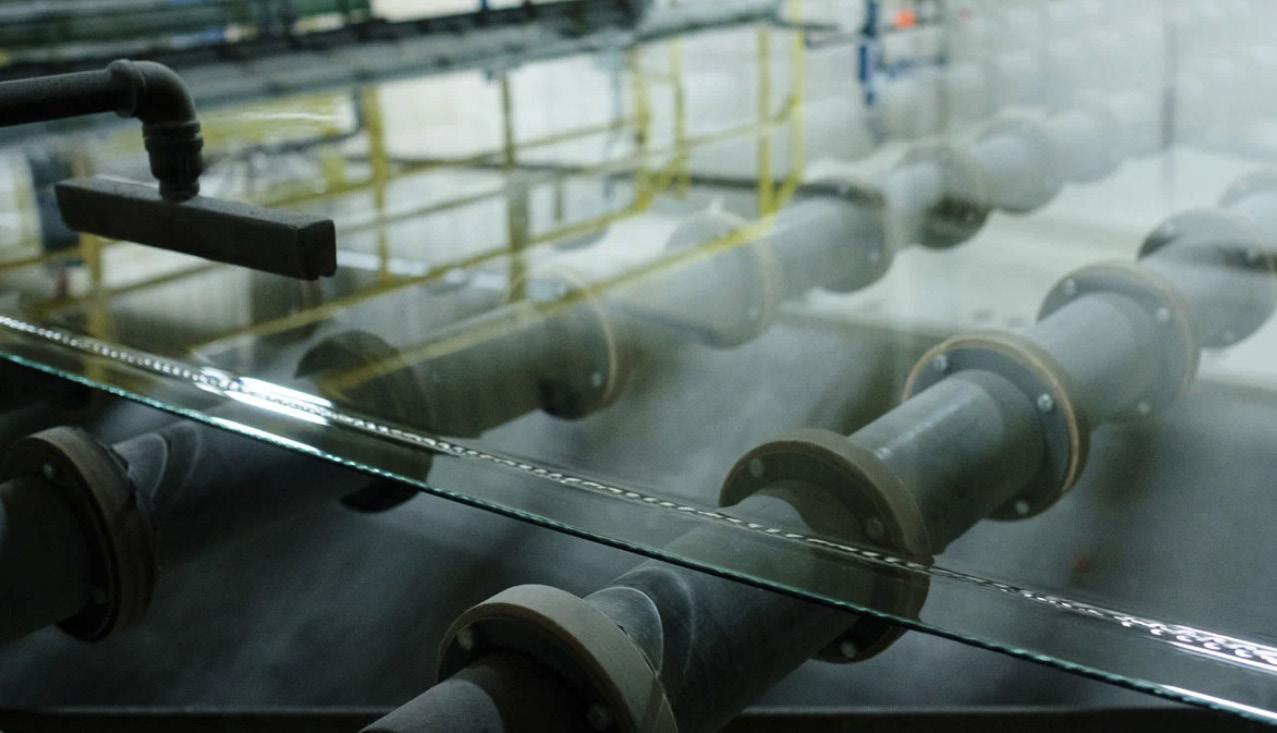
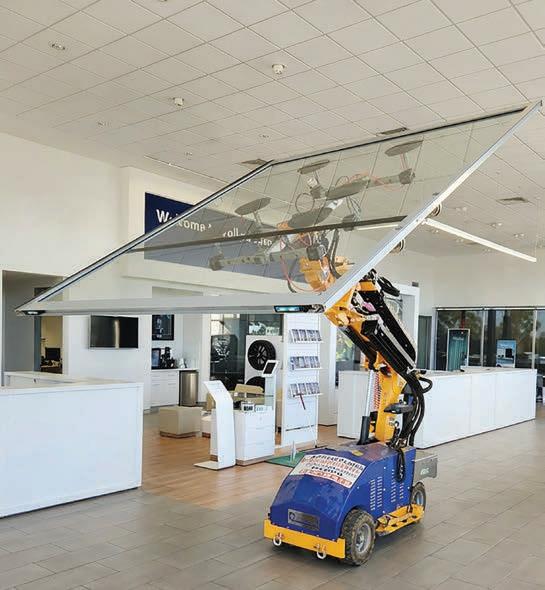
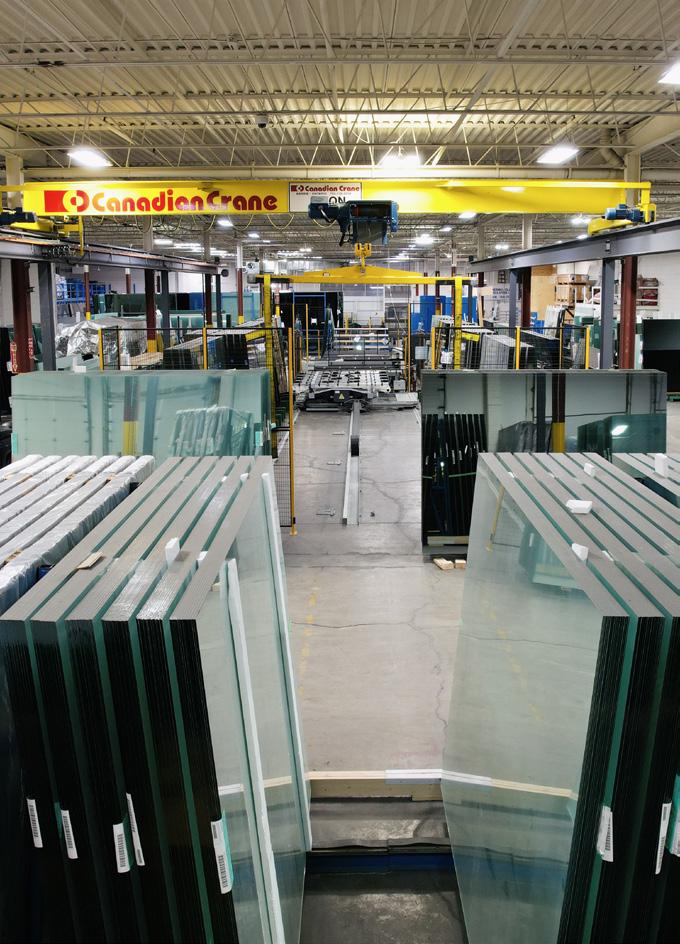
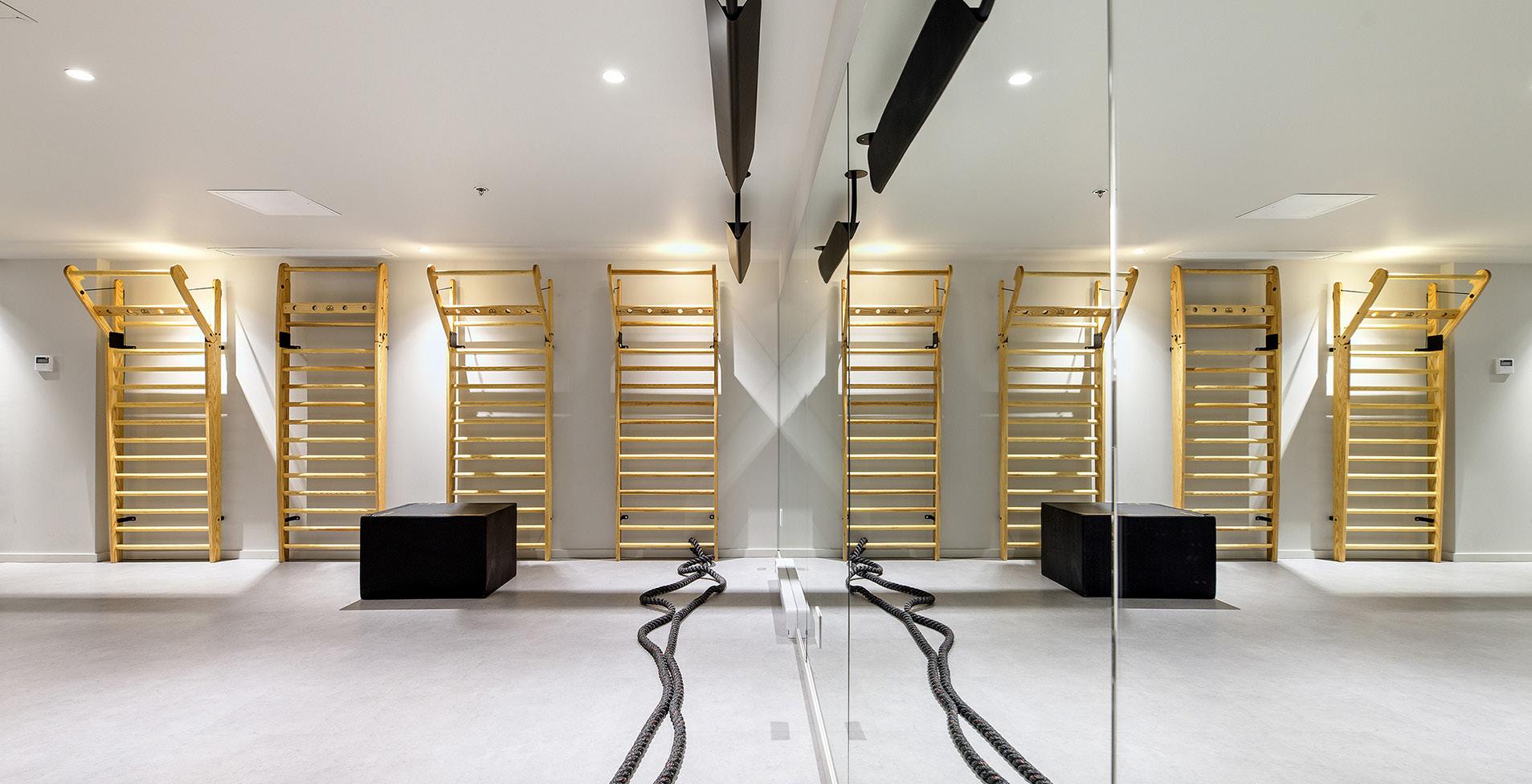
McGrory Glass Systems’ healthcare portfolio features Corning® Med-X® Glass, delivering radiation-shielding solutions trusted in hospitals, imaging rooms, research facilities, and more across North America.
RADIATION SHIELDING / LEADED X-RAY GLASS STOCKED
Industry-leading sheet sizes up to 54” × 108”. All plate sizes and thicknesses cut to exact project specifications and shipped directly to the job site.
COMPLETE GLAZING SOLUTIONS
One source for X-ray, fire-rated, security, switchable-privacy, and decorative glasswith in-house lamination, print/film, and 23,225+ square meters of production.
The overseas opportunity for Canadian glass
GLASS CANADA
Economists and politicians are telling Canadian companies to focus on foreign markets to replace lost U.S. contracts and suppliers. Is that even possible for Canadian glaziers?
16 Under the Glass 24 Hour Thermal Glass maximized productivity before it was cool. Now it’s taking even more steps to modernize and improve.
20 The 7 Deadly Sins of mirror installation
If you thought lust and greed were bad, wait until you read this.
24 Low-E and myopia
Is there a link between low-E glass and nearsightedness in children? We need to be ready to answer the question.
28 Think access
Leaving maintenance access out of your facade design can cause headaches down the road. Luckily, there are easy solutions.
7 Canada’s glass associations
18 Fenestration Canada 27 Fenestration and Glazing Industry Alliance 14 The Engineer by Claudio Sacilotto
30 That’s Rich by Rich Porayko
Episode #85: The alignment problem
Paul Amato of Tallinn Advisory brings 20 years’ of professional experience advising construction companies to the question of how to get the different parts of your organization working better together. He joins GlassTalk to talk about what he means by “alignment”; the elements of a good mindset; the barriers to great customer service and quality; and how to build a culture that succeeds. Take some time with Paul to think about how you do business!
The new word on the street
EDITORIAL
A belated interest in building is growing across Canada.
Suddenly, the hottest word in Canadian politics is “build.” It’s on every leader’s lips as politicians scramble for answers to two huge problems: the new unreliability of the U.S. as a trade partner, and high housing costs that threaten to put home ownership out of reach of the next generation. Building factories, pipelines, ports, mines, power plants and other infrastructure is seen as a way to make us more selfreliant and attractive to foreign investment from around the world, not just from the south. Building housing is needed to increase supply and bring prices down over the long term. As these remarkable revelations are dawning on the minds of our intelligentsia, they are simultaneously finding that the very conditions they promoted are making it almost impossible to do these things.
NEXT ISSUE
• Canada’s Great Glazing
• Top Glass West
In this industry, we’ve felt for quite a while that building stuff was a good thing. Unfortunately, our position was easy to dismiss as self-interested and relegated to second place behind such other concerns as climate change and low taxes. Now, after decades of kicking the can down the road on infrastructure and piling red tape on builders out of a belief that they would always build, the chickens have come home to roost. The federal housing ministry says we need 500,000 starts per year. We’re at half of that and starts in Toronto and Vancouver declined last year. The existing oil pipeline from Edmonton to the west coast is due to hit capacity in two years, but the various stakeholders can’t even reach an agreement to build another one, much less actually start on it. Two attempts by Xinyi to build a float glass plant in southern Ontario were rebuffed by NIMBY groups. High speed rail between Windsor and Montreal (or at least Toronto) has seemed like a good idea for about 50 years, but at this rate aliens are going to have to visit Earth to show us how to do it because everyone here is fresh out of ideas. We’ve just now started building some new nuclear reactors in Ontario after a 50-year hiatus due to concerns over what might happen to people who find the waste 10,000 years from now. I could go on.
The silver lining to all these ridiculous problems is that serious minds are now apparently focusing on them in a serious way. And they will need to because the barriers to building are multifaceted and often outside the control of any one entity. The late-’90s/early 2000s lust to lower taxes gave us municipalities addicted to development charges instead of property taxes. Now, figuring out how to stimulate building is a Mexican stand-off between levels of government over who pays for the needed infrastructure. Municipalities are going to have to find some way to let builders build the kinds of homes people want in the areas where they want them. Activist groups should be politely listened to, not given veto power. Interest rates need to come down and stay down, though that’s going to be hard to do with high oil prices driving inflation. Like it or not, tax dollars will have to flow.
Anyone reading this is an important part of the solution that most of the top economic thinkers in Canada say we need now. Maybe now our voices will be heard. •
GLASS CANADA
June 2026
Volume 38 • Number 2 Annex Business Media P.O. Box 530, Simcoe, Ontario N3Y 4N5
READER SERVICE
Print and digital subscription inquiries or changes, please contact Angelita Potal, Customer Service Rep.
Tel: 416.510.5113
Fax: 416.510.6875
Email: apotal@annexbusinessmedia.com
Mail: 111 Gordon Baker Rd., Suite 400, Toronto, ON M2H 3R1
EDITOR/PUBLISHER | Patrick FLANNERY pflannery@annexbusinessmedia.com 226.931.0545
GROUP PUBLISHER | Danielle LABRIE dlabrie@annexbusinessmedia.com 519.429.5187
AUDIENCE DEVELOPMENT MANAGER | Shawn ARUL sarul@annexbusinessmedia.com 416.510.5181
MEDIA DESIGNER | Alison KEBA
CEO | Scott JAMIESON sjamieson@annexbusinessmedia.com
SUBSCRIPTION RATES
Canada - 1 Year $39.25 (plus tax) U.S.A. - 1 Year $90.17 (in CDN dollars)
Publication Mail Agreement #40065710
Printed in Canada ISSN 0843-7041
Occasionally, Glass Canada will mail information on behalf of industry-related groups whose products and services we believe may be of interest to you. If you prefer not to receive this information, please contact our circulation department in any of the four ways listed above.
Top Glass 2026 was the biggest ever with over 550 attendees visiting 72 exhibitor booths – including 20 first-time exhibitors –representing about a 30-percent growth in both visitors and exhibitors over the previous year.
“Top Glass was more than just a trade show – it was a chance to connect with the people who shape and move the glass industry forward every day,” Keraglass posted to its LinkedIn feed.
“Technoform enjoyed exhibiting at Top Glass last week!” the thermoplastics supplier posted. “From a soldout exhibit floor to insightful conversations with fabricators, glazing contractors, designers and industry partners, Top Glass once again proved to be a key meeting place for innovation and collaboration in our industry.”
“Still buzzing from Top Glass!” posted Yashar Bashari of Sailing International Trade.
The event started on April 29 with a tour of Tri-Temp Glass in Toronto. Guests were treated to an intimate look at the advanced glass fabrication facility, ably hosted by TriTemp’s Denis Odorico and David Lawless. They saw bent glass fabrication; vertical cutting and edging; tempering; waterjet cutting and lamination carried out on advanced new equipment recently installed by Tri-Temp.
“The plant tour is a really special and hands-on event,” commented Val Voznyi of Glass Pro Solutions.
The packed education sessions included talks on Canadian codes and standards; using AI in the glass business; rope access installation methods; and vacuum insulating glass.
“I had a great time at Top Glass – always energizing to reconnect with familiar faces and meet new ones across the industry. The mix of technical insights, new technologies, and real-world discussions made it especially valuable this year,” said Amy Roberts of the Fenestration and Glazing Industry Alliance.
The OGMA Awards of Excellence recognized Contract Glaziers and Moriyama Teshima Architects for excellence in execution and design for Limberlost Place at George Brown College. The 10-storey mass timber building incorporates several “firsts,” including being the first mass timber occupancy building in North America. Built to Passive House energy efficiency standards, the project also features a low-carbon design, smart facade controls and groundbreaking standards for air exchange, daylighting and passive heating and cooling.
“The Ontario Glass and Metal Association (OGMA) was proud to once again be part of Top Glass Conference and Exhibits,” the OGMA posted. “The show gave us a great opportunity to strengthen our presence, expand our network and connect with industry professionals across the glass and metal sector.”
Top Glass West takes place Oct. 21 in Calgary. Registration is open at topglasswest.ca.
COMING EVENTS
June 10 - 13
AIA Conference on Architecture and Design San Diego, Calif. aia.org
World Congress Pittsburgh, Pa. facadetectonics.org
Oct. 14
Glazier Expo Toronto ftiontario.com
Oct. 21
Top Glass West Calgary topglasswest.ca
CANADA’S GLASS ASSOCIATIONS
AVFQ
Last March, we held our Annual Conference with a record-breaking attendance of more than 400 participants! We are now turning our attention to our Omnium, which will take place on August 20 at the beautiful Summerlea Golf Club. We are proud to see just how popular our events have become: all 288 golfing spots sold out in only 20 minutes!
Our new strategic plan is focused on the following priorities:
• Raising awareness of our association;
• Strengthening our connection with members;
• Offering more technical training opportunities;
• Conducting targeted lobbying efforts.
Our executive director, Maggie Champagne, is committed to visiting members across the industry in order to better understand the realities of our sector and stay informed about the needs of all stakeholders.
PGAA
TheProfessional Glaziers Association of Alberta has elected a new president, James Ironhall of Metro Glass. On April 30, representatives from the PGAA attended the Advanced Education Session held at the McDougall Centre in Calgary. Attendees included Gary Porter, Richard Munro (Evolution Glass), James Ironhall, and Stuart Cantrill (Glass Guild). The session led to productive discussions surrounding apprenticeship training, industry risk and compliance and the longterm sustainability of glazing education programs in Alberta. A major topic of conversation
throughout the meeting was student enrollment within the glazing programs at both NAIT and SAIT. Through discussions with Alberta Industry Training (AIT), the PGAA learned that the NAIT glazing apprenticeship intake scheduled for next year will be suspended until further notice unless enrollment numbers improve. While this news is concerning for the industry, it also highlighted an important reality: greater support from the glazing trade itself is needed to sustain these programs. Industry participation, apprentice sponsorship and long-term commitment to training will be critical moving forward. Although SAIT continues to operate its glazing program, there is also recognition that enrollment and industry engagement could be stronger there as well. The PGAA believes that maintaining strong, accessible apprenticeship pathways is essential to the future of the trade. As workforce shortages continue to impact construction across Alberta, investing in training and supporting apprentices entering the glazing industry must become a shared priority.
The association is also aware of recent changes within Alberta’s glass industry organizations. The Glass Trades Association has now been dissolved and is considered defunct. Discussions have begun regarding the possibility of former GTA members joining the PGAA in an effort to establish a more unified voice for the glazing industry throughout Alberta.
AGMCA
Theboard of directors at the Architectural Glass and Metal Contractors Association are excited to wel-
come their member glazing contractors and all industry professionals to the second annual Glazier Expo, which will take place on Wednesday, Oct. 14, at the FTI Toronto Glazier training centre located at 130 Toro Road. Held in partnership with the Finishing Trades Institute and IUPAT glaziers, the event will welcome glazing contractors, general contractors, architects, government officials and skilled trades workers for a full day of networking, education, and demonstrations. This event reflects an ongoing commitment to innovation, education and certification: key pillars in preparing AGMCA apprentices to strengthen and advance the skilled trades workforce. There will be several demonstrations during the day, including a pre-glazed curtainwall installation under job site conditions on our exterior steel structure. The AGMCA is thankful to their industry partners at Alumicor and Stouffville Glass for their contribution and commitment to this important upgrade in skills training.
Guests will have the opportunity to:
• Tour the Toronto-area Glazier Training Centre;
• Learn about glazier training programs;
• Witness live glazing demonstrations, including a showcase of the AGMT (Architectural Glass and Metal Technician) test;
• Explore exhibits from select vendors, each offering industry swag and product insight. Complimentary breakfast and lunch will be provided by the AGMCA in partnership with the FTI and the IUPAT. Drop in any time between 9 a.m. and 3 p.m. To register, please visit ftiontario.com.
OGMA
The Ontario Glass and Metal Association was excited to host our Second Annual 2026 Members’ Meet and Greet on March 26 at Splitsville in Woodbridge. We were thrilled with the turnout and appreciate everyone who attended and helped make the evening a success.
On April 30, the association was pleased to attend Top Glass 2026. At Top Glass, we were proud to present our 2026 Awards for Excellence. Awards director, Luana Buratynski, presented the Award for Excellence in Design to Moriyama Teshima Architects and the Award for Excellence for Execution to Contract Glaziers. Both awards recognized excellence on the Limberlost Place at George Brown Polytechnic.
We were also excited for our inaugural Blue Jays Night Networking Event, held in an executive suite at Rogers Centre on May 22. The event was sold out, marking another tremendous success for the association. Thank you to our sponsors, CS2, Spandreltech and BVGlazing Systems.
Looking ahead, our Spring Golf Tournament will be held on June 17 at Lionhead Golf Club in Brampton, where we will be presenting our 2026 Lifetime Achievement Award and our spring Student Bursary Award. Please register today as tee times run out quickly.
We are also pleased to announce that our ever-popular Woodbine Race Night will be returning this July. Additional details and the event flyer will be circulated shortly, so please keep an eye out for further announcements.
Fenestration Canada leading push to return float glass production to Canada
Fenestration Canada, led by director of codes and regulatory affairs, Adrian Edge, is calling on Canada’s glass industry to help it persuade glass manufacturers to open a float glass plant in Canada.
“Since last year’s trade conflicts, Fenestration Canada has actively engaged with federal and provincial governments to explore pathways for re-establishing float glass manufacturing in Canada,” reads a message to members from Edge. “This year, those efforts have expanded to include discussions with global float glass manufacturers and private equity firms to gauge market interest and identify potential investment barriers.”
Fenestration Canada has posted an “expression of interest” form online that anyone who purchases glass can fill out. The form collects a rough estimate of the amount and kinds of glass the company purchases and asks for an estimate of how much glass the company would purchase from a Canadian supplier, all else being equal. Basic identifying company information is collected, but not shared outside of Fenestration Canada staff. Only aggregated data is passed on to outside parties.
“Canada currently requires the equivalent of roughly 1.7 float glass plants at 600 tonnes per day capacity,” Edge reports. “As part of this initiative, we are aiming to validate interest representing at least 70 percent of one plant’s capacity (approximately 420 tonnes per day). For those members who have already participated – thank you. Early responses already represent approximately 10 percent of this target.”
Farewell to Bill Parkin
The form can be accessed through the FenCan website at fenestrationcanada.ca.
In related news, Canadian Premium Sand has announced a review of strategic alternatives that includes the possibility of building a float glass plant near Selkirk, Man., to produce architectural glass. Previously, the company had announced the Selkirk operation would focus on solar glass for export to the U.S., but trade uncertainty has caused the company to reconsider its plans. CPS is also planning to build a float glass plant in the U.S. Other options under consideration include sale or merger of the company.
Parkin (right) receiving his OGMA Lifetime Achievement Award from former president, Frank Fulton.
Bill Parkin, founder of Burlington Glass and Mirror in Burlington, Ont., passed away on April 12 at the age of 89. Parkin was a long-time supporter of the Ontario Glass and Metal Association and its predecessor, the Metro Toronto Glass Association, serving on its board for 10 years in the ’80s and early ’90s. He received the OGMA Lifetime Achievement Award in 2008. Frank Fulton, former OGMA president, shared details of Parkins’ career. Parkin studied metallurgy at Ryerson Polytechnical in Toronto and went on to become an estimator at Hind and Dauch Paper after school. His first job in the glass industry was as an estimator at New Toronto Glass in 1953. His father, Al, was a glazier there. In 1955, Parkin went to Pilkington as an estimator and moved to sales in 1957. Parkin was an office manager at Pilkington when it opened its second Canadian float glass line in 1970. He once met and shook hands with Sir Alastair Pilkington, inventor of the float glass process. In 1975, Parkin left Pilkington to start Brampton Glass with his long-time friend, Morris Lash. Notable early teammates at Brampton Glass were Worsel Vaughn, later founder of TAGG Industries, and Harold White. Brampton Glass fell on hard times during the recession of 1980 and had to close its doors. Parkin started Burlington Glass and Mirror a year later. His father joined to manage operations and worked in the company until age 75. Burlington Glass was a true family business, with Bill’s entire family – wife Margaret, sons Greg and Stephen and daughters Sarah and Brenda – all working there at one point. Having three generations of Parkins working in the company was a particular point of pride for Bill. His son, Greg Parkin is president of Burlington Glass today..
Kennedy joins Imagic
Imagic Glass in Concord, Ont., has welcomed Andrew Kennedy to its team. Kennedy is a glazing industry professional with 12 years’s experience across the GTA, Ontario, eastern Canada, and the northeast USA, bringing a deep expertise in exterior facades and interior glass solutions. Some of Kennedy’s standout projects include Terminal One of Pearson International Airport, the CIBC Towers in downtown Toronto and First National Bank in Pittsburgh, Pa. Kennedy will work alongside sales manager, April Donvito, to support Imagic Glass customers and ensure continued exceptional service. He considers his strengths connecting with architects, glazing contractors and general contractors alike, turning complex projects into seamless results. Outside the office, Kennedy is a proud dad and granddad, avid traveler and sometimes a motorbike-riding sales representative.
Photo:
Aluminum handling manual updated Dvorak named GTA rep for Alumicor
The Fenestration and Glazing Industry Alliance (FGIA) has released an updated comprehensive manual covering the care and handling of architectural aluminum products through project completion. AAMA CW-10-26 Care and Handling of Architectural Aluminum from Shop to Site was last updated in 2015. This manual describes steps like visual inspection, care needed during mill fabrication and packing, tips for shipping to fabricators, proper unloading and storage techniques, installation checks and more.
“This latest version aims to minimize issues after the production and finishing procedures,” said Carl Troiano (Trojan Powder Coating), chair of the FGIA AMC Finishes Committee. “This manual can ensure that quality finishes are preserved in the packaging and handling procedures included in it.”
Serving Alumicor customers from Ontario to the Atlantic Coast, Cass Dvorak’s sales territory has expanded to include the Greater Toronto Area. Sought out for his expertise and recognized for building strong customer relationships, Dvorak will focus on growing these connections, elevating service and enhancing the experience for all Alumicor customers. Dvorak collaborates with his Alumicor colleagues to support glazing contractors and installers with their selection and specification of aluminum-framed curtainwall, storefront, window and entrance systems for commercial, institutional and high-rise residential projects.
Committed to Alumicor’s planned growth and continual improvement, Dvorak has moved to the company’s Toronto headquarters and reports to director of sales, Jeff Thompson. “I am looking forward to continue growing Alumicor with our team in Ontario,” said Dvorak. “In this expanded role and primary location, I can be even more responsive to our customers’ needs and expectations, uplifting their service to the next level.”
Drawing from nearly 20 years of experience in the architectural products industry, Dvorak started with Alumicor in 2018 as a shipping receiving supervisor and joined the inside sales team in 2020 before transitioning to the client development management team in 2023. His previous positions included roles with Overhead Door, Jeld-Wen, and Alumitech Architectural Glass and Metal. Dvorak is a graduate of the University of Winnipeg and has completed additional training through Dale Carnegie. A member of Construction Specifications Canada (CSC), he also earned his Certified Technical Representative credential and represents Alumicor at many of CSC’s events and conferences.
Can we pivot?
Economists and political leaders would like to see us set sail for foreign shores seeking new realms of opportunity. Past efforts proved difficult.
Photo: Alberto Andrei Rosu/Shutter Stock
pivot?
Assessing the possibility of decoupling from the U.S.
by TREEN HEIN
While the trade war with the U.S. has fizzled out in recent months, more battles could be coming as soon as this summer, further affecting companies that export into the U.S. market in the glass sector and beyond. How should Canadian glass fabricators and glazing best view the U.S. market at this point, and should they look to other markets?
First, a review of the market south of the border. It wasn’t far into 2025 when U.S. president Trump made unprecedented threats of 25-, 50- or even 100-percent tariffs on all Canadian goods entering his country. The worst of those threats, thankfully, never materialized and most of the tariffs that might have affected exported Canadian architectural glass products don’t apply as long as they’re exported with Canada-US-Mexico (CUSMA) country-oforigin paperwork.
However, as Dallas Paquette, president of Toronto-based window manufacturer Everlast Group, explains, the Section 232 tariffs on aluminum, steel and copper are “fairly high,” [50 percent] and “are based on full value, not the component value. For aluminum exporters like Everlast, this has taken quite a toll.”
Everlast Group CEO Mike Bruno adds that “since most of our raw material costs are based in U.S. currency – whether we buy them here in Canada or abroad– the ‘cheap loonie’ no longer provides a meaningful buffer when exporting.”
The winds of change
Already, several high-profile Canadian glass fabricators (Integro, Antamex and TAGG) have filed for bankruptcy. Tariffs on their exports and counter-tariffs on their imported supplies were mentioned in their bankruptcy filings as contributing factors. The additional costs suddenly dumped on their contracts for U.S. projects – long after signing – blasted their profit margins.
And no one knows what the future may bring. For a Canadian glass company, taking on a major U.S. glazing project requires upfront commitment of tens of thousands of dollars or more in engineering, component fabrication, shipping and work on site. Return on those costs is at risk should the trade landscape suddenly change. The stability that once existed between the Canadian and U.S. markets was very positive for many exporters.
Other factors have contributed to our narrow focus on U.S. markets. The spread between U.S. and Canadian currency gives exporters an advantage when they collect U.S. dollars in payment and pay Canadian costs (such as labour) in Canadian dollars. Economists have long blamed this effect for our identity as “hewers of wood and drawers of water” who never invest in innovation, domestic value-added manufacturing and productivity improvements. It’s just been too easy to simply extract and ship resources without taking on the up-front risk of major investments in plant and people.
The U.S. market is a relatively easy market in other ways. Canada and the U.S. share the same language, basic culture and, in the case of fenestration products, the same basic product landscape. For centuries, relying on sales to the U.S. was a rational and safe approach for Canadian businesses in many sectors.
But that era may be over. In response to President Trump’s musings about ripping up trade agreements and perhaps deciding to cripple the Canadian economy, Prime Minister Carney has stated that the special trade relationship that Canada has shared with the U.S. is “over.”
COVERSTORY
He’s calling for Canadian businesses to look for new markets, and some are pivoting to do so. Michael Klopchic, a senior vice-president at RBC Commercial Banking, notes that “within my team, we’re starting to see more Canadian businesses are increasingly exploring opportunities beyond our borders. What I’m hearing from clients is that access to new markets has improved, thanks to trade agreements, funding programs and global networks.”
But what would be required for Canadian glaziers or glass fabricators to start selling to projects in other countries like Germany, Brazil, China or India? Is it even possible?
Markets differ widely
Beginning on a cautionary note, Adrian Edge, director of Codes and Regulatory Affairs at Fenestration Canada, reminds us that international fenestration markets are fundamentally different in many ways from Canada and from each other, which would make entry quite challenging. “Western and eastern Europe, China, India, Australia, Brazil and so on – each operates with its own regulatory frameworks, performance expectations, construction practices and business cultures,” he says. “Successful diversification depends on understanding those realities in detail. That alone places Canadian companies at a disadvantage. Most international markets are, at a minimum, aware of North American products and practices, but the reverse is less consistently true.”
Canadian fenestration would need to integrate seamlessly into local construction methods. Edge explains this is not always easily feasible. For instance, our residential products are largely designed around flange-based installation, a method that is not common in other parts of the globe. In other countries, internal anchoring systems reign, says Edge, and the Canadian approach offers no clear, transferable advantage that would cause customers to switch from anchoring systems, which are tried, true and trusted in their local markets.
Price presents another constraint. “Canadian manufacturers do not benefit from global scale, nor do we hold a distinct cost advantage in labour, materials or production,” Edge notes. “In limited
Tips from RBC’s 3-Step Blueprint to Go Global
Stage 1: Laying the foundation
Ensure your preparation is thorough. Regulatory compliance, product adaptation, logistics and market-entry expenses will strain your resources if not fully understood. Also maximize financial readiness to handle longer payment cycles, more inventory in transit and higher upfront costs.
Stage 2: Executing your entry plan
At this stage, many of your earlier assumptions are tested. Costs are more defined, responsibilities are allocated and key terms – such as payment structure, risk ownership and delivery timelines – are negotiated and finalized. Integrate outside support – whether through funding, financing or advisory input – to ensure the best deal structures.
Stage 3: Expanding strategically across multiple markets
Once you’ve established a foothold in one market, it may make sense to expand further. Take a measured approach (testing new markets, building relationships, validating demand) and only commit once there’s clear traction.
Source: rbcroyalbank.com
The Canadian fenestration industry may need to prioritize durability.
cases, such as in parts of Europe, Canadian products may appear cost-competitive due to simpler configurations, including single-point hardware or thinner profiles. However, any nominal advantage is likely offset by transportation costs and differences in perceived value tied to performance or durability.”
Taken together, these factors suggest to Edge that Canadian fenestration products are not currently well-positioned to take on competitors in global markets or compete with what they import already.
Paquette’s views are similar. “As far as western Europe goes, the product is just so different (tilt-and-turn versus projecting/sliding), it’d be hard to turn the market,” he says. “I’ve long thought that the U.K. is possible, but they are facing many of the same issues as Canada as they untangle from Brexit. They recently unveiled a new ‘Modern Industrial Strategy’ initiative which isn’t too far different than Mr. Carney’s plan.”
Looking at countries south of the U.S., Paquette considers these markets basically
out of the question for two reasons: low labour costs and cheap access to primary materials like PVC, glass and aluminum. In fact, he reports that “many Latin American companies are net-exporters of windows. We see them more and more in the southern U.S.”
Making it work
Circling back to European or Asian markets, Bruno believes that successful market entry would require support for Canadian manufacturers in the form of federal export tax grants. “The costs of entry and competition are simply too high to tackle alone under the current structure,” he stresses. “Furthermore, a significant hurdle is our inability to source raw materials locally within Canada. Specifically, finding reliable glass and hardware sources is a major challenge. Relying on international supply chains for these components remains one of the biggest obstacles we face in becoming competitive in other global markets.”
For his part, Edge believes that to find international success as a fenestration exporter, Canadian products must become distinct. The opposite has happened, because Canadian standards, programs and regulatory expectations have historically aligned closely with those of the U.S. (though this has also obviously supported countless cross-border business deals). “Becoming more distinct does not require
full separation,” says Edge, “but it does require the ability to define and operate within our own framework, particularly in standards, regulatory expectations and programs licensed from the U.S., such as Energy Star. Without that, establishing or communicating a unique value proposition internationally is difficult.”
Edge also suggests that the Canadian fenestration industry may need to prioritize durability over broader lifecycle analysis in order to enter international markets. “Much of the current global focus has been on embodied carbon, particularly A1 to A3 stages,” he explains. “While important, this approach emphasizes impacts at the point of manufacture rather than performance over time. Canadian conditions suggest a different starting point makes sense for us.” A focus on durability, including service life, aging trackability, repairability and component replacement – in effect, understanding how long products last and how they fail – could reshape how lifecycle value is
assessed, says Edge, and position Canada ahead of this particular value alignment. By first establishing durability expectations for glass, hardware and extrusion systems (including service life, aging behaviour and repairability), material and product development can be directed toward meeting those outcomes. In that context, Edge believes Canada’s resource base can become an enabler of differentiated products, rather than simply a supply input.
Using existing expertise
Indeed, Edge believes Canadian fenestration companies could fill a need that no one else is paying much attention to globally: windows with extreme cold-climate performance and durability. He says that despite increasing global interest in window service life, lifecycle performance and long-term asset management, no particular country has specialized in these areas. It is a gap that Canada is well-suited to fill. Many Canadian products already
achieve high levels of performance and durability, Edge notes, and, if further matured, this could extend to include more advanced approaches for long-term durability, including the ability to demonstrate aging trackability as well as a greater focus on repairability and component replacement throughout a product’s life. Canadian experience with harsh environmental exposure could therefore “provide a foundation,” Edge says, “for targeted participation in markets or projects where durability is a primary concern.”
Probably not
When you ask a Canadian glass person about the possibility of pivoting the offshore markets, the mood gets pessimistic in a hurry. And not because Canadians are lazy or defeatist, but because there are very real barriers that few see a good way to overcome. The answer to the question “Can we pivot?” is “Probably not.”
But can you pivot? That’s a question only you can answer. •
by CLAUDIO SACILOTTO
Claudio Sacilotto is director of engineering for
The path to marketdriven innovation
Product innovation is essential to a company’s long-term success. My company, like many organizations, invests a lot of time and energy establishing a culture of innovation. It’s a strong starting point, but culture alone is not a strategy. In my experience, consistently delivering business-building results requires a structured process that channels the best ideas into market-ready, commercially viable products. The goal is not novelty for its own sake but finding the intersection between creativity and real market demand. Viable innovations solve a problem for my customer or create measurable value for stakeholders across the building lifecycle.
The starting point in my process is identification of which innovations create broad, longterm value. In the building-products sector, this process begins with insights which can come from multiple sources: market trends, shifts in building practices, regulatory pressures, and, most importantly, customer pain points. I find that customers are typically the most reliable source of market-worthy innovation concepts. Whether it’s a developer seeking to maximize usable square footage of a residential unit or a contractor trying to reduce installation time, these real-world challenges are catalysts for market-ready products I can present to my team.
My colleagues in sales and customer support are uniquely positioned to capture this critical customer intelligence. These professionals hear firsthand what customers struggle with, what they value and what they wish existed. When this information is systematically captured and shared within an organization, it fuels a powerful engine for meaningful innovation.
Effective innovation doesn’t happen by chance.
THE ENGINEER
An integrated approach is essential. Alignment with our R&D, engineering, sales and marketing, customer support and operations teams ensures that we assess concepts not only for technical feasibility, but also for compliance with building standards, manufacturability, cost efficiency and market readiness.
This approach also emphasizes collaboration over siloed thinking. Ideas are not simply approved or rejected. We challenge, refine and strengthen them through cross-functional input. Data and analytics play an important role, helping individual teams assess market viability, forecast demand and validate assumptions before significant resources are committed.
An example of this process in action is our new Vertika integrated railing system. The concept originated from conversations with several of our customers. Our discussions explored ways to deliver more livable square footage as well as reduce construction costs in increasingly dense urban environments. Developers were facing pressure to maximize the footprint of residences in multi-family developments without compromising affordability or usability, while improving construction efficiencies. We decided to explore a new type of guardrail system, one fully integrated into the footprint of a sliding door. Our vision was a modern, safe and visually unobstructed alternative to “Juliet” balconies. The result was Vertika. With this new approach, we sought to address key stakeholder challenges: architects seeking design flexibility, developers aiming to maximize return on investment, contractors seeking ease of installation and end users who value livable space. The concept moved through our structured process of cross-functional vetting, iterative design improvements and continuous alignment with evolving market realities. Each stage incorporated feedback from stakeholders, ensuring the product was both practical and impactful.
Effective innovation doesn’t happen by chance. It’s built through an intentional, structured process, keeping the customer at the centre of every decision and prioritizing real-world impact over theoretical potential. By investing the time and energy to design and follow a repeatable system, organizations can transform innovation from a sporadic cultural effort into a consistent driver of growth and competitive advantage. •
Novatech Patio Doors.
Vertika
The only patio door railing system designed as one.
Seamless, integrated design:
Fully integrated within the sliding door footprint for a modern finish while preserving maximum floorspace.
Designed for architects. Built for contractors.
Start your next project with Vertika
Optimized costs & installation:
Interior-only installation: Completed entirely from the inside of the building eliminates the need for cranes, lifts, or swing platforms.
High-rise qualified performance:
Fully compliant: Meets CSA A500 requirements and the 2020 National Building code of Canada (NBC 2020).
UNDERtheGLASS | BY
Chris Meiorin
Before the theory
24 Hour Thermal Glass was optimizing operations before it was cool.
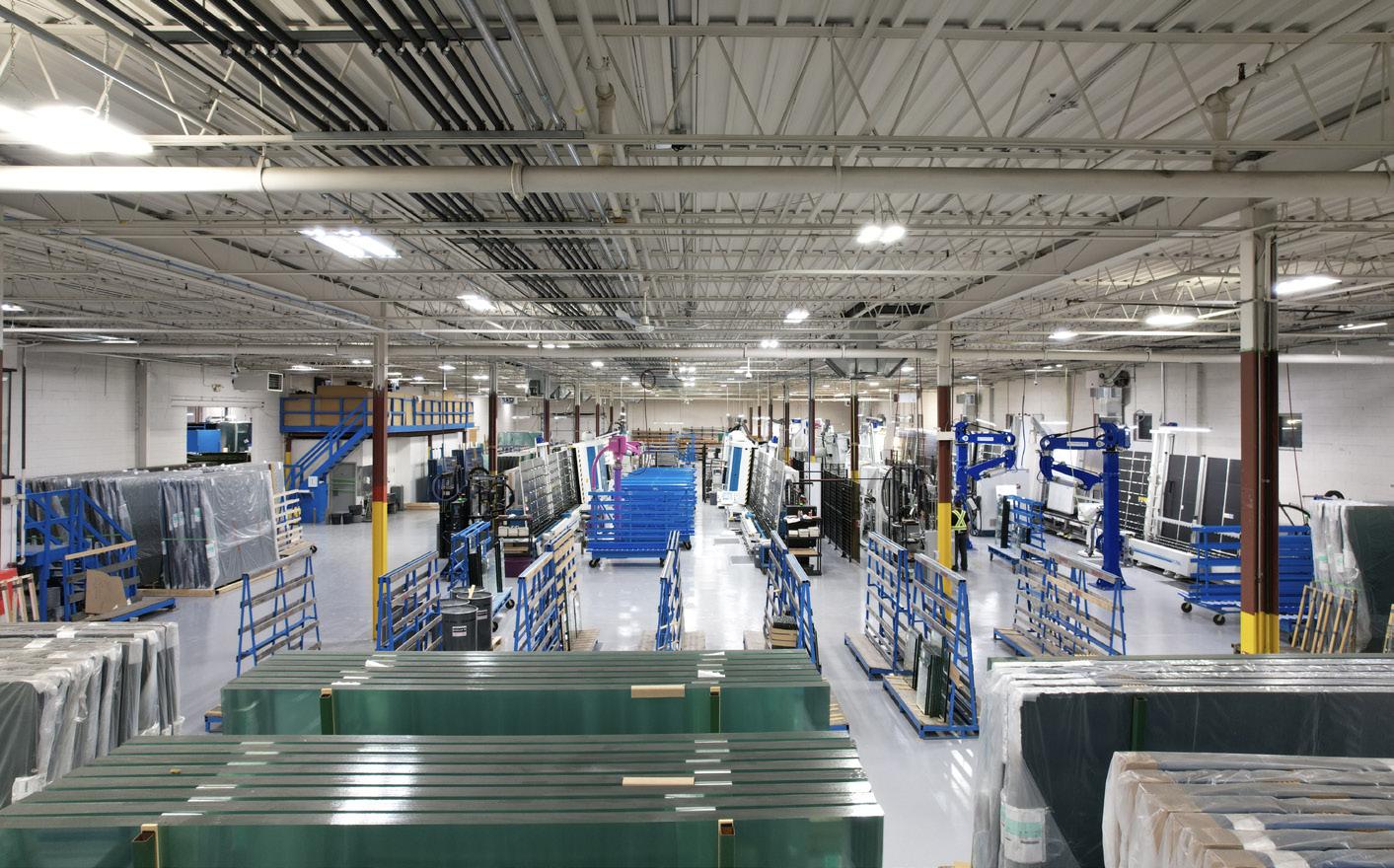
A wide view of 24 Hour Thermal’s 80,000-square-foot manufacturing floor.
By the time much of Ontario’s glass industry began discussing Lean manufacturing, 24 Hour Thermal Glass was already practicing it quietly and instinctively, without a formal name for the process.
I know this because I once asked the company’s founder, Galo Narvaez, whether he followed a LEAN manufacturing philosophy. “What the fuck is that?” he replied. It was not a dismissal, but an honest answer that revealed more about the company’s culture than any management framework could.
Founded in 1986, 24 Hour Thermal Glass began as a focused operation supplying insulated glass units to window and door manufacturers across Ontario, with a primary emphasis on the residential market. Like many successful manufacturers of its era, the company grew through necessity rather than ambition, responding to demand, refining process, and earning trust over time.
Over the years, the company operated out of multiple facilities before settling into its current location. Today, that facil-
AT A GLANCE | 24 Hour Thermal Glass
ity feels permanent by design. The name is on the building. The brand is embedded in the operation. It is not an outpost or a trial. It is home.
While others held financial interests at various points, Galo Narvaez has always remained the primary name and face behind the business. Within the Canadian glass industry, it is not uncommon to hear “Galo” referenced as readily as the company name when discussing insulated glass supply.
From the outset, what distinguished 24 Hour Thermal Glass was not scale, but discipline. Long before efficiency frameworks entered everyday industry language, the company had already built a culture around accountability, repeatability and throughput.
That discipline is visible on the shop floor. In-house quality control includes non-destructive, instantaneous measurement of gas-filled insulated glass units using plasma emission spectroscopy to verify fill rates. This step, still uncommon across much of the industry, removes assumptions from the manufacturing process and
Founded: 1986
Owner: Galo Narvaez
Location: Vaughan, Ont.
Product: Tempered and large-format insulating glass units
Capacity: Four lines, 3,500 units per day
enforces consistency at scale.
Beyond equipment, the discipline lives with the people. Skilled line employees understand the company’s expectations and execute to them daily. Quality is not inspected into the product; it is carried through the floor.
Christina Narvaez has been part of the business since she was old enough to work. For many years, she was a constant presence in the office, coordinating schedules, deliveries and the realities that connect sales commitments to production timelines.
Today, as vice-president, her role centers on operational continuity. She ensures orders move efficiently from intake to production to dispatch, while also guiding how the company presents itself to cus-
All
photos by Chrisopher Meiorin
ing that balance is part of the work.
The timing of this transition matters. Many long-standing customer relationships formed over decades are now passing to a new generation on the client side as well. Christina’s role positions 24 Hour Thermal Glass to meet those counterparts with continuity rather than disruption.
Recent investments have expanded the company’s capabilities without diluting its focus. Additions include large-format insulated glass capacity and in-house tempering, allowing the company to pursue architectural applications while continuing to serve its established residential manufacturing base.
In an industry that still largely communicates through specifications, price lists, and familiarity, 24 Hour Thermal Glass is taking a different position...one that carries its own risk. The company has launched a new website, refined its identity and committed to a more visible digital presence. It’s not a marketing exercise, but as a shift in how it chooses to be understood. The timing is not accidental. As more window and door manufacturers invest in their own glass capacity, the insulated glass market is tightening. For independent producers, the question is becoming less about supply and more about relevance.
Christina sees that shift clearly. “The next generation of customers doesn’t engage the same way,” she explains. “They’re educated, they expect access, and they expect to see how things actually work. If you don’t show it, they’ll assume.”
tomers and partners.
Under Christina’s leadership, 24 Hour Thermal Glass has begun modernizing how it communicates externally. This includes the development of an updated website, a more transparent digital presence, and the use of social media to better reflect the people, processes, and standards that already define the operation.
This effort is not about marketing gloss. It is about visibility and continuity, allowing customers, architects and manufacturing partners to better understand how the company works and what it stands for, while reinforcing trust built over decades.
This generational transition carries its own challenges. Galo remains deeply respected within the organization, often referred to as the godfather. His hands-on involvement built the company, but it also sets a high bar for the next phase. Navigat-
Rather than leaning further into catalog-driven communication, 24 Hour’s new platform at 24hourthermalglass.com focuses on process, people and the realities of production. At the same time, the company continues to invest in capability, including expanded large-format insulated glass and in-house tempering, positioning itself beyond the small-shop segment while maintaining its residential base. The shift is measured, but intentional. It reflects a broader question facing the industry: whether trust is built through what is listed or what is shown.
For a family-owned manufacturer approaching four decades in business, the challenge is not reinvention. It is stewardship, protecting what works while preparing the operation for what comes next. •
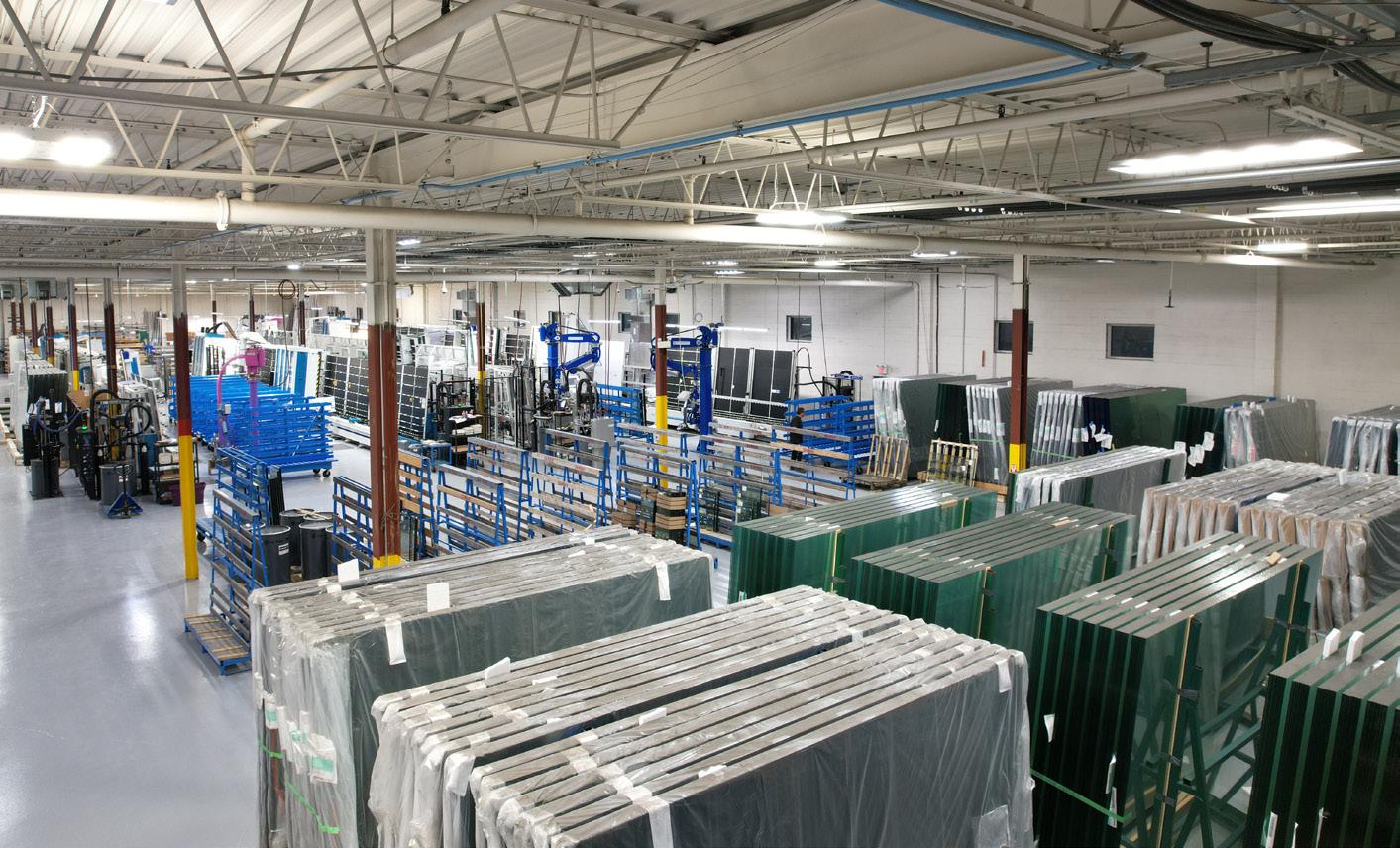
Glass is staged and moved through the facility daily.
Vice-president of operations, Christina Narvaez, is that person who knows everything about the business and makes it all run as a unit.
24 Thermal’s overhead crane has the capacity to move even largeformat glass sheets.
Bringing Canada’s glazing community together
Fenestration Canada’s 2026 spring event season moved into full gear on April 8 with the Canadian Glazing Conference at the JW Marriott Parq Vancouver. Now in its third year, CGC has quickly become an important gathering place for Canada’s commercial glazing community. It is focused, technical, practical and built around the kinds of conversations our industry needs more of.
The day opened with Leonard Pianalto, managing principal at RJC Engineers, presenting “Lifting the Fog on IGU Durability.” His session explored the science behind insulating glass unit performance, seal durability, moisture vapour, desiccant, frost point testing and the real-world question every building owner eventually asks: how long should these units actually last?
Cam Drew of Fenestration Canada followed with “Lean Manufacturing: Principles, Tools, and Effective Communication.” Drawing on his experience as retired managing partner at Thermoproof Manufacturing, Cam brought Lean thinking down to earth. His message was not simply about speeding up production. In many cases, the bigger opportunity is reducing downtime, removing waste, improving communication and giving teams better tools to do their work safely and consistently.
In the afternoon, Jonathan Hovey of Sherwin-Williams presented “Innovations in Aluminum Coatings.” His session examined the role coatings play in the long-term performance, durability, appearance and sustainability of aluminum building products. Topics included surface preparation, pretreatment systems, powder and liquid coatings, AAMA performance standards, corrosion resistance,
CGC delivered exactly what in-person events do best
FENESTRATION CANADA
UV exposure, heat buildup, solar reflectance and the evolving conversation around PFAS. For the glazing industry, coatings are not simply a colour choice. They are a performance decision.
Shiva Zargar, founder of Build Neutral, brought another timely topic to the room with her presentation on Environmental Product Declarations for fenestration materials. As embodied carbon becomes a larger part of construction decision-making, EPDs are moving from “nice to understand” to “you had better understand this before someone asks.” Her session explained how Life Cycle Assessments, Product Category Rules, third-party verification, and credible environmental data are shaping the future of product transparency.
Beyond the education sessions, CGC delivered exactly what in-person events do best: it created space for connection. Attendees had time to visit exhibitors, meet suppliers, continue discussions over lunch, and carry the conversation into the post-event happy hour mixer. A strong conference is not only about what happens from the stage. It is also about the hallway conversations, supplier introductions, follow-up meetings and relationships that grow stronger because people took the time to show up.
Fenestration Canada continued that momentum with FenCon, held April 23 at the RBC Convention Centre Winnipeg. The event brought the industry together in the Prairies for another full day of education, exhibits and networking, with sessions covering condensation at windowsills, automation and smart factories, specifications, EPDs and technical updates.
By the time you read this, Fenestration Canada will have gone to Quebec City for the 2026 Spring Conference, May 26 through 29. The Spring Conference remains one of FenCan’s major national gatherings, combining technical education, association business, supplier showcases, networking and the social events that have become a hallmark of the FenCan community.
From Vancouver to Winnipeg to Quebec City, this spring has shown once again that Fenestration Canada is at its best when it brings the industry together. The issues are complex, the acronyms are many, and the coffee is always necessary. But the value is clear: when our industry learns together, connects together, and tackles challenges together, everyone gets stronger. •
THE 7 DEADLY SINS OF MIRROR INSTALLATION
by MARION PYNN
When it comes to mirror, there’s one question that comes up again and again: “How to install it properly?” Unlike monolithic glass, mirror comes with a silvered backing that can complicate installation and handling. We sat down with glass and mirror fabricators and installers, Frederick Robert of Vitrerie Longueuil and Marc-Andre Deveaux of Vitrerie L.M., to learn their tricks for a smooth and long-lasting mirror installation. Here are their insights, along with best practices from the National Glass Association and product guidelines from Walker Glass.
Mistake #1: Wet mirrors
If mirrors have an ultimate nemesis, it’s moisture. Continued exposure to water will corrode the silver backing right off your mirror, leaving it with all kinds of stain marks and the dreaded “black edge.” Protect your mirror stock by storing mirror in a dry environment with a stable temperature. Look out for standing water, steam, splashes and condensation.
When it comes to the actual mirror installation, a dry environment with stable temperature is best. Of course, mirrors are often used in bathrooms, which are prone to humidity and temperature
Avoid these pitfalls to make beautiful and long-lasting creations with mirror.
All
photos by Walker Glass
fluctuations. In this case, it’s important to keep the area dry during installation and for 24 hours afterward, or until all glues and sealants have fully cured. When installing a bathroom mirror over a sink, you’ll also want to seal the bottom with silicone to protect it from splashes.
Mistake #2: Going too big
Regardless of mirror quality, there’s a limit to the size of panels that can be installed successfully and keep their shape. Robert says that 48 inches is the widest he’d recommend for mirrors. Beyond that size, you’re asking for torsion and strain on the glass.
When it comes to covering a large wall with a mirror, you may be tempted to use a single large piece. However, it’s better to go with multiple smaller mirrors. Here’s why:
First, interior walls aren’t always perfectly straight. They might have curves or dips that could distort the reflection of a very large mirror. By using smaller mirrors side by side, you can avoid that problem and get a clean, accurate reflection.
Plus, installing a massive mirror can be a real headache. It’s hard to manoeuvre through narrow hallways and doorways, and you risk damaging both the mirror and your walls. Smaller mirrors are much easier to transport and install without any fuss.
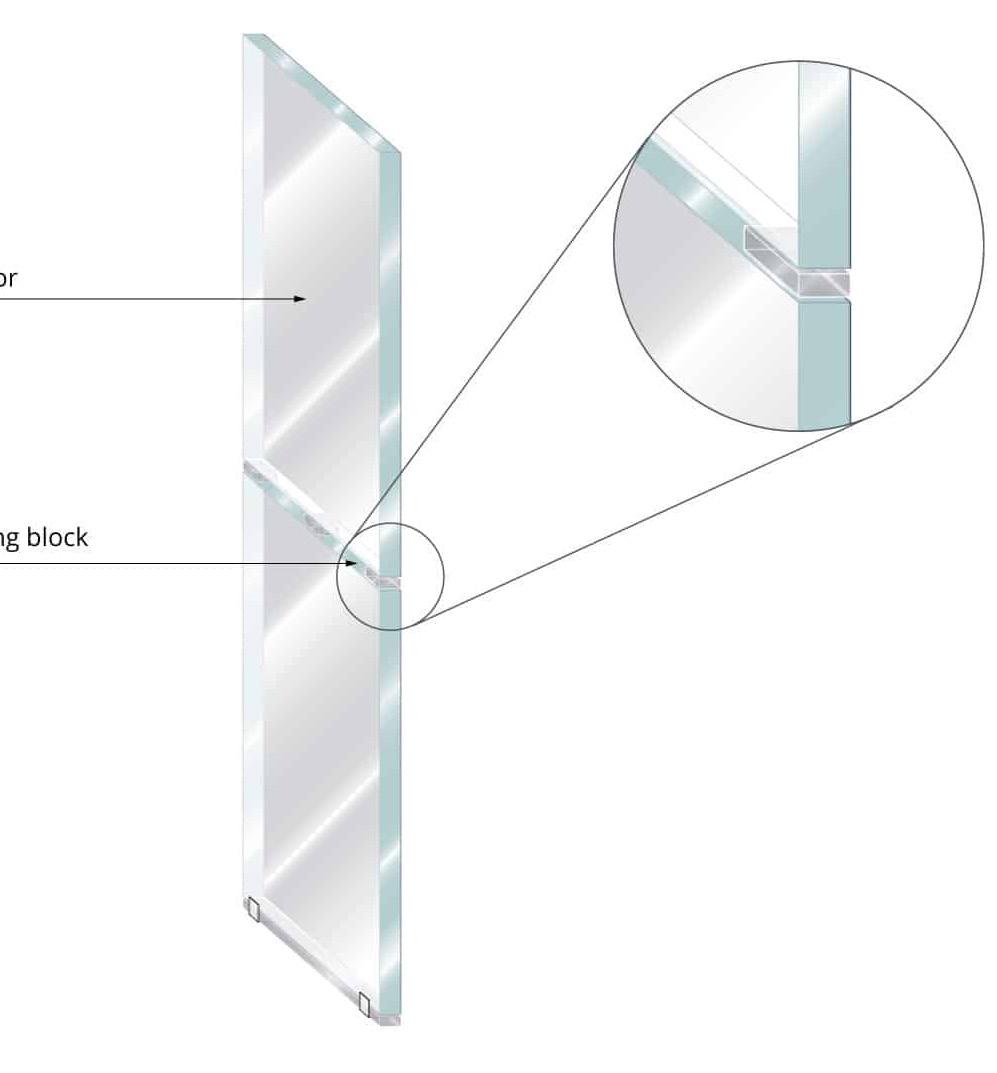
So, if you’re looking to cover a large wall, consider using multiple mirrors. Deveaux and Robert suggest using polycarbonate setting blocks between sheets of mirror to prevent rubbing and support the mirror on top. Combined with other mounting techniques, these little blocks will keep multiple rows of mirror in place.
Mistake #3: Installing mirror on inappropriate surfaces
First off, mirror is an interior material. Indoor use only, please!
Secondly, you should never install mirror on bare wood, drywall, concrete, brick …you get the picture. Everyone we heard from is adamant about this point, including the NGA. Unfinished
Polycarbonate setting blocks can be used as spacers between mirrors. These are available in various widths and colours, right down to onemillimeter thickness.
surfaces are porous, which means they’re prone to collecting moisture. Do mirrors like moisture? Mirrors do not like moisture. Furthermore, adhesives and other chemical mounting methods won’t bond well to unfinished surfaces, so your mirror installation won’t be secure in the long run. Take the time to seal your wall with a proper coat of primer.
Mistake #4: Rushing the process
We know, we know, waiting for paint to dry is as boring as, well, watching paint dry. But you have to do it. If you rush to mount mirror over a damp coat of primer, you’re trapping that dampness between the mirror and the wall: perfect conditions for the moisture to gradually degrade the mirror’s backing. By now, the very thought of trapping moisture behind a mirror should make you cringe.
The NGA’s whitepaper, Installation Techniques Designed to Prolong the Life of Flat Glass Mirrors, recommends leaving glass mirror installation to the end of a project, and we agree. It’s a great way to ensure that the support wall’s surface is fully cured before you put the mirror in place.
Mistake #5: Using the wrong installation products
There are two main options for mirror installation: mechanical and chemical. An ideal mirror installation will incorporate both methods, but you can get by with just one approach.
Mechanical methods include things like J-mouldings, clips and screw, or traditional frames, and they’re sturdier on the whole than chemical adhesives. When you’re using this approach, make sure that your J-mouldings have a drainage hole in the bottom (because standing water means death to mirror), and include spacers behind the mirror to accommodate any variations in the wall. Vitrerie Longueuil and L.M. favour a soft setting tape, which can be twisted for a little extra bounciness.
If you opt for a chemical mounting technique, you’ll be working
with adhesive products like glazing tapes, mirror mastics, silicone and other specially formulated mirror adhesives. You’ll want to watch out for chemicals that can damage mirror backing, such as acetones, toluols, methylene chloride and acetic acid. Any corrosive or acidic ingredients are a no-go. Of course, you’ll also want to confirm that the glue is strong enough to hold the mirror’s weight and that it won’t weaken over time. The safest way to do this is to use products specifically designed for glass mirror installation. A good example is Adseal Production 4551 from Adfast. This product is a neutral cure, solvent-free silicone with very low risk of corrosion. Used correctly, adhesives like this will help ensure a secure and long-lasting mirror installation.
Some building materials can be used and abused and come out without a scratch.
Mirrors cannot.
Tips for glues and chemical mounting of mirrors:
Apply adhesive in lines of small dots to the back of the mirror, each dot about 10 millimeters across. Larger dollops will dry around the edges while the interior is still soft, which stops the mixture from fully drying out. A damp adhesive is a weak adhesive, not to mention the damage that a permanently damp chemical paste can cause to the back of the mirror. Small dots will dry properly and perform better over time.
Create venting “channels” by running your dotted lines of adhesive up and down the back of the mirror, instead of side to side or criss-cross. This way, gases won’t be trapped between the mirror and the wall, and any heavier- or lighter-than-air fumes will
BUILDING ENVELOPE TESTING
(Laboratory & Field)
• Windows, Doors & Curtain Walls
• Insulating Glass Units
• Fenestration Computer Simulation
• Safety Glazing
• EIFS
• Cladding & Building Systems
• Air Barriers
• Thermal Performance
• Condensation Resistance
• Instrumentation & Test Equipment
escape out the tops or bottoms of the channels.
Caulking gun application is ideal. This lets you apply adhesive without touching the mirror with trowels, putty knives, or other tools that could scratch the back. Cartridges, pails and drums of adhesives can be paired with powered feed guns, making them even easier to apply.
Mistake #6: Rough handling
Some building materials can be used, abused and come out the other side with barely a scratch. Mirrors cannot. To keep these products looking their best, you’ll want to handle them with gloves on. The grit, sweat and oils on human hands are hard on mirror backs, while the mirrors’ cut-glass edges are hard on your hands. Between one thing and another, it’s a mutually beneficial arrangement to keep the gloves on.
Speaking of separation, you’ll want to avoid stacking mirrors right on top of each other or carrying multiple sheets at a time. Fine bits of grit on one piece of mirror can scratch other mirrors, and you’re more likely to drop or bump the mirror if you’re trying to handle multiple sheets at once. It may seem like a waste of time to move the sheets one by one, but this will save you time and money in the long run. The same goes for stacking. Piling mirrors on top of one another can lead to scratches, stress and breakage, so you’re better off storing them vertically with spacers between layers.
Mistake #7: Not keeping your business clean
By this point, you know that moisture, dirt and chemicals are hard on mirror. The question is, how do you keep mirror clean without getting it wet? A damp, lint-free cloth with a pH-neutral detergent is a safe bet. You can also spray glass cleaner onto a soft cloth and use that. Here at Walker Glass, we always keep a stash of detergent-infused sponges handy for photo shoots and trade
show displays. Whatever tool you use, you’ll wipe the mirror parallel to the edges to stop water from pooling in joints. Make sure to clean and dry the mirror thoroughly before and after installation. The NGA recommends leaving glass mirror installation to the very end of a construction project, after most of the mess has been cleaned up. The idea is never to
leave dirt, salt, chemicals, or water sitting on the product, especially on the mirror backing.
Handling mirror can be tricky, but with a little care you can ensure a beautiful, long-lasting mirror installation. Fortunately, experts like Frederick Robert, Marc-André Deveaux and consultants over at the NGA are willing to share their tips
and tricks for glass mirror installation. If you’re ever in doubt, you can always check Walker’s Material Handling page for best practices in installing our mirror and other glass products.
To recap:
• Keep your mirror dry;
• Cut mirrors to 48 inches wide or narrower to prevent torsion;
• Make sure the support surface is appropriate for mirror: smooth, sealed, and fully cured;
• Don’t rush the process;
• Use mounting products specially designed for glass mirror installation;
• Handle with care;
• Keep your business clean.
Now that you’re an expert on mirror installation, it’s time to explore the world of mirrors. Beyond standard clear varieties, acid-etched mirror can improve the lighting in a room by softening and distributing light. Why not add a touch of colour with tints? On the other hand, if you’re looking for absolute purity, a Starphire Ultra-Clear mirror might be right for you. •
WHY CHOOSE RIMAC?
LOW-E AND MYOPIA
Could window coatings be causing an epidemic of nearsightedness in children?
by JOE MENCHEFSKI
For most of human history, daylight shaped how humans saw the world. Our eyes evolved outdoors, responding to intense brightness, shifting solar angles and a full spectrum of light that guided eye growth, circadian rhythms and long-term visual health. Today, that relationship has been profoundly altered, not only by screens but by the buildings where we now spend nearly all our waking hours.
The world is in the midst of a myopia epidemic. Rates of nearsightedness among children have risen sharply in recent decades, with a report in the British medical journal, The Lancet, projecting that nearly half of the global population could be myopic by 2050. Screen time and reduced outdoor play are often blamed, but a growing body of research suggests a deeper structural factor may also be at work: prolonged exposure to indoor environments that fail to deliver the intensity and spectral quality of natural daylight.
Modern buildings are optimized for energy efficiency, not biological health. In the pursuit of tighter envelopes and lower energy use, architecture has steadily reduced, filtered and homogenized the light that reaches our eyes. Many contemporary schools, offices and homes appear well lit, yet from a physiological standpoint, the light inside them may be fundamentally different from the daylight humans evolved to live in. The issue is not simply how much light we receive, but what kind.
This shift accelerated with the widespread adoption of LED lighting and low-emissivity glass. Low-E coatings significantly improve window insulation and reduce heat gain, but they also selectively filter portions of the solar spectrum before daylight ever enters a building. LEDs emit light in relatively narrow spectral bands, lacking meaning-
ful amounts of long wavelength red and near infrared light while only approximating natural blue light.
Together, these technologies have reshaped the indoor light environment in ways that are only beginning to be fully studied, particularly during childhood, when eye development is most sensitive to environmental cues.
What makes this especially important is that daylight is not just illumination, it is a biological signal. Numerous studies, including ones from the American Academy of Ophthalmology, show that bright outdoor light slows the onset and progression of myopia in children by regulating eye growth and reducing excessive axial elongation. Time outdoors consistently emerges as one of the strongest protective factors against nearsightedness, often independent of screen use.
When children spend most of their days inside buildings that suppress daylight intensity and alter its spectrum, myopia begins to look less like an individual behavioral issue and more like a built environmental one.
Research from adjacent fields strengthens this concern. Hospital patients recover faster in rooms with daylight. Students perform better and are more alert and motivated in naturally lit classrooms. Office workers gravitate toward windows even when artificial lighting meets technical standards. These are not esthetic preferences. They are physiological responses to biologically meaningful light.
To be clear, the science linking low-E glazing directly to myopia is not yet conclusive. Researchers are still working to isolate variables, measure long term outcomes and separate correlation from
All light is not the same.
Research suggests exposure to light at the very highest end of the visible spectrum may play a role in regulating eye growth.
causation. Multiple studies are underway examining how spectral filtering, daylight intensity and indoor exposure patterns affect eye development over time. The jury, scientifically speaking, is still out.
At the same time, many vision scientists, ophthalmologists and building health experts increasingly suspect that aggressive daylight filtering may prove to be a contributing factor. The biological mechanisms are plausible, the epidemiological trends are concerning and the consistency of findings around outdoor light exposure is difficult to ignore. While definitive proof may take years, there is growing confidence among experts that the current evidence points toward harm rather than neutrality.
What people and policymakers can do
The myopia crisis raises an uncomfortable question: what if some of our most celebrated energy saving building practices are unintentionally contributing to a public health problem? Waiting for absolute certainty may mean waiting too long.
Policymakers can begin by updating building codes and energy standards to treat daylight as a health input, not just an energy variable, especially in schools, childcare facilities, housing and workplaces. This could include minimum daylight access standards, public procurement guidelines that prioritize diffuse natural light and funding for interdisciplinary research linking architectural design to long-term visual and developmental outcomes.
Architects, builders, and developers can reconsider long-standing assumptions about facades and glazing. Full-spectrum daylighting systems that control glare and maintain energy performance do not have to be in conflict with biologically meaningful daylight. There are many options available. Designing for daylight quality, not just quantity, may prove to be a critical next step.
Individuals and families also have a
THINKPIECE
role. In homes, access to daylight, particularly in spaces where children study and spend long hours, should be considered a health factor, not merely a design preference. Choices about window placement, glazing and reliance on artificial lighting quietly shape visual environments during critical developmental years.
None of this requires abandoning climate goals or energy efficiency. It requires expanding our definition of building performance to include human outcomes alongside energy metrics and applying the same precautionary thinking to light that we already apply to air, water and materials.
The buildings we design, regulate and live in today are shaping how an entire generation will see the world tomorrow. If architecture helped filter the sun out of daily life, it now shares a responsibility – with policymakers, industry and individuals – to bring it back thoughtfully, guided by emerging science and with human health at the centre. •
About the author
Joe Menchefski is a chemical engineer with an MBA in marketing. He is vice-president of sales and marketing at Advanced Glazings and hosts the podcast Better Buildings For Humans.
[Editor’s note: Using Cardinal’s Low-E Colour Simulator we can see that, in a double IGU, visible light transmittance is approximately 82 percent. The most common low-E coatings reduce VLT by a further three to 19 percent, depending on the coating selected. Researchers
High-spectrum light appears to activate proteins in the retina that regulate eye growth.
at this time do not know whether a three-to-19 percent reduction in interior visible light can have a long-term effect on childhood eye development. Note that product data shows that low-E coatings may suppress infrared and/or ultraviolet transmission, but do not reduce high-spectrum visible light transmission beyond the stated VLT rating. High-spectrum visible light (“deep violet”) is the range implicated in eye health studies.]
Tri-Temp Glass has manufactured tempered glass for showers, railings, entrance systems, interior partitions and architectural glass applications since 2007.
• Tempered up to 96 x 144
• Custom Laminated up to 86 x 144
• Bent Tempered Laminated to 66 x 96
• Back Painted Glass
• SentryGlas Lamination
• Opaci-Coat-300 Spandrel
by AMY ROBERTS
A recipe for quality control
An effective quality management system is critical for success. It ensures businesses are consistently meeting customer expectations and delivering products with limited waste. To help insulating glass unit fabricators, FGIA has created the training manual, IGMA TM-4000, Insulating Glass Manufacturing Quality Procedures, which provides a framework for quality control. IGU fabricators can use it to create a quality management program that meets the unique requirements of their facilities.
While the manual doesn’t fully address all aspects of quality management, it offers examples of in-plant quality control that fabricators can modify as needed to use in their own plants. The manual recommends fabricator appoint a dedicated person to fully manage the facility’s quality assurance system, reporting to the executive level.
In each plant, the different areas or fabrication processes, such as component preparation, glass washing standard procedures, unit assembly, unit sealing, unit separation, packaging, storage and transport, and preventative maintenance, must be clearly defined. Detailed best practice procedures for each section should be written down and displayed prominently to ensure uniformity in the process between individual operators and work shifts. All operators then need to be trained in these practices and use them as a matter of routine to carry out their job functions. IGMA TM-4000 provides examples of process control documents that fabricators can use as the basis to create their procedures.
TM-4000 offers examples of in-plant quality control that fabricators can modify as needed.
Needless to say, the test equipment used in the quality inspection process must be working properly and be able to accurately measure the desired property. To assure uniformity they should be calibrated against a well-known measurement standard. One can find examples of measuring devices and calibration procedures in QP-S201 of IGMA TM-4000.
It is highly advisable to inspect all the individual components and raw materials like glass, spacers, desiccants and sealants before they are used to fabricate IGUs. Inspection procedures are listed in QP-S202a.
Further, finished IGUs should be inspected either by line workers or quality control personnel before they are shipped or sent for use in an application. Fabricators must determine who will be responsible for this final inspection as well the frequency of the sampling and inspection. If the inspection finds products that do not meet the plant’s quality standards, then they should be set aside for further analysis. Investigation into the problem will provide useful information that can help create a corrective action plan to prevent reoccurrence. QP-S203 of IGMA TM-4000 provides procedures and guidelines that fabricators can follow.
QP-S204 of IGMA TM-4000 offers detailed procedures for the storage and handling of completed IGUs. A uniform process is required to not only prevent damage to glass and/or potential edge seal damage, but also to standardize labelling and inventory procedures.
Guidelines should be established to detail how often and what items will be reviewed periodically in the quality program. The audit can include a review of records, confirmation of the performance of responsibilities of the individuals involved and a system to correct identified deficiencies. QP-S207 of IGMA TM-4000 provides sample forms that can be used during inspections.
A quality program can only be successful if the staff is adequately trained. Continuous improvement is key to ongoing success of a quality control program. Therefore, fabricators are advised to maintain records of sessions to evaluate the effectiveness of training.
IGMA TM-4000 is an easily available and adaptable guide with sample forms and procedural guidelines that IGU fabricators can adopt for their own use instead of trying to create a quality management system from scratch. Get your copy today in the FGIA Online Store! •
FGIA
Amy Roberts is FGIA’s Canadian codes and advocacy director.
Think access
Don’t make maintenance access an afterthought.
These guys need somewhere to tie off. If the facade design doesn’t include one, the owner is going to experience costs and delays when they need maintenance and cleaning.
Modern glazed facade systems are pushing design further than ever, balancing esthetics, structural performance and maintenance. Floor-to-ceiling curtainwall now defines the skylines of cities across Canada and beyond. As facade design advances, maintenance access planning has become an increasing consideration for many projects. Too often, the question of access for future maintenance gets deferred until late in the design process or left to be resolved in the field.
Deferred planning for maintenance, however, often means maintenance crews can’t easily service glazed building systems. That leads to deferred maintenance, with associated performance failures, water ingress and costly emergency interventions. While installing maintenance solutions in high-rise glazed walls can be expensive and disruptive, early planning makes the process far easier. When you include exte-
rior and interior access solutions in design plans, the result is a safer building that performs better and costs less to maintain.
The access problem
The shift toward unitized curtainwall systems has benefitted esthetics combined with improved daylighting and energy performance. But they are also harder to service. Traditional facade construction, such as masonry, offers natural access points that make installation and maintenance flexible. Glass facades, on the other hand, require deliberate, planned access solutions. The silicone bonds and integrated framing that create the continuous look on these facades are, by their very nature, hard to take apart. Furthermore, glazed facade maintenance goes beyond systems hidden behind walls. It also includes exterior preservation. Routine inspection, cleaning, sealant maintenance and component repair all require reliable, safe pathways to the facade. All
these access points must be part of the design and not added after the fact.
Interior access for behind-thewall systems
Behind any modern glazed facade is a layered system:
• Spandrel zones with fire-rated buildups;
• Drainage paths;
• Structural fixings;
• Integrated MEP elements like blind motors;
• Electrochromic controls, sensors and perimeter heating at full-height glass lines.
All of these require periodic inspection, adjustment or replacement. Without planned interior access, getting to these systems means opening up finished walls and ceilings. This can be a costly and disruptive process in any occupied high-rise.
Non-rated and fire-rated access doors provide the solution. With early planning, contractors can install these units in wall, ceiling and floor systems. They can create discrete, code-compliant entry points into concealed spaces without disrupting or demolishing finished surfaces.
Exterior maintenance access
Exterior access determines how glazing is detailed. It includes systems suited to different building heights, facade geometries, and maintenance frequencies. For tall towers with continuous curtainwall, building maintenance units (BMU) are the standard solution. Mounted on the roof via davits or tracks, they cover large glass areas efficiently. But they need early planning. The roof also needs to support their load and the track layout must match the facade’s shape.
Rope access is a flexible, cost-effective option for mid-rise buildings or irregular facades that BMUs can’t easily serve. It relies on tie-back anchors built into the structure or cladding, so they need to be planned early. Retrofitted anchors are often less reliable and can disrupt the building’s appearance.
Swing stages and suspended scaffolding remain the tool of choice for large-scale glass replacement or intensive maintenance. Fixed access walkways and catwalks are relevant where suspended systems are impractical. Think about sloped glazing, skylights and atria. Anchor locations, structural loads and even mullion sizes may need to accommodate access hardware. Bringing glazing
contractors and facade consultants in early helps catch these dependencies before they become costly site issues.
Designing for access from day one
The most effective maintenance access solutions share one quality: they are included in schematic or design development. The earlier access planning is integrated, the less it costs, and the better it performs. Early design-phase access planning should address
• Where future glass replacement is most likely to be required and how the panels will be removed;
• Which wall cavities contain components that require periodic inspection or servicing;
• What fall-protection anchor systems need to be embedded in the structure and how they will be detailed;
• Where rated penetrations will be located and the fire-rated access door specifications required to maintain assembly compliance.
space. Verify that the door placement does not compromise the thermal or air barrier continuity of the wall assembly.
For exterior access systems, glazing professionals should verify the structural capacity of the BMU or rope-access anchor loads during facade engineering. Coordinate track or davit locations with roofing, parapet and coping details to avoid conflicts that compromise weatherproofing. Most importantly, engage the facade contractor and the access system supplier together, early. Exterior access hardware and interior access doors and panels are part of an integrated maintenance strategy that only works when coordinated.
Building in serviceability from the beginning
The glazing industry has advanced significantly over the past two decades, from thermally broken curtainwall and structural silicone systems to dynamic glazing and precision-assembled unitized panels. The next step is to align lifecycle thinking with that same level of innovation. Effec-
Unplanned access leads to emergency interventions, retrofitted anchor systems and demolished wall assemblies.
The lifecycle cost argument is simple. Unplanned access leads to emergency interventions, retrofitted anchor systems and demolished wall assemblies. It costs far more than a coordinated access design would. Beyond direct cost, there are operational costs. Tenant disruption, system downtime and the reputational risk for a building that visibly struggles to maintain its envelope. There is also a sustainability dimension that aligns with where the industry is heading. Buildings designed for long-term maintainability have longer effective service lives. That reduces embodied carbon by deferring energy losses and the material-intensive work of major retrofits or premature replacements.
Specification considerations
For interior access doors and panels, confirm that the fire rating of the access door matches the rating of the assembly it penetrates. Ensure the door dimensions are sufficient to accommodate the tools, equipment and personnel that will use the
tive maintenance access that combines exterior and interior facade access systems, like a fire-rated access doors, can no longer be treated as an add-on. It’s what keeps a high-performance facade performing so well over its service life. The glass may be the face of the building, but the ability to safely reach it, inspect it and maintain what lies behind it determines whether that investment holds its value. Planning for accessibility from the outset is the professional standard that ambitious design demands. The buildings that will best stand the test of time are the ones whose designers had this aspect clearly in mind from the very beginning. •
About the author
Teresa Ndonj is a content marketing writer at Best Access Doors, where she focuses on access solutions and the built environment. She creates content that connects technical building knowledge with search strategy, with a focus on how design decisions affect maintenance, performance and lifecycle outcomes.
by RICH PORAYKO
Rich Porayko is a professional writer and founding partner of Construction
Creative, a marketing and communications company located in Metro Vancouver, BC. richp@ constructioncreative.com
The industry gets practical
The National Glass Association’s 2026 Building Envelope Contractors Conference took place in March in Louisville, Ky., and, fittingly, it served up a little bit of everything: economic uncertainty, workforce anxiety, artificial intelligence, succession planning, technical updates, architects asking for help earlier and bourbon. In other words, a normal week in the glass industry.
NGA president and CEO Lakisha Woods opened with a clear message that the association is listening. She acknowledged the pressures facing contractors: labour shortages, material costs, energy codes, sustainability requirements, project delays, supply chain disruption and the ongoing challenge of delivering quality work at competitive prices. She also emphasized that glazing contractors are not “just installing windows,” but integrating high-performance building systems that determine how structures perform for decades.
Max Perilstein of Sole Source Consultants set the tone early, telling attendees, “I say this every year, but the best of the best is in this room.” It was a fitting line for BEC, which has always been one of the better events because it is built for people who actually have to get buildings enclosed.
Joshua Johnson, founder of The Redemption Collective, challenged attendees to rethink where they look for talent. His session on overlooked labour pools, including justice-impacted workers, was not soft-focus inspiration. It was a direct challenge to an industry that says it needs people but often keeps recruiting the same way it always has. Johnson’s point was simple: if the old pipeline is not producing enough workers, stop staring at the old pipeline.
BEC 2026 felt like an industry trying to get past complaining and into execution.
Succession planning was another major theme, which makes sense in an industry full of family businesses, founder-led companies and longtime employees who know where every skeleton, old shop drawing and discontinued pressure plate is buried. The “New Gen, New Rules” panel brought next-generation leaders from glazing companies together to talk about the messy reality of transition. The takeaway was refreshingly honest: there is no perfect succession plan. There are family dynamics, equity conversations, legacy employees, modernization efforts and founders who “retire” by coming back into the office to stir things up and then leaving again.
One of the sharpest points came from architect Timothy Hawk who argued that glazing contractors need to be brought in earlier as true design partners. As architectural teams lose technical depth to retirement and shifting workloads, the people who know how the wall actually goes together cannot be treated as an afterthought. In plain English: involve the glazing contractor before everyone falls in love with a rendering.
On the technical side, NGA’s Urmilla Sowell and Tom Culp updated attendees on advocacy, codes and technical advancements, including embodied carbon tools, energy code trends, thermal enhancements, school security and daylighting. The code and sustainability conversation is not getting simpler. If anything, it is becoming a full-time job disguised as a few pages in a specification. Contractors who understand the changing rules will have an advantage. Contractors who ignore them will eventually get ambushed by them.
Overall, BEC 2026 felt like an industry trying to get past complaining and into execution. The problems are familiar: labour, codes, risk, succession, technology, project delays and uncertainty. The solutions are not glamorous. Recruit differently. Train better. Plan earlier. Read the market. Understand the codes. Use technology where it helps. Build real partnerships.
And, when all else fails, go to the tabletop reception and talk it out over bourbon. That remains a proven building envelope technology. •