PM40065710
Deals with target pests. Integrates with IPM. Introduced in 2008, DuPont™ Altacor™ insecticide has quickly established itself as a highly effective choice for the control of economically significant pests in Canada’s orchards and vineyards. Powered by DuPont™ Rynaxypyr™, Altacor™ provides broad-spectrum residual control of the pests that matter: Oblique-banded leafroller, Codling moth, Grape berry moth, Climbing cutworm, Oriental fruit moth, plus others. As a new chemistry, there are no cross-resistance issues to worry about, and its low use rate means Altacor™ is easy to use and convenient.
Questions? Ask your retailer, call 1-800-667-3925 or visit www.dupont.ca/ag
With any crop protection product, read and follow label directions. The DuPont Oval Logo®, DuPont™, The miracles of science™, Altacor™ and Rynaxypyr™ are registered trademarks or trademarks of E. I. du Pont de Nemours and Company. DuPont Canada is a licensee. Member of CropLife Canada. © Copyright 2009 DuPont Canada. All rights reserved.
May/June 2009 Volume 65, No. 5 Editor Margaret Land mland@annexweb.com 519-429-5190 888-599-2228 ext. 269 Advertising Manager Sharon Kauk skauk@annexweb.com 519-429-5189 888-599-2228 ext. 242 Sales Assistant Mary Burnie mburnie@annexweb.com 519-429-5175 888-599-2228 ext. 234 Production Artist Emily Sun Group Publisher Diane Kleer dkleer@annexweb.com President Mike Fredericks mfredericks@annexweb.com PUBLICATION MAIL AGREEMENT #40065710 RETURN UNDELIVERABLE CANADIAN ADDRESSES TO CIRCULATION DEPT., P.O. BOX 530, SIMCOE, ON N3Y 4N5 e-mail: lmorrison@annexweb.com
Fruit & Vegetable Magazine is published seven times a year (January, February, March, April, May/June, September/October, November/ December) by Annex Publishing & Printing Inc., P.O. Box 530, 105 Donly Dr. S., Simcoe, ON N3Y 4N5
Page 6
Page 20
Contents Volume 65 • May/June 2009 • No. 5
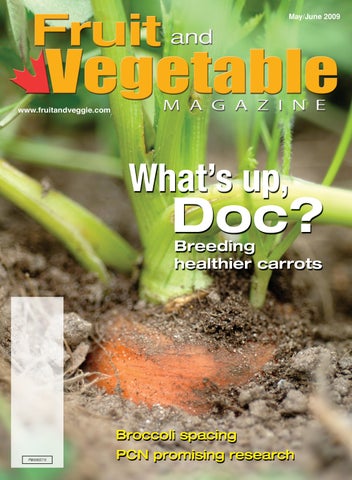
What’s up, Doc? Researchers working on a better carrot By Hugh McElhone ............................................................................................................. 6
Potato cyst nematodes in Canada By Guy Bélair and Dr. Louis Simard .................................................................................... 10
Research examines potato tuber formation ........................................................................................................................................ 13
The ABCs of growing cabbage By Hugh McElhone ............................................................................................................ 14
The dos and don’ts of growing Gala By Dan Woolley ................................................................................................................. 16
The impact of flooding on soils
Printed in Canada ISSN 1488-7959
........................................................................................................................................ 19
Circulation e-mail: lmorrison@annexweb.com Tel: 1-866-790-6070 ext. 206 Fax: 1-877-624-1940 Mail: P.O. Box 530, Simcoe, ON N3Y 4N5
Tighter broccoli spacing can result in higher yields, problems
Subscription Rates Canada – 1 Year $ 12.72 (includes GST – #867172652RT0001) U.S.A. – 1 Year $ 40.00 From time to time, we at Fruit & Vegetable Magazine make our subscription list available to reputable companies and organizations whose products and services we believe may be of interest to you. If you do not want your name to be made available, contact our circulation department in any of the four ways listed above. No part of the editorial content of this publication may be reprinted without the publisher’s written permission. ©2009 Annex Publishing & Printing Inc. All rights reserved. Opinions expressed in this magazine are not necessarily those of the editor or the publisher. No liability is assumed for errors or omissions. All advertising is subject to the publisher’s approval. Such approval does not imply any endorsement of the products or services advertised. Publisher reserves the right to refuse advertising that does not meet the standards of the publication.
By Dan Woolley ................................................................................................................. 20
The pits: Breeding a plum without a stone By Sharon Durham ............................................................................................................ 26
Departments Editorial .................................................................................................................. 4 Letter to the Editor ................................................................................................. 4 Coming Events ..................................................................................................... 21 New Products ....................................................................................................... 22 Briefs .................................................................................................................... 24
www.fruitandveggie.com FRUITANDVEGGIE.COM, MAY/JUNE 2009
PAGE 3
Beetle mania
I
n mid-April, Prince Edward Island joined the ranks of Ontario, Quebec, New Brunswick and Nova Scotia when the Canadian Food Inspection Agency (CFIA) imposed restrictions on the movement of plants and soil from the island. The restriction was put in place in a bid to help control the spread of a new pest for the province – Japanese beetle. According to the CFIA, the pest was detected on P.E.I. last year during a plant pest survey conducted by the agency. The survey indicated the Japanese beetle population was an established one, meaning regulatory control measures had to be put into place for the province. According to a recent report from the CBC, the CFIA doesn’t believe this new restriction will impact P.E.I. too severely. “Right now Prince Edward Island is surrounded by areas that are regulated for Japanese beetle, including Ontario, Quebec, New Brunswick, Nova Scotia and most of the eastern seaboard of the United States,” Dawn Miller-Cormier, the CFIA’s area network specialist for horticulture, is quoted as saying. She adds that material moving from P.E.I into those areas will not be restricted but material moving into Newfoundland and Western Canada will be. The CFIA is also quick to point out there will be no compensation supplied to growers for any plants destroyed due to infestation by Japanese beetle. Apple, berry, grape and tender fruit producers in eastern Canada are familiar
with Japanese beetle, which was first discovered in North America in 1916 and found in Canada (Yarmouth, N.S.) in 1939. While turf is the favoured home of the pest in its larval stage, adults are the heavy feeders, damaging both the foliage and fruit of more than 250 host plants. Just a few days before the CFIA’s announcement, a report was released by European researchers highlighting the financial cost invasive species – such as the Japanese beetle – have on agriculture and the environment. Using data from the Delivering Alien Invasive Species Inventories for Europe (DAISIE) project, the Spanish researchers examined terrestrial vertebrates and invertebrates and put together a “Top 10” list of invasive species in Europe. While Japanese beetle was not on the list (Canadian geese were), the research did show that terrestrial invertebrates, such as insects and spiders, wreaked the most financial havoc, even though they had the narrowest range of effects. The authors estimated that the financial cost of crop losses due to alien insects in the United Kingdom is about $3.7 billion (US) annually. The researchers stressed that the major issue for the management of invasive species is that their impacts are not all known. Only 10 per cent of invasive species in Europe are actually known to scientists and, although the U.S. and Canada understand
the way invasive species disrupt agriculture and the environment, the countries still lag behind in creating an inventory of known invasive species. “It is important first to continue exploring the impacts of ‘unknown’ species,” said lead report author Montserrat Vila. She added that once scientists have a more comprehensive idea of what makes an invasive species invade, then researchers can make better predictions about future damage. The European researchers are suggesting that existing federal, state and local assessments in the U.S. (and Canada) would provide a good start for an inventory of the North American continent. The database could interface directly with DAISIE. “We need to harmonize the existing information on impacts across species and across regions,” said Vila. “Then, finally, we will be able to create institutional bodies across sectors, such as agriculture … to tackle the prevention and management of impacts of biological invasions.” It sounds like a good idea, especially considering the way the world appears to be “shrinking.” Less than 100 years ago, no one in Canada had even heard of or seen a Japanese beetle, which is native to Japan. Now, almost half the country has restrictions placed on it because of a little beetle. ❦
Letter to the Editor Re: Bill 132 – Selling fruit wines at farmers’ markets This local beverage issue has been ongoing since before 2006. Bill 132 passed second reading unopposed on December 11, 2008 and was referred to the General Government Committee. At present there is no indication of a date for the General Government Committee Hearings. Whether or not Bill 132 moves forward will depend on the mindset and the respect of the Ontario authorities charged with retaining the status quo or making changes to the Liquor Licence Act. Hopefully democratic due process will take place and Bill 132 will eventually PAGE 4
come before the legislature for third reading and a vote by all MPPs. Whether or not changes are made to the Liquor Licence Act, it seems to be more of a psychological question than a common sense question. There is also a question of respect when different perspectives are discussed by the proponents of Bill 132 and its detractors. Some of the questions that Ontario authorities need to feel comfortable about include, • Ensuring social responsibility and public safety
Concerns by the socially responsible organization MADD • Issue of International Trade — Local wine is more environmentally desirable, and Ontario research of non-Ontario jurisdictions on 1-3 above. This research must then be made available to all. If any research has been performed to date on other jurisdictions in Canada, U.S.A. or the world, this information has not been made available to Fruit Wines of Ontario (FWO), the Ontario Federation of Agriculture (OFA) •
FRUITANDVEGGIE.COM, MAY/JUNE 2009
Yours truly, Bert Andrews Milton, Ont. FRUITANDVEGGIE.COM, MAY/JUNE 2009
RE N GI OW ST ER ED
or Farmers’ Markets Ontario (FMO). If this were only a rural issue, Bill 132 or its equivalent would have been problem solved with the necessary regulations put into place for selling fruit wines at farmers’ markets, years ago. Leaving a small fruit winery industry (about 15 to 20 wineries) hanging for years with some hope but no real action is totally unfair. For my personal part, I have worked on this issue for years with no compensation and am now retiring. It has been very discouraging, even though the selling of fruit wine at farmers’ markets in other jurisdictions makes common sense. How do you explain to new and young fruit winery owners or potential owners that Ontario authorities appear not to care about the future of small rural fruit winery businesses? Can someone in authority please assure FWO, the OFA, FMO and other supporters of Bill 132 that Ontario authorities will research selling wine at farmers’ markets in Alberta, Quebec, New Brunswick, Nova Scotia and Ontario’s St Lawrence Market? Research could also be expanded to the U.S., including neighbouring New York state and Iowa. It would seem that without an Ontario study of other jurisdictions, Ontario authorities and rightly so will not feel comfortable about addressing issues one to three above. As a supporter of Bill 132, our industry would also not feel comfortable unless we have input into the necessary regulations surrounding the sale of fruit wines at farmers’ markets in Ontario. In closing, it seems important to stress: If there is a will, there is a way. Bill 132 is as green and local as it gets. Only a pilot project is proposed, that can be pulled immediately if any problems with one to three above are found. A type of special occasion permit as required in other jurisdictions along with other necessary regulations is a no brainer for both proponents and detractors. Fruit wineries are totally supportive of the necessary regulations that must be in place regarding social responsibility and public safety. Ontario farm families producing high class Ontario Quality Certified (QC) fruit wines have the potential, if supported by the Ontario authorities, to be world leaders in the production of fruit wines. We have the climate and the fruit. A date needs to be set for due political process regarding the General Government Committee. Sustainability through the marketplace of farm family fruit wineries needs to be supported by the Ontario authorities as fruit wineries receive no government grants. A positive comfort level needs to be found by both the majority proponents and the minority detractors of Bill 132. This can probably only be achieved by Ontario authorities doing research into other jurisdictions. On behalf of our industry and the many supporters of Bill 132, may I have a response from the Ontario authorities to the suggested action plans outlined above? Thanking you in advance for your reply. ❦
TWO THINGS ALWAYS IN SEASON: BOOTS AND LONG-LASTING RESIDUAL. Control weeds before they start and keep control with the long-lasting residual of Chateau® Herbicide. Chateau stays where you put it. It’s preemergence protection that gives even tough weeds the boot. Chateau Herbicide is registered for use on tree fruit, grapes, strawberries, highbush blueberries, asparagus, dry-bulb onions and potatoes. For details see your dealer or call Engage Agro at 1-866-613-3336.
| www.valent.ca | 519-822-7043 Read and follow the label instructions before using. Chateau is a registered trademark of Valent U.S.A. Corporation. © Valent U.S.A. Corporation, 2009. All rights reserved.
PAGE 5
Researchers working on a better carrot By Hugh McElhone
T
he ubiquitous carrot is no longer considered a boring vegetable staple but has become a trendy snack food among consumers looking to improve their health. Carrots have been grown as a cultivated crop for approximately 1,100 years, says researcher Philipp Simon, with the horticulture department at the University of Wisconsin. And they were not always a brilliant orange in colour, nor the slender uniform size seen in grocery stores. The heritage carrots of old grew to all shapes and sizes and were generally white, red-white, purple, red, yellow, as well as orange. Coming from the species Daucus carota, carrots are naturally high in sugar, minerals, antioxidants and provide a rich source of dietary fibre. Carrots are also an excellent source of beta-carotene, which the body metabolises into vitamin A. These health factors have led to their increasing growth in popularity. In 1975, North Americans consumed an average of four pounds of carrots per person per year. By 2007, that had increased to 12 pounds per person. “The development of the baby carrot has led to the boom we’re seeing now,” says Simon. “They’re convenient and easy to eat. Just open the bag and pop them in your mouth.”
The market segment for carrot juice has been growing steadily according to Philipp Simon. PAGE 6
Health factors have led to an increase in popularity for the humble carrot. In 1975, North Americans consumed an average of four pounds of carrots per person per year. By 2007, that had increased to 12 pounds per person.
Consumers can also get their hit of betacarotene through the convenience of carrot juice. While Simon is not sure who the
main juice consumers are, he says that market segment has been growing steadily. Simon says carrots have other uses in
Ontario carrot trimmer implementation project The Pest Management Centre (PMC) and Agriculture and Agri-Food Canada (AAFC) recently posted a call for proposals to conduct demonstration trials to promote carrot foliage trimming technology for reduced risk management of white mould. White mould in carrots is caused by Sclerotinia sclerotiorum, a fungus that continues to pose a serious threat to carrot production across Canada. Recent report indicate losses of $1,000 to $1,600 per hectare in stored carrots in Prince Edward Island and up to 15 per cent crop loss in Nova Scotia. In a previous PMC funded project, AAFC researchers in P.E.I. successfully built, demonstrated and promoted the adoption of a mechanical carrot foliage trimmer prototype. The project demonstrated that foliage trimming alone (without the use of fungicides) significantly reduced carrot loss due to white mould in the field and in storage. From this research, growers in the
Atlantic provinces are incorporating the use of the trimmer in commercial production systems. Oxford Frozen Foods, operating in Nova Scotia, built and used a trimmer on approximately 1000 hectares of carrots in 2007 and 2008. The trimming technology consists of a mechanical device that laterally trims carrot tops, removing a portion of the canopy between the rows. Research has shown that by opening up the carrot canopy through trimming, there is an increase in sunlight penetration and airflow, creating an unfavourable climate for white mould development. The purpose of the project was to allow Ontario carrot growers the opportunity to test and evaluate the technology in Ontario production systems. A funding limit of up to $75,000 for up to three years was available for the project. For more details on the project, visit www.merx.com and type “carrot” in the search box. FRUITANDVEGGIE.COM, MAY/JUNE 2009
The pigment power in carrot colours
The development of the baby carrot in the late 1980s has led to a boom in carrot consumption among healthminded consumers, says researcher Philipp Simon.
the market place. Their colour pigments, in particular purple, are increasingly being used for food colouring. Like beets, carrots can be used to produce sugar; and like corn, they can be used as a bio-fuel. The oil from carrot seeds has also proved to be excellent lubricant in industrial applications. Carrots were left relatively untouched by science until the 1960s when the first successfully commercial hybrids were developed. “Today, there are good breeding programs in the U.S. and the European Union. We share our molecular breeding tools and it’s been good for them, good for us,” says Simon. “Consumers want high carotene carrots but they want good taste too,” he adds. Researchers continue to work on reducing the ‘turpentine taste’ and ‘woody texture’ that is occasionally found in carrots, while improving the sweetness and flavour. Researchers also have a wish list of characteristics they would like to see in growing the crop, such as resistance to root knot nematode. They are also working on better alternaria leaf blight controls, and improving resistance to bolting. “In these days of water shortages, we’re also working on hybrids that are more tolerant to heat and drought,” says Simon. “Having a 60-day crop would also be nice but maybe that’s a dream.” Carrots are an ideal crop for large or small operations, and global production has been increasing steadily, says Simon. Brazil alone has increased its carrot production by 35 per cent in the last 10 years, he notes. “There’s a great potential here to improve this crop.” And of his wish list, he believes, “it can be done. There are still issues to face and problems to deal with, but there is also a very promising future for this crop.” Simon is also part of a research team that includes researchers with the department of nutritional sciences at the University of Wisconsin. The team recently published results in the Journal of Agricultural and Food Chemistry of research they have conducted examining the antioxidant activity and capacity of seven coloured carrot cultivars. The researchers looked at different contents of antioxidants, including anthocyanins, chlorogenic acid, caffeic acid and carotenoids. Their results showed that anthocyanins were the major antioxidants in purpleyellow and purple-orange carrots while chlorogenic acid was a major antioxidant in all the carrot cultivars. As a result, FRUITANDVEGGIE.COM, MAY/JUNE 2009
White carrots Health benefits – none from the pigment but fiber helps in digestive health Pigment – no pigment, like wild carrot (Queen Anne’s Lace) Origin – Northern Europe, 1600s Orange carrots Health benefits – Vitamin A, essential for healthy eyes and a health immune system Pigment – beta and alpha carotene Origin – Europe and the Middle East, 1600s Purple-orange carrots Health benefits – helps prevent heart disease and strokes, antioxidant ties up harmful free radicals, Vitamin A activity Pigment – Anthocycanin, beta and alpha carotene Origin – Afghanistan, Turkey and the Middle East, 900s Red carrots Health benefits – helps prevent cancer, especially prostate; Vitamin A activity Pigment – lycopene (another carotenoid) and beta carotene Origin – India, China and Japan, 1700s Yellow carrots Health benefits – eye health (especially macular degeneration) and cancer prevention Pigment – xanthophylls (other carotenoids), especially lutein Origin – Afghanistan, Turkey and the Middle East, 900s Information courtesy of Philipp Simon, USDA and University of Wisconsin
purple-yellow carrots had the highest antioxidant capacity, followed by purple-orange carrots. All of the other colours and varieties were not significantly different in their antioxidant capacities. “This information is useful for consumers and may help horticulturalists develop carrots with higher antioxidant capacity,” the researchers concluded. ❦ PAGE 7
From pest control to environmental safety, new Delegate™ insecticide from Dow AgroSciences brings a higher level of performance to your fruit or vegetable business. Delegate uses a novel mode of action to deliver quick knockdown of a wide range of problem pests with a low impact on beneficial insects. Combine these features with a low use rate on a wide range of fruit and vegetables and you’ll find many reasons to put new Delegate to use in your Integrated Pest Management program. For more information, call the Solutions Center at 1.800.667.3852 or visit dowagro.ca.
EVERY GROWER HAS A NEED TO DELEGATE.
™
Trademark of Dow AgroSciences LLC 0209-10365
Potato cyst nematodes in Canada: Go forward with the science By Guy Bélair and Dr. Louis Simard
Distribution of PCNs in North America In Canada, G. rostochiensis was first identified in 1962 near Botwood in Newfoundland. This finding was attributed to the importation of potatoes and other vegetables from the United Kingdom because prior to becoming a province in 1949, Newfoundland was free of any import regulations. A few years later in 1968, G. pallida was also identified in this province. In 1965, G. rostochiensis was reported in British Columbia on the Saanich Peninsula, near Victoria. Infestation was associated to the importation of bulbs from Europe followed by several years of monoculture of potatoes. A fumigation program was initiated to control the infestation and all PAGE 10
Submitted photos
T
he potato cyst nematodes (PCNs), Globodera rostochiensis (Golden nematode) and G. pallida (Pale cyst nematode), are two very closely related species known to be major pests of potatoes across the world. In light of this, PCNs are the subject of strict quarantine regulations in many countries, including Canada and United States. These nematode species are capable of causing severe losses in potato fields up to levels in excess of 80 per cent and have remarkable ability to survive unsuitable conditions. Cysts containing viable eggs can survive in the soil for up to 20 years until a host such as potatoes is planted. The life cycle of PCNs starts when second-stage juvenile hatches after stimulation by potato root diffusates. These juveniles have the capacity to detect the potato roots and to penetrate inside them. Afterward, the development of cysts on roots is observed. Cysts mature outside the potato roots and then fall into the soil. Consequently, PCN cysts can be carried in soil adhering to seed tubers, farm machinery and equipments, boots etc. and can also be transported by wind and flood water. The host range of PCNs is limited to potatoes, tomatoes, eggplants and some solanaceous weeds.
Microplots located in the infested zone in St-Amable, Que.
host crop production has been prohibited in the infested zone since 1982. Recently, the recovery of G. rostochiensis in the provinces of Quebec (2006) and Alberta (2007) prompted the Canadian potato industry to set up a national research program aimed at the integrated management of PCNs. In the United States, both species of PCN were identified. In New York state, G. rostochiensis was first isolated on Long Island (1941) and further in western New York state (1967). In 1994, the pathotype Ro2 of G. rostochiensis was first reported in North America (New York state). Moreover, G. rostochiensis was found in Delaware in 1968 but no cyst was recovered since the first report in despite of several surveys. In 2006, G. pallida was discovered on eight potato fields in Idaho.
Research in Canada The discovery of PCNs in Quebec and subsequently in Alberta had a significant impact on the Canadian potato production industry and international trade, and led to an intensive survey to define the infested area. This situation also revealed the urgent need for research on PCNs in Canada to
help potato growers to face this challenge. One critical objective of the national research program on integrated management of PCNs is to study the biology and population dynamic of G. rostochiensis under our climatic conditions. Particularly, researchers are currently working to determine the seasonal development and survival rate of G.rostochiensis and evaluate the potential of emergence of new pathotypes of G. rostochiensis and the species G. pallida. Researchers are also trying to develop alternative control strategies for PCNs in Canada. The screening of potato varieties and clones for G.rostochiensis and G.pallida resistance adapted to Canadian market and climatic conditions is certainly the most promising tool. Currently, the five major potato varieties, grown in Canada for more than 50 per cent of the cultivated area (~400, 000 hectares), have no resistance against G. rostochiensis. Consequently, potato breeders have now included PCN resistance in their program and the screening of potato clones and varieties against both species of PCN is currently underway. Research efforts have been oriented towards three fields of activities: FRUITANDVEGGIE.COM, MAY/JUNE 2009
Distribution of potato cyst nematodes Globodera rostochiensis and G. pallida, in North America.
• •
•
Evaluation of existing PCN resistant varieties (short-term); Evaluation and development of potato clones from three genetic improvement programs (mid-term); and Development of G. rostochiensis and G. pallida resistant varieties (long-term). In 2008, 370 clones and varieties were
tested and several white flesh clones and/ or varieties have shown high resistance to G. rostochiensis and also good agronomic traits for the Canadian market. Furthermore, researchers aim to evaluate the potential of crop rotation and non-host plant strategies to reduce G. rostochiensis populations; to determine the potential of trap cropping
and tuber-forming sticky nightshade (Solanum sisymbriifolium) for suppression of G. rostochiensis and to assess the potential of various soil amendments and treatments to reduce G. rostochiensis populations. G. rostochiensis infested fields in regulated area in Quebec are available for the research team to conduct experiments related to the development of an integrated management program against PCNs. The area of more than 10 hectares represents the most important research facilities in North America. In 2008, more than 400 microplots were installed to conduct research activities on G. rostochiensis and soil PCN extraction facilities were set up in the infested research area. In 2009, clones and varieties from the potato breeding programs in Quebec and Fredericton (New Brunswick) will be screened against G. pallida in Agriculture and Agri-Food Canada, St. John’s, N.L. Quebec PCN Research committee members are: Georges Laplante and Nancy Shallow (CFIA), Guy Bélair and Dr. Louis Simard (AAFC), Dr. Pierre Turcotte (MAPAQ), and André Gagnon (ProgesT 2001 Inc.). Research on PCNs in Canada is currently
Protects both sides of leaf Reason® for early blight and late blight control
bayercropscience.ca or 1 888-283-6847 Always read and follow label directions. Reason® is a registered trademark of Bayer. Bayer CropScience is a member of CropLife Canada. 9581-0109
FRUITANDVEGGIE.COM, MAY/JUNE 2009
PAGE 11
Fall 2008 harvesting.
supported by: Conseil pour le développement de l’agriculture du Québec, Canadian Food Inspection Agency, Agriculture and Agri-Food Canada, ProgesT 2001 Inc., Centre de recherche Les Buissons Inc., Fédération des producteurs de pommes de terre du Québec, New Brunswick Agricultural Council Inc., Agriculture and Food Council of Alberta, Adaptation Development Agricultural Production Technology Council (PE), Manitoba Rural Adaptation Council, Agricultural Adaptation Council Ontario, Groupe Gosselin FG Inc., Les Semences élites du Québec, Distribution Proplant Inc., Propur Inc, Patate Lac St-Jean, Ministère de l’Agriculture, des Pêcheries et de l’Alimentation du Québec, Institut de recherche et de développement en agroenvironnement, Agriculture Council of Saskatchewan Inc., Patates Dolbec, Investment Agriculture Foundation of Bristish Columbia, Agri-Futures Nova Scotia, Fondation Banville et Michaud, Agri-Adapt Council Inc. de Terre-Neuve et du Labrador (N.L.). ❦ Guy Bélair, M.Sc., is a researcher and nematologist and Dr. Louis Simard, PhD, is also a nematologist. Both are with the Horticulture Research and Development Centre, Agriculture and Agri-Food Canada, located in St-Jean-sur-Richelieu, Que.
References
Experiment process related to PCNs.
Globodera rostochiensis on Snowden potato roots. PAGE 12
(1) Olsen, O.A. and R.H. Mulvey. 1962. Canadian Plant Disease Survey 42: 253. (2) Stone, A.R., P.R. Thompson and B.E. Hopper. 1977. Plant Disease Reporter 61: 590-591. (3) Morgan, G.T. 1968. Proceedings of a North-Western Nematology Workshop: Integrated Control Programs for Nematode Pests. Simon Fraser University, Canadian Department of Agriculture, Vancouver, Canada, p. 45. (4) Orchard, W.R. 1965. Canadian Plant Disease Survey 45: 89. (5) Sun, F., S. Miller, S. Wood and M.-J. Côté. 2007. Plant Disease 91: 908. (6) Canadian Food Inspection Agency. 2009. http://www.inspection.gc.ca/english/ plaveg/pestrava/gloros/situatione.shtml. (7) Chitwood, B.G., Clement, R.L., Morgan, R. and Tank, R. 1942. Plant Disease Reporter 26: 390-391. (8) USDA-APHIS. 2009. http://www. aphis.usda.gov/plant_health/plant_pest_ info/potato/pcn.shtml. (9) Spears, J.F. 1969. Plant Disease Reporter 53: 243. FRUITANDVEGGIE.COM, MAY/JUNE 2009
Research examines potato tuber formation
U
nderstanding how plants produce storage organs that humans use as food would be a valuable tool for science and for a hungry world. Iowa State University researcher David Hannapel, professor in horticulture, thinks he has found a key to figuring out the process. Hannapel studies potatoes and the process that leads to tuber formation. Like other plants, potatoes collect sunlight in the leaves and turn that energy into sugars using carbon dioxide. In potatoes, late in the growing season, the sugars in the leaves are delivered to underground stems during the process of making starch in the edible tubers. “We’ve always known that there was a signal activated in the leaf that was sent down the plant to activate tuber formation,” Hannapel said. “But the identity of that signal has never been confirmed.” Recent discoveries have demonstrated the role of a full-length mobile ribonucleic acid (RNA) molecule in a signaling system that activates tuber formation, Hannapel said. According to Hannapel’s theory, the signal molecule RNA moves from the leaves to the tubers and communicates to the plant when to activate the pathway that leads to tuber formation. The gene that signals this activity is prompted by sunlight in the leaf. The RNA recognizes when the days are getting shorter and this induces the RNA to start moving. Hannapel has studied tuberization for more than 20 years and knows that understanding the process takes time. “Right now, we have more questions than answers,” he said. “But most likely RNA-binding proteins are involved that protect the RNA and deliver it to its site of function.” Having figured out the function of the gene, Hannapel now wants to understand how the signal RNA works. And scientific knowledge is moving fast in this area. “It was just three years ago that we discovered these RNAs were moving,” he said. Since then, advances have been common and widespread. Scientists now know FRUITANDVEGGIE.COM, MAY/JUNE 2009
that there are hundreds of RNAs that traffic through many different plants. “Full-length, mobile RNAs that travel long distances in plants and act as signals for development and defense are a novel idea in plant biology. The value of
our work is that it provides a model for understanding how such signal RNAs are moving and what determines their final destination,” Hannapel said. The work also has the possibility of boosting potato production. ❦
North Waterloo Farmers Mutual Insurance Company Represented by:
R.E. Mann Brokers Ltd. - Simcoe (519) 426-2031 • 1-800-567-7423 “Your peace of mind...is our bottom line.”
www.remann.com PAGE 13
The ABCs of growing cabbage By Hugh McElhone
W
ith more than 13,000 acres planted every year, “cabbage is king in New York state,” says Stephen Reiners, a researcher with Cornell University. The vegetable’s kingdom has also been expanding as the market for cabbage grows slowly but steadily, he adds. During the 1920s, Americans consumed an average of 22 pounds of cabbage per person. This steadily declined to a low of just under eight pounds during the 1990s but has since rebounded to more than 10 pounds in recent years. Reiners says sales tend to peak mid-March when corned beef and cabbage are a popular meal during St. Patrick’s Day festivities. Much of the growth in cabbage sales can be attributed to fresh products such as ready-to-eat bagged salads. Also new to the market is a sauerkraut-flavoured mustard that, as the name implies, is mustard infused with a dash of dried sauerkraut. There has also been a resurgence in sauerkraut sales among those 35 years of age and up. Reiners says this age group appears to be interested in the anti-cancer and anti-inflammatory properties that researchers have found in broccoli and cabbage. Both vegetables are an excellent source of vitamin C and also contain significant amounts of the amino acid, glutamine, he adds. Like other agricultural sectors, food safety is a concern among New York’s cabbage growers. While there have been no problems in cabbage to date, Reiners says E. coli scares in other crops have made growers vigilant in following manure spreading regulations, plus the proximity of pastures and livestock to fields. Irrigation water is regularly tested and monitored for E. coli and bacteria levels. One of the trends Reiners has seen in the industry is a move from direct seeding to plug planting. “Direct seeding is cheaper but you need good ground preparation for germination,” he says. “There can also be a problem getting a good stand, maintaining weed control, plus the rising cost of seed.” Growers also need to be sure there is no bacterial rot in the seed. “The companies PAGE 14
Cabbage cut by hand for the fresh market is a labour intensive crop so growers should aim for a uniform crop size and maturity to try to do a once-over harvest.
do their utmost to deliver clean seed,” he notes, adding there should not be many problems. Cabbage transplants can be either plugs raised in trays in a greenhouse, or bare root plants that are intensely cropped in a small field, then pulled and transplanted into large fields. “Compared to one guy sowing with a drill, plug transplants are a more expensive way to grow,” says Reiners. There are greenhouse and labour costs associated plus transplant shock can be a problem. Despite these factors, plug plants deliver a more uniform stand, and a much earlier yield for the early market, he says. For soil fertility, Reiners says cabbage prefers a pH range of 6.2 to 6.5 so that all nutrients are available to the plant. If the soil is more acidic – below a pH of 6 – he recommends a split application of four tons per acre of lime applied in the fall with the other half applied in the spring.
Cabbage consumption in the U.S. is rebounding after a low of eight pounds per person per year in the 1990s. It’s currently at 10 pounds per person, still lower than the 1920s, when Americans consumed an average of 22 pounds of cabbage per person.
Ideally, the lime should be ploughed down or well incorporated into the soil. “Club root is a persistent problem and can live in the soil for seven to 10 years,” says Reiners. As a remedy, he says problem fields can be taken out of rotation and the pH increased to 7.2, which club root does not like. An alternative control is to band apply hydrated lime next to the plant. For full season fertility, Reiners recommends a per acre range of 100 to 120 FRUITANDVEGGIE.COM, MAY/JUNE 2009
A HORTICULTURE INDUSTRY STANDARD, NOW IN TWO HANDY VOLUMES BALL REDBOOK For the fully revised and updated 17th edition, Ball Publishing presents a wealth of information in two more specialized volumes. Volume 1 and Volume 2 share everything needed to know about setting up and operating greenhouses and growing more than 160 different crops. Both books are edited by industry experts, based on the contributions of dozens of professionals and contain the same high-quality, useful information that has kept the Redbook continuously in print since 1932. Ball Redbook Volume 1 Item #: G-1883052343
Ball Redbook Volume 2 Item #: G-1883052351
63.59
$
$
87.97
THE SAFE & EFFECTIVE USE OF PESTICIDES
About 40 per cent of the cabbage crop is held in storage before it hits the market. A healthy cabbage harvest can be stored up to eight months.
pounds of nitrogen, 40 to 120 pounds of phosphorus, and 60 to 160 pounds of potash. This should be applied and incorporated before planting, with 20 to 40 pounds of nitrogen side dressed later. “Remember that you’ll have nitrogen available if manure, vetch or clover were on the field before,” he says. “So take a soil test to see just how much nitrogen you really need. This could save you some good money on fertilizer.” As for pests and diseases, “cabbage has a ton of them,” Reiners says. “There’s club root, black rot, flea beetles, caterpillars, and more recently, the Swede midge.” The latter was found in broccoli fields in Ontario in 2001, and later moved into New .York. He explained the continuous cropping of broccoli there led to an increase in the Swede midge population. While not a problem in early years, damage from onion thrips is a growing FRUITANDVEGGIE.COM, MAY/JUNE 2009
concern. Some pesticide work on thrips control has been done but researchers are looking into resistant varieties. He adds cabbage damaged by thrips can be used for sauerkraut but it would not qualify for Kosher, which is a big market in the U.S. Cabbage destined for sauerkraut is machine-harvested, so labour costs are not an issue. “Generally though, cabbage (cut by hand) for the fresh market is a labour intensive crop. So you should aim for a uniform crop size and maturity and try to do a once-over harvest to keep those costs down.” Approximately 40 per cent of cabbage is held in storage before it hits the market. If it is properly harvested and stored, cabbage will keep well for up to eight months. “The key is to keep the guys from throwing it into bins,” Reiners says. “If it’s bruised, it won’t last long.” ❦
This completely revised edition provides detailed information for training employees to select, use, handle, store, and dispose of pesticides safely and properly. Like the first edition, emphasis is placed on prevention of groundwater contamination, protection of endangered species and wildlife, and reduction of environmental impact. It is an essential reference and study tool that applies to agricultural, structural, landscape maintenance, greenhouse and nursery, rightof-way, forest, aquatic, demonstration and research, public health, and regulatory pesticide-use situations. Item#: 1879906433
$63.59 Prices do not include GST or handling charges
Tel: (877) 267-3473 Fax: (877) 624-1940 www.annexbookstore.com PAGE 15
The dos and don’ts of growing Gala By Dan Woolley
T
Photo by Dan Woolley
here was lots of experience to share involving the growing of Gala apples in the Maritimes during this past winter’s Nova Scotia Fruit Growers Association meeting. A small group of apple growers shared their experiences of the dos and don’ts of the variety during a producer panel segment at the conference.
Canard Orchards Gerry Van Oostrum of Canard Orchards grows Pacific and Royal Gala varieties on M9 rootstock and believes growers must control the vigorous variety from the beginning. “Apply thinner right from the start,” he recommends, adding that as his Gala planting has aged, he uses naphthalene-acetic acid (NAA) more frequently. During the 2008 season, he also gave MaxCel a try, finding the plant growth regulator did not reduce fruit size. As his Gala trees have aged, pruning has become more important for Van Oostrum, who says he spends more time trimming Gala than any other variety he grows. He does a lot more header cuts on Gala and cautions growers to be vigilant as the variety is very susceptible to fire blight, which he controls using Apogee. “Perhaps, one application would be enough,” he says. When it comes to pest control, Van Oostrum says growers should be on the lookout for apple mites. “You don’t want to let mites go or you will have awfully small, poorly developed Gala,” he says, adding the variety can be very high-yielding – “probably higher than MacIntosh” – and produces moderately sized fruit. Harvest begins in Canard Orchards’ Pacific Gala planting around the same time as Honeycrisp, the last week of September and the first week of October. Van Oostrum believes the big advantage Pacific Gala has over Royal Gala is the fact the variety can be harvested in two picks, rather than three for the Royals.
Noggins Corner Farm Ltd. Andrew Bishop has 30 acres of Gala on M26, B9 and M9 rootstocks. He currently harvests up to 1,300 bushels using fivefoot by 14-foot spacing for his Regal PAGE 16
Apple growers (left to right) Andrew Bishop, Gerry Van Oostrum and Geoff Hennigar shared their experiences growing Gala during a producer panel segment at the 2009 Nova Scotia Fruit Growers Association meeting.
Royal trees and six-foot by 14-foot for Imperial Pacific. Thinning – both by hand and spraying – “is an absolute must,” Bishop says. He uses Sevin plus an acid thinner, adding that in his early years he over-thinned the variety. “I have cut my thinning rate in half,” he says. Because of fire blight, Bishop suggests growers pick their planting sites carefully, especially if they plan to establish an orchard next to an existing planting. Growers should gear their production to both orchard fertility and pruning, Bishop recommends, adding, “Spur pruning is the first step to get what you want at the end of the day.” Colour can be an issue with Gala and Bishop says he prefers a Royal Gala with a red stripe on a yellow background. He has observed colour problems with the variety on M26 rootstock when the orchard block is over-cropped. Although some growers have achieved nice colour results using reflective cloth, Bishop reminds them they need to remember Gala is a commodity apple and not Honeycrisp. According to Bishop, the use of a plant growth regulator, such as ReTain, “is a must” as larger Gala apples can crack, especially during second and third picks.
Doug Nichols, an apple researcher with NSFGA, adds that the rate of ReTain applied is very critical when it comes to Gala. If it’s too high, the plant growth regulator could impair the apple’s colour development, he says. “Yes, do plant Gala,” Bishop says. “It is a very grower-friendly apple. “But be very careful what you do plant. It is a two-to-three-pick apple. Two-tothree-picks can be hard to get back to because it will interfere with (harvesting) other varieties.”
Blomidon Farms Ltd. Geoff Hennigar first planted Royal Gala 10 years ago on heavy soil, supporting his trees using a vertical axis trellis at a sixfoot by 14-foot spacing. He’s learned that thinning is “a big thing” in Gala management and he does it using Sevin XLR and acid. He also used the plant growth regulator MaxCel in 2008 but did not obtain the results he was looking for. When it comes to pruning, “Gala has to be cut back,” Hennigar says. “Ignore pruning tips, and the variety will grow so much it will strain the trellis.” Lately, Hennigar has noticed the colour of Royal Gala fruit has become very pale and resembles “an old-fashioned Delicious FRUITANDVEGGIE.COM, MAY/JUNE 2009
PEI farmer receives recognition from ALUS
S Thinning Gala is an absolutely must, according to all of the panelists, and pruning is another important element of variety management.
in appearance.” He has also found that achieving consistent fruit size in his Gala block has been an issue and feels the source of the problem could be the use of M26 rootstock. “Even with aggressive hand-thinning, M26 has had a great deal of issues with snapping off at the union,” he says, adding he plans to look at different rootstock and spacing as the farm develops “large, large trees on the trellis.” For fertility, Hennigar applies one annual application of a calcium, boron, and nitrate mixture, as his orchard’s soil is “aggressive” and Gala’s fertility is very good. For mite control mites, he uses a seaweed extract and has achieved very good control with it. ❦
ouris potato farmer Peter Townshend is the first recipient of a provincial payment under P.E.I.’s Alternative Land Use Services (ALUS) program. Townshend, a veteran farmer and winner of awards for his environmental work, was presented with a cheque from the ALUS program in a recent ceremony at Province House in Charlottetown. Townshend Potato Company, a family farm operated by Peter and Lynn Townshend, was the 2007 winner of the Gilbert R. Clements Award for Excellence in Environmental Farm Planning. This award is given annually to a farm enterprise that is economically viable, environmentally sound and socially responsible in the production of high quality food from a sustainable system. The ALUS program, announced in P.E.I. in early 2008, provides farmers and
landowners with financial incentives to carry out environmental services that go beyond the minimum standards mandated by provincial regulation. So far, more than 125 ALUS applications have come in from across P.E.I. requesting support for land and water protection projects that affect fields totaling roughly 50,000 acres. Eligible projects range from enhanced buffer zones to anti-erosion structures and retirement of high-sloped lands from annual crop production. ❦
New Canadian registrations for Alias® Makhteshim Agan of North America, Canada (MANA Canada) recently announced new label additions for its insecticide Alias®. Alias is now registered for Crop Subgroup 13-A (including red, black and wild raspberry, blackberry, loganberry, sweet potato and ginseng) and Crop Group 9 (including citron melon, muskmelon, watermelon, summer and winter squash, cucumber and chayote). For more information, visit www. manainc.ca. FRUITANDVEGGIE.COM, MAY/JUNE 2009
PAGE 17
THE ONLY GROUP 9
LEAVING YOUR PROTECTION BEHIND CAN BE A PAINFUL MISTAKE
It’s best to use the right protective equipment for the job. The same is true for your potatoes. Scala® protects against early blight and is the only Group 9 fungicide on the market. So you get excellent early blight control in a smart rotation management tool. New Scala. Growing potatoes without it is like taking a puck in the groin.
bayercropscience.ca or 1 888-283-6847 Always read and follow label directions. Scala® is a registered trademark of Bayer. Bayer CropScience is a member of CropLife Canada. 9412-0109
The impact of flooding on soils
A
recent study conducted in the Midwestern U.S. examined the effects of harsh wet conditions on both cultivated and uncultivated soils, vastly advancing the knowledge of water’s effects on aggregation. Soil aggregation is an important soil attribute that is related to the physicalchemical state of the soil, and is one of the essential processes that determine soil quality. During the wet season in parts of the U.S. and Canada, soils can be underwater for days or weeks, causing oxygen depletion, or reducing conditions, which may in turn affect the chemistry of the soil-water system and, consequently, soil aggregation. Loss of soil aggregation impacts agriculture by decreasing soil quality and crop production. Recently, soil scientists investigated how changes in the reduction-oxidation (redox) status of the soil can impact soil aggregation during short-term ponding conditions. Results from the study were published in
the March/April, 2009 issue of Soil Science Society of America Journal. To carry out the research, six different upland soils – three cultivated and three uncultivated – with different organic carbon and similar mineralogy, were incubated up to 14 days in an anaerobic biogeochemical reactor. After each treatment, the soil solution was analyzed for metals and dissolved organic carbon. A simple laboratory procedure that measures the degree of aggregate breakdown during wetting was used to determine aggregate stability of the incubated soil samples. The research revealed that the aggregate stability of upland soils was decreased under reducing conditions from shortterm water ponding. The decrease in aggregate stability reached about 20 per cent during a 14-day ponding period, which is quite significant in terms of soil disaggregation. Changes in redox sensitive elements, alkaline metals, and dissolved organic carbon under reducing
conditions contributed to the decrease in aggregate stability. Overall, the aggregate stability of cultivated soils was more affected by the reducing conditions than that of uncultivated soils. This indicates that the management system plays an important role in the stability of aggregates. The use of natural soils without addition of chemicals simulated a realistic field situation when aerobic upland soils remained saturated for several days and the oxygen level depleted to a minimum, causing reducing conditions. The authors believe that once the reducing reactions take place in the field and disaggregation has occurred, the process will not reverse itself because the natural drainage will carry away the released chemicals and the chemistry of the soil-water system will not return to the original state. The disintegrated aggregates may clog the soil pores and further degrade the soil structure.❦
Meha_d] \eh ;dpW PWZ[d c[Wdi meha_d] \eh W b[WZ_d] Xh[[Z_d] YecfWdo e\ _ddelWj_l[ l[][jWXb[ lWh_[j_[i$ Ekh ^[WZ e\ÓY[ _i beYWj[Z _d j^[ ^[Whj e\ j^[ i[[Z _dZkijho0 ;da^k_p[d$ MehbZm_Z[" ;dpW PWZ[d [cfbeoi el[h '&&& ijW\\ c[cX[hi" Z_l_Z[Z el[h (+ beYWj_edi$ Ekh WYj_l_j_[i _dYbkZ[ j^[ Z[l[befc[dj e\ lWh_[j_[i \eh beYWb cWha[ji Wi m[bb Wi j^[ iWb[i WdZ Z_ijh_Xkj_ed e\ ^_]^#gkWb_jo l[][jWXb[ i[[Zi$ M_j^ j^[ [nf[hj_i[ WdZ Z[Z_YWj_ed e\ ekh [cfbeo[[i m[ Yedj_dk[ ijh[d]j^[d_d] ekh cWha[j fei_j_ed$ Meha_d] \eh ;dpW PWZ[d c[Wdi meha_d] _d Wd _dj[hdWj_edWb [dl_hedc[dj$ <eh \khj^[h Z[l[befc[dj e\ ekh j[Y^d_YWb WdZ iWb[i ikffehj" m[ Wh[ dem beea_d] \eh W
IZX]c^XVa HVaZh BVcV\Zg \eh j^[ Dehj^ 7c[h_YWd ]h[[d^eki[ cWha[j" XWi[Z _d 9WdWZW$ @eX if[Y_ÓYWj_edi
@eX h[gk_h[c[dji
J^[ cW_d \eYki m_bb X[ _d j^[ ZodWc_Y WdZ _ddelWj_l[ Dehj^
J^_i _i W ]h[Wj effehjkd_jo \eh Wd [dj^ki_Wij_Y YWdZ_ZWj[ m_j^
7c[h_YWd ^_]^#j[Y^ ]h[[d^eki[ cWha[j" m^[h[ oek m_bb X[
iekdZ meha [nf[h_[dY[ _d j^[ ^ehj_YkbjkhWb i[Yjeh WdZ m_j^ Wd
h[ifedi_Xb[ \eh fhecej_d] j^[ ;dpW PWZ[d ]h[[d^eki[ l[][jWXb[
[ZkYWj_ed _d j^[ Ó[bZ Wj W ^_]^[h b[l[b$ 7 Ô[n_Xb[ Wjj_jkZ[ WdZ ]eeZ
i[[Z lWh_[j_[i Å jecWje" f[ff[h" YkYkcX[h" b[jjkY[ WdZ []]fbWdj
Yecckd_YWj_ed ia_bbi Wh[ _cfehjWdj je Yh[Wj[ ijhed] h[bWj_edi^_fi
Å je j^[ fhe\[ii_edWb ]hem[hi$ Oek m_bb X[ h[ifedi_Xb[ \eh fheZkYj
m_j^ Ykijec[hi WdZ j[Y^d_YWb WdZ Yecc[hY_Wb YedjWYji _d j^[
Z[l[befc[dj WdZ \eh eh]Wd_i_d] WdZ [lWbkWj_d] beYWb lWh_[jo jh_Wbi$
cWha[j _d ][d[hWb$ 7bj^ek]^ oek m_bb X[ fWhj e\ W ikYY[ii\kb iWb[i
Ceh[el[h" oek m_bb X[ fhel_Z_d] j[Y^d_YWb ikffehj je eXjW_d j^[
j[Wc" oek d[[Z je ^Wl[ j^[ WX_b_jo je meha _dZ[f[dZ[djbo WdZ je X[
X[ij f[h\ehcWdY[ m_j^ ekh lWh_[j_[i$ Oek m_bb h[fehj Z_h[Yjbo je j^[
ef[d je jhWl[b [nj[di_l[bo$
7h[W IWb[i CWdW][h _d j^[ D[j^[hbWdZi$ :e j^[ `eX h[gk_h[c[dji WXel[ Wffbo je oek WdZ Wh[ oek _dj[h[ij[Z _d W Y^Wbb[d]_d] `eX _d W ]hem_d] WdZ ZodWc_Y YecfWdo5 M[ m_bb e\\[h oek W lWh_[Z `eX" Wd WjjhWYj_l[ iWbWho WdZ ]eeZ X[d[Óji$ <eh YedÓZ[dj_Wb Yedi_Z[hWj_ed" fb[Wi[ [cW_b oekh Wffb_YWj_ed WdZ h[ikc[ CIMehZ ZeYkc[dji edbo fb[Wi[ je 7]9Wbb >kcWd H[iekhY[i Wjjd0 C_a[ 8WY^d[h" c$XWY^d[h6W]YWbb^h$Yec &' BVg\VgZi 8djgi q E#D# 7dm &%(& q Hi# BVgnh q DciVg^d q 8VcVYV q C)M&7, q iZa *&. '-) ',.( q lll#V\XVaa]g#Xdb 6cn XdbbZgX^Va VXi^k^i^Zh XdcXZgc^c\ i]^h VYkZgi^hZbZci l^aa cdi WZ VeegZX^ViZY#
FRUITANDVEGGIE.COM, MAY/JUNE 2009
PAGE 19
Tighter broccoli spacing can result in higher yields, problems By Dan Woolley
W
hen Prince Edward Island cole crop growers approached researchers with Agriculture and Agri-Food Canada (AAFC) at Charlottetown searching for a way to help the industry increase the viability of its broccoli crops, several factors had to be considered when looking for a solution. While the growers’ major concern was adequate yield, research scientist Kevin Sanderson also had to consider head size and head quality as it pertains to processing and reducing labour costs. On top of that, there had been no research on P.E.I. involving broccoli spacing and growers were in the midst of investing in irrigation. From 2004 to 2006, Sanderson conducted three seasons of trials using the broccoli variety Marathon, a leading processing cultivar for yield and quality. He conducted the trials under various plant populations and planting configurations (single and double rows), with and without drip irrigation, and using two different planting times. Sanderson also fertilized the rows with two side dressings of nutrients at two and four weeks after planting.
9\kk\i :fekifc% 9\kk\i MXcl\% Kiljk LG$:p[\ Zpg\id\k_i`e `ej\Zk`Z`[\ ]fi Xcc pfli ]il`k Xe[ m\^\kXYc\ e\\[j% Kiljk\[ `ej\Zk`Z`[\ gifk\Zk`fe ]fi YifX[$jg\Zkild Zfekifc fe eld\iflj Zifgj% CXY\c\[ ]fi lj\ fe j\m\iXc ]il`kj Xe[ m\^\kXYc\j# `eZcl[`e^ jkiXnY\ii`\j# Xggc\j# g\Xij# Zfc\ Zifgj# Zfie# c\kklZ\ Xe[ kfdXkf\j% :fekifc X^X`ejk kfl^_ g\jkj jlZ_ Xj c\X]d`e\ij# Zf[c`e^ dfk_# c\X]_fgg\ij Xe[ fi`\ekXc ]il`k dfk_% :fekX`ej Zpg\id\k_i`e# k_\ jXd\ XZk`m\ `e^i\[`\ek k_Xk nXj ]fle[ `e :pdYlj_ `ej\Zk`Z`[\% 9l`ck ]fi n_\i\ Zifg gifk\Zk`fe `j ^f`e^%
8cnXpj i\X[ Xe[ ]fccfn cXY\c [`i\Zk`fej Xe[ gi\ZXlk`fej% LG$:p[\ `j X i\^`jk\i\[ kiX[\dXib f] Le`k\[ G_fjg_filj# @eZ% :pdYlj_ `j X i\^`jk\i\[ kiX[\dXib f] Jpe^\ekX :ifg Gifk\Zk`fe :XeX[X# @eZ%# n_`Z_ `j ef cfe^\i XmX`cXYc\ fe k_\ dXib\k% DXiZ_ )''0 Le`k\[ G_fjg_filj# @eZ%
PAGE 20
Research has shown that broccoli yields can be increased by spacing plants in-row at 20 centimetres but the yield bonus results in more unmarketable plants.
In 2004, he planted on June 1 and July 20, harvesting from Aug. 3 to 11, and Oct. 21 to 25. The next year, Sanderson planted on June 9 and July 29 and harvested from Aug. 15 to 22 and Oct. 20 to Nov. 6. In 2006, the last year of the trials, he planted on June 19 and July 19 and harvested from Aug. 26 to Sept. 12, and Oct. 3 to 10. The plant spacing in the three, single row configurations were at 20, 27 and 35 centimetres. The in-row spacing in the double rows were at 35 and 40 centimetres, with the planting staggered in the rows, which were 90 centimetres apart. The double-row planting proved a bit more of a challenge when it came to weed control, said Sanderson. In the trials, he examined the effect of plant spacing on stem hollowing, plant height, head diameter and plant spread. He also looked at the effect of planting time on yield. Sanderson discovered a higher yield was obtained from the earlier plantings, with “a quite respectable yield increase” of about two tonnes per hectare. A 1.5 tonne yield increase was also obtained with the use of irrigation, an increase in marketable yield he estimated at about five per cent. Sanderson also found there was an increase in yield from 11 tonnes per hectare to 14 tonnes per hectare when the plant spacing in the rows was reduced from 35 to 20 centimetres. But, along with FRUITANDVEGGIE.COM, MAY/JUNE 2009
Coming Events
Decreased row spacing of broccoli can also result in decreased head diameters.
this yield bonus, he also found the planting had a lot more unmarketable plants. When Sanderson went to a double-row planting, he found a 70 per cent increase in hollowing in the early plants. He also found an increased head weight with greater spacing in the row and a small increase in head diameter when irrigation was used. Decreased row spacing was also accompanied by decreased head diameter and decreased spacing and double rows tended to result in decreased plant heights. In summary, Sanderson observed higher yields in early plantings plus larger plants and more marketability, but he also discovered more hollow stems and stem browning. As for irrigation, Sanderson found higher yields and marketability of the broccoli when it was used but more hollow stems. He said there was no effect on stem browning, plant weight or size when irrigation was used. When it comes to optimal row spacing, Sanderson said a single row with 20-centimetre plant spacing offered the best yield and marketability percentage. Double-row plant spacing produced smaller plants, he added. Plant density in Sanderson’s planting configurations varied from 31,746 plants per hectare in a single row with 35 centimetre in-row spacing to a density of 63,492 plants per hectare in a double row with 35 centimetre spacing. “Although, we see some advantages to higher plant populations, growers must look at the costs of transplants versus yield return,” he said. A greater plant density requires increased labour and a denser plant canopy may result in increased disease and insect pressures, Sanderson added. ❦ FRUITANDVEGGIE.COM, MAY/JUNE 2009
June 17-18, 2009 – Food Meets Function Conference, Best Western Lamplighter Inn and Conference Centre, London, Ontario. Visit www.foodmeetsfunction.ca. June 23, 2009 – Manitoba Potato Agronomy Meeting, Carberry, Manitoba. Contact Tom at tom.gonsalves@gov.mb.ca. June 23, 2009 – Ontario Soil & Water Management Workshop, Niagara-on-theLake, Ontario. Call 905-562-1631. June 23-25, 2009 – 2009 International Potato Processing and Storage Convention, Delta Prince Edward Island, Charlottetown, P.E.I. For more information, visit www.potatoconvention.com. June 24, 2009 – Manitoba Potato Agronomy Meeting, Winkler, Manitoba. Contact Tom at tom.gonsalves@gov.mb.ca. June 24, 2009 – Ontario Soil & Water Management Workshop, West Niagara, Ontario. Call 905-562-1631. June 25, 2009 – Manitoba Potato Agronomy Meeting, Portage la Prairie, Manitoba. Contact Tom at tom.gonsalves@gov.mb.ca. July 7, 2009 – Potato Growers of Alberta Annual Field Day, bus tour of the St. Mary’s headworks. Visit www.albertapotatoes.ca for more information. July 8, 2009 – Potato Growers of Alberta Annual Golf Tournament, Paradise Canyon Golf Course, Lethbridge, Alberta. Visit www.albertapotatoes.ca for more information. July 13-16, 2009 – Plasticulture 2009, Ramada Conference Center & the Pennsylvania State University Research Farm, State College, Pennsylvania. Visit www.plasticulture.org. July 19-22, 2009 – 6th Annual World Congress Industrial Biotechnology & Bioprocessing, Montreal, Quebec. For more information, visit www.bio.org/ worldcongress/.
PAGE 21
New Products VaporCoat® Series Coatings
Netafim Hydrometers The VaporCoat® Series of coatings from Michelman are recyclable, water-based moisture barrier coatings designed for a wide range of substrates including specialty lightweight papers, folding carton, boxboard grades and linerboard
used in corrugated packaging. The coatings can be used for moisture retention when used on the interior surface, or to prevent moisture penetration into the container when used on the exterior. Various grades of VaporCoat are printable, capable of being pulped again, recyclable, can be glued cold-set and are FDA compliant. In many applications, VaporCoat can replace costly, non-recyclable curtain coatings, poly-laminated linerboard and plastic bags. VaporCoat 1500 and 1500A provide excellent water, oil and grease resistance along with excellent MVTR properties. VaporCoat 2200R provides water and grease resistance and excellent MVTR properties on liners and other substrates. VaporCoat 330C is a moisture vapor coating that can be pulped again, is printable and can be glued cold-set. www.michelman.com
Gifm\e :_\d`jkip ]fi GfkXkf ;`j\Xj\j G\eeZfq\Y =le^`Z`[\% Kiljk\[ ]fi p\Xij Yp gfkXkf ^ifn\ij# G\eeZfq\Y ]le^`Z`[\ `j X YifX[ jg\Zkild# dlck`$j`k\ ]le^`Z`[\ k_Xk f]]\ij jlg\iY Zfekifc f] <Xicp Xe[ CXk\ 9c`^_k fe gfkXkf\j% 8e[# G\eeZfq\Y ZXe Y\ kXeb d`o\[ n`k_ jpjk\d`Z ]le^`Z`[\j Xe[ fk_\i gifk\Zk`m\ ]le^`Z`[\j# dXb`e^ `k Xe `[\Xc gXike\i ]fi ;`j\Xj\ I\j`jkXeZ\ DXeX^\d\ek Gif^iXdj% G\eeZfq\Y `j k_\ fe\ pfl ZXe Zflek fe# k`d\ Xe[ X^X`e% =fi dfi\ `e]fidXk`fe fe G\eeZfq\Y Xe[ fk_\i LG@ gif[lZkj# ZXcc ($/--$)/.$0(0' fi m`j`k nnn%lg`$ljX%Zfd 9l`ck ]fi n_\i\ Zifg gifk\Zk`fe `j ^f`e^% 8cnXpj i\X[ Xe[ ]fccfn cXY\c [`i\Zk`fej Xe[ gi\ZXlk`fej% G\eeZfq\Y `j X i\^`jk\i\[ kiX[\dXib f] Le`k\[ G_fjg_filj# @eZ% )''/ Le`k\[ G_fjg_filj# @eZ%
PAGE 22
Netafim USA has expanded their product offering to include Hydrometers. Netafim’s double-chambered valve, water meter and flow sensor combination hydrometer is designed to provide quick acting and positive opening and closing. Ideal for places where space is limited, a builtin straightening vane eliminates both an upstream and downstream straight pipe, saving both space and installation costs. Additional features include: Hermetically sealed, the impeller is the only wet part of the • metering unit – magnets drive the fully sealed register; Registers are stainless steel/glass encapsulated and guaranteed • against fogging from moisture; Fully compatible with most central control systems; • Low head loss makes it energy efficient; • More than two per cent accuracy across all flow ranges • – eliminates false alarms; Operates efficiently at varied flow rates; • • Excellent leak detection due to it’s unique design. Netafim Hydrometers are backed with three-year warranty and all Netafim Hydrometers are individually tested, calibrated and inspected to ensure they meet the highest quality standards. www.netafimusa.com.
New JD 7530 Series model John Deere has expanded its 7030 Premium Series Tractor lineup with the addition of the new 180-engine hp (152-PTO hp) 7530 Premium. The 7530 Premium comes equipped with a 6.8L John Deere PowerTech™ Plus engine, a ComfortGard™ Premium Cab, and has a rear hitch-lift capacity of 10,600 pounds. In addition, the new model features a 29-gpm closedcentre, pressure-and-flow compensated hydraulic system – and updated CommandCenter™ controls that let the operator precisely dial in the tractor’s hydraulics to fit the task at hand. All 7030 Premium Series Tractors are outfitted with a full-length frame teamed with a rugged rear axle. The 7530 Premium Tractor has similar power levels and a slightly smaller wheelbase at 105.7 inches compared to the larger 7730 Premium model with a 112.6-inch wheelbase. Triple Link Suspension™ can also be added to improve operator comfort and tractor performance. www.johndeere.com. FRUITANDVEGGIE.COM, MAY/JUNE 2009
Toro drip system resource
AGCO DT Series
Toro Micro-Irrigation recently released a resource illustration that can be used to help educate growers about typical drip system layouts. The illustration was developed to address the growing demand for information about drip irrigation from the agricultural production community, and seeks to help those unfamiliar with the technology to understand basic drip irrigation system components, concepts and layout strategies. Although every application and design is different, the illustration provides a starting point for discussion and education. The illustration is organized into two halves. The “headworks” portion of the illustration shows the typical water sources, pumps, filters, chemical injection equipment and controls used in a drip irrigation system. The “field” portion of the system shows typical layouts for five different types of drip irrigation systems – field crop sub-surface drip irrigation (SDI), short- and long-term vegetable crops, vineyards and orchards. The illustration may be accessed at www.dripirrigation.org, Toro’s drip education website. Click on Typical Layout under the Design and Installation header, and right click on the illustration to download the web version. More information is available at www.toro.com.
AGCO introduces the DT Series tractors, newly designed from the ground up. The series features four models with new, higher horsepower ratings, including: the DT205B with 205 PTO hp; DT225B with 225 PTO hp; DT250B with 250 PTO hp; and DT275B rated at 275 PTO hp with a maximum 350 ISO engine hp. The new AGCO SISU POWER™ 8.4 L engine is equipped to meet the current U.S. EPA emissions regulations and will be able to handle future emissions requirements without sacrificing power or efficiency. The DT Series is also introducing the e3 Selective Catalytic Reduction (SCR) technology to help reduce emissions of nitrogen oxides (NOx) and particulates. The DT Series also offers the new continuously variable transmission (CVT) with Dynamic Tractor Management (DTM). The DT Series CVT with DTM helps to reduce the amount of horsepower and fuel needed to do the job. The CVT offers two variable speed ranges: from 0 to 17 mph for field applications, and up to 32 mph with the optional front-axle suspension system. The CVT transmission, coupled with the Dynamic Tractor Management system, makes it easier for the operator to constantly run the tractor at the most efficient engine rpm while maintaining high productivity from the tractor and implements. DTM comes standard on all DT Series tractors, and provides infinite speed control from super creep to transport speed without shifting, jerking or delay in traction and power. www.agcocorp.com.
THE FOUNDATION OF BROWN ROT CONTROL
1-866-613-3336 (R) Topas is a registered trademark of a Syngenta Group Company.
FRUITANDVEGGIE.COM, MAY/JUNE 2009
PAGE 23
Briefs Baskpac Products expanding
SUBSCRIBE TODAY ! 1 YEAR SUBSCRIPTION
$ only
1200
(GST $12.72; QST/HST $13.68) US/Foreign $40.00 (USD)
Name: ___________________________ Title: ____________________________ Company: ________________________ Address: _________________________ City: ____________________________ Prov.: ____________ P. Code: ________ Tel.: _____________________________ Fax: _____________________________ e-mail: ___________________________ WHICH OF THE FOLLOWING BEST DESCRIBES YOUR PRIMARY ACTIVITY - check one only ❏ Full-time farming (active in operations and/or management) ❏ Part-time farming (active in operations and/or management) ❏ Hobby Farmer ❏ Owner - But not involved in farming operations or management ❏ Agri-dealer/Supplier - Please Specify ____________ ❏ Education/Government extension ❏ Other - Please Specify _______________________
PRIMARY ACTIVITY - circle all that apply FRUIT VEGETABLES Apples Muck Crops Tender Fruit Potatoes Grapes Cucumbers Berries Leafy Greens Melons Pepper Pears Cole Crops Other (Please Specify) Other (Please Specify) ______________ _______________
Cheque - Payable to Annex Publishing & Printing Inc. Visa MC AMEX Account #: ___________________________ Expiry: __________________________ Signature: ___________________________ Date: ___________________________
TO SUBSCRIBE: Tel: 866-790-6070 Fax: 877-624-1940 Mail: Fruit and Vegetable Magazine c/o Annex Publishing & Printing Inc. P.O. Box 530, Simcoe, Ontario N3Y 4N5 e-mail: lmorrison@annexweb.com
www.fruitandveggie.com PAGE 24
John Deere combines divisions Deere & Company recently announced the company is combining its agriculture equipment division with its commercial and consumer division, resulting in a cut of 200 jobs. The new department is called the Worldwide Agriculture and Turf Division and came into effect May 1, 2009. The company hopes that by combining organizations it will be better positioned to meet worldwide customer needs and reduce overall costs. Deere’s chairman and chief executive officer, Robert W. Lane, said the change has been in the works since early 2008. “Products and functions will be formally realigned to make us more responsive to customer needs and market conditions, and allow us to work smarter, more effectively, in all that we do.” Deere hopes the combination of business units will extend the company’s reach in the turf management equipment, utility vehicles, lower horsepower and lower-spec equipment markets through improved access to established global networks. It’s also hoped a regional approach will enable the company to more closely target specific customer segments effectively and share best practices.
Atlantic orchard renewal program receives more funding
PAYMENT:
GST#867172652RT0001
Baskpac Products, a manufacturer of plastic baskets for the fruit and vegetable industry, is expanding to Waterford, Ont. The company will be opening a retail store at the past Miles Containers site, located at 377 Concession Rd 11, Waterford, Ont. Miles Containers, owned and operated by Keith Miles, has been a supplier of packaging products in the Waterford area for more than 40 years. Jeff Fotherby of Basket Products plans to follow in Keith’s footsteps by continuing to provide a wide range of packaging products and materials to service the needs of growers in the Waterford area. Baskpac Products, which has been in business since 1999, made its start in the packaging business with the development of a plastic three-litre basket and plastic handles. Inventory has grown to include a wide range of sizes from one-litre to eight-litre baskets. In conjunction with Ontario strawberry growers, the company has also designed a clear lid for one-litre berry containers and a new one-litre hinged container. Baskpac’s head office is located in Pakenham, Ont. The company supplies baskets across Canada and the United States. For more information, visit www.baskpac.com.
0509FV
The province of Nova Scotia is assisting provincial apple growers who plant more profitable varieties of apples with $200,000 in additional funding for the orchard renewal program. The funding will allow more apple growers to replant orchards in 2009 with varieties such as Honeycrisp, Gala, and Ambrosia; varieties that offer growers higher rates of return in the marketplace. The Honeycrisp Orchard Renewal Program began in 2005 with a commitment of $1.175 million. In 2008, the province contributed an additional $235,000 to meet the growers’ demand. “This program has allowed the apple industry to grow during an economically challenging period, and remain a leader in Canada,” said Dela Erith, executive director of the Nova Scotia Fruit Growers’ Association. The value of the apple industry in Nova Scotia is about $50 million. The sector, composed primarily of small and medium-sized enterprises in the agriculture and food industry, is well positioned to grow local and export markets. “More than 129,000 apple trees have been planted in the province since this extremely successful program was launched five years ago,” said Mark Parent, Nova Scotia’s Minister of Agriculture. FRUITANDVEGGIE.COM, MAY/JUNE 2009
FRUIT TREES
Apples Plums Cherries Peaches
REFRIGERATION
Nectarines Pears Apricots Currants Fruiting Quince
1380 Centre Rd, Box 180, Carlisle, ON L0R 1H0 Tel: 905-689-4022 • Fax: 905-689-8080 www.krausnurseries.com
PACKAGING SUPPLIES One-Piece and Portable Skid-Mount Systems; HydroCoolers; Medical and Process Chillers; Blast Freezers; Vacuum Coolers, Refrigerated Dehumidifiers. Manufacturer’s representatives invited
Visit our website to view our complete line
FERTILIZER
CLASSIFIEDS FOR SALE: Small square bales of wheat straw. Also small squares of mulch hay. Phone: 905-658-7693. FOR SALE: Orchard equipment including Dunkley Junior Pitter, newer cherry grader, ladders, extender Stihl chain saws, 3 pt. hitch irrigation pump. Phone: 519-676-8558.
FRUITANDVEGGIE.COM, MAY/JUNE 2009
PAGE 25
The pits: Breeding a plum without a stone By Sharon Durham Photo by USDA-ARS
C
onsumers would love to sink their teeth into a perfectly ripe plum without having to worry about how to inconspicuously dispose of that pit. Researchers in the U.S., including tree fruit breeder Ralph Scorza, are looking for the genes that control pit formation in plums — the first step in blocking their development. Fruit pits consist of the seed and the hard woody material, or stone, surrounding the seed. The stone is considered a nuisance by consumers and processors. “Pitless fruit varieties would be a premium product that could provide higher income for growers and could increase consumption of these nutritious foods,” says Chris Dardick, a molecular biologist. It could also save fruit processors money, because pit removal and disposal are costly practices. The idea of pitless – or stoneless – fruits is not new. In the early 1900s Luther Burbank, a prolific horticulturist, crossed a partially stoneless wild plum with California French prune varieties. These crosses led to commercial-quality fruit that almost completely lacked the stone, but still contained the seed. Burbank’s work demonstrates that stoneless fruit can still hang onto the tree, reach appropriate size, and attain commercial quality. Since Burbank’s death in 1927, only three sources of his stoneless plums can be found in U.S. germplasm repositories. Most of Burbank’s stoneless varieties have been lost, but the researchers have found
A ripe plum fruit from one of Burbank’s remaining stoneless selections. The fruit is cut to reveal a naked seed surrounded by a cavity where the stone would normally form.
some of the trees. Crosses have been initiated with these trees to start a new breeding program, but the trees are still immature and do not yet produce fruit. In addition, the researchers have engineered Burbank’s stoneless variety with an early-flowering trait that will hopefully speed up the breeding program. In 2008, one of the team members genetically engineered early-flowering plums that produce fruit in six months instead of the usual four to five years. There are several plum lines that are being further developed for experimental use. Early
New cold storage facility in P.E.I. Agriculture and primary processors in P.E.I. will benefit from a new 23,000 square foot cold storage facility located in the Souris Food Park in Charlottetown, P.E.I. Federal and provincial investments of $1.5 million for the new facility were recently announced. The investment will support construction of the new facility, which has a capacity of five million pounds, plus two, 20,000 lb. blast freezers. The facility is available to a variety of users, including fruit and vegetable processors in the area. Rather than build their own cold storage facilities, many processors prefer to use public cold storage for pre-shipping as well as to meet their seasonal and long-term needs. The total investment in the facility is $3,500,000. PAGE 26
flowering will substantially shorten the time it takes to test the strategies. The resulting fruit has remarkably little stone tissue, but further improvements are still needed to make it edible. “If it’s successful, we hope the research can be applied to other stone fruits, such as cherries, peaches, nectarines, and apricots,” Dardick says. While pitless stone fruits won’t be on store shelves anytime soon, the study of plum stones may also have important implications for forestry or biofuel crops — in which lignin is a key source of fiber strength and energy storage. Manipulating lignin levels in plants has proven difficult. New studies suggest that plum stones contain extremely high levels of lignin. Understanding how they accumulate so much lignin may open up new opportunities for enhancing wood properties in trees or developing high-energy-density biofuel crops. ❦ Sharon Durham is a writer with the U.S. Department of Agriculture’s Agricultural Research Service information staff. FRUITANDVEGGIE.COM, MAY/JUNE 2009
Introducing Movento® New two-way systemic aphid control for tree fruit, grapes and vegetables Put an end to hide-and-seek There’s nowhere for insect pests to hide with Movento, a revolutionary new systemic insecticide. Movento travels up and down to protect leaves, roots and new growth, controlling pests above and below ground. Movento protects apples and grapes from a broad range of sucking insect pests – including hard to control pests like woolly apple aphid and grape Phylloxera. And Movento’s new class of chemistry, Group 23, provides a different mode of action for better resistance management and rotation options. Movento – there’s no hiding from this new two-way insecticide.
bayercropscience.ca or 1 888-283-6847 Always read and follow label directions. Movento® is a registered trademark of Bayer. Bayer CropScience is a member of CropLife Canada.
9234FruitVeg-1108
YOU WON’T FIND A BETTER FIT FOR YOUR BUSINESS.
All across Canada, in more and more fruit and vegetable crops, growers like you are discovering how Dow AgroSciences products fit smart business practices. From scab and mildew to leafrollers and codling moth, we help you control pests and improve profit. Pest control that includes new Delegate™ insecticide. In just its first year in the market, Delegate is already proving itself, delivering exceptional control of a wide range of insects in fruit and vegetable crops. And it’s doing it with a Reduced Risk pesticide classification. From exciting new chemistries to the names you know and trust – there’s a great fit for your business with horticulture products from Dow AgroSciences.
ACCOMPLISH MORE. ON THE SAME ACRES. WITH DOW AGROSCIENCES. CALL THE SOLUTIONS CENTER AT 1.800.667.3852 OR VISIT DOWAGRO.COM/CA.
TM Trademark of Dow AgroSciences LLC. 0309-10365-2