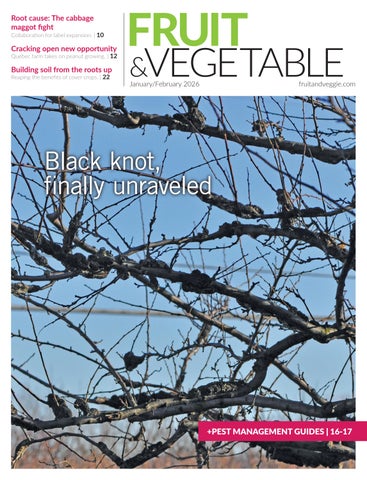
Root cause: The cabbage maggot fight
Collaboration for label expansion. | 10
Cracking open new opportunity
Quebec farm takes on peanut growing. | 12
Building soil from the roots up Reaping the benefits of cover crops. | 22
January/February 2026
fruitandveggie.com
Black knot, finally unraveled
+PEST MANAGEMENT GUIDES | 16-17
Strong control. Top to bottom. Neudorff North America is an innovative leader in ecologically responsible pest solutions for farmers, turf professionals, nursery and greenhouse growers. Our effective and affordable solutions for disease, insect pests, pest slugs and snails have limited impact on applicators, beneficial insects and the environment. They are an important part of integrated pest management programs.
CUEVA
Powerful disease protection for your fruit and vegetable crops with a fraction of the copper found in other copper fungicides.
®
COPPER FUNGICIDE
KOPA
The soft-bodied insect specialist. Kills aphids, mites and whiteflies on contact in a wide range of crops. A great tank mix partner.
™
INSECTICIDAL SOAP
VEGOL
A summer and dormant oil. Controls all life stages of insects and mites, and supresses powdery mildew.
®
FUNGICIDE/INSECTICIDE/MITICIDE
SLUGGO
A durable iron phosphate bait that offers excellent crop protection from slugs and snails.
®
SLUG AND SNAIL BAIT
SCORPIO ANT AND INSECT BAIT
Neudorff has you covered from the ground up.
®
A durable, fast acting spinosad bait, active against a variety of ants, cutworms, spotted wing drosophila and wireworms in a wide range of crops.
©2024 Neudorff North America. All rights reserved.
NeudorffPro.com
CONTENTS
January/February 2026 Vol.82, Issue 1
8
Black knot, finally unraveled
Accelerating the discovery of this stealthy disease. Editorial
4
Industry News
6
Insect pest control for apples
16
Insect pest control for tomatoes
17
Fruit production and strategic marketing in vertical farming 18 How are vertical farm operators responding to challenging economic times? .
10 12
ON THE COVER Plum tree infected with black knot. See page 8. Photo courtesy of Wendy McFadden-Smith.
22
Root cause: The cabbage maggot fight
Cracking open new opportunity
Building soil from the roots up
BY STEPHANIE GORDON
BY JOEL CEAUSU
BY TIM MORCOM, PERENNIA
Researchers collaborate on label expansions for insecticides.
Quebec berry farm takes the leap into peanut growing.
Reaping the benefits of cover crops in Nova Scotia.
January/February 2026 - FRUIT &VEGETABLE 3
FROM THE EDITOR
FRUIT & VEGETABLE January/February 2026 Volume 82, No.1
JILLIAN FILMER | @FruitandVeggie.com
Spread out the risk and opportunity If I have learned anything from 2025, it’s don’t put all your eggs in one basket. With Canada’s heavy trade reliance on our neighbour to the south, the past year stressed the need to put those “eggs” in multiple baskets and seek out other market opportunities. Keeping a few of those “eggs” in the Canadian market doesn’t hurt either. Economic resiliency can start right here at home by supporting the Canadian food production system for our country’s own food security and providing opportunity for our own industries. With the Canadian-United StatesMexico Agreement (CUSMA) under review this coming July, each country will decide if the agreement will be
production. Read the story on page 18. And it wouldn’t be a crop protection issue without a little disease and pest talk. Learn how research in Vineland, Ont. is breeding plum varieties with resistance to black knot, and two Canadian researchers are collaborating to open new management options for cabbage maggot, a nuisance to Brassica crops. We’ve even compiled handy insect pest control guides for apples and tomatoes on pages 16 and 17 for planning your attack on pests. The Fruit & Vegetable team will be at the Ontario Fruit & Vegetable Convention once again on February 18 and 19 in Niagara Falls. Stop by Booth #500 to come chat all things fruit and
“Economic resiliency can start right here at home.” extended for another 16 years or continue with annual reviews until 2036, its end date. Agreements such as this keep crossborder supply chains efficient and provide market access predictability for businesses, including farmers and producers. Until we find out what is to come of the CUSMA – we’ll keep you posted – what can you do at your own operation? This issue covers crop protection, with a few stories focusing on new opportunities, like a berry farm in Quebec trying their hand at growing peanuts, a much-loved snack in the province. Learn more about it on page 12. The vertical farming industry is also making moves into the production of higher-value crops, like strawberries, to combat higher operational costs and open new avenues for food @fruitandvegmagazine 4 FRUIT &VEGETABLE - January/February 2026
vegetable, learn about the magazine, or just to say hi! As a newer face in the fruit and veg space, I’m looking forward to learning more about the Ontario sector but also connecting with you and others in the industry. After all, it’s those connections and conversations that have made Fruit & Vegetable what it is today – your trusted source for industry news and timely insights for navigating the growing season. As always, feel free to send me an email at jfilmer@annexbusinessmedia. com if you have thoughts or ideas to share. All the best for the year ahead! •
@fruitandvegmag
@fruitandvegmag
Reader Service Print and digital subscription inquiries or changes, please contact Shawn Arul, Audience Development Manager Tel: (416) 510-5181 Fax: (416) 510-6875 Email: sarul@annexbusinessmedia.com Mail: 111 Gordon Baker Rd., Suite 400, Toronto, ON M2H 3R1 Editor JILLIAN FILMER jfilmer@annexbusinessmedia.com 416-305-4840 Sales Manager REENA UPPAL ruppal@annexbusinessmedia.com 437-922-7359 Publisher NASHELLE BARSKY nbarsky@annexbusinessmedia.com 905-655-6626 Account Coordinator KATHRYN NYENHUIS knyenhuis@annexbusinessmedia.com 416.510.6753 Media Designer ALISON KEBA Group Publisher MICHELLE BERTHOLET mbertholet@annexbusinessmedia.com 204-596-8710 CEO SCOTT JAMIESON sjamieson@annexbusinessmedia.com Publication Mail Agreement #40065710 Printed in Canada ISSN 1488-7959 Fruit & Vegetable Magazine is published three times a year November, Jan/Feb, Apr/May by Annex Business Media SUBSCRIPTION RATES Canada - 1 Year $24.40 (plus applicable taxes) U.S.A. - 1 Year $56.75 GST - #867172652RT0001 Occasionally, Fruit & Vegetable Magazine will mail information on behalf of industry-related groups whose products and services we believe may be of interest to you. If you prefer not to receive this information, please contact our circulation department in any of the four ways listed above. Annex Privacy Officer privacy@annexbusinessmedia.com Tel: 800-668-2374 No part of the editorial content of this publication may be reprinted without the publisher’s written permission. ©2026 Annex Business Media. All rights reserved. Opinions expressed in this magazine are not necessarily those of the editor or the publisher. No liability is assumed for errors or omissions. All advertising is subject to the publisher’s approval. Such approval does not imply any endorsement of the products or services advertised. Publisher reserves the right to refuse advertising that does not meet the standards of the publication.
fruitandveggie.com
Experience built your orchard.
INNOVATION WILL CROWN YOUR SUCCESS. Introducing BREVIS™ by ADAMA.
The first fruitlet thinner of its kind, trusted around the globe. Tradition has its place. But not when it costs you time and yield. BREVIS™ 150 SC takes the guesswork out of fruit thinning with proven, predictable performance backed up by twelve years of global research. It’s okay to stay true to your roots. But now, we’re making sure they don’t hold you back.
Start seeing results at brevisadama.ca. Always read and follow label directions. BREVIS is a trademark of ADAMA Agricultural Solutions Canada Ltd. ©2026 ADAMA Agricultural Solutions Canada Ltd.
INDUSTRY NEWS fruitandveggie.com
$10 million invested into Alberta produce industry A new program has been created to expand Alberta’s greenhouse and vertical farm industry, support the province’s economy and improve consumer access to local produce. Support for this 3-year, $10-million program, Growing Greenhouses, will come from the Governments of Canada and Alberta, as part of the Sustainable Canadian Agricultural Partnership. This program
will help support new construction or expansion improvements for commercial-scale greenhouses and vertical farms that grow produce. “We are continually working to build resilience and sustainability into our food production systems, increase opportunities for producers and processors, create jobs and feed Albertans,” said RJ Sigurdson, Minister of Alberta Agriculture and Irrigation.
New report urges for revitalization of agriculture A report from Farm Credit Canada (FCC),
Reigniting agricultural productivity in Canada, estimates that $30 million in additional farm income, $31 million in GDP and thousands of new jobs could result with the revitalization of productivity within the Canadian agricultural sector. Productivity within the sector has slowed in recent years due to underinvestment and
slow adoption of new technologies. This is detrimental to market competitiveness and meeting food demands. “Canada’s agricultural productivity growth has consistently outpaced other G7 countries for more than three decades, showing the strength and adaptability of our producers,” says J.P. Gervais, FCC executive vice-president, strategy and impact. “Even so, our growth has slowed, turning
that around will take continued investments to spur innovation, and smarter ways of working to help producers improve efficiency and stay competitive in a fast-changing global market.” To be productive, farmers need to make the most of their inputs, and this includes improving efficiency by leveraging data and elevating management practices; scaling operations through
strategic investment; and accelerating innovation by adopting new technologies and approaches on the farm. FCC has committed to the advancement of Canadian agricultural innovation into 2030 with a $2 billion investment. This will help companies develop new technologies, help producers/processors adopt new tools into their operations and strengthen the Canadian ag sector.
Plums and prunes were grown on
589 HECTARES
in Canada in 2024.
IN 2024, 3,773 METRIC TONS OF PLUMS AND PRUNES WERE PRODUCED IN CANADA. In 2023, plums and sloes were grown on
2,621,876 hectares
across the globe.
6 FRUIT &VEGETABLE - January/February 2026
World production of plums and sloes amounted to 12,489,827 metric tons in 2023.
Ontario produced
2,434
METRIC TONS
of plums and prunes in 2024.
DID YOU KNOW?
Sloes are a small, dark-blue fruit grown on a blackthorn bush and are tart in flavour.
SOURCE: STATISTICS CANADA, AGRICULTURE & AGRI-FOOD CANADA
BY THE NUMBERS
@CABEFscholarship
cabef.org
Canadian agriculture and food needs more talented people. Each year, CABEF helps students to pursue rewarding agri-food careers through seven $2,500 scholarships. We’re looking for the future leaders who will help this industry meet tomorrow’s challenges.
Do you know someone who needs to fund their future in agri-food?
Tell a student today.
AVERAGE
TOMATO consumption in Canada is 3 a day yummy tomatoes
Scholarship application deadline is
April 30, 2026
Want to help support the next generation of agri-food leaders?
Become a “Champion of CABEF.” This program allows your organization to directly sponsor a deserving student. Contact CABEF at info@cabef.org. CABEF is a registered charity (#828593731RR0001). For more information on all registered charities in Canada under the Income Tax Act , please visit Canada Revenue Agency www.cra-arc.gc.ca/charities.
BLACK KNOT, finally unraveled
Accelerating the discovery of this stealthy disease. BY STEPHANIE GORDON
SILENT, BUT DEADLY The fungal disease is a silent killer for plums, tart cherries and wild Prunus species. You will not know your trees are infected until symptoms develop, which can take 12 to 15 months. “Prune it and burn it,” says Wendy McFadden-Smith, tender fruit and grape IPM specialist for Ontario’s Ministry of Agriculture, Food and Agribusiness (OMAFA). The infection extends beyond where you can see symptoms, so it’s recommended growers prune well back from knots – a minimum of 15 to 20 centimetres toward the base of the limb. However, pruning is only the first step. “If you leave prunings on the ground, they can continue to release spores,” McFadden-Smith continues. It used to be believed that spore release happened only early in the season before bloom, but McFadden-Smith’s own research, together with former Agriculture and Agri-Food Canada’s John Northover, revealed it can happen later in the growing season if weather conditions are favourable. Chiefly, when it rains, it spores. Black knot spores are released when conditions hit approximately 0.25 mm of rain and temperatures above 10°C. Because spore release is dependent on weather, growers are recommended to continue spraying for black knot if it is a dry spring. A lack of rain earlier in a season delays spore release, not eliminates it, and the spores will escape eventually when it rains. RUNNING OUT OF OPTIONS Black knot is slow to develop, tricky to remove, and hard to treat with reliable fungicides being limited or phased out completely. As a North American disease, only a handful of research publications have studied black knot in the last 60 years. After 15 8 FRUIT &VEGETABLE - January/February 2026
years of research, Subramanian’s team has made a breakthrough. With help from OMAFA and grower funding, they’ve identified resistance markers that can be spotted early in the breeding process. BLACK KNOT ROULETTE The Vineland Campus is home to new varieties of peach, plum and nectarine. In 2006, a hot new plum variety hit the market: Vampire, which had no symptoms of black knot after growing on campus for 20 years. But in the next few years, the disease made its way in and spread. Vampire became a magnet for black knot. This was the case for most plum breeding programs in North America where thousands of new plum varieties are kept clean. “We don’t know whether anything that they release is resistant or susceptible until it is hit,” Subramanian explains. This can be incredibly frustrating for growers who plant a promising new variety and hold their breath hoping that when the leaves fall before winter, black knots don’t appear. However, resistance – or rather tolerance – exists. McFadden-Smith’s field research shows the varieties Italian and Early Golden consistently had less infection than Shiro and Vampire regardless of environmental conditions. With barely any new research on the genetics of black knot, Subramanian’s goal was to uncover if genetic resistance exists for black knot. PHOTO . COURTESY OF WENDY MCFADDEN-SMITH.
B
lack knot is enough to put a knot in any plum grower’s stomach.“Black knot is like a cancer of plums,” says Jayasankar Subramanian, a professor and tender fruit breeder based at the University of Guelph’s Vineland Campus. “The peculiar thing with black knot is that it infects the tree and sits inside the tree for one full year, and then when it shows up, it’s already too late.”
BITTERSWEET DISCOVERIES Breeding research takes the hit where growers cannot. Around 100 to 200 different types of plums were grown for at least 10 years without controlling for black knot to let the infection take over. Then Subramanian’s team evaluated each genotype to see the level of resistance or susceptibility. If a plum variety gets hit with black knot in year three, it’s very susceptible. If a plum variety gets hit with black knot in year eight, it’s more tolerant. ABOVE A close-up of a two-year old black knot that produces spores.
will have a bit of bitterness, were present in the right amounts in the leaves of black knot resistant plums. “Almost every plant species produces [some form of catechin]. Then how is this regulated by those plums that are resistant versus susceptible? And why were the susceptible plums not able to produce it in the right time to kill the fungus,” Subramanian says. He predicts that susceptible varieties are either producing the compounds at low levels or not at the right time, and he wonders what is making a resistant plum variety prioritize the production of these compounds over something else. The discovery means faster breeding, lower costs and long-term disease resistance is on the horizon for plums. “You can look for the chemical compounds even when the plant is very young instead of waiting 15 years,” Subramanian summarizes. Breeders can start the elimination process earlier, removing susceptible varieties from the field, and breeding black knot resistant varieties faster. This research is shining a light on what was deemed an invisible disease. Today, pruning and burning is the best remedy with fungicides applied post bloom every one to two weeks, especially before a rain. • PHOTO COURTESY OF JAYASANKAR SUBRAMANIAN.
But if a plum variety never gets it, then it is resistant. “The first year we did the [resistance] rating, about eight per cent of trees showed complete resistance because we did not see any black knot on them,” Subramanian starts. “Four years later, it dropped down to around three per cent.” Some varieties tried to fight off the disease but eventually succumbed. “So, we need that time of five to 10 years to do that, to do the rating again and again to say, ‘Okay, these are definitely resistant, and these are very susceptible,’” Subramanian says. The team did identify a few varieties that were resistant. Subramanian was excited at the thought of comparing the genomes to see the differences, to spot the elusive “resistance factor.” But the genome sequence was all over the place. The team pivoted to metabolomics, a more recent method that looks at the metabolites of plant cells and tissues instead of genetic data. It allowed them to sift through only a few hundred differences instead of thousands of variations. Subramanian’s team saw a positive trend for two biochemical compounds which were strongly associated with resistance. They applied the compounds on an isolate of the black knot fungus and saw that the compounds could inhibit the growth of the fungus. These mystery compounds – catechins – are a group of compounds that are present in any fruit, leaf or vegetable that
ABOVE Symptoms of black knot take between 12 to 15 months to develop.
WHEN COLD COUNTS... call the cold storage specialists!
SPECIALIZING IN ALL YOUR COMMERCIAL REFRIGERATION & HVAC NEEDS
Fruit • Vegetables • Nursery • Chillers • Walk-In Freezers/Coolers Cold Storage • Controlled Atmosphere Providing our customers with 24 Hour Service / 365 Days A Year
SALES • SERVICE • INSTALLATION • DESIGN
634 Welland Avenue, St. Catharines, ON L2M 5V6 905.685.4255 pennrefrigeration.com
January/February 2026 - FRUIT &VEGETABLE 9 FV_PENN_JanFeb26_JLR.indd 1
2025-12-22 FV_NM-Bartlett_April23_CSA.indd 3:22 PM 1
2023-03-06 7:35 AM
ROOT CAUSE:
The cabbage maggot fight Researchers collaborate on label expansions for insecticides. BY STEPHANIE GORDON
10 FRUIT &VEGETABLE - January/February 2026
LOSING LORSBAN Both Prasad’s and Achtymichuk’s research is spurred on by the removal of Lorsban (chlorpyrifos) insecticide in Canada and the U.S. in 2023, which growers relied on to control CRM in their crops. Their trials of important emergency registrations for Cimegra and Verimark have shown promising results. The goal of these trials is to apply for label expansions to include cabbage root maggot. “Fortunately, Doug Waterer, retired University of Saskatchewan vegetable researcher, and I had some experience, working with broflanilide (Cimegra) which was registered in 2020,” Achtymichuk says. “We were looking at it for wireworm control, and wondered if it would control CRM, so we tried it on rutabagas in 2021, and noticed an effect. In our trial, the effect was rate dependent. It was this work that encouraged us to pursue emergency use registration for Cimegra to control CRM in head and stem brassica vegetable crops. [Plus,] this product was already registered for diamondback moth, cabbage looper, imported cabbageworm and flea beetles in these crops.” Timing is of the essence, and label expansions are easier to achieve than brand new registrations for insecticides. Currently producers have Verimark as an early-season option, but Achtymichuk says she’s optimistic that a full registration for Cimegra will be granted in time for the 2026 crop. If not, they will apply for another emergency use registration (valid for only one year) like they did before. Both trials also examined unregistered insecticides to collect data that can help down the line. Prasad acknowledges this can be frustrating for growers to hear, especially when the toolbox for this pest is so small to begin with. “For the different products we’re testing, they’re PHOTO COURTESY OF RENEE PRASAD.
F
or many vegetable growers, brassicas like cabbage, broccoli, and cauliflower, are dependable crops. That’s until cabbage root maggot strikes. Then the season can unravel underground, unseen until it’s too late. Renee Prasad teaches IPM and agroecology at the University of the Fraser Valley and is trialing various insecticides for the control of cabbage root maggot (CRM) in a research project funded through the Fruit and Vegetable Growers of Canada. The pest is the larval stage of a fly, where the fly lays eggs and its larva make its way beneath the soil to eat the roots and underground stems of crops like cabbage, broccoli, cauliflower, bok choy and other Asian greens. “When plants are very young, they can outright die from maggot feeding damage. As plants get more mature, they can certainly handle some maggot feeding damage – although it may slow crop development and result in a late and uneven harvest. For root crops like rutabaga, turnip, and radish, feeding damage to the roots makes the crop unmarketable,” Prasad says. Root maggots are found across Canada because cole crops, a group of vegetables within the Brassica family, grow across Canada. Prasad says that these crops are usually the first in the ground, last to be harvested, and their long window of production produces a reliable cashflow for growers – unless maggots strike. What makes cabbage root maggot difficult – beyond its sheer prevalence across the country – is that their life cycle varies from province to province. The life cycle ranges from two flights of adults in Nova Scotia to four flights of adults in British Columbia, where mild winters can see flies zooming as early as April. It is important to be on top of your CRM control early in the season if you’re in the Fraser Valley, but root growers have to be diligent throughout the season. Connie Achtymichuk, provincial specialist for vegetable crops with the Government of Saskatchewan, is doing complementary trials for CRM control as well. “We’ve got 12 million acres of canola being grown in Saskatchewan and [canola growers] don’t use any pesticides to control them, so canola acts as a secondary host for cabbage root maggot that we have no control over,” Achtymichuk explains.
ABOVE In the Fraser Valley, Prasad’s team tested three treatments on direct-seeded rutabaga and six treatments on transplanted broccoli.
at different places in the registration pipeline [and] one is not even registered at all,” Prasad explains. “I think that’s another piece for growers to understand, because I feel it could be frustrating to growers that different products are at different places in the pipeline. As a researcher, we only can contribute the data to support movement in the pipeline, but the company and PMRA [Pest Management Regulatory Agency] ultimately decide how quickly that moves.” FIELD TRIALS IN FRASER VALLEY In the Fraser Valley, Prasad’s team tested three treatments on directseeded rutabaga and six treatments on transplanted broccoli. It was important to test if treating at tray or at planting made a difference for transplanted crops to mimic all the possible grower practices. “A big take home message from the last couple of years is that most products can give some level of control or efficacy compared to the untreated control when the pest population is low,” Prasad says, sharing that she begins her field trials and insecticide applications in early May. “When we do the trials later in the season, like we go until June and many growers are planting and transplanting into June, July – then pest pressure is really quite high and we don’t see the same levels of efficacy.” In short, procrastinating lets the pest get ahead. “So we’re using the same product, we’re using the same rate, all of that’s kind of the same. But the only difference is, we’ve gone from the populations in May compared to June are just much higher,” Prasad says. FIELD TRIALS IN SASKATOON The test crops were broccoli and cabbage, direct-seeded and transplanted. All three products tested provided “excellent” levels of CRM control. Both Cimegra and the unregistered product tested could be used as an effective mid-season treatment, but Verimark cannot because it has a longer pre-harvest interval (PHI) and can only be applied once as a soil treatment. “I was surprised at how effective the treatments were. In 2025, in the transplanted control treatment we lost over 50 per cent of the untreated broccoli and cabbage plants to CRM within a week of transplanting,” Achtymichuk
remarks. “If this were a farm, that’s a 50 per cent loss in income.” By contrast, 100 per cent of the seedlings that had been treated with Verimark or Cimegra prior to transplanting survived the attack by CRM. With respect to timing, treating the seedlings with the insecticides after they were transplanted into the field provided less protection against CRM. WHAT GROWERS CAN DO NOW Growers can use Verimark early in the season and then use Cimegra. The other
insecticide tested in the 2025 field trial is not registered in Canada yet. It is possible to do two applications of Cimegra, Achtymichuk notes, but cautions against it. Despite Cimegra being the more cost-effective product, using two different groups (Cimegra, Group 30 and Verimark, Group 28) is better in the long run to fight against insecticide resistance. In addition to insecticides, vegetable growers are exploring biologicals, physical controls and other IPM strategies to keep cabbage root maggot at bay. •
FROST PROTECTION
Prevent Frost Damage Fogging Creates A Thermal Blanket Protecting Your Crop
K-50 pulsFOG
K-30/20 pulsFOG
TracFOG
Rapid fog application with Dramm pulsFOG ® or TracFOG ®, quickly drapes the field in a blanket of fog, protecting plants from frost in temperatures as low as 25°F (-6°C). Call Dramm to learn how the pulsFOG can save you time and money. ®
Integrated Plant Health Scan Code for video & more information
FV_Dramm_JanFeb26_CSA.indd 1
information@dramm.com www.dramm.com 920.684.0227
January/February 2026 - FRUIT &VEGETABLE 11
2025-12-18 9:19 AM
CRACKING OPEN new opportunity
Quebec berry farm takes the leap into peanut growing. BY JOEL CEAUSU
T
PHOTO COURTESY OF JOEL CEAUSU.
here’s nothing peculiar about André Strebel’s farm in the Strebel needed something beyond berries to compete. “Everyone Montérégie, near the U.S. border. around here grows sweet corn, and every gas station already has At first glance, the two test acres in his Havelock field their guy.” look like soybeans, but below the surface, it’s peanuts. With a plan to maximize his acreage and extend the farmstand Literally, arachis hypogaea. season, and get in on agritourism, Strebel studied his options last That Strebel and his partner at Ferme Bons Fruits, Frank Boyle, winter, which were few. “I looked at what I had: sandy soil, fairly harvested their first two-acre test run of peanuts on the Canadian warm region, and limited machinery. I figured, maybe a peanut?” side of Covey Hill isn’t peculiar, though it’s drawing attention. Quebecers love peanuts, particularly peanut butter. According What is, however, is Quebec’s labour calendar, which led two to the American Peanut Council’s Canadian Peanut Bureau, they welders-turned-farmers to try becoming Quebec’s first commercial lead national consumption: 41 per cent eat peanuts and 61 per cent peanut growers. eat peanut butter weekly, compared to 36 per cent and 59 per cent After harvesting 7,000 kilograms of for other Canadians. Quebec’s Ministry of raspberries and blackberries in 52,000 square Agriculture, Fisheries and Food reports retail feet of high tunnels at Ferme Bons Fruits, once peanut butter sales at $96.7 million in large a fallow apple orchard, Strebel began reviving stores last year, up 5 per cent from 2023; 100 acres around his home with a few acres of while fruit, seed and nut snacks topped sweet corn under plastic to turn the field from $201 million. Statistics Canada lists 2023 grey to green. national nut, seed, and trail mix sales at A child of Swiss immigrants who bought a $1.07 billion. local dairy farm, Strebel ran a welding company Strebel looked west to southern Ontario for 20 years before buying his 100-acre where growers use conventional methods, Havelock farm five years ago and partnering on reasoning that with warmer temperatures another 100 acres next door. The area has a lot and his Samco planter, he could start of variable, rocky and sloping terrain, and twoearly. “They have about a week or 10 days’ thirds is wooded, far less attractive to growers jump on us in that region, so using plastic than the Richelieu River region further east. basically gives me a two-week jump on the But it wasn’t nature or consumer taste that standard way of doing things, and pretty ABOVE pushed him to corn and nuts; it was Quebecers’ With frost damaged vines, harvest much the same conditions.” It’s the same was slow-going. holiday habits. Since the early 1970s, Quebec’s approach he uses growing berries in pots in two-week construction holiday beginning in midhigh tunnels to compete with Île d’Orléans to late July, sees all trades and work sites in the province, large and producers. small, grind to a halt. Families in the trade and not, go on vacation; His peanut variety of choice, a Valencia, is Canada-proven with add in a Canada-U.S. trade war and a declining dollar, Quebecers a 120-day cycle. “Why reinvent the wheel? It’s not high yielding, – just like their fellow Canadians – are spending more of their time but the sweetest in terms of Brix so it’s the preferred nut for eating and tourism bucks at home. In La belle Province, that means road fresh.” He considered the shorter-cycle Spanish nut, higher in trips, and a lot of stops at farmstands along the way. oil and more flavourful when roasted; but like most U.S.-grown “Everyone stops for corn during construction holidays,” says varieties, it grows on runners and needs warmer weather. Strebel. “If July 16 comes and you don’t have corn, you’re dead With little market research, Strebel dove in. “It was really a test in the water.” Planting early under plastic provides a head start to in every sense of the word,” he laughs. “We did a large enough make selling season. “All the local guys do this because you need to plot to be serious, but not to bet the farm on it, so to speak. I just be ready for construction holidays.” wanted to try it. I also knew I had no harvesting equipment.” Yet with abundant producers, growth space was tight, and CONTINUED ON PAGE 20 12 FRUIT &VEGETABLE - January/February 2026
NEW
VARIETIES 2026
Norseco
Bloodstone F1
Red Eagle F1
Large mid-season dark red onion, that cures quickly, thanks to its small neck. Does well in both mineral and muck soils. Good storage potential.
Nice end of the season, dark red onion with a good potential for large size bulbs. Very round, uniform and firm. Suited for transplants or direct sowing.
Dash F1
Carla F1
The earliest variety in our selection of bicolour Sh2. Well-covered ears with bright, vivid kernel colours. Crisp yet tender kernels with a delicious sweet flavor. Good vigor early in the season conditions.
Fresh market butternut squash, very uniform in size and shape. High yield potential due to a small seed cavity for an excellent flesh recovery. High quality flesh. Very vigorous vine.
LAURENTIAN F1 Interesting early to mid season maturity onion, with a good root system and a vigorous top that shows potential for high yields.
MANSFIELD F1 Early Spanish onion that produces good-sized bulbs for its maturity. Small necks and good skin. Good storage potential.
ORANGE FANCY F1 Long cylindrical carrot for cello or slicing. High quality due to it’s smoothness and straight roots.
Customer Service Brennan Y.B.R. F1
Red Margarita Y.R. F1
order@norseco.com 514 332-2275 | 800 561-9693 450 682-4959
Our Team of Experts Warren Peacock Yves Thibault, agr. Ontario Central & Eastern Québec warren.peacock@norseco.com yves.thibault@norseco.com 519 427-7239 418 660-1498
Bronco type with resistance to black rot. Heads fill early during growth.
Nice early cabbage with a perfectly round, intensive red head, ideal for fresh market presentation. Harvesting period is from early summer to late season. Vigorous plants build a strong frame with large wrapper foliage.
Ben Yurkiw MB, SK, AB & BC ben.yurkiw@norseco.com 604 354-1830
Marie-Pierre Grimard, P. Tech Western Montérégie marie-pierre.grimard@norseco.com 450 261-7468
Isabelle Dubé, Agr. North Shore of Montréal isabelle.dube@norseco.com 514 295-7202
Marie-Hélène Monchamp Eastern Montérégie marie-helene.monchamp@norseco.com 514 968-2906
Katherine Jouvet, agr. Stéphanie Gosselin. Agr. Organic & Small-Scale Farms Central and Eastern Québec katherine.jouvet@norseco.com stephanie.gosselin@norseco.com 514 386-0277 418 254-1469
norseco.com
norseco_officiel
January/February 2026 - FRUIT &VEGETABLE 13
NEW VARIETIES 2026
Stokes Seeds
Borealis Hybrid Beet
Appalachian Hybrid Broccoli
Sirkana Nantes Carrot
85-90 days. Produces uniform, globe-shaped roots with a vibrant deep red exterior and interior, delivering excellent visual appeal and processing quality. With high sugar content and reliable internal root quality, Borealis maintains strong brix levels during storage
94 days. Reliable mid-maturing variety, well adapted to the North-Eastern and Mid-Atlantic regions. With its strong field performance, it delivers excellent uniformity in maturity, ensuring consistent, high-quality harvests. Compact, use for crown/short trim market.
60 days. Top-performing variety known for its dark orange color, bulky roots and excellent uniformity. With a cylindrical, tapering root shape and consistent sizing, this variety delivers high yields and outstanding field holding capacity, ensuring flexibility at harvest and quality at market.
49 days. Produces a bright white, 2 lb/1 kg domed head that maintains its color beautifully, even under direct sun exposure. The heads are notable for their firmness, density, and impressive weight, delivering both visual appeal and market value.
Gourmet Sweet Brand Dash Bicolor Sweet Corn
Maxton Leek
Mansfield Long Day Yellow Onion
Wayfinder Sweet Bell Pepper
110 days. Start your season strong with Maxton, an early maturing leek variety designed for speed and productivity. With its rapid growth and high yield potential, Maxton is an excellent choice for growers looking to maximize early market opportunities. Pelleted seed.
115 days. Delivers exceptional size potential. Tops are impressively strong and very upright, supporting easy harvest and overall plant health. Offers reliable long-term storage, holding firm all the way until June with a durable, resilient skin that maintains quality even after extended storage.
These extra-large green peppers are exceptionally heavy and richly colored with a deep, dark green hue.
Cider Pumpkin
Admiration Squash
Lancer Tomato
96-105 days. Elevate fall displays with Cider’s charm and durability. Its smooth, eye-catching buckskin colouration sets it apart from traditional varieties, offering a sophisticated look that complements mixed displays beautifully. Well-adapted to a wide range of growing conditions.
Midseason maturing. A standout zucchini variety that delivers exceptional yield and outstanding fruit quality. With its deep, glossy dark green fruits and uniform sizing, Admiration lives up to its name in both field and market performance.
73 days. This early maturing and high yielding hybrid has a vigorous, open compact plant with short internodes and good fruit set. The round fruit are large in size, very tasty and have an attractive deep red color. Pelleted seed.
68 days. One of our earliest bicolors, featuring good ear and plant size for the maturity. Tolerates cool soils, has great taste, early vigor and strong yields.
Exuma Sweet Cubanelle Pepper
Proven across multiple planting slots, Exuma delivers consistent performance and versatility for growers. The fruit are medium green with uniform size and shape, offering appearance and productivity comparable to Key West.
14 FRUIT &VEGETABLE - January/February 2026
Marmorex Hybrid Cauliflower
Dark Horse
~ Quality Seed Since 1881 ~
Sybaris
PERFORMANCE STARTS WITH THESE NEW VARIETIES FROM SEMINIS & STOKES W
W
NE
NE
Justify
W
W
NE
NE
Performance may vary, from location to location and from year to year, as local growing, soil and environmental conditions may vary. Growers should evaluate data from mu consider the impacts of these conditions on their growing environment.
The recommendations in this material are based upon trial observations and feedback received from a limited number of growers and growing environments. These recomme should not be substituted for the professional opinion of agronomists, entomologists or other relevant experts evaluating specific conditions. Bayer, Bayer Cross and Seminis® are registered trademarks of Bayer Group. ©2024 Bayer Group. All rights reserved.
MANSFIELD
CHINOOK
MARMOREX
LAURENTIAN
115 days. Offers reliable long-term storage, holding firm all the way until June with a durable, resilient skin that maintains quality even after extended storage.
Large to extra large blocky fruit shape with excellent uniformity. Strong plant with a robust disease resistance package. Great high yield potential.
49 days. Produces a bright white, 2 lb/1 kg domed head that maintains its color beautifully, even under direct sun exposure.
100 days. Long day yellow that offers growers a medium to large bulbs with small necks and medium brown skin, Long term storage.
SEED EXPERTS FROM COAST TO COAST: Alexandre Paul Banks John Hart John Rob Hovius Bisson (QC) (ON, NS) (BC) Hattingh (ON) (ON, PEI, NB) 905-688-4300 438-334-1996 778-908-0201 289-257-1245 519-580-3231
Marc André Darcy Leiter Amélie Emily Laberge (QC) (AB, MB, SK) Lepage (QC) Robins (ON) 514-984-4589 306-491-6485 514-984-0662 905-308-4396
1-800-263-7233 │ www.stokeseeds.com
FOLLOW US:
PEST MANAGEMENT GUIDES
Cypermethrin (Group 3)
Foliar
Ground
7
12
7-10
3
C
Sefina
Afidopyropen (Group 9D)
Foliar
Ground
7
12
7
4
Nealta
Cyflumetofen (Group 25)
Foliar
Ground
7
12
14
2
C
C
Magister SC
Fenazaquin (Group 21 acaricide,Group 39 fungicide)
Foliar
Ground
10
See label for details.
1
C
C
C
C
Nexter SC
Pyridaben (Group 21)
Foliar
Ground
25
24
1
2
C
C
C
C
Imidan WP
Phosmet (Group 1B)
Foliar
Ground
See label for details.
See label for details.
14
2
Malathion 85E
Malathion (Group 1B)
Foliar
Ground
3
12
3
2
Double Down Spray Oil
Mineral oil
Foliar
Ground
12
10-14
8 (summer), 2 (dormant)
Altacor MaX
Chlorantraniliprole (Group 28)
Foliar
Ground
5
12
10
3
S
Exirel
Cyantraniliprole (Group 28)
Foliar
Ground
1
12
7
4
C
C
Delegate
Spinetoram (Group 5)
Foliar
Ground
7
12
7-14
3
S
C
Entrust
Spinosad (Group 5)
Foliar
Ground
7
Until dry
7-10
3
S
C
Movento
Spirotetramat (Group 23)
Foliar
Ground
7
12
14
Maximum 1.83 L/ha (0.74 L/ac) per year
C
C
C
Sivanto Prime
Flupyradifurone (Group 4D)
Foliar
Ground
14
12
10
Max. 2,000 ml/ha (809 ml/ac) per crop season
C
C
C
Minecto Pro
Abamectin (Group 6) and Cyantraniliprole (Group 28)
Foliar
Ground
28
12
1
Agri-Mek SC
Abamectin (Group 6)
Foliar
Ground
28
12
1
Harvanta
Cyclaniliprole (Group 28)
Foliar
Ground
7
12
14
3
Assail
Acetamiprid (Group 4)
Foliar
Ground
7
48
12
4
C
C
C
C
C
S
C
C
C
C
C
C
C
C
C (summer spray)
C
C
C
C
S
C
C
C
C
C
C
C
C
S
C
C
C
C
C
C
C
C
C
C
C
C
C
S
S
C
C
C
C
C
S
C
C (summer spray)
C
C
C
C (summer spray)
This table is presented as a guide only. Please refer to product labels for application details and a complete list of labelled insects. C - Control. S - Suppression.
16 FRUIT &VEGETABLE - January/February 2026
C
C
C
C
C
European red mite
Up-cyde
C
Rust mite
Two-spotted spider mite
S
Scale insects
McDaniel spider mite
3
Leafroller
Apple maggot
10
Japanese beetle
Max. applications per season
12
Codling moth
Days between applications
5
Leafminer
Re-entry period (hours)
Ground
Plum curculio
Pre-harvest interval (days)
Foliar
Rosy apple aphid
Aerial or ground
Chlorantraniliprole (Group 28)
Green apple aphid
Soil or foliar
Shenzi
Bud moth
Active ingredient (chemical group)
INSECTS
Insect management product
APPLE PEST CONTROL 2026
C
C
C
C
C
C
C
PEST MANAGEMENT GUIDES
C
Up-cyde
Cypermethrin (Group 3)
Foliar
Ground
3
12
7
3
C
Sefina
Afidopyropen (Group 9D)
Foliar
Ground
0
12
7
4
Nealta
Cyflumetofen (Group 25)
Foliar
Ground
3
12
14
2
C
Magister SC
Fenazaquin (Group 21 acaricide, Group 39 fungicide)
Foliar
Ground
3
12
1
C
Malathion 85E
Malathion (Group 1B)
Foliar
Ground
3
12
7
4
C
C
Lagon 480 E
Dimethoate (Group 1B)
Foliar
Ground
7
12
7
2
C
C
Coragen MaX
Chlorantraniliprole (Group 28)
Foliar
Ground
1
12
5 or 7*
3 or 4*
C
Verimark
Cyantraniliprole (Group 28)
Soil
Ground
1
C
Delegate
Spinetoram (Group 5)
Foliar
Ground
1
12
7-14
3
Entrust
Spinosad (Group 5)
Foliar
Ground
1-3
12
7-10
2-3
Movento
Spirotetramat (Group 23)
Foliar
Ground
1
12
7
Max. allowed per crop season: 730 ml/ha (295 ml/ac)
Foliar
Ground
1
12
7
Sivanto Prime
Flupyradifurone (Group 4D) 45
12
Soil
12
Max. allowed per crop season: 2,000 ml/ha (810 ml/ac)
C
C
C
C
C
C
C
C
C
C
C
C
C
C
C
C
C
C
C
C
C
C
C
C
C
C
C
C
C
C
C
C
C
Minecto Pro
Abamectin (Group 6) and Cyantraniliprole (Group 28)
Foliar
Ground
7
12
7
5**
C***
Harvanta
Cyclaniliprole (Group 28)
Foliar
Ground
1 day
12
7
3
C
Assail
Acetamiprid (Group 4)
Foliar
Ground
7
12
7
2
C
Harvanta
Cyclaniliprole (Group 28)
Foliar
Ground
7
12
14
3
S
Assail
Acetamiprid (Group 4)
Foliar
Ground
7
48
12
4
C
C
S
S
C
C
C
C
C
S
C
C
C
S
C
Two-spotted spider mite
4
Tomato fruitworm
Colorado potato beetle
5
Tobacco hornworm
Max. applications per season
12
Cabbage looper
Days between applications
1
European corn borer
Re-entry period (hours)
Ground
Sweet potato whitefly
Pre-harvest interval (days)
Foliar
Silver whitefly
Aerial or ground
Chlorantraniliprole (Group 28)
Potato aphid
Soil or foliar
Shenzi
Green peach aphid
Active ingredient (chemical group)
INSECTS
Insect management product
TOMATO PEST CONTROL 2026
C
C
C
C
This table is presented as a guide only. Please refer to product labels for application details and a complete list of labelled insects. * Pest dependent. See label for details. ** Dependent on rate used. *** Do not apply Minecto Pro if any Group 28 insecticide was used at planting as in-furrow treatment. C - Control. S - Suppression.
January/February 2026 - FRUIT &VEGETABLE 17
PHOTO COURTESY OF JORDAN GEREIN.
Fruit production and strategic marketing in vertical farming How are vertical farm operators responding to challenging economic times?
BY MATT MCINTOSH
The vertical farming industry is going through a period of consolidation as financial pressures from operational costs and rapid production scaling are coming home to roost for some companies. More investment is being put into the identification and development of higher-value crops for vertical farming systems, as well as sustainable markets. STATE OF VERTICAL FARMING INDUSTRY A 2024 global census of controlled environment agriculture, by consulting firm Agritecture, indicated cost and affordability continues to be primary barriers for operators of vertical farms. Cost was specifically identified as the most significant barrier to technology adoption – underscoring the need for “more accessible financing options and affordability changes.” “Since I started with the ministry in 2020, I saw a number of vertical farms being established. The business model here [in Ontario] is different – it’s not quite as ‘go big or go home,’ says Fadi Al-Daoud, greenhouse vegetable specialist with the Ontario Ministry of Agriculture, Food and Agribusiness. Typically, they start small with a community-
18 FRUIT &VEGETABLE - January/February 2026
focused business model and grow at a steady sustainable rate. As a whole, the group of vertical farmers I’m working with are still around and growing,” Al-Daoud says. “It’s moderate growth, but it is there. It’s being driven by increase in domestic demand. I think that’s really helped them become a sustainable production system.” “Demand really started with COVID and supply chain issues, and the reliance on imports. Now with today’s economic climate and other issues, that’s really bringing an urgency to domestic food supply.” BERRIES BRING OPPORTUNITY Such food security concerns have spurred vertical farming stakeholders to direct research and development resources to higher value crops, like raspberries and strawberries, rather than herbs and leafy greens – the crops most produced in vertical farming systems currently. Funders such as the Weston Family Foundation are getting involved, as ABOVE Vertical farming system at Akamihk Fresh.
labour, compared to an indoor farm that’s more of a tech company trying to pay people more of a suitable wage, which I think is making it harder to compete,” Gerein says. He adds additional challenges, including the smaller size of indoor-grown greens, along with higher input costs to achieve smaller product, contributes to the challenge. “Electricity is everything in indoor farming. A head of field lettuce might be half a pound to one pound, that’s hard to achieve in an indoor farm…We’re getting a three-to-four-ounce head of lettuce, and the input costs to achieve this can be higher. The higher you can go in terms of vertical layers, you can counteract that. But then you need more light, cooling capacity.” Highlighting Akamihk Fresh’s community brand has been an effective means of developing markets in light of these challenges. Gerein says the community-owned company hires local people, including members of Montana First Nation, rather than importing labourers from abroad. They still do a variety of jobs manually to keep hardware costs down. And the farm’s relative proximity to major urban centres provide a significant array of markets with “a MARKET INNOVATIONS lot of local pride.” “There are many farmers markets between Edmonton and Important as technical innovation is, market innovation is another Calgary. That’s helped us navigate and find the customer base willing means of ensuring profitability for vertical farms. to pay the price our product sells for. There’s also lots of big retailers Akamihk Fresh – a hydroponic herb and lettuce farm owned that are not too big. We can cater to someone like them who does and operated by Montana First Nation in Alberta, is one such local farming and sells at a higher unit price but also markets in a company. For greenhouse manager Jordan Gerein, being strategic way consumers can identify with and appreciate,” says Gerein. in marketing and building community relationships is a necessity “There’s enough of the population willing to support local. I still given the significant disparity between cost of production with fieldsee an avenue for other producers to find their lane, as long as they’re produced imported products. strategic in what they grow. There’s still many markets to tap into. ” • “The25_014572_Fruit_and_Vegetable_JAN_FEB_CN contrast between conventional farming of lettuce is cheap Mod: December 10, 2025 4:02 PM Print: 12/18/25 page 1 v2.5 well as farm operators and academic researchers. The perennial challenge, says Al-Daoud, is getting to a point where fruiting crops actually make a profit. This necessitates figuring out how lighting and irrigation systems should be designed, better pollination systems, as well as what genetics are best suited to vertical farming. “A lot of the berry crops right now, they were bred for field production. The cultivars of strawberries, even in greenhouses, are not specifically bred for greenhouses. There’s more investment from seed companies going into controlled environment breeding programs,” says Al-Daoud, reiterating better cultivars would go a long way in reducing cost of production. “There are farms in Quebec growing strawberries, and a lot of the vertical farms in Ontario are trialing strawberries and raspberries. But we haven’t reached a level where its commercially viable, as far as I can tell, in Ontario. It’s not necessarily the lack of knowing how to grow them, but the ability to grow them to make it economically viable in different jurisdictions.”
π FROM BULK BAGS TO TARPS ALWAYS IN STOCK IN ALL LOCATIONS
ORDER BY 6 PM FOR SAME DAY SHIPPING
FV_Uline_JanFeb26_CSA.indd 1
1-800-295-5510
uline.ca
January/February 2026 - FRUIT &VEGETABLE 19
2025-12-22 8:53 AM
A challenge it was, from start to finish, as the bottom half of May in southern Quebec was rainy, cold and with little sunshine. But he managed to plant some 200,000 seeds on two test acres in midMay. Typically planted after last frost and harvested before first frost, after a peanut flower is pollinated, a shoot – or peg – grows downward from the base of the flower into the soil, before extending and maturing into a peanut pod, with about 20-30 viable pods per plant. By late September, 200,000 plants were ready, yielding about 1000 kg per acre, enough to gauge larger potential. “Once we realized we have a decent crop we asked ourselves, how the hell are we going to harvest this?” The first answer was: about five weeks late, with a 30-year-old harvester salvaged from a Niagara field needing a serious rebuild. In the end, they chanced the wait, doing a fair bit of jerry-rigging to get their machine going. Short on conveyors and time, they got to work, trailing the machine with baskets that are unloaded on the go in their test field. The harvester cuts plants, strips pods and dumps vines on the field. Unlike southern growers who pull, flip and sun-dry plants, their growing season and climate requires a drying system and greenhouses before shelling, roasting and storage. With harvest significantly delayed, the first frosts damaged much of the plants’ foliage, reducing the collector’s grip. They still pulled
all the plants, but it was slower going and messier due to moist soil accumulation. The late September frost and delay also meant a fair number of shoots couldn’t make it to ground, and a lot of small nuts didn’t develop in the soil said Boyle. “But it’s ok, we’re going to collect them for bird seed. We’re going to sell everything.” The long-term goal explains Strebel, is to “build a kiosk here and open up to the public by next year,” tapping into Canada’s $2 billion in direct-to-consumer farm sales with nuts, berries and more. Canada is currently the second largest importer of U.S. peanuts (after Mexico) says the American Peanut Council. More than 85 per cent of peanuts consumed in Canada are obtained from American growers, who shipped more than 138,000 tonnes of peanut product across the border in 2024 – most of that raw. Despite the trials of the test run, the roughly 2000 kg of peanuts look good, says Strebel, noting next year’s planting will expand, to between 50 and 100 acres on the two farms. With up to 100 tonnes of the legume, he is looking at plenty of options for direct-to-consumer, and wholesale, and is confident he can move all his product. He’s already heard from a Quebec processor seeking to buy as much as he can grow. • PHOTO COURTESY OF FERME BON FRUITS.
CONTINUED FROM PAGE 12
ABOVE Peanut field at Strebel’s farm.
PLANT CARE MADE EASY The plant & planet healthy solution you have been looking for!
Distributed in Canada exclusively by
Safe for Food, Gardens and Medicinal plants Will not harm Bees, Ladybugs and Praying Mantis. 20 FRUIT &VEGETABLE - January/February 2026 FV_LostCoastPlantProtector_JanFeb26_CSA.indd 1
www.qualityhort.com
www.lostcoastplantprotector.ca 2025-12-23 11:00 AM
FRUIT
&VEGETABLE
BUSINESS DIRECTORY fruitandveggie.com
AD INDEX Adama Canada Ltd..........................5
Norseco Inc................................... 13
Annex Bookstore......................... 21
Penn Refrigeration Ltd...................9
CABEF...............................................7
Plant Protector............................. 20
Dramm Corporation.................... 11
Rupp Seeds Inc............................. 23
Gowan Company.......................... 21
Stokes Seeds Ltd................... 14, 15
N.M. Bartlett Inc..............................9
Teris Corporation......................... 24
Neudorff North America...............2
Uline Canada Corporation......... 19
FAMILY-OWNED CROP PROTECTION SINCE 1962
SCAN HERE
LEARN MORE
FV_Gowan_JanFeb26_CSA.indd 1
TEMPERATE FRUITS: PRODUCTION, PROCESSING, AND MARKETING, 1ST EDITION Scan code to buy this book
2025-12-18 9:24 AM
This volume presents the latest pomological research on the production, postharvest handling, processing & storage, and information on marketing for a selection of temperate fruits. These include apple, pear, quince, peach, plum, sweet cherry, kiwifruit, strawberry, mulberry, and chestnut. The book provides the latest information on the effect of climate change on fruit production, organic fruit growing and advanced fruit breeding, the nutraceutical value and bioactive compounds in fruits and their role in human health, and new and advanced methods of fruit production. $146.00 | Item #1774637739
Educational Resources for Industry Professionals | 877-267-3473 | annexbookstore.com
FV_Bookstore_JanFeb26_ASK.indd 1
January/February 2026 - FRUIT &VEGETABLE 21
2025-12-30 11:04 AM
BUILDING SOIL from the roots up
Reaping the benefits of cover crops in Nova Scotia. BY TIM MORCOM, VEGETABLE SPECIALIST, PERENNIA
I
PHOTO COURTESY OF PERENNIA.
Some cover crops such as oilseed radish produce an abundance of n 1984, the members of Canada’s Standing Senate Committee root exudates – one of the reasons this cover crop is considered an on Agriculture produced a report Soil at Risk: Canada’s Eroding excellent ‘soil conditioner’. Future, an assessment of soil health in Canada at the time. Until recently, root exudates were often ignored or thought trivial According to this report, Canada was facing the most but now they are understood to be key drivers of plant, soil and serious agricultural crisis in its history – and unless action microbial health. They can be utilized as one of our most powerful wasn’t taken quickly, the country would lose a major portion of tools to shape resilient and profitable farming systems for the future. its agricultural capability. Not only can they help to build soil organic matter, but they have Forty years later, a new report Critical Ground: Why soil is essential also been shown to recruit, repel, stimulate, inhibit or kill other to Canada’s economic, environmental, human, and social health was rhizosphere organisms; ease root penetration through compacted published. According to this 2024 report, soil degradation and soils; improve soil structure; and enhance nutrient uptake through losses of agricultural land have continued in every region of Canada. the rhizophagy cycle. Recent modelling suggests that by 2030, It’s only just the start of unraveling the roughly 81,000 km2 of agricultural land will murky world of root exudates and how they experience high and severe erosion risks. can be optimized within farming systems. A When soils erode, they take with them their recent Nova Scotia On-Farm Climate Action fertile layers of soil organic matter (SOM) and Fund (OFCAF) demonstration highlighted its carbon. Rebuilding soil starts with rebuilding the potential benefits to growing cover organic matter. Scientific understanding of SOM crops at the same time as a cash crop. This dynamics and accumulation has been turned on demonstration grew four different cover its head since the early 2000s. Previous research crops (oilseed radish, buckwheat, oats and has demonstrated that microbial “necromass” peas, and sunn hemp) in between rows (dead microbes) can make up more than 50 of pumpkins as a management strategy to per cent of soil organic carbon in grassland and minimize nitrogen loss before the pumpkins agricultural soils. This understanding suggests ABOVE ‘run’ and fill in the laneway space between taking a microbial focus may be key to begin OFCAF demonstration highlighting rows. These cover crop species were seeded rebuilding degraded soils and their organic pumpkin rows intercropped with at the same time as the pumpkins and matter levels. buckwheat at time of termination. terminated five weeks later, just as the A 2016 research project by Kallenbach et al. pumpkins were running. inoculated two sterilized clay powders, kaolinite and montmorillonite, with field-soil derived microbes. These were There were noticeable changes to the pumpkin biomass within one month of growth, with pumpkin plants in the oilseed radish given additions of dissolved organic carbon, derived from collected plot weighing almost three times more than the pumpkin plants root exudates, for 15 months. Over 15 months, the clay powders in the control. Results indicate that the soil was enriched with transformed into material with organic carbon levels between 1-1.4 root exudates and microbial communities were invigorated from per cent, along with a chemical diversity and stability characteristic the cover crops – and this played a substantial role in increasing of natural soils. pumpkin growth before the cover crop had been terminated. This study was the first to demonstrate that microbes can produce an abundance of stable and chemically diverse soil organic These benefits continued through to fruit number and average fruit weight with all cover cropped plots producing more pumpkins matter from inert clay powders fed only from root exudates. These exudates are organic carbon compounds (sugars, amino acids, with a higher average weight than the control plot. While this was not a replicated trial, it tantalizingly hints that there could be great organic acids) that plants excrete into the soil through their roots, benefit to incorporating cover crops, and their prolific root exudates, which create hotspots of microbial activity surrounding that root. into cash cropping systems. • Plants produce different compositions and amounts of exudates. 22 FRUIT &VEGETABLE - January/February 2026
When you’re ready to order, we’re ready to help. Call us! It only takes a couple of minutes. Your order will be placed and your questions will be answered. Let us show you what ordering from Rupp is all about! Kristen, Marie, Maryn, Nicole, Pete, Roman - Inside Sales
New Varieties for the 2026 Season CALHOUN
GTO
Grower All-Stars Proven Varieties - Trusted by Growers
BLONDE BEAUTY
HOT CHOCOLATE
EVOLUTION
Find these varieties and more at ruppseeds.com/pub02
Questions/Orders
1-800-700-1199
EDEN RMN
We GROW what we sell, so we KNOW what we sell.
DARK HORSE
BAYHORSE GOLD
Every year, we conduct real-world field trials at our office/research farm. These trials allow us to plant, monitor, and harvest vegetables - just as you do. We collect data from these trials so, when you’re ready to order, we can help you make the best decisions. Our goal is your successful harvest! A brother-owned business operating on the family farm.