Pots in high tunnels
Protected cultivation of container-grown raspberries. | 12
Assessing apps
How to evaluate smartphone apps for onfarm use. | 16
Crowning a new king
Meet the latest grower to earn the title of Grape King. | 32
FRUIT
&VEGETABLE
January/February 2019
New Varieties 2019
fruitandveggie.com
CONTENTS
JANUARY/FEBRUARY 2019 Vol.75, Issue 1
12
Pots in high tunnels
A look at protected cultivation of containergrown raspberries in Canada. BY TREENA HEIN
Editorial
4
Industry News
6
Growth Trends
8
New Products
10
2019 New Varieties
26
Marketing Matters 38 Its all about the experience.
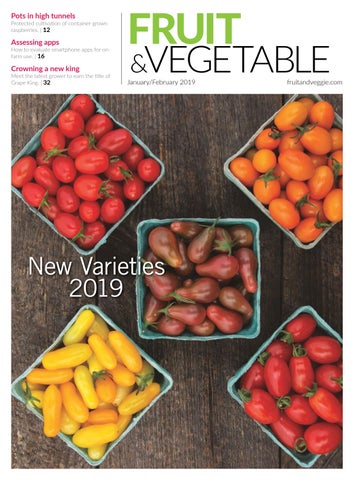
16 20 32 ON THE COVER The Galaxy suite cherry tomatoes showcase a few of the colourful offerings in the 2019 New Varieties. See page 26 for more. Photo courtesy of High Mowing Organic Seeds.
Assessing apps for in-field use
How to identify which smartphone apps are most useful for your farming business. BY RONDA PAYNE
Seal off your produce from pests
Crowning a new king
BY ALICE SINIA
BY JIM MEYERS
Protect your crop investment. Ensure your IPM includes strategies for storage.
Meet the latest grower to be named Grape King, Chris Van de Laar of Van de Laar Vineyards.
January/February 2019 - FRUIT &VEGETABLE 3
FROM THE EDITOR
FRUIT & VEGETABLE January/February 2019 Volume 75, No. 1
JENNIFER PAIGE | @FruitandVeggie.com
Editor JENNIFER PAIGE jpaige@annexbusinessmedia.com 416-305-4840
A New Year’s mindset The start of a new year is something I tend to look forward to. There is nothing more promising than an untouched calendar with blank days just waiting to be filled with the highs and lows of what is sure to be another eventful chapter. A new year brings with it the opportunity to renew, refresh or reinvent ourselves. A time to reflect on what may or may not have worked last year and contemplate what we want to accomplish during our next journey around the sun. Thinking about the past growing season, where did you see the most success on your operation? Where were your trouble spots? How were the yields? Perhaps you are feeling driven to try something new in 2019. If so, Fruit and Vegetable (F&V) magazine’s new variety listings might peak your interest. A few of this year’s varieties are featured on our cover – The galaxy suite cherry tomatoes from High Mowing Organic Seeds. This was an easy choice to feature with its eyecatching pops of colour. Peruse all of the 2019 New Varieties on page 26.
Advertising Manager AMANDA MCCRACKEN amccracken@annexbusinessmedia.com 226-931-5095 • 888-599-2228 ext. 266 Account Coordinator MARY BURNIE mburnie@annexbusinessmedia.com 519-429-5175 • 888-599-2228 ext. 234
increase in weed pressures in recent years? Where are you seeing gaps in crop protection options? How can F&V better assist you in your operational goals in 2019? To sweeten the deal, and for the generosity of your time, F&V is offering up a $500 prize for eligible survey participants. Check out fruitandveggie.com/survey for all the details. The end of January also saw the launch of a new project. F&V has partnered up with BASF for the What’s Growing Canada video contest. The concept behind this contest came through a conversation with our team about how we could better celebrate the upcoming growing season. So, in an effort to shine a light on all the hard work that goes into producing Canada’s fruit and vegetable bounty, we are asking Canadian growers to capture a 30 to 60 second production-focused video and share it with us for a chance to win tickets to next year’s Ontario Fruit and Vegetable Convention and $500 cash (as well as a few Tim Hortons gift cards along the way).
Perhaps you are feeling driven to try something new in 2019. In keeping with the New Year’s mindset, the F&V team has been busy reflecting on the past issues of the magazine and have been looking for areas of the publication that may need to be renewed. To this end, F&V wants to hear from you and to do this we have created an online survey. The survey starts out as many do, with the basics – where are you and what do you grow? But, the latter questions provide an opportunity to express the trends and issues that you may be seeing. Have you had an
We want to see what is going on, on your farm and every farm across Canada. Show us how you prepare for the season, the seeding activities that take place on your operation, scouting and crop protection measures you may take and, of course, all the action of harvest. So, get out your smartphones, tablets and cameras and help us to capture the action and beauty of the Canadian fruit and vegetable industry!
Circulation Manager AASHISH SHARMA asharma@annexbusinessmedia.com 416-442-5600 ext 5206 VP Production/Group Publisher DIANE KLEER dkleer@annexbusinessmedia.com President/CEO MIKE FREDERICKS Publication Mail Agreement #40065710 Printed in Canada ISSN 1488-7959 Fruit & Vegetable Magazine is published five times a year (January/ February, March, April, May, November/December) by Annex Business Media SUBSCRIPTION RATES Canada - 1 Year $ 23.00 (plus applicable taxes) U.S.A. - 1 Year $ 41.00 USD GST - #867172652RT0001 CIRCULATION Roshni Thava rthava@annexbusinessmedia.com Tel: (416) 442-5600 ext. 3555 Fax: (416) 510-6875 or (416) 442-2191 Mail: 111 Gordon Baker Road, Suite 400, Toronto, ON M2H 3R1 Occasionally, Fruit & Vegetable Magazine will mail information on behalf of industry-related groups whose products and services we believe may be of interest to you. If you prefer not to receive this information, please contact our circulation department in any of the four ways listed above. Annex Privacy Officer privacy@annexbusinessmedia.com Tel: 800-668-2374 No part of the editorial content of this publication may be reprinted without the publisher’s written permission. ©2019 Annex Publishing and Printing Inc. All rights reserved. Opinions expressed in this magazine are not necessarily those of the editor or the publisher. No liability is assumed for errors or omissions. All advertising is subject to the publisher’s approval. Such approval does not imply any endorsement of the products or services advertised. Publisher reserves the right to refuse advertising that does not meet the standards of the publication.
Check out all the contest details at WhatsgrowingCanada.com.
@fruitandvegmag 4 FRUIT &VEGETABLE - January/February 2019
Media Designer ALISON KEBA
@FruitVegMag
fruitandveggie.com
INDUSTRY NEWS fruitandveggie.com
Canadian Plant Health Council launched The Canadian Plant Health Council, which was launched in the fall, will address priorities for the plant health sector, working together on preventive approaches and activities to protect plants from pests, diseases and other risks. The council consists of 11 members from national industry associations, academia and federal, provincial and territorial governments representing
the plant health sector in agriculture and forestry. “Fruits and vegetables are very sensitive to new pests and disease. The Canadian Plant Health Council’s ability to co-ordinate an effective national response to such threats is extremely relevant to our industry, as consumers demand high quality produce,” said Brian Gilroy, president of the Canadian Horticultural Council.
INVESTING IN AUTOMATION RESEARCH The federal government recently announced an investment of up to $5 million to the Automation Cluster under the Canadian Agricultural Partnership. The Automation Cluster will help address labour costs and availability through automation, artificial intelligence and precision agriculture technologies in the horticulture sector. The Cluster will be led by the Vineland
Research and Innovation Centre Inc. Over the next five years, researchers at Vineland will focus research on three key areas – developing and testing robotic harvesters for greenhouse cucumbers, developing smart, wireless irrigation technologies for potted flowers and vegetables, and developing state-ofthe-art sensors that will help detect and monitor moisture levels in the soil and air.
News of the investment was looked at favorably by industry members. “Fruit and vegetable farmers are actively looking for ways to increase automation in their businesses to reduce their reliance on labour and maintain their competitiveness in a global marketplace,” said Jan VanderHout, chair of the Ontario Fruit and Vegetable Growers’ Association. “We welcome this type of investment by the
government to help the future profitability of our sector, both for existing crops and new ones that technological innovation may make it possible for us to grow in the future.” VanderHout adds that the investment will better position the fruit and vegetable sector to maintain and grow the significant contributions it makes to the provincial and national economies.
BY THE NUMBERS - Raspberry production
IN 2017 2,140 hectares of raspberries were grown across Canada 795,249 tonnes of raspberries were produced worldwide
3,045 tonnes (including frozen) were exported 9,745 tonnes were marketed
THE AVERAGE LIFESPAN OF A RASPBERRY PLANTING IS 7 TO 10 YEARS 6 FRUIT &VEGETABLE - January/February 2019
B.C. produces
58% of Canada’s raspberry bounty
38%
of Canadian raspberry growers report selling directly to consumers
Source: Statistics Canada
We’ve been in apples since kids started bribing teachers with them. At BASF, we’ve provided innovative solutions to apple growers for over six decades. This year is no exception with the addition of our new, fast-acting aphicide, Versys™. Also joining our lineup is Ignite® herbicide, with its effective burndown of annual grasses and broadleaf weeds. Get schooled on the whole portfolio at agsolutions.ca/horticulture or contact AgSolutions® Customer Care at 1-877-371-BASF (2273).
Always read and follow label directions. AgSolutions, APOGEE, IGNITE, NEALTA, SERCADIS, and XEMIUM are registered trade-marks, and INSCALIS, AND VERSYS are trade-marks of BASF; all used with permission by BASF Canada Inc. SERCADIS fungicide should be used in a preventative disease control program. © 2019 BASF Canada Inc.
GROWTH TRENDS fruitandveggie.com
New high-yield varieties released
BASF opens global breeding center for cucumbers in the Netherlands
CREDIT: MATTHEW HAYES
Dickens is a traditional, June-bearing strawberry with high yields and bright red fruit that continues bearing late into the season.
By Krisy Gashler courtesy of the Cornell Chronicle 8 FRUIT &VEGETABLE - January/February 2019
Research helps breed better-tasting sweet corn Lindsey du Toit, vegetable seed pathologist at Washington State University’s Northwestern Washington Research and Extension Center at Mount Vernon, is a co-primary investigator on a $7.3 million, four-year grant to find the genetic traits that will make sweet corn taste better, last longer and grow better. The project is funded by the Specialty Graduate student, Ryan Solemslie, Crop Research Initiative (SCRI) and surveys a sweet corn field in central is led by scientists at the University Washington this past season. of Florida, and includes research at Iowa State University, the University of Wisconsin, and the USDA. Carrie Wohleb and Tim Waters, WSU Extension Educators in the Columbia Basin, have performed trials for a number of years. Sweet corn breeders leading the SCRI project invited Wohleb to participate in the project to represent Pacific Northwest production, and screen for tolerance in sweet corn germplasm to cool spring planting conditions and resistance to seedling blights. To get started on finding the best genetic traits, scientists will screen existing sweet corn lines, to find genes that, among other things, help corn grow right after planting. While researching ways to defeat pests, scientists also seek genetic traits that make corn last longer on grocery store shelves and require less pesticide use.
CREDIT: LINDSEY J. DU TOIT
The berry breeding program at Cornell AgriTech is releasing two new varieties, which will be available for planting in spring 2019: A strawberry, Dickens, and a raspberry, Crimson Treasure. The new berries are the handiwork of berry breeder Courtney Weber, associate professor in the College of Agriculture and Life Sciences based at Cornell AgriTech in Geneva, N.Y. Dickens is a traditional, June-bearing strawberry with high yields and bright red fruit that continues bearing late into the season. The berries are firm, so they hold well on the plant and in the container, Weber said, but not so firm that they have no flavor. The Dickens strawberry was first discovered in Weber’s breeding fields in 2002 and was originally noticed for the plant’s hardiness in surviving cold winters, making it especially suitable for cold-winter climates. Production trials throughout the region have shown Dickens to be an adaptable and consistent producer of high-quality fruit. Dickens has been tested in annual and perennial production systems, without soil fumigation, and found to be tolerant to root rot and other common diseases. The new raspberry, Crimson Treasure, is also very high-yielding, with larger fruit than traditional varieties grown in the region. The well-known Heritage raspberry produces fruit of approximately 2.5 grams, while Crimson Treasure produces berries twice as large – averaging between four to six grams. Crimson Treasure is a fall-bearing raspberry with bright-red fruit that holds its colour and texture well in storage. Crimson Treasure was originally discovered in 2012. Weber has worked to speed the process of developing new raspberry varieties because the program has so many international collaborators interested in raspberries. The berry program works with commercial partners across North America, in Morocco, Spain and Portugal.
with marker BASF has opened a new state-of-thetechnology in the art breeding center laboratory and indoor farming for cucumbers at techniques, this its site in Nunhem, the Netherlands. breeding center will reduce the The facility will house all cucumber development time of pre-breeding and seed varieties by up to 25 per cent. breeding programs The new facility will house all in Nunhem: High The greenhouse cucumber pre-breeding and is also at the wire, long, short, breeding programs. snack and pickling forefront of modern cucumber types, including the environmental standards. Energy saving technologies and translucent phenotyping line, which offers digital evaluation of fruit characteristics. screens inside the greenhouse ensure an even climate and reduce gas The results from these programs will consumption by up to 48 per cent. provide innovative new varieties for The Nunhem site is the first in a greenhouse and open-field growers series of global centers of excellence as well as retailers and consumers establishing the Creator Campus around the world. concept. The facility incorporates the latest “Our aspiration is to provide an technology to optimize breeding open platform for variety development operations including plant hygiene and innovation with value chain and locks, equipment and protocols to R&D partners. It will enable us to minimize infection risk, diffused nurture ideas and create successful glazing for optimal use of natural vegetable solutions together,” light, high roofs and high-pressure commented Joachim Schneider, head moistening for better plant climate of BASF’s vegetable seeds business. and energy saving. In combination
WE’RE MOVING IN ON APHIDS. { They’re bugging out. }
New Versys stops aphids from feeding and creates a lasting barrier against them. Aphid infestations can be incredibly unpredictable. Until now. New Versys™ insecticide quickly stops aphids and white flies from feeding, protecting the health of your crop and quality of your product. With a new mode of action, it also controls populations that are resistant to other chemistries. And Versys is safe for beneficial insects, ensuring that your targeted pests are the only bugs that check out. Visit agsolutions.ca/horticulture to learn more. Always read and follow label directions. AgSolutions is a registered trade-mark, and VERSYS, and INSCALIS are trade-marks of BASF; all used with permission by BASF Canada Inc. © 2019 BASF Canada Inc.
NEW PRODUCTS fruitandveggie.com
Vermicompost solution the first of its kind in Canada
Growers in Canada now have access to an organic soil amendment that’s improving soil quality and producing healthier plants. A.M.A.Horticulture Inc. is offering TerraVesco Vermicompost – the first vermicompost solution of its kind available north of the border. TerraVesco Vermicompost is a horticultural grade soil amendment that is enabling growers to naturally accelerate the quality, fertility and biodiversity of the soil. TerraVesco’s proprietary production process uses pre-composted organic dairy manure to eliminate weed seeds and harmful pathogens. Millions of red wiggler worms convert the manure into an organic soil amendment that is consistent in texture and performance. It is Canadian Department of Food and Agriculture-certified and Organic Materials Review Institute-listed in Canada. TerraVesco Vermicompost promotes increased nutrient uptake, enhanced root mass and stem calipers, improved transplant success, disease suppression, and healthier, more resilient plants. TerraVesco Vermicompost is versatile and can be used during all phases of the growth cycle. Grape and tree nut growers are placing it directly in the transplant hole during the planting process and using it for top dressing around established plants and trees. Nurseries and landscapers are blending it into potting mixes and flower beds. “Sustainable solutions like TerraVesco Vermicompost are helping our industry move away from chemical-based products while continuing to drive high yields, high quality products and strong bottom lines,” said Connie Bradt-Monsma, managing director, A.M.A. Horticulture Inc. amahort.com 10 FRUIT &VEGETABLE - January/February 2019
Withstanding extreme wear in handling equipment Agricultural bulk handling equipment such as chutes, spouts, elbows and distributors can experience severe wear seasonafter-season. The bare structure of the equipment may not be adequately wear resistant and even traditional steel or rubber protective liners may insufficiently control the abrasion. This can pose a risk of costly spillage and production downtime for cleanup and repair. For such applications, sheets made from urethane (short for polyurethane) provide far better wear resistance than more traditional options such as steel or rubber. Urethanes are cost-effective, dependable elastomers that combine some of the performance advantages of high-tech metals, ceramics, and plastics, along with the flexibility and resiliency of rubber. Because of this, thinner cross sections can be applied at lighter weight, allowing easier installation. This liner can be cut from full sheets of various sizes to fit the contours and shapes of high contact areas, so it can easily be glued, bolted, or welded to provide extreme wear protection wherever it is required. While such liners are commonly cut to fit and installed onsite, custom liners made to fit important transitions or more complex configurations can increase reliability, simplify installation, and further reduce production downtime. The abrasion resistance of urethane elastomers has led to many important applications where severe wear is a problem in industries as varied as agriculture and mining. The material can be installed using a bolted technique, glued or welded in place to create rugged and durable lining for chutes, spouts, and other agricultural bulk handling equipment. Polyurethane coated bolts are also available when using a bolt-in technique. argonics.com
New Brunswick creates online resource hub Launched last growing season, the AgriStartNB is a website that connects prospective farmers with a “one-stop shop” to help them investigate opportunities in the sector, and also benefits existing farmers who are looking to expand their operations. The website provides information on available government programs, equipment, labour and training, commodities and markets. It also has an online directory that will bring together people looking for farms and farmland and those leasing or selling it.
AgriStartNB complements the provincial government’s New Entrants Road Map for new farmers, which provides links to important resources, contacts, and various programs currently available. Producers now have the opportunity to add their listings directly into the website. Listing information can include land identification, acreage, soil type, area, commodity, price and whether the land is being sold or leased privately or through a realtor. agristartnb.ca
Not everyone’s a fan of our work.
Providing first-rate protection for vegetables. Vegetable growers have come to expect the most advanced solutions from BASF. Whether it’s herbicides you’ve trusted for years like Prowl® H2O or the exceptional protection against disease provided by Cabrio® and Sercadis.® It’s all part of our mutual commitment to growing heathier, more bountiful crops. So kids will have plenty to turn their noses up at for many years to come. To learn more, visit agsolutions.ca/horticulture or contact AgSolutions® Customer Care at 1-877-371-BASF (2273).
Always read and follow label directions. AgSolutions, CABRIO, FRONTIER, PROWL, SERCADIS, XEMIUM, and ZAMPRO are registered trade-marks of BASF; all used with permission by BASF Canada Inc. CABRIO, SERCADIS, and/or ZAMPRO fungicides should be used in a preventative disease control program. © 2018 BASF Canada Inc.
POTS IN
high tunnels A few of Canada’s raspberry growers are seeing an increase in production with the use of high tunnels, container production and a soilless growth medium.
BY TREENA HEIN BELOW In Quebec’s Ile-d’Orléans region, Onésime Pouliot Petits Fruits has been growing containerhigh tunnel raspberries since 2008.
12 FRUIT &VEGETABLE - January/February 2019
To boost both production and quality, some Canadian producers have been using high tunnels in conjunction with container production and a soilless growth medium. “There is growing interest in Ontario,” reports Erica Pate, fruit crop specialist with the Ontario Ministry of Agriculture, Food & Rural Affairs, “and there are a couple growers who are in the early stages of production.” Pate says there has been a request for funding for a project in which the government will partner with others to study container high tunnel raspberry production, and confirmation should be received in February. On the West Coast, the British Columbia Raspberry Industry Development Council does not know of anyone using high tunnels and containers in that province, but some producers in that province do use high tunnels. In Quebec, however, a few growers have been using this type of production for years. Among them is Fraises de l’ile d’Orleans in Saint-Laurentde-l’Île-d’Orléans owned by André Gosselin, a retired Laval University horticultural scientist. Gosselin considers high tunnels essential for raspberry production in the climate of Quebec, and also notes that using soilless growth mediums in containers eliminates root diseases, along with favouring higher yields and better fruit quality. He uses a peat moss based growing medium developed over many years in collaboration with Berger, a company located in Saint-Modeste, Que.
LEFT Onésime Pouliot farm is also a nursery in that it sells varieties suited to container-high tunnel production, and demand is growing for that every year.
very limited shelf life, the dry conditions provided by high tunnels is a game-changer in itself. Having plants in pots allows growers to move some into storage when the weather turns cold, and lay the rest down and cover them for the winter. This means that growers like Onésime Pouliot Petits Fruits can therefore use varieties that would not otherwise survive conventional field cultivation, maximizing both taste and yield.
“Having root cuttings that have a head start at transplantation and providing higher temperatures under tunnels allow for a rapid establishment of the crop.”
which also has outlets or processing plants in several provinces and two U.S. states. Fertigation of raspberries grown this way, adds Gosselin, should be based on recommendations from Northern Europe (Holland, Belgium and Switzerland). “Cultivar selection must be based on conventional criteria such as yield, fruit quality and shelf-life, disease resistance, winter resistance, early maturation and so on,” Gosselin says. “The good news is that excellent new genetic selections are now available from Holland, Italy, France, Poland and more, but they must be tried and evaluated at various sites and growing conditions.” Also, in Quebec’s Ile-d’Orléans region, Onésime Pouliot Petits Fruits has been growing container-high tunnel raspberries since 2008. They also grow blueberries, strawberries and sweet potatoes, and sell their products through major food chains throughout Quebec, the Maritimes and parts of the U.S. The farm’s business development manager Joey Boudreault notes because wet raspberries have a
STAGGERED HARVEST Putting some of their canes in cold storage has another advantage. “When the spring comes, we take some of them out but not all of them,” Boudreault explains. “We keep some in there, in dormancy. About a month later we take them out, and they progressively start to give fruits like they normally would in the spring. So, we can expand the season, and have a more constant supply of berries throughout the season instead of having one big boom of berries.” Their season runs from mid-July to the end of September, or even very early October depending on the year. Currently, Onésime Pouliot is unable to meet all of the marketplace demand. But, Boudreault says they should be able to completely meet demand as production grows. “We do export some of the raspberries in the U.S., to smaller farmers markets,” he adds. “We want to expand that as well. It is good business with the exchange rate.” While it’s hard to compare the yield between ‘bush’ field-grown raspberries and the container-high tunnel varieties (each cane grows to about six feet tall), Boudreault says the latter obviously benefits from fertigation, which makes them highly productive. They are also much easier to harvest. “Harvest represents around 50
January/February 2019 - FRUIT &VEGETABLE 13
per cent of our costs, so improving that is major for profit,” Boudreault notes. “We try a lot of varieties each year. For now, the Tulameen stays in front of all of them. Some other varieties have better yield then Tulameen, but it stays the reference in term of taste. We believe that we will get better results long-term with this instead of having more yield of a poorertasting berry that will maybe disappoint a customer.” Onésime Pouliot farm is also a nursery in that it sells varieties suited to container-high tunnel production, and demand is growing for that every year as well. Boudreault notes that sometimes it takes time for people to decide to start this type of production because it’s more expensive than field cultivation. “You have to put more work in as well,” he says. “The 15 to 25 irrigations per day needs to be taken care of by someone, and growers usually do not need more work. We have a fulltime employee dedicated to check the irrigation, verify that everything goes well in the tunnels, program the pumps and injectors, check that the tubes are clean and that everything is going well,”
he adds. “This is how much monitoring you need to do. This is very costly production, so if you are going to do it, you have to do it well. Everything is important and the attention to detail will make a big difference down the stretch.” Boudreault notes that harvest efficiency is key to keeping expenses down, and that they are learning how to be more efficient all the time. They also make high tunnels themselves and might even start selling them to other growers in the very near future. RESEARCH RESULTS Yves Desjardins, professor in the Institute of Nutrition and Functional Food at Laval University, has conducted several studies of soilless high tunnel raspberry cultivation with colleagues in the recent past. With cultivar Jeanne d’Orléans, he and his team found that compared to field-grown plants, they produced a taller and thicker primocane, more fruit and higher total fruit yield. He says that while the growth medium is important, after a couple of months, the roots occupy most of the pot volume and therefore fertigation is the main factor that is
influencing plant development. In another study with cultivar Autumn Britten, Desjardins and colleagues studied responses to fertigation solutions, various substrates and propagation methods. Higher fruit yield was mostly found in this study, he says, due to the advancement of the peak fruiting period because of higher greenhouse temperatures in early spring while root-cutting propagation occurred. “We are indeed favouring the fastest establishment to obtain good yield of primocane raspberry. Having root cuttings that have a head start at transplantation and providing higher temperatures under tunnels allow for a rapid establishment of the crop,” Desjardins says. “I would personally say that for raspberry, high tunnel production is a must,” he adds. “Californian companies like Driscoll is growing under tunnels for the quality of the fruits, the increased shelf life and size. In northern climate conditions, the gain in productivity is even more important.” He confirms that several, “large Quebec growers are doing very well with this production style.”
Here’s to
WEARING OUT YOUR WORK GLOVES We’re proud to finance the people, the dreams, and the future of Canadian agriculture.
Here’s to Canadian Agriculture. Here’s to you.
fcc.ca FEBRUARY 12
14 FRUIT &VEGETABLE - January/February 2019 GH_FarmCreditCan_January19_CSA.indd 1
2018-12-12 11:53 AM
IDEAL
FROM FIRST LEAF TO FIRST CUT Count on Luna Sensation™ fungicide to help you produce a flawless lettuce crop. Its two modes of action give you outstanding control of damaging diseases such as lettuce drop and powdery mildew. Want your lettuce to look its very best? Incorporate Luna Sensation into your spray program.
Learn more at cropscience.bayer.ca/Luna
Always read and follow label directions. Luna® and Luna Sensation™ are trademarks of the Bayer Group. Bayer CropScience Inc. is a member of CropLife Canada.
Assessing apps for use in the field With new smartphone apps being developed every day, how can growers determine which one is best suited to their needs? BY RONDA PAYNE
Every day there is a new smartphone application launched that claims to assist growers in their farming efforts. And while many of these apps can be beneficial tools, wading through the ever-growing lineup of offerings can be a daunting task. “I think apps are a really good tool when we are busy. But, just like any other tool, you want to spend some time doing your research before downloading or paying for anything,” says Renee Prasad, assistant professor of agriculture at the University of the Fraser Valley. Prasad and her students have taken on a number of research projects with the goal of determining how to identify a useful smartphone app for a farming business. She explains that without the proper research, an app can also become just another icon taking space up on your phone. Reviews and ratings are helpful, as are the developer’s website, which may explain the app and its functionality. Throughout her research, two weed
identification apps were reviewed - Farm Progress Identify Weeds and Plant Snap. And while Prasad isn’t recommending any apps in particular as there are numerous other weed identification apps available, she does want those in the industry to understand some of the pros and cons of apps and how to assess them. Therefore, these two apps were used as an example of how her team, and growers, can determine which app is right for their needs. Prasad notes that the Farm Progress app requires users to scroll through pictures to match their weed to an image on the app. The majority of the images were soy and cornfield weeds, which made the app fairly crop specific. Most interestingly, the app only had a one-star rating and the developer operation is no longer running. “You wouldn’t know something like that without doing the research,” Prasad explains. “A person could install the app on their phone, then wonder why it never had updates if they didn’t look further and learn it wasn’t being supported.”
ABOVE Apps are often a faster way to find information, complete a task or file information. However, like many tools, what a person gets out of it often depends on what they put into it. 16 FRUIT &VEGETABLE - January/February 2019
HORTICULTURE GROUP
28
TO BE SELECTED,
THEY NEED TO BE PROTECTED. Use Exirel® insecticide early in the season to give your pome fruit, stone fruit and blueberries the head-start they need during the most critical stages of development. Exirel® insecticide has fast acting, translaminar and xylem systemic movement so you’ll be protecting new growth from difficult chewing and sucking pests, including aphids, plum curculio, apple maggot, codling moth, Oriental fruit moth, leafrollers, weevils, and spotted wing drosophila. Exirel® insecticide, powered by Cyazypyr , is an important part of an integrated pest management program. TM
Always read and follow label instructions. Member of CropLife Canada. FMC, Cyazypyr and Exirel are trademarks or service marks of FMC Corporation and/or an affiliate. ©2019 FMC Corporation. All rights reserved. 63693-1/19
@FMCAgCanada FMCcrop.ca I 1-833-362-7722
App evaluation checklist In an effort to help users evaluate smartphone apps, Stefanie Havelka from Lehman College and Libguides at Emporia State University came up with an evaluation checklist. Below are eight categories of questions to investigate before committing or paying for a smartphone application. 1. Currency: How current is the app? When was it developed? When was it last updated? 2. Relevance: How relevant is it to your purpose or outcomes? 3. Authority: Who created the app? Who is the author, publisher or source? What is their background and expertise?
The second weed identification app, Plant Snap, uses a crowd-sourced method, meaning a variety of users contribute to the information. It has a four-star rating but very few users are farmers. Functionality-wise, it’s easy. Take a picture and the app searches for the matching plant. Users must follow specific criteria for their picture, and, for a fee, the photo could be sent to an expert for individual assessment. “Within about 10 minutes, we got an answer,” Prasad says. She notes that Plant Snap may not help with seedlings as the images were primarily of growing, more established or mature-staged plants. The research team found that apps are often a faster way to find information, complete a task or file information. However, like many tools, the outcomes depend on what the user inputs. “It’s about you and your use of the tool,” Prasad says. “Many apps require inputs, so you need the correct information and to take the time to enter the data.” Prasad also looked into another application called Bucketload, which helps to track the progress of field workers at harvest. She notes that while Bucketload is helpful in tracking
the harvest and determining pay, it is dependent on user inputs to make the app functional. “Before you can use the app, you have to do some work in the real world.” For instance, pickers need ID numbers assigned to them along with QR codes. When the picker brings their harvest in, they scan their QR code and the app keeps a tally. The grower can then upload that information to calculate payment. Sometimes incorrect information can result from settings that need adjustment, such as measurements being shifted to metric from imperial, or a box that needed to be checked or unchecked. Each app is made with a certain set of assumptions and those boxes that are checked are what the app creators feel are the most universal set of standards. Prasad emphasizes that a user should not assume they fall into the category the app creator had in mind. For example, if the app was created for okra crops, which is traditionally grown in the southern United States, a grower in Canada would want to check the default settings and ensure the inputs were accurate for their growing region. “To get the right app that can be a useful tool, it seems you need an investment of time to find the ones that work for you,” Prasad says.
18 FRUIT &VEGETABLE - January/February 2019
4. Purpose: What was the purpose behind the development of the app? What is the purpose of the app? Is the information fact, opinion or propaganda? 5. Privacy: Does the app have a privacy statement or setting? Does the app share information on social networks? Does it use location services? 6. Intuitive: Is it easy to use? Can you use it without instructions? 7. Ease: How easy is it to find the (needed) information? 8. Stable Interface: Does the app crash? How secure is it? Here are a few popular agriculture smartphone applications to evaluate for your operation: • ID Weeds • Tank mix calculator • Farm Logs
• Agri Sync • Ag Guardian • Beet Clock • iSOYLscout
CREDIT: CONTRIBUTOR PHOTO
Seal off your produce from pests Protect your crop investment. Ensure your integrated pest management plan includes strategies for protecting fruits and vegetables from pests in storage too. BY ALICE SINIA, ORKIN CANADA
When plants are growing outdoors, it’s no surprise that they are at risk for pest activity. But even once produce is harvested and brought inside for storage and packaging, it can fall victim to pests’ appetites. In fact, pest infestations that are established during storage can put your produce at increased risk, as it is easy for pests to move and spread quickly in the closed environment. While a pest infestation in the field might be obvious as plants show signs of fatigue, develop deformations or die, an infestation in the warehouse can pass under the radar if it is not monitored. So, it’s important for your Integrated Pest Management (IPM) plan to include strategies for protecting your fruits and vegetables as you prepare them for storage and shipment. IPM strategies focus on preventive techniques, like exclusion, maintenance and sanitation and use sustainable, environmentallyfriendly practices to manage and control pests. Pests can infest produce items at any point in the supply chain, and improper packaging can
make it easier for them to access your produce. Here are some of the most common pests that attack harvested fruits and vegetables: SPIDERS Spiders prey on insects and are naturally inclined to be found on foliage and vegetation. Therefore, harvested produce will harbour spiders. While in the field, spiders do help keep insect populations in check, but you don’t want them on your produce when it gets packaged and shipped. SPRINGTAILS Springtails are tiny insects that jump around when disturbed. They are attracted to moisture, dampness and humidity. They normally live in damp soil and feed on mould and fungi. So, naturally they will be found concealed in foliage and on plant stems, especially on vegetables that grow at soil level. As a result, they can easily make their way into packaged produce once harvested.
ABOVE It’s important for your Integrated Pest Management (IPM) plan to include strategies for protecting your fruits and vegetables as you prepare them for storage and shipment. 20 FRUIT &VEGETABLE - January/February 2019
Sencor® STZ herbicide for potatoes lets you spend less time worrying about weeds, and more time enjoying the little things. Things like taking in the stars, meeting the school bus, or pausing to pat the dog. We call those Grower Vacations. And with the weed control of Sencor STZ, you can discover more of them knowing you’re protected from all major weeds. So enjoy your own vacation, even if it’s just for a few minutes. Find out how at GrowerVacations.ca
cropscience.bayer.ca
|
1 888-283-6847
|
@Bayer4CropsCA
|
#AskBayerCrop
Always read and follow label directions. Sencor® is a registered trademark of the Bayer Group. Bayer CropScience Inc. is a member of CropLife Canada.
FRUIT FLIES As their name suggests, fruit flies are attracted to ripening and fermenting fruits and vegetables. Female fruit flies lay their eggs under the surface of fruits and vegetables. Therefore, a detailed inspection of random samples of fruits and vegetables to detect eggs and larvae is crucial to preventing a pest infestation in your processing and storage facilities. Sampled fruits should be cut through and examined for eggs and larvae, which will be visible to the naked eye. INDIAN MEAL MOTHS While they only feed on dried fruits and vegetables, Indian meal moths are the most common stored product pest in foodhandling facilities, homes and grocery stores. They are primarily attracted to dry foods and can damage products as their larvae spin silk webbing that accumulates fecal pellets and cast skins in the food. Common signs of an Indian meal moth infestation include the silk webbing, buildup of droppings in the food product and pupal cocoons along walls, shelving and ceilings. PREVENTION Once harvested and packed, fruits and vegetables must continue to breath to maintain their freshness. So, packaging often has aeration pores that can make produce vulnerable to pest attacks, and it is difficult to find packaging that is impervious to all pest activity. However, there are some packaging materials that should be avoided for produce. Wooden containers can harbour wood boring insects. When exposed to moisture, they also can rot or cause mould
22 FRUIT &VEGETABLE - January/February 2019 Untitled-1 1
and fungal growth that attracts insects which can spread and infect the packed produce. Rough, wooden boxes or bamboo like packaging can cause bruising and damage produce, which attracts insects. Materials less capable of withstanding stress also can damage produce, as they are vulnerable to tears, which can expose or damage the fruits and vegetables. Therefore, it’s important to choose the right type of packaging for your produce. In addition to avoiding these materials, keep an eye out for packaging that doesn’t seal properly. Even the best packaging doesn’t stand a chance if it’s not closed all the way or has a hole. At the end of the day, your goal should be to make it as difficult as possible for pests to reach your fruit and vegetable products. Fruit and vegetables are susceptible to pest infestations while they are growing. And once in storage, it’s easy for a pest infestation to spread quickly – especially with such an abundance of food for the pests to thrive on. So, it’s important to take steps to manage infestations in the field and to establish controls to help prevent infestations from being brought inside and spreading once in storage. IN THE FIELD Pest prevention starts with Good Agriculture Practices (GAP) in the field that reduce conditions conducive to pest infestations. • Extensively monitor for pest activity by inspecting or scouting plants regularly during growing season to catch infestations early. • Reduce pest attractants by practicing good sanitation (phytosanitation) and eliminating on-site harbourage sites such as weeds, piles of compose, standing water and idle
2019-01-07 2:47 PM
! ED .
To da M IT y LI
IS
er
NG
is t SE
AT I
Re g
Advancing Women In Agriculture Conference
Elevating the discussion in agriculture March 11 & 12, 2019 Hyatt Regency – Calgary, AB AdvancingWomenConference.ca or call 403-686-8407
unused equipment. • Remove fallen, overripe or rotting fruits from the fields, as this could attract fruit flies and other pests. • At time of harvest, inspect extensively for insects and spiders on produce. • Harvest produce when they are dry. This prevents pest and diseases from clinging on them. • Clean and sanitize harvest equipment, bins and tools before and after harvesting. • Avoid or prevent bruising of produce. The bruising attracts insect pests, especially fruit flies. IN PROCESSING AND STORAGE As a first step, implement these post-harvest handling practices: Sanitation • Have written cleaning and sanitation operating procedures for equipment and the facility. • Clean and sanitize packaging, handing bins and equipment regularly to prevent build-ups and habourages. • Regularly clean spills or trapped produce, especially in hard to reach areas and dead voids in packaging conveyer machines and equipment footing, as well as under and inside pallets. • Ensure floor drains have undamaged cover grids or traps to prevent trapping fruits and vegetables in the drain. This creates a breeding ground for fruit flies, drain flies and phorid flies. • Using drain brushes, mechanically clean floor drains at least every two weeks or so. • Ensure the floor is void of cracks and tile gaps. The floor should
Get Fresh
be smooth and level for effective cleaning. • Practice good fruit and vegetable waste management to avoiding attracting pests and creating harbourage sites. Exclusion • Air curtains, sensor doors and roll-up doors keep flies from entering into processing or storage areas. • Install pest monitors like insect light traps and pheromone traps. • Repair screens and weather stripping around doors and windows. Storage and Shipping • Use the first-in, first-out rule for storing and distributing products to avoid fermentation. Keep products off the floor on racked shelves. • Keep products refrigerated when you can. Temperature regulation and maintaining your cold storage system keeps the produce fresh and keeps pests away. • Allow proper illumination and ventilation to keep moisture down and discourage pest activity. • Avoid crisscross movement of packed produce to prevent pest contamination. • Ensure transportation vehicles are clean and temperatures are regulated. • Inspect packaging for pest activity prior to loading and shipping. In addition to these preventive steps, be sure to monitor pest activity closely – indoors and outdoors. This will help you identify trends and adjust your pest management program to meet the unique needs of your property.
Visit a Farm
Being a member of OFFMA means having a team of people behind you cheering you on every step of the way, celebrating your successes & being there to help you when you stumble. Tom & Nicole Wilson, Spirit Tree Estate Cidery
If you are running a direct farm market and are not a member of Ontario Farm Fresh, it is akin to being a hockey player without skates. Steve Martin, Martin’s Family Fruit Farm
ontariofarmfresh.com 24 FRUIT &VEGETABLE - January/February 2019 FV_OFFMA_WILSONMARTIN_JANFEB2019_ASK.indd 1
2019-01-08 3:59 PM
YOU’VE
NEVER SEEN A BAYERVALUE
™
HOT POTATOES
®
PROGRAM
LIKE THIS We’ve now made it even easier to qualify for up to 12% savings, with 50+ brands and hundreds of products including Bayer corn and soybean seed trait and Roundup Xtend ® with VaporGrip ® Technology herbicide. You’ll be surprised how simple it is to save. Ask your local retail for complete details or visit cropscience.bayer.ca/BayerValue
Always read and follow label directions. Admire®, Aliette®, Alion®, BayerValue™, Betamix® ß, Buctril®, Calypso®, Concept®, Converge®, Decis®, Emesto®, Envidor®, Ethrel®, EverGol®, Flint®, Folicur®, Hot Potatoes®, Infinity®, Luna Sensation™, Luna Tranquility®, Movento®, Nortron® SC, Oberon®, Option®, Pardner®, Priwen®, Proline®, Propulse®, Prosaro®, Puma®, Reason®, Scala®, Sencor®, Serenade®, Sivanto™, Stratego®, Trilex®, Velum®, and Vios® are trademarks of the Bayer Group or its licensors. DEKALB®, Genuity®, RIB Complete®, Roundup Ready 2 Technology™, Roundup Ready 2 Xtend®, Roundup Ready 2 Yield®, Roundup Ready®, Roundup®, SmartStax®, VT Double PRO® and VT Triple PRO® are trademarks of the Bayer Group, Monsanto Canada ULC licensee. All rights reserved. Titan is a trademark of BASF. © 2019 Bayer Group. All other products mentioned are trademarks of their respective companies. ALWAYS FOLLOW GRAIN MARKETING AND ALL OTHER STEWARDSHIP PRACTICES AND PESTICIDE LABEL DIRECTIONS. Details of these requirements can be found at https://www.genuitytraits.ca/en/product-legal/. Bayer CropScience Inc. is a member of CropLife Canada.
ADMIRE® /// ALIETTE ® /// ALION® /// BETAMIX® ß /// /// BUCTRIL® M CALYPSO® /// CONCEPT® /// CONVERGE® FLEXX /// CONVERGE XT /// Country Farm Seeds /// Croplan® /// DECIS® 5EC /// DEKALB® /// ELITE /// /// ENVIDOR® /// FLINT® ETHREL® /// /// FOLICUR® EW General Seed Company ® /// GENUITY® ROUNDUP 2 YIELD® READY® SOYBEANS /// GENUITY VT TRIPLE PRO® RIB COMPLETE® CORN /// Legend INFINITY® /// Seeds Canada /// LUNA SENSATION™ /// LUNA TRANQUILITY® /// /// Maizex Seeds /// ® MOVENTO /// Northstar Genetics /// NORTRON® SC /// OBERON® /// OPTION® LIQUID /// PARDNER® /// PICKSEED /// Pride Seeds /// PRIWEN® /// Prograin /// PROLINE® /// /// PROPULSE ® /// PROSARO® XTR PROSeeds /// PUMA® ADVANCE /// REASON® /// ROUNDUP READY ® 2 CORN /// ROUNDUP READY 2 XTEND® SOYBEANS /// ROUNDUP XTEND® /// SCALA® /// SeCan /// SENCOR® STZ ///SENCOR480 /// SENCOR 75DF /// SERENADE ® SOIL /// SERENADE OPTI /// SIVANTO™ PRIME /// RIB SMARTSTAX® CORN COMPLETE® /// STRATEGO® PRO /// TITAN®/// TITAN EMESTO® /// TRILEX® EVERGOL® /// TRILEX EVERGOL SHIELD /// VELUM® PRIME /// /// VIOS® G3 VT DOUBLE PRO® RIB /// COMPLETE® CORN XTENDIMAX®
2019
NEW VARIETIES Bean
Bean BAI BU LAO
Bean BUSH BEAN SPEEDY
Bean DESPERADO
Very upright, 18” tall. Excellent disease resistance. Uniform pods suitable for mechanical harvests.
White pole bean. The pods are 10 to 12” long and half an inch wide. Stringless, and stay tender for a long period without fibrosis. Tolerant to cold and diseases. High yield.
Well adapted for heat/stress tolerances. Excellent germination and plant vigor. High tolerance to BCMV. Maturity: 53 days.
Courtesy of High Mowing Organic Seeds
Courtesy of Agrohaitai
A European variety with the ability to produce under cover or shorter day conditions. Early, flavourful, and productive on strong, disease tolerant plants. Courtesy of William Dam Seeds
ANTIGUA BUSH BEAN
Courtesy of Stokes
Bean LASALLE
SEYCHELLES POLE BEAN
Bean
Beet BOHAN
Broccoli
High yielding, dark, easy to harvest three to four sieve bean with high consistent yields. Good heat resistance. Tolerant to CBMV, Halo Blight and Brown Spot. Maturity: 54 days.
Quality stringless pods with an archipelago of tender, small seeds inside each. Vigorous plants produce round pods in clusters of six for an easy and continuous harvest.
This eye catching new beet has very smooth skin and a round shape. It has vigorous, strong, clean tops. Maturity: 52 days.
Vigorous plants reliably produce uniform, tight domes. Upright, largeframed plants produced big, tightly beaded heads for reliable harvests. Good for spring or fall.
Courtesy of Stokes
Courtesy of High Mowing Organic Seeds
Courtesy of Seedway
High Mowing Organic Seeds
COVINA F1 BROCCOLI
Broccoli HYDRA
Broccolini ASPABROC
Cabbage ALFARO Y.R. F1
Cabbage B3158 Y.R. F1
Medium green smooth domed heads are easy to harvest and are suitable for the bunching and crown markets. Performs best in temperate summer climates. Maturity: 102 days.
Resembles a broccoli raab with an asparagus stem and a mild taste. Easy to grow and requires little space. Plants will set three to five shoots and height reaches 20 to 24”.
Nice round heads, early in maturity, dense and well filled, with a short core. Good wrappers. Very uniform in size and shape. Maturity: 62 days.
Early cabbage, Cambria type. Dark blue heads, well wrapped, very heavy, of an excellent quality. Short core. Good field holding ability. Also tolerant to white blister rust. Maturity: 55 days.
Courtesy of Stokes
Courtesy of Siegers
Courtesy of Norseco
Courtesy of Norseco
26 FRUIT &VEGETABLE - January/February 2019
2019
NEW VARIETIES Cabbage BOTRAN F1
Cabbage SATIE
Cabbage SUMMER DISH F1
ULTRA VANTAGE Y.R. F1
Bronco/Grand Vantage type that combines the high quality of Bronco to the good wrappers of Grand Vantage. Stands out due to its high tolerance to black rot. Maturity: 65 days.
Late white cabbage with uniform heads perfect for fresh market. Long storage suitable for growing conditions like hot continental summers.
Flat head. 65 to 70 days after transplanting. Four to six pounds. Tolerant to heat, humidity, bursting and diseases.
Storage type cabbage. Large head size and a dense inner core. Hearty plant habit, strong stalk and a high head position. Maturity: 100 days.
Courtesy of Norseco
Courtesy of Siegers
Courtesy of Agrohaitai
Courtesy of Norseco
XTREME VANTAGE Y.B.R. F1
Cabbage
Carrot B3136 F1
Carrot NAVEDO F1
Heads stand high for an easy harvest. Excellent wrappers. Strong resistance against black rot and a strong tolerance to tip burn. Maturity: 65 days.
Cello/jumbo type with high quality roots in both mineral and muck soils. High uniformity of straight and long roots of a perfect shape. Maturity: 63 days.
Very cylindrical roots that stand out for their excellent uniformity and their high yield potential. Smooth and wellfilled roots. Maturity: 63 days.
Courtesy of Norseco
Courtesy of Norseco
Courtesy of Norseco
Cabbage
Carrot
SV7627 F1
New cello/jumbo from Seminis. A complement to SV2384 and Enterprise, offering a higher ratio of jumbo size carrots. For both mineral and muck soils. Maturity: 70 days. Courtesy of Norseco
Cauliflower FIORETTO 60
Celery XP 266
Choy NABAI SPRING F1
Dill HERA
A long stem cauliflower with a small head and sweet green stems. Fresh or cooked, it stands out for its taste and sweetness.
Mid-size frame with appealing green colour. Upright with smooth petioles. Excellent taste and yield. Maturity: 100 days
Courtesy of Siegers
Courtesy of Norseco
Baby Pak Choy. 45 to 50 days after sowing. Size: Four to six inches. Extra slow to bolt. Can be planted in spring, summer and fall. Disease resistant. Courtesy of Agrohaitai
Very late bolting dill. Upright growth habit with much leaf mass. Wider harvest window than Bouquet. Suitable for the fresh market and industry. Courtesy of Norseco
January/February 2019 - FRUIT &VEGETABLE 27
2019
NEW VARIETIES Eggplant ANNINA F1
Kale REDBOR F1
Leek FENCER
Lettuce STANFORD
Prolific yields of upright, spineless fruit. Performs as you expect a hybrid to, but with flavour of heirloom.
Redbor F1’s tall, dark red leaves on sturdy stems are full of vigor and grow upright for easy harvests. As with all reds, flavor and color are enhanced by cold weather.
Bluish green, main season leeks. Very uniform, large size and remarkably easy-cleaning long shanks. Maturity: 100 days.
Stanford offers the leaf shape and texture of a tender butterhead, but has the added benefit of truly upright growth, similar to a mini romaine.
Courtesy of High Mowing Organic Seeds
Courtesy of High Mowing Organic Seeds
Courtesy of Norseco
Courtesy of High Mowing Organic Seeds
Lettuce TROPICANA
Melon GODDESS
Melon GOLDEN GIANT F1
MONASTRELL
High quality, full heads. Uniform leaves that retain crispness and flavour throughout the season. Our trials showed this workhorse variety to be a top overall performer in a dry, hot year.
Like Athena but earlier to ripen. Large (four to six pounds) oval fruits with excellent sweet flavour on healthy vines. Maturity: 66 days.
Oriental melon. Oblong fruit, average 2.5lb. Crispy and sweet with brix 14 to 16. Resistant to disease. High yield.
Uniform bulbs with an impressive dark red exterior color and good red interior color. High quality, single-centers. Use as first early red. Limited storage potential. Maturity: 98 days.
Courtesy of High Mowing Organic Seeds
Courtesy of William Dam Seeds
Courtesy of Agrohaitai
Courtesy of Stokes
Onion
Onion
Onion RED GENEVA
Onion RED MOUNTAIN
Onion SADDLEBACK
Extra-large uniform round bulbs with long-term storage potential. Widely adapted to areas that use Prince or Fortress and has shown excellent quality out of storage. Maturity: 110 days.
Flattened bulbs pair well with a yellow cipollini for an early, colorful display. Slightly slower to mature than yellow varieties, but with comparable shape and size. Excellent flavor for eating raw or cooking. Courtesy of High Mowing Organic Seeds
Red long day storage onion. Large storage red onion. Good color throughout bulb. Firm with good storage capability. Maturity: 110 days.
Large, uniform, globe shaped bulb. Strong root system permits growth on marginal muck soils, enabling high yield potential. Medium term storage potential. Maturity: 100 days.
Courtesy of Seedway
Courtesy of Stokes
POCONO
Courtesy of Stokes
28 FRUIT &VEGETABLE - January/February 2019
2019
NEW VARIETIES Onion SSR-BO-14 F1
Onion TRAVERSE F1
Pea PLS 14
Pea PLS 595
The darkest and the longest shank of the SSR family. Very erect and uniform. Can be cleaned and attached as fast as the other members of the SSR-BO family. Maturity: 65 days.
Great quality, mid-season onion. Remarkable round shape, firm, small neck and very uniform. Large size bulbs for an excellent yield. Maturity: 98 days.
Early, high yielding shelling pea. 24 to 30” tall with plenty of foliage and vigor. Excellent flavor, good for fresh eating or processing.
High yielding variety produces two large, full pods per stem. Sturdy, compact plants have more tendrils than foliage. Averages eleven peas per pod.
Courtesy of Norseco
Courtesy of Norseco
Courtesy of High Mowing Organic Seeds
Courtesy of High Mowing Organic Seeds
Pea SV0935QF
Pepper CARMEN F1
Pepper ESCAMILLO F1
Pepper FLAMING FLARE
Good yields of concentrated sets of uniform colored peas. Sweet taste with good disease resistance. Maturity: 44 days.
Early maturing fruit on medium-sized 20” plants can be harvested at green or allowed to ripen to a deep red.
Quickly ripens to red and adds dimension to any dish. An AAS winning Fresno type with wonderful field performance and productivity. Beautiful shape and colour.
Courtesy of Seedway
Courtesy of High Mowing Organic Seeds
A golden Corno di Toro-type with crisp, juicy walls and excellent flavor. Prolific yields from vigorous 22” tall plants. Good for eating raw, frying or sautéing.
Courtesy of High Mowing Organic Seeds
Courtesy of William Dam Seeds
ORANGE MARMALADE
Pepper
Pepper PLACEPACK F1
Pepper SKYHAWK
Pepper SV3964PB (X4R)
High yielding, early ripening, sweet and flavorful. Small to medium sized blocky bell fruit. Performs well in open field.
Large size green pepper that has excellent yields. Very nice uniformity. Very concentrated first set. Large plant. Maturity: 68 days.
Early maturing smooth, attractive jumbo sized fruit with a perfect blocky shape and mid green color. High yields with tolerance to BLS 1-10.
Courtesy of Siegers
Courtesy of Norseco
Courtesy of Stokes
Large, high quality, firm, blocky dark green fruit with a strong plant habit. Adapted well for late season harvest. Excellent option for growers in the Northeast. Tolerance to CMV and BLS 0-4. Maturity: 78 days.
Courtesy of Stokes
January/February 2019 - FRUIT &VEGETABLE 29
2019
NEW VARIETIES Pumpkin GUMDROP PMR
Shallot MATADOR F1
Spinach SHELBY F1
Squash BRÛLÉE
Unique flat bottom, and a big, sturdy handle. The avg. 11 to 13 lb. pumpkins are an ideal size for kids, or for accenting any fall display. Short vine allows 24 to 30” spacing in-row.
Excellent transition variety for spring and fall, with high quality leaf shape and size and strong tolerance to downy mildew. For baby leaf production. Maturity: 55 days.
A prolific and early producer of stout, personal-sized squashes with traditional butternut color. Very high yields on vigorous plants
Courtesy of Johnny’s Selected Seeds
Giant, uniform shallots in papery skins. Large, blocky bulbs are easy to process in the kitchen and have the traditional flavor and sugar content of shallots. A vigorous variety that produces two large twin bulbs per one seed. Courtesy of High Mowing Organic Seeds
Courtesy of Norseco
Courtesy of High Mowing Organic Seeds
Squash GRANITE
SUNSHINE F1 KABOCHA
Squash
Sweet corn CALIBER XR
Sweet corn
A nice package of uniformity and productivity for the boxing trade. Fruit is smooth with little to no ribbing and carries a refined shape that boxes easily. Maturity: 95 days.
Flattened globe-shaped fruits have excellent flavor and tender, stringless texture. A great culinary variety for baking, mashing or pies.
Courtesy of Seedway
Outstanding yield potential on a strong plant, superb eating quality, and an excellent husk package. Great for roadside and shipping markets. Superior across different environments and conditions.
High quality sh2, eight inch. bicolor ear with 16 to 18 rows. Strong plant with broad adaptation and good stress tolerance offering excellent yield potential. Intermediate resistance to Rp1-GFJ Rust. Maturity: 78 days
Courtesy of High Mowing Organic Seeds
Courtesy of Siegers
Courtesy of Stokes
Sweet corn
Sweet corn
Sweet corn
FLAGLER
Sweet corn
NATURAL SWEET XR F1
NECTAR BICOLOUR QUADSWEET F1
SEMINOLE SWEET XR
SOLSTICE BICOLOUR SH2 F1
Vigorous 5’ plants offer ideal ear height for harvesting (20 to 25”) and produce uniform ears with great husk coverage and exceptionally sweet, milky kernels.
Second Quad Sweet introduction from Crookham. Sweet and creamy, full season corn. Very good germination. Well filled and well-covered cob. Sturdy plant. Maturity: 72 days.
High quality shipper that combines high yields with superior flavor. Dark green husk package and good husk protection to go along with a clean strong, plant and excellent kernel flavor.
Earlier Nirvana type. Particularly sweet and tender variety. Strong emergence. Strong tip fill. Stands out by its great quality, just like Nirvana. Maturity: 67 days.
Courtesy of High Mowing Organic Seeds
Courtesy of Norseco
Courtesy of Siegers
Courtesy of Norseco
30 FRUIT &VEGETABLE - January/February 2019
2019
NEW VARIETIES Sweet corn VISTA XR
Tomato COMET F1
GALAXY SUITE CHERRY
MIDNIGHT PEAR CHERRY
First early yellow sh2 hybrid with great husk protection and 7.758.25 in/19.5-21 cm ear length. An incredible choice for the high quality roadside market. Resistance to RpGDJ and NCLB. Maturity: 69 days.
Firm, uniform red grapes bred for high yields and vigorous plants. Stay firm and reliable through transportation. Part of High Mowing’s exclusive Galaxy Suite tomato collection.
An assortment of cherry and grape tomatoes with outstanding texture, crack resistance and post-harvest shelf life, allowing fruit to maintain quality through transportation and storage.
Dark purple, small pear fruits have wildly cosmic flavor. Irresistible to harvesters and market-goers alike. Part of High Mowing’s exclusive Galaxy Suite tomato collection.
Courtesy of High Mowing Organic Seeds
Courtesy of High Mowing Organic Seeds
Courtesy of High Mowing Organic Seeds
Tomato
Tomato STARLIGHT CHERRY
SUNGRAZER F1
Courtesy of Stokes
Tomato
Tomato
PLUM PERFECT F1 PASTE TOMATO
PROFI FRUTTI CHERRY F1
The winner in our trials for a late blight resistant plum tomato. Texture and flavor superior to other late blight resistant plums in our trials three years running.
Indeterminate tomato selected for its excellent productivity. Small, dark red, shiny fruits that weight around 20 g. Brix rate of 10, sweet and delicious fruits. Winner of Les Exceptionnelles 2018. Maturity: 60 days. Untreated seed.
Slender yellow grape tomatoes. Slightly late to mature, will continue to ripen until frost. Plants are prolific and require diligent trellising. Part of High Mowing’s exclusive Galaxy Suite tomato collection.
Courtesy of Norseco
Courtesy of High Mowing Organic Seeds
Courtesy of High Mowing Organic Seeds
Tomato
Tomato
An orange grape tomato with sun-kissed color and a celestial flavor profile. Firm fruits can hold up to harvest and transport and complete a custom grape mix. Part of High Mowing’s exclusive Galaxy Suite tomato collection. Courtesy of High Mowing Organic Seeds
Tomato
Watermelon RED AMBER
A marbled mini-Roma shape with constellations of yellow stripes on a red flesh background. Red flesh with yellow marbeling and a unique mini-Roma shape. Part of High Mowing’s exclusive Galaxy Suite tomato collection. Courtesy of High Mowing Organic Seeds
Strong, vigorous plant that produces a uniform set of high quality fruit. Interior has a crisp texture and contrasts well with the medium green background and medium dark green stripe.
Knock-out sweet flavor, slightly crunchy texture and very juicy flesh! Fruit have a dark, thin, shiny rind. Replaces Jade Star.
Cylindrical fruits in shiny dark green color. Resistant to PM and virus. Maturity: 40 - 45 days.
Courtesy of Siegers
Courtesy of Siegers
Courtesy of Agrohaitai
SUPERNOVA CHERRY
Watermelon
SWEETIE PIE
Zucchini BLACK JADE
January/February 2019 - FRUIT &VEGETABLE 31
Off-farm experience builds appreciation of the vineyard The 2018 Grape King, Chris Van de Laar spent 14 years in the corporate world before returning home to take over the family grape and tender fruit farm. BY JIM MEYERS
For 14 years Chris Van de Laar has spent his time climbing the corporate ladder and developing a love affair with banking and finance. While an account manager with Scotiabank at rural Ontario branches in Listowel and Goderich, he handled a number of agriculture accounts, until moving into faster-paced commercial banking, and finally, he was offered a vice-president position. That plum job offer came just minutes after a telephone call from his father who offered to sell him the family grape and tender fruit farm in Niagara-on-the-Lake, Van de Laar Vineyards. “Two dream job offers dropped in my lap in one day,” he says. That was in February, 2005, in the middle of a what would be a severely cold winter that caused significant winter kill in addition to winter kill two years earlier. His father Peter, then 62, was prepared to put the second generation farm up for sale if his only son
was set on a banking career. Chris, who was then just 37, said he deliberated for two weeks. Then he got a telephone call from a bank executive who influenced his decision. He, too, had faced the same dilemma and left the family farm to a younger brother who was, “making five times less money, but was 10 times happier.” And with that Chris turned down the corporate promotion and went back to the family farm. “(It) was a no-lose opportunity: If at any time I wanted to come back to the bank, the door was open to a similar position. For me, the business side (of farming) is just as important as the production side,” Chris says about navigating the rocky financial shoals of growing a crop that’s highly sensitive to the weather. He acknowledged that he’s not mechanically inclined, but any shortcomings he has are offset
ABOVE In over 63 years there have been three father-son grape kings and this was one of those years. Chris Van de Laar’s father Peter was grape king in 1985. 32 FRUIT &VEGETABLE - January/February 2019
Now is the time we change the conversation about mental health #ItStartsWithMe
domore.ag
have their vineyards evaluated on a by his father who is prepared to jump on the tractor and run errands at any time. number of criteria ranging from the As well, there are six offshore workers obvious — grape varieties that are hard to grow, weed, soil, canopy, and disease from Jamaica who have been part of the management, and overall quality — to operation for years, and a 14-year-old less obvious, but just as important son Nathan who, in banker’s lingo, he calls his “succession plan”. categories – outreach in the industry and Chris and his wife Laura — high innovation. Over 63 years there have been three school sweethearts — have an older father-son Grape Kings and this was one daughter Erica who is studying to of those years. Chris Van de Laar’s father become a lawyer. When she was seven Peter was Grape King in 1985. Chris, she was diagnosed with Leigh’s Disease, a who was 17 years old and in high school neuromuscular disorder that has affected her vision. They lost a three-year-old son, then, said he was “slightly embarrassed” by the over-the-top crown and purple Andrew, to the same rare genetic disease. robe his father wore at official functions. Now, Chris is looking back on 14 The official attire now is a tailored harvest years — the same number of sports jacket and a chain of office that years as he was a banker. And, as he prepares to enter his fifteenth year has the names of all previous Grape operating the farm, Chris will be taking Kings. It was designed by former Grape Chris Van de Laar was named the 2018 on a new role after being named the King, Howard Staff (1996). Grape King at the Niagara Wine Festival. The Grape King attends numerous 2018 Grape King at the Niagara Wine functions during the Niagara Wine Festival this past fall. Festival in the fall. One of the first is with his family on the Every fall since 1956 Ontario’s grape growers have selected City of St. Catharines float that anchors the 90-minute long one of their own to be crowned Grape King. The king is festival parade. selected by a three-judge panel from academia. They choose Chris had declined previous Grape King nominations from a handful of nominees made by fellow growers who because of the time it would take him off the farm to be the belong to the 500-member Grape Growers of Ontario. grape and wine industry’s ambassador. But this year Laura, a The growers who allow their names to stand for judging
MEETINGS, TRADE & EQUIPMENT SHOW At the Bradford & District Memorial Community Centre 125 Simcoe Road, Bradford Ontario, L3Z 2A8
MUCK
Vegetab le Growe CONFER rs ENCE 27 & 28 MA
BRAD bradfo
RCH 20
19
FORD
rd c o o p
.ca
Contact: Matthew Sheppard, Bradford Co-operative Storage Limited msheppard@bellnet.ca • 905.775.3317
34 FRUIT &VEGETABLE - January/February 2019 FV_Muckconference_JanFeb19_MLD.indd 1
2019-01-02 3:02 PM
teacher who also runs the roadside fruit market on the touristladen Niagara Parkway, is taking a year off teaching to free up some time. The new roles will mean going to numerous events in the province on behalf of the Grape Growers of Ontario. There’s also a trip to the Okanagan growing area in British Columbia where the industry stands to be adversely affected by the recent USMCA (United States-Mexico-Canada) trade agreement that ends exclusive grocery store shelf space for B.C. wines. “Trade issues and legislative changes mean anyone can come in tomorrow with even one small change,” he said prophetically in September. One of those big changes came in 1988 when the CanadaU.S. Free Trade Agreement was signed and it was feared Canada would drown in Napa Valley (California) wine. A pullout program, financed by the federal government, and permitted by the U.S., allowed growers to replace inferior grape varieties used to make sparking “pop” wines with European vinifera varieties to make better table wines. At that time, he was in university taking a course in Agricultural Business and Economics with every intention of returning to the family farm armed with academic farm knowledge. “My dad and I decided (then) it would be best that I consider another career, at least temporarily, until the dust settled,” he says. And he advises others to do the same. “I really don’t think I’d be so happy and appreciative today had I not done something else first.”
Untitled-1 1
Van de Laar Vineyards • Consists of 60 acres (two vineyards) on home farm on Niagara Parkway; three (total 50 acres) bought since 2005. • Soil varies from heavy clay to sandy loam on home farm. • Grapes are grown for Arterra Group (formerly Constellation in Canada) for its Inniskillen and Jackson Triggs brands. • Through soil testing and precise temperature recording, grape varietals, rootstocks, and clones are matched as perfectly as possible to the best growing locations so that sensitive merlot and syrah show very little winter damage. • High humidity this year meant grapes were susceptible to mildew, yet judges found vineyards, particularly mildew-prone Chardonnay Musque, to be clean. • Peter Van de Laar, an amateur winemaker, was one of the first in Ontario to grow European Chardonnay, Gamay, and Reisling vinifera varieties in the late 1960s.
January/February 2019 - FRUIT &VEGETABLE 35 2018-12-17 2:37 PM
FRUIT
&VEGETABLE
BUSINESS DIRECTORY fruitandveggie.com
CLASSIFIED
Fruit Tree Pruning. Apple/Pear and Cherries. Hobby farms and larger blocks. Heritage and newer varieties. Contact 519-599-6194, Cell 705-888-2602 or e-mail amaxwell25@rogers.com
BALL REDBOOK VOLUME 1 & 2, 18th EDITION
FRUIT TREES
Buy both Volume 1 & 2 and save. This professional horticulture reference, which has been in print continuously since 1932, is fully revised and updated in this eighteenth edition.
Nectarines Apples Pears Plums Apricots Cherries Currants Peaches Fruiting Quince Gooseberries Small Fruits
VOLUME 1 GREENHOUSES AND EQUIPMENT VOLUME 2 CROP PRODUCTION $133.99 Item#: RedbookSet
877-267-3473
1380 Centre Rd, Box 180, Carlisle, ON L0R 1H0 Tel: 905-689-4022 • Fax: 905-689-8080 www.krausnurseries.com
annexbookstore.com
Come visit us at the OFVC booth #533 on February 20-21 FV_redballbook_JanFeb19_MLD.indd 1
FV_Vkraus 1 2019-01-14 10:11 DBBC_NovDec18_CWM.indd AM For all your professional pruning and harvesting tools.
2018-11-06 8:50 AM
1-866-287-0777 agri-flex@hotmail.com www.agri-flex.com ADVERTISERS INDEX
FV_Agriflex_revised_dblbuscard_JanFeb19_MLD.indd 1
Untitled-2 1
2019 Muck Conference .......................................................................................34 2019-01-09 10:28 AM 2019 Ontario Fruit and Vegetable Conference ........................................................2 2019 Video Contest .............................................................................................19 2019 Women In AG Conference ..........................................................................23 Arysta LifeScience Canada Inc. .............................................................................5 BASF Canada Inc. ..................................................................................7, 9, 11, 22 Bayer CropScience Inc. ...........................................................................15, 21, 25 Do More Agriculture Foundation..........................................................................33 Farm Credit Canada ............................................................................................14 FMC Agricultural Solutions .................................................................................17 Fruit and Vegetable Survey ..................................................................................35 Lakeview Vineyard Equipment Inc. ......................................................................39 Ontario Farm Fresh Marketing Association ..........................................................24 Penn Refrigeration Ltd.........................................................................................24 Stokes Seeds Ltd. ...............................................................................................40
2018-11-01 1:04 PM
January/February 2019 - FRUIT &VEGETABLE 37
MARKETING MATTERS
CATHY BARTOLIC | cathy@ontariofarmfresh.com
It’s all about the experience You may have noticed a shift in the last few years from people buying gifts and products, to people who are looking for a special experience for themselves and their families. A survey conducted by Travelzoo in 2015 indicated that up to 80 per cent of Canadians polled applauded experiential gifts over physical items. Is this another trend spearheaded by the baby boomer generation? These folks have houses filled with things they have bought or received over the decades and many are looking at downsizing and reducing their “stuff” inventory, or perhaps it is the minimalist movement that is seeping into our lives? Sparse Nordic design elements are being adopted by more and more North Americans. Another factor could be that city living has become so expensive in places like Toronto and Vancouver that most people can only afford tiny apartments or condos and they have no room for extraneous items. For whatever reason, the experiential movement is on the rise. According to Cindy Chan, a Toronto expert on consumer behaviour, “It’s all about emotion. Whether you take someone to a cooking lesson or a rock concert, the outing will pay off in a stronger social bond between giver and recipient.” Even Airbnb, an online marketplace and
Gardens has tapped into the experience market by offering dinners in the Blackhouse on her farm. Her dad is very involved in dry stone structures and the building was put together during a dry-stone convention on the farm a few years ago. It has an intimate setting and can only hold about 20 people. Her dinners have been sold out this year. She also has the Blackhouse available for private parties or special events that her customers would like to celebrate. Because of the construction of the building, the weather only allows for the use of it from April to midNovember but that just adds to the feeling of exclusivity and uniqueness. Experience PEI is a leader in this field. Their website describes them as Prince Edward Island’s leading provider of authentic experiences. Eat, play and make your way through their many unique, hands-on adventures, connect with interesting Islanders and make memories to last a lifetime. Beachcomber clam boil, sensational sandcastles and hills, hay and herding are just some of the experiences they offer. Bill and Mary Kendrick stumbled upon this entrepreneurial opportunity when they were innkeepers on the Island. Their guests would talk excitedly about their day exploring the beautiful Island and seemed especially animated when they There are many special experiences to be shared on every farm. could recount chance meetings with Islanders hospitality service, has noticed the interest who were willing to share stories of life there. in experiential events. They are now offering Rather than leave these memorable experiences to experiences. chance, the Kendricks decided to develop unique Nicole Judge of Spirit Tree Estate Cidery was exclusive opportunities for visitors to meet in Italy with her family on a vacation recently interesting Islanders doing interesting things and she was looking into some of the Airbnb and experience what life is truly like on Prince Experience offerings. They signed up for truffle Edward Island. hunting. For this experience they joined a small There are many special experiences to be group of other interested travellers and were shared on every farm. How about making your taken out to the woods with dogs that had own tea from fresh herbs, soup workshops been trained to find truffles. After the hunting or creating a salad in a jar from fresh picked expedition, a meal was created at the farm by a vegetables? The opportunities are endless if we chef using the truffles that were found that day. look for them. Nicole and her family thoroughly enjoyed the experience and have told many of their friends Cathy Bartolic is the executive director of Ontario about it. Farm Fresh Marketing Association, which works to Ontario Farm Fresh Marketing Association promote and provide education for the direct farm member, Rebecca Landman from Landman sales industry. 38 FRUIT &VEGETABLE - January/February 2019