Learning in the orchard
Nova Scotia fruit growers stay up-to-date on latest research, innovations | 12
Growing grapes the Italian way Viticulture expert Stephano Poni shares ideas with growers in B.C. | 16
Dos and don’ts of running drip The best ways to optimize irrigation | 20
FRUIT
&VEGETABLE
January/February 2018
New Varieties 2018
fruitandveggie.com
CANADA’S PREMIER HORTICULTURAL EVENT
2018 ONTARIO
fruit & vegetable
16
YEA STRONR S G!
CONVENTION
FEBRUARY 21–22, 2018
SCOTIABANK CONVENTION CENTRE NIAGARA FALLS, ONTARIO
FOFOORD
! THOUGHT
LEARN
BROWSE
ENJOY
120+ EDUCATIONAL SESSIONS
80,000 SQ. FT. OF EXHIBITS
FARMERS & FRIENDS RECEPTION
FEATURING
SAVE
WHERE FARMERS MEET KEY INDUSTRY BUYERS 1 ON 1
REGISTER ONLINE TODAY FOR EARLY BIRD SAVINGS
MEET THE BUYER
FREE PARKING
www.ofvc.ca
@ofvc1
CONTENTS
JANUARY/FEBRUARY 2018 Vol.74, Issue 1
10
Spears of success
Asparagus Farmers of Ontario’s Fox Seeds continues to grow sales in Canada and beyond. BY TREENA HEIN
Editorial
4
Industry News
6
Growth Trends
8
New Varieties 2018
26
New Products
32
Marketing Matters 38 Getting more out of life
12 16 20 Learning in the orchard
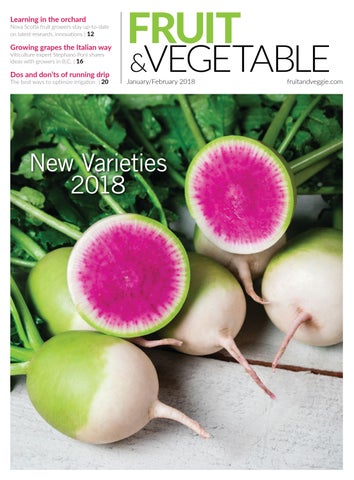
ON THE COVER Meet Stargazer, a watermelon-type radish. See page 26. Photo courtesy of Sakata Seed.
Nova Scotia fruit growers stay up-to-date on latest research, innovations. BY DAN WOOLLEY
Growing grapes the Italian way Italian viticulture expert Stephano Poni shares his ideas, experiences with grape growers in B.C.
Dos and don’ts of running drip Drip irrigation expert shares her ideas on the best way to optimize irrigation.
BY HUGH MCELHONE
BY TOM WALKER
January/February 2018 - FRUIT &VEGETABLE 3
FROM THE EDITOR
FRUIT & VEGETABLE January/February 2018 Volume 74, No. 1
MARGARET LAND | @FruitandVeggie.com
Honesty is the best policy Life was much simpler growing up during the 1970s and 1980s in rural Ontario. Well, I think it was. The rules were pretty straightforward – don’t steal, don’t lie, be home before dark, etc. You knew what was expected and what would happen if you didn’t meet those expectations. Fast-forward to 2018 and life is a lot more complicated. Case in point – in late September 2017, CBC’s Marketplace aired a program about farmers’ market vendors lying to consumers about the produce they were selling. A team from the program went undercover at 11 farmers’ markets across the province, ultimately discovering five vendors at four different markets were passing off produce purchased elsewhere as being grown by themselves. The TV program even followed the suspected vendors, filming them as they picked up goods at the Ontario Food Terminal. I’m going to go out on a limb here and suggest this never would have happened when I was a kid. Not that the 1970s and 1980s were some
as having come from their “farm.” In the first place, many were urban dwellers with no access to land for a market garden. They had customers who had been coming to them for years, possibly even generations, and they weren’t that far removed from the farm. They could tell the difference between local produce and imports. On top of that, day neutral strawberries and greenhouse produce weren’t as plentiful then as they are today. You would have been hard pressed to convince a consumer that the strawberries you were selling in August or September were from Ontario. Or those November red or yellow peppers were grown just down the road. They’d be giving you the stink eye and quickly walking away. Of course, in the 30 years since then, the world has changed. Advancements in storage technology and produce transportation have meant some domestic crops last longer out of season and more imports are making it into the Canadian marketplace from further away and in a shorter amount of time.
“A kind of balance ... existed between farmers and resellers.” idyllic time of honesty and harmony but because no consumer ever would have fallen for a lie like that. The farmers’ market where my family sold produce – grown at our farm and local neighbours’ operations – had multiple resellers – vendors who went to the terminal or bought at the farm gate and then resold the produce at market. Everyone knew who they were – consumers and vendors alike. A kind of balance and cooperative spirit existed between farmers and resellers. Arguments were rare. Of course, none of those resellers would have dreamed of trying to portray the produce they were selling 4 FRUIT &VEGETABLE - January/February 2018
The produce market has become more competitive and farmers’ markets have become more popular. Many city dwellers are several generations removed from the farm and have no understanding about what crops are in season locally. The market has also changed. It isn’t about price anymore – it’s food miles and the stories connected to food. Unfortunately, people have changed as well. Honesty, in some cases, has fallen by the wayside as vendors struggle for customers’ money. That spirit of cooperation isn’t always there. And I believe the industry is poorer for it.
Editor MARGARET LAND mland@annexweb.com 519-429-5190 • 888-599-2228 ext. 269 Advertising Manager SHARON KAUK skauk@annexweb.com 519-429-5189 • 888-599-2228 ext. 242 Account Coordinator MARY BURNIE mburnie@annexweb.com 519-429-5175 • 888-599-2228 ext. 234 Media Designer CURTIS MARTIN Circulation Manager AASHISH SHARMA asharma@annexbusinessmedia.com VP Production/Group Publisher DIANE KLEER dkleer@annexweb.com COO TED MARKLE tmarkle@annexweb.com President/CEO MIKE FREDERICKS Publication Mail Agreement #40065710 Printed in Canada ISSN 1488-7959 Fruit & Vegetable Magazine is published five times a year (January/ February, March, April, May, November/December) by Annex Business Media SUBSCRIPTION RATES Canada - 1 Year $ 22.50 - 2 Year $ 38 (plus applicable taxes) U.S.A. - 1 Year $ 40 USD Foreign - 1 Year $ 58 USD GST - #867172652RT0001 CIRCULATION rthava@annexbusinessmedia.com Tel: 416-442-5600 ext.3555 Fax: (416) 510-6875 (main) Mail: 111 Gordon Baker Road, Suite 400, Toronto, ON M2H 3R1 Occasionally, Fruit & Vegetable Magazine will mail information on behalf of industry-related groups whose products and services we believe may be of interest to you. If you prefer not to receive this information, please contact our circulation department in any of the four ways listed above. Annex Privacy Officer privacy@annexbizmedia.com Tel: 800-668-2374 No part of the editorial content of this publication may be reprinted without the publisher’s written permission. ©2018 Annex Publishing and Printing Inc. All rights reserved. Opinions expressed in this magazine are not necessarily those of the editor or the publisher. No liability is assumed for errors or omissions. All advertising is subject to the publisher’s approval. Such approval does not imply any endorsement of the products or services advertised. Publisher reserves the right to refuse advertising that does not meet the standards of the publication.
fruitandveggie.com
Since 1950, you’ve been at the core of our business. At BASF, we’re proud of our long-term commitment to the apple industry. And we’re even prouder to be a part of our customers’ continued success. To learn more about the kind of innovative solutions that apple growers have trusted for over 65 years, visit agsolutions.ca/horticulture and follow us on Twitter @BASFAgSolutions.
Always read and follow label directions. AgSolutions is a registered trade-mark of BASF Corporation; APOGEE, NEALTA, POLYRAM, PRISTINE, SERCADIS, and XEMIUM are registered trade-marks of BASF SE; all used with permission by BASF Canada Inc. POLYRAM DF, PRISTINE, and/or SERCADIS fungicides should be used in a preventative disease control program. © 2018 BASF Canada Inc.
INDUSTRY NEWS fruitandveggie.com
Scotian Gold expands packing line Federal representatives visited Scotian Gold’s Coldbrook facility recently to announce an investment of up to $1.75 million in support of the cooperative’s new apple packing facility. The investment enabled Scotian Gold to expand plus purchase and install two production lines. With the expansion and new technology, Scotian Gold expects to grow its sales and demand of Nova Scotia-grown apples, both in Canada and the U.S.
“The new facility is an example of Scotian Gold’s willingness to invest in the future of our growers, employees and the apple industry,” said David Parrish, president and CEO of Scotian Gold Cooperative. “Over the next number of years, apple volume will increase for varieties such as Honeycrisp, Ambrosia and SweeTango. This facility will have the capability to supply Scotian Gold’s expanding markets in a timely, efficient manner.”
POTATOES NAMED TO HONOUR CANADA 150 Two Canadian potato companies are celebrating Canada 150 by giving newly licensed potato varieties developed by Agriculture and AgriFood Canada (AAFC) a link to Canada. The new potatoes – called AAC Confederation and AAC Canada Gold-Dorée – were recently named by Progest 2001 Inc. based out of Sainte-Croix, Que., and Canadian Eastern Seed Growers
Inc. based out of N.B., respectively. “Taste and texture are important,” said André Gagnon, president of Progest 2001. “We need tasty special potatoes that fit customer needs. We feel that AAC Confederation has the potential to become a popular yellow variety for consumers.” When naming AAC Canada Gold Dorée, André Côté, co-owner of the Eastern Seed Growers Inc. with his
brother Eric Côté, said they were inspired by the potato’s golden colour when choosing its name. “We chose AAC Canada Gold-Dorée for its golden flesh and its golden potential as a winner in the markets.” Both AAC Confederation and AAC Canada Gold-Dorée are graduates of the AAFC potato breeding program, based in Fredericton, N.B. “A lot of work goes
into developing a new potato variety,” said Dr. Benoit Bizimungu, a potato breeder with AAFC. “For instance, the AAC Canada GoldDorée was six years in development before being released in 2015 to the potato industry to be evaluated of commercial potential.” The two companies expect to begin selling seed for AAC Confederation and AAC Canada Gold-Doré by 2020.
BY THE NUMBERS - ASPARAGUS SIZE OF HECTARES
$23 million Farm gate value
Ontario
1,214
Quebec
295
70%
6,239 metric tonnes
B.C.
105 6%
1,737
Manitoba
89 5%
Canadian production
3,000 to 4,000 kilograms/hectares average production
6 FRUIT &VEGETABLE - January/February 2018
17%
EXPORT 1,511 metric tonnes
$
= 7
million
hectares
6.5 to 6.8 ideal soil pH for asparagus
There are more vegetarians than ever. Don’t let them down.
Our reputation for innovative solutions is no secret. That’s why growers have trusted BASF herbicides to get their crops off to a clean start for decades. Of course, our fungicides have also gained a reputation for managing the toughest diseases. To learn how they can help you maximize your operation, visit agsolutions.ca/horticulture and follow us on Twitter @BASFAgSolutions.
Always read and follow label directions. AgSolutions, and PROWL are registered trade-marks of BASF Corporation; CABRIO, SERCADIS, ZAMPRO, and XEMIUM are registered trade-marks of BASF SE; FORUM is a trade-mark of BASF Agro B.V.; all used with permission by BASF Canada Inc. CABRIO, FORUM, SERCADIS, and/or ZAMPRO fungicides should be used in a preventative disease control program. © 2018 BASF Canada Inc.
GROWTH TRENDS fruitandveggie.com
Innovating to increase cranberry production The Canadian government is prioritizing science and innovation and the competitiveness of the agriculture industry as a whole to create better business opportunities for producers and Canadians. Funding was announced in October for two projects by the Centre de recherche en sciences animales de Deschambault (CRSAD), including a plan to increase the pollination efficiency of bees to achieve better yields in cranberry production. Funding of $183,127 will enable the CRSAD to identify the best method of feeding bees with sucrose syrup and to test variations of that method to maximize the bees’ pollination efficiency in cranberry production. The outcomes of this project are designed to increase cranberry yields and decrease bee feeding costs. “The CRSAD is very appreciative of the federal government’s strong support for its research activities,” said Jean-Paul Laforest, president of the CRSAD. “Canada holds an enviable position in the world for cranberry production, and bees are major allies of the industry. Our project will deliver positive outcomes for both cranberry production and the bees themselves.” In 2016, the Quebec cranberry industry generated nearly $82 million in market receipts and over $30 million in exports.
Pregnancy test science could protect Brassicas The science behind the homepregnancy test is now being trialled to detect the presence of diseases, which can devastate fields of vegetable crops, including Brussels sprouts. Current trials are underway to help protect crops of Brassicas – sprouts, broccoli, cabbage – and onions. Diseases – including ring spot, light leaf spot and downy mildew – are being monitored. The test, known as a lateral flow device (LFD), picks up the presence of infective spores carried in the air around crops in the field. Used alongside weather data, test results could indicate how likely a disease is to develop, allowing growers to decide if crop protection methods are needed or not. Further development work is underway, so growers can gain immediate results, without needing to send samples to laboratories for further testing. The project is the result of an industry partnership between growers, AHDB Horticulture, Warwickshire College and Mololgic Ltd. “When it’s fully developed, this simple low-cost tool – allowing growers to test whether there is a risk of diseases
developing on their crops – will help prevent significant financial losses and reduce the need to use conventional methods to protect their crops,” said Cathryn Lambourn, AHDB senior scientist. “Over the last four years, we’ve been developing the lateral flow device test, demonstrating how simple and effective it is, to give growers the confidence to rely on the results and make appropriate decisions for their business.” The LFD tests are also being developed to detect for other plant diseases. The AHDB is funding the University of Worcester to develop lab tests and LFDs to test for oomycete pathogens, which cause diseases like blight and sudden oak death. Primarily testing is focused on root, stem and crown rots caused by Pythium and the Phytophthora species, which can affect a range of crops. Through the same funding, Warwickshire Colleges and Stockbridge Technology Centre are developing and testing two LFDs to test glasshouse air samples for powdery mildew and gummy stem blight, which affect cucumber crops. Canker in apple tree crops is being investigated in a separate research program.
Examining potatoes’ past could improve future Examining the ancestors of the modern, North American cultivated potato has revealed a set of common genes and important genetic pathways that have helped spuds adapt over thousands of years. The study appears in a recent issue of Proceedings of the National Academy of Sciences. “Worldwide, potato is the third most important crop grown for direct human consumption, yet breeders have struggled to produce new varieties that outperform those released over a century ago,” said Robin Buell, Michigan State University Foundation Professor of Plant Biology and senior author of the paper. “By analyzing cultivated potato and its wild relatives using modern genomics approaches, we were able to reveal key factors that could address food security in 21st century agriculture.” Cultivated potatoes, domesticated from wild Solanum species, can be traced to the Andes Mountains in Peru, South America. Spuds essentially spread worldwide since their domestication some 8,000 to 10,000 years ago. As potatoes were taken from the more equatorial regions of Peru and Bolivia to the southern parts of South America, they became adapted to longer summer days in Chile and Argentina. Spanish conquistadors introduced potatoes to the European continent, where potatoes were 8 FRUIT &VEGETABLE - January/February 2018
quickly adapted as a staple crop. As the explorers ventured from Europe to North America, they also brought potatoes to the new world. Research teams from MSU and Virginia Polytechnic Institute and State University studied wild, landrace (South American potatoes that are grown by local farmers) and modern cultivars developed by plant breeders. The result was the largest crop re-sequencing study to date. Not only did it involve substantial re-sequencing of potato, but it also tackled one of the most-diverse crop genomes. The modern spuds found in today’s kitchens are genetically complex tetraploid potatoes, having four times the regular number of chromosomes. Potatoes’ complex genome harbors an estimated 39,000 genes. Studying the gene diversity spectrum, from its wild past to its cultivated present, can provide an essential source of untapped adaptive potential, Buell said. “We’ll be able to identify and study historic introgressions and hybridization events as well as find genes targeted during domestication that control variance for agricultural traits,” she said. “Many of these help focus on adapting to different climates, fending off different pathogens or improving yield, keys that we hope to better understand to improve future breeding efforts.”
For more information about crop essentials from Arysta LifeScience, visit www.gowithwhatworks.ca.
Always read and follow label directions. ACRAMITE, B-NINE, CASORON, DECREE, ELEVATE, FLORAMITE, KANEMITE, MAESTRO and ROYAL MH-30 are registered trademarks of an Arysta LifeScience Group Company. SHUTTLE is a trademark of an Arysta LifeScience Group Company. KASUMIN is a registered trademark of Hokko Chemical Industry Co., Ltd. ORTHENE is a registered trademark of OMS Investments, Inc. RIMON is a registered trademark of an ADAMA Group Company. Arysta LifeScience and the Arysta LifeScience logo are registered trademarks of Arysta LifeScience Corporation. ©2018 Arysta LifeScience Group Company. CDNH-1710
Arysta LifeScience offers a portfolio of consistent and reliable tools to protect your investment. With trusted fungicides, insecticides, miticides, plant growth regulators, a herbicide and a bactericide, you can confidently protect your crops against a broad spectrum of diseases and pests.
CONTRIBUTED PHOTO
Spears of success Fox Seeds, a private firm formed by the Asparagus Farmers of Ontario (AFO), continues to grow sales in Canada and beyond BY TREENA HEIN
Love for asparagus is growing in the U.S., Canada and Europe, which is music to the ears of those at Asparagus Farmers of Ontario (AFO) and its offshoot seed firm, Fox Seeds. It was back in late 2012 that the Ontario Asparagus Growers’ Marketing Board changed its name to AFO to reflect a ‘grower first’ philosophy. At the time, a new governance structure was also created, and Fox Seeds was formed. Executive director for both entities, Bernie Solymár, came on board in 2013. He indicates that, because AFO is a not-for-profit organization regulated under the Ontario Farm Products Marketing Act, selling seed would have to be done under a private corporation. Fox Seeds got its name from the type of sand found in Norfolk County, where a large percentage of asparagus is grown in Ontario. The University of Guelph’s breeding program for the vegetable is also located there. Fox Seeds provides a royalty to the University of Guelph in exchange for rights to grow and sell seed for Guelph Millennium (a winter-hardy, long-lived
and high-yielding variety developed by Dr. Dave Wolyn of the University of Guelph about 20 years ago), Guelph Eclipse (which debuted in 2017) and Guelph Equinox (release set for 2020). Fox Seeds has had very strong success in selling Guelph Millennium seed – about 95 per cent of asparagus grown in Ontario and Quebec (where most Canadian asparagus comes from) is that variety. About 75 per cent of existing Michigan cultivation is also Guelph Millennium and 80 to 90 per cent of new planting there as well. Millennium is also the dominant variety sold in Washington State over the last three years. Lastly, sales are off to a good start in Europe (more on that later). “Guelph Millennium is an excellent variety that provides strong production at the start of the season,” Solymár explains, “but growers are interested in additional later peaking varieties, as well ones with enhanced disease control, more cold-hardiness and drought tolerance. Guelph Eclipse is very productive and has better tip quality, a very tight tip, and significantly thicker spears,
ABOVE Fox Seeds is currently putting a lot of effort into building visibility for its asparagus varieties in Europe with the assistance of its European distributor, Global Plant Genetics (GPG). 10 FRUIT &VEGETABLE - January/February 2018
LEFT Guelph Millennium (pictured) is Fox Seeds’ main variety while Guelph Eclipse debuted in 2017 and Guelph Equinox is set to release in 2020.
CONTRIBUTED PHOTO
which are particularly desired by growers in Michigan. Trials are showing that Guelph Equinox is similar to Guelph Millennium and it’s very exciting that in trials, its production per acre is 50 to 100 per cent higher than Millennium.” Fox Seeds is looking at potential new markets across the ocean for all three varieties, and others are being tested for possible commercialization as well in the UK, Poland, northern Spain, northern France and Germany. In addition, research trials are ongoing or in the works in Chile, Japan, China and Russia. “Dr. Wolyn has been breeding new asparagus varieties for 28 years,” Solymár explains. “The breeder does the initial crosses and early trials, and when there are varieties identified with potential, we produce small amounts of seed and then grow for seed in commercial plots.” Solymár is particularly excited about expansion in Germany, where they grow about 20 times the amount of asparagus grown in Ontario. “German asparagus growers produce predominately white asparagus, which is just green asparagus with soil mounded over it, so the spears never see sunlight and turn green,” he explains. “It’s milder tasting than green asparagus and must be peeled. Because younger consumers nowadays don’t want the inconvenience of peeling and they associate green colour with health, there is an increasing demand for green asparagus. The white varieties don’t do as well when grown as green, and we believe we have a superior green variety in Guelph Millennium.” While Millennium is not what would be yet considered well known in Europe, Fox Seeds is currently putting a lot of effort into building visibility with the assistance of its European distributor, Global Plant Genetics (GPG). “We’ve had a long history with Jamie Petchell of GPG, he’s known as Mr. Asparagus over there, so we had no challenge in finding a good distributor,” says Solymár. “Together we’re using social media, putting in a presence at tradeshows, and also providing seed to nurseries and growers to test.” Since Solymár started at Fox Seeds, he says the focus has always been on producing enough seed to meet demand. “With Guelph Eclipse, as with any new variety that’s introduced, it takes a few years to get seed production where you want it, but we’re getting there,” he says. “Our challenge now is to continue to develop new markets and, like any company, we want to increase profits and increase sales. The demand
for asparagus has been very strong the last three or four years because it’s become more popular and people also want to buy local. The U.S. exchange rate has also meant good export profits. But while Fox Seeds has had few challenges and great success, at the asparagus industry level, challenges are coming with the new minimum wage rate in Ontario for example, and current NAFTA negotiations may have significant negative impacts.” It’s been a varied road to AFO and Fox Seeds for Solymár, who has 12 years of extension experience with the Ontario Ministry of Agriculture, Food and Rural Affairs and 12 years as a private consultant. For several years, he provided expertise to the Canadian Horticultural Council’s Apple Working Group in developing their Integrated Fruit Production project, and also did field research testing novel biological control agents. “I think my two roles at AFO and Fox Seeds compliment each other,” he says. “The evolution of Fox Seeds has been very exciting because we’ve had a product in hot demand. We’ve been able to move quickly to build market share and we have a very solid basis to increase our sales in many markets around the world.”
What you might not know about asparagus • There are 84 growers in Ontario, with about 3200 total acres under cultivation • Asparagus is a member of the lily family, which includes onions, garlic, leeks, and gladioli • Under ideal weather conditions, an asparagus spear can grow 25 cm in 24 hours • If not harvested, the shoots grow into tall fern like with small red seeds • An asparagus plant can be productive for 15 or more years • Asparagus is native to eastern Mediterranean and Asia Minor • The name has a Greek origin, meaning “sprout” or “shoot” • Romans first cultivated it nearly 2,500 years ago • In the 16th century, asparagus gained popularity in France and England, and colonists brought it to North America • Asparagus is often called the “Food of Kings”. King Louis the XIV of France was so fond of it that he had greenhouses built so he could enjoy it year-round. • The most production occurs today in China, Peru, Germany, Mexico, Thailand and Spain. The U.S. is 7th in value and Canada is 16th • Purple asparagus is simply a variety of green asparagus. It is sweeter than green asparagus. • Asparagus is a diuretic. It dilutes the urine, which helps prevent renal and urinary tract inflammation January/February 2018 - FRUIT &VEGETABLE 11
PERRENIA PHOTO
Learning in the orchard Nova Scotia fruit growers stay up-to-date on the latest research and technologies being utilized by their peers across the province BY DAN WOOLLEY
Nova Scotia Fruit Growers Association’s 2017 orchard tour focused on innovations and research trials in members’ orchards. At the first orchard, Donnie Connell’s Pomona Farms in Canard, Kings Co., fall-applied herbicides as effective weed controls were reviewed. Tour guide Chris Duyvelshoff, tree fruit specialist with Perennia, listed the considerable benefits of fall application of pre-emergent herbicides on orchards, including an early start on weed control during the weed-free period [from bud break to 30 days after blooming], not having to spray during the busy spring season, and better residual weed control with some herbicides. Last fall’s treatments [2016] at Connell’s orchard were applied Nov. 7, followed nine months later with residual weed control evaluation, Duyvellshoff said, noting the different responses of herbicides on sandy loam and clay loam orchard soils. He added that herbicides Chateau, Sinbar and Casaron worked very well on sandy loam, whereas a mix of Chateau and Alion were no better than Alion alone. Alion worked better than Chateau on clay ABOVE Andy Parker’s mature tree wall at his CAP Farm.
12 FRUIT &VEGETABLE - January/February 2018
loam, but a Chateau and Alion combination was no more effective than Alion alone. Sandea worked well on clay loam, but not as well on sandy loam, he said. At the next orchard stop ¬– Peter Eisses’ BreezeWay Acres in Billtown – tour members examined wild apple tree control, new high-density plantings on nine and 10-foot row spacings, and management of young tree crop loads. Eisses has new B10, G935 and G202 rootstocks, plus the well known M9, B9 and M26 rootstocks, said Duyvelshoff, adding Eisses’ typical row planting has been 10-feet wide, but with a recently planted Ambrosia block at nine feet. It is a small, upright tree and shouldn’t have any vigour control issues, “but he won’t plant at nine feet again.” The wild apple tree control trial examined ridding Breeze-Way Acres of wild trees, which can host pests. Duyvelshoff said Garlon worked well as a control. The NSFGA tour also visited Andy Parker’s Cap Farms in Grafton, where he planted a tree wall of Ambrosia in 2013. The tree walls are 11 feet apart, which Parker believes is well-spaced for his harvesting-aid machine and the Ambrosia tree size,
Want high-quality crops and peace-of-mind? Reach for Altacor . ®
Altacor insecticide
®
Altacor® insecticide delivers long-lasting insect control for apples, cranberries and grapes in addition to other fruit crops. Say goodbye to oblique-banded leafroller, codling moth, Oriental fruit moth and many other pests. Powered by Rynaxypyr®, Altacor® insecticide gets rid of damaging pests while being easy on beneficials* and the environment – providing the ultimate protection for your high-value crops. Visit FMCcrop.ca or call 1-833-362-7722 to learn more.
Apples
Blueberries
Grapes
Cranberries
* When applied at label rates. In line with Integrated Pest Management and Good Agricultural Practices, insecticide applications should be made when pollinators are not foraging to avoid unnecessary exposure. Always read and follow label instructions. Member of CropLife Canada. FMC and Altacor are trademarks of FMC Corporation. ® 2018 FMC Corporation. As of November 1, 2017, the PMRA registration for Altacor has been sold to FMC by DuPont.
LEFT NSFGA’s Golden Apple Award at the association’s 2017 orchard tour held August 3.
PERRENIA PHOTO
Duyvelshoff said. Since the trees are two feet apart, with their size and their wall spacing, it is easier to estimate the tree wall’s crop load, Duyvelshoff said, adding that Parker tries to thin to about 50 apples per tree. Crisp Growers Inc. Orchard in Morristown, jointly owned by several Annapolis Valley apple growers and managed by Andrew Stirling, was another stop on the tour. The operation has many bench-grafted trees. “More growers are growing their own trees due to a shortage of nursery trees across North America,” Duyvelshoff said. “You get a bigger tree by benchgrafting. It is a little more time-consuming and it is not as uniform a growing tree as produced by T-budding.” At Kelly Penner’s Nazinga Farms in Aylesford, a bud-in-place feasibility study is looking at orchardists growing their own trees rather then buying finished nursery stock. The advantage of budding in place at the final tree spacing is there is no transplant shock, Duvelshoff said, but “you have to grow it like a nursery tree
and, at the final spacing, it is more time and labour consuming. You also have more variability in tree size and they are not as consistent as nursery trees.” At the final orchard stop – Melvern Square’s Spurr Bros. Farms, managed by Lisa Jenereaux – tour members examined the topworking grafts she did with Honeycrisp onto 111 rootstock. “She found it was very productive, the main challenge being vigour control because they are older rootstocks,” Duyvelshoff said. “We looked at a fertilizer trial, evaluating N rates on newly planted trees. We didn’t have a response to N beyond 20 grams per tree, regardless of N sources or single versus split applications.” During the tour’s lunch stop at Lloyd Dyck’s Apples and Spice Orchard in Waterville, Blake Sarsfield, NSFGA president, and Peter Eisses, chairman of NSFGA’s production committee, presented Duyvelshoff with the NSFGA’s Golden Apple Award for his contributions to the industry. In 2012, Duyvelshoff succeeded Bill Craig as Perennia’s tree fruit specialist. Five years later, he resigned [effective August 25] to return to his family roots in southwestern Ontario. Michelle Cortens is Perennia’s new tree fruit specialist. She is a graduate student of the University of Guelph’s Ontario Agricultural College where she worked as a research assistant, followed by a stint as an extension assistant at the Ontario Ministry of Agriculture and Rural Affairs in weed management. Cortens was also involved in writing teacher-assistance material.
MEETINGS, TRADE & EQUIPMENT SHOW At the Bradford & District Memorial Community Centre 125 Simcoe Road, Bradford Ontario, L3Z 2A8
MUCK Vegetab le Growe CONFER rs ENCE
28 & 2 9 MAR
BRAD
CH 2
018 FORD
Contact: Matthew Sheppard, Bradford Co-operative Storage Limited msheppard@bellnet.ca • 905.775.3317
14 FRUIT &VEGETABLE - January/February 2018 FV_Muckconference_JanFeb18_MLD.indd 1
2018-01-04 2:26 PM
6
YEARS OF COMPLETE
CONFIDENCE
T itan Emesto. The number one performing seed-piece treatment, six years and counting.
Another year, another year on top. Titan® Emesto® is the number one potato seed-piece treatment in Canada. The unique red formulation is easy to apply and easy to see. It protects against the broadest spectrum of insects – including Colorado potato beetle and aphids – plus all major seed-borne diseases, including rhizoctonia, silver scurf and fusarium, even current resistant strains. It takes a lot of confidence to grow a healthy potato crop, season after season. And we’re proud Canadian potato growers keep choosing Titan Emesto to do it. Learn more at TitanEmesto.ca
cropscience.bayer.ca or 1 888-283-6847 or contact your Bayer representative.
@Bayer4CropsCA
Always read and follow label directions. Emesto® and Titan® are registered trademarks of the Bayer Group. Bayer CropScience Inc. is a member of CropLife Canada.
Grape growing the Italian way Italian viticulture expert Stephano Poni shares his ideas and experiences with grape growers in Ontario and B.C. as part of the 2017 Triggs International Premium Vinifera Lecture Series BY TOM WALKER
B.C. grape growers and winemakers were treated to a day in the vineyard with an Italian viticulture expert, as part of the Triggs International Premium Vinifera Lecture Series. Stephano Poni (PhD), professor of viticulture and chair of the Instituto of Frutti-Viticoltura of the Università Cattolica del Sacro Cuore of Piacenza, Italy, used the West Kelowna vineyards of Quails Gate and Mission Hill wineries as a backdrop to share and discuss canopy management best practices in early August. Organized by Brock University Cool Climate Oenology and Viticulture Institute (CCOVI), the lecture series features world leaders in the cultivation of premium vinifera grapes, thanks to a generous donation by Don and Elaine Triggs to the CCOVI. Poni’s visit to the Okanagan followed a similar event in Niagara-on-the-Lake in Ontario. He also presented a public lecture at both locations. This was the 10th Triggs event in Ontario and the fourth time the program has been offered in B.C.
“We acknowledge the generosity of Don and Elaine Triggs for supporting this program,” said Debbie Inglis, director of the CCOVI at Brock. “It gives us much food for thought as the industry continues to grow in B.C. and Canada.” While the Okanagan valley was in the midst of one of the longest stretches without rain on record, the Ontario organizers were happy to escape the rain and cool temperatures that were causing mildew issues and threatened to slow ripening back home. A pallor of smoke from the worst fire season ever in B.C. cast an eerie fog-like cloak over Okanagan Lake and the vineyards. “Currently, in Italy, we are having a very hot summer, it is over 38 C,” Poni said by way of introduction. “So, I am asked to do the opposite back home as you are doing in Ontario. “In Italy, we must often try to delay ripening, not achieve ripening. We are researching canopy management practices to delay sugaring but not delay the other processes, like colour and aroma.” Quails’ Gate vineyard manager, Jo Breti,
ABOVE A pallor of smoke from the worst fire season ever in B.C. cast an eerie fog-like cloak over Okanagan Lake and the vineyards. 16 FRUIT &VEGETABLE - January/February 2018
Ball RedBook Volume 1 and 2, 18th edItIon Buy both Volume 1 and 2 and save or each can be individually ordered. This professional horticulture reference, which has been in print continuously since 1932, is fully revised and updated in this new edition.
Volume 1 - Greenhouses and Equipment: $60.95
Based on real-life experiences from industry professionals including growers and equipment and greenhouse manufacturers, the presented information covers all aspects of greenhouse equipment — the structures themselves, benches, irrigation, curtains, environmental controls, machination, and the greenhouse as a retail facility.
Volume 2 - Crop Production: $81.95
Offering detailed information on the production of 162 flower, herb, and vegetable crops, this essential resource for growers includes techniques and advice that work in real-life production, not just in the lab or trial greenhouses.
greenhouse BookAd_sept 13.indd 1
2013-08-09 11:21 AM
explained the various chardonnay clones that were planted as early as 1987. He described the soil as much like the lake – sand, clay, and silt for over 50 feet. The site had not yet been irrigated by early August. Although it is some 50 metres above the lake, spring floods had raised the water table and the vines were only just beginning to show signs of dryness. Poni addressed the Scott Henry training system that was employed in the block, which divides the leaf canopy vertically, with shoots growing up and down. “Where vigour is high, it is a good system,” he said. “It provides a nice balance between a reasonably high yield. It has high leaf area, so you have enough leaf area to crop a higher yield but, at the same time, you have a good cluster exposure.” When does vigour become high enough to justify a divided canopy, Poni asked. He said it disappoints him when the training system does not match the growing conditions on a site. Correctly balancing the vigour is essential for maintaining the lowest inputs and getting the maximum return. “One difference I noticed with the Scott Henry we looked at in Ontario is how the bottom part of the canopy is managed,” Poni said. He pointed out that at this Okanagan site, the bottom shoots were in essentially a vertical position. “Another option is to have the bottom shoots a bit shorter and mostly horizontal. That would give the advantage of a mixed canopy with vertical plane plus horizontal plane. We know from experience with old traditional systems, like the pergola type we have in Italy, that a mixed canopy is rated as the most effective at intercepting light.” Joe Breti and Poni joked back and forth about how winemakers drive the viticulture decisions in the vineyard. “Winemakers will often say that if we increase yield, we automatically decrease quality,” said Poni. “But that is not always true.” A mild increase in yield may be needed, he added. “A slight increase in yield might be what you need to control vigour and increase quality. This is an old principal and we need to be aware that in many cases a difficult problem may have a simple solution.” The issue of canopy density is one of the oldest ones, Poni said, and if you ask different people, you will get totally different answers. “We know in a lot of instances, any canopy having two to three leaf layers can be optimum,” he said. For the simple reason, three leaf layers are enough to intercept and hold the light but at the same time is not too dense. “A grower comes to me and says ‘I have eight layers, the three you recommend and I have five more,’” Poni joked. “That is not the same thing. At night, you have a much higher night time respiration and the CO2 balance gets worse when you have increased leaf area.” With a high canopy density, you might spoil quality due to a microclimate affect, he warned. Poni described a study in Italy evaluating the optimum canopy in a given trellis. Using a sprawl canopy, they started with 13 square metres of leaf area. It was a vine with 1.5 metres of cordon. “We started to pull out leaves from the inner part of the canopy to see what was the optimal area and we monitored it with a gas exchange system,” he explained. “We were actually able to remove up to four square metres of leaf area without 18 FRUIT &VEGETABLE - January/February 2018
affecting photosynthesis.” That study showed the four square metres they removed were excessive for the vine balance. “We have a golden rule in viticulture that you need approximately 1.5 square metres of leaf to ripen a kilo of fruit,” Poni said. “I can tell the grower with that six metres of leaf area he can profitably ripen about four kilos of grapes. Of course, we would need this information for each variety and for each trellis system.” The aim for a Scott Henry system is to keep an 8-inch window open between the upper and lower canopies. While it is commonly assumed that upper row quality would be better it is not necessarily so, said Poni. “When you have an open window, you have light penetrating down through the canopy. If the bottom canopy is slightly horizontal, you should have enough light to achieve ripening. Remember, photosynthesis is the guy who is producing the grapes.”
TW AAFC research Triggs lecture series attendees in the Okanagan valley also heard about the vineyard projects of two AAFC Summerland Scientists. Kevin Usher shared the positive effects of leaf removal on Syrah vines, part of five years of continuous trials. “Using pre bloom removal in Syrah we were getting up to about 60% crop load reduction, mostly through the abortion of berries during fruit set,” explains Usher. The cluster physical size remained the same as did berry size, but the cluster was much looser he says. “We didn’t see any gains on fruit ripeness, but we did see big differences in phenolic development so flavanols, tannins, anthocyanins, these sorts of things.” “When we did leaf removal at fruit set you don’t see all those physical changes happening, but you get the quality changes,” he says. “Though not is not as extreme as we saw at pre bloom leaf removal.” There are different goals for leaf removal with white varieties he explains. “But what we have been finding is later leaf removal can actually help with developing flavor and aroma.” Jose Ramon Urbez—Torres spoke about monitoring trunk vine disease spores to help manage what he considers one of the most important grape diseases in Canada. “We don’t have any registered products for controlling trunk vine disease in Canada so we are doing research to try to bring in some products,” says Urbez-Torres. “One of the experiments here, is trying to understand how the disease works in the Okanagan valley,” he says. He uses solar powered spore trapping devices that work 24/7, at five locations across the valley. The pathogens form on the trunk of the vine and at the right combination of rain, humidity and temperature, the spores discharge and enter the vine through pruning wounds. “We see the first peak of spores around the beginning of March,” says Urbez –Torres. “We want to know when there is a higher load of spores throughout the growing period, so we can recommend when growers should apply controls to protect the pruning wounds.”
– Marijke V., Ontario
! ay d. tod ite ter lim gis is Re ting a Se
During AWC I heard messages of ‘never say no out of fear’ and to ‘seize every opportunity’. At the conference end, I decided to apply for a new work position and I’m glad I did! Thank you for inspiring many to step outside of our comfort zones!
LISTEN, LEARN, NETWORK & GROW! And prepare to be inspired. Acquire the life skills you need to reach your goals and live your life to your full potential. Network with women passionate about agriculture. Register today! Visit advancingwomenconference.ca or phone 403-686-8407.
Celebrating our 5th year in Calgary!
HYATT REGENCY CALGARY MARCH 26 & 27, 2018
CONTRIBUTED PHOTO
The dos and don’ts of running a drip irrigation system
Drip irrigation expert shares her thoughts and ideas on the best ways to optimize an operation’s irrigation system BY HUGH MCELHONE
Drip irrigation is no longer the ‘new kid on the block,’ and nearly 10 per cent of U.S. farms rely on it to grow their crops. Each year, new growers dabble with drip and many learn by trial and error. Reaching out with some helpful tips to those growers is Inge Bisconer, technical marketing and sales manager for Toro Micro-Irrigation. Drip irrigation is a system where water is pumped from the ground or surface, filtered, amended with nutrients and/or water treatment chemicals, and then delivered directly to the crop root zone through a network of pipelines into different types of emission devices depending on the crop to be watered. Micro-irrigation has typically been used for fruit, nut and vegetables. However, for the past 25 years, it has also been used successfully with field crops such as alfalfa, corn and soybeans too, Bisconer explained. “It is successful because we can target water and nutrients directly into the root zone,” she said. “It is
a very popular technology that is growing every day,” she said. Benefits include better yields, quality and crop uniformity, all done using less water, fertilizer and energy versus sprinklers and sometimes even less than flood systems depending on how much water is pumped. With reduced inputs, growers are better able to comply with environmental concerns such as deep percolation and runoff. Less labour also means greater profitability. So why is uniformity so important for crops? Why is a highly efficient irrigation system important? Because the runtime on an efficient system will be lower than the runtime on an inefficient system, and every plant will get the same amount of water and nutrients, Bisconer said. Using a typical system as an example, if you have a 60 per cent efficient system, you will need to run 3.2 days a week to meet the crop water requirement. Whereas, if you have a 90 per cent efficient system – which you should be able
ABOVE Treat the soil profile as a bank holding your water, so you are making deposits with irrigation and making withdrawals through crop water use. 20 FRUIT &VEGETABLE - January/February 2018
New Sencor® STZ herbicide for potatoes lets you spend less time worrying about weeds, and more time enjoying the little things. Things like taking in the stars, meeting the school bus, or pausing to pat the dog. We call those Grower Vacations. And with the all-new weed control of Sencor STZ, you can discover more of them knowing you’re protected from all major weeds. So enjoy your own vacation, even if it’s just for a few minutes. Find out how at GrowerVacations.ca
cropscience.bayer.ca or 1 888-283-6847 or contact your Bayer representative.
@Bayer4CropsCA
Always read and follow label directions. Sencor® is a registered trademark of the Bayer Group. Bayer CropScience Inc. is a member of CropLife Canada.
LEFT Soil types and irrigation equipment help dictate the wetting pattern. The wetting pattern they desire influences their choice of emitter flow rate and spacing.
CONTRIBUTED PHOTO
to achieve with drip irrigation – then you only have to run 2.2 days. “That’s almost half the runtime required; that’s half the pump time, the water and nutrients, labour and so forth,” she said. “That’s why uniformity is important in terms of resource consumption.” Of course, system uniformity is even more important to achieve optimum yields and quality, she added. Even the size of the sub-main pipe can influence the irrigation system uniformity. With a given example, a two-inch sub-main in the middle of the field achieves 89 per cent emission uniformity while a three-inch sub-main gains an extra five uniformity points, she explained. But if you feed that field from the end instead of the middle with that three-inch pipe, you lose five uniformity points. The choice of emission device is even more important because tape and dripline emitter performance varies widely, Bisconer said. “Choosing a flow control emitter will usually improve system uniformity by about five points or even more, depending on layout and terrain, versus a turbulent flow emitter. Flow control emitters also avoid the expense and other drawbacks of pressure compensating emitters. It’s very important to have help from the local dealers and designers, and manufacturing support to select the right components and layout to optimize system uniformity.” Seven points to optimize your irrigation system Bisconer said the Micro-Irrigation Owner’s Manual, which she authored, is a good reference guide for operating a uniform irrigation system and it is a free PDF download from the Toro website. “The second edition was published six years ago and is written in layman’s terms for growers and includes irrigation scheduling, maintenance and operation,” she said. 22 FRUIT &VEGETABLE - January/February 2018
She recommended focusing on the seven key items in the manual. The first is to monitor and record the system flow and pressure. “That’s absolutely the first thing an operator should look after,” she said. “If it’s not already included in the design of the system, it’s never too late to get a flow meter and put in pressure gauges because otherwise you have no idea how to tell if the system is operating properly. You can’t tell by looking at it, especially if it’s a sub-surface system.” There are several places where a system should be monitored, such as upstream and downstream of the filters. If the pressure difference between those two is large, that generally means the filter is plugged. Pressure gauges should be included at the start and end of each irrigation block. A flow meter at the pump station will also help indicate if there is clogging or a break in the line. “That’s the number one, to measure those parameters,” she said. “The second thing is to record it, keep a record of it and compare it with what it’s supposed to be. Once you’ve installed a drip irrigation system, you should get some information from the dealer as to what the flow rate and pressures should be at the filter station and at the block valves. Growers should routinely take those readings and compare them with the baseline data.” The third thing is to maintain the system like you would a swimming pool where you use chlorine and acid treatments to keep the water in good shape. “If you are a drip system operator, please find out what your water pH is because if your pH is high and you start to get clogging, and you’re adding chlorine, you’re wasting your money because the efficacy of chlorine at a pH of eight is about 20 per cent versus 80 per cent at a pH of six,” she said. “We also need to know how much acid to add to your water to lower the pH, and that can be found out by taking your water sample to the lab and they’ll do a titration curve and tell you how much acid you need to apply to bring the pH down from eight to six. Not hard to do, it’s just a chore that needs to be done.” The fourth thing she likes to stress to growers is the importance of applying all fertilizers properly. “Please apply fertilizers through the drip system. It’s the perfect delivery vehicle. If you’re irrigating but you’re not fertigating, you’re missing out on one of the main benefits of a drip irrigation system.” Bisconer said fertilizer trades people should be able to supply tables on their product showing the compatibility of different fertilizers mixed together and which ones will cause clogging and which ones are compatible. The owner’s manual also provides such a table. “A very simple thing to do, if you’re going to be adding fertilizers together, is to mix them together with the water from your drip system into a jar, shake it up and let it sit overnight,” she said. If the chemicals precipitate out of solution and clump up, clogging could occur in the drip emitters. The solution is to change the pH, or choose a different fertilizer to avoid emission device clogging. “Also, irrigation runtime in relation to fertigation is important,” she added. “For example, don’t add fertilizers prior to a long
Here’s to the
GROWER “When I was a boy in India, I never could have imagined the opportunities I’d have in Canadian agriculture. My orchard business takes hard work, but I’m glad to see my kids grow up on a farm, just like I did. My name is Lakhwinder Brar and I grow fruits and vegetables.” From all of us at FCC, thanks for making Canadian agriculture so amazing.
#HeresToCdnAg
fcc.ca
FEBRUARY 13
CONTRIBUTED PHOTO
Drip irrigation is no longer the ‘new kid on the block,’ and nearly 10 per cent of U.S. farms rely on it to grow their crops.
irrigation set which will result in the fertilizer leaching beyond the root zone. Stabilize the system first, then towards the end of the cycle inject the fertilizer into the soil where it’s useful, then clean out the system for a few minutes afterward to get the fertilizer out of the lines.” The fifth area of concern is the importance of flushing out the laterals. “Even if you are irrigating perfectly filtered water, there are some things that make it downstream of a 200 mesh filter and even if it doesn’t cause harm to the physical system there are biologicals and chemistries that can happen,” Bisconer said. “Some of the tiny particles that are harmless on their own aggregate and start to cause clogging problems so we need to flush them out periodically.” From a hydraulic stand point, the standard in the U.S. is to flush lateral lines at one foot per second; duration is until the water runs clear. Do this as often as needed. Many systems have an automated flush, which reduces the manual aspect. Or surface laterals can be fitted with a valve and manually flushed periodically. “Take care to not open all the lines at once because then you won’t get the flushing velocity,” she said. Conditions are different on every system so start by flushing every week and let the laterals flush for about 10 minutes so the debris in the middle of the tape or drip lines has time to be expunged. If everything looks clean, then flush once a month, if good, then two months. At the bare minimum flush at least once per year, she advised.
The sixth concern is measuring field uniformity. This can be done via a field-can test where flow is measured from a representative sample of emission devices. The cans are placed under drip emitters throughout the field to measure water amounts. She advocates measuring uniformity periodically because even the best systems change over time and can decline far below optimum if not monitored.
“Don’t run a drip system the same as a gravity system, which undergoes feast and famine conditions. Most of us like to eat two or three times a day and crops are the same way.” – Inge Bisconer
For the seventh concern, Bisconer advised growers to schedule irrigations according to weather conditions and agronomic needs of the crop, for example, using the cheque book method as a baseline. With proper irrigation scheduling, the crop may be spoon-fed and waste minimized. “Don’t run a drip system the same as
24 FRUIT &VEGETABLE - January/February 2018
a gravity system, which undergoes feast and famine conditions,” she said. “Most of us like to eat two or three times a day and crops are the same way.” Consider that the soil profile is a bank holding your water, so you are making deposits with irrigation and making withdrawals through crop water use, she suggested. “We don’t like to be overdrawn with our bank accounts, and the crop doesn’t like that outcome either.” So how often should growers irrigate? “We want to balance our applications with our withdrawals,” she said. To schedule irrigations one must consider the soil type; clay, loam and sandy soils dictate how much water the soil can hold in the root zone. Then, the decision on how often to refill the root zone is based upon how much water the plants are using. Soil types and irrigation equipment help dictate the wetting pattern, which is especially important for vegetable growers, she said. The wetting pattern they desire influences their choice of emitter flow rate and spacing. Popular at the moment is the low flow tape with emitters spaced at eightinches apart. Bisconer’s final word of advice is to not go it alone. “There are tons of resources out there including the local dealer that you bought the equipment from, the manufacturer who supplied it, the universities, consultants, and the commodity organizations,” she said. “All are teamed by people eager to help. Please take advantage of these resources.”
FLAWLESS FROM FIRST LIFE TO FIRST SHINE
With Luna Tranquility® fungicide, you can keep your apples flawless from spring through to harvest. And that’s all possible thanks to the unique Group 7 (fluopyram) and proven Group 9 (pyrimethanil) modes of action that give you outstanding control of the most damaging diseases such as apple scab and powdery mildew. Expect nothing but perfection with Luna Tranquility.
Learn more at cropscience.bayer.ca/Luna
cropscience.bayer.ca or 1 888-283-6847 or contact your Bayer representative.
@Bayer4CropsCA
Always read and follow label directions. Luna Tranquility® is a registered trademark of the Bayer Group. Bayer CropScience Inc. is a member of CropLife Canada.
2018
NEW VARIETIES Arugula
Basil EVERLEAF
Bean AFFIRMED
Broccoli EASTERN MAGIC
Quick to establish, upright variety, mix of lobes, smooth shapes; leaves become spicy as they mature, exposed to high temperatures.
Genovese type; very-late flowering; huge harvest potential; flavour stands up to cooking; intermediate resistance to Downy Mildew, standard resistance to Fusarium.
Matures 56 days; straight medium green pods; plant sets well, upright off ground; high yield potential.
Matures 103 days; high-domed, exceptional blue-green colour; good heat tolerance; performs well in long day length, moderate heat.
Courtesy of PanAmerican Seed
Courtesy of Norseco, PanAmerican Seed
Courtesy of Stokes Seeds
Courtesy of Stokes Seeds
SIMPLYSALAD ARUGULA
Broccoli EMERALD STAR
Cabbage RED DRAGON
Cabbage SEOUL 65 F1
Very tight-headed, fine-beaded, bluegreen coloured, crown cut/short trim (Asian cut) variety; nice uniformity; performs best in cool to warm, warm to cool seasons.
Chinese type; full-size, vibrant red colour; excellent for salads, stirfries, kimchee; prone to internal tipburn.
Flat type; early maturity; resistant to Yellows and Black Rot; tolerant to heat.
F1 hybrid; multi-purpose; well suited for early cut, peel production, slicer, early cello for fresh market; smooth skinned; good flavour, colour; no green shoulders.
Courtesy of Sakata Seed
Courtesy of Johnny’s Selected Seeds
Courtesy of AgroHaitai
Courtesy of Stokes Seeds
EAGLEPAK
Celery BALADA
Celery RIVALRY
Tall processing, fresh market; heavy, compact plants; good field holding ability; intermediate tolerance to Fusarium.
High quality; very long internodes; medium green plants, healthy, heavy; Fusarium tolerant.
Rosette-forming plants stay in neat, tidy bunch before flowering; great lobe shape, spicy flavour.
Matures 55 days; up to 10 days earlier than any other variety; firm, glossy fruit; spineless calyx; compact plant.
Courtesy of Norseco
Courtesy of Norseco
Courtesy of PanAmerican Seed
Courtesy of Seedway
26 FRUIT &VEGETABLE - January/February 2018
Cress
Carrot
SIMPLYSALAD CRESS
Eggplant A1014 ESTELAL
2018
NEW VARIETIES Eggplant GRETEL
Eggplant HANSEL
Melon AFTERGLOW
Melon ASTOUND
Earliest white; highly productive, producing clusters of glossy mini-fruit; tender, non-bitter; can be grown in-ground or in large containers.
Early-maturing, highly productive variety; produces clusters of glossy black-purple fruit; non-bitter, tender; plants can be grown in-ground or in large containers.
Deep sutured hybrid; cantaloupe type; high Brix; firm flesh for extended hold ability; 5-7 lbs fruit.
Matures 75 days; cantaloupe type; firm flesh, small cavity; consistent, refined netting; suited to main season plantings in Northeast.
Courtesy of PanAmerican Seed
Courtesy of PanAmerican Seed
Courtesy of Rupp Seeds
Courtesy of Seedway
Onion CARTIER
Onion CATSKILL
Onion POCONO
Onion
Matures 102 days; yellow storage onion; strong skin, fine neck; long term storage capability; matures evenly.
Matures 105 days; storage type; large globe shaped, medium dark brown skinned; good skin retention, neck size; high yield potential, adaptability.
Matures 110 days; extra large uniform round bulbs; dark skin colour; very small necks; 7-8 month storage potential.
Matures 110 days; early red storage type; direct seed or transplant; good colour; sizes and stores well.
Courtesy of Seedway
Courtesy of Norseco, Stokes Seeds
Courtesy of Stokes Seeds
Courtesy of Seedway
REDHAWK
Onion RED NUGENT
Onion RIDGELINE
Ornamental corn
HEAVENLY SPICE MIX
Pea SHERWOOD
Matures 113 days; large dark red bulbs; small necks; strong root systems for growing on marginal mucks; 5-6 month storage potential.
Matures 107 days; F1 hybrid; yellow storage type; excellent yield potential; globe-shaped bulbs; brown skin; slow to bolt.
Grows early in the season; makes high pack-out of marketable ears; 8-9 inch ears with earth tones; great husk attachment.
Early, highly adaptable in variety of environments; first flower node in 9-10 days; tolerance downy mildew.
Courtesy of Stokes Seeds
Courtesy of Norseco, Stokes Seeds
Courtesy of Siegers Seed
Courtesy of Norseco
January/February 2018 - FRUIT &VEGETABLE 27
2018
NEW VARIETIES Pepper AJI RICO
Pepper CANDY CANE RED
Pepper CRACKLE
Pepper DESPERADO
Hybrid hot pepper; narrow, conical fruit; delicate citrus flavour; medium heat; crispy, thin-walled. AAS winner.
Unique, eye-catching variegated foliage; fruit ripens from green striped to solid red; sweet flavour, thin walls, crispy texture.
Large fruited “finger hot” type; excellent yield potential; sturdy mid-compact plant; dark green fruit, matures red; suited for multiple harvests.
Large fruited, Anaheim type; mid-early maturity; great yield potential; fruit are light green; glossy look, thick walls; well suited for fresh, processing.
Courtesy of PanAmerican Seed
Courtesy of Norseco, PanAmerican Seed
Courtesy of Sakata Seed
Courtesy of Sakata Seed
Pepper DICAPRIO
Pepper LA BOMBA II
Pepper MAD HATTER
Pepper NINJA S10
Yellow bell pepper suited for either a high tunnel structure or unheated greenhouse. From Enza Zaden.
Jalapeños type; very large, highquality fruit; medium-hot rating; disease resistance to Bacterial Leaf Spot 1-3, Tobacco Mosaic Virus.
Flat-disc type; crunchy, crisp, with delicate floral scent; rich flavour that intensifies/sweetens as it matures. AAS winner.
Widely adapted, green-to-red bell; matures mid-early; high yields; extra large, jumbo fruit; very firm, glossy dark green, matures red.
Courtesy of Rupp Seeds
Courtesy of PanAmerican Seed
Courtesy of Norseco, PanAmerican Seed
Courtesy of Sakata Seed
Pepper PLAYMAKER
Pepper RED EMBER
Matures 75 days; dark, green fruit; produces heavy set highquality large fruit; high yield potential; great disease tolerance.
Cayenne type; thick enough for fresh, thin enough to dry; fruits express moderately warm heat; makes excellent powder or flakes.
Widely adapted, green-to-red bell; maturity early to mid-early; high yields; extra-large fruit; good size uniformity; very firm, glossy dark green, matures red.
Shishito type; small fruit; mild but rich flavour; compact plant; high production potential; fruit uniformity is superior.
Courtesy of Norseco, Stokes Seed
Courtesy of Johnny’s Selected Seeds
Courtesy of Sakata Seed
Courtesy of Sakata Seed
28 FRUIT &VEGETABLE - January/February 2018
Pepper SAMURAI
Pepper TAKARA
2018
NEW VARIETIES Pumpkin BAYHORSE GOLD
Pumpkin ORANGE SUNRISE
Pumpkin RACER OG
Pumpkin SPARK
Uniform, slightly elevated fruit; dark orange colouration; elongated black handles; 15-20 lbs; intermediate resistance powdery mildew.
Matures 88 days; early maturing, 12-18 lb fruit; good deep orange colour, nice round shape.
Organic hybrid; extra early; ripens speedily; blocky, midsize; strong handle; 12-16 lb. fruit; short, vigorous vines; averages 2-3 fruits per plant.
Unique mini pumpkin; yellow, deep orange stripes; perfect for fall decoration; very uniform; dark green strongly attached handles; vigorous plants; strong Powdery Mildew resistance.
Courtesy of Rupp Seeds
Courtesy of Seedway, Stokes Seeds
Courtesy of Johnny’s Selected Seeds
Courtesy of Siegers Seed
Radish
Radish
GREEN SHOULDER SPRING F1
Radish ORIENT LEGEND F1
Perfect mid-size shipper; embedded black handle, rich orange rind; stress tolerant; crops under variety of weather conditions.
Korean radish; matures 60-70 days; slow bolting; resistant to Club Root.
Red-skin radish; matures 50-55 days; slow bolting; can be planted in spring.
Watermelon-type; bright red interior, white exterior; excellent colour contrast; mild flavour, crisp juicy texture; bright green tops.
Courtesy of Siegers Seed
Courtesy of AgroHaitai
Courtesy of AgroHaitai
Courtesy of Sakata Seed
Pumpkin THOR
Rhubarb
Squash
STARGAZER
RHUBARB SUPREME
Squash BAYHORSE GOLD
Squash SCARLET ASIA F1
MASHED POTATOES
Selected for exceptional resistance to bolting; wide, rich red petioles; lustrous, dark-green leaves.
Matures 42 days; Summer type; exceptionally firm, smooth fruit; thick, sturdy neck; attractive glossy skin.
Stark white acorn type; will hold colour into late fall; flesh is nearly white, resembles mashed potatoes; typically produces 3-4 fruit per plant.
Early maturity; flat fruits in bright orange colour; orange flesh is nutty and sweet.
Courtesy of Johnny’s Selected Seeds
Courtesy of Seedway
Courtesy of Norseco
Courtesy of AgroHaitai
January/February 2018 - FRUIT &VEGETABLE 29
2018
NEW VARIETIES Squash
SWEET SPLENDOR F1
Squash TEMPEST
Squash WALDO
Sweet corn AFFECTION
Flat fruit with deep orange flesh; easy to cut; sweet.
Traditional yellow crookneck; vibrant colour, gourmet flavour, eye-catching ridges; versatile summer squash; soft spines for easy harvest.
Butternut type; high yields, great flavour; strong PMR; 3-3 ½ pounds, convenient size.
Bi-colour, Sh2; outstanding flavour, texture, sugar; strong plant; excellent husk cover; great tip fill.
Courtesy of AgroHaitai
Courtesy of Johnny’s Selected Seeds
Courtesy of Johnny’s Selected Seeds
Courtesy of Norseco
Sweet corn AMERICAN DREAM
Sweet corn ANTHEM II
Sweet corn AWESOME XR
CALIBER XR
High yields, strong tip fill, attractive ear package; blissful taste; bi-colour Supersweet type; late maturing.
Bi-colour Supersweet; great eating quality, tender, sweet; excellent yield, tip fill; belowground protection for Corn Rootworm; dual modes of action against European Corn Borer, Corn Earworm, Fall Armyworm; weed control benefits of Roundup.
Matures 74 days; bi-colour SH2; added rust resistance; more plant vigour; excellent yield potential. Can be used all season in Northern regions.
Matures 76 days; medium-length, mid-season bi-colour; great eating quality; strong plant; outstanding yield potential; excellent husk.
Courtesy of Rupp Seeds, Siegers Seed
Courtesy of Siegers Seed
Courtesy of Seedway
Courtesy of Stokes Seeds
Sweet corn
Sweet Corn KICKOFF XR
Sweet corn TEMPTRESS
Tomato BRAVEHEART
Tomato LITTLE BING
Matures 69 days; bi-colour Supersweet type; impeccable eating quality; excellent husk package; smart solution for early high-quality.
Matures 70 days; attractive ear, eye-catching husk package; moderately good cool soil emergence for early planting.
Cherry type; versatile, suited for low/medium-tech production, roadside markets; very prolific, flavourful, good shelf life.
Cherry type, dwarf determinate; sets fruit, ripens over few weeks; large yields; flavour-filled fruit for fresh eating.
Courtesy of Seedway, Siegers Seed, Stokes Seeds
Courtesy of Norseco, Rupp Seeds, Stokes Seeds
Courtesy of Rupp Seeds
Courtesy of PanAmerican Seed
30 FRUIT &VEGETABLE - January/February 2018
2018
NEW VARIETIES Tomato LITTLE SICILY
Tomato MIDNIGHT SNACK
Tomato RUBY CRUSH
Tomato TIDY ROSE
Compact, sturdy plant; produces over few weeks for large harvest; good-tasting, small red slicer fruit, great eaten fresh.
Cherry type; ripens red with overlay of glossy black-purple skin when exposed to sun; productive all season; flavourful fruit. AAS winner.
Grape type; widely adapted, mid-early maturing; mid-compact, determinate plants; good vigour; deep red fruit; very smooth, uniform, firm; good flavour.
Deep pink beefsteak type; beautiful ribbed fruit; rich heirloom flavour.
Courtesy of PanAmerican Seed
Courtesy of PanAmerican Seed
Courtesy of Sakata Seed
Courtesy of PanAmerican Seed
Tomato VALENTINE
Watermelon BELMONT
Watermelon JOY RIDE
Watermelon
Grape type; high-lycopene; massive early yields; deep-red fruit; rich flavour; excellent early blight resistance; long shelf life. AAS winner.
Mini, 6-10 lbs; extremely deep red flesh colour; strong, vigorous vine; excellent yield potential; use early pollenizer when growing this variety.
Highly adaptable; triploid, seedless watermelon; thick rind, firm fruit; uniform setting on vigorous plant; good canopy coverage.
Uniform shape, size; 45‐count Crimson; exceptional internal/external quality; very adaptable; high yield potential; average Brix of 11.5.
Courtesy of Johnny’s Selected Seeds
Courtesy of Sakata Seed
Courtesy of Siegers Seed
Courtesy of Siegers Seed
ROAD TRIP
Watermelon TAILGATE
Watermelon TROUBADOUR
Zucchini GREEN MACHINE
SPINELESS SUPREME
Excellent internal characteristics with small pips; low frequency of hard seed, hollow heart; produces high brix content, great flesh firmness.
Matures in 82 days; triploid seedless; fresh dark rind; uniform oval shape; sets reliably; extra-firm sweet flesh.
Widely adaptable, high yielding; high-quality, medium-green fruit, light flecking; strong semi‐open plant; excellent disease resistance.
Latest release in the Spineless series from Syngenta; improved virus, disease protection over its predecessors.
Courtesy of Rupp Seeds
Courtesy of Seedway
Courtesy of Siegers Seed
Courtesy of Norseco, Rupp Seeds
Zucchini
January/February 2018 - FRUIT &VEGETABLE 31
NEW PRODUCTS fruitandveggie.com
Draganfly Tango2
Kubota M-Series
The Tango2 fixed-wing increases commercial use cases by offering long duration flight times and the design allows for lower airspeeds, which translates to lower altitudes and higher resolution. This multi-battery small Unmanned Aerial System (sUAS) is capable of carrying a wide array of payloads and is ideal for agriculture. The aircraft can fly two to three hours with standard battery packs, four to six hours with additional batteries, and 14-plus hours with solar panel add-ons, and supports a wide range of payloads. The autopilot system features automated takeoff, flight plan execution, and landing with refined fail-safe features. Launched by catapult, the plane’s high-lift wing design provides both a steep takeoff and steep landing profile, allowing for operations to be performed in areas with short runways and small clearings. The modular payload bay supports multi-axis stabilized data acquisition options such as high-res EO color, thermal, multi-spectral, LiDAR, hyperspectral, and other customized sensors
Kubota Tractor Corporation recently introduced four new specialty agriculture tractors designed for narrow and low-clearance applications. The new M-Series introductions include the M4N-071, M5N091 and M5N-111 narrow tractors, and the M5L-111 low profile tractor. The new specialty tractors bring more variety, performance and operator options to the orchard and vineyard markets. The new models feature updated engines, intelligently revamped operator stations and improved hydraulics. They also feature highly versatile transmissions designed to provide superior power and efficiency for the most rigorous specialty environments. The M5L-111 low profile tractor features a telescopic ROPS frame, engineered for work in orchards or other applications requiring a low profile design. The M4N/M5N narrow tractors deliver power in tractors engineered specifically for work in vineyards, orchards and other narrow environments.
draganfly.com
kubota.ca
“We know the work we put in to grow safe, healthy food. We’re the ones who should tell our story.” Sam Bourgeois, Agvocate Apple Producer
Be somebody who does something. Be an agvocate. Learn more at AgMoreThanEver.ca.
32 FRUIT &VEGETABLE - January/February 2018 FV_FCChalf_JanFeb17_CSA.indd 1
2017-01-03 10:25 AM
Enthusiasm for local food crashes website: selling “local food love” on social media
Big success is being achieved through social media to promote local food.
T
he Ontario agri-food sector is always seeking new, innovative ways to promote local foods to consumers. Recently, two grower organizations - Ontario Pork and the Ontario Apple Growers have seen great success engaging with consumers through social media and other avenues, thanks to financial support from the Government of Ontario in partnership with the Greenbelt Fund. Ontario Pork’s goal was to highlight and promote delicious, yet underutilized, cuts of pork. The group partnered with Osteoporosis Canada and Heart and Stroke to create a factsheet on pork’s important health benefits as well as multiple heart-healthy recipes. It then promoted these resources through social media and product demonstrations, using a $41,500 grant from the Greenbelt Fund.
Engaging bloggers “We had a large involvement with Facebook,” explains Susan Fitzgerald of Ontario Pork. “Food bloggers picked up on our objective and promoted a huge variety of pork recipes, from simple to complex. We also explored some sponsored events, with demonstrations in “early years” centres and high schools, and in-store samplings in Loblaw’s stores.” The organization also held webinars for dieticians and other health care professionals. Ontario Pork reports that the campaign exceeded all of its objectives, with “views” of its six videos topping 443,000 – almost double the target. In addition, the original six recipes ballooned into an entire healthy recipe booklet, which hit 225,000 “reaches” through
bloggers – triple the goal. Similar success was had by the Ontario Apple Growers. It used $49,000 from the Greenbelt Fund to increase consumer awareness of the versatile nature of Ontario apples and the Foodland Ontario brand.
Personal touch First, ten bloggers were selected and introduced to Ontario apple production. “We took them on a farm tour last fall, where they could learn directly from an experienced apple grower,” explains Kelly Ciceran of Ontario Apple Growers. “We encouraged them to ask questions about all stages of apple production.” The bloggers were later taken on another tour of storage and packing facilities, allowing them to understand how Ontario apples are made available to consumers year round, how apples are graded and many apple products. Blogger Charmian Christie, a culinary instructor and author of the blog “The Messy Baker” says that “as a culinary professional, farm tours are invaluable. When I say “I’ve been to the orchard” or “I’ve see the apples being washed and packed,” I have a level of authority no amount of Googling can recreate. As a result, my students and readers are more engaged, ask more questions and are more eager to shop Ontario.” Each of the bloggers then created three recipes that they posted to their blogs and shared through a variety of social media. “We also compiled these 30+ recipes into an e-Cookbook that was available for download from our website in nutrition month, March of 2017,” Ciceran explains. “The e-Cookbook was
so popular upon its release that the website crashed.” Navigating the blogosphere and social media can be daunting, particularly for individual farmers whose busy days don’t leave much time for online marketing. As Ontario Pork and Ontario Apple Growers demonstrated, grower organizations can benefit their members by taking on this opportunity and reaching consumers in new ways. “We believe the Fund is making a big difference in spreading the “Local Food Love” throughout Ontario,” observes Ciceran, “helping consumers realize how delicious and easy local food is to access.”
The Greenbelt Fund changes the way we eat by investing in projects that bring more Ontario food to Ontarians’ plates, with financial support from the Government of Ontario.
NEW PRODUCTS fruitandveggie.com
Tal-Ya agriculture tray
MDI Packaging
Tal-Ya trays provide a number of benefits that together create a “personal greenhouse” for each tree or plant, leading to accelerated growth and faster time to market. The tray’s structure focuses water and fertilizer to the root, creating a savings of at least 50 per cent in water consumption and 30 per cent in fertilizer consumption. The tray does not allow sunlight through, so it prevents weeds from growing under the tray around the tree. This saves organic farmers on manpower to remove weeds, or on the cost of herbicide (and makes for healthier produce). The tray traps air underneath it, which provides insulation and temperature control, protecting the tree in extreme cold and hot temperatures. The top of the tray includes UV, which reflects sunlight. This both protects the tray and reflects sunlight up into the leaves
Growers and packers looking for customized packaging solutions have more options now with new corrugated, polypropylene-plastic packaging from MDI. The reusable, returnable and recyclable solutions reduce packaging costs significantly, and offer a long lifecycle. MDI polypropylene products are lightweight and impact-resistant, and resist cracking. Additionally, polypropylene produces a “living hinge” for boxes that are opened multiple times daily or throughout their lifespan. In display and presentation, polypropylene’s clean edges help keep the focus on the product instead of the packaging. Growers can take advantage of the plastic’s rigid nature and impact resistance by using it for dividers, partitions or sleeves in transport containers. In addition, polypropylene is easy to clean, and resists mould, mildew and insects – delivering specific benefits for the harvest, storage and transportation of agricultural products.
on the underside of the tree (leaves which do not usually receive sunlight), enabling photosynthesis to occur there and accelerating the growth of the tree. Water is constantly evaporating from the earth. The tray traps this moisture and leads it to trickle back to the root of the tree, making the earth under the tree constantly moist, ideal conditions for growth. tal-ya.com
John Deere 2025R
MDI.org
Tolsma-Grisnich 5M Temperature Sensor
The newly redesigned John Deere 2025R provides an easy-to-use machine equipped with a Final Tier 4-compliant diesel engine and TwinTouch foot controls, allowing the operator to select speed and direction of travel with the touch of a toe. The addition of the optional Auto-Throttle allows the operator to automatically increase or decrease engine speed while pressing on either of the TwinTouch pedals. The 2025R also features equal forward and reverse ground speed. Operators can quickly install and remove implements on the 2025R, reducing time spent switching between tasks. Customized implement configurations – a total of seven different combinations available – decrease time spent installing and removing implements in preparation of a task.
The five metre-long product sensor has been developed to measure temperature differences at different heights in the bulk potato storage system. Enhanced storage efficiency is achieved, thanks to anticipation of the storage strategy, underpinned by improved measurements. The cable sensor, featuring five measuring points, can be incorporated along the gradient of the bulk storage as the product is being stored. Condensation in the top layer can be avoided and better assessment of the duration of internal ventilation is also made possible.
JohnDeere.com/Tractors
tolsmagrisnich.com
34 FRUIT &VEGETABLE - January/February 2018 FV_AMA_plugtray_JanFeb18_CSA.indd 1
2017-12-05 8:42 AM
YOU DON’T HAVE TO CLEAN UP TO TAKE HOME THIS AWARD. No brass. No glam. No BS. Just a chance to give your hard work, honest sweat and commitment to Canadian agriculture the recognition it deserves. You’ll build your business, make connections and uncover new opportunities along the way. Nominate someone outstanding at oyfcanada.com.
National Sponsors:
oyfcanada.com National Media Sponsor:
@CanadaOYF 05/16-48318 AX
FRUIT
&VEGETABLE
BUSINESS DIRECTORY fruitandveggie.com
HASKAP
EDIBLE BLUE HONEYSUCKLE
!
Visit our website for information about our varieties, pricing, research, and production guide.! Plants for sale at
www.phytocultures.com admin@phytocultures.com | 902.629.1229 D kooljet 3.25x4 ad.qxp_Layout 1 11/23/16 1:31 PM Page 1
1.866.748.7786 Authority in refrigeration for Food Processing and Agricultural industry • cUsTOM Designs • ThrU-The-wAll • rOOF-MOUnTeD • POrTAble • hYDrOcOOlers • blAsT Freezers • chillers • greenhOUse cOOlers
PlUg AnD PlAY
Made in North America One Piece Design
Free cOOling
FV_Kooljet_buscard_Janfeb17_CSA.indd 1
36 FRUIT &VEGETABLE - January/February 2018
2016-11-23 2:55 PM
FRUIT
&VEGETABLE
BUSINESS DIRECTORY fruitandveggie.com
CLASSIFIED For Sale: Smart Net Systems Bird Netting. Brand new, has never been used, still in the original packaging. 20’ wide assorted lengths 20-25% discount pricing, while quantities last. Call Dennis today (226) 757-0067
Come visit us at the OFVC booth #533 on February 21-22
For all your professional pruning and harvesting tools.
1-866-287-0777 agri-flex@hotmail.com www.agri-flex.com
FV_Agriflex_dblbuscard_JanFeb18_CSA.indd 1
2018-01-10 9:52 AM
FRUIT TREES Nectarines Apples Pears Plums Apricots Cherries Currants Peaches Fruiting Quince Gooseberries Small Fruits
1380 Centre Rd, Box 180, Carlisle, ON L0R 1H0 Tel: 905-689-4022 • Fax: 905-689-8080 www.krausnurseries.com ADVERTISERS INDEX FV_Vkraus DBBC_novdec 2017_MLD.indd 1
2018 Muck Conference ..............14 2017-09-08 11:05 AM 2018 Ontario Fruit and Vegetable Conference .................................2 2018 Women In AG Conference .........................19 AMA Plastics Ltd.........................34 Annex Bookstore .........................17 Arysta Lifescience .........................9 BASF Canada Inc. ......................5, 7 Bayer CropScience Inc. ...15, 21, 25 Business Directory ................ 36-37
Canada’s Outstanding Young Farmers .........................35 Farm Credit Canada ..............23, 32 FMC Agricultural Solutions..........13 Greenbelt Fund ............................33 Lakeview Vineyard Equipment Inc. .........................39 Ontario Farm Fresh Marketing Assoc. .....................17 Penn Refrigeration Ltd.................17 Stokes Seeds Ltd. .......................40
January/February 2018 - FRUIT &VEGETABLE 37
MARKETING MATTERS
CATHY BARTOLIC | cathy@ontariofarmfresh.com
Getting more out of life I am envious of people who, at least from the outside, look like they have their life together and in order. They have a successful business but are not working 24/7/365 just to pay their bills. They take holidays at least once a year and maybe more often. They seem to be able to make a decision and go with it. They have time for their kids – heck, they have kids. In short, they have apparently discovered a work life balance that touches all the important aspects of their life. One of these people is a second-generation nursery owner. The business was originally started to grow shrubs that were wholesaled at the food terminal. Gradually, they transitioned over to “selling sticks.” They now grow pussy willows, dogwood, ilex and hydrangeas, along with other plants, that are sold as cut branches or cut flowers. A lot of what they do now was put into place as a conscious decision to have free time with their kids during the summer. They have picked crops that do not need to be harvested in July. Although there is maintenance still to be done on the farm, there is also time to enjoy a summer month with your family. Most farmers would find it hard to relate to this. Don’t get me wrong, these folks are hard working and put in many hours each day, but they have also found a way to step back and refresh with their families.
Tom and Nick Karadza run Rock Star Real Estate. They often talk about how they left their highly successful office jobs to set up a real estate investment brokerage. They believe that financial freedom comes from owning several properties and collecting rent from all of them. They wanted to be their own bosses and have their own business. Their catchy tagline – Your life-Your terms” – has made them lots of money and continues to bring clients through the door. After some research, I have found a few tips on how to get more out of life without burning out. 1. Follow your passion – Get to know yourself and understand what gets you up in the morning and what activities take you to a zone where time flies and you are hardly conscious of your surroundings. Find a way to make that activity profitable. After all, when you do what you love, it hardly feels like work. 2. Face your fears – Much easier said than done! Fear of failure can be paralyzing. Ask yourself: “What is the worst thing that can happen in this situation?” and “What are the chances of that actually happening?” More often than not, fears are unfounded or at least out of proportion. 3. Form new habits – Making a change can be uncomfortable and even overwhelming. “This is the time of year to get off life’s roller coaster for a bit.” You may upset some people and you may have to put more effort I also admire many OFFMA members who, for into certain activities if things are changed personal or religious reasons, do not want to open up. But keep in mind that if you want a their market doors on Sunday. Sometimes, when different outcome, you need to change the growing and selling season is short, it is hard your behaviour. After all, the definition of insanity is doing the same thing over and to not be open for sales, especially now that the over again and expecting a different result. internet is open 24-hours each and every day. There must be a lot of pressure from their customers This is the time of year to get off life’s roller and from society in general to be open to sell on a Sunday. But these farmers have made a decision and coaster for a bit, breathe deeply and figure out they are sticking by it. From all accounts, once their where you want to go and how you are going to get customers are informed, they generally respect these there. In July, you’ll be happy you spent some time sorting this out in January. kinds of decisions.
38 FRUIT &VEGETABLE - January/February 2018
orchard-rite frost protection wind machines ™
cover up to 15 acres of crop during fall frost, extreme winter cold, and spring frost conditions. The most reliable gearbox/blade in the industry. Low rate financing available
1. 866.677. 4717 I lakeviewvineyardequipment.com
Stokes Seeds Trial Evaluation
Researching the best for our customers since 1881.
W
EW
N
NE
AFFIRMED
110 days. Extra large uniform round bulbs with dark skin color and very small necks that have long term 7-8 month storage potential. Has shown excellent quality out of storage.
56 day, longer, straighter and better quality pods compared to other varieties, plants set well with high yield potential.
W
NE
Pocono
W
PLAYMAKER
NE
(with X10R®)
sADDLEbAcK
100 days. Large, uniform, globe shaped bulb with medium skin color and a small neck. Strong root system permits growth on marginal muck soils, enabling high yield potential.
First commercial variety with resistance to ALL races of BLS and Phytophthora. Bred and developed for the Northeast & Midwest. High yield potential. Henry Zomer
Leah Erickson
Bridget Visser
Laura Caralampides Rob Hovius
Paul Banks
Marc André Laberge
ON, MB, SK
AB, BC
ON, MB
QC
ON, PEI, NB
ON, NS
QC
905-308-4396
604-957-2359
905-715-8595
514-984-0662
519-580-3231
905-688-4300
514-984-4589
— Quality Seed Since 1881 — T: 1-800-263-7233 │ F: 1-800-272-5560 │www.StokeSeeds.com │ Box 10 Thorold ON L2V 5E9