AUGUST 2025
firefightingincanada.com
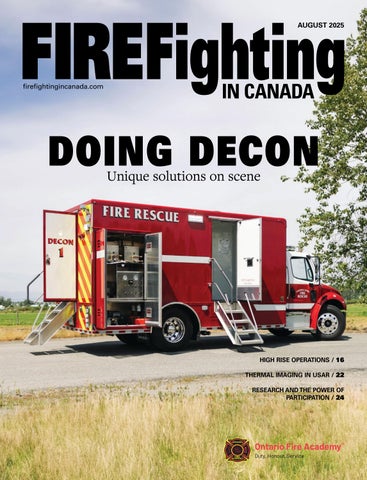
DOING DECON Unique solutions on scene
HIGH RISE OPERATIONS / 16 THERMAL IMAGING IN USAR / 22 RESEARCH AND THE POWER OF PARTICIPATION / 24
FLEET UPFITTING AND RELATED ACCESSORIES PROGRAM CONTRACT HOLDER Commercial is proud to have been awarded the highest rated contract in the canoe fleet upfitting and related accessories program. PROUD DE ALER FOR CANOE CONTR ACT HOLDER S:
PROUDLY 100% CANADIAN OWNED AND OPERATED. VANCOUVER • SURREY • EDMONTON • CALGARY • REGINA • WINNIPEG • AYR • WOODSTOCK
1.800.665.6126
INSIDE AUGUST 2025 firefightingincanada.com
FEATURES
10
DOING DECON DIFFERENT
16
HIGH RISE OPERATIONS
Learn about innovative solutions via apparatus to decontaminate firefighters at the scene By Julie Fitz-Gerald
The low down on specialty nozzles for high rise operations and standpipe equipped buildings By Stephen Hilton
COLUMNS
DEPARTMENTS
4 COMMENT
6 STATION TO
By Laura Aiken
22
THERMAL IMAGING IN USAR OPERATIONS
24
THE POWER OF PARTICIPATION
Using handheld and airborne drone technology for urban search and rescue By Manfred Khin
How firefighters can help drive mental health research forward By Nick Halmasy
12
STATION
8 NFPA IMPACT By Laura King
20 LEADERSHIP
COVER PHOTO: KARIN LOUWERSE
FORUM By Monique Belair
30 VOLUNTEER VISION By Tom DeSorcy
ESTABLISHED 1957 AUGUST 2025 VOL. 69 NO. 5 READER SERVICE Print and digital subscription inquiries or changes, please contact: Angelita Potal, Customer Service Tel: (416) 510-5113 Fax: (416) 510-6875 apotal@annexbusinessmedia.com Mail: 111 Gordon Baker Rd., Suite 400, Toronto, ON M2H 3R1
6 EDITOR LAURA AIKEN
BRAND SALES MANAGER BRAD MILLER
GROUP PUBLISHER ADAM SZPAKOWSKI
AUDIENCE DEVELOPMENT MANAGER BEATA OLECHNOWICZ
laiken@annexbusinessmedia.com
aszpakowski@ annexbusinessmedia.com
ACCOUNT COORDINATOR KRISTINE DEOKARAN
kdeokaran@annexbusinessmedia.com
bmiller@annexbusinessmedia.com
bolechnowicz @annexbusinessmedia.com
MEDIA DESIGNER ALISON KEBA CEO SCOTT JAMIESON
PUBLICATION MAIL AGREEMENT #40065710 RETURN UNDELIVERABLE CDN. ADDRESSES TO CIRCULATION DEPT. P.O. Box 530, SIMCOE, ON N3Y 4N5 subscribe@firefightingincanada.com Printed in Canada ISSN 0015–2595 SUBSCRIPTION RATES Canada – 1 Year - $26.01 2 Year - $44.88 | 3 Year - $59.16 Single Copy Canada - $5.00 (GST - #867172652RT0001) USA – 1 Year $59.67 (CDN) Annex Privacy Officer Privacy@annexbusinessmedia.com Tel: 800-668-2374
Occasionally, Fire Fighting in Canada will mail information on behalf of industry-related groups whose products and services we believe may be of interest to you. If you prefer not to receive this information, please contact our circulation department in any of the four ways listed above. No part of the editorial content of this publication may be reprinted without the publisher’s written permission ©2025 Annex Business Media. All rights reserved. Opinions expressed in this magazine are not necessarily those of the editor or the publisher. No liability is assumed for errors or omissions. All advertising is subject to the publisher’s approval. Such approval does not imply any endorsement of the products or services advertised. Publisher reserves the right to refuse advertising that does not meet the standards of the publication. firefightingincanada.com
August 2025 FIREFightingInCanada.com 3
COMMENT
The perpetuation of the piles There seems to be a distinct sentiment that the fire service is changing fast, so fast that we must hustle to keep up, chase its change down framework-laden aisles bumpy with economic potholes and weary gravelled shoulders. The conversation around the pace of change and what fire departments will need to face – from weather emergencies to rapidly declining volunteers and retiring attrition – has reached a fever pitch. Layer on the day-to-day of calls, personnel sort-outs, paperwork and the list of matters that need evaluating, and the perpetuating pile becomes a daunting one indeed. It’s not what to do in a day; it’s what not to do, and not to do it fearlessly. It’s a healthy debate to consider who is creating all of the happening and what is the true urgency of any one thing, particularly for fire chiefs, the CEO of the fire department. Is it driven by mainstream media urging us to squirrel from crisis to crisis faster than one
$104 MILLION: The latest large investment in wildfire mitigation and prevention made available through the Government of Canada’s Resilient Communities through FireSmart (RCF) Program Canada’s annual mean temperature warmed by about 1.7 C from 1948 to 2016, which is double the global average warming over the same period (Canada’s Changing Climate)
A review of U.S. and UK case studies showed that door-to-door smoke alarm installations and safety education have reduced fire incidents by up to 40% in high-risk neighbourhoods (Data-driven fire prevention in vulnerable communities, FFIC)
4 FIREFightingInCanada.com August 2025
could ever keep track of the nuts? Or is it in part our propensity to talk? The human race is a world-class bunch of chatterboxes, compelled to produce endless reams of information that create more work. As we sift through those tasks later, we respond with more communication that cycles into more work. Today’s society is arguably addicted to TMI – too much information. View life with less information and you might realize some things are actually changing at a much slower pace. In some regards, things aren’t changing at all. In many ways, perspective has become the pace — and perhaps it always was.
LAURA AIKEN Editor laiken@annexbusinessmedia.com
WILDFIRES: The U.S. Consumer Product Safety Commission reported
14 DEATHS
related to electrocutions in swimming pools from 2003 to 2014 (NFPA)
Canada entered a National Preparedness Level 5 on May 29 and was still in it July 2 (CIFFC)
69%
of departments in urban centres reported significant new housing starts, yet only 17% had any new resources (CAFC Great Canadian Fire Census 2024) @fireincanada
ICONS: © POCIKE, SAN D, POD GLADIATOR / FREEPIK.COM
I was chatting with a fire chief one morning who lamented, in the context of the seemingly warp-speed changing world, that where he used to have one or two matters requiring full attention on his desk, that list had now grown to five or six. This drove a cycle of feeling like there is a lot happening all at once, perhaps more so than ever before. But is there? And if so, who created all the happening? Is the burgeoning pile on the desk a self-inflicted state driven by over productivity, or is has it been heaped on by others, whether from your own fire department or various agencies or your repository of personal life responsibilities and desires? Perhaps it’s a mix, as if we have collectively decided that Rome must be built in a day or else civilization as we know it will end. Does it feel like your value in saving the planet hinges on a melange of task mastering, selfcare, box-checking and overall performance standards that are, quite frankly, likely impossible to meet?
ORDERING A CUSTOM TRUCK JUST GOT EASIER.
INTRODUCING E-ONE SELECT SERIES™ When you’re in the emergency response business, time is always of the essence. E-ONE is saving departments time with our new Select Series fire apparatus. We streamlined the order-to-delivery process by preselecting the most popular options while allowing customization to meet your specific needs. Available now with our 75', 78' and 100' aerials in single or tandem axle configurations.
A FEW SELECT SERIES KEY FEATURES:
COMPACJACK™ CRISS-CROSS UNDERSLUNG JACK Provides a jack spread as narrow as 11' for full extension in tight spaces.
EXCEEDING THE NFPA STANDARDS
TIP LOAD
Extruded aluminum aerials feature a 2.5:1 structural safety factor.
750 lb. tip load on 78' aerial and 500 lb. tip load on 100' aerial.
Ordering fire apparatus just got easier, with the new E-ONE Select Series. Scan for more information, contact your E-ONE dealer or visit e-one.com today.
e-one.com © 2025 REV Group, Inc. All rights reserved.
STATION TO STATION Regional News Briefs
• A new parkette, with additional green space planned for the site of the old fire station once demolition of the old facility begins. This further green space will complement the existing parkette. More information about the centre is available at engage.calgary.ca/varsity.
Calgary debuts multiservice hub featuring new fire station, housing, and green space
The City of Calgary has officially opened the new Varsity Multi-Service Centre, a community hub designed to enhance emergency response, provide new housing, and offer public green space in the Varsity neighbourhood and surrounding areas. The facility, located at 3400 37 St. N.W., brings together various key services in one accessible location. “This project is about building a resilient and inclusive community,” said Katie Black, general manager of community services, in a news release, noting the integration of “key services in one accessible location” and the addition of “much-needed housing and green space for the residents of Varsity and beyond.” The mixed-use centre includes several key components: • A modern fire station intended to meet contemporary emergency response demands and bolster safety in Varsity and adjacent areas. This new station replaces
The facility, located at 3400 37 St. N.W., brings together various key services in one accessible location, aiming to build a more resilient and inclusive community.
6 FIREFightingInCanada.com August 2025
the Varsity Fire Station, which served the community for over 50 years, ensuring continued quick and effective emergency response and providing a healthy, safe environment for firefighters. Calgary Fire Chief Steve Dongworth highlighted that the new fire station will allow the department to “serve the community into the future as the community continues to grow and change.” • Forty-eight mixed-income housing units, including 11 barrier-free homes and several multigenerational family units, are expected to provide stability and affordability for approximately 200 Calgarians. Sarah Woodgate, president and CEO of Calgary Housing, described in the statement as this being a “a smart approach towards addressing housing needs,” by integrating residents into a larger community with on-site services. • A household hazardous waste dropoff site to support environmental stewardship. • Flexible workspaces for City service teams operating within the community. • A potential day care service within the new retail space.
The District of North Saanich, a municipality on Vancouver Island, is expanding the International Association of Fire Fighters (IAFF) Local 5509 to formally include paidon-call (POC) firefighters. In a June 2 news release, District officials said the development “marks a new chapter in the District’s continued commitment to providing a unified, professional fire service that meets the growing needs of our community.” “The District looks forward to working with IAFF Local 5509 to establish a collective agreement that supports a safe, professional, and responsive fire service,” it continued. “This partnership ensures that all firefighters – career and POC – are supported in their roles and equipped to serve the residents of North Saanich effectively.” North Saanich Fire Fighters chartered with the IAFF in August 2024 and become Local 5509. The addition in May 2025 of 26 POC members now forms a 32-member association. The District of North Saanich is located on the Saanich Peninsula of British Columbia, approximately 25 kilometres north of Victoria on southern Vancouver Island.
@fireincanada
PHOTO: CITY OF CALGARY
Vancouver Island district expands IAFF Local 5509 to include paid-on-call firefighters
THE FIRE HALL BULLETIN
Central York Fire Services recognized as North American leader in firefighter health and wellness Central York Fire Services (CYFS), in Newmarket, Ont., has been selected as one of 17 departments across North America to join the Wellness-Fitness Initiative (WFI) Task Force, a collaborative effort through the International Association of Fire Fighters (IAFF) and the International Association of Fire Chiefs (IAFC) to improve firefighter health and performance. This May, the WFI Igniting Change Team visited CYFS as part of a multi-city effort to develop evidencebased wellness and fitness programs for firefighters and emergency medical workers. In a May 29 statement, CYFS officials said the goal of the WFI is to provide departments “with a holistic system to support the health and wellness of firefighters so they can do their jobs and retire healthy.” CYFS also stated it has been “a leader in implementing WFI practices,” focusing on early detection, intervention, and prevention. One example, CYFS said, is creating a group of 15 peer fitness trainers who can help fellow firefighters and act as a resource on shift. The current WFI program includes: • Annual in-depth blood work and consultation with a physician. • Chest X-rays every five years. • Annual fitness testing and cardiac screening. • Diffusing sessions following challenging calls and preventative mental health initiatives. • Peer-led monthly training on health, wellness, and nutrition. While the current program has only been in place for the past five years, CYFS has historically taken the lead in advancing health and wellness for its members. In the 1990s, CYFS officials started a fitness assessment program and later implemented the original Newmarket Fire Department task force and fitness certifications, with a similar approach for the Aurora Fire Department (pre-amalgamation). Acting Captains Amber Bowman and Thomas Johnston (TJ) recently visited Washington, D.C. to represent CYFS, the statement said, and they joined over 100 subject matter experts from fire departments, government agencies and academic institutions committed to sharing their expertise. CYFS is a full-time department that provides protection to the Towns of Aurora and Newmarket, in York Region.
PROMOTIONS & APPOINTMENTS STEVE ZAYTSOFF is the new district fire chief for the Clive Fire Department in Lacombe County, Alta. He embarked on his journey in 2004 through Lacombe Composite High School’s work experience program, and by the age of 19, he had completed his NFPA 1001 training at Lakeland College. Zaytsoff steadily advanced through the ranks of the Clive Fire Department, serving as a firefighter, captain, and most recently, deputy fire chief. CORRIE ANDERSON is the new district fire chief for the Alix Fire Department in Lacombe County, Alta. Anderson’s fire service career began in Northwestern Ontario in 1992. He has held positions as firefighter, captain, and deputy chief across two departments. Beyond his volunteer roles, Anderson also works in the oilfield industry as an operations manager and emergency responder, providing him with extensive hands-on knowledge in incident command and safety protocols. PHIL WEST has been promoted to the position of director of emergency services/fire chief for the town of St. Marys, Ont., effective June 30. Since joining the department in 1995, West has held leadership positions at every level. Beginning his career as a firefighter, he advanced to lieutenant in 2019, captain in 2022, and deputy fire chief in 2024. BRYAN BURLEIGH was named the new fire chief for Prince George Fire Rescue in B.C. He joined the Prince George department 23 years ago and assumed the role of deputy chief of operations and training three years ago. He moved into his new role in June.
In Weyburn, Sask., MICHAEL WOCK has been promoted to deputy chief. Wock has a background in fire fighting and working in the oil industry. He previously worked for the Estevan Fire Rescue Service.
RETIREMENTS Director of Emergency Services and Fire Chief MONIQUE BELAIR will retire from the Kingston Fire & Rescue on July 31. Chief Belair has had an esteemed 39 year career. She is the founder of Camp Molly, which provides with young women with opportunities to discover the fire service. She began her career in 1986 as a crash rescue/structural firefighter with the Canadian Armed Forces as one of only five women serving on military bases across Canada. Assistant Deputy Chief DAVID MCKINLEY is retiring from the Fredericton Fire after 35 years with the department. McKinley started as a firefighter in 1990, becoming a lieutenant, then captain and assistant deputy chief. He is a former executive board member of the New Brunswick Association of Fire Chiefs and vice chair of of National Advisory Council to the Canadian Association of Fire Chiefs. McKinley competed in over 100 Firefighter Combat Challenges and won several regional titles. Fire Chief ANDY THIESSEN will retire from Morden Fire & Rescue in Manitoba after 45 years of service. Thiessen will retire at the end of September, and spent 30 years as the Chief in Morden. The fire department created a touching tribute video for Chief Thiessen to mark the hanging up of his helmet.
August 2025 FIREFightingInCanada.com 7
NFPA IMPACT
Laura King is the NFPA’s regional director for Canada. Contact her at lking@nfpa.org.
By Laura King, NFPA Regional Director Canada
Charge into FIRE SAFETY during FPW The key message for children for Fire Prevention Week is to charge devices on a hard surface: Put phones and tablets on something hard when you plug them in.
The decision to choose lithium-ion battery safety as the 2025 Fire Prevention Week theme was made with a lot of data and a bit of hesitation. We know lithium-ion batteries have caused fires and fatalities across North America. We know lithium-ion batteries are fundamentally safe, but used improperly, damaged, or paired with non-listed chargers, cords, or items of the wrong voltage, and the batteries can be dangerous. But how do educators teach young children – a primary audience for Fire Prevention Week – about lithium-ion battery safety? Usually, the FPW theme revolves around knowing the sounds of the smoke alarm or getting out and staying out – actions that are fun to teach and easy for young children to grasp. This year, with the increasing numbers of lithium-ion battery fires, NFPA’s education division listened to educators and fire departments and, working with experts, created a package of resources that synthesizes the plethora of information about lithium-ion batteries into teachable bites that children and adults can easily understand and adopt. NFPA thought long and hard about how educators use Fire Prevention Week messaging and materials, and how best to deliver the information, before choosing the 2025 Fire
8 FIREFightingInCanada.com August 2025
Prevention Week theme: Charge into Fire Safety™. Lithium-ion Batteries In Your Home. There are three key messages for adults: buy only listed products; charge devices safely –on a hard surface and with the cords and chargers provided by the manufacturer or listed replacement products recommended by the manufacturer; and recycle lithium-ion batteries responsibly (visit call2recycle.ca). The key message for children for Fire Prevention Week is to charge devices on a hard surface: Put phones and tablets on something hard when you plug them in. There’s a colouring sheet featuring Sparky the Fire Dog – in English and French – and complementary messaging about smoke alarms and escape plans so educators can provide a well-rounded lesson. Educators can talk about the importance of charging devices safely and having working smoke alarms, knowing the sounds of the smoke alarm, and getting out and staying out. We know that even the youngest kids use tablets, and they parrot at home what they’re taught in daycare, pre-school, school, or at a FPW event. We also know there’s additional messaging that adults need to hear about how to safely buy, charge and recycle lithium-ion batteries. The English and French Fire Prevention Week resources for
Canadian fire departments include a new tip sheet (buy, charge, recycle), an adult mindfulness / colouring sheet, and a lesson plan for adult programming. Other free-to-download materials include a press release, proclamation, social media cards and the accompanying text, a selfie frame, and a customizable event poster. To find the English and French Fire Prevention Week materials, go to www.fpw.org. Scroll to Campaign Toolkits and download the Printables Toolkit and the Digital Toolkit. Both toolkits contain zipped folders with Canadian versions of the resources (metric measurement and spelling, and Canadian websites such as call2recycle.ca) and French-language materials. To learn more about the 2025 Fire Prevention Week resources and how to use the theme, there’s an NFPA webinar on Aug. 5, during which NFPA and the fantastic folks with Call2recycle will review the resources and the fpw.org website; register at nfpa.org/events/webinars#fpw. You can expect to learn about: • The fire risks associated with lithium-ion batteries and how they occur. • Key safety actions your department or organization can promote to reduce incidents. • Educational strategies and messaging that resonate with people of all ages. • How to use NFPA campaign materials to support outreach in your community. If your department or association would like to host a webinar in September – daytime or evening for volunteer departments in your region – contact me. Fire Prevention Week 2025 is Oct. 5-11. To buy a Canadian Fire Prevention Week kit – English or French – with handouts for children and adults, visit https://canopsstore.org.
@fireincanada
LEADERSHIP FORUM
Monique Belair began her career in 1986 as a crash rescue/structural firefighter with the Canadian Armed Forces as one of only five women serving on military bases across Canada. Reach her at mlbelair66@gmail.com.
By Monique Belair, Fire Chief, Kingston, Ontario
ARE YOU A GOOD BOSS? Throughout our career, we are often questioned about what type of leadership style we would classify ourselves as. However, do you ever ask yourself, “Am I a good boss?” And, if asked, how would your staff respond to this question? Leadership style refers to the approach or way a person leads and influences others, encompassing traits, behaviours, and characteristics that define how a person leads a team or organization. Style can vary widely among individuals and can be categorized into different types, such as autocratic, democratic and transformational, among others. Being a “good boss”, on the other hand, involves effectively managing and leading a team in a way that fosters productivity, engagement, and growth. A good boss can inspire and motivate their team, set clear expectations and goals, provide guidance and support, and create a positive and productive work environment. Being a fire chief isn’t just about command—it’s about leadership, legacy, and people. So, what does it truly mean to be a good boss as a fire chief? Here’s what experience — and listening closely — has taught me over the years.
Having an open-door policy isn’t just about being available, it’s about being present without needing to fix, judge, or turn the conversation back to your own experiences.
LEAD WITH INTEGRITY
In fire services, respect isn’t automatically granted with the badge or number of stripes on your epaulettes — it’s earned through actions. A good fire chief doesn’t hide behind the chain of command. They lead by example, admit when they’re wrong, and stay accountable to the same standards they expect of their staff.
10 FIREFightingInCanada.com August 2025
WHEN TO STOP TALKING
BE PRESENT
Emergencies require clear direction. Day-to-day leadership demands something deeper: the ability to truly listen. Members of the department may not always speak up, especially if they don’t feel genuinely heard. Having an open-door policy isn’t just about being available, it’s about being present without needing to fix, judge, or turn the conversation back to your own experiences. When someone walks through your door, sometimes, the best thing you can do is sit with them in silence, ask the right questions, and let them speak freely without fear of repercussions. You don’t just have an open door; you have open ears and an open mind. If they are providing feedback accept it with humility and take it seriously.
As the increasing pressures and commitments of a fire chief consume more of our days—budgets, meetings, policies, planning—it’s important to remember that face time with the membership still matters. The more visible and approachable you are, the more you remind your team that you haven’t forgotten where you came from or who you serve alongside.
INVEST IN YOUR PEOPLE
Good chiefs look beyond capital and operating budget restraints, council reports and labour relation issues. They think about what their members need to grow and thrive, both professionally and personally. STRIKE A BALANCE
Balancing tradition and progress in the fire service is one of the most complex and challenging responsibilities for any fire chief. Tradition shapes our identity. It honours those who came before us, reflects our shared values, and reinforces the pride we feel in the uniform. But progress is what ensures we continue delivering our core services with the highest level of competency, safety, and professionalism.
A CULTURE THAT LASTS
Ultimately, your legacy as a fire chief isn’t the equipment you purchased, your latest and greatest fire station or the policies you wrote, it’s the culture you leave behind. A good boss succession plans and mentors the next generation, knowing the real success of their leadership is when others are ready to step up with confidence and purpose. And on that note, and after much thought and reflection, I have decided that on July 31, after 39 years of service, I will be retiring from my position as fire chief and director of emergency services. I want to take this opportunity to express my sincere appreciation to my colleagues, peers, and association members. Your commitment, support, and camaraderie have meant the world to me. Looking back, I know I didn’t always get it perfect. No leader does. But I tried to show up with integrity, lead with heart, and leave things better than I found them. So, if I’ve earned the memory of being a “good boss” in the minds of those I’ve worked with, that would be the greatest honour of all. @fireincanada
The No. 1 manufacturer of SCBA Decon machines is pleased to Introduce their new line of soft and hard mount Bunker Gear Extractors and Gear Driers
The Solo SCBA Decon/Washing machine ✓ REDUCED HEALTH RISK was designed and built ✓ SAVES TIME 2/PKS IN 8 MIN for one purpose only…to ✓ EASY TO USE protect Fire Fighters from ✓ 5 YEAR WARRANTY Cancer causing agents found in the Smoke and Qualified by MSA, SCOTT, DRAEGER residue left on their & INTERSPIRO for cleaning their SCBAs. SCBAs. As an added bonus it can clean Gloves, Boots and Helmets. In addition, it substantially lowers the time spent decontaminating WASH/DECON TWO firefighter equipment. SCBAs The SOLO is the only In 8 minutes. Also SCBA decon machine cleans, boots, gloves that meets both NFPA Aand helmets. and CSA standards.
AVAILABLE IN SINGLE OR THREE PHASE
NFPA approved Soft install Gear Extractors and Driers Front load Stainless steel, 120 Vac 2-4 pieces of gear
Front load Stainless steel, 220 Vac 1 ph 4-6 pieces of gear
EW35G
EW22G
Dries 6 suits of gear, boots, gloves, Helmets or SCBAs. 220VAC 1 ph or 3 ph. 40-60 amps
Dries 2 suits of gear, boots, gloves, Helmets or SCBAs 120 Vac 13 amps
DC2
SD6C
CANADIAN SAFETY EQUIPMENT IS PROUD TO BE A DISTRIBUTOR FOR THE INTERSPIRO RESPIRATORY PROTECTION LINE. THEIR STATE OF THE ART S9 INCURVE IS ONE OF THE MOST COMFORTABLE SCBAs YOU WILL EVER WEAR. GIVE US A CALL AT 800-265-0182 OR EMAIL US AT INFO@CDNSAFETY. COM
No Company has a richer history in respiratory protection than Interspiro. Their innovations have become industry standards, time and time again.
MASS DECON SYSTEMS
Call Canadian Safety Equipment for all your Bunker Gear Racking requirements.
GEAR RACKS - HOSE RACKS & DRIERS- BOTTLE STORAGE – GEAR EXTRACTORS & DRIERS
• Heavy Duty Air Berms – FSI utilizes extremely heavy duty air berm construction in all DAT® series mass casualty portable hazmat decon shower systems. FSI uses the same 1100Dtex, quadruple overlapped and glued berms found in our wide range of transom rescue boats – known for the extreme conditions they are subjected to. • Extremely Rapid Deployment – FSI Portable Shower Systems are compact, fully integrated, and supplied complete in a heavy duty carry sleeve/bag. FSI Shower systems inflate virtually unaided – with the use of compressed air, or via a supplied electric inflator/deflator with a hands-free connector within minutes (size of unit and method of inflation dependent). The inflatable decontamination shower units are meant to be deployed simply and quickly – with modest training and few personnel.
By Julie Fitz-Gerald
DOING DECON DIFFERENT An innovative solution to decontaminate firefighters at the scene was unveiled at the Fire Chiefs Association of BC’s 2025 BC Fire Expo, held at the Penticton Trade and Convention Centre on June 8 and 9. The decon apparatus is the vision of Campbell River Fire Department’s (CRFD) deputy chief of training and safety, John Baker, and the department’s internal build team. After losing a lieutenant to work-related cancer and then watching a good friend battle occupational disease last year, Baker felt compelled to take action. “Obviously, cancer in the fire service is at epidemic levels right now and it doesn’t seem to matter where you work or how big your department is, it just seems to get you,” he said. The alarming statistics on cancer in the fire service have grabbed the Government of Canada’s attention, with the Minister of Health introducing the National Framework on Cancers linked to Firefighting (the Framework) in 2024. The Framework’s goal “is to raise awareness of cancers linked to firefighting to improve access for firefighters to cancer prevention and treatment.” It acknowledges that of the approximately 3,200 fire departments across the country, “cancer is the leading cause of job-related deaths for firefighters in Canada.” Using findings from the BC Injury Research and Prevention Unit, the Framework notes that 85 per cent of work-related fatality claims of Canadian firefighters between 2007 and 2021
BELOW Turnout gear is doffed and prepped for wash at the ear entry.
12 FIREFightingInCanada.com August 2025
were related to cancer. The International Association of Fire Fighters (IAFF) has that number even higher, reporting that in Canadian IAFF member career firefighters, line-of-duty deaths related to cancer were 94 per cent. As Baker mentioned, if you’re a firefighter in Canada, chances are good that cancer has impacted you in some way, whether you’ve experienced it yourself or watched a fellow firefighter battle the disease. When federal, provincial and territorial governments began addressing the issue through presumptive legislation to recognize occupational disease, including cancer, as work-related, Baker said a light went on for him. “Wouldn’t it be nice if we didn’t have to get to the point of disease?” Recognizing an opportunity to make advancements in how the CRFD was deconning personnel on the fire ground, Baker began to envision a mobile unit that could go to the fire scene and act as an immediate decontamination facility. Initially, he thought it could be a trailer, however as the CRFD internal committee discussed design options with the manufacturer, the idea evolved into a self-contained truck. The innovative apparatus sits on a mid-sized 2025 Freightliner chassis, featuring a two-person cabin with a custom backend built by local B.C. manufacturer Intercontinental Truck Body (ITB), featuring a washroom, two showers, a dressing area and a place to refill SCBA cylinders. Divided into three areas, the hot zone is at the back of the truck and
PHOTO: KARIN LOUWERSE
Unique decon apparatus unveiled at 2025 BC Fire Expo
@fireincanada
ONE MEASURE THROUGHOUT THE LIFE OF AN APPARATUS. PERFORMANCE IS EVERYTHING. United and operating as one. Pierce and our dealer network work together as a single team of experienced professionals dedicated to keeping your apparatus performing at its best. From parts to service, we’re setting new standards in lifecycle support and working to drive down cost of ownership. United we build. United we perform.
piercemfg.com
pierceparts.com
The Pierce name and Pierce logo are registered trademarks; and Perform. Like No Other is a service mark of Pierce Manufacturing Inc., Appleton, Wisconsin. ©2025 PIERCE MANUFACTURING INC. All other trademarks are the property of their respective owners.
WEST & ONTARIO Commercial Emergency Equipment Co. 1.800.665.6126 comemerg.ca
QUEBEC L’Arsenal 1.800.266.7610 larsenal.ca
EAST Safety Source Fire Inc. 1.800.667.3030 safetysourcefire.ca
contains a washroom facility with sink and toilet. Firefighters can use the washroom while on scene, and they also begin here when initiating the decontamination process. Entering through the back of the truck, they remove their contaminated gear, which is placed in plastic bags, tagged and then sent back to the station to be decontaminated. The firefighter then moves through to the warm zone where two
The “Mobile” Dry Hydrant Excels Where Strainers Fail SEPARATORS® Unlock New Rural Water Sources Normally NOT Available! Finally draft water where you wouldn’t before - even 4" deep. Eliminate pump damage by sand, debris, vortex & weeds. Reduce tank refill times and keep firefighting efforts focused where they matter most... on the fire. Simple, efficient, revolutionary!
Wildfire • Rural • Cottage • Dewatering Upgrade your firefighting arsenal today.
The “Mobile” Dry Hydrant
Patented 14 FIREFightingInCanada.com August 2025 FFIC_Bearspaw_Aug25_CSA.indd 1
ProtectaPump.com @fireincanada 2025-06-24 9:23 AM
PHOTO: KARIN LOUWERSE
LEFT There are two showers located in the apparatus’ warm zone, where firefighters head after bagging and tagging their contaminated gear.
shower rooms are located. Supplied with hot water from two diesel-fired, on-demand hot water heaters that utilize fuel directly from the truck, firefighters are able to get the dermal decontamination that is critical after being exposed to carcinogenic materials. Personnel then continue on through the apparatus to the cold zone, where they are fitted with clean overalls before exiting the vehicle through a side door. It’s leaps and bounds ahead of how CRFD – and many other Canadian fire departments – traditionally manage decontamination. Usually, firefighters battle the blaze and then initiate the decontamination process back at the station. CRFD’s new decon system deals with contamination in real time at the scene. John Van Seters, sales and marketing manager with ITB, says the rig is essentially a one-stop shop for the department’s needs: a washroom, two showers and a two-bottle fill station with a cascade system for SCBA cylinders. “Instead of bringing all of these solutions in three different ways, we were able to combine the three solutions to meet those needs all in one truck. It’s faster to deploy and it gets resources on scene,” Van Seter explained. He noted that ITB is largely a work truck builder for industries like mining, however about 10 per cent of what they build is for emergency services. This positions the family-owned business to bring innovative ideas from other industries into the fire service, finding solutions that may not have been done before. CRFD’s decon apparatus has several unique features as a result. “This is one of the first times that we built something like this where it’s powered by essentially a fire hose or fire
Emergency Rescue Pumper Side Control
Emergency Rescue Pumper Side Control
,1) 'LEWWMW ,4
,1) 74)'86 -- 'LEWWMW ,4
4-D Door Li Liber berraato bera tor Pum um ump mpeerr Sid S e Cont Cont o ro roll
Eme merge g ncyy Re ge Rescu escuee Pump Pumpper Topp Mo Mount Mount ntt En E cloosed
**VI VIIMKL MKKLLXPM MK XPXPMRIV XPM PPMRIV RIIVV 'L RI 'LEWW EWWMW EWWMW MWW , , ,4
-RX -RXIVR R IVR IVREXM V EXM EX SRE SREP ' 'LEWWWMW WMW ,4 ,4 , 4
%PP TLSXSW EFSZI EVI JSV MPPYWXVEXMSR TYVTSWIW SRP] ERH QE] RSX VIƽIGX XLI I\EGX WTIGMƼGEXMSRW JIEXYVIW SV ETTIEVERGI SJ XLI EGXYEP XVYGOW PMWXIH
For over 105 years, Fort Garry Fire Trucks has FIIR FYMPHMRK ƼVI ETTEVEXYW XLEX HITEVXQIRXW EGVSWW 2SVXL %QIVMGE XVYWX MR XLIMV QSWX GVMXMGEP QSQIRXW )RKMRIIVIH JSV XLI XSYKLIWX VSEH GSRHMXMSRW ERH ƼVIKVSYRH HIQERHW IZIV] XVYGO [I FYMPH MW FEGOIH F] HIGEHIW SJ I\TIVMIRGI XLI PEVKIWX ƼVI ETTEVEXYW IRKMRIIVMRK XIEQ MR 'EREHE ERH E VITYXEXMSR JSV VYKKIH HYVEFMPMX] ;MXL SYV WMKREXYVI JYPP JVEQIH 8 EPYQMRYQ I\XVYHIH WYF JVEQI ERH WEPX[EXIV QEVMRI KVEHI EPYQMRYQ GSQTEVXQIRXW IEGL ETTEVEXYW HIPMZIVW YRQEXGLIH WXVIRKXL GSVVSWMSR VIWMWXERGI ERH PSRKIZMX] MR XLI ƼIPH *VSQ TIVJSVQERGI XS GVEJXWQERWLMT *SVX +EVV] *MVI 8VYGOW MW GSQQMXXIH XS TVSZMHMRK XLI XSSPW ƼVWX VIWTSRHIVW VIP] SRƂHE] MR ERH HE] SYX 3YV GYVVIRX MR WXSGO ERH MRGSQMRK TYQTIVW EVI RS I\GITXMSR *IEXYVIH MR XLMW EH EVI JSYV SJ SYV
QSWX WSYKLX EJXIV FYMPHW IEGL EZEMPEFPI JSV TYVGLEWI RS[ [MXL HIPMZIV] XMQIPMRIW ZEV]MRK F] YRMX WXEXYW 8LI ER Pumper 4-Man CrownƂFYMPX SR ER -RXIVREXMSREP GLEWWMWƂSJJIVW I\GITXMSREP ƼVI WYTTVIWWMSR GETEFMPMXMIW [MXL MXW ,4 'YQQMRW 0 IRKMRI ,EPI (7( TYQT ERH - + XERO [MXL MRXIKVEXIH JSEQ W]WXIQ ;MXL SZIV JXt SJ WXSVEKI E +IRXMPM HVST HS[R PEHHIV VEGO ERH ER EPYQMRYQ JYPP JVEQI FSH] MXƅW E TS[IVJYP WSPYXMSR JSV HITEVXQIRXW RIIHMRK FSXL GETEGMX] ERH GVI[ WYTTSVX 2I\X SYV ER Pumper Side Control YRMXWƂ EZEMPEFPI SR ,1) ERH ,1) 7TIGXVɸ-- GLEWWMWƂGSQFMRI TVSZIR HVMZIXVEMRW ERH LMKL ƽS[ ,EPI 97+41 TYQTW [MXL -+ [EXIV XEROW )EGL MW IUYMTTIH [MXL
E JYPP ;LIPIR IQIVKIRG] PMKLXMRK TEGOEKI ERH E ,4 'YQQMRW 0 TS[IVXVEMR SJJIVMRK TIVJSVQERGI ERH ZMWMFMPMX] [LIR MX QEXXIVW QSWX *MREPP] XLI 4-Door Liberator Side Control, QSYRXIH SR E *VIMKLXPMRIV 1 GVI[ GEF GLEWWMW HIPMZIVW FMK SR ZIVWEXMPMX] *IEXYVMRK E ,4 HMIWIP IRKMRI 97+41 (EVPI] TYQT ERH HYEP JSEQ XERO W]WXIQ XLMW TYQTIV FEPERGIW QERIYZIVEFMPMX] [MXL JYPP WIVZMGI VIWTSRWI GETEFMPMXMIW *SV QSVI MRJSVQEXMSR SR XLIWI YRMXW SV XS VIWIVZI SRI XSHE] GEPP 1-800-565-3473 or VIEGL SYX XS ]SYV *SVX +EVV] *MVI 8VYGOW WEPIW VITVIWIRXEXMZI ;LIR VIEHMRIWW QEXXIVW XVYWX in One Tough Truck
hydrant. It gets hooked onto a fire hose, not a tank of water like others,” said Van Seter. To regulate the water pressure into usable pressure, a pressure-reducing valve was installed. Another cutting-edge feature are the two diesel-fired, on-demand hot water heaters, which use the diesel fuel from the truck directly to heat the water for the showers. “Rather than running a generator to make electricity and
heat water quickly, this takes the fuel from the truck’s fuel tank and creates hot water on demand, quietly and efficiently. It can keep up with limitless hot water and won’t run out until you run out of fuel. That’s a pretty advanced feature that most people wouldn’t know exists,” said Van Seter, noting that the technology is from local BC company International Thermal Research (ITR).
16 FIREFightingInCanada.com August 2025 FFIC_RollnRack_June25_CSA.indd 1
He expects demand for decontamination apparatuses like this one to continue rising as fire departments look for better solutions to decrease their exposure to carcinogenic materials. “Making it mobile and at the scene achieves these goals. And it’s approachable. You’re not in a decon tent out in the cold. This is a nice experience to go through. The truck is spacious, well lit and warm – it’s meant to be a nice experience as you use it.” Van Seter advises other departments interested in a similar apparatus to start with local companies and call around to see what potential solutions are out there. Every fire department has different needs and if a local company isn’t able to find solutions for those needs, they can likely point them in the direction of someone who can. Early investigation by the department into possible solutions and good dialogue with the manufacturer are integral to a smooth process. The timeline from initial concept to purchase process can be lengthy as the plans take shape, however, once that’s solidified the time from purchase process to delivery is approximately 18 months, according to Van Seter. As for budget, Baker said the cost was about $440,000 all in, and he expects it to be a valuable asset to the CRFD for many years to come. “This is a real passion project for this particular customer to improve health outcomes for firefighters – not just for their department, but for the industry as a whole,” said Van Seter. “That passion for the end result is what separates this project from others.” Baker’s passion to reduce cancer rates in the fire service through actionable solutions is evident. He hopes the CRFD’s cutting-edge decon apparatus will inspire other departments to find similar solutions for their members. Explaining that while his generation of firefighters were focused on respiratory protection, and rightly so, he believes there’s currently a gap in solutions to limit dermal exposure to the chemical cocktails that seep through the skin while fighting fires. He said the goal is to “shower within the hour,” however exposure time often goes well beyond the hour for many different reasons. Bringing showers to the scene of the fire is a way to fight back against this. “I hope the next generation of firefighters can get ahead of this. If they never had to use the presumptive legislation, that would be a victory,” said Baker. @fireincanada
2025-04-30 8:50 AM
1 T O R T A M L O H T1: ALL-IN-ONE FORCIBLE ENTRY TOOL Whether it’s breaching doors, cutting locks, or lifting heavy materials; with the T1, you always have the right tool for the job. MULTIFUNCTIONAL TOOL
SPREADING TIPS
T1 is the only tool that can hammer, cut, spread, lift, wedge and ram.
Load-holding function makes the tool suitable for (progressive) lifting.
OPTIMIZED CUTTING BLADES AND JAW DESIGN
TWO-STAGE PUMP
T1 can easily cut rebar, chain and padlock; easily replace the cutting blades when they are damaged.
High power transmission gives you a maximum cutting force of 14,2 ton/31 248 lbf and a maximum spreading force of 3,4 ton/7 419 lbf.
REQUEST A DEMO holmatro.com
By Stephen Hilton
HIGH RISE OPERATIONS A look at specialty nozzles for high rise operations and standpipe equipped buildings When it comes to high rise fire fighting tactics, most fire departments have standard operating procedures (SOPs) or standard operating guidelines (SOGs). Those procedures/ guidelines will lay out what equipment will be deployed during a high rise incident. The purpose of the SOPs/SOGs are to provide a safe and effective method for responding to fires in a high rise or a standpipe equipped building. Typical equipment in a high rise incident are typically three lengths of 50’ sections of hose, either 13/4” (45mm) or 21/2’ (65mm), a smooth Bore nozzle or combination Fog nozzle, set of irons, high rise bag consisting of pressure gauge, gate valve, some reducers, wrenches, straps, etc., and a thermal imager. Let’s think outside of the box and look at some of the nozzles that many fire personnel don’t think about using but are usually at our disposal every day on our apparatus which can be used to attack unusual circumstances if and when the situation presents itself. BRESNAN NOZZLES.
The Bresnan nozzle, also known as the Cellar nozzle to most firefighters, is a very underused nozzle that has many benefits. The Bresnan nozzle has been used in the fire service since the late 1800s and was invented by battalion chief John J. Bresnan, who served in the FDNY. The Bresnan is used to lower a hose line into a basement or other confined spaces that are too hot or dangerous for firefighters to enter directly. When using a 21/2” (65mm) hose line with the Bresnan nozzle you can flow up to 500 GPM (2000 Lt) at 100 PSI (700 KPA), which produces a circular water pattern up to 36’ with zero nozzle reaction, allowing you to move the hose line with little effort. The Bresnan nozzle can be left unstaffed. Here is perspective on how much water is flowing from the Bresnan nozzle: You can fill up a 55 gallon drum in 36 seconds — that
18 FIREFightingInCanada.com August 2025
ABOVE Top left: Bresnan nozzle with a swirl cage used for lithium-ion battery fire. Top right and bottom left: Horizontal nozzle flanking an apartment fire. Bottom right: Ground monitor being extended with a Bresnan nozzle. is a lot of water. There are basically two methods that can be used to attach the Bresnan nozzle to a hose line so you can maneuver and slide the nozzle into the desired position along the floor. The first option is using a swirl cage, where the nozzle sits in the centre of the swirl cage and is attached by setting the female orifice of the nozzle in one end of the cage and threading the male coupling of the hose line into the Bresnan, which securely attaches the two together. The second option is to use a halligan tool. With the ads on the ground and the spike pointing up, place the Bresnan nozzle and hose line on top of the halligan using a strap to securely attach the two together. The Bresnan nozzle can be used during fire attack into the fire compartment @fireincanada
Wi-Fi connectivity for maintenance alerts from Captium™
Get roll warnings, power levels and battery charge status at a glance
Smart dashboard displays live visual tool feedback
New turbo function allows for a faster rescue
Detects when a saltwater capable battery has been installed
LEFT TO RIGHT: Bresnan nozzle being used for a wind driven fire. Right: Floor below nozzle flowing water into an upper apartment window. and you are making zero progress due to there being lithium ion batteries in the fire compartment producing thermal runoff that is creating very large amounts of fire and high release rates. The size of the hose line and the amount of water you’re applying just isn’t enough to gain any ground on the fire. By switching your tactics from a hand line and nozzle to the hose line with the Bresnan nozzle, with the Bresnan attached to either the swirl cage or the halligan tool, so you can safely manoeuvre and push/ slide the Bresnan into the fire compartment. Be sure to shut the door to the fire compartment to control any flow path, then leave the Bresnan unstaffed until the thermal runoff has subsided and it is safe for fire crews to re-enter and finish the extinguishment. The Bresnan nozzle can also be used to your advantage for wind driven fires if the fire floor is compromised and it’s either impossible or too dangerous to push down the hallway to the fire compartment due to the wind pushing and driving the fire out into the hallway because both the door to the apartment and a window or a patio door in the apartment were left open, creating a flow path on the windward side of the building. By using a 21/2” ( 65mm ) hose line along with the Bresnan nozzle you can proceed to a minimum of two floors directly above the fire compartment, lower
The Easiest Charger to Install Yet With a Touch Screen and rotating mounting feet, installation is hassle-free Dual Battery Type Technology enables simultaneous charging of two different battery chemistries Optional Remote Touch Display available Watch Video
FLOOR BELOW NOZZLE
The less well known Floor Below nozzle can be deployed when the fire floor has been compromised, for wind driven fires, or where the fire is located at a level that is too high for the use of aerial operations. The Floor Below nozzle is operated at 265 GPM at 50 PSI using a 11/8” smooth bore tip, with a 21/2” (65mm) hose line. The nozzle can be disconnected into two pieces so it’s easy to transport into elevators for easy access. The Floor Below nozzle should be operated by two firefighters safely and effectively, and it is best practice to place the nozzle into one of the corners of the windowsill, which will allow the two firefighters to operate and direct the nozzle stream to its desired target. You will also be required to use a spotter from the ground level, or in a building opposite to the fire building. The spotter helps the crew operating the Floor Below nozzle direct the nozzle stream correctly into the fire compartment using radio communications. This fire tactic allows fire crews to attack the fire safely from the floor below to knock down and control the fire so another attack fire crew can safely make entry down the hall and into the fire compartment to fully extinguish the fire. VOID (HORIZONTAL) NOZZLE
The third specialty nozzle is the Void or (horizontal) nozzle which flows at 185 GPM at 50 PSI using a smooth bore tip of 15/16”. The
MCE VEHICLE POWER
Copyright © 2025 Kussmaul. All Rights Reserved. All trademarks are owned by Kussmaul.
20 FIREFightingInCanada.com August 2025 FFIC_Kussmaul_Aiug25_CSA.indd 1
the charged hose line with the Bresnan nozzle attached down directly in front and into either the open window or patio door, using the wind to your advantage to help push the Bresnan nozzle stream into the fire compartment to knock down and control the fire. At this point another fire attack crew can make entry into the fire compartment to extinguish any hot spots and initiate overhaul.
@fireincanada 2025-06-13 8:18 AM
Void nozzle is great for cocklofts, knee walls, attics, void spaces or using it to flank a fire from one apartment next to another due to a high volume of fire and a large heat release rate. The Void nozzle is focused on the reach of the nozzle stream, not on the volume of water being used. If a fire compartment is compromised and the fire attack crew cannot make entry into the fire compartment safely, the Void nozzle is another great tactic in the tool box that can be used to flank the fire by going into the next apartment to flow the nozzle stream from the balcony and into an open window or patio door of the apartment on fire. This tactic might be enough to control and knock down a good portion of the fire so another fire attack crew can make entry safely and finish off the extinguishment of the compartment on fire. PORTABLE GROUND MONITOR
The final nozzle that the majority of fire departments don’t ever consider using as an offensive fire attack in a high rise incident is a portable ground monitor. Over the years, while travelling to different fire departments across Canada and the U.S., I noticed a good number of departments look at and use the portable ground monitor only as a defensive tactic. I have noticed that most of the ground monitors are stored away in a compartment, sometimes not even fully assembled, instead of having it pre-connected as an offensive attack line, either by having it stored and ready to be deployed from the hose bed, or attached and secured on the rear of the fire apparatus ready for a quick and efficient offensive fire attack. There are a number of different makes and styles of portable ground monitors on the market. You want to look for one that is designed to be compact for the use of an offensive fire attack where it’s easy and efficient for deployment and movement. Some portable ground monitors are available that are as light as 20 lbs in weight which makes them very effective and easy to maneuver for a fire attack. Portable ground monitors flow very large quantities of water so you’re able to knock down and control fires that are very difficult and stubborn to control and extinguish. By flowing 500 GPM at 80 PSI you are producing large quantities of water to extinguish a fire very quickly and effectively. Once you have the fire under control you can transition the portable ground monitor as a regular hand line to extinguish any hot spots, and initiate overhaul by ether disconnecting the nozzle tip and attaching a 50’ length of 21/2” ( 65mm ) with a nozzle, or attach a gated wye with two 50’ lengths of 13/4” ( 45mm ) hose line with a hand held nozzle. There are many advantages available to fire departments when they use a portable ground monitor as an offensive fire attack tactic. When practicing and searching for best practices in high rise and standpipe equipped buildings for fire fighting operations, remember there are a number of versatile nozzle that are at your disposal to use besides the typical high rise kits used today. Remember to think outside the box and to practice and train with other specialty nozzles that can help assist us in unique situations and help us perform our tasks safer and more effectively. Stephen Hilton has 21 years in the fire service. He is currently working for the London fire department as a firefighter. He is a certified level II fire instructor working for Firestar Services and is a certified instructor with the IAFF Fireground Survival Program. He is a member of his department’s Peer Support Team. You can reach Stephen at hilts6ff@yahoo.ca.
August 2025 FIREFightingInCanada.com 21 FFIC_air technology_March23_MLD.indd 1
2023-02-10 1:32 PM
By Manfred Kihn
TIs to the urban search and rescue Here’s how to effectively use a thermal imager for urban ground search and rescue operations For years, the fire services have been using thermal imaging equipment (TI) to search for victims within structure fires that they have responded to. On some occasions they are called upon to aid in the search for victims lost outdoors. This month’s article will reflect upon the usage of handheld and airborne (UAE drone) thermal imaging technology. Using a handheld fire service thermal imager for urban ground search and rescue (GSAR) can be highly effective due to its ability to detect heat signatures in complex environments. Here are some key considerations and best practices: UNDERSTANDING THE EQUIPMENT
Thermal imaging detects heat differences, allowing rescuers to locate victims hidden by debris, rubble, or in low-visibility conditions. Higher resolution and thermal sensitivity improve detection capabilities, especially in cluttered urban settings.
ABOVE Airborne view, directing three searchers towards a victim in the search area. by fallen trees and debris. OPERATIONAL TIPS
Be aware of ambient temperature changes that may affect detection, as the cooler the background, the greater the heat signature, the greater for thermal distance. To identify heat signatures, look for human-sized heat sources that are consistent and mobile. You don’t have to detect the entire victim, perhaps you detect the heat signature from an arm or leg of the person laying in deep grass or behind a tree. Distinguish false positives: Recognize other heat sources such as rocks, trees and other hot surfaces caused by solar loading from the sun and reflections caused by water. SAFETY AND LIMITATIONS
Familiarize yourself with the device. Prior training on the specific model ensures effective use. Do a scene assessment by analyzing the environment to identify potential heat sources, entry points, and hazards. Then, coordinate with the team, establishing search patterns and communication protocols. SEARCH TECHNIQUES
Use grid or sector searches, systematic scanning, to ensure thorough coverage.Adjust the angle and height of the imager to maximize visibility into debris and hidden areas. Move slowly and steadily; observe for heat signatures that stand out from background temperatures. Make multiple passes: revisit areas as heat signatures can change over time or be obscured
22 FIREFightingInCanada.com August 2025
Maintain safety protocols — always prioritize personal safety, especially in unstable terrain. Thermal imagers cannot see through thick foliage canopy or debris, i.e. rocks; they detect surface heat, so victims may be concealed or cooled. Victims cannot be seen underwater as I/R cannot penetrate below the water’s surface. Weather pertaining to rain, snow, fog or bright sunny days can affect thermal readings. POST-DETECTION ACTIONS:
Confirm potential victims with secondary methods if possible. Be sure to mark and locations of heat signatures for rescue teams. Keep observing the area for changes or new heat signatures. Using UAE drones for urban ground search and rescue (GSAR) or airborne aviation (helicopter) offers significant advantages and has become an increasingly vital tool for emergency responders. ADVANTAGES OF DRONES IN USAR
Drones can be quickly deployed to assess situations in hard-to-reach or dangerous @fireincanada
PHOTO CREDIT: OPP AVIATION TEAM
PREPARATION AND PLANNING
areas, reducing response times. Aerial perspective: They provide real-time high-resolution imagery and video, giving rescue teams a comprehensive view of the terrain, collapsed structures, or hazardous zones. Drones can navigate through debris, narrow alleys, and confined spaces that might be inaccessible or dangerous for ground personnel. Equipped with thermal imaging and multispectral cameras, drones can detect heat signatures of trapped or missing people, even in complex urban environments. And, compared to helicopters or other aerial vehicles, drones are more affordable and easier to operate.
with ground teams is required. Drones should complement on-the-ground efforts, with clear communication protocols. Plan missions considering drone endurance in regard to battery life and range to maximize coverage. Exercise data management by securing transmission and storage of collected data for analysis and decision-making. CHALLENGES TO ADDRESS
• Urban environments pose obstacles such as heavy foliage canopy, power lines, and unpredictable weather conditions. • Limited flight time due to battery constraints. • Tethered drones must be continuously relocated as coverage area has been completed.
KEY TECHNOLOGIES AND EQUIPMENT
Thermal and infrared imaging is used for detecting body heat in low visibility conditions. High-resolution RGB cameras provide detailed visual inspections. LiDAR sensors create 3D maps of the environment, useful for assessing structural stability. Autonomous flight capabilities provide precise, repeatable search patterns over designated areas. Obstacle avoidance sensors safely navigate cluttered urban environments. OPERATIONAL CONSIDERATIONS
Ensure adherence to local regulations regarding drone use, airspace restrictions, and privacy concerns. Coordination
CONCLUSION
Employing a handheld fire service thermal imager and/or UAE drones into urban ground search and rescue operations enhances situational awareness, speeds up victim location. Proper training, systematic search techniques, and understanding the device’s limitations are vital to maximizing effectiveness and ensuring safety during rescue operations. Until next time stay safe and train often. Manfred Kihn is a 19-year veteran of the fire service, having served as an ambulance officer, emergency services specialist, firefighter, captain and fire chief. A member of Bullard’s Emergency Responder team since 2005, he is the company’s fire training specialist for thermal imaging technology. E-mail him at manfred_kihn@bullard.com.
When the Wild Calls Forest Lite Type 1 & 2
Forest Lite Mop-Up
Armored Reel
Genfo Backpack
End to End Firefighting Solutions KuriyamaFire.ca
Viper VTE Viper Blue Devil
(519) 753-6717
sales@kuritec.com
140 Roy Blvd. Brantford, ON N3R 7K2
August 2025 FIREFightingInCanada.com 23 FFIC_Kuri Tec_March25_CSA.indd 1
2025-02-20 10:40 AM
How firefighters can drive mental health research forward Perhaps you would be surprised to find that members of your fire department attack a structure fire, purposefully and every conceivable time, from the unburned towards the burned side of the structure. You’ve noticed this over the last two structure fires, that extra effort was made to apply the suppressant in this way – maybe you even wondered aloud at the last fire, admitting to your confusion. I hear you say, “The fire is right there, why don’t we hit it directly?” I shake my head in disappointment. “We’re supposed to be saving properties, not destroying them. That would push the fire further into the building.”
24 FIREFightingInCanada.com August 2025
Perhaps you’ve been a firefighter long enough to receive this as part of your training. Perhaps, even, there remains those out there that would suggest that this is accurate and true of fire behaviour. The fire nerds (endearing term) over at Underwriters Laboratory- Fire Safety Research Laboratory (often, just referred to as UL) gifted us a wide range of research experiments in fire suppression applications and found nothing. In a multitude of controlled environments, the belief that firefighters could push fire was placed under scrutiny. Different fire applications, approaches, ventilation scenarios, etc., were all expertly adjusted under the conditions of a lab. Pushing fire was found to be not supported — with good evidence. In a lab, under amazingly specific and controlled conditions, repeated over a multitude of times, we tested a myth that lived happily and healthily in the fire service. The evidence found that it didn’t deserve our hospitality. Yet, despite this evidence, it teetered on the precipice for so much longer. Perhaps, in some places, it still lives a good life. While I can’t say that the idea of pushing fire wasn’t controversial, because I think in some circles it may still be at least a touchy subject, mental health is much further in the jungle of stigma and controversy. While we are actively working to drop these barriers, movement through this jungle is dense and laborious. It feels more like bushwhacking than clear cutting. @fireincanada
PHOTO © ANDREY SUSLOV / ISTOCK / GETTY IMAGES PLUS
THE POWER of participation
By Nick Halmasy
The getting’s slow for a few different reasons. Stigmatization and ostracization is one. Ignorance and dismissal is another common reason. The list is unfortunately a bit lengthy. I want to highlight a reason that is unlikely to be on your radar. Response rates to research projects is low. Straight talk. And not low across the board and all of the time, would be the honest view. But far too often the way we act towards our researcher friends is the same as a mutual aid call from a neighbouring department and like four people show up, for a bit, then leave (often without telling anyone). I get it, it’s tedious and doesn’t present as providing you anything in the immediate moment. Remember that each little interaction has a cumulative effect. It stacks and researchers are counting on the stacking effect that will produce an irrefutable hypothesis that may change how we do things. When it comes to our mental health approaches, this is exactly the type of mutual aid that we need. This same process means long held beliefs can be toppled by newer understanding. This is science. If you at all wander into the online market of firefighter mental wellness, you will be confronted with the alarming amount of firefighter suicides. Similarly, you’ll be hit with the ever-growing amount of mental health resources – psychologists with their brand new, fool proof plan or well-meaning clinicians with their resilience program that will ensure your emotional and mental grit. There’s firefighters who’ve designed the perfect cold-plunge-to-ruck ratio for developing that ever-lacking mental fortitude. You’ll bump into CISM teams and shoulder with antiCISM teams. The list goes on and on. Partly, this is the due to the healthy exchange of ideas and growth. Partly, this is a good thing. Ideas are getting tested and tried. At the Wounded Warriors conference in April, it was suggested that many programs and approaches that are in play are evidence-based and they’re just not researched. I agree to some point – innovation, especially in this field and especially with firefighters, has really been grassroots in a lot of ways. Peer teams forged on the frontline are some of the most effective. That said, we really need to have a better definition of “working” here. This can only carry us so far. If we don’t meet this front-end innovation with mutual aid to the academic field, we bushwhack separately, more slowly, and without all the knowledge of topography needed. We move hazardously into areas for which the other could tell us that we are in troubled lands. I’ve written and spoke about the glaring elephant in the room with regards to this. Namely, the fact that some of our biggest programs do not have reliable outcome measures. To some, this is okay, I suppose because it has great adjacent research. That is the most charitable way to look at that. Again, if you can afford to send people to any of these big programs, go for it. I’d wager, though, that for the majority of the fire services the fees are prohibitive. Not to mention, though I have before, the frustration that arises personally when I know that departments that want to make mental health a priority are utilizing important funds to have their members participate in a program that does not produce the outcomes that it suggests it does. Some of that needs to be owned by the large organizations producing this work. They ought to have a duty to ensure their work is every bit evidence based as it can be.
R AISES THE BAR
LOWERS THE RISKFIRE EAGLE INTRODUCING
XTREME
STEP INTO A
NEW DIMENSION
FIRE EAGLE > ATHLETIC > LIGHTWEIGHT
®
AIR > CUSTOMIZED FIT
ATHLETIC FEEL AND FIREFIGHTER STRONG, OUR LIGHTEST STRUCTURAL FIRE BOOT YET
scan for details www.haixca.com August 2025 FIREFightingInCanada.com 25
FFIC_HAIX_Aug25_CSA.indd 1
2025-06-24 9:30 AM
We can’t confirm something works and does what it says it does, but neither can we say it doesn’t
The ownership doesn’t end with them. It also involves us. Participation in research in the fire service is not exactly a gold star. And I get it. It’s difficult for us as firefighters to really see what the immediate benefit is to checking boxes, writing comments, or speaking with a researcher for an hour every six months may have. Like our stress injuries, the effect of this is cumulative. It’s cumulative individually, meaning each time you engage with a program, that data develops and builds, giving us an ability to say what could work or not work for you as an individual. It’s cumulative as a cohort – meaning that we gain an understanding across a within-group (which means within a selected group researched, like your hall alone for instance) and how individual differences tell a broader picture. Lastly, it’s cumulative as a service, meaning that we get an idea of how a program does within the larger service itself. I’d like to end with a bit of a cautionary tale to illustrate exactly how important this research is. Critical Incident Stress Management (CISM) was the hallmark tool for potentially traumatic event response in the fire service. Born, in part, by a firefighter in the 1980s and landing somewhat full force in the early 1990s, CISM is a widely used program. It has its fans. And, it has its detractors. The Cochrane Review conducted in 2002 was systematic review of existing literature. It did a size up, essentially, of the available research on CISM implementation. Like us, researchers only want to use the best, so they focused on randomized control trials, the gold standard of a research project. Between 1980 and 2002, only 15 studies were completed. And, a small fraction of that was with firefighters. CISM had blown up as a tool that seemingly anybody could pick up and use. With a wide implementation of a program there tends to be a wider array
26 FIREFightingInCanada.com August 2025 FFIC_AHStock_March23_CSA.indd 1
@fireincanada 2023-03-01 FFIC_ToolMountsCanada_Aug25_CSA.indd 11:56 AM 1
2025-06-13 10:22 AM
PHOTO © LPETTET / ROYALTY-FREE / GETTY IMAGES
When we have a lack of quality research, the outcomes then are twofold. We can’t confirm something works and does what it says it does; but, neither can we say it doesn’t. This state of flux creates two problems for us. One, it allows organizations and individuals to create any program they want, call it something like, “Generic Fire Resilience Program” and sell it to you. Two, we can’t hold them accountable, as we should be able, to demonstrate that it actually produces the outcomes they claim. Therefore, we continue to have arguments and heated debates about the effectiveness of CISM utilization. As a friend said to me, “evidence and research versus passionate opinion.” And, in a lot of ways that is all we have here. A little bit of evidence, and not great evidence, and a lot of passionate opinion. Let’s begin to answer the mutual aid calls so that we, firefighters, can contribute the programs that we, firefighters, will benefit from at the end of the day. Not only are we worth that effort but so, too, are our families and friends.
of how it is implemented. The Cochrane Study is only as good as the studies it, well, studies. This means that if an individual study is of low quality, then the review will be impacted by the fact that a low quality study was included. If the studies included don’t share exactly the same rollout, utilization, and follow up, then we are not comparing apples Nick Halmasy is a registered psychotherapist who spent a decade in the fire service. He is the founder of After the Call, an organization that to apples. Low quality studies that don’t truly study the same thing, are not overly provides first responders with mental health information. Contact him at nhalmasy@afterthecall.org. illuminating.25_005848_Firefighting_In_Canada_AUG_CN Catch my drift? Mod: June 3, 2025 3:59 PM Print: 06/16/25 page 1 v2.5
π A HOT SELECTION OF SAFETY ITEMS
ORDER BY 6 PM FOR SAME DAY SHIPPING
COMPLETE CATALOG
1-800-295-5510
uline.ca
August 2025 FIREFightingInCanada.com 27 FFIC_Uline_Aug25_CSA.indd 1
2025-06-17 10:46 AM
CHARGE
into Fire Safety™ Lithium-Ion Batteries in Your Home
• Buy only listed products. • Charge devices safely. • Recycle batteries responsibly.
OCTOBER 5-11, 2025
CHARGE INTO FIRE SAFETY™: LITHIUM-ION BATTERIES IN YOUR HOME. This year’s Fire Prevention Week™ (FPW™) campaign strives to educate your community about lithium-ion battery safety. Lithium-ion batteries are increasingly found in the devices we use everyday. When not used properly, the batteries can lead to fires or explosions. Fire Prevention Week™ is the perfect time to get the community thinking about fire safety, especially when it comes to charging devices they use every day. NFPA has developed a wealth of materials and resources to reach the public with these lithium-ion battery safety messages during Fire Prevention Week™ and beyond. Firehall Bookstore is proud to distribute NFPA fire prevention products across Canada.
FPW IN A BOX™
The top-selling FPW in a Box™ value pack for groups of 100, 300, or 500 has everything you need to engage your community.
MUST-HAVE PRODUCTS FROM NFPA®
• Lithium-Ion Battery Safety Tip Sheet • Annie Makes a Plan Easy Reader • How Much Do You Know About Fire Safety? Easy Reader • Read Up On Safety Bookmark • Hidden Picture Booklet • Hidden Picture Tear Pad • I Spy Fire Safety Checklist
KIDS FIRE HATS
• Stock and custom available. • Ask us about putting your logo on a custom hat!
Your headquarters for fire prevention & public education materials
Shipping Coast To Coast Across Canada
Order your FPW™ products today FIREHALLBOOKSTORE.COM or 1-877-267-FIRE (3473)
VOLUNTEER VISION Tom DeSorcy, Ret. Fire Chief, Hope, B.C.
History and creating a legacy
Creating history involves a conscious effort. It’s about fostering innovation while respecting tradition.
In the fire hall, we all love to reminisce, sharing stories of the past that harken back to a seemingly “better” time. Even if you’re new to the fire service, you’ve likely been subjected to a barrage of tales from the “old days”. These stories, often told with affection, humour, and sometimes exaggerated nostalgia, serve as bridges between generations of firefighters. However, the truth is that the “old days” aren’t all that old, and those times weren’t necessarily better, they were simply different. History comes in many forms, ranging from the fire service as a whole, to the legacy of your own department and the members who came before you. As a new recruit, you will undoubtedly hear countless anecdotes about how things used to be and, often more importantly, why they aren’t that way anymore. These tales are not just idle musings, they carry lessons and wisdom that can guide decisions today and in the future. History can help to instill pride and a sense of belonging. All organizations have their own but often don’t recognize its potential as a motivator and too often brush it aside in the spirit of progression. The way it was isn’t the way it is, and the past is a long way behind us…or some would think. So, what qualifies as the past? What would you consider historic? Is it something that occurred 50 years ago, 10 years ago, or even last year? Our perception of history evolves as
30 FIREFightingInCanada.com August 2025
we grow older. When I first became a fire chief, my 17 years in the fire service felt like a lifetime of history behind me. Now, with over 40 years of experience, I realize that history is not confined to distance or time—it remains equally significant regardless of how far back it lies. The fire service relies a lot on roles. We all have a place and position in the organization. This may change from time to time, but each and every time, we clearly know what that role is and what’s expected of us. There is, however, one role that many overlook and that’s your part in history. In the Fire Fighting in Canada archives of 2015, I emphasized the importance of preparing to make history. At the time, the volunteer fire service was undergoing significant change, with recruitment and retention becoming increasingly challenging. These predictions have proven true, and the question, “How many of today’s firefighters will even be around in 2025?” still resonates today. How many 10-year pins were awarded in your department this year? These milestones highlight the delicate balance between honouring the past and building the future. I had forgotten what I wrote back then but clearly my mindset and beliefs haven’t changed over the years — predictably, the fire service has. While we’re not out of the woods as it were, we continue to adapt and get better at what we do with the incredible people
Tom DeSorcy joined the fire service in 1983 and became the first paid firefighter in his hometown of Hope, B.C., when he became fire chief in 2000, retiring in 2023. Email Tom at tdesorcy@telus.net media.
on our team with a quality over quantity approach in many cases. I’ve talked before of the windshield and rearview mirror when it comes to mental health, a metaphor that is apt for the fire service. While the windshield is larger to focus on where you’re headed, the rearview mirror serves as a reminder of where you’ve been. One is certainly larger than the other for a reason and this dual perspective is crucial. The past informs our decisions, but the future demands our focus and energy. As a retired fire chief now engaged in peer support, I often connect with new recruits and share not only the history of the fire service but the importance of creating their own legacy. History is not just something to preserve, it is something to actively build upon. New recruits bring fresh perspectives, ideas, and energy to the fire service. We must learn from their insights and adapt to the ever-changing landscape of our field. Again, perspective is the key. As a new recruit, learn all you can about the history of your department and the fire service as a whole. If you’re that twoyear member, look back on the last couple of years and note how things have changed in that time. How you have changed since you’ve been a member? This feeling will only amplify if your department is able to bring in recruits annually. Sooner than you know, you’re not the junior member anymore and those stories told around the table will very soon come from you. Creating history involves a conscious effort. It’s about fostering innovation while respecting tradition. It’s about valuing diversity in thought and experience and challenging the status quo when necessary. It’s also about ensuring that those who step into the fire service understand that they are part of something larger than themselves. A community, a legacy, and a mission. Together we can teach young firefighters how to become old ones. @fireincanada
THE RIGHT GEAR FOR THE RIGHT CALL
Whether you’re battling fires, responding to medical emergencies, or performing rescues, you need gear that stands up to any challenge. Having the right gear for the right call is essential. From high-performance turnout gear to multi-function rescue gear, INNOTEX has you covered in every situation.
MADE IN CANADA INNOTEXPROTECTION.COM © 2025 INNOTEX Inc. Products are distributed in the U.S.A. by INNOTEX CORP. All rights reserved. TM, ® and the INNOTEX logo are registered trademarks of INNOTEX. † All other trademarks are the property of their respective owners.
CANADA’S L ARGEST SELECTION OF IN-STOCK APPAR ATUS
A P PA R AT U S AVA I L A B L E F O R
IMMEDIATE DELIVERY ALL ACROSS CANADA
MAXIMETAL PARAGON 1200
FREIGHTLINER M2-106 CHASSIS 1200G TANK, WATEROUS CX PUMP JOB #INC5090
JOB #INC5092
MAXIMETAL PIC2400
FREIGHTLINER M2-106 CHASSIS, 2400G TANK 1250GPM DARLEY PUMP, SPEEDLAYS
JOB #INC5001
MAXIMETAL MINI RESCUE
FORD F550 CHASSIS, TRANSVERSE FRONT DEEP REAR SLIDEOUT, TELESCOPICS
JOB #INC4647
MAXIMETAL MAXISABER PARAGON 1000 SABER CHASSIS, 1000G TANK 1500GPM WATEROUS PUMP, HUSKY 3 FOAM SYSTEM
CONTACT OUR TEAM FOR INFORMATION ABOUT THESE AND OTHER IN-STOCK APPARATUS.
PROUDLY 100% CANADIAN OWNED AND OPERATED. VANCOUVER • SURREY • EDMONTON • CALGARY • REGINA • WINNIPEG • AYR • WOODSTOCK
1.800.665.6126