






CRAFTED WITH PRIDE. ASSEMBLED IN CANADA.
Delivering quality products with dependable lead times and responsive service.
Backed by 80+ years of material science and engineering expertise, ODL delivers CANADIAN-ASSEMBLED fiberglass doors engineered for energy‑efficient performance, design‑forward woodgrain aesthetics, and durable reliability that resists warping, rot, cracking, and corrosion, reducing long‑term maintenance and callbacks. Trusted to transform the way you build.
Fenestration Review 2026
Vol. 15 • Issue 2
Annex Business Media
P.O. Box 530, Simcoe, Ontario N3Y 4N5
Reader Service
Print and digital subscription inquires or changes, please contact Angelita Potal, Customer Service Rep.
Tel: (416) 510-5113 • Fax: (416) 510-6875
Email: apotal@annexbusinessmedia.com
Mail: 111 Gordon Baker Rd., Suite 400, Toronto, ON M2H 3R1
EDITOR | Patrick FLANNERY pflannery@annexbusinessmedia.com 226.931.0545
BRAND SALES
MANAGER | Leslie OSBORNE losborne@annexbusinessmedia.com 647.280.5885
ACCOUNT
COORDINATOR | Emily GUIMARÃES eguimaraes@annexbusinessmedia.com 416.510.5118
MEDIA DESIGNER | Alison KEBA
AUDIENCE DEVELOPMENT
MANAGER | Shawn ARUL sarul@annexbusinessmedia.com 416.510.5181
GROUP PUBLISHER | Danielle BEAVAN dbeavan@annexbusinessmedia.com 226.931.0375
CEO | Scott JAMIESON sjamieson@annexbusinessmedia.com
Publication Mail Agreement #40065710. RETURN UNDELIVERABLE CANADIAN ADDRESS TO CIRCULATION DEPARTMENT, P.O. 111 Gordon Baker Rd., Suite 400, Toronto, ON M2H 3R1
Printed in Canada, All rights reserved. Editorial material is copyrighted. Permission to reprint may be granted on request. ISSN 0843-7041
SUBSCRIPTION RATES
Canada - 1 Year $23.34 (plus applicable taxes)
U.S.A. - 1 Year $53.57(in CDN dollars) Foreign – 1 Year $61.53 (in CDN dollars)
ANNEX PRIVACY OFFICER Privacy@annexbusinessmedia.com Tel: 800.668.2374
4
EDITORIAL A focus on performance could unlock the innovative potential of this industry.
20
MARIO’S REPORT
A look at the 2026 crop of cargo delivery vans.

Occasionally, Fenestration Review will mail information on behalf of industry-related groups whose products and services we believe may be of interest to you. If you prefer not to receive this information, please contact our circulation department in any of the four ways listed above. fenestrationreview.com
7 SIDING AND WINDOW DEALERS ASSOCIATION OF CANADA

10 A PASSION FOR WINDOWS
Mehdi Berisha is driven to get windows right and do them better at CDW.
24 NEW PRODUCT SHOWCASE
Some eye-catching stuff that has come through the inbox.
14 FENESTRATION AND GLAZING INDUSTRY ALLIANCE
16
HYPERPERFORMANCE
Two projects illustrate the amazing potential of emerging window technologies.
26 THE WINDOW GEEK
Just what is a life cycle? by Anton Van Dyk
19 FENESTRATION CANADA
Let’s open the door to hyperperformance.
On page 16 of this issue you’ll see Carroll McCormick’s excellent report on two projects Duxton Windows and Doors has done that go well beyond “high performance” and into a realm I’m calling “hyperperformance.” Duxton has used cutting edge vacuum insulating glass and thin quad insulating units to achieve thermal performance that exceeds by wide margins what is possible with high-performance triple IGUs – and do it with units that fit into the existing glazing pockets made for standard double IGUs. This is game-changing technology for energy retrofits and the costs would fit into the window budget for the sort of high-end luxury retrofit we see all the time.
But what do we do with technology that far exceeds what our codes and energy regulations demand? It’s nice to have something out there for the rare homeowner who is passionate enough about energy efficiency to pay top dollar for the very best. But that’s a tiny percentage of builds and retrofits. Most people are willing to pay for the bare minimum that will meet standards and only pay more if the investment pencils out in energy savings over the expected life of the windows...and then only sometimes. As long as it is possible to install cheaper, lowerperforming windows that have an acceptable functioning lifespan, they will remain the biggest sellers on the market. The hyperperforming products will remain a curiosity, relegated to a specialty niche.
That is, unless the homebuilding industry changes its focus from compliance to performance. As Jon Layton of Layton Engineering pointed out in his talk at the Fenestration

by Patrick Flannery
Canada Spring Conference (view it online at the FenCan YouTube channel), the need to specify products that cross minimum pass/fail thresholds ensures that only the minimum performance levels will be specified. In turn, this means that product development and R&D will stall once those low levels have been met (except with a small cohort of niche manufacturers). This is the effect of prescriptive energy compliance paths. When performance paths are followed – as they usually are in commercial construction –innovation and creativity are unlocked. Things like VIG and thin quads enter the chat because architects are now looking for ways to trade higher performance in one area to offset lower performance in another. Perhaps you can get away with a smaller HVAC system if your windows are hyperperforming. Designers can adapt to local conditions. Hyperperforming windows might be more attractive in very cold climates, or in buildings heated with fossil fuels. Perhaps you can put in the very large, full-wall windows people want if they are hyperperforming and you don’t have to adhere to strict window/wall ratios. Alert readers will notice I have snuck up once again to my One Number hobby horse. I do think the world would be a better place if architects and engineers were allowed to unleash their ingenuity on the problem of designing the bestperforming buildings rather than being asked to follow pages of detailed instructions on how to do it, as if there were only one way. Then we might get to see exciting new technologies like VIG and thin quads deployed at scale, with the associated price reductions and product advancements over time.

Fenestration Canada, led by director of codes and regulatory affairs, Adrian Edge, has been holding high-level meetings through the first half of 2026 with government leaders and reaching out to potential investors in an attempt to see a float glass production facility built in Canada.
The effort has become focused around Canada Premium Sand’s proposal to build such a facility near Selkirk, Man. CPS owns a quarry with high-quality sand in that location and claims it has obtained all necessary approvals for the project, along with statements of support from all levels of government and local First Nations. CPS CEO, Glenn Leroux, addressed the Fenestration Canada Spring Conference to educate attendees about he project and update progress. “There isn’t a box this project doesn’t tick,” Leroux said. “It is all on the yes side and none on the no side [...] We’re planning to build a 600-ton-a-day float. What we need is support because, I can tell you from hands-on experience, this is not going to fly without offtake agreements.”
To facilitate this process, Edge has launched an Expression of Interest survey to measure the likely Canadian demand for glass produced at a Canadian float glass plant. Anyone purchasing architectural flat glass in Canada is urged to fill it out. The survey collects basic identifying company information and estimates of glass consumption and future demand, but only anonymized information is shared outside of the immediate survey administrators. A
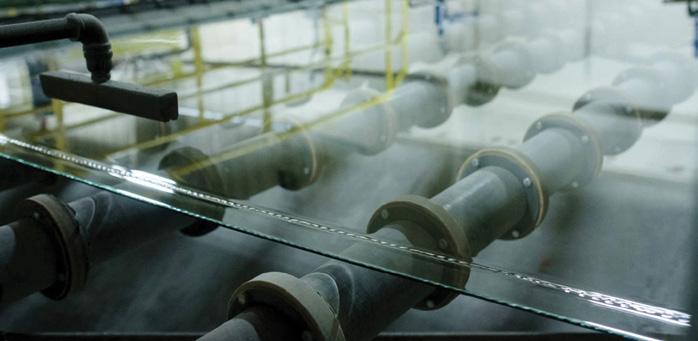
link to the survey can be found in Edge’s latest progress bulletin at fenestrationcanada.ca.
“Canada currently requires the equivalent of roughly 1.7 float glass plants at 600 tonnes/day capacity,” Edge explains. “As part of this initiative, we are aiming to validate interest representing at least 70 percent of one plant’s capacity (approximately 420 tonnes/day).”
Edge’s latest bulletin updates the survey results so far:
• Approximately 276 tonnes per day of midcase demand;
• A range of approximately 228 to 325 TPD, depending on purchasing commitment assumptions;
• Approximately 54 to 77 percent of the initial 420 TPD benchmark.
“While significant work remains, the conversation has progressed well beyond whether Canada possesses sufficient demand to support domestic float glass manufacturing capacity,” Edge reports.
“The focus is increasingly shifting toward how a viable project could be structured and what information prospective operators and investors require to evaluate the opportunity properly.”

July 14 - 15
FGIA FenBC Insight Hour Online fgiaonline.org
Aug. 31 - Sept. 3
FGIA Fall Conference Calgary, Alta. fgiaonline.org
Sept. 10
Fenestration Canada
Manitoba Golf Stony Mountain, Man. fenestrationcanada.ca
Sept. 23 - 25 Glassbuild Las Vegas, Nev. glassbuildamerica.com
Oct. 8
FGIA FenBC Region Summit Surrey, B.C. fgiaonline.org
Nov. 5 - 6 WinDoor Montreal windoorshow.ca
Screenco has welcomed Ryan Everard to the team as its director of sales and marketing. Everard will be overseeing all North American sales operations and brings extensive experience in strategic sales leadership, OEM and Tier 1 manufacturing markets, distribution management and technical solution selling across Canada, the United States and Mexico. With a proven track record of driving growth, building strong customer partnerships and leading cross-border sales strategies, Everard’s leadership and industry expertise will play a key role as Screenco continues to expand across North America.
In other Screenco news, the screen manufacturer has opened its eighth location in Swainsborough, Ga. The new manufacturing and service facility is intended to provide improved service and faster support in the southeastern U.S.
Every now and then it is a good idea to look backward to help us see where to go in the future. Around 40 years ago, there was a workshop at an IDEAS trade show where a panel of successful siding, window and door dealers hosted a discussion about their industry. It quickly became apparent that the truth was there was no cohesive industry. Window dealers tended to do their work in isolation, suspicious of each other and not sharing information.
Not sharing information was about to be a critical flaw in their future success. Government was beginning to see the threats of climate change. Without changes to improve homes’ energy efficiency, there would be some dire circumstances predicted in a quarter century. Changes to weather patterns could result in sudden floods, extended heat waves, redistribution of plant and animal life and more. In other words, what we are presently experiencing worldwide.
From an industry perspective, the lack of cooperation and coordination in the new political environment was about to leave dealers defenceless and unable to successfully adapt to new realities. Sharing information, particularly regarding changes to legislative requirements, was important. At the IDEAS panel this became crystal clear and it occurred to the group that they needed to form an association. And from that acorn SAWDAC was born.
This was not an easy birth. The first reaction from a small, struggling dealer typically was, “What’s in it for me?” This can be a hard question to answer given that the dealer looks through a narrow lens of financial benefit. “If I pay dues for this association, how do I get my money
2026

Everlast CEO, Mike Bruno, had himself a day at the SAWDAC golf tournament last fall, winning the big bottle of Canadian Club in the putting contest. He spent $60 on tickets but since proceeds went to KidsAbility, no one minded. Later that day, Bruno found out he was going to become the youngest-ever winner of Fenestration Canada’s top honour, the C.P. Loewen Award.
back with a profit?” It is not easy to explain an association in terms of financial profit. It became clear to the founders that they did need to find programs which could save an individual dealer on costs they incurred to conduct their business. Creating a bulk-buy insurance program was one of the first. Developing finance programs with better rates than could be negotiated dealer-by-dealer was another big benefit.
There was another hurdle the founders had to overcome. For the most part, they were from larger, more successful companies. Smaller dealers were extremely suspicious that, by joining an association, they would be undercutting their own future opportunities and subjugating their businesses to the big guys. This belief took years to overcome. I’m sure there are still some dealers who hold this sentiment even today. Then the larger dealers did something the small dealers found hard to believe. They opened their books to the
smaller dealers in city-by-city meetings. They showed their pricing models openly. Small dealers came to the meetings to learn how their competitors priced, often openly saying how stupid it was to make it so easy to quote against them when you knew their price. Strangely, this didn’t quickly overcome their suspicions.
In the ‘80s, in Ontario, Ontario hydro offered a $5 rebate per square foot if homeowners upgraded their window purchases from clear sealed units. The program was wildly successful in breaking low-E into the market. After the dust settled, the program also showed a gigantic flaw in the rebate program. The quality of the installations was often so poor that there was little benefit from the upgrade to the new, higher-efficiency windows. (It also showed to need for better quality control in manufacturing, but that is another article.)
The result was SAWDAC’s creation of it’s crown jewel: Window Wise. Window Wise certified installation brought high, consistent standards to dealers. The engineering class may have had their documentation on best practices, but this rarely filtered down to the dealer level. Window Wise was so successful that when Ontario created its GreenON program, it actually specified it to be part of the program. The dealer had to be a member of Window Wise. It is still Canada’s gold standard for window installation.
So, is the siding, window and door industry now a cohesive industry? Well, if you want to see a large group of dealers share a fun day with each other, sign up for SAWDAC’s annual golf tournament! Join SAWDAC. Fight climate change, improve your own business and get together to have fun.
PRESIDENT Christopher George EXECUTIVE-DIRECTOR Jason Neal TRAINING David Mitten RenoPlan Ronda Ford WINDOW WISE Ronda Ford

In February, the Canadian Home Builders’ Association posted an open letter to prime minister Mark Carney on its website calling for the federal government to halt implementation of the 2025 National Building Code and all future code development until the 2025 code can be revised and reforms made to the code development process. The key demand is for code development to consider affordability when making changes, which is not officially part of the development process now. CHBA estimates the changes to the 2025 NBC will add between $50,000 to $100,000 to the minimum cost of a new 2,500-square-foot home. The association also expresses concern with the impact of frequent code changes on sector productivity; a lack of transparency and industry involvement in the development process; and an ongoing lack of code harmonization across the country owing to the provinces’ continued ability to modify the NBC or make different interpretations of it in their jurisdictions.
The tone of the letter is scathing in places:
“We cannot support the 2025 model codes or their adoption and call for an immediate pause to redo them properly.”
“CHBA has become seriously concerned over the last
few years with how Canada’s new governance system for national codes and its updated code development process is neither transparent nor evidence-based anymore.”
The letter references Australia, where building code development has been paused in response to similar concerns. Specific actions the CHBA is calling for include:
• Immediately stop the adoption and implementation process of the 2025 National Construction Codes and assess them with a plan to only put forth for adoption cost-neutral changes for housing in Part 9 of the 2025 national codes (such as the prescriptive point-based compliance paths for all energy efficiency tiers);
• Pause all 2030 code development until critical reforms are made to the development approach, such as:
º restoring transparency, accountability and meaningful stakeholder engagement within the codes system;
º adding an ex-officio seat for CHBA and other broad sector stakeholders at all CBHCC meetings (including in-camera meetings) to properly inform the development from an industry perspective;
º reinstating a coordination committee dedicated to NBC Part 9 (which deals directly with housing) rather than spreading it across 13 committees with non-residential construction;
º reducing the priorities for the 2030 code cycles, focusing only on essential, cost-neutral requirements;
º making housing affordability a core principle in code development along with a robust structured process to assess and limit individual-change and cumulative costs for each future code edition;
• Establish a National Building Code Interpretation Centre to achieve consistent local application of harmonized national construction codes and work with the provinces to make published solutions binding.
The full letter can be found at chba.ca.
This January, Roto North America welcomed new business regional manager, Nathan Boodt. With more than 15 years of experience in sales, marketing and business operations, Nathan brings a strong track record in the fenestration industry and a commitment to building long-term, value-driven partnerships. He believes that people don’t care how much you know until they know how much you care.

Director of sales, Dan Gray, shares his enthusiasm. “I am very excited to have Nathan on board to conduct sales activities in Canada’s western provinces. Nathan brings a wealth of fenestration knowledge to Roto and will be a strong addition to our team.”
As a dedicated sales professional, Boodt offers a fresh perspective
supported by extensive client relationship experience and a genuine passion for customer success. Outside of work, he enjoys spending time with his wife and four children and can often be found on the soccer field or golf course.
In addition, Steve Wood, who joined Roto in June 2023, has expanded his sales responsibilities to cover the entire western U.S. market. Gray notes, “Steve’s extensive knowledge of the fenestration industry’s products and customers continues to be a great asset for Roto.”
With increased sales activity, expanded territories and the addition of experienced industry professionals, Roto says it is well-positioned for a year of continued growth and strengthened customer partnerships.

Metrie, a manufacturer and distributor of millwork solutions, has announced its acquisition of door fabrication, hanging and finishing assets in eastern Canada from Northstar/ TruBilt Doors, a division of Cornerstone Building Brands, and the expansion of door manufacturing and service capabilities through the purchase of additional assets in western Canada. The expanded capabilities and value-add services are intended to strengthen Metrie’s ability to deliver consistent, reliable door solutions for customers across Canada, according to a company release.
With these acquisitions, Metrie has expanded capability in interior and exterior door distribution and advanced valueadd services with the ability to supply specialty door systems and solutions including pre-hanging, pre-finishing, job-site delivery and custom solutions for complex specifications.
“Our long-term strategy is clear: we want to help drive our customers’ businesses forward through expanded advanced value-add millwork solutions and services,” commented Kent Bowie, president and CEO of Metrie. “As North America’s leading manufacturer and distributor of composite and solid wood mouldings and finished grade lumber, we want to
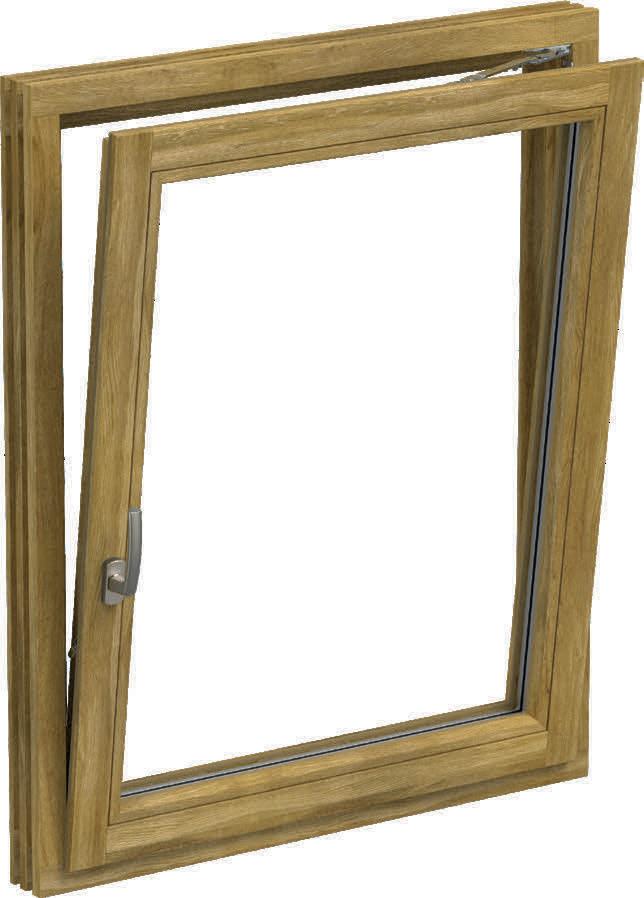
also lead in interior and exterior door distribution, systems and services. This latest expansion of our service offering in Canada shows our determination to deliver. It builds on over 60 years of door experience in the Canadian market, our strength in interior and exterior door solutions in the western U.S. through Metrie EL and EL; and our recent acquisitions of the BWI, Florida Made Door; and Louisiana Millwork door distribution businesses from Owens Corning in the eastern and southern U.S.”
“We have had value-add capabilities on interior doors across Canada for many years, but these asset purchases will accelerate the strategic service offerings we can make to customers across both interior and exterior door solutions,” added Ashik Bhat, regional vice-president of Metrie Canada. “We will have full custom capability across CNC cutting, prefinishing, jamb preparation and sill fabrication and assembly. This means that whatever our customers need in interior and exterior doors, we will be able to fulfil.”
Founded in 1926, Metrie began as a small family-owned and -operated millwork business in Vancouver, B.C. Since then, Metrie has expanded operations to include seven domestic millwork manufacturing sites and 32 distribution centers across the U.S. and Canada.
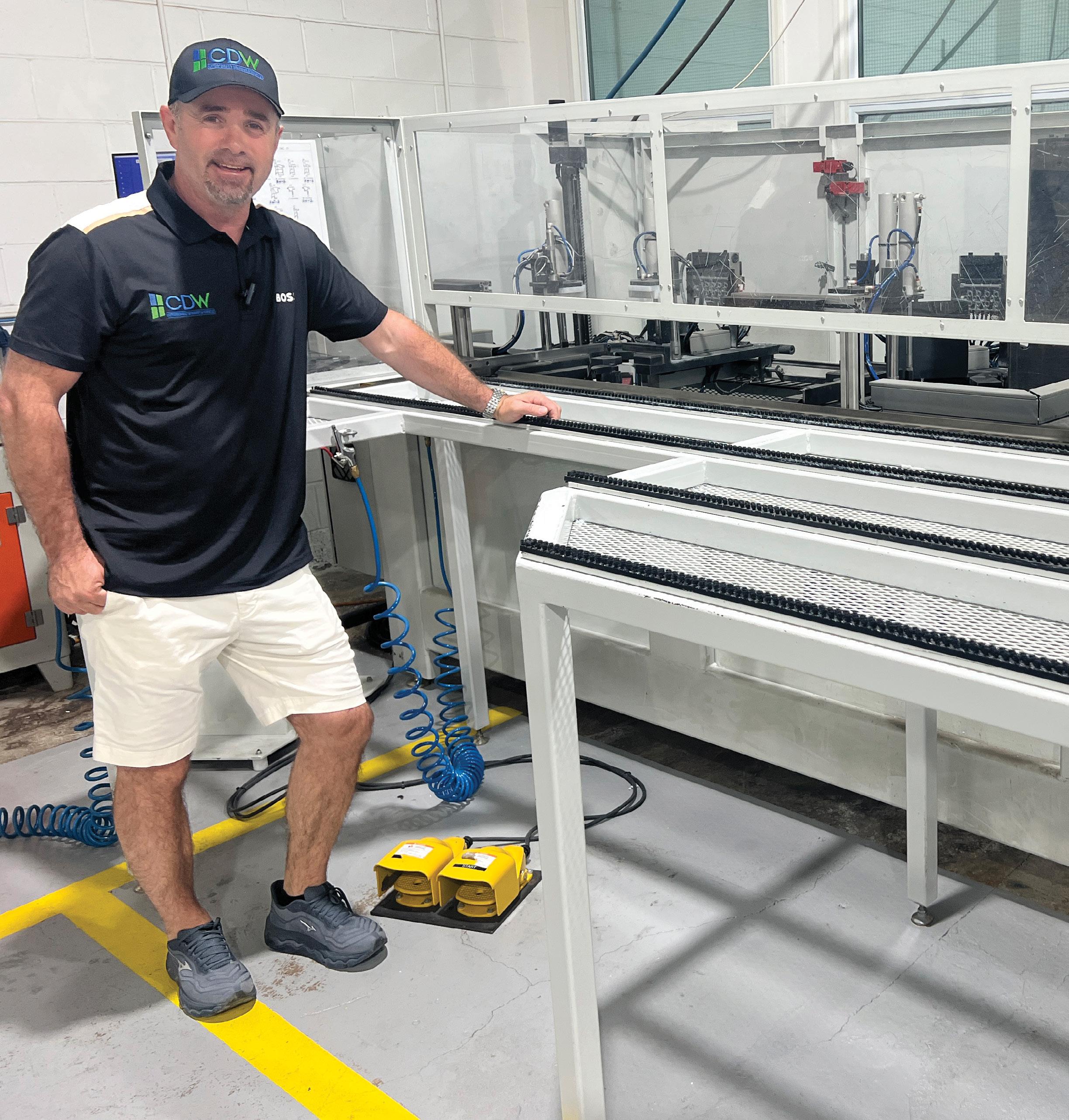
To an outsider, windows don’t seem like something you could be passionate about. Functional squares of glass that don’t do anything except let you see outside. But for someone with the heart of a craftsman, like Mehdi Berisha, owner of Custom Direct Windows in Hamilton, Ont., they present an endless challenge to do better.
by PATRICK FLANNERY
Fascinated first with the intricacies of the technology, then with the obstacles and opportunities of manufacturing, Berisha has dedicated himself to doing window and door manufacturing right –with impressive results for his company.
CDW sells and installs Novatech windows, doors and patio doors. It also manufactures and installs custom windows and doors using its own profile designs from Thermoplast and slab and glass from Novatech. It also designs, manufactures and installs aluminum windows and curtainwall. In other words, CDW does just about anything the project calls for and can service any customer from a small residential replacement up to a full high-rise facade. After 30 years in the industry, curiously learning all he can about every aspect of each project and making friends along the way, Berisha is willing to take on just about anything.
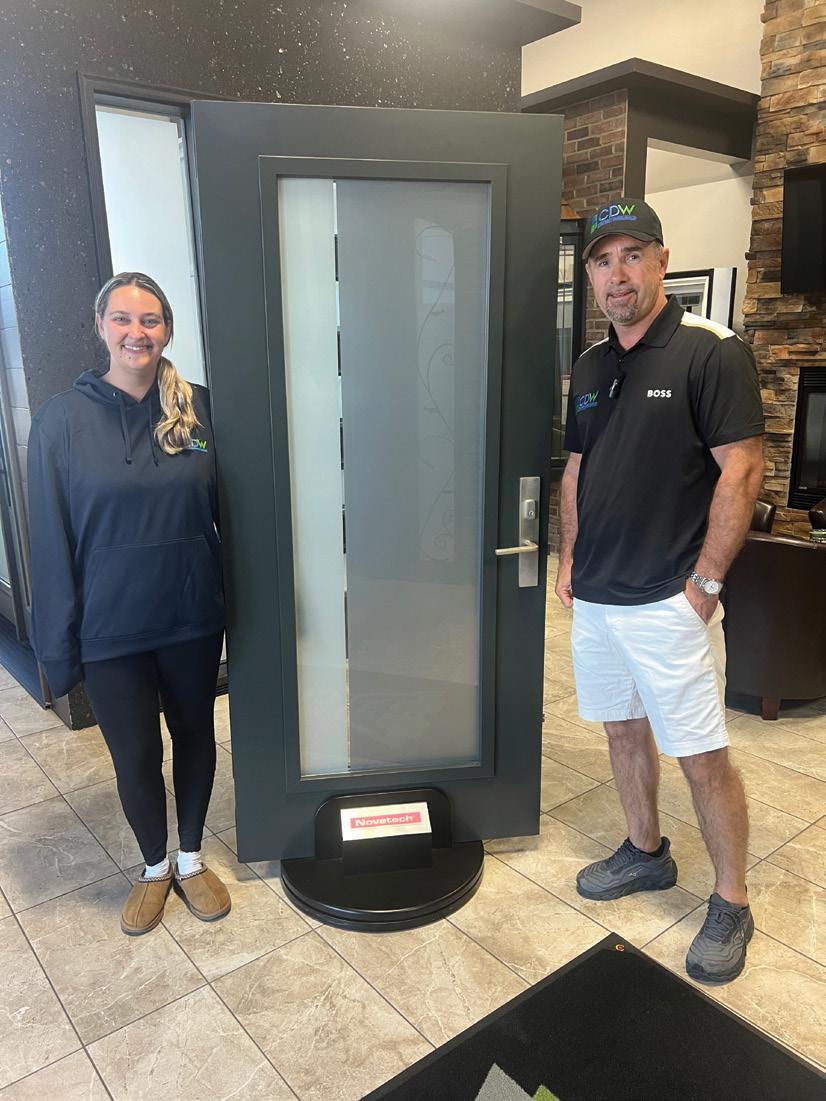
CDW has only a portion of its offerings on display in the showroom because Berisha doesn’t want it to look cluttered. He tries to pick some representative styles just to get a conversation going about what a customer might want. He’s gotten help and advice from Novatech, who told him never to overload the showroom with options. Berisha has double sliders, awnings, double hung and two styles of casement on display – contemporary and colonial – as well as patio doors and fibreglass entry doors. Berisha
says the flatter, cleaner contemporary look is gaining popularity over the colonial style of past decades. Contemporary casements are his hottest seller at the moment, with many new-build projects having only casements throughout.
CDW has sold and sourced some imported European windows over the years, but Berisha doesn’t buy into the narrative that European quality is better. “You know what? Novatech gets tested for here,” he explains. He finds there are plenty of small problems with the imported European products he’s seen.
Novatech fills CDW’s more standard orders for residential windows, doors and patio doors, but Berisha’s strength is custom work. He buys glass from Novatech for that and his profiles from Thermoplast.
“Quebec is more advanced than us,” Berisha states bluntly. He finds the windows specified and offered in Ontario to be flimsy and obsolete: “They are just cheap.” Profiles from Quebec suppliers are wider and stiffer with more material and better sill drainage. “They don’t even use three-and-a-quarter in Quebec,” Berisha explains. “In Ontario, it’s 90 percent threeand-a-quarter. Now it’s getting up to four-anda-quarter, four and five-eighths. But they have five and three-quarters, even six-and-a-half.” He says it’s because of the way walls are designed in Quebec, with the frame sometimes recessed.
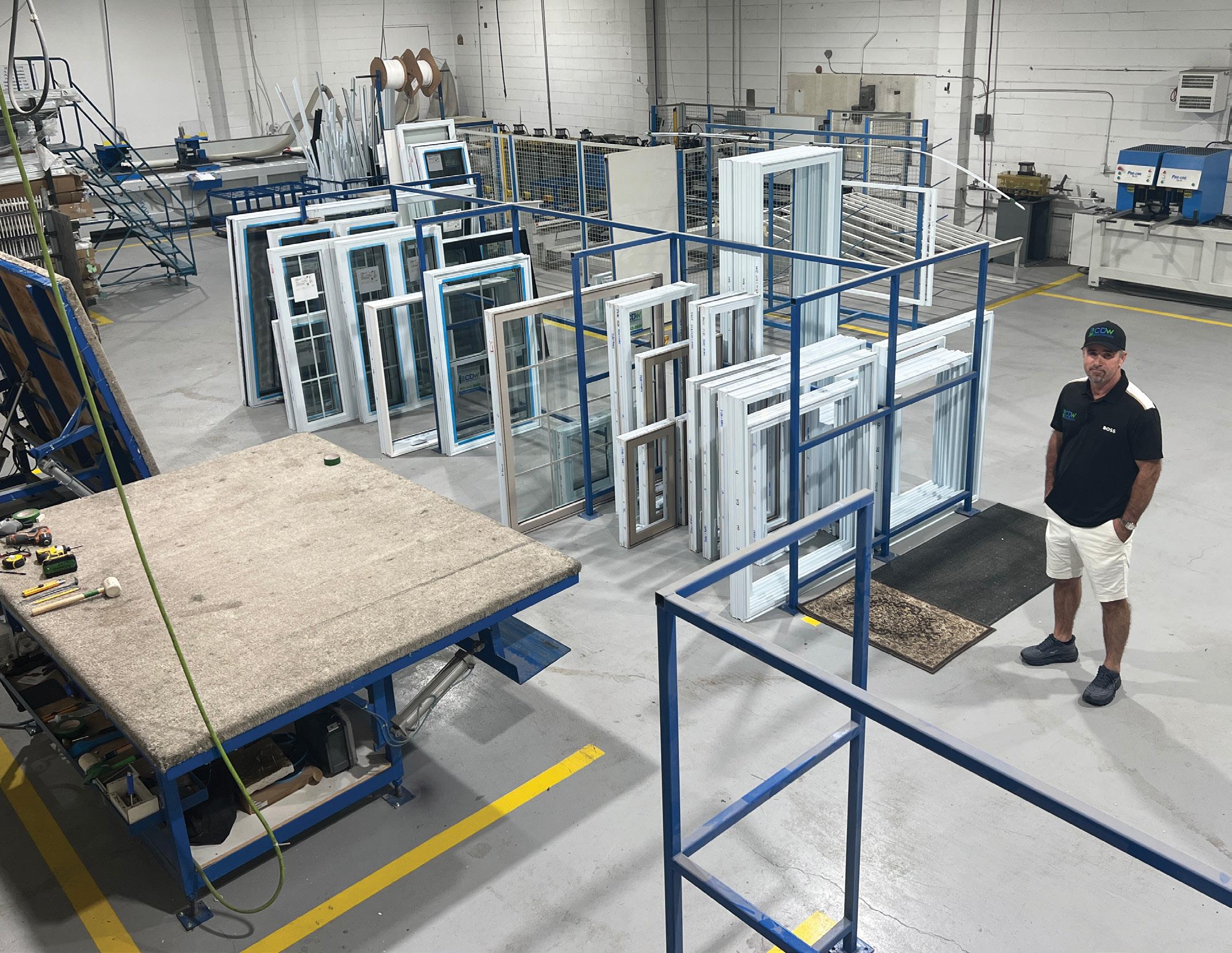
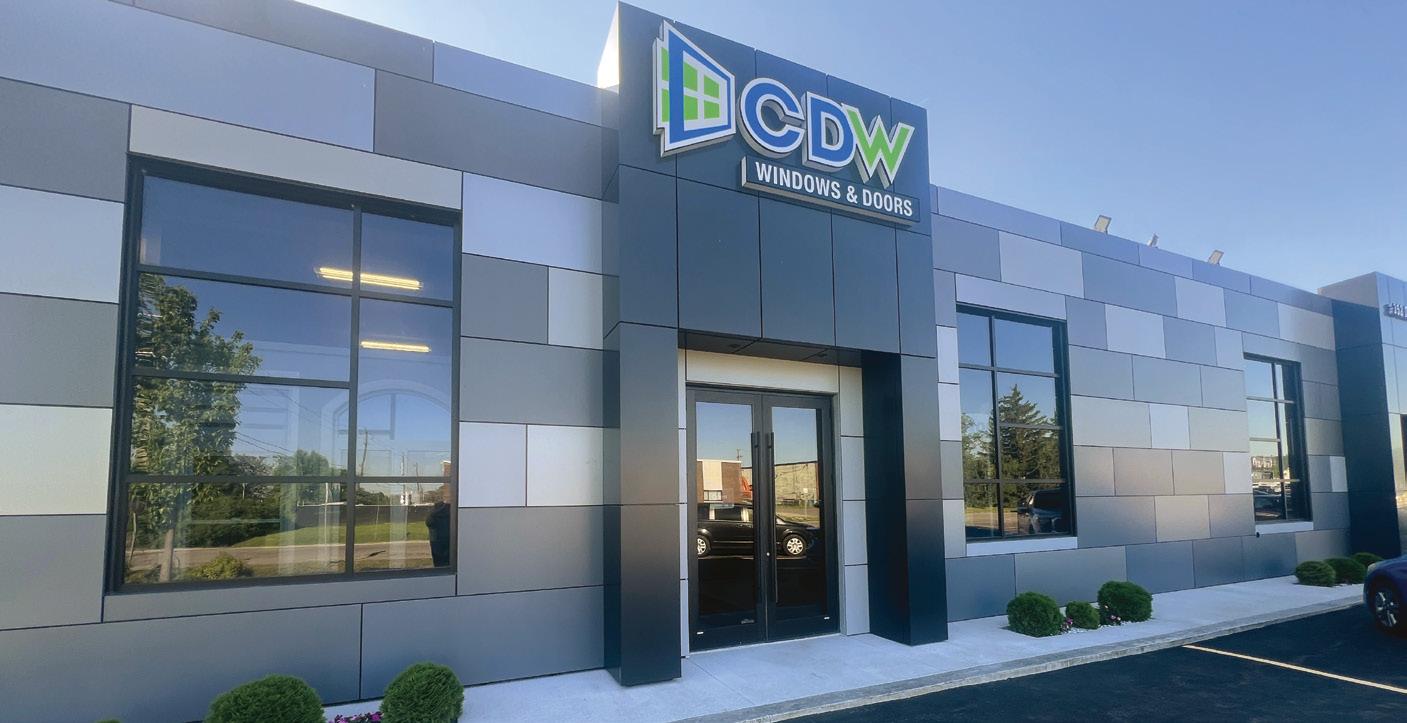
CDW operates out of a 10,000 squarefoot facility in Hamilton, Ont., with quick access to major highways going north to Toronto, west to southwestern Ontario and south to the U.S. border.
Berisha likes his products heavy and robust, with lots of structural strength. CDW will do it all when needed, including aluminum windows, storefront and curtainwall. CDW is not a massproduction operation, so projects that require some design assistance and customization are preferred. This is where Berisha’s long experience and knowledge come into play. He says he has success working with property management companies and their engineers because he knows what he’s doing and can follow a more complex plan. “A lot of crews, they can’t get along with the engineers,” he explains. “There is a certain way you have to do it and the engineer is the boss. If you don’t do it right, he’s going
to tell you to rip it off. They like to work with us because we do so many projects with them and they don’t want the headache.” Building to code and using the specified wraps, screws and caulking are examples of things CDW’s crews do
to bring up the quality of their installs. “It doesn’t matter if it’s a small job. You can’t cut corners. You have to do it right,” Berisha asserts.
Berisha started in the mid-’90s as a helper on window install teams for a
succession of old-school window guys. One of them, Boris Fudriqi, told him he should save up enough to buy his own truck then go out on his own. By 1998 he was installing windows for FM Windows (now Clera). They ran a tight ship, Berisha remembers, and he benefited from his time there, learning the right way to do things. One day, FM co-founder, Steve Mastrorillo, told him “Mehdi, one day you’re going to own your own company. You are too noisy. What do you know about the window business?” Ten years later, Mastrorillo got to tell him, “I told you so.”
What Mastrorillo recognized in Berisha was a drive to solve problems and not go half way to an objective. “I want to be good,” Berisha says. “If I’m installing but I have a problem on my job site, I’m going to fix that window. They understand I’m not going to say ‘no’ to the customer. They understand that if I have my parts there, I’ll fix it right on the spot.”
In 2009 he went out into manufacturing on his own. He used savings and loans to buy about $200,000 worth of old equipment and partnered with a smaller extruder that made him buy his own fixtures. He’s changed profiles twice since his first design. “Every time you change profiles, it costs you money. You change the machine, change the dies, change the fixtures...you really have to want to get better.”
“It was weird,” he admits. He quickly found that manufacturing was not just about knowing how to make windows, but about looking at the entire business picture and maximizing efficiency and eliminating waste. Advertising and obtaining supplies was something he had never had to worry about before. Banks won’t give you anything unless you already have more than you are asking for. Berisha says he didn’t make any money for his first three years in business.
Berisha moved CDW into its present location in 2017. He did a full redesign of the building, including all the curtainwall and interior finishes. He doesn’t pursue commercial work, but ends up doing quite a bit of it because of requests from friends who know how he oper-
ates. He’s ended up glazing schools and six-storey high-rises. “I only work with people I know,” he explains. The problem with commercial, Berisha says, is the extensive proposal process. “I get emails every day to bid on jobs. Do all this work, then they go somewhere else.”
Once he got into his present location, he bought out the other tenants’ leases because at the time he was running a glass line and making his own insulating glass on an old Billco machine. He made IGUs for six or seven years and it went well, filling his own needs and selling the surplus. But ultimately he found it wasn’t worth it when he considered the expense of employees and equipment maintenance. He figured you’d need to sell 1,000 units per day to make the operation profitable, and his small operation was nowhere near that. Now he does window and facade fabrication exclusively, employing seven or eight in his plant.
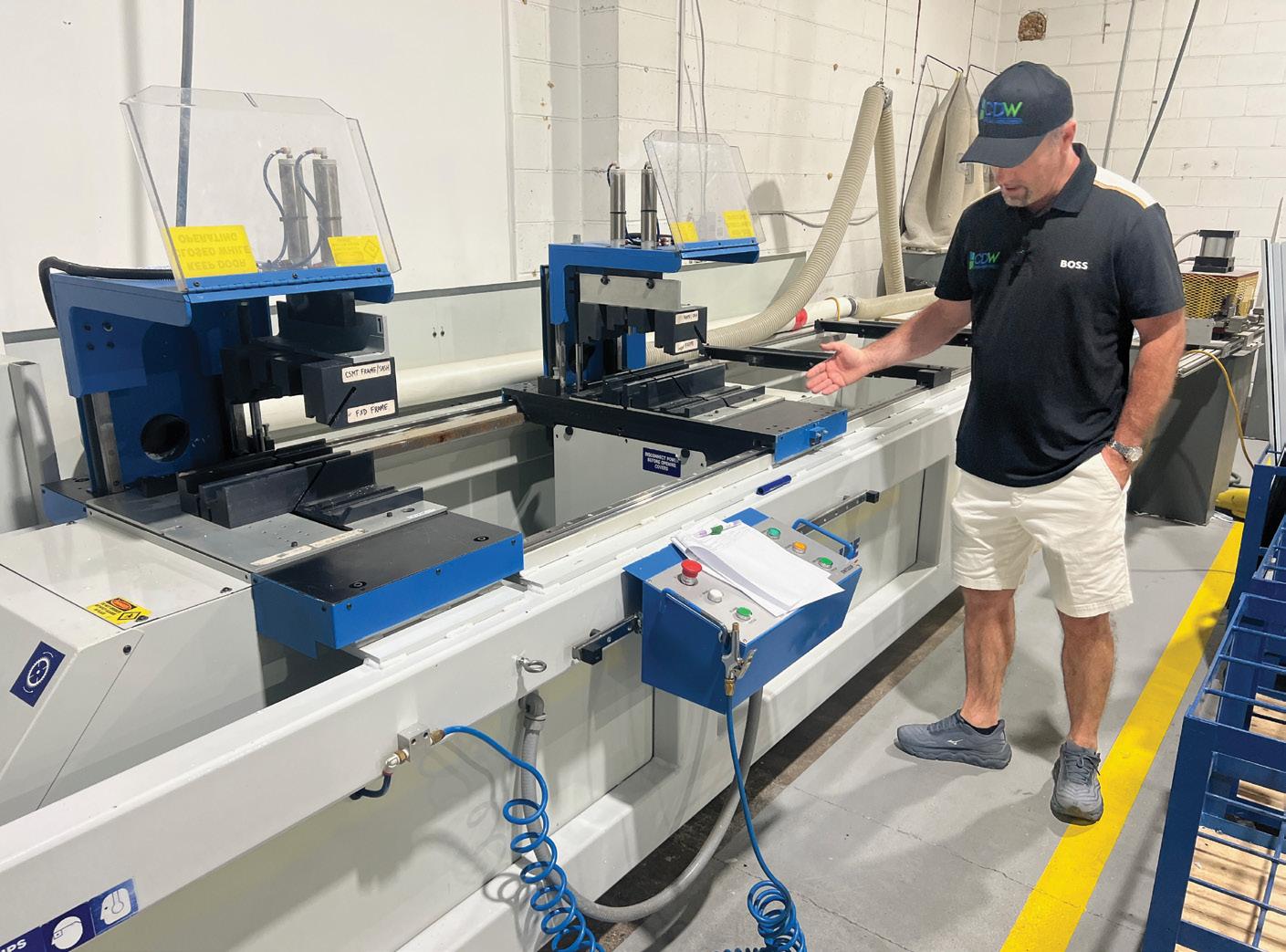
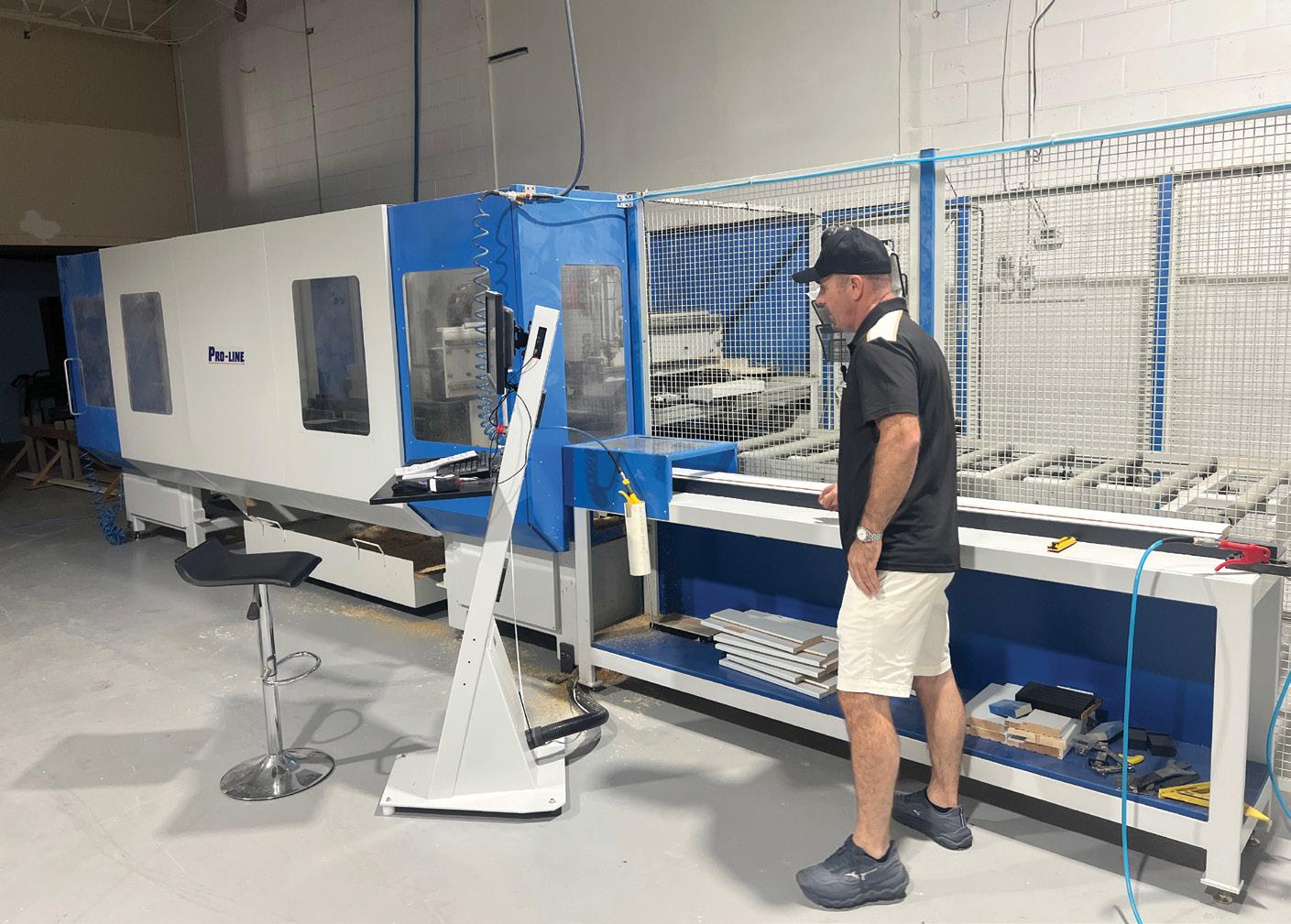
Berisha invested in all new Proline fabrication equipment four years ago and couldn’t be happier. “We made a good choice with them. They are a good company to work with. And they’re close by... Woodbridge.” He has a Pro-Clean CNC-
27 twin-head corner cleaner (96 by 12 by six inches capacity); a Pro-Weld TH-21 twin-head welder; a Pro-Cut DMT 220P double mitre saw (cuts four or five profiles at once) and – his pride and joy – a PD-500 door fabrication centre.
The PD-500 does it all. Panels, jambs, hardware holes and slots...all in one setup. “I love this machine. I operate this machine myself,” Berisha gushes. It is rightsized for his operation. He acknowledges that he could produce faster with two machines, one cutting panels and one cutting jambs. But that would require double the floor space and another operator...plus he doesn’t need that level of production anyway for the customized work he does. The capacity to make 25 doors per day is fine for him. And the PD-500 machines the entire door in one setup, with all the tolerances perfect relative to one another.
Berisha learned entirely how to use the new CNC machinery himself before he started training operators. He crosstrains his operators on all machines, but finds it’s sometimes a challenge when operators leave, taking their training with them. Turnover hasn’t been a big problem for CDW – many employees
have been there for years. But it is tough when one goes and training has to start all over from scratch.
Getting into CNC was always, for him, about the quality of the product rather than the speed of production. After struggling with old machinery and its limitations and breakdowns, Berisha knew he wanted the latest technology. “It’s like driving a new car,” he explains. “These machines are meant to make a window 110 percent. We are working with a 1/8-inch gap. If you are off, the window won’t operate.” Being able to work to tighter tolerances without losing time has enabled Berisha to deliver a better product at the same price. Berisha figures his three new machines can produce 200 windows per day.
Thermoplast provided 10 custom fabrication fixtures to go with CDW’s profiles. Berisha estimates they are worth $250,000 and he is allowed to keep them on consignment in his plant. Using them, he can quickly punch holes for hardware in all his profiles in just
one operation.
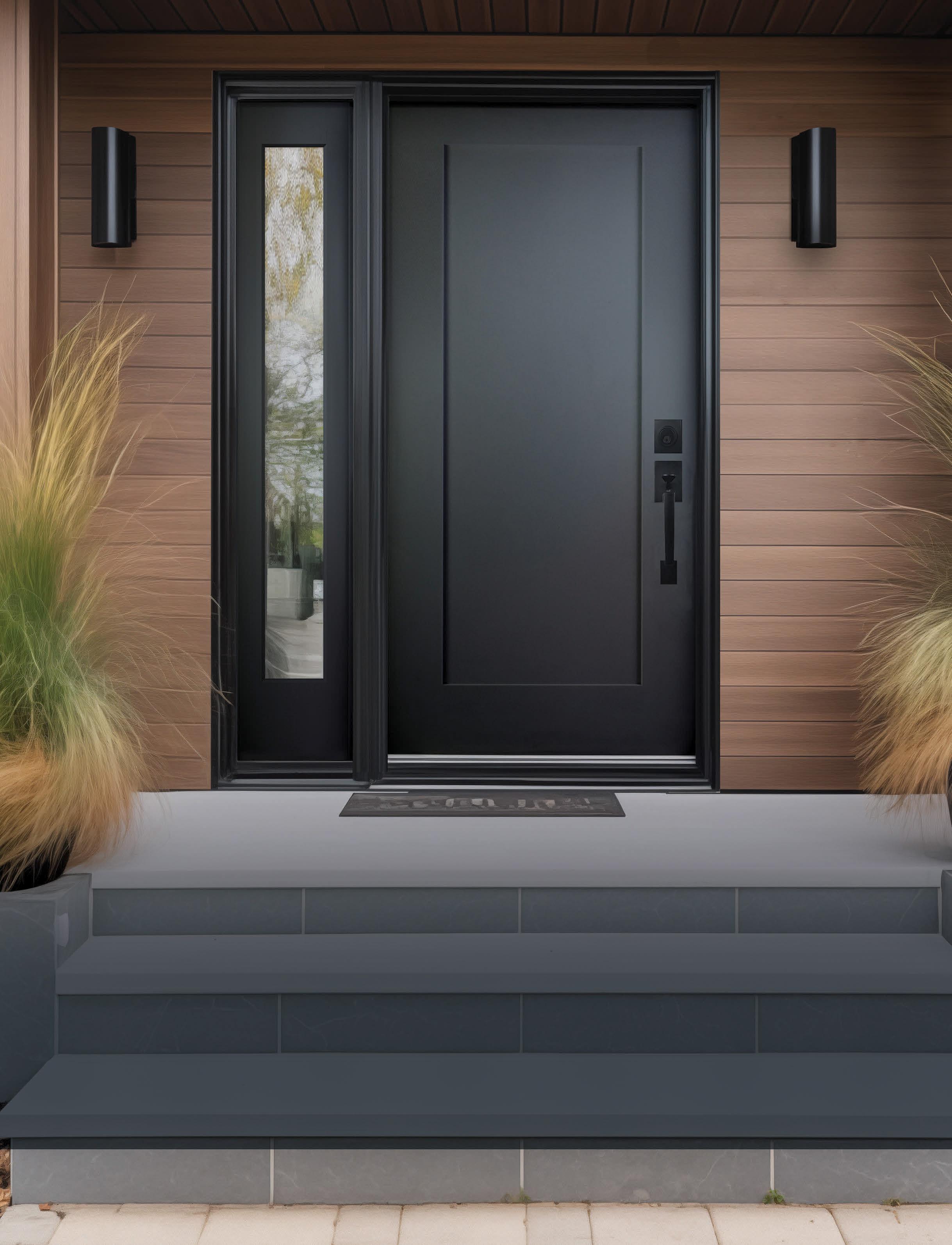
Berisha moves between 150 and 200 doors per year. Eight-foot fibreglass with multipoint locks are his hottest seller. He adds LVL reinforcement to the slab edges because, in his view, when there are sidelites and you can’t screw the jam directly into the brickmold, there is not enough support from the screws at the top and bottom. The extra material adds stiffness and mass to offset the weight of the multipoint systems.
Berisha also buys all his glass from Novatech. He has a special order in house for six-and-six laminated glass for a house by the highway. It’s the contractor’s third attempt to satisfy the owner’s need for sound control and now they are trying laminated units after going through triple and double options. “I told him he shouldn’t buy a house by the highway,” Berisha quips.
Berisha has three trucks on the road and likes to flow production so that one order is gone before the next one comes into the loading area. It just makes for less clutter and easier handling.
CDW is hitting another level with the opportunities it is now getting. Early on, most of the business was residential replacement, often for friends of friends and word-of-mouth referrals. Now, Berisha is regularly doing townhouse complexes with 30 and 40 units and, just recently, landed a job providing over 1,000 windows to a 99-unit complex. He’s booked into November. Almost all of it comes from his long relationships in the industry and with property managers and their engineers.
Berisha’s shop was fairly quiet the day Fenestration Review visited because most of his staff were out getting ready for the big 99-unit multi project he was starting the next day. Only Laura Szabo was working in the back – normally there are seven or eight out there. He also has three crews of three who do installs working as freelance subcontractors. They are old friends of his, and he worries that soon many of them will age out and he’ll have trouble finding skilled crews to replace them.
“The younger generation, they don’t
want to learn,” he gripes. “This is a good business. You can make good money. Some of them, they are 30, they should have their own truck and trailer. I wasn’t even 30 when I had my crews – I was running four or five crews for FM back in the day. The five salesmen were selling like $7 million per year. I don’t think the kids know about it.”
The big project means Berisha is not aggressively pursuing more work right now. CDW will be busy through November. Timelines on that project just got even more compressed due to delayed paperwork on an air/water field test. Nothing to do with the CDW windows, of course – the issue was in the masonry. The engineer fixed the problem and the next test passed but the project is still waiting for the paperwork to clear. Berisha says they didn’t need to do the field test to pass inspection on this building, but the builder is trying to do everything right. He’s seeing more field testing lately, which is a change. Normally the consultant would only come and visually inspect every couple of days because each field test costs around $4,000.
Berisha was joined by Darylleigh Laidman in 2011. She is a friend of Berisha’s niece, who was working summers at CDW and needed someone to cover for her while she went on maternity leave. It was only supposed to be for a couple of months. Today, Laidman is that glue person who knows everything about everything in the operation and keeps everything organized and running smoothly with all the details attended to. “I’ve been able to learn everything about the industry,” she says, “Just from answering phones to now I know what people are talking about. I find that when you are working for somebody, you should work as if you are a partner, not just an employee. I treat this place as if it is my second family.”
“I tell everybody who works for me, you have to be good at what you do,” Berisha says. “That’s how you make money. But if you hate what you are doing, you are not for that business. Windows...that was my passion and it still is.”
by Amy Roberts
The construction industry is tightly regulated, so it’s important for professionals to have basic knowledge about building codes and standards, materials and applications. The Fenestration and Glazing Industry Alliance offers several continuing education courses for fenestration professionals.
This two-hour course offers an overview of the terminology and standards for fenestration products used in residential and light commercial markets, as well as commercial and architectural applications. It is ideal for new employees as part of a comprehensive onboarding and training program. Inside sales reps, customer service teams, and anyone new to the industry can gain a basic understanding of fenestration products. At the end of the course, participants will know how best to discuss and describe windows, doors, skylights and other fenestration products. These five modules could be completed in a single day, but participants are able to pace them out over a period of three months. Successful candidates will also earn two hours of continuing education credits from the American Institute of Architects (AIA).
A part of the FenestrationMasters 3.0 course, the Fundamentals of Insulating Glass program has two modules: Glass Fundamentals and Understanding Insulating Glass. This course can be studied on its own too.
This module explores the critical aspects of fenestration transparency and delves into the intricacies of glass functionality and selection criteria, examining various monolithic glass types. Glass

Fundamentals provides insights into the glass manufacturing process and safety enhancements available. This module equips learners with the knowledge and skills needed to excel in glassrelated decision-making and compliance within the broader fenestration industry.
This module provides an in-depth look into insulating glass units, which are critical for modern fenestration products. Learners will explore the structure and components of IGUs, such as spacers, desiccants and low-E coatings, as well as their thermal performance benefits. Additionally, the module covers industry standards, performance requirements and testing guidelines to ensure long-term quality and performance. The module also addresses the impact of environmental factors on IGU integrity and explores customization options like muntins and internal blinds. At the end of this module, participants will be able to evaluate and apply IGU technologies in various building applications. Participants have three months to complete the course. They will get a certificate of completion when program requirements are met.
This is an a la carte module that is designed to empower participants with a nuanced understanding of the requirements governing fully fabricated fenestration products. Learners will dive into the mandatory performance requirements of each performance class, as outlined by NAFS-22 and its predecessors.
Amy Roberts is FGIA’s Canadian Codes and Advocacy Director.
Canada's celebration of the architectural glass industry returns to Calgary for a third year

Best Western Premier Calgary Plaza Hotel & Conference Centre
This year’s content OCTOBER 21, 2026
CROSS-COUNTRY
CODES AND STANDARDS UPDATE with Amy Roberts, FGIA Canadian Codes and Advocacy Director
YOU GET WHAT YOU INSPECT, NOT WHAT YOU EXPECT
Preparing for effective site inspections and understanding what engineers really look for because the devil is always in the details
GAMA AWARDS
Celebrate Alberta’s next generation of glaziers with the GAMA Apprenticeship Awards.
(ALMOST) LIGHTER THAN AIR
The remarkable properties of aerogel in glazing applications. FROM THE TRENCHES OF THE TRADE WAR
The current state of tariffs and countertariffs affecting our industry.
Iby CARROLL MCCORMICK
Since the replacement glass units are no thicker than the original glass units, they could be retrofitted into the homes’ existing glazing pockets. This becomes possible because of the truly remarkable thermal performance these new technologies achieve, even at thinner widths. They are beyond high-performance – call it “hyperperformance.”
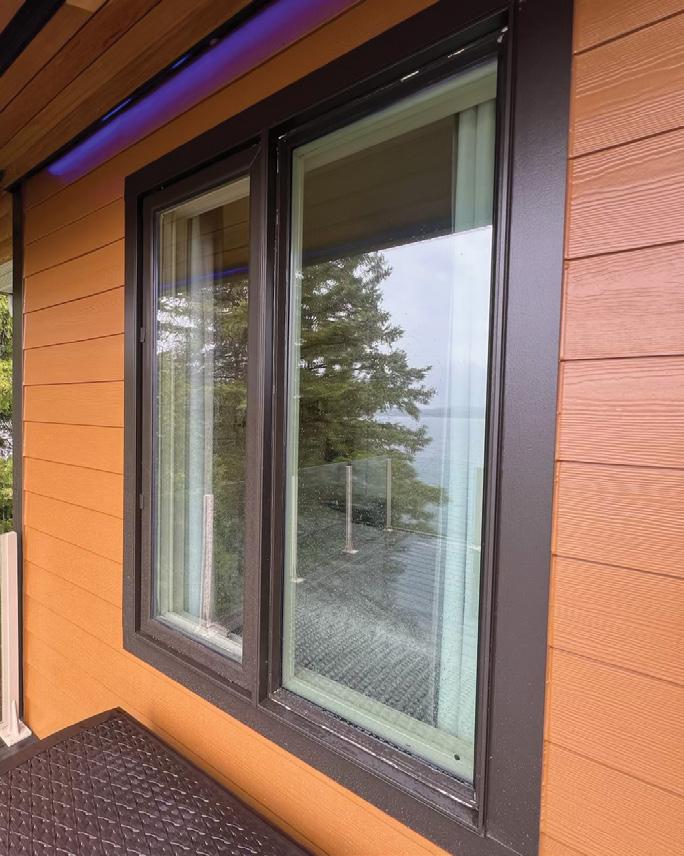
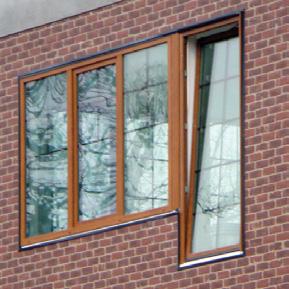
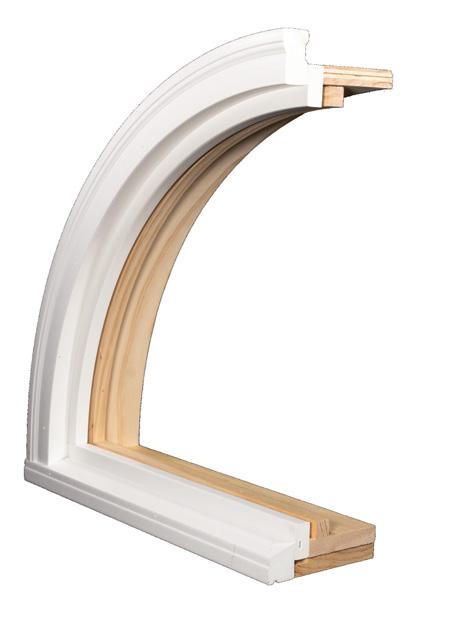
The house reglazed with vacuum insulation technology is in Sudbury, Ont. The homeowner wanted to change the glass in their metal-clad wood windows from dual low-E to something with a higher performance. At some point in a conversation, Dueck offered to supply hybrid vacuum insulation glass (VIG) units: two-pane units manufactured by LuxWall, with a third lite added by Cardinal for good measure. The technology itself was not at issue in the trial, rather, the question was whether the windows could be re-glazed with these higher-performing glass units while retaining the original frames.
“The idea was to test the concept where a careful removal and replacement of the wood glazing stops with essentially the same outside diameter thickness of glass would raise the centre-of-glass
n conversation with two homeowners looking to reduce heat loss through their windows, Al Dueck, the owner of Duxton Windows and Doors in Winnipeg, suggested trialing two technologies designed to greatly increase the windows’ centre-of-glass and R-values.
R-value from three-ish to something around 20,” Dueck says.
LuxWall states that it offers two vacuum insulation glass solutions: Enthermal, with an R-18 performance, 0.055 U-factor, and an eight-millimeter profile; and Enthermal Plus, with an R-23 performance, 0.043 U-factor and a
25-millimeter profile.
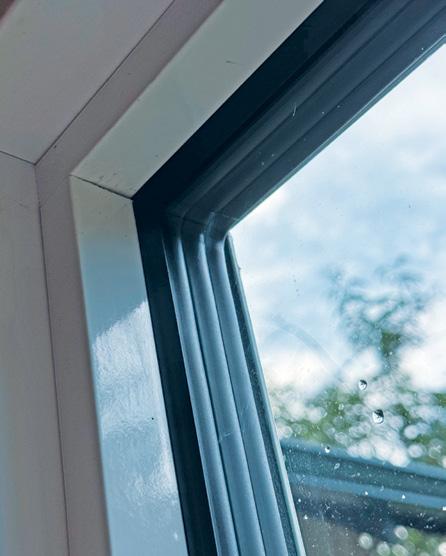
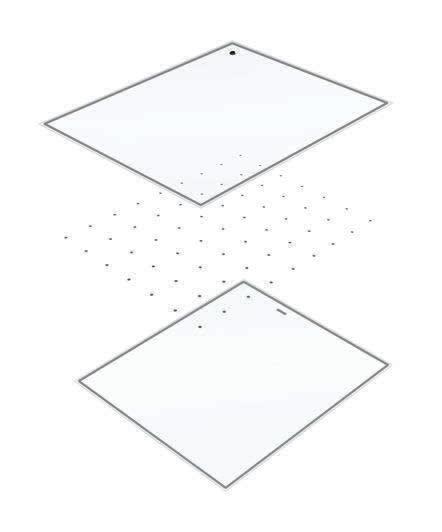
While manufacturing this solution is complex, the concept is straightforward: construct a sealed unit with two very thin, tempered panes (the outboard pane with a low-E coating) and maintain the gap between them with what LuxWall calls micro-pillars, which are about the size of grains of sand. Moisture and air are pumped out, resulting in a high-R unit with a unit thickness barely more than a monolithic single pane of glass.
“The problem with insulated glass nowadays is that the gap is about seveneighths of an inch. In VIG the gap is oneeighth. The best you can get out of dual is four to five-ish COG R-value. With a triple, the best you can get is about eight,” Dueck says.
Sudbury-based Best-Way Glass installed the hybrid units for Dueck’s client, beginning with a test phase for eight windows. “From an installation perspective, the test phase was important because this was a retrofit application using hybrid vacuum insulating glass units in existing PVC and wood hybrid window frames that were not originally designed around VIG technology. The concept relied on carefully removing
and reinstalling the existing wood or PVC glazing stops while maintaining essentially the same overall glass thickness and sightlines,” explains Keegan Marshall, the owner of Best-Way Glass.
“Before proceeding with the full project,” he adds, “we wanted to confirm several things in the field: That the existing sash and frame systems could properly accommodate the new VIG sealed units without placing undue stress on the frames or glazing pockets; that the fitment and tolerances were precise enough to avoid damage during installation, particularly given the unique characteristics of vacuum insulated glass; that the glazing stops could be removed and reinstalled cleanly without compromising the integrity or appearance of the existing windows; and that the upgraded units would perform as intended while maintaining the functionality and esthetics of the original window system.”

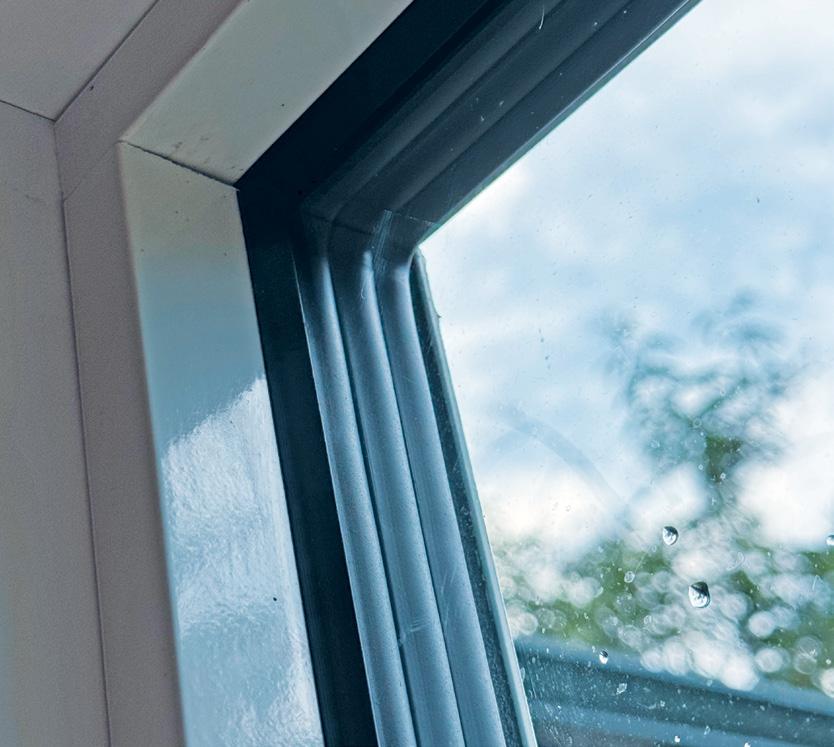
Best-Way removed the existing interior wood or exterior PVC glazing stops and the original sealed units, cleaned the glazing pockets and installed the new units, which were a similar overall thickness and fitment as the existing window systems. Where required, Best-Way used updated glazing materials and setting blocks, according to Marshall.
“The initial test phase involved the installation of 17 sealed units. They ranged in size from approximately 20 by 40 inches to 28 by 62 inches. This equates to roughly 5.5 square feet on the smaller units and approximately 12 square feet on the larger units,” Marshall says. Phase two will include 12 additional sealed units, including installations in doorlites and retrofits within multi-panel door systems, where existing solid door panels will be removed and replaced with VIG glazing to maximize the glass area.
Summarising the pilot phase, Marshall says, “It became apparent that the glass itself was now outperforming the existing frame systems thermally, making the glazing the warmest part of the assembly. As a result, increasing the glass area while reducing insulated panel sections became a logical approach to further improve overall performance.




“From a cost standpoint, retrofitting existing windows and doors with this glazing technology makes tremendous sense. The performance improvement, compared to conventional insulated glass, is dramatic, while allowing homeowners to retain their existing window and door systems. This avoids the substantial cost, disruption and labour associated with full replacement, while still delivering a major increase in energy efficiency, comfort and overall thermal performance. Prior to this, the warmest part of the window was the frame. Now it is the other way around. On a Canadawide platform it is incredibly new. It is really revolutionary.”
The other retrofit solution used quadpane insulating glass manufactured by AlpenGlass, which it refers to as Thinglass IGU, in the Edmonton home of Peter Amerongen. He is, among other things, a pioneer of Net Zero construction in Canada and the co-founder of Retrofit Canada.
Amerongen built his home 25 years ago with a building envelope that was better than code for the time, including fibreglass windows and triple low-E glass. As a vocal advocate for Net Zero retrofits, he decided it was time to do his own house. Amerongen’s home has about 60 sealed units. “When I heard from Al about the possibility of windows with a COG of about 14, I jumped at the
Evacuation Port
Clear Tempered Glass
Structural Micro-Pillars
Thin Film Getter
Hermetic Edge Seal
Low -E Coated Tempered Glass
Vacuum insulating glass incorporates several innovations in order to work, including advanced edge seal technology; super-dessicant “getter;” extremely flat and highly tempered glass; and micro-pillars placed by robots.
chance. Al agreed that even though the fibreglass frames are 25 years old, it would be OK to retrofit the new glass into the glazing pockets.”
AlpenGlass writes that its IGUs are available in triple or quad panes; are compatible with ¾ to 2-¼-inch glass pockets; can include options that give it up to an R-15 rating; and are about 30 percent lighter than traditional triplepane units. The secret is the thin glass technology that allows the two interior lites to be as little as half a millimeter thick while still having the structural strength to withstand the gas pressure in the insulating cavity without losing their edge seal. The cavity thickness can also be reduced because now there are four cavities instead of two.
“They will save me about 20 percent of my annual heating requirement but also give me an enormous comfort boost. Nothing else I could have done would reduce the heating load by that much,” Amerongen says.
Amerongen reports that the new glass units made an immediate difference. “I was expecting a comfort boost next winter – less of that chill you feel when cold glass sucks the radiant heat from you. With the old glass I felt that chill even though it had a decent R-value. It was a very pleasant shock to me what a difference the quad-pane thin glass made, comfort-wise. And that was in May, when
the outside temperatures are only a few degrees cooler than room temperature.
“Until recently,” Amerongen continues, “[The] low-E argon triple-glaze combo has been about the best you can do to reduce heat loss from windows without spending crazy amounts of money. Because windows are usually such a big portion of overall heat loss in designing for Net Zero, you had to compensate by using very high R values in the walls, roof and foundation. Now that you can easily double the R-value, it makes it easier to reach Net Zero.
“It is a great lever, especially for retrofits. These units are lighter than the triple-glazed windows. And these units are also lighter than triple-glazed windows. I think this stuff is a game changer. What is not to love?”
LuxWall’s Enthermal products and Alpenglass thin quads are available at a price point comparable to coated triple IGU. Retrofitting existing buildings is acknowledged to be a higher priority, and a more difficult problem to solve, in the effort to fight climate change than updating the standards for new buildings. So hyperperforming solutions that can bring fenestration far past the existing code minimums without requiring changes to the existing structure will become an important tool in the fenestration designer’s toolbox as we look for ways to meet tighter regulations and expectations.

Fenestration Canada’s 2026 Spring Conference brought members and industry partners from across the country to Quebec City from May 26 to 29 for education, association business, supplier connections and the kind of industry conversations that are difficult to recreate on a screen.
Held at the newly renovated Delta Hotels Quebec, the conference opened with the board of directors meeting, supplier showcase setup, registration and a welcome mixer before attendees headed to the President’s Dinner at Parc de la Chute-Montmorency.
The main education program kicked off with “Window Safety Beyond the Borders: A Global Perspective,” presented by Mike Fischer of Mighton Products. The session examined Canadian window safety regulations in relation to approaches used outside Canada, with a focus on how codes and standards can balance child fall prevention, fire safety and practical building performance.
Michael Pierce of the Window and Door Manufacturers Association followed with a timely presentation on the upcoming United StatesMexico-Canada Agreement review. With the 2026 joint review now in motion, the session provided a Washington-grounded look at U.S. negotiating priorities, political forces and what the review could mean for trilateral trade. For an industry deeply connected to North American supply chains, it was a reminder that trade policy can directly affect costs, sourcing decisions, competitiveness and long-term planning.
The afternoon continued with the winner of the 2026 President’s Award, Jonathan Layton of Layton Consulting, presenting “Conformance vs. Performance.” His session addressed the gap between meeting formal requirements and delivering real performance on site.
Farouk Mouhtadi of Moov AI presented “AI for the Fenestration Industry: From data to better decisions.” The session cut through the hype by focusing on practical opportunities for manufac-
turers and distributors. .
No FenCan Spring Conference would be complete without the social side. The supplier showcase gave attendees opportunities to connect with vendors and partners throughout the day, while the evening pub crawl along Grande Allee offered a chance to reconnect, continue conversations, and enjoy Quebec City. The evening also included a well-deserved recognition for Screenco’s Jennifer Small, who was named Most Valuable Volunteer.
The technical focus continued with the Manufacturer’s Council meeting, supplier showcase time and a timely session on “Regulatory Maturity: Tariffs, float glass and what comes next.” FenCan’s Adrian Edge addressed tariffs affecting the Canadian market, developments related to U.S. Section 232 tariffs, and the ongoing discussion around float glass capacity in Canada.
The session also included an important update from Glenn Leroux, CEO of Canada Premium Sand, on efforts to advance domestic float glass production in Manitoba. For years, the Canadian industry has discussed the vulnerability created by relying entirely on imported float glass. The update reinforced both the opportunity and the complexity of building Canadian capacity, including the need for investment, regulatory progress, market confidence and supply-chain alignment.
Adrian Edge and Dave Goldsmith of Cornerstone Building Brands also presented “Guard Glazing Under NBC 2025.” The session reviewed glass used as guards, including key issues related to the current writing and interpretation of National Building Code provisions and the code change request submitted for review.
From window safety and trade policy to AI, tariffs, float glass, guard glazing and performance requirements, the 2026 Spring Conference reflected the complexity of the Canadian fenestration industry today. The issues are technical, regulatory, economic and sometimes political. They also cannot be solved in isolation. That is where Fenestration Canada continues to play an important role.
Here’s a look at the latest offerings.
In North America, the vehicle of choice for work fleets is the pickup truck. It can do a lot things that are useful for many companies that need to get things done. However, for certain fleets, the pickup truck is just not a viable option. For those businesses, a commercial van is the way to go.
by MARIO CYWINSKI
RIGHT: They’re great because you can fit all your stuff in them. The Ram Promaster interior is offered with many options for shelving and racks with plenty of room left over for big things like patio doors.
If you have ever been to Europe or other parts of the world, pickup trucks are very rare. Many cities have very narrow roads, and fuel prices are traditionally high. Therefore, most commercial companies use vans of all sizes (with many being high and narrow) to do their business. While we do not have the plethora of van options in Canada, we do have a good variety that business owners need to look at for their day-to-day operations.
Years ago, every van looked the same inside and out: it was a white rectangular van with
wheels. With some having air conditioning and a radio as options. Thankfully, those days are long gone. Over the years, vans have added different roof heights, wheelbases, engine options, allwheel drive, advanced touchscreen infotainment systems, cargo lights and lots of upfitting options for work.
A big advancement over the past couple of years has been the introduction of battery electric models to van lineups, allowing for fleets that need to be more sustainable to have another choice in their toolbox.
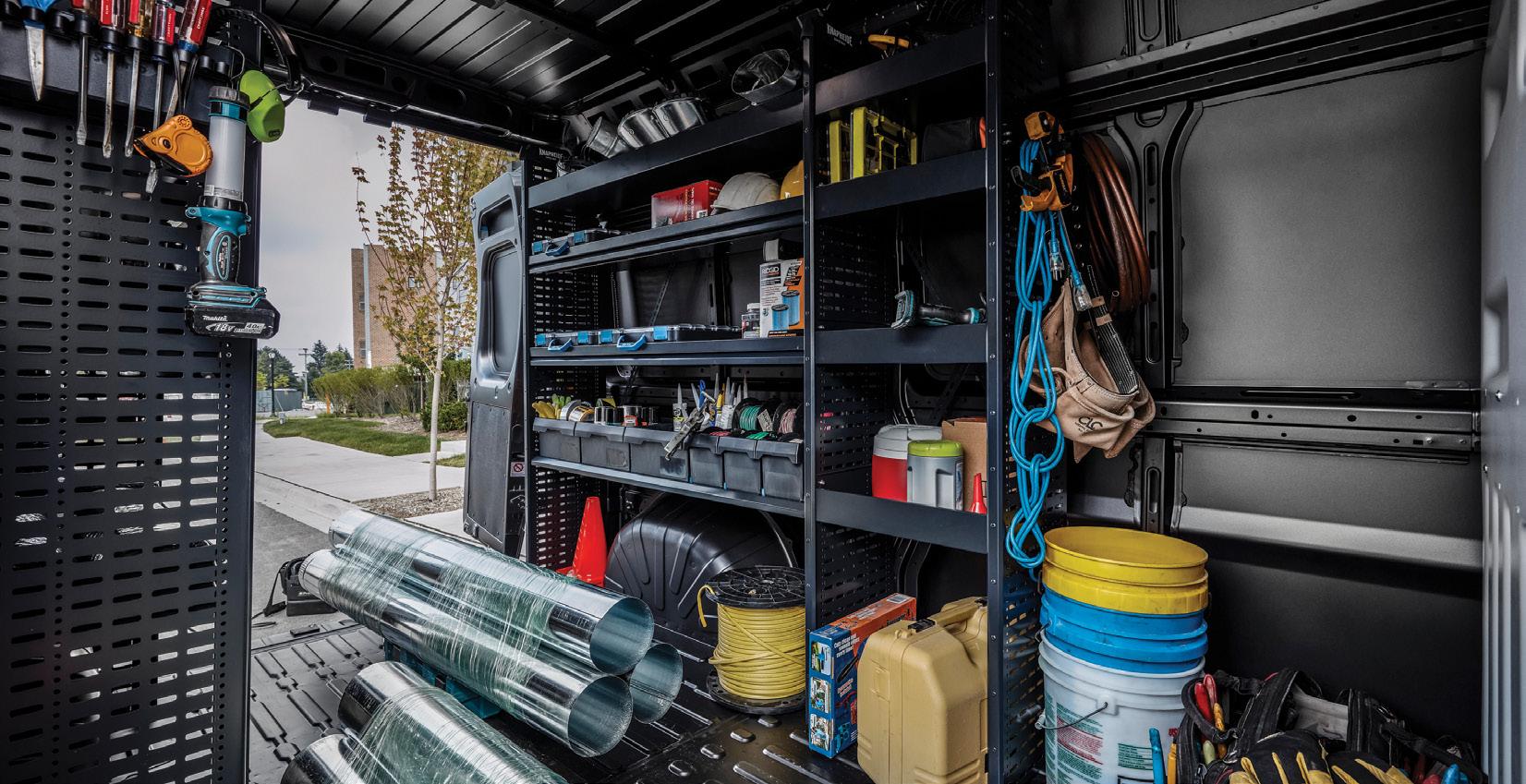
Today, Stellantis (which offers many vans as part of its European operations) by way of its Ram brand offers the ProMaster, ProMaster EV and the smaller and newly announced ProMaster City. Ford offers its Transit van and eTransit. as well as the ageless E-Series cutaway. Mercedes-Benz Vans offers the Sprinter. General Motors still offers the Chevrolet Express and GMC Savana. Many of the options are offered in panel van or passenger van configurations.
Making its debut in Canada in 2014, the Transit has been one of the top selling commercial vans in Canada ever since, with the eTransit joining the lineup in 2022. The smaller Transit Connect model was available starting in 2009 but was removed from the lineup in 2023.
Not long after the Transit was introduced it took part in the Canadian Truck King Challenge, for which I was a judge. While the Challenge usually looked at

pickup trucks, for a couple of years it took on all the commercial vans on the market at the time. The Transit came out on top each time. It has the capability and quality of high-priced vans, but at a lower price point. Since then, Ford has only improved the Transit and it continues to be a great option for commercial vehicle fleets that need a full-size van for
the businesses.
The Transit is available in two engine configurations: a 3.5 litre V6 naturally aspirated engine with 275 horsepower and 260 foot-pounds of torque, or a 3.5L EcoBoost twin-turbo V6 with 300hp and 400 ft/lbs of torque. Both engines are mated to a 10-speed automatic transmission and offer standard rear-wheel drive



or optional all-wheel drive.
One big area where commercial vans have improved is in terms of safety features. Gone are the days where airbags and the most basic features were offered. Now the same safety features that are offered on luxury vehicles are also offered on vans. Case in point, the Transit offers Ford Co-Pilot360 as standard on all models. It brings together auto high-beam headlamps, lane keeping system, intersection assist, camera-only evasive steering assist, pre-collision assist with automatic emergency braking, post-collision braking, rear view camera and front and rear parking sensors. Available upgraded systems are also available that add adaptive cruise control, blind spot monitoring, cross traffic alert, 360-degree camera and many others.
Transit comes as a cargo van, passenger van, chassis cab and cutaway in three roof heights (low, medium, and high) as well as three lengths (regular, long, and extended) and in T-150, T-250, or T-350. Wheelbases vary, with cargo and passenger models coming in two lengths, while chassis cab and cutaway have three lengths. This allows for a maximum payload of 5,103lbs, maximum towing of 6,900lbs, and maximum cargo volume (behind seats) of between 246.7 cubic feet and 487.3 cu/ft. According to Ford, the Transit is available in a whopping 37 different configurations.
For 2026, Ford has made updates to the digital aspects of the Transit, including a Sync 4 centre display at 12 inches, eight-inch multifunction dashboard, an available 5G model that can be used as a hotspot for 10 devices, over-the-air software updates, Ford Pro integration with telematics, vehicle maintenance monitor, and keyless push button start.
The Sprinter has been on sale since 1962 and is celebrating 30 years in Canada in 2026. It was initially branded as a Dodge Sprinter in Canada, as at the time Chrysler and Mercedes-Benz were operating together. When the companies split, the Sprinter was branded as a Mercedes-Benz. Sprinter is built in Dusseldorf,

Germany, where I was able to see it in its place of origin when the Sprinter was redesigned a few years ago. For many, the Sprinter is the benchmark for a luxury commercial van. Here is what makes the Sprinter one of the best commercial vans available on the market today.
It comes in two roof heights (standard and high), three lengths and four series (2500, 3500, 3500XD, and 4500). Two versions of a 2.0L diesel engine are offered: standard output and high output. The standard version offers 168hp and 295 lbs/ ft of torque, while the high output version offers 208hp and 332 lbs/ft of torque. Both are mated to a nine-speed automatic transmission. An AWD model is also available.
Maximum capacities for the cargo Sprinter are payload (3,090kg), cargo volume (532.6 cu/ft), towing (3,402kg), cargo floor length (481cm), cargo floor width (178.7cm), and interior standing height (200.9cm).
Many years ago, Mercedes-Benz North America held an upfitters event for the Sprinter in Chicago. It was amazing to see how robust the upfitter side of the business is for the Sprinter. The van can be configured to be everything from a basic work van interior to an RV to a mobile meeting space to a highly specialized workspace and everything in between. The Sprinter can be upfitted to any specification the consumer needs by way of the company’s ExpertUpfitter and ExpertSolutions programs.
Furthermore, the Sprinter can be built to any specification the user needs. The 2026 Sprinter dealer order guide is a
whopping 78 pages of options. One of the main things that Mercedes-Benz touts for the Sprinter is its total cost of ownership, as the initial cost does tend to be a little more than other options.
An electric eSprinter is also available and uses a permanent magnet synchronous motor with an output of 295 ft/ lbs of torque. The battery is a lithium iron phosphate and has a capacity of 113 kWh or 81 kWh. Range is approximately 328km (204 miles) with the smaller battery or 478km (297 miles) with the larger option.
Globally, Stellantis has many van options, in North America, which comes down to the Ram ProMaster and smaller ProMaster City. Depending on what your business needs, there are configurations of each that are available.
Let us start with the Ram ProMaster that has now been available in Canada for over 12 years. A staple in Europe, badged as a Fiat and other Stellantis brands, the ProMaster is one of the more affordable cargo vans available on the market.
Fun fact, when my family moved a few years ago, we used a Ram ProMaster. While moving an entire house can be daunting, especially without professional help, the ProMaster did an excellent job. The flat walls allowed for larger items to be placed safely and the high roof allowed for standing up in the back and for larger items to go in no problem. The low load floor allowed
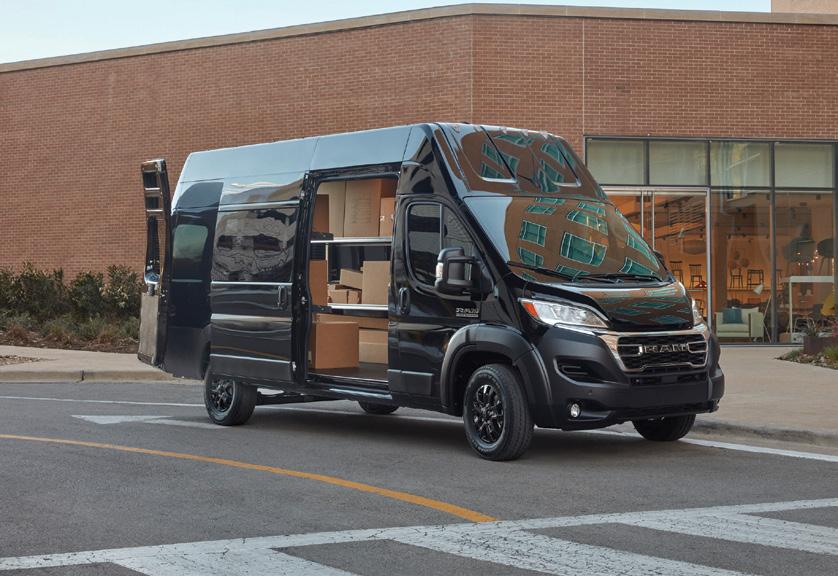
for loading without a ramp, the seating and front cab were comfortable and offered what you need on a day-to-day basis.
For 2026, Ram introduced 12 new features to commemorate its 12 years in Canada. The Tradesman model is now offering these freestanding options: remote start, driver and passenger sixway seat, 225/75R16C A/S tires, 220 AMP alternator, passenger sliding door with window, two additional key fobs, advanced safety group package, digital rearview mirror and power folding/ heated mirrors. Additionally, ladder rack mounting points are now standard on super-high roof models; 136-inch wheelbase cutaway is again available and a new forged blue metallic colour is added.
As with many cargo vans, the Mexicobuilt ProMaster comes in an array of combinations. It comes in 2500 or 3500; cargo, window or chassis cab; three wheelbase options; and low, high, or super-high roof. It is offered with a 3.6L V-6 engine outputting 276hp and 250 ft/ lbs of torque mated to a nine-speed automatic transmission and front-wheel drive. ProMaster has a towing capacity of 3,134 kg and 2,123kg of payload capacity.
The EV model builds off the standard ProMaster and offers 268hp and 302 ft/lbs of torque in a 3500 step van with superhigh roof configuration and a 110kWh battery pack. This is good for 289km of range.
The recently reintroduced 2027 ProMaster City, which has been out of the North American market for the last few years, now returns.
“When the new ProMaster City arrives at dealerships early next year, it will
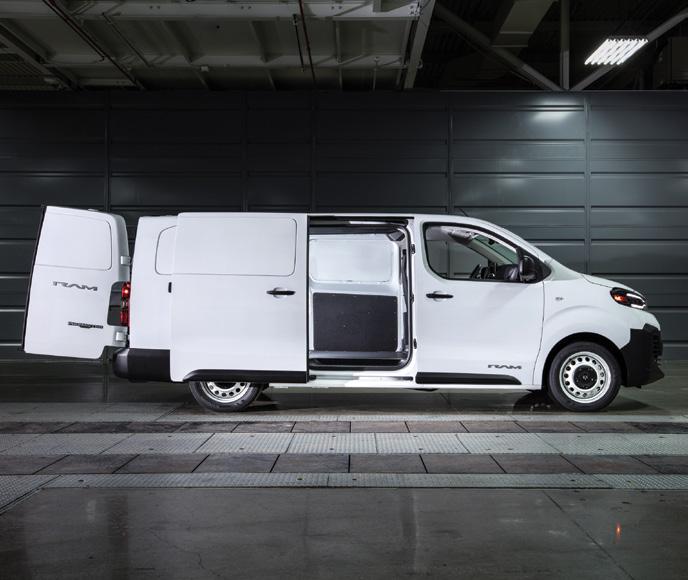
be the only midsize commercial van on sale in the U.S.,” said Tim Kuniskis, head of North American brands, SRT Performance division and retail marketing. “Despite our unique market position, Ram Professional isn’t coasting; we’re raising the competitive bar and delivering on small-business expectations.”
As the vehicle has just been announced, and is set to arrive in first quarter of 2027, details are scarce, but here is what was released. It will come with a turbocharged 1.6L inline-four engine with 166hp and 221 lbs/ft of torque mated to an eightspeed automatic transmission; 4,728L of cargo capacity with a 2,819mm load floor; 907kg of payload, and a towing capacity (when properly equipped) of 907 kg.
ProMaster City has a standard passenger-side sliding door, while, at the rear, options are available for 180-degree rear swing doors or an optional rear liftgate. Six window and panel combinations are offers, as well as two rear access options, in all offering 11 model configurations. On the inside two 10-inch screens are offered (instrument cluster and touchscreen infotainment) with navigation, Bluetooth, and Android Auto or CarPlay integration.
Safety wise, the van offers forward collision warning with automatic emergency braking, automatic headlamps, digital rearview mirror, driver attention alert, hill-start assist, rear backup camera, rear parking sensors and second- and thirdrow side-curtain airbags (on the passenger wagon model).
Ram vans in 2026 are backed by the company’s full-size truck and van limited powertrain warranty of 10 years or 160,000 kilometres.
Also on the market are the General Motors twin pair of Chevrolet Express/ GMC Savana. Offered as a traditional commercial van with a single roof height in either 2500 or 3500, in cargo or passenger configuration, and with the choice of a 4.3L V6 engine (276hp and 298 lbs/ ft of torque) or a 6.6L V8 engine (with 401hp and 464 lbs/ft of torque. Both are paired to an eight-speed automatic transmission. Cargo van models have a payload capacity of between 3,280lbs (2500) to 4,280lbs (3500). Available safety features include rear camera, rear park assist, forward collision alert, side blind spot alert, lane departure warning and tire pressure monitoring. An all-electric van from GM, the BrightDrop, which was produced in Ontario, has recently been discontinued. However, some may still be available where dealer inventory remains.

Kia is planning to bring its first-ever commercial vehicle to the market soon. Details are scarce but it was displayed at the Canadian International Auto Show earlier this year. Available details claim that the all-electric 2027 Kia PV5 cargo van is expected to have 4,500L of cargo volume, a 419mm step-in, 71.2 kW battery and a NACS charge port. It features a wide variety of safety features, advanced technology features, and an estimated range of around 400km.
Mario Cywinski is the editor of Modern Work Truck Solutions and has worked in the automotive industry for over 20 years, both as an automotive journalist and working for a local dealership. He is a member of the Automobile Journalist Association of Canada (AJAC). He can be reached at mariocywinskI@ hotmail.com.
Summer is time to clean out the inbox and take a look at some of the new technology hitting the market.

8swisspacer.com
Swisspacer has introduced Frameracer, featuring fully automated frame production in under 20 seconds.
From frame assembly to filling, Frameracer promises reproducible quality with minimal operating effort. With the Frameracer service, Swisspacer is expanding its range for the first time to include a fully automated solution for frame production in the insertion process. Frameracer is designed for precise dimensional accuracy, reproducible quality and high cycle rates. Spacer bars can be precisely inserted, welded or hot-bent depending on the line logic. Frameracer guides Swisspacer spacer bars through precisely coordinated process stations from profile feeding and frame assembly to filling. The focus is on short cycle times and optimised
material usage in a continuous insertion process. An integrated dynamic storage system for spacers and corner keys enables simple order processing and, above all, continuous frame processing. Depending on the line layout, the system can be operated by just one operator instead of up to four people in the manual process. The high cycle rate helps to reduce downtime, minimise rework and create production conditions that remain predictable, especially for large-scale industrial insulating glass processors with high volumes.

8vbhgb.com
VBH has announced that its Greenteq Velocity door hinge range has been further expanded with the addition of two new colour options. The hinge is now available in RAL 7038 Agate Grey and Antique Black finishes from UK stock. Velocity is a two-
knuckle T-hinge designed for rebated doors with a sash upstand dimension between 16 and 24 mm, making it ideal for PVC single and double doors. Greater rebates can be achieved with the addition of packers beneath the frame bearing. Ample 3D adjustment is available on site to ensure that the finished door can be installed quickly and is working perfectly. Velocity is extremely quick to fit to the door, as a jig is only required to drill two holes in the frame. A recent time trial saw a hinge fully fitted in under a minute. The two new painted colours bring the number of finishes available to 15, all of which are available from VBH stock in the UK.
8groupenovatech.com
Novatech has launched the darkly elegant Infinite Black doorglass design. Created for the entrances of contemporary homes, new Infinite Black glass features a fine V-grooved, reeded texture and shadowy black finish. This unique doorglass filters light while gently obscuring the view, adding depth and elegance while creating a semiprivate entryway for the home. With a bold look designed to impress, Infinite Black delivers both style and
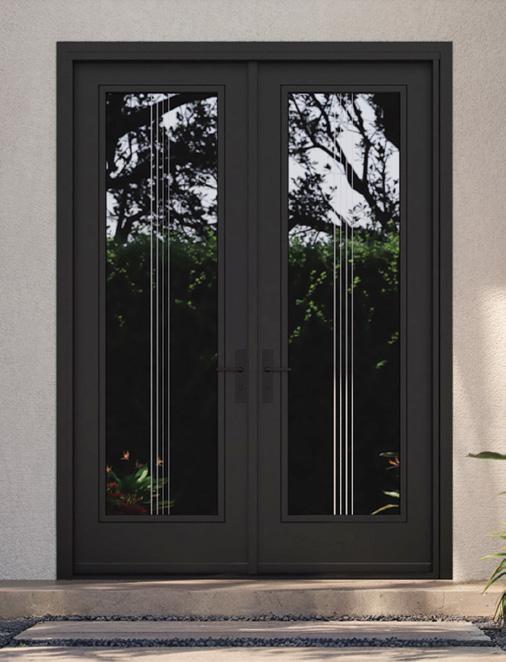
subtle privacy. Its deep black tint reflects sunlight during the day and appears a softer gray at night to let additional light into the home. The black-tinted glass creates a striking contrast on light doors and seamlessly disappears on dark ones, offering a sleek, minimalist esthetic. Infinite Black doorglass is crafted with triple-insulated glass for superior energy efficiency. Each unit is assembled with low-E coatings and argon fill to enhance thermal performance. The glass in Infinite Black is also thicker than typical triple-insulated glass, providing additional energy performance. Black Infinite doorglass is available in all popular dimensions and can be harmonized with the design of garage doors from Garaga, Novatech’s sister company. Complementary sidelites are also available.
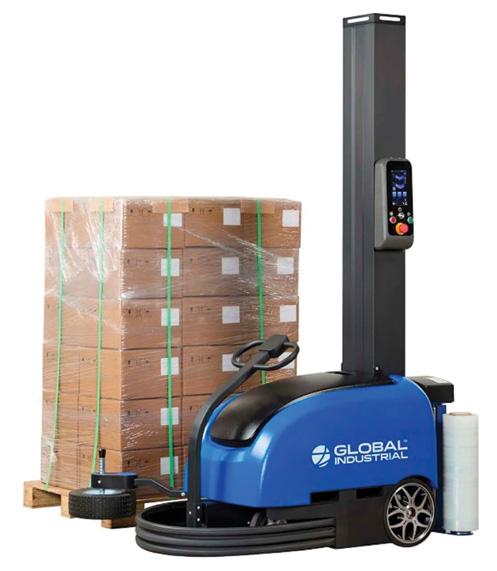
8globalindustrial.ca
Gobal Industrial has announced the launch of its mobile robot stretch wrap machine, a self-propelled, semi-autonomous solution that enables facilities to securely wrap irregular or oversized pallets directly on the floor. Designed to complement traditional turntable wrap machines, the mobile robot travels to the load and wraps it in place, reducing forklift traffic and accommodating pallets that exceed standard turntable dimensions. Its compact design and intuitive touchscreen support single-operator workflows in warehouse, manufacturing and retail environments where floor space and foot traffic make fixed stations impractical. Consistent, programmable film-tension control delivers better results than hand wrapping, providing maximum load security while reducing film use, costs and waste. The robot is compatible with Global Industrial machinegrade stretch for optimized consumable performance. The compact design with three wheels allows wrapping across multiple zones without dedicated stations. The robot travels to the pallet, reducing forklift traffic and eliminating the need to transfer unstable or oversized loads to a turn-
table. Powered by two batteries that deliver up to eight hours of continuous operation and fully recharge in under 10 hours, the robot wraps irregular, oversized, or non-standard pallets with no maximum weight capacity. A colourful touchscreen includes programmable wrap settings and film tension controls for consistent results and reduced film waste. Built for demanding industrial environments, the robot includes durable components and a front safety bumper that automatically stops movement on contact to help protect operators and bystanders.
8baldwinbrassdepot.com
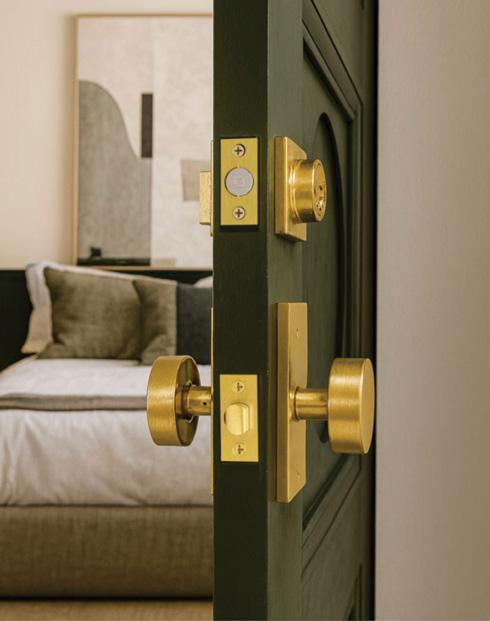
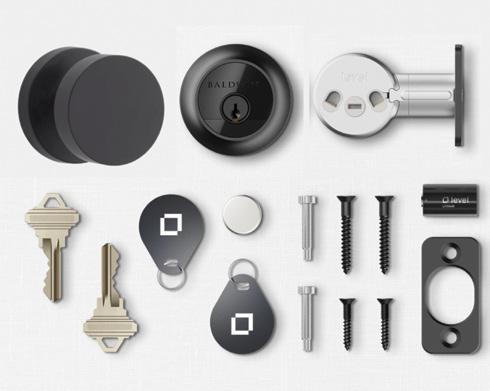
Baldwin Hardware has launched a new collaboration with Level Home. The two brands debut the Baldwin Engineered with Level collection, blending design excellence with design-forward, innovative engineering.
The new collection promises refined esthetics and advanced technology at the
front door. Featuring three trim styles – Baltimore, Gramercy and Minneapolis – and statement grip sets including Soho and Hollywood Hills, the collection offers a diverse palette of bold silhouettes and luxurious finishes. Each piece is crafted in solid brass, offered in seven rich finishes with custom split-finish options, and designed to pair seamlessly with Baldwin’s portfolio of levers and knobs. At the core of the locks is Level’s invisible smart-lock technology, engineered inside the bolt. The lock supports Bluetooth and Matter-Over-Thread for direct smart home integration, with remote access, lock status and activity history enabled. The lock works with Apple Home and other Matter ecosystems, while maintaining Baldwin’s signature look and feel. This co-branded release is aimed at the forefront of the growing smart luxury segment designed for architects, designers and homeowners who refuse to choose between beauty and performance.
8grafsynergy.com
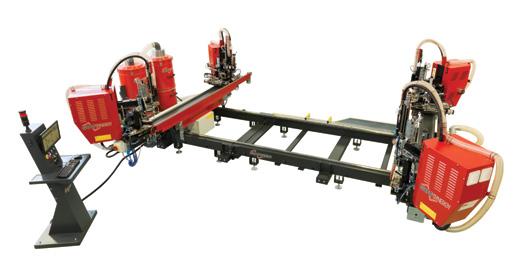
V-Perfect technology in Graf’s SL4FF EVO seamless welder allows users to weld hybrid PVC and aluminium profiles while keeping the aluminium wrap on. This allows fabricators to couple the aluminium cover to the PVC profile at the beginning of the process, cut the hybrid profiles, then place the 45-degree cut pieces in the SL4FF welder. The welder will take care of the entire process and create an excellent weld
with an exact match of the aluminium edges. Boxes are ready for hardware assembly out of the welder – no more additional tables and labour to add the aluminium cover. The same SL4FF EVO will do seamless welding of all other profiles – white, painted, laminated – with no need for any corner cleaner.

sensoryrobotics.com
Sensory Robotics has introduced its SR-1 system that uses 3D time-of-flight sensing to build a live, invisible safety zone around an existing industrial robot. The system watches the space continuously, letting the robot run at full speed when the area is clear, slowing it down as a person approaches and stopping it instantly if someone or something gets too close. The result is that people and fast, heavy robots can work in the same space without the cages and fences that have defined factory floors for decades. Physical safety fencing consumes valuable floor space and forces a choice between speed and proximity. Slow-moving collaborative robots designed to be safe near people solved the proximity problem but gave up the speed and payload that production lines depend on. After years of effectively demonstrating its worth, the SR-1 system has been certified by UL and international standards to a level that allows manufacturers to deploy it without safety fencing.
We need to get a handle on how long things last.
by Anton Van Dyk
We have all heard the phrase “You get what you pay for” when it comes to certain things we buy. Roofing is the best example. I purchased a home that was sold with a new roof. The issue was the previous owner purchased a low-cost shingle and as a result it had to be redone within 10 years. In other words, a short life cycle.
As we start to pile on more regulation for buildings I find myself asking a foundational question: how does this impact its life cycle? So let’s dissect what some of the aspects are that can impact a product’s life cycle.
The obvious one is low cost. Low cost does not always mean low performance, but low cost often does have some level of compromise on performance. A good example I see is the desire for dark window frames on the exterior. Ten to 15 years ago, this product was often an aluminum frame capable of being used in warmer climates. A painted PVC frame option is a lower-cost alternative, however there will be certain environments that it simply is not suited for. I witnessed this first hand in an AirBnB in Palm Springs, Fla., where the homeowner renovated their windows with dark brown frames and the frames were bowed about a half inch.

just cold in Canada is simply wrong. The 2021 heat dome in BC proved we can see southern California heat and that designers and fenestration suppliers need to be aware when communicating a product’s life cycle that it relates to the environment it is installed in.
The third example is an emerging one. One that has me a bit concerned as I see it pick up steam among product specifiers. It is embodied carbon. The desire to reduce embodied carbon as a design metric can have an impact on a product life cycle. This is due to how much influence this will have on material selection. My recommendation on
A product’s life cycle relates to the environment it is installed in.
Another is high solar heat gain. Often viewed as a performance metric for colder climates and free winter heat, its impact on a products life cycle is starting to be come known. In particular, when homeowners try to address summer overheating with interior blinds. Temperatures can exceed the resilience of a PVC frame and will distort the frame, in some cases to the point where it needs to be replaced.
These two examples are somewhat unique to the Canadian climate. The assumption that it is
this one is to make sure you ask the question, “What is the desired product life cycle?” when determining an embodied carbon limit. Using a product with twice the life cycle may have less embodied carbon impact over the building’s overall service life.
These are three common examples that overall can be addressed on their own. But there is an even more important process to all of this. It’s how they are all coordinated together. This responsibility often falls under the coordinating registered professional. Most often, this is an architect. But what an architect needs more than ever with all of this regulation change is for the fenestration industry to advise on what a product or material’s life cycle is.



•