Paul Grossinger pgrossinger@annexbusinessmedia.com (416) 510-5240
PRESIDENT & CEO
Scott Jamieson sjamieson@annexbusinessmedia.com
The lastest industry news from across the country.
9 REPORT
Why the FCC forecasts more uncertainty in 2026.
11 HEALTH & SAFETY
Building a safety program that goes beyond the basics.
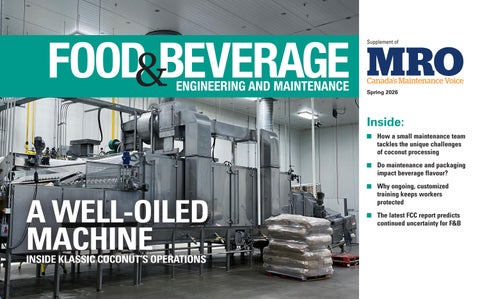
13 COVER STORY: A WELL-OILED MACHINE MRO goes on an exclusive plant tour to explore the unique maintenance challenges of coconut processing. 17 BEVERAGE FLAVOUR
How maintenance and packaging choices can impact beverage flavour.
How will slowed investment impact maintenance?
What a difference a year makes.
At the beginning of 2025, there were signs that Canada’s food and beverage manufacturers were preparing to invest and expand. Heading into the year, Farm Credit Canada (FCC) reported that companies planned to increase capital spending, both for expansion and equipment. Food manufacturers, in particular, expected to spend 14 per cent more than they did in 2024, with most of that going toward machinery and equipment.
But as we all know, that’s not how things played out. As the year progressed, trade uncertainty, new tariffs and rising costs forced many companies to rethink those plans upgrades.
Now, a few months into 2026, the outlook still feels unsettled.
The latest FCC report points to modest sales growth this year, driven largely by higher prices rather than stronger demand. Volumes contracted by 2.6 per cent in 2025 and are forecast to fall another 0.7 per cent in 2026 — marking a fourth consecutive year of declining volumes across the sector. At the same time, investment is slowing. FCC data shows capital spending fell in 2025 and suggests manufacturers will remain cautious.
All of this had me thinking about implications at the plant level, especially for maintenance professionals. When new equipment isn’t coming in, existing assets are expected to stay in service longer. Replacement decisions get pushed out, even as plants are still expected to meet production targets. Over time, that makes it harder to move the needle on productivity. As FCC senior economist Amanda Norris noted in November 2025, when investment is delayed, productivity gains are often delayed as well.
For maintenance teams, the focus shifts from preparing for new projects and expansions to ensuring existing equipment runs reliably. Preventive maintenance, asset planning and reliability become even more critical when capital investment is on hold.
Under these conditions, incremental improvements can have an outsized impact. Reducing unplanned downtime, streamlining maintenance routines and improving parts availability can all make a meaningful difference to throughput and cost.
There’s plenty of 2026 ahead — and if last year taught us anything, it’s that conditions can change quickly. But if investment remains constrained, plant performance will depend more than ever on how effectively existing equipment is managed.
In the meantime, I’m curious: has your organization been impacted by slower investment? If so, how has maintenance played a role in weathering the storm?
Let me know. I’d love to hear from you.
Kirstyn Brown kbrown@annexbusinessmedia.com
MARS CANADA COMPLETES $180M INVESTMENT TO MODERNIZE MANUFACTURING OPERATIONS
Mars Canada has completed a $180 million investment across four Ontario manufacturing facilities aimed at expanding production capacity, upgrading packaging lines and modernizing plant operations.
According to the company, the investment was made between 2022 and 2026 and spans its manufacturing operations in Bolton, Newmarket and Guelph, supporting Mars Snacking, Pet Nutrition, Food & Nutrition and Royal Canin production. The company said the upgrades are intended to improve productivity, reliability and sustainability across its Ontario footprint.
Mars said more than $100 million of the investment was directed toward three major packaging line upgrades, designed to increase throughput and support new product formats.
NEWS
Site level investments include:
• Mars Pet Nutrition (Bolton): An $86 million investment to enhance manufacturing capacity and sustainability, resulting in a reported 50 per cent increase in production capacity for TEMPTATIONS™ products. The company said the upgrades also reduced site water use by 15 per cent and gas and hydro consumption by 13 per cent.
• Mars Snacking (Newmarket): A $40 million investment in packaging line upgrades, which the company said increased overall production capacity by 25 per cent. Mars reported a 40 per cent reduction in electricity use on the filled bar line and a 75 per cent reduction in compressed air consumption.
• Mars Food & Nutrition (Bolton): A $17 million investment to enhance production lines for Ben’s Original™ and other products, increasing capacity by eight per cent and reducing energy use by approximately 93 kilo-
watt hours per day, according to the company.
• Royal Canin (Guelph): A $39 million investment to modernize operations and strengthen manufacturing capabilities, resulting in a reported 12 per cent increase in production capacity,
alongside reductions in thermal and electrical energy use.
Mars said the investments bring its total capital spending in Canada to nearly $400 million since 2015. The company employs approximately 1,800 workers across its manufacturing sites on Ontario.
The company said the investments were focused on automation, safety systems, energy efficiency and production reliability as part of its long term manufacturing strategy in Canada.
NORTERA TO CLOSE LETHBRIDGE FROZEN FOOD PLANT
Nortera will close its frozen food processing facility in Lethbridge, Alta., in June 2026 as part of a restructuring of its Canadian frozen operations, the company said in a press release.
The closure is part of what Nortera described as a consolidation of its production footprint, citing long-term competitiveness and pressure from
international imports as key factors behind the decision.
The Quebec-based company says production volumes and certain equipment from the Lethbridge facility will be transferred to other Nortera frozen food plants over the coming months. The closure will affect approximately 70 employees. Nortera said it will provide support to employees impacted by the decision.
Nortera CEO Hugo Boisvert said the company determined consolidation was necessary due to current market pressures.
Nortera said the decision will also affect its relationships with agricultural partners in southern Alberta, where the Lethbridge plant sourced vegetables for processing.
The North American processor of frozen and canned vegetables operates13 plants in Canada and the United States.
PROTEIN INDUSTRIES CANADA NAMES SECOND COHORT OF SUPPLY CHAIN PROGRAM
Protein Industries Canada has part-
nered with nine companies in the second cohort of its Strengthening the Canadian Supply Chain Program, an initiative aimed at increasing domestic food and ingredient processing.
The program was launched in response to geopolitical pressures affecting global trade and is intended to help Canadian companies adapt while expanding food production and processing within Canada, according to the organization.
The selected projects span several provinces and focus on developing or scaling products made with Canadian-grown crops. In Ontario, 1847 Stone Milling is developing a high protein Atta flour, while Yofiit Inc. is creating a high protein drinkable yogurt. Henry’s Tempeh is scaling production of marinated tempeh made with Canadian grown organic soybeans, and HealX Vitals is developing a frozen fry using Canadian pulses and grains.
Projects in Manitoba include Farmery Estate Brewing Company, which is upcycling brewer’s spent grain into protein ingredients, and
Fresh Hemp Foods, which is developing a flax protein powder. Quebecbased Grazy is reformulating frozen desserts and beverages using Canadian pea and fava bean protein.
MeeT Restaurants, operating in British Columbia, is developing a new plant based burger, while B.C.-based Trueleaf Petcare is scaling production of dog dental sticks made with Canadian agricultural ingredients.
KRAFT HEINZ TO INVEST $250M IN MONTREAL FACTORY
Kraft Heinz Canada has announced plans to invest $250 million to modernize its Mont Royal factory in Montreal, Que. The funds will be used to upgrade key plant systems, improve efficiency and make operations more sustainable.
The investment intends to increase the plant’s production volume. The
facility produces several Kraft Heinz products including Kraft Dinner, Philadelphia Cream Cheese and Kraft Peanut Butter. It employs over 1,000 employees.
“This investment underscores our more than 120-year-old commitment to Canada and producing the foods Canadians love right here at home,” said Simon Laroche, president of Kraft Heinz Canada.
Kraft Heinz has been present in Canada for more than 120 years and currently has approx. 2,000 employees.
ARDENT MILLS PLANT MANAGER WINS
ADVANCE: WOMEN IN MANUFACTURING
AWARD
Erica Porter, plant manager at Ardent Mills in Saskatoon, Sask., wins an Advance: Women in Manufacturing Award in the Plant Manager of the Year category.
Presented by Annex Business Media’s manufacturing brands including MRO, the Advance: Women in Manufacturing Awards celebrate women who are making a meaningful impact in their organizations,
communities and in Canada’s manufacturing sector.
A food science graduate from the University of Saskatchewan’s College of Agriculture, Porter she brings her expertise in food manufacturing to operational excellence. She has built her career in manufacturing across the meat, appetizer and flour-milling sectors.
Porter says she is passionate about food safety, product quality and developing people, and is known for fostering collaborative, high-performing teams.
COCA-COLA CANADA BOTTLING LTD. TO INVEST $141M IN BRAMPTON FACILITY
The Ontario government is welcoming a $141 million investment from Coca-Cola Canada Bottling Ltd. (Coke Canada Bottling) to renovate and expand its flagship manufacturing, distribution and sales centre located in Brampton.
The expansion will reportedly introduce a new state-of-the-art production line, capable of producing at least 20 million additional cases annually, creating up to 500 jobs during construction.
Per a company press release, the Brampton expansion will be built exclusively by Canadian tradespeople and have at least 75 per cent of materials sourced domestically, it will also be one of the most technologically advanced production lines in the country, helping to increase production capacity and packaging capabilities.
The project follows an $8 million investment by Coke Canada Bottling in its Hamilton distribution centre last year.
Coke Canada Bottling has invested more than $230 million in its Brampton manufacturing and distribution operations since becoming an independent, family-owned business over seven years ago.
The Brampton facility is home to more than 1,300 employees who service more than 7,000 local customers from Kitchener to Oshawa. Beverages made there are distributed across the province and throughout eastern Canada.
FCC REPORT FORECASTS ANOTHER UNCERTAIN YEAR FOR FOOD AND BEVERAGE MANUFACTURERS
FCC Economics forecasts sales will increase 0.8 per cent in 2026, driven largely by higher prices rather than stronger consumption.
BY KIRSTYN BROWN
Canada’s food and beverage manufacturers are heading into another year of uncertainty, with modest sales growth projected for 2026 but continued pressure on volumes, investment and demand, according to the latest Food and Beverage Report by Farm Credit Canada (FCC).
FCC Economics forecasts sales will increase 0.8 per cent in 2026, driven largely by higher prices rather than stronger consumption. Sales volumes, adjusted for inflation, are expected to decline 0.7 per cent, marking a fourth consecutive year of falling volumes
across the sector.
“Weak volume growth shows the sector is still adjusting to tighter consumer spending and slower population growth,” FCC chief economist Craig Johnston said in the report, noting that demand conditions remain uneven across product categories.
COST PRESSURES EASING, BUT RISKS REMAIN
After several years of steep increases, FCC expects some relief on input costs in 2026, which could help improve margins across parts of the sector. Prices for key agricultural inputs such
as cattle, hogs, canola and cocoa are forecast to ease following supply disruptions that pushed costs higher in recent years.
Those disruptions included avian influenza affecting poultry supplies, drought conditions in cocoa-producing regions, and tight livestock inventories across North America. Labour costs also rose as employers competed for workers, adding to pressure on operating margins.
However, FCC cautions that the cost outlook remains uncertain. The conflict in the Middle East has introduced new volatility into global
energy and commodity markets, creating upside risk for processors reliant on transportation, utilities and imported materials.
“While cost pressures were expected to ease, uncertainty around energy and commodity prices adds another layer of risk,” the report noted, particularly if elevated prices persist beyond the short term.
MARGINS EXPECTED TO IMPROVE UNEVENLY
Gross margins for food and beverage manufacturers are forecast to improve in both 2026 and 2027, following sev-
eral years of compression. In 2026, margin improvement is expected to come primarily from easing raw material costs rather than a rebound in sales volumes.
FCC projects stronger margin performance in meat processing, seafood preparation, bakery products, grain and oilseed milling, and sugar and confectionery manufacturing. By contrast, fruit and vegetable processing and beverage manufacturing are expected to face renewed margin pressure due to higher exposure to labour, packaging and input costs. Despite the improvement, margins across many subsectors remain below pre-pandemic levels, signalling that the sector’s recovery is far from complete.
INVESTMENT CONTINUES TO PULL BACK
One of the more concerning trends highlighted in the report is declining capital investment. After what was expected to be a year of expansion, capital expenditures in food and beverage manufacturing fell 5.3 per cent in 2025, marking the fifth consecutive
quarterly decline.
Early indicators suggest investment may weaken further in 2026 as manufacturers navigate trade uncertainty, subdued demand and cost volatility. FCC warns that prolonged underinvestment could carry long-term consequences, including slower productivity growth, delays in capacity expansion and reduced adoption of new technologies.
export markets and input costs, with ripple effects throughout supply chains.
Although most Canadian food and beverage products continue to move tariff-free into the United States, indirect costs such as compliance requirements and higher-priced inputs in integrated North American supply chains continue to weigh on profitability.
cal lever for manufacturers navigating the year ahead. Businesses that can manage input costs, reduce waste and improve operational efficiency are expected to be better positioned as conditions evolve.
For maintenance and reliability teams, this places increased emphasis on asset performance, downtime reduction and lifecycle planning. As companies delay or scale back capital projects, maintaining existing equipment and extending asset life becomes central to protecting margins.
For plant operators and maintenance leaders, these trends may translate into older assets being kept in service longer, tighter capital planning cycles, and increasing pressure to improve equipment reliability and efficiency through maintenance strategies rather than large-scale upgrades.
TRADE AND GEOPOLITICS SHAPE THE OUTLOOK
Trade uncertainty remains a defining feature of the 2026 outlook. Tariffs, retaliatory measures and shifting trade relationships continue to influence
China-related trade actions, along with ongoing geopolitical tensions, have further complicated planning for processors that rely on export markets for growth. FCC notes that uncertainty around trade policy remains a key factor dampening investment and long-term decision-making across the sector.
PRODUCTIVITY BECOMES A DIFFERENTIATOR
With demand growth constrained and capital spending under pressure, FCC points to productivity as a criti-
“Businesses that improve productivity, manage input costs and adapt to changing consumer preferences will be better positioned as conditions evolve,” Johnston said.
Canada’s food and beverage manufacturing sector includes more than 11,000 businesses and employs approximately 318,000 people, making it the country’s largest manufacturing employer. It plays a critical role linking Canadian farms to domestic and global markets, even as processors contend with shifting demand, trade uncertainty and cost volatility.
SAFETY BEYOND THE BASICS
Orientation isn’t enough—ongoing, tailored training is key to a safer workplace. Here’s how to build a program that protects workers, every day.
BY CANADIAN CENTRE
FOR OCCUPATIONAL HEALTH AND SAFETY (CCOHS)
When it comes to health and safety, employers have a responsibility to ensure that everyone has the training, tools and resources needed to work safely. This duty extends far beyond orientation at the start of a new job. Continuous training is a must.
According to a recent study by Threads of Life, a Canadian not-for-profit organization that supports families impacted by workplace tragedy, 49 per cent of employers cite a lack of time for training as the biggest challenge to improving the health and safety of their workplace. New workers who receive inadequate safety training are significantly more likely to be injured on the job compared to their experienced colleagues, particularly in high-
risk industries. However, ongoing training can help keep everyone in the workplace informed about evolving risks, new safety procedures and changes to the occupational health and safety legislation.
An effective training program should guide workers on how to recognize hazards, respond to emergencies, follow safe work practices to help to reduce the risk of incidents and injuries and understand the importance of reporting all unsafe acts, conditions and incidents
COVER THE RELEVANT TOPICS
The first step to build or improve a health and safety training program is to assess common hazards and risks to determine what kind of training is needed to reduce them. Every workplace is different, so tailor your training program accordingly. For example, review safety data sheets and equipment manufacturer’s instructions. It’s also important to talk to experienced workers and your health and safety representative or committee about what their challenges and experiences have been to gain insight into potential hazards. Another important step in the process is to review your safety logs and incident reports to gain insights into common injuries and near misses.
A few topics are universal: workers need to know how to identify hazards, assess risks, follow safe work procedures and use any required personal protective equipment correctly. Emergency preparedness is another critical area to include in your training. Everyone should know the fire safety, first aid and evacuation protocols in your
workplace. For jobs that involve physical labour or repetitive tasks, providing education on proper ergonomics and manual and material handling techniques can help prevent musculoskeletal strains and injuries.
Include specialized, industry-specific training on topics such as the proper operation and maintenance of tools and machinery, preventing slips, trips and falls with good housekeeping, safe storage practices and following prevention procedures such as lockout/tag out.
Also keep in mind that a truly safe workplace is one where psychological safety is prioritized alongside physical safety. Your training program should address problematic substance and mental health, stress management, harassment prevention, and response procedures for workplace violence or harassment.
UNDERSTAND LEGISLATION IN YOUR JURISDICTION
Consult provincial or federal safety agencies to make sure your training program meets the legal requirements for your industry and jurisdiction. The Canada Labour Code requires federally regulated workplaces to provide health and safety training and maintain hazard prevention programs, while provincial organizations outline additional industry-specific requirements and risks. Failing to meet these standards can lead to legal consequences, financial penalties, and most importantly, preventable injuries. To avoid these risks, make sure your training program aligns with current regulations and best practices and are updated regularly to reflect any changes or updates.
TAKE ADVANTAGE OF TECHNOLOGY
Technology can make it easier to provide effective and engaging health and safety training. Online learning allows workers to complete required courses at their own pace, making training more flexible and accessible. Virtual reality and digital simulations can create realistic training environments where work-
ers can practice safety procedures without real-world risks. Mobile apps offer quick access to safety resources, hazard reporting tools, and refresher courses. Data analytics can help employers track training completion rates, identify knowledge gaps, and customize learning experiences based on individual needs. This personalized approach can help workers retain critical safety information and apply it effectively in their daily tasks.
SET THE FOUNDATION WITH A SAFETY-FOCUSED CULTURE
A workplace where everyone feels cared for and considered is a happier, healthier workplace. Encourage workers to speak up about safety concerns as soon as they arise. Demonstrate that all safety concerns will be taken seriously by having a process in place to record, investigate and follow up on them in a timely way.
Don’t forget to make use of the knowledge and expertise that already exists within your workforce. Consult experienced workers on your health and safety training program and get their feedback on any potential knowledge gaps. Introducing mentorship programs, where experienced workers guide newer employees through safety practices, can also be an effective way to get everyone involved and reinforce training in a practical setting.
A strong commitment to workers’ health, safety and well-being has benefits for the entire workplace. Deliver ongoing training, provide the tools and resources needed to work safely, and foster a culture where conversations about incident prevention are encouraged.
The Canadian Centre for Occupational Health and Safety (CCOHS) promotes the total well-being — physical, psychosocial, and mental health — of workers in Canada by providing information, advice, education, and management systems and solutions that support the prevention of injury and illness. Visit www.ccohs.ca for more safety tips.
A WELL-OILED MACHINE
In a factory that smells as good as it runs, a small maintenance team keeps one of Canada’s largest coconut processors humming.
BY KIRSTYN BROWN
On certain days in Simcoe, Ontario, you don’t need a map to find Klassic Coconut’s factory — you just follow your nose. When the factory is toasting, the thick scent of coconut can be smelled for miles.
Phil Genery, one of the plant’s two-person maintenance team, laughs about it.
“My fiancé’s grandma, she lives all the way on the other end of town,” he says. “She can even smell the toasting line over there.”
That toasting line a custom-engineered, gas-fired, two-stage band oven capable of processing 4,000 to 5,000 pounds of coconut per hour—is both the crown jewel and one of the most demanding pieces of equipment at Klassic Coconut’s 50,000-square-foot facility. It’s also a lesson in how different maintenance looks when your raw material is coconut.
During a recent visit by MRO, Duncan Stewart, who
oversees operations at Klassic Coconut, and Genery walked through the plant and the maintenance program that keeps it running with minimal downtime.
A LEAN DREAM TEAM
Founded in 1986 by Henk Van Amerongen Sr. under the name Van Amerongen & Son Inc., Klassic Coconut is a family-owned and operated business and one of the largest importers of desiccated coconut in Canada. It manufactures sweetened and toasted coconut products for customers across North America, with some product moving to the Middle East, Brazil, and Ecuador.
The current Simcoe facility was essentially a shell when the company acquired it. It was a gut job that kept only the steel structure with a new roof, floors, walls and a production layout designed by the team in-house. The company is now planning an additional 52,000 square feet on the same site.
Running maintenance across all of it: Tim Zandstra, the facility’s lead maintenance technician with 11 years on the job, and Genery, who has been with the company for seven years across multiple roles before landing in maintenance about four or five years ago. It’s a lean team, but it works.
“It’s a pretty robust preventative maintenance program that’s run very well,” says Stewart.
The plant runs Monday through Thursday, with the Friday-to-Sunday window reserved for Zandstra and Genery to work through a structured schedule of daily, weekly, monthly, quarterly, semi-annual and annual tasks.
Every production day starts with morning checks: sanitizer and soap dispenser concentrations measured at each numbered sink, belt tracking verified on every running conveyor, forklift inspections covering hydraulics, brakes, horns and warning systems.
Weekly tasks include roof checks of all AMUs and HVAC filters, battery top-ups on the three lead-acid forklift batteries and a check of the sugar silo magnet, which screens for any metal fragments that may have come loose from the grinder.
Once a month, the team conducts a full glass and plastic audit of the entire facility, checking every light bulb, switch cover and transparent guard for cracks.
The approach is deliberately manual and low-tech. The team briefly tried a software program for tracking, but Stewart says it was less intuitive and more cumbersome than their binder system.
“Our downtime is incredibly minimal,” says Stewart. “There are situations that are unforeseen that you can’t plan for, but since we moved to this facility, our downtime for maintenance-related issues is negligible. Properly documenting and scheduling maintenance has paid dividends.”
THE UNIQUE CHALLENGE OF OIL
Desiccated coconut is 65 per cent fat. When containers arrive cold from Vancouver in winter, that fat has solidified, causing the product to clump and become difficult to process. Before production can begin, incoming shipments have to be moved into tempering rooms and brought up to 82 to 85 degrees Fahrenheit to bring the product back to a workable state.
The oil creates a separate challenge at the other end of the process. During production and cleanup, coconut oil makes its way into the facility’s drainage system. The plant was designed with production drains on a separate system, feeding through an oil interceptor to keep coconut oil out of the municipal sewer. In warm months, that works
seamlessly. In winter, the oil pooling in the interceptor can solidify entirely.
“We’ve had a couple of times when Tim and I have been called in in the morning,” Genery says. “We go in there and there’s a giant hunk of solid coconut oil in the separator tank.”
Monitoring that interceptor through the colder months is now a standing
maintenance item.
Oil also requires careful management when it comes to lubricants. Because this is a food plant, every lubricant used on equipment must be food grade; not
station.
something that can be sourced locally in a pinch. The team tracks chemical inventory monthly, monitoring usage closely to make sure they’re never caught short before a PM.
“If we don’t have certain oils, then next thing you know, you’ve drained something out and now you can’t use it for a month because it’s on backorder,”
Genery says.
OH, SUGAR
Despite these challenges, oil isn’t Klassic Coconut’s dominant maintenance issue: it’s sugar. Klassic Coconut mills granulated sugar on site and grinds it into icing sugar, which behaves less like a food ingredient and more like a fine-grit abrasive.
“It’s like a micro-sanding to everything,” Genery says. Belts, pins, plastic components all wear faster than they would in a typical manufacturing environment.
“Powdered sugar is very abrasive. It likes to wear on plastic,” says Zandstra, who explains that some belts in the facility have lasted 11 years, while others needed replacement after three or four. One machine runs with a Teflon coating on its upper surface to maintain slip and that coating must be stripped and reapplied every two years because the sugar contact wears it away.
Sugar also has a humidity problem. If moisture gets into the sugar system, the product clumps and stops flowing. So the plant runs a dehumidifier and the
Klassic Coconut’s custom-engineered toasting line can process up to 5,000 pounds of coconut per hour.
team checks humidity levels weekly, a non-negotiable on the maintenance schedule.
HIGH HEAT, HIGH STAKES
Of all the equipment in the facility, Stewart says the toasting line (or “oven dryer”) demands the most care. The line uses a custom-engineered band oven, designed on the same principle as equipment used in the Philippines to produce desiccated coconut, but specifically built for Klassic Coconut’s toasting process. It runs at 380 degrees Fahrenheit (193 Celsius) and requires a licensed gas fitter to inspect the entire gas system annually.
Klassic Coconut’s mixing
The line also has a ventilation requirement. The toasting process generates exhaust that, without proper ventilation, can deplete the oxygen in the production room and create a negative atmosphere. To prevent that, the oven is interlocked with a makeup air unit (AMU)—the oven will not run unless the AMU is confirmed to be operating. Genery checks the AMU and all HVAC systems weekly, year-round, roof access in January included.
“That’s why we check them on a weekly basis,” Genery says of the ventilation systems. “If anything happens, that toasting line instantly shuts down, we check it and figure it out.”
The rest of the toasting line PM is belt- and bearing-heavy: checking gear mesh, inspecting for tears or wear, monitoring gearbox fluid levels through drain-plug checks and keeping track of chains and motors in the tumbler system.
“For the most part, it comes down to making sure that all the bearings are greased up and that all the belts aren’t going to, you know, explode on us,” says Genery.
The company also makes coconut butter line presents its own maintenance discipline. To make coconut butter, desiccated or toasted coconut is fed into a high-speed grinder that pulverizes it into a liquid, a process that takes roughly 30 to 45 seconds for a 20-litre pail. The grinder runs at 14,000 RPM and is belt-driven, with four interlocks preventing operation unless all guards are in place.
“There’s oil that needs to be running in that consistently, and it has to be running half an hour before we actually start it up because of how fast it runs. It can’t run dry at all,” explains Genery.
THE SMELL OF SUCCESS
All of those challenges exist on top of the baseline demands facing any food and beverage processing facility: stringent food safety standards, foodgrade lubricant requirements and a full glass and plastic walkthrough every four weeks to account for anything cracked
or broken anywhere in the building.
Then there’s the supply chain. “Coconut itself is pretty volatile,” Stewart says, noting that coconut is grown in the Philippines and Indonesia, regions prone to typhoons, volcanic activity, and weather cycles that can make supply scarce.
But walking through the spotless
facility, you’d never know. For a twoperson team managing a toasting line, a sugar milling system, a coconut butter line, tumblers, forklifts, and HVAC, the operation runs with quiet precision. And when the breeze carries that warm, sweet smell across the town of Simcoe, it’s proof that everything is running as it should.
IS PRODUCTION LINE MAINTENANCE, ALONG WITH THE CHOICE OF PACKAGING,
A FACTOR IN BEVERAGE TASTE?
Exploring the common factors that impact flavour.
BY BRYAN CHRISTIANSEN
From alcoholic beverages to fruit juices, you have control over numerous variables that enable you to create the ideal flavour for your product. But sometimes, the taste of your carefully crafted beverage can change for the worse. In this guide, we’ll take a look at how production line maintenance and choice of packaging can impact the taste of your beverages.
POTENTIAL ISSUES CAUSED BY A POORLY MAINTAINED PRODUCTION LINE
The manufacturing process of any
beverage relies on numerous pieces of equipment. From heat exchangers to packaging lines, equipment maintenance is essential to the process in many ways. Failure to make it so can have a severe impact on the taste of your beverage and its drinkability. Here are some of the most common issues.
BACTERIAL INFECTIONS
All beverages can suffer from bacterial infections as a result of poor production line maintenance and sanitation.
The packaging line, filters, and heat
exchangers can become major hot spots for bacteria and fungi. A faulty cleanin-place (CIP) system in the packaging line can lead to improper sanitization, inviting bacteria and wild yeast to enter your production. Worn gaskets and scratched hoses can also allow bacteria to thrive and contaminate the liquid.
A bacterial infection has a severe impact on the flavour and can create a major safety hazard. The introduction of wild yeast to a beverage during packaging can eventually cause glass and plastic bottles, cans, and cartons to explode.
OXIDATION ISSUES
Oxidation can transform both the flavour and appearance of beverages such as beer, wine, and fruit juices. It strips the flavour away almost entirely, leaving behind an unpleasant, stale, damp, cardboard-like taste.
Oxidation occurs when oxygen enters the beverage and reacts with organic molecules, increasing the rate at which flavour compounds and nutrients break down.
Worn gaskets and hoses, along with faulty capping heads and purging sys-
tems can all allow oxygen to enter your beverage during the packaging process.
CONTAMINATION WITH NONBACTERIAL SUBSTANCES
Faulty machinery can enable external substances such as industrial oil, water, cleaning and sanitizing solutions, and cooling media to enter your beverage. This has a negative impact on the flavour of your beverage and can also cause major safety issues. Again, worn gaskets and hoses are often held responsible for such contamination. Industrial oil contamination is
most prevalent in machines that work with an air compressor, so it’s essential to ensure they’re regularly maintained. Meanwhile, filtration systems and heat exchangers can allow substances like cleaning and cooling solutions to enter your beverage.
CARBONATION LOSS
The taste of carbonated drinks such as beer, sparkling wine and cider can all change considerably if they’re not adequately carbonated. Carbonation loss often occurs during packaging as a result of faulty capping systems. In the case of pneumatic systems, a small air leak caused by worn hoses or gaskets can reduce the power, resulting in poor sealing.
Carbonation can also be lost due to faulty in-line carbonation systems, as well as pressure leaks in carbonation and maturation tanks.
DOES YOUR CHOICE OF PACKAGING IMPACT FLAVOUR?
When it comes to packaging, beverage producers have more choices than ever before. Modern options are all food-safe and do a great job of protecting the liq-
uid inside. For the most part, packaging material has little direct impact on the flavour — but there are some things to bear in mind.
• Glass: Products in glass bottles are considered higher quality, although this is dictated by marketing rather than actual flavour. However, glass does offer better protection against oxygen than other materials, making it the best choice for beverages that require long-term storage and maturation — such as wine and certain beers. Glass colour is also important for some bev erages. For example, brown glass is best suited for beer as it offers greater UV protection, which helps prevent skunky off-flavours.
• Polyethylene terephthalate (PET) bottles and kegs: generally seen as an inferior material, PET offers a good level of oxygen protection, though not as good as glass. It’s a good choice for shortterm storage with no discern able impact on flavour.
• Aluminum cans:
consumers insist that cans make beverages taste like metal, this isn’t the case. Most have a thin polymer coating inside, preventing any contact with the metal. It also offers 100 per cent UV protection.
Ensuring your beverage tastes great
every time is more about production line maintenance than the type of packaging you use. If you’re striving for quality and consistency, keeping on top of maintenance tasks is a must, and the first step in achieving that is drawing up an effective maintenance plan.
Bryan Christiansen is the founder and CEO of Limble CMMS, a CMMS solutions provider. He can be reached at mail@limblecmms.com This article was originally published in Food in Canada.