OCTOBER 2026
CANADA’S INFORMATION LEADER FOR ELECTRONIC ENGINEERS AND DESIGNERS
EPT.CA
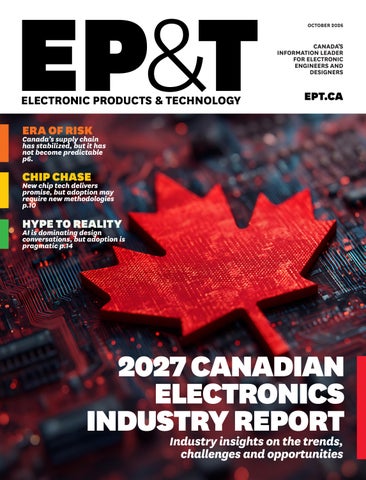
ERA OF RISK
Canada’s supply chain has stabilized, but it has not become predictable p6.
CHIP CHASE
New chip tech delivers promise, but adoption may require new methodologies p.10
HYPE TO REALITY
AI is dominating design conversations, but adoption is pragmatic p.14
2027 CANADIAN ELECTRONICS INDUSTRY REPORT Industry insights on the trends, challenges and opportunities
INSIDE Columns
4 EDITORIAL Intriguing survey results and thanks to our panelists 5 DEMOGRAPHICS More than 200 industry members take the survey 30 PANELISTS Mark Burr-Lonnon; Kevin Bailey; Mark Wood; Adam Grigor
In this issue
22 ENVIRONMENTAL Sustainability becomes absolute 26 MARKET OUTLOOK Playing to your strengths
6 10 OCTOBER 2026
2027 INDUSTRY REPORT
6
10 14 18
RISKY BUSINESS While the component supply chain has become healthier over the past few years, the recovery isn’t uniform. SEMI SECURED The rise in use of GaN, SiC and chiplets promise significant design help, but can you find what you need?
14
EMBEDDED AI AI is bing incorporated into existing electronics, but not appearing as a distinct new product category.
18
GAP WIDENS IN EXPERIENCE The industry is looking for people who understand what happens at the boundaries between disciplines.
Cover photo: Adobe Stock Photos (this page, from top): Adobe Stock (all)
Canada’s Electronics Industry: The View Ahead Canada’s electronics industry continues to navigate a rapidly changing landscape shaped by supply-chain pressures, semiconductor demand, artificial intelligence, evolving technologies and ongoing talent challenges. This year’s Canadian Electronics Industry Report examines these forces while highlighting the opportunities and strengths that continue to define Canada’s electronics sector. Drawing on the perspectives of industry leaders and the results of EP&T’s national survey, the report provides a timely snapshot of where the industry stands — and where it may be headed. EP&T thanks TME Group Americas for its sponsorship and support of this important initiative.
Sponsored by
2027 Canadian Electronics Industry Report / EP&T
3
EDITORIAL
Report provides a closer look at our industry There’s no shortage of conversation these days about the future of electronics. Artificial intelligence is redefining the demands being placed on semiconductor technology and data infrastructure. Supply chains continue to present their share of challenges. And companies across the industry are being asked to do more with less, while keeping pace with a technology landscape that seems to change by the month.
Take the temperature
But, what does all of this mean for Canada’s electronics industry? How are the people designing, manufacturing, distributing and supporting electronic products navigating these changes? Where do they see the greatest opportunities and challenges on the road ahead? Those are among the questions we set out to explore in this, EP&T’s fifth annual Canadian Electronics Industry Report. Over the years, this report has become an important opportunity to take the temperature of the industry we serve. While our annual survey provides a valuable snapshot of the views and experiences of Canadian electronics professionals, this year we wanted to take that conversation a step further. To help bring greater context and perspective to the findings, we invited four industry leaders to share their insights on the issues shaping their businesses and the broader electronics ecosystem. Their experience and observations have served as the driving force behind the editorial content in this year’s report.
Connect with EP&T
facebook.com/EPTmag/
4
Our thanks go to Mark Burr-Lonnon, CEO Americas of TME Group; Kevin Bailey, founder and CEO of Ottawa-based design house Design 1st; Adam Grigor, president of Mississauga manufacturers’ representative Tech-Trek; and Mark Wood, CEO of Markhambased contract electronics manufacturer Microart Services.
Examine what numbers mean
Representing different corners of the electronics industry, each brought a distinct perspective to the discussion. Together, their contributions helped us move beyond the numbers and examine what those numbers mean for the companies and professionals working in this sector every day. And there is plenty to consider. Supply chain management remains a central concern, but the conversation has evolved. It is no longer simply about finding components and getting them delivered. It is about anticipating availability, managing costs, identifying alternatives and making smarter decisions earlier in the design process. The influence of artificial intelligence is equally difficult to overlook. For some companies, AI is already finding a place in their workflows. For others, questions about practical applications, security, investment and return remain. The technology may be advancing rapidly, but its impact on the day-to-day realities of Canadian electronics businesses is still unfolding. Then there is the ongoing challenge of talent. The industry continues to rely on people with specialized technical skills, from embedded software and RF engineering to power design and
/ept-magazine
info@ept.ca
manufacturing. Finding and retaining those people remains an important part of the equation for companies looking to grow and compete. These are not isolated issues. They are interconnected pressures that influence how products are designed, how businesses invest, and how Canadian companies position themselves in an increasingly competitive global marketplace. What I find particularly valuable about this year’s report is that it doesn’t attempt to present a single, definitive view of the industry. Instead, it offers a collection of perspectives—some encouraging, some cautionary, and others that raise important questions about what comes next. That, in many ways, is the strength of an industry report such as this. It provides an opportunity to step back from the daily demands of running a business or developing a product and consider the broader picture.
Providing insights
For EP&T, that broader picture has always been central to what we do. As Canada’s electronics industry trade journal, our job is to keep our readers informed about the technologies, companies, people and developments that matter to them. This annual report is an extension of that responsibility. I hope you find the stories, survey findings and panel discussions in this issue both informative and useful. More importantly, I hope they provide some insight into how your colleagues across Canada are approaching the opportunities and challenges ahead. Enjoy the issue. STEPHEN LAW Editor slaw@ept.ca
ept.ca
ELECTRONIC PRODUCTS & TECHNOLOGY / 2027 Canadian Electronics Industry Report
Canada’s information leader for electronic engineers and designersv
OCTOBER 2026 Volume 48, Number 5 READER SERVICE Print and digital subscription inquiries or changes, please contact Angelita Potal Tel: (416) 510-5113 Fax: (416) 510-6875 Email: apotal@annexbusinessmedia.com Mail: 111 Gordon Baker Rd., Suite 400 Toronto, ON M2H 3R1
EDITOR Stephen Law slaw@ept.ca · (416) 510-5208 WEST COAST CORRESPONDENT Mike Straus · mike@brandgesture.ca BRAND MANAGER Joanna Malivoire jmalivoire@ept.ca · direct (416) 881-0731 ACCOUNT COORDINATOR Shannon Drumm sdrumm@annexbusinessmedia.com MEDIA DESIGNER Brooke Shaw bshaw@annexbusinessmedia.com AUDIENCE DEVELOPMENT MANAGER Anita Madden amadden@annexbusinessmedia.com (416) 510-5183 GROUP PUBLISHER, MANUFACTURING Paul Grossinger pgrossinger@annexbusinessmedia.com CEO Scott Jamieson sjamieson@annesbusinessmedia.com EP&T is published five times per year by ANNEX BUSINESS MEDIA 111 Gordon Baker Road, Suite 400 Toronto, ON M2H 3R1 Tel (416) 442-5600 Fax (416) 510-5134 annexbusinessmedia.com SUBSCRIPTION RATES Canada – $62.06 one year; $99.72 two years USA – $142.15 (CAD) per year International – $194.66 (CAD) per year Single copy – Canada $15.00 ISSN 0708-4366 (print) ISSN 1923-3701 (digital) PUB. MAIL AGREEMENT NO. 40065710 Return undeliverable Canadian addresses to: EP&T Circulation Department, 111 Gordon Baker Rd. Suite 400, Toronto, ON M2H 3R1
© 2026 EP&T. All rights reserved. Opinions expressed in this magazine are not necessarily those of the editor or the publisher. No liability is assumed for errors or omissions or validity of the claims in items reported. All advertising is subject to the publisher’s approval. Such approval does not imply any endorsement of the products or services advertised. Publisher reserves the right to refuse advertising that does not meet the standards of the publication. Occasionally, EP&T will mail information on behalf of industry-related groups whose products and services we believe may be of interest to you. If you prefer not to receive this information, please contact our circulation department. PRINTED IN CANADA
EPT.CA
DEMOGRAPHICS Who Took Our Survey?
Results indicate where the industry stands — and where it’s going STEPHEN LAW, EDITOR, EP&T Canada’s electronics industry is entering a period of change that is difficult to ignore. Supply chain uncertainty, rising costs, talent pressures and rapid advances in artificial intelligence are reshaping the environment in which Canadian electronics companies design, manufacture and compete. Now in its fifth year, EP&T’s Canadian Electronics Industry Report provides a snapshot of how the industry is responding. The findings reveal an industry that remains pragmatic and forward-looking, while confronting a growing list of challenges—from managing costs and securing skilled talent to keeping pace with emerging technologies and evolving customer demands. This year’s results offer both a measure of where the industry stands today and a glimpse of where it may be headed next. To help put this year’s Canadian Electronics Industry Report into perspective, we asked survey participants a series of questions about their professional backgrounds, companies and place within Canada’s electronics ecosystem. These responses provide a snapshot of who is represented in our survey—from years of industry experience and company size to regional representation and personal background. Together, these demographics offer important context for understanding the perspectives and insights presented throughout this year’s report.
Experience matters
Our survey respondents bring decades of experience to Canada’s electronics industry. Nearly half (48%) have worked in the industry for 21–40 years, while another 32% have more than 41 years of experience. 22% have been in the industry for 20 years or less.
Average industry experience 33.9 years
Experience by company size
Among respondents from companies with 101+ employees, 38% have worked in the electronics industry for 31–40 years, compared with 26% across all respondents.
Years in Electronics Industry 10 or fewer
Born in Canada
9%
11 ro 20
13%
20 to 30
22%
31 to 40
Yes 67%
26%
41 to 50
21%
More than 51
11%
Region in Canada
Number of Employees
West (B.C., AB, Sask.,Man.)
44% 14%
Quebec
49%
20 or fewer
38%
Ontario
Atlantic Canada
No 33%
21 to 100
25%
More than 100
26%
4%
Regional snapshot
Experience varies across the country. In Quebec and Atlantic Canada, 36% of respondents have 21–30 years of industry experience, compared with 22% nationally. The bottom line: Our survey reflects an industry with a deep pool of experienced professionals, alongside a significant group of newer participants helping shape its future.
Where are our respondents from?
67% of survey respondents were born in Canada, while 33% were born outside the country. This provides another perspective on the diverse backgrounds represented across Canada’s electronics industry.
Where in Canada do our respondents work?
Our survey captured perspectives from across the country, with Ontario accounting for 44% of respondents,
followed by Western Canada at 38%. • Ontario — 44% • West — 38% • Quebec — 14% • Atlantic Canada — 4% Together, the results provide a broad cross-section of Canada’s electronics industry, with strong representation from both Ontario and Western Canada.
What size companies do our respondents represent?
Our survey reflects a broad mix of company sizes, with nearly half (49%) of respondents working for firms with 20 or fewer employees. • 20 employees or fewer — 49% • 21–100 employees — 25% • 101+ employees — 26% The results provide a balanced view of Canada’s electronics ecosystem, spanning small businesses and start-ups to mid-sized companies and larger organizations.
2027 Canadian Electronics Industry Report / EP&T
5
INDUSTRY REPORT
Canada’s electronics industry faces a new era of risk Component supply chain stabilizes, but it has not become predictable BY STEPHEN LAW, EDITOR
Innovation may be the lifeblood of Canada’s electronics industry, but for design engineers, the reality of day-to-day work is increasingly shaped by two relentless forces: cost and speed. According to the findings of EP&T’s nationwide survey, these pressures dominate the design process, often leaving teams to wrestle with a difficult question: how do you balance tight budgets and shrinking timelines with the freedom to take risks and innovate? The answers could shape the products that reach the market, along with the competitive nature of innovation. Canada’s electronics supply chain has come a long way from the component shortages that crippled production during the pandemic. But if this year’s EP&T survey is any indication, the industry has not emerged from the experience unscathed. 6
Instead, the nature of supply-chain risk has changed. Component access is considerably healthier overall, with 56% of survey respondents rating their access to critical electronic components as good or very good. Yet 35% describe access as only fair, with smaller organizations and respondents in Quebec and Atlantic Canada reporting comparatively weaker conditions. While the industry may no longer be confronting shortages across virtually every component category, supply-chain risk remains its clearest business pressure. Lead times rank as the top challenge, cited by 43% of respondents, followed by pricing volatility at 33%. The message from the four industry experts who dissected the survey results for this report is clear: the supply chain has stabilized, but it has not become predictable.
ELECTRONIC PRODUCTS & TECHNOLOGY / 2027 Canadian Electronics Industry Report
A designer’s BOM can be 99% available and remain commercially unusable because of that missing 1%
As Mark Burr-Lonnon, CEO Americas of TME Group, puts it, the 56% positive rating broadly reflects what he is seeing, but the headline conceals a much more complicated market. Availability has improved across many high-volume, broadly interchangeable product categories. The difference today is that constraints are increasingly concentrated by technology, package, manufacturer, qualification status and application. “A bill of materials can be 99% available and still be commercially unusable because of the missing 1%,” Burr-Lonnon says. That remaining 1% might be an older microcontroller, an analog component in a particular package, a safety-rated industrial device or a connector qualified for a regulated application.The component itself may represent a small percentage of a product’s cost, but its absence can hold an entire production schedule hostage. Adam Grigor, president of Mississauga-based manufacturers’ representative Tech-Trek, sees much the same pattern. “The component supply chain is much healthier than it was during the last major shortage cycle,” he says, with availability across most product categories having normalized. However, the recovery isn’t uniform. Memory is one of the most obvious current pressure points, while Grigor is also watching components associated with the rapid expansion of AI and data-centre infrastructure, including MLCCs and power MOSFETs. “We’re not seeing the broad-based shortages that affected virtually every component category during the last cycle,” Grigor says. “The pressure is more concentrated in technologies where demand is accelerating or capacity is constrained.” That concentration may actually make the supply-chain problem more difficult to recognize. The industry is no longer facing one obvious crisis. Instead, vulnerabilities are appearing in specific parts, technologies and materials, often with little warning.
AI’s appetite for memory
For Mark Wood, CEO of Markham, Ontario-based contract electronics manufacturer Microart Services, the most immediate example is unmistakable. EPT.CA
Photo: Prasanth/Adobe Stock
SUPPLY CHAIN
You design. We deliver. The Newest Products for Your Newest Designs®
mouser.com/new
SUPPLY CHAIN
INDUSTRY REPORT
“Memory. Memory. Memory.” Wood says AI data centres are consuming enormous quantities of external high-performance memory used alongside GPUs and CPUs. In some cases, he says, prices have increased tenfold. The pressure is particularly acute for smaller OEMs that cannot compete with the purchasing power of companies building large-scale AI infrastructure. This isn’t simply a question of the onboard memory integrated into many processors. Wood is referring primarily to the increasingly sophisticated external memory required for high-performance computing applications. The impact is already reaching the economics of electronics products. Grigor says memory illustrates how availability and pricing can become intertwined. Significant cost increases can force customers to reconsider designs, qualify alternative technologies or even delay new-product releases. Customers can generally absorb modest and predictable cost increases. The problem comes when a major price or availability change occurs after the product has already been designed. “At that point, it isn’t simply a procurement problem. It can become an engineering issue and ultimately a time-to-market issue,” Grigor says. Wood is seeing an even more troubling consequence: some OEMs are delaying or stopping production because their products are no longer economically viable at current part costs. “One of the biggest OEMs in Toronto, basically stopped doing engineering altogether,” Wood says. “That’s because the end consumer or commercial product is no longer saleable at the previous prices.” For another OEM, the answer has been to commit to two or three years of continuous production in order to secure components at a set price. In other words, the lessons of the pandemic shortage are resurfacing, but in targeted areas. The industry’s response is 8
increasingly moving upstream, into product design itself. Kevin Bailey, founder and CEO of Ottawa-based Design 1st, argues that approximately 70% of a product’s manufacturing cost is locked in during design. “Availability gets locked in at the same moment,” Bailey says. That means component availability can no longer be treated simply as a purchasing problem to be solved once the engineering work is complete. “Sourceable used to be a fact you checked once, now it is a forecast,” he says. For design engineers, today’s distributor stock figure provides only a snapshot. A component that is available in quantity today may not be available in engineering quantities nine months from now, when the prototype is ready, or throughout the six-year commercial life of a product.
Redesigns can be costly
At Design 1st, Bailey says availability is now evaluated alongside function, cost and manufacturing location before a component reaches the schematic. The architecture itself can therefore become a supply-chain decision. A sole-source semiconductor in a critical path means the entire product inherits that supplier’s lifecycle decisions. If the component is discontinued or becomes difficult to obtain during production ramp, the resulting redesign can be extraordinarily expensive. “Sole-source silicon in the critical path is an architecture decision,” Bailey says. That philosophy is driving greater emphasis on qualified alternatives. Burr-Lonnon agrees that alternative-component planning offers the greatest near-term chance to improve resilience. That’s provided it happens during the design phase rather than after a shortage occurs. That can mean designing around components with multiple sources, approving more than one manufacturer, avoiding unnecessarily unique packages, maintaining validated alternative bills of materials and
Which supply chain challenge impacts your work the most? 43%
Lead times 33%
Pricing volatility 12%
Logistics delays Counterfeits
4%
Other
6%
reviewing lifecycle status before design release. “The most resilient design is not necessarily the one using the component with the best specification,” Burr-Lonnon says. “It may be the one that delivers the required performance while preserving future choices.” The industry appears to have learned the value of second sourcing, but putting that lesson into practice remains difficult. Grigor says customers are talking about second sources more than they did before the shortages, but the industry remains somewhere between proactive and reactive.
Finding time & resources
Everyone understands the value of an alternate source after experiencing a shortage. The problem is finding the engineering time and resources to qualify one when supply conditions have improved. The better organizations, he says, are considering alternatives during the original design. Bailey agrees, describing qualification of alternates as normal practice in his development work. He does see another potential strategy emerging: modularity. Breaking a product into modules can provide the flexibility to move a subassembly to another region if trade, geopolitical or supply conditions change. This means flexibility comes at a price. “Modularity always increases product cost,” Bailey says,
ELECTRONIC PRODUCTS & TECHNOLOGY / 2027 Canadian Electronics Industry Report
because modular products require additional tooling and manufacturing investment. His conclusion is pragmatic: qualify second sources at the schematic stage, when a substitution can cost hours rather than months, and use modularity when the production-volume economics justify the additional investment. Company size also continues to matter, perhaps not in the way many would expect. Burr-Lonnon says purchasing volume, supplier relationships and negotiating power all influence availability, but information quality is becoming almost as important as purchasing scale. Large customers naturally have advantages. They can provide longer demand horizons, place scheduled orders and negotiate supply agreements. Volume alone doesn’t guarantee supply. Suppliers also value credible forecasts, stable ordering behaviour and confidence that projected demand will become actual consumption. Bailey makes a similar point. Allocation can follow historical consumption, meaning that even a large OEM launching a brandnew product may initially have a supply profile not far removed from that of a funded startup. The real problem for smaller companies can emerge between receiving samples and securing production quantities. A handful of engineering samples may be relatively easy to obtain. Obtaining full reels or production EPT.CA
Where do you expect most supply chain improvements to come from in 2026-27? Inventory planning
36% 25%
Alternative components 17%
Domestic sourcing New distributors
11%
AI-driven forecasting
10%
Other
3%
From chips to pcb boards
“Memory, memory, memory,” components are in exceptional demand, causing turmoil in BOM cost management and at the design level. – Mark Wood, Microart Services quantities can require minimum orders, inventory commitments or broker pricing — all of which create financial risk before the first product has shipped. Bailey believes small firms frequently under-use the technical resources available through franchised distributors and manufacturers’ representatives. “Use the franchised distributor’s field application engineers and the manufacturers’ reps,” he says. “That’s their job, and small firms under-use them.”
Technical relationship
Grigor has seen the same evolution in the role of manufacturers’ representatives. During the major shortages, reps spent considerable time helping customers identify and qualify alternate solutions. That experience demonstrated the importance of establishing technical relationships before a component becomes a crisis. “When a component suddenly goes on allocation or moves to an unacceptable lead time, that’s not the ideal time to start learning the customer’s design,” Grigor says. The lessons of the past few years have also changed how
10-week lead time that moves to 18 weeks after the order is placed is much more disruptive.” That uncertainty affects production scheduling, labour planning, customer commitments and working capital. For distributors, it also changes the meaning of customer service. A website showing an estimated delivery date isn’t enough. Customers increasingly need to know how much confidence they can place in that date, and what alternatives exist if it moves.
companies think about inventory. Burr-Lonnon says customers are taking different approaches simultaneously. They are generally less willing to hold excess inventory across an entire bill of materials, but more willing to carry additional coverage for components considered operationally irreplaceable. The result is a more selective approach to safety stock. Rather than simply asking how many months of inventory should be held, companies are increasingly assessing the risk associated with individual components. That includes the availability of qualified substitutes, supplier and geographic concentration, lifecycle status, historical lead-time volatility, redesign and recertification costs, and the amount of revenue or production capacity that could be placed at risk. “In that sense, inventory strategy is becoming more intelligent, not simply more conservative,” Burr-Lonnon says. But there is a catch. The most difficult supply-chain problem may not be a long lead time. It may be an unreliable one. “A known 20-week lead time can be planned around,” Burr-Lonnon says. “A quoted
The supply-chain vulnerabilities don’t end with semiconductors. Wood says Microart is now seeing pressure on the availability of bare printed circuit boards and the materials required to manufacture them. Prepreg, the resin-impregnated material used in multilayer pcb construction, is becoming difficult to secure, he says. Material delays that would traditionally have been measured in days can now stretch to weeks. Even FR-4 boards, among the industry’s most common pcb board, are becoming more difficult to obtain in some circumstances. Wood points to vulnerabilities further upstream in the global supply chain for pcb materials and chemicals, including dependence on overseas sources. He also believes geopolitical disruption is demonstrating how seemingly remote events can affect electronics manufacturing. The result is another reminder that supply-chain resilience cannot be measured solely by checking whether a chip is in stock. The electronics industry depends on a vast network of materials, chemicals, substrates, packaging, fabrication, assembly and logistics. This is often spread across multiple countries and continents. As Burr-Lonnon notes, buying a product domestically does not necessarily mean its underlying manufacturing exposure is domestic. A component purchased from a Canadian distributor may still depend on fabrication, packaging, assembly, raw materials or
subcomponents concentrated elsewhere. The EP&T survey found stronger component-access ratings among respondents in Ontario and Western Canada than in some other regions. Grigor cautions against attributing that difference entirely to geography. Ontario certainly benefits from its concentration of electronics industry players. Company size and supply-chain sophistication may be just as important. “Access today is less about where a company is located and more about the strength of its supply-chain relationships and how proactively it plans,” he says. That may be an important distinction for Canadian policymakers contemplating domestic supply-chain strategies. Burr-Lonnon argues that domestic sourcing is strategically valuable, particularly for defence, aerospace, infrastructure and other critical sectors. But, Canada cannot realistically reproduce every element of the global electronics supply chain. Thus, supply-chain resilience becomes a design discipline
Single-sourced problems
Perhaps the most important change revealed by this year’s panel discussion is that supply-chain management is becoming less of a purchasing function and more of a cross-functional discipline. Engineering, procurement, manufacturing and supply-chain teams can no longer afford to make decisions sequentially. A component selected for its technical performance can become a problem if it is single-sourced. A lower-cost component can become expensive if it has poor lifecycle support. A product designed for the lowest manufacturing cost can become uncompetitive if tariffs change the economics of its production location. For an industry in which a single unavailable component can stop an entire production line, that may be the most valuable form of resilience.
2027 Canadian Electronics Industry Report / EP&T
9
SEMICONDUCTORS
INDUSTRY REPORT
Balancing innovation against risk Industry weighs performance gains of nextgen chips against cost, availability, design complexity and qualification challenges BY STEPHEN LAW, EDITOR throughout its lifecycle. Mark Burr-Lonnon, CEO Americas with TME Group, cautions against treating chiplets, GaN and SiC as a single technology-adoption category. They address fundamentally different requirements. SiC is increasingly relevant in higher-voltage applications where switching efficiency, thermal performance, power density and system size can justify its additional cost. GaN is attractive in high-frequency power conversion, compact power supplies, data-centre power and charging applications where efficiency and power density are priorities.
Selective Inventory
Chiplets occupy a different part of the semiconductor landscape, primarily addressing advanced computing and semiconductor architecture rather than the broad catalogue requirements of a typical Canadian industrial customer. For GaN and SiC, Burr-Lonnon believes demand is sufficient to justify selective inventory and greater technical support, but not indiscriminate stocking. That distinction is important because adopting a new semiconductor technology rarely means simply replacing one transistor with another. GaN and SiC can require changes to gate drivers, magnetics, capacitors, thermal management, protection circuitry, pcb layout and measurement techniques. The engineering team also needs to understand the behaviour of the devices within the complete system. That complexity
10 ELECTRONIC PRODUCTS & TECHNOLOGY / 2027 Canadian Electronics Industry Report
helps explain why many companies remain hesitant. Burr-Lonnon says companies holding back are not necessarily resisting innovation.They may simply be making a rational business decision based on higher device and redesign costs, limited internal power-electronics expertise, concerns about switching behaviour and EMI, qualification requirements, uncertainty about second sources and existing investments in proven platforms. Ultimately, he says, adoption will accelerate when customers can quantify the total benefit rather than simply comparing the price of one semiconductor with another.
Selective inventory of GaN and SiC chips is sufficient, versus indiscriminate stocking, says Mark BurrLonnon.
The regional adoption question
The survey also found a significant regional difference in stated adoption intentions. Forty-five per cent of Ontario respondents indicated they were likely or very likely to adopt new semiconductor technologies, compared with only 24% in Western Canada. But, Adam Grigor, president of Mississauga-based manufacturers’ representative Tech-Trek, cautions against interpreting that as evidence
Photo: Adobe Stock
Canada’s electronics industry is interested in the next generation of semiconductor technology. However, interest and adoption are two very different things. EP&T Magazine’s latest Industry Survey found that just 37% of respondents are likely or very likely to adopt new semiconductor technologies within the next 12 months — a result that points to an industry that remains cautious about making the transition to unfamiliar silicon, despite the potential benefits. That caution is understandable. Technologies such as gallium nitride (GaN), silicon carbide (SiC) and chiplets promise significant improvements in efficiency, power density, switching performance and computing capability. Adoption of these devices may also mean new design methodologies, unfamiliar qualification requirements, additional testing, higher component costs and, in some cases, an entirely different approach to system architecture. And, there is another consideration that has become increasingly difficult for Canadian OEMs to ignore: Can you actually secure the parts once you have designed them in? The four industry experts contributing to EP&T’s Industry Report see considerable opportunity in emerging semiconductor technologies. Their message is equally consistent on the risks: adoption will accelerate when the technology delivers a measurable system-level advantage and when engineers can be confident that the resulting product can be supported
EPT.CA
“Chiplet adoption can manifest itself in the form of tighter BGA pitches and additional pcb layers” – Kevin Bailey, Design 1st that Ontario engineers are inherently more willing to embrace new technology. He believes the difference may have more to do with the types of companies and applications represented in the respective regions. “Adoption of technologies such as GaN and SiC tends to be driven by the application and whether the technology solves a specific design problem, not simply by an engineer’s willingness to adopt something new,” Grigor says. Where higher efficiency, power density or thermal performance delivers a meaningful system-level advantage, the business case becomes considerably stronger. Data-centre power, battery systems, motor drives, automotive electrification and industrial power conversion are among the applications where Grigor sees significant interest in wide-bandgap semiconductors. However, the industry’s number-one
design priority identified by the EP&T survey was reliability, and that is an important brake on semiconductor adoption. Customers want to understand qualification, supply continuity, second-source availability and the overall system benefit before replacing proven technology. In that sense, the semiconductor adoption question is closely linked to the broader supply-chain issue confronting the industry: innovation is difficult to embrace when it introduces another point of supply-chain uncertainty.
The bench-capability gap
For smaller Canadian design teams, the challenge isn’t always the semiconductor itself. It can be the expertise and equipment required to make it work. Kevin Bailey, founder and CEO of Ottawa-based Design 1st, says larger organizations have a significant advantage because they are more likely to have the necessary laboratory and engineering capabilities in-house. “GaN and SiC bring fast switching edges, and fast edges create gatedrive, isolation and EMI problems you cannot see without isolated high-bandwidth probes, an EMC
pre-compliance setup and people who have used them before,” Bailey says. That creates what he describes as a “bench capability” gap. Larger organizations can evaluate new semiconductor technologies early because they already possess the equipment and specialized expertise. Smaller firms may have to borrow laboratory time or rely on external resources — sometimes only after encountering compliance problems. Chiplets create a different set of challenges. Rather than necessarily appearing as an obvious new component category, Bailey says chiplet adoption can manifest itself in the form of tighter BGA pitches, additional pcb layers and increased thermal challenges. Bailey doesn’t believe company size has to permanently dictate access to semiconductor expertise. His own electronics team, for example, spent a year developing deep expertise in wireless-power theory and reviewing more than 100 research papers to build a modelling engine that could subsequently be applied across multiple client projects. The lesson, he says, is similar to the advantage enjoyed by larger organizations with internal specialists: invest in the knowledge once, then reuse it across multiple projects. For companies expecting to use GaN or SiC repeatedly, putting an engineer through that learning curve may be a more effective strategy than treating each new design as a one-off exercise.
AI changes the semiconductor equation
While AI hardware ranked only fourth among the survey’s stated R&D priorities, its influence on semiconductor demand is already reaching well beyond dedicated AI accelerators. Burr-Lonnon describes much of the opportunity as “AI inside” rather than an identifiable AI product. Industrial equipment increasingly incorporates anomaly detection, predictive maintenance, machine vision and adaptive control. That creates demand not only for AI accelerators, but also for higher-performance edge processors, microcontrollers with neural-processing capabilities, greater memory capacity, high-speed connectivity, more capable sensors,
2027 Canadian Electronics Industry Report / EP&T
11
SEMICONDUCTORS
INDUSTRY REPORT
secure elements, improved thermal management and higher-density power conversion. In other words, AI is changing the semiconductor requirements of conventional electronics. A machine doesn’t necessarily have to be marketed as an AI product for its bill of materials to be influenced by AI. And that demand is already creating competition for certain components.
Memory a warning sign
For Mark Wood, CEO of Markham, Ontario-based contract electronics manufacturer Microart Services, memory is the clearest example of how quickly an emerging technology can disrupt the semiconductor market. “Everyone is very cautious, so we are not seeing much new,” Wood says. Yet customers building complex products, particularly products incorporating onboard computing, can find themselves “dead in the water” if they have not secured their semiconductor supply. Wood says memory components are being particularly affected by AI and data-centre demand. While MOSFET availability appears to be improving, memory remains a significant concern. He points to a broader problem that has emerged repeatedly in the electronics industry: vendors can introduce a new semiconductor, OEMs and designers can enthusiastically adopt it, and only later discover that production quantities are difficult or impossible to obtain. “We’ve seen it multiple times,” Wood says.
Cost an innovation barrier
That is precisely the kind of risk that can discourage engineers from adopting newer semiconductor technologies in the first place. If the supply chain surrounding an established technology is already difficult to predict, introducing an unfamiliar device can seem like an unnecessary additional risk. Wood believes the current supply environment is indeed 12
Likelihood of Adopting New Semiconductor Technologies TOP TWO BOXES [5] + [4]
37% 17%
Very likely [5]
20%
[4]
28%
[3] 16%
[2]
20%
Not likely [1]
36%
BOTTOM TWO BOXES [1] + [2]
slowing technology adoption. The reason isn’t simply availability. It is the increasing emphasis on cost. Companies may know that a newer semiconductor could improve the performance or efficiency of their product, but if the resulting product becomes too expensive to sell, the technology investment no longer makes commercial sense. Grigor sees the same tension. Engineers are prepared to pay for performance and reliability where those characteristics create real system value, but they are also looking aggressively for cost savings in components that do not differentiate the end-product. That distinction is becoming increasingly important as semiconductor technologies mature. A GaN device that costs more than a conventional silicon alternative may nevertheless reduce system size, improve efficiency, reduce cooling requirements or increase power density. The relevant calculation is therefore not the price of the transistor, but the economics of the complete system. Burr-Lonnon makes essentially the same argument. The industry will adopt GaN, SiC and other advanced semiconductor technologies when customers can quantify the system-level return. Until then, proven silicon has a powerful advantage: engineers know how to design with it, manufacturers
know how to build with it and procurement teams know where to source it. The semiconductor discussion also inevitably returns to Canada’s ability to develop a more resilient domestic supply chain. The EP&T survey found domestic sourcing among the three areas where respondents expect significant supply-chain improvement. Grigor sees genuine interest in strengthening Canada’s domestic electronics ecosystem, particularly in strategic technologies and specialized manufacturing where the country already possesses expertise. He does caution against the assumption that Canada can replace its global semiconductor supply network with domestic production.
Domestic capability — but not isolation
“We don’t have the scale or breadth of semiconductor and component manufacturing required to source most designs domestically,” he says. Canada’s opportunity is therefore likely to be more focused: building strength in strategic technologies and specialized manufacturing while continuing to participate in the global semiconductor ecosystem. That approach also mirrors the reality of today’s electronics designs. A locally-designed product may depend on semiconductor fabrication in one
ELECTRONIC PRODUCTS & TECHNOLOGY / 2027 Canadian Electronics Industry Report
country, packaging in another, assembly somewhere else and distribution through a global network. Domestic capability can improve resilience, but it cannot eliminate globalization. Perhaps the strongest theme running through the panel’s semiconductor discussion is that innovation must ultimately clear the same hurdle as every other electronics technology: reliability. The survey identified reliability as the industry’s top design priority, ahead of performance and cost reduction. That finding helps explain the relatively cautious adoption rate for emerging semiconductor technologies.
Reliability a gatekeeper
For an engineer, adopting GaN, SiC or a new computing architecture isn’t simply about whether the technology is technically superior. It means asking whether it can be qualified, sourced, supported and maintained over the product’s expected lifetime. For manufacturers, it means asking whether the component can be obtained in production quantities. For procurement, it means understanding the supplier base and potential alternatives. For the business, it means determining whether the technology’s benefits justify the additional development and supply-chain risk. The result is a semiconductor market in transition. In Canada, the industry is clearly interested in the possibilities offered by wide-bandgap semiconductors, advanced computing architectures and AI-enabled devices. Adoption will not be driven by novelty alone. The technologies that gain the strongest traction will be those that can demonstrate a compelling combination of performance, reliability, economics and supply continuity. This means that the semiconductor of the future has to do more than perform better. It must be available, supportable and economically defensible for as long as the product is expected to live. EPT.CA
Have you seen the industry’s lowest-profile wirewound chip inductor?
Hopefully the arrows help. With a maximum height of just 0.28 mm, our new 0201HT Series is the industry’s lowest-profile wirewound chip inductor, also featuring a tiny 0.58 x 0.46 mm footprint. It offers up to 70 % higher Q and lower DCR than similarly-sized thin-film chip inductors and is optimized for high frequency impedance matching in applications such as cell phones, wearable devices,
WiFi, Bluetooth, GPS and LTE/5G IoT networks. The 0201HT provides SRF as high as 36 GHz and is available in 14 inductance values from 0.5 to 13 nH. Find out why this tiny part stands so tall. Download the datasheet and order your free samples today at www.coilcraft.com.
®
WWW.COILCRAFT.COM
ARTIFICIAL INTELLIGENCE
INDUSTRY REPORT
AI: From hype to practical engineering tool Artificial intelligence may dominate the technology conversation, but within Canada’s electronics industry, its adoption is proving considerably more pragmatic. Our Industry Report survey found that AI hardware ranked only fourth among areas attracting R&D and design investment, behind embedded systems, power electronics and wireless. Meanwhile, 42% of respondents said they use AI tools occasionally, suggesting that the technology has entered the engineering workflow, but has not yet become routine. For the four Industry Report panelists, that is not necessarily evidence of hesitation. Instead, it reflects how AI is increasingly becoming embedded in existing electronics technologies, engineering processes and manufacturing operations rather than appearing as a distinct new Rather than forming new product category, AI adds intelligence to embedded systems or wireless disciplines. product category. As TME Group’s Mark Canada. Rather than designing Canadian OEMs, the question “It does suggest that AI adopBurr-Lonnon puts it, the survey an entirely new category of “AI is therefore not whether to build tion in industrial electronics result “separates attention from hardware,” companies are in- an AI system from scratch, but may be more evolutionary than expenditure.” Canadian OEMs creasingly adding intelligence to where intelligence can add value revolutionary,” Wood says. still have products to build that products that already fall under to an existing product. sense, connect, control, commu- embedded systems, wireless or Predictive maintenance, ma- Productivity opportunity is nicate and manage power. AI is other established disciplines. chine vision, anomaly detection, closer than AI revolution increasingly being layered onto Tech-Trek president Adam intelligent sensing and improved If AI hardware is not yet domthose foundations. Grigor is seeing much the same system efficiency are examples inating electronics R&D, where trend. of where that value can emerge. is AI delivering practical value? Chipmakers add AI & ML “I don’t necessarily interpret At Microart, CEO Mark Wood For Burr-Lonnon, the most The relatively low ranking of AI the result as AI hardware lag- is also seeing AI arrive incre- tangible opportunity is reducing hardware is not surprising to ging,” he says. “Increasingly, mentally. The Markham-based the time engineers spend findDesign 1st founder and CEO AI is being incorporated into CEM is not assembling dedi- ing, interpreting and organizing Kevin Bailey. products that would tradition- cated AI motherboards, he says, information. AI can help formu“A customer buys a monitor ally be classified as embedded but customers are increasingly late search terms, summarize that catches sleep apnea, or systems, wireless or even power modifying existing products and technical concepts, interpret glasses that tell you where a electronics rather than existing software to incorporate AI. documentation, compare broad sound came from,” Bailey says. as a separate design category.” Some processing takes place specifications and generate ini“The AI lives somewhere in the Semiconductor manufacturers directly on the pcb. In other cas- tial code or test ideas. It can move product bowels, same as the ra- are adding AI and machine-learn- es, products send information to an engineer more quickly from dio or the battery.” ing capabilities to processors, the cloud, where AI processing an unfamiliar problem toward a That distinction may be crucial sensors and other embedded occurs before the results are workable shortlist. But there is to understanding AI adoption in devices, Grigor notes. For many returned to the device. an important qualification. 14
ELECTRONIC PRODUCTS & TECHNOLOGY / 2027 Canadian Electronics Industry Report
EPT.CA
Photo: Nattawat/Adobe Stock
BY STEPHEN LAW, EDITOR
“Engineering is an environment where a plausible answer is not necessarily a safe answer,” Burr-Lonnon says. A component that appears equivalent may differ in timing, pinout, derating, temperature range, qualification, software support or lifecycle status. AI-generated information therefore needs to be checked against authoritative sources, such as manufacturer datasheets, application notes and certification documentation. That leaves AI in a supporting role rather than replacing engineering judgment. “The near-term gain is not autonomous engineering,” Burr-Lonnon says. “It is faster engineering with a qualified person still accountable for the decision.” Bailey reaches much the same conclusion from the design side. “The tools are great drafters,” he says. “Humans take the result the last mile.”
At Design 1st, AI is being applied to some of the less glamorous but time-consuming parts of product development. The company has developed a tool that helps draft product requirements across business, market, user, product and supply considerations. Senior product leads also use a visual concept-exploration tool trained on thousands of internal sketches.
Timing critical code
AI is being used in firmware development as well, Bailey says, to draft test harnesses, build scripts and documentation. Register-level and timing-critical code remains human-written, with AI-generated code receiving the same review as code written by an engineer. The principle is straightforward: AI can inform product creation, but it does not make the final decision. The most compelling example from the panel comes from
Microart, where AI has moved beyond experimentation and into production. Wood says the company has deployed an AI program across its quality-assurance operation to analyze production-line defects in real time and examine returned products. The system identifies patterns in defects and RMAs and feeds that information back to the relevant production department, helping identify problems while production is still underway. For Microart, the payoff is tangible: less rework and lower costs. “We are finding the biggest wins in the QA department with the ability to identify quality issues live and feed back to the production line,” Wood says. It is an important distinction. The value is not AI for its own sake. It is the ability to identify a recurring manufacturing problem faster and act on it before that problem becomes more expensive. That same logic applies
across the electronics ecosystem. Burr-Lonnon points to opportunities in technical support, component comparison, demand forecasting, inventory management, documentation and software development.
Identify consumption
AI can potentially identify changes in consumption patterns, distinguish recurring demand from project-driven requirements, and help organizations assess inventory against revenue importance, supply risk and component lifecycle. For an industry accustomed to making decisions from enormous quantities of technical and commercial data, that may ultimately prove more valuable than simply generating another AI-enabled product. Design simulation ranked as the leading AI benefit in EP&T’s survey, but only 17% of respondents selected it. Bailey cautions
26_011554_EPnT_OCT_CN Mod: August 21, 2026 3:57 PM Print: 09/03/26 page 1 v2.5
π PROTECT YOUR HANDS GLOVES IN STOCK – READY TO SHIP
ORDER BY 6 PM FOR SAME DAY SHIPPING
GRIPTION®
PVC DOT KNIT
COMPLETE CATALOG CUT RESISTANT
1-800-295-5510
uline.ca
2027 Canadian Electronics Industry Report / EP&T EPT_Uline _Oct26_CSA.indd 1
15
2026-09-15 9:39 AM
ARTIFICIAL INTELLIGENCE
INDUSTRY REPORT
Where does AI provide the greatest benefit for your organization? 17%
Design simulation Code generation
14%
Supply chain planning
14%
QA/testing
14%
Other
13%
Don’t know
against assuming that AI is about to transform conventional engineering simulation. Traditional FEA and CFD remain fundamentally deterministic physics problems. The difficult part is often developing a high-level model whose assumptions and simplifications can be trusted, which is something that still requires experienced engineering judgment. AI-driven simulation of real-world operating environments is a different and much earlier opportunity. For now, Bailey sees greater productivity gains around simulation rather than in replacing the underlying physics. AI can sift literature and test data, accelerate interpretation and potentially reduce the number of physical prototyping cycles. That is a more modest claim than the sweeping promises sometimes associated with AI, but potentially a more useful one. Experience matters, but governance matters more The survey uncovered an intriguing relationship between AI use and concern over intellectual-property and data security. Among respondents using AI the least, 46% were very concerned about AI-related IP and data security. That fell to only 14% among routine users. The panelists caution against interpreting that gap as proof that frequent users have eliminated the risk. Instead, greater confidence may reflect better understanding, stronger internal controls, or simply greater familiarity with the technology. Grigor says the legitimate concern is clear. Electronic OEMs routinely 16
29%
handle proprietary designs, customer information, source code and other intellectual property. The solution is not necessarily to prohibit AI, but to establish clear rules governing its use. Those rules can include approved tools and accounts, restrictions on confidential information, human-review requirements, source and citation expectations, retention controls and employee training. “Confidence should follow governance,” Burr-Lonnon says. “It should not replace it.” Bailey takes an even harder line. At Design 1st, publicly available AI tools are treated as though the company has not signed an NDA with them. More sensitive applications may instead use internally controlled AI infrastructure or paid services with contractual protections around data. His conclusion is blunt: routine AI use without rules is more concerning than limited AI use with a clear governance framework.
AI raises value in engineering
Perhaps the biggest obstacle to wider AI adoption is not the technology itself, but the ability to distinguish a useful answer from a convincing wrong one. Bailey points out that experienced engineers can sometimes become slower when using AI because the technology makes it easier to explore more possibilities. An engineer who already knows what works may spend additional time investigating alternatives generated by an AI system. That does not make AI ineffective. It changes where the productivity
ELECTRONIC PRODUCTS & TECHNOLOGY / 2027 Canadian Electronics Industry Report
gain occurs. The value comes when engineers use AI selectively - to accelerate research, explore alternatives, organize information, generate drafts and handle repetitive tasks, while retaining responsibility for technical decisions. There is a precedent. Bailey compares today’s AI transition with the arrival of 3D CAD. The technology did not eliminate industrial designers or mechanical engineers. It changed their workflow and enabled them to explore shapes, forms and complex assemblies that were difficult or impossible to produce through manual drafting. AI could represent a similar shift. The skilled engineer remains essential, but the number of possibilities that engineer can investigate within a development cycle increases dramatically.
Opportunity may be practical rather than spectacular
For the electronics industry in Canada, that may be the most important takeaway. Burr-Lonnon notes that the country is stronger in specialized, high-value engineering than in mass production of computing hardware. The nation’s aerospace sector, for example, reflects an economy built around R&D, systems expertise and specialized participation in global supply chains rather than sheer manufacturing scale. That makes the survey’s fourthplace ranking for AI hardware less troubling. Canadian companies do not necessarily need to manufacture the processors that power the global AI boom to benefit from it. They can build products that use those processors. They can add intelligence to existing embedded systems. They can improve manufacturing quality with AI. They can use AI to accelerate engineering research, documentation and software development. And, they can create specialized products in which AI is one component of a larger system-level value proposition. The challenge is determining where AI actually earns its place. In Canada, the next stage of AI adoption may therefore be less about chasing the technology’s hype and more about answering a very familiar engineering question: What problem does it solve—and can we prove that it solves it better? EPT.CA
in 2026
OTTAWA
OCTOBER 15
CALGARY OCTOBER 27
CANADA’S COAST-TO-COAST ELECTRONICS TRADE SHOWS
Explore what’s next in AI, MedTech, IoT, wireless, test, pcbs, and more REGISTER NOW IT’S FREE!
BOOK YOUR BOOTH
SECURE YOUR BOOTH NOW Register at eptech.ca
STAFFING
INDUSTRY REPORT
The experience gap is becoming a bigger challenge for employers BY STEPHEN LAW, EDITOR
Where the disciplines collide
Design 1st founder and CEO Kevin Bailey sees the problem most clearly at the boundaries between engineering disciplines. 18
“You can find a good mechanical engineer or a good firmware engineer,” he says. “Hiring gets hard at the boundaries between disciplines.” A modern product can cross nine or more disciplines, Bailey notes. Mechanical design intersects with thermal management and manufacturing. Firmware must work with hardware during bring-up. RF design eventually meets the certification laboratory. Those boundaries are where expensive mistakes often occur—and where experience matters most. “The second scarcity is plainer,” Bailey says. “Graduates exist and the engineers who have taken a physical product all the way through to production, and carry the scar tissue from it, are rare.” That “scar tissue” is an important part of engineering expertise. It comes from seeing prototypes fail, debugging a design at the bench, dealing with certification problems, managing a manufacturing change and discovering why an apparently sensible decision did not work in production. It is difficult to teach that experience in a classroom.
RF, embedded and power remain stubborn gaps
The survey’s three hardest-to-fill disciplines—RF engineering, embedded software and power design—share another characteristic: much of their expertise is developed through practical experience. Bailey describes RF as a skill learned “at the bench beside somebody who has done it before.” Circuit theory can be taught in a lecture hall. But the practical realities of RF failure modes emerge when a
ELECTRONIC PRODUCTS & TECHNOLOGY / 2027 Canadian Electronics Industry Report
prototype unexpectedly fails to meet specifications. Power design requires an understanding of magnetics, thermal performance and safety that becomes much more tangible when a prototype is being tested. Embedded development occupies the increasingly important boundary between hardware and software. “Universities teach the two halves in different buildings,” Bailey says. Burr-Lonnon sees a similar expansion in the skills required by today’s electronics industry. Beyond RF, embedded software and power, demand is growing for expertise in industrial communications, functional safety, cybersecurity, sensing, power quality, thermal management and regulatory compliance. For distributors, that is particularly significant because customers increasingly arrive with application questions rather than simple product requests.They are not merely asking for a sensor. They want to know how to detect a condition reliably, connect the data to a control system, secure that connection and maintain the installation. “That requires systems knowledge,
Photo: Andrey Popov/Adobe Stock
Canada’s electronics industry does not simply need more engineers. It needs more engineers with the hands-on experience to connect disciplines, solve problems in the real world and carry hard-won knowledge from one product generation to the next. That distinction is becoming increasingly important as the industry confronts a tight technical labour market. EP&T’s Industry Report survey found that just 13% of respondents consider Canada’s electronics talent availability to be strong, while 35% describe it as limited. RF engineering, embedded software and power design emerged as the three most difficult areas in which to recruit. But the challenge extends beyond filling vacancies. The industry is increasingly looking for people who understand what happens at the boundaries between disciplines, and who have actually taken products from concept through design, testing and production. “The biggest gap is not simply the number of engineers,” says Mark Burr-Lonnon, CEO Americas at TME Group. “It is the availability of experienced engineers who can connect several disciplines and understand the customer’s application.” That experience gap may ultimately prove more consequential than the headline shortage of technical workers.
EPT.CA
“What’s missing in Canada’s engineering field a is a willingness to carry a junior beside a senior long enough for the transfer of expertise to happen,” says Kevin Bailey.
not just catalogue knowledge,” Burr-Lonnon says. The skills shortage is changing the role of the supplier As OEMs struggle to maintain every specialized capability internally, outside design partners, manufacturers’ representatives and distributors are increasingly being asked to fill portions of the expertise gap. TechTrek president Adam Grigor is seeing more OEMs rely on outside design resources for specialized areas such as RF and wireless. That changes the role of the manufacturers’ representative, he says. Instead of supporting only the OEM, the representative may have to work with the OEM, its outside design partner and the semiconductor manufacturer through the same development cycle. For distributors, the shift can be even more pronounced. When customers have fewer internal specialists, distribution may be expected to help identify an architecture, narrow product choices, provide development tools, coordinate manufacturer expertise and support implementation. Burr-Lonnon sees
this as an opportunity, but also a responsibility. The answer is not to expect every distributor employee to become an expert in every technology. Instead, companies need a scalable support model combining application specialists, manufacturer engineering resources, reference designs, technical content, training and increasingly AI-assisted access to verified information. In effect, some of the engineering workload is moving outward into the supply chain. The education-to-experience gap The industry has no shortage of engineering graduates, but converting graduates into experienced product developers takes time. Grigor believes one of the first challenges is simply making young people aware of the breadth of careers available in electronics. Manufacturers’ representatives, for example, are often unfamiliar career territory for students and young engineers. Yet the role can offer technically trained professionals exposure to multiple technologies, manufacturers, engineering teams and applications—and a view of the product journey from initial concept through production. “We don’t do a particularly good job as an industry of making students aware that this career path exists,” Grigor says.
Retention is becoming a form of knowledge management
He believes manufacturers, representatives and distributors should become more active with colleges and universities through co-op programs, technical seminars, career events and engineering-program partnerships. Bailey agrees that co-op represents one of Canada’s strengths, but says the industry also has to be prepared to make the investment that follows graduation. “What is missing is industry’s willingness to carry a junior beside a senior long enough for the transfer to happen,” he says. That may be one of the most important investments the industry can make. Every experienced engineer who retires without transferring practical knowledge takes some of that capability with them. The experience gap also changes the economics of employee retention.
Burr-Lonnon points out that an experienced application engineer does not simply carry technical knowledge. That person may understand specific customers, suppliers, failure modes, previous designs, informal escalation routes and the reasoning behind decisions that were made years earlier. Much of that knowledge will not be found in a CRM system or product database. “Retention is therefore also knowledge-risk management,” he says. Bailey makes the same point even more bluntly. “When a senior product engineer walks out, the salary is the replaceable part,” he says. “The decision history of every product they shipped goes with them.” That makes employee satisfaction more than an HR issue. It becomes a business-continuity issue.
Culture is becoming a competitive advantage
The survey found that 63% of respondents are satisfied with their workplace environment, with Ontario scoring particularly well at 72%. Culture ranked as the most important workplace factor for 30% of respondents, while workload balance ranked second at 22%. Compensation was third at 17%. The numbers suggest that salary remains important—but it is no longer the entire employment proposition. Grigor describes compensation as necessary but insufficient. Employees expect to be paid fairly. Once that threshold is met, however, autonomy, trust, workload, respect and career development become increasingly important. “Good people generally don’t want to be micromanaged,” he says. Burr-Lonnon similarly points to leadership, meaningful technical work, manageable workloads, flexibility, modern tools, continuing education and visible career paths. One issue he believes companies often overlook is the assumption that experienced engineers must eventually move into management to advance. Technical professionals should be able to build status, compensation and influence while remaining technically engaged. That may be particularly important for retaining the very people whose experience is hardest to replace.
2027 Canadian Electronics Industry Report / EP&T
19
STAFFING
INDUSTRY REPORT
Engineers want to keep learning
Bailey sees stagnation as one of the most common triggers for an experienced engineer to start looking elsewhere. A salary increase may delay the decision, he says, but it does not necessarily address the underlying problem. “What fixes it is a problem they have not solved before.” At Design 1st, Bailey says the variety of projects is itself part of the retention strategy. Working across multiple products and industries allows engineers to develop pattern recognition and see how decisions in one discipline affect another. Just as importantly, the work reaches production. “Engineers and designers stay where the work reaches production and onto end customers,” he says. For technical professionals, there is considerable satisfaction in seeing something they helped create become a physical product.
Flexibility versus collaboration
Work-life balance has also become a more significant part of the employment equation.Wood acknowledges that this creates real challenges for a CEM operating against customer deadlines. Manufacturing cannot always be paused at 5 p.m. simply because the workday has ended. Deadlines, production problems and customer requirements remain. At the same time, he says employees increasingly expect flexibility. The answer, in his view, is not to ignore those expectations but to provide people with a clearer understanding of where the company is headed and what their working environment will look like. He also believes electronics manufacturing and engineering remain fundamentally collaborative activities. Customers, colleagues and suppliers often reveal more in a face-to-face conversation than they will on a video call. Burr-Lonnon reaches a
How would you rate the overall talent availability in Canada’s electronics sector? Strong
13% 48%
Adequate 35%
Limited Very limited
3%
Which skill area is most challenging to hire for today? RF engineering
23%
Embedded software
20% 16%
Power design
13%
PCB design
12%
AI/ML
14%
Other
similar conclusion, describing the best approach as “purposeful flexibility” based on the work being performed. Laboratory access, mentoring, collaboration and customer interaction can make physical presence valuable for technical roles, even as other work can be performed remotely.
Automation changes the skills equation
The labour shortage is also accelerating automation, particularly in manufacturing. Wood says rising wages are forcing smaller manufacturers to scrutinize every hire more closely. Automation can reduce the need for some manual tasks, but it can also create demand for more sophisticated technical roles. At Microart, soldering robots initially caused concern among
employees who feared automation would eliminate their jobs. Wood’s response was that automation might eliminate one manual position for every several workers—but create a need for someone capable of operating, maintaining and programming the technology. The job changes from manual assembly to higher-skilled technical work. For manufacturers, that represents an important opportunity: automation can help address labour constraints while simultaneously creating a pathway toward more technically sophisticated employment. The challenge is ensuring workers have the training required to make that transition. The survey suggests larger companies may have some advantages in both talent availability and workplace satisfaction. Among companies with 101 or
20 ELECTRONIC PRODUCTS & TECHNOLOGY / 2027 Canadian Electronics Industry Report
more employees, 62% described talent availability as adequate, compared with 48% overall. Workplace satisfaction also rose to 71% among the largest organizations. Wood believes larger companies can offer more clearly defined strategic goals, while smaller organizations may have greater flexibility. But, size does not automatically determine culture. A smaller organization can offer autonomy, direct access to decision-makers and the opportunity to have a visible impact on the business. A larger company may offer more structured career paths, training and resources. For both, the fundamentals remain similar: employees want to know where the organization is going, where they fit into that future and whether their contribution matters.
Retention may be Canada’s best hiring strategy
The industry’s talent challenge will not be solved quickly. Universities can produce more graduates. Industry can expand co-op programs. Manufacturers and distributors can become more visible to students. Automation can change the nature of manufacturing work. Immigration can add experienced professionals. However, none of those measures replaces the experience that takes years to develop. That makes retention particularly important. A strong workplace culture, manageable workloads, fair compensation, technical career paths, autonomy and opportunities to keep learning are not simply employee perks. They are mechanisms for preserving scarce technical capability. As Bailey puts it: “In a market this thin, retention is the hiring strategy.” In Canada, that may be the most practical lesson of all. The next generation of engineers will eventually provide the numbers. The harder task is making sure there are enough experienced engineers around to teach them what the textbooks cannot. EPT.CA
Finally, a manufacturing podcast worth your commute! Find Us Wherever You Podcast.
manufacturingeh.ca
ENVIRONMENTAL
INDUSTRY REPORT
Sustainability becomes an engineering requirement
Designers consider lower power components, making systems last longer BY STEPHEN LAW, EDITOR
efficiency, reduced heat, longer product life, fewer materials, repairability and regulatory compliance. In other words, environmental considerations are increasingly becoming engineering requirements. “Customers ask for lower power consumption, higher motor and power-conversion efficiency, longer operating life and reduced heat generation,” says Mark Burr-Lonnon, CEO Americas at TME Group.
Lower operating costs
The distinction matters. An engineer may not describe a more efficient power supply as an environmental decision. The objective may be lower
operating costs, better thermal performance or longer battery life. But, the environmental benefit is still there. “The deeper sustainability question is not simply whether an individual component consumes less power,” Burr-Lonnon says. “It is whether the complete system lasts longer, uses less energy, can be maintained, and avoids premature redesign.” That disconnect between environmental objectives and engineering language appears throughout the survey results. Energy efficiency was identified as an environmental pressure by 20% of respondents overall, rising to 36% in Quebec and Atlantic Canada. Manufacturers’
representative Adam Grigor says energy efficiency is already a familiar part of engineering conversations. What he does not hear as often is the word “environmental.” Instead, customers talk about reducing power consumption, improving efficiency, managing heat, increasing battery life and increasing power density. GaN and SiC are good examples.
Improving power efficiency
Their ability to improve power-conversion efficiency can reduce energy consumption, but the immediate engineering case is often better performance, thermal management or system size.
Enviro regulations are changing the role of distributors and component suppliers, making documentation an integral element of the product itself. 22 ELECTRONIC PRODUCTS & TECHNOLOGY / 2027 Canadian Electronics Industry Report
EPT.CA
Photo: abdul studio/Adobe Stock
For Canada’s electronics industry, environmental responsibility may be becoming less visible precisely because it is becoming more embedded in the design process. EP&T’s industry survey found that environmental considerations are important or critical to 66% of respondents, rising to 75% in Quebec and Atlantic Canada. Yet, discussions with the industry’s four expert panelists suggest that environmental concerns are not always being expressed as “sustainability” when engineers sit down to select components. Instead, they appear as lower power consumption, greater
“Some of what the survey identifies as environmental pressure may already be showing up in the engineering decisions we’re involved in,” Grigor says. That may help explain why environmental considerations can rank relatively high in a corporate survey while appearing less frequently in day-to-day component discussions. The environmental objective is there. It has simply been translated into engineering language.
commercially unusable if the required documentation cannot be obtained. “If information is incomplete, inconsistent, or difficult to obtain, the component may be technically suitable but commercially unusable,” Burr-Lonnon says. This is an important evolution in component selection. The engineer is no longer evaluating only electrical specifications, package, price and availability.The information attached to the component increasingly
forms part of the purchasing decision. Bailey believes regulatory developments in Europe will push this trend further. He points to the Digital Product Passport framework and the growing requirement for product lifecycle information. For battery-containing products entering markets where such requirements apply, information relating to performance, durability and carbon footprint increasingly becomes part of the product’s commercial identity.
Regulation is moving upstream
Environmental considerations become impossible to ignore at the regulatory compliance stage. This was identified as the biggest environmental pressure in the EP&T survey, cited by 42% of respondents. Material restrictions ranked second. Design 1st founder and CEO Kevin Bailey says this represents a fundamental change in how engineers have to approach compliance. “Regulatory compliance used to be the thing you sorted out after the design was locked,” he says. “Regulation is a day-one design input now.” That can affect considerably more than the obvious material restrictions. Regulations can influence component selection, materials, architecture and even how a product is assembled. For designers, the problem with leaving compliance until the end is straightforward: discovering a restricted substance or emissions problem after certification testing can trigger redesign, retesting and a missed market window. Hardware changes become increasingly expensive the later they occur. Bailey says Design 1st therefore incorporates regulatory research into concept and detailed engineering stages and conducts its own preliminary EMI, ESD and RFI testing before formal certification. The objective is not simply environmental compliance. It is avoiding the much larger cost of discovering a problem after the product has been engineered and built.
To Be Creative Strip Series B300 Ultra
Compliance data becomes part of the component
The regulatory burden is also changing the role of distributors and component suppliers. Burr-Lonnon says customers increasingly need reliable declarations covering material restrictions, substances of concern, country of origin, conflict minerals and other environmental or supply-chain requirements. That makes documentation part of the product itself. For digital distributors in particular, compliance information needs to be searchable, current and readily retrievable. A technically suitable component can become 2027 Canadian Electronics Industry Report / EP&T
Quality Built Into Every Cycle The Strip Series B300 Ultra combines high-performance cable processing with award-winning quality monitoring to deliver exceptional stripping accuracy and process reliability. Its integrated Adaptive Incision Control (AIC) and Automatic Conductor Detection (ACD) technologies automatically optimize every cycle, helping manufacturers reduce scrap, protect conductors, and achieve consistent, repeatable results.
AIC automatically optimizes incision depth for faster setup and optimal stripping quality ACD continuously monitors blade-to-conductor contact in real time to prevent damage and maximize process reliability Wire Solutions for a Connected World
schleuniger.com 905-827-1166
23 EPT_Schleuniger_Oct26_CSA.indd 1
2026-09-15 9:33 AM
ENVIRONMENTAL
INDUSTRY REPORT
The implications extend beyond the battery itself. Designers need access to lifecycle information earlier, yet Bailey says supplier lifecycle data remains difficult to gather and the tools for doing so remain relatively thin. The irony is that regulation may ultimately force the creation of the tools that designers have been missing. The result could be a much more data-intensive form of product design, in which environmental information becomes another attribute engineers evaluate alongside electrical, mechanical and commercial specifications.
Sustainability still loses without business consequence
Despite the growing importance of environmental considerations, the panelists are not suggesting that sustainability has overtaken reliability, performance, cost or availability. Bailey is particularly direct on this point. “Environmental requirements influence design where they carry a consequence, and much less where they do not.” Those consequences can come from market-access regulations, customer procurement requirements or economics. A product that cannot be sold in a major market creates an obvious incentive to comply. An industrial or aerospace customer can impose environmental requirements contractually. A lighter product using fewer materials or less energy can sometimes reduce cost at the same time. Where an environmental choice increases cost or threatens reliability without delivering an obvious commercial benefit, it can still struggle to win priority. That reality makes the convergence of environmental and economic benefits particularly important.
Efficiency is the easy sell
Energy efficiency is perhaps the clearest example. A more efficient motor-control system can reduce energy consumption and operating costs. A more efficient power supply generates less heat and may require less thermal management. A longer-lasting battery improves both product performance and resource utilization. These are improvements that do not require the engineer to choose between the environment and the
product. They are simply better engineering decisions. The same logic applies to product longevity. Longer manufacturer support, repairable or replaceable modules and designs that avoid premature obsolescence can reduce waste while also reducing maintenance costs and protecting the customer’s investment. For Burr-Lonnon, the real sustainability question therefore sits at the system level. A component with impressive environmental credentials does little good if the finished product has a short service life, cannot be repaired or consumes excessive energy elsewhere in the system. At the manufacturing level, Microart CEO Mark Wood sees environmental responsibility differently than he did several years ago. He says the intense emphasis on “green” initiatives seen during the COVID period has softened, but environmental responsibility has not disappeared. It has simply become expected. Microart has reduced incoming and outgoing packaging and continues to recycle materials including solder and cardboard. Wood says customers are no longer asking about many of these measures because they have effectively become standard expectations.
How important are environmental considerations in your design decisions? Critical
8%
Important
58%
Somewhat Not important
26% 7%
Which environmental pressure affects the design team most? Regulatory compliance
42%
Material restrictions
24%
Energy efficiency demands
20%
E-waste requirements Other
12% 3%
Green corporate responsibility
“We view the focus on environment as more corporate responsibility,” he says. That shift may actually represent progress. When environmental practices become routine rather than a special initiative, companies no longer need to be persuaded to adopt them. Waste reduction, recycling and energy efficiency become part of normal operating practice. The survey suggests that environmental pressures can vary significantly according to company size and region, particularly around regulatory compliance. For manufacturers such as Microart, however, the practical environmental burden can be relatively straightforward. Wood points to recycling solder, cardboard and other materials, while emissions from manufacturing processes are managed through existing equipment and procedures. For a CEM, ‘green think’ is less about launching a separate sustainability program and more about
24 ELECTRONIC PRODUCTS & TECHNOLOGY / 2027 Canadian Electronics Industry Report
controlling the waste streams and energy use already associated with production. The bigger challenge for smaller companies may instead be the increasing volume and complexity of environmental information required by customers and regulators. As environmental requirements move further upstream into product design, smaller organizations may need better access to compliance data, supplier declarations and lifecycle information without necessarily having the staff to manage a dedicated sustainability function.
Circular-economy questions
Perhaps the most interesting development is that environmental thinking is beginning to influence product architecture itself. Repairability, replaceable modules, longer support periods and reduced material use can all be decided long before a product reaches a manufacturing line. Bailey points to an apparently EPT.CA
simple example: how a product is fastened together. If a housing must eventually be opened for service, the choice between adhesive and screws can become more than a manufacturing decision. It can affect repairability and regulatory compliance. The same principle applies to packaging. A product marketed as environmentally responsible can undermine that message if it arrives surrounded by packaging that cannot be recycled. These are design decisions, not simply end-of-life decisions. There is also a growing connection between environmental considerations and the broader resilience issues facing electronics manufacturers. Longer product life reduces replacement demand. Repairability can reduce dependence on new products and components. Efficient designs reduce energy exposure over the life of a product. Greater visibility into material composition and country of origin can help companies manage both regulatory and supply-chain risk.
Even material selection can have multiple consequences. Bailey notes that a seemingly minor material substitution can affect not only environmental compliance but also trade treatment and tariff classification. “Chemistry, compliance and trade classification have become one decision that most teams still make in three different meetings,” he says. That is a useful illustration of how complicated modern product development has become. Environmental considerations are no longer necessarily a separate sustainability exercise. They increasingly intersect with compliance, supply chain, manufacturing, cost and product architecture.
From green to design discipline
The survey results suggest that Canada’s electronics industry takes environmental issues seriously. The panelists’ experience suggests the industry may be moving toward something more significant than simply becoming “greener.” Environmental
considerations are becoming normalized. Engineers may not describe a more efficient power supply as a sustainability decision. A manufacturer may not describe packaging reduction as an environmental initiative. A distributor may not view compliance documentation as a sustainability service. Yet all three contribute to a product’s environmental footprint. The next stage will be making those decisions more visible and more measurable. As regulations demand greater lifecycle information, customers impose environmental requirements and engineers gain better access to component-level data, sustainability will increasingly become another parameter in the design equation. In Canada, the environmental question may therefore no longer be whether companies should design with sustainability in mind. It may be whether they have enough information to understand the environmental consequences of the engineering decisions they are already making.
2027 Canadian Electronics Industry Report / EP&T Untitled-11.indd 1
25
2026-09-16 10:36 AM
MARKET OUTLOOK
INDUSTRY REPORT
Opportunity is about playing to its strengths Canada should avoid trying to compete with large international players, and rather stay focused on specialized markets BY STEPHEN LAW, EDITOR systems, agriculture and advanced manufacturing,” he says. “Many of these sectors are investing in electrification, sensing, connectivity, automation, cybersecurity and productivity improvements.” Adam Grigor, president of TechTrek, sees a similar pattern from his position between component manufacturers and Canadian customers. Aerospace and defence, data-centre infrastructure, industrial automation and robotics, power electronics, energy storage and communications are all generating design activity. “What I find encouraging is that many of these markets play to Canada’s strengths,” says Grigor. “We may not have the same volume of consumer electronics manufacturing as some other regions of the world, but we have a lot of sophisticated engineering taking place here in technically demanding applications.” That distinction may ultimately define Canada’s electronics opportunity.
Playing a different game
There was strong agreement among all four panelists that Canada should not attempt to replicate the high-volume, cost-driven manufacturing models of Asia. Canada’s advantage lies elsewhere: specialized engineering, intellectual property, reliability, certification, security, systems integration and products where technical complexity matters more than sheer production volume. “A Canadian OEM doesn’t necessarily have to manufacture millions of units to create a very successful
26 ELECTRONIC PRODUCTS & TECHNOLOGY / 2027 Canadian Electronics Industry Report
Legacy industrial equipment is getting digitized, leveraging sensing and connectivity, which suits Canadian engineering.
“We have a lot of sophisticated engineering taking place here in technically demanding applications,” – Adam Grigor, Tech-Trek business or an attractive opportunity for the component industry,” says Grigor. “A lower-volume product with high electronic content and significant engineering value can be extremely attractive.” Burr-Lonnon identifies a similar opportunity in markets such as aerospace, defence, industrial, energy, medtech, photonics, compound semiconductors, sensing and advanced communications. “These are markets where customers value specialized engineering, high reliability, security, certification, harsh-environment performance, long product lifecycles, systems integration, intellectual property and traceability,” he says. Kevin Bailey, founder and CEO of Ottawa-based Design 1st, sees evidence that this model is already working. More than 100 hardware programs passed through his EPT.CA
Photo: kokouu/Adobe Stock
Canada’s electronics industry enters the next two to three years with reasons for optimism. However, the opportunity is unlikely to come from competing on volume. Instead, the industry’s prospects rest on its ability to capitalize on specialized markets, turn engineering capability into commercial products and move from concept to production faster. Of all the findings in this year’s Canadian industry survey, perhaps the most encouraging is that optimism is not tied to a single technology or market. Nearly half of respondents—49%—expect Canada’s electronics industry to grow over the next two to three years. Aerospace and defence lead the market outlook at 41%, followed by industrial applications at 29% and medtech at 18%. At the same time, the panel’s responses reveal a market that is considerably more diverse than those rankings alone suggest. From robotics and industrial automation to power electronics, energy storage, data-centre infrastructure, communications, medical devices and electrified transportation, opportunities are emerging wherever physical products increasingly require sensing, connectivity, intelligence and control. For Mark Burr-Lonnon, CEO Americas with TME Group, that diversity is one of the strongest reasons for optimism. “Canada has activity across aerospace and defence, industrial automation, energy, transportation, medtech, communications, building
company last year across 13 industries, and he says larger companies are increasingly reaching out for additional development capacity. “This is the first time in 20 years I have seen that kind of momentum,” Bailey says. He points to first-time hardware developers, reshoring, and growing activity around medical wearables as particularly encouraging signals. The common denominator is complexity. An industrial pump that has operated in the field for decades can suddenly become a connected product simply by adding sensors, wireless connectivity and local intelligence. Similar transformations are occurring throughout industrial equipment, power systems, transportation and medical products. “A lot of what looks like industrial growth is that,” says Bailey. “Legacy equipment getting digitized, which is sensing and connectivity and local processing retrofitted into products designed before the cloud existed.” That creates an opportunity well
suited to Canadian engineering firms and manufacturers: products that require expertise, documentation, certification and close collaboration between engineering and manufacturing.
Aerospace leads—but industrial has biggest runway
The survey’s aerospace and defence ranking is difficult to ignore. The sector was identified by 41% of respondents as having the greatest growth potential, rising to 50% among Ontario respondents. Burr-Lonnon believes the sector has considerable near-term momentum, particularly because aerospace and defence programs can involve technically demanding products, long lifecycles, strict traceability and substantial electronic content. However, he makes an important distinction: industrial automation may offer the more durable foundation for component demand. “Industrial is broader and more diversified,” he says, encompassing automation, energy, transportation,
food production, process control, warehousing, mining, buildings and infrastructure. That breadth matters. Unlike a sector dependent on a relatively small number of major programs, industrial electronics demand is spread across thousands of applications and companies. Grigor cautions against reading too much into individual regional survey results, but agrees that traditional market boundaries are becoming increasingly blurred. “An industrial product today may incorporate wireless connectivity, sophisticated sensing, power electronics, edge processing and increasingly AI,” he says. As a result, a product classified as “industrial” can create demand across a remarkably broad range of semiconductor and component technologies. Bailey sees the same convergence from the design side. Power electronics is riding electrification, sensing and connectivity are modernizing legacy equipment, and remote monitoring is creating new
2027 Canadian Electronics Industry Report / EP&T EPT_TransferMultisort_Oct26_CSA.indd 1
27
2026-09-10 11:35 AM
MARKET OUTLOOK
INDUSTRY REPORT
How do you feel about the growth prospects of Canada’s electronics industry in the next 2-3 years? 13%
Very optimistic [5] [4]
37%
[3]
36%
[2] Very pessimistic [1]
Which end markets do you expect to grow the fastest?
Combined 49%
11% 5%
BOTTOM TWO BOXES [1] + [2]
opportunities in medical applications. These aren’t necessarily entirely new markets. In many cases, they are existing products being transformed by electronics.
Manufacturing at home— where economics make sense
If there is a consensus among the panelists, it is that Canada should be selective about what it manufactures domestically. Microart CEO Mark Wood is blunt about the challenge. “We will never compete at high-volume,” he says. “So we need to concentrate on the high-margin mid-level manufacturing.” For Wood, the current trade environment has also created an unexpected benefit: a broader view of the potential global customer base. “We think there is much room to grow manufacturing in Canada once the trade issues are settled,” he says. “We are seeing more inquiries from countries that were not on our radar before the current trade issues.” Microart has already added customers from Germany and China, while some U.S. companies are choosing to manufacture products in Canada as a way of serving international markets. That suggests that “Made in Canada” can be more than a patriotic label. For certain customers and markets, it can become a competitive differentiator, particularly when combined with technical expertise, quality, proximity and supply-chain considerations. Bailey takes a pragmatic view of the manufacturing equation. For low-volume, tight-margin consumer products, Canadian manufacturing
15%
can remain difficult to justify. But, higher-margin applications with regulatory, technical or performance barriers can change the calculation. Aerospace, defence, medtech and specialized industrial products can all support business cases where engineering and manufacturing proximity are worth paying for. “The volume ceiling is nothing to apologize for,” says Bailey. “Canada is not going to win on unit cost at a million units a year.That game is won on manufacturing scale and capital by people who are very good at it, and choosing not to play it is a strategy.” That may be the most important strategic observation in the panel’s market outlook.
Clock is becoming a competitive weapon
If choosing one issue that could determine which Canadian companies capitalize on these opportunities, Burr-Lonnon would choose time-tomarket. His reasoning is straightforward: time-to-market converts almost every other business challenge into a competitive outcome. Talent matters because skilled people accelerate development. Technology matters because the right one can improve performance and productivity. Component cost matters because it affects margins. But, none of those advantages matters if a company gets its product to market after the opportunity has moved on. “Time-to-market is not simply an engineering metric,” Burr-Lonnon says. “It reflects the quality of the entire organization.”
28 ELECTRONIC PRODUCTS & TECHNOLOGY / 2027 Canadian Electronics Industry Report
Aerospace/defence
41%
Industrial
29%
Medtech
12%
Consumer
9%
Automotive
8%
Other
3%
That includes the speed of decision-making, collaboration between engineering and procurement, early qualification of alternatives, rapid prototype sourcing, compliance planning and the ability to move reliably into production. Bailey agrees that the industry is being asked to become “faster and more right at the same time.” Technology decisions that could once be deferred are increasingly locked in early, he says. Changing silicon can mean new toolchains, supplier qualifications, certification evidence and testing. All of which can erase the perceived advantage of adopting a newer technology. His answer is to attack risk early. “Tackle the riskiest technical unknowns first, before the big spend,” he advises. “So a project that is going to fail fails early and cheaply.” He also advocates reusing proven platforms and components wherever innovation isn’t central to the product’s value, and using smaller batch builds as a means of accelerating learning before committing to fullscale production.
Managing cost without losing the opportunity
The industry’s ability to control costs will remain a defining issue. Costs ranked as the biggest business challenge in the survey, ahead of technology shifts and supply-chain concerns. For CEMs such as Microart, some of that risk increasingly has to be shared with customers. Wood says large customers commonly sign master service agreements that establish EPT.CA
how unforeseen material-price increases are handled. The issue has become particularly important as some semiconductor suppliers have moved toward requiring commitments before providing firm pricing. That environment makes supplier strategy more important.This potentially changes the relationship between OEMs, manufacturers and distributors. Burr-Lonnon says rising costs and rapid technology changes are interacting in another way: they make inventory decisions more complicated. Holding inventory can protect against lead times, but rapidly evolving technology creates the risk that stocked components become obsolete before demand materializes. Distributors therefore need to distinguish between stable replenishment products, project-specific requirements, strategic long-lead items, emerging technologies, lifecycle-risk products and customer-specific commitments. The traditional supplier conversation around price and lead time is no longer enough. Product roadmaps, lifecycle policies, manufacturing exposure, technical support, channel strategy and the quality of product information are increasingly important.
And for Burr-Lonnon, it comes down to execution. “The companies most likely to succeed will not necessarily be those with the lowest component cost or the most advanced idea,” he says. “They will be those that can turn a sound idea into a qualified, manufacturable, supportable product before the market opportunity moves on.” That may be the clearest conclusion to emerge from this year’s industry report.
Canada’s electronics industry does not need to win every market. It needs to identify the markets where its engineering, intellectual property, manufacturing capabilities and proximity provide an advantage, and then become exceptionally good at turning those advantages into commercial products. The outlook, in other words, is promising. Optimism alone won’t build the next generation of Canadian OEMs. Execution will.
2027 Canadian Electronics Industry Report / EP&T
29
VERSA NI N CATALOG
RY
Taken together, the panel’s responses paint a cautiously bullish picture of Canada’s electronics industry, but not an easy one. There is no suggestion that Canada is about to become a global centre of high-volume consumer electronics manufacturing. Nor is there evidence that one technology, be it AI, semiconductors or otherwise, will single-handedly transform the sector. Instead, the opportunity is more practical. Canada has sophisticated engineering talent, established industrial and aerospace capabilities, a growing need for electrification and automation, and a customer base increasingly interested in resilient and geographically diversified supply chains. The challenge is converting those advantages into products that reach the market quickly enough, at a cost that supports a viable business. For Bailey, that means disciplined innovation: projects should be funded in stages, tested against real requirements and stopped when the business case no longer works. For Grigor, it means competing through specialization and close customer relationships rather than trying to be the lowest-cost supplier. For Wood, it means concentrating on the high-margin manufacturing opportunities where Canadian production can make economic sense—and looking beyond traditional U.S. markets.
A
Next two years may reward execution over ambition
ED
ITION
EP&T K-Invention BCCR_WashMach 1-2isle_10-26r1p.indd 1 EPT_EMXKeystone Electronics_Oct26_CSA.indd 1
9/9/26 11:12 AM
2026-09-10 11:39 AM
2027 EP&T INDUSTRY REPORT ROUNDTABLE PANELISTS SPONSOR
Mark Burr-Lonnon TME Group, Americas
Mark Burr-Lonnon is a global electronics industry executive with more than four decades of leadership experience spanning electronic component distribution, manufacturing, EMS, and interconnect technologies. Currently serving as CEO Americas for TME, Mark is leading the company’s North American expansion and growth strategy. Throughout his career, he has held senior leadership positions with globally recognized organizations and brands including TME, Mouser,TTI and the EDAC Group, and major multinational distribution and manufacturing businesses, helping scale operations across North America, Europe, and Asia.
PANELIST
PANELIST
PANELIST
Kevin Bailey
Mark Wood
Adam Grigor
Kevin has spent 30 years in new product development. Early jobs at National Research Council, Alberta Research Council, Shell Oil, Syncrude and General Motors led to 13 years in the global development design group at Nortel Networks. Design1st was founded in 1996 and he grew a team of designers and engineers into a 25 person company serving 70 clients a year developing new hardware products, from custom electronics and embedded software to industrial design.
Mark Wood has served more than 35 years in the electronic manufacturing world to his current role with one of Canada’s fastest growing contract electronics manufacturers. Mark joined Microart Services 17 years ago and has led the annual double-digit growth through building effective relationships with customers and the Microart team. Located in Markham and servicing North America with its electronic manufacturing services, Microart also provides design services.
Adam Grigor is President of TechTrek Ltd., a position he has held since 2017. He joined the company in 2001 in distribution sales support and has progressed through a range of sales and management roles, gaining broad experience across the electronics distribution channels. Grigor is resident of CERA, the Canadian chapter of the Electronics Representatives Association (ERA), where he works to support and advance the interests of electronics manufacturers’ representatives across Canada.
President Design 1st
CEO Microart Services Inc.
President Tech-Trek Ltd.
RESEARCH
Gerald Bramm
President Bramm Research Inc. PUBLISHERS
30 ELECTRONIC PRODUCTS & TECHNOLOGY / 2027 Canadian Electronics Industry Report
EPT.CA