
Data Driven Restoration at Oshawa Power / 16
Innovation Accelerated
A unified voice advancing innovation across Ontario’s electricity sector

Festival Hydro Prioritizes Cyberattacks / 9
Milton Hydro Goes Digital / 14
CES Transformers Answers the Call on Transformer Shortage / 12






FROM THE CHAIR
A Sector United in Innovating the Grid
Since our winter edition of Distributor, the sector has moved quickly. A harsh start to the year across Ontario is slowly making way for spring and with it, meaningful progress on the issues shaping the future of electricity distribution.
In late October, the province launched the Panel for Utility Leadership and Service Excellence (PULSE) to review the distribution sector. The EDA mobilized quickly convening member and constituency meetings, forming an Ad Hoc Board committee and engaging with PULSE panel Chair Anthony Haines. Following extensive research and LDC surveys, our coordinated December submission is grounded in evidence recognizing the diverse capital needs, geographies, customer bases, and asset conditions across LDCs. The EDA also called for reforms to enable flexibility for utilities to pursue what best fits their local context, while maintaining regulatory predictability that avoids added investor risk, higher capital costs, or delayed investments.
Continued engagement in January led to a supplementary PULSE submission that clarified but did not change our original recommendations. We refined three areas: ratemaking that balances productivity with system growth, symmetrical incentives that reward LDCs for exceeding service standards, and support for long-term financial planning without public disclosure that could affect competitiveness in capital markets. While consolidation was outside the panel’s mandate, the EDA reaffirmed that any mergers and acquisitions must remain voluntary. We expect the government’s response in the first quarter, and we will keep members informed.
Across the sector, innovation continues. New investment in transformer production by CES Transformers is increasing capacity and helping address a sector wide shortage while ongoing advocacy for appropriate financing reflects how LDCs are responding to rising demand. Progress is also advancing in distributed energy resources (DER) with pilot projects now moving forward across the sector. The EDA continues to advocate for a clear DER framework that enables LDCs to unlock the full potential of DERs in their communities.
As I write my final Distributor message as Chair, I want to express my sincere gratitude to the many colleagues, partners, and friends across this sector who have made this journey so meaningful. I am especially thankful for the exceptional dedication of the EDA staff, whose tireless efforts have helped ensure our sector speaks with clarity and purpose. It has been a true privilege to serve alongside the EDA Board members, a team of principled leaders, united in our commitment to our communities and to maintaining a strong, unified voice during a period of significant change. Thank you for your trust, your collaboration, and your friendship. I look forward to continuing to support this sector and the people who make it so truly exceptional.

Sincerely,
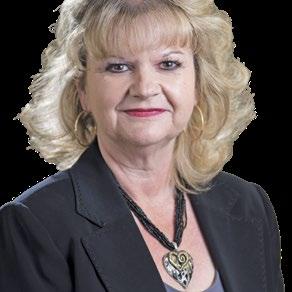
Janice McMichael-Dennis President and CEO, Bluewater Power, and Chair of the Electricity Distributors Association
The Electricity Distributors Association (EDA) publishes The Distributor for its members and stakeholders. All rights to editorial content are reserved by the EDA. No article can be reproduced in whole or in part without the permission of the EDA.
PUBLISHED SPRING 2026 FOR:
Electricity Distributors Association
3700 Steeles Avenue West, Suite 1100 Vaughan, ON L4L 8K8 www.eda-on.ca
EDA STAFF CEO’S OFFICE
Teresa Sarkesian, President and CEO
Natasha Galati, Executive & Administrative Assistant
POLICY, GOVERNMENT AND CORPORATE AFFAIRS
Ted Wigdor, VP, Policy, Government & Corporate Affairs
Derek Nardone, Director, Corporate, Government & Public Affairs
Brittany Ashby, Senior Regulatory Affairs Advisor
Rudra Mukherji, Senior Regulatory Affairs Advisor
Antonio Brieva, Senior Advisor, Government & Stakeholder Relations
Tina Wong, Senior Policy Advisor
MARKETING, COMMUNICATIONS AND MEMBER RELATIONS
Mike Chopowick, VP, Marketing, Communication & Member Relations
Marica Macura, Director, Member Relations
Lesia Kostecki, Senior Membership Services Advisor
Kimberly Hicks, Senior Manager of Communications & Marketing
Alec Mackinnon, Communications Coordinator
FINANCE AND ADMINISTRATION
Tamara Orlova, Chief Financial Officer
Arlene Klemmer, Accounting Clerk
Matthews Joseph, Senior IT Analyst
Chrissan Pascal, Business Support Specialist
PUBLISHED BY ANNEX BUSINESS MEDIA, 111 Gordon Baker Road, Suite 400, Toronto, ON M2H 3R1
(416) 442-5600
annexbusinessmedia.com
Agreement #: 43526108
ADVERTISING SALES
Media Edge nanciep@mediaedgepublishing.com
London Hydro Recognized by Canada’s Safest Employers for Best Wellness Program

London Hydro is the recipient of the Kii Health Award for Best Wellness Program as part of the annual presentation of Canada’s Safest Employers awards in fall 2025.
The award recognizes organizations that excel in promoting physical, mental, and social well-being in the workplace. It is awarded to companies that create programs fostering resilience, engagement, and a culture where employees can thrive. London Hydro has created internal wellness offerings to support employees such as on-site fitness resources and personalized health coaching to themed wellness weeks focused on mental health, mindfulness and seasonal well-being.
MILTON HYDRO AWARDED WITH EXCELLENCE IN INNOVATION BY MILTON CHAMBER OF COMMERCE
At their annual 2025 awards, The Milton Chamber of Commerce awarded Milton Hydro with the Excellence in Innovation Award for their forward-thinking approach and commitment to leveraging technology to enhance customer service and operational excellence. The award recognized the utility’s launch of their cloud-based OMNI-channel customer service platform that integrates phone, email and online support in a single interface.


FESTIVAL HYDRO’S GO PAPERLESS CAMPAIGN
RAISED $11,820 FOR LOCAL HOSPITAL
Thanks to the support of almost 800 customers switching to paperless billing, Festival Hydro donated $11,820 to the Stratford General Hospital Foundation.
LEADERSHIP CHANGES IN THE SECTOR
SHANNON RESTOULE, CEO, GREATER SUDBURY UTILITIES

Greater Sudbury Utilities (GSU) announced Shannon Restoule as its new President and Chief Executive Officer. She succeeds longtime leader Frank Kallonen, who retired after 38 years of dedicated service to GSU and its customers. Born and raised in Sudbury, Restoule is a Chartered Professional Accountant. Since joining GSU in 2012, she has held several progressive executive roles, including Vice President of Strategy and Growth and General Manager of Agilis Networks. She brings proven leadership experience, a deep understanding of GSU’s operations, and a strong connection to the community.
TOMO MATESIC, PRESIDENT AND CEO, ENTEGRUS

The Board of Directors of Entegrus Inc. announced the appointment of Tomo Matesic as President and Chief Executive Officer, effective March 1.
Matesic succeeds Jim Hogan who retired March 1 after two decades of leadership and dedicated service to the Entegrus and the Ontario energy sector. Matesic joined Entegrus in 2005 and previously held the role of Vice President Engineering and Operations. His vision, experience and commitment to community values align him for the CEO position.
Read the media release Read the media release
Read the media release
Read the media release
Read the media release
SECTOR SCAN
LEADERSHIP CHANGES IN THE SECTOR
IGOR RUSIC, PRESIDENT AND CEO, NIAGARA PENINSULA ENERGY
The Board of Directors announced the appointment of Igor Rusic as President and CEO, effective March 9. He brings a wealth of leadership experience and strategic vision to NPEI. Rusic’s background in the sector is extensive and he most recently worked as Executive Vice President, Finance and Administration, Milton Hydro.
ANTHONY ZARECKI, INTERIM PRESIDENT/ CEO, SIOUX LOOKOUT HYDRO
Sioux Lookout Hydro has appointed Anthony Zarecki as interim CEO in November 2025, following the retirement of longtime CEO Deanne Kulchyski. The Board of Directors thank Kulchyski for her leadership, dedication and contributions to public safety, customer service, and local reliability improvements. Zarecki joined the Sioux Lookout Hydro team in 2007 and was Operations Manager since 2019. He is known for his hands-on approach and strong relationships with staff, municipal partners and local businesses.
ROBERT WATSON, CHAIR, BOARD OF DIRECTORS, OSHAWA POWER

The Board of Directors of Oshawa Power Group of Companies appointed Robert Watson to replace outgoing Chair Denise Carpenter as of January 1. Watson served as Chair, Human Resources and Governance Committee and Vice Chair of the Board since his appointment in 2018. He has extensive industry experience as an executive in regulated environments such as CEO of the Information Technology Association and CEO of SaskPower and SaskTel.
CHRISTINE HEALY, BOARD OF DIRECTORS, ONTARIO ENERGY ASSOCIATION
The Ontario Energy Association welcomes Christine Healy to its Board of Directors. Healy is President & CEO of Northland Power Inc. and has extensive experience in international energy transition across the Americas, Europe, Asia, the Middle East, Australia, and Africa. She has also worked in the private, public and not-for-profit sectors and was recently named to the Global Top 275 Female Influencers of the Energy Sector.
LONDON HYDRO RECEIVES APPROVAL TO PURSUE AFFILIATE BUSINESS ACTIVITIES
In December, The City of London approved strategic direction for London Hydro to pursue affiliate business activities aimed at expanding the utility’s ability to innovate and participate in new markets beyond its regulated electricity distribution operations. This new structure allows them to re-establish London Hydro Holdings Inc. to support the utility’s participation in nonregulated business opportunities.

ELEXICON ENERGY INC. RELEASES 2027-2031 INVESTMENT PLAN
With the support of customer and community input, Elexicon Energy Inc. built its 2027-2031 Investment Plan: Energizing Growth around five key priorities to enable a more modern and sustainable grid.
Input was received by a survey where customers shared their top priorities on how money should be invested. Given that extreme weather events are more frequent and severe, one of the priorities is Strengthening Grid Resilience.
HYDRO ONE RECEIVES ELECTRICITY CANADA’S SUSTAINABLE ELECTRICITY DESIGNATION
By earning Electricity Canada’s Sustainable Electricity Designation, it confirms that Hydro One meets rigorous third-party verified standards for sustainability. Hydro One supports a sustainable future and practices responsible actions to strengthen the grid for long-term growth, reduce environmental impact, and improve service for communities across Ontario. Hydro One joins Toronto Hydro, Hydro Ottawa and Oakville Hydro in receiving this designation.
Read the media release
Read the media release

Alectra Named as Top GTA Employer for
Fifth Consecutive Year
Alectra has been named in the annual Greater Toronto Area (GTA) Top Employers competition for the fifth consecutive year. The competition evaluates organizations on workplace culture, health and financial benefits, training and development, and community involvement. Alectra’s inclusion reflects its long-term investment in creating a workplace ‘where people can grow, thrive and make a meaningful impact.’
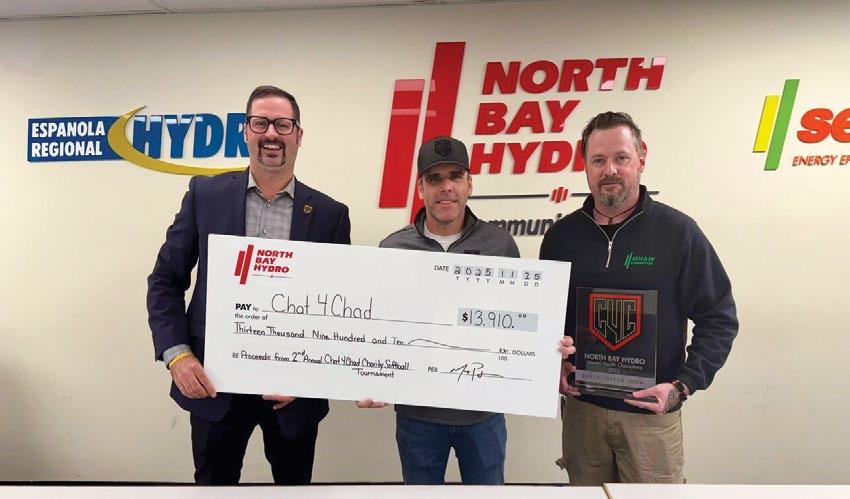
NORTH BAY HYDRO RAISES
$13.9K
FOR CHARITY
North Bay Hydro’s Mental Health and Wellness Committee hosted their second annual Chat4Chad Charity Softball Tournament bringing 15 teams together for a day of baseball that raised $13,910.
ENTEGRUS INC. MAKES $293K IN COMMUNITY DONATIONS
In December, Entegrus made three donations to strengthen communities within their service area. The Children’s Treatment Centre Foundation of Chatham Kent received $200,000 to support an expanded facility. Another $10,000 went to Blenheim Youth Centre, in partnership with shareholder Corix District Energy Holdings LP in support of youth programs focusing on supporting connection and confidence.
In St. Thomas, three organizations – Inn Out of the Cold, Project Tiny Hope and the Ignite Youth Centre received $58,000 to support housing, youth engagement and community services.
In January, Entegrus also donated $25,000 to Habitat for Humanity Chatham-Kent to support affordable housing for local families.
PUC ANNUAL BILLING CAMPAIGN RAISES
$8.3K
FOR CHRISTMAS CHEER PROJECT

PUC raised more than $8,240 for Christmas Cheer, a Sault Ste. Marie charity that raises money to purchase grocery cards of the following year’s holiday boxes to assist those in need. In addition, PUC also collected more than 300 toys for the charity as part of their community toy drive.
SECTOR SCAN

GRIDSMARTCITY WELCOMES THREE NEW UTILITIES
In January, GridSmartCity expanded their provincewide collaboration to include three new LDCs including Festival Hydro, InnPower, and London Hydro. This announcement builds on several years of steady growth, with these new utilities they now have 21 member utilities. The GridSmartCity Cooperative works to advance innovation, improve operational efficiency and support reliable, sustainable energy for the future.
ENWIN SUPPORTS E.L.K. ENERGY BY COMPLETING SECOND FEED IN KINGSVILLE
ENWIN and E.L.K. Energy completed infrastructure upgrades in Kingsville that bring a second hydro feed into commission. Since the project’s completion in December, Kingsville is now better positioned to support future growth and be less vulnerable to full outages.
WESTARIO POWER ANNOUNCE PROPOSED SALE TO ERTH CORPORATION
In early December, Westario Power’s Board announced the sale of Westario to ERTH Corporation. Westario said the sale will benefit customers, employees and the communities they service including Port Elgin, Kincardine, Hanover, Southampton, Walkerton, Wingham, Palmerston, Harriston, Lucknow, Mildmay, Teeswater, Clifford, Ripley, Neustadt and Elmwood. The Board said the sale will ensure they can meet rising electricity demands and ensure stable rates. Prior to approval of the sale, ERTH will establish an advisory committee to meet for a one-year period following the closing of the proposed sale.
ALECTRA EMPLOYEES RAISE $200K FOR UNITED WAY CAMPAIGN
Through a combination of payroll deductions and corporate contributions, Alectra employees supported their service areas in Greater Toronto, Halton and Hamilton, Niagara, Guelph Wellington Dufferin, and Simcoe Muskoka through $200,000 in United Way donations. The funds will be used to address immediate needs and create long-term stability for vulnerable populations in those communities.
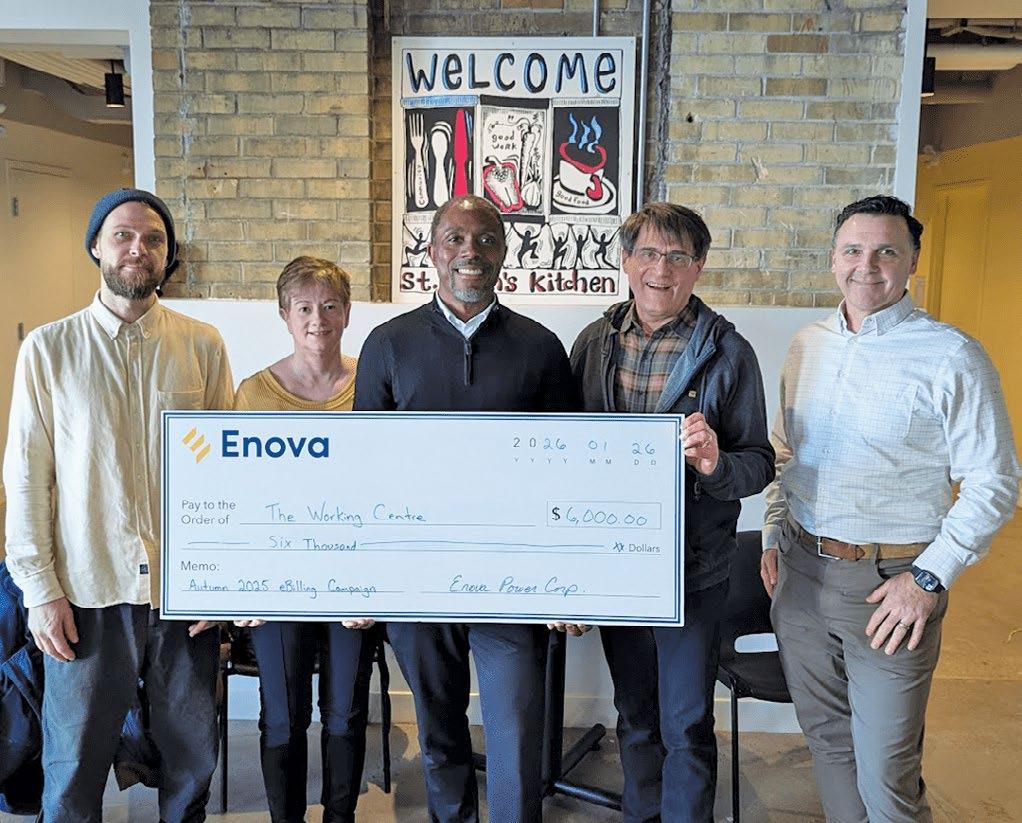
ENOVA POWER RAISES $6K TO SUPPORT VULNERABLE RESIDENTS IN KITCHENERWATERLOO
Enova Power’s fall e-billing campaign raised $6,000 for The Working Centre – an organization supporting vulnerable residents with meal programs, shelter and housing and social enterprises. Enova is thankful to their customers who made their donation possible by switching to e-billing.
HYDRO ONE TO BUILD NEW TRANSMISSION LINE BETWEEN BARRIE AND SUDBURY
A new priority transmission line spanning 300 kilometres between Barrie and Sudbury will be built by Hydro One in partnership with First Nations to support a stronger more reliable north-south electricity grid.
In early February, the Honourable Stephen Lecce, Minister of Energy and Mines and the Honourable Sam Oosterhoff, Associate Minister of Energy-Intensive Industries directed the Ontario Energy Board to have Hydro One develop and construct the new transmission line that is expected to be in service by 2032. Oosterhoff said transmission investments are crucial to meet growing electricity demand across our province.
No Longer If: When Cyberattacks Aim to Destroy
Why Ontario’s Grid Evolution Demands a New Approach to Cybersecurity
By Dave Cullen, Vice President of IT, Festival Hydro
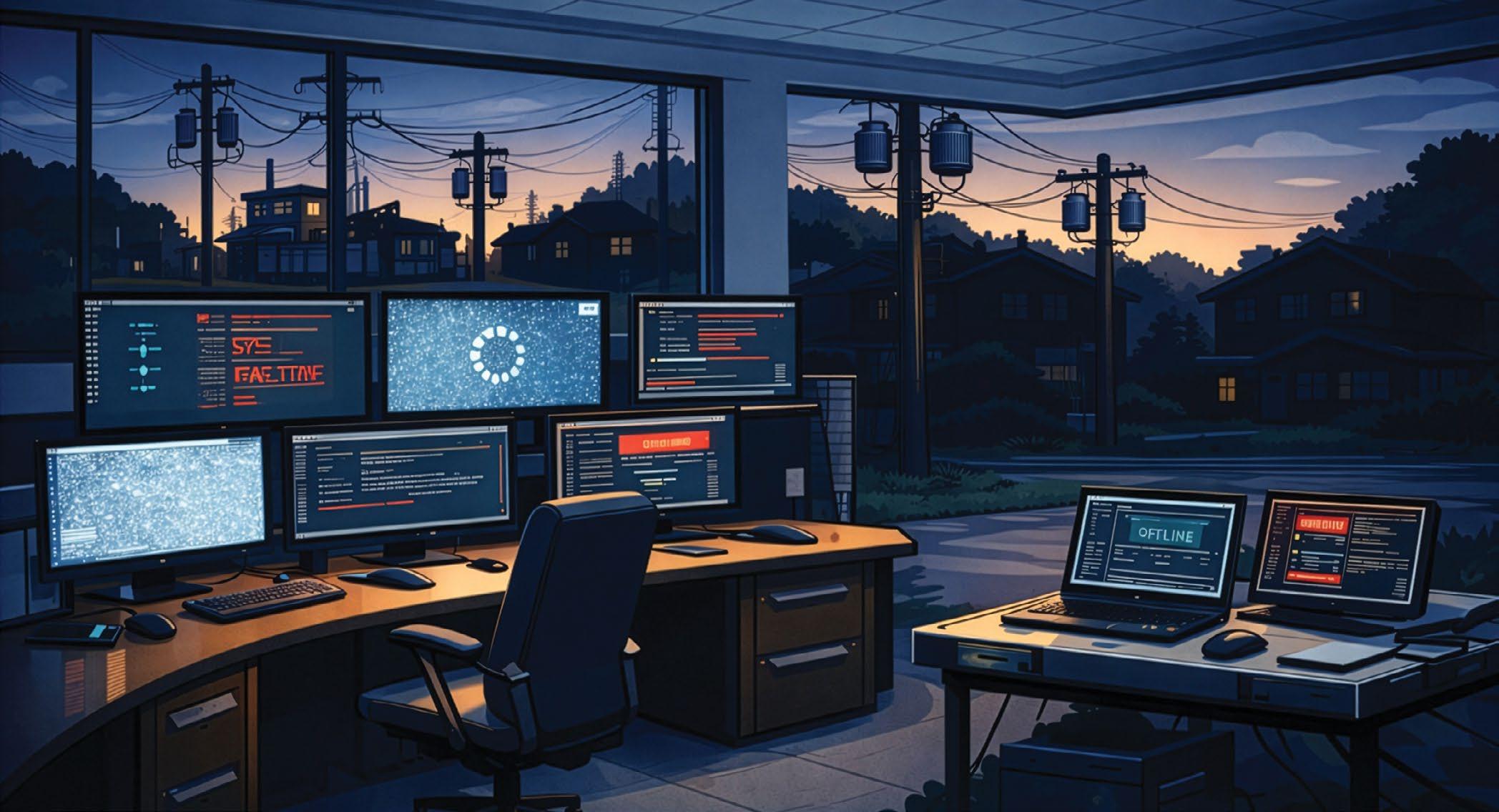
In late December 2025, a coordinated cyberattack struck Poland’s energy infrastructure, targeting a heat-and-power plant serving half a million customers and dozens of wind and solar installations.
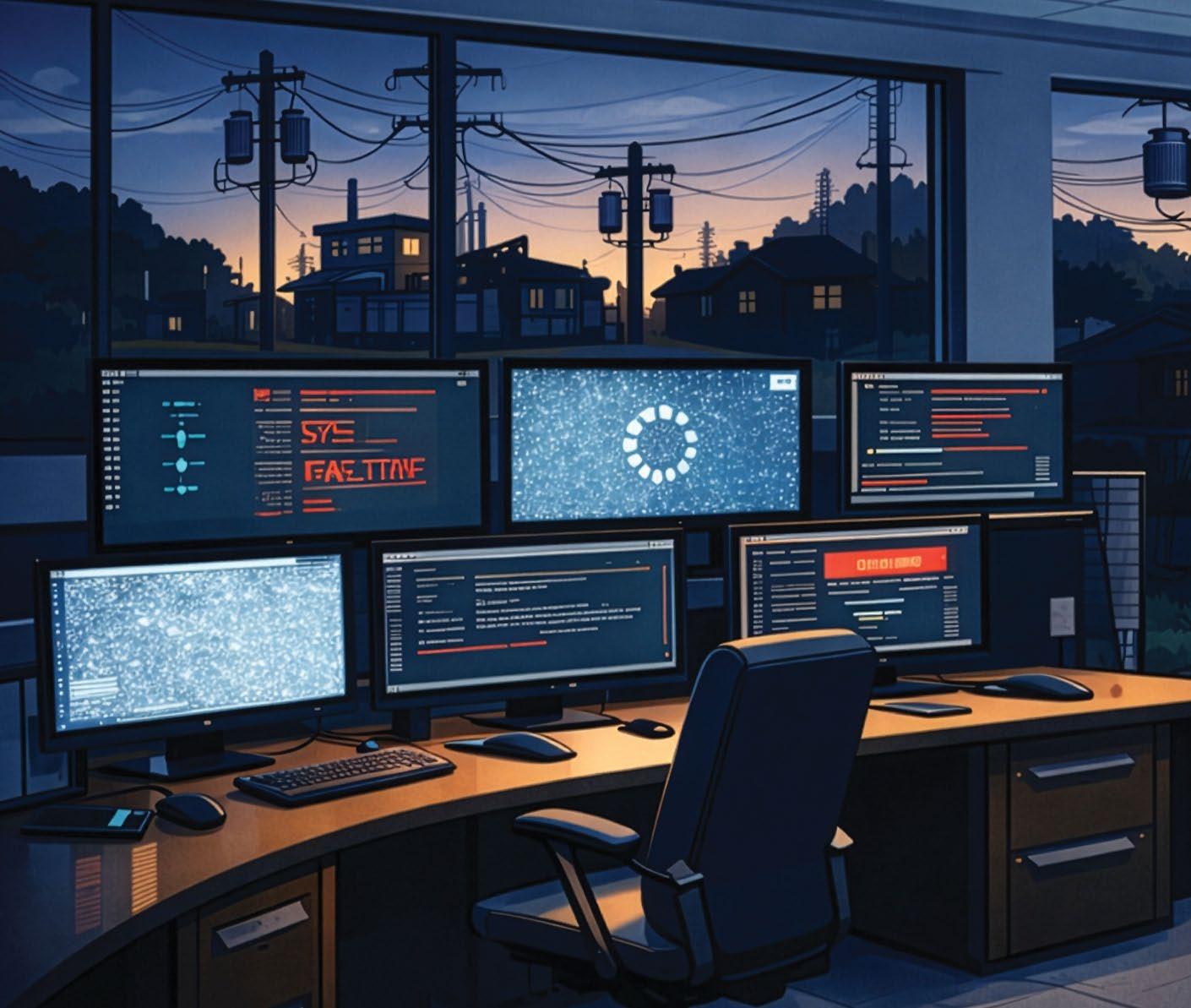
The attackers, linked to a Russian state-sponsored group, were inside the plant’s network for up to nine months before deploying malware designed to wipe over a hundred workstations and render the devices operators depend on to monitor and control the grid useless. Polish investigators described the operation as purely destructive, likening it
The risk profile for utilities is changing as we integrate distributed energy resources, deploy AMI 2.0, add automation, and adopt real-time intelligence platforms.
to arson. There was no ransom demand, no encrypted files with a payment link. The goal was to destroy operational systems and render them permanently inoperable.
That distinction matters. Utilities have traditionally treated ransomware as an attack that locks your systems, you restore from backups, and eventually you recover. The assumption is that your infrastructure is still intact afterward. A destructive attack changes the risk profile. When firmware is overwritten and devices are rendered inoperable, there’s nothing to restore. You’re replacing hardware, not recovering software. In Poland, attackers replaced legitimate firmware on remote terminal units with code that put devices into continuous reboot loops. If that played out across a utility’s Operational Technology (OT) network, recovery would be constrained not by Information Technology (IT) effort but by equipment lead times and supply chain availability.
These networked endpoints need to be secured and maintained. As we add these capabilities, are we accounting for security with the same rigour we apply to reliability and safety?
There are three technology areas where LDCs can make meaningful progress now.
1. Asset visibility. You cannot protect what you cannot see. As the grid advances, utilities should maintain an inventory of every networked device within the operational network—what it is, what firmware it runs, and its associated data flows. The Polish attackers exploited devices with outdated firmware and default credentials that nobody had changed, in part because there wasn’t a clear picture of what was deployed.
2. Data integrity. As utilities rely more on real-time data for operational decisions— voltage management, load balancing, outage detection—it becomes critical to ensure that data from field devices is both protected and trustworthy.
Utilities have traditionally treated ransomware as an attack that locks your systems, you restore from backups, and eventually you recover.
Encrypting data in transit and at rest prevents interception and tampering, while integrity checks like firmware signing and configuration baselines help detect unauthorized changes before they cause harm.
3. Network segmentation. Reducing the attack surface means ensuring a compromise of one system doesn’t give an attacker free access to everything else. While we have largely segmented OT from IT, isolating critical control systems and limiting lateral movement between zones with OT is essential as the grid grows more connected. In Poland, attackers were able to move freely across sites. Proper segmentation could have contained the damage. Building these capabilities into grid modernization planning rather than bolting security on afterwards is crucial. Incident response plans should account for destructive scenarios where field devices need physical replacement, not just a reboot. Spares strategies for components like Remote Terminal Units and communication modules should consider the possibility of simultaneous failures.
The Polish incident is a useful reference point, not because an identical attack is imminent, but because it shows what can happen when security practices don’t keep pace with grid modernization. As a sector, we have done well to build up strong cybersecurity capabilities, but as the threat landscape changes, we need to adapt our strategies. Through continued collaboration and a strong focus on resilience, Ontario LDCs will continue to the lead the way.

https://www.capgemini.com/ca-en/ industries/energy-and-utilities/


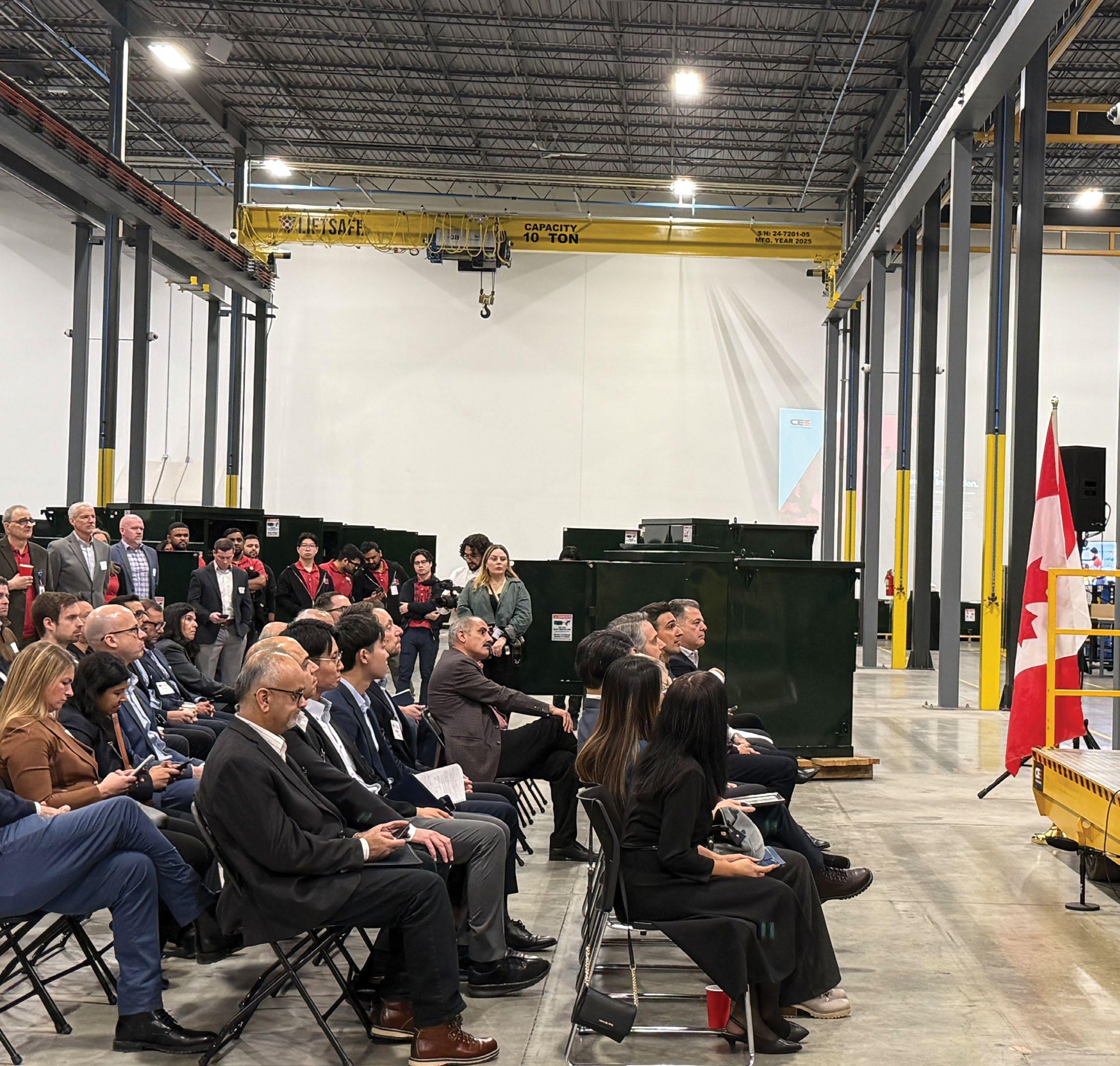
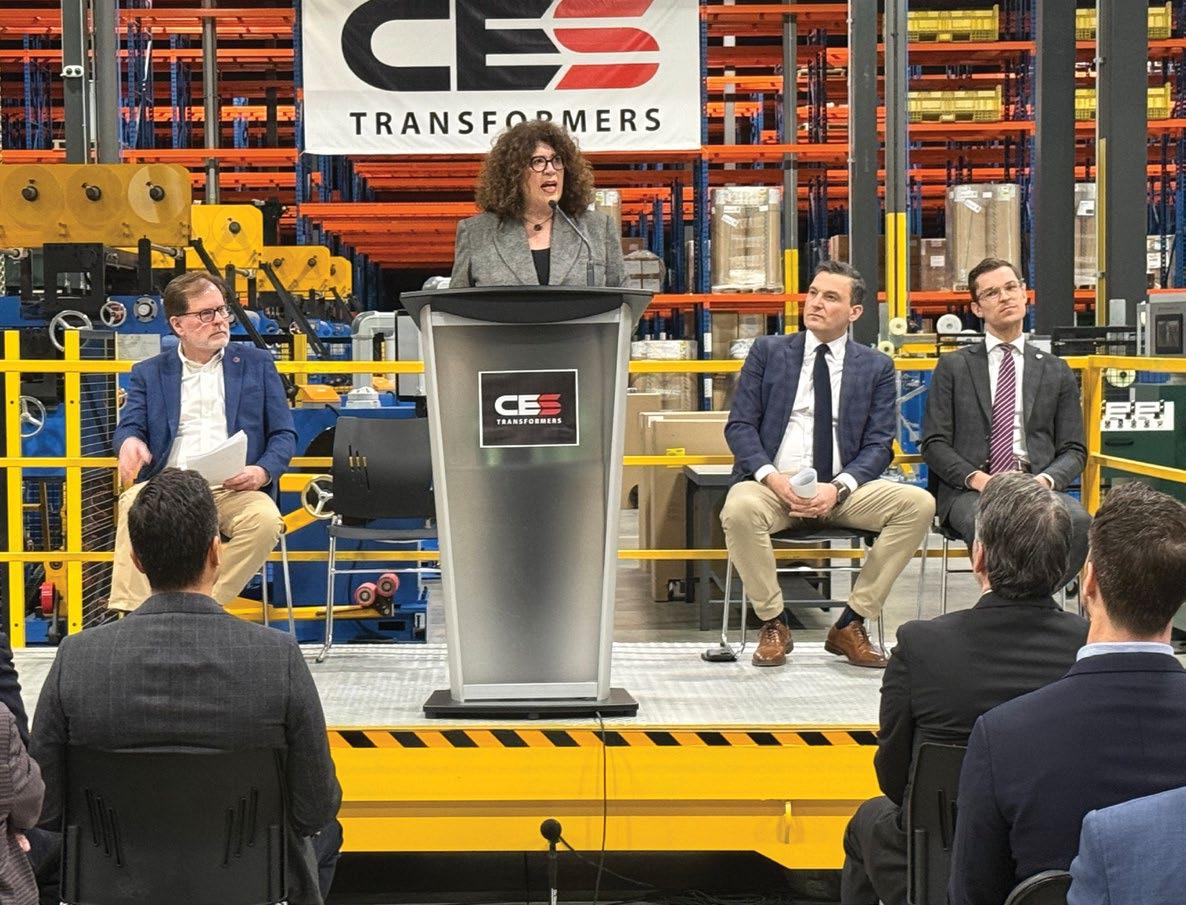

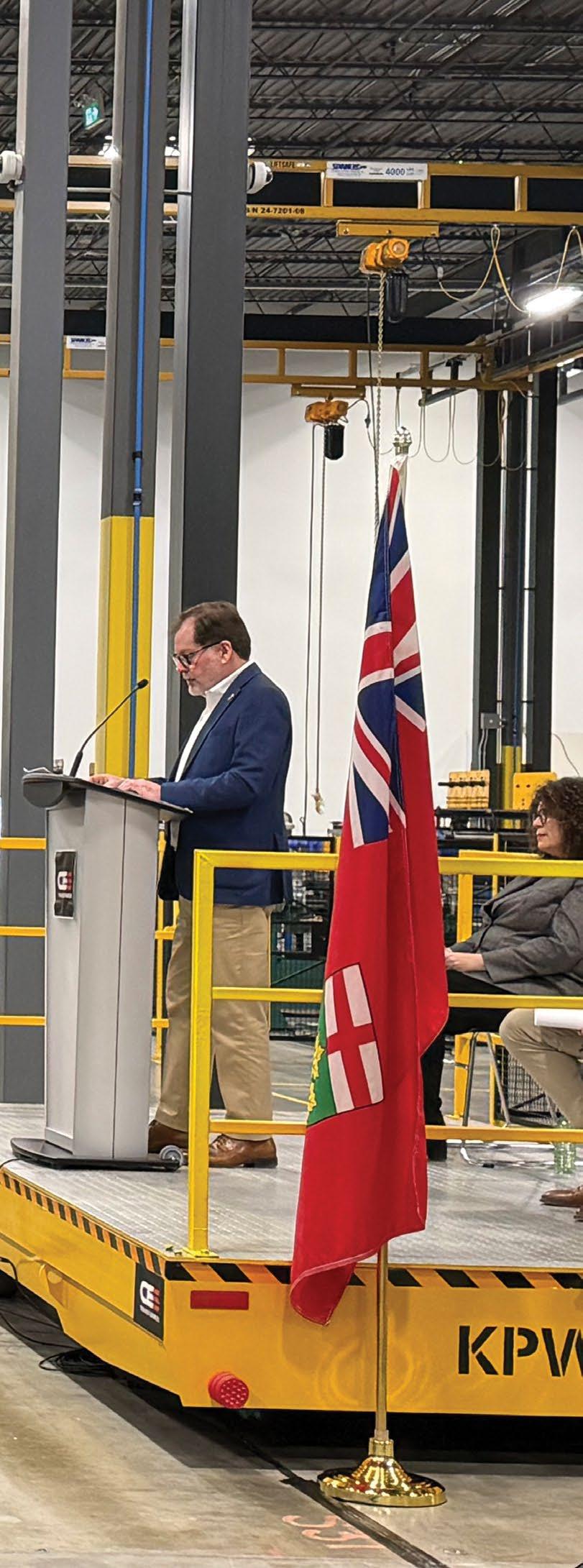
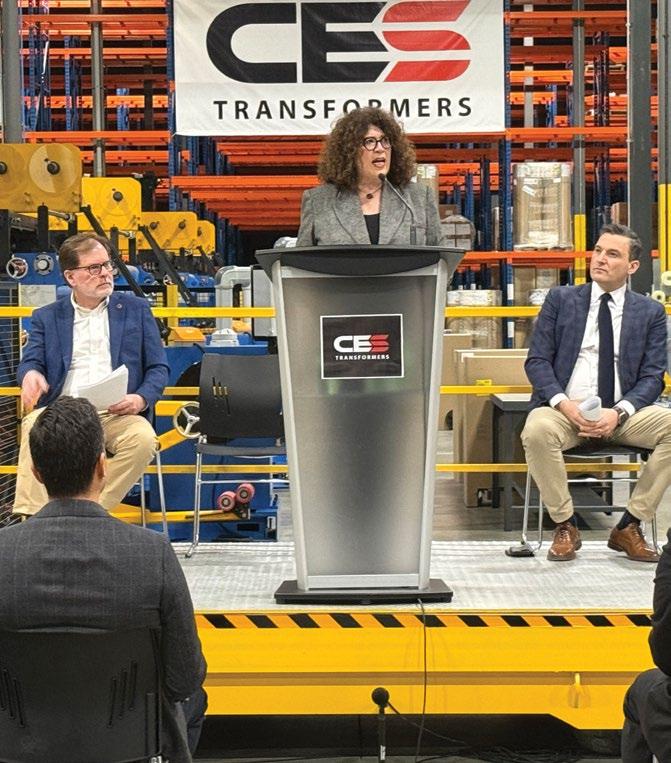
In January, CES Transformers celebrated the grand opening of its new 160,000 square-foot manufacturing facility in Markham. Their new location received a multi-million-dollar investment that will triple the company’s transformer production and help address supply shortages across the sector.
“Our expanded facility ensures we can deliver customized, high-quality transformers right here at home –supporting customers, creating jobs, and strengthening the grid for decades to come.”
reliably and safely deliver power to 5.4 million homes, businesses and industries,” said Sarkesian. “Increasing transformer production will help us meet the significant growth in electricity demand on the horizon, driven by electrification, housing, economic investment and data centres.”
The milestone event brought together industry and government leaders to mark a significant expansion of Ontario’s domestic manufacturing capability. EDA President and CEO Teresa Sarkesian served as Master of Ceremonies, joined by CES President, Adam Bryk, the Honourable Evan Solomon, Minister of Artificial Intelligence and Digital Innovation and Minister responsible for the Federal Economic Development Agency for Southern Ontario, and Sam Oosterhoff, Ontario’s Associate Minister of Energy-Intensive Industries.
- CES President, Adam Bryk
In her remarks, Sarkesian underscored the significance of CES’s $100 million investment, particularly at a time when Canada faces ongoing trade uncertainty with the United States. Strengthening local manufacturing capacity of transformers – an essential component of our electricity grid –has created a bottleneck in the supply chain in recent years. Transformers, Sarkesian added, are critical to maintaining a reliable grid and affordable electricity to customers across the province.

“All of Ontario’s electric utilities require transformers to
Guests toured the new facility during the event, gaining a first-hand look at CES’ state-of-the-art manufacturing capabilities. The plant produces transformers for local distribution companies across Ontario and throughout Canada, positioning the company as a key contributor to grid modernization and energy reliability.
Bryk described the opening as “a good day for our company and for the North American energy market.”
“Our expanded facility ensures we can deliver customized, high-quality transformers right here at home – supporting customers, creating jobs, and strengthening the grid for decades to come,” said Bryk.
Beyond increasing production capacity, the new facility will create 150 new manufacturing jobs in the Markham area by 2030. CES Transformers has been a family-owned business for almost 40 years. Christopher and Nicholas Espielithies, brothers and managing partners at CES were on hand for the celebration. Read the media release

What matters: Navigating a smarter, modern electrical grid
Powering our world has never been more challenging. It’s no longer enough to simply provide reliable electrical power. We have to be smarter about how we do it. From generation to transmission and distribution, we need to solve for the whole system. Increase efficiency. Upgrade an aging grid. Incorporate alternative energy resources. Migrate to automated utilization. Address cyber threats. Protect personnel. At Eaton, we’re already creating the answers for today’s power hungry world. And beyond. Our innovative products, intelligent power system designs and experienced engineers can help you tackle increasing demands on the power grid.
Milton Hydro Goes Digital, Saving Employees Time and Customers’ Money

Milton Hydro has transitioned from manual scheduling processes to a modern digital platform creating a faster and more efficient way for teams to plan work, support customers, and meet the needs of more than 44,000 customers.
The new scheduling system replaces disconnected manual steps with a centralized digital system that automates routine tasks, increases visibility, and supports real time coordination across departments. It also improves how staff deploy resources and manage daily operations. These improvements lead to cost savings, reduce errors, and provide stronger operational insight for frontline staff and leadership.
Milton Hydro President and CEO Troy Hare said the system has already delivered measurable results with thousands of
Milton Hydro staff from left, Hassan Syed, VP Distribution Services, Dave Belluz, Operations Manager, Adam Charlebois, Project Coordinator, and session host Mike Wittemund, VP Lines & Operations, Alectra during their EDIST presentation in January 2026.
workflow automations reducing manual effort and saving staff time every month, boosting efficiency and generating savings.
“These efficiencies translate directly into cost savings and allow skilled staff to focus on higher value work that benefits customers and the community,” said Hare.
Beyond operational improvements, the digital platform strengthens collaboration by breaking down silos and enhancing support for frontline crews and customers. Designed to scale across the organization, the system delivers value to engineering, stores, administration, and leadership teams as customer needs grow.
Milton Hydro’s work also gained industry recognition. Project Coordinator Adam Charlebois and Manager of Operations Dave Belluz presented the initiative at the 2026 EDIST Conference in Toronto, highlighting how digitization improves efficiency, reduces duplication, and strengthens support for the crews who keep power flowing every day.
This project represents a significant shift in how Milton Hydro plans work, shares information, and supports its people. With this new digital platform, the utility continues to build a more efficient, transparent, and resilient organization for the future.
C able Able ® CABLE & CONDUIT SUPPORT BRACKET
C able Able ® CABLE & CONDUIT SUPPORT BRACKET







Time-savingnon-metallic CableAble® Support


Time-savingnon-metallic CableAble® Support
Brackets are the
Four- and eight-hole CableAble mounts horizontally or vertically to studs or unistrut. And horizontally to all thread and beam clamps. up to $29 per MC Backbone Support
Time-savingnon-metallic CableAble® Support
Brackets are the ONE BRACKET for support of EMT or flexible metal conduit, power MC and NM cables, and low voltage cables, in commercial or residential work, with plenum or non-plenum ceilings.
Brackets are the ONE BRACKET for support of EMT or flexible metal conduit, power MC and NM cables, and low voltage cables, in commercial or residential work, with plenum or non-plenum ceilings.
BRACKET for support of EMT or flexible metal conduit, power MC and NM cables, and low voltage cables, in commercial or residential work, with plenum or non-plenum ceilings.
Four- and eight-hole CableAble mounts horizontally or vertically to studs or unistrut. And horizontally to all thread and beam clamps.
Four- and eight-hole CableAble mounts horizontally or vertically to studs or unistrut. And horizontally to all thread and beam clamps.


For power, data, communications, control systems • Lowers total installed cost • Minimizes space required for support –Reduces ceiling congestion
communications, control systems
• Lowers total installed cost
• Minimizes space required for support –Reduces ceiling congestion
Plenum applications per NEC 300.22(c)
• Plenum applications per NEC 300.22(c)



CA8 Eight, 1-1/4" T Bracket
CA8L Eight, 1-1/4” L Bracket
CA4 Four, 1-1/4" T Bracket
CA4L Four, 1-1/4” L Bracket

The Digital Grid: How RealTime Mapping Accelerates Power Restoration
ACCELERATING POWER RESTORATION THROUGH REAL-TIME GRID VISUALIZATION
Every LDC knows the common protocol when an outage call comes in. Where is it? What’s affected? How quickly can power be restored?
For years, answering those questions meant pulling out maps, making calls, and piecing together information from multiple sources. In Oshawa, that reality has changed through digital grid modernization.
THE DIGITAL TRANSFORMATION JOURNEY
Oshawa’s transition from legacy paper maps to comprehensive digital mapping has changed how the utility operates. Crews used
FLISR
Fault Location, Isolation, and Service Restoration technology
to work with printed diagrams that could be outdated before they even left the yard. Now they access dynamic, real-time grid representations on tablets, phones, and laptops. The shift goes beyond replacing paper with screens. It changes how the utility responds when customers lose power.
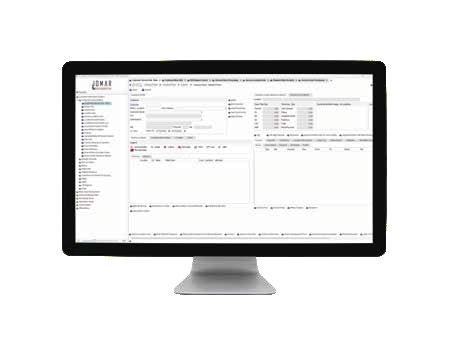
Connecting digital maps to the Outage Management System (OMS) is where the value really shows up. When an outage occurs, the system displays the affected area on maps that update in real time. Operations teams see what’s happening as it develops, and crews get dispatched with accurate information about conditions on site. The guesswork is gone.
SEEING THE DIFFERENCE IN ACTION
A recent protective relay trip in Oshawa’s downtown area shows how this works. Field crews arrived on site and could immediately see on their digital maps that the affected section had already been isolated from the rest of the grid. What used to require time spent investigating, tracing circuits, and confirming switch positions simply wasn’t necessary anymore.
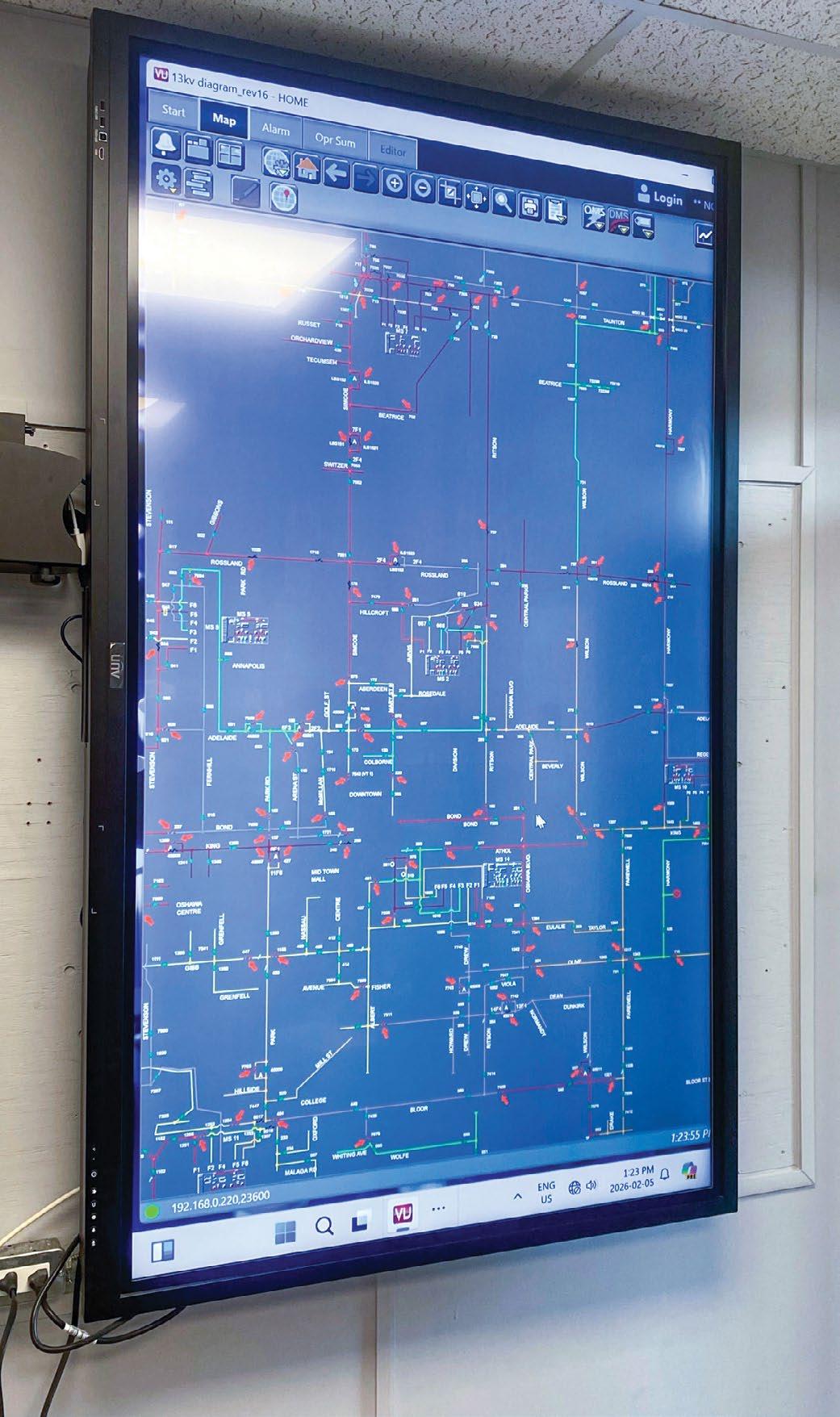
The map showed exactly which sections were isolated and which remained energized. Crews knew where to focus and could start restoration work right away. Power came back so quickly that some downtown businesses barely registered the interruption.
TAKING AUTOMATION FURTHER WITH TECHNOLOGY
Oshawa has layered Fault Location, Isolation, and Service Restoration (FLISR) technology on top of the digital mapping foundation. FLISR automatically detects faults, isolates problem areas, and restores power to unaffected sections, often before customers notice anything happened.
Combined with digital maps, FLISR provides exact information about which areas remain without power and which have been restored. During complex outages requiring multiple switching operations, operators track each step on their screens, verifying automated actions and intervening when needed.
This visibility changes customer conversations. When Oshawa residents call about an outage, the response is specific: how many customers are affected, their locations, and the steps needed for restoration, leading to more accurate estimates and less guesswork.
system maintains a complete history of outages, switching operations, and grid configurations. Patterns emerge that inform better procedures and infrastructure investment decisions.
The map showed exactly which sections were isolated and which remained energized. Crews knew where to focus and could start restoration work right away.
Crew training has improved too. New team members work with interactive digital maps instead of memorizing paper diagrams. During emergencies when all hands are needed, even crews unfamiliar with a particular area of the city can navigate using real-time digital guidance.
WHAT THIS MEANS FOR ONTARIO’S ENERGY FUTURE
What started in Oshawa as replacing aging paper maps has grown into something more significant. Digital mapping and OMS integration deliver measurable results: faster restoration, better information, improved service. These improvements show up in daily operations, not just on special occasions.
Adding capabilities like FLISR to this foundation keeps raising the bar. The rapid response times that used to be exceptional are becoming standard across the city. As other utilities across Ontario pursue similar modernization efforts, each will find their own path forward. The goal remains the same: reliable power delivery when communities need it.
The grid taking shape in Oshawa responds faster and operates smarter than what existed five years ago. For utilities considering digital transformation, the message is clear: the technology works, the benefits are real, and customers notice the difference. This is grid modernization in action.

BEYOND EMERGENCY RESPONSE
Digital mapping in Oshawa extends well beyond outage response. The
We are lESO registered as MSP#1002 and provide meter installation services; Meter Data Management (MDMA) functions, Web posting of data and bill reconciliation (MDS Web); Settlement Services (WSS Web) and Conservation and Demand Management to Wholesale Market Participants, Local Distribution Companies, Energy Services Companies and Generators.


By Peter Vickery, Chair, EDA Commercial Member Steering Committee
EDIST Expands in 2026 with New Venue, New Streams, and New Attendance Record COMMERCIAL CORNER
In January, 1,500 energy sector innovators, trendsetters and experts gathered in Toronto for three days at EDIST to exchange ideas and shape Canada’s energy future— marking an unprecedented 40 per cent growth over last year.
In its 20+ year history, this was the largest EDIST yet. The Electricity Distributors Association’s (EDA) flagship conference sold out in advance of the January 20-22 event, reflecting both the sector’s momentum and growing demand for connection, collaboration and forward-looking dialogue.

This year’s event also marked a move to a new waterfront location at the Westin Harbour Castle. Our expanded tradeshow showcased 128 exhibitors – the most in EDIST’s history. The support from LDCs and our commercial partners was exceptional. We extend our sincere appreciation to every commercial member who brought their innovative products, technologies and services to life on the tradeshow floor.
Utilities of all sizes and from all corners of Ontario were represented, along with out of province utilities including St.
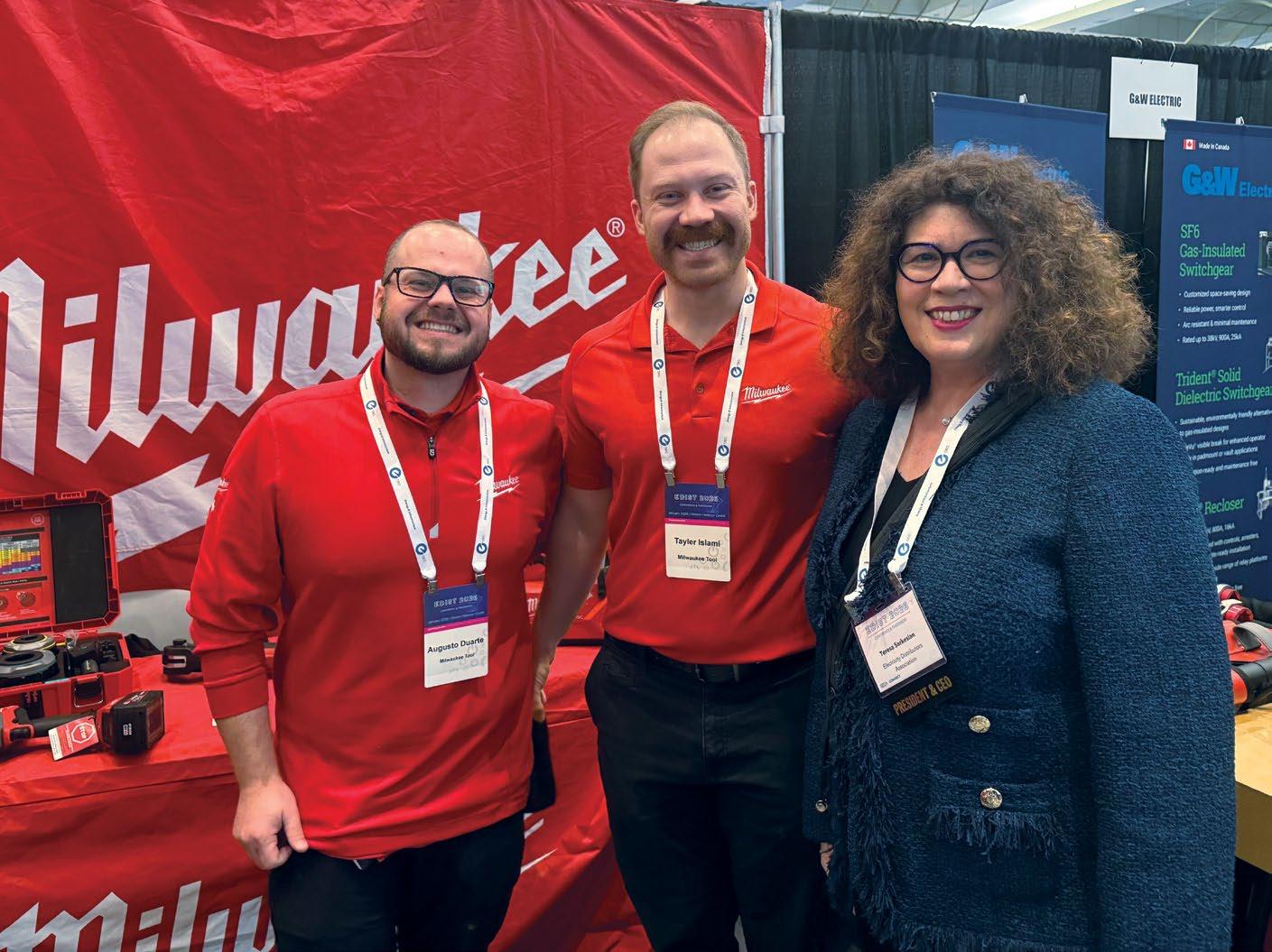
EDA CEO Teresa Sarkesian connects with Milwaukee representatives on the trade show floor.
John’s Energy, Manitoba Energy, and Hydro-Quebec. The expanded program attracted a broader audience and reinforced EDIST’s reputation as a national platform for the electricity sector.
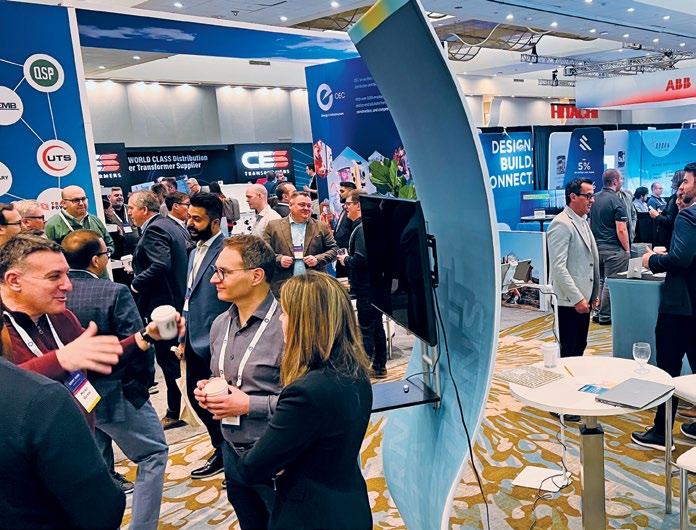
The tradeshow created valuable opportunities for attendees to connect with vendors, explore emerging technologies and bring new practices back to their organizations. Exhibitor mixers on the first two days, encouraged networking, allowing vendors and attendees to build relationships beyond the booth.
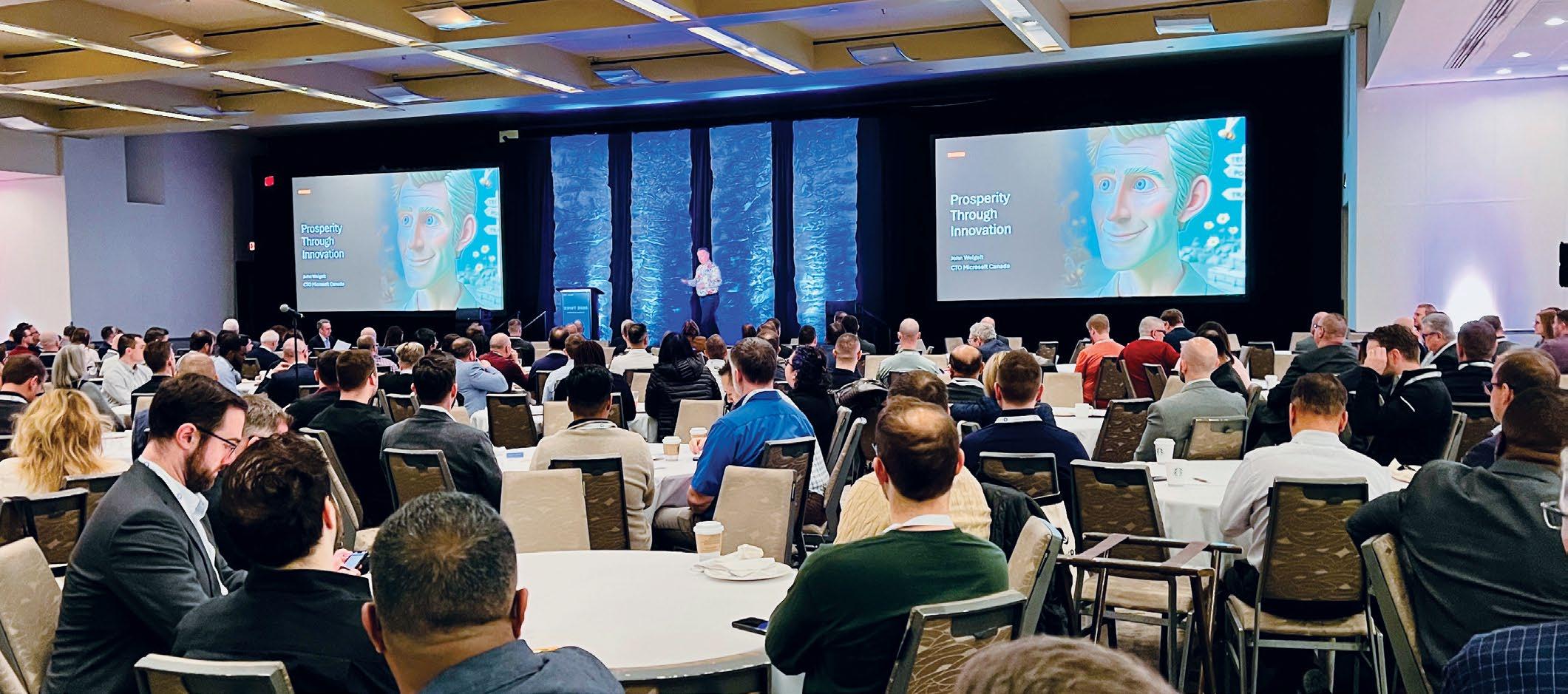
Opening keynote speaker John Weigelt of Microsoft Canada set the tone with a compelling look at the future of AI expansion and Canada’s opportunity lead.
“We need to be bold and brash and say, we build that here,” said Weigelt. “It takes time for rule sets to change; it takes time to make systemic changes. We need to work together in a collaborative way to make these systemic changes.”
Across three days, EDIST welcomed prominent plenary speakers including Mitch Panciuk, CEO of Ontario One Call, Carolyn Calwell, CEO of the Ontario Energy Board (OEB), and Michelle Branigan and Tania Chaar of the Electricity Human Resources Canada (EHRC), among others.
Between plenaries, attendees chose from 35 concurrent sessions organized into five streams: Sustainability & Decarbonization, Regulatory, Operations, Engineering, and IT & AI. The addition of the Sustainability & Decarbonization and IT & AI broadened the conference’s reach, attracting CEOs, CFOs, regulatory leaders and environmental experts.
These sessions highlighted the innovation and transformation underway across the sector. Their success is thanks in large part to our dedicated EDIST committee volunteers who carefully reviewed submissions and curated a program showcasing the industry’s best
thinking. We extend our sincere thanks to the committee for their leadership and commitment.
The conference closed off with inspiring keynote from best selling author Marc Champagne on building “Strong Minds.” Drawing on lessons from his Uncle Al where they went for early morning coffee and chats at Tim Hortons, Champagne reflected on the power of presence, connection and reflection and defining your daily non-negotiables.
“It’s about becoming mentally fit,” said Champagne. That could mean, he added, a morning affirmation, meditation or a “pump me up” playlist to reset yourself.
EDIST’s future is brighter than ever. Plans are already underway to further expand the exhibit floor and enhance the registration experience. If you missed this year’s event, watch on our website for exhibitor opportunities launching mid-year.
We look forward to welcoming you back January 18-21, 2027, for EDIST.
Above EDIST2026 kicks off with keynote speaker John Weigelt from Microsoft Canada who spoke about AI, collaboration and innovation.
Left EDIST conference attendees visit one of our 128 exhibitors on the trade show floor.
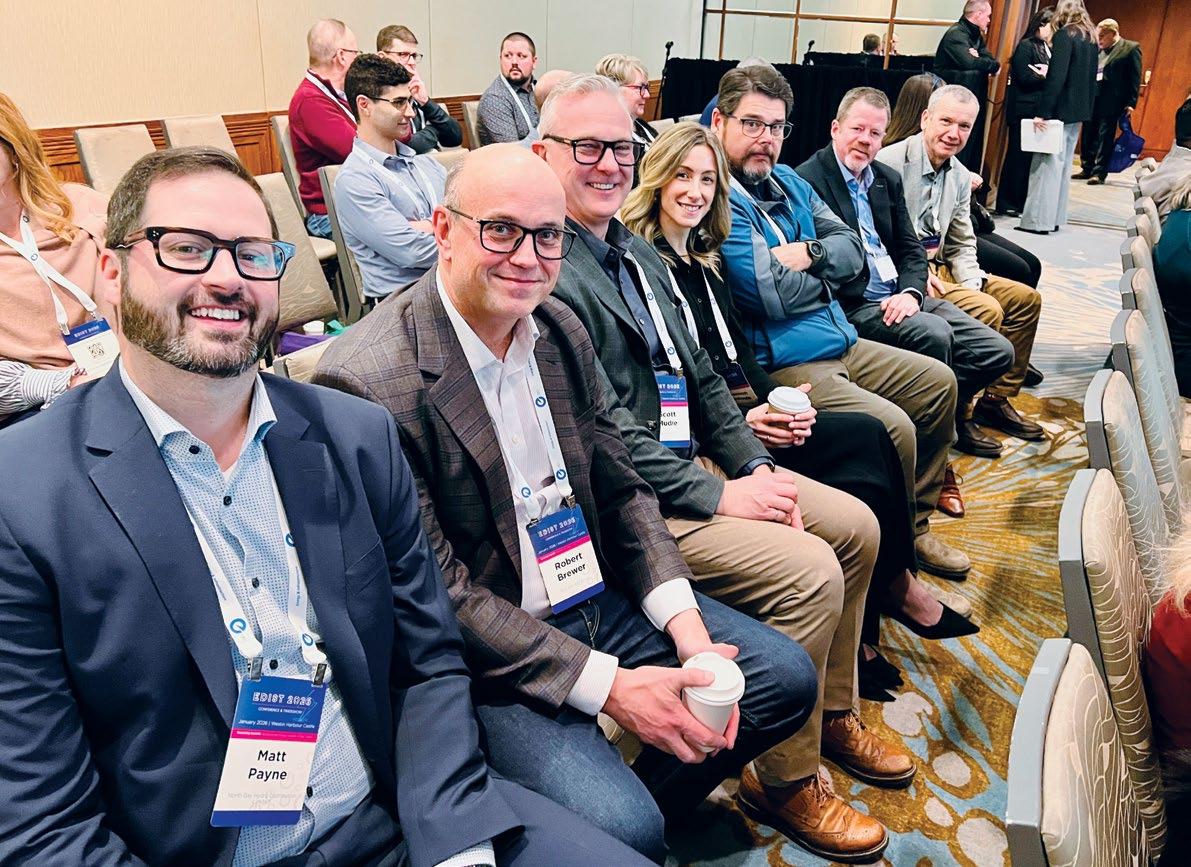
Right L-R: Matt Payne (North Bay Hydro), Rob Brewer (PUC Services), Scott Mudie (OEC), Shannon Restoule (Greater Sudbury Hydro), Frank Kallonen (PowerShare Inc.), Kevin Carver (Welland Hydro), David Fell (Utilities Kingston)






Harnessing Innovation as a Catalyst for Economic Development
By Carolyn Calwell, Chief Executive Officer, Ontario Energy Board
The energy sector is going through a period of seismic change. Forecasts show sustained and significant growth in energy demand over the coming decades. Our energy mix is evolving, and our grid requires significant modernization, which necessitates new and enhanced approaches to investment.
Ontario’s electricity distributors are witnessing these changes first-hand, through interactions with customers, stakeholders and, of course, the province’s energy regulator, the Ontario Energy Board (OEB). Utilities are responding with ingenuity, yet the goals that lie ahead of us – through 2026 and beyond –cannot be met by working in the same ways we always have.
To deliver affordable, secure, reliable and clean energy that supports Ontario’s economic growth, innovation is the path forward.
Facilitating innovation in the electricity sector has been a legislated mandate and strategic goal for the OEB for more than five years, and it is arguably more important now than it was when first introduced. This is especially so in the context of Energy for Generations and the Minister’s June 2025 Integrated Energy Plan Directive to the OEB.
The initiatives featured here demonstrate how the OEB is approaching the challenges we’re facing and pursuing opportunities by marrying innovation and economic growth.
CENTRALIZED CAPACITY INFORMATION MAP
In January, we launched our Centralized Capacity Information Map (CCIM). Providing users with information to allow early-stage screening, the CCIM is a
powerful tool designed to provide transparent, accessible data about the province’s electrical grid capacity for both load and distributed energy resource (DER) connections.
The CCIM features capacity data submitted by Ontario’s licensed electricity distributors, whose expertise and input were instrumental throughout the development process. The map can be used by anyone in Ontario – and beyond – to get an indication of available grid capacity that could allow for new homes, commercial and industrial expansion, and electric vehicle (EV) charging infrastructure. It also shows hosting capacity for DERs such as rooftop solar and battery storage installations and helps users such as municipalities and developers screen and compare connection opportunities.
Having this rich data so readily available for our vast province is a needle-moving innovation and a definite catalyst for economic growth.
DISTRIBUTION SYSTEM OPERATOR ROADMAP
In December 2025, we also shared with the Minister of Energy and Mines our Distribution System Operator (DSO) Roadmap, which we see as a practical plan for advancing regulatory policy for DSOs.
The roadmap recognizes that DSO capabilities create conditions that allow DERs to contribute to the energy ecosystem, supporting new businesses and economic growth opportunities. Our plan proposes a staged, evidence-based path that leverages sector progress and ensures the regulatory environment supports distributors as they evolve their DSO capabilities.
We know we are not the only organization considering how to advance DSOs in the province and that our proposed method is not the only possible path forward. Our plan’s focus on informed testing, before making decisions that may have significant and costly impacts, appropriately balances the risks and rewards inherent in these
emerging systems that promise significant economic building power.
The EDA and many of its LDC members participated in our DSO consultations, for which we are grateful, as always. We look forward to continuing to work with stakeholders to move this initiative forward.
UTILITY REMUNERATION
Utility remuneration is another arena where innovative approaches are needed for utilities to remain viable and attractive to investors. The OEB’s Next Generation Rate Framework consultation, launched earlier this winter, focused squarely on utility remuneration, providing an opportunity to advance our approach and continue to drive outcomes that consumers value and that meet the needs of a changing energy sector.
We are confident that, with input from the sector, we will be able to propose improved remuneration approaches for LDCs, which take into consideration incentives and performance goals, capital bias and the need for predictable regulatory outcomes for creditors and investors.
We appreciate the thoughtful input we received from the sector on our Spending Pattern Analysis report, published in January, and on the objectives, scope and topics of the Next Generation Rate Framework consultation. We are on track to communicate next steps for this initiative in the coming months and will remain open to incorporating insights from the sector, including from the government’s Panel for Utility Leadership and Service Excellence report on how to best fund and deliver the next generation of electricity infrastructure.
APPLICATIONS
Since the December 2025 passage of Bill 40, which amended the Ontario Energy Board Act, the OEB is applying new ways of thinking to the applications and adjudication processes – and asking applicants to do so as well. In response to our new objective to enable economic growth, the OEB now requires that applicants detail the economic benefits supported by their major applications. These could be indicators such as job creation, contributions to the local economy, development of supply chains and linkages with other Ontario industries.
Supporting economic growth has long been integral to OEB’s mandate. For instance, there is about $68 billion worth of applications currently before the OEB,

Carolyn Calwell, Chief Executive Officer, Ontario Energy Board
representing a very significant amount of upcoming economic activity for our province.
Initial guidance regarding how to highlight economic benefits in applications was sent to the sector in a December 2025 bulletin from our Chief Commissioner, along with amended filing requirements. We look forward to seeing the case made for economic benefits in upcoming rate applications and we will provide additional guidance as needed.
LONG-TERM LENS FOR THE ENERGY SECTOR
The OEB views Ontario’s energy sector through a long-term lens and recognizes that innovation – in many forms – is required now for generational success. Since becoming CEO of Ontario’s energy regulator last September, I have been inspired by sector-led innovation that is already creating potential for Ontario’s economic growth. As we continue to work together – and work differently – I look forward to seeing how our province advances innovation to enable reliable, affordable, clean and safe energy for our province now and into the future.

Imperatives for a Connected Utility: How Vertical AI Transforms Every Utility Interaction
By Peter Vickery, Smart Energy Water (SEW)
Today’s energy and water customers expect more than just uninterrupted service - they want control, transparency, and personalization in how they interact with their utilities. From real-time usage insights and flexible payment options to proactive updates during outages, modern customers expect utilities to anticipate their needs and respond intelligently.
Meeting these expectations requires utilities to rethink traditional operations. Going beyond infrastructure and resource management, the focus required shifting to delivering seamless, human-centered experiences across every touchpoint - online, in-app, or in person.
This transformation is powered by Artificial Intelligence (AI), but not just any AI.
Utilities need Vertical AI, a type of domain-specific intelligence designed to address the unique challenges of the sector. Vertical AI enables utilities to personalize communications, predict demand, manage distributed energy resources, and optimize field operations, creating smarter, more responsive services for consumers.
Its impact is maximized when deployed within an interoperable platform ecosystem, where customer experience (CX), workforce management (WX), and business experience (BX) platforms operate as a connected, seamless network.
For utilities ready to move beyond reactive service and improve customer service, the question isn’t if AI will transform their operations - it’s how quickly they will embrace it.

A connected ecosystem can:
• Provide real-time updates and insights that empower customers to make informed decisions
• Equip field teams with accurate, actionable data, ensuring faster resolution during outages or service interruptions
• Align back-end operations with front-end engagement, creating a seamless and consistent customer experience
HERE’S WHERE VERTICAL AI CAN BE VALUABLE
A Vertical AI-powered Connected Experience Platform can address thousands of use cases across the energy and utilities sector. From enhancing grid resilience to personalizing customer interactions and optimizing field workforce management, Vertical AI has the potential to transform hundreds of utilities worldwide, impacting billions of people globally.
Key Use Cases of Vertical AI in the Electrical Sector:
• Customer Engagement: Empower customers to manage their utility accounts anytime, anywhere through AI-powered mobile apps and web platforms, offering real-time usage insights, proactive notifications, and personalized guidance for a seamless, meaningful, and tailored experience.
• Smart Payments: Vertical AI can allow customers to pay their bills anytime, anywhere, offering flexible options like pay-as-you-go, automated payments, and custom plans, making transactions seamless, convenient, and tailored.
• Electric Mobility (EV Management): Optimize EV charging schedules to balance grid demand, reduce peak loads, and integrate charging behavior with energy plans. Vertical AI enables utilities to support sustainable mobility while maintaining grid stability.
• Multi-Persona Support: Cater to a wide range of stakeholders, including landlords, property managers, municipalities, and smart city administrators, with precise, scalable solutions. From multi-tenant billing to city-level energy management, AI ensures flexibility and accuracy across diverse use cases.
• Outage Prediction & Mitigation: Proactively detect and manage planned and unplanned outages. AI predicts potential issues, communicates restoration updates to customers in real-time, and equips field teams with actionable data for faster response and resolution.
• Demand Response Optimization: Implement incentive programs to encourage customers to conserve energy during peak hours, balancing supply and demand while rewarding participation. AI helps utilities optimize grid performance while fostering sustainable energy usage.
• Field Workforce Experience: Streamline operations with advanced work order management, intelligent scheduling and dispatch, mobile app platform, smart wearables, and real-time tracking. AI empowers field teams to work efficiently, ensure first-time fixes, and deliver superior service.
• Business Experience Management: Leverage AI-driven analytics, CRM, and campaign management to optimize customer interactions, improve operational decisions, and enhance strategic planning. Utilities can make data-driven decisions that strengthen both customer satisfaction and business outcomes.
• Advanced Analytics: Use AI to analyze energy, customer behavior, and operational performance. These insights drive efficiency, reduce costs, streamline complaint management, and improve program administration while empowering utilities to make informed, strategic decisions.


Vertical AI enables utilities to personalize communications, predict demand, manage distributed energy resources, and optimize field operations, creating smarter, more responsive services for consumers.
• Revenue Realization: AI can help utilities maximize revenue by reducing payment delays, minimizing chargebacks, and automating reconciliation, ensuring accurate, timely, and efficient collection while improving overall financial performance.
A fully connected, AI-powered ecosystem doesn’t just improve operations - it reinvents what it means to serve a utility customer. Imagine a world where outages are predicted before they happen, payments are seamless, energy usage is personalized, and field teams have everything they need at their fingertips. This is not the future - it’s what Vertical AI enables today.
For utilities ready to move beyond reactive service and improve customer service, the question isn’t if AI will transform their operations - it’s how quickly they will embrace it. The power to anticipate, adapt, and act intelligently is in your hands. Are you ready to unlock it?
PROTECT, POWER & CONNECT YOUR DATA


Proudly Canadian Owned and Operated
Proudly Canadian Owned and Operated
Proudly Canadian Owned and Operated
Proudly Canadian Owned and Operated
Our secure, reliable solutions provide the dependable infrastructure you need, protecting operations, improving efficiency, and reducing costs.
Our secure, reliable solutions provide the dependable infrastructure you need, protecting operations, improving efficiency, and reducing costs.
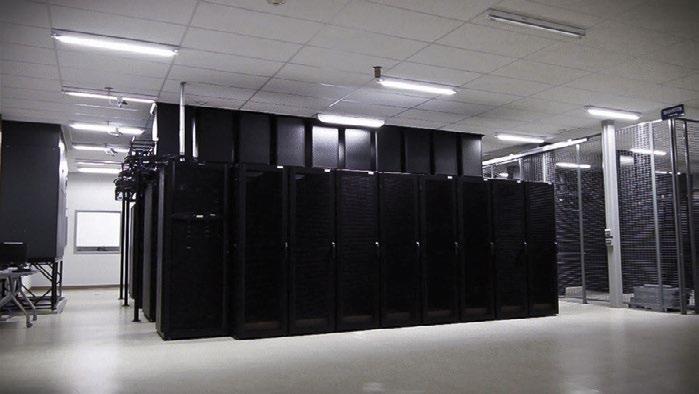
Whether you need a primary or secondary colocation, our customizable services are designed to meet your specific needs.
AI-ready infrastructure: designed for power, space, cooling, and sustainability
AI-ready infrastructure: designed for power, space, cooling, and sustainability
AI-ready infrastructure: designed for power, space, cooling, and sustainability


UPTIME FOR
connect? Let’s talk. 1-866-804-7325 x 4306 datacentre@entegrus.com entegrus.com/datacentre
Entegrus Data Centre
Entegrus
ADVOCACY IN ACTION

EDA SUBMITS RECOMMENDATIONS TO PULSE PANEL
EDA submitted its recommendations to the Panel for Utility Leadership and Service Excellence (PULSE) in December 2025. The Panel, announced in October, is tasked to provide strategic advice and recommendations to the Minister of Energy & Mines on how to “ensure LDCs are positioned to meet increasing electricity demand while maintaining high standards of safety, reliability, and cost-effectiveness.”
The EDA held several membership meetings to solicit feedback and expert advice on these issues. Key Principles of our recommendations include:
• Differentiation, not uniformity: policies must account for the diverse capital needs, pacing of capital needs, geographies, customer bases, and asset conditions of LDCs.
• Flexibility in pathways: enable multiple pathways so each LDC can pursue the model that best fits its local context. Recognize different needs and different capabilities.
• Predictable, stable regulatory environment: ensure reforms do not introduce uncertainty that could raise capital costs, delay critical investments or create new investor risk.
• Incentives over mandates: encourage efficiency, collaboration, and innovation through supportive mechanisms rather than prescriptive restructuring. Carrots over sticks.
• Strengthen, do not dilute, local accountability: governance models should recognize municipal interests while enabling access to capital and expertise.
• Partnership-based reform: co-design solutions with distributors to ensure practicality, affordability, and alignment with grid modernization needs.
MINISTER’S LETTER OF DIRECTION TO ONTARIO ENERGY BOARD
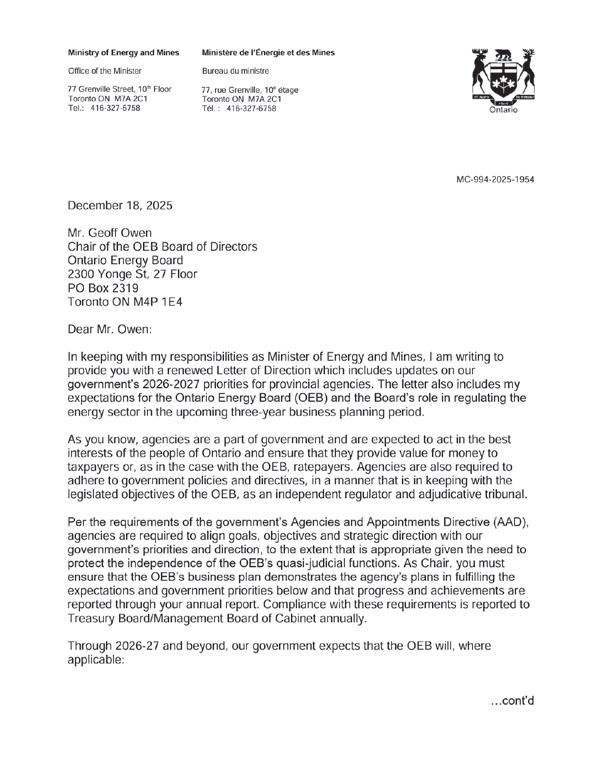
In late December, the Ministry of Energy and Mines issued a Letter of Direction (LOD) to the Ontario Energy Board (OEB) setting the foundation for 2026 expectations. The LOD directs OEB to strengthen domestic supply chains, deliver a better customer service experience, better value for money, and enhance reliability, resilience, and performance across Ontario’s distribution sector in the face of weather related, cyber security and other emerging risks. The full LOD is available on the OEB’s website.
EDA SUBMITS COMMENTS ON CANADA’S CLEAN ENERGY STRATEGY
In January, the EDA submitted its comments to the federal government regarding Canada’s Clean Electricity Strategy. The comments focus on areas of the strategy which could be adjusted to include distribution systems, and by extension LDCs.
OEB CENTRALIZED CAPACITY INFORMATION MAP
See OEB’s letter on capacity maps here
experts engaged with the OEB to successfully advocate for:
In January 2026 the OEB officially made its Centralized Capacity Information Map (CCIM) public. This OEB-hosted map is intended to be the next phase of the online map project that began in 2024, and led to LDChosted load capacity maps that have been live since March 3, 2025. On June 26, 2025, the OEB mandated the provision of capacity data for quarterly updates of the CCIM as a license condition of LDCs. In 2025, the EDA’s Electrification Council and LDC
• presentation of load and hosting capacities as polygons, rather than detailed circuits
• allowing LDCs to redact data where security or customer privacy is a concern
• clarification from the OEB on questions of data liability and cybersecurity
To support LDCs in communicating with their customers, the OEB has made an “LDC Communications Package” for the CCIM available for download through its map data submission portal. This package can be accessed on the members-only section of the EDA website (login required). If you have any questions, please contact Tina Wong, the EDA’s Senior Policy Advisor (twong@eda-on.ca).
EDSM 2025 YEAR IN REVIEW: NEXT STEPS FOR 2026
As the first year of Ontario’s new 12-year eDSM framework concluded in 2025, Stream 1 participation continues to build, with more than 40 LDCs now engaged and quarterly reporting underway. In 2026, the newly formed Governance Committee will lead several key next steps: consolidating LDC feedback for the IESO, reviewing Stream 1 funding allocations as program activity increases, and beginning work on the process for a successor eDSM agreement to take effect after 2027.
For Stream 2, the sector is awaiting guidance from the OEB following the Regulatory Working Group’s proposed streamlined approval mechanism for local and regional eDSM programs. If adopted, this framework could enable LDCs to incorporate Stream 2 proposals into their 2026 regulatory filings.
Read the full submission
Upcoming EDA Events
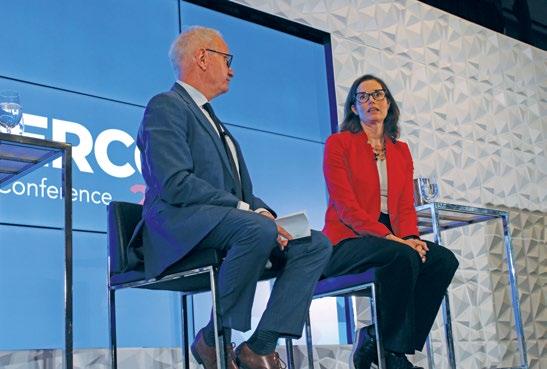
ENERCOM 2026
March 22-23, 2026 | Fairmont Royal York, Toronto
Join us for Ontario’s leading forum on the future of electricity distribution. Hear from industry leaders who are shaping the future of energy across North America:
• Building Ontario Fund, Michael Fedchyshyn, CEO
• New York Power Authority, Justin Driscoll, President & CEO
• American Public Power Association, Scott Corwin, President & CEO
• Canada Energy Regulator, Gitane De Silva, Former CEO ENERCOM is the place for timely discussions on system transformation, regulation and innovation. The conference includes networking receptions and strategic insights for executives and emerging professionals.

Save the Date
Director’s Summit
May 5, 2026 | Toronto
EDIST 2027
The Electricity Distributors Association (EDA) has a slate of exciting events planned through 2028. Mark your calendars and join us for upcoming conferences and our annual award Gala that showcases the best of Ontario’s electricity sector. For more information visit: eda-on.ca/ EVENTS.

EDA AWARDS GALA
DISTRICT MEETINGS
District meetings offer an opportunity to regionally network with LDCs.
Niagara Grand District Spring
Technical Meeting
May 26, 2026
| Erie Beach Hotel, Port Dover
Western/Niagara Grand Districts
Metering Exhibition Show
September 22 to 24, 2026
| Best Western Plus Lamplighter Inn & Conference Centre, London
Upper Canada/Georgian Bay Districts AGM
September 30 to October 2
| JW Marriott, Minnett
Northwestern/Northeastern Districts Conference and Annual Meeting
September 15 to 17
| Delta Hotels Waterfront, Sault Ste. Marie
March 23, 2026 | Fairmont Royal York, Toronto
Celebrate excellence in Ontario’s electricity sector. Join us for an evening of recognition, networking, and celebration following ENERCOM.

January 18-21, 2027 | Westin Harbour Castle, Toronto
ENERCOM 2027
March 21-22, 2027 | Fairmont Royal York, Toronto
Awards Gala 2027
March 22, 2027 | Fairmont Royal York, Toronto
ENERCOM 2028
March 19-20, 2028 | Fairmont Royal York, Toronto
Awards Gala 2028
March 20, 2028 | Fairmont Royal York, Toronto
THE POWER OF YOUR ASSOCIATION

Distributor














Shaping the Future of Energy & Infrastructure
Serving the infrastructure, energy, gas and electricity distribution, and telecommunications sectors nationwide, we are trusted to deliver innovative and reliable solutions that not only meet client needs but consistently exceed expectations. From concept and design to engineering, comprehensive field and construction services, our integrated solutions deliver excellence on time and on budget, safely and with quality.
Visit OEC.CA to find out more or email us at info@oec.ca to get started.