


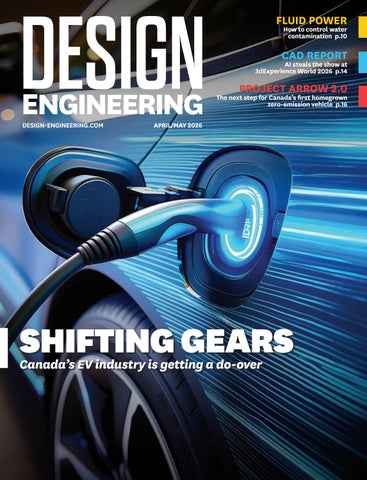
6 Automotive update

Canada’s EV industry is facing some challenges, but a recalibration of its ecosystem means it can still flourish.
10 Fluid power
Water contamination is a fact of life for fluid power systems, but the right approaches can minimize the issue.
16 Electric vehicles
The 2.0 phase of Project Arrow, the all-Canadian zero-emission vehicle, aims to bridge the gap between research and commercialization.
18 Artificial intelligence
A conversation with a leading AI expert on what’s here now for auto design, and what lies ahead.
4 From the Editor
Pulling the plug on the EV mandate 5 Design News
New university engineering program, Canada’s largest automakers form new association
14 CAD Report AI amplifies 3dExperience World 2026
20 Idea Generator
The latest industrial products
22 Canadian Innovator
Making aerospace vehicles safer in icy weather

Canada’s electric vehicle (EV) mandate is no more.
In February, Prime Minister Mark Carney revoked the mandate – which had called for 60 per cent of all new vehicles sold in Canada to be EVs by 2030 and 100 per cent by 2035 – and replaced it with a new five-point automotive strategy for manufacturing EVs without implementing mandatory sales targets.
For some, the decision probably came as no surprise, as the writing had been on the wall for the mandate for some time now. Last year, for example, Macdonald-Laurier Institute Senior Fellow Jerome Gessaroli, based in Ottawa, predicted the outcome, and was spot-on in his reasoning. The mandate was stalling, he wrote, “thanks to a misguided subsidy-driven, top-down attempt” to jumpstart a domestic EV industry. He noted that, since 2019, the federal, Ontario, and Quebec governments have committed more than C$52 billion to subsidize EV plants and supply chains, with promises of tens of thousands of jobs and a world-leading industry. “Yet, even before production ramps up, the early warning signs [in 2025] are unmistakable – cost overruns, repeated delays, and subsidies that reward dependence rather than competitiveness,” he wrote.
According to Gessaroli, the challenges ran too deep to overcome. The government was trying to build an entire EV ecosystem at once, he wrote, without addressing fundamental constraints in supply and labour – efforts to streamline approvals for mining projects critical to EV production were emerging too late; and shortages of skilled workers in battery chemistry, power electronics, and advanced manufacturing were too severe. The EV mandate “is already emerging as a cautionary case of how complex and costly government-led interventions can struggle to succeed in mature industries,” he concluded, even before the plug had been pulled.
The one thing I would add is that, as a matter of basic human psychology, most consumers don’t like being told what they can and can’t purchase – not even famously polite Canadians. The government and assorted central planners decided that forcing drivers out of internal combustion engine cars and into EVs was a good idea. But EVs were never as popular as they thought, and Canada’s consumers clearly voted with their wallets to reject the mandate, as evidenced by the fact that EVs accounted for just 8.77 per cent of new vehicle sales by August 2025. Governmental overreach and interference clearly lost to consumer choice.
All of this is certainly not to say that EVs aren’t valid or can’t succeed – just that they couldn’t succeed under the original, flawed industrial policy. Whatever problems EVs have, they’re better resolved by free markets than government fiat. |DE
MARK STEPHEN Editor mstephen@annexbusinessmedia.com
Editorial Board

DR. MARY WELLS, P.ENG Dean, Faculty of Engineering, University of Waterloo

KEVIN BAILEY CEO, Design 1st

MASSIMILIANO MORUZZI CEO, Xaba

JAYSON MYERS CEO, NGen Canada
APRIL/MAY 2026
Volume 71, No.2 design-engineering.com
READER SERVICE
Print and digital subsciption inquiries or changes, please contact Angelita Potal Tel: (416) 510-5113
Fax: (416) 510-6875
Email: apotal@annexbusinessmedia.com
Mail: 111 Gordon Baker Rd., Suite 400, Toronto ON M2H 3R1
EDITOR Mark Stephen (416) 903-8041 • mstephen@annexbusinessmedia.com
DIGITAL EDITOR Jared Dodds (437) 775-9680 • jdodds@annexbusinessmedia.com
PUBLISHER Kathryn Swan (647) 339-4880 • kswan@annexbusinessmedia.com
ACCOUNT COORDINATOR Cheryl Fisher (416) 510-5194 • cfisher@annexbusinessmedia.com
GROUP PUBLISHER Paul Grossinger (416) 510-5240 • pgrossinger@annexbusinessmedia.com
AUDIENCE DEVELOPMENT MANAGER Beata Olechnowicz (416) 510-5182 • bolechnowicz@annexbusinessmedia.com
CEO Scott Jamieson sjamieson@annexbusinessmedia.com
Design Engineering, established in 1955, is published by Annex Business Media, 4 times per year except for occasional combined, expanded or premium issues, which count as two subscription issues.
Printed in Canada
Publications Mail Agreement #40065710 ISSN: 0011-9342 (Print), 1929-6452 (Online)
Subscriber Services: Canada: $61.00 for 1 year; $98.12 for 2 years; Outside Canada: USA - $149.04; Overseas - $160.18; $10.00 for single copy.
All prices in CAD funds.
Add applicable taxes to Canadian rates.
From time to time we make our subscription list available to select companies and organizations whose product or service may interest you. If you prefer not to receive this information, please contact our circulation department in any of the four ways listed above.
Annex Business Media Privacy Officer: privacy@annexbusinessmedia.com Tel: 800-668-2374
No part of the editorial content of this publication may be reprinted without the publisher’s written permission.
©2026 Annex Business Media. All rights reserved. DE receives unsolicited features and materials (including letters to the editor) from time to time. DE, its affiliates and assignees may use, reproduce, publish, re-publish, distribute, store and archive such submissions in whole or in part in any form or medium whatsoever, without compensation of any sort. DE accepts no responsibility or liability for claims made for any product or service reported or advertised in this issue. DE is indexed in the Canadian Business Index by Micromedia Ltd., Toronto, and is available on-line in the Canadian Business & Current Affairs Database.


Saint Mary’s University (SMU), in Halifax, N.S., will see its first class of Bachelor of Engineering graduates soon, after the Maritime Provinces Higher Education Commission approved the school’s plan to launch a new two-stream program.
The Bachelor of Engineering in Resource Engineering will allow students to specialize in either mining engineering or renewable energy engineering. The program will prepare students to manage the full lifecycle of projects, from planning and construction to operation and reclamation, while integrating areas such as environmental science, geology, management, finance, and health and safety.
Dalhousie University – also based in Halifax, and one of the participating universities in the multi-university system – discontinued its mineral resource eng ineering program in 2019, prompting concern from the mining industry, which led to consultations that contributed to the development of the new SMU program.
A central part of the new program will include a required 16-month
co-op component, which is longer than those typically offered in similar engineering programs across Canada. Students will be able to choose to either spend the full 16 months with one employer or separate it into two eight-month terms with two employers.
The initial cohort is expected to include 20 to 30 students across both streams.
The Centre of Excellence in Next Generation Networks (CENGN) has announced a Living Lab partnership with the Drummondville, Que.-based industrial consultant Centre national intégré du manufacturier intelligent (CNIMI) and Swedish multinational networking and telecommunications company Ericsson, to advance Canadian innovation in manufacturing.
The lab, in Drummondville, will provide access to cutting-edge infrastructure, expert support, and a real-world testing environment that enables the validation for advanced manufacturing solutions. It will be outfitted with the latest Private 5G wireless connectivity powered by Ericsson, including 5G IAP (indoor advanced
positioning), enabling validation of solutions targeting key use cases like indoor positioning systems, integrated sensor and machine solutions, and autonomous stationary and mobile robotics.
The lab joins seven other living labs as part of the CENGN Living Lab Initiative, which provides innovative Canadian companies co-funded access to real-testing environments to validate their solutions in key economic sectors.

Honda Canada Inc., Honda of Canada Mfg., Toyota Canada Inc., and Toyota Motor Manufacturing Canada have launched the Pacific Manufacturing Association of Canada (PMAC), a new industr y association bringing together Canada’s two largest automotive manufacturers, which represent the majority of vehicle production in Canada.
In an April 15 press release, PMAC said it will serve as a collective voice for lobbying and policy engagement with both federal and provincial governments, and also with Japan-based auto parts suppliers with Canadian operations. Its areas of focus will include electr ic vehicles, greenhouse gas emissions, regulatory reform, and steps aimed at strengthening manufacturing competitiveness.
Brendan Sweeney has been named the association’s first president and CEO. He has previously led automotive and manufacturing research centres at McMaster University and Western University in Ontario.
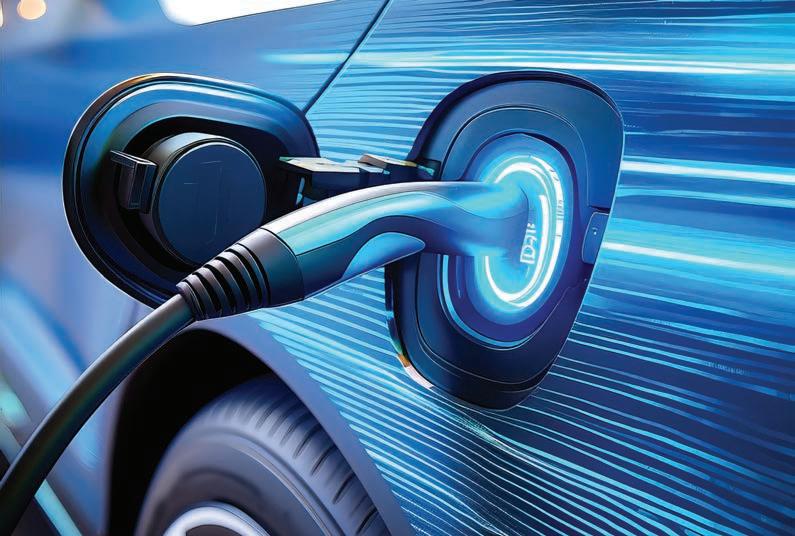
Canada’s electric vehicle industry is facing some challenges, but a recalibration of its ecosystem means it can still flourish.
BY MARK STEPHEN
Along with artificial intelligence (AI), electric vehicles (EVs) were assumed to represent the emergent frontier of advanced manufacturing in the digital age.
But now, after billions of taxpayer dollars invested, the EV industry in Canada is facing headwinds, character ized by slowing growth, high vehicle costs, a pivot to hybrid options, limited battery range and sparse charging infrastructure, and a recommitment among many drivers to traditional internal combustion engines.
According to the latest data available from the third
quarter of 2025, EV sales accounted for a mere 5.5 per cent of the Canadian market and plug-in hybrids for 3.8 per cent; by comparison, hybrids that run on a combination of gasoline and electr icity, without having to plug in for recharging –and which aren’t eligible for government subsidies – accounted for 12.4 per cent of all passenger vehicle registrations, surpassing the sale of EVs and plugin hybrids combined. The overwhelming leader in the Canadian auto sector is still gasoline-powered vehicles, and they’re staging a bit of a comeback: preference for internal combustion engine
for plug-in hybrids with a final transaction value up to C$50,000 on cars made by countries that Canada has free trade agreements with; the easing of emissions rules; the establishment of a new workforce alliance of industry, labour, and training partners to address bottlenecks and accelerate private investment; major spending on EV charg ing infrastructure; and strategic partnerships with South Korea and China that aim to strengthen domestic EV manufacturing and improve supply chain resilience. The overall message is that, despite some wobbles, Canada’s ambition of becoming a powerhouse in the global EV market and supply chain ecosystem remains intact.
vehicles rose from 44 per cent to 58 per cent year-over-year.
Not coincidentally, Canada has also scrapped its EV mandate, which required 60 per cent of all new cars to be electric by 2030 and 100 per cent by 2035, but Prime Minister Mark Carney’s government pivoted immediately by unveiling a new five-point national automotive strategy to continue the electrification of the Canadian auto sector without implementing mandatory sales targets. The pillars of the strategy are a five-year EV affordability program with purchase or lease incentives of up to C$5,000 for battery electric and fuel EVs, and up to C$2,500
One change is that Canadians are now seeing inexpensive mass-market Chinese EVs on the roads for the first time.We can thank the U.S. for that. After a long, deeply integrated economic partnership with the U.S. – which saw Canada’s automotive sector export 91 per cent of its parts south of the border – tariffs from President Donald Trump have roiled the relationship between the two nations, forcing Canada to look elsewhere for partners. The Canadian auto market officially opened to Chinese-made EVs on March 1, and 49,000 of them will arrive here each year through a new trade agreement that reduces the import tax on the cars from 100 per cent down to just 6.1 per cent. In Canada, BYD – which is now the world’s biggest EV manufacturer, and the only Chinese EV that automatically clears Transport Canada standards due to previous applications to sell taxis and buses in our market – is planning to open 20 dealerships this year alone.
While some say this comes with big rewards in terms of boosting EV uptake and infrastructure in Canada, others consider the influx of these vehicles to be a major disruption to the domestic automotive market, challenging established brands with lo wer-priced alternatives. For example, Doug Ford, the premier of Ontario, the hub of Canada’s auto industry, has been routinely critical of EVs from China and has called on Canadians to boycott them. Boycott or not, most auto market analysts expect to see heavy discounts and undercutting since Chinese EVs – including marquee brands like Chery and Geely – tend to sell at a lower retail price due to cheaper materials, low labour costs, and industry subsidies from the Chinese government.
Nor are Chinese EVs of lesser quality. If anything, just the opposite – they often enjoy a technological advantage relative to EVs made in Nor th America and Europe, which makes sense since they had a head start: China began fostering this advantage nearly 20 years ago with hundreds of billions of dollars in subsidies to aid the sector. Chinese EVs are also often very safe, which is why a good number of them have achieved five stars in the gold-standard European New Car Assessment Programme crash and safety tests. And crucially, Chinese EVs offer quicker charging times: they’re already slightly ahead of the top-rated offerings from western automakers and are poised to catapult fur ther ahead based on recent announcements by CATL and BYD. “Both noted new
battery technologies that can add 520 km [kilometers] and 400 km of range, respectively, in five minutes of charging,” a recent TD Economics report from economists Andrew Foran and Likeleli Seitlheko said. “This would be comparable to the time it takes to fill a tank of gasoline for a similar range.”
To this point, highly specialized EV engineers have been essential architects of the rise of EVs in Canada, designing, developing, and optimizing all electric-powered transport – from passenger cars and commercial fl eets to high-performance motorsport vehicles – by collaborating with mechanical, electrical, and software teams to push the boundaries of energy storage, power
electronics, and autonomous features. Far from simply refining old technology, they’ve been building the foundation of next-generation mobility, integrating AI, autonomous systems, and sustainable materials. Going forward, however, things might change dramatically
Officially, most automakers continue to state that they’re focused on an all-electric future – especially after sinking so much capital into their various programs –but many are already scaling back EV production to accommodate buying trends. A utomakers need years of advanced planning before they put models into production, and some are currently r unning slightly scared on EVs, given sluggish sales and the extreme volatility of the current domestic situation.

On the other hand, things might not change much at all, given the government’s recommitment to EVs as evidenced by the auto strategy, which is in many ways a do-over: a reimagined electrification policy and not a retreat from EVs. The consensus among many industry analysts is to tweak the policies but stay the overall course. Supporters of EVs argue that the EV sales lull in Canada is temporary, along with a coinciding lull in the U.S., and that global EV sales are surging – and that our EV industry should therefore remain committed or else get left behind. “Even conservative estimates suggest that by 2040, around three-quarters of new car sales will be fully electric globally,” Charles Conteh and Tia Henstra, researchers at Brock University, in St. Catharines, Ont., recently wrote in a paper. “Canada has every reason to ratchet up its commitments in the months and years ahead.”
Virtually everyone agrees that the lack of charging stations across Canada is a hurdle to EV adoption. As of last year, there were approximately 35,000 charging stations across the country – well short of the 100,520 projected to have been needed by the end of 2025. As part of the auto strategy, the government will invest C$1.5 billion to expand charging infrastructure, including along major
transportation corridors. But that only addresses part of the problem. “Installing charging infrastructure along isolated highways and rural communities is equally necessar y and would help boost EV sales, and hopefully the government and provinces start tackling this soon,” said Taylor Walker, a senior analyst on the Pembina Institute’s transportation team, based in Ottawa.
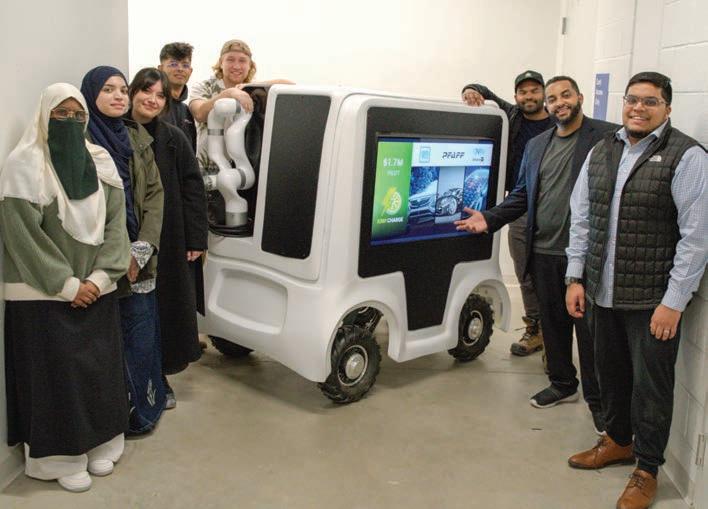
In the interim, interesting solutions are being created to fill some holes. For example, Toronto-based robotics and AI startup Kiwi Charge has just developed robotic EV chargers that can autonomously navigate to parking spots and deliver on-demand charging, enabling more convenient charging for EV owners in older condominiums, rental buildings, and multi-unit residential buildings, which often require costly electric upgrades and hardwired infrastructure to offer EV charging capabilities. The project was backed by Ontario’s provincial government through the Ontario Vehicle Innovation Network (OVIN) and had support from General Motors Canada and Pfaff Automotive.
Examined through the crucial prism of jobs, it seems clear that, in the short term, the trickle of Chinese EVs won’t create employment here at home – indeed many in the sector fear that the scaled-down plants operated by Chinese companies in Canada could actually erase thousands
of existing automotive jobs. For example, Stellantis is said to be considering letting its joint venture partner Leapmotor, a Chinese manufacturer of EVs, use its idled plant in Brampton, Ont., to build electric vehicles.The problem, critics say, is that the joint venture would not be a full manufacturing plant, but a complete knock-down (CKD) facility that would receive unassembled parts from China that would then be assembled, welded, and painted into their final form – a production process that involves only about a quar ter of the workforce needed at a traditional manufacturing plant. And since most CKDs are used for low production runs of as few as 8,000 to 10,000 units only, there’s no conceivable need to beef up the workforce.
Going forward, the federal government hopes for joint venture assembly plants with Chinese EV makers, but two factors seem to cut against this. First, assembly plants need to produce hundreds of thousands of cars to be profitable, and these volumes aren’t going to happen anytime soon with Chinese EVs, given the cap of 49,000 EVs in the first year. And even though the cap will be raised to 70,000 vehicles by 2030, that’s still little more than a drop in the proverbial bucket. Second, Chinese EVs often have different powertrains and total part counts. But anything is possible. Since Chinese EVs don’t qualify for Canadian government subsidies, BYD, for one, is said to be evaluating the construction of its own manufacturing plant on Canadian soil to circumvent these limits long-ter m.
That’s a trend that should be encouraged, analysts say, and we don’t have to reinvent the wheel, since American and European automakers already partner with Chinese and other Asian companies to varying degrees. “Canada should push to establish manufacturing partnerships with South Korea and China to reinforce its end-to-end EV ecosystem, spanning vehicle assembly, battery production, and the responsible development of critical minerals,” said Taylor Walker. “EVs are the main driver of new demand for battery materials, making them central to the future of the critical minerals sector, and Canada has an abundance of critical mineral resources.” What this could mean for Canada’s EV sector was spelled out in a 2024 EV battery supply
chain report by BloombergNEF, an annual assessment that rates 30 countries on their potential to build a secure, reliable, and sustainable lithium-ion battery supply chain: Canada ranked first among 30 countries, outperforming even China. “This advantage can’t be fully realized without a strong domestic EV market to pull those materials through the value chain, however,” Walker added.
Costs and consolidations
Driving down the cost of EVs must also be a priority – and batteries, again, will play an outsized role. As the TD Economics report by Andrew Foran and Likeleli Seitlheko noted, BYD – which started as a battery manufacturer –makes its own batteries and does so at a much lower cost than leading battery manufacturers such as LG Energy Solution, Samsung SDI, and Panasonic, which supply many western OEMs. “This is a notable advantage as batteries comprise a large proportion of EV manufacturing costs,” the report said. “For EVs available in Canada, battery costs are estimated to be over a quarter of total vehicle production costs.” In a move to help lower costs, the federal government announced in April a contribution of C$23 million to a battery production R&D centre that German multinational Siemens is setting up in Ontario, part of an overall C$150-million investment Siemens announced in March 2025 for the centre, which will focus on improving battery efficiency and production methods. Another tactic is to switch to lithium iron phosphate (LFP) batteries – which are generally 30 to 45 per cent cheaper than lithium-ion batteries – and some automakers in Ontario are scheduled to begin producing LFP batteries, along with other battery chemistries, in 2027. Canada’s automotive innovation ecosystem is generally robust, made up of such players as the Automotive Parts Manufacturers’ Association, the Automotive Industries Association of Canada, the Automotive Centre of Excellence, OVIN, and others, all serving as bridges between government, industry, and researchers. Still, it’s going to take some skilled calibration to overcome current EV challenges. “In particular, Canada needs to consolidate its EV innovation ecosystem by integrating the upstream of its domestic supply chain
assets with the downstream of its technology commercialization and adoption,” Charles Conteh and Tia Henstra wrote. And it might just happen – with the Liberals now having crossed the line into a majority government and safe in power until the next scheduled election in October 2029, we can expect them to cement their commitment to EVs despite the skeptics, which will likely ensure fiscal incentives and policies that
may boost short-term demand and also supply the stable, long-term forecasting requirements needed by the automakers and the design engineers they employ.
To return one last time to China, there’s a famous expression we’ve all heard – often attributed as an ancient Chinese curse – which says, “May you live in interesting times.” For Canada’s EV sector, it’s shaping up to be interesting and then some. |DE






























Water contamination is a fact of life for fluid power systems, but the right approaches can minimize the issue. BY MARK STEPHEN
Contamination is widely recognized as the leading cause of premature f ailure in fluid power systems, and water is among the most common culprits. In pneumatic systems, water contamination can compromise, or even wash away, the lubrication of important components such as valves, leading to premature wear and failure. It can also result in bacterial growth and microorganisms in pipes and components, plus pipe scale and rust buildup. Over time, these accumulations can detach from the piping and travel through the system, causing further damage.
Water can also pick up other contaminants, such as oil and dirt, which clog various components of pneumatic systems.This frequently leads to unplanned work stoppages to replace damaged components and, in the worst cases, to complete machine failure. Which is why some subject-matter experts say that water control in pneumatics is an even bigger task than controlling loose particles, which is the better-known main culprit of contamination.
Remember the adage, “Oil and water don’t mix”? The consequences of water contamination can be even worse in hydraulic systems, which need clean oil to work at their best. Contaminated hydraulic fluid is the root cause of up to 80 per cent of hydraulic system failures. Water, one of the most common and damaging contaminants, can be difficult to keep out even under ideal conditions. It can appear in three forms: dissolved, mixed (emulsified), or free water. Moisture can enter from the outside via rain, high humidity, routine cleaning, leaky seals, improper fluid storage, or internal condensation.
Even in small amounts, water is highly destructive and can wreck even the most durable system design. It impairs the hydraulic fluid’s ability to act as a lubricant by altering its physical and chemical

Water inside hydraulic and pneumatic systems is a major concern, and if not treated properly, it can lead to serious failures.
characteristics, causing rust, corrosion, iron oxide particles (which are particularly tough contaminants), accelerated wear, and microbial growth, leading to unresponsive controls. And it can jam components due to ice crystals formed at low temperatures; and in extreme cold, it can expand when it freezes to form ice, cracking pipes and other system components.
Controlling water contamination is a huge part of operating and maintaining both pneumatic and hydraulic systems and, therefore, potentially integral to a design engineer’s job. “It’s a silent killer of fluid power systems,” said Ian Miller, P.Eng., a Calgary-based division manager of Motion Repair & Services. “Low levels of water saturation are hard to notice, but they steal lubricity, causing equipment to wear faster. It doesn’t always cause a catastrophic component failure, but it will reduce the working life of components like pumps. Plus, it can be very hard to identify – especially in hydraulic systems, because it can remain dissolved in the hydraulic fluid.”
The problem is that water is everywhere, including in the air we breathe. Since pneumatic systems depend on air as the driving force, water – in the form of humidity – inevitably finds its way into every system. It first appears as condensation in the air compression system, and then as liquid pulled into the rest of the pneumatic system during operation. “Pneumatic systems are actually a bit more prone to water contamination than hydraulics, because you’re taking air – which has water in it – and making it the medium through which you do your work,” Miller noted.
Preventing or removing moisture entirely is probably impossible, but solutions are available to achieve the next best thing: sufficiently reducing water contamination so that the performance of a pneumatic system isn’t hampered. Many options exist to help reduce moisture in a compressed air system, including the installation of prophylactic protective equipment. “This is a proactive step that includes using devices like coalescing filtration units to precondition the air before it enters the pneumatic circuit,” Miller said. “These work by forcing tiny
droplets to collide and merge into larger drops, which then drain via gravity.” Some brands offer coalescing filters that are said to remove up to 99.999 per cent of liquid water, oil emulsion fluids, and solid particulates to one micron. Other tactics include absorption drying – also called desiccant drying, since desiccant beads are usually used. Another drying option is refrigerated dryers, which some subject-matter experts say are more common because of their flow capacity and reasonable price. Also, it helps to regularly drain the compressor tanks – which are essential for storing compressed air – by using the drain valves or auto drains. Perhaps simplest of all is a water separator, which uses centrifugal force to separate water from air, with water collecting at the bottom of the trap. For best results, some subject-matter experts advise positioning the water trap where the air temperature is coolest to encourage condensation, and ensuring that the traps are emptied frequently to avoid overloading them.
Preventing water contamination in hydraulics is probably more difficult than in pneumatics simply because water already exists within hydraulic oil, in the form of humidity. On top of that, additional water has many potential points of ingress: It can be absorbed from the air during transport, or rain can leak into poorly sealed barrels when left outside. And backing up a step, it may come in excess from the manufacturing processes for the oil itself due to things like improper storage, transportation or packaging. “The clearances and quality of oil required can sometimes be much higher than factories are used to, and higher than what the oil delivery firm considers ‘clean’ oil,” Miller observed. “So even though you’re buying clean oil and it was delivered to the standard you bought it at, it might not meet specifications.” Indeed, while modern hydraulic systems generally demand a fluid cleanliness level of ISO 16/14/11, other subject-matter experts note that new fluid delivered in barrels may be as dirty as ISO 23/21/18.
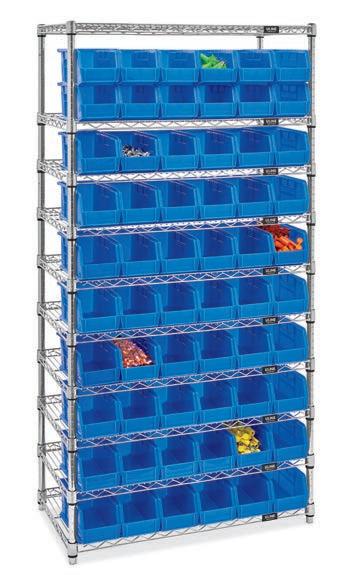
A first line of defense, then, is to keep your system securely sealed and covered in a preconditioned storage asset, from the largest reservoirs down to individual containers. “Adding offline filtration to both storage and systems that contain cellulose-based filter media can help to remove freestanding water,” Miller said. Additionally, installing a desiccant breather ensures that a high-humidity atmosphere doesn’t enter the reservoir. In fact, this can reduce humidity in the reservoir’s headspace by drawing it out of the oil itself. And it seems obvious but worth saying:Your lubricants are an asset and should be treated as such. Hydraulic fluid should always be kept in sealed containers – or, better still, inside a storage system that integrates filtration and is located in a designated lubrication room. Water can also enter the fluid system from the process side by means of leaky heat exchangers or coolers; temperature fluctuations that accumulate moisture as water vapour condenses inside reservoirs; direct ingression of process water, such as in steel plants that use cooling water;
Mod: March 24, 2026 1:53 PM Print: 04/14/26 page 1 v2.5
connection points or seal faces; steam created by the production process; and with a system that has to be washed down regularly. And don’t discount human error. “Sometimes, employees pump water into a hydraulic system by mistake, such as from a waste oil barrel that hasn’t been marked properly and which has some water at the bottom and gets dumped in,” Miller explained. “It sounds unbelievable, but it does happen.”
Finally, as in real estate, location matters. “The problem of relative humidity causing water contamination is obviously a bigger issue in climates that are more humid,” Miller noted. “It’s more serious for reservoirs in Ontario than in Alberta, for example.”
Water ingression can be minimized with subtle system design considerations and good housekeeping, but if c ontamination does occur, you have several options to combat it. “For small systems, it’s an easy fix: Just drain the oil and put new oil in,” Miller said.
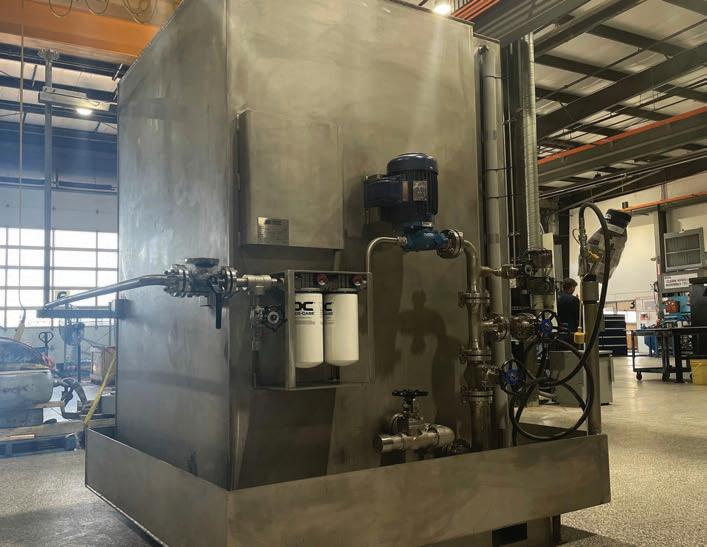
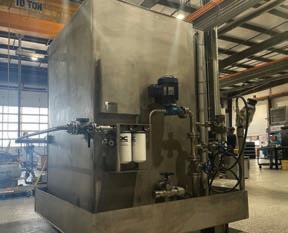
Designed for the oil and gas industry, this custom storage tank features a kidney loop system for preconditioning and protection. The tank is equipped with special adapters to self-fill and dispense oil through close-coupled and filtered connections.
For larger systems with several thousands of gallons of oil, where the above option isn’t on the menu, there are several remedies. First, draining water from the lowest point of the system and

from the bottom of the reservoir – water is heavier than oil and will always accumulate at the lowest points in its freestanding form. Second, vacuum dehydrators, which are another great mechanism to decrease humidity in hydraulic fluids and lubricants through light heating and exposing them to a partial vacuum, to lower the boiling of water. Third, water-absorbing filter elements to remove free, circulating water. And finally, kidney loop systems (which can also remove other types of contaminants). And for oil transfers, subject-matter experts recommend filter-transfer pumps. One would be used to draw fresh fluid and pump it through a filter directly into the system via a close-coupled connection. This will reduce the opportunities for water – among other types of hydraulic contamination – to enter the system.
A final, proactive line of defence is testing, which can range from a simple visual inspection – oil contaminated with water can have a milky appearance – to precise laboratory analysis. The established, universal method for analyzing water content for various industries since 1935 is Karl Fischer titration, but this can potentially create a frustrating time lag between sending in the oil sample and finally getting the result. A much faster method is a capacitive water sensor. By detecting changes in electr ical capacitance between two conductive plates or electrodes, these

Aside from water, there are several types of contamination that can plague both pneumatic and hydraulic fluid power systems.
1. Solid par ticles introduced through environmental exposure, improper fluid handling, or component wear, and which can include dust, dirt, rust, fibres from filters, or even metal shavings from worn components.
2. Built-in contamination that’s left-over from the manufacturing and/or assembly process, including grains of sand, slivers of metal, and tiny pieces of cleaning rag.
3. Air that gets trapped in the hydraulic fluid after entering through poorly tightened connections, or faulty or worn seals. This reduces the fluid’s ability to transfer heat efficiently, which can lead to overheating and system degradation.
4. Chemical contamination caused by the natural degradation of the hydraulic fluid – a process that can be accelerated by excessive heat.
sensors quickly identify the presence of water and provide real-time monitoring of water levels.
The potential for significant water contamination in hydraulic and pneumatic systems is a fact of life and can never be fully eliminated. Both air and new fluid will always have a baseline humidity. Prevention is always the best medicine, however, and can keep water contamination to a bare, relatively
har mless minimum. Design engineers can proactively anticipate where ingress points will be and eliminate them as threats through various devices and production designs, combined with watching for exceptional events as well as the day-to-day. So, although water contamination will remain one of the biggest problems for fluid power systems in general, it doesn’t have to be one of your biggest problems. |DE

5. Generated contamination, created as hydraulic equipment runs. And every bit of generated contamination is likely to produce even more contamination in a dangerous domino effect.
Source: Texas Final Drive

Among the undercurrents at the show: is AI all hype, will it make design obsolete, and will it take away engineering jobs? BY
RALPH GRABOWSKI

Last year, 3dExperience World celebrated the promise of artificial intelligence (AI). This year, Solidworks CEO Manish Kumar began his keynote addressing the demon in the room: “Is AI all hype? Will AI make design obsolete? Take away engineering jobs? And to be frank, there is a real uncertainty here” – given the headlines that scream of between 50 and 90 per cent job losses from AI.
With that acknowledgement out of the way, he and other Dassault executives repeatedly reassured us that its AI would not replace our jobs. Dassault Systemes CEO Pascal Daloz said the relevance of engineers ought not be understated: “AI is just a multiplier; you are the value,” he said. “Your intellectual property [IP] and your experience are the most valuable intellectual property in this new world.”
But then Manish Kumar changed the messaging. He predicted jobs and tasks involving repetition will change. Today’s AI is just in a spark state, he said. “I’m a firm believer that the most world-changing applications of AI have not even been invented yet,” he said.
Kumar went on to imagine new applications that will create new workloads: more sensors and more actuators in smaller packages, and reimagining machines that were never built for autonomy. Humans still need to decide that which AI can’t, he said, such as new chip designs and manufacturing processes.
Dassault embraces World Model AI Dassault sees itself at the forefront of the “generative economy,” where products are software-defined, where the Virtual drives the Physical, and where IP is the new currency. This is the latest stage of Dassault’s many transitions, beginning with 3D, then moving on to DMU (digital mockups), PDM (product data management), PLM (product lifecycle management), virtual twins, and now it’s Generative Economy.
Dassault plans to combine its existing virtual twin technology with science, AI, and virtual companions – with this emphasis: “They keep you in charge, they keep you in control.” The software, with the oddly spelled name of “3D Univ+rses,” was introduced last year.
In a slight to Large Language Model-based AI that’s currently consuming hundreds of billions of dollars in
investments, Daloz affirmed that, “The real world isn’t made of text and images; it’s made of physics, materials, energy, and constraints.” So, World Model AI is the newest approach being explored by Dassault and other firms. Instead of statistically regurgitating words as ChatGPT does,World Model AI considers geometry, behaviour, performance, manuf acturing, and use. Dassault calls its version “Industry World Models.”
When it comes to virtual companions, last year’s Aura business advisor is joined this year by Leo for engineering (such as manufacturing constraints and assembly feasibility), and Marie for science advice (as in materials). The three access the same information database from Dassault, and then present data as different disciplines.
Dassault public relations confirmed that Leo is not the same as another Leo AI that calls itself “the first AI for mechanical engineering,” in which former Solidworks CEO Bertrand Sicot is an investor (www.getleo.ai). And Marie shouldn’t be confused with that other Marie AI that does no-code machine learning (marieai.com).
Aura runs already, Leo comes in July, Marie in the fall, running in the 3dExperience-based xDesign add-on to

Dassault’s Marie AI explaining materials.
Solidworks. Their advice is, however, not free. Dassault will charge you on a consumption basis, meaning longer thinking and longer replies cost more. Since you might not know ahead of time how long replies take, hopefully there will be a limit to how expensive the bill gets.
It’s good to see Dassault no longer treating Solidworks as the unwanted stepchild. To compensate for past sins of omission, executives have taken to wearing “SW” pins and speak glowingly of Solidworks users as the best CAD users in the world!
In Solidworks xDesign, we saw a live demo of Leo turning a 2D PDF drawing into a 3D parametric model in about a minute, although the accuracy of the result was not revealed. Leo was shown assembling parts stored in the mode into an assembly; in the future, it’ll get parts from repositories and external libraries. To improve assembly performance, Leo can evaluate how they were built. We saw it converting images to 3D meshes, and STEP b-rep models into parametric features. I would argue that some of these have already been shown to work without AI, such as image-to-mesh generation through non-AI algorithms like SIFT.
Should we encounter design problems, Leo analyzes them to determine fixes. It finds commands in answer to our questions. There was, however, no applause from the audience during these demos.
It could be, in my opinion, that Dassault is counting on accelerated revenues through AI agents, as studies suggest an agent running full-time could cost up to US$100,000 per year. nVidia CEO Jensen Huang, who has GPUs to sell, would like to see engineers “tokenmaxxing” by spending closer to US$250,000 per year in AI tokens. Despite reassuring customers that its AI would not unemploy them, these numbers might not sit well with bosses who face paying more for more valuable engineers, plus that chatty new AI.
A problem with World Model AI is how edge cases (unpredictable events) are handled. The formulae dictating physics are quite simple, such as F=ma; it’s the real world’s unlimited edge cases (how smoke rises from a BBQ, how water flows in a rock-filled creek) that present problems, as they exceed the number of predictable cases by orders of magnitude.
“If your engineer is getting great results with minimal AI usage, that might mean they’re skilled enough not to need the crutch,” said Hedgie Markets. I think it’s best to see additions to Solidworks xDesign that are labeled “AI” as additional semi-automated tools that are available to users. And who knows – perhaps in the future, the “AI” label will become as unnecessary as the “I” label signaling internet functions in the 2000s. |DE
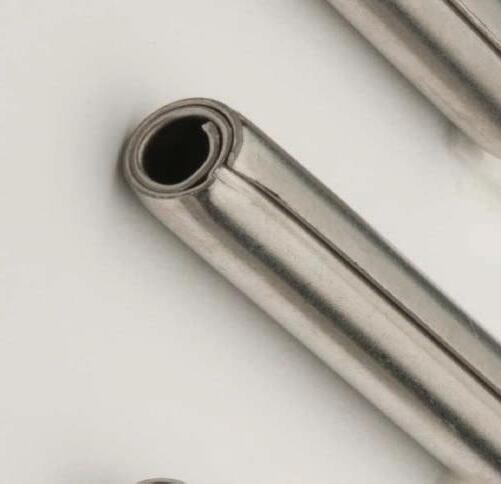
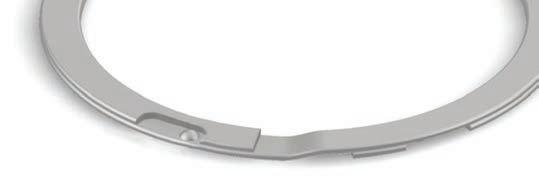
- Balances Strength & Flexibility
- Extends Product Life
- Accommodates Hole Variation
- Reduces Assembly Cost
- Easy to Install
Ask Us About Pin Installation Equipment
Application Engineering helps develop quality fastening and assembly solutions. Read “How To Pin a Shaft and Gear Assembly”
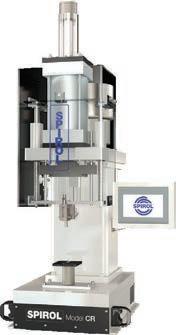
SPIROL’s complimentary
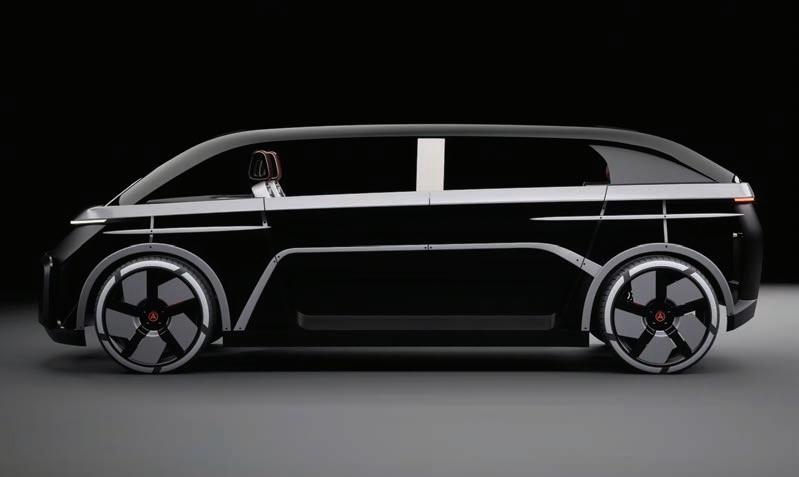
The 2.0 phase of Canada’s first homegrown zero-emission vehicle aims to bridge the gap between research and commercialization.
BY MARK STEPHEN
To modify the famous opening line from Star Trek , Project Arrow is continuing to boldly go where no electric vehicle (EV) has gone before – and most recently with key conceptual a nd technical inputs from engineers at the University of Western Ontario (UWO), in London, Ont.
Introduced in 2023 as Canada’s first homegrown zero-emission vehicle, Project Arrow established a national collaboration across academia, technology partners, and supplier s – including startups and major Tier 1 firms. The brainchild of the
Toronto-based Automotive
Parts Manufacturers’ Association (APMA), several government bodies across Canada contributed C$8 million to Project Arrow, with the goal of showing that Canada could build an EV from the ground up without relying on foreign proprietary platforms. Fast forward to 2026 and APMA has now unveiled the next phase of the program: Project Arrow 2.0. Backed by C$11 million in new federal and provincial funding, the next step moves the national project from proof of concept to next-generation technology deployment from more than 80 suppliers and partners.
For the 2.0 phase, the University of Ontario Institute of Technology (Ontario Tech), in Oshawa, Ont., is the main construction partner and supports technical integration, prototype assembly, and advanced research collaboration. Arrow 2.0 development will take place at Ontario Tech’s ACE Core R&D facility, home to its world-class climatic aerodynamic wind tunnel. This f acility can simulate extreme weather from blizzards to hurricanes, ensuring Arrow 2.0 withstands Canada’s notoriously harsh winters;
and the batteries have been adapted to reflect that, with improved thermal management systems designed specifically for the Canadian climate. The university offer s the ideal ecosystem for driving innovation and commercialization in the automotive industry, Ontario Tech officials said.
Two new advanced EV prototypes – Project Arrow Vector and Project Arrow Borealis – are the first iterations of Arrow 2.0. Project Arrow Vector represents a near-term innovation platform engineered to demonstrate commercially scalable Canadian technolog ies aligned to the 2030 mobility environment. Key innovations include an artificial intelligence (AI) formed, 3D-printed lightweight polymer and aluminum chassis; a 650 horsepower all-electric powertrain; an estimated 550 kilometer (km) range; and Level 3 autonomous functionality, which offers so-called “ conditional automation,” allowing the car to handle all driving tasks – steering, braking, and monitoring the environment – in specific scenarios, such as traffic jams or well-mapped highways. The exterior lighting is integrated into the body panels, allowing the car to communicate with pedestrians through light patterns – a crucial feature for the future of autonomous city driving. Inside, meanwhile, door panels and dash inserts are made with recycled and bio-based materials sourced from across Ontario and Quebec, and biometric sensors in the seats can monitor driver fatigue and stress.
Project Arrow Borealis, meanwhile, is the next stage serving as a research and design platform exploring the long-range future of Canadian mobility and infrastructure

integration. The project aims to achieve fully autonomous Level 5 functionality; smar t cities-connected vehicle systems; AI-designed, 3D-printed metal alloy chassis and powertrain; and zeroemission propulsion with a projected 1,500 km range. Level 5 autonomous vehicles represent full automation, capable of driving themselves anywhere, anytime, under any conditions, without any human intervention.
The Arrow Borealis EV is also where the UWO team comes in – specifically Mohamed Zaki, a civil and environmental engineering professor, and a group of collaborators that included students in the Emergent Mobility for Resilient Communities lab. The team, working closely with APMA and its partners, delivered critical designs fueling the latest automotive advancements in AI, autonomous systems, and applied engineering research. “APMA didn’t want an incremental improvement or another refined version of an existing car,” Zaki said. “They wanted us to imagine the car of the future, one with no steering wheel and no driver, because the technology changes how we live in the vehicle, not just
how we move it.” Working with real constraints – the physical dimensions and chassis design of the earlier Project Arrow vehicle – Zaki and his collaborators reimagined the interior and exterior architecture to reflect a future in which vehicles function as living and working spaces, rather than driver-centric machines.
Core design concepts
reality,” Zaki said. While aerodynamic optimization –maximizing its performance by changing its shape to minimize air resistance – and a fully functioning product were outside the project’s scope, the resulting concept vehicle was validated as feasible within “real manuf acturing boundaries,” he said, meaning it would be possible to produce it.
According to Zaki, the UWO team delivered a complete conceptual design, on a tight timeline, t hat balanced speculative innovation almost bordering on science fiction with eng ineering realism, and the other partners mostly adhered to that design. “With some minor alterations for broader acceptance, the final vehicle retained the core spatial logic, autonomy-first
philosophy, and experiential intent that we developed,” Zaki said. “It was a great experience to be part of this Canadian car.”
The wider world got its first looks at Arrow 2.0 at the 2026 Canadian International AutoShow in Toronto in February, and then in March when project leaders – including a delegation from Ontario Tech – showcased the vehicles at the Hannover Messe industrial trade fair in Germany. This exposure is part of the goal of the 2.0 iterations: Unlike many EV concepts shown by automakers that ser ve mainly as stylistic exercises, the Arrow Vector and Borealis are “shoppable” platforms for the Canadian parts industry, APMA said –a point that gets driven home when the vehicles are shown in public. |DE





A conversation with AI expert
on what’s here now, and what lies ahead.
BY TREENA HEIN
Those Design Engineering readers in automotive design will already be familiar with MIT’s DrivAerNet++ dataset, a public benchmark now in wide use. It combines variations in automotive geometry with dynamic air flow information, making it “a credible way to test whether a learning-based approach can capture the signals that matter to engineers,” according to artificial intelligence (AI) fir m Neural Concept (NC). “Evaluating on this dataset is not only a research exercise, it’s a practical check on readiness for real-world engineering work.”
This “practical check” is made possible, of course, by AI, and the capacity of this technology is building every day. AI is making increasing inroads in mechanical engineering across many tasks, from AI-enhancements to CAD, to full automated production of thousands of component designs or par ts configurations. This partnership is freeing engineers from repetitive, lower-skill tasks and takes their prowess to a whole new level.
As NC chief technology officer
Théophile Allard explained, the ability of this new “AI layer” to provide real-time physics evaluations to engineers and help them manage system-level complexity is not only accelerating design speed in an increasingly competitive landscape (in vehicle design and beyond) but also changing the fundamentals of engineering forever.
The broad strokes: AI in automotive engineering
Allard first noted the speed of vehicle design is limited by two main factors. “One is low, specialized, and expensive tools to g ive physics feedback – CFD simulations, FEA, electromagnetic analysis,” he said. “A single aerodynamic simulation can take hours to days.” The other is the slow, specialized, and expensive tools needed to create geometry modifications. CAD is complex to use, Allard explained, and 3D models can be brittle depending on which modifications are made. This forces teams to explore and evaluate very few variants, he said, with the result that lots of better design options remain unexplored.
The presence of AI, however,

introduces change to this framework at three levels. “It suggests geometr y modifications, evaluates their expected physical performance, and applies the most successful ones, all in a loop that runs in near real-time,” Allard said. On top of these changes, Allard also noted that AI changes the whole experience of engineering. “Instead of fragmenting the design process across many specialized tools, each owning a fraction of the product development process, such workflows offer tailored AI-generated interfaces, connecting AI copilots for different disciplines, together,” he said.
According to Allard, there are three core AI technologies in vehicle design that engineers should be aware of. These are:
• Sur rogate models: neural
networks trained on a set of simulation results to predict physical outcomes – drag coefficients, temperature distributions, torque curves – for new geometr ies in milliseconds.
• Geometr y generative models: models working across multiple modalities (mesh, CAD) to generate new design variants instantly, where specialized CAD users previously had to spend hours dealing with potentially unclear requirements.
• Large Language Model-powered generative UI copilots to create the right collaborative interfaces for the right product development problem. This makes the whole AI-powered system user-friendly and focused. While AI automates more of the work, it ensures humans stay in control, with full observability and the ability to take over control whenever relevant.
Allard noted that these new processes shift the conversations between disciplines as well. “At a major OEM, for example, the classical process was that a designer proposes a shape, an aerodynamicist runs a simulation days later, feedback comes back as ‘good’ or ‘bad,’ and repeat,” he said. “Down the line, FEA engineers work with the resulting outer surfaces as constraints, trying to find appropriate A-pillar or B-pillar designs, making trade-offs with manufacturing and costs while ensuring compliance with safety standards. This takes time, and late-stage failures happen, triggering deep redesigns that generate delays and massive cost increases.”
However, with AI, aerodynamicists and safety engineers can immediately run sensitivity analyses around the designer’s baseline – not to find a theoretical optimum, but to identify small modifications that improve drag while preserving design intent and complying with safety constraints.
In the case of NC’s AI and DrivAerNet++ dataset, the NC team trained and validated its Geometric Regressor on the dataset, a geometry native model designed for engineering data. In one week, they achieved “highly accurate predictions across surface fields, volumetric velocity, and scalar targets such as drag coefficient,” Allard said.
Within days, the system turned a colossal amount of aerodynamic simulation data (39TB) into a production-ready digital car model. According to Allard, this proves that digital twins can now be trained and deployed quickly at an industrial scale. With this achievement comes shorter future design cycles; lower costs; and faster, more-confident decision-making at every stage of vehicle development for automotive OEMs.
Allard further explained that for EVs in particular, every bit of drag translates directly to reduced range. The value of AI in optimizing aerodynamics, in his view, is not to automate decisions but in making the cost of exploring design alternatives “near-zero, so engineers own the actual trade-offs rather than being forced into them by the limits of their tools.”
A similar framework can be applied to powertrain design. “Electric motor development involves three coupled physics domains that can’t be optimized
independently: electromagnetic performance, thermal behaviour, and mechanical stress,” Allard observed. “Historically, separate specialist teams handled these in sequence, discovering conflicts late and expensively. AI surf aces those interactions earlier by building end-to-end workflows that encapsulate all disciplines at once, rather than treating each as an isolated problem.”
Allard noted that, yes, these workflows automate existing processes, but the effect is much greater than that. These new AI-enabled workflows generate the right interface for the specific development problem at stake – whether that’s a component-level optimization task or a broader system integration challenge. “Connected together, they form copilots that coordinate development activities at the system level,” he said. “By handling the complexity of individual disciplines, they give engineers a clearer grip on what’s happening across the full system, where the most consequential decisions are made.” |DE


The latest advancements to Emerson’s Guardian digital platform deliver new artificial intelligence (AI) capabilities and more robust customization to help organizations improve visibility, accelerate workforce productivity, and strengthen operational performance. A new, customizable dashboard provides insights tailored to operators, engineers, maintenance teams, and leaders. The enhanced Knowledge Base Article (KBA) module helps users more quickly and easily find critical information –enhanced search and contextual access to KBA content, updates, and hotfixes help teams proactively address system health and avoid disruptions. And new integrated call support workflows allow users to monitor the resolution process from start to finish, receive real-time updates, and interact with specialists by sharing additional information.
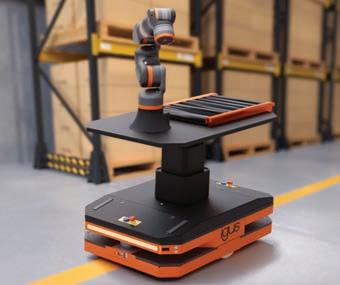
New from igus, theReBelMove Pro modular is a customizable autonomous mobile robot that offers simple configuration with flexible superstructures, easy commissioning, and cost savings. ReBelMove Pro integrates quickly into various industrial processes without any programming experience and has a high speed of 6.5 miles per hour, carries up to 550 pounds, and can pull more than 1,980 pounds of payload. Navigating its surround-
ings using LIDAR, 3D sensors, and a RealSense camera, ReBelMove Pro can map more than 2,150 square feet in under three minutes. One charge can last for a full eight-hour workday, and programming the unit’s movements takes as little as 15 minutes without coding skills.
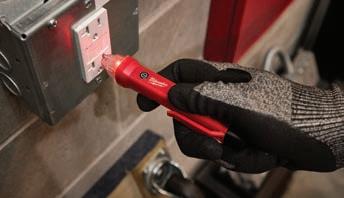
Milwaukee Tool’s Gen II voltage detectors are engineered for optimized portability, faster battery swaps, and best-in-class visibility, with standard and dual-range models detecting AC voltage from 12 to 1,000 V. The non-contact voltage detector and the non-contact voltage detector with LED are designed to quickly identify the presence of live electricity, delivering clear visual and audible alerts when AC voltage between 50 and 1,000 V is detected. The voltage detector with LED adds a bright, independently operated work light to improve visibility in dark or confined spaces. Both solutions automatically differentiate low voltage from higher voltage, providing a yellow indicator for low voltage and a red indicator for high voltage.
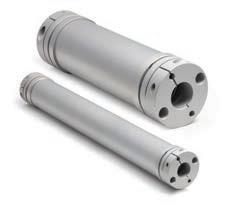
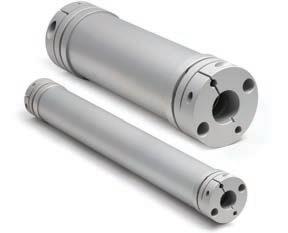
Zero-Max is introducing the new ServoClass floating shaft couplings, providing both high torsional stiffness and high misalignment capacity in extended length applications. Utilizing the design of the ServoClass couplings, these new line shaft couplings are well-suited for motion control applications including X-Y positioning systems, X-Y-Z gantry systems, line-shafted equipment for connecting two adjacent linear actuators or screw jacks, and
more. Construction features include hubs, flanges, and floating shafts made of clear anodized high-strength aluminum for maximum strength, durability, and corrosion resistance. Disc packs and bushings are made of 304 series stainless steel. All screws are treated for maximum corrosion resistance.
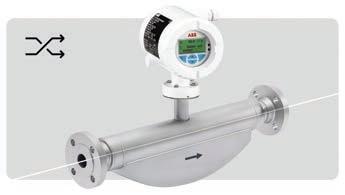
ABB has added Ethernet-APL (Advanced Physical Layer) connectivity to its CoriolisMaster mass flowmeter to open new possibilities for collection and analysis of process data. The new capabilities support real-time decision-making and predictive maintenance based on real-time data, reducing errors and downtime. Ethernet-APL offers enhanced data rates of up to 10 Mbps, and shielded two-wire connection for carrying power and data safely over the same cable and cable lengths of up to 1,000 meters. Intrinsic safety is also integrated, including a profile that limits supply voltage and current to eliminate the risk of sparking, enabling Ethernet-APL to be deployed in hazardous environments.
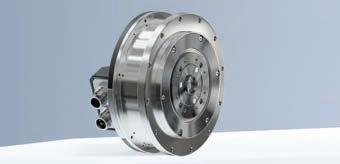
Faulhaber has added the new 9317 BXI G internal rotor motor to its portfolio, combining robustness and compactness and defining new standards for integrated drive systems in robotics. With a maximum torque of up to 20 Nm, it enables dynamic movements, fast reaction times, and a highly precise movement control. The motor covers a voltage range of up to 50 V and, due to the available interfaces and an installation length of just 34 millimeters, is easy to integrate in existing
system architectures. The flat aluminum housing offers corrosion resistance and supports optimized thermal dissipation.
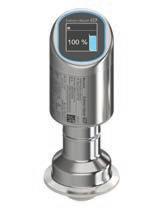
Endress+Hauser’s new Micropilot FMR43 free space radar addresses the need for smaller hygienic measurement devices for small vessels and pipes in the life sciences and food and beverage industries. The Micropilot FMR43’s 80GHz radar technology gives 16 readings per minute, delivering reliability even under rapidly changing or turbulent process conditions for mixing applications of viscous and low-conductive media, filling applications of viscous media, storage of low-conductive fluids, and level measurement in tanks with changing media density. There also is a 180 GHz sensor variant with an especially small process connection, used frequently in particularly small process tanks and containers.
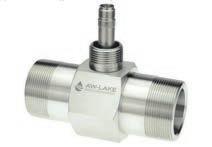
AW-Lake has launched the TH series high-accuracy turbine flow meter, a precision liquid flow measurement solution for industrial applications. Designed for low-viscosity liquids such as oils, water, and many process chemicals, the TH turbine offers measurement accuracy specified to ±0.5 per cent under controlled conditions with linearization, with repeatability as tight as ±0.1 per cent for high-confidence flow control. Multiple line sizes and flow ranges cover applications from low-flow test loops to high-flow transfer lines, and the turbine can be paired with electronic displays, transmitters or wireless totalizers for integration with PLCs, DCS, and plant historians.
New from Carlo Gavazzi, the NRG 3-phase smart solid state relays are designed to meet the growing demand for high-performance switching solutions by offering digital communication capabilities, precise power control for both two- and three-pole switching applications, and an array of diagnostic features. Engineered for integration into Industry 4.0 architectures, the new

NRG relays enable predictive maintenance, improved process reliability, and enhanced Overall Equipment Effectiveness (OEE).
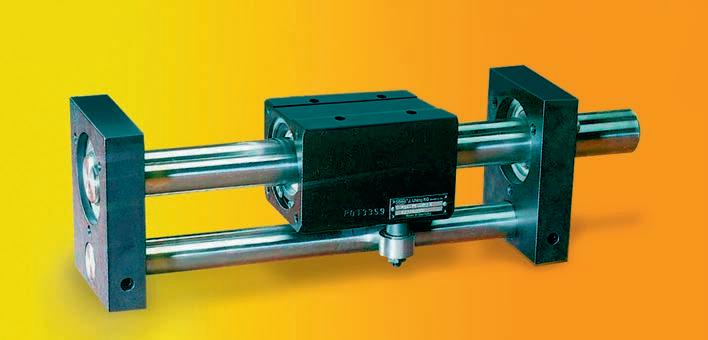
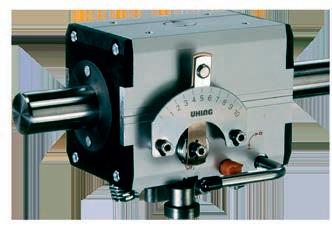
Example applications:
Many different sizes

University of Toronto Engineering postdoctoral fellow Kamran Alasvand Zarasvand is aiming to make aerospace vehicles safer in icy weather.
BY MARK STEPHEN
We’ve all experienced the many hassles that come with modern commercial air travel – cramped seating, lost luggage, crying babies, to name a few – but flight delays probably top the list of things we don’t want. Too bad, though: One report says that 57 per cent of North American travellers surveyed said they experienced a delay of more than two hours in the past 12 months, while 14 per cent reported that their flight had been cancelled during the same period. And the airlines hate these disruptions too: The estimated cost of delays and cancellations to airlines is eight per cent of their total revenue, or a whopping US$60 billion worldwide.
And a big cause of delays, especially in a northern country like Canada, is ice on the wings. Aircraft certified to fly in icing conditions, like airliners, currently have simplistic icing detection probes – most ice-sensing systems can only detect ice at a localized level, meaning that if ice forms a few centimeters away from the sensor, the system misses it. So it’s good news that ice detection technology developed by students at the University of Toronto’s Department of Mechanical & Industrial Engineering (MIE) could speed up the de-icing process for planes and other aerospace vehicles.
The team developed a new triboelectric nanogenerator (TENG) sensor device that
can detect ice forming, melting, and detaching on surfaces and provide information in real time using little energy.
“The TENG sensor consists of two layers: a metal electrode and a thin dielectric plastic coating ,” said Kamran Alasvand Zarasvand, an MIE postdoctoral fellow and the lead researcher on the project. “When another material makes contact with this coating and then separates, they exchange a charge, producing a sharp electrical signal. The signal changes depending on what event occurs – so ice forming generates one signal pattern, while ice melting and detachment creates a different one.”
According to Alasvand Zarasvand, since his team’s TENG sensor forms a continuous layer over the surface, it makes ice detection more reliable than what’s come before. “It’s very lightweight,
just two thin layers, simple to fabricate, and can be applied to any surface – even complex geometr ies such as aircraft wings or wind turbine blades,” he said. And the sensor can also detect ice cracking or detaching from the surface, among other features. “Based on the signal and temperature, we can also distinguish between types of precipitation, such as rime ice – a type that forms as planes fly through fog or clouds – or freezing rain, which is the most dangerous for aircrafts,” Alasvand Zarasvand said.
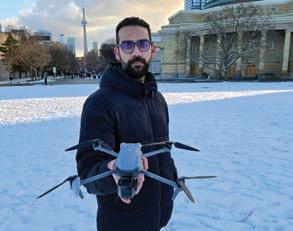
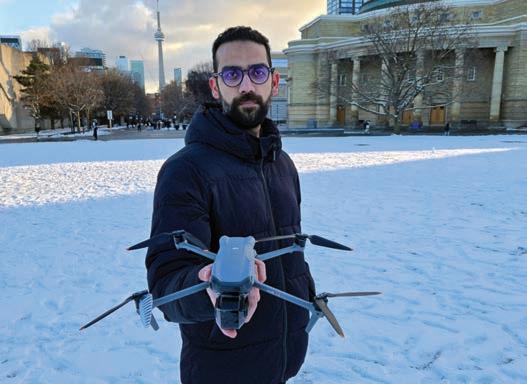
The versatility and light weight of the coating means that it can go on multiple surfaces –including small drones, where Alasvand Zarasvand believes the technology will be particularly helpful. “Drone crashes in cold weather are common, so drones used for commercial
inspections of power lines or delivering aid to remote regions need reliable ice detection,” he said. With most studies on drones carried out only under simulated conditions, Alasvand Zarasvand created a real-world situation by flying the drone in front of a nozzle system that sprayed water at known temperatures while the environment was kept below freezing. And once ice began to form, it didn’t take long for the drone to crash. “One of the surprises in our research was just how vulnerable the drones were under cold weather conditions,” Alasvand Zarasvand said. “Our system responds in less than a millisecond, so drones can land before icing causes a crash.”
Another element that sets the new sensor apart is its heating potential. Alasvand Zarasvand hopes that the electrode layer can also act as an electrothermal de-icing system to melt ice when it’s detected. “It’s an energy saver, not having to constantly have heating on,” he said.
More research is planned for this coating, including testing it on drones in outdoor conditions, integrating heating and sensing, and adapting the system for different applications. “If we can avoid the need for emergency landings for aircraft vehicles and the need for de-icing fluid, then it’s a real impact,” Alasvand Zarasvand said. “What we have is the first step, and now that we know this system works, it will be exciting to take it further.” |DE
Photo: Behrooz Khatir and Mohammad Soltani
Amplify Content Studio is a full-service custom content studio, helping companies share their story, build brand awareness and garner trust through original content.
There are so many ways to reach a target audience. We’ll craft you content for any medium:
• Thought leadership – long-form or short-form articles
• Blogs, whitepapers, infographics and case studies
• Webinars, podcasts and video
• Tradeshow marketing content
• Automated content marketing supported by first-party data ....and so much more!



Engineers know the importance of a solid foundation. That’s why the Engineers Canada-sponsored Group Savings and Retirement Program offers tailored financial solutions to help you build and grow your savings. Whether you’re saving for that next trip or planning for a confident retirement, build on what you’ve earned with a financial approach as intentional and forward-thinking as you are.
Why join the plan?
• Lower-than-retail fees* mean you pay less and keep more, helping your savings go further
• Access to a variety of plan options including a registered retirement savings plan (RRSP), tax-free savings account (TFSA), non-registered savings plan (NRSP), registered retirement income fund (RRIF) and life income fund (LIF)
• Free personalized guidance from licensed advisors who understand your goals and help you stay on track
• Retirement support from a dedicated licensed consultant offering expert, non-commissioned advice to help you understand your options and retire with confidence
• Easy plan management from anywhere through My Canada Life at WorkTM, Canada Life’s intuitive member site and mobile app
A plan built just for you.
The Engineers Canada-sponsored Group Savings and Retirement Program is exclusive to engineers, geoscientists, students and their families across Canada.