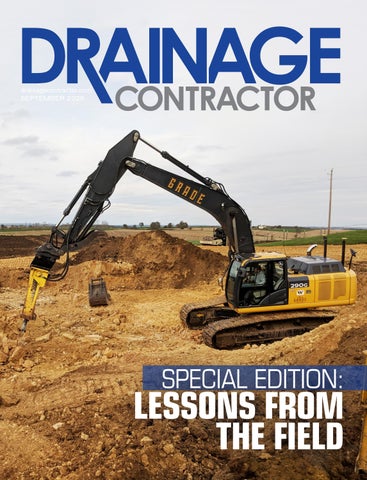
drainagecontractor.com SEPTEMBER 2026
SPECIAL EDITION:
LESSONS FROM THE FIELD
EDITORIAL
Expect the unexpected by Bree Rody
I "You could make a whole event out of contractors' craziest field stories."
t all started at DrainWest.
On a chilly March day in Brandon, MB, I hosted a fireside chat with contractor Hudson Mealy, who co-founded Impact Drainage with his brother, Taylor. Hudson and I first met at a trade show in 2025, when Impact was only about a year old, and I’ve followed his career closely since – calling him up for interviews, field pictures, points of view and more. Naturally, I knew he would be a great speaker for a conference held in a place where drainage is still a burgeoning industry – even after only a few years in business, Hudson already had some great stories. One of those stories came out onstage, and it was one I’d never heard before. I’d reveal the details here, but you can read them yourself on Page 10 (and yes, there are pictures). What I can tell you here is that his story had me – and the audience – in stitches. Not an hour later, at presenting sponsors Precision Land Solutions’ panel, a question was posed about the biggest pain points in tiling. Field operations manager Glen Bartly, knowing his answer would resonate, grinned and grabbed the mic. One word: “Rocks.” A knowing chuckle rippled through the audience. While the day was about much more than these anecdotes, I went home thinking, “You could make a whole event out of contractors’ craziest field stories.” And it is true – contractors tell great stories. That’s not exactly what we did here, but it did lead to the creation of this e-book. Yes, contractors have a knack for storytelling. There’s something about the profession that attracts great orators, I suppose. But it’s the kind of storytelling that serves a purpose: we walk away not only entertained, but also educated. Think of your early days at a job you may have had, when the person training you started to loosen up – maybe go off-script a little. You come across a rule or a process or a piece of advice that seems… oddly specific. Maybe you get the courage to ask: “What’s the story there?” And then they launch into the story. The story in which something hit the fan. Your jaw drops. Your belly aches from laughing. But as you collect yourself, they shrug: “So, that’s why we don’t do that anymore.” And then, one day in the field, you come across something unexpected – something no manual covered. And just as you’re thinking, “What do I do now?” you hear the story again. You repeat to yourself: That’s why we don’t do that anymore. You’ll get to know many people throughout your career, and you’ll hear many stories. And you’ll still have never heard all of them. But this e-book is a starting collection of some of our favorite stories. They’re not only the most entertaining, but also the ones that have a clear lesson to be learned. We’ll also provide resources on how to stay safe, prepared and alert, from planning to the drive home. Have fun in the field.
2 DRAINAGE CONTRACTOR | SPECIAL EDITION: LESSONS FROM THE FIELD
SPECIAL EDITION: DRAINAGE DONE DIFFERENT SEPTEMBER 2026
Reader Service Print and digital subscription inquiries or changes, please contact Angelita Potal, Customer Service Rep. Tel: 416-510-5113 Fax: 416-510-6875 Email: apotal@annexbusinessmedia.com Mail: 111 Gordon Baker Rd., Suite 400, Toronto, ON M2H 3R1
5
SPECIAL THANKS TO... LaVerne Weber, Tyler Seals, Stu Frazeur, Steve Gerten, Hudson Mealy, Eric Layden, Denis Mikula, Jr. and Tyler Seals. Thanks to LICA National, Ohio LICA, Illinois LICA and LICO for their contributions and connections.
Editor | Bree Rody brody@annexbusinessmedia.com 437-688-6107 Sales Manager | Sharon Kauk skauk@annexbusinessmedia.com 519-410-4854
8
Account Coordinator | Shannon Drumm sdrumm@annexbusinessmedia.com Audience Development Manager | Anita Madden amadden@annexbusinessmedia.com 416-510-5183 Group Publisher & VP, Content Strategy | Michelle Bertholet mbertholet@annexbusinessmedia.com CEO | Scott Jamieson sjamieson@annexbusinessmedia.com Printed in Canada ISSN 1488-4305 Publications Mail Agreement #40065710 Subscription rates: Canada – 1 yr $18.56 CDN Canada – 2 yrs $26.52 CDN USA – 1 yr $36.60 CDN Foreign – 1 yr $49.33 CDN From time to time, we at Drainage Contractor make our subscription list available to reputable companies and organizations whose products and services we believe may be of interest to you. If you do not want your name to be made available, contact our circulation department in any of the four ways listed above.
Annex Privacy Officer privacy@annexbusinessmedia.com 800-668-2374 No part of the editorial content of this publication may be reprinted without the publisher’s written permission © 2026 Annex Business Media. All rights reserved. Opinions expressed in this magazine are not necessarily those of the editor or the publisher. No liability is assumed for errors or omissions. All advertising is subject to the publisher’s approval. Such approval does not imply any endorsement of the products or services advertised. Publisher reserves the right to refuse advertising that does not meet the standards of the publication.
drainagecontractor.com
Sections INTRODUCTIONS 4: About this e-book Featured contractors BEFORE THE JOB STARTS 5: What's in a name? 6: Your "job day" tote 6: Safety first and always PPE standards
11
12
FINDS IN THE FIELD 8: Fixing old mistakes 8: Not-so-cuddly critters 9: All's well that finds wells 10: Kickstart my heart MESSY SITUATIONS 11: Sink or swim GUEST COUMN 12: Neighboring landowner BMPs
Your inbox, every two weeks Drainage Contractor continues to bring you the best of the web, with the new, the now and the relevant coming straight to your inbox via our free, biweekly eNewsletter. Subscribe today at DrainageContractor.com. New eNewsletters Notice something new in your inbox? Earlier this year, we launched two new free eNewsletters: Just The Good News – for a dose of industry optimism – and Cover Stories – for deeper drainage dives. SPECIAL EDITION: LESSONS FROM THE FIELD | DRAINAGE CONTRACTOR 3
THE INTRO
ABOUT THIS E-BOOK The what, the why and the who
W
e’ve divided this book into key sections: tips for before the job starts, tips for in the field (including unexpected finds and equipment malfunctions) and finally, the human factor – neighboring landowner relation BMPs. by BREE RODY
WHAT IS THIS E-BOOK? Lessons From the Field is designed as an evergreen e-book for contractors, drainage installers and anyone working on drain tile or other subsurface agricultural projects. Although many of these stories are humorous in their contents, we also hope you will learn valuable lessons from this book that help you operate in a safer and more prepared way every day. It is our intent to re-publish this e-book every few years with new stories (and your favorite, evergreen cautionary tales), new advice and new perspectives – so if you’re looking to get your tales in the next edition, contact us!
WHO’S TELLING STORIES We’ve chatted with scores of contractors over the last few months to find the best, most thrilling and wackiest stories in the field – with representation from the Midwest, the Northeast and Canada. Here’s whose stories you’ll be reading:
Stu Frazeur owns and operates Stu Frazeur Tiling in Canby, MN. As a contractor, he specializes in drainage and irrigation, septic systems, terraces and waterways, and also has experience installing controlle drainage. Unfortunately, the beard in this picture is not real. Steve Gerten is the owner of Ohio-based Inbody Drainage Company, and celebrated 50 years in business in 2024. Originally tiling as a part-time job at the age of 16, Gerten eventually purchased the business, which he still runs with his brother, two sons and nephew. He’s been a previous president of OLICA, and in 2024 was named LICA’s National Contractor of the Year. Eric Layden owns Layden Drainage in Hooperston, IL. A past president of Illinois LICA, Layden holds a BSc in physical geography from Illinois State University and is passionate about spreading education in drainage. Hudson Mealy co-founded Impact Tile Drainage with his brother, Taylor, in 2022. Based in Minto, MB, the Mealys have expanded their business to include Saskatchewan. As his business grows, Hudson has represented the
4 DRAINAGE CONTRACTOR | SPECIAL EDITION: LESSONS FROM THE FIELD
company at trade shows and speaking engagements, while still actively farming field crops. Dennis Mikula, JR. is the chairman of Mikula Contracting in Clifton, NJ, where he has worked since 1995. He sits on numerous boards including the Commerce and Industry Association of NJ and the Meadowlands Chamber operating committee board of advisors. Earlier this year, he was named LICA National’s first-ever CEO – and he also has 30 years’ experience as a secondary and collegiate football coach. Tyler Seals is a supervisor and head of farm drainage at Kieffer Bros. Construction in Mt. Carmel, IL where he sells, designs and installs farm tile in southeast and southwest Illinois. He is also VP of Illinois LICA. LaVerne Weber owns Grade Solutions in Rock City, IL and joined the drainage industry after an accomplished career in the roads industry. A previous Drainage Contractor GroundBreaker and current first vicepresident of Illinois LICA, LaVerne has aided drainage researchers and educators in the development of BMPs and in studies on edge-of-field practices such as bioreactors.
IN THE FIELD
BEFORE THE JOB STARTS
The work that’s done before you set foot in the field
T
ime lost can be hard to estimate, says LaVerne Weber. The owner of Grade Solutions in Illinois has worked in the drainage industry for more than 10 years, and in the roads industry for many years before that. So he knows a thing or two about the value of time, especially on contract-based jobs.
by BREE RODY
In those years, Weber says, one of the most consistent lessons he’s learned is that there’s a lot of time to be saved before one even steps onto the field. Researching the area in which you’ll be working is a must, he says. And in some cases, says Weber, the research involved isn’t that complex.
WHAT’S IN A NAME? Weber sites the small town of roughly 500 people where he’s based as an example – its
challenging topography should be visible on a soil map, but he says it’s common for busy contractors to breeze past the crucial step of checking a soil map. “There’s a lot of rock underneath this soil – it’s kind of interesting, because in some of these northern counties, in the northern part [of the county you’ll find significant rock, and the southern half does not – it’s the total opposite,” he explains. “You see some of it in our subsurface irrigation,
SPECIAL EDITION: LESSONS FROM THE FIELD | DRAINAGE CONTRACTOR 5
IN THE FIELD YOUR “JOB DAY” TOTE Standard PPE, as bolded in this feature, is a nonnegotiable. However, Layden says just as crucial to remember is personal comfort – which can very easily translate into safety on a long job. Days that last 12 hours or more in tough conditions, far from your home or a store, are part of the job, says Layden, who keeps a tote – roughly 12 by six inches – with his recommended job day essentials. • Allergy medicine – hay fever and other seasonal allergies are commonly triggered in agricultural settings. • Sunscreen and bug spray. • Pain medication, which can help not only with workrelated aches and pains but also with sunburn relief. • A belt. (Layden laughs – “Believe me, you never know when your belt might break!”) • Electrolyte packets – hydration and sodium levels can deplete significantly on a summertime field day. where we’re literally putting irrigation lines on a contour.” Weber’s town? Rock City. He laughs. “It’s not rocket science,” he says with a chuckle, “One probably should know these things, but when you start operating for a while, things start clicking.” Paying attention to not only town names but also road names in an area is a practice one should get used to, especially if they are limited in their access to detailed maps or are unsure of how to interpret something. “There’s a town called Rock Grove; you have a Rock City Road, Rock Run Road, Rock Rolls Road – when the old timers started naming all these areas with the word ‘rock,’ there’s your sign that you should pay attention.” His team can usually get through the rock with a couple pieces of equipment, says Weber, but in some cases, boring equipment was needed. Last year, he says, during a massive excavation for a cheese plant, Grade Solutions’ pre-work scouting indicated that there would be limestone close by. “We insisted on soil boring,” he says. “The corner of this excavation was solid rock – so we were really hammering down a lot to grade for this building expansion. Paying attention to the names in these areas might give you advance in terms of preliminary preparation.” Rocks aren’t the only feature that Weber encounters when he checks the address for a job. Underlying water features are another challenge not visible to the naked eye. “We’re on a site right now,” says Weber during his interview, “And that’s exactly what we knew we were going to encounter – the road was called Springbrook Road, and surely, there were a lot of underlying springs in the field, which even some of the landowners aren’t aware of.” And, although it can be a delicate subject, it’s not always wise to simply take a landowner’s word for it. “Some newer landowners, once the older owners are gone, they might not be aware of everything – they might not have heard the stories.” When you
can’t connect with previous generations, says Weber, it’s best to start with official maps and documents – and, although Weber doesn’t consider himself a naysayer, a tendency to ask, “What happens if this goes wrong?” is essential. “Be knowledgeable about at least a couple of alternative plans – we do a lot of rehearsing in our minds.” For example, he says, it may be “primitive,” but knowing how to evacuate unexpected water under the Springbrook Roads of the world can avoid not only time lost, but also stuck or stalled equipment. The specific evacuation may depend on the specific project, equipment and topography, but more “mental rehearsing” the team does, says Weber, the quicker one can implement the plan. “We go in with contingency plans that we can implement really quickly. You’re going to have a little bit of a loss, but [not having a plan] can add days of downtime.” For Inbody Drainage Company owner Steve Gerten, rocks are also quite common. From time to time, he says, you may break the point of your plow, and even when trying to get rock out, you may break a tooth on an excavator or backhoe bucket. “You can expect that things like that could happen when you’re trying to take care of a problem or situation – you always want to be conscious of your grade.” Gerten likes to keep gravel available. “We like to have number six stone on hand so we can fill that hole or void and bring it back up to grade where the tile is going to be, so you don’t have to worry about it settling and eventually having a dip in your tile.” Nine times out of 10, he says, the rock itself is deeper than the grade – Gerten says it’s always smart to use stone to support the grade or elevation, which will help keep the water flow strong.
SAFETY FIRST AND ALWAYS Rocks don’t just cause lost time due to big equipment demands. They’re also risky. And Stu Frazeur, owner of Stu Frazeur Tiling in Canby, MN, says rocks are one of the first things he tells workers about on their first day. “If you’re running a wheel trencher in rocks, on your very first day, I’d say, ‘Be sure you keep your PPE on,’” says Frazeur. Wheel trenchers have a tendency to throw rocks around, says Frazeur. Standard PPE for anyone operating a wheel trencher starts with the obvious – head, eye and face protection (a full-face shield for any up-close inspections), slip-resistant, steep-toed boots and high-visibility (light-reflective) clothing. Ears and hands should also be taken into account – approved earplugs or earmuffs with an approved noise reduction rating can help avoid long-term damage, although any gloves should be form-fitting as loose material creates entanglement hazards. Some soil conditions may also warrant a dust mask. Before getting onto your equipment, check all factory guards on your machine’s components to assure flying rocks will be blocked. While research of the terrain should be thoroughly completed before the job begins, an on-site terrain assessment can never be skipped, especially as different weather conditions can create different hazards. Contractors should also be well familiar with their respective
6 DRAINAGE CONTRACTOR | SPECIAL EDITION: LESSONS FROM THE FIELD
“call before you dig” systems. In the U.S., the standard, nationwide number is 811 – a free service that helps identify underground utilities so contractors can work around them. It is recommended that U.S. contractors make their 811 calls two to three business days before their project begins and provide as many details as possible including equipment descriptions, depth of excavations and GPS coordinates. In Canada, 811 is not the national “call before you dig” line (it provides nonemergency health advice); instead, all 10 provinces have different toll-free lines. One must provide similar details to the U.S. service, with around five business days’ advanced notice. Eric Layden, owner of Layden Drainage in Hooperton, IL, says safety begins with awareness of standards set by the Occupational
Safety and Health Administration’s standards and practices. Not every practice set out by OSHA is law – OSHA is a federal agency, and some regulations one might find on agricultural or construction worksites differs by state – but OSHA practices are a good start. There’s been plenty of education about the dangers of confined spaces in agriculture when it comes to grain bins and manure storage facilities, but Layden reminds readers that trenches and manholes of certain depth are considered a confined space by OSHA. Hydrogen sulfide is heavier than air, and can pool at the bottom of a confined space. “OSHA wants us to be wearing a three-gas monitor around our neck [when standing in a confined space]. I wouldn’t say it’s common practice, but that’s the OSHA guideline – especially if you’re going to be down in the bottom of a hole.” Relying on the monitor is crucial, as hydrogen sulfide can neutralize the olfactory senses at 400 PPM, meaning the nose is not a reliable indicator. OSHA dictates that these devices must sample air within the worker’s “breathing zone” – defined as forward of the shoulders within a radius of six to nine inches. Hence, around the neck. A lanyard is not recommended, as it can drop the device down too low and create an entanglement risk. Thus, the monitor should be clipped directly to a collar, lapel or shoulder strap on a harness or vest. “The best work is the work that’s done properly,” says Layden.
PIPE THAT PERFORMS. DRAINAGE THAT LASTS.
Drainage tubing from 4" to 15" Full range of fittings in stock Dual wall pipe up to 48" in diameter
5384 Line 81 RR4 Listowel, ON N4W 3G9 | PH:519-291-3118
SPECIAL EDITION: LESSONS FROM THE FIELD | DRAINAGE CONTRACTOR 7 DC_LISTOWEL_AUG26_BAS.indd 1
2026-09-22 9:27 AM
IN THE FIELD
FINDS IN THE FIELD by BREE RODY
D
Contractors share their craziest discoveries below the surface
ennis Mikula, JR’s family has been in the construction business for 80 years. His grandfather started the business in 1946, specializing in excavating and drainage demo. When Dennis became involved with the business, he also became involved with the Land Improvement Contractors of America (LICA), where he recently became the CEO. He’s heard a lot of stories – and seen a lot of crazy things himself.
Drainage and excavation can uncover all sorts of quirky finds. Mikula details some of the things he or his team have come across. “We found a time capsule from the early 1910s with magazine articles and bibles,” he says. “[The team] have run over safes before – and bones.” He added: “We’ve had to call to make sure they weren’t human remains.” They weren’t, he clarified. The team has even knocked down a house to find another house. But finds in the field aren’t always funny or quirky. Besides the pesky natural elements of rocks and water discussed on Page 5, contractors have reported a slew of unnatural elements – from wells to wires and even wildlife.
FINDING OLD MISTAKES Canby’s Stu Frazeur says some of his jobs have started out with him having to undo old work. “I had a piece of tile that is plugged because the landowner had an eight-inch tile, but he only had a six-inch cast iron beehive-style intake.” The landowner had made himself a ring on top of the intake, but overtime, the beehive slid down the intake and went downstream. When Frazeur came on the job, the intake cap was restricting flow after after getting stuck a full 600 feet downstream from where it first entered the main. What had happened? “The five-inch plastic plug was mounted at the end of a tile line, inches from an intake,” Frazeur explains. “Mice entered the intake, chewed on the plug which, when weakened, dislodged and was discovered a quarter mile away in the tee that was crushed by truck traffic. There was a suck hole by the intake, and we couldn’t figure out why there was no plug.” It’s typical to see mishaps that come from stopgaps, says Frazeur. “We’ve seen other contractors who didn’t have a sixinch coupler, so they shoved a five-inch into it – it’s throttled everything, and they’ve charged the [client] for six inches.”
As for the beehive intake incident, Frazeur walked away with a keepsake (pictured), but also a lesson learned: “We now use heavier plugs when near rodent access.”
NOT-SO-CUDDLY CRITTERS Mice aren’t the only thing that have caused a stink on the job. Frazeur’s had his own encounters with wildlife, including a skunk he had to carry out of a worksite – after the skunk had ridden with the team all the way down a huge culvert. Hooperton’s Eric Layden agrees. Two decades ago, when Layden purchased the business, a veteran contractor told him he’d be seeing a little bit of everything on the job – and it turned out, he’d be seeing nearly the entire animal kingdom. “If it’s not snakes or racoon or fish in the middle of the field,
8 DRAINAGE CONTRACTOR | SPECIAL EDITION: LESSONS FROM THE FIELD
it’s snapping turtles in tile holes.” He’s even encountered a number of “job dogs” – dogs who may or may not have an owner, who show up and hang around, even spending the whole week with the crew – even eating part of your lunch, says Layden. “I didn’t really understand what [the contractor] was talking about, but now I know,” he says. Not all of the animals are as cute as dogs; his crew has had to scoop at least one temperamental snapping turtle out of a tile, and fling a snake or two off a site. But one of his funniest memories came from draining a prairie pothole. “We were probably 1,000 meters from the ditch when my brother picked up a carp that was over a foot long,” says Layden. “The farmer happened to be there to witness – his jaw just dropped. He couldn’t believe that this was in field – it made it all the way there.” Then there are the animals who look cute but could also pose a danger. “One time, I dug a hole. There was existing clay pipe, so I got down into the hole to look inside it.” Looking into pipes can be done safely and has to be done to look for mud or water – but when he stuck his head in, Layden’s glad he had proper PPE and a quick reaction time. “There was a raccoon looking right at me – about five or six feet away.” Despite their innocent-looking faces, raccoons can pose a risk of rabies – and, it should be noted, a rabid raccoon’s lethargy
and confusion can sometimes come across as docile and even gentle. Don’t take this as a sign to get closer. “That got me out of the hole right away,” says Layden. Rather than chance it by sending a human in, Layden says they let time take care of it. “We broke for lunch – we were wondering if he was still there. But he was gone.” Layden reminds contractors that looking into a pipe requires not only proper PPE (see Page 5) but also a thorough examination to ensure that the excavation was done properly. “It’s all about the excavation and safety, and being able to trust yourself or an employee to get in. And it’s one thing to be standing in a hole, but another to be crouched down in a vulnerable position.”
ALL’S WELL THAT FINDS WELLS Ohio’s Steve Gerten thinks he might have the best luck in the world – or perhaps superhuman hunting abilities. “Several years ago, we were on an 80-acre project,” he says. “The landowner told us, ‘clear back there, in the back 40, there used to be a well.’” The landowner didn’t know the exact coordinates of the old well, just that years ago, there had been a well. Gerten says in such a large project, he didn’t think the odds were in their favor to land on the well. “Well, as luck would have it, we happened to run right on top of that well – so we found it!” he says laughing. The team dug
AGRICULTURAL DRAIN SYSTEMS HIGHWAY CULVERTS 3” TO 48” • Agricultural Drain Systems • Airport Runway/Parking Lot • Constructed Wetlands • Landfill Drainage • Industrial Waste Water Applications • Septic Sewer Drain Pipes • Sewer Sludge Compost Pipe
OUR PIPE IS LABORATORY TESTED Crumpler Plastic Pipe, INC.
For the Best Quality and Service Call
Phone: 910-525-4046 Fax: 910-525-5801 cpp-pipe.com Toll Free: 1-800-334-5071
Crumpler has proudly served the Carolinas and beyond since 1945 SPECIAL EDITION: LESSONS FROM THE FIELD | DRAINAGE CONTRACTOR 9 DC_CRUMPLER_EBOOK26_BAS.indd 1
2026-09-16 10:45 AM
IN THE FIELD and located the capped well at approximately two feet below the surface. It was a somewhat easy fix – “We put a little hole in the casing, re-capped it, re-cemented it to seal it back up, and that’s how we fixed it.” But Gerten still laughs at the luck of it all. “In 80 acres, if a fella wanted to try to find it, he wouldn’t find it.”
KICKSTART MY HEART Mt. Carmel’s Tyler Seals echoes reminders about calling 811 (or whatever jurisdictional call-before-you-dig line is available), but added one caveat: “They do not locate private utilities.” This matters, he says. While he jokes that nearly every day has a memorable incident, some have resulted in more damage or lost time than others. “We were installing tile one day – I worked for this local farmer for 11 years ago, and I farmed every year for him. There were oil wells on [the property]. We were right along the road. There was another oil well across the road, but I thought it went to another set of pump jacks. No one said anything about it.” But the next thing Seals knew, there was a big buzz sound followed by a flash – and a big ball of fire. Fortunately, he says, the fireball didn’t last long, and no one was hurt – but the trench stayed on fire. “So the trench chain, everything, just sat there burning.” The crew had to shut everything down until things were officially cleared. It turns out the oil went across the road, which Seals didn’t
know, even despite his familiarity with the property. “It goes to show a person to always double check – just because you think it may be a certain way doesn’t mean it is.” With this being a private oil well, he says, an 811 service wouldn’t locate it. “Down here in Southeastern Illinois, there’s literally pump jacks in almost every field pumping oil – it’s one of the largest oil basins in the country.” Pump jacks can be found in almost every field in the region, he says, some of which have been there for 70 to 80 years. Where the lines run between the jacks can sometimes be a “guessing game,” he says, so they spend a lot of time dealing with oil companies. Seals hasn’t just seen great balls of fire – he’s had great brawls with wires. On one job in which the crew was executing a directional bore underneath a state highway in the middle of town, they came across a fibre optic line. “We were told it was four feet deep, [and] we were boring at 15 feet deep,” he says. “We thought we didn’t need to locate it, because they didn’t put it in 15 feet deep.” Almost 100 feet of boring later, once they got to the end of the road, they hit the wire. “It felt like a one in a million chance,” he says. “But it shut down [fibre optic for] two cities. It was a major ordeal.” The lesson learned? Even “obvious” assumptions can come with a cost.
BUILT FOR
CONTRACTORS. TRUSTED IN THE FIELD. Quality corrugated drainage pipe, fittings, and accessories designed to perform when it matters most.
(800) 720-8453 timewellpipe.com 10 DRAINAGE CONTRACTOR | SPECIAL EDITION: LESSONS FROM THE FIELD DC_Timewell Drainage_EbookFall26_CSA.indd 1
2026-09-10 1:33 PM
IN THE FIELD
MESSY SITUATIONS by BREE RODY
R
Sometimes, problems are big enough to require a whole crew.
ock City’s LaVerne Weber’s many mental rehearsals and contingency plans means he’s developed solutions to highly specific situations.
For example, when he’s run across surprise or excess water, his crew has had to create temporary drainage – usually French drains or clear stone drains. Surprise water is part of the job, he says, but evacuating water is necessary, and failing to do so can have grave consequences. “We’ve been stuck in the mud before,” he says. And a big machine stuck in the mud can cause a big prolem.
SINK OR SWIM Mt. Carmel’s Tyler Seals heads up drainage for a large construction company – drainage is just one part of their mandate – which means he’s seen his share of heavy equipment getting into sticky situations. Literal sticky situations. “We were building a large marijuana production facility, and we had to strip down 15 acres of topsoil and brush.” Two large tractors and two dirt pans were on the field – but the work uncovered soil that Seals described as “almost like quicksand.” “Once you broke through it, it just sucked you down.” The crew’s large John Deere 9530 oil drive tractor and large dirt pan were “literally sucked into the ground,” he says. The time lost was significant. “We spent almost 10 hours getting it out.” It involved dipping all of the dirt out of the pan and digging a huge area around the tractor, and then calling in another friend with a dozer, who tag-teamed with Seals on his own tractor. “It pulled my
tractor all the way down to the front of the cab,” he says. “The windows of the cab were underground.” It sounds crazy, says Seals, but those type of chain reactions can become extreme. Take Minto’s Hudson Mealy, who has learned a lot in his first five years of business. Looking back on his first few, scrappiest years, one story sticks out. “It had been kind of wet that fall,” Mealy says, but it was nothing crazy. “But the area we were working in was really saturated.” Still, he says, one area was especially saturated where they were working. “It took a couple of days, and basically the first thousand feet of the overcut just filled with groundwater.” A few inches of water filling the space created an immediate problem, and the crew had it outletting out into the area below – but that whole area, in Mealy’s words, “turned to soup as well.”
The crew hooked the pow onto the end of the 50-inch compact trailer and began plowing just before the overcut. But within a couple feet, they had the plow down in the dirt, down to the cab wall. But it didn’t stop there. The crew brought in their larger, 35-ton excavator and hooked it on. It went down quite quickly – mud coming into the cab and all. “We tried with our other excavator, hooking it onto the front of that to get it out, and we couldn’t budge it.” The crew came close to hiring a winch truck, and weren’t even sure that would work. Eventually, the client was able to help – he had his own D6 dozer with a winch, which finally got the “train” moving. The process took four to five hours, Mealy says. More memorable, though, was the attention it attracted. “It was a Friday night,” he says. “People in town started showing up and talking to us, coming in to take videos.” You want to get the job done and can’t always wait until conditions are pictureperfect – and Mealy says the initial sinking might not have been avoidable. But looking back, he says rain couldn’t be avoided, but he should have simply started with the dozer and the winch – and not try to pull out with an excavator. “If we’d just started with the dozer and the winch, we could have gotten it onto dry ground to get going.” But it’s at least a great story, says Mealy – and one that earned them a good deal of attention.
SPECIAL EDITION: LESSONS FROM THE FIELD | DRAINAGE CONTRACTOR 11
GUEST COLUMN
Neighboring landowner BMPs By Ryan Arch, with intro from Bree Rody
EDITOR’S NOTE: This column by Illinois LICA’s executive director, Ryan Arch, originally appeared in the May 2024 addition of Drainage Contractor. We thought this would be helpful to include as a resource because amidst all the snapping turtles, equipment failures and great balls of fire, many of our contractors’ stories also touched on one of the most intriguing things of all: human nature. “Our little motto I put on most of my invoices is, ‘In field and in people, it’s what beneath the surface that makes the difference,’” says Stu Frazeur. Sometimes neighboring landowners, even well-meaning ones, have suspicions, questions and concerns. Frazeur says over time, he’s developed a skill any drainage business owner should hone: figuring out which of your team members have the “people skills.” “Sometimes, someone just thinks they know better, or they’re watching us all the time,” Frazeur explains. “I have an employee who does a very good job at talking – he’s the ‘designated distractor.’ Sometimes, that’s the most efficient use of a guy’s time.” For more info on neighborly relations, here’s Ryan Arch’s perspective.
A
ll contractors have been there: you’re working for a landowner or tenant on a project that is “land locked” between neighboring properties. It could be standing crop, limited equipment loading/unloading access, or inadequate bridge crossings. Or maybe you have access to your project site, but your project area includes work at or near the property line of a neighbor’s. Regardless of the situation, and whether or not the landowner you are working for is a “Hatfield” or a “McCoy,” we have compiled some best management practices (BMPs) to help keep you and your company on the honorable neighborhood list, preventing downtime and future lost business opportunities.
KNOW THY DECISION-MAKER Few things are more frustrating than taking the time and effort to meet and discuss a project with a customer only to discover that they do not have the authority, as a partner or tenant, to ultimately make the on-farm decisions, or worse yet to discover that they do not have any ties to the property they are leading you onto for the project; it’s happened… Most landowners and tenants wouldn’t purposely lead a contractor into litigious situations, but it is critical to identify your customer’s ties to the property upfront. This 12 DRAINAGE CONTRACTOR | SPECIAL EDITION: LESSONS FROM THE FIELD
can be accomplished during project discussions where you directly ask who the decision maker is, who owns this ground, who owns any of the infrastructure in the project area, and what’s the contact information for them. As you document any project details, jot
down the information your customer is providing regarding property ownership, contact info, neighbors, etc. for future reference, and don’t forget to date stamp and file these notes for further safe keeping should you need them.
KNOW THY SCOPE Proper pre-planning increases efficiency, reduces costs and enhances safety. Applying these skills to evaluate a project’s scope, or area of impact, to help better identify any project specific considerations but also to help identify situations that may impact a neighboring landowner’s property. For example, compare equipment operation and space requirements to design sets. Is the last lateral of your drainage system installation far enough back from the neighbor’s property line, or would your equipment have to be “nosed out” across the property line to complete the run? Does your designed waterway
grade logically blend with the neighbor’s receiving waterway downstream, or will some grading be required at or beyond the property line to ensure the new waterway’s function after construction? Are you able to clear your customer’s fence row entirely from their side of the property, or is it likely you may need drop trees onto the neighbor’s side for safer removal? Every project has an area of impact that should be closely reviewed, especially when there is neighboring property not owned by your customer.
KNOW THY NEIGHBOR Everybody has a neighbor. Whether or not they are on speaking terms with their neighbor is a different story. Luckily, as a contractor, you just must be cognizant and respectful of the neighboring landowners and their property. If your project area of impact is solely on the property of your customer’s and there are no foreseen impacts (direct or indirect) beyond the
field border, you are likely in good shape to proceed with your project without further ado. If, however, your project may be crossing the property line or contributing more concentrated surface or subsurface drainage flow, for example, you will need to work with your customer to identify their neighbor. What are their names, how are their existing relationships with their neighbors, what’s the best way for you to contact them, etc.? Most contractors are pros at navigating personalities, finding solutions and getting the job done. That said, working across property lines on projects, intended or unintended, can have real consequences without prior planning and clear communication; even the seasoned pros have a story or two to share about that. Do yourself a favor and “love thy neighbor as thyself” …or at least treat their property as you would want yours to be treated. You never know: that neighbor could just be your next big customer.
TIME WATER IS MONEY
UP TO
30% MORE YIELD
DISCOVER HERE
SPECIAL EDITION: LESSONS FROM THE FIELD | DRAINAGE CONTRACTOR 13 DC_Solano_EbookFall26_CSA.indd 1
2026-07-24 10:34 AM