www.canplastics.com
SEPTEMBER 2020
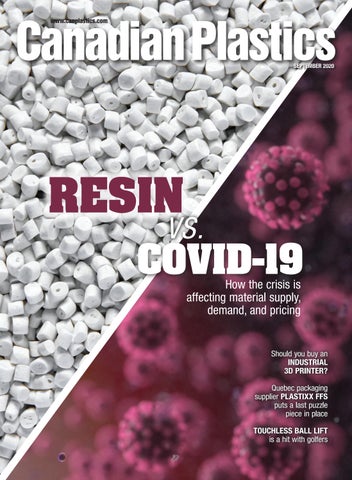
RESIN
VS.
COVID-19 How the crisis is affecting material supply, demand, and pricing
Should you buy an INDUSTRIAL 3D PRINTER? Quebec packaging supplier PLASTIXX FFS puts a last puzzle piece in place TOUCHLESS BALL LIFT is a hit with golfers
CPL_Sept2020_AMS.indd 1
2020-08-21 1:54 PM
C
M
Y
CM
MY
CY
CMY
K
CPL_Maguire_Sept20.indd 21 CPL_Sept2020_AMS.indd
2020-08-05 2020-08-21 11:18 1:54 PM AM
5 11:18 AM
contents SEPTEMBER 2020 VOLUME 78 • NUMBER 4
Cover: 4X-image/Getty Images
The January 1966 issue of Canadian Plastics reported on a new milk transport case developed by Tedruth Plastics Corp. in Toronto. Formulated from Hercules HDPE, the injection molded cases weighed twothirds less than the wood-and-wire crates that were then cornering the market; had no dividers since they were intended for plastic bottles instead of glass bottles; and could be nested within each other, allowing for good stackability. The cases, which were capable of carrying four three-quart or six two-quart plastic bottles, came with a five-year guarantee against breakage in normal handling, and were being distributed by Kemp Products Ltd., in London, Ont.
Cover: saravut - stock.adobe.com
FROM THE ARCHIVES
10
Number of the month:
6 million*
* Amount of new PE capacity, in tons, added in the U.S. since 2017. (See pg. 11)
16
14 cover story
10 MATERIALS: Resin vs. COVID-19 in every issue 4
Editor’s View: CPIA, RIP
5
Ideas & Innovations: Getting kids back to school with the IsoBooth
6
News: • CIAC names Elena Mantagaris to lead new plastics division • Maguire now distributing for Rapid Granulator in Ontario, Central and Western Canada • Expoplast cancelled, virtual event planned • Supplier News and People
23 Technology Showcase 25 Advertising Index 26 Technical Tips: Barrel temperature profiles for barrier type screw
The pandemic is having a massive, chilling effect on global oil prices, and thus on petrochemical markets. Add to this the fact that demand for plastic resins used in durable goods has suffered while material demand for packaging and healthcare applications has skyrocketed, and the result is an unprecedented supply, demand, and pricing situation. We asked two experts to explain what it means for buyers and sellers.
features
14 INJECTION MOLDING/MOLDMAKING: Scoring with a new touchless golf ball retrieval system
y eliminating contact between the golfer and the flagstick, the made-inB Ontario Mully Cup reduces the spread of COVID-19. And it could become the new normal on the greens even after the pandemic.
16 3D PRINTING: To buy or not to buy a 3D printer?
or plastics processors with a steady use for 3D-printed parts, that’s F definitely the question: is it better to make the investment for an in-house machine or outsource the printing? Here are some questions to ask yourself.
20 PACKAGING: Plastixx FFS puts a last puzzle piece in place
In an industry where customer service is everything, the installation of a new EFI PrintFlow scheduling workflow system is helping this Quebecbased form-fill-seal film and plastic valve bag maker stay ahead of the competition.
Visit us at www.canplastics.com September 2020 Canadian Plastics
CPL_Sept2020_AMS.indd 3
3
2020-08-21 1:54 PM
Canadian Plastics magazine reports on and interprets developments in plastics markets and technologies worldwide for plastics processors, moldmakers and end-users based in Canada.
editor’s view
CPIA, RIP
J
uly 1 – Canada Day, no less – marked the official end of the Canadian Plastics Industry Association (CPIA), which merged on that date with the Chemistry Industry Association of Canada (CIAC) to become its new plastics division. The goal is to combine resources so that CPIA’s proplastics voice and agenda gets a bigger platform, and I’m sure we all hope for great results. But the fact remains that, for the first time in decades, Canada is without a national association dedicated exclusively to plastics. CPIA traced its roots to the founding, in the war year of 1943, of SPI Canada, the Canadian branch of the larger, U.S.-based Society of the Plastics Industry. SPI Canada’s goal was to serve as the national voice for the industry, representing the interests of the plastics value chain including resin and raw material suppliers, processors and converters, equipment suppliers, and brand owners. Within a year of its creation, SPI Canada had company and individual members that represented over 90 per cent of the nation’s plastics industry, and over the succeeding years it accomplished much: in 1947 it sponsored the first Canadian plastics show with 24 exhibitors, it established a Hall of Plastics at the annual Canadian National Exhibition in Toronto, and beginning in 1950 it held its first Canadian Plastics Achievement Awards. In retrospect, SPI Canada took a giant leap forward in 1966, when Ron Evason joined the organization as vice president. Evason’s goal was to get SPI Canada out from under SPI’s shadow, and by 1971 he had negotiated an amicable separation from the American association. From then on, SPI Canada was an independent association that focused on Canada’s plastics industry needs. Fast forward to the mid-1990s and plastics was still a booming industry in Canada, but its reputation – and its pro-
4 Canadian Plastics September 2020
CPL_Sept2020_AMS.indd 4
www.canplastics.com EDITOR Mark Stephen 416-510-5110 Fax: 416-442-2230 mstephen@canplastics.com
file with government – was beginning to suffer under attacks from the growing environmental movement. Evason died in 1995, and the next year SPI Canada renamed itself as the Canadian Plastics Industry Association. CPIA aimed to offer a more geographically representative industry voice, with offices in British Columbia, Alberta, Ontario, Quebec, and Nova Scotia; and it absorbed such sub-groups as the Plastic Film Manufacturers Council and the Vinyl Council of Canada. But environmental pressures continued to grow (particularly those surrounding waste disposal and possible toxicity of raw materials) and increasing foreign competition combined with free trade and dwindling government grants created a much tougher competitive environment for Canadian processors than ever before. Faced with the fact that it couldn’t solve all these problems on its own, CPIA began to scale back – it sold the Plast-Ex and Expoplast trade shows, for example, and eventually shuttered its branches outside of Ontario – in order to concentrate on specific goals: encouraging the industry to become less wasteful by focusing on environmental stewardship, pushing back against product bans, and rebutting anti-plastics propaganda from the zealots who found new powers of attack through social media. After the 2008-09 recession, CPIA had to do more with even less, and forged valuable, productive partnerships with the Washington, D.C.-based Plastics Industry Association and the American Chemistry Council. Which is why its final partnership – in which it ceased to be CPIA by joining CIAC – is not out of keeping with this recent trajectory. And, again, I’m sure we all hope the new plastics division is successful. But that doesn’t mean we can’t mourn the loss of our only purely plastics national association.
ASSOCIATE PUBLISHER Catherine McDonald 289-921-6520 cmcdonald@annexbusinessmedia.com ACCOUNT MANAGER Wendy Serrao 416-510-6842 wserrao@annexbusinessmedia.com MEDIA DESIGNER Andrea M. Smith asmith@annexbusinessmedia.com ACCOUNT COORDINATOR Cheryl Fisher 416-510-5194 cfisher@annexbusinessmedia.com CIRCULATION MANAGER Shawn Arul 416-510-5181 sarul@annexbusinessmedia.com VP PRODUCTION / GROUP PUBLISHER Diane Kleer dkleer@annexbusinessmedia.com COO Scott Jamieson sjamieson@annexbusinessmedia.com PRINTED IN CANADA ISSN 008-4778 (Print) ISSN 1923-3671 (Online) Publication Mail Agreement #40065710 2020 SUBSCRIPTION RATES 5 issues Canadian Plastics, plus Dec. 2021 Buyers’ Guide: CANADA: 1 Year $77.50 plus applicable taxes; 2 Years $123.50+ taxes USA: $176.00 (CAD) / year FOREIGN: $201.00 (CAD) / year
CIRCULATION sarul@annexbusinessmedia.com Tel: 416-510-5181 Fax: 416-510-6875 or 416-442-2191 Mail: 111 Gordon Baker Road, Suite 400, Toronto, ON M2H 3R1 Occasionally, Canadian Plastics will mail information on behalf of industry related groups whose products and services we believe June be of interest to you. If you prefer not to receive this information, please contact our circulation department in any of the four ways listed above. Annex Privacy Officer privacy@annexbusinessmedia.com • Tel: 800-668-2374 No part of the editorial content of this publication June be reprinted without the publisher’s written permission ©2020 Annex Business Media. All rights reserved. Opinions expressed in this magazine are not necessarily those of the editor or the publisher. No liability is assumed for errors or omissions. All advertising is subject to the publisher’s approval. Such approval does not imply any endorsement of the products or services advertised. Publisher reserves the right to refuse advertising that does not meet the standards of the publication. MEMBER: Magazines Canada, Canadian Plastics Industry Association.
Mark Stephen, editor
mstephen@canplastics.com
www.canplastics.com
2020-08-21 1:54 PM
ideas & innovations
Photo Credit: Imagine Fibreglass Products
Getting kids back to school with the IsoBooth the positionable hood to its most effective and comfortable position. Made from polycarbonate, the IsoBooth is also said to be easy to clean, and consumes less than 80 watts of power per seat daily. The cost of the unit itself is comparable to that of one week of childcare. “The IsoBooth Student is intended to give kids a protected, safe, and comfortable place in the classroom to sit, do their work, listen to lessons, and eat their lunch without the distraction and discomfort of wearing a mask,” said Imagine Fibreglass president Jim Ashton. “As a parent, it’s especially important to me that my kids can get back to school.” A similar but larger version, called the IsoBooth Office, is available for teachers and office workers, Ashton said; it easily mounts to any standard five-spoke base office chair or stool, and has all the same features and benefits of the IsoBooth Student. CPL
Chain Slings
A
s Canada deals with the ongoing COVID-19 pandemic, students and teachers are preparing to face a very different school year come September – and a new device manufactured by a Kitchener, Ont.-based fibre reinforced plastic products maker might just help ease the transition. Called the IsoBooth Student, the patent pending device created by Imagine Fibreglass Products is designed to allow students to return to school safely without the distraction and discomfort of wearing a mask most of the day. The unit consists of a lightweight canopy and a compact, energy-efficient blower system that attaches to a standard school chair to protect kids in the classroom against aerosol and airborne viruses such as COVID-19. The opening in front of the IsoBooth is protected by a powered air shield that can capture and reject airborne droplets and aerosols. Meanwhile, the student inside can breathe easy and not have their view obstructed. The device can easily be pulled up to the desk by a student, company officials said, and the canopy can be adjusted forward to accommodate students as they lean down to write at their desk. With the open front, a student can easily move their chair, get in or out, and move
Shown with safety latch
Versatile Heavy Duty Lifting • ASME B30.9 OSHA & NACM Approved • Made of Grade 100 Alloy Steel • Safety Latch Optional
Nylon Mold Slings Also Available
Shown without safety latch
Call or Visit Our Website for More Information.
800.537.5375 • www.imscompany.com/CP5 70+ years Serving the Plastics Industry Made in the U.S.A
September 2020 Canadian Plastics CPL_IMS_Sept20.indd 1
CPL_Sept2020_AMS.indd 5
5
2020-08-07 1:43 PM
2020-08-21 1:54 PM
news
Photo Credit: Chemistry Industry Association of Canada
CIAC names Elena Mantagaris to lead new plastics division
The Chemistry Industry Association of Canada (CIAC) has named Elena Mantagaris, a public affairs and stakeholder
relations executive, as vice president of its new plastics division. The plastics division was created on July 1, when the Canadian Plastics Industry Association merged with CIAC, which is headquartered in Ottawa. Mantagaris has more than 20 years’ experience working with federal and provincial governments, along with municipalities and Indigenous communities to advance large-scale national initiatives in the iron, energy, transportation, technology, and cultural sectors. “She recently advanced a $1.5 billion iron processing facility and prior to that a $20 billion nuclear project with willing host communities,” CIAC officials said in a statement. Mantagaris’ served as director, gov-
ernment and external relations for Nuclear Waste Management Organization from 2008 to 2018, and most recently served as vice president, communications and public affairs with Maritime Iron Inc. She has a Master of Public Administration degree from Queen’s University. “Mantagaris will lead a team that will advocate on behalf of CIAC members to help Canada advance sustainable solutions for the development of a circular economy for plastics,” CIAC said. “Additionally, she and her team will focus on promoting responsible plastic production in Canada while working toward reducing and eliminating plastic pollution from the environment, all in support of a robust Canadian economy.” CPL
Lloyd Leadbeater, an innovative pioneer in Canada’s plastics industry, passed away on May 15 in Lindsay, Ont., aged 97. Born in Toronto, Leadbeater trained as a toolmaker and started making molds and dies for plastics in 1943, and six years later co-founded custom injection molder and extrusion shop Toronto Plastics Ltd. with two partners, and served as the company’s longtime president. Toronto Plastics began with a single injection molding machine and under Leadbeater’s guidance it grew into one of Canada’s premier full-service molders – eventually operating 28 injection presses and four extruders in an 85,000-square-foot factory – and produced some revolutionary plastic products. In 1960, the company developed the first all-vinyl window sash for customer Weather Seal Manufacturing; and in 1969, it worked with sports equipment maker Cooper Canada Ltd. to design and manufacture plastic helmets as well as the wildly-popular plastic road hockey stick replacement blades. By hiring graduates from polymers and plastics training courses at Ryerson
6 Canadian Plastics September 2020
CPL_Sept2020_AMS.indd 6
University and George Brown College in Toronto beginning in the 1960s, Leadbeater also played a big role in launching the careers of many wellknown Canadian plastics professionals, including Frank Maine and Bob Davies. “Lloyd was a real mentor to me and many others, and I learned from him what a good plastics manufacturer should be,” Davies told Canadian Plastics. “He was always pushing the state of the art in molding machine development, tooling innovation, and new plastics, and was up for any manufacturing challenge, no matter how difficult.” Peter Stephen, another industry veteran, remembers a very generous side to Leadbeater. “I was working for Anchor Cap in Toronto in the late 1960s, and Toronto Plastics was molding thermoplastic closures for us,” he said. “As the volume grew, we decided to take the molding in-house. Lloyd was about to lose a good portion of his business, but instead of being resentful, he guided us about what kind of machines to buy, and even taught us about material purchasing.” In 1964, Leadbeater was among the first 17 charter members of the newly-
Photo Credit: “Canadian Plastics Pioneers 1950-2000”
Canadian plastics pioneer Lloyd Leadbeater passes away
Lloyd Leadbeater circa 1965.
formed Canadian Plastics Pioneers association, and later served as its treasurer for many years; and in 1970 he was named Leader of the Year by SPI Canada, the forerunner of the Canadian Plastics Industry Association. Leadbeater retired in 1983, and Toronto Plastics ceased operating in the early 2000s. CPL www.canplastics.com
2020-08-21 1:54 PM
CPL_PP
YOUR DEPENDABLE SOURCE FOR
Toll Free: USA, Canada & Mexico
CPL_PPE1_Sept20.indd 1 7 CPL_Sept2020_AMS.indd
2020-07-30 1:54 2020-08-21 1:37 PM
news
Maguire now distributing for Rapid Granulator in Ontario, Central and Western Canada Auxiliary equipment supplier Maguire Products Canada Inc. is now the distributor for size reduction technology specialist Rapid Granulator in the Canadian provinces of Ontario, Manitoba, Saskatchewan, Alberta, and British Columbia. Founded more than 75 years ago, Rapid is a leader in granulator and shredder development, manufacturing, and marketing. The company is headquartered in Bredaryd, Sweden, and has its North American headquarters in Leetsdale, Pa. “My business relationship with Rapid’s president Jim Hoffman goes back about 40 years, so there’s a lot of trust on both sides, and I know this partnership will benefit our customers,” said Maguire Canada general manager Brian Davis. “Rapid makes top-quality granulators and related equipment and has a large population of existing customers, and the Maguire Canada team will now provide local sales and service support for them in the areas we’re distributing in.” Maguire Canada is headquartered in Vaughan, Ont. CPL
Photo Credit: Nova Chemicals Corp.
Leadership change at Nova Chemicals Nova Chemicals Corp. has appointed chemical industry veteran Luis Sierra as president and CEO, succeeding Todd Karran, who announced his retirement in late June. “[Luis] brings a wealth of knowledge and experience from a strong and successful career with BP,” Calgary-based Nova said in a July 7 statement. “We look forward to working with Luis and his Luis Sierra team in successfully tackling the challenges presented by the current economic situation, and also embracing greater circularity in the petrochemicals sector.” Sierra – who holds engineering degrees from the University of Florida and the Georgia Institute of Technology and an MBA from the University of Chicago – was with BP for 30 years, most recently as CEO of the company’s global aromatic chemicals business, which has operations in the U.S., China, Belgium, Indonesia, and Taiwan. His career started with Amoco Corp. in business development, and later included leadership roles in London after the merger of BP and Amoco in 1998. CPL
8 Canadian Plastics September 2020
CPL_Sept2020_AMS.indd 8
Expoplast cancelled, virtual event planned The Expoplast 2020 trade show in Montreal, originally scheduled for Oct. 7-8, has been cancelled due to COVID19 fears, and a week-long virtual event will be held instead from Nov. 30 to Dec. 4. The next Expoplast in-person show is now scheduled for Nov. 9-10, 2022, at the Palais des congrès de Montreal. “The event organizers of Expoplast have announced that, after close consultation with our industry partners, it’s in the best interest of our exhibitors, attendees, and the surrounding community to cancel the 2020 in-person event, and shift to a digital format,” said Tam Nguyen, PR specialist with show organizer Informa Markets. Expoplast is part of the ADM Expo Montreal, a series of co-located shows at the Palais des congrès de Montreal. The other shows include PackEx Montreal, ATX, Design & Manufacturing, and Powder & Bulk Solids. All of these shows have been cancelled as well, and will be incorporated into the replacement virtual event. Called “Virtual Engineering Week,” the event will showcase exhibitors from all five of Informa Markets’ engineering events, and feature a line-up of digital activities, including keynotes, education sessions, product showcases, and networking opportunities, Nguyen said. CPL
Montreal’s IPL Plastics sold to U.S. private equity firm Montreal-based IPL Plastics Inc., an injection molder of pails and other rigid plastic packaging, has been purchased by Chicago-based private equity firm Madison Dearborn Partners LLC. The transaction values IPL at $555 million on an equity basis and at $981 million on an enterprise basis. “We have concluded that this transaction is in the best interests of IPL and fair to our shareholders,” said Rose Hynes, an IPL director and chair of a special committee that assessed the bid, in a July 29 statement. IPL was founded in 1939 as a small manufacturer of household items; Dublin, Ireland-based molder One51 plc bought a majority stake in IPL in 2015 and changed its name to IPL Plastics in 2017. The company currently has 14 manufacturing facilities in North America, Europe, and China that operate a total of more than 400 injection molding machines, plus three R&D facilities in Canada and the U.S. Its products include large format packaging (pails, containers, crates, and wheeled bins); consumer packaging (injection molded containers and lids); and returnable packaging (bulk containers, and reusable and collapsible containers). CPL www.canplastics.com
2020-08-21 1:54 PM
news
Name change for Sun Plastech Sun Plastech Inc., the manufacturer and distributor of Asaclean mechanical and chemical grade purging compounds, has changed its name to Asahi Kasei Asaclean Americas. The Parsippany, N.J.-based company initially joined the Asahi Kasei Group nearly 25 years ago as one of the Japanese firm’s original American entities and, in a statement, company officials said the new name is meant to reflect the close relationship to its parent company. The name change won’t have any impact on the Asaclean products, officials added. CPL
ABS buys Thoreson McCosh
Advanced Blending Solutions LLC (ABS) has acquired Thoreson McCosh Inc., a desiccant dryers and auxiliary equipment maker in Troy, Mich., for an undisclosed amount. In a July 31 statement, ABS said it will “absorb the manufacturing” into its headquarters campus in Wallace, Mich. ABS also said the acquisition will allow it to offer its customers economical standalone drying solutions, while Thoreson McCosh customers will be introduced to ABS’ products for bulk solids handling, storage, and blending. Thoreson McCosh will now be a division of ABS, and with this addition ABS now has approximately 117 employees operating at two locations. CPL
SUPPLIER NEWS – Vaughan, Ont.-based machinery sales firm Belplas Inc. has been appointed by Sterling Inc. as the exclusive representative for its Sterling line of auxiliary equipment for the injection molding and blow molding industries in Central and Eastern Canada. Headquartered in New Berlin, Wis., Sterling makes temperature controls, process cooling systems, size reduction equipment, and material handling systems. – Pneumatic conveying products maker Lorenz Conveying Products, of Cobourg, Ont., has appointed Prairie States Industrial Supply LLC as its sales representative in the U.S. states of Kansas, Nebraska, and Missouri. Prairie States is headquartered in Overland, Kan.
– Mississauga, Ont.-based film and sheet extrusion systems supplier Macro Engineering and Technology Inc. has appointed Sima Latino Americana S.A. as its representative in the Central American countries of Guatemala, Honduras, El Salvador, Nicaragua, Costa Rica, and Panama, as well as the Dominican Republic. Also, sales agent Michael Fishman will now represent Macro in Russia.
PEOPLE Joshua Baca
Bob Deitrick
Tod Durst
David Genik
– Washington, D.C.-based industry trade association the American Chemistry Council has appointed Joshua Baca as vice president of its plastics unit. He replaces Steve Russell, who announced his retirement in late 2019. – New Berlin, Wis.-based auxiliary equipment maker ACS Group has named Bob Deitrick as vice president of sales.
– Resin distributor PolyQuest Inc., headquartered in Wilmington, N.C., has named Tod Durst as president.
– Windsor, Ont.-based moldmaker Cavalier Tool & Manufacturing Ltd. has named David Genik as sales agent for Eastern Canada and the Northeast U.S., and Ricardo Novales Vargas as director of business development for Latin America. Genik is based out of Windsor, and Vargas is based out of Mexico City.
– Frankfurt, Germany-based global styrenics supplier
Ricardo Novales Vargas
Steve Harrington
Joseph Kelley
Dr. Markus Steilemann
Paolo Zirondoli
Ineos Styrolution has named Steve Harrington as CEO. He replaces Kevin McQuade, who will now serve as the company’s chairman.
– Westlake, Ohio-based material dispensing and fluid management products maker Nordson Corp. has named Joseph Kelley as executive vice president and chief financial officer. He replaces Gregory Thaxton, who is retiring.
–D r. Markus Steilemann, CEO of material supplier Covestro, has been named president of PlasticsEurope, the association of plastics manufacturers in Europe, for a three-year term.
– Sumitomo (SHI) Demag Plastics Machinery (Italia) S.r.l., the Italian subsidiary of injection molding machine maker Sumitomo (SHI) Demag Plastics Machinery, has named Paolo Zirondoli as managing director. September 2020 Canadian Plastics
CPL_Sept2020_AMS.indd 9
9
2020-08-21 1:54 PM
materials
RESIN
VS.
4X-image/Getty Images
saravut - stock.adobe.com
COVID-19 The pandemic is having a massive, chilling effect on global oil prices, and thus on petrochemical markets. Add to this the fact that demand for plastic resins used in durable goods has suffered while material demand for packaging and healthcare applications has skyrocketed, and the result is an unprecedented supply, demand, and pricing situation. We asked two experts to explain what it means for buyers and sellers. Compiled by Mark Stephen, editor
O
f the many factors that are considered before selection of a plastic resin – impact and tensile strength, elasticity, chemical resistance, and more – cost is usually at the top of the list. Indeed, it might just be the most important point of all to people who make their livings in plastics. The price of crude oil is a leading indicator for resin prices, and oil prices are extremely sensitive to changes in geopolitical conditions. And there hasn’t been a bigger geopolitical change in decades than the ongoing COVID-19
10 Canadian Plastics September 2020
CPL_Sept2020_AMS.indd 10
pandemic, which has had a catastrophic impact on the global oil industry. Oil prices plunged in the early days of the crisis as economies slowed dramatically, and while the worst effects of COVID-19 on global oil demand have now passed, they will continue to echo as the market slowly recovers in the second half of 2020. Adding to the complexity and uncertainty, the crisis has played havoc with consumer buying habits throughout the world. Suppliers have throttled back on production of some materials to adjust
to weakened demand, while other resins are suddenly in greater demand than ever. Closer to home, the strong growth in North American resin exports of the last two years could falter in 2020 as overseas production gets cheaper. So, what does it all mean for resin buyers and sellers? What resins have been, and will continue to be, affected, and how? We turned to Zachary Moore and Jeremy Pafford, analysts with Houston, Tex.-based market intelligence firm ICIS, for some answers. www.canplastics.com
2020-08-21 1:54 PM
materials
lion tons of new PE capacity since 2017, and there was a wave of new cracker investments planned for 2020, but a lot of these projects have now been paused. We expect these investment decisions to be pushed off for a few more quarters and ongoing projects to be delayed as construction slows or stops.”
ZACHARY MOORE
Deputy managing editor, Americas, ICIS
POLYETHYLENE
“PE has probably had the least demand destruction of any material during the pandemic, largely because so much of it goes into consumer nondurable items, especially food packaging. Food sales have been going up during the pandemic, so the demand for PE film grade has been steady, but PE used in more durable consumer goods like automotive applications or piping for infrastructure have taken substantial hits. We forecast a 0.5 per cent decrease in demand for LLDPE in North America this year, a decline of 2.5 per cent for LDPE, and a decline of about 1.3 per cent for HDPE. “The U.S. is dependent on PE exports – it exported about 51 per cent of all the PE it produced in 2019, including to Canada and Mexico – but as global demand has fallen, demand for American-made PE has also fallen, because as oil prices plummet there’s no cost advantage to buying American-made PE over PE manufactured in Europe. “Some of the PE feedstock costs have actually been increasing for the U.S., largely because ethane prices are increasing, but we don’t foresee any ethane shortages on the horizon. In the longer term, barring a multiyear worldwide recession, we believe North American PE crackers will retain a production advantage over other regions and eventually regain whatever advantage they lost during the crisis. “The U.S. has added about 6 mil-
POLYPROPYLENE
“PP is used in a wide variety of applications and some PP sectors have done well during the pandemic: cloth masks, including the N95, are mostly made from PP non-woven; PP nonwoven grades, and also fibre grades, are used in hospital gowns; and a lot of PP is used in food packaging, and the uptick in grocery sales has helped that segment. “Other PP grades haven’t done well, however: many of the block copolymers that are compounded into automotive applications have seen very sharp drops as the auto sector slowed, and PP grades used in appliances are in less demand because consumers are postponing these types of purchases. Given this, ICIS is forecasting a possible overall decrease in PP demand of about 2.6 per cent, depending on how long lockdown and other anti-viral measures last. “In the U.S., 55 per cent of all propylene comes from refineries, and these have massively scaled back their operating rates in the face of the pandemic – from 90 per cent to the mid-60 per cent range as of early May – and this could impact propylene supply. We believe the demand destruction we’re predicting for PP may be at least as significant as the drop-off in the overall price of propylene. “There are also new PP capacity expansion projects being planned that will increase PP capacity, if they go ahead. Those that don’t already have steel in the ground will likely be delayed. In Canada, Pembina Pipeline has deferred its plan to build a $4.5-billion PP complex in Alberta, and Inter Pipeline Ltd. says the building of its
Heartland Petrochemical Complex may be delayed.”
POLYSTYRENE
“The good news for PS suppliers during the crisis is that bans and restrictions on single-use plastics and food packaging applications made from PS have been relaxed and/or reversed as grocery stores and other retail outlets forbid the use of reusable bags for safety reasons. “Some of the other sectors that use PS have not been faring as well, however, including food service – consisting of disposable cutlery – since people were not eating at outdoor barbecues and picnics during lockdowns. Also, PS is used to make some promotional items, and that business has fallen off significantly since stores either can’t open or have scaled back hours. “And the use for PS in the appliance sector has probably taken the hardest hit of all during the pandemic, and seen the slowest recovery, as purchases of big-ticket discretionary consumer items like dish washers and refrigerators get postponed. “PS pricing is tied very closely to the crude oil complex, so as crude oil prices fell we saw very significant reductions in benzene and styrene prices, which has had a knock-on effect on PS prices. ICIS assessed our April contract prices for PS down by US$0.09 – a number actually announced by some of the producers – so there’s enormous pressure coming on the cost side for the PS sector. “Interpolymer substitution could become a big threat to PS going forward. In 2019, PP was taking in some of the applications that were previously using general purpose PS; if that continues, there will be pressure on PS sellers to get their product to a level where it can compete with the PP industry, especially since PP sellers are going to be looking to take over even more applications from PS as traditional demand for PP falls during the crisis.” September 2020 Canadian Plastics
CPL_Sept2020_AMS.indd 11
11
2020-08-21 1:54 PM
materials
JEREMY PAFFORD
Head of North America, market development, ICIS
PVC
“PVC use is tied to the economy and by what GDP does, and the depressed state of the current global economy is weighing on the PVC market. Globally, we’ve seen pricing for PVC fall during the pandemic, mostly because of falling downstream demand. “The major demand drivers for PVC are the construction and automotive sectors, and current and planned construction has been either slowed, postponed
Odor VOC / rs e Reduc
or cancelled. Demand for automotive production was already slow going into the pandemic, and now it’s basically evaporated. Until people start buying cars again, PVC demand will continue to suffer; and given the societal movement, especially among young people, towards ride sharing, Uber, and Lyft, PVC demand within this space is not something we see growing substantially. “That said, we still expect to see another 300 kt of PVC capacity coming online in North America, fueled by the shale gas revolution that’s creating cheap ethane feedstock. Most of this wave has been about PE, but PVC has benefitted as well. Because of the cost advantage, North American producers have been exporting much of this to Latin America and Asia. Barring an escalation in trade tensions we still expect those exports to grow, but demand is going to need to grow coming out of the pandemic. “PVC has seen a recovery in demand after hitting bottom in May, and brisk
business continues this summer as economies reopened. Operating rates at plants remain cautious, which has led to a supply tightness amid the demand uptick, which in turn has led to higher prices. The key question through the rest of this year is, will the demand uptick be sustainable enough to build producers’ confidence to raise operating rates further, or will there be a second wave of the virus come winter before a vaccine becomes widely available?”
ENGINEERING RESINS
“Engineering resins such as ABS, PC, nylon, and PMMA are all tied to automotive and consumer discretionary goods, which are things consumers don’t need to have, so demand for these materials for these products is down during the crisis, and engineering resins are currently disadvantaged compared to commodity resins like PP and PE, which go into general purpose packaging that remains in demand. About twothirds of ABS demand is in the elec-
SOLVED ODOR & VOLATILES
Turn Your Obstacles into Opportunities
Odor lizers Neutra
Struktol engineered odor and volatile control additives can help you solve “smelly” problems. From high odor/volatile feed streams in recycled applications to strict odor/ VOC specifications in automotive and packaging applications – these problems can be solved by adding a small amount of our unique solutions.
Your Application + Struktol Additives =
Odor & Volatiles
Struktol Canada, Ltd. | Newmarket, Ontario | Canada Call us at 416.286.4040 email us at strukcansales@bellnet.ca or visit us at 4struktol.com
12 Canadian Plastics September 2020 CPL_Sept_Struktol.indd 1
CPL_Sept2020_AMS.indd 12
www.canplastics.com 2019-01-29 10:34 AM
2020-08-21 1:54 PM
CPLBuye
materials tronics sector, for example, and that is not a sector that is faring well right now. “On the plus side, PC, ABS, and PMMA are in demand for medical products. PC is being used in face shields and face masks because of its clear properties, for instance, and also as a clear barrier for social distancing to allow businesses to reopen; PMMA is also being used for these barriers. And we expect this demand to rise as the pandemic continues, and also to continue after COVID-19 as people realize that threats of future pandemics are now quite real. “Expansions of engineering resin capacity tend to come out of Asia – China in particular – and these imports into North America determine price direction. Asia production of resins was offline for the early part of 2020 because of the pandemic, but is now almost entirely back online, although there are still supply chain disruptions. These is still an engineering resin oversupply problem in North America that won’t get corrected until consumers feel
comfortable buying cars and other discretionary items again, although we’re now seeing an uptick in demand with the return of automobile production in the U.S., and this is leading to increased optimism from resins suppliers, equipment manufacturers, and automakers.”
PET
“Normally, PET has a seasonality: demand is up in the summer because of cold drink consumption, and down in the winter. But this year was different because of COVID-19. As early as March, consumers were buying as much bottled water as they could, resulting in much higher than normal demand for PET, and that helped keep prices elevated when the price of every other material type was falling due to the falling price of crude oil and the lack of demand for overall chemicals. But as people built up their bottled water inventory – and now have to drink through it – PET demand has slackened somewhat. “But something else happened as
well: the U.S. ran out of aluminum capacity, causing a can shortage that’s still taking place. This has increased demand on PET, especially in the soft drink industry. Also, as restaurants have reopened, they’ve opted for more packaged drinks instead of operating fountains, creating another new demand pocket. Add in the temporary shuttering of public water fountains helping increase sales of bottled water, and the result is a PET marketplace that’s getting tight on supply and is facing higher pricing come the fall and winter. “Recycled PET prices have gone up in North America since March because supply has gotten tight due to breakdowns in supply chain/gathering systems caused by contamination concerns. rPET used to be a cheaper product to buy than virgin PET, but no longer. Going forward after the pandemic is over, sustainability will become more important again, and we expect rPET to again become more competitive.” CPL
EcoPower
55 – 300 t energy-efficient | precise | clean
world of innovation
Wittmann Battenfeld Canada Inc.: 35 Leek Crescent | Richmond Hill, ON L4B 4C2 Tel.: +1 905 887-5355 | www.wittmann-group.ca
CPL_Sept2020_AMS.indd 13 CPLBuyersGuide_2018_WittmannMoldToolsDies.indd 1
2020-08-21 1:18 1:54 PM 2018-11-09
injection molding/moldmaking
By eliminating contact between the golfer and the flagstick, the made-inOntario Mully Cup reduces the spread of COVID-19. And it could become the new normal on the greens even after the pandemic.
Photos courtesy of Frank Cirino and David Thibert
Scoring with a new
TOUCHLESS
GOLF BALL
RETRIEVAL SYSTEM By Mark Stephen, editor
G
olf has been called a good walk spoiled, but after weeks of orders for people to combat the COVID-19 pandemic by staying inside and avoiding contact with others as much as possible, the reopening of Canada’s golf courses in mid-May must have felt like hitting a hole-in-one for even the worst duffers in the sport. But there were strings attached: each province had new guidelines designed to maximize physical distancing and limit the number of contact points where the virus can be transmitted, including prohibiting reaching into the hole after sinking a putt. To satisfy this last condition, two veterans of the tool and mold industry in Windsor, Ont. have devised a plastic, touchless ball retrieval system that fits both regulation and tournament poles, and installs simply by wrapping around the flagstick,
14 Canadian Plastics September 2020
CPL_Sept2020_AMS.indd 14
Top left: Frank Cirino (left) and David Thibert demonstrate the Mully Cup. Above: Mully Cups before installation.
allowing players to use a putter to lift up the top plastic disc and release the ball.
BORN OUT OF NECESSITY
Called the Mully Cup, the original idea for the device was conceived by Frank Cirino, president of Lomar Machine Repair in Amherstburg. Cirino is also a member of the golf course committee at nearby Pointe West Golf Club, and was involved in meetings in April around how to safely reopen the course following mandated protocols established by the Ontario government. “We had to come up with an idea on how you could retrieve the ball out of the hole without touching it or the flagstick,” Cirino said. “We considered using touchless flags and even pool noodles that block the hole, but all of these options seemed too disruptive.” Looking for an alternative, Cirino
devised his own rough idea for a handsfree ball retrieval device and then sought out the expertise of a client, David Thibert, a partner in moldmaker Mega Mold International in Maidstone and a member at Windsor’s Essex Golf and Country Club. “I thought Frank had a good basic idea after meeting with him, and I brought some of the staff at Mega Mold into the project; it came along at the right time for us, in that we had machine time available in our shop,” Thibert said. “We developed a few product designs and modeled them up, and then refined it down to a specific design. We made it into a 3D model, put it in place in a mold, and built the mold around it.” An early design challenge arose when Thibert and his team and Cirino – who visited Mega Mold daily to follow the project’s development – realwww.canplastics.com
2020-08-21 1:54 PM
injection molding/moldmaking
ized that since some flagsticks are a uniform half-inch in diameter while others are tapered, they needed something adjustable. “We solved this by modifying the Mully Cup to suit both flagstick styles with an interchangeable clip at the top,” Cirino said. Picking the right material for the job was another challenge. “After some deliberation, we selected a PC/ABS,” Thibert said. “It has the right combination of rigidity, strength, and soft feel – we don’t want the Mully Cup to make a clanging sound when a golfer touches it with the putter, and we also don’t want it to scratch or damage the putters like metal ball retrieval devices can.” A final design feature of the Mully Cup is 360° ball entrance with no interference. “There’s nothing that obstructs the ball from dropping, which is the one thing that golfers and course operators all demand in a ball retrieval system,” Cirino said.
CATCHING ON
With the product ready for production, Cirino and Thibert contacted Injection Technologies Inc., a full-service Windsor-based injection molder, to manufacture the parts. Injection Technologies first opened in 1990 as the city’s “original” mold testing facility, and operates 16 presses with capacity ranging from 140 tons up to 3,500 tons at its 48,000-square-foot facility. “Injection Technologies is very well known in the Windsor area for mold tryouts, and my own relationship with them goes back 25 years,” Thibert said. “They’re building a bank of Mully Cups for us so that we’ll have enough to satisfy virtually any amount of orders. They’ve been a tremendous help, and we couldn’t have done this without them.” Having gone from a rough idea to a finished design ready for molding in approximately one week, the Mully Cup is now catching on at an equally
fast pace. The device is being distributed by Winnipeg-based Bayco Golf, and is currently being used at over 100 courses across Canada – including Thibert’s own course, which started play in mid-May with another metal version of a touchless device but switched to the Mully Cup shortly after. And the international market is beckoning, as well. “Bayco Golf recently sent samples down to clubs in the U.S. and we’re now getting orders for some of these courses,” Cirino said. Looking ahead, Cirino, Thibert, and the owners of Bayco Golf see a market for the Mully Cup even after the COVID-19 crisis is over. “It speeds up play, allows people to get their ball out of the cup without bending over, and fits in with a recent rule change that states the flagstick doesn’t have to be removed when putting,” Cirino said. “We think it will become the new normal in golf.” CPL
Experience Full Control
Factor The X Factor is Value. • Reduced cycle time • Increased precision • Improved gripper designs • Application flexibility • More productive uptime The servo wrist adds value in any application!
www.sepro-group.com • seprocanada@sepro-group.com • 514-515-9349 • @SeproGroup l
September 2020 Canadian Plastics CPL_Sepro_MarApr20_CSA.indd 1
CPL_Sept2020_AMS.indd 15
15
2020-03-17 2:32 PM
2020-08-21 1:54 PM
3D printing
TO BUY OR NOT TO BUY A 3D PRINTER? For plastics processors with a steady use for 3D-printed parts, that’s definitely the question: is it better to make the investment for an in-house machine or outsource the printing? Here are some questions to ask yourself.
16 Canadian Plastics September 2020
CPL_Sept2020_AMS.indd 16
For a high-volume production run of hundreds of thousands of parts, virtually everyone agrees that 3D printing isn’t an effective option, since it can’t come close to competing with the speed, efficiency, and repeatability of an established process such as injection molding. But there are other areas where it offers advantages over traditional molding. “Injection molding’s Achilles’ heel is its high set-up costs and the lengthy lead times to get to the production stage, due to the necessity for steel tooling,” said Nick Allen, marketing director with 3D Print UK. “This is where 3D printing can shine by expanding the possibilities for part prototypes, short-run molds, and production mold tooling.” For plastics processors that have decided their business needs 3D-printed parts, however, the path to operational implementation isn’t always clear. The
almost literal million-dollar question is, do you buy a 3D printer or order parts through a 3D printing service provider? And the answer, as it turns out, depends on the answers to a host of other questions.
CRUCIAL QUESTIONS
According to some of the experts, the applications you plan to 3D-print should be your number one decision driver. In short, which molding process are you trying to replicate? For injection molding – the most common plastic part making process – the closest 3D printing process is selective laser sintering (SLS), which uses a laser to sinter powdered nylon or polyamide according to a 3D model, binding the material together to create a solid structure. “SLS is the only 3D printing technology that comes close to an injection molded part,” said Annette Kalbhenn, sales and marketing manager with 3D
Photo Credit: xiaoliangge - stock.adobe.com
A
s the COVID-19 pandemic has ripped through much of the world this year, 3D printing has emerged as an agile and effective technology for producing personal protective equipment, medical equipment prototypes, nose swabs, and more. But the pandemic is simply accelerating a trend, as more and more plastics processors have for years now been interested in printing parts for a variety of reasons and functions. All of which makes the question of whether or not to buy a 3D printer – as opposed to outsourcing the technology – timelier than ever. The process by which digital 3D design data is used to build up a component in layers by depositing material, 3D printing – also called additive manufacturing and, in the early days, rapid prototyping – allows for customer-specific components in a short time, without any tool molds or changeover costs.
By Mark Stephen, editor
www.canplastics.com
2020-08-21 1:54 PM
3D printing
Prototype Design Inc. But like all 3D printing processes, it comes at a cost to quality. “Parts printed with SLS don’t have the smooth surface and finish of injection molded parts, so there’s always a compromise in that respect,” Kalbhenn continued. To replicate blow molding, stereolithography (SLA) is a good fit. SLA works by using a high-powered laser to harden liquid resin that’s contained in a reservoir to create the desired 3D shape. “SLA is really the only 3D printing process that can support blow molding,” said Andrew Sliwa, managing director with Custom Prototypes. “It’s also the best choice for printing packaging parts like clamshells.” SLA also has the benefit of being able to produce multiple parts at the same time, Sliwa added. The third of the three primary technologies adopted in 3D printing is fused deposition modeling (FDM), in
which a thermoplastic filament is heated to its melting point and then extruded, layer by layer, to create a 3D object. As such, it’s said to be the best 3D printing technology for mimicking extrusion. The problem is that extrusion is, by definition, a difficult process to 3D-print, period. “Even using FDM, 3D printing is limited to making short-section prototypes of longer extruded parts because you can’t 3D-print a long part,” Sliwa said. A second consideration is the volume of 3D-printed parts you require, by month or by year. “Frequency of usage is definitely a determinant in whether or not to buy an industrial 3D printer,” said Kevin Han, CEO of AON3D. “Every 3D printer vendor has seen manufacturers who bought expensive 3D printers and then never used them.” This is an area, the experts say, where it’s best to be honest with yourself. “Ask yourself how many parts
WE ARE THE CONVEYING PRODUCTS PEOPLE.
DID YOU KNOW?
• 90% plus of all orders ship on time • 36% of all orders ship early
Photo Credit: xiaoliangge - stock.adobe.com
Call to have your new catalogue shipped today!
you’ll actually be printing as opposed to how many you hope to print,” said Annette Kalbhenn. “You don’t want to have to print parts simply to justify having the machine. Current demand alone should justify it, not expectations going forward.” At a basic level, the experts say, if you think you’re going to need a high mix of part designs at a low volume – which usually means making prototype applications – it may make sense to purchase a printer since you won’t require multiple systems working at once. But if you’re planning on printing a high volume of a low mix of part designs, a service bureau that has capacity and an extensive quality team to ensure consistency and repeatability might be the best solution.
IGNORANCE ISN’T BLISS
The familiarity of your team with 3D printing is another factor to consider –
INLINE ANGEL HAIR TRAP
ANGEL HAIR TRAP
PROBE BOX
HORIZONTAL PROBE
#LorenzQuality #LorenzManufactures MANIFOLD STATION
USA 1-800-263-7782 | CANADA 1-800-263-1942
September 2020 Canadian Plastics CPL_Lorenz_Sept20.indd 1
CPL_Sept2020_AMS.indd 17
17
2020-07-29 1:14 PM
2020-08-21 1:54 PM
3D printing
and it may be problematic to gauge, due to the common misperception that 3D printing is easy. “Most people don’t know as much about 3D printing as they think, even those with training in CAD/ CAM design,” Kalbhenn said. “The industry tends to promote 3D printing as being as easy as plugging the printer in and pressing the print button, but there’s much more to it than that.” In fact, while 3D printing frees designers from many of the traditional design constraints and allows engineers to create parts solely for desired form, fit, and function, there’s a steep learning curve when it comes to designing for 3D printing. Which means that bringing a 3D printer inhouse usually means training your staff – or even hiring new talent. “To run an SLS machine, you need a specialist,” Kalbhenn said. And while 3D printing is now becoming a part of mechanical engineering education, it’s
not yet fully established. “There’s a definite skill set requirement, especially around high-end printing, and if you don’t have it, outsourcing part production to a specialist is a way to minimize risk,” Kevin Han said. Finally, once the part has been printed, some degree of post-production treatment is usually necessary for resin-based projects. Although not all steps are required for all projects, this can mean removing support material and structures, perhaps with knives or pliers; powder removal; washing the part in a solvent bath; filling small holes or cracks or even attaching together parts that have been printed separately; curing or hardening; and surface finishing, which can include smoothing the surfaces by sanding. Post-processing can be costly, especially when done by hand – and this manual post-processing is labour intensive and isn’t scalable. “It’s an
open secret in the 3D printing community that post-processing is the biggest problem,” said Andrew Sliwa. “These steps are almost never shown in YouTube videos about 3D printing, and they can be a nightmare.” Last but definitely not least is budget. The price of 3D printers for professionals is a lot more than for hobbyists, and no wonder: these are serious machines for serious business, highly durable and built with plenty of metal in their construction. Industrial 3D printers usually cost between $20,000 and $100,000 depending on their capabilities, and the high-end powerhouses retail for even more. “Overall, prices are dropping as more brands come into the marketplace, but it’s still a very big investment for most processors, and they really have to be serious about 3D printing, and use it often, to justify buying one,” Sliwa said. “A printer won’t pay for itself if it’s only
Water Chillers
Portable Chillers : .25 -40 tons Indoor Portable Chillers ... Air or Water Cooled
Central Chillers : 5-180 tons
Indoor & Outdoor units ... Air or Water Cooled Complete chiller & pump system packages or stand alone chilling modules.
NEW MG Portable Chiller Control System
905-895-9667
Portable & Central Chillers Manufactured by Advantage With Exclusive Canadian Distributor, Chillers Inc.
www.ChillersInc.com 18 Canadian Plastics September 2020 CPL_Chillers_June20.indd 1
CPL_Sept2020_AMS.indd 18
1228 GORHAM STREET, UNIT 11 NEWMARKET, ONTARIO L3Y 8Z1
www.canplastics.com 2020-05-05 10:45 AM
2020-08-21 1:54 PM
3D printing
being used to print one or two prototypes per month.” And it’s important to remember that buying the 3D printer is only part of the overall cost of the process. “You’ll also need to pay for electricity; maintenance; software, in some cases; and filaments, which tend to be overpriced because the cartridges will be specific to that machine,” said Kevin Han. Customers can expect to pay around $20 per kg of filament, Han added. Finally, there’s the additional expense of buying purging filaments to clean the printer to prevent material from curing inside the machine and damaging the system.
DECISIONS, DECISIONS
In the end, for a plastics processor with a need for 3D-printed parts, the answer to the question of whether to buy a 3D printer or to order parts through a 3D printing service provider will be deter-
mined by its own unique circumstances, objectives, and business model. Since each route has benefits and drawbacks, what you definitely don’t want to do is act on impulse. For some, buying a 3D printer is indeed the smart decision. “Processors that can immediately identify a number of areas in which 3D printing can be part of their business have a good case for buying an industrial printer,” Han said. For others, letting an agency take the strain is probably the better move. “You don’t have to invest in the capital equipment in-house to make the move into 3D printing, as there are agencies that have invested in numerous 3D printing machines so that you can subcontract your manufacturing to experts in the technology,” Nick Allen said. “In this way, you also eliminate the necessity to learn a whole new set of manufacturing protocols.” For those who can’t yet make that
LOWER COST OF OWNERSHIP MEANS HIGHER PROFITS FOR YOU
determination, there’s a middle-of-theroad option. “You can work with a 3D printing service provider, sending them a few projects to determine whether 3D printing is a viable path for you,” Kevin Han said. “If there’s demand among your customer base, you can buy the machine and bring 3D printing inhouse for quicker turnaround and increased capacity.” When considering such a big-ticket investment, it’s crucial to weigh the pros and cons and find the best 3D printing solution for your business challenges. CPL RESOURCE LIST 3D Print UK (London); www.3dprint-uk.co.uk 3D Prototype Design Inc. (Toronto); www.3dprototype.com; 416-894-2800 AON3D (Montreal); www.aon3d.com; 833-772-6633 Custom Prototypes (Etobicoke, Ont.); www.customprototypes.ca; 416-955-0857
Sure, we deliver economically priced electric and servo-hydraulic injection molding machines. We’re also about infrastructure that serves customers long after the machine hits the plant floor: • Energy efficiency for lower operating costs over the long haul • Machine reliability for maximum uptime • Short lead times and lower costs for aftermarket parts • Free technical troubleshooting over the phone • Service engineers standing by to help you on site quickly • Training with experienced engineers that have seen it all
Our molding machines make you money. www.absolutehaitian.com
Looking for a machinery supplier with a dependable, value-conscious approach to ownership? Call us at 508-459-5372. For support, call 216-452-1000.
September 2020 Canadian Plastics CPL_Absolute_Sept20.indd 1
CPL_Sept2020_AMS.indd 19
19
2020-07-29 11:27 AM
2020-08-21 1:54 PM
packaging
PUTS A LAST PUZZLE PIECE IN PLACE
On the plant floor at Plastixx FFS.
All photos courtesy of Plastixx FFS
Plastixx FFS
In an industry where customer service is everything, the installation of a new EFI PrintFlow scheduling workflow system is helping this Quebec-based form-fill-seal film and plastic valve bag maker stay ahead of the competition.
By Mark Stephen, editor
I
f you’ve ever lost that last piece of an almost-finished jigsaw puzzle, you’ve learned the hard way that you can’t complete a picture until absolutely everything is in place. The same holds true for building a successful business: it can’t be done if something – anything – is missing from the mix. Quebec-based Plastixx FFS Technologies Inc. recently put what could be the last piece of its own puzzle in place when it added a more efficient scheduling workflow system to its operations. Founded in 2010 as part of the Nelmar Group of Companies, which produces security packaging, Plastixx FFS manufactures specialty tubular form-fill-seal (FFS) films and plastic valve bags that are both weather-resistant and 100 per cent recyclable. The bags, which feature a special venting system
20 Canadian Plastics September 2020
CPL_Sept2020_AMS.indd 20
that eliminates excess air without exposing the product, are used to package building materials, tile adhesives, cementitious materials, fertilizer, dry food ingredients, and more.
MAKING CHANGES
In 10 short years, Plastixx FFS has made a significant difference in the efficiency and sustainability of tubular FFS bags. Previously, North American businesses had to endure the cost – and the added environmental impact – of importing bags from Europe. “We started our business to service domestic demand for this very new and specialized type of heavy-duty shipping sack,” said company president Ricky Gold. “We initially manufactured only tubular FFS films with a sophisticated labyrinth venting system to package www.canplastics.com
2020-08-21 1:54 PM
packaging
industrial materials like concrete mix, grout, and tile adhesives, with the goal to expand and include bags and films for specialty chemicals and food-related products such as protein powders, starches, preservatives, and even dried food ingredients. We’ve really become a one-stop shop for very specialized forms of recyclable, moisture-proof, and weatherresistant packaging for the industries that we service.” The company’s well-known XFLO and XFLO+ bags feature a venting system that enables excess air to escape after the filling process for enhanced sealability. About three years ago, Plastixx FFS commercialized a plastic valve bag – branded as XVALVE and XVALVE+ – that Gold describes as a lighter weight, one-for-one substitute for paper valve bags being filled on manual or automated lines. “It can be filled at the same speed as a paper bag, is 100 per cent recyclable, and is also completely weather-resistant,” he said. “Another huge benefit is that clients can use our new valve bag product on their existing filling equipment. The plastic valve bag offering opened up a new avenue for growth, and the result has been tremendous.” If that sounds like the last piece of Plastixx FFS’ puzzle put firmly in place, it wasn’t. Despite the company’s successes, its workflow scheduling was overdue for an optimization. “We were using an Excel spreadsheet for scheduling, which was an incredibly manualand labour-intensive process,” Gold said. “We knew we needed a better, more efficient scheduling workflow system, so our goal became to find one that was capable of integrating with our company’s current ERP system, SAP Business One, which is also used by the entire Nelmar Group.”
THE RIGHT SOLUTION
Plastixx FFS engaged three different companies – two non-SAO options and SAP with its production planning module – to help find a more advanced and efficient replacement, and then it approached EFI, the developer of PrintFlow, a print and packaging industry scheduling solution that employs the principles of TGO, which is short for the “theory of global optimization”. TGO focuses on identifying the constraints that hinder overall throughput within the print and manufacturing process, and then adjusting production schedules to optimize productivity. PrintFlow leverages smart software, using complex algorithms to dynamically synchronize and optimize every step of the
manufacturing process. “Once we understood the nuts and bolts of PrintFlow, it was the clear winner,” Gold said. PrintFlow provides a real-time production and schedule status at a glance and allows for drag-and-drop schedule editing with conflict alerts. Users can automatically load new jobs as they’re created, and the system has the ability to automatically determine the most optimal production path for every new job. The software continuously factors in thousands of constraints, including customer requirements; job specifications; capabilities; and the availability of materials, tools, equipment, and employees. PrintFlow’s rules-based logic is configurable to a plant’s unique production methods and scheduling requirements, so it can be tuned to any enterprise or machinery profile to deliver optimum results. And importantly for Plastixx FFS, users can integrate PrintFlow with the SAP ERP platform. One of the first major advantages PrintFlow delivered at Plastixx FFS, Gold said, was an immediate reduction in errors when job specs were changed. “SAP became the master database for everything, and when there was a change, PrintFlow would automatically reflect those details,” he said. “We reduced our error rate immediately, and the switch to PrintFlow also reduced the need to do reruns.” External and internal communications also improved. Using PrintFlow’s web view, the company’s internal communications team gets real-time data on where jobs are in the queue and when each job will be complete, so they can give customers accurate delivery dates. “All of that information is available to everyone on our team, and it doesn’t require Left: The XFLO+ bag. Below: The Nelmar Group’s 200,000-square-foot facility.
September 2020 Canadian Plastics
CPL_Sept2020_AMS.indd 21
21
2020-08-21 1:54 PM
packaging
meetings, phone calls, or internal emails, so they’re more effective in how they do their jobs and more efficient in how they use their time,” Gold said. “PrintFlow has provided a holistic map of each step of the manufacturing process, marking all of the steps involved and the components that need to come together to accurately hit a required delivery date.” Third, Plastixx FFS has also gained the added benefit of faster changeover times because production operations have become more efficient in general.
REAPING THE BENEFITS
Plastixx FFS is one of three companies operating from the Nelmar Group’s 200,000-square-foot facility – the others being Nelmar Security Packaging Systems Inc. and Plastixx Extrusion Technologies Inc. – so PrintFlow’s ability to connect three different databases is also a big benefit. “We can now run ‘what-if?’ scenarios that determine, for example, how inserting the job in the middle of a queue would impact other jobs downstream, and get instant feedback,” Gold said. “We can also run jobs from two companies interchangeably without issue and schedule the jobs coming from both companies based on reduced changeover times, which was very difficult to do previously.” Gold and his staff have also noticed a significant increase
in customer satisfaction and retention rates, which has helped stimulate business opportunities. “Our customer service doesn’t stop once we produce and put the film on the truck, so being able to meet customers’ expectations with delivery dates and improved communications is in part because of EFI and PrintFlow,” Gold said. And these capabilities are perhaps more valuable than ever during the current global pandemic. “Our customers all have different challenges due to COVID-19 and some have had to ramp up their own production dramatically, and we’ve been able to utilize PrintFlow’s functionality to prioritize their needs,” Gold said. “In our own plant, we’re using PrintFlow to help move people from one machine to another to prevent bottlenecks.” The company has also implemented social distancing for its employees, installed Plexiglas barriers where necessary, and is following other governmentmandated requirements, but was probably better prepared for the crisis than many other manufacturers due to its already high sanitization standards. “Plastixx FFS has a Level 2 certification from the Safe Quality Food Institute, so we’ve always been committed to operating a clean, organized, and controlled manufacturing facility,” Gold said. Now more than ever, indeed, it’s critical to have all the puzzle pieces in place. CPL
MATERIALS HANDLING WEEK
SEPTEMBER 21-25, 2020
THE LATEST NEWS, TECHNOLOGIES & BEST PRACTICES IN RAW MATERIALS CONVEYING It’s always critical to get a good start out of the gate in any race. And in the race to get plastic goods to market ahead of the competition, this means jump-starting the molding process by conveying resin from a central point to the processing machine efficiently. Our daily themed e-newsletters from September 21-25 will report on the latest news, technologies, and best practices in raw materials conveying that can help you keep your resins – and your part production – flowing smoothly.
Sponsored by:
Sign up to our e-newsletter today at canplastics.com/subscribe/
22 Canadian Plastics September 2020 CPL_Sept2020_Lorenz half ad_AMS.indd 1
CPL_Sept2020_AMS.indd 22
www.canplastics.com 2020-08-12 11:30 AM
2020-08-21 1:54 PM
technology showcase
AUXILIARY EQUIPMENT Sanitizing system for factories
Novatec Inc. has introduced the new patent-pending ScrubX sanitizing system designed to help prevent the spread of COVID-19 by removing and sanitizing dust and plastic particulate that may have been exposed to harmful airborne pathogens. ScrubX features a multi-stage air circulator, scrubber, and sanitizer that traps airborne particulate and then kills any viral matter automatically with a multi-staged ultraviolet system. Airflow is moved and directed by a regenerative blower to enter through an intake that can be oriented to provide maximum air circulation. The air enters a cyclone designed to remove most of the dust and then directs it to a collection container that has ultraviolet C (UVC) germicidal lamps with 2-4 mJ/cm² intensity. Any dust that’s too fine to be removed by the cyclone enters a second-stage filter that removes dust and small pathogens, including COVID-19. Available in both mobile and stationary units, each ScrubX provides 200 cubic feet per minute of airflow and can provide dust/particulate control for up to 3,000 square feet of interior space. Novatec Inc./Maguire Products Canada Inc. (Vaughan, Ont.); www.maguire.com; 905-879-1100
INJECTION MOLDING Compact, flexible, cost-effective next-generation unit Engel Austria GmbH has launched an extremely compact, high-output all-electric press designed to provide low unit costs even in a cleanroom environment. Thanks to an optimized toggle lever geometry, the new e-mac 265/180 is 450 mm shorter than the previous 180ton version, without reducing the opening stroke. Among the all-electric machines on the market, the e-mac machines of the new generation are among the most compact in their respective performance segment across the entire series. All movements of the Engel e-mac – including the nozzle movement and ejection – are performed by servo-electric drives. This means that the machine achieves very high overall efficiency. If required, a servo-hydraulic unit can be integrated into the machine frame without requiring additional space. The Engel e-mac injection is available in three perfor-
mance classes, so it can be precisely adapted to requirements in order to achieve the highest overall efficiency for the widest variety of applications. Engel Canada (Waterloo, Ont.); www.engelglobal.com/na; 519-725-8488
Router boosts security for working remotely Wittmann Battenfeld has optimized the firewall and other safety features in the latest generation of its i nje ct ion mold i ng machines to offer secure access to entire production cells when equipped with its Unilog B8 control system and the Wittmann 4.0 router. The firewall now closes ports not dedicated to essential external communication between the injection molding machine and the auxiliary appliances connected with it. The permitted communication processes also are subject to continuous plausibility testing, or intrusion detection, and if the
Minutes MAtter Are changeovers keeping you off your pace? Dyna-Purge cleans on the first pass, minimizing machine downtime to maximize your productivity! Plus, only Dyna-Purge provides product and technical support built on over 30 years of innovation. Our customers enjoy the industry’s most effective commercial purging compounds, outstanding customer service and reliable results. Start saving time and increasing profits today. Request a free sample of Dyna-Purge and see for yourself.
Discover the Difference. 866-607-8743 www.dynapurge.com DYNA-PURGE is a registered trademark of ShUmAN PlASticS, iNc.
September 2020 Canadian Plastics CP_MinutesMatter_Resize.indd 1 CPL_Shuman/DynaPurge_Sept20_CSA.indd 1
CPL_Sept2020_AMS.indd 23
23
2017-02-22 9:30 3:11 AM PM 2020-08-17
2020-08-21 1:54 PM
technology showcase
communication volume exceeds the typical volume of data to be expected, it’s stopped by immediate counteraction. The Wittmann 4.0 router also is equipped with a secure boot process that allows automatic updating of the operating system as long as the respective update has a certificate from Wittmann. This prevents the installation of fake updates in the hardware, which could be capable of circumventing all kinds of security installations. Wittmann Battenfeld Canada Inc. (Richmond Hill, Ont.); www.wittmann-group.ca; 905-887-5355
EXTRUSION Next-generation die for extrusion coating applications Davis-Standard LLC has introduced its next-generation 510A die for extrusion coating applications. Engineered with an innovative short lip design and edge bead functionality, the 510A builds on earlier generation Davis-Standard die offerings while offering improvements that include simplification of the die’s pre-land channel and internal deckling blade for easier cleaning and maintenance.
Essential to this new design is a motorized internal and external deckling system for safe and easy operation where internal die channel is optimized for melt flow and deckling adjustment for precision edge bead control. The 510A die is well-suited for acid copolymers, LDPE, LLPE, HDPE, and PP resins among others for extrusion coating and lamination onto board, aluminium foil, and for flexible packing applications. Davis-Standard LLC (Pawcatuck, Conn.); www.davis-standard.com; 860-599-1010 Auxiplast Inc. (Ste-Julie, Que.); www.auxiplast.com; 866-922-2894
Safe and simple power clamp makes changeovers faster
Featuring electro-mechanical actuation, the new AutoGrip power clamp from Graham Engineering’s American Kuhne product line is designed to reduce downtime in installations with frequent screw, breaker plate, or tooling changes; and also reduce the risk of injury or burns involved in manually releasing and tightening clamps during changeovers. T h e AutoGr ip clamp is remotely controlled by a two-hand push-button controller for user safety and convenience. The drive Whatever your specifications, Stäubli multi-couplings provide the solution and motor and gear box are mounted configuration to meet your requirements for all applications in the plastics industry. above the clamp, protecting them From cooling, core pulling, ejectors to sequential injection, we are trusted for from melt residue and making them multi-connection of thermal regulation and hydraulic circuits. easy to access for maintenance. Reliability. Efficiency. Safety. Stäubli. The AutoGrip power clamp is available for extruder sizes of 3.5 to 6 inches (90 to 150 mm), and can be Learn more about Stäubli QMC solutions at quick-mold-change.com retrofitted on many existing installations. American Kuhne (Ashaway, R.I.); www.americankuhne.com; 401-326-6200
Confidence born from experience
24 Canadian Plastics September 2020 CPL_Staubli_Sept20_CSA.indd 1
CPL_Sept2020_AMS.indd 24
www.canplastics.com 2020-08-21 10:15 AM
2020-08-21 1:54 PM
technology showcase
PROCESS COOLING Chillers with new upgraded features Thermal Care Inc. has released an update to its Accuchiller NQ series portable chillers to include a new control system and cabinetry design, making them even easier to operate. The redesigned NQ series chillers come standard using an advanced PLC control system with ModBus RTU and a seven-inch colour touchscreen, a robust control system that provides premium performance and extensive diagnostic capabilities with a wide range of communication options including Modbus, BACnet, and LonWorks. Screen layouts are improved to simplify finding data in an easy-to-follow format, and pressure sensors are now included as part of the control system package for even more reliable and accurate information. NQ series portable chillers are available from four to 40 tons in air-cooled, water-cooled, and remote condenser models for indoor and outdoor applications. Thermal Care Inc. (Niles, Ill.); www.thermalcare.com; 888-497-8520 Tantus Corp. (Pickering, Ont.); www.tantuscorp.com; 647-258-9657 DCube (Montreal); www.dcube.ca; 514-272-0500
CONVEYING Inventory tracking system simplifies resin dispensing
Developed as an alternative to singlecomponent batch blenders for resin inventory measurement, the new TrueRate intelligent inventory tracking system from Conair Group automatically tracks changes in the inventories of up to 500 different user-specified resins or flowable powders.
TrueRate is available in two sizes – an eight-inch weighing ring equipped with two load cells or a 12-inch ring equipped with three – and both can operate in either a default or “totalizer” mode that continuously and automatically measures the total resin flow through the receiver, or a job (active) mode that enables the system to meter and dose a specified amount of material. TrueRate can also be connected to Conair’s SmartServices cloud-based Industry 4.0 solution by a SmartServices hub and an Ethernet cable connected to the TrueRate system’s electrical control panel. Conair Group (Cranberry Township, Pa.); www.conairgroup.com; 724-584-5500 Dier International Plastics Inc. (Unionville, Ont.); www.dierinternational.com; 416-219-0509 Industries Laferriere (Mascouche, Que.); www.industrieslaferriere.ca; 450-477-8880 Turner Group Inc. (Seattle, Wash.); www.turnergroup.net; 206-769-3707
ROTATIONAL MOLDING Stoner debuts rotational mold coating
RotoFlow, the first-ever rotational mold coating from Stoner Inc., is designed for use with polyolefins and nylon resins, and is suitable for use with most metals. Sprayed directly onto the internal mold surface, benefits include improved quality and consistency of rotomolded polyolefin and nylon parts, increased strength of inserts, and reduced scrap. By preventing pinholes and helping fill in voids around inserts, tight radii, threads, and deep cavities, RotoFlow enhances the surface of the mold. It also increases the flow of polyolefin and nylon resins into hard-to-fill areas of rotomolded parts, and provides protection against process variations such as temperature. Stoner Inc. (Quarryville, Pa.); www.stonersolutions.com; 800-227-5538
advertising index Advertiser
Page
Website
Advertiser
Page
Website
Absolute Haitian
19
www.absolutehaitian.com
Plastic Process Equipment Inc.
7, 27
www.ppe.com
Chillers Inc.
18
www.chillersinc.com
Sepro Canada
15
www.sepro-group.com
IMS
5
www.imscompany.com
Shuman Plastics DynaPurge
23
www.dynapurge.com
Lorenz Conveying Products
17, 22 www.lorenzproducts.com
Staubli
24
www.staubli.com
Maguire Products
IFC
www.maguire.com
Struktol Canada Ltd.
12
www.4struktol.com
Piovan Canada
OBC
www.piovan.com
Wittmann Canada
13
www.wittmann-group.ca
September 2020 Canadian Plastics
CPL_Sept2020_AMS.indd 25
25
2020-08-21 1:54 PM
technical tips
Barrel temperature profiles for barrier type screw By Timothy W. Womer, TWWomer & Associates LLC
E
xtrusion operators usually don’t critique the barrel zone temperatures to the resin being processed when using a barrier type extrusion screw; indeed, it’s not uncommon to see the extruder barrel zones set at temperatures lower than the desired melt temperature. Under this operating condition, however, the control of the extrudate temperature is totally dependent to the screw geometry and the viscous heat it develops from the shear rates generated by the channel depths, flight clearances, and screw speed. Studying the heater zone layout and how they’re located in reference to the different sections of the screw will help determine the proper zone setting, and this column will explain how.
ZONING IN
First, the die zones and adapter should be set at the resin manufacturer’s recommended melt temperature for the resin being processed, and the feed throat section should be set to a temperature where it’s “warm to the touch”, which is somewhere between 110°F to 120°F, or 43°C to 48°C. A good way to monitor the feed throat temperature is to install an immersion thermometer in the return line of the feed throat cooling water. There are basically three coefficients of friction (COF) that take place in the feed section of the screw: first, between the barrel and the pellet; sec-
ond, between pellet to pellet; and third, between the root of the screw and the plastic pellet. Screw cooling on the feed section core of the screw should always be installed, and this will usually benefit the process by giving the operator another “zone” of control of the extruder. The main theory of “solids conveying” is that the resin must “stick to the barrel” and “slip on the screw” – cooling the root of the screw reduces the COF between the steel of the screw and the plastic pellet. By cooling the root of the screw and the feed throat section, Zone 1 can be set to a temperature that will maximize the COF at the barrel wall, which in turn maximizes the solids conveying of the resin. For most polyolefin resins, Zone 1 should be set between 300°F and 400°F, or 148°C to 204°C; the higher the final recommended melt temperature, the higher Zone 1 can be set. The metering section (Zone 5) should be set approximately 10°F to 25°F, or -12°C to -3°C, below the recommended melt temperature or 10°F to 25°F below the adapter and die zone settings. Zone 2 should be set between 125°F and 175°F, or 51°C and 79°C, higher than Zone 1. This elevated zone temperature won’t cause a higher melt temperature because the resin is still in a pellet form at this point. Using the increased temperature in this zone puts more energy into the resin and, in turn, helps in the
melting process of the polymer. The remaining zones, in which there are two in this example, should be evenly split between Zone 2 and Zone 5. For example, if there is 60°F, or 15°C, difference between Zone 2 and Zone 5, then Zone 3 will be set 20°F, or -6°C, below Zone 2, and Zone 4 will be set 20°F below Zone 3. To give you an idea, the table at the bottom of this page gives starting barrel, adapter, and die zones settings for three different resins. With the return water on the screw cooling and feed throat housing set between 100°F and 120°F, or 37°C and 48°C, the remaining zones should be set as follows in F° (see table). The temperature settings suggested in this column are starting point settings which will best process the resins mentioned here. These barrel zones are specifically recommended for barrier type screws, and will condition the resin in a less stressful manner and help reduce screw and barrel wear due to forcing too-cold resin into the barrier section of the screw. CPL Timothy W. Womer is president of TWWomer & Associates LLC, an Edinburg, Pa.-based consulting company. A widely recognized authority on plasticizing screws for extrusion, injection molding, and blow molding, Womer was inducted into the Plastics Hall of Fame in 2012. For more information, visit www.twwomer.com.
Resin Type
Tm
Zone 1
Zone 2
Zone 3
Zone 4
Zone 5
Adap.
Die
Z-N LLDPE
415
350
465
445
425
405
415
415
EXCEED ® mLLDPE
405
325
450
430
410
390
405
405
EXACT® Plastomer
380
300
415
400
385
370
380
380
26 Canadian Plastics September 2020
CPL_Sept2020_AMS.indd 26
www.canplastics.com
2020-08-21 1:54 PM
CPL_PPE
CPL_PPE2_Sept20.indd CPL_Sept2020_AMS.indd1 27
2020-07-30 2020-08-21 1:42 1:54 PM PM
CPL_PIOVAN_Sept20_CSA.indd CPL_Sept2020_AMS.indd 28 1
2020-08-17 1:54 2020-08-21 2:56 PM PM