www.canplastics.com
JANUARY/FEBRUARY 2021
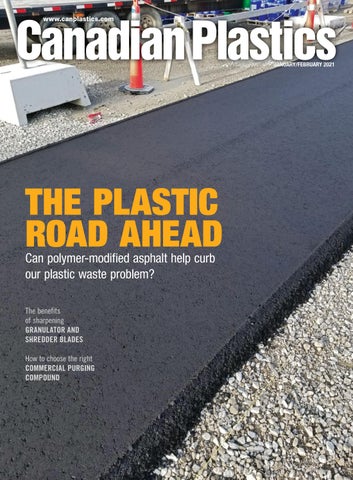
THE PLASTIC ROAD AHEAD Can polymer-modified asphalt help curb our plastic waste problem? The benefits of sharpening GRANULATOR AND SHREDDER BLADES How to choose the right COMMERCIAL PURGING COMPOUND
SNEAK
PEEK Here’s an early look at what’s inside the upcoming April 2021 issue of Canadian Plastics magazine: The cover story will be on the ins and outs of extruding bioplastics – what you need to know to succeed with these often tricky, temperature-sensitive materials.
We’ll also have articles on: How to overcome some of the biggest challenges in raw materials handling and conveying A look at some of the latest chiller technologies New developments in software for 3D printing/ additive manufacturing
Be sure to visit www.canplastics.com for daily news updates and longer feature articles, and follow us on Twitter, @CanPlastics
contents JANUARY/FEBRUARY 2021 VOLUME 80 • NUMBER 1
The April 1993 issue of Canadian Plastics reported on the creation of the Canadian Plastics Training Centre, which had just opened up on the North Campus of Humber College in Toronto. The result of a joint agreement between the Society of the Plastics Industry of Canada, the Ontario Federation of Labour, the Ontario Public Service Employees Union, Humber College, and the Ontario provincial government, the centre had funding of $1.7 million through to 1997, and offered courses through Humber in injection molding, blown film and pipe and profile extrusion, and blow molding. The processing equipment was donated by a large number of OEMs.
Cover Photo: GreenMantra Technologies
FROM THE ARCHIVES
9
Number of the month:
2,885*
* Number of square yards of the LyondellBasell Cincinnati Technology Center parking lot paved with recycled plastic asphalt. (See pg. 11)
4
5
Editor’s View: What’s next for industry trade shows? Ideas & Innovations: Montreal researchers develop shock-absorbing 3D-printed plastic canvas
12
5
cover story
9
RECYCLING: The plastic road ahead
With more and more recycled plastic being used to repave highways and roads around the world, we might be driving toward a future with a lot less plastic pollution.
features 6
News: • NPE2021 cancelled, no virtual show • Canada launches plastic pact to improve recycling, composting rate • ProAmpac makes big Canadian packaging acquisition • Supplier News and People
20 Technology Showcase
12 SIZE REDUCTION: Stay sharp
From reduced throughput to increased dust and fines to poor regrind quality, when the cutting edge of a granulator or shredder knife fails, just about everything else in size reduction fails too. Which is why sharpening or replacing your knives when necessary is the smart move.
17 PURGING: Choosing the right commercial purging compound Selecting the best purge product for your plastics processing application is essential for a successful outcome, and it involves answering some key questions.
20 Advertising Index 22 Technical Tips: How to prevent and troubleshoot short shots
Visit us at www.canplastics.com January/February 2021 Canadian Plastics
3
editor’s view
Canadian Plastics magazine reports on and interprets developments in plastics markets and technologies worldwide for plastics processors, moldmakers and end-users based in Canada.
www.canplastics.com
What’s next for industry trade shows?
N
ot to be pessimistic, but I think most of us knew that NPE2021 – which had been scheduled for May 17-21 in Orlando, Fla. – was going to be cancelled long before it actually was. Since the coronavirus pandemic began, we’ve seen the pattern repeat itself with so many shows: the first big exhibitor pulls out, a few more follow, and then the floodgates open and the trickle of fleeing companies becomes a wave, and then a tsunami. To its credit, the Plastics Industry Association, which owns NPE, had the foresight to cancel the show before the trickle really began (see pg. 6). NPE typically draws more than 50,000 registered attendees and 2,100 exhibiting companies, and the cancellation of this year’s edition makes it the biggest trade show casualty of the pandemic for our industry to date. Which maybe also makes it a good moment to assess the future of live trade events. In-person events are where companies showcase their latest and greatest products and services. Salespeople connect with old customers and meet new ones; and customers can shop, meet with salespeople, learn about new products, network, and more. All of that is part of the typical trade show experience. But here’s the rub: If it’s unsafe for people to gather in numbers, how can these events safely be held? The quick fix, of course, has been the rise of virtual trade shows designed to create an attendee experience that competes with live events. The wildly popular Zoom software, among several options, has made this transition a relatively smooth one, allowing organizers to broadcast events to thousands of viewers, alongside breakout rooms and opportunities for networking. But with all due respect to these organizers, when it comes to replacing large-scale in-person trade shows, vir-
4 Canadian Plastics January/February 2021
tual events feel like a Band-Aid, not a cure. For the attendee, they have some advantages over an in-person show – they allow the attendees to control conversations with exhibitors, increasing their ability to get the information they want – but they don’t allow them to hold and inspect newly-molded parts in their hands; and since they don’t feature actual face-to-face communication, they give attendees too much opportunity to “zone out”, perhaps prematurely, and click into another window. One school of thought says that the previously “normal” way of staging a trade show is now gone for good – that, once the pandemic is over, a hybrid model will emerge with organizers offering an online component alongside a physical event. Low streaming costs, increased availability of technology, and a wider audience online make this decision a no-brainer for organizers, the proponents say. It may well turn out this way, but I wonder: If people ever again feel comfortable attending a live, crowded trade show, why would the virtual component be necessary? Conversely, why would a company exhibit at a live show – which entails enormous travel, rental, and other expenses – if a virtual option is available? The two models seem at odds; to me, at least, an inperson show feels like an all-or-nothing proposition. For almost a year now, the world has wondered when we can return to normal, including the trade shows and exhibitions we’ve attended in the past, the way we’ve attended them in the past. It may be a year or two before we see those crowded aisles again; or we may never see them again, if a critical mass of people remain concerned about public health, even after a vaccine. I certainly prefer the former.
Reader Service Print and digital subscription inquiries or changes, please contact Barb Adelt, Audience Development Manager Tel: 416-510-5184 Fax: 416-510-6875 email: badelt@annexbusinessmedia.com Mail: 111 Gordon Baker Rd., Suite 400 Toronto, ON M2H 3R1 EDITOR Mark Stephen 416-510-5110 Fax: 416-442-2230 mstephen@canplastics.com ASSOCIATE PUBLISHER Catherine McDonald 289-921-6520 cmcdonald@annexbusinessmedia.com ASSOCIATE PUBLISHER Stephen Kranabetter C: 416-561-5362 W: 416-510-6791 skranabetter@annexbusinessmedia.com MEDIA DESIGNER Andrea M. Smith asmith@annexbusinessmedia.com ACCOUNT COORDINATOR Cheryl Fisher 416-510-5194 cfisher@annexbusinessmedia.com VP PRODUCTION / GROUP PUBLISHER Diane Kleer dkleer@annexbusinessmedia.com COO Scott Jamieson sjamieson@annexbusinessmedia.com PRINTED IN CANADA ISSN 008-4778 (Print) ISSN 1923-3671 (Online) Publication Mail Agreement #40065710 2020 SUBSCRIPTION RATES 5 issues Canadian Plastics, plus Dec. 2021 Buyers’ Guide: CANADA: 1 Year $77.50 plus applicable taxes; 2 Years $123.50+ taxes USA: $176.00 (CAD) / year FOREIGN: $201.00 (CAD) / year
Occasionally, Canadian Plastics will mail information on behalf of industry related groups whose products and services we believe June be of interest to you. If you prefer not to receive this information, please contact our circulation department in any of the four ways listed above. Annex Privacy Officer privacy@annexbusinessmedia.com • Tel: 800-668-2374 No part of the editorial content of this publication June be reprinted without the publisher’s written permission ©2020 Annex Business Media. All rights reserved. Opinions expressed in this magazine are not necessarily those of the editor or the publisher. No liability is assumed for errors or omissions. All advertising is subject to the publisher’s approval. Such approval does not imply any endorsement of the products or services advertised. Publisher reserves the right to refuse advertising that does not meet the standards of the publication. MEMBER: Magazines Canada, Canadian Plastics Industry Association.
Mark Stephen, editor
mstephen@canplastics.com www.canplastics.com
ideas & innovations
Montreal researchers develop shock-absorbing 3D-printed plastic canvas Photo Credit: Shibo Zou/Polytechnique Montreal
similar to silk proteins.” Gosselin and his team received funding from the Fonds de Recherche du Quebec – Nature et Technologies, the Natural Sciences and Engineering Research Council of Canada, and the Canada Foundation for Innovation. “Transparent materials with high impact absorption are required for many safety-critical engineering systems [and] existing transparent tough composites have increased impact resistance but often fail catastrophically because of poor impact absorption,” Gosselin said. “We propose a transparent impact-absorbing composite that reproduces the toughening mechanism involving sacrificial bonds and hidden lengths in spider silk.” According to Gosselin and his team, this nature-inspired innovation could lead to more durable plastic smartphone screens, new protective coatings for aircraft engines, and maybe even a new type of bulletproof glass. CPL
A baseball encased in a 3D-printed canvas.
I
n a development that might pave the way for unbreakable plastic cellphone screens and other covers, a research team from Polytechnique Montreal has demonstrated how a web-like canvas designed by 3D printing absorbs up to 96 per cent of the energy of a shock without giving way. Professors Frédérick Gosselin and Daniel Therriault from Polytechnique Montreal’s Department of Mechanical Engineering, along with doctoral student Shibo Zou, wanted to demonstrate how plastic webbing could be incorporated into a glass pane to prevent it from shattering on impact. The distinctive design twist in the project came from their source of inspiration: spider webs and their amazing properties. “A spider web can resist the impact of an insect colliding with it, due to its capacity to deform via sacrificial links at the molecular level, within silk proteins themselves,” Gosselin and his colleagues said in a recent edition of Cell Reports Physical Science journal. “We were inspired by this property in our approach.” The researchers used polycarbonate – which, when heated, becomes viscous like honey – to achieve their results. Using a 3D printer, Gosselin’s team harnessed this property to “weave” a series of fibres less than two millimeters thick, then repeated the process by printing a new series of fibres perpendicularly, moving fast before the entire web solidified. The benefit of the process is that, as it’s slowly extruded by the 3D printer to form a fibre, the molten plastic creates circles that ultimately form a series of loops. “Once hardened, these loops turn into sacrificial links that give the fibre additional strength,” Gosselin said. “When impact occurs, those sacrificial links absorb energy and break to maintain the fibre’s overall integrity,
PURGING PERFECTION What does purging perfection look like? Industry leadership, decades of innovation, outstanding customer service, technical expertise and product that’s effective every time. When your work has to be perfect, trust the leader. Trust Dyna-Purge. Request a free sample of Dyna-Purge and see for yourself. Discover the Difference. 866-607-8743 www.dynapurge.com DYNAPURGE is a registered trademark of Shuman Plastics, Inc. January/February 2021 Canadian Plastics
CP_PurgingPerfection_Resized.indd 11 CPL_ShumanDyna_JanFeb21.indd
5
2017-02-23 2:47 2021-01-21 9:19 PM AM
news
The NPE2021 show, the biggest plastics fair in North America, has been cancelled for May in Florida because of the coronavirus pandemic, the organizer announced, with no virtual event planned in its stead. In a Jan. 5 email to exhibitors, the Washington, D.C.based Plastics Industry Association, which owns the show, announced that the event could not be held safely. The fair, which is held every three years, had been scheduled for May 17-21 at the Orange County Convention Center in Orlando. “After extensive review, it has been determined that it is not possible to hold the planned event and also provide a safe environment at that time and location, and therefore we must cancel the in-person show,” the association said. “While we are disappointed by the circumstances that led to this decision, we know that the plastics industry is strong and resilient.” It followed that up with a Jan. 22 email to exhibitors saying that it will not be able to return the first half of deposits. “The first 50 per cent of exhibitor deposits have been invested in the myriad expenses required in the advance planning
Photo Credit: NPE
NPE2021 cancelled, no virtual show
stages of the show, as well as to support ongoing operations for [the association], and therefore cannot be returned,” the group said. The email also said that there will not be a virtual NPE2021 show. The previous NPE, in 2018, was the largest in show history, with 2,181 exhibiting companies occupying more than 1.2 million net square feet of sold-out exhibit floor space, and 56,034 attendees, up 1.7 per cent over that of NPE2015. CPL
Canada launches plastic pact to improve recycling, composting rate More than 40 Canadian companies, governments, and environmental groups have unveiled a plan to recycle or compost 50 per cent of the country’s plastic packaging by 2025 and take other steps to improve Canada’s environmental performance. The Canada Plastics Pact (CPP), which joins a number of other similar agreements worldwide – including the United States Plastic Pact, which was announced in August 2020 – said it will also develop plans to boost recycled content in plastics packaging and work to phase out what it called “problem-
atic” packaging materials. “With an eye for bold systematic change, the CPP will work to eliminate the plastics we don’t need, innovate to ensure that the plastics we do need are reusable, recyclable or compostable, and circulate the plastic we use, keeping it the economy and out of the environment,” the group said in a Jan. 27 statement. The CPP said it was starting with packaging because that accounts for 47 per cent of plastic waste. The pact comes three months after Canada’s federal government announced
Leadership change at CCC Plastics
Philip Latchman
Blair Russell
Brian H. Page
After almost 35 years in the industry, Philip Latchman, the president of Toronto-based material supplier and manufacturer CCC Plastics, retired at the end of 2020.
6 Canadian Plastics January/February 2021
Image Credit: Canada Plastics Pact
details on a nationwide ban on a few single-use plastics and tighter regulations on other plastic products, including recycled content and producer responsibility. Founding members of the CPP include Canadian Tire Corp., Circular Plastics Task Force, Coca-Cola Canada, EFS Plastics Inc., Keurig Dr Pepper Canada, Loblaw Companies Ltd., Merlin Plastics, Unilever Canada, and Walmart Canada. CPL
Latchman led CCC Plastics for 13 years, and helped grow the company into a $120-million business as a major manufacturer of compounds and colour concentrates, as well as a distributor of thermoplastics to the North American market. He received a Lifetime Achievement Award from the Canadian Plastics Industry Association in 2019 for his work in the plastics industry. In conjunction with Latchman’s retirement, CCC Plastics has promoted Blair Russell to vice president, manufactured plastics; and Brian H. Page to vice president, distribution plastics. CPL www.canplastics.com
news
Canadian resin distributor Rod Monster passes away
Rodion “Rod” Monster, a well-known Canadian resin distributor, passed away on Oct. 30, 2020 in Barrie, Ont., at age 75. Monster’s father Jack was the president of Wilmod Industries Inc., a plastic machinery and materials distribution business in Toronto in the 1940s, which sold one of the first injection molding machines in Canada in 1949. Monster helped out at his father’s business after school and while earning a business degree from Ryerson Polytechnical Institute, and then started his professional career at Greenline Plastics before founding Albis Canada Inc., the Canadian division of a Germany-based plastics compounder, in 1971. In 1990, Monster and his wife, Sterling, a lawyer, founded resin trader and distributor Monster Polymers Inc., based in Honey Harbour, Ont. Monster Polymers will continue to operate under Sterling Monster’s stewardship. CPL
Maguire Products buys minority share in O.A. Newton
Auxiliary equipment maker Maguire Products Inc. has bought a minority share of O.A. Newton, a Bridgeville, Del.-based supplier of bulk material handling systems to the wood-plastic composite, flexible and rigid PVC, and carbon black markets. The financial terms of the deal have not been disclosed. In a Jan. 25 news release, Aston, Pa.-based Maguire Products said that O.A. Newton will continue to operate separately, but that the investment has the potential to expand its material handling capabilities. “We can now refer inquiries for bulk material handling directly to O.A. Newton and can work together with them as projects require,” said Maguire Products owner and president Steve Maguire. Maguire Products is represented in Canada by Maguire Products Canada Inc., which is headquartered in Vaughan, Ont. CPL
Experience Full Control
Factor The X Factor is Value. • Reduced cycle time • Increased precision • Improved gripper designs • Application flexibility • More productive uptime VISIT SEPRO’S VIRTUAL SHOWROOM! http://bit.ly
The servo wrist adds value in any application!
-NA
/SEPRO-VSR
www.sepro-group.com • seprocanada@sepro-group.com • 514-515-9349 • @SeproGroup l
CPL_Sepro_Nov20.indd 1
January/February 2021 Canadian Plastics
7
2020-10-22 1:19 PM
news
ProAmpac makes big Canadian packaging acquisition
SUPPLIER NEWS
Canada-based packaging suppliers Rosenbloom Groupe Inc., Hymopack Ltd., and Dyne-A-Pak have been acquired by U.S.-based flexible packaging provider ProAmpac for an undisclosed amount. All three brands are part of the Rosenbloom Groupe of companies, a third-generation, privately-owned family business based out of Saint-Laurent, Que. Rosenbloom Groupe Inc., Hymopack, and Dyne-A-Pak are suppliers to North American retailers, grocery chains, and quick-service restaurants, as well as wholesale distribution companies, specializing in the manufacturing of plastic and paper bags and can liners, and foam packaging trays. Rosenbloom Groupe Inc. is headquartered in Saint-Laurent, Hymopack is headquartered in Toronto, and Dyne-APak is based out of Laval, Que. Rosenbloom Groupe’s brands will continue in Canada and will maintain operations at their current manufacturing facilities. With the addition of the Rosenbloom Groupe, ProAmpac has 35 sites globally, with nearly 4,600 employees supplying more than 5,000 customers in 90 countries. CPL
– Bolton, Ont.-based specialty compounder Gendon Polymer Services Inc. has added a French language version to its website, www.gendon.com. Gendon manufactures thermoplastics and thermoset-based materials for a variety of markets. – Machinery supplier Plastics Machinery Inc., headquartered in Newmarket, Ont., is the new distributor for Lube USA Inc. oil and grease lubrication systems in Canada. Lube USA is located in Greenville, S.C. The company’s product line is designed for the injection molding, machine tool, packaging, metal stamping, food processing, woodworking, and automotive industries. – Specialty chemicals and additives manufacturer Struktol Company of America LLC, headquartered in Stow, Ohio, has achieved silver status from the EcoVadis corporate social responsibility (CSR) rating assessment, which measures the quality of a company’s CSR management system through its policies, actions, and results.
PEOPLE
Larry Alpert
Kelly Dombowsky
Michael Draga
– York, Pa.-based extrusion blow molding machinery maker Graham Engineering Corp. has named Larry Alpert as medical extrusion technology manager. – Kitchener, Ont.-based masterbatch supplier Ampacet Corp. Canada, a division of Ampacet Corp. in Tarrytown, N.Y., has named Kelly Dombowsky as account executive for Western Canada. – Auburn Hills, Mich.-based hot runner supplier Incoe Corp. USA has appointed Michael Draga as regional sales manager for Eastern Canada. – The Society of Plastics Engineers, headquartered in Danbury, Conn., has given a four-year contract extension to CEO Patrick Farrey, through to Dec. 31, 2024. – Houston-based resin and specialty chemical distributor Vinmar International has named Vishal Goradia as CEO. – Cambridge, Ont.-based robotics maker ATS Automation has named Ryan McLeod as chief financial officer. – Lebanon, Ore.-based Entek Manufacturing, which makes twin-screw co-rotating extruders, turnkey extrusion systems, and wear parts and components, has named Kimberly Medford as president.
8 Canadian Plastics January/February 2021
Patrick Farrey
Vishal Goradia
Ryan McLeod
Kimberly Medford
Josh Plamondon
Gregory Smith
Jason Spangler
Gerald Vogt
– Aqua-Pak Industries Ltd., an expanded polystyrene molder headquartered in Surrey, B.C., has named Josh Plamondon as CEO. – Danish automation supplier Universal Robots has appointed Gregory Smith as temporary president and CEO. He replaces Jürgen von Hollen, who left the company at the end of 2020. – New Berlin, Wis.-based auxiliary equipment maker ACS Group has named Jason Spangler as sales manager for Manitoba, Ontario, Quebec, and the Maritimes, as well as the Northeastern U.S. – Swiss-based robotics systems, connectors, and textile machinery maker Stäubli has named Gerald Vogt as CEO. He replaces Rolf Strebel, who served as CEO since 2006. www.canplastics.com
recycling
THE PLASTIC ROAD AHEAD With more and more recycled plastic being used to repave highways and roads around the world, we might be driving toward a future with a lot less plastic pollution.
By Mark Stephen, editor
A strip of asphalt made with recycled plastic that was deployed in Sarnia, Ont. in a paving project involving Nova Chemicals Corp. and GreenMantra Technologies. Photo Credit: GreenMantra Technologies
I
f you thought asphalt paving would always remain what it has always been – an aggregate of sand and gravel held together by black asphalt as a binder – it’s time to think again. As recent examples from around the world show, the use of recycled plastic-modified (RPM) asphalt binders and mixtures are beginning to make inroads in paving technology. There’s a backdrop to the quest to improve blacktop: as freeze-thaw cycles, UV rays, moisture, and traffic pressure wear down traditional asphalt pavement, it breaks down, forming cracks and potholes. Over time, it needs to be replaced, and every driver has suffered through the result: traffic gridlock as departments of transportation using milling machines laboriously take up the old pavement while pouring fresh asphalt concrete. Incorporating recycled plastic into the asphalt mixture may help to alleviate these issues by making the pave-
ment more durable, and also has other complementary sustainable benefits: it improves overall resource efficiency and enhances the circular economy by reducing the amount of post-consumer plastic going into landfills; extends the limited supply of the petroleum in asphalt; and can be reused immediately on-site, whereas traditional pavement is ground up and reused at a later time.
GROUND RULES
It’s important to realize that there are several methods used to repurpose recycled plastic into roadways, and they’re not all created equal. One method, which tends to be used in some developing countries or areas with foot traffic only, is to literally create “plastic roads,” where waste plastic is compacted and used to pave a road with minimal or no asphalt. “These types of mostly ‘plastic roads’ perform to a different standard – perhaps suitable for lower traffic conditions or bike or pedestrian paths – but
aren’t capable of meeting the engineering requirements specified by the transportation authorities from Canada and the U.S., so they’re not viable for widespread paving application in North America,” said Carla Toth, senior vice president of sales and marketing with GreenMantra Technologies, a Brantford, Ont.-based company that’s pioneering new ways to incorporate recycled plastic in asphalt. “Another method to create an RPM asphalt mixture is to utilize a lower dosage of recycled plastic to modify the asphalt formulation, and this is the focus of most North American projects that involve using recycled plastics in roads.” RPM asphalt mixtures are created through several steps: the recycled plastic – usually water bottles, soda bottles, and single-use plastic bags – is sorted by polymer type, such as polyethylene (PE) plastic bags in one group and PET bottles in the other. Each polymer type varies in how durable and January/February 2021 Canadian Plastics
9
recycling
pliable it is. Once the plastics are separated and pressed into pellets, they can be mixed with hot asphalt to create the RPM asphalt binder. Some recycled plastics are added to black tarry asphalt before the aggregate to enhance the performance of the asphalt, and some are added with the aggregate and the milled pavement to act as a binding agent for the gravel and sand. A challenge, however, is to balance the asphalt performance with gains in recycling and sustainability as well as environmental concerns. In some early applications, where waste plastic was simply ground up and tossed into the mix, the plastic agglomerated near the road surface, creating the opportunity for small pieces to break away and generate microplastic pollution. This problem can be overcome by recent technologies like those from GreenMantra. “GreenMantra changes and redesigns the carbon chain of recycled PE plastic feedstock, creating a more functional shorter chain wax that easily melts into and integrates seamlessly with the asphalt and doesn’t create microplastic pieces,” Toth said.
MADE IN CANADA
The first known plastic and asphalt road project in Canada dates back to the early 1980s, when the City of Edmonton ground up Fisher-Price toys to use to repave a local street, followed by several road mixes that used nonrecycled plastic. Later, in 1990, an experimental section of Highway 401 around Toronto – then and now the busiest highway in Canada – was paved with asphalt reinforced with plastic from recycled milk jugs. These projects and a few others like them remained isolated instances in Canada up to the late 2000s. But as technology continues to improve, RPM asphalt mixtures have more recently been used in a range of Canadian paving projects, including a Vancouver International Airport runway; a portion of the South Fraser Perimeter Road, a new four-lane expressway along the south side of the Fraser River in B.C.; and a parking lot in Burnside, N.S. paved with asphalt that included two tonnes of material made from plastic shopping bags in a demonstration project undertaken by Goodwood Plastic Products Ltd., of
The ability to use recycled plastic in asphalt could address two of our most challenging problems: the plastic waste crisis and our aging infrastructure. There’s also concern about the potential for certain types of melted plastic to release toxic fumes. An October 2020 report by the U.S.-based National Asphalt Pavement Association (NAPA) acknowledged the risks of running the wrong plastics through an asphalt plant and advised against using recycled PVC in paving applications, as it releases toxins when heated. The report highlighted that PE is the primary plastic that could be incorporated safely into asphalt mixtures because of its low melting point, with polypropylene as a second viable candidate.
10 Canadian Plastics January/February 2021
Shortts Lake, N.S. GreenMantra, a pioneer in the field of advanced recycling technologies in Canada, is promoting a new approach to using plastics in roads. “Unmodified recycled plastic is relatively inert and can impair asphalt stability and performance, whereas GreenMantra’s products used in asphalt paving applications are PE waxes derived from recycled plastic items such as films, containers, and bottle caps, and they’re molecularly different than unmodified recycled plastic,” Carla Toth said. “Traditional waxes derived from petroleum have been used for decades to enhance the
performance of asphalt. GreenMantra’s advanced recycling technology creates a new sustainable wax that’s derived from recycled plastic. As waxes have a much lower viscosity and softening point, this translates into differentiated performance in the asphalt. When added to the liquid asphalt, our PE wax readily melts and fully incorporates with the asphalt, and once mixed, remains very stable. We’re changing the paradigm towards a performanceenhancing additive that doesn’t sacrifice properties of asphalt.” GreenMantra’s first paving project was the “Blue Box to Green Roads” program with the City of Vancouver in 2014, and it has been involved in several new projects within the past year. In one, it partnered with Nova Chemicals Corp. in a project that incorporated its PE wax – equivalent to 113,000 single-use plastic bags – to pave two pathways, approximately 1,700 feet long by eight feet wide and two inches thick, at Nova’s construction site for its new PE facility in Sarnia, Ont.; in a second, the company was selected to participate in the “Plastics Research in Action” program alongside Northern Alberta Institute of Technology and petroleum development company Inter Pipeline, with its waxes being evaluated in asphalt paving test strips in Strathcona and Sturgeon counties in Alberta. “We’ve also been invited by the National Center for Asphalt Technology (NCAT) to submit our waxes for evaluation for a test track that will be paved this upcoming summer, and we have several other projects and trials underway in North America, Europe, and the Middle East,” Toth said. “The positive environmental and societal impact of these combined projects is enormous, as each kilometre of road paved with our waxes can divert the equivalent of 2.6 million single-use plastic bags from landfills.”
AROUND THE WORLD
Like Canada, Europe and other parts of the world are edging into the use of more complex post-consumer plastics for paving projects. India is widely considered a www.canplastics.com
recycling
train of equipment that grinds up the top three inches of pavement and mixes the grindings with a liquid plastic polymer binder, which comes from a high amount of recycled, single-use bottles. The new asphalt material is then placed on the top surface of the roadway, eliminating the need for trucks to bring in outside material for a paving operation. Caltrans is testing the material for later use throughout the state.
GROWING ACCEPTANCE
A highway paving project in Oroville, Calif. that uses recycled asphalt pavement and liquid plastic from single-use plastic bottles. Photo Credit: California Department of Transportation
pioneering nation for widespread mixing of plastics and asphalt, putting down its first waste plastic road in 2002 with material supplied by KK Plastic Waste Management in Bangalore. India has also published a code for the hot and cold mixing of plastic waste at plants. Since its first road, according to World Highways Magazine, KK Plastic’s product has been used on 3,000 kilometres of Bangalore road with its KK Poly Blend mixed at a rate of eight per cent to asphalt. And Dow Chemical Co. recently worked with government officials in India and waste collectors in Bangalore and Pune to pave 40 kilometres of roads with its Elvaloy polymer-modified asphalt technology, diverting the equivalent of 25 million flexible pouches from landfills. Dow sees demand for this technology growing throughout the Asia-Pacific region – where plastic roads have already been constructed in Thailand, the Philippines, and Vietnam – and the chemical maker is also piloting the technology in cities across the U.S. An emergent supplier is Lockerbie, Scotland-based asphalt specialist MacRebur, which offers three differ-ent types of pellets – which vary in durability and pliability – that it sells into the international asphalt market. Each kilometre of road laid with its pellet mix uses up to the equivalent
weight of 740,541 single-use plastic bags, company officials said, and one tonne of MacRebur mix contains the equivalent of 80,000 plastic bottles. The firm has paved roads throughout the U.K. – including a project in June 2020 that involved repaving a major road in Carlisle, in the North West of England – and has also taken part in projects as far afield as New Zealand, Australia, and South Africa. The company’s first project in the U.S., at the University of California at San Diego early last year, involved paving a small test area in front of a graduate housing complex, and the university may introduce the plastic asphalt throughout the campus if it proves viable. MacRebur already has a facility in San Diego, and now is finalizing plans for a new plant in Tampa, Fla. Also in California, another paving company is responsible for a pilot project in July 2020 that repaved three lanes on a 1,000-foot section of highway in the town of Oroville using recycled asphalt pavement and liquid plastic from single-use plastic bottles – the first time the California Department of Transportation (Caltrans) has paved a road using 100 per cent recycled materials. Developed by Redding, Calif.-based TechniSoil Industrial, the process employs a recycling
Coupled with the advocacy and support of paving associations like NAPA and NCAT, the industry continues to evaluate the expanded use of RPM asphalt mixtures as a means to promote sustainability and demonstrate a secondlife application for recycled plastics. The Washington, D.C.-based Plastics Industry Association has committed to work collaboratively with its member companies in partnership with NCAT on the “New End Market Opportunities for Film Asphalt” project. The first of several projects from the association to explore RPM asphalt was initiated in November 2020, when Dutch multinational chemical company LyondellBasell used recycled PE – the equivalent of 71,000 plastic retail bags – to pave 2,885 square yards of the LyondellBasell Cincinnati Technology Center parking lot in Ohio. At present, there are over 200 field projects using recycled plastic in asphalt pavements throughout the world. Many of these projects are only a few years old, which means the longterm durability of the pavements have yet to be determined, but one thing seems certain: As the asphalt industry advances and makes strides to become more sustainable, recycling post-consumer plastic into asphalt pavement mixtures is, increasingly, the responsible action. “The ability to use recycled plastic in asphalt could address two of our most challenging problems: the plastic waste crisis and our aging infrastructure,” Carla Toth said. Which means it’s the end of the road CPL for a lot of waste plastics. January/February 2021 Canadian Plastics
11
size reduction
STAY SHARP From reduced throughput to increased dust and fines to poor regrind quality, when the cutting edge of a granulator or shredder knife fails, just about everything else in size reduction fails too. Which is why sharpening or replacing your knives when necessary is the smart move. By Mark Stephen, editor
A
change is as good as a rest, the saying goes. When it comes to granulator and shredder knives, a change – or perhaps just a sharpening – is even better than that, since a granulator or shredder performs best and most economically when blades are sharp. The downside is that, when blades are being sharpened or replaced, the machine is down and production is halted. Which might explain why some processors neglect sharpening or changing their knives. “Most processing shops don’t change their knives as often as they should,” said Bob Harrison, product manager, size reduction group, with Universal Dynamics Inc. “We see this most often with shops that have older granulators and shredders that only allow knives to be adjusted after installation, or that limit adjustment to one set of knives, which isn’t conducive to easy knife changes.” And since replacement knives are the most significant operating costs associated with granulators and shredders, there may appear to be a short-
12 Canadian Plastics January/February 2021
Rotors and cutters on a shredder.
term gain in ignoring them. But that’s an illusion. Whatever the inconvenience, sharpening and replacing knives when necessary will allow machines to operate more efficiently, produce more consistent quality regrind, reduce maintenance, save on wear and tear in the long run, and make your work environment safer.
TELLTALE SIGNS
Within a plastics granulator, there are fixed knives and rotating knives with a small gap, or clearance, in between them – and the first step in keeping granulator knives sharp is knowing when they’ve become dull. “The biggest indicator is a reduction in throughput,” said Mike Cyr, president of Rotogran International Inc. “There are other signs as well, but this is the one that everyone notices first.” When throughput starts to slow, you can visually inspect your regrind. Quality regrind can look different in different applications, but a good rule of thumb is looking for consistent, uniform
Photo Credit: Vecoplan LLC
granulate size with minimal sharps and low dust. “If your regrind isn’t cleanly cut, or if you’re starting to see dust and fines, the blades might be getting dull or worn, which causes the clearance between the blades to increase,” said Brian Davis, general manager of Maguire Products Canada Inc., which distributes for Rapid Granulator Inc. in Ontario and Western Canada. According to Dave Miller, general manager, size reduction with Conair Group, other indicators include high noise levels caused by parts bouncing around and rotors smashing rather than cutting parts; and increased heat and power draw as frictional heat builds within the cutting chamber, possibly even leading to dangerous fire conditions. In extreme cases, rotors can stall or jam completely. For shredders, only some of the same indicators apply. “Unlike with granulators, granulate that isn’t uniform is not necessarily a sign of worn knives on a shredder,” said Heiko Plankenhorn, vice president at Weima www.canplastics.com
size reduction
America Inc. “A better indicator with shredders is that the output per hour is decreasing.”
GETTING DULL
Knife sharpening requirements for granulators and shredders differ based on throughput, usage, and the geometry of the knives. Taking this last point first, the cutting angle of the granulator knife edges relative to one another will have a big impact on how cleanly a material can be cut, how durable the tip is to impact, and therefore how the blades will wear over time. There’s a wide variety of knife configurations to choose from, but high-shear and lowshear are two of the most common. “High-shear knife designs are more pointed, but aren’t great for thicker material or contamination; and lowshear is good for thicker material,”
said Mike Cyr. As far as throughput and usage go, there are a few rules of thumb that affect knife wear. In general, for producers of film, the material to be granulated is consistent and contaminantfree and there’s no possibility of anything other than virgin film entering the granulator, which means the best blade material has a high hardness level to maximize knife life. Recyclers and scrap plastic molders, in contrast, granulate a wide variety of materials, and may find labels, screws, bottle caps, and staples within the material, all of which can cause the edge to chip, leading to edge failure. And plastic molders that process a wide range of items – from thin, easily cut plastics to thick, filled plastics – may find it necessary to use a low-shear knife rather than a high-shear knife. But the prob-
lem commonly faced by recyclers and scrap plastic molders of knife damage caused by contamination actually plagues the plastics processing industry as a whole. “The number one nemesis to a granulator is a nut or bolt finding its way into the system and chipping or breaking a knife,” Cyr said. Finally, coatings play a role in the rate of blade wear too. “Each supplier has their own version of high-wear coatings and heat treating,” said Dave Miller. A tip: “Having tungsten carbide coating on the tips of the knives will make the knives last longer, but it’s very poor when it comes to impact,” said Mike Cyr. “It will chip, so you have to choose applications for these blades carefully – tungsten carbide coating is best used in a two-stage system with a shredder in front to pre-size the material and eliminate the impact.”
Water Chillers
Portable Chillers : .25 -40 tons Indoor Portable Chillers ... Air or Water Cooled
Central Chillers : 5-180 tons
Indoor & Outdoor units ... Air or Water Cooled Complete chiller & pump system packages or stand alone chilling modules.
NEW MG Portable Chiller Control System
905-895-9667
Portable & Central Chillers Manufactured by Advantage With Exclusive Canadian Distributor, Chillers Inc.
www.ChillersInc.com
1228 GORHAM STREET, UNIT 11 NEWMARKET, ONTARIO L3Y 8Z1
January/February 2021 Canadian Plastics CPL_Chillers_JanFeb21.indd 1
13
2021-01-21 3:08 PM
size reduction
TIME FOR A CHANGE
All of which means that the rate of knife wear or breakage, and the need for sharpening or replacement, will vary from shop to shop – and even from line to line within a shop – with the big distinction being between processors and recyclers. “It’s very difficult to say exactly how often blades and cutters need sharpening or replacement – the answer is, it depends,” Dave Miller said. “Post-consumer scrap is by far the most challenging due to the very high levels of contamination; most recyclers will set a standard schedule for blade changes for each piece of equipment, and I’ve seen blade changes as often as every eight-hour shift. On the other hand, in a typical plastics processing plant where you’re grinding clean sprues, runners, and scrap parts, you might run several weeks or even months before you need to sharpen or replace your blades.” A slight silver lining is that, generally, knives wear at the same rate in a granulator, with perhaps slight differences depending on the type of scrap and how it’s fed. “If you’re reducing a profile or a pipe with a modified infeed chute bringing it in from the side, you could see increased knife wear and a wear pattern where it’s hitting on that side,” said Jim Hoffman, president of Rapid Granulator. Whenever the time for knife sharpening in a granulator does come, some general rules apply. In most applications, the experts say, blade material removal is less than fifty-thousandths and can be as little as fifteen-thousandths in blades used in light cutting applications. “As a rule of thumb, typical granulator knives have about three-eighths of an inch of usable material,” Hoffman continued. “It’s only necessary to put a clean edge on a set of knives – aggressive sharpening will change the knife hardness and lead to a decreased number of sharpenings – and the customer can usually get approximately five sharpenings out of a set.” This varies, however: according to Mike Cyr, Rotogran knives can be sharpened up to seven times before they need replacement. Whatever the number of sharpenings, since precision sharpening costs only 15 to 20 per cent of the price of replacing a granulator knife, proper sharpening dramatically reduces the overall costs of maintaining your granulator. “If you don’t sharpen knives, they become duller and you lose more of the steel when you do sharpen them, giving you fewer sharpening cycles from a set before it reaches the end of its life,” Cyr said. A second rule of thumb: “It’s always recommended that granulator knives be replaced in sets to ensure that the knife-to-knife tolerances required by the granulator manufacturer are maintained,” said Dave Miller.
14 Canadian Plastics January/February 2021
Fast Plastic Solutions With IMPROVING YOUR PROFITABILITY WITH INNOVATIVE POLYMERIC MATERIALS AND
ON-TIME DELIVERY orders@poundsofplastic.com
SUPPLIER OF MATERIALS FOR • INJECTION MOULDING • EXTRUSION • BLOW MOULDING • ROTO MOULDING • FILM • Antimicrobial thermoplastics (Kills bugs) • Biodegradable thermoplastics (Degrades in Landfill) • Black colour concentrates • Reprocessed post consumer thermoplastics
POUNDS OF PLASTIC INC. www.poundsofplastic.com 5650 Tomken Rd., buildings 1 &2, Mississauga, Ontario L4W 4P1 PH: 905-286-9894 • FA: 905-625-8233 100 Progress Way, Owenton, KY 40359 U.S.A. rpounds@poundsofplastic.com
The following is specifically related to nylon 6 and nylon 6,6, which are the predominant nylon products sold. Nylon 6 and nylon 6,6 are hygroscopic. Hygroscopic means readily taking up and retaining moisture. Many thermoplastics are hygroscopic. Nylon is unique in that the absorption of moisture results in physical property changes in the molded part post molding. Other thermoplastics absorb moisture post molding; however, most do not have physical property changes post molding. One of the purposes of this technical blurb is that Pounds of Plastic is soon to introduce a product line that has very similar performance characteristics as nylon without the design anxiety.
a problem depending upon the relative humidity. Note: nylon does not release its captured moisture easily. The following chart compares the physical properties of HEXATHORPE 1000 (unreinforced nylon 6,6) DAM (dry as molded) to HEXATHORPE 1000 (50% R.H. conditioned physical properties. HEXATHORPE 1000 is unreinforced nylon 6,6. The following was conducted on virgin HEXATHORPE. Please note the percent change in these properties once the test bars had absorbed moisture. The HEXATHORPE 1000 becomes much more ductile after moisture absorption (see table below).
Nylon suppliers/manufacturers report physical properties “DAM” dry as molded and often “moisture conditioned”. Often “moisture conditioned” physicals are not available. How does one design a part, then? DAM is as simple as measuring the physical properties of (in the case of a laboratory) test bars readily after molding. The bars are not allowed to absorb moisture prior to test. In the case of “moisture conditioned” the test bars remain in a controlled environment @ 50% relative humidity @ room temperature (23°C) for 48 hours. This conditioning is to simulate “real world”. What happens when the ambient temperature is higher than 23°C and the relative humidity is greater than 50%? How flexible does an unreinforced nylon part become at 33°C and a humidity of 90%? We would have to test, as we do not have that information readily available. There are significant differences between the physical properties of nylon parts DAM (dry as molded) versus “moisture conditioned” (often the term 50% R.H. is used for moisture conditioned data). This poses a challenge to designers. Once subjected to moisture the nylon exhibits a reduction in strength and stiffness. This means that moisture-conditioned nylon from the same batch is more flexible than dry as molded parts. The impact changes with moisture absorption in a positive manner. The parts get tougher after they have absorbed moisture. The dimensions of a nylon molded part also change. Absorption of moisture grows nylon parts. This can pose
PROPERTY
ASTM TEST
The designer must be aware of the ambient conditions that nylon parts will be exposed to. He/she must design for the ambient conditions and compensate for those conditions. If dimensions are critical then compensation must be made for the growth of the part post molding. In ambient conditiowns the parts will expand upon moisture absorption. What happens in Arizona? What happens to parts used in the Amazon River valley? The designer is faced with potential conditions that will change the performance of the nylon part(s). Pounds of Plastic Inc. is therefore launching thermoplastic materials that have similar attributes to nylon, such as chemical resistance, wear resistance, toughness, lubricity, and heat performance. Post molding these products don’t change physical properties and they don’t grow. Stay tuned for the launch. For more information on our HEXATHORPE nylons and our other products please see the 2021 Canadian Plastics Buyers’ Guide, where we have a full page of our line card. Please contact Dave Hamilton (west) dave@ poundsofplastic.com @ 647-233-8296 or Kyle Geer (east) kgeer@poundsofplastic.com @ 905-439-2832 for additional information and competitive price quotations. You can contact us through info@poundsofplastic.com or via phone @ 905-286-9894. On another note: Pounds of Plastic is NOT a thermoplastic recycler. We can, however, assist in your recycling challenges via advice.
DRY AS MOLDED
CONDITIONED
% CHANGE
Tensile Strength (MPa)
D638
83
62
25
Flexural Strength (MPa)
D790
90
41
54.4
Flexural Modulus (MPa)
D790
2759
1310
52.5
Elongation (%) Yield
D638
10
20
100
Notched Impact
D256
>1.0
<3.0
200
www.poundsofplastic.com Ph: 905-286-9894 • Fx: 905-625-8233 Pounds of Plastic Inc. prides itself in on time swift delivery (often same day delivery), high quality materials and competitive pricing.
TECHNICAL SOLUTIONS SERIES
NYLON IS A PAIN IN A DESIGNER’S (DESIGN ANXIETY)
size reduction
EASY ACCESS
The process of sharpening or changing blades has probably never been simpler than now, as newer, higher technology granulators have features that make it easier, faster, and safer to access the cutting chamber. “These include zero speed sensors for rotors in lieu of time-delay safety switches for safer access; easier access to the knives for checking gap and changeout; and knife gap adjustment fixtures for safer, easier, accurate setting of the knife gaps outside of the machine,” said Bob Harrison. Introduced last year, Wittmann Battenfeld’s G-Max 13, the fourth model and second-smallest granulator in the company’s product line, has an open rotor with three knives and is said to offer very easy knife changes, for example. On a related note, remember that mechanical wear doesn’t just affect knives: all of that fast-moving material also has an impact on screens. Dull screens mean more cuts, and therefore wasted time, as material keeps passing by the holes without always falling through the screens; and as with blades, screen maintenance tends to get overlooked. “Some customers think of screens as being like sieves, with material passing through easily, but they’re not – they take just as much abuse as knives,” said Brian Davis. And they’ll also show visible signs of needing replacement. “As the screens wear, circular holes tend to elongate into teardrop-shaped holes that let larger, chunkier, non-uniform pieces of regrind drop into the bin,” Davis continued. The solution is to clean and inspect – and when necessary, replace – screens along with the knives to ensure consistent granulate sizing. “Some regrind processors, such as recyclers, perform granulator cleanings, knife changes, and adjustments daily or with each shift,” Dave Miller said. “Others adopt a weekly, monthly, or hours-based maintenance program.”
SHREDDED
Shredders are becoming more preva-
16 Canadian Plastics January/February 2021
lent in the plastics industry as an increasing number of companies are now processing their own waste; while for recyclers, shredders are simply must-have pieces of equipment. The highest wear parts in a shredder are the rotating cutters and the mating stationary counter knives through which the tools drive the material, which is why rotating the knives and replacing counter knives regularly is important for optimal performance. As with granulators, the rate of cutter wear will vary depending on the application, and virtually every shredding application is unique. “Processors recycling only clean, soft material can go years without changing the cutting blades; with glass-filled materials, it could be once a month or even more frequently,” said Greg Parent, the Canadian sales representative for Vecoplan LLC. Unlike with granulators, there’s debate whether or not to sharpen shredder blades at all. “Sharpening shredder blades can actually cause them to lose tolerances and performance on the equipment, which is why I always recommend replacing knives instead,” Parent said. “Some customers have tried to sharpen them but ended up with lower throughput.” According to Heiko Plankenhorn, there’s a standard formula for when to replace shredder knives. “They can be turned up to three times – four corners – and then will need to be changed,” he said. An area where some shredder users go wrong, Greg Parent said, is in changing the cutters but not the counter knives. “I see this a lot,” he said. “It’s like having a pair of scissors where one blade is sharp and other is round: you won’t get proper cutting unless both sides are sharp.” Confusion might be caused here by the fact that cutters and counter knives don’t wear at the same rate. “Typically, a counter knife lasts for two full sets of cutters,” Parent said. Shredder knives should be designed for quick removal and reinstallation to maximize production uptime, and many shredders utilize keys for disas-
sembly and reassembly of cutters for sharpening. And other design advances can help. “Republic Machine, a Conair sister company, has a patented design where we can split our shredders open to allow easy access to the internal components for safe, fast, and easy access to the cutters for replacement,” said Dave Miller. As with many things, rotating or changing cutter blades is a job where practice makes perfect. “Once they’re good at it and have the right tools, most customers can change or rotate one cutter per minute,” Greg Parent said. In the end, there’s no getting around the fact that sharp granulator and shredder blades are critical to producing quality regrind with minimal fines. Which means that establishing a regular periodic maintenance program to check knife wear and sharpness – and sharpening, rotating, and replacing knives and cutters when necessary – is one of the smartest moves you can make in size reduction. CPL RESOURCE LIST Conair Group (Cranberry Township, Pa.); www.conairgroup.com; 724-584-5500 Dier International Plastics Inc. (Unionville, Ont.); www.dierinternational.com; 416-219-0509 Industries Laferriere (Mascouche, Que.); www.industrieslaferriere.ca; 450-477-8880 Turner Group Inc. (Seattle, Wash.); www.turnergroup.net; 206-769-3707 Maguire Canada Products Inc. (Vaughan, Ont.); www.maguire.com; 905-879-1100 Rapid Granulator Inc. (Leetsdale, Pa.); www.rapidgranulator.com; 724-584-5220 DCube (Montreal); www.dcube.ca; 514-272-0500 Rotogran International Inc. (Toronto); www.rotogran.com; 905-738-0101 Universal Dynamics Inc./Piovan Canada (Mississauga, Ont.); www.piovan.com; 905-629-8822 Vecoplan LLC (Archdale, N.C.); www.vecoplanllc.com; 336-447-3573 Greg Parent; 416-678-0154 Weima America Inc. (Fort Mill, S.C.); www.weimaamerica.com; 888-440-7170 Wittmann Battenfeld Canada Inc. (Richmond Hill, Ont.); www.wittmann-group.ca; 905-887-5355 www.canplastics.com
purging
KNOW YOUR RESINS
Choosing the right
COMMERCIAL
PURGING
COMPOUND Selecting the best purge product for your plastics processing application is essential for a successful outcome, and it involves answering some key questions. By Mark Stephen, editor
Photo Credit: Slide Products Inc.
I
t’s a shame to see something valuable being misused – most of us old enough to remember still wince at the thought of basketball superstar Michael Jordan’s lost year in minor league baseball, for example. In plastics processing, an equivalent waste happens every day with commercial purging compounds (CPCs), which all too often are not used properly or in the most cost-effective manner. Which is a shame because a) CPCs aren’t inexpensive and b) they offer tangible benefits to processors when used properly, including shorter down-
time when changing colours and resins; money saved in raw materials; and elimination of charring, black specs, and other contamination from leftover spec resin. So if you’ve gone to the trouble of investing in CPCs – as opposed to using your own resin or a homemade brew to run purges, which is a whole other issue – you owe it to yourself to get the most out of your purchase. Which means asking, and answering, three questions upfront: What resins are you running, what additives are being used, and what equipment is being used?
It’s hard to overstate the importance of understanding the intrinsic properties of your molding resin when choosing the best purging product for your application. For background, CPCs are available in two main types: mechanical purging compounds that rely on shear force and differences in material viscosities to clean injection molding machines and extruders, and chemical compounds that clean by using chemical reaction. And whether you’re using a mechanical or a chemical-based CPC, knowing the processing temperature range of the molding resin is a critical factor in selecting the proper purge product. “Every CPC has an optimal processing temperature range, and using it at the wrong temperatures may leave behind residue or cause it to degrade,” said Ken Shuman, president of Shuman Plastics Inc., which supplies the Dyna-Purge line. “Super engineering resins like Ultem and PEEK run at very high operating temperatures of 370° to 425°C or 700° to 800°F, for example, and many chemical purging products opt out in those conditions, making a mechanical purge like our E2 grade a better choice.” The good news is, most CPC suppliers have brands designed for resins like these. “We have a high-temperature CPC that goes to over 425°C or 800°F,” said Jeff Lewis, technical and sales manager with Slide Products Inc. And according to Phani Nagaraj, vice president at Asahi Kasei Asaclean Americas Inc., Asaclean PF and PX2 grades have among the highest processing temperature ranges of any CPCs on the market. “We recommend them for purging PEEK, PEKK, and PEI,” he said. CPC manufacturers usually have grades not only for high-temperature resins, but also for polyolefins and engineering resins. “Typically, there will be general products that work with a range of different resins – for example, one purge that will work with HDPE, LDPE, and polypropylene,” said Laurent Saleur, global technical January/February 2021 Canadian Plastics
17
purging
Purging a blow molding machine. Photo Credit: Thermo Fisher Scientific, Rochester, N.Y. / Dyna-Purge Div./Shuman Plastics Inc.
support manager for thermoplastics with Chem-Trend L.P. “Other CPC grades may be offered for a specific resin that’s being processed, such as a transparent polycarbonate to transparent PMMA material transition.” Another key parameter in selecting the right CPC for your application is the viscosity of the resin, which is a measure of its resistance to flow. This matters because, since purge products work with physical force and agitation, the viscosity of the resident resin will have an impact on the product’s effectiveness. “Most grades of CPCs use a high-viscosity resin as the key carrier, and they work well for purging most resins,” said Ken Shuman. “If you’re running a low-viscosity resin, you have to select a purge product that can be reasonably eliminated or post-purged.”
UNCOLOUR YOUR WORLD
For many processors, removing colour has always been the main reason for purging in the first place, and the advantages of using CPCs instead of trying to purge with resins or other inhouse solutions when making the classic transition from dark to light are well known. But with more processors
18 Canadian Plastics January/February 2021
molding more coloured parts than ever, newer purging problems have emerged. First, some pigments have an affinity for metal and require a more aggressive purge for cleanout. “Some of the blues, in particular, are built with a raw pigment that has an affinity for metal, as are blacks with blue in them,” Shuman said. “These tend to want to lay behind on screws and barrels and other parts of the flow channel, and some CPCs eliminate this problem better than others.” And even some of the lighter colours can be difficult to remove. “There are more clear products being molded these days – trays, cups, et cetera – and getting back into clear is a challenging purge because clear highlights every defect like a magnifying glass,” said Jeff Lewis. For instance, an olefinbased purge product may cause cloudiness in a clear acrylic or polycarbonate part due to incompatibility of the resins based on their chemical composition. “Using the right CPC makes the changeover much faster and creates much less scrap,” Lewis said. Along with colourants, additives are also widely used today. If left untreated in the processing machine, they can cause carbon buildup, which becomes much more difficult to remove as time goes by, so they also play a part in the selection of the right CPC. “Additives in resins can make them become sticky to the screw or hot manifolds, and therefore challenging to purge,” Lewis continued. “These don’t have the same characteristics as traditional resins, which makes them unpredictable – sometimes mechanical purging won’t work but chemical purging will, or vice versa.” Many processors run into issues when trying to purge additives like flame retardants and UV stabilizers, which not only are prone to adhering to the screw, but also tend to break down and leave carbon residue behind. “These, along with glass- and carbonfilled resins, typically necessitate stronger cleaning grades, like Asaclean’s EX grade,” said Phani Nagaraj. More recently, fibre-reinforced plastics are gaining greater acceptance, particularly in the replacement of metal
parts. Since these glass- and carbonfilled resins produce a stiffer melt that’s more difficult to displace than unfilled resins, CPC suppliers say, they require a purge with a higher viscosity.
MACHINERY MATTERS
Finally, the equipment configuration, the process being run, and the condition of the machinery all help to determine the type of CPC that should be used. “Equipment is actually the most important consideration in selecting a CPC,” Laurent Saleur said. “Hot runners, thin-wall, stack molds, melt pumps, feed blocks, and multilayer extrusion heads are all challenges, and require tailored solutions that consider tight clearances.” Related to that, whether the customer is running injection molding, extrusion, blow molding, or compounding also matters, Ken Shuman noted. “Knowing the process allows us to make a better estimate of what the rate of CPC consumption is going to be, and recommend a grade best suited to that application,” he said. The distinction is important because, while many general-purpose CPCs are available on the market, they may not be as effective as more specialized grades in certain situations. “Mechanical purges don’t work well in blow molding, because blow molding fights gravity and a mechanical purge won’t expand upwards properly,” said Jeff Lewis. Extrusion, meanwhile, can require specialized CPCs since the travel of polymer into an extrusion line is longer than into injection molding, and most extrusion processes use more viscous material. “These differences combined mean that extrusion is more prone to ‘dead spots’ and calls for different cleaning requirements,” said Laurent Saleur. And for injection molders, the hot runner configuration has a big impact on the type of CPC to be used because not all purge compounds are safe for use in hot runner systems, many of which have tight clearances, uneven temperature profiles, and even poorly designed channels. “A CPC suitable for cleaning hot runner systems may be www.canplastics.com
purging
different to a grade selected for screw and barrel cleaning only,” Saleur continued. And the idea of purging hot runners at all is relatively new. “Ten years ago, no one had the confidence to put a CPC through a hot runner manifold because the only way to unclog it if it got stuck was to take the manifold apart, which takes time,” said Jeff Lewis. “Most CPC suppliers now offer grades designed specifically for hot runners, so it’s no longer taboo for the processors. In fact, it’s one of our fastest growing sales areas.” A final consideration is the age and/ or condition of the processing machine itself – and it’s becoming a bigger factor all the time. “This is actually a hotbutton issue right now, as more and more processors are trying to push their older assets to the limit,” Ken Shuman said. “CPC suppliers are being tasked with tough purging challenges, where
customers have really old machinery, they don’t know what the condition of the screw and barrel is, and they don’t have performance baselines. This is common with inherited machinery or newly acquired older machinery.” The good news is, the CPC suppliers can help; as with grades for hot runners, there are CPC formulations that are especially suited for older equipment. “For an older machine that’s never been cleaned with a CPC, we recommend Asaclean EX mechanical purge, which is our strongest product, to remove carbon and contamination built up over time,” said Phani Nagaraj. And depending on the machine age and condition prior to purging, more than one fill (or full cycle) of purge compound may be necessary to achieve a clean state, CPC suppliers say. In the end, selecting the best CPC grade for your particular application is
critical for a successful outcome, and it hinges on asking and answering a few basic questions. Most purge suppliers provide a selection guide on their websites to help you, and are also available for discussions to offer more detailed advice. Do it right and what happened with Michael Jordan and baseball won’t happen to you and your purging process. CPL RESOURCE LIST Asahi Kasei Asaclean Americas Inc. (Parsippany, N.J.); www.asaclean.com; 800-787-4348 Chem-Trend L.P. (Howell, Mich.); www.chemtrend.com; 517-545-7980 Dyna-Purge Div./Shuman Plastics Inc. (Depew, N.Y.); www.dynapurge.com; 866-607-8743 Slide Products Inc. (Wheeling, Ill.); www.slideproducts.com; 800-323-6433 AceTronic Industrial Controls Inc. (Mississauga, Ont.); www.acetronic.com; 905-564-7227
Temperature Control Modules • Housings • Connectors
Accurate & Consistent Operating Temperature S20-D3C
Rock-Solid Performance Delivers simple operation and reliability Manual buttons for fast and easy setpoint selection
UATC-20
Intelligent Design and Advanced Perfectly matched control for Hot Runners Advanced membrane keypad for multiple functions and displays
5, 8 & 12 Zone Housing Assemblies Available!
Thousands of Hot Runner Components In Stock! 1.800.537.5375 • www.imscompany.com
CPL_IMS_JanFeb21.indd 1
January/February 2021 Canadian Plastics
19
2021-01-29 1:42 PM
technology showcase
AUXILIARY EQUIPMENT
Conveying control has autoconfiguration, cost-saving diagnostics
Conair Group’s new SmartFLX conveying control introduces a new system architecture with a more powerful PLC processor, faster and clearer communications, a Universal I/O panel structure, and an intelligent configurator that simplifies and reduces costs for system design and installation, system expansion, and remote diagnostics. A 10-inch, high-resolution colour monitor displays the new SmartFLX user interface, which incorporates a context-sensitive Help system that provides specific instructions for each screen presentation. It operates atop a new PLC processor and software, with all system intelligence centralized in the system’s main panel. The new “smart” FLX conveying control system can support greater overall capacity – up to 40+ pumps, 256+ receivers, and 500+ controlled sources and all available features – using just three I/O panel types. Conair Group (Cranberry Township, Pa.); www.conairgroup.com; 724-584-5500 Dier International Plastics Inc. (Unionville, Ont.); www.dierinternational.com; 416-219-0509 Industries Laferriere (Mascouche, Que.); www.industrieslaferriere.ca; 450-477-8880 Turner Group Inc. (Seattle, Wash.); www.turnergroup.net; 206-769-3707
Add-on injection units and multi-shot molding machines
Injection molders looking to add multi-component molding have a new option: add-on injection units and multi-shot molding machines from Absolute Haitian Corp. The multi-component solutions are available for Zhafir electric machines – including the Zeres (pictured), Venus, and Jenius series – and are designed to offer flexible configuration options along with all the advantages of electric machine technology, and can be easily integrated into upstream and downstream automation production processes. Configurations include horizontal “L”, vertical, parallel, piggyback, and opposing placement of the second injection unit. The horizontal “L” and vertical injection units are addon options so that the machine can operate as a standard
20 Canadian Plastics January/February 2021
single-shot machine or multi-shot machine. These “plug and play” injection units are designed as independent modular components with their own power and drive sources. Absolute Haitian Corp. (Worcester, Mass.); www.absolutehaitian.com; 508-459-5372 Barway Plastics Equipment Inc. (Vaudreuil-Dorion, Que.); www.barway.ca; 450-455-1396 Shadow Automation Inc. (Uxbridge, Ont.); www.shadowauto.ca; 416-464-2070
EXTRUSION Fully automated crosshead for hose applications
Davis-Standard LLC has introduced the Model 4000AG fully automated crosshead for elastomer hose applications, designed to provide closed-loop, stepperdriven automatic control of tube concentricity and wall thickness in a hands-free, low-maintenance package. The crosshead’s fixed die eliminates the need to loosen or tighten bolts for fine-tuning. For concentricity adjustment, operators use a joystick instead of manual wrenches. Wall thickness modifications are stepper-driven, eliminating the need for hand tools and thickness measuring devices. For ease of operation, the crosshead’s HMI touchscreen interface streamlines functionality. Initial tooling setup and maintaining operator-to-operator consistency is simplified. Immediate in-line product feedback helps identify and correct off-spec issues, reducing errors and promoting reliable on-spec results. Davis-Standard LLC (Pawcatuck, Conn.); www.davis-standard.com; 860-599-1010 Auxiplast Inc. (Sainte-Julie, Que.); www.auxiplast.com; 866-922-2894
advertising index Advertiser
Page
Website
Canadian Plastics
2
www.canplastics.com
Chillers Inc.
13
www.chillersinc.com
Dyna-Purge Div./Shuman Plastics Inc.
5
www.dynapurge.com
IMS
19
www.ims.com
Piovan
OBC
www.piovan.com
Plastic Process Equipment Inc.
IBC
www.ppe.com
Pounds of Plastic
14-15
www.poundsofplastic.com
Rotogran International
21
www.rotogran.com
Sepro Canada
7
www.sepro-group.ca
www.canplastics.com
technology showcase
BLOW MOLDING
Internal air-cooling systems speed blow molding
Internal air-cooling systems (IACS) from Wittmann Battenfeld use chilled compressed air to cool parts from the inside while the mold cools them on the outside, offering an increase in blow molding production of between 15 to 50 per cent. This dual-surface cooling not only speeds cycles, but also reduces internal stresses compared with cooling on just one side of the part, allowing for thinner walls and weight savings of up to 10 per cent while still passing the same leak, drop, and strength tests. The IACS offers a choice of two equipment types for exchanging cold air inside the part during the cooling cycle: the Blow Molding Booster (BMB), which produces a compressed air temperature of about 5°C or 41°F, eliminating the need to dry the compressed air; and the Blow Air Chiller (BAC), which feeds compressed air through the internal Pressure Air Dryer (PAD) with a molecular sieve desiccant
for regeneration by means of dry compressed air. Wittmann Battenfeld Canada Inc. (Richmond Hill, Ont.); www.wittmann-group.ca; 905-887-5355
MATERIALS
Special effects masterbatch for textured, frosted effects
Material supplier Ampacet has introduced the new Whispers collection, special effects masterbatches designed to provide a textural and frosted matte finish for natural brand messaging of PET applications. An extension of the company’s popular Modern Mattes line of special effects masterbatches, Whispers provides a tactile, textural feel in combination with a visual matte effect. The iced energy of the effect is provided without the added expense of a secondary process or mold change. This collection of colours can be customized for any colour pathway to accurately reflect the targeted brand message. Ampacet Corp. Canada (Kitchener, Ont.); www.ampacet.com; 519-748-5576
You produce it ... We’ll Reduce it! ... Since 1982 North American Built and Priced Right for Today’s Economy » GRANULATORS » BELT CONVEYORS » BLOWER/CYCLONE SYSTEMS » FINES SEPARATOR SYSTEMS
Rotogran granulators are internationally recognized for their superior design, efficiency, durability and competitive pricing. We are the size reduction specialists for the processing and recycling industry. Our rugged equipment is precision manufactured to meet individual customer needs. • Complete range from press side to central. • Chamber construction second to none. • Custom applications our specialty.
MANUFACTURER OF SIZE REDUCTION EQUIPMENT for the Plastics and Recycling industry
4 SIMPSON ROAD, BOLTON, ON L7E 1G9 CANADA Tel: 905-738-0101 | Fax: 905-738-5750 sales@rotogran.com | www.rotogran.com
January/February 2021 Canadian Plastics
21
technical tips
How to prevent and troubleshoot short shots By Shane Vandekeerkhof, RJG Inc.
S
hort shots are among the most common and visually obvious quality issues most molders face. So what causes them? How can we prevent them? And how do we troubleshoot them if they do occur? A short shot is when a plastic injection molded part doesn’t completely fill out – a portion of it is missing. A few issues can cause short shots, and the fix isn’t always straightforward. Causes include poor venting, material variations, improper machine settings, blocked gates, and mechanical failures. So with numerous causes to the issue, it’s often hard to pin down which one you’re battling. Unfortunately (or fortunately), there are just as many fixes to these issues, depending on the root cause of the problem. But the bestcase scenario, of course, is to avoid them altogether.
PREVENTION
There are many ways to prevent short shots, ranging from equipment to processes to material. Here are five of the most common fixes:
1
Proper venting. If vents are crushed or non-existent, air can’t escape, and this creates short shots.
2
Proper fill volume. Always ensure that the first stage (or fill) is similar to the setup sheet. If there isn’t enough fill volume, then the pack pressure won’t be able to do its job of completing the fill and packing out the part.
3
Hold time. This one may seem obvious, but I’ve certainly seen many parts produced with the hold time off, even with the hold pressure on. This is likely to produce a part with a lot of sink marks and possibly short shots. This can be caught with
22 Canadian Plastics January/February 2021
an Injection Integral PSI alarm set on a process control system.
4
Pack and hold pressure. Having enough pressure to complete the fill and pack out the part is very important. As the material’s viscosity increases, indicating a thicker plastic, it gets harder to push and harder to transfer the plastic pressure to the end of the cavity during the pack and hold phase. Having the pack and hold pressure high enough to do its job when the viscosity increases is critical.
5
Pressure-limited process. If your process doesn’t have enough injection pressure, or if the injection pressure limit is set too low, then the machine may become pressure-limited and won’t be able to inject the plastic at a constant velocity when the viscosity increases too much. As it’s good practice to have your pressure lowered from maximum to act as a safety net, you must still have an abundant amount of injection pressure during a good production cycle.
TROUBLESHOOTING
One of the first steps in troubleshooting a short shot is to turn off secondstage pressure and time, and make what’s referred to as a “fill-only” part. The goal is for this part to appear to be 99 per cent full with no second stage being applied. If the part is significantly smaller than that, we need to start the root cause analysis of the problem:
1
Verify the machine settings are correct by comparing them to the process setup document.
2
Make sure there are no mechanical problems.
3
Check for any foreign material that could be possibly blocking the gates and impeding flow into the cavity.
4
While the machine is down, it’s a good time to give the mold surface and vents a good wipedown to make sure they haven’t been clogged by contamination.
5
If everything seems to be in good working order, the problem could simply be material variation. If this seems to be the cause of the short shot, then add material to the cavity.
6 7
Adjust the shot size to achieve 99 per cent full.
Put back the second-stage pressure settings and take a look at the parts, comparing them to the target part weight if you have it. If the short is still present, or the part is underweight, then increase the secondstage pressure to drive more material into the cavity. As you do this, the short will hopefully disappear and the part weight will come up. The ultimate goal is to follow a systematic troubleshooting procedure that allows everyone to work through the process in the same manner, for the same reason, to fix the problem. CPL Shane Vandekeerkhof is the director of training and consulting at RJG Inc., a Traverse City, Mich.-based training and consulting company that specializes in the injection molding industry. He has been with the firm for almost 20 years, and is a certified Master Molder and has studied Computer Information Systems. Visit www.rjginc. com for more. www.canplastics.com
YOUR DEPENDABLE SOURCE FOR
Toll Free: USA, Canada & Mexico