

MAY 21, 2026, 11AM-2PM | SANDMAN
The Canadian Plastics Impact Awards is an annual must-attend event for members of the plastics industry. The awards luncheon celebrates plastics professionals in Canada who have made a difference in the industry.
2026 AWARDS INCLUDE:
• Leader of the Year: Recognizes an individual for his or her outstanding leadership and for having made a significant, positive impact on their organization and/or the plastics industry at large over the past 12 months.
• Lifetime Achievement: Recipient is recognized for making major contributions throughout his/her entire career that have shaped their field and influenced future generations.
• Innovator Award: Recognizes new and groundbreaking products, services, or processes in the plastics sector.
• Sustainability Award: Recognizes individuals, organizations, or products that demonstrate a strong commitment to environmentally and socially responsible practices.
• Emerging Leader of the Year: Recognizes a relative newcomer to the plastics sector who has already significantly distinguished themself, highlighting their potential for future success.





It’s official: Canada’s electric vehicle (EV) mandate is dead.
In February, Prime Minister Mark Carney pulled the plug on the mandate – which had called for 60 per cent of all new vehicles sold in Canada to be EVs in 2030 and 100 per cent by 2035 – and replaced it with stronger greenhouse gas emission standards for vehicle models 2027-32 to encourage automakers to produce more zero-emission vehicles.
Reader Service Print and digital subscription inquiries or changes, please contact Angelita Potal, Customer Service Administrator Tel: (416) 510-5113 | Fax: (416) 510-6875
Email: apotal@annexbusinessmedia.com
Mail: 111 Gordon Baker Rd., Suite 400, Toronto, ON M2H 3R1
Editor MARK STEPHEN 416-510-5110 mstephen@canplastics.com
Associate Publisher STEPHEN KRANABETTER C: 416-561-5362 W: 416-510-6791 skranabetter@annexbusinessmedia.com
Media Designer LISA ZAMBRI lzambri@annexbusinessmedia.com
The government was ordering the virtual extinction of gas-powered vehicles despite challenges to EVs that haven’t been worked out yet.
They say that defeat is an orphan, but for the defeated mandate, it’s possible to identify several fathers. First, as outlined in an August 2025 Statistics Canada analysis, the government’s decision to pause its widely used EV rebate program, along with economic uncertainty related to tariffs and a drop in interest in EV giant Tesla, weighed down sales. Second, the mandate was undermined by international events: The U.S. has recommitted to gas cars, and the European Union voted recently to scrap its own plan to ban all sales of new combustion-engine cars following pressure from automakers and some member states. Third, Canada’s automotive industry – which never liked the mandate – piled on at the end: The presidents of Ford, General Motors, and Stellantis in Canada sent a letter to Carney in late 2025 urging him to repeal the mandate, saying that it set out unrealistic targets they couldn’t possibly meet and that it was duplicative, since Canada already has regulations that require automakers to reduce the carbon emissions of the vehicles they sell.
Fourth – and most importantly –EVs were never as popular as the central planners thought. Canada’s consumers clearly voted with their wallets to reject the mandate, as evidenced by the fact that EVs accounted for just 8.77 per cent of new vehicle sales by August 2025.
The lesson is that, with very few exceptions, top-down mandates from a government – any government – that put a thumb on the scale to shape an outcome – any outcome – that should be left to consumers are a bad idea. In this case, the government was ordering the virtual extinction of gas-powered vehicles in Canada despite challenges to EVs that haven’t been worked out yet. This isn’t to gainsay either the value of EVs or their importance to the plastics sector – plastics are essential materials for EV batteries and EV chargers, for example – but only to note that, as the automakers said, widespread demand simply isn’t there.
Henry Ford famously said that his cars were available in any colour the customer wants, as long as it’s black. That approach won’t fly today – consumers have too many options, and a critical mass of them won’t stand for being told what to buy. Not even famously polite Canadians.
MARK STEPHEN editor mstephen@canplastics.com
Account Coordinator KRISTINE DEOKARAN 416-510-6774 kdeokaran@annexbusinessmedia.com
Audience Development Coordinator LAYLA SAMEL 416-510-5187 lsamel@annexbusinessmedia.com
Group Publisher/VP Sales PAUL GROSSINGER pgrossinger@annexbusinessmedia.com
CEO SCOTT JAMIESON sjamieson@annexbusinessmedia.com
Printed in Canada ISSN 008-4778 (Print) ISSN 1923-3671 (Online)
Publication Mail Agreement #40065710 PUBLICATION MAIL AGREEMENT #40065710
SUBSCRIPTION RATES 5 issues Canadian Plastics, plus Dec. 2025 Buyers’ Guide: Canada: 1 Year $82.21 plus applicable taxes 2 Years $131.01 plus applicable taxes USA: $186.70 (CAD) / year Foreign: $213.22 (CAD) / year
Occasionally, Canadian Plastics will mail information on behalf of industry related groups whose products and services we believe could be of interest to you.
If you prefer not to receive this information, please contact our audience development department in any of the four ways listed above.
Annex Privacy Officer privacy@ annexbusinessmedia.com • Tel: 800-668-2374
No part of the editorial content of this publication can be reprinted without the publisher’s written permission ©2026 Annex Business Media. All rights reserved. Opinions expressed in this magazine are not necessarily those of the editor or the publisher. No liability is assumed for errors or omissions. All advertising is subject to the publisher’s approval. Such approval does not imply any endorsement of the products or services advertised. Publisher reserves the right to refuse advertising that does not meet the standards of the publication.
Canadian Plastics magazine reports on and interprets developments in plastics markets and technologies worldwide for plastics processors, moldmakers and end-users based in Canada.
MEMBER: Magazines Canada, Canadian Plastics Industry Association.

The Federal Court of Appeal has upheld the Canadian federal government’s 2021 decision to list “plastic manufactured items” as “toxic,” allowing it to continue with its ban on several types of single-use products.
The decision overturns a 2023 Federal Court ruling which struck down the “toxic” designation.
In a unanimous decision released on Jan. 30, the court ruled that the federal leaders in Ottawa acted reasonably when they added plastic manufactured items to Schedule 1 of the Canadian Environmental Protection Act in 2021, restoring the legal foundation for federal action aimed at reducing plastic pollution.
Any future regulations, the court added, would still need to comply with constitutional limits and administrative law standards.
The plastics industry – represented by Dow Chemical Canada, Nova Chemicals Corp., and Imperial Oil – and the provinces of Alberta and Saskatchewan challenged the initial “toxic” designation, and the 2023 ruling that struck down the designation had been issued by Justice Angela Furlanetto, who called that designation “unreasonable
$533.59 U.S. dollar amount, in billions, of the value of the overall market.
and unconstitutional.”
The ban, which was allowed to remain in place during the appeal, includes the manufacturing and sale of stir sticks, cutlery, takeout containers, and six-pack rings.
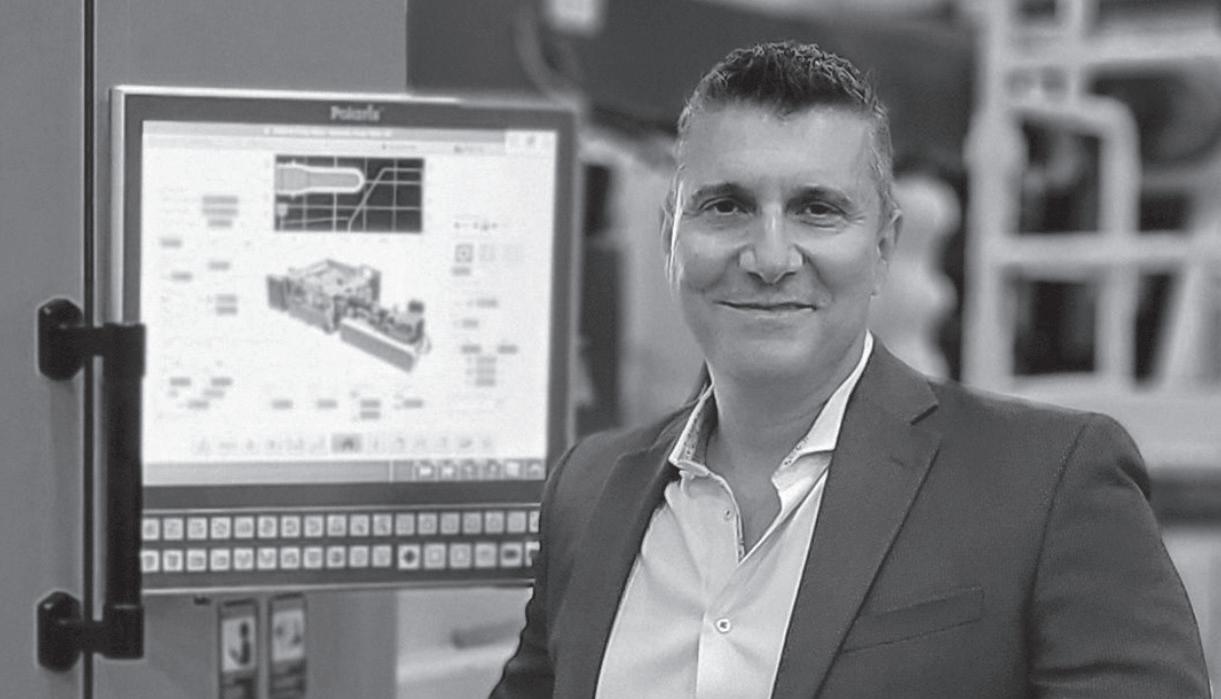
Injection molding systems supplier Husky Technologies has named company veteran Robert Domodossola as its new president and CEO, as the Bolton, Ont.-based firm navigates a sweeping leadership transition under new owner GPGI Inc.
Domodossola succeeds Bradley Selleck, who previously said he would step down this spring for personal reasons following Husky’s US$5 billion acquisition by GPGI late last year. GPGI recently rebranded from CompoSecure Inc.
Domodossola has been with Husky since
1996, most recently as president of the systems and tooling segment.
His appointment comes during a period of turnover at Husky. In February, the firm disclosed that both Selleck and chief financial officer John Linker would depart in the weeks ahead. Tony Black, president of Husky’s services unit, also retired at the end of March.
CCL Industries Inc. has signed a binding option agreement to buy France-based shrink sleeve label producer Sleever International Co. SA in a deal valued at approximately US$151 million.
Officials with Toronto-based CCL said in a March 13 news release that the purchase price will be paid through a combination of cash and assumed net debt.
In the release, CCL president and CEO Geoffrey Martin said the two companies have had a long relationship. “We have known Eric Fresnel, the visionary, entrepreneurial leader, and principal shareholder of Sleever, for almost 20 years,” he said. “We’re excited to have the opportunity to combine our respective sleeve product lines.”
Sleever is headquartered near Paris, and operates 11 manufacturing sites across Canada, France, Germany, Belgium, Ireland, Poland, China, and Brazil. The family-owned company supplies shrink sleeve labels, application equipment, and decorating services for consumer packaged goods and health care markets.
Fresnel will remain with the business in an advisory role after the deal closes.
5.1%
Projected U.S. dollar amount, in billions, of the overall market by 2034.
compound annual growth rate from 2026 to 2034.
53% Current market share of the Asia Pacific region.
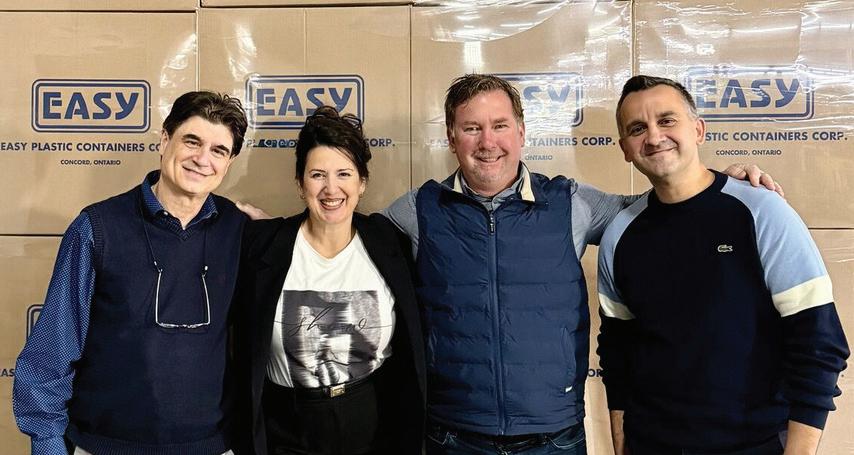
Vaughan, Ont.-based blow molder Easy Plastic Containers Corp. has been purchased by FirmaPak, which is headquartered in Chicago, Ill., for an undisclosed sum.
Established in 1979, Easy Plastic operates two sites near Toronto, and serves a range of sectors such as automotive, health and beauty, food and beverage, industrial, and pharmaceutical. The company, managed today by Nick Seretis, Andy Seretis, Geena Grigoriadis, and Nick Vayenas, was started by the late George Seretis and the late Chris Grigoriadis. Nick Seretis will continue to lead Easy Plastic, which will now operate as Easy Plastic, a FirmaPak Company.
FirmaPak also owns U.S.-based blow molders Container Services Inc. and Apex Plastics, which now operate under the FirmaPak name, as well as U.S. firm Lighthouse Packaging, which it acquired last year.
Wallace, Mich.-based Advanced Blending Solutions (ABS) has now fully integrated Thoreson McCosh into its manufacturing operations for blending, material conveying, desiccant drying, and controls products. ABS acquired Troy, Mich.-based Thoreson McCosh in 2020.
Chinese injection press manufacturer Tederic Machinery Co. Ltd. has named Ottawa, Ont.-based machinery supplier Leap Green Polymers Inc. as its sales representative for Canada.
PROMOTIONS, RETIREMENTS, RECOGNITION • If you have people in your agency recently promoted or retiring or an individual you wish to have recognized (major award or recently deceased) you can let Canadian Plastics magazine know by emailing: mstephen@canplastics.com.

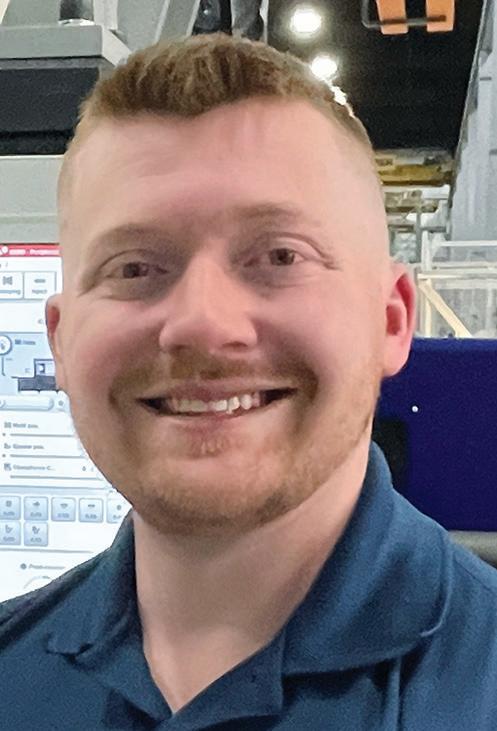
The Absolute Group of Companies, the distributor of plastics equipment in Canada and the U.S. based in Worcester, Mass., has named Jason Tucker (top) as national accounts manager for Canada and the U.S for Absolute Haitian, and Stephen Porth as regional sales manager for Canada and the U.S. for Absolute Robot.




Cleveland, Ohio-based specialty materials distributor Formerra LLC has appointed Tom Kelly as CEO.
Purging compound and additives maker iD Additives Inc., based in LaGrange, Ill., has named Peter Schroeck as technical sales manager.
Wichita, Kan.-based polypropylene and nylon 6,6 maker Invista has named Nancy Kowalski as CEO.
KraussMaffei Technologies, the injection molding and extrusion machinery subsidiary of Germany-based machinery maker KraussMaffei Group, has named Dirk Musser as managing director.

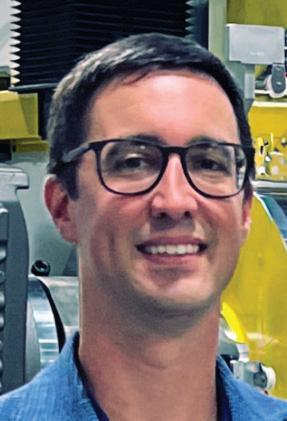
Duluth, Ga.-based injection molding machine maker LS Mtron IMM USA has appointed Jose Villanueva as service manager.
Extrusion machinery maker Processing Technologies International (PTi), based in Aurora, Ill., has named Ryan Leopold as vice president of operations.




Spartech LLC, a Maryland Heights, Mo.-based maker of packaging, rollstock materials, and specialty products, has named Andy Filson as CEO.
Winchester, Va.-based plastic composite decking maker Trex Co. has named Adam Zambanini as president and CEO.
Germany-based size reduction equipment maker Vecoplan AG has named Ralf Guckert as CEO.
Maple Grove, Minn.-based Zeiss Industrial Quality Solutions USA, a maker of quality control systems for plastics and other materials, has named Hendrie Viktor as president.
You may not have heard of isocyanates, but they’ve probably heard of you. A family of highly reactive, toxic organic chemicals, isocyanates are major respiratory and skin sensitizers, frequently triggering allergies and causing occupational asthma, severe irritation to eyes and skin, and even lung damage. The problem is, they’re indispensable for the chemical industry, and are needed especially in the production of polyurethane.
So it’s good news that researchers at the Fraunhofer Institute for Applied Polymer Research (IAP), in Potsdam, Germany, have developed an innovative process that replaces isocyanate with harmless dicarbamate.
Developed as part of the so-called CO2NIPU project – which is a consortium of Fraunhofer institutes, including IAP – this new approach makes the production of plastics easier, safer, and simplifies handling requirements, since employees no longer have to undergo special training to protect themselves from the isocyanates; since 2023, according to tightened European Union rules on isocyanates, only trained personnel can work with substances containing more than 0.1 per cent isocyanate. The process also reduces greenhouse gas emissions by using carbon dioxide in the dicarbamate manufacturing process.
According to project manager Christoph Herfurth, the resulting polyurethanes have identical molecular structures to conventional materials, meaning existing expertise and applications can be directly adapted. Although reactions with dicarbamates proceed more slowly – taking six to eight hours compared with minutes for isocyanates – this enhances pro-

Medical infusion tubing is often made of polyurethanes.
A novel production method developed by Fraunhofer IAP enables the production of high-quality polyurethanes without using toxic isocyanates.
cess control and cuts waste and quality variation.
The researchers have further developed the process with a view to industrial feasibility. Different chemicals are mixed in specific proportions to produce the desired properties. Chain extenders – low molecular weight reagents that convert polymeric precursors to higher molecular weight derivatives – are used to help cross-link the molecular groups and ensure elastic or adhesive properties. Polymer diols serve to soften the plastic, while the dicarbamate, as a substitute for isocyanate, initiates the chemical process. After mixing, these chemicals are melted and stirred; and then after cooling, the experts test for characteristics such as tensile strength and elasticity.
Concurrently, Herfurth said, researchers at Fraunhofer IAP are working on recycling methods that would allow polyurethane products to be broken down and reused, supporting a more circular plastics economy. Initial commercial-scale steps of the CO2NIPU project include pilot production of non-isocyanate polyurethane and explorations into medical applications such as biocompatible catheter tubes, as well as specialized adhesives to bond components. And the technology has already advanced beyond the laboratory. Researchers have successfully piloted several kilograms of the isocyanate-free polyurethane, Herfurth said, and plans are now underway to scale production to hundreds of kilograms.
The non-isocyanate polyurethanes have identical molecular structures to conventional materials, meaning existing expertise and applications can be directly adapted.
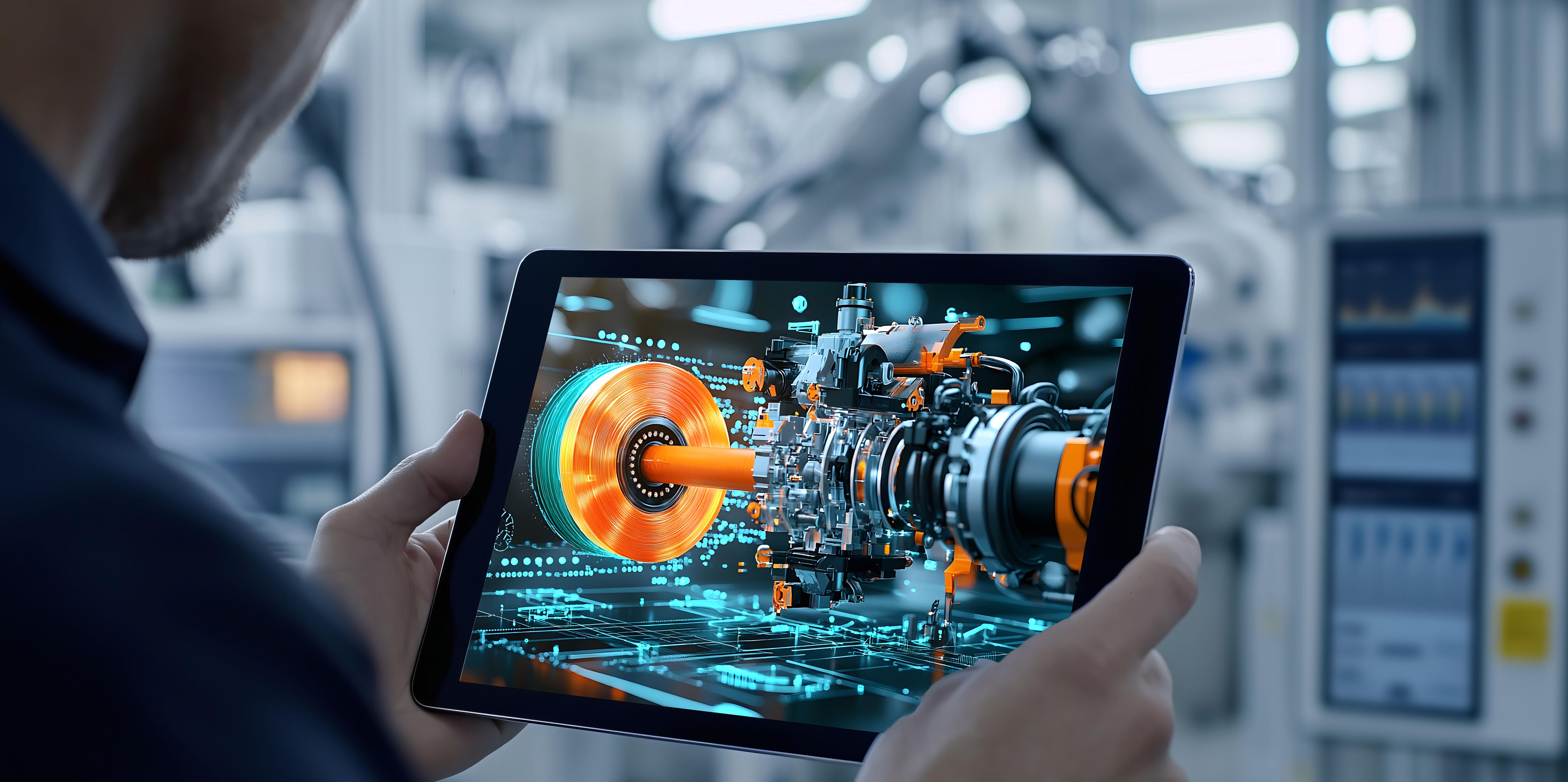
Driven by real-time data, cutting-edge sensors – including some with AI functionality –are moving plastic extrusion into a new era of fully autonomous systems that can handle complex, multi-material, and high-speed production scenarios.
BY MARK STEPHEN, EDITOR
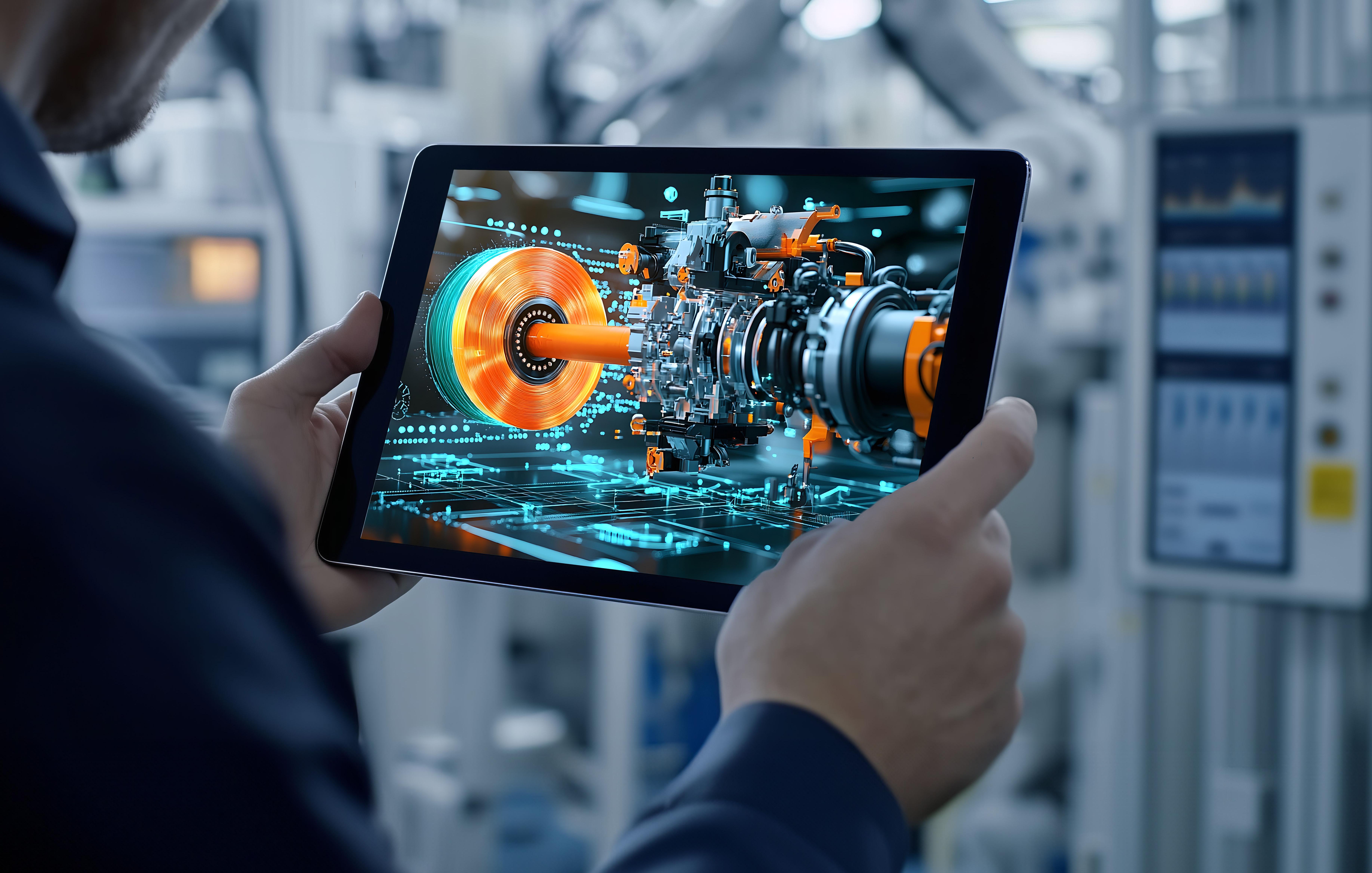
Extrusion is a pivotal process for making a variety of important plastic products, including pipes, profiles, and films. And regular in-process measurement and analysis of extruded products are pivotal to successfully managing a line – in particular, the sensors that maintain precise, real-time control over critical parameters like temperature, pressure, and dimensions. Mismanage any of these and you’re left with sputtering output and product defects such as warping or discolouration, wasted resources, and a lot of headaches; get the balance right, on the other hand, and you’ll hit that sweet spot where quality, efficiency, and performance come together. But even the best operators aren’t perfect, and the most accurate process measurements can, when subjected to imperfect operator judgment, leave the process open to inconsistencies.
Which is where state-of-the-art sensors and other control software comes in –solutions aimed at adding more repeatability to the process while lessening the need for human intervention in a world where finding, training, and keeping operators is increasingly difficult. The goal is to put extrusion on autopilot, and the OEMs keep moving the industry closer as the worker shortage grows more acute.
Here’s a look at some of the latest offerings in automated controls, some unveiled at last year’s K 2025 trade fair in Germany – the industry’s barometer for innovation and technological advancement – and some since then.
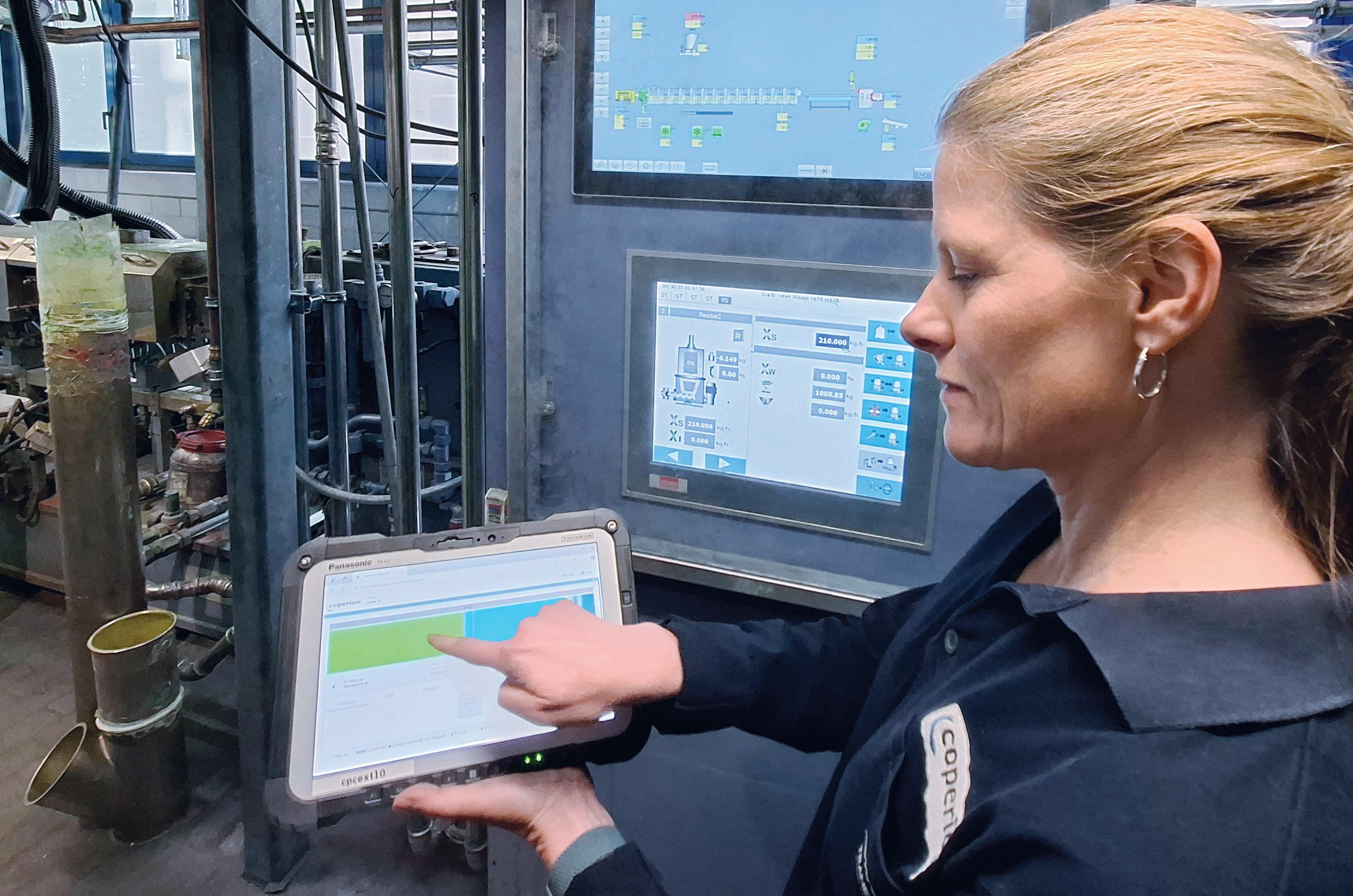
Germany-based Coperion recently expanded its C-Beyond digital platform –which captures and displays an extruder’s operational data – by adding a Lifecycle Manager function for predictive maintenance planning, in order to increase overall equipment effectiveness (OEE). The Lifecycle Manager uses an extruder’s operating hours and performance to compute upcoming maintenance and repairs for all the machine’s components. In case of machine breakdown or de-
viations in the operating window, C-Beyond can automatically notify management and operating personnel, enabling even faster reactions; and when a service is coming due, C-Beyond sends a notification to the operator. Coperion officials said the Lifecycle Manager improves a machine’s OEE because service and maintenance can be bundled and scheduled to minimize downtime. Service and maintenance work is logged in the Lifecycle Manager to create a maintenance record over the machine’s life.
First introduced in 2023, the DS-XEL control from Pawcatuck, Conn.-based Davis-Standard implements high-performance human-machine interface features to facilitate data acquisition and process information, company officials said. Processors benefit from built-in security to prevent unauthorized changes to setup parameters, multi-language support, process alarm logging, and real-time and historical data trending. The DS-XEL is the new standard control for Davis-Standard’s Super Blue and HPE extruders and is compatible with the company’s DS Activ-Check cloudbased platform; and is available as an upgrade to existing extruder controls. In addition, the DS-XEL addresses connectivity requirements with a simple connection to ERP/ MRP or upper-level supervisory control using a standard OPC-UA interface.
The CCS1000 testing system from Germany-based Gneuss, now with heated holders and RFID-ready sensors, ensures precise, safe, and future-ready process monitoring, and enables testing under real operating conditions.
Thanks to its modular design, the CCS1000 can also be retrofitted with a temperature-controlled pressure port. Additionally, the newly developed clamping device for the sensor holder reduces wear on the sealing surfaces, preventing leaks during testing. Gneuss officials said they can provide a customized solution for testing needs based on the CCS1000. Pressure ports are available for various thread types, including 0.5 inch and M18. Display units can be integrated for the sensor types based on customer request. Gneuss sensors are future-proof thanks to digital IO-Link communication and optional identification using RFID chips.
Hosokawa Alpine, headquartered in Germany, recently introduced a digital startup assistant based on its ExVis process visualization software. Settings for a film formulation are stored in the software, enabling operators to start up the system in four easy, automated steps, company officials said. Alpine also offers an operating device for the film take-off, which can be connected to the take-off or the collapsing system and operated on-site – this gives the operator immediate access to the connected component. Additionally, Alpine is now offering system monitoring technology that immediately visualizes malfunctions in operation and production so they can be rectified quickly. Cameras located at the take-off, winder, and machine-direction orientation unit produce images that can be called up via the operator terminal, enabling operators to get an overview of the complete process from the control panel, even in areas of the system that aren’t visible. And in an emergency, the remote service from Hosokawa Alpine Blueserv, the company’s service brand, can quickly access the system for troubleshooting.
With its new ppC (pioneer processControl) control system, German OEM KraussMaffei aims to bring greater clarity and efficiency to extrusion processes. Instead of complex operating logic, ppC relies on intuitive processes, clearly structured user guidance, and a unified user interface, company officials said, which shortens the learning curve, reduces the amount of training required, and makes everyday production easier. Its modular design enables use across all extrusion tasks – from flat and foam, to pipe and profile, to compounding and recycling. Integration into existing systems is also easy, with interfaces for connecting to third-party devices such as metering devices, measuring systems, and higher-level systems such as MES or DCS enabling the central operation and monitoring of entire systems, ensuring greater transparency and process reliability.
Milacron, based in Batavia, Ohio, recently rolled out the latest ver-
sion of its well-known Mosaic extrusion control system, called the MosaicX. The latest version has more standard features, faster processing speeds that enable more data collection and report-generation, plus custom screen options that can provide simultaneous views of multiple machine functions. Milacron officials said it can control multiple extruders, downstream equipment, and auxiliary systems, and it offers graphical process monitoring for more than 50 parameters. Data protection with four access levels for up to 30 machine operators is standard, and RFID login is available as an option. Data transfer, including mold data and screen shots, is through USB keys. The change log and alarm log can be stored on the control, a USB stick or network drive. The operating system is Windows-based, and real-time monitoring provides live updates on extruder motor pressure. The controller also allows for adjustable back-pressure settings. Milacron said selfdiagnostic and fault-finding capabilities have been improved to provide quicker problem identification and resolution. MosaicX supports three languages – English, French, and Spanish – and can be retrofitted to older Milacron extruders.
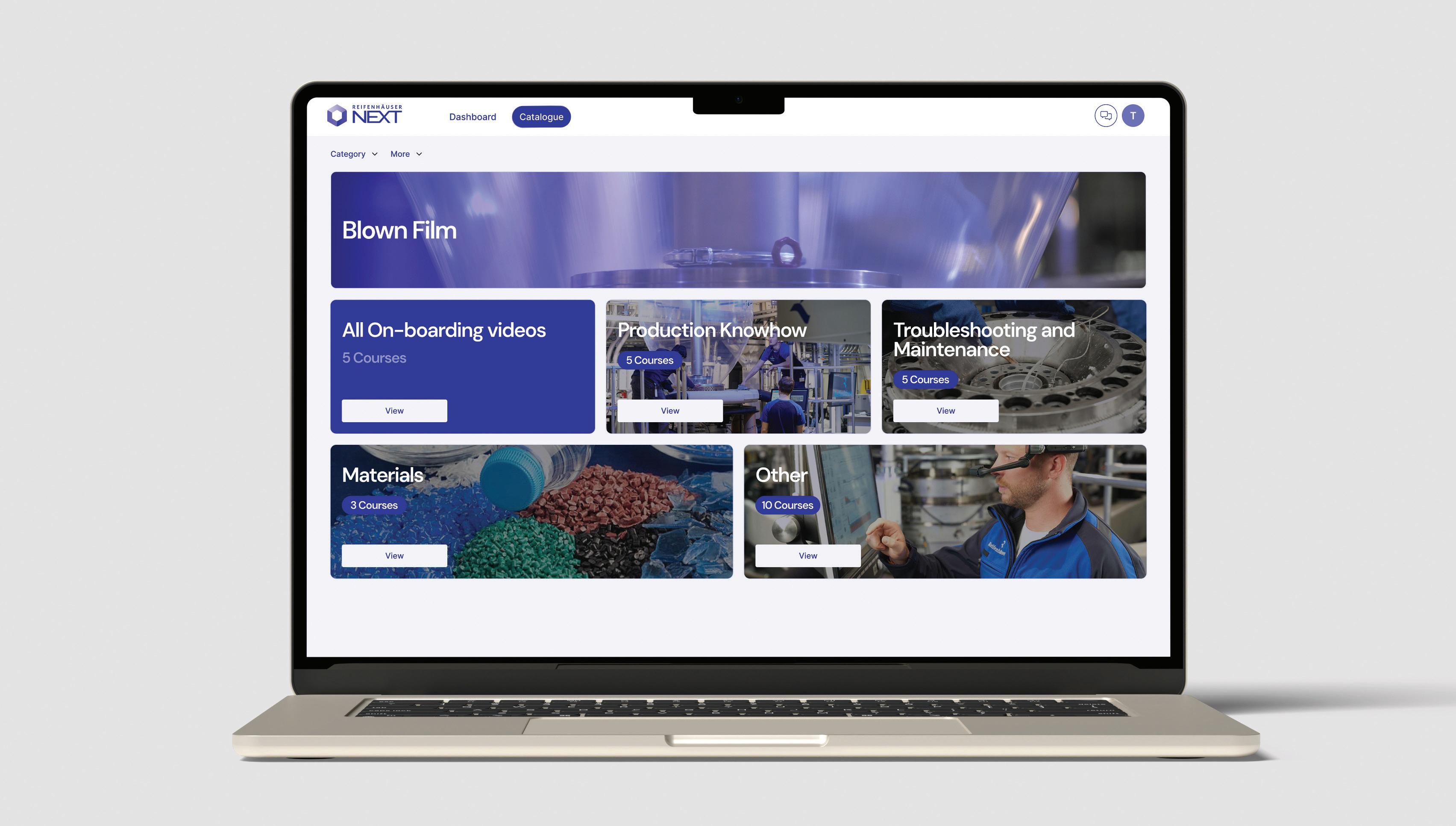
Germany-based Reifenhäuser’s new NEXT system is a three-pronged artificial intelligence (AI)-based solution that’s designed to help processors increase OEE by optimizing availability, performance, and quality. NEXT consists of three products: NEXT.AI, an AI chatbot

Frustrated with profits being lost to unnecessary scrap costs?


Minimize waste with Dyna-Purge – the most effective commercial purging compound in the industry. With over 30 years of innovation, Dyna-Purge provides unequaled product and technical support. Our customers enjoy outstanding customer service and reliable results. Start reducing scrap costs and increasing profits today. Request a free sample of Dyna-Purge and see for yourself.
Discover the Difference. 866-607-8743 www.dynapurge.com



that responds to text questions with immediate answers and suggestions; NEXT.Learning, a combination of on-site training and a digital learning platform that helps users retain staff expertise and make it available to new employees through AI avatars; and NEXT.Data, which automatically aggregates production data and displays it on dashboards designed for the plastics extrusion and packaging industries. According to Reifenhäuser officials, studies show that the use of industrial AI has the potential to improve OEE by up to 15 per cent and reduce waste and downtime by up to 20 per cent.
Windmoeller & Hoelscher Corp. (W&H), based in Lincoln, R.I., recently unveiled its new Easy2Run copilot system for blown film extrusion – a self-optimizing control system that automates performance adjustments and maximizes throughput, even
when operator experience is limited. The system builds on W&H’s earlier Easy2Change technology by not only applying pre-set parameters but also continuously adjusting the process based on live operating data. Sensors track key variables like frost line height, air pressure, and extruder performance to find each line’s safe performance ceiling. W&H officials said the system displays power reserves for individual machine components as well as a visualization of the possible output power by means of a clear speedometer and automatic detection and graphic representation of the bubble shape. And a visual dashboard lets operators see at a glance where
Reifenhäuser’s
NEXT.Learning is a combination of on-site training and a digital learning platform.
Putting extrusion on autopilot has been the goal for years, and the OEMs are getting closer with some of the latest offerings in automated controls.
there’s untapped capacity. Easy2Run analyzes thousands of data points in real time and can boost output by 10 to 30 per cent — with no changes to the machine — just by optimizing what’s already there, W&H officials said. Today, as skilled operators retire and others prove difficult to train and retain, advances in digital technology offer extrusion shops the possibility to reduce their reliance on trained personnel and operator-dependent process controls – and point towards a future where intelligent systems, including some that are AI-driven, allow them to leverage the full potential of their own production data. Going forward, it might just be the difference between success and failure.
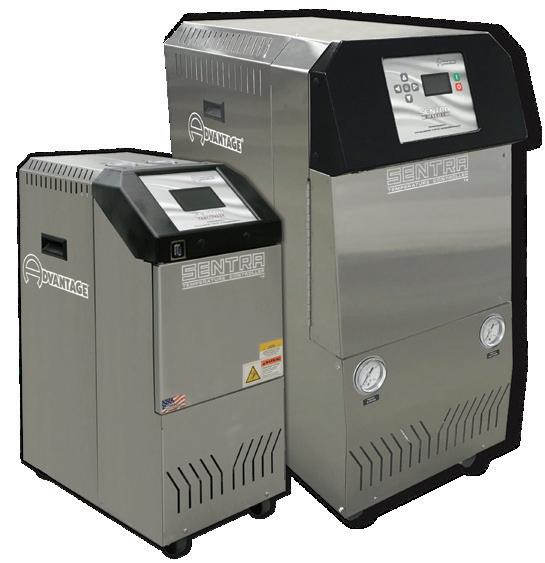

• Available with OPC UA EM82.1 communication capability for communication with primary machinery
• Maximum chillers are available with Low GWP (Global Warming Potential) Refrigerants
• Over 47 Years of Dedication to Engineering & Manufacturing Process Cooling & Temperature Control Equipment
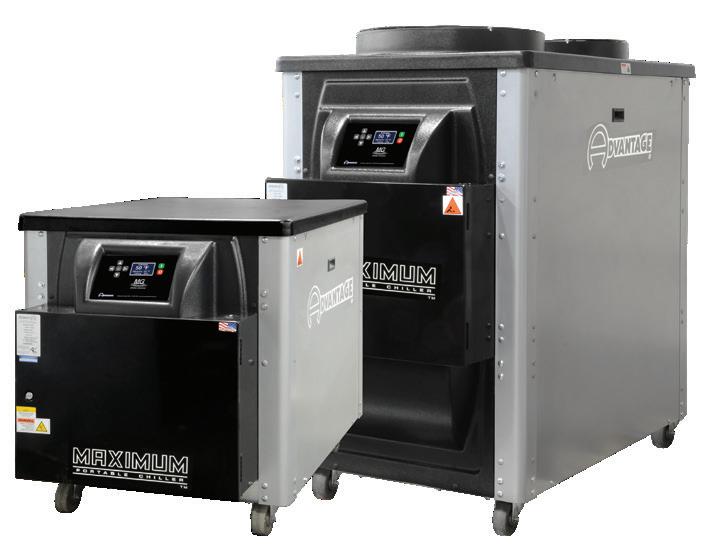
• Over 95,000 Units Produced & Shipped Worldwide
• Continually Developing Better Solutions Featuring the Latest Technology
• Customer Service always available to answer application & troubleshooting questions

Industry 4.0 solutions have made resin conveying systems more intelligent than ever, breaking traditions and solving problems. Is AI the next step?
BY MARK STEPHEN, EDITOR
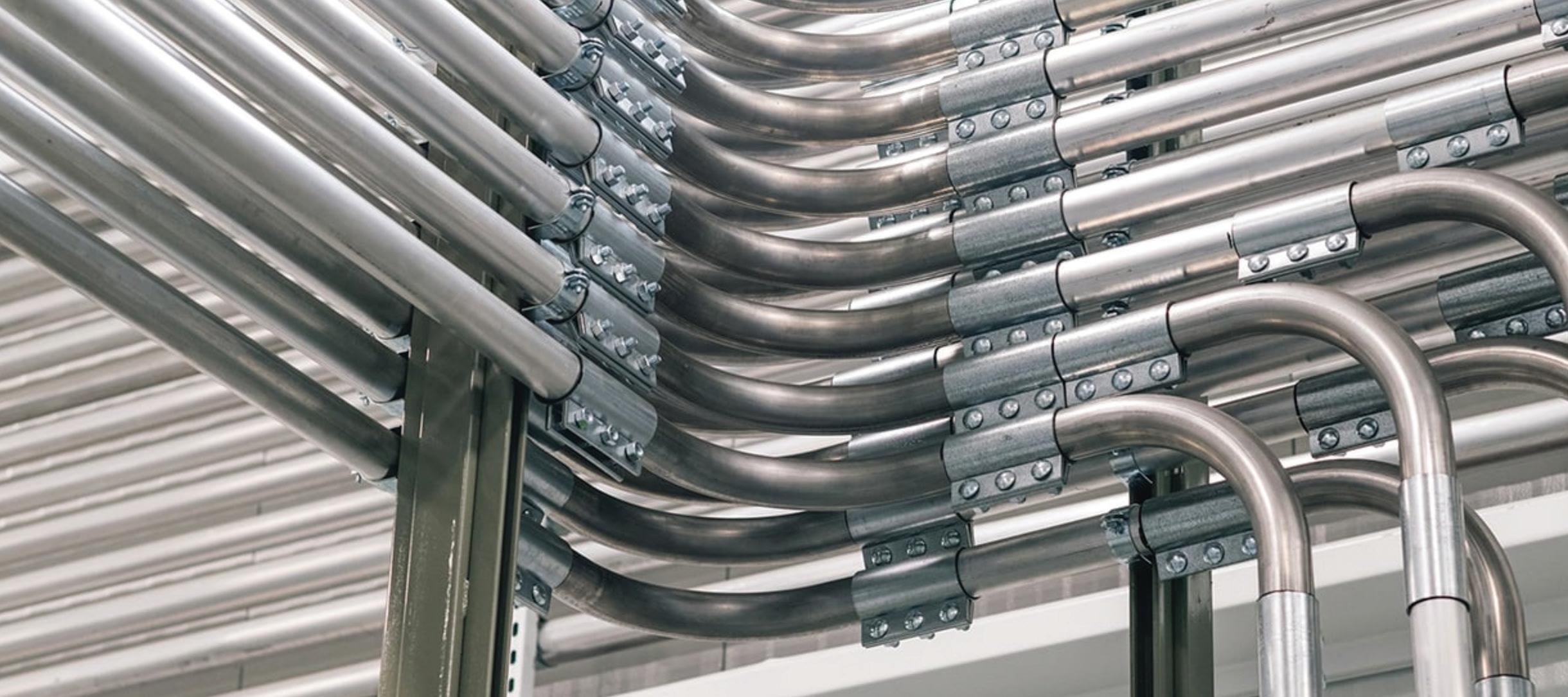
Resin doesn’t usually sit still for long in a plastics processing plant. Your machines are calling for material, and a consistent flow of pellets is being delivered from silos, bins, and other storage containers through either vacuum or pneumatic conveying systems – the latter of which includes either dense phase or dilute phase – depending on distance, throughput, and scale.
The state of conveying technology doesn’t sit still for long either. In the early days, resin movement was entirely manual, through buckets, ladders, and operators climbing to fill feed hoppers, and was characterized by timeconsuming adjustments and costly production stops. But it’s evolved through major improvements as controls have grown more sophisticated, to become far more efficient, saving labour and maximizing valuable floor space and machine throughput. Nowadays, no matter the scale or complexity, having an intelligent, automated resin conveying system that promises repeatability is a key part of running a successful molding operation.
Systems are now highly customized and flexible in their capabilities, far more so than was possible in the past. Many improvements have been in hardware, such as blowers, compressors, and vacuum pumps with more efficient
operation; and the development and implementation of a wider range of material flow regimes. The other side of the coin is the development of control systems and wireless communication protocols that draw from Industry 4.0, the fourth major transformation in manufacturing and work, generally considered to have begun around 2011. Programming software today is available with “canned” algorithms such as PID controllers, weigh batch controls, and signal conditioning, making it easier to adopt more advanced Industry 4.0-themed adaptive control methods such as touchscreen-enabled devices that can display detailed graphics, data trending and history logging, real-time monitoring and troubleshooting, “pop-up” windows, and other important performance criteria that allow operators to have a much better understanding of the process and of what’s actually happening inside the pipes and vessels. In a word, resin conveying has become smart.
And the developments continue with even newer smart controls – and also some technologies that some OEMs say incorporate the newest topic in the manufacturing space: artificial intelligence (AI), which a lot of people in the plastics world are talking about.
Throughout plastics processing, the convergence of AI and types of processing machinery and auxiliary equipment is ushering in a new era of intelligence by automating decision-making and enabling predictive maintenance. But how close is it to ushering in a new era of intelligent material flow? Some OEMs are already offering conveying controls that use what they’re calling AI-driven technologies, primarily machine learning, the subset of AI focused on algorithms that can “learn” the patterns of training data and, subsequently, make accurate inferences about new data. Last year, Cranberry Township, Pa.-based Conair Group introduced Conveying with Optimizer, an AI-based solution built around a Conair SmartFLX control with optional software that automatically detects sourceto-destination conditions – such as vacuum, receiver distance, material bulk density, and other factors – and autonomously adjusts the conveying system in real time to move material under optimal conditions. If line conditions change – perhaps because of a filter clog, leak, or material density or moisture change – the control regulates the Optimizer valve to adjust the air intake until it reaches the pressure setpoint. The modified valve position is stored for use in the next cycle. “Thus, this AI-driven system begins with a data-based algorithm and stored settings but continuously queries to ‘learn’ what’s going on and adjust for optimized performance,” said Justin Carter, Conair’s conveying products manager. “It eliminates the most labour-intensive and error-prone part of conveying operation: the manual guesswork and adjustment of feed tubes. The system has the adaptability to deal with many day-to-day performance variations and situations, and includes intelligent alarms.”
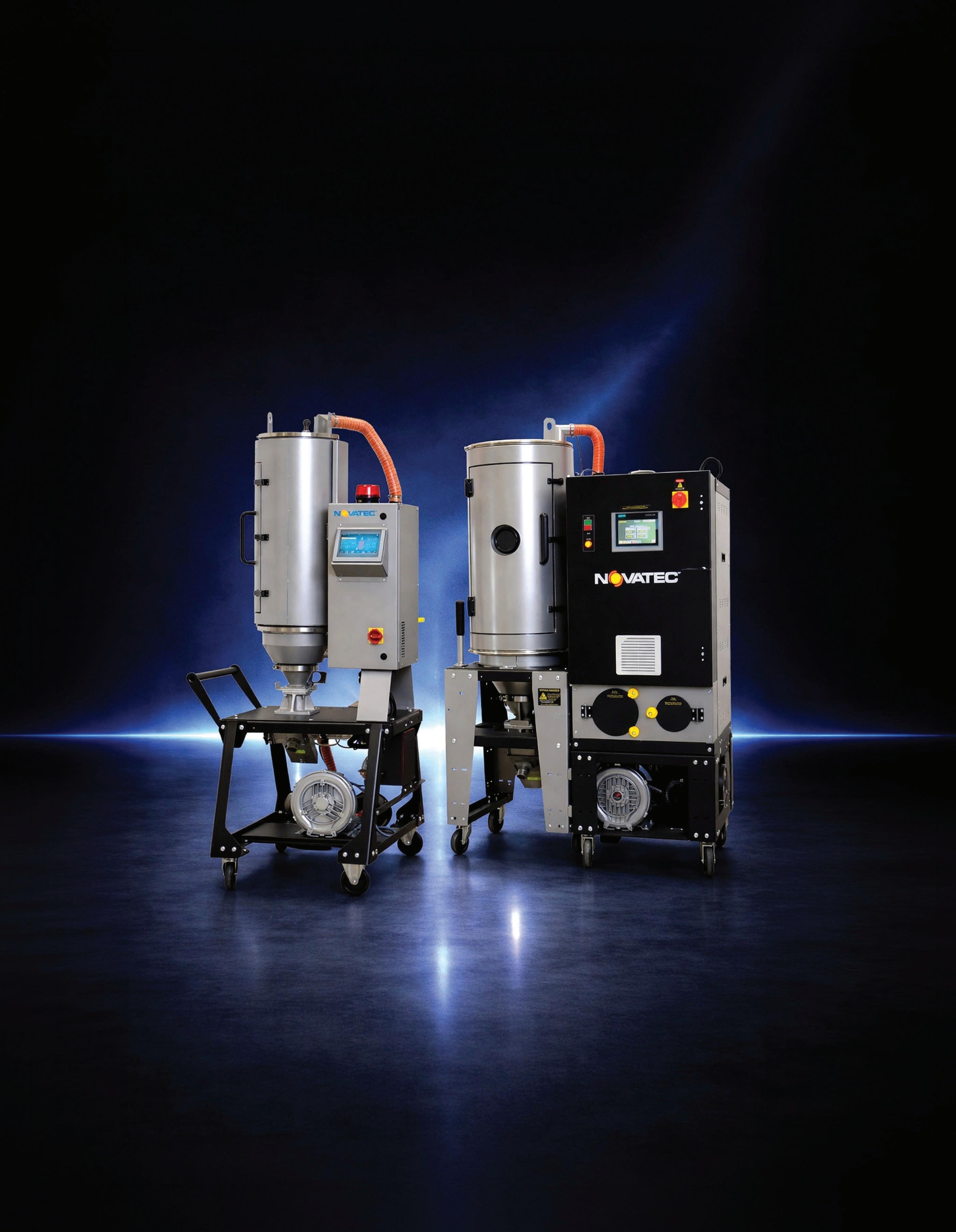
According to Conrad Bessemer, president of Baltimore, Md.-based Novatec Inc., one area that has historically been overlooked is monitoring the health of the vacuum pumps that drive the conveying system. “Many processors have invested in controls that monitor sources and destinations throughout the plant, but the pumps themselves often run without much visibility until something fails,” he said. AI-powered monitoring technologies are beginning to correct this oversight, Bessemer said. “Systems such as Novatec’s PumpSense use sensor arrays combined with predictive algorithms to monitor vibration signatures, vacuum levels, oil condition and level, temperatures, and utilization patterns on blowers and motors,” he said. “These indicators help reveal developing wear conditions long before a catastrophic failure occurs, so processors can schedule maintenance based on real operating conditions.”
Bessemer also sites Novatec’s Master Data Hub predictive monitoring system, which can aggregate sensor data from material handling lines, silos, railcar unloading systems, and other auxiliary equipment throughout the plant, including equipment that may not traditionally be
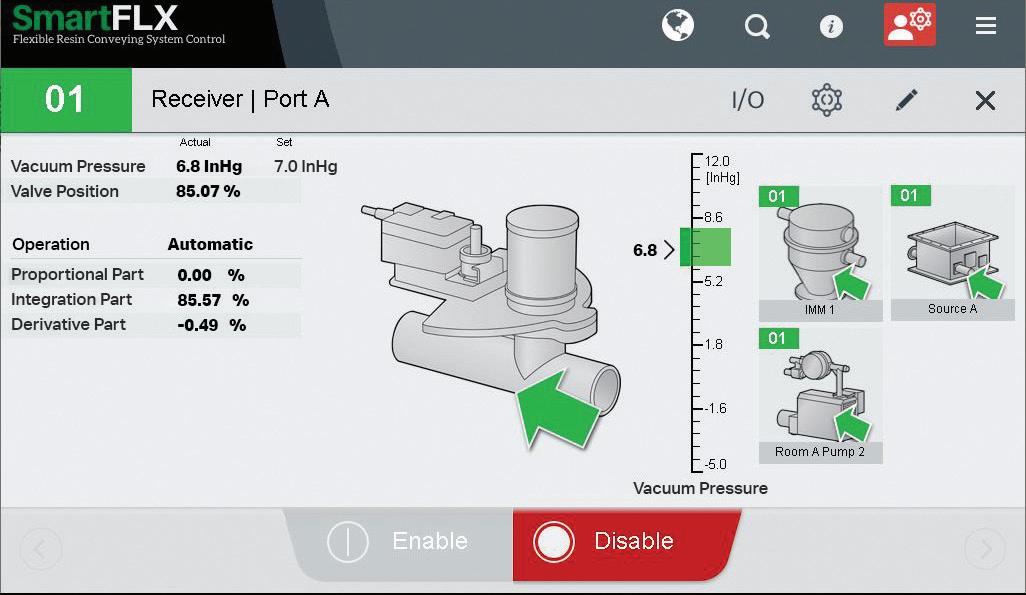
Conair Group’s Conveying with Optimizer in operation, adjusting airflow within the conveying system to manage pressure and air-to-material ratio.
connected to centralized control systems. That information can then be integrated into plant-wide monitoring or control systems to give operators a clearer view of system health and performance. “In many ways, this aggregation and analysis of operational data is what the current wave of AI in manufacturing is really about,” Bessemer said. “The underlying information often already exists in sensors and equipment across the plant, but the challenge has been that the data lived in separate systems or was only visible locally. By bringing that information together into centralized controls that can analyze conditions and respond accordingly, processors can optimize conveying performance based on real operating conditions, through a conveying system that’s continuously learning.”
Industry 4.0 is considered to have begun in 2011. Advocates for AI in resin conveying say that much of the data being trended, recorded, and documented by Industry 4.0 systems still needs to be interpreted by a human being.
Advocates of AI in resin conveying point out that much of the system performance data being trended, recorded, and documented by Industry 4.0 systems today still needs to be interpreted by a human being – and sometimes a subjectmatter expert. The development of AI, they say, will be able to capture much of the subject-matter expert’s role, as AI models can learn the specifics of even very complex pneumatic conveying systems and learn from their operation over time.
This may be the promise, but other OEMs say that bringing AI-driven technology into conveying is – at the most – a short discussion between themselves and their customers that often doesn’t last too long. “At the moment, we’re not seeing widespread interest from our customers about AItype control capabilities – occasionally a customer will ask about it, but it’s more of a buzzword in the industry right now,” said Joe Dziedzic, senior product manager, material handling with AEC, a division of ACS Group in New Berlin, Wis. “It’s an evolving technology, and I don’t think it can significantly impact the monitoring and control capability of many of the platforms already on the market. The same control platforms are being re-marketed by some companies as ‘AI-enabled,’ but these controls are using platforms with sensors that make adjustments and they may or may not be tied into an Industry 4.0 platform to collect data. That’s technology that exists today.” That said, Dziedzic continued,
ACS Group is exploring the possibility of putting AI-based capabilities into its control platforms, provided it doesn’t make things more complicated for the user. “The goal is always to make conveying as easy as possible,” he said. “Currently, our team is investigating how that’s best achieved and whether the software will have to change in order to incorporate AI functionality and make the panels even more intelligent than they already are.”
Another OEM that isn’t seeing interest from its customers is Plainwell, Mich.-based Motan Inc. “Keeping things simple for simple processes is still the preferred way for most customers,” said Noah Easton, regional sales manager for Canada and the northeastern U.S. “More complication means more costs and more failure points. There are a lot of variables that impact the conveying process, and the technology is already in place to identify and address them – as well as to alert the operators – through the appropriate alarms, so we don’t see a clear advantage to using AI in our conveying systems.”
Some vendors question whether true AI is in resin conveying at all –and whether there’s even a need for it. “Currently, there are no AI panels in resin conveying, and I’m not sure there needs to be,” said Rob Miller, president of Wittmann Battenfeld Canada in Richmond Hill, Ont. “There’s definitely smart conveying being used in
Whatever the degree of penetration of AI-based technologies right now, Industry 4.0 solutions still represent the dominant technology for managing changing conveying conditions.
plants now, through sensors and other methods of data-gathering, but these don’t involve learning or using large language models [LLM] – they involve forecasting, and the data isn’t being given to an LLM to learn from.” The current smart systems use ladder logic, Miller said, which is a fast and simple way of creating logic expressions for a PLC to automate repetitive machine tasks and sequences. “Successful conveying depends mostly on repeatability, less so on making real-time changes, and the current technology already does that,” Miller said. “Hypothetically, in an extremely complicated resin conveying system, AI might be useful to make sure the right material goes into the right conveying line for the right product without a human telling it what to do, but – again – that exists pretty much in 4.0 technology now.” As an example, Wittmann’s new M8 plus control system is intended for large central material conveying installations and is designed to handle medium and large setups where coordinated supply to multiple production cells is required. M8 plus allows control of up to eight separate material supply systems using a single control-
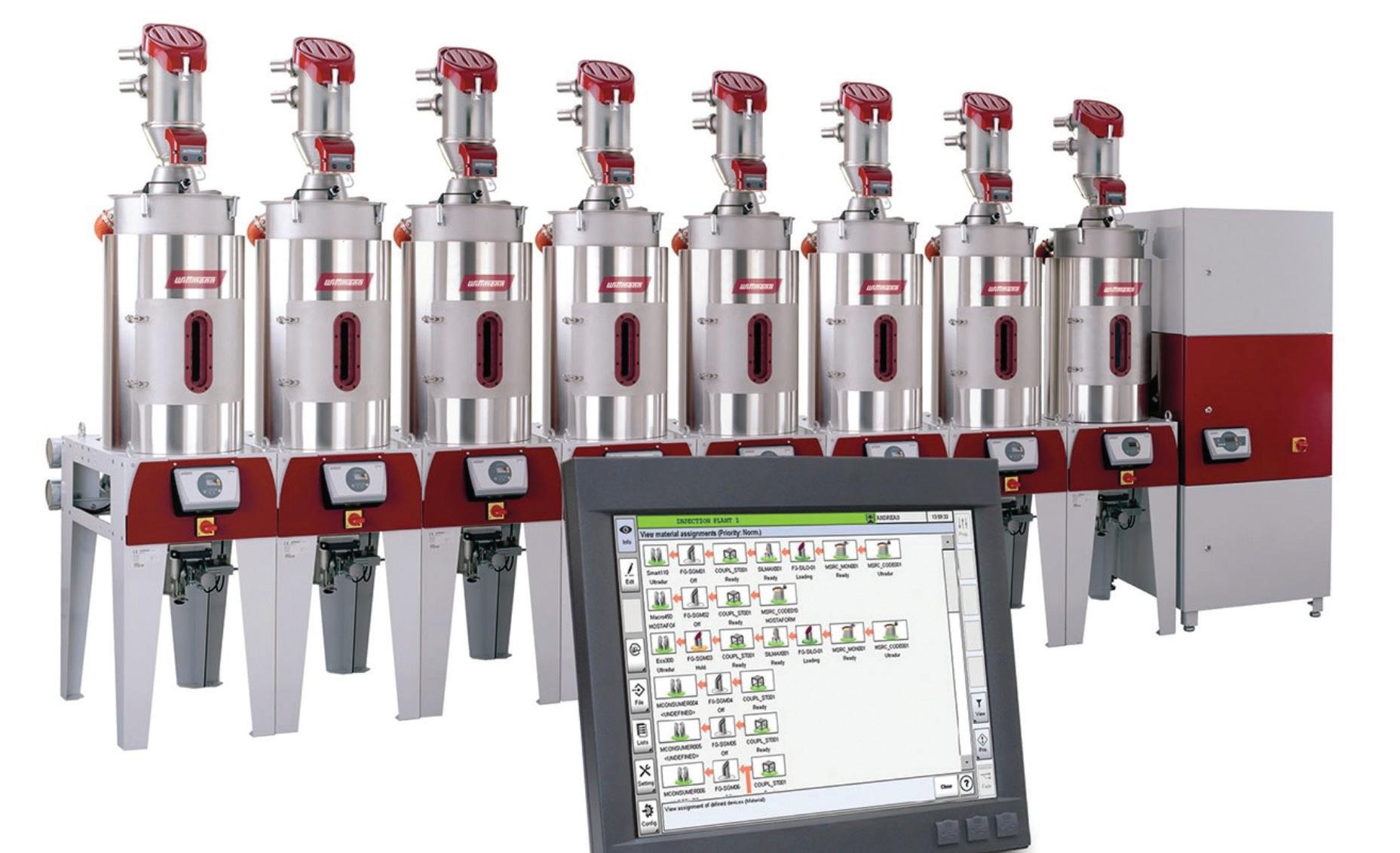
ler. Process and diagnostic data can be provided on demand via the OPC UA (Unified Architecture) protocol, and a new feature is the ability to incorporate entire networked production cells, integrated via Wittmann 4.0 software.
On the question of AI, Miller continued, there might also be concerns from customers about cost and data security, since unsecured or ungoverned AI use can easily expose sensitive information. “A lot of customers probably don’t want their confidential production data being used as part of a model’s training data to develop an LLM, and most of them won’t want to pay for that,” he said.
Wittmann’s new M8 plus network control makes material handling even more flexible and secure.
According to Conrad Bessemer, there are valid concerns about cybersecurity, but mostly among customers that rely on cloud aggregation of data or the export of data outside their boundaries. “That’s the primary reason we moved our data-gathering and analysis skills to the edge on devices such as pumps, conveying systems, and our central controls, including the Master Data Hub,” he said. “Our major customers asked for local control and non-cloud systems and now all of ours are local, edge-type memory systems that don’t communicate with any outside services – then the data can be pushed to in-house resident systems that are secure and not cloud-based. This data can also be analyzed by retrieval augmented generation [RAG]type local AI applications that also don’t involve exporting key data outside of the facility, but still are smart enough to examine the past data and identify issues, pending service problems, and offer management improvement strategies using all the plant data, not just localized systems like conveying.”
Whatever the degree of penetration of AI-based technologies right now, Industry 4.0 solutions still represent the dominant technology for managing
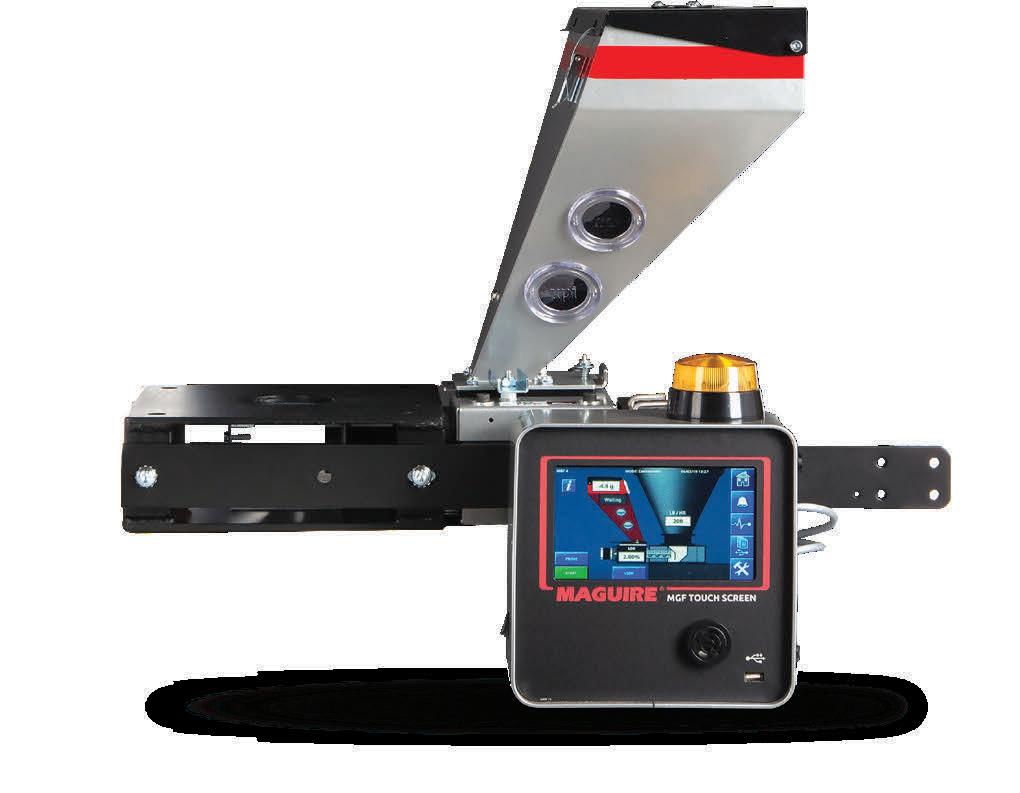
changing conveying conditions, and are still being refined by OEMs, with plenty of new developments coming down the pipeline. Maguire Products, for example, recently unveiled what it calls a more powerful version of its Fusion control package, described as an advanced integration platform that unites conveying, gravimetric blenders, feeders, and – when required – extrusion control into a single streamlined system, managed from a single intuitive touchscreen interface. According to Maguire officials, this inclusive control package streamlines operations, enhances accuracy, and delivers measurable efficiency gains.
AEC has added a distributed input/ output (I/O) control platform to its VacTrac Plus series of conveying controllers. This platform is used for medium to large conveying system applications, Joe Dziedzic said, and it’s useful when processors expand their plants.
AISome OEMs are already offering conveying controls that use what they’re calling AI-driven technologies.
“The system automatically detects and reconfigures I/O when new pumps or stations are installed or when an existing network is expanded,” he said. “The platform utilizes Ethernet communications, which allows the control to automatically configure and assign I/O. Automatic email alerts can be set up to provide operators instant visibility into specific issues on the production floor.” VacTrac Plus can also be remotely monitored with the ACS Group’s MiVue manufacturing insight service, Dziedzic added.
More good news is, whether you’re exploring AI-driven technologies or modern Industry 4.0 systems, older conveying equipment can oftentimes be retrofitted. “We frequently retrofit vintage home-run 110V controls to modern CAN-bus low-voltage systems and that’s very worthwhile for improving system performance, reliability, and uptime,” said Noah Easton. And
Conair’s Conveying with Optimizer can be retrofitted to existing systems because it’s compatible with most vacuum pumps and systems. “Installation replaces feed tubes with fixed connections, updates the SmartFLX control software, and adds the Optimizer valve and transducer,” Justin Carter said. But there’s a limit to what can be retrofitted. “I imagine that an AI-based system would require more sensors than some traditional, older platforms would have, so that upgrade probably wouldn’t be practical in many cases,” said Joe Dziedzic.
In the end, intelligent conveying lines – whether powered by Industry 4.0 or AI-driven technologies – will continue to become more scientific, understood, controlled, and predictable every year, reducing operator intervention, improving consistency, and solving labour challenges. It’s the smart bet, definitely.











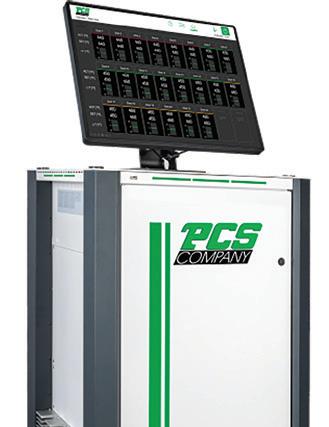



Advanced controls and analytics for industrial chillers have made process cooling more intuitive and user friendly than ever before. And now AI seems poised to continue the smart evolution.
BY MARK STEPHEN, EDITOR
It’s no exaggeration to say that plastics processing lives and dies by temperature control. Stable and repeatable cooling supports consistent cycle times, protects mold tools, and helps reduce defects linked to cooling instability by ensuring that plastic parts don’t warp, shrink, or develop internal stresses that could compromise their structural integrity. And this stability is what industrial chillers provide. The only problem is, chillers –whether portable or central, air-cooled or water-cooled – are complex systems with multiple failure points that include compressors, condensers, and evaporators.
Preventing this failure is therefore a prime directive for the chiller makers. And it was a challenge for decades, as OEMs struggled to provide controls with sophisticated analytics that could derive actionable insights from their chiller data and maintain a comprehensive overview of the entire cooling system. But the past 15 years have seen chiller performance remade by the fourth industrial revolution of Industry 4.0, which has transformed production plants into smart, interconnected, and highly efficient environments. “Modern chiller controls perform advanced functions that weren’t possible with older systems,” said Mario Coletti, area sales manager with Frigel North America Inc., in East Dundee, Ill. “These smart controls are designed to continuously monitor operating conditions and automatically optimize performance, improving both energy efficiency and process stability.”
Industry 4.0-related chiller control

developments have been facilitated by improvements in chiller hardware. “With the availability of speed-controlled compressors, low-temperature-operating compressors, speed-controlled fans, and proportioning water valves, it became more important to sense what was going on in the chiller to take full advantage of all these new components available to us,” said Roger Lambert, president of Markham, Ont.-based Temperature Corporation. “And since there was so much information that was being sensed and gathered from the chillers, the chillers had to know what to do with it all.”
Fast forward to today, and they know. Modern chiller controls now track key metrics like energy consumption, refrigerant pressures, ambient dewpoint, vibration levels, and component health; and modern chiller analytics platforms transform this raw operational data into clear, actionable insights through sophisticated key performance indicator (KPI) dashboards. The core metric – tracking the ratio between electricity consumed and chilled water produced – provides facility managers with an immediate understanding of system performance. When facilities operate multiple chillers, analytics platforms can automatically determine the optimal combination of units to run based on real-time efficiency data and load requirements.
Beyond this, advanced chiller analytics provide operational insights that extend equipment lifespan to the maximum, including automatically sending alerts for predictive maintenance and analyzing the frequent starts and stops – often caused by incorrect setpoints or load miscalculations – that can degrade chiller performance and shorten equipment lifespan. And for plantwide systems, effec-
tive chiller analytics monitor the entire cooling ecosystem.
As an extra wrinkle, there’s a balance that OEMs are often being asked to maintain – offer chillers that are smart but not confusingly so. “Many plant maintenance teams and outside service technicians still want controls that are intuitive and easy to troubleshoot,” said Jon Gunderson, president of Advantage Engineering Inc., in Greenwood, Ind. “In our experience, overly complicated interfaces can slow down troubleshooting when a problem occurs.”
Beginning in 2021, Richfield, Wis.-based Delta T Systems began rolling out a single- and dual-zone temperature control heater and chiller package that combines energyefficient variable speed compressors and fan motors with a heating loop for precise temperature control. Suitable for plastics processors that use chillers and temperature control units in tandem, the standard single controller and program can control two processes at different temperatures and pumping capacities. As an option, the company also offers process monitoring software called DTS Smart Connect that enables remote chiller management and servicing. When equipped with an upgraded, Ethernet-enabled controller, all Delta T Systems chillers can upload specified process parameter data to a cloud-based server. “The package also provides predictive maintenance to customers through ‘pop-up’ warnings,” said company president Jochen Naujokat. Self-diagnostics is an area that Delta T is continuing to work on, Naujokat continued. “Our control technology records the number of hours that each component is running and the number of starts, which will help tell when components are at the end of their life,” he said.
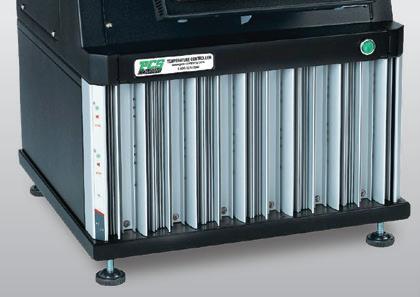
Temperature Corporation, meanwhile, offers its System Remote Master (SRM) modular chiller cooling system, which can control 12 chillers with a total of 48 stages. “It monitors the operating and fault conditions of all of the chillers in the group and can pass this information along to the plant PLC or the BMS [building management system],” said Roger Lambert. “Once we log into our SRM remotely over the internet, it’s as if we’re standing in front of the chiller and can monitor each unit’s operation as well as the temperatures and pressures, and we can make changes to the modes from cooling to heating.” The SRM will also stage all the compressors in the system to match the cooling load, Lambert added, and if a chiller stops due to a fault condition, the SRM starts the next chiller in line with no interruption and signals the SRM that a chiller has failed.
And now, the plastics industry stands at the threshold of another technological revolution: artificial intelligence
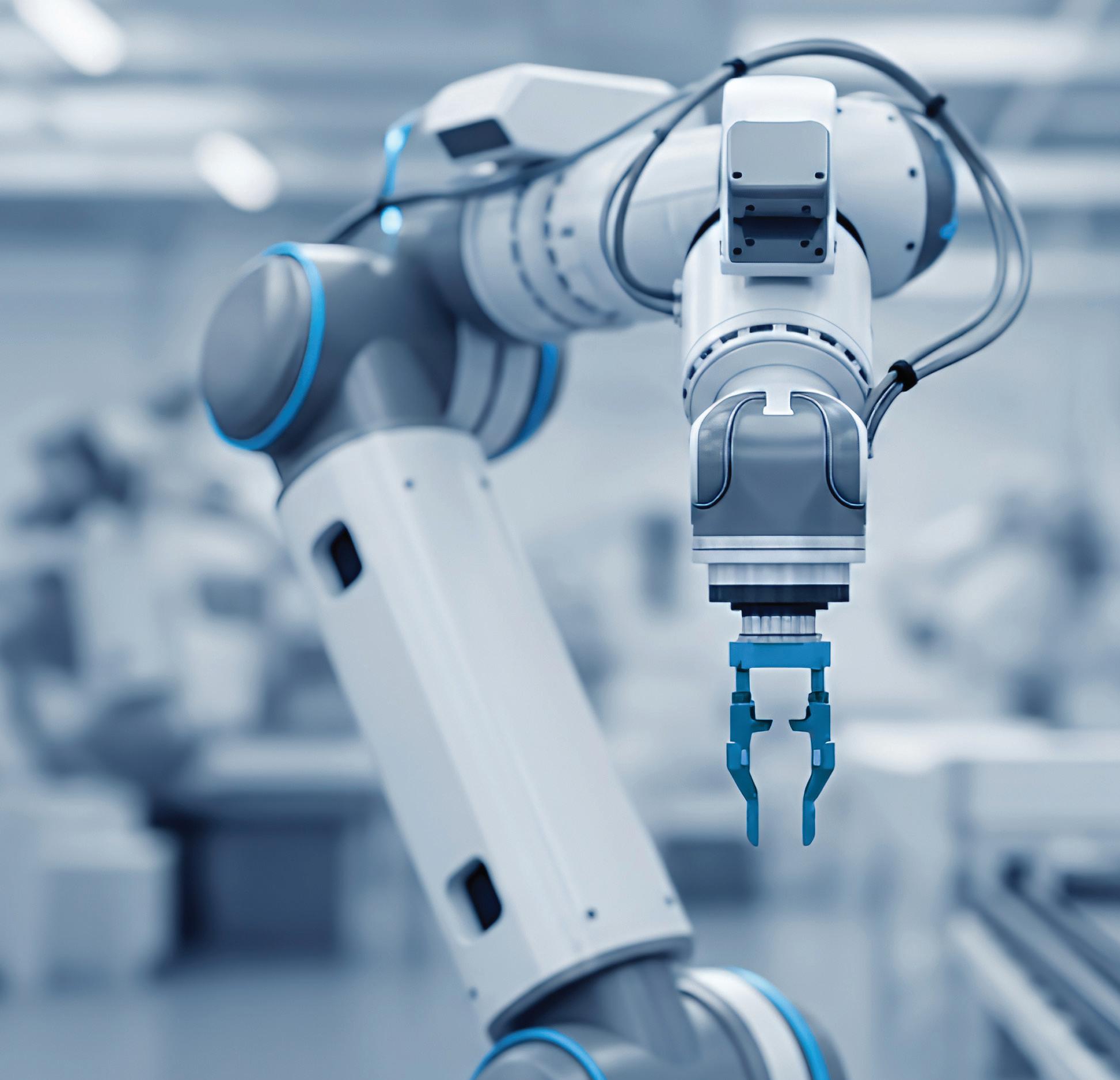
4.0
The Industry 4.0 era of manufacturing depends so heavily on data-driven precision that AI feels like the inevitable next step for harnessing all that information.
(AI). The Industry 4.0 era of manufacturing depends so heavily on data-driven precision that AI feels like the inevitable next step for harnessing all that information, with the promise that algorithms like machine learning and deep learning will mimic the human capacity to learn, reason, solve problems, and make judgements without explicit human instruction, improving prediction accuracy over time. That said, these are still early days for AI, and most of its penetration into plastics so far is in the major molding technologies like injection molding and extrusion, less so in process cooling. “We’re not being asked about Al yet from most of our customers, but we’re starting to go that way slightly with a few of them by adding more code to a controller’s programs so they can automatically adjust to changing conditions,” said Jochen Naujokat. “We’re also working on a preventive maintenance feature for our controllers – the data is already being collected by our sensors, we just have to develop algorithms that present it to the user proactively. It borders on what the industry is calling AI.”
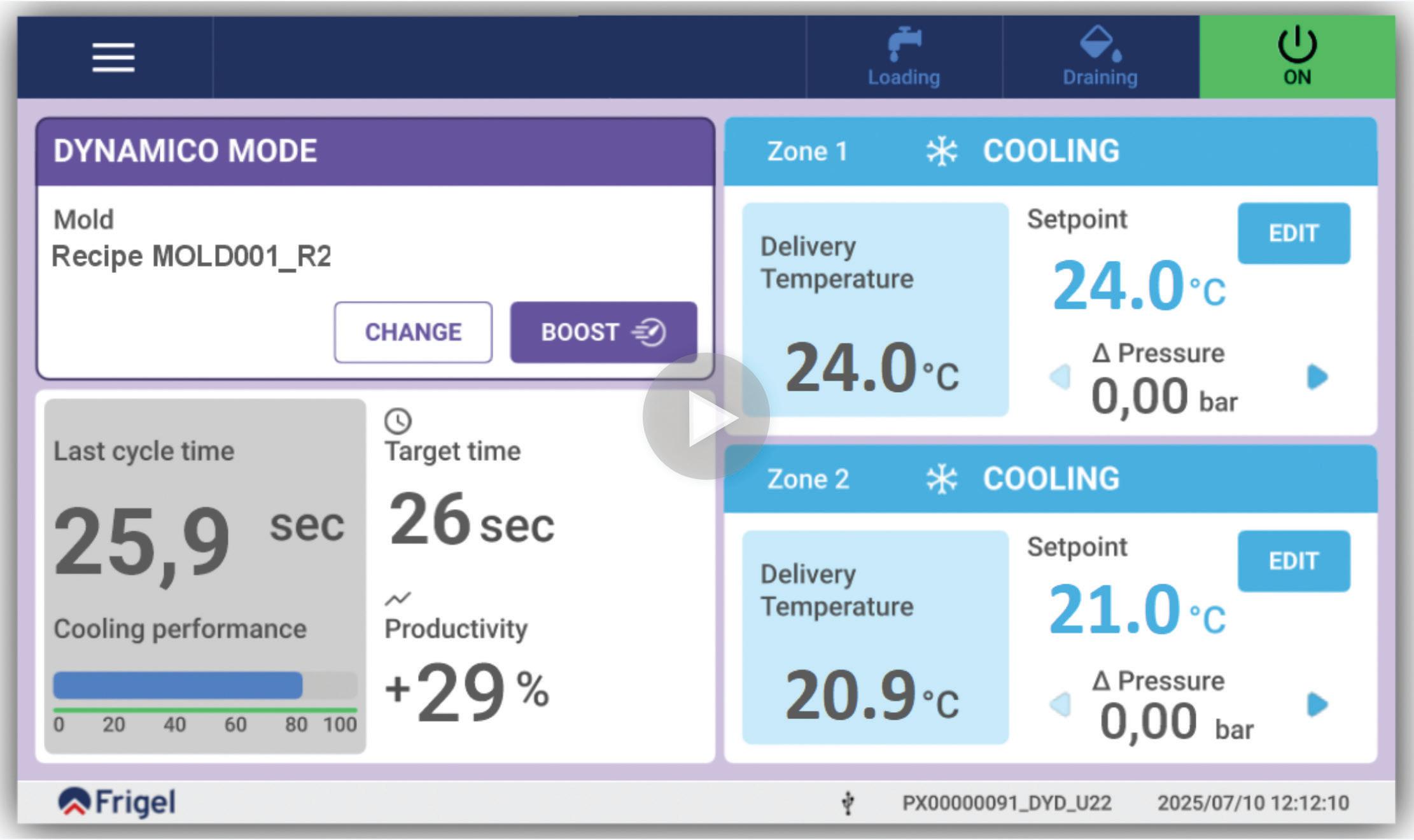
Other OEMs are already touting full-blown AI-driven technologies. According to officials with Frigel, its new Dynamico system uses AI-assisted dynamic temperature control to cut cooling times, boost productivity by up to 50 per cent, and reduce unit costs by automatically regulating water temperatures in the various cooling phases – and, in some cases, modulate flows in the two mold halves through powerful booster pumps. The cooling time reduction is suggested by “Dynamico Wizard,” exclusive software developed by Frigel that uses AI-assisted algorithms. “Thanks to the initial data requested for the initial setup, the Dynamico synchronizes itself with the process and helps the operator find the best cooling time reducing this value, hence the
Modern chiller controls now track key metrics like energy consumption, refrigerant pressures, ambient dewpoint, vibration levels, and component health.
overall cycle time, to the shortest possible,” said Mario Coletti. “Furthermore, internet connectivity opens the way to continuous learning, with algorithms capable of progressively improving performance thanks to data from all machines and molds connected to the network.” The solution is already used in various sectors such as automotive, medical, and packaging, he added.
As AI transforms every aspect of manufacturing, there are worries that risk is outpacing governance, and some plastics processors report being uneasy about deploying AI at scale due to concerns about cybersecurity and the transparency of AI systems. “Many facilities are cautious about exposing their production equipment to outside networks
No matter what our competitors say, there’s only one Struktol – producing customized solutions and proprietary blends for:
for any reason,” said Jon Gunderson. And they’re not worried for nothing: AI arguably poses a greater data privacy risk than earlier technological advancements, and numerous reports have cited the need for more reliable networks and stronger cybersecurity to fulfill AI’s potential. But the right software solutions can address some AI privacy concerns right now, some OEMs say. “We work closely with the IT department of every customer to be sure all the safety protocols are kept in place,” Mario Coletti said. “With our Dynamico, we remove the problem by providing each machine with a router and a SIM card, so that each machine has its own internet connection that’s independent from the customer’s network. Furthermore, the blockchain-based data exchange will guarantee that each machine is anonymous, making it impossible to share sensitive data to third parties.”
Going forward, these OEMs say, some customers may need to modernize their networks to increase bandwidth and upgrade unreliable wireless connectivity that could otherwise affect AI operations.

Retrofitting new smart controls onto older chillers is an option that many processors would probably embrace. But is it doable? The answer is, it depends. Assuming the customer has a relatively modern chiller, the OEMs say, a retrofit can probably be done. But there’s a limit, usually based on a cost/benefit analysis. “It’s sometimes possible, but it can be expensive and complicated,” said Jon Gunderson. “Retrofitting often means replacing sensors, wiring, and major electrical components, and the integration work can add up quickly.”
Gunderson also notes that process cooling is still nowhere near reaching the point of autopilot, where operators aren’t necessary. “Modern controls can help identify inefficient operation such as poor water flow, fouled heat exchangers or excessive compressor cycling; and they can also provide better visibility into how the equipment is operating over time,” he said. “But experienced technicians still play a big part. Controls are helpful diagnostic tools, but they don’t replace good maintenance practices.”
Whether based on Industry 4.0 or AI, the latest chiller controls aren’t meant to replace human workers, in other words – they’re meant to give them superpowers.
Here’s a look at what’s inside the upcoming June 2026 issue of Canadian Plastics magazine:
Artificial intelligence can deliver transformative performance to an injection molding machine. But some processors don’t trust it due to questions about cybersecurity and the transparency of AI systems. This article will explore how injection molding machine makers are incorporating AI to ensure that it’s safe.
ALSO IN THIS ISSUE:
• Profiles of our Impact Awards winners
• How to choose the right granulator
• The hot colourants for 2026 and beyond







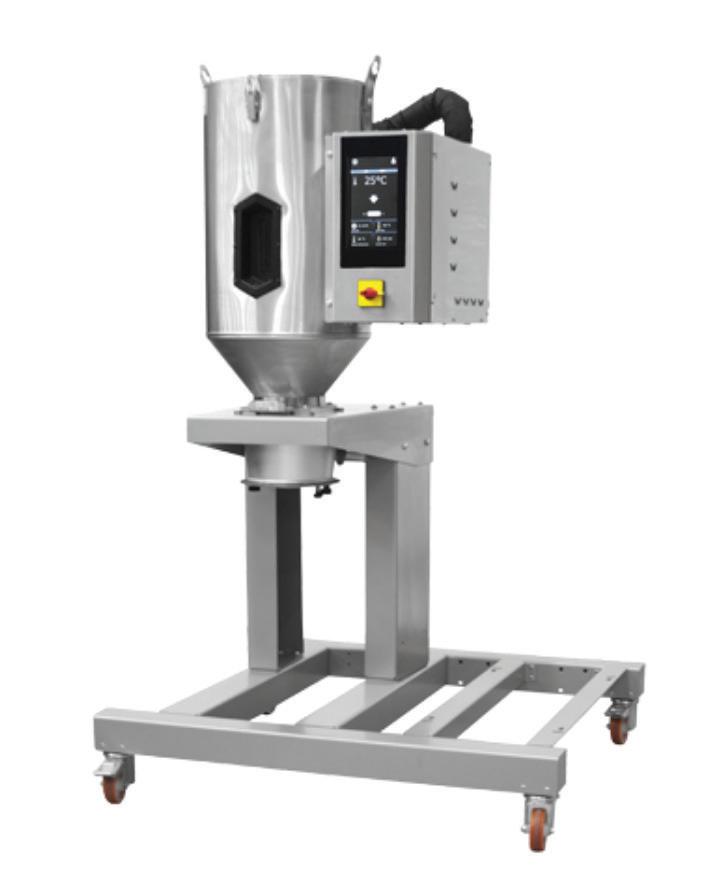
The smallest units in the AD series, the new ADW14 and ADW25 (pictured) desiccant wheel dryers from AEC are well-suited for low-throughput applications – including medical injection molding, extrusion, and blow molding – that require energy-efficient drying solutions with a minimal footprint. They can process up to 11 kilograms (kg) or 25 pounds per hour, depending on the material.
A “smart mode” feature automatically controls process parameters to protect material from overdrying, for energy savings of up to 40 per cent. Because of their compact size, the dryer and drying hopper can be placed on a cart or mounted directly to the feed throat of a machine, and the units are ideal for applications where floor space is limited. Low-temperature options are also available for processing bioresins. www.aecinternet.com
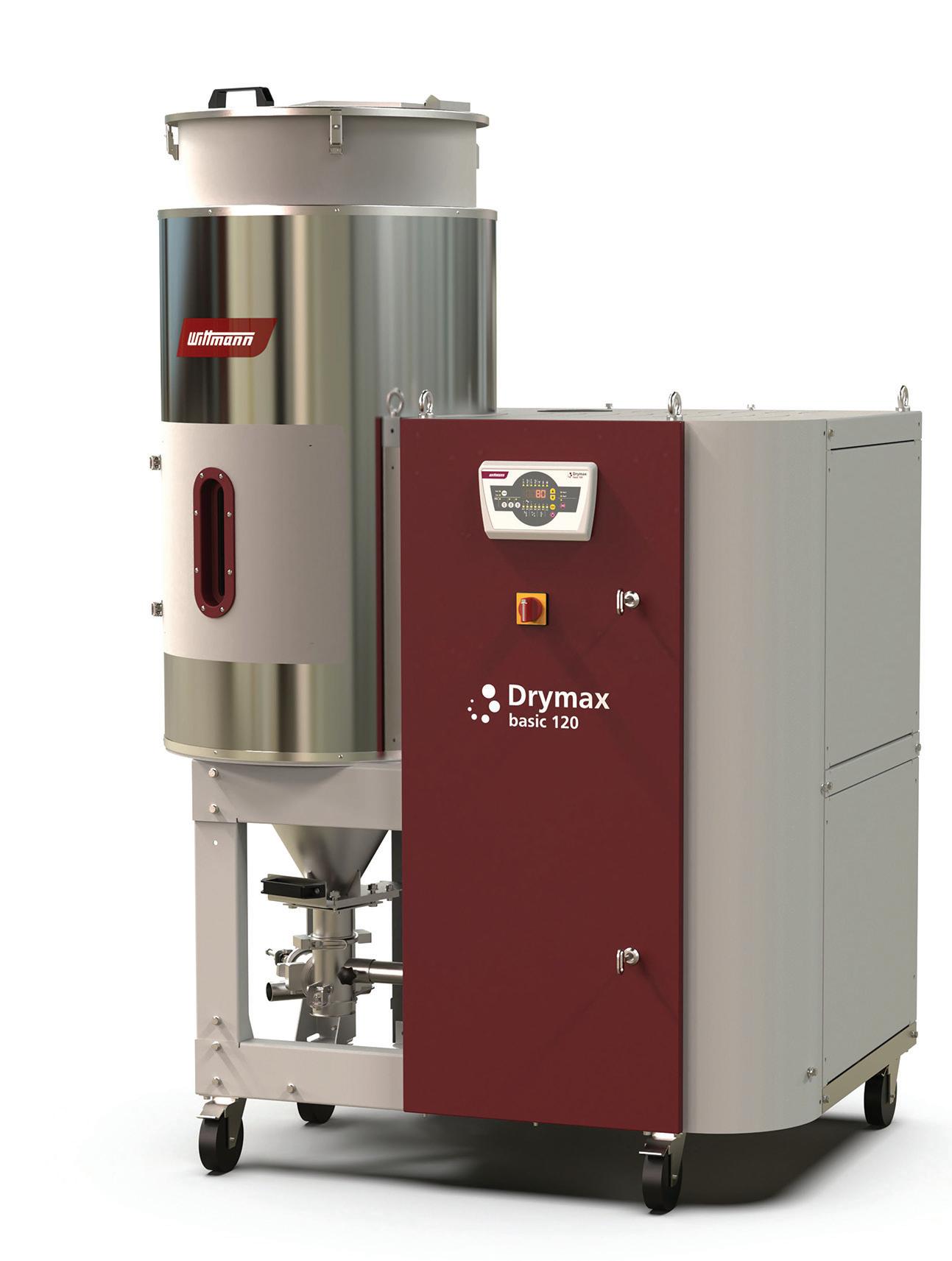
Wittmann recently debuted its Drymax basic 120 dry air dryer, a compact, mobile unit that features energy-efficient dual-cartridge technology. Designed for throughputs of up to 75 kg or 165 pounds per hour, the duration and intensity of the unit’s temperature-controlled regeneration are based on the current demand, to avoid unnecessary energy consumption; and the automatic temperature reduction during machine downtime or when drying requirements are lower offer additional increases in energy efficiency. And a new SmartCare option was developed specifically for geographical regions with high ambient temperatures and frequent high humidity.
www.wittmann-group.com
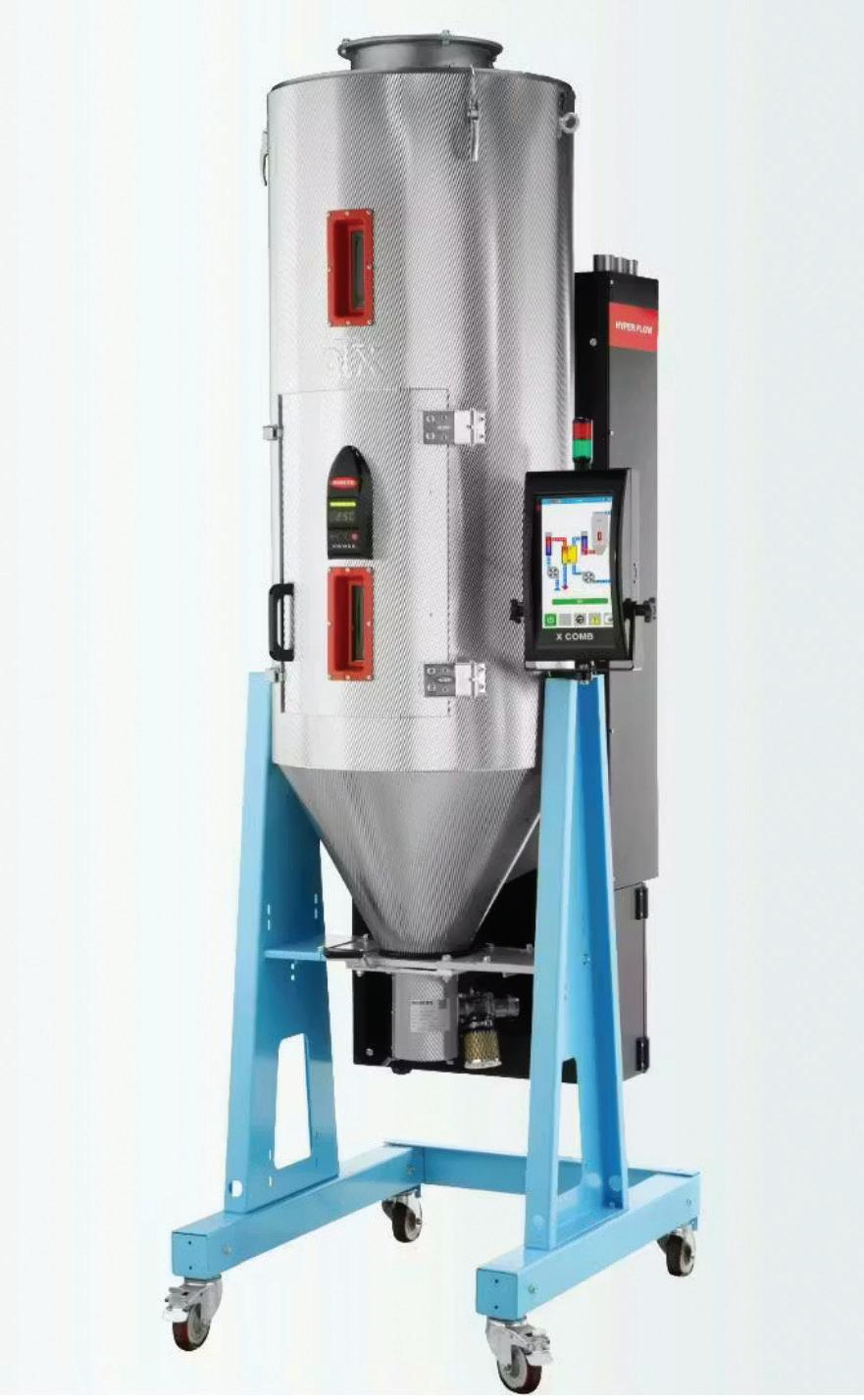
Moretto has expanded the range of its X Comb mini dryers with the new XC19 model desiccant wheel dryer, suitable for the energy-efficient drying of engineering polymers and productions of up to 63 kg or 140 pounds per hour. Boasting a completely innovative design, the XC19 enhances the construction, technology, and performance of the X Comb series and comes with a seven-inch colour touchscreen. Distinctive features remain the honeycomb technology in 100 per cent Zeolite with superior absorbent capacity; the exclusive OTX hopper with a bullet-shaped interior geometry that improves the flow of material and reduces energy consumption; and the “hyper flow” turbo compressors with variable flow, which guarantee a consistent process and high energy efficiency. The model is compact, taking up less than 6.5 square feet.
www.moretto.com
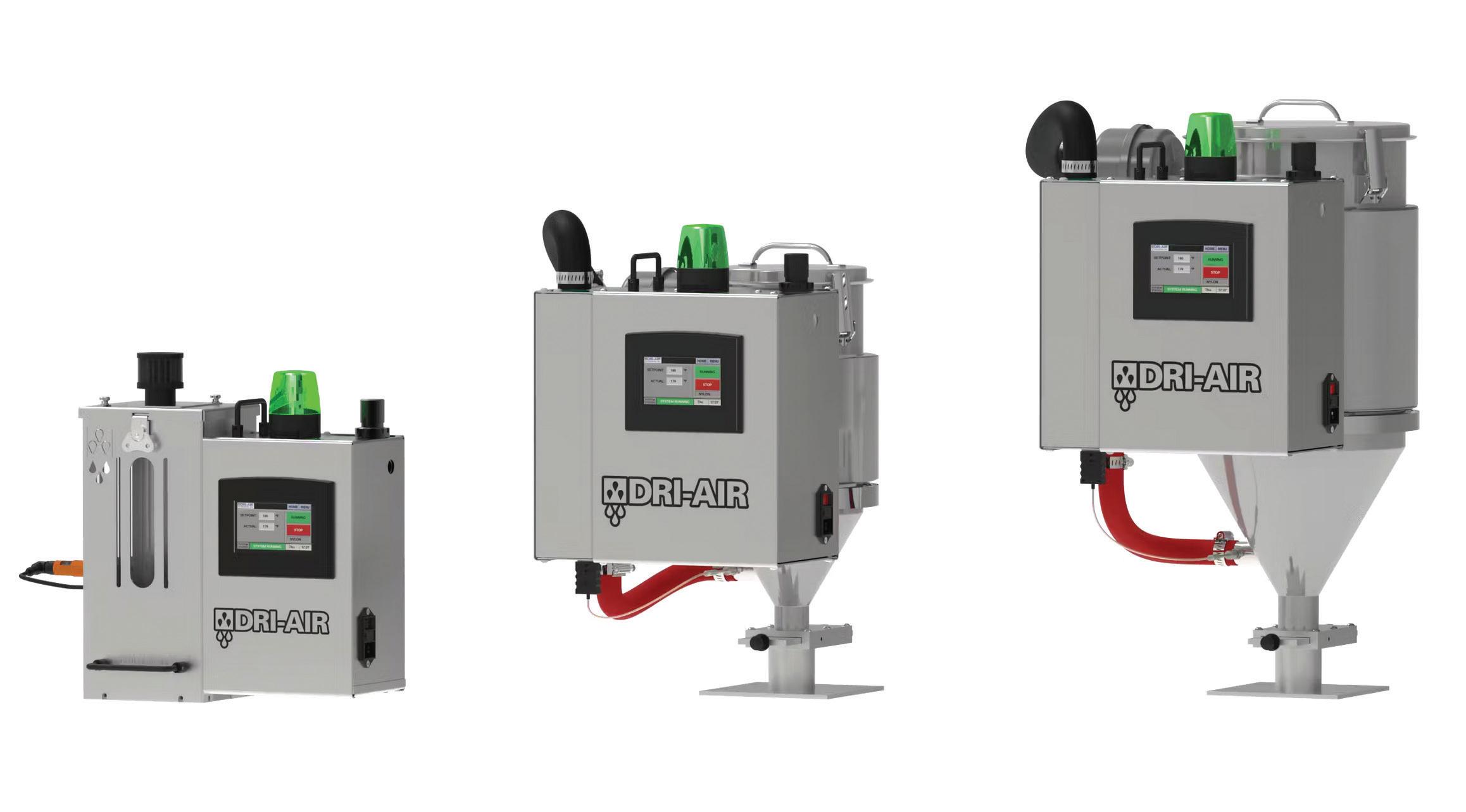
Dri-Air has added two new models to its MD series compressed-air micro dryer/hoppers: the MD-2 (middle unit in photo) with a two-kg or five-pound hopper capacity and the MD-3 (on the right) with a seven-kg or 15-pound capacity. They join the MD-1 (on the left), which was introduced in 2024. Constructed with stainless steel and Pyrex glass, the new dryers are well-suited for cleanrooms by offering precise drying for low-throughput and high-cost resins and operate on 120-volt or 230-volt single-phase power. A membrane and compressed air prefilter ensure very low dewpoints. A four-inch colour touchscreen control includes temperature and alarm settings, a resin library, and a seven-day timer. Also, a compressed air loader for the drying hopper is available.
www.dri-air.com
Piovan’s SmartForesight intelligent cloud-based condition monitoring and predictive maintenance solution uses remote monitoring technology to provide continuous data analysis of GN, GP, and GMP dryers, maximizing productivity and offering direct technical support. The system’s sophisticated cloud and edge technologies enable predictive and preventive maintenance by detecting abnormal behaviour before faults occur. SmartForesight identifies wear and degradation patterns in critical components, sending personalized alerts and notifications to specific personnel via email or phone when anomalies are detected.
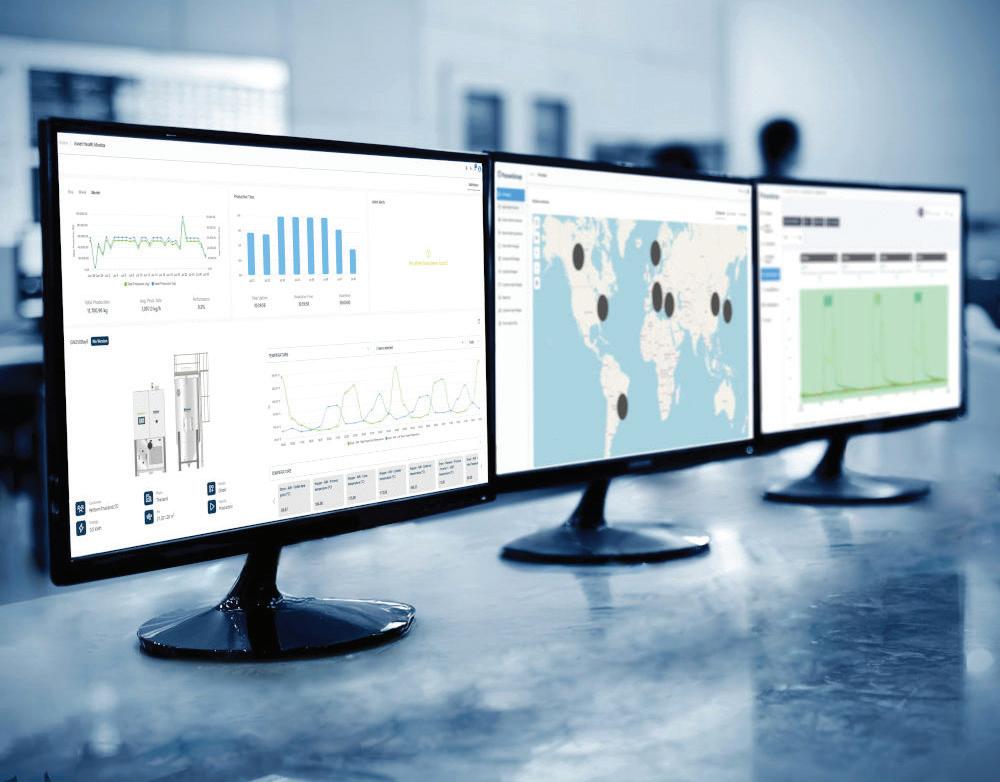
The system’s customizable monitoring capabilities allow both predictive control and precise monitoring to be tailored to specific customer requirements. Data protection and business continuity are assured through compliance with IEC 62443 Level 3-3 standards. www.piovan.com
Equipped with two fully insulated, stationary desiccant beds, Motan’s new sDry 250 dry air dryer is a compact, stainless-steel unit that can work with either one or several drying bins in a range of sizes – from 100 to 900 litres –and can handle different drying bin sizes for different applications.
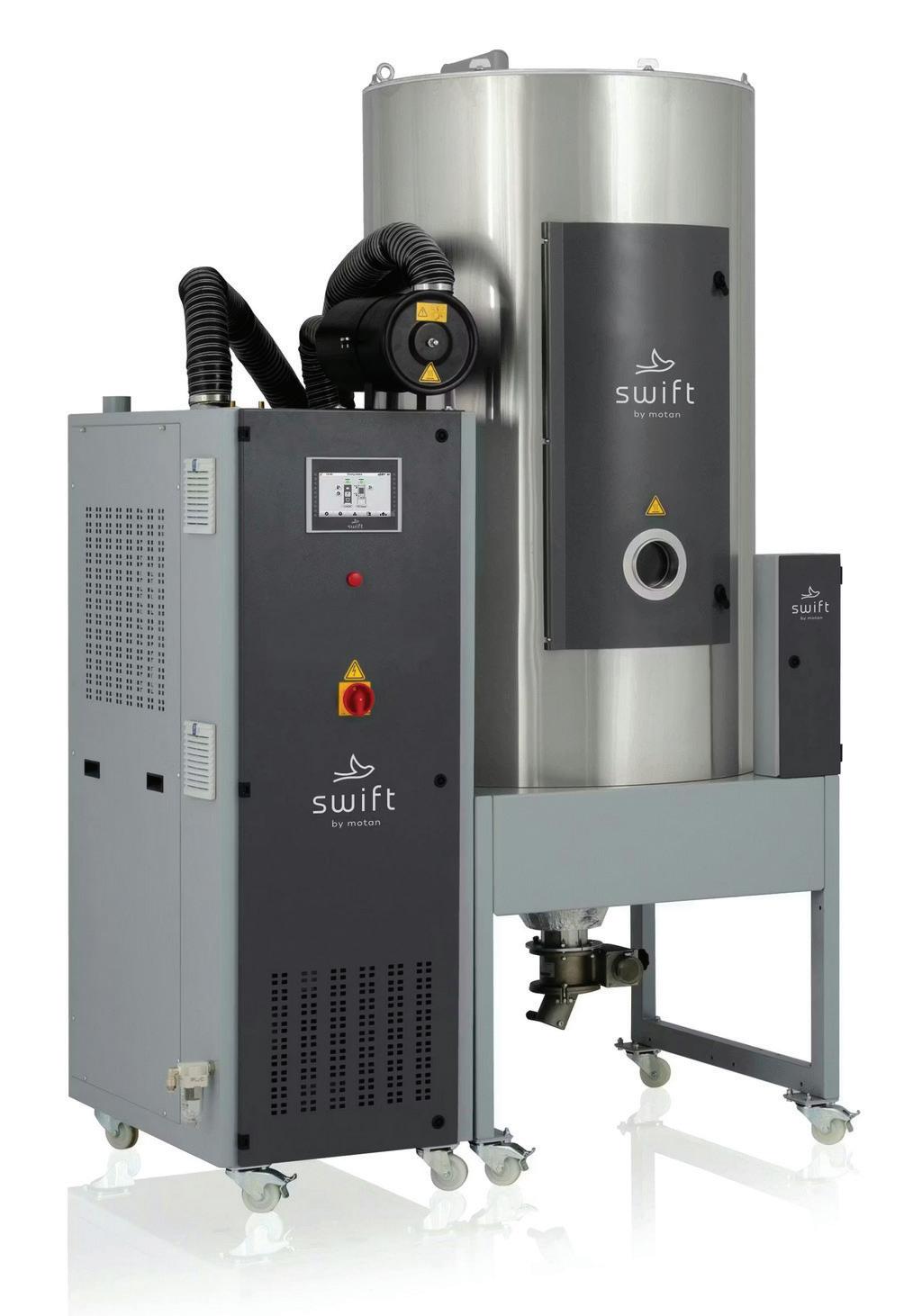
Functions such as dewpoint control or return air cooling are available as options. Heating of the process air takes place directly in the drying bin and is individually adjustable. Also, the dryer is capable of long drying cycles and even distribution of temperatures; and it has no moving parts, saving energy and ensuring reliability and constant, stable dry air quality.
www.motan.com

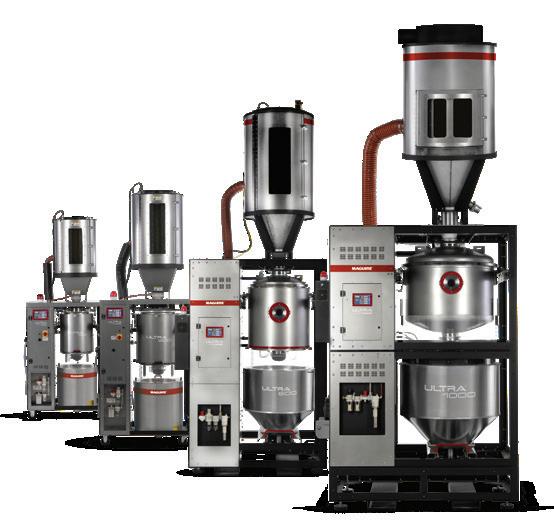
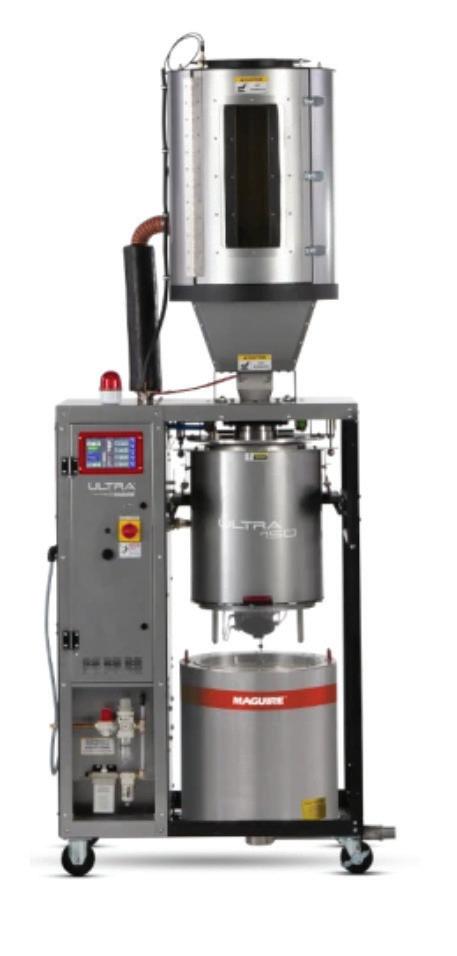
Maguire’s Ultra-150 dryer, the industry’s first ultra-low energy vacuum dryer, is designed to deliver fast, consistent drying with a fraction of the energy consumption of conventional desiccant systems. The Ultra-150 uses a clean vacuum drying process that eliminates desiccant beds, regeneration cycles, and high-maintenance components, reducing energy use by 60 to 80 per cent and dramatically shortening drying times while increasing overall production uptime. With its compact footprint and low-maintenance design, the Ultra-150 is well-suited for medical, cleanroom, packaging, and technical molding applications – virtually any environment where material quality, process stability, and energy efficiency are critical.
www.maguire.com
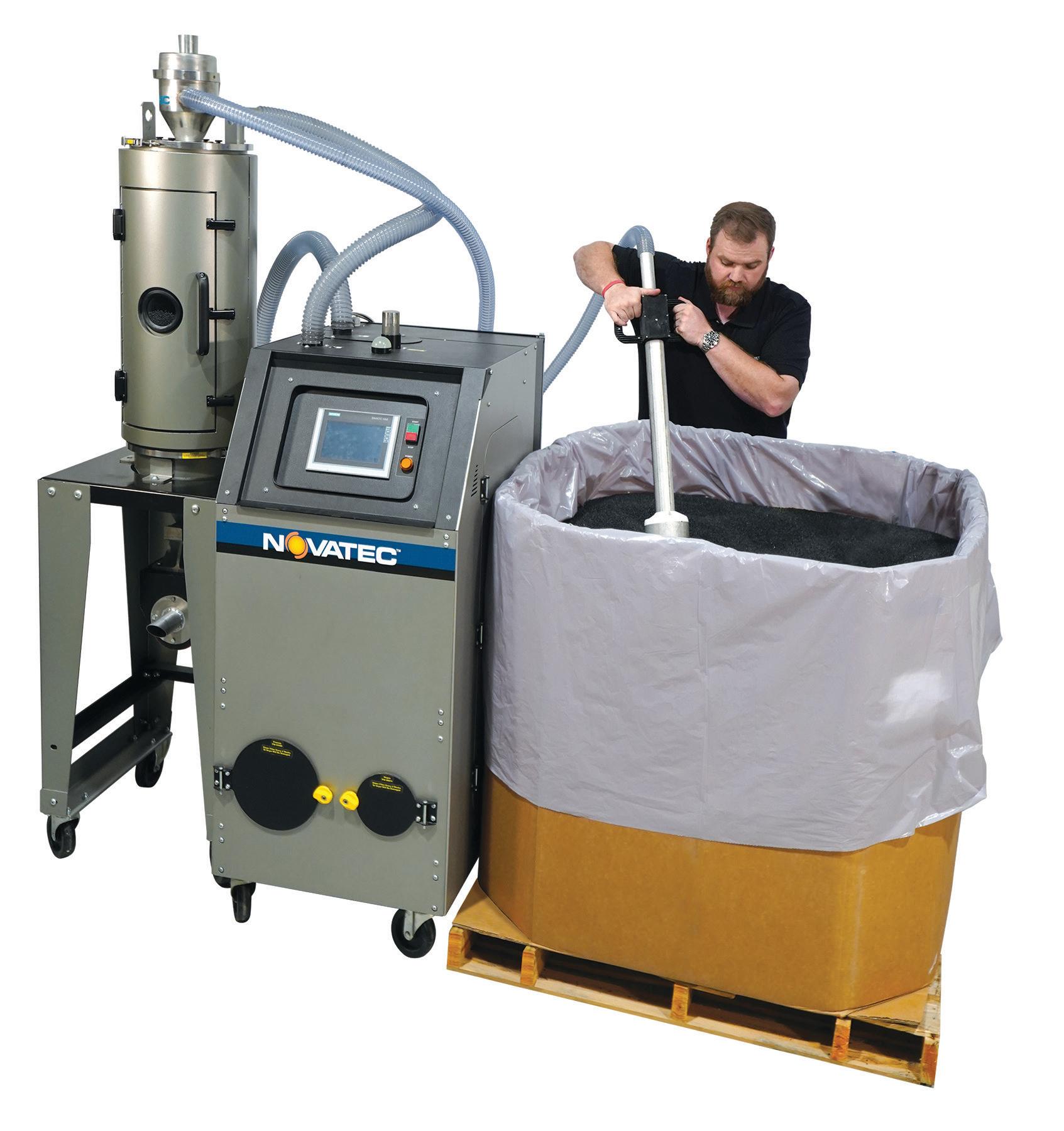
Novatec’s Drying Genie material pickup lance provides reliable in-line sampling of resin moisture levels. It incorporates a capacitance sensor, an accelerometer, and a gyroscope near the bottom of the lance, and measures the resin’s moisture level on a parts-per-million basis before drawing it into the dryer. With this information, it can automatically adjust drying parameters to match manufacturers’ prescribed dryness levels.
www.novatec.com
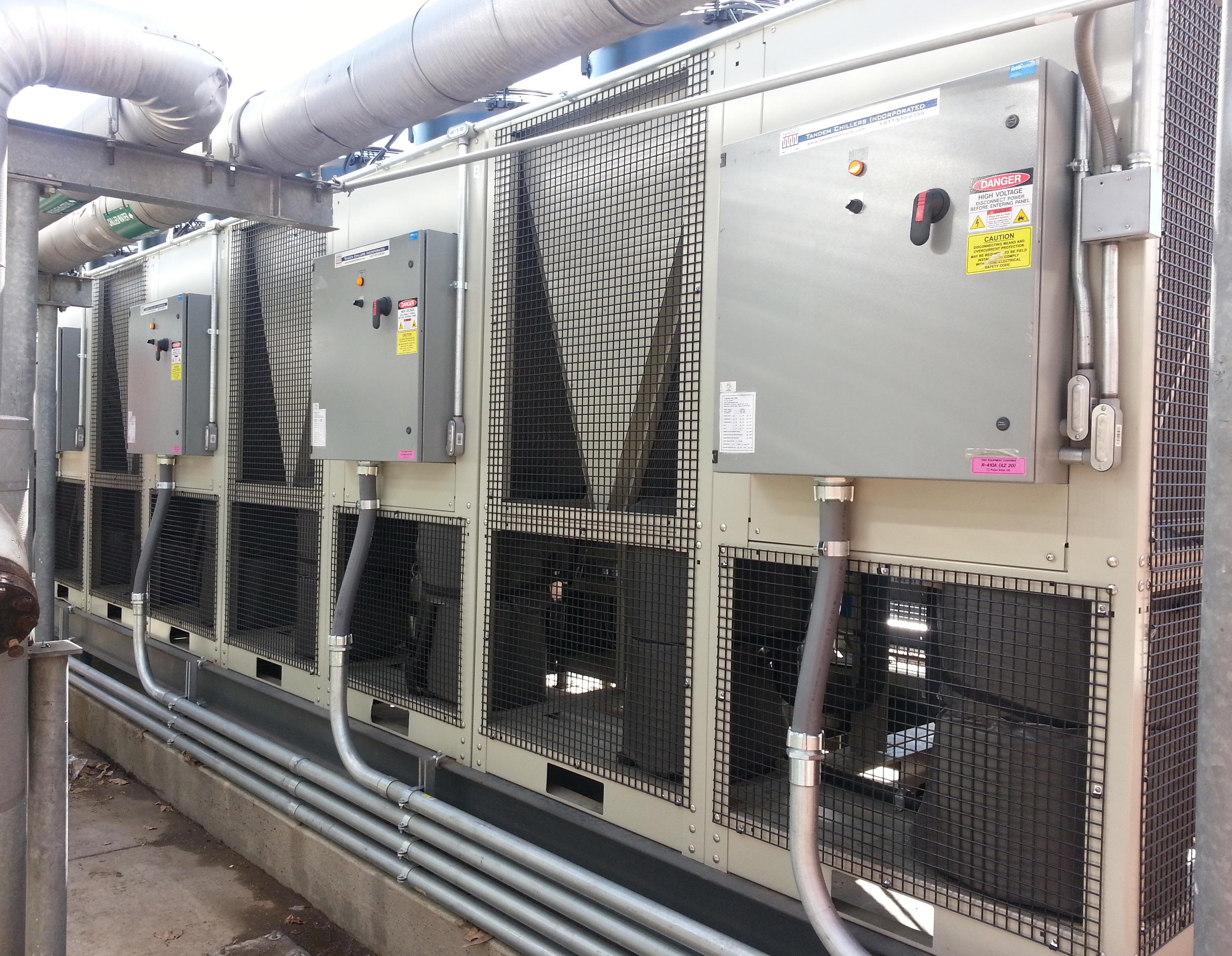
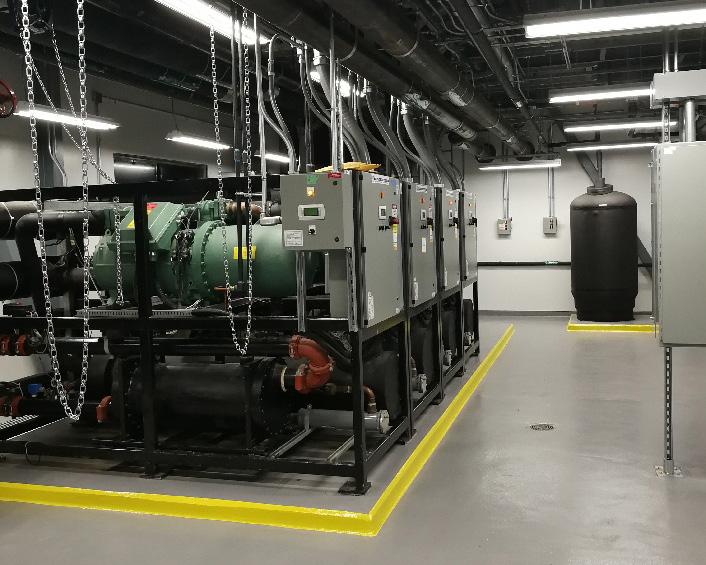
Canadian made Chillers that can both Heat and Cool your process:
MODULAR CHILLERS - Chillers that couple together for an easy simple installation and also make it easy to expand the current system, just couple the new chiller to the existing system.
REFRIGERANTS AVAILABLE – Chillers can have either a mildly-flammable or a nonflammable, non-flammable is a must if the chilling system is open to the plant.
CHILLERS AVAILABLE - As Water Cooled, Indoor Air-cooled, Outdoor Air-cooled, Remote Condenser Air Cooled. Outdoor air-cooled units available for all outdoor winter ambient temperatures.
PUMP TANKS - Chilled water and tower water packages with double pumps, third pump manual stand-by, four pump automatic stand-by. Other arrangements available as well.
INSTALLATION - From plant layout pipe sizing drawings to complete turn key installations in southern Ontario.
PORTABLE CHILLERS – Air and water cooled, Indoor and outdoor, single and dual compressors, single and dual pumps and larger or special tanks.
Phone 877-513-8310
Fax 905-513-8358 Email sales@temperaturecorporation.com temperaturecorporation.com

By Brett Saddoris, Accumold
Micromolding optical and photonics components presents challenges from the get-go. First, designers have to weigh a material’s general mechanical performance, cost, and availability alongside such specific requirements as optical transmission at a particular wavelength, birefringence (i.e., double refraction), scattering behaviour, thermal drift, moisture uptake, chemical compatibility, cleanliness, and long-term dimensional stability. And then micromolding adds its own constraints, because a polymer that looks great on a data sheet can behave very differently when you’re trying to fill micro features and hold micron-level tolerances.
Photonics components are rarely just structural. Even when the polymer isn’t acting as the optical medium, it often determines alignment, stability, and reliability. That means material selection typically needs to account for three broad categories of performance. First, the optical behaviour. If the polymer is in the optical path (lens, light guide, window or micro-structured surface) then transmission, haze, refractive index, and surface fidelity are central. For some applications, the relevant spectrum may be visible; for others, infrared (IR) or near-IR.
Second, dimensional and thermal stability. Many optics assemblies are performance-limited by alignment – a few microns of drift due to thermal expansion, relaxation or humidity effects can show up as coupling loss, beam deviation or inconsistent sensor response. Materials with predictable thermal behaviour and low creep can protect optical function over time.
Third, environmental and regulatory realities. Photonics shows up in medical devices, industrial sensing, aerospace, and communications infrastructure, and in many of these, materials must tolerate cleaning agents, sterilization approaches, ultraviolet exposure, or long service life.
When people ask about materials for optics, they often mean “What can I use that’s clear?” Clarity matters, but it’s only one dimension.
• COC and COP (cyclic olefin polymers): These materials are frequently chosen for optical applications because they offer excellent transparency, low birefringence, low moisture uptake, and strong dimensional stability. They can be highly attractive for microfluidic optics, diagnostic cartridges, and applications where optical clarity and consistency are critical.
• PMMA (acrylic): PMMA has long been associated with optical clarity and can be an excellent choice in certain imaging and light transmission applications. It can also be sensitive to cracking, so selection needs to consider the environment the part will see after molding.
• Polycarbonate (PC): PC is a workhorse in many optical and consumer applications because it offers good optical properties alongside toughness and impact resistance. It can be valuable where durability matters, although it may introduce trade-offs in stress birefringence or long-term stability.
• LCP (liquid crystal polymer): LCP is a compelling choice for high-precision applications because it offers excellent dimensional stability, low moisture absorption, and strong performance in thin-walled geometries, which are useful in high-density packaging and connector-related components. It’s frequently considered when tight tolerances and thermal stability are needed.
• Ultem (PEI): PEI can be useful where elevated temperature performance and structural reliability are required, such as in housings or alignment structures near heat-generating components. It’s also a candidate when chemical resistance and long-term stability matter.
• PEEK: PEEK is often selected for demanding environments such as high temperature, chemical exposure, and long service life. In photonics contexts, it may appear in components that need to survive harsh conditions or maintain stability in safetycritical systems. These materials can be harder to mold, especially at microscale, but when chosen well and molded well they can deliver the stability that optical systems depend on.
For optics and photonics, a material choice is only as good as the manufacturing control behind it. Micromolding introduces specific challenges that don’t always show up in conventional injection molding, such as fill behaviour in microfeatures (since tiny ribs, channels, or lens edges can be vulnerable to short shots or incomplete fill), stress and birefringence (since even clear parts can become optically problematic if residual stress is introduced through processing), surface replication, (since optical surfaces demand tool finishes and process conditions that protect fidelity), warpage and shrink variation (since small variations can create big optical consequences in alignment features and mating geometries), and part handling and cleanliness (since optical surfaces can be damaged or contaminated easily, making packaging and handling part of the process, not an afterthought).
Being able to control materials at microscale in a way that protects optical intent is what separates a “material list” from a true capability, especially when the end application demands reliability you can’t negotiate. If you’re designing molded optics or photonics-enabled assemblies, don’t treat material choice as a last-mile decision – treat it as the start of manufacturable performance.
BRETT SADDORIS is the technical marketing manager at injection molder Accumold. Based in Ankeny, Iowa, the firm specializes in micromolding and insert molding. Visit www.accu-mold.com for more.