focus on
Instrumentation Volume 48, No. 1 February 2020
Instrumentation
Circa 1973
COMPACT LEVEL SENSORS WITH 80 GHZ RADAR
POINT LEVEL DETECTOR READY FOR INDUSTRY 4.0
VEGA
Endress+Hauser Canada
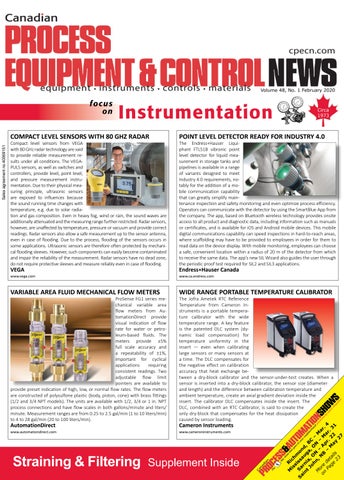
The Endress+Hauser Liquiphant FTL51B vibronic point level detector for liquid measurement in storage tanks and pipelines is available in a range of variants designed to meet Industry 4.0 requirements, notably for the addition of a mobile communication capability that can greatly simplify maintenance inspection and safety monitoring and even optimize process efficiency. Operators can communicate with the detector by using the SmartBlue App from the company. The app, based on Bluetooth wireless technology provides onsite access to all product and diagnostic data, including information such as manuals or certificates, and is available for iOS and Android mobile devices. This mobile digital communications capability can speed inspections in hard-to-reach areas, where scaffolding may have to be provided to employees in order for them to read data on the device display. With mobile monitoring, employees can choose a safe, convenient location within a radius of 20 m of the detector from which to receive the same data. The app’s new SIL Wizard also guides the user through the periodic proof test required for SIL2 and SIL3 applications.
www.vega.com
www.ca.endress.com
VARIABLE AREA FLUID MECHANICAL FLOW METERS
WIDE RANGE PORTABLE TEMPERATURE CALIBRATOR
AutomationDirect
Cameron Instruments
e
in
az
ag
m
n
ec
cp
by
d
ce
du
ro
!p
od
ho
or
www.cameroninstruments.com
ow
sh
y
da
n
ia
d
Th
e
a
n
a
C
Straining & Filtering Supplement Inside
th
at
go
es
to
yo
ur
ne
ig
www.automationdirect.com
The Jofra Ametek RTC Reference Temperature from Cameron Instruments is a portable temperature calibrator with the wide temperature range. A key feature is the patented DLC system (dynamic load compensation) for temperature uniformity in the insert — even when calibrating large sensors or many sensors at a time. The DLC compensates for the negative effect on calibration accuracy that heat exchange between a dry-block calibrator and the sensor-under-test creates. When a sensor is inserted into a dry-block calibrator, the sensor size (diameter and length) and the difference between calibration temperature and ambient temperature, create an axial gradient deviation inside the insert. The calibrator DLC compensates inside the insert. The DLC, combined with an RTC Calibrator, is said to create the only dry-block that compensates for the heat dissipation caused by sensor loading. hb
ProSense FG1 series mechanical variable area flow meters from AutomationDirect provide visual indication of flow rate for water or petroleum-based fluids. The meters provide ±5% full scale accuracy and a repeatability of ±1%, important for cyclical applications requiring consistent readings. Two adjustable flow limit pointers are available to provide preset indication of high, low, or normal flow rates. The flow meters are constructed of polysulfone plastic (body, piston, cone) with brass fittings (1/2 and 3/4 NPT models). The units are available with 1/2, 3/4 or 1 in. NPT process connections and have flow scales in both gallons/minute and liters/ minute. Measurement ranges are from 0.25 to 2.5 gal/min (1 to 10 liters/min) to 4 to 28 gal/min (20 to 100 liters/min).
7
Compact level sensors from VEGA with 80 GHz radar technology are said to provide reliable measurement results under all conditions. The VEGAPULS sensors, as well as switches and controllers, provide level, point level, and pressure measurement instrumentation. Due to their physical measuring principle, ultrasonic sensors are exposed to influences because the sound running time changes with temperature, e.g. due to solar radiation and gas composition. Even in heavy fog, wind or rain, the sound waves are additionally attenuated and the measuring range further restricted. Radar sensors, however, are unaffected by temperature, pressure or vacuum and provide correct readings. Radar sensors also allow a safe measurement up to the sensor antenna, even in case of flooding. Due to the process, flooding of the sensors occurs in some applications. Ultrasonic sensors are therefore often protected by mechanical flooding sleeves. However, such components can easily become contaminated and impair the reliability of the measurement. Radar sensors have no dead zone, do not require protective sleeves and measure reliably even in case of flooding.
PR OC ES S& R M AU is ich si m TO S Sa ss on ai r a M n ni ug d, AT t a B a Jo , ,O C O IO h n N N –M M NS , – – o a N on re B Ap M r. HO – r. ar 4 Pa de . t M 2 W ge ai ay 2 31 S 23 ls 2
Sales agreement no.40069151
focus on