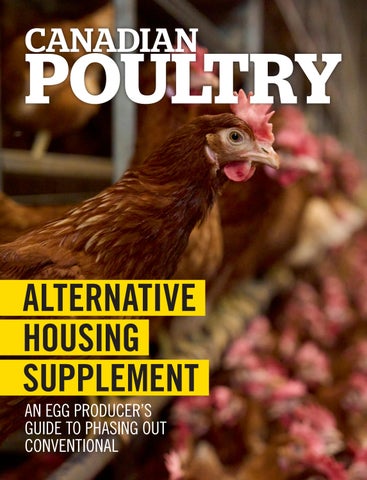
ALTERNATIVE HOUSING SUPPLEMENT AN EGG PRODUCER’S GUIDE TO PHASING OUT CONVENTIONAL
WHAT’S HATCHING Companies expand housing options Some Canadian food companies are expanding previous cage-free egg commitments to include enriched colony housing. Eight companies have reportedly revised sourcing policies to recognize enriched systems, including Cora and Sunset Grill. Other companies have also incorporated enriched colony housing into egg-sourcing policies. The changes come as Canada’s egg sector continues its transition away from conventional housing and companies reassess commitments established during the push toward cage-free sourcing.
PHOTO CREDIT: ALLTECH
Study highlights environmental trade-offs in layer housing A shift toward cage-free egg production could come with increased environmental impacts, according to new research examining the consequences of different laying hen housing systems. Researchers, including a team from the University of Oxford, modelled eight scenarios for the United Kingdom egg sector, comparing furnished cage, barn, free-range and organic production while maintaining current egg output. The study was published in Royal Society Open Science in July. Moving production from cages to free-range systems increased estimated greenhouse gas emissions by 5.84 per cent compared with the current mix of production systems. Shifting cage production to barn systems resulted in a 13.55 per cent increase. By comparison, a scenario in which all production used furnished cages reduced greenhouse gas emissions by 17.72 per cent. Cage systems also had lower land occupation, acidification and eutrophication impacts in the modelling. Differences in feed efficiency, mortality and the number of hens required to maintain egg production contributed to the results. Researchers found cage-free scenarios generally required more birds to maintain the same national egg output. The researchers said the findings illustrate the need to consider environmental impacts alongside welfare when evaluating future changes to egg production systems. They also acknowledged an important limitation: the analysis relied on UK production data collected in 2009 and 2010 because it remains the most comprehensive dataset available for comparing housing systems. Production practices have evolved since then. ABOVE: Enriched cage systems had lower environmental impacts than cage-free systems across several measures examined in the study. OCTOBER 2026 ALTERNATIVE HOUSING SUPPLEMENT
UK proposes cage phase-out
5.84%
is the estimated increase in greenhouse gas emissions if cage production shifted to free-range systems, a UK study found.
Governments across the UK have proposed phasing out enriched colony cages for laying hens by 2032. Under the proposal, new enriched colony systems could not be built or brought into use beginning in 2027, while existing systems would be prohibited beginning in 2032. Enriched colony systems currently account for just over 20 per cent of UK shell egg production. The consultation on the proposed changes closed March 9.
New layer facility planned at USask A proposed new layer research facility at the University of Saskatchewan will allow researchers to study enriched, free-run and free-range housing systems. The nearly 24,000-square-foot facility has received more than $6.2 million from the Canada Foundation for Innovation. Designed to accommodate approximately 6,000 birds, the facility will include 10 individual housing rooms with controls for lighting, temperature and other environmental variables, supporting research into layer welfare, health and production.
3
HOUSING CHOICES BY TREENA HEIN
Several years into Canada’s conventional cage phaseout, enriched colony remains the leading alternative.
4
OCTOBER 2026 ALTERNATIVE HOUSING SUPPLEMENT
PHOTO CREDIT: ALLTECH
ABOVE: As Canada phases out conventional cages, egg farmers are weighing housing choices that offer different benefits and challenges for hen welfare and management.
It has been nearly a decade since the updated Code of Practice for the Care and Handling of Pullets and Laying Hens was published in 2017, setting Canada’s egg industry on a path to phase out conventional cages. One interesting aspect of the transition to other types of housing – with the vast majority of egg farmers choosing either free-run aviary (cage-free) or enriched colony cage systems – is the ratio between these two main alternatives. It has not unfolded as many expected. Despite continued pressure from retailers, restaurants and animal welfare organizations advocating for cage-free egg production, most Canadian egg farmers transitioning away from conventional cages have chosen enriched colony. As explained in Egg Farmers of Canada’s (EFC) 2025 Annual Report, the most recent available, as of mid-2025, 39.45 per cent of Canadian laying hens were still housed in conventional cages, with “enriched colony remaining the
largest alternative housing system in Canada, representing 39.33 per cent.” Hens in cage-free systems accounted for 14.77 per cent, with the remainder in free-range and organic housing. Cage-free eggs are therefore in limited supply, and much of that supply is going to the many Canadian restaurant and retail chains that committed to, and have achieved, complete sourcing of these eggs. These include McDonald’s Canada, A&W, Boston Pizza, Subway, Dairy Queen, Chipotle, Panago, Starbucks, Mary Brown’s Chicken, Harvey’s and Swiss Chalet. Others source some cage-free eggs. Restaurant Brands International, which owns Tim Hortons, Burger King, Popeyes and Firehouse Subs, reported 39 per cent cage-free egg sourcing last year. In the grocery sector, Whole Foods Market and Nature’s Fare were sourcing all cage-free eggs in 2025, while Choices Market was at 92 per cent, Costco Canada at 23 per cent, Sobeys at 20 per cent, Loblaw at 18 per cent, Metro at 14 per cent and Walmart Canada at nine per cent.
Before we look at the interesting story of one of these grocers, let’s review housing around the world, starting with Australia. CAGE-FREE PRODUCTION AROUND THE WORLD For some of the global picture of layer housing, we reached out to renowned Canadian poultry welfare expert Prof. Tina Widowski, a core member of the Campbell Centre for the Study of Animal Welfare at the University of Guelph. Widowski first notes that in Australia, although egg farmers have only recently changed their code of practice to eliminate conventional cages, “most of the industry, over 70 per cent, has already transitioned to free-range (cage-free plus outdoor access) due to pressure from grocers. I do not think any producers will adopt enriched there.” Looking at the European Union, Widowski – who presented on the global hen housing situation at the 37th Annual Australian Poultry Science Symposium in February 2026 – notes that in 2012, the EU passed a directive allowing for, and outlining requirements for, cage-free and enriched cage housing. Widowski shared data from 2021, the most recent available, that put percentages that year at 47 per cent for enriched, 36 per cent for cage-free, 11 per cent for free-range and the rest organic. In addition, some EU countries have banned all types of cage housing. In the United Kingdom, Widowski shared 2025 government data showing that a large majority – 71 per cent – of commercial eggs come from hens in free-range housing, with 17 per cent in enriched cages and the balance in free-run and organic. Looking at the U.S., Widowski reported that as of 2024, 10 states had enacted bans on the production or sale of eggs from hens in cages – conventional and, in some cases, enriched. However, she noted that “a much greater impact on the U.S. egg industry has been the 2015/2016 corporate
commitments by retailers and food service to only sell eggs produced in cage-free systems by 2025.” While not all of these commitments have been met, Widowski noted that as of October 2025, 46 per cent of the national hen inventory was kept in cage-free housing and 54 per cent in conventional cages. The vast majority of cage-free hens are housed in free-run barns, with about 16 per cent in organic systems and the rest in free-range or pasture-based systems. Enriched colony cage housing is extremely rare in U.S. egg farming. INHERENT WELFARE DIFFERENCES Reflecting on her own hen welfare research and that of others over the last decade, Widowski notes that “the research findings and conclusions about the welfare trade-offs between enriched and free-run housing have not changed, and most likely never will, as they are inherent.” Specifically, she explains that in enriched cage systems, hens “are confined and movement is restricted,” but this housing offers “health and hygiene benefits including air quality, less risk of injury and less risk of mortality [compared to free-run].” Widowski adds that “some motivated behaviours are supported, particularly nesting, but foraging is not as well supported and full dustbathing behaviour is not possible due to lack of substrate.” Conversely, she explains that while “free-run systems allow freedom of movement and ability to perform motivated behaviour, risks for injury, health problems and consequences of feather pecking can be greater. There is a higher risk of mortality due to various reasons including piling.” In her presentation in Australia, Widowski also noted that “multi-tiered aviary systems are commonly used for cage-free production to increase stocking capacity in barns. However, behavioural adaptation to these complex housing systems and skeletal health problems, such as keel fractures, are both significant challenges in aviaries.” She also noted that recent research
OCTOBER 2026 ALTERNATIVE HOUSING SUPPLEMENT
indicates that pullets’ early-life experiences with environmental complexity, specific structural elements such as perches and ramps, and load-bearing exercise are crucial for their success in adapting to aviaries and for their long-term health and welfare. Feather pecking behaviour – a problem that can result in plumage damage, injury and cannibalism – occurs in all types of housing systems. However, the consequences can be worse in cage-free systems. For producers using free-run systems, Widowski says investing in pullet housing that matches the adult housing system should be a priority. “Early experience during the rearing period is extremely important for behavioural and physical development of pullets,” she notes. She also recommends providing ramps or other navigational aids to help pullets and hens move between levels in the aviary. These aids are “critical” for hen well-being in aviary systems, she says. Looking forward, Widowski notes that new research is focusing on optimizing hen genetics and pullet management to match birds to cagefree housing and reduce skeletal and behavioural problems. In addition, research into the development of automated methods for real-time assessment of hen welfare will help prevent problems in the barn and improve animal welfare audits. SOBEYS SHIFTS STANCE Years ago, like other Canadian grocery and restaurant chains, Sobeys committed to selling only cage-free eggs by 2025. However, as mentioned above and explained in Sobeys’ 2025 Sustainable Business Report, only “20 per cent of total shell eggs sales were cage-free, with the remainder coming from enriched housing systems or conventional cages.” Relating to this fact, Sobeys has been heavily targeted by animal welfare group Animal Justice. On June 22, 2026, the organization protested at Sobeys locations and affiliate grocers in continued on page 8 5
Advertorial
Aviary System Meets the Latest Standards When Adam and Alicia DeVisser were presented with a unique opportunity to raise pullets for vaccine egg production in an aviary system, they jumped at the chance and began the process of planning a leading-edge pullet barn that would incorporate the best in bird comfort and development, efficient operation from both an energy and labour standpoint, and quality equipment that would last a lifetime. When it came to the housing equipment, the Valli Baby Area pullet housing system was an easy choice for them. Since Adam works as a poultry design and sales representative for County Line Equipment, he was already very familiar with the Valli line of poultry housing equipment, and how Valli stands behind their product. A Proven Path To Healthier Birds In rearing a pullet destined for an aviary layer barn, it is crucial to have a housing system that offers the pullets as many opportunities as possible in early development to challenge themselves physically through jumping, climbing, perching and inclines, building coordination and flexibility as well as strong muscles, bones and connective tissue. This early development translates into a resilient and athletic bird that will be able to adapt to the aviary housing in the layer barn and thrive though the entirety of egg production. The Valli Baby Area checks all these boxes while offering maximum flexibility and labour efficiency.
6
Valli – The Best in Bird Comfort Valli’s alternative poultry housing brings welfare, efficiency, and practical management together for pullets and laying hens. Designed around natural bird behaviour, Valli aviary systems provide shared spaces that encourage movement, perching, scratching, dust bathing, and secure nesting, while supporting strong production results. Thoughtful placement of feeding, drinking, nests, manure belts, and inspection access helps producers manage flocks confidently and maintain clean, efficient barns. From pullet rearing through lay, Valli solutions are built for comfort, durability, and dependable performance.
Energy Efficient Design The barn’s minimum ventilation features Skov’s DA 820 fans using high efficiency VFD motors and variable dampers for precise control of airflow. Air intake is handled by Skov ceiling inlets which feature a pullopen, spring close design for more accurate positioning. For the hot summer days, the tunnel design utilizes the J&D Mfg. Magnum 58” fans paired with a Cumberland insulated tunnel door system and evaporative cooling system. Integrating all this together is Skov’s world class climate and production controller, BlueControl. The BlueControl constantly learns from past conditions, assesses current conditions, and predicts future conditions to make small adjustments and maintain an optimal environment in the barn.
Completing the project with County Line Equipment Though the build process, Adam couldn’t be happier with how he was supported by County Line Equipment. “It’s a fantastic company to work for and the whole team strives to support the customer’s projects as if they were their own” says Adam. “Building this barn really gave me perspective on the challenges and pressures our customers face throughout the build process, and how critical it is to have the support of a supplier that really cares and has the expertise to follow through when challenges arise”.
For more information on this and other alternative poultry housing options please visit our website county-line.ca or give us a call 1-800-463-7622
OCTOBER 2026 ALTERNATIVE HOUSING SUPPLEMENT
VALLI ENRICHED HOUSING
The VOLO BABY AREA is the ideal housing system for pullets, with all the main components integrated, while the SPACE COLONY, an enriched cage for raising laying hens, allows you to customize the multi-level configuration from 3 to 12 floors. Valli-Italy operates on the premise of passion and quality to ensure each producer recieves the ideal system for their operation.
Contact Your Local Dealer for More Information United Agri Systems Abbotsford, BC 1.604.859.4240
unitedagri.com
Western Ag Systems Saskatoon, SK 1.306.382.0700 Swift Current, SK 1.306.773.7999
westernagsystems.com
Penner Farm Services Lacombe, AB 1.403.782.0655 Blumenort, MB 1.204.326.3781 Lethbridge, AB 1.403.380.4941
County Line Equipment
pennerfarmservice.com
Listowel, ON Hickson, ON 1.800.463.7622
county-line.ca
Jolco Equipements St-Hyacinthe, QC 450.383.4000
jolco.ca
Agritech Farm Equipment Ltd
Amherst, NS 1.902.667.5550 New Minhas, NS 1.902.678.2430
agritechequipment.ca
R
valli-italy.com
OCTOBER 2026 ALTERNATIVE HOUSING SUPPLEMENT
7
HOUSING CHOICES continued from page 5
8
THE PRODUCT ROUNDUP What’s new in alternative housing VIKE TRADITION AVIARY SYSTEM AND VALEGO PAGODA NESTS From Chore-Time Chore-Time’s VIKE Tradition Aviary System and VALEGO Pagoda Nests offer specialty egg producers an alternative to conventional floor housing. The tree-style aviary provides ground-level space for pecking, scratching and dust bathing, along with upper-level perches and integrated feeders and drinkers. Separate Pagoda Nests provide a dedicated laying area, while manure belts help reduce litter and ammonia levels. MEGGSIUS INSPECT From Vencomatic Group Meggsius Inspect automates dead-bird detection in the upper tiers of Bolegg Gallery three-tier and Bolegg Terrace two-tier systems. A rail-mounted robot uses an integrated camera to scan individual sections, with LED indicators identifying where attention is needed. The system reduces manual searching and difficult-to-access inspections while supporting worker safety, consistent monitoring and less flock disturbance. LIBERA DUO AVIARY SYSTEM Facco, available through Kaiser Ag Solutions Facco’s Libera Duo aviary system builds on its Libera Casa platform with a design developed for the North American alternative housing market. Created by Facco USA with the company’s engineering team in Italy, the system features a new nest design, different tilting mechanism and increased floor space. Currently in the patent process, the Duo is aimed at Canadian and U.S. producers planning future aviary housing projects. OCTOBER 2026 ALTERNATIVE HOUSING SUPPLEMENT
PHOTO CREDIT: CHORE-TIME, VENCOMATIC GROUP
12 Canadian cities, following similar protests in November 2025. In August 2025, there were demonstrations in four major cities, and on Aug. 7, 2025, during the championship match of the National Bank Open tennis competition at Sobeys Stadium in Toronto, Animal Justice hired an airplane to circle overhead with a banner targeting the company over its cage-free commitment. We reached out to Sobeys asking whether not meeting its 2025 commitment to sell only cage-free eggs was due to supply issues, analysis of bird welfare or other reasons. There was no response. However, there are significant differences between Sobeys’ 2024 Sustainability Report and the 2025 version. In the 2024 report, Sobeys says it’s “working to increase the availability of cage-free eggs.” In the 2025 Sustainable Business Report, Sobeys says, “we remain committed…to increase the availability of cage-free and enriched-housing eggs, setting internal purchasing milestones and educating customers on the options available in stores. Currently, many egg suppliers use both enriched housing systems and conventional cages, and it is difficult to get accurate data as to the proportions from each type of housing within the supply provided. As the transition from conventional cages to enriched housing systems continues, we will work with suppliers to get accurate data to help demonstrate our progress towards our commitment.” There are also media reports that in 2025, eight other Canadian food industry firms revised their egg sourcing policies to accept eggs from hens kept in enriched colony cage housing, including breakfast chains Cora and Sunset Grill. In terms of matching the supply of eggs from hens housed in alternative systems to demand, EFC notes in its 2025 Annual Report that its National Alternative Housing Project Team concluded its work in 2025. The team was designed to work in conjunction with other policies, enhance data exchanges across the industry and match alternative housing demand to the available supply. The report states that “the EFC Board of Directors, egg boards and the Canadian Poultry & Egg Processors adopted the recommended policies [of the Team] in August 2025, which cleared the way for a phased-in implementation [of these policies]. These steps coincided with the implementation of a new Interim Alternative Housing Processor Protocol, which in conjunction with the national IPP Processor Protocol, will support growth of all egg varieties as we respond to changing markets.” EFC emphasizes that the transition is not intended to favour one alternative housing system over another. “We have been clear and transparent about the sector’s transition plans from the outset,” EFC said in a statement to Canadian Poultry. “Moving to a new housing system requires significant investment from farmers, along with careful coordination across the supply chain.” Rather than promoting a particular housing system, EFC says the goal is to ensure farmers have the information they need before making those investments. “The transition is not about promoting one housing system over another; it is about ensuring farmers can make informed investments by discussing the market’s needs with their egg board and grader.”
BIRD MEETS BARN Research reveals how brown and white layers perform across different housing systems.
PHOTO CREDIT: ALLTECH
BY BRETT RUFFELL Choosing a housing system for laying hens involves far more than deciding how much space birds should have or which enrichments should be included. The genetics of the birds occupying that system can be just as important. That was one of the central messages from Dr. Kenneth Anderson, retired professor and poultry Extension specialist at North Carolina State University, during a recent Canadian Poultry Egg-Centric Learning Series webinar. Anderson presented findings from research comparing commercial brown and white egg layers across different housing environments. The work looked well beyond basic egg production, examining feed consumption and efficiency, mortality, egg weight, USDA grades and losses, as well as physical egg quality measures such as shell strength, Haugh units and yolk colour. The results showed that housing systems do not affect all birds equally. Brown and white layers responded differently to the environments in which they were housed, and systems that produced strong results for one type of bird did not necessarily do the same for the other. Even within a particular housing system, the OCTOBER 2026 ALTERNATIVE HOUSING SUPPLEMENT
Brown layers showed strong production and feed efficiency in free-range and cage-free environments, highlighting the interaction between genetics and housing.
picture could be mixed. Strong production might come alongside poorer results for another measure of egg quality or mortality. The findings add another consideration for an egg industry already navigating a significant evolution in housing. They suggest that selecting a housing system cannot be separated from selecting the bird that will live in it. Here are five key takeaways from Anderson’s presentation. 1. BROWN BIRDS FAVOUR EXTENSIVE SYSTEMS One of the clearest patterns emerged among the brown egg layers. Brown birds performed particularly well in freerange and cage-free environments. Production was strong, as was feed efficiency, while the free-range hens produced the heaviest eggs and recorded the lowest mortality among the systems evaluated. That matters because feed consumption alone does not tell producers whether a flock is performing efficiently. What matters is how effectively birds turn that feed into eggs. The results from the more restrictive systems were less favourable for brown birds. Barren colony continued on page 12 9
Advertorial Advertorial
WHY THE NEXT FLOCK’S PERFORMANCE STARTS IN THE PULLET BARN
As Canada’s egg sector moves toward alternative housing, the right rearing strategy can help prepare both pullets and farms for the demands of tomorrows’s egg production. Canada’s egg sector is moving through a period of practical change. Conventional housing is gradually giving way to enriched colonies, free-run and free-range production, but there is no single route that suits every farm. Producers must weigh animal care, customer expectations and long-term economics against the dimensions, condition and location of the buildings they already operate. Choosing housing is therefore less about selecting a category and more about creating a workable production environment for both the flock and the farm team.
The transition starts before the first egg That planning should begin before a pullet enters the laying house. In a multi-tier environment, young birds need opportunities to develop confidence in moving vertically and to learn where feed and water are located. Canadian research and trade coverage have drawn attention to the navigational demands of aviaries and to the value of raising pullets in surroundings that resemble their future laying accommodation. Preparation during rearing can consequently influence how smoothly birds adapt when they move to the next stage. Canadian producers are making these decisions while facing several pressures at once. Highly pathogenic avian influenza keeps biosecurity high on the agenda. Labour availability and the cost of feed, fuel, packaging and other inputs affect the economics of daily production. Meanwhile, the market continues to send different signals about enriched and cage-free eggs. In this environment, equipment that supports clear routines, adaptable planning and effective flock observation has a practical role to play.
German engineering, adapted to the individual farm Hellmann Poultry approaches that task from Vechta in northern Germany. Founded in 1968, the company has spent more than five decades developing housing equipment for rearing and egg production. Its engineers, production specialists and sales teams work closely together, enabling projects to be adapted to the customer’s building and operating concept. That combination of German manufacturing and project-specific planning is particularly rel10
evant when a Canadian farm is renovating an existing barn or preparing a new one.
Preparing pullets for the laying house Hellmann’s two rearing aviaries address different priorities. In the PRO Pullet, the arrangement of the equipment remains consistent from level to level, giving birds a predictable structure as they explore the system. Platforms that fold out between tiers, sliding doors and carefully positioned partitions are intended to support inspection, bird movement and handling. The system can be supplied in three widths and with adjustable height, creating scope for different floor plans and retrofit situations. The PRO Motion is built around progressive training. Its tiers are designed differently and remain accessible, while movable platforms can be adjusted as the pullets grow. This gives the birds more time to practise movement within the aviary before the doors open after roughly five to eight weeks. Automatic height adjustment supports that process, and lockable drinkers can be used to teach birds to find water across the available levels.
Practical solutions for the laying phase The same principle—making daily work more manageable—continues in Hellmann’s aviary laying range: The flexible PRO 11 can be configured for different requirements, and the low-profile PRO 12 is designed to improve visibility across the flock. Closed egg channels, tilting nest floors and divided manure belts are examples of the PRO 12’s features aimed at protecting egg quality while keeping collection and maintenance practical. Equipment is not a substitute for sound husbandry, trained staff or a farm-specific biosecurity programme. It can, however, support people in applying those practices consistently and give birds a clearer path through the production environment. For Canadian egg farmers, the right answer will depend on their market, building and future plans. Hellmann Poultry’s German origin is reflected in durable engineering and manufacturing expertise; its approach is not to impose one standard solution, but to develop a system that fits the farm. The most important investment in the laying flock may therefore begin before the first egg—when the pullet is learning how to live and work within the system. OCTOBER 2026 ALTERNATIVE HOUSING SUPPLEMENT
www.hellmannpoultry.com Eggcellence. Made in Germany.
Your Hens Deserve the Best. Lucky They’re in Canada. Wherever your farm is, we’re not far. Find your local Hellmann Poultry partner right here on the map.
11 10
8 9 7 5
6
1 1 Quebec / Eastern Ontario
Stéphane Chouinard +1 450 266 9604 schouinard@hellmannpoultry.de
2 Middle / Western Ontario
Pullets Plus Inc. (Clarence Martin) +1 519 669 2225 clarence@pulletsplus.com
3 Middle / Western Ontario
Andrew Stokman +1 519 777 1495 astokman@hellmannpoultry.de
4 Ontario – Service
Jeff Earl +1 519 348 8483 jrearl@hogslat.com
OCTOBER 2026
5 Atlantic Canada (New Brunswick, Newfoundland, Nova Scotia, Prince Edward Island) Johann Benner +49 170 562 0738 jbenner@hellmannpoultry.de
6 Atlantic Canada – Service (New Brunswick,
Newfoundland, Nova Scotia, Prince Edward Island) Agritech Farm Equipment Ltd. +1 902 667 5550 support@agritechequipment.ca
4 3
2
9 Saskatchewan
Greg Olson +1 306 260 8081 gaolson@sasktel.net
7 Manitoba
10 Alberta
8 Saskatchewan
11 British Columbia
Caldora Poultry Equipment Inc. (Calvin Hiebert) +1 204 346 3584 cal@caldorapoultryequip.ca
Star Egg Company Ltd. (Shawn Harman) +1 306 244 4041 info@staregg.sk.ca ALTERNATIVE HOUSING SUPPLEMENT
Star Egg Company Ltd. (Shawn Harman) +1 306 244 4041 info@staregg.sk.ca New Leaf Equipment (Dave Coburn) +1 778 752 9279 davecoburn@newleafequipment.com
11
BIRD MEETS BARN continued from page 9 housing produced poorer feed efficiency and the highest mortality. Taken together, the findings suggest brown layers may be particularly well suited to environments that provide greater opportunities for movement and behavioural expression. It also illustrates why broad assumptions about housing can be misleading. A system’s success depends partly on the bird. 2. WHITE BIRDS TELL A DIFFERENT STORY White egg layers did not simply follow the same pattern. They generally performed better in more structured and intensive environments. Conventional cages produced the highest production, heavier eggs and strong feed efficiency. Cage-free housing also performed well in several areas and recorded the lowest mortality. The contrast between the brown and white birds was significant. For a producer, it means results obtained with one strain cannot automatically be applied to another. The genetics of modern commercial layers have developed over generations of selection, and those birds can respond differently when placed in different environments. The white-layer findings also reinforce the complexity of comparing housing systems. Conventional cages performed strongly on several production measures, while cage-free housing delivered advantages elsewhere. There was no single system that won every comparison. 3. HOUSING CHANGES THE EGG Production and mortality are only part of the equation. Anderson’s research also examined what came out of the barn. Housing environment had measurable effects on egg characteristics, and once again those effects differed between brown and white birds. Among brown layers, free-range birds produced eggs with the darkest shell colour and darker yolks. Shell strength was also strong in free-range and cagefree environments. Yet cage-free did not outperform
12
other systems on every quality measurement. Brown layers in cage-free housing recorded the lowest Haugh units, an important measure of interior egg quality. White layers produced another set of results. Cage-free birds had strong shells and darker yolks, while conventional cages produced the highest Haugh units. Other characteristics were relatively unaffected by housing. Some measurements, including vitelline membrane strength and dry matter, remained comparatively consistent. The practical lesson is that “egg quality” cannot be treated as a single characteristic. Shell strength, albumen quality, yolk colour, egg size and other measures may each respond differently to the same environment. 4. LOSSES ADD UP The proportion of eggs that ultimately achieve a saleable grade may be just as important economically as the total number laid. Here, Anderson’s housing comparisons revealed another notable difference. Cage-free and free-range systems for brown layers produced a high proportion of Grade A eggs while keeping overall losses relatively low. Colony systems, meanwhile, produced more loss eggs and a lower proportion of Grade A eggs. A similar issue appeared in the whitelayer data, with colony housing again associated with higher egg losses while cage-free housing produced a high proportion of Grade A eggs. Small percentage differences become meaningful when multiplied across thousands of hens and an entire production cycle. A flock can therefore post impressive production numbers without necessarily delivering the best economic outcome. Breakage, cracks, downgraded eggs and other losses have to be considered alongside hen-day production and feed efficiency. For producers evaluating a housing system, the question isn’t simply how many eggs the hens produce. It’s how
many marketable eggs ultimately make it through the system. 5. MATCH THE BIRD TO THE BARN If Anderson’s research carries one overarching message, it may be that producers should avoid looking at housing and genetics independently. Brown layers showed advantages in more extensive environments such as free-range and cage-free housing. White birds, by comparison, demonstrated particularly strong production performance in more intensive systems, although cage-free housing provided advantages in areas including mortality and certain egg quality measures. That doesn’t make one bird or one system inherently better. It makes the interaction between them important. Enrichments may provide another opportunity. Features such as perches, nesting areas and opportunities for birds to move and express natural behaviours could help improve the performance of colony systems, although housing design and management remain critical. There are still questions to answer. Future research could incorporate physiological indicators of stress to help explain why birds perform differently across environments. Expanding comparisons to additional systems, including aviaries, would also provide useful information as alternative housing continues to evolve. For producers, however, the existing findings already provide plenty to consider. The debate over layer housing is often framed around which system is best. Anderson’s work suggests a more useful question may be: best for which bird? Production, feed efficiency, mortality, egg losses and physical egg quality all change depending on the combination of genetics and environment. Understanding those interactions gives producers another tool for making housing and flock decisions. And as the layer sector continues to change, getting that match right could become increasingly important.
OCTOBER 2026 ALTERNATIVE HOUSING SUPPLEMENT
HARD WIRED How alternative housing supports the behavioural needs of laying hens.
ALL PHOTOS: MADDIE MCAULEY
BY JANE ROBINSON Even though laying hens have been domesticated for thousands of years and selectively bred to maximize production, they still retain behavioural needs that are largely unchanged and deeply ingrained in their DNA. The shift from conventional housing is designed to build systems that give birds the opportunity to express these innate behaviours and improve their overall welfare. Dr. Tina Widowski has been studying poultry welfare and behaviour for more than three decades at the University of Guelph as part of the Campbell Centre for the Study of Animal Welfare. A significant part of her research has focused on how to ensure laying hens make a successful and safe transition to alternative housing systems. “We’ve developed very sophisticated ways to find out what’s important to layers – what they will work for and what they avoid – to understand the behavioural traits they need to express, regardless of how they are housed,” says Widowski. “Alternative housing designs draw on decades of research to incorporate these hard-wired behaviours that cover the need to nest, perch, forage and dustbathe.” Whenever Widowski talks to producers about design features that are critical for aviary and enriched colony housing, she starts with these four behaviours. “These are research-backed behavioural needs that alternative housing is designed around,” the researcher says. Many in the industry refer to these features as “enrichments” – perches, scratch mats and nest boxes. Widowski isn’t a fan of that categorization as it implies these are optional elements of a housing system when, in fact, they are largely required under the current code of practice for laying hens and align with fundamental bird behaviours. OCTOBER 2026 ALTERNATIVE HOUSING SUPPLEMENT
EVALUATING THE BIG FOUR We asked Widowski how aviaries and enriched colony systems are stacking up when it comes to allowing birds to express these four fundamental behaviours that support their overall welfare. 1. A secluded spot to nest Hens are highly motivated to find a secluded place to lay their eggs. “Even if they aren’t raising chicks, they have a fundamental reproductive behaviour to take care of offspring and that starts by protecting their eggs,” says Widowski. Nesting behaviour is the highest priority for hens and is well supported in both enriched colonies and aviaries by providing an enclosed area with secure flooring that hens value.
Pecking blocks are commercially available for aviaries to help satisfy hens’ innate motivation to forage and peck. Researchers are now examining their potential in enriched colony housing.
2. Searching for a high perch Birds are ground dwellers, but hens are motivated to find a safe place to roost at night. “We have this notion that birds need to wrap their feet around a perch, but they are really looking to get up high where they can be vigilant and see around them,” says Widowski. “It’s a carryover anti-predator behaviour.” Enriched colonies do provide perches, and hens readily use them, but they are not likely fulfilling the need for vigilance to the same degree as aviaries with multiple tiers offering higher-level perching positions. 3. Foraging for food Birds want to search and work for food, even when all the required nutrition is readily available. “It’s part of their job, and if we don’t provide for that searching to be expressed, behavioural problems can result,” says Widowski. “Foraging is a key behaviour for hens because without it, there is greater risk of feather pecking.” Scratch mats are required in enriched colonies
13
Pecking blocks as edible enrichment
PhD candidate Maddie McAuley is investigating whether pecking blocks could be a practical enrichment to stimulate foraging and reduce feather pecking in enriched colony housing.
so birds can perform the pecking and scratching behaviours used to forage. One of Widowski’s graduate students is looking at the feasibility of adding pecking blocks to enriched colonies to work in tandem with scratch mats (see sidebar, Pecking blocks as edible enrichment). 4. Getting down in the dust Dustbathing isn’t a survival behaviour, but birds are motivated to get into a dusty substrate that Widowski says probably gives them some type of pleasure. Aviaries are required to have litter to accommodate dustbathing and foraging, so Widowski says this behaviour is well supported. Enriched colonies are more of a challenge, and it’s harder to find a practical solution. The scratch mat requirement for enriched colonies can support some level of dustbathing. THE TRADE-OFF Enriched colonies represent the majority of alternative housing systems in Canada – about 39 per cent compared to about 15 per cent in aviaries, according to Egg Farmers of Canada’s 2025 Annual Report. It’s a trend Widowski says does not follow the global shift toward non-cage housing. “Enriched colonies will never be able to give birds the amount of freedom and space that an aviary can, but there are important trade-offs for hen welfare,” says Widowski. Aviary housing is better able to support the four key behavioural needs of hens but can increase the risk of disease and injury. Enriched colonies carry a lower risk to bird health and mortality. “We support hen behaviours in enriched colonies but there are limitations,” says Widowski. “It’s important to build alternative housing systems around the bird’s need to nest, forage, perch and for dustbathing – but these should also be weighed against other risks to welfare.” Widowski also notes that along with welfare trade-offs, there are different economics and environmental footprints to consider between the types of alternative housing.
14
Pecking blocks are commercially available in aviary housing, but much less is known about how these edible enrichments might affect foraging and dustbathing behaviour and reduce feather pecking in enriched colony housing. “We know how important it is for hens to forage, peck and scratch as part of their behavioural biology to search for food,” says Madeleine McAuley, PhD candidate with Dr. Tina Widowski at the University of Guelph. “We wanted to see if pecking blocks could be a practical enrichment for enriched colony housing.” The code of practice for enriched colony housing requires perches, nest space – a curtain or nest box – and some type of foraging or dustbathing space. This usually includes a plastic or rubber scratch mat so hens can peck, scratch, forage and bathe in the accumulated dust. McAuley’s research compared enriched colony systems that housed 30, 32 or 60 birds. All colonies had scratch mats, and half also included mineral-based and grain-based pecking blocks positioned next to the mats. Dekalb White and Bovans Brown birds were used in each enriched colony style to look for any strain differences. All the birds were monitored throughout the lay cycle to track behaviours including foraging, dustbathing and feather pecking, as well as performance measures including egg production, mortality, body weight and feed intake. Fulfilling a natural need
“We have learned that pecking blocks could be a simple way to divert attention and let birds express their natural need to peck,” says McAuley. McAuley found hens foraged more when pecking blocks were available compared to hens housed with only scratch mats. The blocks were also effective at reducing feather pecking in the brown strain compared to the control group with only scratch mats. There was less overall feather pecking in the white strain – with or without pecking blocks – which McAuley says is more likely related to strain differences than whether pecking blocks were diverting this behaviour. Lighting also appeared to matter. Hens in the 30-bird housing system used the pecking blocks more compared to those in the 60-bird system. “Birds liked the blocks under brighter lighting, so we think it’s important to make sure pecking block areas are well lit,” says McAuley. “And if you used a pecking block in the larger colony size, be sure it is lit consistently.” The type of block may matter as well. In this study, both strains used the mineral-based block more than the grain-based block. “We have found in previous trials that brown strains preferred the grain block, and that white strains seem to use mineral block at the end of the day, possibly to feed their calcium appetite.” There are logistics to sort out before pecking blocks are ready for commercial use in enriched colonies, as blocks need to be placed in a container compared to being placed on the floor in aviaries.
OCTOBER 2026 ALTERNATIVE HOUSING SUPPLEMENT
LEVEL UP YOUR CAGE-FREE EXPERIENCE FROM START TO FINISH, OUR SYSTEMS PROVIDE A GREAT CHICK START AND PRODUCTIVE LAYER ENVIRONMENT Our LIBERA DECK cage-free system provides multiple levels,
allowing your flock to comfortably move between tiers and to and from the litter aisle with ease. The result is a healthy, productive layer flock and a system that's easy to inspect and manage.
SAFE AND EFFICIENT BIRD MOVEMENT THROUGHOUT THE SYSTEM
NIAGARA EGG COLLECTION WITH WIDE PERFORATED EGG BELT SPEEDS UP EGG COLLECTION
CANADIAN SALES BEN KAISER ph: 780.405.0476 bkaiser@kaiserag.com
SYSTEM DESIGN ALLOWS FOR SAFE AND THOROUGH MANAGEMENT AND INSPECTION
FACCO REPRESENTITVE DALE LATSHAW ph: +1.402.889.5735 dale.latshaw@facco.net
FACCO USA HEADQUARTERS ph: +1.847.579.5140 facco@facco.net www.facco.net
OCTOBER 2026 ALTERNATIVE HOUSING SUPPLEMENT
15
FUTURE-READY FARMING STARTS WITH BIG DUTCHMAN Group t es laying n s m e t s sy
Mult i-ti true er aviar ies
Enriched colony systems
Aviary rearing systems
For decades, Big Dutchman has offered proven and industry-leading layer and rearing systems that deliver optimal production results. Designed to reduce floor eggs, enhance bird welfare, and fit the unique needs of your farm, our solutions are built for you to succeed. Ready to take your production to the next level? Scan the QR code below to contact your local Big Dutchman sales representative to learn more.
WWW.BIGDUTCHMANUSA.COM 16
OCTOBER 2026 ALTERNATIVE HOUSING SUPPLEMENT