SEPTEMBER/OCTOBER 2026
www.craneandhoistcanada.com
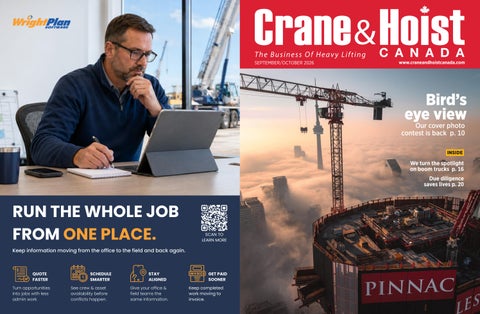
Bird’s eye view
Our cover photo contest is back p. 10 INSIDE
We turn the spotlight on boom trucks p. 16 Due diligence saves lives p. 20
Building bridges www.liebherr.com
Lifting operation LR 1300.1 SX
15 10
Contents
September/ October 2026
16
Volume 17 Number 5
Features COVER STORY
10 Bird’s eye view
We share your stunning images from this year’s cover photo contest.
16 Equipment Spotlight
30
COVER PHOTO: PHOTO: CREDIT CROPAC EQUIPMENT/ KOTSY PHOTOGRAPHY
The combination of mobility, versatility, reach and lifting capacity make the boom truck a common sight on worksites.
20 Supervisor in the middle
Due diligence saves lives in crane operations.
Departments 4 6 15 19 23 30
Editorial Industry News Association news Safety Corner Mr. ‘Fix It’ Knowing the Ropes
WWW.CRANEANDHOISTCANADA.COM
September/October 2026 · CRANE & HOIST CANADA
3
FROM THE EDITOR BY MIKE LACEY
VOLUME 17, ISSUE 5 | SEPTEMBER/OCTOBER 2026
H
ow about that cover, eh? What a fantastic photo and no surprise it took top spot in our annual Cover Photo contest. However, it had some stiff competition this year. To see more of the amazing photos that were submitted, turn to page 10 in this edition. I was quite impressed with the quality of this year’s submissions. Having taken a photo or two in my time, I know how difficult it can be. What your eye sees versus what the camera captures can sometimes be two different things. So, while the cover photo is stunning and perfectly captures the amazing heights crane operators can reach, the other photos submitted also do an excellent job of demonstrating the variety of work crane operators carry out across Canada. The crane sector’s diversity is what make its so perfect for such a contest. While the tower cranes working on skyscrapers provide a visual that is difficult to beat, the work on oil fields and wind turbines, ports, and residential and commercial construction are equally as dynamic and photogenic. That’s what I enjoy about this contest. It allows us to highlight the full range of the crane sector. That could be work on nuclear reactors in Ontario, bridgework in Alberta, lifting glass windows in Saskatchewan or installing wind turbines in Quebec. And, obviously, that can’t happen without your submissions. But please don’t wait until the annual photo 0contest. We would love to display your images in every edition. If you see a breathtaking shot, snap a pic on your phone and send it my way. You can email it to mlacey@ annexbusinessmedia.com or, and perhaps this is easier, text it to my cell: 289-221-8946. We would love to share more of your images and continue celebrating the industry.
With significant disruptions in our economy and (as of this writing) an ongoing and damaging trade war with the United States, it’s time Canada became a serious country and finally removed the provincial trade barriers. The need for goods and people to move freely across this country is vital. This is especially true in the construction and energy sectors. We need to harness the kind of energy we saw in the Second World War and direct it toward finding and training our future skilled trade workforce, and then provide the opportunties for them to easily move from province to province. As our aging workforce retires, there is a real fear that important skills will be lost. While some are using new technology to bridge that gap, ultimately we need to funnel younger people into the trades. Business and government have raised this quite a bit, but under our present circumstances, it is becoming a matter of national security. We want to build. We need to build. But we need trained workers to do it. Here’s hoping that begins now.
Next Up
Speaking of the next generation... Now that the photo contest is complete for another year, we turn our attention to the Top 10 Under 40. The annual feature recognizes those in the industry under the age of 40 who are doing outstanding things. For me, it’s a wonderful way to end the year. The hopefulness of those we feature is particularly motivating for an older, jaded man such as myself. The 10 lucky members will be profiled in our in next edition. So, make sure to keep an eye out for it. Talk soon.
craneandhoistca
Mike Lacey mlacey@annexbusinessmedia.com
/company/crane-hoist-canada
EDITOR | MIKE LACEY mlacey@annexbusinessmedia.com ASSOCIATE EDITOR | COLIN LEGGETT cleggett@annexbusinessmedia.com NATIONAL ACCOUNT MANAGER | LAURA GOODWIN lgoodwin@annexbusinessmedia.com • 289-928-8543 MEDIA DESIGNER | ALISON KEBA akeba@annexbusinessmedia.com ACCOUNT COORDINATOR | BARB COMER bcomer@annexbusinessmedia.com AUDIENCE DEVELOPMENT MANAGER | URSZULA GRZYB ugrzyb@annexbusinessmedia.com • 416-510-5180 CONTRIBUTORS | Saul Chernos GROUP PUBLISHER | DANIELLE BEAVAN dbeavan@annexbusinessmedia.com CEO | SCOTT JAMIESON sjamieson@annexbusinessmedia.com PUBLISHED BY ANNEX BUSINESS MEDIA 105 Donly Drive South, Simcoe, ON N3Y 4N5 Crane & Hoist Canada is published six times a year by Annex Business Media. Reference to named products or technologies does not imply endorsement by the publisher. Subscription rates (six issues) Canada: $39.25 (per year + tax) Canada: $67.36 (2 years + tax) USA: $50.92 (CAD per year) Send cheque or VISA/Mastercard number to Subscription Department, Crane & Hoist Canada, 111 Gordon Baker Rd., Suite 400, Toronto ON M2H 3R1. Fax orders to 416-510-6875. Or subscribe online at www.craneandhoistcanada.com
RETURN UNDELIVERABLE CANADIAN ADDRESSES TO: Crane & Hoist Canada. CIRCULATION DEPT. 111 Gordon Baker Rd., Suite 400, Toronto ON M2H 3R1 PRINTED IN CANADA ISSN 1923-788X Publications Mail Agreement #PM40065710 Annex Privacy Officer Privacy@annexbusinessmedia.com Tel: 800-668-2374 The contents of Crane & Hoist Canada are copyright ©2026 by Annex Business Media and may not be reproduced in whole or part without written consent. Annex Business Media disclaims any warranty as to the accuracy, completeness or currency of the contents of this publication and disclaims all liability in respect of the results of any action taken or not taken in reliance upon information in this publication.
Next Advertising Deadline: xxxxxx, 2026 Don’t miss the opportunity to be part of this exciting industry publication. For more information, or to reserve space in the next issue, call Laura Goodwin at our Advertising Department Tel: +1-289-928-8543 lgoodwin@annexbusinessmedia.com Next Editorial Deadline: xxxxxx, 2025. For writers’ guidelines and submission requirements get in touch with the editor, Mike Lacey, at mlacey@annexbusinessmedia.com
MEMBER OF:
UES
ON
N
TI
IA
CRANE & HOIST CANADA · September/October 2026
DE
OC
GR
ASS
4
MEDIA PARTNER:
SOCIATIO L AS NO TA F EN
A NAD CA
CRAN ER
/CraneHoistCanada
Time to get serious
CA
NAD
IEN NE DE LO
TI O CA
WWW.CRANEANDHOISTCANADA.COM
PHOTO: CREDIT
Look up, way up
Reader Service Print and digital subscription inquiries or changes, please contact customer service Angelita Potal Tel: (416) 510-5113 Fax: (416) 510-6875 Email: apotal@annexbusinessmedia.com Mail: 111 Gordon Baker Rd., Suite 400, Toronto, ON M2H 3R1
INDUSTRY NEWS WorkSafeBC urges employers to review wildfire evacuation plans
WorkSafeBC is reminding employers to review their emergency evacuation plans in the wake of intensifying wildfires across British Columbia. WorkSafeBC provided steps on how to prepare for a potential evacuation: • Identify when workers may need to evacuate: Consider wildfires and other emergencies that could affect the workplace, including risks specific to the location. • Have clear evacuation routes: Identify primary and alternate routes to safely leave the worksite and make sure exits are clearly marked, well-lit and free of obstructions. • Have a way to alert workers: Make sure workers know how they will be notified if they need to evacuate and what an evacuation alert or order means. • Assign responsibilities: Make sure workers know who is coordinating the evacuation and who will help others get to safety. • Plan for shutting down equipment and work processes: Identify what may need to be shut down, how it can be done safely, and who is responsible. Consider materials or processes that could become hazardous when exposed to fire. WorkSafeBC notes, however, that workers should not delay evacuation to shut down equipment or complete other tasks when there is an immediate threat to their safety. • Plan for everyone: Consider the needs of workers, visitors and others who may need assistance during an evacuation, including people with disabilities and those who do not speak English. • Keep workers informed and prepared: Review the plan with workers, provide training and hold evacuation drills at least once a year. Discuss emergency plans seasonally or when the potential for an emergency increases. In regards to smoke from Wildfires, WorkSafeBC says employers should monitor local air quality and adjust work as conditions change. This may include relocating or rescheduling work, reducing strenuous activity and taking steps to improve indoor air quality.
Toro elects new president and CEO as part of planned succession
Toro has announced Edric C. Funk as its next president and chief operating officer, effective Nov. 1, 2026. Funk will succeed Richard M. Olson, who 6
CRANE & HOIST CANADA · September/October 2026
will transition to the role of executive chairman of the board following more than four decades with the company, most recently as chief executive officer since 2016. Funk will also join the board of directors, effective immediately. Funk, a 30-year veteran of the company, has served as president and chief operating officer since September 2025 with responsibility for all its global businesses and integrated supply chain operations. Since joining The Toro Company in 1996 as a design engineer, Funk has held leadership roles spanning engineering, marketing, global product management and technology innovation. He led the company’s Center for Technology, Research and Innovation in 2017, became general manager of the Sitework Systems business in 2020, and later served as group vice president of Golf, Grounds and Irrigation. Funk holds a Bachelor of Science in engineering from the University of Minnesota and an MBA from the University of Minnesota – Carlson School of Management. He also has a professional certificate in innovation and technology from the Massachusetts Institute of Technology. He serves on the boards of the National Golf Foundation and The Toro Company Foundation.
GMV appoints Pick and Place Lifting Equipment as new Canadian dealer
GMV A/S has appointed Pick & Place Lifting Equipment as its new dealer for Winlet glazing robots, ErgoMover electric transport trolleys and Lasius compact pick & carry cranes in the Canadian market. Pick & Place Lifting Equipment has already received its first Winlet 600 and has ordered an additional Winlet 600 as well as the tracked Winlet 1000 Crawler glazing robot.
These machines will form the first step in the company’s GMV rental fleet and support customers who need reliable equipment for demanding glazing and material-handling tasks. The company has also closed its first equipment sale. Pick & Place Lifting Equipment is based in Vancouver and provides professional glass lifting equipment. The company works with glazing robots, vacuum lifters and other lifting equipment for applications such as storefront glass, curtain wall, oversized panels, restricted-access interior glazing and rough-terrain installations. Michael Hagge, Glass Expert at Pick & Place Lifting Equipment, will be the local contact for GMV solutions in Canada. The Winlet range consists of self-propelled vacuum lifting robots designed for handling glass, windows and other airtight materials. The ErgoMover range is designed to move and handle heavy building materials in areas where forklifts or fork-equipped machines cannot operate. GMV’s Lasius range has been developed for users who need compact lifting capacity,
WWW.CRANEANDHOISTCANADA.COM
reach, mobility and precision in areas where larger cranes or forklifts may not be suitable.
SAIT’s inaugural Crane Rodeo tackles industry labour shortages
Instead of talking about the labour challenges Canada’s crane industry is dealing with, the Southern Alberta Institute of Technology (SAIT) decided to take some proactive steps to help solve the problem. On July 5, 2026, during Calgary Stampede kickoff weekend, SAIT’s Point Trotter Campus hosted the inaugural Crane Rodeo, a first-of-its-kind industry event designed to open the doors of the crane and rigging world to women, families and the next generation of tradespeople. The free, family-friendly event was built around the idea that inspiration is the first step toward a career. Rodeo weekend in Calgary is when the city comes alive and SAIT states it wanted to turn that energy into a celebration of skill, strength and the kind of grit it takes to work with precision and purpose.
Servicing Ontario 647-466-3338 • info@hardlinetc.com
CHC_Comansa_MayJun25_CWM.indd 1 WWW.CRANEANDHOISTCANADA.COM
The event brought together some of the most respected crane companies in Alberta to one yard. Myshak, Vertical Crane and Rigging, McIntyre Crane and Rigging Ltd., TNT Crane and Rigging, Nors and Rigpoint Ltd. all came out with equipment and people. SAIT’s own program cranes filled out the yard alongside them. Women in Trades ambassadors from SAIT’s Women in Trades and Technology (WITT) staffed the Try-A-Trade stations, which featured welding, rigging,
blacksmithing, carpentry, electrical, ironworking, crane simulation lab and more. The successful event had more than 200 people attend. The morning featured a keynote from Dean Lynda Holden. A live band performed throughout the day. The kids’ zone ran at capacity, which included bouncy castles, Telus Spark and a sandbox for children. Sponsors including Platinum Sponsor Mettle Industrial Services, Gold Sponsor Oxford Building Supplies, and Bronze Sponsor Somerville and others filled the vendor spaces and brought their teams out to connect with attendees directly. With experienced operators retiring, SAIT states the pipeline of new talent is not keeping pace. As well, the pool the industry has traditionally drawn from is a relatively
Servicing British Columbia 778-239-9750 • contact@groke.ca
2025-05-06 2:58 PM7 September/October 2026 · CRANE & HOIST CANADA
INDUSTRY NEWS narrow demographic and not large enough to fill the gap. Women represent an enormous and largely untapped source of skilled labour for the crane industry, SAIT states. However, while women represent approximately 5 per cent of the skilled trades workforce in Canada, for the crane industry that number is significantly lower at just 0.5 per cent, according to SAIT. The Crane Rodeo was built on the premise that recruitment must happen before training.
bringing together a diverse range of experience and perspectives from across industry with a genuine interest in improving rigging, hoisting and lifting safety in Alberta. The board said it had a productive and engaging first meeting, where it established direction and began laying the foundation for future initiatives. The ABRSC is dedicated to improving safety in industries that involve rigging and hoisting throughout Alberta. Its mission is to protect workers through education, training and the development of a standardized competency framework that supports safe, consistent and professional work practices across the industry. The council grew out of a creative sentencing project on rigging, hoisting and lifting safety following the death of Brandon Nelson, a Red Seal Journeyman Heavy Duty Mechanic from Fort McMurray. Nelson was was killed in a rigging incident in 2022.
Mammoet obtains ISO 19443 nuclear power certification Alberta Rigging Safety Council dedicated to improving rigging and hoisting safety across Alberta
The newly formed Alberta Rigging Safety Council (ABRSC) held its first meeting at Red Deer Polytechnic following its formation this summer. The founding board includes Kris Chambers, Deb Hlushak, Chris Schnell, Ashleigh Kaliszuk, Jesse Johnson, Katheryn Carley BSc., CRSP, Matt Moreau, RSE, Chris Waples, Jordy East and Thomas O’Neill. In a LinkedIn post, the board says it is
Mammoet has become the first company in its industry to achieve ISO 19443, the international quality assurance and management standard for organizations operating in the nuclear power sector. ISO 19443 was officially published in 2018 and is an international quality management benchmark specific to the nuclear power industry. It provides businesses with a framework covering different business areas, from sales and operations to HR and procurement. Mammoet holds several ISO certificates, including ISO 9001, ISO 14001, and ISO 45001. The company says the decision to obtain
CRANE MATS CRANE CRANEMATS MATS CRANE MATS OUTRIGGER PADS OUT RI G G ER PA DS O U TR IG G ER PADS TRANSITION MATS TRA NSI T I O N MATS TRA N SITIO N MATS Tel: 604-462-7517 | www.industrialtimberproducts.com 604-462-7517 | www.industrialtimberproducts.com Tel: 604-462-7517 | www.industrialtimberproducts.com 1 8 CHC_Carlwood_MarApr23_CSA.indd CRANE & HOIST CANADA · September/October 2026
2023-02-09 8:56 AM
ISO 19443 was driven by its commitment to quality assurance and service as it works with key players to develop efficient build strategies for next generation reactors. The ISO audit assessed everything from culture and processes, to training, engineering and health-and-safety within the organization. The ISO certificate will be awarded to Mammoet by DNV France – the third-party certification body for ISO 19443. Mammoet has been working in the nuclear power sector for decades and has supported many high-profile projects for many of the world’s biggest companies working in the sector, including Bruce Power, EDF, ITER, RWE, Framatome and PreussenElektra.
Richard Plante retires from Ben-Mor
After almost three decades with Ben-Mor, Executive Vice President and owner Richard Plante officially retired on Aug. 28. As a member of the first shareholders’ board, Plante helped guide Ben-Mor through several significant stages of its development, bringing his expertise particularly to business development and marketing. Plante began working for Ben-Mor in 1996. “Throughout my career, many people have inspired me,” Plante writes in an open letter. “If there is one piece of advice I would give to young entrepreneurs, it is to listen and learn from others. “I have learned a tremendous amount by remaining curious and genuinely interested in the people around me, and I continue to do so today. Learning does not come solely from asking questions of artificial intelligence; it also comes from conversations and the experience of others.”
Do you have news to share with the industry? Spread the word with the help of Crane & Hoist Canada. All you have to do is email the information to either: mlacey@annexbusinessmedia.com or cleggett@annexbusinessmedia.com
WWW.CRANEANDHOISTCANADA.COM
IT’S IN YOUR REACH! LONG BOOM 120-Ton| 110 mt Hydraulic Truck Crane ✓ 197’ 7-section main boom ✓ 263’ max tip height ✓ 33’ more main boom than standard 120|HT ✓ Longest truck crane boom on the market
Re T H I N K FUEL
Lexington, Kentucky USA|www.linkbelt.com Contact your local dealer for more information.
HVO READY EPA COMPLIANT
Find us on:
Link-Belt Cranes
Lexington, Kentucky, USA | www.linkbelt.com
COVER STORY
Bird’s eye view Stunning images from readers across the country By Mike Lacey
O
ne would be hard pressed to find a sector that lends itself to more stunning photography than cranes. Whether it is the eye-popping heights cranes reach, the unique and often massive items lifted or the geographical beauty and wonder serving as the backdrop, the crane industry is filled with the elements photographers crave. That’s why Crane & Hoist Canada’s annual photo contest is such a treat to judge. Seeing your images from across the country and learning more about the projects behind each photograph is a wonderful journey. But it would be difficult for anyone to surpass this year’s winning entry from Cropac Equipment. Breathtaking photos taken this past spring capture Cropac customer Premform’s Terex CTT 472 flat-top tower crane rising above the clouds in Toronto, Ontario. These stunning images were shot by Kotsy Photography during construction of the SkyTower, the tallest residential building currently under construction in Canada. Located on Toronto’s waterfront, this 110-storey skyscraper is part of the landmark Pinnacle One Yonge development. Over the course of the project, the crane climbed to a final height of 348 metres with the use of 16 internal ties. Configured with a 55-metre jib, a 6.24-tonne tip load and an 80 kW hoist capable of lifting at speeds up to 196 metres per minute, the crane provided the reach and lifting performance required for one of Canada’s most ambitious residential developments. Here is a look at the other amazing entries in this year’s contest.
Cropac Equipment/Kotsy Photography About: The winning image in Crane & Hoist Canada’s annual photo contest is this stunning photo from Cropac Equipment of a Terex CTT 427 flat-top tower crane used in the construction of the 110-storey SkyTower in Toronto, Ontario. PHOTO: CROPAC EQUIPMENT/ KOTSY PHOTOGRAPHY
10
CRANE & HOIST CANADA · September/October 2026
WWW.CRANEANDHOISTCANADA.COM
Another spectacular shot of Cropac Equipment’s Terex CTT 427 flat-top tower crane used in the construction of the 110-storey SkyTower in Toronto, Ontario. PHOTO: CROPAC EQUIPMENT/KOTSY PHOTOGRAPHY
WWW.CRANEANDHOISTCANADA.COM
September/October 2026 · CRANE & HOIST CANADA
11
COVER STORY
Bruce Power Major Component Replacement Project Where: Bruce Power nuclear site, Tiverton, Ontario When: Summer of 2026 About: Bruce Power shared these images from its Major Component Replacement Project, which will extend the life of the reactors by 35 years and includes the replacement of key reactor components like steam generators, pressure tubes, calandria tubes and feeder tubes. Partner SGRT (a joint venture between Aecon and SGT) used Mammoet’s PTC-35 to lift two 300-tonne steam drums onto cradles to get access to the steam generators sitting vertically below. From there, they removed and installed eight steam generators, requiring a total of 16 heavy-lift evolutions between June and November 2026. The three cranes that assembled the PTC-35 were a 300-tonne crawler, a 300-tonne all-terrain and an 80-tonne rough-terrain crane. PHOTO: BRUCE POWER
Sterling Crane Where: Chetwynd, B.C. When: June 2026 About: Sterling Crane operator Dylan Cole captured this stunning image at a British Columbia wind farm. The crane in the image is the company’s Liebherr LR 1600-2. Sterling Crane notes that while the lightning created an incredible backdrop, it also serves as an important reminder that no photo is worth compromising safety. Severe weather is one of the many hazards crews monitor closely and work is stopped whenever conditions become unsafe. PHOTO: DYLAN COLE
VanGenderen Canada Inc. Where: Jasper, Alberta When: Feb. 24, 2026 About: VanGenderen Canada used two Spierings SK488-AT7 Mobile Tower Cranes for the first tandem lift with Spierings cranes in Canada. The tandem lift involved a 6040.5 kg unit that was part of renovations at Fairmont Jasper Park Lodge. PHOTO: VANGENDEREN CANADA
12
CRANE & HOIST CANADA · September/October 2026
WWW.CRANEANDHOISTCANADA.COM
Cutting Edge Consulting Where: Vancouver, British Columbia When: June 10, 2026 About: An LTM 1650 8.1 all-terrain crane was used to assist in the dismantling of a tower crane. PHOTO: MATTHEW DAVIS
Sterling Crane Where: Guelph, Ont. When: June 2025 About: This photo was captured during the construction of a Battery Energy Storage System (BESS) project in Ontario, featuring Sterling Crane’s LTM 1400 and LTR 1400 working together to support this critical infrastructure. PHOTO: STERLING CRANE
WWW.CRANEANDHOISTCANADA.COM
September/October 2026 · CRANE & HOIST CANADA
CHC_OZLifting_MayJune26_CSA.indd 1
13
2026-05-07 7:48 AM
COVER STORY
N-Force Crane and Equipment Where: Calgary, Alberta When: Jan. 27, 2026 About: N-Force Crane and Equipment used a Tadano AC300 and Tadano AC220 to install tub girders over Deerfoot Trail in Calgary. The project involved getting both girders onto the road and up into position before a full air splice could take place to join the girders and allow the cranes to unhook. PHOTO: N-FORCE CRANE AND EQUIPMENT
Guay Where: Bécancour, Québec When: May 16, 2026 About: A Manitowoc MLC 300 VPC-Max and a Manitowoc 2250 unload wind turbine blades at the Port of Bécancour. PHOTO: GUAY
Prairie Crane Where: Saskatoon, Saskatchewan When: July 16, 2026 About: Prairie Crane’s 275-ton all-terrain crane hoists glass windows for the new Nutrein facility being constructed in downtown Saskatoon, Saskatchewan. PHOTO: PRAIRIE CRANE
14
CRANE & HOIST CANADA · September/October 2026
WWW.CRANEANDHOISTCANADA.COM
ASSOCIATION NEWS
Building Momentum Across Canada It has been a busy summer for the Canadian Crane Rental Association
A
s summer draws to a close, it is worth reflecting on what has been an exceptionally productive and rewarding season for the Canadian Crane Rental Association (CCRA). While many industries experience a slower pace during the summer months, the CCRA has continued to advance important initiatives that will benefit our members and the crane industry across Canada for years to come. One of the highlights of the season was our highly successful conference in Halifax. The event brought together industry professionals from across the country for valuable networking, technical discussions and knowledge sharing. The strong attendance and positive feedback received from participants reaffirm the importance of these gatherings in strengthening our industry and fostering collaboration among members. In addition to conference activities, there was significant progress on several key projects. The CCRA’s Bridge Research Project continues to advance steadily. This important initiative aims to improve our understanding of bridge capacities and transportation considerations for mobile crane operations across Canada. The project represents another example of the association’s commitment to addressing practical challenges faced by crane owners and operators. We are also pleased to announce the addition of a new resource to our growing collection of industry tools and information: a comparative database of mobile crane driver licences across Canada. This assessment WWW.CRANEANDHOISTCANADA.COM
Mammoet Canada Western Ltd. took home top honours in the annual Lift of the Year competition. PHOTO: MAMMOET CANADA WESTERN
has highlighted the need for the CCRA to advocate for the reinstatement of MELT grants for employers across Canada, who wish to ensure a skilled and qualified workforce and ensure mobility and compliance within our workforce while providing added value to members. Further supporting our advocacy and research efforts, the CCRA has hired a young engineer who spent her summer gathering extensive data on mobile crane weights and dimensions and all types of mobile cranes. This work, combined with a detailed analysis of regulations and practices throughout the western provinces, will strengthen our ability to engage with regulators and promote practical, evidence-based solutions for our industry. Collaboration remains a cornerstone of the association’s success. During the summer, CCRA developed a crane de-
scription guidance document supporting further understanding of the crane sector by the Western Task Force on Weights & Dimensions Members. CCRA representatives also met with Alberta bridge engineers to discuss issues of mutual interest related to infrastructure and the safe movement of cranes. These discussions continue to build important relationships and help ensure that industry perspectives are considered when decisions affecting our operations are made. Looking ahead, preparations are already underway for our fall Board of Directors meeting, where members of the board will review ongoing initiatives, establish priorities and discuss future opportunities for the association. Planning is also beginning for the National Task Force on Weights and Dimensions meeting scheduled for December. Participation in this
important forum ensures that the crane industry’s voice continues to be represented in discussions that shape transportation policy across Canada. This year marks another milestone. After five years, it is time to review the Canadian Lift of the Year Award competition. This award has become an important showcase for innovation, engineering excellence and professionalism within the crane sector. As part of the review process, the Board will consider potential enhancements to the program, including the possibility of introducing an additional award category to recognize a broader range of outstanding lifts and achievements. Finally, the CCRA continues to closely study Australia’s highly regarded CraneSafe Green Sticker Program. This program has demonstrated success in promoting crane safety, inspection standards and industry confidence. We are evaluating how a similar initiative might be implemented within Canada and what adaptations would be required to meet our unique regulatory and operational environment. The potential benefits for safety, consistency and public confidence make this an exciting area of exploration for the association. The program has been introduced in the United States and is led by the NCCCO. The progress achieved over the summer demonstrates the dedication of our volunteers, board members, committees and industry partners. Claire Bélanger-Parker is Executive Director of the Canadian Crane Rental Assocation.
September/October 2026 · CRANE & HOIST CANADA
15
EQUIPMENT SPOTLIGHT
BOOM TRUCKS Versatile and mobile, the boom truck is a key piece of equipment across many sectors. By Mike Lacey
T
he combination of mobility, versatility, reach and lifting capacity make the boom truck a common sight on worksites. The truck’s ability to move between jobsites, easily transitioning from road travel to lifting operations with minimal setup, make it an invaluable piece of equipment across many sectors, including construction, utility and industrial.
efficiently from the preferred side of the machine. The stand-up configuration also provides excellent visibility of the work area and surrounding jobsite, while allowing operators to maintain a clear perspective during setup and lifting operations. The 30100C is available with optional fixed and telescopic jibs, extending reach and helping operators work around obstacles or access elevated work areas.
Tadano 301000C
Manitowoc National Crane NBT45-2
The 30100C is a 30-ton conventional-mount crane featuring 100 feet of main boom, delivering the performance and versatility needed for fast-paced lifting applications. Designed as a stand-up crane, the 30100C is built for efficiency, with quick setup times that make it an ideal choice for taxi crane service and contractors moving from job to job. Operator-focused controls are positioned on both sides of the crane, providing convenient access and helping operators work 16
CRANE & HOIST CANADA · September/October 2026
The National Crane NBT45-2 is designed to deliver a balance of lifting performance, roadability and customization for a wide range of applications, including utility work, commercial and residential construction, and general lifting. With a 45-ton capacity, Manitowoc states this boom truck combines a field-proven design with modern controls and productivity-enhancing features. Depending on configuration, it can be equipped with a five-section full-power boom offering up to 142 feet of main boom length and WWW.CRANEANDHOISTCANADA.COM
A LONG WAY
TOGETHER
a maximum tip height of 204 feet. One of the defining characteristics of the NBT45-2 is its adaptability. Through Manitowoc’s Truck Mod Center and Lift Solutions teams, the cranes can be configured to match specific customer and application requirements. An example is the NBT45-2 configuration that does not require a single front outrigger and yet still provides full-capacity performance while simplifying setup. The model also incorporates several operator-focused features, including a hydraulic tilting cab with up to 20 degrees of inclination, ergonomic electronic joystick controls and an integrated graphical rated capacity limiter (RCL) that simplifies setup and operation.
AIROMAX AM 27 No matter how challenging your needs, AIROMAX AM 27 is your best ally for mobile cranes in industrial applications. The tire is particularly suitable for road usage. Thanks to its All Steel casing and the special tread design, AIROMAX AM 27 provides extraordinary traction along with high load capacity. AIROMAX AM 27 is BKT’s response to withstand the toughest conditions in the construction industry.
Discover the BKT Range
Manitowoc National Crane NBT60XL
The National Crane NBT60XL has established itself as a standout model in the boom truck segment by combining the mobility and roadability traditionally associated with boom trucks with performance characteristics often found in larger truck cranes. With a 60-ton lifting capacity and a 151-foot five-section full-power boom, Manitowoc states the crane offers one of the strongest reach-and-capacity combinations in its class, allowing operators to complete a wide range of lifting applications without relying heavily on jib configurations. A key feature of the NBT60XL is its flexibility. The crane can be equipped with up to 16,000 pounds of hydraulically removable counterweight, enabling operators to balance strong lifting WWW.CRANEANDHOISTCANADA.COM
Joe Dias Eastern Zone Manager Directeur Régional, Est du Canada BKT Tires (Canada) Inc. Cell: 514-792-9220 Web: www.bkt-tires.com
September/October 2026 · CRANE & HOIST CANADA
CHC_BKT-Tires_SeptOct26_CSA.indd 1
17
2026-09-01 11:03 AM
EQUIPMENT SPOTLIGHT performance with transportation requirements. Multiple counterweight configurations, along with available four-position outriggers and the optional NTC Performance Package, help adapt the crane to varying jobsite conditions while maintaining efficient setup and transport. The 20-degree tilting cab and operator-focused controls are designed to enhance comfort and productivity during long workdays.
Tadano’s TC50155H
The TC50155H is a 50-ton crane featuring 155 feet of main boom, delivering the reach and versatility needed for a wide range of lifting applications. As part of the TC Series, the TC50155H comes standard with dual-axis electric-over-hydraulic controls, providing smooth, precise operation. The Auto Level feature allows operators to quickly and easily level the crane with the push of a button, simplifying setup and helping get to work faster. The spacious operator cab features curved glass for excellent visibility around the jobsite, while the ergonomic controls help provide a comfortable operating experience throughout the workday. For additional reach and versatility, the TC50155H offers a 39-foot fixed jib with an offset transition, allowing operators to work up and over obstacles. An optional man basket further expands the crane’s capabilities, making the TC50155H suitable for telecommunications, utility and other aerial access applications.
Altec AC65E-155S
The 65-ton AC65E-155S is one of Altec’s largest and most capable boom trucks, enabling crews to handle both lifting and aerial work with one machine. With a six-section, 155foot main boom, Altec states the truck is equipped with class-leading material handling capacity and personnel lifting capabilities that rival most non-insulating aerial devices on the market today. These features allow operators to handle complex projects more efficiently and with fewer machines. According to Altec, the industry-first hydraulic luffing jib gives crews more useful reach, grants access to difficult work locations and allows them to do more in a single setup. Altec’s Smart-Zone Rating functionality maximizes pick capacity in any configuration. As with all Altec products, the AC65E-155S is backed by the industry-leading service support and warranty protection. 18
CRANE & HOIST CANADA · September/October 2026
Tadano’s TC65131
The TC65131 is a 65-ton boom truck featuring 131 feet of main boom, with the option of a telescopic lattice jib for additional reach and versatility. Designed with both performance and operator experience in mind, the TC65131 comes standard with Auto Level, allowing operators to quickly level the crane with the push of a button. The operator cab features curved glass for enhanced visibility, while dual-axis electric-over-hydraulic controls provide smooth and precise operation. Interchangeable counterweights give operators the flexibility to configure the crane to meet the demands of different lifting applications and jobsites.
PALFINGER PK 580 TEC knuckle boom crane
With its high lifting capacity, long reach and intelligent control capabilities, the PALFINGER PK 580 TEC knuckle boom crane is designed for demanding lifting applications. It delivers a maximum lifting moment of 401,790 ft-lb, a maximum lifting capacity of 44,090 lbs. and a maximum hydraulic outreach of 69-feet 7-inches. The crane features PALFINGER’s P-Profile boom, designed to provide a strong, lightweight and torsionally rigid boom structure. Smart assistance systems, including Smart Control, support precise and efficient crane operation. The PK 580 TEC also incorporates the LX-6 control valve and PALTRONIC 180 electronic control system, which support responsive and precise crane control. As part of PALFINGER’s TEC series of knuckle boom cranes, the PK 580 TEC combines advanced crane technology with intelligent operator assistance. The series is designed to support smooth operation, responsive control and efficient handling in demanding lifting applications, including jobs requiring precise maneuvering in limited spaces. www.palfinger.com. WWW.CRANEANDHOISTCANADA.COM
SAFETY CORNER
BY TRENTON GROVER
Winter and Boom Trucks Winter doesn’t make boom trucks unsafe; it removes your room for error.
W
inter brings obvious challenges to lifting operations. Snow, ice and low temperatures can all affect the worksite, but weather is only part of the story. Cold weather doesn’t just change operating conditions — it also changes how we work. As temperatures drop, schedules remain the same, daylight hours shrink and crews often feel increased pressure to complete work quickly. That’s when small shortcuts can begin to appear and risks start to increase. Boom trucks are valued throughout the industry for their versatility, mobility and ability to perform a wide range of lifting tasks efficiently. Those same characteristics often mean frequent moves, repeated setups and changing work environments throughout the day. Each setup requires operators to evaluate new ground conditions, weather, obstacles and worksite hazards. In winter, those changing conditions can reduce the margin for error and make small oversights much harder to forgive. These issues often appear in subtle ways. The ground conditions appear acceptable because the surface appears frozen. Pre-use inspections may become rushed because of the cold. Equipment operating normally the previous day may be assumed to be ready for service without further scrutiny. None of these decisions may seem significant on their own, but cold weather can reduce the margin for error that normally helps prevent small oversights from becoming larger problems. Industry standards and guidance, including those published by CSA Group and ASME, require lifting equipment and rigging to be inspected and removed from service when defects are identified. The challenge is rarely a lack of information or requirements. More often, the challenge is maintaining the same level of diligence and discipline when environmental conditions become more demanding. I learned a cold weather lesson on a 30-tonne stiff boom I operated through summer without issue. The first very cold morning of the winter, I drove to site at 5 a.m. During setup and inspection, I discovered the boom would not swing. After several reasonable checks, I stopped, packed up and took the crane back to the shop. WWW.CRANEANDHOISTCANADA.COM
Boom trucks are valued for their versatility, mobility and efficiency. PHOTO: © STEFONLINTON / ISTOCK / GETTY IMAGES PLUS
The crane was parked inside and worked fine the next day. Again, I parked it outside overnight, and the next morning the same thing happened. It turned out there was water in the slew motor. When the crane sat outside overnight, the water froze and stopped the swing function. The motor was removed, serviced, resealed and reinstalled. After that, it was good to go. The problem already existed. The cold simply revealed it. Cold weather changes how cranes behave. Hydraulic systems respond slower, oil thickens and components stiffen. Seals may shrink or change and can let moisture in. That is when hidden problems start to show. Equipment that felt smooth in summer suddenly feels delayed or inconsistent in winter. That change in feel matters. A small delay in response may not sound like much, but it can lead to overcorrection, load movement or unexpected crane behavior. Add gloves, cold hands and reduced visibility from frost or snow, and even experienced operators are working with less feedback from the machine and the environment. Many winter problems start with subtle warning signs: a hesitation, an unusual sound, a control that feels different, or rigging that doesn’t behave as expected. The wrong response is to push through it. Cycling controls to force movement, adding more load or continuing anyway does not solve the problem — it increases the risk. Guidance reflected in CSA and ASME standards is clear: equipment that cannot operate as intended needs to be taken out of service until the issue is understood. The right response is simple, but not always
easy. Stop and reassess. Lower the risk by getting the load to a safe condition if possible. Confirm what is happening instead of guessing. Get qualified support when needed. Chain slings, synthetic slings and wire rope all react differently to cold weather, but winter often makes existing problems harder to ignore. Damage, wear, contamination and poor maintenance that may not have been obvious in summer can quickly show once temperatures drop. That is why inspections matter and why standards emphasize removing damaged equipment from service before it becomes a failure. Experience shows up quickly in winter. Experienced operators slow down, not because they must, but because they understand the conditions, take more time with setup, pay attention to how the crane feels and stop when something does not make sense. At the end of the day, winter does not necessarily create new problems. It can expose the ones that were already there. Almost every cold-weather incident I have seen came back to the same pattern: a shortcut was taken, a warning sign was missed or a decision was rushed. Real crane and rigging safety come from proper training, consistent inspection, respect for equipment limits and conditions, and a workplace culture where workers have both the authority and confidence to stop unsafe work. When crews are trained to recognize risks and empowered to act, incidents are prevented before they start, and safety and productivity work together instead of against each other. If something feels different in winter, it is. And that is not the time to push harder — it is the time to stop and take a closer look. Trenton Grover is Field OHS Advisor with BC Crane Safety.
September/October 2026 · CRANE & HOIST CANADA
19
SAFETY
Supervisor in the middle Due diligence saves lives in crane operations By Roberta Sheng-Taylor, BC Crane Safety
O
ver the past five years, seven workers have lost their lives in crane-related incidents in the province of British Columbia. In 2021, a catastrophic tower crane collapse in Kelowna claimed five lives and seriously injured another worker. In 2024, two more workers were killed — one in Vancouver and one in Victoria. These were workers doing the jobs that build our communities. Work that should have brought them safely home. Remembrance alone is not enough. We owe it to these workers, to their families and to every person who steps onto a jobsite tomorrow to do better. To understand what failed. To improve the systems that let it happen. That commitment is at the heart of BC Crane Safety’s newly released publication, Managing Safety from the Supervisor’s Perspective — a comprehensive, practical guide built around one central truth: the supervisor is the most critical link in any crane safety system.
The Person in the middle
Safety researchers have a term for it: “leading from the middle.” The concept, drawn from the work of Dr. Thomas R. Kraus, recognizes that supervisors occupy a unique and powerful position — standing between organizational management and frontline workers, influencing both. No policy survives contact with the worksite unless the supervisor makes it real. Under BC’s Occupational Health and Safety Regulation, a supervisor is “a person who instructs, directs and controls workers in the performance of their duties.” That definition includes owners, managers, superintendents, charge hands, lead hands, department heads, journeymen and trainers. In short: if you have influence over how work gets done, the responsibility falls partly to you. When supervisors are present and engaged, employees’ safety behaviours improve. Adherence to safety rules increases. Incident investigations are conducted 20
CRANE & HOIST CANADA · September/October 2026
BC Crane Safety’s new publication Managing Safety from the Supervisor’s Perspective is a comprehensive, practical guide built around one central truth: the supervisor is the most critical link in any crane safety system. PHOTO: BC CRANE SAFETY
more thoroughly. The culture shifts. When supervisors are absent — physically or psychologically — the gap is filled by shortcuts, assumptions and, eventually, tragedy.
Four cornerstones, one framework
BC Crane Safety’s approach is built on a crane specific framework refined through
years of fieldwork and incident analysis. To support field use, this framework has been adapted into an Infoflip — a compact, copyrighted flip card booklet from Flip Productions that presents information in layered, cascading panels. The framework content is drawn from WorkSafeBC’s Safety Management Systems for Supervisors and represents operational requirements, not abstract principles. Information: Workers need to know the hazards and safety procedures before they encounter them. This means load charts, site maps, pre-lift briefings, and clear communication about exclusion zones, overhead power lines, and ground conditions. Instruction: Clear guidance ensures tasks are done safely. Instruction happens in crew talks, one-on-one evaluations, written safe work practices, and familiarization with OEM manuals and load charts. It is not a one-time event — it is a continuous practice. Training: Training typically happens on the job, grounded in occupational standards, supervised practice, and verified through written and practical assessments. For crane operators, this includes BC Crane Safety certification — a credential that must now be renewed to ensure operators remain current, competent, and aligned with today’s standards. Supervision: Monitoring catches and corrects unsafe practices before they become incidents. Supervision means being accessible, engaged, and able to intervene — and it means being physically present when the work demands it, including critical lifts, climbing, repositioning, and assembly or disassembly.
The cost of getting it wrong: young and new workers
We’ve all been new at some point — uncertain, untrained, trying not to mess up. Young and new workers are twice as likely to be injured in their first six months. The reason is not carelessness. It is a predictable combination of inexperience, limited WWW.CRANEANDHOISTCANADA.COM
CRANE ROPE & RIGGING CENTRES Alberta - Ontario - Quebec
Perform Heavy Lifts with Research has found supervisors occupy a unique and powerful position as they stand between organizational management and frontline workers. No policy survives contact with the worksite unless the supervisor makes it real. PHOTO: BC CRANE SAFETY
hazard awareness, and a reluctance to ask questions for fear of appearing incompetent. For provisional crane operators, the stakes are especially high. Each worksite presents unique challenges, such as uneven terrain, overhead power lines, crowded sites or equipment they may have never operated at scale. The BC Crane Safety guide describes a four-step model for bringing these workers along safely: Prepare the Worker, Demonstrate and Describe, Observe on the Job, and Check Progress. These are not optional courtesies. They are the building blocks of reasonable care. WWW.CRANEANDHOISTCANADA.COM
Twin-Path
®
High-Performance Synthetic Slings Dual Paths - Up to 500 tons Capacity Overload Indicators - Easy to Inspect Fully Repairable - Proof Tested Custom built and tested at Unirope sites in
Alberta: 780-644-9000 Ontario: 800-457-9997 Quebec: 877-239-5444
ww w.UNI RO P E .co m September/October 2026 · CRANE & HOIST CANADA
CHC_Unirope_TwinPath_JulyAugust26_CSA.indd 1
21
2026-06-24 11:27 AM
SAFETY Content from BC Crane Safety’s new flip card booklet is drawn from WorkSafeBC’s Safety Management Systems for Supervisors. PHOTO: BC CRANE SAFETY
Employers and supervisors sometimes unknowingly encourage risky behaviour, whether by valuing workers who stay quiet, those who ask few questions, and those who produce too quickly. The guide is direct on this point: the culture that rewards silence is a culture that breeds incidents. Intense supervision should extend through the first six months in a new role and not the first one to three weeks.
Documentation Is not paperwork — it’s evidence
A common misconception is that documentation is a bureaucratic exercise. The guide reframes it: documentation is evidence of due diligence. In the event of an incident or an investigation — what matters most is the quality of your records, not the quantity. Supervisors are encouraged to make one purposeful entry per day in a journal or log: “reviewed operator logbook… observed rigging setup… noted compliance with load charts.” Small entries, made consistently, build a record that demonstrates a functioning safety management system, one that protects both workers and the organization.
When things go wrong: investigations done right
Most employers focus their investigative attention on serious injuries or significant property damage. The BC Crane Safety guide argues that near misses and substandard conditions deserve the same rigor. A slipping load that catches in time. A near tip-over on soft ground. A close call with a power line. These are not lucky outcomes, they are warnings. Effective incident investigation follows five principles: incidents stem from safety system failures, not individual blame; outcomes are preventable; analysts must be competent; proper methods must be used; and root causes must be identified and corrected. Most causes, the guide notes, can be traced back to failures in one or more of the four cornerstones — information, instruction, training, or supervision.
A resource built on real loss
The Managing Safety from the Supervisor’s Perspective guide is dedicated to Cailen Vilness, Jared Zook, Patrick Stemmer, Eric Stemmer and Brad Zawislak — the five men who lost their lives in the July 12, 2021 tower crane collapse in Kelowna. Their memory is built into its foundation. The guide covers more than 30 topics, from safety management systems and communication styles to psychological safety, MSI risk assessment, impairment in the workplace, WorkSafeBC claims management and return-to-work programs. It is a complete supervisory resource for the crane industry, written with the weight of experience and the intention of prevention. Today, as BC Crane Safety continues to advance crane safety reforms — certification renewal, licensing frameworks, supervision requirements, and the Good Neighbour Program — this guide represents the conviction that every incident is preventable, and that prevention starts with the person in the middle. The guide is being distributed province-wide within B.C. For more information or to request copies, visit bccranesafety.ca or contact BC Crane Safety at info@bccranesafety.ca. 22
CRANE & HOIST CANADA · September/October 2026
Interested in taking a closer look? A digital version of the Infoflip Managing Safety from the Supervisor’s Perspective is available online. Simply follow the link below to explore it online (it is recommended to view this link from a desktop computer) www.bccranesafety.ca/cranesupervisor/#managing-safety-from-the-supervisor-sperspective-infoflip WWW.CRANEANDHOISTCANADA.COM
MR. FIX IT
BY SEBASTIEN GIRARD-PAGE
Getting the diagnosis right Understanding the real cost of crane downtime
C
rane downtime is rarely measured accurately by the cost of the failed com-
ponent. When a crane comes out of service, the financial impact can extend well beyond the repair itself. Production stops, crews may become unproductive, subcontractors can be delayed and project schedules can quickly be affected. For this reason, accurate and efficient troubleshooting has become an increasingly important part of crane maintenance and fleet management. Modern cranes have also changed the nature of troubleshooting. Mechanical and hydraulic expertise remain essential, but today’s technicians must often combine that experience with electronic diagnostic equipment, manufacturer software, electrical testing and an understanding of machine communication systems. The objective is not simply to get the crane moving again. It is to identify the actual cause of the failure and correct it properly the first time.
The cost of downtime goes beyond the repair
When a crane breaks down, the first question is often: How much will the repair cost? A more useful question may be: How much does every hour of downtime cost? The answer can include operator and crew costs, lost production, delayed lifts, subcontractor downtime, equipment rental, mobilization, expedited parts and freight, overtime and potential schedule consequences. A component failure that WWW.CRANEANDHOISTCANADA.COM
issues, especially when cranes operate in remote locations or harsh conditions. A disciplined diagnostic process typically follows: Complaint ➞ fault information ➞ testing ➞ diagnosis ➞ repair ➞ verification. The technician needs to determine whether the information reported by the control system is consistent with the actual behavior of the machine before replacing components. Modern crane troubleshooting cannot always be divided between mechanical and electronic problems. PHOTO: SGP CRANE REPAIRS
costs several thousand dollars to repair can therefore create a much larger financial impact if the crane remains unavailable for an extended period. This changes the economics of troubleshooting. Investing additional time in reaching an accurate diagnosis can be considerably less expensive than replacing components through trial and error.
Modern cranes require modern diagnostics
Today’s cranes are highly integrated machines. A single crane can contain engine and transmission control modules, hydraulic controls, sensors, electronic joysticks, safety systems, load moment systems and multiple electronic control units communicating across machine networks. A problem in one area can produce symptoms somewhere else. Manufacturer-specific diagnostic software and appropriate electronic test equipment can provide information that may not be available through
conventional inspection alone. Depending on the machine, diagnostic tools can provide access to active and stored fault codes, live sensor data, control-module information, system parameters and functional tests. However, diagnostic equipment is a tool, not an automatic answer.
A fault code is a starting point
One of the most important distinctions in modern crane troubleshooting is the difference between a fault code and a failed component. A control system may identify that a signal is outside its expected range. That does not necessarily mean the sensor generating the signal is defective. The problem could be the sensor, wiring, connectors, power supply, grounding, communication network or another component affecting the system. Weather and environmental conditions can also cause or contribute to certain
When mechanical and electronic diagnostics work together
Modern crane troubleshooting cannot always be divided into “mechanical” and “electronic” problems. A hydraulic function may be electronically controlled. An engine problem can affect hydraulic operation. A pressure sensor can influence a control strategy, while a mechanical problem can generate an electronic fault. We recently experienced this with a Liebherr LG 1750, where a minor engine fault code significantly reduced winch speed. Although the code appeared to be an engine-related issue, its effect was felt directly in the crane’s operating performance. This example demonstrates why effective troubleshooting requires both system knowledge and practical testing. A diagnostic computer may indicate a control valve is not responding as expected. The next step may involve checking electrical signals, measuring resistance, verifying power and grounds, checking hydraulic pressure, observing mechanical movement and inspecting the valve itself.
September/October 2026 · CRANE & HOIST CANADA 23
MR. FIX IT
BY SEBASTIEN GIRARD-PAGE The most effective process combines data from the machine with physical evidence from the machine.
Avoiding parts replacement by guesswork
Replacing parts until the problem disappears can become an expensive and ineffective diagnostic strategy. It can also leave the original cause unresolved. For example, repeatedly replacing electrical components without identifying an underlying voltage, resistance, grounding or wiring problem can result in repeated failures. The same principle applies to hydraulic systems: replacing a component without investigating contamination, incorrect pressure or overheating may simply set the stage for another failure.
The goal should be to repair the failure mechanism, not just the failed part.
many repairs as possible from an emergency situation into a planned maintenance event.
Preventive maintenance should be the top priority
Getting the diagnosis right
Preventive maintenance is fundamental to equipment reliability, but it also has an important economic role and should be at the top of the priority list. Scheduled maintenance creates an opportunity to identify developing problems while the crane is still available for planned work. Fault histories, operating parameters and maintenance records can also help identify recurring problems and component trends. The objective is not to eliminate every failure. That is unrealistic. The objective is to move as
The fastest repair is not necessarily the repair that begins with the fastest parts replacement. Having the appropriate diagnostic software, test equipment, technical documentation and experienced personnel can shorten the path from failure to confirmed diagnosis. Modern diagnostic technology provides technicians with more information than ever before, but technology does not replace experience. The most effective approach combines electronic diagnostics, mechanical and hydraulic testing, manufacturer information, machine history and field experience.
For crane owners and fleet managers, the lesson is straightforward: downtime should be managed as a business cost, not simply a maintenance event. When the cause of a failure is properly identified, the repair is more likely to solve the underlying problem, reduce repeat failures and return the crane to productive service with confidence. In an industry where crane availability can directly influence project productivity, getting the diagnosis right the first time can be one of the most valuable maintenance decisions a fleet can make. Sebastien Girard-Page is the owner-technician of SGP Crane Repairs, bringing over 20 years of technical expertise to delivering reliable, high-quality crane repair services across Canada.
sales@nelsontrailers.com
sales@nelsontrailers.com sales@nelsontrailers.com www.nelsontrailers.com www.nelsontrailers.com www.nelsontrailers.com Phone: 419-523-5321 Phone: Phone:419-523-5321 419-523-5321
Providing Solutions all of North America Providing Solutions for all America Providing Solutions forfor allof ofNorth North America
LET USASSIST ASSIST YOU WITH YOUR TRANSPORTATION NEEDS LET YOU LETUSUSASSIST YOUWITH WITHYOUR YOURTRANSPORTATION TRANSPORTATIONNEEDS NEEDS Crane *Rigging Rigging *Construction Construction * Heavy * Oversize * Aerospace Crane * *Construction * *Heavy Haul * *Aerospace Crane* *Rigging Heavy Haul*Haul *Oversize Oversize Aerospace
6448 6448State StateRoute Route224 224Ottawa, Ottawa,OHOH45875 45875
6448 State Route 224 Ottawa, OH 45875
24
CRANE & HOIST CANADA · September/October 2026
CHC_Nelson_quater_JanFeb25_MLD.indd 1
2025-01-08 CHC_CCRA_NovDec25_CSA.indd 12:58 PM 1
WWW.CRANEANDHOISTCANADA.COM
2026-05-07 12:13 PM
PROJECT PROFILE
A helpful pick-me-up Moir Crane Service assists with cable replacements on Ambassador Bridge By The Canadian Crane Rental Association
Moir Crane Service is assisting in the replacement of suspender cables on the Ambassador Bridge.
Moir Crane Service used a National Crane NBT60XL 60-ton boom truck. PHOTO CREDIT: AC METAL FABRICATING
PHOTO CREDIT: AC METAL FABRICATING
M
oir Crane Service is in the process of assisting with construction efforts on a long-standing piece of infrastructure the company is very familiar with – the Ambassador Bridge. Originally founded as Moir Cartage in 1890, the fifth-generation company out of Windsor, Ont. is one of the long-
WWW.CRANEANDHOISTCANADA.COM
est-standing crane rental companies across Canada. Moir Cartage delivered the first shipment across the Ambassador Bridge from Windsor into Michigan. So, the fact that the company is still called upon to assist with projects on the bridge is a testament to long-standing quality and customer service. This particular project in-
volved work being done by AC Metal Fabricating Limited out of Windsor replacing the suspender cables on the Ambassador Bridge, which was originally opened to the public in 1929. Moir Crane Service was hired to hoist the personnel platform to areas where workers needed to go to install the new suspender cables. To raise the worker platform,
Moir Crane Service used a National Crane NBT60XL 60ton boom truck. The crane featured 150.5 feet of main boom and 36 feet of fixed jib with a 16,000-lb. counterweight. The total load for the project was 3,300 lbs. “We set up the crane on the bridge and needed to know what the capacity and the outrigger pressures were be-
September/October 2026 · CRANE & HOIST CANADA 25
PROJECT PROFILE
“As always, safety is one of our biggest priorities here at Moir Crane.” Jeff Reaume cause of the bridge structure,” explains Jeff Reaume, director of sales with Moir Crane Services. “We had to make some larger outrigger pads in order to disperse the weight over the bridge. We then hoisted the platforms above.” For AC Metal Fabricating to perform its installation work, utilizing a crane for this type of application was the best option, Reaume says. He adds that the biggest challenges
with this type of lift is gathering up all the information beforehand to make sure there’s not too much downward pressure or weight for the crane. “There are also traffic management issues to deal with since there were two lanes on the bridge that remained open throughout the project – one lane in each direction,” Reaume says. “As always, safety is one of our biggest priorities here at Moir Crane.”
Moir Crane Service’s role in the project was to hoist the personnel platform to areas where workers needed to go to install the new suspender cables. PHOTO CREDIT: AC METAL FABRICATING
Visit first whenever they want the latest industry news. From breaking industry news and equipment launches to business updates, projects, regulations and product innovations, Crane & Hoist Canada delivers the information that matters—when it matters. Don’t wait for the next issue. Visit us online for the latest news, exclusive stories and industry insights from across Canada’s lifting, crane and rigging sectors. Your first source for crane and lifting news.
1 26 CHC_HOUSEAD_SEPTOCT26_BAS.indd CRANE & HOIST CANADA · September/October 2026
CraneandHoistCanada.com
2026-08-13 1:29 PM WWW.CRANEANDHOISTCANADA.COM
Ask us about our new products!
MARKETPLACE Advertise your parts, products, accessories and more in our Marketplace section! Contact Laura now at+1-289-928-8543 or lgoodwin@annexbusinessmedia.com /CraneHoistCanada
/company/crane-hoist-canada
craneandhoistca
REDUCE FRICTION – PROTECT COMPONENTS – IMPROVE EQUIPMENT LIFE
Visit www.craneandhoistcanada.com for the latest news, stories, products, videos, photo galleries and industry events.
FOR OVER 15 YEARS, LUBE-A-BOOM HAS BEEN THE MOST TRUSTED NAME IN LUBRICATION IDEAL FOR CRANES, FORKLIFTS, AERIAL LIFTS, TELEHANDLERS, TELESCOPIC BOOMS, HYDRAULIC EXCAVATORS, WRECKERS AND TOW VEHICLES AND SO MUCH MORE…
WWW.LUBEABOOM.COM 317-578-3961
Sign up for our ENEWSLETTER to get the latest news affecting your industry today! ADVERTISERS INDEX Associated Wire Rope & Rigging Inc. (RopeBlock)..........................28 Basil Equipment...........................................................................................29 BKT Tires Canada, Inc................................................................................17 Canadian Crane Rental Association (CCRA).......................................24 CarlWood Lumber Limited......................................................................... 8 Comansa........................................................................................................... 7 Crane & Hoist Canada................................................................................26 Cropac Equipment Inc................................................................................. 5
AWARD WINNING LUBE-A-ROPE GREASE
LAB LLC (Lube-A-Boom)..........................................................................27
AVAILABLE NOW!
Liebherr-Werk Biberach GmbH................................................................. 2 Link-Belt Construction Equipment........................................................... 9 Nelson Manufacturing Company.............................................................24 Nors Construction Equipment Canada ST, LP....................................32 Oz Lifting Products.....................................................................................13 SGP Crane Repairs......................................................................................29 Shawmut Equipment of Canada, Inc.....................................................28 Tadano America Corporation...................................................................31 Unirope Limited...........................................................................................21
WWW.CRANEANDHOISTCANADA.COM
CHC_LABLLC_VT_MarApril23.indd 1
September/October 2026 · CRANE & HOIST CANADA
27
2023-03-02 10:20 AM
Your one source for all of your lifting requirements.
associatedwirerope.com
310-448-5444 sales@awrrinc.com
310-522-9698 sales@watermansupply.com
CHC_ Associated Wire Rope-Lifting_MayJune26_CSA.indd 1
2026-03-19 2:19 PM
Equipment_JulyAug26_CSA.indd 1 28 CHC_Shawmut CRANE & HOIST CANADA · September/October 2026
2026-07-07 1:41 PM WWW.CRANEANDHOISTCANADA.COM
CRANE REPAIRS
YOUR TRUSTED CRANE REPAIR PARTNER ANYWHERE IN CANADA! On-site diagnostic testing, repairs, and maintenance provided for all crane manufacturers Coverage spans across Canada, including remote sites and shutdown locations
418.951.4340
CHC_SGPCRANES_JANFEB26_BAS.indd 1
sgpcranerepairs.net
CALL/TEXT 818-991-9694
2025-12-08 9:31 AM
info@basilequipment.com www.basilequipment.com
YOUR CRANE SAFETY SOLUTION
CHC_BasilEquipment_SepOct24_SVA.indd 1 WWW.CRANEANDHOISTCANADA.COM
2024-09-11 7:42 AM September/October 2026 · CRANE & HOIST CANADA 29
KNOWING THE ROPES BY JUSTIN BROWN
The last safe decision Rigging safety is not created in the moment of the lift, it is created through the decisions, systems and culture that exist before the load leaves the ground
T
he rigger at the hook may have the final opportunity to stop a potentially unsafe lift, but that decision is influenced by everything that has happened beforehand: equipment selection, product identification, training, inspection, lift planning, communication, site conditions and whether the organization genuinely supports work stoppages when something does not look right. In other words, the rigger’s decision at the hook is only the final link in a much longer chain of decisions. Safe lifting depends on a system designed to make the correct decision easier to recognize. For crane and hoist professionals, lifting must therefore be viewed as an interconnected system. The crane, operator, lift plan and rigging all play essential roles in controlling, moving and landing the load safely. A correctly attached sling is only one part of that system. Even with a capable crane and qualified operator, a lift can become unsafe if the wrong sling is selected, sling angles are misunderstood, the centre of gravity is misjudged, edge protection is overlooked, equipment condition is compromised, product identification is unclear, hardware is used incorrectly or communication fails. The safest lifts are those where every decision leading up to the moment the hook takes the load supports the right outcome.
Beyond Capacity
One of the biggest misconceptions in rigging is that safety is primarily about product 30
strength. Strength matters, but it is only part of the answer. A sling can have sufficient rated capacity and still be wrong for the lift. It can be strong enough in straight tension and still fail because it is exposed to an unprotected edge. A fitting can physically connect and still be incompatible. This highlights a wider challenge within rigging: many dangerous mistakes are not visually obvious. There is a saying in our industry that if it looks bad, it probably is. However, the greater risk is often the lift that looks acceptable but contains hazards that are not immediately visible. A safe lift depends not only on what equipment is being used, but how that equipment is applied. Sling angle and protection are two clear examples of why rigging safety is about application, not just capacity. A rigger may read a sling tag and believe the sling is suitable, but the configuration matters. As sling angles decrease, sling leg tension increases, meaning a sling that is correctly rated in one arrangement may be overloaded in another. A sling does not become overloaded only because the load is too heavy; it can also become overloaded because the angle was misunderstood. The same principle applies to sling protection. A sling can have sufficient rated capacity and still be unsuitable for a lift if it is exposed to damaging contact points. Edges, corners, protrusions, abrasion, compression and movement under load can all compromise a sling. A challenge is that the word “sharp” can create a misleading impression. A hazard does not
CRANE & HOIST CANADA · September/October 2026
‘A safe lift depends not only on what equipment is being used, but how that equipment is applied. Sling angle and protection are two clear examples of why rigging safety is about application, not just capacity.’ need to look sharp to cause damage; a clean 90-degree edge on a beam, plate, concrete form or fabricated structure can be enough to damage a loaded sling. Edge protection is therefore not an accessory or an afterthought; it is part of the rigging system and must be selected based on the sling, load, contact surface and potential movement. Abrasion protection is not the same as cut protection; materials suitable for reducing wear may offer little protection against cutting. Protection must match the hazard.
Training for reality
Recognizing these hazards is not simply a matter of having access to information, it requires training that reflects the decisions people must make in real lifting environments. Training must prepare people to assess real field conditions, not simply complete a course. A competent rigger needs to understand and apply the fundamentals of safe lifting, including load weight, centre of gravity, sling angle, hitch type, hardware compatibility, inspection, edge protection, communication and load path. Competency also means having the confidence to recognize when something is not
right, stop the lift and escalate concerns when necessary. Experience is valuable, but experience alone does not define competence. Experienced riggers often develop the ability to identify issues that may not be obvious on paper, but familiarity can also lead to the normalization of shortcuts. A practice can be repeated for years without incident and still introduce unnecessary risk. Regular training, skills refreshers and learning from near misses and incidents are essential to reinforcing good practice and highlighting the consequences of poor decisions in rigging. The rigger is not the only safety control in a lifting operation. Manufacturers, suppliers, employers, supervisors and workers all influence the outcome through the decisions they make before the load leaves the ground. The goal should not simply be to react when something looks wrong, but to create systems where the right choice is easier to recognize and act upon. That means creating a culture where concerns can be raised, mistakes become opportunities to prevent repetition and stopping a lift is seen as a demonstration of competence rather than a failure. The safest lift is not achieved by one person making the perfect decision at the hook. It is achieved when every decision before that moment has helped make the correct choice possible. Justin Brown is the president of Unirope Limited, a Canadian company focused on the training, testing, and distribution of wire rope and rigging products. Brown holds active memberships with the AWRF and OIPEEC.
WWW.CRANEANDHOISTCANADA.COM
Tadano Knows Crawlers Built for demanding terrain and challenging access, the Tadano AS-58C and AS-58CJ Telescopic Crawler Booms deliver exceptional reach, stability, and versatility.
The AS-58CJ adds an integrated jib for greater positioning flexibility, with a maximum working height of 64 feet, horizontal outreach of 40 feet, 2 inches, and platform capacities up to 750 pounds. Both models feature 57% gradeability, 360-degree turntable rotation, dual lifting capacities, non-marking crawler pads, and advanced safety systems. Two crawler booms. One proven name. Tadano knows crawlers.
www.tadano.com
© Tadano Ltd. 2026
The AS-58C offers a maximum working height of 64 feet, horizontal outreach of 50 feet, 6 inches, and platform capacities up to 990 pounds. Its low 5.8 PSI ground pressure helps protect sensitive surfaces.
Built by Grove. Powered by Nors. Why Nors Crane? Comprehensive crane portfolio from top brands. Strong regional presence across Canada. Personalized customer support and dedicated accounts. Tailored financing solutions and competitive pricing. Expert after-sales services and rapid parts availability.
Partner with Nors and discover why industry leaders trust us to lift their businesses to new heights.
www.nors.com