
IBY MACENZIE REBELO
have just returned from a busy week at CONEXPO in very hot Las Vegas, Nevada. While I prepared plenty of interview questions, I clearly wasn’t prepared for the heat and returned to chilly Toronto with quite the impressive sunburn.
To my surprise, CONEXPO was not as overwhelming for a crane newcomer as I expected.
Everyone I spoke with, many with years of expertise under their belts, were not only willing to sit down and explain the ins and outs of the industry but also encouraged me to keep asking questions––something a journalist is not used to!
The energy at CONEXPO was palpable, you could feel the excitement the moment the hall doors opened at 9 a.m. Despite the ongoing tensions between the United States and Canada, exhibitors I met with were incredibly friendly and even apologetic about the state of things.
You never know what to expect the first time you do something like this, but in my experience, people in the crane and lifting sector are some of the most welcoming around.
As someone who grew up in the Greater Toronto Area, I’m very familiar with cranes, but I had never been up close and personal with one—and wow, they are massive. Pictures truly don’t do justice to the sheer size of the equipment. It was eye opening to tour the machines and learn about the care and engineering that goes into designing them.
advancements and innovations.
There’s no better feeling than handing out the magazine to exhibitors and hearing, “Hey! I read this magazine!” It’s humbling to know that so many of you look forward to receiving each new edition in your mailbox.
As editor, I am always happy to hear from readers. If I happened to miss you at CONEXPO, please feel free to reach out by email and say hello. You can also find photos from my time at the event on our social media platforms, @craneandhoistca, on Instagram and LinkedIn.
With spring just around the corner, the construction industry is entering its busy season, which means the pressure is on to complete projects efficiently and on time. As Patrick Falzon, Powerline Safety Advisor at the Electrical Safety Authority, notes on page 20, maintaining a safety-first mindset is crucial, especially when production pressures are high.
It’s humbling to know that so many of you look forward to receiving each new edition in your mailbox.
Despite the many safety breakthroughs emerging in this ever-innovating industry, one thing we cannot change is the impact electricity can have on the human body.
Reader Service
Print and digital subscription inquiries or changes, please contact customer service
Angelita Potal
Tel: (416) 510-5113
Fax: (416) 510-6875
Email: apotal@annexbusinessmedia.com
Mail: 111 Gordon Baker Rd., Suite 400, Toronto, ON M2H 3R1
EDITOR | MACENZIE REBELO mrebelo@annexbusinessmedia.com
NATIONAL ACCOUNT MANAGER | LAURA GOODWIN lgoodwin@annexbusinessmedia.com • 289-928-8543
MEDIA DESIGNER | EMILY SUN esun@annexbusinessmedia.com
ACCOUNT COORDINATOR | BARB COMER bcomer@annexbusinessmedia.com
AUDIENCE DEVELOPMENT MANAGER | URSZULA GRZYB ugrzyb@annexbusinessmedia.com • 416-510-5180
CONTRIBUTORS | Saul Chernos
GROUP PUBLISHER | DANIELLE LABRIE dlabrie@annexbusinessmedia.com
CEO | SCOTT JAMIESON sjamieson@annexbusinessmedia.com
PUBLISHED BY ANNEX BUSINESS MEDIA 105 Donly Drive South, Simcoe, ON N3Y 4N5
Crane & Hoist Canada is published six times a year by Annex Business Media. Reference to named products or technologies does not imply endorsement by the publisher.
Subscription rates (six issues)
Canada: $39.25 (per year + tax)
Canada: $67.36 (2 years + tax)
USA: $50.92 (CAD per year)
Send cheque or VISA/Mastercard number to Subscription Department, Crane & Hoist Canada, 111 Gordon Baker Rd., Suite 400, Toronto ON M2H 3R1. Fax orders to 416-510-6875. Or subscribe online at www.craneandhoistcanada.com
RETURN UNDELIVERABLE CANADIAN ADDRESSES TO: Crane & Hoist Canada. CIRCULATION DEPT. 111 Gordon Baker Rd., Suite 400, Toronto ON M2H 3R1
PRINTED IN CANADA ISSN 1923-788X
Publications Mail Agreement #PM40065710
Annex Privacy Officer
I even tried a crane training VR headset, something I’ll admit I was absolutely terrible at. We can all be thankful that my passion lies in writing, not operating heavy machinery!
A key highlight of my experience at CONEXPO was having the opportunity to meet Crane & Hoist Canada readers and learn firsthand about the latest industry


While it is encouraging to see the safety measures the crane and lifting sector is implementing to protect its workforce, there is always more safety knowledge to be shared across the industry. As the famous aphorism goes “Knowledge is power!”
Whether you have a story to share or a question to ask, please don’t hesitate to reach out to me.
Macenzie Rebelo mrebelo@annexbusinessmedia.com
Privacy@annexbusinessmedia.com Tel: 800-668-2374
The contents of Crane & Hoist Canada are copyright ©2026 by Annex Business Media and may not be reproduced in whole or part without written consent. Annex Business Media disclaims any warranty as to the accuracy, completeness or currency of the contents of this publication and disclaims all liability in respect of the results of any action taken or not taken in reliance upon information in this publication.
Next Advertising Deadline: April 24, 2026
Don’t miss the opportunity to be part of this exciting industry publication. For more information, or to reserve space in the next issue, call Laura Goodwin at our Advertising Department Tel: +1-289-928-8543 lgoodwin@annexbusinessmedia.com
Next Editorial Deadline: April 29, 2026. For writers’ guidelines and submission requirements get in touch with the editor, Jack Burton, at jburton@annexbusinessmedia.com

MEMBER OF: MEDIA PARTNER:





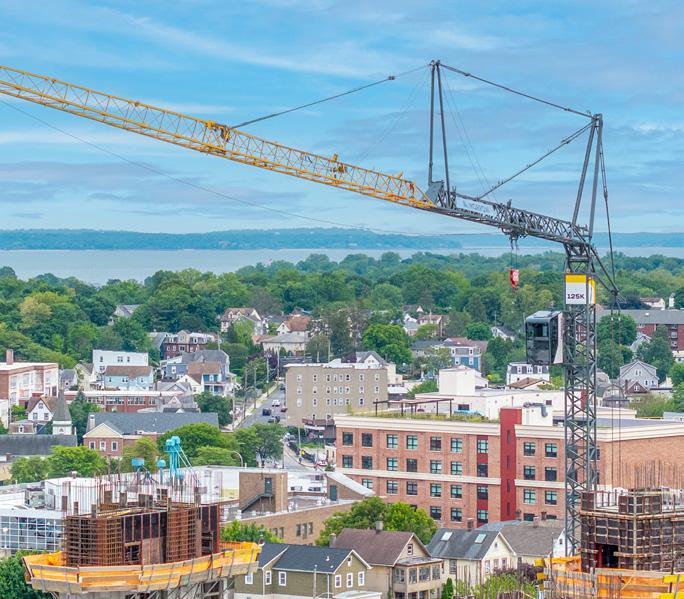
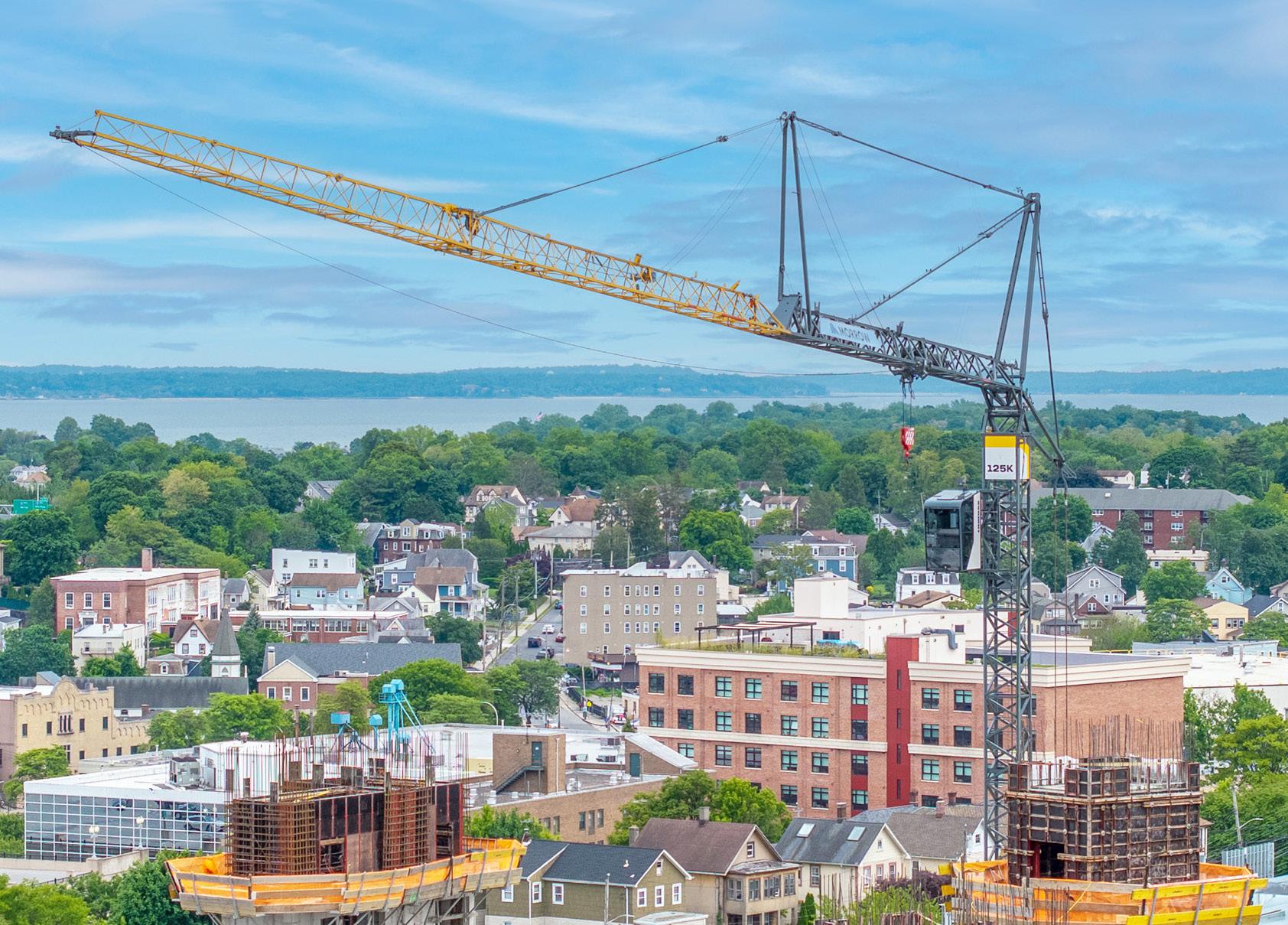
Liebherr’s renewed generation of self-erecting K cranes is tailored to meet the demands of the North American construction market. The models 43 K, 61 K and 91 K combine compact transport dimensions, powerful lifting capacities and exceptional adaptability on tight urban jobsites. In addition, Liebherr introduces a full suite of intelligent assistance systems that significantly increase precision, jobsite safety, and operator comfort. The existing 125 K, the largest self-erecting crane in the lineup, according to Liebherr. The new K generation also integrates Liebherr’s intelligent assistance systems. These automated functions support operators during challenging lifts, improve handling accuracy and significantly increase safety on site. With Vertical Line Finder, loads are lifted exactly vertically without diagonal pull. The system autonomously positions the hook above the load’s center of gravity, preventing dangerous side forces and protecting both people and sensitive components, stated Liebherr. For repetitive lifting cycles, Positioning Pilot offers substantial relief by storing up to three hook positions and two routes. The crane can automatically travel these paths with high precision, making it ideal for concrete placement, unloading processes and other tasks requiring repetitive movements.
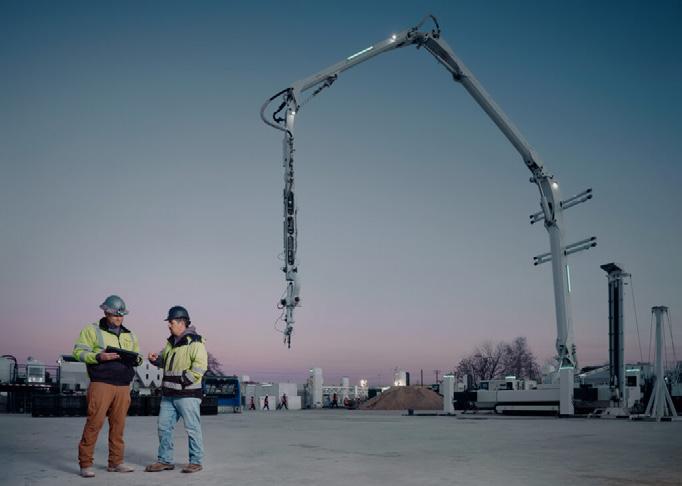
Palfinger and Icon collaborate to bring large-scale robotic 3D printing to construction
Palfinger, a global provider of crane and lifting solutions, has partnered with Icon, a U.S.-based robotic 3D printing company. With more than 90 years of engineering experience, Palfinger contributes lifting and handling solutions, modular system platforms, and large-scale robot expertise to Icon’s 3D printing ecosystem. According to Palfinger, together the partners aim to explore how robotic 3D printing can transform construc-
tion by increasing efficiency, safety and sustainability. A core element of the large-size robot system “Titan” is Palfinger’s Special Lifting Solutions, which enables the precise positioning, stability and scalability required for largesize robotic 3D printing systems. Initial prototypes of the Titan system have already been successfully tested, demonstrating readiness for industrial application, according to Palfinger. The solution reduces building costs compared to conventional construction methods and enables faster project execution with fewer and safer labour requirements.
The province of British Columbia is taking action to strengthen protections for workers and enhance crane safety by enacting legislation that enables a new WorkSafeBC crane licensing and permitting program. The province developed a new program that is based on recommendations from members of the province’s Crane Safety Table, convened by the Minister of Labour with industry, labour and technical experts to coordinate and accelerate action on improving safety. The province will introduce a new WorkSafeBC crane licensing and permitting program designed to ensure those overseeing crane work meet consistent, high-quality safety requirements. According to the province, workers who operate cranes in B.C. must be certified and registered with an oversight body, while others responsible for cranes (for example, those who own, maintain, repair, move, erect, disassemble or are otherwise responsible for cranes) are not required to be certified, registered or licensed.
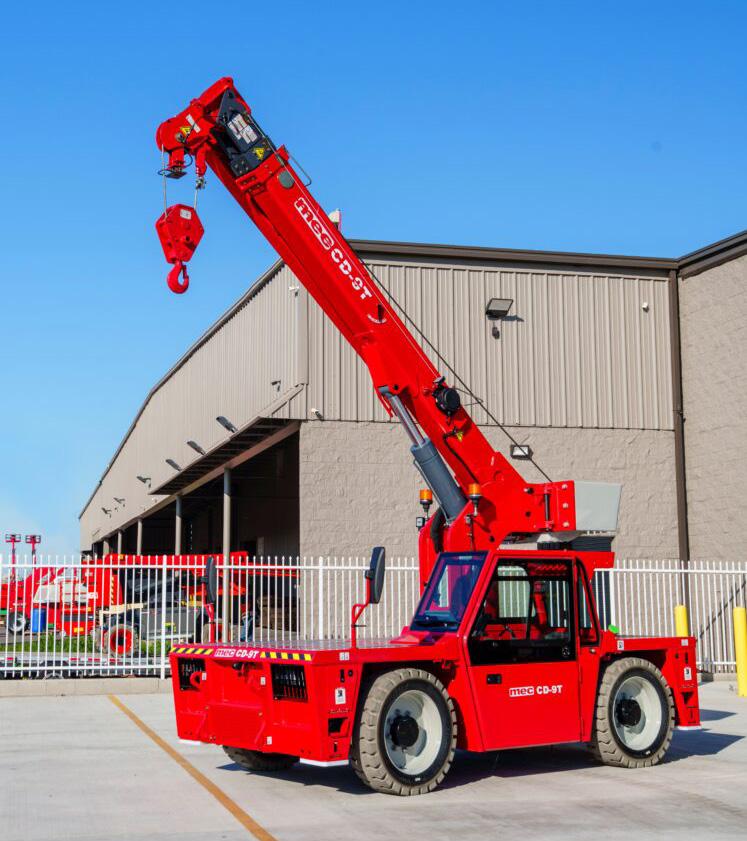
After analyzing their growth strategy, MEC decided to enter the crane market due to customer demand. The 9-ton CD-9T diesel carry-deck crane is designed to address long-standing pain points in a segment that has seen limited change for decades, explained Baxter. Rental companies expressed a need for more products in the carry deck crane market, which has felt underserved, said Baxter. The CD-9T includes a chassismounted, sideplaced engine and a clean boom design which minimizes obstructions, giving operators clearer sightlines around the jobsite. The CD-9T’s design improves sightlines with a low-profile design that provides 360° visibility, offers a more workable space in its comfort cab, and provides smoother positioning and placement control, while giving rental fleets a widely requested alternative in the 8–10-ton class.
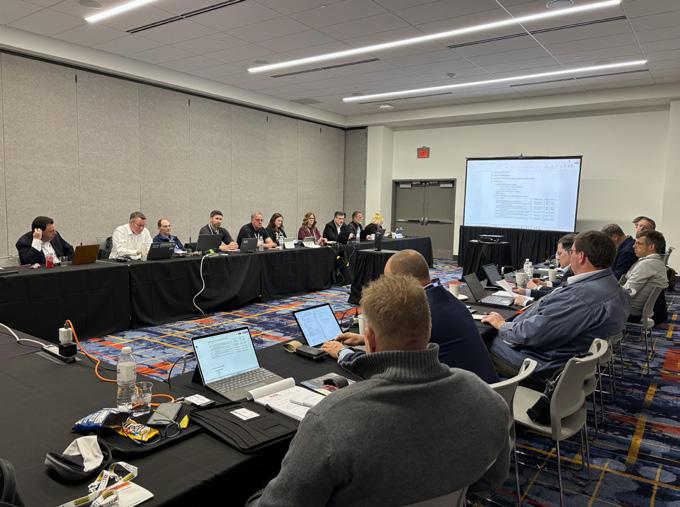
Since 2012, the International Crane Stakeholders Assembly (ICSA) has held meetings in conjunction with construction exhibitions in Germany, Australia and the United States. This year, the world met in Las Vegas. These meetings include separate user group and manufacturer group sessions, followed by a joint meeting in the afternoon. The ICSA’s work involves gathering global expertise to ensure that crane operations are safe, efficient, and in line with the latest standards.
Canada continues to increase capacity and expertise through these meetings, which contribute to the development of practical technical documents available to all members of the Canadian Crane Rental Association (CCRA).
In attendance were CCRA’s official representatives: executive director Claire Belanger-Parker; Jason Brown, member of the CCRA Technical Committee and technical project lead at Kova Engineering Ltd.; and Clinton Connell, executive director of BC Crane Safety.
Highlighting the CCRA’s progress on standards and regulations
CCRA updates included process on Canadian safety standards, such as CSAZ150 (Mobile Cranes), CSAZ248 (Tower Cranes), as well as information indicating that the CSAB335:25 Forklift standard will soon include rotating telehandlers. Rotating telehandlers have been addressed on multiple occasions during these meetings, and the development of a Canadian standard received positive feedback.
The CCRA briefly touched on the CSA-S6 Bridge Standard, which is currently under review, and its effort to ensure alignment to support modern crane transportation. CCRA representatives provided an update on the Rigging, Hoisting and Lifting standard development in discussion in various parts of the country. It remains to be determined whether Canada will achieve a national reference standard that provinces can adopt or whether the industry will continue to operate under a patchwork of
requirements that can lead to frustration and confusion.
Following the latest funding announcement from MITACS, the University of Alberta research lead, Mohamed Elgamal, joined virtually to provide an update on the Bridge Formula Research Project. The team outlined the upcoming bridge testing phase and shared the encouraging news that peer-reviewed academic articles will be released soon.
Lastly, the CCRA and the European Association for the abnormal road transport and mobile crane rental industry (ESTA) shared their concerns surrounding diesel emission fluid (DEF/AdBlue) and the challenges it presents for machinery worldwide. Recent regulator-request changes in Finland may present opportunities for broader regulatory adjustments.
Throughout the meetings, international partners also discussed workforce development initiatives, safety survey results, winch maintenance, proper weighing of mobile cranes, the CraneSafe Green Sticker Program, weights and dimensions harmonization efforts, Lift Operations Risk Management Guide, operator certification and licensing, and consideration of expanding ICSA’s scope to include transport and road access for mobile cranes. -
Reinforcing CCRA’s leadership role internationally was discussed in depth at the
CCRA’s Board of Directors’ annual Board Retreat, held February 2–3. The retreat provided an opportunity for the Board to step back from operational matters and engage in a structured strategic planning exercise aimed at validating priorities, assessing progress, and confirming longterm direction. The outcome of the retreat was clear and affirming. Through thoughtful discussion and strategic review, the Board confirmed that the association’s current trajectory remains the right one.
A key theme reinforced during the retreat was harmonization. The Board acknowledged that regulatory inconsistency across jurisdictions continues to create operational challenges for members, particularly those working across provincial boundaries.
To support meaningful progress in this area, the Board reaffirmed the importance of developing a national regulatory comparison matrix, which, as it is developed, will provide a clear overview of regulatory requirements across Canada. The CSA-Z150 compassion matrix has already been published, and further comparison matrices, such as other crane-related CSA standards, weights and dimensions, pilot cars, and driver permits, are being considered.
The February Board Retreat reaffirmed the CCRA’s strategic direction and strengthened alignment around key priorities.
With continued focus on harmonization, research, standards leadership, workforce development, financial sustainability, and digital modernization in addition to an active presence at influential forums such as ICSA and workforce development initiatives such as Skills Compétences, the CCRA remains well-positioned to advance the interests of its members and support the longterm success of the crane rental industry across Canada.
Claire Belanger-Parker is the executive director of the Canadian Crane Rental Association. For more information on the CCRA’s initiatives and upcoming events, visit www.ccra.aclg.ca
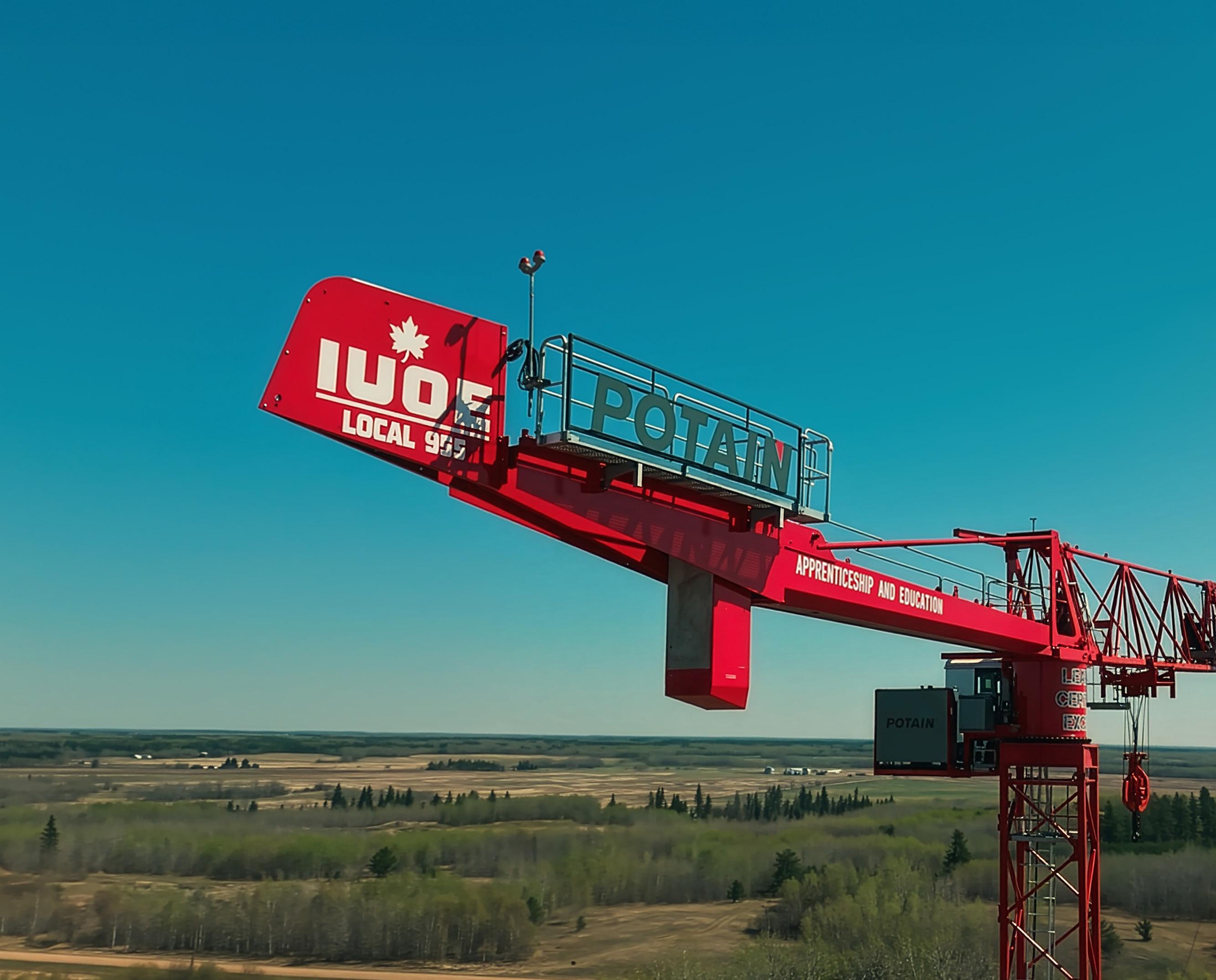
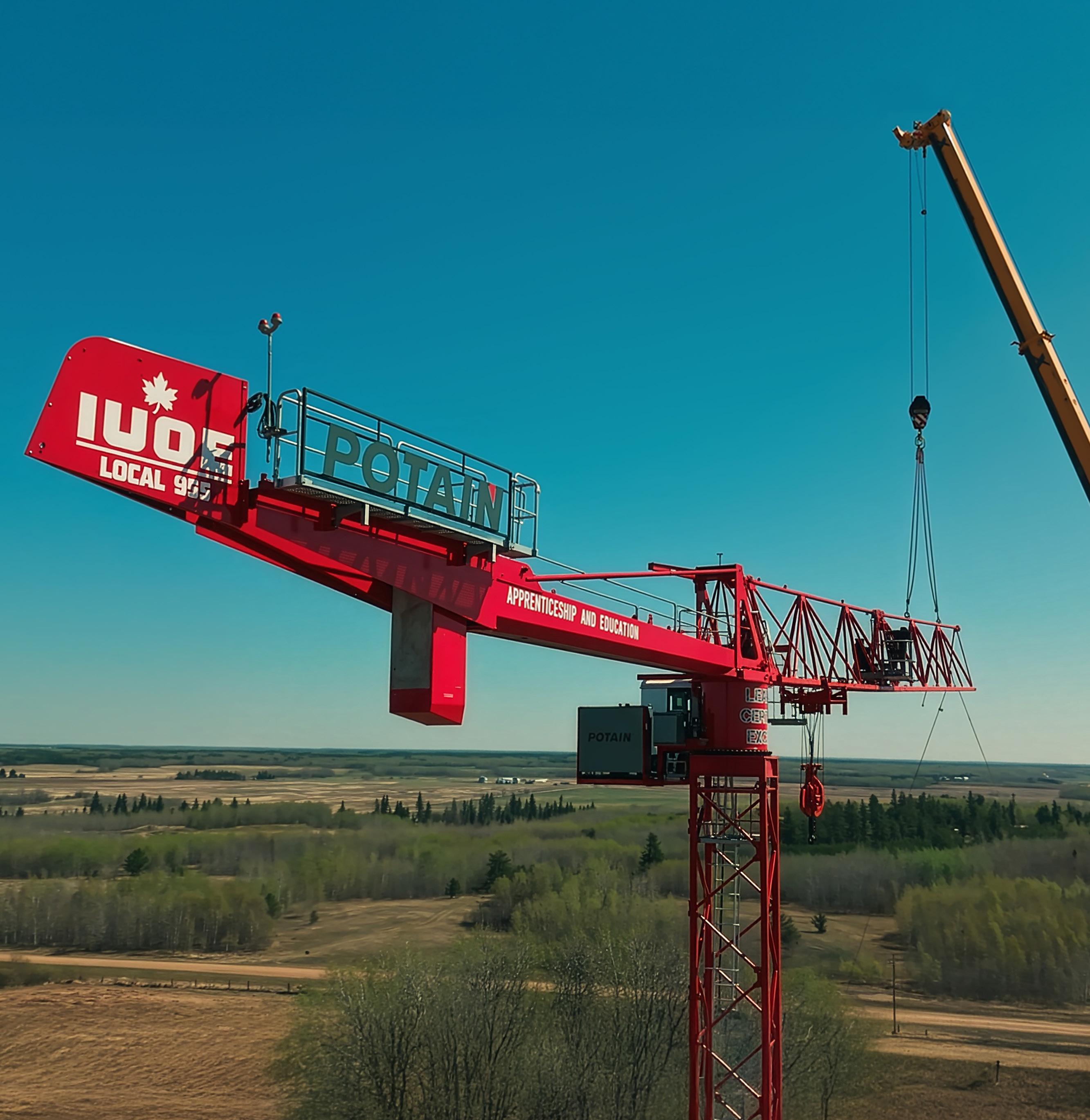
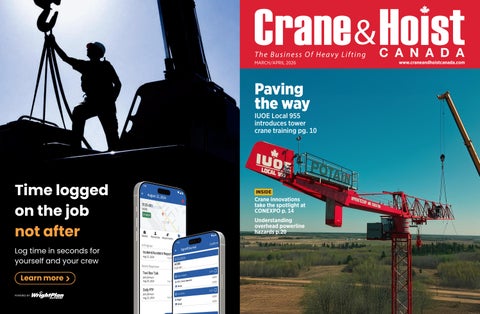
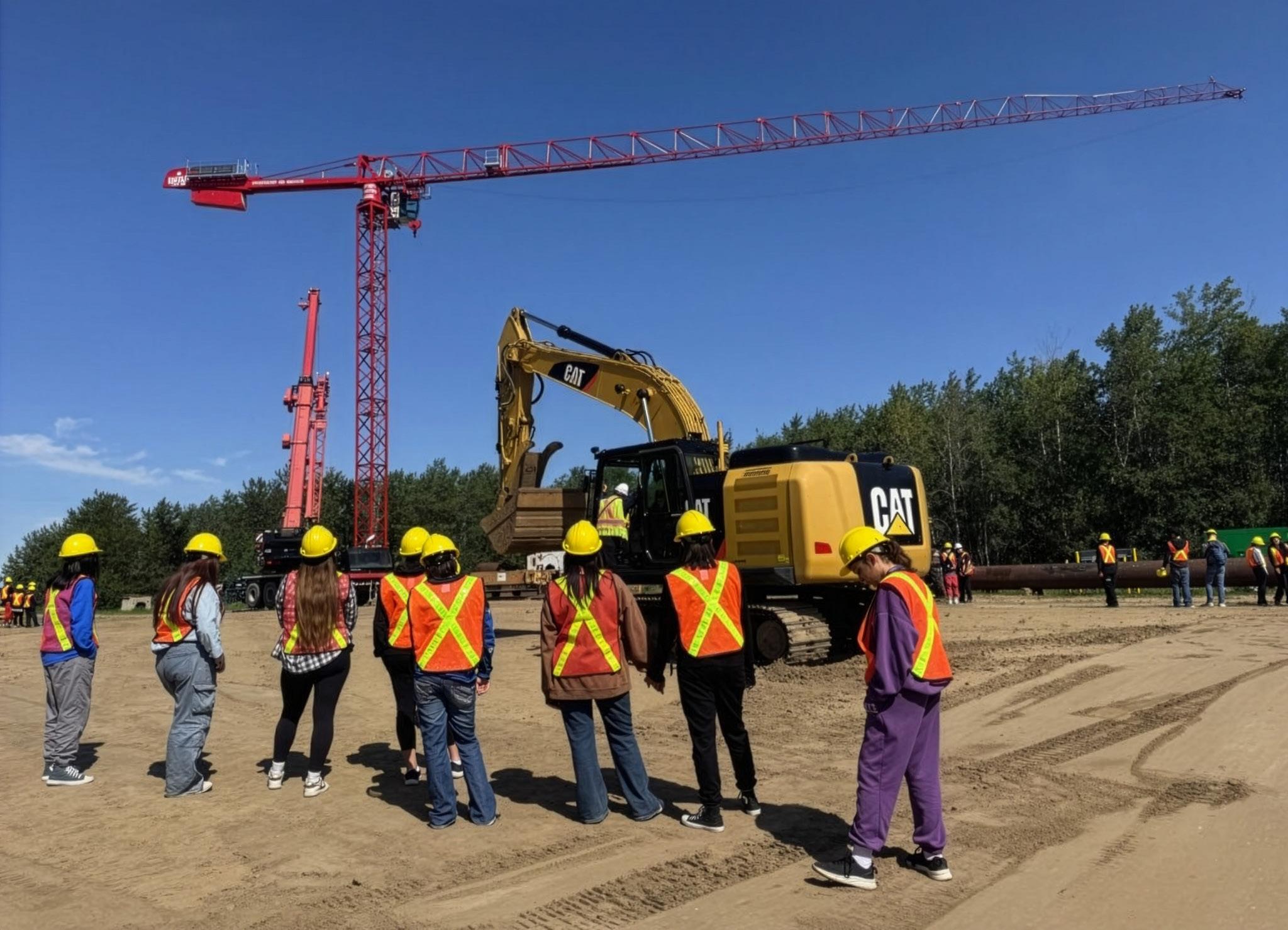
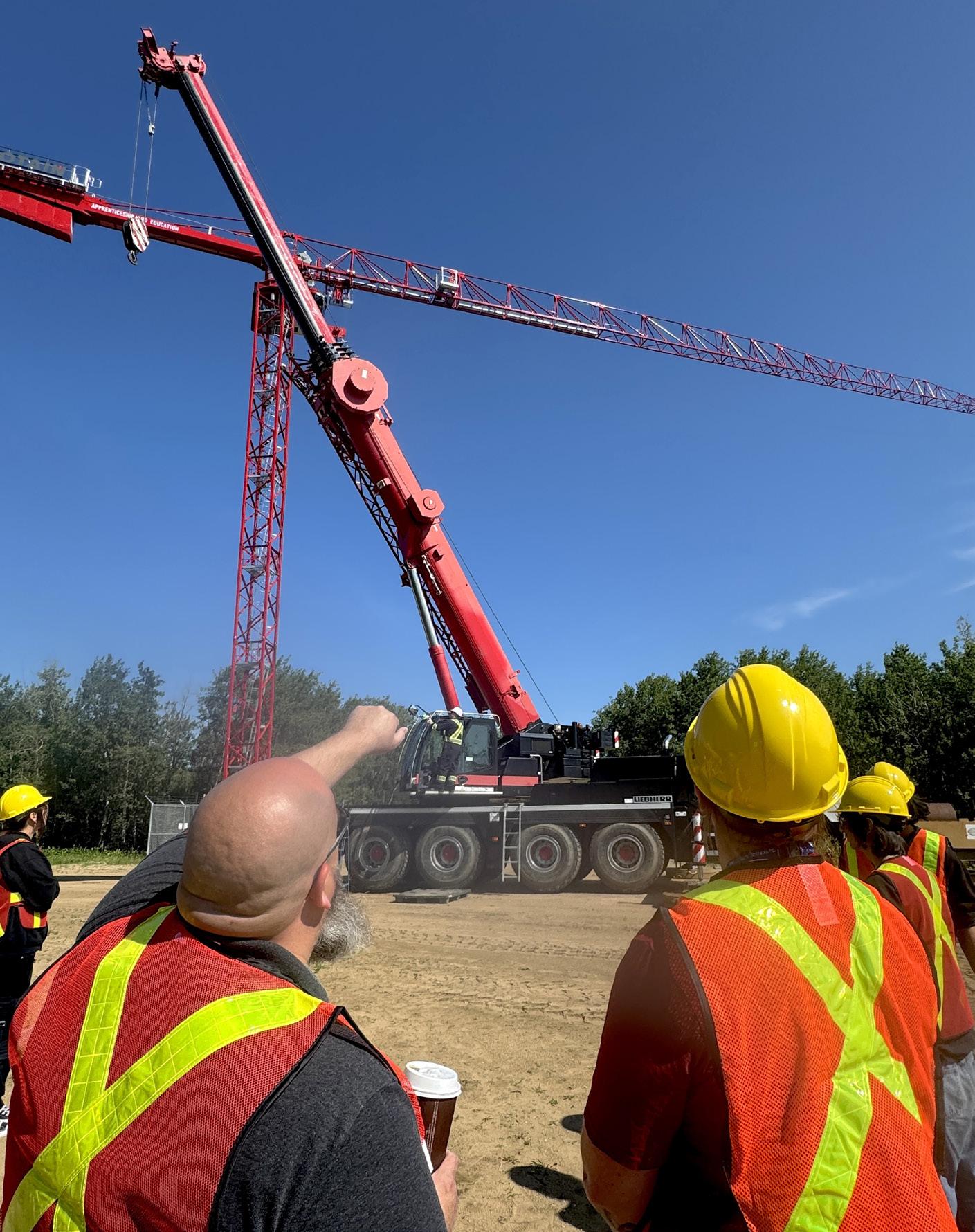
Last year, it was announced that the International Union of Operating Engineers (IUOE) Local 955 in Alberta would be offering tower crane training.
Notably, this includes the establishment of a Potain MDT 219-J8 tower crane for training purposes at the Local 955’s Budd Coutts Apprenticeship and Education Centre, which is said to be the first tower crane erected in the Prairies for the sole purpose of training and instruction (a second training tower crane has since been erected in Manitoba).
Declan Regan, president of the Local 955 and a former crane jockey himself, notes that there actually hasn’t been any technical training for tower crane operators available in Alberta. Before 2018, anyone who had a mobile crane ticket could run tower cranes, while those who had received a mobile ticket in the years since would need a second tower crane ticket. There is a gap that needed to be addressed, and the union were able to apply for and receive funding from the Canadian Apprenticeship Strategy to establish the training.
“With our own tower crane, we’re able to train our members,” says Regan. “Anyone who has a mobile crane ticket in Alberta [from] prior to 2018 can also run tower cranes. They’re not trained
on running tower cranes; they probably never spent any time in a tower crane. But their ticket gives them the ability to run a tower crane. So, this tower crane won’t only be used for new apprentices. The tower crane will also be used to skill-up current mobile crane operators. They’re already able to run the cranes legally, but now we’re able to skill them up so they’re able to go out there and actually perform the work.”
Technical training is about more than just proving that someone has learned something, Regan asserts. Sometimes, apprentices in the field can be afraid to ask questions, particularly tower crane operators who will usually be alone in the cab and may not be able to run something by a more senior person as easily as someone on a crew of pipe fitters or iron workers could.
“Having them come to school and making them feel comfortable, to make sure that they know to ask those questions and find out those pieces in a secure and safe place is important,” adds Regan.
Launching this June, the training will run for six weeks and will generally alternate between classroom days and practical days. Classes will be relatively small, six students between two instructors and will follow the Z248 standard, as overseen by Alberta’s
Apprenticeship and Industry Training (AIT). The Budd Coutts Centre also houses a school of rigging–the rigging training will not be compulsory, but encouraged and available, and those who complete it will have a separate rigging designation. Students will also have access to on-site simulators, but as helpful as those simulator sessions can be, having actual hands-on time will be huge.
“Not only for the training portion of it, but also the testing part of things,” says Regan. “Currently, testing is done on a live job site. So, if I’ve gone through my apprenticeship now, I need to go and do my practical test. The Alberta government has a third-party company that they use. That person will rent a crane or try to get access to a crane at a downtown office building in Edmonton or Calgary and have to go down there and do what amounts to currently 15-to-20 minutes to show that they know what they’re doing. Personally, I think that’s insufficient. You’d learn a lot from anyone running a crane quite quickly, but it’s very important that you spend time with them. When you have a tower crane set up at a training site, you have all the time in the world, and you don’t have to spend 15 or 20 minutes because you just rented the crane.”















































Filling an important gap
Sean Hlushak, an instructor with the Southern Alberta Institute of Technology, says that having this training available fills an important gap.
“Tower crane is a huge [gap] because we’re relying on industry to fill in the standards,” says Hlushak. “Not saying that the industry is bad at it, but there can be a huge discrepancy and a huge variation of the training programs, the training requirements and the competencies between the different companies.”
As it stands currently, a mobile crane operator can challenge the test to be able to run a tower crane, but Hlushak believes that the test is rudimentary. The threshold is low and there has been no designated or specialized training for the erection of tower cranes, which is crucial since several of the high-profile tower crane incidents in recent years have occurred during the erection or dismantling of the cranes.
Thomas O’Neill, University of Calgary professor and director of their Individual and Team Performance Lab, says that the lack of clear rigging standards is one of his key focuses. In speaking with counterparts in other jurisdictions, such as the UK or Australia, he says they are often stunned to hear there isn’t one clear, easily understood standard.
“They can’t believe what we’re doing, they’re like, ‘Are you serious? You have no rules, anybody can do anything, and that’s legal?’” relates O’Neill. “Yes, that’s the case. There’s no governing body. I think we need a governing body for that.”
While there is no overall governance for strict standards, Hlushak does note that the key to success in the 955’s program will be whether students can pass an AIT-approved test. Based on his experience with the counterpart AIT test for mobile cranes, it is fairly stringent–harder than a Canadian Red Seal test.
“My opinion is that 955’s practical test will be much harder and more representative of good practices than challenging,” says Hlushak. “Challenging is usually pretty rudimentary.”
Beyond Alberta, Bill Banks of the Calgary Construction Association notes that there is a significant need for national training standards for cranes. Those high-profile incidents in recent years have intensified these conversations, but they have been
“Seeing as gravity is the same wherever you are, there shouldn’t be a need for regional differences in training.”
– Bill Banks, Calgary Construction Association
ongoing for some time.
“The primary benefit is you have universal standards that everybody has to meet,” says Banks. “And seeing as gravity is the same wherever you are, there shouldn’t be a need for regional differences in training. That should just be a given. No matter where you are, physics works the same.”
The other major benefit of harmonized standards could be to alleviate some of the ‘race to the bottom’ when bidding. If safety and training standards are left to the companies themselves, then companies with higher safety standards may end up losing on bids to companies whose lower prices come at the cost of lower standards.
“If I’m bidding against people that have a half-arsed approach to these things and I’m carrying dedicated resources, I’m putting myself at a disadvantage,” says Banks.
This issue comes to a head for any workers who travel between jurisdictions, as they will have to learn all the specifics, and how
the provinces approach these topics can be very different.
“Where B.C. is going is when you go to assemble a tower crane or disassemble a tower crane, you have to let the regulator know, then the regulator comes out and vets the people and vets the assembly,” observes Rick Sikora, president and CEO of Cranemasters Hoisting + Rigging Training. “Alberta is not even going to be close to that in a long time. Harmonization really needs to happen.”
Hlushak expands on this point to add that in Alberta, Occupational Health and Safety generally listens to industry and change is driven in that way. In B.C., on the other hand, change is instituted from the top down, from the regulators to the industry. And, as Sikora notes, some provinces may be ready to make radical changes overnight, while others can take 10-15 years to make those decisions. O’Neill observes that provincial regulators can also be a roadblock to progress.
“I’m in disbelief that this is how things work,” says O’Neill. “The public does not know, they don’t understand. It’s a shock. I’m a member of the public on this one. Your provincial regulators have their own cultures and approaches to the issue of regulation, and they’re very different, and some are very quick to make change. So provincial regulators not being harmonized themselves is one of the barriers.”

By Macenzie Rebelo
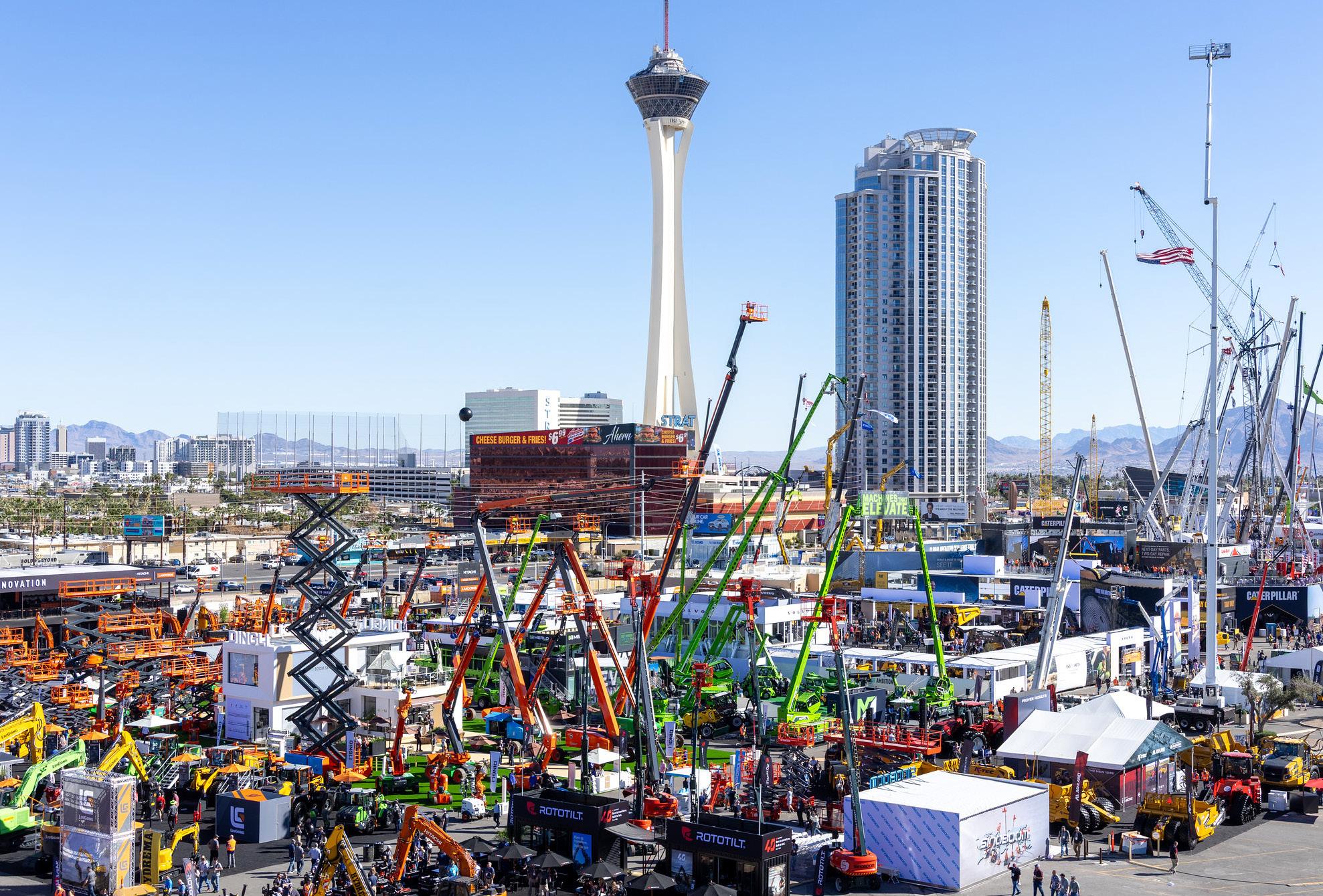
Every three years, CONEXPO-CON/AGG in Las Vegas, Nevada, attracts more than 2,000 exhibitors showcasing their latest products and services.
More than 140,000 attendees gathered at the Las Vegas Convention Center from March 2–6 for North America’s largest construction trade show.
There was no shortage of crane equipment and technology innovations this year, with common themes including sustainability, efficiency and ergonomic design.
Here are some highlights from this year’s show.
A1A Software showcased the next evolution of its digital platform at CONEXPO 2026, highlighting an expanding ecosystem of technology products designed to support crane, rigging, and heavy equipment operations across the construction industry. The company emphasized at the show that its technology portfolio has grown into a fully integrated ecosystem of planning, visualization, and operational tools built to support the entire lifecycle of a job.
A1A also highlighted its 3D Lift Vision, the first virtual crane simulator built from real lift
CONEXPO Festival Lot in Las Vegas, Nevada, 2026.
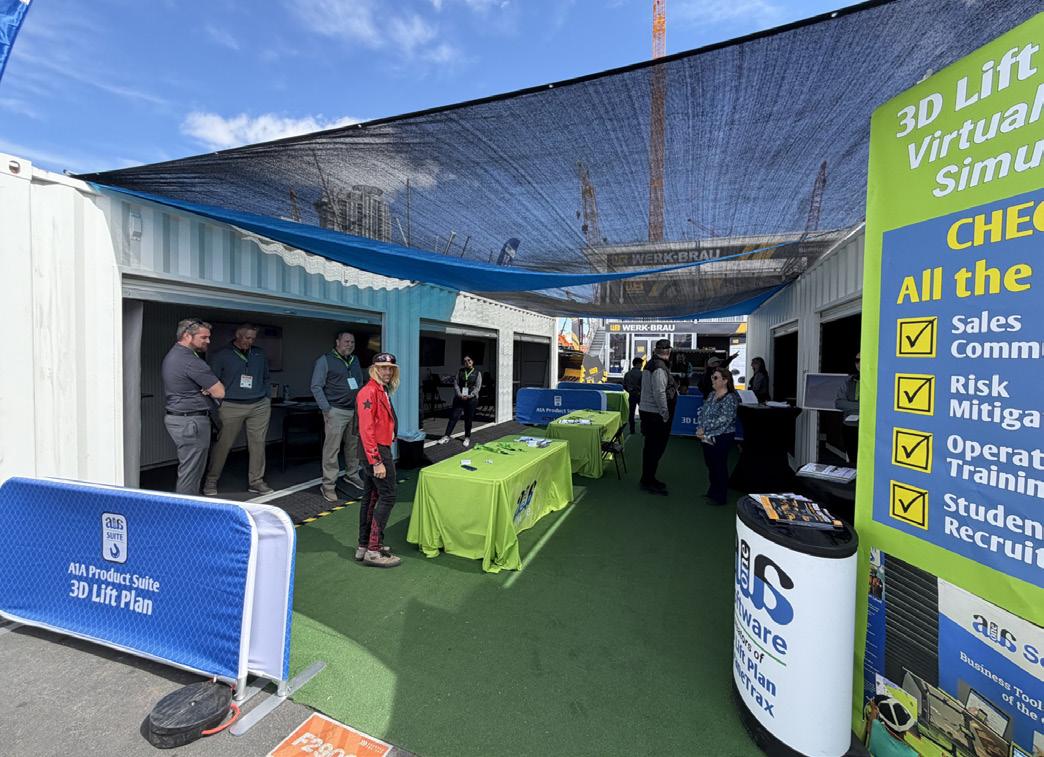
plans. The technology transforms lift plans into immersive simulations, allowing teams to evaluate lift scenarios, support training, and enhance project presentations
At CONEXPO, CM Labs showcased its Intellia Workforce Training System, a workforce development solution that standardizes, manages, and scales simulation-based operator training. Designed for organizations scaling profes-
sional simulation-based training programs, the Intellia Workforce Training System supports consistent, accountable training with measurable results. The training curriculum offers structured and simulator-based exercises, hands-on skill development, alongside web-based content for theory and preparation. AI has been utilized in the training workflow, explained Lisa Barbieri, VP of Marketing & Strategic Partnerships. The AI Assistant takes on questions and tasks,
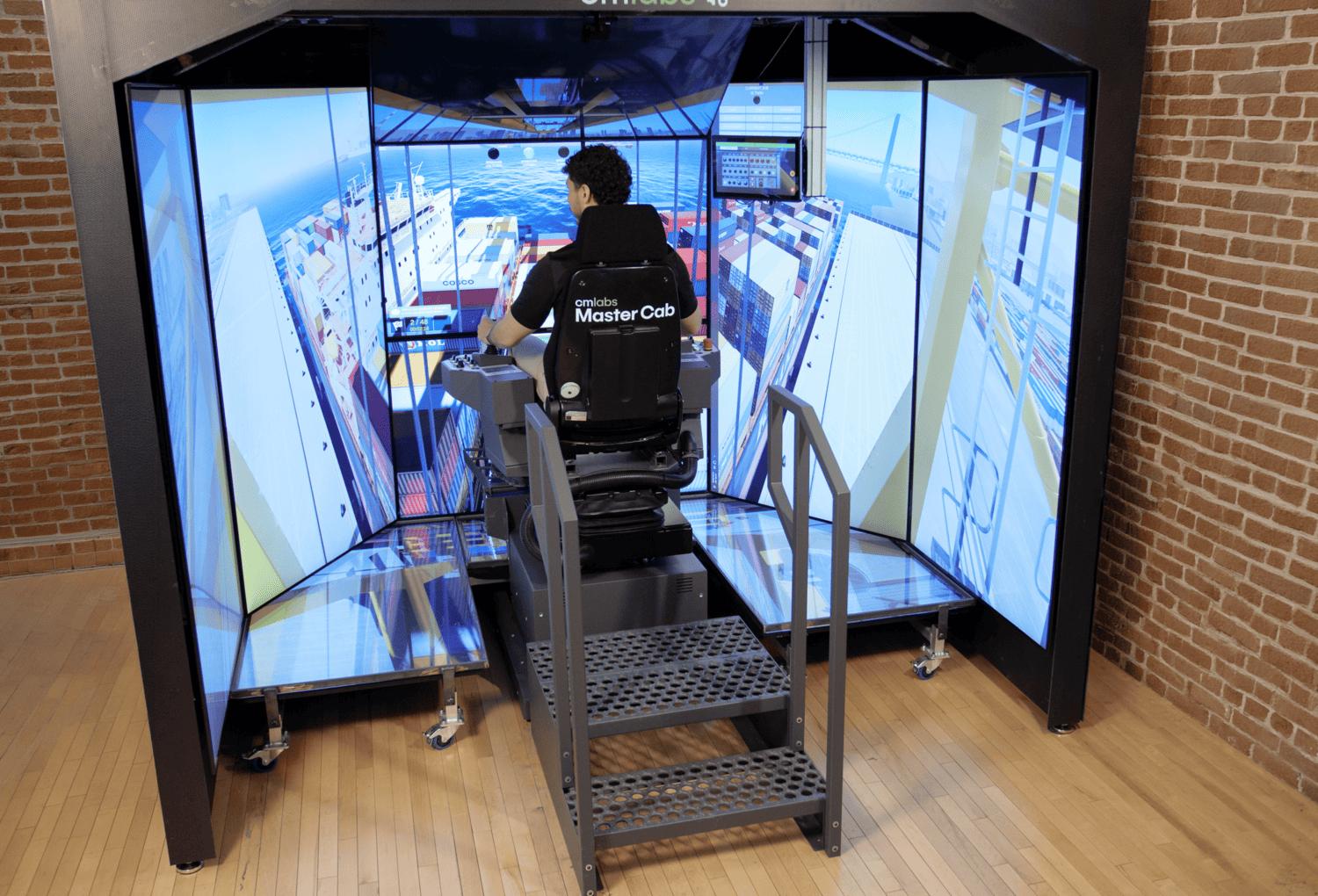
reducing manual overhead, helping keep sessions moving, and allowing instructors to focus on coaching.
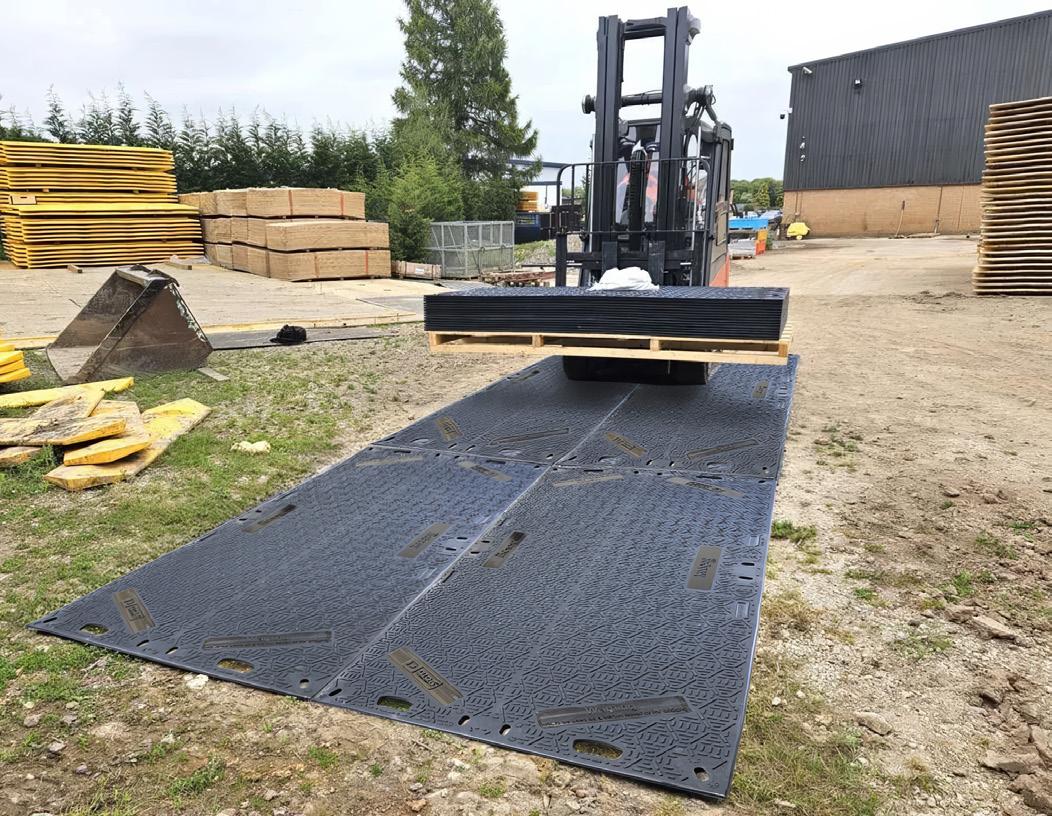
At CONEXPO, DICA showcased its new line of ground protection outrigger pads, the Ranger HD. The new matting system addresses the growing need for safer access, improved load distribution, and reliable surface protection across construction and infrastructure, stated Kris Koberg, CEO of DICA. “This product is designed for realworld jobsites where ground conditions are anything but ideal. When operators are faced with uneven, soft, or sensitive surfaces, this product provides a practical solution that improves safety, protects the ground, and keeps work moving efficiently.”
Ranger HD is a lightweight ground protection mat intended for temporary installations where surface protection
and rapid deployment are priorities. It is ideal for protecting poured concrete, asphalt, lawns, and other sensitive surfaces from wheeled or tracked equipment such as skid steers, telehandlers, boom lifts, and support vehicles. Dual-sided tread patterns support both wheeled and tracked equipment, while multidirectional nubs maximize tire grip. Ranger HD mats measure 95” x 47.25” with a half-inch core and weigh 80 lbs. Built-in handholds allow one- or two-person crews to reposition mats throughout the workday without machinery, reducing labour and setup time.
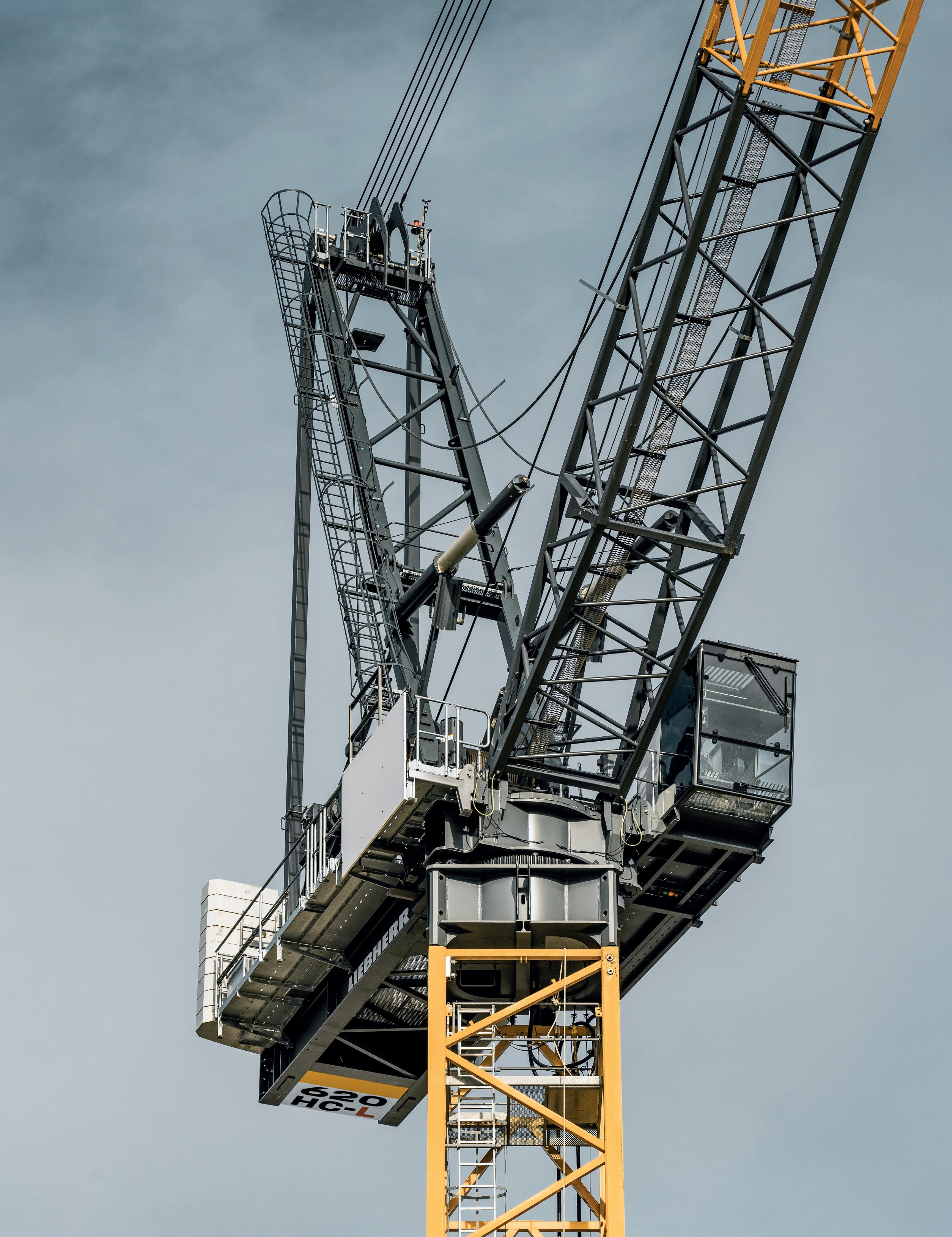
Liebherr has expanded its product portfolio with the debut of the 195 HC-LH 6/12, a new hydraulic luffing jib crane designed specifically for dense metropolitan environments. At CONEXPO, Liebherr highlighted the crane’s luffing-jib and hydraulic system, enabling
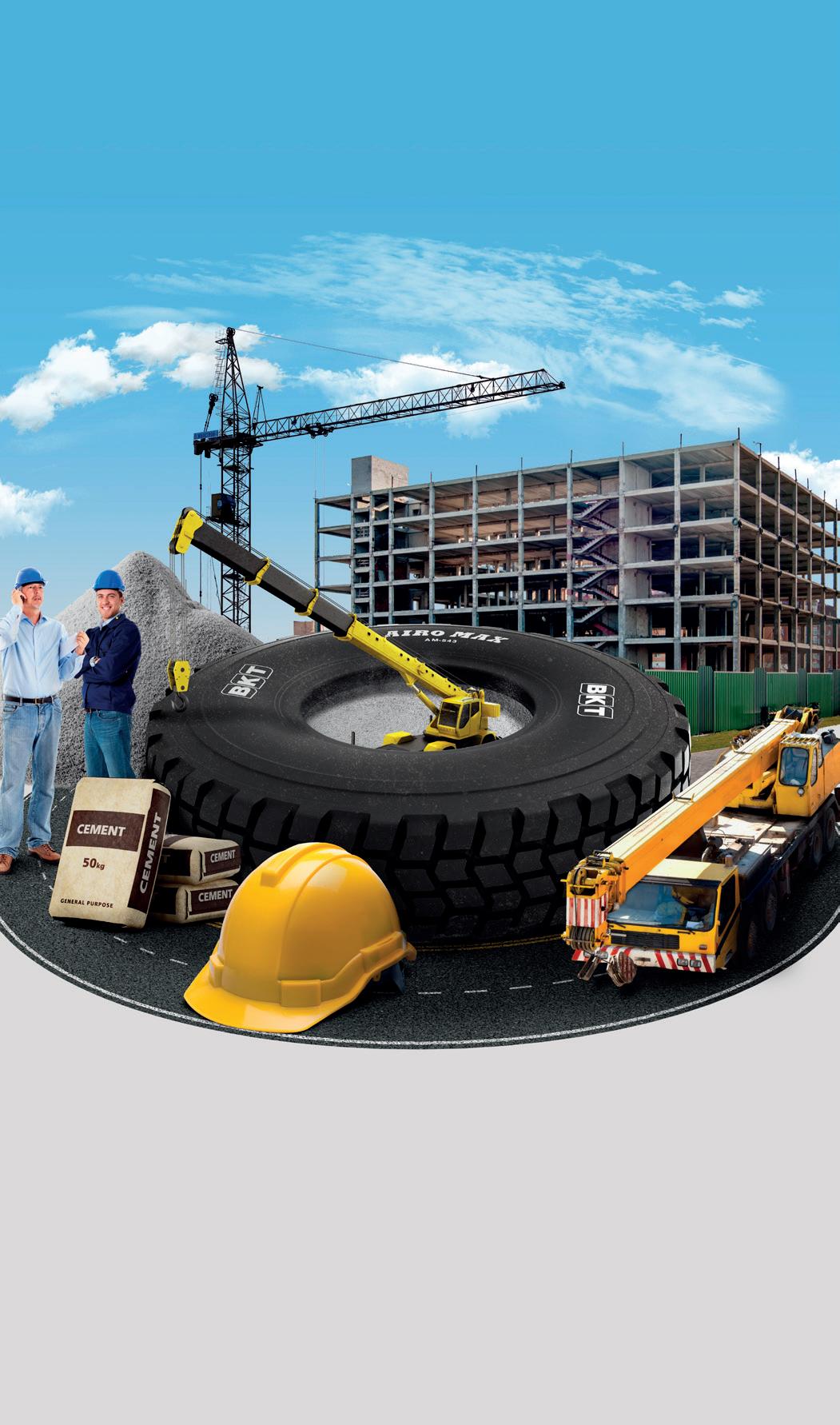
With outstanding traction and stability, AIROMAX AM 543 is the ideal BKT’s tire for construction applications with cranes. As crane tires are subject to particular stress and extreme usage conditions, AIROMAX AM 543 has been designed for providing excellent heat resistance. Besides, it is suitable for all operations requiring a high level of handling.
Joe Dias
Eastern Zone Manager
Directeur Régional, Est du Canada
BKT Tires (Canada) Inc.
Cell: 514-792-9220
Web: www.bkt-tires.com
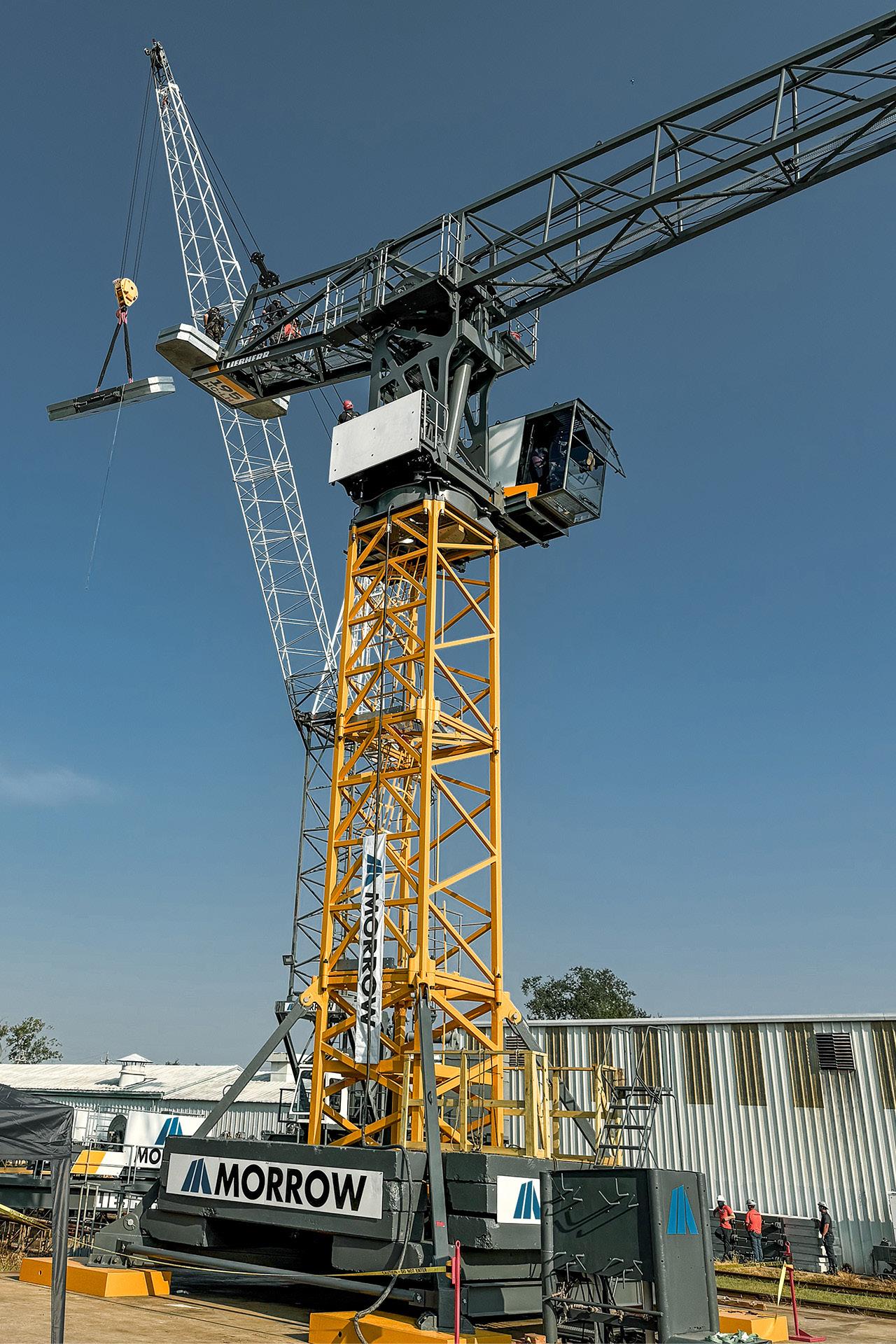
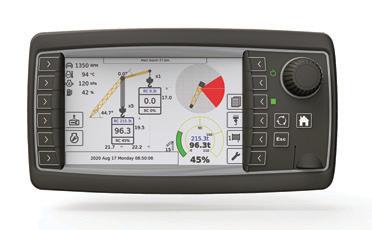
full luffing in under 90 seconds. The 195 HC-LH offers a maximum load capacity of more than 26,400 lbs (12,000 kg) in single-fall operation and lifts over 5,600 lbs (2.550 kg) at its maximum radius, stated Liebherr. Additionally, the 195 HCLH is equipped with Liebherr’s latest Tower Crane Operating System 2 (TC OS 2), a modern control interface that allows operators to customize display settings and manage all crane functions.
Link-Belt Cranes displayed its 90|RT 2 Rough Terrain Crane at this year’s event. The 90|RT 2 is fitted with a 38–140foot five-section pin and latchformed boom with optional 16-foot boom extensions and
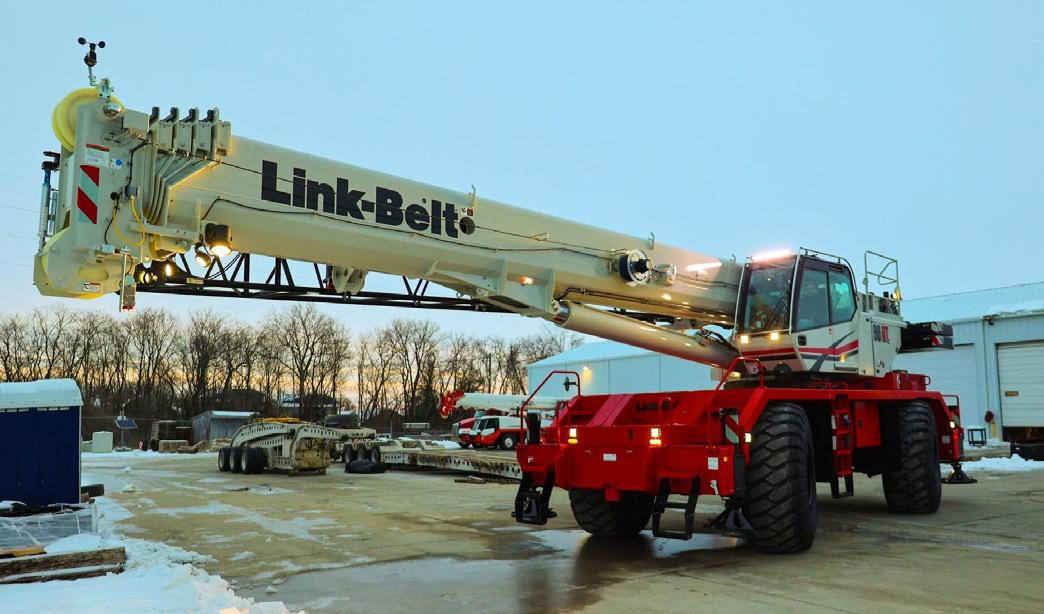
serves as Link-Belt’s next-generation 90-ton-class crane. The 90|RT 2 offers a fully rigged transport under 94,000 lbs (42 638 kg) with counterweights removed and one fall-off load.
“The 90|RT 2 boasts a very strong chart with no deductions in the lift chart when telescoping a load,” said product manager for Rough Terrain Cranes, Kelly Fiechter.
6 Palfinger
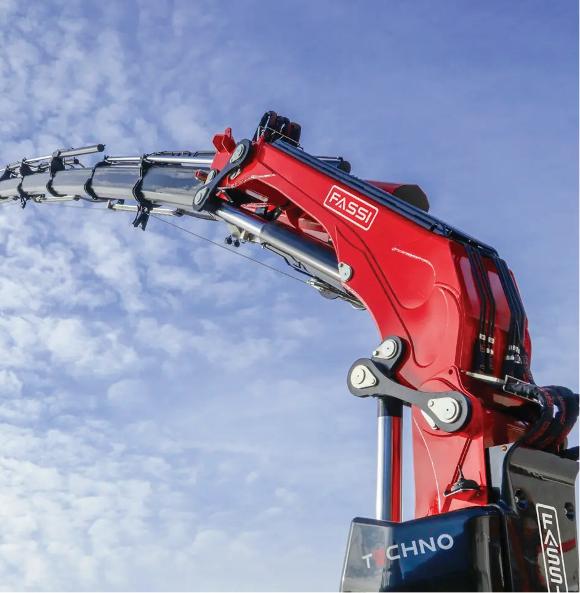
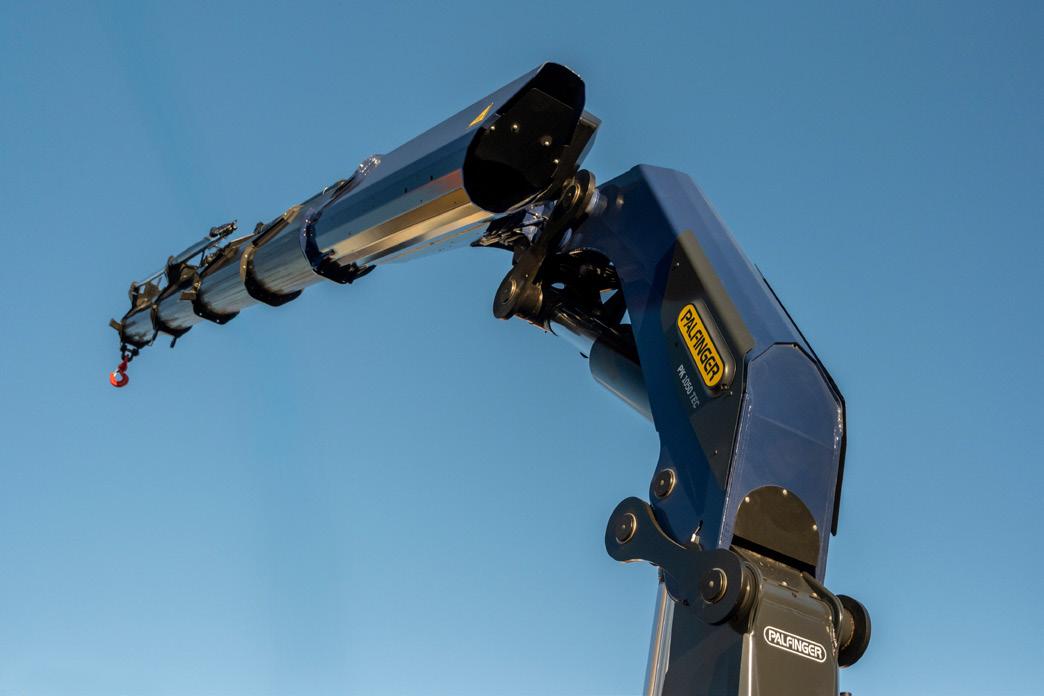
Palfinger showcased the PK 1050 TEC knuckle boom crane, which offers precision and lifting performance with an advanced design. This heavy-duty crane offers easy control, power, and efficiency. The extra-rigid and lightweight P-Profile boom allows for greater payload, and with the optional
7
assistance system Memory Position, the cranes can store up to four coordinates for faster, more precise control. Greg Sneek, product manager with Palfinger North America, explained, “This crane does all the heavy lifting and is designed with the precision needed to execute long-reach maneuvers.”
7 Raimondi’s Terex Rough Terrain
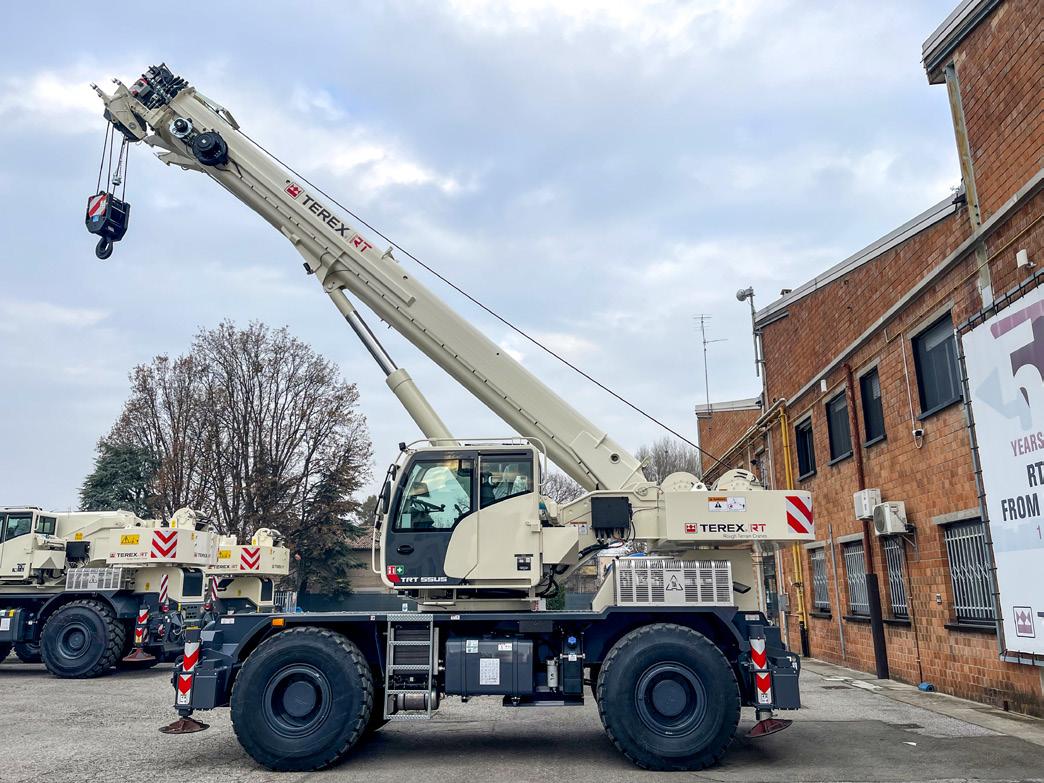
Debuted under Raimondi’s North American banner, the newly established North American entity, Terex Rough Terrain, presented the TRT 55US at CONEXPO. Designed and developed in Italy by the Terex Rough Terrain team and shaped by customer insights gleaned
from the American market, the new 55t model builds upon the proven engineering foundations of Terex’s range, now fully integrated within the Raimondi portfolio. Reaching a maximum tip height of 130ft with the main boom, the TRT 55US may be equipped with an additional 26.25ft jib, thereby extending the maximum tip height to 157.5 ft for demanding lifting applications.
“This is our first step of diversification,” said Luigi Mag-
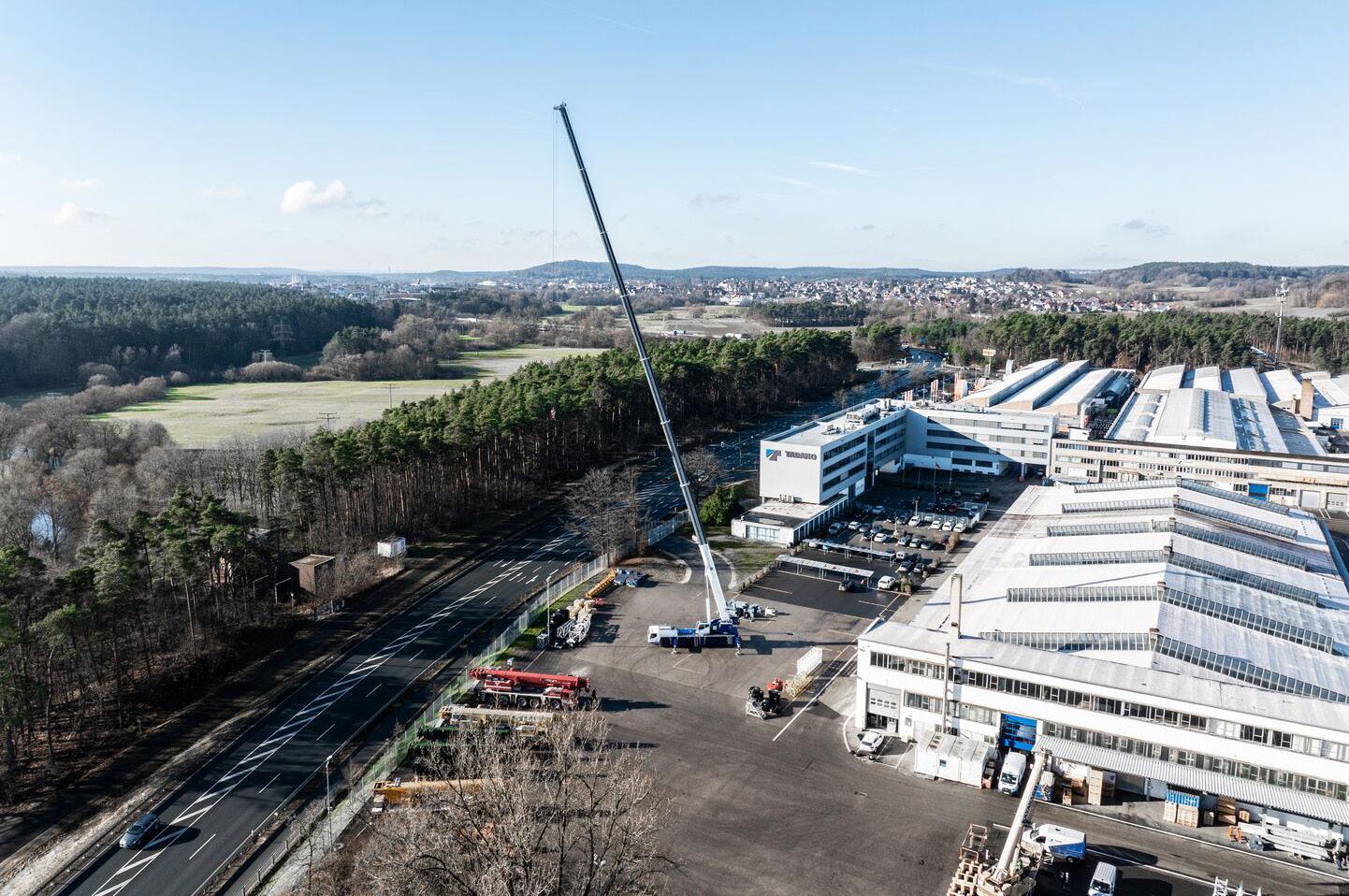
tension is 98.4 feet and is designed for urban applications. The AC 5.250L-2 offers a load moment up to 736 mt, explained Peter Kleinhans, project manager at Tadano. This high load moment is achieved with a working radius of 23 feet, a 44.3-foot-long main boom and a load weight of 231,920 pounds. In addition, Tadano offers an optional heavy-lift attachment for even heavier loads up to 305,780 pounds on the short boom with additional sheaves.
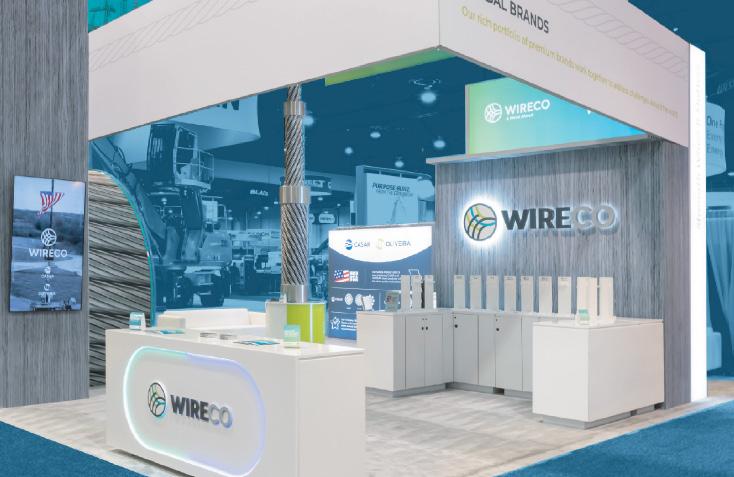
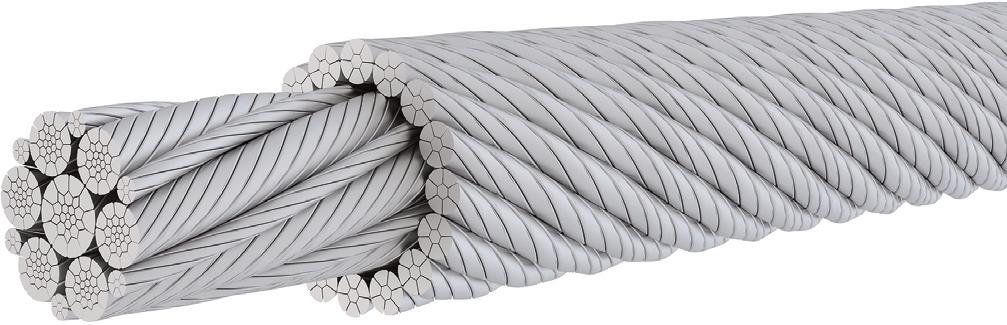
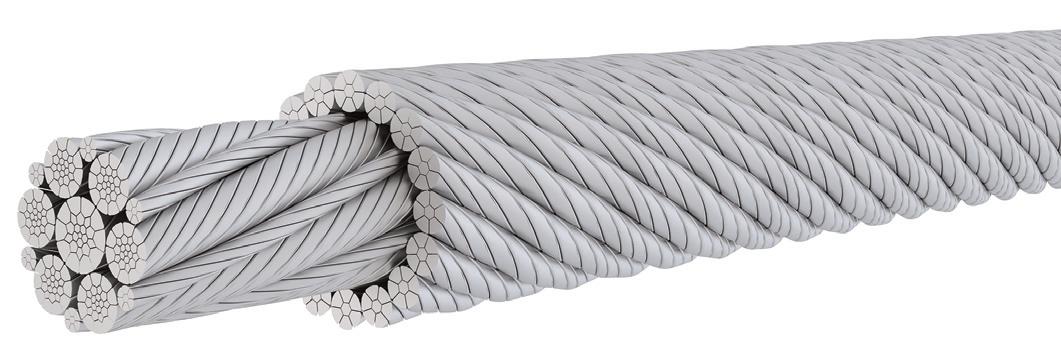
At CONEXPO, WireCo highlighted the Casar Lazerlift, a rotation-resistant hoist rope developed for use in large telescopic cranes, crawler cranes, and high-capacity tower cranes. According to Timothy Klein, senior principal engineer with WireCo, Lazerlift was developed
for demanding lifts and offers consistent spooling behaviour with high minimum breaking force. In addition to the Lazerlift, WireCo showcased the Casar Boomlift, a steel rope designed for use as an adjustment rope in boom hoist applications on telescopic, crawler, and large tower cranes.
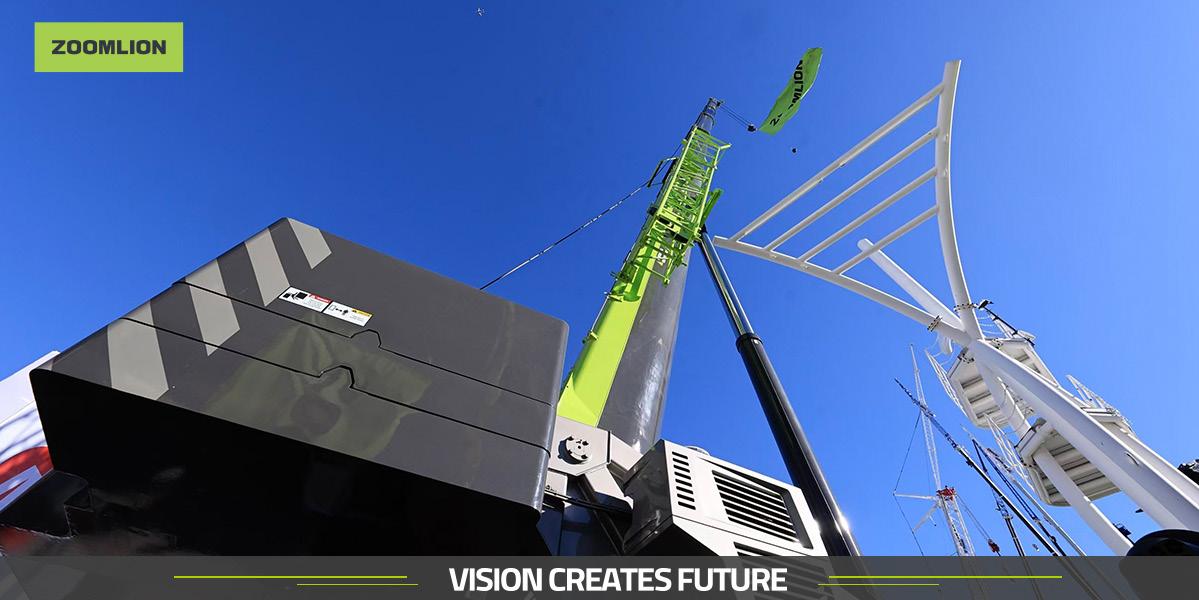
Zoomlion showcased its ZRT1500V6 rough-terrain crane, developed for the North American market. The crane features a six-section 198.5-foot elliptical boom and is designed to meet regional lifting and mobility requirements. Its self-loading counterweight system allows transport weight to remain within local road limits, which supports efficient relocation between job sites, stated Zoomlion.
gioni, Group CEO of Raimondi Cranes. “We are aiming to have a more diversified conglomerate. This rough terrain crane complements the tower crane products well.”
Tadano spotlighted the all-terrain crane model AC 5.250L-2 at CONEXPO. With its 259.2-foot-long main boom, this 5-axle machine is at the “top of its class,” stated Tadano. The maximum main boom ex-
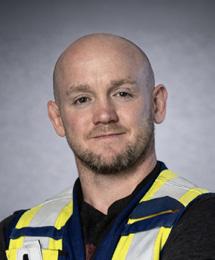
BY DAVID MONTEITH
Finding and keeping skilled workers has become increasingly difficult.
So how do we, as crane companies, improve employee retention?
Firstly, we need to remember we aren’t looking for ‘skilled workers,’ we are looking for people. Human beings.
It is so easy to begin contextualizing people as commodities. Commodification can often happen as a company attempts to divest itself of emotion when dealing with business matters. Is this wrong? Not necessarily. For a business to be successful in ever more competitive industries and fluctuating economies, some measure of detachment is bound to occur, especially when difficult decisions are required. ‘The cost of doing business,’ perhaps.
However, to simply state that people are not commodities may be a little too cliché. People are a resource, the most critical resource there is. People find the work. People do the work. People, ultimately, are the reason we have work. So, how do we attract and retain people while also running a successful business?
Where do we start? Before we work towards keeping people, we need to bring them in. How? Well, in short, we need to be a place that people want to be. Luckily, for the most part, craning is a very attractive trade within the construction industry as the jobs are generally well-paying, well-respected, and by contrast to most other trades, do not require a lot of back-breaking labour.
Great! People want these jobs. As employers, we generally want the ‘best’ people, but finding and attracting them can be a tough task. How about looking for the ‘right’ people?
What do I mean by the right people?
Perhaps the simplest answer to this is to say that the right people are those who fit your culture. When you bring in people who fit in well with your current team and share the same vision as your company about how work is to be completed, they are likely to hit the ground running–as the adage goes, “first impressions last forever.”
People who find they fit in well with a company right away are more likely to have

a positive and lasting initial impression of the company than they are when they start somewhere that they feel out of place. A positive first impression sets the stage for how an employee will perform their work, how they’ll represent themselves and the company, and ultimately, how they’ll perceive their employment and future with the company.
People, for the most part, want to fit in and feel like they belong. Trying to fit a square peg into a round hole didn’t work in kindergarten, and it doesn’t go any better in the workplace. Take an honest assessment of the vision your company has towards process, efficiency, safety, and teamwork, among other priorities. When you interview prospective employees, take a little extra time to get to know a bit about them as a person, and assess if they are the right fit for your team.
If you’re looking at a new opportunity, the same goes for you. Ask questions about a company and get a feel for where their
focus is and ask yourself honestly if the workplace aligns with your personality and your preferred way to operate. As good as the money may be, if the company isn’t the right fit for you, the likelihood of you wanting to be there long-term is low.
There will always be situations where you need someone now, or you need a job now, but where feasible, remember the sports mantra, “bend, don’t break.” Keep your focus on not just finding somebody but finding the right people. When the right person fits, they’ll be far more inclined to stay. Having people who want to be where they are will always be one of, if not the biggest, building blocks towards a strong and productive culture, and ultimately a successful company.
David Monteith is the safety, HR, and fleet manager for Calgary-based McIntyre Crane & Rigging Ltd. An NCSO and graduate of the University of Alberta Occupational H&S Program. David specializes in safety program development and maintenance, training, and company culture management.

BY ALBERT WANG
Wind is one of the most significant and unpredictable hazards on any worksite involving cranes, turning “normal” lifting into a high-risk operation in seconds.
American National Standards Institute (ANSI) documents indicate wind as the second leading cause of crane-related accidents globally between 2000 and 2010. Wind is deceptively hard to judge from the ground: conditions at ground can feel manageable while, 80 m up, a large-area load can behave like a sail in turbulent gusts. Wind should never be treated as “just weather.” It is a side load applied to the crane, the rigging, and the load. Because wind pressure increases with the square of wind speed, small increases can create dramatic rises in force.
Understanding the standards: Your rules for wind
There is no single wind limit that applies to every crane or every lift. Operators must follow, in order:
1. Manufacturer’s instructions (for the specific make/model and configuration)
2. The applicable standard and regulation
3. The site’s more conservative limit (when conditions demand it)
In British Columbia, WorkSafeBC’s OHS Regulation requires work to stop if the load cannot be handled safely because of wind. For tower crane operations, unless the manufacturer specifies a lower maximum permitted operating wind speed, 50 km/h applies.
To support accurate decision-making, an anemometer must be mounted on the crown, apex, or operator’s cab of each tower crane, providing real-time site wind information that reflects conditions at the hook. The regulation also reinforces two often-missed controls: do not add signs or attachments that increase surface area without manufacturer or engineer authorization, and do not erect, operate, or dismantle above the manufacturer’s limit for that activity.
Two CSA standards provide essential frameworks:
• CSA Z150-16 (Mobile Cranes): Requires
the manufacturer to provide maximum allowable wind speeds for operating and out-of-service conditions. Limits vary by crane configuration (boom length, radius, jib, counterweight) and by the load’s “sail area.” The standard also prohibits personnel lifting when wind speeds exceed 25 km/h.
• CSA Z248-17 (Tower Cranes): Mandates adherence to manufacturer wind limits. For erection, climbing, or dismantling, operations must stop above the manufacturer’s limit, or 32 km/h if unspecified. For general operation without manufacturer guidance, the limit is 50 km/h. Continuous wind monitoring via a calibrated anemometer near the upper slewing ring is required, with sensors kept unobstructed and regularly maintained.
Key factors in wind safety assessment
Beyond the standards, managing wind risk requires evaluating several dynamic factors. Even among similar cranes, manufacturers can set different limits—and your ‘stop work’ point may be lower depending on the lift, conditions, operator comfort, and other factors. The tolerance for wind for crane operations changes dramatically with the task and types of cranes.
• Personnel lifts: CSA Z150-16 prohibits mobile crane personnel lifts above 25 km/h. While tower crane standards lack an explicit numerical limit, industry best practice applies a 50 per cent safety factor to the 50 km/h operational limit—resulting in a 25 km/h maximum for all personnel lifts.
• Load characteristics: Limits vary by crane type and load. A lattice-boom crawler crane with a large sail area will have a lower operational wind limit than a smaller rough-terrain crane.
• Manufacturer specifications are mandatory: Always defer to the operator manual. Different manufacturers set varying limits for similar cranes based on design and stability calculations. Manual limits override all general guidelines.
• Wind gradient: Wind speed increases with height. Conditions that feel calm at ground level can be dangerously strong
at the boom tip or load. Operators must anticipate this gradient, especially when making high lifts.
• Gusts vs. wind speed: 40 km/h gusts pose a greater risk than 40 km/h sustained wind. Gusts create dynamic shock loading and sudden load swing. Base decisions on maximum gust speed, not averages.
• Urban canyon effects: In cities, wind accelerates through building corridors (channelling) and creates violent turbulence on leeward sides. Urban crane operators must recognize these microclimate hazards.
Before the lift:
• Confirm which wind limit applies and choose the safest option (manufacturer, regulation, or site threshold)
• Identify high sail-area loads (formwork, sheets, or cladding)
• Use tag lines or other effective means to control the hazardous movement of a load
• Build a clear stop-work trigger that considers gusts, urban effects, and operator comfort
During the lift:
• Monitor wind continuously
• Stop early if control deteriorates — control is the first warning sign, not the last
Managing wind is a proactive process. It begins with a thorough review of manufacturer limits and site-specifics. It requires continuous monitoring with the right tools and an understanding of the site’s microclimates and operator competency. Every operator, rigger, and supervisor must understand that:
• Wind is an external structural load
• Gusts create unpredictable hazards
• Height amplifies risk
• Manufacturer limits are binding Stopping early is always safer than pushing limits. By respecting this invisible force, we ensure that every lift concludes as safely as it began.
Albert Wang is a quality control policy engineer (HS&E) with BC Crane Safety.
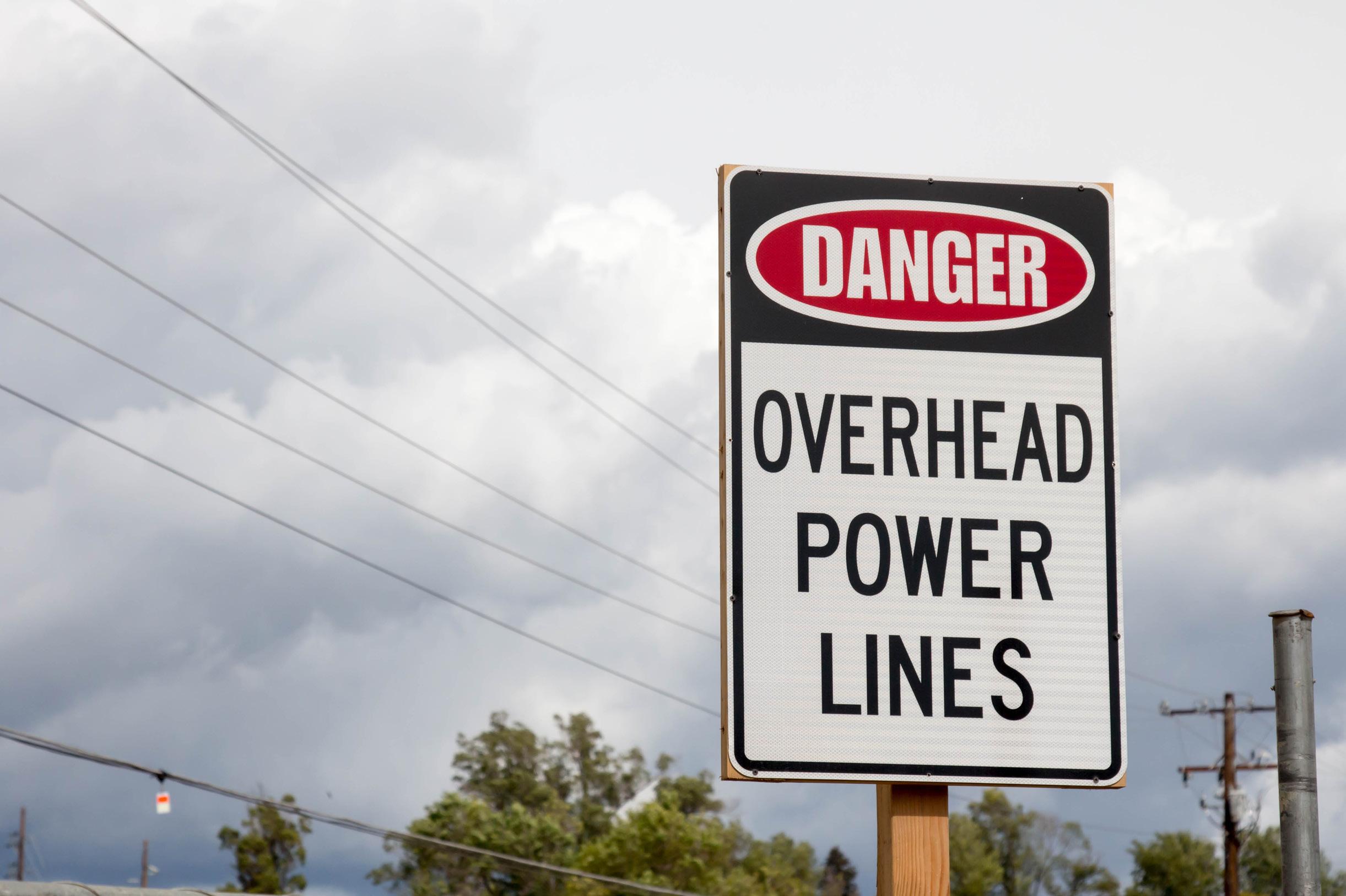
Understanding overhead powerline hazards while operating mobile cranes. By
Macenzie Rebelo
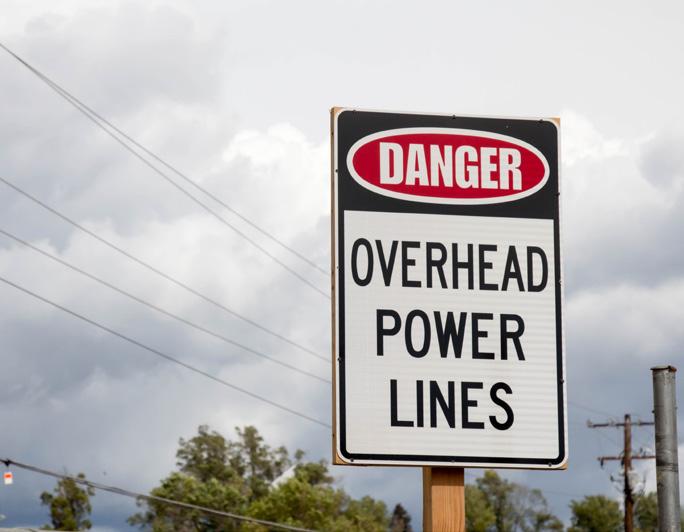
When an operator is working around overhead powerlines, it is crucial that all safety measures are strictly followed to prevent serious injury, or in many cases death.
A safety-first mindset and workplace culture is essential for crane operator safety, even if it feels like a tedious task when production pressures are high.
For Patrick Falzon, powerline safety advisor at the Electrical Safety Authority (ESA), reducing overhead powerline contacts and developing initiatives that foster electrical safety literacy are at the core of his work.
He joins Crane & Hoist Canada to share his expertise on powerline safety.
Why are overhead powerlines the most serious hazard in mobile crane operations?
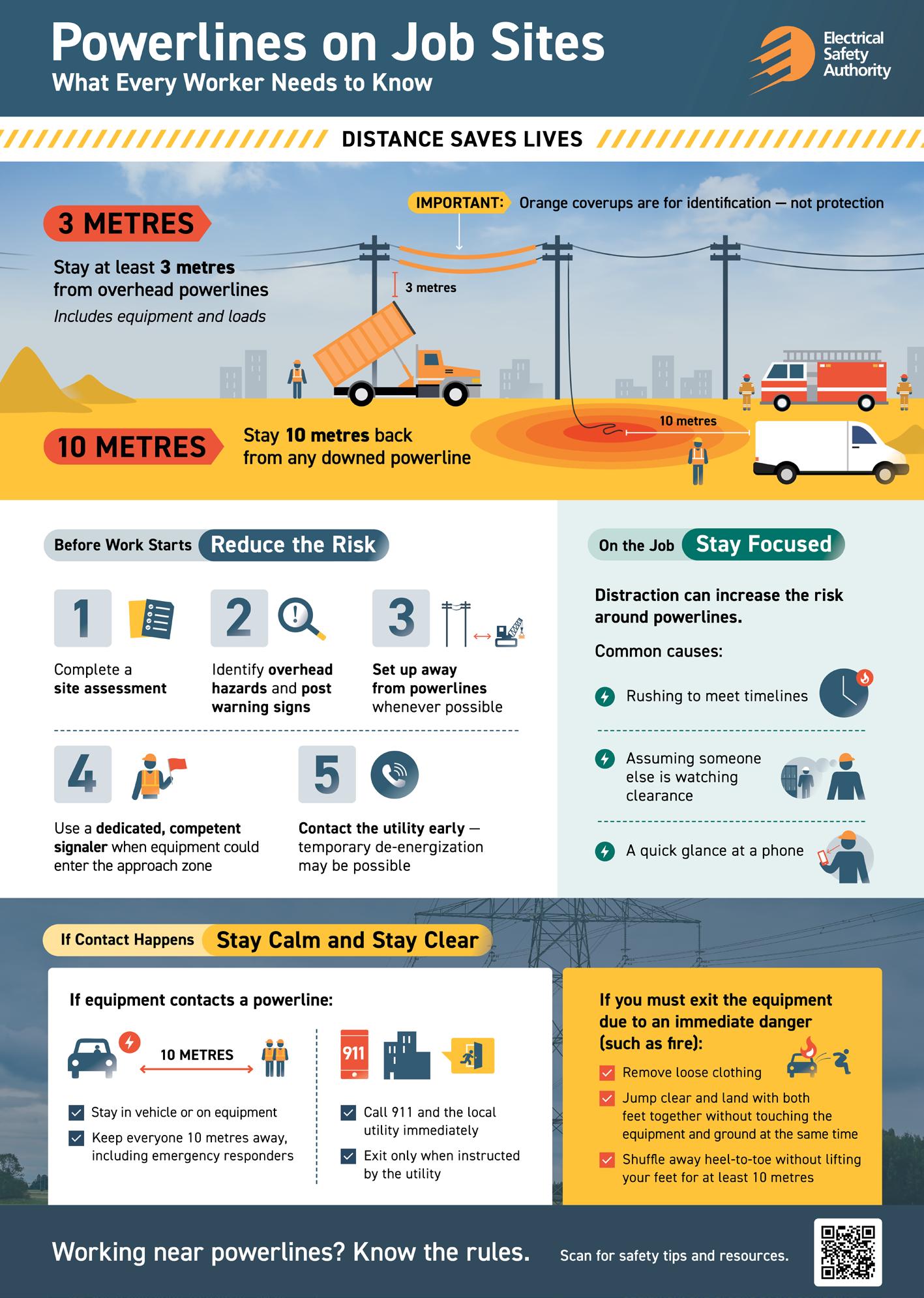
PF: From a tower crane to a boom truck, this equipment is tall and has enough outreach that can contact an overhead powerline. A lot of the time, the operators are not even aware of what the distance ‘limits of approach’ are, which requires at least three meters of space from overhead powerlines.
This doesn’t just mean the wire rope or crane itself, but the load it’s lifting. For example, if an operator is lifting a 12-foot beam, that three-meter distance would apply from the edge of the beam. Another issue is when a crane is delivering materials on the side of a street; in many cases, the
equipment is reaching over the overhead powerlines while lifting. A few years ago, there was a fatality in northern Ontario when delivering drywall to a residential site. The load contacted the high voltage lines and energized the entire equipment at 16,000 volts. Over the past decade, there have been well over 1,600 overhead powerline contacts resulting in 21 people dying. Nearly half the contacts are from the construction sector, and 97 of those contacts are from aerial lifting.
This is a high-risk industry, and it is necessary to have a competent designated signaler who has a clear view of the equipment and the overhead powerlines to make sure the load does not encroach three metres.

What are some common overhead powerline misconceptions?
There are quite a few, for one, people wrongly assume that to make electrical contact, you’d have to directly touch an overhead power line—that is false. If the equipment is close enough to the overhead powerlines, then the electricity could arc across the equipment itself. Many conditions come into play as well, such as humidity in the air. Voltage is also overlooked, as the closer you are and the higher the voltage, the more likely it is to arc power. Another misconception is that a downed overhead powerline always turns off the flow of electricity. That’s not always the case. A powerline could sit there and be energized, including the earth—powerlines on the ground do not have to spark to indicate it’s live. Getting close to it could cause electrical shock or death. The ESA surveyed about 400 construction workers and found that only 26 per cent of construction workers knew the safe distance to be from a downed overhead powerline, which is 10 meters, which is the length of a school bus. That 26 per cent is a very low number. In that same survey, only 18 per cent of construction workers knew the safe distance from an overhead powerline, which is three meters. Again, another really low number.
The last misconception is about orange coverups—most people believe they are meant to protect non-utility workers. ESA found 70 per cent of people believe it is okay to touch an overhead powerline with orange coverups, but that is not the case. They are meant for identification purposes only. This means if you see an orange cover-up on the jobsite, you still must maintain three metres distance. This is why, on some job sites, utilities have replaced them with red flags.
What are best practices when it comes to overhead powerlines and lifting?
Regardless of the trade sector, a site assessment must be done before doing any kind of work. Utility workers have what we call a ‘tailboard meeting,’ where they gather everyone together and go through all the hazards on the jobsite, and sign off on it. That’s why utility workers have a low rate of contacts compared to the construction sector. The Occupational Health and Safety Act (OHSA) require the equipment and its load to be located three meters away from the overhead powerlines rated up to 150,000


volts. Anything over 150,000 volts to 250,000 volts, the OHSA requires 4.5 meters, and anything over 250,000 volts requires six meters. This is known as the limits of approach. Basically, if you’re going to have a large crane going over the powerlines, it’s the whole radius of those wires. As mentioned before, a competent designated signaler is another key factor–this means a person who understands the hazards of overhead powerlines and has no other responsibility except observing the equipment and its load does not encroach the limits of approach of the overhead powerlines. If you’re operating near overhead powerlines, then it’s best to work with the local utility and see if they can temporarily disconnect power just to make sure the site is safe. Of course, there is a fee, but what is the fee compared to a lost life on a job site?
How can a company reinforce a safety-first mindset when production pressures are high?
In my close to 20 years working at ESA, I’ve had to conduct many interviews after a critical injury or a fatality. One interview I had a few years ago regarding a worker fatality has stayed etched in my mind today. While in the interview, the supervisor who just witnessed one of his co-workers dying became very emotional about what transpired that day. The thing is that the accident could have been prevented. When someone dies, there is a thorough and detailed investigation, new training and procedures, potential fines and lawsuits, but beyond all that, there is overwhelming grief. The grief that comes with losing a friend and colleague. And the pain from knowing that moments matter and accidents are preventable. This is why safety talks are so important, regardless of the job being big or small.
This time of year, the ESA gets busy because construction companies are starting safety talks before the busy spring season. I get a lot of construction companies that do spring startup meetings. Creating an environment of constant communication about safety is critical to keeping the jobsite protected. In Canada, we have a short window for construction, unfortunately. In a lot of these cases, construction workers are working 12 to 15-hour days. The ESA found a lot more contacts and fatalities happen at the end of their shift between May and October, which is peak season for construction.
Based on past incidents, what are some critical lessons the industry should be applying today?
When you’re in or on the equipment or operating a boom from a wireless remote–if contact is made with an overhead powerline, the number one thing to do is try to safely reverse the boom to break contact. When contact is made, it energizes the equipment itself and the ground surrounding it. If you cannot safely break the contact by reversing the boom, stay where you are.
Do not move or try to exit the vehicle. This is because the moment you walk, you create a path through the body from one foot to the other foot, known as step potential, or if you land on the ground and touch the equipment at the same time, you are creating a direct path, or what’s called touch potential contact. This is how fatalities happen. Everyone should keep back 10 meters and call 911 right away. The safest thing to do is wait until the utility shows up.
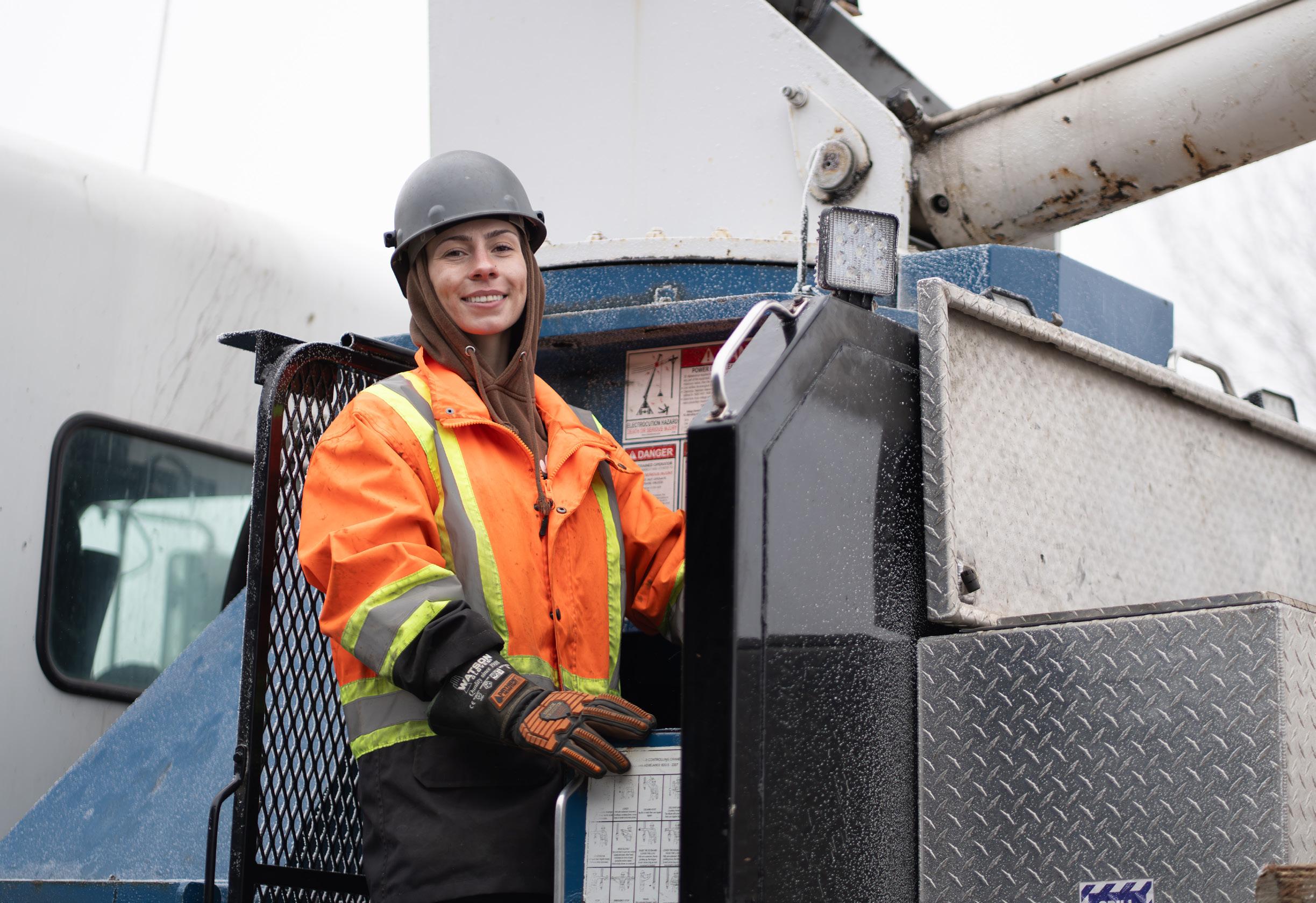
Early in her career, Clarke struggled with confidence, frequently feeling she had to go above and beyond to prove herself in a male-dominated industry.
Nicole Clarke’s journey in crane operations proves that any dream is within reach. By Macenzie Rebelo
As a little girl with big dreams of operating heavy machinery and becoming a big-city crane operator, Nicole Clarke has always loved powerful equipment.
Growing up in Edmonton, Alberta, Clarke used to be glued to her window, completely captivated by the rumbling of trains passing by her home. In hindsight, she can see how that curiosity evolved into the ambition that led her to the career she has today.
For as long as she can remember, she has always wanted to be a heavy equipment operator.
“I was drawn to anything that moved and required a lot of focus and coordination to
operate,” she says. “I was absolutely fascinated by it.”
Clarke began spotting mobile cranes and tower cranes around the city, which piqued her interest in the equipment.
But by the time high school came around, Clarke questioned whether pursuing the trades was a realistic or feasible path for her as a woman.
“I thought the trades could be a good thing,” she explains. “But I’m a female and a part of me was nervous about being accepted or working hard enough to get the job done.”
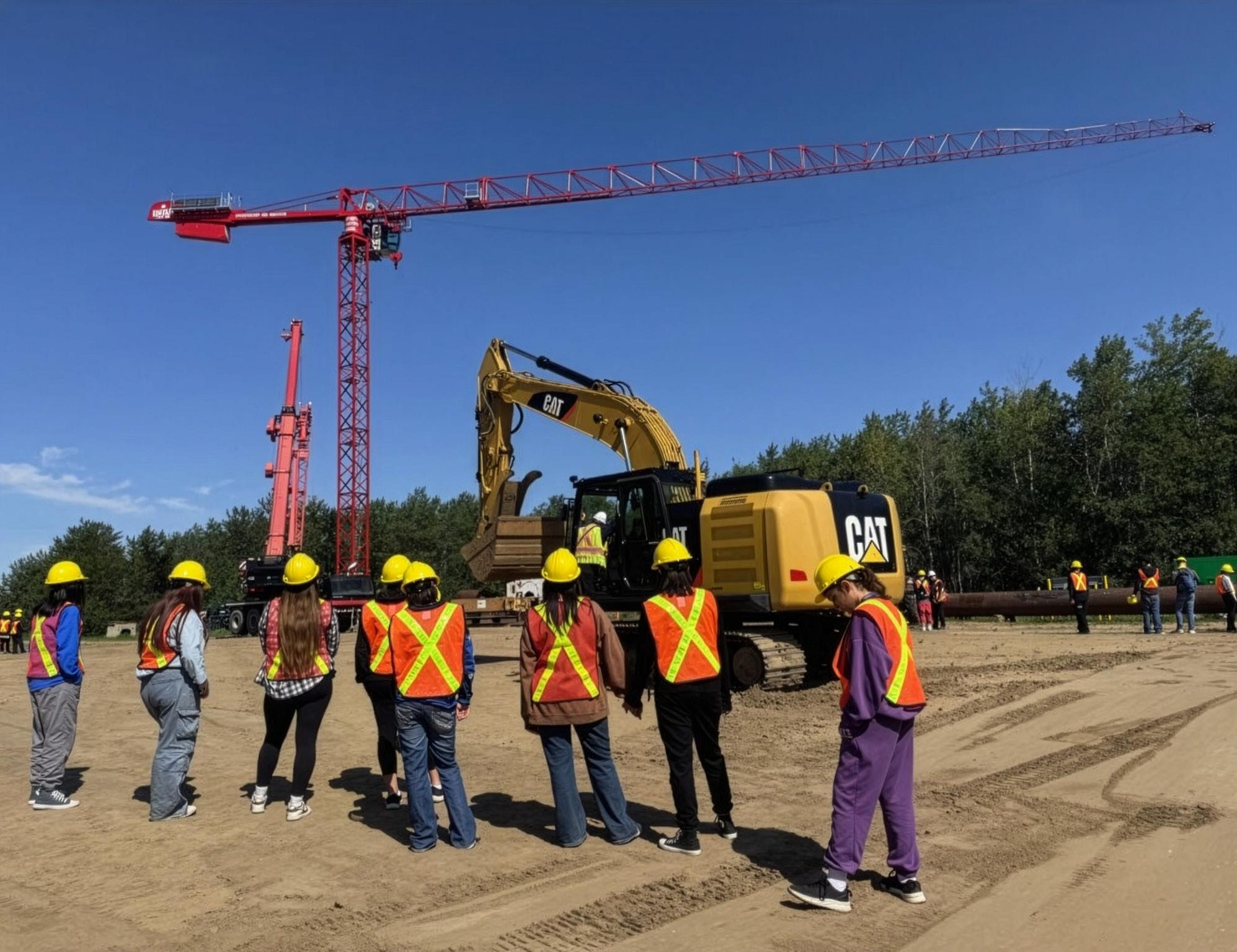
Her perspective changed after the Northern Alberta Institute of Technology (NAIT) hosted a field trip for young women to explore the trades in their facility.
Clarke and a group of fellow young women explored a variety of career options at NAIT. Already feeling motivated, Clarke was especially inspired when the day concluded with a visit to the crane program.
“They had a female journeyman named Morgan Bosch-Brice come and speak to us,” she says. “It was such a big deal for me.”
Bosch-Brice explained the day-to-day responsibilities of her role and shared a personal story about operating a crane in her neighbourhood
“She told us about how she parked a mobile crane on her driveway, in the middle of a cul-de-sac, to lift her hot tub into her backyard,” explains Clarke. “I thought it was the coolest story I’ve ever heard. I left
there thinking, ‘One day, I am going to put a hot tub in my backyard’.”
Clarke was sold.
After graduating, she started to apprentice with Encore Trucking & Transport, which took her under its wing and taught her everything there was to know about the industry.
She completed 54 months of verifiable crane and hoisting experience and was finally able to enroll in the NAIT-recognized credentials program.
“I was in school for six weeks, and it was pretty intense,” explains Clarke. “One week classroom learning, the next running equipment in the yard—it was hard work to keep up with all the material, staying up late most nights.”
She remarks that she was surprised that there were so many women in her program, including women teachers.
“Ashleigh Kaliszuk showed me that there are confident women operators in this trade,” she shares.
“And it was a full circle moment when Morgan later became my instructor. She encouraged me to apply for bigger cranes, pushing me to see myself as a capable operator.”
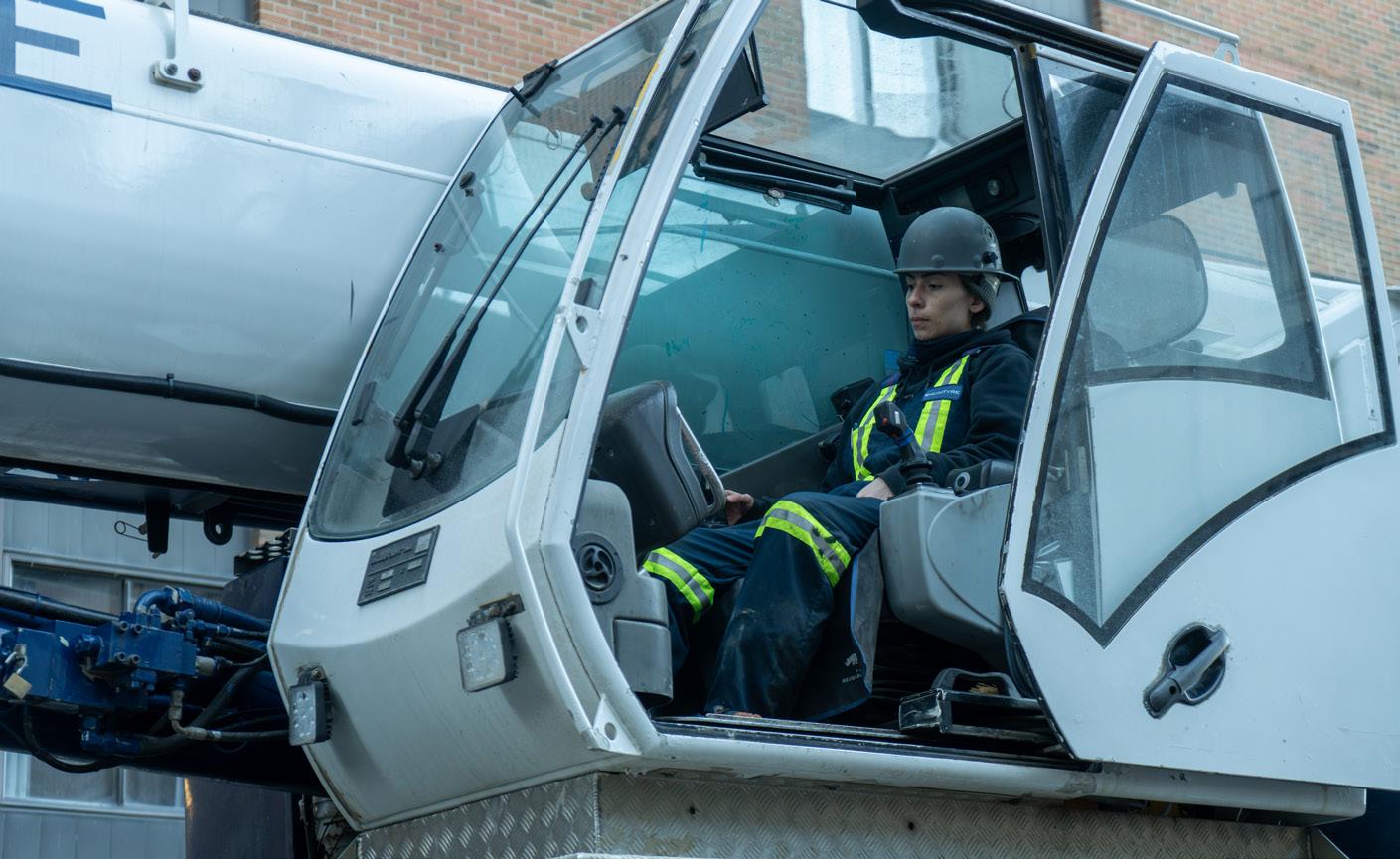
In 2025, Clarke moved down south to Calgary to continue her career with McIntyre Crane as a mobile crane operator. Today, at 25, she has been working in the industry for a little over four years and has been enjoying every moment of it.
“What I really love about this job is that every day there is something new. On a daily, I am problem-solving and figuring out challenges.”
Through her work, Clarke has developed a strong sense of self-belief, especially
when taking on difficult tasks or challenging jobs.
She recalls a time when she had to load a carry deck crane on her own, chaining it securely to the trailer, executing a tricky 90° turn into a yard, and then offloading and maneuvering it into a small shop entirely by herself.
“I am especially proud of this lift,” she says. “I handled every step from transport to operation, and I owned every step.”
A pivotal moment in her career occurred in January, when she completed her first solo 100-ton crane lift. The job required Clarke to drive the mobile crane downtown and squeeze into a cramped back alley. There, she navigated tight turns, determined the optimal outrigger setup within the confined space, and safely raised the full boom despite towering skyscrapers surrounding her.
“I nailed a blind lift flawlessly and handled the entire job end-to-end. I am truly proud of myself for rising to every challenge,” she says.
She attributes her self-assurance to the many mentors she has worked with closely over the years, who have encouraged her to
aim higher despite the setbacks along the way.
“They built that foundation in me, giving me the confidence to tackle any job safely and efficiently. They also showed me what real hard work looks like.”
At the start of her career, Clarke did not always feel so secure and often felt she had to work extra hard to prove herself in the industry as a woman. She pushed herself to be perfect and would often tell herself she didn’t merit her position there.
“For me, being the only woman on-site made me feel like I had to work twice as hard,” she shares. “I’d go home and talk it through with my mom. She’d always remind me, ‘You’ve already proven yourself.’”
Over time, Clarke has realized she has nothing to prove to anyone but herself. She hopes to instill the same confidence in other young women considering careers in the industry or the trades as a whole.
“Don’t downplay your skills or doubt yourself. Show up prepared, be safe, be consistent, and let your work speak for itself,” she says.
Clarke hopes to inspire the same spark of ambition that Bosch-Brice had ignited in her years ago.
She believes it is crucial for young women to see that a career in the trades, especially operating cranes, is not only possible but rewarding and provides independence.
“Visibility is everything and representation matters.”
Clarke explains that the more women who enter and work in the industry, the more normalized and encouraged it will become for young girls to dream big and pursue the trades.
“I was inspired by seeing one woman share her story in this trade, and that one moment helped shape my whole career path. If my story can make even one girl look at a crane and think, ‘That could be me one day,’ then it’s worth telling.”

By Andrew Snook, on behalf of the Canadian Crane Rental Association
When it comes to the adoption of the latest technologies, the construction sector has historically lagged other industries. But as the skilled labour pool continues to shrink and the costs associated with implementing automation and AI-powered software into operations decline, the sector has been embracing more of these innovations into its operations, and this includes the crane rental sector.
While some industry members have hesitations about how to implement AI-powered tools into their operations, Guillaume Gagnon, executive vice-president of GUAY Inc., believes these tools have the potential to improve safety on jobsites.
“From a safety perspective, intelligent sensors, cameras, and computer vision could increasingly support operators by detecting proximity risks and hazards on congested jobsite,” Gagnon explains.
“These tools may be especially valuable on tight sites with blind spots, swing-radius conflicts, and dynamic traffic, where early warnings and clearer situational awareness can reduce risk.”
He adds that over time, systems could help reduce cognitive load by prioritizing the most critical warnings, rather than adding constant alarms, so operators receive more actionable decision support when conditions change quickly on site.
“Importantly, the objective is likely to strengthen human judgment with timelier, more consistent information rather than replacing it,” Gagnon notes.
Another area where he sees AI adding value to operations is in fleet management by enhancing monitoring through telematics, by translating machine and jobsite data into simpler reporting and better visibility into utilization and compliance documentation.
As data becomes more structured, Ga-
gnon says AI could support lift preparation as well as help teams validate constraints, anticipate interferences (power lines, nearby structures, other equipment), and improve planning decisions before a crane is mobilized.
“Looking ahead, AI could become a valuable tool for training and day-to-day decision-making across roles,” Gagnon says. “In parallel, AI-driven e-learning platforms might deliver more personalized and adaptive training based on real operating patterns, accelerating skill development while improving consistency across teams.”
For Ryan Long, president of A.W. Leil Cranes & Equipment, the main advantage of implementing AI into operations currently is finding ways to remove trivial tasks from staff and free up their time for more important duties.
“Our obligations as contractors continue to go up. Every customer has a different supplier portal and safety program where they want us to maintain stats and documentation. I feel like a lot of those things, they tie up a lot of time. But to me, those seem like the kind of tasks that would be ripe for the picking for AI to grab our information and just auto-populate it into those platforms,” Long says.
The adoption of AI for improving predictive maintenance procedures is another area of value for companies. As data on breakdowns and incidents grows and improves in quality, Gagnon says predictive maintenance could become more feasible.
“In many fleets, the first step may be anomaly detection and condition-based maintenance before true predictive models become reliable,” he says.
These programs have the potential to assist maintenance teams with some of their regular day-to-day tasks, such as planning repairs and reducing unplanned
“From a safety perspective, intelligent sensors, cameras, and computer vision could increasingly support operators by detecting proximity risks and hazards on congested jobsite.”
– Guillaume Gagnon, GUAY Inc.
downtime. This would lead to lowering secondary costs such as project delays or environmental cleanup following incidents like oil leaks, Gagnon notes.
Long adds that the combination of AI and various equipment sensors will be able to provide a “crystal ball” to fleet managers to allow them to cut off issues before they happen, optimizing predictive maintenance operations.
Manufacturing operations
While Long doesn’t believe AI is currently ready to be implemented into cranes on jobsites, he does see it playing a role in the future.
“It’s interesting to see how manufactur-
ers are starting to think about AI and how they might incorporate it into some of their products,” he says.
Liebherr’s Berenike Nordmann believes AI will primarily continue to evolve within the company’s production environment, where AI-based automation and robotics already support quality, efficiency and process stability.
“For crane customers, we expect digital systems to become even more integrated and datadriven, always with the clear objective of providing practical benefits and maintaining the highest safety standards,” Nordmann says.
Digital tools and connected machine data help customers plan lifts more pre-
cisely, prepare operations more efficiently, and manage their fleets with greater transparency, Nordmann notes.
As Liebherr continues to develop its crane technologies and digital solutions, the company believes that selected AIsupported functions could complement its digital planning tools in the future, Nordmann says.
“For example, AI could help streamline or preprocess certain 3D data used in lift planning, which may support even smoother workflows in the long term,” she says.
As the digital risks in the world continue to increase, companies need to seriously assess how they use AI for confidential and sensitive documents.
“The risk of those files being hijacked, leaked, or corrupted by a faulty AI system, I think is a real risk,” Long says. “AI is more complex than most of us are equipped for. So, unless you have a very robust IT department, many small- to medium-sized businesses are, I would say, at risk. Even though they might not be a juicy target for hackers or cyber criminals, they’re probably a much easier target, just because we don’t have that sort of digital sophistication that others might have.”
To unlock all the potential benefits that AI can offer crane rental companies, the industry may need stronger data governance, disciplined sensor calibration, cybersecurity, and improved integration across mixed fleets and OEM systems, Gagnon says.
“Just as importantly, organizations could need a clear ‘humanin-the-loop’ approach, so AI remains a trusted assistant rather than a source of confusion or liability,” he adds. “Done right, AI has the potential to steadily make crane operations safer, more efficient, and better planned – while helping teams optimize total operating costs.”











BY JUSTIN BROWN
Blending technological power with human judgement, this convention season reflects a transformative chapter for the industry
Whether it’s the longer-term quest for harmonization or the immediacy of a handshake at a trade show, in-person activity continues to underpin everything we do. Robots may be frighteningly capable and artificial intelligence (AI) unnervingly precise, but humans remain the ultimate decision-makers, problem-solvers, and arbiters of real-world value.
At no other time is this more apparent than when spring comes, construction primes itself for another peak, and marketplaces enter the latest trade show season. The leaders I look to show a bias towards meeting the industry where it is. In other words, they immerse themselves in the field to first understand problems and second, meet them with solutions.
Each convention brings together equipment manufacturers, engineers, and end users in one place. That density of decision-makers makes it one of the most efficient ways to understand where a sector is heading.
Specifically, we use these exhibitions to evaluate equipment trends that will influence lifting requirements; meet with key suppliers and original equipment manufacturer (OEM) partners; and, most importantly, listen carefully to how our
customers are thinking about productivity and safety. It’s less about selling and more about direction.
Remember, trade shows transcend exhibition halls and product displays. Away from the daily pressures of operations, attendees are curious and engaged– creating an environment where conversation reveals what truly matters in the market. Embracing trade show activity means seeing beyond the brochures, measuring behaviour as much as words, and turning every question into insight one can act upon and eventually monetize.
In everyday operations, digital tools handle information transfer effectively. However, trade shows now serve the purpose of discussing future directions. Even in a connected age, nothing beats seeing the products your crane or hoist depends on.
I’m reminded of the importance of kinesics in modern business. In fact, I’d argue that how people convey meaning through gestures, facial expressions, and eye contact is more important than ever, given the ubiquity of Industry 4.0. Inescapably, body language conveys confidence and credibility. In lifting and rigging, where failure isn’t an option, trust is essential. Hesitation can
The name of the game, regardless of the type of event, is capturing the attention of the target demographic. It’s an often-overlooked facet of exhibiting at a convention that, unless a company attracts attendees to their table or booth, they can’t explain to them how the products and solutions can help solve the problems they encounter at work.
Gamification is a great tool to achieve that objective. In business terms, gamification works best when it aligns technology with human psychology by using structure and feedback loops to reinforce desired behaviours. When learning becomes participatory, retention increases. Some trade shows are so overwhelming that exhibitors need a hook to attract visitors to their exhibit; they’ll walk past. Once there, gamification can help to enhance that visiting experience and make it memorable. If an attendee goes home with a clear understanding of how a vendor can help them become more productive, a meaningful connection has been secured. Think about it in terms of an information exchange, where problem meets solution. Gamification fits naturally into a trade event setting precisely because attendees are temporarily removed from the pressures of day-to-day operations. On the show floor, they are not troubleshooting equipment failures, managing teams, or chasing production targets; they are in discovery mode. Game on!
be detected in person, conviction can be felt, and it’s possible to assess whether someone truly understands their product. This human element continues to impact decision-making.
Trade shows serve as an excellent platform for discussions and a powerful way for exhibitors to showcase their expertise. When standards are revised, inspection interpretations shift, or key product updates are made, conventions provide a venue to quickly share this information with stakeholders. They can reduce what might take months of communication into just a few days and are also highly effective for addressing follow-up questions. In our safety-critical industry, this rapid dissemination of knowledge is particularly valuable.
Technology is powering industry like never before. Yet the COVID legacy has reinforced a simple truth: even in a hyper-connected, data-driven world, people remain central. From remote collaboration to onsite problem-solving, human judgment, intuition, and resilience continue to define outcomes, guide innovation, and shape the way technology is applied.
The initial post-COVID trade events carried a palpable energy. Attendees missed all aspects of in-person meetings, from casual interactions with industry colleagues to spontaneous conversations and the opportunity to see new products. It reminded everyone that this industry remains fundamentally relationship driven. Trust in lifting and rigging cannot be built solely through a screen. All things considered, exhibitors and attendees are more focused. Exhibitors are more intentional, with clearer messaging. Booth teams are better prepared, and passive attendance has decreased. Attendees come prepared, having already researched online. Trade shows are now seen as decision-making environments, learning accelerators, and relationship checkpoints. Make the latest events season count.
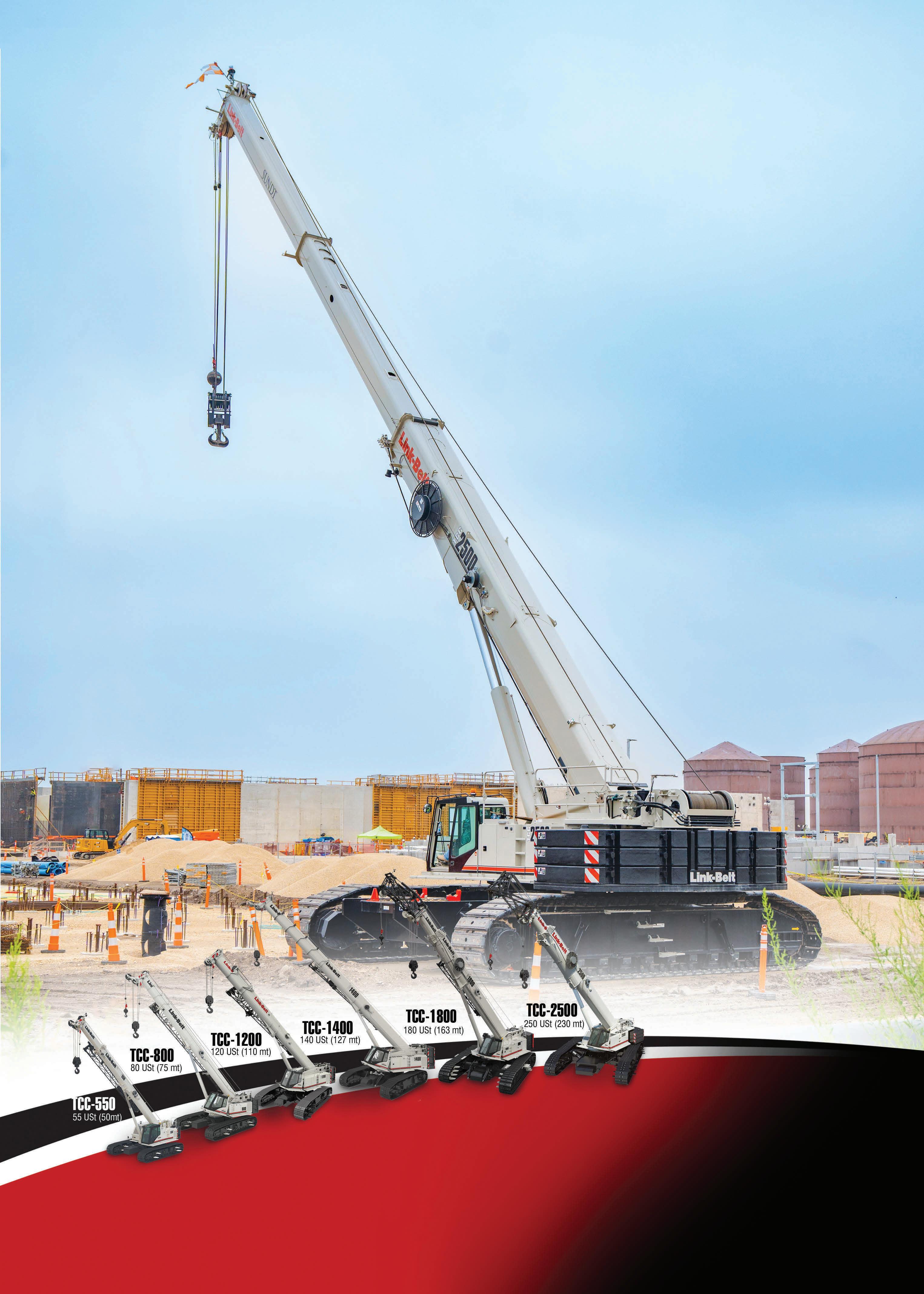
• Unbeatable 360° pick and carry capacities
• Transport complete in eight loads
• Main Unit transports under 107,156 lbs (48,605 kg) with the boom
• No overflow over 44,000lbs ( 20,000 kg)
• Stands on 4 widespread jacks
• Hook and pin side frames and quick hydraulic connections
• Two Bar grouser with nylon pads or flat pads for any jobsite condition
• Travel speed 1.6 mph (2.6 kph), 40% Gradeability
• Up to 4° List Charts
Link-Belt’s proven formula for large capacity, superior quality and durable design. The TCC-2500 offers the longest reach telescopic crawler in its class! 2,400 lbs (1 088kg) at 275 feet (84m)!
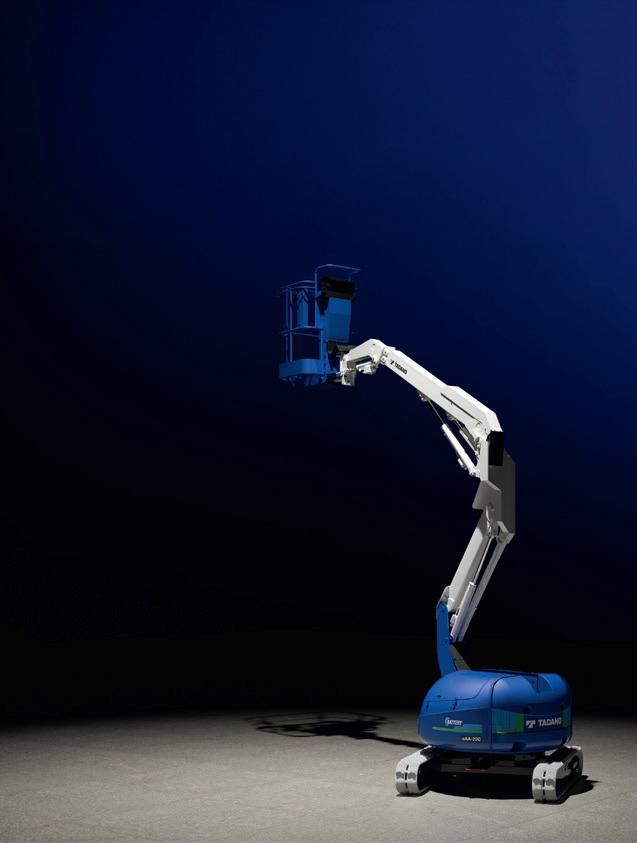
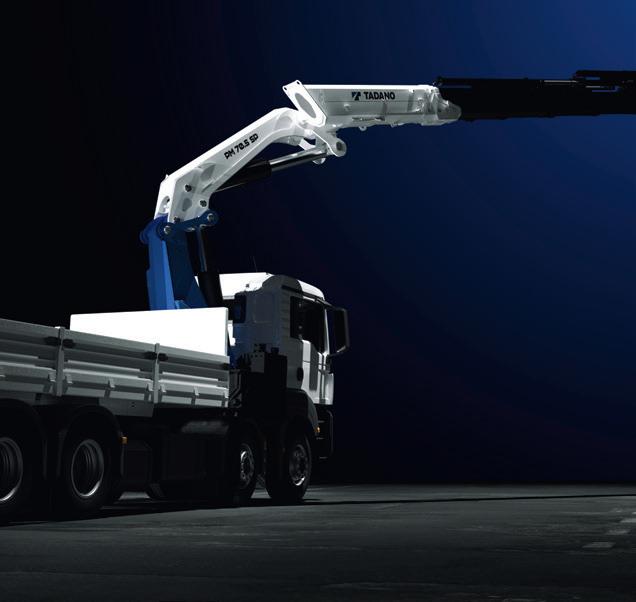
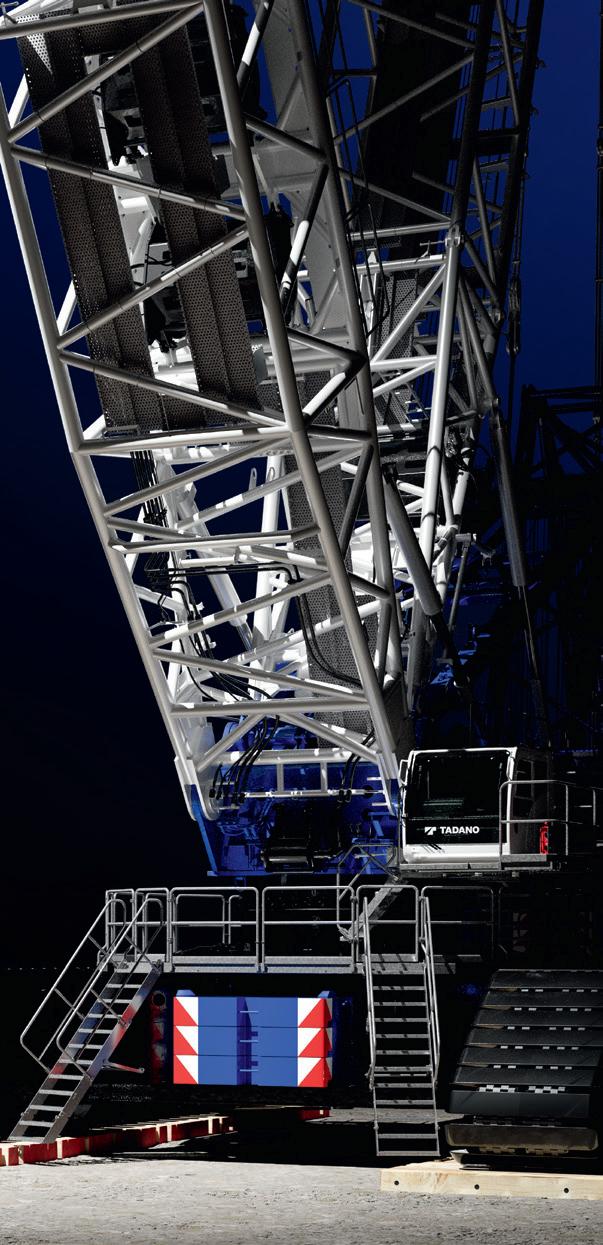
With
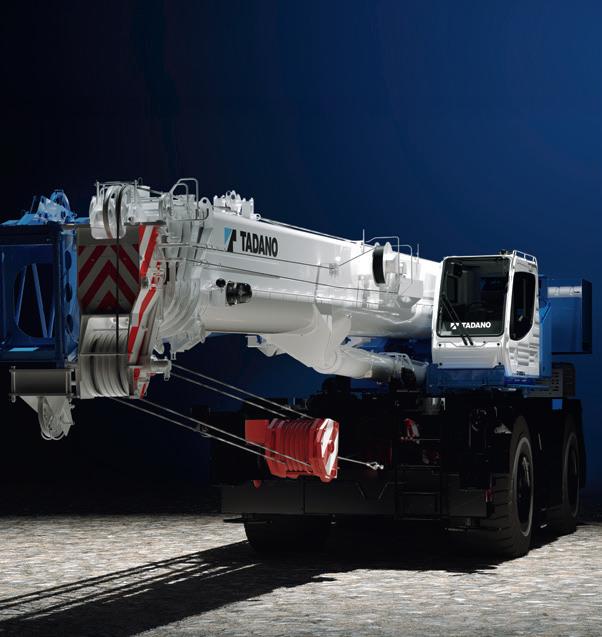
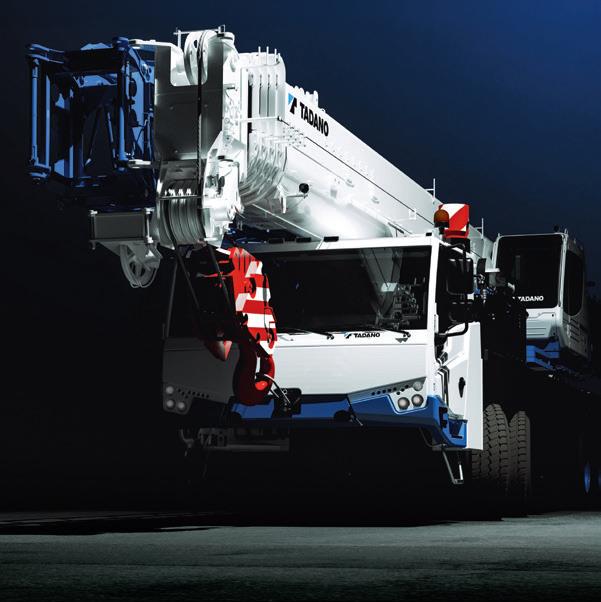
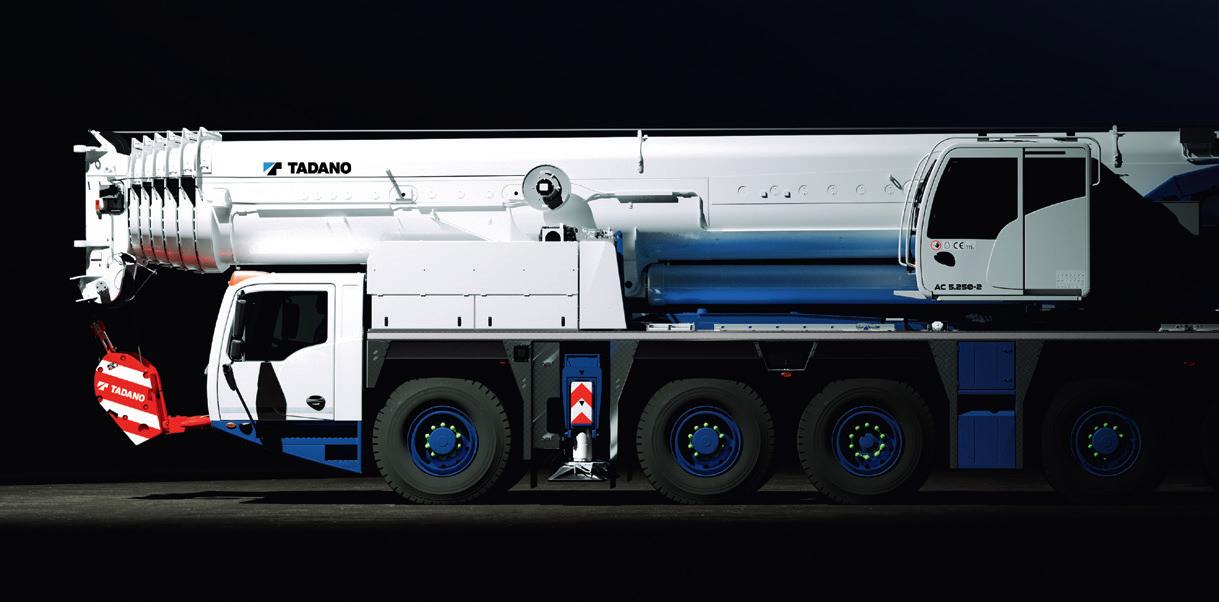
When you choose Tadano, you’re taking your business to the next level and reaching new heights. www.tadano.com