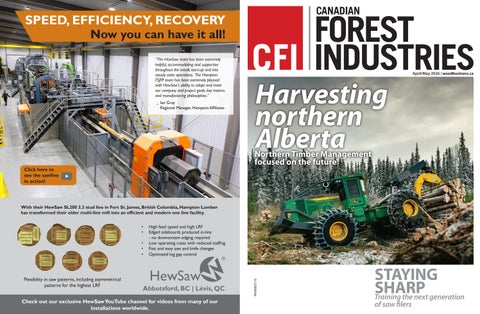
SPEED, EFFICIENCY, RECOVERY Now you can have it all! “The HewSaw team has been extremely helpful, accommodating and supportive throughout the install, start-up and into steady state operations. The Hampton FSJFP team has been extremely pleased with HewSaw’s ability to adapt and meet our company and project goals, key metrics and manufacturing philosophies.”
- Ian Gray
Regional Manager, Hampton Affiliates
CANADIAN CANADIAN
FOREST CFI INDUSTRIES Harvesting northern Alberta
| woodbusiness.ca April/May April/May2026 2026| woodbusiness.ca
Northern Timber Management focused on the future
Click here to see the sawline in action!
With their HewSaw SL200 3.3 stud line in Fort St. James, British Columbia, Hampton Lumber has transformed their older multi-line mill into an efficient and modern one line facility.
• • •
Flexibility in saw patterns, including asymmetrical patterns for the highest LRF
High feed speed and high LRF Edged sideboards produced in-line - no downstream edging required Low operating costs with reduced staffing Fast and easy saw and knife changes Optimized log gap control
®
Abbotsford, BC | Lévis, QC
Check out our exclusive HewSaw YouTube channel for videos from many of our installations worldwide.
PM40065710
• •
STAYING STAYING SHARP SHARP Training Trainingthe thenext nextgeneration generation of ofsaw sawfilers filers
Reliability that counts ƒ MS 500i GAS CHAINSAW
194999
$ ,
MSRP with 20" bar
79.2 cc • 5.0 kW • 13.7 lb ①
The MS 500i is the first chainsaw in the world to feature electronically controlled fuel injection. Ideally suited for the professional forester, this high-torque machine cuts through big timber with ease. Rapid acceleration and optimized operator control means that the MS 500i is perfect for felling, bucking and limbing. Featuring electronically controlled fuel delivery, the MS 500i starts easily and delivers outstanding engine performance regardless of altitude & temperature. The revolutionary engine design provides the operator the best power to weight ratio on the market. ⬤ Optimum engine performance from the first pull under all conditions ⬤ Rapid acceleration in an unbelievable 0.25 seconds, enabling this high-torque machine to provide instant power ⬤ Electronic Fuel Injection technology guarantees optimum performance regardless of temperature or elevation ⬤ Captive guide bar nuts on the sprocket cover so they won’t get lost when changing the guide bar or chain Note: Wrap handle version is also available. ① Weight with powerhead only.
Scan code for more product information or visit www.stihl.ca
CONTENTS
April/May 2026
8
LOGGING PROFILE
Harvesting northern Alberta
Northern Timber Management is always focused on the future.
13 WILDFIRE MANAGEMENT
18 WOOD PRODUCTS
FPInnovations building a wildfire business case.
High-value approach key to Winton Homes and Cottages.
24 SAWMILL UPGRADE
28 SAW FILING
Elmsdale Lumber reinvests in Cardinal carriage technology.
Training the next generation of saw filers.
32 SAW FILING
37 EVENT PREVIEW
How much horsepower does a saw really need?
BCSFA’s annual saw filing show is back in Kamloops.
DEPARTMENTS
ON THE COVER
4 First Cut 6 Industry News 34 Saw Filing Spotlight 36 Saw Filing News 38 Final Cut
Northern Timber Management has been supplying fibre to mills throughout northern Alberta for over 40 years. Photo: Northern Timber Management.
Business case
Tried and true
A question of power
Building value
Staying sharp
BCSFA is back
April/May 2026 CFI 3
EDITORIAL first cut
Biomass BDO Zones An option for expanding the forest bioeconomy
ANDREWsnook
asnook@annexbusinessmedia.com @CFIMag
CanadianForestIndustries @cfimag Canadian Forest Industries
4 CFI April/May 2026
Canada’s forest products sector is undergoing one of its most challenging times. The combination of higher U.S. duties and tariffs, a slow homebuilding market, and costly fibre extraction has caused several sawmills, pulp mills and pellet plants to shut down. Navigating obstructive government policies hasn’t helped, but some of that has started to change, with the federal and provincial governments starting to pay more attention to the value that a healthy forest products sector brings to the country. Even with government support, one thing is for certain, the forest products sector needs to diversify its markets and products sooner rather than later. While higher-valued engineered wood products are certainly part of the diversification strategy, another big opportunity lies within Canada’s bioeconomy. While the bioeconomy is already assisting with finding new homes for sawmill’s residuals through wood pellet plants, biocarbon plants, and biomassfuelled heat and power facilities, the bioeconomy yields much more potential for improving the health of the forest products sector. One way that forest residuals are starting to garner more attention is through the development of the Biofuel Development Opportunity Zone Initiative (BDO Zones). The BDO Zone Initiative offers standards-based technical risk assessments related to a region’s feedstock, supply chain, and infrastructure risk related to its potential for developing new biofuels plants. To date, North America has 61 BDO Zones created with 19 of them located in Canada. The greatest potential value to date to come from a BDO Zone in the country to date was the announcement that Provectus Biofuels is planning to construct an $845-million biofuels plant in Vegreville, Alta. using wheat straw.
The construction of the biofuels plant is expected to create between 400 to 500 jobs over a two-year period with 100 permanent skilled jobs after its completion. The plant is estimated to consume 165,000 tons of local wheat straw residues to produce 100 million litres of renewable jet fuel on an annual basis. Part of how Vegreville became recognized as a potential region to develop the plant was through its ‘A’ BDO Zone Rating, which assisted in the derisking of its feedstock potential. While this massive project is using wheat straw for its feedstock, other municipalities across Canada with an abundance of other types of feedstock are starting to realize the lead generation value that BDO Zones can offer them, and yes, this is includes forest products residuals and forest biomass (there are currently four regions using BDO Zone assessments to showcase their forest products and biomass feedstocks). Canada’s forests are rich with biomass and wildfire-damaged stands – in some cases, to the point where harvesting is being considered or performed strictly for mitigating future wildfires. But the data related to potential forest residual feedstock needs to be quantified to attract a potential investor to consider constructing a biofuels plant in any community. BDO Zones can assist with attracting potential investors to areas where wood products companies once thrived; since they are recognized by project developers around the world as strong signals of where new plants can be successfully sited. The reality is the wood products sector needs all the help it can get, so municipalities where industry jobs are on the line or are desperately needed should be reviewing this option to see if it is a feasible solution to help the sector get back on its feet.
PRECISION SERVO SYSTEM
FULLY AUTOMATIC
FLEXIBLE INTEGRATION
insidesales@burtonmill.com
burtonmill.com
NEWS upfront Call for unity at CWF Spring Meeting
Jason Limongelli, vice-president, woodlands with J.D. Irving Limited (JDI), says the region’s largest forestry company is taking steps to tell more good news stories about forestry. Photo: Maria Church.
Maggie Monday, associate with Cassidy Levy Kent based in Washington, D.C., updates CWF members on current U.S. trade policy. Photo: Maria Church.
6 CFI April/May 2026
The Atlantic Canada forest industry’s strength as a large collection of independent businesses and woodlot owners can also be a weakness if it leads to fragmentation and disjointed efforts. Speakers at the Canadian Woodlands Forum (CWF) Spring Meeting in Moncton, N.B., March 25 to 26 reiterated this point and urged unity of message and purpose among members, who range from woodlot owners to researchers to logging contractors and sawmillers. Among those calling for action was Jason Limongelli, vice-president of woodlands with J.D. Irving Limited (JDI), the region’s largest forestry producer. Limongelli told attendees the company is taking steps to pull back the curtain and share their story. “There’s a lot of negative headwinds and we’ve lost a bit of our pride, but we need to get it back,” Limongelli told the audience. “We should be proud and promote the fact that we’re doing a good job.” JDI currently manages 2.4 million hectares of woodlands between New Brunswick, Nova Scotia, and Maine. But insecure fibre availability is still limiting the company’s investments in Canada, Limongelli said. Nova Scotia’s and New Brunswick’s largest economic assets are their crown land, yet governments have no economic objectives for that land. It’s a similar story across Canada: annual allowable cut (AAC) is decreasing despite forest inventory increasing since the ’90s, Limongelli said. Policy is the constraint, and policy is influenced by public perceptions. We need to return to a more
balanced approach that factors in ecological, social, and economic objectives, Limongelli said, adding that securing the political will to take this approach will mean getting the public on board. Getting the public on board will mean more companies and individuals sharing their stories, Limongelli said. JDI has proven the forests in New Brunswick have the potential to produce a lot of fibre without a lot of effort. Limongelli noted in their Black Brook Freehold in New Brunswick they harvest 3.19 cubic metres per hectare per year. That is higher than even Finland which lists an average of 2.4 cubic metres per hectare. There are more good stories to tell. JDI is investing $1.5 billion in its Saint John westside pulp mill that will increase its capacity to between 1,000 to 2,000 tonnes per day. It’s welcome news for a region where many low-grade wood customers have exited. Limongelli said he hopes more small players in the industry, from woodlot owners to harvester operators, are ready to share their stories. “We all need to speak up. We all need to do our part,” he said. CANADA-U.S. RELATIONS Conversations around government policy inevitably turn to U.S. market uncertainty and the CWF brought in Washington-based Maggie Monday, associate with Cassidy Levy Kent, to update members on current U.S. trade policy. Monday referenced the news that the U.S. supreme court struck down the International Emergency
Economic Powers Act – better known as IEEPA – tariffs and noted that a refund process is being developed now. She said it will not be an automatic process and advised companies who might have been affected to be proactive. Another update centred on the softwood lumber trade landscape. There are currently no ongoing negotiations, Monday said. The U.S. Softwood Lumber Coalition is not interested in settling the dispute since it’s clear Canada’s market share decreased significantly since the duties went in place. The new rates will be announced in April, but she said they do not anticipate any changes. CUMSA – the Canada-U.S. -Mexico Agreement – talks are ramping up with the official review beginning in July. Monday said it’s possible the U.S. wants separate deals with Canada and Mexico. Either way, “the administration focus is not on this industry, unfortunately,” she said. Monday noted there is a new forced labour investigation under section 301 of the 1974 Trade Act that could result in new tariffs and Canada was named as part of the investigation. “This review process has made tension even higher between the U.S. and Canada,” Monday said. “I know this is frustrating… hopefully with the CUMSA review there will be some concessions made on the American side.” In all cases, Monday encouraged the audience to expect additional tariff actions and to keep detailed records and consider auditing for import compliance. - Maria Church
Gorman Group acquires $120M tenure transfer in Okanagan B.C. Minister of Forests Ravi Parmar has approved a $120-million tenure transfer from Weyerhaeuser to the Gorman Group. The news follows the May 2025 announcement by Weyerhaeuser of the sale of its Princeton, B.C. mill to the Gorman Group, which was finalized this past September. The Ministry of Forests stated that the transferred tenures total approximately 682,000 cubic metres and consists of 46,000 hectares of tenure in Tree Farm Licence 59, near Oliver, B.C., providing more than 57,000 cubic metres of harvest per year; two replaceable forest licences in the Merritt timber supply area, providing more than 538,000 cubic metres of harvest per year; and one replaceable forest licence in the Okanagan timber supply area, providing almost 87,000 cubic metres of harvest per year. Prior to the tenure transfers, the Gorman Group had an estimated tenure of 734,000 cubic metres per year.
EDITOR - Andrew Snook (438) 483-7451 asnook@annexbusinessmedia.com GROUP PUBLISHER - Anne Beswick (416)410-5248 • Mobile: (416) 277-8428 abeswick@annexbusinessmedia.com ACCOUNT COORDINATOR - Shannon Drumm (416) 510-6762 sdrumm@annexbusinessmedia.com AUDIENCE DEVELOPMENT MANAGER Barb Adelt (416) 510-5184 badelt@annexbusinessmedia.com
Logs being transferred in Gorman Bros. Lumber’s log yard in West Kelowna, B.C. Photo: Andrew Snook.
NATIONAL SALES MANAGER - Josée Crevier Ph: (514) 425-0025 • Fax: (514) 425-0068 jcrevier@annexbusinessmedia.com
“We recognize that any Crown tenure transfer comes with important responsibilities and obligations to First Nations, communities and employees who depend on the long-term stewardship of the land and the careful use of the fibre,” said Nick Arkle, CEO, Gorman Group. “We look forward to working with the First Nation bands, and the people of the Similkameen and Nicola Valleys, toward a new vision of co-operation and working together to find the balance we all seek.” In addition to the Princeton mill, the Gorman Group owns
WESTERN SALES Tim Shaddick 1660 West 75th Ave Vancouver, B.C. V6P 6G2 Ph: (604) 264-1158
and operates Canoe Forest Products in Canoe; Downie Timber and Selkirk Cedar in Revelstoke; Gorman Bros Lumber in West Kelowna; and the Lumby Pole Division in Lumby. The tenure transfer will help ensure a stable supply of fibre for the Princeton mill, which has received a great deal of public support. The Minister of Forests stated that it received close to 300 letters during the public comment period in support of the tenure transfer from individuals, businesses, First Nations, contractors, community forests and unions.
FPAC announces new board leadership The Forest Products Association of Canada (FPAC) recently announced the appointment of Luc Thériault as Chair of the Board of Directors. Thériault is the CEO of pulp and wood products and president, Canada, for Domtar. He has more than 30 years of experience in the forest products industry. Juan Carlos Bueno also joined as vice-
Reader Service Print and digital subscription inquires or changes, please contact Angelita Potal, Customer Service Tel: 416-510-5113 Email: apotal@annexbusinessmedia.com Mail: 111 Gordon Baker Rd., Suite 400, Toronto, ON M2H 3R1
chair of the board. Bueno if the president, CEO and director of Mercer International Inc. He has more than 30 years of international business experience over his career. FPAC also thanked David Graham, president of Weyerhaeuser Company Ltd. (Canadian subsidiary), for his outstanding leadership and service as Board Chair helping advance
FPAC’s mission and supporting Canada’s forest products sector during his tenure. “We are grateful to David Graham for his unwavering leadership during a period of unprecedented pressures. His commitment to keeping employees and forest-dependent communities front of mind in all that we do has helped us remain resilient and future
ready,” said FPAC president and CEO Derek Nighbor. “As Luc and Juan Carlos step into their new roles, we look forward to advancing our work together – embracing new opportunities for growth, innovation, and strengthened collaboration across Canada’s forest sector with the federal government and our national and international partners.”
COO - Scott Jamieson sjamieson@annexbusinessmedia.com PUBLICATION MAIL AGREEMENT #40065710 RETURN UNDELIVERABLE CANADIAN ADDRESSES TO CIRCULATON DEPARTMENT. P.O. Box 51058 Pincourt, QC J7V 9T3 Canadian Forest Industries is published five times a year. Published and printed by Annex Business Media. Printed in Canada ISSN 0318-4277 SUBSCRIPTION RATES: Canada - 1 Yr $60.47; 2 Yr $108.20 Single Copy - $9.00 (Canadian prices do not include applicable taxes) USA – 1 Yr $128.89 CDN Foreign – 1 Yr $146.39 CDN Occasionally, Canadian Forest Industries will mail information on behalf of industry-related groups whose products and services we believe may be of interest to you. If you prefer not to receive this information, please contact our circulation department in any of the four ways listed above. No part of the editorial content of this publication may be reprinted without the publisher’s written permission ©2026 Annex Business Media. We acknowledge the [financial] support of the Government of Canada. Annex Privacy Officer Privacy@annexbusinessmedia.com Tel: 800-668-2374
woodbusiness.ca
British Columbia Saw Filers Association
April/May 2026 CFI 7
COVER
story
HARVESTING NORTHERN ALBERTA
Northern Timber Management focused on the future
BY ANDREW SNOOK
For more than 40 years, Northern Timber Management has been supplying fibre to sawmills and other wood products manufacturers throughout northern Alberta. What started out as a single logging operation in northern Alberta back in the 1990s, has grown over time into seven different divisions offering logging, chipping, grinding and transport services across much of the region including La Crete, Manning, Peace River, Hines Creek, Cleardale, Worsley, Grande Prairie, Fort McMurray and their surrounding areas. The company’s various forestry divisions operate under the Northern Timber Management and Transport Holdco holding companies and include Pineridge Chippers; Cleardale Logging; Peace Country Ventures; Reinder’s Logging; Athabasca County Logging; Mighty Peace Ventures; and Pineridge Transport. Altogether, the company employs between 450 to 500 people annually with 278 people direct employees and the remaining workers comprised of contract drivers for their transport divisions. Co-owner Andrew Peters has been with the company since 2005, when he decided to work alongside his father-in-law, Jake Froese, who coowned the company since 1999 with his partner Pete Peters. Over the past 27 years, Peters says 8 CFI April/May 2026
“I LIKE WORKING WITH SMART PEOPLE WHO HAVE ACCOMPLISHED GREAT THINGS, I THINK THAT’S MY FAVORITE PART. IT’S A VERY GOOD PARTNERSHIP.”
Northern Timber Management has experienced tremendous growth. “We’ve gone through significant growth and change, including an amalgamation that effectively doubled the size of the company. We also transitioned our operations from primarily in-bush chipping to a cut-to-length logging model, and new contracts,” he says. While Peters grew up working in the bush and loves his time out there, as the business has grown, so has his responsibilities as a co-owner. “Seems the longer you’re with a company, the more days you spend in the office. That’s not a bad thing, I just have to take some more hunting trips,” he says. Peters enjoys spending his time working alongside the other co-owners of the business, who each bring specialized skills to the company. In addition to Peters, who oversees marketing and sales, and manages the health and safety and IT teams, the company’s ownership is comprised of Darren Wald (transportation manager); Dave Bennis (finance manager); Jeff Neustaeter (operations manager); and Willy Neufeld (integrator and fleet management). “I like working with smart people who have accomplished great things, I think that’s my favorite part. It’s a very good partnership,” Peters says. “We April/May 2026 CFI 9
In 2025, Northern Timber Management harvested 1.2 million cubic metres, supplying sawmills and other wood products plants throughout northern Alberta. Photos: Northern Timber Management.
get together a lot and we build our plans. I enjoy that very much.” The company harvested 1.2 million cubic metres last year, which is particularly impressive given the current state of the forest products sector. “We’ve done more in the past but with the industry right now, it seems tough to add. We have room to add volume, and we’re hoping that that number is going to come up over the next couple of years,” Peters says. To do this work, the company operates a fleet of approximately 500 pieces of equipment, including support equipment and vehicles. This includes 140 bunchers, processors, skidders, dozers, loaders, graders, grinders, chippers, trucks and excavator units directly involved in the harvesting operations. Many companies that run fleets of this size operate using a wide variety of brands. However, Northern Timber Management has remained very brand loyal relying only on Tigercat and John Deere machines for its harvesting operations and Kenworth trucks for its transport divisions. The main reasons for these choices are good equipment dealers that are nearby; reliability and durability in Northern Timber Management operates a large fleet with over 500 pieces of equipment including 140 bunchers, processors, loaders, skidders, dozers, graders, grinders, chippers, trucks and excavator units.
10 CFI April/May 2026
the bush; good resale value; and easier maintenance; Peters notes. “We don’t rely on John Deere or Tigercat technicians. We have mechanics in-house that have been around for a long time, and they do very good job maintaining our fleet,” he says. “We’ll have techs on site at each operation, and we have them on call at nights. They work at keeping everything up and running and productive.” APP-LYING THE LATEST TECH Keeping operations profitable is the biggest challenge for most logging operations and Northern Timber Management is
no exception. To help with maintaining profitability and continuously optimizing efficiencies within the various operations, the leadership team spent the past three years developing its own in-house app called Timbrtech. Timbrtech has helped the team manage and streamline production, maintenance and parts inventories. “Our whole accounting system generates reports on production, downtime and utilization. We have KPIs now that we can monitor daily. That’s where we’ve put most of our focus right now – to really get the data from the equipment and the guys and use that to manage everything better,” Peters says. The original reason for its creation was to manage time sheets for employees working in several different remote areas simultaneously. “We’re spread across northern Alberta. So, at the end of the week, you would be trying to get time sheets from everywhere, and someone would be in the office on a Saturday trying to get all the information into the system,” Peters explains. “The idea was to build this so when the guys enter their info, it’s in the office the same day and already in the system. From there we just had more ideas, and we kept adding to it.” The company has one dedicated staff
BACK CANADIAN FORESTRY WITH LUBRICANTS THAT LAST. Proudly made here at home, our lubricants deliver proven, long-lasting protection for Canada’s forestry, logging and lumber industries. Engineered to stand up to the toughest workloads and harshest climates, our multi-functional products keep your equipment running reliably day after day. Get performance you can count on.
Buy smart. Buy Canadian
EXPLORE THE LINE:
petrocanadalubricants.com
member that focuses their time on finding ways to improve the app and continue boosting efficiencies. “He works on it every day and he loves it. He’ll spend 10 hours a day on it, or 20 hours a day, depending on how he feels. He’s constantly working out making it better. It’s pretty neat,” Peters says. The creation of the Timbrtech has completely changed the way the company does business. “We’re faster. We have data quicker. We can bid projects better and faster,” Peters says. “The cool thing is it’s building history, so we can see progress from one year to another. It’s been a game changer for us. I never thought it would turn into something that big, but once you start, you can’t stop.” Operators have the app installed on their smartphones and can enter their timesheets or other data whenever they need to, whether they’re in the bush or in the city. While the app has become a vital part of Northern Timber Management’s operations, support for the technology didn’t come overnight. “It was tough to start. We had to get support in phases. It started with the leadership team, and once we had something that was working, we started with one division to try to get them on board; and slowly, we filtered it through the entire company,” Peters says. The biggest challenge was getting some of their long-term employees to buy into the technology. “But once we had that, every new hire gets introduced to it right away, so that made it easy. Now I don’t think anybody in the company would go back,” Peters says.
Flow Perfect
Pewag Traction — Engineered to Perform pewag bluetrack delivers superior grip with innovative Starwave® studs and self-cleaning performance. Available in multiple sizes and configurations.
Extreme
Duro
Contact Wallingford's for information. Lydia Stone : 207-250-3284 (français, english) JD Moore : 548-887-2626 (english) www.wallingfords.com
RETENTION AND RECRUITMENT Requiring upwards of 500 people to keep operations running means staying on top of recruitment and retention. Shortages have been most common in the transport division, trying to get enough truck drivers to move logs. To help reduce their reliance on contract drivers, Northern Timber Management has been growing its in-house driver pool. “Currently, we operate 35 of our own trucks, a combination of King B, Super B, and hayrack units. We run double-shifts with approximately 70 of our own drivers. In addition, we work with 75 lease trucks, operating with a mix of single and double shifts,” Peters says. While there have been years where getting experienced operators has been a challenge, overall, this part of the business has been fairly stable. This is especially impressive since most of the harvesting is done in the winter months due to the ground being too soft to operate on for most of the warmer months. “We have a core group that stays on year-round, but we really ramp up in the fall. That hasn’t been too bad because we get a lot of guys that farm in the summer that’ll come work in the bush in the winter. That works out fairly well for us,” Peters says. “We’ve been around for a long time, so we have a good reputation.” FUTURE GOALS In the short term, Northern Timber Management would like to continue building its in-house trucking fleet. “It used to be 75 per cent or more of our trucking operation would be lease-ops. Over the last couple of years, we’ve tried to move that to have more of our own trucks. We’re really working on that. In the next couple of years, we would like to be majority-owned trucks and just a portion of lease-ops,” Peters says. Another future goal is to continue to find ways to harvest data from operations to make better planning decisions as they search for new growth opportunities. “We’re working with AI a little bit more, trying to speed up operations that way; get more efficient,” Peters says. While the company wants to keep its current administrative staff on board, it would like to continue to grow using AI so it would not have to expand its existing support staff. “Having that same core group and still be able to manage growth, that’s the strategy there,” Peters says. While AI will assist with improving efficiencies, people are always number one when it comes to why the company has been so successful over the years, and Peters doesn’t see that changing. “The biggest reason for our success has been our people. We have a very committed crew that works extremely hard every day. Without them, we would not have a business,” he says. Ensuring the short-term and long-term success of the company is vital for the hundreds of families and many communities that rely on Northern Timber Management for employment and economic growth. “We’re proud of the company we’ve built and very fortunate to have the team and community that supports it,” Peters says. “Our community depends on this company continuing to operate, and that responsibility is something we take seriously.”
12 CFI April/May 2026 CFI_Wallingford_AprMay26_CSA.indd 1
2026-03-24 2:25 PM
WILDFIRE
research
Building a wildfire business case FPInnovations researching solutions for biomass harvesting
BY ANDREW SNOOK
Following the 2023 record-breaking year of extreme wildfires across Canada, the topic of how to best manage wildfires came to the forefront for many organizations within Canada’s forest products sector, as well as all levels of government. One organization that has been actively researching ways to mitigate the risk of these extreme wildfires is FPInnovations, a private, non-for-profit research and development organization with expertise in the pulp and paper industry, forest operations, wood products, and bio-sources products sectors. Over the past year, FPInnovations put together a special team, which his part of its Technical Assessment Research Group. The team is comprised of two groups that traditionally didn’t work closely togeth-
er. One group is the forest operations researchers comprised of foresters, technicians, scientists and biomass supply experts. The second group are FPInnovations’ wildfire operations experts, working on fire behaviour, detection, suppression and resilience. Those two groups came together to form a working team focused on wildfire risk reduction through the utilization of woody biomass and landscape strategies to mitigate wildfires. The scope of their research includes the evaluation of operational practices and forest management strategies to mitigate wildfire impacts on fibre supply to meet the existing and emerging fibre demands; while also adapting to existing and new markets and climate change. FPInnovations is currently performing trials in
Sylvain Volpé, forestry manager for FPInnovations. Photo: FPInnovations.
April/May 2026 CFI 13
TOP: Conventional commercial thinning with sawlog recovery (11 cm top). Scenario 2: CT with sawlog recovery (11 cm top) with tops/branches recovered as biomass. Scenario 3: CT with recovery of sawlog (11 cm top) and rat tail (~2.5 cm top) with no tops/branches recovered as biomass. Scenario 4: CT with recovery of sawlog (13 cm top) and recovery of rat tail (~2.5 cm top) with no tops/branches recovered as biomass. BOTTOM: Commercial thinning with sawlog recovery (11 cm top) with tops/branches recovered as biomass. Photo: FPInnovations.
14 CFI April/May 2026
Quebec and Alberta that have the potential to help with wildfire risk reduction in forests while harvesting fibre to bring to market. “Some of our members are looking at different ways to harvest and treat the forest, some of it through CT treatments (commercial thinning), and biomass recovery through tops and branches being brought to roadside and recovered,” explains Sylvain Volpé, forestry manager for FPInnovations. Sometimes, a portion of the top can be recovered, the type of biomass being brought to roadside is often referred to as “rat tail production,” the last piece of the stem leftover once an operator has topped the stem at its merchantable-sized diameter, which is around 9.1 centimeters. “Whatever is left over after is usually left in the forest. It’s the top, it’s non-commercial wood. Technically, though, it’s feasible to continue delimbing that twig,” Volpé says. FPInnovations’ trials in Alberta and Quebec have been delimbing the rat tails from 9.1 centimetres all
the way down to four-centimetre diametres. “That little twig there that can still be put on a forwarder, brought to roadside, and loaded on log trucks, but it’s a biomass product. It helps better utilize feedstock in the forest and clean the landscape as well,” Volpé notes. The hypothesis that the team is looking to validate through its research is that silviculture work can mitigate wildfires to a level that provides a cost-effective measure to reduce overall wildfire costs (suppressions costs, evacuations of affected communities, damage to infrastructure, etc.) while potentially increasing fibre availability. “Fire occurrences are going to continue, for sure, but we want to see how we can put a forest structure in place that will be more resilient; and then when that fire occurs, it spreads less quickly and we have better access to stands to intervene and suppress quicker, and limit the damage more rapidly,” Volpé says. There is certainly a business case for preventative
THE ORIGINAL WELCOME TO OUR TERRITORY
® Olofsfors is the market leader in bogie tracks for CTL machinery and wheel tracks for skidders and wheeled feller bunchers. Under the brand names, ECO-Tracks and ECO-Wheel Tracks, Olofsfors offers the widest range of track models and linkage systems for various machine configurations and ground conditions. Superior quality, performance and a proven track record for increased productivity and durability. NO MATTER THE CONDITIONS - OLOFSFORS HAS YOU COVERED!
www.olofsfors.com (519) 754-2190 info@olofsfors.com
“FIRE OCCURRENCES ARE GOING TO CONTINUE, FOR SURE, BUT WE WANT TO SEE HOW WE CAN PUT A FOREST STRUCTURE IN PLACE THAT WILL BE MORE RESILIENT; AND THEN WHEN THAT FIRE OCCURS, IT SPREADS LESS QUICKLY AND WE HAVE BETTER ACCESS TO STANDS TO INTERVENE AND SUPPRESS QUICKER, AND LIMIT THE DAMAGE MORE RAPIDLY.” wildfire management, as the direct and indirect costs of wildfires is in the billions of dollars and can only be expected to increase in the future. There are also the environmental costs of not better managing wildfires, which are the largest emitters of carbon dioxide in Canada. DATA GAPS There are significant data gaps in the research currently available that need to be addressed to better assess the true overall value of this type of mitigation work. “Fire Smart fuel treatments have been studied plenty in the past, but the effectiveness of those treatments over time – how often would you need to go to maintain a low risk – we don’t have that
data,” Volpé says. FPInnovations also don’t know the effectiveness of large-scale logging operations on helping mitigate wildfires. However, a study was recently released that shows that the sector could make an impact. It looked at various eco-zones in Canada, reviewing the weight of the fuel components, the weather, and the topography, and the importance of these factors related to overall wildfire risks. “These percentages vary by ecozone, but on average, the fuel load, the biomass, is responsible for the majority of the wildfire risk, even more than the weather and the topography,” Volpé says. “As a sector, if we addressed the fuel component, we could have a significant impact.”
FIRE SUPPRESSION SYSTEMS
Learn more
INSTALLED BY FLO √ Protect your resources & facilities √ Protect your equipment √ Protect your operator √ Keep your operations running √ Keep insurance costs down √ Avoid bad press √ Avoid fines
1.800.668.5458 • sales@flocomponents.com • www.flocomponents.com 16 CFI April/May 2026
CFI_FloComponents_SeptOct25_CSA.indd 1
2025-08-28 1:32 PM
To better model how this work could decrease wildfire risks from a fire-intensity perspective, FPInnovations is working on collecting the various metrics that need to be captured from the forest including surface fuel load, the canopy base height, and the canopy bulk density following treatments. “That’s all linked to calculate the fire intensity,” Volpé says. “There’s various ranks of fire intensity or classes. Ranks five and six are fires that you want to avoid or limit, because those are high-intensity out of control wildfires where you can barely do anything. So, you want to put in conditions where, if it burns, it going to burn to a rank two, three or four, where you can intervene quicker and more safely. Those are the conditions that we’re trying to target.” BUSINESS CASE While forest biomass on the surface might appear as an inexpensive, low-grade feedstock to people not active in the sector, the recovery, grinding, loading, and transporting of the fibre, dollar-per-tonne, can make it an expensive feedstock, especially without an outlet for its consumption that is close to the source. “You need some type of application and outlet that can make a business case out of this. Is it through community heating? Co-heat plants? Is it some type of small- to large-scale bioproduct facility? There needs to be a use for that feedstock,” Volpé says. In the end, part of the business case will need to be showing hard data that proves that preventative wildfire efforts like this are effective in reducing overall wildfire costs, and provide a better understanding of the impacts of those strategies on the overall regional wood supply. Throughout the project, FPInnovations’ team will create regional case studies to assess the cost-benefit reality of proposed forest management adapted practices. The project will produce a «template» that can be adapted for regional/community specificities. “For any given community, the challenge will remain of adapting the “business as usual” wood supply plan to reduce the fire risk while generating the greatest impact for the sustainable wealth of the sector and the community.”
Dirty boots. Fresh perspective. Forestry is a challenging industry, with operational, trade, environmental and regulatory requirements constantly evolving. That’s why it helps to have an advisor who is not afraid to get their boots dirty. With deep roots in the forestry sector, our advisors deliver a fresh perspective and advice to improve and streamline your operations.
Chris Duncan, CPA, CA, National Leader, Forestry and Forest Products 250.856.2443 | chris.duncan@mnp.ca MNP.ca
CANADIAN WOODPRODUCTS
BUILDING VALUE
BY SARAH STOTLER
18 CFI April/May 2026
Nowadays, many businesses in British Columbia’s forest industry are looking for value-added opportunities to stay competitive, but for Winton Homes and Cottages, a high-value approach isn’t anything new. The company has been manufacturing engineered wood products, including trusses, stairs, floor systems, and wall panels, all of which can be integrated into its prefabricated home packages, for decades. “While many companies are focused on simply supplying materials, Winton Homes and Cottages delivers engineered, prefabricated building systems that boost quality, efficiency, and sustainability,” explains Chris Moulton, sales and marketing manager at Winton Homes and Cottages. “By tying everything together, from locally sourced timber to
high-performance home packages, Winton Homes and Cottages sets itself apart as both an innovator in construction and a real contributor to British Columbia’s evolving forest industry.” WINTON HOMES AND COTTAGES’ STORY However, Winton Homes and Cottages hasn’t always been a secondary processor. The company’s story began over 100 years ago with its sawmilling and logging operations. In 1919, the Winton family moved their operations from the U.S. to The Pas, Man. They purchased the Finger Lumber Company and renamed it The Pas Lumber Company. In 1954, the company expanded to Prince George, B.C. While the Wintons were focused on the sawmilling side of business, Irly Bird, a local Prince George,
April/May 2026 CFI 19
Winton Homes and Cottages employs approximately 60 employees and runs two shifts during peak season at its 4,500-square-metre, climate-controlled facility in Prince George, B.C. Photos: Winton Homes and Cottages.
and in 2014, the company rebranded as Winton Homes and Cottages. In 2024, Winton Homes and Cottages became wholly owned by the Stewart family. Today, Winton Homes and Cottages employs approximately 60 employees and runs two shifts during peak season at its 4,500-square-metre, climate-controlled facility in Prince George, B.C. Most of its engineered wood products are sold within a 500-kilometre radius of Prince George, while home packages are delivered across Western Canada and the Territories. Rob McKenzie, project coordination and estimation manager, highlights that over 1,600 Winton Homes packages have been sold since 2007 alone.
B.C. lumberyard, saw a demand for faster ufacturing and acquired Spruce Capital construction, and in 1972, it began limited Homes. The infusion of additional capital production of pre-framed walls, launching allowed it to expand its engineered wood Spruce Capital Homes. Throughout the product offerings to include trusses, wall 1980s and ’90s, Spruce Capital Homes panels, floors, beams, and framing packagsupplied housing components to Japan, es. The early 2000s brought major capital China, Iceland, and the western U.S. investments to Spruce Capital Homes’ markets. factory, including Virtek laser projection In 1987, The Pas Lumber Company and automated jig systems. was acquired by Sinclar Group and Canfor. In 2004, Spruce Capital Homes began INSIDE WINTON HOMES AND In 1996, The Pas Lumber Company rec-System doing business as Winton Global Homes 9:57 COTTAGES’ PRINCE GEORGE FACILITY Pubicite_CFI_Automatic Grading for Planermill_AVEC_HR.pdf 1 2026-04-03 AM ognized the potential in value-added manDivision as a nod to the company’s history, One thing that stands out when you take a look inside Winton Homes and Cottages’ manufacturing facility is the level of automation and efficiency achieved through numerous capital upgrades over the years. “We are always looking for ways to invest in capital that matches our customer and market needs,” Moulton says. “Generally, our capital payback would be through YOU NEED TO GRADE YOUR DRESSED improved production capacity to enhance LUMBER LINEARLY OR TRANSVERSLY? our market reach and deal with seasonal workflows.” Winton Homes and Cottages’ production process starts in its office, where the engineering team utilizes specialized software that is capable of sending production instructions directly to the equipment on the manufacturing floor. “Our engineered wood products are produced through a highly integrated, factory-based process that begins with digital modeling using BIM (Building Information Prograder Finnos Linear Automatic Transverse Board Modeling) and MiTek software,” explains Grading System Grading System Moulton, “and it ends with precision-cut, Authorized Agent pre-assembled components ready for rapid on-site installation.” Next comes the lumber. “Winton Homes sources multiple lumber product grades and ratings for framing and compo| carbotech.ca | info@carbotech.ca nent manufacturing,” says McKenzie, add-
AUTOMATIC GRADING SYSTEMS
FOR PLANERMILLS WE CAN HELP YOU!
20 CFI April/May 2026
CFI_Carbotech_AprMay26_CSA.indd 1
2026-04-08 8:46 AM
ing that most products come from industry supplier partners in B.C. Despite moving to independent ownership under the Stewart family in 2024, Winton Homes’ relationship with its former parent company, Sinclar, provides an advantage when it comes to lumber sourcing. Sinclar operates three mills in B.C., and Moulton explains, “Sinclar is an excellent local supply partner for the products required for our manufactured walls.” He notes, “In addition, we have long-standing relationships with wholesale suppliers as well as local manufacturers to ensure we manage supply chain risk.” However, sourcing the lumber is only half the battle; with multiple products coming into Winton Homes and Cottages’ facility, the other half of the battle is knowing what needs to be used where. “We have optimized the amount of lumber SKUs through our design process,” says Moulton. “By forecasting jobs and using electronic design tools, we can ensure that we have the correct products in the right quantities on site when required.” Once on site, the lumber is placed on carts using a forklift in preparation for
picking, using Winton Homes and Cottages’ recently installed MiTek Ranger Universal System. The correct piece of lumber is automatically located using a Lightspeed lumber scanner. Next, the lumber is picked up and delivered to the MiTek MatchPoint BLADE II. The system can handle lumber lengths from 6’ to 20’ and widths from 2’x3’ to 2’x12’, and its overhead truss can span up to four lumber carts. Winton Homes and Cottages’ MiTek Ranger Universal System is integrated with a MiTek MatchPoint BLADE II, which is a fully automated linear saw. Automation software selects the optimal boards for cuts. It can handle everything from compound mitres and bevels to birdsmouth notches. Once cut, the boards are marked with information needed for assembly, including structural arrows, bracing locations, and component sequencing, by AGS printing (assembly guide system). Winton Homes and Cottages’ system also includes an edge printing option, which allows workers to read what the part is, even when it is buried in a stack. The cut boards are then transported to specialized stations depending on the final
product. At the truss plant, workers lay boards out according to a Virtek overhead laser projection system. A hydraulic truss system ensures that every truss is exactly the same. Once the truss is laid out, a MiTek Roof Gantry RT secures the boards using metal connector plates. The completed trusses are then laid flat, ready to be loaded onto delivery trucks. At the wall panel station, boards are precisely laid out on Winton’s Intelligent Building Systems prefab wall line using specialized framing tables and then nailed together. Once assembled, the panels move to the sheathing station, where they are pressed and squared to ensure accuracy before the sheathing is secured using a nailing bridge equipped with 16 Bostitch nail guns. Before the sheathing is fully fastened, any required rough openings for doors and windows are routed out by a router bridge to ensure clean, accurate cuts. For Winton’s engineered 4x2 floor systems, the cut boards are transported to the floor system assembly area. At this station, 2x4s are laid out using a Virtek overhead laser projection system to ensure precise placement and consistency. Truss plates are
Supporting Canada’s Sawmill Industry for Over 30 Years HewSaw delivers industry leading technology in their fully integrated primary breakdown systems. • • • •
Processing log diameters from approximately 2” to 22” Fastest feed speeds and greatest efficiencies in the industry Canadian-based technicians and project integrators Fully stocked parts warehouses in BC and Quebec
Scan to see HewSaw lines in action!
HewSaw - Manufactured in Finland and supported in Canada. Abbotsford, BC | Lévis, QC 22 CFI April/May 2026
CFI_Hewsaw-half_MayJune26_CSA.indd 1
®
www.hewsaw.com
2026-04-16 7:35 AM
added at each joint to hold the connections securely, and the components are then assembled to create a solid and uniform structure. A hydraulic press secures each connection, ensuring consistent strength and accuracy across every unit. The completed floor systems are then stacked and staged, ready to be loaded onto delivery trucks. Components are moved almost directly from Winton Homes and Cottages production lines onto a 53-foot drop deck delivery truck, so they spend the minimum amount of time outside. “Wall panels, floor systems, and trusses are built to exact specifications with quality control at every stage, wrapped, and shipped in sequence – resulting in highly accurate, efficient, and high-performance building components compared to traditional site-built methods,” Moulton explains. “Winton Homes builds precision-engineered components in a controlled factory environment, resulting in higher quality, faster assembly, and less waste compared to traditional construction, where components are built on-site under variable conditions.”
CFI_Inotech_MarApril25_CSA.indd 1
MODERNIZING CONSTRUCTION LENDING While the technology of building pre-fabricated housing has moved into the future, McKenzie mentions that the financial systems that allow customers to choose it are stuck in the past. “Historically, finance options for customers are geared for a site build with a traditional draw structure for multiple payments that matches the percent of completion,” he explains. “The manufactured housing industry would benefit from revisions to this process and a front-loaded payment structure to support procurement and manufacturing before arrival on site.” McKenzie adds that customers, the government, banks, and finance partners need standardized terminology to clearly define the various products and styles of manufactured housing. “For example, preframed, modular, and prefabricated are different, but the terms can often be mixed up, which creates confusion. Winton is working with customers and partners to clarify the benefits and correct terminology where possible,” he says.
GROWTH, SUSTAINABILITY AND MEANINGFUL RELATIONSHIPS Moulton says the new ownership sees Winton Homes as a key link between British Columbia’s traditional forestry sector and its growing value-added wood products industry. “Rather than focusing on commodity lumber, Winton specializes in engineered wood systems and prefabricated housing, helping transform locally harvested timber into higher-value building solutions,” he says. “This aligns with broader industry shifts toward advanced manufacturing, improved construction productivity, and low-carbon building practices.” Moulton adds that as part of an integrated forest products group, Winton Homes is positioned to capture more value within the province while supporting innovation, sustainability, and regional economic development. “Beyond individual projects, we are committed to building strong, connected communities by creating spaces that support long-term growth, resilience, and meaningful relationships,” he says.
April/May 2026 CFI 23 2025-03-19 2:27 PM
CANADIAN WOODPRODUCTS
TRIED AND TRUE
BY ANDREW SNOOK
24 CFI April/May 2026
When Elmsdale Lumber Company (ELCO) in Elmsdale, N.S. purchased its first carriage from Cardinal Equipment more than a quarter-century ago for its sawmill, management expected it to last, and they weren’t disappointed. In fact, when the company decided to replace it this year, it wasn’t because of the carriage itself, it simply outlasted some of its electrical components that became obsolete and were no longer readily available. “It was one of quickest transactions I’ve ever been a part of,” says Mark Wilber, president of Elmsdale Lumber. “The carriage was in there for 26 years, and the electronics started to give up. We were told the electronics were good for 20 to 22 years, and 26 years in, the electronics were starting to fail, and we were having different issues created by electrical components.” The main issues came from obsolete amplifiers
and servo motors. The sawmill could have paid for a costly and lengthy refit of the electronics, but that could have meant significant downtime. Management reconsidered that option after reviewing the mechanical components and the wear the carriage had taken over the past 26 years. “We started looking at the mechanical components of the carriage – the frame, the wheels, the bearings, the slides where the knees slide back and forth, just any moving parts – and of course, after 26 years, everything had significant wear,” Mark says. After getting a long life out of their old Cardinal carriage, Mark reached out and chatted with them about the cost of a replacement. Cardinal gave Elmsdale Lumber pricing options for replacing all the electrical, servo motors, and related components; but also quoted the cost of a new carriage with trade-
FROM MOMENTUM
TO MAINSTREAM
The Softwood Lumber Board invests industry funds to expand lumber’s role in the built environment and capture greater market share across key segments. SLB investments have now generated 16.7 BBF of incremental demand since 2012, including 1.5 BBF in 2025 alone.
IN 2025, THE SLB: Influenced
Generated
62 MILLION
1.5 BILLION BOARD FEET
SQUARE FEET of wood project construction.
of incremental demand.
to build with wood resulting in
580 MM BF of incremental lumber consumption.
By facilitating wood use, produced a carbon benefit of
HYBRID LIGHT-FRAME AND MASS TIMBER 47 MM BF 16 BF/SQ. FT.
3.5 MILLION METRIC TONS OF CO2.
Delivered
MASS TIMBER 179 MM BF 12 BF/SQ. FT.
8%
Influenced
1,536 PROJECTS
26%
66% LIGHT-FRAME 354 MM BF 8 BF/SQ. FT.
Every $100 the SLB invests in programs leverages
129,700 HOURS OF EDUCATION to architects, engineers, developers, contractors, and code officials from SLB-funded programs.
The average incremental demand from SLB investments is
$1 = 77 BF
$1 = 85 BF
in 2025.*
over the lifetime of the SLB.*
SOFTWOODLUMBERBOARD.ORG *2025 Independent Evaluation of the Impact of the SLB pending USDA approval.
$93 IN ADDITIONAL OUTSIDE FUNDING from the government and other wood products manufacturers.
LEARN MORE ABOUT THE SLB’S ACCOMPLISHMENTS
CANADIAN WOODPRODUCTS in value for their existing carriage, which they could refurbish and re-sell. The price point for the new carriage made sense and Elmsdale Lumber pulled the trigger quickly on the purchase of a new carriage equipped with a state-of-the-art MUDATA setworks/positioner. A few months later, the new carriage arrived. When discussing the installation with Cardinal, it was originally estimated that the complete job would take about two weeks to complete, including four days allotted for cutting the old rails off the subframe and putting the new rails on. However, the team at Elmsdale Lumber was ready to do everything it could to speed up the install and reduce downtime. The team shut down the carriage line for a single day to remove the old carriage and rails and clean the substructure. With the help of a surveyor equipped with a robot that builds a point cloud with a laser scanner, they were able to build a 3D
digital representation of the area where the new carriage was going to be installed. “That night, when everybody went home and the mill stopped vibrating, we set up all of our surveyor friend’s equipment, and we placed the rails and had them completely welded down in 12 hours instead of four days,” Mark recalls. “I think we surprised the Cardinal folks.” “They have a great crew over there. They prepared the electrical before we arrived. They’re a great customer to work with, always ready to help,” says Pascal Labranche, president and owner of Cardinal Equipment. “We started the installation on the Thursday night, and we saw the first log on Monday afternoon.” Another reason the quicker install was possible was because the sawmill had undergone major renovations in recent years, which included the purchase of a new 10-ton overhead crane. The crane was a huge help during the installation of the
new carriage. “It added some costs, but wow, did it pay for itself,” recalls Robin Wilber, Chairman of Elmsdale Lumber. “We picked up the old carriage and placed it in a spot in the sawmill, and then when the new one showed up, we took it off the truck and set it on the rails.” The new carriage offers several advantages and features that weren’t available 26 years ago, including remote maintenance. “They now have the telematics remotely. So, if they have a problem with the computer, we can have access to everything via Internet,” Labranche explains. The remote PLC module is the other new feature on the new carriage. This module allows a significant reduction in the number of cables that need to run through the pantograph, and it simplifies a lot the troubleshooting.
SIMPLY BETTER NEW JS-50 EDGERS X6B SHORT-INFEED CARRIAGES &
NEW JS-50 MX LINEAL
LONG-RANGE
SAWMILL SCANNING 26 CFI April/May 2026 CFI_Cardinal_AprMay26_CSA.indd 1
2026-04-10 CFI_JoeScan_marApr23_CSA.indd 10:48 AM 1
2023-03-20 3:16 PM
(L to R): Robin Wilber; Jocelyn Buatois (MUDATA); Mark Wilber; Pascal Labranche (Cardinal Equipment); and Timber and Tally, Mark’s Great Danes. (This photo was taken when the mill was not in operation). Photos: Cardinal Equipment.
“The old one had a lot of wires that ran from panels along a pantograph out to the carriage, and it was quite a wiring nightmare,” Mark says. “With the new carriage having new electronics, things that used to need several wires of several
different types now just need an Ethernet cable.” Another advantage of the new carriage is the repositioned setworks. The old system was a big analog electrical panel with relays and all sorts of different
electrical components that don’t exist in the new system. “It was a big panel all off to the righthand side of the operator. Every time the operator needed to clear a program or start a new program for another log, he had to take his eyes off the carriage. He had to turn 90 degrees in his chair and type in his wish list,” Mark explains. “With the new one, the setworks’ brain fits in the palm of my hand and is just one little component that’s in an electrical panel in the booth with an Ethernet wire run to a touchscreen, which is on an infinite position mounting bracket and basically sits on the operator’s lap.”
SUPPLIER OF THE BEST SOLUTIONS FOR YOUR DUST MITIGATION NEEDS For over 60 years, we have proudly designed and manufactured our equipment in Quebec.
PHONE 418-839-0671 | EMAIL info@rodriguemetal.com
CFI_RodrigueMétal_FebMar26_CSA.indd 1
April/May 2026 CFI 27 2026-02-17 9:19 AM
CANADIAN WOODPRODUCTS
STAYING SHARP
BY ANDREW SNOOK
Fifty-five years ago, a 21-year-old Robin Wilber left the head office of his family’s lumber business in Halifax and moved to Elmsdale, N.S. to be mentored by his father’s partner who ran their sawmill operation, Elmsdale Lumber Company. Robin recalls that time clearly. This was when he started his training to become a saw filer and the general manager. “The mill was about to change from circular saws to a band mill – a huge change, as this also required a filing room geared up for band saws. I became the saw filer,” Robin says. When his father, Jim, passed away 20 years later, Robin found himself with many responsibilities overseeing the family business. The more management issues he took on, the less time was available for the filing room. Nights and weekends helped, but he eventually started to train a filer. Because of Robin’s history as a saw filer, he was
cognizant of the time it takes to find the type of person that is capable of learning the trade and willing to put the time and effort into becoming a truly talented saw filer. “I tried several people before I found one that fully embraced the trade,” he recalls. Robin ran Elmsdale Lumber from 1976 to April 5, 2025, when he handed over control to his son, Mark Wilber, the fourth generation of the family to oversee the business. Robin continues to play a role as Chairman and still helps out with the mill’s operations whenever necessary. While technologies have made certain aspects of saw filing easier over the years, the role of saw filer still comes with many challenges. “It is not an exact science, and it takes a lot of time and experience to become a good saw filer,” Robin says. “You can teach somebody how to run an automatic grinder or grinding a band saw or
Matt Graves, Secretary-Treasurer for the BC Saw Filers Association, and head filer for Tolko Lavington division.
28 CFI April/May 2026
ADVANCE THE CUTTING EDGE! ‘P4’ VERTICUT PACKAGE CROSS CUT SYSTEM
Equipment delivers the NEW Standard
P4
PERFORMANCE:
LM P4 Verticut with manually operated carriage systems and fastest simplified cutting throughput, is the most competitively priced turn key system offering P.E.T. cutting tolerance of +- 1/32".
PRECISION: The P4 Verticut operation uses a laser light and digital read-out system to position and deliver the package on a precision lineal bearing conveyor to the correct cut location. At the press of the cut button, the saw proceeds with the cut and shuts down once through the package. Then the package lift opens up the kerf to allow a clear path for the saw to raise. The package can then be positioned for the next cut.
PRODUCTION:
The LM P4 Verticut System with programmable Automated PLC touch screen controls for remote starting and automated cutting substantially reduces cutting time. It automatically advances the saw to the package at a much greater speed than cutting speed. When the saw gets to within 2" of the package, it automatically switches to a slower cutting speed. This is even more beneficial on all lumber packages less than 48" tall. Other unique high production user benefits include: • Digital length measuring with LED readout; • Laser light to indicate cut location; • Bump Rollcase & Side Squeeze for package alignment; • Automatic strapping system with side squeeze; • Bi-directional infeed package transfer; • Bi-directional outfeed package transfer; • Heavy duty construction waste conveyors
PROFIT: P4 Verticut’s automated controls, higher precision
“FACT” (Fast Advanced Cutting Technology - Patent Pending) cutting and throughput add up to more bottom line profit.
Programmable touch screen for easy operation. Remote control starting.
LM P4 Verticut System has bi-directional infeed and outfeed package transfer section options.
L-M EQUIPMENT COMPANY LTD. 604-576-0088 · Toll free 1-800-455-8807 · email: sales@LMSAWS.COM
WWW.LMSAWS.COM
circular saws. You can teach them how to re-tip carbide-tipped saws. Those are all fairly easily taught. But to teach somebody how to tension a saw properly, that’s a challenge.” Becoming a good, experienced saw filer often takes two to four years of hands-on training, so having someone leave after investing that much time and effort is a big hit to any sawmill. Keeping saw filers engaged in their work is paramount for the health of the mill. “The filing room is the heartbeat of any sawmill. If you don’t have saws at the top of their game coming out of the filing room, it will not help the performance of the mill,” Robin says. MEET THE TEAM While some sawmills discourage saw filers from leaving the filing room to speak with the operators in other areas of the mill, Robin says he has always encouraged them to interact with the operators on the floor. “I’ve been in sawmills that discourage – or don’t even allow – the saw filers to go out and talk to the sawyers. We’re the opposite. We encourage it,” he says. For example, when frost is coming in or going out of logs being sawn for lumber, there’s a lot of changes that happen to saws during that process that require the sawyer and saw filer to interact. “The teeth will either get a little wider or a little narrower. The speed of the saw, the rim speed of the saw, needs to change, and you have to gradually do that as the frost comes in or goes out,” Robin explains, adding that for a saw filer to do the best job he or she can do, they need to go out and talk to the sawyer and ask how the saw is performing.
PLANNING AHEAD Elmsdale Lumber has been fortunate to have two excellent saw filers that have worked for the company for many years. However, one day they will decide to retire, and much like in ownership, a succession plan needs to be put in place years in advance to ensure a smooth transition from one saw filer to another. “You have to think about it much further in advance than you do with most other jobs in and around the sawmill,” Robin says, acknowledging that putting these types of plans in place come with a significant investment in time and money. “If you think you’re going to need one in two years’ time, you’re going to need to start today.” Asking mills to invest more money in long-term planning is a tough sell these days, as increased tariffs and duties combined with rising fibre costs have wreaked havoc on much of Canada’s forest products sector. As saw filers retire, some mills have chosen to rely on its existing staff to pick up the additional work to avoid replacing them to reduce costs. While investments in new technologies have assisted with reducing some of the workload on saw filers, it is not a replacement for the decades of knowledge that walks out the door, explains Matt Graves, head filer for Tolko Lavington division and Secretary-Treasurer for the BC Saw Filers Association. “Every time you lose another guy, an older filer, that expertise is gone. Some of that knowledge is not getting passed down,” Graves says. “Because the mills are running and everybody is so busy now, you kind of lose that focus on training the highest quality person you can. Everybody is in survival mode trying to get through the day.”
THE FINEST
SAWS AVAILABLE • 48” diameter Shingle Saws • Jointer Saws • Inserted Tooth Cut-Off Saws to 96” diameter • Jumbo “R” and Gullet Style Carbide • Custom surface grinding
30 CFI April/May 2026
CFI_STREIFEL_QUARTER_MAR_APR_25_GWJ.indd 1
• Smooth Trimmer Saws hollow ground to 60” diameter • Solid Tooth Cut-Off • Hammering, repairs and sharpening • Shake Band Saws • SawTooth Sales
While Graves understands why sawmill management feel the need to go this path in the current economic climate, he admits it’s a bit of a gamble. “You’re risking the future to stay alive, living in the now and not worrying too much about later, but hoping things work out,” he says. “We’ll always figure out a way to get things done, but I think the expertise that we had in our part of the world was a little bit ahead of everybody else because of the school we had and the knowledge that got passed down over the years. There was a lot of pride in the trade. But I think every challenging year that goes by, a little of that is getting lost.” For sawmills to ensure they have the next generation of capable saw filers available to them, they will need to invest in the trade and offer supports for young people so they can envision themselves having a secure and fulfilling career in the trade – and they will need do so before the current generation walks out the doors for good. “You’ve got to get some apprentices in the system and try to get the knowledge passed on before guys retire. If one guy retires and he doesn’t pass that knowledge on to the next guy, and then that guy isn’t up to par like the one before him, then it just keeps snowballing to the point where the quality of everything goes downhill,” Graves says. “It’s hard to look at the long term sometimes if you’re worried about your doors closing now, but the reality is that companies need to look at both. They need to try to find a balance. It’s a tough situation for the companies to manage. I don’t think they’re all just giving up on everything. I think they just have some really tough decisions they’ve got to make right now.”
STREIFEL INDUSTRIES LTD.
23712 River Rd., Maple Ridge, BC V2W 1B7 P 604 463 7161 F 604 463 4218 E streifelind@hotmail.com
2025-03-18 3:29 PM
Saw Grinding Saw Tipping Tensioning & Leveling Knife & Surface Grinding Saw Guides Saw Guide Design & Engineering Saw Working Tools Consumables & Accessories
CIRCULAR SAW GUIDES BAND SAW GUIDES HAMMERS ARBORS SLEEVES 3-PHASE MOTORS PLCs
HMIs
PRESS DOWN ROLLS PINEAPPLE ROLLS KNURLED ROLLS KILN WHEELS KILN TRUCKS MILL CHAIN DOUBLE END CHAIN SHARP CHAIN
DEBARKER PARTS CHAINS & ROLLERS CHIPPER ANVILS J-HOOKS PULLEYS SHEAVES SHREDDER TIP SAW PLATES
PRODUCTS CIRCULAR SAWS BANDSAWS HOLLOW GROUND CIRCULAR SAWS HOLE SAWS CHIPPER & PLANER KNIVES DIAMOND WHEELS SPECIALTY CUTTING KNIVES & TOOLS
SERVICES SAWS
CUTTERS
TONGUE & GROOVE CUTTERS
WWW.CARBIDETOOLWORKS.COM
TOOL REPAIRS ROTARY SURFACE GRINDING
ROUTER BITS HOLE SAWS
SAW SHARPENING CHIPPER PLANER KNIFE GRINDING RE-TIPPING & BALANCING SAW HOLETENSION SAWS & LEVELING GRINDING & BORE MODIFICATION
DIAMOND WHEELS
TOOL SHARPENING CUSTOM MANUFACTURE KNIVES
HAGEN@CARBIDETOOLWORKS.CA
(604) 888-1353
COLUMN Saw filing
How much horsepower does a saw really need? JAYdrury
Jay Drury has been with Burton Mill Solutions for 43 years, working in manufacturing, sales, and is now leading their Cutting Tool Specialist Team. He can be reached at: jay.drury@burtonmill.com
Ask 10 sawmill operators how much horsepower is needed per saw, and you’ll likely get 10 different answers. That’s because there is no single, universal number. Horsepower requirements depend on a complex interaction of wood, machine, saw design, and operating strategy. What’s often overlooked is that horsepower isn’t just a motor-sizing question, it’s a system-efficiency question. At the foundation of horsepower demand is equipment condition. A well-maintained machine with properly aligned feed systems, sound bearings, and tight drive components will always require less power than one fighting friction and vibration. The same applies to saws themselves. Proper tensioning, sharp teeth, and plates sized correctly for the application reduce drag and prevent wasted energy. Before adding horsepower, many mills could reclaim capacity simply by restoring mechanical efficiency. There are many factors that determine the consumption of power in various sawing situations. As you can see in the three commonly used formulas below, none of them contain enough variables to be accurate and none of them account for saw and saw tooth vibration. CONSIDERATIONS WHEN DETERMINING YOUR SAWING HORSEPOWER NEEDS Wood matters more than you think Even when cutting softwoods, not all species behave the same at the saw. Spruce and fir generally cut with relatively low resistance, while pine falls into a low-to-moderate range depending on variety. Douglas fir, larch, and especially hemlock demand significantly more power due to higher density and fiber strength. Denser softwoods translate directly into higher horsepower requirements per saw. Moisture content also plays a major role Green wood typically requires 10–25 percent more horsepower than partially dried stock. Wet fibers deform plastically instead of fracturing cleanly, increasing friction and energy consumption. Mills
32 CFI April/May 2026
pushing green material at high feed speeds often underestimate how sharply horsepower demand rises. Kerf width: The biggest lever Among saw design variables, kerf width has the largest impact on horsepower. Quite simply, removing more wood requires more power. Horsepower scales with kerf width, feed speed, and depth of cut. Older solid-plate gangs commonly ran kerfs between 0.100 and 0.125 inches, while modern thin-kerf designs fall closer to 0.075–0.095 inches. That reduction alone can lower horsepower demand by 20–40 percent per saw, a dramatic improvement without sacrificing production. Tooth pattern also influences power draw. Aggressive hook angles between 20 and 30 degrees tend to reduce average horsepower requirements, though they can introduce vibration if pushed too hard. The number of teeth in the cut and proper gullet design also help in expelling sawdust. This helps to keep the saws from overheating and snaking in the cut which negatively affects horsepower. Cut geometry and feed rate Depth of cut is another linear factor. An eightinch cant requires roughly twice the horsepower
CANADIAN
of a four-inch cant at the same feed speed. Likewise, the number of teeth engaged in the cut effects how power is delivered, more teeth require more horsepower. Feed rate remains the most direct, operator-controlled variable. Doubling feed speed nearly doubles horsepower demand. Light gang operations may run 60–120 feet per minute, while high-production mills can exceed 300 feet per minute. Many older mills controlled power limitations simply by slowing the feed, masking underlying inefficiencies. Speed, losses, and reality Saw rim speed must be matched to the application. Typical circular saw velocities range from 9,000 to 12,000 feet per minute. Too slow, and the saw tears rather than cuts, spiking power loads. Too fast, and windage loss and heat generation waste energy. Proper speed minimizes horsepower per unit of material removed. Mechanical losses are frequently forgotten in calculations. Bearing friction, belts, gears, arbor windage, and misalignment all consume power without adding production. A practical rule is to add 10–20 percent to calculated cutting horsepower to account for these losses. Warning signs Signs of insufficient horsepower include feed stalling, RPM drop, washboarding, and blueing of teeth. Conversely, excessive horsepower can cause vibration, tooth breakage, plate heating, and unnecessary energy waste. THE TAKEAWAY Sizing horsepower for sawing isn’t about finding a magic number. It’s about understanding the full cutting system: species, moisture, kerf width, depth of cut, feed speed, saw speed, mechanical condition, and duty cycle. When those variables are aligned, horsepower becomes an efficiency tool rather than a limitation. There is no universal answer—only the correct horsepower for your exact cutting conditions.
FOREST CFI INDUSTRIES For more saw filing news, products and features, visit: www.woodbusiness.ca.
CFI_HOUSE FILLER_APRMAY26_GWJ.indd 1
2026-04-17 11:51 AM
Combustible Dust Specialists NFPA68 ◆ NFPA69 ◆ NFPA77 ◆ NFPA91 ◆ NFPA499 ◆ NFPA654 ◆ NFPA664 Allied brings 49 years experience to help you meet current NFPA Standards with: system design/documentation, spark detection, isolation, grounding, PLC, venting, blast path management, clean-up systems and duct audits — CWB certified and member SMACNA. Sawmill – Biomass – Boardplants – Pulp & Paper – Power Generation – Mining
50 years of Industrial Air Systems
www.alliedblower.com ◆ Phone: 800-576-3611 Surrey,BC ◆ Vernon,BC ◆ WilliamsLake,BC ◆ Edmonton,Alberta ◆ PrinceAlbert,Sask ◆ Mobile, Alabama
CFI_AlliedBlower_JanFeb24_MLD.indd 1
April/May 2026 CFI 33 2024-01-23 1:51 PM
SAW
filing
Oleson Saw Technology Oleson Saw Technology wide bandsaws are engineered for high-performance in demanding sawmill environments. Designed for accuracy and durability, each blade features precision CNC tooth geometry to ensure consistent, stable cutting across varying log conditions and operating requirements. Oleson offers a broad range of standard blade configurations, along with the ability to custom-engineer solutions tailored to your cutting requirements and mill setup. Backed by Comact’s
Williams & White service and technical support, they provide a reliable solution for mills focused on maximizing productivity and throughput. www.olesonsaw.com
LM Equipment LM Equipment Ltd. Canada’s P4 VertiCut Package cross cut system delivers precise an all-round, fully automatic PLC controlled, hydraulically operated system with P.E.T. cutting tolerance of +/- 1/32” accuracy and best surface finish. The P4 Verticut features a unique wireless remote control starting, precision linear bearing guide system, built-in waste conveyors, self-cleaning carriage drive system, and manually operated controls. Using a programmable, dual-language optional touchscreen, operators have a laser light, electronic measuring digital readout system to position the package for the correct cut location. The P4 system’s flexible design accommodates cutting capacity from 20 to 60 feet and longer, and multiple-package loading for increased production. www.LMSaws.com
Supersaul Chemmex Supersaul Chemmex EGL 1221 constant viscosity synthetic Guide Lube dramatically reduces usage cost by extending protection and wear life for saws and guides while reducing consumption and costs. EGL 1221 reduces saw deviation; increases LRF; uses less water; reduces monthly lube cost and lowers saw change frequency. It avoids the normal concept of guide lube engineering. No need to use tackifiers, V.I. improvers or extreme pressure 34 CFI April/May 2026
additives blended with base oil. EGL has linear and stable viscosity which does not fluctuate from temperature or extreme conditions. It enables exceptional forgiveness to saws during harsh conditions. www.supersaulchemmex.com
Williams & White’s latest high-quality machine, the HAMMERHEAD 3000 AUTO-BENCH, is an all-in-one band saw processing centre designed to automatically tension and level a bandsaw. Features include an easy saw load system featuring hide-away clamps, independent rigid tension and level heads; an intuitive touchscreen control with teach functionality; and full light curtain safety system. The machine has carbide tungsten tensioning rolls for longer life; a measuring system with three high-precision sensors; and an auto-tracking system lines up the saw blade automatically in the machines double head system with independent tensioning and leveling operation. www.williamsandwhitemanufacturing.com
Burton Mill Solutions Rising material costs are pushing mills to rethink tooling strategies. While carbide remains the gold standard for precision and finish in clean cutting conditions, its brittleness can limit performance in tougher environments. Stellite offers a durable alternative, excelling in dirty, frozen, or inconsistent wood by resisting chipping and wearing more gradually. Rather than replacing carbide, some operations are adopting a hybrid approach, matching each material to the task. With advanced solutions like Burton Mill Solutions’ TW-3 Welder and LK Pro² Tipper, mills can optimize performance, control costs, and stay flexible in today’s volatile market. www.burtonmill.com
Efficiency in Every Bucket Forestry operations demand efficiency, and the L 580 XPower® is built to deliver. With advanced XPower® drive technology, the L 580 XPower® delivers exceptional fuel efficiency and long-lasting durability, even in the toughest forestry conditions. Its high tipping loads ensure stability when handling large volumes, while a rugged design minimizes downtime to keep operations running smoothly. Move more material in less time maximizing your productivity while reducing costs. Get more done with Liebherr. www.liebherr.ca
Wheel Loader L 580 XPower®
Liebherr-Canada Ltd. • 1015 Sutton Drive • Burlington • ON • Canada • L7L 5Z8 • Phone +1 905 319 9222 • Info.lca@liebherr.com • Instagram: @LiebherrCanadaLtd • www.liebherr.ca
April/May 2026 CFI 35
SAW
filing news
Comact completes acquisition of Oleson Saw Technology Comact recently announced that it has completed its acquisition of Oleson Saw Technology, a well-established leader in wide bandsaw blade manufacturing based in York, Penn. Comact stated that as part of the transaction that it has committed to supporting Oleson’s continued distribution of Swiss-made ISELI filing room equipment for bandsaws and circular saws. “This acquisition represents an important step in strengthening our cutting and saw technology portfolio,” said Adam Infanti, executive vice-president and chief financial officer of Comact. “Oleson’s expertise in wide bandsaw blades and its strong market reputation complement our existing capabilities and strengthen our position in cutting solutions. We are pleased to welcome the Oleson team and to build on their legacy together while continuing to support customers with reliable, high-performance solutions.” As part of the acquisition, a new website has been built for Oleson Saw Technology that can be viewed at: olesonsaw.com.
36 CFI April/May 2026
CFI_ Supersaul _MayJune23_CSA.indd 1
Burton Mill Solutions acquires Moraska Saw Inc. Burton Mill Solutions recently announced its acquisition of Moraska Saw Inc., a respected saw service and repair provider serving the Upper Peninsula of Michigan and Wisconsin. Since 1973, Moraska Saw Inc. has supported timber producers and sawmill operators with reliable craftsmanship, quality-focused service, and a commitment to solving customer challenges. Founded by Jim Moraska, the company has built its reputation on precise reconditioning work and dependable turnaround. Moraska services band saws, large- and small-diameter circle saws, carbide saws, and chipper knives. In addition to repair and sharpening, Moraska provides replacement parts, offering customers a comprehensive service solution. The acquisition strengthens Burton Mill Solutions’ service presence in the Great Lakes region and expands the company’s product range in the area. Integrating Moraska’s capabilities into Burton’s broader network enhances regional support, expands service capacity, and provides customers with access to an even wider range of cutting tool products and technical expertise. “This acquisition strengthens our ability to support wood processors in Michigan and Wisconsin. Moraska has always focused on helping customers solve problems with high-quality services and products, and that aligns perfectly with the values that guide our mission,” said Ray Eluskie, Burton’s Midwest District manager. Mark Gudwer, owner of Moraska Saw Inc., shared, “I’m proud of the skilled workers we have at Moraska, our team will be working with the Burton team to help facilitate a smooth transition. Our employees take great pride in their work and in supporting customers across the region.” Moraska Saw Inc. will be incorporated into Burton’s North American network of saw and knife reconditioning centres. This addition reinforces Burton’s commitment to delivering regional reliability, localized expertise, and high-quality support for wood processors across the Great Lakes region.
2023-05-12 9:19 AM
EVENT
preview
BCSFA COMING TO KAMLOOPS
The BC Saw Filers’ annual convention changing to one-day format BY STAFF REPORT
The BC Saw Filers Association (BCSFA) will be moving to a one-day format for its annual conference and trade show being held on May 23 at the Coast Kamloops Hotel & Conference Centre in Kamloops, B.C.
The format for this year’s show will pivot between educational sessions and the trade show component of the event. “We moved it to one day to try this year. It might be a little easier for the vendors to get in and out, and for people to make it on a Saturday,” explains Matt Graves, Secretary-Treasurer for the BCSFA. “I know a lot of mills are running pretty lean, so it’s hard for guys to get away for two or three days.” Educational sessions for the convention this year will include a presentation on saw guide technologies courtesy of Dean Maier from Industrial Autolube International; an update from Thompson Rivers University on the state of the saw filing trade and the saw filing apprenticeship program; and other sessions to be announced at a later date. The show will also host its annual trade show featuring the following companies:
• Andritz • Williams and White Equipment • Supersaul Chemmex • Burton Mill Solutions • USNR • Tru-Cut • Streifel Industries • Carbide Tool Works • Saw-ADD • Optimil Machinery • Premier Bandwheel & Equipment • DK-Spec • Sawco Industries • HMT Machine Tools Canada
• Thode Knife & Saw Ltd. • Industrial Auto Lube • Key Knife • Fuchs • Star West Petroleum • Petro-Canada • Interfor • Nicholson Manufacturing • Peerless Saw • Voestalpine • Webco • Promac • Northern Metalic
April/May 2026 CFI 37
COLUMN final cut
Maximizing fibre utilization Ottawa Valley producers unlocking opportunities
MARYAM Arefmanesh
Director of innovation, energy and manufacturing, OFIA
ADRIANsmith
Director of policy, OFIA
38 CFI April/May 2026
From the square timber era to the rise of pulp and paper, the Ottawa Valley has had more changes in the forest sector than almost any other region. Many of its mills trace their roots to those early days, remaining today as the country’s oldest continuously operating businesses. That legacy of change continues, as the region unlocks its diverse forest resources to advance full fibre utilization and unlock new opportunities in a growing bioeconomy. We recently had an opportunity to see this ongoing change firsthand through a tour of Ottawa Valley forest operations and mills processing. Tighter margins and economic challenges are making more businesses focus on maximizing utilization. What used to be deemed a waste product – treetops, lowgrade trees and mill residuals like chips and sawdust – are now being seen as an opportunity to extract more value from our forest resources. This isn’t due to fundamental changes in the harvesting or milling process, but because of financial pressures and a need to extract more value throughout the bio-economy supply chain. The forest sector in the Ottawa Valley, including Shaw Lumber, Heideman and McRae Lumber, are multi-generational family businesses manufacturing high-quality forest products from sustainably managed forests. But with tougher market conditions and ongoing trade pressures, the assumptions around what wood can be used for are changing. There’s renewed interest in what happens to fibre that doesn’t make sawlog. High-quality timber will always be used to produce lumber. That’s not changing. With sustainable forest management practices, both high- and lowgrade timber needs to be harvested for forest health. The question these businesses are answering now is what you do with the residual fibre. Some of it already has a home. Lower-grade and other unmarketable fibre goes into composite products like the medium-density fibreboard produced by Roseburg in Pembroke. That market isn’t new, but it’s becoming more important because it can take volume and it doesn’t need perfect wood. For a lot of operations, that’s the baseline.
Where things start to shift is with the low-grade fibre that can’t be used in existing processes. In the forest we are still producing piles of tops and branches. In a lot of cases, it’s not economical to move that material far. Haul distances kill profitability pretty quickly. But where there’s a market nearby, it starts to make sense. Some of this material is being turned into garden mulch to serve the growing greenhouse-driven agricultural sector by operations like Killaloe Wood Products. Once low-grade fibre gets to mills it can be chipped and turned into things like animal bedding or, more recently, bio-products like liquid fuels and food additives, like is being done by Kerry Group in Renfrew. Bioenergy is another use for this fibre that’s getting more attention. Using low-grade fibre and residuals for heat or power – either at a mill or close by – can reduce businesses’ heating and energy costs and make better use of what’s already being handled. It’s not a perfect fit everywhere, but where it is done, it works. There are still real limits. You can’t haul low-value fibre long distances and expect it to be profitable. New markets need to be close enough, steady enough, and big enough to matter. And none of these happen without coordination across the bioeconomy – forest managers, mills, secondary manufacturers and energy users are all required. But the upside is there, and the Ottawa Valley is a great example of bioeconomy success, where the supply chain already exists and people know how to adapt. However, even their times are tough and new innovations and uses are needed to ensure the supply chain remains resilient and competitive. Building the bioeconomy isn’t about replacing traditional forestry. It’s about getting more out of it. Sustainably managing the forests over multiple generations, maximizing value to existing wood uses, and just extracting more value from the wood already being harvested. Maryam Arefmanesh is the director of innovation, energy and manufacturing for the Ontario Forest Industries Association (OFIA). Adrian Smith is the director of policy for OFIA.
MEET THE NEW L-III SKIDDERS. Building on the previous John Deere L-Series, the L-III skidders deliver comfort, visibility, simplified diagnostics, and connected support. Designed for those at the controls, these machines help operators stay confident and productive from first light to last load.
OLESON, NOW PART OF COMACT Expanding Comact’s cutting solutions with wide bandsaw blades
OLESON WIDE BANDSAW BLADES
4" to 14" width range Designed for demanding sawmill applications Available configurations: • Stellite™-tipped • Swage-tipped • Ready-to-tip
PRECISION. DURABILITY. RELIABILITY.
Upgrade your cutting performance, contact us today | 1-800-256-8259 | olesonsaw.com