CFI - FebruaryMarch 2026

Page 1


Now you can have it all!

“The HewSaw team has been extremely helpful, accommodating and supportive throughout the install, start-up and into steady state operations. The Hampton FSJFP team has been extremely pleased with HewSaw’s ability to adapt and meet our company and project goals, key metrics and manufacturing philosophies.”

Ian Gray Regional Manager, Hampton Affiliates -

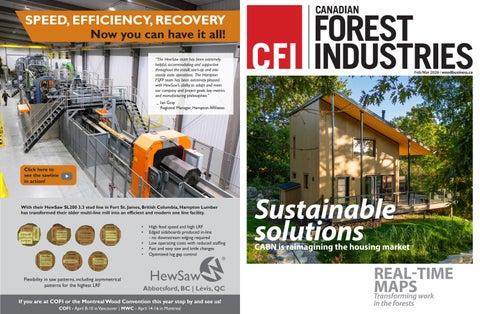
With their HewSaw SL200 3.3 stud line in Fort St. James, British Columbia, Hampton Lumber has transformed their older multi-line mill into an efficient and modern one line facility.

• High feed speed and high LRF • Edged sideboards produced in-line

CABN is reimagining the housing market

Reliability that counts

MS 500i GAS CHAINSAW

79.2 cc • 5.0 kW • 13.7 lb ①

$1,94999

MSRP with 20" bar

The MS 500i is the first chainsaw in the world to feature electronically controlled fuel injection. Ideally suited for the professional forester, this high-torque machine cuts through big timber with ease. Rapid acceleration and optimized operator control means that the MS 500i is perfect for felling, bucking and limbing. Featuring electronically controlled fuel delivery, the MS 500i starts easily and delivers outstanding engine performance regardless of altitude & temperature. The revolutionary engine design provides the operator the best power to weight ratio on the market.

⬤ Optimum engine performance from the first pull under all conditions

⬤ Rapid acceleration in an unbelievable 0.25 seconds, enabling this high-torque machine to provide instant power

⬤ Electronic Fuel Injection technology guarantees optimum performance regardless of temperature or elevation

⬤ Captive guide bar nuts on the sprocket cover so they won’t get lost when changing the guide bar or chain

Note: Wrap handle version is also available.

① Weight with powerhead only.

APRIL 8-10, 2026

BOOTH NO. 33

MONTREAL WOOD CONVENTION APRIL 14-16, 2026

BOOTH NO. 99

ONE PARTNER.

One profiling line, run by a single operator, working Scan&Set, for all possible cutting patterns:

WOOD PRODUCTS

Sustainable solutions

A small modular homebuilding company in Brockville, Ontario is reimagining the housing market.

The path forward

TLA Convention

Real-time maps

Real-time maps are transforming forestry work.

N.A. market update

North America market update

A cut above

Reliability and accuracy top priorities for harvester heads.

Trends in drying

How mills are looking to improve drying operations.

The clock is ticking

The need for action in the residential sector.

CABN builds smart homes using CLT panels made by

and European manufacturers. For more, turn to page 20.

FEAR NO FOREST

The New L-III Skidders

Superior cab comfort, visibility and efficiency. Greater forest confidence.*

*Compared to previous Deere L-Series.

asnook@annexbusinessmedia.com

@CFIMag

CanadianForestIndustries

@cfimag

Canadian Forest Industries

first cut Support on its way

Feds open call for proposals for diverse programs

With unforgiving tariffs and duties, fibre challenges, rising costs and labour shortages, it’s no secret that Canada’s forest products sector could use some additional support in the current climate. So, the announcement from Minister of Energy and Natural Resources Tim Hodgson calling for proposals under NRCan’s forest sector transformation programs on February 25 was met with a positive response from industry representatives.

“In a world where trade is getting more volatile, Canada has to focus on what we can actually control right here at home. These programs will help innovate our lumber and pulp and paper members’ operations. The forest products sector provides the building blocks for our country – from the lumber for our houses to the renewable energy we need to be self-reliant,” stated Forest Products Associaiton of Canada president and CEO Derek Nighbor.

The call for proposals, announced is for four different programs backed by a $500-million commitment from the federal government. The programs include:

• The Investment in Forestry Industry Transformation (IFIT) program;

• The Green Construction Through Wood (GCWood) program;

• The indigenous Forestry Initiative (IFI); and

• The Global Forest Leadership Program (GloFor).

Casting a wide net, this approach by NRCan offers different supports for Canada’s forest products producers.

For companies seeking to diversify their product offerings and markets in the face of increased U.S. protectionism, Canada’s Global Forest Leadership Program is designed to support the development of innovative forest products and the expansion of international markets for Canadian producers, starting April 1, 2026.

The IFI program is designed to advance reconciliation by supporting Indigenous-identified priorities to accelerate First Nations, Inuit and Métis groups’ awareness, influence, inclusion and leadership in the forest sector. The program will provide funding for

Indigenous-led projects in the forest products sector including: gathering, developing, using and protecting Indigenous knowledge and science; Indigenous leadership and participation in forest stewardship; and the identification, consideration and pursuit of economic development opportunities.

GCWood, which has been around for nearly a decade (created in 2017), promotes the use of advanced wood-based building products, systems and technologies including modular and prefabricated structural components in residential construction; as well as use of advanced wood-based products in community infrastructure, and industrial and commercial buildings.

The IFIT program offers funding support to capital investment projects and research into advanced woodbased building solutions, biomaterials and biochemicals, pulp and paper modernization, next-generation biofuels, and advanced decarbonization. With the recent closures of sawmills and pulp mills across the country, this program is more vital than ever to keep people in Canada’s forest product sector working while finding new homes for mill residuals.

FPAC recommended that its members review the programs to explore ways to enhance innovation, diversity production, boost domestic demand, expand wood use in construction, support Indigenous involvement, and access new markets.

While negotiations continue on a new CUSMA deal, there’s no guarantee that the forest products sector will be spared from the damaging tariffs and duties currently hurting the sector. With the U.S. housing market in a slow recovery mode from now until the end of 2027, and a weak Canadian homebuilding market expected for the next few years, there’s never been a more important time for the sector to find ways to pivot and create innovative wood-based solutions, while building up new markets and expanding existing trade relationships with countries overseas.

The 200,000 people who depend on this sector for their livelihoods are counting on industry and governments to work together to find solutions. Here’s to hoping programs like these can help support the forest products sector with transitioning into a brighter future for everyone.

ANDREWsnook

ED 3000 Wrapper

Fully automatic wrapping and stapling machine for lumber packages

NEWS upfront

Canada signs MOU with China to expand cooperation and markets for wood products sector

The Government of Canada has announced Natural Resources Canada has s igned a Memorandum of Understanding (MOU) with China’s Ministry of Housing and Urban-Rural Development (MOHURD) designed to increase cooperation to support modern wood construction while generating new opportunities for Canada’s forest products sector to expand further into international markets.

The news of the new MOU regarding wood products generated positive responses from industry representatives.

“Mark Carney’s visit to China is an important opportunity to reset the relationship and refocus on practical cooperation,” stated Bruce St. John, president of Canada Wood Group. “Renewing the NRCan–MOHURD MOU builds on more than a decade of proven collaboration that helped modern wood construction take root in China. With climate goals, urbanization, and industrialized construction all moving in the same direction, this is the right moment to scale up technical cooperation and expand the role of Canadian wood in China’s construction sector.”

“Concurrent to ongoing efforts

to overcome our trade challenges with the United States, it is important that we build upon the successes of existing export partnerships and seek to build new ones,” added Derek Nighbor, president and CEO of the Forest Products Association of Canada (FPAC). “Renewing this Canada-China MOU creates not only opportunity to sell more Canadian wood overseas, but it also enables the export of Canadian know-how and technical support to help shape the future of China’s wood construction industry.”

The MOU is part of a broader set of preliminary agreements in principle struck between the two countries that includes Canada allowing upwards of 49,000 Chinese electric vehicles (EV) into the Canadian market with a reduced tariff rate of 6.1 per cent; while China will lower tariffs on Canadian canola seed to a combined rate of approximately 15 per cent from 85 per cent, effective starting on March 1, 2026. The Government of Canada stated that it expects that Canadian canola meal, lobsters, crabs, and peas will not be subject to relevant anti-discrimination tariffs from March 1, 2026, until at least the end of this year.

Reader Service Print and digital subscription inquires or changes, please contact Angelita Potal, Customer Service Tel: 416-510-5113 Email: apotal@annexbusinessmedia.com

Mail: 111 Gordon Baker Rd., Suite 400, Toronto, ON M2H 3R1

EDITOR - Andrew Snook (438) 483-7451 asnook@annexbusinessmedia.com

GROUP PUBLISHER - Anne Beswick (416)410-5248 • Mobile: (416) 277-8428 abeswick@annexbusinessmedia.com

ACCOUNT COORDINATOR - Shannon Drumm (416) 510-6762 sdrumm@annexbusinessmedia.com

AUDIENCE DEVELOPMENT MANAGER Barb Adelt (416) 510-5184 badelt@annexbusinessmedia.com

NATIONAL SALES MANAGER - Josée Crevier Ph: (514) 425-0025 • Fax: (514) 425-0068 jcrevier@annexbusinessmedia.com

WESTERN SALES Tim Shaddick 1660 West 75th Ave Vancouver, B.C. V6P 6G2 Ph: (604) 264-1158

COO - Scott Jamieson sjamieson@annexbusinessmedia.com

PUBLICATION MAIL AGREEMENT #40065710

Feds announce Canadian Forest Sector Transformation Task Force

The Government of Canada has announced a new task force designed to improve the competitiveness of the country’s forest products sector. The announcement was made by Tim Hodgson, Minister of Energy and Natural Resources, while offering an update on the progress of federal support measures for Canada’s forest sector.

The Canadian Forest Sector Transformation Task Force, which is scheduled to start up in early 2026, will be seeking input from industry members, provinces and territories, Indigenous foresters, communities, and labour groups on how to restructure the forest sector to ensure the sector’s long-term success.

The task force will be led by Ken Kalesnikoff of Kalesnikoff Mass Timber and Frédéric Verreault of les Chantiers Chibougamau. It will have 90 days to consult with interested parties on recommendations for best practices for expanding the use of mass timber and modular systems; diversifying products; identifying new markets; and improving productivity. More task force members will be announced in the coming weeks.

Natural Resources Canada’s Green Construction Through Wood (GCWood) program has announced funding for several initiatives to help promote various wood-based solutions and systems. The Canadian Wood Council is receiving more than $8.5 million in funding from the GCWood program for three projects.

The Climate Smart Buildings Alliance will receive $272,000 in funding from the GCWood program to conduct a feasibility and/ or prototype-level assessment of potential solutions to address insurance challenges faced by the mass timber construction industry.

Sustainable Buildings Canada will receive $261,900 in funding from the GCWood program for a project to develop a mass timber costing guide designed to help educate people about cost issues associated with the design, engineering, code equivalency and construction of large mass timber buildings.

Ken Kalesnikoff of Kalesnikoff Mass Timber

TLA DISCUSSES PATH FORWARD IN VANCOUVER

Convention tackles markets, “Path to 45,” and more

The Truck Loggers Association (TLA) covered many of the challenges facing the forest products sector during the TLA’s 81st Convention & Trade Show, which took place at the Westin Bayshore from Jan. 14 to 16 in Vancouver.

TLA president Dorian Uzzell kicked off the convention by welcoming attendees to the convention themed, “Fostering collaboration and partnerships.”

“The TLA believes the power of working together is the key to building a stronger and more sustainable forestry sector,” he told the crowd.

Uzzell, who is president of Wahkash Contracting Ltd. in Campbell River, spoke to the

crowd briefly about the economic uncertainty impacting forestry in B.C.

“Unfortunately, the air of uncertainty in B.C. forestry has expanded beyond contractors. The entire sector is suffering; and that should not be surprising to anyone who follows the forest industry,” he said.

While the news of mill closures has garnered significant media attention, there is little being mentioned about the impact to small, independent operators, Uzzell noted.

“These ar e our members who are downsizing and shutting down, and are the backbone of a healthy forest economy, and the small rural communities of B.C.,” he said.

TLA president Dorian Uzzell welcomes attendees to the TLA Convention & Trade Show.
Photo: Andrew Snook.

Living in Doucetteville, located in Western Nova Scotia you have a couple of options for a job: Fishing or Forestry. Justin Thibault has tried them both and decided that dry land was better suited for his job aspirations. He still enjoys a trip on a fishing boat but, its more of a ‘pleasurable’ trip with a few libations.

2010, Justin started with Cut-to-Length forestry equipment and recently purchased a new 7000 Xtreme and installed it on his existing 855C carrier. “We really liked the ‘beefiness’ of the frame, felling link and saw box”, states Thibault. This all adds to the performance of the head when working primarily in Western, Nova Scotia with a main diet of Spruce, hardwoods and Hemlock. “On average, our wood size runs 45 cm. to 60 cm.”

Thibault’s operator, Tristan White likes it too. After operating 7-8 years on wheeled harvesters, this is his first time operating a tracked harvester with a Log Max. “It’s impressive. You hit the feed button and it goes through. I’ve never run anything comparable to this this before.”

“Support and service is key. Our dealership, Log Max Forestry Inc. is based out of Moncton, NB. I’ve been doing business with them for 10 years and they don’t disappoint.”

L-R: Owner / operator Justin Thibault and operator Tristan White

MARKETS AND THE ECONOMY

One of panel sessions during the convention offered a focus on lumber markets and the economy.

The session featured panelists Rick Jeffery, president and CEO of the Canadian Wood Council; Don Wright, senior counsel for Global Public Affairs; and David Fell, director of research and analysis at Forestry Innovation Investment (FII). The panel session was moderated by Vancouver Sun columnist Vaughn Palmer.

FII’s David Fell started the session speaking to Canada and B.C.’s abilities to diversify its trading partners in the forest products sector. In 2024 (data from 2025 was unavailable), Canada exported approximately $40 billion in forest products with B.C. accounting for about $11 billion. With 42 per cent of B.C.’s forest products already going offshore, the province is in a much better position to diversify trade from the U.S. than other provinces.

“We’re already well positioned because of our position on the Pacific for that offshore trade. The rest of Canada, only about 14 per cent of forest products were exported outside North America,” Fell explained.

For dimensional lumber produced in B.C., approximately two-thirds was shipped to the U.S.; and 20 per cent went offshore. Only about 1 per cent of dimensional lumber produced in the rest of Canada was shipped offshore in 2024.

The remaining lumber produced in B.C. (about 13 per cent) was sold within the province or interprovincially in 2024 –much smaller domestic consumption than lumber produced in Ontario and Quebec, which have larger populations and housing demands.

In addition to being able to meet demands in Canada, U.S. and China, Fell said that B.C. producers need to have a foothold and be prepared to meet demands in markets such as Vietnam, India and the U.K. He also noted that European producers are competing for these same markets, while Russia is trying to grow its market share in China.

“Diversification is this complex web of multiple different countries and suppliers. Our job really is to make sure that we are ready in some of these key import markets to position B.C. product,” Fell said.

He also discussed the need for B.C. producers to grow existing markets overseas,

such as Japan.

While the province has found some success supplying the country’s smaller residential construction, Canada should focus on growing its foothold in the multifamily housing market.

“Everyone is travelling to Japan right now. Japan is investing a lot in tourism, investing in hotels and tourism infrastructure. So, Canada Wood Group is closely tracking that market,” Fell said.

DOMESTIC CONSUMPTION

Canadian Wood Council president and CEO

Rick Jeffery discussed the need to increase the use of domestic forest products in Canada’s built environment through the use of codes and standards.

While the majority of domestic lumber consumption is used to supply the residential sector, and that is unlikely to change anytime in the near future, Jeffery pointed out that single-family homes now account for about 30 per cent of new homes, while multi-family units make up about 70 per cent, so the forest products sector needs to look about the types of products its producing for the domestic residential market.

Between these opportunities and the non-residential market, Jeffrey believes that

Canada can increase its domestic consumption by 1 to 2 billion board feet.

As the wood products sector has grown its foothold in multi-family dwellings through the use of mass timber products, it has increasingly become a competitor to concrete and steel products. However, the steel industry needs to carbonize and has been researching the use of timber-steel hybrid products – an opportunity for the wood products sector to increase its market share.

“For us it’s a win, because 70 per cent of the structural material in those buildings is in the floor, and that’s where the wood would reside,” Jeffrey said. “It’s an opportunity, and so, we’re doing research in that regard to see how we can fast-track hybrid buildings in Canada in the codes, so that you can start to take advantage of that.”

KEEPING COMPETITIVE

Global Public Affairs senior counsel Don Wright stated for B.C. to be able to grow its market share around the world, it will need to first tackle the uncertainty and cost competitiveness issues around its fibre supply. He said fibre supply issues and actual harvest declines in the province are largely policy driven, which needs to be remedied. In last year’s election campaign, a key part of

James Girvan discusses the Province of B.C.’s “Path to 45” mandate during the Truck Loggers Association’s Annual Convention & Trade Show in Vancouver. Photo: Andrew Snook.

the current government’s platform was to get harvest levels back up to 45 million cubic metres. Wright said this was most likely driven by the significant reduction in stumpage revenues going to the province from forestry operations.

“I should point out that stumpage revenue is only a fraction of the total direct revenue that the government gets from a healthy forest sector,” he explained. “In addition to stumpage revenue, there is the personal income tax by employees in the forest sector. There’s a corporate income tax for companies. There’s a sales tax, so on, and so forth. Rough order of magnitude total for the B.C. government take is about four times what that stumpage revenue is. So, does the government have an incentive to get things back on its feet? I think a couple billion dollars in this state and age due to the fiscal circumstances is a pretty good incentive.”

B.C.’S “PATH TO 45” QUESTIONED

Another panel discussion focused on B.C.’s fibre supply and featured a presentation related to the Province of B.C.’s “Path to 45” forestry initiative, which targets an actual harvest of 45 million cubic metres from public lands.

The presentation was made by James Girvan, associate for Industrial Forestry Service Ltd., who discussed this mandate in detail, and the progress that has been made towards this goal since its announcement in early 2025. Girvan has a 45-year career in professional forestry as an industry analyst working in consulting, pulp and paper, fibre management, commercial banking, and is a former executive director of the TLA.

He said the reality is that the industry has harvested significantly less in recent years with an actual harvest of 37.6 million cubic metres in 2025, down from 38.4 million cubic metres in 2024. These actual harvest numbers are far lower than the approximately 65 million cubic metres that were harvested annually between 2009 to 2018. While managing the mountain pine beetle outbreak was partially responsible for the spike in actual harvest during that time period, new policy was put into place around 2018 that has had a major impact, Girvan says.

“Since then, we’ve seen that steady decline down to the volume that we’ve seen harvested in the last year,” he said.

While the combination of U.S. duties and tariffs and a weak U.S. homebuilding market are hurting demand for B.C.-produced softwood lumber and other wood products, forest policies and issues with permitting are also having a major impact on logging contractors’ abilities to harvest throughout the province. The recent announcements of mill closures in B.C. have only worsened the situation by lowering the industry’s overall capacity.

Girvan said that if we assume the entire industry runs at 95 per cent, including all types of wood products plants and log exports, the industry’s capacity in B.C. would be about 40.5 million cubic metres.

While there are many challenging factors in play for B.C.’s forest products sector to achieve the province’s mandated target of 45 million cubic metres, the root cause of the issues plaguing the industry are the many forestry policy changes put in place since 2018, Girvan told the crowd.

“Like they say in AA, you have to acknowledge the problem in order to start recovery, and I just have not seen that evidence from the government we have today when it comes to the forest industry,” he told the crowd.

A LONG WAY TOGETHER

FORESTECH

FORESTECH is a BKT bias steel-belted tire, suitable for forestry applications with forwarders. It provides excellent traction even in heavy-duty service and applications. Its strong bead and shoulder area ensure high puncture resistance as well as a longer tire life cycle. As a result, you can deal with the toughest working conditions in the forest without concern.

Choose the BKT range for forestry applications!

Eastern

Directeur Régional, Est du Canada

BKT Tires (Canada) Inc.

Cell: 514-792-9220

Web: www.bkt-tires.com

Discover the BKT Range

HARVESTER heads

A CUT ABOVE

Reliability and accuracy top priorities for harvester heads

When it comes to what logging contractors are looking for in today’s harvester heads, traditional needs are still very much a priority.

“They want machines that work, that they can rely on, because downtime to them is money lost,” says Hervé Charbonneau, spokesperson for Maskinen, a distributor of forestry equipment based in Saint-Nicolas, Que., serving Quebec, Ontario and Atlantic Canada.

Tigercat Industries is also focused on reducing downtime for contractors. In addition to manufacturing its latest harvester heads using thicker steel on the frames, top saws and knife arms, the company has recently invested in additional field support.

“We’ve invested in additional field service reps that will go out and tune the head. They make sure you know what you’re doing and it’s running at its maximum efficiency,” says Chris McMillan, marketing technical writer for Tigercat Industries.

While reducing downtime and optimizing productivity have always been a vital part of logging operations, precision has also become a priority.

“We’re seeing more focus on precision regarding measurements. Contractors are responding to the stricter standards in that respect imposed by sawmills,” Charbonneau explains. “They need heads that can provide consistent and reliable measurements. I would say this is the battleground on which harvester head manufacturers will be competing in the years to come.”

When it comes to features, logging contractors are opting for overall productivity, reliability, and ease of use over individual peak performance figures, notes Ponsse product manager Markku Laaksonen.

“It is no longer just about maximum feeding force or speed, but about how consistently and predictably the harvester head performs across varying

tree sizes, species, and site conditions,” Laaksonen says.

Key features Laaksonen notes include smooth and wellcontrolled feeding, accurate length and diameter measurement, and secure stem handling throughout the processing cycle.

“When feeding, delimbing, and sawing are stable and well bal anced, measurement accuracy improves and log quality remains high. This directly translates into better recovery, less waste, and higher value output,” Laaksonen says.

While manufacturers are working away trying to meet the various needs of contractors, there is another challenge that needs to be overcome: brand loyalty.

“A lot of contractors seem to have their favourite head that they’ve always used. So, trying to get them to change is difficult. We have to try and prove to them that our head is better,” McMil lan notes. “A lot of people are set in their ways, and they just use a certain head, and they don’ demos and show them that if you just give us a try, you might be impressed.”

TRAINING

One area picking up interest for harvester technologies are automation and assistance functions, which can significantly reduce operator workload and allow the operator to focus on the overall harvesting process.

As older operators retire, the next generation coming in needs additional assistance with training, as they have fewer experienced colleagues to lean on for advice. To help with this, manufacturers like Tigercat and Ponsse use simulators to help train new opera tors. A far more forgiving option than learning out in the woods.

“Training and simulation tools, as well as guided operating modes, help operators build confidence without immediate pro duction pressure. The overall goal is to ensure that the harvester head actively supports the operator and productivity regardless of experience level,” Laaksonen says.

Ease of use in the equipment itself is also an important feature.

“With increasing challenges in operator availability and train ing, contractors value systems that are intuitive and forgiving to use. Modern harvester heads are expected to support the operator, not require constant finetuning to achieve good results,” Laak sonen says.

Logging contractors are opting for overall productivity, reliability, and ease of use over individual peak performance figures. Photo: PONSSE.

“This makes it easier for new operators to reach productive working levels more quickly.”

While automation is making headway in logging operations, full automation is still some time away due to the irregular terrain and challenging conditions for most of the har vesting operations in Canada, Charbonneau notes.

“It’s going to take a while before we move to full automation. Of course, there will be continuous evolution in terms of bucking optimization, software and controls. We’re seeing more in terms of exchange of information between the harvester itself, the contractor, and the sawmill,” he says.

PRODUCT SHOWCASE

TIGERCAT INDUSTRIES

The TCi 573 Harvester Head has a threewheel design for harvesting and processing in medium- to larger-sized tree profiles. It has an optimal range of 16 to 24 inches; a feed wheel opening of 34.5 inches; and weighs 6,120 lb. The unit features strong components, large bushings and pins, and durable construction throughout for reduced downtime and high production. The TCi D7 Control System combines a solid, field-proven hardware and bucking control technology with a head control and user interface developed by Tigercat. The result is a system that delivers powerful functionality, simplicity and intuitive operator control. www.tigercat.com

LOG MAX

Log Max Forestry Inc.’s 6000V harvesting heads feature a top saw unit with two MK2 30cc saw motors to assist the contractor in maximizing yield out of forked softwoods and nasty hardwoods. The 6000V is also equipped with standard tilt-control to place the head at the desired tilt angle; optimized saw box to accommodate up to 90-cm saw bars; redesigned measuring wheel cylinder and hydraulic circuit; lubrication points to facilitate maintenance; reinforced frame with safety lock pin; expander pins, plus many more updates. Serial production units will be available in Q1 2026. www.logmax.com

SP MASKINER

The SP 761 LF is a heavy-duty, high-performance harvester head, featuring SP Maskiner’s exclusive Low Friction principle for minimal friction and maximum productivity. The unit can be mounted on large wheeled or tracked harvesters as well as forestry excavators. Its high capacity combined with a compact, protected, and robust design allows the SP 761 LF to efficiently handle a wide variety of demanding felling tasks. Equipped with specially designed knives and a topping saw, the SP 761 LF

becomes a processing head capable of efficiently handling stacked logs. The SP 761 LF offers optimal performance in stands with a DBH of 25 to 50 cm. It has a cutting diameter of 80 cm and weighs 1,750 kg. www.maskinen.ca

PONSSE

The new PONSSE H8 harvester head enables faster, more efficient, and comprehensively economical harvesting even when there are plenty of large-diameter trees to handle. Thanks to the robust structure, great sawing power, excellent gripping geometry and uncontested agility, the head allows smooth proceeding without unnecessary interruptions. The H8 boasts exceptional power and ability to perform, especially in relation to its compact size. Even though the head’s agility enables smooth operations in all types of forests, the new H8 maintains its stability well. This results for example in efficient feeding and fast, yet flowing tilt function. www.ponsse.com

PONSSE
SP MASKINER
TIGERCAT

REAL-TIME MAPS IN THE FOREST

The arrival of real-time maps is transforming forestry work

“You can know exactly where your machines are, and the maps are much more precise,” says Nicolas Dion, owner of Forestiers NK, from aboard his harvester in the Nestaocano, Que. area, north of Lac-Saint-Jean.

Dion is a forestry technology enthusiast. After being the first contractor to use satellite internet, he also served as a guinea pig for Domtar, testing new Android tablets equipped with Groupe Système Forêt (GSF) software.

“You have to know how to move forward in life, and I like being first,” the forester says with a laugh. “With these new Android tablets, it’s easier to see where you are in your section.”

The maps are also much more precise, which reduces the risk of error, especially near lakes and wetlands. With reliable data, the forwarder can see exactly where the harvester has been, which optimizes the work.

MORE RELIABILITY AND PRECISION

Instead of waiting for the foreman to arrive, before these tools came, foremen had to manually collect machine points. Too often, some were missed – distances that were too long to cover; or delays that could result in losing one to two weeks of data. On Fridays, the situation worsened, as the crews were in a hurry to finish.

With the new tablets, monitoring is automated and performed daily. Data is transmitted directly to the GSF cloud, enabling more rigorous management of land areas and improved trail tracking.

“We can immediately see if an area has been missed,” explains Luc Duval, head of technology deployment at GSF.

The gains are significant. The tablets receive twice as many satellite signals, improving GPS accuracy from 1.2 metres to 0.6 metres. Three alert levels now notify operators: a low alert when the machine approaches a block, a medium alert near a watercourse or protected area, and a high alert if the

machine leaves its designated area. The result: fewer measuring tapes, less risk of violations, and greater efficiency in the field.

“It’s a simple project, but it greatly modernizes our operations,” Duval says. “With the alerts and increased accuracy, we can continue logging without fear of going outside the boundaries.”

AVAILABLE IN REAL TIME

Instead of waiting for the foreman to bring a USB key to access new maps, these are now available in real time thanks to the cloud. Domtar managers can add a map to the system from

their offices, and it becomes immediately accessible in the forest, provided the contractor has a satellite inter net connection. No more wasted time, Dion says.

“We save time, and in the end, that means more money in our pockets,” notes the contractor.

Domtar’s forestry foremen are also more efficient because they no longer have to travel around the territory to deliver maps. With these tools, Dion can now supervise his teams remotely.

“I can see exactly where my guys are in real time and know how they’re logging,” he says. “I can manage remote -

Nicolas Dion, owner of Forestiers NK in Nestaocano, Que., is the first entrepreneur to test the new tablets.

ly even if I’m on vacation and call the guys in the woods when needed.”

The contractor has been testing this tool for a year now and has nothing but praise for it. That said, aside from a minor bug that was quickly fixed, Domtar, building on this experience, now wants to implement the solution with all foresters in the sector before rolling it out province-wide within two years.

LOGGING OUTDOOR ROADS

Since last spring, Forestier NK has started logging forest roads.

“It’s a new challenge I wanted to take on,” Dion says, who operates with a short log kit.

More specifically, he uses an Eltec H7 harvester equipped with a Ponsse H7 HD head and recently acquired a Komatsu 895-2 2024 forwarder.

Harvesting timber to clear forest roads allows for a clear view of the work site in advance.

“We always have timber ahead, and it lets us know where the good timber is,” Dion says.

FURTHER DEVELOPMENTS TO COME

For Luc Duval, this is just the beginning. The next steps aim to integrate more data into the system. Tree height, soft ground detection, and timber volumes measured by harvester heads are all factors that are considered.

“We want to combine this data with transportation data to know exactly what volume is at the roadside and transmit that information to the mill,” he explains.

This would allow production schedules to be adjusted based on the harvested volume and logistics to be better planned.

Looking ahead, the forestry contractor is still open to testing new technologies, but he doesn’t yet know what the next one will be.

“We might be able to harvest with a real-time price list,” he suggests.

Dion also proposes implementing a volume-based payment model, using data collected by the machines, instead of being paid by weight.

“I’m affected by the wood’s moisture content, which varies in weight depending on the season,” he says. “I don’t manage weight, I harvest volume.”

According to him, this method of remuneration would be fairer for foresters.

A LONG-AWAITED REVOLUTION

“We’ve been working for several years to replace the electronic logbooks in the machines, which use a clock and paper rollers,” explains Sébastien Maranda, general manager of Groupe Système Forêt (GSF).

The roller then had to be given to the contractor who had to compile the data. It’s hard to believe this technology is still used in the forest, but it is. The arrival of satellite internet in the forest is a game changer, as all technological tools are now available to the forestry sector.

“It also allows us to do things like prepare payroll,” Maranda says, specifying that Domtar has been using this tool for two years.

In the future, GSF wants to continue to push the boundaries of data and develop new tools. For example, GSF wants to perform predictive analytics to assist operators.

“With data and artificial intelligence, we could suggest the best route for harvesting the block,” he adds.

Thousands of hard-working people are planning to gather in May to conduct some serious business and to have some fun. The LOGGERS’ EXPO features a wide array of supplies and services, heavy equipment and trucks — for loggers and land clearers, tree care professionals and firewood dealers, sawmillers and landowners. This year’s show features the Weiler Log Loading Competition MAY 1-2, 2026 CHAMPLAIN VALLEY EXPOSITION ESSEX JUNCTION, VT For information about attending or exhibiting at Expo: visit northernlogger.com email expo@northernlogger.com call 315-369-3078

Sponsored by

WOODPRODUCTS

SUSTAINABLE SOLUTIONS

CABN is reimagining the housing market

Build more homes. Build them faster. Build them more sustainably. Oh, and make them more affordable. Simple ask, right?

These are the demands of many Canadians across the country as well as the federal, provincial and municipal governments. Couple these demands with a soft homebuilding market and a domestic lumber market under intense pressure from fibre supply challenges, labour shortages and increased U.S. tariffs and duties, and builders and wood products producers have their hands full.

One company attempting to meet some of the demands of Canada’s homebuilding market

while supporting local wood products producers is CABN. Started up in May of 2021 by social entrepreneur Jackson Wyatt, this small modular homebuilding company based in Brockville, Ont. is servicing the needs of Canadians in rural areas across the country, as well as clients south of the border. The company builds and designs energy efficient smart homes in remote locations using CLT panels produced by Canadian and European manufacturers.

Wyatt’s vision for the company stemmed from his background in material sciences in agriculture and forestry, designing sustainable products, combined with a desire to find more

Forestry is a challenging industry, with operational, trade, environmental and regulatory requirements constantly evolving. That’s why it helps to have an advisor who is not afraid to get their boots dirty. With deep roots in the forestry sector, our advisors deliver a fresh perspective and advice to improve and streamline your operations.

sustainable ways to use natural resources for building homes that could be deployed anywhere in the world.

“Selfishly, I like the idea of a cabin in the woods, self-sustaining at net zero, with solar power, off grid. All of those things wer e a personal endeavor of mine. But then I lent on my manufacturing background to look at how we can do this cost effectively,” Wyatt says.

When CABN started up, Wyatt worked alongside former colleagues that included engineers and climate scientists to design the first models of CABN’s modular homes.

“They were modelled around energy efficiency with the idea of deploying them in very remote areas,” he says.

As CABN’s first opportunity to showcase its sustainable housing technology, the company’s show home in Mallorytown, Ont. launched in 2023.

“We were fortunate enough to be supported by the Federation of Canadian Municipalities for our show home in Mallor ytown, to prove the sustainability, the energy efficiency, and then the process,” Wyatt recalls.

Since that time, CABN has grown its operation and have designed and built homes in several provinces and territories, as well as in northern regions of the U.S. Despite the U.S. having ten times the population of Canada, CABN’s current sales are split roughly fifty-fifty between the two countries.

“We are focusing more on the Canadian market. We are intentionally looking at supplying for our housing needs, particularly the last six to 12 months. But we are also working closely with some Commonwealth partners as well,”

Wyatt says, noting that he believes Australia presents some potential opportunities to expand the company’s markets.

Currently, CABN is in the process of expanding its manufacturing capabilities so it can lower its overall costs and make its homes mor e widely available to people. The scaleup process is a challenging balancing act.

“You’re balancing these new growth periods and the scale periods with the resources you have and trying to always stay a little bit ahead of the curve with everything. It’s tough. It takes longer than you expect, but you have these periods of static and then big jumps that are really exciting,” Wyatt says.

NAVIGATING TARIFFS

While some homebuilders are feeling the impact of the increased U.S. tariffs and duties on both sides of the border, CABN has so far been able to minimize their impact to their operations.

“We’re fortunate with our product. The panels themselves are not materially affected,” Wyatt says. “Some of the things that do affect us, we were nimble enough to make adjustments to – like windows, for example, or fasteners and steel.”

Efficient managing of the company’s supply chain is paramount to the company’s success.

“We have to manage quite a bit in terms of those particular items. From the wood side we’re less impacted, if impacted at all. But it’s not a static thing. I don’t necessarily know what’s going to happen in six months,” Wyatt notes.

CABN is focused on using eastern Canadian red pine for producing CLT panels, which is a dominant species in more than 280,000 hectares of forest across Ontario. Photo: Will Jurczy.

One way the company has been able to balance increased supply costs is by taking advantage of a weaker Canadian dollar when servicing clients south of the border.

“We have American customers that see that as an advantage. So, we balance it out pretty well. Again, I don’t know what’s going to happen in six months, but for the time being, it’s pretty manageable,” Wyatt says.

Relying on a combination of Canadian and European producers for engineered wood products has also helped with controlling costs.

The company has also been producing its own cross-laminated timber (CLT) panels with help from InnoTech Alberta, a leading research and technology organization that is a division of Alberta Innovates. The CLT panels are currently being tested at the Discovery Centre, where one of CABN’s solar-powered HUTTs (a small purpose-built, solar-powered modular home) has been constructed in the Limerick Forest in Oxford Station, Ont.

The CLT panels are produced from eastern Canadian red pine, a species

typically used for the production of utility poles and home finishings.

The species was tested for use in CLT production and validated at the University of Toronto’s wood lab before being manufactur ed into CLT panels. The project in the Limerick Forest is a collaboration between CABN, the Mass Timber Institute, the University of Toronto, and the Ontario Woodlot Association.

The fibre used to build the CLT panels for this project was harvested from

the Limerick For est. This was purposely done to showcase the potential for scaling up pr efabricated construction of smart homes in Ontario using eastern Canadian red pine, which is a dominant species in more than 280,000 hectares of forest across the province.

“We were really focused on using local red pine, making local CLT,” Wyatt says.

While ther e is a focus on taking advantage of the vast amounts of red pine in Easter n Ontario for the company’s

CABN founder Jackson Wyatt. Photo courtesy of CABN.

own manufacturing operations, CABN has also been supplied CLT products from various other companies in Ontario, Quebec and Europe.

Wyatt notes that sometimes CLT coming over from Europe can be less expensive than domestically produced products, despite the increased shipping costs, and that Canada’s wood products producers have an opportunity to better supply this market.

“It’s a surprising analysis that foreign supply of CLT is sometimes less expensive than domestic,” Wyatt says. “There’s a big opportunity in Canada in terms of supplying, not just Canadians, but also exporting to the world these high-value mass timber elements.”

FASTER BUILDS

One of the most attractive aspects of the homes that CABN produces to municipalities is that they can be constructed incredibly quickly in comparison to traditional stick-frame houses.

“We have a partner in the U.S. that does some of our builds, and they just put a one of our units up, and it was in four days,” Wyatt says.

CABN’s installation times range anywhere

between two to 10 days, depending on the time of year and the size of the unit – upward of 2,300 square feet for a single-family home – and then another six to eight weeks for the finishing. For a commercial building around 25,000 square feet, depending on the weather, it typically takes about 45 days to complete the construction process.

Another advantage of building using CABN’s process is that the materials can be stored relatively easily near the installation site for prolonged periods of time to build when the weather is optimal for construction, which is incredibly useful in more northern, isolated regions of the country.

“The nice thing about the mass timber approach combined with panelization is that you can ship in advance and then store it for when the available machinery and equipment is there in the short season for building. Then you can erect it and get it closed and sealed very rapidly,” Wyatt explains.

AUTOMATION IS KEY

The company runs lean with only 15 full-time

CABN’s installation times range anywhere between two to 10 days.
Photo: Beattie Film.

employees working at different sites. CABN is currently in the process of scaling up its manufacturing through the use of various robotics to speed up its production with an expectation that the facility will be fully upgraded later this year. The automation of production significantly decreases the amount of labour that would otherwise be required for this kind of production – from approximately 20 employees to three people for handling and overseeing the quality assurance line to make sure that the products are within acceptable ranges.

“An equivalent would be about 100 to 150 hours of people working hours on the automation robotics line, versus in excess of 1,200 hours on a manual line. That’s a factor of 10 difference when you look at overseeing an automated production line,” Wyatt says.

He adds that there is no interest from the company in replacing the creative roles within the company through automation, only repetitive tasks that most people do not want to do, such as

repeated fastening and adhesion, and material placement.

“Not having to put 2,000 screws into something at the same distance, the same time, on multiple panels and in a continuous nature, that’s something that we avoid and replace with robotics arm systems, and then a lot of the precision placement of materials is the other key thing. It’s avoidance of a human error potential in terms of being exact to the millimeter in placements,” he says.

FIVE-YEAR PLAN

Wyatt’s vision for CABN is currently in year four of a five-year plan that includes fully automated mass production lines that focus on using the locally underutilized species for fibre to keeps costs to a minimum.

“The goal is to ultimately make sustainable, higher-quality housing available to everyone, regardless of cultural or geographic cost constraints. The way you do that is not just one single thing. It’s a mixture of better design, higher quality materials in engineering, and

automation to reduce costs,” he says. “We’re on year four, looking at working with our local natural resources and at the cost per square foot, and really looking at how we can get that reduced. We just finished our two-year project with the Ministry of Natural Resources using red pine for the Discovery Centre. It’s our introduction of the automation line.”

Wyatt believes that companies like CABN are an important piece of solving the housing crisis in Canada.

“With these multiple different things incorporated – natural resources, automation, better design – you can make things sustainable, higher-quality housing at a reasonable cost,” he says. “We’ve been going through the growing pains in the scale of things every second of every day, but it’s exciting to see the support, not just from like customers and people that believe in CABN right now, but also from the government support of the larger picture – support from Canada, and the U.S. as well, in terms of this as a solution for housing.”

TRENDS IN DRYING WOODPRODUCTS

How mills are looking to enhance their drying operations

Optimizing existing drying operations is at the top of the agenda for many forest products manufacturers. With the homebuilding markets in the U.S. and Canada currently facing a slow period, many lumber producers are focusing on ways to optimize their existing infrastructure.

“What we’ve seen over the last 12 to 16 months is new kiln projects have slowed down quite a bit, and customers are focusing on what they can do to make their operations more efficient and optimize current processes,” says Nyle Dry Kilns vice-president of sales Adam Duplisea.

For the mills that are considering new kiln installations, drying precision is paramount, especially for North American mills that are expanding to enter the higher-value wood products markets.

“In North America, more and more sawmills are moving into glulam and CLT production, creating new demands for higher quality — specifically lower standard deviation and more consistent drying,” says Valutec CEO John Karbin. “Standard deviation is a critical factor in meeting those requirements.”

AUTOMATION

Improved automation to minimize operator errors is another key focus area for customers.

Comact recently released a new zone-controlled direct-fired continuous kiln. It is equipped with its own control system that offers benefits usually associated with an indirect-fired kiln to a direct-fired kiln, explains Olivier Magnan, wood

drying specialist for Comact.

“Customers want fewer manual adjustments and better product transitions in their continuous kilns,” says Magnan.

“If a change happens at three in the morning, the system takes care of it. Our goal is to reduce the coverage required around the kiln.”

Combustible Dust Specialists

Allied brings 49 years experience to help you meet current NFPA Standards with: system design/documentation, spark detection, isolation, grounding, PLC, venting, blast path management, clean-up systems and duct audits — CWB certified and member SMACNA.

Sawmill – Biomass – Boardplants – Pulp & Paper – Power Generation – Mining 50 years of Industrial Air Systems www.alliedblower.com ◆ Phone: 800-576-3611

Automation will play an increased role as qualified kiln operators become harder and harder to find.

“Back in the day, you had the dedicated lumber drying guy at the mill that could feel the lumber moisture with his thumb,” Wallocha says. “This kind of knowledge has kind of died out, and now you have to sell a product that almost runs by itself. And so, we are in a difficult situation where have to sell a dry kiln with a computer control system that is customizable, but on the other side, also very automated.”

Valutec has also seen strong demand for more advanced automated control systems, driven in part by workforce transitions and the need to onboard new operators efficiently.

“Our customers regularly bring new team members into operations, so it’s essential that the system is intuitive and easy to use,” Karbin says.

DATA-DRIVEN DECISIONS

Access to additional data is another topic of interest for producers so they can make better drying decisions. One example is mill managers looking for ways to speed up dr ying and identify areas where the lumber is not drying, so they can move on to the next step in the schedule, Duplisea explains.

Comact’s Olivier Magnan says customers want fewer manual adjustments and better product transitions in continuous kilns. Photo: Comact.

Comact has also had many requests from customers that want additional data from their drying operations.

“Customers appreciate having real data from their lumber. We track every bundle through the kiln,” says Magnan. “We know when it entered, what zones it ran through, the temperatures it saw, and how long it stayed there. That gives us full traceability for every charge.”

The customer can then use that data to backtrack their quality control processes.

While customers are increasingly interested in collecting data, they also need assistance in identifying and processing the vital information from their operations. This is an area where AI will play a big role in the drying process, Duplisea says.

“Identifying the conditions inside the kiln when the optimum moment is to move on to that next step, based on the lumber species or thickness, it’s not quite integrated yet. But I do see AI taking over and analyzing all the conditions; whether it’s airflow, the heat, the lumber, the percent moisture loss that is acceptable for that species, and when can we move on,” he says. “Our goal is to produce a quality product, but also dry that product as quickly as we can.”

Valutec uses a great deal of machine learning in its simulator technologies for its customers. Whenever the company sells a kiln, they run a full simulation of the kiln (or an entire sawmill with the kiln operating inside it) to ensure it will meet the customer’s needs.

“We have also integrated it fully in our control system that we deliver with the kilns,” Karbin adds.

The simulator is integrated so the operators can use it to generate the schedules they use for drying.

“That’s generated by the same mathematical engine that is behind our dimensioning tool, and we use it also for inter nal projects, like when we do development and testing,” Karbin says.

“So, I would say simulations, machine learning, and AI, if you want to call it that, is a very large part of what we do today and has been for 10 to

drying,” says Ingo Wallocha, senior sales manager for HILDEBRAND BRUNNER. “In times like these, where the economy is not booming, where everything is a little slower, retrofitting of kiln control systems and retrofitting fittings of heat recovery systems on older kilns is a big trend for customers that are not in the market for new kilns.”

Another area of interest for sawmills is finding ways to save on overall energy costs.

Nyle offers its customers an all-electric system as an option for reducing their energy costs.

“It’s a heat pump drying with electric heat. So what customers are doing is selling electricity back into the grid,” Duplisea explains.

15 years. We’ve based a lot of our operations on that type of technology.”

ENERGY MANAGEMENT

Many mills across North America are paying closer attention to their emissions production with a goal of becoming carbon neutral, so energy efficient drying has become an increasingly vital aspect of operations.

“It’s really important to them to have energy efficient

HILDEBRAND BRUNNER is looking at helping its customers save energy by installing solar panels to the roofs of their kilns.

“We are working right now on a solution for our kilns to add solar panels on the roofs. If you are in an area where solar panels make sense, then it’s actually a no-brainer, because it’s going to feed most of the electrical requirements of your kiln by itself,” he says.

During the peak hours, where there’s peak demand charges, customers use Nyle’s energy management systems to dial back kiln use during peak hours, so they’re not hitting high demand charges, and then ramp the kilns back up to 100 per cent during non-peak hours.

“By doing that, they’re selling the electricity back to the grid, but they’re also getting incentives directly from the electric companies to help manage the load on the system. That has been another big item on all of our electric kilns,” Duplisea says. “When you look at an all-electric system, it’s pretty significant… the energy management

Energy efficient drying has become a vital aspect of mill operations. Photo: HILDEBRAND BRUNNER.

system has been extremely popular.”

MANAGING RESIDUALS

Traditionally, many lumber producers would burn any wood residuals they did not have a market for and use that

energy to heat buildings and kilns. While it is still common practice for many operations, some mills are searching for other options, as regulations for getting boilers certified and emissions productions tighten, Duplisea says.

“We’ve seen a shift in what other technologies they can utilize besides a boiler system,” he says. “They’ll turn their wood waste into profit with a system that either produces biochar or wood chips that they can sell to the market instead of burning it.”

THE NEXT GENERATION

Some sawmills are owned and operated by the third and fourth generations of families, and many of their traditional drying methods have been incorporated into their operations for decades. However, as the next generation of mill owners are being trained to take over operations, drying techniques are beginning to shift. Sawmills are very interested in finding ways to optimize their drying processes using existing equipment.

Duplisea says the mills that are being more efficient and optimizing now are the ones that will be successful down the road, because they’ve already accepted that there’s going to be changes, and now are going to get ahead of it, and that’s going to improve their processes.

“Maybe not immediately, because there may be a few bumps along the road, but in the next three to five years, you’re going to see a big difference, because the ones that analyze that data are going to have a head start over the ones that are slow to adapt,” he says.

Nyle Dry Kilns offers an all-electric system as an option for reducing energy costs. Photo: Nyle.

• Enhanced Sensor Technology

• Integrated Energy Management System

• Retrofitted To Any Kiln Regardless of Manufacturer

• Shorter Drying Cycles

• Qualifies for Carbon Credits

• Saves Up to 80% of Lost Heat

• Increases Boiler Capacity

DRYING spotlight

Comact

After expanding its operations, Comact is further advancing its dry kiln portfolio with the Deltech Dual-Path Continuous Dry Kiln, featuring zone-controlled direct-fire technology. The traditional single plenum inlet has been replaced by multiple duct openings combined with optimized damper logic. Each damper controls a specific zone, allowing precise temperature regulation along the entire length of the kiln. This new control approach brings the benefits of indirect heating to direct-fired systems.

Nyle Dry Kilns

Nyle’s Heat Recovery Vents (HRVs) help wood processors maximize efficiency by capturing and reusing valuable heat that would otherwise be lost. Designed specifically for kiln operations, Nyle HRVs reduce energy consumption, lower operating costs, and improve overall drying performance. By reclaiming exhausted heat and returning it to the kiln process, facilities can boost productivity while shrinking their environmental footprint. It’s a smart, sustainable upgrade that delivers measurable savings and stronger bottom-line results for modern wood drying operations.

USNR

Building on the proven automation of the Counter Flow kiln, USNR’s UniFlow advances performance with a simplified, same direction material flow that significantly increases throughput, often achieving up to 65-per-cent more production while using an existing heat source. Its intelligent, uni directional layout restores clear green and dry ends, enhancing forklift efficiency and smoothing movement between the sawmill and planer mill. UniFlow also delivers exceptional lumber quality. The integrated equalizing chamber and variable rate cycling produce wood with less stress and a tighter moisture distribution than traditional batch systems. With Kiln Boss controls providing precise temperature and airflow management, mills gain fully automated drying with consistently reliable results.

Valutec

Valutec’s TC kilns come with distinguishing features such as low energy consumption, high flexibility and

superior capacity. It gives the operator the possibility to create the ultimate drying process with freedom to mix dimensions, minimal moisture content variation and reduced risk of checking. Annual capacity can reach 150 MMBF with target moisture contents down to around 12-18% with a standard deviation of 1%. The principle is based on the timber package being fed length-wise through zones in which the air circulates laterally across the drying channel. This enables the separate regulation of the climate in different zones according to a schedule that comes very close to the ideal schedule of a batch kiln.

HILDEBRAND-BRUNNER

This facility operates four continuous lumber dry kilns, type Hildebrand HCK, engineered for high-throughput, energy-efficient timber drying. Each kiln features a linear flow configuration with doors at both ends, enabling consistent material movement and optimized process control. The continuous design ensures uniform drying conditions across the entire charge, minimizing moisture gradients and improving product quality. Integrated passive and active heat recovery systems significantly reduce energy consumption by reclaiming thermal energy from exhaust air and process streams. These kilns are suitable for all wood species and dimensions.

Source: Madison’s Lumber Reporter

N.A. LUMBER MARKET UPDATE

Market update for 2025

As January came to a close, the impediment of very harsh winter weather kept sales of construction framing dimension softwood lumber items slow. It was more a matter of transportation issues than a drop in demand. Some orders were booked at prices similar to the previous week, but most communication was about organizing deliveries on icy and frozen highways. As well, several regions of the U.S. South and east experienced power failures, which of course impeded sawmill operations.

Most industry players, whether buyers or sellers, agreed that 2026 started off on good footing, with prices quite stable compared to the

same time last year and in 2024. All eyes were on the usual uptick in sales during February, when the largest U.S. homebuilding companies book their wood needed for projects that will break ground in spring.

For the week ending January 30, 2026, the price of Western Spruce-Pine-Fir 2x4 #2&Btr KD (RL) was US$460 mfbm, which was flat from the previous week. That week’s price was up +$69, or +17%, from one month ago when it was $392.

Compared to the same week last year, when it was US$445 mfbm, that week’s price was up +$16, or +3%. Compared to two years ago when it was $442, that week’s price was up +$18, or +4%.

MADISON’S WESTERN S-P-F KD 2X4

Source: Madison’s

KEY LUMBER PRICES AND MARKET CONDITIONS TAKEAWAYS, JANUARY 2026:

• Even while overall availability was limited, customers of Western-SPF lumber and studs in the U.S. remained quiet due to seasonal effects.

• Commodity prices showed consistent but not outlandish strengthening trends.

• Buyers of Western-SPF lumber in Canada retreated to the sidelines after covering the bulk of their short-term needs.

• Sawmills maintained order files into mid-February.

• Purchasers were unwilling to extend coverage beyond that timeline.

• Secondary suppliers of Eastern-SPF commodities reported sales plodded along at a relatively good pace.

• Logistical issues cropped up frequently as winter weather affected huge swathes of both Canada and the U.S.

• Widespread power outages over much of the Eastern portion of the continent affected Southern Yellow Pine

sawmill operations.

• Eastern stocking wholesalers were content to see their prices head into February flat.

The Madison’s Lumber Prices Index for the week ending January 30, 2026 is: US$494 mfbm. This was down 0%, or -$2, from the previous week when it was US$496, and is up +7%, or +$34, from one month ago when it was US$460.

The data for U.S. housing starts is much delayed, as the Census Bureau has only released to October. Normally by now the full-year 2025 would be available.

As such, there is some analysis possible: on an actual basis (not seasonally adjusted), U.S. total housing starts for January to October last year are flat compared to the same time in 2024. There were 1,159,900 new homes constructed in the first 10 months in 2025 compared to 1,152,200 the previous year.

Single-family housing starts for January to October fell 7% last year to 801,000 units, from 2024’s 861,700 units.

Lumber inventories throughout the supply chain were so lean as to be non-existent. Due to so many unknowns continually cropping up in recent years, lumber producers will not increase production until there is a true rise in actual sales.

Customers, meanwhile, have become accustomed to getting the small amounts of wood they need in relatively short order so have seen no reason to build up inventory. In this context, no one knows what the market situation will be over the next few weeks.

The prevailing sentiment is to just hope there is no shock or surprise which catches people unprepared.

COLUMN final cut

The clock is ticking for governments to take action

The most dangerous misconception about Canada’s housing slowdown is that it is just a market correction – something that affects investors, developers, and spreadsheets, but not real people. Nothing could be further from the truth. Tens of thousands of jobs in the residential construction sector are at stake, as well as jobs in the wood and forest product sector.

Falling demand for framing lumber will lead to price drops and production cuts for softwood lumber manufacturers, less work for sawmills and the logging industry, and reduced demand for structural panel manufacturers and those who make engineered wood and prefabricated components.

The ripple effect will be disastrous for many industries and our economy. Economic modelling by the Canadian Centre for Economic Analysis indicates that there will be a deep and persistent slowdown in new housing relative to the 10-year average. The anticipated scenario implies about 21,500 fewer housing starts and about 18,000 fewer completions than the 10-year average, roughly 36 per cent fewer starts and 39 per cent fewer completions.

Just 5,300 new homes sold in the GTA in all of 2025 – the worst year in 45 years of record-keeping. December sales were down 82 per cent from the 10-year average. The implications for the workforce are significant. The expected scenario suggests that about 35,000 residential construction workers in Ontario could be displaced on average. The estimated displacement profile is approximately 21,000 workers aged 35 or younger, about 5,000 aged 36 to 54, and about 9,000 aged 55 and over. This matters because these jobs losses will turn into a permanent skills crisis for our industry. Construction jobs aren’t like retail or office jobs. When workers leave, they don’t magically return when conditions improve. Apprenticeship chains break. Crews dissolve. And workers with specialized skills in trades such as high-rise concrete forming and mechanical systems disappear.

When demand eventually returns, we will discover an inconvenient truth: the workforce that is needed to solve the housing shortage no longer exists.

There has been a tendency to treat the downturn as a downtown Toronto condo story. But as we heard at RESCON’s annual general meeting, the data doesn’t support that narrative. Mike Moffatt, founding director of the Missing Middle Initiative at the University of Ottawa, soundly debunked that storyline. Data shows that sales have slowed not just in Toronto and Vancouver, but also in markets like Calgary, Edmonton and Kitchener-Waterloo. Demand for new housing is down across the board as the cost of building new units is too high to compete with the resale market. Condo apartment starts are down more than 50 per cent across most municipalities in the Greater Golden Horseshoe. The core issue is whether builders can build homes that people can afford to buy. Prices for new homes have fallen roughly 20 per cent from their peak, but construction costs have not followed suit. Builders can’t lower prices enough to attract buyers without locking in losses.

To their credit, provincial leaders acknowledge the problem. It was clear from remarks by Premier Doug Ford and Minister Rob Flack at RESCON’s meeting that they get the challenges ahead and are determined to act further and decisively this year. They intend to speed up approvals, cut red tape and invest billions of dollars in housing-enabling infrastructure. A cut to provincial and federal sales taxes on new housing for first-time buyers is also in the works. All of this will certainly help but only at the margins.

The leaders know what needs to be done systemically to cut the rest of the housing Gordian Knot. If governments are serious about protecting housing supply, they must take further action. That means slashing development charges that add tens of thousands of dollars to each new unit, eliminating the tax-on-tax that inflates construction costs, shortening construction timelines so carrying costs don’t kill projects, and slashing the sales taxes on all new housing. Governments must fire their guns all at once. We cannot wait any longer. Every cancelled project pushes skilled workers closer to the exit. The clock is ticking.

RICHARDlyall media@rescon.com

Three new, proven applications already deployed in sawmills complement the Smart Vision product range to improve flow, efficiency, and operational stability across critical mill operations.

Smart Vision for…

LUG LOADER

Ensures smooth and consistent board loading by managing accumulation before the lug loader

CANT INDEXATION

BOARD UNSCRAMBLER

Or

Scan

Detects misaligned cants and enables precise indexation between primary and secondary breakdown

Optimizes board separation and flow through real-time monitoring and conveyor control

NEW BADGE.

SAME COMMITMENT TO QUALITY AND SUPPORT.

TCi harvesting heads are built by Tigercat Industries and designed to take full advantage of the capabilities of Tigercat harvester and processor carriers. A Tigercat-TCi package offers more than performance, reliability, and durability. It provides a factory-installed solution with ongoing expert factory support to optimize the entire system, tailored to your specific requirements.

Turn static files into dynamic content formats.

Create a flipbook