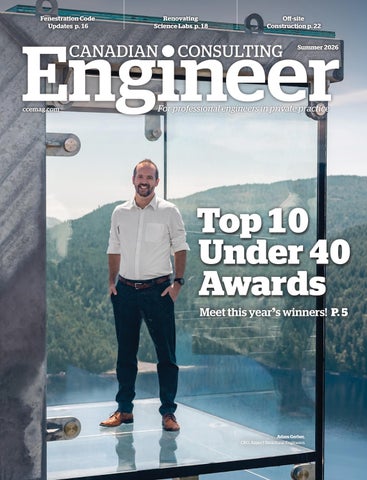
Fenestration Code Updates p. 16
Renovating Science Labs p. 18
Off-site Construction p. 22 Summer 2026
ccemag.com
Top 10 Under 40 Awards Meet this year’s winners! P. 5
Adam Gerber, CEO, Aspect Structural Engineers
1
CANADIAN CONSULTING ENGINEER
Month 2026
̓ A S Ə M ( RI VERVI EW ) B RI DGE S TAL ̕ ƏW VAN CO U V E R , BC
VA N CO U V E R | C A LGA RY | ED MON TON | TORON TO | OTTAWA
CONTENTS
Summer 2026 Volume 67 | ISSUE 3 ccemag.com
13
5
18
COLUMNS
FEATURES
04 | Comment On June 23, Canadian Consulting Engineer’s fourth annual Advance Women in Engineering virtual summit coincided with International Women in Engineering Day.
5
22 | Conversation Modular Building Institute (MBI) executive director Tom Hardiman advocates for the benefits of off-site construction—and for the changes that will help it grow.
COVER STORY Top 10 Under 40 Awards This spring, the consulting engineering community across Canada submitted many worthy nominations for Canada’s top young leaders. Now, we introduce the 10 winners!
13
Public to Private When it comes to large infrastructure projects, there is still much for Canada’s public and private sectors to learn from each other.
16
Fenestration Updates to Canadian Codes and Standards Changes to National Model Codes, new energy requirements and the evolving status of key glass standards are shaping the Canadian regulatory landscape.
18
Retrofitting UWaterloo’s ESC The third-floor renewal of the Earth Sciences & Chemistry (ESC) building began with an architectural goal, but the mechanical strategy would drive key decisions. ON THE COVER Vancouver Island’s Malahat Skywalk & Visitor Centre was a signature mass-timber project for Adam Gerber, who stands among the 2026 winners of our Top 10 Under 40 Awards. See story on p. 5. PHOTO COU RT E SY A S PEC T ST RUC T U R A L E NG I N E E R S..
ccemag.com
CANADIAN CONSULTING ENGINEER
3
Comment by Peter Saunders
Spotlighting Women in Engineering
A
s I hope most of you were aware, we presented our fourth annual Advance Women in Engineering virtual summit on June 23. This timing meant, for the first time, the event fell precisely on International Women in Engineering Day (INWED). Initially founded in the U.K. by the Women’s Engineering Society (WES) back in 2014, INWED has since become a truly international campaign—particularly after receiving the United Nations Educational, Scientific and Cultural Organization’s (UNESCO’s) patronage in 2017—that raises the profile of women in engineering and focuses attention on exciting career opportunities available to the next generation of girls. Its theme in this, its 13th year, was ‘Engineering Intelligence.’ While Canadian Consulting Engineer’s annual summit is entirely Canadian in scope, we recognize the need to support greater opportunities for women engineers all around the world. With that in mind, this year we organized a panel of women who started their professional careers as licensed engineers in other countries before moving to Canada for their next phase. Titled ‘The Immigration Transition,’ it allowed them to share their personal experiences with licensure and challenged Canada’s consulting engineering community to consider how this transition could become a clearer path, rather than a roadblock, to professional development and career continuity. Speaking of which, the event’s other panel discussion was titled ‘Roadblocks and Paths Forward.’ It focused more broadly on new benchmarks for welcoming women into engineering as an increasingly inclusive profession. Before and between the panels were two well-received keynote presentations. First, Florence Morin-Laurin encouraged women to make sure they strengthen their
4
CANADIAN CONSULTING ENGINEER
sphere of influence in the engineering field. With more than 15 years’ experience navigating male-dominated industries, including construction, she knows firsthand what it takes for women to establish credibility and lasting impact. The second keynote was presented by Jocelyn Peltier-Huntley, P.Eng., and named after her recently published book, ‘Active Allyship.’ With more than 20 years’ experience as a mechanical engineer, Peltier-Huntley helps organizations develop inclusive, diverse and equitable workplaces. Her book shares not only her own research-based tools for change, but also real-world stories from other professional engineers. If you missed the summit’s live broadcast on June 23, do be sure to check out the recordings of all of the sessions right here: www.cccemag.com/virtual-events/ advance-women-in-engineering-2026. Each year, we end the summit with an audience survey, the results of which help inform the topics we tackle the following year. I’m also eager to hear your thoughts directly. Please feel free to contact me at the email address below with your suggestions. In the meantime, I’m happy to introduce this issue, which showcases the winners of our annual Top 10 Under 40 Awards, fully half of whom are women. And by circumstance, not design, I’m also pleased to note that all of the submitted feature-length articles in this issue were written by women: Karla Avis-Birch, a former member of the Canadian Consulting Engineering Awards jury; Mary Georgious, whom I previously interviewed in 2024; and Amy Roberts, who presented our most recent CCE Education session in July. Enjoy!
READER SERVICE Print and digital subscription inquiries or changes, please contact: Angelita Potal Tel: 416-510-5113 Fax: (416) 510-6875 email: apotal@annexbusinessmedia.com Mail: 111 Gordon Baker Rd., Suite 400 Toronto, ON M2H 3R1 EDITOR Peter Saunders (416) 510-5119 psaunders@ccemag.com SENIOR PUBLISHER Maureen Levy (416) 510-5111 mlevy@ccemag.com MEDIA DESIGNER Alison Keba EDITORIAL ADVISORS Darryl Boyce, Todd Busch, Guy Bruce, Andrew Macklin, Sadaf Parvaiz ACCOUNT CO-ORDINATOR Cheryl Fisher (416) 510-5194 cfisher@annexbusinessmedia.com AUDIENCE DEVELOPMENT MANAGER Beata Olechnowicz (416) 510-5182 bolechnowicz@annexbusinessmedia.com GROUP PUBLISHER Danielle Beavan (226) 931-0375 dbeavan@annexbusinessmedia.com CEO Scott Jamieson sjamieson@annexbusinessmedia.com CANADIAN CONSULTING ENGINEER is published 4 times per year by Annex Business Media 111 Gordon Baker Road, Suite 400, Toronto, ON M2H 3R1 Tel: (416) 442-5600 Fax: (416) 510-6875 or (416) 442-2191 EDITORIAL PURPOSE: Canadian Consulting Engineer magazine covers innovative engineering projects, news and business information for professional engineers engaged in private consulting practice. The editors assume no liability for the accuracy of the text or its fitness for any particular purpose. SUBSCRIPTIONS: Canada, 1 year $70.01, 2 years $112.44. Single copy $11.22 Cdn + taxes. (HST 86717 2652 RT0001). United States $159.12 (CAD). Foreign $182.46 (CAD). PRINTED IN CANADA. Title registered at Trademarks Office, Ottawa. Copyright 1964. All rights reserved. The contents of this publication may not be reproduced either in part or in full without the consent of the copyright owner(s). Annex Privacy Officer: Privacy@annexbusinessmedia.com Tel: 800-668-2374. ISSN: 0712-4996 (print), ISSN: 1923-3337 (digital) POSTAL INFORMATION: Publications Mail Agreement No. 40065710. Return undeliverable Canadian addresses to Circulation Dept., Canadian Consulting Engineer, 111 Gordon Baker Road, Suite 400, Toronto, ON M2H 3R1. PRIVACY: From time to time we make our subscription list available to select companies and organizations whose product or service may interest you. If you do not wish your contact information to be made available, please contact us. Tel: 1-800-668-2374, fax: 416-510-6875 or 416-442-2191, e-mail: vmoore@annexbusinessmedia.com, mail to: Privacy Officer, 111 Gordon Baker Road, Suite 400, Toronto, ON M2H 3R1. Member of the Audit Bureau of Circulations. Member of Magazines Canada
Peter Saunders • psaunders@ccemag.com SCAN CODE TO VISIT CCE’S WEBSITE: Find the latest engineer-related news, stories, blogs and analysis from across Canada
Summer 2026
EMERGING LEADERS
Top 10 Under 40 Awards We present our fifth annual roster of winners! By Peter Saunders
Mariam Abdulameer Mariam Abdulameer, 29, is a resource manager for COWI North America. At the time of her nomination, however, she was manager of quality and inspection services for Vancouver-based RAM Consulting, leading one of its largest, most operationally complex teams and overseeing quality assurance and regulatory compliance across major projects. “Both of my parents are engineers and I’ve always been drawn to the built environment,” she says. “I initially wanted to be an architect, but as I grew up and became more practical, I realized I wanted to be an engineer.” Abdulameer earned her bachelor’s degree in civil engineering from the University of British Columbia (UBC)—many of whose students she has since mentored— and became certified as a Project Management Professional (PMP). After working at Kiewit as contract administration engineer, project controls engineer and finally lead concrete field engineer, she joined RAM (whose two founders had graduated from the same UBC program as she did) in ccemag.com
Earlier this year, Canadian Consulting Engineer once again reached out to the community to recognize promising young consulting engineers across the country—and the industry again responded with many worthy nominations. The following are 2026’s lineup of winners, presented in alphabetical order by last name.
2021 as a junior quality specialist. “I was aware of RAM as a new player in the market, doing consulting differently,” she recalls. “I had watched them grow from afar. And then my interview was with all women. That really gave me a
strong impression.” Working with teams of skilled tradespeople, Abdulameer has often been the youngest person and the only woman in the room. Joining RAM helped her further build her confidence, resilience and decision-making, allowing her to lead more effectively. By ensuring projects met stringent technical, safety and regulatory standards, she earned the trust of major clients, including Metro Vancouver, BC Hydro and FortisBC. RAM promoted Abdulameer in 2022 to quality specialist and inspections lead and in 2023 to manager of inspection services. She also became chair of the firm’s innovation council, leading the implementation of digital tools to modernize company workflows. Now she has joined COWI, where she continues to expand her experience and focuses on building operational and organizational capacity with the same people-focused approach. Outside the firm, she is co-director of sponsorship for Canadian Construction Women (CCW), supporting initiatives that promote inclusion in engineering. CANADIAN CONSULTING ENGINEER
5
EMERGING LEADERS
Francesco Addario Francesco Addario, 34, is a senior project engineer and project manager with Hatch in Mississauga, Ont. He received 23 nominations for this year’s Top 10 Under 40 Awards—by far the highest number of any candidate. “Toward the end of elementary school, I fell in love with skyscrapers, bridges and the entire civil engineering industry,” he recalls. “That interest peaked through high school and university and I became the first engineer in my family.” Addario earned his bachelor’s (with honours) and master’s degrees in civil engineering at the University of Toronto (U of T). During his studies, he was drawn to consulting and completed internships with Hatch Mott MacDonald (HMM) and HDR’s bridge engineering teams. “University taught me about consulting and how design is embedded within it,” he explains. Addario’s internships provided firsthand experience in bridge design, inspections, contract administration and project team co-ordination. He was involved in such signature transportation infrastructure projects as the $1.4-billion Herb Gray Parkway in Windsor, Ont., and the $3.9-billion Governor Mario M. Cuomo Bridge (formerly the Tappan Zee Bridge Replacement) in New York, N.Y.
Let’s build positive change, together
Discover our highways and bridges solutions
6
As Addario subsequently rose from engineer-in-training (EIT) to licensed professional engineer, Hatch and Mott McDonald separated in 2016; he remained at the former, which absorbed the Canadian infrastructure division. He was promoted to project engineer and project manager in 2020, then to his current roles in 2023. “My role has changed progressively throughout my career,” Addario says. “I started off with the technical design team, performing calculations, developing drawings and preparing construction contracts. Over the past five to six years, I’ve held roles in project management, which is my passion. I like to work with the client, contractors and design team to win projects and deliver good results. It’s been very fulfilling as I get more involved in major pursuits.” His colleagues praise him for the same. “He is an effective communicator, showing an ability to connect with multiple parties and work successfully in many contract models,” says Hatch vice-chair Michael Schatz. “Client feedback and ratings are above-average for the projects he manages,” says Rada Nakamoto, senior bridge designer. “Francesco has achieved so much to date and has a long, fulfilling career ahead of him,” says Claudio Pasqualino, Addario’s supervisor. Aaron Akotuah Aaron Akotuah, 39, is a senior engineer and team manager at Jensen Hughes, based in Vancouver. As the firm’s transit and transportation sector lead for Western Canada, his areas of expertise include codes, standards and regulations, fire safety and project management. “One of my strengths as a child was paying attention to details and being diligent,” he says. “My real turning point toward the engineering field was in high school, where physics came naturally to me.” After earning his bachelor’s degree in civil engineering from Kwame Nkrumah University of Science and Technology (KNUST) in Kumasi, Ghana, Akotuah moved to Canada to pursue a master’s degree in civil engineering at Ottawa’s Carleton University. He joined Jensen Hughes in 2015 and continued his education further with a master’s in structural engineering from
CANADIAN CONSULTING ENGINEER
CCE_Hatch_Summer26_CSA.indd 1
Summer 2026 2026-07-08 10:05 AM
University of British Columbia (UBC). “When I got an opportunity to study in Canada about how structures behave in fire, there was a push at that time to use wood as a sustainable material,” he says. “I did a lot of laboratory research and tests that led me into the fire safety industry, which was a novel field to me.” Over his 11 years with Jensen Hughes, Akotuah has progressed from learning the ropes in fire safety engineering to working on mass-timber buildings to delivering large, complex transit projects. By way of example, he helped Toronto’s Eglinton light-rail
transit (LRT) project navigate occupant safety and liability issues relating to station interfaces and is currently engineer-of-record for the $6-billion Surrey Langley SkyTrain project. “I’m so privileged I got the opportunity to work on the Eglinton line,” he says. “It offered a lot of learning experiences.” Akotuah also focuses on sharing what he has learned. In addition to mentoring younger staff, he recently partnered with TransLink to present lessons from the Eglinton LRT to his local Society of Fire Protection Engineers (SFPE) chapter, to improve awareness of safety considerations for rapid-transit stations with adjacent or integrated developments. “Aaron is a team player who collaborates with colleagues across Canada,” says Dominic Esposito, senior project consultant for Jensen Hughes. “He is always friendly and approachable.” Samuel Bright Amankwah Boadi Samuel Bright Amankwah Boadi, 36, director of major projects and innovation for Vortex Fire Consulting’s Canadian practice, based in Toronto. His work has helped mid-rise mass timber buildings become more routinely approved. “When I was applying to universities back in Ghana,” he recalls, “my father, who was a teacher, introduced me to a professor of civil
p
Under 4 10 0 er inn W
CCE To
TOP 10 UNDER 40 CANADIAN CONSULTING ENGINEER Samuel is a forward-thinking fire engineering leader recognized for his mastery of complex building code challenges. Whether navigating performance-based design, securing approvals for alternative solutions, or making code-equivalency arguments on technically demanding projects, he consistently finds innovative, compliant pathways that bring ambitious and sustainable designs to life. His pioneering work in mass timber fire safety showcases this strength, advancing the code frameworks behind an emerging construction method and shaping how these buildings achieve compliance. With over a decade of experience across hospitals, mass timber buildings, infrastructure, and institutional and international projects, we are proud to celebrate Samuel’s outstanding contributions to fire engineering and building code excellence at Vortex Fire.
SAMUEL BRIGHT A. BOADI M.A.Sc., P. Eng
Director of Major Projects & Innovation
ccemag.com
CCE_VORTEX_SUMMER26_BAS.indd 1
SAFE.SMART.SUSTAINABLE Abu Dhabi | Canberra | Dubai | Ottawa | Sydney | Toronto | Winnipeg
vortexfire.com
CANADIAN CONSULTING ENGINEER
7
2026-06-29 2:11 PM
EMERGING LEADERS
solution helped convert an office designation to classroom occupancy with AHJ approval; and the 10-storey T3 Bayside in Toronto, the tallest timber office building anywhere in North America. He has also provided building code consulting for health-care facilities, which are highly demanding of fire safety because patients cannot self-evacuate. After being promoted to his leadership role in 2024, Boadi not only carries the technical load, but also brings up those around him by teaching new graduates how to think about a building, rather than just how to apply code clauses. engineering. I had never heard of civil engineering before, but I made the best of that opportunity.” That he did, graduating at the top of his class. His professors connected him with Ottawa’s Carleton University, where he went on to earn a master’s degree in civil, fire safety and structural engineering. “My research was focused on the performance of hybrid steel-timber connections in fire,” he explains. “Back then, you could only build mass timber up to six storeys. Now you can go to 18, as we know how to use the material safely.” In 2016, Boadi joined Vortex as a project consultant. He was able to carry forward the core principles from his studies to help clients get mid- and high-rise mass-timber buildings approved by authorities having jurisdiction (AHJs) by proposing alternative solutions to prescriptive building codes. There were also opportunities to continue learning. He became certified in fire evacuation design by Sweden’s Lund University and earned his designation as a Rick Hansen Foundation Accessibility Certification (RHFAC) Professional. Over his nearly 10 years with Vortex, Boadi has contributed to significant projects, including the Centennial College A-Block expansion in Toronto, Canada’s first zero-carbon mass-timber higher-education facility; One Young, a mass-timber building in Kitchener, Ont., where his alternative 8
CANADIAN CONSULTING ENGINEER
Maryam Bostani Maryam Bostani, 39, is HDR’s artificial intelligence (AI) global practice lead, based in Vancouver. The use of AI may still be new to many consulting engineers, but Bostani—who was born in Germany and raised in Iran— began exploring its potential 16 years ago while pursuing a master’s degree in railway and structural engineering. When one of her math courses introduced her to machine learning and neural networks, she wondered if these models could help solve engineering challenges by learning from data and uncovering patterns that would otherwise be difficult to detect. What began as an academic approach to prioritizing railway maintenance activities became her defining professional pursuit. After moving with her husband (who was also studying structural engineering) to Canada, where they would welcome their son Arvin, Bostani revalidated her credentials joined HDR during the final year of her PhD at University of Calgary. “It was not top-of-mind for me to look for work in the private sector, rather than become a professor, but HDR posted the opening at my university and it was a perfect fit,” she recalls. “I've learned a lot from the firm’s different offices all around the world.” She rose from bridge engineer to associate, project manager, senior bridge engineer, professional associate and, finally, lead of HDR’s global AI practice, which now
comprises about 400 members. Far from AI chatbots and content generation, Bostani develops machine learning systems using real infrastructure data to support analysis and decision-making. Her view has always been for AI to support engineering judgment, not replace it. Bostani’s bridge management system has yielded real-world impact. For example, she supported a U.S. transportation agency with an asset management plan for 43 bridges along the Highway I-94 corridor. Combining AI-enabled deterioration models, bridge inventory data and element-based life-cycle cost analysis, she provided bridge-by-bridge guidance for maintenance, rehabilitation and reconstruction. Now, other transportation agencies across Canada and the U.S. are watching—and several are exploring similar programs. Bostani also provides insight as vice-chair of the Transportation Association of Canada’s (TAC’s) digital applications committee and on the Transportation Research Board’s (TRB’s) computational methods and analytics committee. And she achieved her academic goal as adjunct professor and advisor at Brown University from 2022 through 2024. Adam Gerber Adam Gerber, 38, is CEO of Aspect Structural Engineers, whose offices in VancouSummer 2026
ver, Toronto and Bern, Switzerland, serve a growing market for mass-timber construction across North America and Europe. Colleagues describe him as innovative, collaborative, solution-oriented, calm under pressure and “equally comfortable discussing financial reports as the pull-out strength of fasteners.” Working with wood has been a consistent thread for Gerber, who worked as a carpenter, foreman, estimator and engineer-in-training (EIT) before and while he earned his bachelor’s and master’s degrees in structural and earthquake engineering at University of British Columbia (UBC). Those experiences gave him a practical understanding of construction. “As a kid, I wanted to be a builder,” he recalls. “I didn’t know the difference between carpentry and engineering, but I knew I wanted to be hands-on, in the action. My
uncle was a carpenter and we’d build together on the weekends.” Gerber’s interest in engineering grew through high-school math and science classes and a desire to apply those subjects practically. Through an internship program, he job-shadowed an engineer at StructureCraft, a consulting firm known for its pioneering efforts in mass timber. That led to work terms over the next seven years. After graduating, he joined Fast + Epp as a project engineer, then co-founded Aspect as project manager in 2016. “I was the junior in the initial cohort of principals,” he explains. “We set out to become a 20-person boutique firm.” While helping grow the company, Gerber earned an MBA at UBC’s Sauder School of Business. He progressed at Aspect to associate principal and principal. Today, he is CEO of a global firm comprising 65 professionals.
Gerber’s contributions extend beyond project work. He is a certified Passive House (PH) consultant and active contributor to the Canadian Standards Association (CSA)
Congratulations, Congratulations, Maryam Maryam Bostani Every Everyday, day,you’re you’re helping helping clients clients use use data dataintelligently intelligently to to support support safe, safe, strategic strategicinfrastructure infrastructure decisions. decisions. Maryam MaryamBostani, Bostani,AI AIPractice Practice Lead, Lead, Bridges Bridgesand andStructures Structures Canadian CanadianConsulting ConsultingEngineer Engineer Top Top10 10Under Under40 40
hdrinc.com hdrinc.com
EMERGING LEADERS
task group on timber concrete composites (TCCs), which contributes updates to CSA O86, Engineering design in wood. More recently, Gerber and his team began co-developing a mass-timber micro-credential program with the British Columbia Institute of Technology (BCIT), to help encourage more young people to join one of the construction industry’s fastest-growing areas of specialty. Megan Rhind Megan Rhind, 37, is a principal and transportation lead at Entuitive, based in Toronto. She has more than 13 years’ experience in structural engineering and project management. “When I was a child, for as long as I can remember, I wanted to be a veterinarian,” she recalls. “When I was 12 or 13, I shadowed a vet for a day. Everything was fantastic until I had to do the vaccines. I passed out cold on the floor! I realized I didn’t have the stomach for biology, so I wrote it off entirely and focused on physics instead.” With her strengths in science and math complemented by an interest in architecture, Rhind pursued an undergraduate degree in engineering at Queen’s University, followed by a project management certificate at University of Toronto (U of T), which helped prepare her to lead infrastructure project delivery. “When I got to Queen’s, learning the practical elements of engineering was really interesting, but the project management side and studying business became my passion,” she explains. “I realized engineering with more of a business slant was a better fit for me.” After graduating, Rhind joined Brown & Co. Engineering, starting as a structural engineer and rising to project manager and principal, until it was acquired by Entuitive in 2019. “My first project at Entuitive was leading the integration of Brown & Co., post-acquisition, and developing and executing strategies for new service lines,” she explains. From there, Rhind rose from associate to senior associate and, in 2022, led Entuitive’s 10
CANADIAN CONSULTING ENGINEER
expansion to Ottawa. She and her family moved there for two years to establish and open the new office. “It was a very exciting project for the business,” she says, “and for my career personally.” Returning to Toronto, Rhind became Entuitive’s first female principal in 2024. As her transportation strategy co-developer (and nominator) Michael Meschino describes, she has actively advocated for equity and inclusion within the engineering profession and advanced mentorship initiatives, leadership development and more inclusive workplace practices. “Megan is widely respected for her dedication to mentoring junior engineers and emerging leaders,” he says, “and for fostering collaborative, high‑performing teams.”
also focusing on people skills, all of which would prepare her for a future in collaborative municipal engagement—as did working in the alumni office, which led to an introduction to Chris Crozier, who had taken the same dual program at McMaster. “I thought I was going to be building skyscrapers and bridges,” she recalls, “but when I joined Crozier as the third employee in its structural group, I quickly moved into land development, where I could see an immediate impact in master-planning communities, as opposed to specializing in one technical stream.” Land development has since become one of Crozier’s largest business units, with Robertson overseeing a team of more than 50, representing 30% of the firm’s technical professionals. “I really enjoy working with developers, planners and multidisciplinary consultants to bring my clients’ visions to life,” she says. Robertson has now served two terms on Crozier’s board while overseeing a complex portfolio of active development projects and contributing significantly to the firm’s financial performance and growth. She has helped deliver more than 1,000 housing units on one development alone, with thousands more currently under construction or advan-
Brittany Robertson Brittany Robertson, 36, is director of development, partner and board director at Crozier Consulting Engineers in Collingwood, Ont., bringing both engineering and business perspectives to the development of residential communities, secondary plans, servicing strategies and infrastructure planning across her province. “My father was a chemical engineer in the steel industry and had a practical stance on education that could get you a job when you graduated,” she explains. “I was drawn to a dual degree at McMaster University, which combined technical engineering with ‘soft skills’ in business.” Through this program, Robertson says she enjoyed building tangible projects while Summer 2026
cing through planning and approvals. And returning to her roots like her mentor before her, she contributes as a guest lecturer at McMaster and sits on an industry advisory committee to the engineering and management program. “I’ve been able to bring a little of what I felt was missing in my undergrad, which is 'Consulting 101,'” she explains, “That’s been a great opportunity for me to give back— and to help people learn about careers in consulting a bit quicker than I did!” Susan Jingmiao Shi Susan Jingmiao Shi, 38, is an associate, senior environmental engineer and regional market practice lead at J.L. Richard & Associates (JLR), based in Kingston, Ont. “My dad works in the construction industry, which is how I got exposed to engineering design,” she says. “I had a passion to
make the world a better place, which led me to environmental engineering.” Shi grew up in China and moved to Canada in 2006 to study at the University of Windsor, graduating with great distinction in 2010. Through co-op work placements, she explored air pollution research, occupational health and safety (OHS) and
water and wastewater treatment. “I got really good advice from my professors that the water and wastewater industry is where you want to be,” she recalls, “There’s always a need for that infrastructure. Communities depend on it.” After joining JLR as an intern in 2011 and earning a master’s degree in civil engineering at Queen’s University in 2015, Shi built a career helping municipalities address complex infrastructure challenges. Today, her work spans water and wastewater treatment facilities, pumping stations, storage systems, class environmental assessments and master servicing studies across Ontario. “I’m at a stage in my career where I get to manage a lot of different types of projects and I really enjoy that diversity,” she says. “Every community has a different need and it’s rewarding to help find solutions.”
Linear drainage ACO Qmax NEO for heavy duty and high flow needs
Hydraulic analysis Loading conditions
Run layout design Code compliance
www.askACO.ca
Qmax NEO300
Qmax NEO600
ACO. we care for water (905) 829-0665 I
ccemag.com
CCE_ACO-drain_MarApr25_CSA.indd 1
(604) 554-0688 I info@acocan.ca I www.acocan.ca
CANADIAN CONSULTING ENGINEER
11
2025-03-24 9:38 AM
EMERGING LEADERS
One of Shi’s growing areas of focus is climate resilience. She recently earned the Climate Risk Institute’s Infrastructure Resilience Professional (IRP) designation, originally developed by Engineers Canada. As JLR’s Kingston office has grown significantly, Shi has become a mentor to junior and intermediate staff, encouraging them to develop expertise and confidence. In 2023, she became an inaugural co-chair of the firm’s corporate environmental sustainability committee, which has guided the development of greenhouse gas (GHG) emission reporting and supported board approval of a 46% reduction target by 2030 relative to 2019 levels. Shi has also contributed significantly on a volunteer basis to Professional Engineers Ontario (PEO) as its elected eastern regional councillor and audit and finance committee chair. Zion Yua Zion Yua, 37, is an associate and environmental manager for Thurber Engineering’s Prairies region, leading teams in Edmonton (where he is based), Calgary and Saskatoon. “As a kid who grew up always building things with Lego, I think it was predetermined I would want to get into engineering,” he says. “Math and science were my strongest subjects because I found
Congratulations, Zion Yua Top 10 Under 40 Award
This award recognizes Zion’s leadership, technical excellence, and meaningful contributions to environmental stewardship, Indigenous engagement, and the engineering community. Zion is Thurber’s Environmental Manager for the Prairies region.
thurber.ca
12
them fascinating.” Yua was born in Malaysia and grew up in Chilliwack, B.C. He earned his undergraduate and master’s degrees in environmental and geoenvironmental engineering, respectively, at University of Alberta (U of A) in Edmonton, where he met his wife and settled down. He continued to develop his expertise by obtaining his Project Management Professional (PMP) certification in 2017. Today, he is a P.Eng. registered with the Association of Professional Engineers and Geoscientists of Alberta (APEGA). “I was lucky to gain consulting engineering experience through summer employment during my undergrad studies,” he recalls. “As I was exposed to a large volume of projects, I loved how dynamic it felt. Working in the natural environment, no two sites are the same.” After joining Thurber in 2011 as an assistant project engineer, Yua was promoted to environmental engineer in 2015, assistant manager of the Edmonton office in 2023, associate in 2024 and his current role earlier this year. As a leader of Thurber’s Edmonton office, Yua both influenced its culture and fostered relationships with colleagues elsewhere. He has even led an annual fun competition with Associated Engineering’s (AE’s) Edmonton office, building on the two firms’ positive experiences working on projects together. Yua’s leadership has also been key to Thurber’s Indigenous engagement initiatives, such as supporting the Enoch Cree Nation in submitting grant applications for remediation programs and helping the Dene Tha’ First Nation train environmental monitors. And he is a leader outside the firm through various volunteer capacities, having served as president of the Geotechnical Society of Edmonton (GSE) and chair of the U of A Engineering Young Alumni Council (ENGGYAC). Yua was recently the keynote speaker at a U of A Engineering Career Connections event and his outreach work for APEGA has involved mentoring, industry mixers and speaking to children at elementary school science nights.
CANADIAN CONSULTING ENGINEER
CCE_Thurber_Summer26_CSA.indd 1
Summer 2026 2026-06-23 1:47 PM
BUSINESS
Public to Private The public sector provides lessons to the private sector for major projects’ success. By Karla Avis-Birch, P.Eng.
PHOTOS COU RT E SY K A R L A AV I S-B I RC H.
I
spent more than 20 years in the public sector delivering for people’s everyday transit needs across Ontario. Now, I get to bring that experience to the next chapter of my career by helping to shape a better world at a global engineering consulting firm. There is always a little self-doubt when starting something new. For me, it was largely about ensuring I brought value and impact. On this journey, I quickly realized that while the environment changed, the objectives were the same: to shape a better world and to centre benefits for people at the heart of engineering solutions. I have often heard “the public sector can learn a lot form the private sector,” which is always followed by presumptions that (a) the private sector is better because it is fast and can innovate and (b) the public sector can’t get things done because it is slow and bureaucratic. I have seen firsthand how this thinking creates a level of unnecessary tension that breaks down the ability for the private and public sectors to work together in a way that delivers the best outcomes. What I have realized now is the question is no longer about what the public sector can learn from the ccemag.com
private sector, but about how the sectors can best learn from each other and integrate the best of both their worlds while avoiding the mistakes of the past. In this moment of national unity to build strong and lasting infrastructure that meets the needs of communities across Canada, it is hard to argue the collaboration we seek in commercial contracts is the same collaboration we need between the public and private sectors. More to the point, the applied learnings and trust between owners (i.e. the public sector) and consultants (i.e. the private sector) can transform how major infrastructure projects are delivered successfully and how they will achieve their intended benefits. Here are some examples of what can the private sector learn from the public sector.
1
Holistic, long-term planning supports broader societal objectives. I learned early on that infrastructure is not just an asset, but also a social contract. Environmental considerations, safety, accessibility, equity, Indigenous engagement and long-term urban outcomes are not simply ‘nice to have’—they are core requirements that must be prioritized. Community integration, operational performance, asset life-cycle management and future growth plans are additional considerations that must inform design and construction decisions. Consultants who understand this context early, rather than reacting late, are better-positioned to meet public-sector clients’ needs, foster collaborative relationships and deliver positive results. When my team at Metrolinx would develop the transit business case for
CANADIAN CONSULTING ENGINEER
13
BUSINESS
a project, we focused on four 'chapters:' strategic, economic, financial and deliverability. We were always challenged to adequately quantify broader social benefits beyond just looking at the financial case. Being intentional on including those factors allowed us to ensure decision makers and various stakeholders were equipped with all of the impacts beyond building assets. This is also a key differentiator for how Arup assesses the projects it works on; and I am seeing more consulting firms incorporate such criteria.
2
Public value tops profit alone. An important perspective the private sector’s consultants can learn to appreciate from the public sector is what it truly means to be an owner. Public owners carry accountability not just for delivery, but also for the stewardship of public funds, trust and outcomes. When they have to balance choices between technical requirements and these elements of stewardship, it can feel like the project gets bogged down in a time-consuming process of having to pass through many hands, but the reason for the process is the decisions must withstand auditing, public scrutiny and political change, often decades after they are made. Consultants who have never sat in an owner’s seat may underestimate the weight of this responsibility. They may not intuitively look for ways to present trusted advice that enables the owner to satisfy the critical nature
Karla Avis-Birch moved from public to private sector last year, transitioning from Metrolinx to Arup.
Applied learnings can transform how major projects are delivered. 14
CANADIAN CONSULTING ENGINEER
of what is expected of them. Understanding the responsibility will change how requirements are interpreted, how advice is presented and how recommendations are turned into solutions, in a way that optimizes the private sector’s technical excellence and global reach. I have been humbled by both seeing up close and shaping the delivery of more than $179 million in community benefits through major transit programs in Toronto. While the imperative was to ensure the communities impacted by major infrastructure projects would also participate in economic opportunities, the implementation was much more complicated. It involved commercial negotiations, innovative engineering, practical risk timeline assessments and confronting hard truths of affordability, but all in the common pursuit of public value.
3
Engage stakeholders to shape design and enhance social licence. Public teams routinely engage exter-
nally to build requirements for infrastructure projects. It’s a question of learning what you don’t know. In complex builds, early and meaningful engagement mitigates risk, reduces redesign work, speeds up approvals and allows for more seamless integration. Without it, we often see aspirational concepts that are impractical, unnecessarily risky and, in the end, not fit for purpose. Consulting engineers in the private sector are also working with multidisciplinary teams and multiple working offices. The difference is the sum of those inputs are building blocks. With stakeholders, on the other hand, inputs add to the whole in a way that may not have been anticipated. So, the engagement process is not just one of listening, but also of assessing how what is heard can then be added to the vision of the benefits delivered. One of the greatest lessons I learned in the public sector was in taking the time to actively and regularly participate in community engagement sessions. On one such evening, after explaining the details a project would entail, I was confronted by an angry group who cared enough about what was happening to leave their families on a weekday evening because they did not feel they had been heard. That night ended with me pulling out site plans to pinpoint the who, where and what, gain a better understanding and change the project’s impact. A difference of a couple feet meant nothing to the project, but it meant everything to a neighbour’s backyard garden and provided a sense of ownership of the change.
4
Controls and standards are not bureaucratic. Controls allow for accountability and reduce rework. Standards ensure consistency and reliability and reduce variability. Summer 2026
It is expected that the depth and breadth of the private sector will bring innovation to controls and standards. We all want innovation, but it needs to be purpose-driven, not a novelty. It is about solving the right problems to bring value. Some public-sector decisions that appear ‘slow’ or ‘conservative’ are, in reality, a response to the need to provide public benefit, manage costs and ensure trust through evidence-based frameworks. Private-sector partners who appreciate public accountability are better-positioned to satisfy their clients’ needs, justify choices and extract the opportunities of innovation. When attempting to launch Metrolinx’s first Project Controls and Standards Office, before we were calling them Project Management Offices (PMOs), it was rejected as ‘an added step’ and ‘looking over your shoulder’. When there was a mistake or dispute, however, the fallback was to ‘demonstrate what checkpoint was in place’ or ‘how was it determined that this setback would avoid the risk.’ It offered a common starting point and language and a baseline for effective quality assurance and trust. This ultimately helps consultants and owners resolve issues quicker, saving time and money. Driving a shared future We need leaders who are comfortable with ambiguity and experienced across organizational boundaries. The engineering field will benefit when they understand multiple perspectives and then can make better decisions under pressure. Historically, career paths in infrastructure were relatively linear. You were either public- or private-sector, i.e. an owner or a consultant. Crossing those lines was rare; people would stay at a job for decades without any desire to change. Today, the opposite is increasingly ccemag.com
Public agencies also benefit enormously from leaders who have previously worked as consultants. true, as we see the average time spent in a job decreasing significantly. The opportunity to leverage experience for a deeper understanding can helps do things better. When leaders move between roles in the public and private sectors, the entire system allows for an organic and seamless sharing of lessons—and a greater openness to apply those lessons to new projects. I am certainly an example. My position of leadership and guidance for projects like the Gordie Howe International Bridge
Avis-Birch’s experience working on the Gordie Howe International Bridge project helped her understand what the private and public sectors can learn from each other.
and the Alto high-speed rail project provides a firsthand view of how the end products may be different, but the issues are the same. And we are all working through those issues together, regardless of our sector. Leaders who have worked inside public agencies bring an invaluable understanding of governance, accountability, political context and community impact. These factors fundamentally shape project outcomes, but are often underestimated by private organizations. At the same time, public agencies benefit enormously from leaders who have previously worked as consultants or contractors, as they bring a sharper understanding of market capacity, supply chain realities and what project delivery teams need to succeed and can adapt to site conditions and new technologies. This mutual understanding can reduce adversarial dynamics and support more collaborative, realistic project environments that ultimately deliver for better outcomes. My own transition from public-sector roles into private consultancy has certainly reshaped how I see the imperative for better collaboration and intentional applied learning. What the private sector can learn from the public sector is not just process or policy, but unified purpose. What the public sector can learn from the private sector is not just efficiency, but thoughtful execution. There is an opportunity to bring these lessons together, deliberately and collaboratively, to deliver infrastructure that meets the moment and drives a shared future.
Karla Avis-Birch, P.Eng., worked at Metrolinx for nearly 20 years, progressing from senior project control specialist to chief planning officer, before joining global consulting engineering firm Arup as principal and major rail project leader in 2025. For more information, contact her at karla.avis-birch@arup.com.
CANADIAN CONSULTING ENGINEER
15
BUILDINGS
Fenestration Updates to Canadian Codes and Standards Energy and building codes are changing. By Amy Roberts
T
he 2026 edition of Top Glass, an annual industry event organized by Canadian Consulting Engineer sister publication Glass Canada, featured an update on code, regulatory and standards developments with relation to fenestration and glazing. Changes to the National Model Codes, evolving energy requirements and the evolving status of key glass standards are among the issues shaping the Canadian regulatory landscape. These developments reflect stronger expectations for building performance and climate resilience and increased emphasis on documentation and verification. CGSB wind-down One of the most significant recent developments affecting the Canadian standards landscape came through the federal government’s 2025 budget. Public Services and Procurement Canada (PSPC) announced the wind-down of the Canadian General Standards Board (CGSB), describing stan16
CANADIAN CONSULTING ENGINEER
dards development as an “optional service.” This announcement directly affects three key Canadian glass standards: • CAN/CGSB 12.1 for safety glazing. • CAN/CGSB 12.8 for insulating glass. • CAN/CGSB 12.20 for structural glass design. These standards are referenced in building codes, certification programs and procurement requirements. The timing of the wind-down created challenges because all three were in active revision when the announcement was made. Standards 12.1 and 12.8 were close to completion, while 12.20 had undergone significant technical review and was nearly ready for public review before its development was paused. In response, the Fenestration & Glazing Industry Alliance (FGIA), with support from l’Association de vitrerie et de fenestration du Québec (AVFQ), submitted a formal letter to federal officials outlining its concerns and recommending next steps. FGIA’s priority was ensuring any technical work already completed was not lost and the standards could continue moving forward. Both 12.1 and 12.8 have now been published. The situation with 12.20 is more significant because it represents a full modernization of a structural glass design standard that has not been comprehensively updated since 1989. Although the public review process for
12.20 was cancelled and development is currently paused, efforts are underway to preserve funding and technical work, so the project can resume once a new standards development organization is identified. Codes Canada and the 2025 National Model Codes Codes Canada released the 2025 editions of the National Model Codes. The provinces and territories are expected to begin adoption over the next 12 to 18 months with jurisdiction-specific amendments. This cycle of updates continues a trend toward stronger energy performance, durability and clearer compliance pathways. As published by the Canadian Board for Harmonized Construction Codes (CBHCC), the 2025 National Model Codes reflect broad priorities, including harmonization across jurisdictions, climate adaptation, energy efficiency and expanded accessibility provisions. From a fenestration perspective, these changes reinforce long-standing industry trends toward the aforementioned stronger performance expectations, improved documentation and better integration of products into overall building envelope strategies. Summer 2026
PHOTO: © COL L E E N M IC H A E L S / I STO C K / G ET T Y I M AG E S PLUS
provinces and territories more directly into the national process to support harmonization and jurisdictional priorities. The 2030 cycle is expected to focus on accessibility, alterations to existing buildings, climate change mitigation and adaptation and housing supply.
NBC For Parts 3 and 4 of the National Building Code (NBC), technical changes affecting fenestration include updates related to fire protection, mass timber, openings, accessibility and structural loading. From a glazing perspective, revisions affecting opening limits, accessibility requirements and wind loads may influence system design and sizing. The 2025 NBC expands accessibility requirements for dwelling units within Section 3.8. For fenestration, these entail wider openings, reachable operable hardware and accessibility considerations for multi-unit residential buildings (MURBs). Energy performance Energy performance has remained one of the strongest themes throughout the 2025 cycle. The updated codes place increased attention on solar heat gain coefficient (SHGC) limits, airtightness, thermal bridging, energy modelling and greenhouse gas (GHG) reductions, reinforcing the importance of high-performing building envelopes. One of the most notable changes for fenestration is the introduction of an upper limit on the SHGC for prescriptive compliccemag.com
ance for windows and doors. The limits are based on fenestration-to-wall area ratios and climate zones, establishing a clearer energy-performance baseline. The code also clarifies requirements for protection from precipitation at window and door rough openings, reinforcing water-management principles. CSA Group In other big news for codes and standards, the 2026 edition of the North American Fenestration Standard—a collaborative effort of the Canadian Standards Association (CSA) Group, the Fenestration and Glazing Industry Alliance (FGIA) and the Window & Door Manufacturers Association (WDMA)—is now available. A free comparison document outlining revisions from previous editions is also expected to be released. The 2030 code cycle As part of the Canadian Free Trade Agreement’s (CFTA’s) Regulatory Reconciliation and Co-operation Table, the federal government introduced a new governance model for the National Model Code development system. The 2030 cycle will be the first full cycle under this structure, integrating the
Embodied carbon At the February 2026 National Model Codes Committee (NMCC) climate change mitigation meeting, discussions focused on how embodied carbon would be incorporated into the 2030 cycle and which building elements would fall within scope. Initial discussions focused primarily on structural elements, with the building envelope excluded from early scope discussions. However, following committee discussion and industry feedback, the decision was made to include the building envelope as part of the 2030 work. This is a significant shift because it formally brings glazing and other envelope components into future embodied carbon policy discussions. A focus is expected on Environmental Product Declarations (EPDs), A1-A3 data readiness, data consistency and carbon reduction pathways. Canada’s market direction Canada’s regulatory environment continues moving toward tighter envelope performance requirements, a greater focus on embodied carbon and product transparency and increased code harmonization across jurisdictions. Compliance is expected to become more structured and data-driven, with stronger documentation requirements. For engineers specifying fenestration and glazing systems, this means rising performance expectations alongside growing demand for durable, energy-efficient products, particularly in retrofit projects and resilience-focused markets. Overall, the direction is clear, with higher performance standards, stronger oversight and greater emphasis on long-term building resilience. As FGIA’s Canadian Codes and Advocacy Director, Amy Roberts monitors code, regulatory and standards developments across Canada affecting the fenestration and glazing industry. She can be reached at aroberts@fgiaonline.org.
CANADIAN CONSULTING ENGINEER
17
MECHANICAL
Retrofitting ’ UWaterloo s ESC
R
enovating an aging laboratory building is rarely simple. When that building is one of University of Waterloo’s (UWaterloo’s) most active scientific facilities, with a research program that cannot shut down, the complexity grows significantly, especially since past renovations were executed in phases and the building’s documentation did not fully reflect what remains in its ceiling and shafts. The third-floor renewal of the university’s Earth Sciences & Chemistry (ESC) building began with an architectural goal to create a modern, collaborative research environment that could support world-class science. Very early in the project’s design, however, one reality emerged that would shape much of what followed: the mechanical strategy would drive key decisions. The ESC building was constructed in the 1960s when code requirements, ventilation standards and lab equipment demands were dramatically different from today. Since then, many years of incremental renovations have produced a maze of ductwork, dense service runs and layered distribution systems. Updates were often added around constraints, rather than replanned as a whole, which made energy performance and maintainability difficult to manage. Our challenge as engineers was not simply to replace outdated systems, but to rethink how air, heat and energy would move through the building and to prepare the facility for the next generation of research. 18
CANADIAN CONSULTING ENGINEER
Ventilation energy performance is highly sensitive to the details of airflow control sequencing.
A heat pump strategy built for a legacy campus One of the early design decisions focused on how to reduce the ESC’s reliance on high-temperature heating and improve its energy efficiency, while keeping the system flexible for future campus decarbonization efforts. Rather than introduce multiple standalone systems, we proposed a hydronic approach anchored by three simultaneous water-source heat pumps operating on a low-temperature hot-water loop, with heat exchangers interfacing to district chilled water and district steam. This design would allow individual rooms to heat and cool independently, while recovering heat from internal-gain zones and reallocating it through the loop to perimeter areas that experience envelope-driven heating demand. For example, perimeter offices with high glazing exposure can require heating while adjacent labs with high plug loads and equipment heat rejection are simultaneously in cooling mode. The simultaneous heat-pump plant allows that energy to be moved and reused rather than rejected. The building stops behaving like a collection of isolated rooms and begins acting like an interconnected energy network. Summer 2026
PHOTOS COU RT E SY MCCA L LU M SAT H E R.
Mechanical strategy has breathed new life into a 1960s lab building. By Mary Georgious, P.Eng.
The mechanical engineering drove many of the design decisions.
ICONS:M AG N I F IC.COM
The implications for future sustainability were equally important. The plant and distribution were configured so the floor can operate today using existing campus utilities while preserving a clear pathway to lower-carbon heat sources in the future. We created a condenser loop operating at 16 to 21 C (60 to 70 F) and interfacing with district chilled water and steam through heat exchangers. This system presents flexibility for future connection to low-carbon district energy. Low-temperature water was supplied throughout the building. In effect, the building is ‘district-energy-ready,’ which positions it well for long-term decarbonization planning at UWaterloo. One heat pump position, for example, is intentionally planned to be replaceable with a future geothermal connection when the university implements that infrastructure, allowing the system to evolve without requiring wholesale replacement of the floor distribution. Ventilation: The largest opportunity hiding in plain sight Lab buildings are notorious for energy consumption. In fume-hood-intensive labs, the dominant driver is often the exhaust requirement. Legacy constant-volume hoods operated at fixed exhaust flow, increasing labs’ ventilation and associated heating and cooling loads. On a system level, this creates enormous mechanical loads. For the ESC retrofit, we adopted a different approach from the beginning. We sized the systems to meet required air-change and containment requirements and then used monitoring and control to reduce airflow ccemag.com
Rooms are independently heated and cooled, depending on the needs of each.
Incremental renovations over the years had produced a maze of ductwork, dense service runs and layered distribution systems.
when the risk profile would allow. New fume hoods are equipped with sash sensors that detect position and adjust airflow accordingly. Variable-airflow control reduces exhaust volumes significantly during active use by matching flow to sash opening and demand. We selected 60 feet per minute (fpm) for face velocity hoods, a value supported by project-specific risk assessment, rather than defaulting to the more conservative 100 fpm that is still common in many legacy installations. With high-performance hoods, disciplined room air distribution (including low cross-drafts and appropriate supply strategy), stable pressurization and strong sash management, 60 fpm can achieve robust containment while materially reducing exhaust volume and the associated make-up air heating/cooling penalty. These may sound like incremental adjustments, but when multiplied across eight research labs (one of which is still in development) with constant demand, we are talking about a total of 58 fume hoods on the third floor and the impact on energy use is profound. Ventilation energy performance is highly sensitive to the details of airflow control sequencing; small sequence decisions can have outsized cumulative impacts. In the ESC, a facility air-quality monitoring approach supports additional turndown of general ventilation during low-risk/unoccupied modes, while maintaining pressurization. DOAS, exhaust plumes and the invisible architecture of safety The rooftop dedicated outdoor air system (DOAS) and tri-stack high-plume exhaust system became the backCANADIAN CONSULTING ENGINEER
19
MECHANICAL
bone of the project’s lab safety and air quality measures. The legacy air system relied on a single unit handling both supply and return, an approach that no longer aligns with contemporary laboratory ventilation practice. The new rooftop DOAS delivers 100% outdoor air and adiabatic humidification and uses a glycol runaround loop to transfer energy from lab exhaust to reduce conditioning loads. In a research environment with extended operating hours and, in many cases, 24-7 baseload ventilation, runaround heat recovery becomes a practical, durable way to reduce heating and cooling energy without introducing cross-contamination pathways. The design team evaluated multiple heat-recovery options, ultimately favouring a system that relies on proven technology, low maintenance and compatibility with campus operations and service staff experience. Lab exhaust cannot mix with intake air. The campus context at UWaterloo, including adjacent buildings, nearby air intakes and complex wind effects, required dedicated dispersion and wind analysis to verify highplume exhaust would not recirculate into existing air-handling systems. Given the sound and vibration considerations in a tight campus environment, high-plume fan technology was selected to support safe dispersion while limiting acoustic impact. Redundancy and future capacity were also built into the exhaust concept, recognizing how research programs continuously evolve and ventilation demand can change over time. Designing through constraint, not around it Much of our engineering work did not involve selecting equipment, but rather negotiating realities in the field. The ESC is a lived-in building. Research was ongoing beneath the third floor. Legacy infrastructure, including exhaust systems from chemistry storage spaces on the lower levels, could not be taken offline. We discovered unexpected structural load limitations that required a dedicated three-storey mechanical addition just to accommodate two 2,500-gallon buffer tanks, without overloading the existing building structure. Roof penetrations were tightly controlled, so new risers and exhaust stacks had to be threaded between existing structural tees, while 6-in. and larger services were carefully routed under beams within limited ceiling depth. All of the work was sequenced to maintain service continuity to the occupied floors. Such conditions are rarely visible in an architectural rendering, yet they determine the success of a retrofit. Our strategy was to take on discovery. We conducted regular co-ordination reviews with UWaterloo’s facili20
CANADIAN CONSULTING ENGINEER
The new rooftop DOAS uses a glycol runaround loop to transfer energy from lab exhaust to reduce conditioning loads.
ties team, supported by interference checks using building information modelling (BIM).
Low-temperature water was supplied throughout the building.
Performance is cultural, not just technical One of the most rewarding outcomes of this project has been seeing how students and researchers inhabit the space. Although our work was largely invisible—including controls, ductwork, pumps, valves, sensors and piping—the effect is tangible. Labs now maintain stable temperature and pressure with less manual adjustment. Two-pipe fan coils with six-way control valves and medium-pressure air valves support repeatable airflow and hydronic performance, which is fundamental to maintaining containment and environmental stability. The corridor redesign allows daylight to reach spaces that were once only artificially lit. And the mechanical room now contains visibly modern systems that clearly illustrate energy-efficient design strategies. When people describe the project as ‘breathing new life into an old friend,’ that sentiment extends beyond esthetics. It touches on what a preventive, future-focused mechanical approach can accomplish, including longer building life, lower energy use, improved safety and resilience in the face of unknown technological needs. Summer 2026
The case for retrofit over replacement Perhaps the main lesson is sustainability can mean staying with the building you already have. New construction would have consumed more carbon, disrupted active research and required significant new infrastructure. By contrast, a mechanical redesign extended the life of a campus asset while unlocking energy and operational performance that rivals new buildings. For engineering teams, retrofits like the ESC are niche work. And they are the future. Other facilities across Canada face the same challenge of aging infrastructure colliding with net-zero ambitions.
Meeting those goals will require smarter controls, flexible thermal networks and mechanical systems that embrace constraint. Mechanical decisions do not necessarily follow architecture exactly. Rather, they can help shape it. In my view, that’s what made this renovation successful: a willingness to treat building systems not as background infrastructure, but as a design driver worthy of visibility, investment and long-term strategic thinking. Mary Georgious, P.Eng., is principal and mechanical engineering lead for mcCallumSather. For more information, visit www.mccallumsather.com.
Literature review
No Burn-Through Champion Duct® Elbows Solve Data Center Challenges Data center projects offer unique challenges when it comes to electrical conduit systems. Common challenges include conduit repairs due to burnthrough, wire replacement and pulling. Champion Duct® fiberglass elbows deliver solutions for these and other project challenges. Download the Data Center Solutions Guide today Championfiberglass.com/281.655.8900.
ACO Qmax - High capacity slot drainage system ACO Qmax has been developed to satisfy the demand for a versatile, high capacity slot drainage system for a wide range of applications to any load class. The system is specifically designed to form an integral part of modern, sustainable surface water management solution requiring effective collection, storage, or attenuation. ACO Qmax is also economical compared with traditional drainage methods. Email: info@acocan.ca
Professional directory
Experts in Measurement, Analysis & Control
For information on placing an advertisement in the Canadian Consulting Engineer Professional Directory, contact 905-826-4546 answers@hgcacoustics.com www.hgcacoustics.com
ccemag.com CCE_HGC_MARAPR25_CSA.indd 1
2025-03-28 11:57 AM
Maureen Levy, Senior Publisher 416-510-5111 • mlevy@ccemag.com
CANADIAN CONSULTING ENGINEER
21
Conversation
Building A Bright Future for Modular Construction
What have you seen happening in Canada since BCH was established last year? Things seem to be picking up a bit. BCH has created a lot of buzz in our industry. Our member companies are excited about it and want to be involved. The energy level at the event in Toronto was really high, with a
22
CANADIAN CONSULTING ENGINEER
great turnout, more than twice the size as last year, including engineers, architects, government agencies, manufacturers and suppliers. That’s the intent of these events, to get all of the regional players in the room together, so they can make connections and start to team up. This momentum is great, but it needs to start translating into projects—getting them out of the pipeline and into the dirt, so to speak. There’s a sense of, ‘let’s get going, we’re ready!’ What’s key to making that happen? The Canadian government is doing the right thing in aggregating demand by explaining the types of housing units it wants over a longterm process. That’s helpful, as it makes for a more predictable business environment, where factories can scale up production. Canada has seen a push to harmonize building codes across the country, which would be helpful for an industry where a factory in one province could build for other provinces. We’re also excited about the adoption of CSA A277, Procedure for certification of prefabricated buildings, modules and panels, which sets a baseline across the country. Putting teams together to do multiple projects, rather than one factory, will also help. We’re seeing this in British Columbia with manufacturers getting together to develop standardized prototype housing systems that any of them can build. Demand is so massive,
“The momentum is great, but it needs to start translating into projects.”
we need to all be working together, to build infrastructure collectively. What role do you see consulting engineers playing today? Typically, each firm will have one person as its modular expert. We love those people because they get us! But then if that person leaves, the firm might go out of the modular business. If larger firms have only one sales rep for the entire North American modular industry, that’s a pretty big territory! As the industry grows, I think we’ll start to see more engineers dedicated to this niche.
Summer 2026
PHOTO: M B I
T
om Hardiman recently paid Canada a visit for the Offsite Construction Summit in Toronto. The one-day event, held on June 4, represented a growing local presence for the U.S.-headquartered Modular Building Institute (MBI), of which he is executive director, serving as “the official spokesperson for the modular construction industry,” as he puts it, “changing the way the world builds!” Drawing more than 170 attendees, the summit featured discussions of the federal government’s Build Canada Homes (BCH) agency and its focus on off-site construction, why modular projects succeed or fail before design development and the advantage of reliability in project delivery, among other topics. We spoke with Hardiman shortly after that event and before another Canadian visit: an MBI ‘town hall’ on Aug. 18 in Edmonton, where its government affairs team will discuss the modular construction landscape across North America, with specific focus on Canada.
OCT 15, 2026
PALAIS ROYALE, TORONTO
2026 marks the 58th year of the Canadian Consulting Engineering Awards, the most prestigious national program to recognize professional engineering firms’ top innovative, technically complex and socially meaningful projects. A jury of industry experts will review entries from across the country and bestow 20 Awards of Excellence and up to five Special Awards. All of these awards will be handed out at a special gala in Toronto on Oct. 15.
WE INVITE YOU TO BE A SPONSOR OF THIS PRESTIGIOUS IN-PERSON EVENT. FOR MORE INFORMATION PLEASE CONTACT Maureen Levy, Senior Publisher 416-510-5111 / cell: 437-219-0623 / mlevy@ccemag.com
NO BURN-THROUGH EASY CONNECTION ELBOWS FOR MEDIUM VOLTAGE DATA CENTERS No burn-through eliminates elbow repairs
Durable and corrosion-resistant for lower total cost of ownership
Light weight facilitates a smooth, safe, cost-effective installation
A 110 °C temperature rating results in less ampacity derating for the cable
Champion Duct® Electrical Conduit Elbows
CSA LISTED UTILITY SOLUTIONS
BIM/REVIT