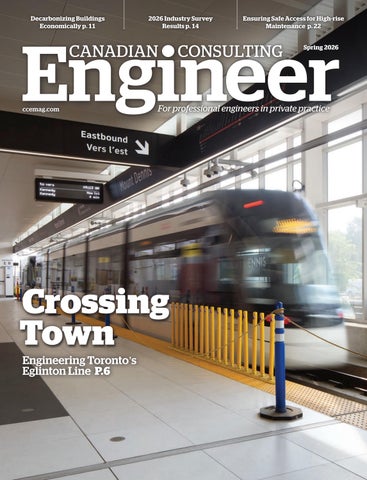
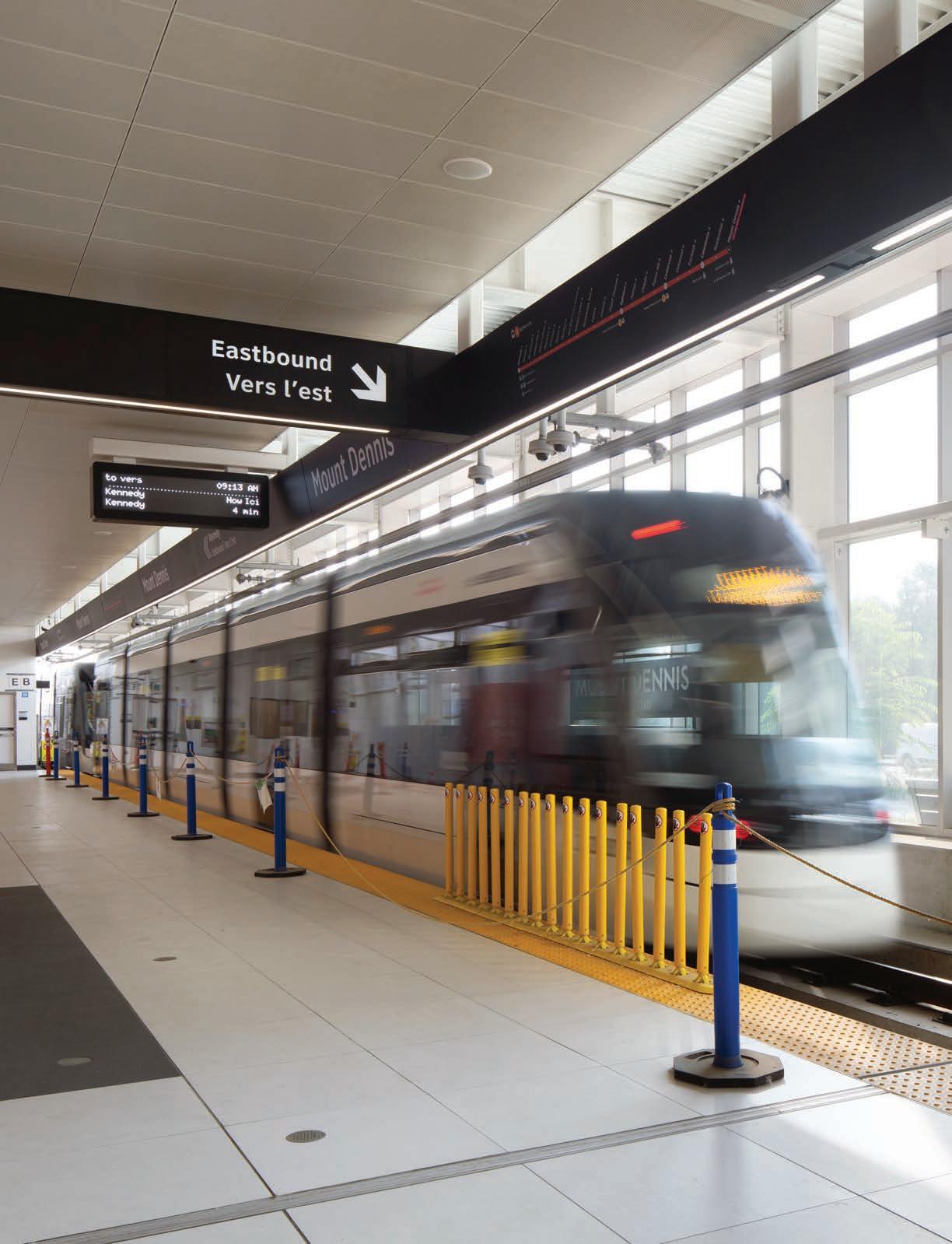
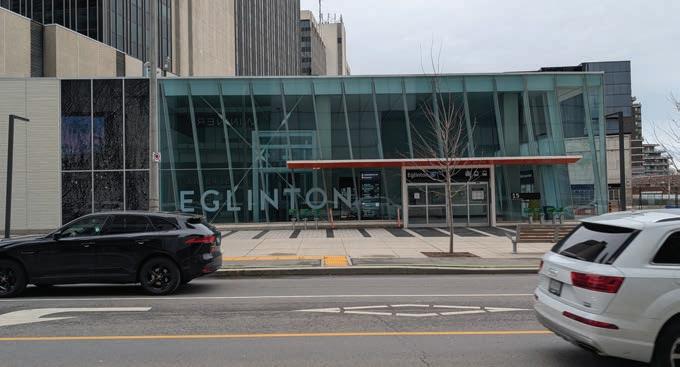
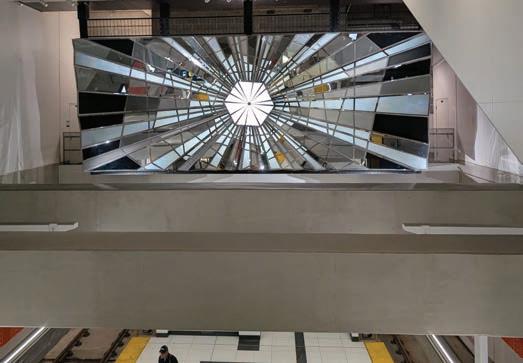
Riding and touring the new Eglinton subway line, which crosses much of Toronto, was a trip down memory lane for our editor.
22 | Conversation
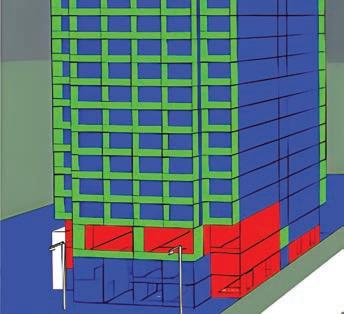
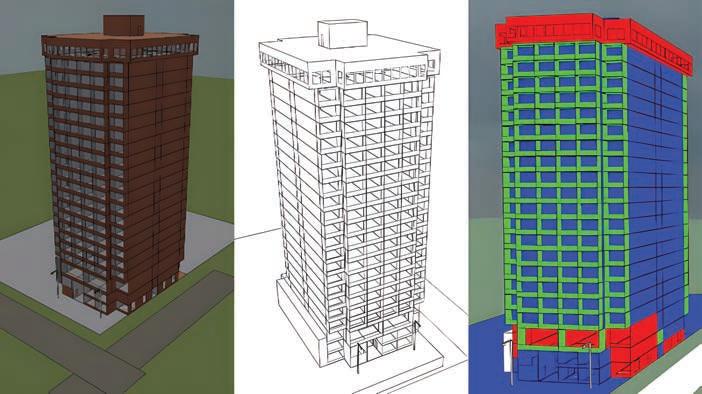
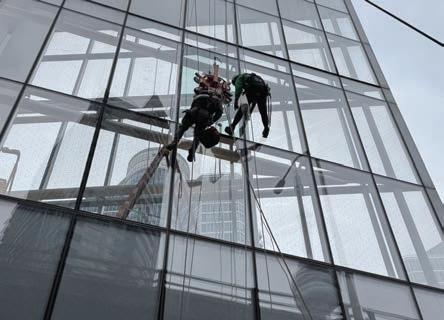
Raymond Carle has contributed to the safe design and modification of high-rise buildings and, thus, a significant reduction in injuries and deaths related to falls.
FEATURES
6
COVER STORY
Crossing Town
Lead engineers share the challenges of building Toronto’s new Eglinton subway line along a densely developed and heavily travelled midtown corridor while mitigating impacts to surrounding infrastructure.
10
Retrofit Prioritization Under Capital Constraints
A consulting engineer’s job not simply to specify the most efficient systems for building retrofits, but to sequence a path to decarbonization within financial constraints.
10
18
14
2026 Industry Survey Results
Our second annual industry survey of our readers generated more than 160 responses—thank you! Here now is a summary of the findings.
18
Ensuring Heat-pump Readiness
With the right emitter, a building can seamlessly transition from a conventional condensing boiler to an air-to-water heat pump tomorrow, without touching a single pipe.
Comment
by Peter Saunders
Retracing My Steps
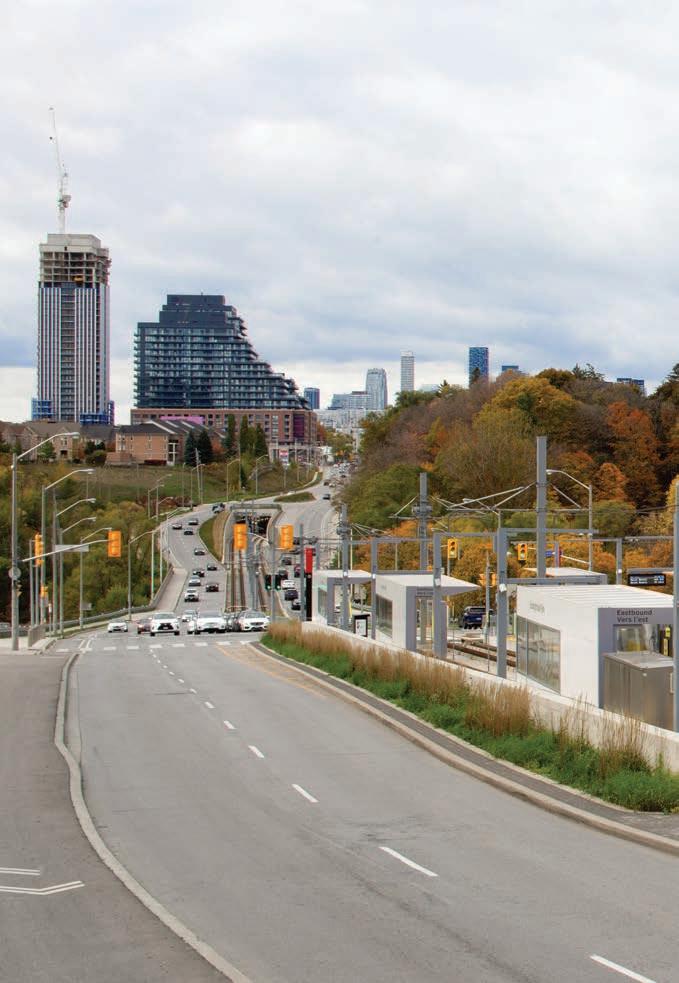
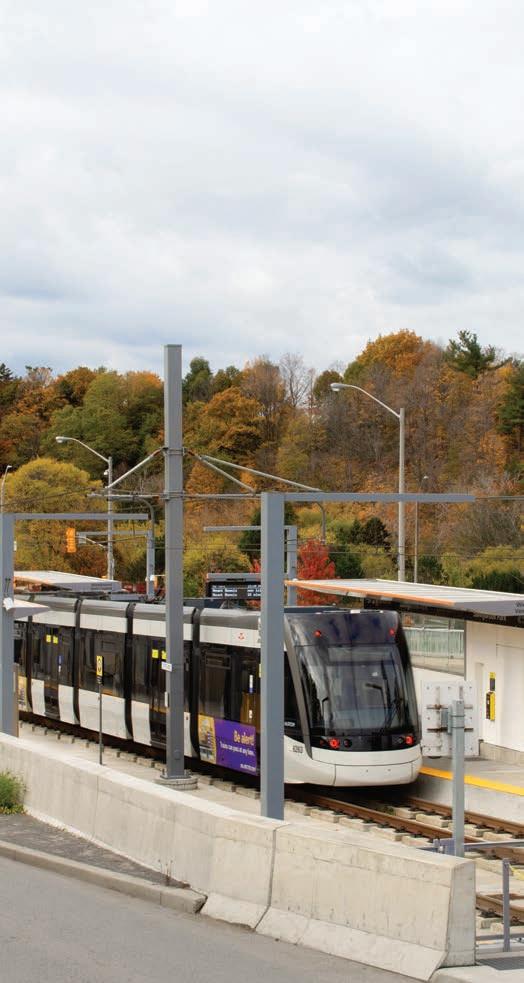
While preparing this issue’s cover story, I took a day trip to explore its topic: Toronto’s new Eglinton Line subway, which crosses town from Mount Dennis Station in the west to Kennedy Station in the east. In so doing, I passed through many areas that were significant in my past and, as such, I had the opportunity to observe how much things have changed over the years.
Most of the system’s underground platforms were built very deep (for reasons discussed in my article) in comparison to older Toronto Transit Commission (TTC) stations. It can feel a bit surreal to climb so far, emerge from one of them and exit at a familiar intersection that never offered rapid-transit connectivity before.
For me, the wildest of these exits was from Leaside Station to the southeast corner of Eglinton and Bayview Avenue. Not only does this structure abut the field of Leaside High School, which I attended for five years, but it also replaces a McDonald’s restaurant where I worked one summer, back when Ontario’s minimum wage was less than $5 an hour. A plaza across the street, where my sister and I bought our Nintendo Entertainment System (NES) from Consumers Distributing, has been demolished for redevelopment.
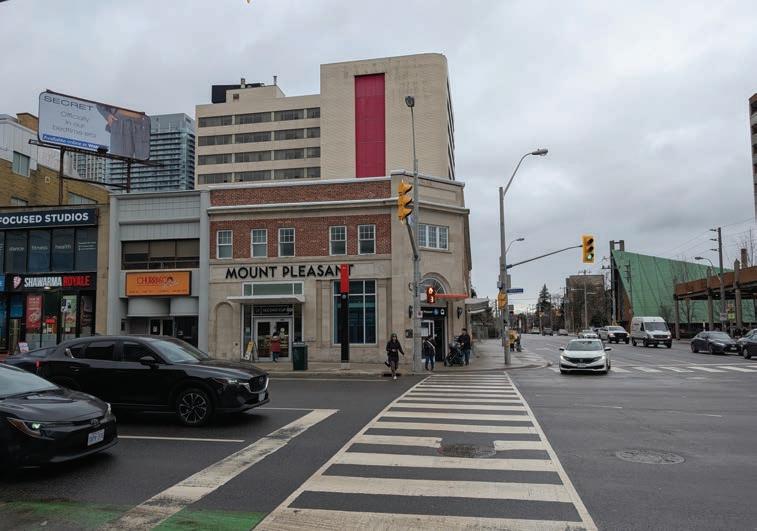
Another poignant example was Mount Pleasant Station, which has maintained a heritage façade around a new ‘box.’ It sits just south of the now-closed Roehampton Hotel, where my wife and I spent our wedding night following our reception at the Granite Brewery across the street. I saw a redevelopment notice on the building that houses this brewpub. When I stopped in for lunch during my subway tour, the waitstaff assured me it will be years before they have to close or move.
I spent much of my youth at Yonge and Eglinton (nickname: Young and Eligible),
which integrated office, retail, entertainment and residential spaces well with direct access to the Yonge subway line. Today, following the construction of many looming condo towers, it remains a place in flux, with the subw ay-connected Canada Square—previously home to a movie theatre and a Mandarin buffet restaurant—sitting empty and awaiting redevelopment. At least I was still able to find a Cinnabon in the subway concourse!
Avenue Road Station sits a few blocks south of one of one of the houses where I grew up. Beside its exit, Yitz’s Delicatessen displays a banner promising to remain open throughout construction of the transit line—a sadly ironic note, betrayed by how clearly the deli has been long closed.
I should also of course mention Don Valley Station—renamed from ‘Ontario Science Centre Station’ once it became clear the provincial government had no interest in maintaining its namesake, an educational facility that pioneered interactive learning for children and where my dad took me to live concert recordings for the local radio station now named Jazz.FM. Instead, a new $1-billion Ontario Science Centre is set to be built at the other end of town, on Lake Ontario’s waterfront.
It is bittersweet to see so many memorable landmarks along Eglinton shuttered before they could enjoy the benefits of rapid-transit access, but I also remain hopeful about the opportunities to create and grow new ones along the route, such as the repurposed Kodak Building at Mount Dennis and Big Bear Park at Don Mills.
How about you? Is your firm working in this area on anything new? Let me know!
READER SERVICE
Print and digital subscription inquiries or changes, please contact: Angelita Potal
Tel: 416-510-5113
Fax: (416) 510-6875
email: apotal@annexbusinessmedia.com
Mail: 111 Gordon Baker Rd., Suite 400 Toronto, ON M2H 3R1
EDITOR
Peter Saunders (416) 510-5119 psaunders@ccemag.com
SENIOR PUBLISHER
Maureen Levy (416) 510-5111 mlevy@ccemag.com
MEDIA DESIGNER
Curtis Martin
EDITORIAL ADVISORS
Darryl Boyce, Todd Busch, Guy Bruce, Andrew Macklin, Sadaf Parvaiz
CEO Scott Jamieson sjamieson@annexbusinessmedia.com
CANADIAN CONSULTING ENGINEER is published 4 times per year by Annex Business Media 111 Gordon Baker Road, Suite 400, Toronto, ON M2H 3R1
Tel: (416) 442-5600
Fax: (416) 510-6875 or (416) 442-2191
EDITORIAL PURPOSE: Canadian Consulting Engineer magazine covers innovative engineering projects, news and business information for professional engineers engaged in private consulting practice. The editors assume no liability for the accuracy of the text or its fitness for any particular purpose.
SUBSCRIPTIONS: Canada, 1 year $70.01, 2 years $112.44. Single copy $11.22 Cdn + taxes. (HST 86717 2652 RT0001). United States $159.12 (CAD). Foreign $182.46 (CAD).
PRINTED IN CANADA. Title registered at Trademarks Office, Ottawa. Copyright 1964. All rights reserved. The contents of this publication may not be reproduced either in part or in full without the consent of the copyright owner(s). Annex Privacy Officer: Privacy@annexbusinessmedia.com Tel: 800-668-2374. ISSN: 0712-4996 (print), ISSN: 1923-3337 (digital)
POSTAL INFORMATION: Publications Mail Agreement No. 40065710. Return undeliverable Canadian addresses to Circulation Dept., Canadian Consulting Engineer, 111 Gordon Baker Road, Suite 400, Toronto, ON M2H 3R1.
PRIVACY: From time to time we make our subscription list available to select companies and organizations whose product or service may interest you. If you do not wish your contact information to be made available, please contact us.
Tel: 1-800-668-2374, fax: 416-510-6875 or 416-442-2191, e-mail: vmoore@annexbusinessmedia.com, mail to: Privacy Officer, 111 Gordon Baker Road, Suite 400, Toronto, ON M2H 3R1.
Member of the Audit Bureau of Circulations. Member of Magazines Canada
Peter Saunders • psaunders@ccemag.com
SCAN CODE TO VISIT CCE’S WEBSITE: Find the latest engineer-related news, stories, blogs and analysis from across Canada.
WOMEN IN ENGINEERING
JOIN US ONLINE JUNE 23, 2026
The Advance: Women in Engineering virtual summit will be held on June 23, 2026, International Women in Engineering Day. This is a key opportunity to promote greater gender diversity in one of Canada’s most celebrated areas of expertise, as consulting engineering firms seek to recruit and retain more women for roles at all levels of seniority.
Our goal is to spotlight the accomplishments of successful professional engineers, encourage more women to join the industry/community and raise awareness of organizations that are already taking a leading role in this effort.
WHY SUPPORT WOMEN IN CONSULTING ENGINEERING?
z Recognize the careers of successful women in the industry
z Build your reputation as an industry leader in diversity
z Amplify brand visibility among Canada’s top consulting engineering firms
z Position your organization as progressive
z Increase exposure to key audiences across multiple media platforms, including email; website; social media; and the live virtual event.
Toronto’s Eglinton Line was a massive engineering endeavour.
By Peter Saunders
On Feb. 8, following years of delays and more than $1 billion in cost overruns compared to the original budget estimate, the Toronto Transit Commission’s (TTC’s) and Metrolinx’s 18.5-km Eglinton Line finally began operations, carrying commuters across five boroughs via underground and surface-based light-rail transit (LRT).
With 25 stations and at-grade stops, including links to three TTC subway stations, two of Metrolinx’s GO Train stations and 54 bus routes, the project marks Toronto’s largest transit system expansion in decades, one that was in the planning as far back as the mid-1980s and suffered a false start in the mid-1990s.
Built along an already densely developed and heavily travelled east-west midtown corridor, the addition of ‘Line 5’ to the TTC’s public transportation network required not only new stations and tracks, but also significant upgrades to infrastructure, including surrounding utilities, and a dedicated maintenance and storage facility at its western terminus.
Sharing design leadership
Working for Infrastructure Ontario (IO) and Metrolinx, a joint venture (JV) was formed between IBI Group (now Arcadis) and SNC-Lavalin (now AtkinsRéalis) to provide engineering, architectural, interior, urban and landscape design for the stations and related facilities. AtkinsRéalis was already involved, as part of the Crosslinx Transit Solutions consortium that won the project’s major public-private partnership (P3) contract, along with ACS-Dragados Infrastructure Canada, Aecon and EllisDon.
Fouad Mustafa, senior business development manager for Arcadis in Canada and previously IBI Group’s global director for P3 infrastructure and new initiatives, was one of the co-leaders of the design team.
“My involvement goes back to when this project was
under the TTC’s 2007 Transit City mandate, before it transformed into a P3,” he says. “Actually, I was involved even earlier, in 1994 under Bob Rae’s Ontario government, when I was a junior engineer with Marshall Macklin Monaghan. Back then, we designed about 25% of the project, only for it to be cancelled by the next premier, Mike Harris. So, it was extremely exciting to return in 2015, after Crosslinx won the P3 contract, to work on what was the largest rail project at that time in North America. It was a once-in-a-lifetime opportunity. I consider myself very fortunate, despite the challenge, the complexities and the length of time it has taken.”
The other co-leader was Christopher McCarthy, AtkinsRéalis’ vice-president (VP) of technical and engineering management and services for Canada.
“ We answered a request for qualifications (RFQ) back in the summer of 2013,” he recalls. “Then the request for proposals (RFP) landed just before Christmas. We started our proposal in January 2014 and were selected for a contract that began in July 2015. So, it has been a 12-year
journey in terms of our involvement in and execution of this project.”
“At the peak, Chris and I managed more than 700 people in the project team, representing every technical discipline you can imagine, including engineers, architects and planners,” says Mustafa. “We also had to involve, manage and co-ordinate a large number of key stakeholders.”
Additional firms in the overall project team included Dr. Sauer & Partners, Entuitive and RJC Engineers (structural engineering); Daoust Lestage Lizotte Stecker, Dialog and NORR (architecture and design); HH Angus (mechanical and electrical engineering); LEA (civil and utilities engineering); Thurber (geotechnical engineering); Jensen Hughes (building code and fire safety engineering); KJA Consultants (vertical transportation); RWDI (microclimate analysis); J.E. Coulter Associates (noise and vibration); and RHEA (security engineering).
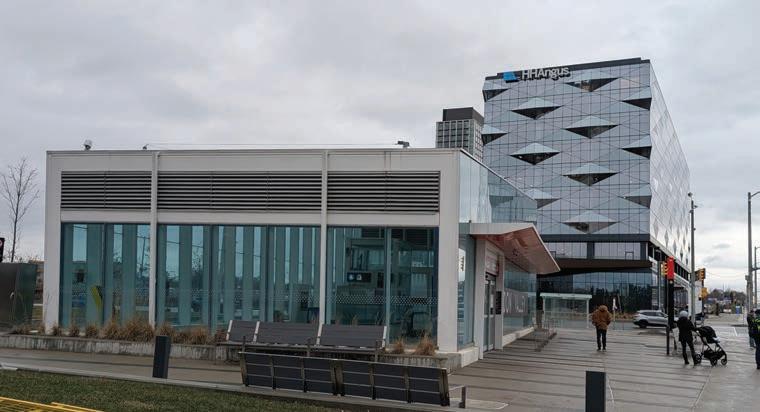
(HH Angus, incidentally, moved its Toronto office in
2024 into the Crosstown Place development at the corner of Eglinton Avenue East and Don Mills Road, to be closer to the LRT line. Its signage can be clearly seen from the Don Valley Station entrance.)
With this many companies working together, it was important to prevent any clashes between components in the team’s three-dimensional (3-D) building information modelling (BIM) software.
“ We developed an in-house ‘bot’ to reduce the clash detection process for a set of drawings from a week to one hour,” says Mustafa. “We have since taken that tool and applied it to other large projects.”
Densely developed
When the designers approached the project, they faced a very different landscape than if it had moved ahead when conceived decades ago.
“Between the 1990s and the 2010s, Eglinton Avenue matured and its density increased,” says Mustafa. “Also, the project’s scope had grown in scale and complexity, from a 6-km twin tunnel in the ‘90s to today’s 18.5-km alignment.”
“The big challenge was building along a 100-year-old major midtown avenue where there’s a lot of infrastructure and utilities,” says McCarthy. “We have done many transit projects across Canada and can build elevated guideway stations in 15 to 18 months, but when you get into underground stations, it takes years to do all the necessary pre-work to get utilities out of the way and put in shoring. And this project was 2.5 times the size of any others we had done.”
By necessity, this meant tunnelling deeper than existing infrastructure.
“ The Eglinton line’s underground stations are very deep,” says Mustafa. “We had to contend with Toronto’s high water table.”
Caution was needed with regard not only to buried utilities, but also to the buildings along the route, many of which include two-storey brick structures that are “inherently brittle.”
“We were very close to the building fabric,” McCarthy explains. “We were successful in implementing stiff shoring systems that protected these buildings and kept the fabric in place.”
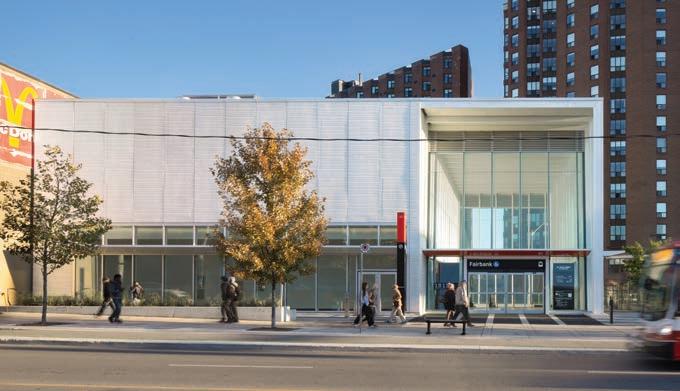
Fairbank was one of three new stations where a top-down construction sequence was implemented to mitigate surface-level traffic disruption.
Reducing disruption
Such a large construction effort along a busy urban corridor could not help being disruptive to residents’ daily lives, but the project team aimed to reduce interruptions with the support of subconsultants and subcontractors like Entuitive, which by way of example provided structural and construction engineering services for two stations: Fairbank, located at Dufferin Street, and Cedarvale, an expanded interchange at what was formerly called Eglinton West.
Fairbank was one of three new stations where a top-down construction sequence was implemented to mitigate surface-level traffic disruption and accelerate reinstatement of the roadway.
“Our design was complementary to construction delivery methods that have not been used in Toronto,” says Mustafa. “Typically, you use an open-cut scenario and cover it to allow traffic to flow, but for these three stations, we reversed the method with top-down construction that allowed surface traffic to continue to flow without any lane closures.”
Cedarvale, on the other hand, had to be built underneath the active TTC Line 1 subway, which called for complex underpinning and strict movement control. Entuitive’s soil-structure interaction and construction sequencing helped maintain continuous service.
Similar measures were needed at the even busier Eglinton station at Yonge Street, building beneath a very active rail line without any interruptions.
“ The LRT runs under a northsouth subway that had been built via cut-and-cover, making it a very shallow system,” McCarthy explains. “We had to create an interstitial level between the platforms. At Cedarvale, we only had to underpin the guideway, whereas at Yonge it was both the guideway and the station box.”
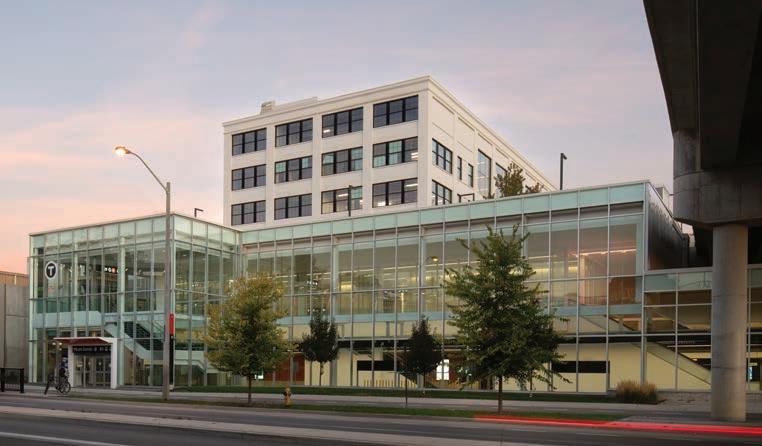
The Kodak Building (pictured behind Mount Dennis station) was moved to facilitate construction.
Mount Pleasant was a rare station on the line to integrate a heritage façade, from a former bank building.
HH Angus, which worked on the Eglinton Line, moved its Toronto office closer to it.
“We are talking about a few millimetres of clearances between those two lines at Yonge,” says Mustafa, “not to mention the utilities conflicts we had to clear. I am proud we achieved all that with minimal impacts.”
Just east of Yonge is another of the new stations that called for topdown construction: Mount Pleasant, which took over a heritage bank building’s site.
“We moved the whole façade away, block by block, numbering and storing them,” says Mustafa. “Then we reinstated them, with modifications, resulting in an entrance that is quite distinct from others along the line.”
Another novel method introduced for the Eglinton subway’s construction was sequential excavation.
“It had not been used in Toronto at that time,” Mustafa explains. “We employed it at the deepest stations for minimal risks to any settlements that we were concerned about along the way. It involved opening a shaft on one side of Eglinton to allow for the machinery to be dropped to the desired depth, then starting excavation entirely underground. You would not even notice on the surface what was happening underneath. Then we would bring the material out from the shaft, without impacting the main avenue."
Yet another method that the project team implemented to reduce vehicular disruption was mined construction.
“We did three stations that way, where there was special track work on one or the other side of the station box,” McCarthy says.
Moving a building
One of the project’s biggest tasks was moving an entire building at Mount Dennis, the line’s western terminus. This station has become the line’s first entirely new interchange facility, connecting with GO Train and Union-Pearson (UP) Express lines. In fact, it opened in late 2025 for both GO and UP ser vice, well before this year’s Line 5 launch.
Here, one of the most prominent landmarks is another heritage property: the Kodak Building, a former processing plant that was unpinned from its original location, placed on heavy-duty rollers and moved northward.
“It was the last of the major buildings representing the former Kodak site at that location,” McCarthy explains. “Our obligation was to renovate and rehabilitate it. We cut it off at the foundations, moved it north about 70 m, then rebuilt the foundations, rolled it back and jacked it up. Now it looks pristine and can be used in the future as a public space by the community.”
“ We had to take that building out of the way of construction,” Mustafa explains, “to achieve the spatial requirements of Mount Dennis station’s excavation and for its connectivity with a new TTC bus terminal nor th of it. Now the building will become a focal point.”
And while Mount Dennis was originally conceived as an underground station, the design team saw an opportunity to beautify the area by bringing it up to grade, where it could obscure an unattractive retaining wall.
As a result of this change, Eglinton’s
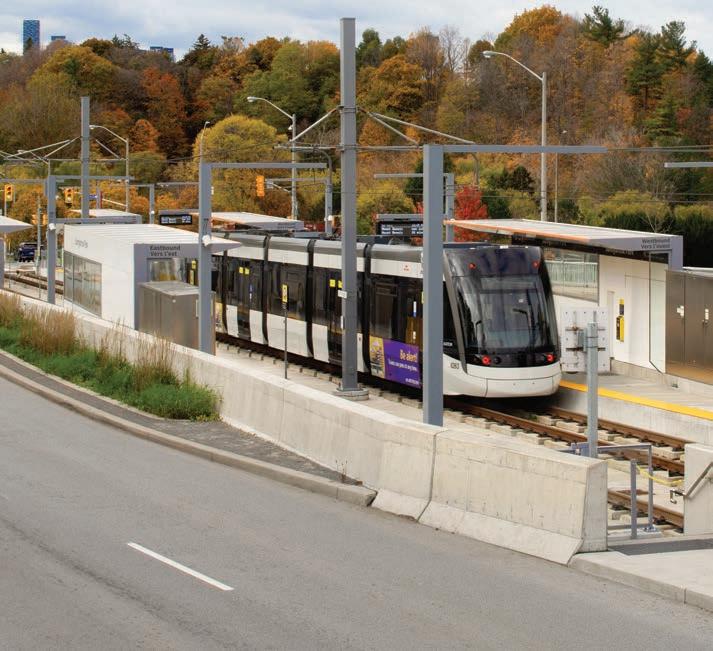
new LRT vehicles start their journey above-ground at the western terminus before descending into a por tal for their predominately underground journey eastward. Further portals bring them up to and down from the surface as appropriate along the route, until eventually they reach the TTC’s long-running Kennedy Station. Both Mount Dennis and Kennedy connect with regional GO Transit service.
“With the portals, you have to address the risk of flooding,” McCarthy explains. “We were fortunate with the Brentcliffe portal east of Laird station, as it drains toward a river valley and doesn’t need as much protection.”
Setting the stage
Before the team had come aboard the project, Metrolinx and Toronto’s municipal government developed documentation to guide the design of the transit line, so as to set the stage for further urban development along its length.
“We designed the stations to be spacious, open, free of clutter and inviting,” says Mustafa. “Credit goes to Metrolinx and Toronto for defining the vision, shape and form of the entire alignment. Their documentation helped us crystallize the vision for Line 5.”
The designers helped establish common features that will also appear along further planned extensions of the Eglinton LRT to the east and west of the existing alignment, regardless of which firms work on them.
“With major transit infrastructure,” McCarthy says, “we are just stewards for a certain period.”
The new line’s stop at Yonge and Eglinton had to be built beneath the existing north-south subway line.
Retrofit Prioritization Under Capital Constraints
It’s time to separate carbon impact from carbon theatre.
By Chris Flood
Every commercial building owner in Canada now faces the same uncomfortable arithmetic: carbon regulations are tightening, utility costs are climbing and capital budgets have not expanded to match. The consulting engineer's job is no longer simply to specify the most efficient system, but rather to sequence a multi-year decarbonization pathway that delivers measurable carbon reductions at each stage, under real financial constraints.
Get the sequencing wrong and your client spends scarce capital on measures that may look impressive in a press release, but barely move the emissions needle. The gap between perception and performance, what we might call carbon theatre, is where good engineering judgment matters most.
Start with the load
The most common mistake in retrofit prioritization is jumping straight to equipment replacement. A new high-efficiency boiler or a heat-pump conversion sounds like a decisive move, but if the building envelope is leaking heat at twice the rate it should be, then the new plant is simply chasing a load it was never sized for. The oversized replacement equipment will operate at poor part-load efficiency for
most of the year, eroding the carbon savings that justified the investment.
The foundational principle is to reduce the load first, then right-size the system to meet it. In practice, the first dollar of capital should target envelope and ventilation improvements—e.g. air sealing, insulation upgrades at thermal bridges and demand-controlled ventilation—before touching the mechanical plant.
A calibrated building energy model is indispensable. It lets you isolate the contribution of each envelope measure to peak loads and annual energy consumption. Without it, you are guessing at sequencing— and almost certainly guessing wrong.
Marginal abatement cost curve
The marginal abatement cost curve (MACC) ranks retrofit measures by their cost per tonne of carbon dioxide equivalent (CO2e) avoided. Building a project-specific
MACC is the most rigorous way to separate high- and low-impact measures.
For each measure being considered, estimate the incremental capital cost over a do -nothing or like-for-like replacement baseline, the annual energy savings in kWh (thermal and electrical), the carbon intensity of displaced energy (based on both provincial grid emission and on-site fuel carbon factors) and the resulting annual tonnes of CO2e avoided. Then, divide cost by annual abatement to determine dollars per tonne. When ranked in ascending cost-per-tonne order, the shape of the curve will be revealing. Typical measures on the left—air sealing, lighting controls, economizer optimization and scheduling corrections—often cost less than $50 per tonne avoided. Measures at the far right—full electrification of process heat, deep envelope retrofits on curtain-wall towers and on-site renewable generation in low-solar-resource
regions—may well exceed $500 per tonne.
The engineer's task is to draw a vertical line at the client's capital budget and ensure every measure to the left gets implemented before anything to the right is discussed.
Beware the attractive-but-marginal
Certain retrofit measures consistently overpromise and underdeliver on carbon reduction. The following three deserve particular scrutiny from engineers when advising capital-constrained owners:
Rooftop solar PV on clean grids
In provinces with low-carbon electricity, including British Columbia, Manitoba, Ontario* and Quebec, adding on-site solar PV displaces very little carbon per dollar spent. The panels generate power, but the carbon intensity of the electricity they displace is already low.
The same capital invested in reducing
natural gas consumption through envelope improvements or electrification of space heating will typically abate five to 15 times more carbon per dollar.
PV makes sense in Alberta and Saskatchewan, where grid intensity remains high (e.g roughly 0.47 kg CO2e/kWh in Alberta as of 2023, per the National Inventory Report), or anywhere it is paired with electrification of gas-fired systems, but it should not be the default first move everywhere.
*(While Ontario’s annual-average grid emission factor is among the lowest in the country, its marginal emission factor—i.e. the intensity of generation that actually responds to changes in load—is significantly higher during peak periods, when it is driven by gas-fired plants. Engineers should therefore use marginal, not average, factors when evaluating conservation and load-shifting measures within the province.)
High-efficiency gas boiler replacements
Replacing a 20-year-old, 80% efficient boiler with a 95% condensing unit saves roughly 15% to 18% of gas consumption. While those are real savings, they lock the building into another 20 to 25 years of fossil fuel infrastructure.
If the target is net-zero, the condensing boiler becomes a stranded asset. In many cases, capital is better allocated to partial electrification, with a heat pump handling base load and the existing boiler covering peak demand. Even if first-year savings are comparable, the carbon trajectory over the equipment's lifetime is radically different.
BAS upgrades without commissioning
Installing a new building automation system (BAS) for a facility that has never been properly commissioned is solving the wrong problem first. It will report lots of data, but the underlying sequences of operation will
Linear drainage
high flow needs
remain broken.
Retro-commissioning—systematically verifying and correcting control sequences, schedules and setpoints—typically costs a fraction of a BAS replacement and delivers 10% to 15% energy savings on its own. It should precede, not follow, any controls investment.
Sequencing
The order of implementation will also affect outcomes. A practical framework needs to follow a clear logic:
Phase 1: Operational measures and retro-commissioning
Low-cost, fast-payback measures in years one and two will correct the building's baseline performance and sharpen the accuracy of any energy model used to evaluate subsequent measures. Also, this is the window for aligning with utility incentive programs, which are increasingly structured around phased decarbonization plans
Phase 2: Envelope and ventilation improvements
In years two to four, these should
reduce the building’s heating and cooling loads, so subsequent mechanical upgrades can be right-sized.
Phase 3: Mechanical system replacement and electrification
These updates can be properly sized to the reduced load in years three to six. Heat pump installations benefit enormously from a reduced heating load; the equipment is smaller, the supplemental heating requirement is lower and the seasonal coefficient of performance is higher.
Phase four: On-site electricity generation and storage
In years five and beyond, these measures can be optimized against the building's actual post-retrofit load profile, rather than the original one.
Phased retrofits
This sequencing is not arbitrary. Each phase de-risks and improves the economics of the next. Skipping ahead—e.g. installing heat pumps before fixing the envelope—leads to issues with oversized equipment, higher electrical demand charges and disappointed building owners.
Engineers should also be aware how phased retrofits support code compliance. Forthcoming National Energy Code of Canada for Buildings (NECB) provisions for alterations to existing buildings, in Part 13, will establish energy efficiency requirements triggered by the scope of retrofit work. Phased strategies can be structured to manage these triggers intentionally by (a) staying below thresholds where the economics do not support deeper intervention or (b) strategically exceeding them where code requirements align with the decarbonization plan.
Modelling to grid carbon intensity
Many retrofit analyses miss the trajectory of grid carbon intensity.
Provincial grids are decarbonizing at different rates. A measure that displaces electricity in Alberta today avoids roughly 0.47 kg CO2e per kWh; by 2035, that figure may drop significantly as coal-fired generation is fully retired and renewables continue to scale. Conversely, a measure that displaces natural gas—which carries a relatively stable emission factor of approximately 1.9 kg CO2e per cubic metre on a higher-heating-value basis—will retain its carbon value for the life of the equipment.
The implication is important. Fuel-switching measures become more valuable over time as the grid ‘cleans up,’ while efficiency measures for already-electric systems become less carbon-significant. T he MACC should be built on a life-cycle basis using projected emission factors, not a snapshot of today's grid.
Engineers as honest brokers
Capital-constrained decarbonization demands engineers act as honest brokers, not advocates for any particular technology and not echoing the preferences of either equipment vendors or building owners.
This means telling a client when a ‘fashionable’ measure does not make sense for their building, in their province and/or at their budget level. It means building project-specific MACCs, rather than recycling rules of thumb.
The buildings that will hit their 2030 and 2040 carbon targets are not those with the biggest single retrofits, but rather those where an engineer laid out a disciplined, phased pathway—load reduction first, then system optimization, then electrification—and the owner followed it.
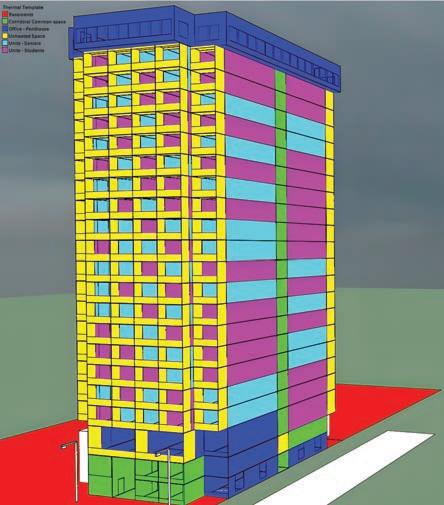
IES conducted energy modelling for CityHousing Hamilton’s building at 191 Main Street West and found it could reduce electrical consumption by 66% and achieve annual cost savings of up to $294,400.
OCT 15, 2026
PALAIS ROYALE, TORONTO
2026 marks the 58th year of the Canadian Consulting Engineering Awards, the most prestigious national program to recognize professional engineering firms’ top innovative, technically complex and socially meaningful projects. A jury of industry experts will review entries from across the country and bestow 20 Awards of Excellence and up to five Special Awards. All of these awards will be handed out at a special gala in Toronto on Oct. 15.
WE INVITE YOU TO BE A SPONSOR OF THIS PRESTIGIOUS IN-PERSON EVENT.
2026 Industry Survey Results
By Peter Saunders
We tried something new last year with a first-of-its-kind industry survey of our readers—an effort to capture the ‘pulse’ of Canada’s consulting engineering community. Following its success, we did it again this year—and heard back from 164 of you, more than last year! Thanks to those of you who shared professional details as well as your own opinions of the current state of the industry. What follows is a summary of the results. It is not exhaustive or comprehensive in its reach and scope, but it might at least provide a useful snapshot of a ‘moment’ in the industry.
Demographics
Our survey reached experienced professional engineers, mostly 55 and older (see chart for Q1), and predominantly male: nearly 83% (see chart for Q2). While this suggests slightly greater gender representation than when the survey was nearly 88% male last year (and the average age perhaps implies the need to train, hire and
Q1 What is your age?
retain younger engineers), the industry certainly has a way to go yet in achieving ‘30 by 30,’ i.e. the goal for women to comprise 30% of newly licensed professional engineers by 2030.
For further exploration and discussion of this issue, please be sure to register for and view this year's Advance Women in Engineering virtual summit, coming June 23, International Women in Engineering Day (INWED).
Nearly 50% of our 2026 survey's respondents were based in Ontario, similar to last year’s 52%. They were followed this year by British Columbia (18%), Alberta (11%), the collective four provinces of Atlantic Canada (nearly 9%), Quebec (5.5%), Manitoba and Saskatchewan (3% each). There was also one respondent within the territories (see chart for Q3).
Following this year's increased number of survey respondents, we hope to see broader geographical representation next year, from engineers in all parts of the country, particularly given how many major projects are now being implemented in very remote areas.
Tenure
As mentioned, most respondents were highly experienced engineers; nearly 68% have spent 30-plus years in the industry (see chart for Q4).
Yet, while it is not uncommon for consulting engineers to enjoy a full career at one firm as it grows and diversifies over the years to provide new challenges and opportunities, our respondents have tended to move around more. Most have spent less than 20 years at their current firm (see chart for Q5).
Pay grade
Whatever choices our respondents have made regarding where they are working today, they have certainly advanced well over their careers, with 37% making more than $150,000 a year and an additional nearly 24% making more than $120,000 (see chart for Q6).
Does the size of a business matter? Roughly half of our respondents report
Q4 How many years have you spent in the engineering industry?
Q5 How many years have you spent with your current firm?
Q6 What is your current salary?
Q7
How many people does your firm employ around the world?
Q8 How do you feel about your role compared to five years ago?
their firms employ between one and 100 people in total, globally (see chart for Q7). In an age of continued mergers and acquisitions (M&A) and international expansions, such responses still suggest not all Canadian firms need to become giants in the industry to be successful.
Mood
Given many respondents have changed roles over the years, one hopes those moves have increased their job satisfaction (see chart for Q8), but any evidence in that direction is not clear. When we asked, ‘How do you feel about your role compared to five years ago?’, 48% answered ‘equally satisfied,’ nearly 29% said ‘more satisfied’ and 23% said ‘less satisfied.’
Among the factors respondents say they enjoy most about their role, the most popular answers, much like last year, included creative problem-solving, collaboration, teamwork, flexibility, a variety of work and mentoring others (see chart for Q9).
More personal answers, under ‘Other (please specify),’ included client relations, interesting and innovative work, skills de -
Q9 What do you enjoy most about your role?
Q10 What do you enjoy least about your role?
velopment, co-workers, autonomy, opportunities to lead and feelings of accomplishment.
What they enjoy least, on the other hand, includes stress, inadequate feedback and recognition, work-life imbalance and difficult colleagues (see Chart 10).
A significant proportion (more than 23%) chose ‘Other (please specify),’ citing such examples as administrative impediments, disruptions relating to artificial intelligence (AI), unacceptable tender terms, difficult delivery timelines, working with governments, chasing clients for payment, disrespect, unwarranted legal claims, lack of opportunity, overreliance on electronic communications, red tape, external demands to get work done faster and their firms' inadequate and antiquated systems, methods and procedures.
The year ahead
Finally, we asked respondents to name their biggest challenge in 2026 (see chart for Q11). Top answers selected from our provided list included work-life balance, market forces, client demands and technology.
Under ‘Other (please specify),’ respondents cited such examples as the pace of their work, financing, inaction, hiring and mentoring new talent, uncertainty, lack of work, getting older and winding down for retirement.
From those perspectives, what change would they like to see? The top answer, like last year, was enhancing continued education of engineers. This was followed by improving support for work-life balance, adopting new technologies and embracing new project contracts and models (see chart for Q12).
Under ‘Other (please specify),’ respondents cited such examples as finding solutions for climate change, increasing fees, improving cash flow, licensing more engineers (and consolidating provincial requirements for such), expediting approvals and improving the overall perception and recognition of consulting engineers’ value.
Q11 What is your biggest challenge in 2026?
Q12
Ensuring Heat-pump Readiness
Specifying the right terminal unit is an important step most
“heat-pump ready” buildings are missing.
By Cyrus Kangarloo, P.Eng
Across Canada, the phrase “heat-pump ready” has become a common specification in new construction briefs. This is a big shift from just five years ago, when it was still an emerging consideration, rather than a baseline expectation.
While it is well-intentioned, however, it contains a critical assumption that is quietly tripping up projects from Calgary to Halifax: that the building’s terminal units are actually capable of delivering the required heating loads at the lower water temperatures with which the pump operates.
In many cases, they are not. The gap comes down to the emitter, fan coil, baseboard or radiant panel responsible for transferring heat from the water loop into the occupied space.
With the right emitter, a building can seamlessly transition from a conventional condensing boiler to an air-to-water heat pump tomorrow, without touching a single pipe.
If the emitter is overlooked, on the other hand, switching to a heat pump can leave occupants in the cold, regardless of the technology on the roof or in the mechanical room.
Focusing on the temperature gap
Water temperature poses the key factor in the effectiveness and efficiency of a heat pump.
A conventional gas boiler, even a high-efficiency condensing model, will typically supply hot water at around 71 C.
By contrast, a modern air-to-water heat pump will operate most efficiently at supply water temperatures closer to 46 C.
This difference can have significant implications for how much heat a terminal unit can extract from the water flowing through it.
For hydronic emitters, heating output is
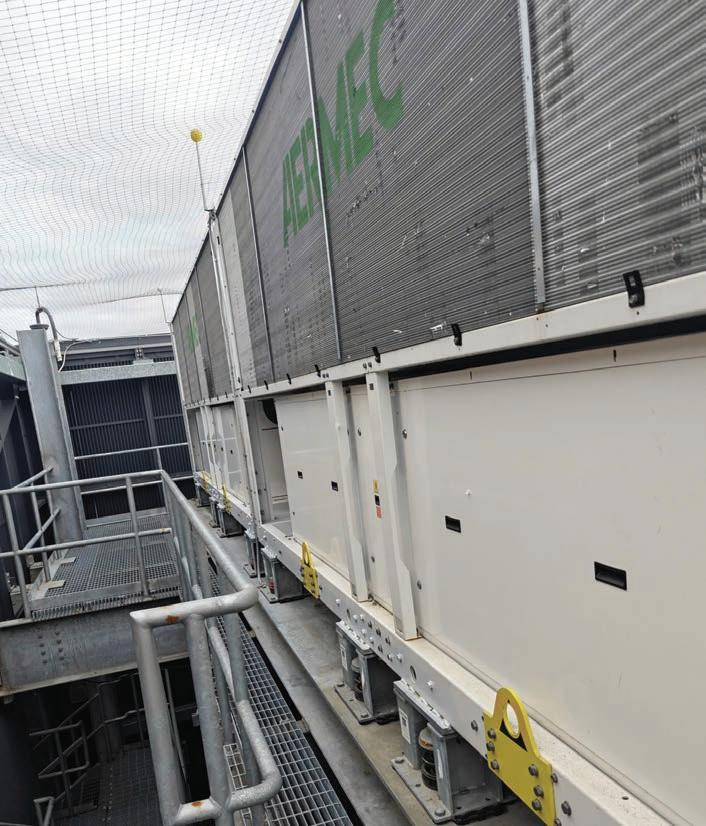
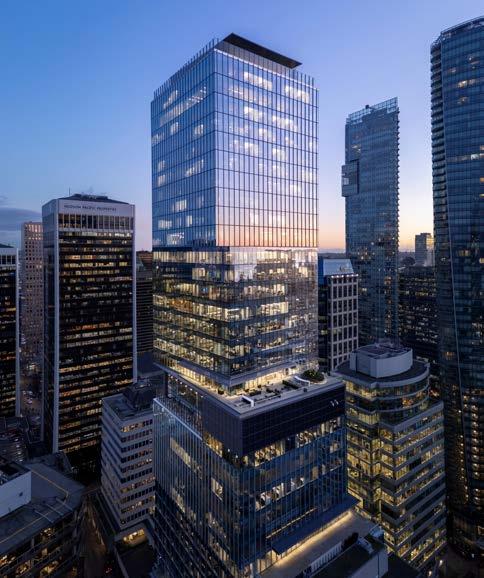
The Stack features air-to-water heat pumps on its roof; see more details in sidebar on p. 20.
2-pipe, full coil + 6-way valve
directly proportional to the temperature differential between the water entering the coil and the air in the room. When you drop the entering temperature from 71 C to 46 C without changing anything else, you will lose a significant fraction of the unit’s rated output.
For terminal units sized exclusively for a high-temperature boiler scenario, this loss can mean the difference between a comfortable building and one unable to meet its full heating load on a cold January day in Calgary.
This is what happens when a heat pump is installed in a building with an emitter that was not selected with low-temperature performance in mind.
The heat pump delivers water temperatures at 46 C as designed, but because the fan coils were designed for use with the 71 C boiler, they cannot extract enough heat from that water to warm the space.
The result is a lack of climate control. If the building is not able to take advantage of the refrigerant cycle and coefficient of performance (COP) gains from the air-to-water heat pump, then it could easily end up operating on a backup high-temperature system for most of the winter
(heat pump)~
A dual temperature selection standard
Many mechanical consultants are adapting with two heating selections for each fan coil on a project: one at 71 C entering water for the current or transitional boiler, the other at 46 C entering water for a future heat pump. In high-performance buildings, fan coils are often sized to meet peak cooling loads. As a result, the unit is often larger than what heating alone would require. The additional coil surface area can allow the terminal to deliver adequate heating performance at lower entering water temperatures, including 46 C.
A good example of growing demand for cooling is Winnipeg’s Innovation Campus. In the coldest city in North America, it was still using cooling in the middle of winter, on sunny days for the computers throughout the facility.
So, in practice, the dual-temperature selection process commonly reveals a fan coil sized for cooling can deliver adequate heat with 46 C entering water. In most cases, then, a building can be heat-pump ready with the same physical fan coil as installed for a conventional boiler system.
The caveat is the coil configuration and valve arrangement need to be specified correctly from the beginning.
Purpose-built for HP temps
Same unit size, 3x+ output gain
Table 1.
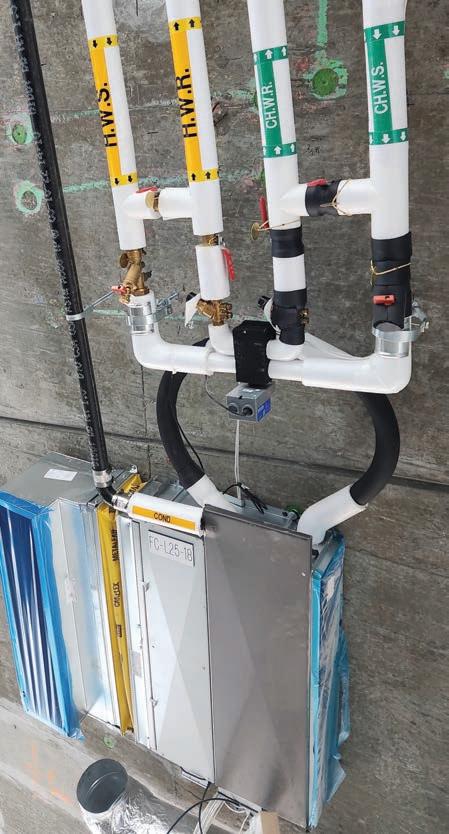
A six-way valve elevates the two-pipe approach from a seasonal changeover system to enable versatility throughout the building.
Benefits of a six-way valve
Engineers widely regard the four-pipe system as the gold standard of hydronic terminal unit configurations, due largely to the flexibility it offers with separate, dedicated coils for heating and cooling. These allow any occupant of the building to independently select heating or cooling at any time of year. There are no seasonal changeovers or compromises to their comfort.
The transition to heat pump temperatures, however, can introduce a specific challenge for a four-pipe system, because of the heating coil. In a standard four-pipe configuration, the heating coil is a single row, sized for the higher water temperatures of a boiler. At 71 C, that single row provides ample output—but at 46 C, it cannot transfer enough heat to meet the load of the space. The difference in temperature between the water and the air in the room is not sufficient to compensate for the reduced coil surface.
The ready-built solution for this scenario is a two-row copper heating coil engineered for the lower entering water temperatures of a heat pump. By doubling the coil depth, it restores the heating capacity lost to temperature reduction, allowing the fan coil to perform comparably at 46 C to what a standard single coil delivers at 71 C.
For projects with an existing two-pipe system—and where fourpipe systems would be impractical, due to budget or space constraints—a six-way valve can offer the same operational flexibility.
A two-pipe system uses a single coil for both heating and cooling, switching as needed between the two modes. When heating is active during colder months, all rows of the coil transfer heat simultaneously, producing substantially higher output at 46 C entering water than the dedicated coil in a four-pipe unit can.
Table 1 on p. 19 illustrates this principle in action. The same physical fan coil can deliver more than three times the heating output in a two-pipe arrangement compared to a standard four-pipe configuration at heat pump temperatures.
The six-way valve elevates the two-pipe approach from a seasonal changeover system to enable versatility throughout the building. By controlling which side of the loop reaches the coil at any moment, the valve allows different zones to draw heating or cooling independently, without a full building-wide changeover.
For projects where heating and cooling use is metered, a six-way valve means only one BTU meter is required. For a four-pipe fan coil, on the other hand, one meter on the cooling side and one on the heating side would be required, which could prove costly.
Ultimately, a six-way valve with a two-pipe system offers nearly the same functionality of a four-pipe configuration and coil-capacity advantages at low water temperatures. The fan coil can be specified at a smaller size than the equivalent four-pipe unit, because the full coil surface working at 46 C delivers output a partial single-row coil is unable to produce.
The spec that matters
As projects continue to adopt heat-pump readiness in their specifications, it is a great signal, as Canadian building owners and designers are embracing more energy-efficient technology; but it is
Case study: The Stack
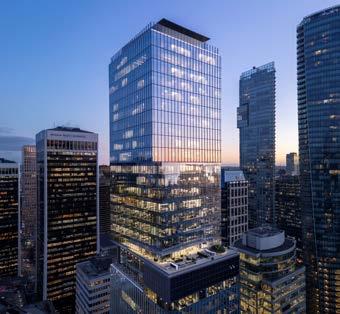
The Stack is a 37-storey office tower in Vancouver that meets the Canada Green Building Council's (CaGBC’s) Zero Carbon Building (ZCB) standard, is one of the most prominent all-electric commercial high-rises in the country and won an Award of Excellence in the 2025 Canadian Consulting Engineering Awards for what a jury of experts called “state-of-the-art mechanical engineering.”
The building uses air-to-water heat pumps on the roof to feed a two-pipe fan coil system with six-way valves throughout and no gas connection anywhere in the building. Every occupant can select heating or cooling independently, at any time.
The system’s performance at scale is beginning to inform a new generation of commercial projects across Western Canada.
important to go beyond the adoption of just heat pumps and also consider the impact of terminal units on efficiency.
A building with fan coils specified with a dual-temperature selection, the appropriate coil configuration and the proper valve arrangement should experience a seamless transition. Another building labelled “heat-pump ready” without examining the impact of emitters, on the other hand, may experience a costly surprise once the switch is made.
The good news for most modern, commercial buildings—where fan coils are the terminal unit of choice and cooling loads are configured in the design—is genuine heat-pump readiness is well within reach, without the need to upsize equipment.
Cyrus Kangarloo, P.Eng., is western sales engineer for Jaga Climate Systems, which manufacturers hydronic heating and cooling systems. For more information, visit www.jaga-canada.com.
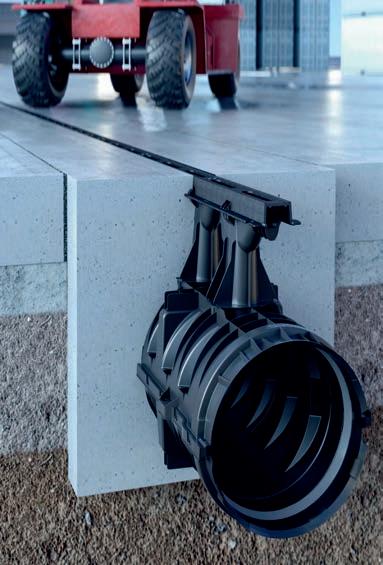
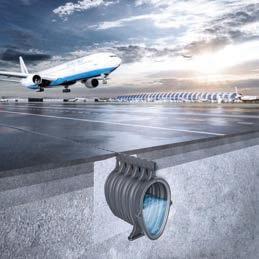
ACO Qmax - High capacity slot drainage system
ACO Qmax has been developed to satisfy the demand for a versatile, high capacity slot drainage system for a wide range of applications to any load class. The system is specifically designed to form an integral part of modern, sustainable surface water management solution requiring effective collection, storage, or attenuation. ACO Qmax is also economical compared with traditional drainage methods. Email: info@acocan.ca
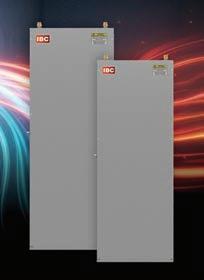
High Efficiency Hydronic Air Handling Made Simple
The IBC AHU HC is a compact hydronic air handler designed for efficient heating and cooling when paired with a compatible heat source. It integrates easily with existing ductwork, reduces installation complexity, and delivers comfortable, refrigerant free indoor air for modern homes. ibcboiler.ca/consumer/products/ahu-hc/
Professional directory
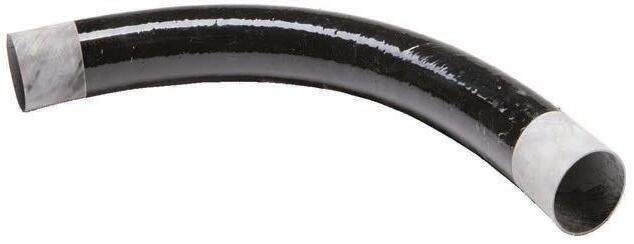
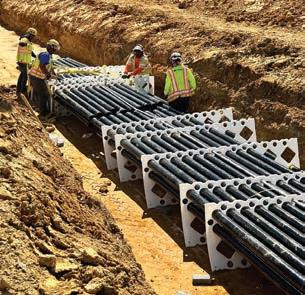
Lightweight, no burn-through Champion Fiberglass® Elbows protect data center cables while minimizing elbow repairs. They offer a fast, seamless installation that contributes to a lower total cost of ownership for projects. Download the Data Center Solutions Guide today. championfiberglass.com/281.655.8900
Canadian Consulting Engineer 2026 media kit
Canadian Consulting Engineer magazine provides high quality editorial coverage of the most pertinent and timely issues that affect engineers across Canada. The magazine reaches the consulting engineers who make the critical decisions on building and construction projects. This is exactly the audience you need to reach. Advertise your product or service with us. Be seen and be specified! To order your 2026 media kit contact: Maureen Levy (416) 510-5111, mlevy@ccemag.com or visit www.canadianconsultingengineer.com/advertise/
For information on placing an advertisement in the
Safe Access for High-rise Maintenance
As cities densify and build upward, planning is key in setting the stage for safe access for the longterm maintenance of increasingly tall towers. Toronto’s 109-storey Pinnacle Skytower, for example, will reach a total height of 352 m when it is completed later this year, making it the tallest building anywhere in Canada.
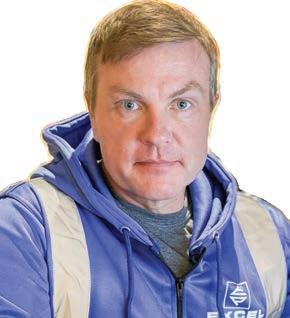
Raymond Carle, vice-president (VP) of operations for Excel Projects, has more than 20 years' experience in high-rise safety, façade access and glazing-related building systems— and more than 10 years’ consulting for engineering and architecture firms. He has contributed to the safe design and modification of many of Toronto’s most recognizable towers and, thus, a significant reduction in injuries and deaths related to falls.
We heard from Carle earlier this year in a CCE Education webinar. You can find his entire presentation, titled 'Permanent Access Systems: The Backbone of High-rise Maintenance,' under the Webinars tab at our website (www.ccemag.com).
How have permanent access systems evolved for taller buildings?
Every access system on a modern building is, fundamentally, a descendant of the pulley, which ancient Egyptians, Greeks and Romans used long before modern materials existed. The pyramids at Giza were built with knowledge in planning, rigging and mechanical advantage.
As structures became taller, access stopped being a construction problem and became a maintenance
problem. Think bell towers and cathedrals; these structures didn’t just need to be built, they needed to be serviced, repaired and inspected. That’s where engineering started borrowing heavily from rigging.
Today, swing stages are suspended loads with redirection, davit arms are cantilevers redirecting a load and monorails are guided rolling loads carried in primarily a shear, but can redirect a load.
So, why are there still major safety issues today?
Complexity has bred misunderstanding. Modern engineering has hidden load paths, obscured force multipliers and automated systems to the point where fewer people understand the access designs upon which workers’ lives depend.
Glass changed everything. Curtain walls removed natural access points. Now buildings had smooth, vertical surfaces that needed to be cleaned, inspected and repaired, with no ledges, no setbacks and no forgiving geometry.
This is where permanent access systems stopped being optional. Building maintenance units (BMUs), davits—which were invented for ships—and monorails
"Modern engineering has hidden load paths."
came in not as design features, but as solutions to geometric problems.
How are standards addressing these issues?
Recent updates to Canadian Standards Association (CSA) Group guidance around load testing of permanent access systems will verify installation quality, load transfer and system behaviour. Load testing is no longer optional thinking, but part of responsible system validation.
Most permanent access systems don’t fail because of one dramatic overload. They fail slowly, quietly and, most of the time, predictably, because of corrosion in places nobody sees, fatigue from repeated use, loosened or deformed connections, installation details that never matched the drawing or assumptions that were valid on day one but wrong 10 years later.
Testing is the only practical way to confirm anchors were installed correctly, load is being transferred as intended and time, use and the environment have not degraded performance beyond acceptable limits.
Inspection tells you what something looks like. Testing tells you what it does. Documentation proves it happened. Permanent access systems demand all three.
NO BURN-THROUGH
EASY CONNECTION ELBOWS FOR MEDIUM VOLTAGE DATA CENTERS
No burn-through eliminates elbow repairs
Light weight facilitates a smooth, safe, cost-effective installation
Durable and corrosion-resistant for lower total cost of ownership
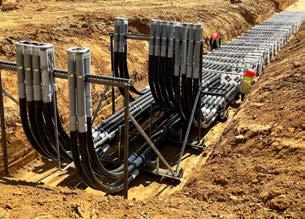
A 110 °C temperature rating results in less ampacity derating for the cable