Prefab fibreglass conduit
Securing smart buildings
Managing liability risk
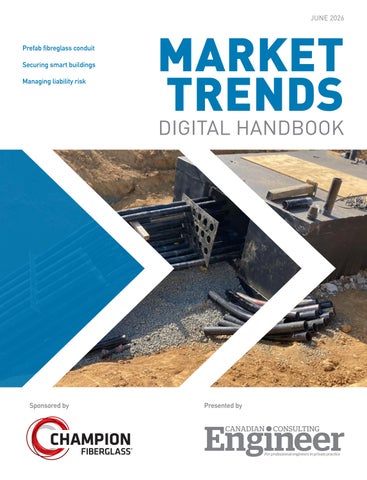
Prefab fibreglass conduit
Securing smart buildings
Managing liability risk
Sponsored by Presented by


The Advance: Women in Engineering virtual summit will be held on June 23, 2026, International Women in Engineering Day. This is a key opportunity to promote greater gender diversity in one of Canada’s most celebrated areas of expertise, as consulting engineering firms seek to recruit and retain more women for roles at all levels of seniority.
Our goal is to spotlight the accomplishments of successful professional engineers, encourage more women to join the industry/community and raise awareness of organizations that are already taking a leading role in this effort. Join the conversation with
WHY SUPPORT WOMEN IN CONSULTING ENGINEERING?
z Recognize the careers of successful women in the industry
z Build your reputation as an industry leader in diversity
z Amplify brand visibility among Canada’s top consulting engineering firms
z Position your organization as progressive
z Increase exposure to key audiences across multiple media platforms, including email; website; social media; and the live virtual event.







ONE BUY REACHES CANADA’S TOP CONSULTING ENGINEERING FIRMS
• Print distribution: 6,000+ copies
• Email distribution: 12,000+
• Website exposure: 26,000+ monthly page views One low investment.



4
4
EDITOR Peter Saunders (416) 510-5119 psaunders@ccemag.com
SENIOR PUBLISHER
Maureen Levy (416) 510-5111 mlevy@ccemag.com
ACCOUNT CO-ORDINATOR Cheryl Fisher (416) 510-5194 cfisher@annexbusinessmedia.com
GROUP PUBLISHER
Paul Grossinger (416) 510-5240 pgrossinger@annexbusinessmedia.com
CEO Scott Jamieson sjamieson@annexbusinessmedia.com
ISSN: 0712-4996 (print), ISSN: 1923-3337 (digital)
POSTAL INFORMATION: Publications Mail Agreement No. 40065710. Return undeliverable Canadian addresses to Circulation Dept., Canadian Consulting Engineer, 111 Gordon Baker Road, Suite 400, Toronto, ON M2H 3R1.
SPONSORED FEATURE Installing Prefab Fibreglass Conduit for a Data Centre
The project required miles of electrical conduit, including duct banks, to be installed on a tight, strict timeline, using high-performance materials.
6 Smart Buildings: Multi-layered Protection for Modern Infrastructure Legacy cloud-based systems, many of which are still being specified in projects today, have proven increasingly vulnerable to a new generation of cybersecurity threats.
June 2026
Market Trends Handbook ccemag.com

8 6

8
Effective Management of Liability Risk
It is important to adopt proactive strategies, given how increasingly complex projects, involving many stakeholders, frequently run into disputes or claims.
ccemag.com
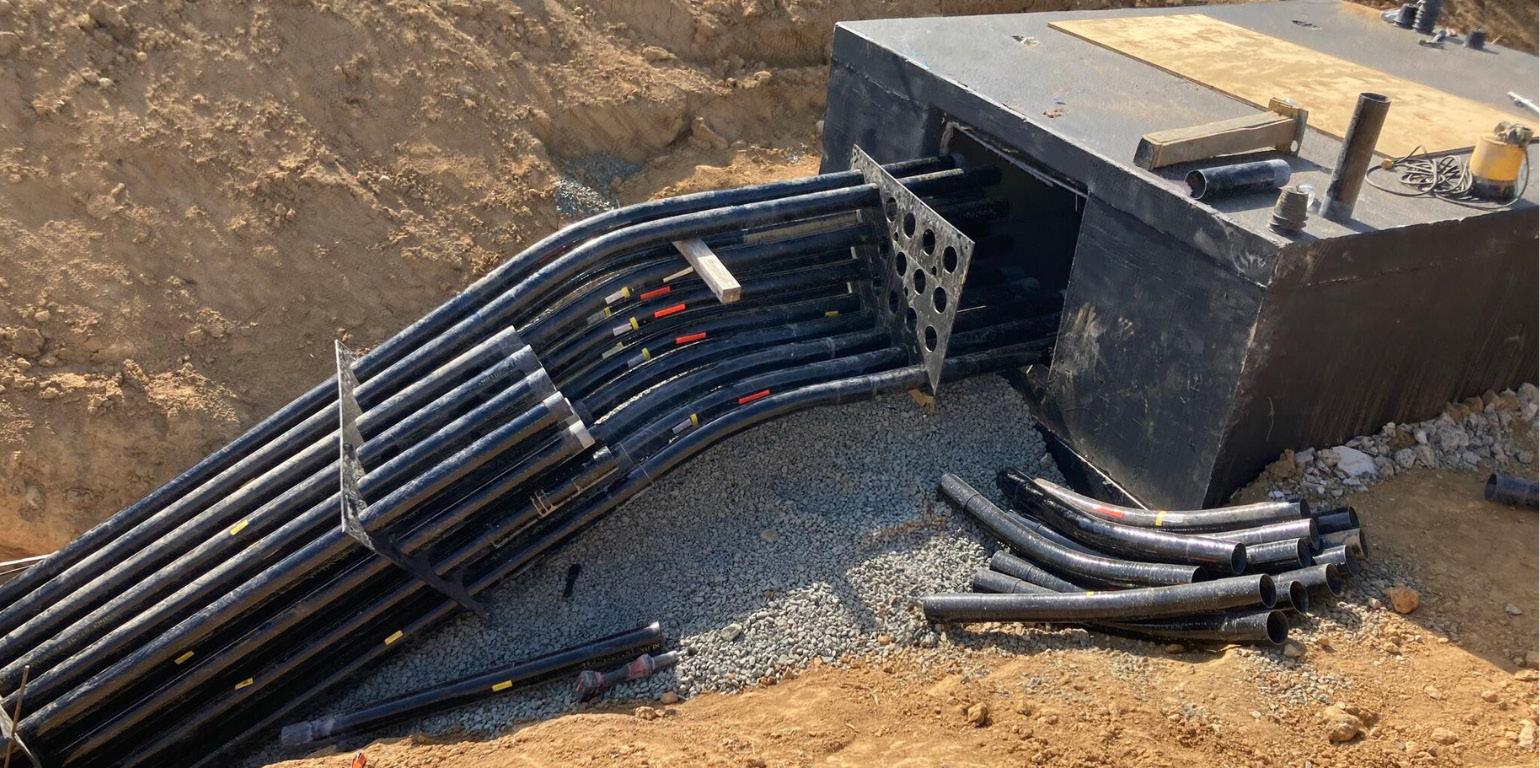
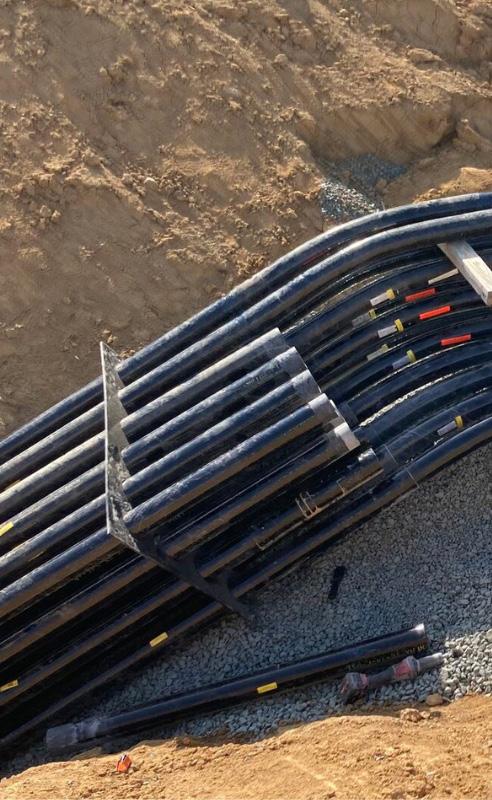
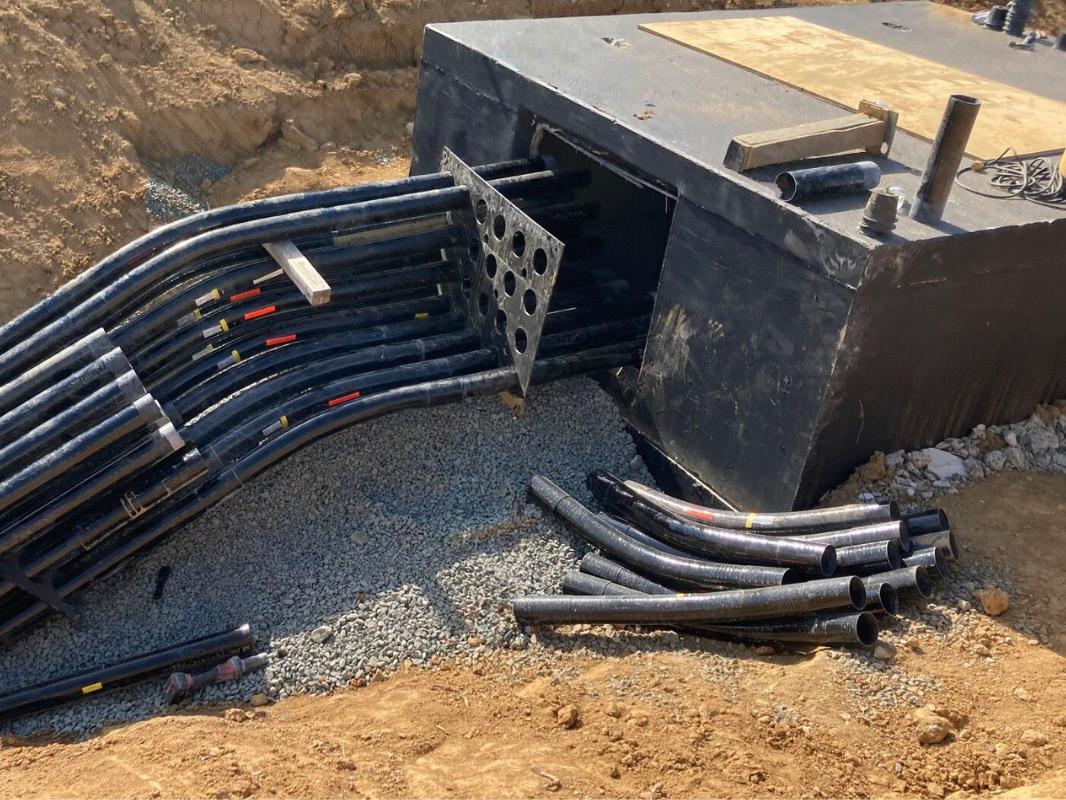
A large project in Virginia’s ‘Data Center Alley’ required miles of electrical conduit, including duct banks, to be installed on a tight, strict timeline. In addition to the scheduling challenge, the data centre customer insisted on high-performance materials and cost efficiency.
The contractor, Rosendin Electric, is an expert in below-ground installations for data centres, but this was its first time installing large quantities of fibreglass conduit. Specifications for the comprehensive installation included 25 miles of 4-in., 5-in. and 6-in. heavy-wall 90s for medium-voltage telecommunications and house transformer duct banks.
The data centre customer actually evaluated both fibreglass and polyvinyl chloride (PVC) conduit for the project, but fibreglass was preferred for the following reasons:
• 66% less weight.
• Shorter installation time, due to less weight.
• Greater safety in the trench, due to shorter installation time.
• Cost savings, as fibreglass conduit materials were priced almost 50% less than PVC at the time.
• Even greater savings for labour.
• Approximately 25% shorter lead time, which helped the project stay on schedule.
The contractor sourced the following products from Champion Fiberglass ®:
• Champion Duct ®
• Champion Elbows
Many advantages were realized for this project, including less manpower, smaller equipment and safer installation due to the conduit’s lighter weight, fault resistance and increased distance between supports. Additionally, prefabrication assembly by Champion Fiberglass helped shorten the process tremendously.
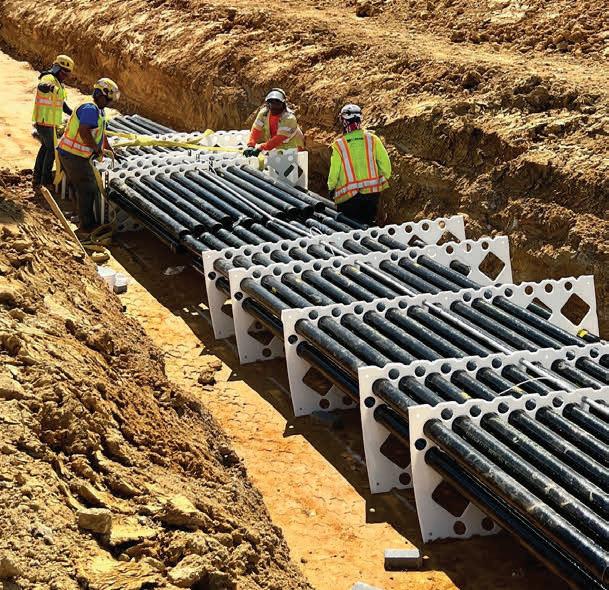
After pre-assembled duct banks were delivered, lightweight duct banks were easily placed into the trench with a forklift, which would not have been possible with heavier PVC conduit.
This project also involved a high level of customer support. Champion Fiberglass provided installation guidance for the contractor to become familiar with fibreglass conduit for installation.
Champion Fiberglass regularly goes the extra mile for customers and there were many touchpoints, including conference calls, samples and customizations.
The project concluded with these results:
• 60% total labour savings.
• 63% increase in productivity over PVC.
• On-time and on-budget completion.
No burn-through eliminates elbow repairs
Light weight facilitates a smooth, safe, cost-effective installation
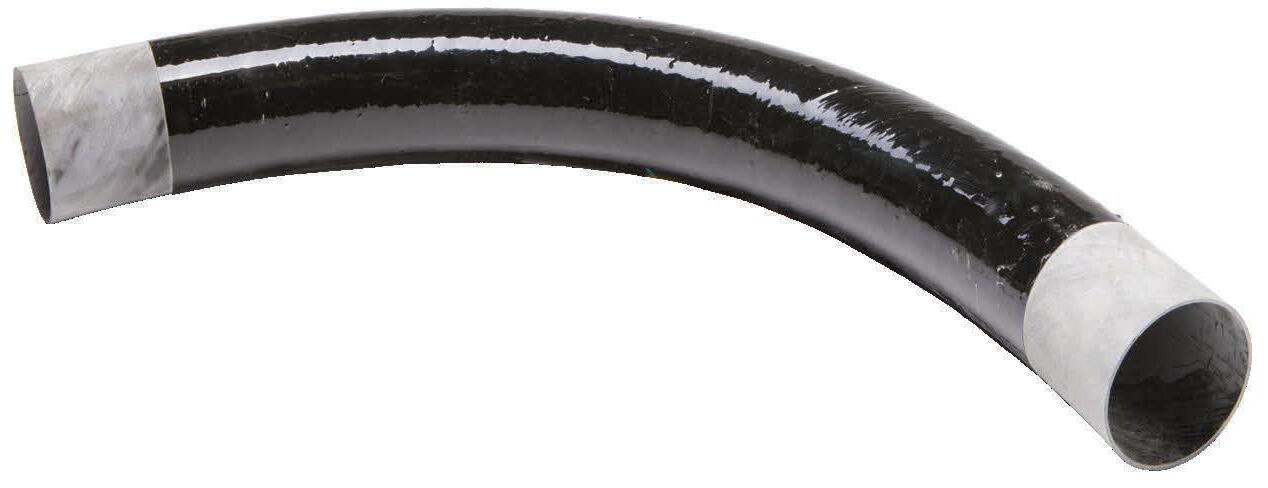


Durable and corrosion-resistant for lower total cost of ownership
A 110 °C temperature rating results in less ampacity derating for the cable
By Fabio Zaniboni
The rapid adoption of cloud-based technologies has transformed how we manage lighting, ventilation, security and other critical building functions. For consulting engineers, this evolution has unlocked the potential for more integrated, responsive and intelligent designs than ever.
However, this progress is shadowed by a significant and growing risk: legacy cloud-based systems, many of which are still being specified in projects today, are proving increasingly vulnerable to a new generation of cybersecurity threats. These vulnerabilities do not just represent an information technology (IT) issue, but also pose a direct threat to the physical infrastructure engineers design, specify and build. Potential consequences range from operational disruptions to catastrophic system failure.
The fundamental flaw in many smart building systems lies in their reliance on a centralized, cloud-dependent architecture. In this model, data from many endpoints, including sensors, actuators and controllers, is continuously funnelled to a single processing hub. This creates

a constant state of exposure during data exchange, leaving sensitive information, including access credentials, confidential occupant data and critical operational metrics, prone to interception.
The problem is compounded by weak or outdated encryption protocols in many legacy systems, which offer a low barrier of entry for cybercriminals looking to disrupt building operations, exfiltrate data or launch ransomware attacks.
The statistics are alarming. Internet of Things (IoT) devices experienced a 107% spike in cyberattacks in the first half of 2024. The urgency for engineers to specify more resilient and secure systems cannot be overstated. An attack is no longer just a remote possibility, but rather an operational probability. Beyond immediate security risks, performance issues like latency and bandwidth overload also plague older cloud systems. When every decision requires a round trip to a distant server, real-time functionality is compromised. This not only creates logistical inefficiencies, but also heightens exposure to denial-of-service (DoS) attacks, which can overwhelm a network and paralyze a building’s core functions. In a hospital, this could mean a failure of climate control in operating rooms (ORs). In a data centre, it could lead to a thermal shutdown.
Legacy systems built without adaptable, multi-layered security frameworks are simply unequipped to withstand evolving cyberattacks.
To effectively counter these threats, a fundamental shift in design is required, away from centralized, hardwired control systems and toward decentralized, wireless IoT networks. This approach provides distinct and compelling advantages for consulting engineers across every phase of a project’s life cycle, from initial concept to long-term operation:
Simpler design and specifications – Wireless IoT systems, particularly those built on protocols like Bluetooth Mesh, eliminate the complexity of traditional control wiring. The need for extensive data cabling, dedicated control cabinets and complex conduit runs is dramatically reduced or, in many cases, eliminated entirely.
This simplifies the creation of schematics, reduces the risk of design errors and frees up valuable space within the building for the client’s core functions. It streamlines co-ordination between electrical, mechanical and IT disciplines for a more efficient, integrated design process.
Faster implementation and commissioning – Removing the need to run, terminate and test kilometres of new cabling, wireless systems can be installed and commissioned in a fraction of the time and reducing material costs. This advantage is particularly pronounced in retrofit projects, where modifying existing structures is often cost-prohibitive and highly disruptive.
Easier maintenance and futureproofing – Perhaps the most significant long-term benefit of modern wireless IoT is the ability to perform

secure over-the-air (OTA) updates. The old model of dispatching a technician to physically access hundreds of devices to apply security patches or firmware upgrades is obsolete. With OTA, the entire network can be updated wirelessly and securely from a single dashboard. This makes long-term maintenance more efficient and cost-effective and ensures the building’s systems can adapt to future threats and the client’s evolving needs.
This new paradigm is built not on a single technology, but on a multi-layered security strategy combining advanced processing, encryption and hardware.
Localized processing with edge computing – Shifting away from total cloud reliance, intelligence is moved from a centralized server to the edge of the network, processing data near its source—i.e. within individual IoT devices or local gateways. Designing a system with edge capabilities can enable a more resilient, responsive and autonomous building.
An edge-enabled heating, ventilation and air-conditioning (HVAC) system, for instance, can analyze occupancy and environmental data and adjust airflow in real time with-
out cloud approval, ensuring continuous, secure operation during a network outage or cyberattack. Decentralization reduces the building’s ‘attack surface,’ as compromising a single node does not grant access to the entire system.
End-to-end encryption – End-toend encryption strengthens security by encoding data at its origin and allowing it to be decrypted only at its final destination. Even if data is intercepted during transmission by way of a ‘man-in-the-middle’ attack vector, it remains indecipherable without the keys. This principle must apply to data in transit across the network and at rest within devices.
Privacy-first hardware – Devices that are purpose-built to prioritize privacy should collect only essential, non-personal data ( e.g. occupancy counts, temperatures, CO2 levels), without capturing sensitive information like audio or video.
Smart lighting that detects occupants without using cameras is a prime example of respecting privacy while minimizing risk.
Mesh security – Wireless protocols like Bluetooth Mesh are designed with security as a foundational principle, offering separate, managed keys for the network, applications and individual devices. Further, the mesh architecture is self-healing; if one node is compromised or fails, then traffic is automatically rerouted. Smart locks, thermostats and sensors operate under highly secure conditions.
By prioritizing localized processing and advanced encryption for a wireless network, consulting engineers can effectively mitigate the growing risk of cyberattacks while optimizing smart building operations.
Fabio Zaniboni, founder and CEO of BubblyNet, has more than 20 years’ experience in IoT. For more information, visit bubblynet.com.
The key is a culture of preparedness.
By Scott Belton
Canada’s consulting engineers are operating in a difficult world today. Projects are increasingly complex, involve a larger number of stakeholders than ever and frequently run into disputes or claims. So, it is important to adopt proactive strategies to manage liability on a project.
An important first step is project risk identification. The following are examples of common project risks: Poor stakeholder communicatio n: Ineffective project meetings, unclear explanation to client of scope of services, lack of clear process for communicating project issues and no written documentation of change requests, impacts or approvals.
Client selection issues: Did your firm evaluate the client prior to submitting your proposal? Is the client financially health and experienced with this type of project? Do they have a litigious history? How is the client selecting the design team, i.e. quality-based selection (QBS) vs. lowest bidder? Is there a realistic project

schedule and budget?
Your firm’s capabilities: Do you have the right experience and number of staff for delivering this type of project? Have you selected the right project manager and subconsultants?
Construction phase services: Are these included in the contract? Is the contractor argumentative or unresponsive and are there other performance issues?
Quality management: Does your firm have an internal program that is being followed?
Contracts: Is there a signed contract? Are you using your firm’s standard agreement or a client-drafted contract? Are you assuming any uninsured liabilities under the contract? Is there a clear and appropriate
scope of service? Have the project manager and team familiarized themselves with the contract’s requirements? Is there a contingency for the project schedule or fee?
The following are some tips for preventing losses:
• Foster a culture of risk awareness and accountability within your firm.
• Select projects and clients carefully.
• Insist on a written contract with a clear scope of services, dispute resolution process and reasonable limitation of liability.
• Before signing, review the contract with your legal counsel and insurance broker to identify any uninsured liabilities you may be assuming.
• Offer comprehensive design services, including construction observation.
• Establish tolerance for risk and turn down any project that exceeds it.
• Keep clear and accurate written records.
• Recognize and react to warning signs of a claim, including communication breakdowns, disputes, significant delays and cost overruns.
Achieving true preparedness can be challenging. Even leaders who perform well under pressure may overlook the importance of planning ahead for a worst-case scenario, assuming instead they will be able to manage any disaster once it hits.
The strongest leaders demonstrate preparedness through how they manage risk, which might involve transferring it to a third party (i.e. through insurance), allocating it through a contract provision, mitigating it via management or avoiding it altogether by declining the project.
Leaders who take time to consider each project’s unique challenges, their own capabilities and the client’s working situation can set the standard around incident reporting and data collection and instill a culture of preparedness within their firm.
Scott Belton is vice-president (VP) of professional liability for Hub International, a global insurance brokerage.