SEPTEMBER/OCTOBER 2026
BlueLine.ca
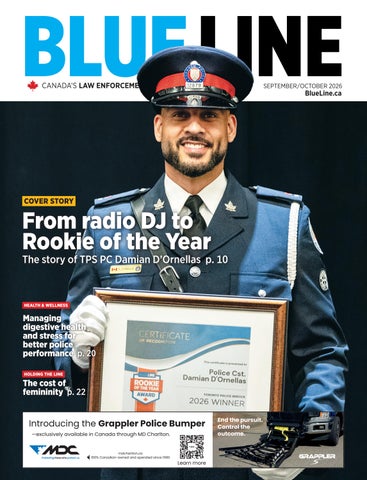
COVER STORY
From radio DJ to Rookie of the Year
The story of TPS PC Damian D’Ornellas p. 10
HEALTH & WELLNESS
Managing digestive health and stress for better police performance p. 20 HOLDING THE LINE
The cost of femininity p. 22 Introducing the Grappler Police Bumper —exclusively available in Canada through MD Charlton. mdcharlton.ca 100% Canadian-owned and operated since 1980
Learn more
End the pursuit. Control the outcome.
NUNAVIK POLICE SERVICE
NOW RECRUITING
POLICING THE CANADIAN NORTH
A CAREER LIKE NO OTHER
EMBRACE THE ADVENTURE. WHY NUNAVIK
AN UNBEATABLE LIFE & WORK EXPERIENCE
2 /2
8 WEEKS
Two weeks in Nunavik, then two weeks home.
Paid leave, every single year.
6 MONTHS
TOP TIER
We cover the full cost — no debt.
Excellent pay, top conditions.
ON, THEN OFF
WHERE YOU'LL SERVE
PAID TIME OFF
FULLY PAID TRAINING
SALARY & CONDITIONS Stations in all 14 communities.
SCAN THE CODE OR VISIT US ONLINE
START YOUR CAREER IN THE NORTH
NUNAVIKPOLICE.CA/EN/CAREERS 2
BLUE LINE | September/October 2026
BlueLine.ca
Contents
10 September/October 2026 Volume 38 Number 5
Features
Columns 4 18 20 22
Editor’s Commentary Q&A Health & Wellness Back of the Book
Departments 5 5 6 6
COVER STORY
8 From radio DJ to Blue Line’s Rookie of the Year The story of TPS PC Damian D’Ornellas. By Brittani Schroeder.
News By the numbers Dispatches Calendar
12 Online sexual exploitation in the age of AI
How can law enforcement modernize investigative strategies? By John Winterdyk, Tonia Tsoulamanis and Hennes Doltze.
16 Transforming community safety with dedicated civilian roles
How civilian patrols manage quality-of-life issues and free up sworn officers for criminal investigations. By David Silverberg.
21 Education & Training Directory COVER PHOTO: TREVOR OWENS, TORONTO POLICE SERVICE
Check out Blue Line’s 2026-2027 Education & Training Directory for options to bolster your resume, tool bag and more.
12 Blue-Line-Magazine
16
18
September/October 2026 | BLUE LINE
3
EDITOR’S COMMENTARY BY BRITTANI SCHROEDER
www.BlueLine.ca
Why self-imposed timelines don’t mean anything
I
s it just me, or is time moving My fixation on how quickly this year faster these days? I know it’s hardwas passing and on what I’ve chosen to ly an original observation, and I do with my time was on my mind as I typically say it around the Novemspoke with Toronto Police Service’s PC ber mark. But as I put together this Damian D’Ornellas, Blue Line’s 2026 edition of Blue Line, I genuinely couldn’t Rookie of the Year award winner. believe we reached September 2026 so Before becoming a police officer, D’Orquickly. It still feels like the year just nellas had already established a career in began, with big plans yet to make and a completely different field. He had built stories to tell. But here we are: something successful for himthe summer is winding down, We can’t self and his family, and nothing and the final few months of the slow down was due to change that. But year are upon us. the clock being a police officer was someSeptember also marks five and go thing he’d wanted to do for a years since I became the editor back in long time. of Blue Line. That was hard to time, but Unfortunately, dreams are believe! In some ways, it feels as we can easy to put off. We come up with though I’ve been with this maga- decide to reasons not to chase them. zine forever, but in others, it act now. Maybe the timing isn’t right, or feels as though I’m just starting maybe we miss the perfect to scratch the surface of the opportunity if we wait too long. stories I’d really like to share with you. Rather than continuing to set his dreams In the past five years, there have been aside, D’Ornellas decided to pursue the too many interviews, conversations, career he’d always wanted. Now, he’s beevents and deadlines to count. In that ing recognized as our Rookie of the Year. time, the policing community and the There is so much more to his story, and broader global landscape have changed, you’ll find it all on page 8. But there is and with them, the daily challenges you something more that has stayed with me, face have changed as well. and it goes beyond policing. I’m repeatedly told that this feeling of We spend a lot of time measuring time “flying” is just what it feels like as where we’re “supposed to be” at certain we get older, but maybe it’s also because points in our lives and careers. We put our lives have become so busy that we unnecessary timelines on ourselves and have very little time to stop and smell assume it’s too late to do something if the roses, as the saying goes. As memwe didn’t do it on that exact timeline. bers of the public safety sector, I imagine D’Ornellas’s story is a great reminder this feeling is amplified for you. The that those self-imposed timelines don’t world doesn’t pause when you finish mean anything. We can’t slow down the your shift. There will always be another clock and go back in time, but we can call, another investigation, another decide to act now. The hardest thing we shift coming up, another challenge you might face is making that first decision. must face, another priority that deAnd now that I’ve imparted some mands your attention. And this doesn’t motivation for your day, until next time, even consider your personal life outside happy reading and be well. of work. Before we know it, years have flown by.
Reader Service Print and digital subscription inquiries or changes, please contact customer service Angelita Potal Tel: 416-510-5113 Fax: (416) 510-6875 email: apotal@annexbusinessmedia.com Mail: 111 Gordon Baker Rd., Suite 400 Toronto, ON M2H 3R1
GROUP PUBLISHER | ADAM SZPAKOWSKI aszpakowski@annexbusinessmedia.com EDITOR | BRITTANI SCHROEDER bschroeder@annexbusinessmedia.com EDITORIAL DIRECTOR PUBLIC SAFETY GROUP | LAURA AIKEN laiken@annexbusinessmedia.com ACCOUNT MANAGER | JANICE EATON jeaton@annexbusinessmedia.com MEDIA DESIGNER | KELLI DECONINCK ACCOUNT COORDINATOR | KATHRYN NYENHUIS knyenhuis@annexbusinessmedia.com AUDIENCE DEVELOPMENT MANAGER BEATA OLECHNOWICZ | (416) 510-5182 bolechnowicz@annexbusinessmedia.com CEO | SCOTT JAMIESON sjamieson@annexbusinessmedia.com
ANNEX BUSINESS MEDIA 111 Gordon Baker Road, Suite 400 Toronto, ON M2H 3R1 Tel. 416-442-5600 • Fax 416-442-2191 Publication Mail Agreement No. 40065710 ISSN 0847-8538 Printed in Canada SUBSCRIPTION RATES Canada — 1 Year $33.42; 2 Year $55.69 USA — 1 Year $144.80 CAD Occasionally, Blue Line will mail information on behalf of industry-related groups whose products and services we believe may be of interest to you. If you prefer not to receive this information, please contact our circulation department in any of the four ways listed above. Annex Privacy Officer Privacy@annexbusinessmedia.com; Tel: 800-668-2374 © 2026 Annex Business Media. All rights reserved. Printed in Canada. No part of the editorial content of this publication may be reprinted without the publisher’s written permission. Opinions expressed in this magazine are not necessarily those of the editor or the publisher. No liability is assumed for errors or omissions. Readers are cautioned and advised that articles presented herein are edited and supplied for your personal awareness and should not be used for further action until appropriate guidance is received from a supervisor, Crown Attorney or other persons in authority. All advertising is subject to the publisher’s approval. Such approval does not imply any endorsement of the products or services advertised. The publisher reserves the right to refuse advertising that does not meet the standards of this publication.
CONNECT WITH BLUE LINE
BlueLine.ca
4
Blue-Line-Magazine
BLUE LINE | September/October 2026
@bluelinemag
BlueLine.ca
NEWS Additional details about the AACP & Blue Line Expo event and agenda will be available soon. CANADA
Police associations demand national strategy to tackle court delays and judicial vacancies
ONTARIO, ALBERTA
PHOTO CREDIT: SHAUNL / GETTY IMAGES [*CANADIAN CONTENT*]
Blue Line and AACP to partner on new western edition of Blue Line Expo
Blue Line Magazine and the Alberta Association of Chiefs of Police (AACP) have announced a new joint venture, the AACP & Blue Line Expo, scheduled for Feb. 3, 2027, in Calgary, Alta. “We’re thrilled to be working alongside the AACP to bring the Blue Line Expo west for the first time. Grey Eagle Resort in February provides a great setting for what we hope will be a valuable day for Alberta’s policing community. By combining our strengths and resources, we look forward to bringing relevant content and world-class vendors to Alberta,” said Adam Szpakowski, publisher of Blue Line. The event will feature a comprehensive trade show floor showcasing the latest technologies and solutions for public safety, alongside educational sessions tailored for all ranks. This initiative aims to provide a unique environment for law enforcement leaders and subject matter experts to network and address modern policing challenges.
“The Alberta Association of Chiefs of Police is proud to partner with Blue Line Magazine in launching the inaugural AACP & Blue Line Expo. This exciting collaboration marks the beginning of what we anticipate will be a long-standing partnership dedicated to advancing policing through innovation, education and collaboration,” said AACP Executive Director Leticia Aplin. “Together, we are creating a premier forum that brings together law enforcement leaders, public safety professionals, industry partners and subject matter experts from across Canada to share knowledge, strengthen relationships and explore innovative solutions to today’s policing challenges. We look forward to building on this inaugural event and continuing to provide exceptional professional development opportunities that support excellence in policing and enhance public safety across Canada.” Both organizations continue to leverage their respective print, digital and public campaign platforms to ensure Alberta’s policing community remains informed on critical issues regarding community well-being and crime prevention.
Canada’s two largest police associations are calling on all levels of government to prioritize court capacity and eliminate criminal delays, warning that a decade of inaction since the landmark R. v. Jordan decision has eroded public trust and undermined police investigations. The Canadian Police Association (CPA) and the National Police Federation (NPF) issued the joint demand following the tenth anniversary of the 2016 Supreme Court ruling, which aimed to dismantle a “culture of complacency” in criminal courts. Despite warnings from the high court, necessary funding for Crown offices and court infrastructure has failed to materialize, forcing officers to repeatedly deal with the same offenders while serious cases languish. CPA President Tom Stamatakis noted that months of investigative work frequently collapse because the system is unprepared for trial. In 2023-24, more than 108,000 cases were stayed or withdrawn in adult criminal courts, representing nearly 91 per cent of the total number of cases resulting in a guilty finding. NPF President Rob Farrer added that judicial vacancies and courtroom shortages in smaller communities pose unmeasured public safety risks. The associations are demanding a coordinated capacity plan, transparent national reporting on delayed cases, and firm provincial and federal commitments ahead of an October ministers’ meeting in Niagara Falls.
BY THE NUMBERS In April 2026, Statistics Canada released recent data on Violent crimes involving a firearm in Canada, 2024. For more information, please visit www150.statcan.gc.ca.
14,488 firearm-related violent crimes in Canada in 2024.
Blue-Line-Magazine
2.6 % In 2024, crime involving a firearm represented 2.6 per cent of all violent crime reported by police in Canada.
4 in 10 shooting homicides were attributable to organized crime.
49 % of firearm-related violent crimes in 2024 involved a handgun.
September/October 2026 | BLUE LINE
5
NEWS DISPATCHES The City of Bathurst has named Stéphane Drolet as the new chief of police of the Bathurst Police Force. Drolet, with 34 years of experience, has served as deputy criminal operations officer for the British Columbia RCMP, and as gold commander for the provincial response to the 2017 and 2018 wildfire seasons. He also served as chief of police in Saint John. Jean-François (Jeff) Bernier has officially been sworn in as the new chief of police of the Nunavik Police Service (NPS). He stated, “I look forward to building a new foundation of support among Nunavik residents that helps us to work together to reduce community violence and major criminal activity.” Police Chief Jodi Empey has announced her retirement to the Smiths Falls Police Services Board, effective Dec. 31, 2026. Empey began her policing career with the Smiths Falls Police Service in 1994. In 2022, she was appointed deputy chief and later served as acting chief before being officially appointed police chief in July 2024, becoming the first female police chief in the service’s history. Kenneth Cribley has been appointed permanent deputy chief of operations for the Windsor Police Service, as of June 22. Cribley brings more than 32 years of policing experience to the role, with a background in operational, investigative and administrative leadership. Most recently, he served as inspector of the professional standards branch. Hamilton Police Service has appointed Robin Abbott to the rank of deputy chief. Abbott has over 27 years of policing
experience and brings to the role extensive leadership experience and a strong commitment to public safety, community partnerships and supporting our members.
Montreal Police Service (SPVM) as president. Members of the CACP elected Dagher during the association’s Annual General Meeting held during the 121st CACP Annual Summit.
The Durham Regional Police Service Board announced that Acting Deputy Chief Ryan Connolly (left) from DRPS and Supt. Chirag Bhatt (right) from York Regional Police have been chosen as deputy chiefs of police. The appointments took effect on July 1.
The National Police Federation (NPF) confirmed the appointment of Rob Farrer as president following the organization’s Annual General Meeting on June 17.
Royal Canadian Mounted Police Inspector Martin Guay has been promoted to the rank of superintendent and is the Maple Ridge RCMP’s newest officer-in-charge. Guay is the first OIC to be selected for the autonomous Maple Ridge RCMP Detachment. Mike Ashcroft has been appointed to the rank of inspector at the West Vancouver Police Department. Ashcroft joined the WVPD in March 2005 and has served in patrol as a constable and corporal, as a sergeant and staff sergeant leading the major investigations team, as the WVPD intelligence officer, and as the divisional staff sergeant in charge of the operational support section. Insp. Jason McTaggart has been selected as the new Brant County OPP Detachment Commander. Prior to this promotion, McTaggart was the staff sergeant at the Brant County OPP Detachment, where he has served since 2022. McTaggart first joined the OPP in 1995 as a provincial constable and has served communities across the province throughout his career. The Canadian Association of Chiefs of Police (CACP) has elected Chief Fady Dagher of the
Durham Regional Police Service is profoundly saddened by the tragic death of Constable in Training (CIT) Tyrone Magbitang, 27, who was involved in a motor vehicle collision while travelling to the Ontario Police College on July 7. Magbitang joined the Durham Regional Police Service as a special constable in May 2023. In April of this year, he took the next step toward achieving his lifelong dream of becoming a police officer when he was selected as a police constable recruit.
6
BLUE LINE | September/October 2026
CALENDAR Retail Organized Crime Conference Date: Oct. 6 – 7, 2026 Location: Mississauga, Ont. peelpolice.ca Building Bridges: Evidence-Based Policing Conference 2026 Date: Oct. 7 – 8, 2026 Location: Edmonton, Alta. buildingbridgesebp.ca Canadian CIT Summit 2026 Date: Oct. 19 - 20, 2026 Location: Hamilton, Ont. citcanada26.vfairs.com Emergency Services Career Expo West Date: Oct. 24, 2026 Location: Calgary, Alta. careerexpowest.ca IAWP Canadian Regional Training Date: Oct. 28 - 29, 2026 Location: Banff, Alta. iawp.org Ontario Disaster & Emergency Management Conference (DEMCON) Date: Oct. 28 - 29, 2026 Location: Mississauga, Ont. crtdemcon.ca/demcon Find more calendar events online at blueline.ca/events. PROMOTIONS, RETIREMENTS, RECOGNITION • If you have an officer in your agency recently promoted or retiring or an individual you wish to have recognized (major award or recently deceased) you can let Blue Line magazine know by emailing: bschroeder@ annexbusinessmedia.com.
BlueLine.ca
trimtag.com • contact@trimtag.com • 905-763-7300 September/October 2026 | BLUE LINE
7
COVER STORY
From radio DJ to Blue Line’s Rookie of the Year The story of TPS PC Damian D’Ornellas By Brittani Schroeder
8
BLUE LINE | September/October 2026
they joined separate divisions, D’Ornellas shared, “Whether it’s five days, five years, or 50 years from now, I got your back.” He knew that they would all have his back in return. The best advice D’Ornellas received during training was to treat the job like an apprenticeship and “let it come to you”. Now, D’Ornellas, a proud first-generation Canadian, works in the same division he grew up in. Within his first year, Det. Terrence Lazarus, who was first D’Ornellas’s sergeant, described the rookie as “one of 43 Division’s most promising new officers. He displays maturity and professionalism far beyond his experience level.”
Making an impact
Since starting at 43 Division, D’Ornellas has brought initiative and sound judgment to every call. One call, in particular, stood out to his superiors. While speaking to a female who had a warrant out for her arrest, she fled, initiating a foot pursuit. He just so happened to be chasing her around the same apartment buildings where he grew up. Though he didn’t consider this pursuit to be high-risk, D’Ornellas recognized that he couldn’t ever know what might happen on the streets. He knew he had to approach
From left to right: Supt. Paul Krawczyk, PC Damian D’Ornellas and S/Sgt. Saleem Husain.
“At a time when strengthening trust is more important than ever, PC D’Ornellas understands that good policing is about relationships and has embodied one important lesson in policing: seek first to understand before seeking to be understood.” – Chief Myron Demkiw
it as cautiously but as quickly as possible, because he had a duty to catch the subject. After catching and arresting the woman, D’Ornellas noticed she was acting strangely. As she was put in the back of the squad, she became nonresponsive. Based on their initial interactions, D’Ornellas and his partner could see that she was under the influence of a narcotic. “Despite being physically assaulted during the arrest, D’Ornellas remained composed and focused. Alongside his partner, he administered naloxone twice, ultimately reviving the individual and ensuring her safety,” shared Lazarus. This incident reflected not only tactical and medical competence, but exceptional compassion from D’Ornellas. “By procedure, we always carry naloxone. Though it’s supposed to be used to protect ourselves, we switch modes quickly,” said D’Ornellas. “We move from taking someone into custody to potentially saving someone’s life.” Beyond his operational excelBlueLine.ca
PHOTOS: TREVOR OWENS, TORONTO POLICE SERVICE
T
here are some childhood dreams you simply can’t let go of. For Damian D’Ornellas, being a police officer was that dream, but it wasn’t one he followed right out of school. Instead, he spent nearly 15 years as a successful radio DJ. Yet despite this success in the hip-hop scene, he couldn’t shake the desire to serve, and at age 35 he decided to ignore his peers’ potential perceptions and pursue his goals. Once committed to this career change, D’Ornellas went all in. He contacted Toronto Police Service’s (TPS) recruiting team to learn about the application requirements and process, attended every available information session, including those at neighbouring services, and collected over 10 reference letters to ensure he was properly represented. “It may be beneficial, or it may be to my detriment, but I jump in with two feet, always. I don’t stick a toe in or go halfway. I jump.” Once his application was submitted, the process moved like a “runaway freight train”. “In hindsight, I wish I would’ve done this 10 to 15 years ago. But timing is everything,” he said. He graduated from the Toronto Police College as his recruit class valedictorian. Addressing his peers before
lence, D’Ornellas has been recognized for his positive impact on community engagement, particularly within the Toronto Community Housing Corporation (T.C.H.C.) properties in 43 Division. He has built meaningful relationships and fostered trust in places where it is often difficult, which has improved how many community members view police officers and 43 Division as a whole. D’Ornellas likes to think that his approach to every situation is different, and accountability and respect go a long way with him. “And when I do have to arrest someone, I don’t need to be a jerk about it,” he says. “It’s, of course, a negative experience because they did something wrong and they’re being arrested, but I don’t have to make them feel like less of a person for it. I’m here to do a job, and it’s not personal. It’s almost like a business transaction.”
A natural leader
When it comes to his role as an officer, D’Ornellas shows a clear eagerness to learn, stemming from a genuine curiosity about all things. “I’m not one-dimensional, saying I Blue-Line-Magazine
only want to do ‘this’. I want to do everything.” He wants to take all the radio calls and make all the arrests, all to ensure he is a well-rounded officer. He shared, “If you show up with the right attitude and an honest effort, every single day, I think people will notice that.” Within the station, Lazarus notes that D’Ornellas’s leadership is equally evident. He is known for arriving at work early, prepared and with a positive attitude that boosts morale. “His smile, humour and approachability brighten any room he enters,” Lazarus added. D’Ornellas has quickly become a favourite among both senior officers and new recruits, who consistently praise his reliability, strong work ethic, eagerness to learn and willingness to support others. He already displays the traits of a natural leader, earning respect through example and genuine care for those around him. As someone who was a “late” hire, D’Ornellas draws on his previous life experiences and believes his maturity plays a big part in his new role. “Let’s say you’re doing training with 100 other recruits, and one person isn’t the greatest
shooter. Other recruits say, ‘How could you not get this?’ But I look at it and say, ‘If they’re not as proficient as you are in this area, rather than make fun of them, how about you help them?’ Because that person standing beside you could save your life one day with that exact same firearm.” It is this kind of approach that Supt. Paul Krawczyk recognized as well. He shared, “It is not often you see this level of maturity so early on in one’s career. PC D’Ornellas brings a strong sense of responsibility, compassion and teamwork to everything he does, and has already made a meaningful difference both within our division and in the community. We are very proud of him.” D’Ornellas believes he knows a lot about life, a little bit about policing, and once he’s able to bridge that gap, he will be an excellent cop.
A career affirmation
PC D’Ornellas comes to work everyday to make a difference. He brings life experience, leadership and common sense to all the situations he is called upon to deal with during his shifts. – S/Sgt. Saleem Husain
Even if D’Ornellas hadn’t been named Blue Line’s 2026 Rookie of the Year, he would still have considered the nomination a significant achievement. We offered TPS the opportunity to inform D’Ornellas of his win, and they did so one morning during parade. When D’Ornellas arrived and saw Supt. Krawczyk, Insp. Christopher Ruhl, Det. Lazarus, and Sergeants Malenfant and Penton, he knew something was up. “Before they started talking, it hit me. I somehow knew that I had actually won.” When asked about how it felt to be named Rookie of the Year, D’Ornellas said it felt like an affirmation. “You finish in the top 25 of your recruit class, you’re class valedictorian, you’re named Rookie of the Year. All of these things are incredibly satisfying, because after being on the fence for so long, and then finally taking the leap to join policing, it confirms everything I have done so far has been correct.” He also pointed out September/October 2026 | BLUE LINE
9
COVER STORY the statistical rarity of the honour: “Out of however many rookie officers there are in Canada every year, I think the math works out to there being a 0.0001 per cent chance of winning this award. So, it’s nothing short of awesome.” D’Ornellas credits Det. Lazarus as a foundational figure in his journey so far. Lazarus, in return, said, “Having had the privilege of serving as Damian’s direct supervisor for the past year, I’ve come to know him both professionally and personally. Damian embodies what it means to be an officer and a gentleman, leading with integrity, humility and genuine compassion for the people he serves. He approaches every challenge with professionalism and a commitment to continuous growth, while never losing sight of what matters most to him: his family. His work ethic, character and dedication to service make him exceptionally deserving of this recognition as Rookie of the Year.”
10 BL_WilfredLaurier_SeptOct26_CSA.indd BLUE LINE | September/October12026
Expo, PC Damian D’Ornellas was presented with the award. During a short acceptance speech, he concluded: “I’ve come to realize that the laws are written in black and white, and many people in the business will tell you that policing is in the grey. My approach to the job and my approach to policing thus far is just to add a little bit of colour. I like to think I’ve done the right thing, at the right time, for the right reason, and that’s why I’m here today.”
Chief Myron Demkiw shakes hands with Damian D’Ornellas at the recruit class’s graduation.
Adding colour to the grey
As for the future, D’Ornellas has many goals and wants to take his career as far as he can while having some fun along the way. If that means one day “putting on a white shirt”, he’d be happy to do it. But until then, he’s going to take things as they come to him. At this year’s OACP & Blue Line
THANK YOU TO THE 2026 PANEL OF JUDGES
Christine Silverberg
Peter German
Armand La Barge
For the judges’ full biographies, please visit blueline.ca.
2026-09-04 10:22 AM BlueLine.ca
RESEARCH
Online sexual exploitation in the age of AI How can law enforcement modernize investigative strategies? By John Winterdyk, Tonia Tsoulamanis and Hennes Doltze
12
BLUE LINE | September/October 2026
ers to recruit and exploit innocent but vulnerable people. It presents new challenges for law enforcement (LE) in their efforts to effectively identify and investigate cases involving online trafficking and/or SE, be they a ‘seller’ or ‘buyer’. Evolving trends in online SE have created significant challenges for LE agencies at the provincial and national levels. They are encountering a growing number of cases involving the recruitment and exploitation of women and girls by traffickers and buyers. These shifts demand new investigative approaches, including enhanced digital competencies and stronger coordination across jurisdictions. Historically and mainly grounded in the 2000 United Nations Palermo Protocol,3 to which Canada became a signatory member in 2001, required member states to combat HT across four main areas: 1. prevent HT primarily through education; 2. protect and assist the victims of HT with
full respect for their human rights; 3. prosecute the perpetrators of HT; and 4. promote partnerships/cooperation among State Parties to meet the objectives of the Protocol. In addition to these four pillars, Canada has a fifth pillar: the empowerment of victims and survivors of HT through enhanced support and the services they need to regain control and independence. To date, despite the vast array of resources (i.e., financial and personal), conventional efforts have met with dismal success. Arrest and prosecution rates in Canada remain well below 3 per cent, and the number of victims and online demand for commercial sexual services appears to be rapidly increasing.4
An exploratory study on online SE incidents
In partial response to these challenges, an exploratory study on demand reduction and SE was undertaken to better understand and BlueLine.ca
PHOTO: TINNAKORN JORRUANG / GETTY IMAGES
H
uman trafficking (HT), particularly sex trafficking and sexual exploitation (SE), remains one of the most lucrative criminal enterprises globally, with estimates placing its annual profits at more than $206 billion. In 2025, international assessments suggested that over 6 million people are sex trafficked each year, the majority of whom are women and girls. While Canada lacks comprehensive national data, multiple sources, including the Canadian National Human Trafficking Centre, indicate that trafficking continues to pose a significant public safety concern. At the national level, human trafficking remains a largely hidden and frequently underreported crime. Statistics Canada reported 528 police‑reported human trafficking incidents in 2025, 605 in 2023 and 608 in 2024,2 reflecting a general upward trend and underscoring the need for effective investigation strategies. This is especially true in cases where online technologies are used to recruit prospective victims, a pattern that now defines a rising share of online cases, which increasingly involve SE. In recent years, digital technologies (e.g., the internet, smartphones, digital cameras, online gaming consoles and smartwatches) have become omnipresent, supporting a wide range of tasks. A recent report estimates that more than 98 percent of Canadians now use some form of digital technology. While the rapid emergence of digital technology, such as generative AI and agentic AI, has expanded the use of such technology, it has become a new tool for buyers of commercial sex and sex traffick-
Where expertise meets experience Discover how our programs can advance your career
Là où l’expertise rencontre l’expérience Découvrez comment nos programmes peuvent faire progresser votre carrière
Canadian Police College | Collège canadien de police
cpc-ccp.gc.ca
RESEARCH ultimately develop protocols that could help reduce online demand for commercial sex, where most of the victims are illegally recruited and exploited against their will. Part of the data collection involved surveying LE agencies across Canada, particularly those with dedicated anti-trafficking units. To the best of our knowledge, no such study has been undertaken in Canada. Therefore, the study is exploratory, and the findings are presented with the caution that, while informative, they are not definitive. The following section summarizes the main findings. . Ninety-five HT/SE Canadian cases were collected from January 2015 through to December 2025 using CanLII. In addition, a small number of LE surveys were completed along with three targeted interviews with HT crime analysts. The data were supplemented with a comprehensive review of the related literature. By its very nature, the project was exploratory. Hence, the results are primarily descriptive, providing an overview of HT/SE cases and identifying common themes and potential gaps in LE investigations. The following are some of the main findings from the data collected: • Over 80 per cent of the charges were filed under Sec. 279 of the Criminal Code. • In approximately 15 to 20 per cent of the cases, the defendant was charged with multiple offences against the victim. • Most of the victims were females between the ages of 11 and 20, and in 15 to 20 cases, were used to recruit other victims. • In about 80 per cent of the cases, the offender was the ‘buyer’ or ‘seller’ (i.e., trafficker), while the remaining cases involved a third-party facilitator. Approximately 97 per cent of buyers were male. • Although generative AI was involved in several investigated cases, most of the digital platforms were open-source, such as YouTube, Facebook, Instagram, Tinder, Telegram and Snapchat (especially among the younger victims). • None of the sentences exceeded five years, and in approximately 40 per cent of the cases, the outcome of the sentences was two years or more.5 • Consistent with the LE feedback and related international studies, there was a notable absence of information (e.g., demographics) for the accused. • Even though most of the cases revealed ‘clear’ elements of exploitation, the LE respondents revealed nominal attention to addressing the issue of demand reduction instead of the successful prosecution of the trafficker/supplier. 14
BLUE LINE | September/October 2026
Summary and recommendation
While this article focuses on strengthening LE investigations into online SE incidents, the issues raised and the recommendations are not unique to Canadian LE agencies. Instead, research shows that the issues are universal.
Human trafficking... remains one of the most lucrative criminal enterprises globally, with estimates placing its annual profits at more than $206 billion. Even though LE agencies across the country have made significant progress in their capacity to detect and charge online SE offenders, several data findings objectively inform recommendations that could further support their efforts. They include the following points:6 • Given the complexity and volume of content (e.g., pictures, images, online text, etc.), establish or expand dedicated resources and personnel to manage and process the data. • Use AI-assisted analysis and/or classification tools to reduce manual data review. This could involve partnering with agencies that specialize in such software and have dedicated staff and experts. • Police investigations must carefully evaluate the evidentiary practices (e.g., trying to prove control, trauma, purpose of the exploitation, etc.). • Given the rapidly evolving nature of online SE and the number of cases, establish smaller regional digital forensic hubs to support those LE agencies that do not have the resources to establish their own anti-sexual exploitation/anti-human trafficking units. • Develop operational protocols to align investigations with regulations and collaborate with AI and digital technology companies to ensure resources and technology keep pace with rapid advancements. • Law enforcement agencies should offer further training that specializes in online and digital-based HT/SE. This will help limit cases being dismissed based on courts’ undermining of police expertise, solely when police are used as expert witnesses.
• Enforce current anti-demand laws, such as Sec. 281(1) and 286(2) of the CCC, across all jurisdictions. The data reviewed strongly suggests that Canada’s law enforcement response to online sexual exploitation and sex trafficking remains uneven and often ill‑equipped to address the complexity of these offences. Frequent reliance on limited resources, staff turnover, inconsistent cooperation among LE agencies, and limited capacity to adapt to the rapidly evolving digital platforms and offenders’ modus operandi all contribute to low charging rates and time-consuming efforts to investigate and prepare cases. While not exhaustive, the recommendations made here address some of the challenges, and the RCMP and other LE agencies across Canada should continue implementing these reforms to strengthen investigations and better protect victims from online SE.
End notes and sources
1. For any queries, contact John Winterdyk at jwinterdyk@mtroyal.ca. 2. Statistics Canada, Trafficking in persons in Canada, 2022–2024, The Daily/Juristat. www150.statcan.gc.ca. 3. Formerly known as the Protocol to Prevent, Suppress and Punish Trafficking in Persons Especially Women and Children – General Assembly resolution 55/25, which supplemented the United Nations Convention against Transnational Organized Crime. 4. Given the clandestine nature of the crime, collecting reliable data on such matters is very challenging. 5. Depending on the nature of the trafficking offences, the penalty can range from five years to life. However, for non-aggravated cases, there is no minimum. 6. Several of the recommendations have also been identified by Public Safety Canada. See: canada. ca/en/public-safety-canada/.
John Winterdyk is Professor Emeritus in the Justice Studies program at Mount Royal University, Calgary, Alta. He has published extensively in the field of human trafficking and currently consults on a range of related projects. Tonia Tsoulamanis is a third-year Criminal Justice student at Mount Royal University, working toward completing her undergraduate degree and pursuing a career in law. She has contributed to several projects under the supervision of John Winterdyk. Hennes Doltze leads the EmpowerMen Project in Winnipeg, Man., and has a degree in social work and non-profit management. His work focuses on engaging men in creating safer communities for women and girls and addressing sexual exploitation and violence.
BlueLine.ca
THE BEST TOOL FOR THE JOB
The NightRide 360 is a magnetic or suction cup mounted, remote controlled 360⁰ pan and tilt thermal camera, using heat signatures to give you a view 1/4 mile or more away dust, rain, snow, fog, smoke, and complete darkness. Perfect for monitoring ongoing situations at night including stakeouts and looking for felons on the run.
THE MOST ADVANCED MODULAR COMBINATION UNIT RESPIRATOR (CUR)
The Avon CS-PAPR™ is the newest generation of CBRN Powered Air Purifying Respirator (PAPR) designed for use in Combination Unit Respirators. The capability to change levels of protection dependent on the threat, now provides the wearer with increased duration on target and safer operation. Utilizing the Avon MP-PAPR module along with the patented combination hose module, the wearer can seamlessly switch between APR, PAPR and SCBA modes of protection. The single air hose connection for all modes allows the wearer to retain a clear mask cheeks for optimum weapon sighting. The low profile shape of the Avon CS-PAPR delivers best in class integration with SCBA systems, benefiting the wearer with reduced weight and size compared to traditional systems. Modular Methodology allows the user to either add the Avon CS-PAPR to existing fielded systems such as the FM53/4 APR and ST53 SCBA, use as a regular PAPR (Avon MP-PAPR) or revert back to the Avon EZAir configuration.
PORTABLE CRIME SCENE SHELTERS
4’ 6’ 8’ 10’ 12’
PORTABLE, NON-METALLIC, NO LOOSE PARTS, LIGHTWEIGHT AND FITS IN PATROL CAR TRUNK Eflare Beacons are intensely bright Can be seen from over 1 kilometer away without the night vision, point fixation and distance judgement problems associated with strobe and incandescent lights. Eflare Beacons are infinitely versatile Available in a variety of one or two colour light combinations, steady-on or flashing, and in three light intensities. Easily attaches to clothing, vehicles, cones and bollards. Be seen and safe in almost any situation you can think of. Eflare Beacons are portable and simple to use The largest model is 22 cm tall and weighs only 460gm including batteries, making it easy to carry or stow anywhere, and quick and simple to deploy in any situation. Just twist the lens to turn on or off, and place one or more units around to provide a highly visible warning and safety zone around a person, work area, hazard or accident. Eflare Beacons double the safety Eflares provide safety by ensuring EFLARES First maximum visibility, but unlike pyrotechnic flares Responder Kits are there is no risk of fire or explosion, and there are found in Police cars no toxic fumes or residue. across Canada. Beacons are extremely robust Eflare Eflares are waterproof, dustproof and will survive a drop from a one metre height onto a concrete surface. Eflare Beacons are HAZMAT accredited Eflare Beacons are HAZMAT accredited for use in Class 1, Division 2 / Zone 2 hazardous areas.
From ballistic protection to blunt impact mitigation; in the trenches, on the water or atop the mountain; Team Wendy has a purpose-built helmet for your mission. Military, law enforcement, search and rescue, and adventure community professionals around the world look to Team Wendy for helmet solutions.
EXFIL® BALLISTIC SL
The Tactical ResQmax™ is the line thrower specifically designed for the tactical world of line-throwing. As with all the ResQmax™ line throwers, the Tactical ResQmax™ is modular and can be used with a variety of accessories for horizontal or vertical line deployment. When equipped with a grappling hook, a climbing line can be deployed to vertical distances up to 110 ft / 34 m, and a tactical ascending ladder can be deployed to vertical distances up to 50 ft / 15 m. Entry points which would otherwise be inaccessible can be breached with ease for method of entry and ship-boarding operations in both land-based and maritime environments.
OPTIMIZATION
Transforming community safety with dedicated civilian roles
W
hen Chris Marinelli looks back at the 24-year history of Halifax Regional Police (HRP) deploying community officers across the city, he couldn’t help but smile and say, “Community response officers are an invaluable part of policing. They foster relationships to the community that are so important for us.” HRP is just one of many departments that recognize the value of community officers and appreciate how these civilian roles can free up other officers to take on emergency calls and respond quickly to critical incidents. In late 2025, Toronto Police Service announced they were expanding community patrols to four new neighbourhoods. The Ottawa Police Service also shared its plans to add more civilian roles to the force. These community officers range from social workers who assist with domestic-abuse incidents to multilingual residents to officers who work solely in schools. Their roles could also involve detailed crime analysis. Some community officers may be from marginalized communities the department is seeking to serve. 16
BLUE LINE | September/October 2026
A survey1 of Canadian police departments going back to 2016 found that respondents contend that “training costs in particular can be reduced significantly over the long term by hiring civilians who already possess specialized knowledge rather than by providing additional training for sworn officers to carry out specialized roles such as crime analysis.” Still, some challenges surface. That same survey noted that a hurdle arises when overseeing civilians whose duties fall under different collective agreements than those governing sworn officers. Marinelli, the central divisional commander at HRP, said their police department has increased the number of community officers in the force, and he consistently values their contributions. “My community response officers are the people that I lean on to manage some of those quality-of-life type issues that maybe our patrol officers don’t have the time to take on,” he shared. There is another corollary benefit to boosting the number of community officers in the streets: they reshape how people view policing. A 2019 study2 in Connecticut found that a single, positive, non-punitive interaction by
community officers “substantially improved residents’ attitudes toward the police.” Also, a UK study found3 that when a dedicated community officer is reassigned or leaves their position, the vital neighbourhood knowledge and localized trust developed within that community are instantly lost, which routinely jeopardizes public confidence. That confidence could stem from the way these civilian roles help ease the effects of non-violent crime. In Halifax, the swaths of unhoused people in areas such as Spring Garden Road offer these community officers the opportunity not just to help these neighbourhoods address more nuisance-related incidents, but to instill trust in the very people they communicate with regularly. “Business owners in those areas are just trying to get to work, so to have our community officers go and speak to the individuals causing problems and speak to them on their level, that’s something we really value,” said Marinelli. In some parts of Canada, community officers can often transition into full-fledged patrol officers. At Metro Vancouver Transit Police (MVTR), close to two-thirds of their BlueLine.ca
PHOTO: NURPHOTO / GETTY IMAGES
How civilian patrols manage quality-of-life issues and free up sworn officers for criminal investigations By David Silverberg
community officers graduate to become fulltime officers, a pathway they view as an ideal training ground. “To give them the power of enforcement is important for us,” said MVTR media relations director Sunny Kanith. “They not only assist with areas such as fare evasion and fights but also act as a deterrent.” Kanith said the more that transit riders see community officers patrolling vehicles and stations, the more self-assurance they feel in how their system is being policed. Also, bad actors may have second thoughts about committing offences. In some departments, community officers are separated from sworn policing personnel, such as in Calgary. Their peace officers are under the umbrella of the City of Calgary, although Calgary Police Service (CPS) regularly works with those officers. “They are key partners in areas of bylaw enforcement, traffic education and responding to social disorder,” a statement from CPS reads. “Peace officers help address community concerns while allowing police officers to focus more time on criminal matters and investigations.”
What should be a front-burner priority, too, is ensuring the mental well-being of these civilian roles. A 2021 Canadian study published in the Journal of Police and Criminal Psychology found4 that “civilian workers can be indirectly exposed to potentially traumatic events through reviewing reports or organizing photos,” leading to low levels of resilience in the face of this barrage of violent imagery.
“When these officers take the time to foster relationships properly, that’s how police officers can make those inroads into our communities.” The report recommends, “Law enforcement organizations should consider extending services and programs offered to officers and the civilian workers in their organizations.” Marinelli said departments that don’t invest in community officers should recon-
sider their decision. He added, “When these officers take the time to foster relationships properly, that’s how police officers can make those inroads into our communities.”
Sources:
1. “Research Summary: Civilianization of Police in Canada.” Public Safety Canada. 2022. www.publicsafety.gc.ca/cnt/rsrcs/ pblctns/2015-s042/index-en.aspx. 2. K. Peyton, M. Sierra-Arévalo, and D. Rand. “A field experiment on community policing and police legitimacy.” Proc. Natl. Acad. Sci. U.S.A. 116 (40) 19894-19898. 2019. doi.org/10.1073/pnas.1910157116. 3. R. Signori, D. Heinrich, A. Wootton, et al. “Relational continuity in community policing: Insights from a human-centred design perspective.” Policing: A Journal of Policy and Practice, Volume 17, paad038. 2023. doi.org/10.1093/police/paad038. 4. K. Martin, A. Siddiqui, R. Ricciardelli, et al. “Differences in Mental Health, Help-Seeking and Barriers to Care Between Civilians and Sworn Members Working in Law Enforcement: A Research Note.” J Police Crim Psych 36, 627–633. 2021. doi. org/10.1007/s11896-021-09437-y.
OUR CHAMPIONS.
The Law Enforcement Torch Run® (LETR) is the largest public awareness vehicle and grassroots fundraiser for Special Olympics in Canada - and around the world. Canada’s LETR began in 1987 and has since raised more than $95 million in support of Special Olympics while championing acceptance and inclusion for Canadians with intellectual and developmental disabilities. Thank you for more than 35 years of friendship and support. Together, we are transforming lives through sport in communities across the country every day. @specialocanada | specialolympics.ca
BL_SpecialOlympics_SeptPOct26_CSA.indd 1 Blue-Line-Magazine
10:27 AM September/October 20262026-09-11 | BLUE LINE 17
Q&A Recently, Editor Brittani Schroeder spoke with Hamilton Police Service’s Cst. Trent Akalu about the importance of balancing professional duty with a distinct personal identity to ensure long-term fulfilment both on and off the job. Q: What inspired you to dedicate your career to public safety?
Q: In which areas have you worked over the past two decades?
I’ve been able to dabble in different uniform patrol capacities in many divisions across Hamilton. I was a member of a proactive police bike unit called the ACTION Unit, which was very gritty, very front-row-seat policing. I was in the bail compliance 18
Trent Akalu.
unit, which was important to me because I feel there’s a weakness and a lack of oversight in the judicial and bail systems. I was very motivated to catch these people if they were breaching their conditions. I was also seconded as a detective constable to the Ontario Provincial Police, Security Bureau, JOPIS (Justice Officials Protection & Investigation Section) and investigated threats, harassment and intimidation towards police, correction and probation officers. Now, I’m in the traffic safety
BLUE LINE | September/October 2026
unit, and I love it. I’m a quality over quantity kind of guy, and I focus on what I believe in and what matters to me, like cell phones and distracted driving, excessive speed and stunt driving, street racing, aggressive drivers, and things like that. Targeting those makes a positive impact on the community because we’re getting dangerous drivers off the road. It’s a niche realm and just one chapter of a policing career. Will I be here forever? No. But while I am here, I want to make a positive impact.
Q: You’ve volunteered in the St. John Ambulance program and have been a medical first responder, you’re part of the Police Honour Guard, and you’re part of Pro Action events, among others. Why are these so important to you?
As part of the army reserves, we were involved with St. John Ambulance. Over 12 years, I worked my way up to Chief for the Niagara Falls Medical First Responders branch. I liked that I didn’t have to be a police officer at all times. It showed me I could BlueLine.ca
PHOTO CREDIT: TRENT AKALU
I came from a dysfunctional family. At a very young age, I made a decision to be a good guy—ultimately, a good dad. I’m a big believer in the conscious choices we make in life; you can choose to follow what you see, or you can choose to know better and pursue something greater. So, from a young age, I knew I wanted to either be in the armed forces or be a cop. I did about eight years in the infantry reserves, and as difficult as it was, I was very proud of what I’d accomplished. I joined when I was 18 and figured if I worked hard, I would get somewhere someday. I became a master corporal, and I liked doing drill and teaching firearms. I didn’t just want to do it; I wanted to show others how to do it. It also made the transition to policing easier for me. I first began with Niagara Parks Police, and then the move to Hamilton Police Service felt very natural. I didn’t feel like anything could hold me back.
still do other things outside the policing world, which made the job more enjoyable because it wasn’t my 24/7. My volunteer work became almost like a hobby.
ledge that you need a break, and that can be a challenge itself. Mental health is a big thing for me, and having hobbies outside of work helps with the emotional survival of this job.
Q: What has the job taught you over two decades?
Being an officer is what you do—it’s not who you are.
I’ve learned that my favourite part is being outside, encountering new things every day. You never know who you’re going to meet, and that unpredictability is what I like. Even when I’m inside doing paperwork for too long, I feel the urge to get out on the street. But to do this work, I’ve learned that you need to be able to emotionally survive it. You need to be able to go to work, then turn it off and go home to be a normal person. That boundary between work and home is a challenge. Sometimes you need to acknow-
Q: What are some of those hobbies?
They’re so different from my military and policing background. I love artsy stuff. I’m into photography, I play the trumpet, I like being in nature and plant life. It’s my way of dissociating from the busyness of everything around us. My kids have learned that from me, and they love nature. When it’s summertime, we’re always outside. No TV or tablets for us.
I want my kids to grow up in a world where they’re aware of what’s around them, not just what they see on TV or on their cell phones. I think most people can name 50 brands that they’re shown on TV, but they can’t name 10 flowers outside. We all need to be a little more human.
Q: If there was one thing that you’ve done throughout your time as an officer that you hope leaves a lasting impression after you retire, what would it be?
That’s a tough one. I always want good relationships with people, and I hope people remember me for the positive interactions we had. I still have 10 more years, and I just want to go to work happy, be happy at home and be there for my kids.
I think I live in the moment. I don’t want to say day-to-day, because sometimes that can be a struggle, but my focus generally isn’t on me. I go to work, do a good job, hopefully make a positive impact on the community, and then be a good dad when I go home. I want to keep that focus on others, and I want to contribute to a positive workplace. Because I started young, I’ll be able to retire at 51. I’ve worked hard my whole life, and I will enjoy my retirement while I’m able to do so. There are some members who can’t let go of the job, but that won’t be me. Being an officer is what you do—it’s not who you are. It’s part of my identity, but it’s not my whole identity. We are human at the end of the day, so enjoy the fruits of your labour and go home.
DISCOVER YOUR FUTURE
OCT 24, 2026
CALGARY, AB
REGISTER ONLINE AT EMERGENCYSERVICESEXPO.CA Meet with agencies, departments, organizations and private companies looking to hire
Network with industry leaders, mentors and recruitment professionals willing to share job-seeking tips and advice
Increase your chances of finding employment in your chosen profession
Gold sponsor:
Brought to you by:
Sponsorships and exhibitor booths are available. For more information, contact Janice Eaton at Jeaton@annexbusinessmedia.com or 416-527-0191.
BL_SPFEXPO_26_JULYAUG26_BAS.indd 1 Blue-Line-Magazine
1:14 PM September/October 2026 2026-07-13 | BLUE LINE 19
HEALTH & WELLNESS BY ISABELLE SAUVÉ
Managing digestive health and stress for better police performance
A
cid reflux, clinically referred to as gastroesophageal reflux disease (GERD), is a prevalent medical condition affecting millions worldwide. It occurs when stomach acid or bile flows back into the esophagus, commonly producing symptoms such as heartburn, regurgitation and dysphagia. Although GERD is widespread in the general population, it presents particular challenges for law enforcement professionals whose work is characterized by physical exertion, disrupted sleep, irregular schedules, suboptimal nutrition and sustained high stress. These occupational factors may contribute both to the onset of GERD and to the worsening of existing symptoms. So, how does acid reflux influence the health and, consequently, the performance of officers? My hope with this column is to raise awareness of profession-specific risk factors and encourage proactive prevention and early intervention in consultation with qualified medical practitioners. Chronic stress is widely recognized as a contributing factor in the development and exacerbation of GERD. Officers routinely operate in demanding, high-stakes environments that activate the body’s “fightor-flight” response and elevate cortisol levels. Excess cortisol can disrupt normal digestive processes, increase gastric acid production, and, over time, impair the function of the lower esophageal sphincter (LES). This LES is the muscular barrier that prevents acid from entering the esophagus, and a weakened LES heightens susceptibility to acid reflux. Ongoing exposure to traumatic incidents, high-adrenaline situations and sustained emotional strain further complicates symptom management for officers already experiencing reflux and may increase the risk for the members who were previously asymptomatic. 20
BLUE LINE | September/October 2026
Healthy eating patterns and sleep routines are closely linked to digestive health, both of which are impeded by our shift work and irregular duty schedules. Officers may miss meals, rely on high-fat or highly processed foods, or consume nutritionally inadequate “convenience” options during or between shifts. These dietary choices trigger acid reflux. Additionally, while on duty, our meals may be eaten quickly or under distraction, such as while driving or between calls for service, which can further impede digestion. Late-night eating is of particular concern, as consuming food shortly before lying down increases the likelihood of gastric contents flowing back into the esophagus. Over time, these patterns can intensify the frequency and severity of reflux symptoms, with consequences for sleep quality, alertness and daytime performance. The physically demanding nature of law enforcement work also contributes to GERD risk. Foot pursuits, suspect restraint, lifting heavy equipment and other strenuous tasks increase intra-abdominal pressure, which can promote reflux. Tightly fitted uniforms, including body armour and duty belts, can exert external pressure on the abdomen, inadvertently increasing symptoms by facilitating the upward movement of gastric acid. While these items are essential for our safety, they may nevertheless aggravate discomfort associated with GERD. It’s important for both law enforcement agencies and individual officers
It is a common yet potentially disruptive condition that can affect both the wellbeing and operational readiness of our members.
to recognize the potential health effects of acid reflux. Although medical evaluation is necessary for diagnosis and treatment, being aware of modifiable lifestyle and workplace contributors is a meaningful first step. Strategies to consider are: • Implementing stress-management training and supporting access to mental-health resources • Facilitating regular breaks when operationally feasible to promote structured meal patterns and reduce physical strain • Developing comprehensive wellness programs that integrate physical fitness, nutrition, sleep hygiene and psychological support Officers who are experiencing persistent symptoms such as heartburn, regurgitation, dysphagia or chest discomfort need to be seen by a medical professional. Left untreated, GERD could progress to more severe complications, like esophagitis or Barrett’s esophagus. Routine check-ups and open discussions of digestive concerns with a primary care provider remain vital components of long-term occupational health in law enforcement. Acid reflux is a common yet potentially disruptive condition that can affect both the well-being and operational readiness of our members. Though I am not offering medical guidance, I want to underscore the importance of understanding how occupational stressors, dietary practices, physical demands and irregular schedules may contribute to GERD. By fostering a culture of proactive health management and ensuring access to appropriate healthcare resources, we can better support the resilience and overall health of our Canadian officers.
Isabelle Sauvé is a sergeant investigator with the Nunavik Police Service. She has an MA in psychology and is a PhD candidate. She is also an ultramarathon/endurance athlete and the Racing the Planet/4 Deserts 2018 Series winner as well as a Guinness World record holder. She can be contacted at: isabelle.sauve@hotmail.com.
BlueLine.ca
EDUCATION AND TRAINING
Education & Training Directory 2026-2027
Annex Bookstore Annex Bookstore provides education and training materials, reference books and texts to law enforcement professionals across Canada, providing the information they need to train, operate and successfully grow in their career. Annex Bookstore is a division of Annex Business Media, a dynamic B2B company comprised of over 60 forward-thinking media brands. All of these brands are built to serve Canadian industries with timely and relevant information and resources. www. annexbookstore.com/police.
BCIT Forensics The British Columbia Institute of Technology (BCIT) offers the most comprehensive Forensic Science programming in Canada, with courses and programs that cover crime and intelligence analysis, digital forensics and cybersecurity, forensic science, fraud and financial crime investigation, and forensic health sciences. Professional development opportunities include courses, microcredentials, advanced certificates, and degrees. Many of our courses are offered online and some programs can be completed remotely, with multiple intakes per year. Learn more at bcit.ca/forensics.
Dalhousie University Since 1993, the Dalhousie Police Leadership Program has been helping law enforcement professionals advance their careers with flexible, online learning. Our courses and
Blue-Line-Magazine
certificates focus on today’s most critical topics in policing: financial crime investigation, occupational stress and resilience, municipal finance, and more. Designed for working professionals, our programs are practical, relevant and immediately applicable on the job. Learn from expert instructors, gain skills that set you apart and take the next step in your professional journey. For more information and to enroll, visit www.dal.ca/openlearning or contact openlearning@dal.ca, 1-800-565-8867.
ENFOCOM Cyber ENFOCOM delivers Cybercrime Investigations training developed with law enforcement, for law enforcement, with courses accredited through University of Calgary Continuing Education. Our hands-on training ranges from foundational instruction for beginners to advanced learning for experienced investigators and senior personnel, covering cybercrime, digital forensics, OSINT, ethical hacking, ransomware and artificial intelligence. Law enforcement guest speakers, real-world scenarios, practical exercises and Cyber Range labs build the knowledge, skills and confidence needed to investigate today’s evolving digital crimes. Learn more at enfocom.com/lawenforcement-training.
Georgian College A leader in providing police and community safety education and training, Georgian College is pleased to offer a fully online Honours Bachelor of Police Studies degree program. Police professionals can fast-track with
advanced standing. Qualified first class constables can receive up to 20 credits (50% of the program), with an additional exemption of 10 courses (25% of the program) for those with previously completed post-secondary education. Course faculty are highly regarded professionals in the field. Apply today, intakes offered each semester: www.georgiancollege.ca/ programs/honours-bachelorpolice-studies/part-time/
M.D. Charlton Co Ltd. M.D. Charlton Co. Ltd. is a trusted Canadian provider of specialized training for law enforcement, military and public safety professionals. Through MDC Academy, participants gain practical, career-ready skills from experienced instructors with frontline expertise. Its comprehensive programs include instructor certifications, firearms, less-lethal systems, armourer courses and tactical applications. Combining hands-on learning, current standards and proven equipment knowledge, MDC Academy helps agencies strengthen instructor capability, improve operational readiness and build safer, more confident teams nationwide across Canada. Visit mdcharlton.ca.
Trident Training Solutions Trident Training Solutions delivers high-impact, real-world training for law enforcement, special constables, by-law enforcement, healthcare, corporate security and public safety professionals. From de-escalation and officer safety to defensive tactics, use of force, legal authorities and scenariobased training, our programs are built to perform under
pressure. Led by experienced instructors and subject matter experts, Trident prepares professionals to make better decisions, act with confidence and perform when it matters most. tridenttrainingsolutions.ca.
University of Guelph-Humber Part-time online degree. Earn your Bachelor of Applied Arts, specialization in Justice and Public Safety. Receive credit for work experience, training and postsecondary study. Complete in 2 to 2.5 years. Students in this program are police officers, paramedics, firefighters, and other frontline public safety workers, and range from new employees to managers, command staff and senior executives. Apply by May 1, 2027, to start September 2027. Open up opportunities: 416-798-1331, futurestudent@ guelphhumber.ca. uofgh.ca/jps.
Wilfrid Laurier University Earn your Policing or Public Safety degree without leaving the front lines! Laurier’s 100% online programs offer transfer credits for prior learning and policing experience, with flexible, asynchronous courses that fit your schedule. Explore the Centre for Public Safety and Well-Being, where cuttingedge training meets realworld impact. Learn from experts in police leadership, mental health crisis response, Gladue Principles, and more – all designed to elevate your skills and strengthen your community. Explore our offerings at www.wlu. ca/programs or connect with us at publicsafety@wlu.ca.
September/October 2026 | BLUE LINE
21
BACK OF THE BOOK BY MICHELLE DAVEY
The cost of femininity
W
hat is the cost of femininity contained “work self” to minimize risk and at work? Within law enforce- secure acceptance, but the line is narrow: too ment (LE), expressions of much femininity risks sexualization or femininity are peer-mon- undermining legitimacy, while too little can itored and regulated, with deviations carrying be coded as “butchy,” “cold” or “inauthensocial consequences and, at times, even for- tic,” demanding continual adjustment. mal correction. For women working in LE, Credibility is produced through careful legitimacy often comes with the partial era- regulation of speech, tone, posture and affect. sure of self in exchange for credibility. These align with dominant norms of restraint, Well before their shift begins, women are emotional containment and controlled presperforming a labour of self-regulation. The ence. Even relational warmth or familiarity female body and presence at work are sites may be interpreted as unprofessional and of scrutiny: uniform fit is assessed to avoid must be monitored. This performance exaccentuation, bodily contours are muted, tends beyond behaviour and speech to the and hair and makeup are governed by stan- management of the female body itself. dards of “neutral” professionalWomen often adopt practices ism. When asked, some women Peer culture designed to mute bodily shape and might describe these practices enforces minimize the visibility of femininnot as constraints, but as com- conformity as ity. Deviations invite scrutiny, remon sense, reflecting how efficiently as inforcing the association between deeply rooted gendered norms formal professional credibility and the of professionalism are internal- authority. suppression of feminine embodiized and reproduced by women ment. Fitted garments, styled apthemselves. pearance or other visible markers Unwritten rules for female appearance of femininity are frequently treated as risky, and behaviour often take the form of the prompting some women to adopt neutral or enduring “how we do things around here,” androgynous presentations. The female body delineating acceptable behaviour and nar- is not simply present at work; it is an object rowing the acceptable range of expression. of continuous management. These expectations are absorbed through informal aspects of training, such as anec- Social regulation, informal discipline dotal mentions, offhand advice and discus- Beyond self-regulation, workplace behaviour sions not part of the formal curriculum, as is further controlled through informal social well as observation of senior or influential practices operating both laterally and hierpeers, feedback from supervisors and archically. Peer culture enforces conformity noting how those who deviate are treated. as efficiently as formal authority, creating Historically, in corrections, women’s pressure for pre-emptive self-regulation. bodies were cast as inherently disruptive Gossip, labelling and reputation act as tools to peers and inmates alike, while in poli- of social discipline, signalling the boundaries cing, visible femininity was seen as a poten- of acceptable femininity. Appearance-based tial threat to public confidence and profes- expressions may be sexualized or trivialized, sional image. Over time, these messages with demeaning labels such as “Barbie,” or have conditioned women to regulate how even as derogatory as “slut,” applied to they look, move and express themselves to undermine competence and authority. The be seen as credible and competent. Across effectiveness of these damaging reputational women’s experiences, several consistent markers lies in their relentless and unforgivpatterns reveal how expressions of femin- ing circulation within the workplace. inity are monitored, constrained and reSupervisory oversight adds another layer. shaped at work. Even without formal policy, reprimands or corrective feedback may be issued for perPerforming professionalism ceived deviations, such as hairstyle, uniform For women in uniform, professionalism is fit, makeup or relational behaviours such as not a neutral standard but a gendered per- being seen as soft or physically warm through formance that entails sustained cognitive and gestures like hugging. These pressures exemotional effort. Many women construct a tend to relational behaviours: women who 22
BLUE LINE | September/October 2026
cultivate friendly or warm connections with male peers, particularly those in positions of influence, may face reputational consequences. Their professionalism is often reduced to assumptions of flirtation or self-interest, undermining their capability and standing within the organization.
Conclusion
The unwritten rules of appearance and presence in LE reinforce disciplined presentation, restrained emotional expression and narrow power-and-control approaches, alongside standards regarding hair above the collar, minimal adornment, neutral cosmetics and a contained uniform silhouette. This box, representing the status quo, privileges a narrow, masculinized expression of professionalism that does not fit all women and limits the range of authentic leadership available within police and correctional institutions. In this way, the cost of femininity at work is both individual and organizational: women must continually edit and contain themselves to maintain legitimacy, while organizations lose energy, leadership capacity and innovation in the process. When formal and informal standards surrounding appearance and feminine-coded behaviour are disconnected from safety, performance or public service outcomes, it becomes necessary to question what purpose they actually serve. Professionalism should be grounded in competence and ethics rather than conformity, and does not require the exclusion of emotional presence, authenticity or diverse forms of gender expression. Recognizing this distinction creates opportunities for meaningful organizational change. This includes reviewing dress and deportment policies to distinguish operational requirements from historically male-defined appearance standards; ensuring supervisory feedback remains grounded in performance; reducing informal scrutiny surrounding women’s presentation; and explicitly communicating during onboarding that diverse forms of expression are welcome within standards grounded in operational performance and public service. These changes can begin to disrupt the systems that regulate femininity in the workplace. Michelle Davey is a PhD student and former police officer with an MA in Leadership.
BlueLine.ca
Modernizing Police Services Nationwide Trusted Across Canada
Transform your service with Triton Police Innovations FOR BETTER SPEED, ACCURACY, AND EFFICIENCY Virtual Front Counter
Recruitment Screening
Transform service delivery with an intelligent platform that simplifies the intake of screening requests.
Speed up hiring with smarter, faster recruiting decisions powered by advanced screening technology.
» » »
Virtual assisted forms Flexible ID verification Automatic jurisdiction check
» » »
48-hour turnaround High-volume processing Cost-effective pricing
Online Public Safety Reporting Capture non-emergency reports and evidence online through a single, secure, user-friendly system. » » »
Virtual response Template builder Location intelligence
Ready to transform your service? Scan the QR code to discover how Triton can help modernize your operations and strengthen community engagement.
Canada’s full-service security partner
Le partenaire canadien en sécurité à services complets
Freeing police officers to focus on the work only they can do
Permettre aux services policiers de se concentrer sur les rôles que seuls eux peuvent remplir
BY-LAW ENFORCEMENT
APPLICATION DES RÈGLEMENTS MUNICIPAUX
NON-CORE POLICING
SERVICES COMPLÉMENTAIRES AUX CORPS POLICIERS
PRISONER MONITORING/ ESCORT/TRANSPORT
SURVEILLANCE DE DÉTENUS /ESCORTE ET TRANSPORT
DETENTION GUARDS
AGENTS DE DÉTENTION
ADMIN SUPPORT
SOUTIEN ADMINISTRATIF
PHOTO RADAR
RADARS PHOTO
FINGERPRINTING SOLUTIONS
SOLUTIONS DE PRISE D’EMPREINTES DIGITALES
ONLINE CRIMINAL RECORD CHECK SOLUTIONS
SOLUTIONS DE VÉRIFICATION DE CASIER JUDICIAIRE EN LIGNE
… AND MORE
SCAN TO VIEW OUR SERVICES/ SCANNEZ POUR VOIR NOS SERVICES 24
… ET PLUS ENCORE
YOUR TRUSTED PARTNER VOTRE PARTENAIRE DE CONFIANCE
BLUE LINE | September/October 2026
BlueLine.ca