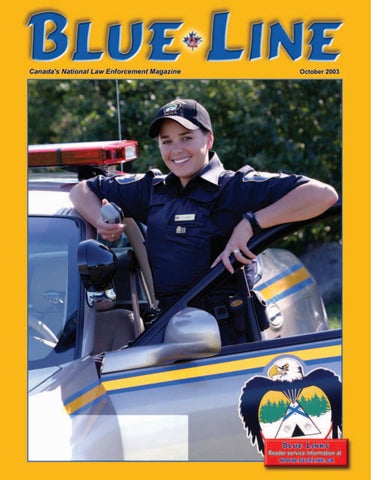
October 2003 Volume 15 Number 8
Blue Line Magazine 12A-4981 Hwy 7 East Ste 254 Markham, ON L3R 1N1
Canada
Ph: 905 640-3048 Fax: 905 640-7547 eMail: blueline@blueline.ca — Publisher — Morley S. Lymburner eMail: publisher@blueline.ca
— General Manager — Mary Lymburner, M.Ed.
Publisher’s Commentary Racism is a cop’s life experience
5
Earning trust – one person at a time Canada’s newest police service begins patrolling northwest Ontario
6
Police saving lives with defibrillators
10
Call for 2003 Police Leadership Award 12 nominations Attitude and creativity in situational leadership Delta Police Department Excellence in policing
14
Technology and crime
16
Project Big Wheel reduces accidents and crime
18
CORRESPONDENCE
19
DEEP BLUE Studying changes everything
20
INCREDIBLE
21 22
— Contributing Editors — Communication Skills Terry Barker Police Management James Clark Tactical Firearms Dave Brown Technology Tom Rataj Psychology Dorothy Cotton Case Law Mike Novakowski
CASE LAW • Warrantless public locker searches unreasonable NEWS CLIPS
23
Police recognized for work with youth
24
Blue Line Magazine is published monthly, September to June, by Blue Line Magazine Incorporated with a mailing address of: 12A - 4981 Hwy. 7 East, Ste. 254, Markham, Ontario, L3R 1N1. Individual magazines are $3.50 each. Subscriptions are $25.00 per year or $40.00 for 2 years. (Foreign - $50.00 U.S.)
Hells Angels run Bordeaux jail
26
Crisis Communications 101: Part 3 An instructional tale
27
The Predatory Script How children are seduced
28
Cultural program helps at-risk youth
30
Pot suspects impersonate police
31
The Crime Prevention Academy The simple idea that’s revolutionizing crime prevention
32
“I need a NEW shift pattern” A cautionary tale
34
PERSONAL COMPUTING Signs of an impending hard drive crash
35
Web site helps nab counterfeiters
36
TECHNOLOGY Powering down saves money
37
PRODUCT NEWS
38
COMING EVENTS
39
DISPATCHES
41
In the footsteps of heroes
44
BACK OF THE BOOK Are cops racist?
46
eMail: admin@blueline.ca
— Editor — Mark Reesor eMail: editor@blueline.ca
— News Editor — Les Linder eMail: news@blueline.ca
— Advertising — Mary Lymburner Dean Clarke Bob Murray eMail: sales@blueline.ca
— Pre-press Production — Del Wall
All material submitted for publication becomes the property of Blue Line Magazine unless other arrangements have been made with the publisher prior to publshing. The authors, advisors and Publisher accept no liability whatsoever for any injuries to persons or property resulting from the application or adoption of any of the procedures, tactics or considerations presented in this magazine. Readers are cautioned and advised that articles presented herein are edited and supplied for your personal awareness and should not be used for further action until appropriate advice and guidance is received from a supervisor, Crown Attorney or other person in authority. Established in 1988, Blue Line Magazine is an independent publication designed to inform, entertain, educate and upgrade the skills of those involved in the law enforcement profession. It has no direct control from a law enforcement agency and its opinions and articles do not necessarily reflect the opinions of any government, police, or law enforcement agency. ©2003 - All articles are protected by copyright. No part of this publication may be reproduced or transmitted in any form or by any means, electronic or mechanical, including photocopying and recording or by any information storage or retrieval system without permission. Internet activity is monitored and use or reposting of material on the Internet is restricted.
This publication is a private venture and receives no subsidy or grant from any level of government.
— Affiliations — International Association of Law Enforcement Planners Canadian Advertising Rates & Data International Police Association The Police Leadership Forum The Canadian Press Newswire Printed in Canada by Janson Printing Service
ISSN #0847 8538
Canada Post - Canadian Publications Mail Product Sales Agreement No. 176796 October 2003 June 2003
3
Think your department has a large area to patrol? Canada’s newest police agency, The Treaty Three Police Service, is responsible for 50,000 square miles! Headed by a former OPP inspector with 30 years experience and an RCMP officer with 25 years to his credit, the service’s first priority is to be a responsive, community based agency that’s not only accountable but in touch with the people it serves. As Chief Brian Rupert notes, he was ordered to “do it right or don’t do it at all — and so far I think we’re doing it right.” Ottawa police officers have saved the lives of two more heart attack victims using Automated External Defibrillators (AED). All Ottawa Police Service officers, civilian and volunteer staff are trained to use the easy to use devices, which are carried in every car and placed in every city owned facility. The Police Leadership Forum has put out the call for nominations for the 2003 Police Leadership Award. All officers, regardless of rank, position or responsibilities, are eligible for the honour, which recognizes outstanding leadership. Veteran journalist Pierre Albert Sévigny makes his debut this month as Blue Line’s Quebec correspondent. In his first article, Sevigny looks at how the Hell’s Angels are running Montreal’s Bordeaux Prison. In other stories this month, Blue Line west coast correspondent Elvin Klassen looks at the Delta Police Department, which also emphasizes the importance of strong leadership from all ranks; the Criminal Intelligence Service of Canada reviews how criminals have turned to increasingly sophisticated technology in a bid to stay one step ahead of law enforcement; Dr. Dorothy looks at the ‘measurement effect’ — how studying the behaviour of an organization changes the behaviour being looked at; case law columnist Mike Novakowski has two cases where warrantless searches of bus depot lockers were ruled to have violated the privacy rights of the person using the locker and Danette Dooley tells us how the Halifax Police Service is using its web site to help nab counterfeiters.
October 2003 June 2003
4
Racism is a cop’s life experience by Morley Lymburner The problem with the accusation of racism is that it is a safe statement for the accuser and a hot potato for the police. It’s like trying to answer a lawyer’s question while giving testimony; “Officer have you stopped beating your prisoners after you arrest them?” If you answer “yes” it infers you have engaged in the activity in the past. If you answer “no” it infers you are still beating them. There is no doubt that it is not an easy lifestyle to walk around every day with black skin. Given the history of blacks in North America there is no way they can really relax when confronted by a police officer. Discomfort levels are high even if the officer is of the same colour or ethnic background. So how can it be any easier if you are of a different colour or ethnic background? All the reassurances in the world will never bring a black person to a state of complete comfort with a police officer who says they saw them committing a violation. For a police officer to comment that a black person was over-reacting is an indicator the officer really does not understand the life experiences of black people.It is completely illogical that a person should have to design their entire lives around the fact that the first couple of layers of skin at birth will control their whole life’s outcome. But for North American blacks this is the reality they must live with. It may not have been articulated before but police officers have a hint of this human plight. When each officer chose this profession they changed colour to blue. It may not be as obvious as skin colour and the officer has a degree of advantage by taking a break from their colour when they go home or on vacation. But their social life changes dramatically when they turn blue. Old school chums drift away and when they do meet there is a distance maintained that did not exist before. People make pre-judgments on how they will react in certain situations and purposefully avoid them. In many cases grudging acceptance into certain social circles is tolerated but not preferred. No. Police discrimination is not the same as the black experience. In most instances it is not even close. But every officer experiences a small hint of discrimination in their own lives. But these old nut questions keep coming up. “Do any officers in your department discriminate?” “Are there any officers who are racist?” On an individual, officer by officer basis these are questions that can never be answered. There is no magical mechanism to read the minds of criminals let alone police officers. So we come down to answering the question in shear logical terms. There is no other profession than policing where a racist can be discovered more quickly. There is no other profession than policing where a racist could become more cripplingly frustrated and quickly burned out. By the nature of the work they must do they could not survive long with racist attitudes. Just think about it. You are a person who passionately hates black people and you want to be a police officer. Why? To torture your life even October 2003 June 2003
more? To try to arrest only black people and think that every supervisor will not care? To then decide you want to spend the next 30 years of your life dedicated to this kind of hate activity? Sorry it does not add up to anything logical. The racist attitude is one that is self destructive in police work. Police officers in this country spend at least the first 18 to 21 years of their lives being on the right side of society and the law. In my books they have the benefit of the doubt when it comes to a lot of criticisms including racist attitudes. Canada has come a long way in burying rac-
5
ist attitudes but the prickly tail ends are still just above ground level in many places. Canada does enjoy a level of racial tolerance that when placed in a global perspective is second to none in the world. I could say we are envied for it but frankly I don’t believe the majority of the world really cares. It is a value system that only we truly cherish. We shouldn’t get too self satisfied by this fact however. All police agencies should feel duty bound to do all in their power to be accountable if the race issue is ever raised in their community. Police have experienced it and should be ready to defend against it on all levels.
Earning trust trust — — one one person person at at a a time time
(C)
Canada’s newest police service begins patrolling northwest Ontario by Mark Reesor Canada’s newest police service will be responsible for enforcing the law in 23 Anishinaabe communities scattered across 55,000 square miles of Northwestern Ontario. The Treaty Three Police Service, which has 30 veteran officers who patched over from the Ontario Provincial Police (OPP) and 14 new recruits, officially began April 1 and is gradually taking over responsibility for the area and its approximately 20,000 people from the OPP. Chief Brian Rupert, who’s also known as the ‘Operational Technical Supervisor - Policing’ or the ‘Director of Policing,’ depending on whom you ask, says the new force has been in the works for about ten years, but there wasn’t the political will to move ahead until 1999. Treaty Three chiefs advertised for someone to organize the department in 2000 and the timing was perfect. Rupert had just retired from 30 years with the Ontario Provincial Police, where he rose to the rank of inspector/regional manager. October 2003 June 2003
Rupert worked out of the basement of his house for the first six months laying the groundwork for the new service, which he says will take about 18 months to reach its full operational status, when its ranks will increase to 55 officers. Rupert is looking to eventually boost that to 68. “When a police service starts, it’s not a ‘turn 6
the key’ operation. There’s a transition involved and that’s what we’re into right now. We’re slowly taking over areas and responsibilities that the OPP did.” The service currently is headquartered in Kenora but looks forward to moving into two state of the art police facilities. The general headquarters will be attached to the station in
Dalles First Nation (just northwest of Kenora), with another station at Couchiching First Nation (adjacent to Fort Frances). The buildings, which will have price tags of more than $1.5 million each, will be built by the respective communities and leased to the service. The new stand alone, regional concept service differs from other First Nations police services, which dedicate officers to a specific community. It’s funded 52 per cent by the federal government and 48 per cent by the province and will be exclusive to the communities it serves, rather than being faced with other commitments and demands like the OPP. Rupert is confident that the “unique policing, different from the cookie cutter, stereotypical approach” prescribed by the government, will have a positive impact on communities within two years. Saying you have ‘X’ number of people, therefore you will have ‘X’ number of officers may work in some communities, he says, “but when you look at the unique needs of rural policing, one officer may be great for 1,000 people but in another area five officers are required for a thousand people.” The remoteness of the communities, distances between them, street gang activity, solvent abuse and violent crime are all factors that have to be considered in allocating officers, he says. It’s also not just a matter of the long arm of the law — members are very keen at interacting and getting to know community members, he says. “One of our favourite adages is ‘we want the kids to run to the car, not from the car;’ that’s exactly what they’re doing right now and we’ve got to change that. Twenty five per cent of our population on the reservations right now are ages six to 18 and that’s our future — our future leaders and the future of our communities — and we have to take care of them now for the future.” Officers are encouraged to get out of their vehicles and talk to people in the community. Rupert recalls an aboriginal adage that a policeman is a man with no legs — “and the reason why they say that is because he never gets out of the car. They just drive through, pick up somebody and away they go.” The situation has become a little better recently but there needs to be “a lot more improvement,” he says. Treaty Three officers have a “sense and knowledge of the traditions and culture in our communities,” he says. About 85 per cent are Aboriginal and the majority come from the Treaty Three area; Rupert stresses they’re all fully qualified, trained law enforcement officers. “We were extremely pleased at that but we recruit from all over and we want the best police officers for our area. We will not lower standards.” Treaty Three Chiefs mandated that all officers have an Ontario police diploma, at least a grade 12 education, drivers license and no criminal record. “The standards are there and we’re meeting them,” he says. “I was given specific instructions — do it right or don’t do it at all, and so far I think we’re doing it right.” Rupert spent much of his career in northwestern Ontario; he left the military for the OPP and his first post was as a constable in the October 2003 June 2003
7
October 2003 June 2003
8
Dryden-Vermillion Bay detachment in 1970. He was promoted to corporal in 1979 and moved to Toronto but returned to the north as a sergeant and unit commander in Kenora in 1986. He became an inspector and coordinator of First Nations Northern policing for the OPP in Chief Brian Rupert 1989 and retired, briefly, in 1999. Rupert wants his officers to be “responsible, sensitive and meet the needs of the communities... each is unique and we have to identify with that.” Officers will work to educate residents, something he says hasn’t been done in the past, and will customize things for a particular community, “within the Aboriginal, traditional and cultural way.” They will also place a high priority on getting to know residents and making sure residents know and feel comfortable with them, he says. “I’ve been around policing for over 35 years and there was a time when you were the town cop. Over the last several years they’ve been using this term ‘community policing’ and that’s a new way of saying something old,” Rupert says. “It’s not rocket science, it’s very simple and it’s the way it’s been done in policing for a long time — it just stopped being done.” Rupert wants Treaty Three officers to be seen by the community not only as role models but as people residents, especially youth, can go to for help for anything. “We’re going to encourage them to take that gun belt off and put it in the trunk (and) get out and meet these kids in their own environment (while on duty), whether it be hockey, baseball, social activities or just sitting around... I would like to think that in the trunk there’s going to be a bag full of baseballs and bats and they’ll be a coach; they’ll take their gun belt off because you’re not going to be running around with a gun.” Their first challenge is earning people’s trust and showing the community that they have integrity and that takes time, he says. Rupert’s expectations for senior management, including himself, is also high. He says they’re responsible for not only what they do but for what they don’t do. That may sound light, he says, but it’s very important, because “if you know that something’s happening but you don’t do anything about it, you’re liable. It’s a key element to make sure that your police service can stand the test of public scrutiny and the test of civil courts.” You have to be prepared for that, he says, noting other police services have fallen by the wayside because they weren’t ready to meet that challenge. Treaty Three Police Service Deputy Chief Wally MacLeod was with the RCMP for 25 years, working in Manitoba in the 1970s, Ontario in the 80s before being transferred to the Yukon. He retired in 1998 and joined the Anishinaabe Police as a division commander working out of Sioux Lookout, looking after an area formerly policed by the Northwest Patrol before signing on with Treaty Three last October 2003 June 2003
December. He was impressed with the way communitybased policing, restorative justice and community consultive groups worked in the Yukon and would like to adapt them to the Treaty Three area. He encourages all officers to work with the communities they police and listen closely to what residents have to say to keep on top of problems. “If we have a patrol on until two in the morning and everything happens between three and four (for example), obviously we’re doing something wrong” he says. Each community will have a contact person who can call one of the deputies or the chief with their concerns, or those of their neighbours, to keep leadership current and allow them to deal with situations before they get worse, he notes. Officers can learn a lot about a community by spending time with residents in a relaxed situation, MacLeod says, adding “we don’t mind if they take some time out in the evening, go 10-7 at the local hockey arena and lace up their skates.”
Officers policing the communities used to be overtaxed, he notes, “and when you’re going from call to call and place to place, you don’t have time to be active in the community, play a little ball with the kids and drop in to visit elders.” The elders have a “wealth of wisdom and have seen what has happened over the years,” he says. “We have to look after the elderly and we have to look after the youth.” People in some communities are still afraid to go from one place to another because of violence, MacLeod says, “and we hope to correct that by making police more visible as protectors.” He says Treaty Three’s regional model allows officers to get to know different communities and will make transfers and promotions easier. Brian Rupert can be reached at brupert@treaty3.ca and Wally MacLeod at wmacleod@treaty3.ca. The Treaty Three Police Service’s general headquarters are currently at 100 Park Street – 2nd Floor, P.O. Box 1480, Kenora, Ontario P9N 3X7. Phone: 807-468-4079; Fax: 807-468-3709.
CO VER T CUFF KEY COVER VERT
This easy-to-conceal cuff key stands as a powerful reminder of the importance of thorough and detailed searching. Although manufactured by at least one company for restricted use by officers in the event they are ever taken hostage and cuffed, Officer Fred Megill with Eatontown (NJ) PD reports that at least one of these keys was manufactured by a unnamed civilian at a plastics warehouse. Fred also informed us that an officer in his area recently found a cuff key like this laying in a parking lot.
Designed specifically for effective concealment these keys, which are suspended in a quarter-sized plastic ring, can be easily hidden under watches, attached to the underside of belts, secreted in shoes, taped inside pants waistbands and ballcap rims, even clipped to the inside of shirt buttons. Wherever you could hide a quarter you could hide one of these. The fully functional cuff key can be quickly snapped out of its supportive plastic ring and used to unlock cuffs. Keep this covert cuff key in mind whenever you search a suspect. Be sure to check "inside and under" and if you find one of these keys, KEEP LOOKING...there are likely more on your suspect.
9
Ottawa Police save lives with defibrillators by Mark Reesor Saving the life of an elderly man who had just had a heart attack was the high point of his 37 year law enforcement career, a veteran Ottawa Police Service (OPS) officer says. Sgt. Sean O’Carroll was one of two Ottawa police officers who saved lives recently, using portable Automatic External Defibrillators (AED) to literally shock heart attack victims back to life. About 700 front line officers, civilian and volunteer members at the service have been trained to use the devices, which are simple to operate. They have access to nearly 160 of them, since the units have been put in all marked cruisers, tactical units, police and community stations, cell blocks, marine patrol units and the courthouse. The fire department also has them. Ottawa EMS is the lead agency for the program, which began in June 2001 and is the largest in Canada and perhaps North America. Officers respond to approximately 3,000 possible defibrillator calls each year, the service says. O’Carroll was attending a dance at a local community centre when he heard a commotion and noticed a number of dancers had dropped to the floor. He immediately went over and discovered an elderly man had collapsed while dancing. “I shouted to the crowd of onlookers for someone to call 9-1-1 and tell them we had a heart attack patient,” he says and, with the help of former nurse Mary Davison, examined the man, whose breathing was becoming laboured and pulse weakening. Knowing that all Ottawa city facilities are equipped with defibrillators, he shouted to the custodian to run and get it, later finding out that although the custodian knew where the device was, he didn’t know how to operate it.
October 2003 June 2003
O’Carroll did the compressions and Davison did the breaths until paramedics arrived and began treatment. O’Carroll was still doing compressions when he felt the man’s heart begin to beat again. He was taken to hospital, where he regained consciousness. The man, Marcel Sauve, was able to squeeze O’Carroll’s hand when he went to visit two days later but was still pretty weak; several days later he was sitting in a chair, surrounded by his wife, daughter and son and able to joke and talk normally. “The family was ecstatic that he was still alive,” he says. “Marcel shook my hand and thanked me for saving his life; it was the best feeling I’ve had in 37 years of police service... that’s the high point of my career, to save a life. It’s a marvellous feeling and when I got home, I was ecstatic.” Someone asked him later if he received any awards, O’Carroll recalls, “and I said no, but the biggest award you can get is knowing that you actually saved a life.” Doctors said Sauve would have died without his intervention; one nurse told his wife that his guardian angel must have been looking out for him, prompting Sauve to present O’Carroll with a guardian angel pin. Although it was the first time using a defibrillator in a crisis situation, O’Carroll said he had no trouble and it was very simple to use. He urges other police services to get them, adding “it’s Photo: Michael Houston, Ottawa Police Service just a pity that there’s not more of them out there. They’re about $5,000 and that’s Sgt. Sean O’Carrol and Marcel Sauve very cheap when compared to a life.” Cst. Alex Kay was waiting at a traf“I put the paddles on his chest — one on fic light when he saw a truck roll through the the centre and one on his left side, turned it on intersection and hit the medium. The driver was and it registered ‘no pulse, shock advised.’” He unconscious and slumped over the steering yelled for everyone to stand clear and pushed wheel. Kay checked for vital signs — there were the button. The victim, who was lying on his none, pulled him out of the cab and started CPR. He asked a bystander to take over while he back, jerked, his body rose off the floor but he still registered no pulse. The device advised him went to get the defibrillator from his trunk, shocked him and did CPR until emergency to shock again and to then start CPR. crews arrived. Although the victim was still VSA — he was shocked again at the hospital — he survived and is now back at work. “It was a good experience and it was nice to be able to be there right at that time,” Kay says. It was the first time he had used a defibrillator on a patient and he says it was very straight forward. “You just follow what the machine says — it basically walks you right through it — it was easy to use and very user friendly. You just have to turn it on and follow what it says.” Ottawa officers receive an initial four hour training course and re-qualify yearly (two hours); there’s also a one hour refresher course every six months. Training is mandatory and done during regular training days. The program 10
is overseen by a medical director. There is no known legal action (civilly or criminally) that can be taken against defibrillator capable responders, the service says, adding that the only lawsuits involve plaintiffs claiming a defibrillator was missing, which is becoming a serious risk management issue.
New police car fire suppression technology
For more on the OPS defibrillator program, contact program manager Cst. Rick Giroux at girouxr@ottawapolice.ca or 613-236-1222, x5955.
Heart facts • The Canadian Heart and Stroke Foundation estimates that between 50,000 and 60,000 Canadians die annually from Sudden Cardiac Arrest (SCA) every year • SCAs can happen to anyone, regardless of age, sex, cardiac risk factors or overall health; everyone is at risk • According to the latest statistics, 64 per cent of SCAs occur at home, 11 per cent on the roadway, nine per cent in public places and three per cent at work • SCAs can be reversed with a simple procedure called defibrillation, which must be done within 10 minutes of the occurrence (collapse). It’s extremely unlikely that the lethal cardiac arrhythmia (irregular heart beat) can be reversed after this period of time. • Every minute that goes by without defibrillation results in a 10 per cent decreased chance that it will be successfully reversed • EMS often takes eight to 10 minutes to arrive, too late for many SCA victims • The four major links to SCA survival are early access (911), early CPR, early defibrillation and early definitive care (paramedics). CPR improves the victim’s chances of surviving until they can be defibrillated. Rapid defibrillation saves lives, CPR merely prolongs it.
October 2003 June 2003
Ford Motor Co. says it will offer fire-suppression technology on Crown Victoria police cars, which have been linked to deaths in rearend collisions that caused fuel-tank explosions. Police cars already on the road cannot be retrofitted because the system uses advanced electronics and onboard sensors that must be integrated into a new computer system, Ford said in August. About 85 per cent of North American police departments use the Crown Victoria Police Interceptor, assembled with other full-size Ford sedans in St. Thomas, Ont. The optional system deploys under certain conditions, like an air bag. Since 1983, 14 officers have been killed when Crown Vic gas tanks were hit from behind and erupted in flames. Critics say the behind-the-axle design of the tanks, which wraps around the axle and is punctured by bolts when struck, makes them vulnerable. Police associations and some politicians have complained about the cars safety record and they’ve been the subject of a US federal investigation and numerous lawsuits. Ford denies the cars are dangerous but did retrofit them with plastic shields to protect the tanks about a year ago. Ford insisted it didn’t introduce the technology because of the lawsuits or design defects. “We’re doing this to make our vehicles safe and everything we can to make them even safer,” Ford spokesman Brenda Hines said. Ford also offers trunk packs intended to hold sharp objects to protect the fuel tank from puncture. The City of Dallas says they may increase the amount of fuel leakage during some accidents. Ford denies the claim.
11
Call for 2003 Police Leadership Award nominations Attitude and creativity in situational leadership Each day, Canadian police and their community partners help to protect and ensure the safety and security of people and their property. Some tasks are repetitive, mundane and boring; others are interesting, creative and rewarding. Like any worthwhile endeavour, community involvement is often challenging but can sometimes be frustrating and most partnerships require integrity, commitment, persistence, courage and risk. One opportunity open to everyone is the challenge of leadership. People who contribute to maintaining peace and good order often experience success, but it’s usually the vision and persistence of one person that creates the energy and momentum to meet new challenges and generate future possibilities. This calls for situational leadership in action. The Police Leadership Forum (PLF) is founded on the principle that leadership is an activity, not a position. Regardless of rank, position or responsibilities, situational (rather than positional) leadership is required from all police and community partners. This involves creating pride, motivating and supporting people to perform in an exemplary manner to achieve uncommon results. Officers have traditionally been recognized for heroic acts and public service, but in today’s changing global environment, visionaries should also be honoured as ethical role models and agents of positive change. Motto: Attitude and creativity in situational leadership. Mission: The PLF Leadership Award was established to recognize and encourage a standard of excellence that exemplifies leadership as an activity and pride in serving the public. Fundamental purpose: To increase the effectiveness, influence and quality of police situational leadership from an organizational and community perspective. Goals:
• To foster awareness and understanding of changing leadership roles in policing;
• To recognize ethical and exemplary performance in policing practice;
• To share and promote situational leadership development and innovation in police organizations. Judging: An independent panel of police practitioners, academics and community/business leaders from across Canada will review nominations and make recommendations to the PLF board of directors. Nominations: The PLF solicits nominations annually and the board may nominate additional candidates. Nominees may be asked to verify the accuracy of information supporting October 2003 June 2003
their consideration.The 2003 award presentation will be made in the spring of 2004. Eligibility criteria: The award is open to members of police organizations and community partners. Equal consideration will be given to all ranks and positions. • Nominees must have demonstrated strong situational leadership and be nominated by at least five people; • Police services, community agencies and individuals may nominate more than one person; • Nominations from previous years may be resubmitted; • Winners can not be nominated again for three years. Award criteria: The award may be conferred upon a member of a police service or a community leader who initiated a specific initiative or strategic endeavor of note. It recognizes leaders who: 1. Develop and enunciate visions - for example: • Shows a personal sense of the general direction of the initiative or organization; • Engages team members in developing a common understanding of the direction of the initiative or organization; • Establishes the process and gather input from key stakeholders; • Develops a picture of the future state and communicate it effectively and consistently. 2. Identifies, leverages and creates local/global trends or help create new initiatives. 3. Develops successful differentiation strategies — for example: • Nominee has an intuitive sense about how the initiative or organization can be unique; • Engages all stakeholders to identify and discuss strategies; • Finds ways to build necessary relationships to enhance differentiation; • Ensures partnerships are future-focused. 4. Attains buy-in by key people to new directions — for example: • Tells everyone affected about new directions; • Leads team through discussion and research to identify key new themes and goals that everyone can accept and use in their efforts; • Consults key people in setting and writing directions in areas that relate to their roles. 5. Identifies and addresses community needs through specific initiatives — for example: • Demonstrates strong accountability to the community and elected officials; • Achieves measurable success by reducing specific crime, disorder or community safety problems. 6. Ethics, trust and integrity — for example: • Lives by the highest ethical standards and sets them for the initiative or organization; • Demonstrates trust and integrity; • Acts as an ethical role model for positive change. 7. Continuous learning — for example: • Creates and maintains a learning environment; • Enhances the performance of police and community partners by sharing best practices; • Promotes benchmarking and cross training with other professionals and organizations. 12
8. Evaluation and results — for example: • Builds evaluation into initiative or organization; • Effectively analyzes and evaluates techniques to move the initiative or organization forward; • Meets goals; • Effectively uses evaluation and results to improve the initiative and organization over the long term. A nominee must demonstrate situational leadership competencies in at least five of the above eight award criteria to be considered. Application requirements: 1.Nominee’s particulars, supporters and resume (NOT curriculum vitae; no more than two pages). 2.Synopsis — summarize significance of the nominee’s initiative or contribution to policing (no more than 500 words). 3.Detailed, point-by-point description of nominee’s initiative or contribution as it relates to the award criteria. 4.Abstracts, including scanned newspaper clippings, letters of support, etc. 5.Photograph. 6.List of media for your area, including contact person and phone/fax number and e-mail 7. Other notes. Nominations, in Word format (paper not acceptable), must be e-mailed to award coordinator S/S Peter Lennox, Leadership Award Coordinator, at peter.lennox@torontopolice.on.ca no later than October 30, 2003. If the files are too large to e-mail, send seven copies on CDs (one for each judge) to: S/S Peter Lennox, Community Liaison Unit, Toronto Police Service, 40 College Street, 6th Floor, Toronto, ON M5G 2J3 8. Previous winning nominations Previous successful nominations can be reviewed — contact Lennox at peter.lennox@torontopolice.on.ca or 416-808-7876. Selection: The board selects the winner by majority vote and reserves the right to: • Veto the nomination of a person that does not subscribe to or demonstrate the mission, vision or values of the PLF • Conduct background checks to verify the acceptability of a nominee • Not bestow the award if necessary Award presentation: The recipient and a spouse or partner are invited to attend an event held during the Blue Line Trade Show, compliments of Blue Line. The recipient may also be invited to address participants at the event. Anticipated timelines: October 30, 2003: Deadline for nominations. November 30, 2003: Recipient identified. December 15, 2003: Award recipient announced. April 28, 2004: Award will be presented.
An honour guard takes the field before the Sarnia Police Association Warthogs trounced the St. Clair County, Michigan Police All Stars 34-7. The match raised $4500 for charity. A rematch is planned for next year in Michigan.
October 2003 June 2003
13
by Elvin Klassen One of the oldest police forces in British Columbia is working hard to also be known as one of the best. Delta Police Department (DPD), established in 1888, makes that goal clear with the ‘Excellence in Policing’ motto it puts on all police vehicles and its vision statement — “Delta – a safer and better community through excellence in policing.” With a population of 100,000 people, Delta is a municipal government serving the communities of Ladner, North Delta and Tsawwassen, located in the southwestern corner of the BC mainland. It borders on Washington State, Georgia Strait and the Fraser River and residents boast that the three communities are as rich and alive as the name ‘delta’ implies: rich in soil and water, history and industry and, especially, people. The mission of the DPD, which has 144 officers and 31 support staff, is “to deliver excellence in policing through community partnership. All efforts will be directed towards maintaining order, promoting safety and reducing crime and its impact.” Chief Constable Jim Cessford, who came to Delta in 1995 from Edmonton, humbly told
October 2003 June 2003
Chief Constable Jim Cessford his staff that “if you expect me to be the only leader, then we are in trouble. None of us is as smart as all of us.” Police alone cannot maintain peace and order in the community, he emphasized, and need to connect with the community and establish ownership. To accomplish this, he di-
14
vided Delta into 36 areas and appointed an officer as ‘chief’ of each. “These ‘area owners’ are expected to know their particular neighbourhood very well,” Cessford says. “They should be recognized as part of the community even though they do not live there. They should be aware of problems and concerns in their area and be a catalyst to getting things done. Here is an opportunity to make a real impact by both reducing crime and improving the quality of life for the people living or working in that neighbourhood.” Cessford insists that no call is too small. “Problem solving is the cornerstone to all policing. Rather than suppress calls for service, the problems must be eliminated. We look for reasons why things are happening. When going to a traffic accident, the officers must assess the situation to try and make sure this type of accident does not happen again... “We developed a strategic plan and established a vision,” explains the chief constable, with the main focus on restructuring, decentralization, problem solving, ownership and technology. In 1995 all officers worked out of a main building in Ladner, with some having to drive from as far away as North Delta, 20 kilometres away. A new building was constructed in North Delta, providing improved visibility and greater efficiency. Laptop computers were installed and officers are now looking forward to connecting with PRIME, the new communication data base that will connect all BC police services. Every area of the DPD is represented when a strategic plan is developed. Some 35 to 40 people, about a third of the staff, attend meetings, including officers, mechanics, janitors, management, volunteers and office staff. The process can take several days, during which internal and external issues are discussed. The staff subscribes to the notion that leadership is an activity, not a position. There is an expectation that all must be leaders and lead in their own sphere of influence. The reception-
ist, chief and patrol officer’s spheres of influence are different but all must lead. Ethics and professionalism, communication, decision making, team building, personal & professional self-development and visioning became the six attributes central to everything that is done. These were defined into observable behaviours and steps were developed to implement these attributes. They have become central to all that is done with the leadership model that was developed. Some 20 public and private organizations were asked to critique the ideas, which were very favourably received, Supt. Rich Drinovz says. “We picked up additional knowledge from these institutions. When we came back, we had a solid leadership matrix.” They then designed six introductory level courses based on the six attributes — personal and professional development, every person a leader, managing people, essential administrative skills and effective supervision and ethics. Job descriptions and performance appraisals were designed around these attributes, Drinovz says, and promotion and hiring also built on them. “This has become a leadership culture,” he says. “There is grassroots ownership and pride of ownership.” The next level courses, which include
October 2003 June 2003
managing people, leadership, communications and occupational ethics and professionalism in a learning organization, are being taught this year and another series is planned for 2004. Staff is required to spend 16 to 17 hours in the classroom and study at home for at least 24 hours on their own time to complete this year’s courses. Cessford says he developed his leadership style from reading books, taking courses and checking what business and private industry is doing. “I developed a personal vision for myself and then got outstanding people to brainstorm and share ideas. There is always resistance but it became part of how we do business in Delta. The staff takes the courses on their own time and participation is excellent.” The core values of the DPD are integrity,
15
professionalism, human dignity, diversity and ethical and moral behaviour, which are part of day-to-day behaviour, says Cessford. “This is who we are, what we believe in and what we stand for. Every decision is either legal, moral or ethical and everyone knows what the parameters are,” he says. “‘Excellence in Policing’ is not bragging about what we have done but a goal toward which we strive. We have established a partnership that has discouraged criminal activity and maintained peace and order. That is making Delta a better place in which to live.” Contact Drinovz at rdrinovz@police.delta.bc.ca or 604 946-441 for more information. Elvin Klassen is Blue Line Magazine’s West Coast Correspondent and can be reached by eMail at elvin@blueline.ca .
Technology is key to modern crime In today’s wired world, there are very few aspects of our lives not guided by technology. Organized crime (OC) recognizes the significance of this influence and the vast economic potential of exploiting it. OC groups, already well known for using sophisticated technology to counterfeit currency, credit cards and various fraudulent investment and telemarketing schemes, are increasingly turning to cyberspace, attracted by its anonymity and global reach. System intrusions, theft of data, identity and intellectual property and distribution of viruses, hoaxes and worms are becoming more frequent. While these offences are sometimes new types of crimes, they are generally theft, fraud or extortion done in new ways using new technology. Over a relatively short time frame, police have witnessed an exponential expansion in both the scope and depth of organized crime’s ability to use technology in furthering their criminal activities. Groups employ individuals with computer expertise to commit crimes and use the Internet and encryption software to communicate. With the seemingly limitless resources of the more sophisticated groups, it appears cost is no object in attaining or developing leading-edge technology used in crimes or counter-surveillance against rivals or law enforcement. Payment card fraud The Payment Card Partners (PCP), which represent the collective interests of Visa, MasterCard and American Express in Canada, reported a 2001 loss of $182.7 million, $10 million more than the previous year. This is attributed to a rise in the fraudulent use of credit cards and an increase in fraudulent applications. Forged activity accounted for $66.3 million of all credit card losses in 2001, compared with $81.1 million in 2000. This decrease, for
the second year in a row, illustrates that efforts to deter and investigate fraud continues to have a notable impact. Debit card fraud losses are not reported by the debit card industry. Credit card fraud is international in scope and ongoing investigations show that sophisticated organized criminals in Canada continue to operate and profit at both the national and international levels. In 2001, 36 per cent of Canadian Visa and MasterCard fraud occurred outside of the country. Forged Canadian card numbers have been used throughout North and South America, Europe and the Asia Pacific region. Foreign authorities have seized card manufacturing factories in China, Japan and the US which were directly related to investigations in Canada. Many Canadian criminal groups are involved in compromising payment card data and manufacturing, distributing and using forged credit cards and the proceeds continue to support other criminal activities such as drug trafficking. A joint forces operation in British Columbia in early 2001 closed sophisticated counterfeit card factories; investigators estimated one factory alone contained enough material to produce over $200 million dollars worth of fraudulent credit cards. This long term investigation revealed extensive networking, including several international links and how OC groups
share counterfeit materials and data from collusive merchants and divert the proceeds into drug trafficking. A significant counterfeit credit card operation based in Québec was closed in May, 2002. Police arrested two of the alleged key figures and seized more than 30,000 phony cards attributed to over 70 financial institutions around the world; the cards had spending limits of up to $150,000. The organization also produced fraudulent identification papers. Organized crime and hackers Historically, hackers evolved from an elite group of programmers who legitimately tested systems in search of software flaws or network vulnerabilities and shared their findings and source code with like minded individuals. Individuals prided themselves in their ability to discover programming deficiencies and create improvements. Computer systems were large, cumbersome and housed in large storage areas and the Internet was still in its infancy. As systems evolved and developers became increasingly sophisticated and competed for market share, new types of hackers emerged and proliferated — white hats (system security specialists), black hats (destructive attackers) and grey hats (somewhere in between). There are also ‘script kiddies,’ who use readily available malicious software on the Internet to launch cyber attacks. Some hackers are driven by curiosity, the desire for peer recognition or political motivations and use their skills for activism, while others claim they’re trying to enhance security. Power, profit, revenge and other acts of malicious intent are other factors. Hackers crack system passwords, breach security, distribute viruses, deface web sites and engage in denial of service attacks. Illegal hacking activity in Canada is widely reported by law enforcement and continues to increase annually. Some groups have become increasingly organized and sophisticated in their attacks and it’s possible they will attempt to recruit hackers to assist them in furthering their criminal activities. Identity theft Reported instances of identity theft — the unauthorized collection and use of personal information — are on the rise in Canada. Past methods — pilfering through garbage, theft of mail or impersonation over the phone — have been joined by technological techniques such as credit card skimming and computer hacking to gain illegal access to sufficient information
October 2003 June 2003
16
to assume another’s identity. So far, there have been no reported instances of organized crime involvement in this criminal activity in Canada. Theft of personal information can be used to obtain new credit, identification or services. In many cases, the criminal assumes the victim’s identity to take advantage of their established credit rating — they’re often unaware of the theft until they try to obtain new credit or are contacted by collection agencies. This type of crime is devastating to the victim, who is faced with trying to re-establish their rightful identity and credit rating. As society becomes increasingly dependent on the Internet and uses it for day to day routine activities, more information is made available for exploitation. Computer users should be aware of the potential for identity theft and should be careful of the personal information they disclose while on-line. Jurisdictional issues A major challenge facing technology crime investigators is the issue of jurisdiction, since they’re required to maintain an evidentiary trail that often crosses international boundaries. Internationally, the Council of Europe took a lead role in addressing this issue. Member countries, Canada, the US, Japan and South Africa helped draft the Convention on Cyber-Crime. The purpose of this treaty is to establish a common international criminal policy against cybercrime; it deals with a range of cybercrime offences, including copyright infringement, computer-related fraud, child pornography and offences related to network security. Canada is one of the signatories. The federal government has promised to introduce new high-tech crime legislation that will incorporate aspects of the convention into Canadian laws. Preliminary highlights include providing law enforcement with wider access to electronic information held by Canadian phone companies, banks and Internet service providers. Recognizing that offences committed in cyberspace do not recognize conventional and jurisdictional boundaries, law enforcement has and will continue to engage in key partnerships with government agencies and the private sector to examine barriers and develop strategies to overcome them.
Police chaplain receives international recognition by Chris Adams Mention the name Reverend Michael Dunnill C.M.C. to Thunder Bay police officers and you may get the odd nod of recognition — but say ‘Father Mike’ and watch the smiles; they all know who you’re talking about. The popular chaplain of the Thunder Bay Police Service (TBPS) was given the Order of Merit by the International Conference of Police Chaplains (ICPC) at their annual meeting in Spokane, Washington in July. An active member of the conference since 1989 and one of only three Canadians to serve as president, the award recognizes his dedication and devotion to the role of police chaplain. He has devoted a great deal of time and effort to the conference, which plays a key role in developing and educating the ‘blue collar’ members of law enforcement. ICPC President Dan Nolta describes Father Mike, who became the TBPS Chaplain in 1988, as “a man who has served with honour, integrity and tenacity.” He rides along with officers to experience the world behind
Outlook Governments and the private sector will work together to establish best practices, security processes and legislation to combat increasingly sophisticated hacker attacks against Canadian information and communication systems. Legislation designed to combat both computer-assisted crimes and crime committed in cyberspace will give much needed tools to police and law enforcement. This article is part of a Criminal Intelligence Service of Canada review of targeted organized crime groups and their activities, based on intelligence and investigation reports from Canadian and international enforcement agencies. Blue Line Magazine is running a series of monthly articles based on the CISC’s 2002 final report. Go to www.cisc.gc.ca for more. October 2003 June 2003
17
the badge and is always there, whether it be a wedding, funeral, baptism or moment of crisis. Perhaps his strength comes from his own success in battling cancer, a fight he continues to this day. Father Mike has taken the Shield a Badge With Prayer program, which was started in Arlington, Texas, to a new level on the shores of Lake Superior. The idea is to get people to pray for officers who serve their communities and his ‘Prayer Shield’ calls upon volunteer members of various local churches to pray for individual Thunder Bay police officers on a daily basis. Perhaps the highest praise comes from the officers he serves with. “Father Mike works very hard at understanding the feelings,” Sgt. William Quarrell says. “Not everyone outside the organization understands what we go through.” Father Mike does. Chris Adams coordinates media relations and Crime Stoppers for the Thunder Bay Police Service.
Project Big Wheel reduces accidents and crime by Frank Malone
• • • • • • • • •
A loud grinding sound shattered the calm of a spring afternoon as the right rear, first drive axle wheel bearing housing failed on a 40 ton dump truck, causing the double wheeled section to break loose. The vehicle was headed downhill on a busy four lane Toronto highway. As luck would have it, the driver reacted quickly and, as the duals separated and began to roll away, managed to turn sharply on to the sidewalk, trapping them and preventing a dangerous situation from escalating. This type of incident is occurring far too often and has resulted in fatalities, especially when poorly maintained vehicles lose their wheels while travelling at high speeds. Toronto Police Service’s (TPS) 53 Division is combating this lack of respect for traffic laws and maintenance by enhancing its High Profile Traffic Enforcement Initiative. Community complaints are reviewed once a month to identify a high collision location and TPS, along with enforcement officers from the Ontario transport, environment and finance ministries, the Toronto taxi industry and local parking control units, conduct a four hour targeted safety blitz. Representatives from the Ontario Commu-
nity Council on Impaired Driving (OCCID) also regularly attend to distribute handouts and teach about the dangers drinking and driving. The blitz focuses on all vehicular traffic and pedestrians. Vehicles are inspected for mechanical, emissions and document compliance and fuel is checked to make sure it meets legal standards. Aggressive, high risk drivers are charged and errant pedestrians, especially seniors, are reminded of the importance of safe practices and following the rules of the road. Project Big Wheel began in 2000 and has obtained the following results so far:
vehicles stopped - 3,907 summonses issued - 1,495 insurance charges - 49 cautions - 603 suspension notices served - 27 drive suspended charges - 23 unsafe vehicles towed - 93 vehicles inspected - 768 parking tags issued - 2,495 During blitzes, traffic enforcement officers patrol the surrounding areas and take problem vehicles back to the main inspection site for testing and parking enforcement personnel tag the general area. Taking this approach and partnering with other units and agencies has resulted in a positive and effective outcome. Officers broaden their knowledge and experience by working with experts in other fields and community requests for high visibility uniform enforcement of traffic and criminal laws are met. This in turn compliments crime prevention and public safety issues and awareness. Traffic enforcement not only cuts the risk of personal injury and property damage collisions but also reduces criminal activity. TPS Sergeant Frank Malone works in 53 Division.
Tampa Police scrap face recognition software After two years of failing to yield any positive results, Tampa police have scraped the highly touted and much criticized face recognition software system that scanned the city’s entertainment district. “It was of no benefit to us, and it served no real purpose,” Capt. Bob Guidara was quoted as saying in August. In June 2001, Tampa became the first city in the US to install the software to scan faces in the Ybor City nightlife district and check them against a database of more than 24,000 felons, sexual predators and runaway children. New Jersey-based Visionics Corp. had offered the city a free trial use of the program, called FaceIt. The system was installed on closed-circuit cameras that police used to monitor city crowds on Thursday, Friday and Saturday nights. The technology had been used in casinos and foreign airports to find card cheats and terrorists. The same technology also was used to examine the Super Bowl XXXV crowd in Tampa in January 2001 for fugitives and terrorists. Police were unable explain why the software wasn’t effective, since it seemed to work in controlled testing, Guidara said. October 2003 June 2003
18
Re: Canada could become ‘Colombia of the north’ (Aug/Sept Blue Line) Marijuana is no less a drug than heroin, cocaine or any other pharmaceutical. Somehow, people seem to think that because it is “organic,” it won’t hurt you. What a crock. Ask any respiratory therapist about the likely effects of inhaling marijuana long term. The other argument that gets trotted out is that it’s a miracle cure for everything from cancer to glaucoma. If the government wants to legalize “medicinal marijuana” then it owes it to the public to put marijuana through the same sets of tests that other medicines have to go through, and it isn’t doing this. What happens if 10 years from now someone develops lung cancer from smoking medical marijuana supplied by the government? Are we then all going to have to bite the bullet and settle the lawsuit, simply because our government is going about this in a “knee-jerk” reaction? If society wants to decriminalize drugs then it should do so, but what we should be talking about is whether we should have the simple possession of ANY drugs a criminal offence. Because the legislators of today have a warm, fuzzy feeling toward the pot of their youth is no reason to single out marijuana for decriminalization. Ethically, you are either for decriminalizing all non-prescription drugs or
October 2003 June 2003
none of them. You can’t be partly pregnant, and that is what the government is trying to be on this issue. Terry Kreitz Re: Gypsy cops can bring unwanted baggage by John Middleton-Hope (Aug/Sept. Blue Line) As a Calgary Police Service (CPS) member, I’ve served with Previously Experienced Officers (PEO) and can attest there’s no problem with their performance, loyalty, conduct, deportment or discipline. Middleton-Hope asserts that while PEOs have enormous strengths, they “also bring behaviours and cultural identities that are different from the agency hiring them,” resulting in “a disproportionately higher number of public complaints against their conduct, as compared with inexperienced recruits.” Where are the statistics on this? He also says “there’s little research on the subject and none that assesses PEO conduct, though there’s plenty on predicting police corruption.” Is he alleging PEOs have a higher level of predisposition towards corruption? He links those with certain ‘cultural identities’ as having a disproportionately higher number of public complaints, yet doesn’t cite proper academic research. He suggests a national data-base of experienced officers be developed to verify work history, provide full disclosure to other agencies and track conduct. Unfortunately, this will only
19
work if the information submitted by agencies and management is truthful, accurate and free from prejudice or bias. I question the academic honesty of his article and find it ironic that he recently left the CPS; is he not in the same category as other lateral officers? Dean Nichol Calgary, AB Editors note: The article (and this letter) are both edited versions of much longer documents. Those interested in learning more about this research, which Middleton-Hope conducted for a Masters degree, can contact him at jmh@police.lethbridge.ab.ca. I read, with interest, Elvin Klassen’s article on PRIME to link all British Columbia police, (Blue Line, August/September 2003) and must commend solicitor general Rich Coleman on his attempts to update policing in that province. As with ViCLAS (Violent Crime Linkage Analysis System) however, PRIME will only be as good as the input it receives. There was no indication in the article that entering information on the system is either legislated or mandatory. Are steps being taken to solicit input from police in the neighbouring province of Alberta, as it is quite obvious that criminals travel regularly between these two western provinces? Andrew Maksymchuk
Studying changes everything The big question - is that good or bad? by Dr. Dorothy Cotton, Ph. D., Psych. I came across some research you might be interested in — see if you can figure out what the studies have in common. 1. Probably the single most effective tool for weight control is to write down what you eat every day. 2. One means of teaching self control to adolescents with attention deficit disorder is to have them record specific types of undesirable behaviour every time they happen; this results in a decrease in the specified behaviour. 3. Compliance can be increased significantly among adults receiving dialysis by having them keep write down when they did and did not comply with treatment. 4. A study in the 1930s indicated that productivity in an electrical plant increased significantly when workers thought that the boss was counting how much work they did — even though he wasn’t. Were you able to spot the common link? They all demonstrate that the simple act of self monitoring actually changes behaviour. If you look at the extensive literature about weight control for example, you’ll see that people tended to eat less and eat better when they wrote down what they ate. They weren’t told “eat this” or “don’t eat that,” just “keep track.” This phenomenon is called variously “reactivity of measurement” or “the mere meas-
urement effect,” depending on exactly what you are measuring. I quote: “The act of observing and recording one’s own behaviour is commonly associated with a change in the frequency of the target behaviour.” In a related vein: “Reactivity to self recording makes it difficult to obtain stable baseline data.” (I can provide the reference if anyone really cares!) What does this have to do with police work? Well, actually, it has to do with the question of whether or not it’s a good idea to record race when you interact with a member of the public. It’s a complex question with no easy answer but there are some interesting twists and turns to it. If you think you’re going to get an accurate picture of how police have dealt with visible minorities in the past (“the past” meaning up to the very minute the officers have to keep track), dream on. The fact is that once you start measuring something, that behaviour changes. You’ll find out what people are actually doing now, today, (assuming they comply and don’t lie but that’s a whole other issue) — but it will not tell you what they were doing before. One could argue that this is not a bad thing, if you are a person who believes that some police HAVE been biased in their dealings — or if you believe that some racial groups are in
fact responsible for more crime than others. It has been argued that recording race is a bad thing because it may well cause officers to alter their behaviour. They might refrain from stopping someone they ought to stop once they see they’re a member of a minority group. That would be a bad thing. Or they might become aware that when they “randomly” stop people, it really isn’t so random because too many of the people are minorities. That would be a good thing. If the officer really is a horrible racist, then my best guess is that he/she won’t fill out the forms or document many encounters. That would be a bad thing. Hard to say what direction this recording will take us in. People will tend to change their behaviour in the direction that they perceive to be the intended or desirable direction. The people on diets change their behaviour when they record what they eat — but they don’t tend to change in the direction of eating more potato chips. In the case of recording race, people will alter their behaviour in the direction that they perceive to be ‘correct.’ If they are determined to prove that visible minorities are more involved in crime, then they will move in that direction. If they were actually doing a fair job to start with but perceive that the ‘correct’ response is to stop fewer visible minorities, then they will stop fewer — even if that is not a good thing. What a mess. The one thing you can bank on is that recording race will cause change. There is just no doubt that self-monitoring causes behaviour changes but exactly what change depends a lot on what you do with the data. Are you looking for change over time? Do you have an idea of what the ‘correct’ percentages ought to be? Will you use the data to compare one officer to another? So is recording race a good idea? I don’t have an answer — I’m just glad it’s not me who will be trying to analyze the data. Dr. Dorothy Cotton is Blue Line’s Psychology columnist and she can be reached at deepblue@blueline.ca.
October 2003 June 2003
20
A Nova Scotia man was charged in August with five counts of mischief for pulling up to the local Tim Hortons drive-through window on horseback. The horse, a gelding named Dillon, is Robert Chetwynd’s means of transportation. The 34-year-old lobster fisherman and parttime carpenter lost his driver’s licence after an April 2000 conviction for impaired driving. Chetwynd is not scheduled to get his licence back until November 2004. “We don’t have any problem with anybody bringing a horse or an animal onto the property if they do it in a responsible manner,” David Arenburg, owner of the Tim Hortons franchise was quoted as saying. However, Arenburg said there were times when the horse was tied to the bumpers of vehicles and utility poles. The horse also defecated on the property. Chetwynd was served last year with a protection of property notice by the RCMP, order-
Analysis helps reduce repeat calls
ing him to stay away from the Tim Hortons. The next day, May 26, Chetwynd tied his horse in a handicap parking spot, according to court information. He was charged and has been charged additional times since. Atlantic Superstore, a grocery chain, has also complained that Chetwynd, whose lifetime nickname is Jell-O-Head, has hitched his horse to its shopping-cart corral. Chetwynd, who faces five mischief charges and 10 counts of breach of probation, plans to represent himself when he appears in court Nov. 10. *** An Ottawa man convicted of drunk driving for the 14th time will not spend any more time in jail, an Ontario Superior Court judge ruled in August, saying long jail terms have little deterrent effect on hard-core alcoholics. Tommy Rice, 48, was handed a three-year driving ban. In her decision, Justice Catherine Aitken struggled with the competing interests of protecting the public from a man with a 25year record of alcohol-related offences and the recognition of what she termed the “significant efforts” Rice had made to combat his addiction. “There is no compelling research . . . supporting the idea that harsher sentences serve as a significant deterrent,” Aitken was quoted as saying. “If you had not started treatment,” Aitken told Rice, who has spent the last two years sober following an eight-month stay in a residen-
Regina Police S/Sgt. Bob Hinchcliffe congratulates Mario Thomas, a Human Justice student from the University of Regina, who just completed his practicum this summer at the North Central Service Centre. Thomas undertook a comprehensive analysis of previous police involvement at hot spot addresses within North Central Regina as part of his studies under the supervision of Cpl. Sheree Ortman. As part of the SARA method of problem solving, Thomas prepared a synopsis of relevant issues as a resource for the officers assigned to problem solving initiatives. His work will help Regina Police reduce repeat calls for service by identifying the root causes of the problem. Thomas is a computer professional who also taught police members new ways to use the technology. This was the last component Thomas required to complete his bachelor of human justice degree and he is now off to study graduate work in conflict analysis at Royal Rhodes University in British Columbia. There will be three more practicum students working at the service centres this fall. October 2003 June 2003
21
tial rehabilitation centre, “I would have sentenced you to three-and-a-half years.” Rice’s probation conditions include his submitting to random breathalyser or urinalysis checks, abstaining from alcohol or drugs, and undergoing treatment for alcoholism. The sentence provoked outrage among members of Mothers Against Drunk Driving. *** Police in Liverpool, England who thought they were searching for human remains had egg on their faces when they found their quarry - a mask made of bacon. Police said they had been tipped off by a burglar who had broken into the home of artist Richard Morrison, and claimed he had seen a head in a jar. Police got a search warrant and broke into the house in August, where they found a mask made of bacon, preserved in formaldehyde in a jar. “It’s obviously a very macabre piece of work, but I never expected it to get this reaction,” a London newspaper quoted Morrison as saying. “The police told me that the burglar was terrified - he had a crisis of conscience and confessed his crimes to his mother.” Morrison said he made the mask for an art course two years ago. The Merseyside Police department apologized and said it would arrange to repair damage to Morrison’s front door.
Warrantless public locker searches unreasonable by Mike Novakowski Both the Supreme Court of Canada and Alberta Court of Appeal have ruled, in separate cases, that warrantless searches of bus depot lockers violated the privacy interests of the person using the locker. In one case, police had reasonable grounds prior to opening a secured locker and physically searching its contents; in the other, they used a dog to sniff around some lockers, received an indication drugs were present and opened an insecure locker so the dog could sniff inside. In both cases, the breaches were treated as serious and the evidence was excluded, resulting in acquittals. In R. v. Buhay, 2003 SCC 30, two Winnipeg bus depot security guards opened a locker using a master key and removed and examined a duffel bag. They found marijuana rolled up in the middle of a sleeping bag, put it back in the locker, locked it and called police. Officers smelled marijuana in the locker and had it opened without a warrant. The drugs were seized and Buhay was subsequently arrested and charged with possession for the purpose of trafficking. At trial, Justice Aquilla of the Manitoba Provincial Court excluded the evidence because he concluded police violated Buhay’s s.8 Charter right to be secure from unreasonable search and seizure. Even though the Charter didn’t apply to the initial search by the private guards because they were not agents of the state, Buhay nonetheless had a personal and reasonable expectation of privacy in the rented locker when police searched it. Officers exhibited a casual attitude towards his Charter rights, the evidence was excluded and he was acquitted. The Crown appealed to the Manitoba Court of Appeal, which found there was no search and seizure by state agents, even when police opened the locker, since the security guards merely transferred their control of the contents to them. If the guards had placed the contents elsewhere, there would have been no search and seizure, so putting them back into the locker should not change the result. The appeal was allowed and a conviction was entered. Buhay appealed to the Supreme Court of Canada. Justice Arbour, writing for the unanimous high court, agreed with the lower courts that the initial search did not engage the Charter. However, she concluded that Buhay did have a reasonable expectation of privacy in the contents of the locker when police opened and searched it, albeit not as high as one would expect in their body, home, or office. He paid a rental fee for exclusive use, possessed the key and could regulate access it and there were no signs suggesting it may be opened and searched. Third party ownership or the existence of a master key didn’t October 2003 June 2003
extinguish Buhay’s expectation. The initial privacy invasion into the locker, even though free from Charter scrutiny, did not cause the accused’s expectation of privacy to end and justify further invasions. Justice Arbour stated: In this case, it cannot reasonably be said that the (accused) had ceased to have a privacy interest in the contents of his locker. The subsequent conduct of police should be considered a seizure within the meaning of s. 8. I see no basis for holding that a person’s reasonable expectation of privacy as to the contents of a rented and locked bus depot locker is destroyed merely because a private individual (such as a security guard) invades that privacy by investigating the contents of the locker. The intervention of the security guards does not relieve police from the… requirement of prior judicial authorization before seizing contraband uncovered by security guards. To conclude otherwise would amount to a circumvention of the warrant requirement…. the security guards’ search of the locker, which is not subject to the Charter, cannot exempt police from the stringent prerequisites that come into play when the state wishes to intrude the appellant’s privacy… (references omitted). The Court also rejected the Crown’s plain view argument; for that to apply, police needed prior justification for entry, which they didn’t have. Since there were no exigent circumstances or other statutory or common law authority to justify the search and seizure, the Crown couldn’t rebut the presumption that a warrantless search or seizure is prima facie unreasonable. Considering all of the factors, including the lower court’s concern that the Charter breach was serious and that it was necessary to discourage police misconduct of this kind, the court found the trial judge’s exclusion of the evidence was reasonable. Buhay’s acquittal was restored. In R. v. Dinh and Lam, 2003 ABCA 201, police were at a Calgary bus depot as part of a ‘Jetway’ drug detection program and used a police dog to sniff for drugs on incoming buses and unloaded baggage. They followed Dinh and Lam, who walked toward public lockers when they got off the bus. Dinh placed her two pieces of luggage in the locker but police spoke to her and Lam before she could completely close the door. Officers asked to see their tickets and identification and a police dog sniffed around the lockers. It made a positive indication for drugs and a locker was opened so it could stick its head inside, where it again indicated the presence of drugs. By this time Dinh had gone to the washroom and an officer went in to arrest her. After she didn’t open the cubicle door as requested, the officer stood on the toilet in an adjoining stall and, peering over the top, saw her holding a white package which was later found to contain $14,000. She was arrested for possession of drugs for the purpose of trafficking. An additional $1,475 and almost seven kilograms of marijuana was discovered in the 22
baggage in the locker. Dinh had the key that opened the suitcase. Lam was also arrested for possession of the drugs and a search subsequent to his arrest revealed a gram of heroin, a marihuana bud and more than $1000. Dinh and Lam were acquitted. The trial judge found that they had been arbitrarily detained, contrary to s.9 of the Charter, when police asked for their bus tickets. Furthermore, police use of the drug dog to sniff inside and outside the lockers was a warrantless and unreasonable search and seriously violated Dinh’s s.8 Charter right to privacy. The judge inferred that she intended to lock the locker before police deliberately interfered. The evidence was excluded. The Crown appealed to the Alberta Court of Appeal arguing that Dinh had a reasonable expectation of privacy in the luggage but not in the odours emanating from it, into a public area, which the dog detected — thus there was no search and the dog’s indication provided reasonable grounds to arrest the accused and search them and their belongings incidental to arrest. The accused submitted that they were arbitrarily detained and subject to unreasonable searches, contending that the warrantless sniff provided personal and protected information about the baggage contents which was unattainable though human senses. Thus, the search was unreasonable and the information obtained from the sniff could not be used to support their arrests and subsequent searches. In dismissing the Crown’s appeal, Justice Conrad, writing for the unanimous Alberta Court of Appeal, concluded that police conducted a search when they were able to “see” into Dinh’s luggage — when the dog sniffed and obtained information about her. The court compared this to police using a thermal imaging camera to detect heat coming from a suspected grow house, which would be undetectable by human senses. Justice Conrad wrote: If it is improper for police to invade a privacy interest using a technique or device that goes beyond enhancing the human senses, it does not matter whether it is a sophisticated technological FLIR device or a police dog with an acute sense of smell. The effect is the same. The police did not discover the odour of marihuana through inadvertence, but were deliberately trying to discover what was inside the luggage using the aid of a police dog’s enhanced olfactory senses. Since the police search (dog sniff) was warrantless, it was unreasonable unless it could otherwise be justified under statute or common law. There were no reasonable grounds or even an articulable cause to target the accused for investigation. The appeal court ruled that the trial judge’s findings of an arbitrary detention and unreasonable searches were not in error and the exclusion of the evidence under s.24(2) of the Charter was also reasonable. The acquittals stood. Contact Mike Novakowski at caselaw@blueline.ca.
EDMONTON — Canada’s newest police association is pushing for a bill of rights to protect police officers from frivolous complaints aimed at derailing investigations. Tony Cannavino, president of the newly formed Canadian Professional Police Association, says criminals are increasingly filing complaints against police to derail their crime-fighting efforts. Cannavino said the tactic, which has been employed by biker gangs in Manitoba in recent months, usually results in police officers being suspended, often without pay, while the complaint works it way through the courts. “They know what to do to take an investigator out - if you are feeling the heat, lay a complaint,” Al Koenig, the head of Calgary’s police association and a member of the new CPPA board was quoted as saying. He added that even a frivolous complaint will probably take someone out of service for two to three weeks. The 54,000-member police association, formed through a merger of the Canadian Police Association and the National Association of Professional Police, said it isn’t looking for immunity, but for protection that will let police do their jobs. The association would like to see federal politicians put such basic protections into law, but Koenig conceded it could take years for that to happen. Koenig says when a complaint is made against a police officer in Alberta, police services are obliged to investigate, regardless whether it appears frivolous. He says losing a
October 2003 June 2003
lead investigator can set an investigation back months or even force police to start again from the beginning. *** CALGARY — A clogged car radiator led to the heatstroke deaths of a police dog and a family pet and the severe injury of a bomb-sniffing canine in August. The dog that survived the accident inside the Ford Crown Victoria police cruiser has made a steady recovery and was sent home with Cst. Darren Leggatt said Insp. Kevin Brookwell. “We’re very optimistic Koko will be back to work - a lot of time and effort was put into getting her to that level (of explosive-sniffing),” Brookwell was quoted as saying. Despite efforts by Leggatt to revive him with CPR, police canine Gino died. A test on the cruiser used by Leggatt when the accident occurred traced the fatal episode to a radiator clogged by grass seed, tree fluff, bugs and dandelions, said Brookwell. The obstructions cut off the supply of cooler air to the engine, which overheated. “To protect the engine, the car’s systems shut down and one of the first things to go is the air conditioning,” Brookwell explained. After an hour of test-running the car under similar conditions, the cruiser’s air conditioning began to fail, said Brookwell. The findings confirm Leggatt - who’d checked on the dogs while parked at a northeast police facility last Sunday - had done nothing wrong, he said.
23
VANCOUVER — A crisis in Vancouver’s police staffing levels has led to the cutting or temporary suspension of numerous programs, including Crime Stoppers. Changes in the municipal pension plan, which would give officers who quit after Nov. 30 significantly smaller pensions, have led the department to expect 150 early retirements by Dec. 1 - about 13 per cent of the entire service. “When you have 150 less officers, something has to give,” Insp. Val Harrison was quoted as saying. Since the pension cuts apply to police and fire detachments in other BC municipalities, the Vancouver police service must train most of the new officers rather than simply hire officers away from other departments. Harrison said the city expects to fill twothirds of the positions by July 2004 and returning to full strength by April 2005. Insp. Bob Rolls said he expects numbers of officers to fall slightly in the Downtown Eastside, where numerous officers were transferred to try to eliminate the open-air drug market that plagues much of the area. “Citizen safety is not going to be impacted by this,” Harrison was quoted as saying. Rolls said staff shortfalls are now being covered by paying officers overtime, and the department plans to rehire 15 to 20 senior officers who will go back on the city payroll even though they will have started to collect their pensions.
Police recognized for work with youth Police officers from across Canada were recognized for their innovative work with youth at the fourth annual Minister of Justice National Youth Justice Policing Award. Justice Minister Martin Cauchon presented the 2003 award in Halifax at the Gala Awards Night of the annual Canadian Association of Chiefs of Police (CACP) conference. The award was sponsored by the department, in collaboration with the CACP. The winner, Cst. Rick Cole of the Edmonton Police Service, created an innovative program known which helps young people who bully, steal or engage in mischief to improve their behaviour. A few years ago, Cole noticed that he and his colleagues were dealing with the same young people over and over again. They didn’t feel responsible for their actions, so he decided to develop a program that became known throughout Edmonton as COLE’S Kids. The program requires young people to sign a ‘contract for success,’ which often calls for them to attain better marks at school and keep their parents informed of their whereabouts. The young person, their parents and police create the contract as quickly as possible after an arrest or intervention, which is one of the main reasons why the program works, Cole says. “A month is a lifetime for a 12-year-old. If some kind of consequence doesn’t happen quickly, it’s not relevant.” The program deals with children as young as seven and as old as 17. COLE’S Kids also requires parents to hold up their end of the bargain. The parents or guardian are asked to spend 15 minutes of oneon-one time with their child each day and make sure all the required chores are completed. This often opens up the lines of communication between the child and their parents and allows the parents to lead by example, Cole ex-
Pictured from left to right: Cst. Ken Anderson - Winnipeg Police, Cpl. Greg Fleet - Regina Police, S/Sgt. Jake Bouwman, RCMP, Chilliwack, Cst. Rick Cole - Edmonton Police Service, Supt. Dan Okuloski, Halton Regional Police Service, Justice Minister Wayne Cauchon, Cst. Richard McDonald, Halifax Regional Police plains, adding that “the parents are really key.” Cole started running the project entirely on his own in 1999, but it was so successful he had to find volunteers to share the caseload. Now he has a team of volunteer mentors – made up of teachers, principals, pastors, seniors, and other community members – who help him ensure the young people are fulfilling their contracts. He acts as a supporter and trainer for the mentors, who are screened by police, and meets with them regularly to make sure the program is running smoothly. In addition to all these duties, he is a full-time patrol officer. The program is known throughout Edmon-
ton for being highly successful in helping youth in conflict with the law turn their lives around. For Cole, this has made his involvement in the program a rewarding experience. “Seeing the changes in some of these kids is really amazing,” he says. Along with the award, Cole received a $5,000 cheque on behalf of the COLE’S Kids Association. Certificates of distinction were awarded to three officers: • Cpl. Greg Fleet, Regina Police Service • Retired Cst. Terry Simm, formerly of the Sarnia Police Service • Cst. Ken Anderson, Winnipeg Police Service and honourable mention certificates were awarded to: • Cst. Richard McDonald, Halifax Regional Police • Supt. Dan Okuloski, Halton Regional Police Service • S/Sgt. Jake Bouwman, RCMP, Chilliwack Detachment • Constables Grant Hamilton and Tom Woods, Victoria Police Department The award is given to officers who undertake their work in a manner that reflects the goals of the youth justice renewal initiative. At its centre is the Youth Criminal Justice Act, which came into force in April. Among the factors considered in selecting the award winner are innovation and creativity, the use of community-based resources as alternatives to the formal court process, the effective use of police discretion, conferencing, community-based alternatives to custody and rehabilitation and reintegration of youth in conflict with the law. Cst. Rick Cole can be contacted at 780-496-8551.
October 2003 June 2003
24
Henson College - Dalhousie University Certificate in Police Leadership Graduates - Fall 2002 - Spring 2003
The Staff and F aculty of the P olice Leadership Program congratulates all graduates on their success! Faculty Police Level 1 Cst. Stephen Murray Halifax Regional Police, NS Level III Cpl. Paul L. Brown RCMP, Old Crow, Yukon Cpl. Stephen Corcoran RCMP, Langley, BC Administration Cst. Stacey Anderson RCMP, Toronto, ON Det/Sgt. John Burchill Winnipeg Police Service, MB Sgt. Peter Cousins Durham Regional Police, ON Director R. D. Ferguson University of Saskatchewan, SK Cpl. Phil Graham RCMP, Peace River, AB Sgt. Mark Hartlen Halifax Regional Police, NS Cst. Eric Irani RCMP, Hay River, NT Cpl. Jeff Jeffrey RCMP, Surrey, BC
Cst. Kent E. R. Langley RCMP, Toronto, ON Cst. J.C. Neeser Peel Regional P.S., ON S/Sgt. Maria Nickel RCMP, Richmond, BC S/Sgt. Randy Patrick Peel Regional P.S., ON A/Sgt. Peter Riemenschneider Peel Regional P.S., ON Det. Dave Staines London Police Service, ON Sgt. Don Spicer Halifax Regional Police, NS Cst. Gordon K. Stewart RCMP, Cole Harbour, NS Cpl. Sheila White RCMP, Smithers, BC Sgt. David Worrell Halifax Regional Police, NS
Service Delivery Cst. Ian Frape Peel Regional P.S., ON Cst. Kirsti Haaka Hamilton Police Service, ON Sr. Cst. Arif Hasham Guelph Police Service, ON Cst. Dean Syniak Louis Bull P.S., Hobbema, AB Sgt. John Van Dyke South Simcoe Police Service, ON Cst. Ken Wright Peel Regional P.S., ON Sgt. Robert Zenzner Waterloo Regional Police, ON Supervisory Skills Cpl. Steve Arthur RCMP, Thunder Bay, ON Cst. Shelley Ballard-McKinlay Saskatoon Police Service, SK Cst. Stephen Calder Halifax Regional Police, NS Cst. Carol Campbell-Waugh Halifax Regional Police, NS A/Sgt. Darren Hawley Peel Regional P.S., ON Cst. Kevin Hovey Halifax Regional Police, NS Cst. John Legault London Police Service, ON
Law and Justice D/Cst. David Dunbar Hamilton Police Service, ON WO. Brian Gallant DND Military Police, Pretoria, SA Cpl. Brian L. Hodgkin RCMP, Ladysmith, BC Cst. John James RCMP, Resolute Bay, NU
Ottawa S/Sgt wins Dalhousie award Ottawa Police Service S/Sgt Jill Skinner has won this year’s Sgt. Bruce MacPhail Award for Academic Excellence. Skinner has worked in most areas of the Ottawa Police organization, including 12 years as a patrol officer, and received a commendation for her actions in arresting a bank robber in 1984. She was promoted to sergeant in 1993 and staff sergeant in 2000, presently heads sexual assault and child abuse investigations and is a trained hostage negotiator who coordinates the Crisis Management Negotiation Unit. She’s on the board of the Canadian Critical Incident Association, has written articles for the Command Post newsletter and is a volunteer member of the Critical Incident Stress Management team. Skinner completed the Police Leadership Certificate, with a concentration in supervisory skills, at Dalhousie and is currently enrolled in psychology courses at Carleton University. The award was established in 2001 by Phyllis MacPhail in memory of her son, Sgt. Bruce MacPhail, commemorating his dedication to life-long learning. He died in June, 2001. October 2003 June 2003
25
Cst. Mark MacDonald Halifax Regional Police, NS Cst. Daryl Mahoney Edmonton Police Service, AB Sgt. Marion Morrison Waterloo Regional Police, ON Cpl. Gillian Poole RCMP, Green Lake/Meadow Lake, SK Cst. Kimberly Quartermain Fredericton Police Force, NB Cst. Kim Reynolds London Police Service, ON Cst. Mike Saunders Calgary Police Service, AB S/Sgt. Jill Skinner Ottawa Police Service, ON Advanced Police Leadership WO Michael W. Amirault DND Military Police, Moscow, Russia Donovan T. Howell Brampton, ON S/Sgt. Hank Zehr St. Thomas City Police Service, ON Cst. Mike Massine Saanich Police Dept., BC This list is not exclusive. Some students could not be contacted and others, for reasons of privacy and security, did not wish to have their names included.
Hells Angels run Bordeaux jail by P.A. Sévigny It’s no secret that drugs have long been a part of daily life for prisoners in Québec. “Whoever controls the drugs within the prison controls the prison,” says Nickolas Gagnon. “We just count the heads and lock the doors.” Gagnon, the vice-president of the Syndicat des Agents de la Paix en Services Correctionnels du Québec (S.A.P.S.C.Q.), says morale among his members is at an all-time low. Guards at Montreal’s Bordeaux jail tell him the flow of drugs through the jail has become a tidal wave and that there’s not much they can do about it. Over a pound of marijuana and quarter pound of hashish was found hidden in the prison’s chapel recently. Authorities soon determined that the inmate in charge of cleaning the area was hiding the drugs for the Hells Angels, who are known to run all the dope business within the jail. “The ‘Hells’ are taking over the province’s prisons,” says Gagnon. “The administration knows it but they don’t know what they can do about it.” More than a few prison insiders agree with him. Peter Paradis, a former ‘full-patch’ leader of Montreal’s Rock Machine, believes that organized crime (OC) has seeped into almost every level of the government’s judicial system. “It’s all about money,” he says, “and there’s too much of it floating around the jails for OC to ignore it.” Paradis should know. While doing a stretch at the Bordeaux jail, he claims to have made far more money than he ever did running drugs on the streets of Verdun. Inmates were ready and able to pay up to $40 for a gram of pot, he says, and “with over 440 grams to a pound of pot, you can make a net profit of nearly $15,000 per pound in less than a week.” Paradis estimates that there must be at least five pounds of soft drugs coming into the prison each week.
October 2003 June 2003
“That’s almost $75,000 for every week to 10 days,” he says. “Do the math!” Most of the dope is coming through the gates well hidden. The favoured method is to have people coming back to jail swallow well greased condoms full of dope. “I had one guy who could bring me up to half a pound of ‘hash’ every time he came back to jail,” says Paradis. “He would swallow the packages but others would stuff their ‘hot dogs’ up the other way.” Guy Samson, a spokesman for the province’s correction service, says Paradis may be exaggerating and that the situation is not as bad as it seems. “We know what’s going on,” he says. “We have good links with the police, the guards keep their eyes open and every jail has its informers.” Samson says that anyone suspected of bringing dope into the prison is locked in a special cell for up to 72 hours. “That usually does the trick,” he says. “If they have anything they shouldn’t have, we’ll eventually find it. Gagnon isn’t so sure. “They still have running water in those cells,” he says. “If anything ‘comes up’, the guy just cleans it off and swallows the package for a second time.” “There’s just too much money involved,” says Paradis. “The guys are going to get the dope inside the jail one way or another. The guards might take somebody down just to show that they’re doing their job, but they generally look the other way.” Paradis says that most of the guards have a ‘live and let live’ attitude, noting that “jails are not the place where you want to get into somebody else’s face.” Paradis and Gagnon say they don’t believe there’s that much corruption in the province’s jails. “A dirty guard doesn’t last for long,” says
26
Gagnon. “There are too many people in the jail for that kind of thing to go on for long without somebody finding out about it.” Paradis blames prison administration for drawing a hard line between soft and hard drugs and says the guards have a liberal attitude towards soft drugs because they help calm the inmates down. Hard drugs are something else. “Dealing hard drugs inside would get you into a lot of serious trouble,” he says. “You don’t need that kind of trouble when you’re doing time.” “The guards are losing control of the prisons to the dope dealers, and the government doesn’t seem to care,” Gagnon says. “They are asking for trouble.” The government is well aware of what’s going on and will take measures to deal with the illicit drug flow, Samson promises. He says the problem isn’t so much about the time being done in the province’s jails but who’s doing the time; most of Québec’s ‘full-patch’ Angels were arrested back in 2001 when police put ‘Opération Printemps’ into action. “We’re talking about a higher level of criminal,” he says. “These people are a serious danger to society. They’re not in jail for parking tickets.” Pierre Albert Sévigny is Blue Line’s new Québec correspondent. A graduate of Concordia University’s journalism program, Sévigny’s work has appeared in many of Montreal’s weekly newspapers and his police beat is a regular feature in Montreal’s The Suburban. Trilingual, he’s at ease in both of the city’s languages “and then some!” “French works in the east end,” he says, “English is good for the west end, but you still have to speak Italian if you want to get a good cup of coffee in Montreal’s Mile End.”
Crisis Communications 101 Part III: An instructional tale by Judy Pal Once upon a time in a place not so far away, a deputy chief was told to handle a very contentious news conference. Even with half a day of preparation from the department’s media officer, including possible questions, key messages and a couple of dry runs, the d/c froze when faced with seven blazing camera lights, a dozen or so microphones and a sea of inquiring faces. When dealing with the media, sometimes no amount of preparation is enough. However, when it comes to a crisis, there’s absolutely no time to hesitate or make mistakes. Important questions must be answered the media and public often look to police for response and reassurance. During the events of September 11th, law enforcement and other government agencies couldn’t be entirely sure of exactly what was happening in North American skies. With thousands of people being deposited at airports across Canada, people were asking the same questions: “What’s happening?” “Is it over?” “Are we a target?” “What can I do?” Essentially, people wanted to know “are we okay?” As a law enforcement agency, it’s extremely important to answer this question. In times of crisis, people need to hear from powers that be that “yes, we are okay,” “yes, law enforcement is in control” and “yes, here’s what you can do” – a ‘call to action,’ so to speak. As silly as it may sound, it’s just as important for law enforcement to very clearly acknowledge the incident. Similar to what we learn in suicide intervention courses, you must ask the person standing on the high ledge if they’re planning to commit suicide. You have to be blunt and acknowledge the situation to enable others to say the words and open dialogue. After 9-11, it was vital government and law enforcement acknowledged the incident and said, “yes, four planes have crashed. The World Trade Centre towers have collapsed. A plane has exploded into the Pentagon and there are likely thousands of people dead.” Saying the words essentially made a surreal situation real for the public and allowed them to begin to process somewhat unbelievable events. During a crisis, it is also imperative your department express empathy for victims. It’s good to remind the public that yes, law enforcement is made up of human beings who feel, cry and are deeply touched by situations they deal with. Sometimes it’s important to acknowledge that emergency services personnel are not Supermen. As the Five for Fighting song adopted October 2003 June 2003
by the New York Fire Department after 9/11 says, “even heroes have the right to bleed.” At the same time (and this may sound contradictory), it’s just as important to convey the fact that “we are in control.” For example, during an incident where a police officer is shot and killed, there is no question officers feel great pain, anger and emotional turmoil. However, those feelings are tempered by their professional training, and the message is “yes, we are hurting, but our ‘game faces are on’ so we can get the job done. There’s no question we will grieve, but right now, we have a job to do.” That message in itself expresses empathy and conveys that all-important message of being in control. Finally, people need to hear from their police and government officials that “we will go on”. Particularly when dealing with large-scale crises due to environment (hurricanes), human error (Challenger) or terrorism, it is of utmost importance. Remember, the public inherently trusts law enforcement more than elected officials, so hearing those words from a police chief goes a long way towards making a community feel safe. When it comes to your department’s action during crisis, it’s important to be pro-active in controlling, containing and managing the message. Let others speak for themselves; concentrate on the basics mentioned above. Stick to your key messages and do your best to keep ‘police sources’ quiet (another issue altogether). Finally, monitor the media. In times of crises, when reporters are under great pressure to perform and self-appointed ‘experts’ come out of the woodwork, it’s sometimes necessary to gently remind the media to be responsible. In the heat of the moment, they sometimes aren’t thorough in their due diligence when it comes to information sources — and with today’s barrage of competitive, ‘on-the-scene’ media, incorrect information can be disseminated instantaneously. Call them on inaccuracies; that’s when good relationships will be extremely valuable. So, next time the proverbial you-know-what hits the fan — step up to the plate. Acknowledge the incident, express empathy, convey control, reassure the public, manage the message and monitor the media. These six steps will go far in helping to ensure your department comes out the other side of a crisis looking professional and capable of handling anything. Next month: Community Surveys. Judy Pal managed communications for Halifax Regional Police for five years. She is a respected public affairs practitioner and an energetic, insightful lecturer and media trainer. Contact: palj@eastlink.ca or (902) 483-3055. 27
The Predatory Scripts How children are seduced by pedophiles by Jeff Lancaster Child predators use a variety of ‘pedophile scripts’ to seduce children, generally when their parents are not around. Just as a script follows a predetermined and precise path, typically so to do the ‘lure and secure’ strategies of child predators and, just as with scripts, they use dialogue, props and scenes. While most criminals’ methods may change according to situation and sophistication, many child predators are obsessive-compulsive individuals with a common predilection for sameness, structure and the ‘control’ often associated with familiarity and ritualistic behaviour. While they may adapt behaviours to suit their needs, the following techniques are the most commonly used: Script: playmate The predator comes across as a friend, someone the potential victim plays and has fun with. They will commonly take the child to theme parks and entertainment centres, buy them ‘fun’ gifts — things the child’s parents wouldn’t normally allow them to have — or take the child home to watch age-specific videos and play games. Predators will also bring tickling, touching and even wrestling games into the relationships, slowly introducing physical and sexual touching as a foundation for the cycle of abuse. They typically act more like a child than an adult, leading their victim to believe they’re more fun and understanding than the child’s parents. Dialogue: anything that creates a ‘fun’ relationship Props: ‘fun’ gifts, theme park excursions, etc Scenes: typically the predator’s home, though preliminary sexual contact may occur at locations where they take the child — theme parks, shopping centres, trips, etc Script: emergency The predator creates a crisis, telling the potential victim, for example, that their mother has been rushed to hospital or that their grandmother has just died and they must go with the predator immediately to the hospital. A good strategy to combat this approach is to design an action plan for emergencies - one that the kids know and understand. For example, if the child is approached at school, have them check with the school principal. Teach them to never go somewhere with another person, under any circumstances, unless they’ve either heard it directly from a parent or guardian or an independent third party has verified it. Establish a school safety policy and write a letter to the principal explaining that, in an emergency, the school will be notified and the child should remain until collected by a person (or persons) listed. If a person seeking to collect the child isn’t on the list, the school should be given a number to call — or, failing that, call police. Dialogue: crisis creation Props: fabricated emergencies Scenes: the most common location is outside schools
October 2003 June 2003
Script: drugs Often applied later in a predator-victim relationship, once a connection has been made. Commonly used to test the levels of secrecy and lay a trap for a later threat — the predator may threaten to tell police or parents they used drugs if they don’t respond to demands. Also commonly used in association with the pornography script or to lessen the predator’s guilt and the victim’s resistance. Dialogue: laying the foundations of secrecy Props: drugs, paraphernalia, alcohol and often pornography Scenes: primarily at the predators home, though incidents have been known to occur at the predator’s workplace; rarely at the victim’s home Script: obligation The predator creates a situation where the potential victim feels obligated to go with them or do what they suggest. This technique is often played out over a long period of time and may include such things as caring for the child or doing things that seem to go beyond what others would do — even being a ‘friend.’ The idea is to create an emotional balance sheet where the child feels indebted. Dialogue: creating an emotional debt Props: initially gifts, then simulated emotional support Scenes: primarily at the predator’s home Script: power Predators know children often fear or respect people in authority; it is a response that has been instilled by parental remarks such as ‘if you don’t behave I’ll take you to the police’ or ‘always go to the police if you are in trouble.’ Predators will often impersonate police or security guards — kids can rarely tell the difference; with the increasingly similar uniforms and equipment, it’s often difficult even for adults — to force children to go with them or do something they would not normally do. Parents should teach their children it’s okay to say no and that they don’t have to go anywhere with anyone, unless accompanied by their parents. Dialogue: power plays, threats Props: positions of power, either real or imitated; typical professions of power include preachers, teachers, police and security guards Scenes: schools, churches, shopping centres, theme parks, etc. Script: help Perhaps the most common scripting behaviour, it usually involves having the child help a predator look for a missing dog, carry groceries because of a ‘broken’ arm or give directions. Children should be taught that adults don’t need help from kids and anytime they ask should serve as a warning. The common denominator with these scripts is the absence of parents or guardians and 28
so the best method of protection is adequate supervision. Children properly supervised and educated won’t fall victim to this type of script. Dialogue: artificial assistance Props: simulated injury, photographs of ‘missing’ pets, crisis creation Scenes: parks, shopping centres, theme parks, streets, etc. Script: idolize These predators often manipulate their positions as teachers, coaches, sporting heroes or celebrities to capitalize on a victim’s idolization of them. Many will exaggerate their status to seduce children who, like many adults, hero-worship. Non child predators also use this tactic. Dialogue: any communication that takes advantage of the child’s heroworship Props: the predator’s themselves, photographs, videos, gifts Scenes: social settings, workplaces Script: love Child predators are skilled at identifying children who have unfulfilled emotional needs. They target kids from single-parent families (often attempting to take on the role of the father), unhappy homes or kids whose parents are divorcing or who don’t get enough attention or affection. They manipulate the child’s emotional situation and provide them with the love and care often missing from their lives. Unfortunately, this devotion is little more than a ruse designed specifically to bring the child into the predator’s world. Dialogue: emotional connection Props: emotions, affection, gifts Scenes: victim’s or predator’s home Script: employment The predator offers the potential victim a job and the lure of making money. Typically, depending on the age of the child, the jobs are either at the predator’s home or workplace and may range from mowing the lawn and painting the house to delivering newspapers or helping with seniors. This behaviour is generally limited to older children, but kids as young as five have been known to fall victim. Dialogue: job solicitation Props: job offers, money Scenes: predator’s home or workplace Script: soliciting fame Often used more effectively on young girls, it involves offering potential celebrity to lure and secure victims. Predators often pose as photographers or talent scouts, tempting children with promises of fame and fortune. Often used first on parents and then the victim. Again, the best protection is proper supervision. Dialogue: celebrity temptation Props: fame, fortune, cameras, videos, etc. Scenes: victim’s home, predator’s home or workplace
Script: computers The Internet has provided predators with another means of locating, luring, and securing victims, most commonly through chat rooms. Individual techniques may vary somewhat, but the objective is always the same — to secure a child victim. Predators will solicit photographs and videos, send children pornographic material or sexually explicit e-mail and attempt to arrange meetings, often referred to as ‘traveling’. Just as neighbourhood streets conceal predators, so too do the invisible streets of the Internet, but the Internet is only a vehicle. Just as we don’t blame the street on which a child is abducted, nor can we blame the Internet — but we can make it safer for children to use. Dialogue: age-specific language Props: computers, age-specific language, development of friendships Scenes: Often initially restricted to online chat rooms. Secondary scenes commonly include secluded meeting areas near the victim’s home (parks, etc.) Script: recognition The predator observes name tags, etc., establishes the name of a potential victim and then approaches the child, using their name as a connecting device. Children typically respond to a person who they believe knows them. This approach also heightens one of the weaknesses of the stranger danger message, because the child thinks a person who knows them isn’t a stranger and therefore must be okay. Dialogue: rapport through identification Props: name recognition Scenes: shopping centres, theme parks, parks
sources available to get what they want. Scare tactics can include threatening to harm the victim, their siblings or friends, tell parents or guardians or suggesting that no one would believe them anyway — or any other intimidation device. Dialogue: threats and intimidation Props: fear, threats Scenes: predator’s home or workplace (longterm); street settings, shopping centres, theme parks (short-term) You may have noticed behaviours on this list that someone has already exhibited with your child. Remember that the important thing is a pattern of behaviour, not isolated conduct — but any one of these incidents should be enough to raise red flags and prompt you to take a closer look at people in your child’s life. Adequate supervision is the key - don’t allow anyone access, cover and time alone with your child. That ‘predatory triad’ can be harmful to their health and welfare. This is powerful information that can help your child avoid becoming a victim — but it requires you to take responsibility, teach your children the lessons they need to learn, live by example, be vigilant, properly supervise activities and scrutinize people in their life. Jeff Lancaster is a former decorated Australian police officer who now operates a threat management business in California and is an internationally published writer and author. This article is from his forthcoming book, Smart Parents, Safe Kids: Protecting Children from Predators, published by Parenting Press. He’s also the author of The Art of Seduction: Interview and Interrogation Techniques to Solve Any Crime and Desperate Dialogue: Understanding Threats, Intimidation, and Violence.
Script: inducement Involves using candy, gifts, money and similar items to effectively bribe the child, making them feel, over time, special and connected to the predator. The objective is to use the gifts to make the child feel obligated to do something in return. This approach is also used as a shortterm strategy to induce children into vehicles or to a secondary location. Dialogue: gift seduction and the creation of indebtedness Props: candy, money, gifts Scenes: street settings, theme parks (short-term), predator’s home or workplace, victim’s home Script: pornography As with drugs, this approach is often applied later in a predator-victim relationship, again typically to test the level of the relationship to see if the child is ready to move on to the next phase of victimization. Predators commonly show explicit photographs or videos to potential victims, often using humour as a means to introduce the material. The successful use of pornography also aids in the testing and eventual establishment of secrecy. Dialogue: secrecy Props: videos, photographs, etc. Scenes: social settings, predator’s home or workplace Script: threats More commonly used later in predator-victim relationships, though not always, and typically when a predator feels they have no other reOctober 2003 June 2003
29
Cultural program helps at-risk youth by James Ham It’s a warm, sunny, midweek afternoon and many people are outside enjoying their yards, sipping beverages on a patio or heading to the park to soak up some sun. Not Winnipeg Police Service (WPS) constables Ken Anderson, Bonnie Emerson and Janet Dykstra though — they’re hosting a cultural awareness program for kids 8 to 13 at the Lord Selkirk Housing Development drop-in centre. It’s a program that brings a little extra sunshine to this community, the kids involved and the officers who run it. “It’s a good chance to get to know the kids in the area and for them to get know us,” says Anderson, who leads the boys group with the help of two other community volunteers. “Hopefully we can help them with a little encouragement and inspiration along the way.” Established in April, 2002 with the support of WPS, child and family services and the community, the program provides role models for ‘at-risk’ youth and a much needed support group in one of Winnipeg’s tougher neighbourhoods, troubled with high crime rates, juvenile prostitution and increased street gang activity. It’s a huge undertaking, and the officers work in partnership with Maria McDougall of child & family services and Dan Trottier of the Lord Selkirk Aboriginal Women’s Group to keep the program moving forward. Children were selected to participate by school guidance counselors and almost all come from high-risk backgrounds, says Emerson, who leads the girls program with Dykstra. “They see things no one else will ever see. Some live right on the low tracks and this is an opportunity to talk to them about dealing with these problems.” The group meets at least once a week and participates in traditional Aboriginal cultural teachings, sports-related activities and field trips to cultural ceremonies in and around Winnipeg. “There were a lot of complaints about the kids in the neighbourhood. The adults felt they weren’t getting any respect from them and there wasn’t much for the kids to do,” says Anderson, who is the area’s beat officer. The program helps the kids learn about their culture and learn to stay out of trouble. “Many of these kids have already had contact with the police and it hasn’t always been under positive circumstances,” says Emerson. “This program gives them a chance to come and talk to us on a less formal basis and ask questions they probably would not otherwise ask. They get to see us in a positive light and they get to see us as people.” The program has proven very popular among the youngsters and the community has taken notice. The kids have been active at sweat lodge October 2003 June 2003
Ken Anderson (top), Janet Dykstra (left) and Bonnie Emerson, along with Jeff Richard of the family resource centre, with children in the program. ceremonies and formed a drum group which has performed in and around the area, including alongside some of Winnipeg’s top cultural performers at the Aboriginal & Diversity Law Enforcement Conference. “You have to talk to kids and create a link,” says Wallace Lacquette, president of the housing development. “That’s exactly what child and family services and Winnipeg Police are doing here and it has been very good for our community. They’ve had quite an impact. Vandalism is down and this program has had a lot to do with it. They’ve got these kids interested in doing something positive; something different. I applaud them for keeping it up and not backing away from volunteering. I wish more people would get involved like this.” “For this program to work, it has to work in concert with the community and we are partnering alongside them,” says Anderson. Police can’t be involved in everything but this is unique enough and specific enough to this area that it works.” While the program is certainly not within the normal parameters of traditional police work (some of the work is done on police time, the rest on personal time), it’s an extra effort that the officers have no regrets about offering. “It’s not an obligation; it’s an honour to see these kids grow,” says Emerson. “We’re getting kids involved in their own culture. It’s great to be able to help them find their way.” 30
Adds Anderson, “we get to see a lot of positive changes. As one board member told us, ‘things will stick. They will always remember your teachings. They’re learning their roots and that will always stick with them. It’s not just about building drums and performing. It’s the confidence these kids will build inside that matters most.’” The aims of the program are to: • decrease the risk of gang/criminal involvement for high-risk children in high-risk areas by promoting cultural awareness and identity • offer a healthy, safe alternative that may not be readily accessible to inner-city children • build self-esteem and confidence through positive experiences and opportunity • develop resiliency by creating opportunities for success through inner strengths and outer supports • provide positive role modeling, support and guidance in a non-judgmental, non-confrontational setting • involve family and the community whenever possible James Ham is with the WPS Public Affairs Unit. He can be reached at jham@city.winnipeg.mb.ca or 204-986-7357.
Pot suspects impersonate police by Les Linder The Ontario Provincial Police arrested and charged six men after they tried passing themselves off as police officers to members of the drug enforcement and emergency response units at a marijuana grow operation in September. Police received information about the location of the operation in Kawartha Lakes, near Peterborough, and officers from both units went to investigate and set up surveillance. Shortly after they arrived a cube van pulled up and six men stepped out; they were dressed as police officers, wore body armour and were armed with handguns and a .30 calibre rifle. “Our officers were a little confused to see these other ‘officers’ since no other officers were expected to arrive,” said Cst. Ted Schendera from the Kawartha Lakes OPP detachment. The clothing worn by the men — windbreaker jackets with clearly marked white letters across the back that read ‘Police’ — wasn’t OPP issue, he said, nor did it have anything to indicate the officers were OPP. “One of the men had an extendable baton, a fake badge — which did not even come close to resembling an OPP badge — and black tactical pants,” he said. The body armour resembled the OPP’s
October 2003 June 2003
older-style vests and was worn in external and internal carriers. The men began cutting and were in the process of harvesting the plants when they were arrested. Although they surrendered quickly and there were no shots fired, Schendera said the situation was tense and could have escalated into a gunfight. Several minutes went by before police made the arrests. An estimated $18 million worth of marijuana was seized at the outdoor grow operation. Police were not sure where the armour, weapons and other paraphernalia came from, saying that was part of their ongoing investigation. The fake badge was found after the arrests were made and wasn’t used by the sus-
31
pects in an attempt to identify themselves. Officers didn’t know who owns the rural property but suspect a large organized crime group was involved. “This just goes to show that criminals are becoming more daring in what they are willing to do to try and get their way,” Schendera said. He added that while the badge and other equipment worn by the men would have been convincing enough to fool most citizens, he doubts they initially intended to actually fool police with it. “When (the suspects) arrived, they weren’t expecting police to be there. Their intention was to use the fake equipment to fool any curious members of the public — I doubt they would have carried out their plan if they knew police would have been there beforehand.” Schendera did not know if any of the six men had a history in private security or law enforcement, but added it would be investigated. Charged with several drug and weapons charges, including impersonate peace officer, possession of a firearm without a licence, producing a controlled substance and producing a substance for the purpose of trafficking are a 50-year-old Port Perry man and his 26 and 29 year old sons, a 30-year-old Oshawa man, a 27-year-old Port Perry man and a 28-yearold Uxbridge man.
The Crime Prevention Academy A simple idea that’s revolutionizing crime prevention
by Tom McKay Crime prevention officers are generally greeted with all the enthusiasm people extend to travelling salespeople — who, by the way, we advise people to be wary of! Most of us deliver our message through superficial, topic specific methods — pamphlets, fact sheets and news releases — which are unlikely to attract real interest; not surprisingly, people are quick to pass us by. The stigma of the subject is so great that one association even removed ‘crime prevention’ from its name. Police forces have tried to attract interest by holding citizen police academies, which are very popular and teach tactics and other ‘useful’ subjects, such as how to conduct building searches. When asked about benefits, one US officer said program graduates would know an officer can’t just shoot the weapon out of a culprit’s hands — useful if a police shooting goes to trial and they’re on the jury. What if a course could capture the same public interest but teach ‘need to know’ rather than ‘nice to know’ information, I wondered — the basic things people need to keep themselves, their family and property safe, the crime prevention equivalent to a St. John Ambulance course. The public generally only learns about crime prevention through the school of hard knocks and even then, there’s no guarantee they won’t be victimized again. The original lesson usually teaches them nothing about being a repeat victim or anticipating a different means of attack. Objectives The Crime Prevention Academy (CPA) we developed was designed to meet external and internal objectives, including: • filling a large gap in crime prevention training • supporting and empowering victims of crime • positively affecting the public’s perception of PRP • motivating people to permanently adjust their behaviour by developing good crime prevention habits • introducing the Crime Prevention Associations to a pool of potential, well-trained volunteers • creating a multiplier effect by disseminating the information to the participants’ families and their community A copyrighted program, the CPA offers 15 hours of training in a proper night school setting over six weeks and is open to residents and people working in Peel Region 16 years old and over. The fact that participants have to travel to it demonstrates a commitment. Topics covered include the basics (crime, prevention and police communications), a range of traditional topics and such non-traditional topics as preventing breakdowns, motor vehicle collisions and how to prevent them, towtrucks at accident scenes, road rage and things October 2003 June 2003
to be aware of when buying a used car. The non-traditional instruction helps avoid crime opportunities and addresses problems that would otherwise tie up police resources and/or potentially cause a hazardous situation. Each student receives a complimentary binder with space for notes that contains 293 Power Point slides and a variety of course resources. Those who attend all sessions are presented with certificates of completion signed by the chief. To date the CPA has delivered almost 5,000 hours of training to Peel residents. Academy potential The academy is an exceptionally versatile concept and waiting lists are routine. The Neighbourhood Watch Academy, an adaptation of the program, has already been developed as part of a Mississauga Crime Prevention Association youth outreach program. Designed to invigorate Neighbourhood Watch by attracting youth, it presents those topics most relevant to Neighbourhood Watch first in a fun, more youth oriented fashion. Learning challenges, which get the youth involved in demonstrating activities that often occur before a crime is about to take place, replace some of the Power Point presentations. The program has already helped develop a significant rapport between police, youth and Neighbourhood Watch participants through a bonding process that develops with the presenters. This has often resulted in participants alerting police to ongoing problems and officers being perceived by teens and others as much more positive role models. The academy can also be delivered to businesses, schools, service clubs and the like and is currently being registered with the Ontario College of Teachers as a credit course that 32
counts towards teacher recertification. A video and civilian trainers are being developed to help promote and deliver the course and, in the process, ultimately help the academy reach its full potential. Measuring results Participants are given three opportunities to provide feedback — a pre and post test, lifestyle and victimization survey and course survey. The first two classes improved by 19 to 25 on their post test and 86 per cent of students said they felt safer and changed their practices as a result of what they learned. In one notable instance, a participant brought instructors a three-eighths inch screw he’d removed from the strike plate of his door after checking to see if it met the three and a half inch length recommendation made the week before. Post academy victimization surveys are presently being developed to measure the long term benefits. Survey comments and results Comments on the course are routinely favourable. Here’s a sample: • Great job • I really looked forward to coming to every session • Terrific course • I feel more confident, less naive and enjoyed coming out every week • Excellent! I really learned a lot, do more things different and am also more aware of my surroundings • I have already recommended the course to several people and shared a lot of the information I learned In response to many requests, the course was extended an additional week. {Unex-
pected benefits} Unexpected benefits included the development of new fact sheets, which occurred after a critical self-examination of current crime prevention material. These include Accessing Police and Community Resources, Dealing with Common Neighbourhood Problems, Crime Prevention Basics and Road Rage and are available at http://www.peelpolice.on.ca/ crimeprevention/factsheets.html Developing the CPA has also reduced the time crime prevention officers spend on the phone answering security related questions. They can now refer people to the academy, which better serves the public and reduces the need for time consuming, one on one security consultations. In one noteworthy example, a woman wanted to know the best way to safeguard her home after a break-in. It soon became apparent this wasn’t the only crime related problem she’d experienced and she was referred to the CPA. Near the end of the course, the woman con-
fided that she felt desolate after the break-in and had difficulty dealing with a sense of violation. She said the academy taught her how she could safeguard herself from becoming a victim and that the course was better than any counselling because it was pro-active. The CPA resonates with the public and is an easy ‘sell’ that’s exceedingly popular, despite very little advertising. It has energized, motivated and empowered people and graduates routinely look for ways to stay involved, regularly ask what’s next and are best described as crime prevention converts. The CPA is permanently changing the way crime prevention is being delivered in Peel. It’s a revolutionary force that has caused a resurgence of interest in crime prevention and Neighbourhood Watch, and will only grow as trainers are developed and innovations explored. For more information about developing a Crime Prevention Academy program, contact Peel Regional Police at 905453-2121, x4025.
Second Chance body armour upgrade Second Chance Body Armor is upgrading or replacing its Zylon-based Ultima and Ultimax protective vests because they’re wearing out faster than expected, presenting a potential officer safety issue. The custom-made vests are worn by thousands of police officers. Users can choose a free upgrade to their current vest — additional pads which can be inserted in minutes by the user and ensure performance through the warranty period — or a significant discount on a new Monarch Summit vest. Owners or agencies are asked to go to the company’s web site (www.secondchance.com) or call the customer service department at 1888-844-5721 with their vest serial number so that manufacture of the custom-made pads or replacement vest can begin. Questions should be directed to email@secondchance.com.
The voluntary upgrade program was announced following a series of tests performed by Second Chance that indicated the Zylon-based vests wear out more rapidly than expected. “We want to apologize for any inconvenience incurred by our customers, but we felt this is the right thing to do and we want to carry this program out as quickly as possible,” said Paul Banducci, president of Second Chance. “We have always stood behind the quality of our products and we will continue to do just that.”
Montreal weapons cache seized Police seized a cache of weapons in August during raids that netted more than 200 items, including Japanese martial-arts weapons and two Taser weapons. The men, aged 39 and 66, face multiple counts of possession and trafficking of prohibited weapons. The seizures and arrests follow an investigation that included an undercover agent posing as a weapons buyer, said Laval police spokesman Andre St-Jacques. The undercover agent purchased two Tasers for about $325 each. Police moved in shortly afterward, said StJacques. The seized also included ninja stars, brass knuckles, long blades concealed within canes and a crossbow that can be fired one-handed. The seizures were made at an army surplus booth at a Laval flea market and at an army surplus store in Montreal’s west end. October 2003 June 2003
33
“I need a NEW shift pattern” A cautionary tale by Carl Mason The duty roster or shift pattern is the final piece in a resource management strategy, linking demand and workload, force and area/departmental goals and targets, staff, unions and representative bodies, consultation and all the legal and advisory elements of managing working time. Most police forces begin the process by designing a roster and then ‘fit’ staffing levels, goals, etc. around it. Inevitably, conflict occurs, the ‘new’ roster is unsuitable and the process begins all over again.
four staff or four blocks of two, so abstractions can be managed in advance as duties change. This allows managers to consider staff welfare without unfairly penalizing other officers (the numbers refer to the length of the shift; ‘D’ means Days, ‘L’ - Lates, ‘N’ - Nights and ‘R’ is a rest day.
Another way some managers seek to design shifts is to roster seven consecutive eight hour duties, although there’s little evidence policing requires such a rigid, inflexible shift pattern (example below). The number of consecutive duties is also an issue; research indicates absences increase with the number of days worked per cycle.
An alternative is to put together large numbers of staff with common goals; many urban response sections operate in this fashion.
The first priority for managers drawing up rosters should be to develop a demand profile based on known or anticipated workload. Generally staff’s first priority is to ensure a pattern based on their perceived welfare needs. In an ideal world, both would be equally important but in the real world, one or the other wins. Beginning with patrol demand function, many forces merely count calls for service, but a more accurate model would be to examine actual deployments, as many calls don’t require a patrol to attend. Most patrol officers will accept this, provided the profile is accurate. Once an accurate, relevant profile is agreed on, the number of staff required to meet the demand within expected targets should be considered. This will become even more relevant when requests for flexibility are made; part-time entitlements or the need to deploy to other commitments or effectively utilize restricted/light duties personnel, for example. The reason is simple; managers and staff have to work together to develop flexible rosters or meet short notice commitments to ensure work is distributed fairly and that neither fulltime nor flexible staff are penalized if one roster is less effective than another. Once this has been calculated and properly risk-assessed as reasonable and realistic, it remains for managers to develop the duty roster itself. There should be consultation, even if it’s only with representative bodies such as unions, before shift patterns are developed. The roster may be based on large groups of staff or just one individual and each must adhere to health and safety and other legislation and agreed conditions of service — it’s only fair to try to ensure that it meets demand as well! Duty rosters aren’t the only solution. It may be more appropriate to develop individual duty patterns for small groups of staff, as follows. Here, the office has a roster for eight staff, rather than a system where there are two ‘blocks’ of October 2003 June 2003
Variations in this roster are provided through a variable shift agreement. Support staff may not operate under the same conditions of service as sworn officers and local conditions of service would have to apply in most cases. Many police officers have mistakenly assumed support staff can manipulate their hours, often with costly outcomes.
Eight hour duties over a 40-hour working week are notoriously difficult to fit within good practice advice for roster design. They’re also largely inefficient because they tend to have no overlap — staffing remains the same across the day, even though demand may increase by as much as 50 per cent in the afternoon. The same inefficiencies apply to 12 hour shifts. The working time regulations in Europe put legal weight behind ergonomic good practice. Below is an attempt to roster pure eight hour duties without breaching regulations requiring one 24 hour period of rest every seven days (in addition to the 11 hour period of rest between duties). The downside — only one weekend off every six weeks — may be problematic when attempting to show a work/life balance and may well lead to more absenteeism. Clearly the balance hasn’t been struck here. 34
This roster has some major failings not shared by modern roster design: • seven consecutive days on duty • a floating rest day (the cycle creates a 42 hour work week so staff contracted for 40 hour weeks are owed a day off every four weeks • Anecdotal evidence indicates police managers are often unable to manage this effectively, leading to shortfalls and increased overtime payments). • equal staffing across the day, regardless of demand • high levels of fatigue and a tendency to create ‘short changes’ (i.e. eight hours between duties from lates to days) Duty rosters depend on staffing levels and robust abstraction management; without sufficient staff, there’s no way a particular roster can work effectively. Although this may seem patently obvious, it’s surprising how many employers believe they can reduce staffing but keep a popular roster. Equally, many staff complain that there aren’t enough people working when the roster, by reducing cover at times of peak demand, actually creates that very situation! You can’t have it both ways — someone has to work the unpopular shifts. It’s not the shift pattern but the number of hours each employee can work per day that meets organisational demand and permits effective resource allocation. The ‘best’ patterns meet demand and also manage staff needs. Poor duty rosters actually create a culture of absenteeism; as the saying goes, “it’s all very well having a day off at short notice, but what about those left behind?” This is the first of a series of articles on the subject of shift work scheduling. Next month Mason, an officer with the Metropolitan London Police Force, looks at 12 hour shifts. He can be reached at carlmason@shiftworker.co.uk
Signs of an impending hard drive crash by Reid Goldsborough If you’ve worked with computers for any length of time, you’ve undoubtedly heard the warnings and the recommendations. Data stored on PCs can disappear in a nanosecond and you need to back up anything that you can’t risk losing. Ideally, you should store at least one set of crucial backup data off-site in case of a fire, flood or other natural disaster. Hard drive failure accounts for about 65 percent of data loss, according to Bill Margeson, president of CBL Data Recovery Technologies. To further protect yourself, there are ways to tell if you’re about to experience a hard disk crash and to recover from one yourself, data intact. Sometimes you can tell that a hard drive is about to fail by the sound it makes. If you begin to hear a high-pitched whining, this could mean that your drive’s bearings are on their last legs. You should immediately back up any crucial data. If you hear a grinding sound, the drive’s heads are likely scraping across the platters instead of floating just above them. Shut off your computer immediately because each scrape could mean more lost data. If all you hear are clicking sounds, you may not be able to access the data on your drive, or if you are, some of it may already be gone. Other times a hard drive will warn you of impending disaster more subtly. You may not be able to find a file you know is on your disk, save a document you’re working on, move a file to a different location — or the name of a file may suddenly include strange characters. If you encounter any of these problems, the
October 2003 June 2003
cause may be software related and the problem correctable. Run the scan disk utility that comes with Windows. In XP or 2000, open My Computer, rightclick on your hard drive, select properties,. then tools, and click on check now. Check both automatically fix file system errors and scan for and attempt to fix bad sectors. If you’re running Me or 98, click start, programs, accessories, system tools and scan disk, then check thorough. If scan disk reports that your hard disk has more than a few bad physical sectors, this may indicate that it’s failing. Immediately back up anything crucial that hasn’t already been backed up. Third-party software utilities such as Symantec’s SystemWorks and VCOM’s SystemSuite include tools that can monitor the internal diagnostic capabilities of newer hard drives — another way to check for looming problems. If your hard drive does fail, all you’ll typically lose is time, provided you’ve made recent backups and tested them to ensure
35
they’re good. In an organizational setting, this often means contacting your IT department to install a replacement hard drive. In a home office or at home, you can have a local computer repair shop do this for you or if you’re handy, you can do it yourself. New hard drives continue to expand in capacity while decreasing in price per storage unit. Today’s drives typically range in capacity from 80 to 160 gigabytes and cost from $100 to $300. After the new drive is installed, you’ll have to reinstall and reconfigure your software if you backed up just your data, and restore your data from the backup media. A faster way to get back on track involves a hard-drive technology known as RAID, which stands for Redundant Arrays of Independent Disks. With some RAID setups, you can replace a failed hard drive without even turning off the computer. RAID is typically used with the server computers that feed programs and data to the multiple PCs of local area networks but it can also be used with a stand-alone PC. With RAID level one, whenever you store data onto your main hard drive the controller card or chip mirrors it onto a second drive. Fortunately, despite the sometimes catastrophic failures of hard drives, they’re generally reliable and have only a two per cent failure rate, according to Margeson. You’ll likely outgrow your current PC before one crashes on you. Still, it’s good to be prepared, just in case. Reid Goldsborough is a syndicated columnist and author of the book Straight Talk About the Information Superhighway. He can be reached at reidgold@netaxs.com or http://www.netaxs.com/ ~reidgold/column.
Web site helps nab counterfeiters by Danette Dooley Halifax residents and merchants can learn whether their currency is counterfeit simply by heading to the ‘Fraud Alert’ section of the Halifax Regional Police (HRP) web site. “If someone has a bill that they think could be suspect, they can go to the web site and enter the serial number,” explains HRP Det/Cst Dana Drover of the forces’ Financial Crime Section. The number is checked against a list of known bad bills circulating in the municipality and “if they get a hit back, they know it’s counterfeit... or they can print off a custom report or a hot sheet once or twice a week and keep it by their cash (register).” Fraud Alert, which also shows people how to spot fake bills, has been a great resource for businesses, financial institutions and the public, he says. “I’m getting some very encouraging feedback as I visit the community. Unfortunately, many businesses get hit on multiple occur-
rences, but they’re now checking them out on the web site.” Less than one per cent of the $35 billion in circulation at any one time is known to be counterfeit, according to the Bank of Canada, which notes that the average person has only about a one in 10,000 chance of ever getting a counterfeit bill. However, if you’re that unlucky person, you are stuck with useless bills. Drover has partnered with the bank and included a link to it so that visitors can “see a complete on-line presentation about genuine currency, how it’s manufactured and its security features.” Fraud Alert is also a great resource for other police agencies in the province, he notes, giv-
Secret Service seminar by Danette Dooley Drover recently participated in a counterfeit detection seminar at the headquarters of the US Secret Service in Washington. Pierre Gagne, the Secret Service’s Canadian liaison officer, spoke to the Halifax Regional Fraud Association in May. He was impressed with what he saw and arranged a seat for HRP at the seminar. “This seminar is put on four to six times a year and only eight participants per session are invited,” Drover notes. The course is coordinated by Jim Brown, a retired 35-year veteran of the Service’s Counterfeit Division whose scientific and investigative expertise took him to every major continent during his career. “The attendees were from all over the world, particularly where the US dollar circulates with the native currency and counterfeiting is problematic. This class included two people from Germany, two from Lithuania, one from Thailand, one from Italy and two from Canada,” Drover says. The five day course started with a short history on the Secret Service, which began in 1875 to combat the huge counterfeit problem plaguing the country at that time. There was no standard currency — every state printed its own — and counterfeiting was rampant. The service suppressed much of the problem by the turn of the century. When October 2003 June 2003
President McKinley was assassinated in Buffalo in 1901, it was given the job of protecting the president and other dignitaries. Next on the agenda was a complete and comprehensive look at the US money making process, including paper formulation, ink manufacture and printing. The Bureau of Engraving and Printing produces about $900 billion annually, Drover says. About 850 billion in circulation and 70 per cent of that is outside the continental US. Participants were granted privileged access to the bureau and saw first hand the process of plate engraving and money making and taught about counterfeit production using offset printing and photoengraving. They spent two days in the classroom examining both genuine and counterfeit notes to help distinguish microscopic security features. The Secret Service investigates a wide variety of financial crimes and other counterfeit activities including forgeries, handwriting analysis and credit card frauds, says Drover. “They are available as a resource to any police agency that requires their assistance in serious financial crimes and will gladly make their personnel available as a resource should they require special expertise.” Drover welcomes queries from colleagues across the country on the security features of US or Canadian currency. 36
ing them a quick way to verify bills are bogus, which can help lead to an arrest. “If they had a suspect in custody and they knew what the serial numbers and the denominations of the bills were, they could log onto our web site and see if they were already on our system and likely passed within the Halifax Regional Police jurisdiction.” Such cooperation between police agencies could show a suspect has passed bogus bills in jurisdictions other the one they were arrested in, Dover says, who would like to see the idea expanded to other areas. “So, while I may not have had a suspect, they may have someone in custody and then we can share the intelligence – who they had in custody, what bills they had, who they’re with, vehicle information and so on.” The largest seizure in HRP history occurred in July when two Ontario men were arrested in a Halifax nightclub after passing several hundred dollars in counterfeit $50 bills. A subsequent investigation and search netted over $15,000 in fake $50s from the suspects and other retailers. Drover put details on CPIC and numerous police agencies responded, including several from Ontario. Due to the excellent cooperation of Toronto and Durham Regional Police, evidence from searches in Halifax led to a computer, printers and embossing equipment being seized at the home of one suspect. Drover meticulously details information about bogus bills seized by the force. “I enter the denomination, serial and occurrence numbers — I have that on my working list. Everything is colour coded so if I have a multiple occurrence of the same bill and denomination, I can reference that to a secondary list and tell if that bill has been passed before.” When the information goes to the second report, it’s entered on the web site. Reports are organized by months “so if a bill gets passed in Newfoundland in March and also gets passed in Nova Scotia in March, we can see that it was passed in both jurisdictions. Again, by sharing information, the officer that has the query can send an e-mail to me and I can get back to them to see if they have a suspect (or visa versa).” Drover says there are in excess of 1,000 counterfeit bills in the database and that number is growing rapidly as more people find out about this unique service. Drover can be reached at droverd@region.halifax.ns.ca — Danette Dooley can be contacted at dooley@blueline.ca.
Powering down saves money by Tom Rataj Computers and office equipment can be incredibly efficient and effective, automating mundane and repetitive tasks and boosting productivity, quality and accuracy — but they can also increase power bills. While computers and their various peripherals don’t take a lot of juice, a whole office full of equipment can quickly add up. Cathode-ray tube (CRT) computer monitors, laser printers and photocopy machines take the most power. Some office machines also generate significant amounts of heat, requiring fans to keep them cool and noticeably heating up the rooms they’re in. That increases demands on the air conditioning system, also boosting the electric bill. There are things you can do to greatly reduce power use and waste in the office (and home), while still taking full advantage of all this electronic equipment. Watts Understanding how much power equipment uses, how costly it is to run and how much you can save requires some simple math. Power consumption is measured in ‘watt-hours.’ To calculate cost, use the simple formula watts x hours x kWh rate divided by 1000. A typical desktop computer with a 17" CRT monitor draws about 150 watts. Assuming the computer is on and used for 40 hours per week, it would cost about 25 cents weekly or $13 a year to run, using the current Ontario kWh rate of 4.3 cents. While this may not seem like much, the cost of a whole office full of computers soon adds up. Many businesses leave most, if not all of their computers running all the time, with few if any power saving features enabled. Leaving our sample machine on all year with no power saving features activated would cost $56 a year, more than four times more. Expanding this example to 100 computers really adds up -- $1342 a year if they’re on 40 hours a week and $5650 if they’re never turned off — and figure on at least another $1,000 if printers, scanners and other peripheral equipment is left on.
be turned on with a remote control constantly consume several watts of power and are often overlooked in home and office energy audits. Scanners, printers and other peripherals have no power switches and are activated by a software command. They also draw several watts during sleep mode, as do high-speed Internet modems, Ethernet hubs and routers which are often left on 24/7. This can add another 40 or 50 watts to your power usage, even if the devices are rarely used. Strategies Implementing all of the power saving features can save a significant amount of energy, both directly and indirectly. Flat-panel liquid crystal display (LCD) monitors are significantly more energy efficient — a 17" LCD typically uses only 30 watts -and just five watts on standby -- and generates considerably less heat. They’re more expensive but lower energy usage actually makes them the cheaper alternative. Contrary to common belief, screen savers don’t save any energy because the monitor is still fully on. They only prevent static images from being burned into the picture tube. Dependant on the actual usage of a particular computer, the monitor, regardless of type, should be set up to switch to sleep mode after 10-15 minutes of inactivity. Pressing any key on the computer keyboard or moving the mouse returns it to full brightness within 10
Standby You can also save money by using all the power saving processes. Since the CRT monitor generally used the most power, this is the place to start. Virtually every monitor is now Energy Star compliant and can automatically switch to a standby or sleep mode when idle for a user definable period of inactivity — but you do have to turn this feature on. A typical 17" monitor consumes about 100 watts of power while being used but only 15 watts or less in standby mode — and emits a lot less heat too. Printers and photocopiers can also use a lot of juice even when idle, but will often drop to the 15 watt threshold when set up to automatically switch to standby mode. Energy leaks TVs, VCRs and most other devices that can October 2003 June 2003
37
seconds or so. Computers themselves can also be set up to go into one of several sleep modes, during which components such as the hard-drive, processor and video cards are turned off. Computers and printers in private offices, which will not be used outside of business hours, should be turned off completely at the end of the business day. Again, contrary to popular belief, turning them off doesn’t damage them and will actually lengthen their life span. Connecting a number of devices to a single power-bar, especially those ‘leaky’ power users, and turning the power bar off during overnight and weekend hours will, over the course of a year, save substantial amounts of energy. All new equipment purchased or leased should be Energy Star complaint and all power saving features should be implemented. Conclusion Despite the many advantages offered by modern office equipment, the price of running them can be quite high, especially in larger corporate settings. Being aware and taking advantage of energy saving strategies and processes can save a substantial amount of money, both in equipment operation and associated expenses such as air conditioning. Reducing energy consumption can also free up money in corporate budgets. You can reach Tom Rataj at technews@blueline.ca.
TurtleSkin duty glove
Cross patching system
Emergency response software
Warwick Mills have introduced a new line of duty gloves designed to protect law enforcement and corrections officers from the daily threat of cuts and punctures. The patented TurtleSkin material is made using the tightest weave ever constructed, the company says, with high-strength ballistic fibers and it’s as thin as three sheets of paper. The TurtleSkin material is built into the leather palm and finger wraps of the glove, while the remainder of the glove is made with a stretch knit material and a Velcro strap at the wrist. The gloves are machine washable and come in sizes XS-XXL.
Telex Communications, Inc. introduces the new VIPER (VEGA Interoperability Portable Emergency Response) unit, which provides a means of cross patching up to sixteen radio systems together using the Model IP-223 adapter panels, a hub and interconnecting cables. The VIPER can be used with the Vega C-6200 or C-Soft console or remotely put into a patch by initiating a DTMF address.
PEAC-WMD 2002 for the Pocket PC predicts a Protection Action Distance (PAD) using an intuitive interface that makes the entry of incident conditions easy to specify. The PEACWMD 2002 algorithms take into account: time of year, time of day, geographical location, wind speed, air temperature, cloud cover, terrain surface features, container size and type of source (pipe/hole, rupture or BLEVE). The displayed PAD is calculated using the IDLH as the default Level of Concern (LOC).
New defibrillator
Hybrid electric bicycle
Gore-tex defender boot
Medtronic of Canada Ltd. announces the launch of its toughest defibrillator to date, the LIFEPAK 500 DPS (Defibrillator - Public Safety) designed for the officer responding to a sudden cardiac arrest. With a charcoal black finish and no reflective surfaces, the 500 DPS is the AED with the officer’s safety in mind.
Electric Vehicle Technologies, Inc. has developed Elite Government Series hybrid electric bicycles. The company says they can improve response time, enhance community policing efforts and reduce patrol costs for public safety forces at all levels. The bikes supplement pedal power with EVT’s patented, maintenance-free DC direct drive motor that carries an individual 30 miles at speeds up to 25 mph before recharging is needed.
Atlantic Police & Security Supply Ltd. are pleased to offer the Bates model #2139 Goretex Defender Boot. This leather/cordura boot features a rugged, welted construction along with the Bates comfort guarantee. The boot is waterproof and breathable and is available in two widths in sizes 5 - 15.
3 point tactical sling
New clotting agent
Portable drug test
CQB Solutions claim to have designed a sling that not only stands up to the toughest punishment but is so soft and flexible that it will not abrade the skin. The sling incorporates derlin hardware, hook and loop fasteners and heavyduty webbing made from #69 Mil-spec thread for extended usability and life span. Models of the sling fit most rifles, shotguns and SMG’s as well as most variant configurations.
Zee Medical has introduced its QRTM (Quick Relief) products, a new revolutionary one-step, complete treatment for bleeding wounds and minor surgical procedures. Clinical results show it can stop bleeding in less than one minute from all lacerations, cuts, abrasions, punctures and even nosebleeds in 96% of cases. QRTM products are completely safe & hypoallergenic for adults and children, the company says, and are proven by an independent FDA registered toxicology laboratory.
Diagnostix introduces RapiScan, a new rapid point of care device for substance abuse detection using oral fluid. The unit was designed for initial precinct or roadside (RIDE) screening, giving the operator results in just a few minutes. Tests available for the unit include THC, cocaine, opiates, amphetamine and benzodiazepine.
October 2003 June 2003
38
Oct. 15 - 17, 2003 OPP Abuse Issues Seminar London, ON A comprehensive, three-day training seminar hosted by the OPP Western Region Abuse Issues Investigation Unit. Includes domestic violence, child abuse, sexual deviance, forensic odontology, domestic homicides, child deaths and current victims issues. Contact: A/D/Sgt. Kelly Wood at kelly.wood@jus.gov.on.ca or 519-352-1122.
on his ’10 Principles of Leadership;’ recently retired NYPD officer Gus Ceccini, who worked in the Ground Zero command centre, speaking about managing in a crisis and several other dynamic speakers addressing ethics in policing, best leadership practices, discipline and managing the work environment, EAP and personal wellness. Visit http://www.nrps.com or call Lianne Daley at 905-688-4111, x5190. Restricted to police, civilian, customs and corrections supervisors.
Oct. 19 - 21, 2003 9th Annual Crisis Negotiation Training Seminar Calgary, AB Features case studies of recent hostage/barricade situations and presentations on recent developments in the field, command/negotiation and tactical/ negotiation issues and strategies and tactics. Learn from the experience of others in real incidents, not training scenarios. Register online at http://negotiatorseminar.com or contact S/Sgt Dan Mullan at dan.mullan@calgarypolice.ca or (403) 519-2394.
Nov. 6 - 8, 2003 Policing a Diverse Community Conference Toronto, ON Dealing with allegations of racially
Oct. 28 - 30, 2003 Professional Standards Seminar Toronto, ON 3rd annual, hosted by Toronto Police Service. Includes lectures, case studies and keynote addresses. Contact: internalaffairs@torontopolice.on.ca or D/Sgt. Jay Frosch at 416-8087745 or Det. Allister Field at 416808-7739. Oct. 29 - 30, 2003 Leadership Conference Niagara Falls, ON Hosted by the Niagara Regional PS, ‘Lead to Succeed’ features Major General Lewis MacKenzie lecturing
October 2003 June 2003
biased policing; presented by the IACP, OACP, Toronto Police Service and ON Ministry of Public Safety and Security for command/ senior officers and police board members. Visit www.oacp.on.ca to register or contact Cst. Jim Lawson at jim.lawson@torontopolice.on.ca or 416-808-7760 for more information. Dec. 2 - 5, 2003 Reid Technique Seminars North Bay, ON Three-day regular and one-day advanced seminars on the Reid Technique of Interviewing and Interrogation, hosted by the North Bay Police Service. Contact Shelley Hampel at
shampel@northbaypolice.on.ca or 705-497-5555, x567. Jan. 18 - 24, 2004 Canadian Police Alpine Games Silverstar Mountain, Vernon, BC Ski and snowboard races for all levels of abilities. Families welcome. Contact: tourdecops@shaw.ca, ian_wightman@city.vancouver.bc.ca or 604-717-3092.
Collector Shows October 26, 2003 Royal Canadian Legion, Rivers, MB Chief Michael Turnbull meturn@mb.sympatico.ca.
Cooking with the mob One of Canada’s big-name mobsters is publishing a cookbook. Frank Cotroni, the aging kingpin of a Calabrian crime family that once dominated Montreal’s underworld — his family allegedly monopolized the fast food contracts at Expo ’67 — has found a publisher and says he wants to share his recipes. Handling food is nothing new for the family — Cotroni’s late brother Vincenzo (Vic the Egg), one-time godfather of a Montreal criminal gang, always claimed to be just a “humble sausage-maker” and held a meat-packing licence. Cotroni, 73, likes to cook, even doing so during the many years he spent in prison, his publisher, Les éditions du Trécarré, says, and wants to be remembered for more than his career in crime. The gangster approached Trécarré, a spokesman says, to produce the book, which will be an illustrated, hard cover edition printed on glossy paper, as a a legacy to his grandchildren. It will reportedly feature Italian cuisine and French-Canadian offerings such as pig trotters stew — Cotroni, the youngest of six children, was born in Montreal. The book could be released within months if Cotroni’s parole officer approves, Trécarré promises. “We know he’s not an angel. We could understand some people could find this immoral. He wants to do something positive,” a spokesman was quoted as saying. Mobsters have always been associated with food, an organized crime experts notes. “All the mobsters like to eat. They like to have a good time. Many [mobster] bosses were killed in
39
restaurants. That’s where they liked to hang out,” Antonio Nicaso, author of 10 books on the mob, was quoted as saying. There have been other mob cookbooks. Former Gambino associate Joseph (Joe Dogs) Iannuzzi combined tough-guy anecdotes with recipes for veal piccata and osso buco in The Mafia Cookbook in 1993; more recently, Henry Hill, the inspiration for the movie GoodFellas, co-wrote The Wiseguy Cookbook. Cotroni is currently on statutory release after having served part of a seven-year sentence for drug trafficking. Two years ago, the National Parole Board refused to grant him parole, saying he had made no effort to rehabilitate himself from a lifetime of crime. “Despite your age, family and health problems, your criminal tendencies are at the same point as when the offence was committed,” the board’s 2001 ruling says. In 1975, Cotroni was sentenced to 15 years in jail in the US after being convicted of conspiracy to smuggle $3-million (U.S.) worth of cocaine. When he returned to Montreal in 1979, he assumed a larger role in the family. His ascension was short lived though, since Sicilian mobsters started wresting power from the Calabrian families. Cotroni and son Francesco were convicted of manslaughter in the contract killing of drug dealer who had turned police informant in 1987. In 1991, he pleaded guilty in a Connecticut court to smuggling heroin and was sentenced to six years. He was freed in the fall of 1995. By April of 1996, he was charged again with drug trafficking.
-
OUT RARILY TEMPO
October 2003 June 2003
40
CK OF STO
Officers honoured for heroism and courage Police Chief John Quinn of the Prince Albert police service handed his letter of resignation to the city’s police commission in August. Quinn and two other officers have been under investigation since last March after Mayor Don Cody was stopped by police. A car had been spotted weaving down the road. Details of exactly what happened have not been made public, but the mayor was not charged with anything by Prince Albert police. That led to suggestions of a coverup by high-ranking officers. Cody was charged with impaired driving in April. His trial is set to start Jan. 13. Morris Fish, an anglophone Jewish Quebecer, a tough former defence lawyer and a judge of his province’s court of appeal, is the newest member of the Supreme Court of Canada. Prime Minister Jean Chretien made the announcement in August. Fish fills the vacancy left after Justice Charles Gonthier retired and is Chretien’s sixth Supreme Court appointment. Fish is the first Quebec anglophone to be named to the court in decades, and the first Jewish member of the court since Bora Laskin stepped down as chief justice in 1984. Convicted killer Robert Sand, who fatally shot Manitoba RCMP Cst. Dennis Strongquill in December 2001, was given a two-year sentence in August for two separate assaults, one in which he tried to slit his lawyer’s throat with a razor blade. The sentence will run concurrent to the life sentence he’s already serving for the murder of Strongquill. There had been concerns that the volatile Sand could erupt during the murder trial and that’s exactly what happened the day before jurors began their deliberations. When Sand lunged at his lawyer, Jason Miller, grabbing him around the throat before several sheriff’s officers were able to pull him off the attorney. A search of Sand revealed that he had a hidden razor blade. The other attack occurred a year earlier, in June 2002, when Sand was being transported from the courthouse to the Brandon Correctional Centre. Sand slipped off his waist restraint and used the chain to hit a guard in the chin in an escape attempt.
A constable who pulled a suicidal woman from the Ottawa River was one of six police officers honoured in August for their heroism and courage. Sammie Brennan, a fourth-year police officer in Ottawa, spotted the woman in the rocks at the bottom of a 30-metre cliff at the Rideau Falls near the prime minister’s residence last summer. “I could see her still floating and somewhat conscious,” Brennan was quoted as saying as he received an award of excellence from the newly formed Canadian Association of Professional Police. He climbed down the embankment, pulled the woman ashore and administered first aid until she could be rescued by boat. Brennan said firefighters threw down a rope which he used to tie himself to safety so the woman couldn’t drag him into the strong current. It seemed like a long time before the rescue boat arrived. The woman was later treated in hospital for broken ribs and a concussion and received psychiatric treatment. The police association recognized Brennan at a special ceremony attended by federal Solicitor General Wayne Easter and Alberta Lt.-Gov. Lois Hole. The 54-000member association also honoured Montreal constables Stephan Lemieux and Martin Sansfacon, Edmonton constable Ray Akbar and Winnipeg constables Mark Philippot and Daryl Smuttell.
An RCMP officer whose house was torched by an arsonist has been refused home insurance because he’s considered too high a risk. Ken Turner, an arson investigator, lost his retirement home last November after two fires devastated his dwelling. The first fire was caused by arson. While the house was being cleaned up from the first fire, another started around the electrical panel. After the second blaze Ken and Agnes Turner were notified that their two homes would no longer be insured by Personal Insurance. The insurance company says it refused to insure the Turners because it had too many unanswered questions about the two fires. The Canadian Judicial Council said in August that a Quebec Superior Court justice lacked concern “for the due administration of justice,” but he should not be removed from the bench for quitting a high-profile biker trial last year. A three-member panel of the council determined Justice Jean-Guy Boilard acted improperly when he cited an expression of disapproval from the council for an unrelated case as his reason for pulling out of the biker case. Boilard “acted with undue haste, guided more by his personal feelings than by an objective view of the situation,” said the council’s report. Last year, Boilard made headlines when he quit the trial of 17 bikers after the council issued a letter criticizing him for the way he had blasted a lawyer in court in another case for mediocre work. The panel concluded Boilard misunderstood the meaning and scope of the initial criticism of his conduct.
October 2003 June 2003
41
Lemieux and Sansfacon rain into the second floor of a burning restaurant to rescue a dazed woman from her apartment while her frantic daughter waited outside. Blinded by thick smoke and with the fire burning below them, the officers found the panicked woman crouched on the floor with her head down. Philippot and Smuttell were engaged in a gun battle with an armed man who barricaded himself with a hostage in a massage parlour. Both policemen were injured when the gunman fired three shotgun blasts through a door. Smuttell, struck with shotgun pellets in the upper left arm, shoulder and collarbone, managed to retreat and helped clear bystanders from the scene. Philippot, bleeding from facial cuts, stayed in position for 90 minutes to watch the gunman until tactical officers arrived to make the arrest. Akbar, 35, a member of Edmonton’s tactical team, was recognized for ending a hostagetaking by disabling a sexual predator who was holding a woman as a shield. Using his Remington .308 sniper rifle, Akbar could see the faces of the suspect and his terrorized captive. He waited for the suspect to turn his head clear of the hostage and shot him in the face. He said later that he had only a split second to decide whether to take the shot and was greatly relieved the hostage was unharmed. The suspect, who recovered in hospital, pleaded guilty to sexual assault offences and was sentenced to 10 years in prison.
October 2003 June 2003
43
In the footsteps of heroes
was humbling. Some tombstones had the names of heroes from all Canadian regiments; others simply read “a Canadian The Calgary Police Service Pipe Band and Cersoldier, known only to God.” emonial Unit took These places are quiet and peaceful, immaculately cared for by local residents part in opening ceremonies for the Juno and veterans associations. At Holten cemetery, Dutch school children place flowBeach Centre on June 6, the 59th anniversary ers on each grave May 4 and a candle on of D-Day. every headstone on Christmas Eve. These are places where one feels unworthy, The interpretive centre is built on the site of the Canadian landings in Norsmall and insignificant. Everyone is quiet; one cannot speak above a whisper, if at mandy, which heralded the beginning of the liberation of Europe from the Nazi all. Services were read at each place, and the pipes played the long lament. regime. Its construction was a cooperative effort between the Royal Canadian Members were able to speak to many Legion, Wal-Mart Canada and the govveterans of the Normandy campaign who, ernments of Canada, France and Ontario. One of several stops on the Calgary Police Service (CPS) Pipe despite their age and infirmities, came The ceremony was just one stop on Band’s recent European tour was the Canadian war graves from afar to honour their fallen comrades. a two week tour of Holland, Germany cemetery at Holten in the Netherlands. Band members were Their stories of suffering and privation, and France which included memorial humbled by the sight of so many young soldiers’ graves. The lost friends, fear, blood and mayhem, told services and performances at other sites band celebrated its 30th anniversary this year. in a matter-of-fact and understated way, should be heard by everyone who now of Canadian and Allied military significance, including the Canadian war graves cem- busy time. benefits by virtue of their sacrifice. Both civilian and sworn members worked The people of Normandy understand and etery at Holten in the Netherlands, Commonwealth war graves site at Bayeux, the site of very hard to make the trip possible and doubly remember more clearly than we do. They are the massacre of the Newfoundland Regiment hard during the tour and returned home tired eternally grateful, and they show it through their at Beaumont-Hamel and the huge Canadian war but very happy they could represent their serv- kindness to Canadians. They thank us profusely; memorial at Vimy Ridge in France. ice, city, province and all western Canadians at when we leave they go back to carefully tending the hallowed ground where our soldiers, They also mounted performances in Trier, this historic event. Germany, Courseulles-sur-Mer and Graye-surSeeing places where young Canadians, sailors and airmen rest, far from home, in the Mer in Normandy and Almelo and Isjelmuiden many no more than 18 or 19 years old, were lush green fields of France. in Holland. These engagements, along with killed and wounded in awful conditions and street parades and impromptu performances at cemeteries where matching tombstones in per- Al Redford is an inspector with the Calgary Police Service. town squares along the route made for a very fect ranks stretched as far as the eye can see by Al Redford
October 2003 June 2003
44
October 2003 June 2003
45
Are cops racist? How the war against the police harms blacks Author: Heather MacDonald Reviewed by Thomas Sowell In much of the liberal media, large-scale confrontations between police and people who are breaking the law are usually reported in one of two ways. Either the police used “excessive force” or they “let the situation get out of hand.” Any force sufficient to prevent the situation from getting out of hand will be called “excessive.” And if the police arrive in large enough numbers to squelch disorder without the need for force, then sending in so many cops will be called “over-reacting.” After all, with so little resistance to the police, why were so many cops necessary? Such is the mindset of the media. Add the volatile factor of race and the media will have a field day. If an incident involves a white cop and a black criminal, you don’t need to know the facts to know how liberals in the media will react. You can predict the words and the music. Heather Mac Donald of the Manhattan Institute does have the facts, however, in her new book, Are Cops Racist? Unfortunately, those who most need to read this book are the least likely to do so. They have made up their minds and don’t want to be confused by facts. For the rest of us, this is a very enlightening and very readable little book. Mac Donald first tackles the issue of “racial profiling” by the police and shows what shoddy and even silly statistical methods were used to gin up hysteria. Then she moves on to police shootings and other law-enforcement issues. Suppose I were to tell you that, despite the
Advanced Interactive Systems Artcal Graphics & Screenprinting Bellwood Health Services Blue Line Reading Library BlueLinks BMW Group CALEA Canada Law Book Ceramic Protection Corp City of Prince Albert Current Corp Dalhousie University Decatur Electronics Gordon Contract Shoes Henry’s Hi-Tec Intervention Instrument Technology Inc. John E. Reid KEYper Systems Laser Labs Lloyd Libke Law Enforcement Sales
October 2003 June 2003
31 16 23 40 23 13 41 14 47 37 29 25 8 19, 24 39 13 27 29 11 33 33
fact that blacks are just 11 percent of the American population, more than half the men fined for misconduct while playing professional basketball are black — and concluded that this shows the NBA to be racist. What would your reaction be? “Wait a minute!” you might say. “More than half the players in the NBA are black. So that 11 percent statistic is irrelevant.” That is exactly what is wrong with “racial profiling” statistics. It is based on blacks as a percentage of the population, rather than blacks as a percentage of the people who do the kinds of things that cause police to stop people and question them. A professor of statistics who pointed this out was — all too predictably — denounced as a “racist.” Other statisticians kept quiet for fear of being smeared the same way. We have now reached the dangerous point where ignorance can silence knowledge and where facts get squelched by beliefs. Heather Mac Donald also goes into facts involving police shootings, especially when the cops are white and the suspect is black. Here again, an education awaits those who are willing to be educated. People in the media are forever expressing surprise at how many bullets were fired in some of these police shootings. As someone who once taught pistol shooting in the Marine Corps, I am not the least bit surprised. What surprises me is how many people, whose ignorance of shooting is obvious, do not let their ignorance stand in the way of reaching sweeping conclusions about situations that they have never faced. To some, it is just a question of taking sides. If it is a white cop and a black suspect, then that is all they feel a need to know. The greatest contribution of this book is in
Matte Industries Medtronic Physio-Control MSA Canada Nine-One-One Outerwear Novo Technologie Northrup Grumman Panasonic Canada Patlon Aircraft Industries Pelican Products Province of B.C. Police Services Savage Range Systems Second Chance Tac Wear Inc. Tetragon Tasse Toronto Police Gift Shop Triform Visa Canada Association Winchester Ammunition Westervelt College Wolverine Supplies
46
10 43 2 15 11 48 4 44 5 18 31 7 35 26 39 17 42 45 20 21
making painfully clear the actual consequences of cop-bashing in the media and in politics. The police respond to incentives, like everyone else. If carrying out their duties in the way that gets the job done best is going to bring down on their heads a chorus of media outrage that can threaten their whole careers, many cops tend to back off. And who pays the price of their backing off? Mainly those blacks who are victims of the criminals in their midst. Drug dealers and other violent criminals have been the beneficiaries of reduced police activity and of liberal judges throwing out their convictions because of “racial profiling.” These criminals go back to the black community — not the affluent, suburban and often gated communities where journalists, judges, and politicians live.
Title: The Police Manual of Arrest, Seizure & Interrogation (Eighth Edition) Author: Hon. Roger E. Salhany Publisher: (Toronto: Carswell, 2002) Reviewed by Gilles Renaud In 1992, I had the pleasure of reviewing the 5th edition of this excellent book by the former and distinguished member of the Ontario Superior Court, R.E. Salhany (refer to pages 501-503 of Vol. 34 of the Criminal Law Quarterly). By way of summary, I remarked that Canadian peace officers were in the learned author’s debt for producing so valuable yet such a concise book on three fundamental areas of police work. The same well-earned praise is visited upon this hand-size guide to arrest, seizure and interrogation, suitable not only for a jacket pocket or automobile slot to permit quick reference, but also for extensive consultation at leisure. It will prove quite useful in avoiding costly mistakes resulting from lack of a reference tool and in ensuring that the procedures selected are consonant with the law. The book is authoritative and reflects traditional concerns while highlighting future developments. No obvious areas of concern are omitted and the information is up-to-date. For instance, the search of the person section (pages 135 to 137) references the Supreme Court of Canada’s recent Golden, 47 C.R. (5th) 1 decision while pages 255 to 260 provide quite useful guidance on the issue of memory recall. In summary, The Police Manual of Arrest, Seizure & Interrogation (Eighth Edition) is a gem. Gilles Renaud is a former assistant crown attorney who received an appointment to the Ontario Court of Justice in January 1995. He presides in Cornwall, Ontario, teaches in the police foundations program at St. Lawrence College and regularly writes and lectures on various aspects of police work and criminal law.
October 2003 June 2003
47
October 2003 June 2003
48