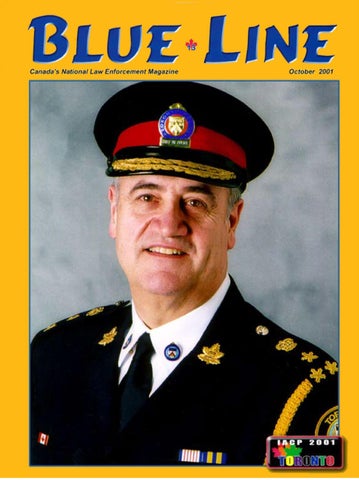
Volume 13 Number 8 October 2001 Blue Line Magazine 12A-4981 Hwy 7 East Ste 254 Markham, ON Canada L3R 1N1
Ph: 905 640-3048 Fax: 905 640-7547 e-mail: blueline@blueline.ca
- Publisher / Editor Morley S. Lymburner e-mail: bluelinepublisher@home.com - General Manager Mary Lymburner, M.Ed. e-mail: bluelinesales@home.com - Managing Editor Mark Reesor e-mail: bluelineeditor@home.com - News Editor Les Linder e-mail: bluelinenews@home.com - Advertising Mary Lymburner Kieran Huggins Bob Murray e-mail: bluelinesales@home.com - Pre-press Production Del Wall - Contributing Editors Communication Skills Terry Barker Police Leadership Robert Lunney Tactical Firearms Dave Brown Technology Tom Rataj Psychology Dorothy Cotton Case Law Gino Arcaro Blue Line Magazine is published monthly, September to June, by Blue Line Magazine Incorporated with a mailing address of: 12A - 4981 Hwy. 7 East, Ste. 254, Markham, Ontario, L3R 1N1. Individual magazines are $3.50 each. Subscriptions are $25.00 per year or $40.00 for 2 years. (Foreign - $50.00 U.S.) ©2001 - All articles are protected by copyright. No part of this publication may be reproduced or transmitted in any form or by any means, electronic or mechanical, including photocopying and recording or by any information storage or retrieval system without permission from the publisher. Internet activity is monitored and use or reposting of material on the Internet is restricted. All material submitted for publication becomes the property of Blue Line Magazine unless other arrangements have been made with the publisher. The authors, advisors and Publisher accept no liability whatsoever for any injuries to persons or property resulting from the application or adoption of any of the procedures, tactics or considerations presented in this magazine. Readers are cautioned and advised that articles presented herein are edited and supplied for your personal awareness and should not be used for further action until appropriate advice and guidance is received from a supervisor, Crown Attorney or other person in authority. Established in 1988, Blue Line Magazine is an independent publication designed to inform, entertain, educate and upgrade the skills of those involved in the law enforcement profession. It has no direct control from a law enforcement agency and its opinions and articles do not necessarily reflect the opinions of any government, police, or law enforcement agency. Blue Line Magazine is a private venture and as such is not funded through any level of government agency, union or association.
Inside This Edition Publisher’s Commentary
7
Host chief says issues same worldwide
8
A little touch of Toronto heraldry and history
10
Book Review
11
Vitality
12
The science of instinctive shooting 14 How to perfect the ‘art’ of combat shooting Bandwagons Puzzling through the politics
16
Deep Blue Lies truths and mistakes
18
Walkerton blues How a small town police service handled a big town media blitz
20
Public & media relations The role of a senior public relations practitioner in policing
28
Case Law Acceptance of Ried technique in Canada
30
International Assoc. of Chiefs of Police Annual Conference and Exhibition Floor Plan and Exhibitor List
32
19th Century Industrial gem to shine again
38
Drug detection dogs - Corrections Canada
39
New software “can deal with everything” 40 Blue Line Classified
42
Realistic training for police recruits
44
Technology Adobe Acrobat 5.0
46
Henson College Graduates Fall 2000 - Spring 2001
49
A sign of the times Highway help program a low tech solution to high tech problems
50
Simulator to help police train for G8
52
First graduates from First Nations Policing Course
54
Blue Line Reading Library
56
APEC report finds Mounties performance unacceptable
59
The Back of the Book
62
Printed in Canada by Garson Graphic Services Inc.
- AffiliationsInternational Association of Law Enforcement Planners Canadian Advertising Rates & Data International Police Association The Police Leadership Forum The Canadian Press Newswire Periodical Publishers Exchange
ISSN #0847 8538 Canada Post - Canadian Publications Mail Product Sales Agreement No. 176796 October 2001
5
The City of Toronto is hosting its second International Chiefs of Police Conference Oct. 27-31. Host Chief Julian Fantino has had a varied career. Starting with the Metropolitan Toronto Police he moved to head the City of London Police Service and then became Chief of the York Regional Police before returning to lead the Toronto Police Service. Often confrontational and controversial Chief Fantino’s reputation is one of setting the agenda for a community. His opinions, which he has shared with Blue Line readers for many years, are as numerous as his talents. He is known to be a clear thinker and a no-nonsense, getting-down-tobusiness type guy. You are sure to gain some positive insight into the man and his agenda beginning on page 8 of this issue. Those heading to the IACP Convention will want to take a look at the floor plan and listings of the more than 600 exhibitors on display at this event on page 32. Police officers can gain free access to the trade show floor by presenting their identification at the registration area. Other accredited individuals can gain access to the show by paying a day fee. The thousands of lives lost in the terrorist strikes on the World Trade Centre and Pentagon weighs heavily on the minds of many. Blue Line Publisher, Morley Lymburner, looks at the courageous role of police leaders in coping with this tragedy on page 7. On page 20 Lymburner also looks at the tremendous pressure put on the officers of a small Ontario police force when a tainted water crisis left seven people dead and focused the eyes of the world on the Town of Walkerton. After spending over a year in preparation the article puts you in the minds and hearts of those officers and their community struggles. There is much to read in this month’s edition from our regular columnists Chief (Ret) Robert Lunney, Dr. Dorothy Cotton, Dave Brown, John Muldoon, and Editor Mark Reesor. You will find articles on architecture, inquiries, new products, case law, self help and award winners. In fact you will find so much we are sure you will have a hard time putting this book down. But then again that is exactly how it was planned. Blue Line Magazine
We must mourn - but there is much to do by Morley Lymburner It is one of those significant events in history in which everyone will know exactly where they were and what they were doing at the time. Such is the case with the devastating events of September 11, 2001 when we all witnessed the destruction of the World Trade Centre in New York. I was in Montreal attending a Police Leadership Forum conference when the news came to me from Bob Pilon, President of the Forum. I can still see his face as he told me the news. “You think this is a build up to a joke don’t you?” he said. I had to confess that I was waiting for the punch line. His assurances to me that it was not a joke was indeed a punch line. I could feel my stomach knot. Going to a television set confirmed a horror of unbelievable depth and depravity. Our conversations at this conference was focussed on leadership as an activity, not a position as it relates to the law enforcement field. As I found myself transfixed by the events flashing before my eyes on the television I witnessed the activities of a large number of “leaders.” The men and women of the New York City Police came immediately in view. I could see hundreds of them helping and directing people - rendering aid - giving direction - maintaining control in a way that only a cop can really accomplish. It is in times such as these that citizens no longer take for granted their emergency serv-
October 2001
ices personnel. While others fled from that scene of carnage, police, fire and ambulance personnel were running towards it. Yes indeed I learned a lot about leadership at this conference and learned much more from witnessing the bravery of those officers on television. Not one officer showed fear. Every one was determined in their resolve. Not one shrunk back from the job at hand. We now know that many of those officers will never return. The aftermath of this event will no doubt change our world. It will change police practices. It will make us all stop and think — and pray. There is no way society can completely protect itself from such a fanatical attack by mad men. The only thing that is really important is how we respond to such incidents. We need managers to plan and coordinate such disaster responses but we need leaders to make those plans happen. The unfortunate part of
7
good leaders is that quite often they are the first to fall. I am confident the police ranks do not lack leaders. This confidence was confirmed for me on September 11th. Police agencies everywhere must nurture and encourage this leadership quality in every officer on a daily basis. Over the intervening months, and even years, we will be hearing and seeing much about the series of events that lead to this dark and depraved act. Police managers and leaders will learn much about how to do things better. The real tragedy will be if we forget what we learn. If we let ignorance and apathy thrive. If we let indecision, intolerance and hatred take control of us we will be doing a serious injustice to those who died so bravely and needlessly on September 11th. New York and indeed the world must mourn these losses. But we must get back up, as the American people have shown us so many times before, and move courageously onward.
Host chief says issues same worldwide by Mark Reesor Police departments from Toronto to Tokyo face many of the same issues, says Toronto Police Chief Julian Fantino, the host chief of this years International Association of Chiefs of Police (IACP) conference. Organized crime, youth and street gang violence, drugs, technology, integrity and, especially, public acChief J. Fantino countability, are on everyone’s agenda, says Fantino. “It’s just a matter of who goes to the batter’s box first; we’re all subject to the same frailties and the same flaws. We have to work very hard at ensuring uppermost that we maintain the public trust — and to me, if we lose the public trust in law enforcement and policing, then everything’s lost anyway. “I am very conscientious about our reputation, our image, our credibility; I live those values and I preach those values and I hold people accountable to those values, remembering always who we are and who we are here to serve. We have extraordinary power and authority and all of that has to be balanced with accountability.” The experiences of other departments can serve as an early warning, Fantino says, highlighting “contributing factors they’ve identified that have caused them great grief and aggravation, up to and including falling into disrepute with the community, the public trust and the scandals and corruption; those are very, very critical issues... “If you can learn about how someone else has been impacted by, say, a very traumatic event that has caused great distress, discomfort and difficulty to a police service and you know darn well that, there but for the grace of God go I, why should I wait and have that happen to me?” The IACP meetings provide a valuable heads-up on how other police departments are handling specific problems too, notes Fantino. Last years conference in San Diego, for example, highlighted raves, a hot issue in Toronto at the time. “It was very, very informative to hear perspectives and experiences from other communities and how so much of the rave scene is really driven by the drug subculture and some of it is directly connected to organized crime.” Learning sessions don’t just concentrate on big city police departments but are balanced so there’s something for everyone — “an opportunity to learn, an opportunity to share, an opportunity to make contacts... and to acquire resources that will help make our job easier,” he says. Police are especially eager these days to learn about new sciences, technology and proOctober 2001
grams — “how everyone else is doing business (and) what better things we can do,” says Fantino, who adds attendees could learn a thing or two from Toronto and its police service. “You can’t deny the fact that this is a glorious city. We really police the world in this city — we have some 160 countries represented here and people from those places speak well over 100 different languages. We have people who speak 75 different languages in our police department. “It’s a unique opportunity to see a wellrun, diverse community that is really at peace with itself and we, the police, are at peace with our community.” Toronto’s population is about 2.5 million but “there are hundreds of thousands of people coming here every year from every part of the world,” notes Fantino. “We have to live and let live and find ways of being respectful, sensitive and caring about differences and not look at them as things that divide us.” The Toronto Police Service isn’t perfect but it is a progressive service in tune with the community, he says. “We live and breathe community policing which, to me, is not so much a program but a way of doing everything,” says Fantino, pointing to the Service’s strong outreach, volunteer and community liaison programs, which he says “brings the community inside” and allows officers to better meet their needs. Liaison programs in particular are a good way of keeping the lines of communication open and dealing with any problems that arise, says Fantino, “because there is no perfect police service and there is no perfect community but collectively, I think we can find the best possible solutions to bridge those things that divide.” Volunteers also help police with recruiting and crime prevention programs, among many other things, he adds. Fantino is also proud of the way Toronto police deploy resources — “we are now as efficient as we can be, given the conditions (we’re under)” — the service’s fight against organized crime, it’s stellar investigative efforts, success in fighting violent crime and the quality frontline service provided by uniformed officers. Traffic safety has become a serious problem, Fantino says, and officers have launched an extraordinary effort to enforce the rules of the road, with success measured by the reduction in injuries and fatalities. “Traffic safety is everyone’s responsibility... and shouldn’t just be left to traffic officers,” he says. “What we want to see is the citizens taking more responsibility; this is not just a police issue... people need to be held accountable for their inappropriate driving habits.” The service does a lot of collision reconstruction work, he notes, studying the causes of all accidents where there’s a death or serious injury and then targeting the actions that led to them. Leading the challenges faced by the serv8
ice is the constant pressure to be more efficient, Fantino says. “Getting people to think along those lines sometimes is very difficult. We can no longer expect to write our own cheque. The finances are what they are and we have to get people to think in a realistic kind of way.” The tremendous need to build new police stations and renovate existing ones is a problem when money is tight, he says. The service is working on a five-year facilities plan which will include amalgamating a couple of stations and redeploying officers to save money. Another concern is attracting young people to policing careers to replace retiring officers. “There’s a lot of effort being done to recruit people into the police service; we, in fact, are not having any trouble doing that and are filling every spot at the Ontario Police College that is allocated to us and have significant numbers of people from other police agencies coming to us — (and) some who have left us are coming back.” That will likely change though, Fantino admits. “We’re all drawing from the same pool and we’re all experiencing the same problems... certainly we’re going to be in a more competitive situation as time goes on if this (the strong economy) continues.” Police officers are highly sought after in other fields, Fantino says, and the demand, coupled with more lucrative retirement packages and hiring freezes in previous years, is creating a shortage of experienced officers. “There was virtually no hiring and therefore no replenishing of the seniority so now we’re stuck with a significant number of people who are eligible to retire but very few others who are coming up behind them until we get into the five and under years of service.” There’s an upside to the problem though more opportunities for younger officers. Fantino says the service has been putting “an awful lot” of people through on promotional processes, especially women and visible minorities. The next decade will bring more accountability to policing, Fantino predicts, and “more scrutiny to everything we do. The economic realities will continue. Science and technology will help us, as it has all along, become more efficient and effective... “(There will be) far more training; the generalist concept, although still valid for some functions, will not be as important as being able to rise to the challenge of computer technology driven crime. The globalization of crime, the sophistication of the criminal element — all of those things will require a much more elevated,
HIGH DEMAND - Specialized Policing more trained and experienced, specialized law enforcement officer, especially in the investigative areas.” What won’t change is how officers interact with the public and the services they provide directly to citizens, which Fantino says makes up the bulk of their work and will become “even more valuable.” The emphasis on community policing will also continue, though it has to be understood that it “is not to be all things to all people all the time... “Community policing is a very labour intensive effort,” Fantino notes. “It can’t be done by computers, cars or automation... it requires a dedicated commitment (and) continuity — you can’t start it and then just do it on Mondays. Everyone in the organization has to work to that tempo. It’s a total commitment.” Police agencies need to provide the best
quality and most sensitive, caring and professional service that they can afford, Fantino says. “The results are enormous if we can dedicate the time and resources to be pro-active, solving problems before we have to manage them. (The problem) is trying to get ahead of this constant production line — demands for service — that seems to be driving everything we do... that sucks up so much of our energy.” The IACP will also change in the years ahead; Fantino foresees it becoming more inclusive of international police agencies. “Much of what we see (now) is really American — that’s where it was born and most of its funding and constituency comes from — but I see it becoming more and more inclusive. They’re now very much involved in conferences all over the world and are certainly very appreciative and inviting of us who are nonAmerican — for instance, on the executive board, on which I serve, and committees. “I see it as a very progressive organization which is well led, well financed and well run and does a lot of excellent research work... and provides a whole lot of strategic support.” This is the second IACP conference held in Toronto — the city hosted its first in 1987 — and Fantino hopes attendees have an “uplifting, rewarding experience,” enjoy the city and want to come back. Toronto’s bid for the 2007 IACP conference was unsuccessful but Fantino says the city will bid again. “I don’t consider it a loss... we put on a good show.” For further details go to BlueLinks at www.blueline.ca
For further details go to BlueLinks at www.blueline.ca
October 2001
9
A little touch of Toronto heraldry and history by Brian Denyer The first issue badge with the City of Toronto coat of arms replaced the six-pointed star of the previous badge, which was of American manufacture. The circular shield was issued just before the First World War and was used only by plainclothes officers who wore it under the lapel. Only the larger Police Forces could afford individually designed badges. Composed of a nickel silver alloy, the natural process of toning by oxidization produces a subdued finish, contrasting with the nickel coated, high lustre surface of current issue badges. One should find some high points of wear in an old issue badge, caused by the friction of rubbing against cloth or from being carried in a wallet — exceptions to this would be nonissue or replated badges or reproductions, which generally have no signs of wear. Lettering around the edge of the Toronto shield is composed in a ‘San serif’ style of typeface and the Center panel ‘Chief’ is serif. Serifs are formed at the ends of letters and were first developed when Roman stonecutters carved signs for buildings and had to curve out the letter ends to make a clean cut in the stone. The seal at the top of the shield was designed in 1834, the year Toronto first became a city. City Council appointed six permanent constables and 14 special constables in 1835, though it wasn’t until 1838 that they found the money to provide a ‘plain uniform.’ A metal police badge was not officially issued until later in the 19th century but, following British tradition, constables carried a small club with the Royal Coat of Arms painted on the tip portion. The city seal on this circular shield identified and visually explained the local Toronto heritage. Various design elements were chosen for their geographic and historical significance. The shield serves the function of a badge of office and is a sign of police authority, providing the name of the political jurisdiction and a number to identify the member. I refer to badges as shields because they are the descendants of the original knight’s shield in a miniature form. The first identifiable shields became part of the warrior knight’s equipment in the eleventh century — they were previously used for protection and defence.
By the end of the century they also visually identified their owner. A wide variety of Christian knights assembled on the battlefield during the crusades in the 11th to 13th centuries, when Christian and Muslim warriors fought for control of the holy sites in Palestine. Surface ornamentation on the shields had to be refined because Christian body armour included helmets with closable visors, making facial identification impossible. This led to complications. Just as today, when someone has something popular, everyone else wants to copy it. To prevent this, a regulative body was formed to ensure each heraldic design was of a protected and limited distribution. Members of this control body were termed ‘Royal Heralds’ and their tradition has continued to the present day. Canada has its own official Herald in Ottawa, under the authority of the Governor General. All approved ‘devices’ must be sanctioned and signed by Queen Elizabeth. Government and private bodies using a British Coat of Arms still have to follow the rules and regulations of the College of Heralds in London, England. The City of Toronto’s Coat of Arms is a smaller shield placed between two figures. According to heraldic terminology, it is divided into four parts, with the most important quarter containing the three lions. High point wear has blurred some of the details on the badge. Lions were used to represent the initial development of Toronto’s political infrastructure; the three walking lions are shown full face and are still used as part of the Royal Arms of England. During the 1800’s, the Lieutenant-Governor of Upper Canada (Ontario) was entitled to use them on the flag raised over Toronto. When the city was incorporated in 1834, these Royal Lions were used on the Toronto seal without authorization; Queen Elizabeth granted approval for their continued use in 1959 after a formal request. Royal approval is not always granted. When the Queen was coronated in 1952, the RCMP was advised that it could no longer continue the unauthorized use of ‘The Order of the
Garter’ around the bison head. When the new Queen’s crown badges came out, the elliptical border around the bison head was left plain. The bison was important to the nation’s economic development but so was the beaver. Another point of interest is that when the ruling monarch changes from male to female, so does the shape of the crown used on the badges. Beavers on Toronto’s shield represent the reason Canada was first explored. The commercial potential of their fur prompted the French and, several hundred years later, the British, to establish trading posts, attracting the first settlers and ships, needed to carry pelts to market. The beaver represents building ability, hard work and high energy. The ship on the shield was U.S. built, representing commercial use of the Great Lakes. Ships helped develop the fur trade, allowing timely delivery of pelts from trading posts to the old world, satisfying the European demand. Outside of the quartered shield are supports or ‘charges,’ figures standing on both sides of the shield to support it. One is a Algonquin Indian, the first inhabitants of the Toronto area, who sold Britain 250,000 acres of land in September, 1787. Britannia is the other figure and symbolizes Great Britain; both figures stand on a lettered ribbon. A motto, “Industry - Intelligence - Integrity”, is written on a curved ribbon at the feet of the supporters. It is an expression of Toronto’s mission statement of shared goals and core values, reflecting the organizational culture of ethical integrity, intelligence and the driving force of industry to build Toronto’s economic base. In contrast, the top-most portion of the seal is a crown of masonry, representing the building of the city corporation from the separate political jurisdictions of the Toronto area. The modern badge is a derivative of the older “Metropolitan Toronto Police” badge which was the original symbol of the Municipality which was designed in 1957. When the two Boroughs and four cities were amalgamated into a single city in 1998 the new badge simply eliminated the name “Metropolitan”. As is common practice each component of the badge is symbolic. The winged wheels at the top of the shield represents industry; the two text books symbolize knowledge and learning; the staff of caduceus at the bottom is the symbol of commerce. Breaking from tradition is still noticable by the placement of the beaver at the top of the shield while placing the ruling monarch’s crown in the centre. British tradition places the crown at the top of the shield indicating the supremacy of rule as vested in the Queen of Canada. Brian Denyer is an avid badge and history buff and works in the security and locksmith industry in and around Toronto. He is a Political Sciences Honours graduate from York University and has previously graduated from Seneca College with an Honours Diploma in Law Enforcement and Administration. He may be contacted at (416) 604-5771.
For further details go to BlueLinks at www.blueline.ca
October 2001
10
Pocket sized street drug guide It’s 4 a.m. and the unruly ‘drunk’ you just arrested is unusually happy, talking incessantly, trying to engage you in conversations which make no sense and is poorly coordinated. But you don’t smell even a hint of alcohol on him. You suspect he’s high on a drug but which one? It’s for situations like this the ‘First Response Guide to Street Drugs’ was written. A pocket-sized spiralbound book printed on waterproof “Transilwrap” (feels like plastic) paper, it’s designed for “rigorous and consistent field use,” according to publisher Burnand Holding of Calgary, and can even be cleaned and sanitized, “should contamination occur.” Written in a quick-reference format, the $20 guide describes, among other things, what the drug is and does, its effects and how long they last, odours associated with it, street pricing and most common street names, stages of addiction and withdrawl — even the possible health dangers and special officer safety considerations for each of the ten most common street drugs listed. Also included is a glossary of street drug terms and what they mean, listing everything from ‘A’ (amphetamines) and ‘A Bomb’ (mixture of marijuana and heroin) to ‘zooming’ (high on mushrooms) and ‘zonked’ (high on drugs).
A chart lists symptons and the drugs that may be causing them — for example, blurred vision or a floating sensation can be caused by ecstasy while methamphetamine, crystal meth and cocaine can trigger violent tendencies. The behaviour shown by the drunk, suggests he’s been taking G.H.B., a “highly addictive substance that has become popular as a club drug.” It has a salty taste that many people hide in alcohol and its effects, which include increased energy, happiness and a desire to socialize, last eight to 12 hours. Negative effects include low heart rate and loss of the gag reflex. Your diagnosis is bolstered when you find a small eyedropper bottle in his pocket; the liquid inside has a mild chemical smell typical of GHB, which is referred to as ‘G,’ ‘Gross Bodily Harm,’ ‘Easy Lay,’ ‘Cherry Meth’ and ‘Everclear’ on the street, according to the book, and goes for between $5 and $20 a dose. First Response was written by Detective Steve Walton, a 23-year member of the Calgary Police Service who’s been with the drug unit for the past eight years and actively instructs on drug investigational techniques. Walton supervises an undercover street team, has managed more than 120 undercover drug operations and is a court qualified street drug expert. To obtain a copy contact 905 640-3048 or Email: bluelinesales@home.com. For further details go to BlueLinks at www.blueline.ca
For further details go to BlueLinks at www.blueline.ca
October 2001
11
Eat less fat — and the right fat for healthier heart by Cst. JoAnne Pendrak So you want to maintain a healthy heart and are not sure how to go about it? Stop, consider your diet and think about how much and what type of fat you’re eating. Many are still unaware of what fat really is. Technically speaking, fat is a soft, oily, greasy substance found in organic tissue and comes in liquid or solid form. I think of fat as that yellowish, blubbery stuff that seeps out from underneath your skin. There are basically two different types of
fat, saturated and unsaturated. Saturated fats are found in animal sources such as meat, poultry and whole-milk products and vegetable sources such as coconut and palm oils. Unsaturated is usually liquid at refrigerator temperature and is broken down into monounsaturated and polyunsaturated fat. Monounsaturated is found in food from plants, including olive, peanut, avocado and canola oils. Polyunsaturated is highly unsaturated and found in plants, including safflower, sunflower, corn and soybean oils. Unsaturated fat is deemed to be less detrimental to your health.
Fat is one of the three nutrients — the others are protein and carbohydrates — that supply calories (fuel) to the body. One gram of fat is equal to nine calories. For example, if a serving has five grams of fat then 45 calories in that serving are from fat. If the total calories of the serving are 100, then 45 percent of the calories come from fat. One gram of protein or carbohydrates is only four calories. Since fat has more than twice as many calories per gram, eat it in moderation to maintain its positive benefits. Fat is essential for the proper functioning of the body but eating two much saturated fat is one of the major risk factors for heart disease. If an individual consumes a diet high in saturated fat, a soft waxy substance called cholesterol builds in the arteries. Too much fat can increase the risk of heart disease because of its high caloric content and may result in obesity, which is another risk factor for heart disease and some types of cancer. When dining out, munching on snack foods or eating on the run, it’s very easy to consume lots of hidden fats. Over time, these fats will turn into extra baggage, weigh you down and make your heart work harder. Some tips to consider: • Use light corn oil and vinegar dressing on salads. • Use margarine instead of butter, if so desired, or use butter in moderation. • Eat broiled and grilled meats, remove excess fat and skin from chicken. • Use tomato sauce, marinara or clam sauces without meat on your pasta. • Choose pizza with vegetable toppings instead of double cheese or meats. • Eat plenty of fruits and vegetable and avoid cream sauces and fatty dips. • Choose sherbets and low fat desserts, trying to avoid fatty deserts such as cookies, icecream and cakes. Remember, fat is an essential nutrient. Too much is detrimental, resulting in heart disease and other associated illnesses. Select foods low in unsaturated fats and eat other fats in moderation. To keep healthy and fit, maintain a good diet, get plenty of rest and regular exercise. Cst JoAnne Pendrak is a training officer with the Sudbury Regional Police and the zone four representative for the Police Fitness Personnel of Ontario (PFPO).
The Great Mac Attack! by Tony MacKinnon “just because your husband ran off with some dish mrs. spoon, is no reason to call 9-1-1!”
October 2001
12
The science of instinctive shooting How to perfect the ‘art’ of combat shooting
by Dave Brown Historically, fewer than one in four shots fired by officers on the street actually hit their intended target. In recent years, firearms instruction has narrowed the gap between range training and actual street encounters, and trainers have created some innovative ways to recreate reality on the police range. This emphasis on modern skills for real situations first required recognition that shooting is not an ‘art’ or ‘magic’ but a science. I call it the ‘science of sudden confrontation.’
Conditioned Reflexes The fastest shot in the world is not likely to win too many gunfights; nor will the most accurate shot. The survivor will likely be the person who fires the first, accurate shot. Modern firearms training recognizes the importance of both speed and accuracy under real world conditions. This is where the science comes in. The study of both physiology and psychology of stress offer important lessons to be learned. Under stress, the body tends to revert to its most dominant responses. This means that the correct responses have to become a conditioned reflex action. There is only one way to make proper shooting skills a conditioned reflex — hundreds of repetitions. This is the key to instinctive shooting. It’s not about spending days training shooters in some new fad technique but about emphasizing good basic skills over and over again until they become automatic reactions.
Instinctive Shooting The technical aspects of shooting are performed below the level of conscious thought. Before we can create these instinctive skills,
we must first recognize what they should be. Instinctive shooting has sometimes been confused with point shooting, but there are significant differences. Point shooting involves firing the sidearm one-handed from below eye level without using the sights. This technique was once taught as viable up to five to seven meters but many instructors now recognize it’s unlikely to reliably connect on a target even as close as three meters. Instinctive shooting, on the other hand, involves a conditioned Figure 1 Figure 2 reflex. When properly taught, it emphasizes constant repetition of a smooth they fired without taking the time to bring the draw, a proper two-hand grip and a fast focus sidearm up to eye level or establish a proper on the front sight at every distance. The draw two-hand grip. Some agencies taught shooting motion should emphasize a clean break from without sights out to specific distances, such the holster and a smooth ‘punch’ toward the as three meters. Why shouldn’t this work? Firstly, physioltarget. The only situation where it’s acceptable to ogy tells us that once an action has become a not use the sights is within an arms-length dis- learned reflex, it actually takes more time to tance. The subject, in this case, is so tight to artificially arrest a smooth, two-handed draw the officer that the gun can be fired as soon as motion and fire one-handed. In fact, observing it’s clear of the holster and will likely still place officers forced to point shoot illustrates how it ultimately takes longer because it requires cona disabling shot on the assailant. Simply put, training should not be a choice scious thinking. If the action could be observed in slow between instinctive shooting or aimed fire; instinctive shooting is aimed fire. It relies on the motion, many officers will initially start to use fact that aiming a sidearm can become a condi- both hands and the sights just like they have tioned reflex action through constant repetition been conditioned to do, then remember to use one hand and lower it back down from eye level. in training and practice. All this wasted motion and conscious thinking Why Point Shooting consumes valuable time. Doesn’t Work More importantly, officers under stress may Point shooting relies on the ability of the attempt to point shoot out to further distances, human hand to naturally ‘point’ a finger at a far beyond what they were trained to do. As a target. It was once thought that officers could by-product of tunnel vision, objects are often shoot faster and with acceptable accuracy if perceived to be much closer and larger than they really are. If officers are taught to perform an action out to a specific distance, they may attempt that same action at three times the distance in a real encounter, with disastrous results. Modern training for high stress situations should never rely on the ability to judge distance. Thirdly, simple geometry shows how important it is to align the sights with each other in order to keep our impact point within the center mass. Picture a steel rod coming out the barrel of the sidearm and touching the target. If the front sight is raised or lowered even a tiny fraction, the resultant error at the end of the rod is exaggerated many times over. Officers can determine the side-to-side alignment (windage) fairly reliably without sights, but the elevation is much more difficult to dial in quickly without conscious effort. (Compare figure one and figure two). Sure, there are highly skilled shooters who can demonstrate accurate point shooting out to great distances, but we must focus our training toward the average officer. Point shooting becomes a poor trade-off when the extra thinking time easily negates the fraction of a second saved in not bringing the gun up to eye level. Shooting without a proper sight picture can
For further details go to BlueLinks at www.blueline.ca
October 2001
14
only be justified if the target is within an armslength distance and, even then, only if the officer doesn’t have the ability to move back or shove the subject away in order to create distance. Tests in popular gun magazines have sometimes suggested that point shooting is a viable technique by comparing accuracy of hits using guns with and without sights. These tests have little validity because, out on the street, it’s not the average of hundreds of shots that will save lives; it is the accuracy of our first shot. Point shooting relies heavily on body position indexing and muscle memory but it’s unlikely that your assailant will allow you the time to dial in your correct body position or practice your draw several times in the middle of a gunfight.
physical skills of grip, stance, sight picture, trigger control, the draw from the holster and the reload are the ‘how.’ The ‘why’ is provided by a basic understanding of the physiology and psychology of stress. The ‘when’ is dictated by laws and agency policy relating to justified use of deadly force. This forms an integrated package of modern firearms training as a ‘science of sudden confrontation.’ Until the pages of competition shooting magazines become dominated by pictures of the world’s top practical pistol shooters firing accurately with one hand, we should still reinforce proper aimed fire at any distance beyond the length of the shooter’s arm. After all, when the score really counts, competition shooters stick to what works best.
Of course, just because it works in competition doesn’t necessarily mean it works on the street, but you can be assured that if it doesn’t work under the stress of competition, it is never going to work on the street. In the real world, the most critical score is the number of good guys still standing after the gunfight. Dave Brown is Blue Line’s Tactical Firearms Training Editor. Considered one of Canada’s top police shotgun trainers, you can read him on the pages of Blue Line, talk to him directly on Blue Line’s Forum at www.blueline.ca or email him at firearms@blueline.ca
When Instinctive Shooting Works Television notwithstanding, the vast majority of Canadian officers will go through their entire career without having to draw their sidearm once outside of training. Those few who will need their guns, however, need to be able to rely on their technical skills on an unconscious level. Most confrontations seem to happen inside seven meters and many of them are closer than three meters. Most are over in seconds. (Although many officers report that time seems to slow down in the middle of a high stress situation. This is called the ‘tachy psychia’ effect.) Some of the other commonly reported symptoms of stress include tunnel vision, a reduction in fine motor skills and a loss of hearing called ‘auditory exclusion.’ Officers often report that they did not clearly hear their shots being fired and they sometimes do not even remember using their sights. If they are trained properly to always use the sights at anything farther than arms-length, this becomes a conditioned reflex and they will not likely remember actually using them. By the end of training, officers should have practiced a fast sight acquisition and a controlled press of the trigger over 1000 times. This is enough to imprint this skill into the subconscious.
New Techniques in Shooting Training time is a finite commodity. It limits the skills to those that can be taught to the average street officer, not the highly skilled shooter. Valuable training time should not be consumed on attempting to imprint one basic skill for short-range encounters and a different skill for longer distances. Instinctive shooting should continually reinforce a fast sight picture and a controlled trigger press. One-hand shooting should be confined to disabled shooting drills. There are some interesting new methods of teaching aimed and unaimed fire, but the final determination on whether to teach these techniques cannot be made on the ability of highlyskilled instructors to accurately place their shots on the target. The criteria must be on how easy it is for the average officer to adapt to a new method without consuming more days of valuable training time. Firearms training must be attacked like any other science. It must address the crucial questions of ‘how,’ ‘why’ and ‘when.’ The basic October 2001
For further details go to BlueLinks at www.blueline.ca
15
Puzzling through the politics by Robert Lunney The spirit of adventure and service traditionally draw men and women towards policing. As the zest for adventure wanes with maturity and experience, satisfaction of service becomes more important. The feeling that comes with knowing you’re doing meaningful work is a powerful incentive, along with praise and recognition. Everyone likes to know their work is appreciated. There comes a point, however, when many people hope to enjoy recognition through promotion. That first promotion is the best of all, signifying your arrival as a leader, but further promotion is often said to be a numbers game and a puzzle. It’s a numbers game because of the decreasing opportunities available as you scale the organizational pyramid. The puzzle is euphemistically known as “politics,” as in “it’s who you know, not what you know” and “I realize that if I’m going to go any further it depends on the politics.” Politics is the science or study of government. Obviously, that’s not what we’re talking about. It’s more like relationships between people. Being human means developing friendships, alliances and loyalty to others. It naturally follows that their impact will never be absent from organizational decision making. The promotion process in a well-administered police service is based on performance and potential, with the best decisions made in a spirit of objectivity and equity. There remains, however, a constant tension between objectivity and the inescapable influence of personal relationships, which isn’t necessarily a bad thing. Consider this advice from the Chinese sage Confucius: “Promote those whom you know. Those whom you do not know others will certainly not neglect.” Ethical decision making and transparency of process are needed to ensure the proper balance. The destructive influence of nepotism, cliques and cronyism is not part of acceptable influencing. If these traits are part of the “politics,” then you have a problem. While good working relationships are essential, let’s examine other elements leading to top personal
performance. Consider these suggestions: Show Up: The first law of policing, whether you’re a rookie reporting on time for a shift or a superintendent meeting with a community group. Good cops seldom say so, but they watch intently to see who shows up. This is particularly true in times of moral crisis, in the extremes of a dangerous encounter, during hazardous working conditions or in just carrying out a boring, tedious but necessary task with no glamour or recognition. Pay Attention: Pay attention to the job at hand, to others, to how you allocate your time and to the worth of what you accomplish. Set priorities and do first things first. It’s amazing how seldom people today truly listen to what another person is saying and meaning, without interruption and with full concentration. Giving your full attention to another person honours them and is a sign of respect and integrity. Have Courage: Displaying courage in a critical situation is much admired by police and the brave deserve the accolades, but relatively few people have the opportunity to display uncommon physical courage. The more common and everyday challenges are moral and ethical, such as whether you’re willing to speak out if confronted by wrongdoing or unethical behaviour or speak the truth when a “politically” expedient statement might get you by. The ultimate test is a willingness to put your career interests on the line to preserve your integrity — that’s having courage. Keep Going: Perseverance, industry and endurance are essential to success in any field. In the face of criticism, occasional failure or disappointment, success favours the individual who unswervingly maintains a sense of mission and purpose. Set Goals: Write a personal mission statement. Document your purpose in life and your long-term objectives. Set goals in your career and personal life. Be realistic; record them in a personal diary and keep them private. Refer to your list at regular intervals and update as your insights and circumstances change. This habit is the key to achieving personal goals. Work Smart and Work Hard: The principles of management are not fully appreciated or practiced
in policing. Becoming a student and practitioner of effective ways and means of getting things done provides an edge in a crowded field. Only relentless, focused effort leads to top performance for most people. Keep Learning: Continuous learning is essential for leaders in this fast-paced society. Exercise your curiosity, read widely, undertake formal studies when you can; put yourself in the way of experts, seek out people who can provide the guidance or knowledge you need and emulate the leadership qualities you admire in others. Continue honing your policing skills. Set aside contemplative time to distil and digest lessons learned. Keep Promises: Avoid getting overcommitted but once you make a promise, do everything possible to make good on it. If you can’t deliver because of circumstances beyond your control, explain why. Be Generous: The best leaders are generous with their time, attention and understanding in dealing with others. They know that generosity with information, praise and sharing of resources is returned fourfold. A generous spirit earns the loyalty of others. Be Positive and Enthusiastic: An indomitable spirit in the face of any condition, from boredom to adversity, is essential to maintaining one’s own spirit and sustaining that of others. Tempt Good Fortune: There is an element of chance in all things. Never discount factors such as being in the right place at the right time or developing a faculty for serendipity — making happy and unexpected discoveries by accident. Good fortune favours the prepared mind. Consider this a starter list. You may add, subtract and consolidate the principles to make them your own. Keep your list short and the wording simple and to the point. Developing winning ways will do more than guarantee top performance; they build those relationships that develop an essential component for leadership — the trust and confidence of others.
Turning Points There is a startling commonality found in the personal stories of many successful people. They describe the early phases of their working life, then strike to the heart of their experience saying, “...and then I got serious.” What follows proves to be the turning point of their career. Getting serious often coincides with other life changing influences — marriage, parenthood, an unexpected career opportunity or setback. Getting serious means stepping up and taking charge of your future.
You may contact Bob Lunney at BandWagons@BlueLine.ca You can also respond through 905-713-1690
For further details go to BlueLinks at www.blueline.ca
October 2001
16
Lies truths and mistakes by Dr. Dorothy Cotton Ph.D., C. Psych. So you haul this guy in for questioning because you’re absolutely sure he’s the one who robbed the drug store. Besides, you have an eye witness that is ABSOLUTELY positive he’s the guy. He says, “You’re right officer. It was me. I see the error of my ways. I have gone astray. I
confess. My apologies.” Or he says, “Pardon me, kind sir, but I believe you have erred. Perhaps you have misconstrued.” In your dreams. Is he lying? And how about the witness? Is she right? Gaze into your crystal ball — might as well, because the fact is that you aren’t likely very good at picking out who is lying and who is not. The other bad news is that just because your witness is sure doesn’t mean she is right. Bummer, eh? There aren’t a lot of things we know for
sure in psychology, but one is that how sure people are about something and how right they are aren’t related. The witness who is dead certain is no more likely to be accurate than the witness who ain’t so sure. People can give very confident reports about the wrong person, the wrong time, the wrong clothing — happens all the time. Indeed, we do it ourselves. How often have you been ABSOLUTELY certain that you left the car keys on the chair in the front hall — only to find them in the kitchen? It’s useful to have family members to blame this on but that won’t change the fact that you probably just remembered wrong. The fact is that your average memory stinks — and is subject to interpretation. It doesn’t mean you are lying though, not that anyone would know unless they were in the US Secret Service. In a study of law enforcement, FBI and CIA personnel and judges, the only ones who could reliably pick out a liar were the Secret Service — and they probably won’t tell us how they did it. Drat! What can you do about this? Not much but it helps to know about it. Saves you from going out on a limb. Then you don’t get that same look from your boss that you get from your spouse when the keys turn out to be in the kitchen — right where you left them. Dr. Dorothy Cotton has been practicing psychology for over 20 years, “providing services for adults of all ages.” Dr. Cotton holds degrees from McGill University in Montreal, Purdue University in West Lafayette, Indiana, and Queen’s University in Kingston, Ontario, and is registered as a psychologist with the College of Psychologists of Ontario. Dorothy Cotton can be reached by e-mail at deepblue@blueline.ca.
The Great Mac Attack! by Tony MacKinnon The bottom line here - Georgie Porgieis kissing the girls and making them cry, is sexual assault!
October 2001
18
Walkerton Blues How a small town police service handled a big town media blitz by Morley Lymburner The day after the “twofour” weekend should have been full of news about the high death rates brought on by vacationland vehicle accidents. May 23rd, 2000 proved to be completely different. The small town of Walkerton, population 5500, nestled in the graceful rolling farm land of Ontario’s Bruce County, made headlines around the world. The E.coli bacteria in the town’s drinking water was found to have caused over 2,000 people to fall ill and seven to die. The local people were about to witness an onslaught of attention never before seen in a town this size. Over the intervening months almost no stone was left unturned and residents’ patience was severely tested by the world-wide media snooping around amongst them. Their stories and all aspects of life in this community was put under a microscope on a global scale. But what about the local police? How did they cope? What were their challenges? I decided to find out.
Policing under fire The South Bruce-Grey Police Service can
Photo: M. Lymburner
THE WORLD COMES KNOCKING: Residents, politicians and police did not have much time to plan when the news of their water tradgedy became known. most certainly be described as well able to meet challenges under fire. Never has a Canadian police service been as intensely tested as this
For further details go to BlueLinks at www.blueline.ca
October 2001
20
small 30-member service. The only way to explain this is to list their stressors: 1. The agency was born of the politically-
forced necessity of amalgamating Hanover and Walkerton police only one year before the water incident. 2. The police service was under review with the threat of being consumed by the monolithic Ontario Provincial Police empire, which was slowly gobbling up smaller agencies across the province. With the coveting eye of the OPP municipal contract section on their police budget, there was great reluctance to ask for assistance from the province. 3. The town of Walkerton (in Bruce County) was amalgamated with two surrounding townships and one village into the Municipality of Brockton in a provincially motivated endeavour to reduce the number of municipalities — but the rural folk refused the services of the established town police in favour of the aforementioned OPP service. This in effect caused a dual policing, hybrid operation in the same municipality. 4. The ultimate challenge came, so all the locals thought, when Chief Burrell Gailing was suspended and investigated for fraud and corruption. 5. The fledgling police service now had a new interim acting chief, Dennis Player, parachuted in from a nearby city. Viewed by many as a professional troubleshooter, he began just three days before the E. coli story broke and was still finding his footing and trying to get up to speed on local issues. 6. While police were busy cleaning their house, other people allegedly forgot to clean the water supply and in May of 2000 many police members, their families, friends and townsfolk started to come down with the “flu.” 7. The pressure gauge was ratcheted up by many notches within 24 hours after a holiday weekend in late May. The media of the world descended on the town in gargantuan numbers and the police were in crisis management mode with an issue that would send shock waves around the world and cause after-effects for generations to come. The multi-level problems and issues simply stagger the imagination. How did this police service handle these situations and cope with the problems of the “water crisis” and still keep ahead of the local issues of regular policing? I was determined to find out but knew this report would take considerable time. After a year I have finally developed a story I feel I can share with Blue Line readers.
The Quest After waiting for the dust to settle a bit I contacted the South Bruce-Grey Police Service in July of 2000. Eager to tell their story I agreed to meet at their station in Walkerton. “You’ll never find it unless you are a local,” said the voice on the phone. “A car will see you at Tim Hortons on the main street.” I could think of no better universal landmark so I quickly agreed. I arrived at the appointed location without breakfast or a coffee. I entered the donut shop parking lot to find a large sign posted in the window that simply said “Closed”. A quick inquiry with a worker at the drive-through indicated we had chosen the day when their water continued Page 22 October 2001
21
system was being purged. A brief inquiry at the town hall to ask directions to the police station initially proved fruitful. The friendly lady at the desk started to explain and stopped in mid sentence when I pointed out to her that I was a male and it took considerable courage for me to just get to the stage of asking for directions. With an understanding look she reached for a pad of paper and wrote out the directions. “Yonge Street, turn left, third street on right, Joseph Street, turn right, Mary Street turn left, last building on right.” I thanked her for her detailed directions... and returned to the Tim Hortons’ parking lot to await the police officer. I was greeted by the smiling face of ADVERSITY: Bringing a Acting Sergeant Ron Shaidle upon my community together with a return. “One advantage to having our common purpose. police station in an out-of-the-way place is that only the locals know how to find us,” he local Canadian Tire store and pointed out how explained. During their water crisis I am sure it that company had offered to supply every was not only an advantage but their only refuge. household in the town with free shower heads Shaidle quickly pointed to a large plastic wa- and taps. “I know it probably isn’t fair of me to ter tank by the doughnut shop’s drive-through just point out these two companies because window and said he wanted to see me here be- there have been an unbelievable amount of cause Tim Hortons was the first to begin supply- similar help from almost every business in ing water to the community after news of the cri- town. But these two are the ones that stand out sis. “We have had volunteer citizens, and police most in my mind and are representative of the officers on their days off, standing by this loca- outpouring of support we have received both tion to assist residents in picking up free water locally and nationally.” I could hear Shaidle’s pride in the town he every day. Tim Hortons brought in water truck tankers to help in this town and they have gained has policed for ten of his 29 years in policing. This was also reflected in the words of Sgt. Carl our undying respect for their service.” Shaidle again directed my attention to the Cameron. “It was the toughest job I had ever
had to undertake in my 18 years with Walkerton. It just seemed like the whole world went upside down in a matter of 24 hours.”
The Challenge When the media frenzy was just beginning Acting Chief Player, on the job for just three days, held strategy meetings and pointed out the priorities and directions the members of the police service would be expected to perform. Player pointed out that the safety of the citizens was to be considered the highest priority, including properly controlling the multitude of vehicles and protecting local people, who would be the focus of media attention. When the water tragedy was made public May 23rd the town was completely transformed within the first 24 hours. A large army of reporters and their vehicles and satellite trucks flooded the town. Reporters from around the world were seen on the streets looking for information and “sound bites” from anyone who would provide it. The immediate concern for police was the parking situation at the Brockton municipal offices. It also houses the main post office and every resident of the town picks up their mail from this site. Therefore it was not only perfect continued Page 25
For further details go to BlueLinks at www.blueline.ca
October 2001
22
for media attention on the municipal hall but provided perfect exposure to almost every citizen of the town. All media were asked to respect the rights of the citizens to go about their business and told that parking bylaws must be respected. The parking zone occupied by many of the media satellite trucks was designed for short term parking and more specifically intended for residents to get their mail. With only a few exceptions media personnel complied with police when this was pointed out to them. “It seemed like the larger the organization the more they would listen to us,” Cameron said. “Our only problem was with the smaller radio and television station personnel who seemed not to care for anything but the story.” Smaller budgets tend to put extra pressures on the staff to get the story quickly before the big guys move in, he pointed out. This could be seen in the manner in which they went about getting any lead that would satisfy their producers. “We were concerned about fights breaking out between local residents and media and we tried to be on top of it as much as we could.” On the day of the first funeral of one of the victims, police tried to keep the media separate from the mourners. Family members had asked that no media be present and considerable tact had to be used to point out that police could not stop them from attending the outside areas of the service. One commotion did develop between a mourner and a media person found trying to tape record the service from a church pew.
The Pride Police officers appeared to have the utmost respect for local politicians. Officers pointed out that at the community meetings the mayor of Brockton and all councillors attended the podium and stayed until the last question was asked. Every question was answered as forthright as possible, even though in most circumstances they simply could not give a conclusive answer. “I have seen many media scrums,” Shaidle points out, “and in almost every case the politician will get to the point where they will simply put up their hands and say that this is the end of the questions and leave the podium. These local politicians hung in there to the very bitter end and it was not easy. They
eral blood transfusions and other extraordinary measures to save her life. Although out of danger and now at home, it is unknown if there is any permanent damage. A member of the local OPP detachment even transferred to a London detachment so he could be close to his hospitalized child.
The Response
were facing a very concerned and even hostile community who wanted answers that they simply could not give. Couple with this the worldwide media attention in the room and I would say there is no one in the country who could handle themselves with as much dignity and sincerity as they did.” Shaidle pointed out that he had known these people for many years on a personal basis but gained an entirely new respect for them; “It really made me proud to see them working on our behalf.” In retrospect Shaidle pointed out that it probably would have been a good move to have media scrums and community meetings held separately. Having to face residents’ local concerns and also deflect media questions that appeared to go in opposing or premeditated directions was not helpful. As it turned out, this formula worked well in later meetings.
The Impact The first problem encountered by police was during the weeks before the actual disclosure of the crisis. Five members came down with what they thought were flu symptoms and simply booked off duty. Otherwise healthy individuals, all but one of them fully recovered. Two afflicted persons were officers from the Hanover detachment who simply filled in for a day and drank water from a station fountain. One civilian dispatcher was hit hard, booking off for quite some time and even having recurrences when she came back to work. Almost every member of the Walkerton detachment either had a family member or friend come down with some form of symptoms. One civilian member’s infant niece was rushed to London where she underwent sev-
For further details go to BlueLinks at www.blueline.ca
October 2001
One of the advantages the local police had was in knowing their community and the people who live there. In many cases members went to school and were raised with them. At one particular meeting this knowledge paid off when a particular individual, known locally as “a character,” was ready to give the entire world a glimpse of what residents would not want them to see. An officer who had a more positive relationship with this individual and could see the gathering storm approached the man discretely and offered him a ride in a police car to get a donut and coffee. The slight hesitation to ponder the invite to do the two things he really liked doing was seen as a positive response and he was quickly whisked away. “We had residents calling for days after that incident thanking us for taking action with him,” Shaidle stated. “It took one of our members out of the picture for the evening but we all agreed the embarrassment the action saved was worth the effort.” Another lesson learned by the police service was to capitalize on any lull in the frantic pace. They valued these moments to plan ahead and to create some tactical focus toward using their limited resources, said Shaidle. They also seized every available opportunity to speak and research with other police forces. “Just before the inquiry began,” Shaidle pointed out, “members of the OPP intelligence squad wanted to know who locally may be a danger. We told them that we knew just about everyone in town and there would be no threat from anyone. We told them the only threat we could see would be in crack-pot outsiders we may have to confront that we don’t know about. They did have a list of known threats and the information they shared was very helpful to us.” It was important to be highly visible to the public and the media personnel, said
For further details go to BlueLinks at www.blueline.ca
25
gling with the decision of which poShaidle. “We ensured that our officers lice service to establish? kept up vehicle and foot patrols in high “It was a classic situation of gildactivity areas to create the appropriate ing the lily,” one officer with the visual deterrence. We also had to mount South Bruce-Grey Police stated. “The several surveillance operations to guard OPP are well known and respected local individuals who received threats. in the area. There was no need to bring This required considerable overtime in over 50 officers, in uniform, and hours and calling in assistance from line up 19 brand new police cars in a other police services.” row across from the town post office Help was also forthcoming from two for what turned out to be a simple case Grey/Owen Sound Victim Assistance Proof recording statements from citizens gram case workers. “We were aware of the of the town. program across the county line in Hanover,” “The whole show was transparent Shaidle said. “We asked them if they would and frankly it should have been downbe willing to help us out in the Bruce County right embarrassing for all those officportion and they enthusiastically welcomed ers who really didn’t have enough the opportunity. We supplied them with the work to even keep them busy.” office space in our Walkerton Detachment. Photo: M. Lymburner This opinion was shared by a They have been a tremendous help to us in relieving our officers from counselling peo- On the south side of Walkerton, in front of the County Court house, a second patrol officer. “Someone in new monument and parkette built by a local Mennonite craftsman was the OPP decided to try to show us ple throughout the E. coli crisis.” dedicated by Governor General Adrienne Clarkson. The simple stone Over the ensuing year the Bruce-Grey ediface with clean water flowing from its cleft stands in silent tribute to up in front of our own people and Police Service tried as much as possible to the pain and healing which has yet to take place. The scars which re- the whole country. I am still having reflect a steadfast and work-as-normal pos- main are indeed deep. In Walkerton the police were not immune and are a hard time understanding what went on there. For what they did we could ture, which was difficult to accomplish given among the first to feel it. have handled that ourselves. But the province’s lack of financial support to someone decided it would be a big pay for overtime expenses. pression of evidence critical of the province be The service had its usual share of regular a factor? Would it have been better, for the sake OPP show.” If the idea was to sway votes through showspecial events and festivals to cover and this was of appearances, to call in the RCMP or another manship, it was successful. Brockton Municiaccomplished through the co-operative assist- police service? ance of such agencies as the Saugeen Shores PoCould the province investigating itself, in pal Council split earlier this year on whether to lice, the Anishinabek Police Service and the OPP. some small measure, be compared with issues keep the existing police service or contract with The politics of policing surrounding the premier and the shooting inci- the OPP. The mayor cast the tie-breaking vote Calling in the OPP brought with it a whole dents at Kettle Point? The premier’s office has in the OPP’s favour and it is slated to take over new complexity of issues. With the launch of refused for many years to call an inquiry in that from the South Bruce-Grey Police Service next the official inquiry, Ontario Premier Mike Harris case, preferring instead to load most of the January. Over the next six weeks eight officers decided that OPP investigators would interview blame on individuals. Can some comparisons resigned and joined the OPP. “Not much use the local citizens and victims. The appearance be drawn between Walkerton Public Utilities staying on the losing side,” one officer said. of a conflict of interest was not immediately seen. Commission Manager Stan Koebel and OPP The remaining members say they will soldier They are a branch of the same provincial Sergeant Kenneth Deane, who was convicted on until the final bell tolls. In the mean time Chief Player has 28 new government that was fast coming under criti- of criminal negligence after a protester at Ketapplicants to review to fill the vacancies and cism as a contributor to the disaster through its tle Point was shot and killed? budget cutbacks and downloading of water testOn a secondary level could there be a per- the townsfolk have gathered together over 2000 ing requirements onto the municipalities. At this ceived conflict of interest in the manner in signatures on a petition calling for the retenlevel a whole new series of concerns might which the investigation proceeded within a mu- tion of their present police service. Recent legarise. For example, could the appearance of sup- nicipality where local politicians were strug- islation is working in their favour in that a new regulation will permit one municipality to contract with multiple police services.
Conclusion Much bitterness has come out of the incidents surrounding the Walkerton water tragedy, not all due to the tainted water. As far as the police service is concerned, their tragedy was a simple case of being overtaken by a whole series of unfortunate circumstances. The officers agree the events have made for a tighter and even friendlier community. “Throughout it all we suffered together,” says Cameron. “The E. coli bacteria struck deeper into this community than just their bodies. It has been felt emotionally and at a deeper level than anyone initially thought. This community turned out to be far more forgiving than I expected. They are really decent people.” Due to the severe nature of the events that have overtaken this town, the name Walkerton has become almost synonymous with bad water. The legacy left will haunt the community for generations to come; those afflicted may be looking at kidney failure later in life. In the same manner that the name Watergate came to describe high level governmental corruption, only time will tell how kind history will be to this graceful inland community in Southwestern Ontario. October 2001
26
SOME KEY FACTS INVOLVING THE TAINTED-WATER TRAGEDY IN WALKERTON, ONT. What happened: Storm washes bacteria-laden cow manure into poorly planned and maintained well; water pumped to taps throughout town. The result: Seven die, 2,300 fall ill from E. coli poisoning. The fix: $15 million spent reconstructing town water system and installing temporary filtration. Judicial inquiry: Aims to find out what went wrong and the role government played, and to examine overall water safety in Ontario. Fallout: Province agrees to guarantee court-supervised compensation in settlement of class-action suit; government implements new water regulations; careers of brothers in charge destroyed. Quote: “(Stan Koebel) is the only one who has accepted any responsibility but his share of it is minimal.’’ - John Finlay, Walkerton resident. A CHRONOLOGY OF EVENTS May 12: Torrential downpour washes bacteria from cattle manure into shallow town well. May 17: Residents complain of bloody diarrhoea, vomiting, cramps, fever - symptoms of E. coli poisoning. May 17: Tests of water sampled May 15 reveal E. coli contamination. Results faxed to Koebel, who fails to notify Environment Ministry, public or public health office. May 19-21: Hundreds fall ill; Koebel does not mention E. coli in water. May 21: Public health unit begins independent water testing, issues boil-water advisory. May 22: First death directly linked to E. coli. May 23: Health unit tests reveal water contaminated with deadly E. coli O157:H7. Two-year-old girl dies, more than 150 people seek hospital treatment, another 500 complain of symptoms. May 24: McQuigge declares E. coli outbreak Canada’s
worst. Two more die. May 25: At least four children in critical condition. McQuigge declares tragedy preventable. Outside agency takes over water system. Koebel leaves town, goes on sick leave. May 26: Tory Premier Mike Harris denies government cuts to blame for tragedy, points to previous NDP government changes. Class-action lawsuit launched. Provincial police begin probe. May 29: Fifth death. Province admits knowing for six years water system flawed; announces new rules to protect drinking water. May 30: Sixth death. May 31: Under opposition pressure, Harris orders public inquiry. June 2: Federal, provincial governments announce financial aid for those affected by outbreak. July 25: Seventh death. Aug. 26: New drinking-water laws take effect. Oct. 16: Public inquiry begins. Nov. 16: Province says Walkerton’s water clean, but leaves it to health unit to lift boil-water advisory. Nov. 17: Koebel resigns, negotiates $98,000 severance package, including $34,000 for unused vacation. Nov. 30: Thomson bursts into tears at inquiry recalling when he learned Koebel withheld crucial information that might have curtailed the tragedy. Dec. 5: Health unit lifts boil-water advisory. Dec. 6-7: Frank Koebel stuns inquiry with testimony about drinking on the job and routine falsification of safety tests and records. Dec. 18-20: Stan Koebel testifies about his reasons for falsifying safety tests and records, and why he didn’t alert authorities to E. coli. Jan. 15, 2001: Court begins hearing request to certify class-action suit.
For further details go to BlueLinks at www.blueline.ca
October 2001
Feb. 1: Tentative settlement reached in class-action suit. Province admits no liability but guarantees compensation plan. March 19: Judge approves class-action settlement. March 27: Province picks up $15 million tab for fixing town’s water. April 23: Walkerton council pays Stan Koebel $82,000 in severance and vacation and $5,000 legal costs. May 1: Deadline passes for opting out of class action. No one does. May 20: Memorial service held commemorating anniversary of boil-water advisory. June 29: Harris takes the stand to testify about his government’s role in the tragedy.
The Bruce Grey Police Service patrols the towns of Hanover and Walkerton in South Western Ontario. There are no new statistics available but an analysis of compiled data indicates that, as of 1997, the combined police services consisted of 18 police officers (17 male and 1 female) and 10 civilian support staff for a total of 28 members. Their combined budgets in 1997 would be just under $2 million. Each officer investigated an average of 50 criminal offences in 1997. The total number of Criminal Code offences were 903, with a 42% clearance rate reported on all crimes. Over all, there was a 1% increase in crime in 1997. The combined population of the area is 12,200.
For further details go to BlueLinks at www.blueline.ca
27
The role of a senior public relations practitioner in policing by John M. Muldoon, APR Not that long ago few North American police chiefs spent any time focusing on public relations, issue management, internal communications or crisis management. Things just happened, reactions were documented and police operations continued until the next ‘major incident.’ Today all senior police leaders — municipal, state, provincial, federal, university, housing or transit — have to incorporate some portion of their thought process around “what is my message, how am I going to deliver it and how do I manage the reputation of my police department?” “LAPD Blues: We’re cops, we’re not PR people,” read the headline in an April 1997 article for Public Relations Tactics (PRT), a newsletter for public relations professionals. The story was about a PR company in Los Angeles helping the police department there create positive public perceptions following the negative publicity of the Rodney King beating and the O.J. Simpson trial. The headline was credited to Tim McBride, LAPD Commanding Officer of Community Affairs, who went on to explain that with budget approval, the department would hire a PR practitioner. Things have changed across North America in just a few years. More and more police services have gradually recognized the need for a full-time civilian PR practitioner to work with senior command. Departments not large enough to support a full-time practitioner have contracted out the service. Why the change? Again referring to the PRT article, Bruce Rubin, APR, chairman of the Florida-based firm Rubin Barney & Birger, says “that while police departments have internal public relations officers, they do a better job patrolling the streets than communicating and dealing with the media.” Rubin continues, “more than any other government agency, a police department needs the
understanding and support of the general public and the municipal government to function to the best of its ability.” To understand PR, you have to know what it is. The Canadian Public Relations Society defines it as “the management function which evaluates public attitudes, identifies the policies and procedures of an individual or organization with the public interest and plans and executes a program of action to earn public understanding and acceptance.” Where does the PR practitioner fit into a police organization? The trend today is to hire senior people who report directly to the chief and advise senior command. Some police services have hired junior or intermediate practitioners, giving them specific responsibilities within one or two sectors of the communication spectrum. The advantage is that they grow within the organization but they are still in their career growth mode and can get restless, tending to move on if there is no room for advancement. Look for a PR generalist with extensive and broad training and experience, flexible enough to handle a range of daily duties and able to formulate strategies for managing issues and longterm planning. The PR umbrella covers issue management, government and media relations, trend analysis, policy development, marketing, special event planning, advertising and communication counsel. While understanding the organization is important, an insight into the way the public and media perceive police is an equally vital prerequisite. The person ideally has ‘seasoning’ in the outside world and a more objective view of the PR role. In simple terms, you can teach someone the operation of an organization but you can’t teach them to think. The person shouldn’t be afraid to take a stand on a position and defend it. They must never hesitate to tell the chief things about an issue or event that no one else will. Their job is to be honest and forthright. Courage, tenacity and ethics are essential.
For further details go to BlueLinks at www.blueline.ca
October 2001
28
Membership in the Canadian Public Relations Society, the Public Relations Society of America or the International Association of Business Communicators is also important; all three have a code of conduct and good accreditation programs which indicate a level of competence. From a purely tactical perspective, the position should oversee all media relations, communication planning, public opinion polling and research, graphic standards, web design and content — basically everything that is written and visually reflective that can affect the image of the department. The challenge facing police PR practitioners is to stay aware of the issues facing the department and the speed at which they change, understand what needs to be communicated and how and recognize and seize the right opportunity to do so. There will be departments that feel they cannot justify a staff practitioner, but when a crisis or damaging situation happens, realize they’re in over their heads and need assistance. Before you hire a firm check their client list and make sure you’re comfortable they can do the job you’re asking them to do. Ask them if they’ve had experience handling this type of issue and determine the outcome. Check their references. Do you have confidence in this company? Can they be trusted? Finally, agree on a price before the project begins so there won’t be any surprises. Many of you may be thinking ‘this sounds great, but I don’t need another person telling me what I should be doing.’ Enlightened chiefs use all available resources. The senior public relations practitioner is just one more resource; no longer a luxury but a necessity. Ask yourself: • When one of my officers was charged with a major criminal offence, did we deliver a message that instilled ongoing public confidence in the department, despite the arrest? • When an officer was acquitted of a criminal
charge, did they display the appropriate behaviour and respond to reporters’ questions in a manner that I felt reflected well on the department? • During our last budget presentation, did I use the same rhetoric and catch-phrases as in previous years or did council really sit up and listen? • When was the last time my department conducted an opinion poll or market research study to determine what the community had to say about us? • If a tragic event occurs, do I have a communication plan to deal with all the various constituents, including the media? • Was our last departmental initiative launched successfully and was the exposure sufficient to sustain? • Are all the messages coming from my office clear, concise, and focused? If you find that some of your answers aren’t what you really want to hear, then you may need the assistance of a senior PR practitioner. In the years to come, they will become more common as police leaders understand their value. Have you looked at the public relations function in your service lately? John M. Muldoon, APR, is president and senior public relations counsel, Bedford Communications International. The former director of public affairs for Peel Regional Police Service in Brampton, Ontario, he’s an accredited member of the Canadian Public Relations Society and an associate member of Issue Management Council (Washington, D.C.). He can be contacted at 905849-8279 or by e-mailing bedford@home.com.
Many equate PR people with ‘spin doctors.’ Here’s a definition of ‘spin’ by Andy Green, author of Creativity in Public Relations: A communicator has the ability to manage the facts and information at their disposal, not just to the extent they make them available, but also in the way they define, or attempt to define, the focus of a situation. Even though every constituent fact in the story may be 100 percent corroborated, the prominence and emphasis given can be managed and creatively used to provide added value. The so-called ‘spin doctor’ can shift the objective focus of a situation in three ways: • Inflate the significance of a small part of the situation. • Expand the context within which the event or development may be seen. • Mask or obscure the situation with a distraction. The act of ‘spinning,’ whereby the objectivity of a situation is altered, could be claimed to be a form of propaganda; the objectivity and focus of a situation are in themselves facts in the communication. Some may argue that this management of the context of information is a legitimate tactic in the practice of public relations. Practitioners may feel it is valid to present their case, rather like a lawyer, in the best possible light. The legal advocate analogy is flawed; it ignores the long-term context of public relations work. A practitioner may win a one-off battle yet, unlike the legal advocate who walks away from a trial never having to put forward another case to the same jury, the public relations professional has to live day in and day out with the jury. Organizations have to present their case through the public relations function on a number of issues to the same groups of people who, in turn, will be passing judgment on them. If an organization seeks unscrupulously to win one argument, it will eventually be found out, subsequently reducing the chance of a fair hearing on its other activities.
For further details go to BlueLinks at www.blueline.ca
October 2001
For further details go to BlueLinks at www.blueline.ca
29
“Reid Technique” is widely accepted by Brian C. Jayne & Joseph P. Buckley The Reid Technique of interviewing and interrogation has been used in the United States to solve hundreds of thousands of crimes. United States courts have routinely admitted confessions obtained using the technique, provided that it was properly employed. In recent years the Reid Technique has been taught in Canada, primarily to the RCMP and larger police agencies. Last year the Canadian Supreme Court reversed a lower court’s suppression of an arson confession. The case, R. v. Oickle, offers implicit approval of the interrogation techniques utilized in the Reid Technique. The Reid Technique represents a three stage process to solving crimes. The first step is referred to as factual analysis where crime scene information is gathered and analysed to establish a list of possible suspects. The second step is a non-accusatory interview of each suspect in the case. Through evaluating the suspect’s behaviour symptoms during this structured interview, the investigator either eliminates the suspect from suspicion or forms the opinion that the suspect has lied during the interview. In this instance, the investigator moves to the third step, which is an interrogation of the suspect. It is this stage which receives the most legal scrutiny. Interrogation using the Reid Technique begins with a direct accusation of guilt. The subject is typically told something like, “I have in this file the entire results of our investigation. There is no doubt that you (committed the crime).” This statement often is not entirely true in that the investigator may not know for certain that the suspect committed the crime. In the previously mentioned Oickle interrogation the suspect was told that he failed a polygraph examination. The Court of Appeals found fault in that the police falsely exaggerated the accuracy of polygraph results. The Canadian Supreme Court rejected this argument citing, in part, the following logic: “confrontation of a suspect with polygraph test results, in such circumstances, is not qualitatively dissimilar from such permissible techniques of persuasion as the police showing a detained suspect a co-accused’s confession, inadmissible in evidence against the suspect, or
police trickery; for example, the ruse of relating to the suspect that his or her fingerprint has been discovered at the scene of the crime.” Following this confrontation, the investigator presents an interrogation theme which offers reasons and psychological (not legal) excuses explaining why the suspect committed the crime. The investigator’s approach and demeanour toward the suspect is understanding and even compassionate. In Oickle, the Court of Appeals suggested that the interrogator’s understanding demeanour improperly abused the suspect’s trust. The Canadian Supreme Court disagreed, stating “in essence, the court [of appeals] criticizes the police for questioning the respondent in such a gentle, reassuring manner that they gained his trust. This does not render a confession inadmissible. To hold otherwise would send the perverse message to police that they should engage in adversarial, aggressive questioning to ensure they never gain the suspect’s trust, lest an ensuing confession be excluded.” During presentation of the theme, most suspects will not sit back and allow the investigator to dominate the conversation. A suspect can be expected to interrupt the theme with a denial such as, “but honestly, I didn’t do it” or to offer a statement explaining why he would not commit the crime, such as “why would I risk going to jail by doing something like this?” An important part of training in the Reid Technique is distinguishing between statements that are offered from a trustful or deceptive suspect during interrogation. If the investigator is convinced that the suspect’s statements are trustful, the interrogation is terminated. However, if the statements are typical of the deceptive suspect, the investigator continues to present the theme. At this point the deceptive suspect often psychologically withdraws during the interrogation and tunes out the investigator’s theme. The investigator will respond by moving his chair in closer to the suspect and incorporate hypothetical questions within the theme. The goal here is to capture the suspect’s attention. If the investigator is unable to maintain the suspect’s interest, the suspect will simply wait out
the investigator and not be persuaded to tell the truth. As a general guideline, The Reid Technique teaches that if a suspect is still denying any involvement in the offence after four hours of interrogation, he is probably not going to be legally persuaded to tell the truth during that session and the interrogation should be terminated. If the suspect is emotionally moved by the investigator’s theme, he may consider telling the truth. When the investigator recognizes that the suspect is in this frame of mind an alternative question is presented. This is a question that offers the suspect two choices concerning some aspect of his crime. Accepting either choice results in the first admission of guilt. A possible alternative question in a theft interrogation is, “did you take this money and blow it on drugs and booze or did you need it for something important like paying bills?” If the suspect responds “something important,” he has made his first admission of guilt. In Oickle, the Court of Appeals expressed concern that the use of an alternative question implies a promise of leniency. In refuting this argument, the Canadian Supreme Court offers a clear test of whether or not an implied threat or promise crosses the legal line to where an ambiguous statement may invalidate a confession. It writes, “The most important consideration in all cases is to look for a quid pro quo offer by interrogators, regardless of whether it comes in the form of a threat or a promise.” Once the suspect has made the first admission of guilt, active persuasion stops and the investigator returns to an interviewing format, asking the suspect questions to develop the details and true circumstances of the crime. An important part of this process is to corroborate the trustworthiness of the suspect’s confession by eliciting information about the crime only the guilty person would know. The Reid Technique has been successfully used for more than fifty years in the United States to solve crimes by obtaining legally admissible confessions from guilty suspects. The reason it has survived legal scrutiny is that it carefully adheres to court decisions. When principles of the technique are violated, the investigator risks the possibility of having a confession suppressed. Such was the case in a 2000 Provincial Court of Alberta ruling, R. v. M.J.S. The judge in this child abuse case offered a highly critical view of the Reid Technique, not realizing that even though the investigator had attended the training program, he did not follow the interrogation guidelines. For a more in-depth discussion of the Oickle and M.J.S. cases, see the website at w.w.w. reid.com (Helpful Information; Critics Corner). Brian Jayne is the director of research and development for John E Reid and Associates and Joseph Buckley is the president. Jayne and Buckley have coauthored two text books on interviewing and interrogation.
For further details go to BlueLinks at www.blueline.ca
October 2001
30
Video helps disabled stay safe by Roxanne Beaubien A new video by the Calgary Police Service (CPS) offers crime safety tips for people with disabilities. Called Safety on the Streets, it’s the second in a video series focusing on safety concerns for the disabled. The first, For Safety’s Sake, offers home security tips to help people feel safe, confident and prepared at home. Written and produced by the CPS video unit, it features disabled people speaking about their safety concerns and the steps they take to protect themselves. Individuals share in their own words how they often feel more vulnerable than others. The most common disabilities are those affecting hearing, seeing, speaking, development, learning and mobility. Individuals affected by each are featured in the 14-minute video. Some act out scenarios in which they are targeted and demonstrate how best to either ward off an attack or minimize injuries. Basic safety tips include being aware of your surroundings, not leaving a wallet in a bag or jacket on the back of a wheelchair and being aware of people who may pose a threat and how to avoid them. The project was spearheaded by Constable Gwyn Amat and Constable Martin Cull and was developed in conjunction with the CPS Persons with Disabilities Police Advisory committee. Cull said both videos are excellent educational tools for officers doing presentations to groups working with disabled people and for service providers to share with their clients. While the disabled are not statistically more likely to be victims of crime, they often feel more vulnerable, he notes. “Taking some extra precautions to ensure their safety provides boosted confidence and independence.” The $7,600 project was taped over a period of about two weeks and has captions for those with hearing disabilities. Copies will be distributed to Calgary service providers, libraries and other interested police services for free. “All we want is for this message to get out there,” Cull says. The response to the first video was excellent and Safety on the Streets is expected to garner the same attention. “It was a general feeling that the first one went so well that one dealing with another aspect of life should be produced,” says Cull. The video series is based on a comprehensive CPS crime prevention guide for the disabled which is available in printed, Braille and audio forms or on the Service’s website. Odette Dantzer of the Calgary Developmental Disabilities Resource Centre calls the project a win-win. It increases awareness among police officers of the safety concerns of October 2001
people with disabilities, while also being used as a pro-active policing tool to teach safety to a specific community, she says. Dantzer says the tools are also useful for family, friends and members of a person’s support network. To find out more about the video or order a copy, e-mail Cull at martin.cull@calgarypolice.ca. Roxanne Beaubien works in the Public Affairs/Media Relations Unit of the Calgary Police Service.
31
EXHIBITOR LISTINGS 4most Enterprises 520 4th Watch Systems, Inc. 833 911 Emergency Products 1907 A A-B Emblem 1526 ABM America 3933 Accident Support Services Intl 1807 AccuQuest Corp. 1227 ACS 1717 ACS State and Local Solutions 4313 AdLib Publishing Systems Inc 2231 Admit Computer Services, Inc. 2021 Adorama 2001 Adore.MdE 1528 Advanced Interactive Systems 601 Advanced Systems Technology 1825 Aerial Films 2725 Aether Systems 3737 Airborne Law Enforcement Assn. 2605 Aker International, Inc. 1616 Alarm Industry Assn. 3109 Alchemy Arms Company 433 Alcohol Countermeasure Systems 4005 Allstar Knowledge Systems 3409 Alpha Controls, Inc. 3309 Amchar Wholesale, Inc. 4212 American Blimp Corp. 714 American Body Armor/Armor Holdings 3417 American Eurocopter 2221 American Handcuff Co. 3204 American High-Tech Transcription 2013 American Jail Assn. 3504 American Locker Security Systems 3208 American Police Beat 3607 American Whistle Corporation 716 Amrel Systems LLC 2112 ANADAC, Inc. 406 Anheuser-Busch, Inc. 814 Anser, Inc. 404 Antenna Plus, LLC 2522 AOI Electrical, Inc. 1032 APCO International 4533 Applied Concepts/ Stalker Radar 3135 Aqua Lung America, Inc 2706 Architects Design Group, Inc. 4303 Argo Communications 322 ARINC 2109 Armament Systems & Procedure 3939 Armor Holdings, Inc. 3417 ASIS International 2130 AT&T Wireless Services 4439 Atlas Business Solutions, Inc. 4247 ATS Asset Tracking Services, Inc. Awards & More 1134 Aware, Inc. 4047 October 2001
International Associa
108th Annual Conference Exhibition & Trade Show ~ B Bancroft Cap Co. 3106 Barringer Instruments Inc 423 Bates Uniform Footwear 3511 Be-Safe Promotions 505 Bell Helicopter Textron, Inc. 3247 Bell Pro Police Helmets 621 Beretta USA Corp. 1009 Big Sky Racks, Inc. 2739 BlackHawk Industries, Inc. 1015 Blackinton VH & Co., Inc. 3405 Blauer Mfg. 901 BLI Baton Labs Inc. 926 Blount Sporting Equipment 1228 Blue Line Magazine 1906 BMW of North America, LLC 2531 Boarman Kroos Pfister Vogel, 3906 BOOK ‘EM Productions 4524 Boston Leather, Inc. 401 Brady Center to Prevent Gun Violence 2913 Break-Free,/Armor Holdings Co. 3417 Brinkley Sargent Architects 4433 Broadcast Microwave Services 211 Brodin Studios, Inc. 4112 Buchlein Badges 1125 Bur. of Alcohol, Tobacco & Firearms 4211 Bur. of Indian Affairs 4532 Burlington Raeford 3610 Bushmaster Firearms Inc 604 C C.H.G. Safety Technologies, Inc. 124 CALEA 4413 CamLite Corporation 1931 Canadian Police Research Centre 108 Casella CEL 2035 Cast Products, Inc. 4100 Caswell Detroit Armor 807 Centech Group, The 1119 Centurion Solutions .com 2314 CeoTronics, Inc. 421 ChoicePoint 3306 Code-3 3117 Code 4 Professional Equipment 2309 CODY Computer Services, Inc. 1726 Cogent Systems, Inc. 4429 Colt’s Mfg. Co. 1601 Combined Tactical Systems, Inc. 3604 Command Security Corp. 3909 Command System Inc. 4341 Commercial Emblem Co. 3811 Common Sense Productivity Sys. 2513 Comnetix Computer Systems, Inc. 4243 Concept Development Corp. 1205 Concept Seating, Inc. 3913 CoorsTek 1013 COPLINK 1130 Cove Shoe Company 2133 CPS 4210 Crimson Trace Corp. 1605 CritiCall Personnel Selection 1328 Crown North America 2207 Crowne Point Technologies, Inc. 4512 CRS Electronics 532 Cruisers, Inc. 3019 CW Nielsen Mfg. Corp. 4410 Cycomm Mobile Solutions 4010 Cygnus Media Publications 3745 Cyrun Corp. 2311
D D&K Mfg. Co., Inc. 2738 D&R Electronics 2517 DAC Technologies 1719 DaimlerChrysler 3339 Dakota Corp./Damascus Gloves 3310 Danner Shoe Mfg. Co. 2525 DARE America 4039 Data Nexus, Inc. 4547 Datacal Enterprises LLC 416 Datalux Corp. 506 Datamaxx Applied Technologies 2549 Dataradio Corp. 4133 Davis & Stanton Inc./Police Awards 3105 db Design, LLC 3651 Decatur Electronics, Inc. 3006 Defend 2305 Defense Group, Inc. 2025 Defense Supply Center Philladelphia 2027 Denali Solutions 1625 Dependable Merchandise 932 Dept of Defense/Inspector/DCIS 3506 Dept.of Housing/Urban Developmen 4409 Dept.of Justice/Criminal Div./AF&ML 1410 Dermalog Afis 2233 Desert Iron Images Inc. Dialogic Communications Corp Diamond Products Mktg. Inc. 1333 Digital Descriptor Systems, Inc. 4219 Diogenes Group (PCAD) Diplomatic Security Service 3801 DM Data Corp. 3210 Dodgen Mobile Technologies 3147 Don Hume Leather Goods, Inc. 1413 Doron Precision Systems, Inc. 4338 Draeger Safety, Inc. 835 Drug Enforcement Administration 3400 DSM Law Enforcement Products 1627
32
]
The International Association of Chiefs of Police consists of over 14,000 of the world’s top law enforcement officers. This year the conference is being held in Toronto at the Metro Toronto Convention Centre. The event consists of the world’s largest police trade show. Although essentially for delegates police personnel can get free access to the Trade Show floor by showing their police identification at the reception area. Non-police personnel must be accredited at reception and pay a day pass fee. To assist those attending this event the following floor plan and listings on the next few pages will help to optimize this visit.
ation of Chiefs of Police
~ Metro Toronto Convention Centre ~ October 27-30, 2001 South Exibit Hall
North Exhibit Hall
October 2001
33
DTC Communications 1809 ,1810 Dummies Unlimited 1709 DuPont Co. 1419 Dynamaps Corporation 2126 DynCorp 1029 E EADS Telecom 1915 Eagle Eye Enterprises 2107 Eagleye Technologies., Inc. 3711 Eastman Kodak Co. 3919 EDS 1803 EF Johnson/Transcrypt 2307 EFIT For Windows/New England Press 2501 Eiseman-Ludmar Co Inc 4011 Elbeco, Inc. 3410 ElectroCom Communication Sys. 4018 Electronic Warfare Associates 916 Emblematics, Inc. 2709 EMPCO - Lite 1711 End 2 End, Inc. 4351 Entenmann-Rovin Co. 1816 Environmental Protection Agency 1603 EOTech, Inc. 1117 ESRI 3947 F Farber Specialty Vehicles 3211 FATS, Inc. 1319 Fechheimer 4317 Federal Railroad Administration 521 Federal Signal Corporation 2817 FieldSoft, Inc. 4551 Financial Crimes Enforcement Net. 4412 Firearms Training Systems,Inc First Choice Armor & Equipment 635 Fischer & Associates Inc 2002 Fist, Inc. 2123 Fitzco, Inc. 3501 FLETC 3000 FLIR Systems, Inc. 2601 FNH USA Inc. /FN HERSTAL, S.A. 1113 Fobus USA 1725 Force One 1415 Ford Motor Co. 3225 Forensic Technology, Inc. 1609 Franklin Covey 4205 Franzen Secuirty Products, Inc. 405 Fuji Photo Film USA 804 Futurecom Systems Group, Inc. 2131 G G-TECH, Graphco Technologies 2507 Gall’s Inc. 1019 Gamber-Johnson 2946 Garrett Metal 2901
Immigration & Naturalization Servic 4445 Impact Solutions/Xpediter Tech. 2116 IMX, LLC 1513 In Time Solutions, Inc. 3508 Indico Corp. 2203 Info USA Government Division 2702 Information Technologies, Inc. 4403 Innocorp Ltd 2539 Innovative Weaponry, Inc. 1218 Institute of Police Technology & Mgmt. 3001 Intl. Police Technologies, Inc. 3910 Intl. Traffic Control Products, In 816 intellinetics, Inc. 4549 Intelliworxx, Inc. 4541 Inter American Data 407 Inter-American Data 407 Interactive Safety Products, Inc. 2029 Intergraph Public Safety 3839 Internal Revenue Service/Criminal I 2909 INTERPOL / U.S. 703 Interstate Arms Company 1433 Intoximeters, Inc. 2713 InvenCom, LLC 611 InvestigAide Software, Inc. 4249 Ion Track Instruments 4507 IPC Intelligent Vehicle 1 Corp. 217 iTECH Itronix 323 ITT Industries Night Vision 1217 J Jamar Technologies, Inc. 827 JAWZ Inc 4531 Jaycor 1133 Jivasoft.com 522 John E. Reid & Associates 3406 Jotto Desk 2719 Joyce Telectronics Corporation 831 JSI Telecom Justice Federal Credit Union 2125 K K9 Storm Inc. 414 Kaestle Boos Associates, Inc. 2638 Kahr Arms 1114 Kawasaki Motors Corp. USA 2947 KEYper Systems 2512 Kimber Mfg. / Meprolight, Inc. 310 Koehler-Bright Star Inc 3503 Kontron Mobile Computing 109 Kustom Signals, Inc. 3117 L L&R Mfg. Co. 411 Laerdal Medical Corp. 2704 Language Systems, Inc. 4427
Gator Hawk Armor, Inc./PITTCO 3601 GE Capital I-Sim 125 Geac Public Safety 3835 Gearbox Toys and Collectibles 2208 General Motors Corporation 2917 General Motors of Canada, Ltd. 2745 General Services Administration 223 Gerard R. Davis, Ltd. 2612 Gerber Outerwear 4013 Getac, Inc. 2731 Gimbel Protective Glove Co 1332 GK Industries Inc. 333 Glock, Inc. 1211 Go Rhino! 435 GoLight, Inc. 3507 Gould & Goodrich Gould Publications 3603 Grafix Shoppe 933 Graphic Designs Intl. 2313 Groen Brothers Aviation, Inc. 2639 Grossenbacher Bros., Inc. 4547 Guardian Products 1311 Guardian Products/Armor Holdings 3417 Gun Vault Inc 1833 H Hallmark Emblems Inc 719 Hamburger Woolen Co., Inc. 3107 Harley-Davidson Motor Co. 3141 Hatch Corporation 3613 Havis-Shields Equipment Corp. 2941 Heckler & Koch, Inc. 1207 Helmet House, Inc. 502 Heroes Tribute Memorial 1930 Hitech Systems, Inc 4525 Hiatt-Thompson Corp. 3007 High Intensity Drug Trafficking Are 1216 Hilson Research, Inc. 920 Honeywell Spectra Technologies 1801 Horace Small Apparel Co. 3631 Houge, Inc. 225 HTE, Inc. 4139 Human Patterns International 4407 Hurst Entry Products 207 I i2, Inc. 3706 IACP Net 4344 ICMA Retirement Corp. 3702 Identicator, Inc. 4012 Identification Technologies 424 Identix, Inc. 1931 IES Electronics Industries 1701 ImageWare Systems, Inc. 4049 IMAGIS Technologies, Inc. 4500
For further details go to BlueLinks at www.blueline.ca
October 2001
Lanx Fabric Systems 820 Laser Devices, Inc. 1111 Laser Shot 725 Laser Technology, Inc. 3025 LaserMax, Inc. 927 Law & Order Magazine 2700 Law Enforcement Technologies, Inc. LDV/Lynch Diversified Vehicles 3125 Leach Mounce Architects 3413 LEDCO 2113 LETN (Law Enforcement TV Net.) 907 LEXIS-NEXIS 2121 Life Safety Systems 1233 Life Scan 2015 Lifeloc Technologies, Inc. 1723 Lifepoint, Inc. 425 Lighting & Electronic Design 432 Lind Electronics, Inc. 2218 Litton Data Systems 3240 Lo Jack Corp. 3206 Logistic Systems, Inc. 3806 Lookout Portable Security/Intellite 1901 Lunar Lite, Inc. 1835 Lund Industries, Inc. 4102 M MAG Instruments, Inc. 3500 Mancom Manufacturing Inc. 2124 Mantenimiento Comercializacion In 2317 Martin’s Uniforms 3901 MASI 4348 Masters of Defense Knife Company Mayo, Mayo and Associates , Inc. 3902 McCoy’s Law Line, Inc. 2701 MD Helicopters, Inc. 116 Med-Eng Systems, Inc. 1727 Medtronic Physio Control 2625 MEGG Associates, Inc. 4149 Memex, Inc. 4002 Metalmasters Target Systems 3307 Metcalf Bros. & Co. 2127 Metropolitan Interpreters 4107 Microslate, Inc. 4318 MicroSurvey Software, Inc. 2129 Mid-American Specialties 625 Mistral Security, Inc. 3810 Mixson Corporation 2015 Mobile Concepts by Scotty 1430 Mobile-Vision, Inc. 300 MobileLED 2624 Mocean Mocean 825 Motion Picture Assn. of America 3809 Motorola 3717 Multiple Options, Inc. 319
For further details go to BlueLinks at www.blueline.ca
34
N N.A.D.A. Official Used Car Guide 516 National Child Safety Council 509 National Crime Prevention Council 3101 National Equipment/Art Loss Register 205 National Pawnbrokers Association 713 National Products, Inc. 2633 Natl.Assoc.School Resource Officers 606 Natl. Assn. of Uniform Mfrs. & Dist 3903 Natl. Criminal Justice Reference Svc 311 Natl. Drug Intelligence Ctr. 201 Natl. Guard Counterdrug Directorate 934 Natl. Highway Traffic Safety Admini 3707 Natl. Law Enf. & Tech. Corrections 3746 Natl. Law Enforcement Officer Mem 3207 Natl. Police Athletic League 720 Natl. Public Safety Information Bur. 4111 Natl. White Collar Crime Ctr. 3003 Naval Criminal Investigative Svc. 3705 NCS Assessments 132 NEC Technologies, Inc. 4017 Neese Industries, Inc. 1128 Nestor Traffic Systems 4346 New Heights, Inc. 2540 New World Systems, Inc. 3849 Newcon Optik 4438 Nextcell 1812 nHand Solutions, Inc. 510 Niagara Knitting, Inc. 324 NICI 334 NIK Public Safety 3417 Nikon Instruments, Inc. 2128 North American Signal Co. 4539 Northrop Grumman Information Tech. 3240
Northwestern Univ. Ctr for Public Safety 3205 Novatel Wireless, Inc. 2101 NSDI / S.A.F.E. Program 4529 O Office of Natl. Drug Control Policy 2104 On Patrol Video Int’l 1832 Open Software Solutions Inc 431 Original SWAT Footwear 721 Orion 4504 Otis Technology, Inc. 523 Our Software 1805 Outdoor Outfits/American Leather 501 P P.W. Allen Inc. 500 PACA Body Armor 1507 Pacific Body Armor 1523 Pacific Concepts 1713 Padcom, Inc. 113 Palomar Display Products 1814 Pamet Systems, Inc. 315 Panasonic Computer Solutions Co. 4345 Paradigm4 3418 Paragon Imaging 2110 PAT America 2206 Patrol Bike Systems 2730 PDSI - TeleStaff 1330 Peerless Handcuff Co. 3305 Pelican Products 3108 Pennsylvania State University 4311 Phillips Swager Associates 400 Phoenix Intl. 1828 Phoenix USA, Inc./The Gunlocker 213 Pictuality, Inc. 317 PINS, Inc. 717
PMG, Inc. 2524 PMP Inc. 2201 Point Blank Body Armor 1001 Polaroid Corp. 4142 Police and Security News 3908 Police Chief Magazine Police Executive Research Forum 3911 Police Foundation 4206 Police Magazine/Bobit Publishing 1414 Police Security Action Cards 2222 Police One.com 709 POLIFORCE 325 Positron Public Safety Systems 4006 Postal Inspection Service 2808 Powerphone, Inc. 3912 PRC Public Sector, Inc. 4225 Precision Solar Controls 4301 Premier Wireless, Inc. 326 Prentice Hall 2023 Printrak Intl. 3829 Pro-Gard Industries 3325 Pro-Tuff by Werner Works, Inc. 3900 Probotics 2503 Progressive Technologie 1615 ProImage Publishing 4009 PropertyBureau.com, Inc. 534 Protective Products Intl. 515 ProWrite LLC 2302 Public Safety Management, Inc. 1633 Public Safety Systems, Inc. 3704 Public Safety Wireless Network 2224 R Raine, Inc. 3609 Range Systems 4204
For further details go to BlueLinks at www.blueline.ca
October 2001
Raytheon Commercial Infrared 3237 RBR Tactical Armor, Inc. 1329 RCMP/Canada Customs 4545 RDJ Specialties Inc 815 Red the Uniform Tailor 3449 Redflex Traffic Systems, Inc. 4503 Redman Training Gear/Macho Prod. 1517 Regional Information Sharing Sys. 3611 Reliance Armor Systems, Inc. 1404 Remington Arms Co., Inc. 3701 Remotec, Inc. 3246 Rescue Solutions International, Inc. 731 Ring’s Manufacturing 1331 Roberts Co., Inc. 3904 Robotronics, Inc. 3100 Robot Factory 4519 Rocky Shoes & Boots 3639 RTS Reflective Traffic Sticks 1729 S Safetec of America, Inc. 1532 Sagem Morpho Inc 1815 Salient Manufacturing &Security Pro 2332 Santa Cruz Associates, Ltd. 3605 SAS R&D Services, Inc. 514 Scanna MSC Inc 415 Scantron Corporation 930 ScheduleSoft Corporation Schweizer Aircraft Corp. 2607 Science Applications Intl. Corp. 4307 Scientific Dimensions, Inc. 403 SciTek, Inc. 1831 Sconset Technologies 819 Second Chance Body Armor, Inc. 915 SecureTech Systems, Inc. 608
For further details go to BlueLinks at www.blueline.ca
35
Security Equipment Corp. 821 SEMCO 4239 Sentinel Security Lockers by Tiffin 429 Setina Mfg. Co., Inc. 2931 Shaheen Restoration 2631 Shield International Inc 503 Shooting Systems Group, Inc. 3644 Sierra Wireless, Inc. 306 Sigarms, Inc. 1105 Sigma Micro Corp./REVERSE 911 3602 Signal Vehicle Products 3301 SIMUNITION Ltd. 925 Sirchie Group, The 1026 Skaggs Public Safety Uniforms & Equip. 3507 SmartDriver 2119 SMC/Advanced Products 615 SMI International 430 Smith & Warren 1432 Smith & Wesson 1401 Sokkia Corporation 1530 Sound Off, Inc. 2830 Southern Police Institute 4339 Southwestern Law Enforcement Inst. 4401 Spacesaver Corp. 518 SPEX Forensics Division 328 Spiewak 3443 Spillman Technologies, Inc. 4327 Squad-Fitters, Inc. 3401 SRB Productions 622 Stallion Leather 1534 Stanard & Associates, Inc. 4411 Stewart Products, Inc. 4417
October 2001
Stoffel Seals 410 StopTech, Ltd. 3729 Streamlight, Inc. 3800 Strong Holster Co. 1305 Sturm Ruger Co., Inc. 1501 Stylemaster Apparel Inc. 1715 Sun Badge Co. 4200 Sun Microsystems 2645 SunView Mobile Data Systems 3648 Super Seer Corp. 3311 Support Systems Product Devmt. 2228 Survivalink Corporation 3437 SymbolArts, Inc. 203 Symteck Corporation 309 T T&L Products, Inc. 3649 TASER International, Inc. 1235 Tasertron 104 Task Footwear 227 Taylor Publishing 418 Taylor’s Leatherwear 3203 TBW Industries, Inc. 3201 TCI (Tel Control, Inc.) 2536 TechMicro, Inc. 1731 Teijin Twaron USA Inc. 800 Test Company Tex Shoemaker & Sons 1427 Texas Inmate Phones 4523 The CAD Zone 1808 The Cruisers Division 2518 The Diogenes Group Inc 1824 The Ear Phone Connection 715
The Halifax Group 2122 The Metalcraft Mint, Inc. 2300 The Phoenix Group 705 Thorlo, Inc. 4402 Thorogood Div/Weinbrenner Shoe 3905 Tiburon 3925 Time Domain Corporation 312 TJ Conevera’s, Inc. 1512 Tomar Electronics Inc 231 Torfino Enterprises Inc 1435 Total Data Solutions, Inc. 529 TrackItFindIt.Com, Corp. 2134 Trade Mark Direct 1226 Treadway Graphics 524 Trem Products Co. 2600 Trijicon, Inc. 1315 TriTech Software Systems 4506 Troy Products 3200 Truckvault, Inc 2617 TRW 3531 Tyco-Electronics, M/A 4033 U U.S. Armor Corp. 1210 U.S. Army-CIDC 3710 U.S. Cavalry, Inc. 3011 U.S. Customs Service 801 Unisys 2543 United States Department of Energy 4304 United States Secret Service 3749 Unity Manufacturing Co. 3250 University of Phoenix 2220 US Police Canine Association, Inc. 931
36
US Postal Service - OIG 2711 USA Software Inc 2530 USDA Forest Service, Law Enf. & Inv 2019 V V & V Manufacturing, Inc. 3103 V-ONE Corporation 829 Valley Screen Process 1030 Varro Group, Inc. 4501 Veracity Report Writing Systems 1224 Veridian 4232 Versaterm Inc. 2330 Video Systems Plus 3112 VideoComm Technologies 623 Viking Technology 4333 Visionics Corporation 4231 VisionTEK, Inc. 2825 W W.L. Gore & Associates, Inc. 2611 Wanco, Inc. 722 West Coast Bullets 1127 Whaling Mfg. 3209 Whelen Engineering Co. 3039 Wildlife Pharmaceuticals, Inc. 2635 Will-Burt Company 3545 Winchester 1108 Winnebago Industries 2839 Wired Rite Systems, Inc 412 XYZ Xanalys 131 Xplore Technologies 4509 Y12 National Security Complex 2215 Zarc Intl., Inc. 1027 Zoll Medical Corporation 3848
19th Century Toronto industrial gem to shine again by Christopher Hume Toronto Star The corner of Toronto’s Front and Parliament Streets may seem an odd place for the 21st century to meet the 19th, but Toronto is finally catching up to its past. One of the city’s oldest and most neglected crossroads will soon be the headquarters of the Toronto police force’s 51 Division. The facility will be housed in the 102-year-old warehouse on the northeast corner of Front and Parliament Sts. Though the mammoth structure has been empty for decades, it has never lost its dignity. Despite being smothered in stucco, defaced with posters and the accumulated crud of years and years, it is a magnificent remnant of the Golden Age of Industrial Architecture. Built in 1899 as a Consumers’ Gas purifying house, it helped fuel a city that was growing at a furious pace and starting to gain a sense of its own identity. Toronto’s then new city hall, designed by prominent architect E. J. Lennox, opened the same year and the city’s future never looked brighter. The 20th century belonged to Canada, Toronto included. But by the time the city acquired the 1-hectare site earlier this year, the brick heap was literally falling apart. The roof was full of holes and, except for the groundhogs that colonized the (brown) field beside the building, this was an empty and abandoned property in the heart of the old city. From the police point of view, however, that made it ideal. “There’s a limited number of places downtown where we can go,’’ says Inspector Joseph Tomei of 51 Division. “We’re a bit hidden away where we are now. After the move we’ll be front and centre.’’ Since 1954, 51 Division has been installed in sleek yellow-brick slab on Regent St. just east of Parliament, south of Dundas St. The building has been altered to suit the force’s needs during the last 50 years, but it simply isn’t big enough to accommodate the 230 people who work there. “It’s time for a new building,’’ Tomei insists. “We’re cramped here. Everyone’s really excited. There’s a rejuvenation going on at Front and Par-
Building this...
...From this... liament and we’re glad to be a part of it. It will be a boost to the morale of this division.’’ Michael Moxam, whose firm Dunlop Architects is handling the $14 million project, sees it as more than a police station. “It’s a visionary approach for the police,’’ he says. “But it will also provide the impetus for reclaiming a neighbourhood. One of the keys of the whole concept is to give the building back to the community.’’ The hard part, according to Moxam, is to find a balance between the desire for openness and accessibility and the need for security. To that end, there will be a small square on Parliament running north from the main entrance. Sections of the interior will also be public, including one area slated to become a 51 Division museum. “We’re not trying to compete with the old building,’’ Moxam adds. “It will be restored. The interior masonry will be cleaned up and you’ll be able to see the steel structure that holds up the roof.’’ But the warehouse was never more than a shell; the additions will begin inside and extend north and east from there. Apart from everything else, the facility will include such unglamorous features as a detention block with 24 holding cells and a two-storey parking garage. To make room, the eastern half of the origi-
For further details go to BlueLinks at www.blueline.ca
October 2001
...Produces this
nal building (constructed more than a decade after the western half) will be demolished. But it wasn’t designed to the same architectural standards as the 1899 structure. It’s worth noting that a similar, even earlier, purifying house, built farther west on Front St. in 1888, was successfully transformed into the Tanenbaum Opera Centre. That opened many eyes to the enormous potential of these derelict buildings. The new 51 Division will do the same. History’s loss will become the future’s gain.
For further details go to BlueLinks at www.blueline.ca
38
Drug detection dogs - Correctional Service of Canada by Guy-Paul Poulin Drug detection dogs and their handlers are now operating in sixteen Canadian federal correctional institutions. The canine teams began operating in April and are scheduled to be in all 52 federal institutions within two years, searching for hard and soft drugs, firearms and ammunition and working to prevent contraband from getting past the gate in the first place. The federal government announced in 1999 that it would institute the canine teams, one of the recommendations of a national study on security in correctional institutions. A resource person in each region was appointed to participate in a national steering committee to coordinate the project, demonstrating the resolve of the Correctional Service of Canada (CSC) to fight the drug problem. With more than 10-years of experience in various positions with CSC, including correction officer and supervisor, parole officer and preventive security officer, and several years of experience working with dogs at an internationally renowned K9 centre, I was appointed to represent Quebec. We worked for a year-and-a-half to set up guidelines and get the program in place. The CSC canine unit will be one of the largest in the country when teams are in place at all federal institutions. There are currently K9 Units at Springhill, Nova Scotia, Archambault, Cowansville, Donnacona and Leclerc in Quebec, Frontenac, Joyceville and Millhaven in Ontario, Stony Mountain, Saskatchewan, Edmonton, Edmonton (for women), Grande Cache and Drumheller in Alberta and B.C. Regional Health Centre, Mission and Kent in British Columbia. Dog handlers take a 10-week training course taught by specialists at Canada Customs Rigaud College to learn how to work with their dog as a team. An annual re-certification is mandatory to make sure the handler continues to meet required standards and to validate the status of expert witness. A typical day for a dog handler would include meeting with management to review incidents which may require the use of the K9 unit, training the dog on a detection, obedience and agility course, conducting searches and completing the appropriate reports. Labradors are one of the most commonly selected breeds for the CSC teams, owing to their inquisitive nature and sweet temperament. A good detection dog demonstrates tenacity in its
searches, is curious and eager to learn and adapts easily and quickly to various situations and environments. CSC dogs passively indicate the presence of contraband by sitting down, rather than scratching, barking or biting the contraband, and do not consume the drugs! Teams are trained to detect contraband on inmates and visitors and also search cells, vehicles, activity areas and materials coming into the institution. ‘Buddy,’ the threeyear-old golden Lab I work with, has helped us find and seize 40 grams of drugs in cells and another 180 grams on various inmates since beginning in April at the maximum security Donnaconna Penitentiary in Quebec. Although the quantities are not comparable to those of external drug detection services, he is invaluable and a great help in keeping the institution safe and secure. With the strong support of our fellow correction officers and preventive security personal, we are doing quite well in here so far. Being a dog handler in a federal institution requires patience and, especially, flexibility to adapt to the constraints we are faced with everyday. Handlers live and work with their dogs and have to constantly watch out for their safety and maintain them in the best possible condition. Inmates are surprised to see the dog teams and frustrated that we have another tool in our fight against drugs. The inmates have made it clear that they do not welcome us — there have been comments and a few incidents where they tried to harm the dogs in the first few months of operations. We are proud to have another effective
means to continue and improve our fight against drugs at CSC institutions and in association with outside agencies. Guy-Paul Poulin is a dog handler at the Donnacona Penitentiary, near Quebec City. In addition to his 10-years at CSC, he has worked as a K9 unit trainer for various security agencies, as a bomb detection dog handler at Mirabel International Airport and has trained dogs for obedience and guard and protection roles. He can be contacted at guypo@globetrotter.net.
For further details go to BlueLinks at www.blueline.ca
October 2001
39
New software “can deal with everything” by Mark Reesor A new occurrence and records management software package eliminates retyping, integrates existing databases and dramatically reduces time spent doing paperwork, promises the Calgary firm that developed it. LEADS - Law Enforcement Automated Database Software - “can deal with everything from the crime, from the moment the officer gets to the site right through to probation,” says Darrell Komick, vice-president marketing, Leads Software. The first segment of the software has query tools — “you can query anything on the database,” reporting tools — “we can generate 150 reports... and you can customize any one you want,” and exhibit and property management tools — “every piece of evidence or exhibit that’s collected can be attached electronically to something called an ‘integrated master file (IMF),’ he says. The IMF, “the latest in technology,” allows for electronic disclosure — giving a defendant all evidence that’s been collected against them with a push of a button. “They figure it could save up to $75 million a year,” he says, adding that sensitive information, such as the names of informants, can be screened out. It also makes arrests easier, he says. An officer books a suspect, clicks on the form and lays a charge; “no retyping — it pulls up the proper criminal code section, the seven elements of the charge, recommended wording — you type in the name and that’s it.” With a click of a key, the document is sent to the court; presently a document is typed up, faxed to the court, retyped and given to a judge, he says. The judge makes his comments, it’s retyped and sent back to the police station to be retyped again. “Think of the bottlenecks — and all that administration time is taking away from active policing. “We figure the average police officer spends about three hours a day on paperwork — we can probably get that down to 40 minutes.” Text and field queries and associated case profiling allow officers to check for any similarities — the same colour car or shoe size, for
example — between cases. “That’s the power of our relational database,” says Komick. “Everything is queriable and everything is accessible.” In a missing child case, for example, where the first 24hours is critical, “you could query the database for known offenders within a two block, six block, ten mile, whatever radius. They would automatically pull up and you could phone them all to see if they were at home.” LEADS integrates with legacy databases — “you don’t have to rewrite software or change existing data in order for our system to query it,” he says. “You don’t have to reinvent the wheel, which saves so much money... “Right now police officers have to go to different computers. I access the firearms acquisition from this computer, I access CPIC here and PIRS here — LEADS software creates an integrated information system for all sources of policing information.” Once information is entered, it can’t be lost, says Komick, who adds the software uses role based, record by record and field by field security which is customizable by the individual user. ‘There’re about 200 checkpoints on the level of security for any one officer or participant.” As an example, he says an officer dropping off crime scene evidence to the lab could simply give them the case number and the lab would have access to the exhibit section only — “they wouldn’t know the guys aliases, what he does and what the charges are.” When the lab finishes its work, the officer would immediately be informed through the system. Audio and video evidence can also be attached to files, Komick says, allowing for video of an autopsy, for example, to be included. Police control the information, he notes, and can make it available to anyone in the justice system with a click of a button. The response from police services, courts and prosecutors to the software has been overwhelming, says LEADS founder and developer Devon Ell, a RCMP officer for 10-years. He also worked on the prosecutorial side for six years, was most recently an Alberta Provincial Court justice and spent the last six years de-
For further details go to BlueLinks at www.blueline.ca
October 2001
signing the software. “The power of the LEADS solution to deliver an integrated justice system is real. Now the three cornerstones of the justice system can share timely and accurate information electronically.” The court module of the software was betatested on 1,500 terminals in Alberta Provincial Court and Komick says it will support up to 100thousand simultaneous users; “that’s as far as the system’s been pushed so far.” The software is hardware-friendly, he says, noting that even a 486-33 can access it, and also user friendly. Training time is four hours “and if you can’t do it in four hours, our trainer will come and sit with you all day; whatever it takes for you to learn it... at no extra charge.”
Chief looks into stopping officer drug abuse Calgary’s police chief says the service is going to try to do a better job at recognizing possible alcohol or drug problems among its officers. A final report from a fatality inquiry into an accident on the outskirts of Calgary in June of 1999 was given to police chief Jack Beaton in August. Constable Brian Hanson was travelling the wrong way in a pick-up truck on a divided highway and collided head on with another car. Hanson, 17-year-old Amy Kauffeldt and 20-year-old Gareth Hackett died in the crash. The inquiry heard that Hanson had been drinking at a party with other officers before the crash. His blood alcohol level was three times the legal limit. The 18 page report from Judge Frank Maloney provided no recommendations to prevent similar deaths in the future. However, Beaton said the service will ensure all of its alcohol related awareness training, policies, standards and practices are aimed at preventing future similar tragedies. He said the incident has shaken the public’s faith in the honesty and integrity of the police force.
For further details go to BlueLinks at www.blueline.ca
40
Blue Line’s Classified advertisements are a free service to law enforcement agencies and related personnel support groups. Other persons or organizations may place their notices in this section at a price of $50 per insertion up to 25 words. Pre-payment by Visa, MasterCard or Cheque only please. Send information and pre-payment to: 12A-4981 Hwy. 7 East, Ste. 254, Markham, ON. L3R 1N1 or Fax (800) 563-1792 or E-mail to bluelinesales@home.com November 5, 2001 by the RCMP, Halifax Regional lice. To register or for more inUp-Coming Events Interviewing and Interrogation Police and Criminal Intelligence formation, go to http:// Oakville - Ontario Service Nova Scotia. This national www.policehockey.com or conInterviewing and interrogation - is conference has become an integral tact Ron Ralph at 905-881-1221 October 17 - 19, 2001 9th Annual Atlantic Women In there a difference? Learn how to part of the united law enforcement x7221 or John Miskiw at 905tell if someone is trying to deceive effort to combat the criminal ac- 881-1221 x7850. Portions of Law Enforcement Conference you. Presented by the Southern tivities of outlaw motorcycle gangs the proceeds will be given to Dieppe - New Brunswick This annual event will be hosted Ontario Law Enforcement Train- in Canada. To register, call (902) three charitable organizations. by the Codiac Regional RCMP. ing Association (SOLETA). $20 873-2801. For more information contact (free to SOLETA members). Register at soleta@home.com or by January 27 - February 2, 2002 Patricia Fox at (506) 857-2453. April 10 - 12, 2002 fax at (905) 632-5597. Contact Police Leadership Forum Canadian Police Alpine Games October 27 - 31, 2001 Chris Collins at (905) 878-5511, Vancouver - BC Vernon BC International Association of ext. 5215 for more information. Book your leave now to attend the To register contact S/Sgt. Murray Chiefs of Police Conference 16th annual alpine games at Lunn at (604) 528-5824 or online November 10, 2001 Toronto - Ontario Silverstar. Designed for all levels at www.policeleadership.org. Patch Collectors Show 108th annual IACP conference at the of skiers and snow boarders, Niagara Falls - Ontario Metro Toronto Convention Centre. finishing off with the Hosted by the Canadian Police InFor more information, visit the April 23 - 24, 2002 ‘DOWNHILL.’ signia Collectors Association. For IACP website at www.theiacp.org. information contact Ken Contact Sgt. Ian Wightman at Response Trade Show October 28, 2001 McGregor at (905) 734-7035 or (604) 717-3103 or email Markham - Ontario Patch Collectors Show ian_wightman@city.vancouver.bc.ca. Blue Line Magazine’s sixth anemail mcgregor@vaxxine.com. Rivers - Manitoba nual law enforcement and emergency response trade show, proHosted by the Canadian Police In- November 11 - 14, 2001 March 6 - 7, 2002 signia Collectors Association. For Canadian Outlaw Motorcycle 42nd Annual Police Hockey moting products and services information contact Michael Gang Investigators Conference for all law enforcement personTournament nel. Call (905) 640-3048 to regTurnbull at (204) 328-7303 or Halifax - Nova Scotia Vaughan - Ontario This conference will be co-hosted Hosted by York Regional Po- ister as an exhibitor or attendee. email meturn@mb.sympatico.ca.
For further details go to BlueLinks at www.blueline.ca
For further details go to BlueLinks at www.blueline.ca
October 2001
42
Realistic Beat Training for Police Recruits
Ontario’s new state-of-the-art police training facility will provide police recruits with vital experience in simulated encounters and significantly enhance community safety, according to provincial Solicitor General David Turnbull. Turnbull was on hand to officially open the Ontario Police College’s (OPC) new $885,000 ‘Streetscape’ training facility in Aylmer, Ontario in July. Located in a former aircraft hangar, the 6,850-square-foot training area enables recruits to experience simulated policing situations in real-life surroundings. Imitation stores, banks, apartments and other settings expose recruits to the challenges and stress they will face as front-line police officers. “Ontario’s police officers are among the best trained anywhere,” Turnbull said, touting the facility as proof of the Harris government’s “ongoing commitment to provide police with the tools they need to improve public safety in communities across the province.” Combined with current practical and classroom training, Streetscape enables police re-
cruits to better develop skills and knowledge essential for today’s police services. Simulation exercises, classroom discussion and case studies help recruits develop a sound knowledge of the laws and procedures they’ll encounter every day as front-line officers. The new facility “will further enhance our ability to prepare Ontario’s police officers for many of the real-life situations they’ll face on the front lines of policing every day,” said Ontario Police College Director Rudy Gheysen. The expansion increased available training space at the college to 18,000 square feet, allowing two classes (75 students) to train simultaneously. The college also purchased new state-of-the-art ‘use-of-force’ judgemental training simulators. Streetscape is a ‘dynamic simulation area’ which translates theory into practice by offering simulations and exercises in nine realistic settings, including restaurants, stores, bars, banks and second floor apartments. All settings are accessible from the outside and there’s a back alley running behind the scenes which is
large enough to be used for static vehicle stop training. Settings reflect the top ten calls for police relating to domestics, trespassing, thefts, customer disturbances and shoplifting. Instructors and other students can view the action below from observation balconies while still remaining out of sight of the participants. Students are coached and evaluated on their abilities to appropriately deal with the situations and also take turns role-playing but professional actors are used to create more realistic situations in officer safety and powers of arrest scenarios. The Streetscape concept is believed to be one of “only a very limited amount” in existence in North America, according to officials. The Ontario Police College is the secondlargest residential police training facility in North America, behind only the FBI Academy in Quantico, Virginia. It has trained students from every Canadian province, the West Indies, Bermuda, the United States, the Middle East and several African countries. During its 39 years of operation, the college has graduated 30,603 police recruits and trained nearly 13,000 active police officers, civilian employees and Ontario government personnel. The college offers a wide range of law enforcement training programs and courses, ranging from basic constable training to forensic identification, general investigative techniques, leadership and other specialized programs. More than 7,000 students took courses at the college last year alone. In addition to its 45 permanent instructors, more than 40 officers from police services across Ontario serve as instructors, ensuring that students learn from individuals who have expertise in police training as well as real-life law enforcement experience.
The Great Mac Attack! by Tony MacKinnon If I hear one more complaint about the shortage of cruisers... you six in the back can get out and walk !
For further details go to BlueLinks at www.blueline.ca
October 2001
44
Adobe Acrobat 5.0 The latest version adds impressive new features by Tom Rataj In the days before computerized wordprocessing, sharing a typed document was a fairly simple process; type a second copy or photocopy it. With the move to computerized wordprocessing, documents could easily be shared by printing another copy, copying the electronically created original to a diskette or sending it over a computer network. The computerisation process also added the ability to create more complex documents, including the addition of colour and graphics. Distributing these complex documents electronically creates a whole new set of problems. Each program uses its own system for placing words and pictures on the page and different programs can produce different results. If the creator and recipient of a particular document do not have the same or compatible software, sending the document electronically is useless because the recipient will not be able to open it. More complex documents that include colour and graphics also become larger files than their monochrome predecessors. File sizes often exceed the capacity of a diskette, making distribution more difficult. When the Internet entered the scene, electronic distribution took on a whole new scope. These larger files became problematic for sharing over the Internet because they take a long time to download, especially with a basic dialup connection. A Portable format Several years back, Adobe Systems (www.adobe.com) created a solution to most of these problems with their Acrobat program. It uses a file format that is platform and environment independent (hardware and software respectively) so it is usable on virtually any
computer system. Quite appropriately, they called the file type Portable Document Format (PDF). In very basic terms, a PDF formatted document is an image of an original document. The conversion process maintains the exact look and layout of the original document, including the text sizes and types and all graphics and images. Creating PDF documents requires the full Adobe Acrobat program while reading them requires only the free Adobe Acrobat Reader software. It is available directly from Adobe’s website, as well as many other websites. The Reader is available for all current versions of Microsoft Windows (in 15 languages), Apple Macintosh, Linux, various versions of Unix, IBM’s OS2/Warp, and now even for the Palm electronic organizer platform. PDF files are editable only by using the full Acrobat program, although they can be saved, printed and readily shared using just the Reader software. In most cases the PDF files are substantially smaller than documents originally created in other programs, making them ideal for transmission across computer networks, an Intranet or the Internet. Because they maintain the exact look of the original document, PDF’s are the perfect solution for distributing almost any type of document. Many manufacturers now use the PDF format to electronically distribute their professionally designed user manuals and brochures. Adlib Systems’ Adlib Publisher (www.adlibsys.com), previously reviewed in Blue Line, successfully began using Acrobat several years ago for their case disclosure publishing software. Very briefly, their Publisher program provides a set of easy to use tools to convert all the documents and pictures associated with a criminal case into PDF format. It also automates writ-
For further details go to BlueLinks at www.blueline.ca
October 2001
46
ing the entire collection of files to a CD-ROM for easy and cheap disclosure. All the files required for disclosure in a homicide case, for example, could easily fit onto one CD-ROM, replacing cases and cases of printed and photocopied pages and saving countless hours of work and the expense of the paper and delivery. Version 5 upgrade With the recent release of version 5.0, Adobe has added a whole range of new features and tools that make Acrobat an even better solution for a wide range of business processes. It integrates seamlessly into the Microsoft Office environment, making the creation of PDF files as simple as selecting the Acrobat icon on the standard Office toolbar. Documents can be reviewed from within a web browser, comments can be added using electronic sticky notes and documents can be approved and signed-off with a digital signature. Electronic forms such as police reports can be created and dynamically filled-in using Acrobat. Using the digital signature process and the new 128-bit encryption feature included in version 5.0, it could provide a complete solution for records keeping and court purposes. Different levels of protection can be encoded into documents, effectively restricting what people can and cannot do with individual documents. Opening, editing, and printing documents can be restricted in order to control authenticity and content. Documents received in PDF can be saved as Rich Text Format (RTF), where they can be edited or the text can be reused in nonPDF files such as word processors. Images within PDF files can also be saved as TIFF or JPEG files and reused in other software programs. A new web capture feature automates the process of capturing individual web-pages, complete with hyperlinks intact, allowing easy offline transmission to other users, and convenient archival of entire corporate web-sites. Converting a whole directory full of documents to PDF is now easier by using the new batch-processing tool. It eliminates the job of manually opening every file and individually converting it to PDF. A multi-page report consisting of documents, spreadsheets, presentation files and any other electronic file types can be processed in one batch, automatically creating the individual
PDF files from each original document. To ensure accuracy and correctness, spell checking is also now included. The electronic form tools also feature interactive dynamic data entry that acts as a form of quality control. Navigating complex multi-page PDF documents is now made easier with enhancements to the thumbnail and bookmark panels. A whole range of accessibility features has also been added to version 5.0. Users with vision impairment can better read files on a computer screen by using the high-contrast screen support. Compatibility has also been included for text-tospeech programs that read computerized text and convert it to speech. There are numerous keyboard shortcuts that provide various means of access to all of Acrobat’s features. Being an Adobe product, of course, also means tight integration with most other Adobe software products such as PhotoShop and Illustrator. To support the use of Acrobat across large computer networks, Adobe has also included a number of tools to simplify deployment and maintenance. Conclusion Distribution of documents, manuals and other information is increasingly done through electronic means. The many incompatibilities between different operating systems and individual software programs makes sharing electronic documents a complicated mess. The de facto standard created by Adobe Acrobat, successfully overcomes almost every problem, and provides an easy to use solution for sharing documents in-house or anywhere the Internet is accessible. Adobe Acrobat 5.0 is available through the usual retails channels for around $300, while the Acrobat Reader is freely available from the Adobe website and many other sources.
Cops cleared in shooting death The Special Investigations Unit has cleared two police officers of any criminal wrongdoing in the shooting death of a man in the parking lot of a coffee shop in Bradford, Ontario. On July 29, three South Simcoe police officers followed Mark Graham, 38, with guns pointed at him for three blocks through the town to a Tim Hortons parking lot, witnesses said. Graham was a suspect in the shooting earlier that day of a 39-year-old man after an argument outside a local bar, police said. The officers then fatally shot Graham after he aimed a rifle at two officers. The police watchdog said that the officers were lawfully performing their duties and didn’t immediately resort to using lethal force. “In all of these circumstances, there is a clear basis for the officers to have had an objectively reasonable belief that the shooting of Mr. Graham was necessary to preserve their own lives and /or the lives of the many other people in the immediate vicinity,” SIU director Peter Tinsley was quoted as saying. October 2001
47
October 2001
48 For further details go to BlueLinks at www.blueline.ca
Henson College - Dalhousie University Certificate in Police Leadership Graduates - Fall 2000 - Spring 2001
Congratulations to all Graduates Level 1 Cpl. Dave Bishop RCMP, Holyrood, NF WO Diane Lewis DND, Kingston, ON WO Paul M. Power DND, Halifax, NS M.Cpl. Kenneth G. Ross DND, Belgrade, YU Cst. Eric A. Thompson Oak Bay P.D., Victoria, BC Cst. John van Breda Waterloo Regional P.S., ON Cst. Peter Webber Halifax Regional Police, NS Level 2 Sgt. David A. Arsenault Saint John Police Force, NB Cst. Paul L. Brown RCMP, Dawson City, YK Level 3 A/Sgt. Michael Murphy Ottawa Police Service, ON Cst. Garry Roth Leduc County, Nisku, AB Administration Staff Sgt. Pat Dietrich Waterloo Regional P.S., ON
Cst. Ingrid DeJongh-MacDonald OPP, Huronia West, ON Cst. Todd Gray RCMP, Kugluktuk, NU Cst. Steven H. Jones Durham Regional P.S., ON Cst. Manj Kaila Port Moody Police Dept. BC Det. Sgt. Doug Lougheed South Simcoe P.S., Stroud, ON Insp. Michael MacMullen Peel Regional Police, ON Sgt. Cory McMullan Peterborough Lakefield P.S., ON Sgt. Terry Rocchio Edmonton Police Service, AB Cpl. Ted Soltys RCMP, St. Albert, AB Cst. Kelli Windsor-Brown RCMP, Stonewall, MB Sgt. Sharon I. Woodburn RCMP, “E” Division, BC Sgt. R. Glen Zavitz OPP, Marathon, ON Law and Justice Staff Sgt. Mark E. Andrews OPP, East Algoma, ON Insp. Susan A. Evans Greater Sudbury P.S., ON Cst. William Hand Peel Regional Police, ON
Cst. Donovan T. Howell Peel Regional Police, ON Cpl. Bradley Kleinsasser RCMP, Portage la Prairie, MB Cst. David Lepper Amherst Police Dept., NS Det. Sgt. Corey Malcovich Peel Regional Police, ON Cst. Tracy Starchuk York Regional Police, ON Cst. Jamie Wingate Peel Regional Police, ON Service Delivery WO Michael W. Amirault DND, Moscow, RU Sgt. Francois Bidall RCMP, Tracadie-Sheila, NB Cst. Shelley J. Birston RCMP, Ladysmith, BC R.P. (Bob) Chamberlain Dept. of Justice, Winnipeg, MB Det. Cst David Dunbar Hamilton P.S., ON Cst. Pamela Matatall London Police Service, ON Cst. Ghislain Ringuette RCMP, Lameque, NB Cst. Victor Steinhammer RCMP, Inuvik, NT Det. Cst. Jay T.A. Turner Hamilton P.S., ON
Supervisory Skills Sgt. Scott Blandford London Police Service, ON Cpl. Mark Boisvert RCMP, Coaticook, PQ Cst. Alex J. Boyko RCMP, Slave Lake, AB Cst. Mona Eichmann RCMP, Kitchener, ON Cst. Pierre Gautier OPP, Kirkland Lake, ON Sgt. Michael Leighton RCMP, Barrington, NS Cst. Michael T. Massine Saanich Police Dept., BC Cpl. Glenn Martindale RCMP, Bathurst, NB Cst. Daniel Martynowski RCMP, Surrey, BC Cst. Lynda Reil RCMP Depot, Regina, SK Advanced Police Leadership Insp. Keith S. Barrett RNC, Labrador West, NF S/Sgt. Michael W. Bell Halifax Regional Police, NS Det. Cst. Tim Gore York Regional Police, ON Cst. L. Gerry Kerr RCMP, Athabasca, AB Sgt. Larry D. Wright RCMP, Hay River, NT
“This list is not exclusive. Some students could not be contacted, and for reasons of privacy and security others did not wish to have their names included.”
Police Leadership Conference 2002 The fourth annual Police Leadership Forum conference is being held next year in Vancouver at a hotel near Stanley Park. Hosted by the British Columbia Association of Chiefs of Police, the Ministry of the Attorney General, Police Services, the Justice Institute of BC, and the Police Leadership Forum, the conference will be held at the Westin Bayshore Resort and Marina from April 10 to 12, 2002. The conference will emphasize that leadership is an activity, not a position. Participants of all ranks working in police services across Canada, will be taught the tools to become leaders in their community. Speakers from around the world will be presenting the theme ‘Managing Change Through Principled Leadership,’ including: • Sir Ronnie Flanagan (Chief Constable for the Royal Ulster Constabulary in Ireland) • John Murray (Chief Police Officer for the Australian Federal Police) • Dr. James Reese (retired FBI agent) • Bob Vernon (Pointman Leadership Institute) • Silken Lauman (Canadian Olympic Rower) A two-day seminar on Ethics Training will follow on April 13 and May 11. Registration is expected to fill quickly. To register, please contact S/Sgt. Murray Lunn at the Justice Institute of BC at (604) 528-5824 or register on-line at www.policeleadership.org.
For further details go to BlueLinks at www.blueline.ca
Dalhousie University Certificate in Police Leadership “The Police Leadership Program is an excellent venue to hone your skills as a police officer and prepare for a leadership position.” Courses in this unique distance education program include: > Police Leadership and Management Development > Communication Skills for Police Personnel > Community-Based Policing > Problem-Oriented Policing > Police Human Resource Management > Budgeting and Financial Management Staff Sgt. Hank Zehr > Legal Issues in Policing St. Thomas Police Service > Policing and the Law of Human Rights St. Thomas, Ontario > Advanced Police Leadership > Managing Police Performance: Coaching Skills (includes a 3-day workshop)
Coaching workshops are scheduled in Halifax from October 1-3 and Edmonton from November 7-9, 2001 If you would like more information or wish to have a brochure mailed to you please contact Sherry Carmont-MacBean, Program Manager at (902) 494-6930. You may also write to Sherry via e-mail at CPL@Dal.Ca or to the address below. Detailed information and registration forms can also be found on our web site. Henson College, Dalhousie University 6100 University Avenue Halifax NS B3H 3J5 www.dal.ca/~henson/police/indexcpl.html
Learning Solutions for a Changing World
For further details go to BlueLinks at www.blueline.ca
October 2001
49
A sign of the times Highway Help Program a low tech solution to high tech problem by Morley Lymburner It was a rainy warm evening when Jane saw the heat gauge on her car begin to flash red. The car seemed to be running okay, she thought, so maybe whatever is wrong can wait until she gets home. Jane’s rationale was that driving on a busy freeway means you’re not necessarily isolated — and there is always the trusty cell phone she carries with her. Help is just a phone call away. Suddenly the smell of hot coolant filled the car and steam began rolling out from under the hood, obscuring an already water swept windshield. Being in the passing lane, she thought about pulling to the right but knew she would almost certainly hit another car trying to go across that many lanes of traffic. She pulled to the left shoulder and the cloud of steam surrounding her told the story of a blown radiator. Getting out of the car, she quickly noticed she needed help. Traffic was as heavy as the rain and there was no way she could dart across all those lanes. Getting back inside, she put on the four way flashers and picked up her cell phone. There was no signal... she was in a ‘black spot’ and could not call out. Jane concluded there was nothing she could do until someone had the courage to stop to help her. Was she going to have to try to flag
down one of the thousands of passing cars? She quickly realized that she would certainly never stop and risk herself and her car if she were passing by.
For further details go to BlueLinks at www.blueline.ca
October 2001
50
Suddenly Jane remembered her husband placing a small plastic sign under her seat over a year ago. In spite of its reflective symbol of a telephone and the word ‘POLICE,’ she wasn’t
For further details go to BlueLinks at www.blueline.ca
convinced that it would help anyone. But here she was, out of luck and out of options. She felt under the seat and pulled it out. Rolling down the passenger window, she placed the bracket on the door window and rolled it up tight, resigning herself to wait for whatever fate would bring. At about that same time Janice was on her way home, happened to notice the ‘Highway Help Sign’ on Jane’s window and immediately picked up her cell phone to call police. Strange... she couldn’t get a signal to dial out. She drove on for another kilometre and when her cell phone came back to life, she called police. The dispatcher thanked her, noting that they had already received at least ten calls and police and a tow truck were already on their way. It was only five minutes after Jane had gotten back in her car but she could already see red and orange flashing lights behind her. A tow truck driver and police officer quickly got on both ends of her car. Another ten minutes and she was in the tow truck cab, which was being escorted by police to the next exit ramp. Jane began to think about his husband and his thoughtfulness in placing that sign under her car seat. The Highway Help program has been in operation for over six years now and its success has been proven over and over again. This story is one of thousands shared by motorists who forgot their phone, found themselves in an unserviced area or who didn’t own a cell phone. The low tech ‘Highway Help’ concept was built on the foundation that almost all motorists naturally want to help those in need but have
reservations that hinder their ability and comfort level in helping strangers. To minimize these barriers, motorists not only need to see when help is needed but also to know what they can do without jeopardizing their own personal safety. With this program and the widespread use of cell phones, many motorists now have the means to safely assist others. With this in mind, the Highway Help Program was launched in Ontario in May, 1996 as a provincial safety effort of the Ontario Association of Chiefs of Police. It was an overwhelming success and expanded nationwide in January, 2000 by the Canadian Association of Chiefs of Police. It’s presently supported through many police agencies from coast to coast. The Highway Help sign is the best ‘call police’ sign on the market today. Its fully reflective quality and exterior positioning make it highly visible in both directions, day or night, and in most weather conditions. The Highway Help Program has been proven to reduce the dangers and fears associated with being stranded through a very simple means of communicating the need for assistance. The program and sign are a truly low-tech solution to a high-tech problem and a most unique backup for all motorists. It has become the key to opening the door to roadside assistance. Motorists, like Jane, can be assured that the clear message sent by this sign communicates a strong and immediate need that is never ignored. For more information call 1-888-466-5486
For further details go to BlueLinks at www.blueline.ca
October 2001
51
Simulator To Help Police Train For G8
Photos: RCMP - Summit of the Americas - Quebec City
by Mark Reesor The RCMP is setting up a simulator to test how well police handle large-scale demonstrations, hostage-takings and other critical incidents. The force hopes to have the Hydra/Minerva simulator, which was developed in Britain, up and running in time to train people for the G8 summit next year in Kananaskis, Alberta, according to Corporal Len Meilleur, National Coordinator for Crisis Negotiators.
It will be the first time in North America a simulator will be used for this type of training, says Meilleur. The project, led by Corporal Bruce Campbell of the Critical Incident Program, RCMP HQ, Ottawa, will train and test the readiness of incident commanders and negotiators. Police officers and federal department managers will also be trained and tested using other simulation exercises. A joint effort between the Canadian Police College (CPC) and the RCMP, the simulator
For further details go to BlueLinks at www.blueline.ca
October 2001
will be housed at the CPC’s Simulation Training Centre. “Basically, through the use of a computer system which has large plasma screens, we would prepare a scenario with real-time video footage of the areas,” says Meilleur. “We would put these people in a room and throw different scenarios and incidents at them and, using evaluators, come up with an overall assessment of their performance.” Some people worry that the Kananaskis
For further details go to BlueLinks at www.blueline.ca
52
summit will be a repeat of Quebec City. Meilleur says he hopes demonstrators will remain peaceful and “exercise their democratic right in a civil matter and that everybody is respectful of each other’s role; however, for the incidents that we have to respond to, the priority is to make sure that police are properly equipped, trained and accountable and respond in a way that the public would deem to be suitable. “I think the public has clearly demonstrated and expressed their concerns of where they feel there has to be an accountability.” The RCMP has been working with the Canadian Police College to ensure that refresher training for negotiators, which they have to receive every five years, is consistent and to help select negotiator candidates. Courses feature experts such as Dr. Mike Webster, Sgt. Greg Harris of the Calgary Police Service and Barney McNeilly of the Toronto Police Service, who heads the Canadian Critical Incident Association. Candidates need to be motivated, have good communication skills, a varied background, exposure to cultural diversity and a willingness to continue with training, says Meilleur. “You have to be very self-motivated... and have the ability to be empathetic towards people and to listen. It’s very important in negotiations that you give someone in dire need the opportunity to express themselves, to vent and to seek and understand. “That provides the framework for a good negotiator; if he’s able to do that, he’s going to have some successes. That’s what we try to provide and really emphasize during the training.” It’s important that critical incident officers work with their national and international counterparts to ensure they’re using the best and most up-to-date practices, Meilleur says. “The public demands it — the public demands that the police have trained and have used the proper and the most current means to try and defuse any situation; that’s what we preach and are working towards.” To that end, the RCMP program was developed with an eye to meeting the needs of all Canadian police agencies, says Meilleur, and to foster working relationships both nationally and internationally. Municipal and federal law enforcement officers and other agencies participated in training exercises recently, including a prison escape and barricade scenario aboard an aircraft at the Edmonton International Airport that went on for more than 30-hours, Meilleur says. Another event involved a scenario at the federal penitentiary in Abbotsford, British Columbia. “There’s been a great reception to this kind of partnership,” he says, noting scenarios have also been staged in Yellowknife and Moncton and the RCMP has been invited to national and international seminars, workshops and training. “Everyone believes this is the way to go,
that there is certainly a need to cross train and have that networking partnerships develop. Every police department in this land experiences different things on a daily basis and has a certain amount of expertise to bring to any training scenario situation... “We as an organization want to work collectively with other police agencies and forge a model of excellence in dealing with critical incidents.” A group of incident commanders experienced in handling large events has been organized by Sgt. Doug Workman and Meilleur says they’re available to advise police services on how to handle critical incidents in their area. Staff Sgt. Bernie Lajoie and Sgt. Andy Baird are working with civilian analyst Dave Bartlett to review the latest information on how to handle critical incidents and suggest ways to improve training and current practices. The officers, who work with the public order section of the critical incident program, will also review the RCMP’s entire tactical operations program. “It’s very important; the RCMP has to be a leader in this and we have to be innovative,” Meilleur says. “It’s evident from recent times that there is a need to be prepared... and to be accountable.” For further details go to BlueLinks at www.blueline.ca
For further details go to BlueLinks at www.blueline.ca
October 2001
53
First graduates from First Nations Policing course by Mark Reesor The first nine students graduated recently from a Manitoba law enforcement training program tailored specifically for First Nation police officers. The Brandon Police Service began talking with the Dakota Ojibway Police Service (DOPS) about two years ago, says Acting Sergeant Bruce Ewanyshyn. After meeting with the chief and community members and researching their needs, Ewanyshyn put together a training program which was reviewed and approved by Aboriginal and Community Law Enforcement Services of Winnipeg. The 16-week course consisted of nine-hour days — eight hour days would have taken 18 weeks and “their chief wanted them out and functioning in the reserves by the end of August,” Ewanyshyn says — and incorporated as much hands-on learning as possible. “We had actors come in and scenarios would take place every Friday afternoon. That way, whatever theory had been taught to the recruits was put in scenario form to see how much they had actually learned and were able to use in a practical sense,” he says. “We covered the whole gamut — right from powers of arrest to provincial statutes they’ll be dealing with, sexual assault investigations, interviewing and interrogation... hand-to-hand (combat) and firearms.” The hands-on, demonstration and role-play-
Graduates of the Brandon Police Services’ inaugural First Nations Policing course (from left, front): Recruit Cst. Dory Cook, Course Coordinator A/Sgt Bruce Ewanyshyn BPS, DOPS Police Chief Frank McKay, BPS Acting Police Chief Dennis Bercier, DOPS Deputy Chief Dave Scott, Recruit Cst. Henry Jonski (back) Recruit Cst. Lucien Ethier, Recruit Cst. Kyle Jacobs, Recruit Cst. Ken Graham, Recruit Cst. Lyndon Isfeld, Recruit Cst. Brian Vandijk (Gilbert Plains Police Service member who trained with DOPS), Recruit Cst. James Pierre, Recruit Cst. Wesley Courchene, Recruit Cst. Brunson Bement.
ing approach was so successful that Ewanyshyn, who has also trained Brandon Police Service recruits, is recommending it be used in all training conducted by the service. Ewanyshyn says he brought in as many First Nations resource people as possible, including representatives from an aboriginal
counselling service and a proponent of ‘restorative justice,’ “which is a restorative rather than a punitive approach. “It really goes hand in hand with their cultural beliefs in that they’re able to talk to the person who has violated their rights and sit down with them and come up with a solution
Wolverine Supplies is the exclusive Canadian distributor for Accuracy International, Armalite Inc. and Barrett Firearms
In service with over 45 countries 7.62 Nato and .338 Lapua Magnum. The world’s premier Sniper Rifle.
Flat top receiver or fixed iron sights. Rifle or Carbine length. Regular or Target. - .223 or .308 Armalite can supply whatever configuration meets your requirements.
Selec t Entry Fire .223 Mode l
Coun te Targe r Sniper .308 t Mod el
LE M15A4TM Carbinea
AR-10(T)TM
BARRETT Factory rebuilt M82A1 with new barrels. Powerful .50 BMG. Police Department purchase only. NEW WOLVERINE M2000 7.62 Nato Tactical Rifle System, fitted with tuned Remington 700 action, 416 stainless 24” match-grade barrel, custom fitted into Accuracy International Chassis System with adjustable cheek piece and butt, matte black finish. Armatech MIL-STD 1913 steel base 15 MOA forward declination, Badger steel 4 screw rings and 5 rd detachable box magazine. Wt. 7.25 kg.
For more information please contact:
Box 729, Virden, MB R0M 2C0 Wolverine Supplies P.O. Phone: 204-748-2454 Fax 204-748Internet: www.wolverinesupplies.com 1805
Email: jhipwell@mb.sympatico.ca For further details go to BlueLinks at www.blueline.ca
October 2001
For further details go to BlueLinks at www.blueline.ca
54
Dakota Ojibway Police Service Chief Frank McKay (left) presents top recruit and valedictorian Wesley Courchene with his general proficiency award. Courchene achieved a 91 percent average.
Valedictorian Wesley Courchene (left) presents a plaque to Brandon Police Acting Sergeant Bruce Ewanyshyn in appreciation of his and the department’s role in training First Nations police.
that is good for both — it’s a healing process for both the victim and the offender,” he says. As coordinator, Ewanyshyn presented about 15 percent of the course material and served as “coach.” Another area stressed was cultural awareness; since half the recruits were from the Winnipeg area, they weren’t as in touch with their cultural heritage and how it affects both victim and offender, Ewanyshyn says. One recruit had security experience, all had taken law enforcement courses and three had worked as band constables in northern communities, he says, “which was definitely refreshing because they were able to reinforce what I was trying to say.” Two recruits were dismissed from the course when they didn’t meet the minimum academic standard of 70 percent. The entire experience was excellent, says Ewanyshyn. “I learned quite a bit more about the aboriginal heritage and they did very, very well. They were very committed, they set their goals high and the class average was 83 percent. “They were always prompt and a very, very dedicated group, contrary to maybe the preconceived notions of people in the past. Right from day one, they came to learn... I had a great group of individuals to work with. No problems at all, very good attitudes, very bright individuals and a good, solid work ethic. It was easy to mould them.” Ewanyshyn has been a police officer for 11-years and says the period he spent developing and running the course “was my most rewarding seven months in policing thus far... (and) is a fine example of how a partnership between two police agencies can benefit both parties. “The Brandon Police Service improved upon our high standard of training which in turn benefited the Dakota Police Service.” He anticipates running training courses for more Aboriginal officers, noting DOPS Chief Frank McKay is in contract negotiations with other First Nation communities so “it’s just a matter of time until everything’s signed, sealed and delivered and we get the go-ahead again to coordinate it.” Established in 1977, the Dakota Ojibway Police Service is one of the longest operating First Nations police services in Canada, serving four Dakota Ojibway communities in Manitoba: Birdtail Sioux - south of Birtle,
Canupawakpa Dakota - south of Virden, Roseau River - north of Emerson and Sioux Valley northwest of Brandon. Its 22 members and two officers investigate all major crimes, enforce federal and provincial laws and band bylaws where applicable. DOPS is locally controlled and accountable to the communities it serves. The agency will soon change its name to the Manitoba First Nations Police Service, says McKay, who confirms there’s a lot of interest from communities wanting to handle their own policing needs. “We thought that, instead of reinventing the wheel again, we would expand,” he says, noting that as soon as federal funding comes through, the service will negotiate to take on three non continued page 57
October 2001
For further details go to BlueLinks at www.blueline.ca
For further details go to BlueLinks at www.blueline.ca
55
IMPAIRED DRIVING Forming Reasonable Grounds
N TIO EDI RD I H T
GINO ARCARO
1
$46.00
3
Described as a “Paper Police College”, this unique and comprehensive Canadian text book is designed to instruct you in the workings of the Criminal Code of Canada in a logical, easy to read fashion.
$58.95
4
Advanced material ideal for academy and departmental training programs and for all law enforcement officers. This very real-life book will not only teach you about the “Tactical Edge” it will help keep you on it.
$48.95
Tactics for armed encounters. Positive tactics designed to master real-life situations. This book deals with tactics police officers can employ on the street to effectively use their own firearms to defeat those of assailants.
5
$14.70
$17.95
6
“The ability to deal with the public in all its forms, moods and temperament with a ‘System’ allows even experienced officers to feel a new confidence.” Give Terry Barker’s “System” a try, it will prove to be a valued tool.
Written by the author of The Five Minute Police Officer, this book is a must read for anyone looking toward a managerial level career. This book has been evaluated by college training staff and psychologists around the world.
$21.00
12
19
This book is a comprehensive study of Canada’s drinking driver laws. Excellent resource for police officers, prosecutors or anyone interested in the administration of laws toward drinking drivers.
$58.95
The main concepts of Tactics for Criminal Patrol states that “vehicle stops are golden opportunities for unique field investigations which ... can lead to major felony arrests.” For officers who want to stop smugglers in transit.
BASIC POLICE PROCEDURES SECOND EDITION
The North West Mounted Police Their First Decade
23
$29.95
24
Police officers are seekers of truth and facts. This book will help officers to interview people with the ultimate goal being to identify the guilty party in an effective manner, consistent with the requirements of any tribunal or court.
Gino Arcaro
$24.95
33
This book covers the first decade in the history of the North West Mounted Police, 1873-1883, a decisive period in the history of Western Canada. The book examines the beginning of the force and the difficulties it faced.
$55.00
A hands-on case study approach combining the most recent materials with case studies and exercises making the connection between literature and practical applications of key ideas and concepts.
26
$16.95
$24.95
27
From the author of the Court Jesters series comes a hilarious collection of real-life tales from those who battle crime. Stupid crooks, cops with a sense of humour, incidents gone wrong - this book has it all.
The sequel to A Double Duty, this book covers the 1885 North-West Rebellion. The role of the Mounties has been down-played by historians, but this doesn’t do justice to the officers who battled at Duke Lake, Loon Lake and more.
28
95
$24.
32
$55. 00
This book is a comprehensive text that covers the most elementary knowledge that a police officer must process in order to apprehend, charge and gather evidence against the criminal element in our society.
This book, reviewed in the Jan. 2000 issue, responds to the need for a comprehensive leadership development model for the education and training of police, justice and public safety supervisors, managers and front line officers.
l Filled with up-to-date, detailed news from coast-to-coast, Blue Line News Week is a must for all law enforcement agencies who want to stay informed. All 52 weekly issues can be delivered to you by fax or mail.
l From legendary Sam Steele to Nelson Eddy in Rose Marie. From the Great March West to the Musical Ride, the Mountie shines as an image of strength, courage and the Canadian way. A must read for RCMP members of those interested in the force. k This book effectively bridges both the theoretical and practical aspects of police work. It surveys current research and policy to examine the structure, operation and issues facing policing in the 1990s and the approaching millennium.
$45.00
31
29
$45.
$100 Faxed OR $100 Mailed
00
T
k Blue Line Magazine has been the officer’s choice for law enforcement news, features and information for more than 10 years. The magazine’s 10 annual issues cover topics including firearms, private policing, communications, training, computer technology, and forensics.
$ 25.00
B
Tax Included
FILL OUT THIS ORDER FORM AND SEND BY MAIL OR FAX. ORDERS MAY ALSO BE SUBMITTED VIA BLUE LINE’S WEBSITE.
ORDER FORM
Catalogue Selection Number
Amount
( + $6.00 Shipping for first book)
Name:
City:
Province:
Postal Code:
Phone:
October 2001
( + $2.00 Shipping each additional book)
Address:
7% G.S.T. Sub Total
Signature: X
Subscription to Blue Line Magazine (Tax Incl.)
Total
CARDHOLDER WILL PAY TO THE ISSUER OF THE CHARGE CARD PRESENTED HEREWITH THE AMOUNT STATED HEREON IN ACCORDANCE WITH THE ISSUER’S AGREEMENT WITH THE CARDHOLDER
Fill out and Fax to 1-800-563-1792. You can also order by phone at (905) 640-3048, on the Internet at www.Blueline.ca, or mail your order to: 12A-4981 Hwy. 7 East, Suite 254, Markham ON L3R 1N1 October 2001
q
56
q
Credit Card Number
q Cheque
Enclosed
Make cheques payable to Blue Line Magazine
Expiry Date
Dakota Ojibway reserves beginning April 1, 2002. McKay says it was important that the Brandon course stress the cultural aspect of First Nations policing and that recruits receive input from non-policing agencies such as victim and childcare services, which are operated by the Dakota Ojibway Tribal Council. “We also put more emphasis on statement taking and how to police the First Nations communities — what the difference (is) between that and the city (police) or RCMP; we tailored it to our own specific needs, he says.” First Nation police are pro-active and work hard to prevent crime before it happens, says McKay, a founding member, first president and currently vice-president of the First Nations Chiefs of Police Association, which was formed in 1992. “Sometimes (an incident) won’t be police-
related but we still go and talk to the individual and try and help steer them to the right agency or to counselling... the First Nation people looks at the policeman as a different person than maybe a non-native person would — they look at us as saviour of all and expect us to have knowledge of everything!” DOPS employs guards, matrons and maintenance personnel from within the communities it serves. Each detachment is supervised by a corporal who controls all operations and is required to regularly meet with the local chief, council and police committee to ensure community needs are being met. Wesley Courchene earned top spot in the class, achieving a 91 percent average and being named valedictorian — he’s working at the DOPS detachment in Roseau River and says
the training course was “excellent... “Bruce did a phenomenal job as our class coordinator. He made us a priority over his life for 16 weeks; it’s a big undertaking to put your family second. He was there pretty well until 9 or 10 o’clock every night... The class had a really good rapport with him — he was more than a class coordinator, he became a good friend.” Courchene formerly worked as a band constable, who are not fully recognized by the province and have only special constable status. “I had a set of cuffs and a PR24 (expandible baton) and that was it; I had no vest, no sidearm, no backup,” he recalls. “I wanted to be recognized — being a constable is something I’ve always wanted to do. “Growing up (in Winnipeg) I always appreciated the role of the police officer — how they protect the public — I looked up to them.” Roseau River has about 500 to 600 people and generates about a thousand calls for service a year which means “you get to know everybody,” Courchene says. “You get to know who does what. In big cities the vast majority of citizens don’t interact with the police at all.” Being new in town, he’s been working hard to meet residents and make himself known, “to let them know that I’m approachable. That way you generate trust between youself and the regular citizens here.” The reception so far has been “pretty positive,” he says. “They wave at me when I wave at them and talk when I talk to them — then again, it’s just the end of my first week!”
Mounties form new unit to deal with public protests The Mounties have a new unit to help deal with public protests. An Ottawa newspaper reported that the Public Order Program was established in May to aid police with the growing number of large and sometimes violent demonstrations at global gatherings. The team will help the RCMP exchange intelligence and information on crowd-control techniques with other police agencies. It will also look at better ways of using less-than-lethal tools such as pepper spray, rubber bullets and tear gas. The paper said select officers will be run through a “tactical troop commanders course” to prepare them for dealing with public gatherings. RCMP Constable Guy Amyot said the unit will allow the agency to keep up with the latest equipment, training and policies. The move comes as Canada prepares to host the G8 leaders in Alberta next year. October 2001
57
APEC report finds Mounties performance unacceptable The RCMP failed to maintain professional standards while dealing with demonstrators, said a commission looking into the 1997 APEC summit protests in Vancouver. Commissioner Ted Hughes said in August report that the police failed to act consistently with respect to the fundamental freedoms guaranteed by the Charter of Rights and Freedoms. Hughes also added there was improper federal government involvement. The report, which took Hughes one year to write, came almost four years after the Asia Pacific Economic Conference was held in Vancouver. The commission, formerly known as the RCMP Public Complaints Commission, sat for more than 160 days, had two commissioners, spent millions of taxpayers’ dollars and heard from more than 150 witnesses. About 40 complaints were made against the RCMP for police tactics used during the conference. Complaints were made because of unusual arrests, allegations of constitutional rights being ignored, reckless use of pepper spray and road blockades. Protesters alleged police were ordered by the Prime Minister’s Office to keep them out of sight of the world leaders to avoid embarrassing Indonesian President Suharto and China’s Jiang Zemin. Many protesters were outraged that Canada was playing host to some “tyrants” among the 18 world leaders attending and wanted to draw attention to the human rights records of several leaders, including Suharto and Jiang. Hughes was also charged with finding whether the RCMP conduct was reasonable in the circumstances. The primary allegation focused on Prime Minister Chretien, whom the protesters were convinced had a hand in directing security arrangements through the Prime Minister’s Office and his key aides. PMO officials testified they weren’t involved in police security decisions. RCMP radio transcripts suggested otherwise, but fell short of proving the opposite. The Mounties were at the forefront of a massive security force called on to protect the leaders. As leaders held talks on the final day, Nov. 25, 1997, protesters and police clashed. Protesters were pepper-sprayed and detained. Female protesters were strip-searched while males were not. While the drama of months of testimony was often negligible, the inquiry did have its moments. It was first announced in February 1998 and testimony began that October under a threeperson panel with commissioner Gerald Morin. A disagreement between Morin and commission chairwoman Shirley Heafey led to Morin’s resignation. Hughes was appointed in December 1998. The top regional RCMP brass testified, including Staff Sgt. Hugh Stewart, who was shown repeatedly on nightly newscasts giving protesters a few seconds to vacate a roadway October 2001
on the university campus before using pepper spray on them. Jean Carle and Jean Pelletier from the Prime Minister’s Office also testified, but the complainants were unable to get Chretien on the
59
witness stand. Lawyers for the RCMP argued in their final submissions that the complainants had failed to provide any evidence that Chretien was involved in directing the security arrangements.
In the 453 page report, Hughes makes several key recommendations for future police public order events to point out a more proficient delivery of policing services. The recommendations include: • The leadership of the force should ensure that peaceful protesters are given sufficient opportunity to see and be seen in their protest • The RCMP should adopt an integrated command structure that would not cause the difficulties in operational responsibilities and planning seen at the APEC conference. • When one position in the command structure reports to another to fulfil their roles and responsibilities, those positions should never be filled by the same officer. • A policy addressing the methodology for po-
October 2001
licing public order events should be formulated. A training program for senior personnel interested in leadership for policing such events should also be instituted. • Quick Response Teams should be in place for enough time to allow for group instruction and training in the field to insure they
60
are well equipped to meet their responsibilities. • Briefing of police personnel should be a priority so that those delivering services will understand how their responsibilities relate to the total operation. • Legal advice should be made available to officers responsible for making documents and policies that could have an impact on the rights of citizens. • An officer who has been closely involved in the event should be designated to compile a file of all matters of service delivery and operational plans. These files should be kept either at division or national headquarters. • The RCMP should enhance, where appropriate, its existing open door policy of meeting and working with the leadership of protest groups ahead of a planned event to avoid unnecessary confrontation. • Before making actions that could result in a physical confrontation, police should make reasonable efforts to warn protestors of the duty of the police, steps they intend to take to fulfil that duty and what actions protestors should take to avoid arrest. Reasonable opportunity to comply should be given to the protestors before further police actions are made. • When deciding to perform body searches on persons in custody, the RCMP should record the decided type of body search to be made and all relevant factors. • When releasing prisoners from custody, police should consider the circumstances of prisoners who are vulnerable. • A process for taking evidence by affidavit at the event should be made, as well as a summary process procedure in appropriate cases. • A review of the existing complaints process should be made with emphasis on the basis on which complainant status is granted. • The RCMP should request statutory codification of the nature and extent of police independence from government with respect to existing principles regarding law enforcement and responsibility for delivery of security services. • The RCMP must instill in its officers that they will allow no intrusion or interference from government officials as they meet the responsibilities of providing security services. • When in the planning stage of a public order event, meetings or other contact between police and senior federal government officials, minutes of those occasions should be recorded. • Police officers should not allow any intrusion or interference from foreign diplomats or consular officials when meeting their responsibilities of providing security services to the Canadian public. • Detachment policies on specific issues should be consistent from one detachment to another. There should be coordination of policies in national headquarters with designated personnel assigned to advise detachments. • Detachment facilities should contain a private area for conducting personal searches of prisoners in order to respect the privacy and dignity of those being searched.
Oh Cannabis... we stand on guard for thee! by Morley Lymburner The thin edge of the wedge has finally been struck. Marijuana has finally been legalized in Canada and there will be no going back. Have I overstated the facts here? I insist that I have not and the police community has some of the blame to take for the current state. In July Allan Rock, the Federal Minister of Health and former Solicitor General of Canada, decided to take a humanitarian approach toward those suffering from chronic pain and other afflictions by permitting them to smoke cannabis. In his haste to remain popular with some segments of society he has created a monster that will haunt all of us for years to come on many levels and on many fronts. The police failure, I would suggest, centres around an unwillingness on the part of many agencies to continue expending the resources on investigating and processing such charges. With all police agencies trying to do much more with much less it was inevitable that something was going to have to give. When the government could see some divisiveness among police leaders across the country it was a fairly sure bet they would gently shove the ‘legalize dope’ agenda. The rush to pass this legislation comes without any empirical evidence that it works as claimed. Doctors not only have no idea of what quantities to prescribe but are also on the hot seat with patients who demand cannabis but have no evidence, other than the ‘pot-heads’ word on it, that it works. As an aside to this issue I am curious why this ‘medication’ has to be smoked. Why is it not given in a pill form or injection? Maybe even a suppository would be effective. This argument is fortified by the overwhelming public knowledge of the dangers of second hand tobacco smoke. Why wasn’t this considered? Can they smoke it in public? How about in restaurants that prohibit tobacco smoking? The genie is out of the bottle and the law enforcement community across the country is going to have to deal with it. Every law enforcement agency will now have to admit that we ain’t going back. The problem arises when ill-conceived regulations, that don’t really work, are mixed with the political attitude that the police can always be counted upon to make bad rules work. My recommendation is to not let bad rules work. This is the future and law enforcement agencies and organizations now have to change their lobbying techniques to meet the problems of the future. Legalizing the drug does not take away the problems the drug causes. In study after study it has been proven that cannabis distorts an individual’s ability to judge time and distance. What a coincidence! Two crucial aspects of driving a motor vehicle. It has also been proven that THC adheres to fat molecules in the body and will not purge from the system as efficiently as alcohol... if ever. Ever heard of a druggy going on a diet? In August I found myself at the annual conOctober 2001
ference of Police Governors in Saskatoon and noted that one of their resolutions suggested sending more officers off on drug recognition courses. Although laudable in theory it is flawed in practice. The immediate response should not include taking officers off the street to take courses. But time and money work against every police service in Canada and it is important to keep things as simple as possible until the cavalry can arrive. Let me itemize a few things that must be done immediately: 1. All certificates authorizing drug use issued under authority of this act should be considered a reverse-onus responsibility upon a user to prove the accuracy of its contents.There are few doctors in this country who could not be intimidated into issuing one of these forms. There is no drug trafficker (or biker) in the country who will not attempt to get one. 2. Legislation is immediately needed to permit mandatory blood tests of all motorists suspected of driving while their ability is impaired but with little or no alcohol in their system to warrant the condition seen. Alcohol and driving don’t mix. Drugs and driving don’t mix. Alcohol and drugs and driving is flirting with almost certain death. 3. Mandatory blood tests of motorists driving or having care or control of vehicles in which the odour of cannabis can be detected. This
will be the only weapon that will work to gain control of the highways. 4. Legislation to suspend the licence of anyone given a prescription to use the drug. If you are legally using it then you forfeit the privilege to drive on public roads. It’s just too scary otherwise. 5. A minimum licence suspension of two years for persons found guilty of driving while their ability is impaired by THC, with the suspension not to be removed until blood samples indicate a low level of the drug present in the body. (A zero reading would be preferable but politicians will run scared from this one.) 6. In the case of new or novice drivers a zero tolerance to THC in the body is imperative and mandatory blood tests required before a licence is issued. The goal here is to make driving as clean as possible. If people partaking in amateur sports must prove they are drug free to run, jump, swim or play bridge, then testing to take on a task that puts everyone at risk is not too much to ask. Police have spent many hundreds of years trying to combat alcohol abuses and have been frustrated with legal red tape trying to fight drug abuse. This latest ill-planned and ill-timed move has just taken a frustrating situation to loftier heights. Tear down the Maple Leaf flag... we all know what to replace it with... and you better be ready to salute.
Accident Support Services Alcom Auroralites ATS Asset Tracking Services Bedford Communications Int’l Bell Helicopter Beretta Big Rush Inc Blauer Blue Line Reading Library Blue Links BMW Motorcycles Bramic Business Watch Butterworths CALEA Canadian Process Serving Inc CAPS Command System Concealable Body Armour Corporate Security Services CVDS Dalhousie University Dataradio Delmas Manufacturing Ltd Denton Technologies Detect Investigations Dunlop Architects Inc. Emergency Vehicle Restorations EOD Performance FATS Flex-O-Lite Flir Systems Ford Canada General Motors Diesel Gordon Contract Footwear Helmet House Henry’s Hi-Tec Intervention IACP
ITI Instrument Technology Inc K9 Storm Laerdal Laser Labs LEADS Software Inc LETS Lethbridge Community College Litton PRC Maritime Services Police & Security Matte Industries Maxxam Analytics Inc Michaels of Oregon Micro Video Motorola Nelson Thomson Nine-One-One Outerwear Pacific Body Armour Panasonic Canada Pelican Products Polaroid Police Ordnance Pride In Service Rec T Fire Reid and Associates Response Trade Show 2002 R Nicholls Distributors Savage Range Systems Second Chance Body Armor Squadfitters Southwest University Sturm Ruger & Co Tetragon Tasse Triform Business Systems Ltd Viking Metals & Military Supplies Westervelt College Whelen Canada Wolverine Supplies
62
30 52 42 52 14 41 17 42 47 56 60 36 12 48 44 22 40 31 23 64 63 55 49 59 25 11 34 22 39 39 45 35 6 9 61 28 54 40 50 64
Visit the advertisers’ web sites through BlueLinks at www.blueline.ca
51 9 58 55 3 38 53 31 27 16 46 43 38 24 29 11 15 4 2 19 53 10, 34 20 57 7 37 42 21 35 25 13 29 51 27 50 18 54