Blue Line Magazine
1
NOVEMBER 2005
Blue Line Magazine
2
NOVEMBER 2005
November 2005 Volume 17 Number 9
Blue Line Magazine
Publisher’s Commentary 5 A price so high..a love so deep..a peace so long
12A-4981 Hwy 7 East Ste 254 Markham, ON L3R 1N1
Canada
Ph: 905 640-3048 Fax: 905 640-7547 Web: www.blueline.ca eMail: blueline@blueline.ca
— Publisher — Morley S. Lymburner eMail: publisher@blueline.ca
— General Manager — Mary Lymburner, M.Ed. eMail: admin@blueline.ca
— Editor — Mark Reesor eMail: editor@blueline.ca
— News Editor — Ryan Siegmund
Metamorphosis From a blue collar beat comes one of Canada’s top employers
6
Taking ownership of your beat 10 Current stats/information co-ordinates efforts Blood spatter primer Directional analysis of blood spatter
14
TECHNOLOGY Going wireless with Bluetooth
16
CORRESPONDENCE
17
Protection requires co-operation
18
eMail: news@blueline.ca
— Advertising — Mary Lymburner Dean Clarke Bob Murray Kathryn Lymburner eMail: sales@blueline.ca
— Pre-press Production — Del Wall — Contributing Editors — Communication Skills Mark Giles Police Management James Clark Tactical Firearms Dave Brown Technology Tom Rataj Psychology Dorothy Cotton Mike Novakowski Case Law Blue Line Magazine is published monthly, September to June, by Blue Line Magazine Incorporated with a mailing address of: 12A - 4981 Hwy. 7 East, Ste. 254, Markham, Ontario, L3R 1N1. Individual magazines are $5.00 each. Subscriptions are $25.00 per year or $40.00 for 2 years. (Foreign - $50.00 U.S.) Group and bulk rates available upon request. All material submitted for publication becomes the property of Blue Line Magazine unless other arrangements have been made with the publisher prior to publishing. The authors, advisors and Publisher accept no liability whatsoever for any injuries to persons or property resulting from the application or adoption of any of the procedures, tactics or considerations presented in this magazine. Readers are cautioned and advised that articles presented herein are edited and supplied for your personal awareness and should not be used for further action until appropriate advice and guidance is received from a supervisor, Crown Attorney or other person in authority. Established in 1988, Blue Line Magazine is an independent publication designed to inform, entertain, educate and upgrade the skills of those involved in the law enforcement profession. It has no direct control from a law enforcement agency and its opinions and articles do not necessarily reflect the opinions of any government, police, or law enforcement agency. ©2005 - All articles are protected by copyright. No part of this publication may be reproduced or transmitted in any form or by any means, electronic or mechanical, including photocopying and recording or by any information storage or retrieval system without permission.
Internet activity is monitored and use or re-posting of material on the Internet is restricted.
This publication is a private venture and receives no subsidy or grant from any level of government.
— Affiliations — International Association of Law Enforcement Planners Canadian Advertising Rates & Data International Police Association The Police Leadership Forum Periodical Publishers Exchange The Canadian Press Newswire Harvey Research
CASE LAW 20 • Police can detain to investigate • Extended search incidental to detention • BC drug warrants not restricted to days DISPATCHES
22, 29
ODDITORIALS
23
COMING EVENTS
22
Retirement anxiety Loss of identity . . . or exciting change?
24
Newfoundland officer an unsung hero
26
Geographic profiling debate-round four 28 The big problem with Bennel, Snook and Taylor Dedicated force needed to police ports
30
DEEP BLUE 31 Are we spreading fear or protecting families? Remembering the dead Maintaining morale
32
Canadian Police Research Centre
34
PRODUCT NEWS
36
NEWS CLIPS
37
BACK OF THE BOOK Canada needs more cameras
38
Printed in Canada by Tri-Tech Printing
ISSN #0847 8538 Canada Post - Canadian Publications Mail Product Sales Agreement No. 176796 Blue Line Magazine
3
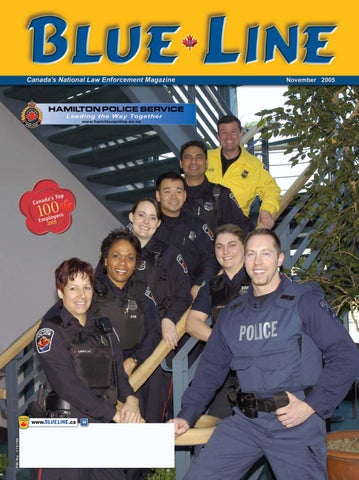
Shown on this month’s cover are Hamilton Police officers Phil Fleming, Kevin Dhinsa, Tony Chu, Hannah Carter, Sheri Nelson, Nancy Lantz, Angela Weston and Marty Schulenberg. Their smiling faces best exemplify this month’s lead story. For the past several years the Hamilton Police Service has been chosen as one of Canada’s top 100 employers. In an era when many police services are looking to hire and retain staff, Blue Line felt there would be some valuable lessons to be learned from their experience. The results of this investigation can be found beginning on page 6 this month. Hamilton is featured in a second story this month in the communications and technology sector with its new ‘Beat Tracker’ system, which links officers on the street with incidents and calls accumulated in their patrol sectors. The simple system has increased the effectiveness of beat officers in responding to community needs and issues. Every police officer should understand the basic principles and procedures of blood splatter analysis, says veteran investigator and crime scene reconstructionist Louis Akin in introducing his ‘blood splatter primer.’ Interpreting this evidence correctly can reveal important information at crime scenes. Shrinking budgets and rising expectations have forced public safety agencies to work together with each other and the public. As Bob Brown and Doug LePard note, accomplishing this goal requires inspiration, leadership, co-operation and perspiration but the result – safer communities – is worth the effort. In our regular features, technology editor Tom Rataj looks at going wireless with Bluetooth, Mike Novokowski has case law and Dr. Dorothy asks if issuing warnings about sex offenders helps protect families or simply spreads fear in the community. Public and media relations correspondent Mark Giles ponders the fine line between situations where police and military personnel die in the line of duty or where their actions or luck keep them alive – and the markedly different treatment the cases receive. NOVEMBER 2005
Blue Line Magazine
4
NOVEMBER 2005
A price so high... a love so deep... a peace so long by Morley Lymburner This year marks the 60th anniversary of the end of the Second World War. Canada has declared 2005 the ‘Year of the Veteran’ and the new war museum opened in Ottawa with special significance, reminding us of all the efforts made by so many to defend our country. Each year we struggle to remember Remembrance Day as anything special beyond a symbolic one minute of silence in our public schools, on the eleventh hour of the eleventh day of the eleventh month. As in most things in life, our memory becomes cloudy with time. As younger generations grow into adulthood, their perspective on this subject has deteriorated to an academic level which could be described as neglectful. What was it like for a young man from small town Canada to be introduced to the stress of wholesale slaughter? To see, on a daily basis, his colleagues cut down, with the expectation of having to do some cutting down of his own? The need to care for the mental health of first responders and the military is a relatively new phenomenon. What counsel did wartime soldiers receive to relieve the trauma and stress of what they experienced? Stress! What was it like to come home only half the man you were when you left, both physically and mentally? To start all over again when you could barely remember what you did before that great mess began? These young men knew they had to get their lives back in line with a ‘peace-time’ world. Many police officers can relate to their experiences. Cops understand that receiving solace from officials, family and friends pales to the attention fellow officers give and receive. Like their war-time counterparts, cops can find it much easier to stand shoulder to shoulder beside the people who have shared experiences and stresses – but I have found there is a watershed of experiences that can cause an opposite effect. Each year I remember stories from many of these old warriors. As much as I experienced as a cop, I cannot completely comprehend what it was like to be in my uncle’s shoes as he laboured in the engine room of a Corvette in the cold North Atlantic. The shear terror of hearing the engine-room doors locked and sealed for battle readiness as the captain ordered an attack on yet another U-Boat is something I will fortunately never feel. Suffice it to say he never wished to go to an annual Haida reunion to relive the events. I remember the stories of a much decorated neighbour who fought in almost every major battle. The stories came from neighbours, never Blue Line Magazine
Canadian War Museum — Ottawa
from him. He never marched in the parades and his numerous decorations for bravery remained in a drawer. I also remember how he died an alcoholic. He was never physically alone but he must have felt his memories were something only he should bear. The story that made the biggest impression on me was told by a minister friend, who probably felt I could understand. He flew Hurricanes in the famous Battle of Britain. During one particularly fearsome dog-fight, he saw a friend attempting to land his plane, which was
5
on fire. He immediately landed beside him in a field, hoping he could assist, but the plane was engulfed in flames by the time he rolled to a stop. His friend was screaming and trying to open the canopy, which had become stuck. John tried his best to get close enough to help dislodge it but was forced back by the intense heat and flames. In terror, he realized what his friend was yelling at him – he wanted to be shot. John struggled with this, the final wish of a dying friend, then drew his gun and managed to find the courage to end his suffering. There is no better teacher than experience, he explained. Those who have not lived through the horrors of battle will never truly understand or be able to judge the variables of war, no matter how hard they try. I felt truly honoured that this man trusted me enough to share this story. Stress! Do we really know what it means? This year, take some time to remember. Wear a poppy with pride or visit the new war museum, if only to thank those old guys, and all the young friends they left behind, for the years of peace their blood and courage bought us.
NOVEMBER 2005
by Ryan Siegmund Renowned for its steel industry, the City of Hamilton is now also becoming well known for its police service as one of Canada’s top 100 employers for the fourth straight year. Canada’s tenth largest city is policed by the sixth largest service in Ontario, responsible for patrolling a 1,138 square kilometre area and home to nearly 500,000 residents. The Hamilton Police Service (HPS) began a “metamorphosis” about 14 years ago, says chief Brian Mullan, shifting from a reactive force to one which follows the principles of community based policing. It also became one of the first police services in the country to begin formalizing its strategic business planning, developing a vision, mission and values statement and determining core functions. “We tried to get deeper and deeper into this concept of a value based organization during those ensuing years,” says Mullan. “Through internal educational forums, re-enforcement in regards to our performance evaluation, our promotional system, as well as through our hiring, we started to change as an organization. “When you are comparing police service to police service, I consider ourselves to be a value based organization... (We are) not only guided by policy, procedures, standards and regulations, but our members make decisions and live their lives based on organizational values they have agreed to follow.” These values led to the HPS being recognized as one of Canada’s top 100 employers Blue Line Magazine
for the fourth straight year by MediaCorp Canada. Over 1,000 employers, including several police agencies, were asked to complete an extensive application process that included a thorough review of their operations and human resources practices. Among the qualities MediaCorp highlighted: • HPS cares deeply about its employees’ work life balance – and even has a special family issues committee, responsible for improving work life issues • Generous maternity top-up and an extended leave program • HPS encourages employees to experience a variety of jobs with the service • HPS operates its own in-house charity, supporting more than 25 local community organizations The criteria for consideration placed heavy emphasis on an employer’s charitable efforts and community involvement, just one area in which HPS has made significant strides over the years. “When I reflect back as to how we evolved as an institution, it is all about having the ability to attract the best,” says Mullan. “When we talk about having the vision to be the best, we use that thought process towards everything we do. We try to hire the best, promote the best and if someone is not performing to the level they are supposed to perform at, we will try and deal with that through remedial efforts, training and through punishment. Mullan says there are many factors that have attributed to HPS’s progression and recognition as a top 100 employer of the last four years. He specifically highlights the service’s career development plan, as a best practice that has been examined by police services nation6
ally. He credits this initiative to broadening the expertise of officers and a reason why they have had such a successful retention rate. MediaCorp measured eight key areas, graded each applicant using industry standards. Here’s how Hamilton scored. Training & skills development: A+ HPS subsidizes tuition for courses even if they’re not related to a member’s current standing, and encourages career development by reimbursing professional association dues and mentoring and in-house training costs. Courses are offered in collaboration with the Hamilton Police Association and include computer skills, firearms, front-line investigative techniques and stress management. Performance management: A Managers meet with members every year to review their work. Supervisors, who are trained to be effective reviewers, issue midyear progress reviews. A formalized appeal process allows officers a chance to make their own comments. Members are recognized for exceptional performance and are eligible for monthly and yearly honours and community service/safety awards. The service also recognizes length-ofservice, promotions and retirements. Community involvement: A+ The HPS supported some 100 charitable groups, both local and national, last year. Members have a say in which charities are selected and receive paid time off to volunteer locally. Many also help organize, raise money and volunteer – on their own time – for numerous charities. NOVEMBER 2005
Blue Line Magazine
7
NOVEMBER 2005
Employee communications: A The HPS publishes the ‘Police Informer,’ an inhouse newsletter which updates officers about current developments, and maintains an intranet site to keep them up to speed on news and human resource policies. An external consultant compiles the results of an employee satisfaction survey, taken every three years, and submits it to managers. Employee feedback is also collected every three years through the business plan development process. Community and member needs shape the plan, which is determined through a public process. Internal and external communication was one of the areas highlighted in the 2003-2006 HPS business plan. Some 1,400 surveys on the service’s strengths and weaknesses, opportunities and threats were filled out by residents. Internal and external questionnaires revealed interesting differences, notes Mullan. “We thought we were doing such a great job in regards to external communication but people externally were telling us that, in fact, it wasn’t so great – so we had to improve that. Our members here were saying we do a great job externally but a lousy job internally, so the reality was we had to improve both internal and external communications. In the last strategic plan, we were able to alter some of the things we were doing in order to meet the community needs better.” The service’s commitment to intelligenceled policing, another plan objective, began to pay off last year. “We were able to show the single greatest decrease in crime out of any major municipality in the country,” proclaims Mullan. “Overall, we had a 13 per cent reduction in crime and I really credit that to the hard work of our front line officers, who have taken on the concept of intelligence led policing.” Mullan credits the partnership the service has with the community with helping to reduce crime, noting Hamiltonians are very willing to speak up about issues in their city. The force encourages this through public forums, held once a week for two months in different areas of the city. They have strengthened community support, helped the service ensure it was meeting community needs and highlighted strengths and weaknesses, says Mullan, who attends the forums and tries to set the tone for honest and open communication, which is one of HPS’s organizational values. The business plan process also uses town hall meetings, statistical analysis, internal and external forums and considers national crime trends; the resulting document becomes a reference for all members, he says. Physical workplace: A+ Members in the city’s four divisions are offered personalized workout programs and access to fully equipped exercise rooms. Membership is free and facilities have treadmills, Blue Line Magazine
stationary bikes, stairmasters, rowing machines, weights, basketball courts, saunas and shower facilities. Fitness evaluation and training programs are also available. The service’s employee lounge and rest areas, which feature comfortable couches, TVs, pool tables, sleep rooms and Internet kiosks, were also recognized by MediaCorp. There’s also a kitchen, outdoor eating area and barbeque. Open-concept workstations, ergonomic workstation design and access to natural light for all employees were other features it noted. Members are given input into the design and purchase of new police vehicles and equipment and the HPS headquarters is located downtown, a short walk from the city courthouse. Work atmosphere and social: A When applicable HPS members dress in casual business attire and are permitted to listen to the radio or music while working. A ‘social and retirement committee,’ which has operated since 1978, organizes a range of popular social events annually, including a family Christmas party, held at Copp’s Coliseum, volunteer awards banquet and police retirement dinner. Members can also participate in athletic activities, including hockey teams, dragon boat races, women’s football and the annual ‘Cops and Cats’ basketball tour with players from the Hamilton Tiger Cats. Vacation & time off: B+ The Top 100 Employers’ survey rated HPS’s vacation and time off as average. New members receive two weeks of vacation after their first year, increasing to three weeks after three years of service. Long serving members get a maximum of nine weeks vacation and members can apply for unpaid leaves of absence. Health, financial & family benefits: A HPS pays the full premium for health benefits for employees and their families – even retirees. New members are not subject to waiting periods for eligibility. The plan covers routine dental work with no annual maximum and 80 per cent of restorative dental (up to $2,000 a year) and orthodontics (lifetime maximum of $2,000). Outside surveys and individual member salaries are reviewed every 12 months to keep 8
pay levels competitive. Performance bonuses can reach nine per cent of salary, depending on tenure. Members on maternity leave are paid 75 per cent of their salary for the first 15 weeks, up to 75 per cent for the following 10 weeks and are provided access to a nearby daycare facility. The service’s new Mountain Station has a daycare on site. The HPS operated family issues committee develops programs to help employees balance their work and personal lives. Mullan says the key to success is ensuring employees have the best possible working environment. “We try to provide as much support as we can to individuals within the organization so they can flourish and thrive not only professionally, but also within their off-duty life and home environment. We give opportunities for people to volunteer, committees are struck that examine issues related to family... (and) our board has ensured our wages and benefits are comparable to the best in the province. “What we are trying to do is create an environment where people work and act professionally, provide quality service and allow them to achieve their dreams. When you put all those ingredients together... people inside the organization will thrive and the organization as a whole will begin to reflect that. It is really important for organizations to examine how they treat people internally because when people are not happy, quite often it affects their performance within the community.” HPS is basically a customer service organization, Mullan says, and its people have to feel good. “We are the only police service to have ever been identified as a top 100 employer. You just have to look at the many assets people have within the organization. We give everyone who works here an opportunity to expand their career, move forward and find a fulfilling job and we do that by our career development plan. “We are not the ones who decide where people end up – it is the member themself who works towards where they want to go and they are allowed to apply to these positions. Ultimately, what I want as an organization is to give people as many opportunities as they want or can have.” HPS Chief Brian Mullan can be reached at bmullan@hamiltonpolice.on.ca.
FAST FACTS • Provides policing services to over 512,000 residents • Deploys 720 police officers and 263 civilian members • Operating budget for 2004 was $98,218,270 • In 2004, responded to over 84,800 calls for service and handled 40,541 reported offences • Hamilton saw a 13% decrease in overall crime in 2004 • HPS has one of the lowest employee turnover rates in Ontario
NOVEMBER 2005
Blue Line Magazine
9
NOVEMBER 2005
Taking ownership of your beat Up to date stats and information co-ordinates efforts by Ryan Siegmund New software is helping front line Hamilton police officers target problem areas and tailor beats to increase their effectiveness. Beat Tracker, a new geographical crime mapping system, profiles community hot spots and has helped the Hamilton Police Service (HPS) redesign its patrol deployment model to better promote proactive policing and increase officer accountability. A lack of timely intelligence and poor information sharing between beat squads impaired community policing in Hamilton. The new software is bridging this gap and alleviating some of the communication problems, says HPS Superintendent John Petz. Front line officers don’t have a lot of time and needed something “quick and dirty” – simple to use, readily available and able to automatically process crime data, which was often skewed and outdated. Launched in May, Beat Tracker’s up-todate, geographical profiles allow officers to map crimes in their beats. It reads information from HPS’s CAD system, which in turn provides data on crimes that officers may query. Once an offence and a time frame is selected, red squares representing those crimes appear on a geographical mapping system. Accessible through HPS’s intranet service from any desktop, the software offers 24 hour upload and provides officers with crime analysis information they can review before starting each shift. “What makes this a Canadian first is that it’s available to the front line officers,” explains Petz, “and we have designed it as such so that they can get access to data very quickly and to data that is timely and accurate. “If we see a trend developing in a particular neighbourhood – whether it be break and enters, drugs or robberies – we are now going to put our resources there. Now if that is biasing, that’s exactly what we are trying to do because the resources are limited and we need to
put them in the right spots – something we haven’t been able to do in the past. “It’s all about leaving the front door of the station with a plan and not just waiting for the radio to send you someplace. If you have a plan, and you have the time to address the problem, your chances of making an arrest or solving a problem are higher because you know where to go. We have learned that just general patrols do not work.” Quality of life issues There was a lot of discussion about community policing as HPS worked on its 1997-2000 business plan. Patrol officers said they knew what was expected of them but couldn’t deliver, since they were just going from call to call; it was clear that systemic changes were needed. The service did a very good job of responding to emergencies and investigative support, notes Petz, but struggled with quality of life issues, though it wasn’t immediately clear why.
HPS’s re-engineering committee looked into the matter and began working to redesign the way officers were deployed. It became clear that officers were policing without sound information, simply reacting to crimes – a direct result of outdated, manually processed crime data. “I’d get April stats at the beginning of May and I’d say ‘holy mackerel, B&Es are up in this area, we’ve got to do something about it,’” recalls Petz. A task force would be quickly put together and “a month later, I get the stats back and ‘wow, they are cleared up.’ The problem is, I don’t know if it went away before I even started the task force because the data was 30 days old. I think I did a good job but it may have moved on its own... there was no proactive side to it.” Furthermore, there was no communication between the four beat squads within the division. Each squad viewed itself as a complete unit, setting its own goals. Squads felt they owned their beats, but only when they were working them. “That is another reason why we couldn’t handle the quality of life issues; the B&Es in your neigbourhood, cars getting ripped off – you can’t address those things unless you consistently monitor them on a 24/7 basis,” says Petz. “If only (one) squad realizes it’s a problem and they are not sharing it with the other officers, it will never get solved.” Intelligence-led policing The solution was intelligence-led policing using a Geographic Information System (GIS) and crime mapping tools. While HPS needed access to timely and accurate data, it also wanted to make the information accessible to
Blue Line Magazine
10
NOVEMBER 2005
Blue Line Magazine
11
NOVEMBER 2005
front line officers as well as crime analysts and strategic planners, who required more sophisticated applications. The Beat Tracker mapping system features a quick filter option, allowing users to map out criminal offences in increments from 24 hours all the way up to one year. The software also has an ‘identify events’ option which brings up tombstone information such as the CSC number, date and time of an incident and where it occurred. “In a nutshell, Beat Tracker allows the beat officer to map out crimes in his or her beat and from that, make strategic plans,” says HPS Cst. Rennick Berkeley. “Even if I was new to that beat and unfamiliar with all those streets – now I have a personalized map and can check out all the hot spots. “If I’ve been off for two weeks holidays, I can bring up data from the last 30 days, which will give me an idea of what happened. You really have to break it out over a week or so to see a trend happening, because it’s the trends that interest us. Once you see a trend – you are biased – now you put resources into that area because the chances of me getting somebody for that particular offence are pretty good.” Officers can create their own custom maps; staff sergeants have been printing maps showing crime trends to take to community meetings, increasing public awareness of problem areas. “A picture is worth a thousand words,” says Berkeley. “If I show you a map, it kind of hits close to home and draws the community into it, as well as addressing the community based
Blue Line Magazine
policing idea.” HPS hopes patrol cars will eventually be able to wirelessly access the system; that’s not possible now because of bandwidth restrictions. Beat Tracker is being used in the city’s east end as part of a pilot project until December, when a decision will be made about rolling it out to the other two patrol divisions. Geographic ownership Beat officers didn’t used to access crime data because they had no sense of ownership, Petz says. “We proposed the geographic policing model, where we actually assign teams of officers to a particular beat and say ‘that is your beat, that is your priority,’” he says. “We are saying it doesn’t matter that you
12
are on different squads because you need to work as a team and we are holding you accountable for the health of the geography that you are assigned... we want the officers to actually feel for their areas and their assigned beats.” The eight officers assigned to each of the four beat squads now all answer to one crime manager, who proactively looks after the problems of a particular sector. If there is a problem, the crime manager alerts each officer and gives them the information needed to help solve it. “This is what will solve the quality of life issues,” says Petz. “You can’t really problem solve anything until you have all the data needed to see how big your problem is, or where your problem is. From the trend reports I get from the crime analyst, I can see which beats are up, which are down and I can determine where we are being effective, and where we are not, as an organization.” Still in its early stages, HPS wants to integrate Beat Tracker with in-house products — a new records management system, for example. In the meantime, officers are free to use it whenever they want. “The whole trick to this is not just to make the tool available but to create the desire to use it, and that is where the re-engineering builds that geographic ownership to make officers care – make them want to care and make them want to use it,” says Petz. For more information contact: Rita Lee Irvine; Corporate Planning Branch Manager; 905-546-3868, rleeirvine@hamiltonpolice.on.ca
NOVEMBER 2005
Blue Line Magazine
13
NOVEMBER 2005
by Louis L. Akin Blood spatter analysis is an important part of contemporary crime scene investigation. Every officer should at least understand the basic principles and procedures and be able to correctly record data for later interpretation by a blood spatter analyst. A basic understanding enables the officer to correctly collect blood stain data at the scene or from photographs of the scene, and intelligently converse with the Crown attorney, medical examiner, homicide detectives, and experts on blood evidence. This understanding is important, because the interpretation of blood spatter patterns and other evidence at crime scenes may reveal critically important information such as: • The positions of the victim, assailant, and objects at the scene • The type of weapon that was used to cause the spatter • The number of blows, shots, stabs, etc. that occurred • The movement and direction of victim and assailant, after bloodshed began • It may support or contradict statements given by witnesses. The investigator may use blood spatter interpretation to determine: • What events occurred • When and in what sequence they occurred • Who was, or was not, there • What did not occur Fortunately, the procedures are not complicated and, while it is easier to use software to make the calculations, the process for doing it with a hand-held calculator can be learned from a source as brief as this article. Blue Line Magazine
Velocities of blood spatter The velocity of the force that caused blood spatter to strike a surface is used to indicate the speed of the force which set the blood in motion, (not the speed of the blood itself). The speed of the blood is measured in feet per second (fps); low velocity blood may drip from a wound as a result of gravity, while high velocity blood may be caused by a bullet moving at 900 fps.
in the trail of a person who is bleeding; larger pools may indicate where they paused. Medium velocity
Low velocity
Low velocity stains are produced by an external force less than five fps (normal gravity) and the stains are three milimetres and larger. These usually result from blood dripping while a person is still, walking, or running, and sometimes from cast off. Dripping blood often falls at a 90° angle and forms a 360° stain when it hits a flat perpendicular surface, depending on the texture of the surface. Spines can be caused by drops repeatedly landing in the same place, by the distance the drop falls, or by the surface upon which it lands. Low velocity blood may also be found 14
Medium velocity blood spatter is produced by an external force greater than five fps and less than 25 fps. The stains generally measure one to three milimetres in size, and are often caused by blunt or sharp force - that is, knives, hatchets, clubs, fists, and arterial spurts. Most medium velocity blood found at crime and accident scenes will be patterns created by blood flying from a body to a surface after blunt or sharp trauma, or the body colliding with blunt or sharp surfaces. It may also be caused by a punch, stabbing, or a series of blows or in the case of an accident, the body striking surfaces inside or outside a vehicle. A void space may be created by anything that blocks the blood from falling on the surface where it would have landed. The object creating the void may be the victim or the attacker’s body or a piece of furniture that was moved to stage the scene. NOVEMBER 2005
High velocity
Point of convergence (POC) The POC is the intersection where lines drawn through the centre of the individual stains meet (at the X-Y axis intersection) and is determined by drawing lines or strings through the long axis of individual spatters as seen in Figure 2.
Figure 2 Lines through the central axes of the spatter cross at the POC. High velocity blood spatter is produced by an external force greater than100 fps and the stains tend to be less than one milimetre. The patterns, which are sometimes referred to as a mist, are usually created by gunshots or explosives, but may also be caused by industrial machinery or even expired air, coughing, or sneezing. In any case, they tend to be tiny drops propelled into the air by an explosive force. High velocity droplets travel the least distance because of the resistance of the air against their small mass. Theory of blood spatter interpretation Angle of impact (AOI) Experiments with blood have shown that it tends to form into a sphere rather than a teardrop shape when free falling or projected in drop size volumes (approximately 0.05ml or 20 drops per millilitre, though some are larger or smaller). The formation of the sphere is a result of surface tension that binds the molecules together in a liquid form, rather than letting them disperse as a gas. This shape is critical to the calculation of the angle of impact of blood spatter, which will be used to determine the point or area from which it originated. Determining the AOI and placement of the point of origin (PO) should be based on a number of spatters; ideally they will provide an arc of reference points, creating a triangulation effect. The process for determining the AOI is not complicated. When a sphere of blood strikes a flat surface the diametre in flight will equal the width of the stain on the surface (which is equal to the opposite side of a right triangle), as seen in Figure 1. The length of the spatter will be equal to the hypotenuse of an inverted triangle.
Determining the AOI The next step in the process is determining the AOI for representative bloodstains. The traditional way to calculate this is with a handheld calculator. The problems with this are that 1. It allows for entry errors, 2. The user must remember the trigonometric formulas, and 3. It doesn’t store or print out the calculations. The latest software eliminates these three problems. The data is posted to a screen so that errors can’t be made and the software knows the formulas and does all the calculations automatically. The information is stored digitally so that it can be printed, e-mailed, or faxed and easily readable Word documents which can be used by any agency or investigator. The software method of analysis When using medium or high price range software, performing the calculations to determine the AOI and PO are as simple as filling in the blanks. The user can just enter the length and width of the representative blood stains and the distance to the POC and the AOI and PO appear instantly on the screen. Blood spatter analysis software programs range from $149 to $2,000. There are free versions of this calculator on the Internet.
The traditional method of analysis Since the opposite and hypotenuse of a triangle are the same as the length and width of the stain the AOI will necessarily be the same as angle “a” inside the triangle (See Fig 1). The AOI is the inverse arc sin of the width/length (W/L) ratio, so first calculate the ratio W/L then SIN -1 (2nd function) to get the degrees of “a” and AOI. Lines drawn through the central axes of the blood drops can be laid flat to show where they converge and then raised to show points of hemorrhage. The Z axis The Z axis is perpendicular to the surface on which the POC is located. It is easiest to imagine in relation to a floor, in which case the Z axis would equal the backbone of a person standing up. However, the measurements may also be taken from a wall or furniture surface. With a wall, the Z axis would be perpendicular to it. If blood spatter was also on the floor, then the perpendicular Z axis from the floor and wall would cross where the points of hemorrhage meet. Once the POC and the AOI have been established, the next step is to locate the point of convergence three dimensionally, which will require a perpendicular axis and is ordinarily dubbed Z. While the POC is perpendicular to the two dimensional intersections of the X and Y axes, the PO is located above the POC on the perpendicular axis, 90 degrees perpendicular to the floor. It is the point from where the blood hemorrhaged or was disgorged from the body. The formula to determine the PO on the Z axis is similar to the one used to establish the AOI except that the tan function is used. First, measure the distance from each blood stain along its central Y axis to the POC. Then take the tan of the degrees of the AOI. Third, multiply the tan of the AOI by the distance along the Y axis. The answer will be the height on the Z axis of the point of origin. Louis L. Akin, LPI, is a licensed professional investigator and writer in Austin, Texas with 23 years experience in investigation and crime scene reconstruction. Louis can be contacted at 512-477-2546.
Figure 1 Side view of blood drop in air, and then striking a flat surface Blue Line Magazine
15
NOVEMBER 2005
Going wireless with Bluetooth by Tom Rataj When Danish King Harald Blåtand unified the previously warring tribes of Norway, Sweden and Denmark around 940, wireless communication consisted of smoke signals, a few brass and animal horn instruments, drums and the human voice. When the new Bluetooth wireless technology, named after him, was first proposed in 1998, wireless communication had already advanced significantly. Unfortunately, it hadn’t done much to help the cable clutter around the typical desktop computer system. Although a number of proprietary cable replacement technologies already existed, the actual products using them tended to be expensive, power hungry devices. To overcome these problems, Ericsson Telephones of Sweden developed the base specifications for a new short-range cable replacement technology that provided a universal, unified standard. Working with the unification theme demonstrated by the late Danish King, they chose to call the new technology ‘Bluetooth,’ the English translation of his surname. Continuing in the Nordic theme, they developed a logo consisting of a combination of the Nordic runes for the letters H and B. Ericsson and eight other major international
Blue Line Magazine
computer hardware and software vendors – 3COM, Agere, IBM, Intel, Microsoft, Motorola, Nokia and Toshiba – founded the Bluetooth Special Interest Group (SIG) to promote and manage the developing standard. The original group has now been bolstered by roughly 3,000 other companies that were licensed to develop or manufacture Bluetooth products. Bluetooth wasn’t meant to replace or compete with wireless computer networking, commonly known as WiFi, but to provide a cheap and reliable two-way wireless connection for exchanging small amounts of data between components over short distances. Despite extensive industry support, implementation and adoption has been slow, particularly in North America. This has begun to change with the arrival of new Bluetooth enabled products. The recent introduction of version 2.0 of the technology, which offers many improvements, particularly in speed and security, will likely further advance market penetration and share. Why Bluetooth? Anyone who owns or uses a personal computer is all too familiar with the rats-nest of wires and cables around the back – cables for
16
keyboards, mice, printers, scanners, cameras, phones – the list just continues to grow. Typically a shortage of USB ports on a computer requires users to repeatedly connect and reconnect peripherals. This can be quite a chore, since computers are typically on the floor or under the desk and all or most of the USB ports are on the back. Bluetooth wireless technology can clear away much of this mess by making all these connections without wires. It is as simple as plugging a USB Bluetooth adapter (also called a ‘dongle’) into an available USB port and accepting the required configuration changes. A single USB Bluetooth adapter can simultaneously support up to seven devices, making it very versatile. Both Microsoft Windows XP and Apple OS X have Bluetooth wireless technology built in and are designed to work seamlessly with it. Most implementations of Linux also offer support. Numerous vendors, including Microsoft and Logitech, manufacture Bluetooth enabled keyboards and mice. Most new personal digital assistants (PDA’s), such as PalmOne and iPAQ devices, are also Bluetooth enabled. Where Bluetooth technology really shines though is with cell phones. Many new phones
NOVEMBER 2005
finally support it, primarily for use with wireless headsets. While wired headsets are generally convenient, they can be a hassle to set up and the wire can easily become tangled. A Bluetooth headset, on the other hand, just needs to be turned on, hooked onto or inserted in the ear and it’s ready to use. With a typical range of ten metres, the phone can easily be left on a desk or table while the user moves around the room. In a mobile environment, the phone doesn’t need to be held in the user’s hand, somewhat improving safety. Technical stuff Bluetooth is an industrial specification for personal area networks (PAN’s). Its technical specification is IEEE 802.15.1. Bluetooth devices work in the same unlicensed 2.45 GHz radio frequency as WiFi networks, although they subdivide the frequency into 79 individual channels to avoid conflicts. The standard uses an efficient time-sharing, frequency-hopping design and small data packets to ensure reliable, high-speed communication between devices. There are three types of Bluetooth devices: Class Three use only one mW and have a range of about one metre, Class Two use 2.5 mW of power and are good for 10 metres and Class One use 100 mW and work up to 100 metres. First generation devices were rated at a maximum data rate of 723.1 kbit/s, while the just arriving second generation increase that to 2.1 Mbit/s (this compares to the latest 802.11g WiFi networking rating of 54 Mbit/s). A single ‘master’ Bluetooth device can connect with up to seven ‘slaves,’ depending
Blue Line Magazine
on configuration, although only the master and one slave can communicate at once. Such a group is known as a piconet. Several piconets can be connected together into a scatternet and communication can occur between all the connected devices. Up to eight Bluetooth enabled laptops or PDA’s can be used to create an ad hoc piconet to exchange small amounts of data when they’re in close proximity, such as during a meeting, further enhancing the versatility of Bluetooth. Security issues Each Bluetooth device has a unique electronic serial number, allowing for secure communications. A cell phone and a Bluetooth headset, for example, can be ‘paired’ by a user, so that only a specific phone and headset will work together. These paired devices can also encrypt all communication between each other so that other devices, or people with equipment capable of intercepting Bluetooth communications, cannot readily listen in. Some early generation Bluetooth devices could be hacked using such processes as ‘Bluesnarfing’ and ‘Bluebugging.’ Most of the known security issues have been addressed as the technology matures. Bluetooth offers a simple, low-cost solution for connecting a large variety of electronic devices without the need for specialized cables or software. Its low power consumption and versatility make it an ideal technology for an increasingly connected world. Tom Rataj is Blue Line Magazine’s technology editor and he can be reached at technews@blueline.ca
17
I totally enjoyed your article on the Job Hazard Analysis for Customs Investigators and Intelligence Officers. (Ottawa’s “runaway” Philosophy - Aug Sep 2005 issue) You were very accurate in your statement regarding that the analysis was ‘guided.’ The consultant was told this is the answer, now you fill in the rest. The federal government has said that they don’t need another police force. Twice they have gone down the JHA road, once for Customs Inspectors, now for Investigators and Intelligence officers only to reach the same conclusion - they don’t need firearms. If the job wasn’t dangerous, why are they issued body armour? Why was a police tactical squad deployed to the borders in the Niagara Region several weeks ago? It can’t be because there was any danger because that would mean that the JHA’s were flawed. Unfortunately society has become more dangerous. With that being said, it’s only common sense that the men and women who protect our borders be allowed the right to protect themselves. Being armed doesn’t make Customs a police force - both fisheries officers and forest rangers carry firearms and they aren’t considered a police force. They carry them because their jobs are dangerous. Being armed allows the officers to protect Canada’s borders and themselves. — Mike Walker
NOVEMBER 2005
Protecting the community requires co-operation by Bob Brown and Doug LePard Public safety is vitally important to all Canadians, yet resources are shrinking relative to the ever-increasing challenges and public expectations of accountability have never been higher. One positive result of these changing dynamics is increased cooperation and collaboration between public safety agencies, regardless of their disparate mandates. Further, collaboration between criminal justice agencies and the public is increasing in a variety of ways. Commitment to increased collaboration is evident from infrastructure changes to grassroots initiatives. For example, a ceremonial signing of the British Columbia Police Code of Ethics document was held in January at the Justice Institute of British Columbia (JIBC). The code “outlines fundamental principles, guiding values and primary responsibilities that guide and govern the conduct of police officers in their relationships with the public, the policing profession and its partners and themselves, personally,” according to the JIBC web site. Here’s an excerpt from the code: In addition to the policing profession, we are responsible to other professions that also serve the public. We must always co-operate with other police and law enforcement professionals and with all those in the criminal justice system in order to develop an open, just and impartial justice system. As well we must always strive to co-operate with other public service professionals in order to advance the public good. This involves the sharing of information in a relationship-building manner that celebrates the interdependent nature of professionalism promoting the goals of the justice system.
Blue Line Magazine
The Correctional Service of Canada (CSC) Mission Statement is consistent with the BC ethics code, stating that the service is part of the criminal justice system and respects the rule of law. It helps protect society by “actively encouraging and assisting offenders to become law-abiding citizens, while exercising reasonable, safe, secure and humane control,” the statement highlights. The statement “offers practical guidance for today and inspiration for meeting the challenges of tomorrow,” according to its introduction. “Along with other law enforcement agencies across the country, we are committed to the protection of the public and the maintenance of a just and peaceful society,” according to Public Safety and Emergency Preparedness Minister Anne McLellan. “We are all partners working towards one ultimate goal: building strong and safe communities.” Clearly, community safety is both a present and future challenge, one which was readily accepted by the leadership of the Pacific Region of the National Joint Committee(NJC) of Senior Criminal Justice Officials at their meeting in August 2004. The Pacific Region routinely breathes life into the NJC Mission Statement, which highlights “the promotion of effective partnerships to improve the administration of criminal justice in Canada.” Effective partnerships need the full co-operation of all those involved. Striving for cooperative interdependency need not undermine the partners’ respective independence. The right leadership can shift the theoretical and inspirational to the operational. Oliver Wendell Holmes suggested that people can be divided into two classes: those who go ahead and do something and those who sit still and inquire why it wasn’t done the other way. Here are some examples of where inspiration shifted to perspiration, resulting in enhanced community protection: • All convicted sex offenders are registered with the police under the Staffordshire, England MAPPA program (Multi Agency Public Protection Arrangements), reported David 18
Griffiths, head of business development of England’s National Probation Directorate. They cannot move without police permission; police and parole officers monitoring the most dangerous offenders work out of the same office to better co-ordinate their efforts. The program dramatically reduced the risk posed by such offenders – 98.7 per cent complied with registration and monitoring procedures, according to a July 2004 report. • The National Resource Center for Police-Corrections Partnerships (NRCPCP), established in 2004, was created to deliver a partnership framework for law enforcement and community corrections agencies at five regional locations throughout the US. NRCPCP promotes sustainable partnerships between police and community corrections agencies through training focused on building and maintaining partnerships. Criminal justice agencies must work together to maintain and improve the effectiveness and efficiency of each other and the administration of justice as a whole, according to Penal Reform International (PRI). All agencies have their own specific objectives and mandates and sometimes these can conflict, but in the end can be expected to work towards the same overall goal – fair administration of justice for all. Most agencies are interdependent and cannot achieve their specific objectives — or in some cases even exist — without the others, PRI notes. This mutual dependency makes interagency co-operation essential. Of course, this is not to say that criminal justice agencies should surrender their independence but simply identify objectives they share with others in the criminal justice system. Lastly, interagency co-operation should not be viewed merely as a ‘project,’ which, by their very nature, are limited in time, purpose and scope, PRI states. Interagency co-operation is an infinite affair, necessary to maintain the chain, part of the ordinary day-to-day operations of all criminal justice agencies. The basic mission for which the police exist is to prevent crime and disorder, according to Sir Robert Peel, the father of modern policing. In viewing the crime prevention ‘mission,’ University of Ottawa Criminology Professor Ross Hastings cautions against the potential for “the overreliance on community and partnerships.” He highlights among his concerns that “participants in partnerships bring different expectations and capacities to the table and those with the most power can exercise disproportionate control. In practice, this can mean that partnerships serve their interests as much as those of the community.” Notwithstanding this legitimate concern, strong leadership should and can mitigate any potential shortcomings. NOVEMBER 2005
Leadership is also fundamental to our collective criminal justice system mandate— protecting the community; that requires inspiration, leadership, co-operation and ‘perspiration.’ The NJC organized a partnered ‘community protection conference’ and ensured various system components were well represented both as delegates and presenters. Community participation was also deemed critical. This venture was accepted in partnership by the following three primary agencies: • British Columbia Crime Prevention Association (BCCPA) • British Columbia Association of Chiefs of Police (BCACP) • Pacific Region National Joint Committee (NJC) The two-day conference, entitled ‘Community Protection is Paramount: Coordinating the System’s Response to High Risk Offending,’ was held in Richmond, BC in Feb. 2005. The theme evolved around two primary criminal justice goals: community protection and crime prevention. It was accepted that system co-ordination was critical to achieving these goals. “This conference is another example of how much more we can accomplish when we engage in true consultation and when we work together towards a common goal,” said Chief Constable Jamie Graham of the Vancouver Police Department. “We all recognize the need for independence, but we also know that we are interdependent as well. Each of our agencies – whether we’re in law enforcement, cor-
Blue Line Magazine
rections, the Crown, or even offender-supporting groups – serves the same customer: the public. While we approach public safety from different angles, our end goal is always the same: public safety for everyone. We can best achieve that objective by working well with each other and with the community.” The conference “marked a significant step in enhancing our service’s partnerships with other criminal justice agencies, including the police, the Crown and provincial corrections,” noted Don Demers, CSC Pacific Region Deputy Commissioner. “We are tied by a common goal and that is to protect the community. All the various criminal justice components contribute to our objective of safer communities, but we can achieve so much more by staying in close contact, keeping each other informed and in working more closely together.” The critical issue now facing the numerous partners involved is ensuring the positive momentum does not falter. Interagency co-operation must be an infinite affair and we must find more ways and means to enhance our constructive interdependency while maintaining our respective independence. Accomplishing this worthy goal requires inspiration, leadership, co-operation and perspiration, but the contribution it can make to safer communities is well worth the effort. Bob Brown is with the Correctional Service of Canada; Doug LePard is Deputy Chief Constable of the Vancouver Police Department’s Investigation Division.
19
NOVEMBER 2005
Police can detain to investigate by Mike Novakowski A provincial high court has again affirmed the right of police to detain suspects for investigation, short of arresting them. In R. v. Chaisson, 2005 NCLA 55, a police officer saw a lone vehicle with two occupants parked in a dark area of the rear parking lot of a closed gas station just after midnight. There was a 24-hour donut shop and a closed restaurant nearby. The officer pulled up about three feet away from the passenger side of the parked vehicle. The lights were out and it wasn’t running. The occupants did not initially see the officer, but were shocked when they did – the driver threw something onto the floor and tried to stuff something else under the seat. The officer asked the men what they were doing and told them to get out of the car. As the passenger exited, the officer saw, in plain view, a plastic bag containing marijuana on the floor and a small piece of the drug on the seat. Chaisson, the driver, was arrested and placed in the back of the police car; the passenger was also arrested and held outside the vehicle. A search turned up two sets of scales, in plain view, more marijuana under the driver’s seat and just over a kilogram of marijuana in the trunk. After the search was completed – about 20 minutes after the arrest, Chaisson was advised of his right to counsel, taken to the police station and searched further, which
turned up additional drug items in his pockets. At trial in the Provincial Court of Newfoundland and Labrador, the accused was acquitted of possession of marijuana for the purpose of trafficking. In the trial judge’s view police violated Chaisson’s Charter rights and the evidence was excluded under s.24(2). The Crown appealed to the province’s highest court, conceding breaches of Chaisson’s rights under s. 8 and 9 of the Charter but arguing the decision to exclude the evidence under 24(2) was wrong. Authoring the unanimous appeal court judgment, Justice Welsh, in an unusual turn, rejected the Crown’s concessions of the Charter breaches. The detention Although Chaisson was detained when asked to get out of the vehicle, it wasn’t arbitrary since police are entitled to detain to investigate. A two prong analysis must be made in assessing whether an investigative detention is arbitrary. First, it must be determined whether police acted within the scope of their duties recognized under statute or at common law, which includes preserving the peace, preventing crime and protecting public order. Second, the detention must be necessary to perform the recognized duty – there must be reasonable grounds to detain, formerly known as articulable cause. In holding that the detention passed constitutional muster, Welsh stated: As applied to the case before this court… I conclude that the officer did not arbitrarily detain (the accused) within the meaning of section 9 of the Charter. Given the location of the
vehicle, the time of day and the reactions of (the accused) and the passenger, exhibiting shock and apparently trying to hide something, the officer had reasonable grounds to suspect that the occupants of the vehicle were involved in criminal activity and that a detention for the purpose of questioning them was necessary. The detention was conducted in a reasonable manner and was very brief in duration (para. 28). The seizures The seizure of the evidence fell under two categories – plain view and search incident to arrest. Addressing the seizure of the marijuana in plain view, Welsh wrote: Reliance on the doctrine depends on three requirements. First, the officer must be lawfully in a position from which the evidence was plainly in view. Second, discovery of the evidence must be inadvertent; that is, the officer must not have knowledge of the evidence in advance. Third, it must be apparent to the officer at the time that the observed item may be evidence of a crime or otherwise subject to seizure. In this case, these three requirements are satisfied to validate the seizure of the items that were in plain view when the occupants got out of the vehicle. The officer was lawfully in a position to see inside the vehicle…. Discovery of the evidence was inadvertent in the sense that the officer had no preconceived view regarding what he would find when he approached the vehicle. Finally, when the occupants got out of the vehicle and the officer saw the ziplock bag containing what appeared to him to be marijuana, together with a small piece of what he believed to be marijuana on the passenger seat, in plain view, he was aware that these items may be evidence of a drug related offence (paras. 33-34). Following the seizure, the officer arrested Chaisson. The power to search incident to arrest may include an automobile, provided police are attempting to achieve some valid purpose connected to the arrest, such as protecting or discovering evidence. Here, “the search was conducted in a reasonable manner and for the purpose of discovering and preserving evidence incidental to arrest,” said Welsh. Similarly, the search at the station was also conducted in a reasonable manner and for a valid purpose incidental to the arrest. Right to counsel Under s.10(b) of the Charter an arrestee is entitled to be advised of their right to counsel without delay (which means immediately). In this case, the officer did not advise Chaisson of his rights until some 20 minutes later, which amounted to a breach. However, contrary to the trial judge’s decision, Welsh ruled the evidence admissible under s.24(2). The Crown’s appeal was allowed, a conviction was entered and the matter was remitted back to the trial judge for sentencing.
Blue Line Magazine
20
NOVEMBER 2005
Extended search incidental to detention unlawful by Mike Novakowski Expanding a search incidental to investigative detention beyond a pat down and into a vehicle must be shown to be reasonably necessary in the circumstances, Ontario’s highest court has ruled. In R. v. Batzer (2005) Docket: C41793 (OntCA), two police officers responded to a homeowner’s 911 call that two armed men dressed in dark clothing were outside his residence. The caller was frantic and police received further information that the men were now believed to be on the roof. The house was one of three located in an isolated area. Shots had been fired at one of the other homes in a random, unsolved driveby shooting two weeks earlier. The officers parked their car nearby, walked to the house and spoke to the homeowner. One of them noted a second male inside. The homeowner now thought the suspects may have gone into a field but there were no tracks in the snow that had fallen around the house. While on scene the officers approached a vehicle parked a short distance away from their cruiser. They did not hear it arrive and were concerned that the gunmen may have returned. The two occupants matched the general description of the suspects – males wearing dark clothing – and were detained for investigation, ordered out of the car and onto the ground, handcuffed and asked what they were doing. The driver, Batzer, explained he had been invited to come over by a resident of the house but got stuck in the snow as they arrived. They were patted down for weapons and the car was searched but nothing was found. The glove compartment was checked on a second search of the car and a zippered, nylon case with ‘Remington’ – a gun manufacturer – written on it was found. Police opened it and found 22 grams of cocaine and 13 ecstasy pills. Batzer was arrested and charged with possession of drugs for the purpose of trafficking. Batzer was acquitted of the drug charges at trial in the Ontario Court of Justice. Although the judge found the initial detention for investigation and incidental pat down for safety was lawful, the extended vehicle search was unreasonable and violated s.8 of the Charter. She found the circumstances were not so exigent because police could have determined whether Batzer’s innocent explanation for his presence was true. Had they checked out his story, there may have been no need to search the car. The evidence was subsequently excluded under s.24(2) of the Charter. The Crown then appealed to Ontario’s top court. Justice Goudge, authoring the Ontario Court of Appeal’s judgement, suggested that “on the right facts, a search incidental to a lawful stop could comply with the common law and pass constitutional muster, even though it went beyond a pat down.” However, in this case the trial judge’s conclusion that it was unreasonable for police to extend the search as they did was well founded. As Goudge noted: Blue Line Magazine
Ultimately, (the trial judge) found that the (accused’s) story could have been checked out by the officers and that the situation faced by them wasn’t sufficiently exigent or critical to warrant extending the search to the contents of the closed box in the glove compartment of the car. It wasn’t reasonably necessary for the search to go that far. She concluded that in all the circumstances the extended search was unreasonable. Her finding that the circumstances were not sufficiently critical is supported by the fact that the occupants of the car were said to match a description that was only very general and unspecific, the absence of weapons on their person, the innocent explanation offered for their presence and the apparent absence of footprints fleeing the area of the house. The same is true of the finding that their innocent explanation could readily have been checked so as to make the extended search unnecessary. The two occupants were handcuffed and on the ground. The officers were a very short distance from the house and had just spoken to the owner. They were aware that there was a second male in the house. The (accused’s) story could easily have been checked, with no meaningful, if any, extension of the appellant’s detention beyond that required for the extended search. If confirmed, the extended search would have been unnecessary (paras. 18-20). The trial judge was also correct in decid-
21
ing the evidence was admissible. The extended search could reasonably be viewed as a relatively serious breach of the (accused’s) Charter rights. It went beyond what was required to mitigate concerns about officer safety. The officers had no reasonable and probable grounds. There is a considerable expectation of privacy in a small case that is zippered shut in the glove compartment of one’s car – and where one of the officers makes clear that she would have searched this car and any car coming down the road that night, regardless of whether she has the common law power to do so, it is hard for the police to rely on good faith in light of this ignoring of the scope of the officers’ authority. Finally, in all the circumstances, including the readily available alternative of checking out the (accused’s) explanation for being there, I cannot fault the conclusion that the administration of justice would be brought into disrepute if the evidence obtained by the extended search was admitted> (para. 24). The appeal was dismissed and Baxter’s acquittal was upheld.
NOVEMBER 2005
BC drug warrants not restricted to days by Mike Novakowski The Criminal Code provisions restricting the execution of search warrants to day time hours unless otherwise justified do not apply to drug warrants, British Columbia’s highest court has ruled. In R. v. Dueck & Bushman, 2005 BCCA 448, police officers executed a telewarrant to search the accused’s residence under s.11(2) of the Controlled Drugs and Substances Act (CDSA). The search was conducted just before midnight and police found 461 marijuana plants and 20 pounds of harvested marijuana. Dueck and Bushman were convicted on charges of production, possession for the purpose of trafficking and fraudulently diverting electricity by the British Columbia Supreme Court. They appealed to the province’s highest court, arguing, in part, that the warrant should not have been executed during the night. Although s.11 of the CDSA authorizes the execution of warrants “at any time,” they submitted that the telewarrant procedures (via s.11(2) of the CDSA) are outlined in s.487.1 of the Criminal Code, which restrict the execution of war-
rants to the daytime unless night warrants are expressly authorized. In the accused’s view, the warrant in this case should have not been executed at night. Justice Ryan, for the unanimous BC Court of Appeal, rejected this argument. Criminal Code telewarrants are restricted to daytime unless a justice is satisfied there are reasonable grounds they should be executed at night, those grounds are included in the information to obtain and the warrant authorizes night time execution. S.11(2) of the CDSA authorizes telewarrants which can be executed anytime and, in Ryan’s opinion, the provisions of s.488 of the Criminal Code do not apply. There was “no sensible reason… that would require the provisions of a warrant obtained over the telephone or by fax under the CDSA to be different in substance from one obtained in person, where the substantive requirements to obtain them are the same,” she said. The appeal was dismissed. Visit www.blueline.ca/resources/caselaw for the complete case. E-mail caselaw@blueline.ca to reach Mike Novakowski.
Campaign to prevent sale of illegal tobacco products MONTREAL — The Canada Revenue Agency (CRA), in co-operation with the RCMP and Revenu Québec, has launched an awareness campaign on the effects of the sale of illegal tobacco products. Tobacco merchants and retailers in Quebec are the targets of this campaign which is on par with the federal government’s drive to combat non-compliance with tobacco related tax legislation. The Minister of National Revenue John McCallum says “tobacco contraband activities result in a major loss in revenue, both federally and provincially, and compromise fiscal integrity and government initiatives.” To ensure compliance with federal tobacco legislation, the government allocated eight million dollars to the CRA over five years to enhance its ability. Among the initiatives to be implemented will be enhancements to the stamping and marking regime for manufactured tobacco products, increased audit activities for tobacco manufacturers, and increased monitoring and tracking of raw leaf tobacco. “It is . . . apparent that the existing stamping and marking regime of tobacco products can, and is, being copied with increasing degrees of success,” reads a request for information issued by the agency to companies interested in providing new anti-counterfeit measures.
“Essentially, there are no means by which wholesalers, distributors or retailers can identify counterfeit or contraband tobacco products. This also applies to federal and provincial policing agencies.” Tobacco products are currently required to be stamped, with most having a plastic wrapper called a tear tape which indicates whether the federal excise duty has been paid. The government is considering making the tear tapes and stamps to have a shiny thin stripe that would change colour when viewed from different angles, much like the silver band that is featured on new paper currency. In 2004, the RCMP seized 120,000 cartons of contraband cigarettes and 50,000 contraband tobacco tins, worth an estimated $10 million. Those figures discount tobacco products seized by border guards at ports, airports and border crossings
A Niagara Regional police officer collapsed and died, while taking part in an exercise for a position with the service’s emergency task force. Cst. Daniel Rathonyi, 41, was participating in a fitness appraisal as part of an application process, when he collapsed at a high school track in Welland, Ontario. Officers at the scene provided emergency assistance and additional emergency personnel were dispatched to the scene. Rathonyi was then taken to hospital where he was pronounced dead. Police Chief Wendy Southall called Rathonyi “an exceptionally dedicated officer who loved his job.” Rathonyi is survived by his wife, Agnes, and two children, Attila, 17, and Thomas, 22. The Ontario Labour Ministry is investigating. Alberta’s solicitor general says gangs may be waging a war, but they won’t win the battle in the province. Harvey Cenaiko plans to meet with the province’s police chiefs to continue working on plans to combat organized crime on a united, province wide front. Al Koenig, president of the Calgary Police Association, says it should be every officer’s job to combat gang activity. But, he says, to do that, they need the tools, more resources and the ability to pursue and prosecute gang members. Cenaiko says several plans are in the works for a multi-pronged approach that attacks gangs from the streets to the jails, and will give police services across the province tools to better work together on the problem. Ronald K. Noble has been selected to serve a second five-year term as Interpol’s Secretary General. At the 2004 Interpol General Assembly in Cancun, Mexico, Noble was nominated unanimously by the executive committee as their candidate for a second term in the post. Noble’s appointment came by the largest majority vote in Interpol’s history – 124 votes in favour, none against and one abstention. “Interpol is a story of commitment to an ideal, a vision seen through the eyes of police of how the world should work,” Noble said. “I have been living this story every day for the past five years. The substantial achievements we have made in that period are proof the ideal of Interpol is working and that Interpol is succeeding in its mission to make the world a safer place.” More fugitives have been arrested by Interpol National Central Bureaus over the past five years than at any time in the organization’s history. Manitoba Justice Minister Gord Mackintosh says the new auto theft unit, fully implemented on September 3rd with 12 staff dedicated to monitoring high-risk car thieves, is making a dent in stolen car statistics in the province. Car theft in Winnipeg dropped by about eight per cent during the first eight months in 2005 compared to last year’s numbers. Approximately 500 less car thefts have occurred in 2005, from the 5,200 cars that were stolen last year. Judge Thomas Gove, who issued a landmark report on child protection 10 years ago has urged the B.C. government to restore an independent children’s commission to review all child deaths. He says if the commission was still in place, the government would have avoided the controversy over its reviews of a Port Alberni girl’s death in 2002. Sherry Charlie was beaten to death only weeks after an aboriginal agency placed the 19-month-old in the home of a man with a history of violence.
Blue Line Magazine
22
NOVEMBER 2005
Fearing it once posed a danger to public safety, the bomb squad in Anchorage, Alaska, are now apologizing for blowing up a lawyer’s cannonball. Yale Metzger has been dubbed an “idiot” by one local officer for carrying around the antique munition in the back of his pickup. Metzger, however, is getting a new cannonball. Along with the apology the department is giving him $58 to buy a new one from eBay. Metzger says he’s buying one made of solid iron, so there won’t be any question of whether it has explosive gunpowder inside. *** Smoking has been banned from the Headingley Correctional Centre since November 2003, however that hasn’t stopped inmates from using tea bags to make homemade cigarettes. The Winnipeg area jail has countered this problem by no longer serving tea to inmates. The inmates have been very creative according to Superintendent Cathy Sandney, who says they have been using the tea bags, paper from Bibles as well as nicotine from chewing gum to manufacture the cigarettes. The facility is considering offering instant tea without bags for in the near future, Sandney says.
Moments before the car struck Christine and the boys, Christine’s younger sister, Heather Halpern, said her brother-in-law reached out to grab his family but he was too late. Hildebrand, who was a defensive back for the Edmonton Eskimos and the Toronto Argonauts in 1989 and 1990, chased after the car and smashed his fist through the windshield to make it stop. Halpern said had it not been for her brotherin-law’s quick actions, the driver would have gotten away. “He’s kind of like the hero,” said Halpern. “I don’t know how he did it.” Nolan and friend both escaped serious injury, however, Christine was taken to a Los Angeles area hospital where she was put in intensive care. She was expected to return home to Edmonton the following day. The 53 year old driver was arrested and charged with being under the influence of alcohol. *** In a sobering lesson to always inspect goods before accepting them, the New South Wales police force received delivery of 50 lime green vests with ALCO written on them instead of ACLO, an abbreviation for Aboriginal Community Liaison Officers. The typing error ALCO is an Australian slang for alcoholics, a touchy slip considering ACLO is an agency that defuses disputes
among Aboriginees in many communities where alcoholism is a problem. A spokesperson for state police chief Ken Moroney was quoted as saying that police staff responsible for uniforms “did not inspect the writing on the vests prior to them being dispatched.” Moroney apologized for any offence the typo may have caused before the vests were recalled. *** A Calgary man says he knew he was too drunk to drive, however, it didn’t stop his failed attempt at trying to perfect his wife’s parking job. Court was told that 39-year-old David Aalten had a blood-alcohol level nearly three times the legal limit the night he asked his wife to drive to the liquor store so they could get more booze for friends they were entertaining. Once there, however, Aalten decided he didn’t like how his wife had parked in front of a pub next to the liquor store. Aalten promptly got behind the wheel and while trying to straighten out the vehicle, backed into another parked car before lunging ahead through the front window of Bally’s Bar and Grill – striking and injuring five patrons. Aalten has pleaded guilty to impaired driving causing bodily harm. Sentencing is scheduled for December 22nd.
*** A former Canadian Football League player used his tackling skills to catch a suspected drunk driver who had struck his wife and son at a cross walk near Disneyland, California. Michael Hildebrand’s wife, Christine, her son Nolan and a friend of his were crossing with a green light at a marked crosswalk when they were struck by an oncoming car.
December 5 – 9, 2005 Fraud Conference Toronto Marriott Eaton Centre Hosted by the Toronto Police Service Fraud Squad. Provided will be a mixture of Lectures and Case Studies discussing a wide variety of Fraud Issues and practices. Cost $350.00 per person. For further information/contacts go to www.torontopolice.on.ca under Seminars and Conferences, or contact Allister Field at 416.808.7332 e-mail allister.field@torontopolice.on.ca or James Farrell at 416.808.7238 e-mail james.farrell@torontopolice.on.ca. April 25 & 26, 2006 Blue Line Trade Show Markham, ON Blue Line Trade Show, celebrating its 10th year, provides a forum for companies to showcase their products and services to Canadian law enforcement professionals. The show provides an opportunity for law enforcement personnel from across Canada to view and purchase a wide spectrum of products and services in the law enforcement industry. Admission is free by pre-registration at: www.blueline.ca .
Blue Line Magazine
23
NOVEMBER 2005
Retirement anxiety Loss of identity … or exciting change? by R.J. (Bob) Fitches Over the past several years, I have, from time to time thought about the whole issue of retirement and the obvious and sometimes devastating effect it has on many people. I have looked around and wondered how many people are able to make the transition so painlessly while others worry and fret for months, or even years, before making the ‘leap’ and then, when they do, they seem to come apart. What can be done to help others to make the transition without so much ‘separation anxiety,’ grief and uncertainty? Many men and women yearn for their retirement to arrive and then, as it rapidly approaches, they appear to turn on their heel and their little legs can’t seem to take them away from the ‘big R’ fast enough. When they see it approaching, the only thing that can be seen is a cloud of dust rising behind them as they do the Wile E. Coyote air run, waiting for their Keds to get a grip. What causes this dramatic shift in the psyche – from that longing, yearning, pining place to the sheer and utter terror that seems to grip the heart when the big day approaches? Why do men and women want to retreat from their well-earned reward? Why do men and women stay in frustrating, bureaucracy-laden workplaces, toeing the line for months or years past their retirement date? Why do wellintentioned men and women ‘gum up the works,’ causing unhealthy delays in the upward mobility of the young, energetic, fresh-thinking crew that is nipping at their heels? I remember listening, although not really fully understanding, as my father described young men (remember we’re talking about many years ago), with university education, who were relentlessly pursuing their careers, potentially putting my dad’s in some peril. I remember him quoting Mark Twain, saying that their ‘schooling’ got in the way of their ‘education.’ The other thing that I believe I remember (I say that because none of us can be entirely sure that our recollections of the past are objectively accurate) is his tacit belief that General Motors might somehow falter once he left. Now, looking at his situation through more educated eyes, I can see why he felt this way. It wasn’t logical then, it isn’t logical now but it happens nonetheless. It has occurred to me that when a person retires from having served a significant time in a particular organization or profession, the most difficult aspect of the transition is this perceived ‘loss’ of identity. When a doctor leaves the medical profession, he or she is no longer known as ‘my doctor’ or ‘their doctor.’ When a police officer leaves policing, they are no longer known as ‘my friend the cop’ (and fortunately no longer have to endure the endless, ‘watch it, she’s a cop’ when introduced to strangers). Often, this sense of loss can be traumatic; it can lead to feelings and emotions akin to grief. These feelings are at the root of the difficulties encountered by many men and women who are about to embark upon the newest, and potentially most exciting aspect of their lives. Blue Line Magazine
So what to do about it? What can you and I do to prepare ourselves for this radical surgery we are about to undergo? I now believe that much can and should be done by men and women who have invested their entire adult lives in carving out for themselves their personal niche within small and large organizations; organizations that have, to varying degrees, defined them as people. Hanging on to the past Professions that capture the public’s attention from time to time exercise considerable influence over those involved in the profession. As alluded to earlier, policing, for example, defines the person and in large measure influences who that person is; if not in the eyes of others, certainly in the eyes of the person himor herself. Some individuals, when they retire, hang on to the past with a death-grip. Whenever possible, these folks gravitate toward those who are either still involved in the work or those who have also retired, from the ‘job.’ When listening to conversations among these folks, they almost invariably revolve around ‘remember when,’ e.g. remember when Joe had that high-speed chase on highway 11? or, Remember when Fred shot himself in the toe? Seldom do these conversations involve discussions about new and challenging situations in which these retirees have found themselves. Even when such conversations do occur, they are often short-lived and eventually return to the familiar ground that cements these relationships. It should be stated here that many, many retirees make a lie out of this generalization! Remembering and reminiscing about the past is a good, healthy and enjoyable pastime. It is among the things that friendships are made of and it is a pleasant way to wile away the time. But should it be all that defines us at this stage in our lives? This article isn’t intended to suggest that anyone ought to change anything about their lives. It is intended to discuss alternatives, and perhaps invite one and all to think about lessening the trauma that all too often pervades that magical date. This article is aimed quite squarely at those who identify with one of the following: 1. I’m having a tough time really getting serious about retirement. I’m still really enjoying myself at work and can’t see any reason why I ought to leave, even though I’ve been here for 34 years. 2. I’m not ready to retire. I’ve still got lots of good ideas and as long as I’m making a contribution, why should I leave? 3. I’m in the middle of __________ project (you fill in the blank). As soon as I’ve finished it, I’ll consider leaving. 4. I’m not ready to retire yet. I’ll be damned if I’m going to work for 34 years and then go and work for someone else! 5. I’ll probably retire in about a year from now; I’m just not ready quite yet. If any or (perish the thought) all of these statements resonate with you, I’m delighted that you’re still reading! 24
Moving into the future In order to carry on with this next, and arguably the most exciting part of one’s life, some preparation well ahead of the event is a great idea. If you’re even beginning to think about retirement – not necessarily tomorrow, now is a great time to begin planning your journey! When planning this next phase of one’s life, all too frequently, we are forced to do so in isolation. If we are lucky, we can have some meaningful discussions with our partner. Sometimes, however, a partner’s goals for your retirement can be somewhat different from yours and occasionally, one’s partner might be even more apprehensive about your retirement than you are! How often do we hear about the partner’s concerns about having someone ‘under foot,’ causing major interference with his or her routine, after having spent a few or many years with the house to themselves? It’s understandable but not particularly comforting, perhaps. If you accept the notion that much of the difficulty around retirement has to do with the perceived loss of identity, then the first step that needs to be undertaken is a decision about your new and improved identity. If you spend a bit of time really trying to develop a ‘picture’ of the new you. You’re going to become really excited about your future. • What are (or were) the very best parts of your working life and your personal life? • What are some adjectives that describe values that you possess (or wish you possessed), or that describe people you truly admire? • What are the most frustrating parts of your work and why do these things make your face twitch? The answers to these questions and others form the basis for step one of a safe and exciting journey from where you are to where you really need to be. By taking time to clarify who you really are you can create a new place for yourself that until now you’ve been unable to occupy. It might take a little guidance and encouragement but believe me; it makes the trip really memorable. If you are having some difficulty making up your mind about retirement, or if you develop hives whenever the thought crosses your mind, take comfort in knowing that you aren’t alone. The grieving process that is often associated with retirement is common, but there are ways to overcome it and, in fact, use it to your long-term advantage. You don’t have to make this journey alone. Talk to someone who you believe appears to have made the trip in relatively good shape. Ask lots of questions; investigate others’ successes and then adapt them to your needs, your wants and your dreams. You’ve worked a long, long time and you deserve to squeeze as much satisfaction, joy and fulfillment from this wonderful phase of your life as you possibly can. Bob is a Personal Life Coach, assisting people who are in transition in their professional and personal lives - including the transition to retirement. He can be reached at 705 325-6164, or at rjfitchesinc@bellnet.ca
NOVEMBER 2005
Blue Line Magazine
25
NOVEMBER 2005
Newfoundland officer an unsung hero by Danette Dooley The motto on Robert Lyon’s letterhead sums up perfectly why Gary Browne persevered for two years to have the late Cst. Frank Stamp’s name immortalized on Parliament Hill. “They are our Heroes. We shall not forget them,” the letterhead reads. Lyon is a retired Ontario Provincial Police staff sergeant and current coordinator of the National Police and Peace Officers Memorial Service in Ottawa. Browne, a retired Royal Newfoundland Constabulary (RNC) deputy chief, learned in July that his persistence paid off; Stamp’s name was engraved on the memorial panel on Parliament Hill and he was honoured in the annual ceremony. Stamp collapsed and died suddenly walking the beat in St. John’s, Newfoundland on May 27, 1954 at 1:35 a.m. after chasing and arresting two American servicemen for assault and disorderly conduct. “This was after the war but there was still a high service representation in Newfoundland from the Americans and St. John’s was still a key port, Europe wise,” Browne explains. Stamp responded to a call from a St. John’s homeowner that one of the men had pulled a knife on him after an altercation. He located the men and, after a footchase, placed them in a police van. A knife was found on the floor shortly after the arrest. Media reports of the day indicate that one man was convicted of assault and fined $20. The lead in The Evening Telegram on May 29, 1954 – two days after Stamp’s sudden death – indicates he was well known, not only as a caring cop but a nationally and internationally acclaimed boxer. “Constable Frank Stamp is dead,” the story begins. The reporter was confident his readers would recognize, by name only, the man behind the uniform. He went on to describe how Stamp was writing an official report about the fracas in the station when “his pencil slipped to the floor and he followed it with hardly a sound.” While it was believed he dropped dead from a bad heart, the reporter noted “spiritually, it was more than just a good heart, as every cop in the city, every reporter, will testify.” The story tells of Stamp’s nightly ritual to smash the ice in Long Pond and go for a dip. “There was a cold fall night (police will tell you); Stamp chased two suspected robbers to the piers from which the two, in a last attempt effort to escape, dived into the harbour. Stamp went into the sea like a ton o’ brick, caught the two by the necks and hauled them gagging to shore,” the reporter wrote. He also noted what “a big Canadian magazine said about him once… he’s the strongest cop in Canada.” Stamp joined the constabulary in 1925 and went on to become a light heavyweight chamBlue Line Magazine
Anita Power showing Gary Browne her father’s 1929-30 Middleweight Boxing Championship Belt.
pion, fighting many of the best boxers in his weight class in Canada and the United States. He resigned in 1930, heading to Boston to pursue a professional boxing career, and returned two years later to rejoin the constabulary. He was 51 when he died. Stamp was a policeman who packed them in at both the Majestic Theatre and the Prince’s Rink in St. John’s, writes Newfoundland historian Paul O’Neill in his book The Oldest City. “After securing a record knockout in Halifax he had joined Jack Sharkey’s camp in Boston and turned professional. While he did well, his career was a financial failure because of his age and he returned home two years later.” Stamp married Phyllis Young in 1935. The couple had one daughter, Anita Power, who lives in St. John’s today. Young died in 1942 while still in her twenties, leaving her husband to raise their child on his own. Anita had yet to reach her sixth birthday. During a recent visit to Power’s home, she showed Browne treasured black and white photos of her parents and her father’s 1929-30 Middleweight Boxing Championship belt. She was 18 years old when he died on duty. Power’s pictures confirm that her father wasn’t the only swimmer in the family. His wife relished her job as a lifeguard at a park pool. Among the snaps are several photographs of the young couple in swimwear and one of Stamp in the middle of the pond, surrounded by ice chips. Browne’s father and two uncles were also police officers. He’d heard a great deal over the years that confirmed, for him, that Stamp was just one of many “constabulary unsung heroes of yesteryear... . “People don’t realize that, back in those days, you had thousands of servicemen stationed here (in St. John’s). These men are away from their homes, they come from different backgrounds. So, from a policing context, there are challenges. It’s like a whole foreign community dropped into a community.” Much of Stamp’s service with the constabulary was pre-1949. Newfoundland was still a colony and the force played a major role in policing, including going into Labrador. “These officers worked in rough times; they policed during the war, they were un26
Stamp in constabulary uniform with his daughter Anita.
armed. St. John’s was a very busy port back then, even in non-war times,” Browne says. Retired constabulary member Bill Daley was on duty the night Stamp died. “We got a call and a couple of American sol- Frank Stamp and his wife diers were ar- Phyllis (Young) in swimwear. rested,” Daley recalls. “When he came down, he opened up his jacket. He wrote down a name on his book. Then he fell on the floor. I got his head up in my arms, I said a prayer for him and that’s where he died. We brought him down to the hospital but he was DOA when we got there.” While his life was cut short, Stamp packed a lot of living into his 51 years. Browne is now writing a book about the Newfoundland legend, portraying Stamp as a loving father and compassionate cop, with a powerful punch and a pocket full of candy for neighbourhood children. “We talk about community-based policing today as a buzz word but these guys were doing that naturally in our towns and bays in Newfoundland before and after Confederation – and as I’ve said time and time again, there are many Frank Stamp’s out there, our unsung heroes. It’s only right that they get the recognition they deserve.” You can reach Danette Dooley at dooley@blueline.ca NOVEMBER 2005
A lab worker’s records mean freedom to convicts by Kristen Gelineau RICHMOND, Va. (AP) — The forensic scientist cut off the tip of a cotton swab and taped it to a lab sheet next to a snippet of stained clothing. Always save a piece of what you test, Mary Jane Burton instructed a trainee back in 1977. Years before the invention of DNA testing, Burton consistently taped swabs smeared with blood, semen and saliva into case files. When she retired she left behind scores of files holding potential DNA samples. The lab she worked in is gone now, but a warehouse a few kilometres away holds 75,000 covered cardboard boxes - more than 4,000 of them the property of the Virginia Department of Forensic Science - just waiting for someone to discover them. One of the first cases overturned with the help of Burton’s meticulous information-saving was one where originally her work had been of no assistance to either the defence or the prosecution. On July 17, 1982, a woman stopped to help a bicyclist who was sitting on a path, clutching his knee. The man grabbed her arms and dragged her into a wooded area. He told her he had a gun and demanded money. She handed him all she had - 21 cents. He snatched her wallet and found another quarter. Then he punched her in the face. For three hours, the woman was raped, sodomized, beaten. The rapist, who was black, told his young, white victim she reminded him of his white girlfriend. At the same time, in another part of town, a young, black man named Marvin Anderson stood in his mother’s driveway, washing his car. Back at their apartment Anderson’s young, white girlfriend was preparing dinner. Interracial relationships were rare in the small southern town and it wasn’t long before Anderson was under arrest. Burton handled the evidence in the young woman’s rape case just like all the others. When she finished testing the specimen on a cotton swab, she cut off the top, took a strip of Scotch tape and secured it to a lab sheet. Burton detailed for the jury the evidence she had received and tested, but explained that the victim was a type AB secretor, which complicated matters. The assailant’s fluids were mixed up with the victim’s and her AB blood
Blue Line Magazine
type essentially masked his blood type. “So because of the victim’s blood type, it’s impossible to say what the type was of the person that assaulted her?’’ the prosecutor asked. “That’s right,’’ Burton replied. She could draw no other conclusions from the physical evidence. But the victim testified that the man who had brutalized her was unquestionably Anderson. “His face will always haunt me,’’ she said. While other witnesses insisted that Anderson had been washing his car at the time of the attack, their evidence was no match for the prosecutor’s gruesome description of the assault. Anderson was sentenced to 210 years in prison. Standard procedure in Virginia was for biological evidence to be returned to the authorities after testing. After a few years, it would be destroyed, except in death penalty cases. Why Burton insisted on saving such samples is as big a mystery as the scientist herself. Some speculate that she had a premonition that science would improve. Her trainee, Deanne Dabbs, thinks there’s a simpler explanation: Burton liked to have something physical to show to a jury when she testified. Burton herself was an enigma to co-workers, who knew her as a brilliant and tenacious forensic scientist. She spent long hours in the lab and rarely spoke of her personal life. A three-year marriage ended when her husband died of pneumonia. She never remarried - her passion was her job. She retired in 1988 and lived a quiet life in a Cincinnati retirement community until her death 10 years later. Anderson was released on parole in 1997, but after 15 years behind bars freedom wasn’t easy. He had to register as a sex offender.
27
His name was destroyed and finding work was difficult. He eventually got a job as a trucker and tried to lead a normal life, but clearing his name remained his priority. He’d learned about DNA, knew the biological evidence in his case could clear him, but was told it had been lost or destroyed. In 2001 Anderson’s lawyer, Peter Neufeld of the Innocence Project, wrote a letter to Paul Ferrara, director of the state’s Department of Forensic Science and asked him to dig up Anderson’s case file. Perhaps the file would suggest where the evidence had gone. Ferrara was scanning the file for clues when he saw the tip of a cotton swab taped to the paper. He knew the tiny piece of cotton contained a smear of biological fluid - the key to unlocking the truth. The sophisticated DNA testing that wasn’t available back in 1982 revealed what Anderson and his loved ones had known all along: he was innocent. On Aug. 21, 2002, Gov. Mark Warner granted Anderson a full pardon. He became the first Virginian to be cleared by genetic testing. As Anderson’s story spread, others stepped forward, wondering if evidence had been saved in their cases, too. Burton’s samples were found in the case files of two other convicted rapists, one who had served 21 years and another who had served 23. DNA testing cleared them both. In Anderson’s case, the samples Burton saved implicated John Otis Lincoln, an inmate who was already serving 23 years for grand larceny, assault, robbery and burglary. Lincoln was convicted of the rape in 2003 and sentenced to three life terms plus 40 years. In September 2004, the governor ordered the lab to check the archives for more samples Burton might have saved. The quest to find others who might be exonerated goes on. For those saved by her work, Burton is a hero. “That woman is a blessing from God,’’ Anderson said. “She was always looking toward the future.’’
NOVEMBER 2005
Geographic profiling debate – round four The big problem with Bennell, Snook and Taylor’s research by Kim Rossmo, Scot Filer & Carl Sesely The one major problem with Bennell, Snook and Taylor’s work is that, while they talk about “applied” police research, their experiments have all occurred in the classroom. They’ve never presented any actual field results, even though their experiments in this area go back over five years, so it’s highly problematic when they make suggestions about operational investigative procedures. The responses from Blue Line’s readers echo this concern. By comparison, substantial operational experience with computerized geographic profiling does exist. There are now fully qualified geographic profilers with the RCMP, OPP, Bureau of Alcohol, Tobacco, Firearms and Explosives (ATF) (based at the FBI’s National Center for the Analysis of Violent Crime (NCAVC)), British National Crime and Operations Faculty and Netherlands police. Police agencies across Canada, the US and Europe use computerized geographic profiling systems to investigate property crimes. Their combined experience involves more than 2,000 investigations of almost 30,000 crimes in North America, Europe, Australia, Middle East, Asia and Africa. Every trained geographic profiler is required to record the details of all their geoprofiles – including the date, location, police agency, investigator, crime type, numbers of crimes and offence sites, type of analysis, case status and result – in a case log. This information allows the profiler or analyst and their agency to track workload and performance. Police departments interested in geographic profiling can evaluate system accuracy, utility and costs by contacting those agencies with operational experience. One sign of the lack of field experience of Bennell et al. is that they remain unconvinced of the importance of additional information (e.g. land use, demographics, arterial routes, barriers, temporal patterns, etc.). In this, they ignore the extensive research found in the transportation, spatial choice, urban planning and environmental criminology literatures. Our previous article contained two examples that illustrated the importance of additional factors and we present another, very recent, case here. In September, the Irvine Police Department (IPD) prepared a geographic profile for a linked series of 31 commercial robberies occurring throughout Orange and Los Angeles counties in southern California. Police had a suspect vehicle description, so they used the geoprofile to prioritize search areas. The peak region was divided into sectors, each assigned to a separate agency. As detectives thought the offender was most likely staying in a motel, the search focused on motel parking lots in each assigned sector. The geoprofile covered a large urban area, but most of the land within the peak region was industrial and there were only a few motel-rich arterial routes, including the Pacific Coast Highway. Blue Line Magazine
By following this strategy, police quickly located the suspect vehicle in a Long Beach motel parking lot, placed it under surveillance and arrested the offender when he returned – after a shootout. Investigators credited the geographic profile for focusing the search process. According to IPD Det. Mark Anderson, “if it wasn’t for that map, we wouldn’t have known where to look.” The crimes covered a very large area (1,087 square miles), but by combining the geoprofile with information on land use, arterial routes and offender behaviour, detectives developed an effective and efficient search procedure. Bennell et al. correctly state that, in certain circumstances, heuristics (sometimes defined as ‘trial-by-error’ learning) can lead to good decisions. However, these circumstances do not include a thorough, methodical and proper criminal investigation. A major report on preventing miscarriages of justice, released earlier this year by the federal, provincial and territorial justice ministers, identified tunnel vision, one common simplification heuristic, “as a leading cause of wrongful convictions.” Daniel Kahneman of Princeton University received the Nobel Prize in Economics in 2002 for his psychological research concerning human judgment and decision-making under uncertainty. His work has long demonstrated the cognitive biases and errors associated with heuristics. Their role in criminal investigative failures is discussed in a forthcoming FBI Law Enforcement Bulletin article by Kim Rossmo. Different situations require different types of judgment. When the data are unreliable and incomplete, or we need to make decisions quickly under chaotic and uncertain conditions, intuitive decision-making is preferable. 28
Such situations occur in street policing or on the military battlefield. However, we certainly do not intuitively fill out our income tax returns. Therefore, when we have reliable and adequate data and time for proper analysis, reasoning produces the best results. Complex and rule-bound tasks, such as major crime investigations or courtroom prosecutions, require careful analysis and sound logic. What exactly are Snook, Taylor and Bennell studying with their heuristic research? Despite the surrounding academic terminology, the reality is their two heuristics do nothing more than gauge how precisely individuals can locate the spatial mean – the geographic “centre of gravity” of a set of points. Not surprisingly, when the number of points is low, people are reasonably accurate at this task (though a simple spreadsheet calculation still performs better than guessing). The question then becomes, how good is the spatial mean at locating the home of a criminal offender? The answer is already well known. Under circumstances where a criminal can travel easily in all directions to commit crimes in a circular pattern around his or her home, the spatial mean does a reasonable job – on par with the sophisticated geographic profiling systems – but such circumstances do not often exist in the real world. The influence of street networks, arterial routes, rivers, zoning, land use, the central business district and other factors distort crime patterns. Crime analysts have used the spatial mean with mixed success in the past, but it is only a geometric calculation, with no underlying theory of human behaviour, and fails to consider the background landscape. For example, in a case involving a series of rapes along a coastal highway, the crime analyst produced a spatial mean NOVEMBER 2005
that fell into the Pacific Ocean. Needless to say, the detective was less than impressed. ATF and FBI experts at the FBI Behavioral Science Unit (now the NCAVC) applied the spatial mean to serial arson cases in the early 1990s, with disappointing results. The NCAVC now has a full time geographic profiler and computerized geoprofiling system. American military intelligence analysts, who have previously used the spatial mean, are also turning to computerized geographic profiling. A recent presentation at the National Institute of Justice (NIJ) Crime Mapping Conference involved comparing the accuracy of the spatial mean with Rigel, a computerized geographic profiling system (Velarde, 2005). The cases involved actual geoprofiles prepared over two years for originally unsolved property crime series. Data were collected from the crime series that had been solved. Velarde found that the spatial mean was closer in one case and marginally closer in two others. Rigel was closer by a large degree in most cases and more accurate when the crimes were spatially biased. Using Rigel, half the time the offender’s residence was found in the top three per cent (6.4 square miles) of the crime area. The comparable results for the spatial mean were 15 per cent (27.0 square miles). These findings are similar to those seen in previous research. While it may not be clear to Bennell et al. that their measurement method is flawed, several presentations at the NIJ Crime Mapping Conference outlined multiple problems with their approach (see http://www.txstate.edu/GII/ geographicprofiling.html). There were three separate panels on geographic profiling, involving multiple presenters from four different countries. A plenary roundtable session on evaluation methodologies for geographic profiling was also organized. It was here that the mathematical problems with the measurement method used in the research by Snook et al. (2005) were rigorously discussed. It was accepted that this method does not accurately measure how police agencies use geographic profiling – as a means of suspect prioritization. There are several other factual errors in their article, including: • Despite their claims to the contrary, Rigel’s algorithm cannot be accurately modeled with either Dragnet or CrimeStat. • The number of crime locations is important. As in all matters of probability, uncertainty is reduced by multiple trials. No one knows what a given spin of the roulette wheel will produce, but at the end of the day, you can count on the house making the most money. Blue Line Magazine
• Their statements regarding South Africa do not reflect that nation’s current progress in their fight against serial violent crime. The South African Centre for Scientific and Industrial Research (CSIR), who already use geographic information system (GIS) software for crime analysis, recently sent one of their senior researchers to Vancouver for training in a Canadian computerized geographic profiling system. Chris Overall, Crime Mapping Project Manager for the Durban Metropolitan Police Service in South Africa, who has also undergone this training, believes geographic profiling is an effective and proven tool. “The expense of importing these skills is not cost-prohibitive considering the potential cost savings factor it brings to complex investigations,” he states. We do support proper scholarly research that has the potential to improve police effectiveness. Psychologists have done much to benefit the law enforcement profession. Other research conducted by Bennell and Snook has been impressive. In this matter however, we believe they have seriously missed the mark. Psychologists are not geographers – nor are they criminal investigators. For research to be useful, it must be linked to the real world. Formerly a Vancouver Police Department inspector, Dr. Kim Rossmo is a research professor for the Center for Geospatial Intelligence and Investigation with the Department of Criminal Justice, Texas State University. He can be contacted at krossmo@austin.rr.com . RCMP S/Sgt Scot Filer is posted to “E” Division in the Geographic Profiling Unit, Behavioural Sciences Group. Sgt Carl Sesely works with the RCMP’s Geographic Profiling Unit in Ottawa.
29
Joel Johnston, a Staff Sergeant with the Vancouver Police Department and regular contributor to Blue Line Magazine, has been named the inaugural “Provincial Use of Force Coordinator” for British Columbia. This is a long term secondment to the B.C. Ministry of Solicitor General & Public Safety – Police Services Division. In his new position he will be responsible for the establishment and maintenance of use of force instructing, training, certification and reporting standards in the province. He is expected to begin his formal duties this month. Manitoba’s Justice Minister Gord Mackintosh says people convicted of illegal firearm smuggling and trafficking should go to jail for at least four years. Mackintosh and the federal justice critic Vic Toews want Ottawa to introduce mandatory minimum prison terms for drug dealers and violent criminals. Mackintosh says there’s a common theme among many justice officials across the country who support stricter sentencing. Toews says people are dying on the street in many cities throughout Canada because the feds haven’t eliminated house arrest and won’t impose mandatory prison sentences. Brockville police Chief Barry King says although his community is often viewed as a small town, there is justification in buying Tasers for patrol sgts. Brockville is the latest jurisdiction to approve the purchase of Tasers for their police force. King says domestic disputes are notorious for escalating and having a Taser would protect victims, officers, and perpetrators. He goes on to say there are times when lethal force isn’t necessary, but pepper spray isn’t appropriate. The city will pay $8,500 dollars for the Tasers.
NOVEMBER 2005
Dedicated force needed to police Canadian ports Awareness of real (and perceived) international threats has placed more emphasis on the need for more international co-operation and intelligence sharing. Governments and agencies are consulting more than ever with the IAASP – the International Association of Airport and Seaport Police – as they work to improve security in airports and seaports. Established more than 35 years ago the IAASP was initially registered only in British Columbia and Washington State. Today it’s the largest non-profit police association of its kind; a worldwide police, customs and security association with members in more than 40 countries. IAASP objectives include: • Deterrence, detection and response to unlawful activity • Promotion of the most effective safety, security and law enforcement procedures • Encouraging development of information exchange and experience • Enabling partnerships through regional networking • Providing expertise for training programs • Assisting in setting standards in ports and developing strategic co-operation with other organizations Terrorism is a major concern and the new reality we all live with globally, not just in troubled regions of the world. Terror can strike anywhere, at any time and ‘home grown’ terrorism is a rapidly emerging factor. The New York and New Jersey Port Authority Police, longstanding IAASP members, lost 37 police officers in the 9-11 attacks on the Twin Towers, which were owned by the port authority. This is believed to be the most lives ever lost by one police department in a single criminal incident. Their experience demonstrates that, in planning for terrorism, we must take into account ‘possible’ as well as ‘probable’ and ‘likely’ risks. They have contributed much to our knowledge about the aftermath of a terrorist attack
Blue Line Magazine
on a port facility and how it effects police and port administration. As worldwide commerce grows at an unprecedented rate, so do the risks posed by terrorism and organized crime. Terrorists can also use ships to direct attacks. The upsurge in world piracy clearly demonstrates their vulnerability on the open seas. Governments currently focus their security efforts on airports, which makes attacks more likely. With their ease of access (particularly from the waterside) and less security regulations, seaports are undoubtedly much ‘softer’ targets. The IAASP and its many partners believe the danger of seaport attacks is very real. Cruise and cargo ships, fuel storage facilities and transportation infrastructures are almost indefensible against determined military style terrorist attacks. The IAASP is disturbed about the presence of organized crime in Canadian ports and the widespread attention it has attracted in recent years. There are now also indicators of terrorist links and we have voiced our concerns about this to the government and media. The London subway bombings have made it clear we must not ignore the prospect of home grown suicide bombers targeting transportation systems, including ports, and we cannot prevent such acts. We must accept that the worst case scenario is possible and develop plans to restore normal operations as soon as possible. Failure to anticipate and plan for this would only add to the effectiveness of a terrorist attack. The IAASP actively promotes dedicated port policing and was greatly disturbed when the federal government disbanded its only national port police service. It accepted the argument that Canadian ports could better compete without the financial burden of providing its own police services. Ports Canada Police was disbanded in 1997-98 over protests from many sources, including the CACP and British Columbia attorney general, leaving the responsibility of policing Canada’s seaports to local police. Policing of ports by external agencies always raises ethical questions, not the least of which is funding; how much should taxpayers pay to police the private and profit-driven transportation industry? Port policing concepts are quite different from normal policing. Our experience shows that the best-policed ports in the world have their own dedicated police. They should be a 30
permanent part of the port community, funded by the industry and part of the administration, sharing operational responsibilities for security and emergency response. They enforce port specific legislation to ensure safe and secure operations and protect against civil liability. As a direct representative of the port authority, they also apply ownership rights and responsibilities, enforce traffic acts and regulations and, in some cases, are designated as immigration and conservation officers. These additional powers and authority add to the overall effectiveness of policing ports. The former Canadian port police, for example, enforced all laws relating to the safety and security of persons and property within the land and water jurisdiction of the ports. Dedicated police play a much greater role in port security matters, often overseeing the process. Consequently they are better placed to conduct threat and risk assessments, taking into account criminal and extremist elements as part of their overall security assessment. Port police respond rapidly to all emergencies, suspicious incidents and security breaches and keep detailed records on all known incidents and individuals in a consolidated database. Combined with extensive knowledge of the industry and its principals, this provides an effective police intelligence base which helps to minimize the risks and exposures posed by organized crime and terrorism. The IAASP is well placed to deal with port related problems by informal personal contact in an impartial manner and without political interference. Its contribution to the transportation industry and world trade is unique, especially today with the world become a smaller and more dangerous place. As the transportation industry continues its unprecedented growth and encounters more competition, the need to expedite cargo and passengers in the most cost effective manner is a major priority. This situation creates new and unique challenges for port policing, requiring more involvement and resources. With the new threats we face – international terrorism and organized crime, disasters and the spread of disease – port policing needs to be a global undertaking with international cooperation. The IAASP enables the exchange of information and experience in port policing and security matters and our annual conferences are the only fully international forums of their kind. The association has developed a comprehensive port policing model based on best practices, derived from our members experiences. The IAASP also has a port police accreditation program and international PFSA vulnerability and risk assessment manual, which many of the world’s largest ports use to great effect. It also issues daily news bulletins, intelligence alerts and officer safety advisories focusing on terrorism, organized crime, human trafficking and political developments. Visit www.iaasp.net for more information. NOVEMBER 2005
Are we spreading fear or protecting families from sex offenders? by Dorothy Cotton You get used to seeing pictures of offenders plastered all over the place when you live in a city with as many penitentiaries as Kingston, Ontario. It’s almost enough to make you immune to the whole thing. Your eyes glaze over as you cruise the Monday morning paper, reading about all the evil misdeeds that took place over the weekend – but you still stop and look a little more closely at a picture when the criminal is a sex offender. The picture is there because police decided to make a public notification. Staring you straight in the face, over your morning coffee, is the mug of a person who committed the type of crime that generally makes people’s flesh crawl. I’m sure glad they post these pictures, because I am sure it helps to – ummm – actually, I am not sure what it helps. It’s an interesting question. What exactly is achieved by public notifications? The theory is relatively straightforward. If someone with a criminal history of sex offences is going to be living next door, then the community can best defend itself and prevent future offences by knowing who and where that person is – and the offender will be more likely to keep on the straight and narrow because they know we’re watching. Nice theory, but does it work? Let’s look at the research and see what it says; all the available data indicate – not much. As it turns out, there has been very little empirical research done on this topic. We have little data so we don’t really know the effects of public notifications. It’s hard to know what we’re even meant to measure. I suppose the intended overall goal is to reduce repeat offences, but how do you keep track or know what is reducing reoffences, even if it happens? Most sex offenders do not reoffend, public notification or not (contrary to popular opinion, the rate of reoffending is somewhere around 15 per cent). So if someone reoffends, you can hardly claim it was because the public was notified. Maybe the goal is to make people worry a
Blue Line Magazine
lot more so they will lock up their children at night, or to ensure no one blames police if someone reoffends – after all, no one will be able to claim that ‘you didn’t warn us!’ Perhaps it’s meant to give the offender additional motivation to behave or to make the politicians look like they’re taking the whole issue seriously. The theory behind public notification is that you can reduce the risk by keeping closer tabs on these folks, making the offender more recognizable and people aware of their location – but is that so? We also know that having a job and social supports can decrease the risk – and public notification makes that almost impossible. Offenders who have been on the receiving end of public notifications report being harassed and victimized by the public and losing their housing and jobs. We know that having these folks listed on a registry makes it quicker and easier for police to keep track of their whereabouts and find them when they need to – but only if people are actually ON the registry and honest about their location. If co-operating with the police means having your face plastered all over town, then disappearing just might be a better idea than
31
keeping your registration up to date. We also know that some groups of sex offenders are at the highest risk of reoffending about five years after being released from the penitentiary. Does that mean we should hold off on notifying the public for five years? I can see it now – the person has been living quietly in the community for five years and suddenly their picture is on the front page. ‘Released offender now entering high risk period – parents beware,’ the headline might read. Finally, there is the question of whether anyone actually remembers the published face or name more than a week after its release – and can identify a person from their photo. While public notification may be an intriguing idea, I would like to see a little more research and thought about the whole issue. While it’s conceivable that it might help prevent a crime, it might also cause harm by increasing the level of fear in the community – and that just might increase the rate of reoffending. It needs a little more thought, I dare say. If you’d like a copy of a review paper on this subject, just send me an e-mail. You can reach Dr. Dorothy Cotton, Blue Line’s psychology columnist at deepblue@blueline.ca, by fax at (613) 5303141 or mail at: Dorothy Cotton RTC(O) PO Box 22 Kingston Ontario K7L 4V7.
NOVEMBER 2005
Remembering the dead – and those still on the job Maintaining morale for those under investigation by Mark Giles After the tragic death of four RCMP officers near Mayerthorpe, Alta. in March, a citizen wrote a letter to the editor of his local newspaper. Agreeing that the four officers were heroes, he wondered what recognition and support they would have received if they’d been in a position to save their own lives – perhaps having used deadly force to do so. It was an interesting question – one that highlights the fine line between situations where police officers and military personnel die in the line of duty, and those where actions or luck keep them alive. We seem to treat the two contrasting outcomes in very different ways – honouring those who die by working closely with their families and highlighting their lives and contributions through the media, while putting those who don’t through an intense investigative process, often with little meaningful communication. The investigative process in these cases is important to ensure accountability for police officers trusted with enforcing the law and military personnel performing peacekeeping or peacemaking duties around the world. Being alive to be investigated is definitely a more desirable outcome, but given the fine line that often exists between these two situations, shouldn’t we try to communicate as effectively for those under investigation as we do for those who tragically can no longer wear the uniform? “The public doesn’t understand how devastating it is for members to be under investigation for simply doing their job to the best of their abilities, with the tools they have at their disposal,” said Al Koenig, president of the Calgary Police Association. “It’s even worse if the media reports inaccurate information and it’s not addressed.” Failing to communicate means inaccurate information is not corrected, leading to lowered morale, decreased public support and worse – police and military personnel questioning their training or ability to react in dangerous situations. To avoid this, police and military organizations need to communicate quickly – internally and externally – throughout the process. Most agencies today have some form of built-in communications capability – it’s just a matter of using it in the right way, and having management support to do so. Communicating internally The internal audience is linked to the community, and their perception of reality will eventually have an influence on public opinion. For this reason, internal communications are often viewed as the most important, providing an opportunity to minimize, or ideally eliminate, the gap between perception and reBlue Line Magazine
cation tools in place, which may range from a website or newsletter feature on a major issue, to e-mail or telephone calls from the chief, a senior officer or investigator. The internal audience also sees media coverage, so police and military personnel should be considered as a secondary audience when an organization communicates externally. By seeing issues addressed upfront, the internal audience is far more likely to believe that management understands the reality playing out at the street or frontline level. Interactive communications can further enhance this process, allowing for discussion of the hard issues. This may include individual or group meetings, postings to an internal web foPhoto by Warrant Officer Peter Veldhuizen; Department; of National Defence rum, or letters to the editor of an organization’s newsletter. Some editing may be ality inside the organization. When this gap is necessary to protect the integrity of the invesnarrowed, police and military personnel are tigative and court process, operational security more likely to accept management decisions and good taste, but this two-way communicaand the reasoning behind them, and to speak tion improves confidence and further reduces positively about their employer. Those ignored the perception-reality gap for both management find other avenues to express themselves. and frontline personnel. Too often these tools The internal affairs process is probably one are used only for one-way communication, of the more stressful experiences faced by posometimes bordering on propaganda. This may lice officers during their career and inadequate result in a warm and fuzzy product, but one communications can severely impact perceplacking the credibility needed to reassure memtions and morale generally. Individually, the bers that their concerns are being heard. more serious the case and its potential career implications, the greater the concern for the Communicating externally officer and his or her family. During my 10 When police officers or military personyears as an active-duty police officer, I was nel die in the line of duty, we don’t hesitate to fortunate enough to only go through the procengage the media. Rather, we respond ess once, and my experience pales in compariproactively – as we should – to ensure accuson with those involved in deadly-force enracy in reporting the facts and circumstances counters or other serious incidents. surrounding the deaths. The RCMP and many The complaint was a relatively minor one other agencies did everything they could to pay – relating to whether my partner and I had the tribute to the lives and service of their fallen grounds to enter a residence and search for a officers. The Canadian Police and Peace Ofwanted individual. As a rookie constable still ficers Memorial Day provides another opporserving a probationary period, and believing tunity to honour these and other police officthat my partner and I had done the right thing, ers that have made the ultimate sacrifice. In we were left wondering what the outcome similar fashion, Remembrance Day honours would be for almost five months. The suspense military personnel and 2005, the Year of the was finally lifted when we received letters from Veteran, has seen a large number of events, the chief stating that the complaint had not been including a special tribute by Canada’s chiefs sustained. As I recall, this letter and a couple of police at the War Museum during their anof phone calls related to our attendance for tapenual conference in August. recorded interviews, were the only communiSo when through an ability to react or good cation we received throughout the process. fortune, police or military personnel survive a Although this lack of communication deadly-force encounter, we should also act caused some personal and family stress, the quickly to manage the issue – going beyond case wasn’t a serious matter and didn’t generacknowledgement and motherhood statements ate media or other public attention. For those to narrow the gap between perception and reinvolved in deadly-force encounters or other ality for the public. In engaging the media, it high-profile incidents, the stress and media may be necessary to communicate further, scrutiny can be very intense. In these cases, making comment on cases that are under inwhich can sometimes take up to a year or longer vestigation or before the courts. This is most to investigate, the need for support and effecimportant when the issue has already become tive communications is far greater. a public one and others are making comment To address this need, management must that raises questions about the conduct of those ensure they have effective internal communi32
NOVEMBER 2005
involved. Although this comment should not venture into the areas of specific evidence or classified information, not responding at all allows others to frame the debate to their liking – often in a fashion detrimental to the personnel and agency involved. “It’s disheartening for officers to see one of their own thrown to the wolves,” said Koenig. “Police associations can speak out, but there is greater credibility if the employing agency provides support publicly.” Comment from associations, retired members or other stakeholders can be helpful, but support from senior management is the most credible with the public. Limiting comment to saying that a matter is under investigation or before the courts has become too common a practice. In many cases, much can be said to put an incident in context for the public and the internal audience, without impacting the integrity of the investigative or court process. A well-known journalist addressed this issue while speaking to the Canadian Bar Association conference in August 2005. “Saying it’s before the courts is a smokescreen – it’s used as a wall to shut down further questioning,” said Ian Hanomansing of the CBC. “Talk to the media generally, talk to the media about the cases you’re involved in – not because of the reporter’s interest, but because of the public’s interest.” This doesn’t mean that saying a matter is under investigation or before the courts cannot be part of the overall response, but rarely do these phrases suffice by themselves. Police and military organizations exist because there is a public to protect, so what’s in the public’s interest should be a top priority. Without meaningful comment from police or military spokespersons, the public forms its own opinion, based on the information available from other sources. Sometimes management may have concerns about the actions of its members. With good strategy and tactics, this too can be communicated in an appropriate way without affecting an investigation, charges or morale. This does not mean that the chief has to address the media immediately on every controversial issue. As most investigations and charges involve a number of unknowns – certainly in terms of outcomes – management support can initially come from a lower level in the chain of command if needed. The chief may want to wait until
Blue Line Magazine
the facts become clearer before commenting on the issue, but by at least putting a designated spokesperson up, the organization engages, puts key information and messages to the forefront, and plays a part in forming initial public opinion and internal morale. Police officers, military personnel and the public want to know the facts, but if an organization waits until an investigation or trial is concluded before actively engaging the media, they’re likely to be eaten alive in today’s fastmoving information world. Restricting comment doesn’t avoid a trial by media, it just allows for uncontested one-way input by other parties – allowing them to frame the issue, which can then be very difficult to reverse later. We must continue to pay our respects to
33
those who make the ultimate sacrifice for their community and the country, while at the same time recognizing that some under investigation were fortunate enough to be on the other side of that fine line, and spared the same fate. In recognizing this, accepting feedback and communicating effectively, we increase the chances that internal and public opinion will reflect reality, and most importantly, that the morale of those involved in the stressful investigative process is maintained. After all, we don’t want police and military personnel to feel they have to die to get the recognition and support they deserve. Mark Giles is Blue Line Magazine’s correspondent for the National Capital Region, public and media relations, and military-related issues.
NOVEMBER 2005
The Canadian Police Research Centre (CPRC) is celebrating 25 years as a unique and successful partnership of the Canadian Association of Chiefs of Police (CACP), the Royal Canadian Mounted Police (RCMP) and the National Research Council of Canada (NRC). In the early 1970s, law enforcement agencies were facing new and troubling challenges. In this era of sweeping technological and social change, with bombings and hijackings on the rise, the CACP approached the NRC for help. The A/Commissioner two organizations underChester R. Eves took several successful joint projects, and in 1979 the RCMP, under the command of A/Comm. Dr. Chester R. Eves, joined in the collaboration, which was formalized as the Canadian Program of Science and Technology in Support of Law Enforcement (CPOSTISOLE). The program produced groundbreaking research as it continued to evolve over the years. In 1990 it was relaunched as the CPRC, and added a new dimension to the alliance of the policing and science communities by forming relationships with private industry, facilitating the move of technology from the lab to the marketplace and into the field. While it has broadened its reach over the years to encompass subjects as diverse as police safety gear, forensic entomology and cybersafety for children, CPRC’s research agenda has always been firmly rooted in science, and shaped by the priorities of the law enforcement community. Today, CPRC is recognized worldwide for Blue Line Magazine
both its research and its innovative approach. It works with law enforcement organizations, emergency first responders, governments, industry, universities and other partners to enhance the safety and security of communities across Canada and around the world. The CPRC is a true Canadian success story. For more than a quarter of a century the CPRC has contributed to the creation, refinement, improvement or testing of a wide variety of products used daily by law enforcement and security forces world-wide. CPRC’s involvement helps to ensure objective evaluation and excellent quality, and helps to put valuable equipment and resources as quickly as possible into the hands of the officers that need them.
“It has been the dynamic interaction between these organizations that has fostered such significant progress,” says Dr. Della Wilkinson of the RCMP. “Things that we are doing are not just theoretical; they will he applied in real crime scenes. The CPRC is really making a difference.” The CPRC’s mission is to provide leadership and focus for science and technology in policing and public safety across Canada through research, development, standards, evaluation and commercialization. Canadian Police Research Centre can be contacted at Telephone: 613 990-8577 Fax: 613 949-3056 or on the web at www.cprc.org
Canadian Police Research Centre moving to Regina Jim Cessford, Chair of the Canadian Police Research Centre and Steve Palmer, Executive Director announced plans to establish its new national headquarters in Regina. “Police services across Canada applaud the plan to create a national research facility in Regina dedicated to working with police to develop the new technologies we need to protect the public and our officers,” said CPRC Chair Jim Cessford, Chief Constable of the Delta Police Department. “A commitment to continuing to build on the twenty five year record of success is welcome news to police men and women across Canada,” Ralph Goodale, Minister of Finance, and Member of Parliament for Wascana met with the CPRC Board in Regina and welcomed the announcement. “By locating CPRC’s headquarters in Regina, CPRC will build on Regina’s 34
strengths in the security sector, including the National RCMP Depot, the University of Regina Justice Studies, Saskatchewan Police College and the Regina City Police,” said Minister Goodale. “I look forward to working with these Regina-based organizations to build a real national centre of excellence with private sector partners that develop and commercialize the tools our police need.” “The Canadian Police Research Centre will establish Regina as a world leader in research on public safety and security,” said Mayor of Regina, Pat Fiacco. “The RCMP Training Depot, National Heritage Musuem, Saskatchewan Police College, and the Regina Police Service make the CPRC a natural fit in our community.” For further information contact Steve Palmer, Executive Director, Canadian Police Research Centre 613 715- 1406. NOVEMBER 2005
1
2
3
4 6
5 7 Ongoing CPRC research is expanding the boundaries of that 100-year-old mainstay of forensic science, fingerprinting, by allowing police to find prints on unlikely surfaces. The Watkin Vacuum Fingerprint Chamber and the original Luma Lite were among the first practical applications of processes that use cyanoacrylate (Crazy Glue) fumes in a vacuum environment, and high-intensity fluorescent light to uncover otherwise-hidden fingerprint and fibre evidence. Today, CPRC research is exploring the use of different chemicals to reveal and preserve fingerprints in dangerous or unstable environments, such as drug labs or the aftermath of explosions.
Trace-element technology—capturing, identifying and measuring minute particles of certain materials—has been a laboratory staple for decades. But it took a dedicated research effort by the NRC, prompted by requests from the police community, to adapt this technology for explosives detection. The development of an effective “Explosives Vapour Detector” (EVD) was one of the first successes of the early informal partnership between the Canadian research and law enforcement communities. The original prototype “Blue Box” EVD soon evolved into a portable device. Following the Air India tragedy of 1985, EVD’s became a standard security feature at Canadian airports.
8
1 2 3 4 5
Working in cooperation with several Canadian universities, the CPRC has led award-winning research in forensic entomology. In this rapidly growing field, scientists use insect evidence to deduce time elapsed since a death. Related research on decomposition in marine environments is also yielding exciting results.
Blue Line Magazine
6 7 8 9
35
9 Riot helmet (Turner, NRC-CNRC) Instrumented Revolver (Turner, NRC-CNRC) “The Warthog” anti-pursuit device (Turner, NRC-CNRC) Miniature Emergency Response Vehicle (RCMP-GRC) Protective wear for police dogs (K-9 Pro Wear) Med-Eng Bomb Suit and Segway Human Transporter (RCMP-GRC) Blast Suppressant Foam Containment System (Allen Vanguard) “Missing” cybersafety game (LiveWires Inc.) Enhanced security films for windows (RCMP-GRC)
NOVEMBER 2005
Tactical equipment
Data warehouse
Anti-graffiti protective films
Atlantic Police introduces an entire new line of professional tactical equipment and apparel by Blackwater. Designed and manufactured in a joint venture by Uncle Mike’s, Crye Associates, and Blackwater USA; this technically advanced product lineup includes load bearing vests, equipment pouches, knives, breathable base layer undergarments, and equipment bags.
Cognos, in cooperation with IBM, introudces the Crime Information Warehouse which supports uniform crime reporting initiatives. Now non-technical staff can use their Web browsers to quickly answer key qeustions based on current data and validated according to standard operation procedures.
3M’s Scotchgard Protective Films are designed to protect graphics, signs, surfaces and windows from vandalism and damage. The film is gouge, graffiti, adhesive and sratch resistant, can be used indoors and out, and can be cleaned without harmful and abrasive chemicals.
Satellite radios
Crests and regalia
Portable printing
Telus Mobility’s satellite cell-on-light-trucks (SATCOLTs) can be driven or airflifted anywhere and connected to the North Amercian iDEN radio network by satellite. SATCOLTs allows for rapid cross-fleet, agency, and border interoperability at any disaster, anywhere.
Top Ten Regalia feautres podium crests, ideal for press conferences and media centres, as well as banners for ceremonies and formal functions and mini-pennants perfect for awards and retirements. Their custom-made products are embroidered with gold or silver bullion thread in detail by skilled artisans.
Pentax’s PocketJet3 Ultra-Portable printer is one of the smallest and lightest full-page printing solutions for on-the-go printing. Ten inches long and 1 lb. in weight, the PocketJet fits easily into a briefcase, computer bag, or quickly mounted in any vehicle or small work area.
Portable x-ray
Gas tank fire suppressant
Cooling body armour
Firepanel, distributed by MegaTech, eliminates fuel tank fires in Crown Victoria collisions. Upon impact, Firepanel releases a fire suppressing powder and decreases the number of fire related deaths in the Crown Victoria.
First Choice Armor introduces its Synergy line of body armour. This latest innovation by First Choice Armor is available in both NIJ Level II and Level IIIA, and offers the lightest Non-Zylon concealable vest, with a unique Evercool built-in cooling system which draws heat away from the body making the armour the most comfortable design ever.
Primex distributes Vidisco’s foX-Rayzor Portable Flat Panel X-ray Inspection Systems, the thinnest digital imager at 13mm. The foXRayzor provides superb resolution fo over 3.5 Ip/mm and excellent dynamic range of 14 bits. Fully battery operated for up to 5 hours the system is housed in just one case. Blue Line Magazine
36
NOVEMBER 2005
WINNIPEG — Traffic officers across Manitoba are being trained to administer roadside tests to drivers suspected of being high on drugs. With an estimated 55 officers undergoing the training, Sgt. Rob Riffel, of the Winnipeg Police Service, says he would eventually like to see all traffic officers trained. To accomplish this, Riffel says it would be a matter of pulling people off duty to undergo the four-day course. The standardized roadside tests were adapted by the Manitoba government last winter in an attempt to crackdown on drivers using marijuana, cocaine or other drugs. The drug test is based on motor skills wherein suspected drivers will be asked to perform a number of specific tasks, including holding one foot in the air while counting out loud. *** TORONTO— Ontario’s Special Investigations Unit (SIU) swore-in three new investigators during a ceremony in September, bringing the team’s strength to 47 people. Among the new investigators is Oliver Gordon, who brings 15 years of experience working as an investigator with the Canadian Security Intelligence Service (CSIS). Also sworn in were Ian Hollingworth and Oleksandr (Alex) Kravchenko. Hollingworth has 30 years of experience with the Greater Manchester Police, specializing in covert surveillance operations and training. Kravchenko has 12 years of experience working in military and police forces in the Ukraine and is fluent in five languages. Gordon will be working with the unit full-
Blue Line Magazine
time, whereas, the other two will be used on an as-needed basis. The swearing-in ceremony followed a week of orientation training at the SIU office. *** MIAMI, FL. — The International Association of Chiefs of Police (IACP) honoured the OPP in September, as part of the association’s annual award ceremony recognizing exceptional innovation in investigation, prevention and enforcement. The OPP received two 2005 Civil Rights Awards in the area of Education for its OPPBound 2004 Aboriginal Peoples initiative, and in the category of Prevention, for its Focus on Professionalism. The annual OPPBound recruitment initiative is aimed specifically towards under-represented peoples and designed to increase awareness of policing employment. The success of the initiative was measured by the pool of qualified applicants and by the program’s participants who now serve as ambassadors for the OPP in their communities. The OPP was also recognized for their organizational change initiative that began in 2002. The initiative resulted in the ‘Promise of the OPP,’ an employee and public driven statement of organizational values and ethical behaviours. The statement clearly defines actions that are above the ever-rising bar of professionalism. The OPP was the only Canadian police service to receive these awards this year. Commissioner Gwen M. Boniface was on hand to accept the awards.
37
TORONTO — Handheld devices such as cellphones, PDAs and portable MP3 players will increasingly be used to take and transfer images of child pornography, a trend that will pose difficulties for investigators, says Toronto police Det.- Sgt. Paul Gillespie. Gillespie was a speaker at an international conference concerning how police departments investigate and prevent the exploitation of children. He says sex crimes investigators around the world will need to step up their technological knowledge as child pornography becomes more mobile and difficult to detect. “In a couple of years you’re not going to have big PCs that sit on your desk,” Gillespie said, adding smaller gadgets will be able to store more depraved images. “Everything’s going to be in the size of a (cellular) telephone that has the computing power of 10 of the best PCs that are out there right now. Everything’s going to be portable, mobile, wireless - that’s just going to pose huge challenges for law enforcement and I’m not sure what the answer is.” The recent arrest of a 36-year-old man who used a cellphone camera to take digital photographs under the skirts of young girls was the “tip of the iceberg,” says Gillespie. “The criminals were very early to exploit the powers of the Internet to their own advantage and I think law enforcement took several years to realize it.” Gillespie says child pornographers are sharing the latest trends in technology via online newsgroups and chat rooms.
NOVEMBER 2005
Canada needs more cameras, not tougher privacy laws by Elliott Goldstein Most of us associate the Latin phrase ‘pro bono’ with a lawyer who takes on a case for an impoverished client and charges no fees, but the expression is actually an abbreviation of ‘pro bono publico,’ which translates as for the public good or welfare. The public welfare is under threat these days from terrorists and other criminals and video surveillance is part of the solution. The four British-born men who launched the London subway and bus bombings were videotaped at 8:30 a.m. July 7 by closed-circuit cameras at King’s Cross station. Each was carrying a backpack that police say had a bomb with less than 4.5 kilograms of explosives. The recordings helped identify them. Two weeks later, when terrorists struck again on July 21, it was reported that pictures captured by closed-circuit cameras showed three of the suspects leaving the scene of the botched attacks and another with a backpack heading for a subway train. Cameras were also used by London police to record and photograph people as they ran out of Central London’s Warren Street tube station after a minor explosion. Police suspected that the would-be bomber was in the crowd. In England, unlike Canada, surveillance cameras are everywhere and monitor many public places, including transportation centres. It has more CCTV cameras per capita than any other country. Canadian cities have used cameras to conduct surveillance of downtown areas to reduce crime, but not for anti terrorism purposes. Sudbury found its downtown CCTV system to be a powerful, cost-effective law enforcement
Bell Mobility Blue Line Reading Library Blue Line Trade Show Blue Max Lighting Camrose Police Service City of Brandon Dalhousie University dav Tech Analytical Services Empire Shirts Federal Signal Gordon Contract Henry’s Integral Designs Martin & Lavesque Matte Industries
Blue Line Magazine
4 39 12 37 31 19 29 20 15 33 35 27 27 25 10
tool. Kelowna RCMP used cameras to continuously record video (not audio) of its downtown area but stopped after a complaint was made to then Federal Privacy Commissioner George Radwanski. The RCMP now videotapes the area only if it sees a law being broken, but is presumably continuing to monitor the cameras. The Toronto Transit Commission (TTC) recently announced it plans to install more surveillance cameras in its subway system in hopes of deterring crimes or a potential terrorist attack. Not to be outdone, Montreal, which has at least 222 cameras in and around its subways, is scheduled to add another 1,000 by year’s end. Other major Canadian cities with mass transit systems, such as Vancouver, are also reviewing security. The Canadian public is now awakening to a fact that those in the alarm and security
MD Charlton Mega Tech Pacific Safety Products Panasonic Pride in Service R. Nicholls Distributors Rogers Wireless Royal Roads University Second Chance Body Armor Seneca College Telus Mobility Toronto Police Gift Shop Triform Underwater Kinetics University of Guelph
38
2 16 7 40 22, 33 5 9 19 11 23 13 31 21 17 17
industries have known for years: surveillance cameras can he used to gather intelligence as well as to prevent or deter crime. The traditional view that only individuals or organizations trying to protect their property conduct surveillance is giving way to a more modern view, which sees it as a method of gaining information on the activities of individuals and groups for a variety of legitimate purposes. Those opposing increased surveillance argue that cameras do not prevent suicide bombings, but that is not their purpose. They help security professionals detect suspicious behaviour, verify potential threats, identify the people involved (as in the London bombing), assess risk and co-ordinate emergency response personnel during rescue efforts. The Personal Information Protection and Electronic Documents Act (PIPEDA) ushered in a new era of privacy protection in Canada by placing legislative constraints on the collection, use and disclosure of personal information by the private sector. “There may be instances where it is appropriate for public places to be monitored for public safety reasons,” the federal privacy commissioner commented during the first PIPEDA case, “but this must be limited to instances where there is a demonstrable need. It must be done only by lawful public authorities and it must be done only in ways that incorporate all privacy safeguards set out by law. There is no place in our society for unauthorized surveillance of public places by private sector organizations for commercial reasons.” Unfortunately, this decision was interpreted by some to mean that private companies could not aim their surveillance cameras at public places or even their own property if the camera’s field of view would also monitor adjacent public property. Private surveillance of public places for non-commercial reasons doesn’t violate PIPEDA. There is a demonstrable need to protect the public from crime and terrorism. Police and government do not have the budget to purchase equipment for all the places where they are needed. Why not enter into a partnership? The cost and resulting information could be shared; perhaps companies could be authorized to conduct surveillance for police and other security/ intelligence agencies. Control would remain with the private sector so companies do not become agents of the state. The best written laws in the world are not going to prevent crime or terrorism. Canada must install more cameras in public places. Organizations volunteering to help fight crime and terrorism by doing surveillance ‘pro bono publico’ would be a great start. This is an edited version of a commentary which first appeared in the September 2005 edition of Canadian Security Magazine. Visit www.videoevidence.ca for more on surveillance laws. NOVEMBER 2005
Blue Line Magazine
39
NOVEMBER 2005
Blue Line Magazine
40
NOVEMBER 2005