2
NOVEMBER 2004
November 2004
Volume 16 Number 9
Blue Line Magazine 12A-4981 Hwy 7 East Ste 254 Markham, ON L3R 1N1
Canada
Ph: 905 640-3048 Fax: 905 640-7547 eMail: blueline@blueline.ca — Publisher — Morley S. Lymburner
eMail: publisher@blueline.ca
— General Manager — Mary Lymburner, M.Ed.
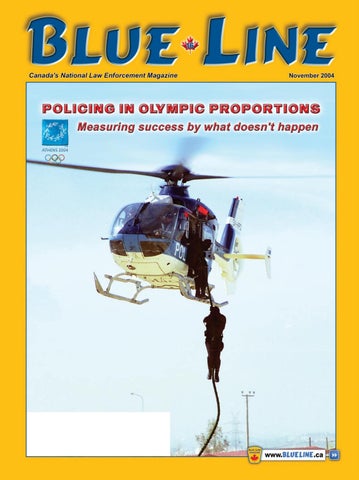
Publisher’s Commentary 5 Maybe it’s time to reconnect with the people Policing in Olympic Proportions 6 Measuring success by what doesn’t happen Corrections officers can carry handcuffs 12 OPP officers like wireless access
14
Biker update
15
Halifax integrates emergency dispatch
16
BOOK REVIEW 10-45 Spells Death
17
eMail: admin@blueline.ca
— Editor — Mark Reesor
eMail: editor@blueline.ca
— News Editor — Les Linder eMail: news@blueline.ca
— Advertising — Mary Lymburner Dean Clarke Bob Murray eMail: sales@blueline.ca
— Pre-press Production — Del Wall — Contributing Editors — Communication Skills Terry Barker Police Management James Clark Tactical Firearms Dave Brown Technology Tom Rataj Psychology Dorothy Cotton Case Law Mike Novakowski Blue Line Magazine is published monthly, September to June, by Blue Line Magazine Incorporated with a mailing address of: 12A - 4981 Hwy. 7 East, Ste. 254, Markham, Ontario, L3R 1N1. Individual magazines are $5.00 each. Subscriptions are $25.00 per year or $40.00 for 2 years. (Foreign - $50.00 U.S.) All material submitted for publication becomes the property of Blue Line Magazine unless other arrangements have been made with the publisher prior to publshing. The authors, advisors and Publisher accept no liability whatsoever for any injuries to persons or property resulting from the application or adoption of any of the procedures, tactics or considerations presented in this magazine. Readers are cautioned and advised that articles presented herein are edited and supplied for your personal awareness and should not be used for further action until appropriate advice and guidance is received from a supervisor, Crown Attorney or other person in authority. Established in 1988, Blue Line Magazine is an independent publication designed to inform, entertain, educate and upgrade the skills of those involved in the law enforcement profession. It has no direct control from a law enforcement agency and its opinions and articles do not necessarily reflect the opinions of any government, police, or law enforcement agency. ©2004 - All articles are protected by copyright. No part of this publication may be reproduced or transmitted in any form or by any means, electronic or mechanical, including photocopying and recording or by any information storage or retrieval system without permission. Internet activity is monitored and use or reposting of material on the Internet is restricted.
Electronic evidence becoming crucial 18 Police officers need to know how to handle it Combatting cyber crime requires training 20 ODDITORIALS
21
Professional media relations Dedicated resources is challenging for smaller agencies
22
DEEP BLUE 24 Serving different masters with different agendas A man for all reasons 25 Keith Aiken 1932-2004 British Soldier and Constable and Toronto Police Staff Sergeant DISPATCHES
25
In search of security
26
CASE LAW 28 • Counsel rights can only be suspended briefly • Pass-on tip ok for articulable cause • ID search unreasonable in investigative stop New squads tackle large frauds
31
Stopping youth crime before it happens 32 This publication is a private venture and receives no subsidy or grant from any level of government.
— Affiliations —
International Association of Law Enforcement Planners Canadian Advertising Rates & Data International Police Association The Police Leadership Forum The Canadian Press Newswire Printed in Canada by Janson Printing Service
ISSN #0847 8538
Canada Post - Canadian Publications Mail Product Sales Agreement No. 176796
TECHNOLOGY Internet dangers
34
NEWS CLIPS
35
PRODUCT NEWS
36
BACK OF THE BOOK Take a load off your feet, back and hips
38
3
Gearing up to police a major event like the 2004 summer Olympic Games is no small task. The population of Athens ballooned and local and national Greek police had to be prepared to deal with everything from traffic accidents to terrorist attacks. In a Blue Line exclusive Jon Webster visited Athens and tells us how law enforcement agencies prepared themselves to handle all threats. Corrections Canada has decided to allow officers who have direct contact with prisoners to carry handcuffs as regular equipment. As Ryan Siegmund discovered, the new policy reflects the increasingly dangerous conditions in prisons. The Ontario Provincial Police are equipping 320 frontline officers with new laptops and equipment giving them high speed wireless access. The force extensively researched the alternatives before settling on its new system, Blue Line news editor Les Linder writes, and has offered to let other Ontario police services use its procurement process. Halifax Regional Police and local RCMP are cooperating on a new emergency dispatch system. Ryan Siegmund describes the new centre which will dispatch both forces within the Halifax Region. It is scheduled to be operating before the end of the year while new computer aided dispatch (CAD) equipment is expected to be on line next spring. Having full-time, professional media relations teams just isn’t in the budget for many smaller police services. Blue Line Media Relations columnist Mark Giles looks at other ways small police agencies can manage issues and handle crisis communications. In other stories, Blue Line publisher Morley Lymburner reviews a new book about former Toronto police chief Bill McCormack, Larry Gagnon tells us about Peel Regional Police’s highly regarded Technological Crime Unit and Danette Dooley profiles RCMP constable Chris MacNaughton of the force’s Technical Crime Unit and her battle against child pornography. Also this month, Dorothy Cotton delves into the dilemma faced by police services boards, Mike Novakowski has case law and Tom Rataj looks at dangers on the Internet. NOVEMBER 2004
4
NOVEMBER 2004
Maybe it’s time to reconnect with the people by Morley Lymburner Ever wonder what mind set exists in the dark dungeons of Ottawa bureaucracy? I don’t know if I ever want to really understand it but there is a tremendous amount of disconnect that needs to be addressed. The recent useless death of a naval officer on board that second-hand tin pipe the Brits call a submarine, sort of underscores the absolute intransigent stupidity displayed by various bureaucracies. For some reason there is a level of government that refuses to listen to good solid common sense. They simply go about their daily affairs completely disconnected from reality. The Ministry of Defence appears to be one of the largest offenders. Ignoring the lives and safety of the people who have to fly in dangerous helicopters and go to sea in damaged and leaky ships bought at bargain basement prices. The real scary part is that money is no object even when they say it is. Repairing those helicopters has cost enough to replace them several times over. The result has been downed crews and lives sacrificed to keep them aloft in a feeble attempt not to embarrass someone. Now we see the result of another bargain that cost another life in a poorly built and maintained Brit sub. Three other lemons purchased previously are still under repair and refit and will no doubt exceed the price of new ships by the time all the bills are in. I am sure even those numbers will be fudged with “soft costs.” Someone in the Canadian Border Security Agency should have a lot to answer for in the loss of the life of a Niagara Falls mother of two last February. An armed and dangerous criminal, with U.S. police behind trying to stop him, ran over the plastic cones protecting all Canadians at the border. He ran down a lady crossing the street near her home then bailed out and took a shot at a Niagara Falls officer before being overpowered. In all this hubbub the only thing we hear from Ottawa was that the US officers, doing what cops are trained to do, should not chase these people into Canada. No one is taking the government to task for a porous security level that sees unarmed CBSA officers putting their lives at risk daily. They have no hope of actually stopping a determined criminal or terrorist. Until they can I would suggest setting a protocol where the Americans can protect Canadians. Admit that we have no capabilities for anything at the border except operating a cash register nor any powers more extensive than a toll booth collector. Now we have Parks Canada Agency and their reluctance and subterfuge when it comes to arming game wardens. The entrenched stubbornness here is really baffling. A brief historical check will reveal a very poor understanding of how law enforcement works as a deterrent. Their argument, overturning a previous endorsement of arming the officers, was that law enforcement activities do not present a danger under the definition of the Canada Labour Code. But wait a minute! This same Code governs Fisheries officers, Ministry of the Environment officers and the RCMP. They are
armed. So the debate goes on while wardens are given one-hour courses on how to get poachers, armed with .303 rifles in secluded bush country, to simply lay down their gun and come along to jail with the nice warden. This Parks Canada fiasco reached new levels of absurdity two years ago when they gave the RCMP over $35 million to supply them with armed officers to perform enforcement duties on behalf of wardens. Duties that could have been performed by their own people at a cost of $20,000 and spare change for range ammo. Now here we are stuck in a new millennium with a federal bureaucracy that feels no
5
reasoning beyond their own is correct. The public is simply not as smart as they are. They can pinch a penny over here and spend like drunken sailors over there. Especially when it comes to influential politicians that keep their cushy butts on comfortable chairs and decide a billion dollars can somehow be spent on a gun registry database. It’s time to take some of these people on an outing in a busy federal park during hunting season, check some cars at the Detroit border, have a helicopter ride over a stormy North Atlantic or take a nice submarine cruise? Now there is a job perk that should be mandatory.
NOVEMBER 2004
by Jonathan B. Webster Imagine that overnight the population of your capital city seemingly doubles at a stroke! Now imagine that amongst the numbers pouring into your manor are not just legions of tourists, but the world’s elite athletes, tennis players and footballers with all their respective entourages in tow. And just to make life even more interesting a large sprinkling of international statesmen and their spouses have decided to turn up. Any reader of Blue Line Magazine would surely agree such a scenario is a police force’s potential worst nightmare, and a terrorist network’s absolute dream! And this... all of this... actually happened for real in the 2004 Olympic Games. Only now can the lid be lifted on how the Athens and Greek National police forces, together with some heavy duty backup from the elite Hellenic Security Corps, prepared for and executed arguably one of the most successful large scale policing operations of recent times. To give the inside low-down of how not one but two largely incident free Olympic Games (if one includes the junior but no less worthy Paralympics) were achieved, I managed to collar the Hellenic Police Chief, Lieutenant General Fotios Nassiakos for a substantial and exclusive interview. In Greek terms the 52 year-old General Nassiakos is super cop
numero uno. To get a mental picture of him think of the Royal Canadian Mounted Police’s commissioner Zaccardelli blended with Elliot Ness and, on his off days, a little bit of Judge Dread thrown in for good measure. This guy was, after all, for many years the formidable Head of the Hellenic Police’s special violent crimes division before being promoted. Now you would be getting the picture. The General can see I am easily impressed by chunky statistics so he cannily lobs me a biggie to start the textual fireworks rolling. He begins by proudly stating that: “For the Olympics we used a total workforce numbering around 41,000 agents who were deployed for specific Olympic duties in Athens and the four regional Olympic cities. Among the other special security services, two units have been especially valuable for ensuring the successful conduct of the Olympic Games: The Special Anti-Terrorist Unit (SATU), and the Department of Explosive Devices Disposal (or TEEM). Anti-terrorism experts Rather impressively, it seems that the Greek security forces have been taking the terrorist scourge seriously for a very long time indeed. The Special Anti-Terrorist Unit of the Hellenic Police has historical roots that stretch back at least twenty-five years. In the beginning SATU was comprised of only 150 members but when Greece became the host country for this summer’s two Olympic Games their number increased to 200 after reassessing the needs for the sheer magnitude of the events. The Special Anti-Terrorist Unit has a fascinating roster of highly specialised duties 6
including: high risk VIP’s escort, high risk arrests, hostage situation response, weapons of mass destruction and hostage scenarios including intrusion response. Fotios Nassiakos When it comes Hellenic Police Chief to hosting and policing an event like the Olympics with sports people and tourists from all over the world, prudence would dictate that the more local knowledge you have of visiting countries from a policing point of view the better. Hardly surprisingly, SATU, building on existing relationships, cooperated with other special units from abroad such as: the FBI/Hostage Rescue Team, the U.S Marshal Service/Special Operations Groups, the U.S. Army Special Forces, New Scotland Yard/ SO19, G.E.O Spain, S.E.K Berlin Germany, France’s R.A.I.D. and Cobra in Austria. The Greek Police’s aforementioned Department of Explosive Devices Disposal (T.E.E.M.) has its own special mission which is to identify, collect and neutralize explosive devices and homemade bombs. It also conducts special investigations in relation to explosive devices. General Nassiakos is at pains to point out that, “although not possessing as much historical pedigree as the Special Anti-Terrorist Unit, NOVEMBER 2004
7
NOVEMBER 2004
T.E.E.M. has an enviable track record. Within the 14 years of operation the Department has successfully completed: 5,700 preventive investigations, 30,500 investigations responding to threatening calls, 105 defuses of homemade explosive devices and 136 disposals of suspicious devices”. Dogs ‘n toys When it came to the use of state of the art equipment to underpin the Athens 2004 policing/security effort no expense was spared. Amongst the more exotic futuristic items used by SATU were antiballistic helmets, endoscopes, thermal display cameras, infra red cameras and flash noise grenades. But on the low tech side they had dogs. The Unit of Police Dogs also falls under T.E.E.M. The Hellenic Police use specially trained dogs in order to guard or identify people or items as well as to detect drugs and explosive materials. Within the frame of the preparation for the Olympic Games the number of dogs was doubled. Evidently dogs were brought in from as far afield as Germany, the Czech Republic, Slovakia and Hungary. General Nassiakos is proud of what this formidable posse of four legged friends were able to do; and says that “for the detection of explosive devices Labradors and Golden Retrievers were particularly useful. For the safeguarding of VIPs the dogs of choice were German Shepherds and Malinois. Not to be outdone T.E.E.M. had their own arsenal of necessary “toys-for-the boys” including: anti-explosive uniforms, portable X-Ray devices, binoculars for both day and night vision and remote controlled vehicles for defusing explosive devices. Training is a big key Although no short cuts were taken when it came to preparation for the Olympics, to a certain extent SATU was able to call upon the lessons learnt from its ongoing rigorous training programs which take place for three months every year. General Nassiakos stated that: “The Unit is used to training in all sorts of locations which had Olympic relevance, including Athens International Airport, planes belonging to Olympic Airways, the Hellenic Railroad system, Athens subway and Piraeus Port to name but a few. Therefore, some of the foundations for a special Olympic Training Program were already in place”. One of the police/security planning stage building blocks and an important catalyst uniting all the forces concerned was the General Olympic Training program. This program was specifically concerned with personnel briefing and awareness raising. It was a decentralised program, which used printed and electronic training material and covered all personnel belonging to the Greek Police and the Fire Corps, as well as Coast Guard and Armed Forces personnel involved in the Olympic Games. Next up was a highly impressive array of Special Training sessions which were devised to give all police and security forces the necessary specialist knowledge and capabilities to deal with any Olympic related issue that might arise. According to General Nassiakos, “within the police/security services an Olympic Advisory
Group (OAG) was set up to provide subscription to no less than 92 Special Training Sessions. These training sessions concerned such potentially hair raising issues as weapons of mass destruction, suicide bombers, hijackings, hijacking of buses, counter attack team tactics and venue security, as well as dealing with less dramatic but nevertheless vital aspects such as negotiating skills and intelligence analysis”. With the assistance of experts from European Olympic Advisory Group member states a great number of Olympic Security operational readiness exercises were also specially created to put everybody through their paces, and keep all officers in a state of heightened alert. Clever use of simulation technologies led to very realistic training in the field, and involved the cooperation and coordination of all the involved security forces and agencies. These exercises had wonderfully descriptive names, “often drawing from ancient Greek mythology”, as General Nassiakos is keen to point out. He lists some of his clear favourites: “The Trojan Horse was an exercise using a scenario involving bus hijacking and bombing incidents. A total of 160 personnel took part. The Gordian Knot, on the other hand, used a scenario involving an airplane hijacking and bombing incident with 235 personnel participating. But for sheer scale, it’s hard to beat The Lernean Hydra which simulated several unwelcome nerve wracking scenarios, including a terrorist threat at an Olympic venue, sea vessel piracy and passengers held hostage, all combined with a natural disaster – an earthquake. A total of 500 personnel took part, and there was simultaneous participation of all Olympic cities via video conferencing.” Of course there would be no Olympics without, above all, the athletes. And special attention was paid to the protection of the “Olympic family” and of VIPs. The measures taken were based on risk assessment and threat evolution. Once again, the security measures put into place were a skilful blend of general 8
measures and special measures. According to General Nassiakos “the former comprised: policing the Olympic road network and its environs, support by Venue security forces, guarding and surveillance of Venues, and capacity to quickly respond to incidents. As for the latter these comprised: personal protection and security escorts, site inspections, preliminary sending in of security scouts, the appointment of special liaison officers, aerial coverage, secure shelters, use of appropriate technical equipment and alternative routes.” Evidently, these measures were adopted on a daily (24/7) basis, from the moment the athletes or VIPs arrived in Athens, up to the moment of his/her departure. And they would be escalated depending on the assessment of the threat. The protection operations during the Olympic and Paralympic Games were coordinated by a Special Olympic Family and VIP’s Protection Centre, housed in the Athens General Police Division (GADA) and supported by the C41 systems (see below). Global protection for a global event But if the athletes had gilt edged protection, ordinary sports fans and tourists – unbeknown to them – had not dissimilar levels of police cover. General Nassiakos is adamant that “our security provisions covered all of the Greek mainland and key islands, with us placing special emphasis on the urban areas of the Olympic Cities, most particularly, of course, Athens. Our aim at every stage of these games was to increase the security index to the highest possible level. For example, the security measures for urban areas were divided into visible and non-visible measures, and included foot, vehicle and aerial patrols.” “As might be expected”, he continued, “special emphasis was placed on the security of the areas surrounding the Olympic venues, on the security of Olympic routes and of public transport (including buses, and Athens’ spanking NOVEMBER 2004
9
NOVEMBER 2004
new state of the art Metro and Tram systems). Last but not least security was tightened in those areas where cultural events were held, as well as of Greece’s precious archaeological sites.” At times security surveillance resembled science fiction, with the use of, alongside helicopters, a Zeppelin-style airship. Behind its innocuous outer skin was a veritable arsenal of equipment, including cameras and air surveillance. The airship had the capacity of flying up to 3,300 metres high for 16 hours a day, seven days a week while transmitting non-stop images to the Olympic Security Centre and to the police’s CCTV network in real time. Computer driven security These days no large scale police/security operation of international scope is worth its salt unless it is underpinned by some serious computer technology. The mission of the Hellenic Police HQ’s prosaically titled Division of Informatics is to design, develop and support the implementation of information technology required for all sections of the Hellenic Police force. General Nassiakos swells with evident pride when he tells me that: “before the Olympics we already had in place a state of the art nationwide computing network which was connected to all the principal police divisions throughout Greece, as well as to all passport control points. We call this network the Schengen Information System and fortuitously it was completed in concert with the design of other international security IT systems, such as Europol and Eurodac. This allowed for maximum exchange of
important police intelligence information; the sort of data that is of key significance when you are trying to police something as huge as the Olympic Games. “In fact, in the light of the 2004 Olympic Games our IT network was extended right down to every Hellenic police precinct (there are around 1,300 in number) by implementing the Police On-Line project. The ability to access this network through mobile terminals was also provided for.” If all of this wasn’t enough, the Hellenic Police managed to roll out just in time for the Olympics the jewel in their technology crown:
10
the C4I systems. The official line goes that the C4I systems are a state of the art means of communication, data processing and security that are completely interactive and provide information (in the form of image, sound and data) to authorized law enforcement commanders, allowing the latter to evaluate a situation in real time and to facilitate fast decision making. Lieutenant General Nassiakos nails it down when he says that: “the C4I systems, through 30 subsystems allow us to have a clear, concise image of multiple incidents at any given time by combining: air surveillance, CCTV cameras (of which there were 903 cameras in 39 Olympic venues and 293 points of traffic monitoring), AVL (automatic vehicle localisation), command centres, port security systems and fire surveillance systems. With such a panoply of resources at his command General Nassiakos could be forgiven for looking just a little like the cat that got the cream. Because, apart from a few unfortunate relatively minor incidents, the Athens 2004 Olympics have proven to be a remarkably peaceful and safe event; and most of the credit for that success has to be down to the exemplary planning and execution on the part of the Greek police and its security allies both at home and abroad. After past Olympic disasters like the Munich Games where Israeli athletes were slaughtered by Palestinian terrorists – the Greek Police and allied security forces deserve a raft of gold medals for ensuring that this year’s Olympic Games have passed off largely trouble-free!
NOVEMBER 2004
Back to the future But what of the future policing of the Olympic Games? One thing’s for sure: the IT resources surrounding a sports event of this kind are going to get even more high tech. To keep undesirables out of forthcoming Olympic Games (the Turin Winter Olympics come up in 2006 and then there is the big one: Beijing in 2008 and Vancouver in 2010) we will see the use of futuristic applications, including most probably iris scanning. And that’s just for starters! In fact, the betting’s already on that Beijing will be as trouble free as Athens. Repre-
sentatives from the Chinese police and security forces were present in Athens learning as much as they could, and, if anything the Chinese will be paradoxically even more stringent and simultaneously adventurous in their security measures. Although whether we will see – as one wag joked – the use of kung-fu tactics utilised alongside more regular methods of policing remains to be seen. Watch this space! Jon Webster is a free-lance writer working out of London, England, on assignment to the Greek Olympics for Blue Line Magazine.
11
NOVEMBER 2004
Corrections officers can now carry handcuffs by Ryan Siegmund Changing offender profiles in Canadian penitentiaries has prompted the Correctional Service of Canada (CSC) to allow federal officers having direct contact with inmates to carry handcuffs as regular equipment. The ruling reflects the ever changing prison environment, where gang activity and weapons are becoming more common and conditions more dangerous. “It’s about time we nationally took a stand and they applied that uniformly,” says Sylvain Martel, president of the Union of Canadian Correctional Officers (UCCO), which was consulted before the ruling. “The violence is very free inside the prisons and we’ve seen an increase like you wouldn’t believe. We are very concerned about that.” Constant review of restraint and security equipment requirements led to the handcuff amendment, says Chris Price, CSC acting director general of security. “I have a staff member who looks after security equipment and he routinely reviews requirements and needs of staff as well as the changing offender profile,” Price says. “When we coupled his work along with conversations with the union, we determined this is the right thing to do.” The handcuff amendment “was a huge victory for us” because inmate behaviour has worsened and weapons are being discovered more frequently, says Edmonton correctional officer Kevin Grabowsky. “I’ve been an officer for 25 years and you’d be lucky to find 25 shivs (makeshift knives) in a year – and now we are finding like 200 to 250. They are certainly on the increase.” Grabowsky says he’s often asked by reporters why the union is trying to ‘Americanize’ Canadian prisons. “My answer is, we are not. The thing is, the inmates are turning them into being that way. Ten years ago when I walked the range, if I needed handcuffs, I just went and got them as I felt I needed them... “You have an officer standing there with no pepper spray, no handcuffs… an inmate starts
assaulting you… now all you are into is WWF. If you have nothing that you can control that person with other than your body – we are finding that the inmate gets hurt and we get hurt.” Handcuffs allow officers to subdue an inmate, which takes the fight out of them, notes Grabowsky, which doesn’t happen if they still think they can take a shot at you. Managers have expressed concern inmates may use pepper spray and cuffs against officers, since they’re always outnumbered, Grabowsky notes; “the trouble is, if it ever gets to the point where they are going to take my handcuffs and take my gas, they were going to take me anyway. If I have the tools of my trade, I at least stand a little bit of a fighting chance when it gets to that point... “We all have a spare tire in our vehicle and we all carry a jack. We don’t carry it because we are going to have a flat tire everyday, we carry it because we might. To me, it’s just simple common sense because it’s the inmates who are taking us down this road.” Statistics compiled by UCCO show almost 10 per cent of its members were off the job last year because of work related injuries. The number of incidences rose from 437 in 2000-01 to 514 in 2002-03, the union says. Price says CSC would take steps if they saw a trend suggesting more officers are being seriously injured in the workplace. “The data we have, major injuries over the last couple of years have been constantly very low.” Grabowsky suggests CSC’s definition of injuries is too restrictive. “It’s actually in the Canadian Labour Code… the definition and its loss of time at work. Maybe you were assaulted or your family has been threatened or you wit-
ness something… officers go off work for a few days to get their bearings again.” The increasing number of gang members behind bars will only increase altercations, UCCO officials predict, especially since they say correctional officers have not received training on how to deal with gangs. Price admits the number of gang members have increased over the past seven years and “our commissioner has committed to UCCO that we would work with them over the coming months to identify what training issues they have. We’ll have to see if they can work collaboratively with our learning and developing committee and maybe we could at least give them an information session.” Despite constant research of offender profiles, keeping up with their changing nature is quite difficult, says Jason Cormier of CSC Security Operations. “Since 1994, we’ve had about 40,000 new offenders come into federal institutions, or ‘flow through,’ as we call it. Considering our average day to day population is around 11,000, you can see over ten years... (that) just getting a handle on the profile and the changing nature is quite a task.” The number of male offenders affiliated with gangs increased to 15 per cent (from 12) over the past seven years, says Cormier, and the number in maximum security jumped to 21 per cent (from 14) between 1997 and 2002. The increase in males under 30 in maximum security institutions also plays a role in these numbers, Cormier says, since they tend to be less willing to follow routine and rules. “It gives an idea of what we are talking about concerning the changing offender profile,” he says, adding CSC generally conducts profile reports every two years. Despite differences in perception with the union, CSC maintains it recognizes many of the same issues and is working collaboratively with the UCCO to resolve them. A new committee is currently looking at equipment needs, he notes, and will report back early next year. “Part of their mandate is to assess our current policy on (stab proof) vests and we are hoping to expand that to other restraint equipment.” The handcuff issue came to a head when new management at Kent Institution in BC stopped allowing officers to carry cuffs in 2001. The union appealed, arguing it violated the Canadian Labour Code, but lost. A Human Resources Development Canada (HRDC) officer ruled there was no evidence to suggest the unavailability of handcuffs has ever led to injury. CSC then announced a national policy directing that cuffs be kept at secured control posts, where officers could retrieve them if needed, says Martel. That was not realistic, he argues. “It’s like telling the police to go and put your gun belt and all your tools in the trunk of your car and if you ever need it, first and foremost request permission.” Ryan Siegmund is a freelance writer and researcher working with Blue Line Magazine. You can contact Ryan at Ryan@blueline.ca.
12
NOVEMBER 2004
13
NOVEMBER 2004
OPP officers like wireless access by Les Linder The Ontario Provincial Police is combining technologies to build a new province-wide communications network in a bid to improve officer efficiency and safety. The new platform includes a Panasonic Toughbook laptop, printer, wireless modem and cardswipe system that allows 320 frontline officers to access the OPP’s records management system through a public wireless carrier. The project began with an electronic ticketing tool that allowed officers to accurately and legibly create tickets for traffic offences. They simply run the magnetic strip of an Ontario drivers licence through an electronic card reader to extract the information, which the computer automatically includes on the ticket. The system has made writing tickets more efficient and removed much of the potential for human error, which could allow the offender to avoid a fine in court, notes Ted Vincent, acting bureau commander for information technologies. Another benefit – “(it) helps keep officers and citizens off the side of the road where they are more vulnerable to being injured or killed in a collision.” The service built a database of typical traffic and liquor offences to augment the system so that tickets could be produced more efficiently and accurately. The mapping unit created a database that covers the footprint where the service has deployed mobile workstations, allowing officers to easily identify their location, particularly on highways. A Bell Mobility 1xRTT (radio transmission technology) wireless network allows officers to query the service’s records management database and CPIC to check information on
drivers and vehicles. The wireless access can also be used to enter information directly into the database. “The ergonomics of the system and car aren’t exactly conducive to lengthy typing sessions, but the option is still there for officers,” Vincent says. “The footprint of coverage on the system predominately is for the 400-series highways, but also includes a good portion of Ontario as well and is continuing to expand.” The force spent about $12,000 to outfit each cruiser and is using the 320 systems across the province. “We’ve distributed them more or less evenly, focusing mostly on traffic responsibilities,” he says. “Highway accidents lead to nightmare traffic problems, so if we can reduce the amount of time it takes an officer to finish up a scene, then the happier everyone is.” Vincent explains that even having an officer
pulled over on the side of the road writing a traffic ticket can cause driver inattentiveness and increase the risk of an accident. “By speeding up the process, the officer won’t have to be pulled over on the side nearly as long and then they can get back on the road to increase police visibility and make traffic enforcement even more effective.” The project began about 18 months ago as a pilot program in the Greater Toronto Area and was expanded as the wireless carrier extended its coverage to other parts of the province. The OPP received an innovation award at the IACP conference from the Law Enforcement Information Management Sector for the service’s ability to effectively use the 1xRTT communications network. However, the service is finding there are still bugs that need to be worked out. One common problem is poor reception in certain areas. Vincent says the service is working with hardware and software vendors to fine-tune the system. “Right now it is working reasonably well,” he says. “The message we’re getting from our officers on the road is ‘make it better but don’t take it away,’ which is good news.” The force is also working to solve some connectivity issues and meet officers’ requests for the system to work more seamlessly and continuously. The software used is better geared for an office environment on a reliable network connection. With the wireless connection, the signal can jump to a new tower, which can occasionally cause a momentary signal lapse. “This can force certain processes in the system to have to restart entirely and is somewhat of a pain,” Vincent says. “We’re working on a solution to things like that which get in an officer’s way – we’re learning every day and fine tuning regularly.” Vincent admits that some officers complain about the system but notes they almost always also mention how it’s making things better for them, allowing them to focus more on other policing duties. The OPP is currently exploring opportunities with its hardware, software and network service providers to expand beyond provincial responsibilities. “We are also trying to make it functional and useful without a carrier so it can be expanded to areas with limited or intermittent connectivity,” Vincent adds. While officers working the 400-series highways have the advantage of strong signals, officers in other areas are at a disadvantage. The service is already looking at ways to allow officers who aren’t connected to the host system to enter and record information and authenticate and transmit it at a later time. Vincent says a solution is already being planned and is expected to be tested later this year. The OPP has offered to let other Ontario police services use its procurement process for equipment if they find the pricing advantageous. For more information, contact Ted Vincent at 705 329-6083.
14
NOVEMBER 2004
Biker gang update LAVAL, Que. — Five Bandidos biker gang members were found guilty in September of 22 out of 26 charges ranging from gangsterism and drug trafficking to weapons possession and arson. The Bandidos were known as the Rock Machine until 2001. During a bloody turf war with the rival Hells Angels for control of Quebec’s lucrative drug trade, about 170 people, including several innocent bystanders, were killed. More than 60 members or associates of the Bandidos were arrested in 2002 under police project Amigo. About 48 Bandidos members have pleaded guilty out of the group arrested in the 2002 sweep. MONTREAL — Two convicted members of the Hells Angels biker gang from Ontario have each been fined $100,000 for running a drug network in Quebec. Walter Stadnick and Donald Stockford were given two years to pay the fine or face spending another 18 months in prison. The men were each sentenced to 20 years in prison for their role in Quebec’s deadly biker war that claimed more than 150 lives. Quebec Superior Court Justice Jerry Zigman said in September the men earned nearly $2 million in profits from running a drug business that saw more than $10 million pass through an account between March 30, 1999 and Dec. 19, 2000. The fines were levied in lieu of drug profits that police have not been able to locate. The Hells Angels sold $111.5 million worth of cocaine and hashish during those 20 months. The so-called Gertrude account controlled by Stadnick and Stockford, of Hamilton, Ont., bought 267 kilos of cocaine and 173 kilos of hashish from the criminal organization.
Crown prosecutor Brigitte Bishop welcomed the forfeiture ruling as another victory against the Hells Angels by taking some of their profits of crime. “Based on the evidence that we collected from the Springtime 2001 (police) operation, now when we’ll have similar evidence based on the accounting of the drug evidence, we’ll be able to ask for the forfeiture of this sum of money,’’ she was quoted as saying. Bishop had initially sought a fine of $10 million which the judge rejected. In lieu of forfeiting their houses in the Hamilton area, the men’s wives will have to pay a total of $140,000 to Quebec from second mortgages. Stadnick will forfeit three vehicles including a HarleyDavidson motorcycle. Stockford will lose $34,000 in cash found in his house on the day of arrest three years ago. CALGARY — The Alberta Court of Appeal has upheld a 30-month prison sentence for the former president of the
15
Calgary chapter of the Hells Angels for possession for the purpose of trafficking in cocaine. The three-member appeal panel agreed the trial judge made no error in sentencing Kenneth Michael Szczerba, 47, for possession of a bag of cocaine. Defence lawyer Hersh Wolch had sought a conditional sentence of less than two years to be served in the community. He argued the trial judge had not properly taken into consideration the steps Szczerba had taken to rehabilitate himself. Wolch said Justice John Rooke erred by failing to credit Szczerba with being a model citizen between the time of his crime in 1999 and his sentencing. Szczerba was convicted of possession of cocaine for the purpose of trafficking in connection with his Aug. 4, 1999, arrest over an alleged plot to blow up the home of a Calgary alderman. He was later convicted and sentenced to one year in prison for counseling someone to commit mischief. Justice Adelle Fruman, in handing down the Appeal Court’s ruling, said Rooke gave Szczerba enough credit for finding “a new life’’ by reducing a three-year sentence by six months. “A sentence of 30 months is appropriate for this offence,’’ she said. Szczerba is no longer involved with the notorious motorcycle club. BARRIE, Ont. — The Hells Angels are hoping a guilty plea to extortion in a Barrie courtroom will scuttle a prosecutor’s plan to prove the gang is a criminal organization. Steven Lindsay and Raymond Bonner of the Angels Woodbridge chapter are accused of trying to extort $75,000 from a Barrie area businessman. They’re also charged under Canada’s recently revised anti-gang legislation. Bonner is pleading not guilty to all charges.
NOVEMBER 2004
Halifax integrates emergency dispatch system by Ryan Siegmund Halifax RCMP will soon be receiving calls from the same communication centre that dispatches the city’s police and fire services. Having already established integrated crime units with Halifax Regional Municipality (HRM), the RCMP agreed to be connected to a single Computer-Aided Dispatch (CAD) and Records Management System (RMS), continuing the city’s integration of both services. The new RMS is scheduled to be up and running for this December while the CAD is targeted for spring of 2005. “Since amalgamation, fire and police dispatching has been done from the same centre,” notes project manager Marianne Murphy. “As of now, they don’t use the same application and that’s what we are to fix with the CAD. “It allows us to dispatch units closest to the call – which is going to be a big thing for us,” she says, noting police will benefit from improved case management and searching ability and both police and fire will be able to respond more efficiently to emergencies.” HRM’s response times are very good as it stands, notes Murphy, but there’s always room for improvement. The CAD system will also provide automatic vehicle locating using GPS (Global Positioning System). “While it is likely some calls will result in faster response times, what we really want to be able to do is know where the officers are in relation to that call so that we are dispatching not only the right people but the right number of units as well.” One of the new things HRM can do with the new CAD system is inform both police and fire about hazards they may face, “information on a property for example, in which police or fire are aware of, we are now able to share that across services,” says Murphy. “We’re trying to take info that we are collecting and share it throughout the municipality where ever we can.” The new communication centre will combine HRM and the RCMP’s existing 911 call centres at Dartmouth’s old police headquarters and also include the emergency measures operation centre. Emergency Health Service (EHS) calls are redirected to the provincial EHS dispatch center for the province. “When we move to the centre, we will be taking over all the 911 call receipts for the core, all of HRM and will continue with all the fire dispatching in addition to police,” says Supt. Bill Moore. “It will provide us with a level of integration in our patrol section so that an RCMP or a regional officer in neighbouring districts will be able to back each other up. “A 911 call coming in, the information can be electronically transferred from the 911 system into the call mass and the CAD. The call taker then decides if it’s a police or fire call or both and based on the routing, go to the
appropriate dispatchers.” The CAD system HRP is using now is coming to the end of the line, says Moore, so the service was forced to move to a new platform. “From our perspective, the biggest move to an integrated CAD is that we have police and fire dispatch here, so now we’re kind of able to get a call right from the caller... “When we set out to buy a new CAD and RMS, we looked at getting an integrated solution,” says Moore, adding having both systems produced by one company will help provide a seamless service. HRM had some issues with the old system’s interface, Moore notes. The CAD and RMS were produced by different companies who often blamed the other when one of the systems wouldn’t transfer information properly. “Basically this time around we learned from that and went with an integrated type project – we deal with one vendor from start to finish.” The new CAD system further enhances HRM’s integrated city concept of collecting data once and using it many times. “When you’re talking about records management systems, this is the information that, when you start sharing it, helps you solve crime.” The technology is multi-jurisdictional, meaning other agencies can come onto the system. “From an information standpoint that’s one way; another way we’re looking at information sharing is through the use of LEIP (Law Enforcement Information Portal) technology,” says Moore. Any police records management system can be interfaced to the LEIP (web browser technology), which allows an agency to determine how much information it wants to share. Moore points to technology being used in BC, and most recently Toronto, Windsor, London and Ottawa, which allows information to be shared. “We are looking very strongly at introducing a LEIP here as well,” he says. “For instance, we could give licensing to all the other municipal agencies in Nova Scotia so they could query our data base at any time.” HRM is already talking to Ontario about connecting the LEIPs and envisions further expansion. Moore believes system requirements will become more stringent in the next couple of years, though he notes police services won’t necessarily have to use the same equipment. 16
“The important part of it is the information sharing in a timely matter. I think we could do it from a number of different technologies – I’m not advocating that they have to use one particular technology. “The CPIC (Canadian Police Information Centre) is the mission critical piece that you need to know because that’s mission critical officer safety type of information.” The biggest obstacle for police agencies implementing new systems continues to be the price tag, Moore states. “It’s an expensive endeavour, no question, but when you look at in terms of public safety and the cost if our system had crashed prior to having a new system in place – I think it’s money well spent. It should set us up very well for in the future in relation to keeping up with changes.” Moore feels the message is getting out that interoperability is key to sharing information. “What’s being used in house may be fine for that particular agency, but we’re living in a world now where we are not just confined to our borders… that requires us to maybe bump up or look at some new technology to get the information moving. “We’re moving forward but maybe not as fast as we could in some areas.” Supt. Gordon Barnett, officer in charge of integrated policing for the RCMP, says HRM is a unique environment because it’s the only municipal government in Canada with two different police forces. “This is not an issue in other jurisdictions because you have the service providers dispatched by ‘their’ dispatch centre – here there’s only one dispatch centre, one service provider. This removes any perception that there may be a lesser service being offered or something might be overlooked. It enhances the service level to the public and the ability to coordinate the activitities with the fire department.” HRM had a vision of a truly integrated service when it decided to develop a new communication centre, notes Barnett. “It’s like Deputy Chief (Tony) Burbridge of HRM has said, the citizens of HRM really don’t care what colour the uniform is that shows up at the door –- they just want to see a police officer as quickly as possible and that’s what this is going to to do.” CAD-RMS project manager Marianne Murphy can be reached at 902 490-6562. NOVEMBER 2004
A story told as only a daughter could tell it “10-45” Spells Death Written by: Kathy McCormack-Carter Publisher: White Knight Publications Reviewed by Morley Lymburner Ever since retired Toronto Chief Bill McCormack released his first book “Life on Homicide” I have patiently awaited a sequel. My patience paid off recently with the release of ”1045” Spells Death by Kathy McCormack Carter. The book is far from the style of the original book. It takes some deviations in structure, has a distinct inclusion of drama and more than a little creativity. It makes for a fascinating and entertaining read. This fact that it was written by Bill McCormack’s daughter was enough to pique my curiosity. After reading a brief introduction I wanted to read the book if only to determine how she managed to pull it off. I can think of no greater challenge than trying to write about your father’s experiences and draw parallels with your own. Kathy manages to do more than relate names, facts, dates and incidents from seven homicides investigated by her father in the 1970’s. She has virtually delved deep into these cases and found the stories of the people and victims involved in each incident. She manages to weave a compelling story that comes full circle as she marries facts with facts and then delights the reader with insights never before revealed. The basis for the story involves Constable Kathy McCormack who finds herself in a chance encounter with a man whom her father had helped put away for a double murder some 12 years before. How did he get out of jail? What is he now doing in her police station? What information is he now giving her that will help solve another murder? The reader is then treated to a descriptive narrative which brings you into the world of a homicide investigator known for his tenacity and detail and told in a way that only his daughter could. This same daughter who grew up surrounded by these stories shows a revealing admiration for her father. Like the first book featuring the exploits of Bill McCormack in Toronto’s Homicide Squad I found myself reminiscing about cases I had heard much about but never really became directly involved. Working during the same period and on the same department as this book covers I recognized many people I had known and admired. Possessing an attribute for being a stickler for detail has served Bill well when it comes to writing a book about his cases. If there is one attribute I enjoyed about Life on Homicide it was the inclusion of names of of-
ficers involved in the cases and proper credit given to each. The last story in Kathy’s book was of particular interest to me. This chapter recounts the events leading up to and including the deaths of Detectives Mike Irwin and Doug Sinclair on February 27th, 1972. I was working that night in the infamous west end of North York in 31 Division when I first heard the call for a man shooting a “BB gun” in the hallway of an apartment building. At that time there were only two radio bands for dispatching cars in all of Toronto. We were on the north band which covered all of Scarborough, North York and Etobicoke. As was the case on most Saturday nights (Sunday mornings) there were never enough cars to act as backup. Efforts to raise a car to handle this call were fruitless and a 3 District Detective car finally came on the radio and advised if no one else were clear they would check it out. Then a local patrol car announced he was just clearing and would also attend. That was the last I heard of the incident as I went into the station for lunch until the desk Sergeant told us the news a short while later. The shock of hearing that two officers, and experienced detectives, had been shot was gut wrenching. We were all stunned and speechless. The sergeant then advised us all we were to hit the road and I was to patrol Yonge Street to the
17
east and await orders from the dispatcher. By the time I got to Yonge Street we had been informed a suspect was found and had been shot. I spent the rest of the shift responding to calls long forgotten. The rest of the story was told to me over the next few days through newspapers, television, radio and “the cop network.” Some of the details of the incident remained foggy to me until I read Kathy’s story in this book. Working that night shift had a profound impact on all of us. The one aspect which I recalled was hearing that due to this incident the Winnipeg Police decided to institute two officer patrol cars. It would take Toronto Police another three years to make the same determination. Although this chapter deviated from other stories in the book it was certainly one that had to be told and I was happy to see included. Kathy also delved into the impact these deaths had on the officer’s families and how they coped with the loss over the next years. The epilogue to this chapter has a small surprise twist that is best left for the reader to find out. Every reader will have a different reason why they like ”10-45” Spells Death but in the end they will all like it. Unusual? Yes. Factual? Most certainly. Its value to the law enforcement community... priceless. Congratulations to Kathy for telling a great story in a way that only she could.
NOVEMBER 2004
Electronic evidence becoming crucial by Larry Gagnon
Police officers need to learn how to handle it
Data forensics was a relatively new concept in Canadian policing when Peel Regional Police formed its Technological Crime Unit (TCU) four years ago. There were less than 100 Canadian police officers working in the field and access to equipment and quality local training was somewhat limited. The unit, which began with three constables and one detective in September 2000, was tasked with collecting, preserving and analyzing devices capable of storing data in an electronic form. Each officer was provided with a laptop computer and 20 gigabyte (GB) hard disk drive to store active cases. This, along with one small server, was the total space allocated for data storage and was rapidly outgrown. This was upgraded for the third time this summer and the unit now has 17 terabytes (17,000 GB) of storage space, which will support it for about two years. The demand for this type of service was certainly underestimated. Also in 2004, the unit was moved to new offices in the Emil V. Kolb Centre for Police Excellence, a state-of-the-art building designed to house numerous Peel Regional Police investigative and specialized units. The unit forecasts about 200 requests for service this year – requests have increased by 24 per cent each year. Excellent marketing, great analysis results and word of mouth have all contributed to this overwhelming growth rate, which isn’t unique to Peel; TCU units across Canada, the US, China and the United Kingdom have seen similar increases. Computers and similar devices are so pervasive in our everyday lives that the potential for electronic evidence can be a consideration in almost all types of investigation. It’s now common for people to have cell phones, pagers, personal digital assistants and two or more computers – all items that may be considered for expert examination in support of an active investigation. The average seizure now involves more than one computer or device for examination. Technology continues to develop at a rapid pace. Take hard drives, for example, the most common device used to store data. In 2001, the average home computer included a 20GB drive. That doubled to 40GB in 2002, 80GB in 2003 and 160GB this year. The size of the drive directly affects the amount of time required to forensically examine it, whether or not it is full of data. A full forensic examination currently takes one officer about one week, per computer, to complete. It became apparent earlier this year that the Peel TCU could not maintain its wide range of existing services and continue to be effective at data forensics. Too many hours were occupied collecting electronic evidence, with officers
often assisting various investigative bureaus on search warrants two or three days a week so critical evidence wasn’t overlooked or lost due to improper handling. This left very little time for analyzing data that had been collected. Removing or withdrawing some TCU services was considered to improve the timely delivery of data forensics reports, but cutting back services had the potential to reduce the quality of criminal investigations service wide. We needed to ensure that reduced service at search scenes would not impair investigators’ ability to identify and collect electronic evidence. Being able to recognize devices containing potential evidence could make all the difference in an investigation’s outcome. A plan was devised to train general criminal investigators how to identify and properly seize electronic equipment at search scenes. It was believed TCU officers could satisfactorily train general investigators to perform basic electronic evidence collection in only a few hours. The Peel Regional Police First Responders Electronic Evidence Collection Training was created with exactly that in mind. The first responders course is an intense, half-day session designed to give officers the confidence and ability to identify sources of potential electronic evidence. The course covers seizure, transportation, hardware identification and related case law. Attendees learn how to properly power down a computer on-scene and identify different types of cabling, connectors and various media types. While not exhaustive, it does provide an overview of the most common situations that field investigators experience. Generally, a data seizure will involve a single home computer with some type of Internet connection and a few different kinds of media, including floppy and compact disks and USB flash storage devices. Simple power-down procedures and basic handling techniques can be followed to ensure integrity of the evidence collected. More complex situations such as business networks or advanced storage technology still require the TCU to provide on-scene 18
assistance. Course attendees are reminded they can always contact the TCU for immediate support in complex situations. There has been excellent feedback on the course content, with many of the attendees remarking on how much they learned. All receive a certificate recognizing the completion of training and a comprehensive field manual, developed specifically for this course, for quick reference to assist with on-scene seizure. A considerable amount of time was required to develop the course and actually deliver the training however, even with this added delay, the unit is still at the forefront. There are now 100 Peel officers who can identify, seize and properly transport a non-networked computer or related electronic devices and media. This small sample of the course material includes some of the more common questions investigators ask. • Can I just take a quick look at the computer myself? No! Every time a Windows computer boots up, about 200 files are changed and each is stamped with a time and date. It is extremely important that investigators are able to offer the best evidence at court. We need to demonstrate that no changes have occurred to files during the collection and analysis of the device. A “quick look” at the content, using the mouse or keyboard to navigate through it, will certainly alter the files and possibly contaminate your evidence. • What should I keep in mind when seizing and transporting electronic evidence? Electrostatic discharge is an important consideration when handling electronic devices. Computer equipment and static are not compatible – even a minute discharge can destroy an entire computer. Investigators must be extremely careful when handling electronic components. Never place media or computers near the radio in your police cruiser, as emissions from it could damage your evidence. • What kind of devices should the investigator consider as potential evidence? Electronic evidence can be hidden in all NOVEMBER 2004
kinds of places; no longer are users limited to hard disks, CD’s and floppy disks. A digital camera may accommodate pictures, movies, documents and even e-mail messages, with newer model cell phones containing text messages, movies, pictures and address books. Pagers, PDA’s, USB flash memory drives and MP3 players are not limited to storing a specific type of data – users can insert whatever they choose. • What devices should not be seized? Keyboards, mice, monitors, cables, Uninterruptible Power Supplies (UPS) and joysticks cannot hold data and are generally not required for analysis. • How can I tell which CDs to seize? There are two general kinds of compact disks, manufactured or ‘stamped’ and recordable. Investigators don’t have much use for stamped CDs, which typically contain music or factory installed software which the user can not change or add to. Recordable CDs are what we want to look at for evidence, as the user fully controls content. You can tell the difference by holding the CD up to a light and looking at the back, where the data lies. If you see two concentric circles that appear different in colour, the CD is recordable. If there’s only one uniform colour across the entire surface of the back of the disc, then it is probably stamped and not desirable for analysis. Our first responder course has met its initial objectives. The Peel Regional Police corporate knowledge base has been enhanced, our TCU officers are spending more hours
applying their skills to data forensics and the quality and effectiveness of data seizure has been maintained. There were several unanticipated benefits realized through delivering this course: • The number of after-hours call out requests has dropped significantly, dramatically reducing overtime expenses; • Several new potential succession candidates have been identified and are being considered for advanced data forensics training; • The types of requests for service received by the TCU have changed. The first responder training clearly lays out how anyone can track e-mail or web site registration information with simple tools found on the Internet. At one time, these types of requests for service represented a significant portion of the TCU workload. Today, they’ve almost disappeared from the list of service requests. We will continue to offer this course annually for new investigators and those who wish to stay current with changes in technology. The full course content and reference manual will be made available to law enforcement agencies upon written request. Acting Detective Larry Gagnon, a 19 year member of Peel Regional Police, currently serves as the officerin-charge of the TCU and is second vice president of the High Technology Crime Investigation Association executive committee. He is very active in the promotion and advancement of data forensics throughout Canada and can be reached at larry.gagnon@peelpolice.on.ca.
19
Police on alert for “flash mobs”
OTTAWA — Easy access and advances in everyday technology such as cell phones and text-messaging are putting police on the alert, according to an internal RCMP report. “As a communication device in both voice and electronic text-based format, the cellphone’s ubiquity in the general public becomes a phenomenon to be reckoned with,’’ says the criminal intelligence brief prepared in March. In Britain, the report says, police have confiscated mobile phones from people demonstrating against the war in Iraq. “The (British) police are cracking down on activists who come equipped with mobiles - and are apparently empowered to do so’’ under provisions of anti-terrorism laws brought in after the United States terrorist attacks of Sept. 11, 2001, the report notes. RCMP are continually assessing all new technologies that emerge, said Cpl. Monique Beauchamp, national spokeswoman for the RCMP. The RCMP brief focuses on the use of such technology in the planning and execution of “flash mobs’’ - an ad-hoc gathering organized via e-mail, textmessage or Internet bulletin boards. These “connected crowds’’ receive a time and place. Once the crowd gathers, instructions are given and the crowd disperses quickly after acting them out. So far flash mobs are “mostly for recreational/ entertainment purposes,’’ notes the RCMP report. However, protective details working VIP sites and personal security should be on the lookout, the report states. The RCMP note the use of cellphones and mobile communications by protesters at the 1999 World Trade Organization meeting in Seattle and other major demonstrations in Canada. Police could have a difficult time cracking down on wireless communications. By next year the industry predicts half of all Canadians will be equipped with wireless devices.
NOVEMBER 2004
RCMP wage uphill battle vs cyber crime by Danette Dooley The images RCMP Cst. Chris MacNaughton views each day are as horrific as they are sickening — adults sexually assaulting children and babies and children having sex — yet she wouldn’t trade her job for any other. “On a daily basis, it is not uncommon for me to have to view a multitude of children being victimized through photo images and video home movies. One such vivid memory was that of a nine-month-old infant boy being sexually assaulted,” MacNaughton says from her office at the RCMP’s Technical Crime Unit (TCU) in New Brunswick. MacNaughton credits the almost two decades she spent investigating major crimes in Newfoundland and Labrador for preparing her to stay focused on the job at hand -- identifying child predators. “With good old fashioned police work and now, joined with police forensic computer examiners, it is easier to identify such criminals... I’m just another team player in our vast law enforcement field in the pursuit to capture child predators, pedophiles and Internet criminals on the World Wide Web.” The expansion of the Internet and the widespread availability of high speed access has presented new opportunities for the criminal element and “unique challenges to law enforcement worldwide,” says S/Sgt. Al Langille, who heads the RCMP’s Atlantic Region Technological Crime Unit. “The investigation of computer related crime is expensive and has placed tremendous pressure on enforcement agencies. Purchase of equipment and training of employees to investigate computer crime is expensive. Police officers who are used to investigating traditional crime have had to adjust to offences which use this new media,” explains Langille. Child pornography is becoming more difficult to combat, he notes, now that explicit images and videos are distributed over the net. “As pedophiles are constantly seeking
stimulation and access to faster communication lines, you tend to see more and more home video recordings of children being sexually assaulted, rather than photo images,” MacNaughton says. “Child pornography can be reproduced by using digitizing and scanning equipment which can, for instance, turn child pornography magazine pictures or photographs into computerized picture images on a computer hard disc or floppy disc,” she adds. Such images are easily shared, making the World Wide Web a haven for child predators and pedophiles looking for easy access to kiddie porn. Child pornography and violence against children was brought to the forefront in June when 36-year-old Michael Briere pled guilty to abducting, sexually assaulting, murdering and dismembering 10-year-old Holly Jones of Toronto. Although he had no criminal record, Briere told police he looked at kiddie porn on the net just before snatching Jones at random. Fraud is the next most common offence on the Internet, accounting for a significant percentage of fraud victims. Old-fashioned schemes such as the Western African Fraud Letters (WALF), vacation scams and advance fee payments have found new life on the web; hundreds of thousands of fraudulent e-mails can be sent at little or no cost and with almost total anonymity. The TCU has been amalgamated into one regional unit to better combat the problem and assist other police agencies investigating cyber crime; its services are available to all Atlantic Canada police agencies. The two officers in St. John’s, three in Fredericton and four in the main office in Halifax can assist in such things as searches, preparing computer search warrants, seizures, examining computer-based evidence and presenting forensic evidence in court. Computer examiners like MacNaughton
Cst. Chris MacNaughton
use forensic analysis equipment on seized computer systems to recover evidence. “This analysis is conducted with the aid of a computer forensic program that allows the police examiner to conduct a noninvasive preview of the inside of a computer. We can then make a determination as to whether a computer system contains evidence within the scope of an investigation or search warrant,” MacNaughton explains. “Through an indepth analysis of a computer hard drive, a computer examiner can locate evidence to support the case. This has proved to be valuable to support criminal investigations.” The unit began an 18-month Constable Technological Crime Understudy Position last year, currently held by MacNaughton, to train officers. After completing the program, she will be a qualified Technological Crime Forensic Analyst/Investigator and further her training through computer related courses at the Canadian Police College. She is also expected to prove her knowledge in such areas as computer operating systems, hardware and computer programming. “Throughout the training, I am also required to independently conduct my own technical investigations to prove a broad cross section of forensic computer examinations and court disclosures.” MacNaughton’s police experience includes investigating sexual exploitation of children. She was one of the lead investigators in ‘Operation Snowball’ in Newfoundland and Labrador, a global crackdown on Internet child pornography which targeted 2,329 Canadians. The investigation began when police learned a Texas couple was providing paying subscribers access to child porn web sites. MacNaughton is currently the only female officer in the Atlantic Canada unit and says she sees “very few” in the field across the country. She encourages all police officers, particularly females, to consider what she describes as a new, exciting and interesting field. Contact MacNaughton at chris.macnaughton@rcmpgrc.gc.ca or call 1-866-854-TECH for more information on the tech crime unit. Danette Dooley can be reached at dooley@blueline.ca.
20
NOVEMBER 2004
In a classic example of how not to plan an armed robbery, three men face charges after York Regional Police spotted them driving around drinking beer with a sawed-off shotgun in the car. Two officers with York’s plainclothes unit had their eye on three men from the moment they were spotted pulling in to a Beer Store in Richmond Hill in September. The detectives followed the car for a short distance but moved in after they spotted the men cracking open the beer and drinking them while they were driving around. After stopping the car, the cops seized a sawed-off shotgun, a handmade sling holster, ammunition and other items that could have been used as masks or disguises, police say. Three men face weapons charges. *** A former Marijuana Party candidate with a twisted view of diplomatic immunity now faces pot trafficking charges. Vancouver police say Marc Boyer, the Marijuana Party candidate for Vancouver East in the June federal election, thought he could sell marijuana from his campaign office because his political party of choice has official party status in Canada. “No, he’s not immune,’’ Vancouver Police spokeswoman Anne Drennan was quoted as saying in September. “That apparently is his position and of course that would not be true.’’
Foreign diplomats occasionally are granted “diplomatic immunity’’ in Canada, which generally results in a diplomat charged with a crime being sent home to his or her native land without going to trial. Such immunity doesn’t cover candidates in federal elections. Boyer’s landlord reportedly evicted him from his campaign headquarters for dispensing medical marijuana and handing out cannabis cookies to political backers. He faces a drug trafficking charge. *** Ford Motor Co. can refuse to sell Crown Victoria police cars to Florida law enforcement agencies that join a lawsuit against the automaker over fuel tank fires, a judge has ruled. Circuit Judge Robert Barron denied Okaloosa County Sheriff Charlie Morris’s request that he order Ford to resume selling cars to the department. Ford has refused to sell any more Crown Victoria Police Interceptors to Morris since July 2003, a year after he sued. The suit claims the full-size, V8 powered, four-door sedans have exploded in flames when struck from behind at high speed because of poor design, in some cases killing police officers. They are made at a Ford plant in St. Thomas, Ont. Barron granted class-action status last month, permitting hundreds of Florida law
21
enforcement agencies to join the lawsuit. No deadline for potential plaintiffs to join or opt out has been set. Barron said in September that case law establishes a company’s right to refuse to do business with any customer. With Barron’s ruling in hand, Ford also will refuse to sell the cars to any other agency that participates in the suit, said company lawyer David Cannella. One of Morris’s lawyers, Don Barrett, has said the sheriff firmly believes the Police Interceptors are defective but he wants to buy new ones to replace aging cars because seeking other vehicles would be more costly. Morris’s lawyers say there have been 14 accidents in the United States in which Police Interceptors caught fire after being rear-ended. Ford lawyers say that represents only .01 per cent of Police Interceptors on the road. None of Morris’s cars have been involved. Ford also has installed protective shields on the back of the rear-wheel drive cars, which have received five-star crash ratings from federal vehicle-safety inspectors, company lawyers say. Since Ford refused to sell the Police Interceptors, Morris has bought Ford Explorers and may start buying Chevrolet Impalas, which meet Florida Sheriffs Association vehicle safety standards, Barrett said.
NOVEMBER 2004
Professional media relations: an operational requirement Dedicating resources challenging for smaller agencies
by Mark Giles Public and media relations have become an important part of daily operations for most major Canadian police and law enforcement agencies. The majority have dedicated staff prepared to deal with the intense media activity that surrounds a crisis or other significant event. Smaller agencies experience crises or significant events less frequently; for some it may have been many years since their last large issue – but when one does arrive, it can be overwhelming. Today the media and public expect much of their public-sector organizations. Incidents which received limited coverage in previous years may now attract major media attention, complete with seasoned reporters and satellite dishes to beam out their stories to local, national and sometimes even international audiences. Smaller police services or rural detachments of larger organizations usually cannot afford a separate public and media relations team – most are lucky to have one officer or civilian assigned to this important role and they’re often not full time. A lower priority is sometimes given to this function because management does not expect it will be needed. Although the likelihood of occurrence may be low, the poor handling of a significant event can devastate the morale and reputation of the officers and population of a small town or rural area. For this reason, smaller agencies must have public and media relations support to handle a crisis or significant event that could affect their community.
Rural detachments should use regional support There is a clear distinction between the resources available to smaller, stand-alone agencies, usually in communities that have decided to operate their own police service and the detachments of larger organizations. The latter generally have significant public and media relations support available at the regional or national level. Agencies with back-up available, such as the RCMP, provincial and military police or correctional services and other federal law enforcement agencies, should ensure they use the resources available to them. Calling for back-up to handle difficult situations is a basic principle in officer safety and it also applies with public
and media relations. With small detachments across Canada and overseas, members of the Canadian Forces Military Police are backed up by local base and operational public affairs officers in each location. Further technical assistance is available at National Defence Headquarters from staff with the Canadian Forces Provost Marshal and Assistant Deputy Minister for Public Affairs. As a result, the local military police shift or detachment commander is rarely alone in managing challenging issues that may arise. “With our military police dispersed across Canada and overseas, we must ensure they have the public affairs support they need,” said Colonel Dorothy Cooper, Canadian Forces Provost Marshal. “All detachments require some local expertise and further support to manage larger issues.” Dedicated support for standalone agencies It is essential that small town police services, which generally don’t have this type of support, develop and maintain either an inhouse capability or another source of media and public affairs support. The stand-alone agency, with limited financial and personnel resources, still has several options: 1. Training a sworn member for the public and media relations role as a secondary duty 2. A media relations consultant on retainer 3. Sharing (partnership) media relations services with other law enforcement agencies 4. A combination of the above Secondary duty This individual retains their primary patrol, investigative or other administrative duties and coordinates routine public and media relations as time permits. They must, however, be able to
22
NOVEMBER 2004
drop other duties, usually on very short notice, to manage issues or crisis communications when needed. This option has the advantage that the coordinator is clearly part of an organization’s chain of command and understands its culture and challenges. The extra demands can, however, like any secondary duty, increase the workload of the officer assigned this role. This concept is often used for tactical support services with small or mid-sized law enforcement agencies. Officers are quickly reassigned to their secondary roles to deal with serious events (i.e. hostage takings, riots, weapons related offences). As with tactical support, the officer assigned to public and media relations as a secondary duty needs clear guidelines on when they should assume the role full-time. Contract services A smaller agency can contract with a consultant to provide professional public and media relations, instantly acquiring a high level of expertise in dealing with the public and media. The limitations may include a lack of specific law enforcement knowledge and availability for short notice call out. Partnerships Cooperating with other agencies can provide a good level of service at little to no cost. The concept is certainly not new – the investigative sections of many law enforcement agencies across the country work together in both formal and informal arrangements. A partnership can be arranged with a larger agency, with its own dedicated staff, to assist with public and media relations on a fee-forservice basis. This option provides service by personnel with law enforcement knowledge when required. Costs are likely to be lower, but there may be some problems with corporate identity and staff availability. A partnership with one or several other smaller agencies may work well on a cost sharing basis. A part or full-time public and media relations coordinator position could be funded collectively, thus reducing the costs to each agency. Partner agencies could appoint a sworn member, rotating the position regularly around the agencies in the partnership. This option has the disadvantages of limiting the incumbent officer’s exposure, if rotations are short to balance each agency’s participation, and may present some corporate identity problems. Hiring a civilian, perhaps as an employee of the county or region with loose jurisdiction, may mitigate this. In either case, the coordinator would likely want to use spokespersons representing each agency rather than handling the task him or herself.
back-up is essential – perhaps an alternate officer or consultant assigned to assist or cover when needed. Developing and maintaining relationships with public and media relations staff at other law enforcement agencies can also be very useful. These informal contacts can provide much needed technical advice and encouragement during the management of a crisis or difficult issue. Smaller agencies can shine Without adequate preparation, smaller agencies can become paralyzed if confronted by a large issue or crisis. With good planning however, they have some distinct advantages over larger counterparts. A smaller chain-ofcommand structure usually allows a quicker decision making process and therefore, more flexibility. With good communications strategy and tactics, the public develops confidence in the organization, resulting in more community support and a better chance that the hard working men and women in the agency get the credit they deserve. In today’s high tech, media focused world, smaller law enforcement agencies cannot afford to ignore public and media relations. The public expects a high standard of media interaction from public organizations of every size and smaller police services and rural detachments of large organizations can rise to meet the challenge. Captain Mark Giles is the communications director for the Canadian Forces Provost Marshal, Canadian Forces National Investigation Service and Canadian Military Police Association, based at National Defence Headquarters in Ottawa.
Professional training and support A combination of the above options may be the answer. If a decision is made to use in-house resources, either on a secondary duty or partnership basis, be sure to provide some professional training in media relations and interview skills. This training is available at the academies of most major law enforcement agencies and Blue Line Magazine often offers seminars as part of its annual trade show. Regardless of the option selected, a contingency plan for public and media relations 23
NOVEMBER 2004
Serving different masters with different agendas The police services board dilemma by Dr. Dorothy Cotton, Ph. D., Psych. You can tell what time of year it is by the sound of the clicking calculator keys; it’s budget time and police chiefs and boards are appearing on the front page of local newspapers everywhere. Two images come to mind from last year’s budget discussions. In one city paper, a police chief’s picture loomed large as he announced that officers would actually be laid off because the budget the board put forward to council was just not enough to continue the existing level of support. The board was certainly taking its role as protector of the public purse seriously. Contrast that to the image in another small city’s newspaper of the police services board head angrily pointing his finger at city council members who continually sent back the police budget for additional cuts. The board refused to make them, citing data showing they would interfere with public expectations of what a good police service should provide. This board obviously took its role as protector of public safety seriously. It would be easy to suppose that these cities were over or understaffed, had differing economic situations or needs or chiefs who hadn’t done their homework – easy but untrue. In both cases, the budgets were clear and the implications of cuts even clearer. Both city’s financial situations were similar and there was no doubt about the public’s demands and desires – so what was the difference? The difference seemed to be in the police boards’ perception of their role and mandate. One appeared to be acting as the city council’s agent whereas the other was apparently acting as the police service’s agent. If you asked the board members who they were working for though, both would likely give the same answer – ‘the people of the city.’ They’d be right too – ‘the people,’ whoever they are, want to live in a safe place but they also want to be able to afford to live there; service is an issue but so
is money. It’s not surprising that boards face conflicting expectations. In many jurisdictions, they’re the employer – they hire the chief and help set objectives and priorities – but are also accountable to city council, the mayor or some other august body, as well as city residents. It’s not surprising they find themselves working at cross purposes to the police service at times or come into conflict with the city. The fact is, you can’t please everyone. The police board is, in many ways, like middle management, dealing with pressure from above and below. Social psychologists would use terms like role conflict and role ambiguity to describe this situation – concepts that police board members would be well advised to learn. Role conflict results from incompatible demands being made on a person; complying with one makes it nearly impossible to satisfy the others. Anyone with both a family and a job knows all about this – it’s when the boss won’t give you the day off and your five year old kindergartners has the lead in the school play, for example. Role conflict can also occur when there’s a discrepancy between expectations and personal beliefs; a police officer having to enforce a law they don’t personally agree with, for example, or a police board member trying to juggle their roles as protector of the public purse with protecting the public. Problems also arise when your role conflicts with that of other people or groups, either because they have jobs with different goals or the same job but see things differently. Role ambiguity, on the other hand, comes about when it’s not clear what you’re expected to do – or whose competing expectation takes precedence. A middle manager, for example, may be torn between acting in the interests of his/her staff, the people served by the company’s product or service or the ever-present bottom line. It would be nice to think that the legislation governing police boards would help sort out role issues, but it doesn’t. For example, it
24
says “the board is responsible for the delivery of policing services” but also that “the chief is responsible for the management, administration and operation of the police.” Sounds to me like there’s a smidgen of overlap here, with a lot left up to personalities, personal agendas and knowledge base – and let’s face it, these vary dramatically, both among police chiefs and board members. All jobs have some degree of role conflict and role ambiguity, of course. It’s not a bad thing really, except it makes the person in the middle really uncomfortable. Role conflict leads to tension and job dissatisfaction. Ambiguity leads to feelings of futility (‘why bother?’). Most people in conflicted or ambiguous situations seek clarity, decide on priorities and choose a side; it reduces the personal costs – but while too much conflict or ambiguity is a bad thing, so is too little. If you have no role conflict, you are either extremely lucky or missing something important because you’re oblivious to one set of demands. The same might be said for ambiguity. If everything seems crystal clear, you’re probably missing the boat. Nothing in life is that clear. It is the wise person who sees the contradictions, competing demands and lack of clarity. That’s the dilemma for police boards. They are an inherently contradictory body serving a number of masters, all with different agendas. If you’re on a police board and have no trouble sleeping during budget season, you’re either in a very rich community or are not serving all your masters well. It’s a matter of balance. Think about all the parties you serve and how to balance their interests. If you feel conflicted or torn, then – good for you. Take up yoga as a coping mechanism, but don’t choose a side. Once you do that, you’ve missed the whole point. Dr. Dorothy Cotton is Blue Line Magazine’s Psychology columnist and she can be reached at deepblue@blueline.ca.
NOVEMBER 2004
PROFILE
A man for all reasons Keith Aiken 1932 - 2004
British Soldier and Sailor and Toronto Police Staff Sergeant by Thomas Davey When Keith Aiken died, Toronto Police Chief Julian Fantino sent a floral tribute and Toronto Police honour guard to be present at the funeral service which was held on a lovely sunny day. It was the end of a life almost wholly spent in police or military service. Keith was born April 29, 1932, in Stockport, Cheshire, UK. After serving in Cyprus with the British Army, he joined the Stockport Police Force. Later he emigrated to Canada and joined the then newly formed Metropolitan Toronto Police Force in 1957. He rose to become Staff Sergeant in what once again became the Toronto Police Service. Keith retired after 29 years on the force. He died September 14, following complications from diabetes at the age of 72. A keen amateur historian, Keith studied past military campaigns and took part in reenactments of the Battle of Waterloo in Europe and in the War of 1812 in North America. In both reenactments the players wore period uniforms and carried muskets and other antique arms. Keith also was an expert in Egyptian history. He achieved a lifelong ambition when he spent two weeks in Egypt, four years before his death. He enjoyed helping to field queries from the public while pursuing his hobbies. He had a personal library of some 10,000 books in addition to a collection of coins and antique swords and muskets. I met Keith aboard the plane from Manchester, flying to New York in 1957. He said he was bound for Alberta. During the long overnight turbo prop flight, we got on famously. On disembarking in Toronto I met a friendly police officer who told me the newly amalgamated Metropolitan Toronto Police force was seeking recruits. He explained that several smaller boroughs and townships had been amalgamated into a Metropolitan Force just four months earlier. Gratefully I took his advice and immediately went to Police Headquarters, then in the Stewart Building on College Street. I passed the entrance examination and was elated to have a real chance of a new job in my adopted country. I left the police headquarters and walked along Yonge Street amazed to see a familiar figure approaching. It was Keith! He was as surprised as I was. Statistically, it was a most
improbable meeting. But another amazing coincidence emerged. Keith had also taken the police entrance exam on a stopover in Toronto and decided to abandon his plans to go to Calgary. He too had passed the entrance exam for the newly formed police force. Generously, the police brass offered us temporary jobs at the Traffic Division until our clearance came from Scotland Yard. Keith had a clerical job while I was assigned to whitewashing walls in the large garage. The pay was $50 a week, more than I had ever earned in England. Neither of us had much money so we shared rented rooms. Keith’s wife Anne, with their baby son Peter, arrived shortly afterwards. We began training courses at the Police College, which was then in the east end of Toronto. After we graduated from Police College, Keith stayed in downtown Toronto while I was assigned to 2 District Traffic in Etobicoke. We kept in touch, indeed he was to become best man at my wedding. For more than four decades we remained friends and importantly despite many vigorous debates, there never was a cross word exchanged between us. Those who knew both of us well, said this was even more of a miracle than our amazing meeting on Torontos Yonge Street so long ago. Keith was a learned man with a profound knowledge of history, especially Egyptian history. He was a prodigious reader and collector of ancient weaponry, coins and especially books. I will miss our discussions on history and especially his viewpoints on literary satire. He was especially fond of the erudite humour found in Malcolm Muggeridge¹s books and TV broadcasts. The funeral took place September 18 at St. John the Baptist, Norway, on Woodbine Avenue, Toronto. Keith leaves his wife Anne, their sons Peter and Ian, their wives Cathy and Tina, their daughter Susan and husband Bill and grandchildren Ian, Cassandra and Liam, Kyle and Tyler, Lindsay and Keith. Tom Davey is an ex-police officer with the Metropolitan Toronto Police Force. He went on to become the founder and is currently the publisher of a nationally respected environmental publication called Environmental Science and Engineering. He can be reached at Email: tom@esemag.com. His website can be viewed at http:// www.esemag.com.
25
Police chiefs and the medical profession say federal privacy rules are hampering their push for electronic prescription drug monitoring to fight illegal use of drugs such as OxyContin. The speakers at a New Brunswick Chiefs of Police Association panel discussion in September agreed that an electronic monitoring system would help to deal with the growing problem of prescription painkiller abuse. Edgar MacLeod, chief of the Cape Breton Regional Police Service, said an electronic monitoring system is needed because a paper monitoring system is too slow. He said by the time results from a paper system are tabulated it is too late. Bill Veniot, registrar of the New Brunswick Pharmacy Association, said pharmacists want to help doctors and police by providing client information, but are often muzzled by law. Citing fiscal mismanagement and concerns over the agency’s deficit, the Anishinabek Police Service (APS) fired its founding chief. Glen Bannon, who grew up on the Fort William First Nation, was removed from his post at a meeting in Sault Ste. Marie in September. The dismissal came after a financial review of APS was launched in the summer. On July 29, Bannon was suspended, with pay, for six weeks. The decision to fire Bannon was made following the presentation of information by a four-member senior management team, made at an earlier meeting. Malcolm McLeod, a lawyer for the police service, said a number of transactions were brought to the attention of the police governing authority which were not beneficial to the APS. He said they appeared to be costing the APS more than they should. The leasing of equipment seems to be the focus of the authority’s attention. Along with an allegation of fiscal mismanagement, Bannon was also cited for failing to alert the governing authority to the true extent of the agency’s deficit. It was his direct responsibility to do so. A man convicted of shooting at a Halifax police cruiser, seriously injuring an officer, has failed to get his guilty finding overturned. The Nova Scotia Court of Appeal ruled in September that a confession Draper Donard Grouse made to police was voluntary. Grouse received a seven-year sentence last year for shooting a rifle bullet through the door of a police car in June 2002, when he was 18. Cst. Susan Foster of Halifax Regional Police, the passenger, was seriously wounded when the bullet went through her leg and struck her hand. Her partner, Cst. Dwayne Hodgson, was hit in the face with debris from the car door. Former Ontario Provincial Police officerturned-actor, Matt Taylor, is the main villain in the sci-fi movie “Resident Evil: Apocalypse,’’ playing a killing machine called Nemesis. His costume involves a full body cast and a multi-piece body suit of silicone, polyurethane, leather and metal coated with slime. Taylor joined the OPP in 1994 and began acting in 1996. He left the police service in 1999 when he found himself getting busier with his sideline job. His screen credits include “The Skulls,’’ “Gothika,’’ “Exit Wounds’’ and “Detroit Rock City.’’ A veteran RCMP officer was found guilty of killing a drunken prisoner. Cst. Michael Ferguson was found guilty of manslaughter after two previous trials ended in deadlocked juries. Ferguson was charged with seconddegree murder, but the jury rejected that after 13 hours of deliberations. His trial centred on the question of whether he shot Darren Varley, 26, in self-defence. The defence said he did; the Crown suggested he fired at Varley in a fit of rage. Ferguson was dispatched to the Pincher Creek hospital to deal with a complaint. Varley and Ferguson got into a fight at the hospital. Varley was arrested and taken to police cells where a second scuffle occurred 10 minutes later. Ferguson has served with the RCMP for more than 19 years.
NOVEMBER 2004
In search of security The roles of public police and private agencies
by Kathryn Lymburner In February, 2003 a document called The Roles of Public Police and Private Agencies: In Search of Reality, was presented at In Search of Security: an International Conference on Policing and Security that was held in Montreal, Quebec. The document written and presented by Dale Kinnear for the Canadian Professional Police Association (CPPA), a national umbrella organization for provincial and federal law enforcement officer associations and unions, presents the concerns from rank and file police officers that lawmakers, police governing authorities and senior police management are intent on expanding the status and authority of private security agents. According to the Canadian Professional Police Association, the Law Commission of Canada discussion paper, In Search of Security: The Roles of Public Police and Private Agencies, does little to alleviate their concerns. Issues raised by Dale Kinnear for the Canadian Professional Police Association include: lack of accountability, a cumbersome civil process as the only means to hold private agents and employers liable for their actions, safety of the public and private agents, confusion in the mind of the public created by security firms copying police uniforms and equipment, how this confusion with private agents may reflect unsatisfactorily on the public police, the lack of adequate regulation, and national standards on the private security industry. The CPPA recognizes that there is both a time, place and need for private security, but that there needs to be increased regulations in the industry itself. These should include ministry training, certification, and industry standards. Many provincial statutes differentiate between police and security guard uniforms, but there is still not enough differentiation to help minimize confusion. This lack of regular and national standards on private security industry has lead to public confusion because of a recent trend of security firms copying police uniforms and equipment. Many firms work to capitalize on this confusion which, in the end, reflects badly on the public policing sector. All provinces have statutes setting out regulations and licensing requirements for investigators and guards, but it is interesting to note that Quebec is the only province with any intention of amending current private security statutes. Any Canadian citizen 18 years or older with no convictions in the last five years may be licensed to work as a private security agent. It is normal for there to be an annual licensing renewal, but so far it is only British Columbia and Newfoundland that have a minimum training requirement in place. According to the CPPA, this sector is characterized by lower wages, higher turnover rate, higher percentage of part-time work, low levels of education, minimal or no training, and minimal to no recruitment standards. It is because of all these things that the Canadian
Professional Police Association states that private security agents should not receive increased federal powers. Kinnear writes that, it is not private security’s place to assume authority and responsibility of public policing roles. Public police are created to provide and enforce the rule of law; it is the front end of our justice system. The CPPA believes that private security has a different interest: to protect the private interest and act as the eyes and ears of the property owner. They are often used as a visible presence to discourage unwanted behaviour. Many police managers and local and provincial governing authorities consider it a source of cheap labour to decrease overhead costs. According to the CPPA, bringing in more private security to defray overhead costs is not a solution. As far as giving more authority to the unregulated private security industry, Kinnear warns that federal law makers should exercise caution before giving higher authority in criminal law. But scholars feel that private security may be friendlier and more accepted by the public. The CPPA counter argues that once the private industry takes on more of an enforcement role, that this perception will quickly change. They will essentially have become de facto peace officers. In Alberta an interesting solution has been proposed. Under the Alberta Police Act there are two law enforcing positions, constable and special constable, and the new position of deputy constable has been proposed. Legislative reform was used to create a supplementary level of law enforcement in Alberta. The CPPA sees this move by the Alberta government as watering down law enforcement officer authority with the introduction of the deputy constable position. The Canadian Professional Police Association believes that the Law Commission of Canada relies on the growth of the security industry as rationale to consider reform for the 26
present distinction between peace officers and private security agents. Current provincial statutes on private security don’t apply to in-house security, only contract employees, but the CPPA says that focusing on contract security issues will not solve the problem. It also notes that while paid duty is often raised as blurring the lines of public and private policing roles, it is not something that agencies and officers take on to generate revenue or improve retirement funds. Instead it is done to fill a need in society for public policing and the services that they provide. In the end accountability not efficiency is the most important issue to consider when examining current and future roles for public and private security. Civil liability is another area that is often discussed in the debate between public and private policing. In private security, agents go through the requisite civil actions in the civil court process. However, under common law, police officers have various provisions established in police statutes to fix shortcomings under common law proceedings. The Law Commission of Canada needs to give more meaningful recommendations on this issue. In 1992 an Angus Reid poll stated that 52 per cent of Canadians felt that private security should assume some traditional police duties where Criminal Code offences are not involved, in order to allow police to direct more effort and personnel toward fighting serious crime. These activities included: monitoring parking meters, controlling traffic, investigating automobile accidents, patrolling at night, responding to residential alarms, controlling crowds, airport security, and supporting police personnel. However, remarks the CPPA, many of these activities are impacted by the Charter of Rights and Freedoms and require knowledge of the Criminal Code of Canada, criminal law and procedure, and rules of evidence, all requiring a police response. The Canadian Professional Police Association refers to a 2002 Homicide survey from the Canadian Centre for Justice Statistics that says that 50 per cent of police murders occur while carrying out duties most often seen as responsibilities not requiring a police response. The Canadian Professional Police Association believes that police will always be interacting with private security somewhere at some point in time. The Association continues to state that this cooperation between public and private policing serves to work for the public interest but that getting too generous or complacent on the point of surrendering responsibility to private industry, will compromise safety and security in the long run. Police accountability is linked to their unique authority. Similar authority cannot be granted to private security and investigators without also similar accountability standards. NOVEMBER 2004
Private traffic enforcement stopped in Manitoba WINNIPEG — Hundreds of Manitoba drivers who paid speeding tickets may get their money refunded and demerit points waived - all because of a dispute over the legal authority of private police officers. The province’s move in October has angered leaders of municipalities - they could be on the hook for repaying fines levied by the officers they hired. The tickets have been issued by Prairie Bylaw Enforcement Services (PBES), a company contracted by five rural Manitoba communities. But the provincial government is reviewing the powers of such agencies and advising drivers who haven’t yet paid their fines to throw out their tickets. Cliff Dearman, reeve of the rural municipality of West St. Paul, said the province never informed the municipalities of its plans. Dearman said he wants an emergency meeting with Justice Minister Gord Mackintosh on behalf of 13 other towns and communities to sort out the issue. A spokesman for Mackintosh said the minister is willing to meet the group. Towns and municipalities that surround Winnipeg have contracted Prairie Bylaw Enforcement to enforce provincial laws such as speeding, and municipal bylaws. They include Beausejour, the rural municipality of Tache, Winnipeg Beach and the rural municipality of St. Clements. The RCMP patrol these areas, but because of population growth and increased demand on the Mounties, communities have contracted out traffic and bylaw enforcement. Assistant deputy justice minister Mike Horn says only bona fide police officers have the power to perform those duties. He says it’s an issue of public safety, not only for citizens, but also for the employees of the company. “Often officers are confronted by dangerous individuals during traffic work, and we have actually had peace officers in the province killed in the line of duty dealing with traffic stops,” says Horn. “We have a dual responsibility here, not only to the general public and the municipalities concerned about law enforcement, but also to the safety of the employees of Prairie Bylaw.” Prairie Bylaw Enforcement will still be allowed to enforce local bylaws, such as noise complaints and illegal campfires. Horn said that as of now, any outstanding ticket issued by PBES - a ticket on which the fine has not been paid - has been stayed by the Crown. That means if anyone tries to pay the ticket, it will not be recognized by the courts. Horn also said provincial officials are reviewing whether all provincial offence notices issued by PBES officers in the last four years should be withdrawn. If it is decided they should be cancelled, that means people who paid fines for speeding are entitled to get that money back and to have any demerit points wiped off their driving record. As to who pays, Horn said that process is also under review within the Justice Department. It’s a daunting task and one that has likely
never occurred in Canada, he added. “It’s complex,” he said. “The last thing the department will do is rush to a decision that isn’t based on good law.’’ Prud’homme said the decision caught him by surprise, as he’s always believed his officers had authority as peace officers to issue provincial offence notices under the province’s Summary Convictions Act. He said a court decision in 2000 concerning three tickets issued in Beausejour also confirmed PBES officers had legal status as peace officers. Horn said that’s not the case, and that more concise legislation is needed to properly define the role of private companies that perform the work traditionally done by recognized police agencies in Manitoba. Prairie Bylaw Enforcement has already voluntarily stopped enforcing the Highway Traffic Act and also turned over several stun guns as it waits for the province to establish ground rules.
27
NOVEMBER 2004
Counsel rights can only be suspended briefly by Mike Novakowski The Ontario Court of Appeal has upheld the exclusion of breathalyzer readings when police fail to advise a driver of their right to counsel while they await the arrival of a roadside screening device (RSD). In R. v. George, (2004) Docket:C41000 (OntCA), an officer requested a RSD from another division after stopping an accused in the early morning hours and making a roadside demand. He was told the device would take 15 to 20 minutes to arrive and so informed the accused. The device arrived in 16 minutes and a breath sample was taken two minutes later. At no time during the wait did the officer advise George of his right to a lawyer and he didn’t ask, nor did the suspect tell him, that he had a cell phone. The accused failed the test and was arrested, given his right to counsel and subsequently provided samples of 146 and 137mg% — well in excess of the 80mg% legal limit. At trial in the Ontario Court of Justice, George testified on the voire dire that if the officer had given him an opportunity, he would have called a lawyer. The trial judge excluded the breath samples, holding that the accused’s
Charter right under s.10(b) had been violated, and dismissed the charge. The Crown’s appeal to the Ontario Superior Court of Justice was dismissed so it took the case to the Ontario Court of Appeal. When a roadside demand is made under s.254(2) of the Criminal Code, the driver is detained and their Charter rights under s.10 are prima facie triggered. However if the demand is made forthwith, the detainee’s right to counsel can be suspended as a reasonable limit justified under s.1, thereby allowing police to administer the screening test without advising them of their s.10(b) rights. As the appeal court noted, “it is understood that to be ‘forthwith,’ the demand must be that the detainee provide a sample after ‘a brief period of detention,’ if not ‘immediately.’” If police are not in a position to require a sample before there is any realistic opportunity to speak with a lawyer, the demand is not valid under the Criminal Code and the suspension of s.10(b) rights are not permitted. In other words, if the time between the demand and when the test can actually be carried out would provide a reasonable opportunity to contact counsel —such as a delay awaiting the arrival of a RSD — the suspension of the right to counsel arising from the detention is no longer justified under s.1 and the detainee must be advised of their right to speak with a lawyer. In this case, Justice Gillese, authoring the
Pass-on tip okay for articulable cause Relying solely on information passed on by another police officer can properly provide articulable cause, Newfoundland’s highest court has ruled. In R. v. Wheeler, 2004 NLCA 53, an unidentified motorist told an officer that there was a suspected impaired driver in an orange or red pick-up in front of a convenience store. The officer arrived at the store, which was only about half a kilometre away, 20 seconds later and saw the only vehicle matching the description pull out of the parking lot. He turned to follow the vehicle when a second police officer, who happened to be travelling in the same direction, fell in behind the suspect vehicle. The first officer radioed ahead to the second with the information he had received and the second officer stopped Wheeler, who was subsequently charged with impaired driving and over 80mg%. The accused was acquitted at trial in Newfoundland and Labrador Provincial Court because he had been arbitrarily detained, contrary to s.9 of the Charter, since the officer didn’t have articulable cause on which to justify the stop. In the trial judge’s view, the officer stopping Wheeler made no objective observations of him or his vehicle; simply stopping him on the basis of information provided by another officer was insufficient justification. As a result, the breathalyzer readings were excluded.
The Crown successfully appealed to the Newfoundland and Labrador Court of Appeal. Chief Justice Wells ruled that there was, in the circumstances, “a demonstrable rationale… sufficiently reasonable to have justified the detention.” Furthermore, “information obtained by one officer and passed on to another can be relied upon to establish articulable cause.” Wells wrote: The first police officer passed the information by radio to the second police officer and it was the second police officer that actually stopped the (accused). He did so solely on the basis of the information passed to him by the first police officer and did not observe any erratic driving by the (accused). Neither the fact that the original information was provided by a person who wasn’t a police officer, nor the fact that the person’s identity wasn’t checked by the first police officer, would, by itself, diminish, as was argued by the (accused), the right (perhaps even responsibility) of the police officers to stop the respondent’s motor vehicle. Considering all of the circumstances… the explanation of the police officers must be accepted as articulable cause for detaining the respondent (para. 6-7, references omitted).” The appeal was allowed and the matter was referred back to provincial court for trial. For the complete case visit www.blueline.ca. 28
unanimous judgment, ruled that the demand did not comply with s.254(2) of the Criminal Code. In her view, “the demand… was not to provide a breath sample ‘forthwith’ but to provide a sample when the required apparatus arrived, which was some time later.” She continued: (The constable) wasn’t in a position to require the (accused) to provide a breath sample before there was a realistic opportunity for the (accused) to consult counsel. There was a delay of 18 minutes between the issuance of the demand and the taking of the sample. On the record, contact with counsel could have been accommodated either through the (accused’s) cellular telephone or, given that there were no safety concerns associated with the (accused), by means of the telephone at the nearby police station (located around the corner from the stop) (para. 33). And further: The officer was aware that there would likely be a delay of 15 to 20 minutes before the screening device arrived. In the face of that information, it was incumbent upon the officer to take reasonable steps to facilitate the respondent detainee’s right to consult counsel. Such steps would involve asking the detainee whether he had a cellular telephone. In this case, the evidence is that the respondent would have used his cellular telephone and called his lawyer. I consider the proximity of the cellular telephone more fully below (para. 42)... Where an officer is in a position to require that a breath sample be provided by the detainee before the detainee has any realistic opportunity to consult counsel, the detainee does not have the right to delay the production of the breath sample in order to consult counsel by virtue of the ready availability of a telephone. However, where an officer is not in a position to require that a breath sample be provided immediately after a demand for such a sample, the court, in determining whether the detainee had a realistic opportunity to consult counsel during the period of delay, must consider the ready availability of a telephone as a relevant factor in making that determination (para. 56). The appeal court concluded that the lower courts did not err in ruling that George’s right to counsel under s.10(b) of the Charter had been breached and the appeal was dismissed. For the complete case visit www.blueline.ca.
Convictions upheld in Hancox murder case
Ontario’s highest court has upheld the second-degree murder convictions and sentences against the two women who killed Toronto police officer Bill Hancox. Elaine Rose Cece, 46 and Mary Barbara Taylor, 35, were convicted of second-degree murder at their 1999 trial for the Aug. 4, 1998 fatal stabbing of Hancox, 32. Both Cece and Taylor received automatic life sentences. Watt ruled that Cece, who plunged the butcher’s knife into Hancox’s chest, must serve at least 16 years and Taylor at least 18 years before being able to apply for parole. NOVEMBER 2004
ID search unreasonable during investigative stop Searching a suspect for ID during an investigative detention does not fall within officer safety and is therefore unreasonable under the Charter, the British Columbia Court of Appeal has held. In R. v. Greaves, 2004 BCCA 484, police responded to a report of an assault by one black and five white males at a nearby liquor store. An officer arrived within five minutes, didn’t see anything and headed east. Two blocks away he spotted the accused and two white males walk out from a park in a north-west direction. Although the black male did not closely match the suspect’s description, the officer considered the grouping unique for that part of the city. The suspects discarded brown, longnecked bottles when they saw the officer, who manoeuvred his car to approach and made eye contact. They jay walked, apparently to avoid him, so he walked after and called for them to stop. Believing beyond a mere suspicion that they were involved, he told them they matched the general description of suspects in an assault and asked for ID to determine who they were in the event a photo lineup was warranted, intending to let them go after establishing their identities. Both whites were identified and let go after after a computer check, but the accused produced ID, without a photo or date of birth, in the name of Bradley Vrekko, from a silver cigarette case held open in his hand. Greaves said he was
born in August, then changed it to January 1973. Computer queries for Vrekko were negative and the officer suspected the name was fictitious. Greaves denied ever having a driver’s licence in Canada or owning a vehicle. The officer took the cigarette case from Greaves’ hand to further ascertain his identity. He found other pieces of ID, including a service station credit card and motorcycle safety certificate in Vrekko’s name, however none had a photo or date of birth. A computer query revealed a driver’s licence in Vrekko’s name – a white male. When asked why he had the card and certificate if he never had a licence, Greaves turned and took a couple of steps as if to run away. The officer grabbed him from behind, handcuffed him and conducted a cursory search for safety and further evidence. A pocket knife and two prescription pills were found, but a pellet gun in his waistband was missed. Greaves was warned about obstruction and then said his name was Michael Loyd, but computer checks were negative. He was warned again and gave a phone number to verify his identity; the officer used a cell phone in Greaves’ shirt pocket to call it but it was out of service. He then scrolled through the numbers on the phone, called a listing titled “Dad” and learned it had been stolen during a robbery. Greaves was arrested for possessing the stolen phone, given his Charter warning and searched again, which turned up the pellet
29
gun. Forty minutes had passed since the initial stop and, as a result of it, the robbery victims were able to identify the accused in a photo lineup. Fingerprints found at the scene were subsequently matched to Greaves. He was convicted in BC Supreme Court for various offences relating to two separate confinements, threatening and robbery incidents. Neither the detention or search of his property breached the Charter, the trial judge ruled, finding police had an articulable cause Greaves was involved in the assault and were justified in detaining him to further the investigation. Furthermore, inspecting the contents of the cigarette case and cell address book were reasonably necessary to establish his identity – and even if there were Charter violations, the judge held that admitting the evidence would not bring the administration of justice into disrepute. The accused appealed to the BC Court of Appeal, arguing his rights under s.9 (arbitrary detention), s.8 (search and seizure) and s.10(b) (right to counsel) were violated. Detention Relying on the recent Supreme Court of Canada decision in R. v. Mann, 2004 SCC 52, Justice Lowry, writing for the unanimous court, concluded an investigative detention isn’t arbitrary and doesn’t offend s.9 provided two conditions are satisfied. First, police must have “reasonable grounds
NOVEMBER 2004
to detain,” reasonably suspecting an individual was involved in a crime under investigation, and there must be both a subjective and objective basis for that belief. Second, the detention must be “reasonably necessary” in all the circumstances, including the nature of the liberty interfered with and the public purpose the interference serves. In this case, Greaves argued that the officer lacked an articulable cause because there were insufficient objectively discernible facts giving rise to a reasonable suspicion that he was involved in the liquor store assault. The men were walking towards the liquor store (not away from it), for example, and the number of suspects and their height, weight, age and clothing description differed from the broadcast description. In rejecting Greaves’ argument, Lowry wrote: In my view, the (accused) has established no sound basis for interfering with the trial judge’s conclusion that (the officer) had reasonable grounds to detain for the initial investigative detention. The precise and detailed facts which the appellant suggests the police must possess in order to form reasonable grounds to detain would elevate that standard much closer to the higher standard of reasonable grounds to arrest. It is clear that the standard of reasonable grounds to detain is less demanding than that of reasonable grounds to arrest… Articulable cause has been said to exist, even where the person detained does not match the description of a suspect with the type of precision the (accused) here suggests is required, but the circumstances as a whole still give rise to a reasonable suspicion… The primary purpose of the requirement that police have reasonable grounds to detain is to ensure that they do not have carte blanche to interfere with individual liberty and do not detain persons based on mere ‘hunches.’ It prevents the discriminatory or capricious exercise of police power… It is clear that (the officer) was acting on more than an intuitive hunch. His suspicion that the persons detained may have been involved in the assault was supported by objective facts and was reasonable in the circumstances. Although there may not be objective data to support his belief that the combination of one black and two white males was “unique” in this area, the testimony of (two officers) was consistent with the fact that this was the only group of males –- whether black, white, or some combination of the two –- observed in the area
at the time. After hearing the testimony of (the officers), the trial judge was satisfied that his conduct wasn’t racially motivated (paras. 4142, references omitted). The court also examined whether the prolonged detention – some 40 minutes – ceased to be reasonable and became arbitrary. The court noted that there was no legal obligation for Greaves to identify himself, however rather than simply refusing to provide his name, he chose to give two false identities. The court recognized the distinction between a suspect not being obligated to answer police questions and the legal obligation to not give false information. As for the lengthy detention, Lowry noted, “it was reasonably necessary in the circumstances, both with respect to the assault and a possible obstruction charge, to prolong the questioning of the (accused) for a further 30 minutes in an attempt to discover his true identity.” Search In light of the Mann ruling, the power to search incidental to investigative detention is restricted to searches that are reasonably necessary to permit the detention to be safely conducted. Thus, searches are limited to officer safety, generally through a pat-down frisk, and do not include searches to determine identity. The initial pat-down search of Greaves was largely consistent with a safety search, even though the officer testified in part he was searching for further evidence and removed two pills from a pocket. It was ruled reasonably necessary, despite this reservation, since the officer reasonably suspected the accused was involved in a violent assault. However, the court concluded that inspecting the cigarette case containing the ID and searching the phone address book were unreasonable and breached s.8. Neither search was reasonably necessary to ensure officer safety and therefore fell outside the police power to search incidental to investigative detention. Right to counsel The court was reluctant to pinpoint the precise time the detention triggered s.10(b) rights or that some delay in informing a briefly detained person of those rights may be justified. It did rule that there was little doubt a detention occurred under s.10(b) at the time the officer handcuffed Greaves, which subjected him to significant physical restraint, without advising
30
him of his right to counsel. Admissibility of evidence Assuming, without deciding, that the identification evidence was obtained in a manner that violated the accused’s rights, the evidence was nonetheless admissible under s.24(2) of the Charter, despite the violations. First, it didn’t affect the fairness of the trial, since the s.8 breaches, although serious, were mitigated somewhat by the presence of reasonable grounds to arrest for obstruction. The s.10(b) violation was minor and the officer did not act in bad faith. Moreover, the offences charged were serious and the evidence obtained was essential to a conviction. As a result, its admission would not impair the reputation of the administration of justice. The appeal was dismissed. Contact Mike Novakowski at caselaw@blueline.ca.
RCMP closes some Quebec detachments The RCMP has closed nine small detachments in Quebec said an association that represents the officers. The RCMP planned to make the announcement on Thursday, said Sgt. Gaetan Delisle, Quebec president of the association representing members of the federal force in Quebec. The officers will be sent to other detachments and services will be reorganized, said Sgt. Gaetan Delisle. The federal force will still have about 10 detachments operating in the province, with headquarters in Montreal. Delisle said the RCMP is denying service to people in the outlying regions. The closed are Granby, St-Hyacinthe, Joliette, Coaticook, Riviere-du-Loup, as well as Iles-de-la-Madeleine, Lac Megantic, BaieComeau and Roberval. The St-Georges-de-Beauce detachment will also be reduced to four officers from 11. Delisle said there will be consequences from the closings, noting four of the detachments also provide border security.
NOVEMBER 2004
New squads tackle large frauds by Danette Dooley A Newfoundlander has been appointed to head one of the RCMPs newlyestablished corporate fraud squads. Sergeant Bruce Fillier, who is being promoted to the rank of inspector, leaves his office at RCMP headquarters in St. John’s to head up the Calgary Integrated Market Enforcement Team (IMET). It’s one of five highly-specialized investigative squads initiated by the federal government to police the country’s financial markets. Teams have also been established in Toronto, Montreal and Vancouver, with headquarters based in Ottawa. The fraud squads will tackle the larger Enron-like frauds, partnering with securities regulators and other federal and provincial authorities. These cases are both costly and labour intensive from a human resources capacity, says Fillier. He says the teams will deal with individuals who would try to defraud Canadian investors; “(if) they think that the federal government can’t rise to the challenge, (they) are going to be sorely mistaken.” He warns would-be fraud artists that, as he told the Calgary Herald, “there’s not only an investigative group, but a criminal body and a regulatory group that’s also interested in them.” Fillier joined the RCMP in 1980 and was stationed in Ontario for three years. He took a leave of absence to complete an undergraduate degree and was then posted to Nova Scotia, where he served for three years before taking another leave, this time to earn an education degree in high school social studies and master’s in educational administration. He worked for the Newfoundland and Labrador government and human rights commission and taught school for several years to fulfil his master’s requirement before rejoining the RCMP. He’s spent the last decade working in the force’s criminal intelligence and commercial crime sections, focusing mainly on criminal fraud cases. He was also the province’s telemarketing coordinator, which evolved into the Canadian AntiFraud Call Centre (Phonebusters), and led the Atlantic Region Integrated Technological Crime Unit, which investigates high-tech cases. Over the last decade, he has investigated everything from agencies defrauding government to stock market manipulation – every high profile fraud case that went before courts in Newfoundland and Labrador – but hesitates when asked to recount the cases of companies and individuals that he’s dealt with. “Those people have already done their time and it’s been very traumatic for them,” he observes. “A lot of people who end up being charged criminally for fraud start off as good
people, but they get on that slow downhill side and they end up doing fraud and getting caught and doing their time.” Fillier sees the opportunity to serve his country in such a groundbreaking position as an honour and challenge. “When other people have confidence in your abilities, it’s a nice shot in the arm. It’s a big responsibility, but I’m looking forward to all the many challenges that are going to come with it.” Fillier credits Inspector Leigh DeRoches – his supervisor for the past 10 years – with helping prepare him for such a responsible position. “Leigh supported me in my selection to the new position. He is a great leader and personal friend.” Finishing his undergraduate degree and going back to pursue his master’s degree also helped his impressive progress through the ranks. “I had a family and it was hard going back, but I was committed to doing it and those things are paying dividends for me now,” he says. His family is looking forward to the move but Fillier plans to return to his home province some day. “Calgary is a great city and while we’re excited about our move, Newfoundland is our home and some day we’ll be back. It’s difficult to say now when that will be. It may not be until I retire, but yes, some day we’ll be back to stay. As Newfoundlanders always say, ‘there’s no place like home.’” Danette Dooley can be reached at dooley@blueline.ca.
31
Judge throws out case because of racial profiling A judge threw out a cocaine trafficking case against a black motorist, finding two Toronto officers used racial profiling in stopping him and fabricated evidence. “Police stopped him for an improper purpose,’’ Ontario Superior Court Justice Anne Molloy ruled. “(Kevin Khan) was targeted for this stop because... he was a black man with an expensive car.’’ Molloy found the officers infringed on 29 year old Khan’s constitutional rights against unreasonable search and arbitrary detention and ruled drug evidence inadmissible, adding “I quite simply do not believe the evidence of the officers... in fairness to Mr. Khan and in recognition of what he has been through, I think it appropriate to clear his name completely.’’ Toronto Police Chief Julian Fantino has directed the service’s professional standards unit to investigate. Then Sgt. Glenn Asselin and former Cst. Craig James, who has left the service, stopped Khan on a city street while he was driving his Mercedes Benz. Asselin, now a drug squad detective, testified he earlier noticed Khan sitting “kind of in a frozen state,’’ staring at the cruiser. Khan didn’t comply with their requests, Asselin testified, and was charged after they smelled a strong odour of cocaine. Khan, a teacher and real estate broker, testified he’d just picked up the car from his brother, who borrowed it for the weekend, and didn’t know there were drugs in it. He was driving normally, was pulled over for no reason and complied with the officers’ requests, he said. “I found Kevin Khan to be a very credible witness,’’ the judge wrote. “His story hangs together and makes sense.’’ The police officers’ testimomy was both inconsistent with the documentary evidence and “defies common sense,’’ the judge wrote. “It follows from these conclusions that the officers involved in this case fabricated significant aspects of their evidence,’’ the judge was quoted as saying, noting Khan was stopped “because he was a young black male driving an expensive Mercedes.’’ Toronto police union bosses sharply criticized the ruling. “We are both disturbed and disappointed by Justice Anne Molloy’s comments,’’ said a board of directors statement issued in September. “The Toronto Police Service does not practice racial profiling - never has, never will, end of story. Our officers are trained to deal with each and every member of the public in a responsible and professional manner regardless of their ethnicity.’’
NOVEMBER 2004
Stopping youth crime before it happens by Elvin Klassen Canadian police officers are leading the way in helping Canadian youth become happy, responsible, caring and fulfilled adults, two senior Canadian police officers say. “There is a powerful new movement out there that is capturing the attention and involvement of growing numbers of parents, educators, police officers, coaches, senior citizens, neighbours and young people themselves,” Brockville Police Service Chief Barry King, Richmond RCMP Superintendent Ward Clapham and Keith Pattinson of the Boys and Girls Clubs of BC said in a presentation to the 2004 CACP conference. Take 100 Mile House, BC, for example, where proactively building relationships with youth has become the number one policing priority. Each member of the RCMP Detachment working days is expected to spend at least 15 minutes walking with or talking to school children, welcoming them to school or similar activities, says S/Sgt. Warren Dosko. As a result, “we have seen our young offender contacts drop over 50 per cent in just over one year. I believe that the number is going to continue to decline as the community continues to take hold of asset building as a foundation for involvement with youth.” The BC District of Saanich also has a philosophy that youth are a vital resource and must be involved and engaged in decisions that affect them. Asset development provides the framework for its youth development strategy, which emphasizes that the entire municipality can play a role in developing a healthy community for young people. Its guiding principles are to support and empower youth, give them responsibilities, expect them to do well and provide opportunities for constructive use of time where skills and abilities can be developed. Brockville Police Service’s emphasis on youth was recognized by the province. One of its officers, Cst. Mark Heffernan, received an Ontario award recognizing his outstanding achievements helping the community’s youth, both on and off duty. “As a community, we must demonstrate
that we place a high value on the well life, the likelier they will be to succeed being of children and youth,” King in school, show leadership, stay healthy stresses. “The impact will be felt by and value diversity – and the less likely everyone, both now and in the future. they will be to engage in violence or early Stopping crime before it happens often sexual activity or use alcohol, tobacco lies within the reach of all of us and and other drugs. can be reinforced by social actions The institute divides the 40 ‘developthat ensure a safe, healthy and strong mental assets’ into two categories: Keith community. External Assets Pattinson “We are proud of Cst. Heffernan for • Support his outstanding commitment as being repre- • Empowerment sentative of a range of community involvement • Boundaries and expectations demonstrated by a number of our police officers • Constructive use of time and civilian members.” Internal Assets As a chief, parent and grandfather of six, King • Commitment to learning says he can attest “to the importance of a safe and • Positive values healthy environment for our youth to prosper. • Social competencies While young people are only 20 per cent of our • Positive identity population, they are 100 per cent of our future. We The problem is, the average young person prioritize their safety and well being. surveyed experiences only 18 of the 40 assets; “The World Health Organization recog- 62 per cent experienced less than 20. In short, nized Brockville and District as Canada’s first most young people do not have many of the ‘Designated Safe Community’ due to our phi- basic building blocks of healthy development. losophy, programs and accomplishments.” Developmental assets can also predict beThe Minneapolis-based Search Institute haviour. The institute found the assets: has identified 40 values, qualities and experi- • protect youth against risky behaviours such ences that all young people need to grow and as drug and alcohol use, school failure and become caring, competent and responsible violence adults. The more a young person has in their • enhance their lives by promoting positive,
32
NOVEMBER 2004
healthy choices that enable them to thrive • build resiliency, which helps youth cope with challenges and difficulties Much asset building – which the institute defines as “any action or activity carried out by an individual, family organization, or community that contributes to the development of assets among children and youth” – can occur in everyday life. It’s supported by the intentional and planned efforts of organizations and institutions. Asset building is not just another program but a return to the notion that it takes a village to raise a child, notes Pattinson. Police officers, teachers, grandparents, neighbours and youth all have an important role to play. Everyone can help youth succeed by teaching and modeling old-fashioned values like honesty, tolerance, respect, enthusiasm and industry. It doesn’t take money or even a lot of time to learn the names of young people, for example, take an interest in their activities, teach them new skills or demonstrate the behaviours you’d like them to emulate. “It takes a leap of faith, courage and conviction,” says King, who suggests police must be caring, sustain relationships, rebuild connections, get involved, influence organizations and networks and share the vision of a safe healthy community. “Perhaps the most urgent task facing American society is rebuilding a sense of community, of ‘village,’ in which everyone reclaims or accepts their shared responsibility to and stake in, nurturing the youngest generation,” the institute web site proclaims. “Empowered young people feel good about themselves and their skills,” says institute president Peter Benso. “They grow up feeling treated
with respect, knowing their strengths and sensing that they can make a difference in the world.” Interest in asset development is building in Canada. Mayors and other municipal politicians and victims assistance groups were both planning to hold conferences in the Vancouver area focussing on the subject. Visit the institute’s web site – www.search-institute.org – or contact Keith Pattinson at kpattinson@dccnet.com for more information on asset development.
Manitoba opens first officially bilingual circuit court Manitoba has opened its first officially bilingual circuit court, allowing people across the province to get French language services in the provincial court in person or via video phone links. Circuit court is an arm of Manitoba’s provincial court that travels periodically to over 30 non-urban communities. French court was previously only scheduled for specific days and times. This will be the first court in Manitoba - and Attorney General Gord Mackintosh believes it is the first in Canada - that will offer either language whenever it sits. Mackintosh said the province will provide funding for the circuit court itself. The federal government will fund a bilingual court clerk and pay for videophones in all court offices across the province to allow a connection to a French-speaking magistrate if necessary. A bilingual court was a recommendation of the 1998 Chartier Report on enhancing French language services in the province. Eighteen of Manitoba’s 202 municipalities were designated as French by Chartier and needed to have bilingual government services. They now will have that access to court services through the video phone links. About five per cent of Manitoba’s population speaks French as their first language and 10 per cent of the population is able to speak French, the highest concentration of French speakers in Western Canada.
33
Growing pot expands rapidly in rural Quebec The taint of an exploding pot trade is growing faster than the corn fields in this small farming community. Along the fertile valley about halfway between Montreal and Quebec City, pot growers have infiltrated farmers’ fields and recruited high school students to harvest the crop. The region has quickly become a drug-growing leader in Canada. Statistics show police seized more marijuana plants in Quebec in 2003 than they found in British Columbia, a province much better known for growing pot. Pierreville has become the centre of Quebec’s marijuana cultivation. Provincial police officers at the local detachment have run out of pins for their maps to mark the scores of pot fields they have found hidden in the tall corn. The marijuana is so plentiful, a visitor with a few directions from a local resident needs only an hour to find marijuana plants scattered among the corn. A few kilometres further down the secluded road, police officers pull up plants and haul them out with all-terrain vehicles. Provincial police are on pace to pluck out about 400,000 plants in rural Quebec this year. “This is what we do, five days a week,’’ Lieut. Donat Massicotte was quoted as saying. A local high school principal says a handful of students are skipping school and ditching legitimate work to harvest pot. They eventually show up to school with fancy new clothes, sports cars and big wads of cash. Farmers who go to the police are often intimidated by growers and offered bribes to keep quiet. Mysterious barn fires have broken out and shots have been fired at buildings and equipment. Farmers have found booby traps, including hidden pits, explosives and animal traps in their fields. Police have arrested armed guards staking out crops.
NOVEMBER 2004
Internet hazards lurk everywhere These are normally open and can be used to gain access and control the targeted computer. Dial-up connections are less vulnerable than high-speed (cable/DSL) connections. Software firewalls or (better) installing a router with a hardware firewall are good defences.
by Tom Rataj While most use the Internet for legitimate and lawful purposes, there’s an underground movement of predatory individuals, enterprises and criminal entrepreneurs up to no good. Spam Most users are well acquainted with the unsolicited e-mails (spam) clogging inboxes every day. Much of it hawks cheap prescription drugs, male anatomy enhancing products, get-rich quick schemes, suspiciously cheap software and the king of them all, pornography. Viruses The real danger lurks in increasingly sophisticated, virus-laden e-mails. They often masquerade under guises such as “Use this patch immediately,” allegedly originating from “security@microsoft.com” and “Important” or “Re: your document” from any number of legitimate sounding e-mail addresses. Unfortunately, many of them are “spoofed” to hide their source or the e-mail was generated by the virus application itself as a means of propagation. E-mail filters and up-to-date anti-virus software generally take care of the bulk of this in-box clogging junk. Unfortunately users have to delete it and downloading it wastes time for those with dial-up connections. Pop-ups Internet surfers are accosted daily by “popup” advertising, which take various forms, including pop-overs (appear over a browser window), pop-unders (hide under a browser window) and pop-over/unders, which spawn many more ads when they are closed. Spyware A particularly insidious problem that causes no end of grief and interruptions, spyware is generally software that installs itself onto a user’s computer without their knowledge or approval, or tricks them into approving its installation. A common ruse is to display an authentic Windows looking dialogue box reporting that the computer clock is inaccurate. When they click the OK button, a legitimate clock synchronisation utility is installed, although it is just a front for a spyware application. Another common technique is to offer a free search toolbar utility that will allegedly help
find information. It often does, but generally guides users to sites laden with yet more spyware. Once installed, it can track and report the user’s on-line activity back to a company which uses it to send targeted spam to them. Even more malicious (and criminal) spyware will highjack a user’s machine, in some cases surreptitiously switching their dial-up connection to a long distance number halfway around the world. The user generally only discovers this when their phone bill arrives with huge long distance charges, which they’re responsible for. Another dangerous (and criminal) type is “keystroke logging” spyware. It records every keystroke and sends it to a site which scours it for login names, passwords, credit card numbers and other confidential information. This can be used to manufacture fraudulent cards or commit other types of criminal acts or identity thefts. Free applications that are willingly installed, such as the file-sharing program Kazaa, also contain various levels of spyware. A careless or inexperienced user can quickly bog down their computer with spyware, or even make it unstable. Fortunately, education and an up-to-date anti-spyware application (such as Adaware or Spybot) can keep spyware at bay. Hackers Hackers constantly search the Internet for computers with open ports - connected computers communicate by sending and receiving data through ports – communications channels.
34
Help from Microsoft Microsoft released its highly anticipated Service Pack 2 (SP2) in late August, which improves the security of computers running Windows XP and controls or prevents some of the above problems. A substantial 77MB to 266MB download, depending on your computer’s needs, but Microsoft offers it on CD for free through its web site. Delivery time is listed as four to six weeks, but some report receiving it in days. An alternative is to find a friend or neighbour with a high-speed connection who can burn it to CD. SP2 has major changes and many minor ones. The first thing users notice is Windows Security Center, which begins immediately after and ensures three components are activated: • Windows firewall, which was previously available but had to be manually turned on. Marginally improved, it’s now on by default and has been moved from its previous hiding place in the connections menu. While not a full featured software firewall, because it only blocks incoming ports, it provides basic protection. A full-featured firewall such as perennial (and free) favourite ZoneAlarm will provide better protection. • Automatic updates, also previously available but off by default, provides a convenient way for users to keep Windows up-to-date with the latest security patches and other upgrades. Users are given a number of options to control how and when the updates are delivered and installed. • Virus protection checks for the installation and status of anti-virus software and, if it doesn’t find any, strongly urges the user to install some and keep it up-to-date. It also monitors the status of anti-virus software. SP2 is easy to use and should provide a decent level of protection for most, when coupled with appropriate anti-virus, anti-spam and anti-spyware software and some knowledge about the dangers on the Internet. You can reach Tom Rataj at technews@blueline.ca.
NOVEMBER 2004
WINNIPEG — Hairs used by Manitoba prosecutors to help gain convictions in two murder cases were rejected by DNA tests, Manitoba’s deputy attorney general announced in September. Bruce MacFarlane said the results raise questions about the convictions of Kyle Wayne Unger, serving a life sentence for the 1990 slaying of teenager Brigitte Grenier near Roseisle, and Robert Stewart Sanderson, convicted of participating in a 1996 triple homicide in Winnipeg. “The key question (in the Unger case) is: If the Court of Appeal had known the results of the DNA, would that have affected its decision? “We don’t know the answer to that, and our view is that for that reason the case should be reopened and the federal government should refer it to the Court of Appeal,’’ MacFarlane was quoted as saying. Part of the evidence against Unger was a hair found on Grenier’s shirt. The DNA tests have now proved the hair did not come from Unger. In the Sanderson case, a hair found on one of three victims was the only evidence introduced by the Crown to put Sanderson at the scene of a triple homicide. The DNA test also ruled that hair out. The testing is part of an initiative by Manitoba Justice to review all homicide cases involving hair comparison evidence. A committee of police, prosecutors and defence lawyers has now found four cases where hair evidence was faulty. MacFarlane said the findings have prompted the Justice Department to expand the committee’s investigation to now include any sexual assault cases, robberies or other serious crimes where hair evidence was used. Hair microscopy evidence has also been rejected in two other high-profile criminal cases in Manitoba. James Driskell, convicted of killing his friend Perry Dean Harder in 1990, is currently free on bail while the federal Justice Department investigates his case. Robert Starr was convicted of manslaughter for his role in the 1994 of a Manitoba Warriors gang member and a friend. However, it was ruled that the exclusion of the hair evidence
in that case would not have had any impact on the outcome. He is currently serving out his sentence in Quebec. *** EDMONTON — Alberta is seeking indefinite jail terms for chronic drunk drivers if they reoffend and hurt or kill someone, says Justice Minister Dave Hancock. “We’ll use the application of long-term offender and dangerous offender status in the most serious cases involving repeat impaired drivers where that person has been convicted of an offence that has caused death or bodily harm,’’ Hancock was quoted as saying. Alberta will be the only province in Canada to formally target drivers with multiple convictions, he said. Hancock said a senior prosecutor has been appointed to monitor cases that may qualify to be prosecuted under long-term or dangerous offender status. “We’ve reviewed the legalities of it and determined that we could, so we put in place the prosecutor who is overseeing the process and we’ve started to flag the files,’’ Hancock was quoted as saying. *** OTTAWA — Canadian police services have begun electronically sharing mugshots as part of a project that could lead to a nationwide database of suspect photos. Three Ontario police services converted their mugshot files into digital images for the pilot project, then pooled their efforts to create a searchable online library of 118,000 photos. Police used the computerized tool to quickly compare images of people they arrested with the virtual library containing photos from old mugshot books, video surveillance tapes and composite drawings. “Matches could be found even where the subject went from long hair to bald in five years,’’ says a report by the Canadian Police Research Centre, one of the participants. The digital mugshot initiative, known as Project BlueBear, was a collaboration of the Canadian Police Research Centre, private firm VisionSphere Technologies Inc. and the south-
35
ern Ontario police services of York, Windsor and Chatham-Kent. Participants said the best police uses for the facial-recognition technology are confirming the identity of suspects prior to booking, identification of faces caught on video surveillance systems and the compilation of suspect databases. The initiative could help fulfil a long-term federal goal of ensuring all Canadian police services can collect and transmit digital fingerprint images, mugshots and biographical information. *** WINNIPEG — A Winnipeg firm hopes to take to the skies with its own crime-fighting helicopter. CitiScan is a helicopter-based security and surveillance service for business and commercial property owners, says creator Tony Ursini, president of Taiga Air Services. “We can traverse the city in three minutes,’’ Ursini was quoted as saying of his Bell 206 Jet Ranger helicopter. The helicopter is packed with high-tech surveillance equipment, including a GPS-based navigation system, infrared camera, and airto-ground searchlight. Ursini said it can detect suspicious activity and locate and track suspects not visible to ground units. Winnipeg police officers are watching the service with great interest, since their own effort to rally the community behind the idea of a police helicopter failed earlier this year. However, Cst. Bob Johnson said police have never compromised an investigation by not using a helicopter. “If we need a helicopter, there are many helicopters we can and have rented in Winnipeg for a variety of investigations,’’ Johnson was quoted as saying. Ursini said it was a move by police to stop responding to certain alarm calls that created a security gap and a business opportunity for CitiScan. The service will operate from dusk until dawn responding to client alarms. One member of the two-man crew is a retired police officer who will be in contact with Initial Security guards in cars on the ground.
NOVEMBER 2004
Scheduling program
Prinicpal Decision Systems International has introduced TeleStaff, a scheduling and staff management software for law enforcement. This program helps manage a daily roster of all activities including regular duty, special assignments, court and off-duty work. It can track multiple shifts, rotating and future assignments while providing real-time management reports and charts. TeleStaff also includes an optional Web interface allowing employees to access personal calendars from anywhere with internet access.
Ultrasonic cleaning solution
Mobile ticketing
Lithium ion duty light
Advanced Public Safety introduced the QuickTicket system, a mobile software platform that allows officers to complete electronic traffic citations in less than 30 seconds. Using this system, QuickTicket can automatically fill out the traffic offender’s information, the ticket is then printed directly to the agency’s traffic citation form. An on-board intelligence system ensures all information on the citation is 100 per cent correct.
The Inova four-watt, 100-lumen LED T4TM duty light from Emmissive Energy Corporation is the first rechargeable lithium ion battery-powered LED duty light available on the market. With a two-hour non-dimming burn time, it doubles the performance of a standard rechargeable flashlight, with up to 300 feet of light range while weighing only 8.5 ounces. INOVA has also cut the charge time by 70 percent, from a ten-hour charge time down to 3.5 hours. The T4 comes with a specially designed, low-profile AC/DC charger.
Trunking scanner
Portable multi-gas detector
The Ultrasonic Safety Solution from L&R Manufacturing Company intensifies the ultrasonic cleaning process of firearms. This non-ammoniated solution eliminates the use of harmful solvents. It is concentrated, biodegradeable and environmentally friendly. When used with the Ultrasonic Cleaning System, the solution produces a clean and readyto-use weapon.
Uniden’s BC246T compact trunking scanner gives officers a cost-effective way to monitor their agency’s radio traffic when they are off duty or supplement their two-way radio system to monitor adjacent communities or additional channels when they are on duty.
Scott Instruments introduced a new patented plug-in PID sensor in their Scout Portable MultiGas Detector. Scout’s PID sensor is specially designed for fast response in high humidity environments and is so sensitive that it can be used to detect volatile organic compounds (VOCs) down to one part per million without the need of a sample draw pump. This allows operators a hands-free operation when needed.
Dispatch system
Compact digital printer
Bomb jammers
Polaroid Corporation introduced the PP46d thermal photo printer, developed for law enforcement officials who rely on the ease-of-use and immediacy. The PP46d photo printer offers a multi-functional, compact digital solution with a high-quality photographic printing system. In less than two minutes, the PP46d generates 300 dpi, borderless output with similar high-quality definition and color gradations found in traditional 35mm photographic prints.
The Terrorist Trapa line of bomb jammers from Security Intelligence Technologies can detect and jam virtually all bomb frequencies with pinpoint precision. The VIP 2, VIP 3, and VIP 16 are new portable counterterrorism units designed to provide mobile protection from radio controlled triggering mechanisms attached to incendiary devices. Contained in a briefcase, the jammers travel easily and require no special training or expertise. The jammers can also jam cell phones and practically all RF receivers within the 20 - 2,000 MHx range.
Symposium Technologies introduced the Horizon Event Management Environment, a sophisticated but easy to use CAD system priced for agencies of all sizes and budgets. The Horizon EME is optimized for situations where multiple agencies and jurisdictions need to share resources while maintaining separate workflows and dispatching rules. The system incorporates a host of advanced features, such as multiple mapping formats, GPS/mobile data, and alarm monitoring capability.
36
NOVEMBER 2004
37
NOVEMBER 2004
Take a load off your feet, back and hips
by Morley Lymburner We should be concerned about how officers are holding up. I’m not talking about psychological issues involving stress or too much coffee on the night shift, but literally how police are holding themselves up with the vast array of equipment they carry. One wonders if it’s all necessary and whether it’s slowly tearing them down, one vertebrae at a time. The design and comfort of gun belts has come a long way in Canada over the past 30 years. Today’s models have little resemblance to the ones we used to wear. Now I may be a bit out of touch here but I seem to remember my old gunbelt had a .38 revolver on one side and a pair of S&W cuffs on the other. An 18 inch beech wood stick was discretely secreted inside a blind leg pocket. Other than the fabric in the uniform and leather in the belt, the only other piece of equipment weighing me down was the departmental issue dimes to call the station twice a day. As you can well imagine, we were not especially challenged in the payload area. One of the first ‘bat belt’ enhancements was a new fangled radio that would actually communicate with HQ at least half the time. It was as long as a brick and, by the end of the day, weighed twice as much. Our leather belts withered from the weight. Although we could hear communications on most days, we quickly found transmitting was a crap shoot. For a beat cop of the time, the perfect radio would transmit
Accident Support Services BCIT Blue Line Reading Library Blue Line Trade Show BMW Group BOA Handcuff Conrad Grebel University College CSS Corporate Security Supply Dalhousie University davTech Analytical Services Diemaco Law Enforcement Federal Signal Henry’s Integral Designs International Road Dynamics International Police Association Laser Labs Matte Industries
31 15 39 30 33 15 12 23 23 14 10 5 24 30 29 10 27 20
clearly but not receive. It was surprising to hear the Rochester County, New York Sheriff’s Department responding to an emergency call for assistance from a Toronto beat officer on the north shore of Lake Ontario. “10-4 on that message. We are calling in for assistance to your department.” They must have had Toronto Police Communications Bureau on speed dial. I would suggest most departments take a long hard look at the radios they give their officers to carry. In a day when the public carries cell phones the size of hearing aids, it is hard to justify the heavy handheld radios some cops must carry. The next thing to bog down officers was a new stick which needed to be ringed onto the belt, thus removing the pant-leg pocket. Next came a flashlight holder and a bullet pouch – if we wanted to buy our own for the extra six rounds we might need. By now the old duty belt was pretty much becoming a workplace hazard area for the back and hips, but they were not finished yet. Next, after much arguing and yelling, we were given a new security holster that actually held the gun so we didn’t need to tuck our elbow into it when speaking to a citizen. The downside, of course, was more weight on the original belt and the addition of a second ‘garrison belt’ to allow a safer draw of the gun without ripping the trousers or giving you a wedgy. Then there was the big change from revolvers to semiautomatic pistols. Although not necessarily heavier, the new firepower brought
MD Charlton & Co Mega Tech MicroSurvey Software Northrop Grumman Pacific Safety Products Panasonic Peerless Handcuff PGW Defence Technologies Pride in Service Royal Roads University Seneca College Tac Wear Inc Taper International Tetragon Tasse Toronto Police Gift Shop Triform Versaterm Visteon Automotive Systems
38
with it a mysterious need for more bullets. Today, from what I can see, officers carry at least two magazine carriers on their gun belt, which has me a little perplexed. I don’t understand the need, other than escalating paranoia and too many movie simulations, for an officer to carry 45 rounds in the gun and on their belt. These three magazines have more than eight times the number of rounds I carried on the beat — and these weapons can fire more accurately and in faster succession than any three officers in the past. Each bullet has almost twice the stopping power and much lower ricochet factor. When feeling the need to carry the extra weight of those two extra magazines on your belt, perhaps you should ask yourself this simple question: If you can’t kill the guy with 15 rounds, then maybe you shouldn’t have pissed him off in the first place. Take a bit of a load off and find a secure place for the unnecessary hardware on your belt. Here are some tips: • Consider your duties for the day when selecting which equipment to carry • Encourage cell phone size radios • Find a single nylon belt that can do the job of the double garrison belt. • Encourage smaller flashlights • Leave the flashlight in your case or the station on day shift • Leave the extra mags at the station while walking the beat or secured in your brief case while in a car • Encourage moving to a small expandable baton and try putting it in your cargo pockets
4 21 34 2 9 40 11 24 11, 32 17 37 22 13 35 34 27 19 7
NOVEMBER 2004
39
NOVEMBER 2004
40
NOVEMBER 2004