November June 20032003
2
November 2003 Volume 15 Number 9
Blue Line Magazine 12A-4981 Hwy 7 East Ste 254 Markham, ON L3R 1N1
Canada
Ph: 905 640-3048 Fax: 905 640-7547 eMail: blueline@blueline.ca — Publisher — Morley S. Lymburner eMail: publisher@blueline.ca
— General Manager — Mary Lymburner, M.Ed. eMail: admin@blueline.ca
— Editor — Mark Reesor
Publisher’s Commentary Bringing law enforcement into disrepute
5
Prairie Policing Partners Manitoba’s triple crown of small town policing shows the way
6
NEWS CLIPS
11
Canadian policing models Crossing the line from public to private policing
12
So long, it’s been good to know you 14 After 30 years, Terry Barker’s staying put
eMail: editor@blueline.ca
— News Editor — Les Linder eMail: news@blueline.ca
— Advertising — Mary Lymburner Dean Clarke Bob Murray eMail: sales@blueline.ca
— Pre-press Production — Del Wall — Contributing Editors — Communication Skills Terry Barker Police Management James Clark Tactical Firearms Dave Brown Technology Tom Rataj Psychology Dorothy Cotton Case Law Mike Novakowski Blue Line Magazine is published monthly, September to June, by Blue Line Magazine Incorporated with a mailing address of: 12A - 4981 Hwy. 7 East, Ste. 254, Markham, Ontario, L3R 1N1. Individual magazines are $5.00 each. Subscriptions are $25.00 per year or $40.00 for 2 years. (Foreign - $50.00 U.S.) All material submitted for publication becomes the property of Blue Line Magazine unless other arrangements have been made with the publisher prior to publshing. The authors, advisors and Publisher accept no liability whatsoever for any injuries to persons or property resulting from the application or adoption of any of the procedures, tactics or considerations presented in this magazine. Readers are cautioned and advised that articles presented herein are edited and supplied for your personal awareness and should not be used for further action until appropriate advice and guidance is received from a supervisor, Crown Attorney or other person in authority. Established in 1988, Blue Line Magazine is an independent publication designed to inform, entertain, educate and upgrade the skills of those involved in the law enforcement profession. It has no direct control from a law enforcement agency and its opinions and articles do not necessarily reflect the opinions of any government, police, or law enforcement agency. ©2003 - All articles are protected by copyright. No part of this publication may be reproduced or transmitted in any form or by any means, electronic or mechanical, including photocopying and recording or by any information storage or retrieval system without permission. Internet activity is monitored and use or reposting of material on the Internet is restricted.
This publication is a private venture and receives no subsidy or grant from any level of government.
— Affiliations — International Association of Law Enforcement Planners Canadian Advertising Rates & Data International Police Association The Police Leadership Forum The Canadian Press Newswire Printed in Canada by Janson Printing Service
ISSN #0847 8538
Canada Post - Canadian Publications Mail Product Sales Agreement No. 176796 November June 20032003
Emerging criminal issues
15
Lurking hazards of 12 hour shifts The mad rush begs the question — would turkeys vote for Christmas?
18
DEEP BLUE Morally bankrupt or just different
20
BOOK REVIEW Restorative justice for juveniles Conferencing, mediation & circles
21
Mega-trial killer bikers are sentenced
22
CASE LAW 23 Manitoba’s top court restricts investigative measures undertaken during traffic stops INCREDIBLE
25
Toronto racial profiling recommendations 26 The right way to do community surveys 27 PERSONAL COMPUTING Search the web like a pro
28
Reducing cruiser distractions
29
TECHNOLOGY Wireless is everywhere
30
Officer rescues driver from burning car
31
DISPATCHES
31
COMING EVENTS
32
Dectecting detectors and probable cause 35 PRODUCT NEWS
36
Making a difference in downtown Vancouver
37
BACK OF THE BOOK Border security is still a low priority
38
3
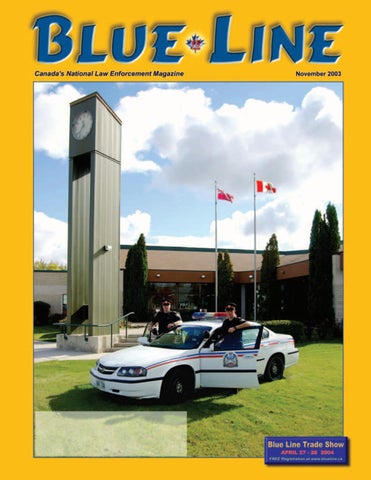
Two officers of the Winkler, Manitoba Police Service grace our cover this month. Smaller police services are always faced with unique challenges. Staffing, training and retention are three big ones but community support is one issue that is about the biggest challenge of all. This month we feature an article from Dave Brown on a Manitoba three-agency inter-force cooperation that creates a model for other small towns across the country. The police services of Altona, Winkler and Morden share not only geography and technology but also a desire to serve their communities by maximizing and sharing resources and staff. Crossing the line between public and private policing models is a concern addressed by Ted Carroll on page 12. This article addresses the three models of law enforcement and how they coexist in the modern world. In his second article on shift work, Carl Mason addresses the biggest health hazard to cops — the 12-hour shift. On page 18 he relates a serious concern for this popular trend and attempts to bring a reality check for those considering the shift cycle. This month our Quebec correspondent, Pierre Sevigny gets us up to speed on the biker trials and the real story how they worked the streets and the system to their advantage. The Toronto Police Commission released their study on racial profiling within that force and you can read the recommendations on page 26 this month. This edition is full of material that should challenge, educate and inform. Dorothy Cotton explains why medical people don’t care about the public good on page 20. A profile of the latest technology in detecting radar scanning devices is discussed on page 35 while the virtues of wireless networking is discussed by Blue Line columnist Tom Rataj. Not to be outdone Ried Goldsborough gives us a rundown on using the internet for investigative searching. Other submissions from our regular columnists Danette Dooley, and Elvin Klassen cover stories from both the east and west coasts of Canada while Mike Novakowski, from central Canada, gives us the latest in Case Law on page 23. There’s even more so get to it!
November June 20032003
4
Bringing law enforcement into disrepute by Morley Lymburner I remember being puzzled by an invitation to a city council committee meeting. I quickly discovered there was a serious move toward making the intersection of Bay and Bloor Streets in downtown Toronto an all-way stop light for pedestrians to cross in all directions. They wanted my thoughts on the issue. When I finished clearing the tears of laughter from my eyes, I was astonished to find they weren’t joking. I regained my composure and asked how they were going to enforce it. “By the police of course,” they replied. After stifling my laughter again, I reviewed the problems with their ‘experiment.’ “You are suggesting a law that would be tantamount to herding kittens in a dog kennel,” I told them. “The idea that an officer could actually try to enforce both pedestrian and vehicular traffic in such a situation is ludicrous. How much discretion does an officer permit for intersection clearance? What about right turns on red? Where are the police going to get the people required to monitor this with all the other things they have going on in the city? What about the effects this ‘Frogger’ game might have on road rage?” At this point someone from the other end of the table asked “and what about the environmental pollution that will be caused by all that traffic being stopped for a further ten seconds?” The head of the committee appeared stunned as he slowly looked around. “I see. I see... well thank your for your input officer and thank you for coming out. Uh... I think then before we continue studying this, we will have it sent out for an environmental study... meeting is adjourned.” I believe the Charter of Rights and Freedoms should prohibit passing legislation that would bring the administration of law enforcement into disrepute. Now here’s a concept that is sure to never come into vogue. All too often law makers don’t consider this important factor and soon discover they just passed a law which does nothing but encourage law breaking as a routine way of life. Bringing the administration of justice into disrepute is a phrase much used by the judicial system in Canada and a concept entrenched in the Charter. It’s the bellwether to the re-writing of laws and is one of the tests all new laws must pass before coming into effect. No one has been unaffected by this basic and far-reaching concept over the Charter’s 20-year history. It includes such things as jail house informants and search warrants, to mention but a few. The legal test I suggest is to simply ask — November June 20032003
is this law enforceable? Do police have the resources, ability and will to enforce it? This would affect speed limits, traffic regulations and any other prospective federal, provincial or municipal legislation. Other than fourway stops and speed zones, one need only point to recent indecision about drug laws, abortion and even fishing rights to find examples that could breach such a concept. A good example is dropping speed limits to such a ridiculous level that any police officer would be embarrassed to enforce them. A four-lane road with a centre left-turn core lane and two-metre wide boulevards posted at 50km/h, for example, or a culde-sac only 50 metres long with a posted 40km/h speed limit. Then there’s the ubiquitous four-way stop signs posted every 100 metres over an entire subdivision. Politicians are adept at passing the
5
buck when citizens complain by making or amending existing laws so the problem is shifted to the shoulders of law enforcement. Four-way stop sign bylaws are a national disgrace and the problem has become epidemic in many areas. If enforcement levels were properly brought to bear, there would be no motorists without at least one ticket; and the tragic thing is that 95 per cent of these offenders feel they did nothing wrong. The average motorist simply gives a bumper dipping nod to such intersections and then roars on to the next one — and the next one may have a child crossing in a hurry because they’re late for school. We can now move on to the federal stage and look at the drug laws — or lack there of. How the feds handle such issues is a wonder to behold. They want to permit limited use of marijuana but don’t want to legalize it. They simply want it to be... well... not legal without being illegal. This leaves officers with a bewildered look and scratching their scalps in disbelief. A legislator needs to ensure a law of convenience or expedience can be enforced before it’s passed. If it can’t pass the simple tests I propose, then perhaps it should be sent back to the drawing board. A little political courage might be in order as well.
Manitoba’s ‘triple crown’ of small town policing shows the way by Dave Brown
recent audit recommended hiring three more officers just to keep up with caseloads. That will happen in the next two years. In the meantime, the service will continue to find innovative ways to share resources with its neighbours.
They’ve heard all the jokes; ‘you know you live in a small town when you recognize every person in your high school yearbook, your teachers remember teaching your parents’ and ‘directions are always given in relation to the traffic light.’ Sometimes people want to live in a small town though — like the residents of Morden, Winkler and Altona, who not only like living in a smaller center but really appreciate the policing service they receive. Canada may be an increasingly urban society but more than nine million Canadians don’t live in large cities. Can they expect and receive the same quality of policing that others enjoy? Can islands of smaller forces survive when surrounded by oceans of larger agencies? To the citizens of Morden, Winkler and Altona, the answer is an emphatic yes. The keys to success, according to the agencies policing these centres, is hiring the right officers, training them properly, providing good equipment, keeping them focused on their community and inspiring them to come up with new ways to cooperate.
lice Service is now one of the more modern and professional forces in Canada. It still manages to maintain all the qualities that make ‘community policing’ a way of doing business, instead of just a goal on a mission statement, and has done so for more than a hundred years. The service has outgrown its space in the relatively new municipal building and will soon be expanding into the former fire department next door. It’s hiring another officer to bring its full complement up to nine and two victim service workers.
Morden A growing town of 6,100 people situated just over an hour south and west of Winnipeg and home to agriculture-based industries for many years, Morden is now attracting many international manufacturing and distribution companies. They’re drawn by its proximity to a north-south highway corridor, attractive business climate and the strong work ethic of the people in the area. Morden police contribute to this attraction in no small measure. First established in 1898, the Morden Po-
Winkler Just up the road from Morden is Winkler, Manitoba’s newest city. Its population, currently 8500 people, doubled over the last 10 years and appears to grow as fast as the wheat and sunflowers that grace the countryside around it. The Winkler Police Service has had to adopt modern and progressive ideas to keep up. Established in 1895, it now has 12 officers and two support staff working out of the modern civic building in the heart of the city. To illustrate just how fast the city is growing, a
November June 20032003
6
Altona Twenty minutes east of Winkler lies the town of Altona. Its 3,400 citizens have even managed to gain some international celebrity status; the town is home to Friesen Printers, who publish the famous ‘Harry Potter’ books and just about every school yearbook in the country. The international media flocked to Altona to await the first copy of the latest book, presenting a challenge for the six officers and one special constable of the Altona Police Service. The service has been operating only since 1906, a relatively ‘young’ agency in a province that highly values its history and traditions. They police this progressive town out of newly expanded quarters that match the many recently built homes, businesses and recreation facilities. Altona is remarkable in that it has identified and is working to change the things about a small town that cause its young people to move away. University-level courses are taught in its adult education facility, a brand new recreation complex with indoor curling and skating rinks has just been opened, there’s a worldclass motocross course right in town and even an exact miniature of the motocross course for radio-control racing enthusiasts. If you can’t find something to do in these three prairie communities, not only are you not looking hard enough, you’re simply not looking at all. . . . continued page 8
November June 20032003
8
Hiring Policing a small town isn’t easy. Officers are under pressure to be self-sufficient and resourceful and must be able to handle every aspect of policing. When they go home at the end of a shift, the job goes with them; it takes a special breed. Hiring the right officer is critical to the success of a small agency. You can’t just bury your ‘mistakes’ away from the public somewhere. Not every officer hired by Morden, Winkler or Altona has stayed. The allure of the big city and big union settlements draw some away. Conversely, they have attracted experienced officers from other agencies and have hired new recruits from across the province. Their best successes, however, are with people from the immediate area. Applicants who are already trained and can be put to work immediately are preferred but the most important factor looked for is the right personality and ‘fit’ with the community. Maturity and life skills are two other important qualities. Morden chief Brad Neduzak considers it important that his officers live in the community. “It’s not just a job. Community policing here is a lifestyle,” he explains. “We live in the same community we police.” The job appeals to officers who really do want to make a difference. “We work in the same community that our children grow up in. When something goes on in your community, you tend to take it personally,” he says. “If you are having a drug problem in town, it will affect your kids, your friend’s kids and your neighbour’s kids. They know they can make a difference here and you have members who work with a lot of pride because of that.” Neduzak reports that officers get an unique opportunity to actually see the fruits of their labours as they follow through every case from investigation to conviction and sometimes even rehabilitation. “They really need to be ‘jackof-all-trades’ people.” The downside of course, is that you are never really ‘off duty’ in a small town. “Sure everyone knows you, but if you have a professional attitude and a good work ethic, the community respects that,” adds Neduzak.
to do so. Altona has even sponsored advanced courses attracting officers from across Manitoba. He tries to spread out the jobs so that every officer has their own specialties. They have a qualified hostage negotiator, a basic firearms instructor and a use of force instructor on staff. “We tend to be pretty proactive when it comes to training. I want to fill as many critical positions in house as possible and reduce our dependence on others,” he says. While a small police force may have to turn to larger agencies for help in highly unusual cases, Robinson also points out that it is a cooperative effort which works both ways, since outside agencies have used town expertise and facilities many more times than the reverse. For example, his Breathalyzer techs have come in very handy when another police force would otherwise have to call in techs from many miles away. Equipment Morden, Winkler and Altona not only have some of the most up-to-date equipment; they have even found a way to invent something that didn’t exist before. Working with local computer company Command Force, Neduzak and Winkler chief Rick Hiebert created a record management system that is shared by all three centers. They call it ‘Command Centre’ and it has really cut down on paperwork. They know that many of their ‘clients’ will likely also operate in nearby communities so they can instantly share incidents and files. Morden units are even equipped with laptops and wireless communications so that records, reports and charge histories can go instantly from a vehicle to all three police services. They all record video in interview rooms and cell areas and even share a common radio channel to keep track of each other and provide backup if needed. The radio reception is not as good as they’d like, so a centralized dispatch
Training “Our officers are as trained, if not more trained, than any other officer in Canada,” says Neduzak. “They just choose to live in a small community. They can step into the same job anywhere in Canada.” Before they hit the street, all officers receive accredited training at either the Winnipeg Police Service Training Academy or the Brandon Police Service facility. They return to the community for their field training and then finish back at the academy. Upon graduation, officers in all three centres can access a wide range of advanced training in everything from Breathalyzers to hostage negotiator courses. Altona chief Glen Robinson points out that his officers can attend advanced training that even some of the biggest agencies can’t provide. He makes sure they have the time and funding November June 20032003
9
system is one of the alternatives being looked at. Altona has cameras in both its vehicles and has been having a lot of success with newer, compact units designed specifically for Canadian winters. All three chiefs are looking at GPS tracking systems for their cars and at equipping officers with tasers. The goal is always greater self-sufficiency, so next on the wish list is an ident unit and canine unit; “and an air unit,” adds Morden Cst. Shaun Klippenstein, with perhaps more than a little wishful thinking. Community policing Policing in smaller centres tends to require ‘broader’ police skill sets, says Winkler chief Hiebert. “You get to know the people and you conduct the investigation from beginning to end. You take the call, write up the statement, interview the witnesses, interrogate the suspects, gather the evidence, lay the charges and prepare the court packages.” “Plus,” he adds, “you don’t get transferred out after a few years and have to pack up your family and start over again!” In Winkler, problems of the community become problems for the police which they must solve. A new web site, for example, will not only have a complete collection of the town bylaws and a downloadable recruiting package but a bicycle registration system. Officers will be able to access the database and hopefully do something about the 50 to 60 bicycles that remain unclaimed every year. “We need to think of new ways to be a ‘smart’ police service,” says Hiebert. “Sure, bike thefts may seem small time, but they sure are irritating. We want to do something about that.” They create an image of a problem that is worse than the actual crime, he adds, and this in itself creates a need for positive action. Morden chief Neduzak points out that social contacts when off duty are also an important part of the job. “We get involved in school
activities, both on and off duty. We play and coach sports. We get involved with Big Brothers/Big Sisters. We sponsor safety contests. Sometimes I feel sorry for some places that may not even know who their police are,” he says. He does admit that it can be difficult to balance the fact that you are never really off duty with the idea that you still need time to yourself. He relates that back to why it’s so critical to find officers with the right personality. “Every citizen knows you, knows what you do and they expect more of you… which is only right if you consider the position we are in.” This quality pays off by attracting more business to the community and hence, more citizens. Klippenstein proudly points to the growing number of international industries that now call Morden home; there is virtually zero unemployment in the area. “Good policing really is good for business,” he says. Cooperation All three chiefs emphasize that a police force is only as good as the people who support it and the cooperation of the agencies around it. Morden, Winkler and Altona have all been blessed with excellent pro-police councils who understand the need to oversee the finances without restricting day to day operations. When more money has been needed for special training or equipment, the money is
there. “In my 19 years on the force,” says Neduzak, “we’ve never had a council who didn’t support us. They all have a good understanding of the need for officer safety.” Altona chief Robinson agrees that they are all fortunate to have the support of good councillors and excellent town managers. Altona Sgt. Perry Batchelor points to the extensive parks, walking trails and recreation facilities, which would be the envy of any town in the country, as evidence residents are willing to invest in their community. All sides have set a goal of working together, says Hiebert. “We all want to create something to show to the citizens that their money was well spent. A police service is visible evidence of professionalism. “People want to look at us and say, ‘that’s our police service!’”
Being reasonably close to both Winnipeg and Brandon and surrounded by the RCMP in southern Manitoba has actually turned into a bonus for all sides. The three forces have access to specialized expertise like the RCMP ident unit to investigate important cases. Winkler Police Service was able to bring in a crack team of child abuse investigators from the Winnipeg Police Service to help solve a recent homicide – only the second murder in the city’s history. All three chiefs report excellent relations with all the bigger agencies in Manitoba and are grateful that they have been able to reciprocate on many occasions. Robinson explains that small police forces can still survive, even when surrounded by bigger agencies, if they’re willing to look at new ways to cooperate. For example, he says they don’t need to spend a lot of money on specialty training and equipment that they will never use if they can work with the people next door and the folks down the road. “If there were a hostage-taking incident, for example, we have an agreement with the RCMP that their emergency response team would respond.” No one talks about exchanging bills when backing each other up in day-to-day activities. Morden officers will speed toward Altona to help out on an incident one night and the next week, Altona and Winkler officers head to Morden for the annual Corn and Apple festival, which swells the population from 6,000 to 40,000 for three days. When an emergency happens close to town, no one complains about assisting the RCMP, especially when they may be many minutes closer. No one has the luxury of two officers on duty 24/7 in every corner of the province, so they have come to rely on each other for backup when needed. Good cooperation is essential since crime doesn’t follow clear-cut lines of jurisdiction. “Out on the street, we’re all officers,” notes Klippenstein. “If someone needs help, we’re there. We don’t care what colour their uniform is… underneath it, we’re all just trying to do the same job.” Innovation The 27 officers of Morden, Altona and Winkler are always looking for even more innovative ways to share resources. They try to get together as often as possible; a recent late night coffee break in Winkler sees a very animated discussion about how to share a dog unit among the three services. With a combined population of over 20,000, the three communities came to terms with policing issues a long time ago. They recognize that local control of policing is important but inter-force cooperation is even more crucial. Doing things smarter isn’t just a necessity for these three prairie communities — it’s a way of life. Dave Brown is a regular Blue Line columnist. He can be reached at firearms@blueline.ca.
November June 20032003
10
QUEBEC — Two informants on criminal gangs complained in September that abuse and corruption are rampant in the province’s informant and undercover agent program. Jim Boivin and Normand Brisebois wanted to meet with Public Security Minister Jacques Chagnon but only got to pass a list of their complaints to an aide. Boivin and Brisebois want a public inquiry to draw attention to the dangerous conditions sometimes endured by those who risk their lives to help jail gang members and murderers. They are also calling for major reforms, including the establishment of an independent U.S. Marshal-style system to protect informants from routine contract violations, the failure to provide new identities and poor incarceration conditions. After months of pushing to have their concerns taken seriously, the pair are increasing the pressure, pledging to expose deep-rooted corruption. Boivin is also suing the government for $1.8 million for making him serve a murder sentence when he was promised probation for his testimony. *** WINNIPEG — Repeat drunk drivers in Manitoba will be required to install devices in their cars that will force them to pass a breathalyser test before they can start their vehicles.
November June 20032003
Ignition-interlock devices will be required for such drivers starting Dec. 1. The ignitioninterlock is programmed to prevent a vehicle from starting if the driver has a blood alcohol level greater than .02. The device requests frequent re-tests once the vehicle is running. The registrar of the Department of Motor Vehicles will have the authority to require repeat drunk drivers to install the devices in their vehicles. Convicted drunk drivers who have been issued restricted licences will also be ordered to use the interlock. Motorists in both categories will have to lease the device from the province for about $3 a day. *** EDMONTON — Corrections officers in Alberta jails received training in September on the use of taser guns to quell violence or fend off an attack. Alberta Solicitor General Heather Forsyth says she wants corrections officers to have more tools to deal with violent inmates. Dan MacLennan, president of the Alberta Union of Provincial Employees, says while guards can now use pepper spray, tasers are another tool to ensure their safety in potentially violent situations. He says more staff are needed for an effective crackdown on gang-related activity but Forsyth says the plan doesn’t call for higher staffing levels.
11
OTTAWA — While crime rates are declining and fewer convicted felons are being sent to jail, more people are being locked up to await trial, Statistics Canada reported in September. Almost 60 per cent of those sent to provincial and territorial jails in 2000-01 were on remand. Remands increased during the late 1980s and have remained relatively stable in spite of generally declining crime rates and rates of admission to sentenced custody, the report said. The number of adults on remand almost doubled, to 110,000 in 1991-92 from about 68,000 in1986-87 and have remained fairly constant. Jail sentences reached a peak of more than 120,000 in 1992-93 and declined steadily to just under 81,000 in 2000-01, partly due to the introduction of conditional sentences in 1996, the report said. *** OTTAWA —The Supreme Court of Canada places new guidelines in September that may make it more difficult for prosecutors to jail dangerous criminals indefinitely. In a 9-0 ruling, the high court said judges cannot place indeterminate sentences unless they first consider the possibility that offenders could eventually be treated and controlled within the community.
Canadian policing models Defining the line between public to private policing has its challenges oped best practices and set standards to varying degrees but now they will have formalized industry standards to guide them. Unfortunately private security agencies still have no formalized standards and regulations. Policies and practice in large private areas open to the public are established solely at the discretion of the property owner. With a multitude of models in place, the public isn’t likely to be treated in a consistent and equitable manner until standards are introduced.
by Edward J. (Ted) Carroll Canada has three models of law enforcement — public police, para-police and private security. Public police are supported by tax dollars and expected to serve all citizens. Corporations and citizens requiring enhanced policing can buy ‘public’ services through paid duty officers. In some situations, public police may be co-mingled with private security when the client requires or decides to have a combination of both models present. Para-Police aren’t public but have more authority than private security officers. They’re generally special constables, provincial offences or by-law enforcement officers and patrol many major university campuses, transit authority property, housing complexes, airports, parks and government institutions. Their powers and mandate are usually defined in an agreement with the local police services board or commission, as prescribed by provincial legislation. Private security officers may be hired directly by an organization or contracted from a company. Hiring criteria, background screening and training varies. In Ontario, contracted officers must be provincially licensed but those working in-house are exempt and employers are free to create their own standards. Officers do everything from guarding construction sites to being deployed as first responders, handling disturbances, domestic disputes, assaults and shoplifters in a variety of settings. Justice The Charter of Rights and Freedoms applies to police and para-police but not security officers, who make arrests as private citizens. It can be argued that intervening and arresting people for assault or causing disturbances may be more in the interest of the public who are victimized than the corporate property owner they work for. Other private security officers also become part of the judicial process by virtue of their duties. In some Ontario jurisdictions, department store loss prevention officers are empowered to release shoplifters after conferring with local police by phone. Essentially, they’re responsible for arrest, search, detention, taking a statement, continu-
November June 20032003
ity of evidence, releasing the accused and court preparation and presentation. Higher standards need to be established for these officers. Equality Industry standards and regulations are required to ensure Canadians receive equitable and consistent security services from all levels of police. Two major Ontario universities, for example, have vastly different policing and security models. One refers to its special constables as police, requires candidates to undergo tests and screening similar to those of public police and prominently displays the word ‘Police’ on its uniforms and vehicles. The other university doesn’t want its security officers to look or act like police and resists any extensive pre-placement testing. It doesn’t do criminal record checks on students working for it part-time or provide its full time officers with protective tools and has a disengagement policy if potentially assaultive behaviour is shown. The community has a right to expect that each university has a security presence that will safeguard property and intervene to protect them if they’re threatened. The security models in place are inconsistent with public expectation and perception. Both universities have a community-based service philosophy, emphasize crime prevention, encourage informal resolutions to disputes and view formal enforcement as a last resort. Their crime rates are relatively low, typical of Canadian universities, yet serious offences such as sex assaults, robberies, dangerous driving and high-value break and enters do occur. Interestingly, both universities provide their security staff with soft body armour. The Ontario Ministry of Public Safety and Security released new guidelines for agencies employing special constables in the spring. Special Constables – A Practitioner’s Handbook is a handbook which serves as a guide and reference manual for both police and nonpolice employers. Many agencies had independently devel12
Accountability Security officers’ roles have moved from protecting property - the night watchman model – to protecting the public. Often perceived or actually acting as social control agents in public places, their role has evolved to one of ‘policing and security.’ The ‘policing’ role brings with it expectations of higher standards and accountability. Many industries are self-regulating and have disciplinary bodies and processes in place to deal with complaints. The security industry is capable of establishing such a body. Efficiency Security officers carrying out ‘policing’ functions should be augmenting or supporting public police, not replacing them. Professionalizing the industry need not result in costs comparable to those of paid duty police officers. It’s possible to formalize learning practices and opportunities that already exist. The onus should be put on those aspiring to be security officers to complete a law and security program. Partnerships with community colleges for ongoing training initiatives and distant or e-learning can be developed. Recommendations Establish the following three classification levels for security and para-police officers – security guard, community protection officer and community peace officer. The traditional guard would handle such duties as controlling building access, protecting property and monitoring close circuit TV, working as ‘eyes and ears’ and not expected to intervene in serious conflicts or disputes or apprehend offenders. Community protection officers would provide proactive and interactive services to the public, including community patrol and response, conflict and dispute resolution, criminal incident response, arrest and detention, medical assistance and directing traffic. Other terms could replace ‘community’ to reflect the environment where the officers serve – for example, campus protection, healthcare protection or housing protection officers. Community peace officers would be sworn special constables not fully trained and equipped to the standard of public police. Parapolice can presently be confused with public police. While it may be advantageous in certain situations to display the word ‘Police,’ it can also be misleading to the public, who might
expect officers can respond as fully trained and equipped public police. It can also be a health and safety issue for para-police officers if they’re confronted by an armed criminal who perceives them as fully armed, public officers. Again, the word ‘community’ could be changed to reflect the working environment. Professional standards Statutory guidelines should be developed through a consultation process to identify industry standards and best practices that require compliance. They would recognize the officer levels suggested above and apply to both inhouse and contract security. The standards would result in consistency of service delivery and ensure that organizations meet standards. Agencies would still be able to customize service and set policies once the standards have been met. Minimum selection criteria and training requirements would be established for each of the three levels. Each category would have uniforms that are distinctive enough to reflect the officer’s level and equipment consistent with their duties. There is presently a wide variation in protective equipment among both special constables and security officers performing similar functions in similar environments. An approved industry standard use of force response options model would be applied to each category. The Ontario Ministry of Public Safety and Security has recently released a discussion paper focused on reviewing the province’s Private investigators and Security Guards Act. This is a positive sign that we may be moving from discussion to action.
Judge calls Toronto jail conditions barbaric An Ontario Superior Court judge has said that the conditions at Toronto’s Don Jail are so barbaric that the judicial practice of crediting triple time to inmates held in pretrial custody “is no longer an adequate response by the courts in this municipality.” Justice Ted Matlow made the comment in September as he was sentencing Robert Kinnear, 18, who spent almost 11 months in the prison, often ending up as the third man in a tiny cell and being forced to sleep on a mattress on the floor, his head next to a toilet. “I cannot simply close my eyes, and even my nose, and continue to send, without protest, human beings to a place where their Charter rights are violated with impunity while they await their trial,” Matlow said in his decision, delivered at the main Toronto courthouse. Kinnear was arrested after he stole a pair of socks and was apprehended by security guards. He faced one count of theft, two of threatening death, one of escaping custody and three of using an imitation weapon while committing a crime. Kinnear spent at least 80 per cent of his time in a three-man cell, counted by jail staff
Accountability Once an organization or person has the authority to exercise control over the free movement of an individual or individuals in public areas, accountability policies must be established to ensure that people’s rights are respected. People employed in these capacities must also be afforded protection from vexatious, frivolous and unfounded allegations. As private security services have evolved into providing lower-tier public safety and security services, so too has the need for accountability. Conclusion The line between private and public policing may have become blurred to the average citizen. Public police cannot be expected to provide the enhanced safety and security presence that some environments demand. Security professionals, while not meant to replace public police, do have a role to play in the safety and security of the community. Formalizing professional standards and invoking best practices will demonstrate that professionalism exists in both the public and private provision of these services. This article was adapted from a comprehensive submission by the author to the Law Commission of Canada discussion paper In Search of Security: The Roles of Public Police and Private Agencies. Carroll, P.Mgr., owns Policing & Security Consulting Services, which specializes in professional standards and best practices for private policing and security organizations. Carroll, who directed a university security service after a 31-year policing career, can be reached at pscservices@rogers.com. November June 20032003
13
as the third man - the one forced to sleep on the floor in a space about a metre wide - on at least 30 nights. Like the great majority of inmates there, Kinnear was on remand, meaning he was presumed by law to be innocent and had not yet had his day in court. At his trial in August, Jim Aspiotis, a security manager at the jail, said that for much of the time Kinnear was at the Don, its theoretical capacity of 520 stretched to the breaking point. At its peak, Aspiotis said, there were 685 men placed into 240 two by three-metre cells. The constant overcrowding, Aspiotis said, meant that inmates might get “yard time” - a brief respite outdoors - once every three days, far less than the daily outing set out by Ontario government guidelines. Also, the jail was chronically understaffed during Kinnear’s stay, so for security reasons, inmates were locked-down and confined to their cells 24 hours a day at least 40 times, Aspiotis estimated. Matlow said it was miraculous that Kinnear had survived his time “more or less intact,” and counted it in full for the sentence of one year, nine months and seven days that he imposed for all seven charges.
So long, it’s been good to know you After 30 years, Terry Barker is staying put by Elvin Klassen The best part of his professional life has been knowing and working with people in law enforcement, says Terry Barker. “Police who I have worked with are the finest people in the world that I ever hope to meet. My passion has been to help them do their job better.” Born and raised in Vancouver, Barker is a man of many talents. He’s taught public school and theatre, trained the armed forces and worked as a sales manager and vice-president of a consulting firm. He spent time in Bermuda, Hawaii, the United States, Australia and the Caribbean, giving courses not only to police forces but large corporations such as IBM, 3M and BC Tel (now Telus). He taught at the Canadian Police College in Ottawa, the Justice Institute of British Columbia, Fairmont Academy in Burnaby and the Saskatchewan Police College in Regina. He enjoyed the challenge of taking the problems encountered in daily life and coming up with solutions through student participation. Barker enjoys telling about how, during his consulting years, he filled out a questionnaire in a Sydney, Australia, hotel that asked how many nights he’d spent in a hotel in the past twelve months. He checked his calendar, discovered the answer was 186 days and said “that’s it, no more!” During the last eight years he developed and taught a course on communication skills for police personnel for Henson College, delivered through the Internet. Barker’s no stranger to computers, buying his first one in 1979. He also moderates the Communication Skills thread on the Blue Line forum. In one of his recent contributions, he wrote: “All these suggestions have one thing in common — power. Who’s in control? If you let them manipulate you, you’ve lost the power game. If you can control your own feelings and behaviour, you’re in charge. I think there are many different systems out there that work, all the way from ‘give ‘em hell’ to verbal judo and my own ‘system’ in The Five Minute Police Officer, but they all start at the same point — control yourself. “It doesn’t matter whether you’re a cop on the beat or a supervisor in a warehouse. If you have power, there will be those who will challenge you. That’s when you apply the system that you have previously thought through and adopted.” Barker lives in Sechelt on BC’s Sunshine Coast — Beachcomber country — with his wife Connie. “None of my life would have been possible without her,” he says. “She gave me the opportunity to discuss ideas and proof my writing. We are a team. She reads everything I write.” He’s written and published several popular books, including Boss Talk … People Skills for Managing Your Staff. Its five editions have sold more than 30,000 copies, making it to the Canadian best sellers list. It has been translated November June 20032003
into Czech and also printed in Australia. Now out of print, it’s still available in electronic form from Barker for $15. His second book, The 5 Minute Police Officer, has been a textbook in many police colleges. “It is a teaching novel,” says former Gibson RCMP sergeant Ed Hill. “When you have finished reading it, you have learned a lesson. “Terry has made common sense out of… the ability to deal with the public in all its forms, moods and temperaments, which allows even experienced policemen to feel a new confidence. We all know that confidence coupled with experience and ability means a polished and professional job.” Many people have told Barker that the book changed their lives. One constable wrote that “I think every member knows of incidents either as ‘Tacky Burns,’ the main character, or while attending an incident with Tacky Burns. “The ‘system’ that the book teaches is quite simple and yet quite effective. By the time one completes the book, the five point system is familiar. I feel this book would be valuable for all members to read.” Other professionals have benefited from Barker’s books. The concepts can be applied in all life situations. Hundreds of copies have gone to managers of a pulp and paper company and teacher colleges have also found it useful. It’s been a valuable tool in teaching conflict resolution, notes Barker, who believes “people can learn to communicate better.” “When I started my training, the standard approach to police discipline was standing the officer at attention and yelling at him for a few minutes. What is the point? The sergeant feels good, having told someone else off but has he solved a problem? These books show a more effective approach. I can’t make you into a perfect manager, but if you follow these steps, you will be a better leader than before.” 14
Barker’s now began a new career as an artist and writer. He seeks out interesting places and people for his Sunshine Sketches column, which appears every two weeks in the weekly Coast Reporter. His meticulous drawings and colourful stories have delighted local readers. He draws the fascinating buildings and sites that can still be found in what is, even today, largely a pioneer land. He’s also done more than a hundred commissioned drawings. Barker sketches in pencil, draws the outlines with ink pens and finally creates deep shadows with brushes and differing intensities of ink and water washes. He also includes a history of the building or site featured. Barker compiled his art into two books, Sunshine Sketches, An Artist’s History of BC’s Beautiful Sunshine Coast and More Sunshine Sketches - A new Collection of Drawings and Stories about BC’s Beautiful Sunshine Coast. Tourists use them as a guide when they go off the beaten path, seeking out some of the places and people that give the area its unique colour and flavour. Locals learn more about their history. On Saturdays you’ll find Barker at the Sechelt farmer’s market sketching caricatures and talking with visitors. He quipped during my visit that “my passion has changed from being a teacher to being a writer, artist and publisher. I have made a right turn in my life and I absolutely love it.” He continues, “I do not want to turn my back on all the wonderful people that I have met in the last 30 years. I love police. They do a job that is not only essential but needs to be admired. I think back at all the police officers that I have met who have become my friends. Thank you for making my life so worthwhile.” He’d love to reconnect with friends, former students or those who’ve been influenced by his books, just to say goodbye. “My travelling is done,” he says, “this is my obit.” He loves to hear how something he’s said has changed someone’s life and, laughing, adds “they can give me their eulogy before I am even dead.” Contact Terry Barker at tbarker@dccnet.com with your thoughts and memories. The Five Minute Police Officer is still available from the Blue Line Reading Library. Elvin Klassen is Blue Line’s West Coast Correspondent. He can be reached by email at elvin@blueline.ca.
Emerging criminal issues Contraband activity Organized crime groups transport and distribute contraband throughout Canada which they’ve acquired either through illegal diversion and illicit production or smuggled into the country. Illicit drugs continue to be the major source of criminal profit. Its trafficking fuels and finances other criminal acts, creates situations prone to violence and encourages societal corruption and disruption. Groups also handle other contraband, including firearms, tobacco, alcohol, precious stones, luxury vehicles and even illegal migrants, some who pass through Canada on the way to the US. A significant portion of the contraband, particularly illicit drugs, is supplied from foreign sources and therefore arrives by air, land or water. Organized crime has learned about and uses all facets of legitimate business and transportation to import contraband and has attempted to infiltrate and/or corrupt border entry points, especially ports. Canadian and US law enforcement agencies participate in joint cross border initiatives to improve cooperation and coordination. Senior law enforcement and justice officials meet each year in the Cross Border Crime Forum to share information and address issues. The Integrated Border Enforcement Team (IBET) concept, initially established in 1996 along the international land and marine borders between British Columbia and Washington
November June 20032003
State, is being gradually extended to other areas. IBETs are multi-agency and designed to complement existing border enforcement efforts and target illegal activity, regardless of which way the commodity is headed. Firearms The illicit firearm market supplies OC groups capability to commit crimes, provide protection, demonstrate status and intimidate or inflict violence on their criminal peers, the law enforcement community and innocent citizens. Even urban street gangs continually upgrade their weapons, going from knives they had a few years ago to automatic weapons. While there’s a profit incentive in selling illegal firearms, it’s fuelled by criminal activity, particularly the illegal drug trade. It also supplies guns to individuals wanting to avoid government control regulations. Domestically, illicit firearms are either stolen from private residences and retail outlets or diverted during a legitimate commercial movement. The major source, particularly for handguns, is the US, where they’re usually acquired from a legitimate licensed retailer, gun and flea markets or through the Internet. It’s difficult to know how many illegal firearms enter the country each year or how many there are already here. In some cases, Canadian smugglers use US residents as front people to legally buy guns,
15
which are then illegally moved across the border, generally in quantities of three to five. Given the sheer numbers of people and goods crossing each day and the long stretches of unprotected areas, it’s impossible to completely stem the flow of illegal weapons. The numerous crime handguns unregistered in Canada and subsequently traced back to their US origins is proof of the severity of this problem. Unlike other types of contraband, a firearm is not a consumable commodity that requires constant replenishment. Some are manufactured 20 years prior to being confiscated. A single illicit gun can be used in numerous crimes and is a threat to society until seized or discarded by its owner. Another source of concern are allegedly deactivated firearms, particularly military rifles and machine guns sold as DWATS (Deactivated War Trophies). In some cases they were poorly deactivated and can easily be made to function again. A recently concluded law enforcement project in western Canada disrupted an operation which imported and reactivated DWATS and sold them to OC groups. While Canada isn’t a significant international source of illegal firearms, there have been random incidents in which it was used as a transit point in their movement. One such incident involved legal importations of M1 Garand ri-
fles used by the US military in the Second World War and Korea which were ultimately destined for the US. Information provided by the Canadian Firearms Registry was instrumental in discovering the illegal diversion, resulting in the recovery of 23,850 rifles or receivers. Police across Canada, including the Provincial Weapons Enforcement Unit (PWEU), an Ontario joint forces initiative, are actively working to interdict illicit firearms. They’re supported by the Department of Justice (DOJ) created and financed National Weapons Enforcement Support Team (NWEST), co-managed with the RCMP’s National Police Services. NWEST is staffed by qualified law enforcement representatives from federal, provincial and municipal agencies. Canadian police work closely with US counterparts, particularly US Customs and the ATF, to battle the illicit gun trade. Diamonds The Canadian diamond industry has become one of the top five producers of rough diamonds in the world in a relatively short period of time, beginning with a diamond discovery at Point Lake in the Northwest Territories in 1991. Police are aware of the potential criminal exploitation of diamonds and is monitoring the developing industry. The RCMP established a Diamond Protection Service in the Northwest Territories which works in cooperation with other agencies and the diamond industry. Precious stones have always been an attractive commodity to criminals due to their high value and low weight. They’ve been used as currency to acquire contraband, pay for services rendered and to move and launder profits. There’s also concern terrorist organizations such as the Al Qaeda network may use diamonds to finance operations, avoiding the international banking system and government controls. As seen in other countries, there’s the potential for OC to infiltrate the industry and arrange to divert diamonds from the legitimate commercial pipeline for criminal exploitation and profit. Given Canada’s reputation as producers of clean diamonds, this country could also attract smuggled illicit diamonds, which would be added to production and effectively sanitized as a bona fide Canadian product for legal sale. Similarly, this reputation could attract foreign origin cut and finished diamonds to be misrepresented as a Canadian product. One source could be regions such as Western Africa, where countries have been known to sell ‘conflict’ or ‘blood’ diamonds to finance violent civil strife. Our proximity to the US, the largest consumer, also increases the potential we will be used as a transit point. The international movement is assisted by a lack of effective rough diamond certification measures to easily ascertain their true origins. The ‘conflict’ diamond situation raised international interest in addressing this problem and sparked the Kimberly Process, which began at the beginning of this year, to establish minimum acceptable standards for national certification of rough diamonds. There’s also a danger OC groups may target the Canadian diamond market and introduce synthetic diamonds, known as moissanite, that November June 20032003
are acquired cheaply in foreign markets and illegally passed off as the legitimate product. Moissanite on the legal market is sold at a substantially lower price than the genuine article but it’s difficult to tell the difference. Canada could develop subsidiary operations such as diamond sorting, cutting and polishing so rough diamonds don’t leave the country to be developed into finished products. This would have positive economic benefits but could also create further potential opportunities for OC to exploit.
Tobacco The continued impetus behind the illicit market is predominantly price driven and involves schemes to avoid federal and/or provincial taxes. Participants range from OC groups to smaller, family-based entrepreneurial operations. Most of the illicit market involves legitimately manufactured tobacco that’s illegally diverted to other provinces to take advantage of different tax rates. There are also small quantities of Canadian product legally exported and then smuggled back, foreign brands, including counterfeit product, and Middle Eastern water pipe tobacco. Cigarettes are moved inter provincially by mail, normal air traffic or using rental vehicles or motor-homes. The RCMP seized 2,897 cartons of Ontario marked cigarettes from a motor-home en-route to Calgary in 2001. It appears increased federal and some provincial taxes, along with a revised export tax, haven’t significantly increased illegal cross border movement of tobacco. However, a gradual increase in provincial tax levels, including Ontario and Québec, previously the major sources of illegal inter provincial movement, could increase activity. It’s reported that legal cigarette exports by the international tobacco industry currently exceeds reported legal imports. As much as one quarter of the world’s cigarettes are diverted to the contraband market — and this doesn’t include counterfeit tobacco products or movement from high to low tax national jurisdictions. The magnitude of this illegal diversion has been demonstrated by numerous international enforcement actions. Irish authorities seized 30 million cigarettes concealed in containers bound for the Netherlands from Miami which had been declared as furniture. UK customs officials seized 68,000 cigarettes from an Estonian vessel. Northern Brands, an affiliate of R.J. Reynolds, was convicted of involvement in a tobacco smuggling scheme directed at Canada in 1998. This case illustrates a potential corruption problem facing legitimate business enterprises dealing in a legitimate product that may be heavily taxed by governments. Invariably, an illicit market will develop to supply a 16
cheaper product. The business pressures to maintain or increase corporate profits and market share may influence actions which could contribute, even indirectly, to the illegal diversion of a legitimate product to the illegal marketplace. Illicit tobacco activities deprive governments of tax revenue and provide OC groups with enormous profits which help them further other criminal activities. Alcohol Our illicit alcohol market continues to be supplied by cross border smuggling, retail/ wholesale thefts, illicit manufacture and, to a lesser degree, inter provincial movement. Smuggling and illicit manufacture are currently the two major concerns. The motive for this illegal activity, as with tobacco, is often price and tax avoidance. Almost all OC groups participate, to varying degrees, in supplying the market — the problem appears greatest in Ontario, Québec and parts of western Canada. The US is the primary source due to a significant price differential and the ease of movement. In some cases smugglers change license plates or move product through ports in container shipments. Participants are often knowledgeable about legal import/export procedures and use them to enable international movement prior to diverting it to the illicit market. Large scale domestic thefts are a continuing problem. Thieves hijacked two tractor trailers parked at a Longueuil warehouse last year, stealing some 30,000 bottles of wine and sangria worth about $300,000. Approximately 3,300 cases of beer were stolen from a hijacked tractor trailer in Alberta the same year. Police continue to find illicit stills across the country; some are small and only for personal use but commercial size stills continue to be discovered. An illegal operation south of Montréal discovered last year produced an estimated 3,000 cases (6 x 1.75 litres) of pure alcohol, diluted with other products and bearing counterfeit labels. In all these cases, the product is disguised as legitimate brands and distributed to bars and restaurants. Drinking alcohol from illicit stills, which can be contaminated with bacteria or contain methanol, can lead to blindness or even death, deprives governments of tax revenue and threatens the viability of legitimate alcohol manufacturing and distribution businesses. Ports Criminal Intelligence Service Canada has been monitoring and evaluating OC activities at Canada’s ports since 1998, which led to a national ports strategy to enhance inter-agency cooperation and coordination under the National Ports Working Group. Integrated multiagency enforcement units are currently located at the ports of Vancouver, Montréal, Halifax, Saint John, and St. John’s. There are numerous other ports in Canada with various levels of facilities and cargo volume capability. Each are potential targets for OC penetration, vulnerable to either infiltration and/ or corruption of employees. These include not just ocean ports but those along the St. Lawrence River and the Great Lakes which are accessible to ocean going vessels. Smaller commercial
ships, private vessels and fishing boats are also used to move contraband along the coastline and within North American waterways. The means by which OC infiltrates and influences marine port operations is well established. Their presence doesn’t have to be pervasive; it’s only necessary to penetrate positions that influence the movement of commercial cargo off vessels and within the port environment. The majority of port employees may be unaware of any criminal presence and are certainly not involved or implicated in the illegal activities occurring around them. In some cases, port employees have been intimidated to ensure cooperation or silence. This presence allows all types of contraband to be moved into and out of the country, particularly illicit drugs, which fuels violent incidents between rival gangs that can invariably affect the lives of innocent citizens. The ports also serve as a conduit for illicit tobacco, alcohol, firearms and illegal migrants. OC groups who’ve infiltrated ports are also involved in stealing and diverting legitimate imported goods and exporting stolen high value vehicles concealed in containers destined for Asia, South America and Eastern Europe. Organized crime and ports are an international problem. A significant amount of commercial shipping destined for Canada initially enters a US port and vice versa, so this entrenched criminality is a threat to both countries which must be addressed through mutual cooperation and coordination. The US and Canada have begun exchanging customs officers at ports in Vancouver, Montréal, Halifax, Seattle-Tacoma and Newark to target containers destined for either country at their first port of arrival. There’s been a heightened concern over security at ports since 9/11. The Ports Canada Police was disbanded in 1997 and port security is now handled by private companies, with local police responsible for general law enforcement. Canadian law enforcement is aware of the potential threat to ports as an entry point for terrorists and/or their destructive weapons or materials. Entrenched OC elements could potentially allow terrorist infiltration, either by mutual arrangement or lack of vigilance, which adds a new dimension to its threat.
Canada’s homicide rate on the increase More people were killed with knives than guns last year, Statistics Canada says. Canada’s homicide rate rose after two years of relative stability, the agency reported in October. At the same time, the proportion of homicides committed with firearms fell to an alltime low, the report said. Stabbings, the most common method in 2002, accounted for 31 per cent of homicides, followed by shootings at 26 per cent, beatings, 21 per cent, and strangulation or suffocation 11 per cent. Handguns accounted for two-thirds of the 149 firearm homicides in 2002, up from about one-half during the 1990s and one-third prior to 1990. The 98 homicides committed with a handgun last year were consistent with the annual average over the past decade. Use of rifles and shotguns have declined - they now account for one-quarter of all firearm homicides. Thirty-seven homicides were committed with a rifle or shotgun in 2002, fewer than the previous 10-year average of 67. The remaining 14 firearm homicides were committed with other types of firearms. The agency said police reported 582 homicides, 29 more than in 2001. “Last year’s increase in homicides was driven by a large jump in British Columbia, where there were 126 homicides reported in
Outlook OC will continue to have a presence at major ports and could shift its focus to other ports in response to law enforcement successes. It will also continue attempts to infiltrate the rapidly developing diamond industry and exploit any potential profit opportunity. The illegal firearms, tobacco and alcohol market will continue to be supplied by a variety of domestic and foreign sources. As federal and provincial tobacco taxes approach the peak levels of the early 1990s, the dynamics will change. The cross border movement of contraband and illegal migrants between Canada and the US will continue but should be reduced by enhanced enforcement, cooperation and coordination. This article is part of a Criminal Intelligence Service of Canada review of targeted organized crime groups and their activities, based on intelligence and investigation reports from Canadian and international enforcement agencies. Blue Line Magazine is running a series of monthly articles based on the CISC’s 2002 final report. Go to www.cisc.gc.ca for more. November June 20032003
17
2002, up from 84 in 2001. Contributing to the increase in British Columbia were 15 homicides of missing women that occurred in previous years in Port Coquitlam and that were reported by police in 2002,” the report said. Winnipeg, with 23 homicides, and Saskatoon, with eight, each had a rate of 3.41 per 100,000 residents, the highest among metropolitan areas. “Although Toronto had the most homicides (90), its homicide rate (1.80) was still slightly below the national rate of 1.85. Oshawa, Ont., was the only census metropolitan area not to have a homicide in 2002.” Statistics Canada also found that: • For a second consecutive year, gang-related homicides decreased. • Almost half of the 182 victims killed by a family member were killed by their spouse. • Forty-four per cent of female victims and eight of all male victims were killed by someone with whom they had a relationship. • Men are more likely to be killed by a stranger than women. • Almost two-thirds of the 523 people accused of committing homicide in 2002 had a criminal record. • Consistent with previous years, men accounted for nine in 10 accused, and about two-thirds of all victims.
Lurking hazards of 12 hour shifts The mad rush begs the question — would turkeys vote for Christmas?
by Carl Mason Managers developing duty rosters will often go to other police forces or industries to see how they have solved the problem, making the fatal assumption that those outside agencies have got it right! For example, encouraged by the positive views of staff in one UK department, a specialist firearms unit from another force approached me with the proposal to change to 12 hour shifts. They thought performance and motivation would improve and that overtime and fatigue would drop. I advised against it but they went ahead anyway. Unfortunately, not only has overtime gone up but performance appears to have dropped. It’s important to note that duty rosters are dependant on staffing levels and robust abstraction management; without sufficient staff, there’s no way a particular roster can work effectively. Although this may seem patently obvious, it’s surprising how many employers labour under the belief that they can maintain low levels of staff, or even reduce staffing, but keep or introduce a popular roster. Equally, many staff complain that “there aren’t enough staff” when in fact the duty roster (by reducing cover at times of peak demand) creates that very situation! It’s not the shift pattern alone that permits effective resource allocation but rather the number of working hours each employee can provide per day at a time that meets organizational demand. The ‘best’ shift patterns meet demand and manage staff needs. The primary motivation and selling point for 12-hour patterns, aside from how easy they are for managers to draw up, is, in my experience, the 191 days off that officers receive each year. Add to that the average 18 days leave (12 hour days), nine public holidays and eight sick days that an average officer takes and it quickly becomes obvious that each member of staff is only working 139 days. Divide those shifts between days and nights and you’ll find each member works just over two months of days and two months of nights in a year. In effect, they have
November June 20032003
the equivalent of eight months a year off. Whilst I don’t doubt that the roster is popular amongst staff, I suspect that organizational benefits are almost non-existent. The 12 hour shifts do not provide a balance between agency and staff need and are rigid, inflexible and prone to enormous problems. Custom and practice • A variable shift agreement in many United Kingdom forces has been negotiated which allows for shifts of between eight and 10 hours. Most representative bodies would not support any member who wants to work 12 hour shifts because of health and safety concerns. • For operational staff, 12 hour patrol shifts mean they could be driving for the entire time, risking a fatigue-based accident. Many staff have complained about even 10 hour shifts and quite a few have been allowed time off in lieu of time worked at the end of a ‘busy’ shift. • 12-hour shifts often mean a 14 hour ‘day,’ based on a one hour commute each way. This severely restricts recuperation opportunities before the next shift. • Many UK forces have consistently been criticized for their high levels of overtime, which
18
are often caused by poor resource management, bad forward planning or understaffing. 12-hour shifts serve to worsen this situation, as only 50 per cent of staff work each day. With eight hour shifts, 75 per cent of staff work each day, reducing the need to cancel days off, which are costly both in financial and human terms. The level of cover given under the 12-hour proposal is exactly the same as eight hour shifts (25 per cent per shift) but, significantly, staff don’t often clamour to be allowed to work eight hour shifts! •There’s evidence suggesting that managers cannot successfully manage the overtime implications of 12-hour shifts, especially in the case of deliberate ‘job distancing.’ This refers to the practice of selectively taking vacation in small periods between the substantial periods of time on days off. This can result in having to work only a few days each month, taking the officer away from integration in their role. For example, a community officer may find they lose touch with the community. In one example, an officer was able to manipulate their time so that they only worked 11 shifts in 31 days – and one of those was a public holiday for which they were paid double time! An overview of research A substantial body of research indicates some disturbing evidence relating to fatigue on 12 hour shifts: • Many law enforcement executives in the United States... doubt that the advantages of compressed shifts outweigh their drawbacks. For one thing, 12-hour shifts leave officers exhausted by the end of shift – especially by the end of the third or fourth work day. They also can magnify the impact of overtime on sleep; when officers have only 12 hours to eat, sleep, see their families and drive home and back, even an extra few hours spent on arrest reports or waiting to testify in court can make it impossible for them to get enough sleep.” — Compressed Hours (extract from “Tired Cops,” Vila, B., 2001) Furthermore, there are more pragmatic concerns, although they’re a little harder to quantify. 12 hour shifts provide significantly higher periods of time away from the workplace and the primary employment often becomes secondary to other interests. Dr. Vila again: Another problem that many people have commented on... is that compressed shifts encourage moonlighting. Most of us who’ve been around law enforcement for a long time remember firemen who also held down full-time jobs in construction or had their own businesses on the side. Fatigue problems could be magnified substantially if officers use the large consolidated blocks of time afforded by compressed shifts to work rather than to recuperate.
The most fundamental argument I’ve been able to find against police working long, compressed hours relates to research carried out by the Walter Reed Army Institute of Research into fatigue amongst soldiers: Sleep deprivation degrades the higher, more complex mental processes. Soldiers lose battlefield awareness. They lose the ability to integrate information into a coherent and accurate representation of the tactical situation. In contrast, simple mental processes are unaffected. This disparity between the effects of sleep deprivation on simple and complex mental abilities helps explain friendly fire incidents. In the sleep-deprived state, soldiers can still put the cross-hairs on a target and fire rounds accurately down range, but their orientation to the terrain and tactical situation degrades. They can shoot and shoot accurately but no longer can distinguish friend from foe. Now consider, in light of the above findings, how much more complex police work is, and then extrapolate the decision making process from the battlefield in war to the street in peacetime. Essentially, tired police officers may be expected to “shoot and shoot accurately but (like the rest of their fellow human beings) no longer can distinguish friend from foe.” What price twelve hour duties where lives may be at stake? Of course, many officers reading this and seeing the potential for a ‘better’ duty roster slipping away may argue that police work is different and officers are unique or even better trained to deal with such situations. Despite opinions to the contrary from less law abiding citizens, cops are human. Studies on human fatigue offer significant evidence that might make proponents of 12-hour shifts think again. For example, the British government published the following research findings which refer to my own research on poor shift design: Prior research indicates that disruption to the circadian rhythm, through working shifts and poor work scheduling, can cause fatigue and have a detrimental effect on the health and stress levels of shift-workers... this is particularly applicable to those over 40 years of age. Focus groups highlighted shift systems as having an important impact on sickness levels. One participant said: I was on a week of 12-hour shifts and it knocked me out for a fortnight (two weeks)… my concentration levels went. I could see everyone on the shift slowly sinking down and they were a lot younger than me… At the end of seven 12-hour shifts, people were just at breaking point, and for them to phone in sick, I would not have said “you are lazy,” I would have said, “fine, take a break. — Uniform patrol sergeant, age 50-59; focus group. The study concluded that: It is therefore vital that the potential health impacts of particular shift systems are considered and further research be undertaken to identify those least damaging to officers’ health. All across the Western world, courts are issuing guidance on hours of work. For example, in the UK case of Johnstone vs Bloomsbury Health Authority, the court was unequivocal: Where an employer knew or ought to have November June 20032003
known that requiring the employee to work the hours they did, they exposed him to risk of injury to his health… they should not require him to work in excess of those hours. Prison sentences in the UK (later suspended for two years) were imposed on two company directors who permitted a driver to regularly work a 60-hour week, even though he was willing. Owing to the long hours, the driver was a causal factor in the deaths of two motorists R v Roy Bowles Transport Ltd, R v Cox 2001. On 12-hour shifts, a 60 hour week is a definite possibility; the officer need only work one days’ overtime on a four-on-four-off rotation. In an operational policing environment, 12 hour shifts are not a suitable solution to the problems of 24-hour cover. I base my opinion
19
on the above evidence, but you don’t have to take my word for it. Visit Internet chatrooms and bulletin boards dedicated to shiftwork. You will often find, as I have, people admitting that they thought 12hour shifts were a good idea — but 18 months down the line, they find they’re overtired and change their mind. The negative consequences of long hours, abstractions, fatigue, understaffing and overtime are clear. Would turkeys vote for Christmas if they knew their fate? 191 days off a year may be attractive, but at what cost? Carl Mason is an officer with the Metropolitan London Police Force. He can be reached at carlmason@shiftworker.co.uk.
Morally bankrupt or just different? by Dr. Dorothy Cotton, Ph. D., Psych. I never realized police officers were so musical! I’d heard of police choruses and bands but didn’t know music was actually part of the job. I made this discovery on a recent ride-along when the officer I was with pulled out a tuning fork to ‘tune’ the radar; neato! I thought they were only used to tune musical instruments. The other thing I learned was that I am, apparently, ‘morally bankrupt.’ This was quite a shock to me, as I had always thought of myself as an essentially good and decent person who’s spent her professional life doing fluffy things like aiding the mentally ill, conducting research to make the world a better place and teaching future generations of psychologists. Apparently not! This error was pointed out to me by — you guessed it — a police officer, in a donut shop at about 3 a.m. when I should have been home in bed, rather than drinking coffee and riding around in a cruiser. The comment emerged in the context of a discussion about why doctors in particular and health care folks in general are often so uncooperative with police. I was recalling how, when I first got involved in this police/mental health stuff, I organized a meeting between hospital people, various local police services, the crown and a few other hangers-on. At one point (not surprisingly), there was a disagreement about some issue. In an effort to smooth the waters, one of the ‘Significant Police People’ said “well, let’s not get too carried away here. After all, we have to remember that we all have the same concern in mind first and foremost — and that is concern for the public safety.” Well, you could have knocked me over with a feather. I have to say that in my 150 years as a psychologist, concern about public safety had
November June 20032003
NEVER been my first and foremost concern; actually, it rarely entered my mind. In fact, if it had been first and foremost in my mind, then I should not only have lost my job but also my professional license. News Flash: Your job is different from mine and has different priorities, expectations and responsibilities. YOU are concerned about public safety, I am concerned about the best interests of my individual client. It isn’t quite that simple but there’s a basic difference between our primary goals. Police codes of ethics, professional standards and the like are full of things like ‘never fail to respond to a call, always take action, never shirk your duty’ and ‘serve the public.’ It’s often the things police officers fail to do that gets them in trouble. Codes of ethics for psychiatrists and psychologists have terms like ‘do no harm, act only with consent, do as the client wishes, act in the best interests of the individual’ and ‘respect privacy above everything else.’ Shrinks get in trouble for DOING things. So you have to act and we’re not supposed to. You serve the public and we serve the individual. You want information and we protect privacy. I can see where this would be a problem, but only if you choose to see it that way. I like to think of it as a system of checks and balances. I suspect most of you are quite happy your doctor isn’t free to tell the boss he thinks you’re a little flaky and that perhaps you shouldn’t be carrying a gun — or tell your spouse you really didn’t get that strange disease from a toilet seat. We all expect our medical files to be private and our innermost secrets to remain OUR innermost secrets. I don’t think that’s a bad thing since I always felt I should be able to decide what information about me gets disseminated.
20
That’s why there are laws preventing medical people from spilling the beans. The new federal privacy legislation will reinforce this value. The comment about the medical system being morally bankrupt came in the context of a rant about how uncooperative emergency room doctors are about providing information to police. I actually tend to agree somewhat on this one; they’re often a little rude and I think they could be more flexible. They tend to interpret the law a little more rigidly than it ought to be; I think the wording of some legislation could be improved. If medical folks and police understood a little more where the other was coming from, they’d discover there are ways of transmitting information that don’t violate anybody’s rights and also serve the public interest. You just have to be a little creative — but I think the day police and doctors start singing from the same hymn book is the day we’re really in trouble. It’s important to have differences of opinion and see things from different points of view. If you’re busy looking after one set of concerns and priorities, then I need to be looking after a different set. You could use the same argument for many other differences of opinion. That’s why we have different political parties, there’s no onesize-fits-all point of view and no single, simple answer to most questions of principle. If two people always agree about things, then you don’t need one of them. By the same token, if health care people and police officers always see things the same way, then someone is not doing their job. I’m not likely to always see things the way you do; does that make me morally bankrupt? You tell me. Dr. Dorothy Cotton is Blue Line’s Psychology columnist and she can be reached at deepblue@blueline.ca.
Restorative justice for juveniles Conferencing, mediation & circles
Edited by: Allison Morris and Gabrielle Maxwell Publisher: Hart Publishing, Portland, Oregon, 2003 Reviewed by Gilles Renaud The Youth Criminal Justice Act has dramatically increased the chances for police to conduct restorative justice initiatives at various stages during criminal proceedings; the problem is, resources are barely sufficient to pay for the ‘protect’ element of the police function. Even a cursory review of the new legislation makes plain that intervention may occur at the time of initial contact with the authorities (s. 6) or at some intermediate step prior to the submission of the file (s. 7). It can also occur much later, at the time of sentencing (s. 41), leaving aside a host of intermediate steps. Accordingly, the question is how the overburdened, poorly financed and greatly stretched financial and human resources of police can accommodate such extra demands. Restorative Justice for Juveniles Conferencing, Mediation & Circle won’t supply those much needed funds but does provide an impressive number of suggestions on possible police practices, touching upon cautions, conferences, mediation and sentencing circles.
November June 20032003
Its carefully crafted chapters are a treasure trove of information on successful and unsuccessful police initiatives, interventions, practices and procedures. In particular, I draw attention to chapter 9 on Circle sentencing in Canada,’ written by Heino Lilles, a very experienced judge who has published extensively on criminal justice issues. She instructs us on the need for “appropriate shaming” within restorative justice procedures involving police in chapter 11, drawing largely on the experiences of the Thames Valley Police. It’s also worthwhile to review at length the criticisms, constructive and otherwise, levelled at police practices, which is described in great detail in chapter 12. The editors point out the imperative need for close collaboration, dialogue and initial instruction between police forces and victims in any police-led intervention with suspected youthful offenders. The reader is provided not only with instances of success and failure, but with detailed instruction on the reasons for these results, thus ensuring a more favourable outcome. The book is a welcome addition to police libraries, especially at a time when new legislation requires fundamental changes in approach and philosophy to youthful wrongdoing.
21
Mega-trial bikers sentenced by P.A. Sévigny Nine of the 12 Hells Angels accused of murder, drug dealing and assorted other crimes pled guilty to reduced charges to end the ‘Hells’ mega-trial in Montreal in September. Judge Réjean Paul agreed to Crown prosecutor Maitre André Vincent’s request and sentenced four ‘full-patch’ Nomads to 15 years and five ‘full patch’ Rockers to 10 years behind bars. The two and a half years they served awaiting trial counts for five years; Paul ordered the prisoners to serve at least half their sentence. Many court observers thought the crown made the best deal it could under the circumstances. “A jury trial could go either way,” said one prosecutor. “The crown couldn’t take their chances with this bunch, so at least they got something.” Vincent, audibly sick with a cold, had spent the day on his feet describing the mountains of evidence that police gathered against the nine men; they sat quietly behind the bulletproof glass of the prisoner’s box while he detailed their multi-million dollar dope-dealing empire. One of the bikers, Guillaume Serra, yawned while leaning back in his chair when Vincent described the killings done to maintain the gang’s control over Montreal’s drug trade. The nine are all members of the Hells Angels and four are Nomads, elite killers loyal to the Hells. Serra was a Nomad prospect, while the other four were members of The Rockers, the Hells Angels ‘B’ team. Vincent’s presentation stressed how murder was a requirement to become a Nomad. “Many are called,” he said, “but few were chosen.” The Nomads developed their dope business into a wholesale ‘Shopper’s Drug Mart’ for the city’s entire drug trade, he said, and controlled local prices all the way down to the $20 quarter gram of cocaine sold on the street. At one point, Vincent pointed out how Normand Robitaille met with another gang
leader and agreed to raise the street price for a ‘quarter’ from $20 to $25. They later had to lower it again because street dealers were complaining that they had to make change and had no place to keep all their loonies. The Nomads made $111 million in gross sales and cleared $15 million over a 10 month period, he told the court, showing videos of bikers delivering hockey bags full of money to a Beaubien Street apartment. A seized accounting program disc showed how the gang kept strict and detailed accounts of all transactions, even to the point of giving a dealer who had overpaid by $20 on a $50,000 order a credit on his next delivery. Vincent made a point of mentioning that the Hells Angels do not pay corporate taxes and said even the police were astounded by the profits being made. For example, when a kilo of cocaine (95 per cent pure and worth $50,000 wholesale) was ‘cut’ (increased by 240 per cent) to make 3400 grams of ‘coke’ and each was split into four ‘quarters.’ That would make each kilo, broken up and sold on the street, worth over $170,000. The Nomads and Rockers used their strong arm to absorb any competition on the streets of Montreal. If the competition didn’t want to play by their rules, the club would be quick to eliminate them.” You wouldn’t last 10 minutes on the corner of Ste. Catherine and Saint Lawrence if you tried to sell dope without their (the Nomads) permission,” one witness testified. The ‘Hells’ used the Nomads and Rockers as their iron fist. Over 164 murders have been directly linked to Montreal’s infamous biker war — and not all the victims were connected to organized crime. Ten year old Daniel Desrochers was play-
ing on Adam Street, deep in the heart of the city’s east end, when a bomb blew apart a nearby dealer sitting in his Jeep Cherokee. Shrapnel tore the top of Desrocher’s head off. He died a day later. A waitress was serving breakfast in a north Montreal restaurant when someone walked in and tried to shoot a biker eating there. He grabbed her to use as a shield; the assailant missed but shot the waitress in the leg — she will limp till the end of her days. A car salesman named Serge Hervieux had the bad luck to share the same name as Serge Boutin, a member of the ‘Rock Machine’, the Hells’ sworn enemies. When someone walked into a Saint Leonard car lot and asked for Serge, Hervieux answered. The man took out a pistol and shot him through the eye. Boutin, the intended victim, was working in a second floor office. A Terrebonne bar owner was beaten to death with baseball bats for refusing to allow the ‘Hells’ to sell drugs in his bar. A teenager, reported to be selling a bit of pot to his friends for some weekend party money, was shot to death while waiting in line to get into a downtown bar. The shooter waved his pistol at the shocked bystanders and yelled “Nobody f—s with the Rockers.” The shooter had been given his club ‘patch’ only a week before the shooting. Murder charges against the nine were reduced to complicity because the crown realized that it would be difficult, if not impossible, to prove that there was a direct link between them and the murders. Police have a stronger case against the other three bikers, Greg Wooley, Pierre Laurin and Jean Richard Larivière, who will be tried in separate trials for assorted murders. “So that’s the price of a life in Montreal,” one trial observer commented when he heard the sentences. Another observer, a police officer who worked on the famous ‘Wolverine’ investigation, didn’t bother to hide his disappointment, saying “it’s all part of the game.” The mega-trial was more of a victory than a defeat, believes Canadian biker gang expert Guy Ouellette.” Remember, we’ve only had three gang related murders since these guys were arrested back in 2001. While these guys were on the street, there were over 160 gang related murders in the city of Montreal.” He doesn’t believe the Hells are out of business though, adding that “while the Nomads will be on ‘ice’ for awhile, the Hells still have the manpower, talent and leadership required to maintain their business.” Governments shouldn’t let down their guard, he warns, noting that “if they think that the Hells will go away, they’re in for a big surprise.” Police know the Hells still rule the drug trade and that it’s business as usual on the dark side of Montreal’s streets. Pierre Albert Sévigny is Blue Line’s new Québec correspondent. He may be contacted by eMail at pierre@blueline.ca.
November June 20032003
22
Manitoba’s top court restricts investigative measures undertaken during traffic stops by Mike Novakowski Three Manitoba Court of Appeal rulings have restricted the investigative measures police can take when stopping motorists. The first two cases involved impaired drivers; the court ruled police may neither request roadside sobriety tests or ask questions about alcohol consumption without first advising the driver of his/her right to a lawyer. In the third case, it was held that a seemingly innocent question — asking a driver suspected of transporting drugs where he was heading — in the absence of a lawyer advisory violated s.10(b) of the Charter. However, despite the violations, the evidence was nonetheless admitted in all three cases. In R. v. Orbanski, 2003 MBCA 43, police stopped the accused after they saw a vehicle go through a stop sign, make a wide turn, drive onto the shoulder and swerve back and forth. The driver’s breath smelled of liquor, his eyes were glossy and he admitted to having one beer. The officer asked him to perform roadside so-
November June 20032003
briety tests after informing him they were voluntary and that he could call his lawyer. The abbreviated Charter warning wasn’t read from a card however, and was deficient because it didn’t meet the informational components mandated by the Supreme Court of Canada. The accused declined a lawyer and agreed to the tests, which he failed. A breathalyzer showed readings above the legal limit; the driver was arrested and charged with impaired driving and over 80mg%. A Manitoba provincial court judge found the accused’s right to counsel under s.10(b) was violated, ruling nothing in common law or statute permitted police to limit his right to a lawyer under s.1 of the Charter when he was stopped and tested. The tests and the breathalyzer readings were excluded under s.24(2); the Crown appealed. In balancing individual rights with highway safety, the unanimous Manitoba Appeal Court concluded that a driver stopped by police is entitled to consult with counsel before being asked to undergo sobriety tests. Any restriction on the right to a lawyer under s.1 must be prescribed by common law or under statute before a court can consider whether it properly limits a person’s constitutional rights. The judges
23
found there was no such provision in this case. Crown counsel unsuccessfully argued that the statutory obligation imposed by s.76.1(1) of Manitoba’s Highway Traffic Act (HTA) on drivers to stop at the roadside when signalled by police includes, by necessary implication, the authority to conduct appropriate investigative measures. The act says: A peace officer, in the lawful execution of his or her duties and responsibilities, may require the driver of a motor vehicle to stop, and the driver of the motor vehicle, when signalled or requested to stop by a peace officer who is readily identifiable as such, shall immediately come to a safe stop and remain stopped until permitted by the peace officer to depart. Neither this section, nor ss.265 or 263.2(1.1) HTA gives police the express or implied authority to compel sobriety tests or request them before a driver consults with counsel, the court ruled. Despite the breach, it admitted the evidence since the roadside testing was non conscriptive. Police didn’t compel or coerce the tests — they were voluntary — and the breach wasn’t serious. The accused’s erratic and dangerous driving was enough for the officers to suspect he was impaired and the reputation of the admin-
istration of justice would be better served by admitting the evidence, the judges decided. The accused’s acquittal was set aside and a new trial was ordered. In R. v. Elias, 2003 MBCA 72, police stopped a man after seeing him leave a hotel and drive off in his truck at 1:44 a.m. An officer smelled liquor on his breath and asked if he had been drinking. The accused admitted he had and an ASD test was demanded. The accused failed and was arrested, cautioned and given his rights under s.10(b) of the Charter. Two breathalyzer tests showed readings of 100mg% and he was charged with impaired driving and driving over 80mg%. The Manitoba Provincial Court returned an acquittal, concluding the accused’s rights under s.10(b) were violated when the officer asked if he had been drinking. The answer to the incriminating question was inadmissible under s.24(2) and therefore there was insufficient basis for the ASD demand. The fail evidence was excluded, eliminating the basis for the breathalyzer demand, and the charges were dismissed. The Crown appealed to the Manitoba Court of Queen’s Bench, which found police were entitled and had a duty to ask questions related to sobriety. It set aside the acquittal and ordered a new trial; the accused then appealed to the Manitoba Court of Appeal, which was divided on the issue. The majority Since the accused was detained when randomly stopped by police, he was entitled to be advised of his right to counsel unless that right could be suspended as a reasonable limit prescribed by law under s.1 of the Charter. Legal reasons to stop a driver include driver’s licence, registration, insurance and mechanical fitness checks. If, during these routine stops, the officer forms a reasonable suspicion the person has been drinking, an ASD demand can be made under the Criminal Code. However, the majority ruled that “there is no provision that expressly or by necessary implication authorizes a police officer to question a detained driver concerning alcohol consumption.” In other words, neither s. 76.1(1) or any other provisions of the HTA or common law
November June 20032003
allow for inquiries respecting sobriety. Hence, there’s no “reasonable limit prescribed by law” that would justify limiting right to counsel under s.1 of the Charter when a driver is stopped and questioned about alcohol consumption. Having found a s.10(b) violation, the majority then considered whether the evidence was admissible under s.24(2). The officer reasonably suspected the accused had been drinking because of the odour and this, apart from the admission, provided an adequate basis for the ASD demand. Justice Philip, with Justice Freedman concurring, wrote: Evidence of the odour of alcohol apparently emanating from the sole occupant of a vehicle who had been observed departing a hotel in the early hours of the morning may not amount to proof beyond a reasonable doubt that the driver had alcohol in his body. In my view, however, those circumstances are more than sufficient to meet the objective component of the reasonable suspicion required for an ASD demand. Since the ASD evidence and subsequent breathalyzer readings would have been obtained without the offending question, the trial would not be unfair. The s.10(b) violation wasn’t serious, police weren’t abusive or aggressive and the question wasn’t an intrusive interrogation. Excluding the breathalyzer evidence would bring the administration of justice into disrepute, the court decided, dismissing the appeal and upholding the order for a new trial. The minority Justice Kroft took a different view, concluding the accused’s s.10(b) right to counsel was limited by law. In his opinion, the power of inquiry (asking questions) is included in the power to stop a motorist and, in some cases, may justify limiting a person’s Charter rights: I do not suggest that the authority to impose intrusive tests like compulsory statements
24
or sobriety tests should be implied, but I have little doubt, after reviewing our drinking and driving legislation, that once having brought a vehicle to a halt, police officers are authorized and expected to make a cursory investigation or screening to ascertain if the concerns of both the HTA and the Code are being met. That is, during the brief investigation conducted at the side of the road, police are expected to make a meaningful, but non-intrusive inquiry regarding licensing, insurance, sobriety and mechanical fitness. If an inadvertent breach of some Charter provisions such as s.8 or s.10(b) is committed, in a minor or trivial form, the admissibility of evidence obtained through the inspection will be determined by applying the standard which has emerged from s.1 of the Charter. Kroft found that denying right to counsel was a reasonable limit; even if its suspension wasn’t justified, he agreed with the majority that the evidence shouldn’t be excluded and would have also dismissed the appeal and ordered a new trial. In R. v. Campbell, 2003 MBCA 76, an informant told police a man was going to take drugs from Thompson to Winnipeg under the guise of attending a snowmobile race. The informant, who said the accused was trafficking in drugs and enjoying a lifestyle beyond his legitimate means, refused to identify himself and would only reveal the accused’s occupation, vehicle description and licence plate number. Police, through independent inquiry, confirmed that the accused resided at the same address as the registered owner of the vehicle and also verified that snowmobile races were scheduled to take place in Thompson. Although he didn’t say so, police believed the informant had first-hand knowledge and asked him to call back when the accused left. He did so and an officer stopped the vehicle, asked the driver for his licence and enquired about the purpose of his trip. Going to see the snowmobile races, the accused responded, and replied “no” when asked if there were any drugs or alcohol in the vehicle. He was arrested, advised of the right to counsel and the vehicle was towed. After speaking to a lawyer, he confirmed there were drugs hidden in the car. A search warrant was obtained and several kilograms of marijuana and cannabis resin were found hidden in the door. At trial, a Manitoba Provincial Court judge found police had reasonable grounds for the arrest. Since it was lawful, the detention wasn’t arbitrary and the search warrant was properly obtained. However, they didn’t inform the ac-
cused of his right to counsel without delay when he was first stopped. Despite this breach, the drug evidence wasn’t conscripted and excluding it wasn’t justified. The accused was convicted of possession for the purpose of trafficking x2 and one count of simple possession. He appealed to the Manitoba Court of Appeal, arguing that his rights to be free from arbitrary detention (s.9 Charter), unreasonable search and seizure (s.8 Charter), and counsel (s.10(b) Charter) were violated. Reasonable grounds To make an arrest and obtain a warrant to search the vehicle, police required reasonable grounds to believe the accused was transporting drugs, since the tip by itself was insufficient. Three areas are assessed in determining whether reasonable grounds exist when relying on informer tips: • Is the information predicting the crime compelling? Bald, conclusory statements, gossip or rumour are not sufficient. • Is the source credible? Unknown if the source is anonymous. • Can the information be corroborated through further independent investigation? Where an unidentified informant supplies the information, “the standard of reasonable grounds will likely only be attained where the quality of information provided by the informant and the quality of the corroborative evidence adequately compensates for the inability to as-
A Sudbury, Ontario man arrested for drunk driving while on his way to deliver a lecture on the dangers of alcohol abuse was fined in September. Alan J. Tuck, 32, was arrested in March after crashing his car into a snow bank on Highway 69. Police found an opened bottle of vodka in the car and believed Tuck was highly intoxicated, assistant Crown attorney Andrew Slater said in the Ontario Court of Justice. Tuck was on his way to Elliot Lake to lecture at an AA (Alcoholics Anonymous) meeting. Breath tests administered by police found Tuck had three times the legal limit of alcohol in his blood. He registered readings of more than 240 milligrams of alcohol per 100 millilitres of blood. The legal limit for motorists is 80 milligrams. *** Members of a St. Thomas, Ont., church were surprised when they found marijuana on the rooftop. Climbing the roof in September to check on a leak, two members of the Gospel Hall congregation found 29 mature marijuana plants. The plants, each about one metre in height, were growing in pots inside 29 large plastic garbage containers. A parapet running around the front of the building kept the grow operation out of sight. After calling the police, church elder Wade November June 20032003
sess the credibility and reliability of the source.” This corroboration “should confirm both the credibility of the informant and the tip itself.” Imperative in this analysis is that the information in some material respect supports the criminal aspect, not merely the ‘innocent’ nature, of the informer’s tip. Although fairly compelling, no criminal aspects of the tip were verified and only the innocent nature could be confirmed, so its reliability regarding criminal behaviour — and reasonable grounds — weren’t established. That made the vehicle seizure, which led to the search warrant, a violation of s.8 of the Charter, the court ruled. Arbitrary detention Once the vehicle was stopped by police, the accused was detained. A detention is arbitrary and violates s.9 of the Charter if it’s conducted in the absence of articulable cause, a standard based on something less than reasonable grounds. Justice Scott, writing for the unanimous court, concluded police had an articulable cause to stop and detain based on the tip, along with spotting the vehicle exactly as predicted. The officers could exclude coincidence as a reasonable possibility at this time. The detention wasn’t capricious, despotic or unjustified. The arrest, despite its unlawfulness for lack of reasonable grounds, didn’t constitute an arbitrary detention.
Steers said the congregation is worried about the bad publicity the pot crop could bring for the church. “I’m 100 per cent certain it’s no one in the church or people who come to this church. One hundred per cent certain,” he was quoted as saying. While police continued their investigation, they expected it will be nearly impossible to track down whoever put the plants on the roof. *** A one-day jail sentence for the teenaged killer of an Iraqi refugee has infuriated the victim’s girlfriend. Mikyla Smith said the sentence, imposed by provincial court Judge Ron Meyers in September sends the wrong message to the Canadian public. The 17-year-old boy, who cannot be identified under Canada’s new Youth Criminal Justice Act, was sentenced to one day in custody after he had pleaded guilty to manslaughter in the death of Chya Saleh on Aug. 26, 2001. Saleh, 22, was struck in the head with a billiard ball stuffed into a sock after he got into an argument with the youth in Winnipeg’s west end. He then drove himself home, where he died alone. The cause of death was blunt trauma to the head. In his sentencing, Meyers said he couldn’t accept the Crown’s recommendation that the youth spend 12 to 15 months in open custody, jail time that would allow him to be released 25
Right to counsel S.76.1(1) of Manitoba’s HTA allows police to stop motorists while s.25(12) obliges drivers to produce their licence when requested. In this case, stopping the accused and demanding his licence was authorized under statute. However, asking where he was going, and his answer, further supported the tip and 76.1 doesn’t authorize police to conduct investigative measures of this nature, thus the accused was entitled to immediately be advised of right to counsel before being questioned. Exclusion of evidence Despite the s. 8 and 10 Charter breaches, the evidence was admitted, since it was ruled the trial wouldn’t be rendered unfair by doing so. The violations weren’t serious and excluding it would bring the administration of justice into disrepute. The appeal was dismissed and the convictions stood. It’s important to remember that not all province’s HTAs bar investigative inquiries and procedures before the right to counsel has been provided. Some permit police to ask drivers questions about drinking or provide sobriety tests without advising them of their right to counsel, making the suspension of counsel a reasonable limit under s.1 of the Charter. Contact Mike Novakowski at caselaw@blueline.ca.
during the day. Meyers said judges are no longer permitted to consider deterrence as a sentencing factor under the Youth Criminal Justice Act, which replaced the Young Offenders Act on April 1. Under the new act, the focus is on rehabilitation and reintegration - not punishment. Meyers said the teen’s court appearance counted as his one day served in jail. After the hearing, he was free to go, but he must live under certain conditions for the next 15 months. They include attending school or seeking employment, not owning weapons, completing anger management, not possessing any drugs or alcohol, and following a daily curfew of 7 p.m. to 7 a.m. *** Police in Laval, Quebec are glad some suspects aren’t too bright. Three men arrested in September made the police investigation into a vandalism rampage easy. The suspects videotaped the crime. The incident began early in the morning when two Laval police cars were sent to look into a complaint of prowlers spotted at the back of a triplex. Officers stopped a suspicious vehicle with three men inside. An officer noticed a video camera inside their car. When he took it to check for serial numbers, he noticed the trio had videotaped themselves vandalizing cars.
Toronto racial profiling recommendations The Toronto Police service and the Toronto Police services board found itself at the centre of a controversy late last year over allegations of ‘racial profiling’ after a series of newspaper articles suggested the city’s police treat blacks differently than others. Chief Julian Fantino immediately ordered a comprehensive review of the service’s race relations policies, practices and procedures since its inception in 1957. The subsequent review — Policing a World Within a City: The Race Relations Initiatives of the Toronto Police service (January 2003), was presented to the board in February. The board also requested information and established a Race Relations Joint Working Group. Its report divides current issues into twelve broad categories: • zero tolerance (to racially biased policing and racial profiling) • the police complaints process • race relations audits • race-based statistics (with respect to victims and offenders) • police stop statistics • board and service consultative processes • human resource issues, including recruiting, hiring, promotion and development • training • non-police community programs • budgeting • future actions This report also makes 19 new recommendations based on recent input from city council and other interested parties to further enhance police-race relations. • That the board and service use the term ‘racially-biased policing’ rather than the more restrictive and potentially confusing term ‘ra-
cial profiling’ • That the board and service define that ‘racially biased policing,’ which includes racial profiling, occurs when members of a police service inappropriately consider race or ethnicity in deciding how and with whom to intervene in a policing capacity • That the board and chief reiterate their principle of zero tolerance for racially biased policing and develop a communication strategy that reinforces Rule 4.2.1 (members shall not discriminate, or attempt to persuade others to discriminate, against any person because of race, ancestry, place of origin, colour, ethnic origin, citizenship, creed, sex, sexual orientation, record of offences, age, marital status, family status, handicap or political or religious affiliation) within the service and communicates it to the public • That the board request that the provincial government review the provisions of part v of the Police Services Act, which govern access to the complaint process • That the board and service continue to promote public knowledge locally about the complaint system and how it can be accessed by making pamphlets available to the public through libraries, municipal buildings and community centres • That the board ask the provincial government to create a specific, comprehensive adequacy standard for police-race relations • That the board invite the Ontario Ministry of Public Safety and Security, Policing Services Division, to audit the service’s compliance with the proposed adequacy standard • That the board continue to prohibit the compilation and publication of statistics relative to the race, colour or creed of individuals involved in criminal activity, except in special circumstances approved by the board, or with respect to the description of suspects wanted for criminal acts
• That the board ask the provincial government to review the issue of whether police services should gather data and keep statistics on the race and ethnicity of offenders and/or victims of crime, and address it as part of the proposed adequacy standard on police-race relations • That, pending the results of a review, the board and service continue not gathering, processing, keeping or publishing statistics on ethno-racial or cultural background of persons involved in traffic stops and other police initiated contacts • That the board, with the assistance of appropriate service members, review results of the OPPs current in-car video camera pilot project pilot to determine if a new Toronto-based pilot or study is justified • That the board and chief continue to emphasize the supervision and accountability of members performing police stops. The chief should continue to promote professionalism, supported by training and supervision, among all police officers as they deal with members of the public and one another • That the service, through the Community Programs Unit, review the structures and processes connected with the divisional and traffic Community Policing Liaison Committees (CPLCs) to ensure they provide the maximum possible benefit in general policing and police-race relations, and that they reflect the community they represent to the greatest degree possible • That the board continue to avail itself of the opportunity, whenever appropriate, of accessing the service’s community consultative groups and to invite specific input to gain information and input about topical issues, as necessary and appropriate • That the city be requested to appoint a board representative to the Race and Ethnic Relations Community Advisory Committee (RERCAC) • That the board provide copies of Policing a World Within a City to interested external groups, including Toronto Council, RERCAC, all community policing liaison committees and service advisory groups and other interested parties • That the service continue working in partnership with boards of education, social services, service clubs and other pro-active community groups to expand the programs and resources available to youth in order to address crime, disorder and quality-of-life issues • That the board continue to encourage and support the service’s involvement in community programs and initiatives and support the best practices in youth programs and initiatives conference • That the board seek the resources needed to create a strategically focused race relations outreach program within the Community Liaison Unit and across the 16 Toronto Police Service divisions as a priority during the 2004 Toronto budget process This is an edited version of the Race Relations Joint Working Group executive summary.
November June 20032003
26
The right way to do community surveys by Judy Pal Most Canadian police agencies have adopted a community-based style of policing that puts the public’s needs first and makes proactive, problem-solving policing a priority. In trying to connect with the community, many turn to an age-old marketing tool - the survey. Conducting one can be a formidable process, especially if its your first time. Based on personal experience, I recommend you hire an outside agency. Few departments have the staff to conduct and analyze a survey. Using outside help also avoids the risk results may be perceived as manipulated. Sample size The first thing to determine is how many people to survey for credible feedback data — in marketing terms, what your ‘sample size’ will be. For a mid-size department, 500 people is usually adequate but be aware that the smaller the size, the less accurate results will be. Then choose the type of survey that will be most effective and best reflect your community; it’s worthless if it’s not representative. Mail vs. phone To obtain a sample of 500 households, you will have to mail out anywhere between 3,000 and 10,000 surveys. Response to average marketing surveys range from three to 21 per cent. Returns will be higher in smaller communities, especially where policing is a high-profile issue, but will likely not exceed 33 per cent. The biggest consideration for mail surveys
November June 20032003
is your sample demographic. Surveys mailed with water bills, for example, will only reach homeowners. Apartment dwellers, renters, people who have wells, etc., would all be left out. Depending on your region, this may seriously skew the demographic results, i.e., you would get response from average to higher income homeowners between the ages of 25-65. Your best bet with mail surveys is doing a drop in each postal code areas - ensure urban, suburban and rural areas, including homes, apartments and low-income areas are covered. Language is another issue to consider. In cities like Vancouver or Toronto, surveys must be produced in multiple languages to ensure a wide range of ethnic citizenry is represented. Then, of course, there’s the problem of people not bothering to check their mail carefully, fill out the survey and find a mailbox to send it back. The biggest drawback to phone surveys is cost; be prepared to spend between $10,000 and $20,000. However, the advantage — reliable and controllable collection of data — is well worth it. Surveyors can screen respondents to ensure an accurate proportion of identified demographics are represented - by geographic area, income level, language spoken or age. Once an appropriate number of respondents have answered from one demographic group, it can be screened out from further calls so that you can hear from others (of course, there is a marginal demographic skew in that your survey would only reach people with phones). Best of all, instead of waiting for surveys to be delivered and hoping people mail them
27
back, your wait-time for results is much shorter. In most cases, a survey will take less than a week to conduct and results should be available within two to three weeks after that. Question development It’s up to your department to formulate the basis of the questions. Do you want feedback on a specific issue? A baseline satisfaction index from which to work? Assurance department goals and objectives are in line with your community’s priorities for safety? Once a baseline study is done, it’s only valuable if follow-up surveys are conducted on a regular basis to monitor change. Establish a ‘police satisfaction index’ with five to ten basic questions that can be repeated each time. This allows you to effectively illustrate improvements in customer service over time. It’s also wise to conduct internal communications audits at the time of the survey. It’s a good chance to find out if officers’ goals are in keeping with community expectations. For the most part, people want three things: to be safe in their home and streets and for their children to be safe in school. That means good customer service, high visibility, pro-active crime prevention programming and excellent traffic enforcement - extremely valuable information when budget time rolls around! Next month: Working with survey results. Judy Pal can be contacted at palj@eastlink.ca or (902) 483-3055.
Search the web like a pro by Reid Goldsborough When searching for information on the Web, do you just fire up Google and type in a word or two? You’re not alone. Despite Google’s effectiveness as an Internet search tool, it will work even better if you use a few tips from Paul Krupin, author of the Magic Search Words books. He’s also in the process of launching www.searchwordpro.com, a pay site that automates searches using his ideas. Krupin has worked for the past 24 years as a researcher for the U.S. Department of Energy and wants to help others be better Web searchers. His books deal with Web searching involving narrow topics, including jobs, scholarships, and health, and he’s currently writing another about how to most productively search for information at work. Among his ideas - adding search words to your search string to more finely hone your results. Use words that are relevant to the information you’re seeking to eliminate irrelevant pages. For example, if you’re searching for tips to help you improve office productivity by eliminating unnecessary paperwork, don’t just type office productivity. Doing this in Google will give you nearly two million Web pages. Instead, try typing office productivity tips paperwork, which narrows the search to about 8,000 pages. You can further refine your results by enclosing multi word terms within quotation marks. With the above example, type “office productivity” tips paperwork, which narrows it down to 200 pages. Since Google does an excellent job of listing the most relevant sites first, all you typically would need to do is check the first screen or first few screens of these results. Another simple trick is to use the minus sign to further eliminate irrelevant pages. You
November June 20032003
can place it in front of words related to subject matter you’re not interested in or in front of types of Web sites you’re not interested in. You can eliminate most commercial Web sites, for instance, from your results by adding -.com to your string. Instead of pages from advertising-laden dot coms, you’ll turn up pages from .org’s, edu’s, and gov’s, which may provide more reliable information. If you want to hone in on sites strictly from government agencies, you can add .gov to your string. Another trick is to experiment with different words, adding some and eliminating others or switching their positions. If you’re looking for just the most current information, you can experiment with adding the current year to your search string. You can also try the same string at other search sites, since they use other technologies and return different results. Try promising newcomers Teoma (www.teoma.com) and Vivisimo (www.vivisimo.com).
28
Information from the so-called ‘invisible Web’ is hidden within databases accessible only by using a specific site’s search tool. One way to find it is to include the term “searchable online database,” with the quotation marks, in your Google search string, then use the site’s own search engine. If you’re looking for information at an individual site but it doesn’t have its own search tool, you can add site: to your Google search string, followed by the site’s URL (address). Make sure you don’t skip a space between site: and the address. Regardless of how you turn up information on the Web, exercise care in evaluating it, says Krupin. Try to determine the source of the information and ask yourself if it appears qualified and unbiased or is just trying to sell you something. Try to verify it by finding at least one other reputable source that provides the same or similar information, particularly if it diverges from your current understanding or involves a critical business, health or family decision. “The Web is now the library of humanity, similar to the ancient library of Alexandria, housing mankind’s cumulative knowledge,” waxes Krupin, a bit too optimistically. Much knowledge still resides elsewhere, in books and other publications, and is not yet online, only in heads or not yet published. A great deal of valuable information can be found on the Web though — if you know how to look for it. Reid Goldsborough is a syndicated columnist and author of the book Straight Talk About the Information Superhighway. He can be reached at reidgold@netaxs.com or http://www.netaxs.com/ ~reidgold/column.
Reducing cruiser distractions by Elvin Klassen The Delta Police Department is testing equipment which allows an officer to access everything in their cruiser using only their voices. Saying ‘siren on,” for example, turns on the siren, and ‘siren off’ turns it off. All other features — lights, radar controls, records and the video camera – can be controlled the same way. The Tacnet technology integrates all of the in-vehicle electronic equipment displays and devices into one reliable command and control unit. A fighter jet style ‘heads-up’ display allow officers to see their computer and radar display, dispatch data and suspect information information without taking their eyes off the road. An officer can control virtually every system in the vehicle through the interface. One screen responds to touch and serves as a centralized information display for all communication input/output, including lights and siren, radio, radar, patrol, video and AM/FM radio. A control pod can be configured from the touch screen for most frequently used functions to support daily patrol activities. Delta saw a demonstration of the technol-
November June 20032003
ogy at the IACP conference, says Cst. Sharlene Brooks, and decided to become the first Canadian police agency to test it. Many electronic innovations have become invaluable to law enforcement during the past few years but the equipment has presented challenges. It takes up interior space, compromises air bag operation and safety, reduces communication efficiency and driver focus and increases power consumption. Tacnet addresses all of these concerns, reducing clutter and improving safety and comfort by clearing the air bag zone and moving equipment out of the passenger compartment. Visteon, which developed Tacnet, has designed a high-tech system that serves as an officer’s dependable companion. In-vehicle devices and electronics are integrated into a single, highly efficient command and control module. The main components are stored in the trunk on a lightweight, removable tray, leaving space for additional equipment. Tacnet’s aim is to allow officers to better focus on the job at hand, a company rep says. The system has been installed in several cars in California and the eastern United States and is undergoing vigorous testing. The company will use the results to further refine the technology. Brooks can be reached at sbrooks@police.delta.bc.ca or 604-940-5016.
29
How to use anti-lock brakes (ABS) “Stomp and steer,” is the advice given by all driving experts. Don’t treat anti- lock brakes (ABS) gingerly as you would ordinary brakes. Instead of pumping, press hard on the pedal without letting up. Any pulsing you feel or noise you hear is the ABS doing its job. Remember that anti-lock brakes are chiefly designed to provide steerability. So don’t wrench the wheel and freeze up. Focus on where you want your car to go and steer there as the ABS does its job to keep the car stable. “If you look at the obstacle you’re wanting to avoid, chances are you’re going to hit it; it’s how the brain works,” said Jim Gill, spokesman for Continental Teves, a manufacturer of ABS. Make sure to practice how to use your ABS before you get into an emergency. Fred Heiler, Mercedes spokesman, encouraged drivers to “find an empty parking lot” to rehearse panic stopping. This also could help the driver get used to any pulsing or noise that might be associated with ABS.
Wireless is everywhere by Tom Rataj It seems every new electronic gadget hitting the market these days is wireless. The driving force behind much of this is the Internet revolution. Once people get accustomed to its wealth of information and resources, they don’t want to be without it. Marketing hype and new technologies have also contributed. Wireless connectivity adds a whole new degree of versatility to laptop computers, allowing them to be used virtually anywhere, with all or most of the benefits of actually being connected to a wired network. A small but growing number of coffee shops and even some McDonald’s restaurants offer wireless ‘hotspots.’ Fees range from free with food purchase to as much as $9 per hour. Serious users can access the Internet virtually anywhere cell phone service is available. Newer cell phones can surf the net and small electronic devices can talk to each other. It’s hard to keep up with all these different technologies and their veritable alphabet-soup of names and numbers, often with confusingly similar designations. Choosing the correct one is becoming a real challenge. Networking Wireless networking has gone through significant changes since we last looked at it in the Nov. 2002 issue of Blue Line. New standards have been introduced and 802.11b, now (thankfully) referred to as WiFi, and its variants have really taken off. Its rated data transmission speed of 11Mbps (mega bits-per second) is adequate for most office and online tasks, though it’s slower than the 100Mbps office standard. WiFi operates in the 2.4GHz radio band and works reliably within a 100 metre range, indoors and out. Somewhat inexplicably, the next new wireless standard brought to market was 802.11a, with a rated speed of 54Mbps. It operates in the less crowded 5GHz radio band, making it less prone to interference from other wireless devices. Radio waves operating at that frequency unfortunately don’t travel through walls and floors as well, so indoor range often suffers. Another variation on the theme is 802.11b+, which doubled the rated speed of the basic WiFi standard from 11 to 22 Mbps. Several months ago the next major standard, 802.11g, arrived, featuring a rated data speed of 54Mbps. Its backwards compatible to the original WiFi standard, although mixing old and new devices reduces speed to 11Mbps. Intel introduced a new integrated wireless networking chipset in the late spring which heated up an already booming market. It consists of complementing technologies built around the 802.11g standard and is marketed under the ‘Centrino’ name. More variations of the 802.11 standard November June 20032003
coming soon promise improvements in speed, range and security. With all this data being broadcast freely through the air, security is an increasing concern. Initially, the Wired Equivalent Privacy (WEP) algorithm was used to combat eavesdroppers. Its various versions provided basic security but were still vulnerable to knowledgeable and determined individuals or groups. Various other security schemes, such as Internet Protocol Security (Ipsec), have been introduced to address WEP’s shortcomings. Many users simply failed to turn on WEP security when installing their wireless networks. ‘Wardriving’ – searching for unprotected networks – became popular and an entire counterculture of wireless ‘hobos,’ who trade their favourite locations over the Internet, developed. A rarely discussed problem with wireless networking is real world transmission speeds, which are often half those of rated speeds. This is largely due to factors such as location of components, the amount and level of security and the largely unpredictable nature of radio transmission. Cellular While the tiny, low-resolution, monochrome screens on most cell phones provide a far from ideal viewing experience, some web sites have been formatted specifically for them. Phones with colour screens are available but, unfortunately, their resolution isn’t much better. The phone companies have introduced new standards and invested heavily in new infrastructure to support Internet capable phones. Bell and Telus use Code Division Multiple Access (CDMA) ‘1x’ technology while Rogers AT&T and Fido use General Packet Radio Service (GPRS) technology, which runs over their Global System for Mobile Communications (GSM) networks. CDMA is a widely used North American standard that’s been enhanced to support high speed data transmission. 1x technology has a rated data transmission speed of 144kbps - more than twice as fast as telephone dial up speeds. GPRS is a high-speed data transmission system widely used in Europe and Asia, which have GSM networks. It supports features similar to 1x and has a slightly faster rated speed of 171.2kbps. As with WiFi, real world speeds are slightly lower. These new technologies enable a wide range of new products and services, including built-in or add-on digital cameras, which allow users to take low resolution pictures and send them to others with phones capable of displaying them. Although their poor image quality makes them more of a novelty, they can be an 30
adequate counterintelligence tool in the hands of the wrong person. Others Another specialty wireless technology, which is finally arriving in quantity, is Bluetooth, which allows virtually any small electronic device to communicate with another compliant device or system. As with WiFi, Bluetooth operates in the 2.4GHz band, although at a much lower power range (1 milliwatt). It has a maximum rated speed of 721kbps and a range of only 10 metres. Many new devices, including Personal Digital Assistants (PDAs), come with Bluetooth. Mice, keyboards and wireless headsets, which allow users to chat on compatible cell phones without the annoyance of hanging wires, have also been introduced. Automotive manufacturers and many other industries are actively exploring the benefits offered by Bluetooth. Infrared light (IR) technology, used for years in remote controls, is used in virtually every PDA to beam information to another device. Unlike the grossly misleading PALM TV commercial, the actual range is actually only centimetres, not 15 or 20 metres from one train car to another. Policing without wires The original police wireless technology – voice radio – has changed little over the years, though most new systems use digital technology and, in some cases, trunking, allowing multiple users to share a frequency. Mobile data terminals (MDT), introduced in the 1980s, operated on private data radio networks. Initially only dumb terminals without any real computer functionality, they generally operated at a sluggish rated speed of 19.2kbps, which was adequate. Laptop computers and their far more sophisticated applications put a strain on that infrastructure. Attention shifted to the more extensive coverage and far higher speeds offered by cell networks. As the recent blackout demonstrated though, public cell networks are vulnerable to being overloaded during crises. Even large events such as the Rolling Stones SARS concert in Toronto overwhelmed cells near the venue, making it almost impossible to make or receive a call. It’s clear emergency services need a private system as backup for such situations. While clearly an improvement, cellular systems still don’t have a big enough ‘pipe’ for all the features laptops can offer. WiFi hotspots around police stations enable higher speeds but only for a 100m range. Agencies with bigger budgets have installed WiFi mesh networks over larger areas, such as downtown cores. You can reach Tom Rataj at technews@blueline.ca.
Officer rescues driver from burning car by Danette Dooley
ing. They were fresh, snow covered roads and there were some Seconds after footprints wandering then OPP officer Cst. aimlessly around, up William (Bill) over lawns, in the Rossiter and fellow middle of the road. It officers fought sixwas like someone had foot high flames to been drinking.” free a trapped motorRossiter decided ist from his burning to investigate and folwreck, the vehicle lowed the footprints erupted into flames. to the rear door of a It was fall 2001 nursing home, backand Rossiter, who was tracked and came recently presented across the person who with the Commissionmade them. er’s Citation for Life“I found an eldSaving Rescue to recerly lady in her late ognize his heroics, Cst. William (Bill) Rossiter 70s or early 80s... she was working the night had Alzheimer’s and shift when a call came in of a vehicle going through a stop sign and she’d gotten out from a non-alarm door. She was curled up by a house at the end of a cul-decrashing into a tanker truck hauling fuel. “The truck went over the vehicle, leaving sac, near a wooded area, with just her washedthe car trapped underneath the truck — and the out, see through nightie on. She wasn’t uncondriver’s foot was trapped between the brake scious but she was totally confused and freezing.” peddle and the fire wall,” Rossiter recalls. Rossiter wasted no time rushing her to hosHe and his colleagues used their fire extinguishers to keep the flames away as they pital, where she was held for several days while worked quickly to free his foot and pull him being treated for frostbite. The nursing home didn’t know until early the next morning that a out the passenger side. “The man was shouting and screaming and resident had gone missing and the lady was iniasking for help. He was asking us to get him tially treated as a Jane Doe. As a child, Rossiter listened to his father, a out of the vehicle because he wasn’t able to get former deputy chief of the St. John’s Regional out on his own.” Seconds later, “just as we made it to the Fire Department, talk about battling fires; he other side of the road with him, the vehicle ex- spotted a blaze himself on a summer Sunday ploded and debris went everywhere. We were afternoon in 2001 while driving through the lucky that there were five people who had ex- small Southwestern Ontario town of Clinton. “There was some smoke coming from the perience working together and knew each other’s abilities — and we had some equipment.” window of a second floor apartment. When I The heat was so intense that Rossiter and stopped, there were some kids saying there were his fellow officers’ jackets were scorched and three people in the house. I managed to get in their hair singed. Each played an essential part and get two young children and their teenaged babysitter out onto the main road.” in rescuing the driver, he says. He received a commendation and is being After helping to free the trapped man, Rossiter, who worked as a paramedic in New- considered for another citation for that rescue. Rossiter took a substantial pay cut to sign foundland before coming a police officer, attended to the victim’s injuries while waiting for on with the RNC, which put him through the Atlantic Police Academy in 1996 but didn’t an ambulance to arrive. Now with the Royal Newfoundland Con- have any openings when he graduated. He stabulary (RNC), he was presented with the ci- signed on with the OPP just days after being tation by RNC Chief Rick Deering on behalf interviewed. Rossiter says he didn’t hesitate when given of OPP Commissioner Gwen Boniface. The incident was one of three life-saving the chance to return home. “I give a lot of credit to where I am today feats that the 35-year-old officer was involved with during his five-years with the OPP, though to the people in the community where I grew he shrugs off the credit, saying he just did what up. There are a lot of people who helped along anyone would have done. He received his first the way. I don’t think I’d be where I am today Commissioner’s Citation for saving an elderly without their support, so coming home to powoman from serious injury or death in 2000, lice gives me the chance to give back to the community a little bit.” but has to be coaxed to tell the story. “It was a really cold stormy night. Most of the roads were shut down and I was driving Danette Dooley can be contacted at dooley@blueline.ca. through Seaforth about 5 o’clock in the mornNovember June 20032003
31
Nearly three-thousand police officers from across Canada gathered at an eastern Ontario church to say goodbye to a fallen officer. OPP Senior Constable John Paul Flagg died in September when his police motorcycle collided with a pickup truck during a high-speed chase near the village of Almonte. An overflow room was set up for the service to allow mourners to watch on a large screen. Some mourners even stood outside the church and listened to the service on loudspeakers while Sergeant John Corcoran delivered the eulogy. He praised Flagg as a man of great character and compassion who had a strong sense of community and courage. He also noted the anger and confusion surrounding Flagg’s death, adding people must learn from how he lived and not how he died. Flagg was with the OPP for 35 years. The death of a military police officer in September was a somber addition to those being remembered at the Alberta Police and Peace Officers memorial day. Corporal Stephen Gibson was killed when a tractor-trailer ran over his car while he was providing escort for participants in the Terry Fox Run near Medicine Hat. It was the 29year-old’s first task as a police officer. His death brought the number of officers who have died while on duty in Alberta since 1876 up to 80. Robert William Kelly, 36, an undercover drug squad police officer with the Toronto Police Service, pleaded guilty to two counts of possessing cocaine. He admitted that he became addicted using the drug on duty and that he supplied the narcotic to a police informant. Kelly was arrested two years ago outside a Brampton bar by a RCMP-led task force set up to probe corruption on the force’s drug squads. Kelly was the first to be arrested by the elite unit. He has been suspended with pay since his arrest. Eva A. Plunkett has been appointed as the new Inspector General, CSIS. The Inspector General is responsible to the Deputy Solicitor General and has a mandate to monitor the compliance of the Canadian Security Intelligence Service with its operational policies and to review operational activities. John Gregory, a 28-year veteran of the Ontario Provincial Police is facing dismissal after he became addicted to gambling as a result of his job. Gregory developed a gambling addiction during his five years working undercover as a card shark on the OPP’s elite illegal gaming unit. He ended up losing more than $100,000 of his own money and confessed to stealing close to $16,000 from the police property room to support his habit. Despite this a judge refused to convict him, ruling that his addiction came as a result of the unique responsibilities of his job. The OPP has suspended Gregory and charged him with two counts of discreditable conduct under Ontario’s Police Services Act.
Nov. 20 - 22, 2003 POP Conference San Diego, CA The Police Executive Research Forum is hosting its 14th annual International Problem Oriented Policing Conference; an opportunity to keep pace with the latest issues, concerns and innovations in problem solving and community oriented government. Go to www.policeforum.org for more information. Dec. 2 - 5, 2003 Reid Technique Seminars North Bay, ON Three-day regular and one-day advanced seminars on the Reid Technique of Interviewing and Interrogation, hosted by the North Bay Police Service. Contact Shelley Hampel at shampel@northbaypolice.on.ca or 705-497-5555, x567. Dec. 3 - 5, 2003 High Risk Offender Warrant Expiry Seminar Halifax, NS Hosted jointly by Halifax Regional Police, RCMP and Nova Scotia Department of Justice, this seminar offers information on managing high risk offenders and dealing with warrant expiry packages. Registration is $150. Contact: Lisa Jackson at Jacksold@gov.ns.ca, 902424-4149 or 902-424-0700 (fax). Jan. 18 - 24, 2004 Canadian Police Alpine Games Silverstar Mountain, Vernon, BC Ski and snowboard races for all levels of abilities. Families welcome. Contact: tourdecops@shaw.ca, ian_wightman@city.vancouver.bc.ca or 604-717-3092. Feb. 11 - 13, 2004 8th Annual Conference on Child Abuse Issues Niagara Falls, ON Topics include investigating and prosecuting serious child abuse offences such as Shaken Baby Syndrome, interviewing and working with male victims of abuse, legal issues and inter-agency joint investigations. Hosted by the Niagara Regional Police Service at the Brock Plaza Hotel. Go to www.nrps.on.ca or call Lianne Daley at 905-688-4111 x5190 for more.
For Sale 4 - MDR2 Moving Radar Sets. K Band, dual antenna with mounts for the Ford Crown Victoria. Asking $750 per unit. Contact Steve Wilson at (905) 775-3311 x1478.
November June 20032003
32
November June 20032003
33
Detecting detectors and probable cause by Carl Fors Many things have changed since we last looked at radar detector detectors (RDD) in the March 2002 issue of Blue Line Manufacturers have countered with undetectable detectors and two new RDDs have entered the market. Here’s another look at who’s winning. We conducted our tests with the help of the Texas State Police, who are interested in nabbing truckers who use radar detectors. The US has banned their use in commercial vehicles in all states and police are finding criminals are using the devices. The drivers in the following three incidents all had them: • An 18 wheeler was pulled over in suffocating Texas heat transporting illegal aliens. Many died. • A shinny, red Peterbilt stopped at a border check point looked innocent. K-9 sniffed out 200 pounds of marijuana stuffed in false bottoms of the fuel tanks. • A Nebraska trooper made a routine traffic stop of a tanker truck on Interstate 80 outside of Kearney. The driver was a fugitive wanted for armed robbery. Radar detector use in cars is legal in all states except Virginia, Washington D.C. and US military installations. Only Alberta, British Columbia and Saskatchewan permit them here. The devices have been around since the 1972 Arab oil embargo spawned the national
November June 20032003
55 mph speed limit in the US. Research conducted by the Insurance Institute for Highway Safety, US Department of Transportation (DOT) and Speed Measurement Labs (SML) consistently shows drivers with detectors travel, on average, five to seven mph faster than those without them. Speeding is the second leading cause of fatalities and injuries on US highways, according to DOT figures. It’s estimated 15-20 per cent of US drivers use detectors. Radar detectors can be detected because they operate as radio receivers tuned to the three radio frequencies (RF) used by radar guns — the X band at 10.525 GHz, K band at 24.150 GHz and Ka band at 33.4-36 GHz. They can sound a warning up to three miles away from a radar gun — but detectors emit their own RF, a signal based on their local oscillator (lo) fre-
34
quency. Old detectors radiated 11.55 GHz , which was detected by the VG-2, the first RDD on the market. It could sense detectors up to half a mile away. Manufacturers countered by changing their lo frequencies and added a ‘VG2 Alert’ feature. New RDDs like the Spectre rose to the challenge; it detected old and new radar detectors. Manufactures countered and modified their lo’s to avoid the Spectre and the chess game continued. Texas State Police asked SML to help it evaluate which radar/laser guns and detectors were most effective. They provided a VG2, Spectre, Spectre II and a new RDD, Hill Country Research’s MD-3, all models they were considering purchasing. The test was conducted in June in El Paso. Police operated the RDDs. Test vehicles equipped with one of 25 old and new radar
detectors provided by SML — more than half were new models just coming on to the market — began at a cone half a mile from the RDDs and drove toward them at 30 mph. Drivers were told, via radio, to stop when their detectors were sensed. Each radar detector was tested twice and some were nabbed from as far away as 2,356 feet away. The VG-2 picked up 44 per cent, the MD-3 80 per cent and the Spectre II 98 per cent. It must be noted that approximately 80 per cent of the some 26 million radar detectors on the road can be sensed by all the RDDs evaluated. Radar detector use is directly tied to speed limits. SML conducted research for Montana when the state had no speed limit on its interstate highways and found three per cent of drivers still used a radar detector. That number approaches 20 per cent in states with a 65 mph limit and is even higher in states with lower limits.
November June 20032003
Some states have dual speed limits; California, for example, restricts 18 wheelers to 55 mph while cars can go 70 mph. Detector use in trucks there approach 18 per cent. Immediately following the RDD test, SML assessed radar detector use in some 2,994 vehicles on rural Interstate 10 east of El Paso and in metropolitan Fort Worth. Both areas have a 70 mph speed limit. Detector use in cars averaged 11 per cent and 18 wheelers 10 per cent. Detecting radar detectors is a public safety issue and the new RDDs are an essential tool for law enforcement, but don’t expect the highway chess match to end anytime soon. Detector manufacturers will continue to improve their products and RDD makers will continue to counter them. Carl Fors is president of Fort Worth based Speed Measurement Laboratories and has more than 18 years experience in developing and evaluating radar and laser based public safety products. Go to www.speedlabs.com for more; Fors can be reached at speedy3@speedlabs.com.
35
Electronic hearing protection
Quick OC refilling station
JLT Mobile Computers, Inc announces their new super-bright dash-mount touch screen computer, featuring a 1000-nit display for easy viewing in direct sunlight. The TNA1205-PS incorporates up to a 700MHz processor, 512 MB of RAM, 800x600 12.1” diagonal display, a touch screen and a back lit keyboard/glide-pad. To allow interoperability, the TNA1205-PS includes two serial ports, two USB ports, a 10/100 Ethernet port, and two type II PCMCIA slots.
Jackson Products introduces Frontline, boasting the highest rated electronic hearing protector available (BRR 27). Frontline features superior protection with Active Listening, which means the wearer can maintain communication and maximize hearing protection through a voice amplification and noise dampening system. Frontline eliminates costly battery replacement with its lifetime battery warranty, the company says.
The Shooting Edge is introducing Curd’s “Police Mat” refilling station. This product allows departments to refill OC training canisters in two seconds, the company says. All that is needed is the Police Mat, a number of refillable canisters and a small air compressor.
Siren control system
Write anywhere pen
Radar detector detector
The pressurized PolicePro pen from Matte Industries Inc. can write at any angle - even upside down. It features special ink technology for operation in extreme temperatures (-50ËsC to 121ËsC) and can write on surfaces such as carbonless paper.
DavTech introduces the new Spectre Radar Detector Detector. This microwave interceptor’s function is basically the same as the VG-2 radar detector detector, which is familiar to most traffic police. The Spectre RDD has been designed specifically to detect the latest state of the art stealth type radar warning receivers. Unlike other devices being offered at present, the Spectre RDD is the only microwave interceptor manufactured and sold to law enforcement departments exclusively.
Integrated mobile computing platform
Less lethal training simulator
The Remote Office and Dispatch System (ROADS) by xwave places mobile computers in police cars and uses wireless networks to connect them to computer aided dispatch and records management systems. ROADS is tightly integrated with xwaveCAD and is also available with Intergraph’s I/CAD system or as a stand-alone in-car device. With ROADS, police members are now able to complete a wide variety of queries and reports from their mobile workstation, significantly improving time management.
Advanced Interactive Systems, Inc. announces the launch of the Less Lethal PRISim 4.3 interactive judgment training simulator. The new PRISim system provides the opportunity for law enforcement officers to train to deploy a multitude of “less lethal” weapons including PepperBall, Taser and Bean Bag, as well as OC spray. AIS has expanded the authoring Wizard to improve the user’s ability to customize scenarios with additional branching of events and gun flashes.
Super-bright mobile PC
The ZTEP-100 by Zone Technologies is a modular siren and accessory control system designed for both marked and unmarked cruisers. A single 10 function keypad controls the entire system and is customizable during installation. The ZTEP-100 is designed to be modular and expandable, saving repair and upgrade costs.
Digital recording system
ICOP Digital, Inc. announces the new 20/20 Digital Video Recording System for Law Enforcement Vehicles. The ICOP 20/20 is unique in that the complete unit is so small that it fits in the factory radio slot of the vehicle’s dash, eliminating problems typically associated with trunk mounted units. Features include pre-event recording from two cameras simultaneously, up to 80 hours of record time on a removable shock resistant hard drive, built-in GPS, a built-in AM/ FM radio, three cameras with simultaneous recording from two, 900 Mhz wireless transmitter with auto on feature and internal mic. November June 20032003
36
Making a difference in downtown Vancouver by Elvin Klassen Many of the 63 Vancouver women who disappeared – some of their bodies were found on Robert Pickton’s pig farm in Port Coquitlam - came from the gritty downtown eastside. The area is a decaying part of the city, centred on Hastings and Cordova Streets. Each night women stand on dark street corners selling their bodies to support their drug habit. Men huddle in corners as they inject another dose of heroin into their veins or smoke some more crack. Drug dealers actively and openly promote their wares and businesses bar their windows and padlock and chain their doors. Angry voices disturb the night as patrons pour out of one of the many bars. The Vancouver Police Department is working to change things. During my visit, two police vans appeared on Hastings Street and officers ushered several men inside. A police car stops down the street to investigate a disturbance and police officers on bicycles patrol on the other side of the street. This scene is repeated night after night. Each evening from 7:30 to 10:00 p.m. three or four people dressed in red rainproof jackets with ‘Agape Street Ministries’ on the back also try to make a difference. They distribute small
November June 20032003
packages filled with candy and phone numbers where people can call to get help. Detox centres and halfway houses are waiting to assist those brave enough to call and begin their escape. The volunteers also carry cell phones, which they use to help those who can’t call. They summon police if they see very young girls trying to turn tricks. They carry bags with mittens, umbrellas, cold medication, birthday gifts and small Bibles. The women they approach often respond gratefully with a hug and a few friendly words – and then the next car slowly drives up. They distribute 250,000 bags each year. On special occasions like Christmas and New Years Eve, a larger group of volunteers provide hundreds of sandwiches, coffee, hot chocolate and cookies to both men and women.
37
Agape Street Ministries is in its seventh year of reaching out to Vancouver’s downtown eastside. It defines Agape as “the willingness to suffer without retaliation and the willingness to serve expecting nothing in return”. The 100 or so volunteers range in age from high school students to retirees and include engineers, carpenters, nurses, lawyers and office workers. They all say they’ve felt called by God to help women suffering from drug and alcohol addiction. The ministry has expanded its initiatives to include a breakfast program, where women can drop in to get a bite to eat and talk in a safe and quiet environment, and hospital and prison visitations. It’s also opened Hope-Faith House, a place away from the downtown area where women can learn to live without drugs and adjust to the real world. Founders Vicki and Pat Conroy are encouraged by the many women who’ve had the courage to leave the streets but still phone or write to thank them. “Most often they say ‘Thanks, you gave me hope!’” they say. “Our reply is, ‘we were there because Jesus wanted you to know that He loves you and He is the true hope!’” Many of the women are now living drug free in the Vancouver area. Elvin Klassen can be reached by email at elvin@blueline.ca.
Border security is still a low priority by Kelly W. Sundberg It’s common knowledge Canada and the United States have the longest undefended border in the world. Perhaps more accurately, it’s only the northern portion of the 49th parallel that’s undefended. The US Bureau of Immigration and Customs Enforcement (BICE) takes border defence very seriously; so do the more than 5,200 men and women who work for the Canada Customs and Revenue Agency (CCRA) or Citizenship and Immigration Canada (CIC). The difference is that Canadian officers have to deal with naive politicians who only pay lip service to border security, contributing to low organizational self-esteem and morale, inadequate training and equipment and lack of support. Visit any police academy recruit class and you’ll likely find young Canadians who ‘worked the border’ during their college or university years. Like many peripheral law enforcement departments, both Customs and Immigration have been viewed as stepping-stones toward ‘real’ police work. Those who remain are often, erroneously, viewed as wanna-be cops or glorified security guards. Ask most Canadians about altercations at the border and they’ll likely begin a lengthy story about how an unreasonable officer detained or harassed them. The organizational culture of both departments has greatly suffered because of this lack of positive public image and respect. All customs inspectors and immigration officers have the powers of peace officers in executing their duties and arrest, detain and, in some cases, remove people from Canada. They decide what and who can enter Canada and must be constantly vigilant in protecting Canadians from harmful goods and dangerous peo-
Advanced Interactive Systems BCIT Bellwood Health Services Blue Line Reading Library BMW Group CALEA Command Force Dalhousie University davTech Analytical Services Henry’s Int’l Assoc’n for Property & Evidence Laser Labs Lloyd Libke Law Enforcement Sales Maritime Services Police & Security Matte Industries Mega Tech
29 35 27 39 11 5 9 21 35 32 29 21 17 27 18 37
ple. Tens of millions of people enter Canada each year and less than five per cent are actually referred for a secondary examination. The officers are the only thing that stands between a nation with the highest percentage of convicted criminals and handguns per capita and the peaceful Canadian public. Customs detects and seizes more illegal drugs and firearms than any other law enforcement agency in the country and Immigration identifies and refuses thousands of criminals. Immigration Enforcement seek out foreign nationals who have serious criminal records in their home countries or belong to terrorist groups; some are even war criminals who have committed hideous crimes against humanity. Officers carry out this increasingly dangerous work, identifying and interdicting some of the worst the world has to offer and seizing tons of firearms, drugs and dangerous goods, despite having only a few weeks of training and being equipped only with pepper-spray, batons, handcuffs and (sometimes) a radio. They aren’t issued firearms, even though they’ve all been given body armour in case they’re shot performing their duties. Ask any veteran police officer if they would do what these brave men and
MSA Canada Nine-One-One Outerwear Novo Technologie Northrup Grumman Panasonic Canada Patlon Aircraft Industries Pride in Service R. Nicholls Distributors Second Chance Body Armor SIG ARMS Tac Wear Inc. Tetragon Tasse The Walter Fedy Partnership Triform Versaterm Westervelt College xwave
33 19 26 40 2 8 12, 24 22 4, 7 34 28 20 32 13 15 10 23
woman do without being armed and the answer will likely be a resounding ‘NO!’ During the summer, peak season for border crossings, chances are the officers standing the line are university students who’ve been trained for two weeks, issued a badge and told to protect the country. These students are some of Canada’s best and brightest, however they’re not what a nation expects for its front line of defence against terrorists, foreign criminals, firearms and drugs. Hopefully none of them will be injured or killed working a summer job. Why does the government put such limited resources and support into border security? Both CCRA and CIC acknowledge there are terrorist within our communities, firearms, drugs and dangerous goods smuggled across our borders and people wanted for serious offences abroad hiding here. Despite this, there’s still no serious commitment to border security and we’re all paying the price: • Anthony Lawes, a former Jamaican police officer, was in Canada illegally when he killed Calgary police Cst. Rob Vanderwiel in 1992. • Clinton Junior Gayle had been ordered deported but remained here illegally when he murdered Toronto police Cst. Todd Baylis in 1994. • Ahmed Ressam was in Canada for years prior to travelling from Victoria to Port Angeles, Washington with a trunk full of explosives in 1999. • Hundreds of Chinese refugees landed on Canada’s shores in derelict boats in 1999, later to be deported in mass back to China. Currently there are over 36,000 outstanding Canada wide warrants for non-Canadian wanted for deportation or other immigration processes. How many of these are of like mind to Lawes, Gayle or Ressam? Despite the increased counter-terrorism budget, airline security tax and mystery spending on national security, the number of officers hasn’t increased, training hasn’t been improved and the government has continued to ignore the risks they face. The issue is far more than just giving these officers firearms — it’s providing professional law enforcement training, better equipment and, most importantly, well deserved support and respect. It’s time the law enforcement community says enough is enough and demands something is done NOW. If government continues to ignore the needs of our border security professionals, we will surely be recognizing one of them at the Canadian Police and Peace Officer Memorial in Ottawa. Kelly W. Sundberg is president of Local 30877 of the Canada Employment and Immigration Union.
November June 20032003
38
OUT RARILY TEMPO
November June 20032003
39
CK OF STO
November June 20032003
40