Volume 13 Number 9 November 2001
Inside This Edition Publisher’s Commentary A wonderland of terrorist response
5
Fredericton Police Celebrating Strength in its Community
6
Durham Sergeant Crosses America
12
Taking the mystery out of DNA First in a series by Robert Wiebe
14
- General Manager Mary Lymburner, M.Ed. e-mail: bluelinesales@home.com
Canadian Firearms Centre News
14
- Managing Editor Mark Reesor e-mail: bluelineeditor@home.com
Municipal police overlooked in new Federal Program Controlled Goods Registration Program
15
2001 Canadian Banks Award
15
Taking its toll... paying the price Workplace stress, burnout and trauma in law enforcement
16
DEEP BLUE - Dr. Dorothy Cotton You’re not a police officer...
18
Patrolling at the speed of sound North Bay Police Chief checks out a new way to get around town
19
National Youth Justice Awards
20
Border tightened after attack
21
BANDWAGONS - Robert Lunney A call to duty - The meaning of Sept. 11
22
Federal Prisons Get FLARE
22
CASE LAW - John Burchill Understanding “Reasonable Grounds”
23
VITALITY - Lara St.Laurent Attention Back Owners
25
Leadership and Management What’s the difference?
26
Blue Line Magazine 12A-4981 Hwy 7 East Ste 254 Markham, ON Canada L3R 1N1
Ph: 905 640-3048 Fax: 905 640-7547 e-mail: blueline@blueline.ca
- Publisher / Editor Morley S. Lymburner e-mail: bluelinepublisher@home.com
- News Editor Les Linder e-mail: bluelinenews@home.com - Advertising Mary Lymburner Kieran Huggins Bob Murray Dave Douglas e-mail: bluelinesales@home.com - Pre-press Production Del Wall - Contributing Editors Communication Skills Terry Barker Police Leadership Robert Lunney Tactical Firearms Dave Brown Technology Tom Rataj Psychology Dorothy Cotton Case Law Gino Arcaro Blue Line Magazine is published monthly, September to June, by Blue Line Magazine Incorporated with a mailing address of: 12A - 4981 Hwy. 7 East, Ste. 254, Markham, Ontario, L3R 1N1. Individual magazines are $3.50 each. Subscriptions are $25.00 per year or $40.00 for 2 years. (Foreign - $50.00 U.S.) ©2001 - All articles are protected by copyright. No part of this publication may be reproduced or transmitted in any form or by any means, electronic or mechanical, including photocopying and recording or by any information storage or retrieval system without permission from the publisher. Internet activity is monitored and use or reposting of material on the Internet is restricted. All material submitted for publication becomes the property of Blue Line Magazine unless other arrangements have been made with the publisher. The authors, advisors and Publisher accept no liability whatsoever for any injuries to persons or property resulting from the application or adoption of any of the procedures, tactics or considerations presented in this magazine. Readers are cautioned and advised that articles presented herein are edited and supplied for your personal awareness and should not be used for further action until appropriate advice and guidance is received from a supervisor, Crown Attorney or other person in authority. Established in 1988, Blue Line Magazine is an independent publication designed to inform, entertain, educate and upgrade the skills of those involved in the law enforcement profession. It has no direct control from a law enforcement agency and its opinions and articles do not necessarily reflect the opinions of any government, police, or law enforcement agency. Blue Line Magazine is a private venture and as such is not funded through any level of government agency, union or association.
Close quarters... Close encounters 28 The lessons learned from International Summit TECHNOLOGY - Tom Rataj Faces only a computer can remember
30
911 Murders blamed on understaffing
32
INCREDIBLE
32
International Association of Law Enforcement Planners Canadian Advertising Rates & Data International Police Association The Police Leadership Forum The Canadian Press Newswire Periodical Publishers Exchange
Technology and policing in the Twenty-First Century
34
BLUE LINE CLASSIFIED
37
ISSN #0847 8538
THE BACK OF THE BOOK Sandbagging tactics interfere with officer safety
38
Printed in Canada by Garson Graphic Services Inc.
- Affiliations-
Canada Post - Canadian Publications Mail Product Sales Agreement No. 176796 November 2001
3
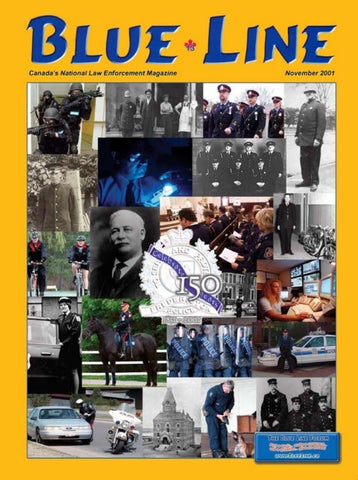
This month’s cover was designed by Blair Foster Jr., a University of New Brunswick Coop Student and the photographs were provided by Diane Doiron and Brian Smith of the Fredericton Police Force.The stories which accompany this cover, written by Leanne Fitch, Bobbi Simmons and Michele Cronin, do more than tell a story. They indicate a real team spirit and enthusiasm to get published in Blue Line Magazine. How could we say no? As the cover clearly indicates the Fredericton Police Force is celebrating its 150th Anniversary. This issue of Blue Line Magazine celebrates this occassion as well with a series of stories and anecdotes beginning on page 6. Congratulations are in order to Chief Gordon Carlysle and all the 156 members under his command. Also in this edition is a story about Durham Regional Police Sgt. John Keating and his determination to bicycle across the continent to raise funds for autism. You can read about how successful he was on page 12. In other stories this month you will read the beginning of a series on DNA edvidence gathering by Robert Weibe of Maxxam Analytics; Workplace Stress by Patricia Fisher and Mark LaLonde from the BC Police Academy; a light hearted look at patrolling North Bay, Ontario, by jet fighter; award recipients for the National Youth Justice Awards and the Canadian Bankers Award; as well as an enlightening piece from Dan Ogle on the difference between police leaders and police managers. This month we also have a full range of stories filed from our illustrious columnists: Robert Lunney, Dr. Dorothy Cotton, Tom Rataj, and Robert Stevens, as well as our staff writers Les Linder and Mark Reesor. In addition Case Law from John Burchill can also be found on page 23. There is plenty of food-for-thought, remedies to problems and just shear entertainment in this issue. We hope you enjoy a good read. Blue Blue Line Line Magazine Magazine
A wonderland of terrorist response by Morley Lymburner There is a problem here in wonderland — sorry, I mean Canada — centred on the federal government’s inability to take a reality check with those who protect us all. One would think that when the whole world is reeling from the devastating news of terrorist attacks, and fingers are pointing at Canada, someone in the upper echelons of power would re-think past policies in light of new realities. The mass media has not been well informed on one of these issues — the denial of firearms to law enforcement personnel at risk. The federal government has gone to great lengths in the past to keep firearms out of the hands of our border guards and game wardens, to name but two. Although they will permit fisheries officers and environmental officers to be armed, they have fought tenaciously to keep guns away from those who protect our borders and wilderness. I wince every time I see the news clips of Canada Customs officers checking vehicles and people crossing the border. If there is a desperate person among them the officers don’t have a chance. Even fully armed police officers do not have the element of surprise on their side. It is an unfortunate fact of life that the bad guys always have that in their favour. Officers never know when deadly force will be the only op-
tion left. The best a cop can do is react quickly, accurately, appropriately and — if he survives the assault and the court process — justly. The sad fact of the matter is that even this rudimentary level of protection is being denied to the people expected to protect our frontiers on a daily basis. The truth is that last year less than 500 officers were expected to accurately tell if 250,000 immigrants were telling the truth when they arrived in Canada. In several cases when they did manage to catch one or two, they ultimately had to let them in anyway. If by chance someone became desperate enough to attack the officer, they are instructed to call the police, who are armed, to take care of the problem. Who thought this one up? Canada now may be forced into pre-clearing trucks going into the US. This job is currently done by fully armed US Border Patrol officers. Canada Customs officers should be armed and armed today. Now let me take aim (excuse the pun) at the game warden fiasco that is still being played out by Heritage Canada. When I investigated this situation in July the wardens were very worried about a long, festering situation that put them at risk for lack of sidearms. An independent government agency listened to both
sides of the argument and agreed the wardens had very valid concerns. Ministry officials have since taken an abstract stance of “let’s see what the ruling is really saying,” and “we should study it further” and “we can use interim methods to protect the wardens.” The “interim methods” they have taken is what I am taking issue with here. The feds found an extra $20 million lying around somewhere, that apparently nobody else could use, and 140 members of the Royal Canadian Mounted Police, who apparently were surplus, and used these resources to take over all of the game warden’s enforcement activities and protect them. It would be interesting to see what September 11th did to all this. I spoke to four RCMP officers who were trained experts at smuggling, who were detailed to chase bears in the bush and keep kids from burning old growth timber in camp grounds. Is it just my imagination or are we really living in Alice’s wonderland? “For then in the sequel appeared a most hideous Beast indescribable, the mem’ry insidious! I read the adventure, and each tick of the clock Gave life to this beast, the famed Jabberwock!”
Response Trade Show 2002 1/2 Page Hor. Colour Ad Pull Film from October/2001
November 2001
5
— An Ode to Alice - by Ruthann Logsdon Zaroff
Fredericton Police celebrating strength in its community by Cpl. Leanne Fitch, Cst. Bobbi Simmons and Michele Cronin The Fredericton Police Force is celebrating 150 years of serving the citizens of New Brunswick’s capital city. Fredericton has about 47,000 people and a combined regional population slightly over 80,000. Students at the University of New Brunswick and Saint Thomas University add approximately 11,000 to the population throughout the school year. The Saint John River divides the city into two very distinctive halves. Since the municipal expansion in 1973, the Force polices a 134 square mile area which includes about 384 kilometres of roadways and 61 kilometres of walking trails. It also polices the St. Mary’s First Nation, located within city limits. The Force has developed into a professional and respected police agency, says Chief Mac Carlisle, and “the calibre of the members makes us one of the premier police forces in Canada.” Carlisle, who’s been chief since 1980, says watching the force evolve and improve has been extremely gratifying, noting that the good policing of 20-years ago would not measure up to today’s standard. Fredericton was founded as a garrison town by the British military and designated as the capital of New Brunswick in 1785 by its first governor, Thomas Carleton. Law enforcement was modelled after the British system of having an unpaid ‘watchman’ or constable in each ward of the city who was expected to keep the peace. City clerk J. Henry Phair requested in 1851 that the legislature establish a city police force, primarily to control and punish “vagrants, beggars, drunkards (and) idle and disorderly persons.” City council was given the responsibility of hiring men for the new force. The province passed a bill 20-years later appointing J. L. Marsh as police magistrate for the county of York, which includes Fredericton, at a salary of $400. He was given the task of retaining a “sufficient number of fit and able men, not exceeding three, to act as constables for preserving the peace, and preventing all felonies, and apprehending offenders against the peace.” A public outcry ensued in the early 1900s over the increasing crime rate and ineffective policing. Temperance advocates led the discontent, complaining that the influences of “demon rum” had taken hold of the “celestial city” and calling for effective policing. A police commission, consisting of the mayor, police magistrate and a local citizen appointed by the Lieutenant Governor, was formed in 1911. It was given the authority to November 2001
LEADING A PROUD TRADTION: Chief of Police Gordon Carlisle has managed the Fredericton Police Force for over 21 years. The Force has had 11 chiefs in its 150 years determine the number of officers required and to set their salary and prompted a move toward an increasingly efficient, disciplined and accountable police force. The commission constantly watched police activities, bringing about increased accountability but causing dissension in the ranks. Police were highly visible in their town-bought uniforms and could easily be the target of public dissatisfaction. Their role was difficult to escape; even officers’ annual leave dates were published in the local paper. It became increasingly apparent over the years that magistrates were ineffective at controlling and disciplining the police so the force began developing a hierarchical structure in 1911. The chief asked the police commission to promote one of his four constables to sergeant and the new appointee was placed in charge during the evening shifts and when the chief was away. The force also began to modernize. Revolvers were issued in 1916, though whistles and nightsticks remained standard equipment, and foot patrol officers now occasionally had the luxury of bicycles, horses and horse-drawn patrol wagons. 6
Flashlights replaced lanterns; call boxes were installed in strategic locations throughout the city, eventually replacing the whistle system that was used to summon help for patrol officers. Automobiles began to replace bicycles and foot patrols were eventually eliminated. By the mid 1950s the force, like many others, had developed into a professional, albeit impersonal organization, with the image of the beat cop fading into the past. The force relocated in 1971 from the basement of city hall to a shared police and fire headquarters on York Street and grew from 58 to 80 members with amalgamation in 1973. Hiring standards were re-evaluated. Candidates were now expected to have at least graduated from high school, with preference given to graduates of the Atlantic Police Academy or those with related police experience. A training coordinator was hired, reflecting the increased importance of education as managers sought to create a professional police service. With the increase in personnel, additional patrol vehicles and expanding job functions, the Fredericton Force rapidly outgrew its shared ... continued page 8
building and moved to the present downtown core headquarters in 1983. The central location offers easy access to the north and south sides of the river. Officers make a dramatic decision in the mid 1980s to establish an independent police association and disassociate from the Canadian Union of Public Employees (CUPE). This decision significantly impacted the public perception of the police and labour management relations. During labour unrest in the early ’80s, the rank and file had to enforce the law on striking CUPE members. An angry mob stormed police headquarters in retaliation and the message was clear; CUPE was unhappy that officers continued doing their duty, enforcing laws and maintaining order during the strike. Disagreeing with the union that emergency services should have the right to strike and dismayed with the CUPE local, members of the force formed the Fredericton Police Association, the first independent police association in New Brunswick, in 1985. The association demonstrated that police can be a “thoroughly viable entity without union affiliation,” writes author Alan Grant, “and is a model for this type of association... (It) has contributed in a most positive way to improving the quality of policing… by agreeing to reasonable flexibility on job transfers, single-officer patrol cars (and) the acceptance of auxiliary police to assist regular police.” These words are echoed in Carlisle’s statement that “the joint vision of onward and upward progress, between management and the association, is unique in any police force.” Fredericton Police have adapted to changing social expectations and circumstance that subsequently transformed the organization, police service and cultural ideologies. The force was somewhat insular from the 1960s to 80s; regulated by rules, regulations, operational guidelines and a strict code of ethics, officers became unfamiliar guardians of the city. Chief Carlisle proposed introducing a unique
community-based approach in 1985 to improve relations with the community and reduce crime in a low-income housing development known as ‘Doone Street.’ One police officer was stationed full-time in a storefront to coordinate community-based initiatives. The project was a success — the coordinator, Cst. Peggy Blackmore, was given the Solicitor-General’s Crime Prevention Award in 1987 — and a storefront was soon opened in another troubled housing complex. Although both have evolved over the years, they remain fundamental parts of their respective communities. The force introduced a Mobile Community Policing unit (MCP) — a customized, 32-foot recreational vehicle equipped with a computer, fax, radio and cell phone and space for meetings, interviews and report writing. The exterior is colourfully painted and the unit is designed to be highly visible and approachable. Doubling as a command post during emergencies or major criminal investigations, the unit moves through each ward and officers distribute surveys and compile data on calls for serv-
An age when a police chase was a race It seems that back in August of 1901 a couple of boys from Marysville, having no way home from downtown Fredericton, decided to steal some transportation. They stole a horse from the area of Queen and Carleton Streets. The Cst. Zeb Wright owner, returning from one of numerous illegal taverns in downtown Fredericton, saw his horse had been stolen. He flagged down Sgt. Paul Phillips, who happened by, and reported the theft. Phillips gave immediate chase on foot without much success. However, he managed to keep them in the downtown area. Cst. Zeb Wright, observing the commotion, scrambled aboard his own trusty steed and headed into action. Zeb chased the two on horseback throughout the downtown area at an incredNovember 2001
ible rate. The chase was quickly the focus of attention to downtown businessmen and shoppers. The chase eventually started back down Queen Street, with Zeb close on the heels of the two horse thieves. Zeb carried a riding whip. He applied the whip occasionally to his horse but, from all reports, applied it more often to the two boys riding the horse just beside him. The chase came down Queen Street and turned right on to Regent Street, with mud and rocks flying off the hooves of the two horses. Still Zeb beat the two boys with his whip. People cheered, dogs barked and kids chased the two racing horses. The chase eventually ended on Charlotte Street when Zeb knocked the two off their horse. They were promptly arrested and locked up under the City Clock. Daily Gleaner, March 25, 1911. The story went on to describe the incident as “the most daring and exciting high speed chase in the history of Fredericton.” 8
ice, crime types and trends. It was so well received by the community that residents of one area, upon learning that it was moving to the next ward, refused to accept its withdrawal. Their pressure led to the creation of the Neighbourhood Constable program. After problem analysis is completed by the MCP, the neighbourhood constable goes to work. A community-based police officer assigned to a specific electoral ward, the officer is accountable to residents and works with the ward councillor. Community-based policing model has brought about a “significant change in how we deliver service to the public,” says Carlisle. “The public have responded with overwhelming support and I would suggest if someone tried to eliminate (the program), there’d be significant backlash from the community and council. To revert to the 80’s style of policing in Fredericton is not an option.” The force has three divisions with 94 regular officers — 18 percent of which are female, significantly higher than the national average of 14 percent — 15 civilians and 15 auxiliary constables. Two of the female officers are following in a family policing tradition. George R. Rideout, the great-grandfather of one of the newest members, Cst. Nancy Rideout, served from 1895 to 1907. Constable Reid Quartermain served in the 1940’s and his granddaughter, Cst. Kim Quartermain, is a detective within the Criminal Investigation Division. The Patrol Response/ Community Division oversees patrol officers and neighbourhood constables and is divided into four platoons, each having 11 members. The Criminal Investigation Division has 23 members and its mandate includes major investigations, family services, arson, forensic identification, polygraph, court section and victim services. The Personnel/Support Division responsibilities includes firearms and exhibits, training and media, stores and purchasing and administrative support. There are six fully trained specialized teams: • Accident Reconstruction Team: Established in 1974 and extensively trained in investigating specialized accidents such as pedestrian/ bicycle, tractor trailer roll-overs and anti-lock braking. The four-member team is equipped with a ‘Total Station’ and state of the art software. • Marine Section: Primary responsibility is water rescue but also educates boaters on safe vessel operations and enforces applicable laws. The Saint John river runs through the middle of our city so there has always been a need for an emergency response. The team, which has 13 regular and six auxiliary officers, was formed more than 20-years ago. • Emergency Response Team: Officers on this 10 member team are trained in the use of special weapons and tactics. The team provides tactical support, VIP security and inservice training. In operation for more than 30 years, it has shown professionalism in peacefully resolving many critical incidents without lethal force.
Long roots lead to policing career choice
• Underwater Recovery Team: One of only two dive teams in the province trained to police safety levels, including under ice qualifications. The five members and one auxiliary officer perform rescues, search underwater crime scenes, recover evidence and lost or missing articles in certain circumstances. They also handle computerized proximity diagrams and underwater photography. • Explosives Disposal Unit: Fredericton is the only municipal police force in New Brunswick to offer this service. Our Police Explosive Technician (PET) has completed an extensive initial nine-week Canadian Police College course and can identify, handle and dispose of commercial explosives and improvised devices. The PET lectures first responders and the public on bomb threat procedures and also works with both the RCMP ‘J’ Division EDU and the explosives ordinance disposal technicians at CFB Gagetown. • Tactical Troop: Formed in 1998 and consists of 31 officers who maintain public order and suppress civil disturbances as required. • Another specialized team, the mounted patrol unit, was reborn for the summer months as part of our 150th anniversary celebrations, patrolling city streets, trails, parks and special events. Headquarters houses an Enhanced 911 dis-
The newest member of the as a member of the family, adding Fredericton Police Force is Cst. “there’s truly a team atmosphere Nancy Rideout, who says she here. We are appreciated for what signed up because the Force “has we as individuals bring to the job been recognized as a very progresand we draw from each other’s sive police agency with lots of knowledge and experience.” opportunities.” She looks forward to a long Rideout’s great grandfather and rewarding career with the George served on the Force from Force, noting “if the past months 1895-1907 and she says it’s “very have been any example, there will gratifying working here and being be lots to learn. Fredericton is a small part of the department’s Cst. Nancy Rideout proving to be an excellent envihistory.” ronment to foster my future goals She recalls being immediately welcomed and aspirations.”
...Continued page 10
For further details go to BlueLinks at www.blueline.ca
November 2001
9
patching centre with state of the art equipment. The city commissioned a trunk voice system and encrypted Cellular Digital Packet Data (CDPD) wireless system; the goal is to enable all city vehicles to communicate on the same system and, eventually, transfer wireless data. The police and fire departments were first to be brought onto the new system. Officers are able to query in-house records, mug shots and CPIC, write reports in their car and e-mail each other or the station. The Force partnered with a local company to install Automatic Vehicle Locators on all marked police vehicles, allowing their locations to be displayed and monitored on four large
plasma screens in the communications centre. The Force has been recognized by the public for its efforts in supporting charitable foundations, won first place for its Canada Day parade float and the New Brunswick Day Merit Award for Community Leadership. Chief Carlisle and the members of the Fredericton Police Force are very honoured to celebrate their rich history and take pride in all that has been accomplished thus far. In keeping with its mission statement, the force looks forward to building better relations with the community, continuing to provide high calibre services to improve quality of life and, as always, “To Serve and Protect.”
19th century policing was no picnic Policeman Woodward was obliged in selfdefence to draw his revolver yesterday in quelling a disturbance among a number of picnickers, who turned upon, and assaulted him while in the discharge of his duty. Unfortunately, there are always a few of these roughs who accompany every large excursion, and whom it is impossible to exclude no matter how stringent the regulations of the committee. On this occasion, the sight of the revolver accomplished wonders, the roughs deeming discretion the better part of valour. (April 29th, 1874. Source unknown)
“Some things I’ll never forget” John King joined the Fredericton Police Force in 1957 at age 18. He was working in a shoe factory, knew a lot of police officers and thought working for the city would be a good career. He was given the choice of workSgt. John King ing for either the police or fire departments when he was hired and jokes that he should have opted to be a fireman “because they got to sleep all night while we walked around.” King was a foot patrol officer for 11 years and says he was able to meet many citizens. Even today, he sees people he met back then who recall him walking the beat. “No matter where I go someone is always coming up to me and asking me how I am. They remember and that’s great.” King was eventually promoted and transferred into the criminal investigation section and later to Identification Services. “I learned a lot out of Ident,” he says. “To be honest, it was all interesting but Ident is where you get your hands into things and I liked that.” He admits though that attending crime scenes and autopsies could rattle him; “Some of those
things I’ll never forget.” King received a commendation from the RCMP for a set of fingerprints he took. The RCMP wrote, “your interest in the performance of a task that is sometimes considered to be of little consequence or value is commendable.” King received this letter after his retirement and was very honoured, commenting that “when you leave, you forget about things. This was a nice reminder that I tried to do a good job.” King’s final posting was in stores and exhibits. He rarely testified in court because both the crown and defence counsels were aware of his attention to detail in preparing and storing exhibits. This was also where he began his collection of shoulder flashes, which numbers over a thousand. King feels that although police have to stick to the grass roots of policing and getting to know the public, technological advances have made policing in Fredericton much better. He advises police officers to take the time to get to know the public since he’s found the public is more cooperative with those they are comfortable with. “People always would talk to me, but that was because they knew they were talking to John,” he notes. “I really enjoyed my job,” says King. “I learned a lot, seen a lot and met a lot of great people. I miss it.”
For further details go to BlueLinks at www.blueline.ca
November 2001
10
“I didn’t expect to fall in love with my job” The best part of working on the Fredericton Police Force for Inspector Gordon Saunders was “working with people and for people.” Saunders, who retired in 1994 after 35years with the Force, was a 7-UP driver/ salesman when he saw Insp. Gordon an ad for police conSaunders stables. His wife dared him to apply and he did but promptly forgot about it. Some time later he began receiving calls from then Chief Bruce Nealy. Worried that he was in trouble, Saunders didn’t return them. Nealy eventually managed to get hold of him and he was hired. When Saunders began in 1959, Fredericton had only 22 members, one paddy wagon, one marked and one unmarked car. Officers weren’t armed and many patrolled on foot without direct communication with the station. They used call boxes, pay phones or went to taxi offices to report situations. Saunders, who says he fell in love with the job on his first day, remembers those times fondly. Patrolling on foot allowed an officer to get to know everyone on their beat - and their property. ‘Ugly Bones,’ as he was affectionately referred to, remembers a lot of laughs and fun during his years as a police officer. “We were a good team,” he says, adding he misses the camaraderie. “The good Lord was just too good to me. I didn’t expect to fall in love with my job. I loved going to work every day for 35 years.” Saunders did everything from foot patrol and directing traffic to major investigations and handling special events, including Royal visits - he was often selected to be in a group that worked in close proximity to them. He advises new recruits to “be a people person and be sincere. Always have the desire to serve the public and your community.” A roof-top park at the Fredericton Police Force building, providing a beautiful view of the St. John River, has been named after Saunders.
“We are a very caring bunch of people” With 28 years of experience in Fredericton and 35 years in policing, Sgt. Gary Arbour is the Force’s most senior officer. Originally from Montreal, he came to New Brunswick to enjoy the “small, good quality of life.” Arbour says he’s Sgt. Gary Arbour enjoyed his career immensely and that there’s not been a day that he didn’t want to come to work. From the beginning, being a police officer was the best job in the world and he says it still is today. Arbour was the first police officer in Fredericton to use a notebook and to lay a charge for prostitution. The event was so monumental that a song was written about it by a local citizen and played over the radio in the central New Brunswick area. Until August, Arbour was the school resource officer for Fredericton High School, one of the largest in the country. It was the best job of his career, he says, adding that “the high school resource officer is the most effective crime prevention program I’ve ever been involved in and seen produce such positive results.” Arbour’s passion has been promoting the importance of critical incident stress debriefing. “We need to take care of our people police officers talking to police officers,” he says. “It will pay off in the long run.” Arbour is one of those officers fellow members come to. He is open, honest, supportive, gives freely of his time and is a valued member of the Force. Arbour, who’s currently the NCO in charge of community policing, has seen a lot of changes, especially technological, but his heart is in the grass roots of policing. “Walking the beat is where it’s at,” he says. “It has to be, we’ve got to talk to the people.” He’s also passionate about co-workers. “Members are the Force’s best attribute, from the maintenance staff to the secretaries to the chief,” he says. “We are a very caring bunch of people and in many ways we all give back to society. We go beyond just working.”
Half-second reaction time key to survival by Cst. Dean Stienburg Some disturbing stats from the last 20 years... the FBI reports that 20-percent of officers killed between 1981-1991 were shot with their own firearms. Often the killer is not the focus of the officer; they are dealing with one person and a second person launches a surprise attempt on the officer’s gun. In addition, 90 percent of subjects who gain control of an officer’s sidearm will attempt to use it against the officer. Half of those who disarm officers will be successful in shooting them. A 1992 survey of Canadian municipal police departments indicated 11 percent of uniformed officers surveyed had a subject attempt to remove their side-arm and about 8 percent of non-uniformed officers had a subject try to grab their sidearm during non-uniform assignments. Two of three officers were killed with their own sidearm in Canada in 1991; the third was disarmed and shot in the head at close range, making him a quadriplegic. Although these stats are somewhat dated, the same dangers still exist. It’s important to practice weapon retention techniques. The
time to start thinking about weapon retention is not when the bad guy makes an attempt at your gun. You want to have built into your muscle memory secure, position, release and followthrough before an attempt is made. New improvements in security holsters over the past decade have done a lot to assist officers in retaining their weapons, but they’re not foolproof. Many bad guys know all too well how to defeat even level III security holsters. The most you can ask of even the best holster is a half-second of reaction time. Practice your retention techniques and a half-second is all you’ll need! Any time a police officer is involved in a confrontation, there is the presence of at least one loaded gun. A weapon retention confrontation is a deadly force encounter - one you must be prepared physically and mentally to win. An officer who is of the right mind set, current in their training and tactically sound will not end up as one of the above noted statistics. Stay safe. Cst. Dean Stienburg works in the training section of the Halifax Regional Police Service. This article was reprinted from the July issue of APB
The Great Mac Attack! by Tony MacKinnon
I can barely make him out... something about the blower in the bomb suit.
For further details go to BlueLinks at www.blueline.ca
November 2001
11
Durham sergeant crosses America for autism by Mark Reesor Autism has long been the “underdog” of disabilities and Sergeant John Keating, the father of an autistic son, decided it was high time that was changed. Although it is the third most common developmental disability and is estimated to strike one in 250 children, a rate which has increased from about one in 10,000 just six years ago, the Durham Regional Police sergeant says seven out of ten people don’t even know what it is. Worse yet, less money is raised to research and fight autism than any other major disability. While more than $130 million US was donated in 1999 to fight Cystic Fibrosis, for example, only $3 to $4 million US was raised that year to combat autism. The Durham Regional Police sergeant considered various ways to raise money and draw badly needed attention to the problem before coming up with the idea to ride a bicycle across the country — a decision he says was easy to make. “It was the only thing I thought I could do. I have really bad knees — I have arthritis throughout them. I can’t run and there’s not a lot of other physical activity I can do but I can cycle because it’s a very limited motion in your knees.” There was one big problem though. Keating was never a cyclist, ever. “I have an old rusty mountain bike that I used to go out on the weekends once and awhile with the kids, but that was it.” That’s where Aubrey Bryce stepped in. The ex-Olympian cyclist heard about Keating and took on the task of training him for the long journey. “I was on the bike six days a week,” Keating says, “and worked out with him and his cycling classes three or four days a week and dropped 22 pounds before I started. He got me into the condition I needed to be in to finish this.” Since this would be the first big event for autism, Keating chose to ride across the US rather than Canada because it would make more of an impact. “There’s 300 million people down there as opposed to our 30 million,” he notes. (Keating hasn’t overlooked Canada - - he’s working on a torch relay ride for autism across Canada to take place next year). “I called the Autism Society of America and told them what I wanted to do. They initially thought I was some lunatic from Canada. It took several phone calls to convince them that I was sincere about my desire and finally they agreed to work with me and support this event. “The last thing they said is ‘you’ve got to think of a good, catchy name; I hung the phone up and the moment it hit the receiver, I thought ‘Cycle USA: to Understand and Solve Autism’... and that title stuck.” Keating started his ride in New York City April 27 and “the moment we kicked off, we were on the Today Show, right behind Rod November 2001
Stewart.” Law enforcement officers took care of the morning rush hour traffic. “There were probably 20 police officers who escorted us through the city. They shut every street down; we were told later that we got the same treatment that the president gets when he comes to New York City. “At 9 o’clock in the morning, downtown New York City, nobody moved, all because of Cycle USA,” notes Keating. “They had their motorcycle guys out, they had their cruisers, they had their bike team... “The police were great — we have a wonderful brotherhood and they were just wonderful to all of us throughout the journey... and came out in droves to support me.” Durham Regional Police were also a great help, donating time off, which Keating combined with his holidays, putting a link to Cycle USA (www.cycleusa.net) on the home page of its website and even sending officers to the kickoff and finish. “I was making a speech at the Canadian Embassy the day before I started and the next thing I know, out walks six (Durham) police officers,” says Keating, “all in number one dress uniform. I was stunned, I had no clue; of course, I cried for ten minutes and then we carried on. “Six more officers, including our new deputy chief and our superintendent, came down to San Diego. The RCMP loaned their jet to the Durham Regional Police to fly our members down to be there when I arrived. The support was phenomenal and it was such a great inspiration for me to have the support of all my friends and colleagues here in the Durham Police... “They have been great — I’m so fortunate to work for an organization like this.” Seeing what officers in some US police forces have to put up with made Keating appreciate his police service all the more. “The pay in some places is so low that you’d wonder why they’d even do it. Then you come back here and Durham Region is always on the cutting edge of technology. We have all the best equipment, we get paid very well. I told our guys on parade the very first parade I came back to... they’ve got to go outside and look at what other people have and then you realize how good you’ve got it back home here.” Keating cycled through 44 major cities in 24 different states, pedalling some 6,700 miles to his finish in San Diego, California July 19 on 12
what he describes as a “bit of a zigzag pattern” designed to hit more large cities. Each community had a Cycle USA committee and staged events as he rode through their area, keeping him very busy. “I had 200 speaking engagements in 84 days — it was cycle all day and speak at one, then go to another one and another one,” he says. “It was exhausting; it’s been a month now since I got back and I’m just getting to the point now where I can talk about it again because I was just burned right out.” Keating spoke to hundreds of thousands of people — in St. Louis, for example, he was at a Cardinals game and did an interview on Fox TV that was broadcast nationwide. He talked to 40,000 people at a Reds game in Cincinnati and did two laps in front of Fox cameras around the track in Indianapolis the day before the Indy 500. The widespread publicity helped raise $1 million US for autism and increase awareness about the disorder. One of the more memorable events of the ride took place in Houston, where throwing out the first pitch at an Astros game turned into “definitely the most embarrassing moment of my entire life,” says Keating. “I threw the pitch 20-feet over the catchers head and just about killed two photographers standing behind... I walked out, they gave me the ball and the catcher squats down. I hadn’t decided up until my windup whether I was going to throw a wimpy little rainbow shot or a hard fastball. In the middle of my windup, I thought ‘I’m not going to go wimpy, I’m going to throw a hard fastball’ so I let her go and it just flew 20 feet over his head and the whole crowd, 40,000 people, all went ‘oooooh’ all at once. It was so high the catcher never even stood up - he never moved. “I told everybody later that I did that on purpose because anybody can throw a strike but I wanted people to remember autism so I wanted to do something that they would remember!” There were also barbecues, picnics, black tie dinners, events at water parks, “all kinds of different events,” says Keating. “I met wonderful people — the Americans are great folks and they welcomed me like I was one of their own. That never became an issue, that I was Canadian; The fact was that I was a father of an autistic child, just the same as them, and that was the only issue.” On a personal note, Keating especially re-
members an eight-year-old Michigan boy with a five-year-old autistic sister who gave him $21.25 which he’d raised selling lemonade. “He told me he wanted to give it to me so that I could give it to the doctors to help his sister... “Another little boy in Indianapolis came up to me with a big plastic bag full of pennies, nickles, dimes and quarters — he emptied his life savings from his piggy bank and gave it to me so I could help his sister with autism; they were two really touching moments.” A lot of work by a lot of volunteers was crucial to his effort, Keating says. “My name was all over the pamphlet and all over the press and I said this is not a John Keating thing because without the volunteers and everybody else putting all their hard work into it, this would not be a success. This is a big team effort... I was just the vehicle that was used to get the word out.” A lot of people told him he was a hero for doing this, Keating says, “and I told them right away that under no circumstances am I a hero; that the true heroes in my life are my son Kurtis, who suffers with autism, and all the kids and adults that suffer with autism every day, because none of us can really understand what they deal with and go through every day... “My little boy still finds the ability somehow to give me a hug and wrestle with me (every night), even though he has to deal with this horrible, devastating disorder — they’re the true heroes in my life.” Siblings also deserve a lot of credit, he adds, for accepting the disability and helping out. “I know that, in my case, with my daughter Krystal (6), my son would never be as advanced if he didn’t have his little sister to help along the way.” Although the long journey was “very challenging,” Keating refuses to call it difficult. “My little boy is eight-years-old and he can’t ride a bicycle and neither can a lot of kids and adults with autism. They’ll never ride a bicycle and, to me, that’s difficult. Riding a bike (for me) isn’t difficult... not when you compare it to living every day with autism and not being able to do so many things... “Those of us without any mental or physical disability, we can hardly complain that anything’s difficult in our life,” he says. “Six out of ten of these people will never speak a word in their life.” Nonetheless, there were times when he wondered if he was going to make it through the day, Keating admits. He carried along some inspiration on the handlebars of his bike; “I had a picture of my little boy and my little girl and whenever it got tough like that, I just focused on them and just kept pedalling.” “Autism is a developmental disability that typically appears during the first three years of life. The result of a neurological disorder that affects functioning of the brain,” according to the Autism Society of America, which says more than half a million people in the US alone suffer from autism or an associated behaviour. “Four times more prevalent in boys than
girls, it impacts the normal development of the brain in the areas of social interaction and communication skills. The disorder makes it hard for them to communicate with others and relate to the outside world. They may exhibit repeated body movements (hand flapping, rocking), unusual responses to people or attachments to objects and resist any change to routines. In some cases, aggressive and/or self injurious behaviour may be present.” Keating says his son was born completely normal on his due date, developed normally “and then all of a sudden, it just hit. It’s like
your child gets hit by a bus and loses all his mental and physical abilities... “I have videotape of him. He walked before his first birthday, he used to throw a ball around the living room with me, he’d say ‘daddy get ball, daddy get ball,’ then he couldn’t say ball, he couldn’t say daddy, he wouldn’t look at you. All the milestones he reached, he lost overnight. It’s so devastating, especially in my case. “My little boy was 18 months old, my girl was born — I had the millionaire’s family, I worked on the police department for 15-years... and then all of a sudden, six months later, you go from on top of the world to devastation, just overnight.” As much as he fights for a cure for autism, “I’ll never love him anymore than I love him today,” says Keating. “He’s perfect just the way he is... that’s what (the ride) taught me, unconditional love for him. I want to see his life improve steadily... and I know it will happen through research but if, for some reason, nothing changes, I won’t love him any less.”
Library open to all police The Canadian Police College Library announces that its catalogue is now available on the Internet at http://www.cpc.gc.ca/ library_e.htm. The catalogue contains the complete holdings of the CPC Library and is available 24 hours each day to all police personnel. Employees of Canadian police and law enforcement agencies may search the catalogue, place the items they have selected into an electronic shopping cart and, using a handy on-line reservation form, E-mail a request to borrow books or videos. There is no charge for this service. A national police service of the Royal Canadian Mounted Police, the CPC Library holdings represent one of the most extensive sources of police-related literature in North America. Its rapidly-growing collection consists of over 20,000 documents gathered from reputable domestic and foreign publishers and from police, government and research agencies, an audiovisual collection approaching
2,000 training videos and subscriptions to approximately 300 magazines, newsletters and professional journals. The Library’s knowledgeable and experienced staff members assist all Canadian police personnel with their operational, professional development, administrative and research activities. Services include providing quick answers to factual questions, comprehensive literature searches on commercial database systems, loans of books and videos, paper or electronic copies of newspaper and magazine articles and referrals to subject experts located in Canada and abroad. The CPC Library is located on the third floor of Building C of the Canadian Police College and is open 24 hours a day, yearround to police officers (other clients by appointment). Catalogue search assistance may be arranged by phoning (613) 993-3225 (with 24-hour answering service), by fax at (613) 993-2220 or by e-mailing library@cpc.gc.ca.
For further details go to BlueLinks at www.blueline.ca
November 2001
13
Taking the mystery out of DNA testing by Robert Wiebe
Items Amenable to DNA Testing
DNA tests have become commonplace in courts and are a fixture on television and the news but there remains a mystique about this powerful tool. DNA stands for deoxyribonucleic acid, often referred to as the ‘chemical blueprint of life’ because it acts as a ‘code’ or set of instructions for how an organism is made. It codes for things that all people share — the protein in muscle or the enzymes that break down food in the stomach — but also determines individual characteristics such as hair and eye colour and height. DNA is found in the tissues of all living organisms, from bacteria and plants to animals and humans, and doesn’t differ within an individual. Samples taken from a blood sample, saliva, semen or tissue will all give the same test result. Tests have been developed for many applications, including diagnosing genetic diseases, identifying pathogens in water or food and verifying the parentage of potentially valuable racehorses. Testing is used in forensic science to determine identity — it answers the question ‘who’ — but cannot necessarily tell when or how a sample was deposited. Since DNA is found in essentially all cellular material, almost any stain from a biological fluid, tissue or secretion has the potential to be a source. Items amenable to DNA testing include: Advances in technology have increased the
sensitivity of tests and decreased the amount of DNA required to successfully generate a profile. When testing was first introduced to forensic casework, a bloodstain approximately the size of a dime was required but newer technology allows profiles to be generated with one billionth of a gram of DNA, a stain the size of a pin head. Cold cases solved with the help of DNA
testing have amazed many people and led to the question of how old a sample can be and still give a result. The answer depends on how it was kept. If a blood stain on a piece of cotton is allowed to air-dry and stored in a dry place for 20 years, it’s very likely that the sample will provide a result. However, if that same sample is kept moist, sealed in plastic and incubated at 37°C (i.e. body temperature), bacteria may degrade the DNA and the sample may not yield a result after just a few days. This example shows both how stable and how fragile DNA can be and highlights the need for proper training of individuals handling evidence. In many cases the skill of the investigator in finding and preserving the right piece of evidence is the crux of a successful case. The importance of DNA testing is its power to exclude an individual as the source of a sample. In fact, the technology is so powerful that not excluding someone is a very strong indication that the sample came from them. The battery of DNA tests available to forensic laboratories yields results that are extremely powerful in terms of the weight of evidence they provide. Robert Wiebe is the business development manager of Maxxam Analytics’ Genetic Identification Division. Maxxam has the only accredited private forensic biology laboratory in Canada, servicing an international clientele and as an overflow for the Royal Canadian Mounted Police.
Exceptions to storage requirements for non-restricted firearms There are exceptions to the general storage requirements of nonrestricted firearms used for predator control if an individual is in a remote wilderness area. The requirements are found in the storage, display, transportation and handling of firearms by individuals regulations. You can also refer to the ‘storage, displ., transportation’ tab of your police officer field handbook. Application of the regulations Subsection 2(3) states that the regulations do not apply when a firearm is used or handled by an individual in the course of one of the following activities, if the activity is lawful at the time and place it is being carried out: • Hunting or target shooting. • Participating in a course in the safe handling and use of firearms. • Controlling predators and other animals. • Participating in parades, pageants, or historical re-enactments. General storage requirements The basic requirements for storage of nonrestricted firearms by individuals are: 1. The firearm must be UNLOADED. 2. The firearm must be either: • Stored out in the open if rendered inoperable November 2001
with a secure locking device, such as a trigger lock (the regulations provide a definition of “secure locking device” in section one. • Rendered inoperable by removing the bolt or bolt-carrier. • Stored in a securely locked container, receptacle or room that cannot be readily broken open or into. 3. Ammunition must be stored so that it’s not readily accessible to the firearm OR stored in the same securely locked container as the firearm OR stored in its own securely locked container or receptacle that cannot be readily broken open or into. Predator control exception The predator control exception is in subsection 5(2) of the regulations and states that general requirement two does not apply if the following conditions are met: • The storage for predator control is TEMPORARY. • The individual REASONABLY REQUIRES the non-restricted firearm for the control of predators or other animals. • This temporary storage for predator control is in a place where the firearm can be discharged in accordance with all applicable federal, provincial/territorial and municipal laws and regulations. While general requirement two does not apply, the non-restricted firearm must still be unloaded and ammunition must be stored in one of the three ways set out above. 14
Remote wilderness area exception The remote wilderness area exception is in subsection 5(3) of the regulations and states that a non-restricted firearm only has to be stored unloaded if the individual is in a remote wilderness area that is not subject to any visible or reasonably ascertainable use incompatible with hunting. While the term “remote wilderness area” has not been defined, the term suggests an uncultivated and uninhabited area that is outof-the-way in terms of distance or travel time. Indications that an individual is NOT in a remote wilderness area could be: • Fences, signs, or buildings in the area. • The land is being used for agricultural or industrial purposes. • There are public recreational trails or facilities (for example, campsites). Police portal updated The portal for police officers on the CFC web site has been updated and contains the following documents: • The Canadian aviation security regulations. • The marine transportation security regulations. • The Canadian firearms registry on-line - query criteria and results. Any police officer can use the CFC police information and referral line at 1-800-731-4000, ext. 2064 (English) or 2063 (French) to obtain information or publications.
Municipal police overlooked in new federal program Controlled Goods Registration Program oversight can cause problems for most agencies in Canada by Mark Reesor A new federal initiative is causing headaches for municipal police departments across Canada. Federal and provincial police are excluded from the Controlled Goods Registration Program (CGRP), which came into effect April 30, but a misunderstanding over who employs municipal police meant they weren’t exempted. The oversight wasn’t discovered until police forces ordered goods covered by the act, which controls everything from prohibited firearms and ammunition to tear gas and certain electronics. “Right now what’s happening is that, because their suppliers have been registered in the program, they’re learning it through their suppliers because they can’t buy their products,” says Natalie Robinson, an operator at the information centre of the program, which is under Public Works and Government Services Canada (PWGSC). Staff hoped to have notified municipalities across the country that they need to register and provided them registration packages by the end of November. Forces are being asked to register, says Robinson, and their applications are being processed in 7 to 10 days, but only if they’re filled out correctly. Some departments have neglected to include needed information or documents, including copies of the “legal status of their corporation... evidence of their Canadian citizenship and copies of evidence to validate their identities.” The application form is “a nightmare,” said a source at a municipal police department. “It’s just a song and a dance — especially when you get to regional governments like ours. The police department’s totally separate from the region... “We can submit all of the paperwork and they will say ‘this isn’t good enough.’” The two-page form, which he says was designed for businesses, has been taken to the region’s lawyer, who planned to take it to the police services board, which would have to make a special resolution to satisfy the requirements. “They’ll have to attach some form of documentation on the Police Services Act that says the police department exists and under the Regional Municipality Act that says the police department exists and then say we’re authorizing this person — one person has to be designated as a liaise person... “And they need a certificate of incorporation; well, we’re not a corporation. There’s been lots of phone calls back and forth.” The force uses virtually everything on the controlled goods lists — firearms, ammunition, gas masks, night vision optical sights, explosives — “so we’re dead in the water as far as buying stuff... the problem is, I’m running out of ammunition now.” He’s confident the problem will be remedied but says dealing with it has been difficult. There used to be license-free exchange of controlled goods between Canada and the US, says Diane Guilmet-Harris, CGRP counsel, but the US cancelled the Canadian exemption because of security breaches. Negotiations began November 2001
immediately and the act was instituted. People who occupy positions in the federal public service, a federal crown corporation or are employed by the province are exempted, she says. “At the time that the legislation was drafted, there was a belief that municipal police forces were employees of the province; having dug into it, we find that police officers are employees of the municipalities... that’s why we’re now forced into a situation to have to register police forces.” The act can be amended by regulation but that process would take until January of next year, she says, and that wouldn’t resolve the problem of what police forces are to do until then. She says there’s been no proposals so far to change the act and “by the time it’s in place, they will have had to register anyway.” Police applications are being expedited, Guilmet-Harris says, who adds many of the problems with forms are due to a lack of comprehension by officers of the corporate structure. Since police officers are employees of the municipality, the corporation is the municipality, she says. “When we’re speaking to the municipality and legal counsel, we seem to be on the same wavelength... “It’s been fairly straightforward once they understand the process and I find that, in speaking with the municipality, they’re more familiar with the corporate structure. We go back to say ‘if you’re entering contracts on behalf of the municipality, who has the authority for signing?’” The act requires a security assessment on that individual but she says internal security assessments — certificates showing that they don’t have a criminal record, have had background checks, conform to the requirements and don’t
pose a risk of transfer — are being recognized. “We are trying to facilitate the process for these individuals as much as possible.” A more complicated question is Aboriginal Police Forces, which also weren’t exempted. “We’ve been trying to see whether it would fit in that they could occupy a position in the federal public service... but it doesn’t seem to be because bands are separate legal entities. Bands will have to register as corporations. “Evidence of a corporation can be a treaty between the federal government and the band recognizing them as a legal status.” Guilmet-Harris says program officials want to work with police departments. “We do really want to create partnerships because I think it’s mutually beneficial to both of us to share information... because of the business we’re in.” It’s not just municipalities that will be affected, Guilmet-Harris says. Universities will likely also have to register, as will museums who are holding tanks and controlled goods. “This was never envisioned at the time that the legislation was enacted.” Another problem — “we have no office space and no staff,” she says. “We’ve been waiting for office space since March; we’re trying to work toward 100 employees to administer the program and we’re between 25 and 40 now. “(Currently) we’re double bunking; we’ve eliminated board rooms and we have people stacked six in a room. The call centre is a tiny room with four people.” Questions about the application form or the program can be answered by visiting the PWGSC website at www.pwgsc.gc.ca/ciisd, phoning a program information officer at 1-866-333-2477 or e-mailing ncr.cgrp@pwgsc.gc.ca.
2001 Canadian Banks Law Enforcement Award
AWARD WINNERS: Det. Braden Baron, Sgt. Pat Fogarty, Cst. Gerry Harnden A British Columbia sergeant and two Peel Regional Police officers have been given this year’s Canadian Banks’ Law EnforcementAward. Sergeant Pat Fogarty of the Organized Crime Agency of British Columbia was honoured for his work coordinating ‘Project Coconut,’ an international investigation of organized crime and credit card fraud. Fogarty’s information enabled police to locate and seize the most sophisticated credit card manufacturing operation ever found in North America, according to the Canadian Bankers Association (CBA). Detective Braden Baron and Constable Gerry Harnden 15
of the Peel Regional Police Service were recognized for their part in ‘Project Self-Serve,’ which investigated the growing problem of debit card skimming at gas stations in the region. Led by Baron and Harnden, investigators and police from several jurisdictions arrested 10 suspected skimmers, recruiters and counterfeiters and tied them to more than $1 million in losses and $5 million in potential losses. The officers were presented with medals at the Canadian Association of Chiefs of Police Conference in Saskatoon, Saskatchewan. “With the increase of tech-savvy, white-collar, organized crime and the tightening of police budgets, strategic partnerships between Canada’s banks and the law enforcement community are more important than ever before,” said Raymond Protti, President and CEO of the CBA. “In the face of these challenges, we must continue to work closely together and share information to effectively control organized crime. Protti said the recipients “exemplify the cooperation and dedication to our common goal of cutting down on organized crime.” The annual award recognizes law enforcement officers for their commitment to reducing fraud and crime and has been presented to 181 officers since its inception in 1972.
Taking its toll... paying the price Workplace stress, burnout and trauma in law enforcement by Patricia Fisher, Ph.D. & Mark LaLonde For the last dozen years Tom (not his real name) has served with a medium-sized Canadian urban police force. He has attended all the ‘usual’ major law enforcement calls: home invasions, spousal assaults, suicides on Christmas Eve, robberies, traffic fatalities, crib deaths and a myriad of routine criminal offences. He’s worked in patrol, traffic, community policing and now is back in patrol working shifts. Like all law enforcement professionals, he’s spent long nights on patrol, followed immediately by days sitting outside a criminal courtroom waiting to be cross-examined on one of his investigations. Citizens have yelled at Tom as he was writing them tickets, telling him to go catch ‘real criminals.’ He’s worked with some great supervisors and many that were not so great. Tom’s department has gone through a number of ‘flavour of the month’ management strategies and strategic plans tied to vision statements he’s not sure he fully understands, or supports. Now, as he enters the mid-point of his career, Tom is starting to realize he’s lost the passion he felt for policing in the early days of the job. His wife complains that he is moody and distant. He hasn’t had a great nights sleep in what seems like months. That duty belt seems to be getting smaller and smaller. The night shift pizza doesn’t sit well any more. There is an uncomfortable kink in his back that just won’t go away. Over the past few years there’s been a few more citizen complaints made against Tom. This rarely happened in the early years. Tom’s sergeant has told him that his productivity and quality of work is slipping. Tom is somebody we all know. Many of us have walked in his shoes. In the unique world of law enforcement people are exposed to a wide variety of unpredictable events and organizational stresses. Some are short-term events, while many are systemic. All of them take their toll. As Tom’s example demonstrates, law enforcement professionals are exposed to two very different sources of stress - organizational (or systemic) and traumatic. Long-term exposure to systemic job stress results in a wide range of negative effects on individuals and the workplace. Exposure to traumatic stress also results in a characteristic set of distressing responses and symptoms. While both systemic and traumatic stress are serious problems in their own right, when combined they greatly increase the risk of negative effects. It’s now clear that workplace stress and trauma are critical issues in law-enforcement, affecting members, their families, the workplace and the employer. The problem is increasing November 2001
The organizational culture • The organization needs to recognize and accept the problem and then develop a serious commitment to address it. • Members need to normalize the problem of workplace stress and trauma effects and to accept that stress effects are common and affect all individuals, regardless of gender, ethnicity, age, management level, etc. Management skills and attitudes • Managers need to be knowledgeable about workplace stress and trauma and understand the role of leadership style in either promoting workplace wellness or in increasing stress.
and personal and financial costs are escalating. Consequences to the individual member may include a wide range of health problems, including cardiovascular disease, gastrointestinal problems, increased risk for cancer and immune system problems. Depression, anxiety, posttraumatic stress disorder, substance abuse and addictions are all outcomes of long-term high-level workplace stress. Unfortunately, long-term stress symptoms such as poor communication, withdrawal, aggression, mistrust and defensiveness often contribute to family breakdown and loss of the member’s support network. In terms of the organization, effects include decreased productivity, poor morale, increased staff conflict, absenteeism, increased overwork and overtime. Stressed members are also at risk to “cut corners” and engage in more hazardous practices. Direct budget-related costs to the employer are also significant in terms of increased sick leave, increased long-term disability, higher rates of staff turnover and increased costs of recruitment, training and orientation. The problem of workplace stress in lawenforcement is complex; therefore effective program interventions need to address a number of critical elements. 16
A workplace wellness program • The program needs to be accessible to all members and should provide them with the background knowledge and tools necessary to develop an effective personal wellness plan. • Since workplace stress is a pervasive longterm problem, effective programs should be sustainable and durably embedded in the workplace. With these principles in mind, the authors have developed a comprehensive Workplace Stress, Burnout and Trauma in Law Enforcement Program, available on-line through the Justice Institute of BC, that includes both an employee wellness program and manager and supervisor training. The employee wellness program is based on the workbook, The Road Back to Wellness: Stress, Burnout and Trauma in Law-Enforcement. Drawing from the latest research and best clinical practices, the book is designed to meet members’ needs by providing a threepart program: • Section 1 introduces the issue of workplace systemic and traumatic stresses and their effects on the individual’s personal and professional life. • Section 2 provides a battery of 17 self-assessment tools that help individuals determine their current levels of risk for systemic and traumatic workplace stress factors, their levels of self-care and their current symptomatic profile. • Section 3 provides effective tools to help individuals develop their own personalized wellness plans. Manager and supervisor training is based on the reference book, The Manager’s Guide to Stress Burnout and Trauma in Law Enforcement. The training program provides managers with a solid theory base regarding the mechanisms and effects of workplace systemic and traumatic stress in law-enforcement. The
theory and principles of management strategy are also covered, with particular attention to their impact on worker stress. Managers are provided with assessment tools that help them: • Determine their own management style and its effect on subordinates. • Assess levels of workplace wellness within their jurisdiction. • Determine the impact of workplace stress on unit functioning. The final section provides tools and templates to assist managers in developing practical management plans for their teams. Program delivery has been specifically designed to increase accessibility. Thus, both the employee wellness and the managers training programs are available as: • Stand-alone programs for individual members or managers. • On-line web-based courses through the police academy at the Justice Institute of B.C. • Facilitated on-site two-day group programs. The employee wellness program can also be provided through a train-the-trainers model. Clearly law enforcement professionals are exposed to a unique set of systemic and traumatic workplace stresses. There is ample evidence that failure to deal with these issues leads to serious consequences. We cannot ignore the problem — it will not go away. Building on recent research and changing attitudes within the field, we are now in a position to effectively address workplace stress and trauma in law enforcement — whether through
our program or through other initiatives. Effective intervention requires both a shift in attitude toward the problem as well as a commitment of effort and funding. However, we need to remember that failing to attend to this issue will only lead to further escalations in the personal and financial costs to members and their organizations. Dr. Patricia Fisher is a clinical psychologist and trauma specialist who has worked in the criminal justice field for the past decade. She developed the Workplace Stress, Burnout & Trauma Program over the past four years, based on extensive research and practice. Mark LaLonde is a coordinator with the BC Police Academy and is currently enrolled in an MA in leadership and training. Prior to joining the police academy faculty eight years ago he served 12 years with the Vancouver Police Department. For more information on the Workplace Stress, Burnout & Trauma in Law Enforcement Program and consultation services visit www.fisherandassociates.org or contact Dr. Fisher at 250 514-1658, or fisherp@axionet.com. For more information about the online training visit www.jibc.bc.ca or call the registration office, Justice Institute of B.C. at 604 5285590. Mark LaLonde can be reached at 604 528-5768, or mlalonde@jibc.bc.ca For further details go to BlueLinks at www.blueline.ca
For further details go to BlueLinks at www.blueline.ca
November 2001
17
You’re not a police officer... here... take a pill by Dr. Dorothy Cotton Ph.D., C. Psych. So, I gather that you think you are a police officer, right? Well, what if I told you that you’re wrong; your mind is playing tricks on you. You are not a police officer. Actually, you are nothing. And by the way, I think you’re a little weird about the edges. Aren’t you supposed to be taking pills? You know — to make your brain work. What’s that you say? You think I’ve made a mistake? You really are a police officer? I think not. I know that sometimes you get these strange ideas, but come on now, you KNOW you aren’t a real police officer. How could you possibly be a police officer? Someone like you? Ahem. What? You want me to knock it off? Well, I am only telling you the truth. You are not a police officer. Stop telling me lies and I will stop pointing out the obvious. Hey! Why are you getting mad? Geez. Surely you know you are not a police officer. Well, good grief!!! How dare you yell at me. I am right and you are wrong. Here — take a pill. Bet that pissed you off a bit, didn’t it — or would have if I had kept it up? After all, you know you’re a police officer and who am I to
tell you otherwise? Just out of curiosity, is there anything I can say to you that would convince you that you’re not a police officer? My guess is no. If I persist at this argument, one of several things will happen: 1. You will stop reading this, thinking, who IS this idiot? 2. You will want to stick out your tongue at me, or worse. 3. I will run out of space in this column and never get to the point. Who knows whether you are a police officer — or just someone who thinks he is a police officer. But it’s your reality and you’re sticking to it. It’s not much different for the person with schizophrenia, actually. He thinks he is the King of England, the saviour, under attack from Mars, has a receiver implanted in his navel or that there’s someone sending him secret messages. That’s his reality, and nothing you say is going to convince him otherwise. You want to try? Expect a little disagreement at first, a little anger after a while, and finally, a little — or a lot — of aggression. My advice? Don’t go there. Sympathize. Relate to the emotion. “Must be hard to be here out on the street instead of in a castle,” you
Dalhousie University Certificate in Police Leadership “This program enables me to further my academic studies with material relevant and applicable to my job. I find it beneficial both personally and professionally. The correspondence/distance education format allows me greater flexibility for studies.” Courses in this unique distance education program include: > Police Leadership and Management Development > Communication Skills for Police Personnel > Community-Based Policing > Problem-Oriented Policing > Police Human Resource Management > Budgeting and Financial Management D/Cst. Linda Conley > Legal Issues in Policing Barrie Police Service > Policing and the Law of Human Rights > Advanced Police Leadership > Managing Police Performance: Coaching Skills (includes a 3-day workshop)
Our winter term will begin on January 28! If you would like more information or wish to have a brochure mailed to you please contact Sherry Carmont-MacBean, Program Manager at (902) 494-6930. You may also write to Sherry via e-mail at CPL@Dal.Ca or to the address below. Detailed information and registration forms can also be found on our web site. Henson College, Dalhousie University 6100 University Avenue Halifax NS B3H 3J5 www.dal.ca/~henson/police/indexcpl.html
Learning Solutions for a Changing World
For further details go to BlueLinks at www.blueline.ca
November 2001
18
could say, or “that receiver must be really annoying.” How about “those voices sound scary.” Arguing with the delusions and hallucinations tells him you’re not listening, you don’t get it, you’re not on his side. That would make any of us a little, or a lot, grumpy. And if you don’t agree I don’t want to hear about it. Dr. Dorothy Cotton has been practising psychology for over 20 years, “providing services for adults of all ages.” Dr. Cotton holds degrees from McGill University in Montreal, Purdue University in West Lafayette, Indiana, and Queen’s University in Kingston. She is a registered psychologist with the College of Psychologists of Ontario. Dorothy Cotton can be reached by e-mail at deepblue@blueline.ca
Is it Leadership or Management Before the great flood the Lord told Noah to build an arc and collect a male and female from each species. Now that was “leadership”. During the flood, Mrs. Noah told her husband to make sure the elephants couldn’t see what the rabbits were doing. Now that’s “management”.
Patrolling at the speed of sound by Mike Lahaie Every job has its perks and police work is no exception. Three members of the North Bay Police Service patrolled the city like never before recently — from the back seat of a Northern Lights aerobatic L-39 Albatross fighter jet. When you fly with the Northern Lights, you’re flying with the best. Three of the pilots are ex-Canadian Forces Snowbirds pilots and the fourth is a Delta Airlines pilot. What really sets these guys apart is that they’re the first non-military aerobatic jet team in the world. In fact, their inaugural public flight with their new Albatross jets was in North Bay at this year’s Heritage Air Show. Chief of Police George Berrigan, Sgt. Kirk Kelusky and Detective Cst. Shawn Devine were ecstatic when asked if they wanted to go on a demonstration flight. Some precautions were taken to kind of soften the ‘blow’ of flying upside down at 800 km/h, such as limiting the height to a maximum ceiling of 2,500 meters. This would mean they wouldn’t have to wear a G-suit or use oxygen. Still, they had their pre-flight briefing, which might be enough to make even the most experienced cop reconsider, especially when told “when I say eject, eject eject, you grab those two handles between your legs and pull up as hard as you can. Then just enjoy the ride down.”
FLYING FAST AND LOW: North Bay Chief points the direction his lunch is about to go.
Starting off kind of slowly, the aerobatics progressed to the point where the pilots did a full breakaway. This little manoeuvre was described as “all of a sudden, the pilot, with the jet already on knife edge, suddenly drops towards the ground. You go from 8000 to 4000 feet in a flash. It’s like the biggest roller coaster ride in the world, just a lot smoother and faster.” Other comments: “You never really have a sense of what’s up or down.” “You don’t realize how hot and exhausted you are until you get out of the plane and you’re soaking wet.” “When the pilot asks you how you’re doing you might want to give some serious thought to your answer. If you say you’re okay, you’re
On the tarmac Once briefed, the pilot takes you out onto the tarmac and you get belted in. This is no Crown Vic or Impala seat belt we’re talking about here. This is a six-point harness that has to be able to hold you in your seat as you’re pulling a 5 G turn or flying upside down. Also, the safety pins for the ejection seat have to be pulled out and you get some very specific instructions about what not to touch. In the 32 degree heat, it starts getting REAL HOT under the canopy. The pilot is then strapped in, the engines get warmed up and it’s just about time to go. No backing out now. “What if I start feeling sick?” “This is no 747 we’re flying here, enjoy the ride,” says the pilot, with a little smirk you hadn’t noticed before. Takeoff and flight Takeoff is almost a relief as the air conditioning has now kicked in and all the anticipation you’ve been feeling is actually becoming reality. Unfortunately, that real nice warm fuzzy feeling doesn’t last too long because of something most people forget. Jet pilots like to let people know they’re special and the one way they can leave this indelible impression on you is to fly you upside down and sideways at nearly the speed of sound. November 2001
19
giving him the green light to proceed to the next level of aerobatic difficulty, which might be going from a 3 G turn to a 5 G loop.” “At 5 Gs, I couldn’t move my head. All the blood was rushing from my head and I was starting to pass out.” “The stress level at 5 Gs was similar to what I’ve experienced only rarely before, like auditory exclusion and tunnel vision.” (Police officers now receive training to prepare them for these conditions they are likely to experience under extreme duress, such as a shooting or weapons call). “Although I’ve flown many times before, in helicopters, small planes, big ones, I wasn’t ready for the fact that loops and rolls can make even the toughest of us so nauseous.” “It’s better than... no, I better not say that.” Landing “Thank God I’m on the ground”. Suffice it to say that two of our three intrepid aviators were not feeling all that well when they landed. In fact, I even heard a rumour that one of them had to go lay down because of what was described as a ‘Northern Lights Demo Flight Debriefing.’ But what an experience — one that will be remembered a long, long time. Mike Lahaie, is the Community Programs Co-ordinator for the North Bay Police Service
National Youth Justice Award Officer from remote detachment honoured with National Award by Dave Cassels The first Minister of Justice National Youth Justice Policing Award was presented in August to Constable Max Morin of the RCMP Ahousaht Satellite Detachment in British Columbia. Established last year to recognize exNational Youth cellence and innovaJustice Award tion in police responses to youth crime, it highlights innovative policing by officers, individually or as a team, consistent with the goals and objectives of the Youth Justice Renewal Initiative. Morin, one of 33 officers nominated, was recognized for serving his entire 21-year career in isolated areas, building trusting and respectful relationships and helping young people in trouble with the law turn their lives around. He has shown imaginative leadership in starting and supporting educational field trips, encouraging careers in law enforcement, actively participating in healing circles and holding discussions involving young offenders, victims and families. Morin has worked hard to raise the selfesteem of young people, frequently visiting their homes and always making time for them. “He fosters respect with these young adults, reminding them in turn to respect those people around them,” said one community member. “This enables them to better reflect on our community’s societal values.” He’s created active partnerships with other community-based agencies, frequently working with counsellors, youth and native care workers employed by the Ahousaht Holistic Centre. Morin also has excellent relationships with band counsellors, elders and hereditary chiefs; their support is vital to his justice projects, which use family and talking circles and circle sentencing as alternatives to the court system. He leads by example and is an excellent role model for young people. His approach is based on genuine respect for all members of the community and he participates fully in all aspects of village life. The nomination report goes on to say that Morin creates a safe environment where youth can share their feelings in the presence of their families, particularly important in developing constructive discussions among offending youth, victims and the community. Initiatives well beyond the scope of normal police duties, like establishing a local artists’ group and working with youth on First Nations culture and spirituality, demonstrate his commitment to the community. November 2001
RCMP Cst. Max Morin Morin encourages young people in trouble to tell fellow students that ‘it’s not cool to break the law’ and shows his solidarity with the community by frequently participating in sweat lodge ceremonies. After receiving this award Morin and three adult chaperones took 14 youth on a week-long journey to the Nekaneet First Nation in Saskatchewan, where they participated in a four day traditional healing and medicines gathering. Morin has worked throughout his career to give young people in trouble with the law a sense of identity and pride, helping them realize the importance of respect for themselves, their culture, and the feelings of others. He can be contacted at (250) 670-9612. Certificate of Distinction A certificate of distinction was presented, also at the conference, to RCMP Sergeant Dave Dort of Grand Falls/Windsor, Newfoundland for developing an innovative response plan to property damage, assaults and bomb scares in loSgt. Dave Dort cal schools. Faced with a disturbing increase in requests for police interventions, Dort developed a response plan using the principles of restorative justice. He began by offering teachers and public officials presentations on the concept of restorative justice and discussed some of the negative consequences of substance abuse with young people. He helped the schools develop a new discipline policy and worked with students to produce an educational video entitled ‘Good Times Gone Wrong: Issues in Underage Drinking,’ using local youth as actors and 120 students from four schools in its actual production. He can be contacted at (709) 489-2121. Constable John Kennedy of the RCMP in Stellarton, Nova Scotia was also awarded a certificate of distinction for implementing the ‘Adopt a Library Program’ and developing a 20
board game called ‘Tall Ships’ to help raise funds for the program. The idea for the literacy program came to Kennedy, who’s been fighting youth crime for 17-years, when he noticed that nearly two-thirds of imprisoned young ofCst. John fenders had very weak Kennedy reading skills. He suspected there was a connection, concluding that if they developed a love for books, they’d be less likely to spend time doing things that could get them into trouble. Under the program, youth don’t have to go to court for minor crimes if they agree to read books and write book reports but only if their victims agree. Kennedy can be contacted at (902) 755-4141. Honourable Mention Sergeant Wade Blake, RCMP, Happy Valley/Goose Bay, Labrador introduced the Community Justice Forum program to Labrador through a pilot project aimed at helping young people in conflict with the law. Sgt. Wade Blake Honourable Mention Detective/Constable Grant Hamilton of the Victoria Police Service was instrumental in creating the Capital Action Team for Sexually Exploited Youth in Victoria. Honourable Mention Constables Randy Huisman, Tim Korchinski and Grant Obst of the Saskatoon Police Service were recognized for their innovative approach to youth involved in prostitution through ‘Operation Help.’
The Great Mac Attack! by Tony MacKinnon Aw, C’mon... I don’t know what prompted me to ask about your diet... Honest!
Border security tightened after terrorist attack by Les Linder Canadian law enforcement officers have beefed up security in an effort to keep terrorists out of Canada following the September 11 US attacks. Officials have been checking the country of origin of travellers entering Canada from other countries but deny that the practice amounts to racial profiling. Reports suggest an internal profiling bulletin has also asked guards to keep a close eye on men with aviation experience, scientists in nuclear energy or defence and those with education in engineering, computers, physics or chemistry. Revenue Minister Martin Cauchon said it’s all part of “risk assessment” to determine who is admissible to Canada. “It means a lot of ... examinations, more targeting, more license plate readings. We don’t have any way out but to use all the tools that we have (at) our disposal,” Cauchon was quoted as saying. Immigration Minister Elinor Caplan said officials are doing what needs to be done without harming anyone. “We are doing the job, we’re doing what Canadians expect us to do. There is no racial profiling, not by gender or religion,” Caplan was quoted as saying. The process for Canadians entering into the US has changed now, said the Immigration and Naturalization Service. Winston Barris of the INS in Buffalo, N.Y. said passports would be the highest level of documentation and any other government identification is generally acceptable unless there is some unforeseen issue. “The laws haven’t changed and the requirements haven’t changed,” Barris was quoted as saying. People are required to establish that they are a citizen of whatever country they claim. Senior US officials have been pressing Canada to start talks aimed at implementing significant changes to cross-border issues, such as a common visa policy for immigrants and visitors. Washington has pushed for seven priorities, including Ottawa agreeing to introduce a landed immigrant card modelled after the U.S. “green card’’ for foreign workers, joint customs clearances and pre-screening of cargo shipments. US officials are proposing a border summit be held early next year, once the turmoil caused by the attacks has eased, to discuss border issues, including a proposed North American perimeter. In a process similar to that used during Canada/US free trade agreement negotiations, both countries would nominate a coordinator to head talks. The United States wants to move quickly on a number of fronts to enhance security in North America and speed up border crossings and promote cross-border trade. Top priorities for the US also include Canada moving up plans to issue a landed-immigrant photo-ID card for non-citizens. However, while lawmakers prepare to debate an anti-terrorism package that could erode
FRONT LINE DEFENCE: Protection from the fringe elements. civil liberties, some Canadian experts say we should keep “a cool head and skeptical disposition’’ toward broadening police powers north of the border. Canadian police and immigration agents have investigative and detention powers that already surpass those of their American counterparts, several legal experts said. As a result, the legislation brought forward by US Attorney-General John Ashcroft in September brings the United States more in line with Canada, they said. Ashcroft’s package calls for greatly expanded powers that would provide police with easier access to credit-card information, student records, tax returns and internet use. It also provides for “roving wiretaps,’’ so officers who have obtained permission to intercept calls on one phone can wiretap any other phone belonging to a suspect without having to go back to court. Canada’s spy agency, the Canadian Security Intelligence Service, has the legal right to conduct intrusive surveillance on anyone suspected of supporting an act of serious violence. Other tools at a CSIS agent’s disposal include the ability to electronically bug conversations, surreptitiously search property, secretly open mail and probe confidential records, he noted. While a search warrant is needed before doing any of that, it’s not a requirement when CSIS uses covert informants to spy on people. The recent terrorist attacks has also had an effect on BC’s billion-dollar marijuana trade following the increased border security. Thousands of kilograms of field-grown marijuana were being harvested in BC in September, but drug enforcement officers say smugglers are having a hard time sneaking it across the border into the US. Staff Sergeant Chuck Doucette, heads of the RCMP drug awareness section, says border patrols are more likely to turn up drugs while looking for smaller items like weapons. Marc Emery of the BC Marijuana Party says the thought of stiffer penalties or that US
officers might shoot on sight is backing up crops in Canada but the increased border security won’t deter so-called drug mules who smuggle BC pot south on foot through dense forests. The perception of increased risk means experienced transporters of BC “bud” are now demanding twice as much money to smuggle pot to the United States, he said, but dozens of smugglers still take the risk every day because there’s not much of a chance they’ll get caught. “In my trade you hear about it when someone gets caught and it doesn’t happen very much at all,” Emery was quoted as saying, adding that only amateurs would smuggle marijuana across the border in a car, especially now because of tightened security. John Bates, deputy chief of the Blaine, Wash., border patrol, said there hasn’t been any marijuana seized since customs officers have been thoroughly checking every vehicle following the terrorist attacks. “We feel pretty comfortable that because we haven’t caught any (smugglers) since then that there’s a very good likelihood that the smugglers are rethinking or taking a lull in their activity at this time,’’ Bates was quoted as saying. Sgt. Mike Dunbar of the RCMP’s Drug Enforcement Branch in Vancouver said there is increased scrutiny by the United States and any mule lured by more money is taking a big risk. “It’s not going to do you any good when you’re sitting in an American jail,” Dunbar was quoted as saying.
For further details go to BlueLinks at www.blueline.ca
November 2001
21
A Call to Duty — The meaning of September 11th by Robert Lunney bandwagons@blueline.ca
The terrorist attack on our friend and ally, the United States, has caused all peace seeking nations of the world to pause and reconsider fundamental aims and alliances. Until the threat of terrorism is eliminated or significantly abated, the conditions shaping our society will be different. While the impact on the economy was immediate and drastic, there will be changes to societal attitudes and the role of government. The signs are already evident. Let’s examine those that are obvious, and speculate on others, in the context of how these adjustments may or should affect local policing. Role of Government We can expect a change in attitude towards government. In the era now past individualism and free enterprise was highly esteemed. Government was eclipsed by national and global business initiatives and cynically criticized, even ridiculed, for its supposed inefficiency. Public sector solutions were proposed for all manner of services previously thought untouchable, and in a number of cases the institutional transition is complete. Events of the past month have overtaken that trend. When the savage attack came, the first line defences of government responded superbly. The NYPD and NYFD are imbued with the unique spirit of that great city, but their professionalism demonstrated the universal value of public service first responders in dealing with disaster. Motivated only by a dedication to service and a commitment to save lives and restore order, they were nothing short of magnificent. We are unlikely to hear much more about privatization of policing now for a long time, if ever. In fact, there may now be a re-evaluation and expansion of the role of police, fire and ambulance services in the
context of a massive review of civil defence capability, operations that traditionally include a critical role for local forces. Inter-agency Cooperation In the aftermath of the American experience, law enforcement leaders are calling for better coordination and information sharing between levels of government. The contest with terrorism will be fought with information, intelligence and strategic response. As we know too well, trust and confidence between individuals and organizations is fundamental to effective intelligence work. There is no question that legal restrictions, compartmentalization and turf wars have represented barriers to vertical information flow between security agencies and local police. At every level there must be a new dedication to channel all energy into cooperative action. The question now is finding both the will and improved procedures for working together consistently in a common cause. The role of the federal government, the military, RCMP and CISC is clear. They will take the lead role in designing the strategy of response to threats to internal security and for mobilizing forces to prevent and counter terrorist acts. The federal agencies must provide the structure for the collection, analysis and dissemination of information to permit local police to contribute in a meaningful way. Good communication was never more important. In accepting responsibility for a participating role, local policing must demonstrate an unrestricted willingness to work as a team and demonstrate that they are trustworthy in maintaining security over restricted information.
Fe d e r a l p r i s o n s g e t F L A R E Correctional Service Canada is planning to install new personal alarm locating systems in three of its federal prisons. Dominion Wireless will provide the the alarm system called FLARE, which uses radio frequency technology to accurately pinpoint a user in distress. “CSC made a commitment nearly a decade ago to equip all of its staff with the most advanced, reliable personal security systems available,” said Roger Christ, president of Dominion Wireless Inc. “We worked with CSC to conduct pilot tests of FLARE in its prisons and are pleased that it has met and surpassed CSC’s stringent security requirements for a locating accuracy of 20 feet,” he said. The new systems are expected to be installed and operational by the end of 2001 and will be the eight federal prison in Canada November 2001
to use the FLARE system. The CSC will also be installing Dominion’s emergency signalling FLASH transmitters in all 49 facilities across Canada. The installations are expected to be complete in March 2002. The FLARE and FLASH systems will help protect corrections officers and medical personnel by helping to locate them quickly if problems occur. The systems are designed to function in the concrete and steel environments of prisons. “We’re confident that FLARE and FLASH provide the best security available for CSC’s staff,” said Mike Jonckeere, CSC Technical Services. Jonckeere said approximately 4,500 personal duress transmitters will be in use to protect all employees in CSC correctional facilities. 22
Focus on community A worried, even fearful public looks to government and the forces of order to restore their sense of security. Police visibility in the community will be more important than ever and now is the time to intensify the impact of police presence. In London, England, government immediately sensed this and acted swiftly to put 1,000 additional officers on the street. Initiatives of this scale may not be possible or practical in Canadian cities, but by acting strategically to engage the public at every opportunity, local police can convey the impression of an attentive, nurturing presence. This is a time to seize every possible opportunity for police officers to show the uniform, meet with the diverse elements of community and offer reassurance. In particular, there must be vigilance against hate crimes and intolerance directed against innocent people. We know from our national history that respect for human rights is never more critical than when society is threatened. The local police are the first line of defence in respecting and protecting democratic principles. Police Ethos and Culture In peaceful times police organizations are prone to indulge in an assortment of self absorbed behaviour. The crisis now upon us puts things in perspective. This does not imply setting aside any legal requirements of working agreements, grievance procedures or other legitimate problem solving systems. In the same manner as respecting democratic principles, these processes represent the values that define us. But frivolous civil actions, vendettas and wilful expressions of personality have no role in the more ordered and disciplined times we have entered. Before this calamity, the NYPD union was embroiled in a serious ongoing contract dispute with the city. In no way did this affect the response of front line officers and the issue has been set aside until the emergency is over. They recognize where the priorities lie. When this union returns to bargaining, the resolute behaviour of those heroic officers will speak louder than rhetoric. Public and political support for policing is inextricably bound up with police operational performance and reputation in the community. A Call to Duty These recent events are a call to duty and an imperative to set aside the issues that matter less while taking care of the vital business of restoring public confidence, maintaining order and security and enforcing the laws that provide the framework for democracy. Every police officer has an important role to play in bringing this about.
Understanding “Reasonable Grounds” by Detective John Burchill In accordance with the Criminal Code, police officers require reasonable grounds to make an arrest, use force, lay an information, search & seize and obtain an arrest warrant or any type of search warrant. As reasonable grounds are the basic requirement that must be met before an officer can arrest or search, it’s important to understand and be able to articulate this basic concept in order to justify your actions and to reduce your risk of incurring either civil or criminal liability. Perhaps one of the most misunderstood cases involving reasonable grounds is R. v. Feeney (1997). In this case an RCMP officer entered the trailer of Michael Feeney, suspecting that he may have been involved in the murder of 85year old Frank Boyle. His suspicions were confirmed when he saw Feeney wearing a bloody shirt and he promptly arrested him for murder. At trial the officer stated that he did not believe he had reasonable grounds to enter Feeney’s trailer and arrest him for the murder until after he saw him wearing the bloody shirt. Notwithstanding his statement, the trial judge felt that objectively the officer had reasonable grounds to do both. The B.C. Court of Appeal unanimously agreed but a majority of the Supreme Court felt that since the officer did not personally believe he had reasonable grounds, he could not have legally entered the trailer. In reaching their decision, the Court felt bound by their previous (unanimous) decision in R. v. Storrey (1990) in which they stated officers “must subjectively have reasonable and probable grounds on which to base the arrest (or search). Those grounds must, in addition, be justifiable from an objective point or view.” Therefore, it was not enough that the judges objectively felt that he had reasonable grounds to enter Feeney’s trailer; the officer must also have believed he had reasonable grounds. The minority of the Court felt that it was so obvious the officer had reasonable grounds that his inability to articulate his actions (or the skilful manipulation of his testimony by defence counsel) should not be held against him. Feeney is a significant case for police officers, not because it created a cumbersome new rule for the police to follow, but because it outlined the serious consequences of being unable to articulate or state your reasons taking a certain course of action. As such, police officers who can articulate, support or explain themselves will be in a much better position to justify their actions in a court of law than one who can not. As seen in Feeney, whether it involves the arrest of an offender, a search of their home, or the application of force against them, understanding what reasonable grounds mean, and being able to articulate it in court, can either enhance or damage a case. However, as noted by the United States Supreme Court in Ornelas v. United States (1996), articulating precisely what ‘reasonable cause’ means is not entirely possible as it is a “common-sense, non technical conception that deals with the factual and
practical considerations of everyday life on which reasonable and prudent men, not legal technicians, act.” This paragraph reaffirmed a previous decision handed down by that Court in 1983 (Illinois v. Gates) which in turn was cited with approval by Justice L’Heureux-Dube in her minority opinion in R. v. Feeney. Although reasonable grounds cannot be precisely defined, in R. v. Storrey the Supreme Court stated that it is something considerably less than a prima facie case for conviction but the police also have a duty to make “such inquiry as the circumstances of the case ought to indicate to a sensible man, without difficulty... for to shut your eyes to the obvious is not to act reasonably.” A case in point might be the decision handed down by Justice Klebuc of the Saskatchewan Court of Queens Bench in Klein v. Seifering (1999), in which several Regina Police officers were held civilly liable for malicious prosecution and false imprisonment. In finding for the plaintiffs, Justice Klebuc stated that “the officers clearly did not have reasonable and probable grounds to arrest and detain the plaintiffs... “Their haste, lack of concern for the frailty and inconsistency of the evidence before them, their disregard of information inconsistent with their objective and their failure to fully brief (the Crown) are illustrative of their state of mind... They deliberately ignored the quantity and quality of the evidence...”
The plaintiffs were each awarded between $25,000 and $50,000 in damages. As noted by Ontario Judges Casey and Knazan in a paper for the Canadian Association of Provincial Court Judges, “(reasonable grounds) can be viewed as a point on a continuum of familiar concepts going from suspicion to beyond a reasonable doubt. It fits in between suspicion and a prima facie case as follows: hunch; suspicion; reasonable grounds; prima facie case (or sufficient cause for committal or dismissal); beyond a reasonable doubt (the standard for conviction). “Reasonable grounds are something more than suspicion, but something much less than the evidence required to convict and something less than that required to establish a prima facie case. If the issue is approached by determining where on the above continuum the facts of any particular case fall, the process of determining whether reasonable grounds exist can be shortened. For example, if you conclude that the grounds fall short of suspicion (ie: a hunch), then they of necessity must fall short of reasonable grounds. Similarly, if you can see at once that the information would meet the familiar burden of a prima facie case, then there are clearly reasonable grounds.” Furthermore, when reviewing the case objectively, it has been recognized in law for over a century that an assessment of the officer’s
For further details go to BlueLinks at www.blueline.ca
November 2001
23
actions is to be based on what occurred up and until the point of the incident, including those facts known and available to him at the time he formed his belief, and not those which arose later. As first noted by the British Courts in Hicks v. Faulkner (1878): “It does not, however, flow that because the supposed fact had no real existence, the belief was unreasonable. The question of reasonable and probable cause depends in all cases, not upon the actual existence, but upon the reasonable bona fide (honest) belief in the existence of such a state of things as would amount to a justification of the course pursued.” While Hicks v. Faulkner case has been cited with approval by all levels of courts in Canada, probably the most recent statement on this point was made by the Alberta Court of Appeal in R. v. Musurichan (1990) which stated: “The important fact is not whether the peace officer’s belief was accurate or not, it is whether it was reasonable. That it was drawn from hearsay, incomplete sources or that it contains assumptions will not result in its legal rejection by resort to facts which emerged later. What must be measured are the facts as understood by the peace officer when the belief was formed.” As noted by the Courts, reasonable grounds are to be based on the circumstances at the time and can include a combination of personal observations, information, the experience of the officers involved and the location. These grounds are later assessed (objectively) by a “reasonable person” placed in the officer’s position. While the Supreme Court has not described who a ”reasonable person” is, in Arland v. Taylor (1955), a unanimous Ontario Court of Appeal described him as: “A mythical creature of the law whose conduct is the standard by which the Courts measure the conduct of all other persons and find it to be proper or improper (as the case may be). He is not an extraordinary or unusual creature; he is not superhuman, he is not required to display the highest skill of which anyone is capable; he is not a genius who can perform uncommon feats, nor is he possessed of unusual powers of foresight. “He is a person of normal intelligence who makes prudence a guide to his conduct. He does
nothing that a prudent man would not do and does not omit to do anything a prudent man would do. He acts in accord with general and approved practice. His conduct is guided by considerations which ordinarily regulate the conduct of human affairs. His conduct is the standard adopted in the community by persons of ordinary intelligence and prudence.” Notwithstanding this definition, in Gauthier v. Beaument (1998), Justice Gonthier, writing for a majority of the Supreme Court, observed that “behind this wonderful fictitious legal individual of the ordinary reasonable person lies the judge’s own point of view”. However, in R. v. Feeney, Justice L’Heureux-Dube cautioned that when assessing an officer’s actions judges should not hold them “to the strict exactitude of a lawyer” and not weigh their evidence “in terms of library analysis by scholars, but as understood by those versed in the field of law enforcement.” While Feeney was a criminal case involving a perceived lack of reasonable grounds, the civil courts can be no less demanding when it comes to allegations of police misconduct. For example, in Swansburg v. Smith (1997), the B.C. Court of Appeal ruled that a police officer could be held liable for assault and battery after making an arrest for which he admittedly did not believe he had reasonable grounds to make. In this case the police officer responded to a complaint about possible drinking and driving at a known outdoor party spot. En route he was passed by a truck going in the opposite direction at a blind corner. Because he felt the occupant was driving too fast for the road conditions (although he was not speeding), the officer decided to pull him over. After about one km the driver of the vehicle finally stopped in his driveway and got out with a bottle of beer in private property. The officer, feeling that the driver was trying to avoid apprehension, told him that he was under arrest and a fight ensued in which the officer broke the driver’s arm with his flashlight. The officer subsequently charged the driver with impaired driving and the driver sued the officer for assault, battery and false arrest. At the civil trial, the officer admitted that he did not form the grounds to arrest the driver for impaired driving until after they were fighting
For further details go to BlueLinks at www.blueline.ca
November 2001
24
and he could smell liquor on his breath. Notwithstanding the officer’s comments, the trial judge felt the arrest was still objectively reasonable under the circumstances and dismissed the case, finding that the officer had been acting in the lawful execution of his duties. A majority of the B.C. Court of Appeal disagreed with the trial judge, finding that the officer “had every right to harbour some suspicion in light of his assignment to go to (the party spot), the blind corner meeting and the beer in hand (and) he may well have had the right under the Motor Vehicle Act to detain the appellant, require his identification and investigate the possibility of an impaired driving charge. But this is not what he did.” The Court ruled that no matter how objectively reasonable the arrest might have been under the Motor Vehicle Act, the officer didn’t rely on this Act to justify his arrest. Instead, he arrested the motorist for impaired driving, an offence for which he admittedly did not form his reasonable grounds until after he had already arrested him and smelled his breath. In this case, the Court of Appeal stated both the officer’s subjective belief and the Courts objective review of the belief were required. The case was subsequently sent back for re-trial. Like Feeney the officer believed his actions were justified, however he could not articulate the proper course of conduct to the Court and relied on the wrong grounds for arrest (although reasonable grounds did exist under the Motor Vehicle Act). The bottom line is, a police officer who believes in himself, understands the law and who can properly articulate his course of action to the Court, should be able to effectively carry out his duties to protect life and property, prevent crime and apprehend offenders with little or no risk of incurring either civil or criminal liability. If an officer believes they are justified in taking a certain course of action but has a problem explaining it, they should ask a supervisor or another officer on their shift for help before writing their reports. Detective John Burchill is a major crime analyst with the Winnipeg Police Service.
Attention back owners by Lara St. Laurent Chances are, you or someone you know has had back pain. It seems to occur almost as frequently as the common cold in today’s society. Some 3.9 million Canadians suffer from chronic pain, according to Statistics Canada, and back pain was one of the two most common causes. Some lower back pain sufferers have bone or disk disorders but for most, the problem involves muscles, tendons or ligaments and can be attributed to lack of exercise and poor physical fitness. Strong muscles, especially the abdominal muscles, support the back and help distribute weight when you lift something heavy. Back and abdominal muscles that have lost their flexibility and strength cause more stress to be placed on the ligaments. Other factors that can cause problems include: • Poor posture • Heavy lifting • Being overweight • Stress • Improper bending or lifting • Standing or sitting for extended periods • Hard sneezing or coughing Poor posture is the most common cause of back pain. When standing, your head should be lifted, not leaning forward, your chin pulled back and your buttocks tucked in so that your stomach is flat. You can test your posture by standing against a wall; there should only be a minimal space between your back and the wall. You can reduce your chances of developing lower back pain by changing or improving the way you stand, bend, lift objects, sit, rest, sleep and exercise. It’s also vital to incorporate flexibility exercises as a part of your daily routine. Use a stool to keep one foot elevated and change positions often when standing for long periods of time. When bending, always bend your knees and waist and hold heavy objects close to your body while lifting and carrying. Keep your neck and back in as straight a line as possible with the spine when sitting and bend forward from the hips. Stress and emotional state also play a major role. Muscles tend to tense up when we’re stressed, which can cause back pain, especially if back muscles are weak to begin with. Try using these basic relaxation techniques several times a day to reduce the tension: • Inhale and exhale deeply, concentrating on the beginning and end of each breathing phase. Try taking a mental vacation, visualizing yourself feeling warm, calm and relaxed. • Clearing your mind can also be a great way to relax. Eliminate as many distractions as possible, get into a comfortable position, close your eyes and focus on a word or image. Relax and breathe deeply. When you are finished, stretch and exhale. It may take a little practice but soon you will feel refreshed and energetic.
Proper bed posture, which starts with a firm mattress, is also important. Lying on your side with knees bent is an effective way to flatten your back. A flat pillow is best, especially for people with broad shoulders. Put a pillow under your knees for support when sleeping on your back. It may also be useful to raise the foot of the mattress to discourage sleeping face down. Avoid sleeping
on your abdomen as this can strain your neck and shoulders. Other preventative measures you might want to try include: • Rotating shoulders forward and backward. • Turning head slowly side to side • Watch an imaginary plane take off, just below the right shoulder. Stretch your neck, following it slowly as it moves up, around and down, disappearing below the other shoulder. Repeat, starting on your left side. • Pull in abdominal muscles, tighten and hold for the count of eight without breathing. Slowly relax. Increase the count gradually after the first week. Practice breathing normally with abdomen flat and contracted while sitting, standing and walking. Staying fit and maintaining a healthy body weight is essential to owning a healthy back. It’s never too late to incorporate a flexibility component into your regular exercise routine. Lara St. Laurent works with the Project Lifestyle Unit at the Ontario Provincial Police Academy.
For further details go to BlueLinks at www.blueline.ca
November 2001
25
Leadership and management: what’s the difference? by Dan Ogle This is an old chestnut. If you have ever spent time around the bar in a military mess, you will have noticed that it doesn’t take long before the talk switches to a debate on the differences between leadership and management. The same would be true in policing if there were bars and time to stand around them. Wherever they stand, debaters often imply that leadership is more important than management. It isn’t, although it may be becoming so as the pace of change quickens. Still, both are important. We need to be both a good leader and a good manager. What’s the difference? John P. Kotter, in his book Leading Change, outlines the distinction better than most. “Management is about coping with complexity,” Kotter says, “whereas leadership is about coping with change.” Poorly managed organizations tend to become chaotic; good management brings about order and consistency. Leadership, on the other hand, is about dealing with change. Going to the filing cabinet to find out how things were done last time is no longer a formula for success. What are the implications? Let’s figure this out in terms of what managers actually do when managing complexity and what leaders do when dealing with change. Managers and leaders have the same broad objectives, but they achieve them differently: See chart opposite page Managers and leaders both decide what needs to be done, create networks of people and relationships that can accomplish an agenda and ensure people actually do the job but there are differences. Building systems is common to both, although Kotter doesn’t mention this. Constructing coherent systems that take inputs, process them and produce outputs is a basic function for both managers and leaders, although they do it in different ways. The manager is more concerned with process, the leader with content. Peter Drucker was thinking of this when he said, “managers do things right, leaders do the right thing.” Systems building for the leader means team building. For the manager, it could mean an accounting system, a shift system, etc. What do those people we call managers actually do? No doubt you can think of certain leaders and managers. How do they get things done? Keep them in mind as we look at the three main differences.
cian, was once asked why all professional musicians seem to be able to play the same notes in the same order, yet some sound wonderful and many do not. The world’s best violinist paused and scratched his head. “But it isn’t the notes that are important,” he objected “It’s the intervals between the notes.” A wise comment, not only about music but also about leadership. We can all be exposed to the same data, the same events, the same information, but those who exert the effort to see the relationships between the events will be the visionaries and our leaders. Visioning is one thing an aspiring police leader must learn to do. Then he or she will be able to set the direction, and that’s the first function of leadership. Planning and budgeting vs. setting the direction Planning is done to produce order, not change; it is a deductive mental process. Setting the direction is done when change is desired and is more of an inductive mental process. Leaders gather a broad range of data on events and trends and look for patterns, relationships and linkages that help explain things. When leaders are doing these things, they are setting the direction. They are not producing plans but instead creating vision and strategies. A police leader will do this in order to describe what his unit or team should become over a long term; in the process, he or she will see how to articulate a feasible way of achieving this desired state. Setting the direction is done through visioning. ‘Visioning’ as used here should not be confused with clairvoyance. Leaders are smart enough to realize that they are not going to see anything in a crystal ball. When leaders are visioning, they are looking for general patterns and relationships in the specific everyday events and trends around them; they are not looking in the crystal ball. This kind of visioning is inductive reasoning and often requires hard work; there is nothing mystical about it, and it need not even require much creativity or innovation. Often, the events and ideas the leader is working from are already well known by everyone eke; what makes the leader special is that he or she sees the relationships between the ideas and events and the significance of the relationships. That’s what we mean by visioning and setting the direction. The story is told that Isaac Stern, the musi-
For further details go to BlueLinks at www.blueline.ca
November 2001
26
Organizing and Staffing is not Aligning You will have noticed that a boss who is more of a manager than a leader will organize employees so they can implement plans as precisely and as efficiently as possible. This involves dealing with complexity. Jobs must be structured, positions classified, reporting relationships established, personnel recruited or at least found and assigned to the work. Some may need training. The manager needs to communicate his plan. He needs to decide how much authority to delegate and to whom. That all pertains to organizing and staffing and is the manager’s function. Aligning the troops is not the same. Whereas organizing is mostly a design challenge, aligning is mostly a persuasion challenge. For one thing, aligning involves talking to a lot more people than organizing does. Anyone who can help implement the vision or block it is relevant. Secondly, trying to get people to comprehend a vision of an alternative future is also a communications challenge of a completely different order of magnitude than organizing them to complete a short term plan. It’s like the difference between the hockey coach trying to organize his team to take a face off in their own zone when there are only a few seconds left in the period, and the same coach trying to convey a new way to play the game during the second half of the season. A third major challenge for the leader in the alignment mode is that even if the message is understood, it may not be accepted. The leader needs to get his or her people to believe the message. Several leadership traits are highlighted at this juncture: the track record of the person delivering the message (have his requests in the past been worthy or did they waste my time?); the content of the message itself (is it truthful?); the communicator’s reputation for trustworthiness and integrity; the consistency between words and deeds; is he a persuasive communicator? A fourth point to notice when comparing organizing with alignment is that although they both lead to empowerment, they do so in quite different ways. One of the reasons why some police services have difficulty adjusting to changes in society or technology is that so many employees feel relatively powerless. They have learned from experience that even if they perceive important changes on the street, and then initiate appropriate actions, they are vulnerable to someone higher up who does not like what
Managers achieve objectives by: • • • •
planning and budgeting organizing and staffing controlling building systems
they have done. Ever been burned? Reprimands can take many different forms: “That’s against (Treasury Board) policy.” “We can’t afford it.” Organizing (or re-organizing) rarely helps overcome this problem, but aligning does in a couple of ways. First, when a clear sense of direction has been communicated throughout the police service, or unit, the officers on the street can initiate actions without the same degree of vulnerability. As long as what they do is consistent with the vision, it will be hard for superiors to say it goes against policy. Secondly, because everyone is aiming at the same target, it is less likely that one officer’s initiative will conflict with another’s, or be stalled. A fifth point of comparison is that organizing is the easiest of all management functions to perform, whereas alignment is the most difficult of the leadership functions. Ever wonder why the new boss often wants to reorganize? Now you know why. We can take the opportunity to apply this lesson to ourselves right away. In other words, if we see something we want to change and are tempted to re-organize things, we should pause to think again. We will want to emphasize leadership in this situation. Change needs a leader who can persuade and align rather than a manager determined to re- organize. Controlling People is not Motivating Them Another consequence of Kotter’s distinction between managing complexity and leading change is that while a manager must control, a leader must motivate. Since some resistance to change is inevitable, a leader must be able to generate highly energized employees to overcome the resistance. He needs to be able to motivate and inspire. Just as direction setting is necessary to locate the path, and just as alignment is necessary to get everyone moving together down the same path, it is also important to motivate people with enough resolve to overcome any resistance or barrier they may encounter. The manager, on the other hand, needs control mechanisms so he or she can compare what
Leaders achieve objectives by: • • • •
setting the direction aligning personnel to go in that direction motivating/inspiring them to move building systems
is done with the plan and take action when there is a deviation. The good police manager sets sensible quality targets (preferable to quantity targets), organizes things so that those targets can be attained, and uses a control mechanism of some sort to ensure that quality lapses are spotted immediately, not in a month or two, and corrected. Controlling is important, whether in policing or business. In fact, it is probably more important in policing because of the need to control the use of force. Leadership is different. Achieving great things requires an occasional burst of energy. Risk is present. While control mechanisms push people in the right direction, motivation and inspiration energize people by giving them the opportunities to do something worthwhile with their lives. Everyone has the ability to live up to their own ideals, but they need some guidance and leeway to do it. Self-esteem, recognition, a sense of belonging: these are the things a leader can give to motivate and inspire. Police officers in general are not hard to motivate because, for the most part, they are self motivated. They want to make a difference, and will do so if given a chance. There is an irony for us to notice here. While the control function is central to good managing, motivation is almost irrelevant to managing. Managerial processes must be as close as possible to fail-safe and risk-free. That means
For further details go to BlueLinks at www.blueline.ca
November 2001
27
they cannot depend on the unusual or hard to find. The whole purpose of management is to help people who behave in normal ways to complete routine jobs successfully, day after day. If motivating is almost irrelevant to managing, control is often of no help when leading. In fact, too much control can be de-motivating and so works against effective leadership. In this sense, motivating people is almost (not quite) the opposite of controlling them. To summarize the three points of difference between management and leadership, we might reflect on a question asked by the guru C.K. Prahalad: “Why is it so hard to get eagles to fly in formation?” Is it because eagles are good managers but able to perform only the first leadership function? Perhaps the Canada goose is a better symbol of one who performs all three leadership functions. (The goose in flight also practices shared leadership.) Systems Building, common to both leadership and management, is so important it needs a separate article. Dan Ogle teaches in the Henson College Police Leadership Certificate Program. He may be reached at penask@aol.com. This article was reprinted from The Mezzanine, published jointly by the Police Leadership Forum and the Canadian Police College.
Close quarters... close encounters The lessons learned from International Summits by Kathryn Lymburner
partment’s intelligence reports. Similar protests were experienced in Geneva, Trade talks, globalization, G7, G8, where the WTO had met previously. The WTO, Summit of the Americas, Battle internal review stated “that incident was of Seattle, Quebec City, violent protestviewed as unique to Europe and highly unlikely to migrate to the US” and coners, police barricades, tear gas, rubber cluded that “the department’s planning bullets, city curfews, chief resigns, police humiliated, public inquiries — and assumptions and analysis underestimated throughout all of this, a media circus. the capability of criminally disruptive This seems to be the logical order of the forces.... modern day international summit scene. “In retrospect, we relied too much on our collective memory of recent hisIt starts almost as soon as the host tory... and placed too little credence on city for the next big round of world trade negotiations is announced. The police intelligence that ultimately proved to be vow to do everything in their power to accurate.” protect the citizens and businesses of So how was the Quebec City demtheir fair city from the violent throngs onstration against the Summit of the Americas different than Seattle? of protesters who will descend on them. First off, the amount of preparation Meanwhile every anti-government and anti-globalization group vows to wage and intelligence gathering undertaken for war on the bureaucratic powers that are this meeting vastly outweighed that done bent on controlling the weak and under- CROWD MANAGEMENT: Lessons learned with each incident for Seattle. The Surete du Quebec, Queprivileged. bec City Police Force, Sainte-Foy Public As we have all witnessed over the past with the obligatory protest signs and the more Security Service, Canada Customs, Immigration decade, large cities have been the main stage hard core group toting vinegar-soaked bandanas. and the RCMP all worked together, with the for the majority of these talks — and for some However, officers in Seattle were greeted with RCMP tasked with handling crowd control and of the most controversial and publicized riots masses of professional protesters who had been any riots that might develop. and protests. Quebec City had about 5,000 officers, more cultivating awareness of their WTO misgivings With the failure of the 1999 World Trade on internet chat rooms and web sites and form- than twice as many as Seattle. Police met with business people and shopOrganization (WTO) talks in Seattle blamed ing themselves into highly efficient and wellpartially on militant protesters and an ill-pre- prepared protest groups. Many had plans for keepers within the four kilometre fenced off pared police force and city, there is no doubt their demonstrations and prepared for the worst- portion of downtown Quebec City before the that organizers will be looking for quieter towns case scenario. conference to dispel any fears they had. Meetto host them in the future. This has left organTheir new tactics included blocking streets, ings were also conducted between law enforceizers scouring the globe for a place willing to not just at the convention Centre but also near ment agencies and protest groups, helping to host the conferences, minus the conflict and the delegates’ hotels, preventing them from even open the line of communications and allowing police to emphasize that they would respect media circus that always seems to follow. It leaving for the convention. also presents the challenge of finding a location The police were also unprepared for the the rights and liberties of residents while prethat is both large enough to host hundreds of sheer numbers of people. City council was told serving the quality of life in Quebec City. leaders and their aides but still has sufficient that officers were receiving the best tactical, Canada also tightened its border controls police to effectively provide crowd control and riot and crowd control training and led to be- and consulted with intelligence services around security. The ideal place for security would lieve that the force size was adequate for the the world in order to keep out potential troublemakers. probably be Fort Knox while Taktoyuktuk number of people expected. might be an ideal choice for crowd control! In an attempt to keep protests and the posIt was later realized that Seattle had too So what makes some trade meetings more few officers for such a large event. As Seattle sibility of terrorist attacks to a minimum, the successful than others? Many experts say, quite mayor’s office spokesperson Bob Royer noted, police cordoned off large sections of the city simply, it’s the way the protesters are handled. “New York City has around 40,000 officers. well in advance of the Summit’s arrival. Other security measures were used, such What’s the difference between a success- We have around 1,200. At some point during ful meeting and an unsuccessful one, given the events, we had 2,000 officers deployed... it as clearing out a local jail to accommodate arthat protesters are on hand at both causing (was) a huge stretch for this region to do this.” rested demonstrators, erecting a six kilometre problems? This lack of planning and overwhelming wall to fence off the summit site and instituting For this we need to look at two large global need for more police assistance forced the city a pass system for residents and workers needmeetings and the way they were prepared for, to finally call in the National Guard and officers ing to get inside the perimeter fencing. Police officials also visited previous meetas well as how the protesters were handled. from other municipalities, raising the question ing venues to learn from their experiences. The first one, which most people remem- of who was in charge. ber well, is the WTO globalization talks held in It should be noted that the vast majority of The very public and controversial nature of Seattle in 1999. Almost everything that could the riots prompted the Seattle police to con- the protesters are not violent but the few who go wrong did. Thankfully though, there were duct an internal review into what went wrong are spoil it for everyone. Anti-globalization no fatalities, just many injuries. and how future situations should be handled. groups such as the New York City-based ‘Ya The planning in Seattle was flawed right Then Acting Chief Herb Johnson said the inter- Basta Collective’ encouraged protesters to arfrom the beginning, something even the Seattle nal report didn’t hold back and was aimed at rive with self-defence gear, including shields, Police Department readily admits. What they accurately identifying mistakes so that they padding and chemically resistant suits. Withfailed to do was plan for the worst-case sce- would not be repeated. out a doubt these protesters are more threatennario, which unfolded in front of them as the Johnson called the WTO protest “a water- ing to the overall peacefulness of a summit meetdays progressed. The police also say that they shed event” and believed that the lessons learned ing and are precisely the individuals police orunderestimated the tactical sophistication of the could help other police departments prepare ganizations are anxious to observe. Quebec City was far more prepared than protesters. for similar events. Previously, it would be common to see small, But the violent nature of the protest wasn’t Seattle. Not only did officials gather intelligence, badly organized groups of protesters armed unforeseeable and was even noted in the de- they pro-actively used the information in planNovember 2001
28
ning their strategy. A more concerted effort to maintain a high level of security within the immediate vicinity of the summit also aided in a relatively successful meeting. The Commission for Public Complaints Against the RCMP released a 453 page report in the wake of the Hughes inquiry into the 1997 APEC summit protests in Vancouver. Several key recommendations for policing future public events were included. • Police leadership should ensure that peaceful protesters are given sufficient opportunity to see and be seen in their protest. • The RCMP should adopt an integrated command structure that will not cause the difficulties in operational responsibilities and planning seen at the APEC conference. • When one position in the command structure reports to another to fulfil their roles and responsibilities, the two should never be filled by the same officer. • Formulate a policy addressing the methodology for policing public order events and institute a training program for senior personnel interested in leading policing for such events. • Put in place quick response teams and allow time for group instruction and training in the field, ensuring they are well equipped to meet their responsibilities. • Make briefing police personnel a priority so that those delivering services will understand how their responsibilities relate to the total operation. • Make legal advice available to officers responsible for making documents and policies that could have an impact on peoples’ rights.
• An officer closely involved in the event should be designated to compile a file of all matters of service delivery and operational plans. These files should be kept either at division or national headquarters. • The RCMP should enhance, where appropriate, its existing open door policy of meeting and working with the leadership of protest groups ahead of a planned event to avoid unnecessary confrontation. • Before making actions that could result in a physical confrontation, police should make reasonable efforts to warn protesters of the duty of the police, steps they intend to take to fulfil that duty and what actions protesters should take to avoid arrest. Reasonable opportunity to comply should be given to the protesters before further police actions are made. • After deciding to perform body searches on persons in custody, the RCMP should record the type of search made and all relevant factors. • When releasing prisoners from custody, police should consider the circumstances of those who are vulnerable. • Institute a process for taking evidence by affidavit at the event, as well as a summary process procedure in appropriate cases. • Review the existing complaints process with emphasis on the basis on which complainant status is granted. • The RCMP should request statutory codification of the nature and extent of police independence from government with respect to existing principles regarding law enforcement and responsibilities of providing security
For further details go to BlueLinks at www.blueline.ca
November 2001
29
services. • Take minutes when there’s contact between police and senior federal government officials. • Police officers should not allow any intrusion or interference from foreign diplomats or consular officials when meeting their responsibilities of providing security services to the Canadian public. • Policies on specific issues should be consistent from one detachment to another and designated personnel should be assigned to advise detachments. • Detachment facilities should contain a private area for conducting personal searches of prisoners in order to respect the privacy and dignity of those being searched. It’s hoped these recommendations will assist both the RCMP and other police agencies as they plan and prepare for international events. There will always be critics of the measures taken to protect both the citizens of the host city and the dignitaries who are visiting, but as it was pointed out, “if [protesters] or anyone else breaks the law, they must understand they will face the consequences for doing so. That’s the whole problem with all of this... the protesters have a right to speak out on any issue. They do not have the right to break the law in the process. The police have the right, and the duty, to enforce the law.” Kathryn Lymburner is a freelance researcher/writer with Blue Line Magazine and a Political Science major at the University of Western Ontario.
Faces only a computer can remember Facial recognition software is taking the biometrics world by storm of law enforcement purposes. Electronic mug-shot systems, enhanced with FR software, add an extra measure of certainty and efficiency.
by Tom Rataj We’ve all worked with an officer who had an uncommon ability to recognize and put names to faces. It’s like working with a secret weapon, sure to generate fear and uncertainty in the criminal community — and great arrest numbers at the end of the month to boot! Fortunately, police can now emulate this ability with new surveillance systems using facial recognition (FR) software. A few strategically placed cameras, connected to one of these computerized systems, can accurately recognize a known person in a crowd of thousands. Part of the biometrics technology revolution, FR holds a great deal of promise for general security, law enforcement and others requiring positive identification. Biometrics encompasses a number of technologies that identify an individual by measuring their unique physical characteristics. FR really entered the public eye during Super Bowl XXXV in Tampa Bay this past January. Without prior warning, Tampa Police connected a sophisticated system to the existing surveillance cameras at the stadium. Fans were already routinely monitored for general security purposes but FR could identify wanted criminals. Quickly dubbed snooper-bowl by the media, it outraged many fans who considered it an invasion of privacy. FR had already been used extensively to monitor people at casinos, airports and other public places and police were successfully deploying it for general public safety initiatives. The systems are also capable of handling building access control, card-free automated banking and any other application requiring identity verification. Memory Work FR technology uses a variety of methods to chart the physical characteristics of a human face, typically measuring the distance between fixed points such as the eyes, nose and mouth, and the interrelation between each set of measurements. From these, it creates a mathematical description of the face. The facial image to be analyzed can, depending on the system and vendor, come from a variety of sources, including live or taped video, still images or even police artist drawings. At the Super Bowl, images of known criminals from police databases were enrolled in the system beforehand. On game-day, the FR system scanned the crowd, looking for matches. Several FR software vendors claim their products can distinguish a human face in a crowd, track it and repeatedly sample it until an image adequate for recognition can be captured. Actual matching to a database of known persons can take place in under a second and millions of November 2001
faces can be scanned, analyzed and compared over a day. FR systems use two modes; a ‘one-tomany’ setting, such as used at the Super bowl, compares individual faces in the crowd against a database of known faces. ‘One-to-one’ mode, such as in a building access control system, compares a person’s face with their record in the system. Overall accuracy varies by vendor, although systems can be configured in different ways. Such things as the ‘false accept rate’ — making a match in error, the ‘false error rate’ — not making a match when it should — and the ‘equal error rate’ — when the false accept and false error rates are the same, is dependant on such factors as the set-up of the system. Let Me In FR systems perform well at physical access control, whether to buildings, computer systems, automated banking machines or other similar applications. Various vendors provide systems designed or adapted for access control. Traditional access control solutions usually rely on photo-ID cards with magnetic strips and/or proximity technology, some in conjunction with passwords. All these card-based solutions suffer from the ‘lost-card’ problem and, when used in conjunction with passwords, the forgotten or guessed password problem. When used in access control applications, FR technology eliminates all these problems and provides a fast and simple method of identification that works with little or no user action. Identity Confusion One of the oldest ‘let’s fool the officer’ tricks is the ‘my name is John Doe’ line. It usually happens when a bandit gets arrested and doesn’t want to spend the weekend in jail because of that bench warrant for missing court. It inevitably ends moments before actually arriving at the fingerprint room, with the not-at-all unexpected confession, ‘ok, my name isn’t really John Doe…’ Although fingerprinting criminals still has its place, especially for forensic purposes, FR software can identify individuals for a variety 30
Policing Possibilities Once an individual offender is enrolled in a FR based system, the applications are almost endless. Offenders complying with a court-ordered reporting condition can be instantly verified when they arrive. The identity of suspects brought in for processing can be verified during the booking process, eliminating needlessly wasted investigative time on ‘John Doe’ scenarios. The system could also be used in all subsequent prisoner handling, including the trip to court and prison. With the large number of laptop computers in police cars, adding increasingly cheap digital video equipment integrated with facial recognition software could provide an effective field identification solution. Products Imagis Technologies of Vancouver, BC has been a leader in the FR software industry. Their Imagis ID2000 product can scan and recognize faces in large public buildings such as airport terminals. It features the usual array of one-toone and one-to-many modes, along with live and static image capture and verification processes. Imagis has also developed Computerized Arrest and Booking Software (CABS) which has been in use by the RCMP at Toronto’s Pearson Airport. CABS integrates arrest, booking, evidence tracking and ID2000 and, when tied to a regional database system, allow an RCMP officer at the airport to share the information with another detachment. Visionics Corporation’s ‘FaceIT’ application is used at Keflavik Airport in Iceland, Birmingham, England and the Newham Borough of London, where it monitors streets and public places as part of the Metropolitan London Police’s network of 300 CCTV cameras. In use for two years, it has been credited with contributing to a 34% decrease in the crime rate. The system is also used in the Ybor City district of Tampa, Florida, also as part of an array of CCTV cameras that monitor the streets in a crime-ridden area of the entertainment district. When its use was initially made public, there was a huge outcry; people even paraded in front of the cameras wearing Groucho Marx disguises or with bar-code stickers on their foreheads. While law enforcement and security applications have received the lion’s share of media attention, a number of vendors specialize in less controversial uses for the technology. Facial recognition is less invasive than fingerprint reading and iris scanning and is proving to be the ideal solution for many commercial applications.
San Francisco’s InnoVentry has developed a system specifically for cheque-cashing machines and Viisage implemented a system for driver’s licenses in Illinois. It was anticipated enrolment would exceed one million faces in the first six months and the system is capable of handling up to 20 million faces. Another company is developing a system that uses a camera at the customer’s end, tied to FR software at the vendor, to verify customer identity. This is already used quite extensively in casinos to identify and apprehend professional cheats. The Future The US Military is spending $50 million on the ‘Human ID at a Distance’ project, with the goal of developing FR software that will reliably identify individuals from a distance of 500 feet (152m) under a variety of lighting and environmental conditions. There will no doubt be a big push to refine and implement FR systems in a wide variety of public venues in the wake of the recent terrorist attacks. As with other biometrics identification systems, FR holds a great deal of promise. Perhaps its biggest single advantage is that it can be implemented and used successfully without the cooperation of individuals. The tremendous speed at which faces can be picked out of a crowd, analyzed and positively identified cannot be matched. It overcomes the lost, stolen or ‘borrowed’ problems of card-based access control system, is simple to use and far more secure.
November 2001
Budget restraints could impede Mounties The head of the BC RCMP warns officers in an internal memo that extreme provincial budget restraints will affect the agency’s ability to respond to unplanned events. The budget cuts were made in August, forcing the RCMP to increase patrols at the Vancouver airport and foreign consulates. The memo, written by Assistant Commissioner Beverley Busson and leaked to the media, refers to the BC Liberal government’s decision to cap the RCMP’s annual provincial policing budget at $15.3 million. That is slightly more than last year’s budget of $152 million, but about $10 million less than what the force says it needs. RCMP spokesman Sgt. Grant Learned said the shortfall occurred because the previous provincial government ordered the RCMP to fill 100 vacancies that were unfilled for months. Solicitor-General Rich Coleman said his government inherited the $153.5-million policing budget from the previous NDP government. He said the RCMP came to him in August complaining of budget pressures. “I asked them to look at their budget to see where they could save money,’’ Coleman was quoted as saying. He said the force assured him it could save money without putting public safety at risk. Coleman added the costs of extra polic-
31
ing resulting from the terrorist attacks on September 11 are a federal responsibility and not affected by the size of the budget. Busson’s memo outlines immediate changes to protect the safety of members, employees and communities. The changes only affect provincial policing services - approximately 34 per cent of RCMP officers in the province. Local policing will not be affected. The planned cuts also include: • A 23-per-cent cut in overtime budgets for the remaining half of the fiscal year. • A $1.8-million reduction in the vehicle budget. • A $1.52-million contingency fund has been eliminated, reducing the ability to respond to unplanned events. The memo also states that any RCMP response to an unplanned incident will have to be funded entirely by the province as the need occurs. The marine services budget will be cut by $200,000 and officers will no longer be paid overtime to make court appearances. Additional policing for large events will now only proceed if the province pays. Mike Funicelli, president of the BC Mounted Police Professional Assn., said members are concerned about how the restrictions will affect them, particularly regarding overtime.
911 murders blamed on understaffing by Les Linder A lack of police officers and communication personnel in Winnipeg are key reasons the so-called 911 murders occurred, said the president of the Winnipeg Police Association. An inquest doesn’t begin until Dec. 3 but Carl Shier is confident it will conclude the Winnipeg Police Service needs more officers to help prevent similar incidents in the future. Doreen LeClair and Corrine McKeowen were stabbed to death by McKeowen’s former boyfriend last February. The women had made five calls to 911 over a period of several hours. Police responded to the first call but were told everything was all right and didn’t respond to three other calls from a separate residence. They rushed to the house after the last call, during which the stabbings took place. The inquest was ordered by Winnipeg Police Chief Jack Ewatski and will examine police policy on domestic violence and recommend ways to improve 911 system procedures. “I welcomed the process from the outset and none of us have opposed it,” Shier said. “Once you play all the cards here, it will become clear to everyone where the shortfalls are and what needs to be done to make positive changes.” The Winnipeg Police Association said earlier this year that the money spent on an inquest could have been used to bolster the understaffed police service. “There are just too few people asked to do too many things,” Shier said. “With the amount of work people carry, eventually something
tragic could happen.” Winnipeg has been plagued with a shortage of police officers in the past few years due to a lack of funding but Shier pointed out that the communications centre is also significantly understaffed and overloaded with work. As much as 15 per cent of high priority 911 calls can wait up to one-hour before an officer responds, which is significantly longer than the norm of most agencies of similar size, Shier pointed out. In an attempt to help alleviate such problems a third dispatch system was put in the works in October to contribute to the city’s current two systems. “The need for those systems was finally recognized even before the inquest begins and that at least gives us some hope things will get better soon,” Shier said.
RCMP funding changes The Saskatchewan government is changing the way it funds the RCMP. Policing will now cost more for people who live in towns and villages without an RCMP detachment; some will be paying almost three times more. Municipalities that have a Mounties’ office in town will pay less for police service. Currently, towns and villages with populations between 500 and 5,000 with a detachment pay between $33 and $99 per capita for policing services. Those without pay a flat rate of $15.61.
Under the new formula, communities in the same population range with a detachment will pay a flat rate of $57 a person. The cost rises to $42 for those without one. Communities below 500 people that have an RCMP office will pay $40 — an increase of $7. Those without will see the cost increase by just under $5 a person to $20. Justice Minister Chris Axworthy says the new formula is “fairer’’ because it will reduce the imbalance between neighbouring communities. The changes go into effect next January.
Mountie survives moose encounter An RCMP officer suffered minor injuries in a bizarre accident where a moose was hit by a vehicle, flew through the air and then smashed into the Mountie’s cruiser. The accident happened in September on Highway 19 near Leduc, just south of Edmonton. After a westbound vehicle ran into the moose, the force of the impact proNovember 2001
pelled the animal into a patrolling eastbound RCMP car. Both vehicles were destroyed by the impact. The 35-year-old male driver of the first vehicle suffered injuries that weren’t believed to be life-threatening. He had to be extricated from his smashed vehicle. Both drivers were alone and wearing their seat-belts. 32
The new system is expected to receive nine new personnel to assist with assigning officers to calls. “It’s great to see some positive change, but the problem still remains that there aren’t any new officers to take those calls and that’s a big problem.” Despite the additional personnel for the dispatch system, Shier expressed concern over the number of applicants for the jobs. “I think about half the normal number of people actually applied for the job. The whole shortage of officers here has had people who would normally apply for the job ask, ‘Do you think I want to do that job and be hung out to dry for any judgement I make on a call and end up facing an inquest and be charged internally or criminally?’ “Some people are simply too worried to try to even take the job.” Shier said the agency’s shortfall with officers and other personnel began with a city mandate several years ago. It called for cutbacks to meet tax reduction promises mayors made in the past which subsequently reduced the agency’s manpower and resources. The Winnipeg force has been struggling since to get back up to the number of officers it had. Even technology has not helped to get work done more quickly. Shier said the addition of computers and other equipment only provides officers with a better way to do their work, but does not shorten the time it takes to do the job. “A whole bunch of computers aren’t going to make the workload go away. We have to put officers in front of that equipment to make the backlog of work go away faster.” Winnipeg’s 911 system is not the only one being scrutinized recently. An inquest is scheduled to begin in February 2002 in Halifax following the death of James Bailey in a police drunk-tank. The inquest will examine the circumstances surrounding Bailey’s death and why a 911 dispatcher failed to respond to a call from Bailey’s sister. The fatal police shooting of Robert Carpenter in Windsor, Ontario resulted in a coroner’s jury recommendation in July that Bell Canada staff the Windsor 911 system 24-hours every day. The inquest heard that deficiencies in Bell’s 911 surveillance system caused a 14-minute delay in obtaining Carpenter’s address. Carpenter, 36, was shot and killed when he attacked Cst. Shawn McCurdy with a knife in October 1999. McCurdy was responding to a 911 call made by Carpenter’s wife. Shier said while additional personnel will help alleviate the problems police face, others need to shoulder part of the load. “All the problems seem to come to police as a problem we have to deal with when tragedy strikes. I think in cases such as domestic violence, other groups and people will have to play a role as well in helping to prevent it and not just the police.” He added that courts and other social services also have to do their part. “Everyone looks to the police to blame when there is a problem or failure of sort. That’s like blaming the goalie in a hockey game for the score. “Where was the rest of the team? Police play goal - we’re the last line of defence, not the first.”
November 2001
33 For further details go to BlueLinks at www.blueline.ca
Technology and policing in the Twenty-First Century Part two of a two part series by Lisa Garey The drive to improve police officer and citizen safety has motivated many of the improvements in law enforcement technology and continues to do so. Biometric technology, which converts human physiology characteristics into a digital identity, for example, is being used in ‘smart guns,’ which would discharge only for a recognized user. Smith & Wesson is developing one that could be on the market within three years. Smart guns would be of tremendous value for both officers and citizens. FBI data shows that about 16 percent of officers killed in the line of duty are shot with their own gun or that of another officer and there are some 10,000 civilian firearms-related injuries and deaths each year due to accidental discharge or unauthorized use of a firearm. Biometric technology can also be employed as a security feature, primarily in building and equipment security. Keys, access cards and passwords would no longer be needed, cutting overhead costs in the long run, though the cost of instituting such a system would be considerable. Police chases can be extremely detrimental to an officer’s health and safety. Several companies have developed what are essentially wireless ‘spike belts,’ systems which access electrical circuitry in fleeing newer vehicles by attacking critical electrical engine controls with magnetic pulses. The vehicle remains drivable but goes into a ‘limper mode’ and eventually comes to a controllable stop. Global Positioning Systems (GPS), which rely on a satellite network to home in on a receiver’s location anywhere on earth, allow realtime tracking of vehicles (Automated Vehicle Location, or AVL) and will soon show dispatchers an individual’s exact location. An endangered officer could be pinpointed in a matter of seconds and variables such as an auto thief’s route could be tracked. Security and protective strategies are becoming increasingly necessary for internet users. It was recently reported that Canadians are using the Internet in record numbers and in more diverse ways. Alberta, Ontario and British Columbia boast the highest rate of household Internet use. Crimes like identity theft, cyber stalking and computer fraud are possible because the average person takes few precautions when going on-line. Internet use has increased for all age groups but growth has been fastest in households headed by seniors (65 and over), followed by those headed by individuals 55 to 64. Significant growth in both those age categories is projected over the next few years, which may lead to more internet-related crime victims over the age of 50. Police need to take steps now to prevent further victimization. CALGARY POLICE SERVICE
November 2001
Advanced Investigative Tools and Time-savers Technological progress often makes performing routine tasks faster and easier. Officers frequently complain that they must spend too much time on routine tasks, such as recording information in their notebooks or writing traffic tickets, for example, and not enough on community-policing objectives. New technologies can help. Personal Digital Assistants (PDAs) are becoming increasingly popular devices for use in police work. PDAs (Palm Pilots, for example) provide users with features such as address books and agendas, notification alarms, modem/ web access, voice and handwriting recognition, audio recording and spreadsheet/word-processing/spell-check/calculator functions. They’re already being used in some police services and all municipal forces should be using them regularly before long. Advances in crime scene technology are also helping to make police work more productive and less time-consuming. The linking together of biological and electronic systems will better equip police to accurately identify stains at the scene of a crime. ‘Chemical cameras’ will allow officers to detect and record more than just visual images. It’s expected that, within the next ten years, crime scene technicians will be able to take “mini labs” to a scene, allowing them to test samples on the spot. It will no longer be necessary to send samples away and then wait weeks for an analysis. This would likely lead to more samples being analysed and perhaps, higher case clearance rates, and would be especially valuable for municipal police agencies with no direct access to crime labs. Voice recognition technology was, until recently, considered still under development and too unreliable to be used in a law enforcement setting. This software allows users to speak directly into a small wireless microphone, in a normal voice; the words are then translated into text, which appears on screen as an unedited report. The possibilities are endless, particularly now that mobile work stations are becoming popular, and its suitability to law enforcement will only be improved upon in the next three to five years. 34
Geographic Information Systems (GIS) are revolutionizing policing and currently have numerous applications for law enforcement. Pin maps have long been accepted as a valuable tool, allowing officers to see spatial and geographic data and helping them analyze crime patterns and trends. Electronic maps offer additional advantages. They can be stored on a hard drive or network, easily shared between agencies and superimposed over one another so that events can be linked to demographic and community characteristics. Electronic maps also allow data to be manipulated so that analysts can test their hypotheses about causal relationships between crime and certain demographics. The Calgary Police Service is now using GIS as an investigative and analytical tool. Wireless and Computer Technologies An estimated 10 percent of all non-photo radar summonses issued by municipal police agencies are dismissed due to error. A wireless electronic summons system has the potential to drastically reduce that number. Bar codes on licenses and registrations will allow electronic entry of this information, eliminating the need for handwritten forms and reducing the number of people needed to enter the data and forward it to the courts for processing. An electronic citation system pilot program has already been instituted in North Carolina, allowing officers to enter information on speeding motorists into a laptop computer, which then forwards it to the court computer system. The driver is sent a ticket. The system is expected to reduce the court’s paperwork overload, making it more efficient, and eliminate time-consuming steps from the citation process. Wireless and computer technologies will require law enforcement agencies to continuously improve their infrastructure to accommodate new applications. The trend towards electronically recorded information will continue and systems need to be able to keep pace with other departments. Police agencies must carefully research and choose with care the computer systems they buy, making sure they are flexible enough to be enhanced rather than replaced. Technology is developing so rapidly that many applications quickly become obsolete. The new forensic technologies present challenges as well as advantages. With more ways of identifying suspects and opportunities to re-open previously closed cases, police will have to balance new cases with ‘cold case’ files. It will be important to keep up with advances in technology; perhaps police will have more time to apply new forensic tools if new timesaving devices are adopted. Enhanced Suspect Identification There are a number of technological advancements that will assist police in identifying suspects with greater ease. Wireless units using third
generation, or 3G (high bandwidth) technology will soon make it possible to transmit still pictures and video on mobile telephones. This advancement, which will also allow more than just text-based use of the Internet, is already underway and expected to appear on the North American market later this year. The ability to transmit video wirelessly will provide many new applications for police mobile work station units. Images captured by a surveillance camera during a bank robbery can be sent directly to police vehicle laptops, for example, enabling officers to more easily identify potential suspects and perhaps improving apprehension rates. Wireless digital biometrics will have a major impact on fingerprint technology, essentially changing the way police now gather and process fingerprints. A company called Digital Biometrics has developed an ‘Identification Based Information System’ (IBIS) which captures fingerprint and photo images on a remote data terminal - a hand-held device not much bigger than a cellular telephone - and transmits them to a central database. Suspects are identified and the information is sent back to the investigating officer. This type of system is something most Canadian law enforcement agencies will likely be considering in the not-too-distant future. New legislation supporting federal access to a national DNA data bank came into effect in June of last year. The bank has a convicted offenders index containing DNA profiles of people found guilty of sexual assault, murder, manslaughter, aggravated assault and approximately 40 other offences. It also includes an index with profiles collected from unsolved crime scenes. The national bank will improve case clearance rates, assist in linking and solving cases that cross jurisdictional boundaries and help rule out suspects so that investigators can re-focus their attention on collecting new evidence. Furthermore, continued advancements will mean that
DNA will eventually be used to identify characteristics of unknown suspects; just a small sample would offer clues to a suspect’s physical features, greatly improving case clearance rates on serious violent and unsolved crimes. Conclusion Many of the technologies outlined can strengthen the community policing philosophy by allowing officers to devote more time to solving crimes and interacting with the community. However, the advancements in areas such as forensic and wireless technology could cause work to begin piling up, particularly unsolved cases. Police agencies can expect to see many changes, directly influenced by the Internet, in the next three to five years. Crimes are chang-
For further details go to BlueLinks at www.blueline.ca
November 2001
35
ing, but so are investigative efforts and laws pertaining to computer security concerns. While technology advances present new challenges, they also provide new tools to enhance policing services to the community. Police Services must continue to adopt and use these advancements and be involved in the construction of new tools. Progressive and community-oriented policing depends on it. Lisa Garey is a Research and Development Analyst in the Centralized Analysis Unit of the Calgary Police Service. She can be reached by telephone at (403) 206-8565 or email at lgarey@gov.calgary.ab.ca. Please note the views expressed in this article are those of the author and do not necessarily reflect the views of the Calgary Police Service.
Blue Line’s Classified advertisements are a free service to law enforcement agencies and related personnel support groups. Other persons or organizations may place their notices in this section at a price of $50 per insertion up to 25 words. Pre-payment by Visa, MasterCard or Cheque only please. Send information and pre-payment to: 12A-4981 Hwy. 7 East, Ste. 254, Markham, ON. L3R 1N1 or Fax (800) 563-1792 or E-mail to bluelinesales@home.com
Up-Coming Events
McGregor at (905) 734-7035 or email mcgregor@vaxxine.com
November 5, 2001 Interviewing and Interrogation Oakville - Ontario Interviewing and interrogation - is there a difference? Learn how to tell if someone is trying to deceive you. Presented by the Southern Ontario Law Enforcement Training Association (SOLETA). $20 (free to SOLETA members). Register at soleta@home.com or by fax at (905) 632-5597. Contact Chris Collins at (905) 878-5511, ext. 5215 for more information.
November 11 - 14, 2001 Canadian Outlaw Motorcycle Gang Investigators Conference Halifax - Nova Scotia This conference will be co-hosted by the RCMP, Halifax Regional Police and Criminal Intelligence Service Nova Scotia. This national conference has become an integral part of the united law enforcement effort to combat the criminal activities of outlaw motorcycle gangs in Canada. To register, call (902) 873-2801.
November 10, 2001 Patch Collectors Show Niagara Falls - Ontario Hosted by the Canadian Police Insignia Collectors Association. For information contact Ken
January 27 - February 2, 2002 Canadian Police Alpine Games Silverstar Mountain, Vernon, BC Book your leave now to attend the 16th annual alpine games at Silverstar. Designed for all levels
of skiers and snow boarders, finishing off with the ‘DOWNHILL.’ Contact Sgt. Ian Wightman at (604) 717-3103 or email ian_wightman@city.vancouver.bc.ca March 6 - 7, 2002 42nd Annual Police Hockey Tournament Vaughan - Ontario Hosted by York Regional Police. To register or for more information, go to http://www.policehockey.com or contact Ron Ralph at 905-881-1221 x7221 or John Miskiw at 905-8811221 x7850. April 10 - 12, 2002 3rd Annual Police Leadership Conference Vancouver, BC The conference is being held this year at the Westin Bayshore Resort and Marina in Vancouver and
For further details go to BlueLinks at www.blueline.ca
April 23 - 24, 2001 Response Trade Show Markham, Ontario Blue Line Magazine’s sixth annual law enforcement and emergency response trade show, promoting products and services for all law enforcement personnel. Call (905) 640-3048 to register as an exhibitor or attendee.
For further details go to BlueLinks at www.blueline.ca
For further details go to BlueLinks at www.blueline.ca
November 2001
emphasizes that leadership is an activity, not a position. The theme is ‘managing change through principled leadership.’ Participants of all ranks will be taught to become community leaders. A two-day seminar on ethics training will follow on April 13 and May 11. Contact S/Sgt. Murray Lunn at the Justice Institute of BC at (604) 5285824 for more information or to register or go to http:// www.policeleadership.org
For further details go to BlueLinks at www.blueline.ca
37
Sandbagging tactics interfere with officer safety
ported brothers and sisters on urban and provincial police forces federal park wardens are very lonely out there. They may encounter armed, law breaking hunters and large, wild animals in an aggressive mood that can quickly become killing machines. Purportedly on call should they be needed, the RCMP, although armed, are largely too poorly trained in the ways of the wild to be of great assistance in anything like a timely or effective fashion. While they’ve shown great sympathy and support for the dilemma of the federal park wardens, our national police service has been repeatedly put upon by more demands from their federal overseers. Again and again, hundreds of RCMP personnel have been dragged away from real police work and forced into quasi clerical and regulatory paper chases and busy-work such as the national gun registry, ferreting out computer program piracy and tracking down unauthorized satellite TV dish use. Worthy causes to be sure, but curious assignments indeed for trained, armed, front-line police officers. All the above, low risk white-collar offences could and should be dealt with by specially appointed federal investigators and special constables or private investigators hired and paid
by the companies affected. Instead, the budgetstrapped Mounties, our once proud and independent national police force, gets tugged this way and that by powerful interests within the establishment. Acting as ‘agents adjunct’ to the seriously demanding duties of the park wardens is just one more imposition to be placed upon a seriously overextended national police service, repeatedly drawn away from its original purpose of criminal law enforcement. In the Blue Line article, Morley Lymburner describes the impossible position in which four RCMP officers have been placed in Bruce Peninsula National Park in Ontario. This followed the removal from the wardens of enforcement duties and the most rudimentary of enforcement equipment they once carried. Some of the re-assigned police officers themselves, who number 140 across Canada, admit they are out of their depth, as their core mandate originally required them to enforce an entirely different set of laws from those of the park wardens. An RCMP corporal allowed as how they were assigned as support staff to the park wardens until the appeals on the gun issue have been heard. What appeals? Who fights in court to prevent our park wardens from being armed? Who would do such a thing? Park wardens are law enforcement officers. That’s what they do. Issue the guns! It hasn’t been an easy fit to bring the RCMP as enforcers in such a difficult environment. Park wardens are trained in the necessary wood lore and laws under the Canada National Parks Act and related provincial statutes. They know how to locate the offenders and assess the damage done but are powerless to act, reduced to pleading with offending campers and hunters to desist from their illegal actions. Meanwhile, enforcement of the park law under the RCMP has been inconsistent and difficult to measure, in spite of the Mounties’ best efforts. Arm and empower the national park wardens. Let them do their job. And let the Mounties get back to theirs. There just might be a terroist somewhere just begging to be caught.
American Institute of Applied Science Beretta Blue Line Reading Library BMW Motorcycles Canada Law Book Canadian Body Armour Concealable Body Armour Dalhousie University davTECH Analytical Services Delmas Manufacturing Ltd Denton Technologies Detect Investigations Flir Systems Ford Canada Henry’s
Laser Labs Litton PRC Lloyd Libke Police Sales Matte Industries MegaTech Micro Video Nine-One-One Outerwear Panasonic Canada Pelican Products Police Ordnance Pride In Service Response Trade Show 2002 Tetragon Tasse Triform Business Systems Ltd Westervelt College
by Robert Stevens Our free and open society is under siege. Arguably, never again will Canadians and Americans be as free and unfettered of regulation as they were on September 10, 2001. Murderous assassins took care of that. They have been allowed to roam freely within and across the North American borders and our American cousins have paid a terrible price as a result, never to be forgotten. There is no way we can grasp what drove these men. For them, dying as they crashed the planes was not a regrettable sacrifice of their own lives but a God inspired bonus guaranteeing them a direct route to paradise; it was like graduation day. Yet, tragically, as we identify the players and the pieces of the puzzle emerge, we see ample evidence of this group of murder bent thugs happily and openly cavorting like giddy schoolboys in America’s free, open and generously tolerant society, mere hours before destroying that society forever — and what do we do in the aftermath? It would seem, for a start, much of what we should have been doing long before September 11th — arming the barricades, hiring more real live armed law enforcement officers and undercover operatives, not relying on a mountain of technology, computer gadgetry and satellites to do the job. Did trillions of dollars worth of technological junk save one life on Sept. 11th? We must arm every law enforcement officer who is likely to deal with potentially armed offenders and that includes severely understaffed Canada Customs border crossing officers — which brings me to a timely piece regarding the arming of federal park wardens in the August/September Blue Line. As I read it, I got to wondering, was any group hung out to dry more effectively? Stonewalled and sandbagged from every direction by their federal masters, the wardens are asked to enforce federal and provincial laws which protect our most precious resource, the flora and fauna of our national and provincial parks. How? By running to the RCMP with information on these offences. While most park users act responsibly, there are always a few dangerously reckless, irresponsible louts on the fringe. That should come as a shock to absolutely no one. The same holds true for neighbourhoods and communities across Canada, but there is a difference. Police officers operating within a recognized jurisdiction are: (a) armed and empowered to act immediately. (b)in continuous radio contact with other armed personnel. (c) have the entire weight of their police service behind them. Federal park wardens, on the other hand, are: (a) not armed. (b) stripped of their enforcement function. (c) required to report any park offences to the RCMP, which may or may not act upon the information. (d) just as likely to face a life threatening situation, armed or not. When compared with their armed, better supNovember 2001
Park Warden: With his only line of defence.
35 36 39 35 25 9 40 18 24 37 17 26 7 17 37
21 27 37 10 33 37 29 4 2 18 13, 27 5 11 19 23
Find out more about these advertisers through BlueLinks at www.blueline.ca 38
IMPAIRED DRIVING Forming Reasonable Grounds
N TIO EDI RD I H T
GINO ARCARO
1
$46.00
Described as a “Paper Police College”, this unique and comprehensive Canadian text book is designed to instruct you in the workings of the Criminal Code of Canada in a logical, easy to read fashion.
3
$58.95
4
Advanced material ideal for academy and departmental training programs and for all law enforcement officers. This very real-life book will not only teach you about the “Tactical Edge” it will help keep you on it.
$48.95
Tactics for armed encounters. Positive tactics designed to master real-life situations. This book deals with tactics police officers can employ on the street to effectively use their own firearms to defeat those of assailants.
5
$14.70
$17.95
6
“The ability to deal with the public in all its forms, moods and temperament with a ‘System’ allows even experienced officers to feel a new confidence.” Give Terry Barker’s “System” a try, it will prove to be a valued tool.
Written by the author of The Five Minute Police Officer, this book is a must read for anyone looking toward a managerial level career. This book has been evaluated by college training staff and psychologists around the world.
$21.00
12
19
This book is a comprehensive study of Canada’s drinking driver laws. Excellent resource for police officers, prosecutors or anyone interested in the administration of laws toward drinking drivers.
$58.95
The main concepts of Tactics for Criminal Patrol states that “vehicle stops are golden opportunities for unique field investigations which ... can lead to major felony arrests.” For officers who want to stop smugglers in transit.
BASIC POLICE PROCEDURES SECOND EDITION
The North West Mounted Police Their First Decade
23
$29.95
Police officers are seekers of truth and facts. This book will help officers to interview people with the ultimate goal being to identify the guilty party in an effective manner, consistent with the requirements of any tribunal or court.
28
$24.95
24
Gino Arcaro
$24.95
33
This book covers the first decade in the history of the North West Mounted Police, 1873-1883, a decisive period in the history of Western Canada. The book examines the beginning of the force and the difficulties it faced.
$55.00
A hands-on case study approach combining the most recent materials with case studies and exercises making the connection between literature and practical applications of key ideas and concepts.
l From legendary Sam Steele to Nelson Eddy in Rose Marie. From the Great March West to the Musical Ride, the Mountie shines as an image of strength, courage and the Canadian way. A must read for RCMP members of those interested in the force. k This book effectively bridges both the theoretical and practical aspects of police work. It surveys current research and policy to examine the structure, operation and issues facing policing in the 1990s and the approaching millennium.
26
$16.95
$24.95
27
From the author of the Court Jesters series comes a hilarious collection of real-life tales from those who battle crime. Stupid crooks, cops with a sense of humour, incidents gone wrong - this book has it all.
$45.00
31
The sequel to A Double Duty, this book covers the 1885 North-West Rebellion. The role of the Mounties has been down-played by historians, but this doesn’t do justice to the officers who battled at Duke Lake, Loon Lake and more.
32
$55.00
This book is a comprehensive text that covers the most elementary knowledge that a police officer must process in order to apprehend, charge and gather evidence against the criminal element in our society.
This book, reviewed in the Jan. 2000 issue, responds to the need for a comprehensive leadership development model for the education and training of police, justice and public safety supervisors, managers and front line officers.
l A pocket-sized durable drug reference manual designed for street cops. This book is a quick reference book that explains symptoms officer would view in people under the influence of the most common street drugs.
29
$45.00
34
$20.00
k Blue Line Magazine has been the officer’s choice for law enforcement news, features and information for more than 10 years. The magazine’s 10 annual issues cover topics including firearms, private policing, communications, training, computer technology, and forensics.
$ 25.00
B
Tax Included
FILL OUT THIS ORDER FORM AND SEND BY MAIL OR FAX. ORDERS MAY ALSO BE SUBMITTED VIA BLUE LINE’S WEBSITE.
ORDER FORM
Catalogue Selection Number
Amount
( + $6.00 Shipping for first book)
Name:
City:
Province:
Postal Code:
Phone:
November 2001
( + $2.00 Shipping each additional book)
Address:
7% G.S.T. Sub Total
Signature:X
Subscription to Blue Line Magazine (Tax Incl.)
Total
CARDHOLDER WILL PAY TO THE ISSUER OF THE CHARGE CARD PRESENTED HEREWITH THE AMOUNT STATED HEREON IN ACCORDANCE WITH THE ISSUER’S AGREEMENT WITH THE CARDHOLDER
Fill out and Fax to 1-800-563-1792. You can also order by phone at (905) 640-3048, on the Internet at www.Blueline.ca, or mail your order to: 12A-4981 Hwy. 7 East, Suite 254, Markham ON L3R 1N1 39 November 2001
q
q
Credit Card Number
q Cheque
Enclosed
Make cheques payable to Blue Line Magazine
Expiry Date