2
MAY 2004
May 2004
Volume 16 Number 5
Blue Line Magazine 12A-4981 Hwy 7 East Ste 254 Markham, ON L3R 1N1
Canada
Publisher’s Commentary Spurring the old horse into action
5
Policing the quiet in the land 6 “Our ancestors came to live in a foreign land” DISPATCHES
8
Safe, secure and on time
9
PROFILE Alberta Special Constable Association
10
Riding safely in inclement weather
12
eMail: editor@blueline.ca
DEEP BLUE Your words say a lot about you
14
— News Editor — Les Linder
FBI’s DNA database helps ID suspects
15
Ph: 905 640-3048 Fax: 905 640-7547 eMail: blueline@blueline.ca — Publisher — Morley S. Lymburner
eMail: publisher@blueline.ca
— General Manager — Mary Lymburner, M.Ed. eMail: admin@blueline.ca
— Editor — Mark Reesor
eMail: les@blueline.ca
— Advertising — Mary Lymburner Dean Clarke Bob Murray
PROFILE 16 Richmond superintendent committed to community NEWS CLIPS
17
COMING EVENTS
17
— Contributing Editors — Communication Skills Terry Barker Police Management James Clark Tactical Firearms Dave Brown Technology Tom Rataj Psychology Dorothy Cotton Case Law Mike Novakowski
Police often overlook botanical evidence
18
Blue Line Magazine is published monthly, September to June, by Blue Line Magazine Incorporated with a mailing address of: 12A - 4981 Hwy. 7 East, Ste. 254, Markham, Ontario, L3R 1N1. Individual magazines are $5.00 each. Subscriptions are $25.00 per year or $40.00 for 2 years. (Foreign - $50.00 U.S.)
Sticks and stones 22 Atlantic region leads in combating school bullying
eMail: sales@blueline.ca
— Pre-press Production — Del Wall
All material submitted for publication becomes the property of Blue Line Magazine unless other arrangements have been made with the publisher prior to publshing. The authors, advisors and Publisher accept no liability whatsoever for any injuries to persons or property resulting from the application or adoption of any of the procedures, tactics or considerations presented in this magazine. Readers are cautioned and advised that articles presented herein are edited and supplied for your personal awareness and should not be used for further action until appropriate advice and guidance is received from a supervisor, Crown Attorney or other person in authority. Established in 1988, Blue Line Magazine is an independent publication designed to inform, entertain, educate and upgrade the skills of those involved in the law enforcement profession. It has no direct control from a law enforcement agency and its opinions and articles do not necessarily reflect the opinions of any government, police, or law enforcement agency. ©2004 - All articles are protected by copyright. No part of this publication may be reproduced or transmitted in any form or by any means, electronic or mechanical, including photocopying and recording or by any information storage or retrieval system without permission. Internet activity is monitored and use or reposting of material on the Internet is restricted.
This publication is a private venture and receives no subsidy or grant from any level of government.
— Affiliations —
International Association of Law Enforcement Planners Canadian Advertising Rates & Data International Police Association The Police Leadership Forum The Canadian Press Newswire Printed in Canada by Janson Printing Service
ISSN #0847 8538
Canada Post - Canadian Publications Mail Product Sales Agreement No. 176796 June 2003
CASE LAW 20 • Laundering does not include receiving goods • 15 minute ASD delay up to officer
Public policing vs private security 24 Is it haggling over money or public security? INCREDIBLE
27
From funnies to forensics The making of a police artist
28
Canada unprepared for terrorism
29
Bridging the intelligence shortfall Learning from inadequate rail security
30
CORRESPONDENCE
32
Montreal gangs ‘locked and loaded’
33
Newfoundland police get pistols
34
TECHNOLOGY LCD monitors rapidly replacing CRT’s
35
On-line and in-time police information Barrie’s “Citizen 911” program
36
PRODUCT NEWS
37
BACK OF THE BOOK 38 Chief Lotherton says “thanks for the memos” 3
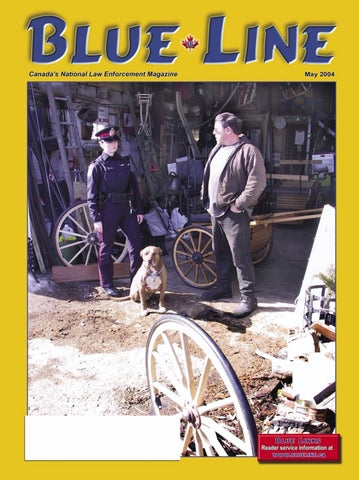
Earning the trust of Old Order Mennonites and Amish, who still use horse and buggies, reject modern conveniences and are non-resistant, can be a challenge. Blue Line publisher Morley Lymburner went on a ride-along with an officer from Waterloo Regional Police’s Elmira detachment, which patrols areas with large populations of Old Orders, to learn how they police “the quiet of the land.” In a sidebar, Elizabeth Ackerman profiles the ‘horse and buggy people.’ Lymburner also profiles the OPP’s new ‘Offender Transport Unit,’ staffed by 26 full-time and seven part-time officers. Set up to cope with the demands of transporting prisoners greater distances from the new ‘super jails’ to courts in other municipalities. News Editor Les Linder tells us about how BC botanist Rolf Mathewes is helping police solve difficult cases through plant evidence, an often overlooked factor in even high profile murder cases. West Coast Correspondent Elvin Klassen speaks to Richmond RCMP Superintendent Ward Clapham, well known for his innovative community policing and leadership strategies. The Corps of Commissionaires raises interesting points in its response to a Law Commission paper on private and public policing. In our regular features, Dr. Dorothy observes that how you speak says a lot about you; Mike Novakowski has two case laws; Danette Dooley tells us the Royal Newfoundland Constabulatory has finally got the go-ahead to replace their revolvers; Tom Rataj looks at LCD monitors and Albert Sevigny has a story on the easy availability of guns on Montreal streets. And finally -- well, I did warn you that it was an “unbelievable story” in this space last month! Plenty of people took our story on the Pembina Police and their unique financing scheme -- our annual April Fool’s story -- seriously. In fact, a representative of one force even asked ‘Chief Lotherton’ for more details in hopes of implementing it in his area. Blue Line publisher Morley Lymburner, who bears an uncanny resemblence to Lotherton, has some of the funnier responses we received. MAY 2004
4
MAY 2004
Spurring the old horse into action
by Morley Lymburner
We have taken some predictable flak about our March feature on the Smith & Wesson magazine disconnect and I want to explain the methods we use when faced with topics such as this. We predicted there would be accusations of ‘Mountie-bashing,’ and there were. This publication looks at all police officers as one rank, one colour and one department. We are neither management nor union oriented and this alone makes us unique in Canada -- and suspect to both groups. We are proud of the fact that we’re banned by one chief and one association but certainly don’t believe alienating our readership is a sound business practice. There is no other place but in this magazine that you could have found out about the magazine disconnect issue and this is why we gave it such a high priority. With time-lines as they are for magazine production, that issue went to press the second week of February. Unfortunately Jim Galloway was killed while it was in the mail. We notified RCMP HQ as early as November that the story need not go to press if they were going to take action to correct the problem -- something we did not have to do. We have often been complimented on being timely but occasionally this can be a curse. Our last unfortunate ‘timeliness’ was when we ran a story about remote, one-member detachments in our April 2001 edition. We wanted to interview officers working at one or two-member
June 2003
OPP detachments but found they didn’t have any -- for safety reasons, so our story quoted only RCMP members who actually enjoyed the remoteness and wanted to work alone. It was a positive story for the most part but caused concern at RCMP HQ, who appeared to stonewall when asked for a response. As we were about to go to press, Jurgen Seewald was killed on Baffin Island. HQ called the next day, wondering if it was too late to make a comment. I advised them we would hold the presses and their comments, which noted the status of onemember detachments were being reviewed, was blended with our story. Without the editorial move by us and the unfortunate death of an officer, would this review have happened? I can give you a small hint of what we didn’t do in the magazine disconnect article. A couple of our experts were so concerned that they wanted us to publish instructions on how to remove the mechanism and disable the disconnect. One argued that if RCMP ERT members won’t work with magazine disconnects, why should all the rest? I cut that portion out because it would be irresponsible for us to show 14,000 officers nationwide how to remove the part; we did put the diagram with the story so Depot would know we had that information. Underscoring all this was another story from Winnipeg which we did not publish. An RCMP member was visiting a Winnipeg officer at his station. The RCMP officer had never han-
5
dled a Glock and wanted to see what that special trigger did. He removed the magazine and looked the gun over carefully. Pointing the gun to the ceiling, he pulled the trigger -- you can guess the rest of the story. Fortunately the only casualty was a damaged ceiling tile but RCMP training presumes the only gun a member will ever handle in their career is their own. Now the question readers have to ask is why the lock is in place for the masses of RCMP officers but not the special service guys. The answer could be tragically simple; special service officers are trained to a higher level of proficiency and safety, a level to which administrators can not, or will not, train the rest. If every other Canadian officer is trained to that higher level of safety though, why the difference? Money? Effort? Lack of personnel? Indifference? Or is it really better? We gave ample opportunities to tell us why it is better than everyone else in the country but the official response basically suggests ‘trust us, we know why.’ Should Blue Line not say anything, even when we can? I have to look at myself in the mirror every morning and so does everyone else. It’s simply a matter of integrity, not money or popularity (I only wish). Sometimes top management can be like an old horse which only moves when pressure is applied. We are happy that Blue Line can occasionally take the shape of a judicious set of spurs.
MAY 2004
by Morley Lymburner The driver touches the screen of the laptop computer with her index finger several times as the shiny new police cruiser leaves the Elmira police station. Global Positioning Satellites (GPS) show our precise position over a map of north Waterloo Region. The scout car, now passing a horse and buggy ambling along the road’s shoulder, shows me the paradox of policing a low-tech community with hi-tech equipment. “Policing an Old Order Mennonite community does not have many challenges but it sure is different,” says Cst. Wendy Bremner of Waterloo Regional Police’s Elmira Detachment. “We never hear too much from them but I have sure learned that if they call, we better move on it - it must be serious.” The uniqueness of Old Order Mennonites is world renowned, even though almost all their efforts are directed toward not being overly communicative with the outside world of fancy cars, luxurious homes and mass media. Their uniqueness is almost entirely visual and highly visible due to their reluctance to embrace technology or things of a frivolous nature. The few exceptions are necessities which permit them to make a living, such as electricity to run coolers so milk doesn’t spoil - that’s acceptable as long as they can use their own generators. For many old order Mennonites even cell phones to communicate with seed suppliers or hardware stores is acceptable, as long as they can pay by cash in advance for air time. Television is not acceptable however, nor are flashy clothes, cosmetics or fancy cars. Black or muted coloured cars are okay to many and it is not unusual to see them at Sunday morning meeting houses. There are so many varieties of Mennonites and Amish around the world that it’s very difficult to cover the many shades of belief and practice among them but most Mennonite and Amish groups have common historical roots. Both were part of the early Anabaptist movement in Europe, which took place at the time of the Reformation. A group led by Jacob Amman broke from the Mennonites in 1693 and became known as Amish -- Amish and Mennonites are Christian fellowships and stress that belief must result in practicing their faith daily.
The local bishops usually determine what is acceptable. Generally if a good rationale is presented as to why a newer technology should be accepted, the bishop will simply announce that it is acceptable. Such was the case some 20 years ago when Waterloo Regional Police approached the local bishops to explain why it was important to put orange ‘slow moving vehicle’ signs on the rear of buggies. Initially seen as too bright and garish looking, a simple nod of the bishop’s head made them mandatory on all buggies once the argument of road safety and visibility convinced them they were necessary. Orange triangles graduated to red reflectors and today it’s not uncommon to see red lights, powered by batteries, festooned on the rear of buggies driving at dusk. Waterloo Region has long recognized the need for wide, well-graded shoulders on rural roadways to accommodate the conservative Mennonite mode of transportation, but accidents involving buggies and other vehicles are not infrequent. “Most problems come about due to lack of experience,” says Sgt. Merv Knechtel, officer in charge of the 12-member sub-station. “Although all motorists must be tested and obtain a licence, it is not so for a horse and buggy driver. Although rare, it has caused problems from some younger and more inexperienced drivers who do not completely understand some road signs or rules.” Likewise motorists not accustomed to seeing buggies can cause a traffic hazard by slowing or stopping unexpectedly to gawk or take pictures. Other problems arise with young and inexperienced horses or even overly playful teenagers trying to spook the horses for malicious entertainment. “Accidents between motorists and buggies can be particularly nasty,” says Bremner. “In the worst cases there isn’t much left of the buggy that is bigger than match sticks and there are always bad injuries.” It’s often necessary to put down the horse after even minor collisions. Bremner relates two particular incidents that stand out in her memory. “I once attended a farm accident scene regarding an injured youth. When I arrived the father calmly advised his son was in the kitchen. I went in and saw the son sitting at the kitchen table with a bandaged hand. He was sitting quietly and his mother was walking about the kitchen area. She was as calm as the father and the injured young man. I asked to see the cut on his hand and when he 6
removed the bandage I was shocked to see two fingers had been amputated. I was astonished that everyone was so calm and accepting of the circumstances.” She also recalls a farm accident where a youth had been accidently hit by the blades of a snow blower. The entire back of his leg was torn down to the bone but the young man was simply laying quietly under some blankets when she arrived and was taken away by ambulance. “I don’t know much about their upbringing but I am amazed at their calmness and discipline under stress.” This calmness matches their patience and willingness to help others in the face of adversity. If a house or barn burns down, hundreds of people show up, sometimes the next day, to begin clean-up and rebuilding. Helping one another is not something that is asked but simply expected. The approach to lending a helping hand is one that Bremner has become accustomed to. “One time I saw an Old Order with a broken down wheel on the side of the road. I stopped and asked if he needed any help. He quietly said no. I left to attend other business in town and upon returning saw him still struggling on his own to fix the wheel. I got out of my scout car and this time did not ask to help, I simply went over and started to help. He did not say much but accepted my assistance without comment. When the wheel was fixed, he simply smiled at me and nodded and got into the buggy and went on his way. So I found you don’t ask if they need help -- you just help.” The local Old Order community has come to appreciate the police in their community as a necessity. Several years back, local police did not receive much information from them. A local merchant mentioned that some old order people were constantly buying certain items and MAY 2004
a local bishop finally reported that some city hoodlums were making the rounds and stealing items and cash. Nothing was being done about it and the thieves took advantage of their victim’s quiet nature and adherence to pacifism to steal at will. This came to an abrupt end when a new relationship of cooperation was developed and police caught up with them. Although this new relationship was established many years ago, Bremner points out one of the small benefits that has resulted. “You really get the feeling that people appreciate having you here. I never pass a buggy without seeing friendly hand waving and smiling faces. The message that the police are here to help has been certainly passed along. It is certainly a big change from city policing,” she concludes. Today the best sources of information for police on the general well-being of the Old Order Mennonites are the people who service them; local blacksmiths, feed mills and other
merchants who meet with them on a regular basis. Although there is a clearer understanding of the police role, they will still speak more freely to some merchants and they act as a barometer of community concerns. Pacifism is one of the cornerstones of the Mennonite faith. Although the various sects interpret it differently, the basic principle of bearing arms for military use isn’t compromised. Many more liberal sects have recognized the subtle differences between soldiers and police as understood in the North American lexicon. These groups acknowledge police as one of the factors in making a safer community, including their use of weapons to protect others from harm. The coercive powers of the state have been used to both protect and persecute Mennonites over the past 400 years and some discomfort with authority remains. Mennonites were deprived of lands, persecuted throughout Europe and even killed for their pacifist beliefs.
Waterloo Regional Police Service was created in 1973 with the advent of the two-tiered municipal government structure introduced in Ontario that same year. This move brought together municipal police forces from Kitchener, Waterloo, Galt, Preston, Hespeler and area townships. The WRPS currently employs just over 600 uniformed officers and approximately 250 civilian members. The headquarters building is centrally located within the Regional Municipality of Waterloo and there are divisions and detachments in Kitchener, Waterloo, Cambridge, Elmira and New Hamburg, serving more than 450,000 people. For further information call 519 653-7700 x773 or visit www.wrps.on.ca .
Who are the ‘horse-and-buggy people?’
by Elizabeth Ackerman The Old Order Mennonites and Amish are conservative branches of larger groups and are divided based on their level of conservatism. Mennonites and Amish first came to Canada in the late 18th and early 19th centuries. Early settlers were all farmers -- all old order Amish still are, as are most old order Mennonites, though some have established other businesses, including manufacturing and building. Amish are found mostly in Perth and Waterloo Counties and around Aylmer, Ontario and their population has stayed about the same in recent years. Old Order Mennonites, however, have been growing steadily in numbers. Population growth within the community and urban sprawl have sparked the establishment on many new communities in the Kitchener-Waterloo region, Grey-Bruce and Huron counties and the Ottawa Valley. Both groups are easily recognized by their distinctive dress. They wear black in public -- women have bonnets and men black hats. Clothes are very simple and oldfashioned, both to encourage modesty and in an effort to avoid the pride and covetousness that accompany following modern fashion trends. They also see their distinctive dress as a visual statement to the world of their faith and adherence to the teachings of Jesus. The Old Order choose to live and farm simply as well, as much as possible without modern trappings which they feel distract from the spiritual. The Amish live without any modern conveniences while Old Order Mennonites allow for electricity, telephones and tractors but don’t have computers, televisions or radios and some don’t have cars. Horses and buggies or wagons are used for transportation. Standard breds, often retired race horses, are the most common; heavier breeds are used in the fields. German is spoken in the home and at church. Church services are in High German while the spoken June 2003
There are now about one million Mennonites worldwide and many have assimilated into the general population and are more accepting of modern advances, but Old Order Mennonites and Amish in our midst still remain the visible recognition of a kindlier and more tolerant society -- one that has permitted them to flourish within their remoteness for over 200 years.
7
language is a dialect called ‘Pennsylvania German’ or ‘Pennsylvania Dutch.’ English is spoken in school to acquaint children with the language they need to deal with the outside community. Children attend parochial schools, which are run by the Old Order, from grade one to eight and then work at home or on other farms until they choose to become baptized members, marry and start their own families. This choice is entirely their own. Old Order people are generous and supportive of one another and neighbours in trouble, even those not be part of their community. They are friendly and approachable and enjoy conversing with ‘outside’ people in appropriate settings. Although the groups differ on rules which dictate how they live and work, the doctrines and principles are the same and go back to the earliest days of the Protestant Reformation in the 16th Century. Simply put, these guiding principles are: • Commitment to follow the teachings of Jesus as found in the New Testament • Adherence to the doctrines of evangelical Christianity • A system of autonomous church government • A belief in voluntary adult baptism • Observance of communion and baptism as only symbolic ordinances • Objection to military service, war and violence • Separation of church and state • Objection to oath-taking and initiating litigation. Old Order groups strive to stay separate from the rest of the world as much as possible; while they will do business with it, they refuse pensions and any kind of insurance, choosing rather to support one another as a community. However, they do take part in service opportunities such as disaster aid and fundraising for the less fortunate around the world through agencies such as the Mennonite Disaster Service and Mennonite Central Committee.
MAY 2004
Mobile workstations include four police services The Police Regionalized Information and Data Entry group (PRIDE), which includes Waterloo Regional, Guelph, Brantford and Stratford police services, was formed in 2003 to replace aging Mobile Data Terminals with state-of-the-art, digital mobile workstation environments. The system consists of laptop computers installed in cruisers, digital modems with GPS capability, digital receiver/transmitters on all tower locations and custom software. One of the system’s many features is ‘photorealistic’ mapping, which displays the location of cruisers in real time and updates automatically as vehicles change location. Map perspective can be increased or decreased, depending on the amount of detail needed. The new system gives dispatchers and road supervisors the ability to see all calls and vehicles on the screen, assisting them in assigning the appropriate units and back up to specific locations and improving officer safety. The inter-agency cooperation helped to build a more robust system at a fraction of the cost of each going it alone. Advantages are also found in cross jurisdictional records management and data min-
ing capabilities and reduced voice-over transmissions that can cripple many overtaxed communications systems. T h e four-agency cooperative awarded contracts in 2002; six months later, five radio sites were set up across southwestern Ontario. By a year or so later, 182 scout cars were equipped with new laptop computers, transmitters and GPS hardware and software. The police services involved in this undertaking employ 980 officers, are supported by 335 civilian personnel and cover a population base of more than 700,000 people. The combined number of criminal offences investigated in these communities in 2002 exceeded 45,000. There is an old axiom that crime knows no boundaries. With the assistance of technologies and interforce cooperation, those criminal movement boundaries are diminishing.
Saskatoon’s deputy police chief has been removed from his duties while the force investigates allegations he lied to a reporter in the lead-up to the inquiry into the freezing death of aboriginal teen Neil Stonechild. Dan Wiks, a 31-year-veteran, has been put on paid administrative leave while an independent investigation is done to see if he was discreditable in his conduct. Russell Juriansz will join the Ontario Court of Appeal as the first non-white judge in the history of the province’s top court. Juriansz came to Toronto from India when he was eight, eventually studying science at the University of Toronto before attending Osgoode Hall Law School in 1972. Two years later, he was called to the bar. Among his more notable cases included the 2001 case in which he ordered an insurance company to pay an unprecedented $200,000 in punitive damages to a Toronto man it had originally been rejected for benefits. A videotape that appears to show a city cop slamming a drunk woman’s head on a police cruiser doesn’t confirm his guilt or innocence, an appeals court judge has ruled. In tossing out Cst. Martin Cardinal’s assault conviction and ordering him a new trial, Justice Jean Forget said the trial judge, Justice Kent Kirkland, doubted the credibility of the alleged victim, Julie Cayer, and never should have used a videotape of the Nov. 25, 2000, incident to fortify her evidence. Forget said because Kirkland doubted if Cayer had a recollection of the incident that was independent from the videotape, the tape can’t stand on its own. The Ontario Provincial Police commissioner has appointed a new eastern region commander. Chief Superintendent Jay Hope has take over the post. Hope has spent 25 years in policing, including a stint as commander of the greater Toronto region. He succeeds Chief Superintendent Chris Lewis who has accepted a position at the OPP’s general headquarters in Orillia. A Niagara Regional Police constable has been found not guilty of dangerous driving causing death. Dozens of supporters of Cst. Ken Davidson Jr. clapped and smiled and wiped away tears upon hearing the verdict in March. The jury deliberated for about seven hours before returning the not guilty verdict. Early on April 20, 2001, Vanessa Carter, 21, was killed when the car she was in and Davidson’s marked police cruiser collided. Halifax’s chief of police says steps are being taken to improve race relations following a human rights commission ruling last year. The service found heavyweight boxer Kirk Johnson was the victim of discrimination by the force after he and a friend were stopped by a police officer in 1998. Chief Frank Beazley addressed the issue after attending a Halifax church service marking the International Day for the Elimination of Racial Discrimination. Beazley says the department has issued a request for proposals looking for consultants to advise them on their race relations training and policies. He says he’s already made some changes he hopes will improve race relations, including new policies relating to traffic stops. Montreal’s police chief announced they have formally adopted a policy denouncing racial profiling by its officers, partly in response to a series of human-rights complaints. “We tolerate no discriminatory behaviour within our organization,’’ police Chief Michel Sarrazin said at a news conference. The police force’s new policy was announced at the same time as a Montreal anti-racism group said it had filed complaints against the police to the Quebec Human Rights Commission on behalf of two 20-year-old men from minority groups. The action follows about a dozen similar complaints against police and the Montreal Public Housing Authority.
8
MAY 2004
Safe, secure and on time by Morley Lymburner In January the Ontario Provincial Police expanded its Offender Transport Unit to serve the region around western Lake Ontario. The new unit, consisting of 26 full-time and seven part-time officers, is headquartered in Milton. On January 26th the special transport unit became operational in the facilities formerly used by the Milton Detachment of the OPP. This facility, which also houses the local Accident Reporting Centre, is situated at the intersection of Highway 25 and Steeles Ave. It is also about one kilometre south of the Maple Hurst Correctional Centre and the Vanier Institute which houses the female prisoner population. “It was quite a job getting this unit off the ground,” says S/Sgt. Al Zunder, commanding officer of the new Miltonbased unit. “We had to hire the personnel and then train them to handle prisoners safely in addition to introducing them to the routes from the jails to the courthouses.” Two previous units were started last year in the area of Penetang and Lindsay and serve a similar function for local court houses in their respective regions. Several years ago the Province of Ontario transferred all responsibility for local prisoner transport over to local municipal police services. At the same time they shut down a large number of jails and amalgamated them into larger “super” jails. Although the efficiencies of maintaining the prisoners were met by the province the municipalities found themselves facing large and unanticipated travel bills for bringing prisoners greater distances to attend court. The extra duties were starving many police agencies of scarce resources and putting both the public and court system itself in jeopardy. The province responded by ordering the creation of these new Offender Transport facilities. Offender Transport Supervisor Kevin Winiarski pointed out the main function of the new units is to relieve surrounding police departments from the added burden and expense of transporting prisoners to and from court houses. A secondary benefit is to supply consistent training for the transporting officers and provide secure transport vehicles to move the prisoners. “This can be quite a logistical nightmare for individual departments,” Winiarski stated. “First they have to contend with the regular male and female prisoners in addition to young offender males and females. All of them have to be kept separated throughout the transporting process.” June 2003
Pictured above is David MacDonell, Mike Greene, Peter Morgan, Tanya MacDonald, Krista Devince, Kerri-Ann Losee, Kelly Kuus, Brian Carter, Kevin Winiarski, and S/Sgt. Al Zunder.
The routes are indeed extensive with nine trucks and buses taking prisoners from a wide area covering from Orangeville to the north and Niagara to the south. All four classes of prisoners are couriered over eleven different routes. Court houses are in Kitchener, Waterloo, Guelph, Brantford, Hamilton, Orangeville and St.Catherines. The special constables work 12-hour shifts and have a pay scale from $53,034 to $56,353. Due to the number of female and young offenders to be transported the selection process intentionally balanced the number of male and female officers. Although their communications equipment includes the standard radio system used by the OPP for emergency response, the largest part of their communications is kept up through cellular telephones carried by each officer. The officers included in the Offender Transport Units come from a wide background. The majority have had some previous experience at various levels of law enforcement. Some were retired police officers while others were court security officers. Others were social workers, probation officers and even correctional officers. A few came with backgrounds in nothing more than supervisors at Walmart and one was an investment broker. Today the one thing they all have in common is to ensure the safe, accurate 9
S/Sgt. Al Zunder reviews the route maps with Supervisor Special Constables Kelly Kuus and Kevin Winiarski.
Special Constable Wayne Flaxman and Peter Morgan book off at the Milton main station.
and timely arrival of all prisoners to their respective courts. “I am very pleased with my team,” S/Sgt. Zunder beams. “Not only have we trained them in self defence, first aid, use of force strategies and handcuffing techniques but also how to drive their transporters safely and in a timely fashion. They are all proud of their accomplishments here and I am more than happy with the effort they put forth.” For further information S/Sgt. Al Zunder can be reached by phone at 905 878-2307 or eMail at alan.zunder@jus. gov.on.ca. MAY 2004
Alberta Special Constable Association by Faith Wood County police were established in Alberta in 1958 and redesignated special constables after the police act review in 1989, resulting in the loss of criminal code authority and the right to carry side arms. The Alberta Special Constable Association (ASCA) was established in 1989 to provide a common voice for special constables throughout the province. It currently has more than 170 members, all performing primary traffic management services within their respective communities. Alberta has roughly 3,000 special constables with full to limited appointments, ranging from court service workers to tribal police; ASCA represents about five percent but a large percentage of traffic enforcement personnel. Alberta is in a cycle of rapid growth and is encountering increasing challenges in managing its existing infrastructure and funding demands. At a time when violence and crime rates are on the rise, there are declining numbers of qualified police applicants able to replace current retirees. ASCA is currently embarking on a public education campaign to encourage better utilization of special constables in chang-
A Special Constable in Canmore Alberta on Bicycle Patrol
ing some of these out of control factors. Special constables are a very important component of law enforcement in Alberta. The province has endorsed enforcement activities through the following levels: 1) Police officer (RCMP, municipal police services) 2) Special constable (county & urban) 3) Bylaw enforcement officer (animal control, parking control) As a result of their specific appointments, special constables are able to place more emphasis on traffic management, municipal bylaw infractions and other common residential complaints. In addition to carrying appointments under the Traffic Safety Act, some agencies enter into Memorandums of Understanding
(MOU) with the RCMP detachment in their areas, giving special constables an expanded criminal code appointment. Special constables protect local infrastructure and roads through commercial vehicle enforcement, reducing fatalities and injuries through education and selective traffic enforcement initiatives. They also provide a liaison with police/fire/EMS and local government to maintain continuity toward safer community service. Many special constables have the expertise, time and enthusiasm required to help educate young people through school-based anti-bullying, driver attitude and awareness campaigns, safe cycling and pedestrian initiatives and other mentorship style programs. These sessions help to point out to local youth that law enforcement is a multi-level function that goes beyond the levels of provincial or municipal police officers. To ensure credibility, competency and a high level of integrity for its membership, ASCA has voluntarily adopted a comprehensive policy that mirrors accredited policing standards. Members commit to meeting or exceeding these guidelines and ongoing professional development. The association encourages implementing such standards for all of the province’s special constables. ASCA believes that special constables are viable and sustainable partners in the local policing matrix and offer unique advantages to government through grass roots concepts which promote local accountability, timely response to evolving trends and, most importantly, cost sharing. The current ASCA program is experiencing many challenges, including the current inability to obtain limited criminal code appointments for all officers or conduct limited enforcement on one and two digit highways. Other problems include use of force issues and equipment and limited jurisdictional powers. Improvements are also necessary in providing consistent communications with police, fish & wildlife and motor transport officials. A lack of consistent training standards for field officers is also of concern. Despite these concerns, ASCA members welcome the opportunity to be held accountable to the community, local and provincial government in the same fashion as other provincial special constables and sworn police officers. The Alberta government has, from time to time, entertained discussions around regionalization. As a part of that program, ASCA is advocating increased partnerships and communication between all enforcement agencies. It also supports a name change to reduce confusion about the municipal officers who provide traffic management services and welcomes the opportunity to train them to similar levels as their police counterparts. Faith Wood is president of the Alberta Special Constables Association and can be reached at faith.wood@airdrie. ca or 403-948-8892, x623.
10
MAY 2004
June 2003
11
MAY 2004
Riding safely in inclement weather by Michael Walker It’s imperative that police services properly train their motorcycle officers to minimize the inherent dangers of riding in bad weather. If it rains during our monthly Tallahassee Police Department motorcycle training days, we normally cancel and help investigate traffic crashes. However, when hit with a torrential downpour during a recent police motorcycle instructor school, training continued on the qualification course -- and what we discovered was both comforting and an eye-opening experience. Equipment/preparation All police motorcyclists should be properly equipped to ride in inclement weather. Normally we retreat to the station for sanctuary, yet sometimes that luxury is not an option -- during special events, for example -- and one should always be prepared. Make sure you have a good quality rain suit -- we’ve found the heavy nylon/pvc two piece suits to be the most durable. Rubber or pvc only suits tend to tear easily and will melt if they come into contact with hot parts of the bike. It’s important that suits seal well at the wrists, ankles and neck for maximum protection from the rain and have snaps on the sides for easy access to your radio and firearm. Many of the upper line suits have a built in liner, which
makes them more comfortable and allows machine washing. A quality suit will cost a few dollars more but can last years longer. Consider reflective stripping and colours that really stand out, such as yellow; being easily seen helps keep you safe during limited visibility riding conditions. Another option to consider is proper gloves for wet weather. The traditional leather glove becomes heavy and cumbersome when soaked, reducing its effectiveness. Consider getting a pair of neoprene or water ski gloves to wear in wet weather -- they will allow you to maintain grip and comfort without sacrificing all protection. It’s a good idea to also have additional eye protection available. The traditional dark shades may not allow proper light and compromise your vision during stormy weather. Consider a clear or amber lens to increase vision in decreased lighting situations.
Training Though we don’t pray for rain on a training date, take advantage of wet roads and light rain when they occur -- but pack it in if there is lightning or signs of high winds; riding in such conditions is dangerous and should be avoided. Once you’re properly outfitted, make sure your bike is also prepared. Start with your normal fluid checks and making sure the tires are properly inflated. This is always important but even more so in less than perfect weather. Check the owner’s manual for your bike’s specifications -- and don’t overlook measuring tread depth, which is crucial for the bike to maintain sufficient traction during braking and cornering exercises in poor conditions. Remember to ride with the headlight on high beam should your training area require you to use the roadway. Begin training with a simple follow the leader drill led by an instructor. Care should be taken to warm everyone up before attempting precise turning maneuvers. Numerous U-turns and figure 8’s should be included to build riders’ confidence. Next, while using the standard qualification course, start with the slow and offset cones, which are less demanding. Riders will discover the rear brake should be used lightly to stabilize the bike. Do at least 10 runs at this before moving to the next obstacle. Riders will notice the performance of the bike during turns and their confidence will begin to build. When you are comfortable with those obstacles, move to the ‘intersection’ or ‘iron cross’ (both terms are commonly used). Begin by moving the cones out from the standard 18’ circles to 23’ and instruct riders to ride into one leg, perform a U-turn and exit the maneuver. Breaking this obstacle down into smaller components will make it less intimidating. Once proficiency is displayed, the cones can easily be moved in toward the original positions and riders can then begin going through the entire obstacle. We found this to be a very beneficial exercise and allowed the rider to understand the capabilities of a police motorcycle on wet pavement. You can also try the double and single 360. Riders need to learn how to perform tight turning maneuvers on wet pavement and to use their brakes properly so they can stop efficiently on wet surfaces. Use the standardized braking obstacles and begin at a slower, more conservative speed. As riders become more confident in their abilities, increase speeds; keep in mind that the front brake provides at least 70% of the bike’s stopping ability so proper training is paramount. We have found these exercises to be a most beneficial part of our training program. Our ultimate goal is to prevent injuries and damage through a well trained and equipped motorcycle unit. Michael Walker is an officer with the Tallahassee Police Department and can be reached at walkerm@talgov. com.
12
MAY 2004
June 2003
13
MAY 2004
Your words say a lot about you by Dr. Dorothy Cotton, Ph. D., Psych. Anyone who’s met me, or even read anything I’ve written, won’t be very surprised to learn that I’m amused by words; unlike a lot of writers though, I don’t get caught up in big fancy words. Oh sure, I like to keep a few notable words on hand to impress people who might otherwise annoy me -- it’s always handy to be able to say something like “I must collude with the vicegerent monarch before he becomes flibbertigibbetted,” for example. The words a person chooses convey a message -- but sometimes they also tell us a great deal about the person doing the conveying. A few police officers ended up in hot water lately because they referred to a member of an ethnic group, disabled person or female in a pejorative manner. It’s a curious thing, language. In some cases, the problem with calling people names is obvious. There are lots of things we used to say in the olden days that are no longer tolerated; I won’t mention them here but you know -- many are terms referring to skin colour and ethnic origin. Sometimes it’s lot more subtle. Some years ago, there was a discussion in my town about calling the people we elected ‘alderman.’ There was a move afoot to change the name to ‘councillor,’ which seemed more gender neutral. Many of the old guard objected, saying that
alderman was historically significant (which is the highbrow way of saying “but we always did it this way…”) and that everybody knew that either males or females could be aldermen. When I asked a couple of neighbourhood children if a girl could be an alderman though, they all laughed at me. Of course not, they said! Language is therefore something that either includes or excludes people, makes them feel like part of the crowd or an outsider. All professions, including yours and mine, have jargon. I usually get a police friend to look at these columns before sending them in, since I sometimes use words that may mean something different to you than me. The problem is that most of us don’t have someone who can vet our utterances and may not be aware that our jargon sounds weird to others. Our choice of language may confuse, offend or make people feel excluded. When I first wandered into the police world, there were all kinds of things people said that didn’t mean anything to me, or had a different meaning. Some of it was procedural but much of it related to language. One of my favourite police words is ‘integrity.’ In the psychology world, integrity is a property of data and related to statistical properties of validity and reliability, but that’s not what it means to you. Neither interpretation of the word is right or wrong. It just means I might not know exactly what you’re talking about and you might not know what I’m talking about. If you want to
Policing costs could rise with pot decriminalization OTTAWA — The federal plan to decriminalize possession of small amounts of marijuana could increase policing costs, not reduce them as many predict, according to internal RCMP notes. The revelation is among several uncertainties and reservations regarding the proposed pot bill spelled out in newly disclosed briefing materials prepared by the national police force. The Mounties take issue with the oft-repeated assertion that the existing pot law is enforced unevenly across Canada, and express concern about some elements of the new legislative package. Several pages of RCMP notes, compiled from May through December of last year, were obtained by The Canadian Press under the Access to Information Act. The latest statistics show police laid a record number of drug-related charges in 2002, with 75 per cent of the 93,000 incidents involving pot. Under the bill currently before Parliament, possessing 15 grams or less of marijuana, about 15 to 20 joints, would no longer be a criminal matter but a ticketing offence punishable by a fine of $150 for an adult or $100 for a youth. Some advocates argue the legislative proposals will free up valuable police time for more serious matters, but the Mounties remain to be convinced. The Mounties believe a key factor would be how many of the tickets issued under the new proposals end up being challenged. “If a large percentage of the tickets issued were contested in court and police officers were called to testify, our costs might actually increase,” the notes say. The federal government says that in large urban centres police are much less likely to lay a charge for possession of small amounts of cannabis than in other
parts of the country. Liberal MP Wayne Easter, a former solicitor general, echoed the argument recently. “In some areas you get a slap on the wrist, in other areas you get a criminal record.” The Mounties deny the suggestion, saying the force strives to enforce the law “in a consistent manner, keeping in mind the policing priorities of the regions it serves.” There is no evidence “this would be any different if the new reform is adopted in Canada,” the notes say. In consultations with federal officials, the Mounties supported the idea of ticketing provisions for marijuana possession, the notes add, but only if police officers would be able to retain the current option of issuing a summons to appear in criminal court for even very small quantities. This would be reserved for cases in which “aggravating factors” made the option of a criminal charge more appropriate. However, the government did not follow the RCMP’s advice. The bill proposes four separate offences, with punishments ranging from a fine of $5,000 for being caught with one to three plants to 14 years behind bars for cultivating 50 or more. When advised in advance of the government’s options, “the RCMP said it preferred to not see potential penalties lowered for any cultivation offences.”
14
keep people outside your group, secret words and jargon are fine. It’s like the secret password you needed to get into the tree house when you were a kid. Language is an interesting issue in the mental health field as well. I think I was taken to be the dumbest psychologist on the block when I confessed to one senior police official some time ago that I didn’t know what EDP meant. It might be common parlance in the police world for a person with a mental disturbance of some kind, but no one in the mental health world has ever heard of it. Nor, by the way, do we commonly use the terms nutbar, looneytune, wacko, basket case or fruitcake. The words you choose say a lot about who you are. I was chatting with a student some time ago who professed an interest in going into police work but referred to people with mental illnesses as ‘nutcases.’ This told me that she lacked tact and wasn’t able to size up a situation very accurately. She knew I was a psychologist. Surely a thoughtful person would have had the insight to know that I might be offended by the term. It also told me that she was the type of person who would use that word -- and that her choice of words was apt to get her in trouble. It told me that she was probably not a very tolerant person and may be judgmental. There are a lot of not so nice words people use to describe police officers -- and psychologists. You can use them if you want -- but you just might want to think about what you’re telling others about yourself. You know that old saying “sticks and stones may break my bones but words will never hurt me?” Well, it’s bull. Dr. Dorothy Cotton is Blue Line Magazine’s Psychology columnist and she can be reached at deepblue@blueline.ca.
MAY 2004
DNA database has found thousands of suspects
WASHINGTON (AP) — The FBI’s DNA database, filled with genetic samples from prison inmates across the US, has helped local authorities identify suspects in more than 11,000 cases. Known as the Combined DNA Indexing System (CODIS), it helped solve two ‘cold’ murder cases in Kansas, identify the two-decade old remains of a missing California child and capture a sexual predator who terrorized young boys in Houston. Just as important, police say, it has freed prisoners wrongly convicted of crimes and helped detectives quickly eliminate wrong suspects, saving manpower chasing false leads. “This basically is the fingerprint technology of this century,’’ said Joseph M. Polisar, the police chief of Garden Grove, Calif. and the president of the International Association of Chiefs of Police. “The potential for us in the criminal justice field to solve crimes with this technology is boundless.’’ As a side benefit, the sharing of genetic fingerprints also has helped the FBI improve relations with local law enforcement, which for years was frustrated by problems with information sharing, Polisar said. The FBI says more than 8,000 samples of genetic evidence from unsolved cases have been matched to past or current convicts in the database, helping to solve crimes. An additional 3,000 samples have been matched to unidentified suspects in other cases that remain unsolved, creating links between cases. Director Dwight Adams, a DNA scientist by trade, created a sophisticated identification system to safeguard the privacy of samples and ensure matches are double-checked before suspects are arrested.
June 2003
“The process doesn’t stop just because you make a match to an individual in the database,’’ Adams explained. “The next stop in the process is for the law enforcement agency to obtain a warrant, get a blood sample from the same individual and do the same testing to ensure there is a match.’’ CODIS has gathered genetic samples from more than 1.6 million criminals, most taken after they entered prison. The database also includes more than 80,000 DNA samples gathered from unsolved crime scenes. Each month, between 10,000 and 40,000 new samples are added by local authorities.
15
The database started in the early 1990s as a trial and was expanded to 50 states in the late 1990s. Now, at least 170 local US crime labs can run DNA samples through the database and find matches. Though concerned about some privacy issues, defence lawyers applaud the FBI’s efforts and say they want the lab to make DNA science irrefutable, increasing the current 13 markers used for matches. “Any mechanism which increases communication and cooperation between law enforcement agencies is a good idea. What we especially value or encourage... is an increased reliance on scientific evidence over more traditional and less reliable forms of proof,’’ said Steve Benjamin, a Virginia lawyer who co-chairs the National Association of Criminal Defense Lawyers’ committee on forensic evidence. When Adams joined the team of six FBI analysts and technicians that started the FBI’s DNA section in 1988, it took six weeks to get police test results. Today, there are 100 scientists and technology has shortened testing to as little as 24 hours. “If we can get this down to a few hours or less, we will improve all the more because there are still more cases and more samples that can be worked,’’ said Adams, the first FBI scientist to testify about DNA in court. This is a sample feature from Blue Line News Week, an executive news briefing service produced and e-mailed weekly by Blue Line Magazine, in co-operation with Canada Press. Go to www.blueline.ca for more details.
MAY 2004
Richmond superintendent committed to community by Elvin Klassen “Just call me Ward” -- that’s what Richmond RCMP Superintendent Ward Clapham says when introduced to new officers. He refers to himself as the ‘detachment enabler’ and is fond of reminding people that he’s just one of the cogs in the wheel and that everyone on the team is equally important. “I see myself as first of equals, an enabler and a team leader,” Clapham says. “As a first of equals, I am not any better, not any smarter and not any more powerful than anyone else on the team. I am first to stand up for my most valuable assets, my men and women. I am first to listen, to help, give credit to my people when credit is due and first to show sincere sensitivity, great interpersonal skills and compassion in my daily duties with the public and my staff.” Clapham is very committed to this “wellness leadership” and says he challenges himself hourly to ensure he’s supporting his people, providing them the tools they need and understanding what’s important to them. As an example, he points to how the detachment is working to reduce officer absence. “This is not a program, plan nor curriculum,” he states. “It is not something you pick up and apply for two hours and then move on. It is a philosophy and a way of doing business. I can proudly say that over a year now, we have had nobody on stress leave... “My people need to see in both word and deed that they are my most valuable asset. They have to know it, see it and feel it. I have to constantly show that I care for them. Once I achieve that, then I can work on the outside service delivery and that is what I do. People want leadership. They want structure, fairness, accountability, focus and execution.” Police managers must focus on the roots of problems, he says, including forming partner-
Concerns growing about major identity theft Concerns are growing about the possibility of a major identity theft in Canada. Criminals have gained access to the detailed, personal credit files of about 1,400 people. Police say most of the information is about people from BC and Alberta, but also from some in Ontario. A security breach was confirmed in March by Equifax Canada, a major national consumer-credit reporting agency. By gaining access to the files, criminals have obtained social insurance numbers, bank account numbers, credit histories and home addresses. With that kind of information, a criminal could steal someone’s identity, set up false accounts, get loans, credit cards and passports. It’s unclear if thieves have done anything with the information from Equifax. The company says the information was accessed by criminals posing as legitimate credit grantors. Unauthorized access to even one file is considered a serious security breach, and something on this scale has never happened to the company. Regina and Moose Jaw have had voluntary computerized tracking systems since 1999 as part of a pilot project.
Superintentent Ward Clapham
ships with the community to enhance public safety, using integrated service teams instead of stovepipe investigations and taking extra time with the client. Working with youth is also extremely important, he adds. “This is the whole notion of working on the next generation so we don’t have the problems we are facing today. This means a whole new mindset where we are proactive in our service delivery and approaching problems before they occur.” He recalls one of his first solo calls as a police officer fresh out of training and ready to take on the world. “I was called to the crime of ‘road hockey in progress’ in a cul-de-sac. I blocked off the cul-de-sac so no other traffic could flow through, turned on the red and blue flashing lights and marched up to the youths in full uniform. I could see the kids shaking in fear as I approached. “’I have a complaint that you are using the road for hockey’, I said, noticing the kids were nervous. ‘There are two ways to go on this. I shut you down so you don’t get run over or I leave my car where it is and we play. Got an extra stick?’ We played for 45 minutes. During that time we talked about drugs, the law and the cool things that cops get to do. I was feeling pretty good about myself that day -- I made a whole bunch of friends and I was pretty positive that I had really made a difference in a few lives. “My bubble burst the next day when my boss hauled me into his office. Apparently, the person who complained about this road hockey game also made an official complaint against me for neglect of duty. My pleas went nowhere with my boss or the complaining citizen. They didn’t understand that it was more important to make a connection than sort out the provincial traffic act.” As superintendent of the Richmond Detach16
ment, Clapham leads nearly 300 employees in a city of 165,000 people. His previous commands included the Fort Vermillion, Alberta detachment, where he realized the importance of developing relationships with the community. He initiated annual Christmas parties, making sure everyone had a chance to taste a Mountie cooked meal and that the children received gifts, with help from business and government sponsors. In another community he assumed a leading role in reducing break and enters from 3,000 a year to almost nil. His success in developing sources and putting the bad guys before the courts earned him a transfer to the General Investigation Section in Edmonton, where he was trained as an undercover operator and successfully completed more than 50 undercover operations over the next five years. Another success came in Faust, Alberta, one of the most violent and crime ridden communities in the province. Clapham redefined the traditional policing approach, asking his six officers to put all their files away and mix with the community. Youth told officers they got into trouble because there wasn’t anything to do -- and complained there was no place to play basketball. Since the detachment parking lot was the only paved surface in town, Clapham set up a court, provided equipment and outside washrooms and told his staff to take time to play with youth. Police were soon seen in a different light; youth crime dropped dramatically and communication with area aboriginal communities improved. “This was one of the best times of my career,” Ward recalls. “That’s because I was really able to make a difference. I learned to work smarter, not harder.” Clapham has assisted hundreds of promotional candidates to achieve ranks as high as chief superintendent and developed courses, resource documents and training sessions for staff on his own time. He’s put together officer candidate sessions to assist aspiring members and even opened his own web site -- www. wardclapham.com -- to provide material and the guiding principles of community policing and wellness leadership. He says the site has saved him hundreds of hours of copying materials. A passionate and inspirational speaker, Clapham has espoused his innovative community policing strategies around the world, conducting seminars and hosting senior executives from national and international police organizations. He’s also a widely published, active writer on police leadership and community policing. Clapham advises organizations interested in wellness to start by “honouring your people; truly listen to them and make them feel worthy. A culture of trust will slowly begin to develop. Your work, life balance will come. It will happen.” Elvin Klassen, Blue Line’s west coast correspondent, can be reached at elvin@blueline.ca.
MAY 2004
DETROIT — A trainer and handler of cadaver-sniffing dogs pleaded guilty to US federal charges that she planted bones and other evidence in cases she worked. Sandra Anderson, 43, pleaded guilty in March to charges that included obstruction of justice and making false statements. The charges carry up to 30 years in prison. Prosecutors said Anderson made phony evidence in several cases in Michigan and Ohio. They said she planted bones in search areas and used her own body fluids to stain a saw blade, coins and a piece of cloth. Anderson and her dog Eagle, a DobermanGerman short hair pointer mix, were invited to Panama and Bosnia to look for victims of political repression, and to ground zero in New York after the Sept. 11 attacks. They also were featured on TV’s Unsolved Mysteries after helping convict a Michigan biochemist of murdering and dismembering his wife. ***
May 3 – 5, 2004 Canadian Critical Incident Spring Conference Halifax, NS Hosted by Halifax Regional Police at Casino Nova Scotia Hotel. The Conference is for Crisis Negotiators, Tactical Officers, and Incident Commanders. Participants will be hearing a number of educational lectures and major incident debriefs. Registration information and details: www.commandpost.tv or spiced@halifax.ca or Sgt Don Spicer (902) 490-5154.
QUEBEC — Quebec’s Justice Department announced it will sell a Hells Angels property that was seized last year. The property in St-Nicolas contained a building that was demolished Nov. 25. It was officially confiscated in March at the request of the provincial attorney-general. Proceeds from the sale will be given to police forces and groups representing the victims of organized crime. *** CALGARY — Speeders caught on Alberta’s roads can now visit the Internet to pay traffic fines. Justice Minister Dave Hancock and Government Services Minister David Coutts unveiled the province’s new Internet traffic fine payment web site in March. It can be found at www.finepayment.gov.ab.ca. The new service will allow drivers to pay traffic fines and parking tickets issued by police, but not those from independent parking companies. The system will take credit cards and be available 24 hours a day. There is no cost to use the service other than the same $7 transaction fee that is added to any fine when paying in person at a local registry. Each year there are about 800,000 tickets issued in Alberta. Traffic fines can still be paid at all courthouses, registry offices and by mail. ***
EDMONTON (CP) — A joint project in which RCMP and Edmonton police promised to fight Internet child exploitation together is being dismantled after just three months. Supt. Ron Lamabe said the sole Mountie assigned to the three-man team was withdrawn at the end of March to work on RCMP files including child porn cases. Although the two city police officers who make up the rest of the team will continue their work, the decision to break up the unique partnership could hamper their effectiveness, say police. “I’m very disappointed to see him leave,’’ Staff Sgt. Peter Ratcliff was quoted as saying, who heads up the city police vice unit. “We didn’t expect him to be here forever but we did feel it was necessary to give this thing a shot.’’ Lamabe said the RCMP officer was only ever meant to be working with city police on a temporary basis. Ratcliff said part of the idea of setting up the small-scale team was to show the benefit of city police and Mounties working together. The team has been working on investigations in both Edmonton and RCMP territory. It made its most recent big arrest March 2 in Edson, 206 km west of Edmonton. William Frederick Simmons, age 42, of Edson, was charged with possession of child pornography, importation of child pornography, accessing child pornography and the unsafe storage of firearms.
May 5-7, 2004 Ontario Women in Law Enforcement Conference Niagara Falls, ON For more information, go to www.owle.org or call 905257-4588. June 14 - 18, 2004 Forensic Anthropology Seneca College, King City, ON Intensive classroom and field course on examination of human remains, processing shallow graves and collection of forensic samples. Course is led by Greg Olson, a recognized authority on shallow grave investigation. Course applicable to academic credit. For more info: www.senecac.on.ca/law or Jeff Agro at 416-491-5050, x5090. July 11- 18, 2004 Can-Am Police - Fire Games London, ON Featuring 60 events, both traditional and career specific. More information and registration: www.canamgames. london.ca or 519-661-4742. September 20 - 24, 2004 Homicide Investigators Course Vancouver, BC Hosted by the Vancouver Police Homicide Squad, and will feature speakers on the Green River Killer and Picton Pig Farm among others. For information: Det Rick Akin, 604 717-2512 or Cathy Love, 604 717-2500. September 28 & 29, 2004 Property & Evidence Management Course Greater Sudbury Police Service This two day course by the International Association of Property and Evidence, provides a unique training opportunity for law enforcement personnel responsible for, or actively involved in, the operation, supervision or management of a Property and Evidence Unit. Contact: 818 846 2926 or www.iape.org.
June 2003
17
MAY 2004
Police often overlook botanical evidence by Les Linder Forensic botany has great potential as a tool for law enforcement but has yet to catch on with many police services, a BC botanist says. Rolf Mathewes, a botanist in the department of biological sciences at Simon Fraser University, uses plant-life evidence to help solve murder investigations. While not a forensic botanist by trade, his research and studies in pollen, grains, spores and fossilized plant remains help him to identify and reconstruct climate and vegetation from a crime scene. “There’s a natural connection with what I do in my normal daily research with finding plant fragments on a victim, on a car mat, in a vehicle or any other number of contexts,” Mathewes says. His work consists of collecting the evidence, identifying and then interpreting it. Mathewes can use the plant parts to confirm the timing or location of a crime. With the help of a microscope, he must often pick his way through dust and sediment for plant evidence that can be up to 500 times smaller than what can be seen with the naked eye. The annual rings inside woody plants can also help Mathewes find the date of burials. “Buried remains act like a fertilizer for trees and shrubs,” he explains. “By examining growth rings you can find evidence of growth spurts in plants which would have been triggered when a body was buried nearby.” Mathewes has been dabbling with forensic botany since 1986 and has worked alongside the RCMP, Vancouver and New Westminster police departments. In one case, Mathewes was called for assistance after police recovered a bag from the bottom of Alouette Lake in Golden Ears Park. His identification of plant remains from the body bag and the victim’s hair helped Vancouver police confirm where her body had originally been hidden. “It’s all a matter of trying to interpret the evidence and establish associations. Where has this car been? Do the plants associated with the crime scene match where the suspect lived or with another crime scene?” Mathewes collects botanical evidence at a crime scene under the supervision of an Ident officer to ensure it’s properly catalogued as evidence. He then brings it to his lab at the university, where he has reference collections, books and a microscope to help him identify it and focus on interpreting what it may mean.
side of things is because they don’t like the idea of possibly working with dead bodies,” he explains. “They also don’t like the idea of being pulled into court to confront a potential suspect and getting involved with all the legal hassles that come with that. This is something I am willing to do.” The interest among students in forensic work at the university is also increasing rapidly, he says. Mathewes is currently trying to develop a forensic studies institute at Simon Fraser due to the significant interest in all fields of forensics. He’s hopeful that in coming years there will be a greater number of botanists willing to work closely with police. Mathewes has done Photo:Courtesy Simon Fraser University lectures and two workAlthough the interpretation is primarily left to shops -- one for the Canadian Society of police, he likes to provide officers with some Forensic Science in Vancouver in 2003 and of his own suggestions; they can use it with one for Vancouver police at their annual fall other evidence to make the case being sent to homicide seminar. “The workshops were filled,” he says. Crown council. Much of the forensic work is about trying “There’s a lot of interest in it from police into establish associations to help narrow down vestigators and coroners, so it definitely seems options for police so they know where to look to be growing.” Mathewes is surprised that forensic botany for more evidence. If pollen is found on a body, for example, investigators can be told where to hasn’t really caught on among police; he’s one find a plant that has that type of pollen, narrow- of the only botanists involved with forensic work in Canada. ing their search area. “I find it strange because many homicides “Sometimes I can go into a crime lab and investigators can hand me a bag with various plants occur outdoors or bodies are later dumped in it and they want to know where they came from. outdoors. Anyone moving around out there is I can quickly answer certain questions like that, moving through vegetation and getting pollen but otherwise I would want to go through a proper on themselves. Plant material is associated with almost every homicide, it is just a matter of detailed identification on the plant.” Mathewes fell into forensic botany by ac- deciding whether it is worth looking over.” He emphasizes that while botanical evicident. His first case was in 1986 and involved the investigation of two females found dead dence is not as definitive as DNA evidence, it on Mount Seymour. An entomology colleague can still be useful in numerous cases. “I think (police) simply haven’t fully caught of Mathewes was called by police to collect insect remains associated with a body. A lot on that there is a point to looking more closely of vegetation was found in the area and police at botanical evidence. While it may sometimes wanted someone with a background in botany end up as only being able to provide another small piece of trace evidence, it can on occasion to look at it. “I happened to be there and was asked if I’d provide a major breakthrough in the case or like to go to a crime scene,” Mathewes recalls. make the investigation easier by getting police “I didn’t have anything particular to do that into the correct area to investigate.” Mathewes believes both the public and afternoon so I decided to go along.” He’s been involved in about one case police simply don’t understand how closely a year since then but that increased to five botanical evidence can be examined and how recently as he became more widely known plant life functions. “The association of plants with crime among police services; he’s currently working scenes is often forgotten and perhaps investion three cases. Mathewes is one of the few botanists will- gators have missed some potential significant evidence,” Mathewes suggests. ing to testify in court. He uses the OJ Simpson trial in many of “The key reason why people who can identify plants don’t get involved with the forensic his lectures as an example of one case where 18
MAY 2004
forensic botany may have been useful. “I have this photograph in a book of Nicole Simpson lying in a bloody pool at the foot of the stairs and the walkway is lined with flowering, shrubs and plants. Whoever murdered her was hiding in those bushes or had to pass by them and would have been covered in pollen and bits of plant matter that could have been identified and linked to the murderer.” Mathewes says he hasn’t found anything to suggest investigators even examined any botanical evidence at the crime scene. “It is surprising and disappointing to see that they didn’t even consider it in a case of such magnitude. I think they could have made a much stronger case with it.” The future of forensic botany may lie in plant DNA. Mathewes suggests there’s theoretically no reason why many of the things done with hu-
man DNA can’t also be done with plants. “Plants produce three different types of DNA, whereas animals produce only two,” he says. “There’s lots of DNA associated with plants that can be used.” Mathewes says that in one case, seed pods from a plant were found in the back of a truck belonging to a suspect in a murder case. They were linked back to a specific tree based on DNA analysis of the pods found at the scene and the pods found on the tree under which the body was found. “There are various techniques that have not been well tested yet, but in theory this could be a huge new area for making detailed associations between suspects, victims and location. It is definitely exciting progress and can open
a whole new set of doors for investigators to work with.” While Mathewes is not too closely connected to police and can’t say how long it might take for them to catch on to forensic botany, he feels they should have access to their own lab technician who can examine, identify and interpret plant remains. “I think it would be a real shame if police end up missing a potential vital piece of evidence simply because they didn’t have all the forensic investigative tools that they could have had.” For further information Rolf Mathewes can be contacted at mathewes@sfu.ca.
Rail Number 16 by S.A. Graham Sometime during the evening of March 1st, 1932, the infant son of famous American aviator Charles Lindbergh was kidnapped from the second-floor nursery of his home in Hopewell, New Jersey, US. The family paid a $50 000 ransom, but their son was never returned. His body was discovered two months later a few miles from the family home. A critical piece of evidence in the case was a crude homemade wooden ladder left at the scene. Xylotomist Arthur Koehler of the United States Forest Service undertook a meticulous examination of the ladder and when the case finally came to trial four years later, offered the first botanical testimony ever to be heard and accepted in American courts. The ladder had been constructed in three sections, presumably for ease of transport. Koehler identified each side rail and rung with a number and identified each piece to species. Through careful examination of the characteristic milling marks left on each piece and comparisons with local mills, he was able to trace all components of the ladder back to their respective retail sources. He also noted distinctive marks left on the wood by a dull, nicked hand plane. Of particular interest was rail #16, a piece of low-grade pine which had four distinctive square nail holes. It was also relatively unweathered. The low grade of the wood, the nail holes, and its unweathered condition suggested that particular piece of wood had been removed from some interior construction, like a barn or shed. Without a suspect however, progress on the case was slow. In September of 1934, some of the notes used to pay the ransom were used at a gas station by Bruno Hauptmann, a carpenter who lived in the Bronx, New York City. He was arrested when $14 600 of the ransom money was found in his garage. Upon searching the attic for more ransom money, police noticed that one of the floorboards was eight feet shorter than the others. The square nail holes in rail 16 lined up exactly with holes in one of the attic floor joists, and the annual ring pattern of rail 16 matched that of the short floorboard. A hand plane recovered from Hauptmann’s garage was indeed dull and damaged, and made marks identical to those on the ladder and on a homemade shelf in the Hauptmann garage. Hauptmann was convicted of kidnapping and murder and was executed on April 3rd, 1936. Graham, S.A. 1997 Journal of Forensic Sciences 42(3):368-377. Source: http://www.dal.ca/~dp/ webliteracy/projects/forensic/plantanatomy.html. June 2003
19
MAY 2004
Laundering does not include receiving goods by Mike Novakowski Receiving stolen or other illegally obtained property is not included in the offence of laundering proceeds of crime, the Supreme Court of Canada has decided. In R. v. Daoust & Bois, 2004 SCC 6, an undercover police officer was attempting to find out whether the accused were laundering merchandise at a pawn shop. He approached them on four occasions to sell “criminally obtained goods” -- new and used items, one borrowed from a local merchant, which weren’t actually stolen but the officer hinted that they were “hot” or otherwise illegally obtained. He was paid $60 for them. At trial in the Court of Quebec, Daoust and Bois were convicted of laundering proceeds of crime under s.462.31 of the Criminal Code. In the judge’s view, the transfer of possession of the property constituted the actus reus of the
Ontario judge makes ruling in DNA sample case Ontario’s top court has ruled in favour of two repeat sexual offenders who argued they weren’t informed, and should have been, when judges ordered their DNA to be taken for the national data bank. “DNA evidence is without question, the most important forensic development since fingerprint comparison evidence came into use,’’ Justice David Doherty said in a written judgment released in March. “At the same time, government seizure and use of personal DNA samples has profound implications on personal privacy and the individual security of the person.’’ Greg Lafontaine, a lawyer representing Dennis Rodgers, who was convicted of sexual assault in 1996, said his client launched an appeal after he was asked to attend a local police station and submit samples of his DNA. “Today’s judgment reaffirms the long-standing principle that a legal procedure is not a fair legal procedure unless everyone involved is given notice and the right to participate,’’ Lafontaine was quoted as saying. Rodney Jackpine, convicted of sexual assault in 1993, 1997 and 1999, was the other offender to file the appeal. With the start of the national DNA databank in 2000, the Criminal Code was amended to get judges to order those they convict to give DNA samples. Judges must issue the order in primary offences, such as murder and sexual assault. The judge uses his or her discretion for lesser or secondary offences, such as assault and impaired driving. Under the Criminal Code, a group of 2,500 people may be required to provide a DNA sample to the databank even though they were convicted and sentenced prior to the 2000 amendment. Within that group were people declared dangerous offenders, some multiple murderers and repeat sex offenders. Rodgers and Jackpine are in that group. The judgment means that 800 of the 2,500 people will have the right to be notified that an application will be made before a judge and the right to be heard in court, Lafontaine said. As of October 2003, police found about 1,100 matches between DNA profiles in the convicted offenders index and DNA profiles kept in the crime scenes index of the databank.
offence. The mens rea, in the judge’s opinion, included the intent to conceal or convert the property along with the knowledge or belief the property was obtained illegally. The case was appealed to the Quebec Court of Appeal, which overturned the convictions and substituted acquittals, ruling that the actus reus had not been satisfied. Justice Fish held that possession of the property had not been transferred, nor did Daoust or Bois intend to “convert” -- change, transform or alter -- the purchased merchandise. Rather, he concluded they were going to sell the property rather than cover up a supposed crime. The Crown appealed to the Supreme Court of Canada, which unanimously dismissed the appeal.
receiving property or similar acts involving the person who accepts or acquires the property do not constitute elements of the offence of laundering proceeds of crime.” Moreover, the court ruled: In the present case, the evidence shows that the respondents (accused) bought the merchandise believing it to be stolen. However, in light of the foregoing, the act of purchasing this merchandise is not the equivalent of “transfers the possession of,” which is the element of the offence specified in the indictment and which the Crown must prove. For this reason, it is my opinion that the respondents did not transfer the possession of the property within the meaning of s. 462.31 (para. 53).
Actus reus In the indictment, Daoust and Bois were charged with transferring the possession of property with the intent to conceal or convert it under s.462.31(1)(a) of the Criminal Code. However, the French Criminal Code version of this offence is narrower and limits the transfer of property to an exhaustive list of specified acts; the English version adds the expression “or otherwise deals with,” which would open up other acts of laundering beyond those listed. These inconsistencies in the actus reus between the French and English version required the court to apply the principles of bilingual statutory interpretation as follows: • determine whether there is discordance between the two versions • if the two versions are irreconcilable, determine whether one or both are ambiguous -- reasonably capable of more than one meaning. If there is ambiguity in only one version, they must be reconciled to a common meaning -- the version that is plain and not ambiguous • if neither version is ambiguous, the common meaning is usually the narrower meaning of the two • determine whether the common meaning is consistent with Parliament’s intent In applying these rules to this case, the court ruled the two versions were identical except for the English addition, therefore the more restrictive French version must prevail. The next question the court examined was whether the “transfer of possession” of property in the laundering proceeds of crime context includes buying property with the intention of converting it. In other words, does s.462.31 apply to the receiver of property? The court answered no. In its view, “(t)he activities criminalized by this provision all concern the same person, that is, the person who originally has the object in his or her possession and seeks to dispose of it.” Section 354(1) of the Criminal Code, on the other hand, “is aimed specifically at persons who receive or accept property despite knowing it to be of illicit origin.” Thus, as Justice Basterache, authoring the unanimous judgment noted, “buying or
Mens rea The mens rea of laundering proceeds of crime includes the intent to conceal or convert property or proceeds and the knowledge or belief that it’s derived from a designated offence. The Quebec Court of Appeal erred in holding that an intent to disguise must be proven to establish mens rea under s.462.31. Justice Basterache wrote: The verb “to convert,” in my view, cannot be given the meaning of ‘disguise’ or ‘conceal’ unless there is an express indication to that effect in the enactment. Absent this, the term ‘convert’ must be given its ordinary, literal meaning. While Parliament might have, in enacting s. 462.31, intended to prohibit acts to disguise or conceal the illicit origins of property or its proceeds, this was only a secondary purpose that was part of a much broader one, that is, to ensure that crime does not pay… Section 462.31 has a broad deterrent effect, in that it is designed to prevent offenders from profiting from their crimes or from engaging in illegal activities, an objective that hasn’t anything to do with disguising the origins of property or its proceeds. Moreover, to read an intent to disguise into ‘convert’ would mean that the offence of laundering proceeds of crime would apply only to clandestine transactions, while leaving the same acts, if committed openly, unpunished… In short, I believe Parliament’s choice of words is indicative of its intention to forbid ‘conversion’ pure and simple, thereby ensuring that those who convert property they know or believe to have illicit origins, regardless of whether they try to conceal it or not, do not profit from it. I am therefore of the opinion that Parliament’s intent and purpose in enacting s. 462.31 favours an interpretation of the word ‘convert’ that does not include an intent to disguise. The interpretation given by the Quebec Court of Appeal to the term ‘convert’ is too narrow and excludes from the scope of s. 462.31 activities that Parliament intended to prohibit (para.. 63-65, references omitted). The appeal was dismissed.
20
Visit www.scc-csc.gc.ca for the complete case.
MAY 2004
15 minute ASD delay up to officer Police do not necessarily have to wait 15 minutes to ensure residual mouth alcohol has dissipated before administering a roadside screening device (ASD) test, Ontario’s highest court has ruled. In R. v. Einarson, (2004) Docket: C40288, police stopped the accused after seeing her drive out of a bar parking lot, head towards a RIDE spot check and then make a U-turn. They smelled alcohol on her breath, her eyes were red and glassy and speech slightly slurred. In response to questioning, Einarson twice denied she had been drinking but failed a breath test. She was arrested for over 80mg%, read the breath demand and subsequently provided two breath samples over the legal limit. At trial the officer testified he was aware that residual mouth alcohol could render a ‘false’ fail if a person consumed alcohol within 15 minutes of the roadside sample being taken. That’s why he asked Einarson if she had consumed alcohol, even though she could have lied, he explained, since he believed he was obligated to eliminate the possibility she had drank within that period. The trial judge rejected Einarson’s argument that the fail reading was unreliable because the officer should have waited 15 minutes to conduct the test and convicted her. The Ontario Superior Court of Justice set aside that conviction on appeal and ordered a new trial. Justice Spiegel ruled that because the officer didn’t know Einarson hadn’t imbibed for 15 minutes, he should have delayed the test to avoid the possibility of a false fail. Thus, the officer could not rely upon the potentially unreliable test result as forming part of his reasonable and probable grounds for the arrest and breathalyzer demand. However, a new trial was ordered to determine if there was still enough reasonable and probable grounds absent the ASD fail reading. The Crown appealed the Superior Court order to the Ontario Court of Appeal. The question became whether the officer was entitled to rely on ASD results in forming reasonable and probable grounds when he knew it was possible Einarson had drank within 15 minutes. Justice Doherty, authoring the unanimous judgment, concluded that any assessment of the timing of the breath samples requires a flexible approach on a case-by-case basis. Rather than demanding the officer wait before administering a test when there is a mere possibility a driver had recently consumed alcohol, the officer’s belief as to the test’s accuracy when administered and the reasonableness of their belief must be the focus. In this case, the unreliability of the test was speculative at best, considering what information the officer had. In summary, the court held: If an officer honestly believes that some delay is necessary to obtain an accurate sample and if that belief is reasonable in the circumstances, a test administered after an appropriately brief delay remains within the June 2003
scope of s. 254(2). The fact that an officer had observed the driver leaving a bar moments earlier is a circumstance that has relevance to the question of whether it was reasonable for the officer to delay the taking of the test in order to obtain an accurate sample. The flexible approach to s. 254(2) accepts that different officers may assess similar circumstances differently in deciding whether some brief delay in the administration of the s. 254(2) test is necessary. Indeed, the reasonable and probable standard must reflect the particular officer’s assessment tested against the litmus of reasonableness. In considering whether to rely on test results absent some brief delay, one officer may give more significance to the fact that the driver was seen leaving a bar just before he or she was stopped (particularly where the driver admits drinking in that bar) than another officer might give to that fact. The first officer might delay the taking of the test for an appropriately short time while a second officer may proceed without delay. Neither officer has necessarily acted improperly. If the officer decides to delay taking the test and that delay is challenged at trial, the court must decide whether the officer honestly and reasonably believed that an appropriately short delay was necessary to obtain a reliable reading. If the officer decides not to delay the administration of the test and that decision is challenged at
21
trial, the court must decide whether the officer honestly and reasonably believed that he could rely on the test result if the test was administered without any delay... The mere possibility that a driver has consumed alcohol within 15 minutes before taking the test does not preclude an officer from relying on the accuracy of the statutorily approved screening device. Where an officer honestly and reasonably concludes on the basis of available information that he can form no opinion as to whether the driver consumed alcohol within the prior 15 to 20 minutes, the officer is entitled to rely on the accuracy of the statutorily approved screening device and administer the test without delay. That is not to say that another officer might not assess the same situation differently and have legitimate concerns about the reliability of a test administered without a brief delay and act accordingly. In each case, the officer’s task is to form an honest belief based on reasonable grounds about whether a short delay is necessary to obtain a reliable reading and to act on that belief. The appeal was allowed and the conviction and sentence imposed at trial was restored. Visit www.ontariocourts.on.ca for the complete case. Contact Mike Novakowski at caselaw@blueline.ca.
MAY 2004
Sticks and stones
Atlantic Canada leads in combating school bullying by Janet Creery Martha Goulding wishes that anti-bullying programs had been in place in the small community of Gambo, Newfoundland, long before her daughter reached high school. “She never got all her high school credits and for the last six months of high school she was on a suicide watch,” says Goulding, who is now the chairperson of the Gambo Crime Prevention Committee. What shocked her was that the school did nothing when the other children repeatedly taunted and shunned her daughter. It wasn’t until there were 22 suspensions for violent behaviour in one term that Gambo High School finally went to the RCMP for assistance. The Gambo Crime Prevention Committee, started with funding help from the RCMP and run by volunteers, now uses a range of techniques to contain bullying at the high school. There is the proverbial carrot – students get to participate in a trip to St. John’s or a barbecue if they honour a “no bullying” contract they sign at the beginning of the term. There is consciousness-raising – the school hosts forums where speakers discuss issues such as the long-lasting impact of bullying and ways in which students can stick together to “beat the bully;” and there is peer mentoring – students in Grades 5 to 8 check in weekly with an older “buddy” in Grades 9 to 12 who is available to talk about issues like peer pressure, labeling, drug use, violence and even suicide. All of these techniques work, says Goulding. In the first term of the program, there were no bullying incidents and the bullying that started up later was dealt with as the full range of programs took effect. Most importantly, the anti-bullying programs clearly identified social exclusion as an act of bullying. “Kids didn’t think there was anything wrong with treating people as outcasts,” says Gouldin. They realized the emotional damage done when they heard a presentation by a former victim. “The youth were astonished to see that 20 years after the fact, the problem of bullying, labeling and gossip still affected the presenter and played a large role in his life.” Atlantic Canada is certainly not alone in struggling with a plague of bullying, but its antibullying projects have been so innovative and
diverse that the Atlantic section on the National Crime Prevention Strategy has been given the national lead on this issue. “We’re definitely ahead of the game,” says Cst. Ian Burke of the Halifax Regional Police. He coordinates an anti-bullying hotline which operates seven days a week, from 7am to 10pm. Burke started the hotline in 1998 after a friend who was a vice principal complained that two of the top students in his school had moved away because of bullying but were too scared to identify the perpetrators. Burke says the hotline, which received about 2,200 calls in its first four years, deals with reports of social exclusion and rumourspreading as seriously as those of physical assaults. For all calls, the process is the same: one of the trained mediators listens to the issue raised by the caller, finds out who else was involved, tries to contact those other parties, then sets up a mediation session if all parties agree. The mediators use a variety of techniques originally developed by Mennonites in Manitoba, but which now include Mi’kmaq healing circles. They help get to the root of the problem which, Burke says, “usually doesn’t have to do with what was said or done that day,” but instead is based on a history of relationships which may include antagonisms between cul22
tural and social groups. Burke recalls one mediation between a group of girls and one of their peers. They had ruthlessly teased and excluded her because she didn’t wear the brand-name clothing they favoured. When the brand-name gang were made to realize that not everyone could afford their clothing, they relented. “It’s an effective program,” says Burke. “Callbacks in relation to a problem are scarce.” Burke’s hotline idea has spread to other parts of Nova Scotia and is now being copied as far away as Thunder Bay and Sudbury. The police force publicizes the hotline locally with a TV commercial, fridge magnets and regular visits to the schools. In Moncton, New Brunswick, where violent harassment led to the deaths of two young men in the mid-1990s, the city has also opted to publicize the problem of bullying. The volunteer Public Safety Advisory Committee (PSAC) developed a whole campaign of public service announcements that were broadcast on the radio and posted on billboards and buses throughout the city. “Bullying is more than a schoolyard issue and we encourage the entire community to look at how intimidation affects them and what they can do to stop it,” says Robert Gallant, coordinator of the committee. Since Moncton is a bilingual city, all of the materials were produced in both French and English and the campaign organizers are delighted to provide them at no cost to other cities or organizations that would like to use them. MAY 2004
Although bullying d o es tr a n s c e n d t h e schoolyard, schools are a prime site for prevention. As Dr. Anne Houston told last year’s Atlantic Crime Prevention conference, one of the big problems in society is that “we face a lot of challenges dealing with emotions and stereotypes – and in school, nobody talks about emotions and stereotypes.” A number of projects are challenging this reality. Throughout Nova Scotia, the League of Peaceful Schools “provides support and recognition to schools that have declared a commitment to creating a safe and peaceful environment for their students,” according to their web site. The league was founded by Hetty van Gurp, who was vice principal in a Nova Scotia school when a boy died after he was pushed head first into a wall. She has now created Peaceful Schools International, based at the Pearson Peacekeeping Centre in the Annapolis Valley. It brings together principals, teachers and students from around the world to work on developing a culture of peace in their schools. Children from Serbia joined a one-week summer camp at the centre last August. In Cape Breton, Nova Scotia, the RCMP hired drama educator Maura Lea Morykot to bring popular theatre-based presentations about bullying to the schools next fall. To prepare, she led theatre workshops with children over
June 2003
the summer. “The children created a dance where the motions involved were the movements the body makes when they are angry, so they can have a positive outlet for anger,” she explains. A dance instructor also taught them movements for a sad song and a happy song and by mid-week, the children started creating a play about bullying which they performed at the end of the week. Police officer Max Sehl visited and talked with the children throughout the week. In PEI, the Evangeline Community Consultative Group is addressing bullying by training local teachers, parents, school administrators and youth groups to work with the Virtues Project, “The Language of the Gift of Character.” They aim to enhance the self-esteem of young people in this Francophone enclave of an otherwise Anglophone province. Schools are also developing more rulesbased approaches. In the largely Francophone community of Edmunston, New Brunswick, the local crime prevention committee became aware of the extent of the bullying problem when they polled youth aged 5 to 18 and nearly three-quarters said they had been verbally harassed and 25 per cent said they had bullied others. A subsequent poster contest among students in Grades 5 to 8 drew 600 submissions. Projects created to redress the problem will focus on developing clear policies and procedures for schools to deal with bullying incidents, says probation officer and com-
23
mittee member Nathalie Cyr-Bélanger. She stresses that the sanctions used will be constructive and educational, rather than simply punitive. The approaches to bullying that work best are those which combine nurturing and accountability. The article was reprinted from the Fall, 2003 edition of the Preventing Crime Through Social Development Bulletin, which is published by the Canadian Council on Social Development (CCSD), in collaboration with the National Crime Prevention Strategy (www.prevention.gc.ca). Editor Janet Creery can be reached at creery@ccsd.ca.
MAY 2004
This is an edited version of the Corps of Commissionaires response to the Law Commission of Canada discussion paper ‘In search of security: The roles of public police and private agencies.’
The domain of public policing is continually expanding and changing and current police officers are carrying out duties (Internet, credit card crime, identity theft, etc.) that their predecessors never encountered or did not exist during their service. Mass public property and computer crime, erosion of the middle class, exponential growth of communications, etc. have each placed new demands on the public police, including a need for police officials to prioritize crime response instead of simply responding to issues as they arise. The public haggling between police service boards and city councils leaves the impression that police services are about money, not security. Since money always wins, one can’t help but get the impression that there are gaps in our security. Once these issues are settled, the public is seldom informed what impact negotiated compromises have on their security. What did the police want that they couldn’t get? What is the impact of that omission on public security? The same case can be made for the apparent losing battle with organized crime. What could be more mainstream and accepting than The Sopranos, which presents the trials and tribulations of a minor crime family? Most previous programs were about fighting organized crime, not understanding it. The perception is that it’s here to stay and should be embraced. What are we to conclude from that? Do police and government accept this premise? Has our culture become that all inclusive? Presumably not, but that is the message. Were this an external threat (war), all of the counties’ resources would be used to defeat it. Is organized crime any less a threat to us than terrorism? You could argue that organized crime is doing more damage to Canada than any external
threat has, or will in the future. Regrettably it is invisible to most of us. The public perception is that life is a lot more dangerous than it was in the 1960’s and that police can’t cope. These may be some of the reasons that, as the Law Commission paper claims, “our appetite for security, whether personal safety or economic security, appears to be insatiable.” Perhaps our perceived needs are unending, because our fears are as well. The discussion paper states “the line between what is public and private property, and who is responsible for policing public and private space, is becoming blurred.” The former, not the latter, is true. Mass private property such as shopping malls etc. is treated like normal private property. Perhaps they are not the same. Does not the presence of the public, uninvited but welcomed on private property place it in a special category – neither entirely private – nor public? Perhaps the complexity of our lives has gone beyond the classic subdivision of public and private property. Mass private property, sports stadiums, shopping malls, etc. have an element of public and private property about them, but they are exclusively neither. A new category of property needs to be created, or perhaps more than one, and a new set of guidelines needs to be developed to enable the public, the owners and the police each to recognize their responsibilities and duties to each other. Private agencies are moving beyond simply protecting private property, but why? Are they doing some of these tasks in competition with the public police? Probably not, but they are moving into a responsibility void. If responsibility for security is one of the duties of the state, why has it not exercised this duty in its entirety instead of attempting to define the problem away. When the state is overwhelmed with its duties and unable to complete them, it only has one choice, assuming the state cannot fail – it must delegate them to others. A review of our social history over the past 40 years would indicate the state has willingly
withdrawn from the complete policing role, for a variety of reasons (competency, cost, priorities). Taking the responsibility back would be virtually impossible. Humpty Dumpty is off the wall. It is time to reconsider and redefine the problem. The state can and should retain responsibility for all aspects of the security of its people. If the public police cannot or will not provide for all of our legislated needs, it can retain the responsibility, but it is time to delegate authority for implementation of those needs it cannot meet to others. Police and policing Why is it increasingly difficult to differentiate between public and private policing, as the Law Commission claims? If both the public and private sector are attending to the same police function, does it pass the test of efficiency? If private policing is making inroads in traditionally public policing areas, is it because the public police is either unavailable, uninterested, unwilling or unreliable to do the job? Policing should be related to carrying out the laws of the state in the areas of security and social justice. Private security is carrying out the wishes of an organization, other than the state, in the areas of security and social order, within the limits of the property being secured and in accordance with the laws of the state. The growth in private security The number of police is often compared with the number of people working in private security – as if it was relevant. Essentially they are different lines of work, with clearly different terms of reference. The essence of the paper is related to the friction caused by areas where police and private security overlap. This overlap is one of the specific problems that has precipitated this examination. Is this overlap growing, shrinking or staying the same? Why is it there? Private security moves into voids vacated by the public police. One should look at what is causing the public police to withdraw from the full provision of services, which is the root cause for the growth of private security. Policing and governance The Law Commission paper asserts that “private security officers arrest, detain and search individuals on a regular basis.” The inference is that they do so on an equal ratio to the public police. This is preposterous. Most private security officers never arrest, detain or search anyone; at best it would be a very rare occurrence. The paper says that the principle of democratic accountability is being eroded (possibly) as more and more policing is undertaken by private security organizations. Eventually it asks whose law is being enforced – blaming the private property owner and the security agency in advance. Should not the question be “how
24
MAY 2004
did the government and the public police allow this to happen?” More can be gained by addressing the cause rather than the result of private security’s alleged infringement on the role of the public police. Determining and addressing the root cause of the perceived need for private security’s encroachment on traditional public police duties would be more beneficial than simply finding new ways to regulate it. It has been suggested, and we concur, that a fundamental re-appraisal of the functions that should be performed by the public police should be conducted, within the context of the policing functions that could be performed by a properly regulated private agency. Public and private policing The paper states that “there exists in Canada a regulatory system for monitoring the performance of the public police. The problem however is that there is little effective oversight of private security.” Says who? The inference is that the public oversight system is OK and the private system is not. Both are wrong. The public system is far from perfect, lacks openness and has failed to convince the public that it is fair and objective. There are two systems that provide oversight to private security; governments and the marketplace. The private security oversight system provided by provincial governments tends to be under-funded and under-resourced, which unfortunately precludes the government agency from properly doing its job. The fact that some provincial governments choose to under-fund these functions is not the responsibility of private security companies. This is a choice governments have made. The systems are in place for private security to be well regulated by both the public system and the marketplace: • Provincial standards must be met – if there aren’t any, it is not private security’s fault • Federal government and some commercial clients demand invasive requirements that examine our quality of training and financial viability and observe private security’s individual site performance • Commercial clients can dismiss us for cause, failure to meet our contractual obligation without redress, lack of performance, health and safety violations or other reasons, depending on the whim of the client • A public complaint to any client, government or commercial – or a complaint to a security company from an individual -- normally demands an immediate response at the highest levels of the security company, if it wants to stay in business • Our employees can seek redress at labour boards, courts and human rights tribunals • The systems to monitor private security are in place, they just need to be recognized and taken more seriously by government The paper claims “there are very few guidelines for regulating the relationship between public police and private security agencies.” June 2003
This is true except in a few more progressive communities. For the most part, especially from the police association’s perspective, police see security as being beneath them in relative importance. Were security perceived to be performing a function of value, then cooperation might be more forthcoming and guidelines might be more achievable. Traditional security relationships There are overlaps between the functions of private security and police because each jurisdiction places different emphasis on certain duties. Police service boards in one community might place a high value on, for example, photo radar and employ only police officers. Another might contract out the work. The reality is in both cases the duties are completed efficiently. What does this tell us? The issue of some security companies and the similarity of their cars to police cars and their equipment to police uniforms cuts both ways. Some security personnel do look like police
25
officers. We believe that to be wrong. Uniforms and equipment are a considerable expense to security companies and they are reluctant to change. Police forces seem to be in a constant state of uniform change; colour, hats, cars, etc. In some cases they have changed to look more like security guards – without any consultation with the security industry. Dialogue should precede any further regulation. Most of us don’t want to look like police officers and want the public to recognize the difference. The paper states “Canadians are also concerned that some security firms engage in tactics usually reserved for the public police force.” The law should concentrate on resolving who does what, not how things are done. Best practices will prevail. For example, at best, it is custom, not fiat that establishes the right of police to use dogs, conduct surveillance, record incidents, etc. Private agencies will use the most effective tools to do the job, within the law. It is silly to think that private agencies cannot use dogs, if dogs are needed to protect a site. What’s next, cars? ‘Pay duty’ is a perfect example of how the police community blur the relationship. A police officer on ‘pay duty’ is a security guard, but one with the powers of a police officer, real or imagined. Should not police officers be used on
MAY 2004
higher priority duties? Is this practice a standard operating procedure for police unions to allow police officers to moonlight at outrageous rates or just a bad habit?
private security industry is corporateness and self-disciplining. What should be drawn from this is not that private security cannot be professional but rather that it needs some help to do so. The first step is to form a fledgling national association that can grow and speak for the industry. The secret to success is doing so without the accompanying bureaucracy. Bureaucracies are expensive. The mainstream elements of the security industry strive to be as competent as they can be. In a business milieu, reputation is everything and most want to at least appear to be professional. The industry is, for the most part, price rather than quality driven, therefore agencies who try to be professional bump up against an invisible ceiling where quality prices them out of the market. Most would agree that there needs to be emphasis on moving toward a greater level of competence. Governments can help by raising the bar and demanding more of security companies and their employees. Setting standards for training is not enough -- they must be accompanied by a mechanism to verify that the training is actually completed and is effective.
Emerging security relationships The issue of security has become so large that it now is beyond the capabilities of any and all police forces. The exponential growth in duties and responsibilities, as well as the requirement to network and cooperate with other police jurisdictions, means that some traditional or customary police duties must be delegated to others. The inference here is that police should continue to retain responsibility for delegated functions; only the authority to carry out the duties is delegated. Checks and balances, standards of performance etc. must be put in place when the work is delegated. This can easily be done when a request for proposal is issued with the standards and deliverables spelled out in detail; these initiatives will serve to eliminate the line, not “further blur” it, since contracted duties will still be clearly defined as police duties. The agency carrying out the duties could be required to meet the technical standard set by the police. Security relationships in context There is more than one context that needs to be examined; the fiscal context certainly, but also the social and economic context. Much of the public police problems began in the 90’s when governments realized deficit budgeting only works in the short-term. Down-loading of responsibilities from the federal level to the provincial and the provincial to the municipal, combined with reduced budgets all round, placed tremendous pressure on police forces. The “more with less” credo clearly doesn’t work. Police and everyone else can only do less with less. The question is, what is it that they no longer do and who does it? The ratio of police per population is certainly convenient and easy to determine, but is it of value in determining anything? There is no optimum ratio. It seems like a self-serving mechanism (based on a continually growing population) to show how hard police officers work in relation to each other. A better measure needs to be determined, if measuring is necessary at all. Ratios and graphs are often used to justify increases in budgets and then take on a life of their own. You would think a comparison of police officers to crimes committed would be of more relevance. Comparing police officer numbers to population presumes all populations are equal -- are they? From a social perspective, the culture of most Canadian communities is or has evolved from a European based, Caucasian underpinning to a multi-cultural one. The relationship with police is changing correspondingly. Many of our citizens come from cultures and countries where the rule of law is a somewhat less important part of everyday life. We make little or no attempt to educate newcomers, only enforce our laws. One person’s crime (in Canada) may be another’s way of life (abroad). If we want immigration to work, new citizens need to be informed what our laws are and why they are enforced. An education program should be a compulsory part of citizenship. Old habits
and practices that are illegal in Canada must be left behind. The rapid growth of the service industry and the corresponding pervasiveness of the minimum wage has changed our society permanently. Atrophy of the middle class leads to a large group of working poor. These three realities, less police, changing cultural values and a growing working class, changes more than the demographics of Canada; it changes our values, and they determine our response to law enforcement. The paper suggests that insurance companies who place conditions on clients, such as hiring private security and installing alarms and cameras, are wrong, but they’re in business to compensate for unexpected and damaging events. Incentives like these simply assist in managing that risk. Is it really any different from incentives for not smoking or not drinking or accident free driving? Police encourage homeowners to engage security companies; what does this say? Accountability There are adequate accountability mechanisms in place for private agencies when conducting private business. The difficulty arises in circumstances when a public police function is transferred to the private domain. Why are private agencies expanding their services into areas previously exclusive to the public domain? Clearly we are not in direct competition with the police -- we are doing something they cannot or will not do and should be held to the same standards of accountability, through either the same or different mechanisms. Professionalism is an elusive term. What constitutes a professional organization? According to Samuel P. Huntington, an organization needs to possess expertise, responsibility, corporateness and be self-disciplining to be professional. What is clearly lacking in the 26
Conclusion The Law Commission paper appears to treat public police and private agencies as if they were the same. They are not, although occasionally they perform the same functions. Perhaps it is time to look at public and private policing from a different perspective. Instead of placing the emphasis on the organization that carries out the work, it might be of value to look at the work itself and determine if it is done for the public good or in support of private interests. For example, responding to murders is clearly in the public interest and anyone doing so should be publicly regulated. A private agency could assist in the investigation but their actions would be subject to the same oversight as police officers. Correspondingly, if police officers wished to “moonlight” as security officers at mass sporting events, they should do so as a security guard, in the proper uniform. The work dictates the status. Author’s note: Our response was intended as a critique and rebuttal to what we perceived as a biased and provocative document. This edited version lacks context as a stand alone essay. The original comments stand except where time (the paper was written more than 18 months ago) requires me to update certain details. Many of the issues covered are deserving of more attention, which will come as the Law Society moves towards the completion of its task. Our full response is at http:// www.commissionaires.ca/media/professional_ articles.html . Ted Nurse is president & CEO of the Kingston and Region division and can be reached at 613-634-4432, x102. The Corps is a private national federation of 17 independent, not-for-profit, corporations who find work for former RCMP and Canadian Forces members. Formed in 1925, it’s Canada’s largest full service security organization, with more than 18,000 Commissionaires serving government, business and commercial institutions from Newfoundland to BC.
MAY 2004
E-Bay halted an auction and suspended a Taiwanese user who allegedly tried to sell three Vietnamese girls on the web site. The starting bid was about $5,400 (US). The auction, which began March 2nd on E-Bay’s Taiwan site, did not include a detailed description of the goods for sale. However, it said the “items’’ were from Vietnam and would be “shipped to Taiwan only.’’ The site included five photos of three people. One dark-haired woman in a white shirt wore makeup and blue nail polish, and the other two appeared to be girls no older than their early teens. Vietnamese activists groups in Australia and the United States noticed the listing as early as March 5th. They began sending e-mails to women’s rights and immigrant advocates around the world. Many of them contacted EBay, and earlier this week the company pulled the auction. E-Bay turned over information on the seller to Taiwanese authorities. — A light dusting of fresh snow did in a water-bottle thief who unintentionally targeted the French Embassy while casing possible breakin sites. Police were called to the embassy on in March after a man was spotted by security guards trying to steal old answering machines from the boiler room. Police said the suspect originally gained access to the embassy at 42 Sussex Dr. by smashing a basement window. The French ambassador was not in the embassy at the time of the break-in, RCMP said. Police added they believed the break-in was a random act and not targeted. By the time police arrived, the thief had fled, empty-handed and on foot. The light snowfall allowed police to follow the suspect’s footprints to an unlocked trailer in a nearby school yard, where the thief stole four empty eight-litre water bottles. A short time later, an Ottawa patrol officer spotted a man carrying four water bottles tied together with yellow caution tape. When the officer attempted to question the man, he took off running. He was arrested a short distance away. Ottawa police Det. Wayne Niemi said identification officers compared the shoe prints of their suspect with footprints in the snow and found the two to be almost exactly alike. Terry Miner, 29, of no fixed address was
June 2003
charged with two counts of break-and-enter. — So much for lying low. A Saskatoon man was arrested for armed robbery after he heckled two police officers about how to do their job. The officers were seizing a vehicle in March on a residential street when a man came out of a nearby home and started mouthing off. The car did not belong to him. One of the officers recognized his face, captured hours earlier on a security camera at a bar where two men with knives had made off with a few bottles of whiskey and beer. Police arrested the man, who had been drinking. “The cops just happened to be seizing the car in front of his house on the street, and he came out and mouthed off to them,’’ Staff Sgt. Murray Zoorkan was quoted as saying. “It’s just crazy.’’ — An Alberta judge has ordered government officials to give a firearms licence to a woman who was refused because she was considered a suicidal alcoholic. People living in “the coniferous forests of rural Canada’’ are sometimes killed by bears and cougars if they don’t have guns to protect themselves, provincial court Judge Don Demetrick said in a written judgment released Monday. “Similarly, in the concrete jungles of urban Canada, ordinary persons sometimes urgently require a firearm for use in lawful self-protection against the lethal attack of twolegged predators such as homicidal rapists or robbers, and of those mentally ill persons who on rare occasion engage in mass homicide for no rational reason,’’ he wrote. “Decent but defenceless urbanites die annually in Canada as innocent victims . . . where their timely and lawful use of a firearm could have prevented or reduced the tragedy.’’ The judge in St. Paul, Alta., about 120 kilometres northeast of Edmonton, also criticized the federal Firearms Act. He said it forces Canadians who want to own guns “to endure a gauntlet of bureaucratic scrutiny and the time-consuming inconvenience of obtaining an official permit.’’ Demetrick made the comments in overturning a decision by Alberta firearms officer Richard Clarke to deny Brenda Pogson a firearms
27
possession and acquisition licence. Clarke said in a notice last March that such a move wasn’t safe because the 40-year-old moose hunter has an alcohol problem and an assault conviction. He also stated she was being treated for suicidal concerns and psychological problems. The northern Alberta woman’s application, made in 2001, wasn’t supported by police either, Clarke noted. But the judge ruled the opinion of police officers isn’t relevant in such a situation, while Clarke’s information about Pogson’s mental health was old and unreliable. Demetrick said he was more concerned with evidence at a hearing last December during which Pogson said she had only told a police officer she was going to commit suicide to avoid being put in a cell for being drunk. She testified she had been sober for six months and was coping with depression brought on by family problems and a 2000 conviction for drunkenly attacking a friend. “The officer brought forth no evidence in the hearing that refuted the essence of what Pogson said about recent positive changes in her personal circumstances.’’ Demetrick has had hard words for guncontrol legislation before. In one 1994 case, he suggested Ottawa should spend more money fighting underlying causes of crime than on complex gun laws. The cost for the gun registry was initially projected at $2 million, but estimates now suggest it will reach about $1 billion by 2005. — A homeless artist caught stealing a $3.89 piece of cheese last November has been ordered to produce a painting for an Ottawa courthouse. Following a guilty plea for the attempted pilfering of a package of Black Diamond marble cheddar, Matthew Cardinal, 37, was sentenced to create the work of art and serve six months of probation. Justice Paul Belanger ordered the artist, who sells his paintings and sculptures on Rideau St., to deliver the painting to the courthouse for permanent display. Cardinal has a long criminal record that includes assault and break and enter. His lawyer, Karen Reid, said much of her client’s involvement with the law has been fuelled by alcoholism. But she said the judge’s order left her client feeling honoured.
MAY 2004
From funnies to forensics The making of a police artist
by Dave Richard It’s 1979, my final year of high school, and I’m sitting in the principal’s office yet again, wearing my faded and torn jean jacket over my favourite Led Zeppelin T-shirt. Long hair covers most of my face but you can still see the moustache I’ve had since grade 3, proof that I come from good French Canadian stock. I’m here because of a caricature I drew of my math teacher in what can only be described as a very suggestive, compromising position. It’s a very good likeness and one of my better efforts. The drawing wasn’t meant for general publication, however it soon makes the rounds of the class and ends up in the teacher’s hands. He wasn’t amused. Fast forward to 1991; I’m in my tenth year of policing and sitting in the inspector’s office, called on the carpet because of a caricature I drew of one my fellow officers in a compromising, suggestive position. The drawing wasn’t meant for general publication, however it generated a third party complaint. I’m told I have to be more considerate of the feelings of others; some things never change. Shortly after this incident, I decided to use my artistic talent for the forces of good as a forensic artist. As luck would have it, the Justice Institute of British Columbia had just introduced a basic composite art course, taught by RCMP forensic artist Cam Pye and Karen Taylor from the Texas Department of Public Safety. The course soon confirmed what I had known all along -- I have a talent for drawing cartoons. All my initial efforts have a cartoon like quality and I realize I have my work cut out for me. I learn about facial anatomy and proportions -- how features relate to each other; capture the proportions and you will likely have a good likeness of the person. A composite is an attempt to capture a near likeness, not a perfect portrait. I also learn about how you can give a 3D look to a 2D image using various shading techniques; adding light and dark values gives a drawing more depth. I’m also introduced to reference photographs. Most people find it very difficult to describe a person’s features verbally so the FBI came up with a facial identification catalogue with pictures of various facial features. A witness chooses those that most resemble the person they’re trying to describe and the artist draws them. In a week I’ve made a lot of progress. I now see a composite drawing as a valuable investigative aid, since it can be used to: • Identify a suspect • Eliminate possible suspects • Add credibility to a witness I also learn that a composite drawing is only as good as the ability of a witness to recall
a face. There are many factors that can affect their memory, including age, mental capacity, trauma and lighting. Upon returning to my department I’m asked to assist with an attempted abduction and use all the skills I learned, beginning with interviewing the witness. The interview is a crucial element and forms the basis for a good drawing. After the choose of the features I being drawing, but soon conclude that I’m either the greatest forensic artist ever or my witness is not being entirely honest, since everything I draw is perfect and no changes are required. I finish and give it to the investigator, along with my conclusion that the witness made up the face. The witness is confronted and admits to fabricating the entire event. This will not be the last time I’ve caught a witness being deceitful. My next step as a forensic artist is being invited to the FBI academy in 1997 for their three week facial imaging course. I’m the only Canadian in the program and am met on the first day with a chorus of “so you’re Canadian eh?” and “Canadians are so polite.” I take it upon myself to educate my southern brethren on what being Canadian is all about. They’re obviously impressed with the professionalism of a Canadian police officer, as one Rhode Island detective remarked “boy, you Canadians can sure drink a lot of beer!” We had been drinking an American light beer. I learn about postmortem drawings, used to help identify unknown deceased persons. The idea is to draw an approximation of what they looked like when alive, taking into consideration the condition of the body and the amount of decomposition. The instructor is Taylor, my first forensic art teacher. We learn about decomposition, relying heavily on research from the Kentucky body farm. The last part of the course deals with facial reconstruction -- creating a likeness from skeletal remains -- and is taught by one of the best, Betty Pat Gatliff from Oklahoma. Facial reconstruction is based on tissue depths -- how thick the face is in specific areas. Research from New Mexico in the 1960’s provided statistical information on tissue depths by race, sex and body stature. Once these parameters have been determined, the approximate age is required for an accurate reconstruction 28
of the facial image. The forensic artist works closely with a forensic anthropologist to garner the required information. The reconstruction begins with measuring and placing rubber pegs on the skull to establish the tissue depths. Clay is sculpted onto the face, using the tissue depths as a guide. Some use a wig to add hair but many artists, myself included, prefer to sculpt it out of clay. I quickly learn that the more information available, the more accurate the finished product will be. In subsequent courses, I learn how to draw the reconstruction and how computers can be used in reconstruction efforts. Regardless of the method used, the same scientific principles provide the foundation for the final image. Once again my new skills are quickly put to the test upon my return when an unidentified body is found in the Fraser River. It was in the water for some time and decomposition is quite advanced. I was fortunate enough to have been the ident member called in and have photographs I took at the scene and in the morgue. I am asked to provide an image of what the deceased would have looked like for release to the media, in the hope that someone will recognize her. I now have to decide if there is enough visual information left on the features for a postmortem drawing or if the skull should be de-fleshed for a reconstruction. I decide to produce a drawing, which is subsequently aired on the 6 o’clock news. This is my first postmortem drawing and I feel as though my reputation is on the line. Within 10 minutes of the broadcast, someone phoned to say the deceased is their missing daughter. This is later confirmed through dental records and I receive a thank you letter from the family for my part in helping them put their daughter to rest. To this day I continue my journey as a forensic artist. I’ve taken advanced courses at the prestigious Scottsdale artist school in Arizona and have been involved in various research projects. In 10 years as a forensic artist, I have completed over 300 composite drawings and worked on numerous unidentified remains investigations. I lecture extensively on the value of forensic art as an investigative tool. As a result of all that experience, I have concluded that, much like hockey goaltenders, forensic artists are a different breed. To put it bluntly, we are flakes. I have proven this by having a ring of skulls tattooed around my right bicep! I look forward to continuing my career and encourage all investigators to use the services of a qualified forensic artist -- and should our paths ever cross, keep in mind that I’m not above picking up a pencil and caricaturing you. Dave Richard is a forensic identification officer with the Delta Police Department and can be reached at drichard@police.delta.bc.ca .
MAY 2004
Senate says Canada unprepared for terrorism by John Ward The main federal agency charged with emergency preparedness is unprepared for emergencies, a Senate committee report concludes. The committee on national security and defence also reveals Health Canada stashes emergency supplies across the country but won’t tell municipal officials where they are. They even moved one stash when a city disaster official found it. In a separate report, the Commons fisheries committee said the Canadian Coast Guard needs to be beefed up as an armed maritime security force to help protect the country. “Despite the name, the Coast Guard does not actually guard our coasts, at least not in any formal sense,’’ the report said. The Coast Guard should be taken away from the Fisheries Department and placed under Transport, as it was until 1995, and should have a formal policing role, the report says. At least some officers should be given police powers and be allowed to carry sidearms and some vessels should be armed with deck guns, it adds. Sen. Colin Kenny, committee chairman, said Canadians should be “mad as hell’’ about the country’s lack of readiness. His report came a day after Auditor General Sheila Fraser said gaps in security measures could leave the country vulnerable to a terrorist strike. Kenny recounted a list of failures that weaken defences against catastrophe: • Federal agencies don’t communicate with
June 2003
their provincial counterparts. • Money earmarked to bolster municipal resources is siphoned away for provincial needs. • Health Canada jealously guards its emergency gear. The scathing report said the Office of Critical Infrastructure Protection and Emergency Preparedness, supposedly the point agency for federal disaster response, is little more than a shell. Few municipalities - who would respond first to any disaster - know about the office, which is known by the unwieldy acronym OCIPEP. Those who do say it’s doing a bad job. Kenny said he doesn’t really know what the office does: “They seem to liaise a great deal with people. They have some brochures. They might have had a conference.’’ The report ridicules Health Canada for its protectiveness. The department has $330 million in medicine and equipment scattered in secret caches across the country. While those are supposed to be for emergencies, two thirds of the 86 cities which responded to a committee survey had no idea where the caches are or what they contain. One municipal disaster official from Medicine Hat, Alta., told the senators he found one of the caches by accident and Health Canada promptly demanded that he return the key. He later heard that the department moved the stash. The report, more than two years in preparation, said the country is unprepared for major disasters because police, firefighters and other front-line workers are often ill-equipped and
29
under-funded and no one listens to them. Those first responders are hamstrung by red tape and jurisdictional tussles. The report said bigger cities are better prepared than smaller ones, although only half of the big municipalities said they are prepared for a major disaster. Many cities and towns said they’d have problems because police, fire and ambulances can’t communicate with each other because they use different equipment. The senators said a terror attack using germs or viruses would be deadly because Health Canada is unprepared to deal with five of the six most likely diseases. Vaccines exist for killers such as anthrax, plague and smallpox, but Canada only has a plan to deal with the last. The report urged the federal government to strengthen its emergency systems, cut red tape, co-operate with provinces to put emergency plans and gear in place and give OCIPEP the legislative muscle to co-ordinate responses. “When it comes to man-made or natural crises, Canada has a history of muddling through,’’ the senators said. “In a world that has become much more unpredictable, in which nature has become more capricious and man-made threats have become far more likely and far more ambient, muddling is not enough.’’ This is a sample feature from Blue Line News Week, an executive news briefing service produced and e-mailed weekly by Blue Line Magazine, in co-operation with Canada Press. To subscribe or for further information go to www. blueline.ca or phone 905-640-3048.
MAY 2004
by James Clark My brother Dan and I set off to Europe March 2nd to evaluate security levels from a civilian prospective, on behalf of my company. I have a police background and Dan is a retired firefighter, so we felt comfortable in evaluating office buildings, stores and transportation. We began in Lisbon and then took the night train to Madrid, where we planned to stay a couple of days. Although there appeared to be a sense of higher security, in reality there wasn’t. We arrived in Madrid around 8 a.m. and moved out into the train station. After a couple of hours we decided to go to Barcelona to make observations there. Two days later all hell broke loose in the Madrid train station, leaving 202 people dead and hundreds injured. It’s not my intention to give you my entire report, but here are some observations of the Madrid station, just two days before the bombs went off. The station is equipped with surveillance cameras but they appeared to all be fixed in place with no pan/tilt/zoom capabilities. All of the cameras are exposed with no dome covering, allowing people to see exactly what area is being monitored. Security and police walk around in pairs, don’t talk to civilians unless approached, smoke, drink coffee and continually face each other to carry out conversations. We didn’t see any of them use radios -- if they carried them, they didn’t appear to be on. Firearms were carried in poor quality holsters, with a lanyard attaching the gun to the back of the officer’s belt. A control barrier in the main station area separates the main public area from the entrance
to the train platforms. As both of us had tickets and a legal right to access, we decided to enter this area in an unorthodox manner. The barriers were not being monitored so Dan simply waited for someone to exit, grabbed the gate and moved through with his suitcase. I took a different route, simply lifting my suitcase over the entrance barrier and climbing over the gate. We were not challenged or investigated. We took the train from Barcelona to Marseille, France. The ride was uneventful except for six police officers and a dog going through the train looking for suspects. No one ever approached us or asked to see our tickets during the several hour trip, even though we left one country and entered another. In fact, we were only asked to produce our tickets on two trips and no one asked to see photo ID to prove that the tickets were ours. I should note that you can buy a ticket in Canada on the Internet which allows unrestricted travel by train in Europe. In effect, a criminal can order a ticket under any name and travel anywhere. The only way to ensure the user is the owner of the ticket is to check their passport or some other identification. There was a heightened security presence in some train stations in the days following the Madrid tragedy. We saw 20 heavily armed soldiers in the Marseille train station, but they all stood together near a side entrance. To me this gave suspects an excellent opportunity to neutralize the whole group with one explosion, rather than having to deal with officers deployed in strategic locations around the station. We continued our trip through several cities in France, Monaco and Italy before finally returning to Canada from Rome. During our 30
travels we watched the news reporting and general reaction from the people. On the long flight home we tried to summarize our events and observations and apply them to Canada. Because our clients are spread across the country, we asked whether we’re ready to deal with a similar incident in one of our major cities. I am sure there are many people who believe this will never happen in Canada and it is not my intention to convince anyone that it will, but such attacks can be so horrific that no one can risk ignoring the possibility. So what have we got in this country to protect us? We have an intelligence community, though I’m not sure how effective they are. I suppose that’s a good sign. After all, they are the keeper of our secrets, but intelligence groups have not been looking very good recently, considering the mess in Iraq and the lack of information relating to the bombers in Madrid. We have government organizations that plan responses to large medical disasters but this only deals with post events. So what have we got? My first hand knowledge of how government agencies have responded in the past isn’t encouraging. I worked as a young constable in the 1960’s when the nuclear threat from Russia was on everyone’s mind. Toronto had built a large fall-out shelter in Richmond Hill, north of the city, which could house hundreds of so called “important people” -- politicians. They gave us all a tour of the place, just to let us know where they would be while the rest of us were being burned to a crisp. I attended a training session where someone from this planning group advised us of what our MAY 2004
duties would be in the event of an attack. Toronto streets would be made one-way to allow for quicker evacuation and I would be expected to direct traffic at some location until the bomb went off. At the time they said we would have about 18 minutes. The instructor was very serious; the rest of us sat in the class making wisecracks about how we would use the police car with sirens blazing to lead the people out of the city. The bottom line was that the plan was a joke but obviously it made someone feel that we were doing something by merely having a plan. Whether or not it was reasonable wasn’t even open for discussion. Today we face a different issue. It’s not about a government that is threatening us, but a bunch of fanatics who have absolutely no moral principles when it comes to killing men, women, children or babies to make their point. There is no doubt as to the availability of explosive material in this country. The Internet teaches how to put it together. After the elections in Spain, one newly elected politician commented that the country should increase dialogue and try to work through terrorist’s concerns. This man frightens me more than the terrorists. How can anyone believe these people will go away if you give them something? They are not in it for the little
fight, they want the whole pie; they want power. Ten days after Madrid, I could see security declining; people who have lived with this problem seem to adjust quickly. They show mass expressions of outrage immediately after the event, but their memories fade fast. So what is the answer? Quite frankly, I don’t know, but we better get our act together and figure out a game plan, because although security in European centres is generally poor, ours is even worse. The first response must involve a coordinated effort of intelligence services from all levels. Local police services should be recognized as important sources of information and be adequately funded to carry out their programs. Police training centres need to deal with the issue of terrorist attacks as a
separate and distinct subject. Experts in this field, along with police officers who have experienced these crimes, should be invited to speak at training sessions. The federal government needs to review and set security standards for all places where large numbers of people gather. It may sound trite, but we control the number of people who can get in an elevator or drink in a bar, so why can’t we set security standards for train stations, office towers or hockey arenas? James Clark is a founding shareholder and director of operations of Monad Security Audit Systems. A former Toronto deputy police chief, he acts as team leader in all security audits, consults and prepares client reports, training and policy and procedures manuals. He can be reached at jclark@monadsecurity.com.
Act may reduce property theft Saskatchewan’s new Pawned Property Act will help track stolen goods and cut down property crimes, says the Saskatoon Police Service. Under the legislation, which came into effect in March, municipalities can require pawn shops to record transactions in a computerized system. Saskatoon deputy police chief Don MacEwan called the act a huge step forward’ in crime prevention. MacEwan said the electronic system will allow police to cross-reference pawned items with stolen goods quickly and easily. Under the current paperbased system, police have to pick up data from pawn shops and then card-catalogue the information by hand. Justice Minister Frank Quennell said a more effective tracking system will help discourage property theft. Quennell added he believes Saskatchewan is the first province in Canada to adopt such legislation, although Alberta, British Columbia, Nova Scotia and Ontario are considering similar initiatives. June 2003
31
MAY 2004
Re RCMP senior firearm instructor Mike Lynn’s letter, April issue Society has given police officers wide, sweeping powers, some of which are not possessed by the state. For example, Canadian law states that, even for the most heinous crimes, the state cannot take a life -- but a police officer can, under certain circumstances. Considering the gravity of such an act, society has placed severe restrictions on it. Police are required to delay shooting until the very last moment and only do so as a last resort. Because society demands that police officers place themselves in harm’s way, they need a pistol which shoots fast, accurately and reliably and adequate and proper training to use it. A pistol fitted with a magazine safety is unreliable because it can become inoperable when the magazine is unseated. If this happens in a fire fight, an officer must find the cause of the failure and either drive home the unseated magazine or, if the magazine well is empty, retrieve and insert a spare magazine. This takes time in a predicament where there is no time to spare. The magazine can become unseated, unbeknownst to the officer, if the release button is displaced only a very short distance against a relatively small force. This can occur in the holster, during the draw or through physical activity. In the March edition of Blue Line, RCMP Sgt. Mike Lynn wrote that, in consulting other police services and gun manufacturers, the force learned of accidental discharges in semi auto pistols which didn’t have magazine disconnects. “It was clear that had the pistols been
equipped with a magazine disconnect safety in some of these incidents, injury or death would have been averted,” he stated. Such incidents usually occur while loading or unloading pistols during shift changes or cleaning and, other than mechanical failure, are most likely due to incompetence because of inadequate or improper training. These procedures are not time constrained. The magazine safety protects an incompetent officer from inadvertently firing only when the magazine is out, however such a person is also likely to inadvertently yank a trigger when it’s in. Considering that, during loading or unloading, the pistol remains in the officer’s hand much longer while the magazine is in than out, the protection offered by the magazine safety is minimal. Lynn noted that the RCMP was “unable to identify any documented incidents where a pistol needed to be fired when the magazine wasn’t inserted.” One does not need documented incidents to confirm that the magazine safety can be a hazard in a gunfight. If the button is depressed, the magazine can be unseated. As already noted, such a displacement can easily occur and would prevent an officer from firing when they pull the trigger. From the anatomy of a defensive gunfight, we know that by the time the officer learns their gun is inoperable, their life is in serious jeopardy. Lynn said “there was considerable discussion over the advantages and disadvantages of a magazine disconnect safety. The result of those discussions was that majority consensus deemed the benefits of the magazine disconnect safety far outweighed the disadvantages.” He doesn’t mention the advantages and disadvantages. The most often cited advantages are protection from accidental discharge during loading/unloading and the potential for an officer to drop the magazine, rendering their pistol inoperable, before an adversary takes it away (there are very mixed feelings about this). The prevalent and obvious disadvantage is the inability to fire a round in a fire fight should the magazine become unseated. I think this disadvantage alone greatly outweighs any advantages. The RCMP has removed the magazine safety on pistols carried by dog handlers and tactical units. Where Smith and Wesson pistols are carried by line officers in the RCMP, Peel Regional Police and other services, they are fitted with the magazine safety. Police of other services that carry pistols (other than S&W), including Toronto and the OPP, do not have it. If it offers protection to the carrying officers and those around them, one may wonder at this inconsistency. The fact is that, with proper and adequate training, officers can be taught to consistently and safely load and unload a pistol; it’s as easy as opening and closing a door. Training, not a foolproofing device, is needed to make guns safe. Ted Ryczko — email: ryczko@cogeco.ca I start by saying that I do not speak for the RCMP, simply from the point of view of a Cst. who for over 23 years has been on the front line. Firstly, while I would like to think you for penning your article in good faith to aid us poor un-enlightened horse cops, I must say it has the 32
resounding smack of more Mountie bashing. Your article strikes me as classic yellow journalism, rife with rumour and innuendo. I find it curious how the same weapon must be “slightly rotated about the hand” to intentionally use the magazine release, but when it’s not supposed to work “displacement can occur in the holster, during draw or as a result or physical activity.” Typical eh? We are damned either way. You next have the audacity to imply that the death of Cst. Strongquill was a result of this deficiency! Possibly you are privy to information you are withholding, which I’m sure your readership would love to hear more of, but I suspect that, like the rest of us, you are unclear of the actual facts. If in fact Dennis’ death was due to the magazine disconnect, I would like to know, but please do your homework first. Don’t forget anything “is possible,” but as I said, we really don’t know. What would be really interesting is to see some empirical data. The magazine release button can be activated “using a relatively light force,” so just how may foot -pounds of pressure would that be? What is relative? Since I have this hazardous weapon on my hip, I tried to see just how much pressure it took to release it. I used some real scientific stuff too. Making sure the breech of the weapon was clear (I wanted a full mag for the weight), I used a pencil to exert pressure on the mag release while pressing down on a scale. I’m sorry, it was pretty crude and inaccurate, but I was over two kgs. before anything started happening. Surely a “well known and respected” former firearms instructor (I’m guessing here) must have something more elaborate than a pencil and the detachment mail scale -- and out of interest, I tried some left handed pistol handling to see if I could cause the mag to drop to simulate what Strongquill encountered. Try as I might, I couldn’t get this much maligned weapon to do anything but what it’s intended to do. Oh well, on to the next one. I tried to see how an improperly seated mag would act. I can report that the magazine disconnect either disconnects or it doesn’t. When seated, the pistol operates; when unseated, it won’t, however the magazine is obviously loose in the well, I think noticeably so, but I do concede in a pinch it might be missed. I am not aware of anyone encountering a problem with the weapon in training. It has never malfunctioned on me or anyone else I was training with when we switched from the wheel guns. I spoke to our rookie and while he questions why we have a magazine disconnect, he never saw a malfunction either during his troop training. I won’t pretend I understand why we have the magazine disconnect. The only use I make of it is to drop my mag when I print bad guys, as this process puts them in close proximity to my weapon -- but if you want to criticise something around police, then do so with the kind of facts we can take in to court, not with the tricks employed by lawyers. You choose a soft target when you pick on the Force, knowing we seldom rise in defence. I can’t say I blame them after reading your report. You do a disservice to us, the Blue Line and yourself. Maybe this “legendary” stuff is going to your head. Name withheld MAY 2004
Montreal gangs ‘locked and loaded’ by Albert Sevigny While Canadian gun control advocates say they believe our firearms registration system has done much to reduce gun related crimes, some police officials describe the program as a failure. “Gun control is a joke,” says Montreal homicide detective Steve Roberts. “Bad guys don’t register their guns, only people like you and me register their weapons.” The government has spent over a billion dollars on the registration program but Roberts says the 300 million weapons in the US has turned it into an expensive fiasco. “It would have been a lot cheaper if the government changed the Criminal Code and started treating armed criminals like they do in England,” says Roberts. “Robbery in England is one thing, but armed robbery is something else. That’s worth an easy 10 years of jail time.” Gun control advocate Wendy Cukier disagrees. “The registration and licensing of firearms has done a lot to reduce criminal violence, especially in situations where there is domestic violence,” she says. “Police must have the capacity to convict someone if they possess an illegal weapon.” Any unregistered weapon is by definition an illegal weapon. While Cukier is aware of the problem created by guns being smuggled over the border, she still credits the firearms legislation with reducing problems. “Gun related homicide rates are far lower in Canada than they are in the States,” she says. “We start having problems when guns are smuggled into the country from the States.” Montreal police say that common street criminals are often well armed with cheap weapons. SPVM (Service de la Police de la Ville de Montreal) Commander Sylvain Lemay says that his men, unless they know otherwise, now treat every suspect as if they are armed and dangerous. Lemay, who commands the SPVM’s street gang division in the city’s southern sector, says easy access to weapons has ‘raised the bar’ of ordinary street crime. “Guns are cheap,” says one plainclothes investigator, “and you never know who has one.” While a decent 9mm pistol might cost around $1000, ‘low-end’ models can be had for as little as $400. “If their guns weren’t so cheap, the killers might not want to get rid of them,” says homicide division Commander Andre Bouchard. “That would make our job a lot easier.” While police sources don’t believe that anyone is running guns in an organized fashion, RCMP Corporal Francois Paar thinks that the city is getting the overflow from the US illegal gun market. Paar is part of the National June 2003
officer who worked on the Vezina file estimates he built more than a thousand different weapons, including dozens of Cobray sub-machine gun pistols, for various clients. Paar says that Vezina used to buy the Cobray parts the same way you can buy a piece of furniture at IKEA. In order to get around American firearms import and export regulations, the packaged weapon was missing its ‘bottom receiver slide,’ an integral piece of its firing mechanism. This technically altered the pistol’s definition as a deadly weapon. To produce a working machine gun, he had a local tool-and-die shop make the missing piece and would sometimes alter the pistol’s barrel so that it could be fitted with one of his own, custommade silencers. Police believe that there are still dozens, if not hundreds, of his Dave Brown altered machine-guns hidden away. An Ontario judge recently ruled that Firearms Enforcement Support Team -- there’re Canadian natives are exempt from gun only four police officers working for Quebec’s registration laws. Police working the anti-gang PWIU (Police Weapons Inspection Unit) -- squad believe that organized crime, especially and his job is to trace weapons once they have the bikers, will be quick to react and begin hidbeen used in a crime. While he thinks that the ing their weaponry on reserves. firearms enforcement law is a good idea in principle, he also worries about all the hardware Albert Sévigny is Blue Line Magazine’s Quebec correspondent. He can be reached via eMail at south of the Canadian border. “We usually trace a gun back to the States albert@blueline.ca. before we lose the trail,” he says. “Once we hit the PWB (principal weapons buyer), the trail begins to fade. “ An American citizen with no criminal record can buy one gun a week in every state of the Union, he notes. The PWB builds up a stock of legal weapons and later sells to criminals after declaring a weapon lost, stolen or otherwise destroyed. While guns can be bought new for as little as $79 (US), the price usually doubles when the weapon is sold. Paar says that a Canadian biker, after making a few phone calls, might send his girlfriend down to Virginia, known for its easy gun regulations, with a credit card and a few thousand dollars to pick up some guns. “All it takes is a quick ride through customs and that’s how another 10 to 15 guns hit the street.” Montreal’s street gangs, at the lowest rungs of the criminal ladder, have lots of cheaper models but organized crime, especially the city’s bikers, prefer the high end weaponry. Gunsmith Michel Vezina, presently serving a five year federal jail sentence, supplied the Montreal Hells Angels with many of their weapons. He would buy gun parts over the Internet from a number of US gun manufacturers and have them sent to a PO box in Plattsburg, New York. He’d pick them up there, break apart the packages, throw the parts into an old tool box and drive back to Montreal. After building his custom-made weapons, often equipped with a silencer of his own design, he would sell them to the Hells. One police 33
MAY 2004
Newfoundland police get pistols and in-province training by Danette Dooley The oldest police force in North America, the Royal Newfoundland Constabulatory (RNC), is converting from revolvers to semi-automatic pistols. The move was announced during the provincial budget, brought down Mar. 30 by the province’s newly elected Progressive Conservative government. The justice department has confirmed to Blue Line that money has been set aside for the firearm conversion and subsequent training and conversion to
pistols will begin as soon as possible. The funding will be spread over a three-year period. RNC management and rank-andfile members have waged a decadelong battle with the government to obtain pistols for its members. The announcement comes 10 years after an Ontario ruling declared revolvers unsafe for police work. The government has also committed to train 75 RNC officers over three years at Memorial University. In the past, RNC recruits were trained at Holland College in Prince Edward Island. With retirements, it will cost $2.25 million
by 2007-08 to hire 45 new officers -- 15 a year for three years. An additional $1.5 million has been set aside for new equipment, including new guns, vehicles and training for the RNC. Cst. Joe Boland, Royal Newfoundland Constabulary Association president, says the news is proof that those in a position to do something were listening when the association travelled across the province last year looking for support on these and other issues. “Clearly this is a win, win for everyone involved,” Boland said, thanking all those who supported the force’s bid for more money and officers. Newfoundland Premier Danny Williams said he paid attention when people expressed concerns the RNC was being stretched too thin. “The RNC have been saying for years that they are understaffed, that they can’t provide the services that are needed, particularly in the major urban centres in the province,” Williams told reporters, “(and) there is a need.” Rank and file and commissioned RNC officers are quick to credit RNC deputy chief Joe Browne and Chief Rick Deering, insiders say. Boland feels that the force’s connection with Memorial will give it more liberty in monitoring progress and selecting those best suited to work as police officers. The new program will take a year to complete and will consist of two academic terms at Memorial that cover a wide range of disciplines, including political science, sociology and social work, followed by an on-the-job semester with the RNC. Shifting the training from Prince Edward Island to Newfoundland will also reduce the cost for prospective students. The PEI course costs upward of $25,000, once tuition and living expenses are factored in. Cadets will now pay Memorial’s tuition fees, which come in at less than $3,000 for the two semesters. The new money comes as good news for a force that has been weathering the storm for several years now. Finally, it looks as if the tide has turned -- welcome news not only to the RNC but to the communities they police. Members were ecstatic to learn that government is investing in a force which has been stretched beyond its limits for years, both in human and financial resources. The new provincial budget wasn’t good news for everyone though -- the new government froze wages, cut jobs, cancelled construction projects and closed offices in an effort to bring the provincial deficit under control. Following on the heels of the budget announcement, 20,000 union employees walked off their jobs in the province’s largest public sector strike ever. Their contracts expired on March 31, the day after the budget came down. Just days before the strike, members of the Toronto Police Service were in St. John’s training RNC officers in crowd control and other measures that may be needed during such a strike, which reaches every nook and cranny of the province. Danette Dooley can be contacted at dooley@blueline.ca.
34
MAY 2004
Flat-out better
by Tom Rataj
LCD monitors rapidly replacing CRTs
There is no denying that the flat-panel, liquid crystal display (LCD) computer monitors have become the number one “must-have” computer accessory in the last few years. Rapidly dropping prices for basic 15” models have placed them squarely within the massmarket affordability range, while larger 17” to 19” models are becomming more common at the upper end of the consumer market. Adding to their marketability is the fact that they provide bright, flicker-free display of computer text and graphics while consuming about 60 per cent less electricity and 75 per cent less desktop space than their cathode-ray tube (CRT) relatives. A typical 17 inch CRT uses more than 100 watts while a 17” LCD typically uses less than 40 watts. The amount of heat generated is also substantially less, offering a more pleasant work environment and lowering air conditioning costs. As with any other technology though, not all flat-panel monitors are alike. First and second-generation models, originally seen only in laptop computers, suffered from numerous problems, including ghosting and low light and contrast levels. Scrolling through a page of text or moving a mouse pointer across the screen resulted in an image that appeared to flow more than scroll. The newest generation of flatpanels monitors have overcome most of these problems and offer extremely bright, high-contrast screens with virtually no ghosting or blurry images. How LCDs work An electric charge is applied to groups of liquid crystal molecules, which are arranged in a grid pattern of picture elements (pixels) within one layer of the display screen. The charge precisely and rapidly changes the crystals transparency through as many as 256 levels, from zero through 100 per cent. Simple LCD’s found in devices such as a wrist watches usually rely on a reflective material behind the display to reflect available light around the darkened liquid crystal pixels. The wearer can activate one or two small lights behind or beside the display so they can read it in dim light. More complex LCD’s found in computer displays rely on fluorescent tubes around all four sides of the display which flood the entire area with light. A white light-diffusion panel behind the actual LCD layer helps to evenly distribute the light, giving the display its uniformly bright characteristic. Colour LCD’s use red, green and blue filters to create each coloured pixel, offering an effective possible palette of up to 16.8 million colours. Newer, ‘active-matrix’ (also called thin-film transistor or TFT) has replaced older June 2003
‘passive-matrix’ technology. There are various types of LCD’s available, including some that are particularly well suited for viewing in direct sunlight. The ‘sunlight-readable’ displays are most commonly used for laptop computers and displays used outdoors or in mobile environments such as police cars. Features The most common flatpanel display size for desktop use is 15,” although price pressure and intense competition has increased sales volumes for the 17” models. Manufacturers advertise a number of specifications, most commonly brightness, contrast ratio, response times, vertical and horizontal viewing angles and dot or pixel-pitch. Brightness is measured in candelas per square metre (cd/m2) and typically ranges from a low of 200 to a high of around 400 (for desktop displays) and considerably higher for mobile sunlight-readable displays. Contrast ratios typically run from a low of 450:1 to a high of 700:1. Response times, which define the speed at which the pixels can be switched on and off, typically range from a low of 25 milliseconds (ms) to 16ms in newer models and 12ms in recently introduced models. Vertical and horizontal viewing angles define how far the monitor is readable off each plane. Viewing angles typically range from a low of 130 to a high of 170 degrees off-centre, both vertically and horizontally. Dot or pixel pitch defines the diagonal distance (expressed in millimetres) between likecoloured pixels in the display. Basic flat-panels offer a dot-pitch of 0.294mm; better monitors
35
have a dot-pitch of 0.264mm. A less frequently discussed feature of flat-panel monitors is the video signal input type. Most CRT and LCD monitors use an analogue 15-pin D-SUB connector, which delivers an analogue video-signal. Newer, better-quality flat-panels often have both D-SUBs and the newer Digital Video Interface (DVI), which requires a video card with the unique DVI connector. These provide better picture quality because a pure digital signal is sent to the monitor. Many flat-panel monitors offer both height and tilt features and a few can also pivot, allowing the panel to be turned 90 degrees from the normal landscape orientation (wider than taller) to the portrait orientation (taller than wider). This feature allows the user to view an entire page of text at full size or larger, aiding in such tasks as desktop publishing. A few multi-media oriented flat-panel monitors also offer built-in speakers, which are fine for basic home and office audio needs. A handful of manufacturers also include integrated TV tuners, allowing their monitors to serve double duty, for $100 to 200 extra. Prices begin at about $400 for 15” flat panels, $575 for 17,” $700 for 18” If you’re contemplating making the switch, keep in mind that cheaper LCD monitors are often warranted for only one year, while pricier models have three year warranties. Current retail pricing for flat-panel monitors ranges from about $400 for 15,” $575 for 17,” $900 for 19” and $1,500 and up for 20” and larger displays, but there are frequent rebates and sales. You can reach Tom Rataj at technews@blueline.ca.
MAY 2004
On-line and in-time police information Barrie’s “Citizen911” program keeps community prepared
Recognizing the ongoing need to establish community partnerships by reaching out to the community, the Barrie Police Service recently launched a community communications program known as Citizen911. The innovative program works dynamically to keep the lines of communication open and information flowing to the community in a timely fashion. Citizen911 exploits the phenomenal growth in Internet accessibility and the lightning fast speed of digital message transmission and couples it with the overall general receptiveness by all ages to the electronic communications tool that is the Internet. Utilizing a data base of subscribers, a web site and dedicated e-mail, the program works to inform its subscribers on crime trends, emergency situations and danger alerts and provides general safety and crime prevention information. Developed and designed to enhance communication between the police service and residents of Barrie and the surrounding area, it gives participants information on events and safety issues, promoting a better sense of com-
munity well being. The program defines citizens in its database by location and specific group association and creates custom listings which are delivered by e-mail to all subscribers, only those in specific areas or even to specific associations. All subscribers register through the Internet and choose what information they want to receive. Residents and businesses provide information about themselves, their location and, for businesses, their hours of operation and other details. For example, a convenience store operator might note the business is open 24 hours a day, 365 days a year and provide other pertinent information. The system would then e-mail any message which might be relevant; a rash of counterfeit $20 bills being passed off in the city, for instance, would be news of great interest to him and other merchants, as would information on the bills and descriptions of suspects. If an incident was localized to a specific location, for example tractor trailers being damaged and broken into in an industrial area, those businesses subscribed to Citizen911 in that specific area would be alerted and given details.
36
If a small child goes missing or is abducted, all subscribers receive an alert message similar to the Amber Alert program. Since the slowest form of Internet access is dial up, most messages are simple text or text with small graphics to keep download times short. As the program becomes fully operational, messages will be able to link recipients to a web page specific to the message content that has been sent. The page may contain additional information, video clips, graphics or more links. Subscribers with a high speed connection may avail themselves of the web site content, while dial up subscribers will have the choice. Any personal information received by Citizen911 from subscribers is held in strict confidence and will not be shared or provided to any third party except by process of law. All subscribers can request they be removed from the database at any time. For further details visit www.police.barrie.on.ca or contact A/Sgt. George Cabral at gcabral@police.barrie.on.ca or 705-725-7025 x2920.
MAY 2004
Battery analyzer
Bone conduction ear piece
The Cadex C7400ER is the most powerful battery analyzer in its series. The analyzer accommodates nickel, lead and lithium-based batteries with voltages from 1.2-36V (28.8 for nickel-based). Batteries interface with custom and universal SnapLock™ adapters that automatically configure the analyzer to the correct settings. The optional BatteryShop™ software transfers operation to a PC and allows 120 analyzers fully extended, the company says.
PELTOR is pleased to announce the new EarCom, a 2-way communication bone conduction ear piece for use with Motorola, Kenwood and Icom radios. This new, discreet communication ear piece is a slim-line, “in-ear” 2-way radio accessory for applications where covert communication is required. Small, comfortable and virtually undetectable, the company says, the EarCom enables the user to transmit and receive messages all in one ear piece.
Hammerhead Industries is pleased to unveil the latest additions to its GearKeeper brand lineup, the Firearm Retracting Tether. Compact, rugged and reliable, these spring-loaded, self retracting security systems prevent loss to weapons during tense tactical situations, the company says.. These tethers are available for both sidearms and shoulder arms, and mount securely to the wearer’s duty belt.
Lighter body armour
New LED light
ID card software
Pacific Safety Products has announced they’re now offering DuPont’s KEVLAR Comfort XLT line of body armour. KEVLAR Comfort XLT is a new, patented technology system which allows the manufacture of comfortable ballistic body armour that is at least 25 percent lighter than previous designs, the company says. Other benefits of the new design include improved ballistic performance, improved mobility and additional freedom of movement for officers.
Pelican’s new M6 LED houses a one watt Luxeon® LED which endures 10,000 hours of lamp life and provides 41 lumens of intense light output, the company says. Virtually indestructible, the M6 LED is constructed from CNC machined aluminum, which provides durability that can withstand high impact situations. Available in silver and black, the M6 LED comes with a free holster and batteries and is backed by Pelican’s legendary, “you break it we replace it…forever,” Lifetime Guarantee of Excellence.
Polaroid Commercial ID Systems have announced the launch of the new version of their popular ID software, ID Card Maker 4.02M. The software offers significant upgrades to features and functionality, most notably in the areas of database connectivity, badge design, photo/image management, and user interface, the company says. When bundled with the Polaroid digital camera and one of the Polaroid printers, the software provides customers with a stable, user-friendly solution for virtually any identification program.
Traffic vest
Vehicle search kit
Rugged tablet PC
The new TV713 5 Point Tear-Away traffic vest from Ontario Glove meets ANSI and CSA Z96 Standards, says the company. The vest features fluorescent fabric and Scotchlite® striping, a retro reflective technology from 3M. A large reflective POLICE patch on the back makes this traffic vest suited for any police force.
Zistos Corp have announced the launch of their new WalkAbout Vehicle Search Kit. The WalkAbout Vehicle Search Kit is a turnkey solution for vehicle inspection at check points, designed with the public sector in mind. The system includes a weather-resistant monitor and an 11’ telescopic pole with a self-illuminating video camera, the company says.
The HP Rugged Tablet PC tr3000 is designed with the rugged users in mind. It offers a unique wireless design, architecture, variety of wireless technologies, and a wide-range of upgrading possibilities. With an 866Mhz PIII Processor and up to 640 Mb of ram, this ultra rugged platform is well suited to the mobile user, the company says.
June 2003
37
Gun tether
MAY 2004
Chief Lotherton says “thanks for the memos” We appear to have successfully pulled off another coup with our April Fool’s story on the Pembina Police Service. Our readers are getting wise to our annual jest and we decided this year that we were going to have to pull out the stops a bit more. In addition to the story in the magazine we ended with a suggestion to go to the fictional police department’s web site -- www.pembinapolice.ca is registered to Blue Line for the next year -- to apply as a police officer or to find further details. We instructed our assistant Systems Administrator, Darryl Drudge, to set up the worst of the worst police web sites. He set up the site and tracked down the worst design faults on the Internet. Darryl advised it didn’t take him long to find bad stuff. “The worst thing I ever saw was the police car chasing down a motorcyclist and having it crash and burn on the right side of the screen,” Darryl said. “It is hard to believe that someone actually permitted that to go up on their site.” Topping the list of the top ten cop web site music awards was “Beverly Hills Cop” theme. Then came “Beverly Hills Cop” theme... then came “Beverly Hills Cop” theme... then came... I think you got the point. Just to regain sanity Darryl looked around for even more annoying music and included them on the site as well. “Putting my picture in with a bobbling head as Chief Lotherton went a little too far,” Blue Line Publisher Morley Lymburner stated. Darryl has since been bannished to the University of Waterloo where Lymburner suggests he will be buried in ignobility for the rest of his career. His last parting remarks were, “I thought he had a sense of humour... glug... glug.. glug!” Others to be punished at a later time include Editor Mark Reesor and News Editor Les Linder (who laughed a little too much) and Systems Administrator Kieran Huggins “who encouraged that young dolt Darryl.” So just how successful was this year’s April Fools article. Blue Line... er... Pembina Police received over 150 hits on or about April 1st and although most, understandably, kept comments to nothing we decided to supply you with some of the most notable.
BMW Group Calibre Press Conrad Grebel University College Dalhousie University Danbar Enterprises Defense Aerosols Diemaco Law Enforcement Henry’s IAPE Laser Labs Lloyd Libke Law Enforcement Sales MD Charlton Medtronic of Canada
29 13 35 25 32 21 23 27 23 33 12 4 11
*** Subject: Pembina Police article Date: Fri, 2 Apr 2004 03:05 I was a bit confused by the article about your department in the latest issue of Blue Line Magazine. Just wondering about the line in the article: Interviews will be done through video conferencing, Lotherton says. He refused to comment on reports that ad agency CorrupAction was setting up a Pembina office. Is “CorrupAction” really the name of the firm, an editorial comment, or a hack - which is why I e-mail you... Just wondering, Thanks -- Chris *** Subject: Pembina Police article - Curses Date: Fri, 2 Apr 2004 03:13 Oh F*@#! Disregard my last e-mail. I’m so F*@#ing gullible sometimes. You sure got me. C.K. *** Congrats Morley, Les, and all the others at Blue Line...You got me... just received my latest edition and... Damn, you guys are good... that took a lot of work and I fell for it hook, line and sinker. I am in awe! Keep up the good work. -- Darren *** Pretty good! I liked the HMOS Boniface one better though! -- K.L. ***
Mega Tech Micro Survey Software On Target Challenge Pacific Safety Products Panasonic Seneca College Tactical Advantage Tac Wear Tetragon Tasse The Backup Toronto Police Gift Shop Triform Westervelt College
5 27 24 2 40 34 36 19 15 31 36 10 17
38
Dear Sir, My name is _______. I am a Deputy Sheriff for the Province of British Columbia. I read about your police department in Blue Line Magazine. I am interested in becoming a Police Constable with Pembina Police. I did go to the web site but the apply link does not seem to work. I look forward in hearing from you. Thank you. -- Name Withheld *** Morley - how much time do you guys have on your hands? Great joke about Pembina Police - can’t wait till next year. Anita, Richard, Jason, David Hubbard Marketing *** Pembina Police eh! Got me hook, line and sinker. Sucked me right in for a while there. I thought my only April Fool’s joke was that I had to do a RIDE spot check in two degree rain for four hours tonight. Think I will apply to Pembina Police anyway. -- Anonymous *** Your Pembina Police story is certainly different and not as good as the “HMOS Boniface” or the “Drone Cars” from the previous two years, but still good for a laugh! -- Anonymous *** One word for your Pembina Police story... fantastic... great way to start the spring... Good work guys! -- Anonymous *** This was in very poor taste. Not everyone has a computer you know. I will question any article you print from now on. In fact you can cancel my subscription. Mgr. Security & Special Investigations Name Withheld *** Dear Chief Lotherton I very much enjoyed your article in the most recent issue of Blue Line Magazine and would like to discuss your financing methods further to see how we could apply them here in Ontario. Director of Business Services Police Service and Name Withheld *** You wonderful pranksters... I fell for it... I loved It. D.H. *** I was reading Blue Line Magazine and saw the article on your Police Dept. The reason I am writing you is that I am a collector of shoulder flashes and have over two hundred in my collection from around the world, most are from Canada and the US. I usually trade one of ours (University Constable) for another police dept flash and I was wondering if I could trade one of ours for one of yours. If so please just reply to this e-mail with an address and I will forward one of ours with a return envelope. R. L. MAY 2004
June 2003
39
MAY 2004
40
MAY 2004