May 2003
2
May 2003 Volume 15 Number 5
Blue Line Magazine
Commentary Irresponsible attitudes will lead to officer deaths
5
12A-4981 Hwy 7 East Ste 254 Markham, ON L3R 1N1
Canada
Ph: 905 640-3048 Fax: 905 640-7547 eMail: blueline@blueline.ca — Publisher — Morley S. Lymburner
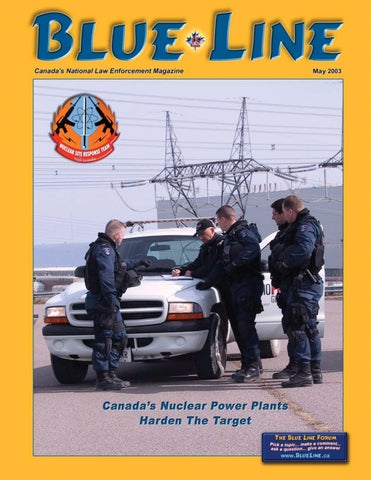
Doubling the guard Canada’s nuclear power plants harden the target What every officer should know about radiation
6
8
eMail: publisher@blueline.ca
— General Manager — Mary Lymburner, M.Ed. eMail: admin@blueline.ca
— Editor — Mark Reesor
eMail: editor@blueline.ca
— News Editor — Les Linder eMail: news@blueline.ca
— Advertising — Mary Lymburner Dean Clarke Bob Murray eMail: sales@blueline.ca
— Pre-press Production — Del Wall — Contributing Editors — Communication Skills Terry Barker Police Management James Clark Tactical Firearms Dave Brown Technology Tom Rataj Psychology Dorothy Cotton Case Law Mike Novakowski Blue Line Magazine is published monthly, September to June, by Blue Line Magazine Incorporated with a mailing address of: 12A - 4981 Hwy. 7 East, Ste. 254, Markham, Ontario, L3R 1N1. Individual magazines are $3.50 each. Subscriptions are $25.00 per year or $40.00 for 2 years. (Foreign - $50.00 U.S.) All material submitted for publication becomes the property of Blue Line Magazine unless other arrangements have been made with the publisher prior to publshing. The authors, advisors and Publisher accept no liability whatsoever for any injuries to persons or property resulting from the application or adoption of any of the procedures, tactics or considerations presented in this magazine. Readers are cautioned and advised that articles presented herein are edited and supplied for your personal awareness and should not be used for further action until appropriate advice and guidance is received from a supervisor, Crown Attorney or other person in authority. Established in 1988, Blue Line Magazine is an independent publication designed to inform, entertain, educate and upgrade the skills of those involved in the law enforcement profession. It has no direct control from a law enforcement agency and its opinions and articles do not necessarily reflect the opinions of any government, police, or law enforcement agency. ©2003 - All articles are protected by copyright. No part of this publication may be reproduced or transmitted in any form or by any means, electronic or mechanical, including photocopying and recording or by any information storage or retrieval system without permission. Internet activity is monitored and use or reposting of material on the Internet is restricted.
This publication is a private venture and receives no subsidy or grant from any level of government.
— Affiliations — International Association of Law Enforcement Planners Canadian Advertising Rates & Data International Police Association The Police Leadership Forum The Canadian Press Newswire Printed in Canada by Janson Printing Service
ISSN #0847 8538
Canada Post - Canadian Publications Mail Product Sales Agreement No. 176796 May 2003
Marijuana grow operations multiplying 10 Crisis communications Using active listening skills
12
Ride smart, ride safe Police motorcycle training and liability
14
BOOK REVIEW The Charter of Rights and Freedoms (second edition)
16
CORRESPONDENCE
18
RCMP announce change in Newfoundland command
20
DEEP BLUE Dysfunctional cops and the sex lives of gerbils
21
Studying responses to unwanted behaviour 22 Challenges and alternative suggestions are sought Fighting graffiti through education
23
CASE LAW 24 • Adequate objective factors provide articuable cause to justify detention • Thermal imaging violates homeowner privacy How to recognize and support people with Parkinson’s
26
Practical digital photography - part two 28 Use digital camera’s advantages to take better pictures TECHNOLOGY Computer printers have come a long way
30
PERSONAL COMPUTING Does your agency have pirates?
32
Keeping the cap on oil patch traffic
34
PRODUCT NEWS
36
COMING EVENTS
37
THE BACK OF THE BOOK 38 Is it live or just media hype... we cant’t be sure 3
The decision to provide around the clock, armed security for two nuclear plants east of Toronto wasn’t an easy one for Durham Regional Police. They knew police agencies in Ontario, Quebec and New Brunswick had turned down similar requests from Bruce Power, Hydro Quebec and NB Power, which operate Canada’s other three nuclear generating plants. In the final analysis though, there was really no other choice — as Staff Sergeant Tim Knight notes in our lead story, refusing Ontario Power Generation’s request would have meant turning their back on their communities. Continuing on our nuclear theme, Port Hope Police Chief Ron Hoath tells us how his service protects two nuclear facilities in his town, next door to Durham Region, and we take a look at what every police officer should know about radiation. Residential marijuana grow operations have sprouted up across the country, multiplying faster than police can shut them down. The Criminal Intelligence Service of Canada looks at the problem in our continuing series based on the agency’s 2002 final report. In a followup to Negotiation 101, Heather Gray offers advice to front line officers on how best to communicate with a subject in a crisis situation. Keeping in mind that we all have certain things in common, including a need to be accepted and understood, is key to establishing a bond and defusing a situation before anyone gets hurt, Gray says. With spring finally here, we present a timely feature on police motorcycle training safety. As Michael Walker notes, many agencies have worked hard to teach their officers advanced car driving techniques but neglected those piloting their two wheel vehicles; so much so that police motorcycle crashes are now the number three killer of US officers. In other stories, Danette Dooley tells us the RCMP has a new leader in Newfoundland and Labrador; Dorothy Cotton looks at dysfunctional cops and the sex lives of gerbils and Dave Brown continues his series on digital cameras.
May 2003
4
Irresponsible attitudes will lead to officer deaths by Morley Lymburner When on patrol in my early years, I recall responding to alarm calls and the dispatcher advising me to check the perimeter to make sure it was secure, but wait for the ‘key holder’ before entering. Invariably a security car would arrive and the driver would open the trunk and pull a key off a coded board filled with keys. These guards always had a gun on their hip. I always felt just a little safer knowing this as we entered. Several years went by and I noticed the guns quietly disappeared. When I asked why, no one seemed to have an answer. From then on I had to worry about my own safety and the key holder’s as well when entering a building. The stress level was suddenly ratcheted up a couple of notches. Now-a-days the dispatcher advises officers to await back-up and two officers are taken off the road for an alarm call. Get the picture here? Last month we interviewed a Durham Regional Police inspector responsible for armed response to nuclear plants. I asked him why nuclear power plant security officers were not armed; after a pause, his answer was refreshingly forthright. “I don’t know... I posed that question baldly to someone who should know and I really didn’t get an answer.” I explained to him that this is
May 2003
the same response everyone gets when they ask that very same question. So what is the issue with arming them? That answer is simply not available. Politicians and even top leaders at these organizations are simply speechless when asked why these officers are not armed. Is it lack of faith in the officer’s ability? Public opinion? Traditional, heavy handed gun control? Whatever it is, the people at the top put up a passive resistance, as if the question had never been asked or simply not heard. This ‘willful blindness’ attitude is unnecessarily raising the stakes for officer safety and fiscal responsibility. So far I have heard four irresponsible answers to four questions about headlines mentioning officers who are unarmed: • Unarmed highway patrol constable shot at in Alberta - “If officers get shot at while stopping cars at 1 a.m., tell them not to patrol at that hour.” • Wardens unarmed but asked to enforce laws - “Call police if campers pull knives, refuse to leave camps, or threaten you with rifles.” • Unarmed border guards ordered to search for weapons and drugs - “Call police if con-
5
fronted by armed people trying to get into the country.” • Nuclear power plant guards - “They don’t need guns because our plants are low threshold targets. Call the cops if you need a gun.” I am further struck by similarities with two apparently separate, but very similar incidents regarding government studies on the issue. Over Caliber Press the past year or so, two government agencies have asked for independent studies on whether their officers should have sidearms. Both reports advised that it would be better if Wardens and Customs officers were armed — and both were buried or severely edited to reflect the opposite opinion. In one study, Customs officers complaining were not even interviewed by the “independent” investigators. Is there a pattern here? A conspiracy? A pattern of complacency? The feds, while fighting the battle for better rhetoric, are quick to quote a rather sad remark made by the RCMP Commissioner which I don’t even want to repeat here. For the Commissioner’s sake, I hope this remark doesn’t become his hallmark in history. The meter is ticking and I fear something rather bad is about to happen.
by Mark Reesor When nuclear power plant operators went looking for a 24/7 armed response force after the 9/11 attack, the only Canadian law enforcement agency to rise to the challenge was the Durham Regional Police Service (DRPS). The service was contacted just days after September 11 and “I don’t recall a time when we thought ‘there’s no way we’re going to do this,’” says Inspector Mike Ennis, who heads the DRPS Nuclear Security Division. “We didn’t immediately jump at it... but once we committed to the project, we moved forward quickly.” The long-term security deal with Ontario Power Generation (OPG) was announced in December 2001, prompting other police departments to call and ask why DRPS had agreed to become involved, Ennis recalls. “As a final note to our discussions, I told them that the last time I looked, ‘Leaders in May 2003
Community Safety’ was still the motto on the side of our cruisers. We could not turn our back on our communities by refusing to assist in the protection of these assets.” “We live here,” adds Staff Sergeant Tim Knight, the unit’s second-in-command, “and a large portion of Canada’s nuclear generating capacity is produced by the two sites located in our jurisdiction.” Even some DRPS members had reservations about the project at the onset, Ennis says, but “the quality of the people we’ve attracted to the unit is absolutely outstanding. They’re adventurous enough to enjoy being involved in something brand new. For me, being at the front end of something new and unique is really entertaining.” Traditionally, police forces have only considered very experienced officers for tactical units, Ennis notes; “however this unique policing initiative has enabled us to broaden our recruitment window because we knew that youth itself could be a great benefit to our program, if we attracted the right people… we have reached out to our younger members, provided 6
they met the requisite and very stringent physical, firearms and psychological standards and had an endorsement from their supervisor. The outstanding performance our troops have provided to date makes it clear that we are on the right track! “Our members are enthusiastic yet disciplined and have the positive attitude necessary for them to adapt to the unique policing environment at the nuclear sites. We are also fortunate enough to have a solid cadre of experienced officers, some of whom have come to us from other police services.” In addition to tactical operations, all members receive specialized training in nuclear facility operations and safety. “Our officers retain that training after their stint with the team,” Ennis notes, broadening the skills of the entire police service. “Early in the game, we were invited to tour nuclear facilities in the United States to get an idea of what they were up to,” says Ennis, “but we determined that the model we saw couldn’t be transplanted (wholesale) here because of their very different laws about the use of lethal force.”
Instead, the NSD team members work closely with OPG Nuclear Security to become familiar with the plant and determine the best way to protect it. “We’ll continue to create strategies designed to deal with just about any scenario you can envision, and probably some you can’t; that’s a big part of the challenge – constantly posing the critical question, ‘what if this happens,’ ‘what if that happens?’ “The reason it’s been so challenging is that it has never been done before; there’s no blueprint.” The World Trade Centre attack dramatically changed the thinking about security at nuclear power generating stations, notes Knight. “Before the events of 9/11, the prevailing philosophy was that the plants were not attractive targets, they were completely safe and did not use or produce materials that anyone would want to steal. The site operators were mandated to conduct annual emergency response training exercises with the police, but we seldom entertained the idea of terrorists being involved.” CANDU reactors are very robust and have a myriad of safety and control systems, says Ennis. “With the current security enhancements, including vital area hardening and dedicated police presence, we feel we are in very good shape, regardless of how skilled the adversary is. In fact, the more skilled they are, the more inclined they’re going to be to do a little sniffing around before they actually come calling... “Any assessment of the nuclear sites will make it obvious that we have professionals on the ground who are trained and equipped to stand in their way,” concludes Ennis; “it will
Nuclear sites unattractive targets
be clear that these are not soft targets.” The Nuclear Security Division’s motto — “Nulli Secundus” (second to none) reflects the justifiable pride of its members. Ennis invites anyone contemplating an unauthorized visit to either of Durham’s nuclear sites to also carefully consider the unit’s unofficial motto — “don’t even think about it!” You can contact Inspector Ennis at mennis@drps.ca
Candu reactors are housed in buildings with onemeter thick, steel reinforced concrete outer shells that experts say would be very effective in stopping a large aircraft. The reactor itself is surrounded by a reinforced concrete, biological shielding up to 1.8 meters thick. Any one of several independent safety systems would shut the plant down immediately in a catastrophic event. “Total destruction following a World Trade Center (WTC) style assault (complete structural penetration, followed by an explosion and aviation fuel fire) is not a credible scenario for commercial North American nuclear plants,” says physicist Dr. Jeremy Whitlock. Trying to damage a reactor by flying an aircraft into it is like driving a car into an office safe to break it open, he says. Most of the energy would be absorbed by the destruction of the aircraft itself. Sandia National Labs sent a rocket-propelled F-4 Phantom fighter aircraft down a track at 770 km/hr an hour into a reinforced concrete wall in 1988. The F-4 completely disintegrated, penetrating only six centimeters. Experts believe the results would be similar with a fully fueled jumbo jet, since its bulk consists mostly of lightweight, collapsible fuselage and wing material — no match for reactor containment buildings, among the most hardened facilities on earth. They’re designed to withstand hurricanes, earthquakes, tornadoes, floods, fires and the internal pressures and temperatures resulting from severe reactor accidents. Hitting a reactor building, typically less than one tenth the height and cross-sectional area of the WTC, would be very difficult, especially since large aircraft are tough to control so close to the ground.
Cooperation key to nuclear plant security by Ron Hoath The town of Port Hope, Ontario, next door to Durham Region and its two nuclear power plants, has two licensed nuclear facilities of its own. Cameco Corporation refines uranium at its processing and conversion plant, which it purchased from Eldorado Nuclear (a federal Crown corporation) in 1988. Eldorado began in Port Hope in 1932 and was federalized in the 1940’s during World War Two. The company has always had in-house security and there’s a good relationship between the security staff and our police agency. Most of our officers have toured their facilities and are familiar with the plant layout and production process. The refined uranium the plant produces goes to US generating plants but some is also taken to another Port Hope company, Zircatec, which palletizes the product and places it inside fuel rods which are used in Candu reactors. Zircatec was founded in 1956/57, prior to there being any commercial nuclear plants in Canada. At that time the company made fuel rods for the experimental research reactor at Caulk River. In May 2003
7
1972 the company was purchased by Westinghouse and the first commercial nuclear fuel rods were made for the Pickering reactors. It was purchased by Zircatec in 1988 and the company still operates the plant today. After 9/11, Zircatec made significant upgrades to its in house security, setting up better controlled access to all areas of the plant and installing improved CCTV cameras. These upgrades were required by the Nuclear Regulatory Agency of Canada. We have an excellent relationship with this company as well. These two facilities are both lower level risk than nuclear plants and both companies have protocols in place with us. Over the years we have responded when Cameco was attacked by Greenpeace protesters. We do screening (police checks) for both companies, as required by the regulatory agency. We also have protocols in place with both Durham Regional and Ontario Provincial Police in the event tactical units might be required, as we do not have one. Ron Hoath is chief of the Port Hope Police Service. He can be reached at mail phps@phps.on.ca
What every officer should know about radiation
Radiation is part of our environment and comes from both natural and man-made sources. Humans have been exposed to natural sources, which include cosmic radiation from space, radioactive rocks and soils and materials found in air, food and water since the dawn of humanity. Radiation is a form of energy; the atoms of some elements are radioactive and spontaneously release energy (radiation) as they transform from unstable to stable forms. That energy can be released in four different forms: • Alpha particles can travel only short distances (inches) and are stopped by a sheet of paper or the outer layer of a person’s skin. Materials emitting alpha particles are hazardous only when inhaled, ingested, absorbed or injected. • Beta particles travel farther and can pass
through a sheet of paper and some clothing, but are stopped by thin metal or glass. They can damage skin, but like alpha particles, are most hazardous when inhaled, ingested, absorbed or injected. • Gamma rays are similar to x rays and travel at the speed of light through air. Concrete, lead, steel and other dense materials can be used to block (shield) them and they can be an extreme external body hazard. • Neutrons are extremely small atomic particles which can travel long distances in air and are released when an atom breaks apart, a process known as fission. Water and concrete can be used to shield them. Like gamma rays, they can be an extreme external body hazard. Special instrumentation and trained personnel are needed to accurately identify the
form(s) of radiation, although it may be indicated on packaging. Natural sources Our bodies naturally contain many radioactive elements and there’re even small concentrations of the radioactive gas radon, which seeps from the earth’s crust, in the air we breathe. The atmosphere screens out most cosmic radiation, but some still penetrates to the ground. The level rises as you go up so people living at higher elevations or who fly often receive more than those living at sea level. Man-made sources Man-made radioactive materials are used in medicine, industry, research and nuclear weapons. Medical uses can be roughly broken down into diagnostic — x rays and injection or ingestion of radioactive materials for imaging internal organs — and therapeutic — cancer treatments. Industrial uses include nuclear well logging (petroleum industry), measuring property, smoke detectors and weapon night sights (tritium). Special nuclear materials, such as plutonium and uranium, are used in nuclear weapons. Dirty bombs ‘Dirty bombs,’ also called radiological dispersal devices, are devices that spread radioactive material by exploding a conventional (nonnuclear) explosive such as dynamite. Typically, their threat is from the explosion but the resulting spread of radioactive contamination is likely to create hysteria and terror among the public and contaminate the exposed area. Dirty bombs are not traditional nuclear weapons and cannot cause mass devastation. They are difficult to accurately describe or characterize because they may be constructed using different types of containers and virtually any industrial or medical radiation source. Detection of radioactivity Nuclear radiation cannot be seen, heard, smelled or tasted. The most obvious way to determine its presence is by locating a warning symbol on a vehicle, container, or object, or at the entrances and exits of a room or facility. It can also be detected with special equipment. Some simple radiation detectors are available commercially at costs ranging from several hundred to several thousand dollars. These include:
May 2003
8
• Personal devices similar to those worn by x-ray or medical personnel; • Detectors worn on duty belts, commonly referred to as radiation pagers, which can be used to search for sources; • Hand-held monitors for determining exposure data; • Larger, more sophisticated instruments which can distinguish the type of radioactive atoms present. Actions to take Follow the protocols established by your agency if you suspect a radioactive source or contamination but remember, detection and identification requires special training and instrumentation. The extent of contamination can depend on many factors, including the size of the explosive, if any, amount and type of radioactive material used, weather and terrain. Department policies and procedures may differ regarding whom to contact if a radiological event is suspected. Make sure you have ready access to telephone numbers to contact the appropriate resources. Protecting yourself and the public The fundamental principle in radiation protection is to keep exposure to a minimum. Typically, there’s no immediate symptoms — we are all continually exposed to natural radiation — but heavy exposure to intense sources, although rare, can cause radiation sickness, in-
cluding nausea, vomiting and diarrhea. Eye damage, increased cancer risk, genetic defects and even death can also result. Three key factors influence an individual’s radiation dose: • Time - the most direct way to reduce a radiation dose is to reduce the time spent working with or in the vicinity of sources. Cutting exposure time in half will also cut the dose in half. • Distance - doubling the working distance from a point radiation source will reduce the dose received by a factor of four. For example, moving from 20 to 40 feet away will cut your exposure by 75 per cent to one quarter of the original dose. • Shielding - again, first and foremost, follow your agency’s response protocol, or if it doesn’t have one, remember that an explosive blast may injure or kill those in the immediate proximity. Entering an area with dispersed radioactive materials without proper equipment, training and procedures may put you at risk. Individuals or items suspected of being contaminated should be isolated and secured until they can be surveyed and decontaminated by trained personnel using proper instrumentation. The area should be secured so that unauthorized personnel don’t disturb the scene and aren’t contaminated. This article is an edited version of What every public safety officer should know about radiation and radioactive materials, published by the US National Institute of Justice.
Verified response reduces alarm calls Salt Lake City is a semi-finalist in the Innovations in American Government award, sponsored by Harvard University, for its Verified Response Alarm Program (VRAP). The department previously won a Herman Goldstein Award for Excellence in Problem Oriented Policing and the International Chiefs of Police - Webber Seavey Award for the program. Police responded to about 38 million alarm activations, at an estimated annual cost of $1.5 billion (US), in the United States alone in 1998. Most were burglar alarms and between 98 and 99 per cent were false. It’s estimated that solving the problem would relieve at least 35,000 officers from providing an essentially private service. The Salt Lake City Police Department solved this burden by adopting VRAP. Alarm companies are required to verify an automatic alarm signal via an eyewitness before an officer is dispatched. Should the private guard discover an open door or broken window, dispatch treats it as a high priority call. Officers are no longer responding to alarms caused by cleaning crews, kids, cats, dogs and May 2003
balloons while continuing to answer human activated alarms such as robbery, panic and duress. Alarm responses decreased by 90 per cent and burglaries and service response times for high priority calls were also down during the first two years of implementation. This program has been a win-win for citizens, alarm companies and the police department since it was instituted in 2000. Citizens are receiving a much faster response to their alarm signal from the private guard companies for an additional $5 per month and police officers can now be redirected to actual public safety needs. Las Vegas Metro Police Department began Verified Response in 1991 and also achieved a 90 per cent reduction in alarm responses. False alarms are a national problem for police, with some departments using 25 to 30 per cent of their patrol resources on a call. Eight other cities currently practice it and 53 are moving in this direction. As police departments are becoming more aware of this program, they’re shifting the burden of false alarms to the industry that created the problem and has the ability to solve it. 9
Attorney General Gord Mackintosh announced in March that he will add an additional $582,000 to the prosecutions budget to hire 12 new full-time employees, but hasn’t decided yet how many would be prosecutors and how many support staff. The money will come from a new $15 justice surcharge on provincial fines - everything from speeding tickets to fines for all provincial offences. Justice Minister Martin Cauchon backed away from plans to introduce legislation by the end of April which would decriminalize simple marijuana possession. Cauchon said he believes Canadians need a national debate before taking any steps to downgrade possession of small amounts of marijuana from a criminal offence to one penalized by a ticket and fine. Cauchon suggested that any move toward decriminalization should be linked to an overhaul of Canada’s national drug strategy, including a review of drug enforcement and education policies. Cape Breton Regional Council has approved a 98.7 million dollar budget. The budget came without tax increases or the anticipated loss of eight police officers for the municipality. Police Chief Edgar MacLeod had told council further cuts to the 169-officer police force would endanger public safety. He said he was relieved by the budget. Police officers have agreed to train on their own time to prepare for new family violence and youth justice legislation. The move was meant to cut costs. Gov. Gen. Adrienne Clarkson criticized the law profession in March for underrepresenting women in its “masculine world” after accepting an honorary law degree at Osgoode Hall. Clarkson said she’s heard that Canadian Bar Association meetings often discuss why it’s difficult to retain female lawyers. “My answer is that the legal profession has been built by men for men in a man’s world,” she said in a speech. During the special ceremony at the Toronto law school, Clarkson credited the profession with moving away from “systematic” discrimination in the last 40 years. However, she suggested that many women still don’t get ahead because they don’t fit into the old boys’ network. The last Mountie who had been involved in the Mad Trapper case back in 1932 died last February. Robert McDowell was 92 when he passed away in Oliver. McDowell was a Corporal in 1932 when another Mountie was wounded in the Arctic near the town of Aklavik. McDowell rescued his colleague and made a 20-hour journey by dog sled to a doctor. For the next two months, McDowell was part of a 21-person posse set out to capture the shooter, Albert Johnson, also known as the Mad Trapper of Rat River. A total of 32 front-line Toronto police officers earned more than $100,000 in 2002, mainly due to overtime caused by court appearances, a visit by Queen Elizabeth and World Youth Day. The report shows that of the 84 police employees who earned at least $100,000 last year, 32 were detectives, sergeants or constables, all of whom earn a base salary of less than $72,000. Chief Julian Fantino was the city’s highest-paid cop, earning $176,993, Senior Constable Abdulhameed Virani pulled down $115,053, the most of any of the front-line officers. The biggest earner among detectives was Martin Woodhouse, at $110,732, while the highest-paid sergeant was Reg Pitts, at $106,779.
Marijuana grow operations multiplying Police across Canada last year countered the nationally widespread phenomenon of residential marijuana grow operations with Operation Greensweep. The number of sophisticated multi-plant operations increased as organized crime, attracted by the enormous profits, became involved. Police also wanted to highlight the dangers they pose to people living in or near the residences. There were 189 search warrants executed and 162 people arrested on 367 charges in Greensweep I, which took place Jan. 30. Some 56,000 marijuana plants, worth about $56 million, and $3.8 million of growing equipment was seized by the more than 500 officers who took part. The operation was coordinated by the York Regional Police Service (YRPS) and Criminal Intelligence Service Canada (CISC). The majority of the residences were rented and the sophisticated operations could potentially produce 1,600 plants, worth $1.6 million, annually. Many — including 99 with illegal power hook-ups — posed a significant fire and safety hazard. Another serious concern was the 37 children found living in them. Grow operations were targeted again from April 15-30 in Greensweep II. This time 208 search warrants were executed, 255 people arrested on 510 charges and 60,000 marijuana plants, worth about $60 million, and $4.8 million of growing equipment was seized by the more than 700 officers taking part. The joint forces operation was coordinated by the OPP Drug Enforcement Section and CISC. As in the first Greensweep, most residences — including 103 with hydro bypasses — posed a significant fire and safety hazard. Twenty nine children were removed and various weapons, including six rifles, two shotguns, knives, a sword and a bayonet, were seized. Organized crime involvement The Hells Angels and Asian-based organized crime groups, particularly Vietnamese, continue to be extensively involved in the largescale cultivation and exportation of marijuana. The Angels have been known to control sites with large numbers of plants while Vietnamese-based growers often cultivate fewer plants in multiple locations. The two groups recently competed for control of the BC lower mainland industry but now tolerate each other, realizing that national and international demand exceeds what they alone can supply. Grow operations controlled by Asian-based groups are moving east and in BC, shifting from centralized locations in greater Vancouver to further up the Fraser Valley and interior. There’s also been a dramatic increase in grow operations in southern Ontario. The majority of individuals arrested in Greensweep were of Vietnamese descent and acted as growers or house sitters. Criminal organization members or associates run a number of operations at any one time, thus reducing the profit loss from raids. May 2003
Crop-sitters act as security guards and tend to the plants, looking after the lighting and watering systems; many are indirectly associated to organized crime while others work off loans, gambling or drug debts or are recent indentured immigrants. Contractors will set up a basement operation for a fee and brokers act as negotiators between growers and buyers. Workers are usually paid about $40-$50 an hour and may be brought in to dry and separate buds. Proceeds are frequently funnelled into other criminal activities, such as importing and trafficking cocaine, ecstasy and heroin, or are laundered to be reinvested in legitimate businesses. Canadian marijuana is distributed across the country to meet domestic demand and a significant portion is smuggled to the US. Drug Enforcement Administration officials in Portland, Maine report that it’s sold there at up to five times the price of domestic and Mexican marijuana. Canadian marijuana sells for US$1,500 to US$2,000 per pound in Vancouver and between US$3,000 to US$8,000 in major American metropolitan areas. Public health and safety issues Indoor plants are grown using either organic (soil-based) or hydroponic (water-based) technology. Hydroponic systems normally yield higher THC levels, but Vietnamese-based groups appear to have mastered organic methods that rival it. Growing marijuana indoors allows yearround crops and offers some protection from other criminals and police. Significant electrical and structural alterations are needed to convert a typical urban residence into a high-yield, profit-oriented grow operation. These pose serious health and safety risks to the occupants and larger community. Growing indoors demands amounts of heat and electricity markedly higher than normal residential wiring and power supplies can safely handle. A significant number of operations steal electricity through diversions or bypasses, which circumvent utility meters and conceal abnormally high usage from utility companies. Holes are often drilled through the concrete foundation or walls to tap into the hydro lines and the current generally doesn’t go through fuses or circuit breakers, thus removing safety controls on unsafe or excessive energy con10
sumption. A household that operates a hydroponic lab needs three to 10 times the power of an average home. Bypasses are often performed by people with little knowledge of wiring or safe levels of usage. In BC alone, some 15 growers were electrocuted between 1995 and 2000 working in improperly wired installations. The houses also have numerous fire hazards, including exposed live wires, highintensity light bulbs and overheated fluorescent ballasts. Approximately one in 10 bypass operations end in fires, which pose an obvious danger to the surrounding community. Overloading the power system can also cause hydro transformers to blow, resulting in power outages to entire neighbourhoods. Utilities are becoming more pro-active in targeting marijuana grow operations. The YRPS estimates power worth $72 million was stolen in the region (north of Toronto) in 2001. Utility companies there have monitored transformers for surges in electrical use since Feb. 2002, helping police locate and shut down 150 operations. In addition to massive amounts of power, marijuana grow operations also require significant amounts of water, causing high levels of humidity. Without proper ventilation, this can result in mold build-up, particularly inside walls and insulation; large crops can also produce a lot of pollen — both may cause asthma, respiratory conditions and allergies in those living or working in the residence. Vapours from chemicals used to grow marijuana rapidly may cause respiratory health problems, particularly in children. Faulty rerouting of the ventilation system and extensive indoor cultivation can cause deadly levels of carbon monoxide build up. Investigating and dismantling grow operations pose a serious chemical and electrical hazard to police, rescue and municipal workers. Police drug units frequently wear fulllength disposable suits and goggles to protect against the fumes. Firefighters face unstable walls from structural alterations, dangerously high temperatures, electrocution and chemical traps. Hydro crews must dig deep to disconnect bypasses, risking electrocution if they accidentally touch live wires and there’s a significant safety risk to housing inspectors, contractors or legitimate tenants if operators move out and leave the bypass intact. Investigators have also encountered spike traps or trip wires which activate harmful substances or electrical currents, designed to protect the operation from other criminals or law enforcement. Marijuana operations are more frequently being discovered in larger suburban houses located in upscale neighbourhoods. Landlords are increasingly being held responsible for stolen electricity and damage caused by marijuana growing tenants. Some Ontario hydro companies even refuse to reconnect electricity until they’re repaid for the stolen power and it’s only a matter of time before insurance companies become stricter when dealing with grow house
related claims. Violence is an integral part of operations run by organized crime. Homicides and assaults are carried out to exert control over production and distribution; home invasions and severe beatings of occupants are perpetrated to steal harvests, particularly in BC. There have been homicides related to the marijuana industry in BC and Ontario — one man was found bound and shot, execution-style, in a York Region grow operation — presenting more safety risks for neighbours. Outlook Organized crime groups, particularly Vietnamese-based and Hells Angels, will continue their extensive, large-scale cultivation and distribution of marijuana across Canada. Smuggling to the US will likely increase if demand continues, residential grow operations will remain highly concentrated in existing areas and the move eastward, particularly to smaller centres, also isn’t likely to change. Residential operations will remain a costeffective and highly profitable way of growing large amounts of marijuana. Related fires and violence and the number of children found living in the houses is a serious and concerning trend. Other power companies should follow the BC and southern Ontario trend and increasingly work with law enforcement by profiling suspicious or unexplained excessive hydro consumption. To counter growing losses, insurance companies are expected to introduce firmer rules on damage resulting from grow operations. These changes will force landlords to be more accountable for their tenants’ criminal activities, particularly when those endanger the wider community.
Quick response from chopper aids arrest Calgary’s police helicopter helped nab three suspects after a violent home invasion in northeast Calgary. Three men burst into a home through the front door shortly before midnight in March. Five people were in the house at the time. Two were slightly injured in the brief melee that ensued. Det. Ryan Dobson said the occupants knew the intruders, who were armed with baseball bats, a crowbar and pepper spray. They demanded money. “They corralled the people who were inside the house and put them in a bedroom,” Dobson was quoted as saying. The intruders tied the door closed
This article is part of a Criminal Intelligence Service review of targeted organized crime groups and their activities, based on intelligence and investigation reports from Canadian and international enforcement agencies. Blue Line Magazine is running a series of articles based on the CISC’s 2002 Final Report. Go to www.cisc.gc.ca for more.
Signs of a marijuana grow operation • residents rarely home or only for a few hours, then leave again • windows boarded or covered up • a strange odour • little outside maintenance; unshovelled snow, uncut grass • sounds of electrical humming, fans • unusual visitor behaviour • ‘beware of dog’ signs or guard dogs • bright lights • localized power surges/drops • flyers left in the mailbox • TV or radio left on all night • signs of digging or disturbance around the outside hydro box • condensation on windows • air conditioner never runs • windows always closed May 2003
11
with an extension cord, but one of the persons inside that room had a cell phone and called police. The police helicopter, equipped with a spotlight, was quickly sent to the scene. The suspects ransacked the house and fled with an undisclosed amount of money, police said. The helicopter was over the house as the suspects were coming out the door. “They picked up the car as it went down the back alley. Responding units immediately stopped the car without incident and they didn’t even get down the block,” Dobson was quoted as saying. Three men faced numerous charges.
Crisis communications Using active listening skills
by Heather Gray
gained from interjecting our values, beliefs, biases and opinions. For some front-line police officers, stepping back and allowing someone to express him or herself without jumping in to offer help may take some getting used too. The first step is challenging yourself to practice this at your next call.
In Negotiation 101 (April 2003 Blue Line), we explored front-line response to critical incidents and some of the fundamental guidelines to use while awaiting a coordinated tactical and negotiator response. However, front-line officers can take advantage of every day encounters to garner valuable experience and hone active listening skills. Creating a bond Human nature is complicated but human beings have typical and often predictable responses to crises. When our ability to cope has been exceeded, we may act in ways we wouldn’t consider when handling things well. We need someone who can guide our thought processes and emotional upheaval to a point where we can resolve the issue while retaining our dignity, and then move beyond the crisis and forward with our life. We need to appreciate the power inherent in understanding how to create a bond with another human being, even someone we’ve just met. They may appear to have nothing in common with us and have a crisis to which we cannot relate; we may not even like this person! How do we overcome these challenges and find a human connection? Gavin de Becker, best-selling author of The Gift of Fear, is considered one of the world’s foremost authorities on predicting violent behaviour and threat assessment. He’s discovered that we all have certain basic elements that bind us together and that almost everyone relates to others and their environment in at least some of the same ways. For example, we seek to connect with others, are saddened by loss and dislike rejection but like recognition and attention. We will do more to avoid pain that to seek pleasure, dislike ridicule and embarrassment, care what others think of us and seek a degree of control over our lives. With this in mind, we can begin communicating with someone knowing that they will respond to the warm acceptance of another human being. This fundamental element remains true, no matter what situation we find ourselves in. Communicating on two levels Retired FBI crisis negotiator Frederick Lanceley has set out a format for active listening in a crisis situation that serves as a good benchmark for basic skills any officer can use. He maintains people typically communicate on two levels: • Content – simple facts • Emotion – emotional response to facts The key here is to listen for the emotion first; disregarding the emotion that the person is conveying cheats them and ourselves of the real impact of what they’re going through. It’s the emotional reaction and subsequent behaviour that make a situation a crisis, not the mere May 2003
Crisis communication skills World renowned psychologist and crisis negotiation trainer Dr. Mike Webster describes the role of the tactical communicator as falling into two distinct phases.
facts. How a person feels about it strongly influences what s/he does; that’s where police become involved. Guiding a subject’s emotional reaction will help control their behaviour. For example, think of a time when you were upset and wanted to vent to a trusted person like a spouse or therapist. How therapeutic or cathartic would it be if they tried to cut off that venting process? You would feel cheated and grow frustrated in confiding in them. None of us want to feel disrespected when we’re trying to communicate our emotions. From the time we’re children, we want someone to validate our hurt or frustration and to care enough to comfort us and as adults, we don’t venture far from that child within. Even the facade of the career criminal or the tough street kid are a veneer that covers the hurt, scared child beneath. All of us, regardless of what’s on the surface, seek a connection with another human being. In the midst of a crisis situation, people are more likely to respond to someone they respect and view as willing to listen and try to understand them. Treating the delicate dance of crisis intervention like an interview or interrogation, where we offer the subject themes to grasp at, will encourage them to tell us what’s wrong — things they’ve done or the shame they feel. They can then admit to the emotion, own the deed — if they’ve already done something wrong or illegal — and yet have a way to save face, despite it all. As a person describes what’s happening to them, listen for values and clues to what they feel is important. Clarify the person’s values, for they will influence behaviour. Bear in mind that the subject may be caught in a values conflict. Remember that our role is to be accepting and non-judgmental of the person in crisis. It’s imperative to allow them to express themselves completely without saying what we think of the situation. There’s nothing to be 12
Listening phase 1. Emotion labeling (attending): The intent is to respond to the emotions heard; for example, saying ‘you sound angry;’ ‘you seem depressed; ‘I hear sadness in your voice.’ The key here is to train yourself to actually hear the emotion being expressed and tell them about it. This demonstrates that you are tuned in to what they’re saying and sensitive to their emotional state, helping to create a bond or rapport. 2. Paraphrasing (restate content): This is merely summarizing what the subject just told you, making them a listener and allowing them to hear, maybe for the first time, their own thoughts aloud. This can be profound and creates empathy and rapport because it demonstrates you have heard and understand. It clarifies content, checks perception, gives him/her a chance to correct you and highlights the significant issues (in the subject’s mind). 3. Validation (reflect feelings): We all want our feelings and responses to life validated. It is the role of the crisis communicator (listener) to do that, without judgment, for the person in crisis. 4. Effective pauses (silence): Become comfortable with silence as a powerful tool. It can serve an effective purpose in that many people are not comfortable with it and will seek to fill it with talk. It can also be used before and after a statement to highlight something of great importance. 5. Minimal encouragers: These are the little sounds that let the subject know you’re engaged in the conversation but allowing them the chance to talk. They may be simple sounds such as ‘mmm hmmmm,’ single words or short phrases such as ‘oh,’ ‘really?’, ‘when?’, ‘is that right?’ or ‘go on.’ They shouldn’t interfere with the flow of the conversation but should serve to keep the subject talking and to continue building rapport. 6. Express empathy (sympathy vs. empathy): Sympathy implies pity. Empathy implies objectivity and understanding that builds trust. Show empathy, but only if you actually feel it. Don’t try to fake it; the subject will sense this and it will harm the rapport-building process.
Action phase 7. Probe and ask open (vs. closed) questions: These can’t be answered with yes/no or other one-word answer but require the subject to formulate a detailed response. They usually begin with how, when, what, where or why. We’re trying to get to the subject’s point of view, feelings and perspective on the issue. This is going to reveal to us the most likely way to resolve the situation. Typical sample open questions might be: • Help me understand what happened there. • Can you tell what went on, since I wasn’t there? • How may I help you tonight? Closed questions require only a limited answer and are likely to make the subject feel as if they’re being interrogated. They also force the interviewer to come up with new questions, which is not only very draining but counterproductive to resolving the matter at hand. 8. Self-Disclosure: A little self-disclosure is occasionally appropriate. Use the same discretion as you would during an interview and draw out a suspect with themes. Balance selfdisclosure with the overall goal you’re trying to accomplish. Ensure, above all, that it does not jeopardize officer safety. 9. Re-frame (find the silver lining): There’s always a way to re-state something negative so it has a positive spin. A person in a crisis situation who’s revealed their beliefs, values and emotions has given you a great deal of material. The crisis responder needs to find the silver lining and re-frame the situation to help the subject see it isn’t as bleak as they thought; perhaps they’ve missed some hid-
May 2003
den advantage of the situation. Be cautious though; don’t attempt this too early or be flippant or it will erode rapport. 10. Confront (the ‘yes but’ technique): This is the art of gentle confrontation, something clinical psychologists are particularly good at. At this late point in the process, the crisis communicator should now be able to gently prod the subject whenever they become stuck in their position of negativity. This can build on the re-framing technique, moving the subject away from the completely negative view and helping them to see the crisis in a new light. Finally Remember, you have a wealth of experience; keep your wits about you and you can handle any crisis. Humans share similar feelings and emotions, which gives you insight into what someone else is going through. Feelings are universal but experience isn’t; it’s possible to understand feelings without having gone through the same experience. It’s very easy for police officers to suffer from vicarious trauma, taking on another’s pain as if it were our own. Remember that everyone ‘owns’ their own problem and each person owns their own emotional reaction and behavioural response to that problem. Don’t take on the subject’s responsibility; help people to the best of your ability but don’t forget that ultimately, people must also help themselves. Heather Gray can be reached at info@heathergray.net or 866-988-2484.
13
Ride smart, ride safe Police motorcycle training and liability
by Michael Walker The automobile has played a vital role in the evolution and modernization of law enforcement as we know it today. Forces worldwide go to great lengths and expense to teach officers the proper techniques for any and all driving situations. Larger municipal agencies retain certified driving instructors who are highly trained in giving emergency vehicle operations courses and conduct yearly training. In recent years, departments have come to grips with the civil liability of not having properly trained officers driving on the streets where they serve. Motorcycles have also long had an integral role in law enforcement and are becoming more popular as technological advances make them even more appealing. Unfortunately, training at most departments is haphazard at best. In the early years their was no standardized training for motor officers; you would simply check out a bike for a special event or tour of duty. Fortunately organizations such as the Institute of Police Technology and Management (IPTM) and Northwestern Traffic Institute saw the need and offered classes for agencies wishing to have a certified police motorcycle instructor on staff. Not only is this good for the personal safety of motor officers who ride, it’s a wise step for any agency wanting to reduce its civil liability exposure to officers and the general public. In the landmark case of the City of
Canton, Ohio v Harris, 489 U.S. 379, the US Supreme Court ruled that under certain circumstances, municipalities can be held liable in civil rights action under U.S.C. 1983 for constitutional violations resulting from failure to train municipal employees. The ruling stated: It may seem contrary to common sense to assert that a municipality will actually have a policy of not taking reasonable steps to train it’s employees — but it may happen that in light of the duties assigned to specific officers or employees, the need for more or different training is so obvious,... that the policy makers of the city can reasonably be said to have been deliberately indifferent to the need. Agencies must take the next step to ensure
OPP looking for female recruits Ontario Provincial Police are launching a new program to counter a 75 per cent decline in female applicants in the last five years. OPP Bound is taught by women, to women and intended to introduce them to standard police procedures. “We’ve been for many years a male-dominated organization,” says Chief Supt. Jay Hope. “We need to market ourselves better.” Most women believe policing is just for males, notes Staff Sergeant Karen Harrington. “We want females to know they’re just as valuable.” The five day recruit camp, set to begin July 6th, will be mainly a mentoring session and is designed to give women a chance to learn more than what a pamphlet can teach them. “The idea is to arm them with the best information, so they can make those important decisions,” says Harrington. “There are some excellent women out there. “The people who are going to be there, representing the OPP and offering insights, will all be women officers. They’ll be of different ranks, they’ll represent different areas of the province and they’ll be from all the different fields,” she continues. “There will also be members of our senior comMay 2003
mand staff and IDENT,” which will show participants that they can work in any area they’re interested in, including leadership. Eligibility requirements for the program are the same as those required to be a provincial police officer: • Canadian citizenship or permanent residency • 18-65 years of age. • Ontario Grade 12 or equivalency • no criminal record or conviction which hasn’t been pardoned • class ‘G’ driver’s license with no more than six demerit points • full driving privileges “There has been a large outreach within the policing community,” says Harrington. “Officers from all divisions are volunteering to help.” Currently 20 per cent of the OPP’s staff are female — the national average is 17 per cent, Harrington says. OPP Bound will take place at the force’s academy in Orillia, at no charge to the participants. Organizers weren’t sure what kind of response they’d receive and were “staggered” when more than 700 applications came flooding in — applications will be accepted until June 1. Organizers say they hope women completing the course will opt to join the OPP, adding they would love to put through an all female class of recruits. 14
their motor officers are properly trained. All too often, they’re put out on the streets without proper followup to make sure they maintain proper skills once they pass the basic police motorcycle operators course. Due to their unique design, motorcycles require more training, coordination and physical skills to operate than cars. Police motorcycle crashes are the number three killer of officers in the US, behind shootings and car crashes. Based on these numbers, continuous motorcycle training deserves unwavering attention. Many departments, including mine, allow officers to train monthly so they can keep their skills constantly honed. These training sessions are vital to the success of the unit, must be documented each time by the unit instructor and should include (but not be limited to) the standardized qualification course — we use Institute of Police Technology and Management’s Advanced Motorcycle Officer Skills course — as well as multisurface or cross country riding. It’s not uncommon for a motor officer to be required to leave the roadway to back up another officer and they must be familiar with how their motorcycle accelerates and brakes on dirt, clay, grass or sandy surfaces. Training should periodically be conducted at night to ensure officers are comfortable operating their motorcycle in limited lighting conditions. It also gives them a chance to practice scanning the roadway. Many times motorcycle units will cancel training due to inclement weather; however in the case of light rain, the instructor should seize the opportunity to train on wet surfaces, which offer an excellent chance for officers to gain confidence in their motorcycles abilities to operate on wet roads. All too often it rains during special events and other occasions where motor officers must be prepared to carry out their duties. Special attention should be given to tactical training on motorcycles in order to understand their capabilities and limitations as cover in the event gunfire is exchanged. By design, a motorcycle leaves the operator extremely vulnerable and proper training is a must. Our department uses Simunition training during this phase to ensure realism. Our unit also holds a long distance ride (160 to 320 kms), allowing officers to become familiar with the feel of the bike over an extended period of time. This also gives them a chance to negotiate curves and experience team riding, during which communication between officers is crucial. I hope these training suggestions, which have been very beneficial in our unit, can assist your department in comparing or updating its training program. Crashes and the risk of injury and liability are of paramount concern to all of us — any effort to limit or reduce them should be greatly encouraged. The author is a 14 year veteran officer with the Tallahassee Police Department and has spent 10 years with the motorcycle and traffic homicide units. Walker is a certified police motorcycle instructor. He can be reached at walkerm@talgov.com or 850-891-4316.
Winnipeg has seen its first case of photo enforcement rage. Police said in March that a red light camera took a picture of a truck speeding through an intersection on Winnipeg’s east side. A man allegedly returned and shot the camera. Police got a clear image of the vehicle from the camera and help from witnesses. A 27-yearold man faces mischief and firearms charges. Police said the suspect may be angry with himself because the truck had Alberta licence plates. Out-of-province vehicles can’t get photo enforcement tickets. *** They carried out the perfect robbery — but with one problem — they didn’t get any money. Police in Sweden say a bank heist involving explosives, diversion manoeuvres and multiple getaway cars was carried out in February. A bank, 540-kilometres north of Stockholm, was damaged by two explosions while police were tied up with a suspicious package outside the local police station. No one was injured, but the explosions ripped open an automatic teller machine and triggered dye-packs that rendered the money inside the machine useless. Witnesses told police they saw six suspects carrying automatic weapons with laser sights flee the scene in a car. A bomb squad blew up the package which was spotted outside the police station an hour before the bank explosions. No one was injured. *** Johns TV, a program where the stars are the thousands of real life johns convicted of soliciting prostitutes in Detroit each year is the newest Reality TV show in town. Behind the camera are police, prosecutors
and city officials who are hoping that a little bit of screen time will do what hundreds of dollars in fines, car seizures and criminal convictions have failed to - reduce prostitution in the city and the resulting crime and quality of life problems. The program, which was set to premiere on Detroit public access television Monday night, shows the faces and names of people convicted of soliciting prostitutes. Johns TV will air once a week in Detroit with new episodes each month. Detroit officials modelled their program around a similar one used in Denver. The TV program and the posting of convicted solicitors on that city’s Web site are credited with cutting prostitution solicitation by about 40 per cent, officials said. Wayne County Prosecutor Michael Duggan emphasized that prostitution isn’t a victimless crime - it has been shown to result in increases in violent crime and drug use and a decline in property values. Of the 15,000 vehicles seized in Detroit since 2001 for prostitution, more than half came from the city’s suburbs. The suburb with the largest amount of seizures was Dearborn with 615, Warren followed with 460 and Southfield was third with 378. Officials with the American Civil Liberties Union have voiced opposition to the show, saying it violates a person’s right to privacy. Kary Moss, director of the ACLU of Michigan, said Monday that putting offenders on television is a kind of public flogging. Duggan said he isn’t worried about the show’s legality because all the people featured have been convicted of a prostitution related crime. The materials used to create the episodes are public information available to the media and the general public, he said.
Technology to be used to help protect Canada/US border Technology that detects vibrations, movement and sound is the only way to protect a border that includes national and provincial parks, Indian reserves, huge lakes and vast stretches of prairie, Minnesota’s top law enforcement official told an international conference in March. US Attorney Thomas Heffelfinger said no amount of manpower could adequately protect the border. More than 100 top officials from both sides of the midwestern border gathered in Minneapolis for an update on how far Canada and the US have come on a joint Smart Border plan announced in December 2001. Bruce Cooke, assistant US chief of border patrol, said his government is investigating new sensors to be purchased by the end of 2004. They will include seismic sensors that detect vibrations from cars or pedestrians on roads and trails or at ports that have shut down for the night.
May 2003
Infrared sensors will emit an invisible beam that is m o m e n ta r i l y broken when someone
steps or drives through it. The sensors will alert Canadian and US members of integrated border enforcement teams so they can determine whether it’s worth driving out to the scene. Magnetic sensors can determine the direction of traffic and acoustic sensors will be used to monitor boats trying to cross the border. The US government already has about 1,000 sensors, both permanent and portable, along the Canadian border, but intends to expand as it upgrades the technology. The Red River border enforcement team, which includes eight RCMP officers to be based in Boissevain and Altona, has set up a toll-free line for Manitobans to call if they see any unusual activity near the border.
15
Reviewed by Gilles Renaud It is often best to begin by setting out one’s conclusion: this is an outstanding book and I cannot think of a better reference text for police officers touching upon the vital area of the Charter. Although it was not written for law enforcement officials, the authors have succeeded in setting out a readable yet authoritative explanation of most of the major issues confronting the police in their day-to-day duties. Indeed, I can think of no reason to fail to take advantage of a low-cost, handysized, easily understood and thorough review of the difficult questions that must be addressed if an investigation is to result in a successful prosecution. The question is not whether “the Supreme Court of Canada has been particularly active in defending the legal rights of those accused of crimes…” but rather how best to study and implement the judgments of the court reflecting this. In this review, I hope to make plain the many advantages that will be gained by consulting the second edition of The Charter of Rights and Freedoms. The first and foremost advantage of this book is that it examines each issue within an easily un-
derstood context with appropriate references to the legislation and the applicable case law. For example, those charged with investigating reports of hate crimes or of child pornography/obscenity will be able to refresh their memory as to the salient elements of concern in conducting interviews, seeking judicial authorizations for search warrants or wiretaps, etc. Stated otherwise, the book provides valuable guidance on the pitfalls that must be avoided to ensure that the fruits of the investigation are available to be introduced into evidence. In this regard, chapter 13 and especially chapter 14 provide an overview of how the Charter touches upon police work that one cannot afford to overlook. Issues such as search and seizure, arbitrary detention and imprisonment, the informational obligations cast upon arresting officers and the right to silence are discussed fully and fairly. Very little is overlooked as issues such as the resort to undercover ‘cell-mates’ and general warrants are reviewed thoroughly. Leaving aside the able assistance to police work found in those two chapters, I wish to highlight a further contribution of the book: the
assistance the reader may gain in understanding concerns about vagueness in legislation and the difficulties in interpreting certain laws or regulations. See pages 59-60. Noteworthy as well is the discussion in chapter two, pages 38-42 and 58 on the importance s.1 of the Charter plays in establishing the justification for reasonable limits on our liberties. Police officers will better understand the reasons justifying the denial of general access to records of complainants in sexual violence prosecutions and the defence of extreme intoxication — or why certain invasive searches are permitted. Refer as well to the comments on pages 59-60 explaining why s.1 is largely irrelevant to the issue of the admissibility of evidence when police powers are challenged at trial. In the same vein, I wish to underline the valuable assistance found on page 60. The explanation of the lawfulness of powers to stop drivers and conduct investigations is quite helpful. The reach of the Charter to police work outside of Canada is also discussed — see pages 92-93. Also of interest is the explanation for denying ‘standing’ to those seeking to contest police searches of places to which they have no lawful authority; see page 103 in particular. Efforts should be made when conducting searches to ascertain who might be claiming an interest — those who do may be prosecuted; in other words, those who claim to have nothing to do with a car, goods, etc. may later be stopped from contesting the search. Police agencies charged with ensuring order during labour-management disputes or in enforcing injunctions will benefit from a review of chapter 6. In addition, there are a number of valuable historical references that will assist in understanding the evolution of police powers and techniques. By way of limited examples, see page 10, which touches upon the issue of limiting open-ended discretion respecting censorship, as contrasted with page 60, where attention is drawn to court acceptance of the need for a wide degree of discretion in examining materials imported into Canada and suspected of being obscene. Refer as well to the interventions of police agencies during the Charter ‘debates’ and the modifications to the original legislation on legal rights advice to suspects. It is a truism that we cannot know where we are going unless we recall where we’ve been, and this may be better understood in reference to a precise issue: Sunday closing laws. These are discussed on pages 62-64 and remain controversial, as evidenced by the recent case of R. v. Hy and Zel’s Inc., [2003] O.J. No. 10 (C.A.) in which the legislation is once again being attacked. In a time when it seems that everything the police do is challenged, be it enforcing a municipal by-law against littering or attempting to protect the identity of undercover operatives, it appears wise to review a book on the Charter on a regular basis to ensure that the investigative techniques in place conform to it. Authors: Robert J. Sharpe, Katherine E. Swinton and Kent Roach Publisher: Irwin Law, 2002 Foreword, Preface, Introduction, 17 Chapters, Glossary, Constitution Acts, Table of Cases, Index, $44.95
May 2003
16
CALGARY — Wardens in Canada’s national parks returned to law enforcement - two years after being told the duties were too dangerous for unarmed officers. Under new rules sent to Parks Canada superintendents, wardens will not investigate any incidents that breach the Criminal Code or provincial highway traffic acts. Wardens can pull over potential poachers on highways, but not suspected drunk drivers. “It’s very confusing. We’re virtually returning to the same duties we had before...,” Doug Martin with the Public Service Alliance of Canada, the union the represents wardens, was quoted as saying after being briefed on the changes. “It doesn’t make any sense - all their studies say we shouldn’t be there without the appropriate tool.” Wardens, who had carried out law enforcement duties in national parks since 1885 until 2001, have struggled to be granted sidearms for their protection but Parks Canada has refused. Now union officials are worried that all details have not been worked out, including backup systems. Parks Canada spokesman Gaby Fortin says wardens will focus on resource protection and public safety. Additional training to clarify their duties will take place in the coming weeks. Fortin, said Criminal Code and highway traffic infractions were never part of park war-
May 2003
den responsibilities. In January, park wardens were told they should leave enforcement issues such as handling drunk or rowdy campers to local police unless they stumbled upon problems. Fortin said that wardens will be able to handle campsite disturbances. In 2001 a health and safety officer directed Parks Canada to either ensure the wardens were protected or their law enforcement activities changed. Parks Canada responded by taking away law enforcement duties from wardens and transferred them to the RCMP. Parks Canada also appealed the directive and succeeded in having it thrown out. The union is appealing in Federal Court. A hearing is set for September. Ottawa has spent $40 million over the past two years for the RCMP to cover law enforcement in the national parks. The contract which expired March 31. Martin says many wardens who have spent the past two years handling wildlife and other resource duties in national parks are worried about their safety and their livelihood. Parks officials say the job of wardens is not as dangerous as the union has stated. Over a fouryear period, close to 106 million people have visited national parks with only one minor injury related to law enforcement. A confidential report prepared for Parks Canada in September 2001 warned that it was only a matter of time before a warden was injured or killed if they
17
continued to perform law enforcement duties. *** HALIFAX — Atlantic Canada’s largest municipality has announced a new 12-year contract with its police service. Mayor Peter Kelly of the Halifax Regional Municipality, said the deal provides pay increases, while eliminating the union’s right to strike and management’s right to lock-out. The deal gives police officers an 8.6 per cent pay increase effective July 1st and a further two step increase of two per cent and 1.3 per cent next year. All subsequent salary increases will be based on an average of the top municipal police agencies in Canada with more than 50 officers. The new contract takes runs through March of 2015. *** EDMONTON — Police services and municipalities across Canada will be keeping an eye on a new anti-bullying bylaw which began in Edmonton on May 1st. Edmonton police could become the first in Canada to write bullies a ticket with a $250 fine. The service said there interest in the bylaw coming in from the United States and Britain. Cst. Dan Williams, who first proposed the bylaw, says the hands of police were tied before the bylaw was passed. He says most bullying is verbal or psychological, and not punishable under the Criminal Code.
A belated noted of appreciation regarding your coverage of the Moose Jaw Police Service (March 2003 issue). I was honoured when Dave Brown contacted me, and I am very pleased with the product. On behalf of all of us, our thanks. All the best. Terry G. Coleman Chief of Police
I just wanted to drop you a line and let you know that I thoroughly enjoy your commentaries and articles on the topic of arming peace officers in Canada. My wife and I are both sworn special constables with Toronto Community Housing (formerly the Housing Authority) and I agree with your views that all officers performing duties similar to ours should have the safety of a sidearm with its related training. Unfortunately, I also know that an organization such as mine is decades away from providing us with that kind of training and equipment. All we can do is continue to perform our duties as safely as we can and pray we don’t get injured or killed. James Bridge Toronto, Ontario Re: “Taking pride in gun ownership should be a privilege,” by Kathryn Lymburner (Apr. 2003) Ms. Lymburner’s attempt to justify firearm registration contains serious errors and ignores the real problems facing police, who must rely
May 2003
upon the firearm registry. Almost everyone, including gun owners, supports ‘gun control.’ They know the right to own firearms implies accepting responsibility. The question is, which firearm regulations should we implement? The registry will do nothing to reduce violent crime, is outrageously expensive and, I believe, counter-productive. Ms. Lymburner doesn’t explain how the registry will reduce criminal violence when its error rate is unacceptably high. In a 2001 review of its data quality, the RCMP stated that “some persons who should be in the database are not and these individuals could be issued licences and subsequently use firearms to commit a violent offence.” It concludes that “a tragic incident could arise as a consequence of the poor data quality and that the RCMP therefore faces serious legal risks.” (Auditor General’s report, Dec. 2002) Ms. Lymburner claims Canadian gun laws keep us safer than the US but violence is falling faster there than here. US homicide and violent crime has plummeted more than 40 per cent over the past decade; Canadian homicides declined only 25 per cent over the same period and violent crime hasn’t changed. (M. Gannon, ‘Crime comparisons between Canada and the US,’ Juristat, Vol 21, No. 11 and Gary Mauser, ‘More Guns, Less Crime? What Canada Can Learn From Gun Control Around the World,’ The Fraser Forum, July 2002) Ms. Lymburner errs in claiming the US has “an almost non-existent firearm policy.” Firearm ownership and use is strictly regulated but, unlike Canada, it encourages responsible ownership and harshly punishes criminal violence. Criminal misuse of firearms is a problem, not the typical citizen who owns a firearm. As Sir Robert Peel pointed out 100 years ago, the police cannot be everywhere; they must rely upon citizens to stop criminals and police and protect themselves. Firearm owners in both countries aid society and police. (‘A Short History of the British Police,’ London: Oxford University Press, 1948) If firearm ownership was in itself a danger to society, why is it that the US regions with the largest percentage of firearm ownership have the lowest rates of criminal violence? The current firearm registry is an exercise in politics, not rational public policy, and unnecessarily divides police from the people who used to be their strongest supporters. The firearm registry is counter-productive because many Canadians resent it; at least one million formerly law-abiding gun owners have decided not to get a firearm license or register their firearms. This puts them at risk but also causes problems for the police and Canadian society. Attempting to enforce a law that is not supported by the public will unfortunately result in undermining public support for the law and the police. Respectfully yours, Gary Mauser, Professor Simon Fraser University 18
I would like to thank you for your article, There’s a real gun problem in Canada, in February 03’s issue. It is nice to know that there is someone out there that understands the dynamic and dangers of the duties carried out by peace officers all over Canada, for the safety of the public. I agree 100 per cent that customs officers, park wardens, transit police, vehicle compliance officers (transport inspectors) and sheriff’s deputies should all be armed, no questions asked and no studies needed. These officers are dedicated to public service and risk their lives day in and day out. The least that can be done is to equip them to deal with possible deadly force situations. Not doing so endangers the public, the officer and the offender. Instead of governments stepping up and taking the initiative, they instead sit back and put the issue off until someone gets hurt or, in the worst case, dies. This approach is the reactive way of doing things. In law enforcement, having a reactive approach to issues of security and officer safety only makes you a follower and leaves you behind. As a Deputy Sheriff with the Nova Scotia Sheriff Services, I deal with the most violent, dangerous offenders on a daily basis. My duties include keeping the courtroom, courthouse and judiciary secure, escorting prisoners to court and back to institutions, guarding cells and executing warrants and civil and criminal documents. When I accepted my position, I also accepted the risk and danger that came with serving and protecting the public of Nova Scotia and Canada. When the issue of sidearms for the peace officers of Canada is raised, my only wish is that the government would step forward, recognize the need for such equipment and cooperate to help the officers serve the public safely and pro-actively. Deputy Sheriff Travis R. MacDonald Nova Scotia Sheriff Services
I read just half of the story (Drone cars operated by ‘Drivespatchers;’ April 2003) before starting to giggle at the nonsensical facts behind this story. Drone cars – are you kidding?? This is got to be an April Fools story. How ridiculous could this possibly be? I don’t know what beat cops go for in salary, but a car is less expensive? What about the potential for this car causing accidents as it goes to pick up the nearest constable. C’mon, technology might be good, but robodrone? I don’t think so. Name Withheld
‘Previously deported persons flag’ in place by Keith Serry Citizenship and Immigration Canada (CIC) was to begin flagging previously deported persons in the Prohibited Persons Category on CPIC early last month. “We had a situation where, once someone was deported, there was no record of this on CPIC,” says James Bissett, CIC Director of Investigation and Removals, who led the project. “If that person were to come back into the country illegally, police would not have had a record on CPIC indicating that the individual had been removed. The ‘previously deported persons flag’ addresses this issue.” CPIC users who receive a hit can contact CIC’s Immigration Warrant Response Centre (IWRC), using a toll-free number on the query response screen, to verify the person’s immigration status. To ensure the highest possible data quality, the team worked for more than a year adapting their Field Operations Support System (FOSS) to update information on previously deported persons and send it to CPIC. Work began on the previously deported persons flag when CIC was named a full mem-
Surete restricts access to CPIC data
ber of the CPIC Advisory Committee in 1999. Bissett’s team gathered experts from all over Canada to discuss the project in the spring of 2001. It was determined that the key issue with adding the flag was the need to ensure that it would be removed when and if a previously deported person was granted permission by CIC to legally return to Canada. “If a previously deported persons flag wasn’t removed from CPIC and that person had been granted permission from CIC to return to Canada, then there was the possibility that the person could be wrongfully arrested,” explained Bissett. Immigration officers will flag the records of deported persons, which will be automatically loaded on to CPIC. If a person has been authorized to re-enter Canada, their ‘flag’ will be removed. “CIC is committed to maintaining a strong relationship with our partners,” says Bissett. “Our ability to share information with them on previously deported persons is key to the safety and security of Canada.” Deportation orders are, in most cases, reserved for the most serious cases of inadmissibility into Canada, including persons involved in: • threats to national security • violations of national and international human rights • crime (including what the Immigration and Refugee Protection Act calls “serious” and “organized criminality”) For more information, contact Piera Fasullo at piera.fasullo@cic.gc.ca or (613) 954-0106.
The Quebec provincial police service will no longer be sharing its police information with federal and provincial government agencies. The move may hinder Ottawa’s plans to expand its nationwide criminal computer database. RCMP were notified by the Surete du Quebec in April that, as of June, the service will restrict access to all information Quebec police forces put into the CPIC database. However, police services, including the RCMP, provincial and municipal forces, will still have access to the information from Quebec in CPIC. Non-police agencies, such as Customs and Revenue, Immigration, Transport Canada and the National Parole Board, will no longer have access to the information. An internal Surete du Quebec legal opinion, obtained by a major Ottawa newspaper, says sharing police information about individuals with non-police services is not permitted under Quebec’s privacy law. “Following the tragic events of Sept. 11, 2001, some [CPIC Advisory Committee] members apparently had a certain propensity to want to share as much CPIC information as possible with an extended group of clients,” the document says, which was written by Surete legal counsel Martine Menard. “Given the terrorist context itself, we believe the SQ must, contrary to the opinion of these members of the advisory committee, be more vigilant in reviewing the quality of the individuals and agencies to whom is made available nominative information sent to CPIC.” The legal opinion, dated June 9, 2002, was sent to the mounties by the Surete du Quebec to explain the agency’s decision to limit access. Blaine Harvey, a spokesman for the Solicitor-General’s department, said nobody, including Quebec service, wanted the solution and only took the action because they felt legally bound. However, the Surete du Quebec document indicates the police service does not want to change its position.
May 2003
19
RCMP announce change in Newfoundland command by Danette Dooley After 40 years of policing throughout Canada, RCMP Assistant Commissioner Larry Warren has transferred command of B Division (Newfoundland and Labrador) to Chief Superintendent Gerry Lynch. A formal change of command ceremony, the first in two decades, was held to mark the March 26 handover, with Commissioner Giuliano Zaccardelli, Royal Newfoundland Constabulary Chief Richard Deering and Provincial Lt. Governor Ed Roberts among those attending. A 30-year police veteran, Lynch served as second-in-command of B Division for almost five years and has been part of the force’s longterm planning process, which saw major changes to policing in Labrador. “Our overall direction is safe homes (and) safe communities,” says Lynch. “Whatever steps we have to take to make that a reality, to improve things as we go along, we’ll certainly do that.” Lynch, who has a bachelor of arts and diploma in business programming, joined the RCMP in 1973 in Saskatchewan. He spent his formative years as a young police constable in Quebec and Alberta and was attached to the commercial crime unit in Alberta from 1982 to 1987. He was responsible for police information systems during the 1988 Calgary Winter Olympic Games before transferring to the National Headquarters Foreign Services Directorate. He took over as New Brunswick’s officer responsible for criminal operations in 1991. People often perceive the crime rate in Newfoundland and Labrador as higher than it actually is, says Lynch, who emphasizes the province is a safe place. “We’ll continually relay the message that the communities we live in have been the same communities we’ve lived in for a long time. Nothing substantially has changed that people should be unduly concerned about.” The RCMP was hit with a “very significant” funding cut in the province several years ago, says Lynch, which had a great impact. “We are dispersed greatly across the province and the resources that we had were quite limited to start with — so when we reduced it had quite a significant impact. Since then we are slowly rebuilding.” One of the main concerns was highway safety. The force was left with just 13 highway patrol positions for traffic enforcement right across the province. “That had a very significant impact and the number of fatalities on the highways were increasing every year to set new records,” Lynch says. The province has since begun spending more on highway patrols; although it’s a start, Lynch says more is needed. The RCMP has recently completed a study on how mega projects such as Voisey’s Bay May 2003
L-R: Chief Superintendent Gerry Lynch, the new head of RCMP B Division, RCMP Commissioner Giuliano Zaccardelli and Royal Newfoundland Constabulary Chief Rick Deering. will change policing requirements in Labrador and is planning to establish a full-time detachment in Natuashish, where Davis Inlet residents have relocated. “Right now it’s a fly-in service,” Lynch explains. “We have three members in Natuashish at any time but it’s a unit of six. With the new community, we’re just finalizing housing arrangements and we want to have all six members there at all times.” Labrador isn’t the only area of the province where the RCMP is improving its facilities. Construction of a new headquarters will soon be starting in Holyrood on the province’s Northeast Avalon. An initiative that started as a two-year restorative justice pilot project in Happy ValleyGoose Bay will now be offered in other areas of the province. The federally funded project, where victims of crime have their say in the penalty that will be given, is now being offered in Harbour Grace. Lynch says people dealt with through the restorative justice system tend not to become involved with the law again. If the offender doesn’t comply with the terms of the agreement, they are routed through the court process. “The recidivate rate of people that go through the court system is quite high. Restorative justice is holding people accountable for what they have done; the person appears before a community justice forum and talks about what happened, then the forum comes up with what the punishment should be.” Restorative justice has been used in the past, mostly in aboriginal communities; Lynch dis20
putes the suggestion that using it means going soft on crime. “This is certainly not an easy way of getting out of doing investigations. The investigation is complete before they go into the process. The victim must feel satisfied and the accused person has to atone to the person that they have offended for what they have done — and in the normal court process, they don’t because they are dealing with a third party.” Lynch will oversee the 600 employee force for three to five years and says his experience as second-in-command will help ease the transition to top cop. “It’s exciting to move into this position at this time. As for what I hope to achieve – no one person can change the world and the world doesn’t necessarily have to change, but if we make things a little bit better today than they were yesterday, then we’ve accomplished something.” Zaccardelli said he wouldn’t have recommended Lynch if he didn’t have total confidence in him. “I’m especially proud to have Gerry leading the RCMP in this province,” he told attendees. “I know how he will work in partnerships with the Royal Newfoundland Constabulary and the other sectors of society. I know how he will reach out to the communities of this province the way we have to, to be successful in ensuring... (they) get the very best possible service that we can give them.” Danette Dooley is Blue Line’s east coast writer and can be contacted at dooley@blueline.ca.
Dysfunctional cops and the sex lives of gerbils by Dr. Dorothy Cotton, Ph. D., Psych. Sunday mornings are always an exciting time for me. Here I was, wading through an article on sexual maturity and late parturition (I looked it up; it means birth — editor) among Mongolian gerbils at the local university library when I accidentally bumped into an issue of the Journal of Applied Psychology. It fell open to an article headlined Prediction of Dysfunctional Job Behaviors Among Law Enforcement Officers. Needless to say, the gerbils went on the back burner while I checked it out. It would certainly be nice to know ahead of time which officers are likely to get into trouble. I suspect a good manager can do this fairly well by instinct but it’s always nice to have a little extra information. There are some personality traits that hint at problems ahead, according to the study authors, who were working out of the University of North Carolina and had access to psychological test results from 13 different police services. They used them to identify more than 100 officers who got into trouble for stuff like excessive force, substance abuse on the job, embezzling property and multiple motor vehicle violations and compared them to similar people —same age, gender, length of service, police service and similar ‘active duty’ profiles — with clean records. They looked for differences in the concept of ‘conscientiousness.’ Sounds a little like nailing Jello to the wall, doesn’t it? However, it’s the one aspect of personality that has been shown to generally predict good behaviour in a whole bunch of occupations. Individuals who exhibit it to a high degree tend to be organized, reliable, hard-working, self-directed, scrupulous and persevering. Those on the other end of the scale tend to be lazy, careless, lax, impulsive and irresponsible. It shouldn’t come as a great surprise that it is these latter folks who get into trouble. It’s a complex concept, this conscientiousness stuff, and there seem to be several key aspects. One is ‘reliability;’ does a person do what they are supposed to, when they’re supposed to? Are they typically careless, impulsive and have little concern for a sense of duty? The second aspect is ‘socialization’ — the degree to which someone adheres to social norms; in other words, do they follow the rules or rebel and take risks? Then there’s ‘self control,’ which represents how well a person attempts to control his or her impulses, emotions and temper. Officers at the “not so good’ end of these three variables are more likely to get into trouble, if you define getting into trouble as being the subject of formal disciplinary proceedings. Interestingly, these factors don’t necessarily predict job behaviour overall. A previous study found they weren’t related to how well a perMay 2003
son scored on job knowledge or technical proficiency tests — or even supervisors’ ratings. Of course nothing in life is simple. Not everyone who fails the conscientiousness test is going to get in trouble — and there are always a few really conscientious people who have a momentary lapse or end up in the wrong place at the wrong time. No predictive scheme is fool-proof. This is just one more little piece of information that goes along with all the other bits that we already know — like how people who’ve been in trouble before or have drug
21
problems or previous convictions are at higher risk. Consider this personality stuff a hint — a clue. And as we all know, some clues just don’t go anywhere. But look at the bright side. Picking out potentially problematic officers is probably easier than trying to delay sexual activity in a Mongolian gerbil. Take my word for it. Dr. Dorothy Cotton deepblue@blueline.ca.
can
be
reached
at
Studying responses to unwanted behaviour Challenges and alternative suggestions are sought
A police officer stops a driver who isn’t wearing a seat belt. A company auditor questions certain accounting practices. A schoolteacher leads students in a discussion on bullying. A sport association bans a player for using performance-enhancing drugs. A man encourages a friend to stop smoking cigarettes. Newspaper articles caution against the rise in childhood obesity. There are numerous ways in which ‘good’ or desired behaviour is encouraged in society and unwanted conduct discouraged. We are told, in various ways, that certain conduct is wrong and therefore should be avoided. Whether it’s driving over the speed limit, padding an expense account, stealing, lying to a client, cheating, smoking, hitting someone, overeating or not exercising, we are continuously made aware that certain actions are frowned upon. In certain circumstances, some of these behaviours may even be subject to some form of societal response, including punishment. We’re often reminded that certain behaviour is harmful to ourselves, others or both. The ways in which various behaviours are understood and defined will affect whether they’re deemed to be unwanted and which intervention strategies will be used to deal with them. For example, if behaviour is deemed to be an illness, then a healthcare or therapeutic model is likely to be used. Similarly, if something is defined as a crime, then a criminal law approach will probably dominate. In our attempts to grapple with unwanted conduct and seek appropriate avenues of redress, we’re faced with a diversity of opinions as to what constitutes unwanted conduct and the most appropriate response. Why is some behaviour considered unwanted and other behaviour labelled ‘crime?’ Why do we use the criminal law to respond to some types of behaviour and not others? Is criminal law always necessary? What is a Crime? Challenges and Alternatives, a Law Commission of Canada (LCC) document, examines the reasons certain behaviours are defined as unwanted or criminal and the implications of choosing intervention strategies. In addition to examining some of the contradictions and ambiguities in Canadian law, it also examines the different societal institutions that help draw boundaries between acceptable and unacceptable behaviour. The document focuses on four key issues: why a certain behaviour is defined as a crime; the range of other intervention strategies used to respond to unwanted behaviour; key democratic values that should be reflected in our intervention strategies and some of the challenges faced in understanding and responding to unwanted behaviour. Some of the questions addressed include: • Why are certain types of behaviour considered criminal while others are not? • How do we decide which behaviours warrant intervention so they can be deterred? May 2003
work to help people quit smoking and education campaigns are used to steer people away from starting or continuing to smoke. In this respect, although criminal law plays a significant role, it’s only one of a range of strategies employed to deal with behaviours that are deemed to be unwanted. This section challenges us to consider whether different intervention strategies might provide alternatives to a criminal law approach. In addition, it invites us to question how we might avoid the unintended and sometimes negative consequences of our decision to intervene.
• What is the most appropriate way to act when we want to encourage or discourage specific behaviours? • Have we come to rely too heavily on law to deal with unwanted behaviours? • Why do we use criminal law instead of other strategies to respond to some behaviours? • What does criminal law provide that is not available through other means or alternatives? What is a crime? This section of the report considers the implications of relying on criminal law to respond to behaviour deemed to be harmful or unwanted. In many instances, there is a gap between what is expected of criminal law and what defining and responding to behaviour as crime can achieve. For example, critics of drug enforcement laws argue that years of criminalizing marijuana use have done little to reduce the production and consumption of this substance. What do we expect from criminal law? Are these expectations realistic? The influences that affect our perception of what constitutes a crime and the notion of harm as the basis for determining whether a certain activity should be considered criminal are also discussed. For example, most people agree that causing death is a serious harm and murder carries the harshest penalty in criminal law. Every year, the number of workplace deaths outnumbers homicides in Canada but they’re seldom treated as crimes, even in cases where negligence is present. In this respect, the concept of harm might tell us a certain behaviour is serious but little about how we should respond. Other intervention strategies Although criminal law plays an important role in society, there’s a range of other intervention strategies used to encourage desirable conduct and discourage unwanted behaviour. These include regulation, surveillance, therapeutic approaches, public education, community support and reward programs. Intervention strategies are often interrelated. Consider smoking; we criminalize the sale of cigarettes to young people while attempting to discourage the consumption of tobacco through taxation. Healthcare professionals also 22
Democratic values and intervention strategies Asking what a crime is not only raises fundamental questions about the nature of crime and its control, but forces us to think about and perhaps rethink - the way in which we define and respond to unwanted behaviour. The paper identifies four democratic principles — justice, equality, accountability and efficiency — that should guide our discussions of whether to define behaviour as unwanted, as well as the interventions that follow. Reflecting on them is an important part of the process of defining unwanted behaviour and deciding which mechanisms should be used to deal with it. What are the principles that should be reflected in our choice of intervention strategies? Challenges for our society Contemporary society faces many questions and challenges in defining and responding to unwanted or harmful behaviour. The way in which we currently define and respond to unwanted behaviour may not be appropriate. In general, a reflex to criminal law has come to dominate but this isn’t always the best strategy and may not be the most effective way to deal with what are often complex social issues. We need to reflect on how a range of other unwanted behaviours are understood and dealt with. Why do we consider a certain behaviour unwanted? Do we have the right combination of policies for dealing with it? Can we identify more creative ways to respond? Next steps
The commission invites all Blue Line readers to reflect upon and discuss the various issues and questions raised throughout the discussion paper. A full copy of What is a Crime? Challenges and Alternatives is available from the project web site at w w w. l c c . g c . c a / e n / t h e m e s / c r i m e / crime_main.asp. You can get involved in the consultation process by writing, calling, faxing or e-mailing your comments to the LCC or by attending the public consultations. Mailing address: Law Commission of Canada 1100-473 Albert Street Ottawa, Ontario K1A OH8 Phone: (613) 946-8980 Fax: (613) 946-8988 E-mail: info@lcc.gc.ca
Fighting graffiti through education The Hamilton Police Service (HPS) is working to close the ‘GATE’ on graffiti. GATE — Graffiti Abatement Through Education — was launched at the end of March and is a “completely new and innovative way of looking at the perceived problem and the reality of graffiti,” organizers say. “Too often we tend to deal with the offender, as opposed to dealing with the problem... we have initiated a direction that will hopefully deal with both.” The one-day program, initiated by Det/Cst Brian Ritchie of the HPS Street Crime Unit, shows those engaging in graffiti how their actions affect the community and suggests alternatives. The day is broken into six sessions, each with an objective and built in evaluation. Session One - Police introduce the program, talk about their role and the seriousness of the offence. Session Two - Illegal graffiti as a crime is discussed, including the scope of the problem in Hamilton, the results of graffiti and how it’s seen by the community. Session Three - The consequences and costs of graffiti, including personal costs (fines and criminal records), societal (cost to remove and restore) and judicial (police, court and prison costs). Session Four - Legal graffiti as art (run by an art therapist). Session Five - Legal graffiti as a career (run by an art professional and local professional graffiti artist). Includes information on how to create a portfolio for school or employment, art careers and the importance of post secondary education. Session Six - Solutions to illegal graffiti. Subjects discussed include eradication, prevention,
May 2003
responsible retailing, parental responsibilities, legal/free walls and participants ideas for solving the problem. HPS is running the program with the assistance of community partners and describes it as “innovative, timely and necessary. Whereas graffiti in the broad term is in certain cases a crime, there are those cases where a person’s raw talent and creativeness needs to be recognized, harnessed and redirected. “We cannot just group everything together and give it an all encompassing name. It is incumbent upon us to deal with things individually and weed out the bad from the potentially
23
brilliant.” The service admits GATE won’t eradicate the graffiti problem but sees it as an “innovative tool now available to... assist with a problem as the Youth Criminal Justice Act (YCJA) will very soon dictate. “If we can educate our youth to redirect their energies and impulses to become better citizens, then it is worth our time to keep them out of the courts and let the courts deal with matters that deserve their attention.” Contact Det/Cst. Brian Ritchie at 905 546-3809 for more information on the GATE program.
Objective factors justify detention by Mike Novakowski The British Columbia Court of Appeal has held that an accused person cannot benefit from the violation of a third party’s Charter rights. In R. v. Hyatt & Pawlak, 2003 BCCA 27, two masked men, one armed with a rifle, entered a convenience store in the early morning hours and threatened the clerk with death while stealing money and cigarettes. The clerk called police immediately after they fled and provided a description. Two officers arrived, were relayed the description and searched the immediate area. Finding nothing, they expanded their search area and stopped a vehicle driven by Ms. Bennett and occupied by the two accused on a logging road. After ordering them out, the officers obtained statements without first cautioning about the right to counsel or telling the suspects why they were being detained. They persisted even after Bennett asked to speak to a lawyer before answering questions. Officers searched the vehicle and found coins and cigarettes in the glove box; this, along with some of Bennett’s responses, provided reasonable grounds to arrest the occupants. They were searched and several bills were found in their pockets. At the police station, Bennett phoned her lawyer and then told officers she didn’t wish to talk to them until a meeting could be arranged. Ignoring her wishes, police attempted to press
Share Your Experience - 2005 will be the 150th Anniversary of Policing in Ottawa The Media Project Team of the Ottawa Police invite you to share your story of policing in the city of Ottawa. Submissions will be considered for publication in local media pieces throughout the year 2005. The articles will serve to enhance relationships with the communities served by providing a closer look at the Ottawa Police history and people. Themes of the stories can include contributions of former amalgamated police agencies, points of view, significant milestones, special interests, innovations, or anything that will be of interest to the public and will serve the public in getting to know their police better. Story outlines: Should be approximately 200 words long; Should include references or other sources of information to support it; May include photos, or memorabilia, please indicate if you have these; In French or English; You may eMail to MyStory@ottawapolice.ca or contact us at 236-1222 ext 6651. Project Team Leaders S/Sgt Alain Bernard and Sgt. Tessa Youngson-Larochelle. May 2003
and manipulate her to talk and even called her mother to the station to help convince her to cooperate, again against her wishes. After 12 hours in custody and repeated refusals, Bennett succumbed to the pressure and, in a recorded statement, confessed to being involved with the accused and the robbery. A search warrant was obtained for Bennett’s vehicle and officers seized the coins and cigarettes from the glove compartment and a shotgun and clothing from the trunk. All three suspects were charged with the robbery, but the charges against Bennett were stayed and she was subpoenaed to testify for the Crown. Both accused were convicted on her testimony and the evidence discovered during the investigation. Although not disputing that they were involved, the accused appealed to the BC Court of Appeal, arguing they were entitled to an acquittal, or at least a new trial, because evidence was improperly ruled admissible. Among other arguments, they suggested that because they and Bennett were arbitrarily detained, unreasonably searched and had their right to counsel violated, contrary to s.8, 9 and 10 of the Charter, the evidence should have been excluded under s.24(2). Arbitrary detention Hyatt submitted at trial that the initial vehicle stop was arbitrary and all the evidence flowing from it should be inadmissible under s.24(2). He pointed out that the officer agreed with defence suggestions she was only acting on a “hunch” or “suspicion,” therefore no articulable cause existed. In rejecting this argument, the trial judge found that the police had an objectively based “articulable cause” to justify an investigative detention because: • A serious crime had occurred in a town of 30,000 people • Police had a limited description matching two of the vehicle occupants in age, gender and race • The vehicle was found on a logging road, unusual at that time of the morning • The vehicle was stopped soon after the robbery and close to where it occurred In the trial judge’s view, the officer had these factors in mind and they provided adequate objective grounds to justify the stop. Her decision was supported by the appeal court, which rejected this ground of appeal. Unreasonable search In his appeal arguments, Pawlak submitted that the trial judge erred by concluding he had no reasonable expectation of privacy in Bennett’s vehicle or in the glove box and its contents. He argued that the judge didn’t sufficiently consider his subjective expectation of privacy. He hid the items from police in the glove box, he “owned” the items seized and the location of the glove box was within his reach immediately in front of his seat. The appeal court refused to interfere with the trial judge’s findings of fact and held that 24
she properly applied the relevant legal principles, including the totality of the circumstances test, when she found the accused failed to establish a reasonable expectation of privacy. Accordingly, he could not claim a breach of his s.8 Charter right. Right to counsel The accused’s statements at the scene were ruled inadmissible by the trial judge because they weren’t told about their right to counsel or why they were being detained, contrary to s.10 of the Charter. Hyatt further suggested that both the glove box evidence and Bennett’s testimony resulted from those violations and were thus derivative evidence, undiscoverable but for the constitutional breaches and therefore inadmissible under s.24(2). The trial judge rejected this submission, holding that the officer’s decision to search the vehicle was independent of the accused’s statements. There was no evidence that the interviewing officer told the searching officer of his conversation with the accused. Although the accused’s rights under s.10 were breached, these breaches didn’t lead to the discovery of the glove box items and the search wasn’t an inevitable consequence of the s.10 violations. Furthermore, the trial judge ruled that Bennett’s testimony wasn’t derivative evidence. Her discovery as a potential witness occurred when she was found in the company of the two accused and preceded any Charter violations. Thus, her testimonial evidence was available under subpoena and wasn’t obtained in a manner infringing the accused’s Charter rights. The appeal court also rejected this ground of appeal. Third party Charter breaches The trial judge criticized police investigative tactics, particularly those employed against Bennett, and would have ruled her statements and the glove box evidence inadmissible against her. Police blatantly disregarded her rights, relentlessly pressured her to give a statement and searched her vehicle with a defective warrant — defective because it was supported by information obtained by violating her rights. Since the evidence and testimony were obtained from an unbroken chain of Charter breaches, the accused contended they should be allowed to rely on the violations to have the evidence against them ruled inadmissible under s.24(2). However, the trial judge concluded that the accused could not argue exclusion based on the breaches to Bennett’s rights; thus they had no standing to challenge admissibility. As Justice Smith of the appeal court noted, “Charter rights are personal and cannot be asserted by anyone except the person whose rights are violated.” In short, the accused could not benefit from the breaches to Bennett’s (a third party) rights. The accused’s appeal was dismissed and their convictions upheld. Contact Mike Novakowski at caselaw@blueline.ca.
Thermal imaging violates homeowner privacy by Mike Novakowski Using thermal imaging technology to detect heat emanating from a residence without first obtaining a warrant is a violation of Charter rights, the Ontario Court of Appeal has ruled. In R. v. Tessling, (2003) Docket:C36111 (OntCA), police began investigating the accused and another man after receiving information from sources that he was producing and trafficking marijuana. Hydro said power usage at his residence was normal, leading officers to suspect that the meter was bypassed. Visual surveillance didn’t turn up anything supporting the presence of a grow operation so police decided to use an airplane equipped with a thermal imaging camera. Marijuana grow lights give off an unusual amount of heat and this was detected during the fly-over; the pattern was consistent with a grow operation. The results, along with the source information, were used to get a warrant to search the accused’s residence. Officers found a large quantity of marijuana, scales, bags and weapons. The accused argued at trial that using the thermal imaging technology was an unlawful search and couldn’t be used to support the warrant. Without heat readings, the unreliable source information was insufficient to justify the warrant — and if it was invalid, the search was unreasonable and the evidence should be excluded. Using thermal imaging wasn’t a search but an acceptable police surveillance tool, the Crown countered; Judge Thomson agreed, ruling the warrant valid and making the evidence admissible. The accused appealed to the Ontario Court of Appeal, arguing that the trial judge erred. He maintained that the thermal imaging examination was a search and breached his reasonably held expectation of privacy in his home. Since the police didn’t have a warrant to use it, there were insufficient grounds remaining to properly support issuing the search warrant, hence the search was unreasonable and the evidence ought to have been excluded. The Crown again argued that using thermal imaging was simply surveillance, suggesting that the heat detected didn’t reveal any intimate details about the occupants and therefore there was no privacy, or at most only a trivial interest, in the heat emanations.
Using the technology to measure heat emanating externally from the house “discloses more information about what goes on inside a house than is detectable by normal observation or surveillance,” he wrote, adding: It is, it seems to me, overly simplistic to characterize the constitutional issue in this case as whether there is a reasonable expectation of privacy in heat emanating from a home. The surface emanations are, on their own, meaningless, but to treat them as having no relationship to what is taking place inside the home is to ignore the stated purpose of their being photographed; that is to attempt to determine what is happening inside that home. It would, I think, directly contradict the reasonable privacy expectations of most members of the public to permit the state, without prior judicial authorization, to use infrared aerial cameras to measure heat coming from activities inside private homes as a way of trying to figure out what is going on inside. The court added that it wasn’t prohibiting the use of thermal imaging technology to lo-
Unreasonable search Justice Abella, writing for the unanimous court, held that “the use of FLIR (thermal imaging) technology to detect heat emanations from a private home constitutes a search and requires, absent exigent circumstances, prior judicial authorization.” Justice Abella recognized the accused’s reasonable expectation of privacy in activities carried on in his residence. Using thermal imaging unreasonably intruded on that “because it reveals what cannot otherwise be seen and detects activities inside the home that would be undetectable without the aid of sophisticated technology.” May 2003
25
cate grow houses, just requiring that prior judicial authorization be obtained for any use without exigent circumstances. Since police didn’t have a warrant to conduct the electronic surveillance in this case, the accused’s s.8 Charter right to be secure against unreasonable search was infringed. In characterizing the breach as serious and excluding the evidence under s.24(2), the Court stated: The heat emanations measured by the FLIR are not visible to the ordinary viewer and cannot be quantified without the technology. The nature of the intrusiveness is subtle but almost Orwellian in its theoretical capacity; because the FLIR’s sensor cannot penetrate walls, it is true that a clear image of what actually transpires inside the home is not made available by the FLIR device. However, it is not the clarity or precision of the image which dictates the potency of the intrusiveness: rather, it is the capacity to obtain information and draw public inferences about private activities originating inside the home, based on the heat patterns they externally generate, that renders the breach serious.
How to recognize and support people with Parkinson’s by Judy Hazlett and Roger Buxton Police can quickly resolve and minimize the trauma of people behaving strangely in public if they can distinguish unusual but benign behaviours caused by medical conditions from genuinely threatening or illegal actions. As the number of people with such disorders increases, a result of the greying of the population, police services have a responsibility to learn the most commonly misinterpreted medical conditions and how to assist an affected individual if needed. Take people with Parkinson’s Disease, for example - it’s quite easy to think they are drunk or high on drugs and, as a result, patients have been denied service at liquor stores or escorted out of shopping malls by security against their will. This violates their right to freedom from discrimination due to handicap, contained in provincial and federal human rights statutes. They want to go about their normal activities in public knowing that the police will not only correctly identify their condition but also know how to help them if and when they need it. Parkinson’s is a movement disorder which most commonly affects the elderly (about one per cent of people over 60 have it), though a growing number — about 15% of people with the disorder — contract it at a much younger age, some even in their 20s. Symptoms are mild at the onset and can be well controlled by medications but as it progresses over several years, they become more severe and drugs become less effective. This results in uncontrolled visible symptoms, often causing equally disturbing and attention-attracting side effects, both of which can be misinterpreted. In its later stages, a person is typically so severely afflicted that no anti-social behaviour is inferred. Consequently, people in the middle stage of progression, particularly if they are young or middle-aged, are the ones most at risk for misinterpretation of condition or intent based on their behaviour. The symptoms of Parkinson’s are best described by the acronym STOP, which is especially useful to remember as the basic characteristic of Parkinson’s is to stop a person from moving. • S stands for SLOW, referring to the slowness of movements, which is most evident in reduced manual dexterity but also seen in general paucity and speed of motion and reduced facial expression, often resulting in an apparently angry stare and reduction in the loudness, intonation and clarity of speech. Muscles become stiff and strength and stamina are diminished, frequently resulting in fatigue. • T stands for TREMOR, probably the best known symptom, which usually affects the arms but can also involve the head and legs. and often occur in only one limb. They occur when the limb is at rest and can disappear when one consciously undertakes a task. • O stands for OK INTELLECTUALLY. Cognitive faculties are rarely diminished by ParMay 2003
kinson’s, though it is easy to think that they are when a person has difficulty speaking and conveying body language. • P stands for POSTURE. The typical posture is stooped, bent forward at the waist and tipped forward on the toes, leading to a rapid, shuffling gait verging on a trot, with precarious balance. The inability to initiate walking, called ‘freezing,’ can be particularly difficult. Falling forward is a common hazard. It’s important to appreciate that every Parkinsonian has their own unique set of symptoms so do not expect to see all of them in any one person. However, their severity increases under stress and likewise diminishes when calm is restored, so you can expect to see them change when encountering a police officer. Medication used to alleviate symptoms — there is presently no cure or accepted method to halt the condition’s progression — also causes changes over a fairly short time period. The drugs take about 15 minutes to an hour to work after swallowing and wear off after a period of 30 minutes to several hours. This becomes more unpredictable and they wear off more rapidly as the disease progresses so a person’s level of functioning can change in just a few minutes from normal to being totally unable to move or vice versa. Such large and rapid changes in mobility can easily create a credibility problem, especially when they involve the use of handicapped facilities such as wheelchairs and disabled parking permits, yet these fluctuations are entirely unavoidable. Parkinsonians invariably carry their medications (tablets) with them and take them as infrequently as once per day or as often as every half-hour. Officers should be aware of this necessity and allow them to take their medications when required. Another consequence of medications at the middle-to-advanced stage of progression is dyskinesias — repetitive writhing motions of the body and head and swinging of the limbs, frequently combined with facial, arm and wrist contortions and laboured speech. Like the regular symptoms of Parkinson’s, it can easily be misinterpreted as due to being drunk or high and, in severe cases, can resemble a seizure. It always attracts attention and often causes concern and sometimes fear in onlookers, which is why police are called to intervene. However, dyskinesias is simply due to the inability of the body to use Parkinson’s medications smoothly and most commonly affects middle-aged people who have had Parkinson’s 26
Judy Hazlett and Robert Buxton for ten years or more — about 20 per cent of the Parkinson’s population. It can last from 15 minutes to a few hours and can come on rapidly and without warning and wear off just as abruptly, often taking the person from and to an immobile state without any significant time in an intermediate normal state. Such wide fluctuations in ability to move are challenging enough without having to endure the skepticism and suspicion of disbelieving members of the public. A police officer can provide an immense level of comfort and relief by understanding the situation and providing protection and whatever other assistance may be requested. It should be clear by now that any Parkinsonian exhibiting significant symptoms in public is unlikely to be up to no good. They don’t make good bank robbers, as they cannot write the demand note legibly, cannot aim the gun steadily, will fumble with the money and cannot make a fast getaway! Instead, the difficulty in performing any normal voluntary act of motion, especially with their hands and walking, makes them physically vulnerable in public. For example, they: • Often cannot cross a road within the time allocated by pedestrian signal lights. • Are at significant risk from being knocked over or tripping and falling in crowds or in doorways, revolving doors, turnstiles and escalators. • Often experience fatigue in large public spaces such as stores and supermarkets and need a place to sit (which is often non-existent). • Become embarrassed when dropping utensils and eating sloppily in restaurants. • Worry about being robbed when handling money. • Are regarded suspiciously when trying to enter a debit card PIN at a cash register or at a bank ATM. They are always concerned about medica-
tions wearing off unpredictably, leaving them immobile in an unsuitable location. Whether they are ‘off’ (the medications are not working) or dyskinetic, they are prone to being labelled strange, weird, crazy, drunk, drugged or some other similar epithet which could result in the police being called to intervene. Once the nature of their behaviour has been correctly assessed by a police officer though, the tasks a Parkinsonian requests of the police are quite simple, yet they can be of monumental importance to someone unable to move freely. Use the acronym APE to guide your actions with a Parkinsonian: • Assist their physical situation. • Protect from injury, criminal opportunism, or other risk. • Enforce human rights codes which make it an offence to discriminate on the basis of handicap. ASSIST is another acronym to guide officers: • Ask if they have a medical condition and if so, what it is. About one third of Parkinsonians wear a MedicAlert bracelet, so if you have trouble hearing what the person is saying, ask to see the bracelet. Most importantly, ask what you can do to help. • Safety - maintain the person’s safety and reduce vulnerability. Do not restrain if he/she is dyskinetic. • Stress - minimize stress and create calm. • Individual - every Parkinsonian’s symptoms and response is unique, so do not make assumptions about what they require.
May 2003
• Satisfy the person’s immediate stated needs. They will probably be simple, like accompanying them to a place to sit, making a phone call to home or for a taxi, obtaining a drink or possibly assisting in taking medication out of a container in a pocket or purse. • Trust the Parkinsonian. They usually know what they need and want to be treated with respect and dignity as if they were your own parent. These are straightforward actions which will be appreciated by Parkinsonians. We hope you will see the value of including this material in your training programs because Parkinsonians certainly want police to respond correctly to their situation. Judy Hazlett developed Parkinson’s in her twenties, taught for many years and was an award winning special education teacher. She benefited greatly from an experimental Parkinson’s treatment and keeps moving by skating, hiking, dancing and doing yoga. She can be reached at jhazlett@istar.ca. Roger Buxton, Judy’s husband, participates in her many endeavours. He presently runs his own consulting company and can be reached at rbuxton@ca.inter.net. The couple, with support from Parkinson Society Canada and the Ontario Ministry of Citizenship’s Community ACCESS-Ability Program, give multimedia presentations about Parkinson’s to police services. They’ve also made a short video, in conjunction with the Toronto Police Service, called Recognizing The Symptoms of Parkinson’s. Contact Alwyn Robertson at Parkinson Society Canada at 800-565-3000 or alwyn.robertson@parkinson.ca for more information. The society web site — www.parkinson.ca — provides medical and patient services information.
27
Practical digital photography
Use digital camera’s advantages to take better pictures by Dave Brown Digital cameras are no longer exclusively for the early adopters and techno-weinies of the world. They’ve finally become practical tools for both hobbyists and us regular folks. The best of the current crop combine instantaneous gratification with the quality of a good 35mm film camera. Sure, it’s not likely every patrol car in Canada is going to be equipped with a digital camera and portable photo printer, but the technology exists right now to do just that. Pro magazine photographers may not give up film for digital anytime soon, but law enforcement agencies are recognizing its advantages in many important applications. Digital versus film Believe it or not, our brain sees the world in analog and tends to ‘filter’ out a lot of the extraneous information our eyes transmit — otherwise the sheer volume of visual input would quickly drive us insane. The way we use film cameras closely duplicates how our brain ‘sees,’ selectively focusing on a few main points of interest and blurring out the rest. We’re also conditioned to watching TV shows and movies shot on 35mm film similar to that we load in our cameras. Anything not important to the story line is kept out of focus. Digital cameras, on the other hand, have a much greater depth of field, meaning that more of the image is in sharp focus when shooting an accident or crime scene, for example. In last month’s article, I discussed how this was due to the size of the sensor area digital cameras use to capture an image, which is smaller than a 35mm film frame. This also creates a ‘focallength multiplier effect,’ allowing short lenses to give the same magnification as longer, bulkier film camera lenses. That greater depth of field may not be desirable for wedding or advertising photographers but sure is handy for many law enforcement applications. For example, a long telephoto lens on a high-end digital can bring distant surveillance subjects close enough to see where they nicked themselves shaving, yet still be compact enough to not require a bulky tripod. The shorter and lighter telephoto lens on digitals is also easier to handhold at slower shutter speeds. The greatest single advantage of digital cameras is the ability to instantly review each shot and make the necessary changes. This sure beats impatiently waiting to get your photos back from the lab, only to find out you forgot to change the ISO setting or remove the lens cap. You can also hook a digital up to a computer and transmit your shots to anyone who needs to see them right away. Many photo-quality inkjet printers even accept a direct connection to the camera, giving you a print in seconds. May 2003
ally takes the shot. This is necessary for the camera to find and adjust the focus, set the exposure, adjust the white balance (and possibly stop for a quick coffee and smoke). On some cameras, it can be more than a second. If you don’t allow for this, you’ll have the world’s largest collection of AFTER-the-action photographs. The only solution is to practice with your camera and get used to pushing the shutter down part way to set the focus and exposure and then all the way down when you have the right composition. Photo One You don’t have to worry about space either; one computer hard drive can store about four lifetimes worth of photos. If you’ve ever dealt with the frustrations of balancing the colour ‘temperature’ of your film to various light sources, you’ll be absolutely delighted at a digital camera’s ability to adjust white balance automatically. In short, if your type of photography is such that the wider depth of field may be acceptable or desirable, digital cameras are for you. (Photo one shows a scene where digital cameras really shine - landscapes sharp almost from the end of the lens out to infinity.) Taking the shot I think you should be able to take a well designed digital camera out of the box and shoot fairly decent pictures without having to first read the owner’s manual. However, sooner or later, you must study it if you want to improve your shots. A fact of life is that the more complicated a digital camera, the harder you will have to work to get it to do what you want. Digital is all about choices and one of the first you’ll have to make is what to set the resolution at. Most cameras offer several different quality settings and at least two levels of compression. Don’t worry too much about what they mean, just remember that you should always shoot at the highest JPEG quality possible. JPEG is a very efficient compression scheme that substantially reduces the amount of space each photo takes up without appreciably reducing the quality. They do deteriorate slightly every time they are saved though, so you should convert them to an uncompressed mode such as TIFF before you do any ‘tweaking’ with your computer. Once you set up the camera, just find your subject and begin snapping away. Unfortunately, that’s when you’ll encounter one of the most frustrating aspects of digital cameras — the ‘lag’ time between when you push the shutter button and when the camera actu28
Flash photography Another area where digital cameras ‘lag’ behind is in electronic flash technology. If you’re used to dedicated flash units that ‘talk’ to your camera and precisely measure the amount of light reflected off the film plane, you’re in for a big disappointment. Technology-wise, most digital cameras use flash science left behind from the 1970’s. Not having any film makes it difficult, of course, to measure the amount of light actually reflected from the film while the shutter is open, so most digital cameras simply guess at appropriate settings. Here’s where the ability to review and retake your shots is critical to get a correctly exposed picture. If your digital camera is equipped with a hot shoe, you can use an external flash to replace the somewhat weak internal flashes on most cameras. In fact, you can dust off some of those old automatic flashes you used before you changed to dedicated flash units — most of them will work quite nicely. One important step you need to do before powering up an external flash is to measure the trigger voltage. This is simply the voltage between the center pin and the ground pins on the base of the flash. You can measure this with a digital voltmeter after turning on your flash and waiting for it to recharge. Consult your owner’s manual or the manufacturer’s web site for a specification about acceptable flash trigger voltages. Some older flashes have trigger voltages exceed 700 volts and these can damage circuits of expensive digital cameras. Many other external flashes have trigger voltages around the 7 to 20 volt area, and these can be safely used on just about any modern digital camera. If the trigger voltage checks out, you usually set the camera to its manual mode, adjust the f-stop to the setting recommended on the flash dial and use whatever shutter speed gives you the best picture. Film cameras always have a specified flash sync’ speed — the fastest setting that the camera can open and close its shutter and still read all the light the flash generates from edge to
edge of the film plane. This sync speed is typically 1/60th of a second for a focal-plane shutter camera and 1/125th of a second for a camera with a vertical blade shutter. If you’ve ever tried a setting faster than the camera’s sync speed, you’ll recall finding big black bars across much of the picture. Digital cameras don’t use a mechanical shutter and you can sync the flash at any speed. This is a major advantage if you want to shoot outdoors and use the external flash to help ‘fill’ in shadows. When mixing electronic flash and ambient light, a faster shutter speed gives a greater proportion of electronic (flash) light and a slower shutter speed results in more ambient light. This is a difficult trick for film cameras to perform unless the film type is matched exactly to the colour temperature of both the flash and surrounding light, but it’s easy to do on a digital. Since digital cameras do a very good job of white balancing even difficult lighting conditions, it becomes practical to use ambient light for most of your photographs. Mount your camera on a secure tripod and use the camera’s selftimer button to get rock-solid pictures. (Photo two is a flash picture taken at a fast shutter speed (1/1000th of a second), resulting in a very hard and contrasty shot. Photo three shows the same scene shot with flash but at a much slower (two second) shutter speed. This allows more ambient light, which helps take the edges off the shadows and add more detail.) Even if your digital camera isn’t equipped with a hot shoe, you can often use the internal flash to supplement existing light, even on brightly lit days. This is especially useful on bright sunny days, where the camera wants to expose for all that bright light but often leaves the faces of your subjects underexposed or with shadows in the eye sockets. Your manual will explain how you can ‘force’ your flash to fire, even if there is enough light to take the picture without it. Another important thing to learn is how to turn your flash OFF when there isn’t enough light. We have all watched hundreds of flashes popping off in a stadium as people desperately try to get the great action shots that they see in magazines — and succeed only in brightly lighting up the back of the head of the person in front of them. (Pro photographers, whose career depends on getting colourful action shots in difficult lighting locations such as hockey arenas, use powerful strobe lights hidden in the rafters and triggered by radio signals. These light up the entire ice surface very briefly and result in those shadowless, stop-motion photographs that you see on hockey cards. They also have large, ‘fast’ (wide aperture) and long pro lenses which are extremely sharp (and expensive). When using flash, move your subjects well away from walls to prevent casting hard shadows and try to keep them at roughly the same distance from the camera. Beware especially of bright surfaces that will reflect the light back into the camera. May 2003
Photo Two
Photo Three
Photo Four Composition The third element of a good photograph, after moment and light, is composition. Although we may sometimes only want to record an image, we might also want it to be pleasing to the eye. Carefully balanced photographs are boring. If every line is as straight as a building, we risk putting the viewer rapidly to sleep. Good pictures should be all about lines, curves, space and depth. Think back to any photograph that you found especially pleasing. It probably wasn’t balanced — perhaps it had more space on one side of the frame than the other, for example, adding tension and interest. In fact, photographers often talk about the ‘rule of thirds,’ which simply says that you should mentally divide your viewfinder using three horizontal lines and three vertical lines. The main point of interest in the photograph should not be centered in the viewfinder but fall somewhere near an intersection of those lines. (Photo four illustrates this rule.) When photographing people, there should be more space in front of their face than behind it. Any action with a distinct direction should also have more space in front of it than behind it; otherwise it looks like the action is leading out of the picture. Be very aware of lines that tend to ‘lead’ the viewer into the picture to give it greater depth or help direct their attention to secondary or other points of interest. S-shaped curves, in particular, are effective in adding a sense of movement to even perfectly still subjects. Good photographers will often spend a lot of time carefully setting up the composition of each shot, finding the most pleasing angles and painstakingly examining the scene for extraneous details that the eye skips over easy but the photograph captures in glaring detail. 29
Photo Five (Photo five shows how lines are used to direct the viewer’s attention towards the main point of interest and can sometimes even ‘frame’ a secondary point of interest. Did you see the gun in the hand of the thief?) Close-up photography Most digital cameras can’t show you the exact same image the lens sees because they don’t use a flip-up mirror like 35mm SLR cameras. Most provide a separate viewing window, although some high-end digital cameras use an electronic viewfinder with a tiny LCD screen linked to the sensor. When shooting close-ups, separate viewfinders make it very complicated to precisely line up the subject with the sensor. You can center it exactly in the viewfinder but because the window is often several inches away from the lens, it will come out well off-center. The solution is quite simple. Use the LCD panel to line up your subject — it will run down your battery a lot quicker but reduce your frustration factor immensely. If your lens hunts back and forth and has trouble focusing, try this trick — put a piece of paper with some printing on it over the subject, at exactly the same distance from the lens, push the shutter down part way to get the focus, remove the paper and complete the shutter press. If your camera tends to now underexpose the subject because the paper was too white, try a darker shade. Dave Brown can be reached at brown@blueline.ca.
Computer printers have come a long way by Tom Rataj Printing with a computer used to be a slow, noisy task that gave users very little flexibility and certainly no colour other than black. Dot-matrix printers were relatively cheap to buy and maintain and the tractor-fed, fanfold paper was also quite inexpensive but most users were happy to switch to fast, quiet and high quality laser printers when they became more affordable. Colour laser printers were introduced several years ago and have finally started to become affordable for business purposes, with basic models retailing for the same price as monochrome business class laser printers. Ink-jet printers were introduced in the late 1980’s and were initially monochrome only. They took off when colour was introduced and, thanks to huge strides in printing precision and ink formulations, the best now rival the quality of photographic prints. Technical stuff Printer output quality is measured in dotsper-inch (dpi), which refer to the total number of dots the printer is capable of placing sideby-side over a one-inch long line. If both the vertical and horizontal resolutions are the same, the figure is generally only referred to once; if
they differ, both are mentioned. Older dot matrix and laser printers typically featured 300dpi output, which was adequate for text and basic line drawings. That improved to 600dpi, adequate for printing photographs and grey-scale images. Newer models manage 1200dpi and have excellent accuracy. The best ink-jet printers are capable of an astounding 4800x1200dpi. It must be remembered that the total number of dots placed in a square inch rises substantially every time the dpi rating goes up. A 600dpi printer, for example, actually places four times as many dots in that square inch than 300dpi, so the actual resolution increase is not just double as it may initially appear. Another major specification is the number of pages-per-minute (ppm) that can be done. Low-end inkjets and lasers generally print less than 10ppm — colour inkjet output is half of that. High-end business-class monochrome laser printers are rated at up to 50ppm. Real world output is generally up to 50% slower. Until recently, printers were generally connected to computers with parallel cables but most now also offer Universal Serial Bus (USB) technology, which offer substantially higher data transfer rates; both support bi-directional communication. Many laser printers also offer direct network connections so multiple users can access one good quality, fast printer directly instead
of through someone else’s computer. A shared printer also makes far more sense from a business expense perspective. Dot-matrix Dot-matrix printers generally have nine or 24 individually controllable pins which strike an ink-impregnated ribbon, as on a typewriter, leaving an inked impression — either a letter, number or part of an image. They’re generally quite slow and very noisy. The 24-pin variety can print at finer resolutions because the pins are smaller. The inkimpregnated cloth ribbon — some models have more than one colour — is contained inside a cartridge and continuously circulated until the ink is exhausted. Dot-matrix printers are still quite common today, especially in stores, where they’re used to print out multi-part invoices. Output speed is measured in characters-per-second (cps) and most have two modes — draft quality and nearletter-quality (NLQ). Inkjet Inkjet printers operate by very precisely placing or spraying small drops of liquid ink directly onto paper as the head moves across the page, forming letters, numbers and images. Many newer models can even adjust the size of the ink spray for more precise output. The actual ink delivery technology varies by manufacturer, resulting in some naming variations, such as Canon’s ‘Bubble-Jet’ moniker. Most feature a large black and smaller threecolour cartridge, though some brands offer individual cyan (blue), magenta (red) and yellow cartridges so only the colour that runs out has to be replaced. Several models even offer five or more specialized colour cartridges that can print photos with more precise colour balance. Most inkjet printers use a dye-based ink that is prone to fading when exposed to light and can smudge and run when it gets wet, though some manufacturers have introduced hardier pigment-based inks. Inkjet printers are amazingly affordable, with many budget models retailing for less than $100 — unfortunately that’s where the affordability ends. Replacement ink cartridges are expensive; typical prices are in the $35 to $65 range. They generally don’t last long either, with life measured in the hundreds of pages. Inkjet printers in the $200 price range offer the best balance of price and quality. Laser Laser printers are far more complicated than other technologies, although they offer numerous advantages. Monochrome models go for as little as $300 and colour models have dropped from upwards of $10,000 to less than $1,500 for a basic model. Laser printers work by using static electricity to attract toner powder to the paper, which is then fused using heat, which is why the page is hot when it comes out. Colour models use four separate cartridges to apply black, cyan,
May 2003
30
magenta, and yellow toner as required. The advantages of lasers are that the images they produce are very precise and don’t smudge or run when they get wet. Toner cartridges are generally in the $100 range and are typically rated at 6,000 pages, making actual printing cost quite reasonable. Cost per page A major consideration when choosing a printer is the cost-per-page, calculated by factoring in the cost of the printer and all its consumables. While dot matrix and laser printers can print on virtually any type of paper, inkjets do best on specially formulated papers which have a finer surface texture that prevents
ink from bleeding along the fibres. Speciality matte and glossy photo-paper can cost $1 per page. According to most lab tests I’ve read, the best results can be obtained with paper produced by the printer manufacturer. Inkjets have the highest cost per page and laser’s generally have the lowest (if you rule out dot matrix printers, which are unsuitable for most uses because of their slow speed and poor quality.) Speaking of paper, few people understand that most good quality, general-purpose paper has a ‘print first’ side. Check the end of the ream for a small arrow, arrowhead symbol or ‘print this side first’ label. Insert the paper in the printer’s input tray so that this side is printed first; this also en-
sures that the paper feeds through properly. Another major printing problem is humidity, which tends to cause paper jams. Paper should be stored flat inside its packaging to counter this problem. Conclusions The dream of the ‘paperless office’ appears to have been sidelined by the efficiency and affordability of desktop printing. Choosing the right printing technology and individual product is important in both the home and business environment. You can reach Tom Rataj at technews@blueline.ca.
Affordable laser printer works well A relative newcomer to the North American laser-printer market, South Korean electronics giant Samsung has a limited product line but is a very competitive alternative to market leaders Hewlett-Packard and Lexmark. The Samsung ML-1450 is an affordable solution for homeoffices and small businesses. Available for around $450 retail, it’s more than $100 cheaper than most lower-end competitors, including the HP 1200 and Lexmark E320, while offering far more features. Rated at 600x600dpi, it’s capable of producing 1,200dpi class output at a claimed speed of 15 pages per minute (PPM). With a duty cycle of 12,000 pages per month and a toner cartridge rated at 6,000 pages (at five per cent page coverage), this printer certainly surpasses the needs of most small offices. Measuring a relatively small 39.1cm (W) x 40.9 cm (D) x 29.45cm (H), it easily fits on a desk or table and ships with a 550 page main paper-tray (a second 550 page tray is optional) that accommodates most sizes, up to and including legal (11x14"). A front-facing, multipurpose tray opens to accept up to 100 sheets of standard-width paper and envelopes. Printing heavier paper, card-stock and items such as peel and stick labels is done using an optional straight-through paper output tray at the back of the printer. Designed to work in virtually any computing environment, the printer ships with driver support for DOS, virtually every version of Windows, Linux and the MAC OS. PCL 6 is the standard printer emulation but it’s also capable of emulating PostScript 3 with an optional module. Data connections are made through a standard bidirectional parallel or USB 1.1 port. An optional kit, standard on the ML1450N, allows direct connection to a standard computer network. The printer comes with four MB of memory, allowing it to handle complex jobs — it’s 72 pin SIMM slot accepts up to 64 MB more. The printer is Energy Star compliant, using 350 watts of power when operating but just 12 watts in automatic stand-by mode. It needs about 40 seconds to warm up and then prints the first page within 15 seconds. May 2003
A toner saving feature reduces consumption for less critical tasks and a scale down feature allows from two to 16 pages to be printed on one sheet of paper, ideal for handouts or compressing multi-page documents. Its software also supports manual duplexing (printing on both sides). Replacing the cartridge is simple and, unlike some of its competitors, the toner and drum is combined. The printer ships with a 3,000 page cartridge; a standard, 6,000-page one retails for about $140. Unpacking and setting up was a breeze. While the full and very detailed manual is only available as a PDF file on the included CD-ROM,
31
the basic visual installation and setup guides are adequate to get it up and running in a matter of minutes. Driver installation under both Windows 98 and XP was a simple process. Manufacturer’s printing specs and times are invariably optimistic but the ML-1450 was reasonably close to its rated speed, printing just shy of 10 full pages in one minute. The first page out starting printing at 14 seconds and was finished in eight. Output was generally excellent, although some minor horizontal banding occasionally appeared in pictures. The design and quality is quite good, with good fit and finish and a sturdy plastic body and components. The printer control software offers many features and is well designed and easy to use.
Does your agency have pirates? by Reid Goldsborough If you’re like me, you’ve gotten many email messages lately cajoling you to buy antivirus software. “YOUR COMPUTER IS AT RISK!” shouted one; “PROTECT YOUR COMPUTER,” implored another. If you don’t already have anti-virus software or need an update, these offers may sound enticing. After all, computer viruses are a serious threat and anti-virus software is a must for anyone connected to the Internet; and the price for the software advertised in these e-mail messages is typically very attractive. The problem is, offers such as these are usually just as illegal as the virus activity they purport to protect you from. For the most part these are pirated programs, illicitly copied software that’s sold inexpensively because it didn’t cost the seller anything to obtain it. If you receive these kinds of unsolicited commercial offers, or ‘spam,’ the likelihood is high that it’s a come-on, regardless of which product or service is being offered. With pirated anti-virus software, you face the following risks, according to Sarah Hicks, vice president of product management at Symantec Corp., whose
Norton Anti-Virus and Norton System Works software are often the victims of such piracy: • You don’t know what you’re getting. All the files may not be included. Other files, such as viruses or other malicious code, may be inserted into the software as booby traps. • The seller may be harvesting credit card data, with no intention of sending you the product. • You may not be eligible for ongoing virus definition updates, even if you receive the software and it’s identical to the legitimate program. This can still leave you vulnerable to attack from new viruses. • You’re breaking the law. The practical legal risk for home users in using pirated software is as small as it is big for users in business or other organizational settings, says Bob Kruger, vice president of enforcement for the Business Software Alliance (BSA), a piracy watchdog group headquartered in Washington, D.C. Organizations risk a charge of up to $150,000 for each program illegally copied.
Take the $25 Challenge I’m looking for an article that was run in your magazine concerning the arming of special constable’s. I’m not sure which issue it was in but I’m told it was recent. Can you help? Publisher’s Response Yes we could, but so could any subscriber to Blue Line Magazine. This is typical of the letters received about ten times a week from people looking for articles. We do not have the resources to answer all these requests but we should note that the best method to keep up to date is to subscribe to the magazine. A subscription only costs $25 per year (with all taxes included) to get guaranteed delivery of the magazine to your door each month. That is $2.50 a month with no price increase in 12 years. That is the price of less than half a pack of cigarettes but it is more satisfying and not hazardous to your health. It is also (on average) the price for four litres of gasoline that you can burn May 2003
in the average car after half an hour of driving. It is about half the price of that video you rented and had to return. It is two cups of Tim Horton’s coffee and only you know how many of these you drink in a month. For the price of a subscription each magazine is yours to keep, file, and reference at your convenience or necessity. One of the best questions to ask promotional candidates would be if they subscribe to Blue Line Magazine. A candidate who subscribes shows interest in their profession and a dedication to their community through their willingness to take extra steps to keep up to date. Think about it. Take the $25 challenge and see for yourself.
32
BSA has been aggressive in going after violators. On October 31, 2002, it announced settlements totalling close to $2 million with 12 different organizations. Companies fined include an Irvine, Tex., truck dealership, a Minneapolis manufacturing company, a Denver area engineering firm and a Las Vegas laboratory. BSA has never gone after individual home users, “but it’s still an option we have open to us,” says Kruger. Distributors and manufacturers of pirated software face the greatest risks, including jail time. One big-volume pirate operating out of Los Angeles was sentenced November 22, 2002, to nine years in prison without the possibility of parole. Law enforcement officials had charged Lisa Chen with importing more than $75 million of counterfeit Microsoft and Symantec software from Taiwan for sale in this country. The stakes are high as well for companies whose products are being pirated. BSA believes that last year the dollar loss resulting from piracy nationwide was $11 billion, based on an estimate of 25 percent of all software being pirated copies. In addition to lost profits, piracy reduces funds for research and development, which translates into fewer software innovations available to business and home users. Aside from being wary of unsolicited email pitches, computer users should take other precautions. Buy software from legitimate resellers, whether in a store setting, on the Internet or through other channels. Check prices and forgo those 90 percent discounts. Get details on return, service, and warranty policies. In an organization setting, you should keep track of the software you buy and use. One person should have responsibility for overseeing this. Go through your normal purchasing channels, even with inexpensive software, rather than through employee expense or travel reports or petty cash, which can make it difficult to track software purchases. Pay attention to product licensing language. Don’t think you can necessarily buy one program and copy it onto every computer. All it takes is one disgruntled current or former employee to pick up the phone. Keep software discs in a secure area to minimize the chances of employees innocently but illegally installing programs in violation of licensing agreements. To help keep you out of trouble, BSA provides a free guide to software management, a software audit tool and a training video at its web site (http://www.bsa.org). Reid Goldsborough is a syndicated columnist and author of the book Straight Talk About the Information Superhighway. He can be reached at: reidgold@netaxs.com or http://www.netaxs.com/~reidgold/column.
May 2003
33
Keeping the cap on oil patch traffic by Nicole Watt It’s five a.m. and, while most people are still snugly asleep in their beds, Regional Cst. Mike Patry is already having his first coffee of the morning at the LaCorey Quik Stop. He’s up at this early hour to patrol the LaCorey Resource Road, which takes oil industry traffic up to Canadian Natural Resources Limited’s (CNRL) Wolf Lake plant and the Alberta Energy Company’s Cold Lake operation. The morning rush hour starts early and today is Patry’s turn to patrol for people disobeying the rules of the road. He’s one of three officers that make up the Regional Constable Service (RCS), a joint initiative between the Municipal District (MD) and Town of Bonnyville. The constables are responsible for everything from traffic patrols and inspecting commercial trucks to animal control issues and liquor offences. Speeding, common on LaCorey Road, is one of the local residents’ biggest complaints. The paving of the road a year ago and increase in oil activity has only worsened the problem — and not just on the resource road. There’s been a general increase in traffic on all secondary highways and many local roads since the oil industry has picked up, says Chief Cst. Chris Garner, adding most of the problems are traffic related. The service patrols 3,250 km of roads in the 7,132 square kilometre area, which has a population of 8,000 people. In addition to everyday traffic offences, the service also ensures truck traffic uses the routes assigned by the MD, enforces road use agreements and weight restrictions and makes sure field vehicles are operated in a safe manner, have the proper safety equipment and meet mechanical requirements. “When things get busy, the little things tend not to get done,” Garner says. When work is plentiful, some people get in a hurry and try to cut corners. Patry came across an example of this last year when, while on patrol, he saw a tractor trailer dragging a cable behind that was sparking on the roadway. He pulled the rig over and the driver told him he took shortcuts in securing the load because he was under pressure to work faster, since the company was busy and was paid by the run. Another side effect of the upturn was that companies were forced to hire less experienced truck drivers who have to learn on the job. Regardless of what offence they’re dealing with though, the constables focus on education and prevention over enforcement. “We issue more warnings than tickets with trucks,” notes Garner. However, when a lot of complaints start coming in about a particular offence, like speeding in construction zones, and education May 2003
doesn’t help, the constables get a little tougher with violators. “We do localized crackdowns as a wake up call for guys who figure they can burn up the highway,” Garner says. “When we first cracked down on oilfield traffic we got everybody. Towards the end we got newer contractors, people who are new to the area, who figure because they’re in a rural area it’s a free-for-all.” Crackdowns help but some people still don’t get the message, says Garner, who recalls clocking a truck hauling a flat deck going 123 in a 100 km/h zone. When he turned on his emergency lights, the driver hit his brakes, which locked and left at least 30 metres of skid marks and a cloud of black smoke. “The brakes locked on the first touch of the brake pedal,” Garner says, because they were way out of adjustment. It turned out that the 34
driver hadn’t done a pre-trip inspection and was speeding because he wanted to get an extra run in that day. In fact, he’d driven all the way from Edmonton on secondary highways to avoid inspectors and didn’t have the trip in his log book. “Things like that become a concern because you have a driver on the road way too long and they can cause an accident or get in an accident,” Garner notes. “He had no braking ability on the trailer and in an emergency the trailer would have jackknifed and come right past him.”
Another day the constables received a complaint from a man on a cell phone who said he was driving behind a vacuum truck that was coating the highway behind it with effluent. They responded and pulled over the vehicle, which had a broken seal. The driver had just been up at Wolf Lake camp sucking out the Port-a-Potties. Another problem the constables now see more frequently are suspended drivers using company vehicles, which is usually discovered when they’re pulled over for speeding or another traffic infraction. The worst part of this for the company is that, by provincial law, the vehicle has to be impounded, even if it’s a tractor trailer or seismic truck. Garner says the companies can appeal to the province to have their vehicles returned before the 30-day impound period is up, but they have to show due diligence in maintaining driver records. Local people also have to be reminded to take care when driving, he adds, especially when conditions change and traffic is heavier than usual. “A road that’s quiet suddenly gets a rig on it and suddenly you have rush hour traffic,” he says. “If you’re a local person who’s used to running stop signs and suddenly there’s much more traffic, you could easily get smoked by a truck when you roll through the sign.” The RCS works closely with oil company safety supervisors — Patry is the liaison officer with the industry, a position created when the MD hired a third constable. He’s the point man, mediating disputes between the companies and local residents and providing them information about accidents involving their property or personnel.
Radio link cuts shoplifting Storekeepers in the UK town of Wednesfield have cut shoplifting almost in half through an innovative radio link system that allows them to broadcast alerts directly to police and each other. Businesses subscribing to the system, which was introduced last July and has expanded rapidly, receive a hand-held radio which they use to send instant coded warnings and messages to one another and local beat bobbies at the first sign of trouble. In one incident, a security guard at one store used the Tradernet radio link to notify officers about a shoplifter he was chasing, allowing them to strategically place themselves in the thief’s path. The shoplifter “must have had the shock of his life when he turned a corner and found two police officers waiting for him,” said John McMahon, chairman of the local trade association. Many similar chases have resulted in arrests, helping to clamp down on prolific offenders who would otherwise still be at large, McMahon says. Members pay about $8200 CDN to join the system and fight shoplifters, which stole $600 thousand dollars worth of merchandise from stores in the one year period before it began. “More people are still wanting to join the scheme,” added McMahon. “It has been a great success and has made a big difference to Wednesfield. “The thieves are not idiots and they are aware of the system, but they know the chances of slipping by unnoticed have been reduced.” New antennas have been installed to increase the system’s range.
Nicole Watt is a reporter with the Bonneyville Nouvelle newspaper in Bonneyville, Alberta.
May 2003
35
New viper insole
Tactical shin protection
LED / Xenon flashlight
Viper Brand Law Enforcement Footwear announces new and improved removable insoles in every pair of Viper boots. Since most insoles wear down over time, the new Viper insoles are made of a non-collapsible polyurethane so they’ll stay feeling new. Each insole is covered in moisture wicking Nylex and re-enforced with extra front ball and heel of foot shock absorbing inserts.
Med-Eng Systems have engineered what they believe is a major advancement in ballistic protection of the lower legs. Their V-Top Ballistic Skins attach quickly to their existing line of shin guards to protect both the frontal and lateral areas of the lower leg, from the ankle to the knee. V-Top Ballistic Skins are made using extremely durable and water resistant material to help officers conduct successful operations in hostile terrain and weather.
Streamlight introduces their new Twin-Task line of LED/Xenon hybrid flashlights, distributed by Kolder Canada. TwinTask lights can be operated in either LED mode, providing up to 180 hours of battery life, or xenon mode for a blindingly bright light. The sealing aluminum body and polycarbonate lens make the Twin-Task virtually unbreakable, though the company offers both a lifetime warrantee and a money-back guarantee.
Illuminated reticle scope
Tacticat-shirt
Leupold claims the Vari-X III can “acquire targets and place shots quickly and accurately in even the most extreme low-light conditions.” The scope features 11 intensity settings, a durable waterproof design and a lifetime warranty. The Vari-X III is available in: Illuminated Duplex, Illuminated German #4 Dot and Illuminated Mil Dot.
Tac Wear introduces their new line of CoolMax® Extreme V-neck and Crewneck T-shirts. CoolMax® quickly moves moisture away from the skin and does not allow moisture to accumulate. CoolMax® is proven to dry faster than any other fabric, keeping you cool and comfortable.
Handheld infrared camera Flir’s new revolutionary ThermoVision® Scout infrared camera quickly and accurately locates perpet r a t o r s . Handheld, lightweight and easy-to-use, the Scout offers superior tracking capabilities for a wide variety of law enforcement applications, including search and rescue, patrol or SWAT operations.
Forensic detection
Level II armor
Track Elite Boot
Sensors & Software Inc. Noggin products utilize high-resolution, non-destructive ground penetrating radar technology for forensics investigations. In either the SmartCart or SmartHandle configuration, the Noggin can detect all areas of soil disturbance and metallic or non-metallic objects. The system’s real-time display allows fast, accurate data acquisition for on-site analysis.
Pro Security Gear offers the Kevlar™ 129 Body Armor in threat level II. The armor features full wrap coverage in both male and female designs with a six point, adjustable polycotton carrier. Shirttails and a trauma plate pocket are also included with this machine washable carrier.
Ecco Shoes designed the Track Elite Boot for the military; it’s now available to law enforcement. The company claims their boot is 100% waterproof, incorporating full grained leather and a lining of Gore-Tex. A directly injected polyurethane sole makes it light, supportive, shock absorbent and durable.
May 2003
36
May 11 - 14, 2003 Western Canada Robbery Investigators Conference Calgary, AB Hosted by the Calgary Police Service Robbery Unit. Go to www.calgarypolice.ca/inside/ robbery_conference.html or call (403)206-8787 for more. May 11 - 18, 2003 Peace Officers Memorial Cleveland, Ohio 18th annual event. For more, go to www.policememorialsociety.org or email gcpoms@aol.com. May 12 - 15, 2003 CAPE Annual Conference Ottawa, ON Canadian Association of Police Educators annual conference, cohosted by Ottawa Police Service, Algonquin College and Canadian Police College. The theme is Learning from Experience. Go to www.algonquincollege.com/pr/ CAPE2003 for more. May 14 - 15, 2003 Basic Man Tracking King City, ON A two and a half day course at Seneca College - King Campus involving both daytime and night
tracking. Contact: S/Sgt. Greg Olson, (905) 830-0303 x7400. May 20 - 23, 2003 LEBA Basic Cycling Course Welland, ON Niagara Regional Police Service is hosting this level ‘A’ class, certified by the Law Enforcement Bicycle Association. Contact Gord Duncan at gduncan@nrps.com or call (905) 688-4111, x4234. May 22, 2003 Annual Counterfeit Workshop Niagara Falls, ON Presented by the Niagara Regional Police Service Fraud unit. Go to www.nrps.com/fraud/fraudcon.eht for more or to register. June 2 - 6, 2003 LEBA Basic Cycling Course Welland, ON Niagara Regional Police Service is hosting this level ‘A’ class, certified by the Law Enforcement Bicycle Association. Contact Gord Duncan at gduncan@nrps.com or call 905 688-4111, x4234. June 3 - 6, 2003 Reid Technique Seminars Oakville, ON Three-day regular and one-day
advanced seminars on the Reid Technique of Interviewing and Interrogation, hosted by the Halton Regional Police Service. Contact: Cst. Kate Pulford at 905-878-5511, x5105. June 15 - 18, 2003 52nd Annual OACP Conference Markham, ON Hosted by York Regional Police. June 21 - 22, 2003 Dave Nicholson Memorial Tournament Cambridge, ON 5th annual slo-pitch/volleyball tournament; open to all emergency, corrections and affiliated agencies. Proceeds to charity. Go to w w w. w r p s . o n . c a / N i c h o l s o n _ Memorial.htm or contact Brad Finucan at 519 650-8500, x684. August 11 - 14, 2003 North American Vice Seminar Calgary, AB Go to www.calgarypolice.ca/ inside/vice_seminar.html for more. August 11 - 15, 2003 Anthropological Short Course Newmarket, ON Intensive classroom and field course on processing shallow graves and collecting entomological samples. Contact: S/Sgt. Greg Olson, 905 830-0303 x7400. August 11 - 15, 2003 Clandestine Lab Investigators Assoc. Conference Calgary, AB Offers information on investigations, safety, recertification and site safety officer training event. For more, go to: www.clialabs.com/Conference.htm August 24 - 27, 2003 98th Annual CACP Conference Halifax, NS Hosted by Halifax Regional Police.
May 2003
37
September 9 -11, 2003 Reid Technique Seminars Newmarket, ON Three-Day Reid Technique for Child Abuse Investigations seminars, hosted by the York Regional Police Service. Contact: Det. Cst. Julie Provis at 905 8951221, x7882. September 9 - 11, 2003 Reid Technique of Interviewing Vancouver, BC Three day course, hosted by the Vancouver Police Department. Contact: Hari Gill at: hari_gill@city.vancouver.bc or 604 717-3126. September 12 - 14, 2003 International Police Diver Symposium Hamilton, ON The 10th annual International Police Diver Symposium. Visit the web site www.ipds.org or contact coordinator Rick Rozoski at (905) 574-6817 (phone/fax) for more.
Patch Collector Shows August 16, 2003 Royal Canadian Legion, Calgary, AB Colin Mills - 403 938-6110 September 20, 2003 Niagara Regional Police, Welland, ON Ken MacGregor kendebmcgregor@sympatico.ca September 27, 2003 Tom Brown Arena, Ottawa, ON Steve Lawrence slawrence@sprint.ca October 26, 2003 Royal Canadian Legion, Rivers, MB Chief Michael Turnbull meturn@mb.sympatico.ca
Is it live or just media hype... we can’t be sure by Mark Reesor By the time you read this, I sincerely hope Severe Acute Respiratory Syndrome, SARS as it’s now called, will have become old news. I don’t mean to minimize the problem — it’s always scary when a bug which researchers don’t understand very well spreads quickly and they’re not sure how — but enough already. Living near Canada’s self-declared “World Class City”, Melville, er sorry, Toronto, I’ve had it up to here with the frenzied media coverage of the “deadly SARS outbreak.” Most nights it elbowed even the great Iraq Attack from the lead position on the evening news. For quite some time we were all treated to multiple reports, all “LIVE!” of course (it wouldn’t do to have a reporter on tape standing outside the entrance to a hospital or clinic — that would be old news). The ironic thing is that the first thing the reporter did was show tape of what happened earlier in the day, followed of course, with the obligatory “and now back “LIVE!” to the scene, where you can see a man getting out of his car and walking toward the door...” They have to be “LIVE!” — they consider it important enough to mention this even if they’re “LIVE!” in the newsroom or station parking lot. I don’t see them saying “TAPE!” when the shot isn’t live. Please somebody, tell the TV executives that, just because you have the technology to do something doesn’t mean you should — at least not all the time. After all, the anchors are “LIVE!” in the studio, but you don’t hear them mentioning it each time they read a news story (they probably will now). But I digress — not unusual, as the people who know me will enthusiastically tell you. A Toronto TV station wealthy enough to have its own helicopter has even treated viewers to “LIVE!” aerial shots of the entrance to the first SARS clinic. You can see so much more from the air, like... the roof. Now let me get this straight — Toronto police can’t even afford one helicopter to capture criminals but two local TV stations have enough money to outfit and operate a helicopter, with the latest technology, to give us dramatic, “LIVE!” shots of clinic entrances (you can see the people looking up, no doubt wondering where the news story is) or ‘scenes’ where accidents happened 12 hours earlier. I’m just waiting for them to show us historical events this way. We go now to Wally Ballou, who’s hovering LIVE! over Quebec City in Skywatch Six.... “Thank you Evan and Candy. I’m over the scene right now and you can see in these exclusive LIVE! shots where, just 244 years ago, French and British troops lay bleeding after falling in battle. The locals refer to this area as the ‘Planes of Abraheen’...” Anyway, back to SARS. After 15 minutes or so of breathless reporting from young and May 2003
pretty “talking heads” with flawless hair, we are told that health officials urge us not to worry and to just go about our normal lives. Talk about mixed messages. Dedicate more than a quarter of your newscast to “a mysterious illness spreading around the world like wildfire,” treat it like a national emergency and then tell us not to worry. They even interview people who are obviously worrying and then wonder why — why indeed? As one doctor pointed out, “more people die in the Toronto area alone in one day from pneumonia they catch in hospitals than have died from SARS in all of Canada.” From what I’ve read, unless you have a compromised immune system, SARS will give you symptoms similar to a severe flu — unpleasant but nothing to get overly alarmed about. I take that back. If you want to get alarmed about something, flu would be a good candidate. The influenza pandemic of 1918 and 19
911 Unity Advanced Interactive Systems Blue Line Reading Library Blue Links BMW Motorcycles CALEA Canada Law Book Canadian Tactical Ltd Constable Cigar Dalhousie University Diemaco Law Enforcement DuPont East St Paul Police Fides Marketing Harley Davidson
38
37 27 39 27 13 8 25 27 37 16 15 40 35 34 33
killed more people than the First World War — over 20 million — and that was before diseases spread across the world in hours, not weeks and months, thanks to cheap and quick international air travel. Experts say it’s not a matter of if, it’s a matter of when the next pandemic occurs (and no, SARS isn’t the next flu — it belongs to a different family of viruses). Flu viruses are unique in their ability to change their structure. So far scientists have been able to counteract that by mixing bits of the flu viruses which they predict will make up the new version we see each year. Every so often though, the human virus undergoes a dramatic change, picking up some genes from an animal version, for example, (most commonly birds or domestic livestock — remember Swine Flu?), and coming up with a structure that isn’t recognized by our immune system and can’t be mimicked by a vaccine. Now that’s something to worry about.
Henry’s John E. Reid Laser Labs Lloyd Libke Law Enforcement Sales Mega Tech MSA Canada Nine-One-One Outerwear Northrop Grumman Panasonic Canada SIG ARMS Tetragon Tasse Triform Business Systems Ltd TSI Solutions Westervelt College
37 31 13 30 5 4 21 11 2 17 23 19 19 35
May 2003
39
May 2003
40