Blue Line Magazine
1
MARCH 2005
Blue Line Magazine
2
MARCH 2005
March 2005 Volume 17 Number 3
Publisher’s Commentary The parallax view from here
5
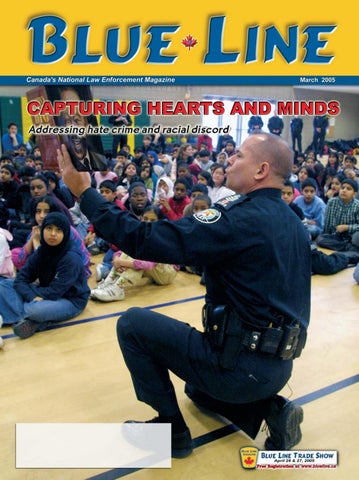
Capturing hearts and minds Addressing hate crime and racial discord through community policing
8
Blue Line Magazine 12A-4981 Hwy 7 East Ste 254 Markham, ON L3R 1N1
Canada
Ph: 905 640-3048 Fax: 905 640-7547 Web: www.blueline.ca eMail: blueline@blueline.ca
— Publisher — Morley S. Lymburner eMail: publisher@blueline.ca
— General Manager — Mary Lymburner, M.Ed.
NEWS CLIPS
10, 36
Student plants seeds for future
12
Coronor’s inquests
13
eMail: admin@blueline.ca
— Editor — Mark Reesor eMail: editor@blueline.ca
— News Editor — Ryan Siegmund
Death under the southern cross 14 Canadian cops help uncover Argentina’s dirty wars DISPATCHES
16
Documenting your image for court ... ... Without having to stop and take notes
17
DEEP BLUE Five steps to solving problems
19
2005 BLUE LINE TRADE SHOW
20
eMail: news@blueline.ca
— Advertising — Mary Lymburner Dean Clarke Bob Murray Kathryn Lymburner eMail: sales@blueline.ca
— Pre-press Production — Del Wall — Contributing Editors — Communication Skills Mark Giles Police Management James Clark Tactical Firearms Dave Brown Technology Tom Rataj Psychology Dorothy Cotton Mike Novakowski Case Law
CASE LAW 22 • Courts get tough on flight from police • Physical access defines a public place • Random sniffing okayed by BC court
Blue Line Magazine is published monthly, September to June, by Blue Line Magazine Incorporated with a mailing address of: 12A - 4981 Hwy. 7 East, Ste. 254, Markham, Ontario, L3R 1N1.
The internal politics of public relations 24 How vulnerable are your communications?
Individual magazines are $5.00 each. Subscriptions are $25.00 per year or $40.00 for 2 years. (Foreign - $50.00 U.S.) Group and bulk rates available upon request. All material submitted for publication becomes the property of Blue Line Magazine unless other arrangements have been made with the publisher prior to publishing. The authors, advisors and Publisher accept no liability whatsoever for any injuries to persons or property resulting from the application or adoption of any of the procedures, tactics or considerations presented in this magazine. Readers are cautioned and advised that articles presented herein are edited and supplied for your personal awareness and should not be used for further action until appropriate advice and guidance is received from a supervisor, Crown Attorney or other person in authority. Established in 1988, Blue Line Magazine is an independent publication designed to inform, entertain, educate and upgrade the skills of those involved in the law enforcement profession. It has no direct control from a law enforcement agency and its opinions and articles do not necessarily reflect the opinions of any government, police, or law enforcement agency. ©2005 - All articles are protected by copyright. No part of this publication may be reproduced or transmitted in any form or by any means, electronic or mechanical, including photocopying and recording or by any information storage or retrieval system without permission.
Freelance forensic artist wants to help 26
Internet activity is monitored and use or re-posting of material on the Internet is restricted.
This publication is a private venture and receives no subsidy or grant from any level of government.
— Affiliations — International Association of Law Enforcement Planners Canadian Advertising Rates & Data International Police Association The Police Leadership Forum Periodical Publishers Exchange The Canadian Press Newswire Harvey Research Printed in Canada by Tri-Tech Printing
ISSN #0847 8538 Canada Post - Canadian Publications Mail Product Sales Agreement No. 176796 Blue Line Magazine
OPP appeal for arms How things have changed!
27
Character/background key to career
28
Depot ramping up
30
Discovering the truth Investigative interviewing techniques
31
Officers earn respect of colleagues
32
ODDITORIALS
33
TECHNOLOGY Fingerprinting through the centuries
34
COMING EVENTS
35
A case for handcuffs in security
36
PRODUCT NEWS
37
BACK OF THE BOOK Wrongful convictions still plague justice systems
38
3
Toronto’s Thorncliffe Park is one of the most diverse areas in the country, if not North America. Residents speak 77 languages and dialects and practice many religions. The area, just southwest of the Ontario Science Centre, is home to many new Canadians and their families and includes the most heavily populated public school in North America. Combining so many cultures does create problems though, including racial/religious discord. The Toronto Police Service designed and developed a ‘quadrate’ of events over the past five years to instill community goodwill and a sense of cross-racial pride. S/Sgt Heinz Kuck, well known for combatting urban graffiti, coordinated the program and tells us how it captured the hearts and minds of residents. Vancouver high school student Rachael Dillman decided at a young age that she wanted to make a difference in people’s lives. She became involved with the Search Institute and has spoken to police, youth workers and parents about how to build assets in youth. West coast correspondent Elvin Klassen tells us more about this extraordinary student and how she’s planting seeds for future generations. Many police officers go their entire career without appearing before a coroner’s inquest. OPP officer Gregory Smith had never given them much thought — until he was asked to testify before one recently. He explains what it was like. Thousands of people disappeared, many without a trace, during Argentina’s dirty wars. The military government was overthrown in 1983 and a forensic anthropology team was formed to begin excavating human remains and discover what really happened during those tumultuous years. York Regional Police officer Greg Olson was among those Canada sent to help and writes about his experience in the country. In our regular features, Mike Novakowski has case law, Dr. Dorothy writes about the five steps to solving problems, Tom Rataj looks at fingerprinting through the centuries and Danette Dooley profiles Newfoundland’s officer of the year. MARCH 2005
Blue Line Magazine
4
MARCH 2005
The parallax view from here by Morley Lymburner A parallax is when your view of something is just as clear as every one else but with a slight angle shift. This phenomenon is one that can be attributed to policing around the world, as well as across a time continuum. What brought this to mind was hearing of the large number of Iraqi police officers killed while returning from training in Jordan. Many of these officers have been trained by a multi-national group of civilian police officers, including a sizeable number from Canada. The wholesale slaughter of new officers is truly tragic. These officers represent the future of that country and yet it would appear that this is not the future many would wish for Iraq. When one looks at policing in North America, we can see a great gulf in style versus necessity when compared to other parts of the world. In other words, the style of policing in any society fills the vacuum that exists at that time or place in the world. To understand this principle one need only look at the policing style that existed after the Second World War in North America. It was a time when millions of soldiers were being “de mobbed” and reintegrated into society. It was a time of high anxiety. Not only where these people now unemployed but they had been trained to take human lives or were suffering from the after-effects of taking those lives. Couple this with surviving the great depression of the 30’s and one can see the type of police officer required to keep order in the streets. They had to be big and tough enough to dish out a form of ‘street justice’ that would never see the inside of a courtroom. A ‘routine’ arrest in those days more often than not came with a few bruises, cuts and broken bones on both sides of the equation. It took many years for a form of civility to slowly return to society. For police officers familiar with the rough and tumble days, it was a simple matter of adjust, quit or retire. Today the tough, pugilistic cop on the beat has been replaced with officers more willing to lay charges and go through the court processes. This is only because the people they are confronted with are more attuned to this type of treatment. Civil rights and liberties have replaced the street justice deterrent of the past and the officers are trained to address this style and act accordingly. Today we live in a society that endorses most police actions because they reflect the tone and humour of the largest majority of the population. Although good police practices are attainable in Canada, it is not so in much of the rest of the world, where policing is stuck in the Second World War style - or worse. Most males are, or have been, trained in military style disBlue Line Magazine
ciplines of kill or be killed. Even those with no military background are familiar with a multitude of weaponry. Living conditions are substandard or precarious at best. Police are unable to train in the niceties of proper police practice because survival is their only agenda. Crime rates are high because a starving or needy population can see no other hope than
5
to take any advantage to survive. In these countries, the common law ‘defence of necessity’ takes on a scale too enormous for Canadians to comprehend. No third-world officer or even judge would understand the principle. Our problem in Canada and the United States arrives when we try to impose our value systems on countries who simply have no infrastructure to sustain them. We are currently sending people overseas to train people to be more like us. Today’s police officers could not function in the society of the 1930’s and 40’s, yet we may be training overseas officers who live under similar or worse environments using our modern standards. They may be prepared for North America when they leave these academies, but certainly not for their own countries. Although this parallax view we have of third world countries may vary from place to place, it is one that we must be conscious of if we hope to encourage evolution rather than revolution in police practices. After all, it is not police that form the society. They are merely a mirror of that society and can only function at a level that their society will tolerate. I hope Canadian officers on secondment consider this parallax in policing principles and adapt their principals to reflect the realities of the communities in which their students must live and serve.
MARCH 2005
Blue Line Magazine
6
MARCH 2005
Blue Line Magazine
7
MARCH 2005
by Heinz Kuck Designed for 12,500 residents but home to 33,000, Toronto’s Thorncliffe Park area is recognized as one of the most unique urban centres in Canada. Residents speak 77 different languages and dialects and practice Christianity, Judaism, Sikhism, Buddhism and Islam – all within a five square kilometre residential area. Thorncliffe has Canada’s largest concentration of Muslims and the most heavily populated public school in North America, with a JK to grade five student population of more than 1,600. This magnificent diversity is not without its share of urban crime and racial and religious discord. Various people, especially youth, engage in behaviour ranging from shouting racial slurs and writing hate graffiti to committing assault. There’s also inter-cultural discord, where people from the same country but different tribal regions or villages are involved in ethnocentric, tradition-based conflicts. The Toronto Police Service designed and developed a ‘quadrate’ of events over the past five years to capture the hearts and minds of Thorncliffe Park residents by instilling a sense of cross-racial pride and community goodwill. We’ve also encouraged them to work cooperatively, irrespective of race, creed or colour, in an effort to reduce harmful ethnocentrism, religious discord, hate crime and criminal victimization. The methodology used is bound to the process of community inclusiveness. We immersed ourselves in various cultural and reliBlue Line Magazine
gious practices, speaking with community elders, religious leaders and youth about complications, situations and possible solutions. The quadrate takes place over four months and capitalizes on established, credible, antiracism events. It’s been embraced by the TPS, and the community, as an alchemy for achieving a proactive race and rights practice within a densely populated urban landscape. A best practices model was undertaken using an innovative, seven-part, continuous improvement model. In the first step, officers and community members define race issues and opportunities within the racial/ethno-cultural/religious experience. Results are established in the second step, with participants asking themselves what they want to see in their community at the end of the day, week, month and year – positive changes that they can invoke and maintain. Step three involves evaluating and identifying alternative actions, including reviewing what was done in the past, whether it worked and other things that can be done. New ideas are selected in the next step – we referred to them as ‘breakthrough actions.’ This involved constructing the quadrate and targeting youth specifically – focusing on the hearts and minds of a new generation of community leaders, then faith communities and families. Step Five involves developing our schedule and ensuring that all our community, agency, political and local media partners were brought into the fold in developing each initiative, providing insight and attending events. We implemented the schedule in the next 8
step, securing equipment, sponsors and venues for events and, in the final step, concluded the process with a review of activity and progress. The impact was immediate. Many volunteers stepped forward and shouldered the responsibility of rousing and rallying their various cultural groups to the cause. These actions embrace a number of existing international initiatives – a well informed educational piece on the life and work of Dr. Martin Luther King Jr. and his path of nonviolence in January, for example. The presentation was tailored for and delivered to an audience of more than 400 impressionable grade four and five students and included biographical information, selected readings, speeches and displays of pictures, posters and banners. The outcome not only involved students participating in an interactive presentation, but also assigned them to go back to their classes and, throughout the rest of the month, do class projects on the King legacy. In February, community-based fund raising initiatives were launched to pay for literature on the historical black experience, coinciding with Black History Month. We select and buy hundreds of books based on the black historical experience, including works on the arts, music, and poetry, written by such greats as Maya Angelou, Nelson Mandela and W.E.B. Du Bois. The literature is distributed throughout the community. More than $3,500.00 has been raised over the past few years exclusively to buy books for this program. March sees us rouse the people to rally and come together as one during the United NaMARCH 2005
tions International Day for the Elimination of Racial Discrimination. There’s a candlelight march and vigil through the heart of Thorncliffe Park, promoted using more than 1,500 multi-language (Urdu, Gujarati, and English) flyers. Hundreds of families pack the gymnasium to experience multi-cultural entertainers, and hear speeches on racial harmony from guests such as Ontario Lieutenant Governor James Bartleman, Toronto Mayor David Miller and Lincoln Alexander. The event culminates with a vigil of silence; the gymnasium is darkened and 500 glow sticks are activated – the room erupts with the bright light of hope. We then assemble outside and together march behind banners of peace in an ultimate display of pride, consciousness and racial tolerance. The quadrate is completed by researching and presenting a piece on the life and work of Mahatma Gandhi, again delivered to students ages 8-10, in an effort to shape and influence choices focused on peace, goodwill and paths towards non-violence. The event gives real life examples of not only what can be done, but what has been done, and provides a framework for individual and community replication. Four months, four events, all woven into a tapestry of goodwill. This initiative was evaluated within a three-part equation. The first involved its link with the continuous improvement model. 1. Defining the issues/opportunities 2. Establishing the results 3. Review alternative actions
Blue Line Magazine
Year Calls for Service Criminal Code Offences 2001 2845 976 2002 2707 783 2003 2725 763 Reductions: -4 % -22 % Total reduction (2001-2003): 11 per cent 4. Select breakthrough actions 5. Develop the schedule 6. Implement the schedule 7. Review Using this process, coordinators and their community partners can design, develop and reshape program processes following a comprehensive plan. Once problems are identified, coordinators can keep actions that work, discontinue those that don’t and start new ones suggested by both police and community input after discussing their cost, ease and effectiveness. The second evaluation feature involves analysis of: • The number of students attending the King commemorative day event • Number of books purchased and distributed during Black History Month • Number of attendees for the candlelight march and vigil • Number of students attending the Gandhi presentation • Media imprints (coverage) for all events • Solidifying the partnership with community elders, leaders and youth • Community satisfaction The King commemorative day has been
9
Property Crime 412 58 348 -16 %
Violent Crime 174 87 102 -41 %
presented to more than 1,200 students over the past four years. More than $3,500 was raised during the same period to buy more than 400 books in celebration of Black History Month. The longest running component of the quadrate, the Candlelight march and vigil, now in its fifth successful year, will record an unprecedented exposure to more than 2,000 participants. Four hundred students took part in the Gandhi presentation, which was done for the first time last year. Of special note, all events were fully covered by Toronto media, which gave the program an outstanding profile and city-wide exposure. The third and final evaluation feature involved a year-to-year comparison of reductions in calls for service, Criminal Code offences, property and violent crime. See chart above. Conclusion The Toronto Police Service recognizes the value of community policing and celebrates this ‘new way of doing business’ philosophy. The quadrate is the first service initiative its ever undertaken that deals specifically with race, creed and colour within Thorncliffe Park. We learned about Thorncliffe’s extraordinary diversity, community inclusiveness and
MARCH 2005
the value of forging partnerships with community elders, religious leaders and local youth. We also learned about the negative side of ethnocentrism, offender motives and hate crime. This experience became invaluable, as our front-line officers and community partners were taught new ways of analyzing and solving problems, identifying crime trends and evaluating prevention methods. We learned the value of research and development, employing continuous improvement models, media marketing techniques and the potency of multi-level government inclusion – but most importantly, we learned that the solution to a community disorder problem is best solved by community development, police education, community/police partnerships and police re-engineering and enforcement. The job of maintaining order and preventing crime must be shouldered equally by the community and police. Other agencies and communities can learn and adopt a great deal from the quadrate experience.
Ignasiak
Cassels
Rayner
EDMONTON — Edmonton’s police chief Fred Rayner was terminated last month in leiu of events surrounding an alleged drinking-anddriving sting operation that targeted the head of the city’s police commission and a newspaper columnist last fall. The dismissal came one day after Rayner told the Edmonton Police Commission he was taking an indefinite period of sick leave. The following day after the firing the Police Commission sent out notice that it had hired a new chief of police but would not name the person until it was ratified by Edmonton City Council. The new person was later found to be former Deputy Chief David Cassels who had made an unsuccessful bid for the top job last year. Two days after selecting Cassels as Chief Edmonton city council decided to not ratify Blue Line Magazine
Ethno-Cultural misinterpretation and complaints of hate and bias crime was viewed as a legitimate disorder priority, instead of being ignored or minimized. A collective community voice was heard and reacted to, and a partnership was forged. Within the realm of police education, specific problem-solving techniques, such as the continuous improvement model, were designed, developed and delivered within the context of strategic planning. A guiding coalition of police coordinators, community stakeholders, media contacts, local agencies and local politicians ensured continuous learning for both us and the community at large. An essential educational component was also seen in the context of long-term, community-based problem solving. Both police and stakeholders focused their energies on mentoring young people to successfully deal with conflict resolution non-violently, in the spirit of good will, and to maintain that focus as they develop into community leaders. Another focus was to embrace the various faith
communities and draw upon their inherent strength and wisdom. Ultimately, the success of quadrate was not measured by the numbers of arrests and charges but by the absence of crime, reduction in victimization and the winning of hearts and minds. Enforcement was not viewed as the first line of defence, as it is with so many other crime management initiatives, but secondary to negotiation, faith community mediation, consensus building, education, outreach and partnerships. Community-based collaboration not only optimizes the delivery of police services to a disorder-affected community, but also, in our experience, creates a means of crime reduction, community protection and ultimately, an opportunity to win hearts and minds.
the appointment for the time being. Mayor Stephen Mandel summed up the feelings of council by stating that they felt uncomfortable with the haste at which the new Chief was hired by the police commission. “I think we should slow things down, take a step back and make sure we do things properly,” Mandel stated in Council. “There is no need to rush into this.” Accusations suggest newspaper columnist Kerry Diotte and police commission chairman Martin Ignasiak were targeted by police during a stakeout of a downtown bar last November. Rayner said Diotte was under surveillance because officers believed they had received a legitimate tip he might drink and drive. According to a tape of police radio transmissions obtained by the media, Edmonton police discussed ways to avoid disclosing some information that could have potentially damaged their case in the event they caught Diotte drinking and driving. In radio transcripts, officers are heard trying to tailor the stakeout to avoid having to later admit they had officers acting as spotters in the bar. The tape also reveals that after Ignasiak left the bar in a taxi, police officers in unmarked cars attempted to follow him in the faint hope that he might drive also. Rayner, when he discussed the operation report publicly, said their target was Diotte and it was a coincidence that Ignasiak was attending the Canadian Association of Journalists event at the downtown bar. “The commission is extremely concerned about what had happened, perhaps more concerned as to whether or not there is anything systemic to allow this incident to have taken place,” said John Acheson of the police commission. “We desperately need answers quickly because there is a dark cloud over the entire force right now, unfortunately.” Subject to ratification by city council,
Darryl Da Costa has been given the role of acting chief. City police spokesman Annette Bidniak said Da Costa is “naturally” concerned about the perception of the police and it “hasn’t been discussed yet” if Da Costa will play a role in addressing the bar room sting case as it continues to unfold. “Much information is out there, but it’s only part of the information and we’re not in a position to release the rest. It has to come out through the process,” Bidniak said.
10
Toronto Police Service S/Sgt Heinz Kuck coordinated the quadrate program. He will present a number of policing theories, including stencil graffiti, April 26 and 27 at the Blue Line Trade Show. Visit www.blueline.ca/tradeshow to register or for more information. Kuck can be contacted at 416 808-5354.
*** MONTREAL — A troubled Mohawk community which incurred a standoff earlier this year over policing will assign aboriginal officers from the Quebec provincial police to patrol the territory. The 16-member provincial police unit at Kanesatake will consist of eight to 10 aboriginal officers, Public Security Minister Jacques Chagnon announced. This initiative will ensure “there are native members of the Surete du Quebec who are present at all times on the territory,” said Chagnon. Steven Bonspille who plans to run for grand chief in the Kanesatake elections and Grand Chief James Gabriel are Kanesatake political rivals who both agree this is a positive step. Drawn-out political infighting has continued to plague the Mohawk community. Gabriel’s house was burned to the ground last January as a result of the policing dispute. Gabriel said the makeup of the Kanesatake Mohawk police patrols still has to be negotiated. The Kanesatake Mohawk police, which Gabriel supports, has been prevented from patrolling in the community. MARCH 2005
Blue Line Magazine
11
MARCH 2005
Student plants seeds for future generations by Elvin Klassen Vancouver high school student Rachael Dillman made a big impression on more than 1,400 delegates at the Search Institute’s annual conference – they gave her a standing ovation, their first ever to a session speaker. Dillman is an international baccalaureate student and the first Canadian to address a plenary session of the institute, an independent, nonprofit organization whose mission is to provide leadership, knowledge and resources to promote healthy children, youth, and communities. Dillman is an old hand at speaking about asset building; the grade 11 student regularly makes presentations to police, youth workers and parents. She began three years ago after seeing a presentation by Vision Training/ Search Institute trainer Keith Pattinson. Dillman approached him after the speech and asked how she could help build assets and make a difference in the lives of youth. Pattinson asked her to co-present with him and they’ve since made many presentations together. “What a difference she has made,” he says. Dillman has presented on more than 40 occasions, encouraged by such responses as ‘it’s refreshing to hear young people speak for themselves,’ ‘I had no idea how committed and talented kids are,’ ‘kids and adults should never meet separately and talk about one another’ and ‘we should meet like this and talk and plan together.’ “For over forty years I’ve traveled throughout Canada talking to adults, mainly parents and professionals, about the needs and aspirations of children and young people,” says Pattinson. “All that changed about six years ago when I was introduced to Search Institute in Minneapolis and their finding that there are 40 life building blocks, called developmental assets, that all kids need to grow up successfully. “More importantly, I learned that acquiring these assets wasn’t solely about something adults did for young people... but about giving young people themselves opportunity and support so they can play an important role in making the world a better place for all of us. Asset building is what adults and young people together can do to make a positive difference.”
Blue Line Magazine
Children and youth who hear Rachael are equally impressed and welcome her message that “young people have a role to play and we can do it.” We’re part of the solution, not the problem, she tells them; “kids can help change the world.” The Search Institute’s 40 developmental assets (www.search-institute.org) are concrete, common sense, positive experiences and qualities essential to raising successful young people. These assets have the power, during critical adolescent years, to influence choices young people make and help them become caring, responsible adults. Building developmental assets can play an important role in reducing many forms of youth substance use, particularly when the community helps contribute to their healthy development. Young people with low levels of developmental assets are two to four times as likely to use alcohol, tobacco and other drugs than those who have above-average asset levels, according to a new report from the institute. This relationship is true for young people from all racial/ethnic, family and socio-economic backgrounds. The perception many adults have of young people is based on what they see on the television news or read in the newspaper, Pattinson says. As a result, many treat young people with fear and loathing based on images that represent the values and behaviours of less than three percent of Canadian youth. Through her passionate speaking and singing, Dillman has played a key role in helping to bridge that gap and, more importantly, served as a role model and mentor, encouraging other young people to join her in building stronger, more compassionate and supportive families and communities. Adults telling other adults that young people are valued and valuable just doesn’t cut it anymore. It’s when youth are given the opportunity to demonstrate their positive values and offer witness to their commitment to caring, social justice, honesty and responsibility that healthier levels of intergenerational understanding, trust and respect are created. “If youth can be involved in things that matter to them, everything will work out bet-
12
ter,” Dillman says in her presentation to police, victims’ assistance staff and youth workers. “Communication between adults and youth is really important. They need recognition and a sense of feeling that they are part of the community.” Dillman gives her audiences practical ideas, encouraging them to “take a genuine interest with youth – it will make all the difference. Build trust. Ask their opinions. Give them an opportunity to share opinions that matter. Ask them their name. Ask them how their day is going. Build relationships.” Dillman began singing in public after her mother gave her an opportunity to sing on an empty stage in a mall. A lady approached and gave her $2, telling her she had done a great job. That was enough encouragement to get her started. Now she is asked to sing the national anthem at her school, perform at weddings and serve as a soloist in her church. Someone believed in her and now she wants to share that joy with others. Dillman has three younger brothers and a younger sister – the youngest is three and the oldest eight. “At dinner we give each one three minutes to talk about anything they want about their whole day. This is a great way for them to feel recognized and heard. That builds assets.” She finished her presentation by singing, unaccompanied, The Impossible Dream from Man of La Mancha: To dream the impossible dream, to fight the unbeatable foe… this is my quest to follow that star, no matter how hopeless no matter how far… and the world will be better for this that one man, scorned and covered with scars, still strove with his last ounce of courage To reach the unreachable stars! “The most important thing that I would like to do,” she concluded, “is have a job where I could really help people and make a difference in their lives… especially young people. Even though I won’t be a young person forever, it is really important that we do plant the seeds for the future generations.” Elvin Klassen, Blue Line’s west coast correspondent, can be reached at elvin@blueline.ca
MARCH 2005
Coroner’s inquests – one officer’s experience by Gregory M.A. Smith You want me to what? That was my initial response when I was asked to testify at a coroner’s inquest. To make matters worse, this was a case in which I wasn’t even initially involved. Due to unforeseen circumstances, the Crown attorney’s office needed someone to testify about certain technical aspects of the case – and all of a sudden, I was that person. Most officers go decades or even their whole careers without being involved in a coroner’s inquest, so very few know what to expect when the situation arises. The mission statement of Ontario’s Office of the Chief Coroner is “we speak for the dead to protect the living.” In order to fulfil this, every coroner’s inquest addresses five basic questions: 1) Who was the deceased? 2) By what means did they die? 3) How did they die? 4) When did they die? 5) Where did they die? The inquest itself takes place in a typical courtroom, with the coroner seated where the judge or justice would normally sit. Other participants include witnesses, a Crown attorney and a coroner’s constable. The strict rules of evidence, normally applicable in a courtroom, do not apply. Opinion evidence is also permitted and therefore, you must be very careful what you say. As these types of incidents attract a lot of publicity, your spoken words may appear in newspapers the following day. After presentation of your testimony and cross-examination (if applicable), both the jury and the coroner can question the witness. Members of the public serve as jurors at every inquest and the five-person jury is permitted to make recommendations at the conclusion. Although recommendations are not legally binding, the coroner’s office is responsible for distributing them to appropriate agencies and authoritative bodies. The ultimate goal of an inquest is generally not to lay blame but rather to prevent similar incidents from occurring in the future. The inquest in which I was called to testify involved the death of a 72-year-old man who was killed in a collision with a farm tractor. At issue were the bale forks protruding from the front of the tractor and whether they were a factor in the collision. I gave opinion evidence regarding matters of time, distance, speed and line of sight. I also presented my interpretation of roadway evidence and various scenarios relating to the point of possible perception (where both drivers may have first seen one another). After testimony from myself and several other witnesses, the jury returned with its recommendations, which included: 1) All new licensed drivers who expect to be driving agricultural vehicles on public Blue Line Magazine
roadways obtain an additional designation on their licenses. 2) Tractors and agricultural vehicles on highways must be required to have, in addition to slow-moving vehicle signs, warning flags on any extensions to the front of the vehicle. 3) Agricultural manufacturing companies should be encouraged to build housing mechanisms for bale spears, to be used while the vehicle is in transport. 4) Lowering mounting brackets to a reasonable distance from the tractor hood to maximize visibility from the tractor cab.
13
Upon conclusion and reflection, I found the experience to be both informative and rewarding. I was left with the feeling that just maybe, I played some small role in the future betterment of society at large and in preventing similar tragedies. So if you ever receive a phone call or subpoena to testify at an inquest, embrace the opportunity – you will probably enjoy it! Gregory M.A. Smith is a constable with the Ontario Provincial Police East Region Commercial Vehicle Unit in Lancaster, Ontario, and can be reached at gregory.smith@jus.gov.on.ca.
MARCH 2005
by Greg Olson A constellation called “Crux” hangs over Argentina. It’s English translation is known as “the Southern Cross”. Many people in Argentina still believe that this cluster of stars is the only witness to the deaths of their loved ones over 30 years ago. During the 1970’s and early 1980’s, Central American countries were at the mercy of corrupt governments, military and police officials. The corruption was deeply ingrained and rampant. During this period the country of Argentina was broken down into six distinct military zones and each zone was broken down into respective “sub-zones”. Each military area had its own military hierarchy which was accountable to the top military brass. With each zone, came various police units and, in turn they too were accountable to the military. There were, at one time, over 460 clandestine prisons where prisoners would be taken after arrest and tortured, a large number were eventually murdered. The uniqueness of this situation allowed for atrocities of all descriptions which included murder and the disposing of large numbers of individuals. To date, there are still over 15,000 missing persons, now referred to as the “Disappeared Persons”. In 1983, when the Military was overthrown and the civilian government took control of the country, the new Presidente ordered a complete investigation into these atrocities. The eminent Dr. Clyde Snow, an American forensic anthropologist, was approached by the government to form an Argentine Forensic Anthropology Team and begin excavating human remains within the country. This undertaking was huge. The subsequent years revealed horrific occurrences involving Argentine individuals. Persons who had opposed the military government during these tumultuous years were disposed of in a number of ways. Some were injected with a sedative and taken to an aircraft and either thrown into the Argentine Sea, or into the jungle, others were buried in existing graves in local cemeteries or in mass graves. It was the latter which brought me to Argentina in the winter of 2003. The City of Cordoba is the second largest city in Argentina and is situated approximately 400 miles inland from Buenos Aires amongst the Pampas. This was the site of one of the largest clandestine prisons in this particular military zone and one Blue Line Magazine
of the most active. A cemetery on the outskirts of the city, the San Vincente Cemetery was the reported site of one such mass burial. Two cemetery workers from the 1970’s came forward with information that the Military came to this area in 1976 and, using a small bulldozer, dug a long trench and disposed of a number of bodies of disappeared persons. I arrived in Cordoba in the last week of February and met members of the Argentine team at this site. We excavated through one layer of tin coffin liners containing human remains, below that was a layer of bodies wrapped in shrouds and below that, approximately three meters, we found human remains displaying signs of gunshot trauma. The first two layers that were encountered were what they referred to as “legitimate” remains. That being, in Cordoba the cemetery plots are basically “rented” in that, the next of kin are required to keep up a payment and if the payments are missed, the cadaver is exhumed and deposited in an unmarked grave rather unceremoniously. The first day that I was assisting in the main 12 meter by 12 meter pit, I recovered five infants mixed in with the layer of shroud wrapped bodies. By the beginning of the second week, we had begun to encounter human remains with obvious gunshot trauma. We had found the first of the murdered disappeared persons. In the two weeks that followed, I worked closely with team members and volunteers from the local University. In the short time that I was there, we located twenty individuals in this pit and I was struck by the fact that not one of them was wearing shoes. I couldn’t help but see a tremendous analogy that this was exactly what had taken place in Nazi Germany in 1944. This callous treatment of individuals 14
was not supposed to happen again with the stamping out of fascism. This turned out to be the first of two layers of murder victims. There were another 72 individuals below the immediate area where I had been working and a total of three hundred recovered in the subsequent months. As we entered into 2004, further information pertaining to mass burials was received by anthropology team members. The informant advised team members that in 1976, the military entered the cemetery with a bulldozer and again deposited a number of murder victims in a deep trench. Once the burial was covered over, a large cement pad was poured overtop and a crematorium was built on the cement surface. I was again invited by the Argentine team to train with them and assist on the location and recovery of this scene Upon my arrival in Cordoba, the excavation at the edge of the crematorium itself had commenced and was approximately four to five meters below the ground surface. A second excavation was undertaken several days later on the south side of the building and at the end of the first week we had encountered over 30 individuals approximately three to four meters below the ground surface. Here there was something that I had never seen before, these individuals had all been autopsied, there were I.V. bottles, syringes, rubber gloves and other assorted bits of medical garbage mixed in with the remains. The excavation continued a further three meters down, below the level of the building and encompassing the center support beam. The excavation now changed direction and continued over one metre under the main structure itself until the actual grave profile became obvious. It was quite clear that the original excavation was performed by use of a bulldozer as the grave profile was a perfect three-sided square and approximately five meters deep. From the examination of the profile, you could see that there were a number of layers or burials, even in this limited side view. Toward the end of the second week, one of the MARCH 2005
excavation staff located the distal end of a human long bone as it extended from the side wall. It was like looking for the needle in the proverbial haystack, but a shotgun pellet was found embedded in the bone itself. This was enough to have the Judge or Prosecutor attend and make the determination based on what she was able to glean from the scene, that this was in fact a mass burial. She issued a warrant to remove the cement floor to the crematorium. This was due to start as my time there came to an end. At the end of the second week, the team was split into two groups and I was assigned to the second group. We received information of a second burial site approximately 500 to 600 metres from the crematorium into the cemetery itself. A trench almost 100 metres in length and 1.5 metres wide were excavated and almost immediately we began to uncover human remains. For the following two weeks, this was my post and as we began to remove soil and excavate further, we began to locate a large number of remains. The laws in this part of the country and those particularly affecting the cemetery itself are such that, if the monthly “up-keep” payments on actual graves are not up to date by the families, the remains are exhumed and put into mass, and as previously indicated, placed into unmarked graves in the cemetery. As I was excavating the day before I flew out, the human remains were becoming more and more obvious in this area. They were layered and gave off the impression that these individuals were just dumped out of the back of a truck. The total body count climbed to just under one hundred individuals. There were other witnesses who also came forward with information on at least two more sizable mass burials on the site of an old military base in La Perla, on the outskirts of Cordoba. The team members enlisted the services or an individual who flew over this 600 acre site with a thermo-imaging unit. There were six or seven sites located and marked as possible mass graves and removing the topsoil by way of bulldozer. By all indications, and this was based on eye-witness accounts, this same area became an artillery range by the military. At this point, the members of the Argentine team were waiting for funding and approval to bring in specialists to locate and defuse possible live ordinance. If these areas are in fact substantiated, this will become the largest human remains recovery site to date in Argentina. There are still over 15,000 disappeared persons unaccounted for and as the years wear on, those with knowledge of these sites are Blue Line Magazine
growing old and don’t want to take these secrets to the grave with them. The most important tool now in the arsenal of the Argentine team, is the eye-witness. They have proven to be invaluable in locating burials. As I left Argentina, I couldn’t help but be humbled. The economy of that country is unstable and their peso is pitiful against our dollar. The people are warm and receptive to Ca-
15
nadians who work and train with them. The experience that I received while I was there was invaluable. Nowhere in North America, is there anything that even comes close to these types of sites for the tremendous amount of learning that can be gleaned, something which increases the knowledge base for our team members and which will, no doubt pay huge dividends. The Argentine team is a well trained,
MARCH 2005
Outgoing Toronto Police Chief Julian Fantino has been appointed Ontario’s new commissioner of emergency management by Premier Dalton McGuinty, succeeding Dr. James Young, who has become special adviser to federal Public Safety Minister Anne McLellan. Fantino will oversee Ontario’s emergency planning and preparedness and will work with other levels of government in the event of a disaster. He will be responsible for co-ordinating all provincial ministries and will report to Community Safety Minister Monte Kwinter. “This is a challenge that I welcome,” Fantino said. “I’ve never lost sight of who we are and who we are here to serve and I am totally and absolutely committed to ensuring that the greater good prevail.”
highly sought after group of men and women and it was a pleasure to work with them. I am happy to share my sincere gratitude to the Argentine Forensic Anthropology Team and in particular, Dr. Dario Olmo and Anahi Ginarte. Without their kind consideration this would not have been possible. I have become close to these people and marvel at the obstacles they have been able to overcome with limited equipment and relying on donations in order to continue. Perhaps with the help of many more people such as these the secrets which many believe are only held by Argentina’s Southern Cross will be revealed.
The York Regional Police Archaeological Forensic Recovery Team has been in existence since 1996 and has assisted in criminal investigations for the York Regional Police as well as other neighbouring police agencies. To date, this Team has excavated human remains at homicide scenes, processed scenes of major sexual assaults and robberies. Members of this service currently instruct members of other law enforcement agencies, coroners and investigators from the Office of the Fire Marshal by way of short courses. To date, they have trained over two hundred personnel and have now adopted a Scenes Of Crime Officer training program in the recovery of human remains. The expertise of the members of the Team is requested on many occasions to deliver lectures to Universities and Law Enforcement agencies on both sides of the border and is the only team of its kind in Canada. The current SOCO program has come on-line to augment recoveries conducted by and prior to the involvement of the Archaeological Recovery Team. This three-tiered system utilizes on-duty SOCO personnel and Forensic Identification officers to conduct minor archaeological-style searches. The training undertaken by the Team has been extensive and involves Colleges and Universities both here and in the United States. The work undertaken in Argentina is not part of the Archaeological/Forensic Team mandate and was conducted on a voluntary basis. The training and mandate for the Team has been under the auspices of the York Regional Police.
Former deputy chief Mike Boyd will take over as Toronto’s interim chief until the board settles on a new one, said Pam McConnell, who was recently acclaimed chair of the Toronto Police Services Board for another year. Boyd retired from the service almost a year ago after spending nine years as Toronto’s deputy chief. A decision on who will take on the chief’s role permanently is to be announced likely in late April or early May, McConnell said. Toronto Police’s Deputy Chief Steven Reesor announced his retirement in January ending 30 years of service, to join the Aurora-based car-parts giant Magna International as an executive. The 51-year-old quickly rose through the ranks during his career; special weapons constable in the emergency task force, a division and homicide detective and a staff inspector of the force’s internal audit division. In 1995, Reesor was appointed deputy chief at the age of 42 making him the youngest at that rank in the history of the force. “I’ve enjoyed every minute of the last 30 years working in policing, every job I’ve been assigned to,” Deputy Chief Reesor said. Winnipeg police Chief Jack Ewatski has invited an aboriginal member of the force to take part in the investigation into the killing of an aboriginal teen by police. In the first time addressing the case, Ewatski said the investigation concerning the death of Matthew Dumas could take months and wouldn’t name the officer involved. The 18-year-old Dumas was shot during a scuffle with police in the city’s north end. Manitoba Justice has called an independent inquest into the shooting, as required by the Fatality Inquiries Act. Ewatski met with the Assembly of Manitoba Chiefs (AMC) Grand Chief Dennis White Bird and is permitting the AMC to choose an outside agency to monitor the police investigation. Aboriginal leaders in the city have voiced their opinions saying the killing was racially motivated. Alberta’s solicitor general wants significant changes to how the RCMP operates in the province. Harvey Cenaiko says he intends to forge ahead with a government plan to create an alternative - on paper anyway - to the Mounties by the end of 2007. “In the future, we are going to be looking at new ideas regarding policing, whether that’s regional policing, adding to municipal models or adding additional resources to the police models we have now,’’ Cenaiko said.
Blue Line Magazine
16
MARCH 2005
Documenting your image enhancement steps for court ... ... Without having to stop and take notes by Jill Smith Digital image processing is a controversial topic in forensic circles these days. Attitudes vary from the laid back — ‘no worries’ — to panic — ‘the sky is falling!’ With a little effort and common sense however, there can be considerable benefit in using digital images for evidentiary purposes. We all are very aware that digital images can be manipulated easily and almost seamlessly — there’s a constant barrage of them on television, magazine ads and the Internet. There is no denying the implications of introducing digital technology to the criminal justice system. We have a new responsibility to develop procedures that will maintain their integrity to ensure they will be accepted in a court of law. If we can enhance a fingerprint or footwear pattern to make it easier to visualize, then we are obligated to do so — but we must adhere to the ‘best evidence’ rule. The Scientific Working Group on Imaging Technologies (SWGIT) has clearly stated its position on digital images used in the criminal justice system: Digital image processing is an accepted practice in forensic science... any changes to an image made through digital image processing are acceptable in forensic applications provided the following criteria are met:
Blue Line Magazine
1. The original image is preserved 2. The processing steps are logged when they include techniques other than those used in a traditional photographic darkroom 3. The end result is presented as an enhanced image, which may be reproduced by applying the logged steps to the original image... The documentation of enhancement techniques should be sufficient to permit a comparably trained individual to understand the steps taken, and to apply the same techniques, resulting in similar output. Documenting enhancement steps accurately is imperative, but it can also be very time consuming. As a civilian forensic imaging specialist, I have had enough irritable, overworked investigators hanging over my shoulder during the enhancement process (wanting the work done yesterday!), to know that there are just not enough hours in the day! Necessity is the mother of invention. There is a solution, or at least a partial solution, which streamlines the digital enhancement process, accurately enough so that it can be repeated, without having to interrupt the flow of work by taking notes — Actions in Adobe Photoshop. In the CS version, there’s the added bonus of the Edit History function, found in the file’s
17
metadata — but Actions is much more comprehensible and has the added advantage of showing your settings and selections details. It should be noted that these actions only work when using Adobe Photoshop; I still save and document intermediate steps when using other imaging software. The advantages of using Actions: • I used to save each intermediate enhancement step as a tiff. These large files take up a lot of disc space; Actions file are often only 20 to 40 kilobytes • Actions are named with the case number and stored within that folder • When actions are played back, selections and details of settings are shown • No stopping to take notes! Steps to using Actions as a documentation tool Begin by ensuring all images being analyzed are captured and stored in a lossless file format such as tiff or raw. 1. Open original 2. Click save as to save a working COPY of the original in a new enhancement folder within the case file. Name it (filename)/copy. 3. Calibrate the image 1:1
MARCH 2005
4. Click save as to save a calibrated copy and name it (filename)/CAL, to indicate that it has been calibrated. Also right click on your calibrated image, go to properties and select read-only. 5. Now go to the actions options list (a drop down menu found on the actions palette menu bar). 6. Choose italics new set end italics 7. A dialogue box will pop up prompting you to name the set of actions you are creating. Use the case number and any other pertinent information and click OK (see figure 1)
figure 1 8. Create a new action. You will find this function button on the recording bar at the bottom of the actions palette. (see figure 2)
figure 2 9. You will be prompted to name the action you are creating within this set. Use the file name of the image you are using for analysis. You may want to include your badge # and the date you enhanced the image. (see figure 3)
figure 3
Blue Line Magazine
10. Click record 11. Enhance for image analysis as you normally would 12. Remember to click the stop recording button when you are finished. 13. Click save as to name and save your enhanced image in the folder you created for enhancements. Name it (filename)/enhanced to indicate you have completed the enhancements. 14. Close image. 15. Now you must save your set of actions. In the Actions palette, highlight the set of actions you have been working on. 16. Click save actions from the actions options list. (see figure 4)
figure 5 23. Select the action you created in this set for this image (you may have more than one action saved for this case if you have multiple files to enhance for analysis) 24. Select playback options from the actions options list (see figure 6)
figure 4 17. Now, navigate to the enhancement case folder where you want to save this set of actions, give it a name and click OK. You are done! Playing back your Actions 18. First, clear all actions. This option can be found in the actions options list. You will be prompted to confirm the deleting of all actions. If you have just successfully saved the set of actions in your case folder, then you may click OK 19. Open the COPY of the original image that you calibrated and saved as CAL 20. In your actions options list, select load actions. Navigate to your enhancement case folder and select the set of actions that you saved there. Before you load this, right click on the file, go to properties, click read-only and OK 21. Load 22. Turn dialogue options ON (see toggle button to the left of the name of the set of actions) (see figure 5)
18
figure 6 25. Under the performance options, select pause for _____ 26. Choose a time setting and click OK 27. Click play The enhancements you performed will now be played back to you, pausing for a predetermined time between steps. Where applicable, the playback will stop at each dialogue box, displaying the exact settings that you used for that step. The playback will not continue until you click “OK”. Selections you made on the image will be shown exactly as you made them. Beautiful! So there is no need to run away from digital image enhancements for courtroom purposes. Jill Smith, a civilian member of the York Regional Police, is a digital imaging specialist working in the forensic imaging section of the identification bureau. She can be reached at 5150@police.york.on.ca or 905-830-0303, x7815.
MARCH 2005
Five steps to solving problems by Dorothy Cotton I just finished reading Police as problem solvers, by Hans Toch and J. Douglas Grant. I suppose there are lots of books on police solving problems, but this one caught my eye because it’s published by the American Psychological Association (APA). There aren’t a lot of books on policing by psychological associations, although the APA does have one on police and stress. As I was reading, I could feel a little something churning away in the back of my mind – there was something vaguely familiar – couldn’t put my finger on it at first… The general gist of the book is that police need to systematically analyze problems – collecting data, planning and then following up specific, clearly identified problems – rather that relying purely on reactive law enforcement and crime solving strategies. It’s a good book and I recommend it. It took a while before I figured out why it sounded a little familiar. The general strategies reminded me of a psychology article I read a gazillion years ago – 1971, to be precise – called Problem solving and behaviour modification, by Thomas D’Zurilla and Marvin Goldfried, who were gurus in their field at that time. They observed that daily life is replete with tough decisions, ranging from which tie to wear or who to date to what to do for a living. They went on to point out that while we all spend a lot of time making decisions, most of us don’t do a very good job. They came up with five essential steps of problem-solving – of which decision making is only one: • General orientation: If you don’t have the right mind set, you’re very unlikely to even figure out that there’s a problem, much less how to solve it. A good orientation includes (a) acceptance that life is full of problems, and that that is okay; (b) the ability to recognize a problem when you encounter it; (c) being able to resist the impulse to respond by either doing the first thing that comes to mind – or doing nothing. For example, suppose you always wear the same tie on the same day – or never wear a tie. Maybe you haven’t clued in that no one else wears ties or that styles have changed over the years – and perhaps you feel the same way about everything else you do. That leads to a complete absence of problem solving. • Problem definition and formulation: Problems are not always what they seem, nor is the obvious formulation always the correct one. Maybe the issue is not what tie to wear but rather whether you should wear a tie at all. If you don’t ask the right question, you’re not likely to get the right answer. My dad used to always tell me that it was easy to find answers – the hard part was finding the right questions. Blue Line Magazine
• Generation of alternatives: This is where brain-storming comes in. If the only alternatives you can think of are ‘well, there is the green striped one and the blue striped one,’ then you need to do a little more work. One of the secrets of good problem solving is to generate many alternatives. In this case, maybe wearing cravat or ascot is a possibility, or not wearing a tie, or… well, I don’t know – I don’t wear ties very often! If I did though, I’d better not stop at the first one that comes to mind. It’s strange how many people skip this step. Sometimes only one option stares us in the face and we simply go with it. That would be fine – if it was always the correct option. • Decision making: This is the fun part and most of us are in such a hurry to make up our minds, we don’t bother to first come up with alternatives. You get to choose one of the options you identified in the last step – but if you skipped the last step, you might want to give it another shot; maybe the ascot IS the right alternative. • Verification: So, did it work? Just because you chose an option or made a decision doesn’t mean it is was the right one. What is the evidence? Sometimes at this stage of things, you have to admit defeat and go back to the second step and try again (okay, I look
19
silly in an ascot). Often, this means collecting data and measuring change; otherwise, how do you really know? Just because you thought it was a good idea doesn’t mean it WAS a good idea. That’s the gist of it. The Toch book reminded me of the method – systematically analyzing what the issue or problem REALLY is, what the options are, how to measure success – all the aspects of problem-oriented policing. It means looking at the bigger picture and approaching things from a slightly different angle – not so much ‘what are we going to do with this guy or this crime?’ but more ‘we have a problem with…’ Works for me. Actually, simple as it sounds, the D’Zurilla and Goldfried article probably had as much effect on how I practice psychology as any other single article I’ve ever read. I don’t think I have seen a patient, conducted a bit of research or given a talk that didn’t rely on their formulation of problem solving. You might want to try it. If you’d like a copy of the article, let me know. It’s kind of yellow and dog-eared, but I think the words are all still there. You can reach Dr. Dorothy Cotton, Blue Line’s psychology columnist , at deepblue@blueline.ca
MARCH 2005
Blue Line Magazine
20
MARCH 2005
Blue Line Magazine
21
MARCH 2005
Courts get tough on flight from police by Mike Novakowski Alberta’s highest court has increased the sentence of a man who led police on a high speed pursuit that injured two constables. In R. v. Roberts, 2005 ABCA 11, police attempted to stop the 22 year-old accused, who was driving a stolen truck, after a citizen reported seeing a car prowler in a residential neighbourhood. The driver fled and was pursued on slippery roads through major and residential areas. Speeds reached 110 km/h and the suspect ran through intersections without stopping, even deliberately rammed a patrol car head on, severely damaging it and seriously injuring two officers who were preparing to get out and deploy a spike belt. The suspect ran but was found hiding in the yard of a residence by a police dog. He fought with officers until the dog subdued him. Roberts, who was also wanted on a warrant for not attending court on an earlier possession of stolen vehicle charge, pled not guilty and was released on bail. He failed to show for his preliminary hearing and was re-arrested but again let out on bail. He failed to show a second time and was arrested again before finally pleading guilty to possession of stolen property over $5,000 and police pursuit causing bodily harm. Charges of dangerous driving and fleeing an accident scene were dropped. He apologized, telling the court at his sentencing hearing that he ran from police because he was using drugs and had amphetamines in the truck. The crash occurred because of speed and road conditions, not because he intended to ram the truck, he told
Blue Line Magazine
the judge, who believed him, recognizing the explanation and guilty plea as mitigating factors in sentencing. Roberts was sentenced to about 34 months on the flight charge but nothing for possession; the Crown appealed to Alberta’s highest court. The Alberta Court of Appeal first addressed the non-sentenced offence by noting that “possession of a stolen vehicle is a serious offence, especially when the driver recklessly demolishes the vehicle.” Justice Cote, authoring the unanimous judgment, concluded that a sentence for possession concurrent to the flight offence, as Roberts suggested, would not be appropriate. They require completely separate elements and intents, even though involving the same truck and overlap in time. Justice Cote stated: Furthermore, flight causing bodily harm is a new, separate crime. Why would anyone lead police on a chase if he had been doing nothing wrong when told to stop and wasn’t wanted by police? Why would he do it if he were driving his own vehicle with his own license plate? Flight then would be pointless. That rarely occurs. Usually drivers flee because they are either then committing another offence, or have clear evidence of another offence in their vehicle. Often the vehicle is stolen. To give concurrent sentences then would be to wipe out one of the offences, for all practical purposes. So long as the penalty given for flight were not larger, this would be a virtual judicial repeal of Parliament’s new criminal flight crime. That would violate Parliament’s strong message… alternatively, if the flight sentence were equal or higher, a concurrent sentence would wipe out the predicate offence, which the criminal was fleeing, and so make the flight successful. It would reward flight, not punish it. It would take Jonathan Swift to appreciate the irony. (paras. 33-34) Secondly, the mitigating factor attributed to the guilty plea was offset by Robert’s two failures to appear, inconveniencing more than a dozen witnesses, including the two injured officers, who had shown up. Rather than promptly pleading guilty, Roberts waited more than 17 months after the offence, and did so then only in exchange for several charges being dropped. Moreover, the police had caught Roberts red-handed and the many professional witnesses made a conviction inevitable. The sentencing judge should not have given any significant credit for the guilty plea. Roberts’ ongoing drug problem and use of drugs at the time should have worked against, not for him, the court found. “Choosing to drive after knowingly consuming drugs or alcohol clearly aggravates any driving offence then committed,” said Justice Cote. Furthermore, the fact Roberts fled the accident, hid, had to be tracked, resisted and tried to evade conviction were also aggravating circumstances overlooked by the trial judge, as was the increasing number of flights from Edmonton police 22
and resulting injuries. Finally, the reason Roberts gave for evading police – to escape trouble from drug offences – wasn’t a mitigating factor. “Those who flee the police and engage in a chase usually do so to hide something illegal,” said Justice Cote. “Possessing amphetamines is not a minor matter, like having an out-of-date address on one’s operator’s permit.” He felt the same way about Robert’s suggestion the collision was due to negligence rather than an intentional act: Had the respondent deliberately rammed the car containing the two constables, that would have been a different, deliberate crime, such as attempted murder, maiming, assault causing grievous bodily harm, or aggravated assault… The offence for which the respondent was sentenced was causing bodily harm, by operating a motor vehicle in a manner dangerous to the public, while being pursued by a constable in a motor vehicle, and failing to stop to evade the constable (Criminal Code s.249.1(3)). No intent to injure or cause a collision is necessary to complete that offence. The mode of driving required by s.249.1(3) is that in s.249(1)(a), dangerous driving. It is trite law that no intent to injure is necessary under that section (paras. 50-53, references omitted). The only mitigating factors recognized by the appeal court in determining the sentence were Roberts’ relatively young age, the possibility of rehabilitation and his belated remorse. That was weighed against the seriousness of the flight from police charge, which is an aggravated criminal offence. When someone is injured as a result, the maximum sentence is 14 years, significantly more serious than criminal negligence, dangerous driving or impaired driving resulting in bodily harm. The manner of driving in this case made a collision highly probable and the serious injuries resulting were far from a fluke, bad luck nor unforeseeable. In passing s.249.1 of the Code, Parliament recognized that the offence is very dangerous to the public, the moral turpitude is greater than dangerous driving, because of the deliberateness and contumacy required, and that penalties must be equal to or greater than penalties of the offence being fled. Roberts’ conduct was dangerous and resulted from a conscious decision to flee for some distance. He wasn’t seduced or bullied by others into the offence and continued to flee and show his disregard for others even after the crash. Roberts’ sentence on the flight charge was increased to three and a half years and he was given an additional four months and 14 days consecutive for the possession offence – the court recognized the ‘globality’ principle that combined sentences should not be unduly long and credited him some time for pre-trial custody. Visit www.blueline.ca/resources/caselaw for the complete case. E-mail caselaw@blueline.ca to reach Mike Novakowski. MARCH 2005
Physical access defines a public place by Mike Novakowski A person’s living room, even if it’s visible through an open window, is not a public place, the Supreme Court of Canada has decided in overturning a BC man’s conviction. In R. v. Clark, 2005 SCC 2, neighbours looking across the backyard from their partially lit family room saw the accused standing in his illuminated living room masturbating. They moved to their darkened bedroom and continued to watch Clark for 10 to 15 minutes, from a distance of 90 to 150 feet and even used binoculars and a telescope at one point to confirm what he was doing. They called police, who arrested Clark and charged him under s.173(1)(a) and (b) of the
lifestyle. Thus, Davis did not have a reasonable expectation of privacy in the area surrounding his van in an area open to the public and the dog sniff wasn’t a search under the Charter, so there was no breach and the evidence was admissible.
window – and willfully did the act in the presence of one or more persons (the neighbours). Clark’s appeals to the BC Supreme and Court of Appeal were unsuccessful. He appealed to Canada’s highest court, which vacated his conviction and acquitted him. Justice Fish, authoring the unanimous judgment, concluded Clark’s living room wasn’t a public place for the purpose of s.173(1)(a). The type of access contemplated in the definition of public place requires physical access within, not visual access from without. Justice Fish stated: Section 150 of the Criminal Code uses the word ‘access’ in reference to a ‘place’ – in this case, a private home, and our concern is with access to that place ‘as of right or by invitation.’ In common usage, ‘access’ to a place to which one is invited or where one has a right to be refers to entering, visiting or using that place – and not, as I said earlier, to looking or listening in from the outside. When we are told that someone has access, as of right or by invitation, to an apartment, a workshop, an office or a garage, this does not signify to us a mere opportunity or ability to look through a window or doorway and to see what is happening inside (para. 45).
Visit www.blueline.ca/resources/caselaw for the complete case. E-mail caselaw@blueline.ca to reach Mike Novakowski.
Visit www.blueline.ca/resources/caselaw for the complete case. E-mail caselaw@blueline.ca to reach Mike Novakowski.
Criminal Code; s.173(1)(a) creates the offence of willfully committing an indecent act in a public place in the presence of one or more persons. Public place is defined in s.150 as including “any place to which the public have access as of right or by invitation, express or implied.” Section 173(1)(b) makes it an offence to commit an indecent act in any place with the intent to insult or offend any person. Clark was acquitted at trial in provincial court because the judge concluded he didn’t know he was being watched and hadn’t intended to “insult or offend any person,” as required by the section. However, he was convicted of committing an indecent act in a public place, since his living room had been converted into a public place – since he could be seen through his
Random sniffing okayed by BC court by Mike Novakowski A narcotics dog sniffing around parked vehicles does not amount to a search, a BC Provincial Court judge has ruled. In R. v. Davis, 2005 BCPC 11, police randomly used a passive alert narcotic detector dog aboard a BC Ferry as part of a drug interdiction operation on a vehicle parking deck open to public access. The dog indicated on a van after putting its nose up to a pop out window and sat down — Davis was sleeping in the front passenger seat, with the window partially open. Officers smelled a strong odour of fresh marijuana as they approached, tapped on the window and identified themselves and arrested Davis for possessing a controlled substance. The vehicle was secured and taken back to the police station. A warrant was obtained and it was searched; a container with 18 ziplock bags of marijuana was found behind the driver’s seat and Davis was charged with possession for the purpose of trafficking. During a voire dire in BC Provincial Court to determine the admissibility of the evidence, Davis argued his rights under s.8 of the Charter, securing him from unreasonable search and seizure, had been violated. For the purposes of the constitution, a search occurs when police conduct interferes with a person’s reasonable expectation of privacy. Although there was little doubt Davis had a privacy interest in his vehicle’s interior, Judge Auxier ruled he didn’t have a reasonable expectation of privacy in the air surrounding it, which contained the odour of marijuana detected by the dog. The judge relied on the recent Supreme Court of Canada R. v. Tessling, 2004 SCC 67 decision, in which the court concluded the use of a thermal imaging device on a home was not a search engaging constitutional protection. He found the information supplied by the dog’s actions did not reveal a biographical core of personal information, nor intimate details of Blue Line Magazine
23
MARCH 2005
The internal politics of public relations How vulnerable are your communications? by Mark Giles In theory, most law enforcement agencies focus solely on their operational role and serving the public. In reality, they’re usually concerned with the political side of things too. Sometimes it’s big ‘P’ politics, involving elected or appointed officials, but more often it’s small ‘p’ politics, internal to most organizations, and often involving decisions based on personal preferences, rather than for the good of an organization. Most agencies have measures in place governing the relationship between politicians and senior management, which protects against the influence of big ‘P’ politics. Police agencies, for example, make a clear distinction between the roles and authority of the police commission, appointed by a municipal council or equivalent, and the police chief and operational chain of command. The concept is that the commission, made up of both elected and political appointees, provides direction as a whole to the chief, thus minimizing the chance that any one individual’s personal politics will influence policing decisions. Internal politics Police agencies are probably more vulnerable to the potential influence of small ‘p’ politics, specifically decisions made below the political level – within the ranks of mid- and upper-level management. To be fair, most executive and middle management decisions are based on operational needs, with the intention of maintaining an organization’s reputation and building trust with the media and public. Occasionally, however, decisions regarding public and media-relations strategy may incorporate the personal preferences or loyalties of an influential sworn or civilian manager. In climbing the corporate ladder, senior managers often develop loyalties to colleagues which can sometimes influence the way they handle an issue. Decisions about professional standards and internal discipline, for example, can be controversial, often affecting reputations and careers. If a set procedure is not followed in communicating outcomes of these issues, personal loyalties can sometimes influence how they are released to the public and media. The obvious conflicts, such as when a senior officer responsible for public and media relations, is faced with deciding whether to release information affecting him or herself, family members or close friends, are usually dealt with quickly. In these cases, the responsibility can be temporarily assigned elsewhere. Other situations are less obvious and can sometimes be overlooked or ignored. If senior officers adopt a non-disclosure or reactive-media strategy, perhaps believing an issue to be an internal matter, they should be required to justify their decision. Perhaps there’s no public interest in the issue or disclosing the information would jeopardize an investigation or public or officer safety. The strategy can then be justified and explained Blue Line Magazine
later if necessary, but if information is withheld for other reasons, it can be more difficult to explain – often putting the agency and its spokesperson(s) in a defensive position. “As soon as you start to defend your position, rather than to explain it, it sets you up for a credibility problem,” says Colonel Brett Boudreau, director of public affairs planning and media liaison for the Department of National Defence. “I don’t defend government policy or what the Canadian Forces (CF) does – I just try to explain it and inform the public.” A major goal of public and media relations is to maintain an agency’s credibility and reputation. An incident which appears to have been handled based on internal politics can significantly damage an agency’s image with the public, media and internal audience. When such a situation comes to light, the agency may be forced into crisis communications mode. Internal politics can lead to bigger problems The dilemma can begin with a disagreement over releasing information or responses to anticipated media questions. The public affairs and media relations unit normally recommends a course of action, but senior management usually decides how to handle issues with significant potential media interest. They would normally approve the unit’s recommendation, assuming it’s based on sound strategy and is consistent with the organization’s strategic goals and objectives. The difficulties arise when a senior, influential individual has another, often hidden, agenda. The 1993 Somalia scandal began with the alleged cover-up of the brutal killing of a Somali teenager by Canadian troops. The incident wasn’t made public for many days, and even then the details were foggy. For months, and in some case years, a few senior defence officials acted and gave direction based on their own personal interests, trying to avoid being implicated in the scandal. Some Canadian police agencies have had similar experiences, holding back for long periods of time until government inquires or the justice system finally forced them to release embarrassing information. The public and media-relations staff are usually wrapped up in these events, trying to do their job, but often with loyalties divided between the organization they work for and the person(s) potentially implicated as events unfold. 24
With the Somalia case, the strategy should have been immediate release of the information, a clear admission that a terrible act had been committed, followed by a plan to administer discipline and later, a review of the lessons learned. A few Canadian police agencies have also learned some of those lessons the hard way when they were initially reluctant to admit responsibility for the death or injury of persons in their custody. They were later forced to apologize and make amends – but not before losing considerable credibility and trust with the media and public. The decisions of senior officials, some perhaps looking to protect themselves or others by putting internal politics ahead of sound management strategy, were most certainly the root cause of these scandals. Reducing the risk Law enforcement agencies must deal with controversial issues, even when internal conflicts arise. As long as management makes decisions consistent with a sound public and media-relations policy, little to no conflict should occur. It’s no secret that public and media-relations units are employed to put their respective agencies in the best possible light. Unless security or investigative reasons prevent it, however, it is expected that information will be released, and that spokespersons will not deliberately lie or distort the facts. The following may help to reduce the influence of internal politics on your agency’s public affairs and media-relations unit. 1. Effective command and technical ‘nets’ Who the director or senior member of the public affairs and media-relations unit reports to is an important factor in the team’s effectiveness and susceptibility to outside influence. Some agencies attach the unit directly to the chief or director’s office; others report through an inspector, deputy chief or equivalent. Generally, the closer the senior unit officer is to the chief’s office, the better placed he or she is to consult at various levels, without being subject to management direction and potential undue influence from other bureaus. Establishing a clear chain of command, as high as possible, also reduces the number of potential conflicts. Although units may report directly, it’s still essential to consult with ‘technical nets’ (working relationships based on technical expertise rather than the chain of command) or ‘dottedline’ relationships. The public affairs officer of the military police branch is under the command of the CF Provost Marshal, the military’s de facto chief of police, but also works closely with the legal and human resources staff of the assistant deputy minister for public affairs, parliamentary affairs and various commands. This ensures that consultation occurs on most issues and options presented have been reviewed by several parties. They are, therefore, more likely to be free of internal politics by the time they’re presented for approval. Similar relationships often exist in civilMARCH 2005
ian police agencies, helping to ensure that a public affairs and media relations unit is not isolated when dealing with controversial issues and the political pressures often surrounding them. This increases input on an issue, thus limiting the chance that one individual’s personal preference will impact the final decision, made by the chief or other senior official. 2. Determine your role as spokesperson Are you speaking for the organization or the individual (chief or other senior officer)? If your superior were to be fired tomorrow, would you still have a job? The answer is probably yes, meaning that your primary loyalty lies with the organization. Public and mediarelations strategy and tactics should, therefore, reflect this primary loyalty and be geared towards the good of the organization. 3. Engage the media at every opportunity Don’t shy away from the hard issues. Regularly engaging the media, especially with difficult issues such as morale or internal discipline, builds trust and a reputation for openness and transparency. It also further establishes the process internally, making the requirement for realigning reporting lines more immediately obvious when a potential conflict arises. A fully transparent media relations policy sends a message to all ranks that not speaking to the public and media on an issue, no matter how sensitive, is not acceptable. Too often police use lines like ‘it’s under investigation’ or ‘the matter is before the courts’ to justify providing little to no comment. The question is not whether it’s under investigation or before the courts – that should be obvious – but rather what can be said with-
Blue Line Magazine
out jeopardizing the investigation or event. Certainly there are times when little to nothing should be said, but these cases are rare. Regularly engaging the media makes it part of the routine and, therefore, more difficult for an individual(s) to justify not commenting for other reasons. 4. Explain your position Work hard at explaining your agency’s position – but don’t try to defend it. An issue should always be explained, whether the news is good or bad. The public and media realize that mistakes happen and that negative outcomes are often part of the law enforcement business. They are not looking for defensive arguments, but rather a reasonable explanation as to what happened, why, and what steps are being taken to prevent a re-occurrence. This philosophy reminds spokespersons that there is an explanation for everything, but that some may not be pleasing to some members. The public affairs and media relations team will certainly try to put things in the best light possible, but must not distort or cover up the facts to benefit individuals. 5. A reflection period allows for validation Wherever possible, include time for reflection in your communications process, especially when the threat of internal politics is present. A couple of hours spent mulling over the information and how to release it allows for consultation on the technical net and often results in a better thought out, rational strategy, which is less likely to be political in nature. This should not be confused with buying time to decide how best to bury facts, which will likely be seen externally as the first step
25
in a cover up. On a breaking story, it’s often crucial to issue a quick news release which confirms the obvious; follow-up comment can often be delayed for a short period to confirm details and ensure that the process is valid and free of internal politics. Balancing communications strategy, loyalties and other factors The bottom line is that an agency’s public affairs and media relations unit work for the organization, support management initiatives and objectives, and should ensure their loyalties are in the right place. As with all units and members, sworn or civilian, strategy and tactical decisions must be based on legitimate operational and ethical requirements, rather than on loyalties to individuals or personal beliefs. Canadian law enforcement agencies have well-established communications plans with strategies and tactics to respond to most scenarios. The actual strategy employed is, however, usually a combination of the plan and other factors. As long as the other factors can be justified as supporting the organization’s mandate and service to the public, an agency is more likely to be free of undue influence and internal politics in its relations with the public, the media, and its own employees. Captain Mark Giles is the communications director for the Canadian Forces Provost Marshal, National Investigation Service and Canadian Military Police Association, based at National Defence Headquarters in Ottawa. E-mail: giles@blueline.ca
MARCH 2005
Freelance forensic artist wants to help
by Ryan Siegmund Putting a face to a skull or rapist or adding age progression to a missing fugitive are skills Diana Trepkov wants to bring to law enforcement. Freelance forensic composite artists are always on-call, just a phone call away, and offer their services to the many Canadian police agencies who don’t have an artist on staff. Trepkov became interested in the field because of a desire to combine her skills as an artist and pure passion to make a difference in people’s lives. However, the road to readiness has not been easy. While working with York Regional Police in the forensic identification unit, Trepkov realized she wanted to use her art background and help children, especially those who’ve gone missing and rape victims. Becoming a composite artist made perfect sense, she says, and knowing she needed substantial education, she decided to learn from the best. With a long line of art certificates and an anthropology and policing course to her credit, Trepkov enrolled in the University of Oklahoma’s basic facial reconstruction sculpture workshop, taught by Betty Pat Gatliff, who invented the basic reconstruction method in 1967. This was followed by an advanced twodimensional identification techniques workshop, led by the renown Karen T. Taylor. Trepkov learned about tissue depths, age progression, post mortem drawings and skull Blue Line Magazine
“If you understand the face and the art behind it, you can discover what happens to the face in a person’s 20s to 40s for example. If they are a smoker or a drinker, there is a big difference in how someone would age, so you have to find out about a person’s lifestyle.” Trepkov says artistic skills are helpful when drawing a composite, but only if you can get a victim or witness to work with you collaboratively, and make them comfortable recalling traumatic events. She feels this is one of her most valuable attributes. “A lot of people ask ‘how can you do it when it is just a mental thing,’ but when you are working together, it helps both parties visualize the face,” says Trepkov. “They are scared, they are mad, but you have to get the individual ready to talk.” There are many methods to trigger a person’s memory, she notes; perhaps they will remember an odour or if the person had warm or cold hands, for example. The right suggestions are imperative to helping the process and Trepkov is constantly trying to hone her skills and further her educate.
photographs and soon enrolled in the advanced methodology and technique workshops, taught by the same two instructors. A person’s race, age, sex and even how they’ve lived and worked all have to be considered when reconstructing a face, notes Trepkov. 26
MARCH 2005
Trepkov maintains the human element is crucial in working with a victim or witness to recreate a face — and that will never be replaced by a computer and facial reconstruction software. The human element is also important in court, where an artist can explain their anthropologic reasoning. “I am trying to get more on the technical side so that I am ready for court. It’s important that they don’t lose what the whole case is about and for fear of lawsuits. I need to be able to explain about tissue depth markers, skulls and explain why I drew the composite the way I did.” Trepkov ultimately feels she is in the right place and, when possible, works at a rape crisis centre to satisfy her need to help. “I know I will make a difference and that is why I am so determined and I won’t stop, even though it is tough. I believe in this so much and I want to help so bad; I think it shows in my art work. Wait till they hire me and let them see how many cases I’ll solve.”
Dana Trepkov can be reached at artworxbydiana@sympatico.ca or 905-686-9660.
Origins of the first traffic light Ever wonder where the first trafic light was erected? Well here’s one story. The world’s first blinking green and red traffic light is believed to be the one erected on the corner of George and Bridge Street in London, England in 1880. The manually operated signal featured a red gaslight for “stop” and a green light for “caution”. The sign was operated by a constable standing watch for members of Parliament who wanted to cross the busy street, which is situated in front of the Parliament buildings. The first North American light was installed at Euclid Avenue and 105th Street in Clevelenad, Ohio on August 4, 1904. It had red and green lights, and a warning buzzer to let motorists know when the light was about to change. Some suggest that red and green lights came from the British railways system of hanging red lamps on the rear of stationary trains. Another theory is that there was an abundance of red and green lamps in most marine stores as they were used to differentiate the port and starboard sides of ships. Thus when the idea of using them for traffic control came about these were the natural lamps to acquire. Blue Line Magazine
OPP appeal for arms How things have changed! To further protect Ontario from any enemy action, a civilian defence committee was established by the province in 1940 in cooperation with the federal government and was intended to set up Air Raid Precaution (ARP) procedures. The committee was chaired by Attorney General Gordon D. Conant, KC and included Deputy Commissioner McCready as vice chairman and director of police services. One object of the committee was to create a volunteer civilian organization to support and assist the civil police in protecting lives and property and combating any subversive developments. Municipalities were invited to raise volunteer units to be trained, supervised and eventually armed by provincial authorities. Thus, the Volunteer Civil Guard came into being and within a few months, the strength of the organization numbered nearly 40,000 persons mustered in two hundred separate units
27
in various municipalities. Although the guards were provided only with blue armbands, lettered “Volunteer Civil Guard” in red, the commissioner of the provincial police reported in 1940 that “at some inspections, the rank and file turned out in uniforms purchased by themselves and in many instances provided their own armbands.” The volunteer officers commanding the guard were made honorary members of the Ontario Provincial Police Reserve and the Volunteer Civil Guard was seen as an auxiliary of the provincial police. To provide the volunteers with weapons, the Province of Ontario appealed publicly on August 6, 1940, for the loan of rifles and 12-guage shotguns. Excerpted from O.P.P. - The History of the Ontario Provincial Police Force, by Dahn D. Higley, published by The Queen’s Printer, Toronto, 1984. Submitted by Garry Breitkreuz, MP, Yorkton - Melville.
MARCH 2005
Character and background key to policing career by Les Linder
into giving trained responses to the recruiter,” Rai says, adding that recruiters can see through that. Most police services like to mold their recruits into a certain type of officer, he says. Madill says students who take a foundations program demonstrate they’ve given some significant thought to policing as a career and have tried to prepare themselves. “We’re going to teach them those things anyway (but) it at least tells us this person hasn’t decided to become an officer on a whim, just a few weeks before applying,” she says. The 14 recruiters interviewed by Blue Line all agreed that no diploma or degree will make or break an application.
The increasing number of veteran police officers retiring has increased the demand for new recruits, but that doesn’t mean the application process will be easier or competition for positions less fierce, recruiters caution. Although the minimum requirements for age, background, education, licence and citizen status are similar from service to service, it’s an applicant’s character and abilities that sets them apart from the crowd. Meeting the minimum requirements isn’t enough; applicants have to be ‘the best they can be’ to achieve their goal. Education Most police services require at least a grade 12 diploma, although a few, including Vancouver and Edmonton, also require up to two years of post secondary education – and most agencies strongly encourage applicants to have post secondary education. “We really want to see a level of continuing education in a person’s life,” says Peel Regional Police S/Sgt. Donna Madill. “We are looking for the fact that the person has continued to enhance and develop themselves and can show us they’re capable of learning.” Most agencies say the courses studied in college or university have little bearing on the likelihood of being hired, and warn that no course is more advantageous than another. Sgt. Steve Rai with the Vancouver Police Service emphasizes applicants need strong writing and verbal skills, adding the service will teach law enforcement to those it accepts. “Whether it’s two years of college or a university degree, what matters is that you have some post secondary education and show that you put effort and dedication into it.” At career fairs, Rai and many other police recruiters encourage students to pursue studies that interest them, not what may or may
Blue Line Magazine
not help get them into policing. “You really only get one good chance to go to university or college and that’s when you’re young,” Rai says. “Study something that truly interests you and follow your dream.” The importance of verbal and interpersonal skills in policing leads Rai to encourage students to take business courses, if that’s among their interests. S/Sgt. Bob Ritchie with the Calgary Police Service cautions applicants that pursuing studies perceived as necessary for policing can reflect badly upon them if their grades are poor. “If you take courses you enjoy and have an interest in, you’re going to perform a lot better at it and you’ll be a better applicant when the recruiter sees how you did,” Ritchie says. Poor grades will likely suggest to a recruiter that the applicant has poor learning and adapting skills. Many police services in Ontario receive applicants with a police foundations diploma. Recruiters have mixed feelings about the program, but most agree the diploma may give applicants a false sense of confidence. “We’re interested in looking at the raw product, not an applicant that’s been coached
28
Work Experience A consistent and reliable work history helps older applicants without diplomas stay competitive, and can be just as important as post secondary education when it comes to earning points in the application process. “Completing post secondary speaks to one’s dedication, just like a solid work history does,” Ritchie points out. A university education may not be for everyone, agrees Winnipeg police Sgt. Jack Cassell. “Not everyone’s cut out for a degree, but if they’re a hard, reliable worker and can show they’ve taken a few courses to improve how they do their job, then they’re not going to have any problems.” Most agencies don’t place more value on one field of work over another, except for jobs which require a person to interact and deal regularly with other people. “We like to see how our applicants get along in a team environment and that they have good problem solving skills,” Ritchie says. A person’s work history is closely examined during the background investigation process to see how reliable an applicant was, how they got along with co-workers and what sort of problems they had. Ritchie stresses it is important to keep a positive employment history, regardless of where a person works. Applicants with backgrounds in related law enforcement work such as private security, corrections and even military service often feel they have a significant advantage. It counts as life experience and does give them a few points, says Cassell, but not necessarily more than people with different work backgrounds. A history in private security can sometimes even be detrimental, Rai cautions. “We’ll sometimes see someone who’s done security work and basically thinks they have policing all figured out,” he says. “These type of people are difficult to train or to get them out of a false mind set, so they may not be ideal candidates.” A background as an auxiliary or railway police officer is more valuable, in most cases. “Auxiliary officers do pretty well if they’ve done a good job in the past,” Cassell says. “It’s simple for us to just contact the service they worked for and evaluate their performance. This gives us a pretty good idea what kind of officer they would make.” All services may not see security work as significantly helpful, Madill says, but it often helps thems indirectly because they can proMARCH 2005
vide better examples of how they handled difficult situations during their in-depth interview. “It’s very useful to us to see how this person reacted in a situation where they were anxious, tense or afraid,” she adds. Background and Character A person’s background and character traits can effectively make or break their hopes of becoming an officer. An applicant can test well and meet all standards but recruiters will pass them by if their personality and background doesn’t measure up. “We want to see integrity,” Rai says. “How have you lived your life? Someone who’s been partying, drinking or smoking dope up until they’re 22 and then at 23 decides they want to be a police officer... well, that just doesn’t cut it for us and it’s a terrible sign of commitment to policing.” Police services want to see people who have displayed consistent role modelling and made responsible decisions leading to a mature life. Many of the competencies police look for can be taught but others cannot, Cassell says. Recruiters examine a person’s past to discover how well they’ve made decisions and their ability to handle stress and gauge their maturity level, inter-personal skills, initiative and common sense. Questionable behaviour as a juvenile may be overlooked, as long as the applicant shows it wasn’t a reoccurring problem. “We don’t want to punish them for life for the mistakes they made as young teens,” Rai says, “but we also want to see this wasn’t a constant problem and that they’ve lived a constructive life since.” Any criminal offences committed while an adult will end a person’s application immediately and make them ineligible to apply again. Offences committed as a juvenile are closely considered; the applicant’s fate usually depends on how severe the offence was. “If they were doing break and enters or stealing cars, you can forget it,” Rai says flatly, “but for lesser offences that weren’t repeatedly done, we’ll see if they’ve learned from those errors and then decide if they are a suitable applicant.” The background investigation also includes people the applicant has associated with, namely friends and family. A family member with a criminal background usually won’t harm an applicant’s chances, recruiters say, unless they were also involved in the crime. Family ties to organized crime, however, results in immediate disqualification. “It’s a risk management practice,” Cassell explains. “We want to see the type of people the applicant is associated with or related to. If an applicant has a family member with a colourful past, that wouldn’t disqualify them, but we’d also want to look more closely into that.” While applicants can’t pick their family, they can pick friends, Cassell notes. Associating with friends that have criminal backgrounds or are involved in illegal drug use or ongoing criminal acts would end the applicants chances at being accepted. Sometimes applicants show they have learned to be a better person because of a family member’s mistakes, Rai points out. “Perhaps an applicant had a violent, alcoholic father that had a lot of trouble with the Blue Line Magazine
law. It isn’t uncommon to see that person become stronger by learning to avoid his father’s mistakes,” he says. “What it really comes down to, after all is said and done, is if I can look at the candidate and ask myself if I could work with this person in a car for 12 hours. Will they fit well in a team environment? When I see him in a uniform, will he carry our image well, with integrity, and be professional?” Some police services use a polygraph to verify statements. Recruiters ask for complete, up-front disclosure of an applicant’s past and background at the beginning of the process. “We want to know what the applicant is about and what their past is,” Ritchie explains. “The polygraph is a means to verify the truth of the things they’ve told us. It helps us to better understand the individual and that we aren’t kept in the dark with anything from their past.” Improving the odds Recruiters warn that improving the odds requires a significant amount of preparation and work. The process is highly competitive and there are many candidates to choose from. Recruiters encourage the following: • Visit a service’s web site to learn all you can it and the selection process • Aim to exceed minimum standards as much as possible, particularly physical fitness • Focus on upper body and leg strength and endurance training; weight training is as important as cardiovascular exercise • Practice running outdoors, especially on hills, and not on treadmills • Study agency standards before going in; be
29
prepared for all components of the process • Look over sample tests of the written component to get an idea of the real test • Learn as much as possible from a recuiter or speak to current or retired officers • Conduct mock interviews with friends or family to help reduce nervousness and awkwardness • Prepare by picking up any issued study guides two weeks ahead of the exam • Participate in consistent community service or volunteer efforts Not making the cut A one to two year deferral process can help applicants found lacking in a few areas; reasons include a need for more life experience or skills or inadequate physical fitness. “We won’t make applicants waste their time,” Rai says. “If we don’t think an applicant is competitive, we’ll let them know so they can decide whether it is really worth it for them to pursue this career.” Rai tries to be open and brutally honest, as a courtesy, to avoid misunderstandings or leaving things open to misinterpretation. Not everyone passes the first time around and the process is a learning experience, notes Edmonton Sgt. Sharon Bach. “When they come back the second time around, they’re far better prepared, wiser, have new skills and experiences and usually do a lot better,” she says. “Being turned down the first time can feel bad but don’t let that get you down. It’s okay to be disappointed but don’t get discouraged, just pull up your socks, go back and do what you need to do.”
MARCH 2005
Depot ramping up by Ryan Siegmund Battling a rising attrition rate, the RCMP training depot in Regina expects to operate at maximum capacity this year for the first time ever. The depot has trained between 830 and 1,000 cadets annually over the last five years, says NCO Sgt. Michel Boyer, but that number could rise to 1200. “That’s a lot. It’s up and down and I think within the next few years its going to increase, just like all the other police forces – everybody is short.”
The RCMP’s central recruiting office in Ottawa forecasts staffing numbers and deployment needs. It asks each division to state annually how many cadets it expects to attract, and how many it will send to depot. “Each division puts in what at least they are going to need so that it is a fair process and that it is not just one province that is putting in so many recruits,” says Boyer. “If B.C. anticipates they will get 1,000 cadets over the next three to four years – well, you’d ask them to contribute at least a 1000 cadets – that doesn’t mean they can’t do more. Basically it is a national policy that goes back to the division.”
Despite projections that depot will operate at maximum capacity, Boyer says the idea of conducting training in other areas of the country is nothing more than coffee talk. “I have heard rumours but there is nothing that came out as far as direction or even studies of doing it – that is still speculative. As far as any official word from management, or serious discussion – we haven’t heard anything yet.” Boyer cautions that it wouldn’t be fair for him to comment on whether training in other areas of the country is a good idea. There has been no discussion about expanding the training depot either, he adds. “If cadets stay for the full 24 weeks, you need room to house them and the max capacity is 1,200,” says Boyer. “You’re talking about having extra cars, having enough room to have them learn self defense techniques and things like that. As far as the infrastructure and the facilities – there is only so much you can do.” While attrition is increasing due to members reaching the age of retirement, the RCMP says is has a very strong member retention rate and members are retiring later than they did in the past. Attrition among members with less than 20 years of service has recently declined and is now less than one per cent a year. Graduate numbers show the force wasn’t keeping up with the attrition rate between 2001 to 2003. “The reason for the drop of cadets between 2000/01 and 2001/02 is due to divisional needs,” says Boyer. “If division’s yearly needs are greater, the more cadets we train at depot. If the need is less – the less cadets we train. “Each division assesses their yearly needs and long term projections… but cadets that are successful need to be posted in vacant positions, not projected ones.”
Statistics • The RCMP has 22,472 employees (15,809 regular members, 2611 civilian members and 4052 public servants) • The attrition rate from 1999/2000 through 2003/04 was between 3.5 to 3.9 per cent annually • Depot graduates 2000/01 1000 (estimate) 2001/02 600 (estimate) 2002/03 647 (actual) 2003/04 839 (actual) 2004/05 900 (estimate) • Average years of service of members by rank: Cst: 11 Cpl: 21.8 Sgt: 25.8 S/Sgt: 29.5 Off: 26.8 • Length of service before departure of members with more than 20 years of service: Cst: 26.8 Cpl: 29.9 Sgt: 31.9 S/Sgt: 33.5 Off: 34.3 Blue Line Magazine
30
MARCH 2005
Discovering the truth Investigative interviewing techniques by Gord Mackinnon There are many courses on interviewing and interrogation. Some have been around for years; others promise ‘cutting edge’ breakthroughs in the gentle art of persuasion. I am often asked if one technique is superior or if in-house courses taught by senior detectives are as good as the slick packaged courses or lectures. The simple answer – there’s not much difference. There are only so many variations on a theme and all of us who teach interviewing follow similar guidelines and use similar terminology to describe what we do. We didn’t invent this stuff; most of us learned it from others during long years in the interviewing profession. In fact, many interview tactics have been around for hundreds of years! What we did do is lay it out in a lesson plan, book or video so that others could learn from our past experiences, both good and bad. I mention in my book that interviewing techniques used to be closely guarded secrets and took on an air of ‘tribal wisdom,’ to be handed down from one generation of interviewer to another. It was even felt that they might lose their effectiveness if exposed to the light of day. What nonsense! We need to de-mystify interviewing so that more investigators, both public and private, feel comfortable in the interview room and are able to conduct their enquiries in a fair and professional manner. In this day and age, as never before, interviews are being held up to scrutiny both in the courts and media. We have all read stories about so-called ‘confessions’ made by people who later turned out to be innocent. While many are questionable and presented with a slant by people who have a definite anti-police agenda, there’s no escaping the fact that interviewers have sometimes verbally pummeled suspects (“You did it! You did it! You did it!”).
That’s one of the reasons why I promote using the ‘non-accusatory interview technique,’ which doesn’t include crossing the line or making accusations. Instead, it’s designed to bring a suspect to the point where they are ready to tell what happened, in their own words. I also advocate using what I call the ‘quality control check question,’ where the interviewer constantly evaluates the person they’re questioning by asking themselves this question — ‘am I doing or saying anything that would cause an innocent person to confess to something that they did not do?’ It may take a little longer but the end result is worth it, and any confession will be much more defensible in a court/tribunal and media. You must remember that the interview process is an interaction between two human beings and only takes place as you are doing it. Its success depends not so much on how many courses you’ve taken but rather on how hard you work during the interview to apply this knowledge. It reminds me of the old joke – “how do you get to Carnegie Hall?’ “Practice, practice, practice!” The successful interrogator keeps an open mind and flexibly applies tactics which fit the individual they’re interviewing. Taking as many courses and lectures as possible equips an interviewer with a formidable arsenal of tactics and approaches that can be
quickly and readily adapted to different interview situations. There will be many similarities in what is taught, but each method also has some very unique points; use that which works best for you and discard that which doesn’t. Be skeptical of an ‘interview guru’ who tells you their method is the only true way or that their technique guarantees results every time. Most reputable instructors warn that, while their methods offer a high probability of success, you must always be prepared for the subject who just will not be interrogated, and should not take this as a sign of failure. It could well just be a case of two personalities that do not ‘click.’ We have all been there. A number of very subtle factors come into play in any human interaction. Constant practice and evaluation and experience reading people will make you more adept at finding those key ‘buttons’ that can be pushed at the right time to uncover the truth. Finding out the truth, after all, is really what investigative interviewing is all about. Gord Mackinnon has more than 30 years of experience in law enforcement and is an acclaimed lecturer and author on investigative interviewing. He will present a two-day training course on the subject at the Blue Line Trade Show. Visit www.blueline.ca/tradeshow to register or for more information.
Aptitude test may be barrier to minorities The Saskatchewan Police Service’s aptitude test used to screen candidates is keeping minorities from earning a badge, says the service’s diversity advisory committee. The American designed test has had roughly half of Saskatoon’s police applicants fail it. Every municipal force in Saskatchewan is required to use the test under the commission, which requires a 60 per cent or higher score to pass. The current test, (Sigma test) was adopted in Saskatchewan two years ago to replace another one which critics claimed discriminated against aboriginals, said Michael Tochor, chairman of the Saskatchewan Police Commission. Commissioner Donna Renneberg, who is aboriginal, feels the test could be too tough to write when people have linguistic barriers. Renneberg says she is not proposing lowering the standards but maintains the test should be more appropriate to Canadian functions. Blue Line Magazine
31
MARCH 2005
Officers earn respect of colleagues by Danette Dooley The call was one every police officer dreads; a teenaged girl threatening to jump off a bridge into the frigid waters of the Waterford River. The temperature on the winter day was minus six degrees. Royal Newfoundland Constabulary Cst. Cst. Steve Knight Steve Knight was one of the first officers on the scene. “As soon as we pulled up, the girl looked down at us and she jumped. It really caught me off guard because we never had a chance to talk to her at all.” After climbing an embankment of snow, Knight looked down about 25 feet into the raging river, fuelled by melting snow and ice. For a split second, he glimpsed the top of the teenager’s coat, then she disappeared under the water. Knight reacted immediately – there was no time to remove his boots or heavy winter jacket. “I went over the bridge, down the bank and jumped in the water. When I first jumped in, it was only to my chest but, as I waded in close to her, I slipped and fell and went up to my neck. I managed to grab ahold of her and pulled her toward me, but the current started to take us both.” Knight credits his partner’s quick thinking and disregard for his own safety for preventing them from being swept away by the heavy current. “Cst. (Jeff) Mackey is the unsung hero here because, while I jumped in the water, he came out on the ice and when the current started taking us, he still tried to get to us. He could have slipped and broken his neck – but he yelled to me to try to grab his hand. I held his hand and he managed to keep us there and kept us from going down under the ice until Cst. (Andrew) Crocker and Cst. (Brian) Marshall got down the bank and took the girl from me.” Knight downplays his role in the rescue. “I think anyone in the same situation would have done the exact same thing that I did. You’re not just going to watch someone drown and not do anything. We’re both just really lucky that Jeff was there and did what he did as well.” It’s been said that suicide is a permanent solution to a temporary problem. Giving this teen a second chance at life was one of several incidents which led to Knight being named Crime Stoppers RNC Police Officer of the Year. In a incident last May, Knight spotted a bouncer being stabbed while breaking up a fight. He stepped in to break it up and “when I Blue Line Magazine
confronted him, he went to stab me in the stomach, but I managed to get my hand down and deflect the knife away. I knew my hand was cut right away. I felt the burn and the blood was visible. “When he came at me the second time with the knife, I didn’t realize I was stabbed. I managed to get him away from me and he started to flee, so I chased after him and got him about a quarter of a kilometre away and managed to subdue him.” Knight says about an hour passed before he realized he’d been stabbed, which isn’t uncommon. “In our training at the (Atlantic) Police Academy, we do a course called ‘how to survive edged weapons’... they interviewed police officers and people who’d been stabbed. About 90 per cent of them say they didn’t realized they’d been stabbed until after the fact.” An emergency CAT Scan determined that the blade entered his body about four inches, miraculously missing all vital organs. “Thank God I was completely fine,” he says. “I credit that to my grandmother, who is up there looking out for me. She’s my guardian angel,” he says, glancing upward. Knight has received two awards of excellence from the RNC Association and was nominated for officer of the year by Cst. Glenn Green for the way he handled a suicidal man with a knife. “You need to speak with them (suicidal people) and try to keep them motivated to continue with their life,” Knight says. “This individual was pretty distraught. He had pictures laid out and candles lit. It was obvious that he was at a point in his life where there wasn’t anything else he could do.” With several officers on the scene, Knight started to talk to the man, who was unresponsive and wouldn’t engage in conversation, “but what I was saying to him was starting to echo home. Then, even though he wasn’t responding, I knew I was reaching him because he started to fill up. He started to cry. We talked about how ending his life wouldn’t be the answer to all his problems, because other people would be left behind having to deal with the situation.” After about 20 minutes, the distraught man surrendered the knife. Knight is grateful to his parents, sister, wife Colleen for their support over the years; his two children are also there for him, he notes. “My boy thinks it’s all about cops and robbers. He asks, ‘did you catch any bad guys today, daddy?’ – but my little girl, who is six now, she’s learning more about what I do; and sometimes she’ll ask me, ‘did you help anybody, today, daddy?” Cpl. Amy Mitchell of Natuashish was named the RCMP Police Officer of the Year for her work in the Labrador First Nations community. Mitchell, who recently won the Atlantic Women in Law Enforcement Leadership Award, was promoted to corporal and officer in charge of the Natuashish detachment in July, 2003 and lives there full-time, in shared ac32
commodations with other members. The community has benefited greatly from her presence and active involvement, the nomination says. Continuity of investigations have improved and she’s helped officers improve their investigative skills Cpl. Amy Mitchell and encouraged them to become involved in the community. She can also take pride in her work to reinvigorate the tribal police force. Under her guidance, proactive community policing initiatives involving youth, elders, schools, community agencies and band council liaison are now the norm. The example set by Mitchell has allowed the RCMP to transfer two new officers into the community in a live-in, full-time capacity. Residents credit her with making the detachment more productive and treating them with respect. Cst. Kent Pike has worked with Mitchell in Natuashish for the last two years and nominated her for the honour. He says being one of the first to live in the community earned Mitchell the respect of residents and her fellow officers. “This has been a big sacrifice for Amy and it’s definitely made a positive outlook on the whole community. The way the people look towards the police – they get to know you and they see you as a more constant face now. Whereas, before when we police here on a rotating basis, you’d be here for a week or so and then you’d be gone and someone else would come in.” Danette Dooley is Blue Line’s East Coast correspondent and can be contacted at danette@blueline.ca.
Sidearms for conservation officers being considered ST. JOHN’S, Nfld. — Newfoundland conservation officers who have been lobbying for sidearms for years may soon have their wish granted. Natural Resources Minister Ed Byrne says the provincial government is considering the idea and will make a decision before the spring’s budget. Unlike other provinces, conservation officers in Newfoundland and Labrador cannot carry guns on duty. Conservation officers in Newfoundland are responsible for forestry enforcement, inland fishing and wildlife regulations as well as ATV and snowmobile legislation. Larry Kinden, president of the association that represents the officers says while he has made no commitment to the sidearms issue, he understands their work is often risky and recognizes merits in the officer’s arguments. MARCH 2005
Help and kibble are on the way to Baghdad. Dog lovers responded to the plea from Army Reserve Captain Gabriella Cook who wrote in an e-mail saying Iraqi police dogs at a Baghdad training center were starving. As a result, the Las Vegas Valley Humane Society is arranging shipment of pallets of donated dry dog food. A sports gambling handicapper has ponied up five-grand for the effort. Cook, who’s a Las Vegas police officer, commands a military police detachment. *** Caught off guard police were surprised to see a federal parolee come out of a different house than the one they were watching. The suspect’s get away occurred on a quiet residential street, resulting in a demolition derby damaging five cars and several churned up lawns. The suspect was trying to get away from officers out to arrest him on a Corrections Canada warrant for parole violations. A shot was fired by a Repeat Offenders Parole Enforcement (ROPE) squad officer who is also a member of Halton police. No one was hurt but the suspect received a minor injury to his head and was treated in hospital, police said. The Hamilton Police have taken over the investigation. Officers at the scene say they followed proper procedures and did all they could to ensure public safety. “The only thing that went wrong was that the man they were trying to arrest decided he didn’t want to be arrested,” said ROPE operational manager Det.-Sgt. Rob Hnatyshyn. The man was wanted in connection with alleged thefts, break and enters and involvement in numerous police pursuits where he managed to evade officers. Police said by not observing the right house, they were forced to act quickly and did so by boxing the suspect in with their unmarked cars. A spike belt was deployed but the suspect reversed into a cruiser, smashing his way up onto a lawn and zigzagged up the street. Hnatyshyn said his officer fired his handgun after police boxed the car in. He could not however go into specifics regarding where the officer was aiming nor how far away he was when he fired his gun. *** A Gagetown, New Brunswick man has learned the hard way that littering does not pay. When the Montreal police arrested Brian Gosman for making a mess along a street, they would soon discover that Gosman was wanted on a Canada-wide warrant for his part in a 2003 armed robbery of a New Brunswick Tim Horton’s. Gosman, was handed over to RCMP the following weekend and appeared in Burton, N.B., provincial court on four charges. Gosman, 19, pleaded guilty to robbery, wearing a disguise, and to two counts of auto theft. He will return for sentencing March, 14.
A 32-year-old Czech man got himself locked up in a pizzeria in the town of Brno to have free access to beer overnight. When the restaurant’s staff left, he broke into a cooling box containing a keg, disconnected the pipes leading to the tap, put them in his mouth and drank as much as he could. The man, drunk and fast asleep, was found by cleaners early the next morning. Vit Cvrcek, a police spokesman, said the man will now have to pay for the beer he drank and faces up to one year in prison or a fine of about $425 Cdn for the damage he caused to the cooling box. *** Returning to the scene of the crime is always a risky move for thieves. A Sudbury, Ontario man learned that the hard way after he stole an entertainment unit from a store and then went back to the same store to buy cables for the set. Greg Borsi pleaded guilty to possession of stolen property and possession of marijuana for the purpose of trafficking. He’s been sentenced to 90 days in jail. Court heard a store surveillance video showed Borsi leaving the store with the 150dollar item last October. He returned a few days later to buy the cables. A store employee followed him to the parking lot and wrote down his licence plate
number, which led police to Borsi’s apartment — where they found the unit. *** A judge wasn’t buying a defence lawyer’s implication Friday that it could have been singer-songwriter Leonard Cohen and not his client who robbed an Edmonton bank. The bizarre defence strategy centred on a column in the Edmonton Sun. For a regular feature on people who look alike, a Sun reader noted the resemblance between Cohen and Eugene Monias, whose photo had been captured on a bank surveillance camera and distributed to the media. The issue of identification was raised in his trial, as some bank tellers were able to positively identify Monias while others were not. Monias’s lawyer then used the Edmonton Sun look-alike column while questioning a police officer, who agreed there were some similarities between Cohen and Monias. However, Monias has numerous distinctive tattoos, including a skull and snake on his right forearm and a heart inscribed with “love mom” on his left forearm, whereas Cohen does not. In the end, Queen’s Bench Justice Richard Marceau accepted the testimony of a bank teller who clearly identified Monias as the person who robbed her on Feb. 8, 2003, and then came back a month later to rob another teller. Monias was sentenced to 10 years in prison.
*** It will be the most expensive keg of beer he’s ever had. Blue Line Magazine
33
MARCH 2005
Fingerprinting through the centuries by Tom Rataj The use of fingerprints as identifying marks dates back about 3,000 years to ancient Chinese and Babylonian civilizations, who used them to sign legal documents. Documentary evidence of their use and the observation that no two fingerprints are alike dates back to 14th century Persia, where official government documents had finger impressions affixed to them It wasn’t until the late 19th century though, that serious research was conducted into how to capture and classify fingerprints for law enforcement purposes. In 1888, British anthropologist Sir Francis Galton published his book Fingerprints, in which he describes their individuality and permanence throughout a person’s life. He also established a method of classifying the ridges, valleys and patterns of fingerprints, often referred to as minutiae. Their first recorded use in a criminal case occurred in Argentina in 1892, where a woman suspected of murdering her two children was identified by her bloody print, left on the door post of her home. After this point, the collection, categorization and use of fingerprints rapidly flourished throughout the world. For the first 75 years or so, the system of capturing and classifying them remained fairly standard, relying exclusively on printer’s ink and paper. In the mid-1970’s a number of companies began to develop and market automated fingerprint identification systems (AFIS). Prints were still captured with ink and paper, but the images were digitised so they could be analyzed and classified electronically. Printrak International, at the time a subsidiary of American giant Rockwell International, is more or less considered the pioneer, although a number of other companies, including Japanese electronics giant NEC, have also been in the business for many years. Printrak changed hands a number of times, eventually being acquired by Motorola in 2000. Printrak began demonstrating the first electronic ‘inkless’ fingerprint card reader system to the FBI in 1975; by 1977 it had begun offering an electronic system capable of auto-
Blue Line Magazine
matically scanning and classifying fingerprints and matching minutiae to make criminal identifications. The RCMP also purchased the system that year. Various upgrades and improvements to the technologies have occurred since then, greatly improving the speed and accuracy of matches. While the majority of AFIS is used for law enforcement purposes, the technology has also been expanded to civil applications such as the Los Angeles (California) County Welfare System. They implemented a Printrak system in 1995 to help positively identify welfare recipients and eliminate fraud in the system. In 2002, Motorola Printrak and the RCMP implemented the new Regional Automated Fingerprint Identification System (RAFIS), which digitises captured fingerprints at the source and transmits them directly to the RCMP’s national data bank. In September 2003, Motorola Printrak and the Toronto Police Service announced a contract which included an update to Toronto’s existing AFIS system, and the addition of ‘livescan’ inkless electronic technology in the field. With this system, all prisoners and individuals can be printed at one of 10 new LiveScan Station 3000 booking management units, located at sites throughout the city. This new AFIS solution is the 8th generation of the OmniTrak system and replaces the old AFIS 2000 system installed in Toronto in 1997. Live-scan Scanners for fingerprint capture and classification generally use optical scanning technologies that rely on light emitting diodes (LED’s) as their light source and charge coupled device (CCD) sensors to capture the image. An optical scanner shines light onto the finger or palm, which is placed on the glass scanning-surface (also called a platen), and the CCD captures the reflected light reflected from the ridges. It’s distinctly different than the light reflected from valleys, so the image of the fingerprint can be clearly captured. Built-in quality assurance processes measure the average pixel darkness, ensuring that the image is not too dark or light, and
34
the definition, ensuring that the image is properly focussed. The captured fingerprint image data is then processed by an analogue-to-digital converter and sent to the system’s processing software. Complex algorithms are used to classify the prints in the same manner as the traditional manual process. The captured and classified fingerprint data is then compared against the existing databank before being stored for future reference. Using classification data from both the newly captured and previously captured prints, the system can very rapidly establish matches between the two. A manual comparison of the computer matched images then confirms that the match is correct. In the old ink-and-paper process, trained fingerprint examiners did all of this work manually. It was labour intensive and time consuming and results often took weeks to obtain. By comparison, a fully integrated electronic system can capture fingerprints and compare them against millions of records in a matter of minutes. Adding electronic capture further enhances the use of fingerprints by improving the quality of images captured from individuals and greatly increasing the speed and efficiency of the entire classification and matching process. A prisoner with sudden post-arrest identity amnesia can be readily identified by capturing his fingerprints with a live-scan system and waiting mere minutes for the system to return results and refresh his memory. A complete live-scan fingerprinting session can be completed in about five minutes. In addition to stationary live-scan systems, a number of vendors also offer small portable systems that can easily be set-up for special events or purposes. Inkless fingerprinting is an excellent technology that delivers significant operational and investigative benefits, eliminating a lot of labour intensive and time consuming work. The elimination of paper and ink from the fingerprint capturing process also reduces operating costs. You can reach Tom Rataj at technews@blueline.ca
MARCH 2005
April 6-9, 2005 Battle of the Badges Hockey Tournament Kamloops, BC Call 250-828-3217 or 250-828-3161. April 8: Mountie Stomp Golf Tournament Call 250-828-3000, leave message at 250-828-8070 or email: mountiestompgolf@telus.net . April 9: 16th Annual Mountie Stomp Music by Steele Heart Band; tickets are $12.50 in advance, $15.00 at the door. Proceeds to Bruce Denniston Bone Marrow Society. See www.dennistonsciety.com or call 250-828-3066 or 250-828-3000. April 25 – 27, 2005 Canadian Critical Incident Incorporated (CCII) Halifax, NS Halifax Regional Police is hosting the Canadian Critical Incident Incorporated spring conference at Casino Nova Scotia Hotel. The conference is for crisis negotiators, tactical officers, and incident commanders. Participants will be hearing a number of educational lectures and major incident debriefs. For registration or information contact S/Sgt. Don Spicer (902) 490-5686 or by E-MAIL spiced@halifax.ca April 26 – 27, 2005 9th Annual Blue Line Trade Show Markham ON Trade Show for law enforcement personnel from across Canada to view and purchase a wide spectrum of products and services of the latest technology in the law enforcement industry. Admission is free by pre-registration. Simultaneous 2 day conference with 4 training seminars requires separate pre-registration and fee. See topics below. Registration and information at: www.blueline.ca, email admin@blueline.ca or 905 640 3048. April 26 or 27, 2005, 9:30 - 12:30 Unmasking Urban Graffiti II Markham, ON This new half-day training seminar is an award winning
blueprint of how police services and community partners can win the war on graffiti vandalism. Delivered by Heinz Kuck, internationally recognized as Canada’s authority on graffiti eradication. Information and registration at: www.blueline.ca or email admin@blueline.ca, 905-640-3048. April 26 & 27, 2005, 9:00 – 4:00 Investigative Interviewing Markham, ON A 2-day intensive training course is a must for professionals who want to take their investigative skills to the next level. Delivered by Gord MacKinnon author of the book Investigative Interviewing. Course details and registration at: www.blueline.ca or email admin@blueline.ca or 905-640-3048. April 26 & 27, 2005 Officer Safety & Situational Awareness Markham, ON This 2-day training course for security and municipal law enforcement officers includes basic handcuffing certification. Focusing on anticipated new provincial regulations on licensing requirements for security officers, this in depth training will give the officers the necessary foundation to effectively do their job. Topics include: positioning tactics, critical distances and personal space, distraction methods for slowing attackers and basic grounding and takedowns. Course details and registration at: www.blueline.ca or email admin@blueline.ca or 905-640-3048. April 25 – 29, 2005 Gun and Gang Investigators Conference Marriott Downtown Eaton Centre Hotel, Toronto Hosted by the Toronto Police Service Gun and Gang Task Force. Topics will focus on investigations and operations of gangs, guns and drugs from a local and national Canadian perspective. $300.00 Canadian per person. Registration cut off date: April 11th , 2005. Contact: www.torontopolice.on.ca under seminars and conferences, or gary.keys@torontopolice.on.ca or 416-808-4493.
May 3 - 6, 2005 7th Annual International Fugitive Investigators Conf. Sheridan Centre Hotel, Toronto Co-hosted by the Toronto Police Fugitive Squad and the United States Marshal Service. Contact and information: www.torontopolice.on.ca under seminars and conferences; or the Toronto Fugitive Squad416-808-5930; or michael.mcgivern@jus.gov.on.ca . May 4 – 6, 2005 Ontario Women in Law Enforcement Mississauga ON The annual O.W.L.E. Conference will take place at the Stage West Hotel, 5400 Dixie Rd., Mississauga. The banquet is May 6 at 6434 Dixie Rd. For registration and information check www.owle.org. May 14 & 15, 2005 Mixed Martial Arts Expo Metro Toronto Convention Centre THE martial arts and self-defense event of the year. Sixteen 1,000 sq. ft. puzzle-mat training areas, each assigned to a different martial art. Special seminars for police and corrections officers on “Effective Use of Force” (held in a separate area) delivered by top-notch L.E.O. instructors and PPCT specialists. Information at: www.MixedMartialArtsExpo.com. June 6 – 8, 2005 Ontario Police Communicators Conference (OPCC) Newmarket ON The 2nd annual OPCC is hosted jointly by the York Regional Police and the York Regional Police Association. The theme will be Team Building. The focus is on communicators and call takers frontline interaction with all areas of policing including patrol officers, drugs and vice units, emergency response units as well as canine units. Information at www.yrpa.on.ca or email Sarah Jane at sj.yrpa@rogers.com.
New web site set up for fighting internet child exploitation A new web site headed by law enforcement agencies in three continents aims at deterring and preventing online exploitation of children. Canada, Great Britain, Australia and the United States as well as Interpol have united under an international alliance of law enforcement agencies known as the Virtual Global Task force. The virtualglobaltaskforce.com web site will supply information on how to use the Internet safely and will provide links to support agencies that can advise and support victims of abuse, said a news release. Online users will have the capability to report online sexual exploitation to appropriate law enforcement agencies in several countries. A “one-stop shop” for information about the protection of children online is the objective, according to a statement from the web site. “This type of crime has no borders and is far reaching,” said RCMP Insp. Jennifer Strachan, officer in charge of the National Child Exploitation Co-ordination Centre. Strachan says the RCMP is committed to increasing the level of co-operation and to address the issues related to online sexual exploitation of children in a more integrated fashion. Created in 2003, the Virtual Global Task force was a response to lessons learned from investigations into online child abuse around the world. Microsoft, AOL (UK), Vodafone and British Telecommunications contribute to the web site that aims to make the Internet a safer place, to identify, locate and help children at risk and to catch perpetrators. Blue Line Magazine
35
MARCH 2005
A case for handcuffs in security by Mike Burgess Ontario’s latest attempt to introduce mandatory licensing, training and equipment standards for security officers is now well on the way to becoming law. Pressure for Bill 159 resulted from the Shand coroner’s inquest. It made recommendations on a training curriculum, licence classification system, re-certification, identification and renewal, excited delirium, positional or restraint asphyxia, handcuffs, batons and appropriate use of force. We are talking about civilians using force on other civilians here, even though guards/ security practitioners act as agents of the crown in some cases – handcuffing another against their wishes and by force if necessary. You aren’t likely to see a specific mention of handcuffs in legislation and there is no statutory authority to use them in the Criminal Code or case law. Wrist and ankle restraints – stocks, ball and chains and shackles – were used as far back as the middle ages to prevent prisoners from escaping. Even prisoners on ancient galley ships are often portrayed chained to their rowing positions. The use of restraints is firmly entrenched in Canadian common law and the courts have determined when it’s appropriate to use them over the years. There’s a myth that handcuffs are weapons – any object that’s intended to be used as a weapon is a weapon, including handcuffs. The
TORONTO — A taser that is smaller, delivers less of a charge and can record the time, date and length of jolt has been given a thumbs for all Ontario police services to use. The X-26 model Taser has been approved by the Ministry of Community Safety and Correction Services. It follows the bigger M26 Taser model which doesn’t have the same accountability features. “This is a better piece of equipment,” said deputy chief Steve Reesor of the Toronto police. “This provides a clear, precise electronic record of every time it is discharged.” Last November, the Toronto Police Services Board voted against buying 500 Tasers for the service despite Reesor volunteering to prove the effectiveness of them. Having been hindered by the Toronto Police Services Board and by budget restraints, the Toronto Police have been attempting to get tasers for their front-line officers. Last November, the board voted against buying 500 Tasers for the service despite Reesor volunteering to prove the effectiveness of them. The cost for 500 is said to be worth more than $1 million dollars. *** CHARLOTTETOWN — Close to $700,000 is being spent by the Federal government to support 23 community based crime prevention Blue Line Magazine
intention is that handcuffs are ‘soft empty hand control’ restraining devices, which is why they’re not mentioned on most use of force models or force continuums. They are not weapons or an appropriate response to resistance or assault but restraining devices, to be used only after an individual is brought under control by other means. A security practitioner can use handcuffs only on a lawfully detained or arrested person and even then, only when their use is appropriate under the circumstances. Guidelines strongly suggest that handcuffs not be used on children, even when they are in lawful custody, though some agencies direct that all people in custody be handcuffed and searched, regardless of age or gender. As with any application of force, security practitioners are accountable for their actions and must have articulable cause (not to be confused with reasonable and probable grounds) to justify using handcuffs – their safety or that or the public or subject, for example, or to prevent the subject from escaping. These reasons must be tempered by the impacting circumstances of the incident, which is why judgment training is so vital, in addition to use of force and use of handcuffs training. The main concern or risk management factor here is that the well-being and safety of any arrested or detained person is now the primary
initiatives on Prince Edward Island. P.E.I. Education Minister Mildred Dover who took part in announcing the funding as part of the National Crime Prevention Strategy said “By addressing root causes of crime and providing opportunities for leadership development and early intervention, we are creating safer and successful environments for all Islanders. It is important that we work together to address root causes of crimes rather than just the crimes themselves.’’ “This is not about locking your doors ... it’s fundamentally about people,” Charlottetown MP Shawn Murphy was quoted as saying. “This (money) will help keep Island communities safe.” In an effort to develop projects and partnerships that will prevent crime, the Federal government has been providing funds to the communities’ academics and professional and volunteer sectors. Among these organizations who received part of the $679,637 was a school-based initiative focused on anti-bullying measures and conflict resolution. A project that examines incarceration and remand rates among aboriginals is another recipient. This project determines if and how the experience of being a residential school survivor puts one at greater risk of conflict with the law as compared to the broader aboriginal community. 36
responsibility of the arresting officer, direct supervisor, management and agency (Bill C-45 amended Criminal Code section 217.1 and opened the door widely for this interpretation). This brings us back to the Shand case, positional or restraint asphyxia and the use of handcuffs in security environments. If we are to learn anything from the death of Patrick Shand and others, we must acknowledge that when security practitioners are hired and placed on the line to protect property, or in some cases lives, they must be trained appropriately. Tiered licensing and training will address much of this. The debate over where handcuff training and certification will end up being placed within the new system has yet to take place. Experts, including myself, argue that every security practitioner who interacts with either the public or employees must be fully trained in using force and handcuffs in basic training. They should then be issued handcuffs, even if they work in environments where their employer does not wish arrests to be made for property offences. Many of my colleagues and I are not big fans of ‘eyes and ears only’ security models. Too many civil suits have arisen from cases where security personnel either should have intervened and didn’t because of fear of reprisals, or intervened without sufficient skills, knowledge or abilities. If there’s a possibility a security practitioner may have to make an arrest – perhaps they are attacked or stumble upon a crime in progress – they need to be trained in use of force and handcuffs. To ignore this fact is to invite the circumstances for another Shand case. Handcuffs are restraint devices; issuing them to a security practitioner without proper use of force training, although it’s legal and routinely done, is certainly tickling the dragon’s tail. Doing so risks civil litigation and exposes practitioners and the public to unnecessary risk of injury and now attracts criminal attention under Bill C-45. My colleagues and I on the Canadian General Standards Board Advisory Committee for Security Guards are working on some fairly major revisions of the National Standard for training personnel and their supervisors. This includes provisions for use of force and handcuff training. The impact of this best practice within the industry and for federal government contracts, backed up by Bill 159 in Ontario, will certainly have a ripple effect across the country – and it’s about time! Mike Burgess, the managing director of Burgess and Associates, is a recognized authority on use of force, managing violent behaviour and preventing violence in the workplace, and has 25 years experience in law enforcement. He will conduct an officer safety and situational awareness training course at the Blue Line Trade Show – visit www.blueline.ca/tradeshow to register or for more information.
MARCH 2005
Ballistic helmet
AFIS
Tire-terrain simulation
MSA introduces an advanced ballistic and impact helmet for law enforcement. The helmet’s low-profile design reduces the risk of interference in target acquisition and ensures compatibility with NVGs, CBRN gas masks, and communication systems. Customized sizing and helmet comfort are due to an innovative suspension system of movable comfort pads.
This Elsevier Academic Press book focuses on automated fingerprint identifications, touches on the emergence and use of fingerprints in other biometric systems, and on the known limitations and advantages of these systems; provides information on the critical and continual need for properly trained individuals; and discusses interoperability, management strategies for large databases, contract development, lights-out verification and other issues which impact automated identifications.
Engineering Dynamics Corporation released three new tire-terrain models within the HVE (Human-Vehicle-Environment) simulation environment. Radial Spring Model allows for simulating tires mounting curbs and rolling over potholes. Sidewall Impact Model allows for a rigorous modeling of the force applied to the sidewall of a tire such as in a curb-tripped rollover. Soft Soil Model allows for calculating tire drag for a vehicle that has left the roadway and is traveling through soft dirt.
Chainless bike
Replica cruisers
Radiation detection
Dynamic Bicycle’s sleek mountain bikes and road bikes use a fully enclosed shaft drive and all-internal gearing so there are no exposed, moving parts, meaning no grease to get on hands or clothes and no more chain bite. More importantly, these chainless bikes deliver an incredibly smooth ride, exciting performance and are virtually maintenance-free.
Available only from the Toronto Police Gift Shop is this 1:43 scale replica cruiser #5214. The car comes in a numbered custom display box and includes: opening doors, hood, and trunk; detailed undercarriage; poseable wheels; detailed engine; heavy guage die-cast metal; rubber tires; with a total of over 60 separate parts.
RAE Systems announced the launch of GammaRAE II. Designed as a front-line security device, this new product provides realtime detection of hidden radiation sources and delivers instant feedback to law enforcement personnel such as municipal police departments, border check-point personnel and cargo port screeners.
Rape Investigation Handbook
DNA belt kits
Biometric scanner
Sirchie Finger Print Labs has introduced a new alternative to larger carrying cases. The SEARCH Belt Kits are configured to carry latent print development, blood and drug testing, physical evidence and DNA collection supplies. Conveniently attaches to the belt keeping the kit close at hand. Empty belt cases are also available allowing individuals to customize their kits.
The Motorola Printrak LiveScan is designed to provide law enforcement agencies with quality image identity features, as well as the ability to interface with the Motorola Printrak Biometrics Identification Solutions. LiveScan features sequence checking for both fingerprints and palmprints and instant live video image feedback.
This Elsevier Academic Press book is the first working manual for sex crime investigators, written by sex crime investigators and forensic scientists. The key feature is a thorough overview of the investigative and forensic processes related to sex crime investigation, showing how investigations of rape and sexual assault can and should be conducted from start to finish. This work is an excellent supplement for any investigative course involving violent crime or death investigation. Blue Line Magazine
37
MARCH 2005
Wrongful convictions still plague justice systems Canada Press News Service Wrongful convictions continue to plague justice systems in Canada and elsewhere despite studies and reports on the issue, says a report released by federal, provincial and territorial prosecutors and police. “Various commissions and studies in Canada and around the world have provided valuable insight into the systemic causes of wrongful convictions and into what has gone wrong in individual cases,” the report says. “What is startling, however, is that some problems, themes and mistakes arise time and time again, regardless of where the miscarriage of justice took place.” Fault lies with the conduct of police, prosecutors, defence lawyers, judges and forensic scientists, and they are not confined to proceedings in the courtroom, says the report. Like disasters, miscarriages of justice are rarely the result of a single mistake or event but almost always the result of a series of events, says the report presented last January at a conference of justice ministers. There are no simple solutions, it says, and responsibility to prevent wrongful convictions lies with all participants in all jurisdictions of the criminal justice system. “Police officers, Crown counsel, forensic scientists, judges and defence counsel all have a role to play in ensuring that innocent people are not convicted of crimes they didn’t commit,” says the report. “As useful as commissions of inquiry may be, they usually come many years after the fact. The goal of all justice system participants must be to prevent wrongful convictions from occurring in the first place.” At the conclusion of the two-day ministers meeting, federal Justice Minister Irwin Cotler lauded what he called the “landmark” report, saying he plans to ensure it is distributed internationally. “The purpose is to pre-
Bell Mobility Best Glove Blue Line 15 Year Archive Blue Line Reading Library Blue Line Trade Show Corporate Security Supply Dalhousie University Edmonton Police Service Henry’s In Travel Canada John E Reid Lac Seul Police Service Mega Tech MicroSurvey Software
Blue Line Magazine
11 9 25 39 20, 21, 34 28 15 33 34 12 29 35 17 31
vent wrongful convictions,” Cotler said. “We want to work to prevent the wrongful convictions to begin with, and this report details recommendations as to how that can be done.” The ministers issued a communique outlining a broad range of issues they discussed, including limiting conditional sentences, improving the management of mega-trials, federal funding of legal aid, detaining those charged with youth crimes and protecting vulnerable people. The 155-page committee report says common factors come up in wrongful convictions in Canada and elsewhere. It devotes a chapter to each with 40 recommendations. Among these it points out: • Tunnel vision, or “the single-minded and overly narrow focus on an investigation or prosecutorial theory,” is the leading cause of false convictions. • Mistaken eyewitness identification and testimony can come from “the most well-meaning, honest and genuine eyewitness.” • A New York study found 35 of the first 130 post-conviction exonerations - 27 per cent made on DNA evidence involved false confessions. • In-custody informers are notoriously unreliable yet still factor in a significant percentage of cases that end in wrongful convictions. • While not proof that one person or another committed a crime, DNA evidence has proven many cases of false conviction. • “Tainted, tailored and unsubstantiated expert evidence couched in scientific terms and language, based on unreliable fact and ultimately debunked science” is a leading cause of wrongful convictions. The reporting panel led by Rob Finlayson, Manitoba assistant deputy attorney general, concludes that the criminal justice system must constantly guard against factors that can contribute to miscarriages of justice. Focusing primarily on serious crimes such as homicides,
Mixed Martial Arts Expo Motorola Biometrics Mount Royal College Pacific Safety Products Panasonic Pelican Products Royal Cayman Islands Royal Roads University Seneca College Toronto Police Gift Shop Triform Underwater Kinetics Wilfred Laurier University Xanalysis Inc.
38
16 4 28 13 40 2 30 19 23 12 5 25 27 6, 7
its recommendations target everyone from individual police officers and prosecutors to police forces and prosecution services. The report stresses the need for continuing education and urges each prosecution service to develop a comprehensive written plan to educate its prosecutors on the causes and prevention of wrongful convictions. It also recommends creation of a virtual resource centre on the issue for police and prosecutors and establishment of a permanent prosecutors’ committee on the prevention of wrongful convictions. “The risk of error always exists in any human endeavour,” the report points out, “In the justice system, the consequences of a wrongful conviction can be tragic... The working group hopes its recommendations, if implemented, will go a long way towards reducing the risk of future wrongful convictions and ensuring that the innocent are acquitted and the guilty convicted.”
Manitoba conducts review for prior miscarriage of justice cases Manitoba Justice has asked the province’s defence lawyers to research and identify cases where a miscarriage of justice may have occurred. The request stems from a precedent-setting review of all cases involving hair comparison evidence, which identified three high-profile murder cases for further post-conviction review. Deputy attorney general Bruce McFarlane says the review is evidence that Manitoba is willing to do everything necessary to review past cases so that no potential miscarriage of justice is left unearthed. McFarlane says it is equally important to aggressively prosecute those who are guilty and when an innocent person is behind bars, there should be an equal and aggressive pursuit regarding those cases. This initiative has been applauded by Lawyers from the Association in Defence of the Wrongly Convicted, who have taken up the cause of a half dozen Manitoba inmates. Winnipeg lawyer Alan Libman says Mr. McFarlane has been a leader in this area and doesn’t think any province has undertaken reviews of this magnitude. Concern about this initiative is that defense lawyers will be hard pressed to do this if Manitoba does not provide additional finances for inmates seeking to have their cases reviewed. Currently, only two cases a year where inmates claim to be wrongly convicted are supplied funding by the Manitoba Legal Aid. James Lockyer of the Association in Defence of the Wrongly Convicted said Ontario is much less likely to review a case, but Legal Aid in that province offers greater financial support. Lockyer says the problem with these cases is they are massive and require lawyers with special expertise and training adding the lack of resources has already undermined other efforts.
MARCH 2005
Blue Line Magazine
39
MARCH 2005
Blue Line Magazine
40
MARCH 2005