March 2003
2
March 2003 Volume 15 Number 3
Blue Line Magazine 12A-4981 Hwy 7 East Ste 254 Markham, ON L3R 1N1
Canada
Ph: 905 640-3048 Fax: 905 640-7547 eMail: blueline@blueline.ca — Publisher — Morley S. Lymburner eMail: publisher@blueline.ca
— General Manager — Mary Lymburner, M.Ed. eMail: admin@blueline.ca
— Editor — Mark Reesor eMail: editor@blueline.ca
— News Editor — Les Linder eMail: news@blueline.ca
— Advertising — Mary Lymburner Dean Clarke Bob Murray eMail: sales@blueline.ca
— Pre-press Production — Del Wall — Contributing Editors — Communication Skills Terry Barker Police Management James Clark Tactical Firearms Dave Brown Technology Tom Rataj Psychology Dorothy Cotton Case Law Mike Novakowski Blue Line Magazine is published monthly, September to June, by Blue Line Magazine Incorporated with a mailing address of: 12A - 4981 Hwy. 7 East, Ste. 254, Markham, Ontario, L3R 1N1. Individual magazines are $3.50 each. Subscriptions are $25.00 per year or $40.00 for 2 years. (Foreign - $50.00 U.S.) All material submitted for publication becomes the property of Blue Line Magazine unless other arrangements have been made with the publisher prior to publshing. The authors, advisors and Publisher accept no liability whatsoever for any injuries to persons or property resulting from the application or adoption of any of the procedures, tactics or considerations presented in this magazine. Readers are cautioned and advised that articles presented herein are edited and supplied for your personal awareness and should not be used for further action until appropriate advice and guidance is received from a supervisor, Crown Attorney or other person in authority. Established in 1988, Blue Line Magazine is an independent publication designed to inform, entertain, educate and upgrade the skills of those involved in the law enforcement profession. It has no direct control from a law enforcement agency and its opinions and articles do not necessarily reflect the opinions of any government, police, or law enforcement agency. ©2003 - All articles are protected by copyright. No part of this publication may be reproduced or transmitted in any form or by any means, electronic or mechanical, including photocopying and recording or by any information storage or retrieval system without permission. Internet activity is monitored and use or reposting of material on the Internet is restricted.
This publication is a private venture and receives no subsidy or grant from any level of government.
— Affiliations — International Association of Law Enforcement Planners Canadian Advertising Rates & Data International Police Association The Police Leadership Forum The Canadian Press Newswire
Inside This Edition Publisher’s Commentary The truth about journalism... and Greek weddings
5
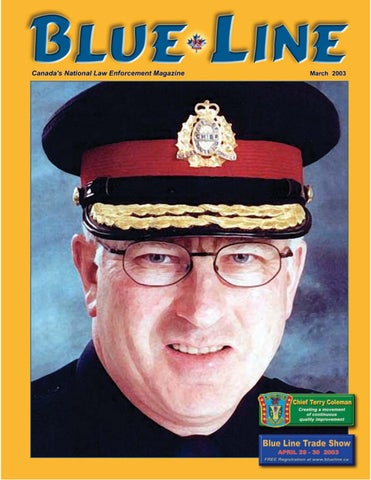
Moose Jaw chief inspires excellence
6
Doing it right the first time Moose Jaw Police Service
9
The journey to community policing... are we there yet? The journey to community policing
10
Collecting digital evidence
12
Police don’t see eye-to-eye on armour 16 Blue Line’s cross country survey proves policies vary dramatically Police career goal helps beat cancer
18
VITALITY Quantitative vs. qualitative performance measures
19
Outlaw Motorcycle Gangs
20
Cutting the costs of conflict
22
The power of the pen and the public’s right to know
23
Ontario Police College Pursuit Continuum Chart
24
POLICE LEADERSHIP FORUM Forum educates and inspires
25
BLUE LINE SEMINAR SERIES
26
Milwaukee police lieutenant retires at 86 27 DEEP BLUE 28 Top ten reasons for mental illness training On the million dollar road again
29
CASE LAW 30 • Unreasonable search product of arbitrary detention • Intent enough for care and control charge • Credibly-based probability enough for warrant New CSA respirator standard now in effect
33
PERSONAL COMPUTING When the bits hit the fan
34
INCREDIBLE
35
TECHNOLOGY Accurate fingerprinting without ink
36
CORRESPONDENCE
37
PRODUCT NEWS
38
Calgary receives police funeral coach
39
COMING EVENTS
40
Anti-terrorism operations centre opens 43
Printed in Canada by Janson Printing Service
ISSN #0847 8538 Canada Post - Canadian Publications Mail Product Sales Agreement No. 176796 March 2003
National Youth Justice Policing Award 44 THE BACK OF THE BOOK 46 Happiness is a warm, unregistered 4-by-4 3
When even the waiters in local restaurants, without any prompting, say your police service is one of the best in the country, you must be doing something right. In his six years at the helm, Moose Jaw Police Service Chief Terry Coleman, Blue Line’s featured chief, has turned the force around with common sense strategies. He asked residents what kind of policing they wanted and then made it happen and empowered officers to make decisions. Dave Brown went to Moose Jaw recently to talk to Coleman and profiles the chief and his department. Another long-time Coleman fan, Dr. Dorothy Cotton, tells us how he’s gone beyond lip service and implemented community policing as an organizational strategy. The first rule of collecting digital evidence is to first do no harm — it’s easy for first responders to destroy or render it useless if they don’t know exactly what to do. Debra Littlejohn Shinder wrote the book (literally) on handling ‘digital crime scenes’ — in an excerpt from Scene of the Cybercrime, she explains what to do until the techies arrive. One thing’s clear from Blue Line’s national survey of body armour policies — police forces don’t see eye-to-eye. Some have no policies at all or leave the decision on whether to wear armour up to individual officers; others have very specific rules. News editor Les Linder talked to 15 forces across the country and found some surprising results. In other stories, we continue our CISC series on organized crime, look at the costs of cutting conflict and hear how media training can help officers deal with the press, which is just one of the interesting seminars we have planned for the Blue Line Trade Show (April 29 & 30). In other regular features, Mike Novakowski has case law and Danette Dooley tells us how a New Brunswick man’s burning desire to be a police officer helped him overcome cancer.
The truth about journalism... and Greek weddings by Morley Lymburner “I was wondering if you would like to make some comments on television about the questionable leadership of Chief Julian Fantino.” I was taken by surprise and the question, from a Toronto television station producer who’d tracked me down at our west coast correspondent’s office, went unanswered for several seconds. “What makes you think his leadership is questionable,” I asked. “Well you know... the recent complaints of racial profiling and the drug squad officers under investigation. It pretty much points toward a leadership with no control over their officers.” I felt my blood pressure rising and knew it was time to take a few deep breaths before I continued laying waste to his argument. Several incidents discussed were issues that pre-dated Chief Fantino’s leadership — unfortunately it is he who must do the clean-up — but the one issue I found disturbing was the ‘racial profiling’ accusation. Over the past several years, Toronto has been rocked by gang warfare like it has never seen before. Almost all is due to a city living in an era unprecedented for the openness of the drug trade and a social polarization that simply exacerbates an already tough situation. In 1989 the job of Toronto police chief was hampered further by a police commissioner with an agenda. She and her board passed a regulation that prohibited the force from keeping statistics on crimes by race. There are not enough words to describe how flawed this was on so many levels. It created a crime analyst’s nightmare and a policing tragedy. Couple this with multiple layers of civilian oversight boards watching everything from brutality to discrimination and we have a department bogged down by extreme politics and turmoil. In the midst of this murky duck soup called Toronto is the curse of a newspaper with a consistent record of making headlines at the expense of local cops. This paper, believing that statistics should never get in the way of a point of view, conveniently sliced and diced some figures last year to show officers were racially biased. The conclusion was drawn from release information from arrest reports. The story drew very good newspaper sales but questionable conclusions from absolutely questionable statistics. Unable to find suitable numbers across the city, the writers decided to hunt for a location that would fit the story. The three Toronto police divisions selected (out of 17) revealed a release rate for black suspects charged with drug offences only half that of whites. The story continued to play loose and easy with other statistics and at the other end of it, I have a television producer asking me about “questionable leadership.” My response was one of shear logic. The March 2003
charges laid were in a part of the city that is a magnet to the drug trade and attracts blacks from the entire region who are looking for legitimate fun and entertainment. On evenings and weekends, this area swells with a racial mix unlike that in any other part of Toronto. Expecting it to have the same ethnic mix as other areas would be like suggesting that only six per cent of the attendees at a Greek wedding are Greek because that is the number in the city. The story was so flawed that it can only be described as preposterous. Toronto Police had made great strides improving communication with the ethnic mix of the community, despite regulations that worked against them. This wasn’t simply window dressing but hard work born from a universal police recognition that the best way to deter crime is to know your community and seek their support. No easy task in a city that
5
doesn’t want cops to know those demographics; all it wanted them to do is wait for the punch and react with political judiciousness. This same Toronto Police Service has an ethnic mix of police officers unparalleled by any other in Canada. Their recruiters are masters at seeking out suitable candidates that will help improve an already excellent picture. I have no idea why Julian Fantino ever wanted to be Toronto chief of police. For some reason he felt compelled to take the job but the city doesn’t deserve people of his calibre. There’s no doubt he is determined, loyal and courageous but I certainly do not envy the task that lays ahead of him — one made all the harder by yellow journalism, mindless journalists and political control freaks. So what about that television interview... no return calls yet! I never was much good at holding my breath.
Moose Jaw chief inspires excellence by Dave Brown are certainly one measure. Plus, you We have indiare dealing with a citizen who may vidual and colhave had little contact with the polective pride in lice over the years, so what to us our achievemay be a routine break-and-enter ments, whether may be the most heartbreaking thing large or small— that has happened to them in years,” from the Moose Jaw Police Servhe says. ice (MJPS) mission statement. “We put a lot of emphasis on When Terry Coleman took doing it right internally,” Coleman over as Moose Jaw police chief in says. Officers treat all calls as im1997, the service was stagnant, portant and are told to “do the best demoralized and lacked a sense of job you can. Do it right the first direction due to rapid turnover of time.” previous chiefs. Things were ripe Victim services is another visfor change and the city had found ible aspect of that response. Officthe ideal person to take on the chalers try to contact every single vicChief Terry Coleman — Contemporary policing at its best. lenge. tim, not just those involved with Coleman initiated and develmajor crimes. “We’re fortunate that oped a variety of programs while with the Calgary into decisions. “Any officer on the force can take we are able to do this with the size of our comPolice Service, including the first Canadian Crime an idea to the chief. He’ll work with you on munity. We can reach just about everyone.” Stoppers. He was one of the original investiga- putting together a proposal on what it involves, Every member of the Moose Jaw Police tors in the first dedicated sex crime units in the how much it costs and how we can implement Service is trained on what community policing country, led the Internal Affairs and Citizens Com- it. He has never said, ‘I’ll have to take that to the is all about and the core values of the organizaplaint units and was the human resources director board’ and then just left it.” tion. Coleman made sure that the mission statefor the 1997 World Police/Fire Games. Moose Jaw really appeals to self-sufficient ment is not only prominently displayed but freHe was accustomed to making high level officers with initiative, he says — the ones who quently used as an internal reference point. command decisions and achieving consensus don’t just whine about how ‘something should He admits that it is still a work in progress among community partners and his Master’s be done’ but can’t back up their proposals with — “we’re not perfect” — and knows that it takes thesis on ‘Strategic Human Resource Manage- facts. “Sure, it takes work,” he notes, but “when time to build up the trust of your own people. ment in Policing’ was used by other agencies we submit ideas, they might come back with a After consulting with the association, he as a reference. request for more details, and he highlights all changed from promotions based on seniority and One of Coleman’s first tasks was to begin of our spelling mistakes, but when it is finished, written appraisals to competency-based human the strategic planning necessary to take MJPS it is a very professional presentation. It’s hard resource management. This has modernized the into the next century. He immediately began to say no to — and he doesn’t.” way the force hires, transfers and promotes. consultations and work on developing a five-year Coleman tries to ensure everyone has a Coleman doesn’t sit on any of the boards who corporate plan and organizational strategy. stake in any changes. “Everything is imple- make these decisions, explaining that “I trained By 1999 he was ready to bring a five-year mented in ways that people can learn from them to do the job. I trust them to do it.” capital budget to the police board which in- them,” he says. Regular performance appraisals, which fell cluded both technological and physical imAnother early task was to find out what kind into disrepute in the ‘80’s, were revived as peprovements and a restructuring plan to move of police service the community wanted. Be- riodic assessment tools but aren’t linked to proofficers away from clerical duties and out on to fore attempting to match their needs, he had to motions or lateral transfers -- a self-assessment the street. find out what they were. Coleman received the for promotion system similar to the RCMP. One of the first things changed was the an- money to complete a community audit and met Moose Jaw’s membership is much younger tiquated radio system, a major source of dis- with residents and more than 80 different com- than when he joined in 1997. The fundamental satisfaction among members; some felt carrier munity agencies that the force now regularly principles of community policing are becompigeons would have been an improvement. ing ingrained into the culture and it has become, interacts with. Priorities were set. The force didn’t have a purchasing or Responding to the needs of the client is the as he says, “the way we do business now.” budget manager at the time so, rather than sim- essence of community policing, but Coleman Relations with the association haven’t alply buying what he liked, Coleman turned the points out that what is described as ‘community ways been entirely smooth but Coleman works acquisition back to the members, asking them policing’ is really ‘contemporary policing.’ To hard to keep them on a good footing, relying what type of radio system they thought was prove his point, he lists its principles: a focus on heavily on talking things through before goneeded. Not only did the force end up with one the client, consultation and collaboration with ing to grievances. Negotiations are often iniof the first digitally-trunked radio systems in the community, quality and valued service, con- tiated over morning coffee. When an opportuCanada, officers also gained valuable experi- tinuous improvement and change and teamwork. nity arises to send officers on labour negotiaence in researching products, dealing with ven“Very few officers really understand what tion courses, he sends an equal number of dors and writing requests for proposals. community policing is all about — including members from the executive and association. “In a big agency, you can pull members from many police executive,” says Coleman. “I preColeman is quick to credit the association various departments to work on acquisition fer to call it contemporary policing because com- and the praise is returned. Contract negotiations projects, but we’re too small for that. I needed munity policing just seems to confuse people.” that used to take years are now resolved in a to ask what they wanted in a radio system and However you refer to it, the philosophy matter of months, notes McKenna. also to encourage them to come forward with “drives everything we do,” he says. Not every decision of the chief is popular other ideas in the future,” says Coleman. Responding to the needs of citizens begins on the streets, of course. While most can unSgt. Rick McKenna, veteran officer and head with police keeping their own house in order. derstand the reasoning behind Moose Jaw’s ‘noof the police association, has seen a lot of chiefs “Clearance rates are one example of how we pursuit’ policy, they still worry about not being come and go over the years and likes how strive for quality service. They are not the only able to do their job. On the other hand, they Coleman gives everyone a chance to have input measure of a police force’s efficiency, but they admit that it is hard to beat a radio signal, espeMarch 2003
6
cially with the new digital system in place. Moose Jaw Police have implemented a number of changes designed to get officers away from desks and out into the community. They use the Versaterm reporting system and every report is now electronic. It took some work to move away from redundant paper chasing, says Coleman. “We had to change a few habits around here… including my own,” he admits. Mug shots are digitized and court assists and bookings are automated. The force bought one of the first Dictaphone Freedom systems in Canada to record all telephone conversation; now every officer can bring up a phone call on a desktop PC. Not surprisingly, frivolous complaints have dropped off substantially. When Moose Jaw began discussions leading to the acquisition of video cameras for all its cruisers, Coleman merely had to point out the positive experience they all had with the digital telephone recordings. He considers it solely an officer-safety and protection issue. As chief, he has yet to look at a single tape. Next on the list of acquisitions will be mobile display terminals, laptops and GPS tracking systems in every unit. Coleman believes one of the keys to getting the proper tools to do the job lies in maintaining a high profile within the community. He regularly lectures in the police studies program at the University of Regina and serves on many community advisory boards and committees. He chairs the Criminal Intelligence Service of Saskatchewan and co-chairs the commit-
March 2003
tee determining the impact of organized crime in Saskatchewan. He’s also a member of the Human Resource Management Committee of the Canadian Association of Chiefs of Police and regularly conducts workshops on succession planning and management. He worked in partnership with the University of Regina and the Saskatchewan Police College to develop a degree program in police studies and encourages Moose Jaw officers to attend the program. Most importantly, he has revived a struggling police force and encouraged members to pursue improvement with the same zeal that he does. He proudly points to a model of Moose Jaw’s brand new police motorcycle on his desk as an example of how an officer can take the
7
initiative for change and convince the executive and the city with well-reasoned arguments. Even McKenna says it’s actually fun to come to work every day. “Lots of people say, ‘when I get to be chief, I’ll change this and this and this.’ Now, you don’t need to be chief to do that. Show the administration where change needs to be made, put together a package to make your case and, if it’s that obvious to you things could be better, it will be obvious to them too.” Coleman serves as an example of how a chief may be able to do good work, but he also shows how an exceptional chief can inspire his/ her people to do exceptional work. Dave Brown is a regular Blue Line columnist. He can be reached at firearms@blueline.ca.
Doing it right the first time Moose Jaw Police Service — the pride of their community by Dave Brown The citizens of Moose Jaw, Saskatchewan are justifiably proud of their police service. In fact, it was a waiter who found out that I was in town to profile the local police service and chief, and proudly declared that Moose Jaw has one of the best forces in Canada. (This was a refreshing comment and a welcome change from the usual demand for cash up front that most waiters make after seeing me.) The concept of community policing has been implemented in many different ways across Canada but perhaps the true test of the word ‘community’ is when the citizens actually take pride and ownership in ‘their’ police service. The citizens of this city of 35,000 seem to want for very little. In addition to a top-notch police force led by Chief Coleman, they boast an active casino, a world-famous mineral springs spa, an attached four-star hotel and some excellent restaurants. No less than Al Capone and other mobsters are said to have frequented the city during Prohibition, using an elaborate series of tunnels below the streets of the town. (Local officials denied their existence for years but the denials became difficult to maintain when part of Main Street collapsed, leaving an unsuspecting motorist planted in a deep hole.) As a major rail link to the United States, Moose Jaw was ideally situated to become a bootlegging hub. The city’s remote location also made it a good place to escape U.S. police and it became something of a gangsters’ resort, with regular visitors from the Chicago mob. It didn’t hurt that the entire local police force, including Chief Walter Johnson, was in cahoots with the bootleggers. Local historians say Johnson ran Moose Jaw like a personal fiefdom for 20 years, and even the mayor dared not interfere. The tunnels were used for gambling, prostitution and warehousing illegal booze. One tunnel is said to have gone right under the CPR station and opened into a shed in the rail yards, making it possible to load and unload rail cars without being seen by unfriendly eyes. Things have changed a lot since the wild, frontier town days of the 1930s. With a book strength of 58 officers plus another 20 support staff and 20 volunteers, Moose Jaw Police has an interesting mix of experience and youth. It has two deputy chiefs, two staff sergeants, five sergeants and eight corporals, a rank other agencies have done away with. Not Chief Coleman though - he sought to increase the number of corporals and says they’re actively used “to give officers experience in supervision and to act as a pool of talent for the sergeants rank.” Every officer reflects the traditional management adage that if you set the bar high enough, the best will rise to meet the challenge. That a waiter, with probably little police contact outside of the odd coffee break, would be so proud of them is a reflection on the importance the service places on maintaining positive contact with the community. The force understands that crime stats don’t March 2003
tell the whole story. A seemingly minor problem or complaint may appear to be insignificant but perceived by the complainant as a very real and serious problem. Traffic offences and property crimes, for example, are two of Moose Jaw resident’s biggest concerns, says Sgt. Rick McKenna. “We tend to have a polarized population,” he notes, with “a unique mix of older citizens and young people.” The city is home to a large technical college that guarantees Moose Jaw’s bar strip is kept hopping every night of the week. Many retirees find Moose Jaw’s size to be an ideal combination of small-town familiarity and large-town services. The police service initiated a traffic safety unit to deal with the perception that there were a lot of ‘young kids running around hitting people’ and concentrated on solving as many breakand-enters as possible. Street officers are relied upon to handle a case from investigation to solution. “We want officers who can solve B&E complaints, not just take reports like insurance adjusters,” says McKenna. “Everyone has seen CSI on TV, but we have to explain how things are a little different in the real world. I think we tend to be a lot more team-oriented than other centres and we want everyone to care about what our perception is as a police service.” He notes that his officers also tend to go a little beyond the call of duty; “find a fingerprint and you’re a hero. Match a print to a bad guy and they’ll love you for life.” They also know that property crimes are symptomatic of a larger drug problem. Residents may not make the connection but police certainly do. The team approach to policing means that intelligence gained by street officers is shared quickly with colleagues and supervisors. To maintain the peace, especially after older citizens have gone to bed and the younger ones are only just getting up, they rely on a very visible presence on the street. A mix of marked Ford and Chevrolet cruisers are used, and shift supervisors spend as much time on the streets as possible, usually in the new Expedition. It’s amazing how parking several cruisers in front of the loudest bars in town can lead to empty 9
parking lots and long lineups of busy cabs at closing time every night. One police vehicle they chose not to trot out for display to Blue Line on a cold winter night was their shiny new Harley Davidson motorcycle. That wasn’t surprising, especially considering the city could be accused of respecting its police more than its motorists — it seems snow is cleared from city streets only when spring leaps into action – infinitely reliable, if not very quick. Not only is the new 2003 anniversary-edition the first police motorcycle the city’s had in 30 years, it has a serial number of 003, which is highly coveted. Coleman proudly refers to it as an example of how his officers are encouraged to come up with their own initiatives and then be willing to sell their ideas to the executive. “If you keep turning down people with new ideas, they stop coming up with them,” he observes. Reaching the community doesn’t end with traffic and parades. Programs begin with school resource officers who spend a lot of time positively interacting with students. The service has also implemented both a ‘citizen police academy’ and ‘Kids & Cops’ program, which offer a behind-the-scenes look at police work. A school safety patrol member from each district is selected once a month and taken out to play laser tag or miniature golf. The sign-up sheets for these community initiative programs fill up quickly, reports Sgt. McKenna, who warns people that “you better get your name in early.” Even the Cops for Cancer program has a Moose Jaw twist; citizens bid on a chance to shave the head of an officer and the sale is conducted by an officer who’s also a trained auctioneer. The event is kept very fun and lighthearted, despite the serious cause. While Moose Jaw Police deal with the crimes and complaints experienced by any other city of comparable size, the care and teamwork shown by officers is not always evident elsewhere. Not only does the city have one of the most unusual tourist attractions this side of a Florida interstate, they also have a police service its citizens can be proud of. Dave Brown is a regular Blue Line columnist. He can be reached by eMail at: firearms@blueline.ca.
The journey to community policing... are we there yet? Chief Coleman’s cross Canada survey shows some revealing insights by Dr. Dorothy Cotton Ph. D., C. Psych. Canadian policing has been undergoing a fundamental shift since the 1970s, moving from traditional policing to the contemporary or ‘community policing’ model. It’s a rare police service nowadays that doesn’t endorse the principles of community policing, at least in the abstract — but exactly how far down this road have we come and to what extent is the journey complete? Have most police services in Canada been able to successfully implement the basic tenets of community policing? For the answers, talk to Chief Terry Coleman of the Moose Jaw Police Service. He’s got data, one of the essential prerequisites for both initiating and measuring change. His recent masters degree thesis took a good look at the isChief Terry Coleman sue and seems to indicate that although we’re making good time, we still have quite a ways to go. Switching to community policing means changing cultures and, as with any culture change, it’s necessary to come up with a comprehensive organizational strategy which reflects this commitment. Obvious as this first step in the process may seem, only 19 per cent of the 48 police services Coleman surveyed — they range in size from under 50 to over 3,000 members — identified community policing as an organizational strategy; a sobering statistic. That’s not to say that there’s not a stated commitment to community policing in general; over 90 per cent of the services described themselves as community policing agencies. What does that mean? Have we really gone beyond lip service? The good news is that a majority of police leaders do identify community policing as at least a philosophy rather than an add-on program — but Coleman would argue the failure to implement such a philosophy into a formal organizational strategy means that change is unlikely to occur. Just thinking about it and mouthing the words does not change a culture. Indeed, if you look a little further into the structures that might support a fundamental culture change, you find some pretty glaring gaps. Getting from traditional to community policing is like taking a trip and having a philosophy akin to knowing what your destination is. The organizational strategy is the route. There are a variety of ways you can get from, say, Moose Jaw to Kingston. First you have to decide that you really want to go (the philosophy), then figure out how to get there (the organizational strategy). Even if you get as far as determining the route, you have to find a way to get there (plane, train, boat, carrier pigeon) and figure out if you are making good time (mile markers). In the world of organizational culture change, the mode of transportation is the strategic human resources plan. Logically, it needs March 2003
to be linked to the destination or the organizational strategy. Unfortunately, only 58 per cent of police services in Coleman’s survey had both an organizational strategy and a human resources strategy linked to it. The kind of disconnect found in the other 42 per cent can result in decisions like opting to take a boat from Moose Jaw to Kingston. There’s nothing inherently wrong with boats or travelling to Kingston — it’s just that you can’t get there from Moose Jaw by water. It’s a bit odd when you think about it. Police officers are retiring at an unprecedented rate these days. While this degree of turnover represents a loss of much knowledge and organizational history, it also presents a prime opportunity for change. Police services have ‘closed personnel’ systems; that is, all positions and ranks are filled, with rare exceptions, from those hired as recruit constables. Therefore, what better way to change an organization than to have the chance to select new members who represent the values and ideals inherent in the new culture? There’s a but though, and it’s a big one — you have to be able to identify and quantify those characteristics. The best way to do so is by employing behavioural competencies in hiring and promoting, though that, by itself, isn’t enough. They also have to reflect and be congruent with the organizational strategy. Although some 60 per cent of services surveyed reported using behavioural competencies in hiring and promotion, only about 10 per cent of these derived their competencies from the mission, vision and values of the police service. So much for change. If you hire the same people you always hired and promote the same kind of people you always promoted, you’re likely to get — PRESTO!! — the same kind of police service you always had. What do the people you are serving think about what you’re doing? You don’t know if you don’t ask — and only 54 per cent of the surveyed services are asking. In the same vein, only 56 per cent ask their employees how they feel about things. Putting all these structures and human resource activities into place isn’t a simple procedure though. Indeed, who has the skills? What we’re talking about here isn’t exactly the purview of your average police officer, yet that’s who 27 of the 48 services surveyed had doing 10
the HR function — and in 21 of these 27 services, the officer in charge had no specific HR credentials. In case you think that’s because many services are too small to afford a civilian HR specialist, it’s worth pointing out the survey found absolutely no relationship; some of the largest services used untrained officers and some of the smallest (under 50 sworn members) used trained civilians. Destination, route, mode of transportation, monitoring progress — all key aspects of the move to community policing, but everyone who’s ever taken a family trip knows that there’s one more consideration here — and that’s the fighting and criticism coming from the back seat of the car. There’s no doubt that if anything goes amok in the journey, you’ll hear about it. How do you keep the troops happy, in line, moving in the right direction and committed to the trip? It’s the frontline officer who is empowered, developed and given responsibility under a community-policing model. If you want them to embrace and act consistently with it, then performance evaluations, rewards and promotions must be consistent with the organizational strategy. That means the traditional practice of rewarding those who hang around long enough and don’t cause too much trouble may not be the route to go. Only three of the 48 services surveyed reported having salary arrangements based on performance and more than half didn’t have reward or recognition systems that focused on performance. So there are gaps; the organizational and supporting human resource strategies that necessarily drive a move to community policing are not as evident and widespread as would be ideal. As Coleman notes: For a culture change to occur in which ‘community policing’ is both successful and sustained, it is the philosophy of community policing that must be operationalized (implemented) as an organizational strategy, impacting all strategies of the organization, including human resources. The absence in some police services… of any linkage between staffing processes, performance measurement, learning and reward systems with the organizational strategy… also suggests a failure to appreciate the necessity of having a clear human resource strategy… Additionally, the absence in many police services of outcome-focused measurement systems and systems to encourage and support innovation, creativity and continuous improvement does not bode well for a culture change to contemporary policing. Ultimately, high quality service will be delivered when police services are staffed with high quality people within whom the philosophy and strategies of contemporary policing are firmly embedded and readily apparent. Are we there yet? Not exactly, but there is no doubt that the trip has begun. Dr. Dorothy Cotton is a regular contributing editor of Deep Blue in Blue Line Magazine. She can be reached at deepblue@blueline.ca.
OTTAWA — An Ontario Superior Court ruled in January against Ottawa’s plan to allow marijuana to be used by some people to ease the pain of chronic diseases. The court says the rules are unconstitutional because the exemption covers a certain number of people, meaning other more deserving people might be left out, adding that the rules violate the constitutional right to security of the person. The court is giving the federal government six months to fix the regulations, after which time they will be no longer valid. *** WINNIPEG — Ralph (Junior) Moar, a former Canadian amateur middleweight champion serving prison time for shooting a teenager in the head, and Peter (House of Pain) O’Kane, a detective with the Winnipeg police gang unit, share a passion for boxing but live on opposite sides of the law. The two were scheduled to fight last year before their bout was called off by police management. Moar and O’Kane met again briefly in January at Stony Mountain Institution, where Moar is doing a four-year stint. Officers laid five firearms charges against Moar, 24, a member of the Zig Zag Crew, a gang known as foot soldiers for the Hells Angels. Several other men, all Hells Angels associates, have been charged with similar offences. Last year, O’Kane and Moar were set to fight one another at Fort Garry Place, but O’Kane’s boss pulled the plug on the bout, citing a conflict of interest. At the time, Moar was awaiting sentencing for the shooting. The youth, who was wounded behind the ear, made a full recovery. *** STEINBACH — RCMP in Manitoba are being trained to use tasers. The weapon sends 50 thousand watts of electricity through a person’s body. It has a six-and-a-half metre range and does not cause permanent injury. All detachments in the province are being provided with tasers at a total cost of 42-thousand dollars. *** EDMUNDSTON — The City of Edmundston and its police officers’ union came to an agreement in January that will see the number of officers temporarily laid off reduced from 11 to five. The agreement will see the union withdraw a grievance to the province’s Labour and Employment Board that contended the temporary layoffs are an “unfair labour practice.” The union will also refrain from filing any grievances over the notice of layoffs and scheduling issues related to the layoffs. Faced with a budget shortfall of about $1 million, the city announced in November it would temporarily lay off the 11 officers. The city had hoped to save more than $150,000 by placing the 11 officers on the callback list. Laying off five officers for the first three months of the year will only yield a saving of $75,000. “Because of the reduction in the number of police officers being placed on callback, the police force is going to have to find new ways March 2003
to make savings because it will have to operate with the same budget as in 2002,” Mayor Jacques Martin was quoted as saying. The mayor said the union will help it find ways to cut another $75,000 from the force’s expenses. *** TORONTO — As the political debate over the federal government’s controversial gun registry continues to rage, Canadian cops on the beat say they are divided over whether the new system will help them fight crime. Many officers who’ve been discussing the issue over their daily coffee believe the registry is already a bust. “It just seems like it’s been an exercise in futility. We already have legislation in place to deal with legitimate gun owners,” Edmonton police Sgt. Patrick Tracy was quoted as saying of the system, which became operational on Jan. 1. Originally projected to cost about $2 million, the federal auditor has said the price tag for registering Canada’s eight million guns is on track to balloon to $1 billion by 2005. “Most of us in our office certainly feel that the gun registry has been a colossal waste of time and money,” said one Toronto detective who spoke on the condition of anonymity. He said the money would have been better spent fighting gun smuggling. Increasing costs have prompted the Ontario Provincial Police Association, which supports the registry, to plan a review of its position. Toronto Police Chief Julian Fantino has decried the system as a waste of cash. However, the Canadian Association of Chiefs of Police endorses it. The registry will allow guns to be traced in much the same way cars are, an association spokesman said. For example, if police stopped a car with a shotgun in the back seat, the registry would allow officers to immediately determine if the weapon had been stolen. Alternatively, if police came upon a cache of stolen property and found a firearm, they would be able to trace it and determine when it was taken and whether it might have been used in other crimes. Some officers agree that the registry will be a useful tool in their investigative arsenal. Corp. Murray Mashford, with the Saanich force in British Columbia, said the registry will help his colleagues respond more safely to potentially dangerous situations. “When we are dispatched to a domestic violence situation ... it’s nice for the members on the road to know if there are guns registered to the occupants of the house,” Mashford was quoted as saying. He said he doesn’t see the harm in having everybody register the weapons they own. The majority of police officers with this department would agree with that, Mashford said. Other officers dismiss such scenarios. “The criminal is going to be behind the door with (guns) that mostly, as far as we’re concerned, aren’t going to be registered. (The registered) guns aren’t the ones that we have to be concerned about,” Tracy was quoted as saying. 11
Collecting digital evidence ten notes and logs related to the operation of the computers. This includes printers, scanners and all storage media: diskettes, optical discs (CDs, DVDs and so on), tapes, Zip or Jaz and other removable disks and any extra hard disks that might be lying around. • Maintaining integrity of the evidence - Investigators should continue to protect the evidence as preparations are made to preserve volatile evidence, duplicate the disks and properly shut down the system. The investigator should oversee the actions of the crime scene technicians and convey any special considerations that should be taken based on the nature of case and knowledge of the suspect(s).
by Debra Littlejohn Shinder A network administrator will often be the first person to become aware of a cybercrime in a corporate setting and the IT incident response team (if the company has one) will take the initial steps to stop the crime in progress and freeze the crime scene before law enforcement personnel take over. Even after the police are called in, the process of collecting digital evidence usually involves several people: the first responders (officers or official security personnel who arrive first at the crime scene), the investigator or investigative team and the crime scene technicians and specialists who are called out to process the evidence. It is important that one person be designated in charge of the scene who has the authority to make final decisions as to how the scene will be secured, how the search will be conducted and how the evidence will be handled. This is usually the role of the senior investigator. It is equally important that each member of this team understand his or her role and adhere to it. The ability of the team to work together is essential to the successful collection of evidence. First responders First responders should follow the same edict to which aspiring physicians swear when they take the Hippocratic oath: First, do no harm. Unless specifically trained in computer forensics, people who are first on the scene should not attempt to do anything with or to the computers other than protect them from tampering or damage. It is very easy for technically astute criminals to plant Trojan horses or otherwise ‘rig’ their computers to automatically destroy evidence when shut down or restarted by anyone other than themselves. The first responder should not attempt to shut down or unplug the computer or access it to look for evidence. The first responder should be concerned with the following tasks: • Identifying the crime scene - Officers who arrive first at the scene should identify the scope of the crime scene and establish a perimeter. This might include only one area of a room or it might include several rooms or even multiple buildings if the suspect is working with a complex setup of networked computers. First responders can begin compiling a list of systems that might have been involved in the criminal incident and from which evidence will be collected. • Protecting the crime scene - In a cybercrime case where digital evidence is sought, all computer systems—including those that appear to be powered off or nonfunctional—should be considered part of the crime scene, as should laptop, notebook and other portable computers (including handheld computers and PDAs). The items subject to seizure may be limited by the wording of the applicable search warrant, but first responders should cordon off and protect as much of the computer and electronic equipment as possible March 2003
and wait for the investigator in charge of the case to determine what equipment, if any, will be excluded. • Preserving temporary and fragile evidence In the case of evidence that could disappear before investigators arrive (such as information that is on the monitor and changing), first responders should take any possible steps to preserve or record it. If a camera is available, photos of the screen will preserve a record of what was there. If no camera is available, officers should take detailed notes and be prepared to testify in court as to what they saw. Investigators’ role The IT incident response team might have already begun to collect evidence in some cases. If so, the best practice is to have one person from the IT team coordinate the hand-over (and explanation, if necessary) of that evidence with one person from the police investigative team. The investigator (or the investigative team) is generally responsible for coordinating the activities of all others at the scene and will be responsible for the following: • Establishing the chain of command - The investigator in charge of the scene should ensure that everyone else is aware of the chain of command and that important decisions are filtered through him or her. Computers and related equipment should not be accessed, moved or removed without explicit instructions from the senior investigator. The investigators shape and control the investigation. If the investigator in charge has to leave the scene, he or she should designate a person remaining on the scene to be in charge of the scene and stay in close contact with that person until all evidence has been collected and moved to secure storage. • Conducting the crime scene search - An investigator should direct the search of the crime scene, which may be carried out by investigators or by other officers. If the search warrant allows, officers should look for all computer hardware, software, manuals, writ12
Crime scene technicians’ role Crime scene technicians responding to a cybercrime case should, if at all possible, be specifically trained in computer forensics. Computer forensics specialists must have a strong background in computer technology with an understanding of how disks are structured, how file systems work and how and where data is recorded. Generally, crime scene technicians will be responsible for the following tasks (although these may overlap with those of the investigators): • Preserving volatile evidence and duplicating disks - Volatile data is that which is in the computer’s memory and consists of processes that are running. Disks should be duplicated prior to shutdown, in case the system is rigged to wipe the disks on startup. • Shutting down the systems for transport Proper shutdown is important to maintain the integrity of the original evidence. One school of thought says the computer should be shut down through the standard method (closing all programs and so on) to avoid corrupting files. Another says that after ensuring that no defragmentation or diskchecking program is running, you should shut down the computer by disconnecting the power cord, to prevent running of self-destruct programs that are set to run on shutdown. UNIX computers usually should not be abruptly shut down this way while the root user is logged on because doing so can damage data. Some forensics experts recommend that the technician change accounts using the su command or, if the root password is available, that the sync;sync;halt command be used before powering off. If the system is turned off, the investigative team generally should seize the computer and boot it in a controlled environment. When you do bring the system up, you should not boot from the computer’s hard disk but instead boot from a controlled boot disk to prevent the operating system from writing to the hard disk, so that crucial data won’t be overwritten. Then you can create a bitstream image of the hard disk. • Tagging and logging the evidence - All evidence should be tagged and/or marked with the initials of the officer or technician, time and date collected, case number and identifying information. The evidence on the tag or mark should also be entered in the evi-
dence log. • Packaging the evidence - Computer evidence, especially any containing exposed circuit boards (such as hard disks), should be placed in antistatic bags for transport. Paper documentation such as manuals and books should be placed in plastic bags or otherwise protected from damage. • Transporting the evidence - All evidence should be transported as directly as possible to the secure evidence storage locker or room. During transport, the evidence should not be allowed to come into contact with any equipment that generates a magnetic field (including police radios and other electronic equipment in the squad car) nor left in the sun or in a vehicle or other place where the temperature rises above about 75 degrees Fahrenheit. The chain of custody must be meticulously maintained during transport. • Processing the evidence - When the duplicate disk is brought back to the lab, the disk image can be reconstructed and the data analyzed using special forensics software tools. Computer seizure checklist Every case is different, but some general guidelines should be followed when computer equipment is seized as evidence in a criminal case. Following these procedures will help protect the legal integrity of the evidence and, equally important, will help prevent loss of essential evidence. These procedures assume that the computer is turned on when you encounter it. 1.Photograph the monitor screen(s) to capture
March 2003
the data displayed there at the time of seizure. Be aware that more than one monitor can be connected to a single computer; modern operating systems such as Windows 2000/XP support spreading the display across as many as 10 monitors. Monitors attached to the computer but turned off could still be displaying parts of the desktop and open applications. 2. Take steps to preserve volatile data. 3. Make an image of the disk(s) to work with so that the integrity of the original can be preserved. This step should be taken before the system is shut down, in case the owner has installed a self-destruct program to activate on shutdown or startup. 4. Check the integrity of the image to confirm that it is an exact duplicate, using a cyclic redundancy checker or other program that uses a checksum or hashing algorithm to verify that the image is accurate and reliable. 5. Shut down the system safely according to the procedures for the operating system that is running. 6. Photograph the system setup before moving anything, including back and front of the computer showing cables and wires attached. 7. Unplug the system and all peripherals, marking/tagging each piece as it is collected. 8. Use an antistatic wrist strap or other grounding method before handling equipment, especially circuit cards, disks, and other similar items. 9. Place circuit cards, disks and the like in antistatic bags for transport. Keep all equipment
13
away from heat sources and magnetic fields. Preserving digital evidence Digital evidence is, by its nature, fragile. Some data is volatile—that is, it is transient in nature and, unlike data stored on disk, will be lost when the computer is shut down. Data on a computer disk can be easily damaged, destroyed, or changed either deliberately or accidentally. The first step in handling such digital evidence is to protect it from any sort of manipulation or accident. The best way to do this is to immediately make a complete bitstream image of the media on which the evidence is stored. A bitstream image is a copy that records every data bit that was recorded to the original storage device, including all hidden files, temp files, corrupted files, file fragments and erased files that have not yet been overwritten. In other words, every binary digit is duplicated exactly onto the copy media. Bitstream copies (sometimes called bitstream backups) use CRC computations to validate that the copy is the same as the original source data. For more information, see Bit Stream Backup - defined (www.forensics-intl.com/def2.html). The ‘mirror image’ should be an exact duplicate of the original and the original should then be stored in a safe place where its integrity can be maintained. The copy is made via a process called disk imaging. In some cases,
Mounties use trucks & bugs to nab speeders RCMP in Alberta are planning to use more civilian vehicles for highway radar traps. RCMP say it will make it easier to catch the reckless, impaired and unbelted drivers most at risk of dying or killing others. “One of the things that we have talked about is a non-traditional type of unmarked car - pick-up truck, minivan, Volkswagen Beetle,” Staff Sgt. Steve MacDonald, traffic co-ordinator for RCMP’s K-Division in Edmonton, was quoted as saying. Ontario Provincial Police used covert vehicles to target careless drivers on busy Highway 401 in a pilot project with “outstanding” results, MacDonald said. The new tactic is part of a sweeping change in how RCMP will enforce traffic on highways. Traffic units have been analysing collision statistics for more than two years to identify the deadliest driving habit in each region and the appropriate tactics to curb them. One result is an admission that RCMP have paid too much attention to speeders and not enough to other motorists breaking the law. On the main highway between Edmonton and Calgary, for instance, the biggest complaints are aggressive and careless drivers, MacDonald said. March 2003
evidence could be limited to a few data files that can be copied individually rather than creating a copy of the entire disk. In the following sections, we discuss both disk-imaging and filecopying techniques. We also look at the importance of ensuring the integrity of disks used for imaging or copying and we consider environmental factors that can affect the integrity of evidence, as well as preservation concerns related to specific types of storage media. Preserving volatile data The data that is held in temporary storage in the system’s memory (including random access memory, cache memory and the onboard memory of system peripherals such as the video card or NIC) is called volatile data because the memory is dependent on electric power to hold its contents. When the system is powered off or if power is disrupted, the data disappears. According to the IEEE Internet draft titled Guidelines for Evidence Collection and Archiving, the most volatile evidence should be collected first. This makes sense because the most volatile evidence is the most likely to disappear before it can be documented or collected. The draft lists the ‘order of volatility’ as: 1. Registers and cache 2. Routing tables, ARP cache, process tables and kernel statistics 3. Contents of system memory 4. Temporary file systems 5. Data on disk Collecting volatile data presents a problem because doing so changes the state of the system (and the contents of the memory itself). Some experts recommend that investigators or crime scene technicians capture such data as running processes, the network status and connections and a ‘dump’ of the data in RAM, documenting each task or command they run to do so. Some of this work can be done by running such commands as netstat (on both Windows and UNIX systems) and nbtstat (on Windows only) to view current network connections. The arp command will tell you what addresses are in the ARP cache (and thus have recently connected to the system). The dd command can be used to create a snapshot of the contents of memory on UNIX machines and the ps command can be used to view the currently running processes. On NT/2000 machines, the downloadable pslist utility can be used to list running processes, or they can be viewed in Task Manager. Other commands such as ipconfig (Windows) or ifconfig (UNIX) can be used to gather information about the state of the network. These programs should be run from a special forensics CD that you bring with you (instead of running the same commands from the hard disk of the suspect computer) and should not require any programs or libraries from the computer’s hard disk to run. This article is excerpted from Scene of the Cybercrime: Computer Forensics Handbook (Syngress Media) by Debra Littlejohn Shinder, a former police sergeant and academy instructor turned IT professional. She can be reached at dshinder@sceneofthecybercrime.com. 14
Peel Region Chief Noel Catney has expressed concerns about a flood of cheap illegal guns in Canada. Catney says the import and trafficking of firearms is just as much as a problem for them as investigating illegal drugs and the cost of guns on the streets has declined drastically over the years. Toronto Police Inspector Rick Gauthier says about one-thousand crime guns were seized last year in the city. Former Calgary police officer Shon Marsh is suing Calgary Police Chief Jack Beaton, saying he was forced to quit his job after less than two years because of what he calls racist and tyrannical treatment from his superiors. Marsh was one of the first officers hired from other police departments around the country in 1998 in the Calgary Police Service’s lateral-entry program, which was aimed at recruiting seasoned officers. Marsh, who is Metis, alleges he was singled out by supervisors bent on getting him to leave the force because they didn’t agree with the lateral-entry program. William Leonard Ostler, who became a B.C. provincial court judge without attending a day of law school, died at age 87 on Dec. 31 in Victoria, BC. Ostler was one of the last lay judges in Canada, died Dec. 31 in Victoria. Ostler served 25 years as a provincial court judge, or the position’s equivalent. His success on the bench was such that the University of Victoria conferred an honorary doctor of laws degree on him in 1986. Ostler educated himself in the law to a degree that impressed colleagues and those who appeared before him. Toronto Police Chief Julian Fantino wants Ottawa to toughen the penalties for crimes involving firearms. Fantino says anyone who uses a gun to commit a crime should face a mandatory sentence of at least 10 years in prison. He is also calling for the creation of a task force to halt the flow of illegal firearms into Ontario. He would also like the federal government to suspend the gun registry program. Fantino says it was no help in tracking down the people responsible for the 28 shooting deaths in Toronto last year. Former RCMP officer Jocelyn Hotte is appealing his conviction on a first-degree murder charge in the shooting death of his ex-girlfriend. A jury convicted Hotte in December of killing Lucie Gelinas as she drove her car on a Montreal-area highway in June 2001. Hotte, who helped guard Prime Minister Jean Chretien when he was in Quebec, also was found guilty of three counts of attempted murder. Cst. Martin Cardinal has been convicted of assault after using unnecessary force when he slammed an intoxicated woman’s face into the trunk of a police cruiser, a judge said in January. The convincing piece of evidence was a videotape shot by a neighbourhood resident that caught the 12-second incident involving the Ottawa police officer. Cardinal is to be sentenced March 28. Commemorative medals for the Queen’s Jubilee have been awarded to Correctional Service of Canada staff across the country. A complete list of Canadian Jubilee medal recipients is available for viewing on the Governor General’s web site (www.gg.ca).
Delays in Ontario court system shakes public confidence The increasing delay between an arrest and a verdict in the province’s courts is shaking public confidence in the legal system, Ontario’s top judge said in January. Speaking at the annual opening of the province’s courts, Chief Justice Roy McMurtry said the Charter of Rights has created a more complex legal environment and led to alarming delays. “There are excessive delays between arrest and the conclusion of the trial let alone disposition of any appeal. (It is) a matter of extreme concern,” McMurtry was quoted as saying. McMurtry said the delays affect “the integrity of the justice system” as well as public confidence in it. So far, he noted, Ottawa has failed to act on a resolution by the Canadian Judicial Council to study the causes. He said the increasing number of people charged with criminal offences who appear before the courts without lawyers is another major concern.
“Such cases carry with them additional administrative and judicial involvement to ensure fairness and a timely resolution,” McMurtry was quoted as saying. He added there is also a growing number of people in the civil justice system who aren’t represented. David Young, Ontario’s attorney general, said access to civil justice was the motivation behind legislative changes last month to allow contingency-fee agreements by which lawyers are paid only if their clients win. “Middle and lower income Ontarians should not have to mortgage their family’s
A Canadian car stolen every three minutes On average, car thieves stole an auto every three minutes during 2001, Statistics Canada reported in January. There were just over 170,000 stolen vehicles reported to police that year, an average of about 470 a day. That amounted to a five per cent increase over 2000, an upturn after four years of decline. The Canadian rate of car theft was 26 per cent higher than that of the United States. This costs Canadians about $1 billion a year, the Insurance Bureau of Canada said. The losses include 600 million in insurance premiums and $400 million in health care, police, court and corrections costs. Some regions were more vulnerable than others. Between 1991 and 2001, theft rates doubled in London and Hamilton, tripled in Regina and more than quadrupled in Winnipeg. Manitoba’s theft rate was twice the national average and the highest among the provinces. The lowest rates were recorded in the Atlantic provinces. In Regina, there were 1,996 thefts for every 100,000 people in the population. In St. John’s, the rate was 183 per 100,000. About one-quarter of the vehicles were never recovered and the statistics agency said that suggests these thefts were connected to organized crime rings. In the 1980s, police solved one in four car thefts, but that rate fell to about one in eight in the last six years. The popularity of sport utility vehicles and vans has been growing among thieves as well as consumers, the report said. Theft of trucks rose 59 per cent between 1991 and 2001, while car thefts rose only three per cent. About 40 per cent of those charged with auto theft were between the ages of 12 and 17, with 16 the most common age.
March 2003
15
future to exercise their legal rights. With this legislation in place, they won’t,” Young was quoted as saying. Young also said recent legislation creating provincially appointed public defenders will strengthen the Legal Aid system and ensure that fewer accused are unable to find lawyers. Heather Smith, chief justice of Ontario’s Superior Court, called for the appointment of more judges, and warned against further expansion of the province’s family court system unless adequate resources are put in place beforehand.
Police don’t see eye-to-eye on armour Blue Line’s cross country survey proves policies vary dramatically by Les Linder — Blue Line staff writer Safety and comfort are the key factors many Canadian police agencies look at when making policies and issuing body armour, a Blue Line survey shows. Interviews with 15 Canadian police services show there are several schools of thought when it comes to instituting policies on types of armour officers should wear or whether to use internal or external carriers. Surprisingly enough, a majority of agencies didn’t even have policies requiring officers to wear armour. Peel Regional Police Service is one of several agencies with an internal body armour only policy for all officers and strictly enforces it. Cst. Stephen Rowe says there are two key reasons why. “We don’t want to be providing anyone with a target to those who actually want to shoot us,” Rowe says. “They probably already know we have armour and a rough idea what areas it protects, but an external carrier outlines exactly where those areas of protection are.” The force is concerned a suspect may aim and shoot for an unprotected part of the officer’s body, Rowe adds. “Another important point is that the internal armour simply looks a lot better on an officer. It isn’t baggy and sloppy-looking like many external carriers,” he says, adding they can also give officers a militant look, creating unease among the public. The policy, which requires all officers to wear their armour when in the field, has been in place since 1986. Cost wasn’t a factor, Rowe notes, since there’s little to no savings between using one type of carrier over the other. Comfort, another major issue and concern for many services, also hasn’t been a problem in Peel. “We haven’t had any sort of poll to see which carrier the officers would prefer simply because it is not an issue that has been brought up often by our members.” The service currently has no plans to change the policy and Rowe adds that most people seem pleased with how it works. Halifax Regional Police Service has opted to use only external carriers for the last seven years and all officers must wear their armour when on duty; plain clothes and undercover officers are the only exceptions. Insp. David Murphy says the decision to use external carriers was made following research showing internal carriers have no apparent advantage. The service used internal armour before changing its policy seven years ago. “Our officers found wearing (armour) internally became very uncomfortable and some were reluctant to wear it,” Murphy says. “Honestly though, it doesn’t matter what you issue, as long as the officers wear it. We simply found our guys more likely to wear their armour if it was comfortable — that’s why we use external.” Murphy feels it looks neat and says most members are happy with it. The Calgary Police Service is one of many agencies Canadian agencies that doesn’t require officers to use body armour. March 2003
Sgt. Brian Willis says there is a policy statement supporting members who wear armour but it’s not mandatory. The legal ramifications were examined and the administration decided that liability issues weren’t a cause for concern, since body armour is provided to those who want it. An informal survey shows 80 to 90 per cent of Calgary patrol officers wear armour, he says, and there’s no move to change the policy. However, officers who do opt to wear armour must use only internal carriers provided by the service; “this is mostly over safety concerns,” he explains. “We found in testing that during combative situations, external body armour can and does get ripped off and leaves the officer vulnerable.” Another advantage — “internal armour is simply far too troublesome to remove in the field, which means our officers are much more likely to have it on all the time during patrol. This basically keeps our officers much safer.” Internal armour is much more difficult for a suspect to get a hold of and will not get torn off during a hand-to-hand struggle, he adds. “We’ve done testing at the subconscious level and the results showed a person is likely to frequently grab onto external carriers and usually ends up tearing it right off. For safety, we just stay away from (using) external carriers.” Some citizens have commented that Mounties in external carriers look like members of a tactical team, Willis says. While he doesn’t believe there’s much merit behind the concern that external armour reminds suspects an officer is protected and prompts them to shoot at an unprotected spot, he admits it’s a possibility in rare instances. The Fredericton Police Service also currently has no armour policy, though nearly all officers are provided external armour, which has been issued since 1988. Staff Sgt. Barry McKnight estimates that only five to seven per cent of the services 94 officers don’t wear it when on duty. “Part of the reason it isn’t in policy is because compliance is already so high that it has not been a problem,” McKnight explains. “We also don’t have much in the way of gun crime here as well, so it isn’t a huge threat.” Regardless, he says the policy will likely be changed soon to require all officers to wear armour while on duty but will not specify the 16
type of carrier. The decision to provide only external carriers, despite Chief Gordon Carlisle’s preference for internal, was because the vast majority of officers requested it, McKnight says. However, he added that some officers do purchase their own internal carriers. McKnight says he doesn’t see a problem with the aesthetics of external carriers as long as they are made to match the appearance and colour of the uniform. The Medicine Hat Police Service also has no policy on the use of armour but if officers do opt to wear it, “they have to wear internal because the administration’s position is that external is far too militant-looking,” acting Sgt. Dellrae Sharpe says. He’s convinced members would all switch to external if the decision was up to them. “There was also some concern by the administration that external armour would give suspects something easy to grab onto if our officer got into a struggle and then get easily thrown to the ground,” he adds. Sharpe says there isn’t concern over the service being held liable if an officer is shot because armour is issued to all members and at least 80 per cent wear it. The Toronto Police Service (TPS) is one of Canada’s few services that requires all frontline officers to wear armour, either internally or externally, even when they’re on the shooting range or special pay duties. Sgt. Rob Knapper says all officers are provided with armour in an external carrier, but can request internal. The key reason most decide to wear external is because of comfort issues, he notes; “basically they want to be able to remove armour on a hot day when they return to the station.” There’s also concern a widespread change would be expensive. “If we say officers can no longer wear external armour, we have to switch everyone back to internal carriers and there is a tremendous cost associated with that,” Knapper explained. Despite the external carrier’s popularity among officers, Sgt. Mike Babineau of the TPS tactical training unit says he doesn’t like them. “(External carriers) remind me of the days we had to use cross straps, which people could easily grab on to and toss us around. We fought forever to get rid of that and as far as I’m concerned, the external armour provides multiple cross straps for bad guys to toss our officers around with.” Babineau feels only internal carriers should be issued, arguing that external carriers look bulky, unprofessional and appear unflattering on an overweight officer. Despite his numerous objections, he says nothing short of an officer’s death caused by external armour is likely to change the policy, and “this would be very difficult to prove without the criminal confessing that he shot an officer in the head because he saw the armour.” A number of TPS officers don’t like external carriers, he notes, but it’s difficult to win them over when so many frontline officers feel external is more comfortable, is easier to take off and
can be worn loosely, even though policy states armour is to be worn snugly against the body. He’s especially concerned about the majority of recruits who wear external carriers exclusively and isn’t certain internal carriers are easily available to officers who ask for them. “Eight to ten years ago, the service would offer a choice to officers as to which carrier they wanted, but now they just issue the external carriers and make those guys who want internal carriers specifically put in a request,” Babineau says. Toronto Police Association uniform director Rick McIntosh disagrees with Babineau’s safety concerns, saying there’s nothing to support them. While he understands the desire of many officers to wear external, he says the service is also looking into the newer generation of body armour, which is lighter and more comfortable. The decision on which type to wear will still be up to the individual officer though, even though top management, including Chief Julian Fantino, are said to feel external carriers look militant, messy and unprofessional. “However, we don’t want our officers out in the street suffering from heat and not being able to breathe properly from their internal carriers,” McIntosh said. “Perhaps this would change if we got top of the line, thin vests that more officers would be likely to wear under their uniform.” Making a switch to new armour, while ideal, would be costly though, McIntosh concedes. The Vancouver Police Service’s current policy leaves the decision on whether to wear armour in the hands of the officers. Insp. Bob Houston says internal armour is issued to all members and he’s
March 2003
been trying to make it mandatory for all patrol officers; he estimates about 80 per cent of frontline officers presently wear armour. While Houston hasn’t been involved in any discussions over safety concerns of external carriers, he’s concerned about how easy they are to take it off, noting “if we’re going to give our officers armour, we might as well make sure they wear it and that’s why internal was issued.” Range supervisor Steve Miller also thinks the service should make wearing armour mandatory. “Officers aren’t even required to wear (armour) in the firing range,” Miller notes. “There’re bullets flying here and the guys aren’t required to wear armour? That’s just not right and we really need to fix that.” Houston has had informal discussions with the union to draft a mandatory wear policy, which he’s hoping to have in place by 2004. The Montreal police service has recently begun instituting policies on body armour, hoping that smaller agencies will follow their lead. Currently, new officers and those who request it are given external armour and then are required to wear it. The service switched from internal to external carriers in April 2001 and no longer provides internal, even on request. All frontline officers will be required to wear armour by the end of this year. Cmdr. Bruno Pasquini says the new external carriers were chosen because they’re more comfortable. “Officers tended, after several years of service, to stop wearing their internal armour because it was too uncomfortable,” Pasquini explains. “So to ensure officers wear the new ar-
17
mour, we went with external. This lets them remove it when they are at their desk and when they head back on the road, they can put it on very quickly.” He says the service managed to avoid concerns of a military look by getting the carriers the same colour as uniforms and making them look more like a shirt than a vest. It also made sure officers liked them. Pasquini dismisses concerns external carriers can easily be torn off or grabbed by a suspect. “We heard of only one incident (in Montreal) where an officer reported his external armour was grabbed by a suspect. The Velcro straps came off and part of the vest opened, almost coming off. However, the service reported the problem to the manufacturer of the carrier and had it changed so the Velcro was stronger and wouldn’t tear off.” He also disagrees that a suspect might shoot an officer in an unprotected location of the body if they can see the armour, saying there’s no proof that’s ever happened. He pointed out that Cst. Benoit L’Ecuyer, who was shot and killed in February, 2002 during a shoot out following a vehicle pursuit, was wearing his armour internally. L’Ecuyer died after being shot four times, including once in the neck. Pasquini is more concerned that many Quebec police services don’t provide officers with body armour, forcing officers to buy their own. “It shouldn’t be like that. Internal, external, it doesn’t matter. Police officers must have proper protection.” He has begun talks with several Quebec agencies, including the provincial health committee, to ensure they follow Montreal’s lead.
Police career goal helps beat cancer by Danette Dooley Scott Gogan wasn’t about to let cancer stop him from becoming a police officer. The well-known New Brunswick guitar player was halfway through his training with the Saint John Police Force and preparing for the physical test when he felt a slight swelling in his neck. Although sure it was just soreness caused by his vigorous training, he decided to see a doctor. “They told me it was just an infection in my lymph node and not to worry about it — but there was still something telling me that something was not right here. I had no physical symptoms but I was a little weak. I thought I was just stressed out because I wanted the job so bad.” When the lump didn’t go away, Gogan was referred to a specialist, who matter-of-factly told him the news. “He looked at me and right away he said, ‘I think you have cancer.’ He sticks this large needle in my neck where this mass was and sends it away for some sampling.” Gogan tried not to think about what the cancer might mean — an end to his dream of becoming a police officer; a shortened life span. Then the specialist called with some good news. “He called me back two weeks later and said ‘it’s not cancer. Come see me in a month;’ and I’m like, oh, great.” The lump didn’t shrink though and the surprised specialist ordered a biopsy. “At this point I’m still going through the hiring process, with this weighing heavily on my mind,” says Gogan. “I go for my police force medical and the doctor tells me everything is picture perfect, but then he notices the mark on my neck and I told him that they think I might have Hodgkin’s like Mario Lemeux. He told me that I’d passed my medical but he couldn’t let me go on and do my physical test
until I got the results of the biopsy.” Gogan was out when the family doctor called with the results. The look on his parents’ face told him all he needed to know. “They were both sitting on the couch just looking at me and they said, ‘yeah, it’s cancer,’ and I’m like, holy frig. I was really upset and I was freaking out a little bit. I just couldn’t believe this was happening to me right now. My mom goes in complete denial and she starts making me eat yogurt and all this other health food.” With chemotherapy and radiation ahead of him, Gogan knew he’d be unable to continue with the hiring process. Even though he was “just a cadet,” he asked to meet with the chief and deputy chief and explained why he’d have to drop out. “They understood and were 100 per cent supportive. They told me if I could beat this, there would be a place here for me as a fulltime member,” Gogan says, his voice cracking. He pauses to compose himself. “I don’t know what words could describe how important it was to have their support… my mom’s here in the background crying now.” He laughs, says “mom, go away!” and then hesi-
Canadian Police Association endorses federal gun registry The Canadian Police Association endorsed the controversial federal gun registry program in January, saying it’s a key tool to reduce the misuse of guns. Mike Niebudek, vice-president of the association, said the registry makes it easier for police to track down illegal guns and forces owners to be more accountable for their weapons. The association’s endorsement came amid debate over the gun-control program. The police association, which represents about 28,000 ordinary cops, said the system is working and that police on the street use it daily. The association also said that the $1 billion cost includes the whole firearms control program, from licensing of owners to registering guns. David Griffin, the association’s executive officer, said the system isn’t a panacea, but it March 2003
is a welcome tool to help fight gun crime. However, Griffin and Niebudek both suggested that police should tread lightly in enforcing the law. They should use discretion when they run up against gun owners who don’t want to comply with the law as an act of civil disobedience. The idea is to persuade people to register their weapons, not to throw them in jail, Griffin said. Gary Breitkreuz, the Canadian Alliance critic for the firearms registry, said he can’t understand how the association can back what he called a flawed law. He said the money would have been better spent putting 10,000 more police on the streets. Eight provinces have criticized the guncontrol program. Some have demanded that the system be suspended pending a full investigation by the auditor general. 18
tates again before continuing. “The chief and deputy chief’s support was the major factor that helped me get through everything I went through. The whole time I was sick and going through the chemotherapy, I was wearing my police academy sweater and I’d be reading law books and I’d be telling myself — two more treatments and then it’s over and I can go and become a police officer.” Gogan continued to volunteer as an auxiliary member throughout his chemotherapy and radiation treatments, “with a little less hair.” He celebrated the day he finished his last treatment, and not just because of the clean bill of health. The force’s human resource department called to say a new hiring process had begun and asked if he still wanted to apply. Two months later, Gogan’s dream was a reality. He started work as a police officer Feb. 25, 2002. Saint John Deputy Chief Allan Bodechon didn’t hesitate hiring Gogan after learning he was healthy and says the young recruit is now a valued member of the force. “Cst. Gogan is a pleasant young man and a resilient police officer. He’s very involved in Cops for Cancer and it’s a pleasure to have him on our force.” Gogan’s first contact with law enforcement came as a teenager when he was asked to join Country Blues, the Saint John Police Force band. “I thought it was funny because when you are that age, you’re not suppose to like police,” he recalls. “I used to make fun of police officers at band practice because I was a smart-ass 18 year old then.” Fellow members of the band, which has raised more than $100,000 for the community, urged him to go on ride alongs to get a firsthand look at police work. “I was about 19 then,” he says. “All my other friends would be out drinking and I’d be sitting in a police car watching what was going on.” With about 700 ride along hours to his credit, he joined the auxiliaries and was the first member accepted to the Atlantic Police Academy. He says being a police officer is everything he expected it to be — and more. “I’m 25 now, I’m feeling great and I’m loving the fact that I am here working as a police officer with the Saint John Police Force. I’m exactly where I want to be and doing what I’ve always wanted to do. I’ve made a lot of friends and I’m always learning. Life can’t get any better than this.” Gogan says he’s learned a lot from his brush with cancer and uses his experience to help others deal with traumatic events. He also works hard to promote cancer fund-raising events. Country Blues is hosting a Cops for Cancer Concert at the Imperial Theatre in Saint John May 8 and Gogan is working to get the Royal Newfoundland Constabulary police band Siochana as the opening act. Danette Dooley is Blue Line’s East Coast writer and can be reached at d o o l e y @ b l u e l i n e . c a
Quantitative vs. qualitative performance measures by Peter Shipley Over the last few years a large number of organizations, including police agencies, have adopted a business planning model where goals and objectives are key to the internal evaluation process. As the old saying goes, “if you don’t know where you’re going, any road will take you there.” One of the objectives of the ‘Fit For Duty’ program at the Ontario Provincial Police (OPP) was achieving a minimum of 1,000 physical fitness tests in 2000, 1500 in 2001 and 2000 in 2002. That objective was exceeded in the first two years; the final numbers for 2002 aren’t in yet. This incredible achievement wouldn’t have been possible without the effort and determination of the certified fitness consultants across the province. This kind of goal setting and achievement is key but some of the most important elements lie within specific qualitative, not quantitative, measures. This kind of measurement is rarely included in the business planning process because the nature of qualitative measures are foreign to police agencies, even though we claim that it’s important to “improve the quality of life of the citizens we serve.” Shouldn’t we strive for those same ideals within our organizations? I constantly hear officers express concern about the time it takes to do paper work, yet they’re expected to create more work and develop community relationships/partnerships. This even though some managers feel talking to citizens isn’t a productive use of time. If officers are required to tag ‘x’ amount of speeders, where does interaction, communication and developing positive relationships come into play? Enforcement is a huge part of a police officer’s duties; these aspects are quantifiable but officers often aren’t free to develop key relationships in the community that allow them to do their job more efficiently and effectively. This qualitative aspect is key to how successfully a police officer does their job. There have been instances where coach officers have been reprimanded for not meeting expected performance levels while training a new recruit. While their numbers may be down, the knowledge and expertise they’re passing to an impressionable young recruit isn’t considered. The qualitative aspect of this critical relationship is more important than any number of tickets that could have been handed out during this critical time. Many coach officers believe this important relationship is hindered by the way they’re required to do their job. One of our employees recently approached me about an academy health initiative focusing on cholesterol testing. She appreciated the chance to get tested — her levels were found to be extremely high — and the consultations that inspired her to see her physician and make the needed lifestyle changes. She’s no longer worried about her health, has lost weight, lowered her cholesterol and blood pressure and March 2003
comes to work feeling energetic and good about herself. There’s also no doubt she’s more productive and knows the organization she works for cares about her. This isn’t measured quantitatively other than being listed as one of the consultations I had during the year 2002. The qualitative aspect, although difficult to measure, is very real. I don’t understand the logic of not investing in health, wellness and fitness programs. The argument that the public won’t accept their tax dollars being spent on such frivolous things as fitness and wellness programs is weak at best. The Police Fitness Personnel of Ontario (PFPO) recently proposed a standardized fit-
19
ness incentive based on a cost benefit analysis to the Ontario Association of Chiefs of Police, presenting hard, quantifiable data to ensure that the qualitative aspects are addressed. We have developed a sound argument to develop, promote and implement a more comprehensive health and fitness programming model — and made it clear that a lack of support may leave agencies open to charges of negligence, given what we know. When I told two colleagues — a retired police officer and inspector — that we were considering making the proposal but weren’t confident the OACP would approve it, they both said “make them say no.” Force them to say ‘we’re not going to invest in these health and fitness programs and we don’t really care about our people and implementing what’s best for them, even if it saves the department and public thousands of dollars.’ I believe police services boards won’t be impressed to discover that pro-active health and wellness programs aren’t in place, even though they could save hundreds of thousands — even millions — of dollars. It’s important to address these aspects in business plans. Peter Shipley is president of the PFPO and Physiological Health Sciences Coordinator at the OPP Academy.
Outlaw motorcycle gangs
Outlaw Motorcycle Gangs (OMGs), particularly the Hells Angels, are engaged in a multitude of crimes across the country, including money laundering, intimidation, assaults, attempted murder, murder, fraud, theft, counterfeiting, extortion, prostitution, escort agencies/ strip clubs, after-hours clubs (selling alcohol illegally), telemarketing and the possessing and trafficking of illegal weapons, stolen goods and contraband. The Angels remain the largest and most criminally active Canadian OMG, with 35 full, one prospect and one hangaround chapter. Members continue to be extensively involved in importing and trafficking cocaine, cultivating and exporting high-grade marijuana and, to a lesser extent, producing and trafficking methamphetamine and trafficking ecstasy and other illicit synthetic drugs. OMGs also continue to be involved in violence, ranging from intimidation and assault to attempted murder and murder. Incidents of violence between the Angels and Bandidos continue. Several high-profile cases of intimidation against victims of crime, witnesses and law enforcement across the country demonstrate the extent to which the gang will go to protect its members from law enforcement. Western Canada The Hells Angels have seven chapters in BC — East End, Haney, Nanaimo, Vancouver, White Rock, Mission City and a Nomads chapter. The Renegades remain their only puppet club in the province. The gang continues to be extensively involved in importing and trafficking cocaine and cultivating and trafficking hydroponically-grown marijuana. In a 16-month joint forces operation related to the 2001 Calgary-based Operation Shadow, which investigated the Hells Angels Calgary chapter, BC police targeted the gangs involvement in methamphetamine and ecstasy pill production and trafficking. They shut down seven methamphetamine labs in a trafficking operation which had connections in Calgary, Kelowna, Vancouver and areas in the Fraser Valley. An associate was found guilty of threatening a prosecutor after two members of the gangs East-End chapter were found guilty of trafficking cocaine. The Angels continue to be criminally active at marine ports throughout BC, particularly on the lower mainland. Their influence at ports enables the gang, often in conjunction with other criminal organizations, to smuggle contraband into and out of Canada. Incidents of intimidation against law enforcement at the marine ports have been recorded. March 2003
Provincial members have historically been associated with traditional (Italian-based) organized crime families in eastern Canada and developed significant criminal alliances. There are also indications of increased collaboration with members of Asian-based organized crime groups. There are three Angels chapters in Alberta — Edmonton, Calgary and a Nomads chapter in Red Deer. As was shown in Operation Shadow, provincial members continue to be extensively involved in cultivating and trafficking marijuana and trafficking in cocaine, hashish and illicit synthetic drugs. While most of the members and associates arrested are proceeding through the courts, some have pled guilty and received sentences ranging up to six years in jail. The gang maintains two chapters in Saskatchewan — Saskatoon and Regina — which were formed Dec. 31, 2001, and has two puppet clubs, the Freewheelers and Regina Men’s Club. The amount of cocaine and ecstasy in Saskatchewan has increased, much of it coming from BC. The Angels are a significant criminal presence in the province but other criminal groups are also involved in drug trafficking. OMG-related violence in Manitoba has increased sharply, concurrent with the Angels forming a Winnipeg chapter. Their attempt to establish control over the local drug trade and promote and protect the gang has resulted in a number of particularly violent incidents of intimidation against victims, witnesses and law enforcement. During six weeks in June and July 2001, there were five drive-by shootings and two fire bombings in Winnipeg. In order to insulate the gang, members typically order their lower-level criminal associates, like the Zig Zag Crew and the aboriginal-based Manitoba Warriors, to perform acts of intimidation and violence. Angels also allegedly perform violent acts – seven of the 10 members are before the courts on charges which include uttering threats, assault, assaulting a police officer and attempted murder. The often public incidents of intimidation 20
in Québec and elsewhere are intended to deter anyone from reporting or testifying about organized criminal activities. In Winnipeg, one witness’ home was fire bombed while another’s was fired upon with a shotgun. A former gang unit police officer’s vehicle was torched and her residence fire bombed twice, once successfully. Three members of the Zig Zag Crew were charged with torching her van. The Angels and associates continued to display their colours in court in an attempt to intimidate potential witnesses, police officers and members of the justice system. In response, the provincial justice department implemented policies to protect witnesses at risk who testify against organized crime groups. The Winnipeg chapter has become increasingly active in importing and distributing drugs in Manitoba, particularly cocaine and marijuana but also other drugs such as ecstasy. In March 2002, after a nine-month investigation, police closed a ‘cocaine storefront’ operation connected to the gang. The Hells Angels continue to be involved in distributing drugs within Manitoba correctional institutions by corrupting government employees. In March 2002, three employees at the medium-security Stony Mountain Institution, north of Winnipeg, were allegedly involved in delivering drugs to an incarcerated Zig Zag Crew member. Central Canada The Angels have 14 full and one prospect chapter in Ontario, while the Bandidos formed two full chapters Dec. 1, 2001. The Outlaws have ten chapters. All three gangs, particularly the Angels, are increasingly making alliances with numerous street gangs which perform the same lower-level criminal activities and security duties as puppet clubs. There are continued tensions, occasionally escalating into violence, between the Angels and the Outlaws and Bandidos and all three gangs’ puppet clubs and affiliated street gangs. After expanding rapidly into Ontario in Dec. 2000, the Angels remain highly competitive in
the province and have insisted members of other gangs join as puppet club members or voluntarily disband. Some Outlaws did but others wanted to stay or join the Bandidos. The Ontario Nomads chapter allegedly responded to the Bandidos’ refusal to disband and its continued expansion into Angels’ territory by targeting members in Kingston and Montréal, triggering retaliation. The hit squads, primarily prospects and associates, were responsible for several violent incidents in Ontario and Québec. One alleged hit man, a Rockers associate accompanied by a member, was stopped by police for a routine traffic violation, opened fire and was killed in the return fire. The Hells Angels continue to promote the gang publicly. A number of public venues have implemented or are considering implementing bans on gang colours because of public safety. Some municipalities, such as Barrie and Kitchener, have instituted voluntary ‘no gang colours/no gang clothing’ programs for local businesses. Properly monitoring and policing OMGs at public venues, particularly when rival gangs attend, has increased policing costs. OMGs continue to be involved in largescale theft. In the joint forces Project WOLF, 149 charges were laid against 27 Bandidos associates involved in hijacking and stealing truckloads of merchandise. Drugs, weapons, and three million dollars in stolen property was recovered. The gang had a complete distribution network to repackage and market products in order to disguise their origin. A number of innovative initiatives to combat OMGs are being examined across Ontario. The provincial government enacted proceeds of crime legislation in April 2002. Legislation to amend the Building Code Act to permit municipalities to prescribe standards for the use of fortifications, barricades and surveillance equipment on property is before the legislature. The bill is in response to concerns regarding outlaw motorcycle gang clubhouses. Québec passed similar legislation in 1997. There are now seven Hells Angels chapters in Québec: Nomads, South, Sherbrooke, Montréal, Québec City, Trois-Rivières and a new chapter, Estrie. They control the Rockers, Evil Ones, Rowdy Crew, Damners, Blatnois, Jokers and Satan’s Guards puppet clubs, affiliated street gangs, the Damners in Grand Falls,
Outlaw gang member convicted A member of the Outlaws Motorcycle Gang pleaded guilty in January to participating in the activities of an organized crime group in what is believed to be the first conviction of its kind in Ontario. Richard Bitterhoff, 41, was sentenced to time served since his arrest, totalling 106 days, and was ordered to forfeit his 1993 Harley Davidson motorcycle, his gang colours and any Outlaws paraphernalia. Bitterhoff had been arrested and charged in early September during a sweeping motorcycle-gang crackdown in the province. Police said they arrested about 65 per cent of the Outlaws total gang membership in the sweep. March 2003
New Brunswick and exert considerable influence over criminal activities throughout Atlantic Canada. There are two full Bandidos chapters in the province, which also control a number of affiliated street gangs. Sporadic violence between the two gangs continues. Seven people, including one nongang-affiliated person, were killed between Aug. 2001 and May 2002. There were also seven attempted murders and one disappearance related to gang violence. A teenager died when he was caught in cross-fire outside a bar. In another incident, an innocent man was killed when his car was mistaken for one belonging to a Bandidos member. There have been approximately 26 arsons in bars and clubs associated to the Angels in south-central Montréal. One person was killed and a number left injured or homeless. Individuals belonging or associated to the Bandidos have been arrested on charges relating to the arsons; the gang has tried to take control of drug territory controlled by the Angels after Operation Springtime 2001, which targeted them. Initially fined, three former members of the Evil Ones Granby chapter, an Angels’ puppet club, were sentenced to between one to three months after the Québec Court of Appeal overturned their sentences. The club intimidated and threatened the families of three police officers who had entered a bar after a routine check in Jan. 2001. Forty-eight of 49 members and associates of the Angels and affiliated puppet clubs arrested are before the courts or have pled guilty to various charges relating to money laundering and drugs. In addition, 17 individuals face charges of gangsterism, drug trafficking and conspiracy to murder rival drug-dealers in the Rock Machine (now Bandidos). The second major trial from Operation Springtime began in September 2002. Fourteen individuals, including ten Nomads members, are each facing 13 counts of firstdegree murder and three counts of attempted murder. An influential member of the Quebec Nomads was retried for ordering the murders of two prison guards and the attempted murder of another in 1997. The highly-publicized trial revealed numerous details of the Angels’ drug trafficking network and other criminal activities in Québec, the gang’s extensive use of intimidation and violence and its strict, hierarchal structure. The member was found guilty of all three counts and will serve 25 years in prison before becoming eligible for parole; he is appealing. Angels in the province continue to be extensively involved in cultivating and trafficking marijuana. Police raided a new subdivision on Montréal’s North Shore in Jan. 2002, finding hydroponic marijuana grow operations at 17 of 80 houses. The operation is believed to be linked to the Rockers North chapter. Eight thousand plants and a large quantity of hydroponic equipment were seized. The homes, largely unoccupied, were equipped with false basement windows and contained props, such as children’s toys and trophies, so the homes would appear to be lived in. Project Amigo targeted the Bandidos in Ontario and Québec; the 15 month operation resulted in 62 arrest warrants charging members 21
and associates with conspiracy to murder, gangsterism and trafficking in a variety of drugs (cocaine, heroin, ecstasy, marijuana and Viagra), among other offences. The gangs’ entire Montréal chapter and half its Québec City chapter were arrested. Its Kingston based national president was also arrested and 26 individuals named in warrants were already behind bars for previous arrests or convictions. Clubhouses and residences were raided in both provinces. Atlantic Canada OMG activities in the Atlantic provinces continue to follow the national trend of violence and control of drug production/importation and distribution. Eight men, including three Bandidos and two Killerbeez members and three associates, were convicted of charges relating to the assault and kidnapping of a man belonging to the Damners. In Operation 4-H, a culmination of Operations Johnny and Jacamar, police arrested 55 members and associates of the Damners and Hells Angels Québec City chapter. They were charged with conspiracy to traffic in cocaine, ecstasy and marijuana and conspiracy to launder the proceeds of crime. The operation identified a national drug network with imports from BC and Québec into Atlantic Canada. Police seized 70 kilograms of high-quality cocaine, 35.5 kilograms of high-grade BC marijuana, 5,300 hits of ecstasy, cash and more than one million dollars in property. The Angels only Atlantic Canada chapter is in Halifax and influences the Highlanders in Antigonish, Nova Scotia, the Charlottetown Harley Club in PEI. The Bacchus in New Brunswick is a hangaround chapter. A successful operation against the Halifax chapter indicates the gang’s extensive involvement in drug trafficking. In Operation Hammer, 20 individuals with ties to it, including three members, were charged with drug trafficking and weapon and gang-related offences. Although there is no resident OMG in Newfoundland and Labrador, the Angels Québec chapter continues to exert influence in the province’s sex and drug trades. Outlook OMGs and their affiliates will continue to intimidate victims, witnesses and law enforcement. In response to new anti-gang legislation and increased police presence, they and affiliates will likely not wear gang-affiliated paraphernalia during intimidation as often. OMGs will continue to use the media and Internet as public relations tools in an attempt to sanitize their outlaw biker image into a corporate, professional organization, promote their interests, communicate with chapters worldwide and make profits through the online sale of gangaffiliated merchandise.
This article is part of a Criminal Intelligence Service review of targeted organized crime groups and their activities, based on intelligence and investigation reports from Canadian and international enforcement agencies. Blue Line Magazine will be running a series of monthly articles based on the CISC’s 2002 final report. Go to www.cisc.gc.ca for more.
Cutting the costs of conflict by Norm Taylor • Two neighbours are arguing over a backyard fence, continuing a feud which began when a century tree in one of their yards grew over the other’s swimming pool. The battle has waged for several months, twice breaking out in pushing and shoving which threatened to erupt in all-out violence. Police have been called three times to intervene and with calm restored, departed with the usual admonitions and advice about “working things out.” Civil action is now pending; today’s resurgence resulted from the arrival of the process server. As the neighbours move toward their respective, adjoining driveways, one stops to pick up his child’s little league bat. • Across town, a father walks hesitantly into the courthouse to meet his young son and daughter. They wait, frightened and confused as always on these visiting days, in the temporary custody of a court-appointed counsellor who will remain near them throughout. Their mother has briefly withdrawn to a nearby coffee shop, where she’ll stay until it’s time to pick them up and return to a temporary and undisclosed address. There’s been no violence in the relationship but mother and father have been unable to come face to face since separating without descending into raging arguments; this intermediate measure was put in place to protect the children from such displays. • In a nearby business office, a staff member accuses her supervisor of harassment. In time the claim will be recanted, but not before the supervisor is irreparably embarrassed and humiliated, which, as it turns out, was one objective of the accuser. Having suffered under the stress and anxiety of a working relationship made toxic by ill-defined antagonism, she resorted to the one mechanism that will, she hoped, bring in outside intervention. Each of these situations reflect damaged relationships, emotional and physical stress and direct and indirect costs which only increase over
time. What is common among them, and countless other daily situations, is the escalating cost of not managing — or poorly managing — the conflicts. While it may be difficult to quantify, it’s clear that doing a better job can result in significant tangible and intangible savings. For example, consider the multiple roles for outside players — police officers, social workers, court officials, lawyers, human resource managers, health care workers — already implied in each scenario. Now add the personal and social costs on the individuals, their families and employers; they’re real, substantial and may strike very close to home. This is probably not news to most of us. Yet, even though there’s a long history of studying and practicing dispute resolution, many of the most primary and influential contact points have, until recently, remained seemingly inert in this cause. Private disputes have traditionally escalated to litigation, where lawyers merely raise the conflict to a higher art and judges use law and precedent to determine winners and losers. Of course, sometimes there is a stop along the way at negotiated settlements or arbitration, where each party at least gets a chance to ensure mutual damage is inflicted. In the classic neighbour dispute, a police officer traditionally didn’t get involved until someone committed a crime. While family law and domestic dispute practices have evolved considerably in recent years, many separating couples still find themselves well into the machinations of divorce lawyers before any alternative peace-keeping and sense-keeping measures are explored. It’s not as though we don’t know any better. Since the late ’70s, the science and techniques for more effective mediation — so-called ‘win-win’
Second World War grenade turned in to Winnipeg Police front desk A Winnipeg city police officer got a surprise at the front desk of police headquarters in January when an elderly man handed him a live Second World War grenade. “His opening line was, ‘I got a grenade,’” Cst. Gerry Bernas was quoted as saying. Melvin McDonald, a 79-year-old Second World War veteran with the Canadian navy, showed up with his wife, took the explosive device out of a brown paper bag and gave it to Bernas. The surprised officer immediately called the bomb unit. Most of the main floor of the Public Safety Building was evacuated and the fire March 2003
department was put on standby until bomb unit officers took the grenade away in a secure container. Bernas, 44, said the precautions were necessary because the grenade was pinned and the fuse was intact. However, McDonald explained he had locked the grenade’s pin with a cotter and said the pin couldn’t be pulled without a pair of pliers. McDonald, who was born in Winnipeg, said the grenade was a keepsake from an early 1940s training exercise in northern Scotland. He said he recently decided it was time to dispose of the grenade, so, acting on advice from his nephew, he turned it over to police. 22
or problem-solving negotiations and alternative dispute resolution (ADR) — have been widely known and available. Arising from the Harvard Negotiating Project, the Fisher and Ury publication Getting to Yes remains the seminal text. Its elegant but relatively simple concepts run so counter to our conditioning and are so at odds with what we see around us that applying them can be difficult. Winning is an almost sacred value in our society so embracing a process that, from the outset, asks us to put subjective ‘winning’ aside and work to achieve objective, quality outcomes can be difficult. Inviting teams to negotiate toward a mutual goal and then watching as they ‘take the bait’ and descend into power negotiating war games remains one of the easiest traps to set in police leadership workshops — and each new generation of police managers, supervisors and young officers exhibit the same instincts. What is clear from years of police education and development is that practicing more effective dispute resolution requires much more than knowing that better options exist. Overcoming our own predilection toward personal victory and working against mechanisms that reinforce, if not invite, conflict escalation requires a much deeper knowledge of the origins and dynamics of disputes and considerable practice and coaching in skills and techniques. If this sounds like getting religion, in some ways it is. The skilled practitioners of ADR and the most effective informal mediators and problem solvers know that there is a better way to achieve goals and seize the opportunity to strengthen rather than weaken relationships when conflict arises. Getting this religion is fast becoming a requirement for police officers. Problem-solving interventions are not only a strategic aim of most services, in some jurisdictions they’re a performance standard. In the neighbourhood scenario, officers may be held accountable for not adequately taking steps to prevent the crime that appears imminent. In domestic matters, they’re increasingly called upon to play an active role in cooperating with social agencies. Increasing complexity and stress factors demand that future leaders possess superior problem-solving abilities. Learning and honing effective mediation, negotiation and other dispute resolution skills and techniques may be one of the wisest career investments a police officer can make and will pay off both professionally and personally. Norm Taylor is a police and criminal justice consultant and professor at Durham College’s School of Justice, where he’s part of a team introducing a dispute resolution program designed to meet the needs of law enforcement professionals.
The power of the pen and the public’s right to know by Judy Pal Officers participating in media training or awareness workshops often ask why police must ‘pander’ to the media. The simple answer? Once police get their own newspaper, radio and television station with the same reach as the local media, we can stop ‘pandering’ to them. Fact is, the old saying about the power of the pen is true. For police, the saying should read, “the power of the pen is mightier than the semi-automatic?.” Police and the media have a lively, symbiotic relationship. For those of us a little rusty in biology terms, it means we depend on each other to survive. I’ve had many a debate with police officers about this issue. “We can do our jobs just fine without them,” is the usual response — but, the day police need to find a missing child or identify a suspect related to a sexual assault; the media come in pretty handy. About five years ago, Halifax Regional Police arrested a man accused of brutally beating a young store clerk. Officers found about six different pieces of ID with different names and ages and the suspect refused to provide any factual information. Investigators knew there was more to the story and orchestrated a news conference to ask for the public’s assistance in identifying him. They felt the man may have been from the United States, so the media were asked to make an effort to sell the story to their national news desks. Sure enough, within minutes of the story airing, a Buffalo, New York television station’s switchboard lit up with people calling to identify the man, who was on New York’s Most Wanted List for escaping custody on an assault charge. His previous record included beating his mother to death with a baseball bat. Without the media’s help, it may have taken days, weeks or even months to identify this
March 2003
suspect; a two-minute story did the trick. An excellent example of international media-police cooperation. On the flip side, media are the first to admit they ‘need’ the police. Well, maybe not the police per se, but definitely the stories police are associated with. Going back to the old media credo, “if it bleeds, it leads,” big police news is usually on page one, inhabits an inside city page and sometimes fills out a regular crimebeat column to boot. Some days, police issues dominate national and international news and create huge controversy. So work with the media. Make an effort to establish positive working relationships with members of the media every day, so when you need to get information out to the public, they will be there for you. Provide them with what they need, so they can do a decent job informing the public, but don’t ever forget, they are in business to make money, sell advertising and keep shareholders happy. Don’t be surprised when a police ‘scandal’ hits the front page — it sells. Expect the fullcolour photo of the two police car traffic accident (even if it’s a minor fender bender) — it sells. Expect the lead story on the local news about the accused drunk claiming police bru-
23
tality — it sells. Izzy Asper, the chairman of Global Television was once asked what he did for a living. Without missing a beat, he replied, “I sell soap.” The key here is to find a synchronicity between what the media want and what police want to provide. Police are in complete control of release of information — to a degree. Don’t be fooled into thinking if you don’t release it, it won’t make the news. If there’s a story out there, it’s the media’s job to ferret it out. Some journalists would make mighty fine investigators! However, police must realize, as shown by the Supreme Court of Canada’s Jane Doe decision, the public has not only a vested interest but a right to know about issues relating to their personal and public safety. Police have the information and media are often the best conduit to reach the community. There will be times when a journalist needs to be gently reminded of their powers. Media outlets always get a chuckle out of pulling April Fool’s Day pranks on unsuspecting viewers, listeners and readers and are then amazed when people believe their story — does Orson Welles’ War of the Worlds mean anything to you? Bottom line, if you view the media as a necessary evil, so be it, but in truth, they are a valuable tool which, when used effectively, can make a significant positive impact on the way the community looks at you and your department. Judy Pal managed communications for Halifax Regional Police for five years. She is a respected public affairs practitioner and an energetic, insightful lecturer and media trainer. Pal will be presenting a series of lectures at the Blue Line Trade Show - April 29 and 30. For information on how to register for this half-day course, go to the ‘Trade Show’ section at www.blueline.ca. Pal can be reached at jpal@partner-intl.com or Phone: 902 483-3055.
Ontario Police College Pursuit Continuum Chart The Ontario Police College Pursuit Continuum Chart is an instructional aid intended to be used in conjunction with the S.A.P. training manual and video. It is not designed to be completely self-explanatory and should be introduced by someone familiar with the terminology and theory behind each of the alternatives and termination methods displayed. The concepts presented in the S.A.P. manual and video are critical to understanding the nature of police pursuit. However, someone who hasn’t been involved in a pursuit can hardly be expected to fully understand the dynamic nature of the event or the relationship of available alternatives and termination methods to each other when examining each method independently. The chart is a graphic portrayal of this relationship within the pursuit dynamic, designed to bring it all together and assist the student in understanding risk assessment when considering options prior to and after initiating a pursuit. Chart layout The horizontal line is the platform for each of the pursuit alternatives and termination methods listed on the chart. The options are laid out from left to right, starting with the most unobtrusive alternative and ending with the most highly interventionist termination method. The line is colour-coded and gradually rises, representing the increasing risk and heightened stress levels posed by each as the pursuit progresses and options are eliminated. The vertical line is the pursuit line, separating alternatives from termination methods, and is bold with ‘PURSUIT’ in block letters so there’s no ambiguity as to what it’s supposed to represent. Points of delivery When an officer decides to initiate a pursuit, they are crossing a line; once crossed, the whole situation changes and the mindset of both the subject and the officer switch to struggle. The subject focuses entirely on escape while the officer is intent on apprehension; these two conflicting goals distorts the perception and therefore the judgement of both. The officers’ focus should be on terminating the mobile occurrence, not apprehending the subject. The ‘alternatives’ side of the ‘Pursuit Line’ should be stressed because one of the primary messages of the S.A.P. manual is the need for an officer to consider any and all alternatives prior to initiating a pursuit. Like a game of catand-mouse, an officer is getting into position at this stage and laying the groundwork for a safe, effective and professional vehicle stop based on the information at hand. As an officer reaches the bottom of the options (intentional contact), they reach the highest point of risk to themselves and the public. Alternatives Strategic Following – Collecting as much information on the vehicle as possible without March 2003
betraying interest in the driver before initiating the vehicle stop. Three Violator Stops – Dependent on a number of factors, including road, environment and traffic, selecting the most effective method and conducting a professional violator stop. Follow-up Investigation – If stopping the vehicle isn’t practical, or the subject will not stop and the officer decides not to pursue, the effectiveness of any follow-up investigation will depend on how effectively the first two options were done. Tire Deflation Device (TDD) – Deployed in anticipation of a subject fleeing, it introduces a slightly increased level of risk because of the effect that the gradual loss of air from the tires causes to the handling of the subject vehicle. Tandem Stop – The riskiest of the pursuit alternatives because of the dynamic nature of the stop and the potential for the subject to make contact with the lead car. Do not confuse this manoeuvre with a rolling block! This is an alternative, not a termination method. It’s not designed to forcibly stop a fleeing car but is just another method of directing the subject to stop. It’s called a ‘tandem’ because it requires at least two cars, but could be performed with more than two. Termination methods Strategic Following – Note the use of the identical term on the ‘alternatives’ side of the chart; when in pursuit, an officer should always be in this mode. The officer is in pursuit with both lights and siren activated and the subject is aware of them. However, the officer is deliberately adjusting the following distance to be able to monitor the movements of the subject and maintain contact while still staying far enough away that the subject doesn’t feel the need to drive faster in order to escape. This method encourages the subject to believe that there’s time and distance to stop the car, bail out and escape. This is a desirable outcome, even if the officer is unable to apprehend the subject on foot, because it stops the mobile occurrence. Pin – A crash may occur despite our best efforts to encourage the subject to slow down and bail. When this happens, pursuing officers may use their vehicles to hold the subject vehicle in place. This, however, poses a slightly increased risk to the officers because it places their vehi24
cles close to the subject, with the potential of vehicle contact if they attempt to escape. TDD – The effect of a TDD on the handling of the subject vehicle at high speeds is potentially dangerous and could result in the vehicle crashing. This risk is acceptable however when compared to the risk of the pursuit continuing at high speeds. Avoid setting it up before curves or near crests. It also poses a high risk to the officer deploying the TDD if they leave cover. Rolling Block – This is a risky manoeuvre at any speed because officers are attempting to forcibly stop a moving car. In reality this poses the risk of contact between police and subject vehicle which could be very dangerous at high speeds. Good teamwork and coordination will reduce the risk. Stationary Roadblock – These are uncommon and potentially very dangerous if set up incorrectly. Only a supervisor may give permission to set one up. Refer to the S.A.P. video example and note that there should always be an escape route for the subject, offering an excellent opportunity for deploying a TDD. Intentional Contact – This action should only be considered as a last resort. It is the riskiest termination method of all because the officer is effectively conducting an emergency manoeuvre to force the subject vehicle off the roadway, very likely causing a collision. The PIT manoeuvre — shouldering at high speeds and ramming the subject’s car — is very risky to the subject, the officer and the public. If these moves were always effective, it would simply be a matter of assessing the risk based on speed and location. However, the reality is that they are not, therefore if it is at once very risky and not very effective, intentional contact is something that should only be considered in dire circumstances. The placement of the word ‘DISCONTINUE’ along the right horizontal line emphasizes that this method of terminating the pursuit is always an option, at any stage, and should always be considered when the risk to the public outweighs the risk posed by not apprehending the fleeing suspect. The details of provincial legislation dealing with police pursuits contained in the S.A.P. manual will give the information contained in the chart a legal framework. The chart is not designed to teach the legal authority for any of the alternatives or termination methods. It is simply a visual aid for use by instructors, designed to assist in: • focusing on appropriate and effective alternatives to initiating a pursuit • understanding the psychological impact of ‘crossing the line’ into pursuit mode • understanding the relative risk to police and public safety when considering pursuit termination methods For more information, contact OPC Police Vehicle Operations Coordinator Ken Lester at kenneth.lester@jus.gov.on.ca or 519 773-4416.
Forum educates and inspires by Janko Predovic Leadership is an activity, not a position — these candid words were emblazoned on the doorway at the 7th annual Police Leadership Conference in November. The yearly forum provides an opportunity for police officers worldwide to share the results from innovative leadership and learn from each other in a provocative and stimulating environment. “The main goal of this seminar is to foster leadership within policing in Canada,” then Police Leadership Forum president Bob Pilon said. “The forum also promotes the highest ethical standards in policing, as well as continuous education, advocacy for systemic changes and strategic partnerships with institutions of higher learning.” Keynote speakers included Dr. Graham Dickson, executive director of the Royal Roads University Leadership & Learning Collaboratory, international entrepreneur, military veteran and consultant Dr. Alfred M. Coke and former Ontario premier Bob Rae. One idea stood apart from all others at the two day conference — traditional models of control, authority and power are no longer effective leadership tools. Barking out orders without concern for those following them fosters disrespect. Monarchical leadership results in the unqualified assuming positions beyond their capacities, demoralizing those they lead; worse still is leadership by threats or fear, which alienates and breeds rebellion. Simply imitating the behaviour of great leaders like Roosevelt, Eisenhower and Churchill is not enough either; although these great men epitomized leadership, they were also products of their eras. Leaders need not anticipate every question before it is asked, nor should they be expected to provide all the answers — but they must be able to communicate ideas with passion, provide a direction or clear vision and be able to explain how it will be realized. Rae said police leaders should expect the unexpected because the media sways public opinion in any direction it pleases. This isn’t completely negative, he added, because debate and conflict are productive and it’s in the absence of opinion that nothing happens. The dutiful police leader isn’t influenced by profit or loss and would rather die with hon-
our than live in disgrace. As Coke put it, a leader must know their own core values and understand that failing to model them shatters credibility. If they lack morality or integrity, the public and even those in their own ranks will not confide in them. A police leader isn’t condescending and is strong by feat, not voice. Such humility reminds an officer that they should personify ‘responsibility’ and not ‘power.’ The humble police leader doesn’t allow rank to cloud their vision, recognizes sound advice, regardless of origin, and is tolerant and chivalrous to all. Leaders should avoid using insulting adjectives and instead pinpoint negative behaviours which can be rectified. Forums such as this are invaluable tools in developing leaders and improving current ones. As Dickson said, being born with musical talent isn’t enough to make one a musician — and even those with little inherent talent can learn to play music if they’re willing to work at it; leadership skills are no different. Without a doubt, those attending the conference left as superior police leaders — and superior police officers. Janko Predovic is a 4th year Criminology student at the University of Toronto who “witnessed abysmal police practices for many years” in Brazil, before moving to Canada.
Armoured car heros foil gas station robbery Two armoured car employees are being hailed as heroes for foiling an armed robbery attempt at a Saskatoon gas station. The men, who work for Securicor Cash Services, were servicing a Royal Bank automated machine at the station in January when a man with a knife entered. Cashier Andrew Clarke says he was surprised the robber targeted the gas station with the Securicor armoured van sitting outside the building. A man is facing four charges of armed robbery. March 2003
25
BLUE LINE SEMINAR SERIES
The Blue Line Trade Show will be featuring a series of Seminars. The following is an overview of these sessions. All seminars held at LeParc Conference Centre 8432 Leslie Street, Markham Ontario For more details go to www.blueline.ca/tradeshow
Police Communication and Public Image; Two-part Seminar series Cost: $80 per course (plus GST) Register online at www.blueline.ca and click on tradeshow and then seminars.
Course No. 1
Communicating In Crisis April 29th 9:00 to 11:30 a.m. This half day session teaches the eight rules for communicating in a crisis, what to look for in a qualified spokesperson during a crisis, what you should be saying... and what the public wants and needs to hear from their police.
Course No. 2
Image, Perception and Police April 29th 1:00 to 3:30 p.m. This half day session focuses on the importance of a police department’s public image, who and what portrays the image of the police department, the important distinction between perception and reality, and how the media play a huge role in shaping a community’s public image of its police.
Presenter Two seminars will be presented by Halifax-based media and public relations expert Judy Pal at this year’s Blue Line Trade Show on April 29th. Judy’s topics will be communicating to the media in crisis situations and how to project a positive image to your community. Both these seminars are parts of a larger more intensive two week course Judy presents on the subject of Police and Media communications. These courses serve as a sampler for the attendee to become more informed on the subject and also to see if this type of work is suited to them.
Who Should Attend • All public and community relations personnel • Any personnel interested in media relations • These courses would be suitable for all levels of police and private security personnel. March 2003
Coping with Police Shift Work April 29th 9:00 to 11:30 a.m. and 1:00 to 3:30 p.m. April 30th 9:00 to 11:30 a.m. Free with pre-registration Register online at www.blueline.ca and click on tradeshow and then seminars.
Course Outline Sergeant Carl Mason discusses his research on police shift work and proposals for designing shift schedules which support leadership and help police officers perform. The seminars are provided free, compliments of the Police Leadership Forum. Pre-registration is required. Go to www.blueline.ca and click on trade show and then seminars.
Presenter Carl Mason has been a police officer since 1981 and holds a B.Sc in applied psychology. As a member of the Merseyside Police Shift Review team, he’s lectured across Europe on shift work and officer health, safety and welfare, and the effects of working time regulations. He is currently a member of the work scheduling unit, which specializes in organizing working time and allocating resources.
Who Should Attend • All personnel on shift work, their supervisors and health and safety personnel
Ontario Gang Investigators Association (ONGIA) April 29th or 30th, 1:30 to 3:30pm Cost: $50 per session (plus GST) Register online at www.blueline.ca and click on tradeshow and then seminars.
Course Outline This seminar aims to empower police and civilians alike with the tools necessary to combat street gangs. You’ll learn the tell tale signs of gang membership and their key motivational factors. Criminal street gangs impact the community in reprehensible ways. The Ontario Gang Investigators Association has partnered with Blue Line Magazine to offer an intense gang training module for the civilian and law enforcement communities. We will examine the history of criminal street gangs and the most common warning signs of gang membership and association. This will heighten delegates’ awareness of the various stages of gang involvement. We will discuss key strategies which focus on interdiction, intervention and education. Upon successful completion, each attendee will receive a certificate from the Ontario Gang Investigators Association.
Who Should Attend • All front line officers • Investigators • Crime analysts • Crime prevention officers 26
Southern Ontario Law Enforcement Association (SOLETA) April 29th or 30th, 9:30am to 11:30am Cost: $50 per session (plus GST) Register online at www.blueline.ca and click on tradeshow and then seminars.
Course Outline With the recent tragic events thrust into the forefront of our society you now have the unique opportunity to be trained in Extraordinary Rapid Deployment at the Blue Line Trade Show in April. Extraordinary Rapid Deployment (ERD) training is vital to all police officers, particularly those on the front line. Ontario has now made this training mandatory for officers responding to calls to schools where an armed suspect is believed to be on the premises. The Blue Line Trade Show gives you an opportunity to be appropriately trained in this response mechanism. The course examines actual incidents and provides critical information for first responders. It shows specific officer deployment tactics, formations, and cornering strategies. Also covered are police, contact, and rescue team priorities, equipment, and procedures. Attendees will receive a certificate of attendance upon completion of the seminar series.
Presenter A Halton Regional Police officer with over 15 years of experience, Chris Collins is the tactical rescue unit team leader and the founder / president of the Southern Ontario Law Enforcement Training Association. He can be reached at soleta@cogeco.ca.
Who Should Attend • All front line officers • Supervisors • Tactical officers • School liaison officers • Campus police services
Where You Should Go
BLUE LINE TRADE SHOW
8432 Leslie Street, Markham Ont.
Milwaukee police lieutenant retires at 86 Signed up in 1942 - “it’s about time Andy.” One of the oldest active police officers in North America is retiring after more than 60 years with the Milwaukee Police Department. “I woke up one morning at 4 a.m. and it just seemed as though God was standing there and telling me, ‘it’s about time Andy,’” says Lt. Andrew Anewenter, 86. His last day is March 14. Anewenter figures he would have to learn a whole new procedure in November when the department gets a new chief — and he’s tired of all the paperwork and 10-hour days. Also, “I think I needed a little bit more time for myself and my wife.” He’s not ready to slow down just yet though. “I am retiring to possibly some other category, you know, whether it’s volunteer work or financial return,” he says. “Even with my seniority, they feel I have things to offer and I have.” He still chokes up recalling the day when he and his partner, Officer Norman Duemling, were transporting two suspects back to the police station. One managed to grab Duemling’s gun, pressed the barrel into his abdomen and threatened to kill him. Convinced that his partner was about to be murdered, Anewenter shot the gunman in the head, killing him instantly and likely saving Duemling’s life. “Norman was so grateful that for six months after the shooting he picked me up at my home for work,” recalls Anewenter. The current police chief was only three when Anewenter joined the Milwaukee Police Department. He has walked the beat, patrolled the city
and investigated murders, assaults, thefts, counterfeiting operations, drug trafficking and a plane crash. He’s provided security for presidents, foreign dignitaries and celebrities, the most notable being Elvis Presley and has held supervisory positions with the department for 53 years, the last ten in the property crimes division. The lieutenant can still recall the names of those he worked with 50 years ago and the details of decades-old cases. He tells of shooting out street lights in the turbulent 1960’s to protect officers from gunmen shooting at them, and witnessing the death of three fellow officers. He admits a few things have changed along the way, like technology - but not the criminal mind. “Crime doesn’t change. Crime is crime. What has changed is that police work is more dangerous today.” He attributes this to the drug trade. Anewenter has served under seven Milwaukee police chiefs and six mayors. Milwaukee doesn’t require retirement at any specific age, however no other officer has stayed on the job past 65. Anewenter credits his positive attitude, daily walks or swims and family support with helping him cope with the stress and pressures of his work.
DNA test confirms Canadian guilty of rape conviction DNA testing has confirmed a Canadian man who has spent the past 16 years in prison for rape really did commit the crime. Officials in St. Louis say the lab test indicates that semen found at the scene belonged to 51-year-old Kenneth Charron of Hamilton. He is serving life plus two 30-year terms at the Missouri Eastern Correctional Centre. For years, Charron has claimed he wasn’t involved in the 1985 break-in at the home of a 59-year-old deaf woman and her 79-year-old mother. Charron was convicted of robbery and of raping the younger woman. A second man was convicted in the robbery, but not rape, and was sentenced to 35 years in prison. The DNA testing was done after a request from the Canadian government. A group of Canadian citizens agreed to pay the 16-hundred-dollar US cost. March 2003
27
Top ten reasons for mental illness training by Dr. Dorothy Cotton Ph. D., C. Psych. I’ve been looking over various inquest recommendations lately, especially those from situations where mentally ill people were shot by police; this is part of a project I’m doing with that distinguished gentleman gracing the front cover of this magazine. As you might suspect, each of these situations is different, but that doesn’t prevent the inquirers from often coming up with the same remedy — training, training and more training. It’s enough to make your eyes glaze over. There’s plenty of training that needs to be done on many subjects — technology, organized crime, leadership and investigation techniques, how to get DNA from a banana (I actually went to a presentation on that last year) — so how do you justify teaching police officers about mental illness? After all, working with the mentally ill isn’t exactly hardcore police work. Ah, I am so glad you asked! Please — allow me to enlighten you! Here’s the top ten reasons for ensuring everyone has basic training to work with mentally ill individuals: 1. Not to state the obvious, but it just makes
sense. You are all spending a significant amount of time on this —up to 15 per cent of your calls involve people with a mental illness. Hard to argue that it is insignificant. 2. The butt-covering aspect. I believe this issue is more formally referred to as ‘deliberate indifference.’ It’s undeniable that police officers spend a fair amount of time dealing with the mentally ill; if you know and acknowledge this but do nothing about it and something goes amuck, well, I suggest you rearrange your body armour to cover places other than your chest. 3. I think one of the biggest gripes police services have about dealing with the mentally ill is the time and expense involved. If you want to handle these situations as effectively and efficiently as possible, you have to know what’s going on and the best techniques to use. If you don’t... 4. ... you can make things worse. It’s everyone’s worst nightmare that what starts out as an innocuous encounter will end up in some kind of violence. The fact is that mentally ill individuals don’t always respond the same way as other people. There are ways to deal with them that reduce the chances of anyone getting hurt — but you need to know about these techniques in order to use them.
Spousal abuse rates drop slightly Spousal homicide and abuse rates appear to be falling but the problems are still significant, especially among aboriginals and young women, says a federal agency on the status of women. Police data suggests 26 per cent fewer women died at the hands of a spouse from 1993 to 2000, while 39 per cent fewer men were killed in the same period, says a report released in December by Status of Women Canada. Spousal homicide rates for aboriginal women were more than eight times higher than those of non-aboriginal women. The report says the possible decline in the severity of spousal assault, as well as the decrease in spousal homicide, may be a result of improved social interventions such as shelters. However, the document adds that it is still too early to draw any conclusions on the questions of whether violence against women has actually decreased and whether efforts have made a difference. In almost all provinces and territories, homicides of women outnumbered homicides of men by at least two to one, says the report. The study, entitled Assessing Violence Against Women: A Statistical Profile, gathered statistics from various sources, including a 1993 Statistics Canada survey on violence against women, a 1999 General Social March 2003
Survey on victimization, and several provincial surveys on related topics. The 1993 StatsCan survey of 12,300 women found that 51 per cent of Canadian women had experienced at least one incident of physical or sexual violence since age 16, based on assaults as defined by the Criminal Code. Almost 60 per cent of those were victims of more than one such incident. Women aged 24 and under living in common-law relationships, and young women who recently separated from a violent partner, were most at risk, the report says, adding that 21 per cent of female victims were abused during pregnancy, and men who abused them were are among the most violent. Low income and alcohol abuse by male partners were also linked to higher rates of assaults, it says. Three previous studies on the economic effects of violence against women are mentioned in the report, indicating the cost to Canadian society is between $1.5 billion to $4.2 billion a year. There are also serious psychological and social impacts that are not as easy to measure, the report says. There were issues surrounding the method of data collection, such as reliance on telephones and the use of official languages, which excluded some lower-income women, aboriginal women and immigrant women. 28
5. Part of the gripe about time and expense relates to the time spent dealing with emergency room medical people. A little training helps you speak their lingo and that can certainly speed things up. 6. At a practical level, mental health training is simply a good way to get the police people and the mental health people in the room at the same time. That’s the logical first step toward any kind of cooperative venture. We might just discover that neither of us is as scary/snobby/pushy/irresponsible/ authoritarian/inconsiderate/ignorant as we thought. 7. Safety is always the bottom line, for both you and the mentally ill person. Increased knowledge and skills means increased safety. 8. If you’re going to spend a bunch of your time doing something, you might want to develop some policy on it. In order to do that, you have to know what works and what doesn’t. Trial and error isn’t always the best way (the ‘error’ part is particularly problematic). 9. Basic decency comes in here somewhere too. The fact is that these are sick people — people with an illness. They deserve to be treated fairly and with respect, preferably by the mental health system, but somehow, you have all become an adjunct to that system. 10. Frontline officers want this training and say that they need it. Convinced? I hope so. Take the plunge — it just might pay off. Dr. Dorothy Cotton has been practicing psychology for more than 20 years, providing service for “adults of all ages.” She can be reached at deepblue@blueline.ca.
On the million dollar road again by Mark Reesor Durham Regional Police Sergeant John Keating is hitting the road again to raise money to combat autism. The father of a nine-year-old autistic son, Keating pedalled more than 11,000 kilometres over 83 days in 2001, travelling from New York City to San Diego, CA for Cycle USA (Cycle to Understand and Solve Autism). His efforts raised over one million dollars (US). Keating is now planning on riding across Canada and this time he’ll have some company. Luc Vandermeeren, who has a 10 year-old autistic daughter, will ride with him. The pair plan to leave British Columbia July 5 and finish up in Newfoundland Aug. 19, with stops along the way at events across the country. The goal is to raise one million dollars to fight autism, which is estimated to strike one in every 250 children and is the third most common developmental disability. Despite this, most people don’t even know what it is and less money is raised to research and fight it than any other major disability. Keating says he received a great response from police in his ride across the US — “we have a wonderful brotherhood and they were just wonderful to all of us throughout the journey... and came out in droves to support me” — and is hoping for a similar show of support from Canadian officers. “We need volunteers to do police escorts as I cycle through major towns and cities, help coordinate routes... and one from every service to be a fund-raiser, signing up pledges.” Riding such a long distance is going to again present a challenge but Keating refuses to call it difficult. “My little boy is nine-years-old and he can’t ride a bicycle and neither can a lot of kids and adults with autism. They’ll never ride a bicycle and, to me, that’s difficulty. Riding a bike (for me) isn’t difficult... not when you compare it to living every day with autism and not being able to do so many things... “Those of us without any mental or physical disability, we can hardly complain that anything’s difficult in our life,” he says. “Six out of ten of these people will never speak a word in their life.” Autism is a developmental disability that typically appears during the first three years of life and results from a neurological disorder that impacts the development of social interaction and communication skills. This makes it hard for those with the disorder to communicate with others and relate to the outside world. Keating says his son was born completely normal on his due date, developed normally “and then all of a sudden, it just hit. It’s like your child gets hit by a bus and loses all his mental and physical abilities... March 2003
“I have video-tape of him. He walked before his first birthday, he used to throw a ball around the living room with me, he’d say ‘daddy get ball, daddy get ball,’ then he couldn’t say ball, he couldn’t say daddy, he wouldn’t look at you. All the milestones he reached, he lost overnight. It’s so devastating, especially in my case. “My little boy was 18 months old, my girl was born — I had the millionaire’s family, I worked on the police department for 15-years... and then all of a sudden, six months later, you go from on top of the world to devastation, just overnight.” As much as he fights for a cure for autism, “I’ll never love him any more than I love him today,” says Keating. “He’s perfect just the way he is... that’s what (the ride) taught me, unconditional love for him. I want to see his life improve steadily... and I know it will happen through research but if, for some reason, nothing changes, I won’t love him any less.” Officers willing to work as route coordinators or escort officers are asked to contact Ron Harrison at ronaldharrison@rogers.com or call 905 426-1991. Those willing to help fundraise can contact Kim Carnegie at 905 579-1520, x5656.
29
US tests border ID systems The US Immigration and Naturalization Service (INS) is testing ID cards with encrypted digital photos, signatures, biographical information and fingerprints at three border crossings and airports. The testing has been successful in stopping many counterfeit attempts and the cards will be required over the next year at the 100 most porous entry points. For example, the machines weren’t fooled by people with similar appearances, catching 150 people, including a woman using her twin sister’s card. The limitation of the system is that the database only includes Canadian and Mexican resident and US permanent residents. All ports of entry should have biometric machine equipment installed by 2004. The INS will have to use a single database that can be shared with other agencies. Passports from foreign countries will be required to use biometrics as well. Privacy concerns, rival technology standards and expenses have led other US government agencies to decide against adopting biometrics. The system would be the first time the US government has used machines that track identifying aspects of the human body on a widespread basis.
Unreasonable search the product of arbitrary detention by Mike Novakowski Continuing to detain and protectively searching a passenger without valid suspicion and for a reason unconnected to why the vehicle was stopped is unconstitutional, Manitoba’s Court of Appeal has held. In R. v. D.F., 2002 MBCA 171, the accused young offender (YO) was a passenger in a vehicle a police officer stopped after seeing it fishtail and drive too quickly for the road conditions. On approach, the officer saw the adult driver pass something to the accused. He didn’t respond to a request for his drivers licence and shut off the vehicle, as the officer requested, only after receiving a nod from the YO. The driver admitted to not having a license and left the vehicle, at the officer’s request, after passing a cellular phone to the YO. He was escorted to the police car, told he would be served with a provincial offence notice for driving without a licence, frisk searched and placed in the car. The officer ran a computer check of the car and learned it was registered to a numbered company but not reported stolen. When questioned, the driver answered evasively about the
ownership, causing the officer to think the car might be stolen. He called for back-up, told arriving officers of his observations and suspicions and asked them to deal with the YO while he continued attending to the driver. The backup officers asked the YO to step out and accompany them back to their police car. When told he would be searched for safety reasons before being placed in the car, the YO reached down the front of his pants, stated he had something he wanted to give them because they would find it anyway, and produced a bag with crack cocaine. The YO was arrested, searched and placed in the car. He identified himself and was informed of his right to counsel and to contact a parent or other adult but his full rights under s.56(2) of the Young Offenders Act (YOA) were not explained to him in age appropriate language. Police then questioned him and he provided incriminating answers. He was taken to the station, strip searched and questioned further. He was left in an interview room for about an hour before being moved to a second interview room and taken through the standard YO waiver form and advised of his rights. He waived them and subsequently provided police with a written statement. He was convicted for possession of cocaine for the purpose of trafficking; the trial judge found the YO had been detained when he was asked to step from the car but that there was
Race identification taken off inmate photo ID’s Canada’s only privately run superjail has ended the practice of noting the race of inmates on their photo ID tags following complaints it was a violation of human rights and consistent with racial profiling. The decision came in January within hours of media reports on the measure used at the Central North Correction Centre in Penetanguishene, Ont., said Doug Thomson, the jail’s administrator. The only thing that will remain on the cards is the photo ID, last name, the first name and the an institutional number, Thomson said. Given the criticism, Thomson said it was important to re-examine why physical descriptors such as race, weight and eye colour, had been included on the tags. Part of the review will include the controversial notations of white, black, hispanic and other racial identifiers, Thomson said. The identification system is used in U.S. jails also run by Management and Training Corp., the American-based private corrections firm that runs the maximum-security, 1,100-bed March 2003
Ontario superjail. Human-rights lawyers and others were outraged by the practice but Thomson denied there was any racist intent. Nor had prisoners complained, he said. “The intent of the inmate identification is to enhance security for us and for the public safety in knowing who the right inmate is.” Thomson was quoted as saying. Despite the jail’s decision to remove the race information, a spokesman for Bob Runciman, the minister responsible for Ontario’s jails, said the ministry had asked the provincial privacy commissioner to investigate. Jamie Wallace said the ministry’s internal race-relations co-ordinator will also investigate. “The goal here is just to ensure that the ministry policies on race relations are clearly articulated,” Wallace was quoted as saying. In December, a provincial rights panel ordered several officials - including an acting deputy minister - to take sensitivity training after finding ministry workplaces to be “racially poisoned.” 30
nothing “unreasonable or ungovernable” about it. Furthermore, although the initial oral statements were excluded because police didn’t comply with s.56(2) of the YOA, the judge accepted the written statement because it was obtained following compliance and was taken at a different place and time. The YO appealed to the Manitoba Court of Appeal, arguing that the cocaine was produced “on threat of an unreasonable search following an unlawful detention” and the written statement was obtained under circumstances where the YOA was not complied with. The detention Using the two pronged legal analysis for determining police common law powers adopted from the English case of R. v. Waterfield, [1963] 3 All E.R. 659 (C.C.A.), the Manitoba Court of Appeal concluded police violated the YO’s s.9 Charter right to be free from arbitrary detention by detaining him. When police conduct constitutes a prima facie interference with a person’s liberty or property (in this case the detention), the court must consider two questions: • Does their conduct fall within the general scope of any duty imposed by statute or recognized at common law? • Does their conduct, albeit within the general scope of such a duty, involve an unjustifiable use of police powers associated with the duty. In assessing whether a particular interference was justifiable, “the interference with liberty must be necessary for the carrying out of the particular police duty and it must be reasonable, having regard to the nature of the liberty interfered with and the importance of the public purpose served by the interference” (Dedman v. The Queen et al., [1985] 2 S.C.R. 2). Justice Twaddle, writing unanimously on this issue, held: In the case at bar, the vehicle in which the alleged young offender was a passenger had been stopped on account of driving offences. The driver was temporarily detained when it was discovered that he did not have a driver’s licence. The alleged young offender, as a passenger, had no involvement in those offences. The police officers involved in the investigation had a suspicion that the vehicle might have been stolen, but did not know that to be the fact and the bases for their suspicion of the alleged young offender’s complicity were tenuous at best. Apart from the alleged young offender’s presence in the car as a passenger, the only bases for their suspicion were: (i) the fact that the driver passed something to the alleged young offender as the first officer on the scene approached the car; (ii) the fact that, when asked to turn off his engine, the driver appeared to do so only on
a nod by the alleged young offender; and (iii)the fact that the driver passed a cellular phone to the alleged young offender immediately before getting out of the car. Neither alone nor in combination do any of these bases justify the detention of the alleged young offender for questioning. In these circumstances, the police direction that the alleged young offender get out of the car and accompany them to theirs was prima facie an unlawful interference with the alleged young offender’s liberty. Even if their detention of the alleged young offender for questioning can be said to fall within the broadly defined duties of the police (a conclusion which I doubt), I do not see it as necessary or reasonable for the police to have detained the passenger, when the driver had already been detained and they had grounds on which they could deny him the right to drive the car away. The important public purpose to be served was the recovery of stolen property, if stolen it proved to be, and that could be accomplished without the alleged young offender’s involvement. The trial judge found nothing “unreasonable or ungovernable” about the detention, but failed to identify either the particular police duty which made the detention necessary or the public purpose which was served by interference with the alleged young offender’s liberty. That being so, I find no proper basis for the judge’s finding. In my view, the detention was unlawful. The search In also ruling the search unreasonable, the product of an arbitrary detention, and thus a s.8 Charter violation, Justice Twaddle wrote: The search which was threatened following the detention was solely for the purpose of securing officer safety. It would have been
March 2003
unnecessary but for the unlawful detention. In the circumstances, the threatened search was unauthorized by law and consequently unreasonable. It is true that the threatened search was never carried out. The alleged young offender, recognizing his vulnerability to a search, produced the cocaine to the officers. In my opinion, however, these facts do not negate the otherwise obvious conclusion that the evidence of the alleged young offender’s possession of cocaine was obtained as a result of an arbitrary detention and an unreasonable search. The right to be secure against unreasonable search, in my opinion, includes a right to be secure against the threat of one where the threat is made when those making it have the immediate ability to carry it out. The statement Even if the written statement had been obtained after the strict compliance of s.56(2) of the YOA, Manitoba’s top court ruled it should have been inadmissible because the oral statements, which were not taken in compliance with the YOA, were “substantial factors leading to the making of the written statement.” Admissibility of the evidence Although the court agreed that the YO’s rights under s.8 and s.9 of the Charter and s.56(2) of the YOA had been violated, it was divided on the admissibility of the cocaine as evidence. Justice Huband and Kroft concluded it was admissible under s.24(2). Characterizing the detention as “being on the borderline of reasonable and certainly understandable,” they found the Charter breaches “to have been the product of carelessness in the execution of duties rather than design;” they were not deliberate or willful. Justice Huband stated:
31
In my opinion, an informed citizen concerned about the operation of our laws and the rights of accused persons, but also conscious of the need to apprehend those involved in serious criminal behaviour, would not be troubled by the admission of this evidence under the circumstances of this case. Nor would the admission of the evidence be seen as condoning improper police behaviour. Whenever Charter breaches have been identified, it is cause for concern. Whenever that occurs, it places in jeopardy the outcome of an otherwise successful prosecution, and that is something that police officials from the highest to the lowest-ranking officer will be at pains to avoid in the future. Justice Twaddle, on the other hand, would have excluded the evidence under s.24(2). He found that the Charter breaches were more than technical and that the officers could have asked for identification without placing the YO in the police car, thus averting the need to search him. The officers exhibited a somewhat cavalier attitude towards the YO, which was compounded by questioning him without complying with the terms of s.56 of the YOA. Furthermore, he suggested that “a scolding of the officers for their violation of the alleged young offender’s rights is scarcely consolation for the alleged young offender or a real inducement to other officers to respect an individual’s rights.” In his view, “by admitting the evidence, the court might be seen to condone the police adoption of a cavalier attitude to the Charter rights of individuals” which “in the long run… would do greater harm to the public interest than the acquittal of the alleged young offender.” The appeal was allowed and a new trial was ordered, with the cocaine being admissible but the written statement excluded. Contact Mike Novakowski at caselaw@blueline.ca.
Intent enough for care and control charge by Mike Novakowski An impaired person can have care and control of a vehicle even if they don’t have the keys, Prince Edward Island’s top court has ruled. In R. v. MacAulay, 2002 PESCAD 24 a citizen came across a person passed out in the driver’s seat of his truck, which was stopped at the side of the road. The engine was running, lights lit, vehicle in drive and the man had his seatbelt on, foot on the brake and smelled strongly of alcohol. After awakening him to see if he was okay, the citizen put the truck in park, shut it off, took the keys and called police. An officer found the accused still asleep in the driver’s seat, observed symptoms consistent with impairment and asked for a breath sample. At trial, the judge concluded that even though the citizen had removed the keys, the
accused still had care and control of his truck when police arrived and convicted him of care and control with a BAC over the legal limit. The case was appealed to the PEI Supreme Court. Although the accused was in care and control when the citizen found him, neither presumptive nor actual care and control had been proven once the keys were removed. Thus, the readings were outside the two hour limit and the Crown was not entitled to rely on the qualified technician’s certificate. The case was taken to the PEI Court of Appeal, which overturned the acquittal and restored the conviction, ruling that Section 258(1)(a) of the Criminal Code creates “a presumption of the actus reus and mens rea of care and control arising from being found in the driver’s seat” of a vehicle. S.258 states:
“Credibly-based probability” enough for warrant by Mike Novakowski Obtaining enough evidence to meet a minimum threshold (reasonable probability) is all that’s necessary to obtain a warrant, British Columbia’s Court of Appeals has ruled. In R. v. Law, 2002 BCCA 594 a police officer told a colleague he’d seen a man leave a van and enter a hydroponics store known to sell equipment and supplies to marijuana growers. Three days later, at 3:30 am, the officer attended the registered owner’s address (obtained from CPIC) and found the hydro meter spinning six to eight times faster than at two neighbouring residences. He also noted that the blinds were down on all the windows. The situation was the same when he checked the next morning, except now the van seen at the hydroponics store was parked in the driveway. After obtaining the hydro records for the residence, which suggested high electricity consumption, the officer applied for and was granted a search warrant under s.11 of the Controlled Drugs and Substances Act. The house was searched and the accused was arrested and convicted of producing a controlled substance and possessing marijuana for the purpose of trafficking. The accused appealed to the BC Court of Appeal, arguing that the trial judge erred in finding that there were reasonable grounds to issue the warrant. He suggested that entering the “indoor gardening store,” closing blinds at night and using more electricity than the neighbours would at best support a “suspicious possibility,” but not amount to reasonable grounds. Issuing a search warrant is justified if the justice of the peace, acting “judicially on the information before her, could have March 2003
concluded that (there were) reasonable… grounds to believe that an offence was being committed (at the residence).” Justice Huddart, writing for the unanimous appeal court, opined that reasonable grounds for belief (aka reasonable belief, reasonable probability or probable cause) simply requires enough evidence to amount to a minimum threshold of “credibly-based probability.” In concluding that the test in this case had been satisfied and dismissing the appeal, Huddard stated: It is true that each fact taken individually could have a legitimate alternate explanation that would weigh against an inference of criminal activity taking place in the house. It is equally true that more diligence could have been exercised by the investigating officer in obtaining evidence to support his application for a search warrant — but the justice of the peace made her decision on the basis of the evidence before her. The question for this court is not what additional evidence might have put the issue beyond debate, it is whether the entirety of the evidence before the justice of the peace was sufficient to give her reason to conclude ‘probability’ had replaced ‘suspicion.’ When I have regard to the entirety of the evidence, I am persuaded it was reasonable for the justice of the peace to conclude from it that a marijuana-grow operation would probably be found in the house to be searched. The observation of the electric meters, combined with the hydro account said to be consistent with a grow operation, takes the evidence beyond the suspicion raised by the visit of a male to the hydroponic store from a motor vehicle registered to the (accused), to the probability required to invade the (accused’s) privacy. 32
In any proceedings under… section 253 (a)… where it is proved that the accused occupied the seat or position ordinarily occupied by a person who operates a motor vehicle… the accused shall be deemed to have had care or control of the vehicle… unless the accused establishes that the accused did not occupy that seat or position for the purpose of setting the vehicle… in motion… The word “purpose” in this subsection refers to intent, not ability. Thus, an accused found in the driver’s seat who fails to prove on a balance of probabilities that they had no intention of driving is deemed to be in care and control. Proof that they didn’t have the means or ability to put the vehicle in motion doesn’t rebut the presumption. Furthermore, it is the accused who must prove lack of intent to drive or set the vehicle in motion; the Crown doesn’t have to prove they intended to drive. In most cases, they will need to testify as to why they were in the driver’s seat or face conviction. In concluding that the accused was in presumptive care and control even though the keys were removed by a third party, Chief Justice Mitchell (Justice Webber concurring) stated: The question therefore becomes whether there is proof on a balance of probabilities that at the material time the (accused) did not occupy the driver’s seat for the ‘purpose’ of putting the vehicle in motion. It is the purpose of the occupant, not his or her means or ability, that Parliament chose to address in s-s.258(1)(a). Although the absence of means may in some cases be evidence of purpose, the fact that an occupant of the driver’s seat does not have keys to the vehicle does not, by itself, overcome the presumption in s.258(1)(a). The main question is not whether the occupant of the driver’s seat had a key to the ignition. The critical issue is his or her purpose in occupying that seat. If an accused found occupying the driver’s seat testifies that he was not there for the purpose of putting the vehicle in motion, evidence that he did not have keys will tend to support his statement. However, the lack of a key alone does not prove an occupant of the driver’s seat was not there for the purpose of putting the vehicle in motion. A motor vehicle is still a motor vehicle within the meaning of s. 253, regardless of whether the person in the driver’s seat has the keys. The fundamental objective of Parliament in enacting s. 258(1)(a) was to keep intoxicated people from even getting into the driver’s seat of a motor vehicle. The majority of the court held that the accused had failed to rebut presumptive care and control. He was in care and control before the keys were removed and this continued after they were removed. He remained seat belted in the driver’s position and called no evidence to demonstrate a change in purpose. In a dissenting judgement, Justice McQuaid said depriving the accused of the ability or means to put the vehicle in motion alters the purpose of occupying the driver’s seat. In his view, the presumption found in s.258(1)(a) was rebutted and care and control wasn’t proven.
New CSA respirator standards now in effect by Manish Gupta With respiratory protection becoming a growing issue in the law enforcement field, it’s important to keep up with current requirements. The Canadian Standards Association (CSA) recently updated and published a revised version of the Z94.4-02 Selection, Use, and Care of Respirators standard. Probably the most significant and important addition comes in Section Six, which has a very detailed ‘respirator selection decision logic.’ It looks quite complicated but going through it step by step provides a very useful method of choosing the right respirator, based on the hazards you may encounter. To make the process easier, there’s a flow chart that lets you visually follow a path through a selection matrix to determine which respirator to use. Although these two new tools look intimidating, I would certainly suggest you try to use them. In the old standard, you had to use self contained breathing apparatus, not air-purifying respirators, for contaminants that had poor warning (smell and/or taste) properties. It wasn’t that they’re particularly hazardous, just that air purifying respirators require the user to be able to smell or taste the contaminant in order to determine if their face piece cartridges are full. With the new standard and using Section Six, you can use them with poor warning property contaminants as long as you have a change out schedule. Section 4 (Roles and Responsibilities): Provides much more in-depth and specific details on the duties of personal in charge of respiratory protection and those who provide support, such as health care professionals, maintenance personnel, etc. Section 8.2 (Training Records) and 8.3 (Refresher Training): Require that if you issue respirators, you must train the people using them, provide refresher training every two years and document doing so. No more issuing respirators and expecting the users to understand how to use them. The best way to do this is to have the respirator supplier/manufacturer come in to do this training. They’re the experts and should be able to provide the documentation you need. For departments that fit test respirator users — this is something we all should do — Clause 7.1.3 A says a fit test shall be carried out at least every two years (recommended annually). Data was provided to the CSA committee showing that the large majority of users don’t generally change face piece sizes over their lifetime; typically, if they start their career with a medium sized one, they will retire with a medium sized one. The largest number of changes, from one size to another, are in the first year after the user has had a chance to wear the face piece for a while and determine whether it’s comfortable and/or the right size. After the first year, the number of size changes are virtually zero. Due diligence still requires fit testing be done on a regular basis, but every two years would make it a little easier to manage a fittesting program. What hasn’t changed is Section 9.1.2.1, which requires people using positive-pressure March 2003
respirators to be clean-shaven where the face piece seals to the skin. Also no change to 9.1.2.4, which allows the program administrator to permit the use of contact lens after considering factors inside and outside the respirator face piece that could affect the users’ eyes. If you’re going to be exposed to a strong eye irritant, such as riot control agents, it’s suggested that you don’t wear contact lenses, as the agents could be absorbed into them and held there instead of being flushed out by the reactionary watering of the eyes. Detachments with self contained breathing apparatus (SCBA) will be pleased by Clause 10.5.5.2, which states that, prior to using an SCBA cylinder which hasn’t been used in 12 months, the cylinder is to be slowly depressurized to atmosphere and refilled with com-
33
pressed breathing air meeting the requirements of CSA Standard CAN/CSA-Z180.1. The old recommendation, to change the air every 90 days, was based primarily on steel cylinders, which have become virtually extinct. The new standard reflects the aluminum shells and liners used in most of today’s cylinders. This should make it much easier to manage your SCBA cylinders. Note, this is not a complete synopsis of the changes but only a highlight of some of the major ones. Make sure you read and are familiar with this standard — there’s a lot of changes and new material. Manish Gupta, CRSP, CSP, is Northern North American Product Sales Manager with MSA Canada.
PERSONAL COMPUTING
When the bits hit the fan Recovering from a hard disk crash by Reid Goldsborough What’s the worst thing that could happen to your computer? It could crash, destroy your data, and — if the computer plays a key role in your business — force you into bankruptcy. This may sound unrealistically bleak and sensationalistic, but it happens more often than you might think, says Jon William Toigo, author of 12 books, including the recent Disaster recovery planning: Managing risk & catastrophe in information systems. Toigo, who’s also a computer consultant, estimates that 50 percent of companies experiencing a computer outage lasting more than 10 days will be out of business within five years. Anybody who’s been around computers for more than a week knows, or should know, that the way to prevent such a catastrophe is to back up data needed to keep you operating onto an additional, or several additional, storage media. Knowledge doesn’t always mean action though. It takes a confident person to own up to their mistakes, but that’s exactly what Bruno Cywinski did when talking about his near catastrophe.
Cywinski, who runs a 12-employee graphics design studio outside Toronto, had a Mac crash on him about a year ago. “The information on that hard drive represented nearly a month of work. If we had lost that data, we would have missed an ‘unmissable’ deadline for our key client — and undoubtedly lost the account.” His story is a common one. Cywinski’s company had grown quickly. “We were always too busy to do backups regularly.” He was lucky. A white knight came to his rescue. A data recovery firm is the place to go when bits hit the fan — when you lose data because of a hard disk crash, fire, flood, and so on, and there are no backups. Cywinski called CBL Data Recovery Technologies Inc. (http://www.cbltech.com), a firm with offices in New York City and San Diego, as well as seven other countries. CBL saved all of his company’s data. CBL isn’t the biggest or most widely known
Bank program reduces robberies Massachusetts bank officials are crediting measures they implemented midway through last year with reducing the number of bank robberies in 2002 by 15 per cent. Most of the measures are confidential, but they include: • Branch signs: Banks posted signs at their branches asking customers to remove hats, hoods and sunglasses — the common garb of robbers. Not one of the more than 40 branches which displayed the sign was robbed last year. • MassMostWanted.org: This web site went live June 27 and immediately produced results, helping to identify bank robbers and leading to many captures. Many people, including civilians, bankers, and law enforcement officials, reportedly use the site as their home page. “We thought it would be successful but no one knew that it would become the success it is today,” says Bill Brooks, deputy chief of the Wellesley Police Department, one of the key developers of the site. News organizations also now use the site on a regular basis, he adds, and it now features other wanted criminals in addition to bank robbers. • Mass Most Wanted TIP program: A statewide informant program to which dozens of banks contributed. The money is used March 2003
by law enforcement agencies to reward informants for bank robbery information that could lead to an arrest. The TIP Program is promoted under every bank robbery photo on MassMostWanted.or g . There were a record breaking 265 robberies in the state in 2001, almost 70 per cent more than the previous year. The measures were introduced to the Massachusetts banking industry at the end of June, 2002 when the number of bank robberies stood at 89, about the same as the year before; the number of bank robberies for the year dropped to 225. The reduction is all the more impressive because it was achieved at a time when the economy was declining, which often causes more robberies, notes Daniel J. Forte, president and CEO of the Massachusetts Banking Association (MBA). The FBI also announced over that period that it would no longer focus on single robberies by note passers so it could concentrate more resources on fighting terrorism, he adds, which would normally also trigger more robberies. The measures were the brainchild of a special task force, the Bank Robbery Working Group, which was formed by the MBA to recommend ways of reducing robberies. For more on the Bank Robbery Working Group program, contact communications director Bruce Spitzer (bspitzer@massbankers.org). 34
data recovery firm. Kroll Ontrack Inc. (http:// www.ontrack.com, formerly Ontrack Data International Inc.) and DriveSavers Data Recovery Inc. (http:// www.drivesavers.com) are both larger, but after talking with the president of the firm, I think CBL just may have the biggest heart. “We cry sometimes if we’re not able to recover crucial data,” said Bill Margeson. This happens relatively infrequently, which is fortunate for both customer’s and his employee’s emotional stability. Margeson cites an 83 per cent success rate and many other numbers that put into perspective the issue of data loss. Hard drives have a two percent failure rate, he says, and as they increase in capacity and complexity, become more prone to failure. The most common reason for failure, accounting for 65 percent of problems CBL works on, is the hard drive heads physically striking the disk platters. This often can be prevented. Be careful about bumping into a computer, particularly during the vulnerable period when it first boots. With a laptop, don’t walk around with it as it’s starting up. Fires, floods, and mudslides account for six percent of the problems CBL sees. “Don’t give up on a melted computer,” Margeson says. The data may still be salvageable. Viruses account for fewer problems than many people think — six percent of the data loss that CBL sees. Other causes of loss include incorrectly reinstalling the computer’s operating system, incorrectly installing software upgrades and patches, inadvertently erasing files — even somebody maliciously smashing a computer. CBL’s average invoice is $1,400, in line with the rest of the data recovery industry. “We see ourselves as the last resort,” said Margeson. After his near disaster, Cywinski learned an important lesson. “Everybody should follow a strict backup regimen,” he said. His involves burning data onto CDs and keeping one set off site. If you keep all of your backups on site, they can be lost in a fire along with your hard-disk data. You should also periodically test your backups to ensure the data on them is accessible. If you can’t access data from your hard drive, and you have reliable backups, you can first try using data recovery software such as Norton Utilities. If you don’t have reliable backups, you should weigh the value of the data. In some cases, using recovery software can later make it more difficult for a data recovery firm to do its work. Reid Goldsborough is a syndicated columnist and author of the book Straight Talk About the Information Superhighway. He can be reached at:— reidgold@netaxs.com.
Authorities in Virginia said in January a masked man suspected of robbing a bank fled the building with several thousand dollars — but then dropped several 100 dollar bills as he tried to stuff the money in his pockets. Police said he then realized that he had locked his keys inside his getaway car and began beating on the window with a piece of wood. That drew the attention of onlookers, who began chasing him. Sheriffs said he then tried to shoot them — but instead shot himself in the leg. The suspect served nearly 20 years in prison after being convicted of a bank robbery in Maryland in 1963. *** An inmate at a New Brunswick jail cut off a toe in January to protest his removal from drug therapy program. Michael Hebert used a razor blade to slice off a big toe to protest being taken off methadone. Despite the severe pain Hebert said he would continue to mutilate himself until he gets put back on the program. He said he needs methadone to combat a heroin addiction. Hebert had his parole revoked last September and was sent to the Saint John jail to await a weapons charge. Jail officials cut off his methadone after a urine test revealed the presence of marijuana. Last January wasn’t the first time Hebert
March 2003
has mutilated himself. While serving a four-year sentence for armed robbery, Hebert cut off his other big toe and a finger. *** Two Ontario Provincial Police officers were about to risk their lives in January to save what appeared to be a partially-submerged snowmobiler, only to learn the person was actually a fire department training dummy. The incident happened in Peterborough in the morning when three OPP officers, including an officer in training, saw what appeared to be a person, about 50 metres out, in water and clinging to ice. Police had responded to two emergency calls by motorists. Two officers removed a rear car seat from a cruiser, tied it to a length of rope and intended to hold onto the seat while making their way across the ice - despite the windy and extremely cold conditions. Spokesman Cst. Bob LaFreniere said the officers were on shore or partially on the ice when they were notified by radio that it was not a person, but a training prop. LaFreniere said the dummy or prop, which was outfitted with a snowmobile helmet and suit, had been left unattended by the fire department, which had been on a training exercise. “(The OPP) responded in good faith to assist and do a rescue. (The officers) weren’t in
35
immediate danger, but they could have been,” LaFreniere was quoted as saying. *** Emergency squads in Quebec racing to a report of anthrax in a mailbox were surprised to find instead that it was a one kilogram package of cocaine delivered to the wrong place. “It was placed in a postal multi-box, very precisely in the box of a particular person,” Quebec provincial police spokesman Daniel Lamirande was quoted as saying in January. The package, which had no identifying marks, was noticed when the owner of the box went to pick up the mail. When he opened it, he saw a white powder and immediately called police because he thought it was anthrax, Lamirande said. Police raced to the scene and immediately cordoned off the area. Public health officials and a special squad trained to handle dangerous materials was also deployed. The man and two women in a house began to show signs of illness at this time but ambulance technicians determined they were suffering from stress. “The police, for their part, noticed that the powder resembled cocaine,” Lamirande was quoted as saying. Lab analysis confirmed the contents of the package were drugs. Lamirande says all the evidence suggests that the package was delivered to the wrong place and in the wrong mailbox.
Accurate fingerprinting without ink by Tom Rataj
Electronic scanners are the way to go
Fingerprints have been used to identify people since Sir William Herschel introduced the idea in India in the late 1870s and Britain began using prints to nab criminals in 1901. Back then taking prints was a simple, lowtech procedure consisting of applying ink and pressing the fingers against paper to transfer an image — a method which really hasn’t changed much in the ensuing 130 years and is still used by most police forces. The first major innovation arrived in the mid 1980’s when computerized Automated Fingerprint Identification Systems (AFIS) were developed and introduced. Inked prints are scanned into a computer and more-or-less automatically classified. The image and its characteristics code are then stored electronically, available to be automatically compared against other fingerprint records. Increasingly powerful computers and more sophisticated processing software have improved the initial gains in efficiency and accuracy. A set of prints can now be compared against hundreds of thousands of others in a matter of minutes. Some manual verification by technicians is still necessary, although the search for possible matches is completely automated. Databases can be quickly searched and latent prints obtained at crime-scenes matched; many agencies also regularly compare newly acquired prints with unmatched latent prints. AFIS revolutionized the identification process by allowing one system to do the work of many people in a matter of minutes. Not only is it an effective tool for local police, it also recently proven its worth in the international search for terrorists connected to Al-Quida and the former Taliban regime in Afghanistan. Allied forces conducted extensive forensic examinations of suspected or confirmed terrorist sites in Afghanistan, collecting latent fingerprints which were classified and entered in
the US Immigration and Naturalization Service’s (INS) AFIS system. This led to the recent arrest of a number of individuals attempting to enter the US as ‘visitors.’ Quality Perhaps the single biggest problem with the traditional ink-and-paper method is quality. Training and skill levels of those taking prints varies, as does the cooperation of their subjects, resulting in inconsistent print quality . Most Canadian agencies roll two sets of prints on a ‘ten-print’ card — one for them and one for the RCMP’s national databank, which has to be scanned, examined and properly classified by a technician, presenting even more variables. Live-scanning A number of vendors introduced completely electronic fingerprint capturing devices to deal with these quality issues. Generally referred to as ‘live-scan’ devices, they usually consist of an optical scanning module connected to a computer running the appropriate software. Most are complete systems housed in a fixed or mobile live-scan kiosk that is networked with the agency’s AFIS system. There are also compact mobile systems, which consist of a scanner module and laptop computer, which can be used in a mobile facility or taken to where a subject is. Typically a live-scan device is capable of capturing finger and palm print images at a resolution of 500 dots-per-inch (DPI), with a colour depth of eight bits (or 256 distinct shades of grey).
Women policing conference a first in Kosovo The first ever Women in Policing Conference and Workshop was held in Kosovo from Jan. 31st to Feb. 2nd. Toronto Police constables Marlene Suddes and Leah Benham, in partnership with international peace keeping officers, introduced more than 400 female Kosovo Police Service (KPS) officers to the value and importance of crime prevention as a tool in community policing. Benham assisted the KPS firearms unit in introducing advanced firearm techniques that enhanced and developed the skills and confidence of the participants. She also set up an information table to provide information on the International Association of Women in Policing, collecting numerous applications from KPS wanting to become March 2003
‘adopted members.’ The introduction of the IAWP gave the officers a new sense of empowerment and camaraderie, which they had never experienced before. The conference, held at the Kosovo Police Service School, also provided Benham a venue to distribute the 100 pairs of donated boots she collected in the greater Toronto area. The KPS officers desperately need equipment. The conference proved to be an invaluable experience that enhanced partnerships between international police and the various ethnic communities of Kosovo. The United Nations international policing community and KPS extended their sincere gratitude to Toronto Police Chief Julian Fantino and Supt. Keith Forde of the TPS Training and Education Unit for making this mission possible. 36
The platen (scanner glass) is typically large enough to capture images of the fingertips and the palm. Some live-scan systems include moisture discriminating optics that can automatically compensate for sweaty palms. There are two major scanning technologies used. The most common is optical, which projects light onto the finger from underneath the platen. This is reflected back to a charge-coupled-device (CCD), recorded and processed against various quality standards to ensure it is adequate. The ridges and valleys (minutiae) that make up the fingerprint reflect light back in different ways, resulting in an ‘image’ that the CCD can record. The other major scanning technology is ‘capacitive’ based. It uses a very low-voltage sensor system capable of measuring the differences in the amount of voltage stored by the minutiae in a fingerprint. As with optical, the resultant image is processed against various quality standards. With a live-scan system, a trained and experienced technician can effectively capture an entire set of prints in about five minutes. The images, which are better quality than those taken with ink and paper and subsequently scanned, can automatically be classified and checked against an AFIS database, even before all the prints have been captured. This is particularly useful when dealing with individuals that suffer from ‘post-arrest identity confusion.’ Vendors There are numerous vendors that supply anything from individual components to complete AFIS systems and live-scan hardware and software. Many also offer live-scan kiosks with integrated mug-shot capturing hardware and software, providing for a complete prisoner processing solution. Major vendors include Motorola, NEC and Heimann Systems. Conclusion The criminal justice process relies on fingerprints to connect individuals to crime scenes and their criminal records and AFIS has made manual processing a thing of the past. Live scan capture systems are rapidly replacing the traditional ink-and-paper process for the same reasons AFIS replaced the manual classification and search processes. Integrated live scan and mug-shot kiosks provide complete solutions for both large and small agencies, allowing for previously unattainable accuracy. You can reach Tom Rataj at technews@blueline.ca.
Its great to see articles like the one about the Military Police in your February issue (Cooperation Combats Crime). I am sure there are a number of other police officers who had no idea about what they do. There are certainly a lot of ex MPs who are now serving with larger forces, and the supervisors that I have spoken with can not believe how good these guys and gals are. Keep up the great work. Merv Long In your January 2003 issue, you published an article over my name entitled ‘A pro-active approach to mitigation’, identified as “an edited digest of the Parks Canada firearms risk assessment review.” This article was also displayed on your Internet web site. Your publication of this article requires some clarification of its inaccuracies for your readers. First, the byline of the article implies that the article in your magazine was written by me and it was not. The article appears to be a ‘cut and paste’ compilation of content within the review I edited and was responsible for, and which was conducted for the Parks Canada Agency by the Justice Institute of British Columbia. It is, in addition, not a very well edited version of that content. Both your magazine and the web site copy omit context words and have spelling errors that are not in the original. Second, contrary to the information box at the end of the article, the Justice Institute of British Columbia was not commissioned by the Parks Canada Agency to “review the need for arming park wardens.” The report was from its beginning a comprehensive third-party review of the Parks Canada Agency strategic directions for the Park Warden Service in relation to all matters of risk mitigation for their intended duties. It was never envisioned as reviewing a perceived need for firearms but rather as a review of duties and the best ways to manage the risk of those duties. There are many ways to manage risk, including not conducting a function that entails risk. Finally, the cut and paste summary of the review’s content in your article does not present an appropriately balanced view of the real issue, the way in which law enforcement should be provided in Canada’s national parks. This is not primarily an issue of handguns, it is an issue of the best way to provide law enforcement services. After speaking with hundreds of park wardens in the course of the review, there was clearly no majority consensus from them on whether they should carry handguns. More important to many wardens I spoke with was a clearer understanding of their role as law enforcers within the resource management context. The members of the Park Warden Service are among the most committed and enthusiastic peace officers I have ever met, and in my view are in the best position to provide the resource management expertise needed for proper law enforcement services. That being said, the Parks Canada Agency should be commended for the rational and careful way in which they have approached the issue of risk management March 2003
for wardens and, by extension, the public. Many other agencies would, and have, simply introduced the use of firearms as the only way of dealing with a complicated issue. To reduce this issue to one of whether park wardens should carry handguns is a gross and inaccurate simplification and does a disservice. Steve Hess It has long been my belief that traffic problems affect more people than any other area police are involved in. Road rage, the collision that slows us down on our way home after a long shift, the hit and run to our vehicle or, worse, an injury to someone we love. That’s excluding all the time spent investigating crashes or the emotional pain having to pull a body out of a wreck or tell a parent/spouse that someone hasn’t survived. I have often wondered why Blue Line had not written many articles about traffic or collision investigation, especially with Morley’s background. As a long time collision investigator/reconstructionist, I believe Jess Ram’s closing paragraph in his January article says it all. With the specialized training and skills required to investigate today’s serious collisions, collision investigators should be considered amongst the elite of any department or service. With rare exception, there is no such thing as an accident on the street. Ian McDonell Edmonton Police Service
37
Publisher’s Response: Yes I became a Level III Accident Investigator (reconstructionist?) in 1984 and worked traffic detail in Toronto for a little over 20 of my 25 years. I had a feeling of accomplishment and enjoyed almost every day I hit the road, knowing I was making a difference in every citizen’s quality of life. Whether investigating an accident or issuing a speeding ticket, I was just life’s referee. I was also the street doctor, victim healer and a citizen’s guide through some of the most traumatic times of their lives. Good traffic cops virtually shine from the glow of community policing and are the lion tamers whose kingdom is between the curbs. Their targets are anything that stands, stops or moves in that real estate and they understand the power they have, the reasons for using it and how to wield it judiciously. Oh yes! The pristine beauty of traffic policing is a well guarded secret from most officers. We don’t want the rabble crowding in so that’s why I don’t speak too much about it. Alas, Toronto no longer has a real traffic unit as we knew it. Their focus has shifted, attention split, concentration interrupted and geographic priorities fragmented. They’ve decided to forget the lessons learned by many years of traffic research, engineering and enforcement strategy for the sake of fiscal expediency. The police department saves some bucks but the citizens pay dearly in other ways.
New OPP replica
Lightweight and Waterproof CE Device
New digital watermarking technology
Academy Products Canada Inc. has released the updated 1/24 scale OPP Crown Victoria Cruiser. This highly detailed, museum quality, diecast replica is based on a cruiser from the Port Credit detachment. The replica comes mounted on an acrylic display stand with an embroidered OPP patch. A limited run of 1500 will be available.
New Multi-function Printer
IDenticam announces the new Millennium printer. The printer produces photo ID cards, membership cards, trophy plates, name badges, name plates, small signage, luggage tags, key tags and promotional incentive cards. The Millennium printer prints on a variety of rigid surfaces, including brushed silver and gold metal plates. A larger model, the DCS12-24 is also available which prints 12" x 24" in full colour.
Tripod Data Systems introduces Recon, an extremely rugged Windows CE .NET platform. The waterproof Recon weighs in at just 17 oz _ and exceeds military specifications for drop, immersion, vibration and both high and low temperature operation. The Recon features 64 MB of SDRAM, a sunlight readable color screen and either a 200 or 400 MHz Intel XScaleT processor. Designed as a modular device, the Recon can be fitted to include a variety of plug-ins enabling USB, Wireless networking, GSM, Bluetooth and GPS.
Signum Techonologies’ VeriData iDem image integrity software will be integrated into all Mason Vactron DCS 121 digital camera systems in the US. VeriData iDem is a specialized Windows program that improves the acceptability of a digital image as evidence in criminal and civil law applications. Quicker to use and more environmentally friendly, digital photography allows the use of computer based image enhancement to reveal more detail about crime scene evidence.
Fuel tank fire protection
Hands free lighting
The new 5.56 mm Carbine rifle
Diemaco Law Enforcement introduces their new C8A2 5.56 mm Carbine, a heavy barrel carbine of the C7 family. Incorporating an increased barrel thermal mass and higher rigidity than a standard C8FT carbine,_Diemaco claims the C8A2 is better equipped for intense tactical applications. The Law Enforcement Carbine is semi-automatic, has a one in seven inch barrel twist and includes the Triad One tactical mount for accessories and flashlights. March 2003
The new, patented QuikLite fits invisibly under your shirt pocket lapel _ and can adjust to direct light for reading & writing in low-light environments. The QuikLite combines a powerful LED with various battery saving features to provide a bright, long lasting light source. The light direction is adjustable through 90 degrees, and is available in white, blue and red. 38
Venmarks Intl’s FIRE Panel Vehicular Fire Protection Systems are designed to help prevent fires resulting from rear end collisions. The system encases the existing vehicle fuel tank in a custom formed polymer panel containing a fire-suppressing powder. The system works automatically, has no moving parts and can potentially make the difference between a devastating fire and a survivable crash, claims the company.
Calgary receives police funeral coach by Al Redford After an unusually high number of tragic deaths in 2000, the Calgary Police Service (CPS) began investigating how it could best provide a proper and dignified farewell to a fallen member and minimize trauma to family members. A funeral committee was struck to better prepare the service for these sad and sometimes very traumatic times and to help organize a sensitive response. Much work has been done to set standardized procedures around such things as funeral services, benefits and advice to the family, honours to be afforded the member and establishing and preserving traditions that belong exclusively to CPS. Given the paramilitary nature of our organization, it was felt that the service should have a funeral hearse of its own, in a configuration that belongs exclusively to us and is related to our work. Additionally, the availability of this vehicle would save the deceased’s family the cost of engaging a commercial coach. It was decided to use a fleet wagon that had seen active service, in order to establish the link between our work and the coach. The service agreed to provide the fleet vehicle and, along with the Calgary Police Association, pay the $30,000 cost of converting it. Fleet unit #91145, a 1999 Dodge van with call sign 3160, was withdrawn from service with the Child At Risk Response Team last September and decommissioned. Work was finished in late December and it was recommissioned and dedicated early this year. Each step of the decommissioning, conversion and recommissioning was carefully recorded, as the coach will likely become part of our archival collection. Careful maintenance and preservation will ensure it’s with us for many years. The coach bears call sign 5001, part of the series assigned to the office of the chief. The light bar, push bumpers and radio remain, but the rear compartment up to the back of the driver and front passenger seats was stripped. A rolling bier table was installed and the interior completely reupholstered. The sliding door on the passenger side was welded closed and body work completed to meld it with the exterior and interior side contours. The two rear door windows bear the Calgary Police Service and Police Association crests. The CPS crest and regimental colours appear on both front doors. Both rearmost side windows have been covered and each is fitted with a landau bar, centred by the CPS cap badge. The funeral coach has its own name, ‘Skye Boat.’ There is both a historic and symbolic reason for choosing the name, which originates in the history of Scotland. Calgary has deep Scottish roots; in fact, our city draws its name from a location in Scotland. Colonel MacLeod, a Scot, brought the first law and order to the Calgary area in the form of the North West Mounted Police. The original ‘Skye Boat’ was the vessel that, in 1746, carried Bonnie Prince March 2003
The new Calgary Police Service Funeral Coach is believed to be the first of its kind in North America. Since the former police van was recommissioned on Jan. 8, both the NYPD and LAPD have expressed an interest in learning more. Charlie across the sea to safety on the Isle of Skye after the Highland rebellions were put down and, symbolically, our funeral coach will carry our fallen safely away from the dangers they faced in life. Our pipe band wears the Prince Charles tartan and will play The Skye Boat Song as the coach departs.
39
While the idea of a funeral coach is a somber one, it’s a fitting gift to the service and will allow us to provide our fallen members and their bereaved families an additional honour. Al Redford is an inspector with the Calgary Police Service. For more, visit www.calgarypolice.ca or call Redford at 403-253-3376.
Blue Line’s Coming Events are a free service to law enforcement agencies and related personnel support groups. Other persons or organizations may place their notices in this section at a price of $50 per insertion up to 25 words. Pre-payment by Visa, MasterCard or Cheque only please. Send information and pre-payment to: 12A-4981 Hwy. 7 East, Ste. 254, Markham, ON. L3R 1N1 or Fax (800) 563-1792 or E-mail to sales@blueline.ca. geared to air crash investigation Fitness Personnel of ON, the April 29 - 30, 2003 April 2 - 4, 2003 Rapid and recovery. Contact: S/Sgt. Greg certification enables candidates to Extraordinary Sexual Assault/Offender Olson, (905) 830-0303 x7400. use Cdn Physical Activity, Fitness Deployment (ERD) Training Management Issues Conference and Lifestyle and ON Police Le Parc Conference Centre Niagara Falls, ON May 2, 2003 Hosted by Niagara PS sexual Fitness Award program test 8432 Leslie St. Markham, ON assault and offender management protocols. Contact: Claire Shaw at The Southern Ontario Law OWLE Awards Banquet Enforcement Training Association Mississauga, ON units; geared toward police and (519) 773-5361. (SOLETA) is offering ERD training Annual Ontario Women in Law crowns. Contact: Maureen Phelan, April 29 - 30, 2003 at the Blue Line Trade Show on Enforcement awards banquet. (905) 688-4111, x5100. Blue Line Trade Show April 29-30, 2003. Go to Contact Det. Myra James at Le Parc Conference Centre April 7, 2003 www.blueline.ca and click on trade mjames@hamiltonpolice.on.ca 8432 Leslie St. Markham, ON show and then seminars to register. ph. (905)546-4614 or Sgt. Lisa SOLETA Stolen Auto Seminar Blue Line Magazine’s seventh Oakville, ON Hodgins at lhodgins@idirect.com This one day seminar teaches how annual law enforcement and April 29 - 30, 2003 for tickets or more information. to identify stolen vehicles, using a emergency response trade show, ONGIA Street Gangs Seminar variety of techniques. Go to promoting products and services Le Parc Conference Centre May 5 - 9, 2003 for all law enforcement personnel. 8432 Leslie St. Markham, ON www.soleta.ca or contact Fragmentary Osteology D/Cst Sean Baker at 905-825-4747 Call (905) 640-3048 to register as The Ontario Gang Investigators King City, ON an exhibitor. Attendees can register Association (ONGIA) is offering An intensive one week course at sean.baker@hrps.on.ca or. on the web (www.blueline.ca). a seminar on street gangs at the Seneca College - King Campus April 14 - 17, 2003 Blue Line Trade Show on April 29- teaching bone recognition from April 29, 2003 LEBA Basic Cycling Course 30, 2003. Go to www.blueline.ca fragments. Contact: S/Sgt. Greg Communicating in Crisis: Welland, ON and click on trade show and then Olson, (905) 830-0303 x7400. Niagara Regional hosts this level A Survival Guide Overview seminars to register. ‘A’ class, certified by the Law Le Parc Conference Centre May 11 - 14, 2003 Enforcement Bicycle Assn. 8432 Leslie St. Markham, ON Western Canada Robbery Contact: Cst. Gord Duncan, 905- Learn the eight rules for April 29 - 30, 2003 Investigators Conference 688-4111 or gduncan@nrps.com. communicating in a crisis, what you Coping with Police Shift Work Calgary, AB should say, how to choose a qualified Le Parc Conference Centre April 14 - 17, 2003 spokesperson and what the public 8432 Leslie St. Markham, Ontario Hosted by the Calgary Police Reid Technique Seminars wants and needs to hear. This half- Sgt. Carl Mason will speak on his Service Robbery Unit; will include Moncton, NB day session with media relations shift work research at the Blue Line case study presentations, Three-day regular and one-day expert Judy Pal is at the Blue Line Trade Show on April 29-30, 2003. undercover techniques, electronic advanced Reid interviewing and Trade Show April 29-30. Go to He will also discuss proposals for file management and disclosure interrogation seminars, hosted by www.blueline.ca and click on trade designing shift schedules which and victim impact. Go to http:// RCMP Moncton. Contact: Joel show and then seminars to register. support leadership and help www.calgarypolice.ca/inside/ Saule, (506) 859-2565. officers perform. Mason, who’s robbery_conference.html or call with the Merseyside (UK) Police (403)206-8787 for more. April 29, 2003 April 25 - 27, 2003 Work Scheduling Unit, will deliver TPS Inter-Denominational Retreat Image, Perception and Police three sessions; 9-11 am and 1-3 May 12 - 15, 2003 Le Parc Conference Centre Pickering, ON PM April 29 and 9-11 am April 30. CAPE Annual Conference A time of personal growth and 8432 Leslie St. Markham, ON renewed hope for police, civilian and This half-day session with media Go to www.blueline.ca and click Ottawa, ON aux. members, friends and family. relations expert Judy Pal focuses on on trade show and then seminars Canadian Association of Police Educators annual conference, coContact: Grant MacNeil at (416) a police department’s public image, to register. hosted by Ottawa Police Service, who and what portrays it, perception 808-8229/(416) 808-8202 (fax). Algonquin College and Canadian and reality and how the media shapes April 30 - May 1, 2003 Police College. The theme is the police image. Go to Air Crash Recovery Apr. 28 - May 2, 2003 Learning from Experience. Go to www.blueline.ca and click on trade King City, ON Certifed Fitness Course show and then seminars to register. An intensive, two day program at http://www.algonquincollege.com/ Aylmer, ON Seneca College - King Campus, pr/CAPE2003 for more. (OPC) Presented by the Police 905-688-4111
March 2003
40
International womens policing conference More than 30 municipal, provincial and federal police officers represented Canada at the 40th annual International Association of Women Police Conference in Canberra, Australia. A highlight of the event, hosted by the Australian Council of Women and Policing in association with the Australian Federal Police, was the all nations parade, complete with 49 flags representing the countries the delegates were from. Unfortunately the day was over-shadowed by the tragedy of the Bali terrorist incident. Officers wore green and yellow ribbons to recognize Australia’s National Day of Mourning. A moments silence was observed during opening ceremonies, which began with mounted officers from Canberra, Victoria and New South Wales, along with the NSW police band, leading almost 1,000 delegates, friends and supporters to the National Convention Center. Saskatoon Police Service officers Shelley Ballard and Susan Grant hosted a colourful and inviting exhibit encouraging IAWP members to attend the 2006 conference, which will be held in Saskatoon. The conference’s theme was ‘Women In Policing Globally’ and included professional training on such topics as domestic and sexual violence, child protection, violence against women, diversity, conflict management, best
March 2003
practice models and international policing. Each day commenced with a plenary session, after which delegates had a chance to select from a diverse group of training topics. Two Canadians were honoured. Recognition certificates were presented to OPP Constable Belinda Rose for her IAWP Medal of Valour and to OPP Sergeant Amy Ramsay for her leadership and vision in establishing the Ontario Women In Law Enforcement. Delegates attended regional meetings to reunite and acquaint themselves with new members and attendees. Canada is divided into Re-
41
gion 12 (BC, Alberta, Saskatchewan and Manitoba), coordinated by RCMP Sergeant Margaret Shorter, and Region 11 (the rest of the country), coordinated by Hamilton Police Service Detective Myra James. Canada is fortunate to have a third member on the IAWP board — Ramsay is the Executive Director. The 2003 IAWP Training Conference is scheduled for Aug. 31- Sept. 5 in San Francisco. Go to www.iawp.org for more information.
March 2003
42
New anti-terrorism operations centre opens Using $22 million in funding made available under the Federal Public Security and Anti Terrorism (PSAT) initiative, the RCMP has leased and equipped a 50,000 square foot, integrated operational centre in Toronto. The facility, announced by the Combined Forces Special Enforcement and Integrated National Security Enforcement teams (CFSEU/ INSET) in February, will permit investigators from 11 different agencies at the Federal, Provincial and Municipal levels to work together on major criminal extremist and organized crime investigations. The facility includes a state-of-the-art Special Operations Centre which will improve the ability of agencies to share intelligence and to coordinate major operations. CFSEU has a mandate to uncover, investigate, prosecute, and disrupt criminal organizations. It has been responsible for many of the most successful major organized crime investigations in Canada during its 25 years of operation. Post 9-11, the RCMP formed new Integrated National Security Enforcement Teams (INSET) with a mandate to conduct national security investigations. In the Greater Toronto Area, due to the similar complex nature of both organized crime and criminal extremist investigations, and the requirements for common skills and support services, the combining of these integrated units under one command was seen as a major requirement for efficient and effective operations. CFSEU and INSET are administered and
March 2003
funded by the RCMP. They also receive funding assistance on a case by case basis, from the Province of Ontario via the Criminal Intelligence Service Ontario (CISO). The units are comprised of members from the Toronto Police Service, Ontario Provincial Police, Royal Canadian Mounted Police, York, Peel and Durham Regional Police, Citizenship and Immigration Canada, Canada Customs and Revenue Agency, Canadian Security Intelligence Service, Federal Department of Justice and the Provincial Crown Prosecution Service.
43
According to the Officer in Charge, Chief Superintendent Ben Soave, “This integrated enforcement facility, this partnership, this solid foundation, is vital to shaping how we conduct operations in the 21st century. It is a local response with a global vision, effectively challenging the threat posed by organized crime and criminal extremism. We now have a state-of-the-art facility, an enhanced partnership commitment, and most important, a critical mass of experienced, motivated investigators.”
National Youth Justice Policing Award The Department of Justice, in collaboration with the Canadian Association of Chiefs of Police (CACP), are presenting the Minister of Justice National Youth Justice Policing Award for 2003 at the CACP annual conference Aug. 2428 in Halifax, Nova Scotia. Meaningful change can occur when police officers creatively approach individual and community problems and develop and implement innovative solutions in close collaboration with community members. Many officers deal with young persons outside the formal court system in innovative and creative ways. The award highlights innovative measures initiated by police officers, individually or as a team, and increases awareness within the police and wider community of the new measures and possibilities for activity inherent in the proposed Youth Criminal Justice Act. The act places a high priority on police officers using their discretion to address youth offending outside the formal court system through warnings, cautions and referrals to other agencies. It encourages them to use community-based sentences
March 2003
• preventing crime by addressing the circumstances underlying a young person’s offending behaviour • rehabilitating youth who commit offences and reintegrating them into society • ensuring that a young person is subject to meaningful consequences to promote the long term protection of the public
and alternatives that foster respect, emphasize responsibility to the victim and the community, help young people understand the impact of their actions and shows them a clear connection between the offence and its consequences. Purpose of award The award also recognizes the efforts of officers undertaking their work in a manner that reflects, promotes and is consistent with the spirit and goals of the government’s initiative, which is based on three key directions:
44
Police play a significant role in effectively implementing this new legislation and the broader initiative, which recognizes and respects their discretion and encourages constructive partnership approaches involving communities, victims, the youth, families and others in addressing youth crime. Criteria for award Four factors will be taken into account in selecting the winner and runners up: 1. Innovation and creativity 2. Effectively using: · police discretion · discussions · community-based alternatives to custody · rehabilitation and reintegration
of youth through positive police/youth activities 3. Achieving one or more of the following goals: · fostering respect for societal values · emphasizing responsibility to the victim and the community · helping youth understand the impact of their actions and connect the offence to its consequences · encouraging parental, family and community involvement in rehabilitating and reintegrating youth · assisting particularly disadvantaged groups or communities 4. Using community-based resources as alternatives to the formal court process Police efforts to develop and implement creative approaches assisting children under the age of twelve experiencing troubled circumstances will also be considered. The deadline for nominations is April 8, 2003. For a copy of the nomination form, go to: ·http://www.canada.justice.gc.ca/Youth ·e-mail: prix.police.award@justice.gc.ca
·fax: (613) 954-3294
Happiness is a warm, unregistered 4-by-4 by Jeffrey Miller “The number of drunk drivers dying at the wheel has increased after years of decline...” “Prime Minister Jean Chretien blamed the provinces and gun lobbyists yesterday for massive cost overruns in the federal fire-arms registry...” — Side-by-side lead stories front page, The Globe & Mail Dec. 5, 2002 Therefore let no man talk to me of other expedients:... of being a little cautious not to sell our country and conscience for nothing. — Jonathan Swift, “A Modest Proposal” Personally, I don’t see why we register cars. It’s just another form of taxation. And they don’t use the money for anything useful, like building more expressways or finding loopholes in the Kyoto climate accord. No, instead, every dime’s sucked up by this insatiable bureaucracy with its Byzantine regulations and confusing forms. Those forms! If you fill in one little thing that doesn’t fit their bureaucratic formula, it can screw up your life for days. There you are, you have to take the bus with all the no-hopers, your new 4-by-4 might as well be up on blocks over the next two days. And then, to kill the commuting time, you have to read the newspaper, and it’s full of stories about drunk driving and car-jackings and rear-enders on the 401. I mean, duh! Does registering your car stop any of that, my dear Watson? Gimme a break. I mean, jeez, it’s common sense. You don’t need to register a bike, do you, but they’re just as lethal, aren’t they? Run you right down, and on the sidewalk, too. And does registration stop car theft? Heck, they hardly ever recover your vehicle, or if they do, it’s a write-off. The criminals just file off the serial numbers, or chop the car up for parts. I mean, what are we paying extra for, on top of the dealer prep, shipping, insurance, upkeep? The registration system costs way too much, with no discernable results. It’s just jobs for all the politicians’ friends. Another central Canuckistan conspiracy. Mind you, my wife’s brother works at Motor Vehicle Registration. But he’s the exception, eh?, the good kind of bureaucrat. But I mean, no matter what they do, drunk driving’s on the rise again, isn’t it? I heard that on the television. So if all these roadside checks and MADD and SADD and “bad boys, bad boys” don’t stop the drunks, what’s the point of registration and having to pay more and more for it every year? They’re even making you go for those pollution checks now, for another 40 bucks, minimum. Twenty times that if they claim your exhaust system or converter’s had the biscuit. They’re in bed with the garages, you know. March 2003
Anyways, get real, brother! Cars don’t kill people. Drivers do. Also, take your farmers and your hunters and your First Nations. Even if some of them are dipsomaniacs on radials, they need to drive for their work, don’t they? Would you prefer it if they were all on the dole, supported by the taxpayers, instead of paying taxes? Okay, so maybe some of them are net beneficiaries of the tax system, but still, if they can’t get the old bus registered, or they can’t afford to, it’s taking bread out of their mouths, isn’t it? And if the farmer can’t farm and the hunter can’t hunt, everybody else starves too, even those eastern liberals who never had their suspension shot to hell by gopher holes on the drive to the mailbox. So what good is registering motor vehicles, I ask you, if people are starving? They’re dead from hunger, they won’t be driving anything anyways, eh? The whole vehicle registration system, it’s an invasion of your personal privacy and integrity. They keep track of where you live, what you
911 Unity Advanced Interactive Systems Blue Links Blue Line Reading Library Blue Line Trade Show BMW Motorcycles CALEA Canada Law Book Canadian Medic Alert Canadian Tactical Ltd Dalhousie University Harley Davidson Henry’s Hi-Tec Intervention John E. Reid
46
40 35 33 47 2, 48 13 5 25 17 27 19 2, 44 40 25 29
drive, how you drive it. Big Brother assumes you’re a criminal, gotta keep his eye on you. Or like I’m going to let my 12-year-old daughter drive when I’m not in the car with her. Okay, so she goes six or eight blocks on her own to her friend’s place, or to the Canadian Tire to pick me up some ammo. She’s as good a driver as I am. Better. I trained her up, didn’t I? What is this, Afghanistan? Then there’s those antique vehicles, you know, like the Model T’s and Model A’s. It’s all just for show, T and A, get it? Anyways, they barely make it past 25 miles per hour - excuu-use me!. . . 40 kilometres for all of you down there in the central Canuckistan - and these guys already spend a fortune on the upkeep of the things. Registration’s like making them pay a fine for preserving our natural history. I mean, you think they’re going to get drunk or something and wrap one of those little collector’s items around a moose off the 401? Serves the moose right, you ask me. I mean, I’m a law-abiding citizen. But I’m not registering my cars any more. Civil disobedience, I say, against gross injustice. And if the police come and rough me up about it, I’ll tell them to charge themselves with assault. It’s the law, isn’t it? They can’t just pick and choose what laws they want to obey, police or not. Look, doing whatever you feel like is what makes this country great, eh? Why should I suffer just because somebody else runs over your city-slicker children? Freedom to burn fossil fuels is part of our God-given and constitutional rights - cough, cough! And the way the government screws up bit time on motor vehicle regulation, that proves it’s a bad idea, doesn’t it? I mean, that’s plain logic, ain’t it? © 2003 Burden of Proof Research Inc. Reprinted, with the author’s permission, from The Lawyers Weekly. All rights reserved. Jeffrey Miller is the author, most recently, of Ardor in the Court: Sex and the Law. Website: www.jeffreymiller.ca.
KEYper Systems Laser Labs Maritime Services Police & Security MicroSurvey Software MSA Canada Nine-One-One Outerwear Panasonic Canada Pelican Products Savage Arms Inc SIGARMS Tetragon Tasse Treck Hall Triform Business Systems Westervelt College York Region Police
11 13 35 43 45 15 4 7 31 8 23 41 27 39 37
March 2003
47
March 2003
48