Volume 14 Number 3 March 2002 Blue Line Magazine 12A-4981 Hwy 7 East Ste 254 Markham, ON Canada L3R 1N1
Ph: 905 640-3048 Fax: 905 640-7547 e-mail: blueline@blueline.ca
- Publisher / Editor Morley S. Lymburner e-mail: publisher@blueline.ca
- General Manager Mary Lymburner, M.Ed. e-mail: admin@blueline.ca
Inside This Edition Publisher’s Commentary A simple handshake will keep a lot of cops gainfully employed
5
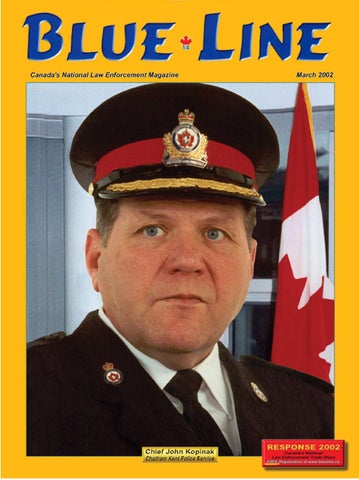
Building public rapport crucial for police 7 Communicating still the bottom line, says chief The Chatham-Kent Police Service 10 Responding today while planning for tomorrow Plasma screens give Fredericton the big picture
13
TECHNOLOGY Electronic monitoring for house arrest
14
INCREDIBLE
15
CORRESPONDENCE
17
DOWN EAST Can you identify this person?
18
DEEP BLUE You are cordially invited ...
20
PERSONAL COMPUTING When there’s a need for speed
21
RESPONSE 2002 TRADE SHOW and SYMPOSIUM
22
Winnipeg police win raise
23
CASE LAW • In custody abandonment • Consent to enter private property
24 26
PRODUCT NEWS
28
Mediation skills invaluable during critical incidents
30
BLUE LINE CLASSIFIED
32
CACP approves national use of force framework
34
NEWS CLIPS
35
Invisible no more The on-going battle for radar detector supremacy
36
THE BACK OF THE BOOK A light at the end of the... vacuum tube?
38
- Managing Editor Mark Reesor e-mail: editor@blueline.ca
- News Editor Les Linder e-mail: news@blueline.ca
- Advertising Mary Lymburner Kieran Huggins Bob Murray Dave Douglas e-mail: sales@blueline.ca
- Pre-press Production Del Wall - Contributing Editors Communication Skills Terry Barker Police Management Robert Lunney Tactical Firearms Dave Brown Technology Tom Rataj Psychology Dorothy Cotton Case Law Mike Novakowski Blue Line Magazine is published monthly, September to June, by Blue Line Magazine Incorporated with a mailing address of: 12A - 4981 Hwy. 7 East, Ste. 254, Markham, Ontario, L3R 1N1. Individual magazines are $3.50 each. Subscriptions are $25.00 per year or $40.00 for 2 years. (Foreign - $50.00 U.S.) ©2002 - All articles are protected by copyright. No part of this publication may be reproduced or transmitted in any form or by any means, electronic or mechanical, including photocopying and recording or by any information storage or retrieval system without permission from the publisher. Internet activity is monitored and use or reposting of material on the Internet is restricted. All material submitted for publication becomes the property of Blue Line Magazine unless other arrangements have been made with the publisher. The authors, advisors and Publisher accept no liability whatsoever for any injuries to persons or property resulting from the application or adoption of any of the procedures, tactics or considerations presented in this magazine. Readers are cautioned and advised that articles presented herein are edited and supplied for your personal awareness and should not be used for further action until appropriate advice and guidance is received from a supervisor, Crown Attorney or other person in authority. Established in 1988, Blue Line Magazine is an independent publication designed to inform, entertain, educate and upgrade the skills of those involved in the law enforcement profession. It has no direct control from a law enforcement agency and its opinions and articles do not necessarily reflect the opinions of any government, police, or law enforcement agency. Blue Line Magazine is a private venture and as such is not funded through any level of government agency, union or association.
- Affiliations International Association of Law Enforcement Planners Canadian Advertising Rates & Data International Police Association The Police Leadership Forum The Canadian Press Newswire Printed in Canada
ISSN #0847 8538 Canada Post - Canadian Publications Mail Product Sales Agreement No. 176796 March 2002
3
Chatham-Kent’s police service was formed Sept. 1, 1998 amid the turmoil of a restructuring which had amalgamated 110,000 people in 22 separate communities into a single municipality just eight months earlier. The new service was faced with patrolling the second largest municipality in Ontario while keeping costs well below the national average. Blue Line editor Mark Reesor profiles Chief John Kopinak, the man who led the new department until last year, on page 7; publisher Morley Lymburner profiles the innovative service, which he says could be viewed as a model for the future of Canadian policing, in an article beginning on page 10. Technology columnist Tom Rataj looks at the latest in electronic monitoring for house arrests on page 14 and we give you another page of ever-popular ‘incredible’ crime news on page 15. Blue Line has added a new columnist this month. Danette Dooley will give us the view from Down East in a regular feature. This month she tells us about a murder in Conception Bay, Newfoundland that has the Royal Newfoundland Constabulary stymied. Perhaps you can help them by identifying the victim. See page 18. Dr. Dorothy Cotton cordially invites you to a meeting to help develop common standards and practices for working with mentally ill people on page 20. Cotton is flexible - she’s open to suggestions as to time and place. We highlight the 6th annual Response Trade Show and Symposium on page 22. Come see the latest in police gear and hear Cotton speak about stress and policing April 23-24. Mike Novakowski and John Burchill give us a double helping of case law beginning on page 24; you’ll find the latest in new products on page 28; Charles Galen gives us a glimpse at mediation/negotiating skills on page 30 and Carl Fors tells us about the ongoing battle for radar detector supremacy on page 36. Blue Blue Line Line Magazine Magazine
A simple handshake will keep a lot of cops gainfully employed by Morley Lymburner Bikers do not deserve the publicity they received in January when the Hells Angels arrived in Toronto for the “patch-over” ceremony for the Ontario biker gangs. What I am talking about is that they received far more than was necessary. Much of this publicity came courtesy of the mayor and chief of police. There may have been some semblance of a rationale around the original concept of what they did but it does not appear to have been well thought through. The chief and his staff decided it would be nice to have merchants in the city post a sign on their front doors, with the police crest on it, saying they will not serve bikers wearing colours. Then the mayor pulls an even bigger gaff by deciding to go to the hotel the bikers were staying at to... well we are not quite sure. Various reports suggest such wildly varying stories that it is difficult to pin point what he was doing there. Both of these ideas are flawed on so many levels that I would think they were both done without a lot of two-way dialogue with their handlers or advisors. Asking merchants to support their local police by putting a sign in their window that insults any segment of society is completely unfair to the merchant. They are cemented to the foundations of the building. They are sitting ducks 24-hours a day and can’t run or move easily if revenge is on the agenda of the recipients. The merchants should have been permitted to stay away from the issue completely. On another level, asking merchants to put up signs could well be communicating that the police have no control over bikers. Not exactly reassuring. It also sounds like an ultimatum. “Support your local police or Hells Angels. Your choice!” It would be interesting to track what little or big “accidents” befall these establishments over the next year. As for the mayor of Toronto I can only say that he has set back the fight against organized crime several decades. There will not be a Hells Angels chapter in the world that does not prominently display the “handshake of the MELennium.” Giving these guys the credibility created by Toronto laying out the red carpet has done irreparable damage on levels that are unimaginable... at least to the mayor. This phenomenon is not limited to the Toronto police and mayor though. There appears to be a lack of understanding of the significance of “wearing the colours”. When the news of the Hells Angels taking over Ontario first came to me I was at a popular summer resort area and saw the result immediately. The area was filled with bikers wearing colours on the holiday weekend. They were openly supplying the “wellknown” merchants with drugs at wholesale prices and while still wearing their colours. They were selling drugs to teenagers on the sidewalks of the main street. They were even making home deliveries to cottage parties. There were no police anywhere. The bikers owned the streets. What March 2002
police presence there was (one cruiser seen occasionally) remained in their steel cocoon. The bikers were sending the message to the community
5
that “they owned the streets and you better get use to it.” It was nothing short of shameful. When officers on patrol see a person belonging to an obvious criminal organization prowling a neighbourhood it should be no surprise that person is going to get stopped and checked out... least of all by the biker being stopped. Wearing a crest of a criminal organization is pretty much a dead give-away. But on the postive side - thanks to good old Mel - more cops will be gainfully employed for quite some time.
March 2002
6
Building public rapport crucial for police Communicating still the bottom line, says chief by Mark Reesor The prospect of job security attracted John Kopinak to sign up with the Port Colborne (Ontario) police department in 1968. He was working for International Nickel Company in the city but strikes and an uncertain labour market had him worried about the future. A stable job, being able to work outdoors and a chance to work with and be involved with the community was appealing, especially with marriage and a family just around the corner. It turned out to be a very good choice for Kopinak, who retired at the end of last year as chief of the Chatham-Kent Police Service. He’s worn many hats in his almost 34 year career, working in uniform patrol, criminal investigation, morality, gaming, drugs and intelligence units. Rising through the ranks, he held command level positions as executive officer to the chief of police, detachment commander, head of the administrative and field support bureaus, platoon commander, uniform inspector commanding 230 uniform staff, divisional commanding officer, chief… the list goes on. He was a coordinator and lecturer at the Canadian Police College, worked as a police advisor for the Solicitor General, was deputy chief and director of program evaluation and standards development for Canadian Pacific
March 2002
Chief John Kopinak Police, lectured and instructed at the Ontario and Canadian Police Colleges, developed the ‘Drugs and Sports Don’t Mix’ community awareness/education program, graduated with straight A’s from the FBI Academy and headed
7
the restructuring and amalgamation of police services in Chatham-Kent. Through it all though, Kopinak hasn’t forgotten where he started and still vividly recalls his first shift walking the beat. Port Colborne at that time was known as the “last port out, first port in,” with sailors either on their way to or from lake freighters on Lake Erie and eager to party it up and “participate in the alcohol endeavour,” as Kopinak puts it. “The very first night was an arrest with five or six people and there was just this copper and I,” he recalls. “I had a senior constable with me; we entered a hotel and there were chairs flying… no backup, you had civilians that supported you, you had the bar owners and you did a lot of talking. We were able to march five people down the main street in town into the lockup because the car that should have come to back us up was on a fatal accident call. “It certainly sticks in my mind… in today’s environment you would have had three cars there and a paddy wagon yet we walked them down the main street in handcuffs. It’s communicating – at any given time there could have been a problem but they respected the fact they knew they did wrong and they were very much aware that they had to accompany us to be incarcerated for awhile!” . . . continued page 9
Another thing that stuck with him was the importance of community-based policing, which he learned long before someone coined a name to describe it. Walking the beat meant you were on the scene very soon after incidents happened and came across so much, he says. “Driving a car at 50 kilometres an hour with the windows rolled up and the air conditioning on is not a way to communicate with the public. We need to have front line officers who are still able to be there to hear a voice, to touch and feel, to be present and build that rapport.” Technology and equipment have made the job easier today, Kopinak says, “but I think it’s a profession where the commodity has always been our ability to communicate with the community… “The bottom line still is verbal and personal interaction with someone who has maybe made a mistake for the first time or maybe has made a mistake many times. You’re still going to have to treat them and adapt to and interact with them.” Kopinak is 6-foot-4 – “if they didn’t respect the uniform and the size, then you knew you were in trouble!” – and says people were grateful to be given a chance to resolve a situation without violence or confrontation. “It was very much appreciated that you didn’t want to push it to that level and if you could communicate, that was the main thing – the win win – and very important in today’s environment too.” The importance of being yourself and not going along with the macho image of police was another early lesson. “I wore my emotions on my sleeve,” he recalls. “I cried and laughed, was happy and sad with what we in this profession see every day... I didn’t think letting these things build up and let them stay pent up was the way to go. The phrase ‘post incident trauma’ wasn’t know to anyone until the late ’70s or early 80s — we practiced our own debriefing.” Officers shouldn’t try and hold back or feel embarrassed if a situation affects them; “I think it’s showing that they’re human,” he says. “Look at the September 11 tragedy — if you look at the pictures of the officers responding, guess what’s streaking down from their eyes. You’re not supposed to show that emotion? That just goes to show that, deep down inside, you are human. We tell our recruits that... once you get your uniform, that should not change you. It should still allow you to be open and understand emotionally what it’s like to be a victim.” Kopinak gets emotional himself when talking about the people who worked with him to make the Chatham-Kent police service, whose 149 sworn officers and 54 civilian employees serve 110,000 people over a 2,494 square kilometre area — the second largest municipal landmass in Ontario — the success that it is. “I’m overwhelmed that the community, my police board, the rank and file staff, the council, everybody was so supportive... we now have an organization which is consistent from top to bottom. It’s a true homogenization, so to speak March 2002
— you don’t have cream at the top and a watery fluid at the bottom.” Amalgamating 23 separate communities into the municipality of Chatham-Kent in 1998 created a “tremendous amount of anxiety,” Kopinak says, noting people would wonder who was coming when they called 911. “We worked very hard and very proactively to get into the community. Every three months I walked the beat throughout each one of our communities. I took the time and went downtown and we talked, just to reassure the individuals and let me hear from them first hand. “Sitting at headquarters, you didn’t get the true realities of what the feeling was out there. That gave me a tremendous insight because the people were honest with me... I pledged to them, we’ll be accountable but just don’t tell me when something’s not working — please be fair to the officers and the staff and tell me when they’re doing something right.” The strategy worked “tremendously well,” Kopinak says, citing a 1999 OCCOPS survey of more than 1,400 people that showed 92 per cent regarded the police service as effective, 85 per cent felt officers were fair, 86 per cent thought they were honest and 88 per cent felt they were courteous, knowledgeable and professional. Kopinak is a big supporter of “cross pollination” among police agencies; trading officers for short periods to give them a chance “to see how it’s done in other places.” For example, he recalls going on a call with a railway officer in Roger’s Pass, Alberta, parking at the bottom of a mountain and walking two miles down a set of tracks to a storage and maintenance yard. “Radios don’t work because you’re in the mountains, phones don’t work and you’re the only person there.” The experience put officer’s complaints about having to wait three minutes for backup in prospective, he says, adding “this guy goes 9
to work not thinking twice, other than realizing before he takes that first step that he doesn’t put himself in a predicament with any false hope of backup.” Officers should rely on their judgement and communication abilities to keep them safe, he says. “You don’t enter into a set of circumstances that puts you into harms way because (you have) that radio and a vest or two officers rather than one; (that) does not make up for using bad judgement.” Kopinak says he’s enjoying his retirement, noting that the time commitment required to hold a senior police position is “unbelievable.” “I’ve missed a lot of special dates – graduations, birthdays – because duty called first. You were expected to work Christmases and New Years. The times that things would go wrong in a major case was usually when it conflicted with something at home… “(My wife) understood that it was a commitment we made and that she would come second in regards to the time allotments with her and the family.” He relishes the time he can now spend with his family, including his two grandchildren and being home for his wife, although he jokes that she is getting a little carried away with the “honey do” list. Kopinak hasn’t completely retired from policing though. He’s teaching one day a week in the law and security program at a local community college and is helping the college look into establishing a combined police, fire and EMS training program.
The Oath of Honour One of Kopinak’s last official duties as Chatham-Kent Police Chief was instituting another oath for all new employees, whether sworn or civilian. “We are probably the only force in Canada that has now adopted a third oath,” he notes. “There’s an oath of office, an oath of secrecy and we now have an ‘oath of honour’… “It’s a reaffirmation to dedication towards ethics and accountability – (the oath) is common in the U.S but I don’t know of any other place in Canada that has it.” The oath reads as follows:
On my honour, I will never betray my profession as a police officer, my integrity, my character or the public trust bestowed upon me. I will always have the courage to hold myself and others accountable for our actions. I will respect and uphold the Constitution of Canada and faithfully serve the community of Chatham-Kent and the Chatham-Kent Police Service. So help me God. Carl Herder, who took over from Kopinak as the new chief, and Dennis Poole, the new deputy chief, were the first to take the oath.
The Chatham-Kent Police Service Responding today while planning for tomorrow by Morley Lymburner The police service of Chatham-Kent could be viewed as the model for the future of policing in Canada in that they were the first independent police service designed to police an existing county-wide area. This style of policing is quite unique in its challenge to handle urban, rural and highway patrol functions with the same effectiveness as that of an agency in a more densely populated area. The challenge of keeping one eye on the budget and the other on crime figures is far more manageable with bigger agencies and not as subject to surprises. Analyzing the responses of the Chatham-Kent Police to their new environment is a study in seeking both stability, continuity and acceptance. The Municipality of Chatham-Kent was created on January 1, 1998 as a result of government restructuring which amalgamated 22 separate communities that were at one time contained within the County of Kent. This new single municipality has a population of approximately 110,000 and covers 2,494 square kilometers, making it the second largest municipality by land mass in the province. Chatham-Kent is located in the middle of southwestern Ontario and has one of the richest land bases in Canada. Located on Highway 401, the major east-west provincial link, it is within a one-hour drive to five U.S. border crossings and strategically positioned near several major North American settlement and employment centres. The municipality’s economy is focused on the automotive industry, including truck assembly and auto parts plants. Chatham-Kent also has a strong agriculture industry, due to its nutrient rich land and one of the most moderate climates in Canada. Various other manufacturing concerns round out a diversified profile that few communities similar in size can claim. Demographically it has been relatively stable over the last 18 years with an average population increase of only one third of one per cent per year. About 50 per cent of the populace are between 25 and 64 years old and 40 per cent of those are over age 45. The Chatham-Kent Police Service (CKPS) became a reality on September 1, 1998. The decision to endorse a municipal police service was made after an intense and lengthy bidding process and multiple presentations to municipal council. The result was a very conservative operational funding plan with a five year fixed salary remuneration agreement which did not allow for much flexibility in funding. In spite of an inflexible budget, the police service seems to have been very astute at managing expenditures. The per capita cost of policing in 2000 was around $134 at a time when March 2002
the national average was $163. This cost factor is even more meaningful when compared to the Ontario average of a lofty $179 per person. Much of the cost savings appears to have been gained through the numbers and types of personnel employed. Statistics show the level of sworn officers per 100,000 population was 138 while the Ontario and national averages hovered around 182. The number of civilian personnel was slightly less than the national average and could be viewed as an area where future savings could occur through reassignment of some tasks. An external survey of police visibility revealed a weakness in coverage due to ChathamKent’s large geographic size coupled with population distribution issues. The 2000 Juristat statistics showed the population density per square kilometre at 45 as compared to similar sized forces such as Guelph at 1,212 and Kingston at 254. After amalgamation, the agency saw calls for service increase by 4.4 per cent to 292,998. The communication centre handled all calls, emergency and non-emergency. Despite the increased load, crime increased just 0.18 per cent overall. There is still concern, however, with a 38 per cent jump in major assaults, 24 per cent more vehicle thefts, 58 per cent increase in possession of stolen goods and 114 per cent rise in counterfeit money. Given these statistical concerns, both internal and external input was sought through a survey to determine priorities and needs. Approximately five thousand survey forms were printed and distributed from each service centre in Chatham-Kent. Surveys were also given to each high school, with a request that they be completed by students in grades 11 and 12, to 19 seniors centres and retirement homes and mailed to businesses. The Community Capacity Builders Forum of the United Way distributed surveys through their contacts with 10
service clubs and agencies. They were also mailed to a random list of 911 users and distributed through booth displays in two shopping malls. To increase exposure, eight public forums were held and the survey was placed on the CKPS web site, allowing individuals to complete it on-line and showing visitors results on an on-going basis. Meetings were also held with representatives from local school boards and three hospitals. An internal survey was given to each employee and, through a partnership with St. Clair College staff, the data scoring and compilation was performed and formatted for quick visual review. The results showed 10 areas which were ranked at 50 per cent or higher for police priorities. • Impaired Driving 65% • Drug Enforcement 65% • Drug Education 59% • Crime Prevention 59% • School Safety 59% • Victim Assistance 58% • Crime Stoppers 58% • Neighbourhood Watch 55% • Car Patrols 54% • Traffic Enforcement 50% Three topics mentioned are autonymous operations; Victims Assistance Unit, Crime Stoppers and Neighbourhood Watch are community driven programs which the police service continues to support. The Police Services Board, in conjunction with the police service, then determined the priorities for years one, two and three. The internal review information was then consulted to determine, by year, what corporate strategies had to be implemented to support these concerns and improve levels of service both externally and internally. The year one priorities included car patrols, impaired drivers, school and community safety and crime prevention. Car patrol strategy included increasing visibility of patrol vehicles in smaller communities, three of which were identified as needing further attention. Measurement and accountability processes were established, staff and vehicles redeployed and funds set aside to pay for the overtime required. A heightened awareness campaign, RIDE spot checks and a policy to publish the names of those charged in the local media was used to fight drinking and driving. An infusion of money and extra equipment acquisitions were also included in the first year plan. A 10 per cent reduction in drinking and driving related accidents over the next two years was established as a measurement goal.
seat belt non-usage. School safety and Measurement indicacommunity services tors are quite aggressive concerns were to be with a 10 per cent inmet by a strategy of imcrease in enforcement, plementing a “Safe 50 per cent increase in School Protocol” training patrol officers which would see a desand gaining accident ignated officer assigned reconstructionists. to schools to develop Year three will see relationships with stuon-going implementadents and staff. School tion of these proboards were also engrams, along with concouraged to conduct tinued monitoring of and share results of results and balancing student surveys deto counter progress or signed to gauge percepregressions. tions of safety issues in Unknown factors their schools. A 24 Members of the Chatham-Kent Police month, 10 per cent re- Services Board are (back) Garry Weir and are always present as duction in police calls Allen Ascott, (front ) Joe Celotto, Board wild cards in any program or strategy. One to schools was decided Chair Doug Arbour and Bill Weaver. such concern is the onupon as being the best going provincial cost-saving initiatives of jail clomeasure of success of these initiatives. Crime prevention was viewed with a sta- sures across Ontario. Chatham-Kent police are tistical analysis solution, with programs estab- currently studying ways to counter expected huge lished to determine areas to target for increased cost increases attributable to amalgamating these police attention and identify active criminal el- jails in more distant locations. Keeping an eye on the present while atements for target enforcement strategies. A measurement of the success of this initiative would tempting to plan for the future is indeed a challenge the Chatham-Kent Police Service appears be self evident. Drug enforcement strategies include training well prepared to take on. Raising the bar of and educating patrol officers and acquiring more excellence is certainly the legacy and the goal of this very new and creative police service. general purpose dogs for narcotic detection. Traffic enforcement is the main new initiative for year two priorities and includes safety For further information call programs in each community and zero tolerD.Chief Dennis Poole at 519 436-6617 ance initiatives on speeding, traffic lights and
March 2002
11
“Make a chance” - Controlling with impact by Joel Johnson Having studied Shotokan Karate for many years under the tutelage of two very experienced and very wise ‘Seniors,’ I always remember and have often reflected on the words frequently spoken by Sensei Yutaka Yaguchi (8th Dan JKA and former All-Japan kumite champion). He always said “make a chance!” Many karate students never fully grasp this concept but police officers and others who may have to defend their lives will understand, even if they’ve never heard the expression. Making a chance simply means creating an opportunity to either control your opponent or escape from your assailant. It almost always involves striking them in some way, either stunning, disabling or rendering them unconscious so you can gain control or get away. Punching and political correctness Punching comes naturally to most; untrained people who are attacked will almost always instinctively lash out in an effort to protect themselves. The most common type of street attack is the ‘sucker’ or ‘haymaker’ punch. Watch a sports match, be it hockey, lacrosse, baseball, even football and when players lose their tempers, the punches start to fly. Remember back to those schoolyard fights; they al-
Canadian troops prepare for deployment to Afganistan as part of Op Apollo
Lecture Training Facility, Edmonton Garrison - Warrant Officer Norm Rooker, a Military Policeman from 1 MP Platoon Edmonton, makes final adjustments to his kit prior to deployment to Afghanistan as part of Op Apollo. March 2002
most always opened with a series of punches followed by some form of grappling. Trained fighters and martial artists will almost always punch in a real confrontation, targeting the head. People genuinely believe that they can win a fight or end a confrontation by striking the head and, in many cases, they are right. Unfortunately, punching in law enforcement, particularly to the head, has several drawbacks, though none of these relate to justification. First, it isn’t politically correct. Law enforcement professionals have been made to believe it’s not socially acceptable and somehow unfair for police officers to engage in this type of behaviour, even when being physically attacked. It just doesn’t look good. Second, when punches are landed to the head, they tend to leave visible injuries - bruises, lacerations, inflammation, etc. Police then go through a second tier of political correctness. Lawyers and other Monday morning quarterbacks automatically assume there was police brutality and that excessive force was used. Photographs are taken, internal complaints made, lawsuits filed and arguments to avoid criminal culpability advanced, all without even examining whether the subject’s behaviour may have precipitated this action. Third and perhaps most importantly is that the hand is frequently injured by punching to the head. The small carpals, metacarpals and phalanges of the hand do not stand up very well against large cranial bones. I have seen numerous officers over the years with casts on their dominant hands after having been involved in a confrontation where they threw a punch. They usually prevailed but ended up on light duties for six to eight weeks while their ‘boxer’s fracture’ healed. Officers have also contracted serious infections after cutting their punching hand on the subject’s teeth or cranial bones. Direct contact in this manner can result in the transfer of blood-borne pathogens like hepatitis and HIV. A more immediate potential danger is the prospect of disabling your dominant hand. If a confrontation escalates from that point it may be difficult or impossible to access other force options that may become necessary (OC, baton, firearm, etc.). So why punch at all? First, punching to the head can be extremely effective if done correctly and, if done with the correct intent and in the appropriate context, can be easily justified. Remember, such punches are legitimate combative techniques taught in American boxing, kickboxing, karate, jiu jitsu, kung fu, tae kwon do, etc. The intent of head punches or, in fact, any type of impact, must be to make a chance — create an opportunity to gain control or escape from a violent subject. An effective punch can achieve this in the shortest possible time frame. Punching the head is often done because it is the most opportune target to achieve the desired result. Distance, body position and the subject’s actions frequently dictate the availability of targets. Second, punching comes easily, naturally often instinctively. It is a ‘gross’ motor skill that requires very little training. True, martial artists will practice for many years to perfect their punch 12
but this goes beyond the scope of what is required in a real street confrontation. We know through research that gross motor skills persist in times of stress so a small amount of training can create an effective punch. It’s simple and that goes a long way when your body is responding to the stress of the moment. Most people believe that an effective head punch will quickly end a confrontation, an important goal for police. Remember, the longer a confrontation, the greater the risk of injury to all involved. The Criminal Code of Canada espouses the concept of reasonable force — “as much force as is reasonably necessary” and “no more force than necessary,” etc. No where does it say no punching; in fact, no specific technique is identified as unreasonable. The point is that the force used must be reasonable relative to the resistance or aggression being faced, with context the key to justification. Most people would believe that if they were being attacked by someone who was kicking, striking or choking them, they would be justified in punching or striking back — and with few exceptions, they would be right. Alternative forms of impact There are alternatives to head punches that are just as easy and potentially effective but they are no more justified. The concepts of reasonableness and proportionality play the same role. The primary reason to employ the alternatives is for self-preservation. Open handed palm heel and wrist strikes and brachial stuns can be extremely effective and much safer for the striker since they tend not to leave visible injury, although the concussive force can be equal to or greater than a punch. These techniques are not as instinctive as punching and require more training to implement them effectively and naturally. There are also head butts, forearm, elbow and knee strikes and kicks, most of which depend upon distance, reaction time, body position, subject actions, target availability, etc. Again we must look at their purpose, which is always to create an opportunity and make a chance. Strikes delivered with the intent to punish or deliberately injure without purpose are not legitimate control tactics or defensive tactics. It is unrealistic to believe that a violent, assaultive or highly resistive individual can be effectively controlled or escaped from without first being momentarily stunned. To engage them with wrestling, grappling or takedown techniques is to invite injury — they are considered to be for follow-up and should always be employed after the stun unless your goal is to escape. Joel Johnston is a sergeant with the Vancouver Police Department’s emergency response team and spent eight years as its control tactics coordinator. He has a third degree black belt in Shotokan Karate and numerous defensive tactics instructor and instructor/trainer designations (PPCT, Modern Warrior, FBI, etc.). He’s presented to ASLET, IAWP, CALEA, PPCT International Use of Force Conference, Canadian Use of Force Instructor’s Conference and IDT International Use of Force Conference on numerous occasions. He can be reached at force@blueline.ca.
Plasma screens give Fredericton the big picture by Paul Chater Every second counts in a 911 call centre, and the City of Fredericton, NB, has found some increased efficiencies since installing four Panasonic plasma screens along with matrix switchers and multiplexers in their emergency response facility. “Since we put in the equipment it’s a lot easier to change things on the fly than before,” said Mike Richard, Senior Project Manager, Information Technology, City of Fredericton. “Space-wise, it has definitely created efficiencies. One of the big advantages of the large-screen plasmas is that through the matrix switchers we can sub-divide each screen up to 16 different ways. When we want to see a close-up of one image, it’s just a click away.” The ability to enlarge images comes in handy for 911 dispatchers, who used to have to work with a series of 6 to 8-inch monitors before the Panasonic TH-42PWD3U plasmas were recently installed. It is especially useful, says Richard, in pinpointing and working with GPS (Global Positioning Satellite) enabled police vehicles.
“We can now pull up a full-screen map of the city and see where each and every police cruiser and fire vehicle is, what direction they’re heading in and how fast they are travelling,” says Richard. “We can use the switcher to zoom in on specific images and layer the map with additional information such as buildings in order to help officers in the field, or to determine who is in closest and in the best position to respond to a 911 call.” Richard says the larger screens also make it easier for emergency response personnel at the
New chief in Nelson, BC
Chief Dan Maluta Dan Maluta has taken over as the new chief constable of Nelson, BC, replacing Ron Brock, who retired last year after 13 years at the helm. Maluta began his policing career with the Vancouver Police Department in 1981, serving nine years as a constable. He completed a bachelor of arts degree in criminology and political science at Simon Fraser University before moving to Nelson City Police and quickly rising through the ranks, achieving the rank of corporal in 1995, sergeant in 1996 and inspector in 2000. The move to Nelson was an easy transition for Maluta, who grew up in nearby Trail and spends most of his free time hiking and hunting in the local mountains. March 2002
13
centre to monitor closed-circuit feeds, such as cells in police facilities, when that is required. He says in the past, response team members “used to have to stare at a small six-inch monitor. That can get tough on the eyes.” The Fredericton facility dispatches police and fire personnel for the city of Fredericton as well as the surrounding communities of Woodstock, Sackville and New Maryland. It also has a hotkey to the RCMP. “The plasma screens are extremely versatile and are ideal for this type of environment where image clarity and space are major concerns,” says Gordon Stephen, Sales Support Manager, Broadcast and Security Systems Department from Panasonic Canada Inc. “Our thin, flat, large-screen plasma display delivers the world’s highest levels of brightness and contrast. Its sharp pictures and natural colours make for an extremely impressive viewing.” For information on Panasonic Canada, go to:
Electronic monitoring for house arrest Voice-verification technology the newest wrinkle by Tom Rataj With non-custodial penalties for convicted criminals becoming fashionable, there’s increasing pressure to find affordable and effective methods to make sure they abide by the rules. The traditional electronic monitoring (EM) tools such as ankle bracelets and global positioning satellite (GPS) based systems are expensive and far from perfect. Bracelet systems require installing expensive hardware at the offender’s residence and fitting a tamper-resistant ankle bracelet transmitter. If they go beyond the transmitters range the receiver activates an alarm. This type of system can only monitor the state of communication between the components and is not able to indicate where the offender is once they’ve gone out of range. GPS based systems, on the other hand, reveal the physical location of an offender wearing the equipment. Like ankle bracelets, they also requires expensive hardware be worn by the offender and infrastructure to monitor it. GPS needs line-of-site access to at least three satellites so its effectiveness is diminished in large urban areas with tall buildings and underground garages made of steel and concrete. In many jurisdictions the cost of electronic monitoring is paid by the offender as part of the agreement to be released from custody early. No bracelet Some of the shortcomings of these systems came to light in a recent parolee case in Toronto. A somewhat infamous convicted paedophile was paroled after eight months of a one year sentence he received for violating the conditions of his previous parole. The crown sought to have a bracelet fitted to the parolee as part of his release conditions
but the court rejected the application, noting that the system could not identify his location when he was outside the range of the receiver. The ruling suggested that a more effective, GPS based system should be used because it’s available and can tell where the parolee is at all times. It added that the Crown was welcomed to reapply for EM of this parolee once it had a GPS based system in place. In response, Ontario Corrections confirmed that requests for proposals (RFP’s) from vendors would soon be issued. Facing similar issues, Alberta is also considering the implementation of GPS based monitoring for parolees. While the court’s observations were certainly correct, a partial system of monitoring is certainly better than none at all. Meanwhile the parolee was set free to wander the streets of Toronto with no direct supervision. His many conditions include a curfew and a requirement to call Toronto Police each day to report where he will be spending the night. (These are more or less the same conditions he was under the last time he was paroled and which he breached within a few weeks. He was arrested after being found alone in a hotel room with a 13 year-old boy.) Under his current call-in reporting requirement, there are no accurate means of positively identifying him on the phone or identifying his actual location. Hello, I’m reporting Fortunately the EM marketplace was recently broadened with the introduction of a cost-
FBI nabs cache of stolen police badges More than 900 black market law enforcement badges, including FBI and Secret Service badges, were bought by undercover on the Internet, US federal authorities said in January. “The individual trafficking these badges was selling them for profit, including selling them to foreign nationals. He had no idea what they were going to be used for,” FBI agent Doug Riggin was quoted as saying. The badges - both real and counterfeit were bought by undercover investigators in Tennessee and Florida, and represented more than 40 federal, state and local agencies. They included badges from the Border Patrol, the Postal Police, the Drug Enforcement March 2002
Agency, military police, security police from Air Force One and police departments in at least 20 states. Authorities believe the real badges were either lost or stolen before they wound up for sale on the Internet. The FBI is investigating whether the counterfeit ones came from badge manufacturers or distributors. Stephens said the suspect sold the badges on a web site that has since been taken down. After several purchases by undercover agents, the FBI searched the suspect’s home, where more badges were found. The Tennessee Highway Patrol was tipped to the black market trade last summer by someone who said it was easy to buy badges on the Internet. 14
effective voice recognition based system which is already being used in the UK to monitor juvenile offenders sentenced to house arrest. On Guard Plus of Manchester, England developed the Intensive Supervision and Surveillance Programme (ISSP), which uses Keyware’s sophisticated voice-recognition and verification technology to positively identify an individual reporting in to the system or answering a randomly timed call initiated by it. ISSP can use a number of telephony technologies to verify the physical location of the caller and can be customized with programs tailored to the individual offender and his/ her release conditions. On the technical side, the ISSP solution uses the Vqvoice module of Keyware’s VerQuis application suite, a stand alone, layered biometric voice verification system that is able to positively identify an individual. The VerQuis suite is a group of applications that support OGPL’s product. ISSP can handle up to 10,000 offenders and is compliant with industry standard database systems. This product is currently in use in the United Kingdom, where monitoring of offenders is contracted out to Securicor Custodial Services. Another vendor in this market is Behavioural Interventions of Boulder, Colorado. Their VoiceID is similar to the ISSP product, offering many of the same custom controls and scheduling features.They also manufacture ankle bracelet, GPS based systems and the Sobrietor, which remotely monitors alcohol prohibition orders. Conclusion Traditional tracking systems are expensive and require a significant investment in proprietary hardware and the custom software necessary to run them. Voice recognition, like many other biometric technologies, offers a number of advantages. It is relatively simple to operate, requires little specialized equipment and effectively verifies the identity of an individual. While by no means a complete solution, it can provide an affordable means to monitor some offenders. Implemented in conjunction with other EM systems, it can be very effective. For a Canadian perspective on EM in Canada, read the Canadian Solicitor General’s report at: www.sgc.gc.ca/EPub/Corr/eem/eem.htm - For more on On Guard Plus, Keyware, Behavioural Interventions and Securicor, go to:
Police dog scores a hat trick
Romeo robber caught on camera
One of Guelph’s two police dogs had a particularly good shift in January. Nero nabbed eight suspects in three incidents during the early morning hours. “It certainly is an example of the benefit (of the canine unit) to police officers,” police spokesman Ron Lord was quoted as saying. Nero’s first catch of the day came when he cornered two suspected car thieves. About 30 minutes later, Nero led police to five young men who fled from a stolen minivan. In the final incident, about two-hours later, Nero led officers to a downtown area where they recognized a thief caught earlier on a security video. The eight face a long list of charges. Nero’s work led to 56 arrests last year.
Romance and robbery proved a self-defeating combination for a British man who was sentenced in January to nine years in prison. Mark Wharton, 31, of Gateshead in northeastern England, was convicted of two counts of robbery. He was caught because he approached a woman at a bus stop shortly after committing a robbery and tried to make a date, prosecutors said. He wrote his name and telephone number on her hand, and she later made a permanent note. Twelve days after the first robbery, Wharton used a knife to rob a man of a rucksack and jewelry. A video camera captured that mugging, and scenes were shown on a television crime program. The woman who had been asked for a date saw the show and called police, prosecutors said.
Police use batons on students to stop cheating Bangladesh police said they used batons and fired into the air to stop university students from cheating in graduation examinations in January. At least 50 people, including teachers, were injured during the clashes in Dhaka, when more than 300,000 students began month-long graduation examinations across the country, police said, on condition of anonymity. Families want students to graduate so they can start earning money quickly in a civil service job in the government. Failing in the exams means another year’s wait to pass and get a job. The Education Ministry said that vigilance teams expelled nearly 5,000 students on cheating charges, and police detained about 100 people, including students, on rioting charges. The students were tested in English language and literature, an important subject as English is the second official language after Bengali, the mother tongue of Bangladeshis. The violence was reported from examination centres in small towns and villages, where even some teachers and families reportedly helped the students in mass copying of answers from books or written notes. Police used batons and fired into the air to stop several hundred students and their families from ransacking school buildings used for exam centres in northern Kurigram, Gaibandha and Sirajganj districts. At least 25 people were injured during the clashes. Similar clashes in neighbouring Kurigram and Sirajganj districts left 25 others injured. In northwestern Natore district, police seized several mobile phones students were using to get answers from helpers outside the centres, Dhaka’s Matribhumi newspaper reported. March 2002
Officer claims anthrax hoax a ‘training exercise’ A US Capitol Police officer was indicted in January on charges of orchestrating an anthrax hoax. The US attorney’s office said James Pickett was accused of making false statements and obstructing fellow members of the police force. Prosecutors contend on Nov. 7, Pickett left white powder at a police security station with an anonymous note saying to “please inhale” and claiming it was a “Capitol Police training exercise.” The note added: “I hope you pass!” If convicted, Pickett, 35, could be sentenced to up to five years in prison and a $250,000 fine.
Robber strips to give cops the slip Tennessee police say a robbery suspect shed her clothes in an attempt to avoid capture. Instead, like a trail of bread crumbs, the clothing led them right to her. Authorities in Rutherford County say a woman wanted for robbing a drug store tried to flea by taking off her clothes during a foot chase. She wasn’t wearing a stitch when arrested but was clutching a fistful of money. Authorities say she had fled in a car but
15
after wrecking it, she jumped out and ran into the woods. They say they tracked her with dogs and followed a trail of her shirt, pants, left shoe and then right shoe. Officers say the woman told them the clothes became too heavy as she ran through marsh and water. She’s charged with robbery, evading arrest and leaving the scene of an accident.
ONT ARIO ONTARIO by Blair McQuillan Ronald Turpin was born on April 29, 1933, to an alcoholic and abusive mother and a father who worked as a conductor for the CPR. He told psychiatrists his childhood was corrupted with sexual memories and that his mother would often tease him about his penis and, when drunk, would often threaten to cut it off with a knife. The psychiatrist felt Turpin’s developmental years were “chaotic, with a lack of guidance, lack of love and affection and rife with unstable, argumentative and physically violent parents. The ultimate result is the development of a typical psychopathic individual. Psychopaths such as him are notably successful in avoiding long term incarceration and he is a good example of this.” Turpin dropped out of school in the eighth grade and was fired from his first job as a clerk in an Ottawa jewellery store for stealing from the till. He worked at odd jobs until he stole a car and was sentenced to 18 months in jail in 1951. Crimes such as car theft, forging cheques and escaping from prison kept him locked up for short periods between 1953 and 1957. On October 25, 1961, he attended a party given by Della Stonehouse, a prostitute who had been under police surveillance in connection with the murder of drug-dealer Lorne Gibson. Soon after midnight Stonehouse answered her door and was confronted by an armed assailant. The man fired twice at her, missing both times, before Turpin jumped him and managed to gain control of the weapon in the scuffle which ensued, she said. Turpin then grabbed his girlfriend and the gun and left the party by the back door just as the police arrived at the front. More than 20 guests, most of whom were in a room off the hallway when the shooting started, related the same story as Stonehouse. One guest had a different story though, telling police Turpin had attempted to kill
March 2002
the wounded officer. Stonehouse. Nash later died on the operatPolice felt that the gun might ing table. A .32-calibre bullet had have been used to murder Gibson penetrated his chest just to the and got a warrant for Turpin’s arrest right of his breastbone and confor discharging a firearm with the tinued to the upper lobe of his left intent to wound. lung. Turpin had heard that police Turpin suffered wounds to would shoot him on sight so he and both arms and a minor flesh wound girl friend Lillian White adopted alion the cheek. He was placed in ases and fled. the back of a cruiser and taken to On Christmas Eve, 1961, he and the hospital. On route he rambled White returned to Toronto for the constantly, “why?... Why would holidays. Turpin wasn’t aware that a guy grab a gun that’s pointed at his picture had been placed in police Ronaqld Turpin him?... Why would he pick me to stations across Toronto as one of the stop? Did he get a call or somecity’s most wanted men. thing?” White purchased a second-hand While recovering in hospital Turpin related delivery van in bad repair in early February which the couple planned to drive to Northern Ontario many different versions as to what had occurred. and placed a gun under the seat; she planned to In one of several conversations he said, “he told me to put my hands on the truck. I turned swiftly dispose of it during the trip. Turpin and White arrived at Stonehouse’s and fired. He hit me in the left arm. Everything home late on Sunday, February 11. A little after happened so fast. I couldn’t tell you after that. midnight Turpin broke into the Red Rooster He went down. I went down.” Under sedation Turpin gave another account. Restaurant and stole $632.84 to pay for the “The cop came across the street and made trip. He was pulled over by Metropolitan Toronto police constable Frederick Nash, perhaps a grab for my gun. I let him have a couple of because of the condition of the van or because hits when he reached for his gun. I threw my gun down when he fired at me from the ground.” he recognized Turpin. When Turpin was informed that he had Turpin told the officer his name was Orval Penrose but didn’t make a good impression and killed Nash, he held his breath and was silent for a minute. “Well, that’s the way it goes,” he was ordered out of the vehicle. Roughly 70 meters away, Leonard Boreham explained. “You all have to go sometime.” Two thousand people attended Nash’s fusat parked in his cab reading the paper. He glanced up after hearing a sound similar to a car neral on February 15 at St. Michael’s Anglibackfiring, saw the officer step out into the can Church. He was survived by a wife and street and collapse and quickly drove to the four children. Turpin told the court at his trial that he nearest police station. At roughly the same time Constable John couldn’t recall speaking to police about the inMcDonnell arrived and saw a crowd gathering cident while in hospital and claimed Nash found around and Turpin frantically trying to start the revolver under the truck seat, ordered him Nash’s cruiser. As McDonnell walked over out and then shoved him against the fender of Turpin threw his gun at him and told him to aid the police car. Turpin said Nash pointed his gun upwards and he was afraid the officer would lower it and direct it towards him so he raised his arms to protect himself when the officer’s weapon discharged. A.O. Klein, the Crown prosecutor, contested that Turpin had murdered Nash while the constable was arresting him. Klein concluded that if Turpin had indeed been shot by Nash at close range there would be powder-burns on Turpin’s clothing but none were present. The jury deliberated for more than five hours before returning with a guilty verdict. While awaiting their execution in the Don Jail, Turpin and Arthur Lucas became friends. On Monday December 10, 1962, they were led to the gallows. The nooses were secured and the floor gave way. Turpin died quickly but Lucas was almost decapitated. Blood covered the room and he hung by a small portion of his neck. Ronald Turpin was pronounced dead at 12:18 am. Lucas hung on for another three minutes. They were the last people to be hung in Canada. 16
I have been a subscriber to Blue Line for the past 6-7 years. Always meaning to write, but never got around to it until reading the 2002 January copy. First of all, my condolences to Eddie Adamson and his family on the loss of their Dad. I worked with Ed and worked for Chief Harold Admason back in the early 70’s. I remember having Harold at the first divisional hockey finals to present the trophies including one in his name for the winners. I have read many of your commentaries over the years and still laugh about the ‘old cruisers’ with the tube radios. “The Back Of The Book” this month was one of the best and there have been many that caused reflective moments. Keep up the excellent work and I’ll be a subscriber for the rest of my life as I enjoy and can hardly wait to read each new copy when it arrives. Thanks so very much for the memories. David Black Edmonton, Alberta Often times the informational reach of a Police Service’s crime management initiative is predicated by the potency and geographical reach of interested media. Whether it is television or radio, local newspaper or syndicated
press, rousing community consciousness into new levels of awareness is important. Such is the case with the Toronto Police Services Graffiti Eradication Program and Blue Line Magazine. Over the past year Blue Line Magazine published two articles on our Graffiti Eradication Program (January 2001 and January 2002). The first article explored the arcane world of graffiti, and the Toronto Police Service’s blueprint on how it would address this crime. The second article involved a retrospective look at a year’s worth of successful implementation, eradication and enforcement efforts. As a direct result of the publication and distribution of the above two January editions, I have received letters and phone calls from police agencies across Canada. From British Columbia to Barrie, Halifax to Hamilton, information requests rolled in, and information packages rolled out. Such is the potency and reach of your publication. I am impressed. Thank you. Staff Sergeant Heinz Kuck Toronto Police Service I couldn’t agree with you more! Exterior body armour is also a pet peeve of mine, along with black uniforms which only increase the chances of officers on foot becoming victims of traffic accidents at night... whatever happened to common sense?
For further details go to BlueLinks at www.blueline.ca
March 2002
17
Additionally, I point to a recent fiasco of “operational security” in Toronto when the headlines were replete with details as to how many officers had permission to take their guns home at night - an officer was quoted as saying “... only about 12 officers have permission...” Grrrreat! You’ve just told the bad guys “don’t worry - only twelve of us take our guns home”. In stark contrast, you’ll never see photo’s of Britain’s SAS in the newspaper... Mark Bossi CD Provincial Training Officer Emergency Measures Ontario Editor’s Notes: When it comes to people not thinking... how about Toronto’s chief (among many others I should ad) telling the newspapers that they will probably have to lay off police officers to fit their tight budget this year. Any idea how many departments would swoop like eagles to pick off any and all officers Toronto lays off? When I questioned the wisdom of this I was told that “well, it is only political posturing at a time when the budget is coming round...” I then hit them with the “yabut”... anyone told those young officers fresh out of college about this strategy? NO! How long they gonna stick around with the threat of layoffs over their heads. Those greener pastures just turned to brilliant emerald. Thanks for your feedback.
Can you identify this person? by Danette Dooley The isolated island portion of Newfoundland and Labrador is known for many things: its low crime rate, friendly citizens and scenic rugged terrain. That’s why the discovery of a partially buried skull has sent shock waves through the close-knit people of the province. Two residents looking for shrubbery in the woods last May discovered the skull in a secluded wooded area in Conception Bay South, about a 20-minute drive from St. John’s. They immediately notified police who called Dr. Simon Avis, the province’s chief medical officer, to help determine if it was human. When Avis confirmed it was, the Royal Newfoundland Constabulary (RNC) had both an unidentified body and a homicide investigation on its hands. The crime scene was secured and guarded by officers around the clock. The immediate area was searched under Avis’s supervision, with help from the RNC’s forensic identification and canine units. When no further body parts were found, the search was widened. The area was divided into 100 square foot sections, each taking about half a day to check. The St. John’s Rovers Search and Rescue team spent days combing dense brush on their hands and knees. The overall search area covered a onemile radius. Two ponds were also searched; the smaller one was completely drained and an excavator brought in to help. “The ground search and rescue team had video cameras on the boat which allowed them to look down into the water in the larger pond. We brought in a helicopter as well to aid the search. No expense was spared. Whatever could be done, was done,” Constable Noel Stanford explains. The Canadian Coast Guard supplied trailers and utility vehicles and tents on loan from the Department of National Defense were erected over the actual site where the skull was discovered. Generators churned during the night to light up the path which led to the discovery site. The investigation went slowly because of the kind of terrain on which the skull was found. Searchers not only had to contend with hills, ponds and swamps but rocks left over from a nearby talc mine.
Royal Newfoundland Constabulary constables Noel Stanford(left) and Barry Constantine show reconstruction of the victim. As the site was used as a dumping area decades ago, numerous other bones were discovered; none turned out to be human, which didn’t surprise the province’s medical examiner. “In Newfoundland it’s not hard to hide remains,” Avis notes. “We’ve got such a vast area of uninhabited territory that it could be on your back door and you wouldn’t know it.” There was no sign of animal interference, he says, nor was there any injury to the skull to show how the head was severed from the body. Investigators also turned to the Halifax Crime Laboratory, which worked with the Bureau of Legal Dentistry to extract pulp from the teeth for a DNA profile. The RCMP Crime Lab in Ottawa was also consulted, as was Dr. Sonja Jerkic, a forensic anthropologist with Memorial University of Newfoundland. A DNA profile, dental records and a facial reconstruction are now available. Investigators believe the victim was a male between 20 and 40 with long shoulder length black hair. It’s felt that the skull was placed in the area within the past ten years and that the man had a Newfoundland connection or was visiting here. RCMP facial identification specialist Peter Petersen gave the skull facial features.
FBI on hiring spree The Federal Bureau of Investigation wants to hire 966 new law enforcement agents, it’s largest hiring in more nthan 30 years. The agency is already reorganizing its Washington headquarters and director Robert Mueller says the overhaul includes implementing new technology and shifting its focus. It’s especially keen on hiring agents specializing in engineering, physics, chemistry and biology. Another priority is attracting candidates fluent in languages such as Pashtu, Arabic, Chinese, Korean, RusMarch 2002
sian and Vietnamese. Starting pay is $50,000 US a year. The new positions are not in response to Sept. 11, officials say, but instead represent existing openings and anticipated retirements. Candidates must be college graduates between 23 and 37. The bureau is also opening four new offices to improve communications with state and local law enforcement agencies and assist technology projects, upgrade records and improve intelligence capabilities. 18
Petersen helped to identify suspected criminals, missing people, unidentified remains and missing children and also works with police to develop new methods of facial identification. However, Petersen is quick to point out that such reconstruction work is not meant to be an exact likeliness but rather a guide to help people remember similar looking individuals. All Newfoundland males reported missing have been ruled out through DNA profiling and dental record comparisons. Since releasing the composite, hundreds of leads have been received from public and police departments as far away as California working to rule out missing persons from their areas. However, investigators are still at a loss as to who the male might be. “We’ve searched a lot of cases through CPIC but none have led to a break in the case and we’ve received a lot of calls,” says Cst. Barry Constantine. “Most of them were easy to eliminate while some took more investigative work to do so,” After exhausting many avenues of investigation, police here are asking officers across the country to jog their memories about missing person cases they’ve investigated or other cases that may have a Newfoundland connection. With holdback evidence to draw on, the smallest piece of information may be the link investigators need to solve this gruesome discovery. “If anybody has worked a case that has maybe gone by the wayside and hasn’t had a lot of attention paid to it lately - or if they were the first officer on the scene or took a report of somebody who went missing, we’d appreciate them contacting us with any information they may have,” says Constantine. Constable Noel Stanford can be contacted via email at noels@gov.nf.ca or by phoning (709) 7298074. You can contact Constable Barry Constantine at the same number or by e-mail at bconstantine@gov.nf.ca.
March 2002
19
You are cordially invited… by Dr. Dorothy Cotton Ph.D., C. Psych. Over the past months, many of us have been in contact with each other to talk about issues related to police procedures, practices and strategies in dealing with the increasing number of encounters with individuals experiencing mental illnesses. We all seem to agree that there is a lot of work to be done in the area and although some of us have some of the answers, there are also a lot of unanswered questions. • What kind of training do police officers and mental health workers need in order to work more effectively together? • What is the appropriate manner of dealing with mentally ill individuals who come into contact with the police? • How can one successfully navigate the medical maze? How do we track, monitor and count such interactions? The one thing that everyone seems to agree on is that it is about time some of us got together and began to develop common strategies for at least asking questions, if not answering them. To this end, we would like to invite your participation in the inaugural meeting of an as-of-yet nonexistent group comprising police officers engaged in or interested in mental health liaison work – and a few mental health folks as well. What would we do at such a meeting? We
could look at: 1. The State of the Art: - What do the existing training programs for police officers look like and what do they accomplish? - What models are out there for police/ mental health agency liaison? - How are MHA apprehensions carried out and how could that work better? - What is the state of the art in terms of less lethal interventions with this population? - What data are we collecting – and what should we be collecting? - How do we measure what we are doing? 2. Best Practices: Based on what we know and where we want to go, what suggestions can we make and what directions can we work toward in developing national standards or guidelines for best practices in this area? Our hope is to bring together in an informal atmosphere a number of us who are committed to developing common standards and practices for working with people with mental illnesses. Interested? At this stage of the game, we don’t have a date or a place for this meeting, just an idea and a hope. We would like to know if you would like to come to such a meeting: Maybe this spring? Maybe in Ottawa? Maybe
two days? We are flexible but we would like a show of interest. (Costs would presumably be confined to travel, accommodation, personal expenses and any charges for meeting space.) Please let us know: • If you would be interested in attending such a meeting and think your organization would support your attendance. • What month or time of year would be most convenient? • Where your preferred meeting place would be. • Specific issues you would like to see included. • Any other thoughts? We look forward to hearing from you! This meeting is being organized by Dorothy Cotton, Ph.D., Inspector Sean Ryan, Royal Newfoundland Constabulary and Chief Superintendent Jamie Graham, RCMP Surrey Detachment. Please pass this invitation on to anyone else who might be interested and send your replies directly to Dorothy Cotton via e-mail (cottond@PCCC.kari.net), fax (613-548-5585) or phone (613-546-1101 x 5711/5713). Dr. Dorothy Cotton has been practicing psychology for more than 20 years, “providing service for adults of all ages.” She holds degrees from McGill, Purdue and Queen’s Universities and can be reached by email at deepblue@blueline.ca.
Stats show number of female officers increasing rapidly There were more women working in law enforcement last year and their numbers are growing more rapidly than their male counterparts. Women made up about 15 per cent of all police officers in June, a figure that has been increasing since the mid ’70s, Statistics Canada said in February. The agency said there were about 8,300 female officers in 2001, an increase of eight per cent from 2000. The number of male officers rose one per cent. There were 57,107 police officers across the country on June 15, 2001, up two per cent from a year before. “Half this gain was a result of a five per cent rise in the number of RCMP officers. The RCMP accounts for about one-quarter of all police officers,” the agency was quoted as saying. The number of police officers per 100,000 population rose for the third consecutive year in 2001 after declining between 1991 and 1998, the agency said. However, Canada’s rate of 184 officers per 100,000 population was lower than the 247 per 100,000 in the United States. Policing the country cost $6.8 billion in 2000, the most recent year a figure is available for federal, provincial and municipal forces. For further details go to BlueLinks at www.blueline.ca
March 2002
20
When there’s a need for speed by Reid Goldsborough Speed has played a key role with computers since the inception of the digital age in the 1940s. The very raison d’être of electronic machines is their ability to carry out computational procedures faster than humans. Speed is not always what it’s cracked up to be but, on the other hand, it sometimes is given short shrift. Understanding the differences can help you make smart PC buying and web site design decisions. The central processing units of today’s runof-the-mill personal computers are faster than those of multimillion dollar mainframe computers that were leading us into the future in the 1960s and 1970s. PCs today are ten times more powerful than they were just five years ago. This mindboggling increase in processing speed was predicted and codified in 1965 by Gordon Moore, who would become the cofounder of Intel, when he said that the number of transistors per square inch on integrated circuits had been doubling and would continue to double every year. Though this doubling would later slow from every year to every 18 months, the increase in capacity has continued, and it’s emblematic of the personal computer revolution. It’s an increase that’s unprecedented in other spheres of human endeavour. This is heady stuff to those involved with personal computers and has led to an infatuation, even an obsession, with speed. It taps into the western notion of progress, of ever-increasing efficiency, output and standards of living. The infatuation is misguided. “Speed is an artificial need,” says Rob Enderle, an analyst for the Giga Information Group, a market research firm in Santa Clara, Calif. “It’s analogous to cars with big engines. Bigger is not always better. Neither is faster.” There’s a countervailing notion here, more eastern in nature, of appropriate technology. In practical terms, very few people today need the very fastest PCs, those that run the Intel Pentium 4 two GHz CPUs, which have recently reached the market, or the equivalent chips from AMD or Motorola. For common tasks such as word processing, spreadsheets, business graphics, web surfing and e-mail, slower and less expensive central processing units are more than adequate. On the other hand, if you’re engaged in CPUintensive tasks such as high-end image or video editing, digitizing music or computer-aided design, the high end can be cost-effective. Other factors can also enter a buying deciMarch 2002
sion. A high even number such two GHz — two billion cycles per second — is psychologically compelling in the same way as a .400 batting average or a Dow of 10,000. Still, on the whole, the importance of CPU speed is the single most overrated aspect of personal computing today. The single most underrated speed element is the time it takes web pages to load. Sure, it’s widely known that a high-speed cable or DSL modem can dramatically improve the quality of your surfing experience. In fact, the biggest PC speed bottleneck for the past several years hasn’t been CPU speed but modem speed, a bottleneck that won’t disappear until highs p e e d Internet access becomes universally available. W h a t ’s not as w i d e l y known is that even with high-speed access, slow-loading web pages can still be a problem. The web won’t be truly efficient until browsing from one page to the next is as speedy as browsing pages in a newspaper or magazine. A recent study by market research firm Jupiter Media Metrix underscores the importance of fast-loading web pages. The study found that 40 percent of people will visit a site more often if its pages load faster, while only 20 percent are interested in multimedia or rich media features, which load much slower than text and simple graphics. Some web page designers look at flashy technologies such as Shockwave as a way to make their sites look hip and cutting edge. Yet many web page visitors look at these technologies as cloying eye candy that just slows them down. People on the web have short attention spans. This is the age of VCRs and microwave ovens. People don’t want to wait to get what they want. If you force them to cool their heels at your web site, gratification elsewhere is just a click away. That’s why the best sites are simple, and why simple sites will more likely be around in the future. “On the web,” says Jakob Nielsen, author of the new book Homepage Usability: 50 Websites Deconstructed, “you have design Darwinism — survival of the easiest.” The theme here is technology for people, not for technology. Reid Goldsborough is a syndicated columnist and author of the book Straight Talk About the Information Superhighway. He can be reached at reidgold@netaxs.com or http://members.home.net/ reidgold.
21
Countdown continues to Response 2002 Trade Show Final preparations are underway for the sixth annual Response 2002 trade show, which will be held April 23 and 24 at the Le Parc Conference Centre in Markham, Ontario. Response gives law enforcement, correctional and bylaw officers and security personnel nationwide a chance to see the latest gear and other items of interest. Interest has been strong and the number of pre-registerations is ahead of last year, says Response 2002 coordinator Tricia Rudy. A number of companies are coming to the show for the first time this year, including Canadian Safety Equipment, Inuktun Services, which designs and makes miniature, remotely operated
inspection systems and modular components, Jane’s Information Group, Offshore Inflatable Boats, Thermal Stress Management, xwave and securities product maker Winner International. Rudy is looking forward to a very successful show — “interest has been very strong and we began receiving calls to reserve space earlier than ever,” she says. Exhibitors will again be displaying a vast array of products and services which will be available for members of the law enforcement community to view and test. Rudy is confident “officers will be able to find a product or equipment of interest regardless of the agency they serve or rank they hold.”
Response is again hosting the Blue Line Symposium, featuring Dr. Dorothy Cotton, which covers: • The physiology of stress and illness. • Personal warning signs. • Causes of stress-with special emphasis on those unique to law enforcement. • The answers: coping skills and solutions. The goal will be to leave with a personal plan and strategies to use when stress is a problem. Cotton’s seminar will run both days. You can register On-Line at www.blueline.ca
Courses will be offered at the Blue Line Symposium. Each course will last one day and is available on both days of the Response Trade Show. Space is limited, and seats will be reserved on a first-come, first-served basis.
It’s all part of the job: Stress and policing Course 1 - April 23, 9-4 p.m. and Course 2 - April 24, 9-4 p.m. Course
Outline
Presenter
Stress — it’s always there and it’s usually not a problem. Some parts of it are unique to being a police officer and some are just part of living. It’s not necessarily a bad thing and no two of us experience it in the same way. The purpose of this seminar is to help participants understand the stress process and its effects, keep an eye on their own stress levels and develop a personal repertoire of coping strategies. Specifically, the course will cover: Physiology of stress • Signs and symptoms. • The relationship between stress and illness. • The adaptive function of stress.
• External work-related stressors (bad guys, fast cars, shift work, boredom, the boss). • The rest of life (family, money). • Me, myself and I — personal idiosyncrasies.
Warning signs • Physical symptoms. • Behavioural change. • Changes in thoughts and emotions. • Developing a personal profile and knowing when you are heading for trouble.
What to do — coping and problem solving • The boring stuff: lifestyle (fitness, nutrition). • The fun stuff: (diversion, recreation). • The challenging stuff: (skill acquisition and new knowledge). • The secret weapon: (talking sense to yourself). • The unmentionable stuff (getting help).
Causes • The essential decisions — things you can change and things you have to live with.
The goal of the day will be to leave with a personal plan and strategies to use when stress is a problem.
Dr. Dorothy Cotton is a regular columnist with Blue Line Magazine and has been practicing psychology for more than 20 years, “providing service for adults of all ages.” She holds degrees from McGill, Purdue and Queen’s Universities and can be reached by email at: deepblue@blueline.ca. Who Should Attend: Front-line officers, managers, employee assistance people, peer counsellors, and chaplains among others.
To register call 905 640-3048 or mail this form to Blue Line Magazine. or email response@blueline.ca
REGISTRATION Deadline for reservation is March 15th, 2002, or when classes are full. Name:
Course 1 q 3 Course 2 q 3
Agency:
Location Le Parc Conference Centre 8432 Leslie Street, Markham, ONT. (South west corner of Hwy #7 and Leslie St.)
Cost $125.00 (Plus Tax) per person. Prepayment by Visa, Mastercard or Cheque.
Badge #
Phone:
Fax:
Visa, MC:
Included is free access to the Response Trade Show floor and refreshments during breaks.
Exp:
Mail to: 12A-4981 Hwy 7 East, Ste. 254, Markham, ON L3R 1N1 or Fax: 905 640-7547 - Ph: 905 640-3048
CERTIFICATES OF ATTENDANCE WILL BE PRESENTED March 2002
Position/Rank:
22
Winnipeg police win raise by Les Linder Winnipeg Police received welcome news in January when they were awarded a pay raise after nearly two years of negotiations. About 1,500 officers and staff will get seven per cent more in the new two-year contract, which is retroactive to Dec. 23, 2000. The city initially offered four to five per cent but an arbitration panel determined the service deserved more. “What we tried to establish during the course of the arbitration hearing in October (2001) was the fact that our people are performing more duties and have more responsibilities than they have had in the past,” association president Loren Schinkel said. “The arbitration panel agreed that our duties have changed and warranted the increase.” The association negotiated from December, 2000 until July, 2001 for the increase. “Unfortunately, the negotiations broke down over the wage issue as well as the lack of movement from the city relative to the indemnification issue,” Schinkel added. The association filed for arbitration in August and October, 2001 and made presentations to the board. “In January, the board ruled in our favour and all of us were very happy with the ruling it was good news for all of us.” The raise moves Winnipeg from 69th on the RCMP pay scale to 33rd - about $848 be-
hind the Calgary Police Service. “We like to use information like that as a comparison because we feel we are very comparable in respects to economy and policing to cities like Edmonton and Calgary,” he said. Salaries increased 2.5 per cent for 2000, 3.5 per cent in September, 2001 and go up one per cent in September 2002. As of Sept. 24, 2002 a first class constable will earn $59,254 per year. Schinkel says the arbitration process and indemnification have been fine-tuned. “It didn’t cover inquests - something our agency has gone through a fair amount in recent years,” he said. “Now we’re looking to recoup some of that cost as a result of the award,” Schinkel said. Despite the raise, he’s still disappointed entry level constables weren’t reclassified. “Since it takes six years for an officer to reach first class constable, we were hoping to try to ‘bump off the bottom end of the ladder,’ so to speak... “New entries to the service starting at the bottom are making 52 per cent of what a first class constable earns. Some of our younger officers, many whom have families and are putting their lives on the line, end up collecting GST cheques - that’s deplorable.” Schinkel said they pushed to change that but the arbitrator said it would have to be negotiated. It will raise the issue again this fall. “Ultimately we’re all pleased with the current results. It was a long, drawn-out process and we’re pleased since we received more than what the city was offering.”
For further details go to BlueLinks at www.blueline.ca
March 2002
23
For further details go to BlueLinks at www.blueline.ca
In custody abandonment Discarded chewing gum seizure violates charter by Mike Novakowski When does a trick to collect a DNA sample become so dirty that it subverts a person’s freedom to choose whether to cooperate, thus violating their charter right against self-incrimination? That was a central question in R. v. Nguyen (2002) Docket: C24776 (Ont.C.A.). Police arrested the accused for murdering his distant cousin, who had been sexually assaulted and brutally beaten to death. He refused to give a DNA sample on the advice of counsel so the trial was put over for two weeks. The Crown asked for an adjournment so that it could apply for a general warrant to obtain samples and dental impressions. Prior to court resuming, police and the Crown conspired to circumvent the accused’s refusal by offering him a piece of chewing gum, hoping that it would be chewed and discarded. The plan was summarized by the trial judge as follows: • “Two female police officers were selected to transport the accused (to the courthouse) in an attempt to create an atmosphere conducive to acceptance of the gum.” • “The officers were to respond if spoken to and were to participate in conversation unrelated to the case. The sliding window into the back seat of the police car was left open for this purpose.” • “Gum was to be offered, officer to officer, accepted and then offered to the accused. Acceptance by the accused was to be voluntary. The officers were not to suggest, persuade or insist. They were neither to ask for the return of the chewed gum, nor to suggest the accused discard it. If the accused swallowed the gum or put it in his pocket, nothing was to be done. If the gum was discarded, they were to retrieve it.” • “The toilet bowl in the court house security cell was drained. Paper towelling was placed to catch anything dropped in the bowl. A clean waste basket was placed outside the cell to provide another opportunity for the accused to deposit the gum.” The plan was successful; the accused accepted and chewed a piece of gum on the way from the detention centre to the courthouse, discarding it in the dry toilet bowl. He accepted a second piece on the return trip, chewing it and tossing it into a trash can. Both pieces were seized and sent for DNA analysis. The trial court found that even though the police “presented the opportunity for the accused to unwittingly circumvent his decision not to supply bodily samples” and relied on his “ignorance or oversight about the possible consequences flowing from abandoning chewed gum,” they didn’t encourage or persuade him. He voluntarily accepted and chewed the gum “entirely independent of police suggestion or inducement other than the offer.” The judge found the warrantless seizure March 2002
valid. The accused could no longer claim a privacy interest in the discarded gum so s.8 of the charter was not triggered. Furthermore, the judge found the ‘trick’ used by the police did not undermine his decision to not provide samples and hence did not violate his privilege against self-incrimination. The accused appealed his conviction to the Ontario Court of Appeal arguing, among other grounds, that the trial judge erred in admitting the DNA evidence derived from the chewing gum. S.7 charter - Protection against self incrimination In describing the offer of gum in this case as a “passive” ploy, the trial judge found it similar to placing an undercover officer in a cell for no purpose but to listen, thereby creating an opportunity to speak with someone. Police offered no “active” deception, unfairness, threats, promises, coercion, persuasion or inducement to accept, chew, return or discard the gum. The police merely created the opportunity by offering it; taking advantage of that opportunity was dependent on the accused, the appeal court ruled in upholding the trial court’s judgement on the s.7 issue. S.8 charter - Unreasonable seizure Although police didn’t improperly subvert the refusal to provide a sample, a second constitutional issue arose of whether an unreasonable seizure occurred. Normally police may collect an item discarded by a person without a warrant or consent because the person relinquishes their privacy interest in the item discarded. However, persons in custody cannot prevent police from retrieving the item and have no choice but to discard things such as bodily fluids in receptacles under police control; whether they relinquish any privacy interest in the item is determined on a case-by-case basis. In this case, the Crown conceded that the warrantless seizure of the gum constituted a violation of the accused’s s.8 charter rights. However, despite the breach, the DNA evidence was ruled admissible under s.24(2) because the administration of justice would not be brought into disrepute by its admission. Consequently, the appeal was dismissed by Ontario’s high court. More about (police) tricks and (discarded) treats Police are permitted to engage in trickery to obtain evidence from those in custody, provided they have not unfairly denied the person the right to remain silent. On the other hand, the right to remain silent only applies after detention and has not extended protection against police trickery to the pre-detention period. In assessing whether trickery at this stage has exceeded permissible boundaries, the court will determine whether police conduct might ‘shock 24
the community.’ The courts recognize that police must often deal with shrewd and sophisticated criminals and the investigation and detection of crime is “not a game to be governed by the Marquess of Queensbury rules” R. v. Rothman [1981] 1 S.C.R. 640 (S.C.C.) per Lamer J. Evidence resulting from police deception that shocks the community should be excluded. Tricks are permitted, but ‘dirty tricks’ (unfair police methods) shocking the community will not be condoned by the courts R. v. Graham (1991) 62 C.C.C. (3d) 128 (Ont.C.A.. A police officer posing as a chaplain or legal aid lawyer, for example, or injecting a truth serum into a diabetic by pretending it was insulin, would shock the community; posing as a criminal and befriending a suspect would not. S.8 focuses on reasonable expectations of privacy — a person who deliberately abandons or discards material may no longer have a subjective expectation of privacy concerning the material. The issue hinges on whether the accused maintains any privacy interest in the thing abandoned or discarded. If the Crown can establish that it was abandoned — the accused gave up their privacy interest — then there is no seizure and s. 8 does not apply. For example, in R. v. Krist (1995) 100 C.C.C. (3d) 58 (B.C.C.A., police seized two garbage bags left on the curbside for pick up at a residence the police had information was the site of a marijuana grow operation. The seizure was entirely speculative but, after examining the contents, police applied for and were granted a search warrant that would not have otherwise been issued. The court held that placing the material in the garbage signified it was no longer something of value or importance to the person disposing of it and there was no longer a reasonable expectation of privacy in respect of it. However, garbage collected from a garbage can inside the hotel room still occupied by a person was a seizure because it was not yet abandoned; the person maintained control over the garbage and therefore, a privacy interest in it R. v. Love (, 1995) 102 C.C.C. (3d) 393 (Alta. C.A.) In R. v. Wells (2001) Docket: C13744 (Ont.C.A.) police rented a hotel room previously occupied by a suspect in their murder investigation. Inside they found evidentiary items, including a T-shirt and jeans with blood stains, which they collected without a warrant. The Court held that: The evidence reasonably supported the conclusion that, in his haste to leave the jurisdiction, the appellant abandoned the items left in his hotel room. Furthermore, the appellant was delinquent in his rental payments and he probably was not maintaining any further lawful possession interest in his personal belongings in the hotel room. Where a person doesn’t have an expectation of privacy in a discarded item, such as a tissue
obtained by police for DNA testing, the item is not seized for constitutional purposes but is gathered and is admissible as an exhibit in the trial R. v. Legere (1994) 95.C.C.C. (3d) 139 (N.B.C.A.) at p.167. However, as noted in Nguyen, caution must be taken when relying on the principle of abandonment respecting persons who are in the custody and control of the police. In R. v. Stillman [1997] 1 S.C.R. 607 police seized the tissue used by the accused to blow his nose while he was in custody at the police station. The accused had earlier refused to provide DNA samples. In addressing the issue of abandonment in the circumstances, Justice Cory, for the majority of the Supreme Court of Canada, wrote: The difficulty with this argument is that when an accused person is in custody, the production of bodily samples is not an unforeseen occurrence. It is simply the inevitable consequence of the normal functioning of the human body. The police are only able to profit from the production of the samples because the accused is continuously under surveillance. For this reason it is somewhat misleading to speak of abandonment in the context of evidence obtained from an accused who is in custody. By contrast, the seizure of cigarette butts smoked by an accused and discarded in an ashtray at a time he was not under arrest or detention but was being interviewed by police at the station did not violate s.8. R. v. D.M.F. (1999) 139 C.C.C. (3d) 144 (Alta.C.A.), application for leave to appeal to Supreme Court of Canada dismissed March 29, 2001). In the circumstances, the accused abandoned the butts and had knowingly relinquished any privacy interest in them. In short, free people who abandon items have relinquished any privacy interest in them but those in custody, particularly if they earlier refused to provide samples, have lost the ability to truly relinquish their privacy interest; they have no choice but to discard the item into police control. In the end however, each evaluation of the s.8 charter issue will turn on the facts of the individual case. Mike Novakowski is Blue Line Magazine’s Case Law Editor. You can get hold of him via eMail at caselaw@blueline.ca
The Great Mac Attack! by Tony MacKinnon Don’t worry folks, we’ll phone it in when we get to the sub shop !
Police motorcycle officers unite to establish inter national group A new organization known as the World Wide Association of Motor O f f i c e r s (W.W.A.M.O.) has formed to unite the police motorcycling community. The group was formed to establish an international entity that is focused and directed at this specialized area of policing. WWAMO began when a few forward thinking individuals saw the need and opportunity for such an organization. The task of building this group was given to Tony Ramos of St. James, New York, a retired New York State Park Police patrol officer assigned to the mounted and motor unit. Ramos was also a general topics instructor, is currently an instructor with the Motorcycle Safety Foundation and is committed to making WWAMO a viable reality. He has established a board of directors consisting of motor officers from all over North America with a mandate to: • Establish a strong lobby in the police motorcycle manufacturing and accessories industries. • Develop and maintain a forum for communication with all motor officers, encompassing such things as a newsletter, calendar of events, memorials, training bulletins, awards program
and equipment updates. • Create a World Police Motorcycling Riding Championship that establishes a standard consistent with existing police motorcycle events. • Host an international trade show directed and focused at the police motorcycle industry and profession. North American police departments have used motorcycles for almost 100 years. It is remarkable that, even with such vast distances separating the different elements of this storied profession, how similar the problems and solutions are. It is through establishing this organization that we hope to provide a forum for exchange of ideas and methodology to the betterment of us all. WWAMO has over 300 members and recently established a foothold in Canada. It is seeking to develop a strong Canadian voice. Membership is $5.00 US (approx. $8.00 Canadian). Contact WWAMO at: P.O. Box 85, St. James, New York, 11780 or phone (631) 584-6836. The Canadian representative on the board of directors is Sgt. Andy Norrie of the Toronto Police Service, who can be reached at (416) 808-1900 or by e-mailing andy.norrie@torontopolice.on.ca. You can find out more about WWAMO at http:// hometown.aol.com/tsgtram/tsgtram.html.
Dalhousie University Certificate in Police Leadership “The self study exercises in the Communication Skills for Police Personnel course provide you with the necessary communication skills needed to address a variety of everyday work-related situations.” Courses in this unique distance education program include: > Police Leadership and Management Development > Communication Skills for Police Personnel > Community-Based Policing > Problem-Oriented Policing > Police Human Resource Management Cpl. Jean Hamm > Budgeting and Financial Management RCMP White Rock Detachment > Legal Issues in Policing B.C. > Policing and the Law of Human Rights > Advanced Police Leadership > Managing Police Performance: Coaching Skills (includes a 3-day workshop) If you would like more information or wish to have a brochure mailed to you please contact Sherry Carmont-MacBean, Program Manager at (902) 494-6930. You may also write to Sherry via e-mail at CPL@Dal.Ca or to the address below. Detailed information and registration forms can also be found on our web site. Henson College, Dalhousie University 6100 University Avenue Halifax NS B3H 3J5 www.dal.ca/~henson/police/indexcpl.html
Learning Solutions for a Changing World
For further details go to BlueLinks at www.blueline.ca
March 2002
25
Consent to enter private property Part Two: Implied permission to enter
by Detective John Burchill Generally speaking, police have two ways to justify entering private property — when they have the express permission of the occupier or when the law gives them authority to do so (implied permission); the latter is a license to enter that is unspoken or understood without being openly expressed. There are two forms of implied permission: • A license implied by law on behalf of the occupier to enter property for lawful business. • A license implied by the occupier by his or her conduct. As with an express license to enter, an implied license may be revoked at any time by the occupier, at which time the person (including a police officer) must leave or be liable in trespass. For example, there is an implied license for the public to enter a business premise and the police may seize evidence seen in plain view. As affirmed by the Supreme Court in R. v. Fitt (1994), there is no reasonable expectation of privacy in areas of a commercial business generally accessible to the public. However, as the police found out in R. v. Thomas (1993), this doesn’t extend to officers wishing to conduct an investigation who have been told to leave by the lawful occupant prior to discovering a crime. In this case, two officers were invited by a guest to enter a home with a noisy party. The owner subsequently told them to leave and when they didn’t, a fight ensued. She was charged with assaulting a police officer but the Supreme Court quashed the charge, stating that once she had revoked the officers’ license to remain, she was justified in using reasonable force against them to defend her property. Where the identity of the property owner is in question however, the police may remain on the premise to conclude their investigation, even when their license to remain has been revoked. In the English case of Kay v. Hibbert (1977), the Queen’s Bench Court of Appeal ruled that officers responding to a burglary alarm “had an implied authority (given by the business owner) to enter the premise to investigate the matter and their having thus entered as licensees, a reasonable time must be allowed to them to investigate before the license (is) revoked.”
In this case, the owner arrived and ordered the police to leave; when they asked him to identify himself and did not immediately leave, a scuffle ensued and the owner was charged and convicted of assault. The owner appealed on the sole ground that once he told the officers to leave, they were trespassers. The appellate court disagreed, finding that since they had the owner’s implied consent to be there, it could not be revoked until they satisfied themselves that he was truly the owner. In a similar case, the Alberta Court of Appeal R. v. Hern (1994) ruled that police officers responding to a break and enter were justified in entering the home of Hern, which appeared to have been forcibly entered. Once inside they found a marijuana grow operation valued at almost $500,000. Although Hern complained that the police had no grounds to enter, his conviction was upheld by the court, which stated that “an inference can be drawn that the owner would welcome police to stop a break-in and protect the residents.” In R. v. Nguyen (2000), a case similar to Hern, the police responded to a 911 call from a neighbour reporting intruders inside the house. Police saw a man at the window but he refused to open the door. After knocking and identifying themselves, the officers forced entry, located the accused and found a marijuana grow in the basement. In admitting the evidence, Justice Catliff of the BC Supreme Court stated that in light of the call from the neighbour, the accused’s failure to answer the door was “plainly suspicious and confirmation that a break and enter was in progress... which justified a forced entry.” The Ontario Court of Appeal recently reached a similar conclusion in R. v. Mulligan (2000). Speaking for a unanimous court, Justice Sharpe stated: “In my opinion, the implied invitation principle extends to situations where the very purpose of entry is to protect the interests of the property owner or occupant. It is plainly in the interests of a property owner or occupant that the police investigate suspected crimes being committed against the owner or occupant upon the property. For that reason, absent notice to the contrary, a police officer may assume that entry for that purpose is
For further details go to BlueLinks at www.blueline.ca
March 2002
26
by the implied invitation of the owner.” In this case, an OPP officer saw a pick-up truck with its lights on outside a commercial establishment near the highway. The officer knew the truck was on private property but didn’t know who the owner was or that he lived on the same property. Given that it was unlikely the place was open at 12:30 a.m., the officer suspected a break-in and drove onto the property; there was no gate or sign forbidding entry. The officer confronted the man, obviously impaired, and asked him to identify himself. He refused, swore at the officer and was arrested for impaired driving. A fight ensued when he told the officer he had no right to arrest him on private property. He was subsequently identified as the owner but was charged and later convicted of impaired driving (care and control) and resisting arrest. On appeal Mulligan argued that neither he or his wife had given police permission to enter their property for any reason and as a result, the officer was a trespasser and therefore not in the lawful execution of his duties. The Court of Appeal disagreed, finding the officer’s entry fell within the “common law invitation to approach.” A similar issue was raised in R. v. Tricker (1995), a case involving an Ontario police officer who was initially convicted of manslaughter. Working traffic enforcement, he clocked a person speeding, stopped him after he entered his own driveway and asked for identification. He refused, ordering the officer off his property; a struggle ensued when the officer attempted to arrest him and the speeder was killed. The officer was charged and convicted of manslaughter. The Crown’s case, in part, was that the arrest was unlawful because he was at all times a trespasser on the speeder’s property. Therefore, the application of any force constituted an unlawful act. The conviction was appealed and set aside by the Ontario Court of Appeal. The court affirmed that “the occupier of a dwelling gives implied license to any member of the public, including a police officer, on legitimate business to come on to the property... and speak to the property owner. The property owner is, however, entitled to withdraw the license. Once the license is withdrawn the person who has entered under the license must leave the property within a reasonable time or become a trespasser. (However), if grounds for arrest without warrant came into existence before the implied license was withdrawn, the appellant would have been lawfully entitled to arrest the deceased and to use physical force in doing so.” The decision was different in a case when an officer randomly stopped a vehicle in a private laneway, with no grounds to believe an offence had occurred. The accused was acquitted of impaired driving as he had been arbitrarily detained when the officer trespassed on his private property R. v. Caissie (1999) N.B.C.A. Although the Crown attempted to appeal to the Supreme Court, it refused to hear it. However, that same year, the court did release its decision in R. v. Evans (1996), emphasizing
the limitations on the right of the police to approach a house solely for the purposes of collecting evidence. Justice Sopinka wrote: “(T)he occupier of a residential dwelling is deemed to grant the public permission to approach the door and knock. Where the police act in accordance with this implied invitation, they cannot be said to intrude upon the privacy of the occupant… However I would hold that in cases such as this one, where evidence clearly establishes that the police have adverted to the possibility of securing evidence against the accused through ‘knocking on the door,’ the police have exceeded the authority conferred by the implied license to knock. “In my view, the implied invitation to knock extends no further than is required to permit convenient communication with the occupant of the dwelling. The ‘waiver’ of privacy rights embodied in the implied invitation extends no further than is required to effect this purpose. As a result, only those activities that are reasonably associated with the purpose of communicating with the occupant are authorized by the ‘implied license to knock.’ Where the conduct of the police goes beyond that which is permitted by the implied license to knock, the implied conditions of that license have effectively been breached and the person carrying out the unauthorized activity approaches the dwelling as an intruder.” In the case of Evans, an appeal was filed against his conviction for possession for the purpose of trafficking in marijuana. At issue was whether police “sniffing” at his door for the drug was a seizure and contrary to “the implied invitation to approach” previously upheld by the court in R. v. Kokesch (1990). In that case, the Supreme Court held that police trespass when they conduct a perimeter search of a person’s house to collect visual and aural evidence (the sights and sounds of a grow operation) to support their application for a search warrant. In upholding their previous decision, the court concluded that sniffing for marijuana on private property was also a trespass. However they allowed the evidence to be admitted, as not to do so would bring the administration of justice into disrepute. Nevertheless, it was apparent that in similar cases in the future, the evidence might be inadmissible. However, in R. v. Kennedy (2000), the Ontario Court of Appeal held that where the police are in a lawful position to smell the odour of marijuana in a house, the “plain smell” seizure is not unlawful. In this case, the accused had consented to the police entering the house on another matter and, since he was neither detained nor being investigated at the time, the trial judge properly admitted the evidence Where evidence is obtained by deceit though, it may be excluded. A case in point might be a recent ruling by the Saskatchewan Court of Queens Bench R. v. Langan (2000), in which a statement of the accused admitting to an aggravated assault was quashed, in part, because the police had unlawfully obtained entry to his home by uninformed consent. The 22-year old man lived at home with his parents. Police had sufficient information to believe he may have been involved in an assault and went to his house to question him. His parents allowed them in but weren’t told why March 2002
they were there; officers subsequently arrested the accused when he came upstairs. In ruling that his right to privacy had been violated, Justice Gerein stated that: “The singular purpose for going... was to arrest the accused. Cst. Landry knew this and despite ample time to consider the situation and obtain a warrant, he elected not to do so. It was the purpose that rendered the attendance unlawful in the circumstances. An invitation to enter the dwelling and the co-operation of the accused could not change the nature of the conduct or rectify what was unlawful. This is especially so when the accused was not advised that the presence of the police was unlawful; that he did not have to accompany them; and that they would immediately depart if so requested.” A similar situation arose in R. v. Adams (2001), in which the Ontario Court of Appeal threw out the arrest and any evidence seized by police after they arrested the suspect in the laundry area of a rooming house. As police lied to the superintendent to get in, telling him they were there for a noise complaint, the court concluded that they were trespassers; their consent to enter had not been obtained with informed consent. In R. v. G.(M.C.) (2001), the Manitoba Court of Appeal also held that there had been no ‘search’ when police entered a suspect’s home during a robbery investigation and asked if he was willing to go with them to deal with an outstanding warrant. While the officers didn’t mention the investigation at the time, the suspect agreed to go with them. The accused subsequently admitted to the two robberies, was convicted at trial and received 18 months in jail. On appeal the defense argued that the officers had committed a trespass when they entered the suspect’s home and attempted to have his confession thrown out. While the officers were allowed entry before their business was fully known, the Court of Appeal dismissed the case. Justices’ Huband and Twaddle felt that there may have been a technical breach at worst while Justice Kroft felt that there had been no charter
breach at all and upheld the conviction, stating: “The police acted in good faith. They did not mislead. They did not overstep what they believed to be a tacit invitation to cross the threshold. The arrest occurred only after the young offender agreed to accompany them to deal with the subject-matter… it was implicit in the language used that the young offender had the right to refuse. No force was exercised by the police.” A similar conclusion was reach by the Saskatchewan Court of Appeal in R. v. Grotheim (2001) when it upheld the arrest of a suspect in his house. In this case, police responded to a hit and run accident and went to the registered owner’s address. The officer was invited into the house by an occupant and, once inside, formed the grounds that the driver was impaired and arrested him. In upholding the conviction, the court relied on R. v. Tricker, R. v. Thomas and R. v. Evans in concluding that: “Constable Warren was lawfully in the home at the time of the arrest. He went to the door not for the purpose of making an arrest – or conducting a search and seizure – but for the purpose alone of talking to the occupants about the apparent accident. That was his intention. And, on knocking on the door, he was invited in… During the short time he was there prior to the arrest, neither Mr. Grotheim nor any of the others had told him to leave. Taken together, these facts make for a lawful presence in the home. The importance of the fact the police officer was present in the home lawfully lies in what would otherwise have been a trespass and an illegal entry.” In conclusion, understanding consent (whether implied or express) can be very important in articulating your course of conduct when seizing evidence and/or making an arrest. If consent is relied upon, then by following the six requirements laid out by Justice Doherty in R. v. Wills, officers should be able to justify their actions and successfully defend their position in court. Detective John Burchill is a major crime analyst with the Winnipeg Police Service.
For further details go to BlueLinks at www.blueline.ca
27
Interactive training simulator for sky marshals
Advanced Interactive Systems has introduced the first multi-screen, use-of-force computer simulator/trainer specifically developed for sky marshals. The interactive training scenarios target specific threats in an aircraft cabin, simultaneously portraying fore and aft the passengers and threats as they react to the situation at hand. The events or situations interact with the sky marshal trainee by branching to a variety of outcomes based on their response to the threat. “The sky marshal training deals very specifically with terrorist threats and training to respond to such threats,” says Tim May, the company’s CEO. “It’s the only available training that truly depicts the full scope of responses, both passive and aggressive, that occur in a terrorist situation onboard civilian aircraft.” AIS, based in Seattle, Washington, has provided interactive simulated training systems for
The RCMP is buying Printrak’s Regional Automated Fingerprint Identification Access System (RAFIAS), which provides access to a national database of 3.3 million fingerprint records from anywhere in Canada. The initial system has 26 RAFIAS workstations at four pilot sites; the force has an option to acquire 171 additional workstations. The technology, based on the Motorola subsidiary’s automated fingerprint identification system research, will replace the RCMP’s current Photo Phone system and allow it to capture, enhance and input ten print and latent fingerprints into the database.
Mini-dome cameras see in the dark law enforcement, security and military agencies worldwide since 1993. Its PRISim will be the exclusive simulator at CERT (Correctional Emergency Response Teams) Challenge 2002 in Orlando, Florida and a mobile PRISim judgement training simulator was recently purchased by the Georgia State Patrol.
Mobile ID system nabs 15 suspects Vi s i o n i c s ’ IBIS Mobile Identification System completed 490 transactions and identified 15 people with outstanding warrants with an average response time of 2.5 minutes in its first two months of operation at a California police department. The system, installed at the Ontario Police Department last October, allows officers to collect photos, fingerprints and magnetic strip data using a remote data terminal, a handheld portable device. The information is transmitted to a laptop in their squad car, then forwarded to a central IBIS server which scans it March 2002
RCMP buys Printrak fingerprint system
and alerts the officer if it finds a match. The system, which provides real-time information to mobile officers, has made the department more efficient and could work with airport security, border control, sporting events, and other mobile scenarios, according to Visionics. 28
Panasonic has introduced a new line of vandal-resistant mini-dome security cameras which feature ‘super dynamic ll’ technology to capture useable images despite extreme lighting variations within a frame. Available in surface and flush mount configurations, the cameras have a small but rugged housing and are, according to the manufacturer, the most sophisticated tamper resistant cameras in their class. They feature day/ night operation to obtain, with a 50 per cent smoked dome, color images in lighting conditions as low as 1.6 lux and detailed black and white images down to 0.2 lux, allowing them to be used in virtual darkness. The feature can be programmed to switch from colour to black and white based on the light level or at specific times. The cameras have a specially designed, three-axis hinge that allows for optimal positioning and can be set for viewing upside down. They come with a 2x varifocal lens, 2x electronic zoom and a monitor output.
‘Smart fence’ detects breaches Since chain-link fences rattle at the softest touch, Penn State University researchers have developed a ‘smart fence’ monitoring system which detects when a fence has been breached. The experimental system uses a single hightension metal wire that can be embedded within the fence’s chain links or strung along the top of fence structures. Any disturbance to the fence — a person attempting to climb it or a piece of trash brushing up against it — will cause the tightly wound wire to vibrate like a guitar string. Sensors strung along the wire translate these vibrations into signals that are sent back to a central computer, which compares the strength and pattern of the signals to determine the type and location of the ‘threat’ against the fence. A tree branch that is blown against the fence, for example, produces only a momentary pattern of vibrations. But a person cutting the fence and the sensor wire creates a very brief pattern of intense signals. Even careful climbing by an intruder would stress the fence and create a heavy, sustained vibration pattern indicating a human invader was present rather than a squirrel. A prototype system installed at Penn State has produced excellent results and several companies have expressed interest in marketing the concept, which could be available as early as the end of this year. It’s estimated retrofitting existing chain link fences with the new monitoring system would cost about one dollar (US) per linear foot of fencing.
Secure online NER database available for police
Stay cool with your concealed armour Men and women who serve and protect can now do it in comfort and style with a ‘hot’ new line of intelligent sleepwear, lingerie and comfortwear made with DuPont’s CoolMax fabric. The new age fabric, used in HotCool Wear’s ‘HotMama’ and ‘CoolPapa’ men’s and women’s clothing line, has been technically engineered to wick moisture away from the body, keeping it dry and cool all day long. The company says it provides a year-round solution to both heat and cold situations for officers wearing body armour, bullet resistant vests and/or hot and heavy uniforms. Available in a wide range of designer colours, HotCool Wear has been marketed in Canada for the last year and a half with great success. Developed in 2000 to help women alleviate hot flashes and night sweats, the company quickly expanded to producing undergarments, other comfortwear and a men’s wear line. Customers reacted positively: “Thank you for my order. The night gear worked very well, no changing in the wee hours of the morning: a first for a long time. The tank top also worked very well for me today under a cotton blouse - as
I don’t just sweat at night!” - Jan, Paris, Ont. A host of other markets were discovered during the initial marketing of the product: “As an insulin-dependent diabetic, I realize I have a lot in common with menopausal women (I never thought I’d be saying that!). Up until now, I’ve had a difficult time making it through the day, cool and calm. I purchased the (men’s) tank shirts and boxers and there’s no more worry. I still get my day sweats, but I stay dry and comfortable. Thank you!” William, Toronto, Ont. The idea of offering HotCool Wear to uniformed officers seemed like a natural: “What a great idea! HotCool Wear. Just perfect for those hot, summer days when you’re wearing your heavy armour vest and dark police shirt. When I’m comfortable, I perform at my best.” - Anonymous, downtown police officer, Toronto, ON. HotCool Wear is available in 16 styles with sizes ranging from Small to 2XL. They are wrinkle resistant and washable. For more information on HotCool Wear, go to:
Police can now register on-line and search the National Equipment Registry’s database for stolen heavy equipment via a secure internet connection. Visit the NER website, www.nerusa.com, and select ‘search the database.’ After filling out a short registration form that includes identifying information, NER will authenticate the officer’s law enforcement status and then validate the user ID and password. During registration, officers will also be able to request e-mail alerts of major equipment thefts in their region. NER specialists continue to be available at 1-866-6-NERUSA 24/7 to answer calls from officers without internet access or to follow up on any hits made on-line. NER helps police in the US and Canada identify equipment, locate identification numbers and carry out searches. On-site support from specialist investigators, geographically specific theft alerts and investigative training are also available free to law enforcement officers. With thousands of theft reports and millions of ownership records readily available, officers can identify the status and ownership of a piece of heavy equipment – normally a labour intensive or impossible task. Through fees from NER member insurance companies, these services are free to law enforcement. For further details go to BlueLinks at www.blueline.ca
March 2002
29
Mediation skills invaluable during critical incidents by Charles P. Galan B.Ed “If there’s something strange in your neighbourhood, who ya gonna call?” Maybe not ‘Ghostbusters’ but perhaps ‘Dispute Busters’ — mediators or professional crisis negotiators. Mediation opens channels of communication, gathers intelligence, makes resolving crisis situation peacefully more likely and generates ways of handling incidents that may not normally present themselves. Techniques are universally applicable and transcend cultural differences. Police officers and others who encounter confrontational situations are encouraged to take this training. A mediator is a third party who helps resolve differences between individuals or groups using many techniques to reduce stress and refocus toward a peaceful settlement. A negotiator has the same aim but acts on behalf of one of the parties involved. Both are acquired skills that must be constantly honed to stay effective. The Greek philosopher Thucydides in 400 BC believed an individual is more likely to continue a conflict if they believe there’s more to be gained than lost. One of a mediator’s prime objectives is to create doubt that objectives can be continuing the present course of action. Perception is reality to those in dispute. A mediator must understand how they perceive the situation, no matter how unrealistic it is. These principles translate into basic mediation
and tactical models, most of which involve at least four steps — establishing contact, clarifying the issues, problem solving and resolution. Every situation is distinctive and no solution covers every crisis. It’s difficult to recall a template with a gun pointed at your head. Continuous, rigorous, realistic training allows you to recall more of what you’ve learned and be an effective mediator/negotiator. Tactical or scene management models involve containing a situation, isolating the individual, ensuring a degree of cover, communicating and finally resolving the conflict. Mediators must be patient but persistent and not rush things. Timing is critical; a measured pace can buy time to gather intelligence, talk openly and, in hostage situations, reduce the threat to both hostages and the hostage taker.
Quebec forensics lab first in North America North America’s first sciDerome enlisted the aid of Dr. entific institution specifically Rosario Fontaine, who later devoted to fighting crime was succeeded Derome as direcfounded by a Canadian doctor tory of the laboratory in 1931 who would help pave the way and served until 1972. for how forensic science is used The digest of forensic in the pursuit of justice today. medicine, published by Dr. Wilfrid Derome, Derome in 1920, and the treafounder of the Laboratoire de tise on firearms that he wrote recherches medico-legales eswith Dr. Fontaine in 1929 betablished in 1914 in Montreal, came landmark reference began providing expert testiworks in the history of fomony in court in the early years rensic science. The laboratoof the 20th century. In 1908, ry’s reputation increased he went to Paris to study fothrough its decisive expertise rensic medicine. in several notorious murder Dr. Wilfrid Derome Derome returned to Quecases, including the October bec two years later to persuade the govern- crisis in 1970. ment of Quebec that the province needed a The institute was divided into two sepascientific laboratory to serve justice. Attor- rate administrative units in 1978: the forensic ney General and Premier Lorner Gouin de- science laboratory and the forensic medicine cided to allow him to set up a forensic medi- laboratory. The staff of both labs provide adcine laboratory. With support from the legal vanced training to future pathologists, stucommunity, Derome was appointed to head dent police officers and investigators of the the new facility. province’s police forces. The laboratory was the first of its kind and Since 1914, analytical procedures have was visited by former FBI director Edgar J. Hoo- become increasingly refined due in large part ver, who used the laboratory as a model before to the work and dedication of Derome and opening the FBI’s own laboratory in 1932. Quebec’s pioneer work in the field. Today, The objectives of the Montreal-based lab North America boasts over 200 forensic sciwere to facilitate police investigations through ence laboratories. scientific means and help the justice system Despite moving twice, the institution repursue criminals. mained associated with the name of Derome, In 1922, given the scope of the task, who directed it until his death in 1931. March 2002
30
Mediators must think quickly, be creative, intuitive, listen actively and be highly disciplined. Most officers are taught to react quickly and it is a challenge to adjust one’s mindset away from forceful and immediate action. A mediator also needs an aura of credibility to earn trust and must intensely focus to not be distracted by events taking place around them. They are emotional safety valves, allowing a disputant to vent off steam while simultaneously moving them toward a working relationship with authorities. There are three basic personality types one is likely to encounter at a given critical incident: • The so called common criminal or ‘wired out’ individual who, given the opportunity to cool off, is rational and can be dealt within a logical manner. • The emotionally disturbed person who may act irrationally and believes there will be no consequences. These types generally have a need for control and want to prove something. • The professional terrorist or criminal who is well armed, well briefed and knows how the authorities are likely to react. Their strength comes from belonging to a group but this is also a potential weakness if they doubt the cohesiveness of the group. All three are handled differently but some tactics work with all. As Thaddeus Golas observed, “what happens is not as important as how you react to it.” • Once things are contained and an hour or so has passed, the balance of power shifts to the authorities. Make things appear as normal as possible. Special units should keep a low profile. • In a law enforcement situation, slowly replace patrol officers with tactical units as the confrontation progresses. Keep sirens and flashing lights to a minimum. Keep weapons out of sight or holstered if possible. Follow the cover and contain philosophy. • Try to keep something between you and the individual and attempt to restrict their movements into smaller areas, but not to the extent that they start feeling trapped. The minimum distance should be at least six to eight feet so you’re too far away to be grabbed. • Make sure you have a way out if things get violent. Don’t make any sudden or exaggerated moves. Stay alert and focused with a relaxed, confident posture. Lean forward slightly to show you’re attentive. Verbal communication is normally best accomplished by telephone, face to face and then bullhorn. Remember, it’s not only what you say but how you say it. Here are some tips: • Never lie or promise something you can’t deliver. Experience gained from the NYPD negotiations unit and LA Police SWAT team found that if you lie, ‘jail house talk’ will ensure you and your unit will never be trusted again. • Ask for and use the individual’s first name. Get them to call you by your first name. When reacting to demands: • It’s okay to compromise but don’t lose ground. • Always try to get something for what you
give. Don’t worry about relative worth. If you can get two hostages for a carton of smokes, do it! • Offer alternatives. • Propose mutually agreeable solutions. • Exchange favours. • Avoid using deadlines or ultimatums. • Never provide the perpetrator with weapons or potential weapons. • Never exchange security personnel or figures of authority for hostages. • Keep the individual in a creative and open minded mood. • Emphasize that you’re a go-between and others have the final say. This buys time and allows things to cool down. In most critical incidents the first 45 minutes are the most dangerous. Don’t use visibly high ranks as mediators; this reduces the time to get authorization that a mediator needs. • Attempt to gain intelligence. Are you alone? Do you need medical attention? Are you okay? • Don’t be intimidated into over reacting. • Build up the individual’s self image (lack of self esteem probably got them there). • Rephrase and restate demands. This shows interest in their problems, buys additional time and builds trust. • The basic tact is “I’m here, no one wants to get hurt, now let’s see how we can help each other.” The mediator should have an even, calm, well-modulated voice with a rhythmical tone. Personal styles vary from low key parental to tactical or ‘verbal judo.’ Throughout, keep delicately addressing the cost of continuing or es-
calating, saying, for example, “what has happened to this point is done — we can’t change it — but we can determine how it will end.” Remember the two t’s, time and talk. Reducing security personnel and onlookers that the perpetrator can see and keeping the media at bay can also help defuse situations. The media can re-energize a felon by making them feel like a ‘somebody’ and giving them a stage to perform on. There are enough pandemic or copy cat situations already. When the initial confrontation is over in hostage situations, allow things to settle. This period of relative calm is referred to by former Edmonton Police Chief Doug McNally as “dynamic inactivity” and permits the perpetrator(s) to chill out and become more cooperative. Studies have shown that the longer hostage takers spend with hostages the less likely they are to mistreat them (Stockholm Syndrome). This bonding process, also called transference, explains why we are seeing more hostages with hoods over their heads in recent terrorist incidents; a faceless enemy is easier to act against. Past experience has shown threats to kill hostages are usually acts of desperation designed to make authorities think twice about using force to end the event. If they wanted to kill someone, they probably would have done so. Dead hostages are no longer bargaining chips; killing them make police more likely to use force. If a perpetrator kills a hostage, they’re more likely to do so again. The penalty for killing two is the same as killing one and they know it. There are no templates or absolutes in mediating or negotiating critical incidents, just
skills. that require constant professional upgrading. One jaded practitioner referred to the process as “consensual manipulation” but ‘integrative resolution’ may be a better term. Either way, the bottom line is peacefully settling differences without injuring people or damaging property. Anyone likely to face a confrontation crisis should seek professional instruction. There are many venues for training in Canada. Civilians can take courses offered by mediation societies, colleges or private companies while most large police forces have their own training facilities. The RCMP and FBI also have excellent, multi jurisdictional training opportunities. As James Carse said, “to be prepared against surprise is to be trained but to be prepared for surprise is to be educated.” When lives depend on us, we should be educated. This article is a sketch of how mediation/ negotiation can defuse confrontations and promotes further professional interest in dispute resolution. Practice makes perfect in this field. Charles Galan is a professional mediator and trainer with over 27 years of experience in handling disputes in both the public and private sectors. He is president of The Galan Conflict Management Group, which offers mediation and dispute resolution training, including a specialized course in mediation skills for police officers. For more information on the Galan Group go to:
Chatham-Kent to Hold Second Symposium The Chatham-Kent Police Service is hosting the second annual Symposium on Youth Profiling and Interviewing. The first symposium was extremely successful, drawing more than 200 education, law enforcement and community/social service professionals to Chatham, Ontario for the two and a half day event. This year’s event, scheduled for late May, is in the final planning stages. It will focus on school safety, multi-agency community protocols and the Missing Protector Strategy (MPS), a practical initiative aimed at assisting young people who may be at-risk of offending. The strategy was outlined by Dan Korem of Richardson, Texas at the first symposium. Chatham-Kent became the first community in Canada to adopt the program in early 2001, initially in two schools; it was recently expanded to an additional nine. Results have been very positive. The strategy is inexpensive to implement and easy to maintain. Although not finalized yet, organizers plan to have Korem back to give an overview of MPS and how it can be implemented. They also hope to have Leena Augimeri from Earlscout to discuss new community protocols. Other invited speakers include Dr. Alan Leschied from UWO, Dr Bill Dodson from Pearl, Mississippi and Dr. James Shaw, author of Jack and Jill (and Why They Kill). There will also be sessions on school safety and threat risk assessment. Contact Dave Wood, Strategic Education and Training, at (866) 222-1800 or fax (519) 351-9800 or e-mail at info@getsetnow.org. For further details go to BlueLinks at www.blueline.ca
March 2002
31
Blue Line’s Classified advertisements are a free service to law enforcement agencies and related personnel support groups. Other persons or organizations may place their notices in this section at a price of $50 per insertion up to 25 words. Pre-payment by Visa, MasterCard or Cheque only please. Send information and pre-payment to: 12A-4981 Hwy. 7 East, Ste. 254, Markham, ON. L3R 1N1 or Fax (800) 563-1792 or E-mail to bluelinesales@home.com
Up-Coming Events March 18 - 22, 2002 16th Annual Forensic Seminar Toronto, Ontario Hosted by the Toronto Police Service, the seminar includes lectures, workshops and trade show to be held at the Colony Hotel in downtown Toronto. Call D/Cst. R. Davie or D/ Cst. M. Doyle at (416) 808-6869. March 24 to 27, 2002 6th Annual Community Policing Management Program 2002 Kingston, Ontario This year’s case study will be based on real-life issues facing the community of Chatham-Kent. For more information, call Jim Lawson at (416) 808-7760. To register, call Constable Laura Houliston at (705) 564-6900. April 10 - 12, 2002 3rd Annual Police Leadership Conference Vancouver, BC The conference theme is manag-
ing change through principled leadership,emphasizing that leadership is an activity, not a position. A two-day seminar on ethics training will follow on April 13 and May 11. Call S/Sgt. Murray Lunn at (604) 528-5824 for more information or go to http://www.policeleadership.org to register. April 16, 2002 Diversity Forum Justice of BC Global issues - local concerns, a forum hosted by the BC Police & Diversity Network. Call Simmie Smith at (604) 599-7689 or by email at simmie.smith@rcmpgrc.gc.ca for more information. April 22 - May 3, 2002 Osteology for Police Officers York Regional Police An intensive, first year university course condensed and geared to police officers, with an emphasis placed on identifying human remains, ‘animal vs human’ and determining sex, race, stature and age. A background in forensic identifi-
cation is helpful but not mandatory. Call Greg Olson at (905) 8300303, x7400 for more information. April 23 - 24, 2002 Response Trade Show Markham, Ontario Blue Line Magazine’s sixth annual law enforcement and emergency response trade show, promoting products and services for all law enforcement personnel. Call (905) 640-3048 to register as an exhibitor. Attendees register at www.blueline.ca. April 26 - 28, 2002 41st Annual Toronto Police Interdenominational Retreat Pickering, Ontario A time of personal growth and renewed hope for law enforcement personnel, civilian and auxiliary members, friends, family and associated professionals. Scriptures, audio visuals, healing, liturgy, personal counselling. Seventy places available. Contact Grant MacNeil at (416) 8088229 or (416) 808-8202 (fax). May 6 - 8, 2002 2002 Western Canada Robbery Conf. Vancouver, BC This year’s annual conference will be hosted by the Vancouver Police Department’s Robbery Squad and features leading speakers from western Canada and the US presenting the latest robbery investigative techniques. Contact Stuart Robertson at (604) 717-2541. May 21 - 24, 2002 Vice Investigators Training Course Virginia Beach, VA Topics include prostitution, gambling, narcotics and liquor violations. The conference is being held at the Vir-
For further details go to BlueLinks at www.blueline.ca
March 2002
ginia Beach Resort Hotel and Conference Centre; discount lodging is available. Visit www.esvia.org or e-mail info@esvia.org for more information. June 4 - 7, 2002 Reid Interview and Interrogation Course Halton Regional Police This will be a combined basic and advanced course and will be held at Halton police headquarters. Contact Kate Pulford at (905) 8785511, x5105 or by email at katherine.pulford@hrps.on.ca. August 4 - 9, 2002 Annual Conference on Alcohol, Drugs and Traffic Safety Montreal, Quebec The 16th annual Conference will be held in the Palais des Congrès de Montréal convention centre. It will build on acquired knowledge to push ahead with greater scientific understanding of impaired driving and seek to spur efforts to reduce it. Call (514) 395-1808 or e-mail info@opus3.com for more information. August 26 - 30, 2002 Anthropological Short Course York Regional Police An intensive, five-day course geared to locating, identifying and recovering human remains, with both in-class lectures and ‘handson’ training. Instructors from both Canada and the US will feature excavating shallow graves, interpreting blood splatter, sharp edge/gunshot trauma to bone and collecting entomological evidence. Call Greg Olson at (905) 830-0303, x7400 for more information. October 15 - 18, 2002 10th Annual Atlantic Women in Law Enforcement Conference Fredericton, New Brunswick
For further details go to BlueLinks at www.blueline.ca
32
CACP approves national use of force framework By CACP HR Committee The Canadian Association of Chiefs of Police (CACP) has approved and released a national use of force framework for use by police agencies across Canada. Its development was championed and monitored by the CACP human resources committee through a partnership with the Ontario and Canadian Police Colleges and is the culmination of significant work at several levels. The Ontario Police College (OPC) worked with representatives of major Ontario police services in 1993 to develop a use of force training model, which received widespread acceptance. It began to be introduced regularly in court and proved to be a valuable way of educating and informing the courts and public. The CACP endorsed a proposal in 1999 to host a conference, co-sponsored by the OPC and the Canadian Police College, to develop a nationally recognized use of force model. The objective was to review and validate a training model which could be used nationally to train police officers and educate the public on major issues pertaining to incident management and police use of force. OPC took the lead responsibility for the
March 2002
Yukon Territory, attended the conference, held at OPC in Aylmer, Ontario April 810, 1999. The result of this gathering of specialists was truly remarkable. The group understood the benefits of a nationally recognized training model and supported developing it. A practical spirit of compromise prevailed, with the goal of attaining a unified approach outweighing the individual differences. By the last day, the delegates had reached a consensus on the graphic depiction of the model. There wasn’t time to develop the accompanying text explaining key components of the model so a smaller group of 21 representatives formed a working committee to add the finishing touches. They finished by the summer of 2000 and Ron Hoffman, the project coordinator at OPC, then sent the results to the entire group for their confirmation. The CACP board of directors endorsed the use of force framework in November, 2000. There are English, French and bilingual versions of the model and the accompanying text is in both languages. project and did the follow-up work needed to complete it. Sixty five use of force specialists from across Canada, representing all ten provinces and the
34
For further information and to download a copy, visit the OACP website: www.cacp@cacp.ca.
Regina, SK—Regina has the dubious distinction of having the highest car theft rate on the continent. According to Statistics-Canada and the FBI, Regina’s auto theft rate is two-to-three times the rate of almost every major US city. *** Washington, DC—The US government is taking steps to develop driver’s licences that can electronically store information. The Transportation Department is working to develop rules for states to encode biological data on driver’s licences to prevent criminals from using false identification. *** Regina, SK—Police officers and community leaders in Saskatchewan are worried that the government may renege on one of its election promises. During the last election campaign, the NDP said it would hire 200 more police officers in four years, but only 45 officers have been hired two years later. *** London, UK—In a country where police are armed only with batons and the closest many get to crime is a TV drama, criminals with guns were seen as problems afflicting other nations. A surge of murders, robberies and assaults using guns in London, England has shaken Britain’s traditional attitude though. According to London police figures, muggings using a firearm rose 53 per cent, from 435 during the six months ending November 2000 to 667 during the same period last year. *** Calgary, AB —There will be no criminal charges arising from the death of a Calgary police officer killed during a tactical team training exercise. Alberta’s special prosecutions branch reviewed the investigation into Cst. Darren Beatty’s death last fall and determined it was a tragic accident. Officers involved in the ill-fated exercise have indicated Beatty, a five-year veteran, died because one of his colleagues forgot to unload before starting a dry-fire training exercise. *** Amherstburg, ON—The Amherstburg Police Service is being sued because it’s alleged one of its officers “acted carelessly, recklessly and with wanton disregard” when he shot and killed a man. The Ontario Special Investigations Unit cleared him of any wrongdoing. A coroner’s inquest was told Cst. McCurdy fired the fatal shot because Robert Carpenter was attacking Sgt. DiPasquale with a knife. The 17 recommendations made by the coroner’s jury focused on the failings of Bell Canada’s 911 system and did not address issues of police procedure or brutality. *** Woodstock, ON — An Ontario court has handed down the first conviction for providing false information to the province’s new Sex Offender Registry. A man pleaded guilty in January and was sentenced to 30 days in jail for failing to notify police of a change of address. Oxford Community Police Service officers initially laid charges when they discovered the offender was not residing at the address provided to the registry. An investigation revealed the man had moved into a residence that contravened his probation order. About 90 per cent of March 2002
convicted sex offenders in Ontario have registered since the registry was launched last April. *** Montreal, QC—A former RCMP sergeant who investigated fraudulent telemarketers while running his own bogus phone scam has pleaded guilty to fraud. Craig Richards, 54, of Montreal, bilked elderly people, mainly in the United States, of tens of thousands of dollars. He worked on Project Colt, a telemarketing fraud squad made up of several law-enforcement agencies in Canada and the United States. ***
Kitchener, ON — The presence of a uniformed police officer guarding a prisoner at the psychiatric unit of Grand River Hospital may have led a man on the ward to kill himself, a coroner’s inquest heard in January. Wayne Cutler, a paranoid schizophrenic, believed he had killed children while driving drunk. There was no foundation to the delusion. The 31-year-old man believed he should be punished for his perceived misdeed, and often he was fearful when he saw police, believing they were coming to arrest him.
For further details go to BlueLinks at www.blueline.ca
35
by Carl Fors OPP Constable Glenn Cairns is Ontario’s ‘top radar detector hunter.’ He’s confiscated more than 2,200 illegal units since the province banned them in 1982; his best three day catch is 45 detectors. Radar detectors are legal in only two provinces — British Columbia and Alberta — but are permitted everywhere in the US except Virginia, Washington D.C. and military bases. Internationally, detectors are illegal in most countries except Iceland, Japan, New Zealand, Spain, Germany, England and the Netherlands. The US Department of Transportation banned detector use in commercial vehicles — 18 wheelers and buses — in all states in 1995. Detecting detectors in trucks there is a high priority given the increased concern for truck safety and the admission of Mexican trucks on US and Canadian highways. Some drivers with ‘wants and warrants’ use detectors to avoid apprehension, an important consideration in this time of increased terrorism threats. Terrorists could be using detectors to avoid police scrutiny. Cairns has seen it all. He reports, “drivers with detectors speed more than drivers without them. On average a driver with a detector averages 140 km/h, which is 40 over the limit in a 100 km/h zone.” They also go to great lengths to hide their detectors. He says they found one recently concealed in a trucker’s CB speaker box. Cairns’ observations are substantiated by Insurance Institute for Highway Safety and Speed Measurement Laboratories research. Both March 2002
organizations found detector drivers travel on average 10 km/h faster than other drivers. Speeding in both Canada and the US is the second leading cause of accidents and fatalities (NHTSA Traffic Facts) after impaired driving. Section 79 of Ontario’s Highway Traffic Act says “no person shall drive on a highway a motor vehicle that is equipped or that carries or contains a speed measurement warning device S.O. 1996, c. 33, s. 12. A police officer may at any time without a warrant, stop, enter and search a motor vehicle... based on reasonable grounds believing to carry or contain a speed measurement warning device... and may seize and take away any speed measuring warning device found in or upon the motor vehicle S.O. 1996, c. 33, s. 12.” Violators face fines of not less than $100 and not more than $1,000. The money goes directly into the government’s general revenue, not into the budget of the Ontario Provincial Police. It’s been proposed the section be amended to include highly advertised radar and/or laser jammers and any other device or equipment intended to interfere with the effective operation of speed measuring equipment. Further, under the statutes, “no person shall sell, offer or advertise for sale speed measuring warning devices by retail.” Violation is punishable by fines up to $1,000 for the first offence and up to $5,000 for subsequent offences S. O. 1996, c, 33, s, 12. “After doing this for many years,” Cairns says, “you develop a profile for drivers with detectors. We find the highest percentage of detector use in high end vehicles like BMW, Mercedes, Lexus and recently SUVs. We find a higher detector use on weekends, holidays and 36
during summer vacations.” The OPP uses unmarked ‘Ghost’ cars, with no antennas or roof mounted light bars, and a VG-2 radar detector/detector to enforce the ban. The VG-2 looks for and reports microwave leakage emitted by detectors. When discovered they’re confiscated and held for evidence for sixty days and then destroyed. “The oldest driver I’ve stopped with a detector was 86 years old,” says Cairns. “I’ve been told many stories and seen many things. Sometimes we trigger our radar guns from behind a group of vehicles and look at tail lights to see which vehicle applies the brakes. Chances are that vehicle has a radar detector. Knowing this strategy, many drivers disconnect their brake lights to avoid detection.” Cairns reports that 95 percent of drivers stopped deny they are using a detector or claim they don’t know it’s illegal. Many truckers have highlighted maps of Highway 401, Canada’s busiest freeway, indicating the most probable locations for the strongest speed enforcement. When stopped, drivers are told the police have a scanner and know they are operating a radar detector and in most cases they simply hand it over. “Over the years we have amassed in excess of 4,000 confiscated detectors,” Cairns says. “In our office we have a ‘wall of shame’ displaying hundreds of newly confiscated detectors. Radar detector makers, knowing about the VG-2 scanners we have, have made changes in their recent models and we can’t detect them. The VG-2 misses about eighty per cent of these new detectors.” Detectors use a common local oscillator
frequency of 11.45 GHz to heterodyne internal microwave reference signals and compare them to incoming police radar. They radiated this signal, which was picked up by the VG2. Manufacturers changed this frequency in their new models so about 75 percent of newer models can no longer be detected. Manufacturers heavily advertise these new models and some have even included a VG-2 alert feature, commonly called the “detector/detector/ detector.” The VG-2, like detectors, radiates a microwave signal which is received by radar detectors with the VG-2 alert feature. Knowing this shortcoming, Sr. Cst. Chris Whaley, Provincial Radar Coordinator of the OPP, is investigating new radar detector/detectors and has invited Speed Measurement Laboratories (SML) of Fort Worth, Texas to help. Two companies have announced new detector/detectors that receive the new low frequencies of radar detectors. Stealth Micro Systems of Australia is marketing their Stalcar RDD, which the OPP has evaluated and found to be effective, and US based Applied Microwave has announced the MR5. The OPP invited SML to conduct field evaluations to find how the MR5 compares to the VG-2. During a general meeting, SML displayed all the new models of detectors and showed how the VG-2 would not see their low frequencies. SML also exhibited the MR5’s ability to pick up both the new and old detectors. The field evaluation was conducted in Toronto last October on Highway 400, a four lane major highway going north from the city, and was observed by OPP Sr. Cst. Chris Whaley and Toronto police service radar coordinator Glenn Jones. Further testing by SML was conducted with Cairns in the field and by SML in Texas. In the Toronto evaluation, the VG-2 was mounted in the SML van approximately 250 meters from the vehicle containing the MR5 and the number of alerts generated by each device was recorded. The MR5 was located in front of the VG-2 and the hits of the MR5 were reported via radio to SML’s van containing the VG-2 to see if it would report detector use in the same approaching vehicle. The same methodology was used in Texas, where detectors are legal in cars. Approximately 15 per cent of drivers there use them, resulting in a larger number of alerts. The combined Ontario and Texas results show the MR5 and Stalcar RDD found four times as many detectors as the VG-2, including old as well as new radar detectors and even models which are claimed to be undetectable. The range of both the Stalcar and the MR5 is approximately 400 meters, depending on the radiation characteristics of individual radar detectors and weather conditions. It should be noted that detector/detector range is adversely affected by terrain and radar absorption environmental conditions such as humidity, rain and snow.
An SML representative rode with Cairns to evaluate the MR5 on Highway 401 outside Belleville. The windshield mounted MR5 began alerting as a green, New York plated, Ford Expedition passed in the opposite lane. This day Cairns didn’t have radar in the Ghost burgundy Chevrolet Lumina. Cairns reacted to the first beep from the MR5. “That vehicle has a detector,” he said with steely determination. He waited for a safe turn-around point and began pacing the New Yorker.
The Lumina’s speedometer read 170 km/h, 70 kms over the limit, when we pulled in behind the suspect green SUV. Cairns skilfully paced the Expedition with the MR5 continually reporting. A radar detector was clearly visible on the windshield. Cairns flipped on his red lights and the vehicle slowly pulled over to the shoulder. A slow moving hand pulled the radar detector off the windshield and put it into a covert cavity. The driver didn’t know he’d been pursued by the OPP’s top detector hunter. The driver claimed he had no detector so Cairns asked what the radar detector windshield suction cup mounting bracket, still attached to the windshield, served and the driver knew he’d been caught. He sheepishly produced the radar detector and grudgingly accepted the citation, asking “how did you know I had a detector? It’s advertised to be invisible to the VG-2... it says so on the box.” Cairns informed him his new “radar detector scanner” sees everything, looking him directly in the eye and saying, “you are invisible no more!” Carl Fors is president of Fort Worth, TX based SML and has 16 years experience in field testing radar and laser devices. For more information on Speed Measurement Labs and Stealth Micro Systems go to:
For further details go to BlueLinks at www.blueline.ca
March 2002
37
A light at the end of the... vacuum tube? by Morley Lymburner I remember when the rule of the day was to keep the rabble ignorant of what new products and services were out there so they wouldn’t demand something better... and possibly more expensive. If a vendor came around a chief with a new product he would be warned not to tell the troops about this handy-dandy item or there would be no other purchase orders coming their way too soon. The vendor would also be warned that promoting products by creating a demand from the rank-and-file would be tantamount to circumventing the chief’s authority. Such was the case (should I add - not too long ago?) with regard to emergency warning systems and radios on police cars. Step back in time with me and become a fly-on-the-wall as I can still hear the rationale from the old chief constable in this fanciful vignette. “Safer... Safer... Who said that...? Get him out of here before he poisons the minds of the rank and file with this ‘safer’ nonsense! Safer to these guys means we have to spend more money we don’t have. “Yes, give me the good old days! They certainly don’t make ‘em like that any more. “Back in the old days, when men were men and women stayed home, we drove the good old two door Plymouths with slant six engines and no roof lights at all. They were good old sturdy steeds. They’d outlive the mechanics that worked on ‘em. “Why now these new cops want computers in their cars. Back in my days the department gave us the good ‘ol sturdy Motorola radios that were so tough they were still working after 35 years of use. Oh sure, once in a while we had to give the vacuum tubes a little tap but they kept on working none-the-less. And we didn’t need radios on our belts back then either. Yes sir. I still remember the old sergeant checking us all out to make sure we had a dime in our pockets to call the station. And the boys never complained that it wasn’t the department’s dime either. “The cops today want better sirens too. Only wimps needed to make a lot of noise with a siren. We were a resourceful breed back then. In the city we knew that every car had two tone horns so we simply disconnected one of the horns so our police cars would sound a little different than the rest. Boy when we honked that horn we sure got noticed! And those useless jerks who would be laughing at us weren’t to be paid attention to. They were just rounders and losers. “I remember getting a call for a man who cut his hand off in an industrial accident. I got to the scene and two men piled him into the back seat of my scout car (after I pulled the back of the seat forward to let them in) and we were off to the hospital. Hey, I was in a marked car and flashing my headlights and honking that single tone horn to get everyone’s attention and those jerks in front of me just looked back in their rear view mirror as if they were just curious as to what I was doing. March 2002
They stopped in front of me and I had to drive right up on the sidewalks and over yards to get around most of them. I can’t believe citizens can get so stupid. I even yelled out the window to get them to move over and they just stared at me with their mouths open. They must have known I was a cop... I had my hat on! “Roof lights were a rarity in this department all right. Although I remember the few cars that did have them. They were those wimpy traffic cars. They never did work right. “Meat grinders,” we use to call “em. I remember the first
Advanced Interactive Systems 31 BCIT 23 Bianchi International 5 Blue Line Reading Library 39 Blue Line Symposium 16, 22 BMW Motorcycles 11 CALEA 37 Dalhousie University 25 DaimlerChrysler 2 Detect Investigations 26 Fellowship of Christian Peace Officers 32 Government of Canada 19 Henry’s 32 Int’l. Assoc. of Property & Evidence 29 Laser Labs 11 LEADS Software 40
time I used one of them. I had to beat it with my nightstick to get it unfroze. When I had to get somewhere in a hurry I’d put on the red light — well it was sort of dark, cloudy amber — and hit the siren with my stick. Then the headlights went dim and I could hear this low whining sound getting slowly louder on the roof. Then the roof of the scout car would start to vibrate like some UFO just landed on it. I couldn’t hear anything for the darn siren so I would turn off the thing and after about a minute it would quieten down to a point where I could try to hear the radio. “That’s when I would find out that the ol’ Motorola went dead... blew a tube. But we were a resourceful breed back then. All I had to do was stop the cruiser and lean under the dash and tap the vacuum tubes in the radio. The old thing would spark to life and I would proceed to the call on the sidewalks and over the yards without those silly lights and sirens scaring the bejeepers out of everyone. “Emergency lights and sirens are just a pain. We don’t need em and we don’t want em. If the guys start complaining... well... tell em we’ll pay for their shoe polish. And someone swat that fly on the wall. It’s botherin’ me.” If you don’t agree with the old chief come out to the Response Trade Show on April 23 & 24 and find out about what is new in law enforcement goods and services. You can register FREE by phoning 905 640-3048 or go to www.blueline.ca and click on the RESPONSE button.
Maritime Services Police & Security Micro Video NEC Technologies Nine-One-One Outerwear Panasonic Canada PRC Printrak, A Motorola Co. Reboot Communications Response 2002 Trade Show Savage Range Systems Search Systems Inc Sig Arms Tetragon Tasse Triform Business Systems Ltd Westervelt College
17 32 6 23 4 13 33 27 21, 34 17 35 8 7 15 20
Find out more about these advertisers through BlueLinks at www.blueline.ca 38
IMPAIRED DRIVING Forming Reasonable Grounds
N TIO EDI RD I H T
GINO ARCARO
1
$46.00
Described as a “Paper Police College”, this unique and comprehensive Canadian text book is designed to instruct you in the workings of the Criminal Code of Canada in a logical, easy to read fashion.
3
$58.95
4
Advanced material ideal for academy and departmental training programs and for all law enforcement officers. This very real-life book will not only teach you about the “Tactical Edge” it will help keep you on it.
$48.95
Tactics for armed encounters. Positive tactics designed to master real-life situations. This book deals with tactics police officers can employ on the street to effectively use their own firearms to defeat those of assailants.
5
$14.70
$17.95
6
“The ability to deal with the public in all its forms, moods and temperament with a ‘System’ allows even experienced officers to feel a new confidence.” Give Terry Barker’s “System” a try, it will prove to be a valued tool.
Written by the author of The Five Minute Police Officer, this book is a must read for anyone looking toward a managerial level career. This book has been evaluated by college training staff and psychologists around the world.
$21.00
12
19
This book is a comprehensive study of Canada’s drinking driver laws. Excellent resource for police officers, prosecutors or anyone interested in the administration of laws toward drinking drivers.
$58.95
The main concepts of Tactics for Criminal Patrol states that “vehicle stops are golden opportunities for unique field investigations which ... can lead to major felony arrests.” For officers who want to stop smugglers in transit.
BASIC POLICE PROCEDURES SECOND EDITION
The North West Mounted Police Police Mounted Their First Decade
23
$29.95
Police officers are seekers of truth and facts. This book will help officers to interview people with the ultimate goal being to identify the guilty party in an effective manner, consistent with the requirements of any tribunal or court.
28
$24.95
24
Gino Arcaro
$24.95
33
This book covers the first decade in the history of the North West Mounted Police, 1873-1883, a decisive period in the history of Western Canada. The book examines the beginning of the force and the difficulties it faced.
$55.00
A hands-on case study approach combining the most recent materials with case studies and exercises making the connection between literature and practical applications of key ideas and concepts.
l From legendary Sam Steele to Nelson Eddy in Rose Marie. From the Great March West to the Musical Ride, the Mountie shines as an image of strength, courage and the Canadian way. A must read for RCMP members of those interested in the force. k This book effectively bridges both the theoretical and practical aspects of police work. It surveys current research and policy to examine the structure, operation and issues facing policing in the 1990s and the approaching millennium.
26
$16.95
$24.95
27
From the author of the Court Jesters series comes a hilarious collection of real-life tales from those who battle crime. Stupid crooks, cops with a sense of humour, incidents gone wrong - this book has it all.
$45.00
31
The sequel to A Double Duty, this book covers the 1885 North-West Rebellion. The role of the Mounties has been down-played by historians, but this doesn’t do justice to the officers who battled at Duke Lake, Loon Lake and more.
32
$55.00
This book is a comprehensive text that covers the most elementary knowledge that a police officer must process in order to apprehend, charge and gather evidence against the criminal element in our society.
This book, reviewed in the Jan. 2000 issue, responds to the need for a comprehensive leadership development model for the education and training of police, justice and public safety supervisors, managers and front line officers.
l A pocket-sized durable drug reference manual designed for street cops. This book is a quick reference book that explains symptoms officer would view in people under the influence of the most common street drugs.
29
$45.00
34
$20.00
k Blue Line Magazine has been the officer’s choice for law enforcement news, features and information for more than 10 years. The magazine’s 10 annual issues cover topics including firearms, private policing, communications, training, computer technology, and forensics.
$ 25.00
B
Tax Included
FILL OUT THIS ORDER FORM AND SEND BY MAIL OR FAX. ORDERS MAY ALSO BE SUBMITTED VIA BLUE LINE’S WEBSITE.
ORDER FORM
Catalogue Selection Number
Amount
( + $6.00 Shipping for first book)
Name:
City:
Province:
Postal Code:
Phone:
December 2001
( + $2.00 Shipping each additional book)
Address:
7% G.S.T. Sub Total
Signature:X
Subscription to Blue Line Magazine (Tax Incl.)
Total
CARDHOLDER WILL PAY TO THE ISSUER OF THE CHARGE CARD PRESENTED HEREWITH THE AMOUNT STATED HEREON IN ACCORDANCE WITH THE ISSUER’S AGREEMENT WITH THE CARDHOLDER
Fill out and Fax to 1-800-563-1792. You can also order by phone at (905) 640-3048, on the Internet at www.Blueline.ca, or mail your order to: 12A-4981 Hwy. 7 East, Suite 254, Markham ON L3R 1N1 39 December 2001
q
q
Credit Card Number
q Cheque
Enclosed
Make cheques payable to Blue Line Magazine
Expiry Date