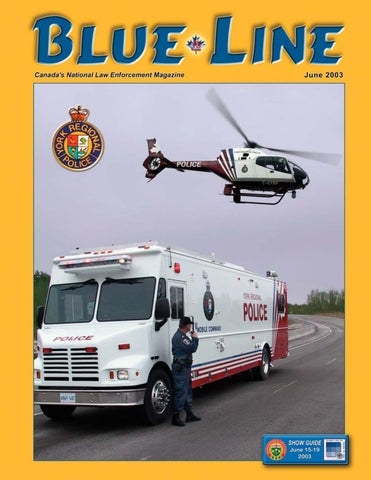
June 2003
2
June 2003 Volume 15 Number 6
Blue Line Magazine
Commentary Tragedies can teach us lessons... if we want them to
5
Command and Control York Regional Police take command of earth, sea and sky
6
Taking command of the sky Police air patrol keeps a vigilant watch
8
OACP 52nd Annual Conference
11
Attacking the paper mountain Vancouver streamlines the parking violation process
14
High tech parking enforcement
17
Asian Organized Crime (AOC)
18
DEEP BLUE Mentally ill or just a little odd? Tips on how to tell the difference
20
CORRESPONDENCE
21
12A-4981 Hwy 7 East Ste 254 Markham, ON L3R 1N1
Canada
Ph: 905 640-3048 Fax: 905 640-7547 eMail: blueline@blueline.ca — Publisher — Morley S. Lymburner
eMail: publisher@blueline.ca
— General Manager — Mary Lymburner, M.Ed. eMail: admin@blueline.ca
— Editor — Mark Reesor
eMail: editor@blueline.ca
— News Editor — Les Linder eMail: news@blueline.ca
— Advertising — Mary Lymburner Dean Clarke Bob Murray eMail: sales@blueline.ca
— Pre-press Production — Del Wall — Contributing Editors — Communication Skills Terry Barker Police Management James Clark Tactical Firearms Dave Brown Technology Tom Rataj Psychology Dorothy Cotton Case Law Mike Novakowski Blue Line Magazine is published monthly, September to June, by Blue Line Magazine Incorporated with a mailing address of: 12A - 4981 Hwy. 7 East, Ste. 254, Markham, Ontario, L3R 1N1. Individual magazines are $3.50 each. Subscriptions are $25.00 per year or $40.00 for 2 years. (Foreign - $50.00 U.S.) All material submitted for publication becomes the property of Blue Line Magazine unless other arrangements have been made with the publisher prior to publshing. The authors, advisors and Publisher accept no liability whatsoever for any injuries to persons or property resulting from the application or adoption of any of the procedures, tactics or considerations presented in this magazine. Readers are cautioned and advised that articles presented herein are edited and supplied for your personal awareness and should not be used for further action until appropriate advice and guidance is received from a supervisor, Crown Attorney or other person in authority. Established in 1988, Blue Line Magazine is an independent publication designed to inform, entertain, educate and upgrade the skills of those involved in the law enforcement profession. It has no direct control from a law enforcement agency and its opinions and articles do not necessarily reflect the opinions of any government, police, or law enforcement agency. ©2003 - All articles are protected by copyright. No part of this publication may be reproduced or transmitted in any form or by any means, electronic or mechanical, including photocopying and recording or by any information storage or retrieval system without permission. Internet activity is monitored and use or reposting of material on the Internet is restricted.
This publication is a private venture and receives no subsidy or grant from any level of government.
— Affiliations — International Association of Law Enforcement Planners Canadian Advertising Rates & Data International Police Association The Police Leadership Forum The Canadian Press Newswire Printed in Canada by Janson Printing Service
ISSN #0847 8538
Canada Post - Canadian Publications Mail Product Sales Agreement No. 176796 June 2003
RCMP offering in-house crisis prevention 22 DISPATCHES
22
Seven phases of a crisis Crisis communication 101
24
Driving and talking banned on the rock
25
More than a just walk in the park Parks Canada Warden Service is at a crossroad
26
Police sergeant aiming for world record 27 Intimate adversaries Asssessing the threat in domestic violence cases
28
BOOK REVIEW Canadian Search Warrant Manual 2003
30
New law targets officer safety on the roadway
31
INCREDIBLE
31
CASE LAW 32 • Warrentless in-home arrest lawful • Overheard prisoner conversation admissible Practical digital photography 34 Simplifying the camera-to-computer interface TECHNOLOGY ‘Deleted’ data remains on hard drives
38
NEWS CLIPS
39
COMING EVENTS
40
PRODUCT NEWS
42
Toronto police send auction to internet
44
BACK OF THE BOOK Whose side is God on anyway?
46
3
The York Regional Police Service, who is hosting this year’s Ontario Association of Chiefs of Police conference, have grown from a collection of small-town police forces to a modern, progressive service of 1,000 officers policing almost a million people. As highlighted in our lead stories, the service has embraced modern policing tools, including a state of the art mobile command centre, the first of its kind in Canada, and one of the quietest, most modern helicopters in the country. Those attending the OACP show can get an advance look at the floor plan and exhibitors list, which begins on page 11. A handgun’s magazine disconnect feature may have cost RCMP Cst. Dennis Stronquill his life. Blue Line firearms editor Dave Brown looks at the issue and what lessons police can learn from his tragic death. You may want to think twice before parking illegally in Vancouver. As Steve Campbell tells us, enforcement officers have gone high tech, using personal digital assistants to eliminate much of the paperwork involved in quickly and efficiently tagging violators. Officers in North Vancouver have gone one step further. Blue Line west coast correspondent Elvin Klassen gives us a look at a state-ofthe-art, computerized mobile license plate reading system that does everything but put the ticket under the wiper blade. In other features, we continue our series on the Criminal Intelligence Service’s review of organized crime; Dr. Dorothy Cotton helps us tell whether someone’s mentally ill or just a little odd; Judy Pal gives us the seven phases of a police agency crisis; east coast writer Danette Dooley tells us of a ban on driving and talking on the ‘Rock;’ Heather Gray has the first of a two part series on assessing the threat in domestic violence cases; Mike Novakowski has two case laws and Dave Brown has some tips on simplifying the camera-to-computer interface in part three of ‘Practical digital photography.’
June 2003
4
Tragedies can teach us lessons... if we want them to by Dave Brown It’s always a tragedy when we have to learn life’s lessons the hard way; when it takes a tragic and needless death to point out the need for changes that should have been implemented years previously. One example of this is a topic you’ve read about many times in the pages of this magazine - the arming of law enforcement officers who protect our borders, parks and roadways. A final insult was recently made by a senior police officer to the effect that arming them would be like giving an accident a place to happen. Thankfully, no officer has died as a direct result of not having the proper tools to defend themselves — yet. Even more tragic would be if an officer dies in the line of duty and nothing is learned from it. Unfortunately, this has already happened. Evidence has been made public that RCMP Cst. Dennis Stronquill was unable to defend himself from his killer, who shot him at point blank range with a shotgun through the side window of his car, because the magazine had fallen out of his sidearm. Why the magazine fell out is irrelevant. Once it’s removed, or even released a fraction of an inch, the Smith & Wesson semi-automatic pistol issued to RCMP members is disabled; an officer cannot even fire the round remaining in the chamber. Whether that one round would have made a difference to Stronquill as his killer approached will never be known, mostly because it was recovered in pristine and unfired condition by officers investigating his death. The Smith & Wesson is one of the few sidearms manufactured with a magazine disconnect, which disables the firearm when the magazine is removed. Beretta, Glock and Sig Sauer do not equip their sidearms with this ‘feature.’ It was once thought that an officer who had their pistol snatched away by an assailant may be able to save their life by reaching for the magazine release and dropping it before their attacker could fire. What a dumb idea. Adding technical features to a sidearm to address training problems just never seems to work. I believe a better solution is to train officers how not to give up their sidearms in a struggle. In another tragic situation, a tactical officer was accidentally shot by his partner during a role play scenario when a round was forgotten in the chamber. In this case, the gun did fire the round in the chamber because that is what it was designed to do. Would a magazine disconnect have saved this officer’s life? Well, even if the agency had been equipped with the Smith & Wesson firearm, it is likely that the sidearms issued to the tactical team members would have had this questionable feature disabled anyway. RCMP Emergency Response Team members do not have magazine disconnects in their sidearms, for what I hope are obvious reasons. June 2003
Let’s not turn these situations into double tragedies by failing to learn the lessons of life: • Train like you fight, because you will fight like you have been trained. • Always follow the P.R.O.V.E. procedure when unloading your sidearm, as has been detailed several times in Blue Line. • Never rely on mechanical features, regardless of whether the manufacturer has labelled it a “safety;” your safety is your trigger finger. If you’re in the habit of simply slipping the magazine out of your sidearm when escorting
5
a prisoner into cells, consider this — If I was the officer racing, in a panic, to respond to your cries of help and I saw a prisoner standing over you with your sidearm pointed at your head, would I have time to analyze whether the magazine was in or out, or even remember if you are or were a member of ERT and thus had the magazine disconnect disabled? Not bloody likely. Dave Brown is the firearms editor for Blue Line Magazine. He can be reached at brown@blueline.ca.
by Morley Lymburner In many ways York Regional Police (YRP) have become the rising star of policing in Canada. They and their community have grown and matured over the past thirty years. Consisting of almost 1,000 officers trained to be in tune with a population of almost a million people, there’s no better way to reflect YRP’s hunger for change than in its embracing of technology to assist in protecting its communities and members. York Region, encompassing an area that runs north from Toronto to Lake Simcoe, was among the first Canadian police agencies to use air patrol support. It acquired its first helicopter in 1999 and has since upgraded through three helicopters and has dramatically improved its communications systems, police stations, in-car computer technology and training facilities. The latest acquisition is a new Mobile Command Centre that brings together a multitude of communication cross links for emergency situations which require a sustained field response. This state-of-the-art centre can be called out, in place and fully operational, anywhere in the Region with less than an hour’s notice. The completely self sustaining centre is operationally divided into five parts, with each section divisible by door partitions. 1 The communication, transportation and support operations which keep the unit self sustained are in the operational command office in the front section. June 2003
2 The galley cell has personal necessities such as washroom and food services for members staffing the unit. 3 The command cell is used for analyzing incoming information and giving direction based on this data. 4 The interview & negotiation cell is used for interviewing and recording witnesses and suspects in a controlled environment. 5 The fifth area is the exterior, which has the capability of serving as a central staging and briefing area for field personnel to both fan out and report back. The unit comes with communication capabilities equal to a fully functional dispatching facility. Roof mounted satellite communications supplies everything from internet capabilities to micro weather reporting to Global Positioning Satellite systems, with locating devices that can scan the local terrain. In an emergency situation communications operators in the unit can dispatch a full range of police resources, from area patrol cars, marine craft, foot officers or aircraft. The unit’s operational communications systems include cellular capabilities and can link to land-lines to assist in hostage negotiation or missing persons searches. In the past, inter-force communication was hampered by the wide array of radio frequencies used by police services, marine radio, airport communications, ambulance, numerous fire departments and utility partners in disaster management. Today the York Regional 6
channels. The unit can Police, partnered with the also monitor the emergency 9-1-1 system, weather — it has a full manages a good portion Columbia Weather Staof this coordinated effort. tion that can supply The new unit can both ground, sea and air place this coordinated consupport units with up to trol at or near the scene of the minute local enviaction. It can also work to ronmental conditions. relieve the headquarters York Regional PoCommunications Bureau lice’s Mobile Comwhen over stretched remand Centre is the first sources, in time of a local of its kind in Canada emergency, take too much but Barrie and Toronto attention from other parts Police Services are of the region. buying similar units The post can also which will be capable function as an on-scene of integrating with investigation office when each other, providing major incidents such as even greater field suphomicides occur. The unit port command and comes equipped with control for incidents state-of-the-art recording such as major disasters and monitoring equipment as well as a com- Constable Ken Doige points out local weather conditions to Police Pilot Sebastian Filion or terrorist attacks. The plete video interview utilizing the on-board Columbia Weather station. The new hi-tech Mobile Command far ranging capabilities room. The video is digit- Center brings together communications and investigation under one field accessible of this unit will go a long ways toward enally recorded and logged on-site unit. hancing emergency for continuity within the Command Post. ate lighting and telephone hook-up capability. preparedness in York Region and is a testaExternal video capability is quite impresThe mobile Command Unit is equipped ment to the forward thinking leadership of a sive. The post is equipped with a telescoping with eleven laptop computers, fully networked forward looking police service. mast that can elevate a camera 12 metres both internally and externally with headquarFor further information contact Sgt. Mike Hand , Incident above the roof. The visual acuity of the cam- ters records and management system. The unit Response Bureau, York Regional Police at eMail: era and its associated equipment can render is also equipped with two commercial satellite 217@police.york.on.ca or phone 905 895-1221 Ex. 7715. a licence plate clearly visible. The camera is dishes for monitoring local and national news also capable of night vision and infrared viewing and can remotely photograph people in crowds from a safe distance. The still pictures can be printed and catalogued for future evidentiary purposes. The entire command vehicle is air conditioned and heated. In a multi-use economy measure, diesel fuel is utilized for not only the engine but also for heating and auxiliary electrical generation. A reservoir of over 400 litres of diesel fuel ensures the unit can function unaided for several days. If electrical hook-up is available, it can be connected through external connections. When needed, the post has considerable search light capability, with a bank of six stadium flood lights capable of illuminating several football field size areas for searchers. Stability is of primary importance. Older units had to be placed strategically so they were more or less level; even then they had to be moved several times if the ground wasn’t stable enough to support its weight. The new unit is equipped with a computer monitored levelling system. Once parked, the system is activated and the entire vehicle stabilized with hydraulic levelers that compensate for rough or unpredictable terrain. If the unit becomes less than level, the monitoring system will automatically compensate. Operationally, the external walls of the post can afford considerable utility for staging operations. In addition to external connectors for public address systems, all three doors have detachable white boards for briefings. External pull out desks are available, with appropriJune 2003
7
Photos by Mark Reesor
by Les Linder The York Regional Police Service (YRPS) has come a long way from its fledgling air support experiment that began eight years ago. The service has developed experience with using helicopters for support and learned over time how to use them more effectively to increase officer and public safety. The service’s first experience began with a six-week long trial project in October 1995, using a helicopter donated by Canadian Helicopter and equipped humbly with a SX-5 searchlight and police radio. A six-month pilot project between York and Durham Regional Police began in June 1999, funded by the Ontario government and YRPS Chief’s Appreciation Dinner committee. The two agencies shared a Bell 206 Jet Ranger equipped with thermal imaging and improved search light. The two York officers taking part were trained by the Calgary Police Service. By 2000, the service had set a goal of establishing its own helicopter program. An Enstrom 480 turbine helicopter equipped with thermal imaging, police radio and an SX-5 search light was donated to the agency in February 2000. Pilots, fuel, maintenance and a hangar were provide by Silverline Helicopters. The helicopter was in service for more than two years when, in June 2002, York Regional council approved the police services board recommendation to buy a new aircraft. The Enstrom was removed from service in August and a Eurocopter EC120 officially took to the air in October under the name Air2. The helicopter was selected for its power, fuel range, June 2003
cockpit layout and noise suppression and came equipped with an Inframetrics MK2 thermal imaging camera, digital VCR, 30 million candle power search light and a Gemini mobile workstation. The helicopter and its equipment cost $1.3 million. Cst. Dave Saunders and Cst. Mark Baggett, both certified thermographers, serve as flight officers aboard Air2. Pilots are contracted from Silverline Helicopters, which also provides maintenance personnel and a hangar. Some of the helicopter’s new tools, particularly the on-board computer, proved to be both a boon and a hindrance when it first arrived, Saunders points out. Using the computer for navigation with the same digital map used in police cruisers and watching the thermal imaging video required some readjustment. “Just like in a cruiser, if a person is too focused with what’s on the screen he’s going to miss what is happening outside on the ground,” Saunders says. “This is even more important to be aware of when you’re in the air and have a much greater area to look at than you do when you’re in a cruiser. The information we can access is great, but we have to be careful how we apply the technology.” Saunders has a video showing how the unit used thermal imaging to spot a suspect who fled from officers and hid in a field of tall grass. The crew directed police on the ground directly to where the suspect was hiding and he was arrested. The service learned a valuable lesson from this incident and has since changed its tactics. Rather than leading officers to a hidden suspect, Air2 now monitors them while ground officers shout out, letting the suspect 8
know they see where they’re hiding and ordering them to come out. In another case, the helicopter led to the rescue of an elderly woman who became lost and fell unconscious in a field during freezing temperatures. The woman’s body heat came up easily on the helicopter’s thermal camera and officers were quickly guided to her. In March 2003, four people were charged after stealing a Mercedes Benz and leading York officers in pursuit which reached speeds of 200 km/h. The pursuit was called off due to public safety concerns when the suspects reached the 407 highway. Air2 followed the vehicle to an underground garage in Scarborough where, with the help of Toronto police officers, the suspects were arrested. The helicopter has also proved effective as a suppression tool in violent or disorderly situations. “What we’ll do sometimes is fly in low and fast on the scene, making a whole lot of noise and pointing the spotlight down on people,” Saunders explains. “This lets everyone know big brother is here and a lot of people will simply lay down on the ground once they see us and our officers move in to make arrests. This type of support is what Saunders says makes the helicopter shine. “We can pursue people without causing dangerous situations and we can keep a bird’s eye view on the situation around our officers. The helicopter is just a tool and you have to use it properly to get good results.” The amount of flight time a police agency budgets for is crucial in determining how successful a helicopter program will be, Saunders
June 2003
9
Air2 keeps a close eye on three people as ground officers move in to secure a night club after a fight broke out.
York Regional Police Air2 is given a quick inspection by pilot Sebastian Filion before beginning an evening shift patrol.
points out. Without an adequate amount of hours, the helicopter may not be available when it is needed most. Air2 is currently budgeted to have about 1,200 hours of flight time annually. Saunders feels that’s sufficient and allows YRPS to use it on lengthy patrols and provide long-term support on dangerous calls. Focusing how the helicopter is used is also vital, he adds, particularly if there’s a limited amount of flight hours available. “We don’t do rescue or really do surveillance. We’re here to support our officers on the ground and our advantage is our speed - we can get anywhere our officers need us before most other ground units. As long as we don’t start trying to use the helicopter for other tasks that can use up time and fuel, we can help keep our officers safe.” One misconception many people and particularly police services have is that a helicopter will result in frequent noise complaints from the public. Saunders says complaints about the helicopter creating noise in York region are almost non-existent. “Instead, we get inquiries about it,” Saunders explains. The calls from residents are almost always a question as to why the helicopter was in their area. “Once (residents) understand what we were doing in their area, they’re fine with it. Even with the new helicopter, which is much quieter than the Enstrom, we’ll get the rare noise complaint, but 99 per cent of the calls are just people asking what’s going on.” Saunders and Baggett have also taken an active approach to dealing with citizen concerns. If a resident calls and asks why the helicopter was flying over their neighbourhood, the communications personnel are instructed to explain the situation. “That almost always satisfies them,” says June 2003
Saunders. “If that doesn’t appease them, Mark or I will phone them back later and explain it to them.” He says the public appreciates receiving a call explaining what was going on, thus improving public relations. Saunders and Baggett have also cemented strong relations with the ground officers they support, proving the helicopter is not just popular among the air support team. In the two month gap between switching from the Enstrom to the EC120 in 2002, Saunders was concerned other officers would forget about Air2. Instead, “(ground officers) kept asking us when we were getting back up. They let us know that our support was missed and important to them - that meant a lot to us.” An issue which frequently arises in services with helicopters is how important it is for the pilot to also be a police officer. The answers vary from service to service and range from financial reasons to mere ignorance, Saunders says. “In police aviation, which is a profession within a profession, you can’t just take an officer and throw him up in an aircraft,” he explains. “What it comes down to is simply having the right people in the environment and making sure they work well together. I don’t know if administrators fully understand that. You need a pilot with the right skill and demeanour to pilot a police helicopter and we’ve gone through quite a few pilots here.” One of the most important qualities Saunders looks for is a police mentality. Because of the cost of operating a helicopter, both people aboard need to be “switched on” and geared right into the job; otherwise mistakes will happen, officers will get hurt and criminals will get away, he says. Saunders and Baggett work hard to make sure the air support unit’s responsibilities are 10
met. Their first priority is officer and citizen safety but they’re also careful to be fiscally responsible by making sure Air2 is used efficiently. “How things may change for our helicopter in the future, I can’t really be Cst. Dave Saunders sure,” Saunders says, “but as long as we meet our responsibilities by making things safer on the ground, we can develop the unit further and provide a better service.”
OACP Trade Show — List Of Exhibitors Accident Support Services International Inc. ACS Public Sector Solution Advanced Interactive Systems Advantage Fitness Sales Inc. Atlantic Police & Security Supply Co. Avel-Tech Inc. Bell Canada Bell Mobility - Radio Division Blue Line Magazine Business Watch International Canada Law Book CanRep Inc. Comnetix Computer Systems Inc. Cowan Dalton Crime Stoppers CVDS Inc. D&R Electronics Dack’s Shoes Ltd. Dataradio Inc. Deeley Harley-Davidson Canada Dictaphone Canada DMTI Spatial DSM Law Enforcement Products
ESRI Canada Ltd. Eurocopter Evin Industries Ltd. Fechheimer Fleming College Garda of Canada General Dynamics Land Systems Canada Goodyear Gordon Contract Footwear Heartzap Services Ltd. i2, Inc. Insurance Bureau of Canada Intergraph Public Safety Lees Motivation Canada M.D. Charlton Co. Ltd. Martin & Levesque / Blauer Medtronic Physio-Control Michaels of Oregon MSA Canada National Parole Board Northrop Grumman Public Safety Inc. OACP Ontario Police College
Ontario Police Memorial Foundation - Torch Run Outdoor Outfits Pacific Safety Products Panasonic Canada Inc. Paradigm Business Systems Pelican Products Inc. Positron Public Safety Systems R. Nicholls Distributors Inc. Rogers AT&T Second Chance Body Armor Sierra Wireless Inc. Strategic Directions/Cromwell Associates Inc. Streamlight Inc. Telus The Police Credit Union Ltd. The Uniform Group Inc. VCR Video Warehouse Inc. ViCARS York Region Westervelt College Windows to Technology Ltd. York Region EMS Zoll Medical Canada
Blue Line Advertisers at the OACP Trade Show Accident Support Services International
See advertisement page 22 Facilitating centralized collision reporting to police and insurers, no cost to police or taxpayers. Reduce traffic congestion and minimize risk of secondary collisions. Manpower and operating costs savings are reallocated to higher priority needs. Improve response times and increase Highway Traffic Act charges with pro-active, not reactive enforcement. Increase “No Insurance” and “False Statement” charges. Photo imaging of damage and “Reported to Police” stickers help reduce insurance fraud. Police involvement is reduced to less than five minutes/citizen from the previous average of 1.5 hours. Our services are flexible to meet your needs, whether the population is from 20,000 to 3 million. June 2003
Advanced Interactive Systems
See advertisement page 39 The Prisim Judgment Simulation training system, featuring the patented ShootBack cannon, provides immediate feedback to trainees and significantly impacts the effectiveness of law enforcement training. The Prisim simulator has been recognized in USA Today, The New York Times, ABC World News Tonight, NBC Today Show, CBS Morning Show, and many others.
Blue Line Magazine
See advertisement page 47 Blue Line Magazine is Canada’s national law enforcement magazine, read by the full spectrum of the industry from management to front line personnel. For 15 years, Blue Line has continuously formed a powerful relation11
ship with its readership, delivering non-aligned editorial content while reporting on the latest trends and technologies shaping Canadian law enforcement. Blue Line’s complete multi-media package includes Blue Line Magazine, Blue Line News Week, Blue Line On-line, and Blue Line Trade Show.
Business Watch International
See advertisement page 24 Our expertise is data management. We have developed an Internet-based program for collecting, storing and delivering transaction information gathered in pawn shops and secondhand goods businesses. Our program addresses the police officer’s need for improved accuracy, quantity, relevancy and timeliness of transaction information. At the same time, police want a system that
is simple to use. Applying modern technology to investigate transactions in the pawn and secondhand industries will, in turn, help in the fight against the many other crimes and social problems linked to property theft. The BWI Automated Reporting System links police services to a real-time database that displays information on transactions occurring in pawn and secondhand businesses.
Dictaphone Canada
See advertisement page 38 Dictaphone’s Communications Recording Systems (CRS) group is the leading provider of liability and quality monitoring recording solutions for over 18,000 customers worldwide, including public safety agencies, contact centres, financial services centres, and government institutions. In addition to its award-winning fault-tolerant recording platform for mission critical recording environments, the CRS group also provides digital video surveillance technology to enhance its disaster recovery and homeland security offerings. Additionally, the extensive suite of quality management applications offered by the CRS group provides contact centers with leading-edge technology for analyzing customer satisfaction and deriving business intelligence for the entire enterprise from the recorded interactions.
Gordon Contract Footwear See advertisement page 30 Gordon Contract is Canada’s foremost distributor of police, security and correctional service footwear. Our knowledgeable and dedicated staff brings over one hundred years of combined footwear experience to the task of providing you with the right product, at the best price with the most reliable and satisfying service in the industry. Because we supply every major brand and source around the world for the latest styles and components, you can rely on us for the information you need to make the best choice for you and your department. Gordon Contract... taking care of your footwear needs.
Medtronic of Canada
See advertisement page 9 Medtronic of Canada is the Canadian subsidiary of Medtronic Inc. the world’s leading medical technology company. Medtronic Physio-Control was formed in 1998, when Physio-Control, a leader in the design, manufacture, sales, and service of automated external defibrillators (AEDs), and manual defibrillators, merged with Medtronic. Medtronic Physio-Control currently has more than 350,000 units in operation worldwide, and the LIFEPAK 500 is the most popular AED ever produced with more than 100,000 units in use. Police use of AEDs in the United States has doubled survival rates (9.0% to 17.6% in Miami-Dade County), and police forces in Canada are now committing to AED use, with the LIFEPAK 500 as their AED of choice. June 2003
See advertisement page 43 Kydex Tactical Holsters from Uncle Mike’s Law Enforcement feature injection molded Kydex construction, which ensures high quality and performance. With a fullyadjustable belt loop and leg, Kydex Tactical Holsters offer users a customized fit that positions the firearm below a raid jacket or tactical body armor. The Velcro-adjustable leg strap includes an elastic segment for comfort and firearm security.
Michaels of Oregon
cases, forensic equipment, defibrillators, crime scene photo cases, and many other applications. Pelican traditional case line (1120 – 1750) are available with pick n’ pluck foam, padded dividers, or no foam configurations. Lid organizers are also available as an option and all 19 cases can be secured by locks. Pelican MicroCases (1010 – 1060) are also available with pick n’ pluck foam. All Pelican cases and flashlights come with Pelican’s legendary “You break it, we replace it … forever” guarantee.
MSA Canada
R Nicholls Distributors Inc
See advertisement page 4 Mine Safety Appliances Company (MSA) is the largest company dedicated to producing a complete range of equipment and systems for workers and plant protection. MSA is a global company with 27 operating companies, serving customers on five continents. Our products help protect lives in more than 120 countries. These products are used by major law enforcement agencies throughout North America and include respirators, respirator cartridges, gas masks, riot control products, fire helmets, shields, self-contained breathing apparatus (SCBA), thermal imaging cameras, hard hats, head protection, fall protection products, harnesses, lanyards, lifelines, confined space equipment, training, consulting services, hearing protection, eye & face protection, monitors, portable instruments, and permanent gas detection equipment.
Panasonic Canada Inc
See advertisement page 2 Panasonic has deployed over 25,000 rugged notebook computers into law enforcement organizations throughout North America. Our top of the line CF-28 Toughbook can be found in many public safety organizations throughout the US and Canada. Panasonic offers a full range of rugged notebooks suited for the public safety market including the CF-28 and our newest model the CF-50. For more information on the Toughbook lineup, drop by our booth.
Pelican Products Canada
See advertisement page 5 Pelican Products, Inc. (Canada) is the manufacturer of the toughest, watertight protector cases and the most safety approved flashlights for hazardous locations in the world. Pelican’s law enforcement flashlights, the Black Knight Series, features a wide range of different size rechargeables, all available with 110V transformer, 12V plug-in charger, or a direct wiring rig. This year they introduced their first lithium powered flashlight – Pelican’s M6. The Xenon bulb in the Black Knight Series will penetrate snow, rain, fog and smoke and belt holsters and traffic wands are available for most. Pelican cases will protect sensitive police equipment such as weapons, ammunition, laptop computers, finger printing kits, drug testing equipment, intoximeters, assault evidence 12
See advertisement page 13 Included in the leading edge products R. Nicholls Distributors Inc. will be featuring this year is the MP7 PDW from Heckler and Koch. The PDW offers the firepower of a submachine gun, medium range capabilities of an assault rifle and pistol-like close combat dimensions…The Digital Eyewitness once again shows that Kustom Signals is the In-car Video market leader. This digital solution is revolutionizing In-car Video...The Hindi baton cap is one more reason the Autolock baton from Monadnock is the premier solution in retractable batons. The Hindi cap adds functionality and aids in the retention of retractable batons…There is no other training suit that provides protection against as wide a range of less lethal munitions as the Pine Tree’s Simmulation Training. Pine Tree’s Defender 20 gauge less lethal firearm and the world’s first level IV retention holster, the Raptor, will also be featured in the Nicholls booth.
Second Chance Body Armor
See advertisement page 37 Second Chance Body Armor is featuring the new Ultima Level II soft body armor, 37% lighter than previous technology, wrapped in Gore-Tex Comfort Cool pad covers. Lightest, thinnest, most comfortable Second Chance vest. New Second Chance Ballistic Helmets and Shields, featuring revolutionary, lightweight ballistic technology.
Westervelt College
See advertisement page 21 Westervelt College, Canada’s oldest private college (118 years) is a leader in law enforcement training. The highly successful program trains over 150 students each year to earn law enforcement positions in Canada and the United States. With over 250 years of police experience, the faculty is second to none in the province. The program is unique in its use of discipline with students. Students wear cadet uniforms, experience daily inspections and benefit from physical fitness, use of force, and defensive tactics training. In addition, the program utilizes scenarios to give students hands on experience to supplement their academic learning.
June 2003
13
Attacking the paper mountain Vancouver streamlines the parking violation process
by Steve Campbell In Vancouver, the days of repeat offenders ignoring tickets are coming to an end as quickly as the paper it takes to catch them. With new hi-tech ticketing the future path to better parking control is assured. Parking enforcement is one of the most paper-intensive activities in city management. From enforcement officers working on the streets to clerical staff and management in the back room, there is little doubt that many experienced city government employees spend too much time shuffling paper when their know-how could be of more use applied to tasks that deliver a higher return. Automating the ticketing and enforcement system can reduce or eliminate the papershuffling workload. In addition, enabling this automated system with real-time wireless twoway connectivity with the central databank of ticket and permit records can connect enforcement officers on the streets with a large library of information, making them much more productive. This was the City of Vancouver’s intention when it automated its parking management system and “went live” this past year with a realtime information network. The business case for the Vancouver system was compelling. In an analysis produced by city staff for review by the city council, a net annual benefit of $235,000 was estimated over the first six years of the system. After that, the benefit would rise to $393,000 per annum — an excellent return on the initial investment. The analysis anticipated the elimination of three keypunch positions (out of four) for transcribing handwritten parking tickets. It also projected a higher volume of valid tickets, increased ticket payment rates, and fewer meter violations. City staff believe the capital cost of
June 2003
the equipment purchased could be paid back in as little as three years, leading to a potential net present value to the city of $1 million over a six-year time span. While the early returns from the system’s first period of operation are not yet in, the system has proven its worth in the field handily. “This is an easy-to-use system that utilizes handheld ‘personal digital assistants’ (also known as PDAs) and a real-time information system that eliminates much of the paper and manual data entry from the ticketing back-end system,” said Ralph Yeomans, Vancouver’s manager of parking operations and enforcement. Over a one-year period, 100 enforcement officers issued approximately 400,000 tickets worth some $8.3 million in fines. “We believed our bylaw officers would welcome a realtime system because it eliminates or reduces clerical tasks and frees them up to focus their attention on more important tasks,” said Brent Heisler, handheld supervisor/coordinator for the city’s program. “The other side was giv-
14
ing staff real-time access on the street to our ticketing, permit and vehicle databases, which has given them the power and knowledge to make better decisions on the street while they’re working.” The new system consists of 81 handheld SPT 1733 handheld PDAs and printers. A manufacturer of wireless automatic data collection systems, provided the ticket-management software — TicketManager — and consulted on the system setup, implementation and operation. In this system, all of the ticket information, vehicle infraction history and residential permit parking registrations are stored on a central TicketManager server Photos: Steve Campbell that is accessed in real time by the enforcement officers via PDAs and the local cellular network. To begin, they simply enter a license plate. A series of drop-down menus on the PDAs and automatic fill-in of repetitive information make completion of enforcement notices convenient and efficient. This eliminates the previous timeconsuming and error-prone task of batchprocessing handwritten tickets at the end of the day. In addition, this system makes available — via the handheld unit — a wealth of parking department information that enables the enforcement officers to do a more effective job. Increased Compliance The Vancouver parking operations branch has counted approximately 9,000 vehicle owners who have five or more tickets outstanding. The cost of tracking and prosecuting these unpaid tickets is high. Already, revenues from the court cases section (cases that will be taken to court if the ticket is not paid) are up $300,000. Parking operations employees believe the reason for this increased compliance is the automatic flagging of vehicles with five or more tickets. Once an offending car’s license plate number is punched into the system and identified as a repeat violator, by the simple act of pressing a button on the handheld unit, a tow truck can be ordered to impound the vehicle immediately. Or, a summons officer can be asked to serve the owner with a court summons upon their return. “We found that once parking violators became aware our enforcement officers have the information available to track and immediately tow repeat violators who don’t pay their fines, they are far less interested in ignoring their tickets,” notes Heisler. “It’s an interesting and unexpected side benefit to the system.”
Illegal use reduced Residential parking permits is another area in which non-compliance or evasion was occurring. In this situation, residents living in communities with limited on-street parking can apply for a residential parking permit to enable them to use nearby “resident-only” street parking. Unfortunately, some of those who already have underground parking will apply for a parking permit anyway, and then sell it to someone else who needs to park in that area (such as employees of area businesses) and wants to avoid paying off-street monthly parking fees. Vancouver’s parking department staff estimates that 15 percent of all permits are illegally resold in this way, allowing outsiders to infringe on the parking rights of legitimate permit-holders. Previously, enforcement officers had no way of knowing if a parking permit was registered to the vehicle displaying it; only hunches would help them uncover this illegal usage. The result was that only one violator per week was caught. Now, under the new system, the officer can punch in a license plate and find out quickly if that vehicle is registered as the official owner of the permit. The same applies to the use of commercial, disabled and exemption permits. The results have been impressive: on average, enforcement officers now discover and tow ten vehicles per day using preferred permits illegally. Easier connections In the new system, enforcement officers ticket the car and enter the information electronically. The car’s information is sent immediately to the police computer system via a secure one-way transmission, and comparisons can be performed automatically to look for matches with the list of missing, stolen or wanted vehicles. When the system recognizes a match, it alerts the police to attend and physically examine the vehicle. Simultaneously, TicketManager informs the parking officer if the vehicle or its owner is a bylaw offender. To cut down on future system abuse, details on every vehicle the branch comes into contact with are recorded in TicketManager server’s secure database. Take “courtesy cancellations” of tickets as an example. If someone’s car has broken down and they plead their case to the enforcement officer, they are often spared a ticket and given a chance to deal with the disabled vehicle. If another officer comes by later and the parker has failed to remove the vehicle but requests another cancellation, inputting the vehicle license into the computer will bring up the entire vehicle record, including the previous courtesy cancellation. Further, if a vehicle owner has been threatening or abusive toward parking staff in the past, this can be flagged in the notes section of the handheld unit. Officers can then be more careful around the vehicle and even choose not to place the printed ticket on the windshield prior to towing, filing it electronically instead. June 2003
With the entire parking staff connected to the system at all times, it also becomes easier for staff to keep track of each other and provide assistance in an emergency. There is a law in Vancouver prohibiting parking at broken meters. The TicketManager system enables the parking branch to keep track of repeat violators, and also business owners who monopolize spots directly in front of their stores. Improved service While no one likes receiving a ticket, the new system improves service for those who do. “In the old system, when people received a ticket, they would phone in immediately to protest, not realizing our customer service people wouldn’t receive the particulars until the next day at the earliest — after the officer had come back to work, dropped off the paper tickets and had them inputted by hand that night,” said Heisler. “Now, the information is available right away, and we can discuss the details with the customer.” Still, the new system has not been without
15
its bugs. For instance, it was discovered that the ticket printer required a certain type of synthetic paper in order to work at maximum efficiency. And some of the older employees who were used to dealing with paper tickets were reluctant to try the new service initially. As they watched other enforcement officers get used to the system, however, most eventually came on board and took the training. Today, all enforcement officers with the exception of one who is nearing retirement are using the handheld units. This successful adoption was due in large part to the fact that training was not made mandatory for staff. “There is little doubt TicketManager has improved our enforcement officers’ personal safety and ability to deal efficiently with non-compliance, not to mention energized their work,” concludes Ralph Yeomans. “It’s a valuable ‘real-time’ system that we fully recommend to other city or town governments for their bylaw enforcement programs.” For the future, Vancouver is also looking at other applications for the real-time technology. These include allowing parkers to pay their meter charges by ordering time over their cell phones as they park, and futuristic new handheld units with scanners incorporated that can take a picture of the car and its parking violation. In the meantime, the city is reaping the benefits of today’s technologies in the form of improved system productivity and employee satisfaction — and enjoying the significant benefits that occur when automated data capture eliminates non-essential paper-pushing. Steve Campbell is a technical writer based in Vancouver. He can be reached at campbellpr@shawbiz.ca.
June 2003
16
High-tech parking enforcement
by Elvin Klassen Parking enforcement officers in North Vancouver now have more than chalk and comfortable walking shoes to help them get the job done. The city has bought a new, state-of-the-art, mobile license plate reader system which it mounted on a 2002 Suzuki Vitara. The vehicle is outfitted with cameras, computers and satellite technology which photographs and records a vehicle’s position, location, plate number, time and date. As the vehicle drives by parallel-parked cars at about five to ten kilometres per hour, the roof and bumper mounted digital cameras record licence plate numbers. Simultaneously, the on-board GPS system notes the precise location of each car, which the computer matches with the plate image and exact time. When the enforcement vehicle returns an hour or two later, depending on the timed parking zone, the cameras go to work again recording plates. If the same one comes up in the same location, a buzzer sounds to notify the parking officer a vehicle has been parked longer than the permitted time. The officer then uses a big colour touch screen on the front dash to set up and record the whole process and even bring up a photo of the vehicle. A traditional handheld machine is still
used to issue the ticket, though that will also soon be automated. At the end of each shift, the parking officer inserts a Zip disk and downloads the day’s pictures. “This system will help us cover a greater area and service more streets where illegally parked vehicles cause problems for local businesses and other drivers in busy areas,” says parking enforcement supervisor Barbara Hamilton. “This is a wonderful tool that will assist us in responding to more illegal parking complaints and conduct our jobs more efficiently.” The license plate reader system has other law enforcement applications, such as helping to find stolen and wanted vehicles and identifying owners with unpaid parking tickets. “Each morning we upload the latest data from the RCMP,” explains parking enforcement officer Rob Maione. “As we cruise around on the streets and we read a plate from a stolen car or from a vehicle wanted by the police, the system tips us off.” The reader can also provide data for parking occupancy, turnover and length of stay studies, though its main purpose is to improve traffic movement and flow in the city. Elvin Klassen is Blue Line Magazine’s west coast correspondent. If you have a story of interest, he can be contacted at elvin@blueline.ca .
Blue Line recognized for anti grafitti support
The publisher of Blue Line Magazine, Morley Lymburner, was recognized for his on-going editorial support of the Toronto Police Service's Grafitti Eradication Program. "It is only through June 2003
the support of the public media that such initiatives can really get a head start," Lymburner said at the April 30th press conference. "We felt the importance of grafitti in communities across the country is underestimated by both the public and most importantly, the local police." Blue Line's exposure of the concerns about grafitti to the national law enforcement community is a good way for this program to propagate itself across the country." Chief Fantino pointed out that since the program received exposure in Blue Line Magazine over the past three years police services from across the country have looked to the Toronto Police for information and guidance on their own local initiatives to eradicate grafitti. 17
Asian-Based Organized Crime (AOC) Asian-based organized crime groups (AOC) continue their extensive involvement in large scale manufacturing and distribution of counterfeit credit cards, software and electronic entertainment such as CDs and DVDs. Groups across the country also import and distribute multi-kilogram quantities of cocaine and southeast Asian heroin and increasingly, designer synthetic drugs such as ecstasy and GHB. Vietnamese-based groups continue to produce a significant portion of BC’s marijuana through large-scale, indoor grow operations and have expanded these across the country, particularly in southern and eastern Ontario. Members and associates often conduct criminal activities with different groups simultaneously and the crimes may or may not be linked. This structural fluidity and flexibility — an individual may be a high-level organizer in one criminal enterprise and a lower-level labourer in another — is an AOC trademark. They also frequently travel nationally and internationally, both to avoid law enforcement scrutiny and because of the wide scope of their criminal activities. Groups continue to associate with criminal organizations here and around the world and expand links with youth and street gangs, which are typically used as security, a source for recruits and labour pool for criminal activities. There are a number of active Asian-based street gangs in BC, Ontario and Quebec. Some members engage in criminal activities, typically street-level crimes, violence and drug trafficking for organized crime groups. Police are beginning to see second-generation members. AOC groups on the west coast of BC, the Canadian gateway to the Pacific Rim, are geographically situated to exploit the international illicit trade in drugs, firearms and illegal human migrants. They continue to be criminally active at marine ports throughout BC, particularly on the Lower Mainland and often in conjunction with other criminal organizations, to smuggle contraband in and out of Canada. AOC groups across the country remain extensively involved in large-scale importing and trafficking of drugs, particularly heroin, cocaine and ecstasy. They dominate the heroin trade, with Fujinese-based criminal groups (based in southeast China’s Fujian province) playing an increasingly larger role — approximately 95 per cent of Canada’s supply originates in southeast
June 2003
Asia. All major heroin seizures in Canada in 2001 involved Asian crime syndicates. Southeast Asian heroin typically enters through Vancouver, Toronto or Montreal international airports and major BC marine ports. A portion is then smuggled to US based Chinese criminal groups, who operate on both sides of the border and control distribution. This is expected to continue, particularly if demand keeps rising. There were 222 illicit drug deaths in BC in 2001 — 90 in Vancouver alone – the highest absolute and per capita in Canada. Heroin and cocaine, often in combination, remain the major drugs of choice for injection. AOC groups, along with the Hells Angels in Saskatchewan (particularly Saskatoon) traffic cocaine, ecstasy and marijuana they import from BC; associates traffic BC cocaine in Winnipeg that’s likely sent by air or land. AOC continues to import and distribute large amounts of heroin in Ontario and also smuggles cocaine into eastern Canada, generally at the multi-kilogram level. They’re also the predominant importers of opium, which originates either in the Afghanistan/Pakistan region of southwest Asia or the Myanmar/Thailand/Laos region of southeast Asia. Vietnamese-based groups continue to be extensively involved in the large-scale cultivation and exportation of marijuana through residential growing operations across Canada, particularly in BC, and have recently been rapidly expanding eastward to Ontario. These operations pose significant health and safety risks both to the occupant growers, their families and surrounding communities. The Hells Angels and Vietnamese-based crime groups use brokers to control about 85
18
per cent of the marijuana production and distribution in BC. It’s conservatively estimated that there are 15,000 to 20,000 grow operations in the Lower Mainland producing $4.2 billion (wholesale value) worth of the drug; production across the province is estimated at $6 billion. Profits are frequently funnelled into other criminal activities; according to intelligence gathered from one operation, high-level gang members of Chinese descent bought marijuana from Vietnamese-based drug trafficking gangs to amuggle into the US. AOC groups are extensively engaged in manufacturing designer drugs such as ecstasy. Six individuals were arrested following an eight-month investigation by the RCMP and Toronto Police Service and charged with manufacturing and distribution in one of the largest seizures of the drug in Canadian history. Also seized were enough chemicals to make another $10 million worth of hits. In the joint forces Project Dracula, investigators disrupted a drug trafficking network active in Toronto, Ottawa and Montreal and arrested high-level members of three AOC groups. Members across Canada continue to be involved in extortions, home invasions, kidnappings, smuggling illegal migrants, theft, shoplifting, prostitution, assaults, illegal gambling, loan-sharking and producing counterfeit currency, software, manufactured goods and credit cards. The groups also launder criminal proceeds and invest the money into legitimate businesses and continue to smuggle illegal migrants across the Canada/US border. Two Canadian citizens of Chinese descent were caught trying to sneak four Chinese nationals across the Niagara River into the US in May 2002; all four entered through the Vancouver airport and were being smuggled in a homemade boat with plywood seats and no windshield. There have also been a few incidents of Korean and Malaysian nationals being smuggled into the US through New Brunswick, bound for New York City.
Pot smoking generation gap widens A new poll suggests the marijuana-smoking generational gap between Canada’s youth and their parents is widening. Thirty-six per cent of Canadians aged 1824 have smoked marijuana in the past year, compared to only eight per cent of those aged 35-54, according to a poll by Leger Marketing. According to the poll, 58 per cent of Canadians who smoke marijuana have tried it by age 24. This figure has been continually rising since 1993 and is now among the highest in the world. The poll was conducted between April 1 and April 6 and surveyed 1,501 people across Canada. Sample results are considered accurate within 2.5 percentage points. While more than a third of people aged 18-24 have recently smoked, only 24 per cent of 25-34-year-olds have smoked marijuana in the past year. After age 34, the rate drops off dramatically with only one per cent of seniors older than 65 using the drug last year.
No large-scale smuggling attempt by ship has been detected since the high-profile arrival in 1999 of four decrepit vessels carrying 599 illegal Chinese migrants; the majority continue to enter Canada by regular commercial international flights. AOC in BC, particularly the Lower Mainland, continue to be at the forefront of North American counterfeit credit card production and distribution and also produce and distribute other counterfeit material, including software, CDs and DVDs. Vancouver Police seized more than 6,700 counterfeit DVDs in Chinatown in January 2002, the largest haul in Canadian history. Usually sold at smaller video stores, the fake discs cost less but are lower quality. Eight people were arrested after $500,000 of Asian made counterfeit goods were seized from two Vancouver companies in April 2002. The raids coincided with seizures in Toronto. Experts estimate the counterfeit industry is worth $20 billion a year in Canada amd more than $500 billion annually worldwide. As in BC, AOC groups in Alberta, particularly Calgary, are also involved in producing and distributing counterfeit credit cards, with networks throughout North America. A 15-month joint forces operation in early 2002 disrupted a huge credit card ring with associations in 34 countries. They reportedly swiped genuine credit cards from users at 116 retail merchants across North America and forwarding the data to other members at eight counterfeit card factories (now dismantled) in Toronto, Calgary, Edmonton and Vancouver. In an example of the
June 2003
multiple criminal activities these groups simultaneously undertake, approximately 2,200 kilograms of marijuana was also seized during the course of this investigation. AOC groups in Saskatchewan have also been known to distribute counterfeit money. A group in Saskatoon used a portable skimmer to steal credit and debit card information, which was used to produce cards in the Toronto area to withdraw cash. Dai Heun Jai was associated with the Toronto portion of the operation. Toronto groups, particularly Dai Heun Jai, continue to be responsible for the majority of cards and exert considerable control over the Canadian industry. Like other AOC organizations, it has criminal networks nationally and internationally, including East European, East Indian and Nigerian-based counterfeiting groups. Outlook Vietnamese-based organized crime groups will continue to be extensively involved in largescale marijuana cultivation and exportation to the US and will continue moving east. The more recent trend of individuals moving back to BC after being charged in Ontario will also continue. Atlantic Canada will also see an increase in AOC presence and criminal activity. This article is part of a Criminal Intelligence Service of Canada review of targeted organized crime groups and their activities, based on intelligence and investigation reports from Canadian and international enforcement agencies. Blue Line Magazine is running a series of monthly articles based on the CISC’s 2002 final report. Go to www.cisc.gc.ca for more.
19
Mentally ill or just a little odd? Tips on how to tell the difference by Dr. Dorothy Cotton, Ph. D., Psych. People often ask me how they’re supposed to know whether a person is just a bit odd or mentally ill? In this case, by ‘mentally ill’ I’m referring to individuals out of touch with reality who may need help to keep themselves or others safe. There are no sure ways to know; even mental health personnel sometimes need weeks to figure it out. It can be hard to tell if someone is psychotic, on drugs or both, but there are some things that should make you suspicious: • The individual is talking to themselves — or at least looks like they are. They’re probably responding to voices they hear but you don’t. • They seem unduly frightened of you and anything around them. You don’t see anything scary but they seem terrified. • What they say makes no sense. The words might be mixed up and put into sentences that don’t appear to have any meaning. • When you ask a question, you either get no response or one that doesn’t have anything to do with what you asked. • The individual thinks people are out to get them, but it doesn’t seem likely given the specifics. Maybe it’s the Martians or the KGB — or neighbours repeatedly trying to break in, even though you don’t see any evidence of this. • Clothing doesn’t match the weather. It’s July and they’re wearing a winter coat and mitts, for example, or February and they’re wearing only a light coat and seem immune to the cold. • The individual has a blank look or wide eyed
stare and doesn’t respond. You say things and they don’t appear to hear you. • They use words in strange ways — either made-up words or normal words said as if they meant something else. • They believe they have special powers, like being able to jump off a bridge without getting hurt or summon strangers to help with a wave of the hand. • The individual thinks mundane things have special meanings. You parked on the left side of the street so that means you must be a spy, for example, or the presence of a fire hydrant means there’s going to be a tidal wave that will drown us all. • They assume odd postures or stand or sit in strange ways — and stay that way for long periods. • They repeat the same word, phrase or gesture over and over or continually pace or walk in circles for no apparent reason. There are other symptoms but these are the ones you’re most likely to come across. Okay, that’s all well and good, you might ask, but what should you do if you decide someone is mentally ill. Here’s what I would suggest: • Assess risk, as you would in any other situation. • Keep your distance — but don’t hide if you can avoid it. They’re less likely to react if they can see you than if you sneak up on them (but of course safety comes first). • Don’t argue with things that don’t make sense. Be sympathetic — it must be very scary to think there are people out to get you so tell them so — perhaps you could say ‘gee, it must
Canadians delivering the flame More than 100 law enforcement officers and 10 athletes from Canada and 23 other countries will deliver the ‘Flame of Hope’ to the 2003 Special Olympics World Summer Games in Dublin, Ireland. Participants will run three different routes through Europe in the international Law Enforcement Torch Run Final Leg, converging in Brussels June 10. The flame arrives in Belfast June 12 and will be carried through more than 130 communities, with the help of Police Service of Northern Ireland and Garda Siochana members, on the way to opening ceremonies in Dublin June 21. Canadians Alan Richardson of South Porcupine, ON and Tim Korchinski of Saskatoon, SK will be among 10 running team leaders. Paul Manuel (Airdrie, AB), Russ Foster (Maple Ridge, BC), Dominic Broaders (St. John’s, NF), Helen Burns (Halifax, NS), Mike Currie (Chatham, ON), Michel Lariviere (Lasalle, QC) and Kenneth Matechuk (White City, SK) are the Canadian LE runners. Every two years, officers and athletes represent their state, province or nation’s Special
June 2003
Olympics Torch Run program on a ‘final leg team’ which carries the flame to the games.The largest grass-roots fundraising and public awareness vehicle for the games, the run has raised $113 million (US) for Special Olympics worldwide since its inception in 1981. “These officers are true ‘Guardians of the Flame’ and exemplify the support and dedication that thousands of law enforcement officers around the world offer to the Special Olympics movement,” said Timothy P. Shriver, Special Olympics president and CEO. The games take place June 21 to 29 and are expected to be the largest sporting event in the world this year. More than 7,000 athletes, 3,000 coaches and official delegates, 30,000 volunteers and 28,000 family members and friends will be on hand. Athletes will compete in 21 sports. Founded in 1968 by Eunice Kennedy Shriver, the Special Olympics offer mentally retarded people the chance to get in shape, demonstrate courage and make friends. There is no cost to participate.
20
be very scary for you…’ We all say things that don’t make sense at times and none of us like to have it pointed out! • If a person is hearing voices, remember that you’re essentially butting into a private conversation when you talk to them. Be courteous and remember that there’s a lot going on in their head right now. • Remember that a show of force may well make things worse, especially if the individual is already frightened. You never know what meaning they attach to a person in uniform, but it could be a reflection of past experiences or something you wouldn’t expect. • Take your time and go slow and steady. Unless the individual is clearly out of control or getting violent, don’t raise your voice. Instead repeat things, offer simple choices and be reassuring. • Smile; it’s amazing how much that can defuse a situation — unless it looks like you’re laughing at them. • Keep communication short and simple. If speech is confused, you can be sure their thoughts also are. It will be hard enough to understand and follow your directions so only make one request at a time. • Don’t talk as if the individual is not there. No matter how confused they appear, they’re likely aware of you and may understand what you’re saying. • Try not to look threatening, since that will just frighten them more and make violence more likely. • Take the least action possible. If a person simply appears mentally ill but isn’t doing anything to harm themselves or others, no action may be the best action. • Try to locate a contact — case worker, family member or friend. • Don’t lie — if you’re taking them to hospital or jail, you may as well be up front about it because they will find out soon enough! Since statistics indicate that many mentally ill people deal with police more than once, there’s no point making things worse for the next time. Instead of coming right out and asking a person if they’re mentally ill, try these questions instead: • “Do you have a problem with your nerves?” • “You look upset — what’s bothering you?” • “Is there someone I can call to help? Do you have a worker or doctor?” • “Are you taking any medication?” • “I can’t hear the person you’re talking to. What are they saying?” • “You seem very frightened. What is scaring you?” The bottom line is that it helps to know what you’re dealing with — and a little extra patience, calm demeanour and good dose of respect, while keeping safety in mind, can go a long way. Dr. Dorothy Cotton can be reached at deepblue@blueline.ca.
I couldn’t agree more with the editorial by Morley Lymburner (Irresponsible attitudes will lead to officer deaths, May 2003). The Canadian government’s attitude regarding arming key officers that deal directly with the public, respond to alarms or guard dangerous complexes/potential terrorist targets is a very serious issue and one which should not be taken lightly. Not only are their lives being put potentially at risk, but so are countless others who live near these facilities, all in the name of ‘Liberal political correctness.’ Our borders are protected by unarmed customs officers, many of which are hired as temporary/summer only university students and have little or no security/law enforcement background. Until recently, many conservation officers were also unarmed; imagine attempting to arrest or detain an armed poacher while unarmed. Do you say ‘hand over the rifle, pretty please’ or wait for police to respond (assuming they’re within a reasonable distance and willing/able to assist). I was shocked to discover the Canadian Federal Virology Lab, a level four infectious disease research facility in Winnipeg, is ‘guarded’ by unarmed commissionaires — talk about a terrorists wet dream! No disrespect to commissionaires — many are well-trained expolice or military — but having unarmed security protect potential targets is ludicrous. You would think security for a complex housing some of the world’s most deadly viruses would be taken extremely seriously, especially after the events of 9/11. Auxiliary and special constables are unarmed, yet expected to perform many of the same tasks as regular members — stopping vehicles, for example. Again it’s just a matter of time before someone becomes a victim of
anti-gun political correctness. A member of the Winnipeg armoured car company I used to work for was involved in a shoot out with the ‘Yule-tide bandit.’ He fired six shots from his .38 service revolver but while attempting to reload with his speedloader, under the stress of being fired upon, found it difficult to accurately align the cartridges. At a closed door meeting several weeks later, I asked why we were still restricted to carrying revolvers and was told it was because Manitoba’s chief firearms officer will not permit guards to carry anything else. These guys are transporting assets which are very attractive to criminals and should be equipped with the best possible gear to protect themselves. Their personal safety should receive the same priority as police officers. This federal government and many police chiefs must take a serious look and carefully reflect upon their attitudes towards what I call an ‘anti-gun hoplophobia’ stemming from Ottawa’s obsession with gun control. You won’t find any government facility or officer in the US unarmed, but it’s the opposite here. With few exceptions, you’d be hard pressed to find an armed officer in many government facilities. The government seems to believe that nothing will ever happen here and that even criminals will obey official’s verbal demands. How many lives must be lost before senior policy makers begin to take security in this country seriously? Robert A. Mazurek, Canadian Pacific Police
Danette Dooley with the Atlantic Community Newspaper Association award she won for Art of the Sting, which appeared in the January 2003 issue of Blue Line and The Express newspaper in St. Johns, Newfoundland. Dooley’s article was chosen as best feature story, beating out 75 other entrants. The judges noted that “her writing captures the drama of how police caught a murderer. The story has energy and flows well.” June 2003
21
RCMP offering in-house crisis prevention by Elvin Klassen Many police services rely on volunteers to handle crisis intervention but the North Vancouver RCMP uses its own staff. The unit, which has two full-time and four auxiliary workers, offer services from 8 a.m. to 9:30 p.m. Monday to Friday and weekends from 5 to 9 p.m. and are on call nights and weekends. Full-time intervention worker Kim Tappay says the immediate availability of staff in crisis situations has proven very valuable to the North Vancouver community. “The members of the unit all have some specialized training and experience in crisis management,” notes auxiliary member Sarah Hunter. “We are proud of the services that we can provide to victims. Other police detachments in Canada are viewing North Vancouver as a model as they develop their own teams.” Unit members respond to calls from officers, victims and the general public, responding immediately to provide emotional support and assistance at sudden deaths, suicides, sexual assaults, home invasions, domestic assaults and other urgent situations. They leave teddy bears with children for ongoing Photo: Elvin Klassen comfort, notify next of kin and provide general information and referrals link- Sarah Hunter (left) and Kim Tappay work to ing victims and families to community relieve stress of both victims and staff. resources or other assistance. When necessary, members also provide tachment’s regular staff, they also work information regarding the suspect’s no con- with officers and civilian personnel, protact conditions and court dates through the viding emotional support and the opportuCrown Counsel office, follow up on files re- nity to discuss personal problems, dependquiring personal contact and offer court sup- encies, relationship difficulties and stress port and presentations or workshops on vic- related issues with an objective person. The unit can also provide information about tim services and crisis intervention. They liaise with counselling and govern- counseling and referrals. ment agencies, assist with the Victims of Crime Act, Crime Victim Assistance Program and For more, contact Unit Coordinator Linda Thorp at 604 Victim Impact Statements and are involved 985-1311 or linda.thorp@rcmp-grc.gc.ca. with the Police Victim Services Association, Elvin Klassen is Blue Line Magazine’s west coast Violence in Relationships and Adults at High correspondent. If you have a story of interest he can Risk committees. be contacted at elvin@blueline.ca . Since unit members are part of the de-
Winnipeg Police Chief Jack Ewatski has not only been cleared a second time of accusations he tampered with internal investigations, but has won praise for what he’s done to make the force more accountable. A consultant’s report released in March is the second time Ewatski has been cleared of suggestions he or his staff meddled with investigations involving police officers accused of crimes. The accusations against Ewatski were made by Sgt. Andrew Mikolajewski, a member of the Winnipeg Police Service internal affairs unit. “In closing, we find Chief Ewatski has undertaken positive steps to enhance public accountability and professionalism within the Winnipeg Police Service,” the report said. Ewatski said he will consider the report’s suggestions on ways to improve communications and other processes within the unit that investigates police officers. A Toronto judge has blasted the aging and overcrowded Toronto Don Jail, calling the facility “an embarrassment to the Canadian criminal justice system.” Mr. Justice Richard said the jail didn’t even meet the minimum standards for housing prisoners as laid out by the United Nations. The judge went on to condemn the practice of putting three inmates in a cell designed for one person, and then keeping them locked up for days on end without letting them out for exercise. Christopher Croisier, a jail guard and president of Local 530 of the Ontario Public Service Employees Union, said the safety of prison guards is put at risk every time they have to wade into a crowded prison yard to break up fights. Peter Tinsley resigned as the Director of the Special Investigations Unit in April. Tinsley was appointed January 1, 1999 to head the arm’s length government agency for civilian oversight of the province’s police services. During his tenure as Director, Tinsley led the implementation of positive changes and improvements at the SIU in fulfilment of the consensus recommendations contained in a 1998 Report by the Hon. George Adams based on consultations with police and community groups. Deputy commissioner William Currie of the Ontario Provincial Police made an official public apology to the Chippewas of Nawash in April for mistakes made in the search for a missing woman who was later found dead. A search by the woman’s family and police failed to find her. A police helicopter eventually found Lucy Pedoniquott. Currie acknowledged that serious mistakes were made with the search that resulted in officers being disciplined internally. The Hamilton Police Service may be looking for some new recruits after 13 members of the force and one officer from Waterloo split a $25-million Super 7 Jackpot in April. The Hamilton officers are said to include supervisors, front-line officers and civilian staff, most of whom work with the services’s identification unit. Waterloo police Staff Sgt. Frank Monteiro joked about the win, saying the whole identification unit will have to be replaced. British Colombia’s Solicitor General Rich Coleman says the province is well prepared in the event of some kind of terrorism incident. Coleman told an anti-terrorism workshop in Vancouver the two issues of constant concern are leadership and communication. Within 24 months, BC will be able to get real time information to any police car or computer in the province. The minister says it will be a breakthrough in policing, and BC will be the only jurisdiction he knows of where every law enforcement officer is on one system.
June 2003
22
Quebec sergeant honoured for bravery
Nominate a trucking hero Transport truck drivers are often the first people to come across accidents and each year drivers risk their lives to rescue motorists. Bridgestone/Firestone recognizes these brave individuals with the Canadian Truck Hero Award, which is presented annually to a professional truck driver who has shown courage, integrity and quick thinking in an emergency situation. “We are asking anyone who knows of a heroic Canadian truck driver to contact us in order to include them in the nomination process,” says Bridgestone/Firestone Canada PR Manager John Lindo. The company is issuing a special invitation to police officers to nominate worthy recipients. Nomination forms and detailed submission criteria for the award, which will be presented at the Ontario Trucking Convention in November, are available at www.truckhero.ca or by calling 1-877-544-HERO (4376). Last year’s truck hero, Martin Baumber (pictured above), pulled two women out of a burning vehicle at a collision near Woodstock, Ontario last July. “The accident was caused by a speeding car,” says Baumber. “I just did what I had to do, but it’s sad when you realize tragedies like these can be prevented if people would use more caution when driving.” Baumber was the 45th recipient of the award.
June 2003
A Sûreté du Québec sergeant has been awarded a Medal of Bravery for heroically rescuing a woman trapped in her burning truck Nov. 26, 1999 in Longueuil. The woman sped past Sergeant Sgt. Claude Beaulieu Claude Beaulieu’s car, skidded and crashed headlong into the front window of a commercial building, catching fire on impact. Beaulieu ran to help the unconscious driver, who was trapped under the dashboard of her truck. With a great deal of effort, he managed to open the door and enter the vehicle, ignoring the flames and intense heat. He managed to free the woman on his second attempt, pulling her out of the burning wreck just moments before the cab was completely engulfed in flames. Beaulieu and eight other people honoured for their acts of heroism will be invited to receive their decorations from Governor General Adrienne Clarkson at a later date. The Medal of Bravery was established as part of the Canadian Honours System in 1972 and is awarded for “acts of bravery in hazardous circumstances.”
23
Seven phases of a crisis Crisis Communications 101
by Judy Pal Police are pretty good at handling crises — you’re trained to take care of other people’s problems and do it almost everyday— but when a police agency encounters a crisis, the old ‘fight, flee or hide’ response may kick in. Crises grab people’s attention, garner headlines and can heap negative publicity on you or your organization, ruining the reputation you’ve worked so hard to establish and maintain. Almost 63 per cent of companies that experience a serious crisis are no longer in business two years later. As a police agency, you have no worries there, but police rely heavily on public perception; if your community is having problems with you — you have problems. Take a police officer charged with a criminal offence, for example. Many agencies would choose not to proactively release the information, especially if it isn’t a ‘serious’ offence. Trouble is, police are held to a higher degree of accountability than the rest of the general public, and as public servants, the people that fund your paycheques do have a ‘right to know.’ What do you think makes the bigger story — the short news release about an officer charged with shoplifting or the reporter at the courthouse who recognizes the cop, calls and is given the run around? You’re right; the big story isn’t the cop being charged, it’s the reluctance to be forthcoming with information. You’ve probably heard this one before, and it’s worth repeating – if you mess up, fess up! Remember, it’s better to eat crow warm. Most crises don’t happen out of the blue. There are ‘prodromes’ (indicators) that a crisis may be around the corner. Internally, they’ll be disguised as a ‘disgruntled cop,’ a problem investigation or an employee with an addiction. Externally, look for a unique situation, public passion or someone on a personal crusade. However, even if you’re vigilant, the first
phase of a crisis is almost always surprise. The reporter calling to ask about a party falling out of the back of the wagon early one morning or the major crime investigator announcing the department is about to lay charges against an internationally known personality. Takes one’s breath away, and the excitement (or dread, if you’re not much of an adrenaline junkie) builds. The second phase is insufficient information. If you don’t know the details, you need to find out — and fast! In most crises, this can be a prolonged phase, especially if you, as the person responsible for communicating, are not in the right spot on the food chain. I encourage every police manager to take a hard look at their
organizational structure and make sure the person tasked with communicating to the public is of the correct rank and authority to get the information that is needed quickly and accurately, and has the ability to release it without jumping through too many hoops. Phase three is usually characterized by escalation. First one media outlet has the story, and by noon, everyone is calling about it. Police hate phase four, and that’s when you as an organization lose control of the story. You’re dancing as fast as you can, but the media is burning up the floor. Here, it’s crucial to have a single knowledgeable and credible person speaking on behalf of the department. Phase five, intense scrutiny by the public, can last a while. Depending on how severe the public perceives the crisis to be and how you’ve dealt with it, the scrutiny could last for days or years. Think Rodney King and the decades LAPD has remained under the microscope. While this intense scrutiny takes place, phase six may set in, and that’s a corporate siege mentality. It’s hard to be in the public spotlight for an extended period without wanting to close down the avenues of communication and shut yourselves away from the intense attention. And finally, phase seven, where you are so intent on the crisis and “getting it over with” that you forget the big picture and end up having short term focus instead of forcing yourself to see the big picture. The best thing about crises is that they too shall pass. Can you remember what the headline was on yesterday’s major daily? Next month: the CAP and PEP principals of communicating in crises. Judy Pal managed communications for Halifax Regional Police for five years. She is a respected public affairs practitioner and an energetic, insightful lecturer and media trainer. Contact: jpal@partner-intl.com or 902 483-3055.
June 2003
24
Driving and talking banned on the ‘Rock’ by Dannette Dooley Newfoundland and Labrador has become the first province in the country to ban the use of handheld cellular phones while driving. The law, enacted April 1, is primarily intended as a deterrent to promote safe driving habits and will be enforced the same way as the rest of the Highway Traffic Act, says Royal Newfoundland Constabulary (RNC) Acting Inspector Paula Walsh. She says officers will take the appropriate action when they spot a violator, much like they do with motorists who don’t buckle up. Walsh says while police recognize the benefit of having cellular phones readily available in vehicles in the event of an emergency, motorists are encouraged to use hands-free equipment. She takes a ‘don’t shoot the messenger’ attitude to such enforcement. “As with any legislation, it is important to recognize that the police do not make the laws, we enforce them. Since the provincial government has deemed it appropriate to bring such legislation into effect, police officers will enforce the law as required.” The RNC Association supports the ban, says its president, Cst. Joe Boland, but is anxious to see how the legislation will be received by the courts if a driver disputes a fine. If cell phone records are needed to verify information about the phone’s owner and time usage, it could become an additional strain on police resources, Boland notes — “added work for our already overburdened force.” The legislation has the backing of many organizations, including the Newfoundland Medical Association, the RNC and RCMP. The province conducted a poll before enacting the law; 95 per cent of respondents favoured banning hand-held phones while driving but 39 per cent felt it should be okay to use the phones with hands-free devices, which remains\ legal. Hands-free kits are available for almost all phones on the market today and range in price from $20 to $100. Newfoundland Government Services and Lands Minister Walter Noel acknowledged the need to have a national consensus when the results of the poll were released. However, he wasn’t prepared to ignore the wishes of people who felt using hand-held phones while driving was a serious safety problem. Noel also noted that cell phone use by drivers could be deemed a contravention of existing laws requiring due care and attention. In order to make the public aware of the new legislation, the government has recently run a series of newspaper and radio ads and distributed brochures to various offices. Road signs have been erected at entry points to the province to make visitors aware of the new law and rental car agencies have also been notified. All vehicles, including emergency vehicles, are bound by the legislation. Those found violating it face losing four demerit points and be fined $45 to $180. The law was passed unanimously by all parties during the provincial government’s last sitting and has received a great deal of public supJune 2003
port and encouragement. However, Atlantic Transportation Ministers, who feel consistency throughout the country is a must, have expressed concern about it. While Transport Canada has looked into the issue, the department does not appear to have responsibility for relevant legislation. While the federal government has responsibility for criminal law, the provinces are responsible for non-criminal highway legislation. A 2001 cross country survey by Ontario found no Canadian jurisdictions had specific legislation banning cell phone use while driving, though all had similar offences and penalties for careless driving. Some provinces had lesser offences for driver inattention, however none were specific to cell phone use. Other than Ontario, no jurisdiction had implemented a targeted public education campaign, though all provinces except for Alberta and Nova Scotia were actively reviewing this issue. Although this is groundbreaking legislation for Canada, some 30 other countries have implemented similar laws, including New York and 14 local US jurisdictions, and legislation has been introduced in many more. Arizona and Massachusetts have banned cell phone use by school bus drivers. Danette Dooley is Blue Line’s east coast writer and can be contacted at dooley@blueline.ca.
25
More than just a walk in the park Parks Canada Warden Service is at a crossroad by Mike Funicelli Patrolling national parks was the furthest thing from my mind when I graduated from the RCMP training academy in Regina in 1986. I didn’t hesitate when the opportunity arose though, jumping at the chance to return to my native province of Quebec and embark on a new challenge — and what a challenge it was! Police officers are accustomed to investigating offences that include human victims, whether dead or alive. The primary victim protected under the general enforcement provisions of the National Park Act is nature in general; charges include poaching for wildlife, fishing in fresh waters or outside the terms of a permit and malicious destruction of vegetation. This meant a shift in attitude for most RCMP members assigned to this different setting. Without assistance from Doctor Doolittle, deer, moose, bears, trout, salmon and crab and rare species of plants were not about to voice their concerns at consultative community group sessions. I’ve come to realize the romantic image of the lonely park ranger on a tower watching for forest fires is outdated. Unfortunately, modern
times have caught up with wardens and the issue of personal safety is now central to their long list of concerns. The issue of allowing park wardens to carry a sidearm is a very simple one in my view and I fully support their right to do so. The current situation is such they are considered as peace officers, carry a shotgun in most vehicles and are already equipped with tools normally pro-
vided to other police officers (soft body armour, pepper spray, baton and handcuffs). They’re trained to handle shotguns and rifles and on the incident management intervention model used by the RCMP. The long list of critical incidents they’ve been exposed to is clearly enough evidence to support the assertion that enforcing the law in Canada’s national parks can be a dangerous undertaking. National parks may not be analogous to downtown Toronto, Montreal or Vancouver, but their remoteness, difficult terrain and the criminal element they attract is on an equal footing with hundreds of RCMP and other police detachments. I know of no RCMP members assigned to police national parks that would agree to do so unarmed. If the general public is at ease with them patrolling parks then I see no other logical obstacle to prevent park wardens from being armed. If our legislators are satisfied having an armed police force in our parks, why would they not equip park wardens with the same tools? The answer, of course, hasn’t a thing to do with logic. Park wardens are simply caught up in a political power struggle dressed up as a legal interpretation of the meaning of the terms ‘danger’ and ‘immediate danger.’ The Government’s role (via the Heritage Ministry) in this labour issue has been nothing short of shameful. Instead of spending about $12,000 to buy sidearms, it allowed Parks Canada to spend nearly $40 million to contract the services of 140 RCMP officers to police national parks. Those officers could have been much better employed, especially after the 9-11 attack. It seems to me that park wardens are at a professional crossroads. They have a choice to make — commit to be part of the larger law enforcement community or continue managing wildlife resources. There needs to be a clearer definition of their role. The gap between the dedication necessary to enforce laws and the scientific proficiency required for fauna and flora management is far too great to be reconciled under one professional umbrella, in my view. Specialization has become a necessity in law enforcement and officers need to work hard to keep up to date on criminal habits and practices, investigative techniques, the latest case law and many other subjects. Learning about the migratory habits of the shrew or the impact of climate change on animal or plant species demands just as much dedication. The park warden service should be split into two branches, one to manage natural resources and the other, armed and prepared to enforce the law. Mike Funicelli is a 17-year member of the RCMP now stationed in Montreal.
June 2003
26
Police sergeant aiming for world record Durham Regional Police Sgt. John Keating is expecting a lot of company when his cross-country ‘Cycle for Autism’ hits Oshawa, Ontario this summer. Keating, the father of an autistic son, and Luc Vandermeeren, who has an autistic daughter, will leave BC July 5 on their ride across Canada. They hope to raise a million dollars to fight the disease, the third most common developmental disability — and break the world record for the most cyclists at a single event. They’re going to need a huge turnout in Keating’s home town — the current record is 48,615 cyclists and was set in Italy in 2000, according to the Guinness Book of World Records. “A monumental task for sure but certainly well worth the effort when you consider the exposure that there will be for autism and the funds that can be raised from it,” says Keating. “I don’t figure it will be a problem because we have a city of two-and-a-half million just to the east of us in Toronto, and there’re 500,000 people alone in the Durham Region.” Durham Regional Police Service (DRPS) Chief Kevin McAlpine is lending a hand by personally contacting all the police chiefs in Ontario and asking them to let their officers
June 2003
know about the event and send them and their families down to take part, Keating notes. “We’re hoping to make it a big family event, where moms and dads can bring their kids and bicycles along and have a good time.” Each participant will be asked to pay a $10 pledge fee; all money raised will go to Canadian-based researchers searching for a cure for the disease, which is estimated to strike one in every 250 children. “We can raise over $500,000 from this event alone if all goes well — and I’m optimis-
27
tic we will be able to break the record,” he says. A number of celebrities have also been asked to take part — Shaun Van Allen of the Ottawa Senators has already agreed to attend — and there will be a stage featuring live entertainment, perhaps even some big name bands like the Bare Naked Ladies. Keating says he’s already been in touch with Guinness, which has promised to consider putting the event on its television program if organizers can get good video footage from the air. That shouldn’t be a problem - DRPS became the first municipal policing agency in Ontario to have its own helicopter when it bought a Bell 206 JetRanger Helicopter in 1999. Riding long distances is nothing new for Keating. He pedalled more than 10,700 kilometres over 84 days in 2001, travelling from New York City to San Diego, CA for Cycle USA (Cycle to Understand and Solve Autism) and raised more than one million dollars (US). Keating received a lot of assistance from US officers for his ride and is looking for an equally enthusiastic show of support from Canadian police for his ride here, which is scheduled to finish in Newfoundland August 23, with many stops across the country. More information is available on the website (www.cycleforautism.com) or by calling 416-946-9592. Keating can be reached directly at 905-426-1991.
Intimate adversaries Assessing the threat in domestic violence cases
by Heather Gray The pivotal questions in domestic violence cases, whether asked by police or prosecutors, are ‘how can we judge lethality? Was something missed along the way? What were the red flags? What can we do differently?’ The criminal justice system has long struggled with how best to deal with domestic violence and stalking. It was the OJ and Nicole Brown Simpson case that thrust the issue into living rooms throughout North America. It raised awareness and highlighted the criminal justice system’s often ineffectual response, showing what it could have, should have and might have done to prevent such an outcome. We need to create systems, protocols and screening tools that will allow us, as objectively as possible, to assess domestic violence and stalking cases for lethality factors, contextual issues and pre-incident indicators. Front-line police responders, prosecutors and judges need to be educated about the dynamics and dangers of domestic violence, stalking behaviours, threat assessment theory and case management practice. It’s imperative that all layers within the system be indoctrinated in both the theory and practical application of the principles. They don’t have to be experts but need to be able to deal appropriately with cases that require special handling and are most likely to escalate. There’s a great deal of misunderstanding about domestic violence among front-line police officers and others in the criminal justice
June 2003
system. This can further impede a victim in pursuing an avenue of safety and garnering adequate interventions. Safety vs. justice Realistically, it would serve us well to recognize and accept that we may not achieve both safety and justice in some cases and that the two concepts may, at times, be at cross purposes. Admittedly, that’s not an easy thing to accept.
28
Habits ingrained in my 20 years as a police officer leads me to want to ‘get the bad guy’. However, as a more reasoned threat assessment professional, I recognize the many gray areas and the need to become comfortable with not always having a perfect outcome. Once reconciled, we will have a much easier time figuring out how to handle each particular case, with the end result being the safety of the victim and those around them. Each case must be evaluated on its own merit by addressing three fundamental questions: • What’s the goal in this particular situation? • Are both concepts (safety, justice) achievable, or are they mutually exclusive in this case? • How do we determine our mandate for this particular case? The ideal in conducting threat assessments, doing ongoing case management and formulating contingency plans is to work with many or all of the key people in the case, including (but not limited to) police, prosecutors, physicians, early domestic violence intervention agencies and private security. They may form part of a crisis management team which can gather all of the pertinent information, determine the best strategies for proceeding, do safety planning with the victim and develop appropriate intervention strategies for the perpetrator. TROs (temporary restraining orders) There are civil and criminal remedies designed to restrain a perpetrator from having contact with a victim. These remedies typically include applying for a restraining order (as part of a family court proceeding) or a peace bond under s. 810 of the Criminal Code. Police can also lay criminal charges, which can result in an arrest and possible bail hearing (with release by way of bail conditions such as ‘no contact with the victim,’ etc.). Everyone in the criminal justice system has a duty to know about the nuances of applying the adversarial intervention of a TRO in cases of domestic violence and stalking. Restraining orders have traditionally been used as a desperate last resort when, at best, they’re likely to be of little value and, at worst, will escalate the issue to extremely dangerous levels. As with the safety vs. justice issue, there are several key questions that need to be answered: • When is a TRO appropriate? • How will a TRO help or hinder in this particular situation? • What happens to the balance of power when a TRO is introduced? • How is this perpetrator likely to respond to
such an adversarial intervention? • What are the other options? TROs are a prescription that should only be applied in those cases where they will help. They are, more often than not, applied in all cases, regardless of the risk associated with them. Considered one of the world’s foremost authorities on predicting violent behaviour, Gavin de Becker of Los Angeles has handled thousands of celebrity stalking cases with great success. California pioneered the first stalking legislation in North America and all others are based on it. There’s been much work done in the last 10 to 15 years on understanding the nature and dynamics of stalking, which is a key piece of the dangerous spiral which leads to spousal or partner homicide. De Becker and I agree that TROs work most effectively when the perpetrator has little emotional investment and there’s no significant power, control and violence issues within the relationship. There are often a history of TROs and other adversarial interventions in spousal homicide cases. We must rethink the standard usage of this type of intervention and its efficacy in cases where they can put the victim at greater risk of harm. TROs may precipitate a violent response — they often do in more intractable situations — simply because they represents a significant shift in the balance of power. The perpetrator in domestic violence and stalking situations is driven by power and control and rules by whatever means they can to maintain that. Once a victim seeks to leave the relationship and does things to shake up the status quo, the perpetrator will be prompted to try desperately to regain the balance of power. The abuser typically views the implementation and enforcement of a TRO as a ‘she won’ situation, which is completely unpalatable. Their sensibilities about entitlement have been offended and that alone is enough to provoke a highly negative response. This is especially the case when the victim has had to initiate proceedings against an abuser by way of a civil restraining order or peace bond application. This pits them squarely against the
June 2003
perpetrator as the antagonist and is a significant departure from the much safer dynamic of the police laying criminal charges. This frees the victim from being the one who, from the perpetrator’s perspective, caused them significant trouble. The situation could be likened to having a pebble in your shoe which you desire to get rid of. When things are out of balance, even when that balance is unhealthy, we seek to right it and we’ll go to great lengths to accomplish that. This is how driven the perpetrator will be to return the relationship to the comfortable centre of control they are accustomed to — and they will feel completely justified in doing whatever’s necessary to achieve that aim. As we come to better understand the complexities and predictability of domestic violence and stalking, we’re better able to work with other key people to determine how to successfully manage situations so consistently safe outcomes can be achieved. It’s the multi-faceted team approach that has the highest level of success. Context To understand threat assessment, one has to understand and evaluate the basic concept of context by determining what other factors are at play in the perpetrators life at that point in time. There is usually a precipitating event — they’ve just been laid off or fired from work, suffered humiliation or the death of a significant family member or have serious financial pressures, for example. Context is one of the foundational factors in the threat assessment process. As a former police hostage/crisis negotiator, I well understand the difficulty in negotiating with a suicidal, barricaded subject who recently lost their job and a significant life relationship. People with few positive inhibitors (things that prevent them from negative actions) are more likely to act out of desperation because they feel they don’t have much left to lose. Pre-incident indicators (PINS) While not always observable, PINS are preparations that an individual undertakes towards some specific end — a comment to an-
29
other about harming an estranged spouse, for example, could be an indicator of homicide. Recently acquiring a firearm or putting affairs in order could be other indicators. What’s needed is a way to capture all of those little pieces of information to form a picture of the situation. De Becker created Mosaic®, a threat analysis software system designed to assist in determining the level of risk associated with a particular set of circumstances by coding cases to establish the overall risk of the presenting situation. There is a Mosaic designed specifically for domestic violence and stalking cases and it serves as an invaluable tool in the threat assessment process, playing a key role in a comprehensive threat assessment and case management protocol. Next month: Stalking and the OJ Simpson case Heather Gray can be reached at 866-988-2484 or info@heathergray.net.
Title: Canadian Search Warrant Manual 2003; A guide to legal and practical issues associated with judicial pre-authorization of investigative techniques Author: Ontario Crown Counsel Scott Hutchison Publisher: Carswell Reviewed by Gilles Renaud For those of you who, à la Billy Crystal, read the last page of a novel first, I’ll begin with my conclusion: no police force should be without Canadian Search Warrant Manual 2003 and very few officers should undertake any aspect of an investigation touching upon judicially supervised searches without consulting it. Hutchison’s text provides a contemporary, concise yet complete, correct and confusionfree overview of every relevant question that might arise in the minds of police touching upon search warrants. In fact, the author has drawn 15 independent chapters in the sense that each may be studied at length, or consulted quickly, without having to review other passages. The introductory chapter, The organizing principles of search and seizure law in Canada, serves to identify and explain the fundamental rules that animate judicial officers to grant police the extraordinary power to invade the homes of citizens. No officer can truly “serve and protect” without being familiar with each of the concepts explained. A botched investigation and civil and criminal litigation could result if fundamental freedoms touching privacy are not respected. Constitutional protections aren’t meant to frustrate officers seeking evidence but to regulate lawful recourse to the wide means of investigation. In all cases, the author’s admonition “what is my legal authority” must be asked. Hutchison explains in five steps how a court will view the search problem presented to it, with particular emphasis on the expectation of privacy. I commend in particular pages 14-16, which cite cases where the argument of a reasonable expectation of privacy was considered. Chapter two, The roles and responsibilities of participants in the warrant process: Understanding the nature of judicial pre-authoriza-
June 2003
tion, continues the introductory discussion and pursues it to the next level of understanding. Although the chapters may be read independently, the author introduces the various elements and then skillfully expands them to intermediate and fully developed stages. Thus, the quality of the drafting is noted in passing in chapter one, discussed at greater length in chapter two and subsequently emphasized in chapter four, General drafting approaches. Time and again, Hutchison weaves this form of instruction so that all ideas are expressed in various degrees according to the needs of the reader, as made plain by the chapter titles, headings and subheadings. I can think of very little that the author has overlooked in chapter three, Understanding warrant provisions: the conventional warrant provision – S. 487, and nothing that should be better explained. I commend especially his discussion of the ‘four corners rule;’ of equal assistance is the chart describing the warrant granting power, the judicial officer authorized to issue it and the judicial protocol. The section on use of precedents and the ‘three questions approach’ in chapter four should prove to be of great assistance. The next two chapters may be summarized by merely reciting their titles: Describing the things to be searched for and seized (five) and Describing the location to be searched (six). In particular, the discussion surrounding the basket clauses and computer searches are exemplary. An in-depth review of computers and search warrants includes interesting observations on the plain-view doctrine. Drafting challenges discussed in chapter eight also touch upon computers, and the theme is pursued quite ably in chapter nine, followed by a fundamental understanding of the three ‘Cs’ of anonymous sources and the thorny problems associated with tipsters. Of note, the author emphasizes time and again the duty to protect informers, concluding with valuable guidance on the dangers associated with searches that use regulatory rules broader than the protections associated with criminal investigations.
30
Chapter 10, Observations on some specialized warrants, will be of great benefit to investigators called upon to examine the need for warrants to obtain DNA evidence. The discussion is an excellent example of writing in this area and the numerous examples advanced are close to being exhaustive. It also touches upon searches of law offices and media outlets may well serve to avoid needless litigation and ensure more co-operation. The question of sealing orders and assistance orders is dealt with in chapter 11, Specific procedural issues, which cautions investigators about involvement with regulators having broader powers of investigation. This is complemented by chapter 12, which addresses the ‘in and out rule,’ night execution, and ‘one search rule.’ Chapter 13, Post-execution issues, instructs on reports to justices and detention orders. Once again, a valuable table is provided which deals with the time frames for these actions. Hutchison returns to drafting in chapter 14, Possible language for specific situations. Among the assistance provided, the need for candour in describing any previous refusals of authorization should be underscored. A very helpful chapter, Checklists, summarizes all of the law using bold-faced themes and sub-headings. By merely following the checklist, an investigator will know whether they’ve identified the various legal and factual issues, correct judicial officer and need for assistance from Crown counsel. The last pages touch upon the checklists for specific warrants and introduce the last chapter, Appendices, in which we find the key legislative provisions. This book is a thorough, top-notch and tremendous resource for any investigator who aspires to excellence. Gilles Renaud is a former assistant crown attorney who received an appointment to the Ontario Court of Justice in January 1995. He presides in Cornwall, Ontario, teaches in the police foundations program at St. Lawrence College and regularly writes and lectures on various aspects of police work and criminal law.
New law targets officer safety on the roadway Ontario enacted new legislation in April designed to protect officers stopping vehicles on the province’s roadways. The legislation - Bill 191, Highway Traffic Act Amendment Act (Emergency Vehicle Safety), 2002 - protects police officers, firefighters and other emergency personnel whose vehicles are stopped on the shoulder with emergency lights flashing. Motorists will have to slow down and, where possible and safe to do so, move to a lane not adjacent to the one in which the emergency vehicle is stopped. “By forcing drivers to slow down and move over, we are protecting those who protect us,” Public Safety Minister Bob Runciman said in a press release. While officers know stopping vehicles is dangerous, there’s no need to subject them to additional risk, he said. “The personal safety of our officers is at risk when dealing with roadside emergencies, issuing speeding tickets or providing assistance to motorists,” OPP Commissioner Gwen Boniface said. “This new legislation will be instrumental in protecting Ontario’s police officers and our roadside emergency partners as they endeavour to keep our roadways safe for the motoring public.” The legislation will apply to all stopped vehicles, excluding school buses, with flashing red lights. Section 62 (15.1) of the province’s Highway Traffic Act authorizes ambulance, fire, police and public utility emergency vehicles and ministries of transportation, natural resources and environment to use red lights. “Many motorists don’t recognize the high risk front-line police officers can face during routine traffic stops,” Brian Adkin, president of the OPP Association, said. “We don’t necessarily think of pulling off to the side of the highway to issue a speeding ticket or to investigate an accident as a dangerous part of an officer’s job. This legislation is critical to our members’ safety.” Those convicted of disobeying the law can expect to be dealt with severely. The fine will be not less than $400 and not more than $2,000 for the first offence and increase to a minimum of $1,000 and maximum of $4,000 and/or six months in jail for the second and subsequent convictions. All convictions will also result in three demerit points and the court is given the option of suspending a motorist’s driver’s licence for up to two years. “We have lost four officers in Ontario in recent years when they or their vehicles have been stopped at the side of the road,” Bruce Miller, the administrator of the Police Association of Ontario (PAO), said. “This new legislation will help to protect both front-line police officers and the citizens they serve. We believe that it will go a long way to help prevent further tragedies.” The PAO represents 22,000 front-line police personnel. Saskatchewan is the only other Canadian province to have similar legislation. A number of American states also have some type of emergency safety vehicle legislation. June 2003
In Athens, Ohio, a person’s right to free speech allows a person to bark back at a police dog. An Ohio appeals court made the ruling in the case of a man who was charged with violating a state law that prohibits taunting or tormenting a police dog. The appeals court says a lower court judge was right to dismiss charges against Jeremy Gilchrist, who barked back at a dog named Pepsie. The officer in Athens who ticketed Gilchrist says his barking disturbed the dog. The court says Gilchrist’s free speech rights had been violated. Pepsie was inside a patrol car and barking when Gilchrist walked by. Officers were busy elsewhere. Gilchrist’s lawyer says his client was just trying to be funny. *** A 20-year-old Windsor man faced charges after being found jammed in a ventilation shaft at a furniture rental business in April. The unidentified man spent several hours with his upper body stuck in the vent, and his legs exposed to the cold air outside. Store manager Randy Laesser said when he arrived for work this morning, he heard a frantic voice calling out for help. Police said the suspect tried to squeeze through a 27-by-25-centimetre opening — but didn’t make it. The man was taken to hospital, suffering from dehydration, scrapes and bruises. He also faces break and enter charges. ***
31
A mystery ailment afflicting a Calgary police officer saved an admitted liquor store robber up to four years in prison. Crown prosecutor Jonathan Hak agreed in April to a plea bargain of three years in prison for Cory Wayne Miller, 32, because his star witness is on indefinite medical leave and unable to testify. Miller listened to his lawyer, Alain Hepner, and pleaded guilty to a pair of heists rather than go to trial at a later date when the policeman might be well enough to testify. If convicted, Miller could have been sentenced to between seven and 10 years. Hak and Hepner both called their joint submission to Court of Queen’s Bench Justice Peter McIntyre a “risk analysis” that worked out for both sides. Hak explained that Cst. Taufiq Shah was on medical leave for an undisclosed reason, but did not have enough evidence to show the officer was so ill his preliminary transcript testimony could be read in. Miller was arrested in June 2002 after Shah and his partner stopped a car being driven by Colleen Agarand shortly after one of the robberies. Agarand allowed the officer to look inside the hatch of the car where Shah found clothing linked by video analysis to two robberies that same evening. During the first robbery $200 and two bottles of liquor were stolen and $350 were taken in the second. Without Shah’s testimony, the incriminating evidence wouldn’t have been admissible, leaving the Crown with no way of linking Miller, who was masked, to the heists, said Hak.
Warrantless in-home arrest lawful by Mike Novakowski Police can arrest people in their homes without specialized warrants, so long as they’re first invited in and then form reasonable grounds, the Manitoba Court of Appeal has ruled. In R. v. Petri, 2003 MBCA 1, police responded to a citizen’s 911 call of a vehicle being driven erratically. The caller gave the licence plate number and described the vehicle but not the driver. Two officers went to the registered owner’s address and found a truck matching the description parked in the driveway. They felt the hood and noted it was still warm, suggesting it had been driven recently. The officers knocked on the front door; the accused, dressed in his nightclothes, answered, confirmed he was the registered owner of the truck and stepped back, allowing them to enter. While speaking to him, they noted he appeared to have been drinking and decided he was impaired. They asked him if he had been driving the truck and when he said yes, arrested him and
took him to the station for a breath test, which was over the legal limit. At trial (R. v. Petri, (2001) 22 M.V.R. (4th) 108 (ManProvCt), Manitoba Provincial Court Justice Harvie concluded the initial entry onto the property was proper under the implied licence doctrine because the intent was to communicate with the occupant(s), not secure evidence. Police didn’t know the identity of the driver or whether alcohol was involved when they knocked on the door. She concluded that, “while the officers acknowledged that the driver’s actions were consistent with that of an impaired driver, there were a number of other rational explanations for the manner of driving observed.” However, the trial judge found police violated the accused’s s.8 Charter rights when they entered the house without a warrant and with no “invitation or real consent.” She ruled that it wasn’t “acceptable or sufficient” for them to rely on ‘implied consent’ to enter and arrest the suspect without a specialized warrant, as required by R. v. Feeney, (1997) 2 S.C.R. 13. As a result, Harvie excluded the breathalyzer readings under s.24(2). The Crown appealed directly to the Manitoba Court of Appeal arguing, in part, that the trial judge erred in finding the police violated the accused’s rights when they entered without
Overheard prisoner conversation admissible A conversation between prisoners unintentionally overheard by sheriff deputies is admissible as evidence, the BC Court of Appeal has decided. In R. v. A.D., 2003 BCCA 106, the accused, a young offender, was arrested after four females robbed a 7-11 store. As the accused and two coaccused were being driven to court on the first day of the trial, the transporting deputy sheriff overheard her tell another prisoner that “you should have seen the look on the guy’s face when we went into the store.” When asked why they committed the robbery, she told the other prisoner that they “needed the money” and that they had taken “cigarettes and a small amount of cash.” While in cells, a second deputy sheriff overheard the accused say “let’s hire a hit man” to her co-accused. The inculpatory statements were admitted at trial and, along with other evidence, satisfied the judge beyond a reasonable doubt that the accused was guilty of robbery. She was convicted of the offence in youth court, but appealed to the British Columbia Court of Appeal arguing, among other grounds, that the statements were inadmissible. June 2003
She claimed they were “covertly intercepted” and obtained following breaches of her s.7 and s.10(b) Charter rights and that the young offender statement requirements of s.56 of the Young Offenders Act (YOA) were not complied with. Further, she contended that a youth must knowingly accept the risk of making statements to the police, and since she was unaware she was being overheard, she could not have accepted the risk. The Crown suggested that the statements were not made to a person in authority, but were voluntarily made to another prisoner. Moreover, it argued they were spontaneous utterances made at a time when the deputy sheriffs could not reasonably comply with the warning requirements of the YOA. In a unanimous judgement, Chief Justice Finch for the British Columbia Court of Appeal rejected the accused’s appeal. He concluded that the statements were spontaneous conversations unintentionally overheard by the deputy sheriffs. They were voluntarily made to a fellow prisoner and obtained by authorities through passive surveillance and thus were admissible. 32
the appropriate warrant. Justice Kroft, writing for the unanimous court, disagreed with the lower court ruling that the officers had violated the accused’s rights. At the time police entered the interior landing of the accused’s home, they did not have reasonable grounds to arrest him and were simply investigating the reported offence when they observed the accused’s appearance. In Kroft’s opinion, “the police respected the accused’s privacy in his dwelling by knocking on the door and waiting for him to answer. Their tentative entry into the interior landing followed the implicit consent from the accused as he backed away from the open door and talked to them.” Officers were lawfully present to talk with the occupant and there was no evidence to suggest the accused had withdrawn this consent. In fact, “he permitted the police officers to enter the landing and responded to their questions with informative answers.” Justice Kroft wrote: (W)hen the police officers first entered the accused’s home, they were still engaged in an open-ended investigation based on the apparent invitation that had been given to them. They had no grounds for an arrest (warrantless or otherwise), and did not obtain reasonable grounds until they had observed the condition of the accused and until he had voluntarily acknowledged that he had just been the driver of the truck. Thus, the implied consent asserted by the Crown was simply the accused’s consent for the police to enter his residence in the course of conducting an investigation, not for the purpose of making an arrest. Although the accused did not expressly invite the police inside, he did step back to allow them to enter and continue their investigation, which was valid implicit consent. Justice Kroft stated: If there was consensual entry into the dwelling of the accused as part of the police investigation, and if the subsequent arrest was based upon the acknowledgment made by the accused on the landing and on the obvious signs of impairment, then R. v. Feeney has no application and there is no issue of warrantless arrest... (T)here was no reasonable ground for arrest until after entry had been granted and the investigation had been completed. Once the police had sufficient grounds to believe he was the driver of the truck and likely impaired, the accused was arrested. Kroft concluded: The ultimate arrest was justifiable as a reasonably associated purpose arising out of the communications between the accused and the police in the course of an investigation conducted pursuant to an implied invitation and without suggestion of coercion. The entry and arrest was ruled lawful. Contact Mike Novakowski at caselaw@blueline.ca.
June 2003
33
Practical digital photography Simplifying the camera-to-computer interface by Dave Brown Technology is not making our lives simpler. We have yet to reach the promise of a paperless office and few of us really see the need for computerized refrigerators that tell us when we’re out of milk and automatically order more. Digital photography is an example of how we can be overwhelmed by technology and miss what is really important - how to take good photographs. Digital cameras may have matured to the point where it’s practical to carry one in a patrol car, but few of us have the time to really learn everything there is to know about their capabilities. In this series of articles, we’ve discussed skills that you can use right now, without spending hours buried in owner’s manuals. This month, we look at how to get the images on that new memory card into (and out of) your computer, without having to learn every detail about desktop image processing. Downloading images Sure, you can take your card to the local photo store for prints or connect your camera directly to a photo-quality printer, but then you miss out on one of the big advantages of digital photography - being able to preview and adjust your images. If you simply print everything, you’ll soon have shoe boxes overflowing with the same kind of photos you took with your film camera - you know, the ones you fully intend to sort and catalog one of these days. You can use your computer to adjust lighting, fix colour casts, retouch and crop. Most cameras come with basic software that can be used to preview photos and do some simple tweaking, but buying a good photo editing program is worth the extra cost. The king of the software hill is Adobe’s Photoshop, which can add more effects to your photos than you could have ever dreamed possible, even if, like most of us, you only manage to learn about ten percent of its capabilities. It may be overkill for most people, but then again, so is most of the high-speed capability of our automobiles but we still prefer fast cars over slower ones. A good compromise is Adobe’s Photoshop Elements, which has most of Photoshop’s capabilities but at a fraction of its price. Interestingly enough, it includes both the Macintosh and Windows versions on the same disk, for those of us who go both ways. Jasc’s Paint Shop Pro is another high-end program without Photoshop’s high-end price tag. Many others promise to make editing digital photos easy but less expensive packages tend to take away a lot of creative control and are quickly outgrown by most users. Once your software is in place, it’s time to download the images, which is usually as simple as plugging in the camera and turning the dial to the appropriate setting. Any camera worth buying today uses a Universal Serial Bus (USB) cable to transfer images in minutes (older cameras relied on serial cables, which were June 2003
much slower). With newer computers, it’s generally not even necessary to dig out the software that came with your camera as Windows XP either has, or can quickly find, all required drivers. The camera store may try to sell you a separate USB card reader, but save your money unless you need to read memory cards from a variety of different cameras. If you use a laptop, you have even more options. You can plug the camera directly into the USB port or buy an inexpensive memory card adapter for the PCMCIA slot on your laptop (Photo One). A spare memory card and PC card adapter is also handy to use as a portable hard drive for moving large files from one laptop to another or for laptops without USB. You can also buy a PCMCIA-to-USB adapter card and add almost full USB capability to older laptops (Photo Two). Older desktops without USB can be adapted by adding a PCI-to-USB card. Windows has come with USB support since the Service Release 2.1 version of Windows 95, but Microsoft highly recommends updating to Windows 98 Second Edition if you actually want your USB port to work. Macs, of course, have worked flawlessly with USB since OS 8.6. Keep in mind that a memory card doesn’t care in the slightest what type of files are stored on it. For a simple, fast way to move large files from one computer to another, simply plug your camera in, upload the files to the memory card, switch it to the other computer and then download them. Be sure to delete the files afterwards though, or you’ll wonder why your memory card is full when no images appear on your camera’s LCD screen! The digital darkroom Photo editing software can perform hundreds of magical functions right before your eyes, but most of us really just want to make some basic changes. The first step is to open your editing program and save the image as a TIFF file. This is also a good opportunity to change the file name from something incomprehensible, like ‘DSC001020,’ to a name that will be more meaningful when you’re desperately searching your hard drive for it months from now — for example, ‘MVA at Main Street and 1st Avenue 10.15.03.” Digital cameras do an excellent job of compressing pictures to a manageable file size using the JPEG format, but each time that type of image is saved, the quality deteriorates. You should take your photos at the highest quality JPEG setting, but then save and work on them as TIFFs. This means that you will always have the final tweaked version stored on your computer, plus the original JPEG as a backup. Many high-end digital cameras also allow you to specify adjustments such as contrast or sharpness right in the camera, but it’s been my experience that such settings are better performed in a good photo editing program. Dive 34
Photo One
into your owner’s manual to determine the best way to turn these off. Once you’ve saved the image as a TIFF, the first step is usually to adjust the levels, using the ‘levels’ or ‘histogram’ tool in your software (try ‘auto levels’ first, if your program has it). This helps to add some snap to gloomy shots. If your image needs brightening, try the gamma control (often called ‘curves’) instead of adjusting brightness. Gamma corrects the midtones of an image without washing out all the highlights, while brightness indiscriminately changes every pixel whether it needs it or not. Gamma can work on each of the three colour channels (red, green, blue) together or separately. Use it to help increase detail in the shadows and to adjust individual colour channels (with discretion) to reduce any overall colour cast. Don’t forget to save your image every time you get the effect you want. Many photos also benefit from a little contrast boost but use this sparingly or the image may end up too contrasty when printed or viewed on another computer. Now is also a good time to do some careful retouching. This is where you can remove the telephone pole that seems to be magically growing out of the back of Aunt Mabel’s head or the facial blemish that haunted you on high school prom night. Once the adjustments are complete, you can then sharpen the image. Digital and scanned photos tend to be slightly fuzzy by nature and almost all can use some final sharpening. Rather than using the ‘sharpen’ control, which sharpens every single pixel, look for an ‘unsharp mask,’ which adds sharpness only where it’s needed, usually around lines and edges. The settings can be confusing at first so you’ll have to experiment. ‘Strength’ controls the intensity of the sharpening, ‘radius’ determines the number of pixels away from an edge that will be sharpened and ‘threshold’ specifies how different pixels must be from each other before they are considered an edge. As a starting point, try 75 to 125 per cent strength, 1.2 to 1.5 radius and a threshold (sometimes called ‘clipping’) of two to five. Remember however, that the sharpen control cannot make up for images that are just plain out of focus. Once you’re happy with the image, save it one more time.
You can crop a copy of your image and lower its resolution (downsample) all in one step once you have an idea of the final destination. If it’s going to be printed or sent to an online photo retailer, I crop each image to 4x6 inches at 300 dots-per-inch (DPI) when possible. Modern photo printers do an excellent job of coping with images that are much lower resolution than this however, so avoid increasing the resolution of the image (upsampling) beyond the original picture. Save these copies as JPEG files at their highest quality setting. If the photo is going to be emailed for viewing on a computer or posted to a web page, 72 DPI is fine. There’s no point going any higher and emailing large images will lose you friends very quickly. You can also use much lower quality settings for JPEG compressions without any appreciable difference when viewed on monitors. If the photo is destined for a PowerPoint presentation, try reducing it to 4x5 inches at 200 DPI. This will look fairly small on your PowerPoint slide but can be easily expanded and still look great on a large presentation screen. Photos printed in newspapers or magazines must be turned into “half-tones” first. This process turns a continuous tone photograph into a series of tiny dots (take a look at a photo in a newspaper or magazine under a magnifying glass and you can see them). You must first know the resolution of the printing press, which is specified in lines-perinch (LPI), to determine the optimal resolution for photos that will be published — for the best quality, they should be twice the press resolution. Newspapers typically print at 85 LPI so a
June 2003
newspaper photo should be at least 128 DPI, up to 170 DPI. Magazines such as Blue Line use presses that can print 144 LPI or more, so photos need to be at least 200 DPI. That’s why we can’t make those 72 DPI photos that people sometimes send us look good with any amount of tweaking, even though they may appear fine on your monitor. Making prints There are countless high quality, reasonably priced ink jets that do an excellent job of printing photographs. Manufacturers can literally give their products away because they know you will be spending many times the price of the printer for ink refills over the next few years. I don’t recommend trying to save a few dollars by buying aftermarket or refilled ink cartridges instead of the original manufacturer’s version. I think it’s false economy; ink jet photos tend to have a short enough lifespan even when printed with name brand inks, which brings us to a major drawback of ink jet printers — the ink. Most washes away easily and fades to almost nothing in a few years. For a few dollars more (plus an incrementally greater cost of supplies), you can buy small versions of the dye sublimation printers large photo processors use to make digital prints. Dye sub prints last much longer and look better, especially up close, because the printers paint continuous tones of colour onto special paper. Another way to get excellent quality prints from your digital camera, if you don’t mind
35
waiting a few days, is with an online photo finishing service. You simply visit a web site, download a small browser plug-in and upload your
Photo Two images. Your pictures are printed on real photo paper and mailed to you a few days later — expect jaw-dropping quality. Most of the big Canadian photo retailers run online printing services. Technology today As you can see, the dream of a digital camera in your gear bag and a portable photo printer in the trunk can easily become a reality today. Add a direct connection to the laptop in the front seat and you can snap a picture and transmit it back to the office in a few seconds. As one contributor to the Blue Line forum pointed out, there’s nothing like a photo of that mobile “igloo” travelling down the road to convince a judge the driver deserved a ticket for an obstructed view of the road! Dave Brown can be reached at brown@blueline.ca.
A march across Austria
The York Regional Police Pipes and Drums band, headed by Drum Major Robert Whitman, has had a history of accepting invitations from foreign lands and representing Canada and their police service with pride. The YRP band arrived on September 4, 2002 in Vienna, Austria where they were whisked off to Hatzendorf, a small village in Styria province where they were welcomed warmly by the residents. All members of the band were made to feel at home on this initial four days of their 10-day long tour of Austria. The band made preperations in Hatzendorf for its first performance which was held in Feldbac. About 26 marching brass and reed bands formed up for a parade in the town. As the band of honour, the YRP band members
June 2003
36
were applauded and greeted so loudly and warmly by locals that their pipes were drowned out as they entered a stadium. Following their performance, the band was treated to a traditional “Oktoberfest” evening. On the following day, the band was greeted again in full force by town’s folk at a reception with the town mayor. The band completed one of many flag folding ceremonies and presenations of gifts. Members auxiliary Insp. Sue Giberson and Cst. Serge Pleau made the ceremonial folding and presentation of the Canadian flag. The group was later treated to a tour of the Von der Groeben armoury, where they were joined by a German band. They later traveled to Muehldorf where, like the rest of Austria, they were greeted warmly and with appreciation. Town folk proved to be very accommodating and hospitable to the band, even during their loud warm ups where they were treated to glasses of wine by locals. On the last day of their visit the band members toured the fabled city of Vienna. Throughout their stay they were billeted with police members of the International Police Association. This globally recognized group was created to encourage hospitality and friendship between police officers around the world. “We highly recommend being a member of the IPA,” says Bob Whitman. “If you and your family wish to travel you will never be in better company nor make as many friends as you travel.”
June 2003
37
‘Deleted’ data remains on hard drives by Tom Rataj By the time you replace that new computer you bought today — likely in two to four years — the 80 or 100 MB hard drive will be filled with information, much of it personal or confidential, especially if you used it for business. There’s virtually no financial or technological advantage to upgrading a computer; the various technologies will have changed at least once or even twice during its life-span, making many of the components unusable in a newer machine. That’s why most computers are replaced rather than upgraded. The only exceptions to this rule are the venerable 3½” floppy-drive and the hard drive. While floppies have remained basically unchanged, hard drives have become much larger and faster. Ten-year-old drives will still work in new computers, though they’d be of little use because of their slow speed and small storage capability. In the business world in particular, where computer leasing is common, the typical two to three year lease life cycle has created a burgeoning market for used computers, which are generally reconditioned and sold for a few hundred dollars or donated to charities. Since their hard drives often contain confidential corporate information, you would think the corporate IT department or leasing company would ‘sanitize’ them before giving up the computers. Unfortunately, this doesn’t always happen. Several computer industry studies show data can often be recovered from off-lease corporate machines, often because users didn’t effectively erase a hard drive or their company didn’t implement and enforce the appropriate policies. Delete Typically, most computer users believe that when they ‘delete’ a file, it is permanently gone, but this is not the case. In all versions of Microsoft Windows since Windows 95 and most versions of the Apple Macintosh operating system – that’s where the idea came from — deleted files are, by default, moved into the ‘recycle bin’ and remain there until they’re deleted. Even emptying the bin simply removes the reference to the file in the operating system’s ‘file allocation table’ (a complex directory of
June 2003
sorts), and marks the space it occupied as available. This is akin to tearing the index and table of contents out of a book – the page containing the information is still there, but all the references to it are gone, making it difficult (but not impossible) to find. The file remains in place until the actual physical location it occupies is reused; if only part is over-written with a smaller new file, portions of the old will still remain and can be ‘undeleted’ by commonly available software tools. Many users believe a drive can be effectively erased by using the FDISK or FORMAT commands. Tests have found that, while this effectively removes all the directory structures and normal operating system references, only slightly more than 0.1% of the files on the hard drive’s surface are effectively overwritten. Commercially available computer forensic software packages (often restricted to government and law enforcement users) can retrieve deleted data and even, reportedly, some that’s been overwritten. As well, there’re a number of companies that specialize in retrieving data from damaged hard drives. US government agents recently successfully recovered data in a child pornography case from a drive that had been burned, though it did take six months. Overwrite – don’t delete There are numerous commercial and free utilities that permanently remove files by overwriting all the space they occupied. The simplest and most direct method used is to overwrite every ‘addressable’ sector (space) with zeroes, verify that the overwrite was successful and then repeat the process. This method is adequate for most home and business applications, but doesn’t meet US Department of Defence (DOD) standards for handling top secret information. DOD insists on degaussing (demagnetizing) the drive, which usually renders it inoperative, or physical destruction by disintegration, incineration, pulverization, shredding or melting. Another effective method, although it requires a little more expertise, is to perform a ‘re-initialization’ (often called a “low-level” format). Re-initialization utilities, best obtained from the hard drive manufacturer, restores the
38
drive to the same blank condition it was in when it left the factory. Most such utilities also ‘zero-fill’ every sector, effectively destroying any data. All information is permanently deleted and the drive is ready to be formatted. Re-initialization is occasionally required when an anti-virus utility is unable to remove a ‘boot-sector’ virus. Business users with particularly sensitive data on retired hard drives may want to consider conducting both a re-initialization and a complete sanitization process on each drive. The cost of doing this may be more than the computer is worth, prompting some companies to drill a hole through the centre of a drive and sell it to a scrap dealer. Used disks You’ll find boxes of used hard drives alongside the second hand computers in many stores. Recent media stories and a research project conducted by two university students indicate that many of these drives haven’t been cleaned at all. Two MIT grad students purchased 158 used hard drives through on-line auctions on e-bay and were able to successfully access 129 of them. Only nine per cent were properly erased and 64 per cent had intact file systems and appeared to have been reformatted. The students were able to retrieve several thousand credit card numbers, personal and official correspondence, including medical information, accounting documents and spreadsheets and the apparently ever present pornographic material. One drive appeared to have been retired from an Automated Teller Machine (ATM) in Illinois and contained account numbers and balances, transactional information and all the software that made the machine work. More than 200 million new hard drives were shipped worldwide in 2002 alone and it’s estimated that seven drives are retired for every 10 new ones purchased. Tens of millions of these will end up in the used market while still full of confidential and potentially dangerous information. You can reach Tom Rataj at technews@blueline.ca.
TORONTO — Two men accused of importing $153 million in hashish had their case dismissed in March after a judge criticized prosecutors for being slow in disclosing evidence. Superior Court Justice Waiwan Low also criticized Ontario Court Judge Monte Harris’s late starts, long breaks and early finishes at a preliminary hearing. In September 2002, one of the men, Roman Paryniuk, had separate drug charges related to his alleged possession of $4 million in marijuana, hashish, LSD and ecstasy. The charges were dismissed on the grounds of an unjustified trial delay - the delay was also blamed on prosecutors. Failure by prosecutors to give full and timely disclosure led to dismissals under the Charter of Rights in both cases. In both cases, Paryniuk sought either a stay or disclosure of evidence in a massive probe led by the RCMP of alleged corruption in the Toronto Police drug squad. Paryniuk has alleged in court documents that Toronto drug squad officers stole $300,000 from a safety deposit box when they busted him in 1999. In March’s case, the initial RCMP probe began in 1995 after 7,680 kilos of hash were found in a rice shipment in Halifax. Howevre, it wasn’t until Ontario Provincial Police searched Paryniuk’s home on the possession case in 1999 that he and Toronto broker Steve Vasilaros were linked to the seized drug shipment. Low noted that while the OPP charged
June 2003
Vasilaros in December 1999, Paryniuk was not charged for another eight months, despite sufficient evidence. “For much of the following 2 years the same lack of urgency on the part of the Crown characterized the manner in which it brought the case to trial,” Low said in a written decision. Low ruled there was nothing complex about the importing case and prosecutors should have reasonably made all disclosures within three months. *** OTTAWA — The Quebec provincial police service has decided to stop sharing its police information with other federal and provincial government agencies. The Surete du Quebec notified the RCMP in April that as of June, it would restrict access to all information Quebec police forces put into the CPIC criminal database, administered by the RCMP. Other police forces, including the RCMP, provincial and municipal forces, will still have access to the information from Quebec in CPIC. However, non-police agencies, such as Customs and Revenue, Immigration, Transport Canada and the National Parole Board, will be cut off from the Quebec information. An internal Surete du Quebec legal opinion, obtained by an Ottawa newspaper, said the sharing of police information about individuals with non-police groups is not permitted under Quebec’s privacy law.
39
HALIFAX — More than 172 kilograms of cocaine were seized from a marine container at the Port of Halifax, the Canada Customs and Revenue Agency said in April. Customs officers found the drugs in March while searching a container full of furniture and clothing bound for Montreal, the agency said. Blocks of cocaine were packed inside six nightstands, wrapped in rubber. Since February 2002, customs examinations have yielded nearly 11.8 tonnes of narcotics at the Port of Halifax. Roy Jamieson of Canada Customs said authorities allowed the container to travel to its destination to see who would pick it up. However, there have been no arrests. Jamieson said the seizure from the container, which originated in Haiti, didn’t employ much of the high-tech equipment recently acquired by the agency. He said good intelligence and “old-fashioned inspection work” led to the seizure. Customs officers were suspicious of the container because of “inconsistencies” in the shipping documents, said Rick Patterson, Canada Customs and Revenue Agency. The inconsistencies with the shipment’s manifest prompted customs officers to use a mobile xray machine to scan the container. After the scanning, the shipment was unloaded and given a closer search by customs officers. The drugs were removed from the shipment and it was allowed to continue to Montreal where police hoped to nab whoever picked up the nightstands. Police said the seizure has sparked an international investigation.
June 15 - 18, 2003 52nd Annual OACP Conference Markham, ON Hosted by York Regional Police.
on processing shallow graves and collecting entomological samples. Contact: S/Sgt. Greg Olson, 905830-0303, x7400.
Vancouver Police Department. Contact: Hari Gill at hari_gill@city.vancouver.bc or 604-717-3126.
June 21 - 22, 2003 Dave Nicholson Memorial Tournament Cambridge, ON 5th annual slo-pitch/volleyball tournament; open to all emergency, corrections and affiliated agencies. Proceeds to charity. Contact Brad Finucan at 519-650-8500, x684 www.wrps.on.ca/ Nicholson_Memorial.htm.
August 20 - 23, 2003 Great Lakes Police Motorcycle Training Seminar Oshawa, ON Three days of training and one-day rodeo style competition. OPP Golden Helmets and Toronto Winged Wheels will put on shows. Contact: Sgt. Jeff Galipeau at 905261-4981or www.glpmts.org to register or for more.
September 12 - 14, 2003 International Police Diver Symposium Hamilton, ON The 10th annual International Police Diver Symposium. For more: www.ipds.org or contact coordinator Rick Rozoski at 905574-6817 (phone/fax).
August 11 - 14, 2003 2003 North American Vice Seminar Calgary, AB For more: www.calgarypolice.ca/ inside/vice_seminar.html
August 24 - 27, 2003 98th Annual CACP Conference Halifax, NS Hosted by Halifax Regional Police.
August 11 - 15, 2003 Clandestine Lab Investigators Assoc. Conference Calgary, AB Offers information on investigations, safety, recertification and site safety officer training event. For more: www.clialabs.com/Conference.htm August 11 - 15, 2003 Anthropological Short Course Newmarket, ON Intensive classroom and field course
June 2003
September 14 - 16, 2003 ON Traffic Conf. Parking Workshop/Suppliers Showcase Barrie, ON Includes 2nd annual golf tournament September 14. For more: www.otc.org or contact Judy Woodley at traffic@otc.org or 416598-4138.
September 9 -11, 2003 Reid Technique Seminars Newmarket, ON Three day Reid Technique for Child Abuse Investigations seminars, hosted by the York Regional Police Service. Contact: Det. Cst. Julie Provis at 905-8951221, x7882.
September 22 - 26, 2003 International Conference on Child Exploitation Toronto, ON Presented by the Toronto Police Service Sex Crimes Unit. For more: www.torontopolice.on.ca/ sas, 416-808-7474 or email sexualassault@torontopolice.on.ca.
September 9 - 11, 2003 Reid Technique of Interviewing Vancouver, BC Three day course, hosted by the
40
October 28 - 30, 2003 Professional Standards Seminar Toronto, ON 3rd annual, hosted by Toronto Police Service. Includes lectures, case studies and keynote addresses. Contact: internalaffairs@torontopolice.on.ca or D/Sgt. Jay Frosch at 416-8087745 or Det. Allister Field at 416808-7739.
Patch Collector Shows August 16, 2003 Royal Canadian Legion, Calgary, AB Colin Mills - (403) 938-6110 —— September 20, 2003 Niagara Regional Police, Welland, ON Ken MacGregor kendebmcgregor@sympatico.ca —— September 27, 2003 Tom Brown Arena, Ottawa, ON Steve Lawrence slawrence@sprint.ca —— October 26, 2003 Royal Canadian Legion, Rivers, MB Chief Michael Turnbull meturn@mb.sympatico.ca
Tactical radio interoperability
Claricomm Communications Corp. is announcing a next generation of ICRI (Incident Commander’s Radio Interface). The ICRI provides tactical radio interoperability for up to five different radio systems and a cellular/satellite link. Claricomm says the 3.5 lb unit can be deployed in 5 minutes with minimal familiarization, and will connect systems using VHF low band, VHF high band, UHF, 700MHz, 800MHz, SmartNet, SmartZone, EDACS, and many more.
Rugged thermal camera
Maritime Services says its “Raytheon X1” thermal imaging camera sets the standard for small size, low weight and durability in portable infrared camera. Extremely easy to operate, the X1’s no-slip rubberized casing makes holding and focusing the camera effortless while able to withstand the rugged environment and use in the field. The 11 ounce camera can stand up to vibration, shock and submersion in water.
New IR binoculars
Newcon Optik says its NVS 7-2 HD binoculars can address any law enforcement need. The NVS 7-2 provides the ability to see under the darkest conditions while keeping the hands free. The company says the advanced, waterproof, lightweight and compact system is affordably priced. June 2003
Tactical telescopic sights
Schmidt & Bender recently appointed Wolverine Supplies as the exclusive Canadian Importer for their range of Tactical Telescopic Sights. The rugged PMII range of scopes is available with either 3-12 or 4-16 magnification, and a full range of features including adjustable parallax and illuminated reticle. New this year is the optional “Double Turn” elevation drum which allows increased range adjustment with an extremely easy to read scale.
Wireless vehicle monitoring
HGI Wireless has developed the HGI Stinger, a high security vehicle tracking and surveillance system for law enforcement. HGI Stinger is a feature rich turnkey system providing GPS tracking, video, audio, digital pictures and user defined sensors, the company says. The data collected by the system can be monitored inhouse, or by HGI Response Center by subscription. The in-car system can be configured to disable the ignition, log events, and/or notify people by pager.
Tactical Communications Bridge
Link Communication’s new TCB-1 is an affordable solution for rapid field deployment where set-up times can be the difference between life & death situations. The TCB-1 is simplified by the built in Radio Setup Database; the user simply selects via dial the radio used and the TCB-1 handles all of the adjustment settings automatically. 42
Reusable distraction devices
The Shooting Edge is announcing a new line of RUAG Distraction devices. The RUAG line boasts an extremely safe operation (can be safely detonated while holding) and an indefinite body life span, the company says. Training fuses, CS, OC dispersion inserts and electrical detonation are also available for these models.
Low-profile goggle
SEALS Action Gear offers an ESS Profile NVG goggle with a low-profile night vision compatible frame. The goggle was designed to include excellent impact protection, wide field of vision, superior anti-fog performance, 100% UVA and UVB protection, as well as duct and particle filtration. This compact yet comfortable goggle includes both clear and smoke lenses and a sturdy carrying pouch.
New sunglasses
WileyX eyewear, distributed in Canada by MD Charlton, is stylish and virtually unbreakable, the company says. Designed to meet or exceed police and military standards, many WileyX models incorporate interchangeable lenses and a fully adjustable form factor. WileyX boasts their eyewear is already standard issue for the FBI, DEA, Army Rangers and the Navy SEALS.
June 2003
43
Toronto police send auction to internet
When the company that ran their police auctions went bankrupt last year, the Toronto Police Service (TPS) decided to try selling seized and lost items online on e-bay. “We had been approached previously about doing this kind of thing — it’s happening in the US,” says Sgt. Robb Knapper, “and since we weren’t tied into a contract, decided this time
to explore the possibility.” Edeals (a division of ebay) runs the auction — “we ship the items to their warehouse and they do the rest,” he says, adding that the big advantage has been that items are available all the time instead of just once every month or two. Things appear to be going well since the 120 day pilot project began Jan. 27, he says,
Police Diver Symposium to be held in Hamilton Hamilton is again playing host to the International Police Diver Symposium - the 10th biannual event, the largest of its kind in the world, will be held Sept. 12-14 at the Hamilton Convention Centre. The symposium attracts some of the world’s most recognized search and recovery experts. Past events have featured a total of 114 guest speakers representing 78 organizations from 12 countries and attracted law enforcement personnel, firefighters, military and medical professionals who all share a common bond – an interest in underwater investigations and search and recovery operations. Bill Kurtis of Investigative Reports, American Justice and Cold Case Files fame will deliver a keynote address this year; other speakers include: • Cpt. Jean-Francois Voillot, French Nationale Gendarmerie (forensic exploitation of underwater evidence) • Det. Bruce Adams, New Zealand Police Service (diving fatality equipment examiJune 2003
nations and coroner reports) • Sgt. Art Oates, Houston Police and Chris Nicola (maritime crisis intervention and recovering the space shuttle Columbia) • Jim Caruso, US Navy flight surgeon and commander (why divers die) • Jim Ruth, US Navy salvage engineer, recently back from the war in Iraq (Ehime Maru Project) • Steven Barsky, environmentalist/author (diving in high risk environments) • Jim Segerstrom, swiftwater specialist (rivers and floods – search and rescue concerns for divers) • Dr. Gary Mailman, Texas Department of Public Safety (moderator, diving medicine for public safety divers discussion) • Lt. Comm. Tim Flath, Canadian Department of National Defence (UXO problem in Canada) • Sgt. Steve Henkel, Toronto Police Service (investigating water related deaths) For more information go to www.ipds.org
44
with strong demand for items and lots of bids. In fact, they’re going so well, the force is considering putting out a tender for the online sale to go full time. “It seems to be fairly popular,” says Knapper. “The advantage of ebay is they have 62 million subscribers so there’s obviously a tremendous opportunity for other people to pick stuff up. From what I understand, in the past 150 to 200 people would show up at a live auction. “There’s be 15 bikes and that might be lot number one and something else would be lot number two. This is allowing people to say ‘hey, I really like the look of the bike or that stereo — I can buy that as an individual.’” People got the feeling at the live auctions that the big buyers were dealers who knew what they could move and would buy in bulk and see the items somewhere else, says Knapper. Another advantage of selling online is that people have longer to make up their minds, since items are listed for seven days. That gives people an opportunity to shop around and decide what the item is worth and how much they’re willing to pay. Edeals gets a percentage of the sale price — “from what I understand it’s very close to what the auction company was getting,” Knapper says, in return for handling everything. “It was very easy to set it up — they’re the ones taking the digital photographs, they’re the ones doing the listing, they’re doing the shipping and handling. That was one of the stipulations of the Toronto Police Service — hands off. We were not going to be boxing stuff at our property warehouse (or shipping items).” Sgt. Robb Knapper can be reached at 416-808-7094 or eMail robb.knapper@torontopolice.on.ca .
The Great Mac Attack! by Tony MacKinnon
“...Ooops! ...Gee, we ant to t ake a want take might w look a t a lighter at model of T aser! ...” Taser!
Whose side is God on anyway? by Morley Lymburner The reality of human kind is that we all would like the assurance that God is on our side. It would be comforting to open a Bible and see Canada named as the ‘Promised Land’ and even nicer if it gave real reasons to support a political party. Unfortunately the Bible is said to have been written by human hands and inspired by divine intervention, and so is open to interpretations that far outweigh the bulk of its text. So whose side is God on anyway? Since the dawn of humankind, the thought of a superior being or force has been central to the theme of human endeavour. History has shown us there’s no greater folly or fortune than humans characterizing a nationalistic or political agenda as “God’s will.” Examples of this abound. Both sides in the US civil war were urged onward with assurances by their political masters that God was indeed on their side. Of course, with the victor goes the ‘truth’ of their claims because God could never appear to be on the side of the loser. Napoleon, Kieser Willhelm, Hitler, Bin Laden, and Saddam Hussein are all examples of losers in the game of Godsmanship. Why? Because they lost the right to claim God’s favour by first claiming it and then losing the war; sort of a trial by torture process that in reality brutalizes both sides. All police officers are required to take an oath of office, a ritual that goes back beyond the beginning of modern policing. The basic text has remained remarkably consistent throughout the western world. The oath is considered necessary due to the enormous power and trust society bestows upon those holding the position. Invoking the wrath of a deity is an obvious intent to reassure the public that those who abuse such power will ultimately be held accountable — but to be effective, that fear of accountability has to be shared by both sides. “The problem we all have as police officers in dealing with the power inherent in our jobs is, how do we use the power wisely?” asked Edward Tulley in a Blue Line editorial several years ago. “All too often we use it without thinking of the consequences of our acts. We have a tendency to believe that since we have power, we are above the law! At times we think we are doing God’s work and the means we use to reach a desirable end-product are justified.” A revelation in doing my job as a cop was clarified for me by reading Romans 13 (verses 2 - 5) in a version of the Bible called The Way. It was published by Youth for Christ International in 1972 and puts the Bible in contemporary modern English and has ever since brought it to life for me: So those who refuse to obey the laws of the land are refusing to obey God and punishment will follow. For the policeman does not frighten people who are doing right; but those doing evil will always fear him. So if you don’t want June 2003
to be afraid, keep the laws and you will get along well. The policeman is sent by God to help you. But if you are doing something wrong, of course you should be afraid, for he will have you punished. He is sent by God for that very purpose. Obey the laws then, for two reasons: first, to keep from being punished, and second, just because you know you should. Since first reading this over 25 years ago, I have concluded that it can do much good but also much harm. My first error was to consider it a message to me and all police officers that what we’re doing is divinely inspired. I’ve since
911 Unity Accident Support Services Int’l Advanced Interactive Systems Artcal Graphics & Screenprinting BCIT Blue Line Reading Library Blue Links BMW Motorcycles Business Watch International CALEA Canadian Police Association Canadian Tactical Ltd Ceramic Protection Corp Constable Cigar Dalhousie University davTech Analytical Services Dictaphone Dunlop Architects DuPont Ford Gordon Contract Shoes Henry’s John E. Reid
46
40 22 39 28 19 47 39 35 24 7 33 21 16 40 25 36 38 23 48 19 30 40 23
realized that although the profession can take some solace from it, there’s no direct support for all police actions. The message is one of simplicity directed at every citizen, police officers included. If you agree to live together in any form of harmony, then you must conform to some rules of behaviour. Police and citizen alike must obey the laws of the land, but more so police, because they have taken a solemn promise that they will uphold the law. Citizens must do so only by default when they accept membership in a society with rules. Today’s realities have degraded the power of God’s word to many possibly, and in part, because of too many years of abuse by authority figures in positions of “trust.” It could be a feeling that the Bible lacks relevancy in everyday life. Perhaps it’s time we take a second look at the oath of office and consider the mind set of each individual we ask to take it. First and foremost, we should ask pressing questions about each candidate’s faith and values and perhaps customize the oath to conform more to them. In many cases we could be thrusting a bible into the hands of someone who feels it has no relevancy to what they are doing. A fortified promise or self designed mission statement could be far more relevant to many officer candidates. I leave the last words to Tulley. “The vast majority of law enforcement officers are honourable persons and their reward is peace of mind, self respect and satisfaction that their work made this country a better place to live. That is a pretty good legacy to leave your sons and daughters!”
KEYper Systems Laerdal Laser Labs LETS Lloyd Libke Law Enforcement Sales Maritime Services Police & Security Matte Industries Medtronic Physio-Control MicroSurvey Software MSA Canada Panasonic Canada Pelican Products Pride in Service R. Nicholls Distributors Second Chance SIG ARMS Tetragon Tasse The Shooting Edge The Walter Fedy Partnership Uncle Mike’s Law Enforcement Westervelt College Wolverine Supplies
17 41 25 15 26 21 18 9 38 4 2 5 14, 23 13 37 45 29 27 40 43 21 31
June 2003
47
June 2003
48