Blue Line Magazine
1
JUNE / JULY 2005
Blue Line Magazine
2
JUNE / JULY 2005
June / July 2005 Volume 17 Number 6
Publisher’s Commentary 5 Parks Canada decision patently unreasonable
Blue Line Magazine 12A-4981 Hwy 7 East Ste 254 Markham, ON L3R 1N1
Canada
Ph: 905 640-3048 Fax: 905 640-7547 Web: www.blueline.ca eMail: blueline@blueline.ca
— Publisher — Morley S. Lymburner eMail: publisher@blueline.ca
— General Manager — Mary Lymburner, M.Ed. eMail: admin@blueline.ca
— Editor — Mark Reesor
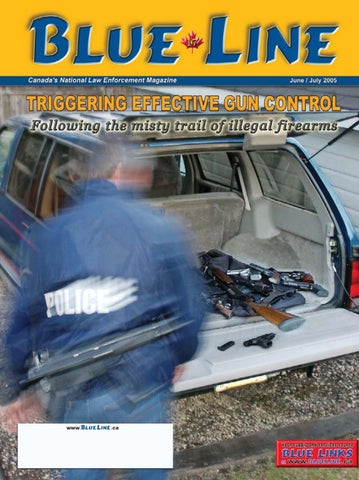
Triggering effective gun control 6 Following the misty trail of illegal firearms America’s first private eye 10 The life and times of the Pinkerton legend DISPATCHES
13
The people’s cop Chief Armand P. La Barge
14
GASP - A day golfing with cops
15
Meeting expectations Canada’s newest police service
16
Getting help from above Dealing with old problems in new ways
18
DEEP BLUE No standard for police checks
22
eMail: editor@blueline.ca
— News Editor — Ryan Siegmund eMail: news@blueline.ca
— Advertising — Mary Lymburner Dean Clarke Bob Murray Kathryn Lymburner eMail: sales@blueline.ca
— Pre-press Production — Del Wall — Contributing Editors — Communication Skills Mark Giles Police Management James Clark Tactical Firearms Dave Brown Technology Tom Rataj Psychology Dorothy Cotton Mike Novakowski Case Law Blue Line Magazine is published monthly, September to June, by Blue Line Magazine Incorporated with a mailing address of: 12A - 4981 Hwy. 7 East, Ste. 254, Markham, Ontario, L3R 1N1. Individual magazines are $5.00 each. Subscriptions are $25.00 per year or $40.00 for 2 years. (Foreign - $50.00 U.S.) Group and bulk rates available upon request. All material submitted for publication becomes the property of Blue Line Magazine unless other arrangements have been made with the publisher prior to publishing. The authors, advisors and Publisher accept no liability whatsoever for any injuries to persons or property resulting from the application or adoption of any of the procedures, tactics or considerations presented in this magazine. Readers are cautioned and advised that articles presented herein are edited and supplied for your personal awareness and should not be used for further action until appropriate advice and guidance is received from a supervisor, Crown Attorney or other person in authority. Established in 1988, Blue Line Magazine is an independent publication designed to inform, entertain, educate and upgrade the skills of those involved in the law enforcement profession. It has no direct control from a law enforcement agency and its opinions and articles do not necessarily reflect the opinions of any government, police, or law enforcement agency. ©2005 - All articles are protected by copyright. No part of this publication may be reproduced or transmitted in any form or by any means, electronic or mechanical, including photocopying and recording or by any information storage or retrieval system without permission.
Internet activity is monitored and use or re-posting of material on the Internet is restricted.
This publication is a private venture and receives no subsidy or grant from any level of government.
— Affiliations — International Association of Law Enforcement Planners Canadian Advertising Rates & Data International Police Association The Police Leadership Forum Periodical Publishers Exchange The Canadian Press Newswire Harvey Research Printed in Canada by Tri-Tech Printing
ISSN #0847 8538 Canada Post - Canadian Publications Mail Product Sales Agreement No. 176796 Blue Line Magazine
The ninth annual Blue Line Trade Show 24 “Hey... it’s a Walmart for cops!” Langley residents volunteer peace officers 26 Canada’s prisoners getting older
28
Escorting a national hero
30
The changing ‘faces’ of policing
31
CASE LAW 34 • Trespass must be against accused • Search without warrant in hand permissible • Firearms roadblock unconstitutional • Reasonable grounds depend on context Managing national issues
38
Bylaw enforcement is a baby step at a time 40 Mexico revives penal island Last in the world
41
Helping out in Haiti 42 RCMP provides members for UN mission Police motorcyclists test their skills Annual training seminar in August
44
BOOK REVIEW One Ranger: A Memoir
45
The high cost of incivility
46
ODDITORIALS
47
Officers become reporters for a day
48
Professional standards course developed 50 COMING EVENTS
51
NEWS CLIPS
57, 61
TECHNOLOGY 58 Classifying and recognizing child images PRODUCT NEWS
60
BACK OF THE BOOK Our legal system is ‘done broke’
38
3
Confiscating and destroying illegal firearms is important but discovering how they were brought into Canada is the key to reducing the problem, according to the National Weapons Enforcement Support Team (NWEST). A branch of the National Police Service, NWEST offers police across the country training and support to shut down sources of illegal firearms. As Ryan Siegmund writes, the agency now has 34 “go to” members which assisted in some 4,500 cases last year alone. Credited with pioneering many modern investigative techniques, Allan Pinkerton became involved in the private detective business quite by accident. His impromptu investigation of counterfeiters led to their capture and requests from shopkeepers to help nab similar criminals. Pinkerton complied, going on to build the Pinkerton National Detective Agency, whose logo — the unblinking eye — led to the famous ‘private eye’ nickname. Canada’s newest police agency patrols the rails and the sky — Vancouver’s SkyTrain system, the longest automated light rail system in the world. Since special constables face the same perils as police officers, BC Solicitor General Rich Coleman announced in March, they should also be authorized to carry firearms. As Blue Line west coast correspondent Elvin Klassen discovered, Canada’s first armed transit police service enjoys strong public support. The ability to call for help from above has increased officer safety and reduced crime in Durham Region. Ryan Siegmund took a ride on Air-1 recently and talked to police about the difference it’s making in the community. In our regular features, Dorothy Cotton calls for standardizing police checks, Mike Novakowski has four case laws hot off the dockets, Danette Dooley tells us about police officers who become reporters for a day, Mark Giles has some tips for managing local and national media when a big story breaks and Tom Rataj looks at software that helps automate the length process of recognizing and classifying child pornography images. JUNE / JULY 2005
Blue Line Magazine
4
JUNE / JULY 2005
Parks Canada decision patently unreasonable by Morley Lymburner Parks Canada management has been slapped with a federal appeal court decision which described its intransigent attitude toward firearms for wardens as “patently unreasonable.” The pages of Blue Line Magazine have been strewn with many stories on the subject over the past five years. This final swipe by the appeal court, Justice Marshall Rothstein, should put Parks Canada management on notice that it needs an attitude adjustment. The judge in the matter could have used a lot of descriptors for management’s attitude. In fact, he could have been neutral by simply telling them to go back and try again, but he chose the precise words that everyone who’s spoken to Parks Canada management might have used. “Patently unreasonable” really means something like stubborn and uniquely so. There are not many government agencies who could continue on under such withering criticism, but this department has certainly shown stiff resolve. It is a pity this resolve can not be redirected in a way that is not so expensive for taxpayers. The absurd decisions made in order to keep 400 wardens from wearing sidearms has been nothing short of an “Alice in Wonderland” tale. We were introduced to the problem in May 2000 while researching a story about the warden service in Canada. After it ran, I checked into a federal parks office and was greeted by a group of supervisors, who presented arguments against their wardens being armed. It was obvious their hearts were not really in the interview. One frustrated supervisor simply stopped in mid-sentence and gave me the Q&A sheet that was supplied by head office. The initial ruling by Human Resources Development Canada - Labour Program advised that something should be done to protect wardens while they conducted enforcement functions was appealed. It was decided officers were not in “danger,” as the word is understood by legislation, but in a confusing turn, Parks Canada was advised to do something to protect wardens. Instead of simply arming them with sidearms, it chose to advise wardens not to do any enforcement activities. RCMP officers, already in short supply, were asked to take over this function. Although the Mounties liked the idea of getting an extra $33 million a year, getting qualified staff was another issue entirely. Officers who were experts in drug interdiction or customs violations were now donning a uniform, getting a hair cut, taking up posts in a bush lot and told to keep a lookout for anything resembling a bad guy. The over simplistic rule was, if it’s flora or fauna, the wardens handle it; if it includes anything to do with humans, the RCMP handle it. Life was made interesting, and there were a few more twists for the Mounties. If it happens outside a park in Ontario, only the OPP handle it; in Blue Line Magazine
Quebec you can’t even stop a car in the park for speeding or it will look like Ottawa is challenging Quebec’s sovereignty. Another twist to this tale came out of British Columbia, where a park warden took a leave of absence to work as an outfitter and guide. He was surprised to learn that he could apply to carry a sidearm, did so and was granted the authority. When performing duties in wilder-
5
ness areas, park wardens – federally appointed peace officers – are prohibited from carrying these same firearms. Ironically, if he came back to work, donned a uniform and patrolled, he would have to do so without a sidearm. The other strange fact is that he could patrol with a rifle in a far more insecure fashion than a pistol, but the rifle is not for human consumption. Other anomalies abound. Ministry of the environment officers can carry guns, as can federal fisheries officers. Provincial counterparts almost everywhere can carry sidearms. What lines are being drawn here? So where does reason take a holiday when it comes to park wardens. Where ever it goes, it has lots of company. The same issues plague officers in the Canadian Border Services Agency, who also must stop random vehicles to see what nefarious activities the occupants might be up to. Both agencies must fight a bureaucracy that says their jobs are not “dangerous” under the meaning of some federal statute. It was this smallest dissection of this word that the Federal Court of Appeal has thrown back at Parks Canada senior management. They have been told to take a reality check instead of dealing with the semantics of a word. “Patently unreasonable.” Now there is a judge who chose his words carefully, but none other could better describe the attitude that runs rampant in Parks Canada’s ivory tower.
JUNE / JULY 2005
by Ryan Siegmund Every day police officers risk confronting culprits with guns which could have been taken off the street with better enforcement, according to the National Weapons Enforcement Support Team (NWEST). NWEST was established primarily to assist police agencies in shutting down the illegal movement of firearms and share knowledge and resources. In the past, a lack of knowledge on how to process illegal firearms has hindered police attempts to get guns off the street. “Before, most police agencies would not trace a firearm to find out the origin of it, where it came from and how it got to where they had the opportunity to seize it,” says Bob Frolic, NWEST director. “What we are saying is, one gun could be the missing link in identifying a gun trafficker... “If we just take the gun and put it in a vault and eventually destroy it – really we are not doing an effective job.” Canada’s first national firearms enforcement support team, NWEST specializes in supporting criminal investigations but also offers training, lectures, analytical assistance, serial number recovery techniques, firearms identification, access to specialized databases and expert court witnesses. “What we wanted to do was to take a more pro-active approach and shut down the sources of the illegal movement of firearms,” says Frolic. “If we can shut down a trafficker or an illegal gun dealer and show a pattern that these guns are showing up in a certain area – that is what it is all about.” Information about illegal firearms must be followed up by front line officers, notes Frolic. “In Ontario we had a pretty good handle on the firearms problem but we didn’t have a connection to all the other provinces – now we do. Now we have a national point of contact dealing with firearms trafficking in Canada. “The bottom line from our world is, if we keep reacting to crimes – that’s all we will ever do in this country.” Blue Line Magazine
Origins Launched and managed by the Ontario Provincial Police in 1994, the provincial weapons enforcement unit (PWEU) was the first dedicated response to illegal firearms in the country. When the federal government rewrote the firearms legislation in 1995, the Canadian Firearms Centre (CAFC) looked to Ontario when developing ways to help police combat firearms problem across the country. As a result, the CAFC developed the National Working Group on the Illegal Movement of Firearms, which empowered a ‘core group’ to research the scope of firearms crime in Canada. The group made presentations to various police agencies, reviewing enforcement, identification and tracing of firearms. Frolic, then with PWEU and a member of the core group, says it was pretty evident at that time the firearms act wasn’t clearly understood, especially the processes available to police to bring successful prosecutions forward. There wasn’t one national agency with a system that could readily identify a firearm for police or advise them on legal processes. “Nor was there a clear understanding of what a ‘trace’ meant, or even how to access the Canadian system on querying firearms licensing and registration,” he adds. After their review, the core group informed CAFC that, for firearms legislation to be effective, investigative expertise had to be offered to police. As a result, the federal government decided in Jan. 2001 to fund the NWEST program to assist front line officers in effective firearms enforcement. The decision was supported by the provincial and Canadian chiefs of police associations and the Canadian Police Association (CPA). Today the program has 34 ‘go to’ members – provincial, municipal and federal police officers in the majority of Canada’s largest police services. NWEST is headquartered in Mississauga, Ontario and has regional offices in Victoria, BC and Montreal, Que. It assisted police with roughly 4,500 files last year. 6
NWEST was originally housed within the Federal Department of Justice, however the program and responsibility was transferred to the National Police Service (NPS), under the stewardship of the RCMP, by a federal orderin-council in April, 2003. The National Police Service was a natural fit for NWEST, as it provides essential, front-line support services to law enforcement in Canada and abroad and has become an internationally recognized model of integrated policing. Tracing and firearms identification When NWEST follows up on seized firearms, it is primarily interested in identifying the source, since guns in Canada generally don’t stay in one particular area. Prior to its establishment, there was no system that could track firearms and link them to other crimes. The search in Canada begins with the last registered owner, but many non-registered firearms have been traced to the United States. Frolic says it’s like a fingerprint, and tracing the firearm to its original point of sale, beginning with the manufacturer. NWEST has improved upon this tactic by developing a good working relationship with the US Bureau of Alcohol, Tobacco and Firearms (ATF), which traces firearms seized in Canada back to the manufacturer or retailer. This initiative looks to identify gun dealers or ‘straw purchasers’; people who buy firearms in the US on behalf of criminals who smuggle them into Canada to traffic. Firearms enforcement is very much a specialized field, Frolic maintains. In the past, he says police tended to be solely interested in prosecuting those involved in firearm related crimes, shying away from processing the firearms; “but if you do it day in, day out – it’s not a hard process,” he says. “We are finding now that if a police officer in Canada recovers a gun, they just call NWEST in their area of jurisdiction and we will walk them through the process. It makes JUNE / JULY 2005
it a lot easier for them because we were missing a lot of information before that we are not missing now.” Firearms identification is another area of expertise lacking in the past that is provided by the team on a regular basis, with the assistance of the Firearms Reference Table (FRT) CD-ROM. Developed by the RCMP, it includes photos, history and classifications. Public agent regulation The Firearms Act Public Agent Regulations, scheduled to come into effect Sept. 30, will require all police agencies to report to the firearms registrar, within 30 days, all firearms that come into their possession. “That will be a wealth of information for intelligence and analytical processes,” says Frolic. “With that, all firearms will be queried, traced and we will have an extremely good handle on the firearms movement in this country. “Guns that used to fall through the cracks of enforcement – we are now going to know about them and we are going to get that information quickly. Before, we wouldn’t know about some of the guns until somebody did an audit of their vault and checked the results with investigators.” Frolic says police would recover stolen property, including firearms, and put them on one property record report. Now most agencies track firearms separately and the information is easily retrievable. “With the public agent regulation we will know exactly where they are and how many there for every enforcement agency in Canada – it’s a huge step.” Most major police services now have a system to track firearms and/or have a separate repository for them. Before NWEST though, Frolic says, most police agencies couldn’t push a button and determine how many firearms they had in their vault. “That’s what our (NWEST) members have been doing in their respected services across Canada,” says Harvey Williams, NWEST firearms investigations specialist. “They are making sure they are getting into those vaults and checking them so that we are up to date.
register them. “To purchase a firearm legally in this country requires that you be trained and tested in safety and have basic knowledge about firearms. Criminals must rely on either stealing one or trying to smuggle one into the country.” The costs of implementing the firearms program has been severely criticized. Frolic says it has its purpose and is a useful tool in criminal investigations involving firearms. Without the full firearms package, including licensing, registration and ongoing eligibility, we would be taking a giant step backwards, he says, adding he’d hate to think about what it would be like if there were no firearms control. NWEST does not have a database at present, other than reports it has assisted with
and collected. Williams says a global database would be an effective tool, however he notes such a large scale operation is not an easy process to implement. “That capability to link them is there within the system, it’s just a matter of international agreements between countries being met,” he explains. One global initiative is the Integrated Ballistic Identification System (IBIS), which is currently in 29 countries. It can link casings and bullets to a specific firearm and was used in the Washington sniper case. Ottawa, Montreal and Toronto currently have IBIS, and there are plans to expand it to Vancouver, Regina and Halifax.
Gun registry CPIC and the Canadian Firearms Registry On Line (CFRO) is a useful starting point for NWEST in attempting to identify gun owners and discover how their firearms ended up at crime scenes. The new CFR on-line system is used roughly 2,000 times a day. Frolic says some have questioned whether it has actually prevented much crime. “How can you identify or prove a negative? Every time we get a gun off the street, it potentially could have caused a lot of havoc,” he says. “Most criminals would retain these firearms until they become too hot or they would have no need for it any longer.” The system is all about accountability and responsibility, he says, adding that, before the registry, anyone could sell guns without being held responsible or accountable. NWEST is now finding that a lot of firearms are being thrown away because people do not want to Blue Line Magazine
7
JUNE / JULY 2005
Prohibited magazines
by Dave Brown Stemming the flow of illegal firearms onto the streets of Canada is an important job. Illegal firearms are often accompanied by prohibited magazines and it usually takes only a few moments to determine if additional charges are possible when encountering illegal weapons. Under Canada’s Firearms Act, certain high capacity magazines, other than for police and military use, are considered “prohibited devices.” In general terms, all handgun magazines are restricted to ten rounds capacity. All semi-automatic centerfire rifle and shotgun magazines are restricted to five rounds capacity.
International firearms trafficking school NWEST coordinates an international trafficking school where police can learn about firearm issues and how to better combat the illegal trade. Japan, China, South Africa, Bosnia and the US all made presentations at the last meeting, which was held in Halifax. “When a lot of these countries do their presentations, it’s interesting to find out a lot of them have similar problems to what we have,” says Frolic. “A major problem with firearms identification globally is trying to track the movement of firearms. The OAS agreement and UN agreement are trying to mark small arms so that firearms that end up in different countries can be identified.” NWEST is planning to host another session in Victoria this spring and anticipates at least 18 countries will participate. “It’s all about sharing and talking about how to proceed and what tools are available to us to make it a lot easier for the front line officer.”
Blue Line Magazine
New initiatives NWEST does not take the lead in an investigation because of a lack of personnel, though that is a goal because of the large number of files that need to be followed up. Frolic says the agency is a victim of its own success in that it’s becoming harder to keep up with the ever increasing number of requests for assistance. “The more front line officers realize the tools that are available to them that make their job easier – we are going to get a lot more calls. Eventually, in a perfect world I suppose, once everybody is trained, it will make our job a lot easier getting illegal guns off the street – ‘cause that is really what we are trying to do. “There are so many other areas of importance we have to look at, like coordinated training with prosecutors and making sure the judges are aware of all the provisions associated with firearms.” The government has given NWEST a vote of confidence by pledging funding through 2009.
8
Handgun magazines • All action types: Maximum regulated capacity = 10 rounds Rifle and shotgun magazines • Semi-automatic centerfire rifles: Maximum regulated capacity = 5 rounds • Semi-automatic shotguns: Maximum regulated capacity = 5 rounds Magazine capacity not regulated • All rimfire rifles • All bolt-action rifles and shotguns • All lever-action rifles and shotguns • All pump-action rifles and shotguns • M1 Garand rifles There are other exemptions in the regulations dealing with certain specific and historical firearms. Provinces also regulate magazine capacity for hunting activities. The regulations apply to both box and tubulartype magazines. Some magazines have numbers marked against holes to show at a glance how many cartridges are loaded, but these numbers cannot be used to determine the maximum capacity. Larger capacity magazines may have been altered to comply with the regulations. To test the capacity, simply load actual cartridges designed for the magazine into it. Additionally, some legal ten-round capacity handgun magazines or five-round rifle magazines may hold an additional cartridge if the spring is very tightly compressed, but a magazine loaded in such a way cannot be properly seated into a firearm with the action closed. To be considered a prohibited device, magazines must clearly contain more than the regulated capacity and leave enough room to properly seat. New semi-automatic rifles that use handgun magazines are being introduced into the Canadian market, and questions are currently being raised about their magazine status. A detailed reading of the regulations show that the ten-round capacity limit applies to magazines designed for handguns, not what the magazines are currently inserted into. This means that some jurisdictions view ten-round handgun magazines in semi-automatic rifles to be legal. JUNE / JULY 2005
Blue Line Magazine
9
JUNE / JULY 2005
America’s first private eye The life and times of the Pinkerton legend Courtesy: Bathroom Readers’ Press, 17th Edition
One day in June 1846, Allan Pinkerton, a 27year-old Scottish born barrel maker from Dundee, Illinois, climbed onto his raft and floated down the Fox River looking for trees that he could use for lumber. He found a lot more than that – when he went to chop down some trees on an island in the middle of the river, he discovered a smoldering fire pit hidden among them. If someone found a fire pit in such a beautiful spot today, they probably wouldn’t suspect anything unusual, but as Pinkerton explained in his memoirs, life was different in the 1840s. “There was no picnicking in those days; people had more serious matters to attend to and it required no great keenness to conclude that no honest men were in the habit of occupying the place.” GOTCHA! Pinkerton went back to the island a few more times during daylight, but no one was ever there. So a few days later, he snuck back in the middle of the night and waited to see if anyone would show up. After about an hour he heard a rowboat approaching the island. He waited awhile and then crept close to the fire pit to see several shady-looking characters sitting around the campfire. The next morning he went to the sheriff. After a few nights they went back to the island with a small posse and caught the men by surprise. Pinkerton’s suspicions were correct – the men were a gang of counterfeiters and the posse caught them red-handed with “a bag of bogus dimes and the tools used in their manufacture.” Counterfeiting was rampant in the 1840s. In those days each bank issued its own bills and, with so many different kinds of paper floating around, fakes were easy to make and difficult to detect. Less than a month after the dime bust, somebody passed fake $10 bills to two shopkeepers in Dundee. The shopkeepers were pretty sure that a farmer named John Craig had something to do with it, but they had no proof. Pinkerton had done a good job catching the last bunch of counterfeiters, so they asked him to look into it. Pinkerton set up a sting. He met Craig, struck up a conversation and convinced him that he was looking to make some dishonest money on the side. Craig sold him $500 worth of the fake bills, but rather than have the sheriff arrest him right there, Pinkerton decided to bide his time. He got Craig to reveal the location of his headquarters (a hotel in Chicago), then made an appointment to buy more counterfeit bills. A few days later, Pinkerton met Craig in the hotel bar. Then, just as Craig was Blue Line Magazine
Allan Pinkerton
passing him $4,000 worth of fake bills, two plainclothes police officers stepped out of the shadows and arrested him. Career change Had Pinkerton been left alone, he might have remained a barrel maker, but the Craig bust changed everything. “The affair was in everybody’s mouth,” Pinkerton later wrote, “and I suddenly found myself called upon from every quarter to undertake matters of detective skill.” He quit making barrels and worked a number of different law-enforcement jobs over the next few years: deputy sheriff, Chicago police detective (the city’s first) and finally as a US Post Office investigator. Then in 1850, he decided to go to work for himself. He and a lawyer named Edward Rucker formed what would become the Pinkerton National Detective Agency. Rucker dropped out after a year or two, but Pinkerton stayed with it for the rest of his life. The eye has it For his company motto, Pinkerton chose “We never sleep.” For his logo, he chose a large, unblinking eye. His agency wasn’t the world’s first private detective agency – a Frenchman named Eugene Francois Vidocq beat him by 17 years when he founded the Bureau des Renseignements (Office of Intelligence) in 1833 – but it was Pinkerton who gave private detectives their famous nickname. Thanks to his choice of logo, they’ve been known as “private eyes” ever since. Train of thought Pinkerton’s timing was perfect. Railroads were beginning to transform the American way of life – in both good ways and bad. As rails 10
began to link major American cities, people could travel greater distances in less time and at less cost than ever before, but so could criminals. A bank robber could knock over a bank in one state, then hop a train and by the next morning be hundreds of miles away in another state. Have you ever seen a movie where the sheriff chases a bad guy and has to stop at the county line! That really was the way things worked back then – law-enforcement agencies were organized locally and a police officer or sheriff’s powers ended as soon as he crossed the city or county line. There were few if any state police in those days and no national police to speak of either. The Bureau of Investigation, predecessor to the Federal Bureau of Investigation, wouldn’t come into existence until 1908. Pinkerton’s private detectives had no formal police powers, but they were free to chase criminals across county and state lines and then work with local law enforcers to arrest and bring them to justice. With no one else to turn to protect their interests, the railroads went to Pinkerton. By 1854 the agency was earning $10,000 a year (about $200,000 today) on railroad company retainers alone. Undercover Pinkerton’s agency achieved its greatest successes by sticking to the principle that Pinkerton himself used to catch counterfeiter John Craig back in 1846. The best way to catch a thief was by pretending to be a thief — a detective had to win the bad guy’s confidence, then get him to spill the beans. The agents infiltrated organized gangs of all types: Confederate spy rings, unions, even the Mafia. The Pinkerton agency was ahead of its time in many areas. It pioneered the use of mug shot and, by the 1870s, had the largest collection in the world. Its centralized criminal filing system has since been emulated by the FBI and other law enforcement organizations worldwide. The agency hired a female detective, a 23-year-old widow named Kate Warne, in 1846; by comparison, the New York City Police Department did not hire its first female investigator until 1903. After the Civil War, the Pinkerton Detective Agency helped bring the Wild West era to a close by sending man hunters into the field to hunt down infamous train and bank robbers: Jesse James, the Missouri Kid, the Reno brothers and the Cole Younger gang. Butch Cassidy and the Sundance Kid abandoned their life of crime and fled to Argentina in 1901 because Pinkerton detectives were hot on their tail. With the agency’s ‘wanted’ posters and mug shots circulating throughout the United States, there was no place in the country left for them to hide. The Pinkerton files The Pinkerton files are full of interesting tales of adventure, success and failure. No other JUNE / JULY 2005
Blue Line Magazine
11
JUNE / JULY 2005
agency of its time had a more shining reputation and demand for its services. The following is a brief overview of some of the more exotic stories of the 19th Century. Saving President Lincoln Background: Weeks before Lincoln was to be sworn into office, a Pinkerton agent named Timothy Webster learned of a secessionist plot to assassinate the president-elect when he was to switch trains in Baltimore on the way to his inauguration. What Happened: Pinkerton told Lincoln about the plot and the future president agreed to change his travel plans. At the appointed hour, Lincoln, wearing a soft felt hat and an overcoat on his shoulders to disguise his features, slipped out of Harrisburg, Pennsylvania, hours ahead of schedule on a secret chartered train. When it left the station, Pinkerton had the telegraph lines cut so no one could warn the plotters that Lincoln was on his way. Aftermath: Lincoln made it to Washington without incident, but his political enemies mocked him for sneaking into the capital. “I did not then, nor do I now, believe I would have been assassinated, had I gone through Baltimore as first contemplated,” Lincoln later admitted, “but I thought it wise to run no risk, where no risk was necessary.” In McClellan’s secret service Background: Following the start of the Civil War in April 1861, General George McClellan, who commanded the Army of the Potomac, asked Pinkerton to head his personal ‘secret service’ – he wanted Pinkerton detectives to gather intelligence on Confederate forces. Pinkerton agreed; he and his men went to work, spying behind enemy lines and interrogating captured Confederate soldiers to find out what they knew. What happened: It was the single biggest failure of Pinkerton’s career. He routinely overestimated enemy troop strength. In 1861, for example, he estimated that there were 150,000 Confederate troops near Manassas, Virginia, when there were only about 50,000. In April 1862, he estimated 120,000 troops near Yorktown, Virginia, when fewer than 17,000 troops were actually there. Two months later he calculated that General Robert E. Lee was leading a force of 180,000 men, when in fact they numbered only 50,000. How did Pinkerton get the numbers so wrong? He was a great admirer of McClellan, who was obsessed with the idea that he was consistently outnumbered. Pinkerton willingly tailored his estimates to suit his boss. Even then McClellan wasn’t above throwing out Pinkerton’s numbers and making up his own higher ones. Aftermath: At best, Pinkerton’s failure helped the general lose his job – when McClellan botched the battle of Antietam in September 1862, Lincoln removed him from command. At worst, Pinkerton’s inflated estimates may have caused the Civil War to drag on until 1865 when it might have been ended in 1862. Blue Line Magazine
During the latter half of the 19th Century the Pinkerton Agency was the forerunner of the CIA, Secret Service and the FBI. Shown here is Allan Pinkerton with President Lincoln and General McClellan. Jesse James Background: During the Civil War, Jesse and Frank James were members of a Confederate guerrilla group known as Quantrill’s Raiders. They used hit-and-run tactics to terrorize Union troops and civilians along the Kansas-Missouri border and when the war ended they used some of the same tactics against banks, trains, stagecoaches and other targets. What happened: In March 1874, Pinkerton sent two of his top detectives, John W. Whicher and Louis Lull, to go undercover to try and get close to the James gang. Both men were found out and murdered; Pinkerton swore revenge against the Jameses. He never got it. If anything. Pinkerton’s vendetta against the James boys helped turn them into even bigger folk heroes than they had been before. In 1875 Pinkerton agents, acting on a tip, raided the Missouri farm of Frank and Jesse’s mother, Zerelda. One of the agents threw an incendiary device into the house – Wild West buffs still argue over whether it was a bomb or just a flare – and it exploded, killing Zerelda’s eight-year-old son, Archie. Public sympathy shifted to the James family and Pinkerton detectives began to be seen as symbols of the ruthlessness of the giant railroads and the eastern money men who controlled them. Aftermath: Pinkerton detectives were still chasing Jesse James when he was murdered in his own home by two members of his gang – brothers Robert and Charles Ford – while he turned his back to adjust a picture hanging 12
on the wall. The Ford brothers hoped to collect the $10,000 reward on Jesse but instead only narrowly escaped being hanged for the crime. Fearing he was next, Frank James surrendered to the governor of Missouri, was tried for two different murders and was acquitted both times.
James McParland
The Molly Maguires Background: The early 1870s were a time of labour unrest in the coalfields of Pennsylvania. Railroad cars were sabotaged, buildings burned and mine superintendents (as well as German and English miners) beaten and killed. A secret society of Irish immigrant coal miners called the Molly Maguires was suspected of the violence and in 1873 the Reading Railroad, which owned many of the mines, hired the Pinkerton agency to break up the group. What happened: In 1873 Pinkerton agent James McParland got a job in the coalfields posing as James McKenna, an Irish immigrant on the lam for a murder charge in Buffalo. Over the next two years he worked the mines while working his way up the ranks of the Molly Maguires, all the while sending written reports back to Pinkerton headquarters. By 1875 the Mollies knew they had an informer in their JUNE / JULY 2005
Detective Allan Pinkerton ("E. J. Allen") of the Secret Service on horseback in Antietam, Maryland in 1862
midst and suspicion fell on McParland. He slipped out of town, having gathered enough evidence to shatter the Molly Maguires, and send ten of their leaders to the gallows. Aftermath: The operation was a tactical success, but it further stigmatized the Pinkerton agency as the hired gun of big corporations, a reputation that would dog it for years to come. Joining the mafia Background: The American mafia got its start in New Orleans in the 1870s. Members of that city’s Provenzano crime family assassinated police chief David Hennessey in 1890 as he was preparing to testify in court against them. Police arrested 19 Provenzano mobsters and threw them in jail, but the case against them was weak and it looked like they were going to get away with murder. What happened: The Pinkertons joined the case, arranging for detective Frank Dimaio to assume the identity of Anthony Ruggiero, a real mob counterfeiter doing time in Italy, then staged an arrest so that he was thrown in jail with the Provenzanos. Only six other men knew his true identity: three at the Pinkerton Agency, two at the U.S. Secret Service and the district attorney. That made the assignment very dangerous: without the guards’ protection, the mobsters were certain to kill Dimaio if they ever found out who he was. In his four months in jail, Dimaio contracted dysentery and malaria and lost 40 pounds, but he also gradually won the confidence of one of the Provenzano gang – Emmanuel Politz. Dimaio tricked Politz into admitting his role in the murder and then implicating the others. Aftermath: Dimaio’s evidence helped to build an ironclad case against the mobsters, but they still managed to intimidate witnesses and the jury, which returned a verdict of not guilty. The mobsters beat the rap, but not for long: the next morning an angry crowd stormed the jail and murdered them. The Scott-Dunlap ring Background: A group of masked men stormed the home of John Whittelsey, chief cashier of the Northampton, Massachusetts, National Blue Line Magazine
Bank, on Jan. 25,1876, forcing him to hand over the combinations to the bank’s three safes. The robbers then went to the bank and made off with $1.2 million. It was the largest bank robbery in U.S. history and would remain so until 1950. What Happened: While interviewing bank employees, Robert Pinkerton learned that William Edson, a representative from the vault company, had recently been to the bank and had talked it into entrusting all three safe combinations to Whittelsey. Before that it had divided them among different employees, a much safer arrangement. Pinkerton put Edson under 24hour surveillance. Another clue – that one of the robbers shrugged his shoulders continuously – led to the identification of the ringleaders, ‘Hustling’ Bob Scott and his partner, Jim Dunlap. They were put under 24-hour surveillance too and when they were followed to a meeting with Edson, Pinkerton knew he was on the right trail. Detectives “interviewed” Edson several days in a row until he cracked, turning state’s evidence against the gang. Aftermath: Scott and Dunlap got 20 years; Edson went free. End of an era After suffering a stroke in 1869, Pinkerton began turning more and more of his responsibilities over to sons Robert and William, but didn’t retire and was still working at the agency in June 1884 when he tripped and bit his tongue while taking a walk. In the days before antibiotics, such injuries were very serious – a few days later gangrene set in, followed by blood poisoning. Pinkerton died on July 1. The world of law enforcement has changed a great deal since the Pinkerton National Detective Agency opened its doors in 1850 and if anything, the pace accelerated following Allan Pinkerton’s death. The biggest change of all: in 1908 the Bureau of Investigation opened for business. The Pinkerton agency’s detective services became increasingly redundant – why pay good money to hire private detectives when the FBI, backed by the resources of the federal government, would investigate crimes for free? As the crime detection side of the business dried up, the agency’s security guard division, founded in 1858, came to assume a larger share. By the late 1930s only a fraction of the company’s revenue came from its original detective services. In 1965 Allan Pinkerton’s greatgrandson, Robert Allan Pinkerton II, acknowledged the inevitable by dropping the word ‘detective’ altogether and renamed the company Pinkerton’s lnc. He was the last Pinkerton to head the Pinkerton Agency. So can you still hire a Pinkerton agent today, at least as a security guard? No – in 1999 Securitas A.B., an international security company headquartered in Sweden, bought the firm and stopped doing business under the Pinkerton name. Securitas Security Services Inc. today is a corporate convergence of Wells Fargo, Burns Security, American Protective Services, First Security and the Pinkerton Agency. It currently boasts a global service with over 120,000 officers. You can find out more by going to www.securitasgroup.com . 13
Attorney General Michael Bryant says the city of Cornwall, Ontario deserves a full inquiry into allegations of abuse of young people. Justice G. Normand Glaude has been asked by the province to lead an independent inquiry into Cornwall’s Project Truth sex scandal. Glaude has been the regional senior justice for the Ontario Court of Justice in Sudbury since 2000. Glaude’s responsibilities will be to examine how the justice system and other public institutions responded to the abuse allegations, says Bryant. Allegations concern high-profile local officials, professionals and clergy accused of sexually abused children for decades. One person has been convicted in connection with the OPP investigation, while over 100 charges against 15 men have been laid. Ottawa’s Mayor Bob Chiarelli says he supports the city’s free crack pipe kit program. “It was a debate that we had to have, and we heard very extensive assessment on both sides, and at the end of the day, I come back to the health issue and support the decision that was taken,” he said. Chiarelli said the information leads him to believe the program is legal and should be operating in Ottawa. “It’s very clearly a health issue,” he said. “We are preventing not only the addicts from becoming seriously ill, ... we’re also protecting innocent people who could become ill because of it. If we can prevent one or two or three innocent people from contracting life threatening diseases, then it is worth the investment.” Former justice Patrick LeSage is recommending Ontario to change its police complaints system so it can be handled by an independent body of civilians. LeSage says the current system where police investigate police is “flawed,” and there needs to be an independent body that decides how complaints against police are handled. Such a group he says could find informal ways to deal with the complaint, ask that particular force to investigate itself, or assign the investigation to another police force. In a province as large as Ontario, LeSage says it’s tough to find a system that will work effectively across all the diverse communities. Manitoba Justice Minister Gord Mackintosh says his new courts administration act would empower municipalities to administer their own bylaw tickets. While tickets for things like parking, alarms, weeds and noise are currently administered by the courts, the new legislation’s intent is to unclutter the court system. Mackintosh plans to work with the Association of Manitoba Municipalities to determine which offences will be covered by the changes. The legislation would also extend the right to withhold vehicle registration for unpaid fines on all provincial offences. This measure is currently limited to photo radar offences. Nova Scotia Justice Minister Michael Baker says the organization that co-ordinates police intelligence will grow to 26 officers from the current complement of six. The province will commit $6.1 million over the next four years to better criminal intelligence gathering that will primarily target organized crime. Baker says veteran police officers from across the province will be seconded to the enlarged agency and they will be replaced by new hires. Chief Edgar MacLeod, of the Cape Breton Regional Police Force, says they’ve been asking the province to do this for years.
JUNE / JULY 2005
The people’s cop Chief Armand P. La Barge… working hard to build trust by Connie Phillipson It was 2002. And the Police Services Board had to hire another Police Chief – again. Three Chiefs in five years. The ‘Chief for awhile’ pattern had to be broken. The Board knew it. The rank and file knew it. What was the Board going to do this time? Go outside or stay in-house? What leadership style did they want? All eyes were on the Board and the bets were on. You could feel the tension. People rallied around their favourite son. Comments floated. Was the Board listening? In July, Chair David Barrow announced the next Chief would be one of our own – someone who understood our past, knew the present, and could guide our future with enthusiasm. Passionate about policing, ethical in decisionmaking and driven to make a difference, the Chief would lead with head and heart – always striking the right balance when making tough decisions that affect people. And the Chief would ‘walk his talk’. Powerful language. The Board wanted it all. A visionary. Ethical. Credible. Dynamic. Compassionate. Tough. And driven. Driven to make a difference in people’s lives. Hiring the Chief is the most important responsibility of a Police Services Board. And the choice that’s made says as much about the Board as it does about the Chief. Chair David Barrow offers a glimpse into the Board’s decision: “Chief La Barge impressed us with his dynamic vision for the future of the force. He’s passionate about policing and driven to make a difference for all of us. He’s grown up in this organization - he’s part of our history. And he’s devoted his working life to the York Regional Police.” His day had come. From cadet to Chief in 29 years. On December 12, 2002, Armand P. La Barge was sworn in as Chief of York Regional Police. In June 2005, Chief La Barge will become the President of the Ontario Association of Chiefs of Police. It’s a formidable leadership opportunity. And one he’ll relish. It’s the pinnacle of recognition by his fellow Chiefs for a life devoted to policing. But not even the crown of the OACP can eclipse the expression of emotion and gratitude flowing to him from citizens. Chief La Barge has captivated hearts. He’s become the People’s Cop. “We have to work hard to build trust,” says Chief La Barge, “and to change guarded attitudes toward the police. Bridges aren’t built in a day. And bridges are built to last a lifetime. That’s our aim. To build strong bridges with our multicultural and faith communities that withstand the test of time. It’s not about us and them. It’s about all of us. We and the Blue Line Magazine
community are one. That’s our message. That’s why we’re making a difference.” Whether he greets people in their own language. Walks in the Janamashtmi Parade. Celebrates a Menorah Lighting Ceremony. Encourages support for a Jamaican orphanage adopted by his Service. Co-hosts a Canadian Citizenship Ceremony during Black History Month. Attends a multi-faith service to honour the victims of the Tsunami disaster. Celebrates International Day for the Elimination of Racial Discrimination with hundreds of citizens and community leaders. Travels to Israel with other police leaders. Chief La Barge is effecting change. And the changes are making a difference in people’s lives and their attitudes towards the police. People are lining up to say thank you to this regional ambassador for tolerance and inclusiveness. Chief La Barge has received numerous awards from Jewish, Muslim, and Pakistani communities for fighting racism and promoting harmony. And the honours keep coming, as the Chief vows to make things better. Chief La Barge has zero tolerance for hate. Hate crimes. Hate propaganda. Racial profiling. The Board knows it. His officers know it. And most importantly, the citizens know it. He’s troubled by the increase in hate crimes and wants perpetrators of hate caught and brought to justice. Clearly, Chief La Barge is on a mission. He transformed the former Hate Crime Unit into a high-profile Diversity and Cultural Resources Bureau that reports directly to him. 14
When the Ontario Human Rights Commission published its Racial Profiling Report, Chief La Barge didn’t bury it, telling the Board: “If it happened here, we’d stamp it out. We wouldn’t tolerate it.” He sought input from his Community Council and invited the Chief Human Rights Commissioner to meet with police supervisors to discuss controversial issues. Chief La Barge is so driven, I had to delve deeper. “What motivates you, Chief? Why are you so passionate about multiculturalism?” His response was immediate and I hadn’t expected such candour. “It’s part of me - as much a part of me as breathing - as existing.” Armand La Barge was born in Sulphide and raised in the Tweed-Hungerford Township area. It’s a story he tells best. “My parents are of French Canadian and Newfoundland ancestry and I have relatives who are First Nations. Now I have a Chinese niece who was adopted by my brother and sister-in-law. I’ve always been fascinated with history, different cultures and religions.” He scarcely takes a breath. “I studied languages and later Native Studies. I came from a very small town to Newmarket and had to reestablish myself. You don’t forget that feeling. So I try to make new Canadians feel at home by learning some of their language and religious customs.” Some say it’s a job. Some a profession. But those who know him well say Chief La Barge has a calling. And it’s a calling he’s embracing with relentless energy and passion. The Board selected Chief La Barge because he had a vision of a better world for the citizens of York Region. And he’s well on his way to realizing this vision. Chair David Barrow can’t resist asking Staff Sergeant Denise La Barge how it feels to be married to the ideal man! She rolls her eyes and laughs. “He is pretty good, isn’t he?” The Chief’s biggest fan is not about to rain on the People’s Cop. Connie Phillipson is the Executive Director of the York Regional Police Services Board.
JUNE / JULY 2005
by Kathryn Lymburner At the York Regional Police GASP (Golf After School with Police) program, students are introduced to police, golf and the basic values which can be learned through the game. “The discipline needed for playing golf is very similar to that required in life,” said S/Sgt. John Sheldon, who begun the initiative last spring. “Honesty, integrity, respect, patience and challenging one’s self are important qualities for all of us.” Sheldon notes that, “this program is a way for (police) to help and encourage those teens who would benefit the most and a way to bring police officers and local youth together.” Students are chosen for this program by their guidance teachers and principals, and while not necessarily the biggest trouble makers at the school, they are the ones deemed to benefit the most from the program. The idea came from the US Golf Conference’s ‘First Tee’ program, which brought together youth, sports celebrities and professional golfers for an afternoon of golfing. Sheldon felt that adapting the program for students and police would allow students to see officers in a positive and non-confrontational setting. The program initially involved only students in the Town of Georgina but expanded this year to include 96 students and golf courses in Markham, Vaughan and East Gwillimbury, which all donate their greens; golf clubs, bags and balls are donated by the public. The Golf Association of Ontario (GAO) has also become involved in the initiative. “The idea is to eventually grow this program across not only York Region, but eventually the rest of Ontario,” says executive director Dave Mills. The GAO helped to coordinate the clubs involved and are helping York Regional Police to appy for funding from the Trillium Foundation which aims to build healthy and vibrant communities in Ontario by investing in community-based initiatives.
S/Sgt. John Sheldon
Student Travis Gardner and Cst. Rob Milligan
Amanda Jamieson, Eliisa Fok, Amanda Kramer, Cst. Audrey Brumel 5 Dist. YRP
For further information on this initiative Staff Sergeant John Sheldon can be contacted at 1 866 873 5423 x7500 or by e-mail at 273@police.york.on.ca . Blue Line Magazine
15
JUNE / JULY 2005
by Elvin Klassen The BC Government has designated the new Greater Vancouver Transportation Authority Police Service (GVTAPS) as an official police service. Since the new designated constables “will face the same perils as municipal and RCMP officers, they will be authorized to carry firearms as well,” Solicitor General Rich Coleman announced in March. “With more than 160,000 passengers every day, SkyTrain is an essential service for communities throughout the Lower Mainland,” said Doug McCallum, chair of TransLink, the public organization in charge of public transit throughout Greater Vancouver. “The new police unit means that travel along the SkyTrain corridor will be safer, while police departments along the line have another resource to draw on support.” The new police service will provide secu-
Blue Line Magazine
rity and safety at stations and on the train, SeaBus and West Coast Express. Plans call for officers to eventually patrol the huge network of Coast Mountain buses that connect the Vancouver metropolitan area. There is widespread support for the idea, notes Bob Kind, the newly appointed chief officer. “It’s come from the public, it’s come from the government, it’s come from TransLink,” he says. “It’s something that’s required; a secure and safe system has always been a priority.” There are presently 86 officers on the force and four more will be added shortly, says Kind, who served for 25 years with the RCMP before joining TransLink security 10 years ago. The service is scheduled to become fully operational when all constables have completed the required training by the Justice Institute of BC. They will all be required to meet provincial standards, which isn’t expected to be a problem – many served previously with the RCMP or municipal police services.
16
“This is the first police service in Canada to be directly connected to a transportation organization and equipped with firearms,” notes Kind. “The Justice Institute did a study and provided a recommendation. They concluded that TransLink runs through a multitude of jurisdictions, which requires a police service to support all other police agencies. “There is also an expectation from the public that if police are in uniform, they need to be equipped to do the job.” Passengers need to feel safe when using the train, Coleman noted as he announced the new service. “We’re creating a new policing unit with increased authority to deal with criminals. This unit, along with initiatives like police integration, PRIME and road safety programs, are enhancing public safety in communities across the Lower Mainland and throughout the province.” The new unit is being set up under the provincial police act. The 90 officers will report to a board of police chiefs from Vancouver and New Westminster, two senior RCMP officers and TransLink’s chief operating officer. They will have ‘Police’ on their uniforms and shoulder flashes to clearly identify their presence. Constables will be divided into four squads, each assigned to a different zone. Several satellite offices in the TransLink stations make it easier to do paperwork. They will also connect with CPIC, PRIME-BC (Provincial Police Records Management System) and E-Comm, the emergency communication services and support system. “Staff are excited about providing this improved service,” says Kind. “They are GVTA police officers that will serve all of the policing and safety needs for all of TransLink’s transit modes.” JUNE / JULY 2005
TransLink’s special constable program began in 1986 when the SkyTrain rail line was opened for Expo 86. Dressed in purple blazers and grey slacks, their major role was to make Expo visitors comfortable and safe — and ensure riders had paid their fare. If a special provincial constable spotted someone with a duffel bag full of drugs, for example, they had to call a police officer to assist. Constables were given the power to make arrests for drugs, deal with incidents off property and detain individuals on outstanding warrants in 2004. They currently carry pepper spray, handcuffs, a baton, cell phone and radio. TransLink security received 14,100 calls for service in 2003, making 1,275 arrests and issuing 44,000 tickets for fare and liquor violations. Officers dealt with 4,159 Criminal Code infractions last year, including 137 weapons related incidents and 634 assaults. Even though GVTA constables will now be armed, they will not replace jurisdictional police, notes Kind. “The key thing you have to remember is that we are a supplementary policing unit. We are not a full police department. If a major crime were committed, the police that have jurisdiction in that area would be called. Our officers would assist with the investigation.” SkyTrain is the world’s longest automated light rapid transit system. All operations are controlled through a central hub. The trains have no driver and move riders quickly, efficiently and reliably across the region, from Surrey, New Westminster, Burnaby and Vancouver along 49
Blue Line Magazine
GVTA Police Constable Lynda Wallace
GVTA Police Chief Bob Kind
kilometres through 32 stations. SkyTrain connects to an extensive network of buses, SeaBus ferries, West Coast Express commuter rail and HandyDART custom transit. Other linked security measures are also in place. Public areas have been designed to provide good site lines, offering maximum visibility for customers. Seven hundred closed circuit cameras, fixed on platforms, help constables with effective station surveillance and record suspicious activity. Granville Station
17
alone has 40 cameras. Trains have passenger silent alarms, yellow strips above every window passengers can press to silently alert control operators about security concerns. An on-train speakerphone is located near the doors in each car, providing two-way voice communication for those needing urgent assistance. The in-station waiting areas have enhanced lighting, closed circuit television and red emergency telephones with direct access to security. GVTA Police Service Chief Officer Bob Kind can be reached at robert.kind@gvtaps.bc.ca or 604-515-8303.
JUNE / JULY 2005
by Ryan Siegmund
Photos Kathryn Lymburner
Police officers in Durham Region, east of Toronto, know they can call for help from above if their safety is threatened or a motorist refuses to stop. Officer safety and arrests have increased and residents have felt safer since police first began flying a leased Bell JetRanger Helicopter in a six month pilot project with York Regional Police in 1999. Both services opted to purchase their own new helicopters several years later. “It’s just such a huge asset to the entire department,” says Jon Hood, tactical flight officer for the Durham Region Police Service (DRPS). “Now that the service has had it for a few years, we have realized that there is so much more that it’s done for us.” Flying out of Oshawa Airport and able to reach an incident scene in minutes, the air support unit has assisted the service in dealing with traditional problem areas. Operations Air-1 is the first unit to arrive at crimes in progress 95 per cent of the time and is frequently summoned to help investigate reports of impaired drivers. Its fast response and location updates give ground officers a chance to make their way through traffic and catch up with suspects. The unit has also helped reduce high speed Blue Line Magazine
pursuits, which were so common in 1999, Hood notes, that Ontario’s solicitor general called for something to be done. The helicopter hasn’t only reduced the number of pursuits but made the ones which do take place less dangerous, Hood says. Once Air-1 arrives, ground units can back off, rather than continuing a Tactical flight officer Jon Hood and police pilot James Roach standing in dangerous pursuit front of Durham Regional Police Air 1. which might have resulted in injuries. the helicopter’s thermal imaging system as Responding to break and enters in Durgrounds to obtain a search warrant. ham’s industrial areas is another common call. “With the infrared camera, you can really “The helicopter enables us at night to see pick out the houses that are putting out a lot of in the dark and check the rooftops, big parking heat,” says Hood. “The camera is so sensitive that it will detect something like a .02 degree lots and fields in a matter of a couple of minutes,” Hood says. “Before, without the chopdifference in temperature. If we are looking at per, you couldn’t do that. It would take how a group of houses that are all sort of in the same many guys to search all of that area in that neighbourhood, made at the same time, insuamount of time – it would be impossible.” lated at the same time, then relatively they Assisting intelligence units, most notably should be the same temperature, whether it’s August or September. the drug unit, in detecting and taking down residential grow-operations is another frequent “We have even had cases where they try call. The drug unit often uses evidence from and vent the grow-op through the roof vents in 18
JUNE / JULY 2005
an attempt to disguise it a little bit. We can pick up the heat dissipation from the house.” Without this capability, the drug unit would have to rely more on information collected from the local power company or perhaps odours neighbours have detected, Hood notes. The number of outdoor grow-ops has also declined since the helicopter was introduced. Hood says the large number of plants seized in past busts has likely discouraged outdoor growers. Policing the sky also means taking on emergency management duties. Air-1 regularly patrols Durham’s Pickering and Darlington nuclear generating plants, water treatment plants and transformer stations. “It’s easy for us to see suspicious activity going on and as far as anti-terrorism goes, we are always aware of the dangers and the risks,” Hood says. “We know where all the important things are around the region and we have to keep an eye on them.” The air support unit works very closely
Blue Line Magazine
The Pickering nuclear power generation station is one of the higher priority properties included as part of the Durham Regional Police Emergency Management responsibilities.
generally with K-9 officers and often respond to the same incidents. “We are up in the sky, overseeing what they are doing and sort of keeping their safety as a priority, while at the same time looking for the bad guy,” he says. “We are getting more and more integrated with our K-9 guys and we have some future training that we are going to set up with them.” Search and rescue efforts are limited be-
19
cause Durham’s helicopter isn’t large enough for that type of work but Air-1 is very useful for directing ground units searching for missing persons. Hood recalls using the helicopter’s thermal imaging system to find three missing children in the middle of the night – and a call about a parachuting accident near Hamilton also stands out. “The local authorities couldn’t find the guy so our guys went and located him and prob-
JUNE / JULY 2005
Responsible for policing one of Ontario’s fastest growing regions Durham Regional Police have been one of the few agencies to recognize the advantages of helicopter patrols in coordinating police activities on the ground.
ably saved his life,” he says. “He was in shock and had some pretty serious injuries. When you look at something like that, it really kind of pays for itself when one guy’s life is saved.” Lending their eyes Earlier this year, Air-1 was called to Bowmanville to help the Clarington Fire Department fight one of the largest propane explosions and fires in Ontario history. The unit picked up the fire chief and headed to the scene, giving him an aerial vantage point from which to direct his crews in fighting the inferno, recalls James Roach, civilian helicopter pilot and
Hood’s right hand man. The unit also played a role in evacuation and planning the best routes out of the area. “I think there was an 80,000-gallon propane cylinder that they weren’t putting water on,” says Roach. “It was getting so heated up that if it would have exploded, it would have probably wiped out the south end of Bowmanville. By having the fire chief up with us and having him notice that and re-direct his guys – it probably saved a bunch of lives.” Air-1’s capabilities have also been called into play by other police services. DRPS and York Regional Police cover each others area if
a helicopter has mechanical problems or is undergoing maintenance, for example. “Their chopper is really not too far from us and we are not that far from them, so we can always go back and forth when they need us or when we need them,” explains Hood. “We have (also) been in Toronto quite a few times, with them calling on us in mostly life or death type situations.” The unit doesn’t want to be going to Toronto all the time though, Hood adds, especially considering the high cost of the helicopter, which was paid by Durham taxpayers. Toronto experimented with its own helicopter project but the program failed to win approval. Bad politics makes for a bad pilot project, Hood quips. “If you ask any of the guys that were on that pilot project in Toronto, they would tell you that the results were no different than anybody else’s results. They were the same as what we had here – positive.” Deployment and equipment Air-1 and its crime fighting equipment cost $2.1 million and annual operation costs run around $877,000, which includes fuel, maintenance, two pilots, two officers and a capital reserve fund of $150,000, which is being built up over time to pay for a replacement helicopter when needed. “Everything in aviation is like buying a Porsche,” says Hood. “You just can’t go to Canadian Tire to get an oil change because everything is sort of special. Of course special means expensive too.” The thermal imaging system, which cost about $250,000 US, was the most expensive tool. Its zoom lens can read a license plate from 1,000 feet away. Other features include a video camera and DVD burner, 30-million candlepower spotlight, GPS equipment and custom dash. “We really do have a well equipped aircraft and our wish list is pretty much fulfilled with what we have,” says Hood. “We can do a lot with what we have and we are thankful for it.” The tactical flight team has two full-time officers and uses part-timers on a fill-in basis. DRPS has a pay-one price package with National Helicopters, which does all the maintenance and supplies two civilian pilots, Roach
Blue Line Magazine
20
JUNE / JULY 2005
and Bruce Buck. Roach, a helicopter pilot by trade, says many police aviation programs use civilian pilots and officers as observers. “The police guy knows his job and the pilot knows his and that is all he does, whereas if you get mixing the two, who knows what will come of it,” Roach says. “In Calgary and York, they run civilian guys, whereas Edmonton and OPP have police service members. The RCMP are a mix but are leading more towards the civilian side. While lots of guys are getting ready to retire, there are lots of experienced pilots in the civilian world.” The Air Support Unit is allotted 1,000 hours of flying time a year. “Usually in the summer we do more flying, out looking for marijuana and what not,” explains Hood. “We won’t do as much in winter time, when it gets dark fast and the weather is not as favourable. On average, anywhere from 20-25 hours a week is what it works out to.” While the Air Support Unit now works as a five-day program, Hood would like to see it expanded to seven days. “The real selling point for the helicopter is that it’s a big safety thing for guys on the road and the people in the community. The guys on the road know how much it gets used and they know how much it is missed when it is not working. Of course, with expansion comes increased costs and putting more time on your aircraft, which means the parts wear out quicker and maintenance goes up.” A secondary benefit to the air unit is a substantial increase in arrests, Hood says. “That is what people pay taxes for and what
Blue Line Magazine
people want the police for,” says Hood. “They want to know when they pick up the phone to dial 911, that the police are going to be there to help them as soon as they can. Ninety five percent of the time or better, we are the first unit at a crime scene, which is obviously due to the sheer speed at which we can get there. “We have received numerous letters from people in the community saying, ‘Hey, thanks guys for being there, we appreciate the helicopter.’ When we hear you flying over our house, it makes us feel safe.’” Receiving all that positive feedback from the public and fellow officers has taken some getting used to, Hood says. “Everybody is thanking you, you feel like a fireman sometimes,” he jokes. “If you are an officer on the road, you don’t get a lot of thanks a lot of the time. The guys really appreciate that we are there and I think that we would really be missed if the helicopter wasn’t there.”
21
JUNE / JULY 2005
No standard for police checks by Dr. Dorothy Cotton Ok, I admit it, I am confused. What the heck is a ‘police check?’ I’m a little embarrassed to admit that, up till now, I thought it meant a criminal record check, but apparently I was wrong. It’s not that I have never undergone one; I’ve done a fair bit of work with vulnerable people and so had to get the requisite papers ensuring I wasn’t a person of ill repute. Here’s the story – I belong to a psychologist listserv and we chat on the computer about psychology-related things. The conversations generally involve profound things like “does anybody know someone who treats spider phobias in Calgary? I have a client moving there…” Recently however, one of the postings really caught my eye. A psychologist wrote that one his clients had decided to do some volunteer work which required a police check. She had no criminal record so wasn’t worried – until she noticed the document which came back noted that she had once been apprehended under the Mental Health Act. The psychologist was aghast that the police released what he considered to be confidential health information – information that he as a psychologist could not release. Several other psychologists said their clients also had information about mental health act apprehensions reported on police checks. Wow. Once I got over my outrage and managed to get the knots out of my knickers, it occurred to me that this was a very interesting problem. Indeed, who has the right to tell what to whom and under what circumstances? I did a little random phoning around and asked various police-type people what the general policy was. I also collected a bunch of the consent forms, just to see what they say. Here’s
what I found out: 1. There’s nothing very systematic about all this, as far as I can tell. Each police service does it a little differently. Often there is a distinction between a criminal record check and a broader ‘police reference check’ or ‘police check,’ but not always. 2. Most consent forms do not mention that Mental Health Act information might be included. I found one that did – and one that specifically mentioned “not criminally responsible” convictions, but that was the exception. 3. Informally, several police services I spoke to suggested that they exercised some discretion about MHA information. If it was felt to be relevant, they included it – but not always. Who has that discretion, and do they have the knowledge base to make an informed decision about whether the information is relevant? Was such a decision perhaps just a reflection of personal bias? 4. Everyone seems to search different data bases and include different things in their reports, so it is hard to generalize. They all seem to include CPIC, but beyond that, who knows? 5. Some places make you consent before they release the information to the agency in question. 6. Some places seem to require that agencies who want these reports register with the police service. I assume there is some kind of vetting going on there. 7. Some places seem to actually make a report and others just check off a box that says they “have concerns” or “have no concerns.” One of the things I find most interesting about this situation is that it provides an excellent example of one of the essential differences between the mandate of police and mental health professionals. The primary duty and responsibility of police is to protect the public
but my obligation as a psychologist is to the individual – my client. It is also a good example of the misconceptions that people have about mental illness – that a person who has had some kind of mental health crisis must be unsafe, dangerous or unreliable in some way. If we didn’t think that, than why would we include it on a police report? It is also an interesting way for potential employers to skirt other bits of legislation, including human rights law. An employer cannot, by law, ask a person about their medical history. My goodness, it is sure nice that they can dance around that by getting the information from police! One or two of the police people I spoke to about this subject insisted that it wasn’t a discriminatory procedure, since police were simply reporting their contacts and the person in question had consented to that. Would police also report that a person had been a victim of crime since, I presume, that is also in their records somewhere? I bet you know the answer to that one! So I go back to my original question – why should mental health act apprehensions be reported to an employer? If a person with a mental illness isn’t suitable for a job, then they need to be ‘not suitable’ on the same kind of grounds as the rest of us. Having a mental illness does not de facto make you dangerous or unsuitable, even if it means that once someone felt compelled to call the police. Ah, I think I hear mumblings and groanings about the duty to protect society and how people expect police not to withhold information, liability issues, special considerations for vulnerable people… OK, we’re probably never going to agree on this one, but at the very least, how about telling people up front that you’re going to look at MHA apprehensions? Putting it right in the consent form rather than just hinting. How about thinking long and hard about the relevance of this information, to say nothing about an employer’s right (or lack of) to have it? How about a little standardization too, like making the default position that you NEVER release this kind of information UNLESS there is a clear, direct and demonstrable relevance to the specific job situation? I suspect I’m not the first one to grapple with this issue. There would not be so many different versions of the police check out there if there were a single answer. I heard a rumour that Saskatchewan is working toward a uniform standard for these things. What are the rest of you doing? Inquiring minds want to know – send me your policies, forms, etc. Meanwhile, I’ll try to explain to the psychology folks what they need to be doing with their clients so everyone can make informed decisions. I’ll mention that whole public safety angle to them – sometimes we forget. You can reach Dr. Dorothy Cotton, Blue Line’s psychology columnist at deepblue@blueline.ca, by fax at (613) 5303141 or mail at: Dorothy Cotton RTC(O) PO Box 22 Kingston Ontario K7L 4V7.
Blue Line Magazine
22
JUNE / JULY 2005
Unarmed customs officers largely defenceless CRANBROOK, B.C. (CP) — A weekend killing near the U.S.-Canada border highlights the fact Canadian customs officers are unarmed and largely defenceless, says an officer who was on duty at the time of the incident. The Roosville port of entry, in the southeastern corner of British Columbia, was closed for almost an hour Saturday evening after a man was gunned down on the Montana side of the border about 50 metres from the crossing. A second man who sped away from the border area after the shooting was later arrested in nearby Eureka, Mont., but customs officer Dan Leibel said he could have done nothing if an armed suspect had tried to crash through into Canada until the RCMP showed up almost 45 minutes later. “We’re very concerned because we don’t have firearms down there,’’ said Leibel. The RCMP later arrived to secure the border crossing. “However, we were still compromised with regards to safety because we have no way of defending ourselves if the suspect comes out of the bush and decided he wanted to take a port vehicle or one of our own vehicles,’’ said Leibel, who is also president of Local 2005 of the Customs and Excise Union. Leibel, who normally keeps the entry point open until 9:30 p.m., was allowed to go home early. The Lincoln County Sheriff’s Office identified the dead man as Robert Donald Mast, 42, of Eureka. Police later arrested Eureka resident Wayne Allen Hixon, 51, and charged him with deliberate homicide.
Blue Line Magazine
The sheriff’s office said Hixon and Mast apparently had a longstanding dispute. While closing the border because it’s so close to a shooting is rare, Canadian border agents routinely seize firearms from people crossing into Canada, said Leibel. “Just two days ago in Kingsgate a lady came through with a loaded handgun on the back seat of her car,’’ he said. “This happens all the time.’’ Customs officers, equipped only with pepper spray and police-style batons, are lobbying Ottawa to be given guns. “Now that we’re enforcing the Criminal Code, we should be armed,’’ said Leibel. “We certainly encounter more drugs and firearms than the RCMP, or any other police agency for that matter.’’ “They give us bullet-proof vests. Why? Does that make us feel better; does it make us imagine that we’re not going to get shot? I don’t know.’’ RCMP spokesman Sgt. Gilles Deziel said it was not the Mounties’ responsibility to patrol the border. That falls to the Canada Border Services Agency, he said from the RCMP’s Ottawa headquarters. But agency spokeswoman Paula Shore said it was the RCMP’s responsibility as part of their role in a team of agencies that work together on the border. Union spokesman Ron Moran called the situation a “bureaucratic football.’’ “The bottom line is nobody’s doing the work,’’ he said. “There is definitely mass confusion in terms of financing, in terms of mandate, in terms of jurisdiction.’’ (Cranbrook Daily Townsman)
23
JUNE / JULY 2005
Blue Line Magazine’s annual Trade Show was held at the Le Parc Conference Centre in Markham, Ontario on April 26 and 27. The trade show offered a one-stop cop-shop for buyers and sellers of law enforcement goods and services. In its ninth year this event has been described by some attendees as the “WalMart for cops”.
Blue Line Magazine
“With M.D. Charlton, Mega-Tech and R. Nicholls Distributors representing the largest of the police department stores it is no wonder the event was described as a Walmart for cops,” said Blue Line Magazine Publisher Morley Lymburner. Also listed among the 73 exhibitors were such names as Bell Mobility, Panasonic, Harley
24
Davidson, Konica Minolta, Flir, Tyco Electronics and Philips to name but a few. In 1996 Blue Line Magazine started its own trade show as a venue for interested individuals and companies wishing to promote and market their goods and services. Each year it draws from 800 to 1,000 interested registrants from among police, security and collateral law enforcement agencies from all levels of government. This year’s event was the best attended with registrants from as far west as Victoria and Medicine Hat and as far east as Cape Breton and Halifax. Canada’s largest drawing law enforcement trade show supports a growing knowledge base of law enforcement goods and services. Those attending had a unique opportunity to discover the latest trends and technological advances that are enhancing the work environment for police officers and civilians. Police pursuits and departmental collisions are always topical issues. To demonstrate this Drive Wise was on hand to share how they are revolutionizing the driver training industry in Canada by incorporating a state-of-the-art virtual reality driving simulation. These simulators provide a highly realistic and immersive training environment to increase vehicle operator performance and safety preparedness for daily or unusual driving situations. The Canadian Police Research Centre, a subsidiary of the National Research Council, was also on hand to show their new internetbased training system called Canadian Police Knowledge Network. This new training option is currently available to police departments across Canada and many officers were impressed with the potential of this innovative training opportunity. Training courses were also offered for those looking to hone their skills on a variety of subjects including officer safety awareness, accident scene reconstruction, and investigative interviewing techniques. Also included in JUNE / JULY 2005
this year’s courses was a follow-up to last year’s ‘Unmasking Urban Graffiti,’ with a focus on community counter measures. This year’s Blue Line Trade Show also honoured Cape Breton Regional Police Chief Edgar MacLeod as the 2004 recipient of the Canadian Police Leadership Award. This award is presented to persons who encourage a standard of excellence that exemplifies leadership as an activity, not a position. Chief MacLeod was recognized for his tireless efforts and negotiating skills in bringing together a multitude of police jurisdictions under one umbrella. Sgt. Barry Gordon redeived the award on behalf of Chief MacLeod. Blue Line Magazine personnel are planning the 10th Anniversary of the Blue Line Trade Show for 2006 and it promises to be bigger and better than ever before. For additional information contact Kathryn Lymburner 905-640-3048 or e-mail her at TradeShow@BlueLine.ca . For updates on the show’s plans as it progresses through the year, visit Blue Line Magazine’s web page at www.blueline.ca. Blue Line Magazine
25
JUNE / JULY 2005
Langley residents volunteer as peace officers by Elvin Klassen Forty-seven citizens of Langley, BC spend at least 160 hours a year volunteering as peace officers, each for different reasons. “Police work has always interested me,” says Bernadette Thompson, a mother of three elementary school boys and recent graduate of the auxiliary program. “When I saw this opportunity, I thought this would be a great way for me to help in the community where I live, work and enjoy many friendships.” “For me it is personal growth, serving my community and an extension to what I already do,” explained James Hollis, owner of the Great Pacific Diving Company. He hopes to become the first auxiliary RCMP dive team member. Ed Visscher wants to give back to the community. Other recent graduates, such as Angela Keith and Paul Walker, see it as a steppingstone to a career with the RCMP. The 24 other new volunteers, the largest class in the detachment’s history, had their own reasons for taking more than 130 hours of training over five months to become RCMP auxiliary constables, joining the 18 already on staff. Led by Supt. Cliff MacDonald, Langley RCMP has 160 full time and four community officers and has set a long-term goal of attracting more than 30 additional auxiliary members. It is unique in that it provides services to both the township and city of Langley. Auxiliary constables are peace officers appointed under the BC Police Act; those who work with municipal police services are called reserves. They are not police officers and don’t do the work of a regular officer or carry firearms. Their primary purpose is to participate
Blue Line Magazine
RCMP Constable Tim Bowles, instructor for the Langley auxiliary constable program, with some recent graduates.
in community policing services related to public safety and crime prevention, although they work under the direction of regular members and assist with all aspects of policing. RCMP Cst. Tim Bowles, who coordinates Langley’s auxiliary program, says many volunteers work full time and train on their own time. “I don’t know of any other program that asks so much of its volunteers... there is no remuneration. They do this all because they like to do it. Some of them are taking vacation time from their regular jobs for the training.”
26
Although auxiliaries are peace officers while under the supervision of a police officer, “the community sees them as peace officers 24 hours of the day. Their family has to be on board with this. We had just started our training last November when the news hit that Vernon RCMP Auxiliary Constable Glen Evely was killed when a stolen truck struck the cruiser in which he was riding. I expected half of the trainees to leave; none did.” An auxiliary officer’s uniform is distinct from that of regular RCMP members. Forage caps have a blue band instead of yellow and they wear auxiliary patches on each arm. Patrol jackets and armour have ‘Auxiliary Constable’ printed both front and back and pants do not have the yellow stripe. An auxiliary uniform kit includes a baton, shirts, patrol jacket, ballistic vest, boots, gloves, duty belt, handcuffs, OC spray and a Gore-Tex jacket, all provided by the detachment. Auxiliary constable candidates must: • Be of good character and reputation • Have a mature and responsible attitude • Be at least 19 years old and not older than 60 to go on ride alongs • Have graduated high school or have equivalent work-related experience • Possess a valid BC driver’s license • Be in good physical condition Candidates are assessed on how much they participate in community activities and are required to successfully complete an extensive course of physical and theory based training, covering law, powers of arrest, the Criminal Code, provincial statutes, court room procedure, traffic control, evidence protection, domestic disturbances, hand cuffing and arrest techniques, self defense, baton and pepper JUNE / JULY 2005
spray training and community presentations. They even get to experience being pepper sprayed and Tasered. To graduate, they must score a minimum of 60 per cent on a midterm and final exam. The course was developed by the Justice Institute of British Columbia and is taught by the RCMP or municipal police at the detachment level. This provides continuity and promotes the ability to transfer from one jurisdiction to another. “On-going training after graduation is essential,” said Bowles. “This includes remedial techniques as well as the use of the baton and self-defense. Auxiliaries may also attend the daily briefing to regular officers and participate in the detachment workshops.” Auxiliary constables are involved in many day-to-day activities in Langley; for example, they do presentations on crime prevention and community safety. A regular officer may be called away on an emergency but the auxiliary can always be relied on to show up. They also help train Block Watch captains and lead bike rodeos at schools, handle traffic and crowd control at special events, help conduct searches and accompany officers when they visit homes. Since Langley borders on the Fraser River, two auxiliaries are trained in coastal watch, which includes vessel identification and safety. Since businesses often change hands, there is a need to keep office information current; auxiliaries volunteer to visit businesses and update their emergency information. “We get a pay check and for us it is a job,” noted Cst. Martin Neveu, an assistant auxiliary instructor. “The auxiliary constables come here and want to do the work because they love what they are doing. Every weekend when I come in from work, there is always a call asking if I need some help. I consider them as partners and equals in the work that we do.” There are currently more than a thousand auxiliary
constables across BC, says Cpl. Tom Clark, E Division Auxiliary Program Coordinator. That’s expected to increase to 1,500 by the end of the year. BC auxiliaries donated more than 200,000 hours of service last year, including two officers who worked more than 1,200 hours, five who worked more than 1,000 hours and 30 who contributed more than 500 hours. More than 50 are involved in the Coastal Watch program, one is trained in the elementary school DARE program and another is a helicopter observer. “These are our ultimate volunteers,” said Clark. “They are coming to us from every occupation, including doctors and lawyers. Each auxiliary member comes with a high degree of dedication and a servant attitude. We attract high
caliber volunteers and provide excellent training to develop the best program in the country.” The RCMP introduced the auxiliary program in 1963. The BC program was altered in 1998 by the then NDP government, which stripped auxiliary police of their designation as police officers, disarmed them and redefined their role and mandate. The current Liberal government has promised to ensure they are properly trained to protect their communities. Cpl. Tom Clark can be contacted at tclark@rcmp-grc.gc.ca or 250-380-6197 and the Langley RCMP auxiliary police office can be reached at 604-532-3200. Blue Line will feature the experiences of several RCMP auxiliary constables in the next few editions.
Langley’s first auxiliary members The recent graduation of 28 RCMP auxiliary constables in Langley served to remind one resident of the early foundation of the auxiliary service. “It was the early ’60s and Canada feared that a third world war was just around the corner,” recalled Bob Griffiths. Fear kept people glued to their TV sets and a few families even built fallout shelters, he told The Langley Times. “Because of this fear, auxiliary constables were trained as back up to the RCMP, to help them with disobedience at the local, community level.” Griffiths was born and raised in Langley and became one of the city’s first auxiliary constables in 1963. A keen interest in political issues and public safety prompted him to sign up. There were only eight volunteers and all had received six months of intensive training at the Cloverdale Fair Grounds. The country’s fear of war eventually subsided but the need for volunteers to assist the RCMP with their duties did not. “Once everything cooled off, we got into the routine of maintaining crowd control at the race track, traffic control as well as interviewing people at the scenes of accidents,” said Griffiths. Langley’s first group of auxiliary constables were all male, unlike the March graduating class, which had seven females. Blue Line Magazine
27
JUNE / JULY 2005
Canada’s prisoners are getting older by Ian Elliot, Kingston Whig-Standard KINGSTON, Ont. (CP) — Canada’s federal prisoners are greying; according to Corrections Canada, more than 3,400 federal inmates, 16 per cent of the population, are over 50. A decade ago, those inmates made up just 11 per cent of the population, making them one of the fastest-growing segments of prisoners. Many prisons, particularly minimum security ones, have more than the national average of inmates 50 and older. That’s because older inmates generally pose a lower institutional risk than younger men and tend to end
Blue Line Magazine
up in lower security. Bob Browne, the regional health-care administrator for Corrections Canada, said the
28
country’s prison system needs a plan to deal with needs of aging convicts. “It’s something that’s in our face and we’re going to have to deal with it. A Corrections Canada report issued in 1999 suggested setting aside a minimum-security institution in each region of the country to house older and geriatric offenders and urges officials to learn as much about rheumatism as rehabilitation. The report was never followed up. Graham Stewart, executive director of the John Howard Society of Canada, said the federal prison service needs a gradual release program to ease older offenders back into society and into supports such as hospices if need be. Kingston Penitentiary recently opened a palliative care unit for dying inmates, but Stewart wondered why. “If a person’s on his death bed, what is he doing in a prison?’’ asked Stewart. “As a society, do we need to exact our pound of flesh that badly?’’ The number of older convicts has risen dramatically in the past decade as a result of mandatory minimum sentences, longer sentences for certain crimes and tighter parole policies. Older inmates are in poorer health than people of similar age on the outside, require more support and medical care and cost about three times more to house than younger prisoners. Poor living conditions and lesser medical treatment in prison, combined with bad diets, drug and alcohol use and stress, accelerate aging and prisoners die sooner. Only about one per cent of the prison population is 70 or older. The American Federal Bureau of Prisons recognized the needs of older inmates as early as the 1970s, said the 1999 Corrections Canada study. In Canada, however, “the need for special programming for older offenders is still a nascent idea that has yet to be embraced by prison administrators.’’ Stewart said it’s cheaper to provide services to dying inmates, such as palliative care, in the community than in a prison and by that time the prisoner posed no threat to the community. “These aren’t difficult people to manage, they’re not escape risks.’’ Browne noted some prisoners have no family to return to, or have become institutionalized. Those men would prefer to die in a place such as Kingston’s palliative unit, where other inmates work. “We’ve had cases in the past where individuals have said the only friends they have in the world are in here and this is where they want to die,’’ he said. Kingston Whig-Standard
JUNE / JULY 2005
Blue Line Magazine
29
JUNE / JULY 2005
Escorting a national hero by Ryan Siegmund It was 4:30 a.m. on July 11, 1980 when Constable John Soffe rode his motorcycle into the Brigadoon restaurant parking lot, near the Scarborough-Pickering border. The assignment – escorting a hero in the making; five provinces and some 3,500 km after starting his Marathon of Hope, Terry Fox had made it to Toronto and the officer was about to start on a very busy and memorable day. First impressions are lasting, and Soffe, then two years on the motorcycle unit and now a sergeant in the Toronto Police traffic unit, vividly recalls Fox’s determination. “As soon as we met, as soon as he got out of the van to start, he was like ‘let’s go, what are we waiting for? I am out of the van, I don’t want to stand around here.’ He was just a very determined young guy and I was really impressed by him.” Soffe and another traffic officer were responsible for keeping Fox going without interruption, ensuring he hit only green lights and was able to continue on through. A traffic cruiser trailed Fox and Soffe was up front leading the way the entire day. He remembers it being a very quiet run during the early morning hours, but the few people on the road were still mindful about what was going on. “People were not a big problem for him out on the streets when we were in Scarborough. They were stopping and clapping and pulling over but they were not getting in his way.” Fox’s run this day was perhaps his busiest, with plenty of media attention and visitations. His acclaim had grown substantially in Ontario. He made his way through Scarborough, breaking for a quick breakfast, followed by a television interview; then it was on to the Scarborough Civic Centre and thousands of school kids waiting to talk with him. After a busy early morning, Soffe led Fox to his downtown Toronto hotel, where he would rest before trekking down University Avenue. “It wasn’t until we got to University that he actually got this big group running with him from out of the hotel,” recalls Soffe. “I remember this being around noon because people, including my wife, were coming out and, during their lunch breaks, showing their support. It was down University where he was joined by Darryl Sittler (former Toronto Maple Leaf captain) and that’s where I have this picture of me leading him, Sittler and a bunch of girls running with banners and such.” They ended up at Nathan Phillips Square in downtown Toronto, where Fox went on stage in front of an estimated 10,000 people and was presented with Sittler’s 1980 NHL all-star team sweater. The Cancer Society estimated it collected $100,000 that day alone. “Once you started getting all the business people coming out and in the square itself, there was a ton of people, which was nice to see,” says Soffe. They continued on to the mayor’s office, Blue Line Magazine
where Fox exchanged more pleasantries. He made his final stop at a Toronto Argonaut’s football game that evening. “I was done, I think, at about 7:00 o’clock that night – it was a long but good day. He didn’t run his usual 30k when I saw him that day because of all the media things he was doing. “He was only a few years younger than me at the time, and here I was starting my career and doing this beside him. I’m watching this kid do something for a cause. It was very obvious that he was getting the word out and it was very impressive. He was amazing, a very determined kid.” This year is the 25th anniversary of Fox’s quest to run across Canada to raise money for cancer research. His run, of course, was cut short near Thunder Bay when the cancer returned. Soffe doesn’t recall Fox enduring any pain during his day with him. “He wasn’t talking a lot of the time because 30
he was so focused, but occasionally he would say something to me and I would turn around and we would yak. It didn’t appear that he was running in pain; he was doing his thing. I was asking him if the exhaust from my bike was bad and I recall him saying that the cities were worse. He had a job to do, basically, and that was what he was doing.” Looking back, Soffe never imagined Terry’s stature would have elevated into what it is today. “It’s his history but I am happy to be a part of it,” he says. JUNE / JULY 2005
The changing ‘faces’ of policing by Leslie Whittaker and Paul Battershill The Victoria Police Department conducts a small swearing in ceremony every few months so Chief Constable Paul Battershill can welcome new members to the department, but there was something different about the latest ceremony. The two recruits, two exempts and one retired RCMP sergeant ranged in age from 27 to 61 years. The sergeant had spent more years on the job than one of the newest members has been alive. One member who had previously served with the department was welcomed back and went straight into a job share. Another new member was a former reserve who simply wanted to be closer to home and two were brand new recruits with significant life experience. “Weird, but a good weird,” was the way Battershill described it. Many of the on-duty members, friends and family attending realized that this may be the new face of policing; a new definition of diversity and a glimpse at how the labour demographic of policing is changing. Janice Rennie is an experienced officer with 13 years of police service. Due to her spouse’s transfers, she’s moved four times in her career and has served with both the Delta and Victoria Police Departments. She immediately entered a job share position to assist her with child care responsibilities. Sgt. John Ferrell retired as a serious crimes investigator after more than 30 years with the RCMP. He was sworn back in as a municipal police constable and ‘cold case investigator.’ Though he is on contract, Ferrell will pay union dues – a unique situation and will be assigned on a six month basis to review cold case files, in conjunction with a currently serving detective. The purpose of the cold case review is threefold – to: • examine cases with a view toward using modern techniques to solve them • put the files into a current electronic format so cases can be properly presented in court if they are solved • enable the sharing of 30 years of police experience and knowledge with younger members who are working in serious crimes Trevor Stephen was also once with the Victoria Police Department as a reserve constable. After a few years with the Delta police department, he moved back home to Victoria so he could be closer to family and serve in the same department as his father once did. His education is in marine response – a skill which should serve him well in our waterfront location. The two new recruits, each equally distinguished in their previous careers, were sent off for training at the Justice Institute of BC. Steven Twardy was an auxiliary officer at North Shore RCMP and Alvin Deo a customs inspector in Vancouver and Victoria. Deo has a BA in criminology and psychology and a certificate in liberal arts and Twardy has a diBlue Line Magazine
Left to Right: Stephen Twardy, Alvin Deo, Sgt. John Ferrell, Trevor Stephen
ploma in humanities. These five new members reflect the realities we are now seeing in the police labour demographic: working mothers balancing career and family, experienced officers exercising mobility and moving for legitimate reasons, retired members contributing their special ex-
31
pertise and young people, with post secondary education and extensive work experience. This is the new spin on diversity; culture, ethnicity, gender, age and experience. Leslie Whittaker is a constable with Victoria Police. You can reach him by eMail at whittakerl@police.victoria.bc.ca .
JUNE / JULY 2005
Blue Line Magazine
32
JUNE / JULY 2005
Blue Line Magazine
33
JUNE / JULY 2005
Trespass must be against accused by Mike Novakowski When police trespass on property and obtain information to get a search warrant, the trespass must be against the accused, not the neighbour, to engage the Charter, BC’s highest court has ruled. In R. v. Hok, 2005 BCCA 132, police went onto a neighbour’s adjoining property on five occasions at night to investigate a marijuana grow operation at a residence. From there they were able to view the accused’s hydro meter spinning and concluded the electricity consumption was high. They used this information to partially support the issuance of a search warrant. Prior to the warrant being executed, Hok emerged unexpectedly from the residence and was arrested driving away. The key taken from the ignition was found to open the door to the grow operation. Police executed the warrant and charged Hok with producing a controlled substance and possession for the purpose of trafficking. Hok was convicted on both charges. Although the arrest was found to be unlawful because the officers only had reasonable grounds to detain, not arrest, any accompanying search could only be restricted to immediate safety concerns, not collecting evidence. As such, seizing the keys exceeded the ambit of an investigative safety search and resulted in a s.8 Charter breach. However, the keys were admitted under s.24(2) because the administration of justice would not be brought into disrepute. Hok appealed to the BC Court of Appeal,
arguing that the trial court erred in admitting the evidence. In his view, police committed an offence under s.177 of the Criminal Code – trespass at night – when they entered his neighbour’s property to inspect the hydro meter. This unlawful action, Hok contended, rendered the search of the home a s.8 Charter violation and the evidence inadmissible. Without deciding whether police committed a s.177 offence, Justice Southin, authoring the unanimous appeal court judgment, concluded a court is not permitted to exclude illegally obtained evidence unless it was obtained by breaching an accused’s Charter rights. In this case, the trespass was against the neighbour, not Hok. However, Southin added: I would not want it to be thought that I find this state of the law pleasing. As a householder, I would not want any peace officer coming onto my property without my leave and licence, whether by day or by night, for the purpose of
spying on my neighbours. Otherwise, if he were in “hot pursuit” of a fleeing burglar (para. 12). As for admitting the keys, Justice Southin stated: Had the officers not seized the key, which they then used to execute the warrant, they would have had to enter the house by breaking down the front door and, thereafter, go to the basement by breaking down the basement door. Having found the marijuana, they would then have had the lawful right to arrest the (accused), seize the key in question and match it to the locks on the front and basement doors. To exclude the key in these circumstances would make the administration of justice look silly (para. 15-16). The appeal was dismissed. Visit www.blueline.ca/resources/caselaw for the complete case. E-mail caselaw@blueline.ca to reach Mike Novakowski.
Search without warrant in-hand permissible by Mike Novakowski Police don’t always require a warrant in hand to conduct a search. In R. v. Tran, 2005 BCCA 145, officers obtained a warrant to search a home for evidence of electricity theft. Prior to the warrant’s arrival, a police surveillance team arrested the accused as he was leaving the home. Concerned that there may be other persons inside the home who witnessed the arrest and
might destroy evidence, officers entered and found a large marijuana grow operation. Tran was convicted of producing and possessing marijuana for the purpose of trafficking in British Columbia Provincial Court. He appealed, arguing in part that the entry by police without the warrant in their hand was unreasonable. Although s.29(1) of the Criminal Code provides that “it is the duty of every one who executes a warrant to have it with him, where it is feasible to do so,” the court rejected Tran’s appeal, unanimously stating that: (T)he search was justified on a legitimate belief that evidence may be lost while awaiting arrival of the warrant. It was, in the circumstances, not feasible within the meaning of s. 29(1) to present the warrant at the beginning of the search. As mentioned, the warrant was on its way at the time the surveillance team apprehended the (accused) and they acted out of a concern that if they did not act immediately in securing the premises, evidence could be destroyed. This wasn’t a warrantless search. The warrant existed prior to the entry (para. 14). The appeal was dismissed and Tran’s convictions upheld. Visit www.blueline.ca/resources/caselaw for the complete case. E-mail caselaw@blueline.ca to reach Mike Novakowski.
Blue Line Magazine
34
JUNE / JULY 2005
Firearms roadblock unconstitutional by Mike Novakowski The Ontario Court of Appeal has excluded two loaded handguns as evidence because police failed to properly balance the accused’s constitutional rights against the exercise of their duty to prevent crime. In R. v Clayton & Farmer, (2005) Docket:C37990-C36722 (OntCA), police received a 911 call from a man across the street from a large strip club. The caller, who identified himself by name, said there were about ten black males, casually dressed, congregating outside the club and that four of them had handguns. The caller also described four vehicles by model and colour that he associated with the group. When asked to check, the caller confirmed there was still a crowd in the parking area but that one of the vehicles had left. The first officers on scene saw a group of men outside the club, but no weapons. Two officers positioned themselves at the lot’s rear exit to stop and search any vehicle attempting to leave. The first vehicle to approach the exit didn’t resemble the described vehicles but they stopped it anyway. Farmer was driving and Clayton was a passenger; police told both men, who were black, that they were investigating a gun call and asked them to step out of the vehicle. Clayton complied, but was evasive when questioned and appeared nervous; Farmer also exited with some reluctance. An officer placed his hand on Clayton to direct him to the back of the car and a struggle ensued; Clayton broke away and fled back towards the strip club. Police pursued and he was apprehended trying to enter the club. A bouncer identified him as one of the males having a gun and he was handcuffed. Police found a loaded handgun in his pocket. Farmer, who remained at the car, was arrested for possessing the gun found on Clayton, handcuffed and searched. A loaded handgun was found tucked in the back of his pants and both men were charged with numerous firearms offences. They were convicted in Ontario Superior Court of Justice after the judge ruled the evidence admissible. In his view, the initial brief detention of the vehicle to screen cars leaving the area was permissible at common law. However, the officers intended on searching the men from the moment the vehicle was stopped, without having a reasonable and individualized suspicion they were involved in a crime. Continuing the detention by removing them from the car to search them violated their rights to be secure from arbitrary detention and unreasonable search. Clayton’s s.10(b) right to counsel was also infringed, but despite the breaches, the judge decided excluding the guns would bring the administration of justice into greater disrepute than to admit them. Farmer and Clayton appealed to the Ontario Court of Appeal. Justice Doherty, writing the unanimous judgment, found the Charter rights of both accused had been seriously infringed and acquitted them on all charges. Blue Line Magazine
There was neither statutory authority for the roadblock nor any reasonable individualized suspicion that could justify an investigative detention, as acknowledged by the Supreme Court of Canada in R. v. Mann, 2004 SCC 52. Nor was the roadblock similar to the type police use for highway safety matters. As such, any authority for the type of roadblock undertaken would have to find mooring in the ancillary police power doctrine. The doctrine recognizes that police conduct interfering with a person’s liberty can be justified if they act in the course of their duty
35
and the conduct is a justifiable use of police powers associated to that duty. In assessing whether police conduct is justified, the factors to be considered include: • the duty performed • the liberty interfered with • the nature and extent of the interference • the extent to which interference with liberty is necessitated to perform the duty • the importance of the duty to the public good. In this case, police had a duty to investigate and prevent crime and they stopped the car while acting in the course of that duty. Doherty noted: The police were investigating criminal activity, hoped to apprehend individuals in possession of dangerous weapons and seize those weapons before they could be used in criminal activity to harm others. Criminal conduct involving the use of firearms, especially handguns, is a serious and growing societal danger. The law abiding segment of the community expects the police to react swiftly and decisively to seize illegal firearms and arrest those in possession of them. The risk posed to the community by those in possession of handguns gives an added significance to police efforts to seize those weapons and apprehend those in possession of them, beyond the always important police duty to investigate and prevent criminal activity (para. 41). However, Doherty found police conduct did not pass the second prong of the ancillary
JUNE / JULY 2005
power doctrine – the justifiability factors. Here, the roadblock stop engaged the criminal process against the targets by determining whether the occupants of a stopped vehicle were involved in criminal activity. The detention and searching of all vehicles and occupants leaving the parking area was a profound interference with individual autonomy and privacy. “Being stopped by the police, questioned about guns, told to exit the vehicle and made to stand against the vehicle in a public place while the police examine the inside of the vehicle, can be a frightening and humiliating experience,” said Doherty. Although he agreed that using roadblocks to investigate crimes and apprehend criminals may be a justifiable intrusion on individual liberties in some cases, this wasn’t such a case. Since police did not have grounds to suspect any specific person, a roadblock could only be justified to apprehend offenders if there were reasonable grounds to believe a serious crime had been committed. In this case, the description provided by the 911 caller was detailed. The perpetrators were described as black males, casually dressed, and the specific make and models of four vehicles connected to the men were provided. Police cast too wide a net; rather than stopping only vehicles resembling those described, they stopped all vehicles, even though they lacked reasonable grounds to believe doing so would result in the apprehension of the perpetrators and recovery of the guns. Had police narrowed their focus consistent with the information provided, the accused’s vehicle would not have been stopped. Stopping all vehicles was unlawful since police could not justify doing so under the ancillary power doctrine. Clayton and Farmer were arbitrarily detained. Questioning them at the vehicle and examining the interior also violated their rights under s.8. Doherty did note, however, that if he had found the stop constitutional, police would have been entitled to frisk the occupants if there was reason to suspect they were armed: In my view, legitimate police safety concerns justify a ‘pat-down’ search of occupants removed from vehicles at a roadblock where the police have information that provides reasonable grounds to believe that one or more of the individuals detained at the roadblock may be armed. I do not think the police can be put in a position where they may have to turn their back on the occupants of the vehicle without first conducting a pat-down search. While my conclusion that a pat-down search would be warranted extends the police power, it also significantly increases the interference with individual liberty occasioned by the roadblock stop. As that interference grows, arguments which are said to make the conduct justifiable must become all the more compelling (para. 67). Unlike the trial judge, the appeal court ruled the handguns inadmissible as evidence. The Charter violations were significant. Police intended to stop and search all vehicles and their occupants. The accused were “entitled to proceed on their way (but) found themselves in a potentially demeaning and frightening confrontation with police.” The fact Clayton and Blue Line Magazine
Farmer had the handguns did not minimize the breach – “criminals do not have different constitutional rights than the rest of the community,” said Doherty. The court was also very critical of police training. Not only did officers fail to consider the relevant factors in assessing the ancillary power doctrine, they also didn’t consider and balance the demands of their duties against interfering with individual liberties. Doherty stated: The failure of the police force to properly train its officers to exercise their powers in a manner consistent with the Charter was made all the more damaging by the absence of effective supervision by more senior police officers. On the findings of the trial judge, the decision to set up the roadblock stop was a more or less spontaneous one made by individual officers, unguided by any protocol or by any input from senior officers, who might be expected to provide a more tailored response to the circumstances of a particular case. The procedures to be followed at the roadblock stop were also left entirely at the discretion of the officers. There was no plan. I also cannot accept that the exigencies or urgency of the situation should mitigate the seriousness of the police failure to properly consider the legal limits of their authority. I repeat, this wasn’t a case where the police directed their minds to the proper considerations and reached a conclusion that the court concludes was wrong. Were that the case, the exigencies and urgency of the situation would be relevant. Here, the conduct of the police had nothing to do with the need to make quick decisions. On the training provided to these officers by their police force, once the officers received a ‘gun call,’ they were entitled to proceed as they did. On the training provided to these officers, there was no need for any split second decision-making or, in fact, any decision-making at all. Having read the evidence of (the officers), I am struck by the failure of their training to address in any way the limits of the ancillary power doctrine. This court and others, including the Supreme Court of Canada, have endeavoured over at least the last decade to articulate the ancillary power doctrine in a way that is consistent with both the principles protected by the Charter and in the community need for effective law enforcement. In interpreting that doctrine, the courts have recognized the difficulties inherent in policing, where officers face an infinite variety of fact situations and often must make quick decisions. The case-specific approach developed in these authorities hasn’t penetrated the training of the officers involved in this case. The testimony of these officers strongly suggests that their police force has made no effort to embed the approach to the ancillary power doctrine adopted by the courts into police training. This systemic failure would suggest that the court must deliver its message in a more emphatic way. The exclusion of evidence may provide that added emphasis. The systemic failings that underlie the conduct of (the officers) make the infringement of the rights of Farmer and Clayton serious. Po36
lice training that leaves officers in the field unequipped to engage in the balancing process required by the ancillary power doctrine invites police officers to ignore individual rights whenever those rights get in the way of the execution of police duties. If the rights guaranteed by the Charter are to have real meaning and shape the interaction between the police and individuals, police forces must take those rights seriously. Bearing in mind both the significance of the Charter breaches and the abject failure of this police force to train its individual officers to honour Charter rights while performing their duties, I would characterize the infringements as serious (paras. 87-91). In excluding the handguns as evidence, Doherty wrote: The third component of the s. 24(2) analysis examines the effect of the exclusion of the evidence obtained by the constitutional violation on the repute of the administration of justice. Where the fairness of the trial is not affected by the admission of the impugned evidence, the exclusion of reliable evidence that conclusively establishes that an accused has committed a serious crime must have a negative impact on the way our criminal justice system is viewed by those who depend on it to keep them safe… If the handguns are excluded from evidence, Farmer and Clayton will in a very real sense have escaped justice and their serious crimes will go unpunished. This harsh reality cannot be ignored in weighing the negative effect brought about by excluding the evidence. Nor, however, can the negative effect of routinely admitting evidence obtained as a result of institutionally engrained disregard for individual constitutional rights be ignored. The adjudication of any specific case on its merits is important to the repute of the administration of justice. So too is the judicial reaction to constitutional abuses within the criminal justice system… Where, as in this case, constitutional violations reflect an institutional indifference to, if not disregard for, individual rights, judicial failure to disassociate itself from that conduct must have long-term negative consequences for the proper administration of justice. The courts cannot be seen to at one and the same time wave a judicial finger of disapproval at police conduct that violates individual rights while embracing the evidentiary product of those violations whenever they do not undermine trial fairness. Courts can best demonstrate that constitutional rights are to be taken seriously by those who exercise powers that may impinge on those rights by excluding evidence obtained by constitutional violations that reflect an institutional failure to equip officers with the training necessary to perform their duties within the strictures of the Charter (paras. 92-95). The appeal was allowed, the convictions were quashed and acquittals were entered on all charges. Visit www.blueline.ca/resources/caselaw for the complete case. E-mail caselaw@blueline.ca to reach Mike Novakowski.
JUNE / JULY 2005
Reasonable grounds depends on context by Mike Novakowski A complainant’s statement alone does not always provide reasonable grounds to arrest without further investigation, the Saskatchewan Court of Appeal has held. In Trudgian v. Wood et al., 2005 SKCA 13 a female RCMP cadet reported to her superior officer that the plaintiff, also a cadet, grabbed her breasts in a sexual manner during a broomball game three days earlier. A city police officer spoke to the complainant the following day, obtaining a written statement and also interviewing an RCMP corporal and sergeant the complaintant had spoken to. No further investigation was conducted and none of the other broomball participants or plaintiff were interviewed. Less than two hours had been spent on the investigation when Trudgian was arrested and charged with sexual assault. He was acquitted in the Saskatchewan Court of Queen’s Bench and successfully sued city police for wrongful imprisonment. Although the trial judge found the arresting officer subjectively believed he had reasonable grounds for the arrest, they objectively fell short. Trudgian was awarded $1,500 in pecuniary damages and $50,000 in general damages. The judge found he was traumatized and had difficulty regaining his corrections officer position and obtaining promotions.
Blue Line Magazine
The decision was challenged to the Saskatchewan Court of Appeal, with the defendants arguing the trial judge erred in finding that an arrest could not be made solely on the evidence of a complainant. The amount of damages was also appealed. A unanimous Saskatchewan Court of Appeal upheld the lawsuit. An officer can, in some cases, arrest based almost solely on a complainant’s statement, but cannot selectively listen to the complainant and decline to look at the rest of the evidence available to them. In examining the existence of reasonable grounds, Justice Gerwing stated: The issue of whether reasonable and probable grounds exists is a factual matter and will be decided in each case on the facts, which will almost always be unique. That is, in some instances and with some accuseds, a statement of a complainant which does not give rise to obvious need for further questioning may be found by a trier of fact to be sufficient. In other circumstances, a statement not otherwise supported may be found not to be adequate. No formula can be laid down by trial judges or this court; it is in each instance for the trial judge to apply the test (laid down by the Supreme Court of Canada in R. v.) Storrey to the facts before him (para. 11). The appeal court further concluded that “the test for determining whether or not the
37
objective basis exists for the arrest is applied at the moment it is made. Subsequent conduct, even if of diligent nature and in accord with police procedure, cannot retroactively validate an arrest and wrongful detention.” Even though the arresting officer later investigated further, that provided no additional justification for the arrest at the time it was made. The trial judge did not err in holding more investigation was needed, concluded Gerwing, who wrote: (The trial judge) focused on the fact the sexual assault occurred in a sanctioned sport witnessed by the entire troop and supervisors. The timing, the nature of the contact and the clothing worn and the fact that the (plaintiff) was carrying a broomball stick at the time were all suggestive to the trial judge that, at least, further investigation ought to have been undertaken. After a review of the evidence before him, we are of the view that there was evidence on which he could conclude as he did, and we are not in a position to interfere (para. 12). Although the appeal of the judgement was dismissed, the damage appeal was allowed. The court found $50,000 to be excessive and reduced general damages to $30,000. Visit www.blueline.ca/resources/caselaw for the complete case. E-mail caselaw@blueline.ca to reach Mike Novakowski.
JUNE / JULY 2005
Managing national issues requires coordination Intense media attention a public relations challenge by Mark Giles The Canadian Forces National Investigation Service (CFNIS), the investigative arm of the Canadian Forces Military Police, charged an HIV-positive female with aggravated sexual assault at CFB Borden, north of Toronto, in early March. She was alleged to have engaged in unprotected sex without divulging her illness, to have made direct sexual advances to male residents in the single quarters, and frequented bars and nightclubs in surrounding areas. Although not the first case of its kind in Canada, it was the first known within the CF and investigated by military police and the NIS. The investigation and subsequent charges raised the issue of notifying military personnel and local communities of the potential health risk. Balancing the public’s right to know with the privacy rights of the accused and the alleged victims also meant alerting those potentially affected without unduly placing details of the case in the spotlight. The story was initially published March 20 by the Barrie Examiner and carried by local radio and television over the weekend. The story had attracted regional and national media attention by March 23 and stayed in the news for 10 days, with reporters from several major print and television agencies calling daily for updates. When additional charges were laid in late April, print media again published the story across the country. Although we had anticipated media interest in the story, the volume and intensity surpassed our expectations. Strategy and supporting tactics Decisions about the appropriate communications strategy and tactics to be employed had to be made quickly. After discussion with the CF Provost Marshal, the military’s chief of police, and the director of access to information and privacy, it was decided to address the situation proactively through internal communications to all base personnel and distribution of a news release to surrounding communities. Although the decision to go public with the information was made quickly, determining what details could be released in accordance with federal privacy law presented a challenge. A person’s full name is usually released when they’re charged with a criminal offence, however, given the nature of the alleged offences in this case, there was also a need to release the accused’s full description. As federal privacy law does not permit releasing both the name and descriptive information, the description alone was released, as it was deemed more likely to be useful to other potential victims in identifying the accused and determining whether they had sexual contact with her. The planned strategy was to be proactive and respond to all media queries, releasing all information legally possible to ensure that all military personnel and civilians were notified of the potential health risk. This helped put us out front of the issue, rather than trying to play Blue Line Magazine
catch-up later, and included a news release to engage the media, internal communications, and notification of civilian police agencies and the local health unit. Since CFB Borden is a training base with a transient population, we realized that a wider CF audience needed to be advised of the health risk – those on the base during the period of concern, who may have left before the information was released locally. A news release was distributed to public affairs officers at all CF bases and missions and, as a further precautionary measure, a ‘CANFORGEN’ (all personnel memo) was distributed internally to all CF personnel through the chain of command. It repeated the information from the news release, with a reminder to practice safe sex and a link to a relevant Health Canada web page. Our media-relations strategy included using the lead investigator as a spokesperson for local radio, television and print interviews, and for national and out-of-town media present on base. As national spokesman, I delivered the departmental perspective to backup the lead investigator, providing taped interviews for CBC and CTV National and a live interview for Canada AM. This strategy worked well for a national organization such as the NIS with a local detachment in Borden and headquartered in Ottawa. Using only one spokesperson is also an option however, especially for municipal law enforcement agencies without a regional or national-level headquarters. Either way, the spokesperson(s) must work together and with senior management throughout the process to develop media response lines, key messages, and ensure they are clear about what information can be released. Key messages In planning for media queries, the following responses were developed, with the second and third being the primary key messages: 1. After investigating a complaint that a woman posed a serious health risk to CF personnel and the public in the Borden area, the NIS laid charges, 2. All military and local civilian communities are being advised of the potential health risk, 3. The investigation is ongoing and anyone with further information is encouraged to contact the NIS at CFB Borden, and 4. The woman is not a member of the CF or employee of the Department of National Defence (DND). Holding a news briefing or ‘media opportunity’ to handle issues generating considerable interest can help ensure your message is consistent and get the information out to a larger number of media and stakeholders more quickly. To be effective, however, they require some planning and the majority of interested media to be available in one location. Although this story attracted considerable media attention, with the majority of interested reporters spread across the country and the information 38
available for release very limited, we decided our two spokespersons would respond individually to interview requests. Periodic briefings held at regular intervals to provide updates, every few hours or daily, are also an option when new and relevant information is expected. In this case, new information was not expected in the short term and, therefore, scheduled follow-up media opportunities were not planned. As media interest grew, our strategy was adjusted so that I, as national spokesperson, responded to new requests from media picking up the story late and others seeking updates. This allowed our local spokesperson to focus on the investigation and pulled ongoing management of the issue away from Borden to National Defence Headquarters in Ottawa. This strategy also underlined the fact that DND took the issue seriously and recognized that the story had become one of national interest, potentially affecting CF personnel across Canada and overseas. If this issue had attracted only local media interest and concerned only CF personnel in the Borden area, restricting comment mainly to a local spokesperson would have helped keep media dealing with the story from that perspective. Media coverage and analysis As this issue received significant print, radio and television coverage across Canada, using designated spokespersons with prepared media response lines helped to successfully insert our key messages into the majority of media coverage. The following is a typical example of the type of coverage received during the first few days after the news release was distributed (key messages highlighted in red within direct and indirect quotes): MAR 24, 2005 MONTREAL GAZETTE PAGE: A14 (NEWS)
HIV-POSITIVE WOMAN CHARGED WITH ASSAULT
Spent time at CFB Borden. Officials anxious to contact soldiers who might have had sex with her NORMA GREENAWAY, CanWest News Service
Soldiers who might have had sex with a woman who frequented CFB Borden are being urged to contact the Defence Department’s investigation unit after she was charged with engaging in unprotected sex without informing her partner she was HIV positive. Canadian Forces officials say they are anxious to get in touch with any military personnel who might have had sex with the HIV-positive woman. The woman, who is not a member of the military, has been charged with two counts of aggravated assault of a young soldier stationed at the base, located near Barrie, Ont. Capt. Mark Giles, spokesperson for the Forces’ national investigation unit, said everyone at CFB Borden, which is primarily a training base, has been alerted, and the department is working to spread the word across the country. “We haven’t done a nationwide alert yet,” Giles JUNE / JULY 2005
said in an interview. “But the information has been put out at the base ... and is, as we speak, making its way throughout the Canadian Forces through internal communications and through the media.” As many as 15,000 military personnel rotate through CFB Borden each year, training at the police academy and other specialty schools. Giles said investigators have no idea how many military men might have had sex with the woman, but they allege in a news release she frequented “the single-living quarters on base, making direct sexual advances to male residents.” Giles said the department also is anxious to alert the public of the problem because the woman was alleged to be a regular at bars and nightclubs in the area. The woman charged in the case has been identified by the Toronto Star as Jennifer Murphy. After the first few days, however, some media shifted their focus from the public health alert and the investigation to the background of the accused woman. Several stories discussing her lifestyle and the culture of “casual sex within the CF” appeared. A few reporters tried to drag the CF into this discussion – we even received queries from the U.S. television show A Current Affair. The following story, a portion of which is included below, was one of the more sensational that appeared during the second week of media interest. Stories of this nature also appeared on a few websites, including pozcanadian.com, an HIV-educational website:
view conducted. Once again, we stuck to our strategy of speaking to the ongoing police investigation and our concern for public health, without releasing details of complainants, victims or medical information. This strategy seemed to strike a good balance and the onset of other news, including the Gomery inquiry, federal election speculation and the death of Pope John Paul II, overshadowed the story after 10 days of intense coverage. Surviving the storm When the onslaught of media interest occurs, the following actions can assist in managing an issue during the ‘storm’: 1. Determine your strategy and supporting tactics quickly, 2. Ensure management buys in on the planned strategy and provides support, 3. Determine who will act as spokesperson(s) for the issue, 4. Be in control – prepare thoroughly for anticipated questions from various media, and determine location(s) for providing television interviews with appropriate background. Be considerate of media deadlines, but stay calm throughout the process. 5. Continue to engage – advise the media on updates, the form they’ll take and then be sure to deliver. 6. Monitor media coverage closely for errors and seek corrections quickly for significant inaccuracies. This avoids media using inaccurate information from other sources in their publications or broadcasts,
7. Continually evaluate your strategy and supporting tactics. Are they appropriate as the situation evolves? Don’t be afraid to adjust your strategy if warranted. The Borden HIV issue was one of the most unique and challenging ones military police, NIS and the CF have faced recently. Despite the intense media coverage, we were pleased overall with our ability to work with the media, the military’s chain of command, DND public affairs and communications staff, and other stakeholders, to get the message out and successfully place our key messages in the majority of media coverage. Through the implementation of a good strategy, well-prepared spokespersons, and ongoing coordination between management, investigators and public and media-relations staff, law enforcement agencies can not only survive an onslaught of media interest – they can succeed in effectively managing the issue to the benefit of everyone involved. NOTE: The charges in this case were still before the courts at the time of publication. The writer has provided no opinion or comment on the court process or medical status/personal life of the accused. This article is intended only to discuss the handling of the public and mediarelations aspects of this case for the benefit of the law enforcement community. Captain Mark Giles is the communications director for the Canadian Forces Provost Marshal, National Investigation Service and Canadian Military Police Association, based at National Defence Headquarters in Ottawa. E-mail: giles@blueline.ca
MAR 29, 2005 THE TORONTO SUN PAGE: 6 (NEWS)
WOMAN WHO ALLEGEDLY INFECTED SOLDIER HAD SAMESEX WEDDING BRODIE FENLON, Toronto Sun
THE WOMAN charged with aggravated assault in the HIV scare at CFB Borden says she’s a “respectable woman” who has never withheld her health status from sexual partners. In an exclusive interview from jail, the woman told the Sun yesterday that allegations she tried to infect soldiers with HIV involve a single soldier and one night of intoxication at a base bar while she was on vacation from Newfoundland. Although she can’t talk about the specifics of her case, the woman filled in details about her life that have surfaced in rumours and innuendo swirling around the military base near Barrie, including... Realizing that this part of the story was not relevant to our management of the issue, we stuck to our key messages and planned strategy. Comments were limited to emphasizing our role – that of investigating complaints, laying charges where appropriate, and informing CF personnel and local communities of the potential health risk. In doing so, we successfully avoided becoming involved in the more controversial parts of the story. Other follow-up media interest focused on the ongoing investigation and whether our proactive stance had resulted in other victims coming forward. This was expected, as we had actively sought further information and victims throughout the process in every media interBlue Line Magazine
39
JUNE / JULY 2005
Bylaw enforcement is one baby step at a time by Connie Phillipson Like a slinking cat, they stalk their victim, watching their every move. They know it’s only a matter of time – and then they pounce. Confident. Powerful. They’ve outwitted the Hell’s Angels again, until the next time – and there will be a next time. York Regional Police (YRP) Det. Brad McKay and Det/Cst. Claude Chapados, members of the province’s elite Biker Squad, first learned the Hell’s Angels were on their door step in June 2002. The stalking began, but unlike the unsuspecting mouse, the Angels knew they were being watched. In fact, by opening their clubhouse on Yonge Street in prosperous Richmond Hill with a party of 250 supporters, they invited the in-your-face policing that followed, and McKay and Chapados were only too pleased to oblige them. “It’s our job to disrupt and dismantle their criminal organization and make them leave the area, and that’s what we set out to do,” said McKay. Chapados agrees. “We want to disrupt them before they get entrenched in the community. The more police scrutiny we give them, the more it disorganizes their criminal enterprise.” Surveillance revealed cement trucks coming and going from the clubhouse site and the construction of land berms, fences, a patio and other structures. Recognizing the need for building expertise, McKay asked John De Vries, Richmond Hill’s director of building services, for help. It was the start of a cooperative working relationship between the police and town that, over a number of months, proved too mighty for the leather-jacketed Hell’s Angels. The clock was ticking and compliance with code was the name of the law enforcement game. “Building officials and by-law officers aren’t viewed by bikers as being threatening as police officers,” mused Chapados. “So they
Hells Angels fortress clubhouse, Sherbrooke Que., is an example of poor bylaw enforcement and municipal planning.
can deal with bikers on a one-to-one basis more easily than we can, and they have more power to go on the property and inspect it.” De Vries couldn’t agree more. “We’re not seen as the enemy, but as an irritant.” On his first visit, De Vries recalls telling two large, burly men at the entrance to the clubhouse door that they could allow him to do his job and enforce the building code and municipal bylaws, or he would return with the police. Over the next few months, a determined De Vries inspected the property a half dozen times, identifying numerous building code violations. The bikers knew he’d be coming back, so they started to work toward compliance. By March 2003, they had had enough and a month later, vacated their clubhouse. It sounds so easy. Knock on the door, tell the bikers it’s me or the police who are going to inspect your property, inform the scowling,
oversized men with tattoos what’s wrong with their home and then leave in one piece. When it works, it always looks easy. Asked for his secret, a soft-spoken De Vries smiles. “I treat them with respect, without caving into them. I don’t treat them differently. I strike the balance. I’m firm, but fair.” McKay and Chapados agree. “John is strictly business. He’s calm and even-mannered, and he’s not intimidated by bikers. They respect him because he won’t back down. John’s a good role model for other municipal building officials and by-law enforcement officers.” Richmond Hill Councillor David Barrow, who chairs the YRP Services Board, praises police and municipal staff for their efforts. “When it comes to the safety of our citizens, we have to work together, and that’s exactly why the York Regional Police and the Town of Richmond Hill were successful in closing the Hell’s Angels Clubhouse in less than a year. They worked as a team and they supported each other. It was a win-win situation for everyone.” McKay and Chapados encourage other bylaw and building officials to talk with their local police agency and, in the case of biker issues, with the provincial biker enforcement unit. De Vries echoes their advice. “It’s all about good communication and relationships. The police and the municipality have to dialogue regularly about issues of mutual interest. Our responsibilities are different, but the nature of enforcement is the same.” McKay was philosophical when asked how he felt seeing the last biker roll out of the clubhouse. “We know the Hell’s Angels are no longer in Richmond Hill, but they’ve just gone somewhere else. We’ll keep after them and we’ll be successful again. It just takes one baby step at a time.” Det. Brad McKay is on secondment to the RCMP’s Integrated National Security Enforcement Team and can be reached at 905-895-1221, ext. 7841. Det/Cst. Claude Chapados is on secondment to the Provincial Biker Enforcement Unit, Organized Crime Section, and can be reached at 905-895-1221, ext. 7835. John De Vries can be reached at 905-771-8810, ext. 2548. Connie Phillipson is the executive director of the YRP Services Board.
Blue Line Magazine
40
JUNE / JULY 2005
Mexico revives penal island Last in the world by Mark Stevenson MEXICO CITY (AP) — Bedevilled by killings, escapes and scandals, Mexican authorities are taking novel steps to regain control, including using soldiers in armoured vehicles to guard the country’s top-security prison. Perhaps no measure is as striking as the decision to revive a once-dreaded island penal colony. Just a month after Panama closed the only other penal colony remaining in the Americas, Mexico announced it would spend $2 million US to revive its Islas Marias jail. Island penal colonies have been used around the world since the 1700s as remote, escapeproof places to “rehabilitate’’ inmates through hard labour. Most also tried to be self-supporting and helped to settle remote territories. Almost all gained reputations for harsh conditions, and almost none survived. In the Americas, France shuttered its notorious Devil’s Island off Guyana in 1946. Chile’s Santa Maria prison closed in the late 1980s, Costa Rica’s Isla San Lucas in 1991 and Brazil’s Isla Grande in 1994. Peru dramatically closed its El Fronton island prison in 1986: gunboats blew up most of the buildings to put down a riot, killing more than 100 inmates. Panama is converting its Coiba Island penal colony into a nature reserve, exactly what
Blue Line Magazine
many Mexican environmentalists had wanted to do with the four Marias islands, which lie 110 kilometres off Mexico’s southern Pacific coast. Buildings on the Marias colony were being closed, 80 per cent of the prisoners were shipped back to the mainland and a cleanup was under way, but in December, Mexican officials did an about-face and sent in 150 new prisoners. “Given the problems of overcrowding, underfunding and corruption, we have to urgently restructure the country’s prison system,’’ said Public Safety Secretary Ramon Huerta. “The first step will be to revive the Islas Marias penal colony.’’ Most prisoners were happy to hear the news though. Despite a history of violence, disease and forced labour, inmates can roam free in the colony, build their own houses, grow food, even distil liquor. Ojeda recalled hearing complaints as the colony’s population was reduced from 3,000 a few years ago to 600 today. “When we told some they were going to leave, they would often cry, or go hide in the hills,’’ he said. The same thing happened at Panama’s Coiba Island, despite a fearsome past which included five inmate decapitations in 1998. Many of the final 27 prisoners didn’t want to leave, said environmentalist Lider Sucre. “While Coiba was a hell for some, for others it represented a sort of paradise because here
41
they had freedom of movement,’’ Sucre said of the island 30 kilometres out in the Pacific. “They could hunt, farm, play basketball, do things they couldn’t in a normal prison.’’ Islas Marias prisoners contend with scorpions, snakes, mosquitoes and, at one time, hard labour on the salt flats, but Ojeda said a school, clinic and church make it somewhat homey. Only inmates with good behaviour are sent to the colony. They have to show up for roll call, but some are allowed to live with their families. Children born there are sent to the mainland at age 11, to avoid being corrupted. The penal colonies kept developers at bay, allowing the island to “to remain in its natural state,’’ said Panama’s tourism chief, Ligia Castro. Huerta, Mexico’s prison boss, thinks keeping the Islas Marias penal colony will be compatible with creating a nature reserve there. “We’re going to send prisoners there who have experience in farming,’’ he said, though many of the “farmers’’ in Mexican jails are there for growing marijuana, a crop rumoured to grow abundantly on the Islas Marias.
JUNE / JULY 2005
Hands-on help in Haiti Canadian police provide members for UN stabilization mission by Natalie Egan At the end of August last year, 35 police officers left Canada for Haiti, joining 27 members already there. They are the second of three contingents. Selected from different police forces based on their personal strengths, the members will assist with the United Nations Stabilization Mission in Haiti– MINUSTAH. International civilian police (CIVPOL) will support the transitional government of Haiti in restoring rule of law and public security; Canadian CIVPOL will act as advisors to the Haitian National Police in the areas of management, professional standards, training and mentoring. “The primary reason for being there is more of a training role, a professionalization of the police force. In the initial stages, it’s more of a guidance,” says Supt. Philip Campbell, Director of International Peacekeeping. The members will be deployed to various regions of the country and will work in police stations with the local police, providing daily guidance, training and backup. If local police run into a situation that they’re unable to handle, the civilian police will provide assistance, says Campbell. Sûreté du Quebec, Montreal, Quebec City, Ste. Therese, St. Jerome and Laval police agencies also provided members for the mission. Prior to departing, they received two weeks of training at the Canadian Police College. During that period, they practised shooting and defensive tactics. There were also orientation sessions, given by individuals familiar with the culture. Members learn as much as they can about the working and living conditions. “We provide lectures dealing with health and safety issues,” says Campbell. “They receive a lot of advice, steps they can take to remain healthy, because the last thing you want to do is get sick when you’re on a mission. The medical facilities are not what you’d find in Canada, and you don’t want to have to come home for treatment.” Insp. Robert Boulet is the contingent com-
Blue Line Magazine
Cst. Kofi Godan, an RCMP member from "G" Division, was part of the first contingent of Canadian Police officers to head to Haiti as part of a United Nations stabilization mission. This photo, used as a cover picture for the RCMP Quarterly
mander. He’s been in Haiti since July last year. Boulet states that the sensitivity training provided prior to departure continues to prove useful in his daily observations of Haitian life. For instance, the complete lack of traffic laws presents the highest threat to members’ safety. “On our way to the office today, we observed two incidents abnormal to our culture.
42
A pedestrian walking along the road was struck by a vehicle and injured. The driver simply kept on driving, while the pedestrian, who refused assistance, hobbled on his way. It’s an everyday event here, pedestrians have no rights,” he explains. Boulet goes on to explain another occurrence. “Cst. Christine Briand witnessed from her
JUNE / JULY 2005
vehicle an incident of ‘natural justice.’ A shoplifter was chased by a crowd past her marked police vehicle and had his arm severed with a machete. As he ran off, the assailant placed the stolen object in the limb, which induced a resounding cheer from the crowd,” he adds. Boulet also explains that to the newcomer, Haiti’s paradox between the rich and poor is constantly visible. For instance, on one side of the road you might find a Porsche automobile dealer while on the other, children beg for food. Boulet adds that CIVPOL are very well received by the general population, especially the children, whereas violence among the population is prevalent. The Government of Canada, through Canadian International Development Agency (CIDA) funding, and with the RCMP as its executing agency, has supported policing efforts in Haiti since 1994. The initial mandate was to facilitate the return of constitutional order under President Jean-Bertrand Aristide. Between 1994 and 1996, the RCMP provided 56 instructors to the new Haitian Police Academy. These officers were assigned to the recruit training program to develop course curriculum and deliver training. The Haitian National Police was created in 1995. It was the first civilian police force in Haitian history as previously all responsibility for law enforcement rested with the Haitian Armed Forces. Between February 1995 and February 1996, 5,300 recruits were trained at the Haitian Police Academy and joined the ranks of the newly created HNP. Since 1994, the RCMP also coordinated the participation of more than 550 Canadian police officers to the successive UN CIVPOL missions in Haiti. The CIVPOL mandate evolved progressively from delivering policing services with an executive mandate, ensuring a secure and stable environment for the elections, assisting in the selection and training of the new HNP, to monitoring newly trained officers in the field and providing advice for the institutional development of the HNP. In 2001, the agreement between RCMP/ CIDA and HNP expired and Canadian police in Haiti returned home. In May 2004, the UN Secretariat requested that Canada provide civilian police officers for MINUSTAH. “The current mission started in June 2004,” says Campbell. “It’s been approved by the government for a two-year period.” “The individuals will be staying for nine months each. Those who went last July returned this past March, and they were replaced by another group, and it’ll just keep rotating.” Almost one hundred Canadian CIVPOL will participate in the initial deployment. For the group that arrived in Haiti last July 17, the first few weeks were dedicated to induction training and administrative functions. Testing for driving abilities—in order to acquire a UN driver’s licence—identification and registration took place. Once they found out where their posting would be, members began the hunt for accommodations. Some also participated in reconnosance missions to several cities and towns in the regions, says Boulet, to determine the state of the HNP. “Being at the onset of the mission, the reBlue Line Magazine
ception and processing of hundreds of police officers from various nations was, and continues to be, a significant challenge for the UN’s logistics,” says Boulet. “This caused long delays of downtime, and produced few intrinsic rewards for members who were all very anxious to begin work.” Toward the end of July, members began deploying to the regions, assisting the HNP perform duties, and providing suggestions on training as well as feedback on their performance. “This will take time,” adds Boulet. “As of this moment, members in regions have only started to build the required relationships with the HNP in order to move forward with their duties.” Campbell also mentions that it will take time before training modules are established. “It’s going to take a while to get organized to the point where you can say ‘Okay, these are the steps you should go through as a newly trained Haitian police officer coming into the field.’ They’ll do what’s more like a recruit field training program, similar to what we would have in the RCMP and try to expose them to different things so that they learn as they go, through experience and training and mentoring, and are then able to perform those functions on their own.” In the meantime, the commissioner for the mission was selected last August. C/Supt. David Beer will be heading to Haiti. “For the duration of his posting there as commissioner, he’ll be overseeing 1,600 police officers from around the world,” says Campbell. “He will oversee everything from the administration, the organization. He’s the touch point between the UN and the mission.”
43
Debit card scam shut down A joint police investigation team involving Montreal police, RCMP and Quebec provincial police have shut down a high-tech debit-card scam that emptied as much as $2.1 million from bank customers’ accounts. The investigation led to the arrests of 15 people in Montreal and Laval who are believed to be part of an organized crime gang. As a result of the raids, police seized 1,500 cloned debit cards. Two brothers who owned Petro-Canada franchises in Montreal and Laval are among those charged. It is believed the scams were taking place at those locations from September 2004 to January of this year. “This deals a serious blow to a criminal gang,” Jean Sergerie, commander of the Montreal police economic and property crimes division, was quoted as saying. “It’s our biggest operation in terms of arrests and seizures since the fraud division was set up five years ago.” ‘Project Fuel’, commenced in January after complaints by the Mouvement Desjardins regarding a $2.1-million rip off of its customers who used automatic tellers. Approximately 600 to 800 bank clients, including police officers, were involved in the original complaint, Sergerie said, adding police believe there are more victims in lieu of the 1,300 phony debit cards discovered. Police say the criminals copied the magnetic strip from customers’ debit cards and secretly filmed their PIN code with hidden cameras at two Petro-Canada gas stations in Montreal and Laval. They then went to automatic tellers and emptied the customers’s accounts. Sergerie says further arrests are pending.
JUNE / JULY 2005
Police motorcyclists test their skills Annual training seminar scheduled for August The Chatham-Kent Police Service will host the 7th annual Great Lakes Police Motorcycle Training Seminar (GLPMTS), scheduled to run Aug. 25-27 at St. Clair College in Chatham. Formerly known as the Greater Toronto Region Police Motorcycle Competition, the event first took place in 1999 and was hosted for the first two years by the Toronto Police Service at the Canadian National Exhibition grounds. The event moved to an area near the Toronto Police Association in 2000, when the first participants from the United States attended. The event was renamed the Great Lakes Police Motorcycle Training Seminar the next year to better reflect the geographical area of the police services represented and to emphasize the training aspects of the event. It’s now hosted by a different police service each year in a location determined by the host organization.
York Regional P.S. Cst. Vince Elgar completes a turn in the Maple Leaf Forever course.
Purpose The GLPMTS allows officers to improve their riding skills and raise money for a deserving charity while striving for the following goals: • Promoting and demonstrating safe motorcycle riding skills within the police community • Promoting awareness of the police motorcycle officer in the public arena as a safe, skilled and responsible motorcycle rider • Establishing a cohesive fraternity within the law enforcement motorcycle community while creating a bond between police, members of the host community and spectators • Supporting local and regional charities 2004 event The Ontario Provincial Police hosted last year’s event at Brock University in St.
Waterloo Regional P.S. Cst. Tim Boniface manoeuvers through a course.
Waterloo Regional P.S. Cst. Tim Boniface tries his luck in the Slow Ride.
Catharines, Ontario. The 2004 GLPMTS was a fun filled and exciting four-day event which began with a three-hour classroom seminar, followed by an afternoon of skill refinement for new and novice participants. Day two and three consisted of skill refinement and practical riding exercises for all participants and the last day was highlighted by the skills competition and an awards banquet in the evening. The 2004 event also included precision motorcycle team performances by the OPP Golden Helmets and the Toronto Police Winged Wheels. Another highlight was a concert by the Canadian Country Music Association’s male entertainer of the year – Jason McCoy. Combined with other events during the seminar, it raised more than $3,000 for the Grieving Children at Season’s Centre (a charity dedicated to helping children who witnessed or were victims of violent crime or other traumatic experiences). Ninety one motorcycle officers from Ontario and several US states (Virginia, Washington, New York, New Jersey, Arizona) attended and 72 competed in the friendly competition on the final day. Blue Line Magazine
44
OPP Sgt. Chuck Kaizer addressing the participants just prior to start of competition.
Hundreds of spectators came out to watch and encourage the police motorcycle riders as they demonstrated their riding skills. Competition Sixty two Canadian motorcycle officers participated in the seminar and final competition. Sgt. Chuck Kaizer of the Niagara OPP Detachment was the highest placing Canadian officer, taking the gold medal in the expert main course, the bronze in the expert challenge and a silver for the second highest overall score. Visit www.glpmts.org for more information on the 2004 GLPMTS or to inquire about the 2005 event, or contact Sgt. Chuck Kaizer at chuck.kaizer@jus.gov.on.ca or 905356-1311 (work) or 1-888-384-6847 (pager). JUNE / JULY 2005
One Ranger: A Memoir Written by:
H. Joaquin Jackson and David M. Wilkinson Published by: Austin, Tx: University of Austin, 2005 Reviewed by: Gilles Renaud The memoirs of this larger-than-life Texas Ranger are a must-read for anybody engaged in law-enforcement. It is filled with both fulfillment and loss. We are reminded of all that is wondrous and fulfilling in serving and protecting the community; the satisfaction of not only achieving case breaking success, leading to the arrest of a dangerous individual, but also the contentment of transforming a young person through counselling and persuasion, turning them into a socialized citizen without the need for a prosecution. This book also reminds us of the tremendous costs associated with police work, including missing so many precious family activities and the ultimate loss, death in the course of duty. In the telling of this story, it is revealed that Ranger Jackson has experienced the joy of seeing one son follow him in law enforcement and the agony of seeing his other son being led from a courtroom to a life in prison for murder. One Ranger: A Memoir begins with the apocryphal but enjoyable story of the small town mayor telegraphing the governor to send
Blue Line Magazine
help immediately to put down a riot. That night, the mayor is crestfallen to realize that only one Ranger emerged from the train. When seeing the concern expressed by his worship, the Ranger explains solicitously: “One Riot, one Ranger!” The book goes on to make plain the fabled history of this proud police force and how they have evolved over the years from an all-male, all-white group, influential in denying the civil rights of strikers and minorities, to a modern police agency yearning to find an appropriate place in today’s multi-force, multi-jurisdiction law enforcement environment. After all, when your symbol is often thought of as a Winchester firearm, it is difficult at times to retain credibility in the eyes of the public and the criminal element. For example, in one amazing instance, Ranger Jackson describes how the Rangers, led by their sexagenarian captain, quelled a prison riot by giving the inmates ten seconds to surrender, then began shooting at the count of three! I recommend in particular chapter seven, The Love and Horses: The Manhunt for the ‘See More Kid. These 23 pages relate the poignant and tragic tale of a poor boy that never had a chance and whose escalating level of criminality is as much his fault as the criminal justice system. In particular, the concluding
45
pages make plain how Jackson risked his life to arrest the offender and then risked his professional name to lend the Kid much needed help in overcoming his demons, which included substance abuse. A photo shows a reformed individual. Is there any greater satisfaction than taking a bad guy off the street forever? Subsequent chapters describe enriching accounts of hard work tracking murderers and dope peddlers using modern techniques, while earlier chapters set out no less fascinating accounts of multiday chases on horseback through rugged and dangerous country. Indeed, one gains a full understanding of the evolution of police science, from a tracking dog trained by the officer himself in his spare time to sophisticated satellite techniques and DNA results e-mailed to the scene of the crime. One Ranger: A Memoir serves to remind all peace officers of the nobility of their profession and its great promise for the future, but not without acknowledging its somewhat controversial past. Gilles Renaud is a former assistant crown attorney who received an appointment to the Ontario Court of Justice in January 1995. He presides in Cornwall, Ontario, teaches in the police foundations program at St. Lawrence College and regularly writes and lectures on various aspects of police work and criminal law.
JUNE / JULY 2005
The high cost of incivility by David J. D. Sims An oriental couple were pulled over in Montreal recently in a routine traffic stop. The woman, a recent immigrant, was driving on a learner’s permit and the officer also asked her husband for identification. A second police car arrived and the officers talked among themselves. After what seemed like an interminable wait, the husband got out to ask what was taking so long but was ordered back into the car. The officer finally returned the identification and ticketed the woman for a defective taillight. When the couple went to pay, they discovered that a cartoon monkey had been drawn on the licence next to the wife’s Cantonese signature . Was this racism or a practical joke? It was certainly disrespectful and hurtful and the couple had every right to complain. This one incident did inestimable and lasting harm to the police service’s reputation. Damage from incivility is instantaneous and almost irreversible. Consider the Connecticut state trooper who responded with “too bad” and hung up when a 911 caller reported a severely injured motorcyclist. The caller called back and this time the trooper said “yeah, help will get there. Shouldn’t be playing games.” The cyclist died of brain injuries five days later. There was no suggestion that assistance was delayed because of the trooper’s response, but irreparable damage was done and he was suspended. On a practical level, incivility in word and gesture demonstrates arrogance and disrespect. Needless to say, it invites a response in kind that frequently spirals downward into distrust and confrontation. In the worst-case scenario, entire segments of communities, most notably visible minorities, hold the police in contempt – and much of this can be traced to a lack of respect and police incivility. Years ago my partner analyzed the public complaints filed against his police service and found, to his astonishment, that more than 90 per cent stemmed from a lack of civility. The dictionary defines civility as acting in a civil manner – and civil is described as sober, decent, humane and polite. Many scholars argue that a free and democratic society is built on a cornerstone of civility. A lack of courtesy has real consequences.
Blue Line Magazine
In his intriguing new book Blink, Malcolm Gladwell recounts the research Wendy Levinson undertook to determine why some highly skilled doctors were often sued while other doctors never faced medical malpractice lawsuits, even though they made lots of mistakes. She discovered that the surgeons who were not sued spent three minutes longer with their patients. In depth analysis revealed that there was no discernible difference in the quality or quantity of medical information each group gave; it came down to bedside manner. Those doctors who displayed dominance were more likely to be sued than those who demonstrated concern for their patients. “In the end it comes down to a matter of respect,” Gladwell concludes, “and the simplest way that respect is communicated is through tone of voice; the most corrosive tone of voice that a doctor can assume is a dominant tone.” Gladwell also describes the work of psychologist John Gottman at the University of Washington, who has conducted 15-minute interviews with more than 3,000 married couples in his ‘love lab’ since the 1980s. Couples are asked to engage in a seemingly innocuous conversation, such as discussing the family pet, and Gottman can predict with over 95 percent accuracy whether the marriage will last. Ironically the marriages of many argumentative couples lasted, whereas those of couples outwardly polite to each other proved to be doomed. Gottman uses sophisticated devices to measure emotions during the conversations, but concluded there is one emotion above all others that is the best indicator of a marriage in trouble – contempt. “(It’s) closely related to disgust and what disgust and contempt are about is completely rejecting and excluding someone from the community,” he said. “Contempt is special. If you can measure contempt, then all a sudden you don’t need to know every detail of the couple’s relationship.” Columbia University law professor William H. Simon tells about a US veteran’s hospital which responded to two large losses in malpractice suits by adopting a policy of routine disclosure, rather than trying to withhold damaging information. When mistakes were made, the hospital informed the patient or family, apologized, recommended they con-
46
sult a lawyer and released the relevant information immediately, without waiting for a request. When a malpractice claim was made, the hospital responded promptly with a reasonable offer of settlement. “The hospital’s premise was that malpractice law suits are fuelled less by financial motives than by anger and distrust,” Simon wrote. “Disclosure and apology go a long way toward assuaging such feelings.” True, many patients learned of mistakes that they never would have known about – but the astounding result was that, although the number of claims went up, the average payout and total costs of claims dropped dramatically. The hospital considers the program a “resounding success.” Lawsuits against police have become more prevalent. The Toronto Police Service alone has spent more than $30 million since 1998 to settle claims against it and its members. Settlement terms were kept confidential but media reports caused considerable public consternation. In fairness, each case must be assessed on its own terms to know whether the amount paid to settle litigation was appropriate, but it’s clear that lawsuits against police are a big expense. Perhaps there is a lesson for police to learn from the veteran’s hospital experience. Candour, full disclosure and apologies have a big payoff, and not just in human terms. More importantly, full disclosure ensures that lessons are learned, corrective action is taken and a platform established for continuous improvement. Confidentiality and lack of transparency only leads to the perpetuation of problem conduct. The big lesson, however, is that civility really matters. The costs of incivility are high and it breeds anger, disrespect and distrust. David J. D. Sims, QC, is with Magna Carta Training.
On April 15, 2005, CNN carried the story of a Texas mother who called 911 for assistance with her 12-year old daughter who was “too big and strong for her to handle.” The 911 communication officer responded by saying “what do you want us to do, come over there and shoot her?” The stunned mother said “what?” to which the officer replied “Relax, it was a joke.” A complaint was being investigated.
JUNE / JULY 2005
Authorities in Hawkins County, Tennessee say a suspect accidentally dropped a dime on himself. Jason Anthony Arnold apparently pushed the auto-dial button on his cell phone and called 911, say deputy Sheriff’s. Dispatchers listened to the ensuing 40-minute conversation between Arnold and James Keith Benton, as they talked about breaking into mobile homes at an RV dealer. When the two suspects came out of one of those mobile homes, police were waiting for them. Investigators will try and identify other possible suspects when they listen to the tape again. *** An outspoken Kincardine, Ont. man trying to spread a message of police corruption will have to do so without his bullhorn for the next nine months. David Thornton, 64, who has been travelling the province in his quest to be heard, was found guilty by a judge for causing a disturbance. He was granted a conditional discharge and placed on probation for nine months. Several Crown witnesses claim that Thornton had used foul language during a demonstration on March 19, 2004, a claim which he denied. Nonetheless, Thornton was instructed to not possess a bullhorn or any other device intended to amplify his voice during his probationary period. Thornton admitted to being critical of the provincial police, the RCMP as well as the Waterloo Regional Police and to using the bullhorn to enhance his claims to have uncovered evidence of police corruption. He says he has “been made a target” by police because of the information he possesses. Justice Norman Douglas accepted the evidence of the Crown witnesses who described hearing Thornton swear. Douglas, who described Thornton as being a “very intelligent, very articulate and very respectful man,” said he should have no trouble finding a less disruptive way to share his views.
medical attention.” When police arrived at the driver’s residence they determined he was not suffering from injuries, but was using the property for marijuana growing purposes. A search warrant was obtained shortly after. “It was a trailer and underneath in the basement, the whole thing was a grow-operation. We seized 1,600 plants and then there was a freezer full of dried bud that weighed in at about 15 pounds. And then there was $21,000 cash,” Bethune said. The 49-year old house owner and driver of the crashed car is now facing charges of cultivation of marijuana and possession for the purpose of trafficking. The man’s 21-year-old son is facing similar charges. *** Police say a man who drove his car into a wall at the Division of Motor Vehicles building in Anchorage, Alaska, later walked in and renewed his driver’s licence. “I saw the guy back up, get out of his car and walk into the DMV like nothing happened,” said agency employee Michelle Steinman. While no one was injured, police charged the man with driving under the influence. They believe he was driving while impaired on medication. His car went up over a sidewalk and dented the building’s metal siding, cracking the inside
of the wall. The accident startled workers sitting nearby the agency’s accounting department but no one in the public area of the licence agency noticed. Workers in accounting notified their superiors and pointed out the driver, who had taken a number and had apologized to a clerk because he had “tapped” the building. When police arrived, the man had paid the $25 Cdn. to renew his licence. *** Police were investigating Toronto court officers for allegedly gambling on the outcome of a murder trial. Four officers allegedly bet on the verdict of a second trial of a man convicted last March of first-degree murder for strangling a woman while she canvassed for a newspaper. Apparently one of the court officers approached the guilty party’s mother after last year’s verdict and said, “You just cost me a lot of money.” The remark was deemed to have meant that he had lost the pool - likely on how long it took the jury to reach its verdict. It was the man’s second trial and second conviction for the same crime. He was jailed for life with no chance of parole for 25 years. The Ontario Court of Appeal set the conviction aside three years ago, ruling the judge erred in admitting certain evidence from the previous trial.
*** RCMP were led to one of the biggest pot cultivation busts in Prince George, B.C.’s history, after a freak car accident led them to the driver’s home residence. “The guy had a bad day,” said RCMP Sgt. Tom Bethune. “First his car runs off the road, he spends the night stuck in his truck in the ditch, then he gets arrested and so does his son.” The primary suspect whose name will not be released until charges are sworn, crashed his vehicle on a country road. Police were called to the scene and found the vehicle demolished and abandoned. “A concerned citizen notified the police that the driver had flagged this citizen down on the road advising he had been trapped in the vehicle since early the night before,’ Bethune explained. “The concerned citizen drove the driver home and then advised authorities the driver was injured and probably needed Blue Line Magazine
47
JUNE / JULY 2005
Officers become reporters for a day by Danette Dooley “The news release is the most used and abused publicity tool in existence – and police officers are the worst offenders,” says Helen Cleary Escott, senior communications strategist for RCMP B Division. Cleary Escott was hired 10 years ago after the Newfoundland and Labrador division realized it needed a trained media relations person to speak on behalf of the force. With a diverse career as a local radio announcer, reporter, promoter and marketer, she knows the media business inside out and was clearly the right person for the job, says S/Sgt Roy Hill. “Helen has done an absolutely fantastic job in preparing our members and employees in general, both internal and external, to do that very important job for us. It’s been absolutely total dedication on her part and since we hired her, Ottawa has also recognized that there was more we could be doing from the media side. They put a real thrust on and eventually we ended up with a couple of additional positions for our media relations team.” Cleary Escott recently delivered her fiveday media course to ten RCMP officers and one member of the Royal Newfoundland Constabulary (RNC). Geared specifically towards police officers, the course is delivered in various sections that can be broken down for officers trained in specific areas. Officers are taught what’s appropriate to say and, perhaps more importantly, the importance of holding back information about ongoing investigations, how to issue news releases, hold news conferences and update the media on ongoing investigations. Cleary Escott stresses releases should only be issued when there’s news to tell. “Police officers have to realize that newsrooms receive hundreds of news releases a day. I teach them how to identify the news hook, the five Ws and two Hs (who, what, when, where, why, how and how much) and how to
Blue Line Magazine
write in Canadian Press (CP) style.” News conference are excellent ways of distributing important news to several media at once but she warns they should be approached with caution. “You need a spokesperson, a director, a media kit and a proper news conference room. I give our officers a checklist and lots of experience... I teach police officers how to approach the media and how to handle themselves during an interview in a format that they can relate to.” The course looks at both the positives and negatives of doing interviews and teaches officers to be aware of their body language and how to anticipate questions. “We talk about how to avoid bad quotes, what to do when you have been misquoted and what to say when you can’t say anything.” Cleary Escott says you always need a plan when dealing with the media so she takes officers through an existing strategy and teaches them how to develop their own. All police departments want more factual news coverage about their operations. Media coverage can help an investigation – or lead to a case being thrown out of court. Knowing about such things as disclosure and other areas of the law is crucial before going before the media, she says. “We look at the privacy rights of individuals and the disclosure of personal information in the public interest.” Too many media relations courses use mock reporters who ask inappropriate questions and reinforce officer fears of dealing with the media, she says. Her courses use real reporters, who work with officers to help them develop a style and share techniques. “The interviews are conducted as if they are real and then critiqued afterwards to offer even more useful advice. The point of the exercise is to help the police officer find a comfort level for doing interviews, not scare then away from the camera.” With the cooperation of local media, Cleary Escott matches police officers with a reporter for a day. Many students say it’s the highlight of the week. “They are each matched with a local TV, radio or print reporter. They spend the entire day in the news rooms, sifting through news releases, putting a story together, meeting deadlines and seeing the media from the inside out.” 48
Officers come back with a whole new concept of the media, she says, with an appreciation of deadlines and why every second counts. “They also realize that there are quite a few similarities between being a police officer and being a journalist. It’s also a great opportunity for police officers and the media to network.” Guest speakers further broaden students’ horizons. Renowned author and forensic anthropologist Dr. Elliott Leyton, for example, recently discussed how the media distorts the truth. RCMP unit commander Cpl. Boyd Merrill admits he often worries about the force’s image. “We are trained to be in control and if we speak to the media, we fear losing that control,” he says. Merrill says Cleary Escott’s media course taught officers how to maintain and grow partnerships while never loosing site of the force’s goals and responsibilities. “I have spent hours with media over the past 20 years. Looking back, I hope I sent out messages that were appropriate. I wish I would have had this course first. Helen convinced us we had the ability, she just gave us the tools... thanks so much.” Merrill questions why an in-depth course like the one Cleary Escott has developed isn’t part of Depot training. “We are great at what we do, we are second to none in how we do it, but we miss the boat often when it comes to telling the public.” RNC Cst. Georgina Short, the only nonRCMP officer and female in the course, is no stranger to dealing with the media but says the course is the first media training she has received. “No doubt the biggest bonus was to have a course instructor who has extensive experience in media and now works in policing, which gave us a perceptive from both sides.” While nervous initially, Short says that changed the moment she arrived in class. “It helped to have ten wonderful colleagues and Helen created a fun environment to learn in.” Short says she particularly learned a lot the day she spent shadowing a CBC TV reporter and watching the evening news hour being produced. The course is one that all police officers would benefit from, she says, adding “I learned I have a lot more to learn – knowing what to say and how to say it when making statements (for example).” Like Short, Merrill is still cautious about some elements of the media, but believes a relationship can be developed that will be beneficial to both police and reporters. “I once thought police and media went together like country folk and city slickers, but then I remembered my favourite show... The Beverly Hillbillies... We can all get along well if we understand each other.” You can reach Danette Dooley at dooley@blueline.ca .
JUNE / JULY 2005
330,000 Canadians have had their crimes pardoned Canada only western nation to do so by Angus Scott, Welland Tribune WELLAND, Ont. (CP) - Almost 40 years ago, a freshman MP from Welland saw an injustice he wanted to correct. Don Tolmie, a lawyer, went on to author legislation creating Canada’s system of granting administrative pardons, a system which passed into law 35 years ago this June, changing the lives of thousands of Canadians. Tolmie, now 81, got the idea in 1968 after hearing about Murray Tait, 26, who had been elected to a council seat in New Waterford, N.S. Tait was forced to resign his seat when a defeated opponent revealed he had been convicted of car theft and fined $200. “I felt that was really unfair,’’ said Tolmie. Tolmie, chair of the justice committee, decided to draft his own legislation and present it to the Commons as a private member’s bill. His bill, the Criminal Records Act, overcame stiff opposition to become law. “Any legislation which on the surface appears soft on crime, is not always politically attractive,’’ said Tolmie. The idea behind Tolmie’s bill was that people make mistakes but should not have to suffer the consequences for a lifetime. If a person convicted of a criminal offence finishes his punishment, then demonstrates good character over a number of years, he
Blue Line Magazine
should be eligible for a pardon, Tolmie said. “It is illogical and completely unjust to add to his punishment, which a competent court decided upon, by saddling him with a record in perpetuity and hounding and harassing him to his dying day,’’ Tolmie said in 1969. Since the Criminal Records Act came into effect in 1970, roughly 330,000 Canadians have received pardons. Canada is the only country in the western world with such a system in place, said Tolmie. “This has allowed thousands of people to get on with their lives,’’ said Nadine Archambault-Chapleau, a spokeswoman for the National Parole Board, which administers the pardon program. Roughly 20,000 people per year apply and there is a 98 per cent success rate, she said. Pardons are revoked if the person is convicted of a new indictable offence. The current revocation rate for pardons has increased slightly over the past seven years, but is still only 3.45 per cent. “That’s an indication the vast majority of people who receive the pardon get on with leading productive lives.’’ The pardon doesn’t result in the destruction of a person’s criminal record. It separates that record from “active’’ criminal records in the Canadian Police Information Centre computer system.
49
The practical effect is when a criminal background check is being performed, during a job application process for instance, the record does not pop up, said Archambault-Chapleau. The administrative pardon system does have limits. It is not recognized by other countries, so travellers to the United States, for instance, could still face difficulties. “We suggest people should not lie,’’ said Archambault-Chapleau. “If they are asked about a criminal record, they should say yes, they had a record, but received a pardon. Be honest.’’ And Tolmie would like to see the provinces enact similar legislation. “To complement the federal legislation, there should be provincial legislation,’’ he said. The CRA only applies to the RCMP. Other police forces and the courts are under provincial jurisdiction, which means they do not have to keep records separate. “I feel proud of this law,’’ said Tolmie, “especially when no other western nation to my knowledge has similar legislation.’’
JUNE / JULY 2005
Professional standards investigator course developed by Tom Chapman Police professionalism and public oversight is of paramount interest these days and definitively on government agendas in many Canadian jurisdictions. A recurring issue is whether police can adequately police themselves; as Plato asked, “who will guard the guardians?” Reviews of police oversight and complaint processes are ongoing in Ontario and Alberta and the Toronto Police Service is continuing to assess and implement the recommendations of the Ferguson’s report on police misconduct. All too often, incidents of police corruption are headlined in the media, which renews attention on police professionalism. This social movement creates an atmosphere where police must be able to reassure the public that they can successfully police themselves. Most police services recognize the importance of establishing highly competent and effectively trained investigators to professionally investigate public complaints and charges of internal misconduct and corruption. However the only Canadian training available for professional standards (PS) or internal affairs investigators was occasional seminars. The Calgary Police Service (CPS) and the Ontario Provincial Police (OPP) formed a partnership in 2002 to address this specific training gap, which was apparent in both provinces and across the country. The focus of their endeavour was to create an educational foundation for new PS investigators. Three experienced PS investigator supervisors, a training development and evaluation specialist and an OPP/Calgary Police organizational development consultant were tasked with developing a PS investigators course in November, 2002. It was felt these individuals had not only PS investigation and supervisory experience, but also training, adult education development and project management expertise. The impetus stemmed from two concurrent factors: • A 2001 review of OPP Professional Standards Bureau personnel and processes which recommended specialized training for all PS investigators, to enhance investigative excellence. • The Calgary Police Service’s business plan identified a strategic priority to establish a professional standards investigators course. Because there was no known formal learning program available to foster professional development of PS investigators, both services decided to develop and deliver such a course. The project team first needed to understand what a PS investigator was expected to do in order to create a course curriculum. Its definition of an investigator’s role would have to suit Blue Line Magazine
the needs of both the OPP, CPS and other police services. Thus, the first step was to establish a standard PS investigator profile correlating the various characteristics, knowledge, skills and abilities PS investigators were expected to posses in order to satisfactorily complete their duties. Six core general areas of competency (GAC) were identified; personal attributes, investigation, communication, interpersonal skills, conflict resolution and research. Each of these was further defined into sub-skills. Competency skills, considered to be entry-level requirements for an investigator, were denoted as expertise officers entering the PS or IA role already had – for example, planning and conducting basic interviews and investigations. The PS investigator course was designed from the remaining competency skills, deemed as areas where PI investigators would need additional or specialized training. An added advantage to the resultant PS investigator competency profile is that it provides a useful performance measurement tool in a chart or template format. Supervisors are able to rate investigators against each profile competency and skill and assess their level of expertise for each GAC and skill listed. A supervisor is able to then select appropriate areas of training for an investigator based on his or her assessment against the profile. The second step in the course development process was building a DACUM (Developing A CurriculUM) resource guide. Each GAC skill was considered individually and sub-skill sets were developed for each skill. Performance indicators were then assigned for each sub-skill. The resource guide allows an investigator or supervisor to pick out any GAC skill from the profile and then see the specific rationale, sub-skills and performance indicators for that task. The guide explains what exact set of knowledge, skills and abilities a PS investigator requires to successfully perform that function. The resource can also be used as an assessment or performance evaluation tool, since it lists specific performance indicators for each skill within a GAC. With the PS investigator profile and resource guide developed, the project team designed a PS investigator course syllabus based on the GAC skills designated as areas requiring specialized training. Generally speaking, the syllabus included areas of expertise specific to PS investigators. Although many come from a criminal investigation field, investigating allegations against fellow police service members requires a unique skill set. For example, seasoned investigators are trained and know proper interview techniques. However, consider that the person being interviewed also knows and uses those same techniques with the interviewer. This poses an interesting situation and requires PS investigators to be aware of those special nuances. The PS Investigator Course course syllabus includes session topics such as: 50
• Role of the PS investigator • Special considerations in internal police investigations • Trends in police civil liability • Manifestation of police stress • Navigating the police disciplinary system • Risk management • Exceptional investigative techniques • Charter rights in police misconduct and internal investigations The course also includes an extensive case study project where course candidates are required to conduct a team investigation into an actual, historical internal case using the knowledge and skills they learned in the course. The course lasts five days and involves group project work and pre-course reading. Evaluations from candidates have highly praised the course, with some remarking that it’s one of the most challenging they have attended. A written examination on the last morning is, according to some candidates, the most difficult they have encountered. Why the high standards? First, the course was designed and intended to provide expert training to PS investigators so that graduates would exhibit PS investigative excellence and professionalism would increase. Second, application to post-secondary institutes is presently ongoing to have this accredited as a credit course for those candidates who may wish to pursue further post-secondary education. It appears the course is close to being successfully accredited at the university and college level in the very near future. The CPS and OPP each jointly conducted an inaugural PS investigator course in Calgary and Orillia in September, 2003, with another held the following year. To date, over 80 professional standards investigators representing 25 police services from five provinces have taken this training; they were also given the opportunity to network with other officers in the same role and benefit from being able to compare notes, policies practices and experiences to enhance the learning curve. Currently, post course evaluations are being developed to determine if candidates are using the knowledge gained in their PS roles. The evaluation also aims to identify any possible training gaps, now that the trained investigators have been able to use the course material in actual investigations. The PS investigator course is again being offered this fall and is tentatively set for October 2005 in both Orillia and Calgary. Each course accommodates only 24 candidates and members attending from other police services must cover their own accommodation and meal costs, in addition to the course fee. A number of police services have already expressed interest in sending candidates. Contact OPP Sgt. Major Tom Chapman at 705-329-6059 or CPS S/Sgt. Brian Whitelaw at 403-295-7900 for further information about the PS Investigator Course or its DACUM process.
JUNE / JULY 2005
Canada a preferred destination for human smuggling OTTAWA (CP) — Almost 12 per cent of people who arrived in Canada without proper documents during a six-year period were directly linked to a smuggler or escort, a federal intelligence study reveals. “Canada has emerged as a preferred destination in the human smuggling marketplace,’’ says the internal assessment obtained by The Canadian Press. Each year millions of people around the globe pay others to help them slip across international borders, sometimes using fraudulent documents. The 63-page study, Illegal Migrant Smuggling to Canada, is the result of the RCMP’s Project Safehouse, an effort to get a better sense of the phenomenon and make recommendations to deal with it. A declassified copy of the study, a joint assessment by the Mounties and Citizenship and Immigration Canada, was released under the Access to Information Act. It examined data from 1997 through 2002 to try to pin down how much illicit migration to Canada results from smuggling activity. During the period, 14,792 people who reached Canada or were intercepted attempting to do so had associations with an escort or facilitator - someone who provided services including a travel document, air ticket, safe house or referral to people smuggling contacts. The figure represents 11.9 per cent of the total number travelling by air, land or ship. Canadians represented the vast majority of those who helped smuggle people from abroad by air. Previous government estimates had pegged the number of migrants relying on people smugglers as much higher. The newly released study relied on actual cases rather than the previous overall estimates. The report paints a dark picture of smuggling that can pose grave hardships for migrants, including dangerous modes of travel, steep fees, threats, violence, health risks and malnutrition. It also cites numerous problems for Canada. “There is growing evidence in the literature of a connection between human smuggling and transnational organized crime groups, terrorist organizations and the movement of individuals who pose direct threats to the security of Canada and the safety of Canadians.’’ Janet Dench, executive director of the Canadian Council for Refugees, called the study disappointing, saying it provides a very narrow perspective on smuggling.
Blue Line Magazine
Many people looking for a safe haven may have to resort to illegal means to flee serious human rights violations in their homelands, she said. “You could talk to many refugees in Canada who would not be alive today if they had not been able to use the service of a smuggler,’’ Dench said. “Part of the reason why they’re using smugglers is because governments of countries like Canada are busy putting up barriers to prevent refugees from getting into the country to ask for our protection.’’ The study also found: • Smuggling fees paid to reach Canada, which range from $20,000 US to $50,000 US per person, have increased over time. • A growing potential for smugglers to bribe Canadian authorities as the profitability of the enterprise increases. • The possibility that tighter border security since the 9/11 terrorist attacks could “force more people to rely on the services of smugglers.’’ The study says smugglers promote Canada as a destination by highlighting perceptions of a generous immigration regime and a chance to obtain citizenship following a successful refugee claim. The study says while there has been successful co-operation between the Immigration Department and RCMP on migrant smuggling, “the effort has been piecemeal, lacking a comprehensive national strategy’’ to provide a full understanding of the issue. The authors call for various measures to improve the overall federal response. RCMP spokesman Sgt. Gilles Deziel said the Mounties are working on several initiatives, including a new memorandum of understanding with the federal passport agency on sharing information about travel documents. The RCMP is also working to “identify and shut down’’ the assets and money transfer channels used by people smugglers, he said. The new Canada Border Services Agency has since taken over the relevant enforcement functions from Immigration. Neither agency would comment on the study.
51
June 7 – 10, 2005 Reid Technique Interview & Interrogation Seminar Burlington, ON Hosted by the Ontario Association of Police Educators and will feature Behavior Symptom Analysis, The Behavior Analysis Interview, and The Reid Nine Steps of Interrogation. Contact Kate Pulford at 905-875-551 x2401 or register at www.reid.com. June 25 & 26, 2005 7th Annual Cst. Dave Nicholson Memorial Slo-Pitch Cambridge, ON Waterloo Regional Police presents the Cst. Dave Nicholson Memorial Slo-Pitch and Beach Volleyball Tournament at the Ice Park in Cambridge, Ontario. Open to all emergency services personnel, spouses and affiliated agencies. $25 per player. Contact Sgt. Brad Finucan at 519-650-8500 x8684 or visit www.wrps.on.ca. September 13 & 14, 2005 Property Room Management Seminar London, ON Sponsored by the London Police Service, the International Association for Property & Evidence will instruct the training seminar. Contact the IAPE at 818846-2926 or check the website at www.iape.org. October 3 – 7, 2005 Conference on Sex Crimes Investigations Toronto, ON The 12th annual international conference is hosted by the Toronto Police Service Sex Crimes Unit. An opportunity to learn about the issues that matter to today’s leading sexual assault investigators from an international panel of dynamic speakers. Contact Nadine Lyle at 416-8087474 or www.torontopolice.on.ca/sexcrimes/seminar. December 5 – 9, 2005 Fraud Conference Toronto Marriott Eaton Centre Hosted by the Toronto Police Service Fraud Squad. Provided will be a mixture of lectures and case studies discussing a wide variety of fraud issues and practices. For further information and contacts go to www.torontopolice.on.ca under Seminars and Conferences, or contact Allister Field at 416-808-7332, allister.field@torontopolice.on.ca or James Farrell at 416-808-7238, james.farrell@torontopolice.on.ca.
JUNE / JULY 2005
Blue Line advertisers at the 2005 Trade Show of the Ontario Association of Chiefs of Police Atlantic Police & Security Supply See advertisement page 19 Atlantic Police & Security Supply is continuing its growth throughout the Canadian market with some of the most innovative products in Law Enforcement. Innovation is not normally associated with clothing, but Atlantic’s line of Elbeco garments are breaking the rules. Elbeco has grown to be the Premier Manufacturer of uniform shirts, trousers, outerwear and base layer underwear for Law Enforcement, SWAT, K9 and Security personnel. With the introductions of the Prestige Advance poly/wool, the U F/X base layers and the new Tactical Twill BDU garments, Elbeco has maintained its commitment to providing uniforms with best-in-class performance and outstanding value. Atlantic Police is a national distributor offering a complete line-up of Law Enforcement products including uniforms, duty gear, outerwear and fleet equipment. BMW Authority Motorcycles See advertisement page 53 BMW will be presenting some of our models which have many applications including police, paramedic, rescue work and other patrol duties. BMW Authority Motorcycles offer superior performance, safety, and low cost of maintenance. In addition to some of the many standard features like ABS, dual batteries, heated grips, adjustable electric windshield, and variable-height rider’s seat, you can also custom order specialized options such as sirens and front and rear flashing light systems in red or blue.
ficiency in a smaller space at a lower cost. Each recorder comes equipped with a minimum 120 GB hard drive (upgradeable) with many archiving options; such as DVD drives, RAID-5, and external network drives (NAS). Playback calls in less than half a second with single-click instant recall. CVDS, Inc. is a Montreal based company serving the needs of clients across Canada since 1973. Dataradio See advertisement News Week Access to critical information and reliable communications are significant contributors to the safety and effectiveness of field officers. As the amount of information increases, so does the need for an efficient and secure way to handle this information. Dataradio provides state-of-the-art 43.2 Kb/s private networks that are compatible with the major suppliers of dispatch software, workstations and associated products. When less secure and less robust networks overload or simply don’t cover the required territory. Your Dataradio private network will continue to perform because we designed it according to your needs. Once deployed you control your network’s operation, maintenance and evolution.
Canada Law Book See advertisement page 43 As one of Canada’s foremost legal publisher for 150 years, Canada Law Book has established itself as an industry leader, publishing some of the finest legal resources available. Our continued commitment to excellence helps to ensure you meet your law enforcement responsibilities both knowledgeably and confidently every day. Enlist Martin’s Annual Criminal Code – Police Edition, Police Legal Access System (PLAS) on CD-ROM, Admissibility of Statements, Police Edition 2004 and Sentencing Drug Offenders, as your ammunition to making a difference in the line of duty. Our word is the law.
Eurocopter Canada Ltd See advertisement page 2 Eurocopter Canada Limited (ECL) has been manufacturing in Canada since 1984 from its head office located in Fort Erie, Ontario and currently employs 140 people. ECL provides a broad range of services: aircraft sales, manufacturing, engineering and 24/7 customer support. At its Fort Erie facility, ECL customizes the new generation EC120 and EC130B4 and the AS350 series a/c for the Canadian market. The AS350 B3 is currently operated by the RCMP and the new EC120 is quickly becoming the helicopter of choice for Police Services across Canada. Eurocopter Canada provides full customer service for over 350 Eurocopter helicopters in Canada. Eurocopter Canada has 100 percent commitment to customer satisfaction, and maintains strategically located warehouses in Fort Erie, Montreal and Vancouver to provide nationwide spares and technical support 24/7.
CVDS See advertisement page 47 ComLog products are state-of-the-art digital voice recorders designed to accommodate diverse client requirements. ComLog Voice Recorders are scalable from 4 to 240 channels in various chassis sizes. We have taken advantage of more powerful processors, higher speed, larger memory capacity and mass storage devices in order to offer reliability and ef-
Gordon Contract See advertisement page 51 Gordon Contract is Canada’s foremost supplier of uniform and safety footwear to Federal, Provincial and Municipal Government agencies with over thirty years of experience. We carry virtually every brand and can source almost every type of footwear. We pride ourselves on our service and dedication to the Police, Fire, EMS and Municipal City workers
Blue Line Magazine
52
that we serve. In addition to footwear, we now carry a full line of Law Enforcement Supplies including uniforms, belts and accessories, flashlights, cuffs and ancillary items. Visit one of our three Toronto locations or our Winnipeg store. We look forward to serving you. M D Charlton Co Ltd See advertisement page 4 M D Charlton has been providing a wide range of top quality equipment to Canadian law enforcement agencies and security companies for the past 25 years. Featured will be Wiley X Eyewear, Streamlight flashlights, Original SWAT boots, ASP expandable batons and their NEW tactical handcuffs, Hatch gloves, Hiatt handcuffs, and our custom leather/nylon accessories. We will also be displaying our new Laser Devices Inc. tactical weapon mounted lighting systems and Salient search tools. Mega-Technical See advertisement page 57 Mega-Tech is pleased to offer to our customers a full line of quality products and factory trained technicians. Our new Eastern Regional office allows us to better serve you from two full service facilities. In many cases the products we offer are recognized as industry standards that offer the very best in quality and customer support. Pacific Safety Products See advertisement page 29 Pacific Safety Products Inc, manufacturer of the PROTECTED BY PSP line of soft body armour, is Canada’s leading provider of protective vests to law enforcement, military and public safety personnel. Founded in 1984 PSP been bringing everyday heroes home safely for 20 years, and has grown to include more than 130 employees at three Canadian facilities in Kelowna, British Columbia; Brampton, Ontario; and Arnprior, Ontario. These facilities are equipped with complete design, production and research capabilities, and at the head office in Kelowna, PSP houses one of the most advanced ballistic research labs in North America. Panasonic Canada Inc See advertisement page 9 Panasonic has deployed over 25,000 rugged notebook computers into law enforcement organizations throughout North America. Our top of the line CF-29 Toughbook can be found in many public safety organizations throughout the US and Canada. Panasonic offers a full range of rugged notebooks suited for the public safety market including the CF-29 and our newest model the CF-50. For more information on the Toughbook lineup, drop by our booth. JUNE / JULY 2005
Pelican Products Inc See advertisement page 11 The world’s most technically advanced flashlights and toughest protector cases. New from Pelican is advanced super bright Recoil LED Technology which combines the brightness of a conventional light with the long life and durability of an LED. See this new technology in Pelican’s Super SabreLite LED and M8 LED. All Pelican flashlights are manufactured to be the brightest, toughest and safest lights in the world. Pelican protector cases are dustproof, corrosion proof and virtually indestructible. Every Pelican product is backed by our legendary lifetime guarantee – if you break it, we replace it … forever! R. Nicholls Distributors See advertisement page 17 For 25 years R. Nicholls Distributors has been committed to the Canadian law enforcement market by supplying organizations and public safety agencies with equipment and uniform products. Nicholls is focused on continuous improvement, aimed at providing our customers with top notch service and quality products. Nicholls carries the finest product lines from the leading manufacturers in the United States, Europe and Canada. We also manufacture our own products under the names of Traditions 4, Rapier, Armour of America and SWAT, and are proud to offer quality products, designed specifically for the Canadian market.
Blue Line Magazine
Second Chance Body Armor See advertisement page 24 Second Chance Body Armor is featuring the new Ultima Level II soft body armor, 37% lighter than previous technology, wrapped in Gore-Tex Comfort Cool pad covers. Lightest, thinnest, most comfortable Second Chance vest. New Second Chance Ballistic Helmets and Shields, featuring revolutionary, lightweight ballistic technology.
Tetragon Distributors Inc ver tisement pa ge 21 adv ertisement pag See ad Tetragon Distributors Inc is a company that has been in business for 20 years specializing in police and military equipment. Tetragon supplies a complete line of equipment from boots to hats to firearms and tactical accessories. We are pleased to represent products such as Simunition, Walther, Surefire and 5.11 Tactical Series to name a few. The company’s office is located in Mississauga, Ontario and from this location serves all levels of government across Canada.
Thomson Nelson See advertisement page 37 Thomson Nelson, the largest educational publisher in Canada and a leading publisher of Canadian criminology titles, is proud to an-
53
nounce the spring launch of a unique module series written by well-known author Gino Arcaro. The Reality Policing Series, geared specifically toward both recruit and specialist training needs, is the first of its kind in Canada. Each of the 20 modules follows a continuum, providing a sensible learning progression and the flexible module format makes it easy to build a customized training resource. Instructor resources, in the form of a “Course-in-aBox”, provide everything an instructor needs to easily deliver courses.
Zoll Canada See advertisement page 7 According to the American Heart Association, portable automated defibrillation has the potential to be the single greatest advance in the treatment of ventricular fibrillation cardiac arrest since the invention of CPR. ZOLL’s AED Plus with Instantaneous CPR Feedback, designed specifically for non-medical professionals, is the only public access defibrillator available today that coaches rescuers through all steps of the American Heart Association’s Chain of Survival. It provides vital visual and audio cues to ensure effective defibrillation and CPR technique to help achieve the recommended depth and rate of chest compressions. Defibrillation combine with better CPR technique means a better chance of saving a life.
JUNE / JULY 2005
Counting organized crime – the Canadian experience by Lucie Ogrodnik In recent years, combating organized crime has become one of the major police priorities in Canada and abroad, but do we really know how much organized crime is taking place in our communities? Criminal Intelligence Service Canada (CISC) continues to monitor and share police intelligence about the major organized crime groups operating here and other reports have studied their impact on Canadians, however there is very little quantitative information available to measure the volume and extent of their activity. Currently, there is no single source of uniform data that could be used to provide national statistics on organized crime and to compare trends over time. There is a need therefore to measure its size, growth, changing scope, changes in commodities, offences of choice, level of violence and associated weapon use. Having national statistics will help focus enforcement practices, aid governments in formulating policies based on accurate statistics and information and serve to educate the public about the impact of organized crime. A united front While many police services and government departments have developed individual responses to the problem within their own jurisdictions, there has been a growing recognition that developing partnerships and working together would be a more effective approach. Organized crime was declared a national priority at the September 2000 meeting of the federal, provincial and territorial ministers responsible for justice. They came together to identify common priorities and agreed that the fight must be waged by all levels of government and on a number of fronts. Ministers endorsed the National Agenda to Combat Organized Crime in 2000 and called for the development of sound data to better measure its scope and more accurate ways to measure how it impacts Canadians. The National Coordinating Committee on Organized Crime (NCC) was subsequently created. Made up of government officials, prosecutors and law enforcement representatives, it determines national policy priorities, identifies key issues for action and develops national strategies and initiatives to address these issues. In response to the lack of statistical information, the Canadian Centre for Justice Statistics (CCJS) looked into the feasibility of collecting police-level data on organized crime. As a result, it began working closely with police through the POLIS committee of the CACP, NCC, RCMP, CISC and Public Safety and Emergency Preparedness Canada to develop a uniform, national approach to collecting police-reported data on organized crime. Blue Line Magazine
The challenge of counting organized crime There are a number of ways to quantify organized crime. We can count the number of organized crime groups operating in Canada and monitor their members, movements and transactions. This is the approach currently followed by individual police services and the CISC. Although extremely useful and important to police, intelligence information does not translate readily into national statistics. An alternative approach is to count the number of criminal incidents committed by organized crime, the violations involved and the group responsible. There is a need to capture this basic baseline information from police without compromising the security and confidentiality of their intelligence information. Answers to some fundamental questions will begin to emerge: How many homicides, vehicle thefts or frauds does organized crime commit annually? How much of our crime rate is attributable to it? Is the situation getting better or worse? Obtaining reliable data is complicated by a number of factors. First, by their very nature, criminal organizations attempt to operate in secrecy and many of their criminal activities probably never come to the attention of police. The under-reporting of organized crime activity is also likely due to the nature of many offences – vice-type offences such as prostitution, gambling and drug offences generate few if any complainants or witnesses and are therefore less likely to be reported to police. The resulting count of activity will be an estimate of the total amount; nevertheless, it’s a critical estimate that will help fill the current data gap. Defining organized crime Collecting accurate statistics hinges on using clear, consistent, uniform definitions to help distinguish organized from non-organized criminal activity. One obstacle – there is no single definition for organized crime that is used consistently by all Canadian law enforcement agencies. 54
While most police services consulted reported using the Criminal Code definition of ‘criminal organization,’ CISC has developed its own operational definition; other police services use the United Nations definition and the RCMP has developed a model to help determine and rank the relative threat posed by different groups. Consultations with selected police services revealed that the Criminal Code definition poses problems for measurement. Police reported that it is too broad and subject to interpretation for data collection purposes. Three or more persons organizing to commit a crime for profit satisfies the current definition. While it’s understood that a standard definition would need to be specific for coding purposes, making it too rigid may eliminate new emerging groups which don’t quite fit the set profile. A standard definition would therefore need to take into account the fluid and changing nature of criminal organizations. The Solicitor General Canada consulted with 29 police intelligence experts, prosecutors and academics, who agreed on the following definition: A criminal organization consists of a static or fluid group of (two or more) individuals who communicate, co-operate and conspire within an ongoing collective or network; and has as one of its main purposes or activities the facilitation or commission of offences undertaken or planned to generate material benefits or financial gain. If uncertain about whether a group is a ‘criminal organization,’ the group should be included if it can also be characterized by either or both of the following provisions: i) involvement in a series or variety of criminal activities; and/or ii) the potential for violence and/or intimidation and/or corruption to facilitate its criminal activities. Recognizing the need to test this definition, the CCJS field tested its viability and implications for data collection with law enforcement agencies. {Who does the counting?} Armed with a provisional definition in hand, the next step was to decide who does the counting: intelligence units specializing in organized crime, front-line officers or both. While police intelligence units have the expertise in this area, front-line officers in tune with their community are the ideal source/point persons to detect and report their suspicions about organized criminal activity occurring in their jurisdiction. On the other hand, organized criminal activity is not always visible and may not be easily identified. While some is relatively obvious, other activity is not as easily identifiable. Front-line officers may not recognize that an offence is related to organized crime until further investigation reveals linkages. It is typically the officer in charge of the criminal investigation unit who determines JUNE / JULY 2005
whether an incident is related to organized crime, given the circumstances, information about the accused and the modus operandi. Data collection through the new UCR 2.2 survey incorporates the best of both worlds. Front-line officers use it to report organized crime activities and indicate suspected incidents. This information is then routed to the intelligence unit or person responsible for organized crime for confirmation, which runs queries through the intelligence database, including the name of the suspect, modus operandi, address, vehicle license plate number or names of associates, and either confirms or deny that the incident was committed by organized crime. This information is then updated on the police RMS and captured by the UCR2 survey, without jeopardizing the security of police intelligence information.
I would like to thank you for the copies of Blue Line Magazine that has been sent to the Honourable Joe Volpe, P.C., M.P., Minister of Citizenship and Immigration. The Minister appreciates your efforts to keep our office informed of the activities and concerns of Canada’s law enforcement groups. Earl Provost Director of Parliamentary Affairs Ottawa, ON *** On behalf of the men and women of the London Police Service, please accept our sincere thanks for providing copies of the May 2005 edition of Blue Line Magazine, which features the London Police Service on the occasion of its 150th Anniversary. We sincerely
appreciate your going above and beyond the call to enable us to share this feature edition with our membership. Your assistance and support in this regard is much appreciated. Wm. Murray Faulkner Chief of Police London Police Service *** Excellent “Editorial” in the May issue. (It’s time to think about police funding). Copies of it are on the way to the Mayor and the Chair of the Police Services Board out here. Well said! Terry G. Coleman Chief of Police Moose Jaw Police Service
The UCR 2 Survey: Re-design and implementation The Canadian Centre for Justice Statistics of Statistics (CCJS) has collected detailed police-reported crime data through the incidentbased Uniform Crime Reporting (UCR2) survey since 1988. It captures detailed information about individual criminal incidents reported to police, including characteristics of victims and accused persons and details about the criminal incident itself. A redesigned UCR 2 survey – UCR 2.2 – also targets other priority issues, including street gang activity, cyber crime, hate-motivated crime and geocoding. It includes new fields to identify whether or not criminal incidents were committed by/for the benefit of a criminal organization or street gang and notes the type of group (e.g., outlaw motorcycle gang, Italian-based organized crime group, Asian-based organized crime group, street gang affiliated/not affiliated with organized crime, etc.). All incidents scored as ‘yes’ or ‘suspected’ are to be routed for confirmation to the appropriate intelligence unit or individual. Data collection This will mark the first time national statistics on organized crime and street gang activity will be collected, not only in Canada but around the world. The centre is supporting police services through presentations and discussions and offers training to the extent possible to encourage compliance. Staff closely examine data quality and ensure that all numbers are verified by individual police agencies before being released to the public. Conclusion Combating organized crime is posing a major challenge for police across Canada and a clear view of its size and scope, crime trends, changes in preferred commodities, violence levels and weapon use is needed to effectively combat the problem. Armed with this information, police and government policy officials can then agree on national priorities and target specific groups which pose the greatest threat or specific types of crimes. The public will also be better informed about the impact of organized crime in their communities. Lucie Ogrodnik is the senior research analyst for the Policing Services Program at the Canadian Centre for Justice Statistics and can be reached at lucie.ogrodnik@statcan.ca . Blue Line Magazine
55
JUNE / JULY 2005
Critical problems exist in Canada’s border security MONTREAL — Gaps in Canada’s border security are so severe that an airport accepts international passengers without on-site immigration checks, a marine border unit has no boat, a computer glitch systematically hides information about terrorists and officers at 62 border crossings are unable to link to a computer to screen incoming travellers. These are among dozens of security problems documented by front-line border agents and presented to the Standing Senate Committee on National Security and Defence. Canada’s border shortcomings include 225 unguarded cross border roads, long distances between unarmed border agents and police detachments, drunk drivers freed at major border sites because they’re not tested by police quickly enough and large drug, weapons and cash seizures stored without armed guards, the officers say. A copy of the brief, several incident reports and other documents assembled by the Canada Border Services Agency (CBSA) officers’ union to push their security and safety concerns were obtained by the National Post. “A mountain of evidence has emerged that clearly points to critical problems in border security,” says a briefing paper presented on Thursday to Senator Colin Kenny, chairman of the committee, by the Customs Excise Union. “Canada has always been seen as a benign environment.... we don’t have that benign environment up there any more. These issues should be addressed,” said Dan Mulvenna, a retired RCMP Security Service officer who is now a professor at the Center for Counterintelligence and Counter terrorism in Washington, D.C. “It’s downright ridiculous that even today,
we have computer systems and watch lists that are not amalgamated and accessible, that the first line of defence cannot access some of the most important databases.” Among the problems cited by the officers is the fact that Deer Lake airport, on the TransCanada Highway in western Newfoundland, is receiving international commercial charter flights from London, despite the airport not being designated as a Customs Service Site and not meeting international airport standards. CBSA agents there process arriving international passengers in a fire hall, the union’s dossier says. Immigration officers are not present and CBSA agents do not have access to computer databases listing wanted fugitives, terrorists, criminals or others they should watch for, meaning they cannot run live computer checks on arriving passengers, according to the dossier. The Deer Lake airport recently sought Customs Service Site designation, but was denied. “Targeting is supposedly done from Halifax while the passengers are in flight,” the dos-
sier says. These arrangements “fly in the face of Custom’s own operating and security guidelines,” it says. Other problems cited include: • The Customs Marine Verification Team in Gananoque, Ont. - in the 1,000 Islands in the St. Lawrence River - has five officers dedicated to searching boats crossing the CanadaU.S. border and yet has no boat of its own, officers say. The team enforces border regulations at more than 60 marine sites spanning 150 kilometres, officers say. Pilots of pleasure boats arriving in Canada self-report their presence and the marine team may then wish to inspect a boat or passengers. However, the third busiest site for such calls is Grenadier Island - which is not accessible to border agents because there is no CBSA boat in the region. “We are told that Customs has a standing offer for a free boat from a local marina; local management would accept the offer but senior management in Ottawa has rejected it,” the dossier says. “There are also hundreds of unguarded marine locations that are supposed to be fully serviced and monitored by Customs.” • There are 62 land border crossing sites staffed by agents who do not have access to CBSA computer databases, according to the dossier. That leaves them unable to run live, computerized checks on the licence plates and names for incoming travellers.
Man shot as helpless CBSA officers seek cover CRANBROOK, B.C. (CP) - A weekend killing near the U.S.-Canada border highlights the fact Canadian customs officers are unarmed and largely defenceless, says an officer who was on duty at the time of the incident. The Roosville port of entry, in the southeastern corner of British Columbia, was closed for almost an hour Saturday evening after a man was gunned down on the Montana side of the border about 50 metres from the crossing. A second man who sped away from the border area after the shooting was later arrested in nearby Eureka, Mont., but customs officer Dan Leibel said he could have done nothing if an armed suspect had tried to crash through into Canada until the RCMP showed up almost 45 minutes later. “We’re very concerned because we don’t have firearms down there,” said Leibel. The RCMP later arrived to secure the border crossing. “However, we were still compromised with regards to safety because we have no way of defending ourselves if the suspect comes out of the bush and decided he wanted to take a Blue Line Magazine
port vehicle or one of our own vehicles,” said Leibel, who is also president of Local 2005 of the Customs and Excise Union. Leibel, who normally keeps the entry point open until 9:30 p.m., was allowed to go home early. The Lincoln County Sheriff’s Office identified the dead man as Robert Donald Mast, 42, of Eureka. Police later arrested Eureka resident Wayne Allen Hixon, 51, and charged him with deliberate homicide. The sheriff’s office said Hixon and Mast apparently had a longstanding dispute. While closing the border because it’s so close to a shooting is rare, Canadian border agents routinely seize firearms from people crossing into Canada, said Leibel. “Just two days ago in Kingsgate a lady came through with a loaded handgun on the back seat of her car,” he said. “This happens all the time.” Customs officers, equipped only with pepper spray and police-style batons, are lobbying Ottawa to be given guns. “Now that we’re enforcing the Criminal 56
Code, we should be armed,” said Leibel. “We certainly encounter more drugs and firearms than the RCMP, or any other police agency for that matter.” “They give us bullet-proof vests. Why? Does that make us feel better; does it make us imagine that we’re not going to get shot? I don’t know.” RCMP spokesman Sgt. Gilles Deziel said it was not the Mounties’ responsibility to patrol the border. That falls to the Canada Border Services Agency, he said from the RCMP’s Ottawa headquarters. But agency spokeswoman Paula Shore said it was the RCMP’s responsibility as part of their role in a team of agencies that work together on the border. Union spokesman Ron Moran called the situation a “bureaucratic football.” “The bottom line is nobody’s doing the work,” he said. “There is definitely mass confusion in terms of financing, in terms of mandate, in terms of jurisdiction.” (Cranbrook Daily Townsman)
JUNE / JULY 2005
EDMONTON — The RCMP’s forensics lab in Edmonton will not be shut down as a cost-cutting measure, says Alberta Solicitor General Harvey Cenaiko. “It’s very exciting news in the fact that we’re not going to lose that ability to (locally) process exhibits from criminal investigations,” Cenaiko was quoted as saying. “Criminal investigations are becoming more detailed and complicated every day and physical evidence plays a vital role in providing proof to support prosecutions.” With the laboratory scheduled to close in September, it would have forced all municipal and RCMP forces in Alberta to send their DNA identification and other specialized tests to one of the remaining federal labs in Vancouver, Regina, Ottawa, Winnipeg or Halifax. “Obviously, by keeping the lab open, we’ll be able to insure that the timelines will be as short as possible,” Cenaiko said. The original decision to close the lab was protested by local police services, who said it would impact the speed at which they do their investigations. “We advised employees that this decision was made to ensure that RCMP forensic laboratory services maintains its capacity to meet anticipated new demands for service across Canada,” said Deputy Commissioner Peter D. Martin.
Blue Line Magazine
MIRAMICHI — Pills, plants, firearms and about $1 million dollars worth of property was seized by hundreds of police officers who swarmed suspected drug dens in Miramichi, St. Stephen and Fredericton. Eighteen arrests were made in Miramichi when approximately 100 police officers started knocking on the doors of suspected illegal drug operations, resulting in the shut down of 12 marijuana grow-ops. Four arrests were made in St. Stephen and one arrest in Fredericton where marijuana plants were seized. Staff-Sgt. Ed MacEachern of the RCMP says the operation in St. Stephen was partly aimed at New Brunswick’s illegal trade in prescription drugs. Police displayed their seizures; wads of cash, bags of green OxyContin pills and marijuana plants the size of Christmas trees. *** OTTAWA — The federal government’s 300-million plan to improve security along Canada’s waterways and maritime borders will include a new multiagency policing centre, more patrol vessels, increased screening and tracking measures at Canadian ports. “This funding for marine security allows
57
us to address a key element of the National Security Policy and helps fulfil our commitment to work with the United States on collective security issues at our borders,” says Roy Cullen, parliamentary secretary to Public Safety Minister Anne McLellan. Included in this five-year plan is the expanded use of radiation detection equipment to screen marine containers entering Canadian ports, enhancing automatic identification system equipment for tracking vessels on the Upper Great Lakes and improving the screening of crews and passengers on the Great LakesSt. Lawrence Seaway system. The RCMP and the Canadian Coast Guard will man four new patrol vessels that will also be added. The Navy’s Halifax-class patrol frigates will also be upgraded to carry RCMP emergency response boats.
For Sale The Town of Sundre, Alberta is offering for sale an Autovelox 105 Photo Lazer Unit (Cod. 300472400) and a Flash 105 (Cod. 300561700) both manufactured by Sodi Scientifica. This machine is in excellent condition. Those interested please contact Special Constable Lavar Adams or Nita Bartholow at 403-638-3551 or email: townmail@sundre.com
JUNE / JULY 2005
Classifying and recognizing child images by Tom Rataj Child exploitation and pornography investigations frequently deal with tens or even hundreds of thousands of images seized from offenders. Under Canadian law, each one has to be individually examined and classified as to whether it is child pornography within the meaning of the Criminal Code. Unfortunately this process is entirely manual, with one or more investigators often spending days or weeks forensically examining the contents of computer hard drives, CDs and DVDs. Not only is this a labour intensive task, it also exposes investigators to large numbers of disturbing images. This often leads to serious psychological harm and high turnovers of staff in the specialized units generally tasked with conducting these investigations – detrimental in an area where experience and expertise is needed to successfully undertake complex investigations and prosecutions. A large percentage of the child pornography images distributed over the Internet have been previously documented during other investigations worldwide. A significant amount of investigative time and effort could be saved if they could be classified so investigators don’t need to re-examine them every time they’re seized. Most web images have been digitized into standard JPG or GIF image file formats so that they can be readily distributed electronically. Each file has a number of computer code characteristics that can be used in a rudimentary classification process that searches for duplicate files. Each file also has a name that follows standard naming conventions such as ‘DSC0023.jpg’
and a file size, usually expressed in kilobytes, such as ‘1,303KB.’ Other embedded characteristics include the date and time the file was created and possibly additional ‘meta-data” about the camera used to take the picture. While all these characteristics are helpful in classifying images, they cannot by themselves be reliable because they can all be readily changed during normal handling and processing.The true test of whether two images are alike is in an actual examination. A relatively new software product called ChildBase was developed to manage and significantly automate the recognition and classification of images seized during child exploitation investigations. The software examines and classifies each seized image, in much the same manner as automated finger print identification systems (AFIS) examine and classify fingerprints. The classification process produces a coded description which is stored in a database. During the setup process, an investigator still needs to examine each image to determine its legal status, which is then noted in the description. Subsequently seized images are then automatically classified and their coded description is compared against the database of known le-
Stats Can releases youth report A Stats Canada report representing 21 per cent of the population, says 60 per cent of sexual assaults reported to police in 2003 involved a child or a youth. Young people were also victims of 21 per cent of physical assaults and 17 per cent of other crimes involving violence or the threat of violence reported to a set of 122 police services in 2003, the agency said. “It should be noted that the 122 police services in this study represent 61 per cent of the national volume of crime,” the agency said. “As such, the data are not nationally representative.” The study found that 20 per cent of all violent crimes reported were committed against children and youth aged 17 and under. “These violent crimes include sexual and physical assaults as well as other incidents involving violence or the threat of violence such as robbery, uttering threats and extortion.” Other findings in the report: • Most physical and sexual assaults against children under the age of six were committed by a family member, most often a parent. • Youths aged 14 to 17 were more likely to be Blue Line Magazine
assaulted by a peer or a stranger, and were at greatest risk between noon and 4 p.m. • Children aged six to 13 were at the greatest risk of physical assault between 3 p.m. and 7 p.m. • Close to one-third of victims aged 11 to 13 and 14 to 17 were physically assaulted on a street, in a parking lot or in an open area. • A further one-quarter of victims aged 11 to 13 and one-fifth of victims aged 14 to 17 were physically assaulted at school. • Girls aged 11 to 17 were at highest risk of sexual assaults. • Younger victims were more likely to be sexually assaulted by a family member. • Older youth were more at risk of robberies, extortion and threats.
gal and illegal images, eliminating the need for investigators to examine every image found on a seized computer or disk. Once the software completes its examination and classification, only the new or unknown images need to be examined to judge their legal status. After being manually classified by an investigator, they are then added to the appropriate portion of the existing ‘known images’ database. In addition to recognizing and classifying the whole image, the software can also recognise and classify items within the image — the faces of victims and offenders, for example, or unique background objects such as furniture and appliances. In one case in the UK, the unique tattoo on an offender’s arm seen in a photo helped to secure a conviction and 12 year jail sentence. Once the ChildBase database is established, the amount of manual labour required by individual investigators will be greatly diminished. Because it is an electronic database built on industry standards, it can be readily shared between agencies and jurisdictions around the world. With some limitations, based mainly on varying legal definitions of child pornography, much of the work done by investigators in one area can be borrowed by investigators elsewhere, making everyone’s work easier. This also eliminates situations where investigators in one part of the world spend weeks or months investigating a series of images produced by an offender who has already been successfully prosecuted in another jurisdiction. While the software’s primary focus is to recognize and classify images, it can also greatly assist in identifying child victims and adult offenders. A known offender’s image, such as from a mugshot, can be searched against images in the database. Likewise an identified and rescued victim’s face could also be checked against the database to find more images they’re featured in. The system can also recognize siblings or images of an individual taken at different ages. ChildBase was developed in the late 1990’s after the names of 6,500 men who had purchased child pornography from an American web site was supplied to UK authorities. It consists of several components, including an Oracle database which uses scalable client-server architecture to accommodate millions of images and conduct the actual examination, recognition and classification of images. There’s also a complete security component, ensuring data integrity, audit tracking and access to the encode arrays of previously investigated images by other participants. A webbased query tool built on Microsoft’s .NET architecture allows for easy collaboration between different jurisdictions both nationally and internationally. The RCMP is currently evaluating the software. Tom Rataj is Blue Line Magazine’s technology editor and he can be reached at technews@blueline.ca
58
JUNE / JULY 2005
DNA databank ruling maintained A decision restricting the government’s authority to store offenders’ genetic samples in a DNA databank has been upheld by the Ontario Court of Appeal. It was ruled by the threejudge Court of Appeal, that in the law’s wording, to be included in the databank, offenders must be convicted of murders committed “at different times” - must be adhered to strictly. The judges supported the view that DNA samples of two multiple murderers should be taken out of the bank and destroyed. In the mid-1990’s, Kuldip Singh Samra and Vlado Maljkovich were both convicted of murder. The Court of Appeal ruled that although each killed more than one person, the slayings must be viewed as single incidents, even though some time elapsed between Maljkovich’s killings. This decision coincides with the Ontario Superior Court’s ruling. “The relevance (of the ruling) is the interpretation of that particular statute and the fact that the DNA databank is not for everyone,” said Ricardo Federico, lawyer for both men. “Regimes have been created and have been put in place for specific offences. Not every offence in the Criminal Code will become part of the DNA databank.” Samra was convicted in 1993 of two counts of first-degree murder and one count of attempted murder for an early-1980s shooting in an Osgoode Hall courtroom in Toronto. Samra had pulled out a gun and shot several people after an unfavourable decision was made in his case. Maljkovich was convicted of two counts of second-degree murder in 1995 after he killed his wife in one room and his daughter in a nearby hallway. Although these two killings were separated by several minutes, the court ruled the slayings were fundamentally connected. Frederico said the government is unwilling to remove any samples from the DNA bank and suggests the legal battle could continue.
Blue Line Magazine
Stun technology safe and effective ARLINGTON, VA — A Potomac Institute for Policy Studies report concludes that stun technology is relatively safe and clearly effective. The institute cautions though that increased medical testing should continue and federal guidelines for manufacturers and end users should be instituted, when used appropriately. A conference at Potomac in February analyzed current issues related to stun devices and brought together medical, industry, policy, military and law enforcement experts. The independent study is based on information gathered from the conference and additional sources. Among the report findings: • Overall, currently available information supports the view that, when used appropriately, stun technology is relatively safe. However, the institute strongly recommends that additional research be conducted at the organism, organ, tissue and cell levels. The specific effects of varying electrical wave forms on organic matter in the immediate time frame of stun application and in the downstream time course needs to be better understood, as do possible psychiatric and other non-lethal effects. • The institute adopted the FDA philosophy, which considers the risks associated with a device relative to its efficacy and considers no product to be completely free of risk. • Odds for stunning to contribute to (this does not imply “cause”) death are, at worst, one in a thousand. The ratio of lives saved to lives lost exceeds 70:1. By comparison, the similar ratio for air bags in automobiles is approximately 50:1. • Stun employment was not implicated singularly as the cause of death in any of the 72 mortality cases appearing in the Amnesty International 2004 report on stun device use, although its application could not be ruled out as a possible contributing factor. These cases showed that other contributing factors, including pre-existing morbidity (such as heart disease),
59
excessive drug ingestion and multiple force applications (baton, wrestling, stunning) could have also led to the deaths. • Available animal modeling conducted by a government laboratory offers indirect evidence of the relative safety of currently available stun devices. • There are no industry standards, regulatory agencies, or federal restrictions or guidelines for stun devices. The institute recommends establishing governmentendorsed standards that will contribute significantly to better understanding of this technology domain. • Although some law enforcement organizations offer exemplary use of force rules, there is no agreed upon point for placement of stun devices on a use of force continuum. • There is no universally accepted terminology or definition for non-lethal weapons within the stun device industry or among users of the technology. The institute suggests adopting the US Department of Defense definition for non-lethal technology, which focuses on the intent of the technology and not the outcome of using the device. • Direct evidence of safety can be drawn from law enforcement agency reports, which provide statistics on situational use and employment results. • Indirect evidence of efficacy of stun devices can be determined from the increased acquisition of stun devices by law enforcement agencies. Some other organizations have actively voiced support for stun device use as a non-lethal force option. The full report can be downloaded at www.potomacinstitute.org (click on the report link).
JUNE / JULY 2005
Pole-mounted video camera
Angiolaz introduces the Vision Stick, an inspection and surveillance tool to view inaccessible areas. The small pole-mounted video camera contains its own light source, IR or LED, and integrated video monitor. Users can adjust the telescoping pole from 57 inches to 12 feet.
Giant sculptures
2-way radio headset
Peltor introduces PowerCom and PowerCom Plus headsets, now available in GMRS/FRS format with 22 channels and 38 sub-channels. Both are compatible with other GMRS/FRS 2way handheld radios. Now the most convenient way to communicate in noisy environments - completely wireless and self-contained – is more versatile.
Hemostatic agent
Emergency response planner
VoiceGate has added a robust French Canadian text-to-speech engine to deliver system messages and database update information. The Emergency Response gives security planners a flexible, easy to use communication tool to pre-plan, load, test and ultimately execute, different emergency responses and scenarios.
Portable x-ray imager
priMed Medical Products introduces QuikClot hemostatic agent. This medical treatment accelerates coagulation of moderate to severe wounds, including high-volume venous and arterial bleeding, by removing liquid from the blood to concentrate clotting and stop bleeding on contact.
SAIC introduces the Large Area (LA) X-Ray Imager option for RTR-4 systems. The LA Imager assists law enforcement and security personnel with quick identification and evaluation of suspicious packages, unattended baggage, and carried items.
Hand-held metal detector
Virtual reality driving training
Portable illumination tower
Engineering Services Inc features the Garrett THD, a rugged, compact metal detector with 360 degree highly-sensitive detection and silent vibrating mode. Sealed in a a high impact, waterproof casing, this metal detector also features an LED flashlight in the tip for low light and night searches.
Drive Wise features interactive driving simulators for law enforcement training. The simulators allow efficient and safe reinforcement of pursuit, immobilization and interception skills. Officers can learn to coordinate these maneuvers in a team using the networking capability of the simulators.
Traffic Safety Management introduces the GTM Portable Light Tower which provides emergent and temproary field lighting with illumination up to 100 000 square feet in darkness. The 1000 watts metal halid lamp is positioned at a height of 15 feet and can be quickly set up in three minutes.
Giantscape will design, create, and install real life size or any size, structures with amazing detail. An infinite range of finishes are used to create the desired effect. The sculptures have a unique and priceless appeal for broad focus and publicity.
Blue Line Magazine
60
JUNE / JULY 2005
MONTREAL — Montreal police have failed to justify the use of surveillance cameras to curb drug deals in a downtown area, the Quebec Access to Information Commission said. The Robot-Cam surveillance, a test project in effect from May 1 to Aug. 31, 2004, was called ill-conceived and poorly executed by the commission. The cameras however, could be back and running again this summer if needed, say police. “In our opinion, they gave results,” assistant police director Yves Charette was quoted as saying. “The majority of merchants and residents said there was improvement.” Charette said the round-the-clock surveillance and taping on St-Denis Street reduced drug-related crime, assaults, robberies and property damage by 30 per cent. “Perhaps we didn’t demonstrate the results clearly enough to the commission,” he says. The commission noted several problems with the project’s report. • Drug infractions were already on the decline prior to the surveillance project. • Police appeared not to consider alternate solutions. • Surveillance and taping went on too long and the public was poorly informed. • An internal project review was imprecise and didn’t detail impacts on neighbouring streets. A decision will soon be made on whether to reactivate the video cameras, Charette said.
Blue Line Magazine
EDMONTON — An Alberta bill that will force drug-addicted teens into treatment was positively perceived by legislators and citizens. Bill 202, the Protection of Children Abusing Drugs Act, allows parents to place addicted kids into a five-day detoxification program, following an assessment by drug counsellors. Politicians have faith that by placing young addicts into treatment might trigger acceptance for it. Assembly speaker Ken Kowalski called the unanimous, all-party vote “the highest form of democracy.” Red Deer Tory Mary Anne Jablonski, sponsor of the bill, created it after hearing horror stories from parents of methamphetamine-addicted kids. Currently, there is no mandatory obligation for children to seek help concerning addiction, unless ordered by a court of law. The bill was redrafted because of apparent flaws, causing support to wane, however, the public reaction got things going again. “This has stirred up a great deal of emotion in the community,” said Liberal House Leader Laurie Blakeman. “Parents are desperate. They don’t know how to get their kids help.” Twenty-four new drug treatment beds were approved in the recent budget meeting, which are to be split between an Edmonton and Calgary facility. How the compulsory-detox program will function has yet to be determined. “This bill will give many families hope,” said Edmonton-Ellerslie Liberal Bharat Agnihorti. The mother of a former teen addict, Audrey Bjornstad, said, “To see history being made on this bill was just amazing.”
61
HALIFAX — Teenagers caught stealing cars for joyriding will be met with stiffer penalties in Nova Scotia. New legislation will give the courts permission to treat 16-and-17- year-olds as adults when it comes to motor vehicle offences. Justice Minister Michael Baker says driving is an adult responsibility and teenagers who abuse the privilege should face the consequences. Baker had previously lobbied the federal government to make car theft a more serious offence in the Criminal Code. By toughening penalties in its area of responsibility, Nova Scotia is trying to lead by example, he says. The proposed law is a direct result of a horrific traffic accident that killed Theresa McEvoy last fall. A teen driving the stolen car that killed her pled guilty to criminal negligence causing death in January. Manitoba also plans to crack down on car thieves. Under new guidelines taking effect this summer, prosecutors will seek probation orders requiring the most serious repeat offenders to contact a parole officer every three hours and comply with curfews. Less serious offenders will also be more cloesely monitored. “Any failure to comply will have severe consequences,” Justice Minister Gord Mackintosh said. “It will mean more jail time.” The province plans to hire 14 extra corrections workers to monitor roughly 300 offenders. Some 9,000 cars were stolen last year in Winnipeg alone — up 38 per cent from the previous year. the investigation.
JUNE / JULY 2005
Our legal system is ‘done broke’ by George T. Berrigan Pick up a newspaper most days and read that major government and corporate malfeasance is taking place at an unprecedented rate. Thefts of taxpayer money are being referred to police for investigation by governments of all colour and stripe. Some of the more dramatic allegations include the ongoing Gomery Commission, Nortel, various spin offs of the sponsorship scandal, Toronto’s MFP computer leasing scandal, the financial escapades of Lord Conrad Black and Lady Barbara and the oh so boring, common stock manipulation and insider trading. As an aside, the length of the police investigation is usually much longer than any sentence actually meted out by the courts. The question is, do police really have the necessary tools to investigate these types of sophisticated crimes? Most tax paying citizens are surprised to learn that there is no duty to come forward after witnessing a crime, or even to respond to police questions. It is within a witnesses right to remain mute until after a criminal charge is laid and they are subpoenaed to testify at a criminal proceeding. The chicken before the egg hypothesis is, how do you get the evidence to lay a criminal charge if the witnesses won’t speak? This situation becomes untenable in seri-
Artcal Graphics Atlantic Police & Security BCIT Blue Line Archives CD Blue Line Reading Library Blue Max BMW Brock University Canada Law Book Carruthers Shaw Architects Constable Cigar CPKN CVDS Dalhousie University davTech Analytical Dunlop Architects Eurocopter Canada First Choice Armor Gordon Contract Henry’s IAPE Infrared Technologies Canada John E Reid LETS Leupold Matte Industries
Blue Line Magazine
22 19 41 21 63 61 53 59 43 15 42 28 47 5 26 23 2 23 51 42 41 45 25 40 64 16
ous white-collar fraud or sophisticated criminal conspiracies. At this stage, the con man (or woman) and the many knowledgeable potential witnesses are well insulated by the best legal help money can buy. It’s especially difficult when there is no paper trail, which is often ‘explained’ with the time worn ‘I didn’t think I had to keep receipts’ – sound familiar? Some parts of the American legal system are attractive to Canadians; grand juries, for example – panels of six to 23 citizens who can subpoena witnesses and records for the sole purpose of determining if there is sufficient evidence to try someone for a crime. The district attorney or other government lawyer convenes the process and hearings are secret, with penalties for divulging evidence the grand jury receives. The potential accused is not represented at the hearing and does not have status. Witnesses testifying have the right to have an attorney present and ‘take the fifth’ (refuse to answer on the grounds of self-incrimination). The grand jury decides whether to indict the accused. Should it disagree with a prosecutor and choose not to indict, it returns a ‘bill of ignoramus’ or a ‘no bill.’ Special grand juries can be formed to investigate specific, difficult crime that requires a strategic approach. Police use of lethal force is investigated by a grand jury in some states. The involved officers are compelled to testify as to the fac-
MD Charlton Medtronic of Canada Mega Tech Molecular World On Duty Equipment Opus Pacific Safety Products Panasonic Pelican Products Pride in Service R. Nicholls Distributors Royal Roads University Seals Action Gear Second Chance Body Armor Securesearch Seneca College Tetragon Tasse Thomson Nelson Toronto Police Gift Shop Toronto Police Sex Crimes Unit Underwater Kinetics Wolverine Supplies Xanalysis Zodiac hurricane Technologies Zoll Canada
62
4 55 57 34 27 45 29 9 11 8, 59 17 35 44 24 46 31 21 37 46 49 49 39 32, 33 20 7
tual circumstances that resulted in the death. It is a condition of employment that an officer not take the fifth during his or her evidence. In Canada, on occasion, our politicians opt to fill the investigative void with royal commissions. Invariably these proceedings go on torturously long and are a windfall for lawyers. Generally it’s a case of the cure being worse than the sickness. The commission sits at the pleasure of the government, which is particularly troublesome and leads to an unpalatable conflict when that very government is the subject of the commission’s enquiries. We simply have to go back to the Somalia inquiry, which was cancelled mid stream. Wouldn’t a grand jury make more sense? On a personal note, a few years ago (more than a few!), three AWOL US Air Force members robbed a sporting good store in North Bay, Ontario. They were quickly apprehended, confessed to assorted mayhem in their hometown of Plattsburg, New York and were eventually returned to the United States by military authorities. A few months later, I received a subpoena ordering me to appear before the People of the State of New York to testify to my knowledge of the events – and appear I did! It was a refreshing experience, once I explained that I wasn’t a Mountie, did not live in an igloo and that the fishing was pretty good! Our legislators have to give police agencies and prosecutors the tools to investigate complex criminal conspiracies and sophisticated white collar criminals. Witness compellability, in the investigative stage, allows the prosecutor to peel the onion skin like layers of protection from the culprit. We are seriously handicapped by witness legislation that was drafted in the dark ages! George T. Berrigan served 32 year with the Toronto and North Bay police forces, retiring as North Bay’s police chief. A life member of the Ontario Association of Chiefs of Police, he resides in North Bay and can be reached at gberrigan@cogeco.ca .
JUNE / JULY 2005
Blue Line Magazine
63
JUNE / JULY 2005
Blue Line Magazine
64
JUNE / JULY 2005