2
JUNE / JULY 2004
June/July 2004 Volume 16 Number 6
Blue Line Magazine 12A-4981 Hwy 7 East Ste 254 Markham, ON L3R 1N1
Canada
Ph: 905 640-3048 Fax: 905 640-7547 eMail: blueline@blueline.ca — Publisher — Morley S. Lymburner eMail: publisher@blueline.ca
— General Manager — Mary Lymburner, M.Ed. eMail: admin@blueline.ca
— Editor — Mark Reesor
Publisher’s Commentary The realities of a slow news day
5
Securing the Campus Community 6 A safe community is a minimal expectation Positive contacts key to policing university 8 Securing a small campus in a small town 10 CORRESPONDENCE
11
Policing the meridian 12 Lloydminister has a policing style like no other Earning trust key to ending crisis
14
A step back from the edge 16 A recipe for building community confidence
eMail: editor@blueline.ca
— News Editor — Les Linder eMail: news@blueline.ca
— Advertising — Mary Lymburner Dean Clarke Bob Murray
DISPATCHES
18
DEEP BLUE What makes a good cop good?
20
Canada’s anti-terrorism plan
22
Sudden death in restained subjects
24
New Calgary rescue system saves lives
26
Surviving an aircraft ditching
26
Swimming lessons for a chopper crew
27
eMail: sales@blueline.ca
— Pre-press Production — Del Wall — Contributing Editors — Terry Barker Communication Skills James Clark Police Management Dave Brown Tactical Firearms Tom Rataj Technology Dorothy Cotton Psychology Case Law Mike Novakowski
CASE LAW 28 • Videotaping statement not required • Design determines legality of pepper spray • Detention depends on circumstances
Blue Line Magazine is published monthly, September to June, by Blue Line Magazine Incorporated with a mailing address of: 12A - 4981 Hwy. 7 East, Ste. 254, Markham, Ontario, L3R 1N1. Individual magazines are $5.00 each. Subscriptions are $25.00 per year or $40.00 for 2 years. (Foreign - $50.00 U.S.)
Stay safe with the right equipment
All material submitted for publication becomes the property of Blue Line Magazine unless other arrangements have been made with the publisher prior to publshing. The authors, advisors and Publisher accept no liability whatsoever for any injuries to persons or property resulting from the application or adoption of any of the procedures, tactics or considerations presented in this magazine. Readers are cautioned and advised that articles presented herein are edited and supplied for your personal awareness and should not be used for further action until appropriate advice and guidance is received from a supervisor, Crown Attorney or other person in authority. Established in 1988, Blue Line Magazine is an independent publication designed to inform, entertain, educate and upgrade the skills of those involved in the law enforcement profession. It has no direct control from a law enforcement agency and its opinions and articles do not necessarily reflect the opinions of any government, police, or law enforcement agency. ©2004 - All articles are protected by copyright. No part of this publication may be reproduced or transmitted in any form or by any means, electronic or mechanical, including photocopying and recording or by any information storage or retrieval system without permission.
Students experience forensics first-hand
35
Canadian forensic interviewing
36
Using robots to retrieve fingerprints
37
Internet activity is monitored and use or reposting of material on the Internet is restricted.
This publication is a private venture and receives no subsidy or grant from any level of government.
— Affiliations — International Association of Law Enforcement Planners Canadian Advertising Rates & Data International Police Association The Police Leadership Forum The Canadian Press Newswire
32
Hiding in plain sight 33 The American witness protection program
Managing image through media relations 38 Perception is reality - but both are important DISPATCHES
40
Police reward designated drivers
42
Blue Line Trade Show well received
43
Officer teaches kids to respect dogs
44
NEWS CLIPS
45
France’s North American enclave
46
TECHNOLOGY Canada’s new privacy act
48
FBI bullet analysis method questioned
50
INCREDIBLE
51
PRODUCT NEWS
52
COMING EVENTS
53
BACK OF THE BOOK Police corruption is nothing new
54
Printed in Canada by Janson Printing Service
ISSN #0847 8538 Canada Post - Canadian Publications Mail Product Sales Agreement No. 176796 June 2003
3
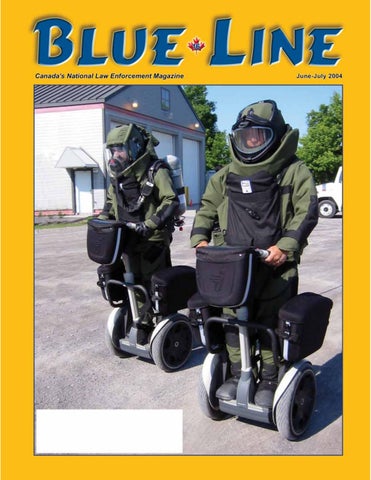
How prepared are we when it comes to anti-terrorism? Inspite of innovative RCMP concepts such as those shown on the cover of this month’s edition, the promise is far greater than the activity. On Page 22 of this month’s edition staff writer Les Linder gives a realistic overview of current studies and issues in relation to these pressing concerns. Campus police encounter unique challenges in policing Canadian universities. Imagine keeping the peace in a university campus the size of a medium-sized town or city, filled with students living away from home for the first time in their lives -- and don’t forget that one of your employer’s primary concerns is keeping them happy and eager to return for another year. We have several perspectives on securing the campus community; Kimberly Fraser writes about the changes in Carleton University’s Department of University Safety, which include adopting a new name; Kathryn Lymburner, a recent graduate, tells us about the challenges the Campus University Police Service faces in patrolling Canada’s third largest university, the University of Western Ontario and Andrew Rennox has a story on security at Quebec’s Bishop’s University, a smaller institution with a student population of just 1,700. In other stories, Lloydminster reporter Ian Ross writes about the challenges of policing the only city in Canada which straddles a provincial border. Deciding whether to use the laws of Saskatchewan or Alberta can be a little confusing for RCMP officers new to the area, but they learn to adapt to the unusual politics and geography of the area. Tallahassee Police Department Sgt. Ken Sumpter, a crisis negotiator, writes about the first ‘for real’ call he received -- and how it felt to know that the fate of a would-be jumper could depend on how well he did his job; Kathryn Lymburner gives us an overview of former Superior Court Justice George Ferguson’s recommendations for improvements at the Toronto Police Service and Les Linder looks at the federal government’s multi-billion dollar security strategy. JUNE / JULY 2004
4
JUNE / JULY 2004
The realities of a slow news day by Morley Lymburner I am taking a large step into deep water here but there are aspects of the recent Toronto Police scandals that need to be pointed out. A lot can be gleaned from a reporter’s question by the way they phrase it. In the thick of the media dust-up, I received numerous calls asking my opinions on “the deteriorating state of the Toronto Police.” I could have responded by asking about the deteriorating state of journalism in Toronto. I received a brief flurry of emails from the Globe & Mail and most seemed to have the objective of getting a better angle than Christie Blatchford. One was from a reporter who wanted to interview some rookies: I am a reporter with The Globe and Mail in Toronto and I’ve been asked to take a look at how police training institutions are approaching the recent events at the Toronto Police Service; ie. how the issues surrounding the corruption allegations are being discussed at police colleges and how new recruits feel about going into the field at such a tumultuous time, etc. I will be approaching police colleges directly, of course, but also thought you might be able to offer some background or insights... There really is no big story here, I responded. Toronto Police have a problem and are very effectively dealing with it. I suggested that the
June 2003
truly remarkable aspect to all of this is the 6,500 other officers doing their job under a very bad set of circumstances and receiving no recognition from the Toronto media. We see a lot of police related stories from across Canada every day in our office. Quite a few are about officers doing a lot of good in their communities. The OPP and RCMP have more than their fair share of stories of this nature. With all the apparent random killings going on in Toronto, politicians bent upon limiting police activities and other social concerns, why are the media far more interested in something that is being effectively handled? I would suggest that, if the chief said there is no problem and nothing needs to be done, now that would be a problem -- and headline news to me. I understand the media interest in this case. It involves some high profile people and their family members and I don’t expect that to go unnoticed, but a little balanced journalism would be a breath of fresh air in Toronto. The fact that Toronto Police engaged Justice George Ferguson two years ago to investigate issues of preventing corruption on the department was lost in the media hype, and it wasn’t because he went easy on them. One section of his report was of particular interest and reported on more fully elsewhere in this issue. Ferguson cites problems of corruption as stemming from the failure of a police service to prevent or detect serious misconduct or corruption that
5
can be traced to incompetent management, inadequate or nonexistent supervision and lack of effective accountability. Often this is also the result of under trained and staffed internal investigative units and the absence of any form of early warning system. So in short, the problem has been identified, acknowledged by the chief, investigations are continuing, charges have been laid and corrective measures have not only been studied but many have been implemented; end of story. I believe a better story would look into what measures the solicitor general’s office has taken to effectively monitor Ontario’s police services. In all of this, no one has asked them about what kind of oversight they provide to ensure proper practices and procedures are followed. Is there an accreditation process available to certify each department as complying with minimum standards? If so, is the public told about it? This is not a radical thought. Nursing homes do this regularly, as do many police services. Perhaps provincial solicitor generals should mandate audit overviews. Nothing would increase community trust more than an independent agency inspecting a police department and certifying it as being compliant. Richard Ayers, a former lecturer with the FBI, once said that “managers do things right while leaders do the right thing.” In this case, I believe Fantino has performed the task of manager and leader very well.
JUNE / JULY 2004
by Kimberly Fraser Visitors to Ottawa’s Carleton University soon notice the security officers patrolling the grounds and buildings, responding to calls or simply chatting with students. With almost 23,000 full and part-time students and more than 2,000 faculty and staff members, it would be easy for officers to get lost in the crowd, but each is aware how important it is to be visible. The campus safety office has an inviting and welcoming atmosphere and is easily reachable through the emergency phone system. Campus safety has evolved from an ‘observe and report’ watchman service to a more pro-active, community-based policing service. Some of the well-trained officers have special constable status and all are empowered to patrol the campus grounds, meet with members of the community and work together to resolve problem areas. The strength of the department is its people, says director Len Boudreault, a retired RCMP officer who began at Carleton in 1992. A mix of young and older officers blends experience and enthusiasm, he notes, and a reassessment of the department’s strategic plan in 2001 ensured it was meeting the needs of the community. “We engaged an external consultant to review our department and our relationship with the local police department,” he says, and used the results “to establish the framework of a new policing agreement with the city police. Also examined was the department’s special constable status and its name.
“We accepted that we provide a policing service but that represented only a small portion of our role,” he recalls. “We more correctly provide a first response and safety role to our community. In that vein, our department changed the name from Campus Police to Department of University Safety.” The Ontario government was re-examining the guidelines for special constables at the time and this resulted in a best practices guide being developed that established the criteria for future appointments by local police departments and service boards. It became apparent that the future role would be as campus safety officers, some with peace officer status. The training and recruitment process was modified to reflect the change. Greater emphasis is now placed on finding and developing the right people for the community. Following the community-based policing model, the department assigned a liaison officer to promote positive interaction with student groups and organizations. There has been an increase in volunteers for the student safety patrol and officers are now more likely to be invited to the table to discuss campus life issues. Boudreault has worked hard to improve the department’s reputation, not only in the university but within the Ottawa region. “The department is going through an evolving process,” he says. “We have moved from security guards to campus police to the role that we more realistically have in our community - that of campus safety. Our future lies in providing a safe learning environment for the stu6
dents, staff and faculty. We are in the business of ensuring that we supply a safe environment; this contributes to the strategic plan and overall goals of Carleton University.” The campus safety officer model attempts to transform the department from a traditional and reactive organization to one that collaborates with the community to solve common problems that affect campus life. This rigidity found in militaristic organizations is reduced so officers can make sound and reasonable decisions. In spite of the positive outlook, the department faced two large hurdles last year -- an increase in theft and the enormous influx of ‘double cohort’ students (a double sized class of first year students caused by Ontario phasing out grade 13). The department is using education to raise awareness of the problem in the campus community. “Its amazing how people on campus neglect the safety of their personal items,” notes shift manager Shaun Armitage. “People fail to properly secure their items and this leaves the opportunity for someone to steal their property.” Education has raised awareness of thefts at Carleton but it remains a huge problem. Carleton’s Department of University Safety is hosting this year’s International Association of Campus Law Enforcement Administrators conference, which is held outside the US only once every four years. The conference will take place June 25-29. Boudreault can be reached at lenboudreault@pigeon.carleton.ca -- Fraser can be contacted at kimberlyfraser@pigeon.carleton.ca.
JUNE / JULY 2004
Positive contacts key to policing university by Kathryn Lymburner Police services must stay in touch with their community and that’s especially important if you’re one of the 19 officers patrolling the more than 30,000 people on the campus of Canada’s third largest university. “There’s no other way to get around it, our officers need to be informed and need to have a good rapport with everyone,” says Elgin Austen, Interim Director of the Campus Community Police Service (CCPS) at the University of Western Ontario (UWO). “Things are changing in our world so quickly that the stuff that happened five years ago and longer than that, we can’t rely on anymore. What I see in the future is, unfortunately, we’re going to be needing police more as time goes on.” Known for many years simply as the University Police Department, the CCPS recently changed its name and logo and went through a modernization process to better reflect the situation it and other police forces face today. “We only have 19 people who work 365 days a year, 24 hrs a day; that’s not a lot of
people when dealing with the size of campus that we have, so it only makes sense to have community oriented policing -- it’s the only way to go.” says Austen. “The larger campus allows us to tap into numerous amounts of resources and caring community leaders to assist in the community oriented problem-solving policing model that we’re using. The size provides us with more resources, as well as those of a larger city, which is a very positive thing.” This good rapport is noticeable through all aspects of the service’s programs, which include the foot patrol program, run by student volunteers, which offers safe on-campus walks home; the newly introduced safe work program, which provides a call-in safety check system for members of the community working late on campus; and the community liaison program, which introduces CCPS constables to residents of the eight campus residences. Cst. Colleen Kelly works to improve the relationship between police and managers, staff and students of the university’s largest residence. “Through meeting with the building managers one hour a week and discussing issues that we have dealt with there, we are able to communicate better and show that we really care about what is going on in their buildings,” she says. “People so often come in contact with officers in a negative situation, so to have the opportunity to go in and discuss things with students and staff on a more personal level helps to foster a better relationship.” Kelly takes time to provide information sessions for students. “Sometimes the residences want me to provide talks with various groups -- usually it’s female safety and awareness -- or 8
if they’re doing some other kind of session and they need information or pamphlets, I’ll do the research and provide the residence managers with the relevant tools for that.” Her involvement is not always strictly about business though. Sometimes she will have lunch with staff and students; “even the caretakers will sometimes take a break and come and sit with me and they’ll ask questions -- sometimes it’s not even about school, it’s about criminal cases and this is my time to make them comfortable, to sit down and have a chat.” “The university’s housing department gave the officers debit cards to set up the lunch program,” says Austen, “so they can meet people under more positive circumstances.” With over 5,000 residence units, he notes it’s very important for them to build these relationships so they’re able to work smoothly to address issues when serious events occur. “For so many young people there will be other issues that will be happening in residence that we sooner or later will be involved in. To have some rapport that’s already established helps make our jobs a little easier in the long run.” The CCPS is different from a regular city police force. “Here we have a little more consistency and confinement; people are here because they want to be here or pay to be at this school,” Austin says. “We’re also able to deal with the small things, while in a city environment they can only deal with the larger things as they come up.” By returning to a proactive, communitybased policing approach, the UWO’s campus police officers are adding a human element and working to be seen as friends, not enemies, to staff and students alike. JUNE / JULY 2004
June 2003
9
JUNE / JULY 2004
Securing a small campus in a small town by Andrew Rennox Since they are small communities within a larger city most universities have both campus security and big city policing problems to deal with. But a university whose student population is one third the size of the community it’s located in faces different challenges. Bishop’s University and it’s 1,700 students is located in the small eastern township town of Lennoxville, Quebec, population 5,000. Technically now part of the city of Sherbrooke, the remote location and many outof-town students creates a unique security environment. Although campus security performs the usual tasks -- protecting the campus community and facilities, first aid and patrolling residences -- the school’s size and location has an effect on the methods they use, says security director Daniel Major. “It’s a small school its true, but we have decided to use the size to our advantage,” he says. “Our Security personnel work with student groups and government to develop a good working relationship. We meet with students at the beginning of the school year to introduce ourselves in a positive light and show them we are here to help. Having a community approach helps us a lot because we find that a lot of people come to us to report things.” This approach also pays off with investigations since they can often just come up with a name because somebody knows somebody who knows who was involved. As with most universities, campus security has a very good relationship, and is in constant contact with local police. An officer from the local police is appointed as the ‘go to’ person -- a contact for special events or other campus concerns. Contacts go both ways; local police come to campus security for help when university-related problems occur in town. There’s also a ‘Town and Gown’ committee. This consists of the police liaison officer, mayor and landlords of student residences making up the ‘town’ portion and the dean of student affairs, student government and security on the ‘gown’ side. The campus and town problems
are taken to the committee, which can call out the resources needed to deal with them and help both sides fulfil their roles more effectively. One of the challenges of patrolling a university campus is being prepared A l t h o u g h b o t h for the unusual. Given the enthusiasm of recently liberated youth from Lennoxville and the family discipline, traditional policing styles must be tempered with university are prima- considerable discretion. rily English speaking, there’s a significant French population in nearby was previously unavailable to them when they Sherbrooke. Due to this all of the Bishop’s were under the facility department. security personnel are bilingual. The result is Officers also work closely and stay in that language presents few problems. close radio contact with Student Safety ServSecurity personnel come from diverse life ices, which is made up entirely of students. experiences. Although backgrounds range from “We are there to help each other out whenever security to military and police, they all receive needed,” says member Steve Robinson. He thorough on-site training to acclimatize them notes they keep in close radio contact with to the unique form of law enforcement and security at all times, not only on campus but protective services the campus requires. “Our within Lennoxville itself, creating a comlittle world here is quite specific to the type of munity-based approach. security that we want,” states Director Major. With its offices in the middle of the campus, Bishop’s security officers perform many security is an active member of the Bishop’s different duties -- everything from police work University community. Their entire approach to night watch duties. Their mandate comes to the policing operation on campus is focussed under student services and the organization toward shared trust and community involveis answerable to the Dean of Student Affairs. ment. For a small campus security service in the That makes a difference as to how they are middle of a small town it is the only viable way perceived on campus and allows them to sit on to function. Their success is reflected in both the committees such as alcohol awareness, which crime rates and student cooperation. 10
JUNE / JULY 2004
This is in response to your article entitled US and Canadian officers are to be congratulated (Publisher’s Commentary, April 2004 edition), which contains a number of inaccuracies we feel must be addressed. On February 18, 2004, three American police cruisers continued through the Rainbow Bridge border point without any advanced warning and without stopping at the Canadian port of entry while in pursuit of an individual wanted for several criminal incidents in the US. The individual was confronted and apprehended, very courageously, as you point out, by a Canadian police officer. The Canada Border Services Agency (CBSA) must, however, make clear that the US police officers who pursued this individual clearly did not adhere to Canadian laws and, in doing so, jeopardized the safety of travellers and officers who were at this border location the evening of the incident. The CBSA takes very seriously the enforcement of laws to prevent the illegal entry of people and goods into Canada. We are concerned with Morley Lymburner’s comment that “to stop an extremely dangerous criminal from hurting Canadians -- something the top levels of Canada Customs, post 9/11, obviously feel it is not that important” and that the unofficial motto of CBSA is “get the cash - let the Americans worry about the terrorists.” This is patently untrue. September 11, 2001 reminded all of us of how important our shared border is to the security and economies of both countries. In order to enhance border security, the CBSA has strengthened its partnership with the US and has participated in the introduction of new programs and technology. Both countries are working together to improve existing programs and to fi nding the best solutions, including cooperation between Canadian and American law enforcement agencies, to ensuring a safe and secure North American border. The CBSA also takes exception to Mr. Lymburner’s comment of “given Canada Customs just go for the cash attitude, I would suggest this renders their real authority to nothing more than the toll collectors on that bridge.” The CBSA’s key activities include enforcing Canadian laws to prevent dangerous and illegal goods and contraband and people from entering Canada; protecting Canadians and the environment from prohibited, hazardous and toxic products; managing risk at the border by facilitating the movement of low-risk goods and people while focusing on those goods and people deemed to be high risk; and ensuring the accuracy of trade data to protect the Canadian economy. The CBSA includes approximately 10,000 dedicated men and women with some 4,000 uniformed officers at 522 border points working to protect Canadians. Every year those officers refer approximately 2.5 million persons to secondary examination, resulting in 44,000 being denied entry to Canada and another 41,000 being reported as inadmissible. E v e r y y e a r, t h e C B S A r e m o v e s approximately 8,000 inadmissible persons from Canada. In our 2003-2004 fiscal year alone, the CBSA made 19,088 drug seizures, keeping more than $408 million of narcotics June 2003
off the streets of our communities. Our officers confiscated 17,801 weapons and seized 1,999 items of obscene material. In addition, approximately 100 missing children were recovered and reunited with their families, thanks to the efforts of our employees. In May of 1998, the Customs Act and Criminal Code were both amended to give designated customs officers the power to arrest and detain persons suspected of or in the process of committing an offence under the Criminal Code. These expanded powers of arrest and detention have bridged an enforcement gap that previously restricted our officers from addressing offences such as
11
impaired driving, child abduction, possession of stolen property and outstanding arrest warrants. Since the implementation of these additional authorities, our trained officers have intervened in more than 11,600 Criminal Code offences. In conclusion, the role of our officers at Canadian ports of entry is multi-faceted, as every day officers contribute to the safety, security and prosperity of Canadians. To characterize our officers as nothing more than the toll collectors on that bridge is not only inaccurate but insulting. Alain Jolicoeur President Canada Border Service Agency
JUNE / JULY 2004
Policing the meridian Lloydminster has a policing style like none other by Ian Ross Lloydminster is a city of deuces – a provincial border cuts this booming oil town right in half like a surgeon’s blade. It’s the only place in Canada where a city straddles two provinces – Saskatchewan and Alberta. With the flood of heavy crude oil has come a flood of heavy crime. Regular break-and-enters, a drug epidemic and vehicle collisions – more than 850 last year – keep Saskatchewan’s second-largest RCMP detachment on its toes. The ‘Border City’ is home to 24,000 permanent residents and a number of oil crews who keep the city’s hotels at full capacity. With the money from oil comes a number of problems. The biggest and most obvious one is the ballooning drug scene. Policing Lloydminster can be confusing but it isn’t hard, according to Tom Lysyk, the city’s protective services director. What the two legal systems create, most of the time, is frustration. Since the RCMP is a federal organization, there is less confusion between the provinces as to who manages the policing function. “If we had our own local police force, there would always be the issue of what type of police act would apply,” said Lysyk. “Would it be Saskatchewan, Alberta or both? Someone would have to make the determination for one act to stretch over into the other province.” Using a federal police system allows administrators to tap into a number of different experience levels, without having to train a city police force. “If we get cadets out of Depot, they don’t have any training in knowing both sets of laws, but they quickly learn the provincial statutes,” he said. “They are different and have to be treated accordingly. They’re quite adaptable, these guys. It’s not like being in one province where there’s one rule book.” Most of the 25 Mounties in Lloydminster have been around a while, either at detachments in Saskatchewan or Alberta. Lysyk said it doesn’t matter whether an officer has six months under their belt or 26 years – there is a learning curve in Lloydminster that they won’t get anywhere else. Municipally Lysyk is responsible – in essence – for the police force. He could make a municipal police service if city council approved it, but the RCMP have been in place for so many years that there really isn’t any point. “We’ve had the RCMP for so long, I don’t think it’s ever been an issue,” he said. “At one point the two provinces were similar in their objectives. If you have a federal client and he’s up for a federal offence, it doesn’t matter where you are in Canada. Where it falls apart is that we have one police station, one commander
and our officers throughout the city. We can say that everyone is treated equally, but they aren’t because when you go to court in Saskatchewan, it’s a completely different world than the Alberta side. There are different rules, different prosecution (and) there can be duplication and overlap of charges.” While Lysyk has the theory side of policing down pat, the responsibility of putting it into action lies in the hands of Sgt. Mike Yanota, NCO for the Lloydminster detachment. “It’s not that complicated,” Yanota said matter-of-factly. “It’s more a mind set that when you’re first new and dealing with different fines and that sort of thing, it’s more a matter of getting accustomed to remembering what side of the fence they (the officers) are on.” Cst. Cynthia White, a sixyear veteran of the RCMP, has just arrived at the Lloydminster RCMP detachment for her March 5th night shift. Friday nights are generally busy, so White buckles down to some paper work and phone calls before going out on the road. Last night – March 4th – she seized crack cocaine worth about $2,500 on the street. The discovery was made while investigating a theft from a vehicle on the Alberta side of the city. Before she can show off the evidence to her colleagues, a man and his son show up at the front desk. They’ve just been T-boned in their Cavalier and the suspect vehicle didn’t stick around. “In Alberta and Saskatchewan, there are different accident reports and different reporting requirements,” she said. “If you’re in an accident in Saskatchewan and it’s two Saskatchewan drivers then you don’t have to 12
report it, but if its Saskatchewan and Alberta, then you have to report it. If nobody is injured in the different provinces then it’s not reportable, but if the combined vehicle damage is over $1,000 in Alberta, then it is reportable. It’s just very confusing.” In Lloydminster, most crashes are reported because police have attended or a tow truck has been called. White is very blunt about the drug problem in the community. “I think you can ask any member at the detachment and (they will say) we encounter a lot of people that will admit the community has a problem. We have had tons of people tell us that it’s not hard to get what anyone wants in this community.” In February, the Slim Thorpe Recovery Centre – a detox facility – turned away more than 90 clients who wanted help with their cocaine problems, simply because there were not enough beds. White believes huge pay cheques in the oil industry are contributing to the problems the detachment is seeing. “A lot of people are moving in and working in an industry where they can make a lot of money and they work hard when they’re working. If you’re young and want to let off some steam and you got the money, you can do it pretty easily here in Lloydminster,” she said. “There is a lot of opportunity for drug dealers to prey on people in Lloydminster. Most of the people who come here to work, come here to work. I don’t think it affects the local people in a negative way. Every growing community in Canada is facing these kinds of problems and in Lloyd we’re halfway between two major centres, we’re on a major highway, we have money in our community and those things all add up to problems.” A short time later Lloydminster’s finest are out to make some patrols, which take them – more times than they can count – across the JUNE / JULY 2004
provincial boundary. White is driving B272, a low-mileage Impala that hasn’t been washed in a while. She hits the road and starts out on 44th Street, Lloydminster’s main drag. It runs eastwest through the city and outside the city limits is referred to as the Yellowhead Highway. It runs from Winnipeg through Saskatoon, Edmonton and finally to Prince Rupert, British Columbia. White drives through a parking lot of the Kooler Nite Club four or five times over the course of the night. Impaired driving plagues Lloydminster like a nasty fungus. It doesn’t go away, no matter how hard the police try to eradicate it. Drunk driving, like everything else, has two sets of rules – rules ranging from how a breath test is done, to technicalities when an arrest is made in Alberta but the breathalyzer is in Saskatchewan. Back at the detachment, White and her colleague Cst. Gord Yetman explain how the tests are done. “I guess in terms of the test, they aren’t different. The way the tests are interpreted are different from province to province. In Saskatchewan the readings are done in increments of 10, their reading will be 128, which gets bumped down to 120,” added Yetman. “Here, you blow a reading of 110 or 120. You don’t blow in between, you just blow solid on the 10’s.” In late March, record warm temperatures brought the masses out on the roads of the Border City. The masses brought their cars and, in true Lloydminster fashion, there were crashes. A westbound race on Highway 16 left one man in hospital -- he flipped his Camaro after realizing he couldn’t make a corner -- and drove in the turning lane in hopes of cutting back in to the express lanes to finish the race. It never happened. “If we have an offence where a couple of guys are racing cars and they start in Alberta and finish in Saskatchewan, we don’t want to have to charge them in both courts,” said White. “It would take up a lot of the court’s time, so we will put all the charges into one province -- and we use something called ‘500 metre wording.’ Within 500 metres of the border when the offence occurs you can change it over to the other side.” Although this is understood in Canadian law, it becomes quite important in Lloydminster. If the person is already in court in Saskatchewan, it’s easier to keep it all in one place. “It makes it easier for everybody -- defence, crown, families. It can get really complicated,” concluded White. One of the mandates of the Lloydminster RCMP is to do more traffic control. A high number of young, inexperienced drivers contribute to major traffic problems, said White. Early Sunday morning after the bar patrons have headed home, White circles around the city looking for impaired drivers. After following a couple of cars, she spots a 1992 Ford Explorer driving south on 50th Avenue – the provincial border. The man behind the wheel swerves his way down the street for nearly ten blocks before coming to a stop. White demands a breath sample. The driver is from Islay, a small village in Alberta about 30 kilometres west of Lloydminster. He’s got enough booze in his system to June 2003
land a 24-hour suspension -- but it was issued in Saskatchewan. After clearing from this incident White does one last lap before driving back to the office. It’s nearly 4 am Sunday morning and, besides a hot coffee, there’s paperwork waiting for White -- on the Saskatchewan side of the city. Ian Ross is a reporter with the Lloydminster Meridian Booster. He may be reached at eMail: photo_ tribe@yahoo.com.
Lloydminster Historical Profile The Lloydminster area was first settled in April 1903 with the arrival of about 2,600 Barr Colonists from England. The new settlement was named in honour of Rev. Lloyd for his efforts in leading them, along with the word ‘minster,’ which means ‘mother church.’ The newly founded hamlet of Lloydminster was located astride the 4th Meridian in the Northwest Territories. When the provinces of Alberta and Saskatchewan were created in 1905 and the 4th Meridian selected as the inter-provincial boundary, the village of Lloydminster was split in two. The Alberta portion was incorporated as a village in Alberta on July 6, 1906, while the Saskatchewan portion was incorporated as a town in Saskatchewan in April, 1907. This peculiar situation resulted in the duplication of all municipal functions; there were two separate municipal councils, two municipal offices and two fire departments. Common sense prevailed and the two communities were amalgamated into a single municipality - the town of Lloydminster, by an Order-inCouncil of both provinces on May 20, 1930. On January 1, 1958 the town of Lloydminster received its charter as a city, becoming the 10th city in both provinces.
13
JUNE / JULY 2004
Earning trust key to ending crisis by Ken Sumpter August 18, 2003 started off just like any other workday. I was on my way in to the station when my ID number came over the radio. I called dispatch and was asked, as the only crisis negotiator on duty in Tallahassee, to respond to Florida State University (FSU) for a suicidal suspect. I began my law enforcement career as a military police officer with the US Army in 1985 and joined the Tallahassee Police Department in 1988. Although I’d been with the Tactical Apprehension and Control Team (TAC) since 1996, training monthly in full practices with the Crisis Negotiations Team (CNT), this would be my first actual face-to-face negotiation with a suicidal subject. One thought ran through my mind -- ‘practice is over, this is the real thing.’ The scene looked like something out of Hollywood, with fire trucks, ambulances and police cars scattered around the structure the subject was threatening to jump from. It was easy to find him; I simply followed the gaze of those standing around. The young man was standing on the ledge -- I remember looking up and thinking ‘man, that’s up there.’ The reality of the situation hit me -- there were no other TAC or CNT members here and
this was all on me for now. How would I initiate a conversation? What is going on in this guy’s head? A FSU police officer approached to escort me to the top. Just my luck, the elevator wasn’t working and we had to take the many flights of stairs; I recall wishing that I hadn’t stopped running on my treadmill!
14
We finally reached the top and another officer briefed me about the subject. People walking by called police after hearing him ask people if they thought he could fly. Three or four officers were trying to convince him to step back from the ledge; I could see the relief on their faces when they saw me and realized I would be taking over their burden. Again, a real sense of responsibility set in. This guy’s life could depend on how well I do my job. The subject was clearly upset and angry and threatening to jump off the ledge. I thought the sea of police uniforms surrounding him may be threatening, recalling our team leader, Sgt. Chris Summers, briefing us the month before about the pros and cons of uniformed negotiators. I don’t know why, but without really contemplating the idea, I took off my pistol belt and handed it to an FSU officer. I walked slowly toward the subject, who could clearly see my actions. “Why did you do that,” he asked. I answered simply, “because I’m here to help you and I won’t need that.” This took him by surprise; he said it was unusual because most cops he had encountered “manhandled” him. Without intentionally doing so, I could see that my actions had opened up a line of communication. I began talking to him about the incident as I went through a checklist in my head -don’t forget to simply ask him to step down, I reminded myself; establish a contract, determine the threat level and whether the subject had planned the jump or decided to do it on the spur of the moment. All the things in training were coming to my mind but it was the human contact that became most important -- the ability to establish a bond, reflect feelings and show compassion. The subject had not had a pleasant life, spending the last four years in jail on property crime and arson charges; although a juvenile at the time, he had been tried as an adult. His child and girlfriend, who had promised to wait for him, were killed in a car accident while he was imprisoned and he was very angry that he hadn’t been allowed to attend their funerals. Having lost a child myself to sudden infant death syndrome, I shared his pain of losing a child. I recalled previous conversation with my sergeant about the pros and cons of selfdisclosure but chose to share my own loss. This seemed to help the subject feel that I knew at least some of what he was trying to express. He began telling me about how frustrating it had been getting out of prison and moving back into his mother’s home, only to be put into the garage to make room for her new husband and his children. He was angry at having to make room for another man’s child. We discussed whether he could move into his own place, which led to his problems finding a job. He felt his criminal history had created a wall and was preventing him JUNE / JULY 2004
from getting a “real” job. ‘Prison, loss of family, no job and living in Mom’s garage,’ I thought to myself -- this guy did have some problems. We had been trained that suicide is an option for some people, but I didn’t think this was the day for him. We discussed all there really was to live for, briefly touching on religion and whether he would have the opportunity to see his child again. I determined that this wasn’t a planned event, but rather a spur of the moment idea. I was able to get him to step down from the ledge, as long as I kept back and he felt safe. He moved back to the ledge at one point and I asked myself what happened. Although there were a couple of times I thought he might actually do something, I felt we were moving toward a resolution. I asked him why he moved back and he replied, “more cops.” I looked around and noticed more FSU officers and my TAC team leader had gathered; I asked them to step back and move away and re-initiated our conversation. The subject agreed to my requests to step down from the ledge again and focus on me. ‘Great,’ I thought to myself. ‘Don’t mess up now with your team leader looking on!” Yet, once I began talking with him again, it was as if there were only the two of us. The subject asked to speak to an attorney he trusted and felt could help him. I wasn’t sure about this idea and the thought of depending on someone else to reach closure. Since he hadn’t committed a crime, I discussed the idea with my team leader and told the subject we would work on it. I continued to reach out and try to get him to walk away from the edge. Then came my first snag.
June 2003
“I have a cell phone he can use,” a FSU officer called out. I began talking -- I don’t remember about what -- to distract the subject in hopes he’d forget the offer, since I didn’t want him to have a phone. It worked -- he continued talking and it was almost as if he’d never heard the offer. I told him I felt he had not given himself every opportunity to resolve his problems, while reinforcing that it was up to him whether he committed suicide. No one said he had to decide today though, I added, recalling how we had been told in training to “go to the dark side -- go into the death itself.” I walked over to the ledge and, as I looked down, said “man, that is really far down; did you really think about this? What if you jump but don’t die?” We discussed the pain and possibility of living life as a cripple. Since this was an unplanned event on his part, I sensed an opportunity to resolve the incident. We couldn’t reach the attorney he had requested so I again brought up the options to death we had been discussing all along. Then the “what ifs” began. Would he go to jail or to a psych ward? I continued as I had from the beginning, telling the truth about everything. My training had always reinforced that you never lie to a subject because you may face them another day and credibility is everything. Then, from nowhere, he asked “if I come down, will you get me a Coke?” I almost laughed; a Coke is going to resolve this incident? What a commercial this would make! I agreed and an FSU officer who had spoken to the subject earlier promised a hamburger to go along with the soda.
15
Seeing the opportunity, I reached out my hand and said, “come on, let’s go get that Coke.” He hesitated but I kept my hand out, continuing to look him straight in the eyes. He walked over to me and we walked away together from the ledge. The entire incident lasted about an hour and a half and a sense of relief came over me as I escorted him to a patrol car. I realized that the tenseness had made me tired. We headed to a drive-thru for the burger and Coke and then went to a hospital so he could be screened by a doctor. We reached the attorney by cell phone and the subject briefly discussed things with him. I wished him well when we got to the hospital and told him I hoped he would be able to work things out. I left to continue my day with a sense of accomplishment and pride, knowing that I was part of a team that stressed training -- training that came through for me when I needed it. I learned how vital it was that day, especially when facing a challenging situation without your team to back you up. I’m thankful for all the practices, past mistakes and ingrained learning. It was rewarding to know that in a crisis, the lessons learned in training stay with you. This incident had a happy ending -- and it didn’t hurt to have the team leader nearby to see one of his negotiators in action with no major mistakes! Ken Sumpter began his law enforcement career with the US Army Military Police in Wildfecken, Germany in 1986. He’s now a sergeant with the Tallahassee Police Department, supervising the S/W patrol district, and can be reached at sumpterk@talgov.com .
JUNE / JULY 2004
A step back from the edge A recipe for building community confidence by Kathryn Lymburner In November, 2001, former Superior Court Judge George Ferguson was requested by Chief Julian Fantino and the Toronto Police Service to write an independent executive summary and working document dealing with current operational issues in the Toronto Police Service. The result of Ferguson’s extensive interviews and research was published in a two volume document detailing his recommendations for changes to how recruitment, employment, transfers, promotions, supervision, training and continuing education, and internal affairs are conducted, as well as policies pertaining to the use of alcohol, drugs and other substances and the treatment of informers and agents by members of the police service. The 28 recommendations are not an examination of the day-to-day operations of policing within the community, and are not meant to radically alter the face of policing. Instead it examines the practices and procedures of the Service and its internal reports and the manner in which disclosure of proven or alleged police misconduct is handled. In his research Ferguson drew on his personal experiences as a practicing lawyer and judge of fifty years as well as extensive personal interviews conducted in Canada, the United States and England. Ferguson sets out five areas that he examines: i. The existing Toronto Police Service procedures with respect to recruiting to ensure
that only those men and women with the highest standards of integrity and honesty are recruited and offered employment by the Service. ii. The current Toronto Police Service practices and procedures regarding training
and continuing education and to identify any deficiencies therein that might contribute to the formation and growth of misconduct or corruption. iii. The organizational structure of the Service to determine if supervision or the lack thereof is a factor which contributes to police mis-
16
conduct or corruption, iv. The culture of policing in general to identify what factors may contribute to the formation and growth of police misconduct and corruption, and v. The legality, feasibility and usefulness of measures such as random integrity testing, mandatory drug testing, financial background checks, and polygraph as tools to identify corruption and preserve honesty and integrity. Recruitment and Employment Unit In regards to the first point, Ferguson outlines nine areas for recommended improvement in the existing recruiting and employment procedures in the Service. He notes that the Toronto Police Service currently utilizes the Constable Selection system set by the Ontario Association of Chiefs of Police (O.A.C.P) but this program has proven to be inadequate for the Employment Unit, requiring “fine-tuning” from time to time. Unfortunately, instituting their own recruiting and employment program would not be viable without an increase in personnel in the Employment Unit. The report emphasizes that a more proactive approach of actively recruiting qualified individuals from high schools, colleges, and universities as well as creating cooperative and joint programs with law enforcement related programs that would establish a priority in recruitment selection. Ferguson notes that in order to attract a greater number of qualified candidates, especially from minority groups, the Employment Unit should carry out seminars at various community centres to explain the recruitment process and employment policies of the Police Service. Once an individual enters the recruitment process, more extensive background investigations need to be expanded to include interviews of family, neighbours, associates, previous employers, and teachers as well as interviews with individuals not listed in the applicant’s references such as previous co-workers. The employment of retired officers to conduct these investigations, a practice that has been successful in the past, is recommended as a practice that should be continued in the Employment Unit. Ferguson suggests the employment of two full-time, fully qualified psychologist to conduct all psychological testing of potential recruits, along with the testing of current members of the Service seeking promotion or transfer to sensitive or high-risk areas. Currently the Service is employing psychologists on a contract basis. A new Special Recruitment Committee needs to be established to act in an advisory capacity to the Employment Unit in order to develop and maintain a recruitment strategy. According to the recommendations, this
JUNE / JULY 2004
committee should consist of six individuals: two members of the Service appointed to the position by the Chief, two members of the Service appointed by the Police Association, and two private citizens who have experience in human resource management to be appointed by the Chief. These committee members will be appointed for two years, subject to one renewal appointment for two years. The members of the Special Recruitment Committee will also receive an honorarium from the Service. The position of “Career Development Officer” needs to be reintroduced and moved to the Employment Unit. This individual will assist members in assessing and achieving their career paths and promotional opportunities.
especially in regards to proactive programs, “whistle-blowers,” and public complaints. Independent telephone lines need to also be established so that members of the public or the Service can report serious police misconduct or corruption on an anonymous basis. A proper system of protection needs to be designed so that “whistle-blowers” will feel comfortable in lodging complaints with Internal Affairs. Finally, Internal Affairs needs to ensure that an adequate number of highly skilled investigators are trained to provide prompt, thorough and professional investigations of all early warnings and complaints of serious police misconduct or corruption. These investigators should be transferred out of the unit after a specific number of years with special recognition for their service
in Internal Affairs for the purpose of future promotional opportunities. Use of Alcohol, Drugs and Other Substances A comprehensive policy on the use of alcohol, drugs and other substances needs to be developed and implemented by the Service. It should include the following components: Members of the Service shall not engage in: a. The illegal use or possession of any of the substances listed in the Controlled Substances Act, b. The use of any other substance, not named in the Schedules to the Controlled Drugs and Substances Act, to the extent that the said substance may have an adverse effect on the
Transfers, Promotions, Supervision, Training and Continuing Education In the study Ferguson remarks that the calibre of supervision and management in the service needs to be improved and that all the suggestions in this area are aimed at improving the Service to prevent the future exposure of serious police misconduct and corruption, while still maintaining a high degree of supervisory and management accountability. Among the recommendations in this section, no member shall be promoted to a management or supervisory position or transferred to a sensitive or high-risk unit unless they have successfully completed psychological testing and assessment, and provided personal financial background information. As well, no member of the Service shall be promoted to a management or supervisory position unless he or she has successfully completed a designated course on management skills in addition to training in ethics and integrity. These ethics and integrity training must be included as components in all training and continuing education course provided by the Service along with a one-day course provided to all members of the Service on ethics, integrity and corruption and the procedures used to detect and investigate complaints of serious officer misconduct. Internal Affairs Recently, it has become increasingly obvious that there is much work that needs to be done to curb corruption within police services. Many of these services have put in place early warning systems and investigative procedures to help stop the problem. Ferguson’s report cites these problems of corruption as stemming from the failure of a police service to prevent or detect serious misconduct or corruption that can be traced to incompetent management, inadequate or nonexistent supervision, and lack of effective accountability. Often this is also the result of under trained and staffed internal investigative units and the absence of any form of early warning system. Along with this, Internal Affairs must be moved to a separate and independent off-site location. Overwhelming evidence has shown that an Internal Affairs Unit cannot operate effectively unless it is located in its own facility, June 2003
17
JUNE / JULY 2004
performance of his or her duties as a member of the service; and c. The consumption of any alcoholic beverage contrary to the policy of the Service. Members who violate this policy will be subject to disciplinary action, including dismissal. As a condition of promotion or reassignment to a sensitive or high-risk area, such as drug squads, major crime units, Emergency Task Force, Intelligence Services, Mobile Support Unit, Professional Standards or Internal Affairs, members should be required to submit to a drug testing program. Also, applicants for employment with the Service and those requesting promotion, transfer or reassignment should be required to acknowledge in writing that they have read and understand the Service’s policy on the use of alcohol, drugs and other substances. Informers and Agents The last section of Ferguson’s recommendations notes that often the Service has used “quick-fix” adjustments to their policies on informers and agents and that now is the time for the Toronto Police and other services to replace its current system with a new one based on management control through the creation of specialized informer source units. Such a system is currently being used by the Metropolitan Police Service in London, England and throughout the United Kingdom. The Source Management System recognizes that informers are an essential tool in the criminal investigative process that need to be dealt with in a systematic, uniform and ethical manner. Informers, in this system, do not belong to an individual handler, but instead to the organization as a whole. The system works on two basic principles of supervision and control. Because all inform-
ers are resources for the police service as a whole and not of an individual officer, controllers must intrusively supervise and manage relationships between sources and handlers. All sources of information are registered on a central computer database. Identified information sources are then available for use through their designated “controllers”, who supervise and manage the relationship between the sources and the “handlers”, the officers who deal with the information sources on a daily basis. This information source coverage is monitored from a central point and to protect integrity, no officer requesting information is told of the existence of a specific information source. As a result, in England, the number of informers were reduced dramatically and was more effective and efficient at providing greater control of relationships and costs. This corporate approach to source management prevents officers from entering into unhealthy relationships with information sources that are secret and proprietary in nature, while providing a closely monitored process having none of the potential trappings for abuse that is characterized by the current system used by the Force. The introduction of the Source Management System is recommended by Ferguson as an immediate step to be implemented by the Toronto Police Service and when it is put in place an annual audit of the systems performance is necessary. This audit needs to be conducted by an individual independent from the Service and the City of Toronto. Persons wishing to get a complete copy of this report may do so by going to the web site of the Toronto Police Services Board at www.torontopoliceboard.on.ca. NEXT MONTH Chief Fantino responds to the Ferguson Report.
A 25-year Edmonton Police Service veteran has been appointed new chief of the service after finishing ahead in a close competition with former Winnipeg chief David Cassels. Fred Rayner, deputy chief since 1997, signed a threeyear contract with the option to renew, a deal worth $199,000 a year. A major Edmonton newspaper quoted police sources as saying Rayner beat out Cassels by a single vote for the job. The commanding officer of the Essex OPP is being hailed as a hero for rescuing a man from a burning truck. Inspector Chris Sharpe was off-duty when he came upon an overturned tanker truck in April near Windsor. The truck was filled with gasoline and diesel fuel and smoldering when Sharpe raced over and rescued the trapped driver. Sharpe says he was concerned about the possibility of a huge explosion, but says he could not leave the man behind. The driver was rescued unharmed. A woman whose harassment complaints against Saskatoon police Chief Russell Sabo led to the chief’s public apology and lengthy leaves of absence for both, is back on the job. Gwen Klotz, formerly known as Gwen Findlater, resumed her job as executive assistant in the chief’s office April 1 with altered duties. She had been away for almost 11 months on paid leave. Klotz made four of 42 complaints against Sabo that an independent investigator studied last year at the request of Saskatoon’s police commission. All four of her complaints were deemed founded. RCMP Commissioner Giuliano Zaccardelli says Canadians need to be debating the proper balance between individual privacy and public security. As police forces at home and abroad move to pool information to fight terrorism, there are growing concerns about the impact on privacy, he told a conference on counter-terrorism in April. Phillip Webb, a British security official, said there has been a definite shift in his country away from individual rights in favour of tougher security measures. Zaccardelli said Canadians haven’t even talked about that balance. He says he is not sure if the shift is as strong in this country, but that Canada is moving to find an equilibrium. James Cornish has been appointed interim director of Ontario’s Special Investigations Unit (SIU). Cornish has been a prosecutor in the province’s Ministry of the Attorney General since 1988. He was most recently a senior Crown attorney for Haldimand County and acting Crown attorney for Norfolk. He has written and taught about investigative techniques for major crimes, and is the co-author of The Law of Criminal Harassment and Stalking, a text on criminal harassment and related psychiatric issues. A prominent member of the Toronto Police Services Board has been suspended for taking police bullets. Norm Gardner was found guilty of misconduct by a three-person panel in April. The panel comprised of members of the Ontario Civilian Commission on Police Services for accepting about 7,900 rounds of ammunition from a Toronto police firearms training facility with the approval of senior officers. The commission suspended Gardner until his term expires Dec. 5. Gardner is appealing the decision. New Brunswick’s justice minister says little can be done to combat Internetluring, until Canada’s age of consent is raised. Brad Green says the age of sexual consent should be at least 16 - it’s now 14; he and his counterparts across most of the country have been pushing Ottawa for the change, but are facing opposition from Quebec and some northern territories.
18
JUNE / JULY 2004
June 2003
19
JUNE / JULY 2004
What makes a good cop good? by Dorothy Cotton It’s funny how one thought leads to another. Last month I was pontificating on the importance of choosing your words carefully and used ‘integrity’ as an example, since it means something different to police than psychologists. That got me thinking about the selection criteria for police officers -- for those of you interested in mental health issues, this would be an example of ‘loosening of associations’ or ‘tangential thinking.’ Okay, let me back up. I looked up integrity in the dictionary and its various meanings include wholeness, the state of being unbroken, innocence, perfect condition, sinlessness, soundness of moral principle, uprightness and uncorrupted. These sound like good characteristics for a police officer (or anyone else, for that matter) -- well, innocence may be questionable and I think the state of being unbroken fades with age, but otherwise they work for me. If we can all agree that integrity is a good thing in a police officer, then I recommend we only hire candidates that have integrity. Mind you, there are some other characteristics, traits and virtues that might be a good idea too, including honesty, obedience, reliability, fairness, justice, self-reliance, patience, originality, helpfulness, humour, connectedness, tolerance, discipline, sensitivity, uniqueness, spiritual awareness… Did I miss anything? Now here’s the big question -- which of these is the most important and how on earth are you supposed to figure out who has these characteristics? You could ask, I suppose. Interviewer: So, Mr. Possible Recruit, we here at the Happy Home Police Service feel very strongly that integrity and honesty are important characteristics for a police officer. Can you tell me how you rate in these categories? Candidate: Well, I have all my body parts and I have never sinned so I guess I have integrity --
and as for honesty, once I cut down a cherry tree and I actually ‘fessed up to my dad about it. Interviewer: OK, you’re hired. Ah, don’t you wish. The fact is these characteristics are hard to get at in an interview or from references. You might be able to discern them from previous experiences if you’re hiring candidates 40 or older, but even then they are pretty intangible. This dilemma does bring up some interesting questions about recruitment and screening -- and from my vantage point, the role of psychological assessment and screening in selecting recruits. Some police services require would-be officers to undergo some sort of psychological screening before they’re hired; it can even be a condition for officers to qualify for promotions or special assignments. There are a number of different tests used to screen out people who shouldn’t be police officers. If you look around your own service, you’ll probably conclude they’re fairly effective -- most of your colleagues are probably decent people -- but you’ll probably also agree that they’re not foolproof either; there’s always a few people who make you wonder… There’s also the possibility psychological assessment can actually help select the best people. The hitch here is that you have to know ahead of time what you’re looking for -- what actually makes for a good police officer. You might think helpfulness is a good characteristic,
for example, but what if the person is so helpful that they spend their entire day helping little old ladies cross the street or getting cats out of trees and never actually get their real work done? Self reliance is also a good trait -- but do we really have any evidence self reliant people are better police officers? Maybe they’re less likely to follow the rules and tend to do whatever they want -- and besides, what IS a good police officer, anyhow? Is the person who eventually becomes chief “better” than the one who elects to be a career constable? Is an officer who has never had a complaint filed against them a better person, or does this simply mean they never took a chance, went the extra mile or dealt with anything dicey? Hiring’s are a curious endeavour, and as a psychologist who participates in them, I have a question for you. What would you look for, personality-wise, in a good candidate? Sure, it would be great to hire only perfect people, but that’s not going to happen -- if it did, none of us would have jobs! If a psychologist could wave a magic wand or give a good test (there are a few out there) and tell you about a person’s real personality, what would you like to know? What are the key characteristics and the most essential traits of a good police officer? Tell me -- e-mail me -- what you would look for. You can choose from my list or think up your own -- and if more than three people respond, I promise to report back sometime down the road. Dr. Dorothy Cotton is Blue Line Magazine’s Psychology columnist and she can be reached at deepblue@blueline.ca.
“Pull it over to the lawn Buddy !...”
20
JUNE / JULY 2004
Canada’s anti-terrorism plan by Les Linder The federal government’s strategy to protect Canadians, bring terrorists to justice and maintain a secure and open border has been harshly criticized by Auditor General Sheila Fraser. Supported with new legislation, $7.7 billion in funding over five years in the 2001 budget and another $605 million announced in March, the strategy promised to improve intelligence, border protection, marine and cyber security. Also promised was enhanced coordination of systems, information, threat assessments and emergency response. However, Fraser said in a report presented to the House of Commons the same month that she found a lack of coordination among security agencies and weaknesses at airports and border crossings that need to be addressed. “September 11, 2001 marked a turning point for Canada and other countries around the world,” Fraser was quoted as saying. “It changed our perceptions of how safe we are and led to higher expectations for the security of our borders.” The audit found: • The government did not have a framework that would allow it to focus on the most important threats and guide investment, management and development decisions so it could direct complementary actions in separate agencies or choose between conflicting priorities • Departments and agencies are still unable to share some security information and their systems are not all able to communicate with each other • Watch lists used to screen visa applicants, refugee claimants and travellers seeking to enter Canada are not consistently accurate and up-to-date • Information about the 25,000 Canadian passports lost or stolen each year is not available to front line officers, even though these passports could be used by terrorists or other criminals
• Machines were purchased to take fingerprints and transmit them in a digital format but no funding was provided to electronically process the digital fingerprints -- and therefore, the time it takes to identify a person through fingerprints hasn’t been reduced • Transport Canada does not have full access to criminal intelligence held by the RCMP when screening airport employees working in controlled-access areas where baggage and freight are handled and aircraft are serviced • Based on a review by the RCMP of a sample of files, the audit estimated that 5.5 percent -- or 4,500 -- of the individuals holding restricted area clearances at five major airports had possible criminal associations warranting further investigation “We were disappointed that some of the flaws we identified -- the incomplete watch lists and the questionable reliability of some airport personnel, for example -- were in fundamental elements of routine security systems that were in place prior to September 2001,” Fraser was quoted as saying. “They should have been functioning more effectively at the time of our audit. These mat-
22
ters are serious and need to be addressed.” 2001 strategy The initial strategy included investments in six key areas, according to Fraser’s report, National Security in Canada - The 2001 AntiTerrorism Initiative. 1. Intelligence and policing ($1.6 billion) Accomplishments include: • increasing the investigative ability of CSIS by hiring more personnel and upgrading equipment and technology • expanding the number of Integrated Border Enforcement Teams from 5 to 14 • creating Integrated National Security Enforcement Teams in major cities • technology improvements such as enhancing information systems and improving forensic laboratory services and counterfeit examination for travel documents 2. Screening of immigrants, refugee claimants and visitors ($1 billion) Accomplishments include: • developing and implementing the permanent resident card, introduced in June 2002 • improving screening to better identify and remove security risks • deploying 45 Migration Integrity Officers (MIOs) in 38 locations overseas to work with other governments and international partners to combat irregular migration. MIOs prevented more than 6,000 individuals from illegally entering into Canada by air in 2003. 3. Protection of critical infrastructure, emergency preparedness and expanded anti-terrorism capacity for the military ($1.6 billion) Accomplishments include: • purchasing chemical, biological, radiological and nuclear (CBRN) detection and decontamination equipment and protective clothing for first responders • developing CBRN training program for first responders JUNE / JULY 2004
• contributing to the international campaign against terrorism through Operation Apollo and Athena • enhancing Joint Task Force 2 • strengthening the domestic capability of the Disaster Assistance Response Team (DART) • enhancing the military’s CBRN defence capabilities • expanding the military’s Signals Intelligence and Computer Network Defence 4. Border security and infrastructure ($1.2 billion) Accomplishments include: • expanding Free and Secure Trade (FAST), a joint Canada-US program to allow the flow of commercial goods by pre-approving carriers, drivers and importers, which is now operational at 12 of the largest land border crossings • expanding NEXUS Highway, a joint Canada-US program for pre-approved low-risk travellers, now operational at 11 major land border crossings • creating joint Canada-US targeting teams at five marine ports in March 2002 to identify high-risk containers at first point of arrival in North America • investing more than $45 million in detection technology, including 11 Mobile Vehicle and Cargo Inspection System (VACIS) systems, more than 60 baggage and cargo Xray systems, 53 ion mobility spectrometers and installing radiation detection equipment at container ports 5. Health security ($162 million) Accomplishments include: • purchasing medical equipment that could be quickly deployed to cope with casualties resulting from CBRN terrorism • purchasing specialized equipment to strengthen laboratory investigation capacity to respond to bio-terrorism threats • coordinating and delivering emergency preparedness, health and social services training courses • purchasing radiological and nuclear detection equipment 6. Aviation security ($2.2 billion) Accomplishments include: • creating the Canadian Air Transport Security Authority (CATSA) in March 2002 • placing armed RCMP officers on selected Canadian aircraft • enhancing policing at airports • improving training for personnel screening passengers and baggage • providing new explosives detection systems at Canadian airports • reinforcing and locking cockpit doors The report noted that departments and agencies responded to the report, highlighting the responses from Public Safety and Emergency Preparedness Canada and the Canada Border Services Agency and providing a clear picture of their intentions to strengthen national security. The report says the government’s efforts to more closely co-ordinate the collection of June 2003
intelligence information and encourage analysts to exchange what they learn suggests the plan is moving in the right direction. A number of other initiatives were also put in place to improve information sharing. In January 2004, the government established the National Risk Assessment Centre (NRAC), which is designed to manage and coordinate national and international watch lists on an around-the-clock basis. NRAC serves as an interface between offices at the international, national and local levels. The centre is expected to increase Canada’s ability to detect and prevent the movement of high-risk people and goods by analyzing and sharing information with frontline staff and international partners. Transport Canada and the RCMP also signed an agreement to share law-enforcement information, including organized crime, to help screen airport workers. The Mounties and Transport Canada also agreed to continue working together to update existing protocols, procedures and documentation to allow for more efficient exchanges of information.
23
JUNE / JULY 2004
Sudden death in restrained subjects investigated by Chris Lawrence A sudden death during or after a vigorous encounter with police is stressful for everyone involved. Officers are left to wonder what went wrong, managers come under increased public scrutiny and the family wants to know why the death occurred. One cause of such deaths is ‘excited delirium’ (ED), a condition described in forensic and police literature, which can be caused by psychiatric illness or drug intoxication -- cocaine is the best known cause -or a combination of both. Cocaine users in excited delirium struggle violently when restrained and may suffer a cardiac arrhythmia at any time during or after the struggle. Alcohol is another common factor. Some psychiatric illnesses have the potential to suddenly worsen to the point of ED. People living in community settings can have recurrent bouts, particularly if they neglect to take their antipsychotic medication; many cases are caused by a combination of drugs, alcohol and psychiatric illness. ED has also been described as “a state of extreme mental and physiological excitement, characterized by extreme agitation, hyperthermia, epiphoria (excessive tearing of the eyes), hostility, exceptional strength and endurance without apparent fatigue.” Exceptional strength and endurance without apparent fatigue are all signs associated with significant sympathetic nervous system arousal. ED is considered a medical emergency. Dr. Wanda Mohr and I have extensively investigated sudden and unexpected deaths after a significant struggle with law enforcement officers over the past five years and created an investigative protocol, based on information collected from several bodies of research, to assist investigators. The protocol parallels recent recommendations made by the National Association of Medical Examiners. The problem is not confined to policing and corrections; it also occurs in psychiatric facilities, hospitals and within geriatric settings. Even within
such controlled settings, where medical staff deployed restraint methods and devices, patient deaths still occurred. Debate about the safety of the prone position continues. Patients have been restrained in the prone (face-down), supine (face-up) and seated position safely within an emergency medical setting, however the people police deal with who are suffering ED are usually on the street. In cases where police have been called to a hospital, it has been because hospital staff are unable to control the individual. Rather than enter into the debate of subject position, I shifted my investigation toward developing a better understanding of the overall problem. The investigative protocol is designed to ensure that consistent, detailed evidence is collected to better assist the pathologist. One of the reasons why the prone position may be so closely connected with subjects who die “proximal to restraint” has to do with two common features shared by both issues: everyone who dies has vigorously resisted and every person who vigorously resists a police officer’s effort to gain control ultimately ends up in the prone position.
24
The reason for this has to do with the way our bodies are constructed; we’re ‘bilaterally symmetrical bipeds’ who move most efficiently on our two legs. The left side of our body is the same as our right side, so we fight most efficiently with the ‘threat’ to our front, allowing us to use all of our ‘evolutionary weapons’ (hands, arms, feet, teeth, etc.). Police officers in the developed world make concerted efforts to force a significantly struggling subject off their feet, thereby reducing the danger posed by the subject’s strongest muscles (legs). Having them on the ground also assists the officers in applying control holds and they can use the ground as a stable, consistent platform, allowing them to establish a mechanical advantage. Officers will work to position themselves behind the subject, where the danger posed by the subject’s ‘weapons’ is significantly reduced and the officer is best able to manipulate control safely and efficiently. The subject can be expected to exert the most effort at defeating the officer’s efforts to gain control and/or escape. History suggests it can be expected to take several persons to establish control of an individual in excited delirium. Two particular groups are associated with the sudden onset of ED and death -schizophrenics treated with antipsychotic drugs and cocaine users. The scope of the problem is beyond the confines of this article, but several problems can develop within either group: • overheating (hyperthermia) • a change in the acidity of the blood that can be life threatening (lactic acidosis) • electrolyte imbalances (rhabdomyolysis, poor diet) • breakdown of muscle cells and leaching of the cellular contents into the blood stream, making the heart susceptible to an arrhythmia (rhabdomyolysis) All these changes can make the heart very susceptible to ventricular fibrillation (an uncoordinated heartbeat that causes it to become an inefficient pump). These problems can result from abusing drugs (including alcohol), physical exertion (including struggling against restraints during transport) or be side effects from psychiatric medication, even when properly taken. ED can also sometimes not have an identifiable cause and can occur independent of any restraint. Struggling with law enforcement officers can worsen the situation due to the exertion the subject puts forth and the resultant expenditure of energy and its by-products. They may not be in optimum physical shape -- poor general health has been linked to mental illness and drug abuse. The significance of the subject’s struggle should be examined in light of their apparent ability to JUNE / JULY 2004
sustain the level of exertion experienced. ED has been identified as a medical emergency and life saving treatment will likely not occur on the street. Getting an agitated subject to hospital requires gaining control of them and they can be expected to resist vigorously, which will likely require police to place the person in the prone position. Once control is established the subject should be rolled off their stomach and placed in a position that least compromises their breathing, preferably onto their left side, so long as it’s safe to do so. Police should then concentrate on getting the subject to an emergency department for treatment as quickly as possible, preferably by ambulance. In several recently reported cases, both agitated and non-agitated subjects suffering from schizophrenia died suddenly and unexpectedly, making the condition a potentially lethal disorder. In cases where police are called to protect a subject experiencing ED and restraint is necessary, the only thing officers can do is restrain the subject quickly and effectively within the limits of the law. Officers are being trained in establishing safe and effective control tactics and simple restraint methods and equipment they can use to reduce the subject’s ability to struggle. These methods can also be used in efficiently transporting the subject via ambulance to a medical facility. The same methodology can be used to reduce the level of force required to transport an aggressive and resistive subject. This
June 2003
system is now being used by several Ontario police agencies, including Guelph, Waterloo and Orangeville. The reasons for a death in cases of excited delirium are multifactoral. The review of this topic conducted to date may also assist in explaining the role of pepper spray, neck restraints and batons in such instances where death is not the direct result of the force option used. The general information on this topic has been presented at several conferences throughout North America and in Australia. This article is a very simple, direct explanation of the relationship between excited delirium and sudden, unexpected deaths. “Promoting mental health… calls for the willingness of each of us to educate ourselves and others about mental health and mental illness and thus to confront the attitudes, fear and misunderstanding that remain as barriers before us,” according to a 2002 report for the US Surgeon General. Police trainers are working to assist in this effort and reduce, to the extent possible, the incidence of sudden death as it relates to excited delirium. Chris Lawrence is team leader of the Defensive Tactics Training Section at the Ontario Police College (OPC). A police officer from 1979 until his appointment in 1996, he has presented on sudden death relating to excited delirium and restraint throughout North America and Australia. The opinions expressed are his and don’t necessarily reflect those of the Ministry of Community Safety and Correctional Services or the OPC. He can be reached at Chris. Lawrence@jus.gov.on.ca or 519-773-4465.
25
JUNE / JULY 2004
New Calgary rescue system saves lives Calgary’s police service and fire department have added another link to ‘the chain of survival’ -- equipment worth $44,000 that enables highly trained officers and firefighters to pluck people from water, cliff sides and even skyscrapers or the construction cranes dotting Calgary’s skyline. Called a helicopter flight rescue system, the equipment was demonstrated for media, sponsors and the leaders of Calgary’s emergency services during a mock rescue from the Bow River last year. Air rescue specialist firefighter Bob Fitzsimmons dangled more than 30 metres below police helicopter HAWC1 as he was manoeuvred into position over the ‘victim’ in the river. Pilot Dan Riopel battled the wind to hold him steady as the firefighter was dipped into the river’s current to attach a harness - dubbed a horse collar because of its shape - to the struggling victim. Within minutes - minutes that can mean life and death in a real rescue - HAWC1 lifted the victim out of the frigid water and onto dry land. EMS and STARS personnel, other links in the chain of survival, transferred him to the air ambulance. The chain is created by the organizations involved in rescuing and treating victims of life-threatening incidents. Calgary Police Chief Jack Beaton praised
Members of the Calgary Police Service Air Services Unit (in blue flight suits) pose with Calgary Fire Department air-rescue specialists (red flight suits) after a demonstration of new equipment to outfit HAWC1 for rescues during flight.
the seamless rescue, saying a gap in emergency services provided to the citizens of Calgary has now been filled. “Both the fire department and police service knew we couldn’t get to victims in the river soon enough -- and this is an excellent opportunity to combine fire and police together with our HAWC1 helicopter to get to the victim and to get them to STARS ambulance or EMS quicker.” A special guest at the demonstration event was Danae Yepiz, who has first-hand knowledge of the dangers of the Bow’s currents because it was her rescue from its waters that, in part, sparked the quest for the new equipment.
Surviving an aircraft ditching by Elvin Klassen A BC company is training pilots, flight crews and passengers how to stay alive when an aircraft ditches in the water in the first course of its kind to be approved by Transport Canada as a recurrent training program. Offered by Pro Aviation Safety Training of Langley BC, it also satisfies the Canadian Aviation Regulations two-year recency requirement. “Our aim is to provide participants with the skill, knowledge and confidence to deal with a real underwater escape situation at an affordable cost,” said owner and founder John Heiler. A qualified instructor and professional pilot who has flown since 1976 in both the Canadian military and civil aviation industry, he has vast experience in over-water flight operations and is licensed for both fixed and rotary wing aircraft. His extensive involvement in aircraft ditching and sea survival training began more than 20 years ago when he was a crew commander with a Canadian Forces Sea King helicopter. As a designated flight safety officer, he took part in preparing and training military flight crews and later civilian flight crews and passengers. Currently a Canadian Coast Guard aerial surveillance pilot, Heiler previously worked as a regional aviation safety officer for Transport Canada. Wife Jackie, an underwater egress in-
structor, pilot and experienced lifeguard, assists in the training. Another instructor is Patrick Herman, a former Canadian military pilot who flew Maritime flight operations in both the Tracker and Aurora patrol aircraft. He flew internationally for a number of major airlines after leaving the military and is presently an Air Canada A320 Airbus pilot. Most aircraft ditchings occur with little or no warning time, Heiler notes, catching passengers and crew by surprise. Most people survive the crash but drown inside the aircraft because they panic, become disoriented and prematurely release the seatbelt/harness before the aircraft settles. The company’s course, normally 3.5 hours of various scenarios, procedures and techniques in the classroom followed by two to three hours in the pool with a simulated cockpit, can be tailored to the needs of the group. Various roll over situations and egress strategies are explored. “I have always thought, how am I going to get out of this thing if it crashes,” one participant commented. “Now I feel more confident that I will have a chance.” Visit www.proaviation.ca or call (604) 514-1630 for more information on Pro Aviation Safety Training. Elvin Klassen, Blue Line’s west coast correspondent, can be reached at elvin@blueline.ca.
26
She was 14 years old when she and a few friends innocently stepped into the river near Griffin Road to wash off after a day of painting fences. “An undertow took me out into the water... I went about three kilometres downstream,” she said, describing her harrowing experience on July 20, 1999. It was an agonizing struggle in 12-degree water before the teen was pulled out by Cochrane firefighters in a rescue boat. “I was waving and screaming. It was so cold I just didn’t feel anything anymore... I didn’t think I was going to make it,” she said shortly after watching the rescue demonstration. STARS was called in to help find her that summer day and then relayed directions to the fire rescue boat, but it still took 45 minutes. Fire chief Wayne Morris says the new rescue equipment will allow rescuers to reach a victim such as Danae faster and drastically improve their chances of survival. “I’ve been on a number of recoveries in the city where it’s taken 25 to 45 minutes, depending on the location. The river is actually a fairly inaccessible piece of property,” he explains. “With HAWC1, we’re anywhere in the city in less than five minutes. “There are places that are inaccessible to us except by helicopter. Everyone benefits from having this kind of equipment and expertise. It’s not just Calgary, it’s the whole Calgary region. It’s the best care that’s available. There’s no question about that. All four HAWC1 pilots are trained to fly for this type of high-risk rescue and all four flight officers are trained to be the rescuer - the person hanging from the flight rescue system. This is an extremely difficult type of rescue for the helicopter pilot in the Calgary region. “It’s very challenging, especially with the high predominant winds that we have here,” said Sgt. Mike ter Kuile, head of the air services unit . “It’s always windy here and that’s a challenge when it comes to flying in a regular situation, let alone in a very mobile environment like a water rescue.” The equipment, which includes several attachments for a variety of rescue situations, was paid for through private donations. Also purchased were flight suits, helmets and small portable containers of air, which will be carried on HAWC1 in case of emergency. PanCanadian Petroleum, Petro-Canada, the ATCO Group and Husky Energy provided $10,000. A single anonymous donor supplied half of the money, $22,000, and another $10,000 was donated through the Cst. Rick Sonnenberg Memorial Society. That this new initiative will provide yet another link in the chain of survival is a continuing tribute to Sonnenberg, an officer killed in 1993 while laying a spike belt to stop a speeding car, Beaton said. “This equipment, and the helicopter in fact, came as a result of the fundraising after his death. It again brings back memories, but it is a continuing legacy to Cst. Sonnenberg.” For further details go to www.gov.calgary.ab.ca/police
JUNE / JULY 2004
Swimming lessons for a chopper crew by Troy Rudy I gasped for one last breath of air mere seconds before the helicopter turned upside down and crashed into the cold water. In the darkness I fumbled for the latch to open the door as I hung suspended upside down from my seatbelt. Finally free from the sinking cockpit I kicked my feet and splashed toward the surface. Fresh air filled my lungs as I floated on the surface of the… swimming pool? It sounds like a crash scene from an action movie, but in actuality it was ‘Dunker Training’ recently completed by members of Calgary Police Air Services Unit at Pro Aviation Safety Training in Langley, BC. The Calgary area is not known for deep rivers and lakes, but since 1995 the police helicopter has been asked to assist in dozens of river searches and water calls. The unit is also trained to assist the Calgary Fire Department with water bucketing and rescue diver deployment into fast water and over larger lakes regionally. Calgary Police acquired the McDonnell Douglas MD 520N in 1995. It was known to be one of the quietest helicopters in the world, designed to be small and light, which makes it more likely to quickly tip over if it hits water and sink rapidly. Pleased with the performance of the present helicopter and planning for a second one, the service determined that more availability would increase demand so it considered contingency plans for training crews in underwater self-extrication. On April 16th, members of the Air Services Unit - HAWC1 pilots and flight officers - underwent survival training on how to properly ditch a helicopter into water and extricate themselves quickly. This underwater escape training was created specifically to provide aircrews with the knowledge, skill and confidence to deal with an underwater escape situation. Pro Aviation instructors gave the members chilling examples of crews who survived crashes only to tragically drown within the confines of the aircraft because of panic and lack of training. Further time was dedicated to the training pool, where team members used an underwater egress trainer to learn how to remove themselves from their aircraft should it go down in water. They were seat belted into a simulated aircraft cockpit, inverted beneath the surface of the water. Remaining calm and calling upon their training, they were able to locate and remove the door, grab a reference point, release the seat harness and pull themselves to safety. Sounds easy enough until members are blindfolded by the instructors after several more practices, who surprise everyone by blocking one of the doors, forcing them to exit out the opposite side. That manoeuvre is a certain test of confidence and emotional control. HAWC1 chief pilot Brendan McCormick, who was trained in underwater escape for his previous job, said it gives flight crews “that extra margin of safety.” June 2003
“It doesn’t matter if you’re saving a person from the water or picking up a bucket of water,” he said. “When you’re over the water, there is just one engine standing between you and the water.” According to a recent Transportation Safety Board report, the majority of pilots who die after crashing into water are found inside the aircraft. Only a small number actually died on impact, leading researchers to believe many drowned after failing to find a way out. McCormick points out that they drown because they panic. “When you’re in the water, you tend to do that,” he said. “Just getting familiar with what
27
could happen could make all the difference.” This is the first time many members of the air services unit received egress training because it is not mandated by the industry. Everyone was impressed and grateful for the opportunity. The air services unit now has the skills to prepare for a successful underwater evacuation, but no one is looking forward to using this skill. Troy Rudy is a tactical flight officer for the Calgary Police Air Services Unit. He may be contacted by eMail at tjrudy@telus.net
JUNE / JULY 2004
Videotaping statement desirable but not required by Mike Novakowski Although it’s preferable to videotape a confession, the law does not require it, Manitoba’s highest court has held. In R. v. Ducharme, 2004 MBCA 29 the accused was arrested on suspicion of being the get-away driver of a car used in a shotgun robbery of a Winnipeg hotel lounge. The last of five suspects apprehended, he was handcuffed, cautioned and taken to the police station by two officers, one of which made notes of their conversation. Ducharme was paraded before the station duty sergeant and then placed in an interview room for an hour before being turned over to two major crimes unit detectives. They interviewed him for 35 minutes, resulting in five pages of notes; Ducharme then said he was willing to give a more complete videotaped statement. At trial, all three statements -- the notes made during the arrest and transport, the written preliminary interview and the 26 minute video - were relevant to the charges. Ducharme argued that the Crown failed to satisfy the confessions rule by establishing the statements were voluntary beyond a reasonable doubt. He testified police extracted them through physical force and intimidation, thus creating an atmosphere of oppression, by threatening to charge his common law wife, which would mean Child and Family Services would take his children. After weighing credibility, the trial judge ruled the statements admissible and convicted Ducharme, but was troubled that the first interview wasn’t recorded on audio or video tape,
even though the equipment and facilities were readily available. Ducharme appealed to the Manitoba Court of Appeal arguing, in part, that the trial judge erred in admitting the first two statements because no contemporaneous recordings were made to assess if they were voluntary. In short, the accused suggested that, without an electronic recording, it must automatically be concluded the confession was improperly obtained. Justice Kroft, delivering the judgment of the Manitoba Court of Appeal, dismissed Ducharme’s appeal. In summarizing the current state of recording interviews, he noted: It is only recently that we reached a stage in criminal investigation where it can be said that when an accused person is in police custody, there will usually be no reason why interviews and interrogations cannot be recorded electronically and, more specifically, videotaped. Such a requirement is economically and technically feasible. A statutory requirement that videotaping, perhaps subject to exceptions, becomes a prerequisite of admissibility and would be capable of enforcement. Indeed, the homicide department of the Winnipeg Police Service already follows a self-imposed protocol for videotaping the statements that go on in its interview rooms. If such a policy were enshrined in law, it would protect accused persons from actual or threatened force or intimidation. At the same time, it would limit the possibility of police misconduct and protect them from false accusations of abuse or oppression. The trouble for all of us, including trial and appellate courts, is that there are no statutory provisions or Supreme Court dicta imposing the policy which we are now addressing (paras. 22-23). Although the concurrent videotaping of a confession is usually desirable and preferred, the court rejected the contention that it was
a legal requirement. In other words, “non-recorded interviews need not be automatically treated as suspect.” However, there are definite advantages to videotaping statements. Verbal and physical interactions are recorded, allowing a judge to know exactly what has transpired and greatly assisting in assessing voluntariness. Further, any air of suspicion can be alleviated by providing a neutral, reliable and accurate recording. After reviewing case law and other materials, Justice Kroft held: (T)he case before us has never been about the desirability of videotaping. The trial judge forcefully expressed his views and lest there be any doubt, it seems inconceivable to me that one could argue against the practice. The difficulty is that until either the Supreme Court articulates or Parliament legislates the duties of the police and lays out a protocol to be followed, the common law definition of voluntariness will remain in effect. That being the case, it cannot be said that the failure to videotape or electronically record will automatically mean the exclusion of the evidence on a voir dire. All of the foregoing leads me to the inevitable conclusion that the trial judge dealt with his dilemma in the only way he could. The concurrent video transcription of confessions is definitely to be preferred. It is, however, not an absolute legal requirement. The admissibility of confessions and inculpatory statements must be determined by a trial judge on the conclusion of a voir dire. If his or her findings of fact are not patently unreasonable and if no error in law can be found, then an appellate court ought not to intervene by reason only of its preference for a recorded statement and the conviction appeal should fail (para. 46, 48). Visit www.canlii.org for the complete case.
Ontario toughening road safety laws Ontario is looking at cracking down on owners of vehicles that speed past school buses and bringing in tougher rules for young drivers and people using child booster seats. The new legislation, if passed, would allow police to charge the owners of vehicles spotted passing school buses illegally. Currently, Ontario law only permits charging drivers who pass buses with their lights flashing. This legislation would improve school bus safety standards by adding wider mirrors to reduce blind spots, increase the number of emergency exit windows on larger buses and require retractable barricades to prevent children from walking into the driver’s blind spot in front of the bus. The province also plans to restrict the number of young passengers, other than family members, allowed in a car when its driven by a person 19 or under with a graduated licence. During the first six months of a G2 licence, the second stage of the 20-month-long graduation process, only one passenger aged 19 or under will be allowed to accompany a driver of the same age. “This is a measured and reasonable response that recognizes the mobility needs of all Ontarians,” said Takhar. “The proposed restriction is supported by sound research data and the best practices in other jurisdictions.” The legislation also make booster seats mandatory for children eight and under who weigh between 18 and 36 kilograms and allows drivers other than parents to be charged for improperly using car seats.
28
JUNE / JULY 2004
Design determines legality of pepper spray The question of what makes pepper spray a prohibited weapon is back before the courts in British Columbia. In R. v. Jordan, 2004 BCCA 139, the accused was charged with possessing the spray, a prohibited weapon under s.91(2) of the Criminal Code, after police detained him while investigating an attempted break-in in a nearby house. When officers requested he empty his pockets, Jordan produced a can labelled “First Defence Aerosol Pepper Protector MK-3” with the following warning -- “The use of this substance or device for any purpose other than self-defence is a felony under law. The contents are dangerous. Use with care.” The back of the can indicated the contents contained a 10 per cent solution of Oleoresin Capsicum (OC), the active ingredient. Prohibited weapons, as defined under s.84(1), include: Any device designed to be used for the purpose of injuring, immobilizing or otherwise incapacitating any person by the discharge therefrom of: (a) tear gas, Mace or other gas; or (b) any liquid, spray, powder or other substance that is capable of injuring, immobilizing or otherwise incapacitating any person. At Jordan’s trial in BC Provincial Court, an expert testified the spray is a prohibited weapon because it’s designed to be used for and capable of immobilizing or otherwise incapacitating any person. However, he noted that had the can been ‘bear spray,’ it would have been legal since it’s designed to be used against bears, not people. The trial judge ruled the Crown hadn’t proven the actus reus of the offence and acquitted Jordan. He could not reconcile why it was legal for a person to possess a larger can of bear spray but illegal for Jordan to have a smaller can of the same substance. In his view, the size and shape of the canister was insufficient to differentiate between criminal and legal possession. The Crown appealed to the BC Supreme Court, which decided the evidence clearly showed Jordan’s canister was unequivocally a prohibited weapon. As for the mens rea component of the offence, the court held that knowledge of the prohibited characteristics could be inferred. Jordan appealed to BC’s top court, arguing that the Supreme Court decision found an error on a question of fact, which it wasn’t entitled to do. In allowing the appeal, the BC Court of Appeal concluded the trial judge accepted the expert’s uncontradicted evidence that the canister satisfied the definition of a prohibited weapon. However, he wrongly concluded the spray itself wasn’t prohibited because it could be legally sold as bear spray. Justice Ryan stated: In my view the trial judge erred in June 2003
basing his decision on two legally irrelevant considerations: first, that the substance in both containers could be used to incapacitate humans and second, that possession of the larger canisters of ‘bear spray’ wasn’t illegal. What is prohibited is an item designed to be used to incapacitate humans; that the substance in both types of canister may be used to incapacitate humans is immaterial. It was also wrong for the trial judge to ask whether the smaller can of spray should be illegal to possess when a larger canister of the
29
same substance is not. What should or should not be criminalized is a question for Parliament (paras. 20-21). However, since the trial judge only addressed the actus reus of the offence and not the mens rea, it was wrong for the Supreme Court justice to enter a conviction. As a result, the conviction was set aside and a new trial was ordered. Visit www.courts.gov.bc.ca for the complete case. Contact Mike Novakowski at caselaw@blueline.ca.
JUNE / JULY 2004
Psychological detention depends on circumstances The circumstances determine whether a person has been detained and other Charter rights are triggered, the Ontario Court of Appeals has ruled. In R. v. Nicholas, (2004) Docket:C36906, C36188, C36025 (Ont.C.A.) the 19 year old accused was approached as a person of interest by police investigating a series of break-ins and sexual assaults committed by a person dubbed the ‘Scarborough Bedroom Rapist.’ Acting on a Crime Stoppers tip, detectives went to the accused’s home and an occupant directed them to his room. Nicholas came out of the bathroom wearing only a towel and was told that he was a person of interest in the investigation and they wanted to speak to him. The accused agreed and was allowed to get dressed first. After moving to a different room at the request of police, a detective read a consent form to him twice, the second time with a tape recorder running, and Nicholas said he understood. He agreed to provide a buccal swab, to be used for DNA analysis relative to investigations of B&Es occurring between June 23 and Aug. 21, 1999, and was told he could speak to a lawyer or anyone else and asked if he had any questions. Nicholas signed the form, swabbed his mouth and turned the samples over. The samples were analyzed and a match was established with DNA left at two crime scenes. Police obtained a warrant, searched the house and found a handgun in Nicholas’ bedroom closet. He was subsequently arrested and charged with 13 criminal counts related to three incidents. Police later realized that the time frame outlined in the consent excluded a B&E which occurred Sept. 13, 1999. To rectify this, they obtained and executed a DNA warrant under s.486.05 of the Criminal Code on Nicholas; again his DNA matched the crime
scene profiles. At trial in the Ontario Superior Court of Justice, Nicholas argued he was detained at his home and improperly informed about his right to counsel, contrary to s.10(b) of the Charter, and didn’t provide informed and voluntary consent for the DNA sample. Thus, he contended the seizure was unreasonable under s.8 of the Charter. The trial judge rejected both these arguments, finding Nicholas had not been detained, since police never assumed physical control over him and any directions given were about where the conversation would take place. The judge also concluded Nicholas gave a voluntary and informed consent, but found that using the DNA sample for the Sept. 13 offence breached his s.8 right -- since it was outside the time frame specified -- but admitted it anyway under s.24(2). Nicholas appealed his conviction to the Ontario Court of Appeal, using the arguments the trial judge rejected. The detention Even though a person is not physically restrained, they may still be subject to a detention within the meaning of the Charter if they are “psychologically detained.” This arises when police demand or direct and a person submits or acquiesces to being deprived of their liberty because they reasonably believe they have no choice but to do so. In determining whether a person felt compelled to comply, their testimony is often a relevant -- but not always necessary -- factor. In this case, Nicholas didn’t testify about whether he reasonably felt his freedom had been restrained, leaving it open to the trial judge to decide whether a detention occurred. In finding no basis for disturbing the trial judge’s conclusion, Justice Abella, writing the unanimous judgment, stated: There is no evidence of any kind in this case indicating that Mr. Nicholas felt psychologically compelled to speak to the police or to provide a sample. D/Cst. Dyck testified that the police had not made any demand of Mr. Nicholas, nor had they ordered him to do anything, and Mr. Nicholas did not express any concern or confusion either before sitting down at the kitchen table or after having the consent form read to him. While it was undoubtedly disconcerting to Mr. Nicholas, dressed in a towel, to find the police waiting for him outside his bathroom door, this alone is an insufficient fact to ground a finding of detention, given what happened next. He was permitted to change and while it is true that the police waited for him outside his bedroom while he got dressed, the only direction they gave him was that they speak in the kitchen because the light in his bedroom wasn’t working. The trial judge found that the suggestion by the police that they move to the kitchen wasn’t 30
a demand or direction and that the police were polite and non-threatening to Mr. Nicholas. The consent form, which was read twice to Mr. Nicholas, clearly stated that he could refuse to provide the sample. Mr. Nicholas wasn’t arrested at the end of the interview and the police continued their investigation. The police were conducting the consent DNA sampling procedure with other residents and had over one hundred persons of interest (para. 42-44). The consent When the issue of consent arises in the context of a s.8 Charter argument, the onus is on the Crown to establish, on a balance of probabilities, that the accused waived his constitutional protection to be secure against unreasonable search or seizure. The test for consent had been previously laid down by the Ontario Court of Appeal in R. v. Willis (1992) 70 C.C.C. (3d) 529 and involves the following six factors: • Consent was given, express or implied • The person consenting had the authority to give consent • The consent was voluntary -- free from police oppression, coercion or other conduct negating the freedom to choose • The person was aware of what the police wanted to do • The person was aware of the right to refuse the police -- which may require, in some cases, expressly telling someone they have the right to refuse • The person was aware of the potential consequences of giving the consent In addressing these aspects, Justice Abella held: The application of the factors in Willis to this case demonstrates that the Crown has established that Mr. Nicholas consented to the seizure of his DNA, at least in relation to the A.U. and G.W. incidents. The police informed Mr. Nicholas twice that they wanted to speak to him about a series of break-ins and sexual assaults. Nicholas was informed that the police were investigating a series of assaults, that he was a person of interest, that the sample would be scientifically analysed and that it would be compared with evidence obtained from the crime scenes. The police explicitly told Mr. Nicholas that this comparison was to enable the police to identify the person responsible for the crimes and that the DNA sample could be used in criminal proceedings against him. The consent form stated that the police were seeking permission and that Mr. Nicholas did not have to provide the sample (para. 50). The trial judge’s ruling on the Sept. 13 incident was also deemed well reasoned and the appeal was dismissed. Visit www.ontariocourts.on.ca for the complete case.
JUNE / JULY 2004
Stay safe with the right equipment by Michael Walker Safety and comfort should be the primary concern when selecting equipment for police motorcycle officers. Here’s some insight on products the Tallahassee Police Department has used and evaluated over the years. Helmets Selecting a good helmet should be your first priority. Always start with a DOT and/or Snell approved helmet; they offer maximum protection. There is considerable debate on the merits of 1/2 and 3/4 helmets -- 3/4s are hotter but offer more protection. Do not alter the double ‘D’ ring clasps for the chin strap; some riders remove these and add Velcro or quick release straps, but most of these aftermarket products are not DOT tested and will void the warranty -- and in the event of a crash, could cause liability problems. Our department replaces helmets at least every two years. The major helmet companies warranty their products for a maximum of two to three years because the persistent heat they’re exposed to results in loss of integrity of the inner helmet components (glue and polystyrene). Always replace a helmet which has been involved in a crash; you would be shocked at its condition after even a minor incident. Consider helmets with removable liners which you can switch out to wash; this comes in very handy in the summer. Choose light colours -- white in your paint scheme, for example; not only will this not attract heat, making the rider more comfortable, it will improve safety by making them more visible to other motorists. Gloves Our department supplies two pairs of gloves, one for winter and the other for summer. Consider a good, sturdy fingerless glove for summer use; these offer maximum feel for the controls and allow an officer to write without removing them, saving time. Urge riders to complete firearm qualifications with their gloves on so they can manipulate and reload it in a hurry should the need arise. Though Florida has a brief winter, a well insulated glove is a must. Look for gauntlets, which allows jacket sleeves to fit under your
glove, reducing cold air flow up the sleeve. Gloves developed with Gore Tex or other waterproof membranes are a bonus, since they don’t have to be removed during rain. We prefer neoprene or simple water ski gloves when things get wet; leather generally breaks down once it’s soaked, loosing its shape and becoming cumbersome, so have an alternative available. Boots Select a good, sturdy heeled boot with oil resistant sole. We prefer the upper to be constructed of solid leather. Boots with laces at the arch look good but allow the elements in, which can be uncomfortable. Find a good cobbler who can resole your boots and they will wear for several years. Jackets We are fortunate -- our department gives us leather jackets, which are great in cold weather. They’re not only warm but offer the most protection against abrasions in the unlikely event of a mishap; studies show leather offers the most resistance to tearing. Make sure jackets have side zippers to accommodate a firearm and radio and still provide a comfortable fit. Some models have hidden reflective panels which can be unfolded at night to make an officer more visible and easily identify them. Also consider nylon cuffs on the sleeves to keep the wind out and a collar which can be securely fastened. Side entry pockets are great for warming your hands and a removable liner increases the amount of time the jacket can be worn.
Rain wear We sometimes have to ride in unpleasant conditions and if you’re not prepared, you will never forget it. We have found the two piece nylon/pvc to be the most durable suit for Florida weather. Many of the lower priced pvc (plastic or rubber) suits melt easily -- try cleaning them off your muffler while you’re soaking wet. We use suits with suspenders, which allow snaps for radio and weapon convenience. Good quality suits are machine washable, reducing mildew build-up. If a suit is properly cared for and securely stored in a saddlebag, it will last several years. Select a suit which can easily be sealed at the wrist, neck and ankles to keep blowing water out. A top with good sized exterior pockets comes in very handy, as does a hood. Choose an easily seen colour -- we use yellow with retroreflective stripping for extra visibility, since our job frequently requires us to dismount the bike. Eyewear A good pair of shades is a must and make sure you carry a set of clear or amber lenses for evening or inclement weather -- our department furnishes both. Look for scratch resistant lenses and keep your extra pair in the saddlebag to protect them from vibration damage. Suntan oil A must, both to protect against sunburn and reduce the risk of skin cancer. Select a SPF 35 or better waterproof lotion which isn’t too greasy so you can still operate the cycle controls. Trial and error will find a lotion which doesn’t irritate your eyes when you sweat. Remember, these are only the basic essentials -- you will need other equipment. Good luck and ride safe! Michael Walker is an officer with the Tallahassee Police Department and can be reached at walkerm@talgov.com.
32
JUNE / JULY 2004
Hiding in plain sight The beginnings of the witness protection program
Raymond Patriarca
In Canada’s centennial year, 1967, an American Joe Barboza Mafia hit man named Joe ‘The Animal’ Barboza was arrested on minor charges and thrown in jail. His boss, Massachusetts mobster Raymond Patriarca, was supposed to bail him out, but Patriarca turned on Barboza instead, having three of Barboza’s friends assassinated. Barboza figured he was next and decided he wasn’t going to just sit around and wait for someone to kill him. He immediately contacted the FBI and offered to testify against Patriarca, on one condition; the government had to protect Barboza, his wife and their daughter against retaliation from the Mafia -- for the rest of their lives. Breaking the Mafia’s code of silence was an automatic death sentence, not just for Barboza but for his family as well. The FBI agreed and handed the job over to the U.S. Marshal Service, the federal agency charged with overseeing the security of the federal courts. Once the deal was made, deputies trans-
June 2003
ferred Barboza to a new jail and registered him under a false name so that nobody would know who he was. Another team of deputies set up a 24-hour guard at his house, an arrangement that lasted until Patriarca took out a $3,000,000 contract on Barboza. Fearing for the family’s safety, the marshals moved the Barbozas to an abandoned light keeper’s house on a small island off the coast of Massachusetts and stationed 16 armed guards there to protect them 24 hours a day. They stayed on the island until a Boston newspaper found out and revealed where they were hiding, then they
33
moved again. Barboza and his family remained in hiding and under round-the-clock protection while Barboza testified against more than a dozen mobsters. By the time all the trials were over, Patriarca was behind bars and his criminal organization had been crippled. It was an impressive victory for the Justice Department, but protecting Barboza had cost a fortune - more than 300 deputies had rotated in and out of two-week shifts guarding the family and now that the trials were over, a way had to be found to protect the Barbozas for the rest of their lives. But how? For now the Barbozas were hiding out in military housing at Fort Knox, Kentucky, but they couldn’t stay there forever. A lifetime of 24-hour guards was out of the question: It cost too much money, consumed too much manpower and put too many lives at risk. There had to be a better way. Gerald Shur, an attorney with the Justice Department’s Organized Crime Division, had been thinking about the problem for several years and came up with an answer: Why not just give the witnesses new identities and move them to a new part of the country? In those days, mobsters were pretty territorial - they rarely left the cities where they lived. A witness from the New York City mob was
JUNE / JULY 2004
a dead man if he stayed in New York, but if he moved to Portland, Oregon, he’d probably be safe - nobody there would know who he was -and if he changed his name and avoided contact with friends and relatives back home, nobody would be able to track him down. Round-theclock armed guards would be unnecessary. Shur was convinced that this was the best way to protect government witnesses like Barboza. He knew it could work because some deputies in the Marshals Service were already beginning to move mobsters around the country on their own initiative, but Shur wanted to put an official program in place. He figured that if potential witnesses knew that such a program existed, they were more likely to cooperate with prosecutors. Not many people agreed with Shur, but when President Lyndon Johnson’s political opponents accused him of being soft on crime, a presidential commission on law enforcement started looking for new ways to nab criminals. In 1967 Shur pitched his witness protection idea to them. They recommended it to President Johnson, but it didn’t become law until President Nixon signed the Witness Security Program (WITSEC) as part of the Organized Crime Control Act of 1970. Initially Shur figured that no more than a few dozen new witnesses would enter the program each year. His guess was way off. For one thing, government prosecutors were eager to use witness testimony to win convictions. But just as importantly, every time a mob witness was able to break omerta - the Mafia’s code of silence - and survive, it became more likely that other disgruntled or imprisoned mobsters would agree to rat out their crime bosses. By 1972, witnesses were entering the program at a rate of 200 per year; two years later the number had doubled. To date, WITSEC has relocated more than 7,000 government witnesses and 9,000 of their family members. The Marshals Service estimates that more than 10,000 convictions have been obtained with the help of the program. So fare none of the witnesses in the program have been murdered in retaliation for their testimony, although 30 left the program and returned to a life of drug dealing, extortion and murder. Among these was Barboza. In February 1976, he left the program and returned to his criminal lifestyle and was gunned down in San Francisco, California in a drive-by shooting that police believe was a mob hit. Though WITSEC was originally set up to
battle the Mafia, today more than half of the people who enter the program are witnesses in drug trials: fewer than one in six are connected to the Mafia. Points to ponder on starting over • Any relatives or loved ones of a witness are eligible to enter the program if they are potential targets. This includes grandparents, in-laws, girlfriends, boyfriends, even mistresses. • When a witness enters WITSEC, they get a new name, assistance moving to a new city and help with rent and other expenses until they find a job. They also get a new birth certificate, social security card and driver’s licence, but that’s about it. The Marshals Service doesn’t create elaborate fake pasts or phoney job histories and it doesn’t provide fake credit histories either. • It’s not easy finding a job without a resume or job history. “You go to get a job, you got no references and they’re not going to lie for you,” says former mobster Joseph “Joe Dogs” Iannuzzi. “They don’t help you get references for even an apartment. You have to go and muscle it for yourself.” • The Marshals Service does what it can to help. It has compiled a list of companies whose CEO’s have agreed to provide jobs to government witnesses. • When a witness is placed with a company, only the CEO or some other high corporate official know that the employee is a government witness and even they are not told the person’s true identity. They are, however, given details of the employee’s criminal history. “You go to the head of the corporation,” says retired deputy marshal Donald McPherson, “and you tell him the crimes. You have that obligation. You’re not going to help a bank robber get a job as a bank teller.” • Witnesses are strictly forbidden from revealing their new identities, addresses or even the region of the country they live in to friends and loved ones back home. If family members don’t know the names and whereabouts of their relatives in the program, the mob is less likely to come after them and try to get the information. • It’s a myth that when witnesses enter the program they are forbidden from ever contacting loved ones outside the program again. They’re only forbidden from making direct contact - letters and phone calls can be forwarded through the Marshals Service. In-person meet-
34
ings can be arranged at safe, neutral sites, such as federal buildings or safe houses. • It’s estimated that as many as one in five return to a life of crime after entering the witness protection program. That’s about half the recidivism rate of convicts released from prison. This is an excerpt from the book “WITSEC - Inside the Federal Witness Protection Program,” by Pete Earley and Gerald Shur. You can order a copy from the web page at www. randomhouse.com .
The Canadian experience There are a number of other witness protection programs operated by police forces across the country, but the RCMP has the only national program. Existing since 1984 as an administrative program, it had no clear criteria, rules or an accountability structure. The Federal Witness Protection Act passed in 1996, introduced a list of factors to be considered in deciding whether a person should be admitted to the program. It defined “protection” as including relocation, accommodation, change of identity, counseling and financial support. It also provided for protection agreements, specified their requirements, established the criteria and process for terminating protection and allowed for agreements with provinces and municipalities where the RCMP provides policing so they could be part of the national program. Although they’re not covered by the RCMP program, spouses who are in such danger that they must flee their surroundings and change their identities are not completely unprotected by the act. Two federal government departments, Human Resources Development Canada and Revenue Canada, administer a little-known ad hoc process called ‘New Identities.’ With the help of information from police, women’s shelters and victims’ groups, the program helps desperate women in life-threatening situations gain a new identity and relocate by providing them with a new social insurance number and ensuring continuity of federal social benefits. The program has no specified mandate however and no separate funding, so the assistance it can provide is not comprehensive. Last year, the people needing protection under the act increased more than 100 per cent – and so has the cost. It cost $1.5 million to place 29 people in the program in 2002, according to the federal solicitor general. In 2003, the cost increased to $3.4 million for 61 placements. Municipal police agencies work with the RCMP, which runs the national Witness Protection Program. New identities or relocations must be approved by the RCMP commissioner. Much of the program details are understandably shrouded in secrecy. Search www.justice.gc.ca for more details on the witness protection program
JUNE / JULY 2004
Group claims witness protection program did not protect them Wearing masks and sunglasses, seven men and women held a news conference in Quebec recently to accuse the witness protection program of failing to protect them. The group claimed they were promised new identities but hadn’t received them and demanded a public inquiry into the province’s handling of criminals who become prosecution witnesses in organized crime cases. A former associate of the Rock Machine biker gang, identified as Michel, alleged police have done little to protect his identity following his testimony against a rival gang. “I just want to let you know that I could be your neighbour, I could work at the same place as you are working and you would not know it. That means it could be dangerous for you and your family.” Daniel Thibault, a spokesman for Public Security Minister Jacques Chagnon, said the minister would not comment. Thibault noted the government has formed a committee to look into the informant system and expects a report in July or August. Informant Jim Boivin said his 60 member group wants a closed-door hearing into allegations the government has violated terms of contracts signed with them. “We have to clean this up once and for all,” said Boivin, who turned to police in 1994 when he realized a robbery in which he had planned to take part in would turn violent. “We need to build a credible system where people who have information in the criminal milieu are OK and confident with co-operating with the justice system.” The news conference marked the first time the association’s members appeared in public as a group. Boivin noted it’s rare to see government witnesses together in one room. “There is a risk of reprisals in calling this press conference, but I think it is important that we did it,” said Boivin.
June 2003
Students experience forensics first-hand by Elvin Klassen Thanks to television, news shows and video games, forensic investigation has become a popular subject in the past few years. Twelve students from four BC high schools got a glimpse of how it would be like to work in the field recently when they participated in a four-day forensic youth academy at the RCMP Training Centre in Chilliwack recently. The main goal was to provide senior high school students with an opportunity to learn about forensic identification from RCMP experts. “I was able to experience forensics in real Canadian life, not the way it is presented by American television,” commented grade 12 student Justice Raymond. “It allowed me to see what it is really like to be involved with forensics and helped me make some important career choices,” said Chris Scarrow, another participant. Topics included an overview of forensic identification, what’s needed to enter the field, crime scene approach, fingerprinting, footwear and tire tracks, plan drawings and presenting court evidence. The program consisted of both classroom
35
and practical work. Students were grouped in pairs to investigate a specific mock crime scene, using the methods learned during the previous three days. They fingerprinted the point of entry and items found at the scene and mapped the crime scene, then made presentations to a panel of forensic investigators as if they were testifying in court. Parents and friends of the students were invited to this final presentation. Upon completion, each student received an RCMP sweatshirt designed especially for the graduates, along with a class picture and certificate of recognition for their accomplishments. The program “provided a continued partnership with our local school districts, gave an understanding of forensics science as a police career choice and provided future recruiting possibilities of highly motivated and qualified applicants into the forensic field,” noted organizer Cst. Steve Hiscoe. “This experience was so successful that we will look at making it an annual event,” he added. Contact Steve Hiscoe at steve.hiscoe@rcmp-grc. gc.ca or 604 702-4082 for more on the forensic youth academy.
JUNE / JULY 2004
Canadian forensic interviewing techniques surveyed by Sean C. Cameron & Kim P. Roberts A forensic interviewer’s training plays a crucial part in the quality of a criminal investigation. There’s increased awareness of how an investigative interview’s structure can shape the outcome of extracted testimony and courtroom scrutiny has placed high demands on investigative interviewing training programs. Research with children in particular has shown that the manner in which investigators interview child victim-witnesses can greatly affect the length, quality and accuracy of their testimony. We wrote a series of articles for Blue Linetwo years ago (Bridging the Gap) which highlighted the benefits that result when police and forensic researchers collaborate. Our goal was to identify and promote the most effective and useful interviewing techniques used by Canadian police forces. The response to this series was tremendous and proved that police in this country take the issues of forensic interviewing very seriously. At the end of this series, we invited forensic investigators to complete an anonymous survey about the interviewing techniques they use, comment on their usefulness and outline specific difficulties they have encountered. Although studies in other countries have examined this subject, few have actually asked interviewers for their opinions and very little is known about the techniques Canadian police use. We recently presented the results of this survey at the American Psychology-Law Society conference in Scottsdale, Arizona, where they received considerable interest from academics and legal professionals. The survey found that forensic interviewers distinguished between the techniques they used and those that they found most helpful. For instance, the most heavily used were rapport building, explanation of purpose (of the interview) and open-ended recall questions. The Stepwise and Cognitive interview procedures were also very popular, which is encouraging because they are effective in eliciting lengthy and accurate eyewitness reports. They also reduce reliance on suggestive questions during interviews -- those containing information not
Sean Cameron and Dr. Kim Roberts
mentioned by witnesses, for example. Interestingly, although Canadian investigators reported using the most effective techniques regularly, they did not always find them useful. For instance, the use of ‘open-ended questions’ was rated as only the fifth most useful technique, even though this is the most highly recommended interviewing technique. ‘Focused questions’ were judged the most effective, despite experts’ caution that they should not be overused. This is not entirely surprising, since openended questions do not always lead to the most elaborative eyewitness reports, especially with young children; using focused questions was seen as more effective in extracting testimony. The obvious danger they pose is the risk of introducing information that the witness hasn’t yet mentioned (suggesting things). The results pose a challenge for investigative interviewing training. It is possible, for example, that investigators would like more training on how to effectively use techniques such as open-ended questions, given that they are the least likely to contaminate eyewitness accounts. Possible solutions include using focused and open-ended questions, as recommended within the Stepwise interview (also rated as frequently used), which follows a progressively more focused approach – allowing witnesses an opportunity to first report information in an
36
open-ended manner (to reduce suggestion) and then moving to more focused questions later. An alternative is to always follow up a focused question -- ‘did he touch you in the basement?’ -- with open-ended prompts -- ‘tell me more about the touching in the basement”.’ These techniques have proven to be good ‘meeting points’ between the demands of real-world police investigations and research that has shown focused questions riskier to use. Many investigators found it particularly difficult to extract individual accounts of incidents when there were repeated abuses reported but noted they almost always needed to elicit these individual accounts in investigative interviews. This may be due to the expectations of evidence required for prosecution -- for example, the witness articulating differences between several different instances of abuse. This requirement of witnesses to identify the source of specific memories is a difficult task and the focus of the majority of our research (‘I know it happened, I’m just not sure exactly when’). We extend a heartfelt thanks to the police and social workers who completed our survey. It is through your experience and feedback that we can learn what is actually happening on the front lines and secure funding to conduct collaborative work to improve your working conditions. Work such as this is important to ensure you have a say in the research that ultimately leads to interviewing guidelines in the field. We appreciate the opportunity to work collaboratively together to ensure the best (and most feasible) practices are used in criminal investigations. E-mail kroberts@wlu.ca for more information or if you’re interested in collaborating with the authors for research or training purposes. We look forward to hearing from you. Dr. Kim Roberts spent five years researching children’s allegations of sexual and physical abuse with Dr. Michael Lamb at the National Institute of Health in Bethesda, Maryland before completing her PhD in psychology at the University of Sheffield, England. Her research has led to collaboration with police forces in Canada, Europe and the US. She is currently a professor of psychology at Wilfrid Laurier University. Sean Cameron is completing a PhD in psychology and works as a part-time instructor at Laurier. His dissertation research focuses on exploring if children can be trained to give more complete and accurate eyewitness testimony. His previously worked as a child counsellor.
JUNE / JULY 2004
Using robots to retrieve fingerprints by Dave Wood The problem with using remotely controlled robots to deal with suspicious packages is that most forensic evidence is destroyed in the process of making it safe. This was the case in Calgary in 1999, when a suspicious package was delivered to the office of then Calgary Police Service (CPS) Chief Christine Silverberg. It was found to contain explosives and was rendered safe using procedures (RSP) developed by the CPS Tactical Unit. Forensic experts then combed through the debris looking for clues as to the origin of the device, but due to the method of RSP used at that time, evidence was minimal at best. With the threat of terrorism on the rise and the increase in explosive-related calls dispatched to first responders, it was imperative to develop a remote method to recover latent fingerprints. A manual approach to recover them from a suspicious package has never been an option, thus valuable forensic evidence is lost because of current RSP procedures. The Calgary Police Service Explosive Disposal Unit has developed a standard protocol for dealing with suspicious packages using the remotely controlled Pedsco RMI-9WT robot. The information gathered using its cameras and x-ray capabilities determine the style of RSP used. Since most procedures destroy forensic evidence, I developed a method whereby the Pedsco robot can deliver a small, bottomless Cyanoacrylate (super glue) chamber with heating capabilities, which causes fuming; the fumes adhere to the oils left behind by latent fingerprints, which are then made detectable and retrievable. The initial experiments and preliminary designs were very positive and the prototype was presented to the National Research Council (NRC). Working in conjunction with the NRC and the University of Calgary Engineering Department, we endeavoured to improve the initial prototype and develop a user-friendly way to retrieve latent fingerprints from explosive packages. Although very effective, the initial prototype had two distinct disadvantages: it could only be used with packages small enough to fit into the fuming chamber and, due to the size of the chamber, there was a possibility of disturbing the package. To overcome these limitations, the fume chamber was eliminated and a higher volume of Cyanoacrylate fumes was generated. The fume/vapour generator developed is easily mounted to the Pedsco robot and does not interfere with its mobility. Since the device is operated in all possible conditions, it’s designed to produce large quantities of Cyanoacrylate vapour to compensate for losses due to atmospheric conditions. In harsh atmospheric conditions, an expandable fuming tent can be erected and delivered by the robot to contain the fumes. Once fuming is completed, obscure lighting conditions developed by the robot enhance the latent fingerprints. The entire process is captured by the robot’s high-resolution cameras and videotaped at the command post. Still photographs of the latent prints are obtained June 2003
from the video and used by forensic experts to identify the print. This work has led to the development of the final working prototype, called Robot Accessory for Fuming Fingerprint Evidence (RAFFE), which I am currently testing for the CPS. This project would not have been possible without the assistance of the University of Calgary’s mechanical and manufacturing engineering department and financial support from the NRC. Sergeant Dave Wood is a former bomb technician with the Calgary Police Service. He can be reached at dwood@calgarypolice.ca or 403-288-5689.
37
A Pedsco robot of the type used with RAFFE (inset) finger print samples obtained by RAFFE.
JUNE / JULY 2004
Managing image through effective media relations Perception is reality - but both are important by Mark Giles Public perception of a police service can significantly affect its image – regardless of reality. Police officers may work hard, follow policy and generally keep the community safe, but if the public is unaware of these efforts or worse, believes otherwise, their perception will not be positive, making an already tough job more difficult. Most police services recognize that positive public perceptions encourage community cooperation in solving and preventing crime. The way the public perceives local law enforcement affects attitudes and, in turn, their level of support for community initiatives, investigations and enforcement activities. If your current situation reflects where you want to be as an organization but public perception does not, you may have a public
relations problem. A variety of inputs contribute to public perception, but a major factor is media coverage and, specifically, its content and tone. Media-police relations and issues vary between
38
regions and agencies across Canada, but one thing is consistent – a positive relationship with the public is difficult to achieve without effective media relations. We’re not talking ‘spin’ here but transparency and an established process to educate the public on what you do and how you do it. Communicating effectively requires a communications strategy that includes specific tactics for use on a daily basis, including: 1. Issuing news releases, sometimes supported by other external public affairs product, for all significant arrests or activities of interest to the public; 2. Ensuring availability of an appropriate spokesperson to respond to media requests for telephone or on-camera interviews; 3. Developing strategic departmental and tactical messages for specific events; 4. Including concrete information (details) with your key messages when appropriate; and
JUNE / JULY 2004
5. Educating the media on the challenges and realistic expectations of police work. News releases It isn’t realistic to be proactive on every issue or event, but some situations require that a police service issue a news release providing accurate details as quickly as possible. These include issues of public safety, major investigations and arrests, policy changes or appointments of interest to the general public. Generally, the more significant an incident, the more likely it is to be of public interest, but some local community events involving interaction between police and the public are also important. News releases should not be over or under used. Finding the right balance to promote confidence in your transparency without information overload is important. A professionally written news release communicates specific information to the media about an incident or event – keep it short, relevant and free of police jargon. A news release is only one of several public affairs tools that can be used to inform the media of your police service’s activities and accomplishments. Others include media advisories, backgrounders and fact sheets that are usually developed by a police media relations unit to support specific activities or events. What is your approval process for news releases? Is your department overly bureaucratic, requiring the approval and signature of several managers or senior officers prior to its distribution? Although this type of policy may ensure the entire chain of command is aware of the issue, it’s also likely to result in no release being issued at all if the process is overcome by other events or it loses its newsworthiness. Some major investigations or announcements are of such importance that only the chief or a deputy should provide approval, but most events do not need to rise to this level. I recommend a two-phase approval, including a street supervisor and duty officer. Patrol officers and investigators should be encouraged to draft news releases. A standard template allows front-line officers to quickly draft a properly formatted release. A quick review by a supervisor for accuracy – and the release can be sent to the duty officer for approval and distribution.
investigating a traffic accident. Using them increases credibility with the media and the public – the downside may be that this person may not be confident or adequately prepared to speak to the media, particularly with requests for sudden on-camera interviews. Discretion is required when choosing a spokesperson – the ideal situation is a wellprepared subject matter expert who speaks with confidence. A designated spokesperson may work better however, if this situation is not possible. A balanced use of the two models often works well, allowing officers to comment on areas where they are the subject-matter expert and using designated and well-trained spokespersons to handle queries regarding larger issues or to assist when required. Strategic and tactical messages Over-arching (strategic) messages normally remain the same and front-line officers should be aware of the key points your service wants to get across. They must be consistent to be credible and their themes usually emphasize the organization’s commitment to public safety through community policing, quick response times and follow-up programs such as crisis intervention and victim assistance. Tactical messages tailored to specific situations, such as when police respond to calls involving death, serious injury or a lifethreatening situation, or police involvement in important community events, can add relevant content and a human element. These messages
refer to the specific incident or event and are linked to your strategic messages. “Our thoughts are with the family and friends of the those injured today. Police will remain here at the mall to ensure public safety and that this incident is thoroughly investigated” is an example of a media response using tactical information that is linked to an organization’s strategic message of “safe and secure communities.” Release of detailed information There are times when a police service cannot release certain information, including when it may jeopardize an on-going investigation, threaten officer safety or infringe on the privacy rights of individuals. When it is appropriate however, the timely release of relevant, detailed information will increase confidence in a police organization. This information may not always be what everyone wants to hear, but if it is clear and includes a relevant tactical message, it can close the gap between perception and reality. The Calgary Sun’s Paul Jackson recently wrote an article on a controversial issue. His message was clear, with supporting details, which may not have pleased all parties involved. His response: “Whenever I write an article like this, I know I’m going to hear about it – but some things just need to be said.” The same is true with media and public relations – some information and some messages need to be communicated if we are going to bridge the gap. Supporting facts and figures are sometimes essential to put a story in
Police spokespersons Canadian police agencies employ a variety of models for communicating with the public via the media, including using designated spokespersons, subject matter experts or a combination of the two. Designated spokesperson(s) increase the likelihood of consistent communications and messaging with the media but they can limit flexibility – and given the 24/7 nature of police work, reduce opportunities for the timely release of information. A subject matter expert is a person within your organization with first-hand knowledge on a given subject. This could be the chief, the head of the homicide unit or the patrol officer June 2003
39
JUNE / JULY 2004
context and add a human element. Brig. Gen. Mark Kimmit, a U.S. military spokesperson in Iraq, uses strategic messages supplemented with some specific (tactical) information. “Our patience is not infinite,” said Kimmit in April 2004, referring to negotiations with local insurgents in Fallujah, Iraq. “If we see a lack of adherence to some of the terms set out, we have more than enough military capability to deal with it.” In a policing context, the same concept can be used at appropriate times, such as when dealing with criminal investigations or local community problems. The Ottawa Police Service recently announced a plan to combat criminal street gangs and weapons. “It’s time for a change,” said Chief Vince Bevan. “We’re going to increase our focus on gangs.” The chief named one gang allegedly involved in a shooting last year, saying he finds it troubling that it’s only one of six operating in the city. During a local television interview, he again sent his message, blending an overall strategy of keeping the city safe with specific (tactical) information. “We have had errant bullets and drive-by shootings in this community,” said Bevan. “This is a problem that we need to deal with now.” This use of strategic and tactical messaging, supplemented with details appropriate for release, clearly demonstrates reality and that the service plans to deal with it. News media reporting the story have solid information to work with and understand the reasons (messages) behind the plan – any gap between public perception and reality should be small. Contrast this approach with the one used previously by several police services, where there was a reluctance to acknowledge gang problems, even though most police officers and some of the public knew otherwise. The perception-reality gap was large for the rest of the public and the credibility gap potentially even larger.
Educating the media The better the media understands what police work involves, the greater chance their reporting will reflect reality. Some reporters specialize in crime and policing, but most are generalists with a broad understanding of a wide variety of issues. Media open houses and special events are a less formal way to build relations and introduce local media to police personnel, equipment and policies. In the mid-1990s, the use of firearm simulation systems became prevalent as a means of providing use-of-force training for police officers. Inviting the media and others to use these training systems proved to be very beneficial in educating them regarding the types of situations officers could be confronted with and the split-second decisions that are sometimes required. A news release, on-camera or telephone interview or news conference can explain these challenges, but an educated media will have a much better understanding of use-of-force dynamics and other police-specific issues and, therefore, is more likely to reflect reality in their coverage. In summary, a positive media relations program can narrow the gap between perception and reality and improve police image within communities. A successful program must incorporate an overall strategy and tactics that are closely linked to it. As with most relationships, it’s mostly the day-to-day activities that build the trust and confidence of local media and the public. The image of your police service is developed and maintained by the spokespersons, messages and public affairs tools you use – use them wisely and you’ll increase the likelihood of your public image being a positive one. Captain Mark Giles is the communications director for the Canadian Forces Provost Marshal, Canadian Forces National Investigation Service and Canadian Military Police Association, based at National Defence Headquarters in Ottawa.
Regina’s police chief says the service let the city down by taking more than 30 minutes to respond to a 911 call that ended in a woman’s murder and promised to make an internal review of the case transparent. Cal Johnston said thirty minutes for police to get to the call was too long, Police had been deluged by an excessive number of high-priority calls the afternoon of the murder, including a break-andenter in progress, two separate suicide attempts, an assault, a break-in involving a domestic dispute, an escapee from a psychiatric ward and a boy hit by a vehicle. Vancouver Police Chief Jamie Graham says people living in his city would suffer sleepless nights if they knew what he knows about terrorist threats. Commenting during a CKNW radio talk-show discussion in April on policing issues, Graham also told program host Bill Good that preventing terrorism is his department’s number one priority. B.C. Solicitor General Rich Coleman said in an interview later that he does not agree with Graham that people would suffer sleepless nights if they received the same intelligence reports and risk assessments available to public security officers. Coleman said he would like to see cities such as Vancouver receive more money from the federal government to combat potential terrorism. Attorney General Michael Bryant says the Ontario government wants public input to develop a new system to handle civilian complaints against police that has the confidence of both the public and officers. The government believes an improved complaints system that has the support of officers and the public could help relieve tensions between some ethnic groups and police. The Canadian Civil Liberties Association has been lobbying hard to change the current complaints system, insisting police should not be allowed to investigate themselves. Association general counsel Alan Borovoy says police are torn by loyalties to fellow officers and their force when they investigate complaints against other cops. Vowing to combat racism and hate crimes, the federal government is finalizing a countrywide plan that includes the establishment of hatecrime police units as well as initiatives to educate Canadians about dangers of hate, Justice Minister Irwin Cotler said in April. The plan was designed, in part, to fight the growing anti-Semitism, such as the fire-bombing of a Jewish school in Montreal and racially motivated incidents against Jews and Muslims in Toronto. Cotler said the multi-million-dollar and multi-year plan will also have a particular emphasis on teaching Canadians about hate and will encourage community leaders to preach tolerance. A poll in April rated Toronto police chief Julian Fantino number-one in popularity among four public figures. A Toronto Sun-Leger Marketing poll asked respondents of the city to rate the performances of the four men. About 65 per cent approved of the chief. Number-two was mayor David Miller, at 51 per cent, and Prime Minister Paul Martin was third with a 34 per cent approval rating. Fourth, and last, was Premier Dalton McGuinty at 25 per cent. Dave Scholz, vice-president of Leger Marketing, says Fantino comes across as fairly responsible in his reaction to crime.
40
JUNE / JULY 2004
Police reward designated drivers by Ryan Siegmund Driving your drunk buddies home can be a rewarding experience in Calgary. The Calgary Police Service approached MADD in March about developing a project that would acknowledge the importance of designated drivers. “This is something we should have done a long time ago,” said Staff Sgt. Carl DeSantis of the Calgary Police traffic unit. Traffic officers who pulled vehicles over at check-stops gave $25 gift certificates to any motorists serving as a designated driver for friends. The certificates were only awarded to those with a zero bloodalcohol level. “I guess what we’ve done with the timing of this particular program is release it in time for the ‘safe grad initiatives,’” said DeSantis. College, university and older high-school students were targeted as graduations occurred throughout May and June. DeSantis explains it is a measure to reinforce responsible driving among younger motorists. DeSantis dismissed the notion that the reward system interferes with the logic that people shouldn’t be rewarded for not committing crimes. “We reward everyone at these set checkstops,” DeSantis said. “But that means abso-
lutely zero alcohol.” DeSantis said Calgary drivers have given the program, which is a first of its kind according to MADD, a thumbs up. “We’re getting incredible response. (The community) can’t believe that we’re taking this step. It’s been wonderful.” DeSantis added that he received complimentary phone calls from the community as soon as the project started. The program attracted attention from other local businesses wanting to participate in the program. MADD and the Calgary Police Service are looking at implementing the program on a yearround basis. Given the amount of interest from community partners, DeSantis is optimistic the support is there to do so.
Drivers who were eligible for the restaurant certificates also received tickets for a draw. Zip Air lines is giving one person in a random draw from all the designated drivers that they identify, two tickets anywhere Zip flies. DeSantis said he hopes the program will garner attention from other police agencies across Canada and that the program might act as a launching pad for others. “Once we evaluate the success at the end of this particular segment of the program, we will share that with our local MADD chapter, with MADD Canada and they will in turn share that with the other MADD chapters and hopefully there’s a way they can establish partnerships with police agencies right across the country.” According to MADD Canada, the Calgary police is the only agency dedicated to checkstop resources 52 weeks of the year, a minimum of four nights per week. Calgary police say that alcohol was involved in 44 per cent of fatal collisions in the city during 2003 – up from 38 per cent in 2002. DeSantis said Calgary’s drunk-driving statistics, whether increasing or decreasing, had no bearing on the program’s initiatives. Given their apprehension rates and statistics, DeSantis suggests it may look like there’s a problem in Calgary. “You really have to look deep into the problem because we catch a lot of drunk drivers through check stops,” he said. “Our agency dedicates their resources every week, whereas some other agencies perhaps wouldn’t have the luxury of a dedicated response to alcohol enforcement like us.” DeSantis said the number of charges at other police services may not be as high as a result. “But that’s not why we launched this particular program,” he said. “This is something I can’t believe all of us collectively have overlooked for so long — the recognition of responsible driving behaviours. “I wish we would have thought of this sooner…When you look at the social problem attached to traffic safety issues, traffic safety is a shared responsibility between everybody. Between the police, the community... motorists and pedestrians. It’s the right thing to do to reinforce responsible and safe driving practices.” For more information contact Staff Sergeant Carl DeSantis, Calgary Police Service, Traffic Section, at 403-295.7902.
42
JUNE / JULY 2004
Technology and training at its finest by Les Linder From holographic scopes to explosive recognition kits, the latest in voice capture digital recording devices and state of the art visual and audible warning equipment, the eighth annual Blue Line Trade Show had it all. With a wealth of new products and technology, Blue Line Magazine had one of its most successful law enforcement trade shows ever. About 1,000 people graced the aisles and over 350 more attended training courses, packing the LeParc Conference Centre April 27 and 28. Readers clearly responded well and came out in droves to see what was being offered in law enforcement equipment and technology. More than 70 exhibitors provided more product choice than ever before. As members from police services, security, corrections services, border services, corporate security, military police and police equipment buyers made their way through the show, it became clear that law enforcement services are adapting well to new technology. Exhibitors were greatly encouraged and appreciative that so many Blue Line readers came out to greet them personally and inquire about their new products, services and technology. The show is no ordinary trade show. A full package deal provided attendees a chance to improve their law enforcement skills and knowledge with affordable, leading-edge training courses. Unmasking urban graffiti, investigative interviewing, lessons from a gang cop and public information communication for law enforcement courses received high praise from the 350 people who took part - a clear sign officers take their education into their own hands and strive to advance themselves. In his opening remarks at the investigating interviewing course, Blue Line publisher Morley Lymburner congratulated the 47 people attending for taking control of their own future. “You are the people who did not sit on your hands waiting for some supervisor to select you
June 2003
for a skills enhancement course such as this one,” Lymburner said. “You are the people who understand that the true recognition of what you learn here will be shown by your work on the streets. It will be shown by the skill by which you enter into future investigations. It will be shown by your more complete reports and higher conviction rates.” The two-day course, taught by Det. Sgt. and author Gordon Mackinnon, was well received. Mackinnon, a 35-year veteran, said that the course was so successful that he is looking forward to having another session at Blue Line’s 2005 Trade Show. Courses were highly praised by many of the participants. “I recently attended the investigative interviewing seminar held by Blue Line and thought it was fantastic,” one attendee said. “One of the topics touched on was the behaviour of police on the stand. We were able to see a defence lawyer talk about his strategies for dealing with police.” “I did the Graffiti and Gang Cop seminars,” said another; “they were great!” A constable from the Port Hope Police Service e-mailed Blue Line to thank staff for the show and courses. “I attended the media
43
workshop at the tradeshow... it was an amazing course; thanks for putting it on.” The Police Leadership Forum also held a training seminar and lunch ceremony. Ontario Provincial Police Chief Superintendent Kate Lines was presented with the Police Leader of the Year award, sponsored by Blue Line Magazine. She was chosen for her innovative approach to problem solving. With the tremendous success of the 2004 trade show and training courses, Blue Line staff are already busy getting ready for the 2005 trade show. Next year’s show promises to be another packed event catering to the needs of law enforcement across Canada and providing even more high quality training courses. Go to www.blueline.ca/tradeshow for news and updates on the 2005 Blue Line Trade Show, or e-mail sales@blueline.ca.
JUNE / JULY 2004
Officer teaches kids to respect dogs Visits schools with German shepherd by Peter Walsh Cst. Pierre Schelling believes society’s ignorance of dog behaviour is putting the lives of children at risk. The Edmundston City Police officer said people don’t understand that although dogs may be part of their families, they are still animals and all have the ability to bite - regardless of breed or size. “Education is the key,” he said, “and it’s important to start when kids are young.” Schelling, who is also an animal protection officer for the New Brunswick SPCA, has spent years working with dogs, studying dog behaviour, compiling information and putting together a bite prevention program. He also testified at the inquest into the death of a boy who was killed by three rottweilers. The program can be adapted to any age and for any workplace, but the overall message is the same: “you have to respect animals,” he noted. To help get his message across, Schelling has teamed up with Benny, a five-year-old German shepherd and retired sport dog who is the product of a century-old breeding program in Germany called Schutzhund. The program selects only the best and most stable dogs for breeding and temperament is everything. So, although Benny loves to romp around with children, he can also demonstrate how powerful dogs can be. From his Schutzhund background, he’s been trained to bite a padded sleeve under specific and well-controlled situations. Benny has become a favourite on the lecture circuit and an important part of Schelling’s education program. Schelling has a host of other tools at his disposal as well; everything from a Power Point presentation to colouring books and a video. For the youngest audience members, cartoons and simple messages work best. He doesn’t try to explain dog behaviour to them, only the consequences. The children learn that dogs can bite if they’re teased, playing rough with a human, afraid or trying to get away from a tight hug. Children are taught two simple things to do
Pierre Schelling and Benny, a six-year-old German shepherd he takes with him on teaching trips.
when they encounter an aggressive dog: stand like a tree or lie like a log. Schelling said the most important lesson is for parents of young children: never leave a child alone with a dog, regardless of its past behaviour, breed or size. Even furry little lap dogs have killed young children, according to a 30-year study of dog attacks in the United States. “We don’t let our kids play with guns. We shouldn’t let our kids play alone with dogs,” said Schelling. The larger the dog, the more damaging a bite can be. He said it takes four pounds per square inch (PPSI) to break a finger and roughly 400 PPSI to break an arm bone. A Labrador retriever’s jaw is capable of 400 to 500 PPSI, a rottweiler 1,700-1,800 and a pit bull 2,400-2,500. For older audiences, Schelling shows exactly what a pit bull’s jaws are capable of doing. His presentation contains picture after graphic picture of children who have been mauled by
dogs -- from small children who have had their noses bitten off to those whose stitched-up heads look like baseballs. Children are most often victims of dog attacks for a variety of reasons - sometimes they provoke the dogs, wrestle too forcefully or try to take food or toys away from them. Schelling said it’s important for parents to understand how pack animals behave. Life for them is structured according to a strict hierarchy of power. The entire household belongs to the pack; the dog can never be number one and it must understand that. In households with two parents, for example, the child will be number four, behind the dog, so once the parents are out of the room, the dog is number one. Dogs communicate with each other through body language and ultimately with their teeth. When a child is at the other end of that communication, the results can be tragic. Even Schelling knows firsthand how damaging a bite can be. Several years ago, while working with a Doberman in Moncton, he got bit in the face during a lightening-fast attack. The bite ripped open the left side of his face from his eye to jaw line. While the scar is a constant reminder of how dangerous an unstable dog can be, the incident was the catalyst for the bite prevention program. He said everyone who regularly goes to strange houses - from the postman and the cable guy to police officers and extramural nurses can learn something from his workshop. He does an average of two sessions per week - in English and French, travelling throughout the Maritimes, Quebec and New England. He also hopes to take his message to schools. This article was reprinted from the New Brunswick Telegraph-Journal. Schelling’s presentations are sponsored by the NB Police Association. He can be reached at Pis@nbnet.nb.ca or 506-739-2100.
EDMONTON — Alberta politicians passed a bill last month forcing people to take blood tests if they bite or spit at police, corrections officers or emergency workers. The Blood Samples Act will not immediately come into force since specific regulations must be developed and then approved by cabinet. Tory MLA Thomas Lukaszuk, who sponsored the private member’s bill, hopes it can become law within a matter of weeks. New Democrat Brian Mason voted against the bill on second reading, but voted in favour on third reading, after emergency workers convinced him of the need for such a law. Mason is still concerned that aboriginals, gays and people with low incomes will be singled out for testing. It is not common for private member’s bills to pass. (Edmonton Journal)
44
JUNE / JULY 2004
SASKATOON — The number of young offenders locked up in Saskatchewan dropped significantly since the new federal Youth Criminal Justice Act became law just over a year ago, says an annual report of the province’s children’s advocate. However, Deborah Parker-Loewen is still concerned about the way young people are treated while they are in custody waiting for a chance to appear in court. Parker-Loewen’s report, released in April, says her office received a number of complaints from youth, parents and community members about the treatment of youth who are held for up to several days in RCMP cells while they are waiting to appear in a provincial court or to be transferred to a youth facility. Parker-Loewen also acknowledged complaints have dropped off as the number of locked-up youth has decreased, so her office is no longer pressing the issue. She had been worried that Saskatchewan would end up with even a greater proportion in custody because of the act. However that hasn’t happened, she admitted in her report. In 2003, the average daily count of young offenders in custody was 261 compared to 330 in 2002-2003. The cross-Canada numbers are collected by Statistics Canada and the data hasn’t been compiled yet, she said. “We do know other jurisdictions are also decreasing the number of youth in custody,’’ was quoted as saying. “One of the premises of the act was to have fewer young people in correctional facilities and from that perspective it seems to be working.’’
between 130 and 160 km/h in a 50 km/h zone on downtown Ste-Catherine Street. The trial marked the first time the data recorders have been accepted as evidence in a Canadian courtroom, Crown prosecutor Jeannot Decarie said. Pamela McLaughlin, a spokeswoman for General Motors Canada in Oshawa, Ont., said when the auto maker first introduced the airbag system in 1973, it included the ability to record crash-related data when the airbag is deployed. McLaughlin says all GM vehicles have a sensing diagnostic module (SDM). The SDM records the condition of the vehicle and how it was operated in a crash or near-crash event such as the engine speed, brake applications, the throttle position, seat-belt usage, air-bag readiness and the severity of a collision.’ The information can be obtained if a warrant is issued. *** LUNENBURG, NS — A Nova Scotia mayor is calling for a clear RCMP funding formula to be enacted across the province. Lunenburg Mayor Laurence Mawhinney says he’s concerned there’s a lack of consistency in billing municipalities for police services. “There’s a patchwork quilt as far as the way people pay for services,’’ Mawhinney was quoted as saying. The provincial Justice Department determines how many officers should staff individual areas and splits the cost of the service with each region. However, unlike the calculation
for a municipality’s fiscal share of education, Mawhinney said, the province lacks a system to adequately determine how much each area should pay for RCMP security or what level of service is required. Lunenburg will have to pay $577,400 in 2004 for the service, which provides the town’s 2,500 residents with 24-hour police coverage and six officers. The town allocates $140,100 of its $1million budget for costs linked to RCMP services. The money pays half of the salaries for the three-member force patrolling the town, which has a population just shy of 1,000 residents. *** EDMONTON — A sophisticated identity theft involving a Calgary woman has cost Alberta taxpayers $540,000. The province was forced to make the payment in February after 89-year-old Elizabeth Costello was fleeced of a one million dollar Calgary property. The scheme was uncovered when one of the culprits bounced a cheque to a property appraiser after taking out a $500,000 mortgage on the property. The broker who was duped in the deal later discovered that the man posing as the property owner was recruited from a homeless shelter. Calgary police arrested and charged the man and two accomplices. The government payment to Costello was used to repay the mortgage and fees and return the property title to her.
*** WINNIPEG — The Manitoba and federal governments are setting up a two-year pilot project to provide more help to victims of crime. The two governments will spend $184,000 on community-based programs. One program will help crime victims deal with the courts by providing volunteers to help people prepare victim impact statements. Another program will use volunteers with the Mennonite Central Committee to help victims with everyday tasks, such as grocery shopping. Justice Minister Gord Mackintosh says victims are sometimes too traumatized to go about their daily chores. *** MONTREAL — A man was sentenced to jail in April for dangerous driving causing death thanks to the data recorder in his car which showed he was driving at an excessive speed. Eric Gauthier, 26, was driving 131 km/h when his car collided with another vehicle, killing Yacine Zinet and injuring a passenger on April 19, 2001. Gauthier was sentenced to 18 months in jail for dangerous driving and nine months for dangerous driving causing injury - the sentences will be served concurrently. Gauthier won’t be allowed to drive for three years. Gauthier had told police that Zinet’s car had run a red light, but the black box in Gauthier’s General Motors car showed he was driving June 2003
45
JUNE / JULY 2004
by Danette Dooley Three thousand miles from France, Fabrice Lecerf polices the last official remnant of France’s once vast empire in North America. Lecerf heads the Gendarmerie Nationale Police Force’s criminal and investigations unit on Saint Pierre and Miquelon St. Pierre, just a few short miles off the south coast of Newfoundland. The islands are just the latest stop in his 16 year policing career, which has taken him to France, Germany, the Caribbean and the former Yugoslavia. The inhabitants of the islands have traditionally earned their livelihood by fishing and servicing fishing fleets operating off the coast of Newfoundland. “Nowadays, some fisheries remain but the activity is not important. Otherwise, a lot of local craft
work and construction building are the main economies,” Lecerf says, apologizing for his broken English. There are no civilian police officers on the islands. All officers are recruited directly from France and work closely with the Burin Detachment of the RCMP. “In Saint Pierre, we are 26 working either police officer or administrative officers, reinforced with 30 anti riot police officers plus nine gendarme working on board of the Fulmar (patrol vessel). In Miquelon, there are two police officers,” explains Lecerf, who has been stationed on the islands for three years and plans to stay another year. RCMP Constable Neil Wentzell of the Burin Customs and Excise Unit works closely with the French police; he says the 30-member French riot squad members are rotated regularly.
Photos: Phonse Barry
RCMP members meet with French Gendarme in St.Pierre. Shown from left are; Cst. Neil Wentzell, Gend. Thierry Diruzza, Gemd. Jean-Francois Charrat, Cst. Stephane Remillard, Gend. Dominique Delatre, Gend. Patrick Borg.
“You may come to St. Pierre for three months but then you move again and you go somewhere else for another three months, so it’s really a job for a single person. There’s not a lot of stability where a home life is concerned.” The Fulmar French Patrol Vessel is the force’s marine unit and members work with the RCMP on various joint force training operations, which help improve relations between the two forces. They also join up when there are policing incidents happening at sea. “The Fulmar has military capability,” Wentzell explains. “This is keeping in mind that the French force appears to have a greater militaristic affluence compared to the RCMP... (and) is also used as a regular patrol vessel, as we would use our Simmonds (RCMP patrol vessel) -- but because the French force in St. Pierre et Miquelon doesn’t have a designated military vessel, the Fulmar would act as both their military and policing vessel all combined in one.” Lecerf says his officers deal with the same array of crimes that police officers in Newfoundland and throughout the country face. “We deal with all type of crimes, including assault, robberies and narcotics. The action of police officers is essentially to make patrols, contact the population and ensure security by crime prevention and repression. We do the same type of policing that the RCMP does, such as road patrols, inquiries, school meetings, etc.” Lecerf says his officers cooperate with the RCMP in intelligence and on numerous cases and 46
JUNE / JULY 2004
“moreover, we maintain so good relations that sometimes the police officers become friends.” Wentzell agrees that the relationship has steadily improved, especially since job shadowing began about 18 months ago. “We spend time with them in St. Pierre and they take us under their wing and we see how they function for a week, then we would reciprocate that by having them shadow us for a week.... I’ve created many friendships with officers that police in St. Pierre. There’s one officer in particular that I’ve known for years. He’s in France now and I still communicate with him so the working relationships certainly do turn into lasting friendships.”
RCMP Patrol Vessel Simmonds is shown moored next to the French Gendarme Patrol boat Fulmar in the harbour of St.Pierre.
Danette Dooley can be contacted at dooley@blueline.ca.
France’s oldest overseas territory Portuguese explorer Joa Alvarez Fagundes discovered the islands in the 1500s and Cartier stopped at St. Pierre to claim the archipelago for the King of France on his second voyage to the St. Lawrence River colonies. France was forced to relinquish its claim to the colonies and Cape Breton Island after the Seven Years War, but St. Pierre and Miquelon were returned to it by the signatories of the Treaty of Paris in 1763. The English had occupied the islands since 1713. France was given the islands to shelter their fishing vessels, but rivalry over fishing brought St. Pierre fishermen in constant conflict with their Newfoundland neighbours. As a result, the islands changed ownership on several occasions and it wasn’t until 1815 that it established permanent possession. They’re now a self-governing territorial collectivity of France and are under French law, with special adaptations for local conditions such as housing and taxation. The islands have a colourful history, much of it associated with its fishing heritage and hundreds of shipwrecks scattered over its rocky shores. Canadian distillers once used them as an offshore base to warehouse huge stocks of Canadian distilled whiskies, which were legally exported to St. Pierre. The weather is cold and wet, with much mist and fog and windy gales in the spring and fall, and most of the terrain is barren rock. The islands’ electrical standard is 220 Volts, the video format is SECAM, the cars, license plates, and traffic signs are just as in France and the currency is the Euro. A député is sent to the French parliament and a member to the senate and large-scale decisions descend from Paris or even Brussels. June 2003
47
JUNE / JULY 2004
Canada's new privacy act By Tom Rataj C a n a d a ’s n e w P e r s o n a l Information Protection and Electronic Documents Act (PIPEDA) has triggered sweeping changes in the way companies and organizations collect, use and disclose personal information. The federal legislation, which took effect Jan. 1 2004, works in conjunction with current and future provincial laws and recognizes that most modern commerce and record storage is now conducted electronically. Many companies have revised existing privacy policies or created new ones to become more compliant and, as required by the act, sent copies to their customers. Principles The PIPEDA establishes a number of principles governing personal information and recognizes the privacy rights of individuals. It balances this with the needs of organizations to gather, use and disclose personal information in a manner that a reasonable person would consider appropriate in each unique business situation. It also addresses the purposes for collecting information, establishes rules for obtaining consent, places limits on how it can be gathered and used and addresses the need to manage and store it in a secure manner. There are a number of mechanisms to ensure the act is followed, including processes to challenge a company’s compliance and an individual’s right to access the personal information maintained by their employers or any commercial enterprise. Companies must establish and make readily available their policies on the handling and use of personal information. Accountability is addressed through a requirement that organizations designate at least one person as a
policies and practices • Develop information that explains these policies and practices The purpose for collecting the information must be given, orally or in writing, either before or at the time it is being obtained. The federal privacy commissioner is responsible for investigating breaches of the act and attempting to resolve disputes. Dealing with personal information in paper and/or electronic means is also specifically addressed to clarify cases where electronic processes have replaced paper and there are guidelines on how to satisfy the requirements of the act where electronic processes are used but not specifically permitted. The act also describes the characteristics, technologies and/ or processes of secure electronic or digital signatures, enabling on-line business processes. PIPEDA amended the Canada Evidence Act to allow for electronic documents to be admitted in court and creates evidentiary presumptions for secure electronic signatures and for their recognition as evidence of notices, acts and other documents published electronically by the Queen’s Printer. •
privacy officer, to be responsible for compliance with the various principles of the act. This accountability is extended downward from the management levels to include other individuals within an organization that would normally handle the collection, management and use of the personal information. Even if it’s sent to a third party for processing, the original owner remains accountable and must enforce compliance with the act by some type of contractual means. Breaches can result in fines and jail time for offenders. Organizations must implement policies that ensure that the principles of the act are given effect, specifically: • Implement procedures to protect personal information • Establish procedures to receive and respond to inquiries and complaints • Train staff and ensuring they are aware of
48
Electronic The act specifically addresses the use of electronic means of information acquisition, storage and use and defines the various electronic references it mentions: • Data - the representation of information or concepts in any form • Electronic Documents - includes data recorded or stored in any form by a computer or similar device that can be viewed by any means, including a monitor, printout or other electronic output
JUNE / JULY 2004
• Electronic Document Systems - any computer or similar system that records or stores data; includes any part of the process that accomplishes this • Electronic Signature - a signature made up of one or more letters, characters, numbers or other symbols incorporated in a digital form when associated or attached to an electronic document • Secure Electronic Signature - takes the electronic signature one step further by applying technology or process to authenticate it which must address a signature’s uniqueness and a person’s sole control of it. There must also be a process to identify the person and link them to the signature in such a way as to authenticate
the document and prove that it hasn’t been changed since it was electronically signed. Software solutions A number of software companies offer products and services to assist organizations in complying with PIPEDA and most records management software solutions now comply with the act. The federal privacy commissioner’s web site -- http://www. privcom.gc.ca/legislation/02_06_01_01_e.asp -- also offers an extensive list of resources, including the complete text of the legislation. Additional information and resources can also be found at the Canadian Privacy Institute -http://www.canadianprivacyinstitute.ca .
Conclusions The electronic collection, management, storage and sharing of personal information has completely changed the business landscape in the past few years. The Internet has made sharing, buying and selling personal information a huge business that can be completed in mere minutes with a few simple mouse-clicks. This act addresses the rights of individuals to have their personal information protected when it is collected in the normal course of business. Recognising the significance of electronic commerce, it specifically defines and establishes rules for modern business. You can reach Tom Rataj at technews@blueline.ca.
Crime analysts receive award by Ryan Siegmund Two civilian crime analysts from the Durham Regional Police Service have made strides in crime mapping techniques since joining the service last year. Glenn Duncan and Bonnie Veno took home two of the four awards at the seventh annual International Crime Mapping Research Conference held in Boston on March 31. The Most Innovative Use of Mapping award went to Duncan, while Veno received an award for Best Analytic Map Display. The other awards included Best Cartographic Design and Best Overall Map. There were about 25 analysts who entered the crime maps competition. The majority of entries were submitted by Americans. “Mapping is very important in terms of letting us view where crime is happening, identifying hot spots… it helps identify the spatial pattern of crime,” said Duncan. Duncan and Veno produce a number of maps as part of their weekly reports to inspectors and staff sergeants. So what made them decide to enter those particular winning maps? “It was a pretty important map that I did,” Duncan said. “I entered it because I thought it was different from what’s typically done.” Duncan’s map system is being used by Durham’s major crime unit in an ongoing court case. His map details a crime series that occurred in Durham about one year ago. Duncan mapped the location of the cell phone towers that the accused parties were using. By mapping where the cell phone towers were and what towers the calls were bouncing off, his service was able to track the movement of these people to and from the crime. His data was obtained from cell phone companies. Veno’s map showed the location of stolen and recovered vehicles. It tried to match up the stolen and recovered locations of vehicles over a span of several months. The map is designed to show patterns in vehicle theft. Both maps are being displayed in the US Department of Justice. The one week conference also featured vendors, panels, discussions and seminars. “It’s nice to see that the Durham police had two people that won first place,” Duncan said. “It says a lot about what our unit is doing.” June 2003
49
JUNE / JULY 2004
FBI bullet analysis method questioned A scientific panel is questioning a method used by the FBI to match bullets from crime scenes, a finding that could give defence lawyers a new route to attack prosecution evidence. In seeking to tie bullets from a crime scene to others found in a suspect’s possession, the FBI analyzes the lead for traces of seven other metals, a system the report from the U.S. National Research Council said is sound. However, the study questioned a statistical analysis method known as chaining, in which trace elements in a series of bullets in a box are compared. It noted bullets sold together in one package are not necessarily all from the same batch of melted lead. The study, which includes a series of recommendations, was first reported in November. In addition to improving the science in comparing bullets, “how those findings are conveyed in court and to a jury remains a critical issue,” said Kenneth MacFadden, an independent consultant in research and analytical management based in Chestertown, Md. MacFadden, chairman of the committee that prepared the study, said he considered the most urgent recommendation in the report is to have FBI witnesses in criminal cases more
clearly explain the limits of bullet-testing procedures. The FBI’s lab director, Dr. Dwight Adams, said Tuesday the report “is only going to improve the technology that we currently use.” He noted it recommended the FBI enhance - but not stop using - the chaining technique. “They found that this technique was a reasonably accurate way of determining whether two bullets came from the same volume of lead,” Adams said. The method in question is a “little-used test,” he said, adding it has only been used in about 2,500 cases since 1980 and mentioned in court testimony about 500 times since. Jack King, a spokesman for the National Association of Criminal Defense Lawyers, said the report “will affect cases on direct appeal, I believe.” “They cannot match lead samples like fingerprints” but when an FBI scientist is on the stand, it receives more credibility from the jury than it deserves, King said.
50
Analysis of the metal content of bullets is used when bullet fragments are too small or damaged to compare the marks left on the slug by the barrel of the firearm. The goal is to determine if the bullet from the crime matches other bullets found in the suspect’s possession or weapon. In chaining, researchers compare the amounts of trace elements in a series of bullets in a box. MacFadden said it’s like saying bullet A is like bullet B and B is like C and C is like D and so on and then concluding that means A is the same as E because they are part of the same chain. The committee said this can lead to an artificially large group of bullets that are considered identical, “when this would not be true if other statistical methods were used.” The bureau told the committee it no longer uses chaining. The FBI procedure could result in a high false positive rate but reduces the chances of a false negative, explained committee member Karen Kafadar of the University of Colorado. The method recommended by the committee would allow the lab to calculate the rate of false positives and negatives, she said. That information would help jurors better evaluate testimony, added MacFadden. The overall concept of analyzing the set of trace elements is sound, the committee said, but “the FBI Laboratory’s practices in quality assurance must be improved significantly to ensure the validity of its results.” The rate of lab error is unknown at the FBI, the committee said, because the agency does not have a program of testing its examiners by an external agency and “its internal program does not appear to be designed to determine an error rate.” In addition, the committee noted while all bullets from a large batch of lead may be identical, that doesn’t mean that all the bullets in one box being sold came from the same batch, since bullets from various batches may be mixed together. “The available data do not support any statement that a crime bullet came from, or is likely to have come from, a particular box of ammunition,” the committee concluded. The findings are the latest in a string of controversies and embarrassments to hit the FBI lab, which pledged to remake itself after a scandal in the 1990s over bad science. The study was requested by the FBI. The National Research Council is the principal operating arm of the U.S. National Academy of Sciences, a private institution chartered by Congress to advise the government on scientific matters.
JUNE / JULY 2004
An elderly couple were chased by police after accidentally letting their vehicle insurance and registration lapse. Police ended up stopping the car with a spike belt, pointing handguns at them, and handcuffing them at the side of the road, said Irene Kirby, 72. RCMP Sgt. Gerry Thomas refused to criticize the actions of officers that night. “We were called to assist another agency. We were given 30 seconds to make a decision on information given to us by another agency,” Thomas was quoted as saying. Kirby said she and her 72-year-old husband Raymond, who has Alzheimer’s disease, were returning to their home in Stonewall, Man., when the chase began. She said she saw flashing lights on a truck in her rear-view mirror and assumed it was a tow truck. It was, in fact, an SUV police vehicle. She then saw someone kneeling down in the middle of the road. An East St. Paul officer had contacted Mounties, who were putting out a spike belt. “We thought there might be an accident and then all of a sudden we felt a bump like we ran over something,’’ Kirby was quoted as saying. “My husband said we should pull over and see what happened.’’ They couple was ordered out of the car. She was told to put her hands up and drop her keys while her husband was ordered to lie on the ground. They were both handcuffed. They were released a few minutes later and given three tickets. Kirby said it was only later at home that she realized what had happened. Her husband, his memory fading because of his illness, had taken renewal notices from Manitoba Public Insurance and the motor vehicle branch and put them away without telling her.
the act. He also ruled Morton should begin his sentence in a youth facility and didn’t set a date for a transfer to adult prison. The sentence also allowed for Morton and Levack’s name to be published for the first time. Morton, who said he killed his classmate at Heart Lake Secondary School because jail was better than living with his strict parents, was diagnosed as a borderline psychotic with no remorse for his crime and has a high risk of re-offending. In an agreed statement of facts, Morton admitted he planned to murder someone for several weeks before eventually deciding to kill Eric Levack, who he said annoyed him. He told friends jail would be “free room and board.” Morton, trained in karate and taekwondo at the time of the murder, showed no remorse at any of his court appearances, nor did he offer any apologies or words to the court. Had he been sentenced as a youth, the teen would have faced a maximum prison sentence of 10 years, with no parole for at least six years. An adult sentence is for life and Morton will be released only if the National Parole Board approves it. *** An off-duty Toronto police officer was attacked in April after he tried to help two victims of a car accident who turned out to be car thieves. The unidentified officer had just finished his shift and was driving home when he saw a speeding car strike the curb and roll. The 29-year-old constable called 911 to report the accident and turned his car around to return to the scene. He noticed one of the men trying to start the car again; neither had been
seriously hurt. Suspicious, the officer called for back-up and identified himself as a police officer. The two got out of the car and began punching and kicking him. They also made an attempt to take his vehicle. The officer captured one of the teens, while the other fled on foot. Police caught the second suspect a short time later in a nearby field. Police said both of the young men had been drinking. Stevenson Romain, 19, and Daniel Roman, 18, face assault to resist arrest and robbery charges. Police were still looking for a third suspect, believed to have been involved in the car theft. *** A father-son team didn’t get far in a robbery attempt when the teen accidentally shot his father with a sawed-off shotgun in Winnipeg, police say. Cst. Shelly Glover said a man and his son were trying to steal a case of beer from three men who were walking down the street in March. The men refused to hand over their beer and, in the following struggle, the son pulled out a sawed-off 12-gauge shotgun. Two of the men ran away when they saw the gun, but the third continued fighting with the father. Glover said the teen pointed the shotgun at the remaining man and fired one shot, but the blast hit his father in the chest and neck. A 16-year-old youth was placed in custody at the Manitoba Youth Centre. A 40-year-old man was taken to Winnipeg’s Health Sciences Centre to recover. The two face firearms and robbery charges.
*** A 15-year-old boy who says he strangled a classmate with a belt to get into jail was granted his wish in April and sentenced to life. Justin Morton murdered 14-year-old Eric Levack in a wooded area near their Brampton, Ont. The new Youth Criminal Justice Act came into effect April 1, 2003, allowing youths to be tried, convicted and sentenced as adults. Justice James Blacklock ruled that Morton must serve seven years before being allowed to apply for parole, the maximum allowed under
June 2003
51
JUNE / JULY 2004
Holographic weapon sight
Digital surveillance
Thermal camera
Eotech have released the model 510 custom holographic Weapon Sight (HWS), specifically designed for the FN 303 Less Lethal Launcher. This customized HWS provides a multi-purpose reticle/image calibrated to the specific trajectory of the FN 303 less lethal ordinance. The image creates unparallelled functionality for users, the company says, by combining a targeting and ranging reticle in one image through a range assisted scale.
B.E. Meyers have created the DVAS, a complete Digital Video Aquisition System for law enforcement. The DVAS is available in many configurations, including an ultra-portable “lunch box” configuration that is easily concealable for under cover surveillance, the company says. Standard features of the system include a motion detector, 250,000 images worth of storage, and the ability to back up evidence to a CD for long-term storage or distribution. The DVAS also includes an extensive control interface that even allows you to operate the unit over the phone.
The ThermoVision® ScoutTM from Flir is the latest in infrared camera technology offering superior tracking capabilities for a wide variety of law enforcement applications, the company says. This new infrared camera allows officers to see suspects or victims clearly in complete darkness or fog, through foliage and in other hard to see situations, often times from 1200 feet away. ThermoVision Scout incorporates true infrared detector technology that offers substantial detection capabilities above and beyond the “low level light” technology currently on the market, says the company.
Uniform caps
Range bags
Personal chemical detector
The Latest in Scully caps are custom and Canadian-made to meet your Police Department’s unique requirements and specifications, the company says. Made-to-measure quality Forage and S.W.A.T. caps will always match the rest of the uniform in colour and distinction. These uniform caps are durable, lightweight, comfortable, and are made with finest materials and attention to detail, Scully promises.
Brownells, a supplier of factory gun parts, gunsmithing tools and accessories, has released a new line of gun cases and range bags. These Signature bags and gun cases feature top-notch materials and construction to ensure durability, even with heavy use, the company says. Each Signature gun case feature 1000 denier Cordura nylon outer shells with a slick interior that will not catch on gun sights or drag against slings.
Smith’s Detection LCD-3 Personal Detector Distributed by Patlon is a personal Chemical Warfare Agent Detector employing enhanced IMS technology with a non-radioactive ionising source. Powered for over 40 hours on 2 AA batteries, the LCD-3 provides the user with a an unobtrusive but effective means of detecting a wide range of chemical warfare threats, the company says.
Rifle scopes
Tiny video transmitter
Tire blowout protection
RF-Video have produced their smallest video transmitter to date - just 0.3” square. The transmitter operates in the 2.4 GHz band and can broadcast up to 1000 feet within line of sight. This device has been designed to work with any camera or CCD, without any adjustments.
Tyron Automotive Corp, distributed by MD Charlton, have invented a new method to help prevent steering loss during rapid tire deflation. The flagship product is an add-on that installs inside the existing tires of a vehicle, providing support in case of blowout. By preventing slippage and other tire movement, Tyron significantly increases steering, cornering and braking control on deflated tires, the company says.
New Swarovski rifle scopes with the innovative SR mounting rail promise a revolution in the precision mounting of rifle scopes, the company says. Their unique meshing system will prevent any movement of the rifle scope, which may result from recoil forces. With the new rail, it’s no longer necessary to drill any holes when fitting the scope, making closer mounts possible.
52
JUNE / JULY 2004
Vrhpolje, Bosnia-Herzegovina Routine policing duties in Boznia are like none seen in Canada. Shown here from last January are soldiers of the Royal Canadian Dragoons Battle Group in the village of Vrhpolje, Bosnia, search for illegal weapons and munitions on January 5, 2004. (Right) Here, Warrant Officer Ken Pichie chats with a local woman requesting that her home be searched. Operations like these are done in cooperation with the local police in villages often suggested by the police themselves. The troops go door to door asking if the occupants have anything they’d like to get rid of - and then they ask if the occupant would mind if the troops search the home. Most Bosnians have become used to this and understand that ridding the country of illegal munitions makes everyone safer. As members of NATO’s Stabilization Force, the Canadians can forcibly enter abandoned buildings and they often do. (Above right), Sergeant Pat Eglinton (left), and
Corporal Tim Morris, Field Engineers with 23 Field Squadron, do last minute preparations to blow out window hinges of an abandoned home that is suspected to be booby-trapped. Once cleared the empty building is locked so children or squatters don’t move in. (Above), Sergeant Roger Marcinowski (far right) briefs Cpl Duncan Mackintosh (far left), Cpl Steven Rampersad and Cpl Stephan Leveille all Military Police serving with the Royal Canadian Dragoons Battle Group in Zgon, Bosnia Herzegovina on routes to be patrolled that day. The 650 troops of the battle group (the sharp end of Operation Palladium) came home at the end of March, 2004, replaced by a reconnaissance squadron group of fewer than 200 soldiers. Photos by Master Corporal Bernie Tessier
July 11- 18, 2004 Can-Am Police - Fire Games London, ON Featuring 60 events, both traditional and career specific. More information and registration: www.canamgames.london.ca or 519-661-4742. August 19 – 21, 2004 America’s 9/11 Ride Foundation Starting out from several locations across the USA and Canada. Riding escort duty this year will include Hamilton PD and the OPP Golden Helmets. Contact Jim Haywood VP: jim @americas911ride.org or call 914-760-0240. September 20 – 24, 2004 Homicide Investigators Course Vancouver, BC Hosted by the Vancouver Police Homicide Squad, and will feature speakers on the Green River Killer and Picton Pig Farm among others. For information: Det Rick Akin, 604 717-2512 or Cathy Love, 604 717-2500. September 28 & 29, 2004 Property & Evidence Management Course Greater Sudbury Police Service This two day course by the International Association of Property and Evidence, provides a unique training opportunity for law enforcement personnel responsible for, or actively involved in, the operation, supervision or management of a Property and Evidence Unit. Contact: 818-846-2926 or www.iape.org.
June 2003
53
JUNE / JULY 2004
Police corruption is nothing new by Jim Clark Recent events have caused much discussion about corruption within the police. The police themselves tend to debate the issue within the ranks while senior police are forced to defend the system and try to maintain confidence. It is also the time that some members of the community attempt to discredit the entire system. This includes everyone from academics who profess to have extensive knowledge of the subject, to politicians and those hoping to be politicians who hope to ride the possible tide of resentment from certain segments of the community. These are the people who look which way the parade is going and run out in front of it to lead the way. The basic fact is that like all other large groups of individuals, there are a few bad ones. Over my career of 32 years I have arrested police officers for theft, assault, drug trafficking and fraud. Should this come as a surprise to anyone? If any police officer at any rank can’t contemplate that some police officers are bad, then I would suggest that they need to take a hard look at real life. I don’t believe that many people join the police with the intent to commit offences. I always wondered what sent them down the wrong path. Was it temptation, sickness, family pressures, poor judgment, simple error or any other of the endless reasons why people go
Accident Support Services Artcal Graphics BCIT Blue Line Reading Library BMW Group Calgary Police Air Support Canadian Process Serving Carruthers Shaw & Partners Architects Ceramic Protection Conrad Grebel University College CVDS Dalhousie University davTech Analytical Services Decatur Electronics Dictaphone Canada Diemaco Law Enforcement Dunlop Architects Edmonton Police Service Emergency Vehicle Restoration Federal Signal First Choice Armor Gordon Contract Sales Hardigg Cases Henry’s IPA John E. Reid Laser Labs
16 18 8 55 15 49 34 20 35 44 23 27 42 35 36 38 23 39 24 29 33 25 17 48 30 46 25
bad. As police officers you often hear defence counsel try to explain away their client’s crimes by blaming their childhood, poverty and so on and so on. How many times have you ever heard someone get up in court and plead guilty to theft and comment that they don’t have an excuse? “I’m just a thief.” I have never met a police officer who hesitates for one moment in suggesting that any officer that goes bad should be charged. I have never heard any police officer suggest that police officers should get special treatment before the courts or during an investigation. To the contrary in most cases the investigations are more rigorous and every effort is made to find the suspect. I have seen the reactions of police officers when a fellow officer is charged, it isn’t taken lightly, it hurts. They might not want to admit it, but it hurts, and that goes from the front line officer to the Chief. Police Chiefs find themselves defending the service they lead not because they are trying to defend the accused officer or suggest that this is the first time and it will never happen again. They need to stand up and defend all of the members of the service from people who want to tear down the years of good work that all of the officers and staff have done. The public needs to hear this and the officers need to be reminded that they have nothing to be ashamed of in doing their work diligently each day. As for the police officers that decide to go
LETS Leupold Lloyd Libke Law Enforcement Sales Maritime Services Matte Industries MD Charlton Medtronic of Canada Mega Tech MicroSurvey Software Nabco Inc Northrup Grumman Pacific Safety Products Panasonic Pelican PGW Defence Technologies Pride in Service Second Chance Body Armor Securesearch Tac Wear Inc Tetragon Tasse Thistle Productions Triform Uncle Mike’s Law Enforcement Westervelt College Wolverine Supplies Zoll Canada
54
40 9 53 38 32 4 21 5 36 31 7 2, 51 56 11 34 22, 51 19 28 37 43 48 14 47 45 50 41
bad, when they commit offenses, they not only break the law, but they break the very heart of the trust that was given to them. They should expect no mercy. Jim Clark is retired from Toronto Police Service. He can be reached at clark@monadsecurity.com.
Troubled Times Four Toronto police officers, including the son of a former chief, face 26 criminal charges in connection with an RCMP-led investigation into allegations of wrongdoing and corruption within the city’s police service. Many of the charges, laid in April, resulted from police officers allegedly tipping off bar owners about liquor licence investigations and influencing the reduction or withdrawal of liquor licence penalties in exchange for payment. Firearms charges were also laid. William McCormack Jr., the eldest son of former Toronto chief William McCormack, was among those charged. He was suspended with pay from his duties as a plainclothes officer in the downtown 52 Division and the entire plainclothes unit was disbanded in April. Also facing charges are Rick McIntosh, George Kouroudis and Jody Watson. Prior to the charges, McIntosh stepped down in April as president of the Toronto Police Association following allegations of wrongdoing. In an unrelated case, four Toronto police officers from one division were charged earlier in April under the Ontario Police Services Act. They face a total of 14 charges under the Police Services Act that include corrupt practice, deceit and discreditable conduct. Charged are constables Robert Correa, Mike McCormack, Michael Thompson and another officer whose name wasn’t released in time for publication. The investigation involves the officers’ alleged connections to Jeffery Geller, a deceased car salesman at a used-car dealership that police suspect was being run as a money-laundering front and as a terminal for stolen cars destined for black markets overseas. Allegations of corruption have plagued the service since the beginning of the year. In January, six members of a Toronto drug squad were charged with criminal offences and their unit was disbanded. Charged are six former drug squad officers: StaffSgt. John Schertzer and Detectives Steve Correia, Joseph Miched, Raymond Pollard, Richard Benoit and Ned Maodus. Schertzer was charged with conspiracy to obstruct justice, three counts of attempting to obstruct justice, perjury, theft over $5,000, assault causing bodily harm and extortion. Correia was charged with conspiracy to obstruct justice, two counts of attempting to obstruct justice, two counts of perjury, theft over $5,000 and extortion. Miched was charged with conspiracy to obstruct justice and two counts each of attempting to obstruct justice and perjury. Pollard was charged with conspiracy to obstruct justice, perjury and two counts of attempting to obstruct justice. Benoit was charged with conspiracy to obstruct justice, assault causing bodily harm and extortion. Maodus was charged with conspiracy to obstruct justice, assault causing bodily harm and extortion and five counts each of attempting to obstruct justice and perjury. He was also charged with two counts of possession of cocaine for the purposes of trafficking, another count relating to heroin and possession of ecstasy. JUNE / JULY 2004
June 2003
55
JUNE / JULY 2004
56
JUNE / JULY 2004