Volume 14 Number 6 June / July 2002 Blue Line Magazine 12A-4981 Hwy 7 East Ste 254 Markham, ON Canada L3R 1N1
Ph: 905 640-3048 Fax: 905 640-7547 eMail: blueline@blueline.ca — Publisher / Editor — Morley S. Lymburner eMail: publisher@blueline.ca
— General Manager — Mary Lymburner, M.Ed. eMail: admin@blueline.ca
— Managing Editor — Mark Reesor eMail: editor@blueline.ca
— News Editor — Les Linder eMail: news@blueline.ca
— Advertising — Mary Lymburner Dean Clarke Kieran Huggins Bob Murray eMail: sales@blueline.ca
— Pre-press Production — Del Wall — Contributing Editors — Communication Skills Terry Barker Police Management James Clark Tactical Firearms Dave Brown Technology Tom Rataj Psychology Dorothy Cotton Case Law Mike Novakowski Blue Line Magazine is published monthly, September to June, by Blue Line Magazine Incorporated with a mailing address of: 12A - 4981 Hwy. 7 East, Ste. 254, Markham, Ontario, L3R 1N1. Individual magazines are $3.50 each. Subscriptions are $25.00 per year or $40.00 for 2 years. (Foreign - $50.00 U.S.) ©2002 - All articles are protected by copyright. No part of this publication may be reproduced or transmitted in any form or by any means, electronic or mechanical, including photocopying and recording or by any information storage or retrieval system without permission from the publisher. Internet activity is monitored and use or reposting of material on the Internet is restricted. All material submitted for publication becomes the property of Blue Line Magazine unless other arrangements have been made with the publisher prior to publshing. The authors, advisors and Publisher accept no liability whatsoever for any injuries to persons or property resulting from the application or adoption of any of the procedures, tactics or considerations presented in this magazine. Readers are cautioned and advised that articles presented herein are edited and supplied for your personal awareness and should not be used for further action until appropriate advice and guidance is received from a supervisor, Crown Attorney or other person in authority. Established in 1988, Blue Line Magazine is an independent publication designed to inform, entertain, educate and upgrade the skills of those involved in the law enforcement profession. It has no direct control from a law enforcement agency and its opinions and articles do not necessarily reflect the opinions of any government, police, or law enforcement agency. Blue Line Magazine is a private venture and as such is not funded through any level of government agency, union or association.
— Affiliations — International Association of Law Enforcement Planners Canadian Advertising Rates & Data International Police Association The Police Leadership Forum The Canadian Press Newswire Printed in Canada by Jansen Printing Service
ISSN #0847 8538 Canada Post - Canadian Publications Mail Product Sales Agreement No. 176796 June / July 2002
Inside This Edition Publisher’s Commentary 5 It’s time to take a hard look at the jury system Ontario Provincial Police A sensitive Community-Oriented and Accountable Service
6
BOOK REVIEW Dedication to Duty
9
OACP 51st Annual Convention
10
Biometric access assures secure communications
11
Police motorcycle ride fights child abuse 12 Police motorcyclists kick off spring
13
Tactical Survival part of Great Lakes Police Motorcycle Seminar
13
Drowning - more than meets the eye
14
DEEP BLUE Expectations determine what you see
15
Law society proposes Ken Murray rule 17 CORRESPONDENCE
18
NEWS CLIPS
19
Blurring the truth Suggestibility in children’s interviews
20
TECHNOLOGY Using the Internet to trim phone bills
22
WINNING STRATEGIES FOR LIFE Laugh for the health of it!
23
CASE LAW • Testimony using inadmissable transcript allowed • Court defines firearm use and storage
24 25
Reaching out a hand in comfort Police chaplains help with tragedies and daily stress
26
Responding to school shootings
28
DOWN EAST Halifax police add bomb detection dog
30
PRESS RELEASE It won’t work if you don’t wear one
32
VITALITY The low down from a sun-tanning junkie
34
PRODUCT NEWS
38
BLUE LINE CLASSIFIED
39
‘Daring’ to ride across Canada for DARE 44 THE BACK OF THE BOOK Let’s swear off the oath in court 3
46
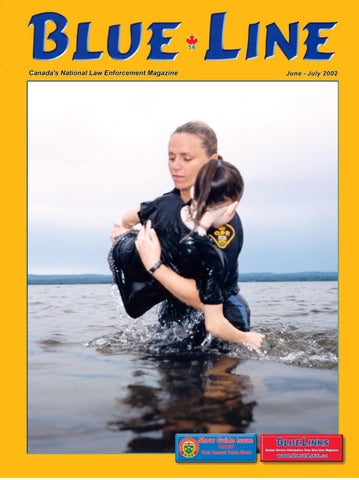
All sudden deaths should be considered potential homicides but this rule is sometimes overlooked when it comes to drowning. This month’s cover shows Cst. Darcy Nicol of Killaloe demonstrating a water recovery. Although it’s the second most common cause of death for children, police officers can fall into the trap of assuming drownings are accidental. Walt Hendrick, an experienced drowning investigator, suggests how you can avoid this mindset on page 14. The Ontario Provincial Police are hosting the Ontario Association of Chiefs of Police Conference (OACP) this year. The OPP is one of the largest police forces in North America, with jurisdictional coverage over more than 11 million people. Our profile of the force, which was formed in 1909 but traces its origins back to the 19th century, begins on page six. The 51st annual OACP conference takes place June 16-19 in Huntsville. We have a floor plan and list of exhibitors on page 10. Police motorcycles are taking to the road again. Read all about an Ontario fund-raising ride and skills competition/training seminars on pages 12 and 13. The Law Society of Upper Canada has proposed rules of conduct for lawyers coming across property relevant to a crime, which became a hot issue after Ken Murray withheld the Paul Bernardo videotapes. See page 17. Police chaplains are an often overlooked part of many forces. In an article beginning on page 26, Keith Howell profiles police chaplains working with Toronto and Ontario Provincial police. In our regular features, Dr. Dorothy Cotton looks at how expectations can determine what you see; Tom Rataj looks at how you can trim your long distance bills by using the Internet; Blurring the Truth, the third in our Bridging the Gap series on interviewing child sexual assault victims; Audrey Pihulyk suggests you “laugh for the health of it;” Mike Novakowski has a double helping of case law; Down East columnist Danette Dooley also does double duty, telling us about Halifax Police’s new bomb detection dog and a Brantford man cycling across the country to raise money for DARE. Blue Blue Line Line Magazine Magazine
It’s time to take a hard look at the jury system by Morley Lymburner Maurice (Mom) Boucher is finally behind bars. This is expected to be his home until well past his CPP eligibility and at best he will never see the other side of the pipes for the rest of his life. This person has shown a cunning ruthlessness seldom seen anywhere in the world, let alone Canada. I am sure he will be a model inmate and sadly missed by the Hells Angels. Now that the trial is over perhaps it is time the legislators take a long serious look at the rules of court procedure. Exceptional times require exceptional laws and in this day of intimidation and terror it should not mean putting a blind up to hide the juror’s identity. Under these circumstances there should be zero risk of contaminating the court room. One manner in which such matters could be dealt with would be by eliminating the right to a jury trial under certain circumstances. In the Boucher matter there is no way a jury should be put under this amount of stress. They were trying a ruthless criminal in charge of a terrorist organization with almost unlimited resources to seek revenge. The court and police officials went to extreme measures to protect these jurors by putting up blinds so the courtroom spectators could not see them. The jury was sequestered with very high security throughout the trial and during their deliberations. But what about now? Who is taking care of the citizens who were burdened with this task? It is time new laws were introduced that strip away the right to a jury trial under certain circumstances. Cases in which jurors could be exposed to a high level of danger or even anxiety would include biker trials and those accused of terrorist acts. As a matter of note there are no greater terrorists in contemporary society than outlaw motorcycle gangs. Their entire existence relies heavily on intimidation of average citizens and authority figures alike. Two dead federal corrections officers attest to this. Parliament should draft legislation immediately that would address this problem. At a preliminary hearing the Crown should be permitted to make application to have the trial by Judge or Judges alone. The Italian justice system found that it is far easier to protect one judge for the rest of his life than hundreds of average citizens from which a jury is drawn. For years the need for jury trials has been brought into question. In the year 1215, when the Magna Carta granted trial by jury, it was an age when almost everyone spent their entire life in one village. It made the jury trial process manageable. Almost every person in the community had skills that did not exceed perhaps ten professions or occupations. Almost every person knew everyone else and knew how their friends and families could be accommodated within that community. If terror and organized crime existed at all it was at the governmental level and had to be tolerated at best. Today’s society has become much more complex than the era in which the jury trial
process was first created. We are much more mobile, far more communicative and of course far deadlier than at any time in history. How can we expect to be assured that jury trials are free from intimidation in this day and age? Arguments in favour of the jury system point out that juries can find someone not guilty by virtue of bad law even if they agree the person violated the law. The bad law doctrine, however, should not be the issue in trying members of organized crime groups. Organized terror groups thrive on intimidation on the streets and in the headlines to help back up the threat of reprisals for those who
would try to stop or even interfere with their activities. A big part of the Hells Angels success is the ruthless business of “taking care of business.” This means an intention to never let anyone get away with impeding their activity. If even one is left ignored or unpunished then their business fails. In such matters, and if left unchecked, every citizen in this country is simply a pawn that lives or dies at their whim. Society can not tolerate this attitude nor permit an environment that supports it. When dealing with individual criminals, jury trials can still work. But not so for organized crime groups. The organizations that come part and parcel with the individual criminal is far more problematic than the pawns they sacrifice. It is the organization that the public must be protected from. It is the organization that is the square root of all fears. Long after an individual is squeezed between the pipes the organization can busy itself “taking care of business” to ensure any one of the twelve jurors are gotten to as an example for the rest of society. If they don’t hesitate to kill correctional officers I am sure they won’t hesitate to intimidated a stock broker, store merchant or house wife. Society can no longer afford the luxury of jury trials in these situations. Italy has proved it... Canada should adopt it.
For further details go to BlueLinks at www.blueline.ca
June / July 2002
5
The Ontario Provincial Police (OPP), with over 5,000 officers and 1,600 civilians, is one of the largest deployed police forces in North America. It directly serves 2.3 million citizens and has jurisdictional coverage of over 11 million. It is responsible for 993,000 sq. km of land and 174,000 sq. km of water. Due to the province’s immense size and diverse terrain, it maintains a large fleet of vehicles, including marine vessels, snowmobiles, two helicopters and one-fixed wing aircraft. This article is an overview of some of the many services and provided by the OPP and their relationships with the communities they serve. The OPP has established expertise in specialized areas, including criminal investigation and intelligence, search and rescue and emergency response. It provides specialized services support to other police agencies in areas such as hate crimes, weapons enforcement, illegal gaming, child pornography prevention, VICLAS (violent crimes linkage analysis system) and the sex offender registry. Working closely with Emergency Measures Ontario, other agencies and ministries, the OPP contributes to the Ministry of Public Safety and Security emergency plan. Its preparedness level is constantly assessed and senior government officials are provided with emergency management planning expertise to help identify and set priorities. June / July 2002
The force maintains a proud relationship with First Nations communities, highlighted recently when Commissioner Gwen Boniface was presented with the Order of Ontario for developing the First Nations Policing Services in Ontario and other outstanding contributions. The OPP has become a leader in developing training for First Nations constables through its strategic partnership with self-directed policing services. This not only satisfies immediate goals but looks forward to long-term community needs. The force is continuing this tradition with the development of officer safety, criminal investigation, effective presentation, inland marine and police governance training for First Nations Policing Services. The OPP’s commitment to community policing has developed and fostered relationships and partnerships with the communities it serves, reducing crime and improving the quality of life. It has approximately 85 contracts with more than 100 municipalities to provide complete policing services and also polices almost 300 additional municipalities. It also provides framework agreements to 56 other police service boards, covering services such as canine, aviation, tactics and rescue and forensic identification. With the services available on an as needed basis, police service boards may now achieve adequacy standards. Policing issues and crime 6
are no longer confined by jurisdictional boundaries. Terrorism, regrettably, is now the top issue and the force is supporting pro-active policing, enhancing investigative and intelligence support activities and ensuring information is shared with other police agencies. Cross-jurisdictional cooperation and resource sharing will mitigate terrorism and associated criminal activities while protecting communities, infrastructure and quality of life. In today’s environment, the need to coordinate efforts between the OPP and external agencies, municipalities and other police services has been magnified. It’s vital that communities are safe and coordinated protection exists throughout the province and country. Anti-Terrorism Unit As evidenced by recent tragic events, antiterrorism requires a concentrated, strategic approach with effective intelligence collection and analysis to discern escalating problems and counteract their despicable effects. The new 24-member Anti-Terrorism Unit allows the OPP to enhance its intelligence capabilities and work with other organizations to fight terrorism within the province and across jurisdictions. This unit is critical to the government’s anti-terrorism strategy and gives notice that Ontario will not tolerate the presence of terrorist organizations.
Hate Crime and nated enforcement strategy. In Extremism Unit 2001, a collaborative provinceThis is currently one of only wide ROPE initiative was estabthree such units in the province lished to enhance the ability to and is maintained as part of the apprehend offenders unlawfully at Intelligence Section, Investigation large across Ontario. Support Bureau. Its mandate is As part of the government’s to carry out multi-jurisdictional counter-terrorism strategy, 10 strategic and intelligence operamembers were added to the 24 tions targeting individuals or ormember provincial unit. Four of ganized groups involved in hate the new members are dedicated to crime and criminal extremism. Its immigration-related violations and primary functions are to: six comprise the Special Appre• Provide investigative support hension Team, responsible for to OPP detachments and muapprehending immigration violaOPP Commissioner nicipal police services that tors with a criminal record. It’s Gwen Boniface don’t have the resources or exanticipated that two additional pertise required to conduct such team members will be added to this investigations. team in 2003/04. • Train police officers to identify and investigate hate crimes. Provincial Emergency Response • Enable the exchange of information between Team (PERT) police agencies and other government agenThis newly created team, one of two initiacies. The increase in racially motivated crimes tives to enhance the OPP’s emergency preparsince Sept. 11 has increased demand for the edness and response capability, will have 32 unit’s investigative advice/support, coordina- officers, selected from across the province and tion of response and training. centrally located to respond to any high level emergency. They will be available to any police Repeat Offender Parole agency to assist in their emergency response Enforcement (ROPE) and members will be trained to deal with chemiThe Toronto Police Service established a cal, biological and nuclear incidents, heavy urROPE Unit as part of its Bail and Parole En- ban search and rescue, emergency management, forcement Unit. Although there was coopera- containment, emergency response team function with Toronto area police forces, including tions and explosive disposal. the OPP, there was no province-wide coordiPERT members will be continuously trained
June / July 2002
7
to ensure the team is ready at all times for any emergency. They will work closely with other ministries, agencies and organizations to ensure a tightly knit relationship and process that will protect Ontario’s critical infrastructure sites. Training will include the four essential stages in maintaining safety: planning, prevention, response and recovery. Personal protective clothing and equipment The second initiative will provide protective clothing and breathing apparatus to officers should they need to respond to a chemical or biological emergency. A complete set of the gear will be individually assigned to officers responding, increasing safety and cutting response time. With this equipment readily available, assessment/detection of an actual or suspected incident involving a biological or chemical agent can begin immediately. These initiatives, combined with the Tactical and Rescue Unit (TRU) and Emergency Response Team (ERT), demonstrate the planning, capacity and response capability that the OPP can and will implement to ensure community safety and public order throughout the province. Ensuring community safety and public order The OPP has had emergency response capability in place for a number of years. The PERT team will supplement services already provided by TRU and ERT.
increased by 68 per cent and new investigations have jumped by 241 per cent. It’s clear that the trend observed in Ontario is also occurring nationally and internationally, fuelled by widespread adoption of the internet. Current legislation before the House Of Commons — Bill C-15A — calls for changes that will strengthen laws against using the internet to commit crimes against children and provide police with additional tools to fight those who do so. TRU is a dedicated team that assists frontline officers by responding to extreme circumstances, including hostage taking or hijacking, high-risk area or building searches, rescue operations and any activity linked to terrorism. There are three teams throughout the province each comprised of 12 members. The ERT is comprised of 256 front-line officers, trained in emergency response, on 16 teams, who dedicate about 25 per cent of their time to this effort, providing 24/7 coverage. The team is responsible for search and rescue, public order, evidence searches, government VIP security, containment and high-risk criminal transfer. The team responded to almost 1,300 calls in 2001, 26 percent more than the year before. Investigations The Provincial Command of Investigations/ Organized Crime is comprised of two bureaus with more than 800 members deployed province-wide. Members are responsible for providing investigative excellence, leadership, highly technical and specialized investigative services and major case management, working in partnership with OPP regions, bureaus, municipal police and other government agencies. These joint force initiatives include a drug enforcement section, VICLAS (violent crimes linkage analysis system), weapons enforcement unit, sex offender registry, child pornography unit, illegal gaming enforcement unit, auto theft team and special squad. Within the Investigations/Organized Crime Command, leadership roles with justice partners have been established to respond to today’s sophisticated and organized criminal activities. Effective intelligence gathering, comprehensive analysis and information sharing within the OPP and with all municipal, provincial, federal and international law enforcement partners are required on an ongoing basis. Child pornography section Commonly known as Project ‘P,’ the section was formed in 1975 at the request of the attorney general to investigate and prosecute those possessing, manufacturing, importing and distributing child pornography. As a lead Canadian agency, the section trains police officers and select groups to better understand the scope of child porn provincially, nationally and internationally and teaches them how they can protect children. Indications are that child pornography is proliferating at an alarming rate. Since 2000, the number of people the section has charged has June / July 2002
Organized crime This is an ongoing concern. The increase in e-crime due to ever-evolving computer technology and the Internet is an increasing challenge. Child pornography and securities fraud top the e-crime list. Computers seized in criminal investigations reveal encrypted communications used to shield illegal activities. The OPP Anti-Rackets Section reports that ‘identity’ theft is the fastest growing crime in the nation. The e-crime team has launched a new platform to fight computer crime and assist prosecutions in these areas. Another concern is the serious threat imposed by outlaw motorcycle gangs. In August 2001, the Canadian Association of Chiefs of Police identified them as the number one issue in the country. The increase in violence due to intense rivalry is a concern, as is the merging of gangs. The Anti-Rackets section is designed to combat organized crime groups through targeted enforcement and includes the weapons enforcement, auto theft, illegal gaming enforcement and proceeds of crime units and the provincial special squad. Provincial Special Squad (PSS) The PSS is a multi-jurisdictional law enforcement unit responsible for the tactical investigation and enforcement activities directly related to outlaw motorcycle gangs, as well as collecting, analyzing and disseminating information on their activities throughout Ontario. Since its inception in 1988, the PSS has taken a leadership role in actively investigating bike gangs and has provided expertise and assistance to intra-provincial law enforcement personnel and agencies throughout Canada and the United States. Provincial Proceeds of Crime Unit (PPCU) An innovative and effective strategy to combat profit-motivated criminal organizations, the PPCU is tasked with strategically applying related legislation and coordinating the program within the OPP. The core functions of the unit can be grouped into three distinctive components: investigations, training and coordination. Established in 1997, the 16 member unit is strategically deployed throughout the province. The formation of a provincial PPC enforcement unit in 2001 added an additional 19 full time members from 15 municipal police services and four OPP regions. 8
Crime prevention section This section demonstrates the OPPs commitment to preventing victimization and leads the abuse, youth and seniors issues, crime stoppers and rural and agricultural teams. Consistent with the OPPs mission statement, policing philosophies and organizational responsibilities, it’s dedicated to decreasing crime by reducing risks and opportunities through prevention programs. Ontario sex offender registry This registry was begun after the brutal 1988 murder of 11-year-old Christopher Stephenson, who was murdered by a convicted pedophile on federal statutory release. Christopher’s Law was proclaimed in his honour in April, 2001 and represents the first sex offender registry of its kind in Canada. It requires convicted offenders to report to their local police service annually and at other designated times. Since its proclamation, the SOR compliance rate has increased to 90 per cent, one of the highest of any registry. The future Like many organizations in both the public and private sectors, the OPP will face human resources challenges in the coming years. Among the most significant challenges will be succession planning to ensure that the necessary competencies are developed to lead and support the organization now and into the future. Recruitment will continue to be a challenge due to a competitive market for excellent candidates and in light of the need to reflect the diversity of Ontario’s population in outreach and recruitment activities. Continued focus on enhanced efficiencies and effective processes will enable the force to respond with agility to recruitment needs. The ongoing education of officers and policy setting is essential to the success of policing services. It is important that policies take into consideration the religious/cultural beliefs of community members. With the current diversity of nationalities and the increasing immigration patterns, it’s essential that the OPP attract officers that reflect the cultural communities it serves. The Ontario Provincial Police are proud of the policing services supplied by its members from 163 detachments and six Regional Headquarters throughout the province. Individually each member of the OPP is dedicated to preserving the safety of the communities in which they serve and live.
Title: Dedication to Duty Reviewed by Morley Lymburner Dedication to Duty, authored by Michael Barnes, is a book written specifically to chronicle the deaths of officers of the Ontario Provincial Police during the 20th Century. In all 78 officers lost their lives during the last century and Barnes’ book eulogizes each officer supplying the reader with a background on the officers’ lives as well as details of their deaths. In the preface of the book Barnes takes the reader along for a brief history lesson of policing in Canada and then Ontario. An edited version of this section provided here, will give you an insight into the quality of the publication’s content. An Order in Council of 1908 directed that there be a force of police constables known as the Ontario Provincial Police Force and in 1909, the OPP came into existence with fortyfive to fifty-five men. Joseph Rogers was the first superintendent. The original OPP application form relied on twenty-one questions to determine the qualifications of a person for the office of provincial constable. Question five asked the candidate, who by now had entered into the spirit of the paper, if he could read and write English. For several years there had been a move to create a tribute to those members who had lost their lives in the line of duty. In 1978 a large
June / July 2002
bronze plaque provided by the OPPA was unveiled at general headquarters bearing names of forty-six officers who had made the supreme sacrifice “in the pursuit of peace and tranquility for the citizens of this province.” The extensive reorganization of the Ontario Provincial Police in the last decade of the twentieth century brought home to all involved the many changes effected by the service since its inception. Despite all the advances in procedure and operation, many officers had been killed
9
while acting in the service of their fellow citizens. Over the years the details of several of these acts of sacrifice have been obscured. This book is an attempt to highlight the lives of the members of the OPP who gave their lives in the service of the people of Ontario in the first century of the organization from 1904 to 1999. The deaths are tragic, but in every case the circumstances have helped instructors, recruits and serving officers to be aware of the potential for danger and to protect themselves as a result. Each fatality in traffic is analysed and procedures modified to minimize the possibility of further deaths of police officers on the highways. This book is an excellent read from cover to cover. The reader is cautioned, however, that it is a very negative book. One should not enter into it thinking it will be light reading. The stories told by Michael Barnes are about real people with real families. Their deaths only underscore the true tragedy and great sacrifice made by each officer. This volume should be read sparingly and over a long time. It should none-the-less be read with reverence. The book sells for $29.95 (plus shipping and handling) and is available from the OPP Insignia Shop in Orillia, 705 329-6280, or by calling the publishers at 1-800-465-6072.
51st Annual Ontario Association of Chiefs of Police Conference
June 16 - 19, 2002 Huntsville, Ontario For more information call Exibitor Co-ordinator Det/Insp Robin Jones 705-329-7404
List Of Exhibitors Accident Support Services International See Advertisement Page 22 ACS Inc. - Public Safety Solutions Advanced Interactive Systems See Advertisement Page 28 Atlantic Police and Security Supply Bell Canada Bell Mobility Blue Line Magazine Canadian Firearms Centre Ceecom Inc. Correctional Service Cda/ Natl Parole Brd
June / July 2002
H5 K 2,3 O1,2,3 J1 B2 B1 C4 H7 A3 E5
CVDS Inc Dack Shoes Ltd D&R Electronics Co. Ltd DaimlerChrysler See Advertisement Page 37 DSM Law Enforcement Products Durham College Evin Industry FATS Inc. (Firearms Training Systems Inc) Flying Cross by Fechheimer General Motors Defense Glock Inc. Gordon Contract Footwear Hi-Tec Sports (Canada) Ltd i2 Inc Inland Life Rafts Intergraph Public Safety Kingwood Audio Visual Inc. Lees Motivation Canada LiveLink Training Network See Advertisement Page 26 Martin & Levesque / Blauer MD Charlton Co. Ltd. Michaels of Oregon Company See Advertisement Page 41 Muskoka VICARS Ontario Assoc. of Property Standards Officers Ontario Police College Ontario Police Video Training Alliance (OPVTA) Ontario Process Services
10
H4 G1 I6,7 J6,7 C2 H2,3 F4 D9 G3 C6 A1 D6 J5 D2 i2 E6 H1 K5 D3 F6 C1 K4 I1,2 D5 C5 I3 B3,4 D4 G4
Ontario Sex Offender Registry A2 Sir Sandford Fleming College, Sutherland Campus J2 O’Dell F1,2 OPS Inc C7 R. Nicholls Distributors Inc E1,2,3 Outdoor Outfits G6,7 Pacific Safety Products Inc F5 See Advertisement Page 25 Panasonic Canada J3,4 See Advertisement Page 2 Pelican Products Inc I5 PRC Public Sector Inc E7 See Advertisement Page 30 Pro-Install Video Systems K1, L1 See Advertisement Page 34 Rotman School of Management F3 Strath Craft Ltd H6 Streamlight Inc G5 Trilcor F7 Uniform Uniforms G2 Uniforms Registered I4 Sonitrol Security Systems D8 StopTech Ltd C8 Telus Mobility D1 VCR Video Warehouse Inc L6,7 Westervelt College D7 See Advertisement Page 35 Whelen Canada L2,3,4,5 xwave K6,7 York Regional Police E4
Biometric access assures secure communications by Melissa Pilon OPP Corporate Communications The Ontario Provincial Police (OPP) Public Key Infrastructure (PKI) Unit has completed the final step necessary to position the force as one of two ‘Certificate Authorities (CA)’ in Canada with a high assurance rating. OPP Commissioner Gwen Boniface recently activated a new layer of security components necessary to operate as a high assurance certificate authority. The secure area where it’s housed is protected by a biometric access control system comparable to those used by the Canadian and US militaries. Even the commissioner had to present photo ID for admittance. The PKI system allows users to securely and privately exchange information and data, encrypting or scrambling it so it can be read only by the intended recipients. The system allows for electronic fingerprinting, which identifies the individual on data such as e-mails or word documents. “The OPP PKI Unit is in the business of providing the Ontario law enforcement community with the tools needed to communicate securely, internally and externally,” Information Technologies Bureau Commander Chief Supt. John Carson said. The OPP PKI CA is rated by the Treasury Board as ‘high assurance.’ The final step in the process to achieve that rating was securing the CA signing keys, which creates a third party trust, says Dave Scott, senior systems officer. “It’s a set of encrypted keys that ensures that the certificates that are talking to it are trusted on both ends... the CA issues your keys initially and when you log on, you have to communicate with it and it authenticates with a password and approves your profile as valid.” When two people with profiles send e-mails to each other, the CA communicates with each party and verifies their identity. The process is seamless to the user, says Scott. “It runs in the background and it’s just a matter of logging in with a profile name and password. Once you’re logged in, everything is encrypted, decrypted and signed in the background. The user doesn’t see anything happening.”
The Great Mac Attack! by Tony MacKinnon
“without a doubt, you’ve got the laziest tracking dog, i’ve ever seen!”
From left: OPP Commissioner Boniface; S/Sgt. Fred Tytus; Information Technologies Bureau Manager Ted Vincent; Chief Supt. Carson. The system uses Entrust Software, which the RCMP recently purchased and is making available to every police service in Canada. The OPP will soon cross certify with the Mounties, Scott says, and will also be able to securely communicate with police agencies across the country by exporting their key.
“If you’re cross certified, then the whole directory infrastructure is seamless. I can send something from my desk right to an RCMP user without having to export any keys — it’s done automatically.” Secure e-mails “are the way to go” to transfer sensitive information, Scott says.
Dalhousie University Certificate in Police Leadership “The concepts taught in the Advanced Police Leadership course have been an asset to my managerial development. I believe as a responsible manager, I owe it to myself, my subordinates and to my organization to continue with my development.” Courses in this unique distance education program include: > Police Leadership and Management Development > Communication Skills for Police Personnel > Community-Based Policing > Problem-Oriented Policing > Police Human Resource Management > Budgeting and Financial Management > Legal Issues in Policing A/Det. Donovan Howell > Policing and the Law of Human Rights Peel Regional Police, ON > Advanced Police Leadership > Managing Police Performance: Coaching Skills (includes a 3-day workshop)
Register for the fall term prior to July 9 to get a $50 discount! If you would like more information or wish to have a brochure mailed to you please contact Sherry Carmont-MacBean, Program Manager at (902) 494-6930. You may also write to Sherry via e-mail at CPL@Dal.Ca or to the address below. Detailed information and registration forms can also be found on our web site. Henson College, Dalhousie University 6100 University Avenue Halifax NS B3H 3J5 www.dal.ca/~henson/police/indexcpl.html
Learning Solutions for a Changing World
For further details go to BlueLinks at www.blueline.ca
June / July 2002
11
Police motorcycle ride fights child abuse
The 2001 ride assembly at the Ontario Legislature More than 200 motorcyclists from police services across Ontario are expected for the 2nd Annual Law Enforcement Ride for the Prevention of Child Abuse. The ride, which benefits the Canadian Centre for Abuse Awareness/Martin Arnold Kruze Memorial Fund, takes place June 22. Ontario Attorney General David Young, Associate Minister of Enterprise, Opportunity and Innovation David Turnbull and MPP Rob Sampson are the honorary co-chairs. Participants will begin by riding through the streets of downtown Toronto and then head
June / July 2002
to Sibbald Point Provincial Park on the shores of Lake Simcoe. The park grounds will be converted into a fun-filled entertainment extravaganza for the whole family to enjoy, according to a news release, with food, beverages, performances by Shades of Blue, and the OPP Bear Hug Band. Organizer and York Regional Police Cst. Ken Doige says he wanted to create an event that would raise public awareness and much needed funds to help prevent child abuse but also give police officers an opportunity to openly express their support for the cause.
12
Ken Doige and Ontario A/G David Young
The CCAA/Kruze Memorial Fund supports child abuse prevention programs and assists adult abuse survivors and their families in dealing with the impacts of abuse later in life. For more information, contact Doige at 416 323-9952 or Beth McBlain at 416 323-3300 or Beth.mcblain@mcblain.com.
Police motorcycle trainers kick off spring
by Scott Spicer Instructors and command officers gathered in Mississauga recently for the Ontario Association of Police Motorcycle Instructors (OAPMI) inaugural ‘Motorcyclists Kick Off to Spring’ event. Their purpose — to set an example for motorcyclist of all experience levels, especially police officers who patrol on bikes. “We are viewed by the public as the experts in driving or riding and it is imperative that we set a good example for the public. Displaying a professional image of the police services we work for is definitely a must in today’s controversial times,” says OAPMI vice president David Haggarty of Peel Regional Police Service. Motorcycle riders are more aware of their surroundings, whether operating four wheels or two. They don’t acquire the false sense of security car drivers get from being surrounded by a metal frame and tend to develop a sixth sense -- a survival instinct. Cars bounce off each other but motorcycle are unlikely too. Police motorcycle training courses and formal and informal riding improves this. “We all get rusty over the winter months and it is important as a police service, instructor, officer or member of the public to ensure we are competent and confident to make good judgmental discussions, based on skill and awareness, while operating a motorcycle,” says OAPMI President Scott Lawson of the OPP. “The old buzz term defensive driving is a term of late. Today’s vehicle operator needs to drive in a fashion that is cooperative with other road users,” says OAPMI secretary/treasurer Bob Olmsted of the Toronto Police Service. “Cooperative driving applies to all motor vehicles and simply said, means to use the space around you to your advantage as much as possible to avoid a potential collision.” Plenty of media turned out. Toronto Star columnist Mark Richardson was interested in trying the exercises on a Kawasaki sport-touring bike but was discouraged by OAPMI members, who reminded him the bike was a demo borrowed from Kawasaki Canada! Special guest and two time Canadian National Superbike champion Michael Taylor spoke about what to do if you have the need for speed, expressing his concern about riders who use the street as a racetrack. “Anyone can turn the throttle and make a motorcycle go fast,” he said, “but can they predict how traffic will react or what debris lies on
the road surface? If you have the tendency to ride fast, come out to the controlled environment of a race track with your own bike or take a racing school course. If you still need to prove how cool you are, don’t take it to public streets, take it racing.” The OAPMI was formed in 1997 and emphasizes safety, training and information sharing, drawing on its members’ expertise, experience and different training techniques to help develop minimum standard criteria in police motorcycle operator training. The goal is to have common skills and knowledge. The association helped foster relationships with Ontario police services, the ministry and the Ontario Association of Chiefs of Police (OACP), which recently supported and endorsed the recommended course training standards set by the OAPMI. The association’s training committee recommended that “police services choosing to utilize motorcycles in operations should subscribe to the OAPMI provincial motorcycle training standard.” The OAPMI can be contacted by e-mail at oapmi@rogers.com or mail: Ontario Association of Police Motorcycle Instructors, c/o Bob Olmsted, 2050 Jane St. Toronto, Ontario M9N 2V3.
Tactical Survival part of Great Lakes Police Motorcycle Seminar
The 2002 Great Lakes Police Motorcycle Training Seminar, to be held on August 21 to 24, will include a one day Tactical Seminar presented by Sgt. Jim Polan of the Fort Lauderdale Police Department. The organizing committee of the Great Lakes Police Motorcycle Training Seminar is made up of volunteers from various Ontario police services including Toronto, Peel, Waterloo, Niagara, Durham, York and the Ontario Provincial Police. In addition to this, the Blue Knights are represented on the committee. The 2000 event involved the first participants from the United States. This year’s event, hosted by the York Region Police, will include a dynamic three-day seminar of intensive practical exercises on the motorcycle and a one day lecture on tactical survival for motor officers. For further information contact Vince Elgar at 416 460-6671 or visit their web site at http:// www.glpmts.org
For further details go to BlueLinks at www.blueline.ca
June / July 2002
13
Drowning - more than meets the eye by Walt “Butch” Hendrick Drowning continues to hold its unprecedented position as the second most common cause of accidental death to children. Accident is the key word here. As law enforcement personnel, our first thought as we respond to a drowning incident is probably that there has been a tragic accident. On the other hand, as we respond to a child found dead with a bullet or stabbing wound, we prepare ourselves to immediately begin looking for signs of possible foul play. Even though all drownings should be considered possible homicides until proven differently, very often the responding officer is already in the accidental death mind set. We almost cannot help it. Ever since we were children we have thought of drowning as an accident. Everyone has heard of someone who drowned. We read about it in newspapers and books, we watch them on TV and in movies and we were trained how to manage and prevent them in water safety and rescue courses. Part of the reason is because we tend to think of water as being for recreational activities, which wasn’t always the case. Punishing people in the water has been an extremely effective tool. John the Baptist purified sinners in the water, the Chinese punished criminals by water and pirates had the everpopular keel hauling or walking the plank. In our own history dunking was a popular way of proving a person’s innocence. If suspects survived they were innocent, but if they drowned it was proof of their guilt. Dunking was still active in the late 1800’s and is still used today as a form of torture. Homicide by drowning is an ever-popular TV and movie theme to be solved by the great sleuths of fantasy. In historical writing, Moses parted the Red Sea to save his people and destroy his enemy and God did away with bad life on earth by drowning everyone outside of Noah’s ark. Compounding the perceived accident con-
cept is the problem of little or no typical evidence of foul play on drowning sites or drowning victims. The following is interesting to note: • It can be difficult for a pathologist to conclusively prove that a person died of drowning. • There might not be a body because it has not been found yet. • If the body is found quickly, such as in a swimming pool or tub, it is quickly removed by rescue personnel, which means evidence could be destroyed. • There is little or no standard evidence to recover and witnesses are usually family • There are usually none of the normal signals to alert the police officer of possible foul play. Remember, emotionally police officers are basically no different than any other human being, except they are perhaps more sensitive to a senseless death, especially a child. This and empathy for a victim’s family members could influence them to accept a drowning as accidental. We talk and hopefully attempt to prepare for critical stress as it pertains to violence and severe personal threat. Perhaps the next stage of critical stress training will be for the mind’s eye and its perception of thought, emotion. Not so much the physical threat but rather the emotional side of the brain and how it functions when stressed with rejectable emotions. Does the mind accept a drowning as an accident because it’s simple or because the critical stress side of the brain believes it to be accidental, or wants it to be. We are quick to perceive homicide in the water when victims have a bullet in their head, bricks tied to their body or when the obvious, available witness information isn’t making sense. For the most part autopsies generally do not look for much more than to prove that the victim died of suffocation or drowning. Many of today’s police agencies are under-manned or under financed and simply don’t have the ability to do more than they are doing now. When there is no body or evidence of foul play, what happens to our standard police investigative skills? Perhaps the over-loaded mind seeks the simplest path. A child drowns in the backyard pool and
For further details go to BlueLinks at www.blueline.ca
June / July 2002
14
the case is closed in a rather short time, even if the witness information doesn’t completely make sense. Another child dies at the foot of the stairs in the home next door, perhaps a victim of a falling accident. Is the perception the same? Did your police trained mind think of the drowning as an accident and the staircase accident as possibly foul play? We are used to looking deeper into the situation surrounding suspicious death or accidents, when there is a body or evidence to research. When asked, the average police officer does not think of a drowning as suspicious unless there are other visible circumstances. A 50-year-old man is found drowned in the late fall, totally naked in a lake four miles from his home. No vehicle or clothes are found on the beach. There is nothing to show how he got there and no one reported a naked man walking on the road or highway. Accidental death?! The FBI stated as long as ten years ago that it believed not all drownings were accidental but this concept has not been well shared or expanded upon in basic law enforcement. Bucket drownings of children under the age of four is not all that uncommon, nor are they all that simple. How many children drown that are special education or problem children with personality, health or medical problems? Accidents with guns, knives and baseball bats are not so easy to hide or misperceive. Think about it, adults and children die in car, fire or drowning accidents every day. They are, for the most part, exactly what they seem — accidents. An estimated 100,000 people a year experience near drownings in the U.S. For years we believed that Sudden Infant Death Syndrome was a significant cause of infant death and today we’ve come to realize that there’s a chance some of these could actually be Shaken Trauma Death Syndrome. We know that humans, and specifically parents, can perform incredible atrocities to their children. Why would drowning them be any different? What if only one per cent of the near drowning incidents and the 7,000 adults and children who die from drowning are not quite the accident they seem? What if that percentage was higher! When confronted with a drowning, step back a bit and simply ask a few more questions. Walt Hendrick is a part time deputy for Ulster County Sheriff’s department, has trained dive teams for more than 25 years and has researched homicidal drowning incidents for over a decade. For more information on Lifeguard Systems go to:
Expectations determine what you see by Dr. Dorothy Cotton Ph. D., C. Psych. One of my friends just got a new car. “Must be a good car,” he commented. “There seem to be a zillion of them on the road. I never noticed before.” His comments reminded me, in a rather obtuse way, of one of those classic psychology studies you find in every textbook. I ran across this one again recently in a book called Psychology for Police Officers. It’s a picture that can be looked at two ways. Depending on your point of view, it’s either an old hag or a sweet young thing. I suppose the reason that this picture appears so often is that it does illustrate a very important point — there are always several different ways of looking at things. I am not talking so much about the theoretical ways of looking at issues here as I am about literally how we see things. Consider a study that was done many years ago. The researchers showed a bunch of people a picture of a man running down the street carrying a gas can. Some of the participants in this study were police officers and some were just regular people (whoever they are). The researchers asked, “what’s going on in the picture?” There were two kinds of answers. The regular people said, “He’s run out of gas and is going to the gas station.” The police officers said, “He’s an arsonist going to start a fire.”
It all has to do with mental set. In any context, we tend to see what we are looking for. Mental set refers to our orientation, the bias we bring with us in any situation. The essence of this is that we tend to see what we expect to see because that’s what we pay attention to. Let’s face it — no matter how simple a situation is, there’s way more stuff going on than we can possible pay attention to. Try this little experiment: look around the room and note everything blue then close your eyes. (I haven’t figured out how you can read the rest of this column with your eyes closed — you’ll have to figure that out!) Now, tell me everything that’s green. If you’re in a very familiar room, you may be Okay. If not, you’re probably thinking, “Hey — no fair! You said blue!” Because you were looking for blue, you probably didn’t pay much attention to green. Or try this: fill in the blank and tell me what the last word in this series is: Tea, cup, bag, ot. Okay? Now how about this one: Wood, termite, damage, ot My guess is you said ‘pot’ the first time and ‘rot’ the second time, but the word stem was the same each time. Why the difference? It’s mental set, in this case, one I gave you — but what if I hadn’t? What would you have filled in the blank with? If you’re a big tea drinker or just had a cup of tea, you might have said “pot.” If you’re rebuilding a deck, perhaps “rot” would have been
For further details go to BlueLinks at www.blueline.ca
June / July 2002
15
your answer. If you’re of British heritage and have a baby you might say “cot.” If your fountain pen just leaked, you might have said “blot.” What does this have to do with police work, you ask? Just as you filled in the blanks on the word stem, you tend to fill in the blanks for everything else you see. How you do so is based on your experience and expectations. If you expect to see crime and disaster at every juncture, you will. The hitch of course is that you will be wrong a lot of the time. Bummer, eh? Here’s an example. In one experiment, a bunch of police officers and non-police officers were shown a series of films and were told that there would be a bunch of thefts going on. The viewers were to pick out the times they thought there was a theft going on. Both the police and the non-police were pretty good at picking out the thefts. Interestingly, the two groups were about equally accurate in this regard. But the police identified way more innocent events as being thefts than did the non-police. In other words, the police expected more to be going on, so they saw more going on. Is this a bad thing? Not necessarily. I presume you’d rather stop an innocent person now and then rather than miss something really big. The point is simply that we all tend to see what we expect to see — what we are looking for — and that means we are all biased and miss the things we are not looking for. It just helps to know that, I think.
Law society proposes Ken Murray rule Ontario lawyers could not accept or keep property relevant to a crime or offence under a proposal from a special Law Society of Upper Canada special committee. There would only be limited exceptions, such as where it’s necessary to do so to prevent alteration or destruction of the property, physical harm to a person or a wrongful conviction. The rule would apply to documents electronically stored or formatted as well as original documents and other property. The committee was struck after the society withdrew a complaint of professional misconduct against lawyer Kenneth Murray who, on the instructions of client Paul Bernardo, retrieved videotapes relevant to crimes of which his client was accused. He didn’t disclose their existence for 17 months, at which point he was Convicted killer replaced as defence Paul Bernardo counsel. The committee was asked to consider the issues raised by the case and devise a rule to guide lawyers who may be faced with similar issues. This draft rule, still to be debated, states lawyers may take temporary possession of property relevant to a crime only where: • It’s necessary to do so to prevent the alteration, loss or destruction of evidence; • It’s necessary to do so to prevent physical harm to any person; • The client or person possessing the property instructs the lawyer to promptly arrange for it to be disclosed or delivered to a crown or law enforcement authorities; • The lawyer reasonably believes it is in the interest of justice that the property be examined or tested before it is disclosed or delivered to authorities and it may be tested without being altered or destroyed; or • The lawyer reasonably believes a wrongful conviction may be prevented if the property is first disclosed at trial and this use of the property would be significantly diminished if it were disclosed before the trial. The lawyer must first get permission by a special committee of the law society in the two latter circumstances. In developing the proposed rule, the committee reviewed other jurisdictions in Canada and the US and found that, until now, Alberta has been the only Canadian jurisdiction to adopt a rule on lawyers’ duties dealing with property that may be relevant to a crime. The committee was chaired by Toronto lawyer and law society bencher Gavin MacKenzie and included representatives from the criminal lawyers’ and crown attorneys’ associations, Ontario attorney general ministry, a retired Ontario appeal court judge and law society benchers. The Committee believes the rule was im-
proved significantly as a result of this input, says MacKenzie. “Representatives of the crown on the committee would prefer a rule that would require lawyers to turn over property to law enforcement authorities in all cases,” he noted. “The committee rejected this proposal partly on the ground that it did not take into consideration the wide range of situations in which issues may arise in the area. “For example, under the crown proposal, lawyers would be required to turn over to the police a document or e-mail attachment that may be relevant to a provincial offence, even if
no investigation is in progress. The committee was concerned that the crown proposal in some circumstances would be contrary with the rights of clients and the independence of the bar.” The majority of the committee felt that the proposed rule “strikes the right balance between the fundamental importance of the independence of the bar, preventing wrongful convictions, and the effective administration of justice,” he concluded. For the complete report go to http:// www.lsuc.on.ca/news/pdf/ convmar02_physicalevidence.pdf
Proposed rule of professional conduct for property relevant to a crime or offence: 4.01 (10) A lawyer shall not take or keep possession of property relevant to a crime or offence, except in accordance with this rule.
established by the Treasurer to decide whether the lawyer may take temporary possession. The lawyer must seek such authorization promptly.
(11) A lawyer may take temporary possession of property relevant to a crime or offence only where: (a) it is necessary to do so to prevent the alteration, loss or destruction of the evidence, (b) it is necessary to do so to prevent physical harm to any person, (c) the client or the person possessing the property instructs the lawyer to promptly arrange for the property to be disclosed or delivered to the Crown or law enforcement authorities, (d) the lawyer reasonably believes it is in the interests of justice that the property be examined or tested before it is disclosed or delivered to the Crown or law enforcement authorities, and the property may be examined or tested without altering or destroying its essential characteristics, or (e) the lawyer reasonably believes that a wrongful conviction may be prevented if the property is first disclosed at trial, and this use of the property would be significantly diminished if it were disclosed to the Crown or law enforcement authorities before the trial.
(13) A lawyer who takes or keeps possession of property relevant to a crime or offence shall not (a) counsel any alteration, concealment, loss or destruction of the property, (b) alter, conceal, lose, or destroy the property, or (c) deal with the property in a manner that there are reasonable grounds to believe would obstruct justice or risk physical harm to any person.
(12) A lawyer may take or keep temporary possession under subrule (11) (d) or (e) only if the lawyer has been authorized to do so by a committee of the Law Society
(14) A lawyer who takes or keeps property relevant to a crime or offence shall give up possession of the evidence as soon as practical and only in accordance with subrules (11)(d) or (e), (15) or (16). (15) A lawyer in possession of property relevant to a crime or offence may return the evidence to its source only if the lawyer is satisfied on reasonable grounds that the evidence will not be (a) altered, concealed, lost or destroyed or (b) used to cause physical harm to any person. (16) Subject to subrules (10) - (15), a lawyer in possession of property relevant to a crime or offence shall disclose or deliver it to the Crown or law enforcement authorities as soon as practicable in all the circumstances.
For further details go to BlueLinks at www.blueline.ca
June / July 2002
17
Re: Publisher’s Commentary - March 2002, “A simple handshake...” Your commentary misconstrues at least one fundamental point and ends up contradicting itself so as to be flawed on at least two levels. Admittedly, if there was any semblance of rationale attached to Mayor Lastman’s ill-fated handshake, it escapes most of us. I do, however, take issue with your assumption that our “no gang colours” policy was not thought through. The idea of banning OMG colours in local bars was in the back of my mind from the time I took up office with the Barrie Police Service. I suppose what ultimately prompted me to act on it was the long awaited takeover of a number of Ontario biker gangs by the Hell’s Angels. In the immediate wake of that takeover, long time local bikers with their newly issued Hell’s Angels colours began ‘showing the flag’ in a somewhat more aggressive manner in Barrie bars. With an in-depth presentation, supported by an instructional video, we began to solicit the support of the Barrie bar owners/operators and with one exception they were receptive. We didn’t attempt to achieve this phase in a week, in fact it took several months. We believe the one exception is controlled, if not owned, by OMG interests which, no doubt, explains their reluctance to buy into the program. This is not a policy that seeks to ban members of a group but rather it seeks to enforce a dress code. To perhaps put this policy into perspective, one has only to consider the long and OUT OF THE BLUE
almost universally established edict dealing with “no shoes, no shirt,” etc. While entering a bar both shirtless and barefoot might merely speak to a certain lack of fashion sense, the wearing of OMG colours in similar circumstances, as you point out toward the end of your article, is more troubling. Firstly, it is a highly visible advertisement for organized crime and secondly, it is an exercise in intimidation which you go on to bemoan in the latter part of your article. Barrie Police Service, in partnership with the local bars, has long enforced a policy of ‘zero tolerance’ in respect to fighting, drunkenness and vandalism. I would suggest that the reasons for adopting a similar approach to the visible manifestations of organized crime (i.e. the colours) and the intimidation thereby engendered are self-evident. Implicit in your article is the position taken by some in the law enforcement community that advises against our type of program for fear of someone raising the dreaded ‘charter argument.’ My response is simple: Let us not be rendered impotent by an unnatural fear of charter arguments. The use of the charter as a threat is also a form of intimidation and from the tone of your article it’s one that appears to work. Wayne C. Frechette, Chief Barrie Police Service This letter is in response to an article titled “Black box scuttled - for now” which appeared in your February,2002 issue. This article contained comments by representatives of the Niagara Police Service and police association president Mike Gamble. It would appear from Mr. Gamble’s comments that he sees data recorders as a “spy” tool to be used against officers and that there are no positive attributes for their use. Yet the facts prove that in countries such as Germany and the UK, police forces that have installed these units have reduced collisions by 25 percent and injuries resulting from incidents by 19 percent. I do not agree with Mr. Gamble’s perception of data recorders as a tool whose only purpose is to help the SIU to investigate accidents involving the police. Data recorders have proven to aid officer safety by ensuring police vehicles are driven appropriately and the vehicle driver is aware that the vehicle is safe to use. For example, a Police
For further details go to BlueLinks at www.blueline.ca
June / July 2002
18
Service where data recorders are in use, recently had an incident that involved a police vehicle hitting a curb at a force of 5 “g”. Because the data recorder automatically alerts via a red LED light that the vehicle had been involved in an incident, the officer responsible had to report the problem. The initial inspection did not reveal any damage to the vehicle. But, an inspection of the undercarriage of the vehicle revealed that the engine mount had been moved back 2 inches and that other ‘hard to see’ damages were found as a result of hitting a curb. In a high-speed chase, this kind of damage could have lead to a serious, even fatal accident. Had it not been for the data recorder alerting to a problem, this incident might have been overlooked and an officer’s life would have been put at risk. As Superintendent Michael Locke pointed out, data recorders can also be used for vehicle and driver performance monitoring, ensuring that both driver and vehicle are working at top efficiency. There are tremendous pressures and risks placed on officers ranging from trying to meet set response times to high-speed chases. By monitoring “Exceptions” the data recorder can show if expectations for response times have been set to unrealistic levels and that circumstances such as road/weather conditions caused a delay. It can also show where additional training may be required. The argument in favour of video cameras over incident data recorders is not clear. For accident reconstruction the incident data recorder’s data can, on its own, stand up in a court of law while the video camera may not. A major point to consider between the two devices is that the incident data recorder sets out to influence the driver by making it known his activities will be recorded. The recorder needs no input from the driver while a camera may require a video cassette to be inserted. This can lead to all kinds of problems from “lost” tapes to forgetting to insert a cassette, which in a court of law can create doubt against an officer. The bottom line is if the driver is at fault, neither the camera nor the incident data recorder will vindicate the officer. If he is suspected of being at fault, and is not, the incident data recorder will corroborate his story. The moral question then becomes if it is best to ignore the many positive aspects of the incident data recorder which is of benefit to the majority in order to protect the few that are guilty. Mr. Gamble argues that money spent on incident data recorders will be better spent on hiring additional officers. For the relative low price that these units sell for, the problem of not having enough officers for the job will not be resolved by saving on the purchase of these units. Priority should be given to the present officers to whom the recorders offer a means for aiding in accident reduction, protection against unsafe vehicles and a tool to help exonerate an officer involved in an accident. With regards to purchasing GPS systems instead of recorders, may I suggest that it need not be a question of choice. GPS can be integrated with data recorders to allow a Police Force to know what is happening and where. Al Cormier, President & CEO Bowmonk Canada Inc., Mississauga, ON
TORONTO, ON – A great demand for intelligence officers is eroding the ranks of senior staff at CSIS, a major Toronto newspaper reported in April. In the past six months, CSIS has lost 35 highly trained, mid-career officers to other federal agencies and departments which were given new or added responsibility in the security-conscious post-Sept. 11 environment. In December, the federal government boosted the CSIS budget by $348 million over five years to compensate for cutbacks in the ‘90s that withered the service to an official complement of about 2,100 today from 2,740. *** FREDERICTON, NB – Recent visitors to the Fredericton Police Force’s Web site in April could find information on outstanding warrants, recent crime reports - and a link to pornography. City police were notified that someone had uploaded a computer script in the Web site’s guest book section that directed viewers to pornographic Web sites. *** QUEBEC, QC – When it comes to uniforms for municipal police in Quebec, the colour black is growing in popularity. It’s a trend that makes some people in the Department of Public Security see red. They think black is too aggressive a colour. A spokesman for Public Security Minister Normand Jutras said in April that research indicates black is a bad alternative to a traditional pale blue uniform colour.
June / July 2002
Quebec abandoned a rule in the late 1980s that dictated the colour of municipal police uniforms, Martin Roy said. Roy said it’s important that a police officer’s uniform cannot be confused with the uniform worn by any other kind of agent, such as a security guard. *** PRINCE GEORGE, BC – RCMP working in BC’s North District will consider creating a unit to monitor sexual predators, but add there are no immediate funds available. The current budget is tapped out and the district would have to take a longer-term approach, said Supt. Mike Morris. BC police agencies want to establish at least six surveillance teams across the province to monitor high-risk, convicted sex offenders. The request comes after a surveillance team in BC’s Lower Mainland region caught seven sex offenders committing new crimes, including sexual assault and possession of child pornography, during a 20-day pilot project in April. *** REGINA, SK — Regina police have impounded the vehicles of 16 suspected johns in an effort to crack down on people who use their cars to pick up prostitutes. Police Chief Cal Johnston says the pilot operation took place on city streets in May. Amendments to the Highway Traffic Act, which came into effect April 1st, give police the authority to seize a vehicle if there is a reasonable belief it was used to commit prostituionrelated crimes.
19
Watch for latex allergy signs Regular latex glove wearers are being warned to watch for symptoms indicating they may be becoming allergic to the proteins found in natural rubber latex (NRL). As many as six percent of the general population and up to 25 percent of healthcare workers are allergic to latex, according to a nurses association, which notes police and emergency personnel also face higher risks. Latex can irritate the skin, causing a rash even in people not allergic to it. Symptoms indicating an allergy’s developing range from skin irritations, sneezing, wheezing and coughing to anaphylaxis, a severe immune system reaction causing breathing difficulties and low blood pressure that can cause shock or death. No cure exists for the allergy. It suggests those affected: • Wear liners or low protein, powder-free or vinyl gloves, • Reduce the amount of time gloves are worn. • Wash hands thoroughly with a pH balanced soap to remove latex proteins and prevent skin irritations. • Avoid oil-based hand creams and lotions that deteriorate gloves and accelerate the release of latex allergens. • Remove gloves hourly to allow hands to dry. • Avoid snapping off gloves to avoid releasing airborne latex proteins.
Blurring the truth Suggestibility in children’s interviews Part 3 of a 4 part series by Sean Cameron & Kim Roberts Our bridging the gap series has focused on the difficulties encountered when interviewing children who have alleged abuse. The fact that we have spanned this issue into a four part series underscores the depth of this topic and skill required to interview children effectively. One of the most difficult issues is judging children’s “suggestibility;” their tendency to change a report based on false information they have encountered. Thankfully, the collaborative efforts of police, social workers, counsellors and researchers have significantly reduced children’s suggestibility in interviews. Despite these advances however, there is still much that we need to learn. Children can be exposed to inaccurate information in numerous ways. For example, concerned parents or teachers may ask them questions that contain information not yet provided by the child (e.g., asking “Did he touch you?” when the child hasn’t yet specified the gender of the perpetrator, who may actually have been female). The danger is that children sometimes change their statements in line with the information that was suggested. One significant tragedy in these cases is that it is entirely possible that no one will ever know for sure if the child was abused because the truth has been blurred. In our research, we found that some sexually abused children were assertive enough to resist suggested information but many were not. Perhaps they were too afraid to correct the interviewer, wanted to create a story based on what they perceived was expected of them or did not even realize that information was suggested. Hence, unlike normal forgetfulness,
where information is simply not reported, suggestive practices can actually contaminate children’s reports. This can cause children who may have accurate memories of the real event to change their minds, their stories and perhaps unknowingly, the outcome of a legal proceeding. This presentation of untrue events is often not intended by the child and more so, is often done when they honestly wish to be helpful to interviewers. Decreasing suggestibility Naturally, interviewers want to know what they can do to minimize false reports due to suggestive practices. Research on children’s memory provides several recommendations: 1) Use general, open-ended questions rather than forced choice or specific questions. Children are significantly less suggestible when asked questions not containing specific information. For example, the prompts “tell
For further details go to BlueLinks at www.blueline.ca
June / July 2002
20
me what happened” and “what happened next?” do not contain any information they can unwittingly incorporate into their statements. Sometimes it is necessary to probe specific information. Interviewers can elicit more detail about a particular aspect of the case by using children’s descriptions (again, to minimize the introduction of information that the child hasn’t provided). For example, suppose a child alleges the following: “Daddy touched me in his room” and an interviewer wants more information about the location of the alleged incident. Instead of asking: Q: Where did it happen in the house? (it might not have happened there). A: The bedroom. An interviewer could ask: Q: Tell me more about the room. A: It was on his desk. In the former example, the child was suggestible because she took her cues from the interviewer and it resulted in an inaccurate statement. In the latter example, the interviewer took cues from the child and the child was able to spontaneously provide more (and, in this case, surprising) information without specific prompting by the interviewer. There are times when an interviewer feels that it is appropriate to ask about a specific detail. Research has shown that it is best to reserve these questions until the end, after the child has been given ample opportunity to spontaneously give their report of the incidents or to “pair” the question with an open-ended one. For example, follow an affirmative response to the question “did he touch you?” with “tell me more about the touching.”
2) Minimize the delays between the alleged incident and an interview. Research has shown that children are more suggestible when there has been a long delay before the interview. Unfortunately police often have no control over the lag time between the incident and a disclosure from the child. It is helpful to bear in mind that extra care must be taken with children whose abuse was alleged to have occurred a while ago. 3) Try not to repeat questions unless absolutely necessary. Children are used to adults repeating questions to get a different answer from them. Doing this in an investigative interview can cause them to change their answers, as they often take it to mean that their first answer was wrong. For example: Q: Can you tell me where it happened? A: In the bathroom. Q: Tell me again where it happened. A: In the bedroom? (thinking their initial answer was wrong). If clarification is needed, it is helpful to indicate this to the child by saying something like this: Q: I’m a bit confused. You said that it happened in the bathroom. Tell me more about the bathroom. This style gives children a sound reason regarding why the question is being repeated and, importantly, doesn’t introduce new (and potentially inaccurate) information. 4) Be especially careful with young children. It’s very important to limit suggestive practices with children six years old and younger as research shows they are more suggestible than older children and adults. This is no small task given that it can be hard to get
detailed statements from such young witnesses. This is one area where more joint police/researcher studies are vital to develop appropriate ways of interviewing these vulnerable witnesses. Officers who interview children deserve credit. As we have pointed out, they are extremely difficult and require a high degree of skill. Unfortunately, suggestive interviewing may have occurred before a child ever speaks to a police officer and should always be considered, regardless of the care taken in interviewing. Coming up... In the final part of our Bridging the Gap series we will discuss the nature of children’s memories in multiple incidents of abuse. These investigations often require a child to discriminate between different incidents but, although memories of the abuse might be clear, they sometimes have difficulty separating multiple episodes. Dr. Kim Roberts has collaborated with police forces in Europe and the US and recently spent five years researching children’s allegations of sexual and physical abuse at the National Institute of Health. She currently works as a professor of psychology at Wilfrid Laurier University. Sean Cameron is completing a master’s degree in psychology at Wilfrid Laurier University. His interest in forensic psychology stems from working as a child counsellor for the past three years in British Columbia. Comments or expressions of interest in collaborating with the authors for research or training purposes can be made to kroberts@wlu.ca - we look forward to hearing from you.
Pilot project puts police on scooters Atlanta police are riding The agency will use them new $9,000 US scooters as part in patrols at Hartsfield Atlanta of a pilot project to fight crime. International Airport and in the The city’s police unveiled downtown business district. a battalion of Segway Human However, the department has Transporter vehicles in April. not committed itself to buying The battery-powered, twoany of the machines. wheeled scooters can top out How the scooters will at 24 kilometres per hour. hold up on the streets of AtInventor Dean Kamen inlanta remains to be seen. Potroduced the gyroscope-stabilice were put through an oblized scooters last fall after stacle course as part of their keeping them secret for months Segway training. Segway Human under the code names IT and “It just went right through Transporter Ginger. Police in Atlanta - a trafeverything,” Officer Jennings fic-snarled city that never met a motor vehi- Kilgore was quoted as saying. “It’ll go about cle it didn’t like - are borrowing six of the as fast as the normal person can run. It’s a scooters from Kamen’s company for a two- pretty good clip.” month test run. The police say they think the Segways The department wants to know whether would help them catch all but the fastest scooter patrols will be more effective than criminals. A special turbo key can send the foot or bicycle patrols, and also hopes to use Segway zooming off at 24 kilometres per the machines to boost police visibility. hour - the normal top speed is 19 - while the The scooter detects small shifts in fastest humans can top 32 kilometres an body weight, rolling forward or backward hour, though only for a short distance. depending on which way its user leans. Its If anything, Woodard said, the Segway gyroscopes make it difficult to fall from or scooters are more agile and stable than bikes, to topple. if considerably slower in hot pursuit. For further details go to BlueLinks at www.blueline.ca
June / July 2002
21
Using the Internet to trim phone bills by Tom Rataj Cheap long-distance telephone calls and secure computer networking to and from almost anywhere is the promise offered by Voice over Internet Protocol (VoIP) and Virtual Private Networking (VPN), two relatively new and related technologies. VoIP enables you to call virtually any phone, anywhere, without using the phone company’s infrastructure or incurring long distance charges. VPN is generally used to create a secure connection to a corporate Local Area Network (LAN) or Wide Area Network (WAN) from virtually anywhere Internet access is available. While there are certainly some security issues and infrastructure costs associated with both technologies, they can provide a cost effective alternative to traditional communications models. Cheap talk The explosion of cheap long-distance telephone services is the result of deregulation and the implementation of VoIP technology. A customer, using any phone, dials an access-number and then the phone number they’re trying to reach. Their call is routed to the VoIP provider, converted from analog to digital and then sent over the Internet. At the destination end, the call is again processed back to analog and transferred into the local telephone exchange and onwards to the
The Great Mac Attack! by Tony MacKinnon
“i want two jumbo burgers with cheese and bacon, large fries with gravy, onion rings, apple pie, chocolate sundae ... oh yeah and a diet coke!”
local number. The calls going into the system at the origination point and coming out at the destination are both local so there are no toll charges, while the long distance component uses the free Internet infrastructure. Large cross country and international corporations take advantage of VoIP to reduce costs by operating their entire infrastructure in-house instead of relying on third-party companies. A phone call starts with a VoIP enabled telephone set connected to a corporate computer network and is routed entirely through it and the Internet, completely by-passing the local telephone company’s normal analogue phone system. At the receiving end, the call is processed in reverse by the company’s system and directed to a VoIP enabled phone or routed to the local telephone exchange, again bypassing the phone company’s long distance system. Provincial and federal law enforcement agencies could use VoIP to significantly reduce their long-distance telephone expenses. For example, an RCMP officer in New Brunswick could use his VoIP enabled phone to speak with a fellow officer in Vancouver, also on a VoIP enabled phone, with absolutely no long-distance charges. The Vancouver officer could even transfer the call to a local public number. Another advantage of this technology is that it simplifies installing and moving telephones. No longer does a technician have to reprogram the switching system before a new phone can be added or an existing one moved. With VoIP, the phone is just unplugged from the network, moved to the new location and plugged back in. VoIP infrastructure, hardware and software isn’t cheap, but prices are constantly falling and the long-term savings in longdistance tolls alone would provide a fairly rapid return on investment. Virtual network Virtual Private Networking creates a private communication tunnel between one or more computers individually or with a LAN. Privacy is
maintained through secure software and/or hardware components that keep prying eyes out. The use of strong encryption software ensures that anyone attempting to gain access to the private connection will encounter only garbled digital information. In addition to the encryption software there are a number of other software and hardware components that ensure that the encrypted ‘packets’ of data being transmitted are not altered while in transit. Various software processes also control and maintain identity authentication, ensuring that only authorized users can establish a connection. In its simplest form, VPN can be software only, though most commercial and business applications rely on hardware such as a VPN router or gateway that controls and manages the traffic. Most systems use either Microsoft’s Point to Point Tunnelling Protocol (PPTP) or the common Internet Protocol Security (IPSec) software. In a practical application, a detective from Vancouver could connect to the Vancouver Police Service’s LAN while conducting an investigation in St. John’s, more or less in the same manner as if he were sitting at his own desk back in Vancouver. Networking between police agencies within largely urban areas such as Toronto, which includes seven municipal and regional police services as well as the Ontario Provincial Police, could be effectively accomplished with VPN. The technology enables secure communication in geographically large jurisdictions where dedicated leased lines make networking an expensive proposition. Many large corporate users have implemented VPN for employees that telecommute or work off-site on a regular basis. Hardware The hardware and software required to implement VoIP and VPN is available from all the usual large telecom and networking companies, including Canadian giants Nortel Networks and Mitel Networks, as well as Cisco Systems, 3COM and others. Most hardware vendors also offer an extensive selection of VoIP and VPN software solutions to complement their hardware, providing complete solutions for customers. Conclusions With the increasing reliance on computerized systems and the need for cooperation between police services across Canada, these two technologies offer an effective and affordable solution to both short and long distance communications. The widely accessible Internet provides the almost free medium to make these two technologies a reality.
Tom Rataj can be reached at technews@blueline.ca For further details go to BlueLinks at www.blueline.ca
June / July 2002
22
Laugh for the health of it! Using humour to provide over all wellness by Audrey Pihulyk Our bodies are intricately designed and when a breakdown occurs in one area, say due to stress, it can adversely effect another part. Stress is the body’s reaction to a demand made upon it. We don’t have to look far to find stressed out people, whether at work or home. There are increasingly heavy demands being placed on our emotional and physical well being and we sometimes break down and give in to the emotions of fear and anger, resulting in rigidity of thinking and behaviour. We may begin to feel like things are out of control, precipitating paranoid thinking. Thankfully, there is one important antidote that has been shown to provide relief and bring us back to productive living — humour, or more specifically, playfulness and laughter. Dr. Kenneth Pelltier, author of Longevity: Fulfilling Our Biological Potential, travelled to Pakistan, Sudan, Mexico and other areas to study the secrets of longevity of people claiming to be 120 to 150 years old. Many had similar traits, the most striking of which were their vigour, humour and love of life. Most of us know people who, though up in years, have a joyful attitude. This is more evidence that cultivating humour in our everyday life experiences can contribute to health and longevity. Our physiological makeup has three components: mind, body and emotions. The mind is the rudder that guides our emotions and body. When it operates at or above potential, it increases our mental flexibility, enabling us to think clearly and creatively while allowing us to block negative emotions. It can shift our perspective, enabling us to see humour in just about anything, even mistakes and failures. Seeing humour this way is helpful for those dealing with life and death situations, helping them stay sane and flexible even in the midst of unpleasant circumstances. With change occurring all around us, we cannot afford to be caught in mental ruts. Change and adaptation are the mode of the day. Fortunately, humour brings incongruity, giving us the unexpected and shifting out perspective. Looking at potential stressful situations with a humorous eye is crucial. A quadriplegic friend in a wheelchair who understands this concept quipped “at least I can always find a seat in a crowded auditorium.” Have you ever sat down to tackle a project and then experienced a mental block? Taking a few minutes for a break, perhaps a musical interlude, looking out the window or stretching can help your mind become active and clear again. A number of years ago, the research department at Xerox set up a project in a dilapidated warehouse which they named Skunk Works. The employees were instructed to leave the building in its broken down state, come and go June / July 2002
as they pleased and wear whatever they wished. All the usual office restrictions were lifted and their only task was to be creative and innovative while having fun. This change of perspective saved Xerox millions in research dollars. In addition to the mental and emotional benefits, humour also benefits the physical being. Dr. William Fry of Stanford Medical School began studying the physical benefits of humour in 1960. His study and others like it show that laughter is very beneficial in reducing physical pain. He also found it gives the muscles of the upper body a work-out that releases six times more oxygen into the lungs than talking alone. Another benefit is the increased blood flow it produced. In fact Fry stated that 20 seconds of hearty laughter exercises the heart as much as three minutes of hard rowing. In his book Anatomy of an Illness as Perceived by a Patient, Norman Cousins writes about how he recovered from an illness that was causing the connective tissue of his spine to disintegrate. He admitted he had made himself sick from overwork, scrutinized his lifestyle and began making changes, including letting loose his laughing spirit. He watched funny videos and visited with humorous friends, finding that 10 minutes of belly laughter brought
23
him two hours of pain free sleep. Gradually, through laughter and other lifestyle changes, his health returned. An incident that I experienced recently brought home the value of humour in reducing stress and maintaining optimum health. I encountered very short deadlines that would have been almost impossible for two people to meet. I pushed on nevertheless, developing a severe headache that no medication in the house could relieve. With my head pounding like it was about to explode, I sat on the couch, petted the family dog and watched the children play nearby. In this relaxed state I soon became detached from my problems, felt the stress lift and my headache disappear. It’s important in stressful moments to disengage our minds from what is troubling us and allow humour and playfulness to take over. Remember, laughing about something will help stop you from getting stressed about it. As the Bible says, “A merry heart does good like a medicine.” That’s a good motto to follow. Audrey Pihulyk is a ‘humour-cilator’ who speaks at conventions and for organizations on ‘Winning Strategies for Life.’ You can reach her at1-866-4842197, audrey@possibilitiesnetwork.com or through her website, www.possibilitiesnetwork.com.
Testimony using inadmissible transcript allowed by Mike Novakowski In R. v. Fliss, 2002 SCC 16, police entered into an elaborate undercover operation to befriend Peter Fliss, a suspect in a murder case. After inserting themselves into his life, undercover officers posed as criminals and, acting on an authorization to intercept, surreptitiously recorded a murder confession Fliss made while meeting with them in a hotel room. A transcript was prepared and reviewed by one of the officers the following day. After proofreading, he made corrections based on his recollections of what was said as well as what he heard on the tape and sent the corrected copy back to be retyped. At trial, the judge found the authorization to intercept shouldn’t have been issued and that the tape recording and transcripts violated s.8 of the charter and were consequently inadmissible as a remedy under s.24(2). However, because the officer had participated in the conversation and the corrections were made on the basis of fresh memory at the time, the judge ruled that he could refer to the corrected transcripts (or “notes”) to refresh his memory at trial. In his testimony, the officer essentially read the excluded transcript word for word. The accused appealed its admissibility, arguing it was so inextricably entwined with the excluded evidence that it should not be allowed. After Fliss’ appeal was dismissed by the British Columbia Court of Appeal in a two to one decision, he appealed to the Supreme Court of Canada. It unanimously dismissed the appeal but for different reasons. The majority reasoning Justice Binnie, writing for the four to three majority, held that the court was entitled to hear the officers’ testimony about the conversation because he had a present recollection of the “gist” of all its important elements. In deciding whether using the transcript to refresh his memory was permissible, Justice Binnie wrote: There is also no doubt that the officer was entitled to refresh his memory by any means
that would rekindle his recollection, whether or not the stimulus itself constituted admissible evidence. This is because it is his recollection, not the stimulus, that becomes evidence. The stimulus may be hearsay, it may itself be largely inaccurate, it may be nothing more than the sight of someone who had been present or hearing some music that had played in the background. If the recollection here had been stimulated by hearing a tape of his conversation with the accused, even if the tape was made without valid authorization, the officer’s recollection — not the tape — would be admissible. However, in this case the officer could not independently recall at trial all of the conversation from present memory, nor did he when he proofread the transcript the day after the recording. Since he only had a partial, although substantial, recollection of the conversation, he wasn’t entitled to recite the entire transcript. It’s use as a memory aid was precluded, not because it wasn’t admissible, but because it failed to stimulate his recollection. Furthermore, his testimony failed to meet all the criteria of the “past recollection recorded” doctrine. Commonly used by police to refresh their memory from notes made during or shortly after an event, it requires that: • The recollection must be reliably recorded. • The recollection must be sufficiently fresh and vivid at the time to probably be accurate. • The officer must be able to assert while giving testimony that the recorded recollection represented their knowledge at the time. • The original record of the recollection itself must be used, if procurable. The third requirement was not met in this case. The officer testified that he could only recall parts of the conversation at the time he made his corrections and allowing him to read the parts of the transcript he didn’t remember into evidence violated the accused’s rights. It was not his recollection but the excluded tape and transcript that provided the sole basis for the parts he couldn’t remember: [A] significant portion of the detail that was recited by the officer into the record cannot be
considered to be his recollection (either refreshed, revived or recorded) but the corrected transcript of the... conversation that… was obtained in breach of s. 8 of the charter. Having found the accused’s s.8 rights were violated by reading in the transcript, the majority nonetheless admitted the evidence under s.24(2) of the charter after assessing the following factors: • The evidence was non-conscriptive. • The accused was not detained nor compelled to confess — the statement was freely volunteered. • The surreptitious recording did not cause or contribute to the statement. • The officer did not hear anything the accused did not intend him to hear. • The police would have heard what the accused had to say with or without a recording device. • The officer recalled all the most significant elements of what was said. • The police acted in good faith – they obtained prior judicial authorization even though it was subsequently ruled invalid. • The act of volunteering the statements indicated a low expectation of privacy. • Murder is the most serious of crimes – this murder was brutal and senseless. The minority reasoning Justice Arbour, although coming to the same conclusion in dismissing the appeal and admitting the evidence, found it unnecessary to consider s. 24(2) of the charter since the trial judge had properly addressed the s.8 breach. Although the recording and transcript of the conversation were from an unreasonable search and seizure and thus inadmissible, the conversation itself was not. The officer was entitled to refresh his memory from the excluded transcript if he testified that the transcript constituted his past recollection. However, even though the court erred in permitting the officer to read the contents of the transcript verbatim into evidence, the error was trivial because no substantial wrong or miscarriage of justice occurred. A Supreme Warning — closing the back door It would appear on its face that the police could deliberately circumvent the authorization process by simply recording a conversation, check the transcript and then rely on the transcript as notes to later be read in at trial, even though the tape itself is inadmissible. However, both the majority and minority cautioned against such procedure. Justice Binnie cautioned that in another case “the s. 24(2) hurdle may not be so readily surmounted” while Justice Arbour forewarned that in a different scenario, any evidence given in any form about the content of the conversation may well be excluded.
For further details go to BlueLinks at www.blueline.ca
June / July 2002
24
Court defines firearm use and storage by Mike Novakowski When does firearm ‘use’ end and ‘storage’ begin? That’s the question the Supreme Court of Canada had to answer recently in R. v. Carlos, 2002 SCC 35. A man allegedly made threatening comments to government officials. Police applied for a firearms prohibition under s.111 of the Criminal Code, obtained a warrant and searched his residence, finding a loaded Ruger .357 magnum revolver, without a trigger lock, wrapped in a rag in a plastic bag behind a stereo cabinet upstairs. Two other loaded revolvers, also without trigger locks, were discovered downstairs locked in a gun safe. The accused was charged with careless storage of the .357 and two counts of storage in contravention of the regulations for the other handguns. At trial (2000 YTTC 519), the accused testified that he had taken the guns out to clean, inspect and admire and had loaded them to check for corrosion. He said he took the .357 upstairs to his office to check the documentation against the serial number and panicked when his wife told him the police were coming to the door. He told the court he didn’t have time to unload the revolvers before putting them in the safe and hurriedly hid the .357 behind the stereo cabinet. To obtain convictions on all three counts, the trial judge stated that the Crown would need to prove that the revolvers were firearms, restricted or prohibited, loaded and stored. They also had to prove the .357 was carelessly stored. In recognizing that the terms ‘store’ and ‘storage’ are not defined in the legislation, the trial judge accepted that they meant “to reserve, put away or set aside for future use.” In failing to find that the firearms were stored, the judge reasoned that the accused had planned to unload all of them and place them in the safe had the police not arrived unexpectedly. Placing the gun behind the stereo was described as a “very ill-planned hiding spot” and all the charges were dismissed. In short, the placing of the guns was simply interrupted use and did not amount to storage. The Crown’s appeal to the Yukon Court of Appeal (2001 YKCA 6) was dismissed in a two to one decision. Justice Proudfoot, writing for the majority, agreed with the trial judge that the accused would not have placed the firearms where they were found but for the unexpected arrival of the police. Since guns are entitled to be handled within the limits of the law, the accused’s actions in putting them aside was a continuation of the handling, not storage. Even though the majority described some of his actions as “unnecessary, dangerous and incredibility stupid,” they decided the accused did not store the weapons. However, the court noted, had the accused been charged with careless handling, a conviction would have likely followed. Justice Ryan, in dissent, found the guns had been stored when they were put aside and there was no immediate or present use being made of them. In her view, hiding the firearms was the same as storing since the accused had “clearly stopped using” them when he put them
away before answering the door. Whatever use he was making of the guns had ended and storage, although temporary, had begun. The Crown again appealed, this time to the Supreme Court of Canada. In a unanimous judgement, it set aside the acquittals and entered convictions on all three counts. Even though there may be “circumstances where a short interruption in the use or handling of firearms would still constitute handling rather than storage,” the accused “took steps to put away and hide his weapons such that the proper char-
acterization of his actions was that he stored them, albeit temporarily, rather than continue his use and handling of the firearms in plain view of the police.” There is no need to establish long term or permanent storage and the temporary hiding of the guns was sufficient in this case. The matter was remitted back to the trial judge for sentencing. Mike Novakowski may be reached at caselaw@blueline.ca
For further details go to BlueLinks at www.blueline.ca
June / July 2002
25
Reaching out a hand in comfort Police chaplains help with tragedies and daily stress by Keith Howell, Toronto Star Toronto police Constable Laura Ellis was responding to an emergency call early one morning in February when the cruiser she was riding in was involved in a horrific crash. The 31-year-old officer, who had just returned to the force from maternity leave, was pronounced dead at the scene, leaving behind a grieving husband and a one-year-old daughter. As Toronto police chaplain Paul Lainen rushed to the police station that morning, his mind was racing with the same questions plaguing many of EIlis’ fellow police officers. “How could a God who is merciful and loving allow that to happen to a mom and a police officer?” Lainen asked himself. “What is the meaning of death?” Lainen was as much at a loss for answers as anyone else. “What do you say to fellow officers who are obviously suffering the loss of a friend doing her duty,” he says. Though often struggling themselves when a tragedy occurs, the ten Toronto police chaplains are expected to provide perspective as well as comfort to the 7,500 police service employees across Toronto whom they are there to help.
Toronto police chaplain Paul Lainen “The important things we do as chaplains is try to give meaning to some of the things of life — a perspective from God’s point of view on what is going on in an officer’s life,” says Lainen, who is head chaplain and was trained as a minister in the Lutheran Church. “We have spiritual resources and theological understanding to draw upon.” Following news of Ellis’ death, one chaplain accompanied Toronto Police Chief Julian Fantino to notify her family and another went to the hospital to check on the condition of her partner, and the driver of the cruiser, Constable Ron Tait. Lainen, who is on call 24 hours a day, quickly headed to 42 Division headquarters in Scarborough to meet with the platoon.
For further details go to BlueLinks at www.blueline.ca
June / July 2002
26
“It was so quiet, and that’s the last thing that a police division usually is,” he recalls. “Some people were sitting there shaking their heads; some you could tell were angry just by the way they were acting. Some female officers were crying.” Lainen says his job was to provide comfort rather than answers. “There really aren’t any answers to some of life’s problems. What deeper meaning is there when an officer is killed?” Lainen says. “Sometimes there just aren’t any answers that God can give. You have to explain about the fallen world we live in. We know God is merciful, loving and caring.” He adds, “We can’t always be preserved. It’s apart of our life.” Fantino, like his officers, drew on the support of the chaplains during those days of heartache. “The ups and downs of this job require some sense of understanding and hope,” says the chief. “With all the pressures we face, it is to be expected we need help.” The police service has been expanding its chaplaincy program over the last few years and Lainen was hired in October, 1999 as its first full-time chaplain. He’s hoping to increase the number of chaplains to 16 from ten — one for each of the city’s divisions. He would also like to expand the chaplaincy program to other faiths. Chaplains are available to provide support for more than just big emergencies and they do it during ride-alongs as well as station visits. They do everything from responding to suicide attempts to performing funerals and providing counselling on issues ranging from grief to martial problems. These days stress — as much a part of the police beat as the badge and the side arm — is also an area they spend a lot of time helping officers address. “No one ever calls a cop to give them good news,” Lainen says. “They usually call you because the party is too loud, there’s been a shooting, and your role is seen as a negative one to those involved... it’s the police who write the speeding and parking tickets.” Shift work is stressful and so is the effort required to not “take the job home.” If left unaddressed, those stresses can reveal themselves in a variety of unhealthy ways — from substance abuse to depression and marital problems, he says. “Our divorce rate is about 20 per cent higher than the general population.” It can also take its toll physically. After a tough day on the job, it’s often hard to wind down, but Lainen says talking to the chaplains is one way to work off the extra adrenaline. “You can trust the chaplains. You can talk to them. We can help.” Rev. Gerry McMillan, a pastor with the Pentecostal Assemblies of Canada, can also attest to the huge stress load associated with being a police officer. McMillan lives in Orillia and has been a volunteer chaplain with the RCMP for the last five years and, more recently, the OPP. McMillan says when he sees an officer on
He was part of the the beat, “I want to say a RCMP team sent to prayer for them, because comfort grieving famiyou never know what lies and officers. they might have to deal The visits to the with in an hour or so. An coastal town of Peggy’s officer on an eight hour Cove “were a wonderful shift may have been to an healing time for many of automobile accident these families,” he says. where a whole family has “It was so beyond anybeen killed. Then he gets thing I had ever faced beback into his patrol car fore. Something like the and has to deal with an Swissair crash would afindividual cross with him fect you emotionally for about a speeding ticket.. . years — you’re scarred. And he has to keep it all I felt so inadequate.” inside.” However, in spite Before he began proof all that, the warm reviding pastoral support sponse the RCMP crifor police, McMillan had Ontario Provincial Police chaplain sis team received conjoined the Georgian Bay Rev. Gerry McMillan, vinced him the trip was Critical Incident Stress worthwhile. Management program, a While their role in huge crises may be more group of professionals who work voluntarily to help emergency workers cope with tragedies. obvious, the rewards for a chaplain are also He describes critical incident stress management felt in helping an individual facing a tough peras “psychological first aid” to help emergency sonal issue. For one RCMP officer who had major heart workers cope. The critical incident stress team provides support by talking about distressing surgery a year and a half ago, a hospital visit events with workers, listening and sharing their from McMillan helped tremendously. “I can’t say enough good things about the own experiences. ‘You can’t keep all this stress inside you or chaplaincy program,” says the officer, now back it’s going to have a psychological effect on you,” on the job. “The chaplains are not there to promote one particular religious belief, but to be an McMillan says. One of McMillan’s most rewarding experi- ear when one is needed.” ences as a chaplain came after the September, 1998, plane crash of Swissair Fright 111 that Reprint courtesy of the Torstar Publishing. killed 229 people off the coast of Nova Scotia. For further details go to BlueLinks at www.blueline.ca
June / July 2002
27
Q~ Responding to school shootings Q~
A recently expelled student in the German city of Erfurt killed 18 people on April 26. Thirteen teachers, a school secretary, a police officer and two students were shot to death before the 19-year-old committed suicide. Six people were injured and many more were treated for shock. This was the second school shooting in Germany in recent months. In February, a 22year-old German shot and killed three people, including the headmaster, at his old high school in Freising, near Munich. In schools that have experienced gun violence, many children and adults are afraid to return. School officials routinely report decreased attendance of up to 25-30 per cent of the student population in the weeks following a violent incident. In the aftermath of a school shooting – even one hundreds of miles away or in a different country – a sense of fear and distrust of fellow students and the environment can prevent students from re-engaging in the life of the school and the learning process. This traumatization can lead to physical, cognitive and emotional changes in both children and adults and must be understood, recognised and addressed. Crisis recovery Individuals, schools or communities typically go through five recovery phases after an incident: Q~ Initial impact: Shock and disbelief; the social order is disrupted, traumatic stress is widespread and even an incident at a distant school
can create fear and insecurity. Q~ Heroic period: Altruistic acts of kindness and patience toward the victims, including community mobilisation of resources and generous outpouring of donations and praise. Q~ Honeymoon period: Past conflicts are forgotten and new relationships are formed; the community or school is open to change not possible prior to the crisis. Q~ Disillusionment: Survivors and others are left with the real impact of trauma and loss; problems that seemed resolved return. Q~ Reconstruction: Based on the newly identified safety needs, the school and community must focus on constructive actions that give hope to and empower the school in the aftermath of tragedy. The operation of the school cannot be viewed as ‘business as usual.’ Trauma responses Children and adolescents can exhibit a wide range of emotional symptoms in response to
For further details go to BlueLinks at www.blueline.ca
June / July 2002
violence, including: Q~ Specific fears triggered by traumatic reminders of the violent act. Q~ Telling and retelling details of the traumatic event; also traumatic play, re-enacting the incident. Q~ Fear of being overwhelmed by feelings or shame about their fear and vulnerability. Q~ Engaging in hostile, aggressive and/or bullying behaviour toward peers. Q~ Impaired sleep, eating disturbances, somatic complaints. Q~ Impaired concentration and poor coping skills in the classroom. Q~ Detachment, denial and/or guilt. Q~ New or increasing risk-taking, life threatening or pseudo-mature behaviour. Q~ Abrupt changes in friendship or abandonment of friendships. Appropriate crisis intervention measures involve: Q~ Verbal reassurance and adult behaviours that re-establish physical and emotional safety. Q~ Clear limits and reinforcement of expected behaviour. Q~ Quiet rest and comfort food. Q~ Calm routine at home and at school with consistent caretakers. Additionally, parents and adults can: Q~ Monitor television-watching and remove traumatic reminders of violence. Q~ Encourage discussion of the actual event/ media coverage, correct distorted fears and give concrete examples of existing safety measures.
For further details go to BlueLinks at www.blueline.ca
28
Q~ Help children identify ‘fear, anger and sadness’ as normal emotions shared by many adults and children after acts of violence. Q~ Encourage children to talk about their thoughts and feelings and identify physical symptoms when afraid. Q~ Act against aggressive, hostile, risk-taking or bullying behaviour toward others. Q~ Encourage constructive alternatives that promote a renewed sense of control and justice and reduce the sense of helplessness. Q~ Spend additional time to help with homework, chores, projects and activities. Q~ Ask for the children’s opinions and ideas. Q~ Praise them for their efforts and reassure them how much they are cared for. Adults also react to violence and trauma with a range of physical, emotional and behavioural responses that may be immediate and acute or blunted or delayed. Symptoms include: Q~ Agitation, hyper-vigilance, startled responses (easily startled or surprised, jumpy). Q~ Hyper-arousal, heart palpitations, high blood pressure. Q~ Hot or cold flushes, sweating, tightness in the throat or chest. Q~ Recurrence of childhood allergies such as asthma or eczema. Q~ Sleep disturbances including insomnia, nightmares, fatigue. Q~ Appetite disturbances and gastrointestinal distress. Q~ Isolation and withdrawal, inability to experience pleasure in daily activities. Q~ Anxiety and generalised fear, increased selfdoubt, guilt. Q~ Irritability, anger or rage.
Q~ Sadness, grief or depression. Q~ Numbness or blunted affect, hopelessness, helplessness, despair and defeat. Q~ Decreased ability to cope with daily life, difficulty making decisions. Q~ Memory loss, frequent confusion, decreased ability to take in new information, decreased ability to do computations. Q~ Intrusive thoughts and images of the violence or its aftermath. Q~ Questioning faith or loss of spiritual beliefs. Appropriate crisis intervention involves: Q~ Verbal reassurance and focus on coping behaviours that re-establish physical and emotional safety. Q~ Identification of constructive coping behaviours and restorative activities. Q~ Discouragement of coping through the use or abuse of substances. Q~ Reinforcement of positive health habits and regular exercise. Q~ Emphasising quiet rest, comfort food and the company of good friends. Q~ Maintaining calm routine at home and work. Recovering from a traumatic incident may take months or years depending on the individual concerned and the type of incident. It may be complicated by a variety of factors, including events triggering re-traumatization. Communication Clear, concise and prompt communication with staff, students and parents during and after a crisis will calm unnecessary fears and reassure. Positive communication controls rumours, offers guidelines, identifies school resources and underscores the importance of school routines.
For further details go to BlueLinks at www.blueline.ca
June / July 2002
The following could be sent to parents in the aftermath of a school shooting incident: To reassure students, parents and teachers, the school’s safety procedures are being reviewed and extra attention is being paid to security measures. The following guidelines may help you deal with your children’s questions or concerns. • Serve as a role model. In times of crisis, children look to their parents and other important adults for guidance. Children will respond similar to adults in their homes, schools and community. If adults conduct themselves with courage and dignity, children will follow their example. • Limit young children’s exposure to television news; children can be at high risk of psychological trauma if they see continuous scenes of human suffering and violence. Television replays can be especially disturbing because some children cannot separate replays from live action. • Focus on the facts. Emphasise that information is still being gathered and that everyone is working to find out what happened and to prevent it from happening again. Speculation is not helpful when all the facts have not been established. • Reassure children that they belong in school every day and that their safety is, as always, the primary concern of their principal, teachers and district staff. Be assured that you will be informed of any changes in school schedules, procedures and/ or operations. The guidelines in this article are extracted from the Jane’s School Safety Handbook. Phone 613 288-0189
For further details go to BlueLinks at www.blueline.ca
29
Halifax police add bomb detection dog by Danette Dooley The events of September 11 are causing police departments around the world to become more security conscious. Halifax Regional Police (HRP) recently added its first bomb detection dog to its canine unit. Rexi and handler Cst. Steve Gillett are ready to respond to any calls where their expertise might be needed. The force contracted Ron Mistafa, a 16-year veteran of the Calgary Police Service, to train the officer and his canine partner. Mistafa spent over a decade as a handler and instructor for the force’s canine unit and has worked as a dog trainer since leaving the force in 1996. He spent two years in Bosnia training land mine dogs and local police officers as handlers and now travels throughout North America, offering lectures, training handlers and supplying both trained and untrained dogs to police departments. Rexi was one of Mistafa’s dogs. Training a dog to detect bombs is similar to teaching dogs to sniff for narcotics, he says, though the end result is more crucial.
June / July 2002
Rexi and handler Cst. Steve Gillett “The difference is when you’re looking for narcotics as a target, whether it’s on a call or just training, it’s not a bad thing if you miss it. Whereas, if you miss a bomb it’s going to be with you for
30
the rest of your life. So you have to have 100 per cent accuracy.” He says, “under normal circumstances” it takes about 17 weeks to undergo the specialized training for bomb detection. However, it can be done “with a really good dog and a senior handler in 8-10 weeks.” Such has been the case with Gillett and Rexi. “Steve has done a really good job here. It’s just been fantastic. It’s working out really well.” In providing HRP with a coursetraining standard, Mistafa used the same profile applicable for Transport Canada. While the RCMP has the contract for the airport, Gillett’s training will allow him to assist the federal force if the need arises. Mistafa says his partnership with the HRP is working well because the force has provided him with the resources needed to do his job effectively. “You have to have explosives. You have to have an explosive license. And in order to have explosives for training, you have to have a site for magazines. You have to have a magazine in your vehicle to transport. So, it’s not just the training. It’s a whole protocol that is required to set up a bomb dog unit. It’s very intensive.” Gillett is a 15-year veteran of HRP and has been a member of the force’s canine unit for the past seven years. While some departments choose their own police dogs, he’s pleased that the force sought out Mistafa’s services to both purchase and train Rexi. “We’ve been really lucky here. The man who trained me, Ron Morgan, has been involved with this for about 25 years. He’d developed a relationship with Ron Mistafa some years ago, so that’s how we got that hook. A lot of departments can find their own dogs, which we have done. But there’s time involved, you have to test the dog. You have to pay the officer’s salary while the dog is being tested. So we found we’ve gotten really good dogs from Ron over the years and this saves time and money for us.” Mistafa frequently travels to Europe where he buys dogs like Rexi – a three-year-old German Shepherd from Hungary. Rexi spent his first two years working in law enforcement sports competitions, with the potential for becoming a police service dog. He’s Gillette’s second canine partner. The duo was on the street for about a month before beginning the bomb detection training. While he lives in a kennel outside the Gillett home, he also spends time inside with the family. “Rexi is an extremely amenable dog,” Gillett says. “I have a wife and daughter at home. My wife considers herself really lucky because he’s just a big, goofy, loveable dog. He goes for runs with my wife and I. He’s in every night. He’s got a mat at the foot of the couch. He hangs out with
us and watches TV and he laps up all the affection my wife showers on him.” While Rexi might like to spend time goofing off, he’s no couch potato. His favourite activity is working. “About 75 per cent of our arrests involve tracking so we do a lot of that. We do building searches, article searches, apprehensions – if they’re going to look for somebody in relation to a warrant we may cover off a hall – they may or may not send us in. We also search for weapons. All our other dogs search for narcotics as well but Rexi will be our only bomb detection dog because, obviously, there’s huge costs in this area.” Mistifa says it’s crucial that the instructor know about different kinds of explosives and that he be able to pass that information along
to the handler. “There are five or six major groups that are used for this training. And if the instructor is going to put on a course and training for a bomb dog then he better know what he’s doing.” Gillett is pleased with the training he’s received from Mistafa and looks forward to putting what he’s learned into practice. “This can be meticulous work at times. As Ron said, it’s not something you want to miss. You’re always cautious in regards to what the wind is doing outside but also inside – air conditioners, fans. And dogs react differently to different kinds of explosives so there’s a whole lot to learn. We’re getting close to the end of our time here and I know I’ll learn a lot after Ron is gone just by going to calls.” As police departments continue to add
Smuggling resumes Human smuggling has resumed in the Niagara area just seven months after the September 11th attacks. Increased security had resulted in a sharp drop, however the Mounties say the Niagara River has once again become a busy area for illegal aliens trying to get into the US. RCMP Corporal Rick Bourdon says more people are trying to cross the Niagara river using inflatable rafts. The US Border Patrol caught a Chinese couple and two Malaysian men in April as they reached shore just north of Niagara Falls, New York.
June / July 2002
31
bomb detection dogs to their canine units, Mastifa says the most important thing to remember is that, whether they choose to bring in a private trainer or go with another police source, the person must be well trained in what they’re doing. “If somebody is going to train your bomb dog, they better know the ins and outs of it. It’s extremely dangerous and very intensive work. One of the things I told Steve in the beginning was that this was going to be the hardest profile that he’d ever do. I told him, ‘you’re not going to like me at the end of this course.’” “And I don’t,” Gillett interrupts with a chuckle. You can contact Danette Dooley at dooley@blueline.ca
It won’t work if you don’t wear one Personal floatation devices and lifejackets save lives by Kathryn Lymburner Blue Line Magazine
Place your agency crest
As the weather begins to warm up and more and more Canadians take to the water for recreation, there are some important ashere pects of water safety that need to be emphasized. Every year thousands of Canadians die needlessly from water related incidents. For the most part these were preventable if the individuals had taken the time to use a personal flotation device (PFD) or life jacket and educate themselves. The terms ‘PFD’ and ‘life jacket’ are often used interchangeably. PFD refers to the devices worn as jackets with zippers or buckles, while life jacket refers to those worn strictly over the head and held in place with ties. Besides the basic look of the two devices, their capabilities differ. PFDs are designed to keep a conscious person afloat while at the same time providing the wearer with greater protection from hypothermia than a standard life jacket. Variations in size according to weight allow for the best individual fit, comfort and protection. With over 120 approved styles, the PFD’s versatility allows it to be constantly worn in the marine environment. Unfortunately, PFDs cannot roll the wearer onto their back and do not protect them from breathing in water. Life jackets, on the other hand, are designed to turn an unconscious victim onto their back from a front float position, thereby ensuring that the victim’s face is out of the water. This minimizes the risk of drowning. Many people find that life jackets restrict the range of motion in their neck and are consequently more uncomfortable than PFDs. Which one is worn comes down to a matter of personal preference, as well as the types of activities that will be carried out. Individuals engaged in active water sports find that PFDs allow for more range of motion in their neck and upper body. The Department of Transportation (DOT) must approve all PFDs or life jackets and ensures they meet safety standards and regulations. This in turn ensures that each person who wears their approved devices will be protected. Fashion has begun to enter the flotation device market. The basic concept is to encourage more people to wear them while enjoying their favourite water sport. In the past many would not due to concerns of fashion and style. As more colours become available to consumers, however, it’s important to remember that only red, yellow/gold, or orange devices are colours officially approved by the DOT. They are the most visible, increasing the wearer’s chances of being spotted by rescuers. Despite safety standards and regulations, PFDs and life jackets are ineffective if not worn. June / July 2002
By law, a government approved buoyant device is required for every person in a small pleasure craft, including rowboats and canoes. Water rescue/safety courses recommend that an extra flotation device be available on pleasure crafts in case rescues need to be performed. This ensures that individual safety is never compromised. Taking care of buoyant devices is another important aspect of personal water safety. PFDs or life jackets that become heavy and waterlogged are incapable of supporting a person’s weight and ineffective at protecting and saving lives. They also need to be checked regularly for rips and tears, discolouration and fading, broken zippers, buckles and straps, all of 32
which compromise an individual’s safety. Another point to remember is that all wet buoyancy devices need to be hung to dry and then stored in a dark and dry location so that fading and rotting do not occur. Drying the floatation device before storage ensures that the material the device is made with does not rot and become unusable. The summer season is here and during the fun and sun by the water it’s important to keep water safety in mind. Taking precautions before you get into that boat could make the difference between fun and tragedy. Don’t be a drowning statistic this summer.
June / July 2002
33
The low down from a sun-tanning junkie by JoAnne Pendrak I love the sun! I love to lie on an ultra cushioned, retractable lawn chair, basking in its glorious warm rays. I like looking healthier because of a nice even tan, not to mention getting rid of that washed out, white, winter skin. I, like so many others, attempt to avoid the truth — that sun tanning damages your skin. If your exposure is moderate, then your skin adapts by thickening and forming melanin (the pigmentation in skin), which in turn allows it to repair itself. If you tan excessively your skin thickens, discolours, can prematurely wrinkle and develop lesions. Now doesn’t that sound attractive? So what is a sun worshipper to do? Like it or not you have to take precautions. There is no such thing as a safe tan, at least not from the sun or tanning beds. Regardless of how quickly you tan, the damage to your skin is hazardous to your health. If you stay out too long and end up with a sunburn, you’ll experience redness, pain and swelling. The damage can continue for as long as 24 hours after the initial burn took place.
To prevent damage, try staying out of the sun as much as possible. This doesn’t mean you can’t go outside but when you do, use a sun screen and try not to stay out for hours at a time. Wear protective clothing — tight-woven cloth so the sun’s rays can’t get through to your skin — and a wide-brimmed hat to protect your face, neck and ears. Avoid the sun between 11 am and 3 pm, when the sun’s rays are the strongest and always use a sunscreen with an SPF (sun protection factor) of 25 or greater. If you have freckles, light hair and eyes or burn easily, use a sunscreen with a higher SPF. It normally takes 20 minutes for your skin to start turning pink when you’re in the sun. The SPF number tells you how long you can stay in the sun before getting burnt. An SPF number of 15 will let you stay in the sun for five hours without burning. The formula is 20 minutes x 15 (SPF) = 300 minutes or 5 hours. Other factors to consider:
• If you plan to swim or perspire heavily, use a sunscreen that is waterproof. • Cloudy skies are not a cover from the sun’s rays and you should still apply sunscreen. • For best results, apply sunscreen 20 minutes before going outside. • Tanning pills are not safe. They may discolor your skin and damage internal organs. • Tanning beds can cause first and second degree burns, resulting in premature wrinkles, eye damage and cancer. • Always be aware of sun exposure, even in the winter, spring or fall. The sun’s rays reflect off snow, water and sun. • Check your skin monthly for signs of cancer and talk to your family doctor if you see anything unusual. If you want to avoid premature wrinkles or worse, you — and I — have to make some changes. Here’s to lots of sunscreen and suntanning moderation. JoAnne Pendrak is a Sergeant with the Sudbury (Ontario) Regional Police. Articles for this column are supplied by members of the Police Fitness Personnel of Ontario (PFPO). Contact President Peter Shipley at (705) 329-7546 or e-mail peter.shipley@jus.gov.on.ca for more information.
For further details go to BlueLinks at www.blueline.ca
June / July 2002
34
Program helps recruit Aboriginal police officers by Les Linder The Ontario Provincial Police is beginning a mentoring program for First Nations people in hopes of increasing their numbers among its ranks. Mentoring for Aboriginal People (MAP) was created by Sgt. Darryl Wilson in Thunder Bay to generate interest in policing across North Western Ontario. Wilson was born and raised in Sioux Lookout, where he developed an appreciation for aboriginal people. MAP provides a refresher course in mathematics and English and a better understanding of what it takes to become a police officer. While the aim is to increase First Nation interest in policing, the program is open to all. “Many aboriginals don’t really get to know police officers since they are geographically located a fair distance away from an office,” Wilson said. “(MAP) allows them to meet us and see what we’re all about and at the same time it allows us to better prepare them if they decide to apply as an OPP officer.” The courses ensure people who apply to the service and take the test won’t be caught completely off guard by some of the questions. Testing for aboriginals is the same as for any other applicant and the selection process follows Ontario’s constable selection system. Mentoring sessions are also planned for Sioux Lookout and Fort Frances by June. Each location has managed to find volunteer teachers to present the math and English part of the program. The sessions are divided into two, two-hour evenings. Wilson presents information about the OPP and the actual testing, as well as what people can expect if they choose to apply or become police officers. “I basically tell the math and English teachers what the test consists of for constable selection and then I leave it up to them entirely to choose what aspects of math and English they will teach in the mentoring program,” he said. The teachers also provide tips on how to study for an exam and how to manage time while writing it. Wilson was inspired to create MAP after discovering that the Northern Anishinabek Educational Council was advertising a nursing program for aboriginals at Lakehead University. “After seeing that, I thought to just change that idea around a little and run a brief but effective mentoring program instead of a full fledged course where people have to attend daily and take an exam at the end.” However, he admits he was initially ill-prepared to execute it when he discovered that two of the three high schools he was to use for the presentations were being closed for summer break. “Fortunately, I’ve received excellent support from aboriginal administrators who were very enthusiastic to help get the program underway once I explained to them what it was all about,” he said. He intends to run the program throughout the school year and continue as long as there’s interest, with the long-term goal of seeing more aboriginals in uniform. “(Aboriginals) have a far better cultural understanding of these communities,” he explained. “Even though we provide our officers with cultural and sensitivity training, it is simply not as
OPP Cst Ian Parker. Ian is an aboriginal officer at Nipigon detachment effective as actually having aboriginal officers to help relate with the many aboriginal communities in our part of the province.” Wilson hopes to see the number of aboriginal applications increase significantly once the program boosts awareness and interest. “A lot of aboriginal communities have come forward and said they would help take care of things by putting out the word to bring in students,” Wilson said. “Their communities are in such close communication with each other that I’m confident they’re doing great at promoting the mentoring program.” Wilson’s goal is to have at least four aboriginal officers within the next 18 months. “That sounds fairly thin, but if you only have 15 apply that go through all the testing, I think it’s feasible to get about four officers out of that group,” he explained. “It would be a
fairy tale to think we could hire 20 aboriginal officers in the next little while. “I think we’re gradually going to see more and more over the next few years.” Sgt. Amy Ramsay, OPP outreach coordinator, is also beginning a mentoring program in Southern Ontario but it will run differently than Wilson’s. Ramsay will have an aboriginal officer go to each reserve to ask chiefs to help identify people they think would make good police officers. The potential candidates will be taken to headquarters for a tour and be given all the recruiting information they need and encouraged to apply to the service. “Once candidates are selected and hired, we will offer to provide them with a mentor who is a First Nations OPP officer,” Ramsay said. “They can speak to this officer to exchange ideas, get additional advice, or discuss anything they may not have been comfortable talking about with a supervisor or coach officer.” Ramsay taught at the Ontario Police College, which had a mentoring program to assist aboriginals. It soon ended when the college realized most were already well educated and didn’t need help. She’s aiming to bring groups of people to the force’s Orillia headquarters two to three times per year to encourage applications. “As First Nations people see more and more aboriginal officers in the agency, I’m quite sure they will become a lot more comfortable with the police and we’ll get even more applicants in the near future.” The service is also asking its current aboriginal officers for their suggestions.
For further details go to BlueLinks at www.blueline.ca
June / July 2002
35
Street racing a “serious threat” to all Police services in the Toronto area are working together to fight the growing problem of street racing, described as “a very real and serious threat to the lives and safety of not only active participants but also to the lives and safety of the innocent public.” Toronto is listed on the Internet as amongst the hottest sites in North America to street race and draws enthusiasts from all over southern Ontario and the United States. There are an estimated 20,000 vehicles modified for racing purposes in the Greater Toronto Area (GTA). Clandestine late night races, held on public roadways, have been known to attract crowds of 400 to 500 spectators and have resulted in several fatalities and “an untold number” of personal injury accidents each year. The crowd mentality also attracts those with a predisposition to commit other offences such as property damage, threatening, assaults and drinking and driving and participants routinely use jurisdictional boundaries to escape detection and apprehension. It is clear that there is only one real resolution to this problem; enter into a Joint Force Operation (JFO) with all current stakeholders. This would consist of a partnership and sharing of resources with the public (other police agencies) and private (eg. Insurance Crime Prevention Bureau) agencies. Street racing generally starts between 1 and 5 a.m. on weekends from May to September and especially on long weekends, for two reasons; people have the next day off and this is when police forces traditionally have the most calls for service and are reduced to one man patrol cars so interference is minimal. Racing is multi-jurisdictional. It is common for racers to meet in one jurisdiction, then drive en masse into an adjacent jurisdiction to race. While at the meeting location participants rarely perform any illegal acts and subsequently bring little or no police response. However, while travelling to or returning from the race venue, they have a wanton and reckless disregard for others using the highway. By the time police can respond to the driving complaint or the racing, the participants are into the adjacent jurisdiction. Racers are sophisticated enough to know the limitations of a single officer showing up at a race meet that has hundreds of spectators and participants. Organizers will send scouts to check out the race locations, which are usually non residential, industrial areas, for police presence. If none is detected, they perform an act, usually a burn out, to draw the attention of any police in the area. If none surfaces, they contact organizers using cell phones and then withdraw to an area nearby to watch for police. The organizers pass the word about the race and location, either by word of mouth, pagers or writing a number on the side of a vehicle which drives around the meeting location. The races usually consist of several racers and hundreds of spectators. They are equipped with, or utilize tow trucks, to scan and monitor the police radio bands for any radio calls directing police to the race site. The scouts will stay at their locations until after the races are complete. June / July 2002
Race enthusiasts communicate freely via the Internet and sites will boast of victories, discuss new technology, inform of new meeting locations, how to fight tickets and how to defeat police during enforcement. Race cars vary, from those worth in excess of $100,000 and trailered to the site, to the average passenger motor vehicle. Some are equipped with wheelie bars, roll cages, nitrous oxide, alcohol fuel and parachutes. Whether built for racing or modified for such purposes, they are both illegal for street use and often unsafe for either a legal track or the public roads. Once the race is on, it only lasts mere seconds. With the advent of new technology, inexperienced drivers and the glamour and ‘devilbe-damned’ attitude (invincibility) portrayed in race movies, often the results vary. Racers put thousands into making their cars faster but very little into their braking abilities. Performance enhancers boost speeds to 150200 km/h. Once attained, braking and steering are no longer an option and the driver just holds on for the ride, failing to realize that at 200 km/h., with 100 percent braking in optimum conditions, it still takes 209 meters to stop. Industrial operations are now open 24 hours a day, seven days a week so once deserted areas can have traffic at any time. This can lead to fatal consequences. Spectators lining the street, jockeying for a better vantage point on the roadway, usually at the optimum speed location, become human pylons and are defenceless to flee vehicles careening toward them. On the occasions that police do arrive at a race event, it’s common for spectators to congregate on the roadway to block the patrol car from pursuing the racers. By the time they get through the crowd, violators are often no where to be seen. Nitrous oxide is playing an increasingly larger part in this scene. Once viewed as a ‘cheater’ it is now an equalizer, allowing family passenger cars to compete with sports cars. Coupled with inexperience, this leads to inevitable disaster but does not deter enthusiasts. Nitrous oxide is a colourless, compressed liquified gas with a characteristic sweet odour which, when heated, splits into oxygen and nitrogen molecules. When injected into an engine, it makes more oxygen available during combustion, increasing the amount of fuel which can be burned and horsepower that can be produced. It also cools the intake air, making it more dense and providing even more oxygen inside the cylinder. 36
Unfortunately it can make an already risky activity even riskier. Nitrous oxide: • Expands when it’s heated, which can cause the cylinders to explode. • Transports oxygen so if a fire occurs, it will make it burn hotter and faster. Knowing that the vehicle contains nitrous oxide and fighting the fire is one thing, but not knowing its present, endangering emergency personnel. • Is a compressed gas, which is very cold and can cause frostbite if released. If a tank rupture is sprayed directly with water, an ice cap may form over the leak, also resulting in an explosion. • Fires will also give off irritating or toxic fumes or gases. • Was initially used as an anaesthetic and has stupefying qualities. If it leaks out, it has the same effect on the driver as driving while intoxicated. • Is stored at 900 to 1,200 PSI so a severed line or valve can turn the cylinder into a projectile. At present there are no rules or regulations in Canada governing the use of nitrous oxide in motor vehicles. Maine, Georgia and Nebraska have laws, all implemented as a result of fatal motor vehicle collisions. It is a veritable ticking time bomb in the midst of unsuspecting racers, spectators and emergency response units. Legislators must take a pro-active stance and ban the use of nitrous oxide in motor vehicles. For more information, contact Sgt. Brian Kenny, Toronto Police Traffic Unit at (416) 808-1900. Toronto and area police are using education as well as enforcement to discourage illegal street racing through the ‘Police And Community Educating Racers’ (PACER) program. Sgt. Brian Kenny talked with departments in LA, Tucson, Vancouver and Saskatoon in coming up with PACER, noting “we all have the same problem. I realized that strict enforcement or playing cat and mouse, as we say, is not the way to go. We have to tether it with some education or an awareness process.” Community partners such as Toronto Motorsports donated free admission tickets for officers to hand out to racers and other partners are paying for an advertising campaign on 105 buses in Toronto and the surrounding area. The CAA and two car magazines agreed to run articles about the program and are printing a pamphlet about it. “It’s an ongoing problem,” Kenny says. “It’s youth, it’s gang related, it’s aggressive driving — we’ve had 16 fatalities in the last four years.” Education doesn’t stop with the racers. A Powerpoint presentation and video are being put together to teach officers how to better deal with them, he says. “Don’t just open up the hood and say ‘yup, there’s an engine in there’ and then close it,’ we tell them. Get involved with these kids and talk with them.” Other police forces have already expressed interest in the program, Kenny says, adding illegal street racing isn’t just a problem in Canada and the US. “I was a police officer in Kosovo with the UN and we had a problem with street racers while we were there and they had a problem in the Caribbean when I was there in the fall.”
Intelligent digital solution to analog video systems
BlastGuard effective against many types of threats
Sensormatic Electronics Corporation is introducing the Intellex DV16000, an intelligent digital solution to analog video systems. The hardware/ software package integrates with most existing security systems, replacing VCRs and costly VHS tapes. This highly configurable, Internet enabled system can record up to 700 hours of video and is fully upgradable.
NBC Team’s BlastGuard can contain many types of threats from biological agents to improvised explosives. In a two minute procedure, the flexible tent-like unit is placed over the threat and filled with a foam decontaminate. NCB Team claims BlastGuard can destroy Anthrax with 99.999 per cent efficiency and contain the explosive force of three lbs. of C4.
Mechanix Wear introduces MPact, their new line of gloves for the law enforcement market. These machine washable gloves breathe well while offering protection for the knuckles and palm. An elastic cuff with a hook and loop closure keep M-Pact snug and secure, guaranteeing maximum comfort and dexterity.
More powerful improved distraction device
Desktop MINI Check It bullet trap
Night vision equipment
Armour Holdings improves on their No. 25 Distraction Device. Despite it’s new body and two new reloading choices, the No. 25 still produces the industries most powerful pressure wave, the company says, adding that if you think nine milliseconds isn’t very noticeable, you’ve never heard the 175 dB or seen the 8,000,000 candela of the No. 25.
Savage Range Systems has moved to the desktop with their new MINI Check It bullet trap. Featuring a low-angle entrance ramp and the Snail deceleration chamber, MINI accommodates all calibre and most types of ammunition. MINI is the newest addition to the Savage Range family of bullet traps.
ITT Industries has designed a new line of night vision equipment especially for the law enforcement market. As comfortable and easy to use as commercial binoculars, this waterproof (floating!) unit has built-in features such as adjustable gain control and an IR illuminator. Both the Night Enforcer 220 and 222 come with an adjustable, detachable head-mount for tactical personnel.
Rugged waterproof long-lasting flare
Multipurpose all terrain OdyGator
Biometric access control system
E-Flare Corporation has joined the growing beacon industry with their Protector series of electronic flares. Using LED technology and a sophisticated design, the Protector series of compact hazard warning beacons are waterproof and extremely rugged. E-Flare claims the two D-cell batteries last 80 hours, costing only 2 cents per hour to project their 1-mile beacon.
The latest product from Odyssey Automotive Specialty, Inc demonstrates that “The only limit is the imagination.” Based on the John Deere Gator, their new ATRU (All Terrain Response Unit) called the OdyGator, can be outfitted to suit nearly any application from EMS to Search and Rescue. Able to negotiate most types of terrain with up to 1000 pounds in its payload, the next application for the OdyGator is limited only by your imagination.
The Handkey II is the newest biometrics system from Recognition Systems, Inc. Using both your palm print and hand shape, these wall-mountable units can either augment or replace your existing card-based access control system. Recognition Systems claims this biometric technology can save money over card or key based systems, as no-one needs to issue, re-issue, or manage the palm of your hand.
June / July 2002
38
Gloves for law enforcement
Blue Line’s Classified advertisements are a free service to law enforcement agencies and related personnel support groups. Other persons or organizations may place their notices in this section at a price of $50 per insertion up to 25 words. Pre-payment by Visa, MasterCard or Cheque only please. Send information and pre-payment to: 12A-4981 Hwy. 7 East, Ste. 254, Markham, ON. L3R 1N1 or Fax (800) 563-1792 or E-mail to bluelinesales@home.com
Coming Events June 22 - 23, 2002 4th Annual Cst. Dave Nicholson Memorial Slo-Pitch Tournament Cambridge, ON Open to all police, emergency services and corrections officers. Men & coed divisions. Proceeds to Citizens Concerned with Crime Against Children. Contact: D/Cst Brad Finucan at (519) 650-8500, x684. June 24 - 25, 2002 The Art of Confession Halton Regional Police Laboratory for Scientific Interrogation’s ‘Art of Confession’ course. Based on LSISCAN principles, using subjects’ words to get them to confess with dignity. Contact Kate Pulford at (905) 878-5511 x5105 or e-mail katherine.pulford@hrps.on.ca. July 12 - 14, 2002 20th Annual Denis Williams Charity Slo-Pitch Tournament Hosted by Hamilton PS, open to
all emergency and corrections, affiliated agencies and spouses. Contact: Joanne Engelhardt at (905) 574-3379 or (905) 574-6044. July 24 - 27, 2002 CALEA 2002 Conference Cleveland, OH Contact CALEA at (800) 368-3757 or go to www.calea.org. Aug. 4 - 9, 2002 Annual Conference on Alcohol, Drugs and Traffic Safety Montreal, QC The 16th annual conference pushes ahead greater scientific understanding of impaired driving and spurs efforts to reduce it. Contact: (514) 395-1808 or info@opus3.com. Aug. 10, 2002 7th Annual Salute to Emergency Providers Day Blind River, ON New York Port Authority police officer Lt. William Oorbeek and wife are guests of honour. Includes grand opening of OPP detachment building, charity ball game, displays and the OPP Golden
Helmets motorcycle team. Contact: Ms. B. Gibbs at (705) 849-7582. Aug. 21 - 24, 2002 4th Annual Great Lakes Police Motorcycle Training Seminar York Regional Police Focus on improving and testing riding skills, suitable for novice to expert. Intensive practical exercises and a tactical survival course. Contact Vince Elgar at (416) 460-6671 or go to http://www.glpmts.org.
shallow graves, interpreting blood splatter, sharp edge/gunshot trauma to bone and collecting entomological evidence. Call Greg Olson at (905) 830-0303, x7400. Sept. 7, 2002 Patch Trade Show Calgary, Alberta Contact: Colin Mills at (403) 9386110 or colinm@telusplanet.net.
Aug. 25 - 28, 2002 97th Annual CACP Conference Quebec City, QC Quebec City Police are hosting this year. Contact Michel Racine. Phone 1-866-686-CACP or e-mail mracine@cacp2002.com or info@cacp2002.com.
Sept. 9, 2002 Characteristics of Armed Persons Oakville, ON Hosted by Southern Ontario Law Enforcement Training Association. Members of the Prov. Weapons Enforcement Unit and Bureau of Alcohol, Tobacco and Firearms will speak. Contact: soleta@cogeco.ca (905) 320-8093.
Aug. 26 - 30, 2002 Anthropological Short Course York Regional Police Intensive course geared to locating, identifying and recovering human remains. Feature excavating
Sept. 14, 2002 Patch Trade Show Welland, ON Contact: Ken McGregor at (905) 734-7035or kendebmcgregor@sympatico.ca.
For further details go to BlueLinks at www.blueline.ca
For further details go to BlueLinks at www.blueline.ca
CIGARS Quality cigars for professionals For a complete line of cigars or humidors call...
CONSTABLE CIGAR COMPANY Toll Free 1-877-2 BY A CGR (1-877-229-2247)
www.policepride.com For further details go to BlueLinks at www.blueline.ca
June / July 2002
For further details go to BlueLinks at www.blueline.ca
39
Pride in Service Ken and Joy Bloomfield take pride in every ring their company, Pride in Service, designs and produces. “Our company name reflects our attitude in the gifts that are sent from us to the recipients,” he says. “We don’t skimp on gold and we endeavour to make our rings last a lifetime... we’re making something of substance that can be handed on to the next generation.” Rings given as Ken Bloomfield retirement gifts, for example, are “seen as something of value, representing years of service.” As well, “most of our items are made with metal dies and that’s why our rings have such good definition and cleanness,” Bloomfield says. “It’s unusual to have such fine detailing on a consistent level.” Detailing is very important on a ring because you’re dealing with a space about the size of a dime, he says. If not done properly, “it can look like a plate of spaghetti when you look at it from arms length. It’s important to know how to accentuate the image so that you can see clearly what it’s representing from a distance. “That’s where the creative aspect and experience comes in. You need to know what needs to be brought forward.” New technology has enabled Pride in Service to offer three dimensional die work, which used to be very expensive to produce. “We’re now finding we can put three dimensional work into our two dimensional dies so instead of just playing with levels, as we have in the past, to give depth and a 3D look, we can now fairly easily do a 3D ring.” Fine craftsmanship doesn’t mean you have to pay more though, he says. “I believe that right now we are at least several hundred dollars below our competition across the country. Instead of raising our price, we have sought to increase our volume by increasing our product base.” Many customers have told him he could raise his prices and still be competitive, Bloomfield says, noting “we’ve only had one price increase since starting the company in 1993. “There’s pressure to increase prices as costs go up but as long as volumes go up and police keep sending business our way, we try to keep our costs to a minimum.” Pride in Service was one of the first companies to stop charging for dyes, Bloomfield notes. “That is an investment on our part of thousands of dollars on die work which we absorb. “We’re looking at a long term perspective of doing business for years. When we pay for the dies, we have a vested interest in doing our very best work and putting our best foot forward. The risk isn’t from the customers end, it’s from our end.” Pride in Service also sells watches, pins and corporate gifts and takes on special projects, Bloomfield says. “I designed a ring for members of the Alberta Legislature, for example — and we’ve just released a beautiful ring of distinction for civil servants in Ottawa.” June / July 2002
40
Word of the company’s products and quality has even reached Australia. After receiving orders from police there, Bloomfield headed ‘down under’ to start up a division, using his technology but manufacturing products locally. Before leaving, he developed the International Police Association of Australia ring for members there, coming up with a 3D design that “blew them away.” The company has worked very hard to satisfy customers and establish good relationships, Bloomfield says, especially in the law enforcement community. “We’ve enjoyed the police business and trust for many years. Most of our new business has been from word of mouth because our product and price point make us better than what’s out there in the market.” A new website http://www.prideinservice.ca allows customers to take a closer look at the company’s products at their leisure and even place orders online. “It’s a tremendous tool which is allowing us to do business around the world,” Bloomfield says. “We can talk to people about our product and they can bring it up on their screen and see some of the projects that we’ve done.” Although the colourful pictures show the high level of craftsmanship the company puts into its products, they don’t do it justice, one RCMP officer wrote upon receiving his 25th anniversary ring. On seeing it, I was elated. Words can not express my content. My partner at work was so impressed that he ordered one. He’s waiting anxiously for his to arrive. My neighbour, a retired RCMP superintendent, is about to order one as well. Keep up the good work. Quality like this is not often found. Bloomfield says he truly appreciates the way police services — “from the RCMP right down to the provincial and smaller forces” — and associations have supported his business over the years. “Without the renewed and continued business that we’ve done with them in the past, we wouldn’t be where we are today... “In appreciation for the past support from Blue Line and our many friends across Canada, Pride in Service will discount our products by 15 percent for the month of June if you mention this story,” Bloomfield says.
PRIDE IN SERVICE P.O. Box 705 Pickering, Ontario L1V 3T3
1-800-535-9735 www.prideinservice.ca
GUILTY! It took five years, but Hells Angels leader Maurice (Mom) Boucher was finally convicted of killing prison guard Diane Lavigne and her colleague. Boucher, 48, was given a mandatory 25year jail sentence in May for the first-degree murder of the two prison guards in 1997. He will be unable to apply for early release under the faint-hope clause, which allows inmates to apply for parole after 15 years if they have been found guilty of only one murder. Boucher was also found guilty of attempted murder after another guard survived one of the attacks. Boucher smiled slightly and raised his eyebrows as juror number seven announced he had been found guilty of murder. The tension in the courtroom had been so extreme that Danielle Lavigne began to cry several minutes before the verdict was even read. She released a sigh of relief when she heard the word “guilty”. Lavigne said she was extremely relieved and happy with the verdict. “At least justice was served,” she was quoted as saying. Lavigne was the only relative of any of the three victims to attend the trial almost
June / July 2002
every day. The conviction ended Boucher’s second trial on the charges. He was acquitted in the first one but the Supreme Court of Canada last year upheld a Quebec Court of Appeal ruling ordering a new trial. Many observers thought the case might by Theo Moudakis, Toronto Star – reprinted with permission end with a hung jury because the eight men and four women reported earlier they Robert Corriveau, narrowly escaped injury. Crown prosecutor France Charbonneau had reached an impasse and didn’t think they had argued the attacks were part of a plot to could reach a unanimous decision. However, in the end, they believed the destabilize the justice system and have bikers crown’s theory that Boucher masterminded the prove their loyalty to the Hells Angels by attack on Lavigne on June 26, 1997, and a sub- committing the most serious crimes. Charbonneau said she was relieved and sequent ambush on a prison bus a few months later that killed Rondeau. Rondeau’s colleague, satisfied with the verdict. One veteran police biker investigator who attended much of Boucher’s trial said it’s too soon to say what Boucher’s conviction will mean to the Hells Angels and their power in Quebec and across the country. “Everybody’s thinking he’s the leader of the leaders in the country and it’s not true,” Guy Ouellette, now retired, was quoted as saying. “He’s one of 35 presidents the Hells Angels have all over the country. Every chapter is self-sufficient and everybody in their own chapter is self-sufficient.” In Quebec, about 75 of 120 Hells Angels members who are either full-patch, prospects or hangarounds are in jail awaiting trial. “There are still about 45 out there,” said Ouellette. “So it’s too early to speculate on the real impact of this.” The jurors, who sat behind a screen of opaque glass to shield their identities from onlookers during the trial, received their instructions from Justice Pierre Beliveau on April 25. He told them they had to enter just one verdict — either guilty or not guilty on all three charges. The crown’s key witness, ex-biker Stéphane Gagné, said Boucher lieutenants André (Toots) Tousignant and Paul (Fon Fon) Fontaine ordered him to kill Lavigne and Rondeau. Both the defence and crown emphasized one conversation in which Boucher allegedly congratulated Gagné on killing Lavigne, told him not to worry about the fact he’d killed a woman and warned him he could go to jail for 25 years if he talked about the crime. Larochelle, who didn’t call any witnesses, argued Gagné was a career criminal and habitual liar who implicated Boucher to get a better deal. Before yesterday’s verdict, Boucher had been scheduled to stand trial later this year on 13 charges of first-degree murder involving attacks on other bikers and their associates. 42
‘Daring’ to ride across Canada for DARE by Danette Dooley Sixty-year-old Stan Wawzonek has set out on a million-dollar mission. The Brantford father of four and grandfather of eight left St. John’s, Newfoundland April 30 on a cross-Canada tour to raise $1 million for DARE Canada. Wawzonek is affectionately referred to in his hometown as The Chip Man. His french fry truck has been a local favourite since his father started it in 1950. The money he’s hoping to raise will be used to train police how to teach the DARE — Drug Abuse Resistance Education — program. More than 50,000 officers are certified DARE instructors. The program is now taught in 26 different languages in 51 countries. It’s aimed primarily at grade five and six students and conducted by uniformed police officers who discuss the effects of drugs and violence. OPP officer Harry Lawrenson, one of two Canadian DARE training instructors, helped kick-start the tour. He also teaches more than 1,000 students a year. While admitting many programs introduced by police go by the wayside, he’s convinced DARE works. “DARE is about a lot more
Stan Wawzonek with Asst. RCMP Commissioner Larry Warren and RNC Chief Rick Deering. than Drug Abuse Resistance Education. It deals with life skills such as consequences, how to deal with pressures and stress, ways to say no, how to build your self esteem and how to be assertive.” Wawzonek founded the Thank A Veteran campaign, which advocates veterans wearing two poppies at Remembrance Day ceremonies so they’re easily identifiable. He took that message on the road in 1997 and 1999, encouraging people to remember the vets’ sacrifice.
Friends George and Mildred Markle, who will both turn 69 on the road, are following Wawzonek in their modest sized motor home. Wawzonek laughs that he likes to keep some distance between his bike and the mobile home. “I don’t have an alarm clock. I start about 7 or 7:30 in the morning. I tell them when I’m leaving and I give them a couple of hours to catch up to me. The vehicle doesn’t stay behind me all day. That would be nerve wracking to me,” he laughs. Wawzonek admits his four grown children worry when he’s on the road but says he’s cautious and doesn’t take any chances. “I ride a mountain bike because I can get off the road. I have a mirror on it and I watch and I listen and if there’s danger coming up behind me, I get off the road onto the gravel.” He plans to travel about 100 kilometres a day, stopping in more than 90 towns and cities to meet volunteer groups and dignitaries and hopes to conclude his 8,934 kilometre journey in Victoria, B.C. July 31. He’s convinced DARE
makes a difference. “When I became involved with DARE, I spoke with the teachers and they’re telling me that if they had to teach the program, it wouldn’t be half as effective as it is. Principals have told me that they have kids coming to them telling them things that they never would have told them before. You could say they’re tattling and why not? Kids are being pressured by their own friends, and if they get one bad friend, he can spread it too far. Now they have somebody to turn to.” Having uniformed police in schools also establishes long term relationship with students, he says. “I was talking to a grade ten student who took the course in elementary school and they’re still talking to that police officer,” Wawzonek says. “And they have an easier relationship with other police officers because of this intervention.” Wawzonek has printed 10,000 business cards with “Where’s Stan?” and Dare Canada’s website (www.dare-canada.com), which he will hand out so people can turn to the website to track his progress. “Kids have asked me, ‘how can you do that, it’s so far,’” he says. “I tell them that, no matter how hard you try, you cannot do two hills at a time... “The only thing that I can see stopping me is my health. And if I fail, I really haven’t because I’ve started. Whatever I do here will be a success. Because this isn’t about me, it’s about teaching our kids. They are our future and it’s all about them. How more important can that be?” For more information, contact DARE Canada at 1-877-617-DARE (3273) or go to www.dare-canada.com.
For further details go to BlueLinks at www.blueline.ca
For further details go to BlueLinks at www.blueline.ca
June / July 2002
For further details go to BlueLinks at www.blueline.ca
44
Let’s swear off the oath in court Making witnesses swear on the Bible is intrusive and outdated, says Judge Ted Matlow It sounds like heresy to say this, but I think it’s time to abolish the legal oath as a tool for encouraging witnesses in court proceedings to tell the truth. Asking someone to swear an oath on a religious book or symbol can be intrusive; in a multicultural society such as Canada’s, with a wide variety of religious beliefs, the administration of oaths can be impractical and their use is certainly inconsistent. At present, a judge who sits in a federal superior trial court, as I do, witnesses legal oaths used in a wide variety of contexts. When they hear legal arguments known as motions, he (I’m using the generic he) often receives the evidence in written documents known as affidavits. For a document to qualify as an affidavit, the deponent who signs it must swear before a commissioner for oaths (usually a lawyer) that its contents are true; in this case oaths are administered without the use of a Bible or other religious book or symbol. Yet during trials, a judge must make sure that each witness who testifies either takes an oath or affirms to tell the truth and when a witness takes an oath, it’s customary to require the witness to swear on a Bible, other religious book or symbol. To complicate matters further, a person whose religious or personal scruples prevent him from taking an oath may choose to ‘affirm’ that he is telling the truth - and here no Bible, religious book, symbol or reference to the Divinity is required. It is impossible for a rational mind to reconcile these inconsistencies. I suspect that most judges (including this one) are confounded by them. We understandably prefer not to examine them too closely, but we should. Each religion regards oaths differently, but there seems to be a common belief that a witness who deliberately lies under oath will be met with some kind of divine retribution in the next life. The fear of this punishment supposedly inclines witnesses to tell the truth; the threat of prosecution and punishment in this world for perjury is secondary. When a young child is called to give evidence in a court, the judge must examine the child and make sure that he’s qualified to take an oath. Until recently that meant the judge had to be satisfied that the child literally stood in fear of such divine retribution; the test used today, fortunately, is somewhat modified. In any case, this is why centuries ago we first used the oath in legal proceedings, and why it continues to be used today - although there’s no universal consensus about the risk of divine retribution for perjurers. In my view, there are many reasons why courts should not inquire at all into the religious practices of witnesses who come before them. A violation of the witness’ right to religious privacy inevitably occurs merely by a court asking whether the witness wishes to swear or affirm. The witness then becomes obliged to June / July 2002
disclose publicly, at least implicitly, whether his religious views will result in his being bound to tell the truth if he takes the oath. If he says that he would be bound to tell the truth, it’s then necessary for the court to invade his privacy even more by asking him to state how he wishes to be sworn - which usually requires the witness to reveal further details of his religion to all present. And if the witness instead requests the right to affirm, the judge is probably obliged to determine whether or not the witness is entitled to do so (however, most judges avoid engaging in this kind of intrusive exercise). Still, we are left with the absurdity of a judge presiding over a secular court inquiring into the intimate religious beliefs of witnesses as part of the daily routine. It seems self-evident that this practice is offensive and should be stopped. Besides, there are practical problems. To meet the needs of different witnesses, a court must now keep on hand a wide variety of Bibles and other religious books and symbols, particularly in a multicultural centre such as Toronto. From my own experience, it’s rare to find a court properly stocked with a sufficient inventory. Several days ago I saw an Orthodox Jew who had asked to be sworn on the Torah mistakenly being handed a copy of the Koran by a well-
Accident Support Services Advanced Interactive Systems Bellwood Health Services Blue Line Reading Library Blue Line Showcase BlueLinks BMW Motorcycles Beretta CALEA Constable Cigar DaimlerChrysler Dalhousie University davTECH Analytical Services Delmas Manufacturing Dictaphone District Security Emergency Vehicle Restoration Federal Signal FLIR Ford General Motors Defense Henry’s ISR Canine Training Jane’s Information Group
22 28 29 47 40 42 19 16 5 39 37 11 20 39 44 40 24 9 7 15 45 39 39 28
meaning but misguided court official who apparently did not appreciate the difference. The solution advocated by those who would remove the use of oaths in courts of law is a simple one. They propose that all witnesses be required simply to promise to tell the truth, in a ritual similar to what occurs now when a witness affirms. All references to religious beliefs and observances would be omitted from the form of the ritual. Some proponents of reform also suggest that the process should include a warning to the witness that deliberate lying after giving a promise would constitute perjury, a crime punishable by the secular authority. It’s hard to believe that this process wouldn’t be at least as effective as the one we now use. And it would eliminate all the confusing and offensive elements that presently exist. Several jurisdictions in the United States and Australia have already made the change. Others are considering similar reforms. It’s hard to find a persuasive reason why Canada should not move ahead with them. Ted Matlow is a judge of the Superior Court of Justice in Toronto. This is a commentary he presented in the Globe & Mail on March 14, 2000.
Laser Labs 27 Law Enforcement Training and Supplies 1 3 LiveLink Video Training 26 Luminex Watches 44 Maritime Services Police & Security 29 Matte Industries 18 Michaels of Oregon 41 Nelson Thomson Learning 21 Nine-One-One Outerwear 27 Pacific Body Armour 25 Panasonic Canada 2 Peltor Communications 48 Police Leadership Forum 31 PRC Public Sector 30 Pride in Service 14, 17 Pro-Install Video Systems 34 Sig Arms 4 Teijin Twaron 43 Tetragon Tasse 12 The Walter Fedy Partnership 44 Triform Business Systems Ltd 23 Westervelt College 35 Wolverine Supplies 34
Find out more about these advertisers through BlueLinks at www.blueline.ca 46
June / July 2002
47