Blue Line Magazine
1
JANUARY 2006
Blue Line Magazine
2
JANUARY 2006
January 2006 Volume 18 Number 1
Blue Line Magazine 12A-4981 Hwy 7 East Ste 254 Markham, ON L3R 1N1
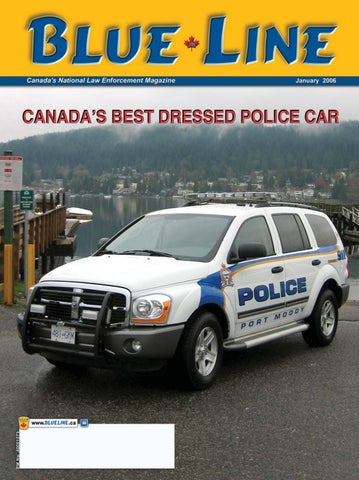
Publisher’s Commentary 5 There comes a time when sorry is not enough Canada’s best dressed police car
6
Michigan State Police vehicle trials
8
U of T’s hybrid SUV
12
Canada
Ph: 905 640-3048 Fax: 905 640-7547 Web: www.blueline.ca eMail: blueline@blueline.ca
— Publisher — Morley S. Lymburner eMail: publisher@blueline.ca
— General Manager — Mary Lymburner, M.Ed. eMail: admin@blueline.ca
— Editor — Mark Reesor eMail: editor@blueline.ca
— News Editor — Ryan Siegmund
DISPATCHES
12, 17
A failing success The “Four Pillars” program
14
Just a minute 16 Identifying stroke symptoms in 60 seconds
eMail: news@blueline.ca
— Advertising — Mary Lymburner Dean Clarke Bob Murray Kathryn Lymburner eMail: sales@blueline.ca
— Pre-press Production — Del Wall — Contributing Editors — Communication Skills Mark Giles Police Management James Clark Tactical Firearms Dave Brown Technology Tom Rataj Psychology Dorothy Cotton Mike Novakowski Case Law Blue Line Magazine is published monthly, September to June, by Blue Line Magazine Incorporated with a mailing address of: 12A - 4981 Hwy. 7 East, Ste. 254, Markham, Ontario, L3R 1N1. Individual magazines are $5.00 each. Subscriptions are $25.00 per year or $40.00 for 2 years. (Foreign - $50.00 U.S.) Group and bulk rates available upon request. All material submitted for publication becomes the property of Blue Line Magazine unless other arrangements have been made with the publisher prior to publishing. The authors, advisors and Publisher accept no liability whatsoever for any injuries to persons or property resulting from the application or adoption of any of the procedures, tactics or considerations presented in this magazine. Readers are cautioned and advised that articles presented herein are edited and supplied for your personal awareness and should not be used for further action until appropriate advice and guidance is received from a supervisor, Crown Attorney or other person in authority. Established in 1988, Blue Line Magazine is an independent publication designed to inform, entertain, educate and upgrade the skills of those involved in the law enforcement profession. It has no direct control from a law enforcement agency and its opinions and articles do not necessarily reflect the opinions of any government, police, or law enforcement agency. ©2005 - All articles are protected by copyright. No part of this publication may be reproduced or transmitted in any form or by any means, electronic or mechanical, including photocopying and recording or by any information storage or retrieval system without permission.
Internet activity is monitored and use or re-posting of material on the Internet is restricted.
This publication is a private venture and receives no subsidy or grant from any level of government.
— Affiliations — International Association of Law Enforcement Planners Canadian Advertising Rates & Data International Police Association The Police Leadership Forum Periodical Publishers Exchange The Canadian Press Newswire Harvey Research
Exporting community based policing
17
CORRESPONDENCE
19
Plan helps prevent domestic violence
20
Ontario Auditor General slams OPP
22
CASE LAW 24 • A suspect’s silence doesn’t infer guilt • Previous conduct admissible • Courts rule on crime of fleeing police BLACK ON BLUE Courts need use of force training
26
2005 a ‘benchmark’ year in graffiti
27
ODDITORIALS
28
COMING EVENTS
29
Managers manage but leaders inspire
30
DEEP BLUE Stress not always a bad thing
32
THE BLUE LINE FORUM
33
MEDIA & PUBLIC AFFAIRS 34 Headline wording can impact perception A little reward for doing things right
35
PRODUCT NEWS
36
NEWS CLIPS
37
Printed in Canada by Tri-Tech Printing
ISSN #0847 8538 Canada Post - Canadian Publications Mail Product Sales Agreement No. 176796 Blue Line Magazine
BACK OF THE BOOK 38 It’s time to get over our inferiority complex 3
Blessed with a west coast lifestyle and a general absence of snow, Port Moody residents now have something else to brag about. In addition to the obligatory ‘so, how’s the weather there?’ query, which sets up the usual reply (‘Gee, that’s too bad. The tulips are blooming here, the sun is shining, I’m in my shorts...’) – they can also mention that their police cars are the best dressed in Canada. Blue Line’s west coast correspondent, Elvin Klassen (who’s been known to boast about the mild climes himself) tells us all about it. Continuing with the automotive theme, Dave Brown has the results of the annual Michigan State Police vehicle trials, including details of the much anticipated Hemi Dodge Charger and Magnum. Vancouver’s ‘four pillars’ approach to combating drug addiction – prevention, treatment, enforcement and harm reduction – has been hailed as a great success, but not everyone is so enthusiastic. As Vancouver Police Department Insp. John McKay notes, three of the four pillars have been largely ignored, leaving the program with only one leg to stand on. Blue Line Publisher Morley Lymburner backs up McKay’s position with a commentary which focuses on enforcement as a useful tool toward crime prevention. Police officers in The Gambia may lack equipment and resources but they’re enthusiastic and eager to learn, write Halifax Regional Police Sergeants Roger Merrick and Nancy Rudback. They were part of a project developed by Mount Saint Vincent Psychology Professor (and former police officer) Dr. Stephen Perrott to introduce community based policing to the country. In our regular features, Mark Giles looks at how the wording of headlines can impact perception, Mike Novakowski has case law, Dr. Dorothy writes about stress, Danette Dooley looks at leadership and Heinz Kuck, Jim Stanton and Tony Moreno offer previews of their seminar presentations at the Blue Line Trade Show. JANUARY 2006
Blue Line Magazine
4
JANUARY 2006
There comes a time when sorry is not enough by Morley Lymburner Is there ever a good way to say sorry? Many have mastered it down to a fine art. There was a great guy in my rookie class that everyone liked. He was friendly, personable, give-you-the-shirt-off-his-back kind of guy. Upon graduation he was posted to his new station and, over the next year, everyone found he had a flaw. He could not bring himself to write a ticket. He would accept any excuse for doing almost anything and would always give people a break. In most cases ‘sorry’ was all he needed to hear. Supervisors counselled and badgered him to do more enforcement but each ticket he issued took a toll on him and he ended up resigning from the police department and finding a job where he really belonged – the fire department. Perfect place for a nice guy like him. Everything he did from then on brought out the good guy in him and not the mean police officer. This man joined the police force with the desire to help people. The image he was given was that of crime prevention and helping people who were in trouble. Many people in policing today have forgotten the old adage that “there are many roads to Damascus.” I was inspired recently by a commentary sent to us from Insp. John McKay of the Vancouver Police Department. You can read his comments in this month’s issue but I want to underscore his point. When you become a police officer, you sort of give up the right to be a ‘nice guy’ whenever you want. You have agreed to prevent crime and keep the peace. This agreement means you have to judge all your actions against the common good of society. It does not require you to be mean, surly, abusive or violent all the time. It does mean that at times, and judiciously, officers must be prepared to take on those roles to accomplish what society wants and needs them to do. There are times when you must also be friendly, kind, caring and nurturing. The difference is that you are expected to already possess those attributes. The problem for trainers is ensuring officers are good actors and reactors. They must be prepared to take on a wide variety of situations, with a wide variety of appropriate responses, and do well each time. Being confronted with a section of town that is rampant with drug dealers, pimps, violent criminals and even mental patients requires officers to perform at maximum capacity. Swinging from friendly face to aggressive and back again is not a simple task. That is why I applaud McKay’s actions in announcing that problems in areas like Vancouver’s Downtown Eastside will be met with what is necessary to make the area safer. It is an announcement to the community Blue Line Magazine
that officers in that particular area will be doing the hard-nosed part of policing, and saying to everyone in advance that they are sorry but it is a job that must be done; a job that they would much rather accomplish in other ways but must now fall back to the only tools they have left. None of us really enjoy finding ourselves in a situation of saying sorry to anyone, but every one of us has had to say it periodically. It is a natural reaction for many and yet a huge obstacle for only a few. The public will often say ‘sorry’ when they deal with cops. In fact, that’s the first thing a citizen stopped for speeding is likely
5
to say. At times they manage to regroup a bit and sputter out ‘was I doing something wrong officer?’ For the most part though, you can bet their first statement will be an admission of guilt. Sorry is not a word that excuses the activity which preceded it. Unfortunately, it is used a lot on police officers in an attempt to seek out a weakness that can be exploited, mitigating the officer’s need to enforce the law. With the more successful, saying ‘sorry’ has become an art. Their ability to squirm out of tight situations relies heavily on both their ability to be convincing and the police officer’s willingness to forgive. In these cases problems do not arise from the former but the latter. In the multitude realms of which policing is comprised, officers must be aware that there is a time when ‘sorry’ is not enough. There is a time to do their duty for the benefit of society. If it means the officer will look mean for issuing that ticket, then so be it; seeing an officer take decisive action is the best deterrent to crime. What of the bleeding hearts who decry this activity? They should check with social workers to see what they can do to ensure cops don’t have to do what they do – and feel sorry they did nothing sooner.
JANUARY 2006
by Elvin Klassen
Port Moody Police Department’s new vehicle graphics took top honours for colour, visibility and attractive styling in Blue Line Magazine’s best dressed police car contest. Residents told the department in a community survey that police cars should be more visible and work began on a graphics package that was both attractive and easy to spot. Cornerstone Signage and Design Ltd., a Burnaby area signage and design company, was recruited to assist with the re-design, production and installation of the fleet graphics. Cornerstone sales manager Art DiStasio stated that their “main objective is to produce visual communication and signage which conveys your message clearly and effectively, in a way that reflects the style and integrity of your business.” The city’s economic development focus in recent years has been on the arts and culture sector, including the development of a new identity as the ‘City of the Arts.’ “The new graphics on the police vehicles are our department’s contribution to this venture,” says Cst. Ryan West, who co-ordinated development of the new look. The style and integrity of the Port Moody Police Department has been molded a great deal by its history. The Port Moody Police Department was established in 1913 with one officer and grew along with the city to its present size of 42 sworn officers. “Despite our significant growth and many legal and technological developments along the way, one thing has never changed: our commitment to our core responsibilities,” says Chief Constable Paul Shrive. “Our motto, ‘no call too small’ is taken seriously,” says Shrive, who was appointed six years ago, is past president of the BC Association of Chiefs of Police and also serves as the BC director of the Canadian Association of Chiefs of Police. “If we get a call that a tricycle has been stolen, we will respond. Our residents have also indicated that they are very satisfied with our response times to both emergency and nonemergency calls for service. We take pride in our prompt response and we are committed to living up to our community’s expectations.” Blue Line Magazine
Port Moody was the first BC police department to implement PRIME, an electronic police records system that will eventually link departments across the province. It has also implemented a bait car program, is involved in the integrated homicide team, uses a ghost car for traffic enforcement and was a leader in changing to Glock pistols. The department has the highest clearance rate, second highest officers per capita ratio and the second lowest cost per capita of any municipal force or RCMP detachment in the lower mainland. West was also responsible for having a new shoulder flash designed for the department, which made the switch to cloth flashes in the early 1950s from the metal shoulder tiles which were common at the time. The department also has its own flag, which can be flown with the Canadian flag and was approved by the Chief Herald of Canada. The department’s offices are tired and crowded and everyone is looking forward to moving into a new, $9 million public safety building in a few months. This state of the art facility will be shared with Canadian Pacific Police, BC Ambulance Service and the city emergency centre. Shrive is proud of his productive and welltrained frontline staff, which average 8.5 years of experience. “Due to our small size, it is relatively easy to promote change and provide training. We are small enough that everyone has a say.” A supportive police board and mayor also makes his job easier, he adds. At the head of the Burrard Inlet, about 20 kilometres east of Vancouver, the city epitomizes the west coast lifestyle of oceanfront and abundant natural spaces. Surrounded by mountains, water and forested hillsides, it offers a unique quality of life, a strong sense of community and a balanced mix of residential, com6
mercial and industrial development. With a population of some 30,000 people and average growth of 2.3 per cent a year since 2001, it claims to be the fastest growing city in Chief Paul Shrive Greater Vancouver. The traditional industrial sector in Port Moody is characterized by a deep-sea bulk loading terminal, two petrochemical distribution operations, a large wood products manufacturer and a thermal electric generating station. Light industry, home-based business and crafts and cultural businesses are also common, along with a growing health and social services sector. Port Moody Police Department’s new shoulder flash incorporates many historical and natural features of the area. The central part of the design, the shield, recalls the elements that led to the city’s foundation. The broad black band, charged with the two gold bars, represents the railway and reinforces the identity of the city as the Pacific terminus of the Canadian Pacific Railway. Above are three Douglas fir trees and below is a 19th century clipper ship under full sail. The shield is ensigned with a silver tripled tower castle, emblematic of Port Moody’s designation as a city. The supporters flanking either side represent the wealth of the natural environment. The stag on the left, with antlers and hooves of gold, proudly bears a collar of red maple leaves. The Coast Salish, the first people of the region, are honoured with a spindal whorl featuring a salmon image hanging from the collar. The right hand supporter, a silver cougar, bears the maple leaf collar, from which hangs a black medallion charged with a golden railway spike. The supporters and shield rest on the compartment, which is composed of the Burrard Inlet harbour framed by forested ridges.
JANUARY 2006
BEST DRESSED CATEGORY POLICE VEHICLES
Blue Line Magazine
7
BEST DRESSED RUNNER-UP
JANUARY 2006
by Dave Brown New technology makes many items obsolete by the time we get them home from the store, so it is comforting to know there are still products made that have, on the surface at least, changed little from when they were first sold. The Boeing 737 airplane is one; the Ford Police Interceptor is another. The 737 is the favourite short and mediumhaul passenger plane of airlines around the world they value its size and thriftiness. Boeing hit the market with the right product at the right time and it is still evolving after 35 years. The Ford Police Interceptor has also evolved substantially over the years but there isn’t a cop (or taxi driver) who would mistake it for anything else, even if you blindfolded them and sped down the 401 – which, come to think of it, is not unlike my last Toronto taxi ride. Thankfully, one does not need to select new vehicles for a police agency blindfolded. Every year the Michigan State Police, in conjunction with the US National Institute of Justice (NIJ), tests the handling and performance of the new crop of police vehicles, classifying each as either a police-package or special-service vehicle. Once again, Blue Line Magazine is proud to report these highly anticipated results. These numbers are preliminary. Final results for the 2006 tests should be ready by the time you read this at www.michigan.gov/msp – tests from previous years are also available. All dimensions and measurements given are in US numbers. Blue Line Magazine
Police package vehicles In what may have been one of the busiest years ever for the testers, 13 2006 police vehicles were officially evaluated. Police-package vehicles are designed for the full spectrum of general police activities, including high-speed pursuits. A record nine vehicles were submitted to the NIJ in this category: • three Chevrolets – the Impala 9C1, Tahoe PPV and Tahoe PPV E85 (a multi-port fuel injection version designed to run on gasoline or up to an 85 per cent ethanol/gas mix); • four Dodges – Chargers and Magnums with either the 3.5 litre V6 or 5.7 litre V8; • Two Fords – Police Interceptors with either the 3.27:1 or 3.55:1 final axle ratio. Due to the overwhelming popularity of the Chevrolet Tahoe as a police vehicle, this is the second year ever that a pursuit-capable sport utility vehicle was evaluated in the normal police-package category.
Chevrolet Impala
Chevrolet Tahoe 8
The Chevrolet 9C1 Impala (and its undercover brother, the 9C3, with – finally – no bolton hubcaps to give it away) returns for another year, a little meaner and quite a bit faster. When Blue Line was given an early preview of the new police-package Impala in 1999, we learned that the top speed was electronically governed for cooling reasons. With 20 more horses and a slightly larger V6 engine under the hood, heavy-duty oil coolers for the engine, transmission and power-steering and twin electric radiator fans, the new Impala runs cooler and is MUCH faster. Its top end easily bests every other vehicle in the test by a wide margin, with the exception of the monster-motor 5.7 litre Dodge Charger and its famous hemisphericalshaped combustion chamber design. Chevrolet was obviously listening to feedback from officers across the country because it now rides higher on increased ride height springs. This helps minimize those embarrassing scoops of water into the engine compartment during floods or high centering on snow banks during those eight months of good sledding experienced by many Canadian locales. The Impala interior still sports some of the best seats in the business and, while it gives up an inch of front shoulder and hip room to the Ford, the rear compartment is larger and the rear door opens wider to better accommodate clients. The big surprise of the last two years is the capability of the Chevrolet Tahoe for routine patrol duties. At 38 feet the Tahoe has the tightest turning radius of all the vehicles tested and even out-accelerates most of them to 60 mph. JANUARY 2006
Blue Line Magazine
9
JANUARY 2006
Test vehicle specifications (preliminary reports - All specifications are subject to change
Dodge Charger
Dodge Magnum Dodge dropped the front-wheel-drive police-package Intrepid in 2005, replacing it with not one but four new rear-wheel-drive vehicles: the brand-new Dodge Charger and the Dodge Magnum, each available with either the 3.5 litre V6 or 5.7 litre Hemi V8. Dodge now leaves Chevrolet all alone in the front-wheeldrive police market. If there were trophies for best-looking and most aggressive-looking police vehicles (which, for many officers, are one and the same), the Dodges would win hands down. Like the Impala, front shoulder and hip room may be at a premium but rear seat room is larger than it appears and riding in the back is not much worse than riding an Air Canada regional jet, but with better food.
Ford Interceptor Ford once again shows why it owned the police vehicle market for so many years by delivering two versions of the V8 rear-drive Police Interceptor: one with a 3.27:1 and the other with a 3.55:1 rear axle ratio. The lower geared 3.55 vehicle accelerates slightly faster, at the expense of a slightly lower top speed, but marked vehicles rarely reach their top speed anyway due to aerodynamics of the light bar. The Ford is still made the good-ole American way, with body-on-frame construction and the same V8 in front driving rear wheels behind that must have been mandated by forefathers such as Thomas Jefferson, Ben Franklin and Richard Petty. The Ford has a five-star crash test rating and was even tested in a 75 mph rear-end crash – if you don’t understand the importance of that number, you haven’t been reading the paper. It is also available with an Blue Line Magazine
optional automatic fire suppression system (with manual override). Special service vehicles Special-service vehicles are designed for specialized duties such as dog units, adverse weather conditions or off-road use. They are not intended or recommended for pursuits. Special-service vehicles submitted for 2006 include the four-wheel-drive Chevrolet Tahoe, the two-wheel-drive Ford Explorer and Expedition and the all-wheel-drive, 3.5 litre Dodge Magnum. For results of the special-service vehicle tests, see the final report. The tests Michigan State Police and the NIJ’s National Law Enforcement and Corrections Technology Center (NLECTC) test all the vehicles together over a three-day period at the DaimlerChrysler Proving Grounds and Grattan Raceway. Each vehicle is tested without rooftop lights, spotlights, sirens or radio an10
tennas in place. Tires are original equipment rubber provided by the manufacturer. Acceleration, braking and top speed tests are performed at the proving ground and vehicle dynamics tests are done using the two-mile Grattan road course.
The results
Vehic le d ynamics testing ehicle dynamics The objective of the vehicle dynamics testing is to determine the high-speed pursuit handling characteristics. Except for the absence of traffic, the two-mile road course simulates actual pursuit conditions and allows testers to evaluate the blend of suspension components, acceleration and braking ability. Four drivers test each vehicle over an eightlap road course, with the five fastest laps counting toward each driver’s average lap time. Final score is the combined average of all four drivers for each vehicle. See Chart 1 JANUARY 2006
Fuel economy While not an indicator of actual mileage you may experience, the EPA mileage figures serve as a good comparison of mileage potential from vehicle to vehicle. Vehicle scores are based on data published by the vehicle manufacturers and certified by the US Environmental Protection Agency. Where the 2006 test results were not yet available, 2005 figures are reported where possible. See Chart 4
Chart 1
Chart 2
Chart 3
Chart 4 tains on 12 60-0 mph full stops to the point of Acceleration and top speed impending skid and with ABS in operation. The objectives of the acceleration and top Each vehicle is scored on the average decelspeed tests are to determine the ability of each eration rate it attains. vehicle to accelerate from a standing start to Each test vehicle makes two heat-up 60, 80 and 100 mph and to record the top speed decelerations at predetermined points on the achieved within a distance of 14 miles from a test road from 90 to 0 mph at 22 ft/sec2, using a standing start. decelerometer to maintain rate. The vehicle Each vehicle is driven through four accelthen turns around and makes six measured 60eration sequences, two in each direction to al0 mph stops with threshold braking applied to low for wind. Acceleration score is the averthe point of impending wheel lock, using ABS age of the four tests. Following the fourth acif so equipped. Following a four-minute heatceleration sequence, each vehicle continues to soak, the sequence is repeated. Initial velocity accelerate to its highest attainable speed within of each deceleration and the exact distance re14 miles of the standing start point. quired is used to calculate the deceleration rate. See Chart 2 The resulting score is the average of all 12 stops. Stopping distance from 60 mph is calBraking culated by interpolating the results. The objective of the braking test is to deSee Chart 3 termine the deceleration rate each vehicle at-
Blue Line Magazine
11
Conclusion The Michigan State Police yearly vehicle tests are highly respected and many agencies rely on them for comprehensive information on new police vehicles. Blue Line has published the results of these tests for most of our history and our own experiences with various police vehicles have reinforced the validity of their testing. The Michigan State Police do not declare any overall winner in their tests, simply because every agency has different requirements. Vehicles must be evaluated on how their individual strengths match the needs of each agency. Michigan State Police also do not evaluate factors such as longevity, reliability or ease of maintenance. The most exciting news for gearheads is not even mentioned in the 2006 vehicle tests. AM General’s Hummer H1 is likely the toughest patrol vehicle ever made and is now fully rated by General Motors for all aspects of police duty, including high-speed pursuits. Sure, the term “high-speed pursuit” takes on a whole new meaning when your acceleration is measured more accurately with a calendar than a stopwatch, but if it can shrug off car bombs, it should be able to handle anything your clients can throw at it or in it. It would take a really, really large group of rioters to roll THIS one on its roof – and I would be willing to bet that not one single client will ever dare glance back at your patrol car and ape the line, “Y’all got a Hemi in that?” For more information contact Dave Brown at brown@blueline.ca
JANUARY 2006
U of T’s hybrid SUV for community policing Escorted by students and campus police on bicycles, the University of Toronto Police Service’s (UTPS) new Ford Escape Hybrid made its debut in a parade around King’s College Circle. A first for Canadian universities, it will be used as a support vehicle on the St. George campus. “The hybrid vehicle represents a logical step in U of T’s commitment to campus greening and sustainability,” said Catherine Riggall, vice president of business affairs and acting vice president government and institutional relations. “When we look at sustainable technologies, it is necessary to match the task to the equipment, and for UTPS this vehicle matches the way they work.” The Ford Escape Hybrid can run on 100 percent electric power at speeds up to 40 km per hour, the maximum legal limit on most of the 27 km of roadways that traverse the historic campus. Energy created through braking is captured and stored in the hybrid battery for future use, meaning the vehicle never needs to be plugged in. UTPS, founded in 1904, is responsible for the safety and security of over 75,000 students, faculty and staff on three campuses. UTPS special constables are appointed by the province and managed by the Toronto Police Service Board. In addition to emergency response they have the authority to deal with criminal and provincial offences.
In a wide-ranging audit of government operations, Auditor-General Sheila Fraser has found many RCMP officers have inadequate and incomplete training, posing health and safety risks to both the officers and the public. The report found 6.2 per cent of the national agency met all mandatory training requirements in 2004, whereas 57 per cent of the officers met the requirements in 2003. Last March, four Mounties were gunned down in Alberta by a deranged man, James Roszko, who then killed himself. Although the report didn’t make any specific reference to the tragedy, questions have been raised as to whether the four officers were adequately trained and prepared.
“Our community policing partnership with the UTPS is essential to maintaining a safe and secure campus environment for students,” “We greatly value the partnership for community policing we have with U of T Police Service....” said Inspector Don Campbell of 52 Division. “The Toronto Police Service congratulates them on their latest tool and we are confident it will further improve their investigations and enforcement activities.” City Councillor Kyle Rae, noting the large student contingency said, “The St. George campus is a unique learning environment in the heart of a great city. Having the hybrid vehicle for community policing is a great example of what a safe and green place it is for U of T students, staff and faculty.” For more information contact Mary Alice Thring U of T Public Affairs 416-946-8369 mary.thring@utoronto.ca www.greatspaces.utoronto.ca
Saskatchewan’s Justice Minister says the province is taking the next step to try and curb gang activity, by hiring 14 new police officers and two Crown prosecutors to investigate gangs in the province. Frank Quennell says the new positions will cost $745,000 this year and two million dollars annually after that. Nine RCMP investigators will be added in Regina, Saskatoon and Prince Albert, to work with the municipal police forces to deal with gang activity in those communities. The RCMP will add one new Criminal Intelligence Analyst in each of those cities as well. Two new prosecutors will be posted in Regina and Saskatoon, to respond to the increase in gang activity investigations and prosecutions that will occur. Justice Minister Irwin Cotler intends to seek Cabinet approval to introduce a package of legislative reforms to address the illegal use of guns. The package is part of a three-pronged strategy focused on tougher laws, enhanced enforcement and prosecutions, as well as community investments in crime prevention. The package will include three measures to enhance and expand mandatory minimum sentences for gun-related crimes, including smuggling and trafficking weapons. He says it sends a message to those who get involved with illegal guns that they will “be going to jail without passing Go.” He says the “disturbing” increase of homicides involving firearms in Toronto and Winnipeg have “underscored the need to attack the problem of the illegal use of firearms on a number of fronts.” Ontario’s Community Safety Minister Monte Kwinter says proposed legislation would protect first responders from people who bite or spit at them and accelerate the process in which they can determine if they have been exposed to infection from certain viruses. If passed, the legislation would give exposed individuals and their doctors more timely information to help them decide on the best way to reduce the risk of illness. Kwinter says in certain circumstances, anyone who provides emergency first aid would be able to apply to have blood tests done on a person with whom they have had contact with. Currently, only a medical officer of health can order such persons to provide a blood sample for testing, if one is not provided voluntarily. Vancouver Police Insp. John McKay says people are tired of tripping over 18,000 needles a month, prompting the change to allow police to arrest addicts who shoot up in public. Police will also begin to seize drugs as evidence and pursue charges of narcotics possession. Police say the crackdown is an effort to encourage drug addicts to use the Insite safe injection site which opened two years ago. “It’s called enforcing the law,” says McKay of the city-wide enforcement team. “We’re going to give (addicts) a legal reason to use (Insite). With an estimated 7,500 to 8,000 intravenous-drug-users in the area, complaints about open drug-use are coming thick and fast,” he said.
Blue Line Magazine
12
JANUARY 2006
Blue Line Magazine
13
JANUARY 2006
by John McKay The ‘four pillars’ approach to drug addiction – prevention, treatment, enforcement and harm reduction – is a social experiment developed in Vancouver, promoted worldwide by our former mayor and hailed as a great success by its proponents. As a police officer working the city’s Downtown Eastside (DTES) for four years, I have observed this strategy first hand and seen beyond the theoretical model to the actual results of its implementation. The DTES, one of Canada’s economically disadvantaged neighbourhoods, is a 12 block area which includes a population afflicted with unusually high rates of drug addiction and mental illness. There are 130 social service agencies concentrated in this relatively small section and it also has a disproportionate share of the city’s social and assisted housing complexes. Free needles (more than three million are provided to addicts annually), drug cooking kits and North America’s first “safe injection site” are among the services available to drug using residents. The philosophy underlying the current situation in the area is, in theory, the four pillars. In practice however, the harm reduction pillar has been embraced and supported to a far greater degree than the treatment, prevention and enforcement components of the strategy. It is interesting to note that harm reduction is the least expensive pillar to fund and the most supportive of drug use. Harm reduction measBlue Line Magazine
ures enable drug use and implementing it through multiple initiatives has actually given Vancouver’s addicts a sense of entitlement. The aim of the safe injection site is to provide addicts with a safe place to use drugs where they can obtain immediate medical attention if they overdose. In fact, the police officers who work in the DTES 24/7 have observed that most street drug use takes place in alleys just a short walk away from the site. Unlimited distribution of free needles is intended to reduce the spread of HIV and other diseases. The unintended consequences of this harm reduction initiative are the thousands of uncapped, used syringes that addicts discard in parks and neighbourhood streets. Because there is no longer a one for one exchange, users have no motivation to return the needles for proper disposal. Therefore, in effect, harm reduction for one group causes harm promotion for the rest of the city’s residents. The drugs injected in the safe injection site are usually paid for by the criminal activities of addicts responsible for most of the property crime plaguing Vancouver’s residents and visitors. Many of the agencies promoting harm reduction are run by earnest, well-intentioned individuals whose objective is to keep addicts alive until they get treatment. Although this is an admirable goal, many of their initiatives damage rather than help the addicts they target. Harm reduction on its own not only can’t help addicts get out of their deep pit of addiction, it actually digs the pit deeper and wider. On balance, many aspects of harm reduction 14
can actually harm both addicts and community members who don’t use drugs. To get a clear focus on the four pillar strategy we need to look at it from a broader perspective and examine how such an approach would be applied to illegal activities other than drugs. Effective existing strategies to deal with many criminal activities include prevention, treatment and enforcement. Harm reduction is usually one element included in all of these three pillars. It is illuminating to overlay the four pillar template on non-drug related crimes and observe the role of prevention, treatment and enforcement. This exercise reveals the flawed logic on which Vancouver’s embrace of harm reduction is based. If we place the four pillars template over other crimes, the roles of prevention, treatment and enforcement become clear. In the case of domestic violence (spousal assault), prevention includes violence recognition training and education about the availability of shelters, transition houses and legal protection. Enforcement policies exist in every province and treatment can be mandated for people convicted of spousal assault. These three pillars are already in place for domestic violence and all other crimes that society has deemed merit fines and imprisonment. What then would be the fourth pillar? Harm reduction for domestic violence might mean that the batterer would wear boxing gloves when assaulting his spouse, which would, of JANUARY 2006
course, reduce harm to the victim. Perhaps a ‘safe spousal beating site’ could provide immediate medical attention for victims. To extend the analogy, we could consider harm reduction applied in a ‘safe impaired driving zone’ or a ‘safe burglary zone.’ These concepts are ludicrous but they could extend to a ‘safe rape site,’ ‘safe pedophilia site’ or ‘safe assault site;’ all are as chilling as they are inconceivable. The answers to these offences are prevention, enforcement and treatment. Harm reduction as a tool in these cases simply does not work – nor is it a panacea for Vancouver’s drug problems. I believe that the four pillars approach has placed the cart before the horse. There is no doubt that, for effective solutions, we must focus on prevention, treatment and enforcement. Harm reduction cannot stand alone. It is already included in the first three pillars and its value depends on its connection to them. Those elements of harm reduction not congruent with prevention, treatment and enforcement should be seen for what they are: prodrug initiatives which will lead to legalization. If successful, they will be detrimental to a safe and secure society. As a police officer, I have offered this perspective on the four pillars approach so citizens and their elected leaders can include it when they are considering the effects of drug addiction on communities. John McKay is an inspector with the Vancouver Police Department.
Gulf police officers need your help Police, fire and ambulance personnel from across North America are invited to spend some time this winter in the most unlikeliest of vacation destinations: the hurricane-ravaged Gulf Coast. The Fellowship of Christian Peace Officers (FCPO) in the US and Canada and the Diakonos Retreat Society are spearheading a volunteer effort to help dozens of police officers rebuild their homes, which were destroyed or heavily damaged by Hurricane Katrina. “Fatigue is really setting in,” says Grant Wolf, executive director of the FCPO, which provides support and accountability to Christian law enforcement officers. “Many of these officers saw their houses completely destroyed,” Wolf says. “There is absolute uncertainty for many of them about what’s going to be covered financially and whether they will ever be able to get back into a house that’s normal – and if so, when.” The FCPO has worked closely with the Gulfport Police Department in Mississippi, providing relief labour to assist officers in cleaning up and renovating their family homes. A temporary RV park with hookups for water, power and some sewage has been established for volunteers working on behalf of stricken families and has been nicknamed ‘Club Canada’ in recognition of Canadian volunteers. This is a critical time for officers hit hard by the hurricane, says Kevin McInnes, spokesman for Diakonos Retreat Society of Calgary, Alberta, an agency providing spiritual, educational and personal support for peace officers and emergency workers. “People who have skills in construction or renovation can give hope to an officer and his family, where right now that family is wondering where that hope is going to come from,”says McInnes, who is seeking volunteers for a
relief team. “You’re going to help them get back to a place where they are comfortable doing their job. You’re going to make a difference to an officer’s life, to their family’s lives and, I believe, ultimately to the community, because the officers themselves will feel cared for and be able to then care for the community in a better way.” The Canadian representative of the FCPO, retired police veteran David Greenhalgh of Delta, British Columbia, is acting as relief liaison and aid coordinator for the Gulfport Police. He says volunteers with construction or renovation experience are needed who can travel to the region for a week at a time, or longer if they have their own RV. Volunteers stay on a self-sufficient basis, covering costs and accepting work assignments on teams. The FCPO in Gulfport can also help locate dorm-style accommodations and oversee arrival logistics. Volunteers will be security-screened and work on Gulf Coast area homes of police and fire employees from Pascagoula to Pass Christian. “The winter climate here is similar to northern Florida,” says Greenhalgh. “This was a beautiful destination resort for retired people pre-Katrina. Working on the houses of emergency services employees devastated by Katrina is a meaningful endeavour full of purpose and job satisfaction. Volunteers will be changing the lives of identifiable families.” To volunteer, donate of for more information, contact Grant Wolf at grant@fcpo.org or 423 622-1234 (web site: http://www.fcpo.org) or Andrew Cowan at a.cowan@shaw.ca or 250 380-6101 (web site: http:// www.fcpocanada.com).
The four-pillar approach to drug problems Prevention — involves educating about the dangers of drug use, building awareness about why people misuse alcohol and drugs and what can be done to avoid addiction. A framework for action supports co-ordinated, evidence-based programs targeted to specific populations and age groups – programs that focus on the causes and nature of addiction as well as prevention. Treatment — consists of a continuum of interventions and support programs that enable individuals with addiction problems to make healthier decisions about their lives and move towards abstinence. These include detoxification, outpatient counselling and residential treatment, as well as housing, ongoing medical care, employment services, social programs and life skills. Enforcement — strategies are key to any drug strategy. Increasing public order and closing the open drug scene requires more effective enforcement strategies, including redeploying officers, increasing efforts to target organized crime, drug houses and drug dealers and better co-ordinating with health services and other agencies to link drug and alcohol users to available programs. A framework for action to increase public order requires law enforcement, probation services and the courts to collaborate with the other programs and agencies involved in each pillar. Harm Reduction — is a pragmatic approach that focuses on decreasing the negative consequences of drug use for communities and individuals. It recognizes that abstinence-based approaches are limited in dealing with a street-entrenched open drug scene and that protecting communities and individuals is the primary goal of programs to tackle substance misuse. A framework for action attempts to demonstrate the need for harm reduction by outlining and drawing upon other successful programs around the world that have significantly reduced both the negative health, societal impacts and costs of drug addiction. Blue Line Magazine
15
JANUARY 2006
Just a minute How to identify stroke symptoms in 60 seconds Bystanders may be able to spot someone having a stroke by giving the person a simple, quick test to see if they can smile, raise both arms and keep them up and speak a simple sentence coherently, according to a report presented at the American Stroke Association’s 28th International Stroke Conference in 2003. The report suggests the following tests: 1. Ask the individual to smile. 2. Ask him or her to raise both arms. 3. Ask the person to speak a simple sentence coherently – for example, ‘it is sunny out today.’ The test, which takes less than one minute, has helped healthcare professionals accurately identify stroke patients. If bystanders can relay results of this test to an emergency dispatcher, it could speed treatment to stroke patients. The main recognized symptoms of a stroke are listed as: • Sudden numbness or weakness of the face, arm or leg, especially on one side of the body • Sudden confusion, trouble speaking or understanding • Sudden trouble seeing in one or both eyes • Sudden trouble walking, dizziness, loss of balance or co-ordination • Sudden, severe headache with no known cause Time is crucial in treating a stroke. A clotbusting drug has been shown to limit disability from strokes caused by clots (ischemic strokes), but the drug must be given within three hours of the onset of stroke symptoms. Because of this short time window, only a small percentage of patients are eligible to receive the drug. “As the brain is deprived of oxygen dur-
Blue Line Magazine
ing a stroke, it’s literally starving minute-byminute. The sooner the patient receives proper treatment in the appropriate medical setting, the better the chances for a full recovery,” says Amy S. Hurwitz, a second year medical student at the University of North Carolina-Chapel Hill School of Medicine in Chapel Hill, N.C. Hurwitz is the lead author on a study designed by Jane H. Brice, M.D., assistant professor of emergency medicine at the same institution. The study examines whether members of the public can effectively administer the simple three-item examination that healthcare professionals use. It is known as the Cincinnati Pre-hospital Stroke Scale (CPSS). Researchers modified the CPSS into a script for over-the-phone administration via an intermediary. They recruited stroke survivors from the hospital’s support group. Some of these volunteers still had one, two or three of the unresolved symptoms identified from a previous stroke, such as facial weakness, arm weakness or speech deficits. Researchers then recruited 100 non-patient visitors (bystanders) to the UNC hospital’s emergency department and brought the people to a quiet room where a stroke survivor and investigator were waiting. The bystanders were instructed to “answer the telephone when it rings” and to follow the directions given over the phone, using the stroke survivor as their mock patient. A researcher role-played a dispatcher implementing the CPSS script. Results indicate that the bystanders correctly administered CPSS directions 96 percent of the time. When stroke patients were told to raise both arms and keep them up, bystanders were 97 percent accurate in detecting arm weakness and 72 percent accurate in determining the lack of arm weakness. When patients were asked to repeat a sentence, bystanders were 96 percent accurate at detecting speech deficits and 96 percent accurate in detecting a lack of speech defi16
cit. The bystanders were 74 percent accurate in finding facial weakness based on the stroke patient’s smile and 94 percent accurate on the absence of facial weakness. “While treating stroke patients may require extensive training and expensive equipment, our study shows that untrained adults can successfully detect stroke symptoms. This ability can allow a bystander to act as ‘eyes and ears’ for a 911 dispatcher who may be miles away,” Hurwitz says. “Unlike other investigations that strive to improve the treatment of stroke within the hospital setting, this study taps into the general public as a first-line resource in the diagnosis and triage of possible stroke victims.” The bystanders in the study scored high when detecting arm weakness and slurred speech – two key symptoms suggesting a patient may have had a stroke. They were less successful in detecting facial weakness, probably because it’s hard to assess a stranger’s smile, according to Hurwitz. If the possible stroke patient was the bystander’s spouse, it’s likely the bystander would more readily detect an abrupt change in the quality of the smile, she says. “The general public should remember the three items tested by the CPSS. Therefore, if a family member’s speech unexpectedly becomes slurred or incomprehensible, you should call 911 immediately. Similarly, if one side of someone’s body ‘goes numb’ or if one side of the face droops down, you should call for help immediately,” Hurwitz says. Delaying medical attention is dangerous when someone is having a stroke, since continued oxygen deprivation can cause brain damage. “As the medical profession strives to improve the diagnosis and treatment of stroke, so should the general public aim to access this medical attention as quickly as possible,” she says. Hurwitz says the next step is to test lay person administration of the test in the field with real patients and emergency dispatchers. “We will train dispatchers to lead callers through the CPSS assessment of the stroke victim. We will then compare the survival and symptom outcomes of patients who are screened with the CPSS with a subset of patients who do not receive the screening. By statistically comparing the patient outcomes, we can assess whether the addition of the CPSS to the dispatcher’s repertoire would benefit future stroke victims and their families,” she says. Barbara A. Overby, R.N. and Kelly R. Evenson, Ph.D. co-authored the study, which was partly funded by the American Stroke Association and the UNC Medical Alumni Foundation.
JANUARY 2006
Exporting community based policing by Roger Merrick and Nancy Rudback We were greeted warmly by police and the public in The Gambia; our mission was to help introduce community based policing to the country. We were eager to get to work. Our first task was to present a lesson plan on use of force at the Gambia Police Training School. The Gambian National Police Force is increasing the size of its intervention unit and the 175 recruits were destined for duties such as border protection, crowd control and if re- Sgt Roger Merrick demonstrates tactics. quired, armed response (following the British system, general duty officers in The attendance. His belief in the philosophy of CBP Gambia are unarmed). was obvious, making him a natural role model The country’s police lack resources and the to lead the force into a new era of policing. school epitomized this shortfall. Lecture classes Since the project is still in the inception were held outdoors, alongside the chickens and stage, a trip up river to the country’s interior goats that wandered freely on the grounds. It was required. After a bumpy four hour drive would be generous to call the barracks spartan we arrived in Farafenni, where local police and and the school had little in training resources, community members gathered for the presenlacking reference material like criminal codes tations. The response was outstanding, with a and other police related publications. sometimes emotional two-way dialogue. It was It was inspiring to see how instructors and novel to have the public and police gather torecruits made do with what little they had. The gether to discuss community concerns. Police phrase “we’ll manage” could be the school’s previously made all the decisions about how motto, for the frequency with which it is spopolicing was done. This lack of public input ken. Despite the obvious deprivation they face, resulted in distrust, but everyone agreed CBP both the recruits and instructors were enthusiwould benefit the public and officers alike. astic and receptive to our training program. As we travelled from Farafenni to Basse and Gambian Police Assistant Superintendent away from the coast, the heat and humidity inAziz Bojang provided us with a great deal of creased – hitting a high of 42 degrees! The trek insight into the force, African culture and peoup river provided us with the opportunity to view ple. A true leader and dynamic speaker, he dethe abundance of wildlife, including monkeys, livered his lectures on community based pobaboons and the hundreds of bird species for licing (CBP) and restorative justice (RJ) with which The Gambia is renowned. insight and conviction. In addition to his teachWe crossed the Gambia River at Janjanbureh ing duties, he had to translate lectures into sevvia a cable ferry ‘powered’ by elbow grease. eral local dialects for the diverse audiences in Infamous as a loading point for the selling of
Retired police officers working in Haiti Twenty-five retired police officers left in October on five month terms to assist with the United Nations Stabilization Mission in Haiti, joining the 100 Canadian officers already deployed there. The officers are training and mentoring the Haitian National Police as part of an ongoing effort to maintain peace during the Haitian national and municipal election period, which continues through the end of February. As police technical advisors, they serve as a link between the national police and UN mission, helping with planning and implementing the Haiti Elections Security Operational Plan. They also assist with operational planning, risk assessments and security implementation to increase the policing capacity during the election process. “They are recently retired Canadian police officers or are on personal leave of absence from their police force,” says Foreign Affairs department spokesperson Blue Line Magazine
Pamela Greenwell. “Many have served in Haiti previously as UN civilian police and almost all have served on international missions.” The federal government recruited, equipped, briefed and deployed the 25 expert officers, who are working closely with the UN Department of Peace Keeping Operations, Foreign Affairs Canada, RCMP and Canadian International Development Agency. The officers are contracted through CANADEM, a non-profit agency dedicated to advancing international peace and security by recruiting, screening, promoting and rapidly mobilizing Canadian expertise. It hires police officers who are 62 years old or less and have been retired from active service for less than five years. Selected individuals must be bilingual (French, English) and pass physical, psychological and fitness tests. Visit www.canadem.ca for more information.
17
slaves to the West, it was difficult to comprehend that such a scenic place could possess such a cruel history. Continuing along the North Bank, we reached the city of Basse, a labyrinth of narrow streets filled with people, cars, bicycles and motorcycles co-existing with goats, chickens, dogs and cats. The market sells everything, ranging from cheap children’s toys to fabric and cooking charcoal. Once again we presented to a mixed crowd, including military police, fire fighters, civilian police and community leaders from the village and outlying areas. Everyone nodded in agreement when Sir Robert Peel’s famous quote – “The police are the public and the public are the police” – was translated. This article first ran in the Nova Scotia Gambia Association newsletter. Merrick and Nancy Rudback were in The Gambia last February.
The long awaited judicial review of new evidence in the case of Steven Truscott was not enough to exonerate him, but showed a likely miscarriage of justice, according to the report. Justice Minister Irwin Cotler who released the report by Justice Fred Kaufman, says privacy issues had prevented him from releasing Kaufman’s 700page report. Kaufman’s review of Truscott’s 1959 conviction for the murder of 12-yearold Lynn Harper had already persuaded the government to order the Ontario Court of Appeal to reopen the case. The appeal began in October 2004 and is ongoing. Vancouver Police Chief Jamie Graham says he felt obliged to ask the RCMP to review the past conduct of mayor-elect Sam Sullivan. Had he not, Graham says he would have been questioned about not investigating Sullivan’s past admissions that he has given people money to buy drugs. Sullivan has also said that on at least one occasion he drove an addict to a Downtown Eastside location to buy drugs and allowed him to smoke crack in his van. “I felt that based on those facts, those self-admissions, it would be prudent for police to have a careful look at this because of the possible conflict with the Vancouver Police and Mr. Sullivan’s future as the possible chair of the police might warrant having an outside agency look at this,” Graham said. Deputy Prime Minister Anne McLellan says the government has asked former Ontario premier Bob Rae to carry out what she calls the second stage of the Air India bombing investigation. McLellan says it’s hoped Rae’s work will allow the families of the victims to move forward and find full and complete answers. Rae had recommended the government conduct an inquiry after looking into how authorities assessed the terrorism threat and handled the investigation of the crime.
JANUARY 2006
Edmonton police receive international recognition by Ryan Siegmund The Edmonton Police Service (EPS) has become the first agency ever to win three International Association of Chiefs of Police/Motorola Webber Seavey Awards for quality in law enforcement in the same year. EPS’s Elder Abuse Intervention Team, hate and bias crime initiative and traffic strategy briefing program were all recognized by the IACP. Elder Abuse Intervention Team A collaborative effort with the city’s community services department and Catholic Social Services, the team works to prevent and respond to abuse of seniors. Examples of elder abuse, which is characterized as any action or lack of action that jeopardizes a senior’s health or well-being, include neglect, psychological or sexual abuse, improper medication or financial impropriety. There was little recognition of elder abuse among police agencies in 1996 when EPS began working with other agencies to combat the problem. The intervention team began in 1998 and is made up of two EPS officers, a social worker and three Catholic Social Services seniors resource coordinators. Objectives include developing a core team with expertise in elder abuse, creating a safe house for seniors and examining elder abuse legislation. The program, which receives no external funding and provides its services at no charge, has assisted more than 3,100 victims. Hate and bias crime initiative Hate and bias incidents were often not reported or documented in Edmonton before the EPS established its hate crimes unit. Constables Steve Camp and Dave Huggins researched the problem in 2000 and approached the chief
Blue Line Magazine
Acting Chief Darryl da Costa with one of the three IACP awards won by Edmonton police.
with their findings, which demonstrated a need to identify and prevent city-wide hate and bias motivated occurrences. “We illustrated that we had this arson at a synagogue that wasn’t classified as a hate crime, although it was quite clear it was,” says Huggins, noting the accused admitted he was motivated by what was happening in the Middle East. “We were trying to illustrate there was something wrong because no one has ownership and you have a high profile Jewish community here who describes it as hate crime, but yet we don’t classify it as such.” Although he endorsed their work, the chief didn’t come across with any money, prompting the officers to go on a quest for funding. Hate crime issues became more prominent after 9-11; Camp and Huggins, having already established contacts with the Jewish and Muslim communities, were relied upon to assess the community and “build a bridge.” The Department of Canadian Heritage liked the officer’s proposal to do more research and sent them across Canada to look at other police agencies. When they returned, they proposed a hate crimes unit, received $108,000 from the federal department and began devel-
18
oping it and trying to arrange further funding. They identified four objectives – training and community awareness, operations and enforcement, intelligence and community partnerships. Hate crime was an issue often overlooked in investigations and severely underreported, says Huggins. As a result, EPS sought to reach out to Muslim, Black, Jewish and Native people. “This was a real eye opener,” says Huggins. “We opened the partnership thinking we would deal with them in terms of hate crimes, but then realized there were so many other issues facing these communities, such as gangs and drugs. We saw a lot of success early and the communities felt this was well worth it.” The EPS reporting system was modified, a related database for intelligence purposes began and the service started handing out awareness packages and doing community presentations. The number of hate crimes and incidents reported grew from a high of ten annually to 57 and then 70 and the EPS laid its first ever hate propaganda charge. Traffic strategy briefing Alberta’s population boom has resulted in high traffic volumes and more fatal accidents. A 2004 survey showed residents ranked traffic enforcement as the most important citywide issue police should address. The EPS traffic section’s system for tracking traffic enforcement and education initiatives was inefficient and limited, says Fiona Braun, EPS traffic communications specialist. “Some of our initiatives had uncertain life spans in that they would start but then stop, sometimes without much notice, and we weren’t doing a very thorough evaluation of some of our initiatives,” says Braun. Costs and benefits were also not documented, so no one knew whether resources were being used effectively, and the unit was unable to make informed decisions about traffic enforcement and education. Recognizing these needs were not being met through the existing planning process, the Strategic Traffic Operations Unit (STOU), which consists of an inspector, analyst, coordinator and communications specialist, began working to develop the Traffic Strategy Briefing Template (TSBT). This integrated approach combines analysis, data collection, communication, resource allocation and evaluation into one package, providing a more accurate understanding of overall efforts and leading to improved management decisions. “The ability to evaluate the program according to criteria gives management the criteria they need to decide whether a program is worthy to continue, or needs to be revised,” says Braun. “It gives us the ability to determine if we should move onto a better solution.” The TSBT allowed limited resources to be used more efficiently, adds Braun. “Our tool is unique as it takes an integrated approach to planning by considering all our functions in one package. This type of approach is a major improvement over standard operational plans that are frequently used in enforcement but do not take a comprehensive perspective.” JANUARY 2006
Although honoured to be featured in your November 2005 magazine article Metamorphosis for all of the Hamilton Police Service’s good work, some clarification is required on achieving this award. The Hamilton Police Association represents all uniform members under the rank of inspector and all but a handful of civilian members who do not hold senior officer equivalent positions. The association bargains collective agreements and handles all grievances and complaints for the members. Your article compliments the Hamilton Police Service for their programs and benefits in being chosen one of the top 100 employers in Canada. What is not said is how a substantial part of these benefits came about. Your readers should not be left to believe they came about at the sole goodwill of the chief of the day and/or the police services board. Most of the identified positives that are noted in your article are a direct result of the dedicated vigilance of this association during past negotiations and arbitrations. Those efforts, combined with our ongoing open communication with the management team, protect the rights of our membership and improve the conditions in their workplace. We hope to continue our positive relationship with our employer in
Counterfeit credit card plant discovered VANCOUVER — The RCMP and the Vancouver Police have taken down a counterfeit credit card manufacturing plant which is likely responsible for millions of dollars in fraud. The bust stemmed from the discovery of a suspicious looking Asian fashion magazine from Hong Kong. Officers examining the magazine noticed some of the pages had been glued together. Gerry Kennedy, chief of the Canada Border Services Agency mail centre in Vancouver, says “when those pages were pried apart, our officers discovered Visa and MasterCard holograms concealed within.” Over 3,200 holograms were found embedded in the $10 magazine. RCMP and Vancouver Police followed the address to a Vancouver home and found plenty of evidence to go on. Approximately $30,000 worth of equipment was seized including; computers, hot-press hologram stampers, a reader-writer for the card’s magnetic strips, and credit-card shaping machines. Vancouver Police Detective Grant Campbell, who took part in the search warrant, says it was the most “significant” bust in his career, because it involved organized Asian crime. He says they have been following these individuals for quite a while. A man in his 40’s was arrested at the home, but not charged. Campbell says they believe the credit card numbers were skimmed from businesses. While they couldn’t say how long the manufacturing plant was in operation, police estimate the suspect and his associates are likely responsible for millions of dollars in credit card fraud.
Blue Line Magazine
the future and keep the Hamilton Police Service in the top 100 employers in the country. Doug Allan Administrator Hamilton Police Association *** In opening the latest edition, I was disappointed to see the advertising from ‘Pardons Canada.’ This organization is NOT the government agency who is responsible for investigating and issuing pardons, but its name and advertising is so misleading that even police officers might be confused. In Canada, it is the National Parole Board who is responsible for pardons. Applicants can obtain an application form from many sources, or download it from the web. It is a user friendly system and they do not need an agent like Pardons Canada or a lawyer to walk them through the process. The cost of a pardon kit is $50 and there may be some additional charges to obtain police or court records. Private pardon agencies usually charge much more than this, but the service they provide does not expedite the review in any way. Any claims they make that they speed up the process are simply not supportable. Private businesses like Pardons Canada are not illegal, however it is unfortunate that average citizens who are eligible to apply for a pardon and need one for work can be misled into paying for a service they may not need. Simonne Ferguson Regional Director National Parole Board
19
JANUARY 2006
Plan helps prevent domestic violence by Elvin Klassen Threat assessment and risk management are essential skills all police officers require to deal with today’s increasingly complex and sophisticated cases. “It is important that officers have a plan – ‘winging it’ just is not good enough,” says Sgt. Keith Hammond of the Vancouver Police Department’s (VPD) Domestic Violence and Criminal Harassment Unit (DVCHU). Hammond is specially trained in threat violence and recommends using HCR-20, which outlines clear and concise steps in analyzing an offence and the offender. Each of 20 items relating to historical, clinical and risk management is scored, including previous violence, relationship instability, psychopathy, prior supervision failure, lack of insight, negative attitudes, impulsivity and unresponsiveness to treatment, lack of personal support and noncompliance with remediation attempts. “Police are able to make good observations but often have difficulty reporting it to the agencies,” says Hammond. “With this tool the officers have a track to run on as they look at the offence and focus on the future of the offender and the victim. It assists the officer to broaden the scope of the investigation. It gives him a detailed interview strategy that is thorough and it allows him to present the information in a concise, clear manner. It makes it possible to make recommendations on how this person should be managed over the long term.” Reporting using HCR-20 has been well received by the courts, Hammond says. “It is comprehensive and complete. It helps the investigator to move away from cop jargon and speak the same common language.”
Detective Joseph Daniel, Sgt. Keith Hammond and Det. Keith Dormond.
Officers simply gather information for the court in an organized manner, he empathizes. “In the absence of having a plan, people were using their own limited experience and previous background. This plan has been well researched and documented. It evaluates the risk and sets up a plan for action.” The VPD has also focused on preventing workplace violence. An analysis of one worker about to be fired, using HCR-20, revealed difficult past problems and possible future risk. By working with the employer, who agreed to pay for counseling, the situation was diffused. Detectives also develop plans and advise employers. They may be present during dismissals or recommend a private security agency be hired to assist. Employees are supported and steps are taken to avoid embarrassment and possible risk to the workplace. Many dangerous situations are diffused with company support through threat assessment and risk management. The VPD also uses this plan effectively in assessing domestic violence and stalking threats and managing risk. Unit detectives Joseph Danieli and Keith Dormond both indicate that using the plan improves their analysis of offences and reporting procedures.
Vancouver’s DVCHU receives more than 4,000 referrals each year through its PRIME database, which provides information about offenders and case details, making it easier to prioritize them. Since it can only process five percent of these due to staffing limitations, it’s important to choose the most critical cases. This unit also trains patrol officers on threat assessment and risk management and has received a lot of interest from outside BC. This led to a course for other agencies, which was quickly over subscribed. Sixty officers from law enforcement agencies across Canada, the US and as far away as Italy participated. In a similar course set for Feb. 20 to March 1, 2006 in Vancouver participants will study: • two basic approaches to threat assessment and how to use them in dealing with general and targeted violence; • the role of mental disorders in violence; • the link between threat assessment and threat management; • threat assessment and management applied to specific cases, including sexual, stalking, domestic, school, workplace and group violence. The focus is on job relevant skills and studying participants’ own cases. Simon Fraser University psychology professors Dr. Stephen Hart and Dr. P. Randall Kropp, who are widely published and recognized, will act as trainers. “Violence risk assessment, also known as threat assessment or threat management, has become a standard tool in law enforcement,” says Hart. “In the past, threat assessment was viewed as a ‘special skill’ used by officers working in behavioural sciences, organized crime or protection of public figures.” These days it’s a “fundamental skill for any police officer who works with violent offences and offenders,” he notes. Past participants dealt with a wide range of problems and issues, he says. “Regardless of their area of specialization, police officers need to be able to understand the risks posed by offenders, the strategies that could be used to manage or contain those risks and how to communicate effectively about risk when writing reports or testifying in court.” Sgt. Keith Hammond can be reached at keith.hammond@vancouver.ca or 604 717-2654.
Blue Line Magazine
20
JANUARY 2006
Blue Line Magazine
21
JANUARY 2006
Ontario Auditor General slams OPP in annual report About half of all Ontario Provincial Police vehicles on the road were damaged or involved in collisions each year between 2000 and 2004, Ontario Auditor General Jim McCarter reports. That works out to about 1,600 collision/damage occurrences every year, according to the Auditor General’s 2005 report, released Tuesday. Fifty one per cent of the collisions that occurred in 2001 and 2002 were classified by the OPP as preventable, the report notes, “and the majority occurred on regular patrols, during daylight hours, on dry asphalt roads, in clear weather conditions.” For that same two-year period, 37.1 per cent of collisions involved officers with less than five years of service. That group made up only 25.9 per cent of active officers. Some officers were involved in multiple collisions, McCarter notes, pointing to a six month period in 2004 as an example, when one officer was involved in eight instances of vehicle damage. Two were collisions deemed as preventable and six were incidents where damage was found on the vehicle. An officer of a higher rank is required to investigate all OPP vehicle collisions when practical, the report notes, but that didn’t happen “in many cases.” The OPP provides no additional driver train-
ing other than that conducted in the basic constable training course, the report says, which may contribute to the high number of preventable collisions involving on-duty officers. In other findings: • Only two of the OPP’s six regions complied with a Police Services Act regulation requiring all officers carrying firearms to have successfully completed a training course during the previous 12 months. The other four regions “did not interpret the regulation correctly and instead conducted their firearms training on a calendar-year basis.” This meant some officers hadn’t received training for almost 24 months. • There was “little evidence” community-oriented policing objectives were being met at some detachments, and no minimum requirements were established. Community policing objectives were given “lack of priority when compared to other service pressures” in some areas. • A staff deployment model, although in effect, was not used so the actual total workload of individual detachments was not taken into account when officers were assigned. • The 12-hour work shift the OPP uses doesn’t allow “an optimal match” between demand and the number of officers on duty. McCarter also expressed concern that the 12-hour shift can have significant health implications, suggesting a variable shift better matches officers to demands for service.
• The OPP’s Differential Response Unit (DRU) function was not fully implemented in all regions, even though it has proven “very effective” in freeing up officers to respond to more serious calls. Statistics from one region showed each DRU officer handled about 950 calls per year, compared to some 200 calls per year for non-unit officers. • A lack of provincial standards for adequate traffic patrol meant that it wasn’t given a high priority. Patrol levels varied significantly from region to region, McCarter reports, from a low of eight per cent of total officer hours in one detachment to a high of 26 per cent in another. Increased patrols had a clear effect. Beginning a new 22 member traffic patrol unit in one region reduced traffic fatality rates by 90 per cent between 1999 and 2001, from 29 to three. • Requirements for restricting access to seized property, drugs and arms stored at detachments were often not adhered to; recordkeeping and disposal requirements for these items were also often not followed. Not all the news was bad for the force though. The auditor general congratulated it for establishing a corporate quality assurance unit, implementing a daily activity reporting system and significantly expanding the number of municipalities for which it contracts policing services. McCarter also complimented the force for decreasing overtime expenditures over the past two years.
Violent crimes plaguing Halifax HALIFAX — Halifax has the country’s highest number of victims of sexual assaults, robberies and physical assaults per 1,000 population, according to a Statistics Canada survey. The survey asked 24,000 Canadians if they were victims of criminal acts during 2004, focusing on types of violent crimes. The survey revealed there were 71,000 violent incidents in Halifax in 2004, or a rate of 229 per 1,000 population. By comparison, there were 451,000 in Toronto, a rate of 107 per 1,000 population. Halifax’s mayor Peter Kelly is surprised by the figures, and says authorities will have to take a step back to examine what is happening. Chief Frank Beazley of Halifax Regional Police is calling on changes to the Youth Criminal Justice Act and for tougher standards for releasing criminals on court-ordered conditions. Beazley and Halifax RCMP Supt. Gord Barnett held a news conference to respond to the Statistics Canada report. “We have heard the calls from many sectors across the country about the need to revisit the Youth Criminal Justice Act and give the police and courts the authority to deal with these young repeat offenders and keep them off the street,’’ said Beazley. “If you’re not out in the bar scene every night and not out in risky neighbourhoods, older people like me are safe.’’ Police say the city has a serious crack cocaine problem that fuels crime sprees and also a contributing factor is the reluctance of the courts to jail young offenders. Approximately 65 per cent of people committing crimes in the Halifax area are under 24 years of age, according to police stats.
Blue Line Magazine
22
JANUARY 2006
Lack of capability leads to communications failures by Jim Stanton Most police departments have a business continuity plan which designates one person to take the lead in ‘getting the messages out;’ this is not good enough. You can’t hope that timely, meaningful communication will magically happen. If you don’t get the right person out quickly, with the right messages – aimed at your primary target audiences – your department’s reputation may suffer irreparable damage. Everyone else will be out there, getting in their 20 second sound bite, and your audiences will be wondering where you are. Why are they not hearing from you? Are you covering up? Stonewalling? Hiding behind the ‘thin blue line?’ You need to be plugged into the e-world and able to transmit messages from the scene of the incident to all media. You need to make sure your internal audiences are getting the same information – and just as quickly. You can’t achieve this strategic, proactive communication without training police officers in the fundamentals of communication training. They need to know what the media want, when they want it and how they need it delivered. Capability means having not just one designated media information officer, but back up officers to take your department through the long-haul scenario – a major catastrophe like the ice storms of 1998 or the fires in western
Canada that went on for weeks in 2003 and 2004. Imagine the stress police departments will face on our west coast if and when the major earthquake that is forecast actually happens? Now is the time to be preparing. Capability means having the right equipment: Blackberries, interactive websites, back-up cell phones and spare batteries and current phone contact numbers for key personnel and the media. Capability means being trained to manage crises that go on for long periods of time and sometimes create new crises along the way. Personnel need to know how to manage the stress they will face in such situations. Capability means having a series of prepared messages ready to go when things go wrong at the worst possible time — in the middle of the night when you don’t have all the facts. The days of ‘no comment’ only exist on TV dramas – not in the real world. Capability means getting out in front of the media as the story is breaking, staying with it through all of its phases and closing the loop when the situation stabilizes. This can only happen if you take the time to train your personnel, read up on the latest trends in communications and attend workshops to ‘stay on top.’ Jim Stanton will be teaching the two day course Policing in the Spotlight:Media Training at the Blue Line Trade Show April 25 & 26, 2006.
Lessons from a gang cop by Tony Moreno I am a 30-year veteran of the Los Angeles Police Department and currently supervise a surveillance unit whose mission is to seek out and apprehend dangerous gang members who have committed violent crimes. I have worked in this unit for the past 11 years. I have also conducted formal training on gangs for more than 22 years, allowing me to meet, interact with and train thousands of law enforcement professionals, public and private organizations and civic groups throughout North America. I have been fortunate to meet and work with some of the most brilliant and knowledgeable gang experts in the world. I was born and raised in Los Angeles and have been immersed in working gangs in that area for my entire career. The experience I have accumulated is invaluable to me and, I hope, invaluable to the people I share it with. Gangs and gang members in Los Angeles may be different from those in Toronto, Ottawa, Vancouver or Winnipeg, but the reasons they exist and their lifestyle and culture, criminal methods and current trends are much the same. I have been to these cities and seen this firsthand. The pressures and challenges presented to those of us who deal with gangs on a regular basis are also the same. During our full day session, I will cover Blue Line Magazine
several topics relating to gangs in-depth. The morning session will serve as a gang overview, focusing on the history, lifestyle and culture of gangs and your current role in fighting to make your community safer. In the afternoon session, we will cover investigative techniques involving developing gang intelligence, interviews, informants, assessment and handling victims and witnesses. We will also cover the most important topic of all – officer safety. This includes not only your personal safety but your personal well-being and survival as a professional. I still look forward to going to work when I wake up each morning. I have been through my share of despair, frustration and disappointment but have always been able to rebound and endure due to my knowledge, circle of support and attitude toward my job and life. I’m still effective, smiling and happy so I must be doing something right. I won’t tell you how to do your job, but you may learn a thing or two that will help you do it better and make it more rewarding. I look forward to meeting and ‘exchanging knowledge’ with all of you at the Blue Line Trade Show. Tony Moreno will be teaching the one day course Lessons From a Gang Cop at the Blue Line Trade Show April 26, 2006. 23
JANUARY 2006
A suspect’s silence doesn’t infer guilt by Mike Novakowski An accused murderer’s refusal to answer police questions does not justify an inference of guilt, the Supreme Court of Canada has ruled. In R. v. Turcotte, 2005 SCC 50, the accused repeatedly asked a police detachment clerk and two officers to send a patrol car to his ranch, but would not explain why. He then gave police keys he said belonged to a truck with a rifle in it that was parked outside. Turcotte was taken to an interview room, where he provided his name and date of birth and repeated his request, again without explaining why. Officers discovered three victims at his ranch who died from axe wounds to their head and Turcotte was detained, advised of his rights and later arrested for the murders. At trial in the BC Supreme Court, the Crown characterized Turcotte’s silence (refusal to answer questions) as “consciousness of guilt.” The trial judge told the jury his refusal to tell police what was at the ranch was better characterized as “post-offence conduct” (behaviour after the crime), which could, if the jury decided, provide evidence of guilt. Turcotte was found guilty on three counts of second degree murder and sentenced to life in prison.
The BC Court of Appeal set aside the convictions and ordered a new trial, unanimously ruling that Turcotte’s silence was irrelevant and could not constitute evidence he committed the offences. The court found that, since there was no common law or statutory rule requiring him to answer police questions, he had the right to remain silent. The Crown appealed to the Supreme Court of Canada, arguing Turcotte’s refusal to answer some of the police questions could be relied upon as post-offence conduct, from which an inference of guilt could be drawn. Justice Abella, authoring the unanimous nine member judgment, first examined the meaning of post-offence conduct. It is not a neutral term encompassing all behaviour by an accused following the commission of a crime, she ruled, but rather only conduct probative of guilt, like flight from a crime scene, for example, or resisting arrest, failing to appear for trial or acts of concealment like lying, assuming a false name, changing appearance or hiding or disposing of evidence. In this case, however, Turcotte had the right to refuse to answer police questions. “Absent statutory compulsion, everyone has the right to be silent in the face of police questioning,” she wrote. “It would be an illusory right if the decision not to speak to the police could be used by the Crown as evidence of guilt.” Conduct after a crime has been committed is only admissible as post-offence conduct when it provides circumstantial evidence of guilt; the necessary relevance is lost if there is
Previous conduct admissible on harassment charge Ontario’s highest court has held that precharge conduct is admissible to prove a criminal harassment charge. In R. v. D.D., (2005) Docket: C41160 (OntCA) the accused called a woman with whom he had fathered a daughter eight years earlier and yelled at her because her new boyfriend was parked in her driveway. He also told the victim he wanted to take their daughter to school; she refused and D.D. later appeared on her doorstep. The victim went outside to meet with him. D.D. complained that she was having sex with her boyfriend while their daughter was in the house, yelled at her while an inch from her face, refused to leave and banged on the door, demanding her boyfriend come outside. The victim managed to push the accused away from the door and get back inside the house; her daughter called 911 but D.D. left before police arrived. At trial in the Ontario Superior Court of Justice, the Crown tried to enter evidence of six prior incidents to help prove whether: • the accused’s conduct caused the victim to fear for her safety; • the accused was aware or reckless as to the fear his conduct may have caused; • the victim’s fear was objectively justified. The trial judge considered each of the six prior incidents independently and ruled them Blue Line Magazine
inadmissible because the prejudicial effect in allowing the evidence of bad character outweighed its probative value. The Crown submitted that an acquittal be entered since the evidence of the most recent incident, by itself, would not prove a charge of criminal harassment. The judge granted the request. The Crown appealed to the Ontario Court of Appeal, arguing the evidence was submitted to show the effect the accused’s behaviour had in the incident, and to establish that he was aware (knowledge or reckless inadvertence) that the victim was afraid of him. The intention was not to demonstrate the accused’s propensity to commit the crime, the Crown argued. Justice MacFarland, authoring the unanimous judgment, agreed with the Crown. Precharge conduct in cases of criminal harassment is admissible for the purposes of determining whether the victim feared for their safety and whether that fear was reasonable (objectively justifiable) in all of the circumstances. Furthermore, pre-charge conduct is also useful in assessing whether an accused knew their conduct would cause fear or were reckless as to whether the victim was fearful. As a result, the court ruled that the trial judge misapprehended the probative value of the evidence and ordered a new trial. 24
no connection. The law imposes no duty to speak to or co-operate with police and this fact alone severs any link between silence and guilt. Silence in the face of police questioning will, therefore, rarely be admissible as post-offence conduct because it is rarely probative of guilt. If one has a right to refuse to do something, the refusal reveals nothing. An inference of guilt cannot logically or morally emerge from the exercise of a protected right. Using silence as evidence of guilt artificially creates a duty, despite a right to the contrary, to answer all police questions. Since Turcotte had no duty to speak to police, his failure to do so was irrelevant, so no rational conclusion about guilt or innocence could be drawn from it – and because it wasn’t probative of guilt, it could not be characterized for the jury as post-offence conduct (paras. 55-56). The Crown also argued that the right to silence is only engaged when an accused is under the power of the state, such as during arrest or detention; if not, the right has no relevance. In rejecting this, Justice Abella wrote: In general, absent a statutory requirement to the contrary, individuals have the right to choose whether to speak to the police, even if they are not detained or arrested. The common law right to silence exists at all times against the state, whether or not the person asserting it is within its power or control. Like the confessions rule, an accused’s right to silence applies any time he or she interacts with a person in authority, whether detained or not. It is a right premised on an individual’s freedom to choose the extent of his or her co-operation with the police and is animated by a recognition of the potentially coercive impact of the state’s authority and a concern that individuals not be required to incriminate themselves. These policy considerations exist both before and after arrest or detention. There is, as a result, no principled basis for failing to extend the common law right to silence to both periods. Nor do I share the Crown’s view that by attending at the detachment and answering some of the police’s questions, Mr. Turcotte waived any right he might otherwise have had. A willingness to impart some information to the police does not completely submerge an individual’s right not to respond to police questioning. He or she need not be mute to reflect an intention to invoke it. An individual can provide some, none, or all of the information he or she has. A voluntary interaction with the police, even one initiated by an individual, does not constitute a waiver of the right to silence. The right to choose whether to speak is retained throughout the interaction.(paras. 51-52). Turcotte’s behaviour at the police detachment, albeit not admissible as post offence conduct, was nonetheless admissible as an inextricable part of the narrative. However, the trial judge was required to tell the jury that it could not be used to support an inference of guilt. This failure by the trial judge was highly prejudicial and a significant error. The appeal against the order for a new trial was dismissed. JANUARY 2006
Courts recognize seriousness of fleeing police A sentence for vehicular flight from police must be consecutive to any underlying offence, the Alberta Court of Appeal has again emphasized. In R. v. Prymak, 2005 ABCA 377 the 27 year old accused led police on a 43 minute high speed chase on country roads, through a village and along a highway. Prymak drove at speeds as high as 155 km/h, failed to heed stop signs, drove the wrong way down a one way street, swerved on the roadway and encountered other vehicles and pedestrians along the way. Once he was boxed in by pursuing police units, Prymak and his passenger fled on foot. The car had many empty and full beer cans inside and the accused, who later admitted he had been drinking, was convicted of dangerous driving and flight from police. He had a dated criminal record (driving over 80 mg% x 2) and five speeding convictions and was sentenced to 90 days in jail, placed on probation for two years and given a two year driving prohibition. In his judgment the sentencing judge questioned the officers’ decision to chase the accused, finding this reduced Prymak’s moral blameworthiness, a mitigating factor in sentencing. The Crown appealed to the Alberta Court of Appeal, arguing the judge made a number of mistakes and the sentence handed down was
Blue Line Magazine
demonstrably unfit. Citing an earlier Alberta Court of Appeal decision (R. v. Roberts), Justice Picard noted: Parliament intended the flight crime to be dealt with as a serious, aggravated criminal offence. It is an offence potentially very dangerous to the public, the moral turpitude is great, and there can be no deterrence unless the penalties equal or exceed those for the preexisting offence whose detection or prosecution is being fled. Deterrence and denunciation are paramount considerations in sentencing for this crime. (para. 7) Furthermore, the Roberts case requires that a consecutive sentence must be imposed for
25
flight from police. In this case, the aggravating factors were many; the offence was potentially very dangerous, moral turpitude is great and the accused was driving after drinking. The sentencing judge also erred in reducing Prymak’s moral blameworthiness because police decided to chase. On the other hand, the mitigating circumstances included the accused’s age, family support, good employment record and a young family he was supporting. The 90 day sentence did not give sufficient weight to denunciation and deterrence. Therefore, the appeal was allowed and Prymak was sentenced to six months incarceration for dangerous driving and six months consecutive for the flight. Applying the globality principle, an overall sentence of nine months was imposed. Visit www.blueline.ca/resources/caselaw for the complete case. E-mail caselaw@blueline.ca to reach Mike Novakowski.
JANUARY 2006
Courts need use of force training by Harry Black Very often, it seems, police officers are required to use force in the lawful execution of their duties, which should come as no surprise to almost everyone. In some cases the force is minimal – a soft, empty handed technique, for example, may achieve the desired effect – but other times it may be of the most extreme and lethal variety, such as an officer using their firearm to protect against serious bodily harm or death. Officers are trained in the use of force from the very beginning of their police training. Having regard for its importance in their professional lives, police services provide ongoing training, which is, of course, essential considering the possible consequences of using force. Force may, in many instances, be used at night or in a near deserted locale. In other cases, it may be required in areas readily seen by the public, but circumstances develop so rapidly and unexpectedly that the untrained observer simply does not perceive and cannot properly evaluate them. Those who deal with these kinds of issues on an ongoing basis are often struck by how frequently apparently neutral, otherwise disinterested witnesses describe an officer’s use of force as shocking, excessive, unnecessary, gratuitous violence, cruel and/or police brutality. Very often an officer is charged criminally or under the Police Services Act and a court evaluates and assesses their actions. Unfortunately he/she soon discovers that, while they have been trained in the use of force, the judge or justice trying the case hasn’t and has never heard of the ‘use of force wheel.’ This, from the officer’s perspective, is obviously quite alarming. It is obvious to those of us who regularly defend police officers that most crown attorneys are often equally unschooled. It was against this backdrop that I was very pleased to have recently received a decision in
an Ontario Police Services Act disciplinary prosecution concerning a young officer who had been charged with “unnecessary and unlawful exercise of authority” by his own police service. The officer, who I will simply refer to as Constable W, was on a paid duty one weekend evening in one of the many Ontario communities proudly boasting a college, university or other educational institution. This particular downtown core featured one area containing a significant number of bars and clubs. It was a warm summer night. At closing time a crowd approaching 2,000 or more young people, few if any sober, spilled out onto the street. A fight broke out, a time honoured tradition after ‘last call’ and, of course, the inevitable happened. W and his escort were alerted by a cab driver and arrived to see an intoxicated young man apparently intent on inciting a violent altercation: he approached his victim and, without warning, punched him hard in the face. Like his attacker, the unsuspecting victim, who was sitting on a flower pot attempting to eat a chicken sandwich, had drunk far too much. As things later turned out, there appeared to be a history to the matter: the aggressor felt his victim had acted in a most ungentlemanly manner toward his current girlfriend, who he believed had once had a romantic liaison with the victim. The aggressor determined that he would teach the unfortunate soul a thing or two about proper male-female relations. Thereafter things unfolded quickly. In short order, the aggressor resisted police suggestions that he settle down, move along, go home and the like. Finally he attempted to shove the officers aside. After repeated warnings the officers were left with no alternative but to arrest him for public intoxication, assault and resisting arrest. He resisted as they attempted to handcuff him and vocal protests about his innocence and the allegedly brutal police behav-
RCMP supports new review measures OTTAWA — An effective and appropriate review of RCMP national security activities is essential for the public trust and for the organization itself, Commissioner Giuliano Zaccardelli told the Commission of Inquiry into the Actions of Canadian Officials in relation to Maher Arar. Zaccardelli says Canadians and the organization both want a review that strengthens investigations and enhances the ability to achieve the RCMP mission. He says he is much more open to the idea of beefing up independent review of the agency’s operations, noting the review should incorporate an open and transparent process. The Commissioner says this process should not interfere with active, ongoing investigations, nor distract investigators from their operational duties. He goes on to say review should also respect the principle of police operational independence, allow for integration with other enforcement agencies, as well as take into consideration Canada’s unique legal, political and cultural systems, traditions and context. New measures should not needlessly duplicate the RCMP’s other mechanisms of review, he says. “I acknowledge the key importance of review that, when designed and implemented appropriately, can Blue Line Magazine
reassure the public that its police are acting as they should, and that corrections will be made if and when they are needed. This will, of course, assist us in doing our job better. More importantly, it will lead to us maintaining our covenant with citizens: to serve, protect and be held to account by them and for them. ” The Commissioner’s remarks were part of a full day of hearings that also included morning appearances by the Office of the Communications Security Establishment Commissioner, the B.C. Civil Liberties Association, and a panel comprised of the Commissioner himself, Ontario Provincial Police Commissioner Gwen Boniface and Ottawa Police Service Chief Vince Bevan. Led by Justice Dennis O’Connor, the Commission of Inquiry is examining the issue of independent, arm’slength review of the RCMP’s national security activities. It is expected to provide its recommendations to the Government of Canada by the end of March.
iour predictably aroused dozens of equally intoxicated celebrants. One of the aggressor’s friends decided to assault W’s escort, who, in attempting to apprehend and take control of his assailant, left W on his own with his arrest, who was becoming increasingly aggressive. Fearful for the safety of his partner, who was now out of sight in an alleyway, W attempted to place his arrest, who by this time was handcuffed, on the ground so he could find his escort. The man repeatedly resisted and W finally used sufficient force to pull him backwards onto the ground. The man claimed he struck his head on the pavement, cutting his ear, and that the officer had assaulted him. A crowd of onlookers became extremely vocal and apparently upset at witnessing this use of force. For other reasons this incident became front page news in the local media. In the resulting public uproar, the chief ordered a hearing into allegations of excessive force. It came as no surprise that the officer was quickly found not guilty, considering the credibility of the prosecution witnesses, but what was most gratifying were some of the comments the hearing officer, retired Superintendent R.J. Fitches, made in his decision. I can do no better than to quote from it: In situations such as this when a police officer finds it necessary to apply some amount of force to facilitate the arrest of a person, the picture that emerges for the onlooker is one that is not very attractive and to the untrained eye smacks of brutality. Techniques such as kicks and strikes are alarming to witness... Such is all too often a part of the task of making an arrest, however. It has been stated that policing can sometimes be an ugly occupation. The application of force is one such unattractive facet of policing. In situations such as this, onlookers simply cannot be expected to recognize the nuances of what it feels like when the officer experiences resistance in a person that he or she is arresting. The subtle twitch or jerk of the arms, legs, hands or shoulder is virtually invisible to the onlooker but is extremely telling to the arresting officer. Those sometimes minuscule changes in the tension of the arrestee’s body are the important signals that put the police officer on notice that he or she is about to experience some degree of resistance and had better be prepared. The officer’s reactions, therefore, can frequently be viewed as happening without cause and characterized as gratuitous... If one were to ask whether this was a ‘textbook’ grounding and/or arrest, one might be hard-pressed to say that it was. Nevertheless we cannot and must never perform exploratory surgery on situations such as this in the calm, methodical, well-lit arena of the hearing room. Those comments should, in my view, be required reading for anyone who is ever called upon to judge police use of force. This document is distributed free to police officers with the purpose of hopefully providing some advice/assistance. E-mail hblackqc@bellnet.ca for an electronic copy. Black can also be reached at 416 860-9400.
26
JANUARY 2006
2005 a ‘benchmark’ year in graffiti eradication by Heinz Kuck Most people reflect and take stock of organizational and personal achievements at the end of each year and into the beginning of the next, analyzing what was done right (or wrong) and whether they reached their goals and objectives. 2005 became known in Toronto as a banner year for eradicating graffiti. We completed our five-year blueprint and reached each of our program goals, achieving a benchmark of cleaning, reclaiming and revitalizing more than one million square feet of previously vandalized surface. We solidified partnerships, not only in Toronto but across the country. I have come to know and respect over the past five years a great many organizations and individuals who have responded to the clarion call of graffiti eradication. I have enjoyed travelling across this great country presenting our award-winning Toronto Police Program, forging new friendships and sharing values and ideas. While in Vancouver I was impressed by the investigative inroads Constables Valerie Spicer and Elizabeth Miller have achieved. Saskatoon has one of Canada’s leading authorities on application of search warrants and graffiti paraphernalia – Cst. Lee Jones. Toronto Transit Commission Special Cst. Craig Wright, probably a bloodhound in his previous incarnation, continually tracks down prolific taggers. Peel Region boasts Cst. Thomas McKay, with his encyclopedic knowledge of CPTED and, of course, Halifax has put together a stellar community response team with the likes of Gary Martin, Jane Nauss, Brian Theriault and Peter Myatt. A cast of thousands across Canada have raised the quality of life in their communities through tireless efforts toward eradicating graffiti. There are too many to mention but I tip my hat to each and every one. Be proud in the knowledge that you make a tremendous difference. I’m also pleased to recognize outstanding performance in Ontario where, for the past two years, I’ve had the honour of presenting the Toronto Police Service Annual Graffiti Eradication Award at the Blue Line Magazine Trade Show. I presented awards last April to Niagara Region Police Service Cst. Joanne Carter and Didi Martin, coordinator of Windsor Crime Prevention, for their achievements in graffiti abatement. Generally we present just one such honour, but having assessed numerous police services and community agencies, our panel of judges ranked Niagara and Windsor equal. Congratulations! Windsor’s ‘Wipe Out Graffiti’ program began in the spring of 2003 after citizens began expressing concerns about graffiti, says Martin. “Windsor Crime Prevention and Windsor Police Community Services Branch partnered in spearheading an initiative to pursue a strategy that addressed the proliferation,” she explains. Organizers consulted with key political and business people and police services throughout North America. “This assisted in the deBlue Line Magazine
Cst Joanne Carter (left), S/Sgt. Heinz Kuck, and Didi Martin.
velopment of our own program, including an amended property standards bylaw. The implementation of these strategies resulted in numerous accomplishments, such as educating citizens and community groups about graffiti, increasing the number of charges, forming working partnerships with various agencies, developing a suspect data base and promoting crime prevention measures.” The program has led to “huge advances” in eradicating and controlling graffiti, she adds. “Areas once considered problematic have now been transformed into spaces where property owners take pride in maintaining graffiti free buildings.” Efforts in Niagara Region have been equally successful. The Niagara Graffiti Eradication Program began in the spring of 2002 to counter
27
a surge of graffiti vandalism, says Carter. “We researched various pieces of literature and spoke to several other police services to assess what other programs existed. Our Niagara program focuses on eradication, education and enforcement strategies, with an emphasis on vibrant community partnerships.” Community members took a sense of pride and ownership in cleaning up their wards, she says, leading to 410 structures cleaned in five wards in 2004 alone “by passionate anti-graffiti community members,” she explains. “Having the support of Mayor (Tim) Rigby and city council has also been important to show the community that the responsibility of a cleaner, safer city is one that is shared. Niagara Region has successfully come together in this endeavour and, together with our police service – the community at large, the media, various agencies, faith communities and local politicians – have all shouldered some responsibility in this program.” Both Martin and Carter have done remarkably well and I know that they continue to work hard in their respective jurisdictions. Will you lead your community this year by participating in a graffiti eradication program? I know I will; let’s head to the streets and take them back one wall at a time! Please join me at the upcoming 2006 Unmasking Urban Graffiti III, where once again we showcase and honour another service or agency devoted to community reclamation through graffiti eradication.
JANUARY 2006
A Penticton, B.C. man says he was still shaking his head the next day after investigating why his kitchen light was on in the middle of the night. With his wife’s cane in hand, Don Schwartz descended down the stairs and discovered a middle-aged man busy frying chicken on his stove. A couple of eggs were sitting on the counter, along with some frozen cake taken from the fridge. “It literally floored me when I saw him cooking,” Schwartz said. “He had all the cupboards open. This guy was making a full-course meal.” When Schwartz asked what the man was doing in his house, the intruder claimed Schwartz had let him in. Schwartz noted the lock on the door leading to the garage was broken and the man’s finger was bleeding. Apparently intoxicated, the man then said he thought he was in Penticton. Within minutes of Schwartz’s 911 call, five RCMP officers responded to Schwartz’s 911 call and arrested the man. “The next day, we sort of had a chuckle about it, but it could have been a serious thing,” he said. Schwartz, however, was dismayed to learn police released him in the morning without charges. RCMP Cpl. Rick Dellebuur explained break-in charges are normally only laid when the suspect also shows intent to commit an offence while inside the premises. The drunken intruder had not threatened the couple nor attempted to steal anything. *** The toddler stage is characterized by growth, negativity and mood swings, but as two boys from Listowel, Ontario have proved – you should not discount utter destruction. The two-year-old boys slipped out of their
Blue Line Magazine
parents home and “ransacked” a nearby bungalow. The little vandals emptied the contents of the refrigerator onto the floor, rummaged through a bedroom and broke a sheet of drywall. One of the boys even deposited his diaper in a basement aquarium housing three turtles. Ontario Provincial Police Constable Randy Clarkson says they did a lot of damage for two little boys. Police officials say the boys may have been on the lam for as long as three hours and were only discovered missing by pure coincidence. Police had arrived at the boys’ home shortly before noon on an unrelated matter and found a door wide open and two adults sound asleep inside. Criminal charges will not be pursued against the parents of the two-year-old boys, who are cousins, police say. The boys are now in the care of Children’s Aid.
outlaws behind the walls, are available for purchase for a cool $40,000. The prison system’s “Big House Choppers” venture is now expanding from a small wooden shed involving a few motorcycle-savvy convicts to a larger prison shop in southern Nevada that will employ as many as 30 inmates. Nevada Department of Corrections spokesman Howard Skolnik says each chopper comes with a certificate that confirms pieces of scrapped prison cell bars went into the bikes. He tells state lawmakers there is so much interest in Big House Choppers, some people want to start dealerships. Corrections officials are hoping to cash in on the nationwide chopper craze and already have agreed to a reality show deal which will tentatively be titled “Incarceration.” Skolnik says Big House Choppers, like other Prison Industries outfits, will be self-supporting and will not rely on taxpayer’s money.
*** Warning bells maybe should have sounded off during the hiring process of a Wendy’s employee. But they didn’t and as a result, Ronald MacDonald, 22, has been charged with stealing from a safe at the Wendy’s restaurant where he worked. No clowning around, MacDonald and another employee were caught by the restaurant manager taking the money at about 1:30 a.m. MacDonald and Steve Lemay, 20, were detained at the Manchester, New Hampshire McDonald’s until police arrived.
*** Inmates at the Hillsborough County Jail in Florida have turned their gardening program into an entrepreneurial venture. Officials gave the inmates permission to utilize their chili pepper crop to come up with their own Jailhouse Fire hot sauce recipe. The Jailhouse Fire hot sauce was such a hit with Sheriff David Gee, he bought half of the prisoners first batch of about 100 bottles. In fact, the inmates hope to increase production next year so they can sell it to the public via the Internet. Civilians apparently won’t get the full strength version though. The prisoners like their hot sauce considerably hotter than commercial products.
*** “Built with Conviction” is the motto of a prison program in Nevada that has inmates building custom choppers. These high-powered motorcycles built by
28
*** Despite a city council bylaw, a number of people in Saskatoon are still urinating, defecating and spitting in public. Twenty-eight people were fined $100 each for urinating during the first month of the bylaw’s implementation back in October 2004. An additional 94 people have been nabbed for both peeing and spitting since then. “There’s a number of people making a spectacle of themselves one way or another,” said Alyson Edwards, spokeswoman for the Saskatoon Police Service. Police say most of those fined have been part of the city’s young bar crowd. “If there is a large number of complaints coming in about this from a specific bar or people living around a bar, we will make an effort to catch the offenders,” said Edwards. “Otherwise, we’ll continue issuing the tickets whenever we happen to see it going on.” The ban on urinating and defecating also applies to private property, although residents can spit all they want on their own lawn. Offenders of the bylaw have 14 days to pay their fines before the city’s treasury branch begins sending reminder letters and ultimately, a notice of a trial date. A $25 discount is applicable to those who pay their fine within two weeks of the infraction. JANUARY 2006
RCMP a top 100 employer OTTAWA — Recognition as a top 100 employer in Canada is all about “how you care for and support your employees,” says Barbara George, RCMP’s Chief Human Resources Officer. In November, Blue Line Magazine featured the Hamilton Police Service for being recognized as a top 100 employer over the last three years, by MediaCorp Canada Inc. MediaCorp is an agency that profiles companies and organizations viewed to be leaders in offering employees outstanding benefits, perks and working conditions. This year marked the first time the RCMP was recognized. George is positive that other police services would rank right up there with the RCMP with what they do for their employees. She says the initiative is valuable publicity for attracting people to the police sector. “It is all healthy competition because the main thing is, it’s highlighting the policing profession here in Canada. I hope it helps to attract the best candidates we can find and I think this is going to be helpful towards that.” Competitive pension benefits, health packages and providing opportunities for fulfilling volunteer work all factored into the RCMP’s recognition. George notes the RCMP’s health and benefit packages are also second to none. “When talking about our aging demographics, especially those of us past the ages of 40 and 45 – you have to look at the retirement pension benefits we have,” George says. Also, the RCMP uses total compensation methodology in all aspects of employee benefits and salary. We certainly feel that we have remained competitive over the years and that is important.” The RCMP looks upon charity and volunteer work as another aspect of the service, George says, adding the agency is involved in numerous volunteer drives across Canada. The Bruce Deniston fundraiser, perhaps the most reknown, honours the officer’s life who succumbed to cancer. All RCMP detachments support one cause or another, says George, adding they are often geared locally and for children. With more than 700 RCMP detachments across Canada, George says it is important to note the application submission was based upon the agency’s headquarters environment in Ottawa. She says in a lot of cases, headquarters has a lot more amenities then you would find out in the field such as child and day care facilities that wouldn’t be found in remote locations. “They (MediaCorp) judge you on the application that you put in and given the environment that you are applying from and then of course there is the overall view of how the RCMP values and supports its employees.” “I thought it was very important for us to take the initiative and do this and I hope it motivates other police services to do the same,” says George. “Maybe it’s time for those agencies to call upon attention to themselves and be recognized for what they do. Hopefully, others will follow suit and there will be a lot of competition.”
Blue Line Magazine
February 20 - March 1, 2006 Threat Assessment and Risk Management Course Vancouver, BC Hosted by the Vancouver Police Domestic Violence and Criminal Harassment Unit. Participants will learn how to use threat assessment and management tools to deal with specific forms of violence including sexual violence, stalking, domestic violence, school and workplace violence and group violence. Cost is $800 before January 1, 2006 or $950 after. Information at www.vpd.ca or contact Catherine Meiklejohn at 604-717-2653. March 1 & 2, 2006 Police International Hockey Tournament Brampton, ON Hosted by Peel Regional Police Association. 3 games guaranteed - $675.00 per team. Register online at www.policetournaments.com or e-mail Bruce Chapman at w.bruce.chapman@peelpolice.on.ca . April 25 & 26, 2006 10th Annual Blue Line Trade Show Markham, ON Trade show for law enforcement personnel from across Canada to view and purchase a wide spectrum of products and services of the latest technology in the law enforcement industry. Admission is free by preregistration. Simultaneous two-day conference with four training seminars requires separate pre-registration and fee. See topics below. Registration and information at www.blueline.ca . April 25, 2006 Unmasking Urban Graffiti III Markham, ON This half-day course by instructor Heinz Kuck, will help you understand graffiti offender motives, decipher the eight graffiti styles, teach how to design your own graffiti abatement project, and experience the development of tags by a graffiti vandal. Course details and registration at www.blueline.ca . April 25, 2006 Methamphetamine Labs Markham, ON This half-day afternoon course instructed by SOLETA members will help you learn about meth. ingredients, how labs are set up, how to recognize indicators of lab activity, patrol issues related to shoplifting and officer safety when dismantling labs. Course details and registration at www.blueline.ca .
29
April 25 or 26, 2006 Non-Accusatory Interview Technique Markham, ON This one-day course by instructor Gordon MacKinnon, will draw on case law and rules of interviewing, witness psychology, teach how to detect deception and use techniques to get court admissible confessions. Course details and registration at www.blueline.ca . April 25 & 26, 2006 Policing in the Spotlight: Media Training Markham, ON This two-day course by instructor Jim Stanton, will provide you with media training for your police service including proactive media techniques, workable key phrases and messages, and building alliances. Course details and registration at www.blueline.ca . April 25 & 26, 2006 Crash Data Retrieval System Operators Update Markham, ON This two-day course by CATAIR is for previously trained Collision Safety Institute (CSI) CDR system users. Upon successful completion of this update class, the student will be current on the systems supported by the CDR system form their original CSI class to those supported at the time of training. An exam will be held on the second day on material covered during the update training. Course details and registration at www.blueline.ca . April 26, 2006 Lessons from a Gang Cop Markham, ON This one day course by instructor Tony Moreno, LAPD, will teach you the history and culture of gangs, gang enforcement and suppression tactics plus tips needed to survive. Course details and registration at www.blueline.ca . April 30 - May 3, 2006 Aboriginal and Diversity Conference Toronto, ON The 2nd international conference is hosted by the O.P.P, R.C.M.P, Toronto Police Service, First Nations Police Chiefs Association, Association of Black Law Enforcers, and Law Enforcement Aboriginal and Diversity (LEAD) Network. The conference theme is Building Trust and aims to bring together a wide spectrum of people who care about providing quality police service to Aboriginal and diverse communities to exchange ideas, hear from world-class presenters and build trusting and respectful relationships. For more information and registration please visit www.cacp.ca.
JANUARY 2006
Managers manage but leaders inspire by Danette Dooley Police investigative failures have been put under the microscope by commissions of inquiries over the last few years. The judiciary has criticized officers and lapses have led to cases being dismissed. Royal Newfoundland Constabulary (RNC) Sgt. John House has spent the last year researching the attributes of effective case managers, which might not only explain the failures but suggest desirable characteristics to look for in future managers. House is the first recipient of the Canadian Police College’s (CPC) Police Research Scholarship Program, which provides direction and financial support for a one year research project to strengthen the professionalism of Canadian police. A police officer is given the opportunity to expand not only their own horizons but also that of the entire policing community. House began by first studying numerous inquiry reports to see if there were any common denominators which could assist law enforcement agencies in understanding what went wrong with their cases. “When you look at them cumulatively, there are a number of things that seem to be common in the cases, such as lack of co-operation and communication, misinterpretation of evidence, inappropriate use of jailhouse informants and using pressure and persuasion inappropriately in conducting interviews,” House says. He found a common theme – all the errors could be attributed to lack of leadership, which highlights the need to identify one individual with command and control of an entire investigation. “I think that it is not enough to have some-
Blue Line Magazine
one in charge, but to make sure that individual has good leadership skills.” Problems can arise with major cases in a variety of ways – for example, when an investigation crosses jurisdictional boundaries, “there may be a competing interest, with different forces having different interests, and they fail to co-operate.” House notes this was particularly evident in the Paul Bernardo case in Ontario, which led to the establishment of a multi-jurisdictional major case management model, whereby a single individual will be identified as the officer in command. “Early on in my research it became very clear to me that there really wasn’t any clear definition of what effective leadership actually is. We understand we need effective leaders, but what exactly constitutes effective leadership? That’s what I wanted to examine.” Being an effective investigator doesn’t necessarily transfer into being an effective leader, House learned. He contacted senior police officers, lawyers and crown prosecutors across
30
the country and identified 51 individuals believed to be effective case managers. All agreed to participate in the research. “Simply having successful cases doesn’t necessarily mean you’re an effective manager,” he notes. “It’s an issue of process rather than outcome, so I was primarily interested in identifying individuals who have a track record of good process in the way they conducted themselves and managed their cases.” He travelled across the country, conducting two hour interviews with them. “What I was really trying to look into was what skills these individuals actually exhibit or possess that stand out. I also looked to the established research literature on leadership in psychology and business.” Although the available literature contained several competing definitions, House says he learned that management and leadership are not the same. People follow managers because they’re the people in authority, he says, but they follow leaders because they’re inspired to do so. “Basically, I found that management is a more formal and scientific activity. The role of managers is to plan, organize, control and problem-solve. Leaders, on the other hand, are more inspirational and tend to influence people within an organization to co-operate towards achieving a common goal or objective.” In studying transcripts of the 51 interviews, House broke down the activities and behaviours that they’d described and assigned each a variable. “I ended up with a list of 52 behaviours that case managers exhibited during their cases,” he says. He then ran a multi-variate analysis to help interpret the results. It became apparent that his findings seemed to tie in with those reported in traditional leadership literature. “What I discovered was that effective case managers are in fact strong leaders... The ability to balance both task-oriented and social-emotional skills is the distinguishing factor between effective leaders and ineffective leaders.” Task oriented skills focus on accomplishing the tasks that get the job done, he says, while socio-emotional skills focus on reducing tension and increasing morale. It’s not as straightforward as possessing those skills, House says. An effective leader must also know when to use them. After determining the qualities of an effective leader, House examined whether effective leadership can be taught. He concluded that it is difficult but not impossible and noted that classroom-based learning isn’t the most effective way to instill these skills. Rather, more creative teaching methods have to be looked at. It’s all about learning by doing, he says. “In order for people to learn leadership skills we have to look at more immersive methods to engage people and expose them to more interactive scenarios. When they practice the skills, they have a better understanding of them and they’re more likely to retain them.” JANUARY 2006
CPC Research and Curriculum Branch Director Dr. David Sunahara, who oversees the scholarship program, is pleased with House’s research. “I think John did a great job. He had the academic background and rigour to be the first recipient (of the scholarship). His research was very rigorous and the report he’s produced has some very important policy implications for police… It’s really the first time for Canada that we’ve got a solid piece of research on this topic.” Once the final editing is completed, he says House’s report will be translated into French. “John is writing a three to four page summary, which will also be translated. We’ll be sending the summary to every police chief in Canada and, at the same time, posting the major report on our website in PDF format for anybody who does want to read the entire thing.” To be eligible for the scholarship program, applicants must be permanent employees of a Canadian police service and have successfully completed an undergraduate degree. The second recipient is Toronto Police Service Det. James Hogan, who began studying in September how a frontline officer transitions into management. The third scholarship program begins next September. Visit the CPC website (cpc.gc.ca) for more information. An RNC member for 25 years, mostly in the criminal investigation division, John House worked on a number of major case management teams. He holds a M.Sc. in Investigative Psychology and his academic interests include police decision making, major case management and psychologically-based investigative techniques. Contact Danette Dooley at dooley@blueline.ca
Statue honours fallen Mounties In honour of the four young RCMP constables killed near Mayerthorpe, Alta., a life-size statue of a Mountie with his horse has been unveiled at a Red Deer shopping mall. Of Peter Schiemann, Leo Johnston, Brock Myrol and Anthony Gordon – Myrol and Gordon were from Red Deer. Myrol had infact worked at the shopping centre as head of security at Zellers for nine years. Myrol’s mother Colleen thanked the mall’s owners for “this incredible memorial to our sons.” She says the statue “will serve as a reminder to all who pass by on a daily basis.” She hopes the statue, created by Toronto-based artist Cameron Watt using fibre mulch over wire, would inspire young people to consider becoming police officers. Johnston’s mother Grace was present as were Gordon’s mother and stepfather. Family members
were presented with a limited edition bronze medallion featuring a depiction of the statue. In addition to the unveiling, mall officials announced it was establishing two $500 bursaries for students in Red Deer College’s sociology program in the names of Myrol and Gordon. The scholarships are to continue for at least the next three years, for a total value of $3,000.
New Anishinabek police chief The Anishinabek Police Service have announced the appointment of Inspector John Syrette as the organization’s new Chief of Police. The veteran officer began his new post in December. Lisa Restoule, the Chair of the APS Police Governing Authority says Syrette’s “very high standard of professionalism and long-term dedicated performance make him an ideal choice for this important leadership position. (Syrette) has consistently demonstrated not only a deep insight into the principles of community-oriented policing, but also a sincere commitment to a practice that is reflective of the needs within the diverse Aboriginal communities which we serve.” A member of the APS since 1996, Syrette rose through the ranks of Staff Sergeant, Regional Commander and Director of Support Services. He was a member of the Ontario Provincial Police before coming to the service. During his career with the service, Syrette has held the responsibility for all major aspects of the police department, including patrols, investigations, fiscal planning, communications, operations, human resource management and administration. The staff of the Anishinabek Police Service includes 65 sworn officers and 22 civilian employees. There are twelve detachments serving seventeen communities. “I am extremely gratified by this appointment and by the confidence that the Police Governing Authority have shown in me,” says Syrette. “The opportunity to serve the seventeen First Nation’s in this new role as police chief is a great honor. The dedicated men and women of APS have worked diligently to provide excellent service to the communities in which they serve and to ensure the health and safety of all residents. I am very proud of their accomplishments.” Blue Line Magazine
31
JANUARY 2006
Headlines don’t always tell the story by Mark Giles “Police beating caught on tape,” read the banner headline on the front page, above-thefold story in the Ottawa Citizen.Triggered by an incident where two Ottawa police officers used physical force to arrest a male at a local coffee shop, the confrontation resulted in police laying charges, and the accused filing a professional-standards complaint and civil suit. The case is definitely controversial – and newsworthy, but does the headline accurately reflect what happened? The man claims police used excessive force and the crown prosecutor withdrew the charges originally laid against him by police. However, the Ottawa Police Service’s professional-standards unit cleared the officers of wrongdoing and the chief of police said “the evidence supports a different conclusion than what was on the news.” To be fair, the reporter looks at both sides of the issue and generally separates fact from opinion – attributing quotes appropriately. However, using the word “beating” or “beat” in the headline, lead paragraph and on three other occasions (including captions) and not attributing it to any source skews what otherwise could have been a balanced story. “We were trying to accurately report on an incident where there’s a videotape that shows a beating,” said Jake Rupert, Ottawa Citizen reporter. “Whether it was a justified use of force or not, that is for another body to decide.” The videotape provided a visual record of the incident, but as no audio was available, professional-standards investigators say witnesses added the needed context to reach their conclusion. Ottawa Citizen staff also viewed the videotape and came to their own conclusions, which Rupert says led to the use of the word “beating.” Given, however, that this is a hard-
Officers added to investigate missing persons cases REGINA — Eight new police officers will be paid for by the Saskatchewan government to investigate the province’s 82 open missing persons files. Six of the new positions will be created within the RCMP, while municipal forces in Regina and Saskatoon will get an additional officer each. The province will also devise a protocol to standardize missing persons investigations. This protocol will be developed through community consultation with a focus on inter-departmental co-operation. RCMP Assistant Commissioner Darrell McFadyen says more than 3,000 people are reported missing in Saskatchewan each year and the vast majority are found quickly and safely. He goes on to say the new resources will assure the public and victims’ families that all avenues will be pursued. “If we convinced ourselves and the public and the police community at large that we’ve done everything possible, then that is our ultimate goal,” McFadyen says. Of the 82 missing persons cases in Saskatchewan dating back to 1940, about half involve aboriginal people, including 17 aboriginal women. Blue Line Magazine
news story, rather than an opinion piece, I question how appropriate its use is – especially considering that no court or disciplinary body has yet to conclude a beating occurred. The issue of police use of force and “beatings” received international media attention after the infamous Rodney King incident in Los Angeles in 1992. Using camcorders to record such incidents was a relatively new concept then and many were shocked by what they saw. Although many police and members of the public agree that excessive force was used in this and more recent incidents, that does not mean that each physical encounter where police employ aggressive tactics to control resistive subjects constitutes a beating – videotaped or not. The word “beating” may mean different things to different people, but the Concise Oxford Dictionary (ninth edition) defines it as “a physical punishment or assault” and my experience suggests the majority associate the word with wrongdoing – an excessive use of force. Readers often skim through the pages of a newspaper or magazine forming their opinion based only on the headline, lead paragraph, pictures and captions. Many glance at the headlines alone as they pass a street-level newspaper box; and even for those who read the entire story. the headline, leads and captions can still be influential. If a criminal court or disciplinary body finds a police officer guilty of assault, then perhaps an incident could be referred to as a beating. When this is not the case, such references, especially in a headline or lead, are inflammatory and influence public opinion against those accused of inappropriate or illegal use of force. Although Rupert rejects any suggestion that there’s bias in the article or the Ottawa Citizen’s approach to it, a headline such as: “Use of force questioned in police arrest” or “Man claims police used excessive force in coffee shop arrest” would probably start off the story in a more accurate and bias-free fashion. Encouraging bias-free wording News reporters are under pressure to get the story right and within deadline. Like po32
lice officers, they have a tough job to do and deserve a certain degree of latitude in their work. Although generally well educated, those assigned to the crime “beat” over a period of time develop a better understanding of the challenges of police work. Generalist reporters, however, report on a wide variety of issues and are not able to develop the same expertise in the law enforcement field. With deadline pressure, different reporters sometimes covering the same story or issue – especially those that span months or even years as the court process unfolds – and an often-limited understanding of use-of-force dynamics, errors and occasional bias will occur. Police and law enforcement agencies can encourage bias-free wording by monitoring the media and running education or awareness programs. Public and media-relations units normally monitor news coverage of police-related issues. Although it is neither necessary nor advisable to respond to every error or case of perceived bias – as some have minimal impact and responding may even reignite an issue that might otherwise have gone away – it’s usually worth making some effort to ensure the media get it right when the reporting of a story has the potential to significantly impact public opinion and the reputation of a law enforcement agency. With ongoing issues, especially serious ones, if corrections are not made or steps taken to counter the problem, it can have a significant impact on public opinion over the short and long term. Police and law enforcement agencies can also encourage bias-free wording by increasing awareness among crime and generalist reporters, and other stakeholders. Without specific use-of-force training, under stressful conditions similar to those present in actual situations, it is difficult to appreciate the dynamics involved and the challenges faced by officers confronted with split-second decisions. Firearms-simulation systems and other useof-force training programs, which allow police agencies to provide basic and ongoing training to officers using realistic scenarios, can also be used for the benefit of the community. Police are trained to use force and subject-control tactics that are professional, yet designed to help officers deal with aggressive and resistive subjects. This needs to be communicated to the media, public officials and selected members of the criminal justice system. Members of the media – and others, such as judges, prosecutors, defence lawyers and the police commission – can all be offered opportunities to enhance their understanding of the daily challenges, including use-of-force situations, facing front-line officers. Those who take advantage of such opportunities, participating in firearms simulation or other use-of-force training, usually develop a greater appreciation for the often difficult and rapid decisions police and law enforcement officers must make. JANUARY 2006
In my experience, it can be a real eyeopener. When a Calgary television reporter joined local military police to participate in a use-of-force training scenario, he wasn’t sure whether his efforts would yield a newsworthy story. Not only was he impressed with the training, the television station and its radio affiliate covered the story for several days Monitoring media coverage and providing opportunities to participate in awareness programs improves the likelihood that headlines and news content will reflect reality and be bias free. These efforts will also usually help in developing and maintaining good relations with the media. In today’s fast-moving information world, good media relations are important – so too is the wording of headlines and other media content that can so easily influence public opinion for better or worse. Mark Giles is Blue Line Magazine’s correspondent for the National Capital Region, public and media relations and military-related issues.
Officer caseload doubles VICTORIA — Police officers in B.C. have seen their workload more than double over the past 40 years as the hiring of new officers has failed to keep up with rising crime and mounting paperwork, according to a new study. The study, by researchers at the University College of the Fraser Valley and Simon Fraser University, suggests a shortage of officers is having a direct impact on the ability of police to do their job - with criminals in B.C. far more likely to get away with their crimes now than they were in the past. Since 1962, the “clearance rate” - the percentage of cases solved by police - has dropped from 90 per cent to 70 per cent for homicides and from 25 per cent to eight per cent for break and enters, according to the study. That means someone who breaks into a house in B.C. has less than a one in 12 chance of being caught. “More and more, police look at crime and say not, ‘Let’s go after them,’ but, ‘Do we have the resources to go after them?’” said Darryl Plecas, a criminology professor at UCFV and one of the study’s authors. “They don’t have the resources to do anything more than jump from call to call.” According to the study, which was paid for by the RCMP, the number of police officers in B.C. has kept pace with population growth over the past 40 years. But during that same period, the number of reported crimes has increased seven-fold, due in large part to a dramatic increase in property crime. That means the average officer today has to handle more than twice as many crimes as his or her counterpart in the 1960s. RCMP spokesman Sgt. John Ward said the study, which cost $150,000, was commissioned by the Mounties to get a better sense of how officers are spending their time and not to pressure governments to increase police budgets. “Generally speaking, our staffing levels have kept up with our requirements,” he said. Ward said the force intends to review the study to find ways to save time within current staffing levels. There are currently about 7,500 sworn police officers in B.C. Bringing caseloads down to 1960s levels would require hiring another 10,000 officers - something that would cost nearly $1 billion more a year. Earlier this year the province announced it will spend $122 million over the next three years to hire 215 more officers.
Blue Line Magazine
In December a post in the Blue Line Forum asked officers to post their questions to politicians. The following are the replies as posted. As an interesting exercise read what these police officers are concerned about and then look at each political party platform. The justice system is broken in this country. What is each political party going to do about it? What about arming federal staff at borders? What about actually enforcing immigration laws (like deportation orders) and then actually keeping them out? What about making prison about punishment and not a perverted social experiment where the inmates become “clients” and run the place? What about holding politicians accountable? (Adscam - charges anyone?) What about getting rid of the senate or making it an elected body? What about the exorbitant salaries and perks paid to politicians and appointees (like the GG and current senators)? When are we going to reinstate the death penalty? Can we go retrieve that money the government paid to Clifford Olsen?
33
What about getting rid of welfare altogether? As a result of recent gun violence, are you willing to introduce and pass a mandatory five year minimum sentence for possessing a gun within the first year of your mandate? Would you be willing to put a truck load of more money into policing in this country so we can get beyond the bare-bones staffing that most services nation wide are facing? When will the government begin to hold Judges accountable for the lax sentencing for violent crimes in this country? When will mandatory jail time be mandatory? What is the government doing to combat identity theft and related frauds? When will politicians running for election actually tell us the truth? When will the government begin to hold Judges accountable for the lax sentencing for violent crimes in this country? What about arming federal staff at borders? The ideology of case common law indicates that our large legislative body of representatives creates a law, yet a single judge can dictate how it is to be interpreted and enforced? What will the political parties do to restore democratic representation in our justice system?
JANUARY 2006
Stress not always a bad thing by Dorothy Cotton Periodically, when I can tear myself away from the wild and wonderful world of abstract theories, complex data analysis and hot gossip – backbones of the practice of psychology – I like to read newspapers or watch TV news to find out what’s happening in the world. This is often not such a good idea because, as far as I can tell, the world is a mess. People keep shooting and blowing each other up, there are a lot of terrible diseases out there, the weather is either going to fry, freeze or drown us, we are all going to be replaced by machines and have no jobs and our children are inevitably going to be the targets of Evil People. The world is apparently not a nice place. I have only been on the receiving end of an average amount of misfortune, but I know of others who’ve had more than their fair share. Perhaps they were caught in the tsunami, had a family member die tragically or lost the family fortune to a wicked fraudster. Likely you have been exposed to a whole lot more of this stuff than I have. Police officers have the privilege of not only experiencing their own personal grief and disaster, like the rest of us, but also experiencing everyone else’s second hand. We all know officers who have been through horrible experiences – being shot at, picking children’s body parts out of car crashes, having their families threatened or spending years investigating murder and mayhem – the options are endless. The curious thing about these officers is that when I look at them as a group, I see three different kinds of things happen. Some fall apart at the seams. The stress is just too much. They never regain their former level of function or really get back on their feet, and experience lasting after-effects and symptoms; sometimes they develop post traumatic stress disorder. Then there are the people who seem to persevere and survive it all. They have some indefinable quality called ‘resilience’ that allows them to weather the storm and end up much as they were before. They are hardy people, with some set of characteristics that
Blue Line Magazine
keeps them together throughout whatever the horrible event or process is. Somehow these folks maintain their equilibrium even in the most adverse circumstances. Other people, strangely enough, seem to rise up out of the ashes. They not only cope and survive but actually use the disaster as a springboard for personal growth and development, as a means of actually shifting to a more positive way of functioning. In other words, they don’t just survive relatively intact; they actually end up better after it all. Wow, how do you do that? Lose your home, partner or child and end up a better person? Walk away from scenes of horror and simply get on with your life – or even get on with a better life than you had before? I for one am not at all convinced that I want to find this out firsthand, but fortunately we can find out from the people researching this. It appears this quality doesn’t have much to do with age, gender, wealth or even how upset you initially are. Some people just seem to have an ability to benefit from adversity and show positive personal growth on the heels of
34
disaster. We used to think that people either got post traumatic stress disorder or were resilient enough to get past the incident, but it’s now clear you may also end up a better person when all is said and done. People who can grow in the face of adversity are not necessarily tougher, immune to a disaster or simply just shrug and say ‘Nah, that stuff doesn’t bother me.’ Some who show the greatest amounts of ‘adversarial growth’ start out with depression and post traumatic stress symptoms but somehow manage to get past it all. They are apparently able to reframe and look at things differently, remain optimistic and focus on the situation as a problem to be solved, rather than seeing it as the end of the world. Religion can help, as does social support and having good, supportive relationships. The interesting question, of course, is whether some people are just born with this ability or if you can teach people these things. This is a tough area to research. You cannot simply inflict a bunch of tragedies on people just to see how they cope, but there’s no shortage of tragedies. As long as people keep blowing each other up, we will always have subjects for research studies. My first choice would be to find a way to get people to behave and stop doing bad things, but until we find a way to do that – and get Mother Nature to behave herself – we might want to focus on damage control. That is, how do you go through a tragedy and come out a better person rather than a broken and defeated shell of your former self? I guess the first step is simply knowing that it CAN be done. You might want to bear that in mind next time you encounter a disaster; even a little disaster might offer the opportunity to practice. There is an element of choice here. You generally cannot choose your disasters but might want to give some thought to how you’d cope with them. You can reach Dr. Dorothy Cotton, Blue Line’s psychology columnist at deepblue@blueline.ca, by fax at (613) 5303141 or mail at: Dorothy Cotton RTC(O) PO Box 22 Kingston, Ontario K7L 4V7.
JANUARY 2006
A little reward for doing things right by Kathryn Lymburner York Regional Police have started its own version of a popular youth rewards program, giving coupons to youth seen promoting positive citizenship in the town of Whitchurch-Stouffville. The idea began with 5 District’s Sgt. Peter Jelley and Supt. Wayne Kalinski, who approached Mayor Sue Sherban and the mayor’s youth council, made up of six youth from the community, to see if the town would be willing to testdrive this youth initiative. “It’s time that the community looks at what the youth are doing right,” notes Sgt. Jelley. “The reward program will aide in reinforcing the community, because in the past so much time and energy has been expended on those doing wrong.” Whitchurch-Stouffville, a town of about 22,000 situated northeast of Toronto, was concerned about the negative relationship between youth, law enforcement and the town. Organizers saw this program as an excellent opportunity to reward and highlight the many positive things that youth, not in trouble with the law, were doing. “There are so many bad stories about teen-
Blue Line Magazine
agers, we felt it was time that the positive stories were highlighted and those individuals rewarded,” said Sherban, “it’s an opportunity to showcase the great teens in our town.” The mayor’s youth council adopted this project as its own, and worked on everything from designing the cards and gathering sponsors to assisting in co-ordinating press releases and providing media interviews. Called the + Positive Reward Card Program, the credit card sized card will be handed
35
out by York Regional Police officers, town by-law enforcement officers, youth council and staff at the town’s recreational centre, to teens seen exhibiting positive attitudes and respect for both people and property. Each card will have two rewards, and can be redeemed for various items such as drinks at McDonald’s and admission for swimming or skating at the recreational centre. Howard Cooper, owner and operator of the local McDonald’s Restaurant, sees the project, as a good way to reward the town’s youth, many of whom are employed by McDonald’s. “It allows us to give something back to them as well as the community,” Cooper pointed out. The cards will also contain local help line information for programs helping teens. Participating establishments are expected to keep track of the redeemed rewards so the youth council can gauge the program’s success and implement necessary changes. The program will be tested in WhitchurchStouffville before being introduced in other areas of York Region.
JANUARY 2006
Polymer pistol series
Reuseable ear plugs
Examination case
The M&P Pistol Series, a new line of law enforcement pistols, was introduced by Smith & Wesson. The M&P 40 is the first in the series and will be initially chambered in .40 S&W with a magazine capacity of 15+1. Incorporating a number of unique features, the M&P series offers versatility in usage and enhanced durability and safety.
Hoppe’s reuseable ear plugs allow freedom of movement and elminate problems when shouldering or mounting firearms. Industrial-grade ultra-soft polymer with flanged conical design offers superior protection against loud noises, with a soft, flexible fit. A plastic storage container is included.
Foster & Freeman’s new ESDA-Lite is ideal for the private document examiner commissioned to work away from the laboratory. The kit contains 1000M of imaging film and 50 sheets of fixing film a document humidifier and humidity meter and can process documents up to 230mm x 335mm.
Tactical mirror
Space Pen gift set
Around corner shooting
The ASP Clean Sweep Tactical Mirror clips to all ASP expandable batons. It is used for safer room, attic and crawl space clearances or drug searches. The mirror can be easily carried in your patrol bag. Each tactical mirror can be ordered either with or without its own fully-lined leather case.
Matte Industries introduces the Maglite Solitare, another great Bullet Space Pen product with its timeless style and design. Gift combo box comes with 1 Fisher Bullet Space Pen, 1 Maglite Solitare, clip on strap and AA alkaline battery. Two awesome products, in one great gift.
Corner Shot Holdings’ CSM comes with detachable colour video camera and colour video monitor allowing the shooter to accurately pinpoint and engage a target. Features an ergonomic pistol grip, tactical light source powered by lithium batteries and a water proof video-out socket.
Building evacuation
Ballistic eye protection
Carryall duty bag
Escape Rescue System is a building-wide solution for safe, external evacuation of building tenants and quick transport of rescue personnel. The system is composed of two devices; each with an array of five collapsible cabins and is permanently stored folded on the roof.
Hatch introduces the Ballistic Optical Safety System (BOSS) a hybrid eye protector. It features impact resistant, antifog polycarbonate lenses that provide 100% UV protection; on-the-fly tear offs; and a self-centering strap that can be adjusted while worn. It fits under any helmet, allowing scopes and sights to be held close to the eye.
Delta Tactical’s super tough, impact and water-resistant nylon bag features a PVC reinforced hard shell case with rigid bottom, front, back and end panels; heavily padded top; large, lockable main compartment with three internal 12" by 12" compartments for carrying notebooks, and three 12" by 6.5" compartments.
Blue Line Magazine
36
JANUARY 2006
WINNIPEG — Already boasting one of the largest police forces per capita among Canada’s major cities, Winnipeg’s mayor has announced a plan to hire nearly two dozen more officers. Sam Katz announced in November $2 million in previously unallocated provincial funding will go toward hiring 23 more officers, upping the city’s complement of police to 1,252. Winnipeg had 179 police officers per 100,000 residents, according to 2004 figures from Statistics Canada. That’s more than all other major Canadian cities with populations over 500,000. Toronto is in second spot with 173 officers per 100,000 residents, while Ottawa ranks last with just 133. Regina and Thunder Bay, Ont. both have more officers per 100,000 residents, but have populations lower than 200,000. The new recruits will enter the Winnipeg Police Service training academy in February. Meanwhile, the province’s Law Enforcement Review Agency fielded a record number of complaints in 2004, the highest numbers in its 20-year history. According to the agency’s 2004 annual report, the agency received 252 formal complaints about police last year. They ranged from allegations of using excessive force to making arrests without reasonable grounds. The number of people who accused police of injuring them as a result of use of force also increased. “We’re always concerned about increases in certain areas,” said George Wright, LERA commissioner. “There has been a gradual crawl upwards in many areas over the last number of years.” Wright said the increase in complaints may also signal a rising awareness of the public about their rights. The amount of time it took LERA officials to investigate allegations rose from nine months in 2003 to 13 months last year, a length of time Wright says he is not satisfied with. He says
Blue Line Magazine
LERA was able to close a number of long-standing files last year which may have contributed to the increase in overall investigation times. LERA investigates public complaints concerning the 14 municipal police forces in the province. *** PRINCE GEORGE, B.C. — RCMP Cpl. Paul Arsenault has received an Award of Valour for his heroics in saving a fellow officer’s life during a shooting. Lt. Gov. Iona Campagnolo presented Cpl. Paul Arsenault with the award in a ceremony at Government House in Victoria in November. Arsenault’s heroic day came on March 24, 2000, while he was stationed in Salmon Arm, BC. Arsenault joined a chase as backup, after a fellow officer recognized a motorist as a prohibited driver. The gunman did not see Arsenault until he was right behind the suspect telling him to drop his weapon. The officer had been shot once in the chest area but was saved by his body armour, only to have another shot hit him in the calf, Arsenault recalls. The wounded officer survived the ordeal and was soon back on duty. Four years after the incident, Arsenault says he was shocked to hear he’d be receiving the award. *** OTTAWA — Fintrac, the federal money-laundering watchdog uncovered $2 billion in suspicious transactions last year, including $180 million linked to the financing of terrorism. Over 142 cases were turned over to police and CSIS during 2004, 55 fewer than the previous year’s total of 197. Last year’s cases involved three times as much money, however, including the $180 million in suspected terrorism funding – two and a half times the amount uncovered in 2003. Despite these figures, the director of
37
Fintrac, Horst Intscher, doubts this means money laundering is ballooning. “I can’t say that this suggests that there is a growing amount of money laundering or a growing amount of terrorist financing, that’s not the conclusion that I would draw,” Intscher said. “We are able to see better and farther and into darker corners. We’ve got an ever-growing and ever-richer database to work with and secondly we have more and more experience in sifting through it.” Once Fintrac assembles a file, the agency passes on the information to police and security agencies for investigation and prosecution. Intscher says Fintrac’s cases are getting more complex as the agency improves its procedures and gains experience. He says the agency produced a number of cases that were “significantly larger” than cases put together from previous years. For example, in 2003, the average case involved about $3.5 million, whereas the average was $14.5 million last year. With money launderers constantly developing new schemes, it is a challenge keeping up with them, says Intscher, adding Fintrac has to hone its methods and technology to do this. Intscher says the development of what are called stored-value cards – cards which can be electronically loaded with money – poses a new challenge. While most jurisdictions limit the amount stored on each card to $500 or $1,000, some places allow storage of $100,000 or even $200,000. “Stick five cards in your wallet and you’d have a million dollars,” he said. “We are busy looking at how we can capture transaction information to then see if we need to have our mandate expanded to tackle those sort of products.” Another avenue for money-laundering are payments made over the Internet, Intscher says, advising all transactions should be monitored.
JANUARY 2006
It’s time to get over our inferiority complex Canadian police are the best: it’s about time we realized it by Brian N. Cox I’ve been involved in law enforcement in some capacity since 1959, first with the RCMP and then as director of a law enforcement academy. It has always disturbed me that Canadian police have traditionally felt they must travel to the US, where the ‘real experts’ reside, to receive the best training, or at least attend a course here taught by a US expert. There is no greater source of pride, it seems, than a certificate from the FBI National Academy. I first realized something was wrong during the O.J. Simpson trial. One of the defense team, questioning an FBI laboratory technician, asked if a test met “the standards as set out by the Royal Canadian Mounted Police;” the witness said it did. Since when was the world famous FBI required to meet standards it did not set? It became evident that the LAPD, often touted as the world’s best police force, was unable to put one effective, competent and professional witness on the stand, regardless of rank or years of service. The best trained, most professional police investigators working in the former Yugoslavia were Canadian – not just the RCMP but all Canadian police, a United Nations law enforcement expert unequivocally told me. Assigned to train police officers in Bosnia and Kosovo, he worked in a similar capacity with the US Department of Justice. The Brits were second, he added and the Americans “a distant third.” I recently learned that the US attempted to establish an international police college in Hungary. Senior European law enforcement
Athabasca University 40 Bell Mobility 4 Blue Line Archive CD 33 Blue Line Reading Library 39 Blue Line Trade Show 35 Blue Line Trade Show Courses 12,18,20,28,30,37 City of Brandon 19 Daimler Chrysler 9 Dalhousie University 19 Daniels Electronics Ltd 34 Dataradio 27 Empire Shirt 10 FCPO 34 Henry’s 29
Blue Line Magazine
officials were invited to hear the presentation but when they heard Canada wasn’t involved, the whole plan collapsed. It would seem Canadian police are held in the highest regard everywhere but Canada itself, or more specifically, amongst Canadian police officers. Many, if not most, police disciplines, software and expertise were invented and developed in Canada. American law enforcement has abandoned its VICAP system of tracking serial offenders and adapted the much superior Canadian VICLAS. Former Vancouver police Inspector Kim Rossmo developed the unique geographic profiling system and is often called in as a consultant by American law enforcement agencies. IBIS, the Integrated Ballistics Identification System, was invented in Canada, as was FACES, the facial identification software that may eventually make sketch artists obsolete. There are only a handful of fo-
John E. Reid MD Charlton Mega Tech Panasonic Royal Roads University Second Chance Body Armor Seneca College Thomson Nelson Toronto Police Gift Shop Triform Vancouver Police Underwater Kinetics University of Guelph
38
22 2 7 21 31 13 15 23 29 5 20 25 25
rensic geology experts in the entire world, but only one, Richard Munroe, is a geologist and career police officer. Now retired from the Winnipeg Police Service, he often assists American police. The OPP developed the process to lift fingerprints off the throat of a strangulation victim. The RCMP leads the world in blood pattern analysis and undercover operations and trains officers around the world. China has adapted its own version of our Charter; arrested people don’t have to answer questions and are entitled to defense counsel immediately. Chinese police are very interested in receiving training from Canadian police. They are intrigued that our police have very little power and our Charter virtually protects criminals from investigation of their crimes, yet our prisons are full. They want to know how police can be so successful under such conditions. Canada has one of the highest crime rates in the western industrialized world, according to UN statistics, including more violent crime, assaults and rapes per capita than the US. Police have little or nothing to do with this, basically reacting and responding to incidents and not fixing or creating social problems. We try to be proactive in preventing crime, but better doors and locks only cause criminals to choose weaker targets. The reasons for Canada’s high and growing crime rate are many, not the least of which is that there are no consequences. Rehabilitation is largely unsuccessful and Canada doesn’t even “warehouse” its criminals to protect potential victims. Despite all the hurdles, Canadian police solve 85 per cent of murders, on average, compared to 65 per cent in the US. This isn’t meant to disparage American law enforcement or the FBI National Academy’s excellent training – in fact, this hasn’t anything to do with the Americans and everything to do with the self image of Canadian police officers. Canada is smaller, poorer and less influential than the US in most areas and we are lightweights on the global stage, some may say. Growing up in this environment makes us think we cannot lead the world in anything except possibly hockey. The fact is, Canadian police are the best trained, most professional and most effective in the world – and it’s about time Canadian police officers knew this. Former RCMP officer Brian N. Cox is managing director of the Northwest Law Enforcement Academy in Winnipeg, Manitoba and chair of the board of directors, International Police College of Canada. He can be reached at brian.cox@nwlawenforcement.ca. JANUARY 2006
Blue Line Magazine
39
JANUARY 2006
Blue Line Magazine
40
JANUARY 2006