Blue Line Magazine
1
JANUARY 2005
Blue Line Magazine
2
JANUARY 2005
Januay 2005 Volume 17 Number 1
Blue Line Magazine 12A-4981 Hwy 7 East Ste 254 Markham, ON L3R 1N1
Canada
Ph: 905 640-3048 Fax: 905 640-7547 Web: www.blueline.ca eMail: blueline@blueline.ca
— Publisher — Morley S. Lymburner eMail: publisher@blueline.ca
— General Manager — Mary Lymburner, M.Ed. eMail: admin@blueline.ca
— Editor — Mark Reesor eMail: editor@blueline.ca
— News Editor — Les Linder
Publisher’s Commentary Quick . . . tell me what to do next
5
Michigan State Police Vehicle Trials Welcoming a brand new Canadian
6
Unsung unit keeps cruisers rolling
10
International effort combats phone scams 11 Showing their colours 12 Canada’s top ten best looking police cars Encouraging youth at their level 14 Asset building is an approach, not a program Good internal communications are crucial 16 Key to good morale and a positive image
eMail: news@blueline.ca
— Advertising — Mary Lymburner Dean Clarke Bob Murray Kathryn Lymburner
eMail: sales@blueline.ca
— Pre-press Production — Del Wall — Contributing Editors — Communication Skills Mark Giles Police Management James Clark Tactical Firearms Dave Brown Technology Tom Rataj Psychology Dorothy Cotton Mike Novakowski Case Law Blue Line Magazine is published monthly, September to June, by Blue Line Magazine Incorporated with a mailing address of: 12A - 4981 Hwy. 7 East, Ste. 254, Markham, Ontario, L3R 1N1. Individual magazines are $5.00 each. Subscriptions are $25.00 per year or $40.00 for 2 years. (Foreign - $50.00 U.S.) Group and bulk rates available upon request. All material submitted for publication becomes the property of Blue Line Magazine unless other arrangements have been made with the publisher prior to publshing. The authors, advisors and Publisher accept no liability whatsoever for any injuries to persons or property resulting from the application or adoption of any of the procedures, tactics or considerations presented in this magazine. Readers are cautioned and advised that articles presented herein are edited and supplied for your personal awareness and should not be used for further action until appropriate advice and guidance is received from a supervisor, Crown Attorney or other person in authority. Established in 1988, Blue Line Magazine is an independent publication designed to inform, entertain, educate and upgrade the skills of those involved in the law enforcement profession. It has no direct control from a law enforcement agency and its opinions and articles do not necessarily reflect the opinions of any government, police, or law enforcement agency. ©2005 - All articles are protected by copyright. No part of this publication may be reproduced or transmitted in any form or by any means, electronic or mechanical, including photocopying and recording or by any information storage or retrieval system without permission.
Internet activity is monitored and use or reposting of material on the Internet is restricted.
This publication is a private venture and receives no subsidy or grant from any level of government.
— Affiliations — International Association of Law Enforcement Planners Canadian Advertising Rates & Data International Police Association The Police Leadership Forum Periodical Publishers Exchange The Canadian Press Newswire Harvey Research
DEEP BLUE The touchy subject of false confessions
18
CASE LAW 20 • ID request not always a detention • Warrant applications look at big picture NEWS CLIPS
21, 27
HomeFront reduces Calgary domestics 22 Alberta mountie gets house arrest
23
COMING EVENTS
24
DISPATCHES
25, 33
ODDITORIALS
25
The canine advantage Extending the long arm of the law
26
Greening the fleet 28 The environmental friendly police vehicle TECHNOLOGY Kicking the fossil fuel habit
29
Study finds less lethal weapons effective 30 2005 BLUE LINE TRADE SHOW
31
Broken windows or broken dreams The truth behind the theory
33
Beware the smokescreen 34 Common tactics used to thwart interviewers Shand inquiry impacts training
35
Ontario revamping security standards 36 PRODUCT NEWS
37
BACK OF THE BOOK 2004 was a strange year
38
Printed in Canada by Tri-Tech Printing
ISSN #0847 8538 Canada Post - Canadian Publications Mail Product Sales Agreement No. 176796 Blue Line Magazine
3
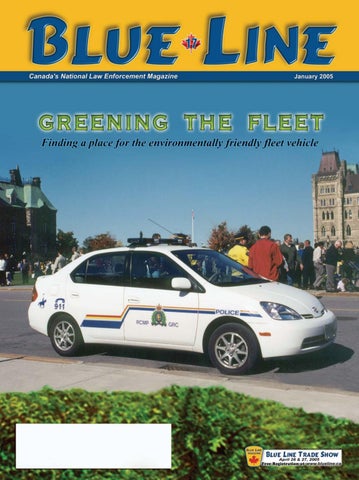
The Toyota Prius hybrid vehicle featured on the cover this month holds promise for some police needs. It was briefly tested by the RCMP in 2002 and while the Mounties didn’t find its performance suitable or cost effective for police needs, they suggested it may have good potential for bylaw and parking enforcement officers. As News Editor Les Linder discovered in researching Greening the fleet, the Prius went 100 kms on 4.5 litres in city driving in Transport Canada tests, about double that of an equivalent gasoline only vehicle, and had only half the emissions. A new Canadian was on hand at this year’s Michigan State Police Vehicle Trials — the Brampton-built Dodge Magnum. Although only entered as a special service vehicle this year, the rear wheel drive, V6 powered Magnum turned some heads — and expect the Magnum to attract a lot more attention if, as expected, DaimlerChrysler shows up at the 2006 trials with a 5.7 litre, Hemipowered, police-package Magnum. The automaker entered a Hemi Magnum in the non-published category this year, fueling hopes that it will return. Continuing on the car theme, Edmonton Police Service vehicle technician Stuart Prysunka tells us about the hard work involved in keeping police cars ready to roll and policecanada.ca chooses the top ten best looking police cars in the country. If you disagree with their choice, remember, Blue Line is just the messenger! In other stories this month, west coast correspondent Elvin Klassen looks at the difference the 100 Mile House RCMP detachment is making in the lives of youth by focusing on building relationships with them, Captain Mark Giles explains why good internal communications are the key to good morale and a positive public image and Dr. Dorothy carefully delves into the touchy subject of false convictions. In other regular features, Mike Novakowski has case law, Danette Dooley profiles the RNC’s canine officers in action. JANUARY 2005
Blue Line Magazine
4
JANUARY 2005
Quick . . . tell me what to do next by Morley Lymburner I remember being confronted once at the hospital by a violent, mentally unstable, muscular man much larger than myself. He had brutally assaulted several orderlies, nurses and doctors and completely demolished the room they had placed him in. His shirt had been torn off and huge, muscular arms confronted me when I entered. I knew the answer to this problem – call the police; but wait a second, I was the police and it was up to me to find a solution, even if it had eluded those before me. The annals of the hallowed halls of newspapers are strewn with the wreckage of misunderstood police activity. No more is this evident than in the trial of (ex-constable) Michael Ferguson. Ferguson was confronted in a hospital by a violent, out of control drunk whom he quickly discovered could easily overpower him. Using the tools at his disposal, he managed to gain control and place the person in his scout car. The man immediately smashed the door window but Ferguson managed to get him into the station cell-block where, once the cuffs were removed, another fight took place. Exterior body armour offered the assailant a handy tool with which to grab the officer and, fearing that the suspect would next grab his gun, Ferguson drew and fired two shots, killing the man. There is no police officer in the world who, once learning the facts of this case, would not immediately identify with the situation Ferguson found himself in. Much of the trouble arose from procedural break-down, which must be dealt with by RCMP leadership and – we can all identify with this one – officer complacency; another part, which also needs to be dealt with, is the public’s perception of police and policing. There is so much to say and so little space to say it in. I can only fall back on these pages to encourage the debate and continue the process of renewal. To walk away from the Ferguson trial and be satisfied that a ‘rogue cop’ has been convicted is simply not good enough, nor even true. Witnesses at a Royal Commission enquiry many years ago testified they saw officers beat the driver of a car as they were taking him to the cruiser. They were arresting him after a long chase which injured and almost killed several citizens and police officers. The judge concluded that police do not come with pressure gauges; anyone who has a violent encounter with police had better keep this in mind. Adrenaline can turn on like a tap but will not turn off as quickly. Even the highest trained individual is going to take a good 15 minutes to come down enough to resume fine motor skills. The amount of force which will flow Blue Line Magazine
from this can and has been devastating, but is understandable and must be accepted as the norm. An officer’s split second decision in a stressful and violent situation is analysed and dissected in the quiet of a courtroom for years after the event. It took three juries and three trials before a conclusion was reached in the Ferguson matter. At what point do we determine justice will be done to the satisfaction of all concerned? Their conclusion is far from a clear, decisive answer as to his guilt or innocence, but the reality is that the last person left standing after such a confrontation is the one who’s judged. The deceased never has to answer for actions which led to their demise, even if it was their actions which precipitated all that came after. The last points are the toughest to answer. Where does Mike Ferguson and the Varley family go from here? There is no real consoling a grieving family. Certainly the loss of a loved one in circumstances such as these will leave no real
5
sense of peace unless some form of forgiveness takes place. Letting go is tough; it is not in our nature to simply walk away from a perceived injustice and both sides derived no sense of closure in this case. Time is the only real healer that most people have, unless they have some form of faith to call upon. Not withstanding Ferguson’s conviction, a blanket policy of firing such people must be tempered by first considering the duties we expect of them. An officer is endowed with incredible powers, duties and responsibilities that very few people would want – but every citizen wants police to have this authority when their or their family’s safety is threatened. Citizens must be prepared for mistakes and miscues. The real determinator must be whether the error was made by misadventure or mischief. If by mischief or corruption, then firing and even imprisonment is the only solution, but if the action can be attributed to human error under extreme pressure, then this must be accepted as a hazard of the occupation. If we continue to scapegoat individuals, then the chilling effect within law enforcement may be far more damaging to society then to policing. Mike Ferguson was faced with a situation of which nightmares are made and it ended his career, a reality that officers face every day. The judge decided on a sentence of two-yearsless-a-day in house arrest after considering his unblemished 19-year career. In my estimation, his sentence fairly reflected this reality and, in and of itself alone, was the only form of justice received. Your responses are expected.
JANUARY 2005
by Dave Brown For more than 25 years, the Michigan State Police (MSP), in conjunction with the US National Institute of Justice (NIJ) have tested the handling and performance of police vehicles in each new model year. Their objective evaluations help decision-makers select their fleet for the coming year. Blue Line is once again reporting these highly anticipated results. The NIJ and MSP evaluate police vehicles in two categories: police-package vehicles, which are designed for the full spectrum of general police activities, including high-speed pursuit, and special-service vehicles, designed for specialized duties such as dog units, adverse weather conditions or off-road use and are not intended or recommended for pursuits. For 2005, five vehicles were submitted in the police-package category: the Chevrolet Impala 9C1, Tahoe PPV and PPV E85 (a flexible fuel version, designed to run on regular gasoline or gas and up to 85 per cent ethanol) and two Ford Police Interceptors, one with a 3.27:1 final axle ratio and the other with a 3.55:1 ratio. This is the first time since 1998 that a pursuit-capable sport utility vehicle (SUV) was evaluated in the normal police-package category. Special-service vehicles submitted for 2005 include the four-wheel-drive Chevrolet Tahoe SUV, Chevrolet Silverado 6.6 litre direct-injection turbo diesel pick up truck, the two-wheeldrive Ford Explorer, Ford Expedition and the 3.5 litre Canadian-made Dodge Magnum. Manufacturers are also allowed to submit vehicles for testing in the non-published category. This is where we often get a glimpse at future police vehicles. DaimlerChrysler submitted a 3.5 litre, four-wheel-drive version of the Dodge Magnum and a rear-wheel-drive Magnum with the 5.7 litre Hemi engine (see sidebar article for more about it and front versus rear-wheel-drive). The tests The vehicles are all tested over a threeBlue Line Magazine
day period at the DaimlerChrysler Proving Grounds and the Grattan Raceway, without rooftop lights, spotlights, sirens or radio antennas in place. Tires are original equipment rubber provided by the manufacturer. Acceleration, braking and top speed tests are performed at the proving grounds and vehicle dynamics tests are done using the two-mile Grattan road course. All dimensions and measurements below are in US numbers. 2005 police-package vehicles Chevrolet: Blue Line Magazine was given an early look at GM’s new police-package Chevrolet Impala in 1999 and we have seen the front-wheel-drive design mature over the past few years. Equipped with the same 3.8 litre V6 engine as last year, the Impala is quick, nimble and roomier inside than its exterior dimensions would suggest. The Tahoe SUV was recently redesigned and the 2005 version is now ready for full police-package duties, including pursuits. GM is appealing to both ends of the police market with the frugal and manoeuvrable frontdrive sedan and the roomy sport utility vehicle; and make no mistake about it – the policepackage Tahoe’s emphasis is definitely toward the ‘sport’ end of the spectrum. With its new 5.3 litre sequential port fuel injection engine, it gets to 60 miles per hour quicker than both the Impala and the Ford 3.27 Interceptor and beats both the Impala and the Ford 3.55 Interceptor for top speed. DaimlerChrysler: The police-package Dodge Intrepid that showed so much promise in 2003 and 2004 is now discontinued. DaimlerChrysler submitted the new Dodge Magnum but only in the special-service category, at least for this year. Ford: Ford once again shows why it owned the police sedan market for many years with its two versions of the rear-drive Police Interceptor, one with a 3.27:1 rear axle ratio and the other with a 3.55:1 rear axle ratio, first in6
Dodge Magnum
Chevrolet Tahoe
troduced for 2004. The lower 3.55 gearing means it will accelerate slightly faster, at the expense of a lower top speed. Because most police vehicles never reach their theoretical top speed anyway due to the aerodynamics of the light bar, Ford’s newest option means a few fractions of a second advantage in both straight line acceleration and road course lap times. Ford will introduce an automatic (with manual override) fire suppression system in the Interceptor toward the end of this year. The results Vehicle dynamics testing The objective of the vehicle dynamics testing is to determine the high-speed pursuit handling characteristics. Except for the absence of traffic, the two-mile road course simulates actual pursuit conditions, allowing the blend of suspension components and acceleration and braking ability to be evaluated. JANUARY 2005
Blue Line Magazine
7
JANUARY 2005
Four separate drivers each take the vehicles for eight-lap series. The final score is the combined average of the five fastest laps from each.
Acceleration and top speed The objectives of the acceleration and top speed tests are to determine each vehicle’s ability to accelerate from a standing start to 60, 80 and 100 mph and to record the top speed achieved within a distance of 14 miles from a standing start. Each vehicle is driven through four acceleration sequences, two in each direction to allow for wind. Acceleration score is the average of the four tests. Following the fourth acceleration sequence, each vehicle continues to accelerate to its highest attainable speed within 14 miles of the standing start point.
Braking The objective of the braking test is to determine the deceleration rate attained by each vehicle on 12 60-0 mph full stops to the point of impending skid and with ABS in operation. Each vehicle is scored on the average deceleration rate it attains. Each test vehicle makes two heat-up decelerations at predetermined points on the test road from 90 to 0 mph at 22 ft/sec2, using a decelerometer to maintain rate. The vehicle then turns around and makes six measured 60-0 mph stops with threshold braking applied to the point of impending wheel lock, using ABS if so equipped. Following a four-minute heat-soak, the sequence is repeated. Initial velocity of each deceleration and the exact distance required is used to calculate the deceleration rate. The resulting score is the average of all 12 stops. Stopping distance from 60 mph is calculated by interpolating results.
Ergonomics The objectives of the ergonomics and communications test are to rate how suitable a vehicle’s environment is for patrol officers as they perform their job. Testers also look at how well a vehicle accommodates required communication and emergency warning equipment and how difficult it is to install the equipment. A minimum of four officers independently evaluate each vehicle on comfort and instrumentation. MSP Communications Division personnel then evaluate how easy it is to install equipment. A total of 28 factors are evaluated on a scale of one to ten and averaged Blue Line Magazine
among all the testers. The final score is the total cumulative score from the average of each of the 28 factors, such as seat design, padding, ease of entry, head room, instrument placement, HVAC control placement, visibility, dashboard accessibility and trunk accessibility. Fuel economy While not an indicator of actual mileage that may be experienced, the US Environmental Protection Agency (EPA) mileage figures serve as a good comparison of mileage potential from vehicle to vehicle. Vehicle scores are based on data published by the vehicle manufacturers and certified by the EPA. Conclusion The highly respected annual vehicle tests are both comprehensive and fair and Blue Line has published the results for most of our history. Our own experiences with police vehicles has also reinforced the validity of the testing process. The Michigan State Police do not declare overall winners, simply because every agency has different requirements. Ve-
hicles must be evaluated on how their individual strengths match the needs of each individual police agency. The MSP also does not evaluate in-service factors such as longevity, reliability or ease of maintenance. For 2005, agencies can choose everything from a front-drive sedan, a rear-drive sedan or a roomy rear-drive sport utility vehicle; all are ready to tackle every aspect of police work.
Front versus rear wheel drive by Dave Brown Forget what you learned in high school driver ed about rear versus front wheel drive; rear drive is what you want. Front is what you wish everyone else drove. Front wheel drive places the traction wheels directly under the heaviest end of the car, helpful in bad road conditions. Rear drive puts them at the lightest end, although traction improves as weight transfers to the rear during acceleration and when climbing hills which, coincidentally, is just about the time you need it the most. Front drive vehicles are good on slippery roads but stumble climbing hills; an important lesson quickly learned the first time one tries pulling a boat up a steep, slippery ramp. More than one proud new boat owner has helplessly spun their front tires as car, boat and trailer slide gracefully into the water. For sheer entertainment value, not much beats hanging around a busy boat launch on a Saturday afternoon. Front-drive vehicles are advantageous for poorer drivers because the front tires steer, brake and accelerate. This usually means understeer during cornering; rear-drive can induce throttle-on oversteer when needed. Understeer simply means the front end tends to ‘plow’ through corners and, if the cornering limit is exceeded, the car is apt to go straight instead of where the wheels are turned. The solution is to simply back off the gas, which tends to come naturally – at least to most drivers – as they slide straight toward the guardrail. Oversteer is when the rear wants to ‘step out’ and begin rotating around the corner more than the front. The solution is to countersteer, which is also pretty natural, if much more alarming to bystanders. In fact, it was once suggested that understeer is when the driver is scared and oversteer is when passengers are scared. Controlled oversteer is familiar to officers in a reardrive car who needs to make a tight turn in a hurry. Also forget what you were told about steering into skids - or was that away from skids? When the rear steps out, steer where you want to go. It’s pretty instinctive. About the only place this doesn’t apply is at Indianapolis Motor Speedway where, it’s said, you never turn right. If the rear gets loose, there’s not much to do but let it spin, hang on, enjoy the ride and hope you don’t stuff it into the wall. This may sound fatalistic but I’d much prefer spinning out of control at Indy than whipping down the 401 on a foggy morning in rush hour. (This simple prairie boy still recalls heading up the 401 in an Impala after testing Chevy’s brand-new police vehicle at Mosport Raceway. I was doing a cool 140 in the left lane, being passed on the right by bimmers and caddies — and this was in a marked police cruiser!) Just to prove that rear-wheel-drive is not yet prepared to roll over and die, especially in the police market, DaimlerChrysler entered the brutal new rear-drive Dodge Magnum with the 5.7 litre Hemi engine in the non-published category of this year’s Michigan State Police Vehicle Tests. The Hemi Magnum, with its extended passenger compartment out to the rear end, looks suspiciously like a really low-slung station wagon, especially if your idea of a station wagon includes a top speed higher than every Ford and Chevrolet police vehicle on the market today. Okay, so it’s not exactly your dad’s Oldsmobile. For one thing, there’s no place to glue on the fake wood trim. For another, I suspect the trim would just blow off anyway at 140 miles per hour. DaimlerChrysler is currently only prototyping the car as a police vehicle, at least for now. I would love to see a police cruiser with those looks and all that excess horsepower waiting to be unleashed onto unsuspecting speeders on the 401. On the other hand, the thought of all that power dumped onto a roadway through lightly-loaded rear tires scares me a bit and the first time I stuffed one deep into a winter ditch and had to endure the next 100 people slowing down and yelling ‘ya’ll got a HEMI in that?’ would be just too much to bear. The full report, which should be available by the time you read this, is available at h t t p : / / w w w. n l e c t c . o r g / t e s t i n g / vehicles.html. Dave Brown can be contacted at firearms@blueline.ca.
8
JANUARY 2005
Blue Line Magazine
9
JANUARY 2005
Unsung unit keeps cruisers rolling by Stuart Prysunka Deep beneath Edmonton police headquarters, they work tirelessly to keep the men and women charged with keeping the city streets safe on the move. They’re the men and women of the transportation unit (TU), who take care of everything from purchasing and repairs to disposal of all Edmonton Police Service (EPS) vehicles, which they call units. Almost anything can (and usually does) happen during their life span – and life span is almost too accurate a description for police vehicles, as they do seem to take on a life of their own, at least to the people who keep them running. It’s funny how two inanimate objects, supposedly built the same way and possibly on the same day, can each have unique problems. It’s the task of the TU mechanical and service personnel to use their training and experience to solve all these little mysteries. It’s usually the years of hands on experience that prevails, as a fleet of police vehicles is like no other fleet around! The staff consists of a foreman and 13 mechanics and service personnel who work in conjunction with a fleet administrator and secretary representing the EPS. The main shop in
the basement of headquarters is supported by three satellite stations, two (west and north division) which have complete service facilities, including floor hoists. The soon to be constructed south division HQ will also be similarly equipped. Service personnel at each satellite station complete basic running repairs but send the units to the main garage for more serious work, including scheduled major inspections. Units are also brought in for regular speedometer testing to ensure that any ‘clocked speeding tickets’ are accurate. Two technicians are motorcycle specialists, responsible for keeping the fleet of Harley Davidsons up and running during the limited riding season. EPS also has a few old Kawasakis, which are used for motorcycle training and qualifying. Classes are usually held only twice a year and are a good test of both student and mechanic expertise! Motorcycles take a real beating in training – rookie riders have a way of testing grav-
ity and burning out clutches in as little as a few hours. These battle weary two wheelers are brought in for repairs, which range from scratches, dents, brake and tire replacement to new clutches, on a daily basis. They’re always repaired and ready for more abuse before the next day’s training begins. Along with general maintenance, the EPS police garage also handles all new vehicle installations. Full size, marked Police Interceptors (including all decaling), unmarked vehicles, covert and surveillance equipment and specialized tactical vehicles are just some of the units designed and assembled in house. The team of technicians for this annual task consists of two permanent police garage employees and as many as four temporarily hired people or individuals transferred from other City of Edmonton repair facilities. The ‘new car section,’ as they’re called, are responsible for much of the designing and fabricating of special use equipment mounts and brackets, a challenging but rewarding task. Officers supply plenty of input about how the tools are used, helping the team to better meet their needs and ensure safe and smooth operation in the field under tactical conditions. Most EPS staff eventually visit the garage, whether for operational needs or just to ask a question or two about their own vehicles. The garage also has a parts department, staffed by a qualified parts technician who keeps the stock up to date and orders parts needed for the fleet. At times they may have to search for rare and obscure parts required to keep up the EPS Museum Unit’s collection of old and antique police vehicles. This can be as simple as a trim piece for a 1992 Crown Victoria or as seemingly impossible as a horn button for a 1957 Chev 4 wheel drive wagon. Whatever the case, they somehow always manage to find what we need. Stuart Prysunka is an EPS vehicle equipment technician who’s been with Edmonton’s mobile equipment services section for more than 15 years, the last seven with the police garage. He can be contacted at stuart.prysunka@police.edmonton.ab.ca. He dedicates this article to the memory of Gary Homer, “whose tireless dedication to customer service molded the EPS Transportation Unit into the highly respected team it has become. A true friend and mentor to many, taken from us too soon at the age of 62.”
Blue Line Magazine
10
JANUARY 2005
International effort combats phone scams by Ryan Siegmund With five million victims and more than $1 billion in loses, telemarketing fraud has become an increasingly sophisticated and international criminal enterprise. Police in Canada, the US, Spain, Costa Rica, Nigeria, the Philippines and the UK have launched Operation Roaming Charge (ORC) to combat the problem. Its primary goal is to increase public awareness and education, says Peter German, RCMP Director General of Financial Crime. Dubbed the most extensive multinational enforcement operation ever directed at telemarketing fraud schemes, the US led initiative has conducted 100 separate investigations, resulting in more than 135 arrests – 100 in the US alone, where 70 people have been convicted. More than 190 search warrants have been executed in Canada and the US. The majority of the telemarketing schemes uncovered originated in the US, says German, including bogus tax fraud schemes, lotteries, sweepstakes, ‘preapproved’ credit cards, nonexistent investments and employment and business swindles. International cooperation between police is essential, notes German, and has increased greatly since 2001. “We always worked together but now its more a case of you ‘will’ work together unless you determine that there is a reason why you can’t or you shouldn’t… excellent cross border relationships develop as a result.”
Blue Line Magazine
German is impressed by the work and contributions of the US justice department, FBI, postal inspection service and Homeland Security. The initiative was driven by those agencies, he says, with Canada pooling together its various strategic partnerships, including the RCMP, PhoneBusters, the competition bureau and joint task forces such as Project COLT in Montreal, Project Emptor in Vancouver and Toronto and Alberta partnerships. A number of the cases also demonstrated that organized criminal operations are engaging in telemarketing fraud. The largest operation stems from a telephone ‘cramming’ scheme in New York. An alleged capo, a soldier and associates in the Gambino crime family generated approximately $500 million in gross revenues by allegedly placing unauthorized charges on local telephone bills of millions of consumers. A call center was also allegedly created to deal with customer complaints. “This wasn’t one organized crime ring,” says German. “This had a number of different telemarketing operations and mass marketing schemes.” The schemes used tend to be mostly traditional telemarketing scams, notes German, although criminals in the US have begun masquerading as authorities to fool their victims.
11
“They often times try and turn what the police are doing against the police,” says German. Criminal telemarketers call an individual and tell them they have won the lottery and follow up by sending a phoney counterfeit letter from customs confirming the prize. The catch is that the ‘winner’ has to pay taxes on the prize before it can be sent to them; the ‘authorities’ then call the victim and request that they pay the taxes owing. “What they are really doing is using law enforcement for their own purpose as part of the pitch; you see that type of thing constantly – they are constantly adapting,” German says. ORC members have coordinated announcements to create as much public awareness of the problem as possible. German says he’s learned one press statement can get covered in an awful lot of newspapers; the diffusion is “incredible,” he says, really helping to spread awareness. “If people accept the fact that money is not given away in this society and that you should never pay money up front, then most of these problems would go away,” he says. Ryan Siegmund is a freelance writer and researcher working with Blue Line Magazine. You can contact Ryan at ryan@blueline.ca.
JANUARY 2005
Blue Line Magazine enlisted policecanada.ca to pick the top 10 best looking police cars in Canada. The winning designs were selected and judged for their uniqueness, originality, visibility and overall impact. The grand winner of the best looking police car for 2004 is the MRC des Collines police service Quebec. This regional police service is responsible for policing seven rural municipalities spread out over 2078 square km with their headquarters located in Lapeche. The graphics are just awesome with all the different shapes and colours accompanied by clear identification of the vehicle, its fleet number and the emergency number at the back. The clearly defined usage of the gold and green accompanying the blue letters makes this vehicle stand-out. A very close vote placed this design slightly ahead of Windsor.
2. The border city of Windsor, Ontario, makes it in the number two spot. This unique car is all about what it means to be Canadian. The way the Canadian leaf is proudly displayed certainly removes any confusion in the minds of Americans crossing into Canada as to which country they are in. Everything really flows well.
4. The number four position goes to the city of Gatineau, Quebec. This police service based their paint scheme on the new city logos and colours which reflect upon proximity to both urban and country life combined with the influences of the Ottawa River Valley.
3. The York Regional Police in Ontario is third. Even with more modern markings we can still see the traditional door seal and the “Deeds Speak” motto. This is the first redesign of their car since the early 80’s and is in keeping with their view of uniqueness in police car identity.
5. Amherstburg, Ontario is number five. Just a swim away from Michigan State this design hints at an American influence but manages to maintain its true Canadian flavour. The manner in which the blue and red combinations are placed makes the car highly visible.
Blue Line Magazine
12
JANUARY 2005
6. The Miramichi Police in New Brunswick takes in a group of communities along the Miramchi River. The design of the markings on their cars certainly reflects the diversity of the communities they serve.
10. The Mistissini First Nation Police Service in Quebec is a small community located north of Chibougamau. The first thing that sticks out is the light blue on black. The use of the colour black is well complimented with the flowing lighter tones running the full length of the vehicle. Much thanks for oganizing this goes to Erik Young of PoliceCanada.ca. If you have a new police car design and would like to enter it for recognition next year check out the site at www.policecanada.ca and email them your submission. Blue Line thanks go to PoliceCanada.ca judges: Stephane Breton (Lac-Megantic QC) Gerard Donnelly (Quebec QC) Robert Clope (Racine Wisconsin) Jim Botaitis (London Ont) Samuel Smith (Easton Pennsylvania) Eric Langlois (Calgary Alberta) Stephane Boulanger (Quebec QC) Jody Hibma (Vermillion South Dakota) Erik Young (Gatineau QC) NEXT MONTH
The British Columbia bait car program Three men were arrested during two bait car thefts over a two day period in November in lower mainland British Columbia. On November 16, 2004 at 2:00 AM, the regional emergency dispatch center notified Burnaby RCMP of a bait car theft in progress. The bait car was started and was on the move before officers arrived at the scene. The dispatcher was able to constantly update officers with the exact location, speed, and direction of travel of the stolen bait car using GPS technology as it was driven from south Burnaby towards Vancouver. Police dispatchers quickly patched the Burnaby and Vancouver police radio channels together so that officers from the two areas could stay in constant communication with each other during the incident. The bait car turned onto a freeway and began to drive eastbound, but by this time nine police cars were already following it. The bait car video that was viewed later shows the lone occupant looking in the rear-view mirror and swearing as he spots the police. He then says to himself, “Oh man, I’m going to jail, look at all the cops!” When officers called for the engine of the bait car to be disabled, the suspect finally realized his demise when he said, “Oh, it’s a bait car!” The car then came to a rolling stop and the suspect was arrested without incident. The suspect is a 37-year-old Coquitlam resident with 30 criminal convictions on his record. He currently has court-ordered conditions where he is not to be in a motor vehicle unless the registered owner is present. He faces charges of breach of conditions, theft, and possession of stolen property. On November 14, 2004 at 1:15 AM, Mission RCMP were notified that a bait car was being stolen. Within a few minutes, police were behind the bait car, in this case a full size pickup truck, and a 35-year-old and 46-year-old man were arrested without incident. Both men are Mission residents well known to police. The bait car program has proven to be an effective deterrent for auto thieves. Since the program began April 1st last year, auto thieves have been arrested in bait cars in almost every municipality in the greater Vancouver area. The auto theft trends in the Vancouver area are different than those seen in the larger cities of eastern Canada where organized crime is responsible for the bulk of auto thefts. In B.C. 95 per cent of stolen vehicles are recovered, and only five per cent are chopped for parts, exported, or re-sold with forged vehicle identification numbers. There is a simple reason for this anomaly: Drug addiction. Next month Blue Line Magazine staff writer, Ryan Siegmund, will present an indepth article on the background of this innovative program and explain how and why it is working so well.
7. The all black police car with colourful stripping from the Kitigan Zibi Anishinabeg, Quebec, first nation police service near Maniwaki takes number seven position. The look of refined ruggedness is blended with the cultural identities of the community they serve.
8. Camrose, Alberta takes number eight. With only 25 sworn officers this small department is fully accredited with CALEA. Although not shown, they currently promote this fact on the sides of each police car. Of particular interest is their usage of the full colour spectrum.
9. The Anishinabek police are a police service with 17 detachments serving communities in mostly northeast and central Ontario. This design was created and inspired by first nations people themselves and reflects the visible images of the communities they serve. Blue Line Magazine
13
JANUARY 2005
Encouraging youth at their level Asset building is an approach, not a program by Elvin Klassen “Youth and proactively building relationships has become the number one policing priority of the 100 Mile House RCMP Detachment,” says S/Sgt Warren Dosko. “The young offender contacts (has) dropped over 50 per cent in just over two years,” Dosko, detachment commander and 18 year RCMP veteran, continues. “I believe that the number is going to continue to decline as the community continues to take hold of asset building as a foundation for involvement with youth.” 100 Mile House, British Columbia was originally a roadhouse 100 miles north of Lillooet, along the wagon road to Barkerville. Today the town of about 2,500 people (15,000 including the much larger rural area) serves as the service centre for the South Cariboo. Dosko took over the RCMP Detachment, which has 18 officers and five civilians, in 2002 and invited Vision Training/Search Institute trainer Keith Pattinson to speak to staff and school/community leaders about preventing crime through social development. They looked at the social issues causing problems in the community and how to eliminate them. When youth have more assets, they discovered, the inappropriate behaviour decreases dramatically. “In the fall of 2003, we ran a pilot project together with Educo Adventures where we took seven grade seven students, a vice-principal and seven police officers and spent one day interacting in various ‘ice breakers’ and team leadership exercises,” says Dosko. The feedback was overwhelmingly positive so 90 grade eight students were paired with 90 adult role models in 16 one-day sessions. Students were identified by the school as hav-
Blue Line Magazine
ing high needs, being at risk or able to provide leadership to the small groups they were broken into, each consisting of six students and six adults, including at least one police officer. Adult role models to date have included elected municipal officials, health professionals, teachers, media, business owners, government employees and private citizens. “The results of these sessions are remarkable to say the least,” Dosco says. “The interaction that occurs during the day truly is magical but the real benefit is what is happening in the community after the fact. The attitudes that are being changed and relationships that are being formed are having a direct impact on the police. Not only do the police get an opportunity to interact with the youth, they get to interact with the adult role models.” Educo Adventure School, a non-profit organization with a focus on youth, has partnered with 100 Mile House to promote asset building at its camp near town. Educo began in the community and has since expanded to many other countries. The informal day at the rustic camp in-
14
cludes orientation, icebreakers, solving problems one-onone and working together for a common goal. Support and trust is developed with activities such as discussing important people in the youth’s lives, high ropes challenge course and blindfold experience. Debriefing is an important part of the process. On the way home, a young participant commented that he would no longer be able to steal from one of the business participants with whom he connected, since they had become friends. “As a first-timer at Educo, I felt very secure because of all the support and reassurance I was given by the others and the instructors,” another said. “The RCMP guys were unexpectedly pretty cool. I thought it was very neat that they were nervous as well. That was the most reassuring part. I thank them for wanting to spend a day with 100 Mile junior students. “The experience at Educo was exhilarating and adventurous. Spending the day with the RCMP was frightening at first, but I got accustomed with it. When the day ended, it was sad to go... “It was a great day and I think we all had a blast. We did a lot of group activities and we learned how to work together, even though we didn’t know the police officers or the other adults. The police officers were really nice, even though we didn’t know them very well.” The 100 Mile House Youth Resource Centre, a partner in the program, has done some outstanding work of its own, supported by RCMP officers who participate in pool tournaments, car washes, evening dances, pizza nights and informal visits. Community leaders decide which age levels have an asset deficit and have already chosen grade eight students to participate in the next Educo program. The detachment is also involved in a community partnership program called ‘Preventing Alcohol and Risk Related Trauma in Youth’ (PARTY), a one-day program for all grade 10 students. The coroner, doctors, victims of impaired driving, victim services, school counselors, fire and rescue and BC Hydro also participate. 100 Mile House High School also uses Educo Adventures resources to help grade eleven students develop leadership skills. All these programs are great but Dosko stresses it’s the individual participants who create the successes. “The real key for cops and kids in asset development is for each police person to understand the impact that they can have on the JANUARY 2005
outcome and future of our youth. There are endless opportunities for police to utilize the asset development approach in their everyday duties, without the existence of special programs. “This is true community policing. We all too often want to create a program when, in fact, it is the approach that is so important, not the program.” S/Sgt Dosko can be reached at warren.dosko@rcmpgrc.gc.ca or 250 395-2456. Elvin Klassen, Blue Line’s west coast correspondent, can be contacted at elvin@blueline.ca.
Blue Line Magazine
B.C. auxiliary officer killed An RCMP auxiliary officer was killed in November after a stolen van crashed into his police cruiser at an intersection in Vernon, B.C. The 39-year old auxiliary constable, Glen Evely, was riding in the passenger seat of the cruiser was pronounced dead at the scene. Cst. Frank Grenier, a 20year veteran of the RCMP, was also seriously injured. Other officers were pursuing the van after receiving a call about an impaired driver. They broke off the chase because the vehicle was going too fast, police said. The van was reported stolen out of Armstrong, B.C., a town 15 kilometres north of Vernon. The driver of the van continued into the downtown core and ran a red light, where it collided with the police cruiser. Alcohol was being considered as a factor in the incident, police said. The 18-year-old male driver of the van and a 16 year old female pas-
15
senger were taken to Vernon hospital. Evely had been working with the Vernon RCMP for two years. Mayor Sean Harvey said the tragedy had shaken the tight knit community. “People are at first shocked and then overcome by a wave of grief and then anger that this one auxiliary constable was killed and another regular member is severely injured as the result of someone stealing a car and choosing to run a red light,” Harvey was quoted as saying. “This wasn’t someone working for a paycheque. This wasn’t someone putting in overtime,” he said “This was someone who believed in his community to the point where he was willing to volunteer to help protect us and keep us safe. He’s paid with his life.” Michael Douglas O’Brien, 24, was charged with criminal negligence causing death and bodily harm, theft over $5,000 and flight from police. Evely leaves behind a wife and two young children, age four and seven.
JANUARY 2005
Good internal communications are crucial Key to good morale and a positive image
by Mark Giles Regardless of the effort put into public, media and community relations, external communications will always be linked to the success of an organization’s internal communications program. Often overlooked, internal or employee communications provide sworn members and civilians with vital operational information, an awareness of the organization’s goals and objectives and details of programs designed to meet them. Effective employee communications can also build confidence and support for management initiatives. Too often, however, they’re simply a one-way pipeline of directives and achievement highlights; that may play well to the external audience but ignores front-line officers and support staff, who need to know that management is on their side during good times and bad. Even if an organization’s primary focus is external communications, the best way to succeed is through developing and maintaining a solid means of communicating with employees. It’s what insiders say about an organization’s operations, morale and credibility that really counts. Sales and marketing professionals know that testimonials are among their most effective tools and the media and public place considerable weight on the statements of frontline officers and support staff. “The key to good external communications is effective internal communications,” said Rachel Boyer, director of external communications and public relations for the Department of National Defence. “Without effective communications internally, an organization loses the opportunity to have its own people send their message to the community.” Sworn members and civilians will send a message even without effective communications, but it may not be the one management wants sent. Poor internal communications can also lead to low morale, as front-line officers and support staff may feel they are not valued. If ignored long enough, it can lead to conflict with unions, associations, individuals and groups. An organization must make its people a top priority. Toronto Hydro CEO, Courtney Pratt, believes that an organization’s three primary stakeholders are customers, employees and shareholders. In public-sector law enforcement, customers and shareholders are arguably one and the same and corporate messages and programs have been tailored to them for decades. ‘To serve and protect’ is a common theme and professional standards sections expend considerable resources to ensure the public is aware of their efforts to address public complaints and concerns. This is essential, generally commendable and must continue, but that leaves employees as a key stakeholder group that must be addressed. Reaching the internal audience Messages sent via internal communications must be consistent and clearly demonBlue Line Magazine
strate that management values employees of all ranks, both sworn and civilian. Communicating effectively to the internal audience involves using tools such as an Intranet web site, newsletter, corporate e-mail and bulletins, and employee meetings with senior management – but it must also be backed up with a sincere effort by senior managers to show they are involved and care. The concept of getting out of the ‘Ivory Tower’ to meet the rank and file is not new – in fact most corporations and law enforcement agencies endorse it – but how many practice it? It’s essential, wrote Jim Clemmer, author of the Leader’s Digest, in his Globe and Mail article Team spirit built from the top (Nov. 26, 2004). The idea of senior management getting out of the office every couple of months and working a shift on the front lines may be just what’s needed to overcome the ivory tower syndrome. “I can’t think of a better way of showing the men and women on the ‘street’ that management cares, supports their efforts and is trying to understand the challenges they face every day,” said Al Koenig, president of the Calgary Police Association (CPA). Web sites It seems that every organization has a web site today, as they should. If used properly, they can reach more people than ever before – but Intranet sites, designed for internal users, are just as important and an ideal way to communicate with employees. Good internal marketing will get the user to your site once, maybe twice, but to keep them coming back, your site must have something to offer. This includes not only a common look and feel, consistent with the overall corporate brand, but regular updates, at least weekly and more often if time permits. A userfriendly home page and relevant and logical sections on the left-navigation bar, containing current information, will encourage users to come back frequently. Your Intranet home page is a great place 16
for a message, or link to a message, from the chief, but it should also follow some rules. Keep it short, relevant and use it to tell employees they are important to the organization. Outlining specific goals and objectives can sometimes be helpful, but avoid the temptation to digress into ‘corporate speak,’ which sends an ivory tower message rather than one that connects with members and civilians on the front line. If written well, with an employee-focused theme and occasionally featuring a deputy chief or other senior officer, it can become a meaningful section, of interest to the internal audience, rather than just a formality. Newsletters Some may suggest that the rise of the Internet and the use of corporate web sites negate the requirement for newsletters; but just like newspapers, they continue to be popular. A tangible, hard copy newsletter is an easy read and can be taken home, on patrol or to the coffee shop. Newsletters are also effective in reaching those not yet comfortable with or inclined towards regular computer use. The newsletter should have a common look and feel and be issued regularly, monthly or quarterly for example, in a consistent and easyto-read format. As with newspapers, where the reader becomes accustomed to regular sections focusing on the city, arts or sports, the newsletter too should have regular sections of interest, including a short message from the chief. “When a chief puts it on paper, it increases credibility and shows confidence in what is being said,” said Blue Line publisher Morley Lymburner. “Internet, television and radio are extremely fleeting, changeable and can be edited at the flick of a switch. Paper, on the other hand, endures, so an organization must get the message right and back up their words with action. It is like signing a contract with your readers.” The newsletter should market the web site and vice-versa. Some articles and information posted to the web can be used for the newsletter. Not every member goes to both JANUARY 2005
regularly and for those that do, a second hit of well-written articles and useful information will not be harmful. Launching and maintaining web sites and newsletters requires considerable resources and effort for research, writing, copy editing and layout, so be sure your agency has the necessary staff and budget to follow through. For federal agencies such as the RCMP, Canadian Forces Military Police, Immigration Canada and others, another challenge is translating all information into both official languages prior to posting or publication. The process reversed negative publicity Just as web sites, newsletters and other material can enhance internal and external communications, they can also generate negative publicity. Their use for negative and sometimes destructive purposes has caught some police and law enforcement agencies by surprise. Anti-management web sites and campaignstyle material targeting the Calgary Police Service (CPS) showed up last October. Although the door-to-door campaign appears to be the work of a citizen known to oppose police, one web site which attacked management was purportedly developed by active-duty or retired CPS members. Ten days and approximately 11,000 hits later, the web site was closed and CPS management took a variety of steps to address the situation. “The chief was concerned that this web site was tainting all of us,” said Robert Palmer, CPS public affairs and media relations manager. “It’s clear that those responsible for the site
Blue Line Magazine
had no respect for those who wear the uniform with pride and for whom being a police officer is a calling.” This pride is important and while there will always be a few disgruntled members, police managers must ensure their good intentions are communicated effectively. The CPS appears to have some work to do on this; a recentlyreleased CPA performance evaluation of senior officers by rank-and-file members clearly shows members perceive problems. Although the evaluation was described as flawed by the chief and Insp. Joan McCallum commented that being a manager is “not a popularity contest,” the CPS is taking steps to address the situation, including providing messages and information to all personnel via its Intranet web site, corporate newsletter and email system, and issuing departmental memos. Reaching the internal audience with external communications All efforts to reach employees don’t have to be conducted internally. Although media interviews, by radio, print or television, are primarily directed at the public, they still reach the internal audience and their family, friends and associates. Reacting to requests for interviews and proactively seeking out other opportunities, Chief Jack Beaton and other CPS spokespersons engaged the media to ensure their messages were heard. Speaking on the Dave Rutherford Show (radio) Nov. 22, Beaton addressed listeners candidly as he spoke of the anti-police campaign, anti-management web site and his concerns for officer safety and morale. This was part of an
17
aggressive strategy to be open, transparent and forthright regarding his expectations. Beaton can’t do it alone though. He will need the help of his officers and civilians of all ranks. A consistent corporate message that employees are valued as important stakeholders can reverse any morale problem that may exist. It’s an ongoing process and takes considerable effort but is worth it if members and civilians gain confidence in their chief and senior management and pride and passion for the work they do. Building morale and team spirit with communications Good communications involve more than a sharp looking, well branded web site and newsletter, employee meetings and well-spoken media relations officers. A professional law enforcement agency will certainly have these resources, but most important is a commitment to developing a cohesive team of sworn members and civilians that feel valued. This requires consistent messages, followed up by actions, which are communicated to all audiences. Most law enforcement agencies today have long recognized the importance of public, media and community relations. It’s time to put more effort into internal communications, which, if done effectively, raises morale and better prepares both sworn members and civilians to speak effectively and positively about the service they provide their communities. Captian Mark Giles is the communications director for the Canadian Forces Provost Marshal, Canadian Forces National Investigation Service, based at National Defence Headquarters in Ottawa. Email: giles@blueline.ca.
JANUARY 2005
The touchy subject of false confessions by Dorothy Cotton Official disclaimer: I am not a police officer; you probably already knew that. I am actually reasonably aware of that fact myself and so generally check out ideas I have for this column with actual police officers. Sometimes my police colleagues say “what a good idea! You should write about that!!” Other times they tell me “turn and run! What a bad idea! That is a can of worms!!” I recently ran across a whole body of research that addresses the subject of false confessions. What with the proliferation of DNA evidence, false convictions are a hot topic – and sometimes, false convictions are related to false confessions. There are a lot of studies demonstrating that it is not all that hard to get people to confess to things they didn’t do. Some people confess for the fame and notoriety – over 200 people confessed to kidnapping the Lindbergh baby, for example. Some people confess because they figure they are going to get convicted anyhow (even though they are innocent), so they might at least try for a more lenient sentence; some confess because they end up thinking they really committed the crime, even though it is later proven that they didn’t.
Anyhow, there is a whole lot of research that demonstrates that this stuff really does happen – and it tends to point a lot of fingers at things like some of the interrogation techniques currently promoted. So I mentioned this idea to a wise and senior police person with whom I have been known to consult and he gave me the “turn and run” advice. Apparently, poking holes in these techniques would fall in the category of ‘Things Best Not Done, Especially by a Psychologist.’ I can take a hint. I am not even going to mention any of these police techniques – I’ll just tell you about a study I read which involved 75 university students. They were told it was a study about reaction time, but that was actually a fib. Two students at a time were taken into a room with a computer; one was told to read out some letters and the other to type them into the computer as fast as he could. The ‘reader’ was actually a foil, there to help dupe the other student. The typing student was told that, no matter what else he did, he should NOT hit the ‘ALT’ key because the computer program would self destruct, the study data would all be lost, the world would end and the experimenter would get very grumpy. You can probably guess what happens next. Part way through the session, the computer appears to self-destruct and the examiner
comes in raving mad about how the student obviously hit the ALT key. The examiner urges him to sign a document saying he hit the ALT key and that it was his fault the experiment blew up. In some cases, the foil said she didn’t see whether the student actually hit the key; other times she would say “actually, I saw you hit it” (for the record, none of the students actually hit the key). Also, in some cases the foil read off the letters at a nice leisurely pace and sometimes she read them very quickly. So did the students eventually ‘confess’ to hitting the key? Sixty nine per cent signed the confession. Of course, that doesn’t mean they actually believed it – but they still signed it. Twenty eight per cent actually became convinced that they had really hit the key and nine per cent were actually able to offer details about exactly how they hit it and when – saying, for example, “I was going for the “N” key and I hit ALT with the side of my left hand by accident.” Students were more likely to confess if the foil read the letters to them quickly and said she saw them hit the key – fully 35 per cent of the students in this situation thought they had really done the deed and were able to provide details of how they did it. Ok, admitting to hitting the ALT key is not the same as confessing to a major crime, but it makes one stop and think – if there is ‘evidence,’ the conditions are right and the subject is vulnerable, easily influenced, has a poor memory to start with, low esteem, is highly anxious, not very assertive, of lower intelligence, tends to have great respect for authority... It does happen. Feel free to poke holes in whatever theories or techniques seem appropriate. If you’d like a copy of a paper that reviews this topic in a little more detail, send me an e-mail and I’ll forward it to you. You can reach Dr. Dorothy Cotton, Blue Line’s psychology columnist, at deepblue@blueline.ca.
Blue Line Magazine
18
JANUARY 2005
Auxiliary policing pioneer retires
After 36 years of service as an OPP volunteer member, Auxiliary Chief Superintendent Terry W. Harkins, executive director of the OPP’s auxiliary policing program, retired at the end of December. Harkins’ outstanding volunteer contributions have earned him a venerable reputation among the many Ontarians whose lives he touched over the span of his career, serving with one of the most recognized auxiliary policing programs in the country. Harkins joined the OPP auxiliary program in 1969. Throughout his career, he juggled his volunteer duties with a 40-year career as a teacher, principal and superintendent of the Renfrew County Board of Education, from which he retired in 1995. He also taught teacher education at Lakehead University in Thunder Bay and at the University of Ottawa. His hard work and dedication did not go unnoticed and he was appointed executive director in 1991 and promoted to the rank of auxiliary chief superintendent by then commissioner Thomas B. O’Grady. Over and above his numerous accomplishments, Harkins also found time to create, author and implement the V.I.P. (Values, Influence and Peers) program, designed to reinforce positive social behaviour and community values among elementary school children. Over the last 10 years, Harkins served as president of the Ontario Education Leadership Center, dedicated to leadership and athletic education of school children. He is an honorary member of the Commissioned Officers Association, Ontario Provincial Police Association and the OPP Veterans Association. He has won the Commissioner’s Millenium Award for Leadership, Ontario Medal for Good Citizenship from the Ontario Lieutenant-Governor and the Queens Gold Jubilee Medal from the Governor General. Harkins is married to his wife of 43 years and has two children, one of whom is a sergeant with the OPP. Auxiliary Superintendent Mike Morton took over as the new executive director of the OPP’s auxiliary program Jan. 1. Blue Line Magazine
New bills harder to counterfeit by Ryan Siegmund In an attempt to stay ahead of counterfeiters, the Bank of Canada’s new $20, $50 and $100 bills have four new security features. Counterfeiting is at an all time high, according to RCMP statistics. Financial losses associated with these crimes in 2003 was $12,715,010, almost triple the previous year’s total. The bank spent about $12 million since 1998 to research the design and develop the bank notes in the ‘Canadian journey’ series. “Given the costs of counterfeiting, we want all Canadians to be able to use their notes and to know they are safe, secure and easy to use,” says Bank of Canada analyst Jodie Sales. The four new security features provide consumers with an easy detection process that will make it more difficult for counterfeiters to replicate. “Every time we come up with new features on the bills, we see less counterfeit notes in the field,” says Gilles Deziel, RCMP media relations officer. “With less notes, there are less people being victimized… it doesn’t hurt the economy as much and it’s cheaper for enforcement.” Cutting down on the circulation of fake bills really assists law enforcement, Deziel says. Since
19
issued last March, he believes that less than a dozen counterfeits of the new $100s have been discovered. “It has a big impact on education and prevention,” says Deziel. “Most people check their change but they don’t check their bills and it’s so easy and reliable. Just pick two features and make a habit of doing it all the time.” Most of the bills counterfeited in the mid 90’s were done by organized crime, notes Deziel. Over the years the RCMP has had to deal with an increase in ‘casual counterfeiters,’ those just trying to make quick money. The most commonly counterfeited note in 2001 was the $100 bill, says Deziel, adding it has given way to the $10 and $20 because of most people’s tendency to check larger denominations but not smaller ones. “It’s easier to pass a counterfeit ten then 100 dollars because people don’t take the time to check – it’s all in education and prevention,” he notes. “Continuous security and improvement is part of the Bank of Canada mandate to bank notes,” says Sales. “There is a cost to stay ahead of the counterfeiter but we believe it is well worth the money when you look at the quality of bank notes that we now have.”
JANUARY 2005
ID request not always a detention by Mike Novakowski Not every request for identification is a detention triggering s.9 or s.10 of the Charter, British Columbia’s highest court has ruled. In R. v. Nguyen, 2004 BCCA 546, police executed a search warrant for electricity theft at a home and saw a van parked in front. A check showed it was registered to a person wanted on an outstanding warrant for marijuana possession for the purpose of trafficking.
He continued: If one deconstructs each item of information from source A and then that from source B and then that from source C and applies the test as against each item individually, as did the trial judge, then the answer may well be no, as the trial judge concluded; but if one considers the totality of the circumstances, one sees that the information from the three sources is corroborative inter se; because of this, the whole of their information becomes greater than the sum of its parts. To put it another way, the sequence of pictures drawn by the three sources tells a consistent story: Mr. Saunders sold hash oil, he kept it at his residence, he had hash oil at his residence on April 1, 2001. As such, the whole could enable the justice of the peace to conclude that credibly-based probability had replaced suspicion (para. 15). As a result, the majority viewed the whole picture as capable of supporting the search warrant. Justice Welsh, on the other hand, disagreed with the majority. In his opinion, a careful paragraph by paragraph review was necessary to assess the reliability of various pieces of information to identify any deficiencies in order to determine whether the totality of the circumstances lacked a valid or substantial foundation. He found that there was insufficient information to establish the reliability of any of the informants, even if their information was consistent with each other. Further independent police corroboration could have buttressed the warrant, but wasn’t undertaken. Welsh found the search warrant invalid, the resultant search a s.8 Charter violation and would have dismissed the Crown’s appeal. In a short oral judgment dismissing the appeal, Chief Justice McLachlin, for a five member Supreme Court, affirmed the order of the Newfoundland and Labrador Court of Appeal. In her view, there was sufficient information before the issuing justice to support the granting of the search warrant.
arrested on the warrant and searched; officers found a key that opened the van and the unlocked door to the residence. The keys were admitted as evidence at trial in BC Provincial Court and Nguyen was convicted of unlawfully producing marijuana and theft of electricity. He appealed to the BC Court of Appeal arguing, in part, that the evidence was obtained through an arbitrary detention, contrary to s.9 and an unreasonable search and seizure, contrary to s.8 of the Charter and asked that it be ruled inadmissible under s.24(2). Citing the recent Supreme Court of Canada decision R. v. Mann, 2004 SCC 52, Justice Saunders, writing for the unanimous court, noted that “the police cannot be said to ‘detain,’ within the meaning of s.9 and 10 of the Charter, every suspect they stop for the purposes of identification, or even interview.” The rights recognized by the sections are not engaged if there is “no significant physical or psychological restraint,” Saunders reasoned, stating: The exchange which led to the identification being provided was brief. It occurred at a crime scene. Mr. Nguyen was on the property, having come from the rear. Whether the (accused) was a suspect or a witness, or neither, a reasonable person in possession of the information (the detective) had would expect a police officer to ask him whom he was and what he was doing on the premises (para. 16). Thus, there was no detention at the time of the identification request and an enquiry into whether s.9 or s.10 had been violated at that moment did not arise. With respect to whether the identification request was a breach of s.8, the court held: Counsel for Mr. Nguyen also complained that the request for identification and Mr. Nguyen’s provision of it by way of a driver’s licence, was a breach of s. 8 of the Charter. That is, he contends that there was some improper constraint upon Mr. Nguyen which resulted in him identifying himself by name and birth date, by producing a driver’s licence. I do not agree. For the reasons expressed above, in the circumstances (the officer’s) request of (the accused) that he identify himself and his review of the driver’s license produced, wasn’t a Charter violation. That information, in my view, wasn’t obtained through a Charter breach (para. 18). As for the search following arrest, it was proper as an incident thereto. Nguyen had been lawfully arrested once he was identified as the person wanted on the warrant. The keys were discovered during that lawful search and it wasn’t unreasonable. The appeal was dismissed.
For the complete case visit www.canlii.org - Mike Novakowski can be reached at caselaw@blueline.ca.
For the complete case visit www.courts.gov.bc.ca - Mike Novakowski can be reached at caselaw@blueline.ca.
They entered the residence and found a marijuana grow operation in the basement that could be accessed through a locked door. The key was found inside but no one was home. One of the officers went outside to get something from his vehicle and saw a male coming from the back yard between the residence and a neighbouring house. The officer said “police” and Nguyen responded that he was there to visit a friend. He provided a driver’s licence in the name of the van’s registered owner when asked for identification and was
Warrant applications look at big picture by Mike Novakowski The Supreme Court of Canada has dismissed an appeal challenging the sufficiency of reliable information contained in a search warrant application. In R. v. Saunders, 2004 SCC 70, three confidential police informants provided information that the accused was receiving hash oil and keeping it at his house. One source told police he had bought some at Saunders’ house while the two others said drugs were there. On the basis of this, police obtained a Controlled Drugs and Substances Act search warrant, executed it and found drugs and money. The accused was charged with possession of a controlled substance for the purpose of trafficking. At his trial in Newfoundland and Labrador Provincial Court, the trial judge ruled police had violated the accused’s s.8 Charter right to be secure against unreasonable search or seizure. In his view, the warrant was improperly issued by the justice of the peace and, as a result, he excluded the evidence under s.24(2) and acquitted the accused. The Crown successfully appealed to the province’s highest court (2003 NLCA 63), arguing that the trial judge failed to examine the “totality of the circumstances” when assessing the sufficiency of the information used to support the warrant. The appeal was allowed by a 2-1 judgement and a new trial ordered. In the majority’s opinion, “the trial judge ‘deconstructed’ every paragraph (and many phrases within paragraphs) in the information to obtain, concluding they suffered from some inadequacy.” As Chief Justice Wells noted: The trial judge engaged in a critique of the information to obtain... almost as if he were correcting a student’s term paper... and not an assessment of the sufficiency of the information in the totality of the circumstances. The approach taken by the trial judge was like that of a person who views a painting square centimetre by square centimetre to identify defects... which has its place... but then fails to step back and view the painting as a whole (para. 11). Blue Line Magazine
20
JANUARY 2005
EDMONTON — Police and corrections officers concerned with gang threats are pushing the province to delete their home addresses from databases maintained by private-sector auto registries. The push to change the regulations comes from concerns among police and corrections officers that criminal gang members have breached registry security and obtained the home addresses of officers and prison staff. “We’ve heard of individual officers receiving threats,” Staff Sgt. Peter Ratcliff, head of the Edmonton Police Association was quoted as saying. “Whether home addresses are being leaked through the registries or not remains to be seen. But we believe that since the province turned vehicle registry files over to private companies, security has dropped significantly.” Mike Rennich, chair of the union at the Edmonton Remand Centre, said at least six of the guards have received threats from gang members since last spring. Rennich said the threat of registry access by well-heeled criminal gangs has his members more anxious than usual. Rennich said the union spoke to the Edmonton Police Service gang unit, which advised the guards to start receiving mail in rented mailboxes, instead of at home. However, he added that it will not help anyone whose address is already in the hands of the wrong people. Ratcliff said the police association is pressing Alberta Government Services to change regulations to allow police officers, guards and Crown prosecutors to purge their home addresses from registry databases. Government Services spokesman Ryan Cromb said the department has its own investigations section that monitors security in vehicle registries. He said registries require home addresses as a hedge against identity fraud. — TORONTO — A Toronto man who refused a police request for his DNA sample in a sexual assault case - that he was innocent of - was found guilty of another attack with the use of his DNA. Phillip Monteagle Barlow, 33, was convicted in November of sexual assault and break and enter with intent for a Feb. 1, 1997 incident. Crown attorney Susan Orlando said if he had given up his sample voluntarily for the 1999 case, that sample would have been destroyed after it was tested for that case. However, his involuntary sample was available for the matching process in 2002 that led to the charge in April, 2002. When Barlow refused to be sampled voluntarily, police followed him and acquired his DNA sample from two discarded cigarettes. The DNA linked him to a 1997 sexual assault against a 22-year-old woman. — SCOTTSDALE, Arizona — Tasers were approved in November for use aboard a major international airline. The approval came from the US Transportation Security Administration, but the company did not state which airline will carry the devices. Taser says the device will be used by specially trained personnel on flights to and from the US and that this is the first approval for use of its devices on commercial flights. Blue Line Magazine
— OTTAWA — The Ontario government is funding a province-wide strategy with an additional $5 million to fight against Internet crimes that target children. Monte Kwinter, minister of community safety and correctional services, made the announcement in November as part of Crime Prevention Week. Ontario Provincial Police and the Ontario Association of Chiefs of Police are expecting to have the strategy ready for January. Ottawa police Chief Vince Bevan said educating the public about the dangers of cyberspace is vital to breaking the cycle of Internet crimes committed against children. The provincial government announced in June it would invest $1 million in additional annual funding in provincial police efforts in fighting child pornography. — TEXAS — Texas police departments dropped a lawsuit against Ford Motor Co. in which they claimed the company’s Crown Victoria patrol cars are vulnerable to fuel-fed fires in high-speed rear-end collisions. The suit was dismissed in November because the claim was unlikely to win court approval. The county, suing on behalf of other state law enforcement departments, claimed the police cruisers were designed with a defect because Ford placed the vehicles’ gas tanks behind the rear axle. The Texas suit is one of more than a dozen lawsuits in which police agencies alleged the placement of the fuel tank
21
in the Crown Victoria put police officers’ lives at risk. In October, Ford won the first classaction claim to go to trial when an Illinois jury found the Crown Victoria is reasonably safe. — TORONTO — DNA evidence has linked three sexual assaults that occurred over a 14year-period to one suspect, police said in November, crediting science with bringing together clues that involved one attack on a seven-year-old girl. The victims varied in age and circumstance and the three cases did not seem to fit the usual profile of a serial rapist, Staff Insp. Bruce Smollet says. However, evidence gathered from the most recent assault in September and involving a 25-year-old woman - connects the unidentified man to two other attacks, he says. The first attack was in 1990 when a 25-yearold woman working in an east-end office was assaulted by a man armed with a handgun. Then in March 2002, a seven-year-old girl was assaulted in the washroom of a school not far from the scene of the first attack. In the most recent attack, the man enter entered a north-end apartment through an unlocked window. “No police office, no profiler, would ever link these three cases on behaviour,” Smollet was quoted as saying. “They are very dissimilar as far as the acts committed, the fact that a weapon was involved in one, the ages of the victims is very different. “The blessing of DNA has at least allowed us to narrow our focus for these three terrible crimes to one person.”
JANUARY 2005
HomeFront partnership reduces Calgary domestics by Ryan Siegmund A collaborative justice and community response to domestic violence program has dramatically reduced recidivism in Calgary. HomeFront is designed to change the behaviour of domestic violence offenders. When a charge is filed, social service agencies, police and the criminal justice system are brought together in court to provide a coordinated and timely response to families impacted by the problem. Launched in 2000 along with a domestic violence court docket, the partnership has reduced the number of offenders charged with new domestic violence offences by almost twothirds – from 34 to 12 per cent. Those who plead guilty and enter into a peace bond are offered immediate access to treatment – recidivism for those who enrolled dropped to 5.7 per cent. The Calgary Police Service (CPS) has greatly benefited from the partnership, says Sgt. Eric McDonald, domestic conflict unit (DCU) manager and supervisor. HomeFront workers are integrated into the DCU office, helping to reduce the heavy workload. HomeFront handles many of the management type issues, allowing police to concentrate on law enforcement. With a limited number of investigators and many complaints, the DCU can only assign members to the most high risk cases, as determined by a designated risk assessment specialist. “The bottom line is nothing gets missed because they are working within our office and we still hear about both situations anyways,” McDonald says, adding that he has noticed a drop in repeat offences, resulting in less cases assigned to the unit.
Blue Line Magazine
HomeFront workers contact McDonald if they see a case fall through the cracks or if a victim complaint isn’t followed through. When a report comes off his desk, McDonald often asks them to contact the people involved and offer them advice. “HomeFront gets a hold of the victims very shortly after charges are laid and if it happens to be one of the cases that is risk assessed by us – then the information sharing is invaluable,” says McDonald. “We’re hoping to prevent the victims from being revictimized through this, and the recidivism rate has gone down, and that is excellent.” If a charge is laid or there is a threat of domestic violence, the suspect goes to the specialized domestic violence court and is given the option of going through the stages of rehabilitative treatment. “The crown prosecutors’ office directs all of those cases to that court,” says Bonnie Knox, HomeFront director. “That is what HomeFront is; coordinated, community justice response.” The cases are fast tracked so that court appearances often occur within two days of the actual incident. As with any other court, the accused has the right to plead or may be placed under peace bond supervision. Many conditional sentences with orders from the judge to attend counseling are offered and accepted. “The peace bonds are used probably unlike anywhere else in Canada, with typically lots of conditions,” says Knox, “but the attrac-
22
tion for an accused person is that you don’t have a criminal record.” “If a guy agrees to be part of a peace bond with conditions to attend counseling, then we are meeting our goal,” notes McDonald. The program isn’t as effective with higher risk cases, says Knox, adding not everybody is suitable to a community disposition. “Some of these folks are very dangerous and probably need to be incarcerated, but there is a great many of them that can be helped to change their behaviour.” Offering offenders treatment immediately is crucial, notes Knox, and the partnership tries to resolve the matter as quickly as possible without causing any more stress to the families. Domestic violence is unique in that it’s the only crime where the victim and offender often come to court and go home together, she says; because of that unique aspect, it’s important that cases are dealt with quickly to protect the safety and well being of all concerned. A DCU member is designated to attend the specialized court every day it sits and tracks each case to ensure information from a police perspective is passed on to all court team members. One man who successfully went through the court system admits that if HomeFront wasn’t involved, he wouldn’t have changed his behaviour. ‘Randy’ was charged with common assault in 2003 and held on bail until he agreed to an alternative measures program, which helped him deal with his anger and learn coping skills. “My attitude going in was basically ‘I hope there is somebody there that can give me the resources,’” he recalls. “I guess I am one of the lucky people who made that choice and said ‘yeah, I do have a problem’ and they were there and still are.” Counsellors told him it was okay to get mad, walk away from an argument and be honest in relationships, he says. “It helped me realize a few things in my background, like my upbringing… with one-on-one therapy, more stuff came out and I realized there were things I could have done better growing up.” Getting into the specialized court docket and immediate treatment were both important, he says, adding that it was “pretty cool” that HomeFront helped him with his wife and supported her at the same time. It contacted her each time he went to court, telling her what was happening and what he should or shouldn’t be doing. “I am not saying that I’m not having any problems – it is a slow progress,” Randy admits. “I still get mad but if I am getting frustrated or anything, I step outside for five minJANUARY 2005
utes and say ‘ok, let’s start over again.’” The program was very hands on and Randy says he really appreciated being able to talk openly about his problems and knowing that help was always only a phone call away – and a key contact person was a police officer. McDonald says it is not uncommon for his unit members to build bonds with perpetrators and suggest ways they can prevent further occurrences. DCU members are trained to understand victimology and the reasons why people engage in domestic violence. “Quite often our guys get called by people when they are feeling depressed and then we try our best to pass them on to resources and help them that way,” he explains. Shared information from the dedicated court has made it easier for police to understand why early intervention and counseling helps lower the rate of recidivism, notes McDonald, who adds he feels most perpetrators appreciate the educational aspect of the program. “We are talking the difference between incarceration and education,” he says. “Like an alcoholic or a gambler – you have to be able to want to help yourself too.” The education arranged through the program is designed to teach both victim and perpetrator that domestic violence is not acceptable behaviour. The goal is to reduce the number of incidents and teach victims to recognize the cycle of violence as quickly as possible. The DCU knows all too well that victims often endure many incidents of abuse before they get help. Even the bean counters are happy with Home Front; given the high cost of responding to domestic calls and processing new cases, the program is expected to save money. Edmonton and Winnipeg have similar domestic violence court dockets and McDonald frequently shares information with them. “There is always a good case to be made for other departments to start using a system somewhat like ours,” he notes; “I see this as such a huge advantage.” Ryan Siegmund is a freelance writer and researcher working with Blue Line Magazine. You can contact Ryan at ryan@blueline.ca. The HomeFront court team includes one representative from each of the following: • The Calgary Police Service Domestic Conflict Unit: Consisting of 10 investigators and a staff sergeant, it reviews all domestic files and provides the court with risk assessment information. • A specialized unit of probation officers, which monitors all persons under supervision for domestic violence related offences. Probation works closely with treatment agencies to ensure offender compliance with court mandated treatment programs. • A specialized prosecutions unit: Consisting of two Crown prosecutors, a clerk and supervisor, it handles all docket court matters. The unit provides the defense with full disclosure within one week of a request and typically is prepared at first appearance. • Domestic court case workers (HomeFront provides five): They contact victims with cases in docket court to collect background information and assess risks and their wishes, ensuring they can have a voice in the court process and are kept informed about the case. • Legal Aid: Provides a full time duty counsel to the specialized court to ensure the legal rights of the accused are protected. Blue Line Magazine
Alberta Mountie sentenced for manslaughter LETHBRIDGE, Alta. (CP) — A former RCMP officer convicted of killing a drunken prisoner who had grabbed his gun was sentenced Friday to house arrest for two years less a day. Mike Ferguson had been through two second-degree murder trials that ended in hung juries before a third jury found him guilty of manslaughter in October. However, in explaining his sentencing decision, Queen’s Bench Justice Ged Hawco appeared to blame victim Darren Varley when he said Ferguson did not initiate the altercation and acted instinctively to an unexpected situation. “It was Mr. Varley who initiated the struggle in the police cell,’’ said the judge. “It was Mr. Varley who pulled Mr. Ferguson’s gun from his holster. The death of Mr. Varley wasn’t the culmination of a feud which began in the hospital and continued in the police cells. It wasn’t a set-up.’’ Hawco also said he agreed with a constitutional challenge mounted by defence lawyer Earl Wilson, who argued that the Criminal Code provision for a minimum four-year sentence for manslaughter with a firearm should not apply to a police officer, who has to use a gun for his job. Wilson also said a jail term would amount to cruel and unusual punishment since for his own protection from other prisoners, Ferguson would have to do his time in protective custody, which amounts to solitary confinement for 23 hours a day. Outside court, Wilson said his client was delighted he wasn’t going to jail. “He has grave, grave fears, obviously, about being in custody and what would happen to him in custody,’’ Wilson said. “Now he doesn’t have that sort of fear anymore.’’ Crown prosecutor Rick Saull was disappointed at the outcome. He had asked for a sixyear sentence, arguing the shooting was deliberate and Ferguson deserved to be treated no differently than anybody else. “There’s no winning in a case like this,’’ Saull said, adding it will be up to Alberta Justice whether to appeal the sentence. Ferguson’s wife, Lynette, was emotional as she spoke of her relief. “I’m so pleased I can take my husband home and his boys are
so grateful to have their daddy coming home for Christmas,’’ she said through tears. Varley’s family, however, was devastated. “We had five years of faith in the justice system and we just prayed for no derailment. This is a derailment,’’ said sister-in-law Connie Varley. “Our faith in the justice system is now completely rocked. Why would any family go through this crap for five years to have this kind of an outcome?’’ “Only a police officer could get away with this,’’ added Dale Varley, Darren’s brother and business partner. Ferguson was ordered to do 500 hours of community service and attend counselling. He was also prohibited from using or possessing a firearm. It all started one night in October 1999 in the southern Alberta town of Pincher Creek when Varley and a group of friends ended up in hospital after a night of drinking and a scuffle. The friends testified Ferguson was called to the hospital after Varley became confused about his fiancee’s whereabouts and started telling people she had been abducted by someone in a van – but the officer’s arrival only served to escalate tensions. One of Varley’s friends testified the officer became so angry and hostile, one of the group called his supervisor to file a complaint. The two men got into their first altercation at the hospital, leading to Varley’s arrest. A short time later in a holding cell, there was a second scuffle and Ferguson said Varley grabbed for his gun. Ferguson shot twice, hitting Varley in the head and abdomen, but always maintained he acted in self-defence. Ferguson had served with the force for more than 19 years, working at Alberta detachments in Lethbridge and Peace River as well as Pincher Creek. He moved to Kamloops, BC about six months after the shooting.
Manitoba restarting and expanding domestic violence prevention project A domestic violence prevention project will be resurrected and expanded province wide, the Manitoba government announced in November. The family violence intervention program will be funded in both Winnipeg and Brandon out of a $4.5-million justice initiative that will also result in 40 new police officers hired, said Justice Minister Gord Mackintosh. Twenty of the officers will be added to Winnipeg’s police service, while the others will go to the rest of Manitoba, mostly to RCMP detachments, but possibly some to the City of Brandon and the Dakota Ojibwa Police Service. There are 612 officers with the RCMP in Manitoba and 1,200 with the City of Winnipeg Police Service. The additional Winnipeg officers will be funded with money 23
from a new provincial revenue sharing of casino profits with the city - five per cent in 2005 and 10 per cent in 2006. That money is included in the initial $4.5-million commitment. How much of that money will go to expand the family violence project is not clear yet. That program, run in Winnipeg between February 2001 and June 2003, was intended to intervene early in high-risk situations and provide immediate services to women such as emergency shelters. It was used to help women get out of abusive situations before violence escalated and was also said to reduce the number of calls to police and other emergency responders. The three-year pilot project ended over a funding dispute. JANUARY 2005
February 16 -18, 2005 9th Annual Conference on Child Abuse Issues Niagara Regional Police Child Abuse Unit Topics include: issues and practice surrounding child witness evidence; forensic dentistry; effective interviewing techniques and strategies; a case study based on John Jamelske, who abducted and sexually assaulted adolescent females; wellness, resiliency and stress management. Contact: Lianne Daley at 905-688-4111 ext 5190 or www.nrps.com . February 21 - 25, 2005 “The Forensic Factor: The Invisible Clues” Toronto, ON Hosted by Toronto Police Forensic Identification Services, the 19th annual training conference will be held at the Travelodge Hotel, 2737 Keele Street, Toronto, ON. Early registration rates will be available. For registration and contact: www.torontopolice.on.ca/forensics/ seminar.html or fis.admin@torontopolice.on.ca or call Det/Sgt, Dennis Buligan 416-808-6861. February 27 - March 6, 2005 North American Police Ski Championships Copper Mountain, CO The ski championships benefit the Winter Sports Programs of Special Olympics. Registration includes 5-day lift ticket, races, 3 lunches, 4 open bar awards parties, banquet and more. For details see www.napsc.org or email napsc@earthlink.net or call 302-436-2461. March 12 - 15, 2005 Fraser Valley Law Enforcement Conference Abbotsford, BC Theme: Mass Murder in the Home, the School, and the Workplace: Spree Killers and Annihilators. Presented by the combined police agencies of Abbotsford, Delta, New Westminster, and Port Moody, British Columbia, in partnership with the University College of the Fraser Valley Department of Criminal Justice, and the Justice In-
Blue Line Magazine
stitute of British Columbia Police Academy. Contact: Vivienne Chin at 604.859.6640, vchin@fvlec.org or visit www.fvlec.org . April 27 – 28, 2004 9th Annual Blue Line Trade Show Markham ON Trade Show for law enforcement personnel from across Canada to view and purchase a wide spectrum of products and services of the latest technology in the law enforcement industry. Admission is free by pre-registration. Simultaneous 2 day conference with 4 training seminars requires separate pre-registration and fee. See topics below. Registration and information at: www.blueline.ca or email admin@blueline.ca or 905 640 3048. April 26 or 27, 2005 Unmasking Urban Graffiti II Markham, ON This new half-day training seminar is an award winning blueprint of how police services and community partners can win the war on graffiti vandalism. Delivered by Heinz Kuck, internationally recognized as Canada’s authority on graffiti eradication. Information and registration at: www.blueline.ca or email admin@blueline.ca or 905-640-3048. April 26 & 27, 2005 Investigative Interviewing Markham, ON A 2-day intensive training course is a must for professionals who want to take their investigative skills to the next level. Delivered by Gord MacKinnon author of the book Investigative Interviewing. Course details and registration at: www.blueline.ca or email admin@blueline.ca or 905640-3048. April 26 & 27, 2005 Officer Safety & Situational Awareness Markham, ON This 2 day training course for security and municipal law
24
enforcement officers includes basic handcuffing certification. Focusing on anticipated new regulations on licensing requirements for security officers, this in depth training will give the officers the necessary foundation to effectively do their job. Topics include: positioning tactics, critical distances and personal space, distraction methods for slowing attackers and basic grounding and takedowns. Course details and registration at: www.blueline.ca or email admin@blueline.ca or 905-6403048. April 26 & 27, 2005 CATAIR Training Markham, ON Canadian Association of Technical Accident Investigators and Reconstructionists (CATAIR) 2-day specialized training with crash testing and mapping; comparing collected crash data; perception and reaction times; and a special presentation from the Quebec Provincial Crime Lab. Course details and registration at: www.blueline.ca or email admin@blueline.ca or 905- 640-3048. May 3 - 6, 2005 7th Annual International Fugitive Investigators Conf Sheridan Centre Hotel, Toronto Co-hosted by the Toronto Police Fugitive Squad and the United States Marshal Service. Contact and information: www.torontopolice.on.ca under seminars and conferences; or the Toronto Fugitive Squad416-808-5930; or michael.mcgivern@jus.gov.on.ca . September 7-10, 2005 Canadian Officer Safety Conference and Safe T-Ex Victoria, BC Victoria Police Department is the host for this national conference and trade show dedicated to supporting the officers who make our agencies safe for all. Contact: Conference Secretariat: De Armond Management Ltd at 250-472-7661,COSC@DeArmondManagement.com,or www.officersafetycanada.org.
JANUARY 2005
The deputy chief in charge of financial services for the Vancouver police has left just one year into his five-year contract. Jim Hudson, a chartered accountant, resigned because of a reorganization, according to a news release issued in November by the police board. Mayor Larry Campbell chairs the appointed civilian board, which has recently been criticized for giving chief Jamie Graham a $15,000 performance bonus, even though the department overspent its budget by $4.5 million in 2003. Graham asked city council in June, 2003 for the authority to create a new $125,000-a-year deputy chief position that Hudson subsequently occupied. Campbell said the multimillion-dollar overrun was not the reason Hudson resigned. He denied a report that Hudson had been fired and said he didn’t encourage him to resign. Jim Judd, previously with the treasury board, became the new director of the Canadian Security Intelligence Service in November. Although he has no direct intelligence gathering experience, Judd is a former deputy defence minister and met with US intelligence officials after the 9-11 attacks. Judd was also a foreign policy adviser to past prime ministers and worked closely with Paul Martin when he was finance minister. The government should consider disbanding police forces in Saskatchewan’s four largest cities and setting up a provincial service, Liberal Leader David Karwacki said in November. Karwacki called for discussion between police chiefs and the provincial justice minister on the pros and cons of a provincial force. Benefits could include sharing resources to fight the growing problems of cyber crime and gang-related violence, improving the integration of aboriginal people into police services and throwing extra weight behind a crisis in a community, Karwacki said. Current officers would be integrated into the new service. Karwacki’s suggestion was quickly dismissed by Justice Minister Frank Quennell, who said the province would not consider the idea unless it came from other groups.
A Venezuelan man swiped a police officer’s gun in Paris while handcuffed and opened fire at the foot of the Eiffel Tower, injuring the officer and two security guards. The man was taken into custody after the incident, which occurred as he was being questioned for attempting to enter a restricted area of the Paris monument. The suspect grabbed the officer’s sidearm while his hands were cuffed behind his back, the officials said. The officer was shot in the arm and a security guard suffered a bullet wound to the shoulder. A second security guard was grazed by a bullet. *** A would-be Vancouver bank robber left empty-handed from a CIBC bank after he handed a teller a holdup note and she fainted. “He just leans over the counter and looks at her as she’s collapsed on the floor and says, ‘Are you serious?’ hoping that maybe she would wake up and actually come to, that maybe . . . she was faking it,” Vancouver Police Department spokeswoman Cst. Sarah Bloor was quoted as saying. The man then turned around and walked out of the bank. The teller at the East Hastings Street bank was shaken, Bloor said. *** A robber in a hurry went straight to jail after a botched hold-up. The would-be robber told the cashier on the express checkout of a Hamilton grocery store that he had a weapon
and demanded money, said acting Staff Sgt. Helena Russell. However, the customer in line behind him happened to be an off-duty police officer, who arrested him on the spot. She and other officers were already joking about the botched robbery, including the man’s choice of an express lane. “He was in a hurry,” Russell said. *** Three bandits in eastern Australia bungled a robbery when they apparently mistook a restaurant’s sliding door for a swinging one, police said in November. About 20 diners at a seafood restaurant in the coastal town of Gerringong watched as the trio repeatedly tried to kick the glass door open, but they failed to enter and later fled in a stolen car. Restaurant owner Greg Moore said the door was unlocked - and clearly marked “Slide.” *** Quebec police defused a potential crisis in November after a man showed up at a police station in suburban Charlesbourg with C-4 explosives in his coat. The man threatened to blow himself up. The man offered the officer on duty to trade his explosives for a gun. The officer refused and began negotiating with him. A few hours later, the man surrendered and was arrested. After speaking with the man’s wife, a provincial police bomb squad went to his apartment and found a large quantity of additional explosives. Tanguay said police immediately evacuated the 24 units in the building before they removed the explosives.
A disciplinary hearing into charges of discreditable conduct against Saskatoon’s deputy police chief will begin in February. The two charges stem from statements Dan Wiks made to a Saskatoon newspaper reporter about two constables who were suspects in the RCMP investigation into the 1990 freezing death of teenager Neil Stonechild. Wiks told the reporter in May 2003 the service did not know former constables Larry Hartwig and Brad Senger were suspects in the investigation. Wiks, a 30-year veteran, also said there was no indication of any police wrongdoing. However, Wiks testified in 2003 at the Stonechild inquiry that he knew those statements were inaccurate. In November, Wiks formally denied two charges of discreditable conduct. A Barrie judge facing possible removal from the bench for questionable conduct decided to step down in November. Eight court employees told a disciplinary panel that 54-year old Kerry Evans touched them inappropriately. Evans chose to quit his seven-year career moments before an Ontario Judicial Council panel was to decide his fate. The allegations from court clerks, secretaries and others were heard during nine days of hearings last summer. Evans denied the allegations and called 14 character witnesses, including three judges. The Crown failed in a bid to restore an assault conviction against an Ottawa police officer accused of banging a woman’s head on a cruiser during an arrest. Cst. Martin Cardinal, 28, was originally convicted of assault but successfully appealed. The Crown appealed the order for a new trial to the Ontario Court of Appeal, which agreed in November with the first appeal judge and confirmed a new trial should take place. At the centre of the case is a videotape of Cardinal’s Nov. 25, 2000, arrest of Julie Cayer, 40. Shot by a witness, it shows Cardinal grabbing her by the hair and apparently bashing her head or face on the car trunk. He then looked around and appeared to bash her face again. Cardinal testified it was his hand, not her head, hitting the trunk.
Blue Line Magazine
25
JANUARY 2005
The canine advantage Extending the long arm of the law by Danette Dooley The dispatcher’s voice was calm but intense and the message captured the attention of every officer on patrol. An elderly man was missing from the outskirts of St. John’s. His name and clothing description quickly followed. Within minutes, several officers were radioing back to headquarters, all eager to help with the search. “You want to go there, don’t you?” asked S/Sgt June Layden, her radio already in hand. I was riding with the Royal Newfoundland Constabulary (RNC) media relations officer the day after interviewing Constables Mike Adams and Mac Tucker about an increase in armed robberies and other serious crimes – occurrences which kept the canine officers busy day and night. The missing man was in his 80s and Layden knew what I was thinking: this would be an ideal opportunity to see a canine team in action. Less than 10 minutes later we drove by the missing man’s home. Concerned family and friends had gathered on the lawn and several cruisers, including the canine unit, were in the driveway. Tucker and his dog Zack had already taken to the woods. I said a silent prayer for the man’s safety as we continued patrolling the area. The dispatcher radioed a caution – Mr. ‘Furlong’ (name has been changed to protect the family’s privacy) may be disoriented, scared and uncooperative if approached by a police car. “These are some of the worst calls we get,” Layden said, her eyes scanning the woods along the busy road. “There are a lot of cliffs and ponds around here. We really need to find him before it gets dark.” Tucker’s voice crackled over the radio several times; deep in the woods now, it was clear he was running and working his dog. Duty officer and shift supervisor Bill Brown was directing a well planned search. All officers had their ears tuned to the radio, knowing the canine team were their best bet to find the man. Zack had only been on the job one year and, as the minutes ticked by, I couldn’t help but wonder whether the rookie pooch had the smarts that a more experienced dog would have. My thoughts were interrupted by a muffled radio call; despite the break-up, panting and static, there was no mistaking Tucker’s voice. Had he found the man? I wasn’t sure until Layden’s “Yes!” told me all I needed to know. “Mac got him! Mac got him!” Layden quickly confirmed the news for several other officers who also had trouble understanding the call – our search was over! Tucker soon called for a cruiser to meet him and Mr. Furlong. “Can you hurry up and get there before Blue Line Magazine
Photos: Danette Dooley
somebody beats us to it,” I encouraged Layden, not wanting to miss the happy ending. She obliged and we were the first unit to spot Tucker, who waved his arms to get our attention. An exhausted Zack soon laid down at his feet, tongue hanging from his mouth. Mr. Furlong, looking confused, stood close by, not quite grasping what was happening. Both officers spoke to him with kindness and understanding. “Are you feeling okay, Mr. Furlong?” Layden asked, putting her hand on his shoulder. “We’re going to take you home now. Would you mind sitting in that car over there?” she added, guiding him by the arm to a patrol car. Still a little hyper from the search, Tucker heaped praise on his four-legged partner. “Zack was off the line. I was working him. He indicated down over the bank. I let him go and followed him down and boom – there was the man, sitting in the meadow, just talking to himself, and Zack was sitting down right next to him – weren’t you buddy?” Tucker explained, bending down to pat the exhausted animal. Furlong had been missing for over an hour but the canine team found him in less than 30 minutes. Tucker says the man “was a good ways from home.” “I knew it was Mr. Furlong because the clothes he had on matched the description of the missing man. He was just sitting there in the meadow, mumbling to himself and Zack found him. He did excellent, didn’t you buddy?” Tucker repeats. “I would have walked right past him if it wasn’t for Zack. I was worried about all the cliffs and I checked them out first, but when people get up that age, they tend to walk down26
hill rather than up, right Zack? You did good, buddy, you did good.” “Positive reinforcement is all part of the training process for canine dogs,” Tucker had told me the previous afternoon. The RNC’s canine unit has seen a marked increase in calls over the last few months, Tucker and Adams noted. “You’ll go to a call in the middle of the night, then you’ll get home and try to unwind and get back to bed but you’re so wound up, that’s hard to do. Then you’ll finally get to sleep and, before you know it, there’s been another armed robbery or break and enter and you’re out again,” Adams says. In addition to working the day shift and being on call 24-7 in covering the RNC area on the province’s North East Avalon, the canine unit assisted the RCMP over the summer on calls outside the St. John’s area. Police dogs are used to track criminals, suicidal and missing persons, search buildings and sniff out drugs, weapons and other evidence used while committing a crime. A dog’s sense of smell is almost 50 times more sensitive and much more selective than a human’s, allowing them to distinguish a specific scent among dozens of other odours. Contrary to what many believe, police dogs aren’t given an article of clothing to pick up a person’s scent – they’re trained to track for human scent. To track a missing person, for example, “we don’t need anything other than to know the last place the person was seen,” Adams explains, “and the same is true for criminal apprehensions. “After all, a fellow who breaks in isn’t JANUARY 2005
going to leave an article (of clothing) for you. So, our dogs are capable of going to the last place that person was seen and taking that scent and following it until it comes to an end.” Lefty is Adam’s third and final dog. In a few years time he’ll be ready to move on, leaving a gap for another officer to fill. “It’s a different kind of police work,” he says. “You’ve got to be hyper; you’ve got to be pumped all the time.” Both the dog and canine cop have to be in great physical shape, as much of the work involves tracking in every imaginable terrain. For officers with the right personality and stamina though, the rewards are great and, both officers agree, the bond developed with your dog is second to none. “You’re with your dog more than you are with your family,” Tucker says. “He becomes a part of you. He’s like an extension of your arm. They help us and we help them. It’s a team effort,” Adams adds. Tucker and Adams are both experienced dog handlers who’ve seen a great deal over the years. “I had a guy a little while ago who just committed an armed robbery,” says Adams. “He jumped in the river when the dog went after him and started eating the money, the evidence. I just kept the dog back and our members eventually talked him into coming out.” An increase in crimes involving weapons has put dogs at greater risk than ever before. “We’ve used the dogs on a couple of stand offs to assist our TRU (Tactical Response Unit) team,” notes Adams. “These are hard calls for us because you don’t know when you’re go-
Blue Line Magazine
ing to be asked to sacrifice your dog... “Recently I was on a particular call where a fellow was armed with a knife. I was in the grass about 20 feet from him for maybe two to three hours with the dog. He knew we were there and I knew it could come down to me sacrificing my dog for one of our members. That’s about the hardest call to go on,” Adams says. Tucker agrees, adding that missing persons calls are also difficult, especially if the person is lost in both body and mind. “It’s never easy when you know you’re going into a situation where the person may have Alzheimer’s or another form of early dementia. We train a lot to make sure our dogs are ready and that we’re ready when we get these calls. Zack is still fairly new at all this but he’s a good dog and, just like Mike’s Lefty is, he’s good at tracking human scent.” Turner had no idea Zack would prove just how good he was the following day by returning a much loved elderly man to his family and friends. Danette Dooley is Blue Line’s East Coast correspondent and can be contacted at danette@blueline.ca.
27
OTTAWA — Federal prisons ombudsman, Howard Sapers, says Public Safety Minister Anne McLellan should order the establishment of needle exchange programs in penitentiaries. A report released in November says the Correctional Service of Canada has ignored such recommendations for years. Drug use is rampant in prisons and that in some places threequarters of inmates inject drugs. Sapers suggests a clean needle programs would reduce the spread of diseases such as hepatitis C and HIV. and that the problem is a public health issue because infected inmates eventually get released into the community. — ST. JOHN’S, Nfld. — Labrador will get seven more RCMP officers early this year to help relieve some of the pressure on police in a challenging region, the Justice Department announced in November. Two of the officers will be stationed in the Innu community of Sheshatshui, which suffers from a high rate of alcoholism and other social ills. The other five officers will be based in Goose Bay, the region’s largest city, Justice Minister Tom Marshall said. Sheshatshui, a town of 1,300 people located about 35 kilometres west of Goose Bay, will have eight officers once the new staff are in place. Last March, officers fled the community fearing for their safety when a housing protest turned into a riot. The situation again deteriorated following a disputed band election in May. The extra officers in Goose Bay will be able to provide back-up to remote coastal communities in Labrador, such as the troubled town of Natuashish. The relocated Innu community has a disproportionate amount of violent crime, most of it fueled by alcohol and drug abuse. Despite cutbacks to other areas of government spending, the province had already added four officers to the Labrador contingent this year.
JANUARY 2005
Gasoline-electric hybrid cars may not yet have a home in policing, but their fuel economy and reliability stand to make them valuable in big cities for duties such as bylaw and parking enforcement. New generations of the hybrid technology may eventually have something to offer police services as well. Transport Canada has been using and testing hybrid vehicles such as the Toyota Prius and Honda Insight since October 2000 as part of its advanced technology vehicle program,
which tests fuel efficiency and safety. Its findings revealed a fuel economy of 4.5 litres per 100 km traveled in the city, nearly double that of an equivalent gas vehicle. Tailpipe emissions were also cut in half. The hybrid’s computer determines whether to run the engine and motor separately or simultaneously and the electric motor helps save fuel and reduce emissions by moving the car at low speeds. The motor also aids the gas engine during acceleration. Coasting and break-
Officer works in London - lives 12,000 miles away by Jason Bennetto, The Independent For six months of the year, Chris McKee works as a police constable in a congested inner city borough in west London. His life and work as a Metropolitan Police officer seem unexceptional - except that to get home he has to fly 12,000 miles. One of a number of international commuters in the police force, ‘home’ for McKee is the New Zealand city of Dunedin. Other Met officers have set up home in France and Spain and there are unconfirmed reports of a London based officer whose home address is in Australia. McKee, 48, is able to make the long trip to South Island because of flexible working hours. They allow him to work long hours for two months and then take the next two months off. These arrangements are exceptional, but more common are uniformed officers who work seven 12-hour days in return for getting the next week off. This allows the beat officers to live ‘the dream’ of a crash pad in the capital, while their main home is a large detached house somewhere warm and foreign. In McKee’s case, the 26-hour flight home to his wife and five children, aged three to 18, is well worth it. He paid 150,000 pounds for a five-bedroomed house with large grounds in a smart suburb of Dunedin. As well as enjoying low crime and good schools, the city is close to a colony of the world’s rarest penguins, the only mainland breeding colony of the royal albatross, and New Zealand sealions. The officer, who earns 30,000 pounds a year and works in Hammersmith, told The Sun “it’s a long way to travel to work, but it’s worth it to give my family a standard of living we could only dream about in England. The value of my house would barely buy a two-bedroomed flat in London. “It works very well for me. It is actually easier for me to do my job than it was when I lived in England. I used to take all the stress of my job home with me and it was hard to relax. Now I’m a lot more fun with the kids when I am in New Zealand and I can be totally focused Blue Line Magazine
on what I am doing at work.” McKee admitted that there were disadvantages, saying “I miss my wife and family and it is the things like birthdays which get to you.” A Metropolitan Police spokeswoman confirmed that other officers were working in London and living in another country, but could not say how many. France and Spain are understood to be the favoured destination for the commuting officers, who are attracted by the relatively low house prices and cost of living. Fast rail links to France and cheap flights to Spain have also helped. Many Met officers take advantage of free travel within a 70-mile radius of central London and have moved with their families to the suburbs, but not everyone is happy with the shift in work patterns. One unforeseen consequence, according to officers, is that the force is finding it harder to recruit detectives to the CID because it does not have flexitime. Senior officers also fear that they will be short of officers in an emergency, and that court cases could collapse. “It’s crazy,” said John O’ Connor, a former commander of the Flying Squad. “What happens if this officer is wanted to give evidence in court or deal with a public order situation? He can’t possibly be available to provide protection for the public if he is in New Zealand.” The Met spokeswoman said that shift patterns, which were agreed with the Police Federation, would not be allowed if they did not benefit the force. London’s high cost of living is driving many native Britons abroad. A recent survey suggests around 25,000 people commute from abroad to work in Britain, most of them from Spain, Italy and France.
28
ing recharge the motor’s batteries, making the hybrid function at its best in city driving - the reverse of gasoline vehicles. The RCMP also experimented with the Prius hybrid in 2002 and were pleased with the environmental benefits, but it did not meet their standards for service as a cruiser. The Mounties say the Prius wasn’t suitable for pursuits and other rigorous police use and proved to be more expensive than a standard gas vehicle of the same size because of the hybrid technology. However, the RCMP did introduced 23 Toyota Prius cars for administrative duties in 2001-2002 as part of their ‘Greening the Fleet’ initiative. John Neufeld, senior safety engineer with Transport Canada, says the hybrid vehicles look like a good option for agencies in large cities, particularly parking enforcement, airport security, bylaw enforcement and even private security. He suggests police services should consider them for administrative functions in cities, where they wouldn’t be needed for emergency situations and rugged police work. “There are new generations of hybrids coming out as well that might eventually work well for police, namely the Ford Escape, which is a V6 hybrid SUV,” Neufeld says. He suggests park wardens may want to consider it for their enforcement duties. Although the cost of hybrids are still higher than other cars in their class, Neufeld points out they’ll very likely save money after four or five years of use. “They balance out well when used for what they’re intended for, which is city driving. You can really see the fuel efficiency in stop and go environments with heavy traffic.” Transport Canada is also pleased with the durability of the hybrids and they are said to be still performing well without any significant problems. Neufeld says the only complaint so far is their high purchase price. “We’re still pretty early in hybrid technology right now, so it’s going to be expensive, but it’s also going to get a lot better soon as more and more people begin to use them,” he says. “I don’t think I’d be surprised if we saw police using them as regular vehicles in the near future. These cars have a lot to offer and are better in almost every way, it’s just a matter of time.”
Taser purchase voted down The Toronto Police Services Board voted against a proposal to buy 500 Tasers for the service in November. The vote came despite Deputy Chief Steve Reesor’s offer to be tased as proof of their effectiveness. Reesor told board members he was so convinced of the Taser’s safety that he volunteered to be stunned by the weapon as they watched. The board voted against the demonstration. The board voted 3-2 to ask for a report from the city’s medical officer on its long-term effects before taking further action on the $1.1-million proposal. The report will likely reach the board by the end of 2005. JANUARY 2005
Kicking the fossil fuel habit by Tom Rataj The venerable internal combustion engine has dominated the automotive marketplace since the early days of the ‘horseless’ carriage. Even though modern gas and diesel engines run very cleanly and efficiently, they’re still large contributors to air pollution levels worldwide. The cost of fuel has finally reached the point where alternative fuels and power sources have begun to become commercially viable. First to market were hybrid gas/electric vehicles, most notably the Honda Insight and Civic and the Toyota Prius, which are powered by small gasoline engines, electric motors and a large battery pack. They use very little fuel and emit little pollution, offering a decent, albeit expensive, short term solution. Diesel engines, which were originally designed to operate on pure vegetable oil, are another good interim alternative. The long term answer is completely eliminating engines that burn fossil fuels. The leading contender and probable eventual winner is the hydrogen powered fuel cell. Hundreds of millions of dollars have already been spent researching and developing compact and reliable fuel cells for the automotive market. Fuel cells are attractive because they can be fuelled directly by hydrogen, one of the most plentiful and virtually inexhaustible elements in the universe, and produce only water and heat as by-products. A few specialty companies, including world leader Ballard Power Systems of Burnaby, BC, are at the vanguard of fuel cell research and development. Ballard has numerous business partnerships with automotive manufacturers, including DaimlerChrysler, Ford and General Motors. The commercial viability of fuels cell in the mobile market also depends largely on developing and constructing the extensive infrastructure needed to produce and distribute hydrogen for fuel. While the bulk of fuel cell research and development has taken place in the past 10 to 20 years, the technology was actually invented by Sir William Grove of Swansea, Wales in 1839. He discovered that sending an electrical current through water split it into its primary elements of hydrogen and oxygen. When he reversed the process, combining hydrogen and oxygen, electricity and water were produced. The first major use of fuel cell technology was during NASA’s Gemini and Apollo spacecraft programs in the 1960’s and ‘70’s, when hydrogen fuel cells were used to generate electricity onboard the spacecraft. Proton Exchange Membrane (PEM) fuel cells, currently the most common type, have nuBlue Line Magazine
merous advantages over other designs, including the ability to operate at low temperatures and deliver high power density. They can be manufactured in sizes that readily fit into existing automotive designs and will eventually be cheap enough to produce on a large enough scale to be commercially viable. There are other fuel cell designs but they tend to either be far more complex or rely on corrosive liquid electrolytes that would cause problems in mobile applications. Many also require very high temperatures to operate efficiently, which also makes them unsuitable. In its purest form, a fuel cell is a device that uses hydrogen as its fuel, combining it with oxygen and passing it through an electrode coated with a catalyst. The movement of the mixture through the cell splits the hydrogen into electrons and protons. The movement of the electrons generates electricity, which is converted by a traction inverter module so it can be used by motors and other electric devices. Pure hydrogen is the best fuel for this process, but because it is currently expensive to produce and distribute and difficult to store in a mobile environment, it creates some challenges. More readily available and easier to handle fuels are being explored as alternative sources of hydrogen, which is extracted from the fuel by an onboard reformer. The cleanest and most renewable alternative fuel is ethanol, which can be produced from most grain crops. Widespread commercial implementation of fuel cell powered motor vehicles is expected to take another 15 to 20 years, although successful demonstration projects are already underway. A fleet of 30 Mercedes Benz transit buses are used in the European Fuel Cell Bus Project and the California Fuel Cell Partnership is hard at work promoting fuel cell powered passenger cars. Most current PEM fuel cell systems use hydrogen in its gaseous state, which is stored in a sturdy metal fuel tank (similar to those used in propane and natural gas powered vehicles) at pressures of between 3,500 to 5,000 pounds per square inch (PSI). While this poses a hazard in the event of a collision, hydrogen’s prop29
erties actually work to its advantage because any leaking gas would rapidly dissipate; if ignited, it burns without creating any smoke. Fuel cell power would need to provide the same durability and longevity as Sir William Grove the internal combustion engines they replace. Ballard currently estimates that a passenger vehicle fuel cell will need a life span of at least 5,000 hours (upwards of 250,000 km), while those used in buses would be expected to last about 20,000 hours, or one million kilometres. As their commercial viability nears, quite a number of fuel cell powered test cars and buses will be seen on public streets. Emergency personnel responding to collisions involving these vehicles will need to take additional precautions. While the bulk of fuel cell research is being directed at the mobile market, there is also extensive research into using it for other applications. The technology is being used in a demonstration project in Japan to power, heat and cool small homes and in a 1.8 megawatt power plant in the US. Most major electronics manufacturers are working to bring fuel cells to market which would replace batteries in portable electronics such as laptop computers, cell phones and MP3 players. The cells would use methanol/water fuel cartridges and provide three times the power of the best battery packs. You can reach Tom Rataj at technews@blueline.ca. JANUARY 2005
Study finds less lethal weapons effective Distance between an officer and subject was a key predictor of injuries in a US National Institute of Justice survey of impact munition use among 106 US and Canadian law enforcement agencies. The study found the main reason people are usually not seriously hurt by the munitions, which include foam rubber projectiles, wooden dowels and small bean bags, is because most rapidly lose velocity after reaching their maximum speed. Broken bones, the most common serious injury, occurred almost 10 per cent of the time when the devices were fired from 10 feet or less, according to the survey, but less often at greater distances. Information was collected from 373 incidents in which impact munitions were used, with 969 projectiles fired. More than 90 percent of the encounters studied were resolved without officers having to resort to lethal force. Training in the use and handling of impact munitions is crucial to their proper use, note authors Ken Hubbs, president of the California Association of Tactical Officers and David Klinger, University of St. Louis associate criminology and criminal justice professor. Munitions need to be clearly marked so they’re not confused with lethal munitions, they warn. There were ten fatalities in the 373 incidents studied; all but one individual was male and they ranged in age from 18 to 68. Five died after being struck in the chest from muni-
tions fired from less than 30 feet away. In two cases there was not enough information to determine where the person was hit or from how far away, and two died after officers mistakenly used lethal instead of impact munitions. At least three deaths resulted from munitions breaking one or more ribs which, in turn, pierced the heart and/or lungs. One target died after being hit in the neck by a bean bag and another Target’s chest was penetrated, puncturing a lung. Bean bags shot from 12 gauge shotguns accounted for 65 per cent of the projectiles fired. Officers fired between one and 141 shots, depending on the incident — multiple shots were often needed to subdue an individual, the authors note, because a single hit was not immediately effective. Ten or fewer rounds were fired in 98 per cent of the 316 cases where information was available. Targets were injured in 782 of the 969 reported discharges, but more than 80 per cent of the injuries were bruises and abrasions. Broken bones accounted for 3.5 per cent and more serious lacerations 5.5 per cent. Head impacts
produced the greatest proportion of nonfatal serious injuries — 14 of the 19 reported resulted in lacerations, bone fractures or wounds. The target’s skin was penetrated in 14 (1.8 per cent) of the injuries. The authors concluded that less-lethal impact munitions are usually effective in resolving potentially violent police encounters. Even though many of the suspects were armed, 93 per cent of the reported incidents where they were used were resolved without officers having to fire their guns. Deadly force should always be available though, the authors caution, in case the less-lethal device doesn’t work. Training is also crucial and less-lethal munitions should be clearly identifiable. In the two cases where lethal munitions were mistakenly used, the shotgun shells looked very much like those containing impact munitions, the study notes. It suggests distinctive markings and colourings would help officers quickly tell the difference. Officers are generally trained to aim for the centre of mass — often the chest or abdominal area. Individuals struck in these areas are more susceptible to serious injury or death, the authors caution. They urge further research on more effective and less dangerous less lethal weapons — pepper balls (modified paint balls designed to rupture on contact), super socks (bean bags resembling cloth socks, typically sewed in the middle and having rear streamers to stabilize their flight) or sponge rounds (made of a spongy material that can be fired from a long range with increased accuracy and consistency). For more information, visit www.ojp.usdoj.gov/nij.
Blue Line Magazine
30
JANUARY 2005
Blue Line Magazine
31
JANUARY 2005
Blue Line Magazine
32
JANUARY 2005
Broken windows or broken dreams The truth behind the theory
by Carlotta Brittinger It has been over 22 years since the ground-breaking ‘broken windows’ theory was first introduced and published by distinguished criminologists George L. Kelling and James Q. Wilson. Broken windows described the relationship between visible public disorder (graffiti, abandoned buildings, public drinking, street corner prostitution, panhandling, etc) and its link to more serious crime and urban decay. Kelling co-authored another work in 1996, this time with Catherine Coles, entitled Fixing broken windows: Restoring order and reducing crime in our communities. In both, the image of broken windows is cleverly used to explain how neighbourhoods might decline into disorder and serious crime if no one attends faithfully to their maintenance. If the windows are not repaired, people seeing this assume that no one is in charge of the building, street or neighbourhood. Criminals exploit the disorder, involve themselves in criminal activity and capitalize on community fear. Both physical and social disorder conditions combine to create a criminogenic environment, which eventually leads to more serious crime and ultimately lowers the quality of life within the community. Fast forward to 2005. Is the theory, which has been debated by politicians, police chiefs and community safety pundits, still relevant? Toronto Police S/Sgt Heinz Kuck, an internationally recognized expert in disorder management and graffiti vandalism, thinks so. The broken windows theory is based on both broad academic research and empirical policing experience, says Kuck and supported by other studies, including a six year effort by Wesley Skogan, who looked at how crime is perceived in major US cities. He interviewed Blue Line Magazine
more than 13,000 and separated their perceptions into social and physical disorder. The end result was that smaller crime issues such as graffiti, street corner prostitution, open drug use and drunken behaviour not only made people concerned about their physical safety but caused them to cocoon (go out less frequently) and/or move out of the neighbourhood. A study in 2003 by the London School of Economics found a correlation between property damage crime and real estate prices, Kuck says, and suggested that property values dropped 1.6 per cent for every 10 per cent increase in vandalism. Kuck had the honour of meeting with then New York Mayor Rudolph Giuliani, who is a firm believer in the broken windows theory. Giuliani put in place a hard hitting, zero tolerance initiative targeting what Americans call ‘misdemeanour crimes’ – we refer to them as summary conviction crimes and provincial statute violations. New York’s murder and serious crime rates plummeted after the crackdown. Analysis indicated that 28 misdemeanour arrests resulted in one less violent crime; over a ten year period, it’s estimated New Yorkers were spared from 60,000 violent crimes. Fighting serious crime by addressing neighbourhood disorder still has incredible value, says Kuck. While police services and the people they serve should prioritize crimes such as murder, sexual assault and robbery, he says, they must also never forget the impact and importance of maintaining a safe community by fixing broken windows. Carlotta Brittinger is a Toronto freelance writer and novelist who can be reached at catharsisgroup@sympatico.ca . S/Sgt. Heinz Kuck will be presenting a number of policing theories, including an in-depth analysis of broken windows, April 26 and 27 at the Blue Line Trade Show. Visit www.blueline.ca/tradeshow to register or for more information. Kuck can be contacted at 416 808-5354. 33
Solicitor General Rich Coleman says the BC government is considering regulating stores that sell hydroponic equipment as a way of cracking down on the marijuana trade. Coleman said in November his officials are studying a proposed law that would force hydroponic equipment sellers to keep a registry of their buyers, which could then be forwarded to police. Coleman said the proposed registry would be similar to the regulations facing Vancouver pawn shops, which now have electronic links to police tracking property crimes. Deputy Prime Minister Anne McLellan said in November that the federal government won’t step into a dispute over RCMP policy that left widows of officers killed in the line of duty burdened with large funeral bills. Kathy Maurice, Marg Galloway and Lesley Massey were all left with bills of up to $21,000 after their husbands were killed in the line of duty. The women say the reimbursements they got from the RCMP did not reflect actual costs of the funerals. Sherwood Park Conservative MP Ken Epp raised the issue in the House of Commons. He said the current Treasury Board policy regarding RCMP funeral expenses is outrageous and said it needs to be changed. Epp said the RCMP should reimburse any widow of an officer killed on duty who had to pay funeral expenses. McLellan said the Treasury Board was reviewing the RCMP’s and Canadian Armed Force’s policies on regimental or ceremonial funerals. The widows received offers of financial support from the public and the Edmonton Police Service Association to help offset the costs of their husbands’ funerals after their plight was publicized. The women said they appreciated the generosity, but felt any financial assistance should come from the RCMP. Two Saskatoon police officers at the centre of a controversy over the freezing death of an aboriginal teenager 14 years ago were fired in November. Constables Larry Hartwig and Bradley Senger had been on suspension with pay after an inquiry found that they had Neil Stonechild in their custody in the hours before his 1990 death. At a November news conference, Police Chief Russell Sabo said the constables were dismissed for failing to diligently and promptly report or provide information to officials that Stonechild was in their custody. The inquiry report by Justice David Wright rejected police claims that the officers had no involvement with the 17-year-old on the night they were dispatched to a disturbance call involving him. A former member of the Hells Angels motorcycle gang was sentenced to two additional years in prison. Stephane Faucher had prison time added for contempt of court after he refused to honour an agreement to testify as a police informant. Faucher is serving 12 years for gangsterism, drug trafficking and conspiracy. Faucher was arrested during a massive roundup of Hells Angels and affiliated gangs in 2001. Within months, he decided to become a witness and agreed to testify against former colleagues. He later changed his mind, claiming police double-crossed him. In 2003 at one of the mega-trials against Hells Angels members, Faucher was sent a subpoena. He was held in contempt when he refused to testify. Justice Minister Gord Mackintosh believes the province can come up with a plan that would allow municipalities to hire special constables to enforce traffic laws. The minister met in November with representatives of about a dozen municipalities and the RCMP. They want to develop a template that would detail the kind of training special constables would need and who they would be accountable to. Municipal leaders and the province have been at odds over the use of private policing services. Municipalities say they need special officers to keep speeders in check, particularly with an overtaxed RCMP. Mackintosh said the province wants to make sure any officer stopping a motorist is properly trained. He said that wasn’t necessarily possible with municipalities relying on private companies.
JANUARY 2005
Beware the smokescreen
Common tactics subjects use to thwart interviewers by Gord MacKinnon We generally define the investigative interview process as a ‘controlled conversation, with a purpose in mind’ — simply to find out what happened. The whys and wherefores are nice to have but not really essential; your job as an interviewer is to uncover what took place. Police investigative interviews are like kicking over a rock – you never know what will crawl out! You or your superiors may think you have a good idea where things are headed, but have to be prepared for unexpected information which dashes previously held theories. It goes without saying that since a lot is often at stake for the subject (particularly if they are guilty), this information can be false and misleading and sometimes downright hostile. Guilty subjects rarely lie outright, simply because lying is a very stressful undertaking. It is much less stressful to be vague or evasive and you must learn to recognize some of the more common tactics that people may use to try and throw you off your goal. So here, in no particular order, are a few thoughts on how interviewees may try and throw a smokescreen your way in order to avoid telling you what happened. Anger Genuine anger flares up quickly and often subsides once a person vents. A subject may be rightly angry about something during an interview but beware of one who prolongs the anger in an attempt to take control of the interview or even terminate it. You must avoid returning the anger or trying to overtly take over the interview by cutting the person off. The next time someone you’re interviewing uses this tactic, try moving your chair to a different position and, at the same time, turning your body so that your side profile now faces them. Direct your conversation at an angle away from the person, as if you were talking to someone else in the room. This will bewilder the person a little, as they will subconsciously realize that something has changed in the interview dynamic but will not be quite able to put a finger on it.
Blue Line Magazine
You’re only saying this because I’m old, gay, black, a woman, etc. While it’s true some minorities often do feel put upon and genuinely believe they are downtrodden, it’s much more likely that, particularly in the case of a suspect, they are playing the ‘political correctness’ card in an attempt to put you on the defensive. Again, this is about control. Always take the high road. Your best response is to put this person on the defensive by asking why do you say that? Make them explain themselves! Their answer will likely be a lame and reaching response that exposes the shallowness of their question. Their response will often be something like you people always put us down! You can now come back and say: What do you mean – you people? Are you trying to stereotype me?! Do you have something against cops/ investigators/government officials/teachers/managers (etc.)? Throw it back at them with the same ‘hurt’ victimizations they would use on you. Interrogation is something of a game. Lawyers, politicians and journalists all do it. Just remember, as long as you don’t do something that would entice an innocent person to say something incriminating, you are doing no harm. Truth seekers have rights too! You can actually turn things back on a subject by saying something like: You wouldn’t believe some of the prejudicial things people say about cops. You talk about stereotyping — the donut shop jokes, the Chief Wiggum barbs; remember the old kids joke about ‘what does your old man do? Answer: nothing – he’s a cop!’ Hey, I’ve heard ‘em all and believe me, they hurt somewhat. If nothing else, you will defuse their attempt to corner the ‘self-righteousness’ market and also put them off balance a little. What’s this all about? This is simply an attempt to elicit information and you can simply respond by asking what have you been told? They will likely say nothing – that’s why I asked. You can now come back with OK – well look – I’m going to explain all that directly, don’t worry, but first I need to confirm a cou-
34
ple of details. OK – you still work at ______? What you’ve done is take back the interview and get the subject to answer some innocuous questions. You can continue this for a few more questions and, at the same time, get them talking about ‘safe’ things. Once they’re in this mode, you have the opportunity to control the interview and begin asking more pointed questions. Investigative interviewing is really about having the patience to let a person explain themselves - at their pace, but with you in control. Control the interview and eventually information will be forthcoming. Are you accusing me of this?! This is a blatant ploy to see if you will reveal yourself and outright accuse the person of having doing it. In a word, don’t! Say something like hang on a minute, just listen for a second, don’t jump to conclusions or there are several things to consider here. This buys time and piques the subject’s curiousity. What are these several things, they may ask, and usually listen to the explanation. Remember, they’re looking for information, hoping you will reveal what you have, thereby giving them an advantage. Take them on a verbal cruise and draw them out, possibly by graphically going over the facts of the offense without necessarily connecting them to it. They may surprise you with their own comments as to what may have happened. Keep your radar up and be ready to pounce if their guard slips. The art of asking questions isn’t complicated. We tend to jump in and sometimes take the bait when subjects throw smokescreens our way. Be prepared and listen for it — and gently try to steer them back to the issue at hand. A truthful person isn’t likely to waste time with smokescreens. They want you to know the truth; their truth! A liar just wants to keep putting you off, anyway they can. Gord MacKinnon has more than 30 years of experience in law enforcement and is an acclaimed lecturer and author on investigative interviewing. He will present a two-day training course on the subject at the Blue Line Trade Show. Visit www.blueline.ca/ tradeshow to register or for more information.
JANUARY 2005
Shand inquiry impacts security officer training it comes to managing violent behavior. Good communications skills help, but without the ‘people skills’ and a miniOntario’s proposed Security Guards mal amount of practical application, it Act (Bill 159) will have a significant imbecomes difficult to continue to be efpact on the security industry across the fective and go home safely at the end country. of the work day. Despite what some proThe revised act will include mangrams preach, it’s not possible to talk datory training and licencing, which were among 22 recommendations made Patrick Shand your way out of every situation. Increasing officer/public safety is by a coroner’s jury after the inquest into largely about learning to communicate the death of Patrick Shand. effectively. However, controlling emotions un‘It’s about time,’ say many, including ofder stress, recognizing pre-attack cues and ficers serving in the front ranks of the security knowing where to stand and how to respond industry. Police also have had to deal for years physically to defend oneself are equally as imwith the fallout of minimal or non-existent portant as good communication skills. Inapstandards and training, lack of accountability propriate responses stem from having too much and perceptions stemming from ‘look alike’ of one and not enough of the other. uniforms and vehicles. Officers should ask themselves the followCivil litigation affects everyone in the law ing questions: enforcement business. If an officer’s public • How can I avoid potentially violent inciduties place them in a position where they dents or de-escalate them quickly if they beknow tempers may flare and there could be come violent? violence, the vicarious liability leading to civil • How do I recognize when things escalate to court action can encompass both he/she and the point that I may be physically attacked the employer, if the officer’s actions are exwhile carrying out my duties? cessive or inappropriate. • How can I be better prepare for a confrontation? Many have heard of officers assaulted on • Why do some incidents escalate very quickly the job, but there is still little or no regular trainand others don’t? Why do some people reing in personal safety and physical skills. Why? act so sharply and then calm down and apoloThe big question is, how does a person gize later? know if their actions are excessive or inap• How can I better cope with highly emotional propriate without the proper training? If there people and lower the risks of a physical atare no provincial standards or accountability tack or resistance during an arrest? for appropriate training, where does this leave The answer is always in training and the an officer? way you think. Simply put, as emotions and In the past, the perception has been that tensions rise, the ability to think clearly debylaw enforcement, security and other duties creases. Your brain will return to a similar inare not hazardous professions. Statistics show cident, real or imagined. If those thoughts were the top five most assaulted persons, by profesfear-filled, or there is no data to draw from, sion, include taxi drivers, bylaw enforcement the outcome will not likely be controlled. officers (parking officers in particular) and The best way to increase personal safety security officers. Correctional and police officers are further down the list. Many municipalities have developed general policy directing employees to ‘observe and report.’ Not much ever happens out there anyway, right? ‘We have officers that haven’t had an altercation in years.’ Sound familar? This is great, in principle – in practice, any experienced officer knows that this attitude and approach is not practical, nor based in reality. How many times have officers been caught off guard or surprised by someone’s actions? The experience, at the very least, causes them to sit up and take notice, or think ‘man, that could have been a lot worse.’ Consider the other side of that coin. What if that experience caused a serious injury or even permanent disability? The first question asked by compensation, injury review committees and risk managers is ‘could that incident have been prevented, avoided or the injury reduced?’ The usual answer: ‘with the proper training, YES!’ Violence prevention programs and verbal de-escalation skills are quite popular among employers at the moment. They are a necessary step in the training process, but in our experience, only a small part of a larger picture when by Mike Burgess
Blue Line Magazine
35
and reduce injuries is to be pro-active. Less action may be necessary to control a situation as a result. Being prepared, not paranoid, is the key. Training, an investment or expense? The answer to this question largely depends on an officer’s attitude toward their job. If you think your employer ‘has to’ provide it, then you place yourself at risk. This is a weak argument to make; consider your families’ needs and calculate if you can live on a disability income. If your employer does not provide training, take the initiative and educate yourself. If you believe, as many do, that ultimately it’s your butt on the line everyday, then it’s your responsibility to get the proper training. Think of it as an investment in yourself and maybe even a claimable education expense chargeable back to your employer or as an income tax deduction. Even when training is mandated or provided, how much of it do you remember if you don’t use or practice it frequently? All physical, academic and practical skills are perishable over time. Our pre-course testing reveals some very embarrassing statistics. Knowledge is not power. Wisdom is the proper application of knowledge and discernment (good judgment) is the key. Just because you can doesn’t mean you should. Experience is also not the best teacher – someone else’s experience is, if we are humble enough to listen and learn. Let’s learn from the Shand case so we don’t repeat the mistakes of the past. Mike Burgess, the managing director of Burgess and Associates, is a recognized authority on use of force, managing violent behavior and preventing violence in the workplace and has 25 years experience in the law enforcement field. He will conduct an officer safety and situational awareness training course at the Blue Line Trade Show – visit www.blueline.ca/tradeshow to register or for more information.
JANUARY 2005
Ontario revamping private security standards by James McCarten TORONTO (CP) - Ontario’s private security guards will soon be subject to stringent new standards as part of the government’s efforts to keep them on their side of the thin blue line. The rules governing security guards and private investigators haven’t been updated in Ontario for nearly 40 years, Community Safety Minister Monte Kwinter said as he announced the proposed new legislation. “Ontario residents must be protected and those offering that protection - in any capacity - must be properly licensed, trained and equipped,’’ Kwinter said.
Blue Line Magazine
If passed, the bill would require mandatory licensing for all security personnel and implement standards for training, uniforms, equipment and vehicles. Those standards would prevent private guards from wearing uniforms or driving vehicles that too closely resemble those of police officers, Kwinter said. “What we want to make sure is that there is no confusion in the minds of the public when they see someone who is providing security, that they don’t think this person is a policeman,’’ Kwinter said. “(Guards) won’t be able to do the things that a police officer can do.’’ Ontario had just 4,000 licensed private se-
36
curity workers in 1966, which was the last time the province’s standards were updated. Today, that number has mushroomed to nearly 30,000, an increase of 725 per cent, Kwinter said. The act would “create a more professional industry and improve community safety.’’ The legislation would set up a civilian oversight body - a “regulatory agency,’’ Kwinter called it - to issue reprimands, suspend licences and levy fines against those firms that don’t comply with the new law. It would also make in-house security personnel that are currently exempt from regulation, including department store guards, bouncers, hotel police and the Corps of Commissionnaires, subject to the act. A working group will be formed in 2005 to help develop regulations that would follow passage of the legislation, Kwinter said. The Ontario Provincial Police Association welcomed the announcement, saying it will raise and set appropriate standards for private security services. “Professional police services have to meet very high standards of training and we believe that private security firms, whose members constantly imitate professional police, must meet some basic standards and be accountable for the services they provide,” says OPPA President Brian Adkin. Adkin also applauded the regulation of uniforms, vehicles and equipment “so that they are distinct from and will not be mistaken for professional police services.” The changes are “clearly in the public interest,” he said. John Carter, vice-president of the Association of Professional Security Industries, said he’s not concerned private security firms will lose visibility without vehicles and uniforms that look similar to those of police. “I think there’s more danger in me as a private citizen looking for police help and thinking I’m going to get it via a car that looks very similar to a police car and come to find out it’s an alarm-response chap sitting in the vehicle,’’ Carter said. The early December announcement came less than a year after pointed questions about standards for guards were raised by the death of Patrick Shand, 31, who died after an altercation with security guards at a Toronto grocery store. A coroner’s inquest into the death of Shand, who was held face down by two Loblaws employees and handcuffed by a security guard, made 22 recommendations on training, licensing and standards for security practitioners, 13 of which the government says are directly addressed by the new legislation. Others, including those involving training standards, rules for recertification, identification and reporting the use of force, will be addressed during consultations on the legislation with stakeholders next year. The government expects the regulations to be in place by 2007.
JANUARY 2005
Tactical response system
Explosives detection
Electronic training tracker
Kinetic Solutions has introduced SCOUT (Special Crisis Operations for Urban Terrain), the company’s Incident Command System. SCOUT is an advanced tactical response support system originally developed as an incident planning tool to aid first responders during crisis situations. SCOUT allows tactical response commanders to visualize the exact layout of the exterior and interior of buildings, in order to effectively deploy response teams.
Thermo Electron Corporation introduces the new EGIS(tm) Defender, a next generation explosives trace detection system. The EGIS Defender simultaneously detects plastic, commercial and military explosives, TATP, HMTD, and enhanced AN-FO as well as International Civil Aviation Organization (ICAO) marker compounds and narcotics with the highest degree of sensitivity. Software upgrades allow the EGIS Defender to respond to future and unknown explosives.
Advanced Interactive Systems released the Interactive Training and Evaluation Classroom (iTEC) a computer based training system which allows participants to interact with presentations while in a classroom setting. Participants utilize a palm-sized keypad to send responses to a database. Via keypad, participants can input answers to true/false, yes/no, numeric choice and multiple choice questions presented during a presentation.
Chevy Impala transport seat
Gun safes
Digital video recorder
Cruisers Inc introduces the Chevy Impala Prisoner Transport Seat (PTS) providing officers with a safer and more secure prisoner containment area, while also reducing the risk of exposure to blood borne pathogens and infectious diseases. The Chevy Impala PTS is formed of high-density polyethylene talc-filled material, which does not absorb moisture of any kind. The talc material also provides insulation properties and additional strength. The seat eliminates most cavities that can be used to hide contraband and/or weapons, and the contoured seat-back design allows for the prisoner’s handcuffed arms.
Adanac gun safes offer full security for valuable firearms at affordable prices. Offering both functionality and economy, these models are designed for the gun enthusiast with a limited budget.
Security Products International announced the STING MPEG-2 Digital Video Recorder. Measuring just 78mm x 60mm x 23mm (3.07”x 2.35”x 0.9”) including internal Lithium Ion battery, this unit can be used in multiple applications & countless scenarios requiring miniature high-quality video & audio recording. Featuring MPEG-2 compression, the STING features full screen DVD image quality and up to 8 hours recording time.
Undercover lightbar
Video management system
Thermal imager
PI Vision has introduced video wall support for its network video recorder, the UVMS (Universal Video Management System). The UVMS D3 Decoder and Display Driver is ideal for controlling banks of video displays. The system is modular, with each D3 driving up to four display units. Linked together, the D3 control system is scalable to an unlimited number of video outputs. The units are slaved to the UVMS, and all functions can be controlled from any authorized access station on the network.
Bullard introduces Tacsight, which enables law enforcement personnel to see heat signatures of objects, people, and other sources. Tacsight detects extremely small differences in temperature, so that officers can distinguish people from their immediate surroundings. Needing no light to operate, the Tacsight generates high-quality images on the darkest nights, and even through smoke. The Tacsight thermal imager is a powerful tool for tactical, surveillance and scene assessment applications. Its small size and convenient side straps make the Tacsight right- or lefthanded, freeing an officer’s dominant hand for a service weapon or baton.
Star Warning Systems has announced the release of the Phantom Undercover Lightbar. Perfect for undercover or unmarked vehicle applications it has a low profile, less than one inch high and 42 inches long, and mounts under centre visor clips above the rear view mirror. It plugs into a standard 12VDC dash plug power outlet. It can be installed in 15-20 minutes as a permanent mount. The lights consist of 270 long-life LED’s positioned on angles for intersection clearing and has 35 flash patterns available through push button switch. Blue Line Magazine
37
JANUARY 2005
2004 — It was a strange year by Tara Brautigam, Canadian Press Life can be strange. Booze only makes it stranger. Take the case of the 52-year-old Calgary man who became trapped inside a shopping cart. Firefighters and paramedics had to cut the cart apart to free the intoxicated man. Sometimes, just the whiff of alcohol can indicate something is amiss. In Canning’s Cove, Nfld., police pulled over a driver for a broken headlight – but that may not have been the only burnout they had on their hands. Officers noticed the smell of liquor, but the driver insisted he hadn’t been drinking due to medications he was taking. As proof, he handed them two pill cases from his jacket pocket. One of the cases contained four grams of marijuana. The 51-year-old man was charged with drug possession – and the traffic offence. Those were just two of the weird reallife episodes that made 2004 – the Chinese year of the monkey – resemble at times a Monty Python sketch. In Timmins, Ont., a 55-year-old man with a taste for steak was given seven months in jail for stuffing T-bones and pork loin roasts down his pants. “You might have pity on him and say he’s trying to acquire the necessities of life,’’ Crown attorney Dave Thomas told the court last month, “but he’s not stealing wieners.’’ Another man tried to argue that he pulled up to a drive-through window in Kitchener, Ont. without his pants because he spilled his coffee. “I ask you to take judicial notice that Tim Horton’s coffees are extremely hot,’’ Wayne Jantzi’s lawyer, Mark Nowak, told the judge. That argument didn’t help Jantzi, who was sentenced to a 45-day jail term. Then there was the landmark case in Al-
Artcal Graphics Bell Mobility Blue Line 2004 CD Blue Line Reading Library Blue Line Trade Show Canada Law Book Community Policing Program Dalhousie University Emergency Vehicle Restoration Henry’s John E. Reid Leupold MD Charlton
Blue Line Magazine
5 7 24 39 31 21 34 19 14 34 30 4 2
berta, in which a judge awarded monthly dog support payments to a woman caring for Crunchy, her former common-law husband’s four-year-old St. Bernard. “I consider myself a pretty fair person,’’ said Ken Duncan of Warburg, Alta., the losing party in the case, “but there’s no way that dog is eating $200 a month.’’ Barbara Dawn Boschee, his ex-wife, said the payment was fair because Crunchy has
Mega Tech Ottawa Police Service Pacific Safety Products Panasonic Police Leadership Forum R. Nicholls Royal Roads University Seneca College Tac Wear Triform Underwater Kinetics University of Guelph
38
11 35 9 40 27 18 25 10 22 15 17 17
“lots of accidents.’’ “The carpet needs shampooing constantly,’’ she said. Rest assured, such legal absurdity wasn’t confined to the provincial courts. The Supreme Court of Canada reserved judgment in November in the case of a Nanaimo, B.C., man caught masturbating in his living room. Daryl Clark’s 15-minute solo gig earned him a four-month sentence for performing an indecent act in a public place after neighbours armed with binoculars, a telescope and a video camera witnessed his prime-time performance. “In the words of the witnesses, he was ‘amazingly visible,’’’ said Joyce Dewitt-Van Oosten, a lawyer for the BC attorney general’s office. “It was like a person on stage. He transformed that living room into a public venue.’’ The Supreme Court is now grappling with the issue after four years of appeals. It usually takes weeks or months to issue judgments in such matters. Speedy squirrels were driving Edmonton golfers nuts this past summer by snatching balls and carrying them up trees, storing them in magpie nests. One tree was stuffed with 250 balls. It’s believed the squirrels were trying to scare the birds away – and like the meat thief in Timmins, it seems the meddling rodents had expensive tastes. “People claim that the squirrels take only the good balls,’’ said apprentice golf pro Dillon Wilder. In the usually stoic world of Canadian politics, former New Democrat leader Ed Broadbent offered one of the most amusing moments of the year. At 68, he came out of retirement and released a rap video in hopes of generating voter interest among youths. “I’ll warm the ice like a warm chinook, with social justice and a mean left hook,’’ he huffed. His rhyming skills were questionable, but Broadbent still managed to win in his riding of Ottawa Centre. Finally, let’s not forget Fred Whan of Kingston, Ont., who kept a year-old burnt fish stick in his freezer because he said it looks like Jesus. Whan planned to auction off the snack on the online auction site EBay if he can find a buyer, inspired by a Florida woman who sold a decade-old, half-eaten grilled cheese with the purported image of the Virgin Mary for $28,000 US. Still Whan insists, “it’s not about the money.”
JANUARY 2005
Blue Line Magazine
39
JANUARY 2005
Blue Line Magazine
40
JANUARY 2005