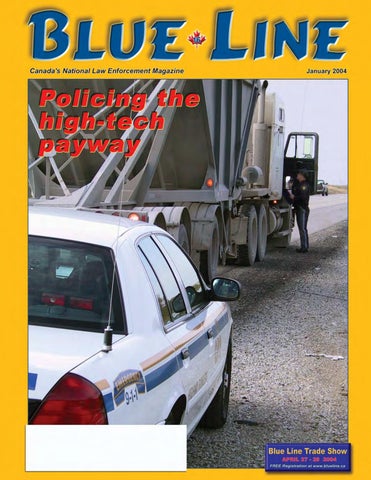
January 2004 Volume 16 Number 1
Blue Line Magazine
Publisher’s Commentary Ontario policing has come a long way to nowhere
5
Policing the fast lane—407ETR Enforcing the law on Canada’s high-tech highway
6
Space age technology dectects “customer’s” needs
8
12A-4981 Hwy 7 East Ste 254 Markham, ON L3R 1N1
Canada
Ph: 905 640-3048 Fax: 905 640-7547 eMail: blueline@blueline.ca — Publisher — Morley S. Lymburner eMail: publisher@blueline.ca
— General Manager — Mary Lymburner, M.Ed. eMail: admin@blueline.ca
— Editor — Mark Reesor eMail: editor@blueline.ca
— News Editor — Les Linder eMail: news@blueline.ca
— Advertising — Mary Lymburner Dean Clarke Bob Murray eMail: sales@blueline.ca
— Pre-press Production — Del Wall — Contributing Editors — Communication Skills Terry Barker Police Management James Clark Tactical Firearms Dave Brown Technology Tom Rataj Psychology Dorothy Cotton Case Law Mike Novakowski Blue Line Magazine is published monthly, September to June, by Blue Line Magazine Incorporated with a mailing address of: 12A - 4981 Hwy. 7 East, Ste. 254, Markham, Ontario, L3R 1N1. Individual magazines are $5.00 each. Subscriptions are $25.00 per year or $40.00 for 2 years. (Foreign - $50.00 U.S.) All material submitted for publication becomes the property of Blue Line Magazine unless other arrangements have been made with the publisher prior to publshing. The authors, advisors and Publisher accept no liability whatsoever for any injuries to persons or property resulting from the application or adoption of any of the procedures, tactics or considerations presented in this magazine. Readers are cautioned and advised that articles presented herein are edited and supplied for your personal awareness and should not be used for further action until appropriate advice and guidance is received from a supervisor, Crown Attorney or other person in authority. Established in 1988, Blue Line Magazine is an independent publication designed to inform, entertain, educate and upgrade the skills of those involved in the law enforcement profession. It has no direct control from a law enforcement agency and its opinions and articles do not necessarily reflect the opinions of any government, police, or law enforcement agency. ©2004 - All articles are protected by copyright. No part of this publication may be reproduced or transmitted in any form or by any means, electronic or mechanical, including photocopying and recording or by any information storage or retrieval system without permission. Internet activity is monitored and use or reposting of material on the Internet is restricted.
This publication is a private venture and receives no subsidy or grant from any level of government.
— Affiliations — International Association of Law Enforcement Planners Canadian Advertising Rates & Data International Police Association The Police Leadership Forum The Canadian Press Newswire
2004 Model year police vehicle evaluation 9 Innovative program combats reckless drivers
12
Watchful neighbours are best burgler alarm
13
Vehicle restoration can make a positive 14 impact on budgets INCREDIBLE
15
Richmond RCMP growing with its community
16
DISPATCHES
17
CORRESPONDENCE
17
All police need dangerous goods training 18 DEEP BLUE Face down restraint can be fatal
20
CASE LAW •Police must knock & announce entry 22 •Top court examines forceful citizen’s arrests 23 Prison guards doing hard time
24
Restorative justice focuses on reconcilliation
25
NEWS CLIPS
26
TECHNOLOGY Electronics increase vehicle safety and efficiency
27
There’s nothing joyful about joyriding 28 Study to give addicts free drugs
29
PRODUCT NEWS
30
High risk vehicle stop A different approach to an old procedure
31
COMING EVENTS
32
Saskatoon constable is a champion wrestler
34
BLUE LINE TRADE SHOW
35
BACK OF THE BOOK It’s time for a public inquiry into the justice system.
38
Printed in Canada by Janson Printing Service
ISSN #0847 8538
Canada Post - Canadian Publications Mail Product Sales Agreement No. 176796 June 2003 JANUARY 2004
3
Policing Canada’s only privately-owned toll road can present some challenges for a public police service. Perception can be a problem, for example, since motorists may perceive officers as toll collectors or agents for the owners. In our lead story, Blue Line publisher Morley Lymburner rides with one of the 33 Ontario Provincial Police officers who patrol Hwy. 407, just north of Toronto, and editor Mark Reesor looks at the technology behind the high tech highway. Dave Brown gives us the rundown on the 2003 Michigan State Police Vehicle Tests. The big three have all made improvements to their police package offerings, Brown notes, making it tough to choose a winner. In other automotive features, Tom Rataj looks at vehicle electronics, we report on a CACP study on joyriding and youth, Chris Collins tells us about a new way to make high-risk vehicle stops and Marc Schram explains why all police officers need dangerous goods training. In other stories, Elvin Klassen looks at an innovative drug treatment program, Dr. Dorothy tells us about the dangers of face down restraints, Danette Dooley reports on how Newfoundland leads the way with restorative justice programs and Albert Sevigny warns of an impending crisis in our federal prison system. CORRECTIONS
Indentity Crisis The officer pictured with South Simcoe Police’s new Honda Element in December Blue Line is Cst. Sal Scaglione, who was incorrectly identified in the cutline as Sgt. Robert Eeles. Blue Line regrets the error. —
A little typo can make a big difference Dave Brown reports a slight typo made a big difference in an article about electronic sights in the December issue of Blue Line Magazine. On page 16 just below the chart in the right column the word “not” inadvertently snuck in. It should have stated that “electronic sights WERE noticeably faster in target acquisition than the shotgun rifle sights.”
JANUARY 2004 June 2003
4
Ontario policing has come a long way to nowhere by Morley Lymburner This message is directed at Ontario because, for some odd reason, the rest of the country feels that province has it all together when it comes to policing. Here is a hint — they don’t. Don’t tear a page out of Ontario Policing 101 and expect miraculous results because it ain’t happnin’ there and it won’t where you are either. Ontario is a wasteland of good policing intentions skewed by too much tweaking, gouging and politics by two successive tinkering governments who preferred revolution over evolution. You can only take so much revolution before it turns to revulsion. These successive governments received free range and wasted no time in messing up policing, both directly and indirectly. One move was to tear a sheet out of corporate America’s pages and apply it to government administration. This meant the wholesale gutting of middle management in as many departments as possible. ‘Lean’ was on the agenda; suddenly 300 communities were told they’d better start getting along with their neighbouring municipalities because the government wanted fewer of them reporting to their now scarce staff. Efficiency was to be gained through amalgamating each and every municipality into larger jurisdictions with ridiculous names. What was once two towns, three villages and two townships was now one big “happy” municipality. As an
June 2003 JANUARY 2004
example let’s look at the recently amalgamated municipality of ‘Nation’. Here is how it describes itself: “An area of 661 square kilometres and a population of approximately 11,000. The Nation was formed on January 1st, 1998, with the amalgamation of the Townships of Cambridge, South Plantagenet, Caledonia and the Village of St. Isidore. It is comprised of the communities of Limoges, Cambridge Forest Estates, Forest Park, St. Albert, St. Isidore, Fournier, St. Bernardin, Riceville, Ste. Rose de Prescott, Caledonia Springs, McAlpine, Routhier, Ettyville, Pendleton, Westminster, Lemieux, Séguinbourg and the outskirts of Casselman.” Each realigned municipality was told they had to decide who was going to police them. The towns folk had their own cops and the country folks had the provincial police and the bickering boiled down to who controlled the votes. If the rural areas controlled council that 100 year-old local police department, that was working fine up to now, must fold. It had nothing to do with it’s competency, just politics and dollars. Do you shop around for the cheapest deal you can find if you’re going to get eye surgery? Of course not — you go with the service that will get the job done safely and competently. At one time all Ontario police departments were secure as long as they supplied proper policing. Unless the Solicitor General’s Policing
5
Services branch came in to investigate corruption or incompetence, municipalities could be assured of consistent service. Costs were more or less dictated by the municipality and agencies worked within the established budgets. Today Ontario police agencies are suffering under five year contracts that may or may not be renewable. How can good policing function in an atmosphere of non-permanence? The horror stories mount. Too few officers handling too many calls; an agency has to share handguns; a town has not seen a police officer in six months; a chief can’t send officers on courses because he doesn’t know if the agency will be around long enough; policing in one municipality is shared between two agencies and there’s no way to cross over and compare records. One village asks its volunteer fire department to “keep an eye out” because police are an hour away; an off-duty officer is afraid to leave home because the lone officer on the next shift may call for assistance; a chief has been ordered to supply cops to guard the courthouse but not the budget to do so; in another town, “community based policing” means downloading problems to residents or social agencies. The problem with being lean is that when sickness does hit, there’s no fat to burn during recovery. Ontario policing has gone about as lean as it can get and can now only get meaner. It is time Ontario stopped looking at dollars and politics to determine good policing.
by Morley Lymburner “It looks like we have a violator coming up behind us,” Ontario Provincial Police Cst. John Richardson says, gesturing toward a bulk gravel carrier in the rear view mirror. We had just turned on to the entrance ramp of Highway 407, a ribbon of express roadway skirting the northern edge of Toronto, running from Hamilton to Pickering. The state-of-the-art toll road, cherished for its convenience and cursed for its fees, was constructed to 21st century standards in record time and under budget. “When I see someone fiddling with the transponder on the front window and shy to pass, I pretty well know something is wrong,” Richardson states. We slow to a crawl on the two lane ramp but the trucker stays behind us and we finally pull over to the shoulder. “Check out the back of the trailer as it passes... it will have an obstructed rear licence plate,” Richardson says. To my astonishment, I see a metal shroud extending out close above the plate. From our vantage point, which isn’t much higher than the top of the tires, we can only make out four of the six digits. Amazed by his apparent clairvoyance, I watch with anticipation. We follow the truck for a short distance and he picks a safe stopping location and turns on the roof lights. The truck immediately pulls to the right shoulder. “Yup, he pretty much knows the score,” Richardson says. After inspecting the vehicle and obtaining the documents he requires, Richardson begins writing a ticket for the obstructed plate, an offence under the special legislation governing this hybrid privately owned expressway. The 108 kilometre long Highway 407 Express Toll Route (ETR) opened June 7, 1997 and began collecting tolls that October. It was the first all-electronic, open access toll highway in the world and its opening attracted considerable attention around the globe. Viewed by many as the ultimate in roadway construction and maintenance, it’s one of the safest expressways in the country. Tolls are recorded either by a signal sent from a transponder or a digital image of a vehicle’s rear license plate, taken by cameras JANUARY 2004 June 2003
mounted on a gantry over every entrance and exit ramp. The registered owner of the transponder or plates is billed for the distance travelled; unpaid tolls are collected when license plates are renewed. Of course this simple and elegant application of modern technology attracts the usual suspects who, for either thrills or financial gain, try to beat the system. “It is a real cat and mouse game,” says Richardson, “but it sure makes my day interesting catching them.” Richardson looks forward to working each day — the challenges and variety of tasks keeps the 15 year veteran sharp and keen. Coming from a police family helps. “My father, John Senior, was a cop for over thirty years with the OPP and I have a sister and a brother on the job as well. I guess it got in our blood at a young age.” Patrolling this hi-tech highway requires unique enforcement strategies. All heavy vehicles using the ETR must have a transponder, for example, and almost all comply. The main reason is the $100 ticket and the opportunity for an officer to look for more violations if you’re spotted without a transponder in plain view. “There is no shortage of violations when you stop one of these rigs,” Richardson points out. “If they are the kind of person that will try to jump the ‘gantry’ (toll gate), then they will probably have a lot more things they’re trying to cut corners on. Insurance, equipment — the list goes on.” The gantry bandits, also known as ‘toll trolls,’ try to beat the system by doing creative things with their licence plates. Some rig their vehicles with fishing line so they can pull the rear plate up as they pass the cameras, or use plates from another vehicle. One enterprising individual even rigged up a small motor to tilt 6
Cst. John Richardson inspects a “Transponder” to ensure it is not gutted and still functions properly.
the plate down by remote control; another cut two different plates in half and stuck them together. The most common tactic is using muddy or badly corroded plates or special tinting to make them invisible to the cameras. Heavy vehicles avoid tolls through improper plate placement. Gantry cameras capture licence plates at a 25 degree angle, so if a plate is recessed into the frame even a short distance, the numbers can’t be picked up. The truck Richardson stopped didn’t have an overhang so the owner simply welded a shroud around the plate. The driver kept the transponder on the window so police wouldn’t suspect anything but took it down and sat on it when he approached the gantry, blocking it from working. The cameras were tripped but his plate
could not be read. The toll would have been around $8 for the 20 kilometre run to Hwy. 410 in Brampton — if the driver hadn’t concealed the transponder. Trucks not using them are hit with an additional $50 flat toll charge, plus a ticket if stopped by police. Drivers gamble on not being caught and pocket the toll, a not inconsequential savings when you consider the number of trips they make each day — and the time saved by taking the ETR and avoiding congestion and traffic jams also helps the bottom line, since they’re paid by the load. “The problem here is that these trucks wear out a highway much quicker than passenger cars,” says Sgt. Luis Mendoza, who supervises the 33 officers patrolling the ETR. “Almost every motorist pays their fair share of the cost of this road and they should not have to subsidize this trucker’s use of it. Sure there is a toll on this highway but the province’s taxpayers don’t have to pay a penny for it, nor do they have to use it if they don’t want to.” Even motorists who don’t use the ETR benefit from it, he notes, since it relieves congestion on the 401 and other major routes. In the event of accidents, it gives them an alternate route and reduces spillover on to city streets and the gridlock which often results. ETR patrol vehicles and police alert each other to accidents so they can be responded to and cleared as quickly as possible. They also work together to manage and correct potentially hazardous situations such as tire debris on the roadway or a stopped vehicle, Mendoza says. Motorists don’t want to sit on a highway that they paid to get on, he says. “When situations happen, the 407 ask us ‘what do you need from us’ and ‘how can we help?’” There is some confusion as to what the OPP’s role is, Mendoza admits, especially after the highway was purchased by a private consortium in May, 1999 for $3.1 billion, almost twice the $1.6 billion the Ontario government spent to build it. “A lot of people think that the OPP are the toll collectors of the 407 but it’s in the Highway Traffic Act. We’re not stopping people on that highway because the 407 wants us to, it’s June 2003 JANUARY 2004
because they’ve committed an offence under the Highway Traffic Act and they’re cheating the system. (License plate) numbers on a plate not clearly visible, for example, is an offence... “Our primary focus is public safety on that highway, just like it is on any other highway.” Having an obscured plate may seem like a minor offence, says Mendoza, until you consider how many hit and run cases Toronto has where witnesses can’t make out the plate number. Regular 407 users resent others trying to get a free ride, he says, and appreciate it when officers nab cheats, shoulder runners and reckless drivers. “Their point of view is, the more we deal with these type of situations, the quicker they get to work and the less time they have to wait.” The OPP is mandated under the 407 act to police the highway and does so in the same way it would police a municipality under contract — “the only difference is that they’re a private corporation,” Mendoza notes. 407/ETR makes payments to the Ontario Government under an annual contract which pays for all policing costs. Officers are kept busy, responding to 3,064 occurrences in 2002 and 3,002 by the end of September last year. An average of 330,000 7
people use the road daily during peak months, and that number continues to build. The busiest day ever occurred last October when more than 384,000 motorists travelled the highway. “We have a very close working relationship with the ETR personnel,” Mendoza explains. “They are very responsive and open to suggestions our officers supply them. We all know that this is new territory we are blazing here and we have found that ideas that would take years to implement elsewhere are adopted in a matter of days here. The whole concept of the ETR is to provide good customer service and we see the policing function as being part of that.” Richardson is also impressed with the ETR’s customer service. He’s policed the road since it opened and watched traffic grow as the 407 was extended to Hamilton and Pickering. Motorists are impressed with the wide open spaciousness of the road way, the relative low traffic flow and reduced number of heavy vehicles; Richardson is more impressed with the responsiveness of the ETR break-down patrol trucks. “If a car runs out of gas or breaks down anywhere the ETR patrol trucks are on the scene to help. They will put a gallon of gas in the motorist’s car, boost dead batteries or help us direct traffic around one of our accident scenes. If we call for a road clean-up, they are there and ready to help.” For some the ETR is an open invitation to take their vehicles to realms of speed never seen before. The winsome thoughts of the German autobahn dancing in motorist’s heads are kept in check only by the vigilance of the officers tasked with keeping their wings clipped. Speed enforcement is still number one on the agenda and one of the factors credited with keeping accident and fatality rates down. Although essentially a private road with public access, all money collected through fines are given to the province. “I take a lot of teasing from my family about being a traffic cop,” Richardson says, “but I wouldn’t change it for anything or anywhere else. I get a great feeling of satisfaction at the end of each day. It is great to police a state-ofthe-art highway and I’m glad to be one of the law enforcement pioneers patrolling it.” Persons wishing more information may contact the supervisor in charge, Sgt. Luis Mendoza, email: Luis.Mendoza@jus.gov.on.ca or phone at 905 841-5777.
Space age technology detects “customer’s” needs
by Mark Reesor The technology used on the 407 was once a closely guarded military secret. The system was developed by Raytheon, a large US defense and aerospace systems supplier. The company had to first ask the military for permission before it began using the technology in commercial applications. When a car approaches the first of two ‘gantries’ — basically overhead toolbars on which lights, cameras and other devices are mounted — the system first checks to see if it has a transponder. If it does, no image is taken and the units ‘talk’ to each other using radio signals, “which is very easy — that’s the easy part,” explains Imad Nassereddine, vice president of traffic operations and planning. Cars without transponders are detected by a Vehicle Detector and Classifier (VDAC), which tells the system “we don’t have a transponder and the vehicle is here. Camera 1, 2, 3 or camera 3, 4, 5 or camera 2, 3, 4, take an image. That’s where the decision is made and it happens in milliseconds.” The specially designed cameras and lenses, which are prefocused on different zones, take high resolution, digital video images of the back of a vehicle. There’s no use trying to speed through the gantry to defeat the high tech devices. Nassereddine says they’re set up and have successfully captured images on vehicles moving at more than 200 kilometres an hour. The images are sent electronically to 407 ETR headquarters in Woodbridge, where a specialized Optical Character Recognition (OCR) system automatically searches for a license plate in the image, looking first for the crown in the middle of the Ontario license plate. (The system is smart enough to avoid capturing advertising or bumper stickers on the backs of vehicles.) If the crown is there, the OCR is triggered, and “when it reads the plate, it assigns a confidence level for each of the letters or numbers it reads,” Nassereddine explains. “If the confidence level is high enough, the system basically runs it through without any manual (human) intervention.” If the confidence level is low — perhaps the plate is dirty, has too many characters or is a JANUARY 2004 June 2003
vanity plate — then it’s referred to a human operator. This happens, on average, about 30 per cent of the time, Nassereddine says, and is more frequent in the winter. The more plates it reads, the better the OCR system gets, since it’s self training. Filters help to eliminate glare and increase contrast and the system is constantly being tweaked to reduce human intervention. License plates without crowns are identified as belonging to out-of-province vehicles are also sent to human operators, but that doesn’t mean those drivers get a free ride. The 407 ETR has agreements with many provinces and states to ensure that bills are sent to everyone who uses the highway. Images of vehicles are captured when they enter and leave the toll road, plates are matched and the registered owner is billed for the distance travelled. The new owners have improved the system’s ability to match plate. Perhaps a vehicle’s transponder worked when they entered the highway, for example, but not when they exited. The system is left with a single image and transponder record, which it puts in a queue; when it can’t match them up, it realizes the record and image are from the same account and links them. When plates or records can’t be matched, Nassereddine says, the vehicle owner didn’t used to be billed. “Now we say, ‘we know that you entered at this location and the minimum that you could have travelled is to the next interchange,’ so we bill you that.” People with many half trips are contacted to find out what the problem is — half trips are often a sign of a bad transponder. The 407 works with the OPP to help catch people trying to defeat the system, Imad notes, adding “the big thing we worry about is, if you have an evader or two, it’s okay — as long as they don’t teach others; then everybody is an evader and that’s what you don’t want. Enforcement is very important to us.” The ETR also uses technology in other aspects of its operation. The busiest part of the highway is monitored with closed circuit cameras, for example, and the computerized control centre receives constant updates from Environment Canada to keep on top of changes in 8
weather patterns. The highway was one of the first in Canada to use pre-wetting to reduce the use of salt. Special spreaders ‘pre-wet’ the roadway with a solution of 30 per cent brine and 70 per cent salt which sticks to the roadway instead of bouncing off it like salt crystals. People calling its computerized call centre had to wait an average of just 13 seconds during the third quarter of last year; average wait times are displayed on a screen in the centre. Compared to other similar electronic toll highways in North America, the 407 ETR claims excellent value for the money. For more information, contact ETR Public Relations Manager Dale Albers at email: dalbers@407etr.com.
407 Toll Comparisons
The gap closes in a three-car race by Dave Brown Remember the Chevrolet Caprice with the 5.7 litre LT1 Corvette engine? Out of production since 1996, it was the product of a different generation. Few police vehicles have inspired such a love/hate relationship before or since. Although practically the size of a small aircraft carrier, it may have been one of the most neutral handling police vehicles ever made. When Blue Line Magazine tested it on the tight inner course at Mosport racetrack in 1999, we noted that the front and rear ends both stay nicely tucked in while going around corners, regardless of the speed or radius of the curve. Much like that burly linebacker on your old high school football team, the Caprice could be big, brutish and unsophisticated but surprisingly nimble on its feet if you knew how to treat it right. Just don’t expect to dress it up and take it out to the opera without a few sideways glances. The Corvette-engined Caprice is long gone, replaced by a V-6-powered, front-wheel-drive for a new generation of officers who value finesse over brute force. Police work sometimes involves just plain out-muscling an opponent however, and modern police vehicles must be sophisticated enough to minimally impact the environment and tough enough to trade some fender paint when necessary. Do the latest generation provide a realistic combination of refinement and strength? Blue Line is once again turning to the Michigan State Police (MSP) Vehicle Tests for an answer to that question. We profile the four patrol vehicles offered for 2004 and compare their results in head-to-head testing. Unlike the Michigan State Police, we even announce a clear winner, based on what we consider is important to today’s officers and administrators. Michigan State Police tests The Michigan State Police, in conjunction with the US National Institute of Justice (NIJ), has tested police vehicles offered by the major manufacturers for over 25 years. They evaluate submitted vehicles in two categories: • Police-package vehicles, specifically designed and manufactured for the full spectrum of general police activities, including high-speed pursuits June 2003 JANUARY 2004
• Special-service vehicles, used by agencies for specialized duties such as K-9, adverse weather conditions or off-road use and not designed or intended for pursuits. Some police agencies have used or adapted regular production vehicles but they often proved costly to maintain and didn’t last as long when subjected to the rigours of day-to-day operations. For 2004, the four vehicles which met NIJ standards for police-package vehicles are the Chevrolet Impala 9C1, DaimlerChrysler Dodge Intrepid and two Ford Police Interceptors, the 3.27 (with a 3.27:1 axle ratio) and 3.55 (with a 3.55:1 axle ratio). The special-service vehicles tested include the Chevrolet Tahoe two and four wheel drive, the Ford Explorer two wheel drive and Ford 9
Expedition four wheel drive. MSP also tested a prototype 2005 Chevrolet Tahoe model but do not report the results.
The tests MSP and the NIJ’s National Law Enforcement and Corrections Technology Center (NLECTC) test all the vehicles together over a two or threeday period at the DaimlerChrysler Proving Grounds and the Grattan Raceway. Each is tested without rooftop lights, spotlights, sirens or radio antennas in place. Tires are original equipment rubber provided by the manufacturer. Acceleration, braking and top speed tests are performed at the proving ground and vehicle dynamics (handling) tests are done using the two-mile Grattan road course, complete with wide corners, tight turns and hills. Testers also look at the ergonomics and ease of communication with each vehicle and publish Environmental Protection Agency (EPA) fuel economy figures. Note that all dimensions and measurements are in US numbers. Police-Package vehicles Chevrolet: Blue Line was given a preliminary look at GM’s police-package Impala, the first front-wheel-drive vehicle from Detroit designed for full police duties, before it was introduced for the 2000 model year. In head-to-head testing at Mosport Raceway, we were delighted by an interior far roomier than it appeared from outside, fingertip handling, tight turning radius and the performance of its 3.8 litre V-6. GM dedicated a lot of time developing the supplemental restraint system specifically for police activities. They tested airbag deployment with all variations of police equipment scattered about the dash and pillars and published diagrams indicating where this equipment should be installed to prevent it from becoming deadly missiles in a crash. Dimensionally, the Impala was very similar to the Ford Crown Victoria police-package on the inside, except for front seat shoulder room. We speculated that two officers in full winter gear and a complement of police equipment on the inside might make the cockpit area seem a tad tight. Chrysler: Introduced as a police package vehicle in 2002, DaimlerChrysler’s Dodge Intrepid (badged as Chrysler here) was the first
has steadily improved its traditional rear-wheel drive sedan. Ford submitted two models, one with the standard 3.27:1 rear axle ratio from 2003 and a new version with a 3.55:1 ratio. The top speed in most police-package vehicles is limited by the aerodynamics of the lightbar, not the final drive ratio; the 3.55:1 ratio has a lower top end but accelerates more briskly. See chart 1, page 9.
police vehicle to wear the Dodge nameplate since the 1989 Dodge Diplomat, whose inoffensive name easily exceeded its mediocre performance. A few of us at Blue Line still fondly remember those stiffly-sprung, monster-motor Dodge
Vehicle dynamics testing These tests determine high-speed pursuit handling characteristics. Except for the absence of traffic, the twomile road course simulates actual pursuit conditions and is ideal for evaluating the blend of suspension components, acceleration and braking ability. Each vehicle is driven 32 laps - eight each by four different drivers. Final score is the combined average of their five fastest laps. See chart 2.
Chart 2 and Plymouth police sedans from the 1970’s whose ability to run at high speeds all day long was legendary. It was nice to see Chrysler reentering the vehicle race in 2002 and closing the gap even more this year, truly making it a threeway race for agency dollars.
Acceleration and top speed This determines each vehicle’s ability to accelerate from a standing start to 60, 80 and 100 mph. Each vehicle is driven through four acceleration sequences, two in each direction to al-
Chart 3 Ford: Ford’s police version Crown Victoria – now known simply as the Police Interceptor – pretty much had the field to itself for years. Despite the lack of competition, Ford
low for wind; the score is the average of the four tests. Following the fourth acceleration sequence, each vehicle continues to accelerate to its highest attainable speed within 14 miles of the standing start point. See chart 3. Braking This test determines how quickly each vehicle decelerates on 12 60-0 mph full stops to the point of impending skid and with ABS in operation. Each vehicle is scored on the average deceleration rate it attains. Two heat-up decelerations from 90 to 0 mph at 22 ft/sec2, using a decelerometer to maintain rate, are done at predetermined points on the test road. The vehicle is then turned around and six measured 60-0 mph stops with threshold braking applied to the point of impending wheel lock, using ABS if so equipped, are conducted. The sequence is repeated following a fourminute heat-soak. Initial velocity of each decel-
JANUARY 2004 June 2003
10
Chart 4 eration and the exact distance required are used equipment installations. If you expect maxito calculate the deceleration rate. The resulting mum performance, safety and durability, it score is the average of all 12 stops. Stopping pays to spend the extra required for dedicated distance from 60 mph is calculated by interpo- vehicles and equipment designed and installed by professionals. lating results. See chart 3. Our selection for the overall winner of 2004? That’s easy; it’s the officer who will be Ergonomics This test rates how suitable the vehicle’s interior is for patrol officers, how well it accommodates required communication and how difficult it is to install the equipment. A minimum of four officers independently evaluate comfort and instrumentation and the MSP communications division tests ease of installation. A total of 28 factors, including seat design, padding, ease of entry, head room, instrument placement, HVAC control placement, visibility, dashboard accessibility and trunk accessibility, are rated on a scale of one to ten and averaged among the testers. See chart 4. Fuel economy While not an indicator of actual mileage that may be experienced, mileage figures serve as a good way to compare vehicles. Scores are based on data published by manufacturers and certified by the EPA. See chart 4. Conclusion These tests have become one of the most respected and anticipated publications for agencies looking to purchase new police vehicles and Blue Line has published them for most of our history. We consider them to be both comprehensive and fair. Our own experiences has reinforced the validity of their testing process. Since each has its own particular strengths, the MSP do not declare an overall winner. Each testing criteria must be examined individually to determine what is most important, based on the anticipated use of the vehicle. In comparing the results we published last January, it becomes clear all three manufacturers worked hard to improve their product. Lap times are all slightly slower but overall acceleration has noticeably improved. Stopping distance is about the same but mileage seems to be getting better with each generation of police vehicle. There’s no question the sophistication level is rising and the gap is closing among all the vehicles in this test. Front-wheel-drive vehicles have proven that V-6 power can cope with most officers’ requirements and the handling characteristics, while slightly different, are no worse than rear-wheel-drive, and potentially even better in adverse weather conditions. Although unstated, the tests indicate that there is no longer room for cobbled-together June 2003 JANUARY 2004
11
behind the wheel of some of the best vehicles on the road today. ALL are tough enough to do they job. You can download the full report — a 7.3mb PDF — at http://www.nlectc.org/testing/vehicles.html. Dave Brown can be contacted at Brown@blueline.ca.
Innovative program combats reckless drivers by Les Linder A new Edmonton police database targets some of the city’s most reckless drivers in an effort to make the city’s roads among the safest in the world. The Edmonton Approach, launched last March, aims to reduce impaired driving and increase traffic enforcement. It was launched after an analysis of fatal and serious injury collisions in 2002 and 2003 showed the vast majority of fatalities were caused by impaired driving and excess speed. One of the program’s innovative initiatives is the high-risk driving program, which began in November, says Insp. Mike Derbyshire. Citizen satisfaction surveys and internal surveys of police members showed that traffic safety was a growing concern. “The public wants us to do something innovative to deal with the problem and our own officers clearly want to do something about it as well,” Derbyshire says. The program began with the hiring of traffic analyst Nash Birdi, who adapted and applied criminal analysis techniques to driving behaviours. “(Birdi) examined the service’s databases and combined a number of different factors together into a profile of a high risk driver,” explains Derbyshire. The profile includes traffic and photo radar tickets and criminal convictions. Information is combined with the service’s database, the provincial motor vehicle database and CPIC. An algorithm runs queries against all the databases, assigns weights and then scores each violation to generate a list of the city’s worst drivers. “We know that by focusing on dangerous driving behaviours, we’re going to make a significant impact because of increased criminal and traffic arrests,” Derbyshire says. “What we found is that roughly 10 per cent of the drivers in Edmonton are responsible for 90 per cent of traffic related incidents. By focusing on these offenders, we expect there will be significant improvement on traffic safety.” All high-risk drivers are flagged in CPIC and the service’s internal databases and that information is then given to patrol officers and is accessible from cruisers. When officers check on a licence plate, they know immediately that the person is classified as a high-risk driver. “The officer-safety benefits alone are tremendous,” Derbyshire emphasizes. On the program’s fourth day, a vehicle flagged with a high-risk driver was stopped by a patrol officer who witnessed a traffic violation, Derbyshire says. A loaded handgun was found when the car was searched and four people were taken into custody. One person on the list was previously convicted of three careless driving offences, two aggravated assault charges, one count of possession of a weapon and two JANUARY 2004 June 2003
of driving while suspended. He had also received 20 speeding tickets, including one for going through a red light and five for going through a stop sign. Another person on the list has 45 speeding tickets and three convictions each for impaired driving and driving while suspended. Derbyshire points out that privacy issues shouldn’t prove to be a problem because the list will not be made public. The judicial system seems to be getting on board as well. Rather than giving a volunteer payment ticket to a high-risk driver pulled over for a traffic violation, prosecutors, traffic commissioners and traffic court judges suggested officers issue compulsory court tickets. That would force offenders to explain their actions and allow judges to give them stronger punishments. Derbyshire finds it interesting that, as far he knows, no other service in Canada has attempted a similar program. “Our patrol officers are liking it a lot because it provides them with timely, accurate intelligence and gives more information for vehicle stops,” he says. It also encourages other services to look into similar program for their communities. The service is already looking to expand and improve the initiative. A symposium scheduled for February will be attended by members of Edmonton’s justice system, politicians, community organizations and the media to help develop strategies to increase community support. “We want to get everybody involved so it becomes a community issue and not just a police issue,” says Derbyshire. “When we’re spending 115 to 130 million dollars a year on injury related health costs associated to traffic collisions, it is clearly in the 12
best interest of the entire community to deal with this problem and make it an entire community issue.” Twenty eight people were killed in traffic accidents in Edmonton as of the end of November and they could all have been prevented, Derbyshire insists. “Traffic accidents tie up a lot of resources from a police, health care and court perspective that could be freed up and used for more productive activities. We just need to get traffic accidents under control.” While the program is still relatively new, the service is constantly evaluating its successes and looking to enhance and expand it. “A lot of stakeholders have tried to take on traffic safety in the past with only limited success,” Derbyshire says. “Nobody has tried to do it from a coordinated community perspective and get all the stakeholders involved. That’s exactly what we’re doing and we’re confident it will succeed.” Insp. Mike Derbyshire can be contacted at mike.derbyshire@police.edmonton.ab.ca.
Watchful neighbours are best burglar alarm by Elvin Klassen Neighbours looking out for each other, the main idea behind Block Watch, has helped reduce crime in many Canadian communities. Success stories abound. A Block Watch participant in the small Fraser Valley, BC town of Walnut Grove, for example, thought he heard teenagers from next door returning home late one night. Rather than complaining, he got up, looked out the window and saw someone breaking into his neighbour’s vehicle. Police responded in time to nab the culprit red handed inside the vehicle. Another participant was preparing coffee when she glanced out her window and saw three strangers in a neighbour’s driveway. She called police, who responded and apprehended the suspects inside the home. In another instance, a neighbour saw a youth toss something into a hedge. Thinking it suspicious, especially since it was during school hours, he noted their description and direction of travel and called police immediately. The item, which turned out to be a hockey bag, was filled with valuables stolen from area homes that morning. Langley RCMP Block Watch coordinator Gerrie Wise organized the Walnut Grove program, which was began in Coventry Woods, a gated townhouse development. She conducted a two-hour training program for the block captains, then visited the community and did a detailed security check. Her three-page report, which included recommendations for such items as security lighting, dead bolts, locks, gates, and window closures, was presented at a public meeting. She also discussed personal safety and suggested other ways the community could be made more secure. Six more residents volunteered to be cocaptains at the meeting and were trained how to coordinate the program in their areas. They also were made responsible for distributing quarterly newsletters provided by the Langley RCMP and reminding residents of security concerns. Signs were put up at the main gates to Coventry Woods and along a path at the rear warning intruders that it’s a Block Watch community and “all suspicious activity will be reported to the police.” Thanks to Wise’s efforts, those signs are becoming more common on streets in the Langley area. Residents are taking a more proactive approach to crime prevention and safety June 2003 JANUARY 2004
and are becoming part of the solution. They’re not only empowered to become the eyes and ears of their block but also the heart of their community. Another BC m u n i c i p a l i t y, Saanich, also reports its Block Watch program has helped reduce crime. About 6,000 households currently participate, says Saanich Police Department Chief Constable Derek Egan, and it continues to grow. The risk of a home being broken into was one in 86 when the program began, notes Egan, but today it’s one in 109 — and that drops to one in 322 among Block Watch members. Career criminals tell officers they avoid committing crimes in program areas, Egan says. Gerrie Wise can be reached at gerrie.wise@rcmpgrc.gc.ca or 604 532-3213. Derek Egan can be contacted at community@saanichpolice.ca.
13
Vehicle restoration can make a positive impact on budgets
by Morley Lymburner
Several police forces in North America have determined that there is money to be saved on the vehicle budget by extending the practical life of their vehicles through restoration. Durham Regional Police have taken the lead of systematically analyzing this option of fleet maintenance and hopes to be able to present hard facts by the end of this year. Just over a year ago the Durham Regional Police Service (DRPS) embarked on a pilot study which began with the Service initially sending two cruisers for restoration work to the Chatham-Kent based Emergency Vehicle Restoration Ltd. (EVR). Due to the success of this inaugural work they have sent a further ten cars for restoration. High mileage in a short period typically leaves police vehicles structurally sound but mechanically worn. Up to now replacement with a new vehicle appeared to be the only economically prudent route to take when considering these vehicles. A while back some police administrators looked at their vehicle budgets and determined that additional value might be attained by extending the life of their high mileage vehicular assets. Not only is there a spiraling cost in initially purchasing the vehicle but there are additional charges in re-wiring and equipping new cars to meet the police working environment. For each vehicle rehabilitated there are no additional fees for such things as re-wiring, light bar installations, radio installations, decaling, safety screen replacements etc. Through this realization the Chatham-Kent based EVR was born. The founders of this company realized that
renewing some of the mechanical components could permit some fleet vehicles to complete a second life cycle at a substantial saving. By analyzing a large number of spent police vehicles they determined that the parts that commonly wear out are consistently predictable. The transmission, braking system, suspension, some engine components, seat upholstery and some detailed interior components were the main deterioration areas. They then set about obtaining an inventory of parts along with the key personnel who could specialize in restoring these vehicles. An analyzing team at DPRS is presently collecting and monitoring the maintenance records of the refurbished vehicles to determine the realistic costs and savings associated with the restoration program. The idea of vehicle restoration was initially encouraged by DRPS Deputy Chief Rod Piukkala. He teamed up with the Director of Business Services, Giles H. le Riche, C.A., and Fleet Manager David G. Winter to perform the study which they hope to conclude later this year. Given anecdotal evidence already available EVR is very optimistic the DRPS study will show success. Positive results have already been reported by many police and EMS agencies, including Durham Region, Chatham-
Kent and Windsor-Essex. Their success has been so evident that they now have instituted regular programs of restoration. The success of these agencies has not gone unrecognized across the border. The restoration process has been Deputy Chief adopted as an on-going strategy that has resulted in sig- Rod Piukkala nificant savings for several police services in the United States. One of the many agencies that have begun to get value from their fleet budget is the Ottawa County (Michigan) Sheriff’s Office. Under the watchful eye of Lieutenant Steve Kempker, the fleet of about 120 cars, is taking an active approach to extending the life of their fleet. The Sheriff’s Office has currently restored six Chevrolet Tahoes which has resulted in an approximate saving of $102,000. The Sarasota Sheriff’s Office, located in Florida, currently has a program with EVR that has already begun to save them money. Steven Meadows, Sarasota’s Fleet Administrator, has determined that the quality, service and return on investment warrants the continued restoration of the Sarasota fleet. Upon completion of their fleet plan this agency could potentially save as much as their counterparts in Michigan. The restoration process uses only original equipment and manufacturer’s parts to ensure due diligence and increased reliability. After the vehicles from the police services’ fleet have been restored, the product is returned to the agency with factory engines, transmissions, suspensions and mechanical parts under full original equipment manufacturer’s warranty. By extending the life of the vehicles in the fleet, as opposed to buying new cruisers, the agencies have realized savings in the range of $6,000 to $13,000 per vehicle. Agencies in North America are discovering that extending the life of an asset saves money. Freeing up cash from the fleet budget provides the opportunity to redirect funds toward such things as training programs, higher-end vehicles and improving upon other equipment available to the men and women who serve and protect their communities. If your agency is tired of spiraling costs there is no doubt that fleet vehicle rehabilitation is a concept certainly worth looking into. For further information go to BlueLinks at www.blueline.ca.
JANUARY 2004 June 2003
14
A visiting RCMP police dog from the Yukon helped local police in Lethbridge, Alberta make a $2.6-million marijuana seizure. The dog, who was participating in training with the Integrated Border Enforcement Team in October, led his handler to a van parked at the hotel where he was a guest. His dog gave him a reason to be suspicious of the vehicle. Lethbridge city police arrested four suspects they believe had stopped over at a southside hotel while transporting the 256 kilograms of high-grade marijuana from the B.C. Lower Mainland through Montana. The drug seizure was the largest on record in southern Alberta. *** Three Nova Scotia teenagers whose summer prank made it to a “stupid news” report on TV will be on probation for the next two years. The boys, aged 16 and 17, appeared in Bridgewater youth court in October after pleading guilty to stealing a boat July 3 and taking a joyride down the LaHave River. The teens drank the liquor they found on board, got drunk, beached the boat on an island off Crescent Beach and torched it before realizing they were then stranded. The boys, who can’t be named because of their ages, were flown ashore in an RCMP helicopter. Their actions were posted on a Web site dedicated to stupid news, and the item was later picked up by an American latenight television show. But it was no laughing matter Wednesday when Judge Anne Crawford told the teens it would be the last time they
June 2003 JANUARY 2004
would be together until 2005. A condition of their probation includes no contact with anyone having a youth court or criminal record. As well as admitting to setting fire to the boat, which was worth about $20,000, the boys pleaded guilty to stealing paddles and gas from another boat and breaking into a cabin on the island. *** The Houston Police Department closed the toxicology section of its troubled crime lab in October after a toxicologist failed a competency test. Acting police chief Joe Breshears said Pauline Louie, who had supervised the toxicology section for three years, was suspended with pay pending an internal affairs investigation. He declined to detail the duties Louie was found incompetent to perform nor how many cases could be affected. Re-testing in hundreds of DNA cases has been under way since March after the outside audit revealed serious deficiencies, including a lack of training of the lab’s employees, insufficient documentation and possible contamination of DNA samples. A grand jury earlier declined to issue any indictments, but was critical of the operation. An internal affairs investigation into the DNA section in June recommended the suspension or firing of nine employees. At that time, Louie was suspended for seven days for failing to inspect equipment and complete necessary safety, security and equipment check lists. *** A Calgary man who went to a landfill in
15
October to dump off some old carpet made an unexpected discovery when he found confidential computer records belonging to police. Cameron Rhodes said he noticed CD-ROMS amongst the construction refuse section of the dump. One of the CDs was labelled Y2K Contingency and the logo of the Calgary Police Service was prominent, he said. Rhodes found a CD with 1999 vehicle registration information - descriptions, addresses and phone numbers - of thousands of Calgary and Edmonton motorists. He says there are 35,000 pages of registry information on one CD. Other CDs, were in an open box and apparently contained information on arrest warrants, missing persons and security alarm code permits. He says there also appeared to be templates for court documents in the pile. Police Insp. Brian Sembo says many of the CDs were produced as backup files before 2000 during the Y2K computer crash scare. Paper versions of the records were properly destroyed when an office at the force’s Andrew Davison headquarters building was being renovated recently. When support staff asked a manager about the CD boxes, they were told there was nothing of value and it was released inappropriately, Sembo says. “They should have been absolutely destroyed . . . obviously, some of these records could still be relevant,” Sembo was quoted as saying. Rhodes said the detailed auto registry information could have been put to troubling use.
Richmond RCMP growing with its community by Elvin Klassen Richmond, British Columbia is striving to be the “most appealing, livable and well managed community in Canada” — and the city’s RCMP detachment is helping achieve that goal with its ‘safe homes and safe communities’ program. A city of more than 165,000 people about 20 minutes south of Vancouver and 20 minutes north of Washington state, the city is completely surrounded by water. Getting there means going through a tunnel or crossing one of eight bridges connecting it to the rest of the lower mainland — or flying in to the Vancouver International Airport, the second busiest in Canada, which is located in the city. A dynamic, multi-ethnic community, Richmond is home to the second largest Asian community in North America and one of the largest commercial fishing fleets in Canada. Richmond RCMP has 185 officers for the city and another 24 assigned to the airport. Supt. Ward Clapham took over the detachment in Oct. 2001 and began preparing a five-year strategic plan. The leadership team held focus groups and conducted meetings and interviews to determine how the community felt about their police and what they expected of them. Clapham gave front line officers the opportunity to attend outside seminars and courses as well as in-house training and introduced daily training sessions for all department employees; city employees involved with the RCMP were also invited. Clapham’s priorities include combatting property and youth crime, drugs and gang violence, improving traffic services and road safety, airport policing and restorative justice. “Richmond RCMP cannot afford to remain status quo while the population increases through new housing and commercial developments,” Clapham wrote in a report to city council. “During the next five years we need to increase our police strength by 29 officers and one crime analyst as well as an additional eighteen municipal employees.” The city’s population is expected to grow by more than 13,000 people in the next five years, according to Statistics Canada, bringing with it new challenges. The senior population, which has a high fear of crime, is increasing; new immigrants have very limited English; youth unemployment is high and the volunteer bank is declining. Organized and white-collar crime, which requires extensive investigation, is increasing. Dangerous driving and driving while disqualified or suspended cases have increased over 300 per cent and a number of young people have been killed racing on city streets. That prompted a city councillor to warn that if you speed in Richmond, “then we are going to take all levels of precautions and we are going to catch you.” City council approved more than $230,000 worth of new equipment for the detachment to target young drivers of souped-up, high-end cars following these fatalities. The new tools included three remote-conJANUARY 2004 June 2003
been bike trained to handle special events and projects. A leader has been assigned to each station and operational hours have been extended. Sixty police officers have adopted elementary schools, in addition to their regular duties, under a school liaison program and make regular visits.
trolled spike belts, unmarked luxury police cars, 12 moving radar sets, two sets of nightvision binoculars and 20 in-car video cameras, complete with cordless lapel mics officers can wear. Improved speed limit signs with messages such as “speed kills” and “speed, a grave mistake” and a public reporting system are also planned — and “this is just to get the ball rolling,” notes a city councillor. Clapham says he’s empowered the community to solve the street racing problem, adding “leadership is about letting go.” He notes the first forum on the subject was organized by the police but the community planned the next one; “this is leadership in action.” The community is also very concerned about the sharp increase in crime related to marijuana grow operations. Five uniformed constables have been assigned to a full time grow enforcement team and ‘Operation Green Clean,’ a multi-disciplinary approach, has helped reduce both supply and demand. A six-pillar approach is being used to manage the problem — enforcement, education, prevention, awareness, treatment and rehabilitation. To better advise and consult with the Asian community a monthly radio talk show, Talk with your police chief,” was introduced on Chinese radio. Other successful community partnerships include graffiti elimination, youth at risk initiatives, event security planning, safe streets programs, joint events planning and bylaw training sessions. Officers give youth ‘positive tickets’ and trading cards and carry free movie and special events passes along with their ticket books. The detachment has community policing stations and nine community constables have 16
Contact communications officer Cpl. Peter Thiessen at peter.thiessen@rcmp-grc.gc.ca or 604-207-4779 for more information on the Richmond RCMP. Elvin Klassen, Blue Line’s west coast correspondent, can be reached at elvin@blueline.ca.
Stephane Boucher was found guilty in November of the February 2002 murder of Cst. Benoit L’Ecuyer. The jury had deliberated for two days. Boucher, 26, was sentenced to life in prison by Quebec Superior Court Justice James Brunton. The defence had argued that Boucher fired in selfdefence when L’Ecuyer and his partner chased him after stopping him in his car as he was on his way to commit an armed robbery. Toronto’s police chief Julian Fantino is upset with the provincial government after hearing the Liberals have cancelled one million dollars promised in the old Tory budget for a police helicopter. Fantino argues the helicopter is a fundamental tool for doing police work. The minister of community safety and correctional services stands by the decision. Monte Kwinter says the money had to be cancelled when the government discovered it inherited a $5.6 billion deficit. Kwinter adds, even the one-thousand new officers the Liberals promised for Ontario might have to wait until the books are balanced. Ontario police officers were legally justified in the shooting death of a 17-year-old earlier this summer and will not face charges. Geronimo Fobister, 17, was killed on Aug. 27 during a stand-off with Ontario Provincial Police officers, who had tracked him down to a trail in a heavily wooded area near his home on the Grassy Narrows First Nation. He was wanted in an incident earlier that day in which a community resident was allegedly shot at by two men. After an eight-week investigation, an independent agency assigned to look into the shooting ruled it was justified.
I was amused at your recent commentary (Nov, 2003) taking issue with the political process as it applies to so many of our bylaws and regulations. From my personal experience, I can confirm your argument. In my more than 35 years in traffic control and management, first as a police officer, then as a traffic engineer, it was immediately apparent to me in dealing with local politicians that unwarranted stop signs, speed limits and a host of other traffic impediments were argued for, and supported, only to gain community support, and thus votes, in the local elections. When Metro Toronto was established I, as one of the suburban traffic engineers, was fortunate to become a member of the 'professional' traffic technical committee, which was formed under Commissioner of Traffic Sam Cass. Permanent members included Metro Police, at deputy level, and engineers for the Toronto Transit Commission. The committee met monthly, taking on the massive task of rewriting all the rules of the road, bylaws and regulations and bringing in a new and consolidated program, and legislation, that had to be sold to all the member municipalities. This was in itself no mean task and took two years of work. As work expanded, one of the first tasks was to bring a 'STOP' to the proliferation of unwarranted signs and regulations, from traffic
Seven Winnipeg police officers and another who retired have been cleared of any criminal wrongdoing in an ongoing biker-related murder investigation. Kevin Tokarchuk, 24, was found shot in the head May 12 in apparent retaliation for the fatal shooting of a Hells Angels associate exactly one year earlier. It has been claimed that an informant warned police about the plans to kill Kevin Tokarchuk, but police never warned the intended victim or his family. The keynote speaker at the Vancouver criminal justice convention in November says there’s little to be proud of when it comes to drug and alcohol treatment in Canada. Doctor Patrick Smith told the Canadian Congress on Criminal Justice a recent Corrections Canada survey shows 56 per cent of inmates were on drugs or alcohol while committing their crime. Smith, with Toronto’s Centre for Addiction, says it’s both a health and crime issue, but the problem is bounced between medical and police systems with little communication between the two. A Montreal police officer convicted last year of negligently using a firearm to stop a fleeing suspect was granted an unconditional discharge in November. Steve Larouche, 36, was found guilty in November 2002 after shooting at a suspect who was fleeing in a truck in nearby Beloeil in May 1999. The shot missed the suspect and lodged in the truck’s dashboard. The discharge means Larouche won’t have a criminal record and is free to return to his job with the Beloeil police force. In his judgment, Quebec court Judge Claude Provost said Larouche acknowledged in presentencing hearings that he misused the firearm after earlier insisting his actions were correct.
June 2003 JANUARY 2004
17
signals to speed limits. After exhaustive debate and study, it was agreed to adopt and apply the traffic warrant system, as drawn up by the highly respected International Institute of Traffic Engineers, to which many of us belonged. The principal was simply that no regulation would be approved and adopted unless it could meet the measured standards of traffic flow and accident records, as well as improving safety. It was my responsibility to prepare reports for committee and council dealing with all traffic controls. It was no easy or simple task to meet with local politicians and reject requests for unwarranted controls based on charts, graphs, vehicle counts and accident records. I confess that it was impossible to win all the arguments and local politics overruled common sense in many cases, but at least we tried. I achieved a 75 per cent success rate but other cities in Metro failed the test miserably and thus there was little uniformity. Still, it was an interesting and exciting time working with some of the best traffic brains in the country and I think back to it as one of the best times in my career. I joined the Toronto Police traffic division in 1945 and by 1946 we had 140 motorcycle officers assigned to three shifts. In those days, you could hardly miss a traffic officer at any of the major intersections or patrolling the main arteries. Now it is very rare to see a motorcycle officer. Thanks for an excellent magazine. Ron F. Anderson Toronto ON
All police need dangerous goods training by Marc Schram More than 250,000 people were evacuated when a large amount of toxic chlorine gas was released in the Mississauga train derailment in 1979. The incident prompted the federal government to pass the Transportation of Dangerous Goods Act and the Ontario Provincial Police to form a dangerous goods enforcement unit. There are currently two members — sergeants attached to the traffic and marine section — acting as full time dangerous goods coordinators. Although assigned to General Headquarters (GHQ) in Orillia, they are deployed to field locations. Traffic Sgt. Marc Schram works out of the North Bay area, while Traffic Sgt. Rod Brown is based in Thunder Bay. Both are designated by the Federal government and Ontario’s Minister of Transport as dangerous goods inspectors and have three main areas of responsibility: • Enforcement • Incident response • Education and awareness Enforcement Very few officers had any dangerous goods training when the unit was formed and one of the primary functions of the coordinators was enforcement. The OPP now has close to 100 members at locations throughout the province who have received specialized instruction in this area, including some with more detailed knowledge relating to incident response. Schram and Brown act as central contact points and assist field personnel wherever and whenever required. You don’t have to be designated as an inspector to swear out informations related to dangerous goods charges, but because they’re so complex — there are almost 600 pages of information — specialized training is highly recommended. Penalties have risen substantially recently due to increased awareness and incidents around the world; fines in the area of $5,000 to $10,000 are common. People sometimes get confused and believe that charges are laid under the federal act but that’s usually not the case. The provinces have
JANUARY 2004 June 2003
1979 Mississauga train derailment passed their own legislation relating to dangerous goods with specific penalty sections, although they adopted the safety requirements, standards and safety marks set out in the federal legislation. There are out of court settlements in some provinces where officers can issue tickets with set fines at the roadside. In Ontario however, every defendant, whether an individual or company, is summoned to appear in court. The maximum penalty for a first offence is $50,000 under Section 4 of Ontario’s act; subsequent convictions carry fines of up to $100,000 or a term of less than two years in prison. Officers should be aware that when conducting any type of enforcement activities, a routine inspection could quickly turn into a dangerous goods incident or spill. As illustrated in the pictures, at first glance, it would appear that there is water on the underside of this trailer, which was stopped for a commercial vehicle check. Upon further investigation however, it was found that the transport unit contained a full load of batteries and the liquid dripping from the underside was actually sulphuric acid. The weather was clear and dry when the truck was stopped; the wet spot wouldn’t have been so easily detected in rain or snow and could have posed a much greater risk to anyone coming in contact with the product. (Picture 1 and Picture 2.) Another example of what can be found travelling down our highways is shown in picture 3. It clearly shows why it is often taught that, when dealing with commercial vehicles, you
18
Picture 1: Batteries on side and leaking acid in trailer
Picture 2: Underside of trailer leaking acid should assume dangerous goods are involved until proven otherwise. Again, this vehicle was stopped for an inspection and the load in the box was covered with tarps and skids. They were removed to reveal almost 7,000 kilograms of explosives. There were no placards on the truck or documentation for the dangerous goods and the driver wasn’t trained, as required by regulations. If this vehicle had been involved in a collision or had mechanical problems such as a blown tire or an engine fire, the outcome could have been disastrous. Note that it wasn’t the manufacturer transporting the explosives. Incident response When the OPP began dedicating officers to dangerous goods enforcement, another important task was responding to incidents. Unit members were all trained to the level of hazmat technician and received instruction relating to incident/scene management. Now, more than a decade later, most police services, fire departments and emergency response personnel have detailed incident management system training. Due to this increased knowledge and because of the size of the province, it’s sometimes not necessary or practical for one of the coordinators to attend an incident. Many can be dealt with in a few hours or the situation stabilized until emergency response contractors can arrive. Even though they cannot physically be at all occurrences, coordinators do provide essential and valuable information in a timely manner via consultation. One of the OPP dangerous goods traffic sergeants is always on call and policies con-
Picture 3: Truck loaded with 7000 kilograms of explosives tained in the force’s orders clearly lay out when they must be contacted. As with many other calls for police response, the first few minutes and initial action are critical. Police officers have to recognize and remember their limitations when it comes to dealing with chemicals that can readily injure or cause death in a short period of time. No one will argue that, for the most part, fire departments are much better equipped and receive greater in-depth hazmat training. The difficulty is that a police officer is often the first emergency responder to arrive at a call. What they do — or don’t do — can affect their and others safety and determine the outcome of an incident. An incident in Walden Township (Sudbury Region) in 1998 is a good example of how to respond properly to a report of dangerous goods. A tractor-trailer transporting about 40,000
June 2003 JANUARY 2004
not attempting to extinguish the blaze when the explosion took place. Education and awareness With recent world events and the increased concern about hazardous materials, education and awareness has become the primary role of the dangerous goods coordinators. The officers spend a great deal of their time speaking to the public and instructing on how to respond to occurrences and what resources photo courtesy of Transport Canada are available. They work with countPicture 4: Highway 17, Walden Township – after the less community groups, priexplosion took place. vate industry and other repounds of Class One explosives was involved in sponse agencies and sit on federal, provincial a collision on the Trans Canada Highway, trig- and municipal committees or working groups. gering a fire. The first officers on scene quickly They also frequently take part in tabletop exeridentified the placard and associated hazards, cises or mock scenarios to prepare for an event, removed the driver from the burning vehicle, shut should one take place. down the highway and set up a perimeter. When responding to an incident that might The blast from an explosion about half an involve dangerous goods, remember the acronym: hour later — the second largest accidental ex- S – Stop plosion in Canadian history after Halifax Har- A – And bour — was felt ten kilometres away. Just like F - First an earthquake, it actually registered on the Rich- E – Evaluate and continue to ter scale. Thanks to the quick actions by emer- R – Re-evaluate gency personnel at the scene, no lives were lost. Marc Schram is a sergeant with the Ontario (See picture 4.) Provincial Police and can be contacted at Fire fighters at the incident also chose the Marc.Schram@jus.gov.on.ca or 705-495-3878. proper response actions and thankfully were
19
Face down restraint can be fatal by Dr. Dorothy Cotton, Ph. D., Psych. My desk is a disaster. It’s partly my fault but it’s also because people often send me stuff they think I might be interested in. Don’t get me wrong, I like when that happens — it gives me an excuse for having a messy desk — but it’s also a good indication of what others are thinking about. If you get enough stuff kicking around, you start to see trends. For example, I read recently about an inquest called when a person died shortly after an encounter with police. The document referred to “excitation delirium,” which caught my eye since the term — or a variant — came up at a meeting of police and mental health people I had been at just a few days before. I was surprised at the number of people there who had never heard of it, since it’s one of those topics that resurfaces whenever there’s an unfortunate death. It’s a pretty straightforward concept, or so I thought anyway — I should know by now that nothing is ever simple. As soon as I mentioned it to someone of the police persuasion, I got an earful of information completely at odds with everything I thought I knew about the subject. Deciding a little research would be in order, I asked one of the psychiatrists I work with and, surprisingly enough, she had never heard of excitation delirium — or excited de-
JANUARY 2004 June 2003
lirium, which is what I’ve always heard it called. I looked in a whole bunch of psychiatry text books and none of them mentioned anything by either of those names. I reviewed the literature and discovered that no one seems to agree about exactly what it is or how one ends up dying from it. I was able to discern two essential truths though, and they should be known and heeded by all: 1. Some people tend to “go berserk” when apprehended. They get totally irrational, very violent, apparently out of touch with reality, seem to have superhuman strength, do not respond to most forms of intervention — and thus, end up being restrained. 2. If you restrain these people in any way that involves being face down — or “prone” as we like to say to make things sound technical — then sometimes they seem to stop breathing and end up dead. I think everyone pretty well agrees on these two points — and that you should never put these people face down. Otherwise things aren’t so clear. Take terminology, for example; some say people die from excited delirium while others say it’s really due to positional asphyxia or restraint asphyxia — and some say those are the same thing and others think they’re different. The whole definition of what’s a delirium can be debated as well.
20
Another question — how come delirium and restraint don’t have the same effect on everyone? There seem to be some common factors among people who died following an excited delirium. Many had pre-existing psychiatric disorders, used cocaine and were on the chubby side, which makes sense. A fat person’s stomach can get in the way of their lungs, making breathing difficult or impossible. Some had pre-existing heart or respiratory problems and almost all were restrained in a prone position, although some were held down by a neck hold rather than with mechanical restraints. Virtually all the victims were male. The hitch with these kinds of summaries is that there were also lots of people in these studies who “went berserk,” were restrained in a prone position and didn’t die. We’re not really too clear about why some people stop breathing and others don’t. Until we figure out a way for police officers to tell the difference, it’s a good idea to just not hold really agitated people face down — it’s not worth the risk. If anyone has a burning desire to look at the literature in this area in detail, I now have a fat file on the subject. Send me an e-mail and I’ll send you a copy of the stuff I have. Dr. Dorothy Cotton is Blue Line Magazine’s Psychology columnist and she can be reached at deepblue@blueline.ca.
Officers admit assaulting suspected drug dealers Six Vancouver police officers admitted in November that they assaulted three men in Stanley Park earlier in the year. The Vancouver officers unexpectedly pleaded guilty to three counts of assault in Vancouver provincial court. Charges of obstruction of justice and assault with a weapon were dropped. The six constables have been suspended with pay by the police service. The officers picked up the three suspected drug dealers in downtown Vancouver early on the morning of January 14. The men were driven to a private spot in Stanley Park and beaten. The officers charged were Christopher Cronmiller, Raymond Gardner, Duncan Gemmell, James Kenney, Gabriel Kojima and Brandon Steele. A spokeswoman for the police service said she couldn’t comment on why the other charges were dropped. The officers will also face disciplinary hearings, headed by Chief Cst. Jamie Graham, in January. The service has recently been plagued by allegations of corruption. Earlier this year, two people sued police after they were beaten while trying to leave a riot outside a Guns ‘N Roses concert that was cancelled. The agency has also been under pressure for how it handled the case of more than 60 women missing from the city’s downtown eastside over two decades. Vancouver Mayor Larry Campbell insisted the service is doing a good job and the Stanley Park beatings are an anomaly. Campbell noted the fact that the case came to light because of the complaint of a rookie officer who was on shift that night, indicates the force is a solid organization. “What you have here is a young constable that recognized a wrong and brought it forward,” Campbell was quoted as saying. Police association president Tom Stamatakis says it is not clear whether the officers will keep their police jobs.
June 2003 JANUARY 2004
Applicants wanted for police research scholarship program A new Canadian Police College (CPC) research program offers law enforcement employees an innovative opportunity for professional development. The program will give allow them to expand not only their horizons but those of the entire police community. It provides direction and financial support for 12months to a police employee who possesses the special knowledge and skills needed to undertake a research project that will strengthen the professionalism of Canadian police. The program has four goals: • A scholarly, empirically researched report that promotes professional policing conduct • A report that supports the educational role of the CPC • The professional development of the people selected to participate in the program • To make a contribution to the scholarly literature on policing in Canada During their time with the CPC, the successful applicant will remain in their community, working full-time as a member of the scholarship program. The CPC will reimburse the successful applicant’s police service for his or her salary. Applicants must be permanent employees of a Canadian police service and have successfully completed an undergraduate degree. To apply, submit a research proposal on one of the following study topics chosen for 2004-2005. The dead-
21
line for submissions is January 30, 2004. • A new paradigm for criminal investigations: This research will examine how major criminal investigations are currently conducted and develop a new investigative model to improve their effectiveness. The model must be consistent with the Charter and ethical obligations while providing for the prudent management of resources. The goal is to encourage rigorous, orderly and self-critical investigations. • The occupational culture of criminal investigators: This research will examine the occupational culture of criminal investigators to identify how it shapes, for good and ill, the effectiveness, legal and ethical probity and prudent resource management of major crime investigations. • Management and leadership of major investigations: Weak management and leadership often characterize investigations that lead to wrongful convictions or other problematic outcomes. This project will look at the practices of case managers who have a record of managing exemplary investigations to identify what makes them successful. The goal is to provide policy guidance for those responsible for the staffing such positions and the career development of those identified as future major case managers. Detailed instructions for preparing a proposal can be obtained from Dr. David Sunahara at dave.sunahara@rcmp-grc.gc.ca or Fax 613993-3577.
Police must knock & announce entry Risk to safety or evidence are the only exceptions by Mike Novakowski Police must knock and announce their presence before forcibly entering dwellings, the BC Court of Appeal ruled in two separate cases, unless they have real safety concerns or there’s a credible risk evidence may be destroyed. Officers relied on policy to justify the entries but, since they were unable to demonstrate a specific and real safety concern, the court found ignoring the common law rule of proper announcement seriously violated the accused’s Charter rights. The evidence of marijuana grow operations was held to be inadmissible, resulting in acquittals in both cases. In R. v. Lau, 2003 BCCA 337, a police officer received a Crime Stoppers tip about a grow operation involving two Asian males in their 30’s. The anonymous tipster reported they could sometimes smell marijuana coming from the home, the venetian blinds were closed and there were two vehicles associated to the house. The officer noted during visits that blinds were closed on all but one small window and it had condensation on the bottom half. He smelled growing, bulk marijuana on one or two occasions and obtained a search warrant under s.11 of the Controlled Drugs and Substances Act (CDSA). Prior to execution, a briefing was held to discuss entry. Officers didn’t know if weapons were present and decided to force open the door with a battering ram, without knocking, to surprise the occupants, gain quick control and ensure the safety of all involved. The entry went as planned. With guns drawn, officers announced their presence, found the accused sitting in the living room watching television and discovered a two-stage marijuana production operation with 252 plants. At trial, the BC Supreme Court justice found police violated the accused’s rights under s.8 of the Charter by forcing entry, which he called unreasonable in the circumstances; nonetheless, he admitted the evidence under s.24(2) of the Charter. The accused appealed to the BC Court of Appeal, arguing the trial judge erred in allowing the evidence. The court agreed, noting s.14 of the CDSA “permits the police to enter a home with a certain degree of force, without announcing their presence, if the circumstances make it necessary for them to do so.” A knock and announce waiver requires a significant likelihood of danger to police or the risk of losing evidence, not just a general experience of danger. There was no evidence police tried to determine the level of danger and acting under a blanket policy is contrary to legislation. Justice Ryan, for the unanimous appeal court, wrote: JANUARY 2004 June 2003
It is important to acknowledge that the motivation behind the police policy in this case is not open to debate. That it is necessary to ensure the safety of the police and of the occupants of a home when the police undertake operations to enforce the laws of this country is beyond question — but good motives do not permit the police to formulate policies which are contrary to legislative requirements. The difficulty in this case is that s.12 of the Controlled Drugs and Substances Act does not permit the formulation of a blanket policy for searches under s.11 of the Act. By s.12 Parliament has required that the use of force be as is necessary in the circumstances, therefore each case must be considered independently. The officers in this case did not advert to this requirement. Rather, they based their decision to enter the premises in the manner that they did on a policy which, contrary to the act, requires surprise entries with respect to every marijuana grow operation (unless the police know children or old people are present), without regard to the circumstances which prevail in the situation at hand. Good faith cannot be founded on a policy which is made contrary to the dictates of the legislation. The method of entry was obtrusive and the accused’s privacy interest was high. The breach was serious, flagrant and not committed in good faith so the evidence was excluded under s.24(2), the conviction set aside and the accused acquitted. In R. v. Schedel, 2003 BCCA 364, a police officer smelled marijuana, heard fans running and saw that the basement windows of a home were covered. A BC Hydro technician investigated and found that electricity was being stolen. The officer was granted a Criminal Code search warrant which included an order allowing the technician to help dismantle the illegal electrical hookup. There was no reference made to drug offences and police didn’t have any information about the occupants or owner of the house. A team of eight officers used a battering ram to force open the closed front door — the back door was open — without issuing a warn22
ing. They entered with their guns drawn and shouted that they were police and had a search warrant. A married couple and two visitors were arrested, handcuffed, ordered to lie on the floor and taken to the station to be strip searched, booked and later released. A marijuana grow operation and harvested plants were found in the basement and the couple was charged with producing and possessing marijuana and fraudulent consumption of electricity — the visitors were not charged. The trial judge concluded s.8, which protects residents of dwellings from unreasonable search and seizure, and several other parts of the Charter were breached. The most serious violation occurred when police failed to knock and announce. The service had a policy and practice of entering grow houses this way, when there was no evidence children or seniors were present, for safety reasons and because weapons had occasionally been found. The police testified that unannounced entry creates needed surprise and gives occupants little choice but to comply with the level of force presented — but in this case, the judge found there was no information specific to the premises to justify ignoring the knock/notice rule. However, he found that the breaches weren’t serious enough to exclude the evidence since police were operating under an established policy that had not yet been ruled illegal — and the grow operation would have been discovered even if they had announced themselves. The accused were convicted but appealed to the BC Court of Appeal. It excluded the evidence, finding “police had no knowledge of who occupied the house and no information of any specific risk.” When searching residences, officers must generally make a formal demand to open the door before they’re entitled to force their way in. The demand can be discarded if rapid action is necessary to prevent the loss or destruction of evidence or if circumstances demonstrate a real threat of violent behaviour. However, police must justify using force or entering without knocking before deviating from this common law rule. What they find after they enter (an ex post facto analysis) is not sufficient — they must have a real concern and identify specific circumstances they based their decision on. The policy relied upon in this case was an abuse of both common law and the accused’s Charter rights and seemed “to run contrary to common sense as well as the clear letter of the law.” Justices Esson and Hollinrake, with Justice Southin concurring in result, ruled that “the means by which the search was carried out were so clearly unreasonable, and the Charter breach so serious, that the evidence must be excluded.”
Top court examines forceful citizen’s arrests by Mike Novakowski The Supreme Court of Canada ruled recently on the question of how much force a citizen can use when making an arrest. In R. v. Asante-Mensah, 2003 SCC 38, airport security arrested a taxi driver under s.9 of Ontario’s Trespass to Property Act. The cabbie was scooping fares without a permit at Toronto’s Pearson International Airport and left his unattended vehicle parked at the curb. An inspector saw him come out of the terminal, touched him on the shoulder and told him he was under arrest for trespassing and would be detained until police arrived. The driver tried to get into his car but was blocked; he then hit the inspector with the car door, forcing him back, and drove away. He was subsequently charged with assault with intent to resist arrest and escaping lawful custody. An Ontario Court of Justice judge concluded the inspector could make the arrest but not use force because s.9 of the trespass act doesn’t permit it — and common law doesn’t infer such authority for provincial misdemeanours. Furthermore, the judge held that citizens, arrestees or both could be injured unnecessarily if such authority were read into the act, thereby making bad public policy. Since the use of force wasn’t authorized, “the accused was entitled to resist an unlawful use of force designed to continue and preserve (his lawful) arrest and custody.” The assault charge was dismissed but the accused was convicted of escape lawful custody for this and a similar incident which had occurred three days earlier. The accused’s appeal of the escape lawful custody convictions was dismissed by the Ontario Court of Appeal but it did allow the Crown’s appeal of the assault charge dismissal. The court set aside the acquittal, ruling the act did include the authority to use reasonable force when making an arrest. The accused took his case to Canada’s top court, which unanimously dismissed the appeal. Although s.9 of the act doesn’t set out the procedure for arrest, the Ontario legislature has used the word “arrest” as a term of art, the court decided. The common law definition of arrest — a “well-understood legal procedure” — is therefore incorporated into the act, unless otherwise modified expressly or by necessary implication. At common law, an arrest is effected either by actually seizing or touching a person’s body with a view to detention or through words of arrest, followed by submission to the process. “Arrest implies confrontation and confrontation creates a potential for the use of force by one party or the other,” it reasoned. In this case, something more than just mere touching June 2003 JANUARY 2004
or words of arrest were required to secure the accused’s compliance. Moreover, “the right to use reasonable force attaches at common law to the institution of an arrest” and it is “the ability to use force (that) often provides the necessary precondition to (secure) the submission of the person arrested.” However, the court noted that many trespasses are of trivial importance and are best handled by other means, thereby avoiding possible prosecutions against the arrestor for assault and civil claims for false arrest or excessive force. The court also cautioned that the latitude shown to police officers, who are under a duty to act in often difficult and exigent circumstances, may not be extended to an occupier who is under no duty to act and instigates the confrontation with the trespasser. It concluded that: ‘Arrest’ in the context of the (act) should be seen as a continuing status initiated by words accompanied by physical touching or submission and ending with delivery to the police, maintained as necessary with force that is no more than reasonable in all the circumstances. Contact Mike Novakowski at caselaw@blueline.ca.
23
Prison guards doing hard time by Albert Sévigny Guards are warning that a crisis is looming within Canada’s federal prison system. Canadian prison guards say they’re overworked, over-stressed, and underpaid, according to a recent study carried out by Québec’s Syndicat des Agents Correctionnels du Canada (SACC). “If nothing is done,” says regional president Pierre Mallette, “Corrections Canada is going to have a big problem.” While guards across the nation are growing older and getting ready to retire, the dropout rate among the service’s new recruits is shooting through the roof — and Mallette’s union says another study has found the job is one of the most stressful in the country. “People don’t seem to understand that once a person is sent to jail, the story may be over for the police but it’s just starting for us,” he says. Organized crime has effectively altered the social environment in prisons, the SACC says, and destroyed many rehabilitation policies. “When a guy was making a million tax free dollars a year outside, don’t expect him to pay too much attention to some guy who is making a paycheck just to keep him locked up for a few years,” says a former inmate. Pensions are also becoming a big issue. Murderers must serve 25 years before being released but guards must put in 35 years before they can retire on a full pension. “Almost 25 per cent of our members have sought help for stress or other problems that
are a result of their job,” Mallette says. “The government must recognize that this situation is getting out of hand.” Even inmates agree. “Prisons are always a dangerous place,” says S. “The difference is that you never know where the danger is coming from.” S should know. He’s spent most of the past 20 years of his life in jail and says violence is a constant fact of life. The 53-year-old career criminal has just finished his latest stretch and is out on a strict parole. “It can be anything,” he says. “An old grudge, an unpaid debt, gang rivalries… there are plenty of reasons why somebody might want to bend a pipe over your head just to see if you’ll ever wake up again.” Mallette’s office is full of souvenirs from the ‘inside.’ A zip gun made out of Popsicle sticks, electric tape and a battery, for example, may be wildly inaccurate but it’s a deadly piece of work at close quarters. A taped piece of heavy-duty garden hose filled with quick set cement is just the thing to make your point — the hose has the added advantage of not setting off prison metal detectors. There’s also a thin brass spike that could carve out your kidney ‘in a New York minute’ and a sharpened piece of Plexiglas that, when drawn across a face, would leave a souvenir of
your ‘time’ for the rest of your days. These are just a few of the homemade weapons that federal prison guards find on a regular basis. While drugs have always been a fact of prison life, S says everybody, guards included, consider administration’s ‘zerotolerance’ drug policy to be a joke. “It’s the zero tolerance policy for violence that can get you in trouble,” he says. “If they catch you on that one, it’s a one-way ticket straight into ‘maximum’.” When a debt gets out of hand, the dealers usually hire someone else to do their collections, he says. That’s when the debtor gets scared and asks to be admitted into ‘protective custody.’ “The guards won’t do that unless the guy gives them a name, and that’s when the fun begins.” S says guards wear full protection gear when they go for someone because they never know who may be HIV positive or infected with the Hepatitis ‘C’ virus. Some HIV positive inmates have been known to use syringes full of their own blood to threaten guards and other inmates and officers are expected to treat each as a possible health risk, a policy Mallette says is impossible and cannot be properly followed. The union has demanded to know which inmates are infected. “It’s a question of self-defense,” he says, describing how some inmates will mix their feces in a shampoo bottle full of urine and, once it’s nicely fermented, spray it on the guards. “That means that you have to follow an automatic 12 day immunization protocol,” says André Bélanger, another prison guard. “How do you explain that to your wife?” Many inmates and some guards believe Corrections Canada has effectively dropped its rehabilitation policies. S says the system is going back to simply warehousing criminals until they’ve done their time and that will contribute to a ‘revolving-door’ syndrome and create a perfect hothouse for organized crime. “The Hells will eventually end up running the jails, just like they run everything else,” he says, noting the Angels’ already head the allimportant inmate committees and their word quickly becomes the real law inside. Bélanger agrees, recalling how he saw an inmate lean against the bars of another’s cell, display his Hell’s Angels tattoos and say it would be a good idea if he dropped his grievance with the inmate’s committee; the complaint was dropped the next day. Corrections Canada isn’t hiring enough new officers to take the place of those who are retiring, Mallette says, and the resignation rate among the young officers they do hire is “worrisome.” S is not surprised. “Prisons aren’t exactly a country club,” he notes. “No one wants be there.” Albert Sévigny is Blue Line Magazine’s Quebec correspondent. He can be reached via eMail at albert@blueline.ca.
JANUARY 2004 June 2003
24
Restorative justice focuses on reconciliation by Danette Dooley For nearly a decade, Dan McGettigan has been the driving force behind restorative justice initiatives in Newfoundland and Labrador. While the catch phrase is fairly new, the concept of restorative justice has been around for centuries, says McGettigan, a parole officer with Correctional Service of Canada (CSC). “I can remember my father taking me by the arm... once when I’d broken a window. He said, ‘you’re going to apologize to our neighbour;’ and having done that, he made me fix the window. So, in a nutshell, that’s restorative justice.” More formal definitions describe it as a process involving those who have a stake in a specific offense. The focus is on offender accountability, problem solving and creating an equal voice for offenders and victims. The best results occur when the community joins in to help resolve the effects of an offender’s behaviour. McGettigan became involved in the field after meeting Rev. Dr. Pierre Allard, a chaplain at Dorchester Penitentiary. “Not only was he a good prison chaplain, he and his wife used to take prisoners into their homes on Sundays. After a couple of Sundays doing this, he didn’t have enough room in the house so it struck him that there was a need in the community as well as in the institutions. He bridged the gap between the institutions and the community for offenders at that time and created what is called community chaplaincy.” McGettigan was also instrumental in bringing the Circles of Support and Accountability (CSA) program, which helps reintegrate high risk sex offenders back into the community, to the province. Putting people behind bars to do their time has a place in justice, says McGettigan, but unless they change, are welcomed back into the community and challenged to be accountable and responsible, they’re very likely to re-offend, continuing the circle of abuse. “In the CSA program, we help sex offenders who have served their time and are released into the community but are still dangerous… the core member is the offender who voluntarily comes into the circle. There are also four to six people who they meet with once a week and someone who contacts them every day to see how they’re doing.” The victim is an important part of the restorative justice process, McGettigan says, because buying in may bring them some closure. “They may say they want to talk to the offender, and that has happened in some serious situations… even in some cases where there has been loss of life, there has been some reconciliation between the offender and the victim’s family. “ There’ve been restorative justice programs in Canada for almost three decades. In order for it to be effective over the long term, says CSC district director Clara Rendell, it’s necessary for all three affected parties to be involved in the process. “Violence is deeply rooted in the way society traditionally accepts inequality,” says Cheryl Bennett, coordinator of an anti-violence June 2003 JANUARY 2004
has shown a lot of leadership. coalition. “I think it’s the belief They’re not afraid to bring in that in power and control over another voice of somebody who doesn’t individual... that’s how violence agree and this is quite ground is promoted.” breaking. Not that there aren’t It’s important that police ofother people in Canada doing this ficers are involved in the restorabut it’s particularly positive here tive justice process, says Royal because they’re sticking with it.” Newfoundland Constabulary Rather than relying on pris(RNC) Sgt. Paula Walsh. ons as the default, Rev. Hugh “More often today, police Kirkegaard, who oversees chapofficers are recognizing the imlain services in Canadian prisons, portance of addressing the root says restorative justice suggests causes of crime. This is the reaDan McGettigan much of the conflict in our comson that networking with likemunities can be dealt with outminded community based organizations and creating partnerships can form a side the confines of prison walls. Kirkegaard also likes what he sees in the basis for restorative justice initiatives.” McGettigan was one of 24 nominees for province, saying Newfoundland doesn’t shy the Ron Wiebe Restorative Justice Award, es- away from the hard issues and is on the foretablished five years ago to honour the late war- front of establishing the right programs and setden of two BC correctional institutions. Wiebe ting examples for other provinces to follow. “There’s a tremendous amount of energy was deeply committed to the vision and values of restorative justice. (The award was given to and vision here that has been driven by a few Mark Yantzi of Kitchener, Ontario, a pioneer people like Dan McGettigan,” he notes. “ Newin Canadian restorative justice who first ap- foundland and Labrador has continued to push proached courts in 1974 with the idea of having the dialogue about the restorative justice procoffenders meet victims face-to-face to apolo- ess and welcomed women’s groups and victim advocate groups in their discussions. There’s gize for their actions.) Jane Miller-Ashton, CSC’s Director-Gen- no other place in Canada that I’m aware of where eral of Restorative Justice and Dispute Reso- that kind of conversation is happening.” lution, is impressed with the progress NewDanette Dooley is Blue Line Magazine’s east coast foundland and Labrador have made with recorrespondent. She can be reached at storative justice. dooley@blueline.ca. “Newfoundland and this coalition of voices
25
VANCOUVER — A new BC dive team authorized to rescue people from submerged cars, downed aircraft and overturned vessels was unveiled in October by the Canadian Coast Guard. The rescue program, which costs $1 million a year to run, was promised by Ottawa after the public outcry following the August 2002 deaths of five people in an overturned fishing boat. The Cap Rouge II capsized near the mouth of the Fraser River, just minutes away from the coast guard and hovercraft base. Terry Tebb, the coast guard’s regional director, said he didn’t think the new team could have saved the people who died on the capsized fish boat. The team’s 24 trained divers will work out of the coast guard’s suburban Richmond base near the south terminal of Vancouver International Airport, working day and night shifts every day of the year. Each diving team has two divers and one dive “tender,” who remains on the surface. Coast guard divers arrived quickly at the scene of the capsized Cap Rouge II, but did not enter because they believed regulations prevented them from doing so. Instead, they waited 90 minutes for the arrival of military divers, who then entered the boat. The Richmond-based diving team is the only such coast guard diving team in Canada, said Tebb, adding that, to his knowledge, no other coast guard in the world has such a team. *** OTTAWA — The Supreme Court has upheld the right of police to seize DNA from people suspected of serious violent crimes. The case is the first judicial test of legislation passed in 1998 allowing DNA samples to be taken in sexual assault and murder investigations. The law was challenged by a man charged with assaulting a 14-year-old girl who later became pregnant.
Police took DNA from the fetus and experts concluded there was a probability the man was the father of the fetus. He argued his rights against unreasonable search were violated when police required him to submit a sample of DNA. *** TORONTO — A Kingston, Ont., woman has won a substantial settlement from the Toronto police service six years after claiming she was put through a humiliating strip search at a police station in plan view of officers. Jennifer Rodgers was awarded $54,000. The offer to settle came in late September just as the civil trial, scheduled to last 10 days, was about to begin. Rodgers said she decided to take the offer for the sake of her newborn daughter, Aveleigh, now nearly five months old. Rodgers was watching a movie with her daughter when police knocked on her door in April 1997, saying they had a warrant for her arrest. Her ex-boyfriend was claiming she had stolen his car, an allegation that was unfounded. She was taken to the police station to be processed. A female officer informed Rodgers she was to be searched and that she would have to remove all of her clothes. Rodgers said she protested and asked to speak with a lawyer, but was denied. When it became apparent to Rodgers that she would have to do as she was told, she asked if the officer could close the door to the room because other officers, some watching a hockey game, could see her undressing. The officer denied her request, saying she had to keep the door open for “security” reasons, Rodgers said. Rodgers spent about three hours at the station before being let go, charged with theft over $5,000. The Crown would later withdraw the charges against her, but she would spend the next several years trying to get answers as to why police had found it necessary
Surveys gauge satisfaction with police by Theresa Brien When it comes to citizen’s assessments of how safe their community is, perception really is reality. If people don’t feel safe, then it is the responsibility of police to work with them to help allay their fears. To better understand the perceptions of residents and ensure their needs are being met, Halifax Regional Police (HRP) regularly commissions a research company to conduct community surveys on our behalf. The random telephone interviews have been conducted at least annually since 1999 and target a representative sample of 400 adults. Questions are devised to gauge satisfaction with HRP, including service levels, response times, visibility and citizen safety in both the community they live and the areas where they work, shop and enjoy recreation. While additional questions are asked to determine citizen needs/satisfaction on timely and sensitive issues as they arise in our community, we strive to keep the questions similar from year to JANUARY 2004 June 2003
year so we have comparable measures which clearly denote improvements. In consultation with the research company, HRP also ensures respondents are asked questions to determine if we are meeting the goals of our annual business plan and municipal corporate scorecard. We also hold a series of community meetings to complement the survey; this public forum also allows the chief and his management team to hear concerns and take action. This two-pronged research approach provides invaluable information which serves many purposes, including helping to allocate financial resources at budget time, guiding leadership in deploying resources and assisting in performance evaluations and preparing our annual business plan. They provide an annual benchmark on citizen satisfaction from which we continually strive to improve. Most importantly, it helps us determine how we can better serve our citizens in order to fulfil our mission of ‘leading and partnering in our community to serve and protect.’ Theresa Brien, public affairs supervisor for the Halifax Regional Police, can be contacted at brient@region.halifax.ns.ca or (902) 490-5063.
26
to strip search her that night. *** CALGARY — Alberta RCMP officials were scrambling in November to send a high-tech breathalyser to one of their detachments after learning that the community was holding a bake sale to buy the device for their Mounties. Cst. Al Fraser, however, said officers in the Rocky mountain resort of Kananaskis never asked headquarters for the $10,000 device. Although only 600 people live in secluded Kananaskis, an estimated 3.7 million people annually travel Highway 40 to make use of the wilderness parks in the area. A federal spokesman for the RCMP could not say how many detachments don’t have access to the technology. Although it’s available in the “vast majority” of locations, Staff Sgt. Paul Marsh said travel time might still be required. *** VANCOUVER — Police say they’ve noticed fewer drug addicts shooting up in Downtown Eastside alleys since North America’s first legal supervised injection site opened its doors in September. “It is going well, in the sense that the beat (officers) walking the back alleys are seeing less people injecting on the street and more people being directed to the site itself,” Cst. Sarah Bloor was quoted as saying. The site’s nurses are supervising about 450 drug injections a day. Before the site opened Sept. 21, there was concern that addicts would be scared away by the surveillance cameras and institutional atmosphere of the space. The site’s operators predicted it would take about six months for drug users to become comfortable with the staff and the concept. The injection site is being run as a threeyear pilot project funded by Health Canada and the B.C. government. The site is expected to cost approximately $2 million a year to run. In addition to preventing overdose deaths and providing clean needles, the injection site is also intended to be a contact point where users can meet with health professionals and counsellors.
The Great Mac Attack! by Tony MacKinnon
“They may be dwarfs, miss white, but as far as i’m concerned, eight of you in the front seat, is drive while crowded!”
Electronics increase vehicle safety and efficiency by Tom Rataj Automobile manufacturers are increasingly relying on electronics in their quest to manufacture safer, lighter and more fuel-efficient vehicles. The dramatic increase in computing power has sped up the design process, increased vehicle performance and made revolutionary safety devices such as anti-lock braking systems and airbags possible and affordable. Electronic stability control systems, which help drivers retain control of their vehicles, are the newest safety revolution. A natural offshoot of ABS, they’re now being introduced in the luxury car and SUV markets, where manufacturers can recoup their high costs. Airbags Airbags substantially increase crash survivability. A network of sensors work together as a failsafe system, determining when to deploy an airbag. Most systems require impact speeds of at least 16 to 24 km/h before they trigger a solid propellant ignition unit, which produces a large volume of nitrogen gas and inflates the bag in a fraction of a second. The bag deploys at speeds up to 300 km/h, which is why it can kill or injure someone sitting too close or not wearing their seatbelt, and starts deflating immediately so it doesn’t hamper the driver’s control of the vehicle. Recently introduced dual-stage airbags inflate at different rates depending on the occupant’s size, proximity to the bag and seatbelt use, reducing the risk of injury to children and ‘out of position’ occupants. Another recent trend is side impact airbags and curtains, which deploy to prevent passenger’s heads from striking side windows or roof pillars in side impacts. They also pose a risk to children and the US National Highway Traffic Safety Association (NHTSA) advises they should not be seated directly beside them.
Stability Stability control is also an offshoot of ABS and prevents the driver from losing control by measuring various vehicle movements and making rapid adjustments to bring it back to within safe handling parameters. Most systems measure wheel speed, steering-wheel position, yaw-rate, lateral acceleration and suspension position. ABS systems already use wheel speed sensors to monitor rotational speed during braking; stability and traction control systems use them to sense when the wheels have lost traction and apply the brakes. Sensors on the steering-wheel determine which direction the driver is attempting to go; the yaw and lateral rates indicate whether the vehicle is about to go into a spin. The computer checks all the sensors and drive-train components about 150 times per second and brakes one or more wheels and reduces engine output until the vehicle is back below pre-programmed thresholds. On vehicles with active suspension systems, it can also change the dampening rates and ride height to help the driver maintain control. Diesel Extensive electronic controls, precision engineering and outstanding fuel economy has enabled the modern diesel engine to capture a significant portion of the European automobile
Seatbelts Even the humble seatbelt has been given a high-tech boost with the addition of pretensioners. The common — and very effective — three point seatbelt has a mechanical locking device in the reel assembly which is activated by a sudden change in vehicle speed. Pretensioners work in conjunction with sensors that measure vehicle movement; if they determine a crash is about to occur, the pretensioners pull the seatbelt tight. Slightly more complex electronic locks work with the air-bag system to lock the belts. The newest and most effective pretensioners use a small explosive device to rapidly take up slack and tighten the belt, also in conjunction with the airbags. Mercedes-Benz took things one step further with its system; its seatbelt pretensioner also adjusts the seat and head-rest positions to make sure the passenger is positioned for optimal airbag deployment. June 2003 JANUARY 2004
27
market. The technology has moved from the noisy and dirty ‘smokers’ to quiet, clean-burning ‘common-rails’ — a high-pressure accumulator that feeds all the injectors. The single solenoid injectors squirt a precise amount of fuel directly into the cylinder when triggered by the engine control unit (ECU). This technology offers up to 20 per cent better fuel economy and performance equal or better than gas engines — and next generation units use piezo-electric actuators, which deliver fuel even more precisely. Volkswagen is currently the only manufacturer selling diesel cars here. The company’s unique 1.9-litre TDi (Turbo Direct Injection) engine, which uses older electronic injection technology, goes about 1,000 kms on a 55 litre fillup. Further performance gains will come with common rail technology, which the company is to begin introducing on the 2004 Passat. Chrysler recently introduced the Mercedes Benz Sprinter delivery and passenger van, rebadged as a Chrysler or Dodge here, with a 2.7litre, 5 cylinder common-rail diesel, the first in North America. It’s available in a variety of configurations, from basic cargo to well equipped passenger van, and is already offered by several U.S. prisoner-van vendors. The 2004 Jeep Liberty will also offer a Mercedes-built, 2.8-litre common-rail diesel. You can reach Tom Rataj at technews@blueline.ca.
There’s nothing joyful about joyriding Many have a problem with the term ‘joyriding,’ feeling it’s an inappropriate word to describe an activity which each year causes injury and death and costs the country hundreds of millions of dollars. The term does convey a sense of what motivates this type of crime though — the reckless pursuit of excitement. Those engaging in joyriding usually do so to have fun. Essentially, under s.335 of the Criminal Code, joyriding is an offence resembling theft, but is not auto theft per se, as that is a separate offence. The offence of theft means that the accused person takes property intending to keep it for his or her own personal use, either permanently or temporarily. With joyriding, the accused intends to use or drive the vehicle, but not keep it. In the simplest of terms, joyriding is to auto theft as borrowing is to taking. Key statistics Joyriding and youth auto theft is seen by some as a peripheral issue that only impacts certain kids in certain parts of the country. Regrettably, joyriding and youth auto theft has become a mainstream issue, affecting tens of thousands of people across the country every year. Understanding the enormity of this issue requires a review of the statistics associated with it: • In 2001 alone, over 170,000 motor vehicles were stolen in Canada — an average of 465 cars each day. • After a dramatic rise from 1988 to 1996, na-
York Regional Police wins international award York Regional Police (YRP) won a Gold Shield Award for a video it produced promoting the region’s new Children’s Safety Village (CSV). YRP took first place in the community relations - short video category. The award was presented by the Law Enforcement & Emergency Services Video Association (LEVA) at its international training conference, LEVA is a 650-member non-profit organization promoting the use of state-of-the-art equipment in law enforcement, including crime prevention, public information and crime scene investigation. The video featured former Toronto Maple Leaf captain Wendel Clark and Canada AM co-host Beverly Thomson and was written and produced by Cathy L. Joyce, a member of the CSV board of directors. It was directed and edited by YRP video services analyst Marcus Gumpenberger and S/ Sgt. Rodney Sine acted as executive producer. JANUARY 2004 June 2003
tional vehicle theft rates have declined over the past four years but remain more than 27 per cent higher than a decade ago. • Auto theft makes up fully 12 per cent of reported property crime in Canada. • The national auto theft picture obscures important regional variations; for example, the problem in many western cities has reached epidemic proportions. Regina and Winnipeg have the highest rates in North America; Calgary and Vancouver have also seen major increases. • The odds of a vehicle being stolen in Canada in 1997 were one in 99 as compared to one in 153 in the US. Impact on youth • In 2001, 42 per cent of those charged nationally for motor vehicle theft were 12 to 17 years old, compared with 20 per cent for other Criminal Code offences. • Research by Pierre Tremblay of the University of Montreal (2001) showed professional auto theft has become a very complex, organized and multi-level enterprise. Both police and insurance officials suggest that in areas with high rates of professional theft (inferred from low recovery rates), young people have been recruited to steal cars for profit. Costs to society • According to a Standard & Poor’s study prepared for the Insurance Bureau of Canada, motor vehicle theft costs Canadians almost $900 million per year in insurance claims, health care, court and police costs. It also found the jobs of some 7,600 health care, police, legal and insurance industry professionals can be directly attributed to dealing with the effects of motor vehicle theft. • The Insurance Bureau of Canada estimates motor vehicle theft costs its members $600 million a year, which translates into an insurance premium payment of $48 for every insured vehicle. The problem costs governments about $250 million a year. • Motor vehicle accident trauma victims spend an average of 9.1 days in hospital, at a direct/ indirect cost per day of $6401 (about $125 million a year), according to the Canadian Major Trauma Information Program. Regional variations • The number of insurance claims for stolen motor vehicles in Winnipeg increased from 28
1,750 in 1991 to 10,188 in 2000. Eastern and Central Canada has also seen increases in auto theft. In Windsor, they increased by 48 per cent from 1999 to 2000. • Number of cars stolen per 100,000 population: Nationally - 521; Vancouver - 1058; Calgary - 580; Regina - 1659; Winnipeg - 1425; Ottawa - 558; Toronto - 365; Montreal - 800 • Approximately 90 per cent of cars stolen in Winnipeg, Regina, Vancouver, Calgary and Windsor are recovered, most with 24 hours. The most popular target vehicles are 1990 vintage Dodge Caravans and Plymouth Voyageurs which, according to car thieves, are relatively easy to steal. • Low recovery rates in central Canada suggest that in some provinces, professional thieves make up a larger proportion of the problem. In Montreal, for example, only 40 per cent of stolen vehicles were recovered in 1999. Toronto’s 2000 recovery rate of 60 per cent was also indicative of professional involvement. That contracts with national recovery rates of 68 to 70 per cent. • Stealing for resale or export outside the country is more common in central Canada. The dramatic increase in thefts in western Canada is blamed on young offenders joyriding in older-model vehicles or using them to commit other crimes. Impact on public safety • Nationally, there were at least 41 deaths in 1999 and 27 in 2000 resulting from stolen vehicles • There were 34,200 trauma victims treated in 1995-1996 as a result of motor vehicle accidents and it’s estimated about six per cent were injured either in or by a stolen vehicle • The majority of drivers involved in vehicle pursuits are young males under the age of 25 and statistics show they steal more than 75 per cent of identified stolen vehicles. Thirty per cent of pursuits which resulted in damage, injury or death involved drivers under the age of 18 and just over 40 per cent involved drivers between 18 and 25 years old. Impact on the justice system • Enforcement has been relatively unsuccessful in Canada, with most police forces having a clearance rate of only 10 to 12 per cent and the courts typically giving relatively mild sentences to those convicted • Typically only half of thefts result in charges being laid, but this still accounts for some 10,000 cases a year, at an estimated cost of almost $9,000 per case — and that doesn’t include defence lawyers and crown attorneys. This article was adapted from Joyriding & Youth Communicating the Facts, an initiative of the Canadian Association of Chiefs of Police. For more information, email cacp@cacp.ca or call 613-233-1106.
Study will give addicts free drugs by Elvin Klassen A new medical study will give heroin or methadone to addicts who don’t respond to traditional therapies as a way of determining which best treats their addiction. Prescription heroin will be provided to half the 470 selected Vancouver, Toronto and Montreal addicts involved in the North American Opiate Medication Initiative (NAOMI). The other 235 volunteers will get the heroin substitute methadone, which is already commonly used for people trying to quit. “The whole idea of the study,” says Dr. Martin Schechter, a University of British Columbia researcher and principal Vancouver investigator, “is that if they don’t have to go stand on the street and sell sex, break into cars or burglarize your house, there may be a window of opportunity where you could actually get them to break that cycle and get them out of that spiral.” Doctors will give the addicts their allotment of heroin, which may help stabilize them and improve their health, he says. “The project is designed to tackle the hardest core, incorrigible heroin users,” notes Vancouver Police Department Chief Constable Jamie Graham. “We will not condone anything that is against the law. It must be sanctioned under the proper statutes and we look forward to cooperating to see what research will uncover.” Planning for the original study, which was supposed to include American cities, began in 1997 — that’s why it’s called the North American trial — “(but) the environment in the United States is not particularly amenable to this kind of study,” Schechter points out. “I think there was hope among our American colleagues that some cities would be able to participate. As time went on, it became more and more clear that they wouldn’t be able to.” To be eligible, Vancouver volunteers must be long term addicts and residents of the Downtown Eastside who have tried and failed methadone treatment programs. Both the methadone and heroin groups will receive extensive counseling and support in trying to quit the drug. “The people who are going to be in this study are there right now,” Schechter continues. “They are chronic heroin addicts... injecting as we speak, injecting dirty heroin with unsafe needles and they do it in the alleys and the hotel rooms and apartments and the cars in this neighbourhood. We are going to 158 of those folks and bring them into treatment with the best available therapists.” Participants who stay with the trial will be paid about $100 over its course as an encouragement to complete lengthy evaluations. Each patient will receive 12 months of active treatment and three months to transition to either methadone or abstinence. Researchers will examine whether providing pharmaceutical heroin improves the health and quality of life of injection drug users, reduces homelessness and decreases their interactions with the law. A similar Swiss study showed a 59 per cent drop in crime, more stable housing and a doubling of employment among addicts who participated. A Dutch clinical trial June 2003 JANUARY 2004
had similar results and also saw improvements in health and quality of life. Schechter said the trial is now awaiting an exemption from the Narcotics Act from Health Canada. Vancouver’s supervised-injection site needed similar approval. The trial has been approved by ethics review boards at the three participating universities and the body that regulates prescription medical experiments. Residents near the 600 block of East Hastings in Vancouver have been advised by mail that a development permit has been requested for a site on the block to run the trial. So far little opposition has been received, though many say they don’t like the location, which is near a school, daycare and a new Union Gospel Mission complex for people who want to live in a drug and alcohol-free environment. It’s anticipated the site will have no more impact on the community than any other medical facility. Staff will consist of physicians who are specialists in addiction, two registered nurses, a site coordinator, alcohol and drug counselor and a social worker. A physician will assess each participant before the study begins and prescribe the appropriate dose of either methadone or
29
heroin. Psychosocial and addictions counseling will also be given throughout the trial. The NAOMI site will operate like a medical clinic, opening from 8 to 11 am, 12:30 to 3:30 and 5 to 8 pm. Clients receiving heroin will visit up to three times a day. A large, supervised, 25 seat pre-treatment waiting room will ensure that there are no lineups outside and the waiting area will be supervised at all times. Only study participants will be allowed into the building; they will be registered, assessed and led through a locked door to a 12-seat injection room to receive a drug dose prescribed specifically for them. They will inject their drugs under trained medical supervision and then move to post-injection room to be observed for 30 minutes. They’re assessed again before leaving and staff will also check to see if they need to see an on-site addiction counselor or assistance from a social worker. The 70-methadone patients will be seen by a physician twice a week for the first two weeks while their doses are regulated and then once a week or as necessary if they have an appointment with a doctor, social worker or counselor. The Federal Government’s Office of Controlled Substances must approve building security, which will exceed that of pharmacies in the area. The trial has received an $8.1 million grant from the Canadian Institutes of Health Research, which is slightly less than what the trial is projected to cost. Vancouver Mayor Larry Campbell says he supports this and other methadone trials “because I believe it is important to do careful studies of any initiatives that could reduce the harm caused by drug abuse. The NAOMI trials have been carefully designed to provide the information we need to make that assessment.” Elvin Klassen, Blue Line’s west coast correspondent, can be reached at elvin@blueline.ca.
GPS vehicle tracking
Universal weapons rack
Prairie Geomatics Ltd now carries the Canadian ATS vShepherd GPS tracking and theft deterrent system. vShepherd™ combines the power of GPS (Global Positioning System) with wireless cellular technology and the Internet and can locate and monitor equipment anywhere in North America, the company says. This powerful protection technology is contained in one compact box designed to be hidden within most equipment and vehicles. Easy installation takes about a half hour.
Manufactured of durable, fully welded, heavygauge steel, Spacesaver’s Universal Weapons Rack has built-in, folding, retractable doors and locking bars that meet physical security requirements for conventional arms, ammunitions and explosives, the company says. Doors, sides and backs of the cabinets are perforated with a diamond mesh pattern to allow visible counts or weapon inventory while doors remain closed and locked. The Universal Weapons Rack can be used as a stand-alone unit, stacked or ganged together on the floor or incorporated into a high-density, mobile storage system to optimize armory storage space.
NABCO’s portable TCV is ideal for explosive screening operations in high risk environments, the company says. Within 10 seconds, a suspect package can be loaded into the unit and the door secured utilizing the unique SpinSafe design developed by SRI International. The cylinder-within-a-cylinder unit measures only 55" high x 33" wide, with an 18" access port, and can contain up to 3 pounds of explosives. The unit provides additional flexibility for the EOD technician by allowing the entire unit to be removed from a facility and transported to a disposal range for completion of render-safe procedures, says the company.
Crime scene camera
Handgun laser grips
New cut-resistant liner
Crimson Trace lasergrips, distributed by ProSecurity Gear, give an immediate and decisive advantage in hot situations, the company says. They’re designed to fit most makes and models, including Beretta, Glock, SigSauer and Smith & Wesson. These grips are used by police and militaries worldwide.
Hatch has recently added the new X11 liner to their line of cut resistant products, offering extreme cut resistance without being bulky, the company says. The popular Street Guard™ glove has been combined with the new X11 liner to create the SGX11 Street Guard™, setting a new standard in cut resistant duty gloves. The SGX11 resists 11 lbf of cut force, more than twice that of the former leader, the Hatch Friskmaster™ Max, to protect the entire hand against injury from sharp objects.
The Nikon Coolpix 5000 is the ideal digital imaging solution for scene of crime units, says Henry’s. The Coolpix 5000 incorporates a 3x optical zoom lens, macro mode, built-in flash and a vari-angle 1.8-inch LCD screen. The camera is firmware upgradeable to permit 12-bit NEF RAW-image file capture for digital evidence collection.
JANUARY 2004 June 2003
30
Portable explosion containment
A different approach to an old procedure by Chris Collins High-risk vehicle stops, which most police have been (or will be) involved in, allow officers to maintain cover, concealment and an advantageous vehicle position, use their lights, work together as a team and communicate with the subject(s). We learn through our mistakes. We watch videos of fellow officers who have made the ultimate sacrifice so that we may learn. It has been years since California Highway Patrol officers stopped two ex-convicts who were about to commit a robbery. The result was four slain officers, which taught us to improve our tactics in performing high-risk traffic stops. We must never stop trying to improve and enhance our skills and the way we perform our jobs. We must never fall into the “if it ain’t broke, don’t fix it” mindset, which US Secretary of State and retired general Colin Powell says “displays a person who is arrogant, complacent or scared.” Traditional The traditional high-risk vehicle stop has been used for years in North America. It involves stopping 30 feet or more behind the subject vehicle and having the occupant(s) exit and walk backwards towards the officer’s voice. They are then ordered to drop to their knees or lie prone between the two patrol vehicles, arrested, cuffed, searched and possibly placed in the rear of another vehicle. Hazards may be encountered if the person becomes combative at the arrest location. The officers are then directing their attention towards them rather than covering off the vehicle and, if the subject is armed, a crossfire situation may develop. In clearing the vehicle after the subjects have been taken into custody, officers must approach it down range of the other officers. These are only a few of the tactical considerations in the traditional high-risk stop.
June 2003 JANUARY 2004
New The not so new stop is a slight variation of the traditional method and eliminates the tactical deficient elements that cause the greatest concern. The primary officer (P1) conducts the stop as the secondary (S1) pulls alongside. Instead of pulling in straight or slightly offset, the secondary officer pulls in at an angle and just a few feet further than the primary, exits and takes a position at the passenger door of the primary vehicle. The third vehicle arriving (S2) is positioned straight and approximately five feet away from S1. This officer takes a position at their own vehicle. Should you have the luxury of another arriving vehicle, that officer will take the outside position (S3). Contact and concealment have now been
31
enacted. The next step is for communication and control of the subjects, who are called out of the car one at a time by the last officer (S3), who has full view of the subject vehicle, is concealed and has the patrol vehicle’s engine block as cover. They are also furthest from the subject vehicle, which adds safety through distance, and the subjects are centred on their voice, which allows officers P1 and S1 to devote their full attention to the subject vehicle for the entire duration of the stop. Each subject is ordered out and told to walk laterally away from the vehicle and then backwards, as is customary in the traditional stop. S2 and S3 will then arrest them under cover/concealment from the subject vehicle. P1 and S1 are still covering the subject vehicle while this is being performed. At no time will officers approach the subject until they are ready to do so in force. If the subjects attempt to use S1’s vehicle for cover, they would find themselves exposed to S3, P1 and S1. The subject will lose their auditory fix on the position of the officers, who can also maintain cover, something they’re unable to do using the traditional method. The ‘new’ method has been successfully attempted with just two vehicles on two lane and multi lane roadways. The main issue is having the primary officer(s) maintain cover on the subject vehicle during the entire stop, which depends on a variety of conditions, space limitations, environment and personnel. Maintain your teamwork and train. A Halton Regional Police officer with over 15 years of experience, Chris Collins is the tactical rescue unit team leader and the founder / president of the Southern Ontario Law Enforcement Training Association. He can be reached at: soleta@cogeco.ca.
January 18 - 24, 2004 Canadian Police Alpine Games Silverstar Mountain, Vernon, BC Ski and snowboard races for all levels of abilities. Families welcome. Go to tourdecops@shaw.ca, ian_wightman@city.vancouver.bc.ca or call 604717-3092 for more information. February 2 – 3, 2004 International Assoc’n of Marine Investigators Toronto, ON The training seminar will include IAMI basic marine investigators training course, case investigations study, marine evidence collection, insurance fraud, marine fire investigation techniques, marine accident reconstruction. Contact: Cpt Stuart McLea, 613 8639640, info@peerless-marine.com or www.iamimarine.org. February 4 - 5, 2004 Property Room Management Abbottsford, BC The two-day training seminar is instructed by law enforcement experts in property and evidence. Contact: International Association for Property & Evidence at www.iape.org or 818-846-2926. February 11 - 13, 2004 8th Annual Conference on Child Abuse Niagara Falls, ON Topics include investigating and prosecuting serious child abuse offences such as Shaken Baby Syndrome, interviewing and working with male victims of abuse, legal issues and inter-agency joint investigations. Hosted by the Niagara Regional Police Service at the Brock Plaza Hotel. Go to www.nrps.com or call Lianne Daley, 905-688-4111 x5190 for more information. February 23 – 27, 2004 18 th Annual Forensic Identification Conference Toronto, ON Hosted by Toronto Police Forensic Identification Services at the Travelodge Hotel, 2737 Keele St., the 2 ½ days conference includes lectures, workshops, exhibition, and banquet. Theme: Digging for the Truth. Contact: D/Sgt Dennis Buligan, 416 808-6861; www.torontopolice.on.ca/fis/ seminar.html; or fis.admin@torontopolice.on.ca. March 7 - 10, 2004 Sexual Assault Investigators Conference Edmonton, Alberta Hosted by the Edmonton Police Service, Sexual Assault Section and the Sexual Assault Centre of Edmonton. The agenda includes stalker threat assessment, profiling, same gender sexual assault and more. A strong component of the conference is actual case studies. Concentrating on the critical skills necessary to investigate complex and traumatic sexual assault this is an excellent opportunity to network. Contact: (780) 421-2041 or scic@police.edmonton.ab.ca. April 5 - 7, 2004 Police Leadership 2004 Conference Vancouver, BC Hosted by the BCACP, Public Safety/Solicitor General ministries and Justice Institute of BC Police Academy. Theme: Excellence in policing through community health, organizational performance and personal wellness. Presenters include Giuliano Zaccardelli, Sir Ronnie Flanagan, Dr. Kevin Gilmartin and Gordon Graham. Contact: Sgt. Mike Novakowski, 877-2754333 x5733, email: mnovakowski@jibc.bc.ca, or www.policeleadership.org.
JANUARY 2004 June 2003
April 27 – 28, 2004 8th Annual Blue Line Trade Show Markham ON Trade Show for law enforcement personnel from across Canada to view and purchase a wide spectrum of products and services of the latest technology in the law enforcement industry. Admission is free by pre-registration. Simultaneous 2 day conference with 4 training seminars requires separate pre-registration and fee. See topics below. Registration and information at: www.blueline.ca/tradeshow, email admin@blueline.ca or 905 640 3048. April 27 or 28, 1:00 – 4:00 Lessons from a Gang Cop Markham, ON Delivered by internationally renowned gang expert Tony Moreno, this half-day seminar and training course will focus on how law enforcement and other front line professionals can learn the key principles of maintaining mental, physical and emotional well-being in dealing with youth and violent gangs. More information and registration at: www.blueline.ca/tradeshow or email admin@blueline.ca, 905-640-3048. April 27 or 28, 9:30 - 12:30 Unmasking Urban Graffiti Markham, ON This half-day training seminar is an award winning blueprint of how police services and community partners can win the war on graffiti. Delivered by Heinz Kuck, internationally recognized as Canada’s authority on graffiti eradication. More information and registration at: www.blueline.ca/tradeshow or email admin@blueline.ca, 905-640-3048. April 27 & 28, 9:00 – 4:00 Investigative Interviewing Markham, ON A 2-day intensive training course is a must for professionals who want to take their investigative skills to the next level. Delivered by Gord MacKinnon author of the book Investigative Interviewing. More information and registration at: www.blueline.ca/tradeshow or email admin@blueline.ca, 905-640-3048. April 27 & 28, 9:00 – 4:00 Public Information & Communications Markham, ON A dynamic and intensive, 2-day training course for participants working in teams or as individuals. Participants will receive a template for their Public Information Officer duties as well as a “Media Checklist” template, be able to prepare a “Crisis Plan Checklist” for their organization, will work with the workshop leader to produce a working plan to become more proactive with the media in their community and will take part in a communications exercise designed to test the skills learned on the course. Delivered by Jim Stanton, considered one of Canada’s foremost experts on media relations. More information and registration at: www.blueline.ca/tradeshow, email admin@blueline.ca or 905-640-3048. June 14 – 18, 2004 Fundamentals of Auditing in a Police Organization St John, NB A comprehensive hands-on 5-day course using real life police examples. Course is lead by Ray Jacobsen, a seasoned instructor with extensive police auditing background. Contact: A/Deputy Chief Bert Martin, 506 648-3218, email: bert.martin@saintjohn.ca.
32
Saskatoon constable is a champion wrestler by Mike Lidstone Saskatoon Police Cst. Viola Yanik has her sights set on the 2004 Olympic Games in Athens. She was the top Canadian at the World Freestyle Wrestling Championships in New York City, winning a bronze medal in her 63 kilogram weight class, and was scheduled to wrestle in Edmonton last month for the right to represent Canada at the Olympics. It wasn’t long before Yanik’s performance in New York caused a buzz among wrestling coaches and fans. She wrestled with an incredible amount of heart and toughness, which have been her trademarks, and was all business as she stepped on the mat. Her confidence and aggression was uplifting. You could see coaches smiling as she soundly won match after match. Yanik, 21, said it was quite an experience taking on the 27 competitors in her division in front of so many people. “Standing on a mat in Madison Square Garden with thousands of spectators is really overwhelming, but it’s a fantastic experience and a chance of a lifetime.” Yanik pinned Lydumila Golovchenko of Ukraine to win 6-0 but was defeated in the semifinals by American Sara McMann in a rematch of the gold medal final at the Pan Am Games, which McMann also won.
Photo by: Christopher Pike
Yanik demonstrated athletic ability at an early age and was asked by her high school gym teacher to join the school wrestling team. After her first few practices she recalls being “totally confused, then after a month it started to make more sense. I discovered something at which I could be pretty talented.” She finished fourth in the Saskatchewan high school championships that first year and went on to win the provincial championships the next three years. Undefeated in her last two years of high school, she was the Canadian champion in the juvenile, junior and senior age categories.
Blue Line News Week ready for research Blue Line Magazine has assisted the National Library of Canada, Electronic Collection branch, in organizing the legal deposits of Blue Line News Week currently being stored there. The current year of the publication will be restricted to on-line users and subscribers but all back issues of the publication to the year 2000 will now be available for research and retrieval by the general public. This will include over 156 issues in three volumes. “The collection of Blue Line News Week in Ottawa was incomplete and in disarray through no fault of the folks at the National Library,” advises Morley Lymburner, Publisher of Blue Line Magazine, the parent owners of Blue Line News Week. “This year we decided to take off all restricted access to back issues of the publication. This was due to an overload of requests for research made to our staff. By unrestricting access through the National Library those wanting to research information from the publication can do so without our intervention.” Blue Line Magazine has checked and verified the current status of the publications on file and uploaded missing issues directly to the database. JANUARY 2004 June 2003
The publication is currently sent out to 248 people on a select paid subscriber base which includes Canada’s top law enforcement executives, officials, and trainers. It is specifically targetted as an executive level reading service supplying news of interest to the law enforcement community. Originally designed as a print medium publication in 1996 it was changed to a fax delivery method in 1997. Three years later it was transitioned to an internet email delivery method. Blue Line News Week is currently in its eighth year of publishing. It is wholly owned by Blue Line Magazine Inc. which has just completed its 15th year in business. The publications are made possible through a negotiated contract between Blue Line Magazine and Canada Press Newswire service. Anyone wishing to connect to the Blue Line News Week archival directory held in the National Archives can simply go to the Blue Line web page at www.blueline.ca and click on the Blue Line News Week button. Other enquiries can be made via email to Publisher@blueline.ca . 34
Yanik hasn’t let her success in New York go to her head, noting “it’s just a bronze (medal)... the success that you have in wrestling depends on the work that you are willing to put into it. If you lose, then you have no one to blame but yourself.” Balancing her police career and training full time has kept Yanik extremely busy, though she has found time to instruct at several childrens’ wrestling camps. Wrestling can turn lives around. I began coaching it and other sports after joining the RCMP more than 17 years ago and have never seen a sport so incredibly valuable in boosting a youth’s self-esteem. I have seen very self-conscious teenagers with no athletic experience represent their high school at meets just weeks after attending their first practice. They not only quickly grasp the fundamentals of one of the oldest sports and forms of self-defence but learn about commitment, discipline and hard work. Learning the basics and practicing hard brings success and a sense of belonging and feeling accepted. “It doesn’t matter what technique you teach them,” noted the coach who got me started in the sport, “just as long as you get youth to believe in themselves. If they believe in themselves, then they will succeed in anything they do, on or off the mats.” I attended the championship primarily to watch two wrestlers compete who I had coached in high school, although I was also able to assist the national team coaching staff. I also had the privilege of meeting Terry Pomeroy, a four time Canadian champion and former national team member from New Brunswick. After retiring from the sport, Pomeroy joined the RCMP and is now posted in Clarenville, Newfoundland, where he coaches young wrestlers, both as a way to give back to the sport and to get young people involved in positive activities. Mike Lidstone was posted in the RCMP’s North Vancouver detachment for almost 17 years and is presently an instructor in the force’s Tactical Weapons Training Section in Ottawa. He can be reached at MLidstone@rcmp-grc.gc.ca or 613-949-0781.
June 2003 JANUARY 2004
35
Public Information Communications Date: April 27 & 28, 9:00 - 4:00 Presentation: 2-day multi-media Accreditation: Certificate Cost: $495.00 + GST
Course Description: This workshop is designed to create an atmosphere that encourages the preparation necessary for capitalizing on crises and creating achievement out of adversity, inspiration out of confrontation, and opportunity out of danger. The world changed on September 11, 2001. Police agencies face some unique challenges in handling the media in emergency situations.. Practical advice is shared with participants from our experience in dealing with many of Canada’s major police departments. The workshop material is presented within the context of the Incident Command System. This is a dynamic and intensive, twoday seminar that will see all participants intensely involved in the program - they will work in teams and as individuals. We will also present participants with a template for their Public Information Officer duties as well as a “Media Check-list” template. They will also be able to prepare a “Crisis Plan Checklist” for their organization. On day two, participants will work with
the workshop leader to produce a working plan to become more proactive with the media in their community and will take part in a communications exercise designed to test the skills learned on the course. Understanding how to develop, update and prepare for the worst possible event is a potent antidote to the pitfalls of a disaster. During this workshop participants will learn the importance of: • developing a proactive media strategy, • training personnel to handle the worst possible crisis questions, • responding promptly when a disaster occurs, and, • rebuilding the organization after a crisis. Extensive use is made of real world television clips, newspaper articles and magazine stories to illustrate good and bad examples of police departments and other organizations that have experienced major crises and how they responded. A workbook is provided. Presenter: A graduate of Simon Fraser University, Jim Stanton brings to his seminars more than 30 years of first-hand experience as an army officer, broadcaster, trainer, communicator, and public speaker. Jim Stanton is President and Founder of Jim Stanton & Associates, an Ottawa based communications and training company with offices in Canada and the USA.
Since 1989, Jim has trained emergency officials from many of Canada’s major cities and provinces, including law enforcement agencies, ambulance services, fire departments, the Ontario & Alberta Fire Colleges, the Canadian Police College, the Ontario Police Academy & Emergency Measures organizations in B.C., Alberta, Saskatchewan, Newfoundland, Manitoba, & Ontario. A frequent guest lecturer on crisis communications and the media, Jim has also trained many private sector company spokespersons and organizations to be ready when a crisis occurs. He assisted the Region of Halifax during the crash of Swiss Air 111 as well as the city of Winnipeg as they prepared for the flood of 1997. Stanton & Associates recently completed the emergency public information plan for the city of Richmond, B.C. and worked with the city of Calgary in providing strategic communications assistance during the Kananaskis G8 Summit last year.
Investigative Interviewing
Date: April 27 & 28; 9:00 - 4:00 Presentation: 2-day multi-media Accreditation: Certificate Cost: $250.00 + GST Course Description: Day One: • Introduction • Types of Witness and Witness Psychology • The Law Relating to Interviews (Case Law and the Charter) • Important Legal Concepts for the Interviewer • The “Non-Accusatory Interview Technique”
• The Mechanics of the Interview • Detecting Deception • The Essential Steps • Verbal Signs of Deception • Tactics for Overcoming Deception Day Two: • Using Tactics and Thematics • Dealing with Denials • Physical Indicators of Deception (includes body language) • Analysis of Statements by both Witness and Accused • Conclusion and Wrap Up Presenter: Det/Sgt Gordon MacKinnon, with over 30 years of experience in law enforcement, has
worked in a multitude of areas including uniform patrol and criminal investigations as well as specialized in areas of underwater search and recovery, fraud investigation, and intelligence. He is an acclaimed lecturer in the techniques of investigative interviewing and has taught officers of police services across Canada, as well as being a course instructor at a community college. Gordon MacKinnon is the author of the book Investigative Interviewing, available in the Blue Line Reading Library.
Unmasking Urban Graffiti
Date: April 27 or 28, 9:30 - 12:30 Presentation: ½ day multi-media Accreditation: Certificate Cost: $50.00 + GST Course Description: Unmasking Urban Graffiti is a comprehensive and dynamic exploration into the arcane world of urban graffiti. The presentation draws upon community consultation, empirical policing experiences, and academic research focusing on the causes and consequences of this physical disorder crime. The end result is an award winning blueprint of how police services, community partners, city officials, and educators, can win the war on graffiti vandalism, and reverse urban decay. Unmasking Urban Graffiti involves a high energy, multi-media presentation di-
vided into three distinct areas. The first area journeys deeply into the deviant mind set of the graffiti vandal. Offered no where else in Canada, this provocative PowerPoint presentation, 6 years in the making, will teach you how to recognize and decipher the seven definitive styles of graffiti found throughout the Canadian urban landscape. You will also learn to understand the ultimate in offender motivation, and the complexities of the graffiti sub-culture. The second area involves an overview of the award winning Graffiti Eradication Program, its design, development and delivery. It looks at the programs blueprint which utilizes a five part community inclusive formula embracing; eradication, education, enforcement, empowerment and economic development. The third and final area presents to participants a template and methodology in which they will be able to design and develop their own graffiti abatement projects,
custom formatted, for their own property, neighborhood, community, or city! Presenter: Architect of Canada’s most successful graffiti eradication program; speaker, writer, educator Heinz Kuck brings with him 25 years of law enforcement experience with a strong academic foundation, having been granted certificates in Advanced Police Sciences from Humber College, as well as a Bachelor of Arts Degree from York University. He is internationally recognized as the Canadian authority on graffiti vandalism.
Lessons from a Gang Cop Date: April 27 or 28, 1:00 - 4:00 Presentation: ½ day multi-media Accreditation: Certificate Cost: $50.00 + GST Course Description: Based on the insights contained in his book of the same name, the Lessons From A Gang Cop seminar is led by internationally recognized gang expert Tony Moreno of the LAPD. This seminar is unlike any other in law enforcement today. It does not focus on gangs, their origins or their criminal activities. Rather, the seminar will present the key principles Tony Moreno believes are essential for the mental, physical and emotional well-being of law enforcement and other front-line professionals dealing with violent gangs and fighting to make our communities safer. Full of inspiring stories and no-nonsense practical advice, this seminar is an indispensable resource for any law enforcement professional wishing to be more effective, successful and productive.
Presenter: A 28-year veteran with the Los Angeles Police Department Tony Moreno. is an internationally recognized gang specialist who has devoted his entire career to developing information on gangs, investigating gangs and gang-related crime, and providing training to tens of thousands of law enforcement professionals, agencies and private companies. Tony’s reputation as a gang cop is well chronicled. The nickname given to him by LA gang members, “PacMan”, and the yellow Plymouth Fury police vehicle he drove for five years, were used in the story line of the movie “Colors”, starring Robert Duvall and Sean Penn. Some Wisdom from the Expert My advice in dealing with Canadian police officers is the better they know their neighbourhoods and the people they work with the better they can detect changes and the emergence of gang activity. You need to be objective in assessing the crime activity and gang activity. If you know the people, they will tell you when there is a rise in gang activity. The key is knowledge
of your particular area. The gang activity is different from city to city, but police need to be able to recognize the problem. I've seen cities in the U.S. deny they have a gang problem and if they do that it just gets worse. I'm not totally aware of the gun laws in Canada but my experience is that they do make a difference from the prosecution angle. Once a crime is committed there is increased sentencing, which is effective. I don't believe it is something that will prevent gang members from using guns but I believe it serves society in the long run if there is stiffer sentencing. But criminals seem to find guns, no matter where they are. Proud sponsor
It’s time for a public inquiry into the justice system by Jim Clark Toronto Police Chief Julian Fantino has called for a public inquiry into the justice system after what appears to be an accelerating trend of violence in the city. Some responded positively while others looked for reasons not to move on this idea. The Toronto Star, which I continue to read even after retiring from the police service — I believe it’s important to read anti-police views, if only to help understand where they’re coming from — quotes several criminologists who didn’t reject the chief’s ideas but commented that the scope of the inquiry would have to be more clearly defined. This is very encouraging; if this is the best the negative press can find, then there must be merit in the idea. The risk is that the concept could be hijacked by certain interest groups and media agencies who would want the inquiry to focus on limited areas — race, jail reform, sentencing, arrest procedures, bail issues, conduct of police and judges, legal aid, plea bargaining, parole, halfway houses, counseling, alternative measures, crime prevention, etc. The problems with the justice system are all of the above. Clearly violent crime over the recent past is a direct result of one or more of the above and several others that could be thrown into the pot by someone else. So what’s the answer? In calling for an inquiry, Fantino becomes the first to step up to the plate and admit that something other than the usual response needs to be done. He didn’t identify any one particular issue as the problem but rather suggested that the entire process needs to be reviewed. This review would certainly include the police and it is to the chief’s credit that he is willing to put his own service under the microscope, along
Accident Support Services 10 Blue Line Reading Library 39 Blue Line Trade Show 35, 36, 37 BMW Group 15 Brock University 13 Cdn Transport Emergency Centre 19 Conrad Grebel University College 18 Dalhousie University 27 Danner Shoes 32, 33 Diemaco Law Enforcement 20 Henry’s 31 International Police Association 23 John E. Reid 17 Laser Labs 13
JANUARY 2004 June 2003
with all of the other agencies, in order to find answers to the problem. There have been many inquiries into justice system issues, including royal commissions on sentencing, detention facilities, police and race relations. The Supreme Court is there to strike down laws that aren’t right or overturn bad court decisions. These reviews have been helpful in making positive changes but the problem continues. There is an all party parliamentary justice subcommittee which listens to presentations from all types of special interest groups, including the police. I have been part of that process on many occasions and always came away with the feeling that the recommendations were based on the good of the party rather than the good of the people. So the challenge is how to conduct an inquiry broad enough in scope to allow an overview of the entire system without being sidetracked by special interest groups and the me-
Lethbridge Community College 29 Lloyd Libke Law Enforcement Sales 19 Mega Tech 5 Pacific Safety Products 2 Panasonic 40 Royal Cayman Islands Police 11 Sherlock Antitheft 21 Tac Wear 14 Tetragon Tasse 30 Toronto Police Gift Shop 31 Triform 23 University of Alberta 20 Visteon Automotive Systems 4 Westervelt College 25
38
dia. The other question is cost; what are the taxpayers willing to spend to find the solution or at the least, recommendations for change. The first step in the process must be political. Governments must stand up and put the safety of the people first. They must be prepared to fend off the usual anti-anything groups who insist that crime is down and there’s nothing to worry about and the never ending comments about social systems, crime prevention and education being the only way to reduce crime. Don’t get me wrong, these are helpful but they’re not the only answer. One only has to look at the smoking issue to see what works. Anti smoking education in the schools hasn’t reduced the problem; enforcing no-smoking areas, restricting sales and generally making it difficult to smoke are the real reasons that adult smoking is down. There must be a clear disciplinary response to improper conduct in society. People must believe that they’re more likely to be caught than get away with it if they break the rules — and that they will be punished if they’re caught. The justice system is not about one or two independent groups, but a multitude of agencies working together to ensure a fair and effective system. Fantino is suggesting that the system has gone off the tracks and needs to be realigned. The answer is not hiring more police, giving out bigger sentences, restricting bail, ensuring that the prison population reflects the racial population of the country or using statistics to suggest that everything is all right. The answer can be found in the people of our communities. Simply put, if we do not feel safe in leaving our homes at night to pick up a quart of milk at the local convenience store, then the system is failing us. As a coroner once told me when talking about a possible inquest, it’s time to shake the tree and see what falls out. Jim Clark is a former deputy chief of the Metropolitan Toronto Police Service and currently the president of Monad Security Consultants. He can be reached jclark@monadsecurity.com.
June 2003 JANUARY 2004
39