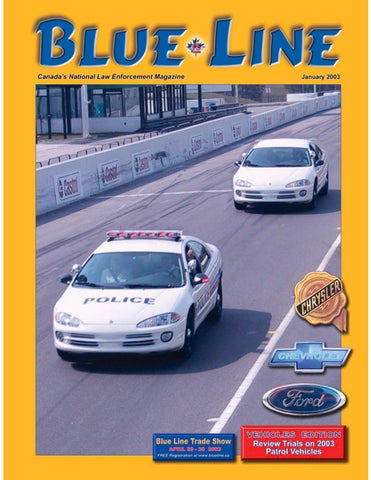
January 2003 Volume 15 Number 1
Blue Line Magazine 12A-4981 Hwy 7 East Ste 254 Markham, ON L3R 1N1
Canada
Ph: 905 640-3048 Fax: 905 640-7547 eMail: blueline@blueline.ca — Publisher — Morley S. Lymburner
eMail: publisher@blueline.ca
— General Manager — Mary Lymburner, M.Ed. eMail: admin@blueline.ca
— Editor — Mark Reesor
Inside This Edition Blue Line Special Seminar Series
4
Publisher’s Commentary
5
Michigan State Police tests 2003 patrol vehicles For the first time in 20 years it looks like a three-way race
6
Spike belt safety 10 The Ontario Police College teach deployment techniques It’s not just an accident anymore
12
eMail: editor@blueline.ca
— News Editor — Les Linder eMail: news@blueline.ca
— Advertising — Mary Lymburner Dean Clarke Bob Murray
A pro-active approach to mitigation 13 An edited digest of the Parks Canada Risk Assessment Review DEEP BLUE We’re lousy at judging our abilities
16
READER RESPONSE
17
WINNING STRATEGIES FOR LIFE Communicate with clarity
19
CASE LAW • Duty to protect life doesn’t require warrant • Police partly liable for drunk prisoner’s death • Facts, not time, define unreasonable delay
20
THE BLUE LINE FORUM
24
eMail: sales@blueline.ca
— Pre-press Production — Del Wall — Contributing Editors — Communication Skills Terry Barker Police Management James Clark Tactical Firearms Dave Brown Technology Tom Rataj Psychology Dorothy Cotton Case Law Mike Novakowski Blue Line Magazine is published monthly, September to June, by Blue Line Magazine Incorporated with a mailing address of: 12A - 4981 Hwy. 7 East, Ste. 254, Markham, Ontario, L3R 1N1. Individual magazines are $3.50 each. Subscriptions are $25.00 per year or $40.00 for 2 years. (Foreign - $50.00 U.S.) All material submitted for publication becomes the property of Blue Line Magazine unless other arrangements have been made with the publisher prior to publshing. The authors, advisors and Publisher accept no liability whatsoever for any injuries to persons or property resulting from the application or adoption of any of the procedures, tactics or considerations presented in this magazine. Readers are cautioned and advised that articles presented herein are edited and supplied for your personal awareness and should not be used for further action until appropriate advice and guidance is received from a supervisor, Crown Attorney or other person in authority. Established in 1988, Blue Line Magazine is an independent publication designed to inform, entertain, educate and upgrade the skills of those involved in the law enforcement profession. It has no direct control from a law enforcement agency and its opinions and articles do not necessarily reflect the opinions of any government, police, or law enforcement agency. ©2003 - All articles are protected by copyright. No part of this publication may be reproduced or transmitted in any form or by any means, electronic or mechanical, including photocopying and recording or by any information storage or retrieval system without permission. Internet activity is monitored and use or reposting of material on the Internet is restricted.
This publication is a private venture and receives no subsidy or grant from any level of government.
— Affiliations — International Association of Law Enforcement Planners Canadian Advertising Rates & Data International Police Association The Police Leadership Forum The Canadian Press Newswire Printed in Canada by Janson Printing Service
ISSN #0847 8538
Canada Post - Canadian Publications Mail Product Sales Agreement No. 176796 January 2003
A perception of bias 26 A policy to address racially biased policing Britian’s big brother image raises questions about surveillance
29
Police and mental health workers meet Unique meeting recognizes need for co-operation
30
COMING EVENTS
32
Art of the sting Undercover officers explain how they caught murderer
33
PRODUCT NEWS
34
POLICE MANAGEMENT Unleashing the leaders within
35
TECHNOLOGY Customized cars can be dangerous
36
THE BACK OF THE BOOK The toss of a coin
38
3
The 2003 Michigan State Police Trials are becoming more interesting now that all three big American automobile manufacturers are again aggressively competing for police business. Testers found that all three companies have made improvements, with Daimler/ Chrysler and Chevrolet narrowing the gap on Ford. The complete report should now be available on the NLECTC’s web site (http:// www.nlectc.org/testing/vehicles.html). Continuing on the car theme, Blue Line News Editor Les Linder profiles the Ontario Police College’s spikebelt safety course. Too many officers have been killed in recent years deploying the tire deflation devices the wrong way or taking chances in a bid to stop violators. Linder’s article is a must read for every Canadian police officer — as OPC instructor Jerzy Kwiatkowski warns his students, a lot of people think they can guess how soon a speeding car is going to reach them; “most are wrong and it will cost them their life.” Investigating vehicle accidents has traditionally been a less than a status symbol job in many police departments. “It’s just an accident,” colleagues say — but as Vancouver Police Department Sgt. Jess Ram points out, many more people are killed in accidents than murdered each year — and in Vancouver, at least, ‘it’s not just an accident anymore.’ It took a freedom of information act request to get a risk assessment review on Canada’s game wardens that Parks Canada didn’t want you to see. The reviewer, JIBC’s Steve Hess, found wardens encounter even more risks than police officers and recommends sweeping changes to ensure their safety. Also in this issue — Dr. Dorothy Cotton looks at how good we are at judging our abilities and tells us about the first annual meeting between police officers and mental health workers; Mike Novakowski serves up another triple helping of case law; Danette Dooley tells us about how undercover officers from two provinces worked together to catch a murderer and Tom Rataj looks at the dangers presented by customized cars.
SEMINAR SERIES BLUE LINE SPECIAL April 29th or 30th PRESENTER
COURSE OUTLINE
With the recent tragic events thrust into the forefront of our society you now have the unique opportunity to be trained in Extraordinary Rapid Deployment at the Blue Line Trade Show, April 29 or 30, 09:30 to 11:30 hrs. This Extraordinary Rapid Deployment (ERD) training is presented by the Sothern Ontario Law Enforcement Training Association. It is vital to all police officers, particularly those on the front line. Ontario has now made this train-
ing mandatory for officers responding school calls where an armed suspect is believed to be on the premises. The Blue Line Trade Show gives you an opportunity to be appropriately trained in this response mechanism. The course examines actual incidents and provides critical information for first responders. It shows specific officer deployment tactics, formations, and cornering strategies. Also covered are police, contact, and rescue team priorities, equipment, and procedures. Attendees will receive a certificate of attendance upon completion of the seminar series.
A Halton Regional Police officer with over 15 years of experience, Chris Collins is the tactical rescue unit team leader and the founder / president of the Southern Ontario Law Enforcement Training Association. He can be reached at: soleta@cogeco.ca.
WHO SHOULD ATTEND
• All front line officers • Supervisers • Tactical officers • School liaison officers • Campus police services
Ontario Gang Investigators Association (ONGIA) April 29 or 30, 13:30 to 15:30 hrs.
SEMINAR OUTLINE This seminar aims to empower police and civilians alike with the tools necessary to combat street gangs. You’ll learn the tell tale signs of gang membership and their key motivational factors. Criminal street gangs impact the community in reprehensible ways. The Ontario Gang Investigators Association has partnered with Blue Line Magazine to offer an intense gang training module for the civilian and law enforcement communities. They will examine the history of criminal street gangs and the most common warning signs of gang membership and association. This will heighten delegates’ awareness of the various stages of gang involvement. This seminar will discuss key strategies which focus on interdiction, intervention and education. Upon successful completion, each attendee will receive a certificate from the Ontario Gang Investigators Association.
WHO SHOULD ATTEND • All front line officers • Investigators • Crime analysts • Crime prevention officers • School liaison officers • Campus police services • Security and civilians
REGISTRA TION REGISTRATION These half-day courses will be held on April 29 and repeated April 30 between 09:30 and 15:30 hrs. The cost is $50 + GST. Register for either day on-line at www.blueline.ca or Phone 905-640-3048 January 2003
4
A truly meaningful New Year’s Resolution by Morley Lymburner What do all these agencies have in common? •Peel Regional Police - 1,836 members •Edmonton Police Service - 1,530 members •Winnipeg Police Service - 1,476 members •Niagara Regional Police Service - 858 members •Brantford Police Service - 182 members •Lethbridge Police Service - 143 members •Canadian Pacific Railway Police - 135 members •Brandon Police Service - 95 members •Six Nations Police Service - 31 members •Camrose Police Service - 30 members •Niagara Parks Police - 24 members They have been certified by the Commission on Accreditation of Law Enforcement Agencies (CALEA). They all have the confidence of their community that they meet recognized standards of acceptability and performance. Furthermore this can be proven by CALEA, an international organization set up to ensure this quality of service. As a further assurance to the community each police agency has the right to proudly carry the accreditation seal as a decal emblazoned on the both sides of their vehicles. Too many top managers of police agencies across Canada spend a lot of time naval gazing. The competitive environment that has developed between the three levels of policing has contributed to this attitude of looking inward and comparing their own agency with others. Smaller agencies fear they must fend off amalgamation by showing they are better than the bigger forces because they can deliver “Community Policing.” Too often it turns into their home-grown version of a feel good local cuddly cop on the corner. Larger police departments simply feel they are too large to worry about competing with other agencies. They are, however, concerned about internal scandals that may signal false impressions to the community that they are simply too big to manage; their policies and procedures are too ingrown and out of pace with the realities of modern policing. Advising the community that their own internal stamp of approval is good enough simply does not wash anymore. Where larger agencies worry about line of command and accountability processes and procedures, smaller agencies worry about credibility with their staff, the community and other agencies. In Canada very few have sought outside help to address these concerns. They either look inwardly to find solutions that affect them outwardly or simply bumble along day by day and hope no embarrassing issues arise. CALEA is designed to allay these fears and issues but too few Canadian police services have availed themselves of their services. CALEA is a single source one-stop-shop designed specifically for the purpose of showing your community and your members that you are doing everything correctly. The process dissects your organization in every aspect of its operations and either confirms you are doing it right or where you need to improve. Confirmation that some existing processes are correct certainly feels good but being able to let go of long entrenched bad policies can only improve January 2003
the credibility of any agency. The Commission on Accreditation for Law Enforcement Agencies, Inc. (CALEA), was established as an independent accrediting authority in 1979.The Commission has 21 members; 11 members are law enforcement practitioners; the remaining 10 members are selected from the public and private sectors. Commissioners are appointed to a term of three years. The position of Commissioner is voluntary and receives no salary. CALEA maintains a small, professional staff, managed by an Executive Director, available to assist applicants and accredited agencies through a toll-free telephone number. The overall purpose of the Commission’s accreditation program is to improve delivery of law enforcement service by offering a body of standards, developed by law enforcement practitioners, covering a wide range of up-todate law enforcement topics. It recognizes professional achievements by offering an orderly process for addressing and complying with applicable standards. Successful completion of the accreditation program requires commitment from all levels of the organization, starting with the chief executive officer. To foster commitment, a decision to participate should be voluntary. To this end, the Commission insures that law enforcement accreditation is and will continue to be a
5
voluntary program. Besides the recognition of obtaining international excellence, the primary proven benefits of accreditation include: • controlled liability insurance costs; • administrative improvements; • greater accountability from supervisors; • increased governmental and community support; • increased confidence of staff and community. And just in case you may think that only police gain benefits from CALEA you should also know that organizations such as Alberta Transportation, Inspection Services were also recently accredited. University security and police services as well as private security companies are examples of other agencies that can reap enormous benefit. Over 650 agencies are currently accredited around the world and every five years they are checked again to ensure they have maintained this standard. There is no agency who can not afford this process. Here is a New Year’s resolution that is completely attainable. Communities everywhere have a right to expect it and police services should show leadership by insisting on it. Find out more about CALEA and the over 650 accredited agencies by going to www.BlueLine.ca then go to BlueLinks.
For the first time in 20 years all three major car manufacturers are aggressively competing for police fleet dominance. Every year the Michigan State Police in conjunction with the US based National Institute of Justice test the latest model year patrol cars submitted by major manufacturers. For the past ten years only Ford has produced a high ranking police car that met the best requirements of the NIJ Standards. This past September the tests proved that both DaimlerChrysler and Chevrolet are now closing the gap with the most advances seen in the new Intrepids. Patrol vehicles are among the most critical purchases that a law enforcement agency makes. For both large and small agencies, they frequently represent the second largest expenditure, after personnel, in their annual operating budgets. Selecting a vehicle that balances both budgetary and performance requirements has become an increasingly challenging task for police fleet administrators. Many agencies are painfully aware of the consequences that result from being ‘penny wise and pound foolish,’
January 2003
where vehicles with inadequate performance, such as regular production passenger vehicles not specifically designed for police service, are selected because they cost less than police package vehicles. Although some agencies have had limited success with nontraditional police vehicles, most find that the increased maintenance costs quickly offset any initial savings. For more than 25 years, the Michigan State Police (MSP) has conducted extensive evaluations of the performance capabilities of each new model year’s police vehicles as part of its annual vehicle procurement process. Since 1981, the US National Institute of Justice (NIJ), through its National Law Enforcement and Corrections Technology Center (NLECTC) system, has sponsored these tests through a partnership with MSP. The 2003 model year patrol vehicles were evaluated from September 21 through 23, 2002. For the purposes of the MSP evaluation, police-package vehicles are those that are designed and manufactured for use in the full spectrum of law enforcement patrol service, including pursuits. A special-service vehicle is a ve-
6
hicle that may be used by law enforcement agencies for specialized use (e.g., off-road, inclement weather, K–9, or commercial vehicle enforcement), but is not designed or manufactured to be used in high speed or pursuit situations. By creating this distinction, it is hoped that it will be easier for agencies to realistically assess the capabilities of each vehicle. Each vehicle is subjected to six major tests and evaluations. The results are weighted to reflect the relative importance of each attribute as related to MSP operational requirements. Four police-package vehicles were submitted for evaluation. The MSP vehicle specifications, test categories and scoring reflect MSP needs. If your department employs this or a similar method, consider your own needs carefully and alter the weighting factors accordingly. What’s new for 2003 AM General: The AM General Hummer was once again submitted for testing as a policepackage vehicle. There are no significant changes from the 2002 model. Chevrolet: For the 2003 model year, the Impala is once again available in both the 9C1 police package and the 9C3 unmarked police package. One enhancement for the 2003 model year is that the fuel cut-off has been increased to 129 miles per hour (mph). Also, the following items that were optional in previous years are now standard: • Engine oil cooler • External transmission oil cooler • Low frequency radio interference suppression • UT7 ground stud for the electrical system DaimlerChrysler: DaimlerChrysler’s entry in
the 2003 model year tests is the Chrysler Intrepid sedan, which was introduced in 2002 as the first police package sedan entered by the company since the Dodge Diplomat in 1989. The 2003 Intrepid remains basically unchanged from 2002. Representatives of DaimlerChrysler’s police vehicle engineering team state that the power steering and antilock brake system (ABS) have been enhanced from the 2002 model and side air bags and remote keyless entry are now available as optional equipment. Ford: The 2003 Police Interceptor was introduced as a midyear replacement in March 2002 and a preproduction version was evaluated in 2002’s tests. The 2003 models feature a new, hydroformed steel frame, which Ford engineers state will improve the strength of the frame and improve front-end crash performance. Also new are the shocks, springs, suspension and rack-and pinion steering. The brake system is all new and ABS is now standard. A new tire, the Goodyear Eagle RS–A Plus, is featured, which Ford engineers say will improve steering feel, wet and snow traction and has longer tread life. Powertrain improvements include a new variable speed electric fan for engine cooling and a knock sensor prevents detonation from low-octane fuels. New interior safety features for 2003 include a higher headrest, which provides greater support behind the head in a crash to prevent whiplash. For units produced after July 2003, side air bags will be standard on vehicles equipped with power seats and optional for vehicles equipped with manual seats. Ergonomic interior improvements include adjustable cup holders to accommodate a wide variety of cup sizes and a new power point below the cup holders provides a location to plug in additional equipment. To assist in installing aftermarket equipment such as emergency lighting systems, radios and computers, a new power distribution box is standard in the passenger compartment and optional in the trunk. It provides ten fuse locations to provide power to aftermarket equipment and signal connections for six key functions. A compressed natural gas (CNG) version of the Police Interceptor was scheduled to be available this month, however Ford elected not to submit one for testing for this model year. The 2003 CNG model will feature the same 4.6L engine as the gas model and will meet ultra-low emission vehicle (LEVII) standards. Vehicle dynamics testing Objective: To determine high-speed pursuit handling characteristics. The two-mile road racing course contains hills, curves and corners; except for the absence of traffic, it simulates actual pursuit conditions. The evaluation measures each vehicle’s blending of suspension components, acceleration capabilities and braking characteristics. Methodology: All vehicles are driven over the course a total of 32 timed laps by four separate drivers, each one driving an eight-lap series. The final score for the vehicle is the comJanuary 2003
bined average of the five fastest laps of each of the four drivers. Acceleration Objective: To determine the time required for each test vehicle to accelerate from a standing start to 60 mph, 80 mph and 100 mph. Methodology: Using a Datron Non-Contact Optical Sensor in conjunction with a personal computer, each vehicle is driven through four acceleration sequences — two northbound and two southbound to allow for wind direction. The average of the four is the score on the competitive test. Top speed Objective: To determine each vehicle’s speed after one and two miles and the actual top speed attainable within a distance of 14 miles from a standing start. Methodology: Following the fourth acceleration run, the vehicle continues to accelerate to the top speed attainable within 14 miles from the start of the run. The highest speed attained within the 14 miles is the vehicle’s score on the competitive test.
Braking testing Objective: To determine the deceleration rate attained by each test vehicle on twelve 60-to-0 mph impending skid (threshold) stops, with ABS in operation if the vehicle is so equipped. Each vehicle is scored on the average deceleration rate it attains. Methodology: Each vehicle makes two decelerations at specific, predetermined points on the test road from 90 to 0 mph at 22 ft/sec2, with the driver using a decelerometer to maintain the deceleration rate. Immediately after these heat-up stops are completed, the vehicle is turned around and makes six measured 60-to-0 mph impending skid (threshold) stops with ABS in operation, if the vehicle is so equipped, at specific, predetermined points. Following a four minute heat soak, the entire sequence is repeated. The exact initial velocity at the beginning of each of the 60-to-0 mph decelerations and the exact distance required to make each stop is recorded. The data resulting from the 12 stops is used to calculate the average deceleration rate, which is the vehicle’s score for this test. 8
Ergonomics and Communications
Objectives: To rate the vehicle’s ability to provide a suitable environment for patrol officers to perform their job, to accommodate the required communications and emergency warning equipment and to assess the relative difficulty of installing the equipment. Methodology: A minimum of four officers independently and individually score each vehicle on comfort and instrumentation. Personnel from MSP’s Communications Division who are responsible for new car preparation conduct the communications portion of the evaluation, based on the relative difficulty of the necessary installations. Each factor is graded on a one to ten scale, with one representing totally unacceptable and ten representing superior. The scores are averaged to minimize personal prejudice. Fuel economy
Objective: To determine fuel economy potential. The scoring data are valid and reliable for comparison, but may not necessarily be an accurate prediction of the car’s actual fuel economy. Methodology: The vehicles’ scores are based on estimates of city fuel economy to the nearest 1/10 of a mile per gallon from data supplied by the vehicle manufacturers.
Repeat drunk drivers avoiding conviction Nearly 40 percent of repeat drunk drivers in the US ignore court orders and take advantage of other loopholes to avoid sentences handed down by judges, who themselves are frustrated by a system they say is overly complicated and chronically under resourced. That’s the main conclusion of a new traffic safety study which surveyed 900 judges from 44 states. The top problems they mention are inadequate systems to ensure sentences are being carried out, insufficient and incomplete evidence at trial, which often results in cases being dismissed and overwhelming caseloads requiring them to review up to 200 cases per day. “What we’re dealing with are individuals who have figured out they don’t have to do the time, even though they’ve done the crime,” said Herb Simpson, Ph.D., President and CEO of the Traffic Injury Research Foundation (TIRF). “However, the study also shows that meaningful progress can be made in reducing drunk driving by forcing repeat offenders to comply with a system that clearly needs fine-tuning and greater resources.” TIRF, an Ottawa-based independent road safety institute, conducted the survey as part of a comprehensive three-year study funded by Anheuser-Busch. Specifically, the top problems uncovered in the survey include: • Inadequate sentence monitoring: Judges say that
40 percent of repeat offenders fail to report to their probation officer, thereby avoiding court-ordered penalties. The solution? Centralize monitoring and reporting activities under probation and parole departments who are in the best position to confirm with various agencies involved in drunk driving cases that offenders are complying. • Problems with evidence: Insufficient or inadequate evidence may force judges to accept pleas to lesser charges, dismiss cases or impose reduced sentences. In addition, judges say they lack adequate knowledge about scientific issues that often arise in drunk driving cases. The solution? More and better training for judges. • Excessive caseloads: Some judges report they review up to 200 cases per day, resulting in limited contact with offenders and familiarity with the details of cases. The solution? Almost half (43 percent) of judges surveyed said more judges are needed to manage caseloads effectively. In addition, judges want to see greater use of specialized DWI courts, which permit swifter resolutions, reduce case backlogs and improve outcomes. The remaining problems encountered by judges include delays in case processing; defendants’ failure to appear in court; inadequate record systems; inconsistent sentencing for repeat offenders; laws mandating minimum sanctions; and the interpretation of technical evidence and complex laws is challenging for juries. For further details go to BlueLink BlueLinkss at www.blueline.ca
For further details go to BlueLink BlueLinkss at www.blueline.ca
January 2003
9
Spikebelt safety course will keep cops alive
Kwiatkowski (left) observes as the student prepares to retract the device.
The student deploys the device and stays out of sight in front of his cruiser.
Photos: Mark Reesor
An OPC student watches from cover of his cruiser as a suspect vehicle approaches. by Les Linder Students at the Ontario Police College (OPC) are learning how to avoid being killed when deploying tire deflation devices during pursuits — and they’re proving there’s plenty of tricks to teach even old dogs. When South Simcoe Cst. Alan Kuzmich was killed in August 2002 while trying to deploy a spike belt in a pursuit, police officers across Canada were reminded of the danger using the device poses. OPC is working to ensure future officers don’t make the same mistakes by including deployment techniques as a part of their regular police training. Jerzy Kwiatkowski, police vehicle operations instructor for the college, points out that many of the things students learn are also important for veteran officers to remember when involved in pursuits. The training includes having each student practice deploying tire deflation devices on a vehicle passing by them and deployment in a simulated pursuit involving numerous cruisers and a suspect vehicle on the OPC’s vehicle course. The course is capped off with a simulated takedown by numerous officers of a suspect in a stopped vehicle. During the hands-on training, Kwiatkowski teaches proper tire deflation device techniques and important information to keep in mind when out in the field. “When the pursuit begins, remember to keep back and away from the suspect’s car,” he says. “Put them in a false sense of security that they are actually escaping. You don’t want to get close because when you do, they drive faster and more aggressively, hoping they can evade you. “Also, if the suspect gets around a corner and doesn’t see you behind them right away, they may feel it is the perfect time to ditch the car to flee and hide on foot. This is exactly what you want to happen, as a foot pursuit is far less dangerous to the public than a vehicle pursuit.” Kwiatkowski adds it’s important for rookies and veterans alike to remember how crucial it is to communicate during pursuits and espeJanuary 2003
cially spike belt deployment. “While a license plate is important data, it isn’t when you want to set out a tire deflation device. You’re not going to be reading that plate number when it’s coming at you over 100 km/h.” Instead, he says, the officer should focus on information that will help the person deploying the device to spot the vehicle. Model, make of car, vehicle colour, location and direction of travel are far more important. Updating the situation every 10 to 15 seconds is also important and at the very least, information should be repeated now and then so it is clear to all officers, especially the person with the spike belt. Kwiatkowski also points out that a lot of the work can be done before a pursuit ever begins. “It’s always a good idea to keep in mind key locations or ideal spots for a spike belt while going about your routine patrol,” he says. “Keep your eyes open and pay attention to the surroundings in your area so you know the best spots to be when a pursuit happens. This can make a tremendous difference and lead to a safer arrest.” While tire deflation devices generally don’t cause a vehicle to lose control, since air is let out gradually, it can still become more difficult to steer, especially with buses, trucks and other large vehicles. Kwiatkowski emphasizes it is important to keep that in mind when following a spiked vehicle or if an officer accidentally runs over a spike belt. Most models of belts are designed to stop passengers cars but can still be used and will sometimes succeed in stopping large vehicles. Kwiatkowski warns never to deploy the device against a motorcycle, as it will likely cause a crash and serious injury. When working with his students, Kwiatkowski teaches numerous important points that all officers should keep in mind while deploying tire deflation devices. For example, when arriving at the location where the device is to be deployed, open the trunk and leave it raised so it obscures the cruiser’s roof lights. “Always deploy the device from the front of your cruiser,” he explains. “Officers who don’t do this can more easily be injured or killed because they don’t have sufficient cover from the approaching car.” He added that officers who were killed in South Simcoe, Sudbury, Alberta and Quebec died during deployment partly because of un10
safe techniques or because they didn’t use proper cover. The officer should be leaning forward and remaining low and close to the front of the cruiser, using the trunk to help hide them from view. Kwiatkowski explains that this is done to avoid drawing attention as the suspect approaches. Ken Lester, police vehicle operations coordinator at OPC, warns of the reasons to never step out from cover onto the road. “It all comes down to maintaining cover and avoiding motion,” Lester says. “If you step out there, you’re just creating motion and that is going to draw the driver’s attention to you and the spike belt. He may panic and swerve to avoid the trap and instead just plow right into you.” To properly deploy the device, either toss it out on the road (such as with a Stop Stick) or slide it out on the road (Stinger) while remaining covered by the front of the cruiser. Release the string attached to the device immediately and place a foot down on the string to hold it in place. “Once the suspect vehicle passes over the device, yank it back immediately with the string so pursuing cruisers can pass safely.” Kwiatkowski stresses it is important to pull the device back far enough so it is not resting in front of your own cruiser’s tires. “In case you decide to quickly get back in your car and either leave the device behind or forget it, the last thing you want is to run over your own spike belt.” However, sometimes the officer fails to deploy the device properly in the first place and it either lands in the wrong spot or in a manner where it won’t work when a car runs over it. Under no circumstances should an officer ever go out on the road to correct a device that didn’t deploy properly, Kwiatkowski says. “Sometimes it simply won’t work. Just leave it alone, that’s the way it is going to have to be. Don’t even think for a second you can go out there and fix it, because that’s exactly how officers get hurt or killed.” Most people, including many officers, don’t have the ability to accurately gauge how quickly a vehicle will be upon you when travelling at a high speed, he explains. “A lot of people think they can guess when a car travelling 120 km/h is going to reach you. Most are wrong and it will cost them their life.” During the exercises, several students could be seen deploying the device incorrectly. Each time, the students almost stepped out onto the road and seemed eager to go fix it as the suspect car approached (albeit slowly), but not before an instructor reminded them to stay put. “This is exactly how we lose officers,” Kwiatkowski says. “This is why we try to drill
prevent it from happening.” into their heads never to step out there, He says the program is a far cry even if they think they can make it.” from previous methods of training Another problem Lester points out is when officers were simply shown the that the instructional videos for many of device, a video, an explanation of how the devices suggest unsafe techniques for it works and then simply told to use it. deployment that some officers may have Lester points out, however, that seen and mistakenly follow. the deaths of officers is rarely caused “The video for the Stinger says the because of the device itself. officer should go out onto the road and “There’s not a whole lot to be imthen drag the spike belt back to the front proved on most tire deflation devices. of his cruiser,” Lester explains. Most of them work just fine when de“This is terribly flawed and very ployed and I can’t really say there is a dangerous since it exposes them to bespecific design flaw that makes officing noticed and even being hit by other cars. It goes against everything we teach Kwiatkowski (right photo, center) demonstrates to his class ers vulnerable.” about safety and cover, so we tell our how to keep cover using the cruiser after deployment. He says most often it is simply students to ignore them completely.” human error and the fault of the officer for stepIn a situation where an officer knows an- the vehicle was approximately 50 metres away, ping out onto the road or not using proper cover. other car is directly ahead of the suspect vehi- making it unlikely that the officer could have “I can understand why officers get the imcle, Lester says the officer must make a deci- stepped out on the road without being hit. pulse to step out and correct the device when An instructor informed the student to stop they don’t put it out there properly,” he explains. sion between the pros and cons of deploying tugging the string as it was creating motion and “They know they are close to ending the purthe device or not. “Worst case scenario is you flatten a few could draw attention to himself. suit and think that if they just fix it, they can “It didn’t work out this time,” Lester said tires on an innocent person’s car and your servend it right there. They’re so determined to do ice will be on the hook for the cost of some afterwards. “Sucks to be you, but guess what? tires,” Lester says. “Ask yourself how impor- You’re safe. You get to live to do it again an- their job right that it can be dangerous. “Sadly, it’s the officer’s own dedication to tant it is to catch this suspect and then make other day and that’s all that matters.” Lester explains that the current system has his job and devotion to protect the public that your decision.” During the simulated pursuit portion of the proven effective and safe, as no Canadian of- can get him killed. “We have to make sure officers remember training, a student officer could be seen deploy- ficers who were using their vehicles as cover ing a Stop Stick device which had landed too far have been injured or killed. There also hasn’t to fall back on their training; it will help keep out on the road. The student momentarily been a Canadian case where a suspect crashed them alive.” flinched as if he was about to step out from cover into the back of an officer’s cruiser while they to fix it, but seemed to remember his instruc- were parked on the side of the road. For more information, contact police vehicle “Officers can be lost when they forget the tions and instead opted to try fixing it from cover operations co-ordinator, Ken Lester at 519 773by tugging on the string to nudge it into the technique and officers have been lost because 4416 or kenneth.lester@jus.gov.on.ca. proper position. At the time this was happening, of this. That’s what the training is here for, to
For further details go to BlueLink BlueLinkss at www.blueline.ca
January 2003
11
It’s not just an accident anymore by Jess Ram A common complaint from police officers who regularly investigate serious and fatal collisions is the lack of respect they’re afforded by other investigative branches. The phrase “it’s just an accident” is often bantered about around report writing rooms and mistakenly used by non-traffic types to describe the complex and lengthy investigations that are completed by collision analysts and reconstructionists. The sobering fact is that the Vancouver Police Department (VPD) Collision Investigation Unit (CIU) investigates the majority of homicides in the city — an average of 36 fatal collisions a year since 1990, ranging from a high of 44 to a low of 25. That compares to an average of about 22 murders a year — and the murder rate has decreased for the past five years, dropping to 19 in 2000 and 15 in 2001. Why then are traffic fatalities viewed as not as important as “real homicides?” One explanation is that, until recently, the media represented traffic related deaths as the price of progress and high traffic volume; the cost of living in a big city. In fact, Canadian Criminal Law does not recognize traffic homicides with specific vehicular homicide legislation, as do many U.S. jurisdictions. As a result, they’re prosecuted under more general laws such as the criminal negligence, dangerous driving or impaired driving sections of the Criminal Code. It’s only in the last few years that the Greater Vancouver area has focused on street racers and high profile traffic related deaths, giving these investigations front page status. They lack the appeal of a high profile murder of a notorious underworld figure or estranged lover, but the recent scourge of street racers terrorizing an innocent and unsuspecting public has shifted the focus. These stories have media appeal — sensational action, emotional tragedy for the victim and can potentially effect any unsuspecting member of society. Recent high profile traffic deaths in Vancouver and BC’s lower mainland caused the media to sit up and take notice. One thing quickly became clear — the manner in which accident investigations are carried out has undergone a notable transformation in the past four years. Attached to the traffic section, the CIU’s 18 constables and two sergeants, working a four on and four off rotation, employ a team approach to investigations. As many as nine officers and a sergeant may work on a single accident, especially during the early stages of the investigation. Unlike some other police agencies, who January 2003
divide the responsibility for accident investigation among general duty/patrol officers and traffic members, the Vancouver CIU manages the entire file, including responding to the initial calls for service. With assistance from motorcycle units and general patrol members, their tasks include: • Securing the scene. • Collecting forensic evidence. • Collecting and analyzing roadway evidence. • Recording the scene through photos and computer mapping. • Interviewing witnesses and interrogating suspects. • Compiling the various external reports. • Making final recommendations to Crown Counsel for charge approval. There’s been considerable technical advances in the entire collision reconstruction community over the last four years. The ‘Leica Total Workstation Laser Transit’ and ‘Compaq IPAQ’ have all but replaced the fiberglass tapes that were used to measure all serious and fatal collision scenes. Diagrams are now reproduced with the aid of computer assisted drawing programs. Several investigations of fatal collisions have used DNA analysis; it was instrumental in identifying the driver in a hit and run and confirmed the identity of the driver in several other accidents. Most Vancouver CIU unit members are now qualified DNA sampling technicians. The VPD recently acquired a crash data retrieval system, which retrieves vital data in a vehicle’s sensing and diagnostic module that is captured just prior to airbag deployment. It can include vehicle speed, throttle and brake settings and seatbelt usage information and has been used in several collisions to support other physical evidence. Many of these technological advances have been made possible through corporate sponsorships with companies such as the Insurance Corporation of British Columbia. Other VPD investigative branches have already recognized and taken advantage of the 12
CIU’s technological advances. Its surveying skills and equipment have been used in several homicides and serious assaults to map forensic data, assisting in capturing large-scale crime scenes and producing accurate and detailed diagrams for court purposes. In addition, DNA technician skills have also been made available to other squads, including the sexual offence squad. The CIU has become increasingly involved with proactive programs designed to reduce collision rates. In addition to regular enforcement strategies, the team helped produce a Public Service Announcement (PSA) entitled Speeder’s Club, targeting street racing and youth. This is currently airing on local Vancouver television stations. Current local radio spots include a CIU member speaking about the dangers of speeding drivers. The Collision Investigation Unit has also used problem oriented policing concepts in problem traffic areas and has helped test new roadway compounds for the Department of Engineering, ensuring that the new noise-reducing compounds don’t negatively affect braking efficiency. Training is another area where the CIU has flourished. Members have trained recruits at the Justice Institute of British Columbia in radar operation and on-scene investigations. They’re also working to replace the collision analyst and reconstruction programs that the Canadian Police College recently announced it was dropping. This includes working with the Justice Institute of British Columbia toward a forensics investigation applied science degree program. Programs have also been developed to educate local fire departments about the job of collision investigators and illustrate firefighters’ role in preserving evidence. On a more personal note, while these changes have not come without their own challenges, supervising this group of individuals has been a wonderful experience. The important principle to remember is that we train them to be collision investigators and they are experts at what they do. All they require are the tools, training and organizational support to do what they do best. The quality and comprehensiveness of their work is unmatched. Collision investigators are really homicide investigators and it is about time they’re given the recognition that they deserve. From where I stand, it’s not just an accident anymore. Sergeant Jess Ram is in charge of Vancouver Police Department’s Collision Investigation Unit. He can be reached at jessbir_ram@city.vancouver.bc.ca.
A pro-active approach to mitigation An edited digest of the Parks Canada Firearms Risk Assessment Review
by Steve Hess Parks Canada is at a crossroads. While initially envisioned as a resource management and protection agency, it has been increasingly called to respond to activities typically within the purview of police. Tourist visits to Canada’s National Parks expanded dramatically after the Second World War. The increase in visitors and trails meant wardens spent less time patrolling backcountry areas and conducting wildlife protection duties and more time responding to problems in the individual campsites. They also had to develop search and rescue skills as more visitors ventured deeper into the parkland. Poaching also became more of a problem, especially as the additional tourists impaired wildlife protection. Poachers likely felt they could operate with impunity because of the limited presence of wardens in the backcountry. A few were apprehended and convicted but the relatively low fines issued by the courts were not a significant deterrent. Increased park activity also contributed to the expanding law enforcement role of wardens. The term ‘law enforcement’ is poorly defined in the context of the warden service. Early in its development, it used the axiom “protection deals with nature and enforcement deals with people.” While catchy, the definition doesn’t help much to distinguish between the duties of wardens and police officers. This problem was more fully explored in the SimeSchuler Report, which suggested the service “should not be considered a law enforcement body, as this was primarily not its role... laws which are designed to protect the resources from people, or people from the resources, should be the responsibility of the warden service. Laws which protect people from other people, or property from people, should be a police responsibility.” It further recommended that wardens “not be used for routine control activities such as parking cars, traffic control, catching dogs in townsites or town-site policing.” The report was controversial, especially its recommendations about curtailing law enforcement duties. Parks Canada had made parks inviting to tourists. They represented a cross-section of society, so the law of averages predicted that there would be more vandalism, fights, domestic disputes and thefts. Without public police to respond immediately, wardens became de facto police officers and some either enjoyed this expanded role or interpreted it as falling within their purview because these disturbances related to a park. The boundary between police and warden activities became blurred even more when traffic and liquor offences were added. There can be little doubt that the warden service has changed dramatically in the last 114 years. The romantic notion of the warden as a guardian of the wild has been slowly replaced with the image of a law enforcement officer who specializes in resource management. Conducting law enforcement duties in Canada’s national parks is particularly challengJanuary 2003
ing given the rugged terrain. Ironically, it is the success of Parks Canada in promoting tourism that has highlighted some of the technological difficulties. For example, more people are accessing park backcountry and some need search and rescue and patrol services, which present significant communication difficulties because the terrain impedes ordinary two-way radios and current satellite telephone technology can be cumbersome. The result is that emergency assistance for wardens conducting backcountry patrols is compromised. The review found that too much faith is being placed in CPIC as a risk mitigation strategy; while a vital tool, it’s fallible and depend-
13
ent upon the communication technology used in the field. Without consistent and immediate access to important intelligence information, wardens may be entering into situations unaware of possible danger from persons. A significant mitigation strategy proposed by the service is requiring a 30-minute response time for emergency back-up, which is impractical. Situations involving hostile people can accelerate within minutes and when they do, back-up is needed immediately. The warden service probably deals with more people who have access to edged weapons or firearms then public police officers. Parks Canada has authorized wardens to use long guns (rifles or shotguns) during exigent law enforcement circumstances but this may actually increase the agency’s exposure to liability. Collateral damage caused by the high penetrating power of rifle bullets and the scatter effect of shotgun pellets may result in unintended injury. Risk Parks Canada asked the review team to examine the Strategic Directions document and the interim guidelines, which referenced a mathematical formula intended to allow the service to predict the amount of risk wardens face in the field. The original risk assessment mathematical model had a fundamental flaw; it didn’t properly define probability estimates and distinguish between consequences. The agency asked the review team to de-
velop a mathematical model that could be applied to the service. In order to build it, the perceptions and activities of all fulltime wardens were surveyed; 83 (32.2 per cent) of the 258 wardens responded. Three key areas for analysis arose — the percentage of time wardens spend conducting specific duties, how often they felt ‘concerned for their safety’ and the number of harmful incidents they encountered. The percentage of time conducting specific duties has general implications for determining risk situations: • backcountry patrols: 14 per cent • public safety (search and rescue): 11 per cent • protection operations & front country patrols: 27 per cent • resource management: 24 per cent • administration: 21 per cent • other: five per cent Sixty six wardens had been concerned for their safety in the past five years — 14 hadn’t — and three didn’t respond. Four of the 14 unconcerned respondents had administrative positions. A vast majority of respondents indicated they experienced situations where they felt “mildly concerned for their safety” — some were moderately to extremely concerned — and many worried about being “slightly injured.” The numbers do not, on the surface, appear to be very high. A more telling statistic is where these events are taking place and what activity was being conducted at the time. A majority — 57 per cent — occurred during front country patrols while, for example, dealing with campground complaints and intoxicated people, breaking up large parties, evicting campers and investigating complaints of disturbances. Traffic enforcement, investigating poaching activities, arresting people and other activities accounted for the rest. These begin to show a pattern of activity that replicates those routinely conducted by public police outside national parks. Several survey respondents mentioned very high levels of concern for their safety and controlling for this may, to a limited degree, lower the reported level of risk exposure. When the reported statistics are combined with all other factors observed as part of this report however, the potential for risk on the part of wardens conducting law enforcement duties remains high. If the reported numbers of incidents where wardens expressed concern for their safety or experienced harm are extrapolated to the whole service, it becomes clear they’re encountering substantial risk. The review team was frustrated in its attempts to obtain any meaningful objective data concerning workplace violence and/or injuries from Parks Canada. It appears that this type of information is kept at individual offices and isn’t readily accessible, even to the national coordinator for occupational health and safety. Determining the degree of risk and potential harm facing wardens therefore relies more on information from external sources such as US policing data and studies from other resource management enforcement agencies. A 1996 use of force report on BC conservation officers indicated they believed the number of threats or assaults had increased over recent years. A survey question examining their January 2003
proaches to mitigating the risk posed to officers from people armed with deadly weapons. In Britain, police officers assess a situation and decide if firearms are needed; if so, they’re either delivered to the site or retrieved from locked containers in vehicles. The second approach, adopted by every police force and most resource management agencies in North America, is to train all officers to assess potentially dangerous situations and employ appropriate mitigation strategies using readily available equipment, including sidearms.
perceptions of risk from people encountered revealed that over 95 per cent of respondents agreed or strongly agreed with the presence of risk in their duties. A majority of incidences involved ‘verbal threats without a weapon,’ followed by ‘having a firearm pointed at the officer’ and ‘physical threats without a weapon.’ This data demonstrates that the potential for conflict (and injury) is high among conservation officers. There were 178 incidents where BC conservation officers were threatened or physically assaulted by someone holding a weapon between 1994 and 1996. Weapons included knives, guns and items typically found in campgrounds such as axes, rocks, sticks, paddles, meat cleavers and bottles. Saskatchewan Conservation Service’s Enforcement Compliance Branch has compiled enforcement activity and conservation injury data for approximately 11 years. Interviews with officials indicate that: • there have been 20 assaults on officers since 1995 • officers have been injured in five of the assaults • male offenders were responsible for 90 per cent of the assaults • 66 per cent of suspects were under the influence of drugs and/or alcohol • 39 per cent of the suspects had criminal records • 46.9 per cent of officer assaults occur during park enforcement • 53 per cent of the assaults occurred at night A senior conservation manager commented that officers carry firearms because of the potential seriousness of the incidents that can happen when conducting law enforcement duties in resource management, not because of the number of violent incidents faced. Wardens are exposed to situations that mirror those that public police attend, the review found. To the outside observer, the warden service has come to replicate a police force in its activities. If this trend continues and wardens continue to conduct law enforcement activities, it will only be a matter of time before one is seriously injured or killed. Police forces recognizes the arbitrariness and unpredictability of violence. Agencies have collectively determined that it’s better to provide staff with all requisite tools and then implement stringent training and accountability standards to ensure public safety, rather than to not issue the tools. Historically, there have been two ap14
Implications and recommendations This review’s central purpose was to conduct an independent, third-party analysis of the warden service’s mitigation strategies and identify activities for which it hasn’t sufficiently mitigated risk. Wardens are conducting a significant number of activities that are within the normal jurisdiction of local police and are not sufficiently equipped to respond if they escalate into violence. Police officers have been injured and/or killed in activities identical in many respects. Based on empirical evidence, Canadian park wardens are exposed to levels of threat similar to those of police and other North American resource management officers. While the frequency of risk may differ, the unpredictability of when a specific risk will be encountered means that park wardens need to be prepared for all eventualities. Force options theory-based models represent the most coherent and justifiable approach to addressing threats of violence and this is an approach used in the warden service training regime. Substantial deviations from the main tenets of this theory may result in serious liabilities for an organization. While to date it appears that wardens are not being significantly harmed by people while enforcing the law, it’s clear that the issue is not ‘if’ but ‘when’ one will be seriously injured or killed. Law enforcement is unpredictable and nothing can be done to remove all risk. Professional agencies recognize this fact and strive to provide their officers with up-todate training and equipment to best address unpredictable and seemingly arbitrary violent events. The main report outlines a series of activities that wardens should be restricted from conducting under the present set of risk mitigation strategies and include: • investigating disturbance calls involving groups of people under the influence of drugs and/or alcohol • conducting traffic enforcement • assisting police in investigating criminal events or looking for suspects/known criminals • investigating in-progress criminal events • investigating field-based poaching activities (fish or wildlife) • conducting high-risk takedowns of known or suspected offenders Wardens are more involved in conducting law enforcement duties in National Parks then ever before and as a result, become exposed to similar risks as police when conducting park law enforcement duties.
Recommendations It is recommended that: 1. The 40-hour ‘law enforcement training course’ be expanded to include tactical communications and personal safety skills training. 2. Parks Canada provide resources to ensure that all PC-04A carded wardens receive adequate training and maintain their skills through re-certification courses within prescribed intervals. 3. Park wardens who don’t have a valid PC-04 card shouldn’t participate in operational duties or backup law enforcement support. 4. Parks Canada conduct a technical review of communication technology to ensure wardens conducting operational duties have efficient and reliable devices. 5. Parks Canada work with local police to ensure that calls for assistance by wardens are received in a timely manner. 6. The service review the process by which wardens are dispatched to calls for service. 7. Parks Canada continue to provide access to databases listed in the Strategic Directions document to enhance the warden service’s ability to analyze information and plan for future mitigation strategies. 8. If law enforcement is going to be emphasized, warden service uniforms should reflect this. If the intent is to move away from law enforcement, uniforms should be altered accordingly. 9. Wardens receive additional training on the need for recording information about hazards encountered in the workplace, in particular violent incidents. 10. Wardens conduct front country campground patrols in pairs, with radio communication to dispatch or other backup sources. 11. Parks Canada review the response time required for backup when wardens conduct operational patrols in the front country. 12. The term ‘peace officer’ be defined as a PC04A carded warden authorized to carry and who is carrying a baton and OC spray, a police officer or other armed peace officer who has authority within the jurisdiction. 13. Night fall highway/operational/poaching/ enforcement patrols only be done by two fully qualified (PC-04A) wardens who have full access to all safety equipment, including the ability to call for backup response. 14. ‘Dark hours’ be defined to include ‘dusk.’ 15. It is recommended that wardens conducting dark hours duties have appropriate backup (another PC-04A carded warden) or police officer. 16. Traffic enforcement stops only be conducted by two PC-04A carded wardens — or one when police backup is present. 17. All backcountry patrols be conducted by two PC-04A carded wardens with appropriate enhanced communication equipment, regardless of season. 18. The term ‘other armed officer’ in the interim guidelines be replaced with ‘local police who have jurisdiction.’ 19. The warden service rely on local police to respond to these incidents and that wardens provide a limited backup role, depending upon the nature of the risk. 20. Memoranda of understanding be established with all jurisdictional local police agencies and that existing memoranda be
reviewed for currency. 21. Joint training be conducted with local police to more fully understand agency mandates, protocols and procedures. 22. Local police be the primary agency responsible for responding to all offences where the potential exists for violence. 23. That, at minimum, a PC-04A carded warden be assigned when backup is required for calls that could potentially involve violence. 24. Parks Canada receive a legal opinion regarding their liabilities when wardens are assisting other law enforcement agencies. 25. Local police first execute all search warrants, with wardens participating only after the building is secured and the occupants are accounted for and guarded by police. 26. Wardens conducting investigations outside park boundaries advise local police and request assistance as needed. 27. Parks Canada better define the series of activities known as special investigations, tactical plans, compliance strategies and operational plans and draft policy that provides guidance to local managers when assigning staff to these duties. 28. Wardens conduct boating patrols only with a partner or in tandem. Steve Hess, former assistant director of the Justice Institute of BC, was commissioned by Parks Canada to review the need for arming park wardens. This review was kept secret but was recently discovered through a Freedom of Information Act application. For further information, contact Doug Martin at djmartin@telusplanet.net or 403-762-1411.
Colorado’s most-wanted poacher found out how determined wardens can be after Colorado officers tracked him down in Michigan on April 14 after an anonymous tip. Wendell Cook, 41, had been wanted by Colorado authorities for nearly a year after he skipped town the day he was to be sentenced for wildlife violations and being a felon in possession of a firearm. Cook and three partners were accused of killing five deer, two elk, two antelope and a black bear. Colorado authorities and those of several other states and Canada had been looking for him. It is not known how many incursions he and his partners made to Canada but it is felt to be an almost certainty that they had.
For further details go to BlueLink BlueLinkss at www.blueline.ca
January 2003
15
We’re lousy at judging our abilities
by Dr. Dorothy Cotton Ph. D., C. Psych.
I hope you all appreciate how lucky you are to have a psychology column each month. Psychology is a very profound subject. You can tell because when you read psychology things, there are many profound remarks. I was just looking at a book called Psychology and Policing and I ran across the following chapteropening statement (now I hope you are sitting down. This is pretty earth-shattering stuff): Driver behaviour has long been recognized as a major cause of road crashes. Whew. Gives me the shivers just to contemplate those words (or maybe that was a hot flash — whatever). All this time I thought car accidents were attributable entirely to roads disappearing, car engines falling out and wild animals jumping through windshields. Who’d a thunk drivers had anything to do with it? After all, there are really very few bad drivers out there. I mean, when was the last time you asked someone about their driving and they said, ‘actually, I am a worse than average driver.’ I am sure there is a study out there somewhere that says that 89.742 per cent of people
consider themselves to be better than average drivers. The curious thing about that statistic (which I made up, by the way), is that of the remaining 10 per cent or so, probably five per cent are really awful drivers and the other five per cent are very good drivers — much better than most. So how come these good drivers don’t think they are better than average? Well, the fact is, when you ask people to assess their skills at anything, the worse they are, the wronger they are about how good they are. Got that? Let me rephrase — people who are bad don’t know it and tend to over-estimate their abilities. Curiously, people who are good tend to underestimate their abilities — but only relative to others. In other words, if I am really good at something, I will tend not to think I am hugely better than others — not because I don’t recognize my own skill but because I over-estimate everyone else’s (this is a variation on the theme of ‘if I can do it, anyone can’). What does all this have to do with the price of onions — or even the causes of car crashes? It means that the first step in the process is to somehow get people to recognize that their driving stinks. There is a problem with this as far as driving is concerned. The most effective way for
HID lights popular with thieves It was dark, Benjamin Benson was tired after a long day at the office, and he slumped wearily into his car, flicked the switch for the headlights and pulled out into traffic. “I start driving, and a police officer pulls me over and says, ‘Put your lights on!’ “ the lawyer recalled. “I said, ‘Officer, they ARE on.’ He tells me to pull over into a parking lot. He gets out of his car, I get out of mine, we look at where my lights used to be and both our mouths are gaping open. There’s wires hanging out of these two big holes.” Benson’s Acura had fallen prey to the latest craze among thieves: stealing high-intensity xenon headlights from expensive cars. Unlike standard headlights that use a glowing filament, the new bulbs use highvoltage electricity to charge xenon gas inside a sealed tube, creating an intense bluish light. Dealers, body shops and insurance companies say the thefts are driven by a lust for the moon-blue lights among urban youths, who transplant them to spice up their cars. “They’re retrofitting these into their Hondas and making them into low-riders,” said Newark body shop owner Richard Black. “It’s an epidemic, totally out of control,” said Dominick Pardo, another Newark body shop owner. “I mean, it’s just crazy how January 2003
many of these are getting stolen.” The headlights can cost $2,000 to $5,000 to replace, depending on how much body damage the thieves inflict while trying to get them out. “A couple years ago it was air bags. Now it’s these headlights,” said John Tiene, president of the Insurance Council of New Jersey. “Any time a manufacturer adds something new to a car, they become the focus of rings that go out and steal them.” He predicted that instead of raising premiums, the insurance industry will absorb the costs of replacing stolen headlights for a year or two while it pressures manufacturers to make them harder to steal. Police are hard-pressed to make arrests, even when they see a Honda or other lowend car sporting the super-bright lamps. “You still have to have probable cause to stop them,” said Newark Lt. Derek Glenn. “There’s no reason to believe it isn’t a part they got legally from a store, and you can’t pull them over just on the suspicion it’s not.” Insurers are taking their own steps. The Insurance Council makes periodic sweeps of body shops and parts stores, asking to see receipts and invoices for xenon lights on the shelves. A light that had been on a car for just a few hundred miles is often smudged and scratched, Tiene said. 16
people to figure out that their driving stinks is to let them have a lot of accidents. It seems to me that you might be able to explain away a single accident as bad luck or because your engine fell out, but have to wake up and smell the coffee if you have a whole bunch of accidents. On the other hand, you and a few other people might be dead by then; maybe this is not such a good idea. Frankly, I suspect you all know far more about road safety than I do — although I am a far better than average driver, I will have you know. So what’s the point? The point is that people aren’t always very good judges of what they’re good at — and the worse they are at something, the poorer they are at judging it. Ahem, this means you too. I’ll betcha there’s been at least one time you were required to do some training and spent the entire preceding shift bellyaching that you knew more than the person giving the course and didn’t need to go; sound familiar? Guess what? You might have been wrong! I ‘tested’ members of three different police services about mental illness to find out how much they knew. Some knew more than I do — and some, well, it was a little scary — but when I asked them how much they THOUGHT they knew, there was no relationship with what they really knew. I’ll bet each of you is thinking right now of someone you know or work with and saying “yeah, I wish Joe/Martha would realize that he/ she is really awful at —— and would do something about it.” Maybe you are a supervisor or manager and thinking “there must be a way to get Felicity/Pierre to see the error of her/his ways; they have no idea how bad they are at ———” The important thing to remember is that while you are looking at your colleagues and pointing fingers, I’ll bet there’s a finger pointing at you. You might want to think about that.
Ontario Opposition Leader Dalton McGuinty wants 1,000 more cops, 50 more prosecutors and 100 new parole and probation officers. He also wants victims to have the legal right to time off work to attend court and to get tough with dangerous young offenders. I am an Ontario correctional officer (CO) and work right now with young offenders. I am also a younger retired MP from Borden. The Ontario government has increased its budget and opened the purse strings to hire 1,000 police officers. I know we have lost a few younger COs to Toronto, Halton, OPP and Hamilton.
The Liberals want to hire more; great — more police officers equal more arrests. Where will they be housed? We are triple bunked now. Talk about tension; you put three inmates in one small cell and 30 in a range designed for 20. That is why we are seeing more disturbances. There is one other option if we can’t house them — parole or lighter sentences. Kind of defeats the purpose and undermines the system. I see a lot of our inmates go to the federal system and return rather quickly. There is no way they did a good portion of their sentence. We need more and better jails and we need to
retain the local jails we do have. The law enforcement community goes from pro-active policing to arrest to jail via the courts. Why do we in corrections have to be the weak link or poor cousin? The job is not complete until all aspects are functioning up to par. George Shewfelt Hamilton, Ontario I have enjoyed your fine magazine this past year. Keep up the great work! Chief W. P. McCarthy (RET) Elkton, MD
The York Regional Police Services Board announced last month that Superintendent Bruce Herridge and Superintendent Eric Jolliffe have been selected to be the next two Deputy Chiefs of York Regional Police. Supt. Eric Jolliffe Superintendent Herridge, a 20-year veteran of York Regional Police, is currently responsible for 4 District Headquarters in the City of Vaughan. Superintendent Jolliffe, who joined the York Regional Police in 1979, heads the Support Services Division. The two Deputies replaced Chief Armand La Barge, who was sworn in as Chief of Police on December 12, Deputy Chief 2002, and retiring Deputy Chief of Terence Kelly Police Terence Kelly. “Superintendent Herridge and Superintendent Jolliffe are the right people to implement the vision of our new Chief over the next five years,” said Chair David Barrow. “We chose them from within our own Service, and I am satisfied that we have put an executive team in place that is second to none. They will provide stability to the organization, and they will chart a course that will keep the public safety of our citizens their number one priority.” “I am pleased with the Board’s decisions,” said Chief Designate Armand La Barge. “Superintendent Herridge and Superintendent Jolliffe and I have worked together for years. Together, we have over 80 years of policing experience. We know the York Regional Police, and we know the Region. I am confident that we will provide strong leadership to the York Regional Police on behalf of the citizens of York Region.” Both Superintendents are enthusiastic about their new responsibilities. “I know we have some real challenges ahead of us,” said Superintendent Bruce Herridge, “and I look forward to working with Chief La Barge in advancing the public interest agenda on behalf of our citizens.” Superintendent Jolliffe agreed. “Chief La Barge will expect us to work hard and to be true to our values. His expectations are no different than those of our citizens. We have to provide excellent public service and produce excellent results. We’re up to the task.”
For further details go to BlueLink BlueLinkss at www.blueline.ca
January 2003
17
POLICE LEADER OF THE YEAR — 2002 NOMINEE
Steadfast dedication a major attirbute of leadership Staff Sergeant Andy McGrogan embraces the challenges of leadership. He lives by the police service motto of serving and protecting with pride and his passion to achieve uncommon results exemplifies motivation and support. A veteran of the Staff Sergeant Andy McGrogan Medicine Hat Police Service, Staff Sergeant Andy McGrogan is currently assigned as the Professional Standards Staff Sergeant. Throughout his career, Andy has experienced diverse policing opportunities and on each occasion his personal vision, work ethic, integrity, determination and influence has secured his triumph and the success of the police service. His unwavering leadership from the front has ratified his position as a true police leader amongst the officers with whom he interacts as well as the police, city administrators and the community. He has worked on uniformed patrol, as a canine handler, a detective, a control tactics instructor, on the recruiting committee, as part of the crime prevention unit, with particular passion for team building and continuous learning. He is a long-standing member of the police tactical team. During his tenure, he has experienced each and every assignment on the team, beginning as an assaulter before being transferred to the sniper element. Before long, Andy was chosen to be a team leader and in 1995 was selected as the tactical teams overall commander. Under his guidance, the tactical team has evolved from a part-time unit with limited training, run of the mill equipment and restricted vision into a foundation of experienced, wellequipped and appreciated officers with a com-
mon understanding of core values and vision. Staff Sergeant McGrogan has led the way through countless operational challenges, ranging from barricaded gunman to hostage rescues and similarly faces inter-departmental challenges each day. His uncommon commitment and passion has fostered the conviction and confidence of all tactical team members and has secured solid relationships within the service and the community. Since his start with the police service and above all with the tactical team, he has consistently demonstrated uncommon commitment. His pride in the team and unparalleled passion to make things just a little better has done just that. Some of his major contributions include: • Developing and Implementing Tactical Team Leadership Training. Andy envisioned leaders as the primary component of a modern day, functioning and effective tactical team. Looking around, he could already see natural leaders amongst the team members and now envisioned their development. Through his involvement in the community, Andy met and befriended a local pastor named Ernie Wouters who frequently spoke internationally on leadership and associated issues. Andy arranged for Ernie to address the team during a training day; a daring move considering that conventional training days had consisted of shooting drills, self-defense training, team fitness events, building clearing and other similar topics. The team accepted Ernie and he quickly became a familiar face during tactical training. Mr. Wouters continues to be an honorary member of the team and has since gone on to complete Auxiliary Constable Training and is now the Department Chaplain. • Development of a Tactical Team Mission Statement and Core Values During these ongoing leadership sessions, Staff Sergeant McGrogan frequently takes the helm and directs the wide-ranging leadership discussions toward issues that need to be dealt with internally. Statements like, “If you don’t know where you are going, how do you
For further details go to BlueLink BlueLinkss at www.blueline.ca
January 2003
18
know when your there?” were often heard in the earlier stages of this program. As a consequence the tactical team as a group, developed a mission statement and core values, which were quickly accepted and each member now stands accountable to the next to honor these values. In January 2001 during a trying 22-hour standoff, Andy’s level headedness and seemingly constant treks from the command post to the scene would become a matter of amusement. His sense of humor, work ethic, conviction and unwavering support was key in the successful negotiation of this subject from the residence. As a result of the outcome of this incident, S/Sgt. McGrogan has been invited to speak at the Canadian Tactical Conference in Toronto in 2002. The tactical team’s repeated successes, it’s ongoing development and the respect it has achieved within the tactical community would not have been possible without the extended commitment of Staff Sergeant McGrogan. Andy’s passion is inspiring and his dedication to the team has remained steadfast. Any one wishing further information abut the Police Leadership Forum or the Annual Award may send an eMail to: John.MacNeil@peelpolice.on.ca
Communicate with clarity
The key to understanding and influencing others Communicating is a basic human activity that’s with us from the time we wake up until we go to bed. If it suddenly disappeared, our whole way of life would crumble. Whether in person or through print and electronic media, it enables us to connect with each other. Effective communication between people can help build and mend bridges, solve problems and bring affirmation. Have you ever addressed a meeting and delivered what you thought was a clear message, but later wondered if anyone really heard you? Chances are they didn’t. Just because we’re in the same room with others does not necessarily mean that we have connected with them or received the intended message. The listener sometimes interprets it in terms of their own experience and if they and the speaker have not had the same experiences, the message may be communicated ineffectively and misunderstandings could follow. Therefore, it’s important that we look beyond the words spoken and take into account the intent of the message by observing body language. Since listening is the most important of all communication skills, one must learn to ‘listen actively’ to be a good communicator, hearing and discerning the coded messages behind the words spoken. This is listening that requires intense involvement in a conversation, where questions are asked and responses expected. The more adept we are at hearing feelings, the better we can decode the intended message. Active listening with empathy communicates warmth, trust and understanding and shows that we care and are interested in what the person is saying. It makes them feel that their ideas and feelings are respected, understood and accepted, which then fosters further exchanges of ideas. Therefore we watch for coded messages, as expressed by a person’s feelings, and internalize and mirror them back to the person. Doing this demonstrates understanding of the issues they’re talking about. After the other person has expressed their concerns and we have listened with empathy, it’s now important to ask some carefully thought out questions. The best ones are the open-ended or objective types that cannot be answered by a simple ‘yes’ or ‘no;’ using these to clarify or restate a problem makes us more effective at enabling individual or group discussions. Execute these procedures properly and a person will readily open up and respond; use
their name frequently and they will begin to feel more connected and comfortable with you. This will provide further opportunities to foster discussions and ultimately reveal feelings, attitudes and biases held by the person, helping to identify underlying problems and begin the problem solving process. Some of our communication is face to face without words, using body language. We smile, frown, make hand gestures and show sympathy or love by touch, facial expressions and the tone of our voices. Behavioural scientists say every thought going through our minds is shown somewhere in our bodies. Body language is an important part of communication but it can sometimes be misread. For example, we say that a person sitting or standing with arms crossed is generally seen as sending negative signals or even being defiant. In one of my seminars, a participant sat at the back of the room with arms folded and a detached look on his face. I thought I had lost him and that he was judging my material negatively but he indicated on the evaluation that he enjoyed the seminar and found the information helpful. I realized that his body language was merely a way of processing the material. From this we can see that care should be exercised when interpreting body language and
it should never be the sole determiner of how we view others’ reactions. To communicate positive signals with body language, one should maintain an open body position, sitting or standing in a non-threatening manner, at an angle to the person. Lean slightly towards them, looking thoughtful and nodding your head while patiently waiting for their input. Watching their body to see whether they’re giving positive or negative signals will give clues to how a person is feeling and increasing your ability to effectively council them. As Elmer Wheeler wrote in his book, Sell the Sizzle, Not the Steak, “a good listener bends towards you physically; he is with you every moment, nodding and smiling at the right times. He listens ‘a little closer.’” Whether at work or socially, effective communication is important. We all love when people listen to us with genuine interest; it affirms us and boosts our self esteem. Remember, listening is learning and it’s where good communication begins. Using it can open many doors. Audrey Pihulyk is a 'humour-cilator' who speaks at conventions and for organizations on 'Winning Strategies for Life.' You can reach her at 1-866-484-2197 or by email at audrey@possibilitiesnetwork.com or through her website, www.possibilitiesnetwork.com
per month
*10 payments for the ladies 14K or mens 10K
For further details go to BlueLink BlueLinkss at www.blueline.ca
January 2003
19
Protecting life doesn’t require warrant by Mike Novakowski The BC Court of Appeal recently held that the police power to enter a residence to protect life doesn’t require an examination of whether they could have obtained a warrant under the circumstances. In R. v. Jamieson, 2002 BCCA 411, a municipal police agency responded to a 911 report of a man with grievous acid burns to his face and body running from a house. Officers were familiar with this person and had information that suggested there may be dangerous chemicals from a clandestine drug lab inside the home. He had previously ordered and picked up chemicals consistent with the manufacture of amphetamines and had twice been found in possession of items police suspected were related to drug manufacturing. They also had information that he had acid thrown at him while inside the house and that a distraught young woman, who also came from the home, was repeatedly asking if police had found “Jessica.” Officers called the residence but there was no answer; no movement was heard or seen and no one answered the door after repeated knocking. The municipal agency contacted the RCMP, whom they relied upon for expertise in situations involving the investigation and dismantling of clandestine drug labs. Three officers entered the home without a warrant two and a half hours after the 911 call to look for suspects and/or victims, injured or dead. They were only in the premises for 10 to 15 minutes, opening doors and windows, but had an opportunity to observe equipment used to make drugs. Since they had not checked whether the heating and cooling apparatuses were operational, an officer re-entered to ensure the lab
was not cooking. The following day, police obtained a search warrant in connection with the aggravated assault and production of a controlled substance. The trial judge found that the officers’ primary motive for entering without a warrant was to protect public safety, not investigate. They were justified in entering because there “were exigent circumstances” and “police had an obligation to act decisively and out of a concern for the safety of individuals who might be in the home and for the safety of individuals in the immediate vicinity.” The accused appealed to the BC Court of Appeal. Warrantless entry Although the accused agreed that police entered in the performance of their duties, he argued that it was primarily to investigate drug offences, not to protect the public. He suggested that the time between the 911 call and police entry, their failure to use the fire department and an officer’s admission that he didn’t have reasonable grounds prior to the entry to obtain a warrant was demonstrative of its investigative nature. Furthermore, the information the police relied upon to obtain the warrant was acquired during the warrantless and unreasonable entry and thus it should be ruled invalid. In unanimously dismissing the appeal, Justice Saunders concluded that the warrantless search of the home was prima facie unreasonable and the Crown carried the burden of rebutting the presumption. If the search was conducted for the purpose of investigating crime, the criteria necessary for a search warrant needed to be satisfied. In this case however, the police were performing their duty to protect public safety and the admissibility of the evidence hinged on a two-stage inquiry: 1. Did police conduct fall within the general scope of any duty imposed by statute or recognized at common law? The court held that both the RCMP Act, which bound responding RCMP officers, and the Police Act, binding on the municipal officers, imposed a statutory duty to protect life. Further, under
the common law police have a general duty to protect life, which is not limited to protecting the lives of victims of crime. 2. If police conduct was within the general scope of their statutory or common law duties, did the officers’ conduct involve an unjustifiable use of powers associated with the duty? In finding that police were justified in entering without a warrant, Saunders stated: The level of danger suspected was high and was associated to the various rooms of the residence so that examination of one room only was not a viable response to the concern. There was no practical way to determine whether a lab was cooking or others were in the house injured other than by entering. It was known that one person in the house had already suffered grievous injuries to his face and head through contact with a highly caustic substance. The duty pursued was the protection of others. The purpose of the first entry was to look for “bodies” and was of limited duration. Notwithstanding the (accused’s) privacy interest in the residence… the law permitted the police to enter the home, provided the entry was no more extensive than required to ensure safety. In this case the entry was of limited duration, considering the deliberation required to avoid chemical accident. I conclude that there was strong and persuasive evidence… (the entry) was legally justified in the circumstances and thus not an unreasonable search within the meaning of s.8 of the Charter. Failure to use the fire department The court found the RCMP personnel were specially trained to deal with clandestine labs and associated dangerous materials and persons entering the premises were required to have such training. Relying on properly trained police officers and not using the fire department did not render the search unreasonable. The delay Although an excessive delay could support the view that entry was made for an investigative purpose, the delay was reasonably explained by the time required to contact the specially trained officers at their home and for them to travel to their workplace to obtain the necessary protective equipment and then to the accused’s home to gear up. This was all done to enter a suspected chemical laboratory where one person had already been seriously injured by a caustic substance. Absence of a warrant Even though police may have had time to obtain a telephone warrant, that’s an investigative tool directed towards the crime prevention aspect of police duties and requires reasonable grounds. However, their duty to protect life and property does not depend upon establishing reasonable grounds to obtain a search warrant. The accused’s appeal was dismissed.
For further details go to BlueLink BlueLinkss at www.blueline.ca
January 2003
20
Police partly liable for drunk prisoner’s death by Mike Novakowski Police may be liable if they don’t seek medical attention for non-responsive, intoxicated prisoners in their custody, the BC Supreme Court has ruled. In Roy et al. v. Attorney General of Canada et al., 2002 BCSC 1021, the wife and three stepchildren of a man who died in police custody sued police under the Family Compensation Act, alleging they were negligent in failing to seek medical treatment for his intoxicated condition. The plaintiffs sought damages for loss of guidance, financial support and household services. The deceased, 56, was arrested for being intoxicated in a public place after a citizen reported seeing a drunk man stumble to the ground while trying to get into his car. The attending officer found a male lying on the ground and concluded he was severely intoxicated. Another officer helped him pick up and carry the man, who was non responsive, to the back of a police vehicle. He was taken to the station, placed on a blanket and dragged to the ‘drunk tank,’ where personal effects were removed and he was rolled into the recovery position in case of vomiting. Although the man was drowsy, had difficulty communicating and reacted very little to his surroundings, no medical check was performed. About 23 minutes after being booked in, the jail guard checked and discovered he was no longer breathing. Attempts to revive him were unsuccessful and he was later pronounced dead in hospital. The most likely cause of death was acute alcohol ingestion. This occurs when a person consumes large amounts of alcohol and it acts as a central nervous system depressant, leading to coma, respiratory depression and eventually respiratory arrest. Death can be averted if immediate medical care is obtained and the alcohol toxicity is detected. To be successful in a lawsuit alleging negligence, the plaintiff must establish the following: • Police owed the deceased a duty of care • Police breached the standard of care expected • The breach was a proximate cause of the death. Duty of care Police owe prisoners in their custody a duty of care, particularly when they’re intoxicated, since they’re vulnerable and are often arrested for being drunk in public because of safety concerns. The standard to which police are held is that of “a reasonable police officer, acting reasonably and within the statutory powers imposed upon (them), according to the circumstances of the case.” Police policy manuals may assist in determining this. The RCMP national policy requires an incarcerated person who is “not fully conscious” to be medically examined, while the provincial and detachment policy required a person of “questionable consciousness” to be medically assessed. A state of reduced mental awareness, in which a person is not readily responsive, may prevent a prisoner from communicating their symptoms to police or request assistance. Furthermore, diminJanuary 2003
ished awareness may mask and prevent detection of other serious medical conditions which may mimic the symptoms of alcohol intoxication. The prisoner, being under the control of the authorities, is entirely dependent on police to obtain medical assistance on their behalf. After weighing the risks to the prisoner and the burden on police of having them medically assessed, BC Supreme Court Justice Neilson concluded the standard of care must be conservative and a prisoner has to be medically assessed if there’s any doubt about their level of awareness. However, prisoners who are intoxicated but consistently responsive to their environments may be incarcerated without an examination. The standard of care also “imports a requirement that the officer dealing with the prisoner conduct an appropriate investigation in making a determination as to the prisoner’s level of awareness,” Neilson stated. (I) would expect such an assessment to include, at a minimum, an attempt to converse with the person about how much he or she has had to drink and what other causes there may be for his or her condition. I would expect some attempt to make him or her respond to basic commands to assess the level of awareness. I would expect the officer do a basic physical examination to determine if the person has suffered any injuries and whether the vital signs such as pulse and breathing are stable. I would also expect the officer to investigate the circumstances in which he or she was found, including speaking to available witnesses about their observations. If these enquiries show the prisoner’s responsiveness is minimal, or if they do not re-
veal sufficient information for a police officer to reach a conclusion that the prisoner is conscious and not in jeopardy, the standard of care requires the officer err on the side of caution and take the prisoner for medical examination before he or she is incarcerated. Breach of the standard of care Because the deceased was in a state of “questionable consciousness” and showing signs of severe intoxication, the officers had a duty, in accordance with the standard of care, to determine whether he should be medically examined before incarceration. Since they “did not perform any adequate assessment or investigation into (the deceased’s) state of consciousness or its cause,” they failed to meet the standard of care required. Proximate cause Neilson concluded that if the deceased had been medically assessed, his respiratory distress would have been identified and immediately treated, saving him; thus the breach of the standard was a proximate cause of his death. However, the court also recognized that the deceased “was not a passive participant” and had placed himself at risk by drinking a large amount of alcohol; it used this as a basis for finding him 50 per cent responsible for his death. The plaintiffs were awarded damages for loss of guidance, financial support (past and future) and household services, which were reduced by half. Mike Novakowski is Blue Line’s Case Law Editor. You can reach him at caselaw@blueline.ca.
Winnipeg police post crime video on web Winnipeg police are posting surveillance-camera video of crimes in the hope Internet visitors can identify suspects. Since May, police have posted pictures of people robbing convenience stores, gas bars, banks and cabbies, stealing cars and computer equipment and defrauding ATMs. Several images were taken from the inside of city taxis by recently installed interior security cameras. The only other police service in Canada doing anything similar is Montreal, which focuses more on still photographs of wanted criminals, not surveillance images showing crimes in progress. Most US police forces also post only still photographs of faces. Some legal experts say the practice comes close to violating privacy laws, but others say Winnipeg police are just doing their job. “It’s a matter of public interest,” University of Manitoba law professor David Deutscher said. He added that, as long as police act in good faith, an argument can’t successfully be made that posting pictures hurts a suspect’s right to a fair trial. Police are using software that lets them decode multiplexed images, turn time-lapse 21
video into real-time, stabilize unsteady surveillance video, track images of a suspect in a large crowd and pull readable license plate numbers from dark areas. However, by posting the video on their web site, police may be opening themselves to defamation claims if it’s shown the people in the video are innocent. That’s already happened. Earlier this year an unspecified Winnipeg bank gave police the wrong pictures of a person the bank said had cashed two stolen cheques, according to a report released last June 28 by Canadian privacy commissioner George Radwanski. Winnipeg police have not yet publicly promoted their new tool, although they say it’s already helped make officers make several arrests. Staff Sgt. Al Scott said the system works well for the service. “As our system becomes more known among the officers, we’ll get more on it and get more results,” Scott said. Scott added the criteria for putting a suspect’s photo on the Internet is whether extreme violence was used during the crime or whether the victim suffered a substantial loss.
Facts – not time – define unreasonable delay by Mike Novakowski Although 24 hours is generally the outer limit of permissible detention, the facts of a case rather than the clock determines what constitutes an unreasonable delay in bringing an accused before a justice of the peace. Section 503(1) of the Criminal Code guarantees the opportunity to seek release from custody and requires an appearance before a justice of the peace without unreasonable delay, and in any event, within 24 hours. In R. v. Tate, 2002 BCCA 189 however, the BC Court of Appeal found that a detention exceeding 24 hours wasn’t arbitrary, while the Newfoundland Court of Appeal ruled in R. v. E.W., 2002 NFCA 49 that a detention for less than that time was. Both cases hinged on the circumstances and evidentiary foundation which either explained, or didn’t, the reasons for the delay. In Tate the accused appealed his conviction for the first-degree murder of his wife, arguing that he was arbitrarily detained, contrary to the Charter, because police failed to bring him before a justice in a timely manner, as required by s.503. As a remedy, he sought to have his statements to police excluded. The accused was arrested at his residence at 11:30 AM and not taken before the court until 2 PM the following day, 26 and a half hours later. The following activities occurred during that period: • 11:50 AM - Acknowledged putting a “pickaxe” to his wife’s head while being taken to hospital after swallowing sleeping pills. • 12 to 7 PM - In hospital, admitted to being ashamed of what he had done.
• 7 PM to 9 AM - In police cells. • 9:20 to 10:15 AM - Videotaped interview with police. •11:20 AM - Taken to court; on the way, agreed to an officer’s suggestion to do a re-enactment. • 11:20 AM to 12 PM - Re-enactment. • 12:15 PM - Arrived at courthouse but remained in custody until 2 PM court appearance while police spoke to Crown counsel and swore the information. In admitting all the statements made to police, the trial judge found that although they failed to comply with s.503 of the code, the accused was neither arbitrarily detained nor suffered any breaches of his s.7, 9, or 11 Charter rights. Police failure to deliver him to court “was the result of a combination of factors, including a shortage of personnel to handle what is, for this small police force, a major investigation.” The decision was appealed but the BC Appeal Court unanimously held that the trial judge did not err in his conclusion. On the other hand, the accused in E.W. was arrested for historical sexual offences at about 6 PM. Police interviewed his estranged wife, finishing at around midnight, but took no further investigative action. At 3:20 PM they asked the accused to provide a statement and he was in the process of doing so when taken before a justice and granted judicial interim release with conditions. The accused argued that he had been arbitrarily detained when he was arrested and unlawfully held in custody for almost 24 hours before appearing before a justice. Had the interview not been interrupted to permit the hearing, the 24 hour time limitation imposed by s. 503(1)
New bill allows forced blood samples A new Ontario bill will allow medical officers of health to order blood samples from anyone who accidentally or deliberately exposes front-line emergency service workers, crime victims good Samaritans to bodily fluids. Bill 105, an amendment to the Health Protection and Promotion Act and the first such legislation in Canada, according to the Ontario government, was proclaimed in November and is to come into effect May 1. The blood would be tested for diseases on the Ministry of Health’s communicable disease list, including HIV, AIDS, Hepatitis C and Spinal Meningitis. “Our emergency service workers protect our homes and save our lives every day,” said Bob Runciman, Ontario Minister of Public Safety and Security. “It’s time that we as a society protect those who protect us. This legislation also further protects the innocent victims of crime as well as the thousands of ordinary citizens who risk their lives to save another’s.” “The officer who is bitten, the sexual assault victim and the good Samaritan who helps January 2003
an accident victim will now have the right to know whether their health has been put at risk,” said Natalie Hiltz, a Peel Regional Police Service officer. “This legislation will help to protect police personnel and all Ontarians.” The bill provides a statutory right to certain applicants to ask a medical officer of health to order a blood sample be taken when he or she believes, on reasonable and probable grounds, that: • The applicant came into contact with the bodily substance of another person as a victim of crime, while providing emergency healthcare or while performing a function prescribed under the regulations • As a result of that contact, the person may have been infected with a virus that causes a prescribed communicable disease • An analysis of the applicant’s blood would not determine, in a timely way, whether the applicant may be infected because of the long incubation period for the prescribed communicable diseases • and taking a blood sample will not endanger the other person’s life or health. 22
would have been breached. The trial judge concluded that the accused was not arbitrarily detained and he was convicted of the sexual offences for which he was charged. The accused appealed to the Newfoundland Court of Appeal arguing, among other grounds, that the trial judge erred in concluding that he was not arbitrarily detained, in violation of s.9 of the Charter. In this case police were unable to explain the delay in interviewing the accused. There was “no evidence that the delay was due to other demands that affected the ability of the police to deal with [the accused] or the investigation expeditiously.” Justice Welsh, for the unanimous Newfoundland Court of Appeal, held: Where there has been a delay in taking an arrested person before a justice of the peace, that delay must be justified as reasonable. Justification requires an evidentiary foundation. In this case there is no explanation for more than six daytime hours during which (the accused) was held in custody. This is a significant period of time, particularly when considered in light of the purpose of section 503(1). In the result, the conclusion was followed that (the accused’s) detention contravened section 503(1) of the Criminal Code. His detention was, therefore, unlawful. That unlawful detention also constituted an arbitrary detention under section 9 of the Charter. The violation of section 503(1) was not a mere technical error. Nor was it explained by activities of or exigencies faced by the police. (The accused) had the fundamental right to have his detention assessed by a justice of the peace without unreasonable delay. The court found that “the length of the delay, the surrounding circumstances and the failure of the police to account in any way for their failure to bring (the accused) before a justice of the police without unreasonable delay resulted in an arbitrary detention.” Thus, his right under s.9 of the Charter was violated. The accused argued that the statement he made should be ruled inadmissible under s.24(2) of the Charter as remedy for the s.9 breach. In assessing whether the statement was admissible, the court (1) had to determine whether there was a causal link between the s.9 Charter violation and the statement and if so, (2) decide whether the administration of justice would be brought into disrepute if it were to be admitted into evidence. Since the delay in obtaining the statement isn’t by itself sufficient to establish a causal connection, the accused had to demonstrate that he wouldn’t have provided it if he hadn’t been detained until the late afternoon. He wasn’t able to establish that his detention at the point it became arbitrary had any relationship with or connection to him providing the statement. There was no oppressive or improper police conduct, nor was the delay designed to increase the likelihood of obtaining a statement, so s.24(2) was not engaged and the statement was admissible.
Two Ontario Provincial Police officers found some unlikely justice when they pulled over a vehicle for a traffic violation in November. The driver, pulled over in central Ontario, produced two suspicious-looking international driving permits which had been issued to someone named Supreme Justice. The officers arrested the driver and began a search of the vehicle, looking for papers that would reveal Supreme Justice’s real identity. Instead, they found a digital scale and crack cocaine. Supreme Justice was finally identified as a 49-year-old Toronto man. Norman Williams was charged with possession of the crack cocaine, possession for the purpose of trafficking, obstructing police, failing to identify himself and driving while his licence was suspended. *** You know the exchange rate is a problem when even a thug won’t take your money. A Beamsville, Ontario man wandered into the wrong part of Buffalo in November. He was confronted by a gun-waving robber who demanded his money. The victim handed over his wallet with $35 Canadian inside. The robber took one look, said, “I don’t want that stuff,” and fled. *** Here’s something you don’t see every day
- a police cruiser chasing a snowmobile down a highway with sparks flying from the snowmobile’s track. The pursuit happened in November on Highway 11 in Burk’s Falls in central Ontario. The Ontario Provincial Police say a snowmobiler made a u-turn and took off down the highway at 130 km/h after an officer tried to pull him over. They say a tractor-trailer had to swerve into the wrong lane to avoid the snowmobile. Police gave up the chase but were able to follow the snowmobile tracks to a home where they made an arrest. *** A man dressed as Santa who tried to rob a bank in Penticton, BC in November says an anti-depressant drug made him do it. Alain Chevrier, 32, pleaded guilty to charges of robbery, unlawful confinement, wearing a disguise and willful damage. He was wearing a Santa Claus hat and beard and packing two guns when he walked into a Bank of Montreal branch in downtown Penticton on Dec. 27, 2000, and demanded money. He then held six people captive in the bank for 6 hours before surrendering peacefully to police. Chevrier told a sentencing hearing that he committed the offence after he experienced a marked change in character when he took extra doses of Paxil, a commonly prescribed anti-depressant.
For further details go to BlueLink BlueLinkss at www.blueline.ca
January 2003
*** Police in Saskatoon used a battering ram to smash through a front door of a home. However, it was the wrong house, police admitted in November. Vaughn Ford, an antique store owner, arrived home after work to find his door destroyed and an officer guarding his house. “Everybody makes mistakes. I think they handled it very well. They realized they had made a mistake and they didn’t ransack anything, they just were very good about it,” Ford was quoted as saying. Staff Sgt. Rick Penny said police received a tip Monday about a handgun at a home. “We went to the home and found that in fact, an 11-year-old did have a handgun, a real one,” Penny was quoted as saying, adding the child was too young to be arrested but two other youths in the home were charged with weapons offences. He said police also got a tip about a handgun at another residence but unfortunately the information police had received was inaccurate and they went to the wrong house.’ The correct residence was nearby, and the suspects police were searching for appear to have been unaware of the mistaken raid the previous night. When the right home was finally raided, three men were arrested and another gun was seized.
For further details go to BlueLink BlueLinkss at www.blueline.ca
23
Ask a Ques tion... Give a n Ans wer
... Topic a k c .. i P ment. m o C a Make An Edmonton Police Service officer was charged with criminal negligence causing death after striking another vehicle at an intersection, killing a seven-year-old occupant; the case prompted some interesting discussion on the Blue Line Forum. Witnesses reported that the lights and siren were not activated at the time of the collision. Many jurisdictions allow only marked police cars to pursue, noted Blue Line Associate Editor Dave Brown, who wondered whether this should be made mandatory everywhere: What are the particular hazards of unmarked vehicles? Does this mean criminals get a free “ride” when they run from an unmarked vehicle? Is there a solution to this problem? It’s rarely worth pursuing a vehicle in Canada, regardless of what you’re driving, observed Grant: There is no support from the public, the courts, or the department if something goes wrong. Unless the suspect is wanted for something like murder or alarming the Queen, then I probably wouldn’t become involved in much of a pursuit. Court Officer agreed: I think each circumstance has to be judged
on its own merit... I don’t think anyone should give chase to someone for a non-criminal code matter, even in a marked vehicle. The risks simply outweigh the rewards. Big Blue said his department is subliminally pushing officers not to pursue: A LOT of our pursuits are aborted within a minute or less and it is very rare for one to continue for any given length, even with all conditions being perfect (if there is such a thing). However, just a few weeks ago, our duty insp. did let one go for about 15 minutes, at speeds up to 110 K in the city, however those dirt bags rammed a cruiser (the unit was able to continue in the pursuit) about four minutes into the chase. Low and behold, all five occupants of the SV were arrested. The anti chase view is understandable but dangerous, said Howard: If a firefighter uses a four inch hose to put out a fire on a kitchen stovetop and makes a genuine mess of the place (but puts the fire out), do we second guess him and say he should have only used a two inch hose? It’s high time this nation began to lay responsibility (and blame) on those who deserve it — the dirtbag that decides to run from the police. In a perfect world, any damages/injuries/
For further details go to BlueLink BlueLinkss at www.blueline.ca
January 2003
24
deaths resulting from a police chase would be regarded as the fault of the scumbag that precipitated the whole incident to begin with — not the police officers trying to do their jobs... what do we do when no one stops for our police lights — for any offence? We will learn eventually, the hard way. Dave Brown agreed: The tendency in this country is more and more towards abdicating responsibilities and blaming some external influence or person for a situation. I agree that it is time to place the SOLE responsibility onto the offender. It is entirely foreseeable that significant injuries or death may result when an offender initiates a pursuit; therefore, they should bear SOLE responsibility for the consequences. Lawmakers take note, urged Barkley: I would like to see a section added to the Criminal Code, something along the lines of ‘causing police to pursue,’ and make it indictable, NOT dual procedure or summery conviction. This way jail time would be mandatory. That would be nice, responded Grant, but: There is something in the code like that, it’s called “Flight” S.249.1 C.C.C. And, whether dual procedure or not, jail time is almost never mandatory. Mark Swaffer saw another benefit to banning marked cars from pursuing: Unfortunately, pursuits are a doubleedged sword. Yes, they can be very dangerous and it’s often best to cut your losses and abort, but you don’t catch any bad guys that way. Any force that says “we have a no pursuit policy” is just saying to the criminal “drive like hell and you’ll get away with it.” Of course, the public is quick to blame the police for chasing that poor criminal and forcing him to crash — UNLESS it was their car that was stolen, then they want to know why you didn’t catch him. Pete Broccolo wouldn’t want to pursue with an unmarked: ... not the way things are these days. We all have to weigh the circumstances and if all you have to drive is an unmarked and pursuit is required, then you do what you have to do. The solution, according to dmulligan: HELICOPTERS! Unmarked cars aren’t exactly invisible though, argued Sanchez: If someone can’t see $6,000 worth of lights on a patrol car, is a couple feet of reflective vinyl going to help anything? I don’t think so. Many US states don’t allow unmarked to even make traffic stops, let alone pursue, noted Dan Kyle: Unmarked cars are used for surveillance only and must call in a marked back-up for a stop, chase, etc. Other than the visibility issue, public safety is the concern, in that too many psycho civilians were using their own Chevy Caprice with a Kojak light to pull over women on lonely side roads.
NEWMARKET, ON - On October 23, 2002 the York Regional Police unveiled their new Eurocopter EC 120 helicopter at the Regional Headquarters building in Newmarket. The new helicopter replaced the older Enstrom helicopter which has served the police service for the past four years. York Regiuonal Police report the Eurocopter EC 120 helicopter was purchased from Eurocopter Canada for its power, fuel range, cockpit layout, and most importantly, for its noise suppression. Some of the mission systems on the new aircraft includes the FLIR Thermal Imaging Device, SX-16 Search Light, and the Gemini Mobile Workstation. The York Regional Police Air Support Unit provides support to frontline police officers and Investigative Units. Some of the missions AIR2 will be involved in will include: searches for missing persons, suspects who flee crime scenes, locating people in distress on Lake Simcoe, traffic enforcement, and deterrent runs in areas requiring an increase police presence. In 2001, YRP Air Support unit responded to 1,390 radio calls and was first on scene 514 times with an average response time of 4.9 minutes. *** HAMILTON, ON — Security officers at McMaster University stopped a sexual assault in November and arrested a man after they caught the attack on high-powered surveillance cameras. A 20-year-old student, who had been visiting a friend at a campus residence, left the building early Sunday morning and walked alone toward her car. A man followed her down a stairway and wrestled her to the ground before sexually assaulting her. The McMaster security officer who monitors the cameras spotted the assault as it occurred. A 24-year-old Brampton, Ont., man faces sexual assault charges. *** HAMILTON, ON — RCMP and customs officials had no Christmas cheer for a Hamiltonbased liquor smuggling ring they shut down following an 18-month probe, investigators announced in November. A series of raids closed an operation that smuggled liquor from stores in the Buffalo, NY, area into Canada for two years behind false fronts built into tractor-trailers, investigators said. The RCMP and Canada Customs and Revenue Agency raided a number of city and area homes Oct. 25. Officers seized $63,000 in cash, two tractor-trailers, six vehicles, 150 cases of liquor worth an estimated $10,000, some stolen property and firearms. January 2003
RCMP Sgt. Luc Forget said the ring was selling cases of liquor to individuals, not licensed establishments. Customers in an elaborate network throughout the Golden Horseshoe were buying cases of liquor at prices about 40 per cent less than the prices at the Liquor Control Board of Ontario, he said. The operation may have diverted more than $1 million in duties and various taxes, said Insp. Linda Martell, officer in charge of the customs and excise section. Forget said the ring would legitimately buy cases of liquor at an outlet outside Buffalo in Amherst, N.Y., and then haul it over the border at the Queenston-Lewiston Bridge in Niagara Falls, Ont., or the Peace Bridge in Fort Erie, Ont. *** NORTH BRUNSWICK, NJ — Cashstrapped police departments around the United States are considering selling advertising space on their patrol cars. A company in Charlotte NC, started selling the ads in approximately in September Under the deal, a police department agrees to put ads on its patrol cars, usually on the hoods or on the side and rear. In return, the company provides new patrol cars to the department for $1, and replaces them every three years. The company keeps the ad revenue. “Due to a lack of government funding and tight budgets, police departments across America don’t have the equipment they need,”
Ken Allison, president of Government Acquisitions was quoted as saying. So far, 20 mostly smaller municipalities around the country have signed contracts, and scores of other cities have expressed interest, Ken Allison of Government Acquisitions says. North Brunswick Mayor David Spaulding says his police department is considering the idea, which Spaulding estimated could save the township $250,000 a year on its 18 marked patrol cars in a municipality with a $30-million annual budget. The ads cannot come from alcohol, tobacco, guns or gambling interests, and the police departments have some leeway to reject ads they deem inappropriate, Allison said. The Elizabeth Township Police Department near Pittsburgh hopes to buy up to 15 cars from Government Acquisitions. The police chief is a NASCAR fan and liked the idea of plastering ads on cars, Deputy Chief Bob Wallace said. But many police officers do not like the idea of turning their police cars into rolling billboards and joke about the poor guy who gets stuck driving a car with an ad for a feminine hygiene product, or worse. Michael Moriarty, North Brunswick’s public safety director, said officers from other communities find the idea hilarious. They have been calling up, pretending to be from Hooters and offering to sponsor a car. But he said the idea can work, provided the ads are done tastefully.
For further details go to BlueLink BlueLinkss at www.blueline.ca
25
Understanding the Perception of Bias
A Police Executive Research Forum policy to address racially biased policing Racially biased policing occurs when law enforcement inappropriately considers race or ethnicity in deciding with whom and how to intervene in an enforcement capacity. This edited Police Executive Research Forum (PERF) article proposes a policy for police forces that reflects this definition, addressing both racially biased policing and the perceptions thereof. This policy was based on information collected from focus groups, a nationwide US survey, existing policies, constitutional law scholars and law enforcement agency counsel. The proposal: • emphasizes that arrests, traffic stops, investigative detentions, searches and property seizures must be based on reasonable suspicion or probable cause. • restricts officers’ ability to use race/ethnicity in establishing reasonable suspicion or probable cause to those situations in which trustworthy, locally relevant information links a person or persons of a specific race/ethnicity to a particular unlawful incident(s). • applies the above restrictions to requests for consent searches and even those ‘nonconsensual encounters’ that do not amount to legal detentions. • articulates that the use of race and ethnicity must be in accordance with the equal protection. clauses of the Charter of Rights and Freedoms • includes provisions related to officer behaviour during encounters that can serve to prevent perceptions of racially biased policing. Background PERF’s survey indicates that, as a result of recent high profile events related to ‘racial profiling,’ 12 per cent of law enforcement agencies surveyed modified existing policies and 19 per cent adopted new policies. Most of these new policies prohibit officers from enforcement action (e.g., stops, arrests and searches) “based solely on an individual’s race.” Our policy proposed specifies when it’s appropriate to consider race/ethnicity in making law enforcement decisions. This policy defines “racially biased policing,” building on section 9, 10 and 15 principles of the Charter. The complementary provisions clarify when officers can use race/ethnicity as a factor to establish reasonable suspicion or probable cause and provides similar clarity for using race/ethnicity in making other law enforcement decisions. It also includes procedures that can reduce perceptions of racially biased policing. Policy (edited for Canada) Addressing racially biased policing and the perceptions thereof. Purpose To reaffirm this department’s commitment to unbiased policing, clarify the circumstances in which officers can consider race/ethnicity when making law enforcement decisions and reinforce procedures that serve to assure the public that we are providing service and enforcing laws in an equitable way. January 2003
Policing impartially 1. Investigative detentions, traffic stops, arrests, searches and property seizures by officers will be based on a standard of reasonable suspicion or probable cause, in accordance with section 8 of the Charter. Officers must be able to articulate specific facts and circumstances that support reasonable suspicion or probable cause for investigative detentions, traffic stops, arrests, nonconsensual searches and property seizures. Except as provided below, officers shall not consider race/ethnicity in establishing either reasonable suspicion or probable cause. Similarly, except as provided below, officers shall not consider race/ethnicity in deciding to initiate even those nonconsensual encounters that do not amount to legal detentions or to request consent to search. Officers may take into account the reported race or ethnicity of a specific suspect or suspects based on trustworthy, locally relevant information that links a person or persons to a particular unlawful incident(s). Race/ ethnicity can never be used as the sole basis for probable cause or reasonable suspicion. 2. Except as provided above, race/ethnicity shall not be motivating factors in making law enforcement decisions. Compliance Violations of this policy shall result in disciplinary action as set forth in the department’s rules and regulations. Supervision and accountability Supervisors shall ensure that all personnel in their command are familiar with the content of this policy and are operating in compliance with it. Title and purpose PERF titled the policy Addressing racially biased policing and the perceptions thereof to reflect its strong preference for the term ‘racially biased policing’ over ‘racial profiling’ and the importance of addressing both the real and perceived instances of its practice. The policy’s stated purpose is “to reaffirm [the] department’s commitment to unbiased policing, clarify the circumstances in which officers can consider race/ethnicity when making law enforcement decisions and reinforce procedures that serve to assure the public that (the department is) providing service and enforcing laws in an equitable way.” Importantly, while this policy addresses racially biased policing, agencies could adapt it to cover biased policing related to gender, age, etc. 26
One aspect of ensuring the unbiased treatment of citizens is to consistently apply the standards of reasonable suspicion and probable cause to law enforcement interventions. The proposed policy affirms this: Investigative detentions, traffic stops, arrests, searches and property seizures by officers will be based on a standard of reasonable suspicion or probable cause, in accordance with section 8 of the Charter. Officers must be able to articulate specific facts and circumstances that support reasonable suspicion or probable cause for investigative detentions, traffic stops, arrests, nonconsensual searches and property seizures. The PERF surveyors found many differences of opinion among front line officers and command staff, even within agencies, on this point. Some believed that officers should not use race/ethnicity to justify law enforcement intervention except when specified as part of a suspect’s description. Others — when provided with hypothetical examples — clearly revealed an on-the-street use of race/ethnicity as a general indicator of criminal activity. The PERF survey data confirms that many agencies do not provide guidance to their front line personnel on this point in policy. Just under four per cent of the responding agencies reported that they have policies that “specify when race can be used as one factor among several to make policing decisions.” While acknowledged that agencies may, to differing extents, address this issue in training, that alone is not sufficient. In this environment of minority citizen mistrust of law enforcement, the PERF study strongly recommends that agencies set forth written policy parameters on the use of race/ethnicity to justify law enforcement intervention. This proposed policy prohibits the use of race/ethnicity as a general indicator of criminal activity, but allows officers to consider it in some situations, such as when provided with suspect descriptions. Specifically, the policy states, Officers may take into account the reported race or ethnicity of a specific suspect or suspects based on trustworthy, locally relevant information that links a person or persons of a specific race/ethnicity to a particular unlawful incident(s). Race can never be used as the sole basis for probable cause or reasonable suspicion. The standard for “trustworthy” information is the same one that officers should apply to any information they use to establish reasonable suspicion or probable cause — that it’s worthy of confidence. “Locally relevant” means officers cannot rely on widely held stereotypes, or even on the fact that in some areas of the country, a certain race/ethnicity is linked to a certain crime. They need information that supports a link be-
tween race/ethnicity and a specific crime in their own jurisdiction. It’s not absolutely necessary that it be generated locally, but it needs to be reasonably relevant to the local area. Considering race/ethnicity in initiating other nonconsensual encounters or requesting consent to search Another policy provision extends those restrictions to law enforcement activities that fall outside the Charter restrictions, but nonetheless pose great risks of being conducted in a racially/ethnically biased way. Specifically, the policy restricts police consideration of race/ethnicity in decisions to initiate even those nonconsensual encounters that do not amount to detentions and in decisions to request consent to search. Officers must be able to articulate some reason (not necessarily amounting to reasonable suspicion) for initiating even a nonconsensual encounter that does not amount to a detention or arrest and for requesting consent to search. They cannot justify either action based on race, except when, as previously discussed, they “take into account trustworthy, locally relevant information that links a person or persons of a specific race/ethnicity to a particular unlawful incident(s).” Ensuring equitable treatment The policy provisions discussed above do not go far enough to describe and prohibit racially biased policing activities. Although the provisions place restrictions on police using race/ethnicity as information to justify law enforcement interventions, they do not prohibit officers from acting on that information in a biased way, or from otherwise acting in a bi-
ased way. That is, those provisions are insufficient alone as they do not prohibit officers from disproportionately targeting certain racial/ethnic groups who are suspected or guilty of breaking the law. Nor do they prohibit them from otherwise treating people differently (e.g., without dignity and respect) based on race/ethnicity. We need the second provision reflecting the general principle of equal protection. As an example, this second provision prohibits an officer from stopping a traffic violator and releasing them because he or she is white and then stopping another traffic violator and requesting consent to search because they are black. Even if the officer has acted in accordance with all section 8 and 9 Charter provisions, he or she has violated section 15’s equal protection clause. As another example, this provision would prohibit officers from conducting ‘pretext’ stops only of a particular racial/ethnic group and not of others, because of race/ethnicity. Thus, the policy includes a provision that recommits the department to ensuring equal protection in all aspects of its work: Except as provided above, race and ethnicity shall not be motivating factors in making law enforcement decisions. The qualification “except as provided above” is necessary to allow officers, in very restricted circumstances, to treat people differently on the basis of race/ethnicity. Those narrow exceptions aside, the provision sets up the “but for” test for officers in evaluating all of their interactions with citizens. For example, officers should ask themselves, ‘would I be engaging this person but for the fact that this person is black?’ and ‘would I be asking this
For further details go to BlueLink BlueLinkss at www.blueline.ca
January 2003
27
question of this person but for the fact that this person is white?’ Together, the provisions above prohibit racially biased policing. They will prompt officers to carefully consider their motives for engaging citizens and tightly circumscribe their use of race/ethnicity in making enforcement decisions. Preventing perceptions of biased policing Some minority citizens participating in the PERF focus groups acknowledged they would be much more likely to suspect a police stop was racially motivated if treated discourteously or not informed why they were stopped. Some of the racial profiling policies we reviewed reflected this by including provisions emphasizing the need to prevent perceptions of racial bias. Part B of the PERF proposed policy includes some of these directives. For example, it proposes that an officer who detains a pedestrian or motorist: • be courteous and professional. • introduce him or herself to the citizen, providing name and agency affiliation, and state the reason for the stop as soon as practical, unless providing this information will compromise officer or public safety. In vehicle stops, the officer shall provide this information before asking the driver for his or her license and registration. • ensure that the detention is no longer than necessary to take appropriate action for the known or suspected offence and that the citizen understands the purpose of reasonable delays. • answer any questions the citizen may have,
including explaining options for traffic citation disposition if relevant. • provide his or her name and badge number when requested, in writing or on a business card. • apologize and/or explain if he or she determines that the reasonable suspicion was unfounded (e.g., after an investigatory stop). Some of these provisions merit further discussion of how they were developed. The provision directing an officer to introduce themselves and provide a reason for the stop was the subject of much focus group discussion. Not surprisingly, virtually all citizens favoured initiating stops this way. Practitioners had mixed opinions — some advocated this method of contact and others criticized it. The critics claimed that they need to get a citizen’s license and registration before stating the reason for a stop, lest they argue and refuse to turn over the papers. On the other hand, officers who generally provide the reason for the stop up front said such cases are rare and, when they occur, manageable. We believe providing an introduction and reason for a stop sets a professional tenor and establishes clear, direct and respectful communication — these benefits outweigh the infrequent negative citizen response. Providing a name and badge number upon request is standard within departments, but providing a business card is not. Citizens in the PERF focus groups perceived that action as a very positive sign of professionalism and accountability. Some departments have adopted as standard practice the provision of business cards following all detentions. Some citizens in the focus groups had been detained because, presumably, they resembled
someone who was being sought. Many of these participants expressed continued anger over the event and lamented that “if only” the officer had apologized or explained the circumstances, they would have felt differently. Respectfully explaining a stop and, in some cases, offering an apology for any inconvenience caused, has great potential for reducing the residual ill effects of such encounters. (The officer is not apologizing for what may have been lawful and proper actions, but rather for the inconvenience and embarrassment the stop caused the citizen.) Compliance, supervision and accountability Supervisors have important responsibilities in ensuring compliance with new policies. They must hold those officers who fail to comply accountable, taking disciplinary action as appropriate. Conclusion A policy that delimits the circumstances in which race/ethnicity can be considered in law enforcement decisions is critical to any department plan to respond to racially biased policing and the perceptions of its practice. The overwhelming majority of officers on the streets are well-intentioned and do not want to engage in racially biased policing. However, very few departments have meaningful policies that articulate the circumstances in which race/ethnicity can and cannot be used to make decisions. A chief executive must not only declare a prohibition against racially biased policing, but also clearly define the prohibited conduct in policy.tor in a set of factors to establish rea-
sonable suspicion to detain. (For example, the officer might also have obtained corroboration through parents’ observations and his or her own observations over several days of a man matching the students’ physical description standing in the same location exchanging goods for money with students, as witnesses described.) Thus, the officer could consider ethnicity as one factor in the “totality of the circumstances” that could justify a stop related to suspicion of illegal gun sales. An example of when the proposed policy would preclude the consideration of race/ethnicity: An officer sees a poorly dressed young black male walking in an upper-class white neighbourhood. Without trustworthy, locally relevant information linking black males to particular crimes in the area, the officer could not consider this person’s race as a factor among others in establishing reasonable suspicion or probable cause. That is, this policy prohibits officers from detaining people merely because they are purportedly ‘out of place’ by virtue of their race/ethnicity. This material is an edited excerpt from Chapter four of the PERF racially biased policing manual. A more comprehensive version of this policy is outlined in the book Racially Biased Policing: A Principled Response, by Lorie Fridell, Robert Lunney, Drew Diamond and Bruce Kubu, with Michael Scott and Colleen Laing. Go to www.policeforum.org/racial.html for more. The research reported here was conducted through the Police Executive Research Forum and funded by the Office of Community Oriented Policing Services. The points of view expressed are those of the authors and do not necessarily represent the official position of the Office of Community Oriented Policing Services or the Police Executive Research Forum or its members. Two examples of situations in which officers, applying the proposed policy, could consider race/ethnicity in establishing reasonable suspicion or probable cause:
* Reports of undercover officers and several recent arrests indicate that white students from the local college are buying cocaine at a particular inner-city apartment complex with primarily black residents. In this situation, applying the proposed policy, an officer could consider the race of citizens visiting this complex as one of a set of factors to establish reasonable suspicion to detain. (For example, observing on several subsequent nights an apparently intoxicated student with prior arrests for drug possession going to the residence of a known drug dealer for two minutes in the middle of the night). Thus, the officer could consider race as one factor that could justify a stop that is related to suspicion of drug activity. * A number of middle school students have reported that Hispanic men are selling guns to students in the area immediately surrounding the school. Again, applying the proposed policy, an officer could consider the ethnicity of citizens. For further details go to BlueLink BlueLinkss at www.blueline.ca
January 2003
28
Britain’s “big brother” image raises questions about surveillance It’s a familiar image on the evening news in Britain, the final steps of a murder victim or a child who has been abducted caught on a video surveillance camera. Britons have become impervious to the publicly and privately operated cameras recording their movements on street corners and in subway stations, buses, supermarkets and corner shops. After all, Britain is the world’s leader in video surveillance with 1.5 million cameras covering public spaces across the country, says the human rights group Privacy International. Media estimates indicate the average person living in a city is likely to be caught on camera eight times a day, but depending on where you live and your daily movements you could be videotaped as many as 300 times a day. In its annual report released last month, the human rights group singled out Britain for its reliance on surveillance of all kinds, a trend that it believes has become more acute since last year’s terrorist attacks on the United States. “The rate of growth of video surveillance, communications surveillance and information collection has exceeded the growth rate in such countries as Singapore and Israel,” Simon Davies, the group’s director, was quoted as saying. The condemnation of Britain’s surveillance culture was levelled despite legislation aimed at limiting access to private data, laws that Davies calls almost useless in limiting the growth of surveillance. The first street cameras in Britain went up in the south coast town of Bournemouth in 1985, but was quickly followed by others. Police regard the CCTV cameras as a bulwark in their fight against crime with the systems accounting for 78 per cent of the Home Office’s crime prevention budget between 1994 and 1997. Yet for every report available showing that video surveillance cuts crime, there is likely another with statistics proving the cameras have little or no impact. As far as the police and the government in Britain are concerned, the cameras work. “It is absurd to suggest that this does not help reduce crime,” Lord Falconer, the minister responsible for criminal justice, was quoted as saying. The use of video surveillance has risen with little public fuss, partly because it has been credited with high profile successes, especially in battling IRA terrorist attacks and in catching the two boys who murdered toddler Jamie Bulger in Liverpool in 1993. Two academics involved in a study on the January 2003
use of the cameras across Europe for the European Union say the Bulger killing was an important turning point in the public debate. “Even if CCTV had not saved the toddler, at least it contributed to the identification of the killers,” Michael McCahill and Clive Norris of the University of Hull were quoted as saying. However, recent studies of the devices indicate that police faith in the systems may be misplaced. A charitable group that lobbies on crime reduction warned the government this summer not to focus its budgets on video surveillance at the expense of proven crime-fighting measures, such as better street lighting. The National Association for the Care and Resettlement of Offenders concluded that the impact of the cameras on crime is often overstated and without the constant oxygen of publicity, the systems lose their effectiveness. “Ironically, evidence shows that the biggest falls in crime linked to CCTV installation occur before cameras are operational, coinciding with the period when publicity is at its greatest,” it said. Rachel Armitage of the group’s crime and social policy unit said it would be foolish to claim that well-planned CCTV can never have an impact, but it is not a solution to crime prevention on its own. She said areas need to be appropriately policed, not remotely policed. At the University of Hull in Britain, McCahill and Norris note that despite a variety of studies there is still no firm answer on how effective cameras are in fighting or solving crime. Using the arrest of the London Nail Bomber, David Copeland, in 1999 as an example, they point out that he was caught by police 13 days after setting off his first bomb in south London. By that time he had detonated two more devices, one that killed three people and injured 76 others in a pub in central London. To identify Copeland, police watched 1,097 video-tapes, or about 26,000 hours of tape. The senior officer in the case was quoted, however, as saying that police would have tracked Copeland down even if video surveillance had not been available because of the traditional detective work that was done at the time. Digital technology may soon make it easier to find suspects after the fact as devices are developed that automatically store and process images for easier identification. Already in areas of London, cameras are used to record licence plates, which are then checked against databases to determine whether a driver may have criminal or terrorist links. 29
Calgary’s proposed budget is calling for a reduction in the number of uniformed police officers. This comes after police had asked for more cops on the street. Police Chief Jack Beaton had wanted 64 new officers to deal with the city’s growth but his plan has been rejected by civic officials. Beaton says the city has grown by more than 28-thousand people in recent years, and in light of this, cutting officers doesn’t make sense. New Brunswick MP Dominic LeBlanc is joining the chorus of voices demanding more funding for rural RCMP detachments in the province. An internal report prepared by the Mounties says unless the province comes up with $4.6 million immediately, the force will have to scale back services. LeBlanc says the police force is overworked and understaffed in remote communities. A top Calgary police official is defending the force’s quota system for traffic tickets. Deputy chief Rick Hanson says the requirement that officers average one ticket per shift produces safer streets. However, the president of the police union, Sgt. Al Koenig says quotas turn officers into revenue collectors for the city. Koenig and the police union brought the issue to light because 10 constables were given a letter citing them for insubordination for not writing the necessary number of tickets.
Less-lethal weapon launches blinding fireball A US company is developing a ‘variable-range, less-lethal projectile’ that detonates in the air before hitting the target, temporarily incapacitating potentially dangerous suspects. The projectile ‘airbursts’ in front of the target, creating a fireball effect ten feet in diameter and with a luminosity more than 100 times brighter than the sun, which can disrupt eyesight for up to 10 minutes. There is no permanent eye damage, the company says, and the fireball cools to room temperature in just 20 milliseconds, reducing the risk of burns. The projectile can also contain chemical irritants to further disorient a target. The weapon will be the first shoulderfired, less-lethal ballistic that uses ‘radar fuzing’ — a transponder in the round is tracked by a small radar system mounted on the launcher — for precise detonation. When the round is nine feet in front of the target, a radio signal is automatically transmitted from the launcher to detonate the ballistic. The rated accuracy of the system is plus or minus six inches at 100 yards. The National Institute of Justice has given the company, Law Enforcement Technologies, a $285,400 (US) grant to develop the weapon, which is to be ready by mid year and will be extensively field-tested before being brought to market.
Police and mental health workers meet Unique meeting recognizes need for co-operation
Dr. Greg Brown of Nipissing University, presented Toronto In retrospect, it seems perfectly obvious — as things so often do afdata suggesting a sigter the fact. Individuals with serinificant number of ous mental illnesses who leave the calls take more than protective ‘custody’ of institutions two hours for police will have greater contact with poto resolve. Other findings — the lice and the criminal justice system. Surely that should have been apparnumber of calls are ent to those who downsized and staggering, working closed psychiatric hospitals. relationships with The following questions come to Toronto hospitals mind: vary from efficient to frustrating and indi1. Are the mentally ill more dangerous and likelier to run afoul of the viduals needing help law? are largely experi2. Did the mental health system reencing psychotic dislease them knowing full well orders, although they’d present a significant addithere’re also a fair number who are suitional burden to police? Front Row: TPS Cst. Scott Maywood, RNC Supt. Sean Ryan, Moose Jaw PS 3. Suggesting that people with mencidal and disoriented. tal illnesses are dangerous isn’t Chief Terry Coleman, Ottawa PS Supt Pat Hayes Data from both politically correct — did that get Back: Louise Riopel, CLSC des Faubourgs (Montreal), Montreal Police cities suggest that poin the way of setting up services Cmdr Benoit Duval, Dr. Dorothy Cotton, Correctional Service Canada, lice contact with that might benefit both them and Montreal Police Agent Sylvie Beauregard mentally ill people rarely involves viothe public? 4. Is this even a line of work that the police • Moose Jaw Police Chief Terry Coleman, who lence but more information is needed. A review should be in? simply thought this was an issue that needed of the scant literature in this area clearly points The answer to all of these questions is the to the need to know more about the people poattention. same — hard to say, not clear, not sure. Per- • Ottawa Police Service Supt. Pat Hayes, who’s lice are dealing with, their progression through haps the good news is that the answers are no responsible for liaison with Ottawa hospitals. the legal system and — more importantly — longer particularly important because some • Dr. Dorothy Cotton, a psychologist formerly what works and what doesn’t in terms of interthings have become abundantly clear in the employed in a psychiatric hospital and now ventions. years since deinstitutionalization began: There are joint mental health/police services with Correctional Service Canada — who 1. Regardless of the reason, the mentally ill are couldn’t help noticing that police were in Hamilton and Ottawa; police officers are secoverrepresented in the amount of time they spending an inordinate amount of time with onded to mental health agencies and these teams require from police. respond both to direct requests from ‘the field’ her patients. 2. Regardless of whether or not anyone saw • An enthusiastic group in Montreal — includ- and calls from other officers. In Montreal, the this coming, most police services were not ing Insp. Mario Leclerc, Agent de model is slightly different. Police there have the — and are not — well prepared to address concertation Sylvie Beauregard, Cmdr. option of calling a crisis team, which is specially this problem. Benoit Duval and mental health crisis team designated to respond; one of its major selling 3. Regardless of the fact that the mental health coordinator Louise Riopel — who called points is a fast response time — obviously a critisystem and police have not worked together when they got wind of a conference and said cal requirement for police work. closely in the past, there is an increasing need The need for mental health personnel and “please — we want to host this!” for them to do so. In all, 90 interested police officers and men- police to develop the skills and knowledge to 4. Regardless of whether they should be in this tal health professionals from all over the coun- deal with the risk management issues that are line of work, police are — and there needs try met to listen to the concerns of mentally ill inherent in this kind of work was a common to be some way for them to meet, problem- individuals and their families. We heard about: theme. All jurisdictions expressed concern solve, develop programs, compare notes and • Cooperative programs developed with mental about the difficulties encountered in dealing generally address their involvement with the health agencies in Montreal, Hamilton and Ot- with the medical system and emergency room personnel in particular. Needless to say, the need mentally ill. tawa to co-respond to mental health crises. Enter the Canadian National Committee for • The issues and informal mechanisms that arise for police training in understanding and relatPolice/Mental Health Liaison — that’s in smaller places like Repentigny and ing to individuals with severe mental illnesses CNCPMHL for short — and its first national Rimouski, Quebec, where there’s not enough was also a prime concern. conference, which was hosted by the Service de Training isn’t enough though - most jurispeople to warrant a full time team but the probPolice de la Ville de Montreal last September. dictions lack the resources and organization to lems are similar to those in the big cities. Catchy title, eh? We made it up. Who is • The lessons that can be learned from sys- enable police services and mental health sys“we” and where did this group come from? It tematic data collection in Toronto and Lon- tems to work together, although there are signs began with: of progress. Maureen Fedorus of the Cornwall don, Ontario. • The concerns of Toronto Police Service (TPS) • Thoughts, ideas, problems and dilemmas that (ON) General Hospital spoke briefly about the Cst. Scott Maywood, who oversees the force’s confront all jurisdictions, regardless of size recently developed memorandum of agreement interactions with the mental health system. between the hospital and local police services, or location. • Vancouver Police Chief Cst. Jamie Graham, The London Police data is sobering; the which should further working relationships. who chaired the BC Association of Chiefs of force is spending dramatically more time and The overwhelming sense of the conference Police (BCACP)’s Mental Health Committee. money on the mentally ill and the number of was that there’s much work to be done. TPS • A/Supt Sean Ryan’s involvement with the ‘repeat callers’ is significant. Insp. Frank Trovato spoke about his research Newfoundland inquests into police shootings Similarly, Maywood, in conjunction with into how police decide what kind of action to of mentally ill individuals. take when dealing with individuals who appear by Dorothy Cotton
January 2003
30
to be mentally ill. It’s a complex subject and we still know little about how specific situations unfold and why. The good news is that despite the picture portrayed by the media at times, Trovato’s and my own research shows the problem is not one of ‘attitude.’ In fact, the attitudes of the police toward the community integration of mentally ill are at least as benevolent as those of the general public, and somewhat less authoritarian. Perhaps Ryan and Coleman said it best when they spoke of their frustration, questions and glaring deficiencies that are evident in ‘the system.’ It’s often presented as a ‘police problem,’ which leads to suggestions about improving and increasing police training, but that’s really only the tip of the iceberg. The care of individuals with mental illnesses is the responsibility of the health care system but some inevitably wind up in the criminal justice system. The health care and criminal justice systems — and indeed, those people suffering from mental illnesses — are all part of the problem as well as part of the solution. CNCPMHL is already planning its second annual conference. We were fortunate to receive funding and support from the federal Solicitor General and the Regie regionale de la sante et des services sociaux Montreal-Centre for the first conference. Proceedings are being circulated to a variety of organizations — CACP, CPA, the Solicitor General and mental health organizations. The biggest drawing card for most participants was to meet with and talk to other people working in this area. To keep the momentum going, a ‘listserv’ (e-mail forum for conversing with others from across the country) to share ideas has been started. To join, or if you would like to be on the committee mailing list, e-mail me (dhgc@post.queensu.ca). A lot of good people are doing a lot of good work in this area — it’s not enough but it’s a start. Stay tuned.
New photo bank helps feds fight fraud The federal government has created a computer database to hold facial images of Canadians who have passports to help fight fraud. The photo bank is part of a pilot project to use biometric facial recognition for passport verification, a newspaper in Hamilton, Ontario reported in November. For the first time, federal officials will be able to scan photos quickly to check whether an image is attached to more than one name. Biometric industry officials say the database will also allow faces photographed for passports to be checked against terrorism watch lists, police wanted files and other databases. But a federal spokesperson said the photo bank is intended primarily to fight fraud. “We only want to eliminate imposters,” Marina Moraitis of the Passport Office in Ottawa was quoted as saying. She elaborated that they specifically want to target people who apply for one passport under a different name. Moraitis acknowledged that there is potential for sharing databases, but said the current pilot project focuses on passport verification only. The Passport Office is scanning existing photos into the database as digital files. Starting next spring, it will require new applicants to submit digital photographs.
Biometric industry representatives say the project is part of Ottawa’s scramble to add biometrics to Canadian identity documents to satisfy the US. A new American security law requires all friendly nations, including Canada, to add some form of biometric - a facial image, a fingerprint, or the pattern of the iris in the eye - by the fall of 2003. Moraitis said the pilot project has nothing to do with the US requirements. Immigration Minister Denis Coderre asked Canadians in November to debate the idea of a new national identity card encoded with a unique, identifying biometric. Coderre said a national ID document might be similar to the Maple Leaf Card issued to landed immigrants in Canada. That program was launched last June. Those cards display a laser-engraved photo and signature, name, nationality, birth date, gender, eye colour, height, landing place and immigrant category, as well as an ID number. Coderre has also proposed adding biometric identifiers to the Maple Leaf cards to make it harder for terrorists to obtain a fraudulent version or steal someone’s identity. Moraitis said it is not yet known whether facial recognition will eventually be used on all Canadian passports.
For further details go to BlueLink BlueLinkss at www.blueline.ca
January 2003
31
Blue Line’s Coming Events are a free service to law enforcement agencies and related personnel support groups. Other persons or organizations may place their notices in this section at a price of $50 per insertion up to 25 words. Pre-payment by Visa, MasterCard or Cheque only please. Send information and pre-payment to: 12A-4981 Hwy. 7 East, Ste. 254, Markham, ON. L3R 1N1 or Fax (800) 563-1792 or E-mail to sales@blueline.ca. Feb. 5 -7, 2003 Youth Criminal Justice Act Conference Toronto, ON The Youth Criminal Justice Act, which will be proclaimed April 1, emphasizes local community responses to youth crime. Participants will discuss the new act’s philosophy and provisions, develop community plans to implement it and and interact with other professionals and groups. Contact: Jean Milligan at jmilligan@operationspringboard.on.ca or (416) 977-0089 x218. Feb. 12 -14, 2003 7th Annual Conference on Child Abuse Issues Niagara Falls, ON Hosted by the Niagara Police Service’s child abuse unit and featuring experts in interviewing victims and suspects in abuse cases, including Dr. John Yuille, Dr. Lillian Glass and Crown Attorney Rita Zaied. Contact: Lianne Daley at (905) 688-4111 x5100.
Feb. 27 - 28, 2003 Youth & Crime 2003 Niagara Falls, ON Hosted by the Ontario Committee of Youth Officers, the two-day conference includes guest speakers, workshops and a panel of experts from various disciplines who will discuss and answer questions relating to the Youth Criminal Justice act. Contact: Cst. Jennifer Caddell at jcaddell@police.barrie.on.ca or (705) 725-7025 x2551. April 2 - 4, 2003 Sexual Assault/Offender Management Issues Conference Hosted by the Niagara Police Service’s sexual assault and offender management units and geared toward police and crown attorneys dealing with sexual assaults and offender management. Speakers include Doctors Alberto Choy and John Yuille. Contact: Maureen Phelan at (905) 688-4111, x5100.
For further details go to BlueLink BlueLinkss at www.blueline.ca
January 2003
April 29 - 30, 2003 Blue Line Trade Show Le Parc Conference Centre 8432 Leslie St. Markham, Ontario Blue Line Magazine’s seventh annual law enforcement and emergency response trade show, promoting products and services for all law enforcement personnel. Call (905) 640-3048 to register as an exhibitor. Attendees can register at www.blueline.ca. April 29 - 30, 2003 Extraordinary Rapid Deployment (ERD) Training Le Parc Conference Centre 8432 Leslie St. Markham, Ontario The Southern Ontario Law
Enforcement Training Association (SOLETA) is offering ERD training at the Blue Line Trade Show on April 29-30, 2003. Go to www.blueline.ca and click on trade show and then seminars to register. April 29 - 30, 2003 ONGIA Street Gangs Seminar Le Parc Conference Centre 8432 Leslie St. Markham, Ontario The Ontario Gang Investigators Association (ONGIA) is offering a seminar on street gangs at the Blue Line Trade Show on April 2930, 2003. Go to www.blueline.ca and click on trade show and then seminars to register.
Drowned man found alive — and arrested LES COTEAUX, QC — A man presumed drowned was found alive in his bed and was charged in November with allegedly trying to collect a $300,000 insurance claim. Florent Terrassin, 40, and his wife Josette Faure Terrassin, 32, face fraud and mischief charges after the man disappeared for several weeks following a fishing trip in August. Police said the man had been hiding out in the United States while his wife allegedly tried to cash in two insurance policies worth almost $300,000. Terrassin’s wife called police on Aug. 20 to report that her husband was lost in the St. Lawrence River. His wallet, a shoe and fishing gear were found in the wa-
ter, leading rescuers to believe he had drowned, said police. The RCMP, Quebec provincial police and local rescue crews combed the river for two days before calling off the search. Investigators became suspicious when they received a call from the couple’s insurance company. Police also received a call from a Canada Customs agent who claimed she had seen the man cross into Canada from the United States a few weeks after his disappearance. Further inquiries revealed the couple’s young son told schoolmates he had spoken to his father, said police. Investigators believe the accused dumped his shoe, wallet and fishing gear into the St. Lawrence River to throw police off his trail.
For further details go to BlueLink BlueLinkss at www.blueline.ca
32
Art of the sting
Undercover officers explain how they caught murderer by Danette Dooley Once Doyle agreed to murder Adams’ wife, the of“Are you the cigarette man?” ficers introduced Brian Doyle asks; ‘Fuzzy’ nods afMacCallum to their unsusfirmatively. Toronto Police Servpecting newfound friend. At ice (TPS) Cst. Brian Adams, an unlast he would get to meet Mr. dercover cop known as Fuzzy to Big — the head of the fictipolice forces throughout Ontario, tious crime group. knew little about Doyle. He was “Out at Pearson Airport simply told where the former (in Toronto), there is a big Newfoundlander, now living in private landing strip where Mississauga, worked and to start all the big people come in in a relationship with him. their private jets,” Adams Doyle’s zest for cheap, contraexplains. band cigarettes opened the door “Don came into the big and eventually led to his arrest for terminal and Brian thought the 1991 New Year’s murder of St. he just arrived in a private jet. John’s, Newfoundland resident He was very impressed beCatherine Carroll, a crime that was cause he saw all the money falsely attributed to Gregory Parthat I had — I had maybe two sons, the victim’s son. or three thousand cash all the “They wouldn’t tell me anytime — and when I’d hand thing about the homicide,” said off money to Don, he would Adams. “They told me where see that. Doyle was working and I went up “I’d have it all wrapped there and sold a couple of cartons Convicted murderer Brian Doyle is placed in handcuffs by a Newfoundland up in pieces of paper all torn of tobacco, but I didn’t see Doyle Sheriff’s deputy as he is led from a St.John’s court room in November. up the size of dollar bills. that day — I gave out some of my “We’d have two-to three-hour meetings They’d be all wrapped up. It would be $10,000, undercover cards and I told all the employees over dinner and drinks and we’d have discus- $25,000, $50,000 — and he thought if he does that I’d be back the next day. sions about the business — who Donny the boss things right, he could get a part of this too and “The less I know, the better it is.” Doyle and his sting partners — TPS Sgt. was, what it would take to get involved in the be the Mr. Big.” Dressed in a suit and tie, the tall, broad Don MacCallum and Peel Regional Police Cst. organization; and definitely our big boss here Catherine Heaney — were in St. John’s recently was the main man that we made our payments shouldered MacCallum looks the part of an executive and told Doyle he had information for Doyle’s trial. They sat in the back of the to and the one we had to satisfy.” Heaney smiles and points to MacCallum. the Newfoundlander was wanted in connection courtroom and listened to testimony they’d gleaned from Doyle a year ago; testimony so “Obviously that intrigued Brian to become part with the Carroll homicide. “The door is there my friend, you can leave strong, it led the 32-year-old man to admit he’d of the organization.” Before long, Doyle was expressing inter- if you don’t wish to play ball,” he told him; murdered Carroll 11 years ago. The homicide was brutal; the woman had est in Adams’ brand new truck. The seasoned after several hours of conversation, MacCallum asked for details on the murder, promising been slashed 53 times with a knife from her undercover cop knew his plan was working. “He loved my truck and wanted to drive Doyle the information would go no further and own kitchen. In a four-hour interview last June, Doyle it,” recalls Adams. “As (the trust) built up over that he would be provided with false ID to help told Insp. Bob Johnston of the Royal New- the weeks, I told him that the guy I worked for evade police. Not only did Doyle confess, he also demfoundland Constabulary that he left a New — Don, who was Mr. Big — I told him if things Year’s Eve party, went to Carroll’s home, mur- work out, maybe some day you can meet him. onstrated how he slashed his victim. Parsons was eventually cleared of the crime dered her in the bathroom, took a shower and He kept on coming back. He wanted my truck. by DNA evidence left at the scene and paid Then I told him Don wants to meet with you continued on his way. and if things go well you can have a truck like $650,000 by the Newfoundland government to help compensate for the wrongful conviction. this, too... Setting it up Doyle was originally charged with first“Then greed took over. I told him (by sellSelling booze and butts from his truck is a degree murder in 2001 but pled guilty last Noploy Adams has been using for years to gain ing) cigarettes at such a cut price he was mak- vember to second-degree murder. the trust of hardened criminals and murderers. ing more money off me than what he was at Although their work on the case ended more Once Doyle showed an interest in what he had work. That kept him coming back and back. than a year ago, the Ontario officers went to Then he’d invite me down to this house. We’d the trial for one reason. to offer, the officer slowly reeled him in. “We built up a relationship. I got involved go out to bars and have a few drinks and, over “The day this all ended, all three of us said in several scams where he thought I was pass- the weeks, he got to like me and respect me.” the only thing we wanted to do was go down ing off hundreds and thousands of dollars in there and shake Mr. Parsons’ hand,” Testing Doyle firearms, explosives… you name it and he MacCallum said. In order to test Doyle’s character, Adams thought I was in it.” “This is the most significant case I’ve ever took the scheme one step further, telling Doyle As Adams gradually gained Doyle’s trust, worked on. Not only did you catch the bad guy, he introduced Heaney, a 15-year veteran who’s that his ‘old lady’ was giving him problems and but you gave somebody else their life back. So worked with him on numerous undercover op- he wanted her ‘knocked off.’ if there’s ever justice, this was true justice, and “He volunteered right away to do it and he that’s why we’re here.” erations, as a coworker in a fictitious crime had no qualms about it at all. He would just organization. Doyle is scheduled to be sentenced this “We met with Brian on a number of occa- gladly do it.” month. Doyle had only one stipulation. He wanted sions in explaining the successes (of the organization),” she says, “so there was a rela- to have sex with Adams’ wife as part of the deal. Danette Dooley is Blue Line’s east coast “He asked me if I’d get mad about it. I said, tionship that developed between the two Columnist and can be contacted at ‘no, of course not. You do what you want with her.’” Brians and myself. dooley@blueline.ca January 2003
33
Forensic mapping software
BlackHawk tactical air mask
Online incident reporting
MicroSurvey Software’s MapScenes forensic mapping software allows you to quickly create accurate 2D and 3D representations of accident or crime scenes. The software comes with an integrated vehicle specifications database, lineof-sight tools and built-in training videos. MapScenes integrates with other MicroSurvey products, and is available in both “PRO” and “LITE” versions.
MSA Canada introduces their new line of BlackHawk Tactical Air Mask. These new masks feature 3 sizes of UltraElite face pieces, the NightFighter heads-up-display and the SpeeD-ON Kevlar harness. The heads-up-display uses an LED array instead of an audible alert that could compromise concealment during a tactical operation.
PPM 2000 has released their new line of incident reporting software with a new spin: online. The system is subscription based, and can be accessed over the Internet from anywhere in the world. PPM 2000 claims IRIMS Express Online (IXO) will save their clients the costs normally associated with purchasing and hosting their own software while maintaining a high level of security and accessibility.
First responder defibrillator
Optimized GSR kit
Covert digital CCTV
Forensic Analytical now offers a complete Gunshot Residue Collection Kit. The kit has been optimized to improve sampling accuracy while reducing the time and cost of analysis. The total GSR kit is ultra-portable, including two collection stubs, sampling instructions, field documentation, latex gloves and evidence seal tape.
Carol Products introduces their Snoop Line of covert CCTV camera systems. Snoop systems record digital video to a memory card the size of a postage stamp, allowing the system to be hidden in very small places. Each system can record up to 20,000 frames of time stamped video, and is available pre-concealed in a wide variety of common objects.
Medtronic PhysioC o n t r o l ’ s LIFEPAK 500 is a fully portable defibrillator for cardiac arrest victims. The LIFEPAK was designed for ease of use by a “first responder”, like a police officer, who would be the first person to arrive on the scene. As a durable, reliable and easyto-use lifesaving tool, Medtronic claims the LP500 is the AED of choice for Canadian law enforcement agencies.
New laser sights for SIG handguns
Lightweight bipods LaserMax Inc adds two new internal gunsight lasers for popular SIG models P239 and P245. The laser sights require no smithing and never go out of alignment. LaserMax claims their pulsating laser beam deviates no more than 2 inches at a distance of 20 yards, making it the most accurate sighting system of its kind. January 2003
Advanced Technology Inc announces several new FeatherWeight Bipods for tactical rifles. All models are manufactured with black, injection-molded nylon and weigh between 6 and 8 ounces. Advanced Technology claims “this breakthrough in engineering technology fills the link between quality and affordability.” 34
Unleashing the leaders within by Frank Elsner - Deputy Chief Owen Sound Police Service Leadership isn’t about having all the answers or being the best or smartest person. In fact, great leaders from Sir John A. Macdonald to Lewis Mackenzie surrounded themselves with the best and brightest individuals they could find. Leadership can be a tricky balancing act, particularly in policing. Encouraging initiative and creativity through participatory leadership is harder than it looks and must be balanced against the command structure’s need for order and control. I think it works. But adopting it takes guts because when you’re the boss, the buck stops with you if something goes wrong. Therein lies the dilemma of the modern leader. I can’t begin to count the number of courses and seminars I’ve attended where the speaker says people are our most valuable resource — but do we put this into practice? Police leaders can and should create a working environment where the best, brightest and most creative employees are attracted, retained and, most importantly, unleashed — given the opportunity to fulfill their potential as people as well as employees. Truly listen to what they have to say and take it into account when making decisions. Encourage them to make decisions and to not fear failure. Create an environment where risktaking is rewarded when done in the best interest of the organization. Communicating effectively is a major challenge for any leader. You may have the best plan of action and the welfare of your staff at heart but if you don’t effectively communicate it to them, you and they will fail. The Owen Sound Police Service has an annual one-week retreat for all front-line supervisors, held off site, to discuss new policies, procedures and legislation and the way we, as an organization, can best implement them. Guest speakers include representatives from the crown’s office and police college instructors. There’s also a round-table discussion with senior command staff, with no subject off limits. This process has helped to open the two-way communication that is vital in any organization. Beyond the retreat, the Police Association, along with rank and file members, are consulted on issues that directly affect them. More than mere lip service is needed or the process fails. If changes occur, they must be well communicated throughout the organization; people are less likely to sabotage the process if they understand it and have real input. As police managers, however, we must be aware that communication and explanation for some people will never be enough. Typically one third of staff will support management’s initiatives and a third will not; the trick is to reach the third that are on the fence. Taking the time to explain to them new initiatives and why they are needed can reap harmony rather than discord. Police leaders must establish clear objectives and guidelines for the minority who don’t support the changes and ensure that they are January 2003
strictly adhered to. Undermining established objectives must be dealt with strictly but fairly. There comes a time when one must say ‘you are either on the bus or in front of it. The choice is yours, but this organization is moving forward with or without you.’ At the same time, leaders must be aware that mistakes are going to be made; it’s a part of the learning curve for everyone. Pay attention to the successes and don’t punish honest mistakes... learn from them. One of the hardest things a leader has to do is give up authority and power. Managers who don’t must always be on guard to ensure that what they want done, gets done. It’s been my experience that the vast majority of our members are hard-working, honest employees who want to be trusted and will rise to the challenge if given the opportunity. Managers who empower their staff to make decisions and carry them out don’t have to micro manage or continually hound for results, lessening their workload. Our High Enforcement Action Team (HEAT) is a good example of this. The duties of these community-oriented officers are a blend of strict enforcement and community-initiated problem solving. Due to their unique work, they require flexibility in their shifts so they were empowered to set their own hours without the prior approval of management. Further, HEAT officers can identify their own objectives and pursue them. This small-scale example has been very successful. Too often, people not open to learning new ideas or concepts for fear of looking incompetent stifle change. Police managers must create a climate where people’s worth is determined by their willingness to learn new skills and adopt new responsibilities. Training and education is paramount for this to succeed. By example our agency has drastically increased the training budget. In addition supervisors and acting supervisors receive government accredited training in leadership and team building. This year, all members will receive training from the Ontario Police College in ‘building a learning organization.’ Members are encouraged to further their education, with some on-duty time permitted. Cross training of positions is man35
datory, which limits ‘kingdom building’ and allows staff to become familiar with other jobs and gain different skills. It’s misleading to suggest that police managers should always empower their staff or seek input. There are many circumstances where the command and control structure is not only appropriate but also very necessary. You can encourage a participative organizational structure but ultimately you, as the leader, must make the tough, unambiguous choices that could influence the fate of the organization. The people we hire today are far better educated than in the past, trained to ask “why” and to look for better ways to do their jobs. These are the qualities that we should look for — smart managers use these traits to further the organization’s goals. Smart leaders must be able to balance the needs of the organization against those of the employee. Smart leaders will walk that fine line and inspire their staff to perform their duties. Not because they have to, but because they want to. If we truly believe that our staff is our greatest asset, then we must trust them with the power and authority to make decisions that are in the best interests of our organizations. Our officers and civilian staff have a bounty of life experience and education and it’s incumbent on police managers to encourage them to use it. Good leaders must look past the length of resumes and degrees to the attributes we value most. Attributes such as intelligence, judgment, loyalty, integrity, drive and a balanced ego. Police leaders must make themselves accessible and available to these people and establish a culture of trust and open communication, where blame is replaced by problem analysis. Leaders must truly understand their efforts and challenges while continuing to demand professionalism and excellence. A good dose of humility is always a welcome attribute for a leader. Without people to follow you, there’s no reason for your existence. Remember why you are there and take care of your people. Will Rogers said it best; “if you get to thinkin’ you’re a person of some influence, try orderin’ somebody else’s dog around.”
by Tom Rataj
Customized cars can be dangerous
Spurred-on by the recent hit movie The Fast and the Furious, the automotive aftermarket is booming. People are spending much time and money building ‘show cars,’ regular production vehicles dressed-up with fancy paint-jobs, body trim pieces, various accessories and, of course, a powerful sound-system. Performance customized cars, on the other hand, are often heavily modified to substantially improve acceleration and high-speed handling. In street racers, extreme modifications are often done to every component of the drive train and suspension, while superfluous parts like rear seats and interior body panels are removed in order to shed a few kilograms. While the economic activity generated by this trend is certainly welcome, numerous public safety issues and crime concerns have arisen. Illegal street racing, whether organized or impromptu, occasionally results in horrific crashes, often involving innocent bystanders and legitimate users of the road. Vehicle and parts thefts are common, while some cheaply made aftermarket parts and modifications fail to meet government legislated performance, safety and emissions standards. Performance Much of today’s customization market is driven by true performance enhancing equip-
ment. Common modifications include replacing shocks, struts and springs to make the ride much firmer and lower the ride height. High performance, low profile tires and aluminum wheels are generally added; the tires generally do not qualify as ‘all-season,’ making them a safety hazard on wet or snow covered roads. Engine performance is boosted through various mechanical and electronic means, including replacing the exhaust and air-intake systems. For those with money to burn, both figuratively and literally, there are nitrous-oxide injection systems that provide significant performance enhancements, albeit for just a few seconds. An aftermarket or modified ‘engine control unit’ (ECU) – the ‘computer’ that controls an increasing number of engine and transmission functions – can be purchased for several hundred dollars. They increase performance by managing spark timing, fuel delivery, fuel/oxygen ratios and turboboost, as well as a wide variety of other related functions. Replacing them is referred to as ‘chipping.’ Aftermarket one-piece ‘racing’ seats are popular accessories that may significantly af-
Tail lamps Another very common aftermarket product is the clear tail lamp housing, usually consisting of a completely clear outer lens and a variety of amber and red signals set in a chromed background. Often referred to as ‘Altezza’ (after the Toyota Altezza – sold in North America as the Lexus IS300) or ‘Euro’ style, they’ve been copied almost endlessly by both aftermarket and car manufacturers around the world. While the original equipment manufacturer (OEM) tail lamps installed on the IS300 satisfy all the regulatory requirements, many of the aftermarket ones fall short. Common deficiencies include the absence of side and rear reflex reflectors, which make cars parked on the side of the road at night easier to see. Other popular features are ‘smoked’ lenses, where the outer plastic is not clear, and a wide variety of coloured signal lamps, including the currently common blue. Some Altezza style assemblies have no coloured lenses, relying instead on coloured bulbs
For further details go to BlueLink BlueLinkss at www.blueline.ca
January 2003
fect passenger safety in the event of a crash. A car’s crash safety rating takes many factors into account, including the proper mounting and positioning of seats, seatbelts and airbags. Smaller competition steering wheels, some of which are not even completely round, are also quite popular. Most are unable to accommodate the OEM air bag, posing a safety hazard for the driver. High-performance exhaust system, including headers, larger diameter pipes and less restrictive mufflers, pose a number of potential problems. Removing catalytic converters to improve performance obviously violates emission, environmental and traffic laws. The less restrictive mufflers generally don’t ‘muffle’ as well, resulting in more noise than generally permissible by law. While not necessarily performance oriented, heavily tinted windows, tail lamps, headlights and turn signals are also quite popular. Generally anything that covers or hinders the effectiveness of exterior lamps causes safety issues and therefore is illegal under provincial highway traffic acts. Tinted windows are also safety hazards. Drivers cannot see outside of their car clearly, especially at night, and officers conducting traffic stops will have difficulty seeing inside the vehicle clearly. Any aftermarket tint darker than the ‘privacy glass’ common on minivans and SUV’s falls within this category.
36
to provide the appropriate light colour. The bulbs are often not the proper colour and aren’t nearly bright enough, making them hard to see, especially during the day. Prices range from under $50 for corner lamps to as much as $500 for complete assemblies. Tail lamps and many other automotive parts are required to meet standards set out by the Society of Automotive Engineers (SAE) and the U.S. Department of Transportation (DOT), which generally extend to products shipped to and/or sold in Canada. From a public safety and law enforcement perspective, these aftermarket tail lamps create a number of serious issues. Do they meet the SAE, DOT and provincial highway traffic act visibility range requirements and if not, what impact do they have on road safety? Another recent and more welcome development is light emitting diode (LED) assemblies, which have started appearing on new Mercedes, Cadillacs, Range Rovers and other makes and have also been available on OEM and aftermarket spoilers. These lights offer a number of major advantages over the traditional incandescent light bulb based units; most notably, they turn on or off almost instantly instead of fading on and off. From a design perspective, they require far less space, consume far less power and generally last for the lifetime of the car. Headlights Fairly common on expensive imports and domestics, high intensity discharge (HID) headlights feature xenon bulb technology, which produce substantially more light than the more
common halogen based systems. T h e i r brightness and bluish-white c o l o u r m a k e s them easy to spot. Unlike traditional incandescent and halogen bulbs, which pass an electric current through a filament inside the bulb, HID bulbs create light by arcing power between two electrodes inside a bulb filled with Xenon gas. The aftermarket crowd initially mimicked the lights with halogen bulbs painted blue but now offer true HID aftermarket conversion kits, some of which are advertised as ‘street-legal.’ Aftermarket kits consist of a pair of replacement headlight units, ballasts and all the necessary cables, switches and mounting hardware for around $1,000. HID offers a number of significant advantages over halogen, including double or triple the light output, about half the power consumption and as much as ten-times the rated lifespan. As with any other popular or in-demand product, HID headlights have become one of the newest theft trends. News reports indicate assemblies are being stolen off high-end vehicles. HID’s are generally upgrades on the entrylevel versions of many high-end cars, while the top-of-the-line trim level often features them as standard equipment. The actual assemblies are designed to fit onto the same car model, so a stolen one can easily be installed on the en-
For further details go to BlueLink BlueLinkss at www.blueline.ca
January 2003
37
try-level version of a particular model. It’s probable that they’re being installed on the thieves’ car or being sold for a tidy profit to other individuals or body shops. Under certain driving conditions, or if HID assemblies have been damaged or misaligned, they can also pose a safety hazard to oncoming traffic because they are so much brighter. Concerns Heavily modified and customized cars raise a number of issues. While mainly ‘cosmetic’ modifications are generally just that, a seemingly innocuous change such as the Altezza style tail lamps can be dangerous. Performance modifications pose a far greater number safety hazard, both from an equipment and road safety perspective. Heavily modified ‘performance’ cars are often equipped with aftermarket parts that are not equal in design or quality to OEM parts, making them a hazard to occupants and other users of the road, especially if they’re used for street racing. If so, they also most certainly contravene the terms of their insurance policies and if leased, generally contravene the terms of the lease. Many performance enhancing parts, especially ‘chipped’ engine computers and high performance exhaust systems, directly contravene emission standards and noise regulations and are expensive, which can result in a blackmarket trade. Thoroughly investigating these modified cars with the appropriate enforcement actions can improve road safety. Awareness of theft related issues can be used in crime prevention and apprehension strategies.
by Robert Stevens
The toss of a coin
When business indicators dropped off alarmingly from one quarter to the next last summer, gloom and doom pervaded financial circles — then the spin doctors stepped up to the plate. Seems that everything was fine after all and the world was unfolding as it should because, don’t you see, business hasn’t dropped off at all. Provided that you compared the quarter to the same quarter of the previous year, we were actually ahead of the game. It was only because the previous quarter had been so good that this quarter looked so bad, so we could all relax. Lesson: If you don’t like the results of one comparison, compare your numbers to something else. How many people have settled a minor (or even a major) decision on the flip of a coin? Perhaps most of us; but when the results are the opposite of what we really wanted, we often utter that classic phrase; ‘let’s make that two out of three’ or ‘how about three out of five?’ You just keep flipping until you get the result you really want. Lesson: If you don’t like the first outcome derived from a narrow base, broaden the base — or change it. Sooner or later, you’ll get what you want. Beautiful! Recently a spate of outrageous, high profile and nasty crimes soiled the carefully cultivated, blissful image that an unnamed community was trying to market for itself. An annoying upward blip in the year to year crime statistics would not sit well on those glossy brochures pumped out annually to attract visitors and capital. Short of lying, what to do? Simply toss out the previous year as a base for statistical reference and instead use the previous decade — or any time period that makes the comparison look better. Lesson: Fudge it. It’s better than lying because, while equally deceptive, it has the veneer of truth. Brilliant! The artful and creative use of statistics is employed all the time in order to bolster weak arguments. The most recent, and significant, example that comes to mind are Canadian long gun statistics. Dubious methodology was used to obfuscate the fact that a miniscule amount of violent crime could be attributed to rifles and shotguns — and even that tiny number was diminishing when compared with the ubiquitous hand gun which, we note, has been subject to firearms registration for 68 long years. All this to support the draconian, intrusive, costly (and next to useless) Government Long Gun Registry. Need one observe that the nearly billion dollar Long Gun Registry has, to date, not spared one homicide victim shot dead by illicit hand guns this year? How many added police patrols would a billion bucks have bought? Eight times more money January 2003
has been spent on regulating duck hunters than on counterterrorism yet it’s reported time and again that terrorist cells exist in Canada. Lesson: Duck hunters are safer to regulate than armed killers or terrorists. The careful use of statistics might benefit society and direct help and policies to where they are most needed. They could identify groups which may otherwise go unnoticed and help gauge the success of our efforts, but as a molder of public opinion, they’re highly questionable and potentially mischievous. The point is that while in some contexts statistics can be useful and helpful, they can also be dangerous and their misuse can cause
Accident Support Services Advanced Interactive Systems Blue Links Blue Line Reading Library Blue Line Trade Show BMW Motorcycles CALEA Canadian Medic Alert DaimlerChrysler Dalhousie University Delmas Manufacturing Ltd Ford
38
18 23 5 39 4, 40 11 36 27 2 25 32 9
great damage. Nowhere is that more obvious than with the men and women of the Toronto Police Service. While they won’t discuss it, it’s readily and sadly apparent that they feel hurt, angry and betrayed. No police department, to my knowledge, has tried harder to bridge the gap between ethnic groups or is freer of racism. What the Toronto Star did was irresponsible and wrong. With perfidy and malice, they have twisted the meaning of statistics to their own ends. I wish the Toronto Police Association success in their law suit against the newspaper. Lesson: If you are the mighty Toronto Star and it’s a slow news day, invent the news.
Henry’s 32 John E. Reid 15 Laser Labs 9 Lloyd Libke Law Enforcement Sales 28 Medicine Hat Police Service 24 Nine-One-One Outerwear 17 Panasonic Canada 7 Planning Systems Inc 20 Treck Hall 37 Triform Business Systems Ltd 19 Viking Metals & Military Supply 23 Westervelt College 31
January 2003
39
BLUE LINE TRADE SHOW FULL PAGE COLOUR AD PLACE
January 2003
40