Blue Line Magazine
1
FEBRUARY 2005
Blue Line Magazine
2
FEBRUARY 2005
February 2005 Volume 17 Number 2
Blue Line Magazine 12A-4981 Hwy 7 East Ste 254 Markham, ON L3R 1N1
Canada
Ph: 905 640-3048 Fax: 905 640-7547 Web: www.blueline.ca eMail: blueline@blueline.ca
— Publisher — Morley S. Lymburner
Publisher’s Commentary 5 Reduced crime should not reduce agency sizes Training for trouble Ontario Provincial Police Tactical Unit
6
Cop’s restraint and a warrior’s mindset Training equals success for tactical unit
10
eMail: publisher@blueline.ca
Spokesperson important part of message 12 It’s not just what is said-but also who says it
— General Manager — Mary Lymburner, M.Ed.
Thieves caught red handed with bait cars 14
eMail: admin@blueline.ca
— Editor — Mark Reesor eMail: editor@blueline.ca
— News Editor — Les Linder eMail: news@blueline.ca
— Advertising — Mary Lymburner Dean Clarke Bob Murray Kathryn Lymburner
eMail: sales@blueline.ca
— Pre-press Production — Del Wall — Contributing Editors — Communication Skills Mark Giles Police Management James Clark Tactical Firearms Dave Brown Technology Tom Rataj Psychology Dorothy Cotton Mike Novakowski Case Law Blue Line Magazine is published monthly, September to June, by Blue Line Magazine Incorporated with a mailing address of: 12A - 4981 Hwy. 7 East, Ste. 254, Markham, Ontario, L3R 1N1. Individual magazines are $5.00 each. Subscriptions are $25.00 per year or $40.00 for 2 years. (Foreign - $50.00 U.S.) Group and bulk rates available upon request. All material submitted for publication becomes the property of Blue Line Magazine unless other arrangements have been made with the publisher prior to publishing. The authors, advisors and Publisher accept no liability whatsoever for any injuries to persons or property resulting from the application or adoption of any of the procedures, tactics or considerations presented in this magazine. Readers are cautioned and advised that articles presented herein are edited and supplied for your personal awareness and should not be used for further action until appropriate advice and guidance is received from a supervisor, Crown Attorney or other person in authority. Established in 1988, Blue Line Magazine is an independent publication designed to inform, entertain, educate and upgrade the skills of those involved in the law enforcement profession. It has no direct control from a law enforcement agency and its opinions and articles do not necessarily reflect the opinions of any government, police, or law enforcement agency. ©2005 - All articles are protected by copyright. No part of this publication may be reproduced or transmitted in any form or by any means, electronic or mechanical, including photocopying and recording or by any information storage or retrieval system without permission.
Internet activity is monitored and use or re-posting of material on the Internet is restricted.
This publication is a private venture and receives no subsidy or grant from any level of government.
— Affiliations — International Association of Law Enforcement Planners Canadian Advertising Rates & Data International Police Association The Police Leadership Forum Periodical Publishers Exchange The Canadian Press Newswire Harvey Research Printed in Canada by Tri-Tech Printing
ISSN #0847 8538 Canada Post - Canadian Publications Mail Product Sales Agreement No. 176796 Blue Line Magazine
So who wants to be Chief?
16
Not ready to go 17 The real consequences of impaired driving Gun control and homicide in Canada Legislation has mixed results
18
DEEP BLUE The bystander effect
20
BC police will soon patrol from above
21
Brockville helps families in Belarus
22
Community, family mourn RCMP officer 23 Police and street youth
24
Act helps protect first responders
25
Processing evidence in the Picton case
28
Roadside drug testing
29
CASE LAW 30 • Alcohol test during probation unconstitutional • Alcohol odour justifies roadside demand • Re-charter unnecessary if jeopardy understood ODDITORIALS
33
DISPATCHES
34
2005 Supply and Service Guide
40
TECHNOLOGY You’ve been phished
58
COMING EVENTS
59
Dealing with workplace violence
60
BOOK REVIEW Workplace Health & Safety Crimes
61
Auxiliary officers a valuable resource
64
NEWS CLIPS
65
2005 BLUE LINE TRADE SHOW
67
BACK OF THE BOOK Police use of force
70
3
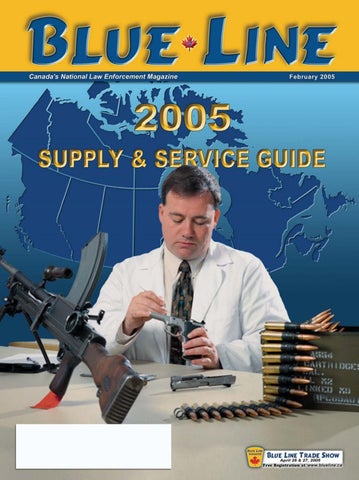
Welcome to our 2005 Supply & Service Guide. Darrel Harvey is the man at the centre of this month’s cover. Darrel is a member of the RCMP Planning Branch in Halifax. The picture was taken when Darrel worked in the Forensic Firearms section of “H” Division. The picture is emblematic of some of the goods and services required by police services across the country. In this month’s edition you will be able to find where to obtain these items in addition to anything else you may need that is not pictured here. With Montreal set to host the world at the 1976 Olympic Games, officials were more than a little concerned about possible terrorist activity. The Ontario Provincial Police were charged with providing security for the yachting events in Kingston and it was decided a tactical unit, specially trained to quickly deal with armed threats, was needed. Andrew F. Maksymchuk was a member of that first OPP Tactics and Rescue Unit (TRU) and went on to coordinate the unit for eight years. His fascinating recollections of those early days is our lead article this month. Continuing with the tactical theme, Ryan Siegmund profiles the Calgary Police Tactical Unit, which puts would-be tac officers through a gruelling 26 week boot camp to see if they have what it takes to join the unit. The few who survive – and are still standing – become members, says Sgt. Tony Manning. In other features this month, Communication Skills editor Mark Giles explains why a well-trained, prepared and appropriate spokesperson is crucial to delivering your message to the press and public; Police Management editor James Clark comments on the current search for a new Toronto chief; Antoon A. Leenaars delves into the effectiveness of Canadian gun control legislation; and Dr. Dorothy looks at the bystander effect. West Coast correspondent Elvin Klassen writes about how the police and citizens of Brockville are helping families in Belarus and Tom Sidney reports on Operation Go Home. FEBRUARY 2005
Blue Line Magazine
4
FEBRUARY 2005
X
Reduced crime should not reduce agency sizes Canada has been blessed with what has been arguably described as a falling crime rate. The reaction to this is quite often one of police cut backs. What puzzles me is that when society finds itself with a much reduced fire hazard no one suggests doing away with firefighters. So what is the difference here? Well to begin with society (and the politicians they vote for) are a little uncomfortable with a lot of cops out there lurking and skulking in nooks and crannies they would much prefer to keep in the dark. The fear of an under worked police officer trying to find something to do is far more problematic to many than an under worked firefighter shining his truck in the fire hall. A cop trying to busy himself just might find there is a lot more to do then he figured. Everyone wants the cops to catch robbers and murderers but not necessarily the speeders and stop sign violators. Although fraudsters are viewed by the public as a nuisance this pales in comparison to the cop asking why your seatbelt wasn’t fastened. It is time police services across the country began to present their case to the community in a more enlightened fashion than simply a statistical analysis of crime trends. The only way to keep crime rates down is to have an effective and sufficiently large police service. If crime rates drop then there is one huge advantage to the community. They now have an opportunity to train their police staff to higher levels of professionalism. When crime rates drop this should be looked upon as an opportunity to prepare for a time when things will not look so rosy; or when a complicated investigation arises the community can be reassured the expertise within the police services exists to handle it. Yes indeed it is time to have officers looking in areas never before looked at. It is time for staff to improve their education or even their interpersonal skills. Police services can now look upon the talents within their agencies and send officers away on secondment to either teach or learn skills that can be of value to others. Communities can benefit from redeploying officers in areas of crime prevention rather than enforcement. Permitting officers to walk the beat once more places more eyes and ears within the community. It produces longrange solutions rather than short term fixes. Another advantage to low crime figures is officers can be freed up to help protect good guys from hurting good guys. If anyone knows my passion this refers to traffic initiatives. Some agencies have actually cut back traffic and highway patrol initiatives to send officers Blue Line Magazine
`
by Morley Lymburner
to other countries or bolster some other currently politically correct segment of society. Although this is good PR the thought that our roads may become less safe than they once were is not comforting. Manitoba and Alberta are two provinces who are suffering from a lack of proper traffic enforcement and the Toronto Police Service still believes 18 small and understaffed traffic units are better than larger more geographically coordinated ones. Somehow the lack of personnel to do day to day work appears not to affect the numbers of officers we are able to send overseas. Currently sketchy figures indicate around 600 officers are deemed not necessary to patrol Canadian communities and are sent off to Iraq, Haiti and other countries around the world. In populated areas there is still a place for the beat officer but few agencies feel they can afford to dedicate officers to this type of work.
5
This in spite of the fact that these types of officers have long been recognized for having their ears to the ground. Too many agencies still insist on “tin can” policing with friendly waves from the cruiser as it passes through. Too many agencies are looking for the wrong kind of problems. They feel they need to solve headline crime instead of solving problems affecting everyone where they live and work. One other thing to be addressed would be to improve working conditions to a level where officers do not mind staying with a particular agency longer and newer candidates will look upon the concept of becoming a police officer more favourably. For instance there is no reason police services should not subsidize officers who choose to live in the community they work in. Long commuting distances for officers caused by high real estate prices can cost the community dearly when the police officers live far from where they work. There is no rational reason to cut back police budgets when crime rates fall. Using the same or even increasing resources creates a better more attractive police service which in turn creates a safer community. Safer communities attract more people and the tax base increases accordingly. It is a win win situation.
FEBRUARY 2005
by Andrew F. Maksymchuk “Don’t puke on the grass!” the physical training instructor yelled. I turned my head toward the pavement. “Don’t barf on the pavement!” the same instructor shouted. To hell with you, I thought to myself as I let it go halfway up Passchendaele Hill on Canadian Forces Base Petawawa. By the time my regurgitation ceremony was over, the group I was with had slowed to a walk at the top of the steepest hill at the army base northwest of Ottawa. The year was 1975 and I was one of 27 members of the Ontario Provincial Police selected to train for a new tactics and rescue unit the force created to deal with possible terrorist activity in Ontario during the 1976 Olympics. The unit’s creation was prompted in part by a number of events, including the October Crisis of 1970 and the 1972 terrorist massacre of 11 Israelis at the Olympic Village in Munich, Germany. It was also prompted by studies that showed violence could be minimized or even eliminated if a specially trained tactical unit could respond quickly to armed confrontations. While Montreal would host the ’76 Olympics, the yachting events were scheduled for Lake Ontario off Kingston. The OPP would help by providing security for the yacht races and its competing sailors. It was agreed that the military training for the tactics and rescue unit would last five weeks and include firearms, ordinance, rappelling, camouflage, concealment and movement, problem-solving and dim-light observation. The men selected for training came from every corner of the province. Indeed, we were strangers to each other and our backgrounds, interests and abilities differed substantially. The only common denominator was that we all, at one point in our policing careers, had been involved in a life-threatening situation. Everyone in the group held the rank of constable, with the exception of myself and one other corporal. I was a month short of my 33rd birthday and had just over 11 years of police service, including a posting to Central Patricia in Northern Ontario. I had passed all the selection criteria – interviews, psychological and physical tests – and had convinced myself I was Blue Line Line Magazine Magazine Blue
66
FEBRUARY 2005 2005 FEBRUARY
as fit as a 20-year-old, but I was mistaken. The military unit selected to train us was 3rd Battalion, Royal Canadian Regiment and those first few days at Petawawa felt as if a big door had closed between us and our regular employer. We were entirely at the mercy of the military training instructors and it became very clear that they could do with us as they saw fit, in both rewards and punishment. Almost all of us lacked any knowledge of military training and we were convinced the instructors would be rubbing their hands with glee to have such control over civilian cops. Our run in a wide assortment of civilian clothing proved we wouldn’t be treated with kid gloves. However, we soon came to realize that our instructors were skilled, intelligent and highly motivated members of the armed forces who had been around long enough to know people and how to deal with them. In his opening statement to us, the battalion’s commanding officer, Lieutenant-Colonel David B. Ells, said he hadn’t asked for us to be on the army base. In fact, he said he didn’t really want us there, but since we were, he would make the best of the situation. We later learned that the popular colonel frequently used this type of tongue-in-cheek method to deliver his message of base conduct. He made it very clear that our little drop of blue in a sea of green would not be receiving any preferential treatment and that we had better follow the rules. Besides running, our training included swimming, which most of us enjoyed. One morning we arrived at the pool to see several
Blue Line Magazine
soldiers standing equidistant around the pool’s edge. Something was up. Coveralls and old boots were tossed to each of us and before we knew it our arms were handcuffed behind our backs and we were ordered, five at a time, to jump into the deep end. We were told that if we didn’t panic, kept our heads tilted back and relaxed, we would be able to float with our faces above the water. We were in for only six minutes, but it seemed like a lifetime. The sight of military personnel standing ready with long, hooked poles didn’t foster a calming effect, but everyone kept their cool, including one member who found he wasn’t at all buoyant. In order to overcome this problem, he permitted himself to sink until his feet touched the bottom of the pool. This enabled him to thrust his body upward for another breath. The intensity of the training increased daily. One of the military’s most highly trained snipers, Sgt. Joe Skerry, took us through cover, concealment and movement techniques. We were taught night vision tricks and a myriad of other skills. From Sgt. Jim McMoran we learned the fine art of proper rifle shooting in just about every conceivable weather condition. A welcome sight during these exercises was Warrant Officer Keith Wyonch with his supply of hot hay-box meals and elaborate coffee break snacks. One particular memorable training session was conducted by Sgt. Wally Adams. As we sat on bleachers on the firing range, he rubbed what appeared to be play dough between his hands. He formed a long cord and wrapped it around a
7
wooden post purposely set up for his demonstration. He then inserted a blasting cap and, while barely able to contain his excitement, touched the wires of the blasting cap to a battery. The resulting explosion cut the post in half and left us startled and amazed at its effects. Adams then pulled small pieces of the play dough from his supply, rolled them into small balls and then tossed them in our direction. After a mad scramble to prevent the balls from striking any hard object, we were told by Adams how harmless C4 was without the electrical current. Prior to that demonstration, none of us had ever dealt with that type of material. However, before the end of our training session, Adams taught us valuable lessons on how easy it was to transport and conceal C4. We also learned how to use it to open locked doors or make doorways in walls. I also recall how the stillness of the barracks erupted early one morning with shouts, thumps and the slamming of doors. I leapt out of bed thinking all hell had broken loose. My bedside clock read 2 a.m. I looked out the door and saw all of our instructors yelling for us to grab our gear and get into the deuce-and-a halfs. The trucks delivered us to a snow-covered field where we were told to go to an abandoned building in the centre of the field. We were to get there by using our training techniques and any topographical advantage we could find. The instructors explained that they would monitor and evaluate our movements. After each of us put on our white parka and trouser shell, we began the slow, cold ar-
FEBRUARY 2005
duous task of crossing the back yards. We also put a man field. Slowly but steadily we on the roof. inched our way toward the old The family, which had to building and after what be evacuated, had recently seemed like hours, we were moved into the house and were within 25 metres of the dark without a telephone. Nethery and silent objective. quietly borrowed a ladder from None of us was prepared a neighbour and we padded it for the tumultuous event that with clothing and propped it unfolded. Suddenly there were against the wall next to the upblinding flashes, followed by stairs bedroom window. Lookdeafening roars. Smoke greing inside, Riddell spotted the nades popped and spewed orhusband and wife asleep in ange, green and grey smoke. I bed. He tapped on the window saw several muzzle flashes and held up his badge, but it coming from the house and took a few moments for him to heard men shouting. We nearly explain the purpose behind our crapped our drawers! The men sudden invasion of the family’s in the house – all volunteer privacy. Still, we managed to military personnel – were get the man and his family teaching us a valuable lesson: safely out of the house. nothing is as it seems. Take I decided that Gardiner nothing for granted and expect and I would enter the house the unexpected. through the front door and Our group had several make the arrest while Riddell rappelling training sessions and Nethery provided cover with Sgt. Dave Janssen before and observation. The door had being given the opportunity to a large window in the upper rappel from two Huey helicopportion and the curtains had ters as they hovered 50 metres been drawn back. There were above the ground. Excitement no lights on. While standing filled the air when the birds near the door, Gardiner and I thundered into view. We hur- First London area OPP Tactics and Rescue Unit in 1975. Front row is Paul Valliere, closed our eyes for a few moHutton and Terry Drew while standing is Al Armstrong and Don Carson. The riedly tied rappel harnesses Doug ments to improve our night viunit was formed to help protect Olympic athletes in the 1976 Olympics. around our thighs and waist sion. We then looked inside with short pieces of rope. Eveand saw two sleeping forms on casionally tap the expertise of military personryone wanted to be first in the air. By the end of a sofa bed across the room, kiddie corner to nel such as Lt. Col. Ivor MacLeod and Cpt. the day, each of us had taken several exhilaratthe door. Ted Ryzcko at CFB Trenton. Eventually the ing jumps. Unfortunately, one member broke We were quite sure one would be our sustraining would include the canine and underhis leg and another twisted an ankle. pect, but who was the other? Were they prewater search and recovery units and the hosTactics and rescue operations demand sutending to sleep, ready to fire at us when we tage negotiating team. Meanwhile, equipment perb skill, fitness, high motivation, split-secmade our move? Using signals and lip readupgrades and familiarization continued on a ond timing, cool judgment and teamwork. ing, we planned our next move. We tried the regular basis. Twenty-five of the 27 police officers selected door – it was locked. Should we break the Indeed, as TRU gained more experience, for the course passed. These men formed the glass, reach in and unlock the door from the it received a number of requests for training nucleus of what would become an effective, inside? That could mean the loss of a hand from from police services across Canada and the well-equipped and well-trained tactical squad a shotgun blast. The decision was made. United States. known as the Tactics and Rescue Unit (TRU). Gardiner kicked in the door and I entered The members of TRU felt they were During the course of the Olympic yachtswiftly, with him a split second behind. We ran trained to handle the type of situation that uning events at Kingston, there were occasions a few steps and then jumped through the air to folded on Oct. 12, 1977. Our unit got a call at when intelligence sources indicated potential land on the figures on the sofa bed. The bed 11:30 pm stating that a Collingwood police problems. Fortunately, no major incidents occollapsed and before both people knew what officer had been gunned down in cold blood, curred and the few minor situations were hanwas happening, they were handcuffed and on his service revolver still in his holster. Assistdled effectively. It might suggest that no acts the floor. ing the Collingwood police force was Det. of aggression had been planned, but it might A 21-year old man was turned over to the Insp. Tom Lennon of the OPP Criminal Inalso indicate that effective security and preinvestigating officers, along with his 14-year vestigations Branch, who requested our TRU paredness proved a sound deterrent. old female bed partner and a pile of bloodteam assist in arresting a suspect who was beFollowing the Olympics, TRU was distained clothes. Eventually, he was sentenced lieved to be holed up in a local residence. vided into five, five-man units strategically to life imprisonment, with no parole eligibilFour of my team members were available: located throughout the province. Each team ity for 25 years. Constables Bud Gardiner, Gus Riddell, Wayne had to be ready to respond to any high-risk Nethery and myself. We arrived at the station threat if requested. I became the leader of the Andrew F. Maksymchuk retired as an inspector after serving more than 30 years with the OPP, including eight years at 2:20 a.m., were briefed on the events by team based at Downsview, Ont., on the northas TRU coordinator. He’s lectured to members of more Lennon and then given directions to the house, ern edge of Toronto, and quite often we took than 100 police organizations around the world, was an a two-storey duplex with living quarters on the advantage of the facilities there for our expert witness on police procedures at officer death inmain floor and bedrooms upstairs. A family of monthly training sessions. quiries and wrote COPS: A Matter of Life and Death, published by Eden Press of Montreal. He retired to Vernon, four lived in one half, our suspect was believed All of the TRU units would meet for onBC with his wife Myra and is currently working on his to be in the other half. We quickly went into a going training at CFB Borden every six memoirs.This article first appeared in the May/June 2001 military reconnaissance mode, slithering unmonths. These sessions were coordinated by issue of Legion Magazine. seen and unheard around both the front and our own training personnel, but we would ocBlue Line Magazine
8
FEBRUARY 2005
A legacy of accomplishment The dense jungles of Vietnam, a grazing shot to the side of the head and getting a leg mangled in a grenade blast were not enough to prevent Don Carson from becoming one of the first members of the Ontario Provincial Police Tactics and Rescue Unit (TRU) in 1974. Even the shrapnel still wedged firmly in his body wasn’t enough to stop him from joining the elite unit. Carson, who served in the 82nd Airborne in the US Army during the Vietnam war, was a clear and easy choice to work with the elite police unit. Carson first served as a MP at the start of the war where he quickly became a helicopter gunner. He served three tours of duty in and over the jungles of Vietnam before being seriously wounded in battle. He was narrowly evacuated by helicopter after being saved by
a fellow soldier. Carson was awarded with a slew of medals for his efforts in the war. He received two Bronze Stars, one for Valour, one Purple Heart, six Air Medals, the Army Commendation Medal, an Army Good Conduct Medal, the Vietnam Service Medal, the Republic of Vietnam Campaign Medal, the Republic of Vietnam Gallantry Cross Medal, and a Republic of Vietnam Civil Actions Medal. After leaving the US armed forces in 1969 as a Sergeant, Carson joined the OPP in 1971. Three years later he became one of the first member’s of the service’s newly formed tactics
unit in London. For the next 26 years, Carson served with the OPP, working in Chapleau, policing reserves on James Bay and Hudsons Bay, serving as a detective in Owen Sound in 1988 and then finally moving to Orillia’s Organized Crime Unit as a detective. Carson’s distinguished policing career ended in 2000 when he retired after 29 years of policing but had added one more medal to his chest; the Police Exemplary Service Medal. Don has left a legacy of accomplishments for others to surpass but he is still looking for that next challenge.
Number of officers per capita declined in 2004 OTTAWA — There were just under 60,000 Canadian police officers as of June 15, 2004, according to a new report showing that there were fewer officers per capita in 2004 than a decade earlier. However, police strength has been increasing in recent years after reaching a low in 1998. Canada’s rate of 188 officers per 100,000 population is about 20 per cent lower than in the United States and Australia, and about 25 per cent lower than in England. In 2004, Saskatchewan reported 202 police officers for every 100,000 population, the highest rate among the provinces for the fourth consecutive year. It was followed by Manitoba, Quebec and Ontario. Newfoundland and Labrador and Prince Edward Island had the fewest police per capita. Most provinces have experienced declines in per capita police strength over the past decade, the largest being in Quebec (down seven per cent). Saskatchewan reported the largest increase in police strength during this period. Among census metropolitan areas, Regina (207) and Thunder Bay (199) reported the highest rates of police officers per 100,000 population. The lowest rates were reported in Abbotsford (129), Ottawa (133) and London (134). One out of every six police officers in 2004 was female, a proportion which has been growing steadily since the mid-1970s. Police services reported that there were almost 10,000 female officers, a six per cent increase from 2003. The number of male officers remained virtually unchanged. British Columbia has the highest proportion of female officers, accounting for one in every five officers. The Atlantic provinces have the lowest proportion, at about one in every eight officers. Canadians paid $8.3 billion for policing services in 2003, an average of $263 per person. Spending on policing has been increasing faster than inflation over the past six years, including a four per cent increase after adjusting for inflation, between 2002 and 2003. Since 1997, expenditures on policing increased 22 per cent after falling slightly (down three per cent) between 1992 and 1996.
Blue Line Magazine
9
FEBRUARY 2005
by Ryan Siegmund Having ‘that warrior’s mindset’ is the single most important attribute of a good tac team member, says Sgt. Tony Manning of the Calgary Police Tactical Unit – and it must be maintained, as the unit’s success hinges on extensive and evolving training which prepares members for whatever may come their way. In addition to being the sniper team leader, Manning is also the operational team sergeant responsible for training. He runs the 26 week introductory training course for would-be members; the few who survive Manning and his fellow instructors’ system – and are still standing – get to join. “We build a wall in front of them and they will either climb over that wall or they won’t,” says Manning. “If they don’t, they leave. If they climb the wall, we build another one a little higher. By the end of the 26 weeks, there is not a whole lot we can do to put off these people.” Aspirants must successfully complete a two week selection process before entering the course, going through basic training drills and various psychological and clinical interviews. The medical people rate them and compare notes with team instructors. “We make a list of our people (and) the doctors make a list of theirs,” says Manning; they then sit down together and compare notes. New members begin with a weapons course and follow through the various stages of entry work, including stealth, dynamic and second storey entry courses. While continually reviewing what they’ve learned so nothing goes stale, they progress through officer and hostage rescue situations, explosive force entries, high angle assault work and elevation shaft, glass and brick climbing. “While pushing these people hard, we really enforce the ability to succeed, the ability to take no for an answer,” says Manning. “We really build them up; build them up, knock them down (and) build them up (again).” Instructors constantly assess trainees’ best attributes. If they think an individual would
Blue Line Magazine
make a really good sniper, for example, and they show a keen interest, they will be trained accordingly – specialty skills are taught after basic skills. Instructors meet at the end of the course to determine who is strong and how they fit the needs of the unit. “If a guy is showing a real aptitude for explosives in the basic course, they will do a police explosive technician assistance course. If he shows a lot of aptitude on that and he is very interested, then we will send him off for his bomb and explosive force density training, and the same with the specialty munitions people.” The training is very in depth, says Manning, and everything is pass or fail. A candidate will often hang in for a couple of months but then conclude ‘I don’t want to work this hard for the rest of my life’ or ‘this week isn’t suited to me’ and leave, he says – and there are times instructors will pull the pin on them and say ‘thank you very much, but this isn’t for you,’ he adds. The six candidates in the 2003 recruit class all successfully completed basic training, the first time that has happened. Previous classes lost 40 per cent of trainees, one way or another. Travis Waddell was part of that group and says you have to be able to endure the mental abuse and grueling physical training. “They want to know right away if you can take it and that is part of the weeding out process.” Team members were very supportive dur-
10
ing training and helped each other get through, he notes. “They pick you up when you have a bad day, which was very important for us.” Waddell concedes not having any family obligations also helped him maintain his focus and drive, noting his drive and teamwork were the two most important factors motivating him to join the unit and stick with it. The young guys trying to get on the team are likely to latch on to an experienced member as a role model, says Manning, so it’s imperative to have extremely positive role models to lead them. Having a negative team, something Manning has seen many times before, creates a negative police officer. “When they are finished their 26 weeks, what we have now is a guy with raw skills – that’s all he’s got,” he says. “Now we have to take him and expose him to the functioning of the team and he’s got to fit into that team and develop his position.” The Calgary Tactical Unit currently has 22 members on three teams, each with a team leader (sergeant) and at least two snipers, bomb and gas technicians. The unit is deployed 800 to 1,000 times a year, giving members a chance to use their skills on a regular basis, and are most frequently deployed to execute high risk drug warrants. When they’re not on calls, they train. Training is broken down into six areas and one month segments, which are conducted twice a year, and includes bus, train and aircraft assaults, high risk warrants and counter terrorism – each segment also includes components on appropriate weapon selection and disabling methods. The counter terrorism segments are examples of how unit training has changed. “Hopefully it is something we will never have to use,” notes Manning, “but if we do have to use that skill, then we need to be able to succeed. “I need to be able to put resources in place that are going to look after the needs of the people of Alberta. We have to train in the areas that we don’t go operational a lot, because when we do and we haven’t dealt with it that often, the risk is high in a lot of ways.” There is no room for on the job training on the teams, Manning says. “There is a lot of expertise that we can pass on to you, on any specific call, but you need to be trained in that area. We can’t send you on a call that you never had any training in and expect you to perform when people’s lives are at stake.” Teamwork and familiarity is imperative to the success of the unit, he says, noting there each team and member has its idiosyncrasies. “It might be the way your snipers supply information… it’s important for me to know what he means when he is saying things and they only get that through training. “It’s important for me to know if my guy is right handed or left handed, because as a team leader that may influence my decisions FEBRUARY 2005
on certain situations when I send them into a room. When they are trained together and are gelling as a team – it is essential.” It is common for teams to send their people off to educational courses around the world. Members share what they’ve learned with the rest of the team and look for ways to apply it in Calgary. “We never invent anything ourselves, we steal everything from everyone from around the world,” says Manning. “We look at what would work for Calgary, based on the resources we have available to us. We keep our people constantly training and figure it takes about five years before a guy is really on top of his game and performing at an ultimate level.” Members are expected to stay current with changing technology so they’re prepared to combat what the ‘bad guys’ are using. The teams are the only Calgary police unit that regularly carries Tasers but members also use fibre optics, night vision, camera systems and intelligence gathering and video surveillance equipment.
Blue Line Magazine
Manning says members understand the need to train hard because it’s helped them get through many situations. “We use tactics over force – that’s our goal. The truth is, we haven’t shot many people here in Calgary, despite the fact we are going out on 800 or 900 calls a year. .. that is a result of the training and experience we have.” Training and experience helps members develop their most valuable asset – the right mindset and a positive belief in their ability to succeed, Manning says. Instructors can teach a member skills but “what I need him to do is to have the mindset to succeed, no matter what happens. If he’s injured, whatever the problem is – I still need him to push on and succeed. “The first week in where we train our people, that is what it is about. We will bring in doctors; we will bring outside experts in to give us the input into the will to succeed – the warrior mindset. That is the single most important factor in any tactical member.” Manning says his unit has been under strength for a couple of years now and constantly needs new members to replace those who’ve been promoted and moved out of the unit. “Ideally for us and for a successful tactical team, is keeping your best people and have it free of promotion,” he says. “If I get a sergeant who comes in and he might have been a tactical guy in the past but he’s been gone for five years, his skills are gone. His knowledge is old and if he is making decisions on a very high risk call, then he jeopardizes the chances of success for the team. Our world is constantly evolving and our skills never stand still, so it is essential that we have
11
the ability to keep our people.” The unit is fortunate in that it’s presently not restricted by tenure, he says, something that really damages a team. That “allows us to build up an extremely high level of expertise in different areas. Tenure (an average of eight years) is something that strips teams of that ability, because you get a guy to certain level after four or five years (and) he knows he’s leaving, so some of his motivation to perform is gone. “If something happens and we have to say ‘well, we couldn’t train in that area because we are short on people’ – I mean, what kind of an excuse is that? People just won’t understand that if someone loses their life over it.” While admitting the unit is low on numbers, Manning cautions that he is not complaining and feels the team’s level of expertise is high – “but we have to make sure that we know what we’re looking for when we pick our people and we’re very objective. There is no favouritism – we pick a person because we honestly believe he’s best for the unit.” Members must love to train, be self-motivated and enjoy challenges, he says. “By following the basic skills learned before joining a team, through to the advancement to specialty work, the end result will be a good product. The product is so important because the kind of work we are asked to do out here, like any other tactical team, is volatile; people’s lives depend on the performance of our team. “It’s also great fun, believe me.” Ryan Siegmund is a freelance writer and researcher working with Blue Line Magazine. You can contact Ryan at ryan@blueline.ca
FEBRUARY 2005
Spokesperson is important part of message It’s not just what is said – but also who says it by Mark Giles As with many law enforcement skills, an effective means of delivery is needed to achieve the objective. Good public and media relations require the use of trained, prepared and appropriate spokespersons to deliver information and key messages to the public and community stakeholders. In today’s media-saturated world, government, private and non-profit organizations use spokespersons to communicate and connect with the public and their key audiences. Sometimes it works; when it doesn’t, it may be because the spokesperson employed wasn’t appropriate for the issue being discussed. Canadian law enforcement agencies employ both sworn members and civilians to speak to the public on a variety of issues. Some prefer to use a designated spokesperson for day-to-day media contact while others prefer subject-matter-experts (SME), to avoid the perception of a ‘talking-head’ speaking on behalf of the agency. Designated spokesperson vs SME Using a designated spokesperson simplifies day-to-day media operations for the agency. The spokesperson may be a sworn member or civilian assigned to the public affairs or media relations unit, or a duty officer (inspector) for operational matters, especially after business hours. This concept allows immediate delivery of basic information related to an incident or issue using spokespersons that are proficient at dealing with the media. A designated spokesperson can also become a trusted figure within the community, as was the case for several years with Cst. Anne Drennan of the Vancouver Police Department (VPD). As with television news anchors, the public identifies with this person(s) and develops confidence in their ability to provide the public with important information. Higher-profile investigations or events, such as those related to robbery, fraud, computer or sex crimes, are usually best handled by a member of the investigative unit responsible – a SME. He or she usually has more cred-
Blue Line Magazine
As officer commanding the Canadian Forces National Investigation Services’ Quebec detachment (military police), and officer in charge of a $100,000 drug seizure, Captain Steve Lebel acted as spokesperson and subject-matter-expert when speaking to the media.
ibility, as they are better able to speak to the details and relevant facts of a case. If the investigation is in its early stages, or your agency is not yet prepared to provide a detailed response, the designated spokesperson can be used to provide an overview of the facts without the risk of inadvertently providing too much information to an aggressive reporter. In these cases, the designated spokesperson and the SME work together, with the duty or media relations officer providing initial comment and the SME later briefing the media more extensively on the status of the investigation or charges laid. This tactic should not be used to avoid transparency or openness on an issue and media should be advised that further information will be released and when, but it does allow the investigating unit and SME time to prepare for the release of further details. Civilian vs sworn member The designated spokesperson is often a member of an agencies’ public affairs or media relations unit. Some agencies use sworn members in this role, others use civilians and many use a combination of the two. Using a sworn member as spokesperson generally has the following advantages: a greater credibility on police or investigative matters, a good understanding of the challenges of the job and, therefore, perhaps a better rapport with the sworn membership. “Using a sworn member as spokesperson for a (law enforcement) agency provides an extra level of credibility,” said Major Mike
12
Lagace, a senior army public affairs officer and former media relations officer with the Winnipeg Police Service. “The officer who has experienced the challenges facing his or her colleagues has a certain understanding and empathy for the work they do, and that comes through when they speak to the media.” With experience and time though, civilian spokespersons can also gain credibility with both internal and external audiences and often have the following advantages: a more in-depth and diversified background in public and media relations, often allowing them to react and deliver responses quickly; more media and business contacts and perhaps a better ability as civilians to see the public’s perspective; and generally less susceptibility to law enforcementrelated jargon and the ‘us and them’ mentality. Depending on their background, civilian spokespersons may see the bigger picture more easily, whereas sworn members are more likely to grasp the details and read between the lines on police reports and investigations. With a little planning, an agency can use a blend of both to its advantage. The Edmonton Police Service (EPS) uses both civilians and sworn members effectively, in both operational and support roles. “Whenever possible, we try to use sworn members to speak to the public,” said Dean Parthenis, police information officer with the EPS. “Our civilian media-relations officers are, however, always available to provide support, including acting as spokespersons when the police officers involved must make an investigation their first priority.”
FEBRUARY 2005
Other considerations include the type of issue. With public safety matters, a sworn member, preferably in uniform, is probably more reassuring to a victim’s family and friends and the community at large. For a citizen’s complaint or professional standards issue, a civilian spokesperson might soften an agency’s image somewhat, bringing the concept of civilian involvement to mind. On the other hand, a uniformed senior officer says ‘command and control’ and that the agency plans on getting to the bottom of the issue. Senior vs non-commissioned officer When using sworn members, the rank of the spokesperson is also a factor to be considered. Anne Drennan was the designated spokesperson for the VPD as a constable, but other agencies have used a senior officer, as was the case with then Supt. Rick Hanson of the Calgary Police Service in the mid-1990s. A senior officer may come across as a greater authority figure, more knowledgeable on corporate issues, whereas a lower-ranking officer, such as a sergeant or constable, is more likely to be seen as being in touch with dayto-day law enforcement and public safety issues. In reality, neither may be overly in touch with day-to-day operations on the street, but the rank of the spokesperson may be a factor in how the message is perceived by the public and key stakeholders. Operational vs corporate communications Corporate issues related to funding, public
Blue Line Magazine
policy or relations with other agencies are normally best addressed by a member of senior management, usually at the chief, deputy chief or civilian-director level. When they are not available, or senior management wants initial briefings handled at a lower level, the civilian public affairs officer can fill this role nicely. Without sworn member rank, it is usually easier to speak on behalf of management as a corporate spokesperson in civilian dress (business suit or equivalent), which forms part of the message that the issue is administrative and related to the management of the agency, rather than to police or law enforcement operations. For issues related to daily operations, such as a serious vehicle accident or residential break and enter, a duty/street inspector or officer is likely most appropriate. The agency’s public affairs or media relations unit must also be prepared to speak to these issues, however, as media will often contact them for immediate or follow-up information. The strategy and tactics used will depend on an agency’s priorities and philosophy. It’s not a matter of being right or wrong, but deciding what message you want to send and what you are comfortable with. Common ground – balancing knowledge and preparation After deciding on the best strategy and an appropriate spokesperson, the next question is: How prepared is our proposed spokesperson? Sometimes the best spokesperson is not available or even comfortable speaking publicly on the matter. Although the SME almost always has more credibility, he or she may not be the
13
best choice if unable to communicate well and get key messages across. In these cases, the public affairs or media relations officer, sworn or civilian, may be a better option. Regardless of an agency’s philosophy, all spokespersons will benefit from the following: 1. A sound and consistent media-relations policy, clearly outlining what is mandatory and discretionary and who makes decisions regarding the use of spokespersons and the delivery of public information; 2. Professional appearance: well-groomed and attired, clear and confidant speaking voice and strong interpersonal skills to relate to the media and the public; 3. A strong working relationship between the public affairs/media relations unit and the operational chain of command; and 4. Good relations with the media, including reporters and journalists, editors and management, and camera and other support personnel. Every member of a police or law enforcement agency serves as an ambassador for his or her organization. Spokespersons are ambassadors with an opportunity to speak to a larger audience through television, radio and print media. Given the reach of today’s media, the use of appropriate spokespersons will increase the likelihood of effective public and media relations with the communities we serve. Captain Mark Giles is the communications director for the Canadian Forces Provost Marshal, National Investigation Service and Canadian Military Police Association, based at National Defence Headquarters in Ottawa. E-mail: giles@blueline.ca
FEBRUARY 2005
Thieves caught red handed with bait cars by Ryan Siegmund Bait cars are everywhere – steal one and get busted. That warning has would-be car thieves in Vancouver and four other Canadian cities thinking twice before speeding off in cars which don’t belong to them. A bait car is equipped with a global positioning system (GPS) tracking device, connected through a cellular digital link to the police dispatch centre. It’s instantly notified when a door is opened and can pinpoint the exact location of the car and track its movements. Once the responding officers get in behind it and have a visual, they ask the operator to disable the engine and arrest the occupants. “The beauty of the program is that everything that took place inside that car, from the moment the door opens, is caught on audio and video,” says Tim Shields, officer in charge of the Integrated Municipal Provincial Auto Crime Team (IMPACT) bait car program in Vancouver. This feature is especially useful in cases where there are multiple suspects inside the car, Shields notes. Traditionally passengers claim they were hitch-hiking and didn’t know the car was stolen but Shields says everything changes when their conversation is recorded. Thieves realize they are going to be arrested very quickly once they see police behind them, which generally happens within a few minutes of the theft, and often plead guilty. “We are finding it to be a successful program and have seen a decline in auto theft of about 13 per cent, year to date, averaged out across the whole area of greater Vancouver.” There were about 32,000 stolen vehicles in the greater Vancouver area in 2003. On a per capita basis, Shields says that puts Vancouver amongst the highest cities in North America for auto thefts. Not only is auto theft a property crime, it also poses a threat to public safety. Shields points to the many times car thieves drive recklessly or at excessive speeds and flee from or even taunt police into a pursuit. Many are aware that pursuits will be called off when speeds become dangerous, as required by police pursuit legislation in BC. With the ability to remotely disable a bait car, high speed pursuits aren’t an option. The IMPACT bait car program began in April of 2004 and now stretches across 16 municipalities around the greater Vancouver area and may expand to Vancouver Island in the near future. IMPACT prefers to not disclose how many bait cars are in circulation, however its equipment manufacturer has told them they now have the largest fleet in North America. The bait car fleet is representative of the most commonly stolen vehicles in British Columbia. IMPACT uses a computer program called ‘Crime Point’ that identifies auto theft hot spots and can check certain time periods to find out how many vehicles, and what type, were stolen from a particular street. “We pick a car from the bait car fleet that matches that same type that is being stolen and we will put it in that auto theft hot spot,” Blue Line Magazine
14
FEBRUARY 2005
Shields says, “so we are very strategic as to where we put them. We find that if an auto thief is living in a certain area, then he will typically steal the same type of vehicle.” The start up costs for the first year of operation were about one million dollars and that included purchasing the vehicles, equipping them with the electronics and an advertising campaign. Shields says the deterrent value is not necessarily the number of bait cars in your fleet but the success of your advertising and publicity campaign. IMPACT is trying to get in the minds of car thieves with its advertisements and slogan, which are on the radio, billboards, bus shelters, transit stations and public bathrooms. Shields says it’s crucial to send a message to those people bent on stealing cars for a living. “You need to put the emotion of doubt and fear in thieves so that they won’t know if the next car they are about to steal is a bait car or not,” says Shields. “In these seven months that we have had it going, there is no question whatsoever that the criminal element are all aware that bait cars are everywhere.” Unlike IMPACT, the Winnipeg Police Service’s bait car program didn’t receive a substantial amount of money to launch an advertising campaign. The WPS is combating the second highest rate for auto thefts in the country, behind Surrey, BC. Staff Sgt. Brian Cyncora of the Winnipeg Police Service Criminal Investigation Bureau acknowledges the importance of having effective advertising. “If you have money for advertising, it’s going to send a message out to the community, but if you don’t have it – it’s not going to have the same effect.” An advertising program such as Vancouver’s may not be effective in Winnipeg though, he says, given the offenders the service is targeting. The average car thief in the city is 16 years old and Cyncora says it’s not uncommon to have offenders under 12. “Where are we going to advertise – in the elementary bathrooms? It’s disturbing to us, to say the least, that we have this many young people, who can’t really make adult decisions, driving around with no experience.” Cyncora says Winnipeg uses tactical deployment, strategically placing cars in hot spots chosen based on the changing profile of stolen cars. If you are not getting the right product out there, he notes, thieves are not going to steal it and therefore it is a waste of time. Winnipeg was the first Canadian police agency to launch bait cars when it began its program in 2001. It’s had its ups and downs; Cyncora says it took until last fall to get the program running properly. “We became a test site and there were things that worked and didn’t work as far as the equipment… the cars are not as labour free as you might think,” says Cyncora. “We’re the first ones and the police industry got the benefit from our testing – Vancouver among them.” The greater Vancouver area has benefited and IMPACT is very satisfied with the number of arrests made thus far, which it plans to make public once the program completes its first year of operation. Compared to other provinces, Shields says BC has a very different auto theft trend. In eastern Canada, about 60 per cent of stolen vehiBlue Line Magazine
cles are recovered by police, with the rest missing or stolen by organized crime groups. These cars are either chopped into parts or re-vinned and exported to other provinces or countries. In BC, police recover some 95 per cent of stolen vehicles. While every jurisdiction has different causes for auto theft, Shields says the trend in Vancouver is that it goes hand in hand with drug addiction, especially methamphetamine. “Auto theft is like a barometer that indicates a community’s level of drug addiction,” says Shields, referring to the cycle of addiction where an addict needs a daily fix and will do anything, including committing crimes, to get it. “In order to do crimes, he needs a stolen vehicle. He’ll steal a vehicle, then use it to help him commit break and enters of houses, businesses, strong arm robberies, smash and grabs, purse snatchings – all are big.” An IMPACT study found that the average Vancouver auto thief is 28, a repeat offender and usually a meth addict, with heroin and crack cocaine secondary. The savings in insurance claims alone would be about $12 million a year if Vancouver auto thefts can be reduced by 10 per cent, notes Shields. Minneapolis, Minnesota, the first city to adapt a bait car program, has seen a consistent decline in auto thefts in the eight years it has used the cars. Three other Canadian cities – Regina, Sudbury and most recently, London – also operate bait car programs. Ryan Siegmund is a freelance writer and researcher working with Blue Line Magazine. You can contact Ryan at ryan@blueline.ca
15
FEBRUARY 2005
by James Clark
So who wants to be Chief?
The Toronto Police Service is about to start looking for a new Chief of Police. After a very questionable political process they have decided not to renew Chief Fantino’s contract and look for a new Chief. “So let the games begin”, was the comment that I heard from my Chief when he decided to retire. I was one of his Deputy Chief’s and of course the speculation, or should I say guessing game began immediately. The first question a person in my position had to ask himself was why in hell do you want the job? Never mind the endless politics, lack of support from members of your own police services board and the unrelenting attacks from certain media groups, they want you to sign a contract that allows them to dump you for any reason. As a senior officer your thirty-odd years with the service provides some protection and allows you to decide when you want to retire. Once you take the Chief’s job, you must sign a contract and a new set of pressures come into play. Since my retirement, they now make the Deputy Chiefs sign a contract and some of them have found out that their retirement plans were moved up by the political side of policing. So why then do people apply? In my case I was driven by two things, my ego and my desire to change the direction of the police service to what I thought it should be. Let me comment that after spending many years moving up the ladder, I’ve seen many changes take place. You see things that you do not agree with and work with some people that you do not respect. Others have the same feelings about issues and in some cases about you. There is an expectation that all officers near the top of the ladder will attempt to take control and unless they are very close to their own retirement, will apply for the position. The question now is what should they be
looking for in a new Chief of Police for Toronto. Realizing that the present Chief did not manage to maintain the confidence of a majority of the Police Services Board, the candidate must look at what the Chief did right and also what he did that caused him to lose support from the Board. This of course is really an unanswerable question. The Chief of Police could be the most outstanding leader in law enforcement in the country, with solid support from his senior officers and front line staff and from the various members of the community. His failure could be that he simply does not fit into the idea of what a Chief should be by those holding the votes on the Board. Or, he could be too good at his job, which places him in a position of power that may threaten the politicians that govern him. Over the past several years many Chiefs of Police have been appointed to various Police Services around the country. I recall when one Police Board announced that they had appointed the first female Chief of Police. They seemed to put greater emphasis on the fact that she was female rather than her skills and ability to hold the position. Although this person may have been qualified for the position, it suggested that the appointment was more for political gains rather than for the good of the Police Service or Community. With the Toronto position open, there has been much speculation about several high ranking visible minority and female officers who may be consid-
ered for the position. Let’s hope that if one of them is selected, it is for their skills and ability and not just so that some politician can claim that they have appointed the first. I was present at my Police Services Board when they promoted a Sergeant on my platoon to Staff Sergeant. He was the first black officer to reach this rank. This part of the meeting is not open to the public and one board member commented to me, “I guess you can say this officer is our Jackie Robinson”. This comment disgusted me as it degraded the officer involved. I knew that he deserved the promotion because of his ability and service, but it was clear that this politician looked at it in a different light. The topic of who should be the next Chief of Police has also been the subject of discussion in many areas of the private sector. I have been present when some corporate leaders of industry express concern as to how the selection is made. Some question why the Chief of Police needs to be a police officer at all. They point out that he really doesn’t carry out the role of a police officer but rather that of a C.E.O. of a corporation larger than most companies. When I try to defend the present tradition of selecting an officer with extensive police experience, they point out that someone who is responsible for controlling a half billion dollar budget and the implementation of policies and controls of staff exceeding 7,000 people should be someone who has been educated for the task and has a proven track record of business management. They comment that the policing part of the job can be given to Deputy Chiefs who would report on their successes and failures. In the end, I find myself holding on to the values of tradition as the only argument left at my disposal. Considering the extensive pressures placed on the Chief of Police in a city the size of Toronto and the demands on their time to deal with the daily challenges facing the community, maybe the answer is a Chief of Police who reports to a Commissioner of Police. This Commissioner would be a civilian who has experience in both the management of a large corporation and the skills and ability to work with the political community who is responsible for overall public safety. Or then again, maybe the Chief of Police position is eliminated and replaced by the Commissioner of Police. As a former Deputy Chief and unsuccessful candidate for the position of Chief of Police, let me describe to you the only thing that I am sure that they are looking for in a new Chief: A male or female person, who is willing to commit themselves and their spouse or partner to a challenge that will consume every minute of their waking hours. The rest cannot be accurately detailed as every person who will take part in the selection of the next Chief has their own idea as to what is important. Let us hope the successful person can rise above them and fulfil our expectations. James Clark, president of Monad Security Audit Systems,is a former deputy chief of the Toronto Police Service. He can be contact at: jclark@monadsecurity.com
Blue Line Magazine
16
FEBRUARY 2005
by Devin Kealey In 1990, the Toronto Police Service in partnership with MADD Canada, produced an anti-drinking and driving video called “Missing You”. For over ten years “Missing You” has been seen by thousands of young people across the country in an effort to reduce incidents of death and injury from motor vehicle collisions which involved drivers who had consumed alcohol. The “Missing You” video has become dated and the Toronto Police Service has again partnered with MADD Canada and produced a new impaired driving video entitled Not Ready To Go. This video is hard hitting and is aimed at educating youth and care givers across the country about the real consequences of getting behind the wheel while impaired by alcohol or drugs. The video re-tells the story of a horrific crash that claimed the lives of five young teens and injuring 11, including two adults, seriously. It all began when 14 friends, returning from a party to celebrate the end of the school year, became involved in a multi-vehicle crash on a straight stretch of highway just outside of Perth, Ontario. The teens were heading home in a four-car convoy when one car pulled out to pass and struck a pick-up truck, which was towing a trailer with a car inside. The subsequent chain of events left Stan Thomson, 18, Alan Siew, 17, Dustin Record, 17, David Rider, 16, and Homoyoun Chaudry, 17, all dead. The two occupants of the pick-up truck Max Beyore, 37, and Time Cole, 35, were seriously injured. To this day the surviving vic-
Blue Line Magazine
tims, and all of their families and friends, are still dealing with the affects of this collision. The driver that caused the collision was a 17-year-old young offender and was eventually convicted of five counts of dangerous driving causing death, three counts of dangerous driving causing bodily harm and was sentenced to one year. The June 1999 collision remains one of the most horrific crashes in modern Canadian history. This video sends a strong message to youth across the country that operating a motor vehicle after the use of not just alcohol but also drugs (marijuana in this particular case) can have the same disastrous results. Not Ready To Go is 20 minutes in length, including sobering remarks from investigating
17
police officers, and heart wrenching commentary from injured survivors, families, friends and teachers. The video features two poignant songs, the first Not Ready To Go is performed by The Trews, and the second “Time” is performed by Chantal Kreviazuk. The video concludes with a montage of photographs of sons, daughters, mothers, fathers, brothers and sisters, who have all lost their lives or been injured as a result of incidents of impaired driving. The launch of this video is timely in relation to support of the RIDE program and the ongoing discussions in the House of Commons regarding the use of marijuana. The Toronto Police Service is committed to removing impaired drivers from our roads. Impaired driving remains the leading criminal cause of death in Canada. Thousands of people are killed or injured on Canada’s roadways each year. The expectation is the video will become required viewing for all police officers nationally and be distributed to each MADD Chapter across the country, and become the centrepiece for regular presentations to address impaired driving issues. The Toronto Police Service and MADD Canada urges everyone to drive straight and sober each and every day of the year. Not Ready To Go is available in both VHS and DVD format. All inquiries can be directed to Sgt. Devin Kealey or Cst. Julie Mahoney at Toronto Police – Traffic Services at 416-808-1900 or by contacting MADD Canada at 1-800665-6233.
FEBRUARY 2005
Gun control and homicide in Canada Legislation has mixed results
by Antoon A. Leenaars Single-factor prevention efforts have rarely been shown to impact the homicide rate, since many factors can lead to the behaviour. Gun control has been proposed as an important component of society’s response. The most popular method for committing a homicide differs by country but firearms are preferred in some, including Canada and the United States. Most of the research on gun control’s impact on homicide has been conducted in the US. It’s a controversial issue there, especially since the right to bear arms is enshrined in the American Constitution. The situation is quite different in Canada, which has a long history of gun legislation. Bill C-51, enforced from 1978 onwards, offers an opportunity to study the effects of gun control laws on homicide rates. The act required acquisition certificates for all firearms, restricted the availability of some types to certain individuals, set up procedures for handling and storing, required those selling guns to get permits and increased the sentences for firearm offences. Early commentators on its impact (Mundt, 1990) noted that it had little perceptible impact on homicides, but Mundt provided only a few charts and numbers and didn’t test their statistical significance. Leenaars and Lester (1994) used a complex statistical package. Their results suggested that fewer firearms were used for homicide after the law was passed, but they also found evidence some individuals may have used other means to murder, since the homicide rate using all other methods increased. They sug-
Blue Line Magazine
gested that even if this phenomenon, which criminologists call ‘displacement,’ occurred, there might still be significant effects in subpopulations (e.g., age, sex). A 1997 study by the same authors examined the impact of gun control on different ages and found that, while displacement occurred for young adult victims, it did not for old adult victims. Their study the previous year showed that firearms homicides decreased for female victims, with no evidence of a switch to another method, but displacement appeared to occur for males. Leenaars and Lester (2001) showed a further positive impact of the law for older and female victims, even if one controlled for some socio-economic variables (i.e. unemployment rate, median family income, birth, marriage and divorce rates, percentage of young males in the population). Social changes other than those considered, of course, may also have caused the homicide rate changes and using a different set of social indicators (such as drug use) might have changed the estimates of the law’s impact, however appropriate data on such in-
18
dicators are not presently available. For example, alcohol and drug consumption data in Canada have only been available since 1985. Canada’s Department of Justice (1996) also isolated a few other social variables that may be associated to homicide, i.e., data on foreign-borns, which is only gathered every five years and education levels, which doesn’t lend itself to similar analysis. It would also be useful to explore the impact of Bill C-51 on murder rates broken down by offender characteristics; for example, did it have an impact on murders committed by males versus females or 15 to 24 year olds versus those of other ages? Unfortunately, not all murders are solved and data on offenders by sex and age for each year are not available. While controlling access to lethal means for murder has been proposed as a sound tactic for prevention (e.g., Lester, 1984), others strongly disagree (e.g., Kleck, 1991). The studies on the impact of gun control laws in Canada suggests that controlling access to lethal means for murder may be an effective tactic for some vulnerable targets. Although the main conclusion is in support of the prediction that one can reduce homicide incidents by controlling the environment, more research is needed to strengthen the conclusion that gun control laws have significantly impacted homicide. For example, since Bill C51 involved both additional regulations and additional punishments, it might be worthwhile to address which part of the bill may have been effective and why. Since C-51, there have been two additional gun control laws in Canada (C-17 in 1991 and C-68 in 1995). The first strengthened the
FEBRUARY 2005
screening provision for firearms acquisition (FAC), requiring more complete search of applicants’ personal and criminal records and longer waiting periods (28 days). Bridges (2004), using the statistical methods of Leenaars and Lester’s work, showed that this new bill probably reduced homicides. The Canadian Firearms Act (C-68) was passed in 1995 and called for the registry of all shotguns and rifles. It took effect in 1998, but its licensing and registration provisions were introduced in stages and there was opposition, mounting internal problems and further delays. It was implemented July 1, 2003 and it will be interesting to see if its impact is similar to its predecessors. It is more problematic to study, however and as a lead researcher in gun control, I must confess that I really question whether we can ever show its impact. Much of the discussions to date have been simple charts and numbers, regressing back to the days of Mundt in 1980’s. This is no more acceptable in science as it would be in law enforcement! Of course, homicide is multi-determined and gun control is only one tactic to reduce it. The Canadian Centre for Justice Statistics report, Homicide in Canada 2003, addressed the question of why Canada’s homicide rate has declined. They cite my studies on gun control, but also other factors, such as new advances and improvements in medical technology. They also cite one of my new studies (Leenaars & Lester, 2004), which shows demographics, specifically the declining proportion of youth (age 15 to 24 years), even if one controls for other socio-economic variables, reduced the rate of homicide. There are further possible factors, such as improvements in policing, but no Canadian data. Further research is required, but support for it, even for homicide, is at an all time low in Canada, so it is unlikely to occur.
House robbers report grow op in Alberta Police in Alberta had a mystery on their hands when a group of youths showed up at an RCMP detachment in January to confess to a break-and-enter. The mystery was that no robbery had been reported and the Mounties couldn’t figure out why the youths were so eager to confess. The answer became clear, however, when police learned the youths had broken into a marijuana grow operation the previous day and feared retribution from the owners for stealing some of the crop. Police said one of the youths had already been visited by the homeowners, who allegedly
brought five friends to beat him with bats, fists and boots. At one point, the youth claimed the female homeowner grabbed his testicles and ordered one of the others to fetch a knife. Fortunately for the youth, the visit ended there, but he said the group promised to return for money to pay for damage that had been done to their back door. Police obtained search warrants and raided the grow-op, arresting the male homeowner at gunpoint as he attempted to drive away. A large quantity of marijuana was found in the car and a marijuana grow operation was found inside a hidden room inside the house.
Windsor psychologist Dr. Antoon A. Leenaars, Ph.D., C.Psych., CPQ, is a lead Canadian researcher in suicide, homicide and gun control. His new book, Psychotherapy with Suicidal People (Wiley, 2004) provides a unique window to the suicidal mind. He has served as an expert witness in legal cases dealing with wrongful death, suicide and homicide and can be reached at draalee@wincom.net or 519-253-9377.
Blue Line Magazine
19
FEBRUARY 2005
The bystander effect by Dorothy Cotton I was driving home the other night when a car ahead of me slid off the road. It wasn’t a big crash or anything, it just sort of slid. Two or three other drivers in front of me immediately pulled over and ran to help; I slowed down but it seemed enough people were there and besides, it’s not like I have any skills particularly useful in such situations – I’m not a medical doctor or nurse or anything. I suppose I could have asked the driver how he felt about being in an accident, but that didn’t really seem terribly appropriate. As I drove home, I did feel mildly guilty about not stopping, though. The incident reminded me of all the studies I read back in my student days about how people behave in times of emergency, both individually and in groups. Those of you who deal with groups probably already know that the more people around, the less likely anyone is to help. It’s called the ‘bystander effect’ and has been widely studied. So much for there being safety in numbers. You’d think that the more people on a scene, the greater the chance there would be a good Samaritan to help, but it’s just the opposite. Some 75 per cent of people who witness an emergency while alone provide assistance – but if there’re others around, only about 50 per cent will offer to help. You could argue that not everyone needs to help – that was my thought as I drove past the accident – and it might be true; but frankly, unless you stop, how do you know if they need more help? The situation tends to be particularly bad if the need for help is ambiguous. If there had been a lot of cars off the road and a bunch of screaming children at the accident I passed,
Blue Line Magazine
the need for help would have been very clear and I likely would have stopped. I might also have been more apt to stop if the two cars behind me had not sped by without stopping. When things are unclear, you take your cue from others – and the others seemed to indicate that there was no need to assist. Besides, as I noted, I figured there were other people helping out. This is what we call ‘diffusion of responsibility;’ everyone thinks someone else will look after things. Some of the older folks might remember the famous case of Kitty Genovese, a young woman who was repeatedly attacked and eventually murdered in New York City in the 1960’s. While a murder in the Big Apple isn’t exactly news, this case had a profound effect because it turned out that there were at least 38 witnesses to the events that led to Kitty’s death, yet not one of them called the police or otherwise intervened. Why? Most of their reasons were related to the issues described above – everyone expected someone else to do something, it wasn’t 100 per cent clear exactly what was going on and they all thought someone had already taken care of it. There were also a few people who just didn’t want to get involved with the police.
20
They had previous unpleasant encounters, or expected they would get grief if they called (you can insert a few hundred words here about the importance of community policing and why people need to feel that all members of the community, not just the police, need to be responsible for crime prevention – but I expect you know more about that than I do so I’ll leave you to it). Mostly though, there was a sense that ‘someone else’ was taking care of it. The fact is that people in groups are very different from people who are alone. Sometimes that is a good thing, sometimes it’s not. As for me, I lied about driving past the accident. It just made a good story. I would never do that – or at least I would never admit to it. That’s what we call social desirability bias – but that’s another story. You can reach Dr. Dorothy Cotton, Blue Line’s psychology columnist , at deepblue@blueline.ca
Siblings earn award for bravery CALGARY - Stopping an armed bank robber has earned a Calgary brother-and-sister team the country’s highest award for bravery. Travis and Jennifer Clarkson received the Governor General’s Medal for Bravery after they repeatedly stopped the gunman’s escape. The siblings were near a Royal Bank on Calgary’s Memorial Drive when they saw a man, who had just robbed the bank, beating another man and stealing his sports utility vehicle. With his sister in the passenger seat, Clarkson brought his half-ton truck around and stopped it behind the SUV. The robber leapt from the vehicle and pointed a .22-calibre handgun at the siblings. Travis backed off just for a moment, then blocked the crook again. The maddened robber leapt from the vehicle and fired at least two shots, one striking Clarkson’s truck. The gunman ran to another vehicle and commandeered it at gunpoint, but the siblings blocked it as well. The gunman fled when police arrived with guns drawn. The robber was arrested a few blocks away. Joshua McCarthy, 21, was sentenced last July to nine years in prison. Calgary police applauded the pair. “I’m not going to recommend people put themselves in harm’s way, but fortunately this turned out in a good way,” Det. Dave Louie was quoted as saying. The siblings were honoured at a ceremony at Ottawa’s Rideau Hall in January.
FEBRUARY 2005
BC police will soon patrol from above by Ryan Siegmund VANCOUVER—The British Columbia government will soon announce the acquisition of a helicopter to assist Lower Mainland policing. “No formal announcement has come from the Solicitor General (Rich Coleman),” says Vancouver Police Chief Jamie Graham, “but several local media outlets have run stories that a ‘Lower Mainland of BC’ helicopter is on the way, courtesy of the Province of British Columbia... “I did confirm that Mr. Coleman, whose ministry oversees police services and the Insurance Corporation of British Columbia (ICBC), will be announcing soon this acquisition. I also understand that they will be paying capital and operating costs and that serviced police agencies will be expected to supply spotters and some incidental costs.” The news is very welcome, says Graham, because “the geography of this region, with its half dozen municipal police forces and an equal number of RCMP detachments, has badly needed a helicopter for some time.” Coleman has always supported the concept of a helicopter to assist local police agencies, Graham notes. “This kind of an announcement could not have come at a better time for the Vancouver
Blue Line Magazine
Durham Regional Police is one of four Canadian Police Services currently using helicopters for routine patrol. York Regional Police, Calgary Police and Edmonton Police are the other agencies. The Ontario Provincial Police and RCMP have helicopters for special operations only.
Police, as initiatives are underway with our own Vancouver Police Foundation and other sources to find a way to obtain our own helicopter.” The announcement shows “great leadership and a true, long lasting commitment to public safety,” says Graham. Funding and the operational breakdown of how the helicopter will be used are currently being discussed and “once the formal announcements are made, we understand that we will have this eye in the sky fairly soon, which is just outstanding news,” he says.
21
FEBRUARY 2005
Brockville helps families in Belarus by Elvin Klassen
city on a six week respite visit when the service put on a Risk Developing a safe community Watch program for grade five and was a real community effort for six students. “We had some of Brockville, Ontario, where 86 orthem in the classroom,” says King, ganizations cooperated to realize “and (they participated) through a common goal – making the an interpreter.” ‘City of the 1,000 Islands’ the The mayor provided a profile safest and healthiest community of each Chausy city department, inin Canada. cluding staffing, budget, equipment, calls or patients and the most Their efforts were recognized common cause of injuries and in 2001 when the World Health deaths. Fire was the major concern, Organization accredited the city as since the city had only a few leaky a ‘designated safe community.’ To and inadequate Second World War qualify, cities need partnerships which promote safety, programs Brockville police chief Barry King poses with the chiefs of the police and fire tankers for fire fighting. departments in Belarus. Brockville had already sent targeting high-risk groups and enthe city a refurbished ambulance vironments and ongoing participaInternational safety initiative and fire truck. When King, Brockville’s tion in national and international safe commuBrockville reached out to its twin city of mayor, a firefighter and six CAC volunteers nity networks. Chausy, Belarus, which is just 10 km north of visited Chausy in October, they took along a More than one quarter of Brockville’s safe the Chernobyl nuclear station. It received more pumper truck, fully equipped with helmets, community organizations have committed to than 70 per cent of the radioactive fallout in boots, coats, fire fighting equipment and rawork toward ensuring that all children are: the days following the 1986 disaster. dio system, 100 smoke detectors and a year’s • born healthy One of the safe community partners is ‘Casupply of multi-vitamins for 2000 children in • cared for and safe nadian Aid for Chernobyl (CAC),’ which is orphanages and hospitals. • ready for school and based in Brockville and sends humanitarian aid “We were all billeted in Russian homes, that all children and youth: and two delegations of 10 to 20 volunteers a by choice,” says King. “I stayed with a man • are successful at school year to Chausy. Food, clothing, medicine and who is a driver for the regional government • make a successful transition to young adulthood other supplies – $24 million worth so far – are and makes $25 per month. His wife works at The project’s success depends on the comhand delivered to ensure they get to the inthe hospital. They and their 11-year-old mitment of the entire community. Schools, tended locations and recipients. daughter have five chickens, a dog, few businesses, councils, parents, youth, police and CAC has also renovated orphanages and clothes and live in a four-room house. They the many agencies supporting children and hospitals, installed laundry facilities and uphave one sink with only cold well water, a youth have developed a collaborative and cograded kitchens and washrooms, helping wood stove and an outside, stand up only operative network and work for the healthy families and children, especially those who outhouse. Despite their conditions, they are development of all. It’s an invitational challost parents and have no support because of a warm, wonderful and appreciative family.” lenge to make a difference for kids. radiation sickness. Almost all homes in Chausy are heated Each organization has identified what it Brockville Police Service Chief Barry with a wood stove or metal bucket in the can do to promote the Every Kid in Our ComKing has co-chaired the safe community coahouse. Cold water and outdoor toilets are community (EKIOC) concept. lition since its inception and also belongs to mon. Old rugs are used on the walls to cut A ‘council of champions’ was formed, the EKIOC lead team. He recalls helping to drafts. Food is mainly what you can grow from made up of people committed to community bring Chausy’s mayor, fire and police chiefs, seeds in the radioactive soil, which is still 70 improvement for children and youth and willeducation and social services directors and per cent contaminated. Everyone over 12 years ing to promote the project and help remove head of hospitals and orphanages to the city old must work for one month on a “collective” barriers to its progress. for a week-long visit. farm to harvest potatoes the size of plums, The coalition chooses clearly identifi“We planned six ‘themed’ days,” he recalls, which are sold in government stores. where the visitors were able to meet their able projects to support, with needs identiThe Brockville Police Service donated its old Brockville counterparts and provincial and fedfied by partners. Success is indicated when uniforms and winter parkas to the city last year, eral politicians. They also got a first-hand look community members begin practicing asset along with bags and bags of good used winter at Brockville’s safety and injury prevention probuilding principles. clothes and toys. It also sent 30 bicycles that were grams. Seventy Belarus children were in the found property; instead of being auctioned off, they were distributed to Belarus orphanages. Brockville also donated a laptop computer, complete with Russian/English translation software, printer and Internet access so the two cities can communicate with each other. Brockville is making a difference in Belarus, says King. “The significant thing you note is that children from either country are the very same… eager, bright and loving. What we are trying to do in Belarus is add hope.” Brockville is “seen as an angel of mercy,” Chausy’s mayor says. “We see smiles on faces when Canadians are coming... thank you for everything.” Barry King can be contacted at bking@brockvillepolice.com or 613 342-0127. Elvin Klassen, Blue Line’s west coast correspondent, can be reached at elvin@blueline.ca Blue Line Magazine
22
FEBRUARY 2005
Community, family mourn RCMP officer by Danette Dooley “Thank you, but please, no more flowers!” Bouquets of flowers were still piling up in Vernon, BC a month after the car crash that claimed the life of 39year-old RCMP Auxiliary Cst. Glen Evely, forcing Cpl. Yves Lacasse to ask the community to stop. “Today (Dec. 10) we ended up having to call the city foreman because so many flowers were still being delivered to the crash site,” Lacasse said. “It was just too difficult for (Evely’s wife) Annie to go downtown anymore.” The volunteer officer died instantly Nov. 13 when a stolen pickup truck slammed into the patrol car in which he was riding. Veteran RCMP Cst. Frank Grenier, who was driving, was seriously injured. Some 3,000 people attended Evely’s funeral Nov. 20, including 1,500 uniformed police officers, paramedics, firefighters and forestry workers. “The RCMP has lost one of its own,” RCMP Commissioner Giuliano Zaccardelli told them. “Vernon has lost a remarkable citizen — a man who gave back more than he could ever receive and who did so for the best of reasons: because that’s just who he was.” Seeing the outpouring of support for their son was extremely emotional for Evely’s parents, both of whom are in their mid-seventies, Lacasse said. “(Police) departments from all across Canada, from Newfoundland to the West Coast, have all shown great support. That’s been tremendous comfort for Glen’s family and also for our members who are going through their grief, too,” Lacasse said. Evely is survived by his brother Christopher and his family. Evely’s parents, John and Daphne are originally from Newfoundland, where relatives on both sides of the family continue to mourn his tragic loss. Glen’s uncle, Albert Evely, a retired Royal Newfoundland Constabulary (RNC) sergeant who lives in Fortune, says police officers take risks each time they hit the streets. “I was in the force 25 years. There were a few mishaps but nothing like this,” he said sadly. Glen Evely worked as a compliance and enforcement technician with the Okanagan Shuswap Forest District. While he enjoyed his job, “it was his ambition to be an RCMP officer and that was his volunteer work, one day a week,” said Albert Evely. “We’re all very much saddened by Glen’s unfortunate passing,” Mary Butt, an aunt, said from her home in Mount Pearl, Newfoundland. “It’s bad enough for a young person to die a natural death, but to be killed like this, it’s just terrible. He was such a lovely boy.”
Evely’s family — his wife, Annie Lavigne and daughters, Corinne, 7 and Lydia, 4. Lavigne, a teacher in Vernon, taught the Lacasses’ young son. Lacasse said the Evely children are finding their own ways to grieve and to remember the daddy they loved dearly. Watching them do so is heart wrenching, he said, particularly at Christmas. “Glen used to take his two little girls out shopping and they’d buy little things for (their) mom’s stocking. Today, when I was having coffee with Annie, she said one thing her daughter said is that ‘daddy’s not going to be here to do that.’ So, the seven-year-old feels very sad that she’s not going to be able to do that this year.” Evely’s eldest daughter, Corinne, has found a way to ensure that the memories of their time as a family don’t fade anytime soon. “The seven-year-old called me this week and asked me to come to her home,” Lacasse recalled. “When I did, she wanted to show me that she’d removed clothes from her closet and had built a shrine in there with about 30 family pictures and pictures of Glen that she had put on the wall — and she had different things that Dad had built put on the floor with a little light. It was her special place.”
Accused escaped The accused in the case, 24year-old Michael Douglas O’Brien, was mistakenly released from the Kamloops Regional Correctional Centre Dec. 10 after a video court appearance. The Crown had laid an additional theft-related charge, police said, but when documents supporting it arrived at the facility, he was inadvertently released. A Canada-wide warrant was issued and he was re-arrested a week later in Calgary. Police had been pursuing O’Brien, who was allegedly driving a stolen pickup truck, but called off the chase when it became too dangerous. O’Brien allegedly kept speeding and ran a red light. He faces charges of criminal negligence causing bodily harm and death, theft over $5,000 and flight from police. Trust fund for family A trust fund for Evely’s family has been established at the Royal Bank. Those wishing to help can make a donation at any branch by referring to account 07920-5109996 (Evely Trust Account). Danette Dooley can be reached at dooley@blueline.ca
Family left to mourn Lacasse has been spending time with Blue Line Magazine
23
FEBRUARY 2005
Police and street youth Understanding for the better by Thomas M. Sidney As our society and communities transform from close knit friends and families into busy urban centres, they become enmeshed in a world of vulnerability, fear and violence, with drug dealers, prostitutes, gangs, violence and youth on the streets. More and more youth are fleeing their homes and families, searching for freedom, independence and a life with no rules. They descend upon concrete hotels, garbage can cafes and ‘employment’ as professional pan handlers. However, what if they’re fleeing violence and neglect at home and looking for safety, a way to survive and an opportunity to break free? The majority of youth who find refuge on city sidewalks often display past experiences on their faces. They are cold, wet, tired, hungry and lonely, with their backs to the wall for safety and trust levels ‘below low’ – and now, here come the cops! How do police mix protocol, a sense of duty and obligation to citizens and business owners and yet still get the kids off the streets? I’m sure most of you have tried talking to a youth panhandling or loitering by a store front. Did you have a calm, quiet, co-operative conversation with no physical contact? Not likely but it’s possible if you educate yourself and put your learning into action. Here are some things to keep in mind: • Resist the urge to judge based on past experiences and stigmas society places on street youth. People tend to reflect on the negative rather than positive and be reactive instead of proactive, making it easy to expect rude talk. • Don’t automatically put up your guard. Experience tells us that if someone acts like a
heavy hitter when trying to engage an at-risk youth, power struggles and conflicts often result. Professionals working with street youth must set the standard and constantly check for the ‘gym bag syndrome’ – baggage like a fight with your spouse, financial issues, a reprimand from a superior or anything else that directly impacts emotional behaviour and attitudes, which influences performance and patience levels. Being aware of your own issues and understanding yourself makes you better able to meet the needs of the people you come into contact with. • When an officer is dispatched to an occurrence involving a street youth, the actual issue or reason for the call may be just the tip of the iceberg; the real issue or behavior is under the surface. Getting to it requires a good understanding of street youth, who always have a reason for being on the streets. It may be maturity, or lack of it, or a desire to defy their parents and be confrontational. Perhaps they may have been abused, neglected or harmed emotionally. The Sidney Model of Understanding (SMU) is designed to help understand the emotional breakdown of a street youth.
Level one - the foundation Remember that all street youth previously had a home life. The majority were victimized as children and often saw the street as a last resort way of escaping the pain. Level two - the present When a youth leaves home and enters the street culture, they live in fear, alone and often scared. They often see society as mean and unforgiving. Many people believe street youth are ‘lazy bums.’ Comments like ‘get a job’ and ‘you’re dirty,’ names such as ‘druggies’ and ‘loser’ and actions like laughing and looks of disgust can have a lasting emotional impact on them and is added baggage. Level three - response This is the way a youth responds to the double baggage they carry from level one and two. Youth who feel alone and shunned by society, have no support system, were victimized as children and haven’t sought or had success with therapeutic support or help often look for ways to numb the pain – drugs or other self harming behaviour such as cutting. This often briefly limits or masks their personal pain, but the effect wears off. The superficial wounds heal but the deep emotional scars are still there and continue to heavily impact the youth’s emotional well-being. They remember the freedom from pain they experienced and begin engaging more frequently in the harmful behaviour. Level four - trapped Once a youth becomes familiar with these numbing behaviors, they will go to any length to obtain these tools to escape from pain and reality – crime, drug dealing, stealing and prostitution, which is becoming the first choice for many street youth. ‘Survival sex’ buys housing, food, money and drugs and creates another issue – criminal behaviour, a third emotional hurdle/baggage to overcome. What can be done? Any one of these issues is hard enough for an adult to work through, even with a therapist. Consider what it must be like for a youth having to deal with all three issues, with no support system, while feeling worthless, hungry, tired and cold. Not to minimize the role and job of police or agree with the youth’s behavior, but it does make it easier to understand why their backs are against the wall. Keep this article in the back of your mind the next time you talk to a street youth. Behind the piercings and interesting fashion statements is a child – a teenager – a future. The manner in which you handle the conversation will determine the outcome of the situation. You never know when something you might say may impact their life. Tom Sidney, RSSW, is director of strategic development for Operation Go Home, a national non-profit organization that works with homeless youth. He’s an expert on street and high risk youth, teaches workshops and is a nationally recognized speaker on the interaction of street youth and police. He can be reached at tom@operationgohome.ca or visit www.operationgohome.ca for more information.
Blue Line Magazine
24
FEBRUARY 2005
Act helps protect Alberta’s first responders by Ryan Siegmund “Welcome to the world of AIDS,” the hit and run suspect said as he was loaded into the cruiser. Cst. Ray Mckenzie had just finished struggling with him for more than two minutes, leaving his arm with cuts which had come into contact with the man’s blood. It was New Year’s Eve, 2001 and there was no back-up immediately available; when it finally arrived, an angry Mckenzie turned the suspect over to another officer and went to seek medical attention. The doctor was able to convince the suspect to provide a blood sample, which confirmed he was indeed HIV positive – “that caused a huge amount of stress,” Mckenzie recalls. The doctor put him on a three day cocktail, reassuring him by putting the threat into perspective but also warning that the drugs he’d have to take would make him very sick. Mckenzie became so ill that the scheduled six week treatment had to be cut to four. “I was so sick I couldn’t even get out of bed,” he says. “I can’t even imagine what it would be like for somebody who actually has the disease – it was just terrible.” The suspect had been HIV positive for 10 years and had a high viral load, so it was a stress-filled six months before doctors could assure him he didn’t have the disease. “That was a long six months – it affected my personal life like you wouldn’t believe,” he says. “I mean, it’s a fatal disease.”
Blue Line Magazine
\The law Incidences like these are becoming more common and prompted Alberta to become the second province to draft a law requiring blood samples to be taken in cases where emergency service workers may have been infected. Mckenzie’s traumatic experience was a valuable source of information for legislators drafting the law. Edmonton MLA Thomas Lukaszuk, who introduced the initial bill, says he worked very closely with the Alberta Federation of Police Associations, which told him police often come
25
into contact with blood and saliva of suspects they’re apprehending. Suspects couldn’t be forced to give a blood sample and some were even savvy enough to use this to their advantage, notes Lukaszuk, offering to give a sample if a charge was dropped or reduced. “I found that unacceptable,” Lukaszuk says. “I think our judicial duty as government is to protect our front line workers.” Proclaimed into law in October, the Alberta Blood Samples Act covers all emergency front-line workers and good Samaritans. It allows them to demand a blood sample when a bona fide transfer of bodily fluids has occurred and there is reasonable and probable grounds to believe the person may carry an infectious disease. “Through my various (media) interviews and newspaper articles, I found that the majority of Albertans were appalled that this law wasn’t in existence,” says Lukaszuk. Getting this important legislation passed was a combined effort of hundreds of people, particularly medical experts from the Edmonton and Calgary police departments. Lukaszuk worked very closely with front line officers but also listened to critics. AIDS, libertarian and civil liberty groups argued that privacy is paramount. Lukaszuk says it took about a year and a half to weigh all the issues and convince colleagues that making the bill law was the right thing to do. The opposition initially opposed the legislation but in the end it was passed unanimously.
FEBRUARY 2005
In drafting the bill, Lukaszuk looked at the original version of the failed federal bill as well as Ontario’s legislation; its only weakness, he says, is that it only covers victims of crime. “That, in my opinion, may subject the bill to a constitutional challenge,” he says. A successful challenge would torpedo the entire law and Lukaszuk considered the issue too important to risk that. “Let’s say we actually catch in the act someone raping somebody and the victim of the rape wants a blood sample,” he explains. “Under the Ontario bill, you as a victim of crime have the right to demand a blood sample from the perpetrator. The problem, however, begins from the very presumption that even though we caught him, we saw him doing it, in the eyes of the law he is innocent until proven guilty. “Technically speaking you are demanding a blood sample from someone who is not the guy – he only becomes the guy the moment you convict him.” That process can take two or three years and by that time, the blood sample is useless. “If the person got AIDS from that victim, he or she would have died by then anyhow – that’s the problem.” The Alberta bill doesn’t require charges to be filed against a person or presumption of guilt. “We took out the criminality aspect of it,” Lukaszuk says. “It doesn’t matter if you are guilty, not guilty, victim, perpetrator – any person to whom a front line worker is exposed to is subject to that. “Perhaps someone – myself or some other member of parliament – will introduce victims
Blue Line Magazine
of crime as a separate stand alone bill, but we do not want to mix them.” Individual’s who don’t comply with the act can be fined up to $2,000 for a first offence and up to $5,000 for subsequent offences. The act only comes into force when an individual refuses a sample and, upon conviction, a judge may order them to comply. They are served with a warrant and a judge must deem the potential exposure appropriate for acquiring a sample. “Now they know they have two choices; they can do it the nice way and provide a blood sample or they can do it the hard way and one will be obtained from them anyhow,” Lukaszuk notes. The procedure Diane Paltzat, the Edmonton Police Service’s (EPS) occupational health nurse, helped
26
form a committee made up of representatives from the city’s police, fire and ambulance services to look at challenges and work to resolve issues Ontario was facing. “It’s been a long haul to get it where we have it. I think it’s going to be very useful if used properly and that’s the big concern everybody has – that it be used when there’s a high risk of potential exposure,” says Paltzat. Paltzat is on call 24 hours a day, seven days a week; if an EPS officer is at risk of HIV from an exposure, she ensures they receive medical treatment quickly, because they only have two hours to get antiviral medications before HIV can start replicating. “A lot of the smaller police agencies don’t have a nurse on staff so by the time the needle stick is done and someone reports it, realizing they might be at risk – there could be two days missing. That two day gap is huge when you look at infectious disease prevention – you need it in two hours. The educational component needs to go out to all agencies.” If emergency workers don’t have someone to call, Paltzat advises them to get to a medical facility for assessment as soon as possible. If a person refuses to give a blood sample, she recommends taking them along because sometimes a doctor can talk them into doing it. “If you are, say, a RCMP officer in a rural area, do those facilities carry the drug treatment? That’s the biggest problem... do they know what to do, do they know how to assess it? Probably not. Will there be a time lapse? You bet.” Some doctors may not want to use the medication because of concerns over a person’s age, liver condition, general health or the risk of side effects. The best case scenario is no risk, says Paltzat, so drugs don’t have to be used. Once she assesses the degree of risk, “we liaise with a doctor or an emergency ward and then we do referrals to infectious disease doctors to take it one step further. I also consult the family because you’ve got a wife or a husband at home who is concerned about potential risk.” It can take weeks to get a warrant and obtain a blood sample, says Paltzat, noting it was one of her concerns with the act. An officer needing a sample applies for a warrant and a judge approves it; the person is then taken to a medical facility to talk to a doctor, a lab tech takes the blood, the doctor gets the results and then decides whether to refer the officer to a specialist. The doctor is the only person who gets that information and dispenses it in a way that is confidential under the health act. “It can take a long time,” says Paltzat, “(and) that’s why there needs to be other things in place, like a nurse or a medical person to do the assessment when it happens, prompt treatment and education… of course you’ve got spouses who need employee and family assistance, because this is traumatic to a family. They think they are going to lose their husband or wife potentially... “I think there are a lot of things involved in terms of developing that program, however the blood samples act is just one more component.” Police have more difficulty than other first responders in acquiring blood samples because, more often than not, people interact with them for less than the best reasons, notes Paltzat. FEBRUARY 2005
“We end up having the biggest struggle with people refusing or people using it as a weapon and threatening the officer. Spitting blood is probably our biggest concern right now because I think we’ve only had two to three needle pokes per year, but we still have people who intentionally share their blood... “(These people often) want us to bargain away charges to give their blood – to me that’s not policing.” Paltzat says she knows people who contracted diseases because they didn’t receive prompt medical treatment after being poked with needles, bit or spat upon. She stresses the importance of education, noting that first responders and other non-medical people didn’t used to know the risks. Paltzat advises police agencies to have their members immunized for Hep B, because the three diseases she worries about most are Hep B, C and HIV. Edmonton officers now assist bystanders who are exposed, says Paltzat. “They are actually taking their education and using it on the street. They’re calling me to say ‘its not me, but it’s a good Samaritan, what do I do with him?’” Many groups probably see the Alberta act as negative but Paltzat disagrees. “It’s put in place to give first responders peace of mind. Whether we get challenged on it, we’ll wait and see. We’re looking at if they intentionally exposed the officer.” The victims Constables Andrew and Val Hoglund of the Edmonton Police Service are drained from an exhausting lobbying campaign to allow mandatory blood samples. Val was exposed in October 2000, an ordeal that shook both her and her husband. Chilliwack-Fraser Canyon MP Chuck Strahl, who headed the original federal blood samples bill, asked for their support in a federal lobbying campaign. Although that bill failed, the Hoglund’s gave a key speech to the justice committee in Ottawa, where they realized their cause would likely fare better at the provincial level. They became the ‘go to’ people, getting tens of thousands of emergency service personnel and citizens to sign petitions and playing a large part in getting the Alberta bill signed into law. The Hoglunds found it difficult to get across to people just how it felt to receive a call from a loved one saying ‘you know what – I was just exposed.’ Val was assisting transit security in making an arrest; when searching the man’s pockets, her finger was poked by an uncapped needle. The suspect had told her to “check for yourself” when she asked if he had weapons or anything sharp, and refused to say if he had any diseases. Frustrated, Val phoned Andrew at home. “I said you have to find out if that guy has anything, you need a blood sample from him,” Andrew recalls. Val went to the hospital to be assessed while the suspect was apprehended. Within two hours, after being promised food, the man showed up to give a blood sample; the results showed he didn’t have HIV but did carry Hepatitis B. Since nothing can be done to combat Blue Line Magazine
that virus, Val decided not to go on the cocktail, a decision that could only be made based on the blood sample. This was an important decision for the Hoglund’s because they were considering starting a family and were concerned the drug cocktail may hinder Val’s ability to have children. “I went through that hour that we did not have a sample of blood from my wife’s suspect – that was a very long hour,” says Andrew. “To have that security blanket, we won’t have to make a decision based on no information. We are going to get information as long as we have the person that did the exposure.” The wait was all the more difficult because the sooner the cocktail is taken, the better the result. “There’re some life changing events here in the next couple of hours,” Andrew recalls thinking, “in which we have to make a decision and we are making a decision based on nothing – and that’s the importance of it (the legislation).” Andrew doesn’t believe the bill impacts average citizens, who would volunteer a sample to put an officer’s mind at ease. The people he’s most concerned about are those who consider police their enemies. “It’s another tool we have in order to complete our goal at work and still come home at the end of the night... I would think we would use it only once or twice in a year, but for those one or two people that have to utilize it, it makes a world of difference.” Ryan Siegmund is a freelance writer and researcher working with Blue Line Magazine. You can contact Ryan at ryan@blueline.ca
27
FEBRUARY 2005
Vancouver task force processes evidence in Picton case VANCOUVER — Of the nearly 100 police officers assigned to Vancouver’s Missing Women Task Force, approximately 10 are dedicated full time to disclosing evidence to the lawyers of alleged serial killer Robert Pickton, according to a task force spokeswoman. “It does complicate our lives,” said Vancouver police Sgt. Sheila Sullivan. “Just the sheer volume of material (means) you need dedicated staff dealing with it on an ongoing basis, so it does draw away from resources you could be putting into investigative avenues.” By law, the Crown and police must provide virtually all the evidence they have to the accused’s lawyers. In the case of the missing women, that disclosure is taking place at the same time as the investigation. At a Dec. 20 court hearing, B.C. Supreme Court Associate Chief Justice Patrick Dohm pleaded with the families of the missing women for understanding as he once again put off setting a trial date for Pickton. But many family members have made it clear they do not understand why Pickton, who was first arrested nearly three years ago, may not face trial until early 2006. Lawyers for both the Crown and the defence have said the primary reason is the sheer volume of evidence in this case. For example, police labs have already
Blue Line Magazine
processed more than 100,000 swabs. But the timing is also complicated by the fact that, unlike in most criminal cases, the court case is taking place virtually simultaneously with the police investigation. On Feb. 22, 2002 - less than three weeks after police began their search of the accused’s Port Coquitlam farm - Pickton was charged with two counts of first degree murder. By that April, three more murder charges had been laid against him. Pickton is currently facing 15 first degree murder charges and the Crown has said it intends to lay another seven - bringing the total to 22. However police say they have found the DNA of 30 women on Pickton’s farm - meaning further investigation could yield even more
28
charges. Sullivan stressed that finding the DNA of a missing woman on the farm does not necessarily mean she has been murdered. With each new DNA sample that is found, said Sullivan, investigators have to go back to the case to investigate further. Disclosing evidence in the missing women case is complex, said Sullivan, in part because it takes officers away from investigating and partly because disclosing some evidence too early could hamper the ability of police to do their work. Ravi Hira, a senior Vancouver lawyer who has worked as both a prosecutor and a defence lawyer, said the reason the prosecution has to disclose so much to the defence is due to a 1991 Supreme Court ruling. “Before December 1991, there was informal disclosure,” said Hira. “What would happen is the Crown would lay a charge (and) the defence would ask for particulars. They would get the Crown narrative and witness statements and then they would have to make applications (to the court) for more disclosure, and have to show why the disclosure was required.” But in its landmark Stinchcombe ruling, the Supreme Court of Canada ruled that wasn’t good enough, that prosecutors had to hand over almost everything. Such a broad ruling means even information the Crown doesn’t plan to use to make its case - leads that didn’t pan out, information on other suspects - has to be disclosed so the accused can defend himself. While so much disclosure can lead to delays, Hira says, in some cases it can actually speed up proceedings - for example, by causing a defendant to plead guilty when he realizes the strength of the case against him. At the Dec. 20 court hearing, no one was willing to predict exactly when Pickton’s trial may finally begin. And police say they can’t be much more specific about when they will be done analysing material from the Pickton farm. “It could take another year to get through everything if we were going to process everything, and those decisions will have to be made as time goes on,” said Sullivan.
FEBRUARY 2005
Roadside drug testing by Dr. Pierre Beaumier Canadian police agencies are increasingly having to decide whether to include drug testing as part of their approach to dealing with substance abuse issues. The federal government is reviewing legislation to decriminalize marijuana and will establish appropriate fines for possession should Bill C16 pass. It will also consider penalties for using the drug in areas where public safety may be compromised. Road safety will be at the forefront and there will be regulatory changes to allow roadside assessment for drug impairment based on specific observations. Should measurement of breath alcohol not support the impairment observation, an individual can be taken to the nearest police station for testing by a properly trained drug recognition expert (DRE). A DRE will be extensively trained to recognize impairment caused by seven drug classes. Their conclusion will allow them to lay charges and suspend drivers on the spot. They will also be able to request biological samples for lab testing to validate their observations. A major challenge these officers may face is that drug cocktails some individuals take may make definitively identifying the specific drugs which caused impairment very difficult. Blood would be the fluid of choice for prosecution, as it circulates the drug to the brain, however it must be drawn by licensed professionals. One possible alternative is saliva; many drugs are present in similar concentrations in saliva and blood. Other drugs, such as cannabis, are in saliva from the boucle cavity because of exposure to inhaled smoke. That doesn’t indicate blood levels but does establish recent smoking, which could confirm observed behavior, since the drug stays in saliva for only hours, not days. The last fluid available for testing is urine. Again this could be an issue if there’s no private area available for collection. Another problem is that several fat-soluble drugs stay in the system for extended periods and it could be argued that the drug detected didn’t influence the observed behavior. This is especially true for cannabis, which can be detected in a user’s urine for several days or weeks, depending on their metabolic rate. The transportation industry, which has had a regulated random testing program for many years, requires a medical review officer (physician) to review laboratory data. They discuss results with the individual to assess if the drug detected came from legitimate sources, such as a prescription, and report their results to the company. There is no provision for this medical review in Bill C16. Roadside application Reliable methods are being developed to obtain instant drug test results. There are on site detection devices that can identify individual drugs or drug classes; one can test a urine or saliva sample for cocaine, cannabis (THC), opiates (Morphine), PCP and amphetamines with a reasonable level of reliability. It gives a reading based on a pre-established cutBlue Line Magazine
off and is reproducible. To be forensically defensible, findings have to be confirmed in a lab, as the devices are susceptible to false positives. The lab extracts the drug from the urine or saliva and obtains a ‘fingerprint’ of it on a GC/MS system, which are used to monitor Olympic athletes and have been part of forensic toxicology analysis for more than 25 years. The samples are sealed and all movements, from collection to analysis, is done with proper continuity of evidence forms. Adulterants, discussed and sold on many web sites, can be added to samples to ‘beat’ a test, creating an issue with on-site testing devices. They’re most commonly used in urine collection, which is done in private, rather than with saliva tests, which are supervised. Private Canadian forensic laboratories accredited by DHHS/ DOT have developed systems to deliver quality results in a very short time. Suspects are either quickly cleared or, if the test is positive, face a well documented laboratory process that has withstood years of legal scrutiny. Negative results are usually reported in three to four hours from receipt by the lab – positives are delivered within 72 hours. Dr. Pierre Beaumier is president of Maxxam Analytics, an accredited drugs of abuse testing laboratory and has more than 30 years experience supplying analytical services to industry and government. Some common drug test misconceptions: Inhaling second-hand marijuana smoke can cause you to test positive People often blame positive tests on this; passively inhaling smoke can result in detectable levels of THC metabolites (the primary pharmacological component of marijuana). However, clinical studies have found it is highly unlikely that a non-smoking individual could inhale enough smoke to exceed the test cut-off levels. Prescription medications can make you test positive The majority of day to day medications – antibiotics, antihistamines, anti-depressants, aspirin, insulin, etc. – don’t show up because the lab only tests for specific substances – marijuana, cocaine, opiates (e.g. heroin) amphetamines (speed, some diet pills) and PCP. Impairment can occur from using benzodiazepines with alcohol and strong prescription painkillers containing opiates will show up if they’re present at or above the cut-off level. Eating poppy seeds will make you test positive The higher opiate cut-off levels make it highly unlikely that poppy seeds would cause a positive opiate result, even though they do contain opiates. However, any time a sample has a morphine concentration at or above the cut-off level, a special test is done to confirm heroin use (6-AM). The synthetic opiates cannot come from poppy seeds and their presence cannot be caused by any food. Drugs stay in the body for months Opiates and amphetamines can be found in urine one to two days after use and cocaine up to four days after use. Occasional PCP use can be detected from one to eight days and up to a month in chronic users. Similarly, cannabis shows up from one or two days up to seven days after occasional use and up to a month in a chronic user. Opiates in saliva are detectable for 24 hours while cannabis is only detectable for 12 hours. These are general guidelines only, as retention times differ among individuals. However, a positive test indicates the drug was present in the body and may have caused the individual’s observed impairment. 29
FEBRUARY 2005
Alcohol test during probation unconstitutional by Mike Novakowski Police in British Columbia now have to rely on their own observations and other evidence rather than testing apparatus when enforcing probation orders with abstention conditions. In R. v. Shoker, 2004 BCCA 643, the accused was convicted of break and enter to a dwelling house with the intent to commit a sexual assault. He had entered the victim’s home, undressed and tried to climb into her bed but she called 911 and Shoker was subsequently arrested. His sentence included two years probation with several conditions, including to abstain from possessing and consuming alcohol and non prescription narcotics and submit to a urinalysis, blood test or breathalyzer test, if asked by a peace officer, to ensure compliance. Shoker appealed to the province’s top court arguing, among other grounds, that the condition was unreasonable under s.8 of the Charter because a sample demand could be made without reasonable grounds. In a 2:1 decision, the BC Court of Appeal agreed, holding the condition was unconstitutional. Although s.732.1 of the Criminal Code allows a sentencing judge to require a probationer to submit to tests of bodily substances, the condition was unreasonable and violated s.8, because “there are no legislative or regulatory standards or safeguards for the protection of the (accused’s) privacy in the enforcement of the condition.” Justice Levine, authoring the majority judgment, wrote: In the absence of standards and safeguards for the protection of the liberty, privacy and safety of the offender, the condition requiring the appellant to submit to a urinalysis, blood test or breathalyzer test on demand has the potential to be applied arbitrarily. Although ss. 732.1(c) and (h) may authorize the imposition of such a condition, neither they nor the
condition provides the appropriate standards and safeguards present in other statutory regimes for similar types of searches. In the absence of such a regime, the offender cannot be said to be “secure against unreasonable search and seizure.” One of the missing safeguards in the probation condition is the requirement that the probation or peace officer have reasonable and probable grounds for suspecting or believing that the offender has breached the abstention condition. If amending the condition to add that requirement would cure the constitutional defects, this Court could order that the condition be amended in that manner. (para. 55-56) However, simply amending the condition so it would require reasonable grounds, in the court’s view, would not make it conform with s.8, since there would still be no safeguards to govern how samples are collected or used. Although a probationer’s reasonable expectation of privacy is reduced when they’ve been convicted of an offence and no longer enjoy the presumption of innocence, s.8 nonetheless protects this lower privacy interest, which extends to the taking of breath, urine or blood. Despite the impact this ruling may have on enforcing non consumption orders, the majority left it to government to change the law: I am aware that striking down this commonly used condition may create difficulty in the enforcement of abstention conditions in probation orders. I consider that there is a gap in the legislation that is the role of Parliament, not the courts, to fill. Parliament may wish to enact appropriate standards and safeguards for demanding bodily samples from offenders on probation to help authorities determine whether such offenders are in compliance with conditions to abstain from the consumption of alcohol and drugs. In the absence of such provisions however, probation officers and police officers must rely on other methods of enforcing conditions of abstention, including testimony as to the rea-
sonable grounds for believing that a person has breached the condition…(references omitted, para. 60) Another view Justice Hall took a different view. He agreed that the condition, as it stood, was unconstitutional because it didn’t require reasonable grounds that the probationer had ingested alcohol or drugs before a demand could be made. However, he argued that if reasonable grounds were a requirement to a demand, the breath and urine tests would not be constitutionally defective. The blood test, on the other, would not be appropriate. Justice Hall wrote: When considering whether the testing requirements ordered by the sentencing judge ought to be found to meet constitutional requirements, it seems to me that the degree of intrusiveness of the tests is a very relevant factor to consider. This order provides for three possible tests: a breath test, urinalysis and a blood sample. In my view, having regard to the fact that this appellant has been convicted and is on probation, he has a somewhat lowered expectation of interference by state agents…. The taking of a sample of the breath of an individual seems to me to not be in any way an invasive procedure or an interference with bodily integrity. The taking of a sample of urine for urinalysis is also not an invasive procedure, provided privacy is afforded for the taking of the sample. Many persons do this every day for medical health testing purposes and it in no way interferes with bodily integrity… These two types of testing required by… this probation order, if conditioned upon the requirement that such a test can only be demanded upon reasonable and probable grounds, appear to me to pass constitutional muster. I do, however, consider that the requirement for a blood test found in this condition is constitutionally unacceptable. Blood testing is an invasive procedure – the skin of the subject is broken and a substance not normally excreted by the body under natural processes is obtained by an agent of the state. This sort of procedure is normally performed by someone trained in medical procedures and is done at a medical lab or the offices of a medical professional. Such a procedure seems to me very different in kind or genus from the aforementioned breath and urine tests. (references omitted, paras. 76-77) In Hall’s view, a blood test procedure would require a detailed statutory regime that presently is not found in s.732.1 of the Criminal Code. The appeal was allowed and the accused’s probation condition amended so he doesn’t have to submit to testing as verification that he’s abstaining from intoxicants. Go to www.blueline.ca/resources/caselaw for the complete case.
Blue Line Magazine
30
FEBRUARY 2005
Alcohol odour justifies roadside demand Smelling liquor on a driver’s breath is enough to form a reasonable suspicion, justifying a demand to submit to a roadside screening test, Saskatchewan’s highest court has ruled. In R. v. Butchko, 2004 SKCA 159, police stopped a vehicle with three occupants after seeing it leave a liquor establishment, make a U-turn, accelerate and fishtail. An officer smelled alcohol coming from the vehicle, asked the driver, Butchko, to step out and noted a strong alcohol smell on his breath. When asked, Butchko denied he had been drinking. He was read the roadside screening demand but refused to provide a sample and was charged. At his trial in Saskatchewan Provincial Court (2003 SKPC 76), Butchko submitted that the alcohol smell on his breath, by itself, was not enough to justify a reasonable suspicion that he had been drinking — and that the officer required additional objective indication of consumption. He filed expert evidence that a person’s breath may smell like alcohol without having it in their body, as they may have eliminated it while still having the chemical that caused the odour. In concluding that the odour was sufficient to provide the necessary level of suspicion, Provincial Court Justice Whelan stated: I accept that the officer genuinely possessed the suspicion and believed it to be reasonable. An objective scrutiny requires that I find the officer’s suspicion was reasonable. I don’t believe that it requires that the officer’s evidence be scrutinized in light of all the evidence before the court. It’s sufficient to ask whether a reasonable person, standing in the officer’s shoes, with the officer’s knowledge, would have had a reasonable suspicion. Butchko was convicted but appealed to the Saskatchewan Court of Queen’s Bench (2004 SKQB 140), which acquitted him. Justice Klebuc ruled that the smell of alcohol on his breath wasn’t sufficient to provide a reason-
Blue Line Magazine
able suspicion that there was alcohol in his body, therefore there was no valid basis for the roadside demand and no requirement he comply. The Crown appealed to the Saskatchewan Court of Appeal, which decided unanimously to restore the conviction. Section 254(2) of the Criminal Code allows police to make a roadside demand if they reasonably suspect the driver has alcohol in their body. The legal threshold — reasonable suspicion — is low and doesn’t require a belief that a crime has been commit-
31
ted. The court adopted the Ontario Court of Appeal’s view in R. v.Lindsay (1999), 134 C.C.C. (3d) 159 (Ont.C.A.), ruling that the smell of alcohol on a driver’s breath was sufficient to reasonable suspect that they had alcohol in their body. Even though an explanation for the odour may be offered, it does not detract from the officer’s reasonable suspicion, the court found. Go to www.blueline.ca/resources/caselaw for the complete case.
FEBRUARY 2005
Re-Charter unnecessary when jeopardy understood When an arrestee understands their jeopardy, there’s no need to reiterate the right to counsel before changing course in an investigation, Ontario’s highest court has ruled. In R. v. Jones, (2004) Docket:C34364 (OntCA), Peel police arrested the accused and advised him of his right to counsel. He told them he didn’t want to call a lawyer and was again told he had a right to counsel before being interviewed at the police station. Toronto police officers investigating a TD Bank robbery interviewed Jones about three hours later. He was again told of his right to counsel under s.10(b) of the Charter, again refused the offer and subsequently confessed to robbing the bank and, when asked, admitted he had robbed others. Jones agreed to provide a videotaped statement and was told he could discuss the other robberies then. He was reminded again at the beginning of the statement that he could speak to a lawyer but declined. He made a full confession to robbing the TD Bank and also admitted to robbing several other specific banks when questioned, identifying himself in surveillance photographs taken during the robberies. He was convicted by a jury in the Ontario Superior Court of Justice on seven counts of robbery and other related offences. Jones appealed to the Ontario Court of Ap-
peal arguing, in part, that police failed to advise him of his right to counsel when they changed their questioning – which the accused described as a “fundamental and discrete” change – from the TD Bank robbery to the other robberies in the course of the videotaped confession. The appeal court disagreed: The (accused) was fully aware of his right to counsel. He had been told of that right on four occasions and declined to speak with a lawyer. When he was reminded of his right to counsel at the outset of the videotaped statement, he knew that the police were going to question him about the Toronto-Dominion Bank robbery and any other robberies that the (accused) was prepared to tell the police about. He understood the nature of his jeopardy. He knew that it would extend to any of the bank robberies that he chose to tell the police about. The (accused) had sufficient information to permit him to make an informed decision as to whether he wished to speak to a lawyer before talking to the police about the various robberies he had committed…(para. 9) The statement had been properly admitted and the appeal was dismissed. Go to www.blueline.ca/resources/caselaw for the complete case. Mike Novakowski can be reached at caselaw@blueline.ca.
Constable awarded for Search & Rescue information exchange OTTAWA - A previously unrecognized Canadian hero, Hamilton Police Constable Rick Rozoski, was announced on Saturday January 8th from the steps of Parliament Hill as the winner of the To The Top Canada Award. Like police officers across Canada, he would fight crime by day, but by night on his time off Rick has been a virtual superhero working as the founder and coordinator of the International Police Diver Symposium (IPDS) the largest event in the world that brings police, fire and recovery divers together for training and educational seminars. It is a massive event with people attending from across Canada, and around the world. “The rescue divers now working in Asia in the region hit by the Tsunami might likely have a single Canadian police officer to thank for creating an information exchange of rescue diving best practices,” says Capt. (Ret.) Scott Fuller, a loyal attendee for the past 15 years. Blue Line Magazine
“This information has the power to save lives not just in Canada, but also around the world. Here is a wonderful example of the leadership of just one person, just not making Canada better but the world we live in,” said Chris Robertson, founder of the To The Top Canada Award. One of the benefits of winning the Award is that a $500.00 donation is made to a registered Canadian charity of the winner’s choice. In a heartbeat, Rick Rozoski asked for his donation to be made to the Tsunami Relief Fund through the Canadian Red Cross. As the winner of the 2005 To The Top Canada Award, Rick Rozoski also received a unique plaque that is mounted on an actual traditional Huron snowshoe. Nominations for the To The Top Canada Award can be made by anyone at the web site www.tothetopcanada.ca. The purpose of this award, is to celebrate a Canadian role model who through their personal sacrifice and pride in Canada has made this nation a better place. 32
A senior city police officer who helped prosecute a dozen people on false sexual abuse charges retired in December rather than face a disciplinary hearing. A lawyer for Brian Dueck tendered the officer’s resignation to Saskatoon police Chief Russ Sabo during a closed-door meeting. The retirement means Dueck is no longer subject to the disciplinary provisions of the Saskatchewan Police Act, the police service said in a written release. In December 2003, Justice George Baynton found that Dueck helped maliciously prosecute Richard Klassen and 11 members of the extended Klassen family in the early 1990s. Dueck was the lead investigator in the sex abuse case, which resulted in numerous charges being laid based largely on the fabricated stores of three foster children. The Edmonton Police Service has dismissed an officer who went public with claims the service had been infiltrated by organized crime. Det. Ron Robertson, who went public with his complaints in 1998, was convicted of 14 police offences in a closed disciplinary hearing in December and immediately dismissed. A police hearing officer found Robertson guilty of two counts of breach of confidence, three counts of discreditable conduct, five counts of deceit, three counts of neglect of duty and two counts of insubordination. In 1998, he and nowretired detective Ken Montgomery alleged police officers who were in regular contact with criminals, including outlaw biker gangs, had compromised police operations. A lengthy internal investigation determined some police or their friends had been in contact with criminals, but there was no proof they had broken the law. In 2000, Robertson was suspended with pay while misconduct complaints against him were investigated. The following year, he was charged with 15 counts of misconduct. Robertson said he isn’t giving up and plans to appeal the ruling. Members of the Cape Breton Regional Municipality police service have voted to switch unions. Vote counting was completed in December at the Nova Scotia Labour Relations Board. One hundred and twenty-five of the one hundred and forty-one members of the Cape Breton service who voted said they wanted to join the Nova Scotia Government and General Employees Union. The 169-officer force originally cast their ballots on November 2nd on whether to join the NSGEU. However, an intervention by the Police Association of Nova Scotia - the union the Cape Breton officers belonged to - delayed the count. Manitoba Justice Minister Gord Mackintosh is calling on Ottawa to do more to stop Winnipeg’s stubbornly high auto theft rate. The city’s stolen auto rate is likely to jump 38 per cent from 2003. Figures indicate about 9,000 vehicles have been stolen in Winnipeg in 2004. That compares to 6,542 vehicles stolen in 2003 and 6,190 vehicles in 2002. The worst years were 2001 with 10,662 thefts and 2000 with 9,568. Mackintosh said he wrote to federal Transport Minister Jean Lapierre to complain about Ottawa’s lack of action to make ignition immobilizers standard equipment on all new vehicles in Canada. Mackintosh made the request almost three years ago. The earliest Ottawa may act on the immobilizer plan is for new cars coming off the line in 2008. An immobilizer arms itself automatically after the ignition is turned off. The car can only start again with an encoded key. When a thief tries to steal the car, the immobilizer cuts power to the starter, ignition and fuel supply.
FEBRUARY 2005
The Hells Angels are using a billboard to send a message for Toronto residents. The biker group put up a billboard near the Don Valley Parkway that reads, “Still fighting for democracy and freedom.” The Hells Angels say they’ve been maligned, victims of slanted media coverage and of willful police and government abuse. The “motorcycle enthusiasts” have taken the initiative to show they’re freedom fighters, not gangsters. Gang expert Yves Lavigne says 80 per cent of the group’s members have criminal records. The public relations campaign is an attempt to counter the possibility the group will be labelled a criminal organization by a judge in Barrie, Ontario where two alleged Hells Angels are on trial. The Crown wants to establish the group is a criminal organization before trying to prove the accused committed a crime for it. A note on the Hells Angels website says more billboards may follow. *** A new board game lets players run their own marijuana grow-op. It’s called The GrowOp Game. Creators call it an educational board game that highlights the perils involved in the pot business and cautions would-be growers about
Blue Line Magazine
the high stakes. Vanc o u v e r creator Ivan Solomon says a reformed pot d e a l e r known only as the “Rabbit” came up with the idea in November 2004. Players use cards and find out how easy it is to get ratted out by neighbours or go to jail. Solomon says even the police are joining in on the fun. Apparently, he says Vancouver police bought one as a door prize for their Christmas party. The game sells for about $40 on the Board Corp’s website. *** An Alberta judge has admitted in court that he fell asleep during a sentencing hearing in December. Court of Queen’s Bench Justice John Moore publicly apologized to the lawyers involved and to a convicted Calgary drug dealer. Moore says he fell asleep during testimony by the accused on December 1st but there’s no way of knowing how long he may have been out. The defence lawyer has said that when he stopped asking questions and the accused stopped testifying, he could hear the judge snor-
33
ing. Moore says he has reviewed his sleep problems with doctors and further appointments are scheduled. Lawyers are now looking at whether an application for a mistrial will proceed or if a new judge will take over the sentencing. *** Crooks in B.C.’s Lower Mainland were being rather courteous to their victims in December. A woman on an escalator in a Burnaby mall had her purse grabbed away from her, police said. “At the speed of light, the woman turns around, grabs her purse back and basically makes the physical gesture that she is going to slug this guy,” RCMP Cpl. Pierre Lemaitre was quoted as saying. “He says: ‘I’m sorry, I’m sorry’ and turns around and flees. As he tried to flee, he is now going down the up escalator - he wasn’t going far very quickly.” The culprit managed to make a getaway. In another incident, a robber entered a store and demanded money from the clerk. An undisclosed amount of cash was handed over before the bandit turned around and thanked both employees and fled on foot westbound along Kingsway. “At least we have polite robbers and purse snatchers here in Burnaby,” Lemaitre was quoted as saying.
FEBRUARY 2005
Retired Mountie a real fighter Al Chapman is a cancer survivor and no stranger to the disease. “I was first diagnosed in 1987 with renal cell carcinoma – kidney cancer,” he says. “I underwent two operations. The first, to remove a malignant tumour found on one of my ribs and then a second to remove my left kidney, where the primary tumour was located.” The 29-year veteran of the RCMP and former chief of protection services for the National Art Gallery of Canada and the National Museum of Science and Technology was told that, other than the surgical removal of his tumours, there was no treatment for his type of cancer. “After the operations, it became a waiting game to determine if they were successful,” he says. “That was in 1988 and, in my opinion, proves that the diagnosis of cancer does not mean giving up.” Chapman retired from the museum in 1993. In addition to fighting his own cancer, he has volunteered with the Canadian Cancer Society for many years. “My original reason for volunteering was to offer help to those who were diagnosed and let them know that having cancer is not an end of something, but the beginning of a fight to beat this disease,” he says. “All of us may approach the fight against cancer in different ways. The cancer patient must fight with a determination to beat the disease.” He says some choose to fight by volunteering with the society, participating in fundraising events or helping provide the array of services offered by the society. “All aspects are very important,” says Chapman. “Without the volunteer, there would be no Canadian Cancer Society, no way of raising funds for the research so desperately needed and no way to conduct the programs and provide the services the society offers.” About eight years after his original diagnosis, nodules appeared on Chapman’s pancreas and then one on his adrenal gland. “Two tumours next showed up on my right kidney and, subsequent to this, five tumours have appeared on my spinal column,” he says. “All this has meant many operations. The last one left me unable to walk and I now spend my days in a wheelchair.” Chapman is philosophical about his situa-
Blue Line Magazine
tion but doesn’t give up easily and feels others shouldn’t either. “I suggest we all must recognize we cannot change tomorrow,” he says. “What will be, will be. My own personal philosophy is that I place my trust in the professionals, my faith in God and am determined to fight. I encourage any cancer patient to do the same. What more can we do?” Chapman is quick to pay tribute to his wife and family for standing by him during his long fight against cancer. “They have been so important to me in this battle, as their love, courage and understanding know no bounds,” he says. “Their encouragement gives me the strength and inspiration to fight on. I have thought about the impact my cancer has had on my family and truly believe it has been much harder on them than on me. “Sure, I have gone through the medical aspect and operations and live with it on a daily basis, but the manner in which they face the reality of this disease and the uncertainty of the future makes me very proud of them. “I think we all would agree that the diagnosis of cancer can come as a devastating blow and triggers a range of emotions that are felt not only by the person involved, but also by family members and friends,” says Chapman. “As a volunteer, I tried to give (patients) reassurance and support to know how important it is for them to continue living their lives as close to normal as possible.” This may not be easy, he admits, but there is a lot of support available. He encourages people to contact the society for free information and help. “The CCS is made up of volunteers whom I found to be kind, considerate and compassionate individuals who worked so diligently for the benefit of others,” he says. “I suggest we should all remember that volunteering is a way of giving and I believe those who volunteer are giving a most precious gift – themselves,” says Chapman. “I remain motivated to be a volunteer with the Canadian Cancer Society because of all the fine people I have met and because I consider myself very fortunate in surviving my cancer for as long as I have. I want to give something back for as long as I can and hope my volunteering can make a difference.” This article first appeared on volunteer.ca.
34
Five weeks after his police cruiser was rammed by a stolen truck, a Vernon RCMP officer came out of his coma. RCMP Inspector Randy Kolibaba says Constable Frank Grenier was conscious on Dec. 21. Doctors weren’t able to say at time of publication if the officer will make a full recovery. Grenier received a severe brain injury in the same accident that killed auxiliary officer Glen Evely. Police say a stolen truck ran a red light and slammed into the police cruiser. Kolibaba says the outpouring of community support has been an incredible help to the families involved in the last month’s crash. The 24-year old man accused in the crash, Michael O’Brien, was picked up in December on a Canada-wide arrest warrant in Calgary after being accidentally released from the Kamloops regional correctional centre. The head of an elite organized crime and terrorism investigators team announced will retire in April. RCMP Chief Superintendent Ben Soave, 57, said it’s time to plan for a successor to take command of the Combined Forces Special Enforcement Unit - which officers from the RCMP, Ontario Provincial Police and four Greater Toronto Area forces work alongside immigration, customs and intelligence agents. Organized crime probes by Soave’s team have led to dozens of arrests in recent years. One of those probes, into possible mob links to illegal gambling, resulted this year in criminal charges against four Toronto police officers and Police Services Act charges against four more. Waterloo Regional Police will continue to ticket bad drivers despite a shortage of justices of the peace, says chief Larry Gravill. In December, provincial police warned it may pull officers off the road who target the worst traffic offenders on area highways if the region doesn’t get more justices of the peace. Waterloo’s police board agreed later that month to send a strongly worded letter to Attorney General Michael Bryant, asking that the province quickly appoint more justices of the peace. From December until April, there will only be 14 provincial offences court dates in Cambridge and 14 in Kitchener. That’s fewer than four court days a month in each city. Alberta’s highest court dismissed the appeal of a ninemonth jail term given to a man who violated a lengthy driving ban that was imposed after he struck and killed a police officer in 1993. A three-member Alberta Court of Appeal panel unanimously upheld the sentence imposed by provincial court Judge Heather Lamoueaux on July 26 after Andrew Yazlovasky pleaded guilty to driving while disqualified. Yazlovasky, now 28, was convicted of criminal negligence causing death after he killed Const. Richard Sonnenberg as he tried to lay a spike belt on a city highway to stop a stolen car Yazlovasky was driving. He received a six-year jail term and a 15-year driving ban for the conviction. On top of the nine-month term, Lamoureux added another month for a shoplifting charge and an extra year to his driving prohibition - neither of which was appealed. James Cornish has officially started his duties as director of Ontario’s Special Investigations Unit. Attorney General Michael Bryant announced in December that Cornish has been appointed to the post full time. Cornish had been interim director of the SIU since April 26th. Bryant says he brings expertise and professionalism to the challenging position. The SIU is the civilian agency that investigates deaths or serious accidents involving police in Ontario. Cornish has more than 20 years of legal experience.
FEBRUARY 2005
Blue Line Magazine
35
FEBRUARY 2005
Blue Line Magazine
36
FEBRUARY 2005
Blue Line Magazine
37
FEBRUARY 2005
Blue Line Magazine
38
FEBRUARY 2005
Blue Line Magazine
39
FEBRUARY 2005
CATEGORY INDEX Access Control Accident Reconstruction Computer - Software Accreditation Addiction Treatment Alarm Devices Security Alcohol Detection Devices Ammunition Architecture & Engineering Police Facilities Armoured Car Service Asset Tracking Associations Audio/Video Aids Training Aids & Books Automated Finger Printing Forensic Services Awards, Badges, Pins Jewelry Pens Batons Weapons - Non-lethal Bicycles & Supplies Binoculars & Telescopes Night Vision Equipment Surveillance Body Armour Tactical Team Equipment Bomb Disposal Hazardous Material Handling Hazmat Equipment Boots, Shoes & Footwear Footwear General Police Supply Breathing Apparatus Bullet Traps Cameras Photography Security - Perimeter Control Surveillance Video - Mobile & Surveillance Cases, Duty Bags, Storage General Police Supply CCTV, Film Cigars & Accessories Clothing & Outerwear General Police Supply Uniforms & Accessories Collision Reporting Centres Communications - Base Stations Computer - Dispatching Telecommunications Communications - Consultant Communications - Hand Held Communications - Mobile Blue Line Magazine
Hazardous Material Handling Bomb Disposal Eye, Ear & Skin Protection General Police Supply Gloves Hazmat Equipment Helicopters & Equipment Holsters & Accessories General Police Supply Weapons - Accessories HR Consulting & Support Inert Explosive Devices Investigative Support Services Forensic Aids & Investigations Jewelry Legal Services License Plate Recognition Lights - Portable Loading & Unloading Stations Marine Electronics Marine - Inflatable Boots Memo Books Motorcycles & Supplies Vehicles - Off Road Narcotics Equipment & Drug Tests Forensic Services & Equipment Night Vision Equipment Cameras Office Equipment & Supply Paging Pens Photo Identification Photography Cameras CCTV, Film Forensic Services & Equipment Video Surveillance Promotional Items Awards, Badges, Pins Jewelry Pens Publishers, Books, Printing Training Aids & Services Radar & Speed Equipment Range Supplies Ammunition General Police Supply Real Estate, Relocation Recruitment & Selection Restraining Devices Riflescopes Robots Safety & Rescue Equipment Hazardous Material Handling Schools & Institutions Defensive Tactics Training Security - Identification
Computer - Accessories Computer - Dispatching Communications - Base Stations Computer - Forensics Computer - Hardware Computer - Laptops Computer - Records Management Computer - Software Computer - Storage Devices Computer - Training Conflict Resolution Cooling Vests Counterfeit & Detections/Fraud Crime Scene Reconstruction Data Collection Data Mining, Data Recovery Defensive Tactics Training Schools & Institutions Defibrillators Digital Video Cameras Display Trailers Distance Education DNA Testing Services Dog Training & Supplies E-Services Emblems & Decals Awards, Badges & Pins Vehicle & Accessories EMS Software Evidence/Exhibit Storage Evidence Notebooks Memo Books Exercise Equipment & Clothing Eye, Ear & Skin Protection Gloves Hazardous Material Handling Range Supplies Firearms - Simulation Training Video - Training Firearms - Training Fleet Graphics Vehicles - Accessories Forensic Aids & Investigations Investigative Support Services Forensic Services & Equipment Form Holders General Police Supply GP Systems & Mapping Vehicle Tracking Equipment Gloves Hazardous Material Handling General Police Supply Graffiti Eradication Hats & Head Protection 40
Security - Penal Institutions Security - Perimeter Photography Video - Mobile & Surveillance Security - Training Sirens & Emergency Lighting General Police Supply Vehicles - Accessories Surveillance Binoculars & Telescopes Cameras CCTV, Film Security - Perimeter Video - Mobile Switches and Control Systems Systems Integration & Support Tactical Team Equipment Body Armour General Police Supply Telemetry Equipment Telescoping Masts & Antenna Thermal Imaging Ticket Holders Training Aids & Services Audio & Video Aids Publishers, Books, Printing Trauma Scene Cleaning Uniforms & Accessories Clothing & Outerwear Emblems General Police Supply Holsters Vacations Vehicle Tracking Equipment GP Systems & Mapping Vehicles - Accessories Fleet Graphics Vehicles - Off Road Helicopters Motorcycles Vehicles - Restoration Vehicles - Specialty Vessels - Accessories Video - Mobile & Surveillance Security - Perimeter Photography Video - Training VIP Protection Voice Logging Systems Weapons - Accessories Weapons - Maintenance Weapons - Non-Lethal Batons Firearms - Simulation Training Weapons - Security Weapons - Training Wireless Communications FEBRUARY 2005
Access Control 911 Unity AutoVu Technologies Inc. ComnetiX, Inc. Competitive Edge Software, Inc. Deister Electronics, Inc. Delta Scientific GE Infrastructure, Security GE Infrastructure-Enterprise Solutions HighCom Security Inc I-Vision Systems Technology IR Security & Safety Labcal Ranger Security Detectors Rebanks Pepper Littlewood Architects Inc. Recognition Systems SAGEM Morpho Inc Smiths Detection Sonitrol Security Systems Viisage Vindicator Technologies
Accident Reconstruction Crime Sciences Inc. Formdocs LLC Institute of Police Technology & Mgmt Laser Atlanta LLC Microsurvey Software Inc Northwestern U’ty for Public Safety PB Electronics Road Safety Network Vericom Computers, Inc
Blue Line Magazine
PRODUCT LISTING Accreditation
Jim Korth Agencies Lloyd Libke Law Enforcement Sales Natec Inc O. P. S. Inc. TTI Armory Wolverine Supplies
Athabasca University Commission on Accreditation (CALEA) eConcordia.com Inc Int’l Association for Property & Evidence Kwantlen University College
Architecture & Engineering
Addiction Treatment Bellwood Health Services Inc. Diagnostix Ltd. Hirsch Precision Inc.
Carruthers Shaw and Partners Ltd, Delta Scientific Dunlop Architects Inc. Nelson Wong Architect Inc Rebanks Pepper Littlewood Architects Inc.
Alarm Devices ATS Asset Tracking Services Inc. I-Vision Systems Technology Identification Technologies
Security Products International, Inc. Telex Communications Inc.
Automated Finger Printing ComnetiX, Inc. SAGEM Morpho Inc
Awards, Badges, Pins 911 Unity
Armoured Car Service Armet Armored Vehicles Canada Inc.
Alcohol Detection Devices
Asset Tracking
CMI Inc. davTECH Analytical Services (Canada) Inc. Diagnostix Ltd. Draeger Canada Ltd. Maxxam Analytics Inc Mega Technical Holdings Ltd
PageNet Canada Inc.
Associations
Lees Motivation Canada Mr. Pin Man Inc. Our Designs, Inc
Career Investigation Security Search Canada Int’l Association for Property & Evidence Identification Technologies
Ammunition
Audio/Video Aids
Atlantic Police & Security Supply C-I-L/Orion Canadian Tactical D.T.I. - Law Enforcement Services Division Hirsch Precision Inc.
Bock Optronics Kindermann Canada Inc. Kinwood Audio Visual Inc. Securesearch, Inc
41
Pride In Service Stokes International William Scully Ltd.
FEBRUARY 2005
Batons D.T.I. - Law Enforcement Services Division HighCom Security Inc PolyBrite International Inc Secure Distributions Ltd Viking Police & Security Co Zaviation Inc.
Bicycles & Supplies Alerte Systems International, Ltd. Alpine Joe Sportswear Ltd NoFlat Tire Sealant Ltd
Binoculars & Telescopes Current Corporation General Starlight Co., Inc. Henry’s Photo-Video-Digital Jim Korth Agencies Kindermann Canada Inc. Kolder Canada Leupold & Stevens, Inc. Lloyd Libke Law Enforcement Sales Maritime Services Newcon Optik Wolverine Supplies
Body Armour Atlantic Body Armor Inc. Ceramic Protection Corporation CoolCop - Body Armor Air Conditioning Dupont Canada EnGarde Body Armor First Choice Armor & Equipment, Inc Hawk Protection Inc HighCom Security Inc K9 Storm Inc. LECOR Technologies, LLC Law Enforcement Training & Supplies Ltd. MAR-VEL International Inc. Mawashi Protective Clothing Inc. Med-Eng Systems MilArm Co Ltd
PRODUCT LISTING Cases, Duty Bags, Storage
Med-Eng Systems Mistral Security, Inc NABCO Inc. Second Chance Body Armor
A.J. Brooks Inc. Adanac Security & Specialty Services Case-Tech Crime Sciences Inc. davTECH Analytical Services (Canada) Inc. Goldrich Security Cabinets Impact Imprints Jim Korth Agencies Kindermann Canada Inc. NatPat Ltd Pelican Products, Inc. (Canada) Polar Pin Prairie Geomatics Ltd Secure Distributions Ltd Specter Gear, Inc. Sprinco USA Tri-Tech Inc. UK Products Canada Inc Uncle Mike’s Law Enforcement
Boots, Shoes & Footwear 911 Supply A.J. Brooks Inc. ALTAMA Footwear Atlantic Police & Security Supply Bates Uniform Footwear bigLeague Marketing Danner Inc ECCO Shoes Canada Empire Shirt Ltd Gordon Contract Hawk Protection Inc Head to Toe Outfitters Hi-Tec Sports Law Enforcement Training & Supplies Ltd. Lloyd Libke Law Enforcement Sales M.D. Charlton Co Ltd MAE International Inc. MilArm Co Ltd NatPat Ltd PoliceFireAmbulance.com Rothco SEALS Action Gear STC Footwear Secure Distributions Ltd Thorlo
CCTV, Film
British Columbia Institute of Technology Cybermation Systems Inc Extreme Surveillance GE Infrastructure, Security GE Infrastructure-Commercial Solutions HighCom Security Inc Kinwood Audio Visual Inc. Micro Video Products Security Products International, Inc. TOA Canada Corporation Vostek Electronics
Breathing Apparatus 3M Canada Company Draeger Canada Ltd. Fisher Safety Mine Safety Appliances North Safety Products Safety Express Ltd. Triosyn Corp.
Bullet Traps
Cigars & Accessories Constable Cigar Co
Cameras
Clothing & Outerwear
A1 Crime Specialists Aegison Corporation Apollo Video Technology Ascendent Technology Group Inc. AutoVu Technologies Inc. Bock Optronics Bullard Current Corporation Extreme Surveillance GE Infrastructure, Security
A.J. Brooks Inc. ALTAMA Footwear Aero Mode Inc. Allsafe Services and Materials Alpine Joe Sportswear Ltd Atlantic Body Armor Inc. Atlantic Police & Security Supply bigLeague Marketing BlackHawk Products Group CoolCop - Body Armor Air Conditioning Domtex Marketing Inc Elbeco Incorporated Empire Shirt Ltd Gordon Contract H.D. Brown Enterprises Ltd Impact Imprints Ingo Global Inc Integral Designs M.D. Charlton Co Ltd Martin & Levesque / Blauer Canada Mawashi Protective Clothing Inc. Med-Eng Systems Murray Randolph Mfg. Co. Nine One One Outerwear
Bomb Disposal
Armet Armored Vehicles Canada Inc. Dupont Canada C-I-L/Orion HighCom Security Inc Instrument Technology Inc Blue Line Magazine
Tactical & Survival Specialties, Inc. The Ontario Glove Manufacturing Co Uniform Uniforms Viking Police & Security Co William Scully Ltd.
Collision Reporting Centres Accident Support Services Int’l DMTI Spatial ViaStat Canada
Savage Range Systems, Inc.
Safariland Second Chance Body Armor Secure Distributions Ltd Tactical & Survival Specialties, Inc. Teijin Twaron USA TurtleSkin Gloves by Warwick Mills USA Body Armor Valley Associates Inc.
O. P. S. Inc. Pacific Safety Products Inc. Pack-A-Cone: Mindspace Inc R. Nicholls Distributors Rothco SEALS Action Gear Safedesign Apparel Ltd Spiewak TAC ! Protective Apparel Ltd.
I-Vision Systems Technology Inuktun Services Ltd Kolder Canada Micro Video Products Search Systems Inc Sonitrol Security Systems TMS Technologies Ltd. TOA Canada Corporation
42
Communications - Base Stations Daniels Electronics Ltd Kenwood Electronics Canada Inc M/A-COM Midland Radio Corporation Symbol Technologies Canada, ULC. Voice Print International Westcan Wireless
Communications Consultant BAJAI Inc Bell Mobility Business Solutions Rebanks Pepper Littlewood Architects Inc. Route 1 Inc. Think-Digital VoiceGate Corporation
Communications Hand Held
Admit Computer Services, Inc. Atlantic Signal LLC Bell Mobility Business Solutions Case-Tech Communications-Applied Technology Epic Data Homeland Security Technology Corp Itronix Corporation Kenwood Electronics Canada Inc Link Communications Inc M/A-COM Midland Radio Corporation New Eagle International PVP Communications Inc. Peltor Communications Route 1 Inc. Symbol Technologies Canada, ULC. TechAlt, Inc. Telex Communications Inc. Time Domain Tripod Data Systems Westcan Wireless xwave FEBRUARY 2005
Communications Mobile
Admit Computer Services, Inc. Bell Mobility Business Solutions Dataradio Inc Epic Data Homeland Security Technology Corp JLT Mobile Computers, Inc. Kenwood Electronics Canada Inc LECOR Technologies, LLC Link Communications Inc M/A-COM Midland Radio Corporation Motorola New World Systems PageNet Canada Inc. Radio IP Software Inc RediAlert Route 1 Inc. Sierra Wireless Symbol Technologies Canada, ULC. Tactical Command Industries Inc. TechAlt, Inc. Telex Communications Inc. Tripod Data Systems Versaterm Inc Westcan Wireless xwave
Computer - Accessories
Copeland Engineering, LLC Corporate Security Supply Ltd Itronix Corporation Jotto Desk Stewart Products, Inc,
PRODUCT LISTING VoiceGate Corporation xwave
Cpal Crime Prevention Analysis Lab Inc Crimestar Corporation Deister Electronics, Inc. Digital Descriptor Systems, Inc Epic Data
Computer - Forensics BAJAI Inc British Columbia Institute of Technology Cognitech Inc. Recovery Force Inc. Signalscape, Inc. Xanalys
Computer - Hardware
Formdocs LLC Huber & Associates, Inc. Motorola New World Systems Northrop Grumman Ortivus North America Positron Public Safety Systems Versaterm Inc ViaStat Canada Xanalys ZyLAB North America
Ascendent Technology Group Inc. Huber & Associates, Inc. Itronix Corporation JLT Mobile Computers, Inc. Mapping Solutions Inc NCI Northrop Grumman Secure Technologies International Inc. Stewart Products, Inc, Symbol Technologies Canada, ULC. The PERCS Index Inc Voice Print International
Computer - Software Accident Support Services Int’l Admit Computer Services, Inc. BAJAI Inc Canada Law Book Inc Celayix Inc. Civica Software Competitive Edge Software, Inc. Copeland Engineering, LLC Corona Solutions Cpal Crime Prevention Analysis Lab Inc Crimestar Corporation CritiCall DATA911 Systems DCC (Dialogic Communications Corporation) DMTI Spatial Deccan International Digital Descriptor Systems, Inc Diogenes Company E Team, Inc. EDP Software EmerGeo Solutions Inc. Epic Data FDM Software Ltd. Fischer Consulting Inc Formdocs LLC HRSG (Human Resource Systems Group) Huber & Associates, Inc.
Computer - Laptops DATA911 Systems Dolch Computer Systems Canada Itronix Corporation JLT Mobile Computers, Inc. Jotto Desk Mapping Solutions Inc
Computer - Dispatching Admit Computer Services, Inc. Corona Solutions Crimestar Corporation CritiCall DMTI Spatial Dataradio Inc FDM Software Ltd. Huber & Associates, Inc. Motorola New World Systems Northrop Grumman Ortivus North America PPM 2000 Inc. Positron Public Safety Systems Versaterm Inc
Blue Line Magazine
Route 1 Inc. Secure Technologies International Inc. Stewart Products, Inc, TMS Technologies Ltd.
Computer - Records Management Accident Support Services Int’l Admit Computer Services, Inc. Competitive Edge Software, Inc.
43
Imagis Technologies Inc. InTime Solutions Inc Institute of PoliceTechnology & Management Kinetic Solutions, LLC Labcal Mapping Solutions Inc Motorola NCI New World Systems Ortivus North America PPM 2000 Inc. Prairie Geomatics Ltd Radio IP Software Inc Road Safety Network SAGEM Morpho Inc Secure Technologies International Inc. Signalscape, Inc. Supergravity Incorporated Syscon Justice Systems The PERCS Index Inc V Solutions ViaStat Canada Viisage Voice Print International Xanalys ZyLAB North America i2 Inc xwave
Computer - Storage Devices Goldrich Security Cabinets Mercom Systems NCI Secure Technologies International Inc. Voice Print International
Computer - Training Alpha Group Analysis Training Athabasca University eConcordia.com Inc Huber & Associates, Inc. John E. Reid and Associates, Inc Lethbridge Community College Seneca College The Backup Training Corporation ViaStat Canada Westervelt College
Conflict Resolution Conrad Grebel University College Royal Roads University
FEBRUARY 2005
Cooling Vests Bullard CoolCop - Body Armor Air Conditioning Empire Shirt Ltd Mawashi Protective Clothing Inc.
Counterfeit & Detections / Fraud
American Innovations, Inc. SecuriSource Inc Xanalys ZyLAB North America
Crime Scene Reconstruction A1 Crime Specialists KCS Kidd Cleaning Services Laser Atlanta LLC Northwestern U’ty for Public Safety
Data Collection Competitive Edge Software, Inc. E Team, Inc. Epic Data Formdocs LLC IRD (International Road Dynamics) Inc. Mercom Systems Recovery Force Inc. Road Safety Network Tripod Data Systems ViaStat Canada Voice Print International Westcan Wireless Xanalys ZyLAB North America
Data Mining, Data Recovery Accident Support Services Int’l BAJAI Inc Corona Solutions Deccan International Northrop Grumman Recovery Force Inc. ZyLAB North America
Defensive Tactics Training Alasdair Cook & Associates ITTA - Int’l Tactical Training Academy
Blue Line Magazine
PRODUCT LISTING Dog Training & Supplies
Lethbridge Community College M.D. Charlton Co Ltd Southern ON Law Enf’t Training Assoc. The Shooting Edge
Baden K-9 Case-Tech Hi-Tec Intervention Inc. Idaho Instrument Jim Korth Agencies K9 Storm Inc. McMahon’s Dog Training Academy Int’l PolyBrite International Inc Securesearch, Inc
Defibrillators
Fisher Safety Medtronic Emergency Response North Safety Products Zoll Canada
E-Services
Digital Video
Career Investigation Security Search PureEdge Solutions The Backup Training Corporation Think-Digital
Apollo Video Technology Ascendent Technology Group Inc. Broadcast Microwave Services, Inc. DATA911 Systems Decatur Electronics, Inc. EMX Inc. Extreme Surveillance GE Infrastructure, Security GE Infrastructure-Commercial Solutions Giga-Tron Associates Limited Henry’s Photo-Video-Digital JLT Mobile Computers, Inc. Kinwood Audio Visual Inc. Micro Video Products NICE Systems Inc. PI Vision Security Products International, Inc. Signalscape, Inc. Sonitrol Security Systems TechAlt, Inc. Vostek Electronics White Pine Productions
Emblems & Decals
Impact Imprints Labelnet, Inc. Mr. Pin Man Inc. Our Designs, Inc Polar Pin Stokes International William Scully Ltd.
EMS Software
Deccan International E Team, Inc. EmerGeo Solutions Inc. FDM Software Ltd. Formdocs LLC Globe Risk International New World Systems Ortivus North America VoiceGate Corporation
Display Trailers
Evidence/Exhibit Storage
Decatur Electronics, Inc. RediAlert White Pine Productions
Adanac Security & Specialty Services Crime Sciences Inc. Deister Electronics, Inc. Goldrich Security Cabinets Int’l Association for Property & Evidence Identification Technologies KCS Kidd Cleaning Services NELMAR Security Packaging Systems Inc. Phoenix Bio-Tech Corp TEAM-1 Emergency Services The PERCS Index Inc Tri-Tech Inc. Tufloc
Distance Education Dalhousie University Royal Roads University The Backup Training Corporation University of Guelph-Humber University of Guelph
DNA Testing Services A1 Crime Specialists Maxxam Analytics Inc Molecular World Inc.
44
Evidence Notebooks Triform Business Systems Limited
Exercise Equipment & Clothing
bigLeague Marketing Elbeco Incorporated Empire Shirt Ltd Head to Toe Outfitters
Eye, Ear & Skin Protection
Allsafe Services and Materials Cuff Cleaner Inc. Gentex Corporation Mine Safety Appliances Peltor Communications Safety Express Ltd. The Ontario Glove Manufacturing Co Viking Police & Security Co
Firearms - Simulation Training
3M Canada Company Advanced Interactive Systems CAPS Inc. FATS Canada Laser Shot Shooting Simulations
The Shooting Edge
Firearms - Training
Advanced Interactive Systems Alasdair Cook & Associates CAPS Inc. Canadian Tactical Crimson Trace Corporation
FEBRUARY 2005
FATS Canada Heckler & Koch Inc. ITTA- InternationalTacticalTrainingAcademy Laser Shot Shooting Simulations MilCun Marksmanship Complex National Firearms Association Otis Products Inc Police Ordnance Company Inc. Porta Target Savage Range Systems, Inc. Southern ON Law Enf’t Training Assoc. The Shooting Edge
Fleet Graphics Artcal Graphics & Screen Printing Inc. NavLynx Technologies Inc. Think-Digital
PRODUCT LISTING General Police Supply
Viking Police & Security Co Wintron Technologies
911 Supply 911 Unity ALTAMA Footwear Alerte Systems International, Ltd. Atlantic Police & Security Supply Atlantic Signal LLC bigLeague Marketing BOA Handuff Company Cuff Cleaner Inc. Glen Enforcement Accessories (GEA) Gordon Contract Head to Toe Outfitters Kinwood Audio Visual Inc. LECOR Technologies, LLC LSH Lights Law Enforcement Training & Supplies Ltd. LifeBarrier
Global Positioning Systems / Mapping
ATS Asset Tracking Services Inc. Accident Support Services Int’l American Innovations, Inc. Corona Solutions Cpal Crime Prevention Analysis Lab Inc DCC (Dialogic Communications Corporation) DMTI Spatial Dataradio Inc Deccan International Homeland Security Technology Corp Kinetic Solutions, LLC Maritime Services NavLynx Technologies Inc. Ortivus North America Positron Public Safety Systems
Forensic Aids & Investigations A1 Crime Specialists B H Harris Consulting BAJAI Inc Cognitech Inc. John E. Reid and Associates, Inc LECOR Technologies, LLC Lynn Peavey Company Phoenix Bio-Tech Corp Tri-Tech Inc.
Sierra Wireless Tripod Data Systems Versaterm Inc
Gloves
Forensic Services & Equipment British Columbia Institute of Technology Carruthers Shaw and Partners Ltd, Cognitech Inc. Crime Sciences Inc. Fitxco Lynn Peavey Company Maxxam Analytics Inc Molecular World Inc. Nelson Wong Architect Inc Overwatch Consulting Inc. Phoenix Bio-Tech Corp Savage Range Systems, Inc. Smiths Detection Tri-Tech Inc.
Form Holders NatPat Ltd
Blue Line Magazine
911 Supply Best Glove BlackHawk Products Group Ferno Canada Kolder Canada Law Enforcement Training & Supplies Ltd. Levitt-Safety Limited MAE International Inc. Martin & Levesque / Blauer Canada Mawashi Protective Clothing Inc. MilArm Co Ltd NatPat Ltd North Safety Products Phoenix Bio-Tech Corp PoliceFireAmbulance.com Rothco Safedesign Apparel Ltd Safety Express Ltd. Secure Distributions Ltd Stokes International The Ontario Glove Manufacturing Co
MilArm Co Ltd NELMAR Security Packaging Systems Inc. NatPat Ltd New Eagle International O. P. S. Inc. R. Nicholls Distributors SEALS Action Gear
Sierra Wireless Specter Gear, Inc. Super Seer Corporation TMS Technologies Ltd. Turboflare Canada Inc Uncle Mike’s Law Enforcement
45
TurtleSkin Gloves by Warwick Mills Uncle Mike’s Law Enforcement Valley Associates Inc.
Graffiti Eradication
21st Century Coatings 3M Canada Company Artcal Graphics & Screen Printing Inc. D. Vandenheede Enterprises Ltd. Goodbye Graffiti Q-Star Technology (Canada)
Hats & Head Protection
Allsafe Services and Materials Bullard Gentex Corporation Helmet House Levitt-Safety Limited Med-Eng Systems Mine Safety Appliances North Safety Products PVP Communications Inc. Stokes International Super Seer Corporation The Ontario Glove Manufacturing Co Valley Associates Inc. William Scully Ltd.
Hazardous Material Handling
Fisher Safety KCS Kidd Cleaning Services Levitt-Safety Limited LifeBarrier Phoenix Bio-Tech Corp Potomac Protection Products Safedesign Apparel Ltd TEAM-1 Emergency Services
Hazmat Equipment
3M Canada Company Allen-Vanguard Bright Star Lighting Products Communications-Applied Technology Ferno Canada Inland Liferafts & Marine Limited Levitt-Safety Limited LifeBarrier Mine Safety Appliances NABCO Inc. Overwatch Consulting Inc. Safety Express Ltd. Search Systems Inc Smiths Detection TEAM-1 Emergency Services
FEBRUARY 2005
Helicopters & Equipment Bell Helicopter Broadcast Microwave Services, Inc. (BMS) Dolch Computer Systems Canada Enstrom Helicopter Corp. Groen Brothers Aviation Inc K9 Storm Inc. Schweizer Aircraft Corporation Turboflare Canada Inc Zaviation Inc.
Holsters & Accessories A.J. Brooks Inc. Bianchi International BlackHawk Products Group Case-Tech Domtex Marketing Inc MilArm Co Ltd O. P. S. Inc. PoliceFireAmbulance.com Rogue Modular Combat Systems Inc. Rothco Specter Gear, Inc. Tactical & Survival Specialties, Inc. Taper International, Inc Uncle Mike’s Law Enforcement Wolverine Supplies Zaviation Inc.
HR Consulting & Support Career Investigation Security Search CritiCall HRSG (Human Resource Systems Group)
Inert Explosive Devices C-I-L/Orion Securesearch, Inc
Investigative Support Services A1 Crime Specialists Alasdair Cook & Associates Alpha Group Analysis Training Corona Solutions Cpal Crime Prevention Analysis Lab Inc Diogenes Company Maxxam Analytics Inc Molecular World Inc.
Jewellery 911 Unity Blue Line Rings Lees Motivation Canada Mr. Pin Man Inc. Our Designs, Inc
PRODUCT LISTING License Plate Recognition
Copeland Engineering, LLC Deeley Harley-Davidson Canada Helmet House LSH Lights NoFlat Tire Sealant Ltd PVP Communications Inc. Stewart Products, Inc, ThunderWorks Mobile Engineering
Narcotics Equipment Drug Tests
Lights - Portable 911 Supply Alerte Systems International, Ltd. Bright Star Lighting Products Current Corporation Footprints International Kolder Canada LSH Lights Lightning Equipment Sales Inc. MAE International Inc. MAR-VEL International Inc. Pelican Products, Inc. (Canada) PolyBrite International Inc RediAlert Secure Distributions Ltd SureFire, LLC Tektite Industries, Inc. Torfino Enterprises Inc UK Products Canada Inc Unity Manufacturing Company Wintron Technologies Zaviation Inc.
Crime Sciences Inc. davTECH Analytical Services (Canada) Inc. Draeger Canada Ltd. LECOR Technologies, LLC Lynn Peavey Company Maxxam Analytics Inc Mistral Security, Inc Smiths Detection TEAM-1 Emergency Services Tri-Tech Inc.
Night Vision Equipment American Innovations, Inc. Bock Optronics Bullard Current Corporation EMX Inc. First Choice Armor & Equipment, Inc General Starlight Co., Inc. ITT Industries Night Vision Kindermann Canada Inc. MAR-VEL International Inc. Maritime Services Newcon Optik PoliceFireAmbulance.com SureFire, LLC Tactical & Survival Specialties, Inc. Tektite Industries, Inc. Valley Associates Inc. Wintron Technologies
Loading & Unloading Stations O. P. S. Inc. Pacific Safety Products Inc.
Marine Electronics Atlantic Signal LLC Daniels Electronics Ltd Dolch Computer Systems Canada Footprints International Identification Technologies Maritime Services Mercury Marine Midland Radio Corporation Prairie Geomatics Ltd
Office Equipment & Supply Adanac Security & Specialty Services Bell Mobility Business Solutions Bramic Creative Business Products Ltd FLIR Systems Kinwood Audio Visual Inc. Spacesaver Corporation
Marine - Rigid Hull Inflatable Boats
Paging
Inland Liferafts & Marine Limited Mercury Marine
Daniels Electronics Ltd
Memo Books
Promotional Items Adanac Security & Specialty Services Domtex Marketing Inc Impact Imprints Lees Motivation Canada Mr. Pin Man Inc. Pack-A-Cone: Mindspace Inc Pelican Products, Inc. (Canada)
Publishers, Books, Printing
Canada Law Book Inc Institute of Police Technology & Mgmt Kwantlen University College LexisNexis Canada MilCun Marksmanship Complex National Firearms Association Northwestern U’ty for Public Safety Thomson Nelson
Radar & Speed Equipment davTECHAnalytical Services (Canada) Inc. Decatur Electronics, Inc.
IRD (International Road Dynamics) Inc. Laser Atlanta LLC Mega Technical Holdings Ltd Newcon Optik PB Electronics
Range Supplies CAPS Inc. Carruthers Shaw and Partners Ltd, Lloyd Libke Law Enforcement Sales Porta Target Savage Range Systems, Inc.
Real Estate, Relocation Niagara Vacation Homes
Pens Impact Imprints Lees Motivation Canada Matte Industries
Motorcycles & Supplies 911 Pro inc
Photo Identification
William Scully Ltd.
Digital Descriptor Systems, Inc GE Infrastructure-Enterprise Solutions Imagis Technologies Inc. Viisage Zebra Card Printer Solutions
Legal Services CritiCall National Firearms Association Blue Line Magazine
Photography Henry’s Photo-Video-Digital Kindermann Canada Inc. White Pine Productions
46
Recruitment & Selection Career Investigation Security Search Canada CritiCall HRSG (Human Resource Systems Group) John E. Reid and Associates, Inc Kwantlen University College
Restraining Devices BOA Handuff Company Delmas Manufacturing Ltd. Discount Handcuff Warehouse Peerless Handcuff Company FEBRUARY 2005
Secure Distributions Ltd Taper International, Inc
Riflescopes D.T.I. - Law Enforcement Services Division Diemaco EMX Inc. Leupold & Stevens, Inc. MAE International Inc. Newcon Optik Police Ordnance Company Inc. The Shooting Edge Trijicon, Inc. Wolverine Supplies
Robots Allen-Vanguard Inuktun Services Ltd
Safety & Rescue Equipment
Allsafe Services and Materials Bright Star Lighting Products Bullard Communications-Applied Technology CoolCop - Body Armor Air Conditioning Cuff Cleaner Inc. Draeger Canada Ltd. Ferno Canada Fisher Safety Flex-O-Lite Ltd Footprints International Gentex Corporation Hawk Protection Inc Inland Liferafts & Marine Limited
Blue Line Magazine
PRODUCT LISTING Schools / Institutions
Instrument Technology Inc K9 Storm Inc. LSH Lights Levitt-Safety Limited LifeBarrier MAE International Inc. MAR-VEL International Inc. Mega Technical Holdings Ltd Mine Safety Appliances North Safety Products Pacific Safety Products Inc. Pack-A-Cone: Mindspace Inc Pelican Products, Inc. (Canada) Peltor Communications PolyBrite International Inc Potomac Protection Products RediAlert Safedesign Apparel Ltd Safety Express Ltd. Savage Range Systems, Inc. Search Systems Inc STC Footwear TAC ! Protective Apparel Ltd. Tac Wear Inc. TechAlt, Inc. Tektite Industries, Inc. The Ontario Glove Manufacturing Co Time Domain Torfino Enterprises Inc Triosyn Corp. Turboflare Canada Inc Unity Manufacturing Company Wintron Technologies Zaviation Inc.
Athabasca University British Columbia Institute of Technology Carruthers Shaw and Partners Ltd, Conrad Grebel University College
eConcordia.com Inc Institute of Peace & Conflict Studies Institute of Police Technology & Mgmt Kwantlen University College Lethbridge Community College McMahon’s Dog Training Academy Int’l Northwestern U’ty for Public Safety Royal Roads University Seneca College Strategic Education and Training University of British Columbia University of Guelph-Humber University of Guelph Westervelt College
Security - Identification Deister Electronics, Inc. GE Infrastructure-Enterprise Solutions Imagis Technologies Inc. Labcal Recognition Systems
47
SAGEM Morpho Inc Sherlock Anti-theft Marking Inc Viisage Zebra Card Printer Solutions
Security - Penal Institutions Deister Electronics, Inc. GE Infrastructure-Enterprise Solutions Lethbridge Community College Metorex Security Products, Inc. Ranger Security Detectors Recognition Systems Smiths Detection Viisage Vindicator Technologies
Security - Perimeter Allen-Vanguard American Innovations, Inc. Delta Scientific McMahon’s Dog Training Academy Int’l Metorex Security Products, Inc. Mistral Security, Inc Pack-A-Cone: Mindspace Inc PI Vision Q-Star Technology (Canada) Rebanks Pepper Littlewood Architects Inc. RediAlert Sonitrol Security Systems Torfino Enterprises Inc Vindicator Technologies
FEBRUARY 2005
Security - Training Advanced Interactive Systems Alasdair Cook & Associates eConcordia.com Inc Globe Risk International Gordon Contract John E. Reid and Associates, Inc Lethbridge Community College McMahon’s Dog Training Academy Int’l Northwestern U’ty for Public Safety PI Vision Seneca College Southern ON Law Enf’t Training Assoc. The Backup Training Corporation
Sirens & Emergency Lighting Alerte Systems International, Ltd. davTECHAnalytical Services (Canada) Inc. 911 Pro inc Federal Signal Footprints International Lightning Equipment Sales Inc. LSH Lights Mega Technical Holdings Ltd Phoenix / PMA Inc PoliceFireAmbulance.com PVP Communications Inc. Turboflare Canada Inc Unity Manufacturing Company
Surveillance Aegison Corporation American Innovations, Inc. Apollo Video Technology Ascendent Technology Group Inc. Bock Optronics Broadcast Microwave Services, Inc. (BMS) Bullard Diogenes Company Extreme Surveillance GE Infrastructure, Security GE Infrastructure-Commercial Solutions General Starlight Co., Inc. Giga-Tron Associates Limited Globe Risk International I-Vision Systems Technology Instrument Technology Inc ITT Industries Night Vision Maritime Services Micro Video Products NavLynx Technologies Inc. NICE Systems Inc. PI Vision Q-Star Technology (Canada) Salient Manufacturing & Security Products Inc Schweizer Aircraft Corporation Search Systems Inc Signalscape, Inc. TechAlt, Inc. Time Domain VideoComm Technologies Vostek Electronics
PRODUCT LISTING Tactical Command Industries Inc. Vindicator Technologies
Specter Gear, Inc. Spike Camp Steelite Tactical Gear Super Seer Corporation SureFire, LLC Tac Wear Inc. Tactical & Survival Specialties, Inc. Tactical Command Industries Inc. Taper International, Inc Tektite Industries, Inc. Tetragon Tasse The Shooting Edge Time Domain TMS Technologies Ltd. Torfino Enterprises Inc Trijicon, Inc. Valley Associates Inc.
Systems Integration Support Cpal Crime Prevention Analysis Lab Inc Deccan International E Team, Inc. EmerGeo Solutions Inc. Gentex Corporation Imagis Technologies Inc. IRD (International Road Dynamics) Inc. Kenwood Electronics Canada Inc NCI Northrop Grumman M/A-COM Positron Public Safety Systems SAGEM Morpho Inc Sonitrol Security Systems
Telemetry Eqipment Giga-Tron Associates Limited Overwatch Consulting Inc. PageNet Canada Inc. Time Domain VoiceGate Corporation
Tactical Team Equipment A.J. Brooks Inc. Allen-Vanguard ALTAMA Footwear Atlantic Signal LLC Bates Uniform Footwear BlackHawk Products Group BOA Handuff Company Bright Star Lighting Products Canadian Tactical Combined Tactical Systems, Inc. Communications-Applied Technology Crimson Trace Corporation Current Corporation Daniels Electronics Ltd Dolch Computer Systems Canada Elbeco Incorporated Ferno Canada First Choice Armor & Equipment, Inc Fisher Safety Gentex Corporation Hawk Protection Inc Head to Toe Outfitters Instrument Technology Inc ITT Industries Night Vision K9 Storm Inc. Kinetic Solutions, LLC Link Communications Inc MAR-VEL International Inc. Med-Eng Systems Natec Inc New Eagle International Newcon Optik Pacific Safety Products Inc. Peltor Communications Porta Target R.Nicholls Distributors Rogue Modular Combat Systems Inc.
Telescoping & Masts Antenna Giga-Tron Associates Limited Lightning Equipment Sales Inc. Telex Communications Inc.
Thermal Imaging FLIR Systems Security Products International, Inc.
Ticket Holders Glen Enforcement Accessories (GEA) Triform Business Systems Limited
Training Aids & Services Advanced Interactive Systems Alpha Group Analysis Training Athabasca University Career Investigation Security Search Canada Cuff Cleaner Inc. Dalhousie University eConcordia.com Inc Ferno Canada HRSG (Human Resource Systems Group) Int’l Association for Property & Evidence John E. Reid and Associates, Inc Kwantlen University College Mawashi Protective Clothing Inc. MilCun Marksmanship Complex Overwatch Consulting Inc. Porta Target Road Safety Network Savage Range Systems, Inc. Securesearch, Inc Skidcar System Canada Inc. Southern ON Law Enf’t Training Assoc.
Switches and Control Systems Copeland Engineering, LLC Cybermation Systems Inc Lightning Equipment Sales Inc. Positron Public Safety Systems PVP Communications Inc. Blue Line Magazine
Trauma Scene Cleaning
Safedesign Apparel Ltd Search Systems Inc Second Chance Body Armor Secure Distributions Ltd
KCS Kidd Cleaning Services LifeBarrier TEAM-1 Emergency Services
48
Uniforms & Accessories 911 Supply Aero Mode Inc. Alpine Joe Sportswear Ltd ALTAMA Footwear Atlantic Body Armor Inc. Bates Uniform Footwear bigLeague Marketing BlackHawk Products Group Case-Tech Domtex Marketing Inc Elbeco Incorporated Empire Shirt Ltd Gordon Contract Head to Toe Outfitters Helmet House Hi-Tec Intervention Inc. Integral Designs Law Enforcement Training & Supplies Ltd. Martin & Levesque / Blauer Canada Nine One One Outerwear Peerless Handcuff Company PolyBrite International Inc Pride In Service Rogue Modular Combat Systems Inc. Rothco Safariland Second Chance Body Armor Spiewak Stokes International Tac Wear Inc. Uniform Uniforms Viking Police & Security Co
Vacations Niagara Vacation Homes Pride In Service
Vehicle Tracking Equipment ATS Asset Tracking Services Inc. AutoVu Technologies Inc. Boomerang Tracking Inc. Competitive Edge Software, Inc. Dataradio Inc DMTI Spatial Homeland Security Technology Corp Identification Technologies IRD (International Road Dynamics) Inc. Mapping Solutions Inc NavLynx Technologies Inc. Prairie Geomatics Ltd Sherlock Anti-theft Marking Inc
Vehicle Restoration Emergency Vehicle Restoration Ltd. KCS Kidd Cleaning Services
Vehicles - Accessories 911 Pro inc Alerte Systems International, Ltd. Bright Star Lighting Products CoolCop - Body Armor Air Conditioning Federal Signal Goldrich Security Cabinets Jotto Desk Lightning Equipment Sales Inc. NoFlat Tire Sealant Ltd Phoenix / PMA Inc Sherlock Anti-theft Marking Inc Stewart Products, Inc, FEBRUARY 2005
ThunderWorks Mobile Engineering Turboflare Canada Inc Uncle Mike’s Law Enforcement Unity Manufacturing Company Winner International
Vehicles - Off Road Mercury Marine NoFlat Tire Sealant Ltd ThunderWorks Mobile Engineering
Vehicles - Specialty Armet Armored Vehicles Canada Inc. Copeland Engineering, LLC Emergency Vehicle Restoration Ltd. First Choice Armor & Equipment, Inc Mercury Marine NoFlat Tire Sealant Ltd Schweizer Aircraft Corporation Sherlock Anti-theft Marking Inc Skidcar System Canada Inc. ThunderWorks Mobile Engineering
Vessels - Accessories Mercury Marine Moose Boats
Video - Mobile & Surveillance 911 Pro inc Aegison Corporation Apollo Video Technology Ascendent Technology Group Inc. AutoVu Technologies Inc. Bock Optronics Broadcast Microwave Services, Inc. (BMS) Bullard Danbar Enterprises-Cruisercam Decatur Electronics, Inc. EMX Inc. Extreme Surveillance Footprints International GE Infrastructure-Commercial Solutions General Starlight Co., Inc. Giga-Tron Associates Limited Henry’s Photo-Video-Digital I-Vision Systems Technology Micro Video Products NICE Systems Inc. PB Electronics PI Vision Q-Star Technology (Canada) Salient Manufacturing & Security Products Inc Security Products International, Inc. Signalscape, Inc. TOA Canada Corporation VideoComm Technologies Vindicator Technologies Vostek Electronics
PRODUCT LISTING Metorex Security Products, Inc. PGW Defence Technologies Inc Tufloc USA Body Armor
EmerGeo Solutions Inc. EnGarde Body Armor Globe Risk International ITTA- International TacticalTrainingAcademy
Weapons - Training
Voice Logging Systems
Advanced Interactive Systems CAPS Inc. Crimson Trace Corporation Globe Risk International ITTA- International TacticalTrainingAcademy L&R Manufacturing Co. MilCun Marksmanship Complex National Firearms Association Police Ordnance Company Inc. Porta Target Southern ON Law Enf’t Training Assoc.
CVDS Inc. Mercom Systems NICE Systems Inc. Novo Technologies TOA Canada Corporation VoiceGate Corporation Wilmac Canada, Ltd.
Weapons - Maintenance Allsafe Services and Materials Canadian Tactical D.T.I. - Law Enforcement Services Division Diemaco Jim Korth Agencies Otis Products Inc Sprinco USA
Weapons & Accessories Argonaut Armament Atlantic Police & Security Supply Canadian Tactical Crimson Trace Corporation Cuff Cleaner Inc. Diemaco D.T.I. - Law Enforcement Services Division General Starlight Co., Inc. Heckler & Koch Inc. Hirsch Precision Inc. Kolder Canada L&R Manufacturing Co. M.D. Charlton Co Ltd MilCun Marksmanship Complex Otis Products Inc PGW Defence Technologies Inc Police Ordnance Company Inc. R. Nicholls Distributors Savage Range Systems, Inc. SEALS Action Gear Specter Gear, Inc.
Weapons - Non-Lethal Combined Tactical Systems, Inc. Crimson Trace Corporation Defence Aerosols Inc Diemaco Police Ordnance Company Inc. Security Equipment Corporation SureFire, LLC TASER International, Inc. Tetragon Tasse Winner International
Weapons - Security Adanac Security & Specialty Services EnGarde Body Armor Goldrich Security Cabinets
Sprinco USA Sturm, Ruger & Co., Inc SureFire, LLC Tetragon Tasse TMS Technologies Ltd. Trijicon, Inc. Wolverine Supplies
Wireless Communications Apollo Video Technology ATS Asset Tracking Services Inc. Bell Mobility Business Solutions Broadcast Microwave Services, Inc. (BMS) Communications-Applied Technology Daniels Electronics Ltd Dataradio Inc Dolch Computer Systems Canada EmerGeo Solutions Inc. Homeland Security Technology Corp Itronix Corporation JLT Mobile Computers, Inc. Kenwood Electronics Canada Inc Midland Radio Corporation Motorola NCI PageNet Canada Inc. Peltor Communications Pride In Service Radio IP Software Inc Route 1 Inc. Secure Technologies International Inc. Symbol Technologies Canada, ULC. Tactical Command Industries Inc. Telex Communications Inc. TOA Canada Corporation Tripod Data Systems VideoComm Technologies Vostek Electronics xwave
Video - Training Baden K-9 FATS Canada GE Infrastructure-Commercial Solutions Safariland Securesearch, Inc The Backup Training Corporation White Pine Productions
VIP Protection Alasdair Cook & Associates Atlantic Body Armor Inc. Blue Line Magazine
49
FEBRUARY 2005
CORPORATE LISTING 21st Century Coatings 284 St. James Street London ON N6A 1X3 519-434-0395
SEE AD PAGE 44
3M Canada Company 1840 Oxford Street East London ON N5V 3R6 519-451-2500
Alpha Group Analysis Training P. O. Box 8 Montclair CA 91763 909-989-4366 fax: 909-476-8271
911 Pro inc 120 Boul. Industriel Boucherville QC J4B 2X2 450-655-9111 fax: 450-655-9110
Alpine Joe Sportswear Ltd 1859 Franklin St Vancouver BC V5L 1P9 604-251-3843
911 Supply 4327A Manhattan Rd SE Calgary AB T2G-4B1 403-287-1911 fax: 403-287-9740 SEE AD PAGE 10
911 Unity 1108 Birchcliffe Crescent Orillia ON L3V-6H4 705-329-1777 fax: 705-329-2777
A
A.J. Brooks Inc. 147 West Broadway Vancouver BC V5Y 1P4 604-874-1117 fax: 604-874-0674 A1 Crime Specialists 112 Falshire Close NE Calgary AB T3J 3A6 403-280-4809 Accident Support Services Int’l 111 Toryork Drive Toronto ON M9L 1X9 416-745-3301 fax: 416-745-5555 SEE AD PAGE 20
Adanac Security & Specialty Services 40 Lennox Dr. Barrie ON L4M-4V1 800-461-9610 fax: 705-733-0058 Admit Computer Services, Inc. 500 Bi-County Blvd Farmingdale NY 11735 800-871-1244 fax: 631-249-2049 Advanced Interactive Systems 665 Andover Park West Seattle WA 98188-3321 800-441-4487 fax: 206-575-8665 Aegison Corporation 4633 Old Ironsides Drive Suite 150 Santa Clara CA 95054 408-496-0190
Baden K-9 P.O. Box 106 Wellandport ON L0R 1Y0 905-562-3095 fax: 905-562-4242 BAJAI Inc 3575 Revelstoke Dr Ottawa ON K1V 7B9 613-731-9069 fax: 613-731-5890
ALTAMA Footwear 3399 Peachtree Rd, NE Atlanta GA 30326 404-260-2888 fax: 404-260-2889
Bates Uniform Footwear 9341 Courtland Dr Rockford MI 49351 616-866-5500 fax: 616-866-5658
American Innovations, Inc. 383 West Route 59 Spring Valley NY 10977 845-371-3333 fax: 845-371-3885
Bell Helicopter 12,800 rue de l’Avenir Mirabel QC J7J 1R4 450-437-3400 fax: 450-437-2006
Apollo Video Technology 1331-118th Ave SE Bellevue WA 98005 425-458-4883 fax: 425-453-0959
Bell Mobility Business Solutions 5099 Creekbank Rd Mississauga ON L4W 5N2 905-282-3315 fax: 905-282-3531
Argonaut Armament PO Box 27020, Tuscany RPO Calgary AB T3L 2Y1 403-249-2246 fax: 403-663-8082
SEE AD PAGE 4
Armet Armored Vehicles Canada Inc. 665 Millway Avenue Concord ON L4K 3T8 905-738-1320 fax: 905-738-6607 Artcal Graphics & Screen Printing Inc. 779 Industrial Road London ON N5V 3N5 519-453-6010 fax: 519-453-3617 SEE AD PAGE 24
Ascendent Technology Group Inc. 930 Baker Street Cranbrook BC V1C 1A5 250-426-8100 fax: 250-426-8170
Atlantic Body Armor Inc. 3005 Matte Boulevard Brossard QC J4Y 2P4 450-659-3334 fax: 450-659-3336
Alasdair Cook & Associates Suite 432, 234-5149 Country Hills Blvd, NW Calgary AB T3A 5K8 403-561-9391 fax: 403-374-0218
Atlantic Signal LLC PO Box 5304 Topeka KS 66605 877-202-0215
Bramic Creative Business Products Ltd 6372 Main St Stouffville ON L4A 1G3 905 642-2911 fax: 905 642 3911 Bright Star Lighting Products 380 Stewart Road Hanover Township PA 18706 800-788-1696 British Columbia Institute of Technology 3700 Willingdon Avenue Burnaby BC V5G 3H2 604-412-7539 fax: 604-431-4516 SEE AD PAGE 11
Broadcast Microwave Services, Inc. (BMS) 12367 Crosthwaite Circle Poway CA 92064 858-391-3050 fax: 858-391-3049 Bullard 1898 Safety Way Cynthiana KY 41031 859-234-6616 fax: 859-234-8987
C
Bellwood Health Services Inc. 1020 McNicoll Avenue Toronto ON M1W 2J6 416-495-0926 fax: 416-495-7943
C-I-L/Orion 533 Argenteuil Lachute QC J8H 3Y2 450-566-0655 fax: 450-566-0677
Best Glove 253 Michaud St. Coaticook QC J1A-1A9 800-241-0323
Canada Law Book Inc 240 Edward Street Aurora ON L4G 3S9 905-841-6472 fax: 905-841-5078
Bianchi International 27969 Jefferson Avenue Temecula CA 92590 951-676-5621 fax: 951-676-6777
Canadian Tactical PO Box 632 Station Main Calgary AB T2P 2J3 403-277-5184 fax: 403-699-0025
bigLeague Marketing 100-2700 Lancaster Rd. Ottawa ON K1B 4T7 613-521-3328 fax: 613-521-2298
CAPS Inc. C.P. 312 Roxboro QC H8Y 3K4 514-696-8591 fax: 514-696-2348
BIO-key International 3349 Highway 138 Wall NJ 07719 800-400-6311 fax: 508-460-4099
Career Investigation Security Search Canada 300 Earl Gray Dr Suite 313 Ottawa ON K2T 1C1 613-836-0105 fax: 613-836-0106
BlackHawk Products Group 4850 Brookside Court Norfolk VA 23502 757-436-3101 fax: 757-436-3088
Carruthers Shaw and Partners Ltd, 2345 Yonge Street, Suite 200 Toronto ON M4P 2E5 416-482-5002 fax: 416-482-5040
Blue Line Rings 59 Mark Place Hamilton ON L8W 2P8 905-383-2099
Case-Tech 1100 Invicta Dr, Unit 6 Oakville ON L6H 2K9 905-842-8294 fax: 905-842-7065
BMW Motorrad Canada Inc. 920 Champlain Court Whitby ON L1N-6K9 905-683-1200 fax: 905-428-5446
Celayix Inc. Suite 2383, 595 Burrard Street Vancouver BC V7X 1C4 604-683-7669 fax: 604-683-1335
SEE AD PAGE 27
Athabasca University 1 University Drive Athabasca AB T9S 3A3 800-788-9041 fax: 780-675-6437
Atlantic Police & Security Supply 99 Rocky Lake Drive, Unit 11 Bedford NS B4A 2T3 902-835-1819 fax: 902-835-2470
Boomerang Tracking Inc. 9280 boul. de L’Acadie Montreal QC H4N 3C5 877-777-8722 fax: 514-385-4719
B H Harris Consulting 140 King St W Gananoque ON K7G 2G4 613-382-3629
SEE AD PAGE 28
Aero Mode Inc. 154 Norfinch Downsview ON M3N 1X6 416-739-7953 fax: 416-739-9266
SEE AD PAGE 45
B
Allsafe Services and Materials 801 Corporate Centre Drive St. Charles MO 63304 636-300-2700
SEE AD PAGE 58
SEE AD PAGE 60
fax: 781-846-8485
SEE AD PAGE 33
Alerte Systems International, Ltd. 243 S. Madison Ave Loveland CO 80537 970-667-1535 fax: 800-635-1536
ATS Asset Tracking Services Inc. Suite 700 736 8th Ave SW Calgary AB T2P 1H4 403-213-5577 fax: 403-262-7169
BOA Handuff Company 101 Commercial Street Plainview NY 11803 516-576-0295 fax: 516-576-0100
Ceramic Protection Corporation 3905-32nd St. N.E. Calgary AB T1Y-7C1 866-209-1007 fax: 403-735-1001
Allen-Vanguard 5459 Canotek Road Ottawa ON K1J 9M3 613-747-3590 fax: 613-747-0723
AutoVu Technologies Inc. 300 St. Sacrament Montreal QC H2Y1X4 514-843-5212 fax: 514-843-5272
Bock Optronics 14 Steinway Blvd Unit 7 Toronto ON M9W 6M6 416-674-2804 fax: 416-674-1827
Civica Software 20101 SW Birch Street Newport Beach CA 90278 949-851-1600 fax: 949-851-1930
Blue Line Magazine
50
FEBRUARY 2005
CORPORATE LISTING CMI Inc. 316 East 9th St. Owensboro KY 42303 866-835-0690 fax: 270-685-6678
Crimson Trace Corporation 8089 SW Cirrus Drive Beaverton OR 97008 503-627-9992 fax: 503-627-0166
Decatur Electronics, Inc. 715 Bright Street Decatur IL 62522 800-428-4315 fax: 217-428-5302
Cognitech Inc. 225 S. Lake Ave. Suite 601 Pasadena CA 91101 626-796-0326 fax: 626-796-7873
CritiCall 2868 Prospect Park Drive - Suite 110 Rancho Cordova CA 95670 800-999-0438
Deccan International 9860 Mesa Rim Road San Diego CA 92024 858-799-7980 fax: 858-799-7990
Cuff Cleaner Inc. Box 24 Site 14 RR4 Edmonton AB T5E 5S7 780-973-6333 fax: 780-973-6340
Deeley Harley-Davidson Canada 830 Edgeley Blvd Concord ON L4K 4X1 905-660-3500 fax: 905-660-3372
SEE AD PAGE 35
Combined Tactical Systems, Inc. 388 Kinsman Road Jamestown PA 16134 724-932-2177 fax: 724-932-2166 Commission on Accreditation (CALEA) 10302 Eaton Place Ste 100 Fairfax VA 22030 - 2215 800-368-3757 fax: 703-591-2206 Communications-Applied Technology 11250-14 Roger Bacon Dr. Reston VA 20190-5202 800-229-3925 fax: 703-471-4428 ComnetiX, Inc. 2872 Bristol Circle Ste 100 Oakville ON L6H 6G4 905-829-1988 fax: 905-829-1944 Competitive Edge Software, Inc. 4369 S. Howell Ave. Milwaukee WI 53207 866-205-2374 fax: 414-481-3203 Conrad Grebel University College 140 Westmount Rd N Waterloo ON N2L 3G6 519 885 0220 fax: 519 885 0014 Constable Cigar Co RR 2 Grand Valley ON L0N 1G0 877-229-2247 fax: 519-928-2055 CoolCop - Body Armor Air Conditioning P.O. Box 578 Creston CA 93432 408-832-0602 fax: 805-239-1409 Copeland Engineering, LLC PO Box 120036 Chula Vista CA 91912-3136 619-575-4600 fax: 601-264-9951 Corona Solutions 3100 WCR 21 Fort Lupton CO 80621 720-685-9550 fax: 303-637-9570 Corporate Security Supply Ltd Unit A - 891 Century St Winnipeg MB R3H 0M3 800-563-5566 fax: 204-989-1010
Defence Aerosols Inc 106 Gibraltar Bay Drive Victoria BC V9B 6M2 250-472-3869 fax: 250-472-1940
Current Corporation 2933 Murray St Port Moody BC V3H 1X3 604-461-5555 fax: 604-461-5525
SEE AD PAGE 27
SEE AD PAGE 62
Deister Electronics, Inc. 1099 Kingston Road, Suite 212 Pickering ON L1V 1B5 905-837-5666 fax: 905-837-0777
SEE AD PAGE 21
Delmas Manufacturing Ltd. Box 500 Highway 16 Delmas SK S0M 0P0 306-445-5562 fax: 306-445-9842
CVDS Inc. 117 Brunswick Blvd. Pointe-Claire QC H9R 5N2 514-426-7879 fax: 514-426-3511 Cybermation Systems Inc 22 - 11151 Horseway Way Richmond BC V7A 4S5 604-448-8829 fax: 604-448-8827
Delta Scientific 24901 West Avenue Stanford Valencia CA 91355 661-257-1800 fax: 661-257-0617
D
D. Vandenheede Enterprises Ltd. P.O. Box 824 Simcoe ON N3Y 4T2 519-428-5329 fax: 519-428-5176
Diagnostix Ltd. 400 Matheson Blvd East Mississauga ON L4Z 1N8 905-890-6023 fax: 905-890-6024
D.T.I. - Law Enforcement Services Div. PO Box 33004 North Vancouver BC V7P 3H1 604-985-8324 fax: 604-985-8380
Diemaco 1036 Wilson Avenue Kitchener ON N2J 1J3 519-893-6840 fax: 519-893-3144
Dalhousie University, College of Continuing Education City Centre Atlantic Halifax NS B3J 3T1 902-494-6930 fax: 902-494-2598
SEE AD PAGE 7
Digital Descriptor Systems, Inc 2150 Highway 35 Sea Girt NJ 08750 732-359-0260 fax: 732-359-0265
SEE AD PAGE 5
E
E Team, Inc. 21700 Oxnard Street, Suite 950 Woodland Hills CA 91354 818-932-0660 fax: 818-932-0661 ECCO Shoes Canada 50 McIntosh Dr. Ste 110 Markham ON L3R 9T3 800-358-3226 fax: 905-475-9405 eConcordia.com Inc 1250 Guy St Montreal QC H3H 2T4 514-848-8770 fax: 514-848-4543 EDP Software 37 Baxter Court Fredericton NB E3B 6M2 506-454-7776 fax: 506-453-4510 Elbeco Incorporated P.O. Box 13099 Reading PA 19612 610-921-0651
fax: 610-921-8651
Emergency Vehicle Restoration Ltd. 725 Richmond St. Chatham ON N7M 5L3 519-352-6200 fax: 519-352-6284 EmerGeo Solutions Inc. Suite 900 - 555 Burrard Street Vancouver BC V7X 1M8 604-443-5025 EMX Inc. 315 Stan Dr. Ste 5-6 Melbourne FL 32904-1078 903-623-3402 fax: 903-623-4013 EnGarde Body Armor P.O. Box 17636 Amsterdam 1001 JM 31 255557381 fax: 31 255557797
Danbar Enterprises-Cruisercam 13 Riverview Place S E Redcliff AB T0J-2P0 403-548-3020
Discount Handcuff Warehouse 431 W 22nd St Norfolk VA 23517 888-346-9732 fax: 757-622-5335
Enstrom Helicopter Corp. 2209 22nd Street Menominee MI 49858 906-863-1200 fax: 906-863-6821
Daniels Electronics Ltd 43 Erie St Victoria BC V8V 1P8 250-382-8268 fax: 250-382-6139
DMTI Spatial 625 Cochrane Drive Markham ON L3R 9R9 877-477-3684 fax: 905-948-9404
Epic Data 6300 River Road Richmond BC V6X 1X5 604-273-9146
Danner Inc 18550 NE Riverside Parkway Portland OR 97230 800-345-0430 fax: 503-251-1119
Dolch Computer Systems Canada 170 Ambassador Dr, Suites 13 & 14 Mississauga ON L5T 2H9 905-795-1544 fax: 905-795-1548
Extreme Surveillance 7701 East Gray Road, Suite 5 Scottsdale AZ 85260 800-788-7101
SEE AD PAGE 62,63
DATA911 Systems 2021 Challenger Drive Alameda CA 94501 510-865-9100 fax: 510-865-9090
Domtex Marketing Inc 1110 Finch Ave West Toronto ON M3J 2T2 416-661-5099 fax: 416-661-0553
Cpal Crime Prevention Analysis Lab Simon Fraser University- Discovery Park Burnaby B.C. V5A 4W9 888-653-2725 fax: 604-294-2470
Dataradio Inc 5500 Royalmount Ave Montreal QC H4P 1H7 514-737-0020 fax: 514-738-7883
Draeger Canada Ltd. 7555 Danbro Crescent Mississauga ON L5N 6P9 905-821-8988 fax: 905-821-2565
FATS Canada 5900 Henri-Bourassa Ville St-Laurent QC H4R 1V9 514-339-9938 fax: 514-333-3361
Crime Sciences Inc. 1874 Hwy 20E Fonthill ON L0S 1E6 905-892-1800 fax: 905-892-4359
davTECH Analytical Services (Canada) Inc. 130-A Industrial Avenue Carleton Place ON K7C 3T2 613-253-7000 fax: 613-253-0023
Dunlop Architects Inc. 500-477 Mount Pleasant Road Toronto ON M4S 2L9 416-596-6666 fax: 416-596-7892
FDM Software Ltd. 814 West 15th Street North Vancouver BC V7P 1M6 604-986-9941 fax: 604-986-7130
Crimestar Corporation PO Box 53435 San Jose CA 95153 603-352-2906 fax: 408-362-0852
DCC (Dialogic Communications Corp.) 730 Cool Springs Blvd. Franklin TN 37067 615-790-2882 fax: 615-790-1329
DuPont Canada Inc. P.O. Box 2200 Streetsville Mississauga ON L5M 2H3 905-821-5858 fax:905-821-5177
Federal Signal Corp 2645 Federal Signal Way University Park IL 60466 800-264-3578 fax:800-682-8022
SEE AD PAGE 15
F
SEE AD PAGE 16
SEE AD PAGE 66
Blue Line Magazine
51
FEBRUARY 2005
CORPORATE LISTING Ferno Canada 755 The Queensway E Suite 12 Mississauga ON L4Y 4C5 800-540-3376 fax: 905-615-1199
Globe Risk International Suite 1205 Toronto ON M5J 2N8 416-368-4118 fax: 416-678-8572
HomeLife/Vision Realty Inc. 1945 Leslie Street Toronto ON M3B 2M3 416-383-1828 fax: 416-383-1821
InTime Solutions Inc 700-5945 Kathleen Avenue Burnaby BC V5H 4L5 604-713-8585 fax: 604-713-8588
First Choice Armor & Equipment, Inc 764 N Main St Brockton MA 02301 508-559-0777 fax: 508-941-6841
Goldrich Security Cabinets P.O. 34014 17790 #10 Hwy Surrey BC V3S 8C4 604-574-3572 fax: 604-574-3572
HRSG (Human Resource Systems Group) 13 55 Bank Street Ottawa ON K1H 8K7 613-745-6605 fax: 613-745-4019
Inuktun Services Ltd 2569 Kenworth Rd. - Suite C Nanaimo BC V9T 3M4 250-729-8080 fax: 250-729-8077
Fischer Consulting Inc 1600 Airport Freeway, Suite 378 Bedford TX 76022 866-486-4867 fax: 817-399-0568
Goodbye Graffiti 222 Gledhill Ave Toronto ON M4C 5L1 416-421-9008 fax: 416-421-5423
Huber & Associates, Inc. 1400 Edgewood Drive Jefferson City MO 65109 573-634-5000 fax: 573-634-5500
IR Security & Safety 575 Birch St. Forestville CT 06010 860-584-9158 fax: 860-584-2136
Fisher Safety 112 Colonnade Road Ottawa ON K2E 7L6 877-676-3639 fax: 613-226-8639
Gordon Contract 552 Queen Street West Toronto ON M5V 2B5 416-504-5503 fax: 416-504-6818
Fitzco Inc. 5600 Pioneer Creek Drive Maple Plain MN 55359 800-367-8760 fax:763-479-2880
Groen Brothers Aviation Inc 2640 West California Ave Suite A Salt Lake City UT 84104-4593 801-973-0177 fax: 801-973-4027
SEE AD PAGE 25
Flex-O-Lite Ltd 15 Flex-O-Lite Road St Thomas ON N5P 3N5 800-265-7661 fax: 800-267-3265 FLIR Systems 5230 South Service Road, Ste. 125 Burlington ON L7L 5K2 800-613-0507 SEE AD PAGE 13 Footprints International 12777 238 Street Male Ridge BC V4R 1P9 604-639-6459 fax: 604-463-2936
I
I-Vision Systems Technology 4040 Creditview Roda Unit 11-291 Mississauga ON L5C 3Y8 905-814-1206
SEE AD PAGE 17
i2 Inc 6551 Loisdale Court Springfield VA 22150 703-921-0195 fax: 703-921-0196
H
H.D. Brown Enterprises Ltd P.O. BOX 190 23 Beverly ST. E. ST. George ON N0E 1N0 519-448-1381 fax: 519-448-3159
IAPE Int’l Association for Property & Evidence 930 N. San Fernando Blvd, Suite 4 Burbank CA 91506 818-846-2926 fax: 818-846-4543
Hawk Protection Inc POBox 150307 Ogden UT 84415 801-622-7327
Idaho Instrument 624 4th Avenue West Twin Falls ID 83303-0793 208-733-5636 fax: 208-733-5658
fax: 801-622-7325
IRD (International Road Dynamics) Inc. 702-43rd Street East Saskatoon SK S7K 3T9 306-653-6600 fax: 306-242-5599 SEE AD PAGE 47
Itronix Corporation 801 S. Stevens Street Spokane WA 99204 509-624-6600 fax: 509-626-4203 ITT Industries Night Vision 7635 Plantation Road Roanoke VA 24019 540-362-8000 ITTA - International Tactical Training Academy #9 3500-27St NE Calgary AB T1Y 5E2 403-274-9005
J
Head to Toe Outfitters 191 St. David Street, # 15 Lindsay ON K9V 5K7 705-878-4319
Identification Technologies 1495 NW Gilman Blvd Issaquah WA 98027 425-837-1709 fax: 425-837-1770
Heckler & Koch Inc. 21480 Pacific Blvd. Sterling VA 20166 703-450-1900
fax: 703-406-2361
Imagis Technologies Inc. 1630 - 1075 West Georgia Street Vancouver BC V6E 3C9 604-684-2449 fax: 604-684-9314
GE Infrastructure, Security 114 West 7th St. Austin TX 78701 512-381-2760 fax: 512-381-1773
Helmet House 26855 Malibu Hills Road Calabasas Hills CA 91301 818-880-0000 fax: 818-880-4550
Impact Imprints 107 Pineridge Road RR#3 Carp ON K0A 1L0 613-839-1101 fax: 613-839-1101
GE Infrastructure-Commercial Solutions 3050 Red Hill Avenue Costa Mesa CA 92626 714-427-2000 fax: 714-427-2098
Henry’s Photo-Video-Digital 119 Church Street Toronto ON M5C 2G5 416-868-0872 fax: 416-868-4951
Ingo Global Inc 57 Schaefer St Waterloo ON N2L 4C4 519-884-8180 fax: 519-884-0287
GE Infrastructure-Enterprise Solutions 791 Park of Commerce Blvd., Ste. 100 Boca Raton FL 33487 561-998-6100 fax: 561-994-6572
Hi-Tec Intervention Inc. 889 Marie -Victorin St-Nicolas QC G7A 3T3 888-709-4400 fax: 800-309-4779
Inland Liferafts & Marine Limited 30 Titan Road Unit 1 Toronto ON M8Z 5Y2 416-207-0446 fax: 416-207-0524
General Starlight Co., Inc. 250 Harding Blvd. West Richmond Hill ON L4C 9S3 416-223-6122 fax: 416-223-2587
Hi-Tec Sports 326 Watline Avenue Mississauga ON L4Z 1X2 800-465-5766 fax: 905-568-8448
Institute of Peace & Conflict Studies Conrad Grebel University College Waterloo ON N2L 3G6 519-885-0220 fax: 519-885-0014
K9 Storm Inc. 3rd Floor 110 McDermot Ave. Winnipeg MB R3B 0R8 204-669-8199 fax: 204-668-2291
Gentex Corporation 837 Rowantree Crescent Kingston ON K7P 1P6 613-384-5303 fax: 613-384-5303
HighCom Security Inc 27 Maiden Lane, Suite 590 San Francsico CA 94108 415-834-0505 fax: 415-834-1155
Institute of Police Technology & Management University of North Florida Jacksonville FL 32224-2678 904-620-4786 fax: 904-620-2453
KCS Kidd Cleaning Services 120-2377 Highway 2 Bowmanville ON L1C 5E2 905-242-7411 fax: 905-623-6317
Giga-Tron Associates Limited 968 St laurent Blvd Ottawa ON K1K 3B3 613-747-4114 fax: 613-747-3474
Hirsch Precision Inc. 34 Johnson Ave. Timberlea NS B3T 1E3 902-876-8690 fax: 902-431-6326
Instrument Technology Inc PO Box 381 Westfield MA 01085 413-562-3606 fax: 413-568-9809
Kenwood Electronics Canada Inc 6070 Kestrel Road Mississauga ON L5T 1S8 800-775-0148 fax: 905-670-7248
Glen Enforcement Accessories (GEA) 3 Pell Street Scarborough ON M1N1M9 416-264-6444
Homeland Security Technology Corp 30 Leek Crescent Richmond Hill ON L4B 4N4 905-764-3701 fax: 905-764-3680
Integral Designs 5516 - 3rd Street SE Calgary AB T2H 1J9 403-640-1445 fax: 403-640-1444
Kindermann Canada Inc. 3-361 Steelcase Road West Markham ON L3R 3V8 905-940-9262 fax: 905-479-9755
Formdocs LLC 800 Turnpike St., Suite 300 North Andover MA 01845 978-686-0020
G
SEE AD PAGE 43
Blue Line Magazine
SEE AD PAGE 43
52
Jim Korth Agencies Box 490,103 Stockton PT. Okotoks AB. T1S 1A7 403-938-3255 fax: 403-938-2722 JLT Mobile Computers, Inc. 6825 W. Galveston St Chandler AZ 85226 480-705-4200 fax: 480-705-4216 John E. Reid and Associates, Inc 250 S. Wacker Drive Chicago IL 60606 800-255-5747 fax: 312-876-17431 Jotto Desk 209 W. Easy Street Rogers AR 72756 877-455-6886
fax: 479-936-8620
K
FEBRUARY 2005
CORPORATE LISTING Kinetic Solutions, LLC 4227 Earth City Expwy South, Suite 160 St. Louis MO 63045 314-770-9090 fax: 314-770-9091
LexisNexis Canada 123 Commerce Valley Drive East, Suite 700 Markham ON L3T 7W8 905-479-2665 fax: 905-479-2826
McMahon’s Dog Training Academy Int’l 2574 Garrison rd. Ridgeway ON LOS 1NO 905-358-4515
Motorola 1301 E Algonquin Road Schaumburg IL 06831 800-367-2346
Kingsway Cash Control Systems 13 Scottswood Lane Caledonia ON N3W 2M4 866-553-5573
LifeBarrier PO Box 6553 Delray Beach FL 33482-6553 800-844-3150
Med-Eng Systems 2400 St. Laurent Blvd. Ottawa ON K1G 6C4 613-739-9646 fax: 613-739-4536
Mr. Pin Man Inc. P.O. Box 3335 Stn D Edmonton AB T5L 4J2 780-470-0011 fax: 780-470-0013
Kinwood Audio Visual Inc. 125 Traders Blvd., E Mississauga ON L4Z 2E5 905-890-0065 fax: 905-890-7084
Lightning Equipment Sales Inc. 2377 Baxter Cres Burlington ON L7M 4C9 905-332-7026 fax: 905-336-3916
Medtronic Emergency Response 6733 Kitimat Road Mississauga ON L5N 1W3 800-268-5346 fax: 905-826-6620
Murray Randolph Mfg. Co. 160 St. Viateur Street East Montreal QC H2T 1A8 514-273-4218 fax: 514-273-5640
Kolder Canada 21 Granview Cres Bradford ON L3Z 2A5 905-775-9191 fax: 905-775-6780
Link Communications Inc 1035 Cerise Road Billings MT 59101 406-245-5002 fax: 406-245-4889
Kwantlen University College 12666 72 Avenue Surrey BC V3W 2M8 604-599-2100 fax: 604-599-3065
Lloyd Libke Law Enforcement Sales 19 Ingram Drive Toronto ON M6M 2L7 416 242 4867
L
L&R Manufacturing Co. 577 Elm St. Kearny NJ 07032 201-991-5330 fax: 201-991-5870 Labcal 400 Jean-Lesage Quebec QC G1K 8W1 418-692-3137 fax: 418-692-1488
SEE AD PAGE 2
Mega Technical Holdings Ltd 6909 76 Avenue Edmonton AB T6B 0A9 800-700-7937 fax: 780-435-7606 SEE AD PAGE 36,37
Mercom Systems 9 Polito Ave Lyndhurst NJ 07071 201-507-8800
LSH Lights 15160 W. Catalina Dr. Goodyear AZ 85338 877-479-2838 fax: 561-431-2618
Mercury Marine 2395 Meadowpine Blvd Mississauga ON L5M 7W6 905-816-4708 fax: 905-816-4748
Lynn Peavey Company PO Box 14100 Lenexa KS 66285 800-255-6499 fax: 913-495-6787
Metorex Security Products, Inc. 250 Phillips Blvd. Ewing NJ 08618 609-406-9000 fax: 609-530-0842
M
Labelnet, Inc. 15 Main St. , 2nd Floor. Cambridge ON N1R 7G8 877-740-8900 fax: 519-740-8919
M.D. Charlton Co Ltd PO Box 153 Brentwood Bay BC V0S-1A0 250-652-5266 fax: 250-652-4700
Laser Atlanta LLC 2827 Peterson Place Norcross GA 30071 770-446-3866 fax: 770-840-0462
MAE International Inc. 7365 Carnelian St. Suite 226 Rancho Cucamonga CA 91730 909-466-7577 fax: 909-466-7579
Laser Shot Shooting Simulations 12818 Century Drive Stafford TX 77477 281-240-1122 fax: 281-240-8241
Mapping Solutions Inc PO Box 2425 Oregon City OR 97045 866-895-MAPS fax: 503-723-5014
Law Enforcement Training & Supplies 48 Talbot St. E. (Rear) Aylmer ON N5H 1H4 888-424-4496 fax: 519-773-8387
MAR-VEL International Inc. 7100 Airport Highway Pennsauken NJ 08109-4302 856-488-4499 fax: 856-488-4343
LECOR Technologies, LLC 1802 Pleasant Valley Drive, Ste. 100-300 Garland TX 75040 972-496-3647 fax: 972-496-5706
Maritime Services 3440 Bridgeway Street Vancouver BC V5K 1B6 604-294-4444 fax: 604-294-5879
Lees Motivation Canada 223 Mary St Hamilton ON L8L 4W2 905-529-9299 fax: 905-522-7988
Micro Video Products One Mill Line Road Bobcaygeon ON K0M 1A0 800-213-8111 fax: 705-738-5484 Microsurvey Software Inc 2300 Carrington Road, Suite 110 Westbank BC V4T-2N6 250-707-0000 fax: 250-707-0150
SEE AD PAGE 38
SEE AD PAGE 18
Midland Radio Corporation 1120 Clay Street North Kansas City MO 64116 816-241-8500 fax: 816-241-5713 MilArm Co Ltd 10769 99 Street Edmonton AB T5H 4H6 780-424-5281 fax: 800-894-7598
N
NABCO Inc. 1001 Corporate Drive Canonsburg PA 15317 724-746-9617 fax: 724-746-9709 Natec Inc 11 Arkansas St. Plattsburgh NY 12903 518-324-5625 fax: 518-324-5627 National Firearms Association Box 52183 Edmonton AB T6G 2T5 780-439-1394 fax: 780-439-4091 NatPat Ltd 3 - 200 Memorial Avenue Orillia ON L3V 5X6 866-469-2395 NavLynx Technologies Inc. 5800 Explorer Drive Mississauga ON L4W 5K9 905-206-8875 fax: 905-206-8955 NCI 2150 Winston Park Drive Oakville ON L6H 5V1 905-829-5579 fax: 905-829-3392 NELMAR Security Packaging Systems 5775 Ferrier Street Montreal QC H4W 2C6 800-363-2283 fax: 514-342-2823 Nelson Wong Architect Inc 146 Vaughan Rd Unit A Toronto ON M6C 2M2 416-657-1048 fax: 416-657-8773
MilCun Marksmanship Complex 14 Burnt River Road Burnt River ON K0M 1C0 705-454-8306 fax: 705-454-8306
New Eagle International Hwy 24 and Madore Street Silver Lake KS 66539 800-850-8512 fax: 785-582-5820
Martin & Levesque / Blauer Canada 420 3 rd Avenue St-Romuald QC G6W 5M6 800-567-0068 fax: 418-839-5220
Mine Safety Appliances 33-2800 Skymark Ave. Mississauga ON L4W 5A6 905-602-0338 fax: 905-238-4151
New World Systems 888 West Big Beaver Road Troy MI 48084 248-269-1000 fax: 248-269-1020
Lethbridge Community College 3000 College Drive South Lethbridge AB T1K 1L6 403-320-3490 fax: 403-317-3500
Matte Industries 4 Fortecon Drive Unit 1A Gormley ON L0H 1G0 888 772 2350 fax: 905-713-1690
Mistral Security, Inc 7910 Woodmont Ave, Ste. 820 Bethesda MD 20814 301-913-9366 fax: 301-913-9369
Newcon Optik 1183 Finch Ave. West #302 Toronto ON M3J 2G2 416-663-6963 fax: 416-663-9065
Leupold & Stevens, Inc. 14400 N. W. Greenbrier Parkway Beaverton OR 97006 503-646-9171 fax: 503-526-1475
Mawashi Protective Clothing Inc. 8815 Ave du Parc Montreal QC H2N 1Y7 514-906-0556 fax: 514-387-9126
Molecular World Inc. 1 South Cumberland Street Thunder Bay ON P7B 2T1 800-665-9753 fax: 807-344-7800
Niagara Vacation Homes P.O. Box 1418 Fonthill ON LOS-1E0 905-322-0550 fax: 514-370-1513
Levitt-Safety Limited 2872 Bristol Circle Oakville ON L6H 5T5 905-829-3299 fax: 905-829-2919
Maxxam Analytics Inc 6740 Campobello Rd Mississauga ON L5N 2L8 905-817-5700 fax: 905-817-5777
Moose Boats 274 Sears Point Road Petaluma CA 95492 707-778-9828 fax: 707-778-9827
NICE Systems Inc. 950 Herndon Parkway Herndon VA 20170 888-999-6423 fax: 703-464-1095
SEE AD PAGE 47
SEE AD PAGE 22
Blue Line Magazine
53
FEBRUARY 2005
CORPORATE LISTING Nine One One Outerwear 1932 St George Ave Saskatoon SK S7M 0K5 800-667-6831 fax: 306 934 6022
Ortivus North America 2525 Daniel-Johnson Boulevard Laval QC H7T 1S9 450-682-6262 fax: 450-682-8117
Panasonic Canada Inc. 5770 Ambler Drive Mississauga ON L4W 2T3 905-624-5010
PI Vision 4370 L.B. McLeod Road Orlando FL 32811 407-540-1252 fax: 407-540-1198
NoFlat Tire Sealant Ltd 7803 Progress Way Delta BC V4G 1A3 800-663-6090 fax: 604-946-3901
Otis Products Inc 6987 Laura St Lyons Falls NY 13368 315-348-4300 fax: 315-348-4332
PB Electronics 248 W Peaceful Ct Shepherdsville KY 40165 502-543-7032 fax: 502-543-3510
Polar Pin 115 Main Street Georgetown ON L7G 3E5 877-765-2734 fax: 905-873-4936
North Safety Products 10550 Parkway Blvd. Anjou QC H1J 2K4 888-212-7233 fax: 888-879-7233
Our Designs, Inc 1211 Cox Avenue Erlanger KY 41018 800-382-5252
Peerless Handcuff Company 95 State Street Springfield MA 01103 800-732-3705 fax: 413-734-5467
Police Ordnance Company Inc. 22 Riviera Drive Markham ON L3R 5M1 905-479-2223 fax: 905-479-8558
Northrop Grumman 2411 Dulles Corner Park Herndon VA 20171 877-452-2757
Overwatch Consulting Inc. 2136 Heidi Ave. Burlington ON L7M 3X2 905-319-1555 fax: 905-319-9317
Pelican Products, Inc. (Canada) 10221 184th Street Edmonton AB T5S 2J4 780-481-6076 fax: 780-481-9586
PoliceFireAmbulance.com RR 2 Peterborough ON K9J 6X3 888-363-7445 fax: 705-760-9542
Northwestern U’ty for Public Safety PO Box 1409 Evanston IL 60204 800-323-4011 fax: 847-491-5270 Novo Technologies 49, Bel-Air Street Levis QC G6V 6K9 888-657-6686
fax: 418-833-6607
O
O. P. S. Inc. 160 4th Avenue Hanover ON N4N 2B3 519-364-7901 fax: 519-364-2510
Blue Line Magazine
SEE AD PAGE 72
fax: 800-347-3367
SEE AD PAGE 21
SEE AD PAGE 69
Peltor Communications 546 Bryne Drive, Unit C Barrie ON L4N 9P6 705-733-3404 fax: 705-733-3565
PolyBrite International Inc 1751 W Diehl Road Suite 110 Naperville IL 60563 630-717-6700 fax: 630-717-5646
SEE AD PAGE 9
PGW Defence Technologies Inc 1 - 761 Marion St Winnipeg MB R2J 0K6 204-231-2976 fax: 204-231-8566
Porta Target P.O. BOX 418 Grant FL 32949 321 725 9911
Pack-A-Cone: Mindspace Inc 28 Silver Oaks Cres Markham ON L6C 2Z5 905-284-1000 fax: 905-284-1082
Phoenix / PMA Inc 2299 Drew Road Mississauga ON L5S 1A3 905-678-9400 fax: 905-678-9406
Positron Public Safety Systems 5101 Buchan Montreal QC H4P 2R9 514-345-2200
PageNet Canada Inc. 2001 Sheppard Avenue East North York ON M2J 4Z8 416-490-3131 fax: 416-490-3147
Phoenix Bio-Tech Corp 6810 Kitimat Road Unit 1 Mississauga ON L5N 5M2 800-701-7450 fax: 905-826-3288
Potomac Protection Products 77 Quaker Ridge Road New Rochelle NY 10804 914-738-0400
P
Pacific Safety Products Inc. 2821 Fenwick Road Kelowna BC V1X 5E4 250-491-0911 fax: 250-491-0930
54
SEE AD PAGE 19
FEBRUARY 2005
CORPORATE LISTING PPM 2000 Inc. 10088 - 102 Ave., #1307 Edmonton AB T5J 2Z1 780-448-0616 fax: 780-448-0618
Rogue Modular Combat Systems Inc. 1040 Martin Grove Road Unit 17 Etobicoke ON M9W 4W4 416-802-3757 fax: 416-241-3385
Securesearch, Inc 3500 Pharmacy Avenue Unit 4 Scarborough ON M1W 2T6 416-492-5349 fax: 416-492-3656
Sprinco USA 7804 Danz Blvd. Austin TX 78724 800-397-9530
fax: 888-443-8887
SEE AD PAGE 12
Prairie Geomatics Ltd 5 Bison Drive Minnedosa MB R0J 1E0 888-444-0302 fax: 204-867-5722
Rothco 3015 Veterans Memorial Highway Ronkonkoma NY 11779 800-645-5195 fax: 631-585-9442
SecuriSource Inc 800 Steeles Ave West Unit #B10-143 Thornhill ON L4J 7L2 800-866-5166 fax: 416-226-5558
STC Footwear 87 Main St. Cambridge ON N1R 1W1 519-621-3182 fax: 519-621-3585
Precision Mounting Technologies 2322 49th Ave S.E. Calgary AB T2B 3E3 403-216-5080 fax: 403-216-5088
Route 1 Inc. 165 Avenue Road, Suite 401 Toronto ON M5R 3S4 416-848-8391
Security Equipment Corporation 330 Sun Valley Circle Fenton MO 63026 636-343-0200 fax: 636-343-1318
Steelite Tactical Gear 3016 Bur Oak Ave Markham ON L6B 1E3 905-202-7919
Pride In Service P. O. Box 705 Pickering ON L1V 3T3 800-535-9735 fax: 905-576-2714
Royal Roads University 2005 Sooke Road Victoria BC V9B 5Y2 800-788-8028 fax: 250-391-2522
SEE AD PAGE 20,30
PureEdge Solutions 4396 West Saanich Road Victoria BC V8Z 3E9 250-708-8000 fax: 250-479-3772 PVP Communications Inc. 2310 205th Street Torrance CA 90501 800-584-4119 fax: 310-212-5492
Q
Q-Star Technology (Canada) PO Box 335 Fairmont Hot Springs BC V0B 1L0 866-349-5772 fax: 250-349-5773
R
R. Nicholls Distributors Inc. 2475, rue de la Province Longueuil QC V3W 0R8 604-543-2360 fax: 450-442-9581 Radio IP Software Inc 740 Notre Dame St. W Montreal QC H3C 3X6 514-890-6070 fax: 514 890-1332
S
SEE AD PAGE 59
Seneca College 13990 Dufferin Street King City ON L7B 1B3 416-491-5050 fax: 905-833-2085
Safariland 3120 E. Mission Blvd. Ontario CA 91761 909-923-7300 fax: 909-923-7400
SEE AD PAGE 15
Sherlock Anti-theft Marking Inc 440 Ste-Helene Longueuil QC J4K 3R2 905-466-5207 fax: 450-647-0376
Safedesign Apparel Ltd 34 Torlake Cres Toronto ON M8Z 1B3 877-253-9122 fax: 416-253-0437
Sierra Wireless 13811 Wireless Way Richmond BC V6V 3A4 604-231-1100 fax: 604-231-1109
Safety Express Ltd. 4060B Sladeview Cres. Mississauga ON L5L 5Y5 905-608-0111 fax: 905-608-0091
Signalscape, Inc. 200 Regency Forest Drive Cary NC 27511 919-859-4565 fax: 919-859-1098
SAGEM Morpho Inc 1145 Broadway Plaza Tacoma WA 98402 800-346-2674 fax: 253-272-2934
Skidcar System Canada Inc. Suite 201 9813 116 Ave Grande Prairie AB T8V 4B4 780-832-8711
Salient Manufacturing & Security Products 160 Main Street S Brampton ON L6W 4R1 905-456-9258 fax: 905-456-9258
Smiths Detection 30 Hook Mountain Road Pine Brook NJ 07058 973-830-2100 fax: 973-830-2200
Savage Range Systems, Inc. 100 Springdale Road Westfield MA 01085 413-568-7001 fax: 413-562-1152 SEE AD PAGE 11
Ranger Security Detectors 11900 Montana Ave El Paso TX 79936 915-590-4441 fax: 915-592-1043
Schweizer Aircraft Corporation 1250 Schweizer Road Horseheads NY 14845 607-739-3821 fax: 607-796-2488
Rebanks Pepper Littlewood Architects 402-1491 Yonge Street Toronto ON M4T 1Z4 416-964-7163 fax: 416-964-5817
SEALS Action Gear 4542 Manilla Road SE Calgary AB T2G 4B7 403-723-0222 fax: 403-692-0208
SEE AD PAGE 64
Security Products International, Inc. PO Box 475 Pottstown PA 19464 610-970-5150 fax: 610-970-9540
Sonitrol Security Systems 1161 Pettit Road Burlington ON L7P 2K3 905-319-1772 fax: 905-319-6545 Southern ON Law Enf’t Training Assoc. 5014 New Street, Suite 315 Burlington ON L7L6E8 905-320-8093 fax: 905-632-5597
SEE AD PAGE 18
Stewart Products, Inc, 1552 E. Cedar St. Ontario CA 91761 909-923-7070 fax: 909-923-7070 Stokes International 5225 Orbitor Drive Unit 6 Mississauga ON L4W 4Y8 800-361-2277 fax: 888-333-7064 Strategic Education and Training 83 Hedge Maple Chatham ON N7L 5E4 866-222-1800 fax: 866-405-8400 Sturm, Ruger & Co., Inc 1 Lacey Place Southport CT 06890 203-259-7843 fax: 203-255-5201 Super Seer Corporation P.O. Box 700 Evergreen CO 80437 303-674-6663 fax: 303-674-8540 Supergravity Incorporated 255 Duncan Mill Road Toronto ON M3B 3H9 416-447-6566 fax: 416-447-2505 SureFire, LLC 18300 Mt. Baldy Circle Fountain Valley CA 92708 714-545-9444 fax: 714-545-9537 Symbol Technologies Canada, ULC. 5180 Orbitor Drive Mississauga ON L4W 5L9 905-629-7226 fax: 905-629-9765 Syscon Justice Systems 230-8211 Sea Island Way Richmond BC V6X 2W3 604-606-7650 fax: 604-606-7654
T
Recognition Systems 1520 Dell Avenue Campbell CA 95008 408-341-4100 fax: 408-341-4101
Search Systems Inc PO Box 80307 Bakersfield CA 93380-0307 661-399-7107 fax: 661-399-3284
Spacesaver Corporation 266 King Street East Toronto ON M5A 4L5 416-360-1022 fax: 416-360-7290
TAC ! Protective Apparel Ltd. 798 Beatty Street Vancouver BC V6B2M1 604-689-4860 fax: 604-689-4076
Recovery Force Inc. 61 Freshmeadow Way Guelph ON N1K 1S1 866-750-3169 fax: 519-767-6779
Second Chance Body Armor 7915 Cameron St. Central Lake MI 49622 231-544-5721 fax: 231-544-9824
Specter Gear, Inc. 1107 E. Douglas Ave. Visalia CA 93292 559-635-1172 fax: 559-553-8835
Tac Wear Inc. 700 Progress Ave. Unit 7 Scarborough ON M1H 2Z7 1-866-TACWEAR fax: 416-289-1522
RediAlert 200 9th. Ave. N. Safety Harbor FL 34695 866-710-7334 fax: 727-797-7770
Secure Distributions Ltd PO Box 3271 Mission BC V2V4J4 866-828-1557 fax: 604-820-1965
Spiewak 469 Seventh Ave New York NY 10018 212-695-1620
TacMed Training Inc. #222 2570 King George Hwy Surrey BC V4P 1H5 604-535-6419
Road Safety Network 45 Sir Williams Lane Toronto ON M9A 1T9 416-239-0070 fax: 416-237-0010
Secure Technologies International Inc. 1807 St. Joseph Blvd., Unit 301 Ottawa ON K1C 7C6 613-830-3131 fax: 613-830-5320
Spike Camp 8003 Argyll Road Edmonton AB T6C 4A9 877-461-5700 fax:280-461-5700
SEE AD PAGE 31
fax: 212-629-4803
Tactical & Survival Specialties, Inc. P.O. Box 1890 Harrisonburg VA 22801 877-535-8774 fax: 540-434-7796
SEE AD PAGE 45
Blue Line Magazine
55
FEBRUARY 2005
CORPORATE LISTING Tactical Command Industries Inc. 1872 Verne Roberts Circle Antioch CA 94509 925-756-7354 fax: 925-756-7977
ThunderWorks Mobile Engineering 10729 Wheatlands Avenue Santee CA 92071 619-596-1925 fax: 619-596-1909
Uniform Uniforms 351 Canarctic Drive North York ON M3J 2P9 416-663-6060 fax: 416-663-4484
Taper International, Inc 235 East Penn Ave. Southern Pines NC 28388 800-628-6863 fax: 910-693-7537
Time Domain 7057 Old Madison Pike Huntsville AL 35806 256-922-9229 fax: 256-922-0387
Unity Manufacturing Company 1260 N. Clybourn Avenue Chicago IL 60610 312-943-5200 fax: 312-943-5681
TASER International, Inc. 7860 E McClain Dr Scottsdale AZ 85260-1627 800-978-2737 fax: 480-991-0791
TMS Technologies Ltd. 1-1680 Lloyde Ave North Vancouver BC V7P 2N6 604-904-8664 fax: 604-904-8664
University of Guelph Faculty of Management Guelph ON N1G 2W1 888-622-2474 fax: 519-836-0661
TEAM-1 Emergency Services 1650 Upper Ottawa Street Hamilton ON L8W 3P2 905-383-5550 fax: 905-574-9141
TOA Canada Corporation 6150 Kennedy Road, Unit 3 Mississauga ON L5T 2J4 905-564-3570 fax: 905-564-3569
University of Guelph-Humber 207 Humber College Blvd Toronto ON M9W 5L7 416-798-1331 fax: 416-798-3293
TechAlt, Inc. 3311 North Kennicott Avenue, Suite A Arlington Heights IL 60004 847-870-2616 fax: 847-398-1692
Torfino Enterprises Inc 11924 Forest Hill Blvd Wellington FL 33414-6258 561-790-0111 fax: 561-790-0080
USA Body Armor 310 N. Indian Hill Blvd. Unit 241 Claremont CA CA 91711 866-577-8732
Teijin Twaron USA 801 F Blacklawn Road Conyers GA 30012 770-929-0781 fax:770-929-8138
Tri-Tech Inc. 4019 Executive Park Blvd. Southport NC 28461 910-457-6600 fax: 910-457-0094
SEE AD PAGE 57
Tektite Industries, Inc. 309 N. Clinton Avenue Trenton NJ 08638-5122 609-656-0600 fax: 609-656-0063 Telex Communications Inc. Land Mobile Group, 8601 East Cornhusker Hwy. Lincoln NE 68507 800-752-7560 fax: 402-467-3279 Tetragon Tasse 2378 Dunwin Dr Mississauga ON L5L 1J9 800-387-6542 fax: 905-828-6390 The Backup Training Corporation 421 E. Coeur d’Alene Avenue Coeur D’ Alene ID 83814 800-822-9398 fax: 208-765-1059 The Ontario Glove Manufacturing Co 145 Northfield Drive West Waterloo ON N2L 5J3 519-886-3590 fax: 519-886-3597 The PERCS Index Inc 535 san Remo Dr Port Moody BC V3H 3S6 800-328-1388 fax: 604 469-7342 The Shooting Edge 4 510-77 Ave SE Calgary AB T2H 1C3 403-720-4867 fax: 403-720-8147 Think-Digital 1198 Royal York Rd. Toronto ON M9A 4B3 416-231-6196 Thomson Nelson 1120 Birchmount Rd., Toronto ON M1K 5G4 800-268-2222 fax: 800-430-4445 SEE AD PAGE 29
Thorlo #150-34 Eglinton Ave., West Toronto ON M4R 2H6 416-484-7386 fax: 416-484-9870 Blue Line Magazine
SEE AD PAGE 41
V
Triform Business Systems Limited 95 Doncaster Avenue Thornhill ON L3T 1L6 416-226-6000 fax: 800-563-1666 SEE AD PAGE 26
Trijicon, Inc. 49385 Shafer Ave. Wixom MI 48393-0059 248-960-7700 fax: 248-960-7725 Triosyn Corp. 14163 Labelle Boulevard Mirabel QC J7J 1M3 1-866-466-6099 fax: 450-434-9424
W
Westcan Wireless 12540 - 129th Street Edmonton AB T5L 4R4 780-451-2355 fax: 780-452-2080 Westervelt College 1060 Wellington Road London ON N6E 3W5 519-668-2000 fax: 519-668-1616 White Pine Productions 22 Nicholson Crescent Minesing ON L0L 1Y0 705-726-2459 William Scully Ltd. 2090 Moreau Montreal QC H1W 2M3 514-527-9333 fax: 514-521-5942
V Solutions 208 S West Street Waupun WI 53963 920-324-4450
Wilmac Canada, Ltd. 80 Richmond Street West Toronto ON M5H 2A4 416-862-0123 fax: 416-862-1211
Valley Associates Inc. #3-860 Taylor Creek Drive Orleans ON K1C 1T1 613-830-1880 fax: 613-830-3008
Winner International 32 West State St Sharon PA 16146 800-527-3345
Vericom Computers, Inc 14320 James Road Rogers MN 55374 763-428-1381 fax: 763-428-4856
Wintron Technologies 276 Spearing Street Howard PA 16841 814-625-2720 fax: 814-625-2725
Versaterm Inc 2300 Carling Ave Ottawa ON K2B 7G1 613-820-0311
Wolverine Supplies Box 729 Virden MB R0M 2C0 204-748-2454 fax: 204-748-1805
fax: 724-983-4098
SEE AD PAGE 65
Tripod Data Systems 345 SW Avery Avenue Corvallis OR 97330 541-753-9322 fax: 541-757-7439
ViaStat Canada 45 Sir Williams Lane Toronto ON M9A 1T9 416-239-0070 fax: 416-237-0010
TTI Armory 14884 S. Heritagecrest Way, Ste A Bluffdale UT 84065 801-545-0174 fax: 801-545-0176
VideoComm Technologies 407 Speers Road Oakville ON L6K 3T5 905-339-0366 fax: 905-339-1776
Tufloc 1406 Fifth Street SW Canton OH 44702 330-452-9132 fax: 330-452-2557
Viisage 296 Concord Road, Third Floor Billerica MA 01821 978-932-2200 fax: 978-932-2225
Turboflare Canada Inc 1420-4th ave N.W. Drumheller AB T0J 0Y1 403-321-0127 fax: 403-823-3484 TurtleSkin Gloves by Warwick Mills 301 Turnpike Road New Ipswich NH 03071 603-878-1565 fax: 603-878-4306
U
UK Products Canada Inc 16652-117 Avenue Edmonton AB T5M 3W2 780-484-2350
Vostek Electronics RPO 60043, 1032 Pape Ave Toronto ON M4K 3Z3 416-486-7440
SEE AD PAGE 41
Uncle Mike’s Law Enforcement 1710 Red Soils Ct. Oregon City OR 97045 503-557-0536 56
X
SEE AD PAGE 23
Xanalys 400-1 Toten Pond Road Waltham MA 02451 877-926-2597 fax: 781-547-5565 xwave 65 Iber Road Stittsville ON K2S lE7 613-831-0888 fax: 613-831-1836
Z
Viking Police & Security Co 6 Orquel Crt. Dartmouth NS B2W4Z3 902-435-8322 fax: 902-435-7427
Zaviation Inc. PO Box 143 Mississauga ON L4T 3B5 905-495-8441 fax: 416-946-1509
Vindicator Technologies 5307 Industrial Oaks Austin TX 78735 512-301-8400 fax: 512-301-8401
Zebra Card Printer Solutions 1001 Flynn Street Camarillo CA 93012 805-579-1800 fax: 805-579-1808
Voice Print International 975 Flynn Road Camarillo CA 93012 800-200-5430
Zoll Canada 5266 General Road, Unit 15 Mississauga ON L4W-1Z7 905-629-5005 fax: 905-629-0575
VoiceGate Corporation 550 Alden Road Markham ON L3R 6A8 905-513-1403 fax: 905-479-6999
ZyLAB North America 1600 Tysons Blvd McLean VA 22102 866-995-2262 FEBRUARY 2005
Blue Line Magazine
57
FEBRUARY 2005
You’ve been phished! by Tom Rataj As if viruses, Trojan horses, spyware and plain old spam weren’t enough to annoy and harass Internet users, the growing criminal scam known as ‘phishing’ is rapidly taking a multimillion dollar toll on individuals, corporations and the banking industry. The scam In its simplest form, the ‘phish’ starts out as an unsolicited e-mail message, generally appearing to originate from a wellknown online retailer or bank. It looks official and indicates that the business is verifying account, credit card or other banking information. To assist in the process, the e-mail includes a hyperlink to what appears to be a page on the institution’s web site and includes fields for the user to enter credit card numbers (with expiry dates) and other associated passwords or personal identification numbers (PIN). It may also request your name, address, phone number, Social Insurance Number (SIN) and other personal information. Once the form is completed, clicking the ‘send’ or ‘submit’ button finishes the transaction and generates a thank-you screen. The unsuspecting customer (read victim) has just been successfully phished, hook, line and sinker! The truth What is really going on is that the e-mail actually originates with an organised crime organisation, frequently based in Eastern Europe and Russia. The message is carefully crafted to look official, while the included hyperlink actually directs the user to a cloned web site operated by the criminal organisation. This works because a hyperlink actually consists of two distinct parts; the displayed text, which can consist of any words, phrases or symbols and the programming ‘code’ behind it, which contains the actual address. The cloned web site, with its official looking address and copied corporate logos, completes the phish by convincing the customer
that everything is legitimate. It uses much of the same technology used by the real corporation and convincingly steps the customer through the data collection process. The data they enter is used to produce fraudulent credit cards. Other personal information collected is used in a wide variety of other scams, including defrauding welfare and other government programs and obtaining fraudulent travel documents (such as passports). Detection The unsuspecting consumer can very easily be taken in by any of these phishing scams, however there are some fairly obvious clues to look for which suggest something is not right. One of the most common is poor grammar and spelling, which is often seen both in the original e-mail and on the fake web site. Most up-to-date e-mail software will automatically capture inbound phishing e-mails before they hit your inbox, because they generally fit within a ‘spam’ profile. Canadian banks also employ a number of methods to detect fraudulent banking activities on customer accounts. One of the simplest involves tracking the Internet Protocol (IP) address of the computers regularly used by
customers to do their on-line banking. In most cases, customers access their accounts from only a few computers, such as those at their home or office. Each time they log in, the bank’s system records their IP address; if the customer suddenly starts logging-in from different addresses, it’s possible their access information has been stolen or compromised. Bank systems alert staff to this and other banking behaviour changes; the bank then contacts the customer directly to verify that the new and unusual activity is legitimate. Challenge-based e-mail filtering technologies, which automatically e-mail the sender of a suspicious incoming e-mail and ask for verification of their identity, also help to protect against phishing scams. Other technologies now being developed validate emails against a list of verified e-mail systems, domains or IP addresses. Microsoft is currently working on Sender ID technology, which verifies that every e-mail actually originated from the domain it appears to be coming from, again by checking against a list of verified servers. Losses Some 200,000 Canadians have been targeted by phishing scams in the last year alone, according to estimates by the RCMP and Visa Canada and at least 13,000 have had their identities stolen, resulting in some $21.5 million in losses. The numbers are even higher in the US, where a Sept. 2004 survey found that 76 per cent of Americans online reported receiving an increased number of phishing or spoofing attempts. It estimated losses at $500 million (US). Another study, released in June 2004, put the number of Americans victimized at almost two million and total loses for the previous 12 months at $2.4 billion US. Unfortunately these statistics are only estimates. Tracking actual loses is difficult because, as with other frauds, many victims either don’t realize that they’ve been took or are too embarrassed to report the crime. It’s always interesting to watch criminals and criminal organisations copy the creativity and ingenuity used by legitimate businesses. While the Internet is a fantastic business opportunity for legitimate businesses and consumers, it’s also increasingly becoming a fantastic ‘business’ opportunity for criminals. Public education efforts by police, Internet-based businesses and financial institutions will help keep this burgeoning criminal enterprise at bay. Improvements in computer technology, particularly transaction monitoring and analysis, will also help prevent losses and assist in apprehending and prosecuting cyber criminals. You can reach Tom Rataj at technews@blueline.ca
Blue Line Magazine
58
FEBRUARY 2005
February 18-29 & February 25-27 Introduction to Human Osteology The course concentrates on developing and increasing expertise in the identification of human remains. For details and registration: http://www.arch-research.com/ Forensics.htm or contact Paul at pracher@archresearch.com . February 21 - 25, 2005 “The Forensic Factor: The Invisible Clues” Toronto, ON Hosted by Toronto Police Forensic Identification Services, the 19th annual training conference will be held at the Travelodge Hotel, 2737 Keele Street, Toronto, ON. Early registration rates will be available. For registration and contact: www.torontopolice.on.ca/forensics/ seminar.html or fis.admin@torontopolice.on.ca or call Det/Sgt Dennis Buligan 416-808-6861. March 5 – 6 Human Remains Recovery – Winter Scene A two-day recovery course will focus on methods for the identification and recovery of human remains in a rural winter setting. For details and registration: http:// www.arch-research.com/Forensics.htm or contact Paul at pracher@arch-research.com . March 12 - 15 Fraser Valley Law Enforcement Conference Abbotsford, BC Theme: Mass Murder in the Home, the School, and the Workplace: Spree Killers and Annihilators. Presented by the combined police agencies of Abbotsford, Delta, New Westminster, and Port Moody, British Columbia, in partnership with the University College of the Fraser Valley
Department of Criminal Justice, and the Justice Institute of British Columbia Police Academy. Contact: Vivienne Chin at 604.859.6640, vchin@fvlec.org or visit www.fvlec.org . April 27 & 28 9th Annual Blue Line Trade Show Markham ON Trade Show for law enforcement personnel from across Canada to view and purchase a wide spectrum of products and services of the latest technology in the law enforcement industry. Admission is free by pre-registration. Simultaneous 2 day conference with 4 training seminars requires separate pre-registration and fee. See topics below. Registration and information at: www.blueline.ca, email admin@blueline.ca or 905 640 3048.
April 26 & 27 Officer Safety & Situational Awareness Markham, ON This 2-day training course for security and municipal law enforcement officers includes basic handcuffing certification. Focusing on anticipated new provincial regulations on licensing requirements for security officers, this in depth training will give the officers the necessary foundation to effectively do their job. Topics include: positioning tactics, critical distances and personal space, distraction methods for slowing attackers and basic grounding and takedowns. Course details and registration at: www.blueline.ca or email admin@blueline.ca or 905-640-3048.
April 26 or 27, 9:30 - 12:30 Unmasking Urban Graffiti II Markham, ON This new half-day training seminar is an award winning blueprint of how police services and community partners can win the war on graffiti vandalism. Delivered by Heinz Kuck, internationally recognized as Canada’s authority on graffiti eradication. Information and registration at: www.blueline.ca or email admin@blueline.ca, 905-640-3048.
May 3 - 6 7th Annual Int’l Fugitive Investigators Conference Sheridan Centre Hotel, Toronto Co-hosted by the Toronto Police Fugitive Squad and the United States Marshal Service. Contact and information: www.torontopolice.on.ca under seminars and conferences; or the Toronto Fugitive Squad 416-8085930; or michael.mcgivern@jus.gov.on.ca .
April 26 & 27 Investigative Interviewing Markham, ON A 2-day intensive training course is a must for professionals who want to take their investigative skills to the next level. Delivered by Gord MacKinnon author of the book Investigative Interviewing. Course details and registration at: www.blueline.ca or email admin@blueline.ca or 905-640-3048.
May16 - 20 Composite Drawing Course Winnipeg, MB Hosted by the Winnipeg Police Service, the course is introductory level for law enforcement officers and taught by Stuart Parks Forensic Associates. Cost is $650 with travel and accommodation extra. Reply to csteel@winnipeg.ca. before March 15, 2005.
Thieves turn stolen cars into missiles WINNIPEG — Thieves are turning stolen cars into driverless missiles, sending them down streets and into buildings in more than one prairie province, say police. “I can tell you that it goes way beyond what the public sees,” an unnamed police officer told a Winnipeg newspaper. “I can think of 15 cars easily in the past two weeks which I have recovered (that have) had their accelerator pedals jammed and sent flying down back lanes and highways, across lakes and ditches, ending up crashing through homeowner’s fences, garages and property.” On Dec. 27, three vehicles were set running, the first of which caused $50,000 in damage to an apartment building when it crashed into a ground-floor suite, landing in a bed that was empty only because the tenant had gone to visit relatives for the holidays. Shortly after, someone jammed a snow scraping brush onto the gas pedal of another stolen vehicle and rammed it into a building. About 25 minutes after that, a school parking lot was used as a launching pad to send a flaming vehicle into the garage of a home across the street. On Dec. 17, thieves jammed the gas pedals on four vehicles and launched them onto the Assiniboine River. No one was injured in any of the incidents, but Barry Ward, executive director of the National Committee to Reduce Auto Theft, said that it’s only a matter of time before one of these vehicles crashes into innocent bystanders. Edmonton police have also been searching for thieves who crashed stolen cars into four businesses over the holiday season. On Boxing Day, another empty car, also with the gas pedal pressed to the floor, crashed through the window of a beauty shop. A week earlier, a Dodge smashed through the storefront of a convenience store. A rock was placed on the gas pedal and a plastic Santa was placed behind the wheel. Police believe the same suspects may be responsible for all of the Edmonton crashes. Blue Line Magazine
59
FEBRUARY 2005
Dealing with workplace violence by Mike Burgess The number of workplace violence incidents the security industry has had to deal with have increased significantly in the past few years, despite the introduction of zero tolerance policies and tougher laws. Some individuals are unable to control their emotions under stress, despite the repercussions. Security has to deal with these issues until police arrive, and response times, despite their best efforts, are getting longer. This begs the question of how much training security is given in dealing with and recognizing the early signs of escalating violent situations. Risk management The old mentality of ‘observe and report’ simply is not realistic or practical anymore. That type of thinking and risk management only serves to increase the risks when an untrained individual encounters a violent situations. The direct consequence of this age old attitude is mandatory training and licensing under pending legislation, such as Ontario’s Bill 159. In light of the Shand inquest and rapidly changing role of modern security practitioners, the Canadian General Standards Board met in November, 2004 to begin overhauling the
Blue Line Magazine
of them. If not, I suggest they now know where their training standard needs to be. New federal law Bill C-45 amended the Criminal Code, particularly section 217.1, which now reads: Every one who undertakes or has the authority to direct how another person does work or performs a task is under a legal duty to take reasonable steps to prevent bodily harm to that person, or any other person, arising from that work or task. In light of this change, I strongly advise supervisors, senior management Photo: Sara Hoffman and risk managers to not sit back and risk becoming a test case in federal court. Become proactive about training, raise federal standard for security officers. This will awareness levels and do all you can to ensure become, at the very least, a ‘best practice’ and the personal safety of your staff! likely a mandatory minimum standard which will be copied by all provinces. Better equipment Many have asked me what I consider an Better equipment can go a long way toacceptable level of training for a general secuwards increasing safety, but it’s less than half rity officer – a level that demonstrates due dilithe equation and not a good replacement for gence by an employer. My answer, not withproper awareness and skills training. standing pending mandatory standards, is to Getting new and more efficient equipment advise them to examine six serious incidents without training is a bit like putting bush bars that have occurred in the last five years or so – on the front of a big four wheel drive truck and consider whether their greenest, least caand then letting your 14 year old son drive it; pable security officer could have handled most
60
FEBRUARY 2005
the bars add a certain measure of safety, but also give him a false sense of security, and won’t be much help if he rolls it over in the water or gets hit broadside by a train. Equipment is not a substitute for good personal safety, situational awareness, appropriate proactive violence prevention or non-violent intervention training. Yes it can help, but it is very limited and not something to bet the farm on. Let’s not put the cart before the horse. Only 15 per cent of a person’s ability to be effective on the job comes from a book or policy – the remainder is the ability to handle people – so why is so much attention focussed on creating new policies, making public statements about zero tolerance and academic information sessions for staff? I’ll bet security companies spend more on firewalls for office computers than training and improving their officers’ ability to handle difficult people on the job. Cost effective delivery vs. due diligence They say that ‘to know and not to do is not to know.’ If the potential for violence exists in your workplace and nothing is done about it – or you or your employer try to make excuses about time or money for appropriate training – you need to reconsider the legal and civil consequences. If you are doing something to address it, the next thing to consider is cost effective delivery vs. due diligence. This raises more questions. Are in-house trainers better than contract consultants? What are acceptable, minimum standards for trainers? Do they have first hand experience dealing with violent incidents relatable to your circumstances? Do they have the background to teach this subject? In house trainers may be the cheapest approach to training, but are they enough to refute a charge that what you’re providing is a ‘marked departure’ from that of other employers? These questions will certainly come under the legal microscope in civil actions, criminal negligence or labour board investigations. I read recently that much of our knowledge about what goes on in the world is tainted and even untrue. We filter information, compare it to what we think is normal or acceptable and tend not to believe that incidents actually occur unless they happen to us or someone we know. This is a result of living and growing up in our own piece of the world and not asking enough questions to expand our perceptions. We do not see the world as it is but as we are, based on where we came from and our experiences. Consider your options carefully, ask a lot of questions and make an informed decision based on the facts instead of what you or your employers think may work.
Workplace Health & Safety Crimes Written by: Norm Keith Published by: Butterworths Publishing Reviewed by: Gilles Renaud Police and other investigative agencies throughout Canada will welcome the publication of this valuable 193 page guide to both the recent ground breaking amendments to the Criminal Code touching upon safety in Canadian workplaces and, of no less signal importance, to the laws of occupational health and safety (OHS). The author is an experienced litigator who is a well-recognized authority on the question of OHS and he brings a wealth of practical experience and academic knowledge honed by two earlier and successful books to the aid of those charged with investigating allegations of injuries or death in work sites in Canada. At a time when the very nature of the potential prosecution of employers for injuries or fatalities caused to both those employed and the members of the public who are found there has undergone a revolutionary change, with the hope that no further Westray-type disasters will occur in the future, Mr. Keith’s book comes as a welcome source of guidance and direction. Workplace Health and Safety Crimes contains six chapters and is followed by three appendices notably the text of Bill C-45. Of special interest are the first two that serve to introduce the subject matter and provide a background to the legislation with particular em-
phasis on the Westray mine disaster. The author then directs our attention to the law of criminal negligence in Chapter three, followed by a detailed analysis of the legislation in chapter four. The next chapter is entitled “Understanding Canadian Occupational Health and Safety Law” and offers a valuable examination of the various legislative schemes and of the philosophies that animate these attempts to regulate and to protect both workers and Canadians in general from preventable injuries and deaths. Finally, chapter six sets out a general review of the criminal justice system, which most experienced police officers will have gained by reason of their training and experience, but which is helpful nonetheless. At the end of the day, readers will have gained a thorough understanding of the newly-enacted law as well as a far better understanding of criminal negligence and corporate crime as those concepts are not defined, not to mention Canadian OHS laws. Of interest, one of the questions that will no doubt come to mind in reading this book is whether the fundamental nature of police work itself must be re-evaluated in light of Parliament’s direction that employers must take reasonable steps to ensure the safety of workers. Whether this will result in increased staffing levels, better equipment, improved training, and superior “after-event” analysis remains to be seen, but such steps must be considered if the legislation is to be respected.
Mike Burgess, the managing director of Burgess and Associates, is a recognized authority on use of force, managing violent behaviour and preventing violence in the workplace and has 25 years experience in the law enforcement field. He can be reached at msburgess@golden.net . He will conduct an officer safety and situational awareness training course at the Blue Line Trade Show – visit www.blueline.ca/tradeshow to register or for more information. Blue Line Magazine
61
FEBRUARY 2005
Stencil graffiti – the emerging urban shadow by Heinz Kuck Our urban environment has always been a unique and powerful stage for graffiti writers – a canvas where they continually transmit their personal visions, at the same visual level as corporate or government messages. Various styles and trends have dominated our urban landscapes over the past few years. Empirical evidence shows ‘hip hop’ graffiti represents over 80 per cent of the graffiti vandalism we’re exposed to; styles such as gang and hate crime graffiti each equate to less that five per cent of what we see. Over the past year a new trend and cutting edge style, ‘stencil graffiti, has grown exponentially throughout Canada. Who better to describe this new style than one of its fervent practitioners, ‘Bansky’. “As soon as I cut my first stencil I could feel the power, the ruthlessness, the political edge. All graffiti is low level dissent, but stencils have an extra history; they’ve been used to start revolutions and to stop wars.” (Manco. 2002) This new form of vandalism is poised more toward using graffiti as a controlled communication tool, rather than using it to self-aggrandize the individual tagger. The writer takes great care to cut the sten-
Blue Line Magazine
cil from plastic, cardboard, or aluminum. It is then held against the target surface and aerosol paint sprayed through it. The end result is an iconographic or pictographic representation aimed at provoking thought or inciting reaction from all those who pass by. Whether used to propagate activism, anarchy or aesthetics, stencil graffiti, it should be remembered, is still nothing more than mischief to property and must be met with both tireless enforcement activity and dedicated eradication efforts. Watch the shadows, for it’s coming your way! S/Sgt. Heinz Kuck will be presenting a number of policing theories, including stencil graffiti, April 26 and 27 at the Blue Line Trade Show. Visit www.blueline.ca/tradeshow to register or for more information. Kuck can be contacted at 416 808-5354.
62
FEBRUARY 2005
Blue Line Magazine
63
FEBRUARY 2005
Auxiliary officers are a valuable resource by Joanne Steventon PEI resident Greg McCormick always aspired to be an RCMP officer, but when he fell just short of the medical requirements due to an eye problem, settled for a position as a 911 telecommunications operator. This didn’t mean he would never get a taste of what it’s like beyond civilian life. For a minimum commitment of 100 volunteer hours a year, McCormick is given a uniform, passenger seat in a police cruiser and the title of auxiliary constable. “I think it was one of the best decisions I’ve ever made. It’s the best of both worlds,” he says. “I guess it’s just given me a better appreciation for what goes on the other side of a police radio.” Since 1963 the auxiliary program has given people across Canada the opportunity to volunteer for their local RCMP detachments as support for regular members. There are currently auxiliary officers serving in every province except Ontario and Quebec. These volunteer members are used predominantly for assisting regular members in crowd and traffic control, during special events and peacetime emergencies or during searches for lost persons. Their specific responsibilities vary day to day. McCormick says it changes depending on which member he is assigned to work with. “Basically, I pretty much do what I’m told. If he needs me to do something, then I’ll do it,” he says. McCormick and a regular member did seat belt checks at a special event on his last shift. He watched passengers while the member spoke to the driver and kept his eyes opened for anything suspicious, such as alcohol. He also ran queries for the officer and communicated their location to the comm centre. After completing four days of training, auxiliaries are given the powers of a peace officer. They aren’t allowed to tote a firearm or write a ticket but they can write a warning ticket, make an arrest and play a significant role. In PEI, the auxiliary force is almost two thirds the size of the regular force. With 100 front line members, there are currently about 58 auxiliary members and the group is still
Blue Line Magazine
Photos: Roxanne Ouellette, RCMP
growing. S/Sgt. Jerry McKenna, the provincial program coordinator, says he hopes that number will soon grow to 70. “We’ll be training a new batch in the fall. We just started the application process,” says McKenna. “We trained 13 new ones this year and 24 new ones last year, so we have a fair number of new auxiliaries.” Many current auxiliaries are really keen; a couple have volunteered over 400 hours in the past year, McKenna notes, and McCormick puts in at least 200 hours. In order to find suitable candidates, the recruiting process for auxiliaries is similar to regular members, though not as extensive. They must go through an interview, security clearance and medical and individuals with a criminal record are not accepted. Emergency response workers aren’t accepted either, to avoid conflicts in emergency situations where auxiliaries are often relied on. Individuals planning to become regular members aren’t accepted into the RCMP auxiliary program in other provinces, but PEI changed that policy and readily accepts them. “It’s going to help them in training and it’s also going to allow us to look at auxiliaries to see if we think they’d be good as members down the road,” says McKenna. It also helps the potential member decide if they really want to make policing their career. Six to eight PEI auxiliaries have decided to go to ‘depot’ in the last three years. McKenna notes. This doesn’t mean potential volunteers
64
must have a desire to become a police officer. McKenna says that most of his auxiliaries already have full time jobs, ranging from accountants to farmers. This is just an exciting way to contribute to the community through volunteering. Unlike candy stripers, auxiliary volunteers accept some risk, which comes with being a police officer. McKenna says that while auxiliaries are not supposed to be exposed to dangerous situations, sometimes it’s unavoidable. “If you’re on route to a complaint and you get a call on the radio that there is violence involved, the auxiliaries are not supposed to be exposed to it,” he says, “but a lot of times there’s a decision – ‘do we take this person to the call or leave them on the side of the road?’” McCormick says he hasn’t been confronted with any violent situations in his five years as an auxiliary officer, but has been the first to call backup on some occasions. “I’ve never been downright scared for my life, where I wish I had a gun. No, I’ve never been in one of those scenarios,” he says, “however, I’ve been in situations where I just don’t feel like something’s right.” McKenna says that he doesn’t know of any serious incidents involving auxiliaries and violent confrontations in PEI and notes there were none in Newfoundland for the 20 years he was stationed there. There has recently been some concern that a change in uniforms may make auxiliaries a target for disorderly individuals. Their uniforms used to be nearly indistinguishable from regular members but a policy change last year requires that there now be a discernable difference. The yellow stripe on their pants and yellow band on their hat was removed and they now have a large auxiliary patch on the back of their jacket and rain coats and a small one on the front. “It has caused some problems,” says McKenna. “We knew it likely would when the uniform was changed because they stand out that much more now, but it hasn’t been too bad.” The bulk of the problems occur late at night with intoxicated individuals, who have a tendency to be a bit more difficult with volunteer officers, but he says it usually doesn’t go further than just a few nasty names. The auxiliary program has been on the island since the ’60s, so PEI residents have had years to get used to the presence of volunteer officers. Many auxiliaries work in small communities, so they are known even without the conspicuous auxiliary patch. McKenna says that most residents are grateful for the auxiliary program, due to the sacrifices that would have to be made without it. During the summer, a group of PEI auxiliaries helped with the Red Cross multi-sport relay event. The Ministry of Transportation required the Red Cross to have police supervised traffic control before it would grant a permit to use the roads. “Without the auxiliary program, the detachment wouldn’t be able to provide that beFEBRUARY 2005
cause they simply wouldn’t have the manpower,” says McCormick, which might have meant canceling the event. Auxiliaries are also a valuable source of information for new members to the force, since they can tell them about community issues and things they may need to look out for. McCormick is modest about his personal contribution to the RCMP, saying he’s just doing something he wouldn’t have been able to do otherwise. “You know, giving up 200 hours for something that I enjoy really isn’t a big deal for me,” he says. “I think that’s the case with most of the auxiliaries.” This article was reprinted from the Fall 2004 RCMP Quarterly. Joanne Steventon is a recent graduate from the Carleton School of Journalism. She currently works as an editor for an Ottawa engineering company and freelances in her spare time. Comments can be sent to quarterly@rcmp-grc.gc.ca.
CHARLOTTETOWN — Island police officers were handed new powers in December to cap bootleggers. The new legislation more than doubles the fines for first time offences, allowing police to enter homes of people suspected of selling liquor illegally without a warrant and providing police with the power to seize anything in those homes. Mike Currie, the minister responsible for the Liquor Control Commission, said the province is reacting to concerns raised from residents, police and municipalities across the Island. Fines for selling liquor illegally will increase from $2,000 to $5,000 for a first time offence. Those charged will now have to appear in court. Up until December, bootleggers could pay their fine much like somebody pays a parking ticket. If a bootlegger refuses to pay his fines, he could end up in jail, said the report. The changes will also allow the courts to designate a bootlegger’s house or place of business as a prohibited premise that will prevent anybody from delivering, possessing, selling, purchasing or even consuming alcohol on that premise. *** OTTAWA — A new Statistics Canada report says nine out of every 10 PEI motorists caught drinking and driving for the first time go to jail. Island judges are tougher than their counterparts in other provinces. They jailed even first time drunk drivers in the 1980’s in an attempt to lower impaired driving rates. During
2003 a total of 207 Islanders were sentenced to an average of two nights in jail for drunk driving. Most other provinces hand out fines for first time impaired drivers, which is the smallest penalty allowed under the law. The PEI policy helps give the island the country’s highest incarceration rate at 58 per cent. The national rate is 35 per cent. *** OTTAWA — A new medal has been created to honour peace officers employed in agencies that deal with issues such as borders, parks, fisheries, environment and immigration. Governor General Adrienne Clarkson announced the award in December. “I am delighted that the Peace Officer Exemplary Service Medal will be awarded to individuals who contribute to the public good,” Clarkson was quoted as saying. “Together with all Canadians, I offer my deep gratitude for their commitment, dedication and caring, for the building of links between the members of their professions and the communities they serve.” The medal was created to recognize peace officers employed for at least 20 years in protecting the safety and security of the public in Canada and who have performed their duties in an exemplary manner. It’s the sixth medal in the family of Exemplary Service Medals. The honour may be awarded posthumously.
New resources now available on Blue Line website Readers of Blue Line Magazine’s case law are receiving a convenient new tool for their research that can be reached through the magazine’s resource-filled website. Case law, one of Blue Line’s most popular regular features, has a comprehensive links section on Blue Line’s web site at www.blueline.ca. This new feature allows visitors to conveniently access web sites often used in researching or studying case law across Canada. The case law links are part of the web site’s new design launched in November 2004. The redesigned webpage offers over 3,700 indexed resource links relating to justice and law enforcement. Previews of each new issue are also posted every month to the homepage where visitors can read the feature story, a new case law article and new commentaries. Details on the magazine’s many additional articles are also displayed, so readers know what to expect when their copy arrives in the mail. A powerful new police resources page, however, is one of the website’s most interesting new features. An “assisted search” field allows visitors to find almost any Canadian website that relates to law enforcement and justice through a few simple keystrokes. The intuitive interface will analyze text being typed and intelligently display pertinent links to the topic. Users can save a significant amount of time that might otherwise be spent on lengthy searches. The new Blue Line Magazine
case law links page also refines on this tool through pre-linked pages in order by province. If a user can’t find the information they seek, they can simply visit the public chat forums and ask for help from over 1,500 registered members across Canada participating in law enforcement discussions. Among the web site’s many other offerings is detailed information on the annual Blue Line Trade Show. Readers can find out the date and location of the show as well as receive clear directions. There is also a listing of which training courses are available and directions are given on how to sign up. For people who wish to visit the show, they can register for free online as well. An easy to use section of the website also provides visitors with all the tools they need to learn about advertising with Blue Line. The Blue Links page also provides visitors with links to companies who are advertising in the current issue, making it even easier to find their products. The Blue Line Store gives the option to conveniently subscribe to the magazine, Blue Line News Week, purchase a 15-year archive CD of Blue Line Magazine and browse through its online bookstore which provides useful law enforcement books for purchase. Staff at Blue Line are constantly aiming to provide greater service to its readers and find new ways to make better tools to meet law enforcement research needs. Check it out at www.blueline.ca. 65
FEBRUARY 2005
Blue Line Magazine
66
FEBRUARY 2005
Blue Line Magazine
67
FEBRUARY 2005
Blue Line Magazine
68
FEBRUARY 2005
Fertilizer for bombs warning issued The publication Vancouver Magazine recently selected Vancouver Police Chief Jamie Graham as the 15th most powerful person in the city. The Chief submitted the following letter in appreciation and recognition of the magazine’s reality check of community standards. “I would like to applaud the courage you demonstrated recently in listing Hell’s Angel John Bryce as the 11th most powerful person in the city of Vancouver. Writing as Number 15 on your list, I can only presume that you recognize the greater power of Bryce’s outlaw motorcycle gang/organized crime connections. I don’t have to tell you that others in the media who exposed members of the Hell’s Angels have placed themselves in great jeopardy of reprisals from people who consider murder and intimidation a normal part of doing business. Your choice was astute and reflects a view of our value systems, society and its problems seldom seen in the Vancouver media. Good luck.” Jamie H. Graham, Chief Constable Vancouver Police Department (VPD)
OTTAWA — The Canadian Fertilizer Institute is warning its members about a suspicious attempt to buy a large amount of a fertilizer chemical that can be used to make bombs. The institute forwarded an alert that Natural Resources Canada received from the US to its 42 members in January. US authorities were checking a report from a Canadian company that a man with possibly phony construction credentials tried to buy a large amount of ammonium nitrate - the chemical used to blow up the Oklahoma City federal building. However, they say there’s no indication yet that terrorism is involved. The institute is asking fertilizer companies to identify any customers they aren’t familiar with. Dealers are also being asked to flag any purchases that may be suspicious - like deals where the buyer is in a hurry to pay cash, or the amount of chemical requested seems wrong for the job cited.
Alberta RCMP Corporal Wayne Oakes said Canadian intelligence officers were consulting with US officials. American authorities say the suspect made several Internet e-mail inquiries to vendors seeking to buy between 500 and 1,000 tonnes of the chemical. That is a larger quantity than Timothy McVeigh used to bomb the Oklahoma City federal building in April 1995 but smaller than amounts companies typically might buy in bulk for construction, explosives or farm work. The ATF was asking the US fertilizer and explosives industries to help locate the man and to report any suspicious inquiries for the fertilizer chemical ammonium nitrate, which is used to make so-called fertilizer bombs. The International Society of Explosives Engineers, based in Cleveland, also sent an e-mail in January alerting its members and asking them to call the ATF to report any suspicious activity.
Chief Superintendent Larry Beechey has been appointed the OPP’s new Eastern Region Commander. Beechey has obtained an extensive background in all facets of policing during his 24-year policing career and has gained extensive experience in First Nations Policing, municipal contracts and finance. He arrived in Eastern Ontario in 1997 as commander in charge of all Ottawa area detachments. In 1999 he moved to Eastern Region Headquarters; his most recent position being the Director of Support Services for Eastern Ontario. One of his many responsibilities included the amalgamation of Provincial Communications Centres (PCCs) within the province. Beechey succeeds deputy commissioner Jay Hope, who was recently promoted to deputy commissioner, strategic services. . The Saskatoon Police Commission has agreed to a request to submit a plan to restore confidence in city police. Justice Minister Frank Quennell made the request in October after a report on how police handled the case of Neil Stonechild, an aboriginal teen who froze to death in 1990. The judge who headed the inquiry into Stonechild’s death stopped short of blaming officers for abandoning him in a Saskatoon industrial area where his body was found. Justice David Wright concluded that police prematurely closed the investigation into the case, likely because the detective leading it was aware that members of the force could have been involved in the boy’s death. The plan calls for more understanding for minorities in the community and to attract more minorities as officers. Regina’s police chief says gang and drug-related activities are among the reasons for an increase in the city’s murder rate last year. Cal Johnston says there have been nine homicides in the first 10 months of the year, compared to five in the same period in 2003. Incidences of attempted murders were also up, to 12 cases in the first 10 months of 2004 compared to four in the same period in 2003. While Johnston didn’t quote any specific percentages, he says it is clear that some of the increased murders are related to gang activity and to the trade in illicit drugs.
Blue Line Magazine
69
FEBRUARY 2005
Police use of force What the public doesn’t understand by Mark Bloxham I am troubled by the media and public’s perception of police use of force. Most people will never be burdened with controlling resistive or violent behaviour; they go about their everyday lives without ever having to consider such a visceral, dangerous situation. As a police officer assigned to my agency’s training section, nothing makes me more content then the thought of average people safe and secure in their home, away from the violent realities of the street. However, the issues of police use of force are prevalent in our society and frequently seen on television and the movies. Police using force is a primary form of Hollywood entertainment and features prominently in the media’s reporting of incidents. As a result, the average person is left with many skewed ideas about what happens in real life situations. Most people who see a police officer ‘use force’ will immediately make a judgement about whether it was reasonable; this is the reality of a good and free society. Police serve the people and, as a result, are accountable to them for their actions – for me to suggest otherwise would be inappropriate – but how qualified is the average person to judge whether force is justified?
21st Century Coatings 911 Supply Accident Support Services Alasdair Cook & Associates Alpine Joe Artcal Graphics Atlantic Police & Security Bell Mobility BCIT Blue Line 2004 CD Blue Line Reading Library Blue Line Trade Show BMW CAPS Inc. Carruthers Shaw Architects Corporate Security Supply Current Corporation CVDS Dalhousie University Danner Shoe davTech Analytical Servcices De Armond Management Decatur Defense Aerosols Diemaco Law Enforcement Dupont FCPO First Choice Armor FLIR Systems Gordon Contract Henry’s
Blue Line Magazine
44 10 20 45 28 24 60 4 11 54 71 12, 67 33 27 58 15 62 21 5 62,63 16 44 35 27 7 66 61 25 13 17 43
Do we automatically tell a doctor they’re wrong when they refer a patient to a specialist or assume a lawyer is mistaken when they make recommendations on a legal matter? Do you ignore an electrician when he recommends rewiring your home because it’s a fire hazard? These professionals have the education, training, certifications and experience to know what they’re talking about and we should at least consider their advice when forming our own opinion. Use of force issues are no different, except for people’s emotional response when they see violence. Watching one person use force against another is, in many cases, unpleasant. Even when the action – firmly grabbing onto someone, pushing, taking them to the ground or striking them – is legally mandated and justified, the visual actions will be considered ‘violent, ugly or undignified’ by portions of society. This is the reality of living in a diverse and peaceful community – the average person rarely or never sees these situations in real life.
Integral Designs International Road Dynamics IPA LETS Maritime Service Police & Security Matte Industries MD Charlton Medtronic Emergency Response Mega Tech Pacific Safety Products Panasonic Peerless Handcuff Pelican Products Porta Target Pride in Service Rebanks Architects Royal Roads University Savage Range Systems Seals Action Gear Securesearch Seneca College Spike Camp Tac Wear Teijin Twaron Thomson Nelson Triform Underwater Kinetics University of Guelph Wintron Wolverine Supplies
70
43 47 49 18 47 22 38 2 36, 37 9 72 21 69 19 20, 30 64 59 11 18 12 15 45 31 57 29 26 41 41 65 23
Perhaps they view police use of force the same way they observe sport. We learn about fair play and sportsmanship in western society and people must learn that this has nothing to do with the reality of policing. There are no ‘Marcus of Queensbury rules.’ When a person chooses to resist or assault police, the officer must respond in an immediate and decisive manner – and the force of their response must be greater then that used by the subject. If it is not, the officer will not control the situation and end the confrontation. The result will be increased risk of injury to the public, subject and the officer. People should remember that what they’re seeing is not a hockey game or Australian rules rugby, but actions taken by a professional who’s making life and death decisions, in a matter of seconds, in volatile, spontaneous and rapidly evolving situations. Although bystanders are observing the ‘force action,’ the officer is making decisions based on the totality of circumstances, taking into account all the variables the average person may be unaware of. These may include previous knowledge about the subject, criminal history, the crime involved, circumstances, access to weapons, existence of evidence, drugs, alcohol, size and ability of the subject in comparison to the officer, existence and proximity of other subjects, environment, light and surface conditions and the officers energy depletion. These are just some of the factors involved in making decisions to use force. These comments are not made in response to any particular incident or event. Police officers in Edmonton and across Canada face having to make extremely difficult decisions under the most adverse conditions. The next time people hear or see something about police use of force, they should ask themselves whether they really know about the incident in its totality — and before being critical, they should contemplate how they would react in a confrontation in the same circumstances. What kind of communities would we have if the men and women of our police services weren’t there to act on our behalf, protecting the community and facing violent criminals 24 four hours a day, seven days a week, 365 days a year? Remember, the arm chair critic has days and weeks to contemplate decisions a police officer had to made in split seconds. Cst. Mark Bloxham is a 12 year member of the Edmonton Police Service and has been a full-time instructor with the Officer Safety Unit for five years. He’s a court recognized expert on officer safety and use of force and a principal of Canadian Innovative Protective Solutions Inc. (CIPS). He can be reached at mark.bloxham@police.edmonton.ab.ca or 780-421-2701. FEBRUARY 2005
Blue Line Magazine
71
FEBRUARY 2005
Blue Line Magazine
72
FEBRUARY 2005