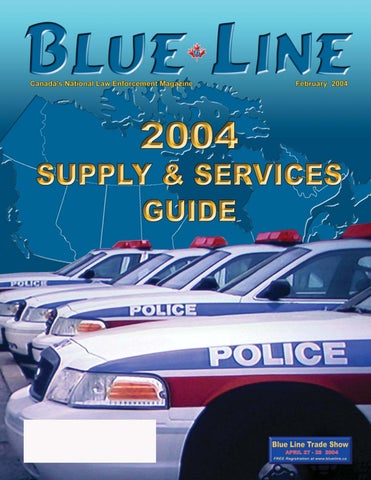
February 2004 Volume 16 Number 2
Blue Line Magazine 12A-4981 Hwy 7 East Ste 254 Markham, ON L3R 1N1
Canada
Ph: 905 640-3048 Fax: 905 640-7547 eMail: blueline@blueline.ca — Publisher — Morley S. Lymburner
eMail: publisher@blueline.ca
— General Manager — Mary Lymburner, M.Ed. eMail: admin@blueline.ca
— Editor — Mark Reesor
eMail: editor@blueline.ca
— News Editor — Les Linder eMail: news@blueline.ca
— Advertising — Mary Lymburner Dean Clarke Bob Murray eMail: sales@blueline.ca
— Pre-press Production — Del Wall — Contributing Editors — Communication Skills Terry Barker Police Management James Clark Tactical Firearms Dave Brown Technology Tom Rataj Psychology Dorothy Cotton Case Law Mike Novakowski Blue Line Magazine is published monthly, September to June, by Blue Line Magazine Incorporated with a mailing address of: 12A - 4981 Hwy. 7 East, Ste. 254, Markham, Ontario, L3R 1N1. Individual magazines are $5.00 each. Subscriptions are $25.00 per year or $40.00 for 2 years. (Foreign - $50.00 U.S.) All material submitted for publication becomes the property of Blue Line Magazine unless other arrangements have been made with the publisher prior to publshing. The authors, advisors and Publisher accept no liability whatsoever for any injuries to persons or property resulting from the application or adoption of any of the procedures, tactics or considerations presented in this magazine. Readers are cautioned and advised that articles presented herein are edited and supplied for your personal awareness and should not be used for further action until appropriate advice and guidance is received from a supervisor, Crown Attorney or other person in authority. Established in 1988, Blue Line Magazine is an independent publication designed to inform, entertain, educate and upgrade the skills of those involved in the law enforcement profession. It has no direct control from a law enforcement agency and its opinions and articles do not necessarily reflect the opinions of any government, police, or law enforcement agency. ©2004 - All articles are protected by copyright. No part of this publication may be reproduced or transmitted in any form or by any means, electronic or mechanical, including photocopying and recording or by any information storage or retrieval system without permission. Internet activity is monitored and use or reposting of material on the Internet is restricted.
This publication is a private venture and receives no subsidy or grant from any level of government.
— Affiliations — International Association of Law Enforcement Planners Canadian Advertising Rates & Data International Police Association The Police Leadership Forum The Canadian Press Newswire Printed in Canada by Janson Printing Service
ISSN #0847 8538
Canada Post - Canadian Publications Mail Product Sales Agreement No. 176796 June 2003 2004 FEBRUARY
Publisher’s Commentary I’m getting an eerie feeling about flying these days
5
Handcuffs 6 An historical overview of police restraints High-tech transporters give new meaning to Mounted Police
11
Darkening skies A real and present danger exists over Canadian skies
13
Dealing with critical incident stress
15
Using “Grey Power” to solve crimes 17 Four gumshoes say that solving old crimes is preferable to retirement Newfoundland police still saddled with revolvers
18
Replacement officers end Mowhawk reserve standoff
19
A unified voice during crises is crucial
20
A first responder approach to dangerous goods
21
Monitoring public spaces A search for a principled approach to public surveillance
24
DEEP BLUE Judging by appearances
26
Bug sweeping requires special skills and equipment
27
CORRESPONDENCE
29
Urban graffiti - harmless scrawl or harbinger of death? Exploring urban graffiti and its effect on Toronto’s indigent death rate
30
Using Kiai improves police control tactics 32 CASE LAW Uncovering the bare essentials
34
Project Lock-up reduces car thefts
39
A field guide to championing change
42
2004 Supply and Services Guide
46
DISPATCHES
68
TECHNOLOGY
70
COMING EVENTS
71
NEWS CLIPS
72
BLUE LINE TRADE SHOW
75
BACK OF THE BOOK 78 Showing dignity and respect is key to policing a diverse community 3
A different cover for a different kind of issue. This is Blue Line Magazine’s Annual Supply and Services Guide. When Blue Line Magazine began publishing 16 years ago it was difficult locating companies even interested in seriously marketing to this sector. Due to its narrow niche of interest and needs Blue Line decided it was worth the effort to simply survey the industry to see who was serious about marketing to law enforcement. Since then Blue Line staff have worked dilligently each year to ensure the listings are accurate and only contain listings of companies and individuals who will respond to the needs of the law enforcement community. For the first time we have designated a different cover for this annual directory to assist those in need of retaining this valuable resource. Each year this special edition will show a blue theme in place of the normal gold coloured covers throughout the rest of the year. This edition is not only about listings, however. Our main feature of the month is a brief history of the tool often used but never really thought about. Handcuffs have been around for thousands of years and now Blue Line Publisher Morley Lymburner has done some research and came up with an intriguing history about this indispensible utensil on page 6. The much talked about Segway has found very limited and questionable uses since its much publicized release in 1999. Found to be quite a novelty it has struggled to find a niche market. The RCMP Bomb Squad, however, has found the Segway to be very functional. You can read more on page 11. Cold Squads have become popular in many police services and especially so since the advent of television shows which focus on such issues. Commencing on page 17 this month you will read about a successful investigation by an Oregon based Cold Squad. Next month you will learn how to start an effective Cold Squad for your own agency and at a minimal cost. This edition of Blue Line Magazine also comes complete with articles from columnists Dorothy Cotten, Mike Novokowski, Dave Brown, Elvin Klassen, Albert Sevigny and Danette Dooley to name but a few. In this our tenth annual Supply and Services Guide no one can say Blue Line dosen’t deliver the goods.
I’m getting an eerie feeling about flying these days by Morley Lymburner There’s no threat greater than the unknown and it’s this foundation that terrorism builds upon. It’s an eerie feeling when one hears a person warning of an impending problem and it becomes reality. I had this occur to me two days before the 9/11 terror attacks when I listened to an elderly lady speak at my church. She had been troubled by a dream that there soon would be great upheaval in the world and it would include Muslims. She warned that whatever it was would require a lot of prayer, and very soon. Her words came back to me loud and clear two days later when the world stood in shock and prayer as those towers came down. I still have her words on tape to prove it. During the recent holiday season, the US government elevated its threat level to Orange. Shortly before New Year’s Day the secretary of homeland security announced that certain flights would be denied entry into the US unless they had armed marshals on board. The British Airline Pilots Association instructed its members that they could refuse to operate flights which carried armed marshals and it would back them up. On December 30 a drunken woman on a Northwest Airlines flight from Pittsburgh to Minneapolis attacked a sky marshal. She was disruptive and unruly and began choking the
June 2003 2004 FEBRUARY
officer after he approached her. Although we don’t know how many officers may have been on that flight, it’s safe to say the security of everyone, including the pilot, was at greater risk by the officer having to deal with this person. The variety and range of opinions regarding armed air marshals certainly merits concern and further study — but I have been troubled recently about another person’s warnings which has apparently gone unheeded. He has been ignored for about a year now; I learned about it in early December, several weeks before that woman on the airliner was arrested. My biggest concern was that my source advised this type of occurrence could be a diversionary way to get at the pilot. I have to thank Ted Ryczko, a recently retired airline pilot, for opening my eyes very wide. Ted, a career military pilot, flew commercial passenger jets after leaving the Canadian Forces. He recently retired and, knowing he had an extensive background in firearms training, I decided he was particularly qualified to talk about hijackings. I was most impressed with his depth of knowledge in both areas; a consultant on police use of firearms, he was acknowledged as an expert witness on the subject at many criminal trials, inquests and tribunals. Since September 11, Ted has been preoccupied with studying methods and modifications which would eliminate or minimize the
5
chance of another intrusion into the cockpit of an airliner, which precipitated the events of that infamous day. He has worked almost continuously developing a Power Point presentation consisting of nearly 1000 images, convincingly describing the problems and offering solutions. I have been privy to much of this material, which he has submitted to the government and am astonished at the token, form letter type responses he has received. The procedures presently in place might stop a crime of opportunity but certainly not the orchestrated type of assaults which occurred four times in the space of half an hour on September 11th. Installing a secure cockpit door is a hijacker’s dream come true and Ted can prove it beyond a reasonable doubt to anyone who takes the time to listen and watch. The folks at Transport Canada have a choice; they can write him off as a crackpot, but if anything he says comes true, Blue Line will make sure everyone knows that they were warned. Ted has a more complete story about this vulnerability on page 13. We’re also offering an opportunity for select individuals to view Ted’s entire presentation in a closed session at our Blue Line Trade Show in April. Anyone interested in attending need only e-mail me at publisher@blueline.ca and await confirmation. We do not want Canada to be labelled the next ‘Boston Airport’ of North America.
by Morley Lymburner In his 1894 treatise, simply called Handcuffs, Insp. Maurice Moser of Scotland Yard told of a French police officer who arrested a thief but found himself without handcuffs to secure him. Displaying some ingenuity, he cut off all the buttons on the man’s suspenders. Modesty made for the best restraint as the suspect held tight to his trousers while escorted through crowded Paris streets. When researching the history of handcuffs, one is initially struck by the huge volume but shallow content that exists on the subject. Moser was looked upon as an expert in ‘modern’ handcuffs in 1894 and his brief overview of the technology at that time describes what turns out to be some fascinating antiques today. Even in Moser’s day, ‘copper’ was a common slang expression for police officers and originally meant “thief catcher.” It came from ‘cop,’ an ancient Anglo-Saxon term which meant to catch (cop) something. Handcop, a natural extension, described a mechanical device that “catches the hands” and was the original name for handcuffs. The idea of restraints dates back to Greek mythology and the prophet Proteus, who could foretell the future but wouldn’t unless forced to. He eluded those who tried to capture him by transforming himself into other forms, including wild beasts, fire and water, frightening them into letting him go. Aristaeus “fixed the fetters on him” after being told Proteus would eventually change back to his original form and prophesy if he held on long enough. References to cuff-like devices date back to Fourth Century BC, when conquering Greek soldiers found vast numbers of them in wagons pulled by Carthaginian armies. They were primarily used to control and enslave prisoners of war. Over the centuries, handcuffs have been variously described as swivel manacles, manacles, shackbolds, shackles, fetters, irons, bracelets and cuffs. The first big manufacturer was the Hiatt Handcuff company, founded in 1780. FEBRUARY June 20032004
The number of styles and usage of handcuffs began to take off around 1850 as the western world became more mobile and urbanized. Crime increased inordinately with the population explosion, as did apprehensions of criminals. Transporting prisoners from police stations to jails and courthouses and back again could only be accomplished with handcuffs, which essentially placed the offender in a secure, lockup situation faster and with fewer escapes. With handcuffs being used more frequently, there was a need to find an easier way to engage them. Until 1850, there were just two types in general use in England. The most common were similar to Bango handcuffs and didn’t allow prisoners any movement. Their adjustability made them popular for general use and they were particularly effective on violent prisoners.
The “Flexible” The ‘Flexible’ handcuff offered prisoners some flexibility, allowing them to eat and perform other personal necessities. They were initially limited to lockup and transport situations because they took longer to size and apply and came in many sizes to fit different wrist thicknesses. Unfortunately the Flexible, also called the ‘Darby’ or ‘English’ handcuffs, became popular for street use because they were so easily concealed. Weight was another matter; at almost half a kilo (one pound), they were almost impossible to place on a violent prisoner, even if the officer was fortunate enough to have the correct size with him — and that was crucial. Too large or small and the suspect had a heavy steel weapon which would make short work of a wooden nightstick. After 1850 there was a move to invent a more universal handcuff which could be used both on the street and in prisons. They needed to be secure, flexible and adjustable, which led to a wide array of contrivances with such names as the ‘Snap,’ ‘Nippers’ and the ‘Twister.’ 6
The Snap, branded Blakely, was the most popular in mid to late 19th Century Europe and America. It consisted of two loops, the smaller of which would literally snap over the suspects wrists; the large loop was held by the officer. The “Snap” The Twister was also quite popular because it was compact and could easily be carried by both uniformed officers and detectives. It consisted of a chain connected to matching hand grips at both ends and was simply wrapped around a The “Twister” suspects wrist, with the officer holding the handles. Any struggling, of course, meant excruciating pain and the risk of breaking a wrist or arm. Widely viewed as contributing to police brutality, it was eventually banned in Britain. Both cuffs could be generically described as ‘come-along’ devices and were adequate for an era when an officer walked the beat. When a prisoner was ‘copped,’ it was a simple matter to hold the other end of the cuffs and walk them to the station, take them for a ride in a horse drawn paddy wagon or commandeer a hapless citizen out for a ride in their fancy buggy. In each case, an officer had to hold the other half. Struggling meant risking a broken wrist; if this happened, the nipper was simply placed on the other wrist. Officers also risked broken bones; a skilful arrestee with strong wrists could break the wrist of an over confident officer. It took the ingenuity of the Americans to overcome the obvious shortcomings of these devices. The first popular adjustable handcuffs were produced by Tower and remained popular for more than 80 years. Many say they set a standard of precision, craftsmanship and security that has never been matched. The history of adjustable handcuffs is very murky. The story begins with W. V. Adams, who patented the adjustable ratchet principle for handcuffs in 1862 — up to then, all American handcuffs were of fixed size. The Adams cuff was an adaptation of the English Darby — a square bow
June 2003 2004 FEBRUARY
7
with notches on the outside which were engaged by a very simple, tear shaped lock mechanism which allowed their size to be adjusted. The design was quite successful and Adams Handcuffs were manufactured in great quantity. The second part of the story takes place in 1866 when Orson C. Phelps invented and patented his version, which put the notches for the ratchet on the inside of the square bow and featured a heavier and more secure lock case. Phelps handcuffs were also very well made; although the lock wasn’t very secure, it was a vast improvement over any earlier design. It’s unknown if Phelps paid a royalty to Adams, who held the original ratchet patent. John J. Tower enters the picture in 1865 when he established a company. He introduced a series of handcuffs initially built under license — it’s unknown precisely when since at least three distinct models were released bearing only the Adams and Phelps patent dates.
wise froze the catch or bolt, preventing it from being opened or further closed and stopping the wearer from shimming it open. To remove the double lock, the key had to be re-inserted and turned a full turn to the left, counter-clockwise. Another half turn would open the cuff completely. The earliest Tower double lock handcuffs are marvels of engineering and were manufactured to very high tolerances. Unfortunately standards dropped over the 50 years they were produced.
The “Tower Detective”
The “Tower” The first Towers weren’t much different from Phelps, with similarly shaped lock cases, ratchet notches on the inside of the bow and a three link connecting chain. Tower applied for his first patent in 1871 to cover the round or oval bow he invented, an improvement over the previous square bow. It took three years for this patent to be issued; O. C. Phelps died during this period and Tower evidently bought the Phelps patent, which was reissued to him in 1877. Tower immediately realized that single lock models had a major weakness — they could be shimmed by a determined prisoner with a proper bit of metal. He solved the problem with the ‘double lock’ handcuff, which had a much more sophisticated lock mechanism. Patented in 1879, it was opened the same way as a single lock model, by inserting a key and rotating it one half turn counter-clockwise. However, turning the key a full turn clock-
Much of the double lock cuffs security was due to their heavy weight. Tower patented a new light weight handcuff in 1887 “made for lessening the expense of the construction of the hasp and case of the lock, for lessening the weight of the handcuff...” The very simple design was essentially a return to the original Adams handcuff. Like the original Adams, the new lightweight Tower model had a rectangular bow with the notches and lock case on the outside. The lock mechanism was very simple; there was no double lock and the cuffs could be shimmed more easily than any prior Tower handcuff. Essentially security was sacrificed for low cost and weight. They were marketed as Tower detective handcuffs, “designed to meet the demand for a very light weight shackle for those officers, detectives, and others who require to have their implements with them, and find a few ounces saved in the weight a matter of convenience and comfort.” Despite their low security, Tower advertised that “we do not hesitate to guarantee them as next to our patent double lock handcuffs, the best shackle ever offered.” Handcuff collector’s sometimes refer to this model as the Pinkerton model, since the
Pinkerton Detective agency supposedly used it. The classic swing through design of the original Peerless handcuff continues to be the industry standard, more than 80 years after it was first produced. The Peerless Handcuff Company was established in 1914 in Springfield, Massachusetts by James Milton Gill, a businessman and city police commissioner. He was approached by inventor George Carney, who invented the swing through design that would eventually revolutionize the industry. Relatively light weight and easy to carry, it could be quickly applied with one hand, unlike other restraint devices of the time. Recognizing the advantages, Milton bought the rights and began selling the product under the Peerless name. It quickly became popular, rendering other types of handcuffs obsolete. Over time, after the patent expired, the design was copied by almost every handcuff manufacturer. The Carney design established Peerless as a leading supplier of high quality restraints, a reputation it still carries today. The Great Santini Modern handcuffs haven’t changed much since the Carney design. Most have adopted a universal key, seen as a necessity so officers could unlock cuffs on another’s prisoner. The down side, of course, is a greater chance Steve Santini a prisoner has a key. Steve Santini, a 13 year old Toronto youth, made headlines in the ’70s by demonstrating his ability to break out of an antique police jail cell. One year later, he wowed everyone with his ability to break free of standard police issue handcuffs. He has since gone on to become one of Canada’s top escape artists, comparable to the famous Houdini, and has defeated more jail cells than any other Canadian escapologist. Santini has also helped improve handcuffs and isn’t impressed by the security of most modern restraints and their ‘universal’ key — but unlike others with the same opinion, he’s come up with two approaches to help fix the vulnerability. • Keeping the universal key but redesigning the restraint so it’s difficult for a prisoner to open it even if they have a key. • Using a high security padlock, either alone or as a supplement to the universal key. Peerless Pivot One of the neatest Santini inventions is the Peerless Pivot. He welded a bar to each cuff to replace the chain coupling on a standard pair
FEBRUARY June 20032004
8
June 2003 2004 FEBRUARY
9
of Peerless handcuffs. The bars are riveted together by a swivel joint which exposes the key hole only when the cuffs are partially folded, making access much more difficult. An external padlock can be fitted over the swivel, locking it in the extended position and blocking access to the key hole, for even more security.
lock, this pair of levers may be pinched together to open the bows of the handcuff. However, with an external, high security lock in place, they’re held in the locked position and are one of the most secure handcuffs ever made.
Hiatt spring loaded key cover
What’s better than a handcuff requiring a universal key? One that requires two of them. This Santini invention is a modification of a standard Hiatt hinged cuff; the key hole is covered by a sliding, spring loaded metal shield. The cover must be held open with the double lock plunger end of a second key before another key can be inserted in the lock. A prisoner would require considerable dexterity to open this cuff. The Titan
Perhaps the most famous of Santini’s inventions, this massive handcuff, cut out of sheet steel and held together with stainless steel rivets, is designed for use with an external lock. Each cuff has a separate latch mechanism that protrudes from the bottom; in the absence of a
FEBRUARY June 20032004
Pickproof Smith & Wesson handcuffs
Thompson, and his recently published book, Devices of Human Restraint, covers restraints from ancient to modern times and includes some of his own inventions. Modern, finely tuned, light and flexible handcuffs have come a long way from the old Nippers. Today’s restraint systems include full body wrap devices, glue guns and net shooting shotguns. Devices of tomorrow could include short term paralyzing devices, with antidotes administered at the police station. “History teaches us that men and nations behave wisely once they have exhausted all other alternatives,” Israeli politician Abba Eban observed. It’s a good thing to keep in mind when taking a person into custody. There can be no benefit of the doubt when an arrest is made — cuff ‘em all! For more interesting reading about handcuffs, go to www.handcuffs.org — other sites of interest include: • www.stevesantini.com • www.peerless.net • www.handcuff.smith-wesson.com • www.h-tmfg.com • www.cuffmaxx.com Morley Lymburner is the founder and publisher of Blue Line Magazine.
The Smith & Wesson Model 100 is one of the most popular cuffs in North America and, of course, opens with a universal key. Santini enlarged the double lock holes so they accommodate a pair of high security Abloy padlocks, making it impossible to remove the double lock; they still function normally without the locks in place. These cuffs are a brute force solution to security — a modern version of classic shackles, which also required external padlocks — but are very solid and quite secure when fitted with proper locks. Santini also has a blue (security) box for hinged handcuffs, marketed by Hiatt
10
A Pennsylvania judge ordered a woman to carry a photo of the man she killed in a head-on collision, and the man’s parents complied by sending a picture of him in his casket. Prosecutors said Jennifer Langston was drunk and talking on a cellphone in June 2002 when she crossed the centre line and hit a pickup carrying teacher Glenn Clark and his pregnant wife, Annette. Glenn died and his wife remains in a coma. Their son, born by caesarean section five months after the crash, is being raised by relatives. Langston pleaded guilty in September to reckless endangerment and reckless driving. A judge sentenced her to 30 days in jail, plus house arrest and probation, and ordered her to carry a picture of Clark for five years. Langston’s lawyer said his client’s requirement to carry the picture of Clark in his coffin is cruel and unusual punishment and wanted a picture of him when he was alive. However, Rosellen Moller, Clark’s mother, was unapologetic and said she had no intention of sending another picture. “I thought it was cruel and unusual to kill my son,” she was quoted as saying.
High-tech transporters give new meaning to “Mounted Police” Scott says too much movement or walking can quickly deplete the hour’s They’re on the cuttingworth of oxygen the tank edge of human transport provides. technology, environmenSince their arrival, the tally friendly and, well, just Segway transporters have plain cool to ride. This past undergone rigorous testing June, two Segway Human by members of the RCMP’s Transporters (HT) rolled up EDTS and Regional Chemiat the RCMP ready for testcal/Biological Response driving and evaluation by Units, bomb squads and members of the Explosives ERTs from the Ontario ProDisposal and Technology vincial Police, Peel and York Section (EDTS). Regional Police services. After spying the selfScott says he wants to balancing, electric-powered see how the Segway— transporter on television, an outfitted with custom-made intrigued S/Sgt Gord Scott snow tires—will perform in Photo by: Jennifer Miriguay (NCO i/c, Operational Rewinter conditions. The plan sponse Unit, EDTS) felt the Segway could form an integral part of a first is to eventually place the two Segway transresponse team during explosives-related inci- porters on the national Chem-Bio Response dents or crisis situations of a chemical, biologi- Team truck. Depending on their evaluations, the Operational Response Unit may also reccal, radiological or nuclear nature. Following research on the transporter’s ca- ommend the Segway for the RCMP Regional pabilities and the financial go-ahead from Chemical/Biological Response Units in HaliRCMP management, Scott and Cst Rob fax, Edmonton and Vancouver. Keewatin headed to Segway headquarters and the company’s manufacturing and training fa- Reprinted from the Nov. 2003 Pony Express. cility in New Hampshire. Their mission: to test- For more information on the RCMP’s new Segway transporters, contact the Explosives Disposal and Technology drive the transporters and evaluate their poten- Section at (613) 993-7880. tial to perform in situations where explosives technicians would need to get in and out of situations fast, efficiently and safely. After some orientation on the Segway, followed by a mandatory training and instruction course, Scott and Keewatin returned to Ottawa with their Segway transporters in tow, ready to pass on their knowledge and driving techniques. Scott says manoeuvring the Segway, which retails for $4,950 US, can be mastered pretty quickly. Designed by American inventor and entrepreneur Dean Kamen, the Segway is a combination of a control system, motor system and series of sensors or balancing system. Five gyroscopic sensors in the Segway platform or foot pads respond to the rider’s movements. To move forward or backward, the rider simply leans slightly forward or backward. To turn left or right, the rider turns the steering grip left or right. Three different speeds are controlled by three coloured keys. The black key maintains six mph (the transporter’s slowest speed), the yellow nine mph; and the red 12.5 mph. Scott says what’s really amazing about the transporter is how much weight it can hold—more than 350 pounds—and that is can simultaneously pull an equipment trailer. This was a key consideration in acquiring the Segway, since it will have to transport a police officer decked out in a 90-pound bomb suit. During a crisis, the Segway may also render itself invaluable for technicians wearing the chemical/biological suit, which is equipped with an oxygen tank. The Segway would all but reduce the risk of oxygen depletion by allowing the technician to approach a suspicious device or package much more quickly and efficiently than if they had to approach on foot.
by Jennifer Miriguay
June 2003 2004 FEBRUARY
11
FEBRUARY June 20032004
12
Photos: Courtesy MicroSoft Corporation’s Flight Simulator
by Ted Ryczko To prevent another 9/11-type cockpit intrusion, government regulators have decreed that weak cockpit doors be replaced with a single, secure door — but when this door is opened, passengers have access to the cockpit. Cockpit doors are opened many times during flights so pilots can visit the washroom or receive drinks and meals. Accordingly, Transport Canada has required that operations manuals include procedures for opening, closing and locking the flight deck door, including closing a sliding curtain between the cabin and galley so a potential hijacker can’t see the door being opened. A trained hijacker would quickly notice these obvious precautions and come up with a plan of attack. Installing the new door is a hijacker’s dream come true. Once airborne in cruise, a hijacker could grab a flight attendant or pilot when they open the door and throw them backwards into the cabin, then enter the cockpit, lock the door with the deadbolt and kill the pilot(s). Since they’re strapped into their seats facing forward, it would be easy to do with their bare hands — or with the handy cockpit crash axe or fire extinguisher.
June 2003 2004 FEBRUARY
Unless a sky marshal is standing in an opportune position in the forward cabin to intercept such an attack, they would be powerless to stop it. It would be executed with thunderclap surprise and be over and decided in just a few seconds. Once locked in the cockpit, the hijacker is behind a secure, bulletproof door, insulated from any intervention, even from an armed sky marshal. Any single door allows access when opened; all that stands between the cockpit and the hijacker is a sliding cloth curtain. Some form of double door system is needed. The Israeli airline El Al has double reinforced steel cockpit doors which are closed and locked prior to passenger boarding, and opened only after all the passengers have deplaned. Under no circumstances are they to be opened in flight and pilots have all the provisions and facilities for the entire flight behind those doors. The double door concepts I propose, for practical economic reasons, fall short of the Fort Knox El Al standard. I recommend that the already installed single door — I’ll call it the front door — remain. My concepts serve to delay the hijacker, allowing time to close and lock the front door, while still making the front wash-
13
room available to the pilots and passengers. While such concepts are being researched and developed, my presentation describes a crew door drill procedure to make the single door as secure as possible. There are about 5,000 pilots operating Canadian flights to which sky marshals could be selectively assigned. Since almost all are now crewed by only two pilots, we would need 5,000 sky marshalls to assign two to each flight, since they deserve no less time away from work than do pilots. I believe we only have about 200 sky marshals, which means that, on average, they would be on only one in every 25 flights — less actually, when you take into account the requirement to have armed sky marshals on all flights landing in Washington DC. My presentation demonstrates that having less than three sky marshals per flight poses a serious risk that they would be disarmed by hijackers. El Al has up to five strategically located on every flight; if Canada were to follow this standard, it would use up half the complement of the RCMP. Security measures for a ground based scenario, be it the Rose Bowl or New Year’s Eve at Time Square, are traditionally addressed by throwing more guns at it — but we’ve gone
to much effort and expense to keep guns off airliners. Any decision to allow them on board must be well thought out and done only after careful study of every possible scenario where those guns may be turned against us. The American order that certain airliners flying into American airspace carry armed sky marshals is an over simplification. American pilots have been allowed to be armed, in response to their claim of having the right to defend their cockpit. I agree, but only if they have double doors, which would provide ample time for a pilot to open a safe, retrieve a gun and prepare to shoot the hijacker once they finally break through. The Americans however, have armed their pilots on airplanes which only have single doors. By pushing aside the sliding cloth curtain after the single door is opened, hijackers could storm into the cockpit and kill the pilots before they could get to their holstered guns. Pilots are strapped into their seats with their legs buried in the rudder tunnel and a control column between their legs, above the knees. With the enemy standing behind the backrests, there’s no worse configuration, other than the pilots being handcuffed, that I can image from which to start a gun fight. I have a separate presentation of 20 minutes and over 300 slides which demonstrates that, with a single door, armed pilots not only do not have any chance of success, they are
FEBRUARY June 20032004
guaranteed to experience varying degrees of disaster. Hopefully pilots would not entertain unlocking the secure cockpit door so they can participate in some shoot out at the OK corral scenario in the cabin. Few know that no flying skills are needed to navigate a commandeered airliner. My presentation confirms that with software advertised for sale on the Internet and flight simulator software, anyone who is literate can learn to control and navigate a modern glass cockpit airliner from cruise altitude and plow it into a specified target on the ground. On New Year’s Eve, American authorities detained British Airways flight 223 at Dulles airport, inbound from Heathrow, to interview passengers related to a terrorist threat. Subsequent BA flights 223 were cancelled. If England were indeed a terrorist departure point that
14
has now been secured, the terrorists will merely go somewhere else, Canada being a good spot. I believe that the next attack against the US could very well be by a Canadian airliner(s) departing a Canadian airport, used as a flying bomb to strike against targets in the US. Many believe that it’s easier for terrorists to enter Canada than the US and to get legitimized here. The American intelligence system would likely not be able to warn Canada about a terrorist threat on a Canadian flight from Toronto to Vancouver, for example. The sheer brilliance of the planning and execution of the 9/11 attacks demonstrates that the terrorists have a lot of imagination and a terrific sense of surprise. These masterminds of terror detected, targeted and homed in on our soft underbelly with razor sharp fineness. Bureaucracy is no match for such a shrewd and determined adversary. Continuing to place our faith in it and conventional wisdom renders us sitting ducks. Ted Ryczko is well known and respected in police circles. His efforts in changing Canadian police from revolvers to semiautomatic handguns is legendary. In addition to his firearms expertise Ted recently retired from a long career as a flight captain of both military and commercial passenger jets. He w ill be doing a closed door presentation at the Blue Line Trade Show on the subject matter discussed in this article. People wishing to attend should send an e-mail to publisher@blueline.ca for more information. Space is limited and it is a two hour audio/ video presentation.
Dealing with critical incident stress
by Liz Ackerman If not properly dealt with, the stress from a traumatic incident can throw a police officer’s life into turmoil and even end their career. Critical Incident Stress Management (CISM), a crisis intervention system which includes pre-crisis education, one-on-one intervention (peer support), small group intervention (defusing), debriefing with groups and more, can help officers cope. It has the added benefit of extending careers and paying huge dividends in the long term for both police personnel and managers by helping to reduce longterm disability and getting officers back to work quicker than if they had to cope with critical incidents on their own. “People need some place to reach out for help after a critical incident and CISM is a structured format that works,” said retired Peel Regional Police Det/Sgt Geoffrey Hancock, one of the participants in the Ontario CISM Conference 2003, held last November in Orillia, Ontario. Hosted by the Georgian CISM Team, it attracted 120 people from Ontario, Manitoba and the border states. With CISM, “people are getting better faster and moving past the experience sooner,” says Murray Firth, president of the Canadian Critical Incident Stress Foundation and one of the organizers of the conference. CISM tools are crucial in dealing with the crises we face today, according to Dr. James Young, keynote speaker and Ontario’s commissioner of public security and chief coroner. Young offered assistance in the aftermath of such traumatic incidents as 9/11, the recovery of Swiss Air Flight 111 in Nova Scotia, the disastrous ice storm which crippled parts of Ontario and Quebec in 1998, the death of Canadian soldiers in Afghanistan and the 2002 Bali bombings. Such incidents highlight the era of globalization that we’re in today, noted Young, and shows the need for organized CISM teams which can respond internationally to provide
June 2003 2004 FEBRUARY
on-scene and post-incident after-care. Emergencies and catastrophic events are more frequent and larger in scale today than in the past, noted Randy Reid of Emergency Management Ontario (EMO). Managing critical incident stress (CIS) is an “an integral part of emergency management,” he said, adding that EMO is setting up its own CISM team and an advisory council is investigating how it would work with the agency. Police officers “can’t be everything to everyone all the time unless you are taking care of yourself,” said Neil Orr of York Regional Police, who worked as a CIS debriefer for the NYPD after 9/11. He described the complications and logistical challenges of organizing debriefings with rescue and recovery workers at the end of each shift and offering peer support when needed. CISM teams from both Canada and the US were brought in to help handle the enormous task at the request of POPPA (Police Organization Providing Peer Assistance). CISM teams can also help co-workers cope with a line of duty death, said Barrie Fire Platoon Chief Keith Lusk. Many people are affected by such events, he noted, and debriefings, peer-support and employee assistance programs are more effective when all work together to help those involved cope with tragedy and loss. Liz Ackerman is a columnist for Blue Line Magazine who specializes in the field of counselling. She may be contacted by email at liz@blueline.ca.
15
FEBRUARY June 20032004
16
Using “Grey Power” to solve crimes
Four gumshoes say that solving old crimes is preferable to retirement by Joseph B. Frazier (Associated Press) About 6,000 murders go unsolved each year in the United States. About At age 16, Benny King was no cherub. 200,000 have gone cold since 1960. Not even close. So when he vanished “Typically, if no new leads are formed from a Roseburg, Oregon beer party within 72 hours, a case has a 60-65 perin 1975, some people weren’t surcent chance of going cold pretty quickly,” prised. He had a string of juvenile said forensic anthropologist Max Houck, offenses and was awaiting trial on a a founder of the new Institute for Cold home-invasion rape charge. Case Evaluation at West Virginia UniverKing stayed missing until mushsity. room hunters found his boots and bones The institute specializes in getting in the woods west of Roseburg in 1998. forensic help to the nation’s 18,000 poOlson and three other retired law enlice departments, often at reduced costs. forcement veterans, who make up After successfully solving their first Douglas County’s volunteer Cold Case case, the Roseburg squad is focusing on Squad, took the case in January, 2003. the death of Barbara Joy Gallagher, who Using old-fashioned gumshoe techwas 31 when last seen in 1988. niques, the four followed clues that led The swimming coach, Red Cross them to Johnny Carlos Tinker, 46, who County, Oregon, Sherrif volunteers Tom Hall and Thomas Schultz review employee, lifeguard and corporate physiwas in prison on pornography charges. Douglas a case under the supervision of Lt. Curt Strickland. cal fitness student has been missing and In September, Tinker confessed to squad presumed murdered for 15 years. members Tom Hall and Thomas Schultz “Law enforcement has been good to me,” The birthday and Christmas calls that she and was sentenced to life in prison. The four members of the Roseburg squad he said. “I don’t mind donating some time back always made to a son in the Midwest had stopped. Friends in the Red Bluff, Calif., area, — mostly around 60 and with more than 100 to the community.” Schultz said that for years, police believed where she had roots, reported no trace of her. years of experience among them — could have She had been living in rural Azalea with put their feet up years ago. There are golf the story by Tinker and an accomplice that King courses in Douglas County, and the rivers are last was seen getting into a Volkswagen at the Robert Barr, described by the cold-case deputies as a violent con man and liar. teeming with fish. But for two days per week, 1975 party. “Everybody who worked the case, includBarr’s wife’s body was found in the Lake on their own time, they are back at it. Cold-case squads are forming across the ing us, chased that fictitious Volkswagen,” he Tahoe region, near where Barr killed himself several weeks later in April 2001 with the same country as new technology and DNA availabil- said. “It didn’t exist.” But the four said that as time passed, fears gun that killed his wife. Barr lived in a heavily ity make it possible to delve into long-abandoned crimes. It is a topic that has people’s in- subsided, attitudes and loyalties changed and wooded area in Azalea. “We’ll probably never find (Barbara’s) terest. There even is a TV show called “Cold more people talked. “We kept narrowing down the names, then body. Our best guess is that it’s out there someCase,” about a young, female, Philadelphia detective who reopens unsolved murder cases. fixed on a couple of them,” he said. Tinker, it where,” Olson said. Olson said he thinks that he nearly has Twice per week, under the supervision of a seems, shot King out of anger about the rape. The first shot from the sawed-off shotgun enough evidence to close the case. But it would Douglas County detective, Lt. Curt Strickland, the four Roseburg volunteers comb over old didn’t do the job, and King fled into the woods. be a lot easier to solve if Barr were alive. They haven’t stopped looking. files, looking for something that others may Tinker returned to his car for more shells and Boyle recently spent a day crawling under have missed, said Syd Boyle, another member urged King to come out, saying it was all a mistake. Barr’s old house; maybe there was something of the cold-case team. King did, and Tinker, then 17, shot him the investigators missed. Strickland organized the squad, assigns them cases and makes sure that they can get in touch twice in the head. Olson said the epiphany didn’t come until Douglas County Sheriffs Office with people with whom they need to work. County Justice Building the two prison interviews with Tinker. The county advertised for volunteers. 1036 SE Douglas, Roseburg, OR U.S.A. 97470 “We had it down to two people at the Phone 541-440-4450 “All we knew is that they wanted to try the concept,” Olson said. “We had no idea which time,” he said. Olson said the county saved $500,000 in NEXT MONTH: A recipe on how to create your very own way it would go.” Cold Squad Team. By taking one case at a time, the squad can trial and appeals costs by getting a confession. avoid distractions, he said. Boyle retired in 1987 after 26 years that included crime-scene and homicide investigation in Modesto and Turlock, Calif. Hall, a former postal inspector who handled bomb-squad cases in Los Angeles and Phoenix, Ariz., farms cattle, as does Boyle. Olson retired after service in several California departments, most recently as police chief in Pacifica, then worked child-abuse cases in Vancouver, Washington. He retired again to a home on a golf course, but it didn’t take. “Once it gets in your blood, so to speak, it’s there forever,” he said. Schultz, a former detective who served on police forces in Wisconsin, Las Vegas and Concord, Calif., now sells insurance. June 2003 2004 FEBRUARY
17
Newfoundland police still saddled with revolvers by Danette Dooley A decade after an Ontario ruling declared revolvers unsafe for police work, Royal Newfoundland Constabulary managers and members are still lobbying with the provincial government for semiautomatic pistols. The revolver is almost completely extinct among Canadian police agencies because of the ruling, says Blue Line Firearms Editor Dave Brown. The Ontario Provincial Police Association (OPPA) convinced a labour ministry tribunal in 1993 that revolvers were unsafe under the Ontario Occupational Health and Safety Act, arguing they’re difficult to reload and subject to accidental discharge due to involuntary cocking. Pistols carry more rounds and don’t need fine motor skills to reload, it pointed out. Ontario officers had reported numerous accidental discharges. The tribunal was told of cases where the gun was involuntarily cocked on such things as an officer’s seat belt, steering wheel and jacket. The Ontario Police Services Act was amended to declare the semi-automatic pistol the only acceptable sidearm for police after the tribunal’s report was released. “After the firearm has been cocked, it takes only a slight pressure to accidently discharge the revolver,” notes Cst. Paul Woodruff, speaking on behalf of the Royal Newfoundland Constabulary Association (RNCA). RNC officers have expressed grave concerns for years about policing the streets with a firearm deemed to be unsafe, he says, and the association has lobbied the government to make the switch since 1998; that’s when officers in the province were given permission to carry their guns, rather than storing them at headquarters or locked in the trunks of their cruisers. Shortly after the force was armed, management told the association the firearms conversion issue would be dealt with by cabinet, he says. “It’s pretty shocking to know this was suppose to be addressed in 1999. We’re a bit dumbfounded that this Ontario report is out there and a decade after the report said they (revolvers)
Deputy Chief, Joe Browne were unsafe to carry, we are still carrying them night after night, day after day.” An RNC officer formally complained in January, 1999 that he and his fellow officers were policing with unsafe weapons and requested they be issued pistols but his request was denied. The association has presented similar concerns to management and, in 2002, took its position to Occupational Health and Safety (OHS) at the provincial labour department. As a result a committee was formed which included representatives from the Department of Justice, OHS, the police chief’s office and RNCA members. The committee put forward a proposal to government about the unsafe firearm, citing the Ontario ruling and requesting that the RNC make the firearm conversion. That was about a year ago and Woodruff says the association is still waiting to meet with the minister of justice on what is “a huge issue for our members... “We’re not doing anything new as the work has already been done in Ontario. The rest of Canada has acknowledged this work is legitimate and that the revolver is deemed to be unsuitable and unsafe for the job we do.” The RNCA also sees the lack of adherence to the Ontario ruling as a civil liability issue. It wouldn’t be unreasonable for the 1993 Ontario ruling to be cited during civil litigation, Woodruff notes. “If a member was shot or hurt because the member wasn’t given the proper equipment to
do their job and it’s been documented for a decade, a Supreme Court judge could certainly question why it wasn’t adhered to. If a piece of equipment is made for police officers, it doesn’t matter if it’s shipped to Newfoundland, Toronto or New York. Policing is similar across the board.” Ted Ryczko was an expert witness for the OPPA during the Ontario hearing and was also hired in the early 1990s by the RNCA to assist with its fight to earn officers the right to carry guns. He’s worked as a consultant to the Canadian Police Association, the OPP and Toronto Police associations, advising on firearms, ammunition and holsters. He says that when police carrying pistols became the law in Ontario, the country’s largest province and home to the largest provincial and municipal force, other provinces followed suit, saying “‘what’s good for this big province has to be good for the rest of us.’ “The attorneys general and solicitor general – the employers of the police in other provinces – would be hard pressed to argue against that when the tribunal and the department of labour prohibits the revolver in the largest province — so I think all the others just fell into line,” Ryczko says. While rank and file members of the RNC still carry revolvers, the force’s tactical response unit and canine unit are equipped with pistols. Ryczko sees this as an admission that the revolver is not the firearm of choice for high stress situations. “What that tells you is that where there is a little bit more danger you need a little bit better equipment. Now, the people on the street deserve no less safety, do they?” Deputy chief Joe Browne says RNC management accepts the Ontario study and subsequent ruling that the revolver is unsafe. Knowing the constabulary lags behind other forces does little to improve officer morale, he admits, adding “we have lost a lot of ground as a police force and it will take considerable time to recover.” The cost of replacing the revolvers was an issue when the force was armed in 1998, he admits; “(since) all members were trained and familiar with the service revolver, it was appropriate that it be the sidearm worn when the arming policy was changed. A weapon conversion at the time would have delayed the policy change.” RCMP officers based in Newfoundland changed from revolvers to pistols in 1996, even though the provincial government pays for all of their equipment. RNC officers work side by side with their federal counterparts daily. Browne says RCMP officers are governed by national policy and the change, authorized by headquarters in Ottawa, applied to all divisions — but admits that, “playing catch up, as you call it, is the usual position that the RNC finds itself in.” Danette Dooley is Blue Line Magazine’s east coast correspondent. She can be reached at dooley@blueline.ca.
FEBRUARY June 20032004
18
Replacement officers end Mohawk reserve standoff A tense standoff at a Mohawk reserve in mid January that saw the band chief’s house burned and police officers barricaded in their station ended peacefully. Tensions began easing when 30 peacekeepers from two nearby Mohawk reserves arrived in the community of Kanesatake. An accord had been reached to withdraw 60 police officers brought into Kanesatake from reserves across the province by Grand Chief James Gabriel. The deal came after several hours of negotiation involving Chagnon and the Kanesatake and Kahnawake police commissions and was taken to the reserve by members of the Kanesatake police commission. One of the tasks of the police officers sent to the reserve was to investigate the fire that destroyed Gabriel’s house. News of the deal was received positively at Kanesatake. “This decision, when there’s peace and harmony, is always the best one,” said Tracy Cross, whose dismissal as police chief was one of the events sparking the incident. He was reinstated under the deal. Earlier, a defiant Gabriel, whose house was torched by protesters on the Kanesatake Mohawk reserve, said he wouldn’t step down and would press forward with a crime-fighting initiative that caused a standoff in his commu-
June 2003 2004 FEBRUARY
nity. Gabriel was targeted by protesters who objected to his decision to hire a new police chief and bring in aboriginal officers from outside the reserve to crack down on crime and marijuana growing operations. Others expressed concerns that the officers would aid an RCMP effort to shut down contraband cigarette sales on the reserve. About 60 of the officers were prevented from leaving police headquarters and going to work by protesters at the Kanesatake reserve, west of Montreal. They were also deprived of food by protesters over two days. Protesters said Gabriel is no longer their leader and also shouldn’t have replaced Cross.
19
Quebec Public Security Minister Jacques Chagnon, who announced the deal ending the crisis, said Gabriel was not included in negotiations and had little option but to approve when he called him. “I told him what we had decided to organize,” said Chagnon. “He said he in fact didn’t have much choice. He doesn’t want to have a bloodbath with the people inside the police station. He’s able to see that we are going to have a peaceful conclusion of that crisis and that’s what we need.” Chagnon said he had been in contact several times with Deputy Prime Minister Anne McLellan and had scheduled a meeting with her, adding “the federal government knows that it has a huge responsibility in everything which happens.” The reserve, near the community of Oka, gained notoriety in 1990 over a land-claims standoff involving Mohawk warriors. A provincial police officer was killed when police stormed barricades erected to prevent an expansion of a nearby golf course on land Mohawks consider sacred. Protesters placed a large red-and-black Mohawk warrior flag on the fence near the headquarters and said they didn’t want outside officers, even aboriginal ones, to police their reserve.
A unified voice during crises is crucial by Judy Pal Hurricanes, sniper shootings and SARS have one thing in common — they’re all events that require multi-agency response to the public. In this day of instantaneous media coverage, coordinating communication at the local, regional, provincial and national levels has never been more important. It’s all about getting the right information to the right people at the right time so the public can make the right decision; and that requires a coordinated single voice. Joint forces operations (JFOs) are not new to police. Municipal departments have worked hand-in-hand with their provincial and federal counterparts for years. At the local level, personnel at a crime scene where there’s fire and police automatically share information. Emergency officials compare notes and decide which department will say what. Today, joint information systems are crucial to ensure your agency maintains and builds public confidence and trust. They can be loosely structured, like at the fire scenario mentioned above, or formally organized during large-scale events, as with the G-7 meetings in Kananaskis. The key is in presenting a harmonized, united voice to the public. Without it, they will loose confidence in your organization and the media will go to others to “fill in the blanks.” During the Columbine crisis, the public obtained much of its information from the media, not law enforcement. It wasn’t uncommon
FEBRUARY June 20032004
to see reporters interviewing other reporters to fill airtime! This led to confusion, frustration and in the end — lawsuits. On the other hand, during the sniper crisis in Washington, DC last year, Chief Moose acted as the media and public’s single source for information. While he certainly wasn’t directly involved in every aspect of the investigation — which included officials from the FBI, ATF, local and state police and a host of other agencies — it was decided he would be the lone spokesperson for information dissemination on the shootings. PIOs from all agencies involved worked to develop the messages and determine what would be said and when. Behind the scenes, chaos often reigned with disagreements and debates about releases of information and news conference messaging, but to the media and public, that single, united voice gave people confidence in what law enforcement was doing to apprehend the suspects. Natural disasters could well be the most frustrating event police may face communications-wise. You will find yourself working with agencies that may not deal with crises and highprofile media coverage. In addition, not many of these organizations are used to the paramilitary structure that pervades emergency services agencies. It’s important to bring these groups into the joint information system to ensure they are not out there on their own releasing contradictory or damaging information. For example, after a severe storm in North Carolina last year, all responding agencies except the Red Cross were part of the state Joint Information Center (JIC). A large portion of a downtown area was cordoned off because of looting and police were urging people to stay away from the area. However, because the Red
20
Cross wasn’t part of the communications loop, a spokesperson went to the media and encouraged people to donate blood. Problem was, the blood donor clinic was smack-dab in the middle of downtown – exactly where police did not want people to be. This well intentioned ‘rogue communicator’ precipitated great frustration among citizens who wanted to help and prompted many to think, “the right hand doesn’t know what the left hand is doing.” That kind of perception results in a loss of confidence in ‘the powers that be’ in the eyes of the media and public. In most cases, inter-agency information sharing is advantageous; in circumstances that require response in crisis, it’s critical. Key communicators should be at the table in your Emergency Operations Centre (EOC) to help advise commanders on what the media will want and what information the public needs to hear. Things to keep in mind when setting up a Joint Information Centre include: • Developing a media staging area, complete with a contingency plan for the myriad of satellite trucks that may appear out of nowhere. • Managing the logistics of having a lot of media people at a scene, i.e. parking, power, toilets, a working area. • Creating a relationship with PIOs in your area before a large-scale event occurs, so a pool of knowledgeable people are available in the event of a crisis; better to meet and learn how these people work prior to an emergency. • Recruiting people who are media-friendly and speak other languages if the local public is multi-national. The advantages of joint information systems and JICs are obvious. You will speak with a united voice to disseminate information that is accurate, timely, understandable and most important, consistent. It links all PIOs involved in the incident and provides one point of contact for the media. This unified method of communication goes a long way to ensure the public heeds your messages and feels confident and comfortable that their police are doing the ‘right thing’ during extraordinary circumstances. In the end, you can’t control the media, but you can control your message. A joint information system will help you do just that. Judy Pal can be contacted at palj@eastlink.ca or Phone 902- 483-3055.
A first responder approach to dangerous goods
Occasionally there is virtually no time to respond or react to a hazardous materials incident. This was the case last February when a train derailed near Napanee, Ontario. A tank car loaded with propane exploded and a large fireball ensued. Fortunately there was no one in the immediate area, as evacuation or evasive actions were not possible. After the initial explosion however, there was time to evacuate people and set up a perimeter before the BLEVEs (Boiling Liquid Expanding Vapour Explosions) that followed. This picture shows the incredible hazards that can be involved. One of the load tank cars (like the one shown top right) rocketed about one mile from the scene of the derailment. How do I respond and what actions should I take are two common questions emergency personnel ask during dangerous goods training. Unfortunately, there’re no easy answers to these questions. As with many other occurrences requiring a police response, each situation is different and there are many variables to take into account. Responding the same way each and every time would mean overreacting to some incidents while compromising safety in others. That said, it’s obviously better to err on the side of caution until you know what you’re dealing with. First responders must resist the temptation to rush in and always remember that dangerous goods may be present. The following information may refer to local laws, policies and procedures that may be different in other areas. Your service’s policies and procedures should always take priority. In general terms, dangerous goods may be defined as materials that present a risk to life, property or the environment. They can burn, explode, produce toxic substances or harm human tissue or property. In the Transportation of Dangerous Goods regulations, they are more precisely defined and broken down into nine different classes, with corresponding safety marks. Each Ontario Provincial Police (OPP) officer is issued a dangerous goods incident checklist, which includes the following instructions (remember, these are only general guidelines and response to incidents will depend on mitigating factors): • Assume cargo involved is dangerous until you determine otherwise. • Take the time to stabilize, control and assess the situation. As a very general rule, stay back approximately half a kilometre. • If necessary to approach a scene before hazards are fully known, do so from upwind and observe for low lying vapours and fog. June 2003 2004 FEBRUARY
• Do not attempt to rescue injured persons until you are fully aware of the hazards involved. • Notify the environment ministry for your area • Consider evacuation or control of the area, depending on the hazards or potential
21
involved • Fire departments have proper breathing apparatus and personal protective equipment. • Consider waiting for their arrival prior to approaching the scene. Do not attempt to extinguish a fire until the risks are known as some chemicals react violently with water. Assess the hazards prior to igniting highway flares and creating sources of ignition. If it can be done safely, attempt to obtain details of the cargo from: • Placards • Operator • Shipping bills • Commercial motor vehicle (cab) • Train (locomotive/crew) • Aircraft (cockpit) Then advise your communication centre (dispatcher) of the information obtained. After an incident has taken place, there are
CANUTEC PLACARD CHART
five basic steps that you can follow: 1. Control and stabilize the scene; 2. Assess the situation; 3. Maintain communications; 4. Positively identify the materials involved; 5. Minimize the risks. Canadian Transport Emergency Centre Operated by Transport Canada, CANUTEC has a computerized data bank of more than one million commercial products and trained chemists on call 24/7 to assist emergency responders in handling dangerous goods emergencies. Its trained staff provides easy access to detailed information on the properties of individual products and can give immediate advice on: • Chemical, physical and toxicological properties and incompatibilities of dangerous goods • Remedial actions to protect life, property and the environment • Evacuation distances • Personal protective clothing and decontamination CANUTEC is also extensively involved in producing the North American Emergency Response Guidebook, an excellent resource for first responders during the initial response phase of a dangerous goods/hazardous materials incident. The free guidebook is published every four years — the 2004 version will be available soon; a current copy should be placed
FEBRUARY June 20032004
22
in every police vehicle. The guidebook provides information on shipping documents, safety marks, how to identify products, emergency contact information, safety precautions and much more. Each response guide in the orange section of the book is broken down into three main areas with sub headings: • Potential hazards - fire or explosion and health • Public safety - protective clothing and evacuation • Emergency response - fire, spill or leak and first aid Responders should familiarize themselves with the guidebook before becoming involved in an incident and using valuable time trying to locate information. Here are links to just a few of thousands of web sites with valuable information on dangerous goods/hazardous materials and incident response: • Transport Canada (www.tc.gc.ca/tdg): Contains dangerous good regulations, response guidebook, handouts, links, etc. • Office of Critical Infrastructure Protection and Emergency Preparedness (www.epcpcc.gc.ca) • Ontario Fire Marshal (www.ofm.gov.on.ca): Contains on line training packages for hazardous materials and terrorism awareness • Idaho State Police (www.isp-video.com): Excellent video library with commercial vehicle and dangerous goods related information. One copy of each title is available free. • Emergency Planning for Chemical Spills (www.chemicalspill.org) • Canadian Chemical Producers’ Association (www.ccpa.ca): The site also has an excellent chart that officers can print and carry with them as part of their kit (www.ccpa.ca/english/position/transport/DAchartEN.pdf) which deals with the disciplined approach to emergency response. It contains guidelines for dealing with incidents involving hazardous materials but covers many other areas as well. Officers may encounter hazardous chemicals on any call but can also come into contact with these products while out on patrol or performing general duties. Many items — gasoline, propane, etc. — are used by millions of people on a daily basis and are often taken for granted. We may let our guard down and get a
little complacent but make no mistake about it, they still present an enormous risk. A growing concern nowadays is the manufacturing of illicit drugs in clandestine laboratories. Many different chemicals are used during some of these production processes. These are hazardous by themselves but can also produce some very dangerous by-products, including toxic gases and explosive atmospheres. Obviously, people involved in these criminal activities, in general, have little concern for their own safety, which also compromises our wellbeing. They don’t comply with dangerous goods regulations or properly mark or store products. Use extreme caution if you become in-
June 2003 2004 FEBRUARY
volved in one of these investigations and don’t forget that laying dangerous goods charges, in addition to those under the Criminal Code or the Controlled Drugs and Substances Act, might also be a possibility. Provincial regulations carry large fines or imprisonment. Remember that there are many different ways that toxic properties can be formed. The trailer shown above caught fire after a collision. Other than the diesel fuel in the saddle tanks of the tractor and a fire extinguisher, no dangerous goods were present. However, because of the materials (foam insulation, plastics) used to manufacture the trailer, the resulting smoke and vapours can have a serious effect on your health. That might be stating the obvious but all too often first responders walk around a scene such as this without donning protective equipment or taking any precautions and come in
23
direct contact with the hazards. Granted, it may not have an effect in a day, a week or even a few years, but I certainly don’t want to become ill while enjoying retirement after working for 30 years — do you? This article was prepared with assistance from Transport Canada and others. OPP Sgt. Marc Schram can be reached at marc.schram@jus.gov.on.ca or 705-495-3878.
Monitoring public spaces
A search for a principled approach to public surveillance
by Robert Lunney
Skeptical researchers are questioning whether the recent enormous investments in closed circuit TV systems (CCTV) are justified — and privacy advocates question whether surveillance of public space is consistent with democratic principles. CCTV is used extensively for loss prevention and security and is an efficient way to observe multiple locations from a single point. There is a parallel belief that the omnipresence of surveillance cameras deters crime and disorder. Experience in other countries The United Kingdom was an early leader in installing CCTV in public places. A key factor spurring on this faith in surveillance was the part it played in identifying two young boys who abducted two-year old James Bulger from his mother’s custody in February, 1993. The tapes, from cameras in a modern shopping plaza near Liverpool, revealed an unforgettable image of evil intent. Although it was rigorous investigation and wide publicity that led to the arrests for murder, this incident remains the single-most persuasive emotional argument for CCTV in public places. More than three quarters of the UK Government’s crime prevention budget between 1996 and 1998 went to pay for CCTV systems, with each pound of funding matched by local authorities. There are now an estimated 2.5 million cameras in operation, more than half controlled by government agencies. It’s estimated the average Londoner is video-taped 300 times a day. New York is touted as America’s most surveilled city; there are over 7,200 electronic eyes in Manhattan alone. Chicago recently installed five surveillance cameras along West Chicago Avenue to deter and gather evidence on street drug dealing. When the crime rate soared in Johannesburg, the South African government asked the private sector for help and, as a result, 350 surveillance cameras were installed in the central business district by last year. 24/7 surveillance,
coupled with a claimed 60 second response time, reduced the crime rate by 80 per cent within three months, according to the firm responsible for the project. In Canada CCTV is widely used in privately owned spaces but cameras in public places is a fairly recent development. The best known is a small installation in Kelowna BC, distinguished by the objections of the then federal privacy commissioner. When local RCMP balked at his suggestion the camera violated the Charter of Rights and Freedoms, the commissioner applied to the civil courts to prove his point. The installation remains in place. Kelowna RCMP use a single camera to monitor crime and disorder at a busy intersection — chosen because statistics confirmed it is a high crime location with many problems. The system is operated according to strict guidelines which take into account the public’s right to privacy and safety. The camera feed is recorded only when trouble is spotted, for example, and the camera may not be monitored at certain times. Security cameras became an issue after a Canada Day riot on Whyte Avenue in the heart of Edmonton’s oldest neighbourhood a couple
of years ago. The location has a history of alcohol induced fights and vandalism. In this case, Alberta’s Privacy Commissioner found that public surveillance is acceptable as long as police use the system sparingly and responsibly. Evaluation incomplete The theory behind CCTV is that it effectively supplements other strategies for public safety, affording: • A capable means of deterrence • Efficient deployment of resources • Encouragement for self discipline by potential victims and offenders • The presence of a capable guardian • A powerful tool for detecting offences and offenders To this point, however, there has been very little substantive quality evidence to justify the proliferation of the expensive systems. The UK Home Office is probably the best resourced and reliable body currently researching this. There are several studies available on their web site describing results from town centre installations in Scotland and England. Australia is also advanced in this field. Early results suggest: • The capacity of CCTV to serve as a deterrent to crime erodes over time. Its effectiveness in London Underground stations, for example, faded after 12 months. • Surveillance without the ability to respond rapidly significantly lessens the usefulness of the systems • Strict adherence to detailed policy that respects public privacy concerns and holds observers accountable to a code of conduct is essential • Installations operated by public agencies separate from the police helps reassure the public and increases support All seen as potential threat Civil libertarians are among the most aggressive critics. They accuse police of monitoring the activities of anyone within range in
FEBRUARY June 20032004
24
hopes of catching them in a criminal act, including those who they have no reason to suspect. This turns the presumption of innocence upside down, and no matter how benign the intent of local police, conjures up visions of a police state in which every action is recorded for possible violations. Others say CCTV amounts to warrant-less intrusion into personal affairs and calls into play Sir Robert Peel’s principle that policing is acceptable only if officers function by and with the consent of the public. Police surveillance without consent breaks that unity and as result, officers are no longer a part of the community. The claim is that too often police see the public as a threat to peace and good order and have no compunction against watching and monitoring everyone. Towards a balanced response The search goes on for a principled approach to using surveillance technology in public places. The Federal Privacy Commissioner contributed this proposed set of principles to guide CCTV surveillance: • Any proposed measure to limit or infringe privacy must be demonstrably necessary to address a specific problem • It must be likely to be effective in addressing that problem – in other words, demonstrable that the measure will make us safer, not just feel safer • The degree of intrusion or limitation of privacy must be proportional to the security benefit to be derived. It mustn’t be a sledgehammer used to kill a fly.
June 2003 2004 FEBRUARY
• It must be demonstrable that there is no less privacy-intrusive measure that would achieve the same result Recent opinions from the privacy commissioners of British Columbia and Alberta represent other helpful contributions towards steering a prudent course through this controversial issue. Hopefully a model policy suitable for application across Canada will be developed. The best solution will balance the needs of effective law enforcement against human rights principles, sustaining assurance that police are preserving a respectful stewardship of democracy. Robert Lunney is an occasional writer for Blue Line Magazine. A former RCMP superintendent and chief of the Edmonton and Peel Regional Police Services, he can be reached at lunney@blueline.ca.
25
Judging by appearances by Dr. Dorothy Cotton, Ph. D., Psych. Extensive research has shown that even in kindergarten, children rated as physically attractive are also regarded as smarter and more desirable as friends. There’s a lot of literature about how people judge intelligence by appearance; it seems that we regard another as being smart if their features are symmetrical and they have a pleasant expression — and we’re generally not at all accurate in our judgments. Ever notice that smart or geeky characters on TV shows always wear glasses — and those who are supposed to be dumb and backward are fat? Other studies show people generally feel they can quite confidently describe what a person with AIDS looks like, even though there is no stereotypical ‘look’ for AIDS; it’s not like chicken pox. Research on job interviews and career success suggests that, all things being equal, tall men are perceived as better candidates than short men and people with cleft pallets are seen as less able. The sound of a person’s voice also plays a part; studies show people with breathy-harsh or hyper nasal voices are assumed to have less desirable personalities.
FEBRUARY June 20032004
Remember the last time you bought a car? I suspect you looked at price, size, maybe specific features and conveniences — like whether a contrabassoon will fit into the back of a PT Cruiser (it won’t). I bet you also considered how you looked in the car. Are you embarrassed to be seen in a minivan? Does driving a Corvette seem more consistent with the imagine you want to send to others? A Mercedes? Doesn’t this suggest that you judge other people by what they drive? The sad truth is that we all tend to judge others by how they look — yes, even those of you who are now saying “I don’t do that.” Imagine you’re a supermarket clerk and a person comes to your counter with a big case of pop in their grocery cart. Do you help them lift it out? If the person is a 20 year old guy, you don’t — but you will if it’s a 77-year-old woman. You might justify your decision by saying that young men are generally stronger than old women. Hey, your mother would be proud of you, right? — and anyway, it’s probably a good thing — your average 20 year guy doesn’t want to be treated like a 77 year old woman, or vice versa — but how do you know the woman isn’t a weigh-lifting champ and the guy doesn’t have a muscle wasting disease and is president of the chess club? Although it may be terribly politically incorrect to say that you judge books by their cover, the fact is that we all DO, all the time — we have to. What are you supposed to do if you don’t have any other information about someone? I like to ask job candidates about how they treat people — and try not to giggle when they tell me “I treat everyone the same.” Mind you, I’m not sure what the correct answer would be
26
in a job interview — perhaps “oh, that’s a tricky one;” indeed, it is. When you have no other information available, you go by the same things everyone goes by — previous experience, stereotypes, how similar or different a person is to you. The problem with this is that sometimes our previous experience is misleading and sometimes stereotypes are wrong or a reflection of our own biases — people with nasally voices have the same range of personality as other people, for example. Stereotypes are not always wrong, of course, and sometimes reflect fact; 77 year old women are indeed, on the whole, weaker than 20 year old guys. I know many people have a certain image of what psychologists should be like. I can see it in the way people interact with me when they don’t know me — but I’m not much like most psychologists and that throws them off. Maybe you saw a psychologist once and he was kinda weird, intellectual, out of touch with your world, talked about fluffy stuff and had a beard and wore thick glasses and… Well, I do wear thick glasses but I don’t have a beard. What does all this mean? It means that you have to be aware of your own assumptions and test them constantly. You have to be constantly challenging your own biases. Yes, we all judge books by their covers; all people do. What is this column really about? Racial profiling, of course. Dr. Dorothy Cotton is Blue Line Magazine’s Psychology columnist and she can be reached at deepblue@blueline.ca.
Bug sweeping requires special skills and equipment Sweeping an area for an electronic bug or recording device requires specialized skills and equipment. A qualified company must: • Be able to carry out a thorough, on-site analysis of the project and provide a comprehensive plan, including an estimate of the cost and how long it will take. The plan should provide for both an electronic and physical inspection and a report at the conclusion of the project. • Have access to people of varied technical and other backgrounds with skills appropriate to the project. • Be prepared to provide a resume for each member of the team(s) and documentation relative to their training. The company must also be prepared to certify that it has carried out a background check on team members and show they’re bondable. • Possess or have access to equipment which will enable its team(s) to detect electronic attacks by analyzing telephone, telex and data lines, power line carriers, cable and CCTV lines, receiver tuning, spectrum analysis and monitoring, non-linear junction detection, Xray inspection and direct observation. • Possess or have access to equipment that can detect, locate and neutralize surveillance devices — tape recorders, hard-wired mics, video cameras, hidden mics for telephones, radio transmitters, optical (fibre) connected monitoring devices and intrusive devices using various domestic and industrial equipment cables to relay the information and passive/ reflective acoustic devices. Further, if the situation so warrants, the company must have access to a skilled counter-surveillance device installer. • Submit a report that summarizes the project objectives, methodology used, presence or absence of electronic surveillance devices, counter surveillance recommended (including equipment needed), training required by the client’s security organization and changes recommended in the client’s security policies and practices. The company’s equipment, which must detect the most modern attack methods and equipment, even those if it’s not turned on during the technical inspection, should include: • Receiver(s) with the ability to detect AM, FM, WIDE FM, SSB (upper and lower side band), CW and FSK radio signals and have the selectivity, sensitivity and stability necessary to sweep. • A non-linear junction detector to detect harmonic anomalies. • A system for identifying differential radio frequency field gradients. • A spectrum analyzer with the capability of sweeping to at least 12 GHz. • A good quality oscilloscope capable of reaching the lowest frequency of the spectrum analyzer. • Good quality test and analytical equipment June 2003 2004 FEBRUARY
to sweep power lines, telephones and other communication, alarm or video systems. • TDR equipment, multimeters, audio amplifiers, etc., general hand tools and an electronics tool kit. Staff performing a technical security inspection must be qualified professional or graduate engineers, electronics technologists or radio technicians and have a firm grasp of radio and data communication and telephony principles. Personnel should have a minimum of three years governmental/military or private industry experience related to the field. Staff must have the experience and capacity to electronically and physically: • find hard wire or quick plant microphones, power line carriers, etc. • find and prevent attacks of customer alarm, video, audio and network systems. • check all types of cables, fibres, telephones, computer equipment and any other devices that may be attacked. • recognize digital microphones, noise and tone masked, frequency hopping and spread spectrum emanations and/or combinations. • test for and recommend methods of preventing infra-red, laser, microwave or other attacks on windows, etc. • be aware of, sweep for and recommend prevention of tempest, EMI and RFI attacks.
27
N
RI
P RE
FEBRUARY June 20032004
28
G
N
TI
On page 9 of your January 2004 issue, Dave Brown was comparing three cars for a 2004 evaluation. He starts off his first line by saying, and I quote, “remember the Chevrolet Caprice with the 5.7 litre LT1 Corvette engine? Out of production since 1996, it was the product of a different generation.” Well, he made it sound as if the Caprice was long gone from police use. I’m here to tell you that we still have one as an active police vehicle here in Kensington, PEI, and we just “retired” one from ten years of police work, but it is still operating magnificently. Mr. Brown also states the Caprice is “long gone,” replaced by a V-6 powered, front wheel drive for a new generation of officers who value finesse over brute force. Yes, we did replace the retired Caprice with a 2003 Impala in the spring, but I am one of these “new generation officers” and I find both cars excellent to work with. It has 150,000 kilometers and still runs great. Reid Laurence Kensington Police Service Kensington, PEI —— On behalf of Dorothy Cotton and I, our appreciation to Blue Line Magazine for your outstanding support of our Conference on Police/Mental Health Systems Liaison (Psychia-
trists in Blue: Collaboration and Learning) in October in Saskatoon. Your assistance in promoting the conference and your contribution of magazines contributed to a successful conference. Each of the 110+ delegates received a copy of Blue Line in their registration package. Once again, our sincere appreciation. We look forward to working with you again. T. G. Coleman, Chief of Police, Moose Jaw Police Service —— On behalf of the organizing committee for the Atlantic Women in Law Enforcement Conference, I am pleased to announce the 11th annual conference was a huge success. This was the first time the Truro Police Service had the honour of being the host agency. 146 female officers from across the Atlantic region and Ontario had the opportunity to meet and learn from female role models and mentors who promote excellence in our profession. It is through associations such as AWLE that we recognize the development of leadership skills for women in law enforcement. Without your contribution and that of many others, this conference would not have been possible. The Fredericton Police Force hosted the 10th annual conference, which more than 130 delegates attended. Next year the honour has been passed on to Saint John, New Brunswick. Again I would like to thank you for your contribution to AWLE and hope you will continue to support women in law enforcement. Cpl. Kelly Moore-Reid Conference Chair
BIO? June 2003 2004 FEBRUARY
29
Urban graffiti - harmless scrawl or harbinger of death? Exploring urban graffiti and its effect on Toronto’s indigent death rate by Heinz Kuck Everything about this place is harsh. The ground is hard and unyielding, the cement bridge, which provides simple shelter, is dank and uninviting — but I had to find it, the place where she lived, slept, cried and no doubt, sometimes laughed. Getting closer, I saw my breath form in the cold air and stopped; did Jennifer C feel a similar sense of harshness and foreboding when she was here, I wondered. Did she remark at the sight of her breath? She was young, only 20, vulnerable and homeless. She wasn’t able to reach out to others one night, for there were few who would venture into her lair. Sometimes she studied the colour, lines and symmetry of her graffiti festooned palace before drifting off to sleep. On March 6, 2000, her lifeless body was found under this bridge, charred beyond recognition from an errant shanty fire, and her name was added to an ever-growing list of Toronto’s indigent dead. Homelessness and urban graffiti are two of Toronto’s contemporary social issues. Both involve profound social and cultural dynamics that make them an important yet independent entity, but evidence from academic, social agency and law enforcement sources shows they also form a mysteriously complex dance of death. The foundation of this dance is an irresistible draw some of Toronto’s dispossessed feel to seek out areas less travelled in order to find rest, solitude and escape. Prized spots include those infected by urban graffiti; left unattended, it explodes exponentially, drawing youth, alcohol use, street level drugs and prostitution. These behaviours get out of control, create a crimenogenic environment, and ultimately lead to a deteriorating urban landscape that glistens with broken bottles and broken dreams. This downward spiral leaves many residents who previously frequented an area with a perception of increased crime, fear, danger
FEBRUARY June 20032004
Photo: Jeff Arnold, Manager, Forensic Services Office of the Chief Coroner for Ontario
and disorder, leading to less frequent visits and ultimately abandonment. Those who would “prowl it” take over from those who would maintain it, provide a lawful presence, and more importantly, a care conduit for those in dire need. In her book,The death and life of great American cities, urbanologist and long time Toronto resident Jane Jacobs writes that in order for a street to be safe, it must have three main qualities: • A clear demarcation between public and private space • Eyes upon the street which belong to the natural proprietors of the street
30
• The sidewalk must have users on it fairly continuously. This ‘Jacobsonian safety template’ creates a sense of boundary, community and solidarity. However, she warns that the three-part template is susceptible to erosion by outside influences, and the most malignant influence is the introduction of social and physical disorder. Jacobs says she’s “distressed” by urban graffiti, adding that “it’s a symptom of disorder and disrespect to buildings. I do not have romantic view of it now, but I know that some people do... I think that it’s outrageous. It’s real defacement of property, of somebody’s property that they put their hopes and their work into, and presumably tried to make it; maybe they succeeded, maybe they didn’t, and they tried to make it a decent piece of the city.” Does disorder equate to erosion? Yes, according to Northwestern University Professor Wesley Skogan. In his book, Disorder and decline: Crime and the spiral of decay in American neighbourhoods, Skogan cites surveys of 13,000 individuals in 40 urban residential neighbourhoods. They were asked about their experiences with crime, fear and perceptions of disorder. Field researchers then independently and objectively evaluated 10 of the 40 neighbourhoods and found: • Regardless of demographics, there was a consensus about what constituted disorder. Social disorder was found to be the presence and interplay of people, public drinking and drunkenness, youths loitering, gangs, noise, panhandling and prostitution. Physical disorder involved the environmental conditions and was represented by the accumulation of rubbish and refuse, dilapidated and abandoned buildings and particularly, a type of vandalism we have come to know as graffiti. • A direct link between disorder and crime; social and physical disorder provided particularly fertile ground for petty crime to seed, take root and grow. Skogan noted disorder, thus crime, “plays an important role in neighbourhood decline.” Studies have shown that writers engage in graffiti to satisfy a need for fame, artistic expression, power and rebellion. Recognition and fame is seen as the primary motivations — ‘tagging’ whatever, whenever and being prolific, daring and placing oneself at risk is being famous. Volume is significant.. Recognition from the community that commutes in and around the tag and from other taggers is highly sought after. These four needs all become potent forces in attracting youth to graffiti crime. A non-demarcated, unwatched, unmaintained surface
becomes a new urban canvass which, in turn, nourishes physical disorder and an environment of perceived crime, fear and disorder. Homelessness, according to Dr. Anne Golden, has reached “unprecedented levels” in Toronto and numbers are increasing. She headed a mayor’s task force on the problem which illustrated some disturbing trends, including that, in 1996, almost 26,000 different individuals used Toronto hostels — some 3,200 people on a given night (this number is much higher on winter nights). This illustration is but one part of the homeless equation. The task force also included in its definition of homeless “those who are visible on the streets… the hidden homeless who live in illegal or temporary accommodation and those at imminent risk of becoming homeless.” In order to make sense of the numbers, one must also make sense of the causes — the catalyst which has created this social crisis. Homelessness has four primary causes — increased poverty, lack of affordable housing, deinstitutionalization and social factors, including domestic violence, physical and sexual abuse. Factors such as these create an exhaustive morass of street living, hostel use, transience, hospitalization and death. Advocacy groups list more than 200 homeless who have died since 1985 — and unfortunately, promises regular updates. The search for records of homeless death inevitably leads me to Project TIDE (Toronto Indigent Death Enquiries), a partnership between the city, health department, Toronto Police Service and Office of the Chief Coroner
June 2003 2004 FEBRUARY
initiated several years ago. It would ultimately provide me with names to go along with the faces, causes and locations of death. Tanya Hatton, an energetic outreach coordinator working out of the Coroners Office assisted me with the file research. She says Project TIDE also helps locate next of kin and arranges appropriate disposition of bodies and works on an appropriate community response to the causes of deaths, poverty issues and prevention methods. TIDE lists 34 males and two females as having died in 2000, 30 per cent between 21 to 40 years old. Drugs or alcohol contributed to more than 60 per cent of the deaths and some 20 per cent had a history of psychiatric illness. The challenge was to isolate incidents of homeless death, which occur outside, to verify a geographic profile linking the location of death with areas of physical disorder (graffiti). Almost half of the deaths were linked to homelessness, sleeping rough (outside) and death within an environment influenced by pro-
31
found physical disorder. Inquests into three of these deaths supported this — the coroners juries listed homelessness and environment among the contributing causes. Golden’s report made 105 recommendations for change and action, most addressing housing issues and service systems, but a number also focus on strategies involving high-risk groups and important health issues. The Toronto Police Services Graffiti Eradication Program includes a number of recommendations as well — eradication, education, empowerment, enforcement and economic development — which vigorously address community crime, fear and disorder. Does a graffiti-blanketed landscape serve as an inviting gateway for some to sleep rough or encourage citizens to leave an area they once maintained, protected and occupied? The research is clear. Being homeless within an environment of profound physical disorder creates a deadly equation. A coalition between Toronto police, the community, social agencies, media and local politicians has begun to address, and will hopefully suppress, this dance of death. Otherwise the future is all too painfully predicable. The contagion of physical disorder will continue and sadly, another name will join Jennifer C’s on the Homeless Memorial home page. S/Sgt Heinz Kuck has been with the Toronto Police Service since 1979 and presently is the lead coordinator of the Graffiti Eradication Program. He can be reached at 416 808-5354. Register for Kuck’s 1/2 day seminar in April at www.blueline.ca.
Using Kiai improves police control tactics by Ed Dewar A police officer can use their voice to increase the effectiveness of a physical control tactic in much the same way weight lifters do. Use of force models show communication as a force response, thus the simultaneous use of voice and technique have added impact. ‘Ki’ is a Japanese character which refers to an energy found in every living thing and ‘ai’ means to join or harmonize. A literal interpretation of combining the two means to harmonize or unite the energy within the body. A common surface explanation of Kiai is a spirited shout. Within the police environment, the kiai used in martial arts can be called a forceful voice command and is useful for many things. As a physiological response, it helps to increase the strength of a technique; a forceful exhalation of air helps increases muscle tension through the body, particularly in the core, reduces blood pressure and prevents blood vessels from bursting. Many sports incorporate it to increase strength needed to complete a movement. When used in combination with a control technique, it can increase the power and focus. Using a spirited shout opens up another avenue of meaning or understanding when employed during a confrontation. A loud voice command can be used to trigger a basic physical (startle) response. The subject freezes for a spilt second and an officer can exploit this momentary lapse in their action. As a psychological response, Kiai can ‘psyche out’ or intimidate a subject. This loud voice command is not uncontrolled yelling. Use specific single syllable commands because more words may have a detrimental effect on the officer by reducing his or her reaction time. Giving specific commands — controlling verbs such as stop and back — also establishes ‘terms of engagement.’ An officer who issues them has laid the ground rules for the subject behaviour to change — they must either stop their action or back up. If they don’t comply, this may allow the officer to increase the level of force needed to resolve the situation. An additional advantage — bystanders at the scene will hear and can testify about the officers actions. The various sounds used when employing vocal commands can have very specific functions. For instance, sharp short sounds can be used when striking, allowing the officer to FEBRUARY June 20032004
focus the power and force of a technique to a single target area. The word down, a longer voice modulation, can be used for throwing and takedown techniques. Again, it establishes the terms of engagement and lets the subject know what is expected of them. This in itself can be helpful to an officer because a subject may comply more readily if they know what an officer wants — and a resisting subject aware of an officer’s wishes may be easier to counter. Executing a voice command and technique simultaneously gives the subject very little time to counter what is happening and is more likely to be seen by bystanders, who can then back up the officer’s articulation of force. A martial arts interpretation of Kiai represents the total focusing and bringing together of all the forces within the body at one moment in time. This can be a good thing for an officer employing a technique in conjunction with a voice command, since it can focus their attention to the task at hand — controlling the aggressive subject. Always keep some air within the lungs when making a forceful voice command; this keeps the body strong, prepared for another attack and maintains awareness of surroundings. If the subject is able to counter or continue a confrontation after an initial strike, the officer will need the reserve air to continue controlling the subject. Also, the air reserve will help an officer absorb a blow from a subject. The Samurai didn’t always use Kiai on the battlefield. Spirited shouts built courage and excitement prior to engaging an enemy but weren’t tactically smart in close quarters combat. Announcing your presence this way would let your enemy know where you were, eliminating the element of surprise. Warriors also weren’t interested in developing good witnesses; their concern was to kill the enemy. The police officer is not on a feudal battlefield and their main focus is not to kill a subject but to control them and win the confrontation. Although an officer may sometimes have to use a deadly level of force to protect themselves or others, the circumstances are different. A full-time police officer since 1981, Edward Dewar is currently assigned to the training section of the Calgary Police Service. He’s been involved in martial arts for 26 years and holds black belts in Karate and Iaido. He is also a certified hypnotist, has a degree in philosophy and is completing a certificate in security management. He can be reached at edewar@calgarypolice.ca or 403-216-1112. 32
The current status of strip searches by Mike Novakowski Searches incidental to arrest vary from pat down or frisks to intrusive strip and body cavity searches, but don’t justify forced seizure of bodily samples (R. v. Stillman (1997) 1 S.C.R. 607 (S.C.C.)). Like many Charter issues, there’s competing interests. With personal searches, it’s an individual’s privacy interest versus the interest of police in finding evidence and ensuring safety. Generally the more intrusive, the greater the justification required for a search. Moreover, police must interfere as little as possible with a person’s privacy and dignity. What is a strip search? In R. v. Golden 2001 SCC 83, the Supreme Court of Canada adopted the following definition of a strip search: (T)he removal or rearrangement of some or all of the clothing of a person so as to permit a visual inspection of a person’s private areas, namely genitals, buttocks, breasts (in the case of female) or undergarments. Strip searches can properly be conducted incidental to arrest but since they’re a significant invasion of privacy and often humiliating, degrading and traumatic, require reasonable grounds above that justifying the arrest. They would be considered unreasonable if carried out as a matter of routine or policy, abusively or for the purpose of humiliating or punishing the arrestee. The Golden nuggets Police arrested Golden for selling drugs and strip searched him in a sandwich shop, discov-
FEBRUARY June 20032004
ering 10 grams of crack cocaine in a plastic wrap clenched in his buttocks. He resisted their attempts to dislodge it and was eventually forced to lie face down on the floor with his pants and underwear pulled down to his knees. An officer removed the drugs after Golden accidentally defecated and relaxed his grip; he was taken to the station and strip searched again. Golden was convicted of possession for the purpose of trafficking, a decision upheld by the Ontario Court of Appeal. The Supreme Court found the search violated the s.8 Charter right to be secure against unreasonable search and seizure. The following principles emerged: • The common law power to search incidental to arrest includes the power to strip search. • Although permissible as an incident to arrest, strip searches are presumptively unreasonable and the onus lies on police to justify them. • Strip searches must be conducted in a reasonable manner and just and proper fashion, not abusively. The intrusion must be proportionate to the search’s objectives and the situation. In deciding whether a search was conducted in a manner that meets the constitutional requirements of s.8, ask if: - it was conducted at the station. If not, why? - the health and safety of all involved was ensured. - the search was authorized by a supervisor. - the searcher and arrestee are the same sex. - the number of officers involved in the search was reasonable. - the minimum force necessary was used. - the search was conducted in private so others couldn’t observe. - the search was done as quickly as possible. - the person wasn’t completely undressed at any one time. - there was physical contact. - the arrestee was given the chance, or offered trained medical assistance, to remove
34
an item from a body cavity. - a proper record of the reasons and manner of search was kept. • Strip searches routinely done on individuals entering the prison population can’t justify searches on all short term detainees. Although officers are legitimately concerned they may conceal weapons, they must justify invasive searches on a case-by-case basis. • Strip searches generally should be conducted at a station unless there’s exigent circumstances -- reasonable grounds to believe a suspect has a weapon, for example. • The Crown (police) bear the onus of proving, on a balance of probabilities, that a strip search was warranted. • Police must show reasonable grounds that a field strip search, and the arrest, was justified, conducted reasonably and show exigent circumstances if it wasn’t done at the station. Following the Golden thread Courts considered the Golden judgement in a number of cases. In R. v. B.B., 2002 BCCA 388, an officer asked the accused to lower his pants and underwear. He remained seated in the car, in a very dark area with little traffic, and the officer stood in front of the open door. A plastic baggie containing nine flaps of cocaine was discovered in the accused’s genital area. The officer testified he conducted the strip search this way because: (1) if the information was incorrect, the accused could be released immediately; (2) it was very busy and there was a limited number of officers working; (3) he needed to protect the evidence from being destroyed by the accused during the drive to the station. The accused was convicted but appealed to the BC Court of Appeal, which ruled: (T)he reasons (the officer) gave for strip searching (the accused) at the scene, rather than at the police station, did not meet the requirements for a lawful strip search as an incident of arrest set forth in Golden. It cannot be justification for a strip search in the field that, if the search turns out to be negative, the citizen searched can then go on his or her way. This rationale suggests that a strip search is really a way of doing detained citizens a favour by saving them a possible trip to the police station. I think it is fair to say that the majority of citizens would rather be spared the favour. In fact, the evidence here is to the effect that (the officer) was motivated by the desire to save himself a trip to the police station, if possible, in order to avoid the time and paper work which such a trip would involve. Had there been evidence of a significant need for his services at the time of this arrest, beyond the usual requirements of patrol duty, that would have been a valid consideration in determining whether exigent circumstances existed which justified a search in the field. There was, however, no such evidence of exigent circumstances here. Further, there is no evidence of a concern
that (the accused) might be armed; nor is there any persuasive evidence that (the accused) could have disposed of the cocaine while being taken from his car to the police station. Presumably he would have been handcuffed in such a manner as to prevent him from removing anything from his pants. He would also have been in the custody of (the officer) and in the company of the ride-along, who could have kept him under observation for the short drive. However, the evidence was admitted under s.24(2) because the officer protected the accused’s privacy interest as best he could and didn’t have the benefit of Golden at the time. In Ilnicki v. MacLeod, 2003 ABQB 465, the plaintiff alleged his Charter rights were violated when he was arrested on an unendorsed warrant. He resisted a strip search at the station and a wrist lock was applied, straining his arm. Although the arrest was lawful, Justice Acton found the strip search unnecessary and unreasonable. The plaintiff’s custody was for a short term, as in Golden, and the force used was inappropriate. He wasn’t warned first and alternative measures — consulting with the sergeant about how to gain compliance, for example, or telling him he’d have to stay in the search room until he complied — were not tried. As a result, the plaintiff was awarded $5,000 for the indignities of the strip search and $6,000 for the arm strain. In R. v. Pringle, 2003 ABPC 7, the accused was arrested after driving erratically and evading police and taken to the station, where he deliberately avoided providing a breath sam-
June 2003 2004 FEBRUARY
ple within the two hour limit. He allegedly struck an officer and was sent downtown, routinely strip searched and put in a holding cell instead of being released as originally intended. Relying on Golden, Justice Lefever ruled an arbitrary policy for conducting strip searches without information the detainee may have drugs or a weapon is unjustified. In this case, the accused was sent downtown to teach him a lesson — a degrading strip search was meant to punish and humiliate him, which was “high handed and without lawful justification” and a “gross abuse of the police power of detention.” The accused was acquitted of all charges. In R. v. Dispersio, (2003) O.J. No. 2917 (OntCJ), the accused failed a roadside screening device and breathalyzer tests at the station. After refusing to provide his correct address and indicating he would not attend court, he was taken to a police detention facility and strip searched by an officer before being put in a cell. The officer testified it was his practice, not departmental policy, to search because of safety concerns, conceding he had no specific reasons to suspect drugs or weapons were concealed. The accused undressed himself and was never completely without clothes. Justice Takach found the concern for prisoner and officer safety, and the danger of not searching, was the same with short and longer term detainees, since “there is a significant public interest in protecting a suspect not just from others, including other inmates and those in authority, but as well from the suspect himself. It is not unknown that prisoners lodged for a short
35
term have harmed themselves or even taken their own lives,” he said, ruling the search reasonable. In R. v. Agostinelli, (2002) O.J. No. 5008 (OntCJ), the accused provided two breathalyzer samples at the station and was strip searched in a hallway in the presence of two officers, without being told why. The hallway wasn’t private and, although not touched by police, the accused lowered his pants and underwear and made a complete turn. There were no reasonable grounds to suspect he had concealed weapons, evidence, or instruments and the judge found police followed a rule that all be stripped before being put in a cell. As a result, there was no compelling reason for the search and it wasn’t reasonable, the
FEBRUARY June 20032004
court concluded, since it had an element of punishment and was designed to humiliate, demean and intimidate. The charges were stayed. In R. v. Keewatin, 2003 ABPC 67, the accused was arrested for being drunk in public, quickly searched, cuffed and placed in a holding cell. The female officer sent him downtown for a bail hearing, but first had a male officer do a strip search in his cell for safety reasons. The accused was asked to remove his clothes and an officer saw a golf ball sized bulge in a sock which turned out to be crack cocaine. Although the search was handled in an exemplary fashion, Justice McNab ruled it was nonetheless unreasonable since the coke would have been found in a more thorough, hands-on, pat down
36
search, which would’ve made the strip search far more defensible. Blindly following a policy without considering a case’s circumstances doesn’t make a strip search either necessary or lawful. The cocaine was excluded as evidence. In R. v. Hornick, (2002) O.J. No. 1170 (OntCJ), five male officers raided a private event — open only to women, who were in various states of undress — for a liquor inspection. Two female undercover officers had earlier observed breaches of the Liquor Licence Act. Justice Hryn concluded the circumstances were analogous to a strip search; police had the authority to enter and conduct an inspection but the way they carried it out was unreasonable. They knew patrons were undressed yet didn’t announce or delay prior to entering; doing so would have allowed time to dress. They also didn’t have the female officers enter. As a result, all the evidence was excluded, including the female undercover officers’ observations. In R. v. S.F. & J.L., (2003) O.J. No. 92 (OntCJ), two female YOs were arrested for a robbery after police asked them to come to the station. They were held for judicial release and subjected to the booking protocol, which required a strip search for weapons or contraband. They hadn’t been searched up to then. The search was overseen by a female officer in an area offering some privacy but partially visible to a surveillance camera. Nothing was found. Justice Katarynych concluded that, even though police were concerned with safety, there were no reasonable grounds to believe either girl posed a safety concern. The police response didn’t reflect the specific circumstances that existed and the strip search was completely unnecessary. Furthermore, a pat-down search wasn’t conducted first, which may have been sufficient to address police concerns. Videotaping their upper bodies also resulted in “excruciating embarrassment,” Katarynych found in staying the charges. In R. v. A.B., (2003) O.J. No. 2010 (OntSCJ), the accused was arrested after police found his wife tied up and her mouth taped. He was frisk searched at the scene, routinely strip searched at the station and strip searched again at the courthouse the next morning. The judge found the first strip search reasonable without considering the distinction between persons held at the police station and those going to court or jail. The second search, however, was ruled unreasonable because it was long after the arrest and wasn’t based on any particular concern linked to the accused. The accused was convicted despite this Charter breach but appealed arguing, in part, that the first strip search was also unreasonable. Appeal Justice Durno of the Ontario Superior Court concluded the first search was conducted as a matter of routine, finding the judge erred in not distinguishing between station house detentions and those entering a larger population. However, in applying Golden, the court was “not persuaded that one strip search of those who will be attending court cells, in itself, is unreasonable, provided the search is conducted in a reasonable manner.” The second routine strip search was unreasonable but the stay application was nonetheless dismissed. In R. v. Clarke, Heroux, & Pilipa (2003)
June 2003 2004 FEBRUARY
37
O.J. No. 3884 (OntSCJ), three people were arrested for their part in a riot. Clarke was arrested in the morning and strip searched three times — on arriving at the station, later by investigators and on admission to Toronto jail. Both Heroux and Pilipa were also strip searched at the station. Nothing was found, but several breaches of police strip search policy occurred, including no proper strip search reports and the complete removal of clothing. The accused applied for a stay of proceedings, arguing in part that their s.8 Charter rights were violated. Justice Ferrier found the searches were not per se unreasonable, even though there were no reasonable grounds to believe they had weapons or drugs, since they were conducted for the safety and security of the accused, police and other prisoners. It would be rare that a strip search of a person entering a prison population, which he defined as persons reasonably expected to come in contact with others being detained, would not be reasonable, concluding: “The police could reasonably be concerned about an inadvertent introduction of a dangerous object into the police station. These concerns may not be satisfied even with a thorough pat-down search.” However, police didn’t keep proper records of the searches or allow removal of clothes in stages and the second and third searches were clearly unjustified and unreasonable. Furthermore, the court found the detentions arbitrary because the accused weren’t brought before a justice as soon as practicable and could have been avoided had alternative means been considered. Nevertheless, the request for a stay was rejected. In Peart & Grant v. Peel Police Services Board, (2003) O.J. No. 2669 (OntSCJ), two plaintiffs were arrested after fleeing a gas station in what was believed to be a stolen car. They sued police, accusing them of engaging in racial profiling and claimed damages for assault and indignities suffered in breaches of their Charter rights, including strip searches. Evidence showed the general practice of Peel police was to strip search all arrestees taken to a station. Justice Lane found the searches reasonable, since they were conducted shortly after the arrest in a private area to protect police and prisoners and discover evidence. Police were investigating why the plaintiffs fled and “such a search could reasonably be expected to throw light on their sudden flight from the Petro Canada station
by disclosing whether they had anything concealed on their persons which explained their conduct,” said the judge. The officers also conducted the searches reasonably; the men were stripped entirely naked, but only briefly, their privacy and dignity interests were respected under the circumstances and there was no body cavity search. The plaintiffs action was ultimately dismissed. In R. v. Ferguson, (2003) O.J. No. 3242 (OntCJ), the accused was strip searched in the booking room with the doors closed after blowing 220mg% and 205mg%. She was never completely naked and her private areas were not touched. The officer who did the search testified it was conducted for safety reasons and to find anti-depressant pills the accused was taking. Justice Baldwin found the search justified on safety grounds, although there wasn’t more than a mere suspicion that pills would be found. “It seems reasonable to me that a person being placed in the cells, even for a short duration, should not have weapons, even small ones like a razor blade, on their person,” said the judge. The accused was extremely intoxicated with volatile emotions, lacked good judgment and was incapable of taking care of herself, which all helped provide objective grounds. Furthermore, metal detectors weren’t used by the service then, which may now be a major factor in subsequent strip searches, the judge ruled. Even though the officer failed to properly document the search as required by Golden, this was insufficient, in the judge’s view, to render it unreasonable. The stay application was rejected and breath samples admitted. In R. v. Douglas, 2003 BCPC 392, the accused was strip searched at the Vancouver police lockup after she resisted officer’s efforts to restrain her during an alcohol-involved traffic stop. The accused also refused to submit to the search, but complied when an officer pulled out her handcuffs, as if to force the search. She was directed to take off all her clothing, turn around, bend over, spread her cheeks and cough. At the time, the jail had a policy to strip search all detainees except bylaw offenders or people arrested for being drunk in public who would be released when sober. Justice Bruce found the arrest and subsequent pat down search lawful. Vancouver jail staff continue to have the authority to search incidental to arrest for general safety purposes, including strip searches
when a detainee is mixed with the general prison population. However, this does not include the right to strip search persons who the officer in charge decides to detain in custody. A blanket strip search policy with respect to these persons is not justified. Rather, the searching officer requires proper grounds to warrant the strip search; mere suspicion is not enough. Factors to consider include the person’s history of secreting weapons or contraband and their criminal record or demeanour, like violent behaviour. In this case, there were proper grounds for corrections personnel to be concerned for their safety. The accused was violent, had been fighting and was to be charged with assault. However, despite possessing the requisite grounds for the search, it wasn’t conducted in a reasonable manner. The search wasn’t done in private — the cell window was open — and the accused was entirely disrobed, rather than her clothes being removed in stages. Also, the corrections officer who presented her handcuffs implied force. Despite these concerns, a stay of proceedings wasn’t warranted. Bruce went one step further, ruling that when prisoners object to a strip search, an additional right to counsel is triggered. No case law was cited to support this contention, even though the Supreme Court of Canada has previously ruled that the right to counsel derives from arrest or detention, not from being searched (R. v. Debot (1989), 52 C.C.C. (3d) 193 (S.C.C.)). It’s unknown whether other judge’s will accept this line of reasoning, but if there is an additional right to counsel, it seems unlikely it would be duly afforded only to those who object to a strip search. The bare essentials A few basic tenets appear to develop from these cases. The common law power to strip search a person incidental to an arrest requires the following: • a lawful arrest (reasonable grounds) • the search must be truly incidental (or connected) to the arrest (ie. safety and/or evidence concerns) • reasonable grounds, independent from the grounds for the arrest itself, to justify the strip search • the strip search must be conducted in a reasonable manner Officers must feel comfortable and proficiently conduct thorough pat down searches, which may provide the necessary grounds to justify a strip search. Detecting an unnatural bulge while frisking a person, for example, may help justify a more intrusive strip search. Moreover, police need to consider metal detectors. A positive reading may also provide the necessary grounds. Remember also that the definition of a strip search accepted by the Supreme Court of Canada involves the visual inspection of the private areas or undergarments. Asking someone to remove their hat, take off a bulky jacket or kick off their shoes would not appear to be covered by this — and don’t forget to document, document, document. Be smart and stay safe! Contact Mike Novakowski at caselaw@blueline.ca.
FEBRUARY June 20032004
38
“Project Lock-up” reduces car thefts by Albert Sevigny Car thieves have long considered Montreal to be an ‘open city.’ There’s always a steady supply of cars to steal and no shortage of people ready to snap up some car lot’s ‘deal of the week.’ When high-end car thefts in Montreal’s well-to-do Hampstead district increased by almost 100 per cent in 2001, two police officers decided to do something about it. Gerry Gatien, a senior constable in Cote St. Luke’s P.D.Q. (Poste De Quartier) and Marie Christine Nobert, the station’s ‘socio-com’ (social-community officer), developed ‘Project Lock-up’ because they felt that the citizens had to be warned and taught how to protect their vehicles. “Car theft was becoming everybody’s problem,” said Gatien. “We had to do something.” His pro-active approach worked well with Nobert’s various community outreach programs. Nobert, along with a number of local community organizations, had already worked out crime prevention initiatives which had done a lot to reduce the incidence of ordinary street crime in the west end borough. “An ounce of prevention is always worth a pound of cure,” said Nobert. Partners were found in the city’s business community and a bilingual leaflet was produced and distributed throughout the borough telling residents steps they could take to reduce the likelihood of the vehicle being stolen. Project partners included a car marking company and a local company which developed a vehicle tracking device now sold all over the world. While citizens were warned to take the usual precautions, police increased their patrols in the affected areas. Tags were put on parking meters reminding motorists not to leave valuables in their vehicle. Vehicle theft in the borough was soon reduced by nearly 70 per cent and vehicle breakins by almost 50 per cent. While both Gatien and Nobert are pleased with the success of their initiative, they don’t believe they did anything special. Gatien thinks that when people become complacent, they forget to take the proper precautions. “People must be reminded to be more careful,” said Gatien. “Don’t leave your keys in the ignition, don’t leave your purse in the car, don’t leave your lap-top on the front seat and park in well lit areas. It’s not complicated, and a few simple precautions can save you a lot of grief.” The project was so successful the SPVM (Service de la Police de la Ville de Montreal) decided to expand it to other affected boroughs, including the city’s downtown core, where car break-ins have become a serious problem. “People should stop and put their stuff in the trunk before they go downtown to shop,” said Gatien. “If the crooks can see you put things into the trunk after you park your car, it’s just a question of time before they make their move.” “Nothing can be taken for granted,” says June 2003 2004 FEBRUARY
Marie Christine Nobert and Gerry Gatien of the Montreal Police developed “Project Lock-up” to remind the public that most stolen cars were left unlocked.
Gatien. “You’ve got to be careful and you’ve got to be smart because that’s what life is all about in the big city.” Montreal’s busy port gives high-end car thieves easy access to international markets and a harsh winter climate keeps an extensive network of car repair shops in business. Customs restrictions and import duties create a perpetual shortage of car parts, insurance fees have become exorbitant and police complain that, when caught, car thieves don’t get the sentences they deserve. Car theft has become one of the province’s ‘billion dollar babies’ and more than a few Quebec insurance industry sources say there’s not much being done about it. While police do manage to recover at
39
least half of the city’s stolen vehicles, another 40 per cent are never seen again. Most of these are stolen ‘on order’ and can be quickly stripped for parts or ‘made-up’ with a new Vehicle Identification Number. These are the cars that are usually sold as a ‘dealer’s special ‘ in used car lots throughout the province. Luxury vehicles are generally packed into cargo containers and shipped off to countries in the Middle East or Asia. Albert Sévigny is Blue Line Magazine’s Quebec correspondent. He can be reached via eMail at albert@blueline.ca.
FEBRUARY June 20032004
40
A field guide to championing change by Eli Sopow Avoid the ‘borg theory’ when managing change — the borg are Star Trek aliens who think and look alike and warn that “resistance is futile – you will be assimilated.” Managers practicing it demand change and believe those who resist are simply blind to its benefits and not team players. They also believe in very prescriptive formulas — usually that change will permeate even thick, resistant hides in “four to five years.” Any change, no matter how small, represents a difference and will be strongly resisted if it’s perceived to threaten our identity, self-esteem and ideals. The brain’s elaborate neuropsychology triggers our ‘spidy senses’ even when small change is detected. Watchful, first-alert stimuli work in concert with more ‘thoughtful’ cognitive processes to decide if the change is good, bad or neutral and how it can be incorporated. That’s the good news! The human brain is highly adaptive and we intuitively know that change is an ongoing process and look (usually subconsciously) for how actions and events within our environment can help us survive. When asked if one should be cautious or bold about making major change, most people say change is okay and disagree with the statement that “ideas that have stood the test of time are generally best” (World Values Survey, 1981-1998). Like a fine meal though, a lot about change is in the presentation. There’s no point in trying to convince someone with a strong resistance to change that it’s a good thing. You are using a rational argument, often supported with cold numbers and facts, to counter resistance based on a hot emotion (fear). That makes the person feel like they have no power or idea of what’s going to happen and threatens their self-image. While you’re quoting the latest change management guru, their emotional brain is locking and loading, hunkering down to fiercely fight what is a threat to sense-of-self and personal identity. Some predictable behaviour occurs during this state of resistance. The person becomes very attracted to the status quo, even if
FEBRUARY June 20032004
it’s not great (the devil they know versus the devil they don’t). There can also be a growth in self-fulfilling prophesies by those trying to implement change and those resisting it. Examples include expecting the worst and finding rare examples to support it and relying heavily on past experiences to predict future actions. It’s also a given that such bad news travels fast and is well remembered. Perception is reality during change. How an individual feels about it is based on many emotional and cognitive factors – what the change reminds them of, their past experiences, what they hear from those they trust and their interpretation of what the people creating change tell them. Long-time management designer, consultant and educator Will McWhinney says “conflict is immediately related to change and change engenders conflict” because it often arises from differences in “the way each of us constructs reality.” It’s also good to remember that the language of change — the words ‘rationalization,’ ‘downsizing’ and even ‘efficiencies,’ for example — have become code words for bad things about to happen. Each person perceives change differently — but for them, their perception is their reality. It is a huge mistake for change managers to adopt the notion that “people just don’t get it.” The ‘machine-works’ myth One of the tallest tales of organizational
42
thinking is that it’s possible to maintain the status quo and a good thing to seek containment and tight control. You can never step again into the same river – it constantly changes, and so do all organizations. Frederick Taylor’s idea that all employees should be treated like cogs in a wheel was wildly popular with factory owners but ignored the fact people, unlike robots, have emotional needs. His ‘scientific management’ theory eventually produced rebellions and dysfunctional corporations. Like biological systems, organizations are very much alive, constantly in motion and, like people, have personalities, reputations and levels of public trust based on history, learning ability, tradition, culture and operating rules. When rules are rigid and impractical, mandates inflexible and expression stifled, people find ways to adapt within what complexity scientist Ralph Stacey calls the ‘shadow system’ — informal, unofficial ways of doing things that produce the desired results. Over time and despite managers’ best efforts to prevent deviations from the norm, they eventually emerge into the light of day through policy re-design, altered practices and ‘new’ thinking formally adopted by senior management. Progressive organizations today see the futility and downside to dictatorial command and control, top-down systems and instead look for ways to harness the creative potential of constructive chaos. As management scholar Jeffrey Goldstein points out, such self-adapting organizations look to create “far-from-equilibrium conditions” through creatively challenging assumptions on a regular basis, contrasting the original purpose of a unit or group against the purpose of its current function and allowing for a free flow of information. This may sound ‘fluffy’ but the US Marine Corps (USMC) doesn’t think so — this is from their management training manual: Like a living organism, a military organization is never in a state of stable equilibrium but is instead in a continuous state of flux, continually adjusting to its surroundings. Command and control is not so much a matter of one part of the organization getting control over another as it is something that connects all the
elements together in a cooperative effort. The USMC refers to its approach as ‘command and coordinate’ rather than command and control, recognizing the impossibility of totally controlling many aspects of war. Be a change champ, not a change chump The good news is that most people intuitively understand change is ongoing, adapt and want to learn more about it — but how that information is conveyed is hugely important. Fully understanding what’s needed to establish trust, cohesion and adaptability is the key to successful change management. The idea is to build on successful, comfortable and familiar systems rather than imposing externally designed, one-size-fits-all, flavourof-the-year ‘solutions,’ which is all too common. People react to them the same way biological systems do to an infection or toxin — by immediately producing antibodies. As Stephen Covey suggests, “seek first to understand” before seeking to be understood. Emotional factors play a far stronger role in successful change than pure organizational design, yet managers are preoccupied with new system designs, flow charts, reporting lines, organizational charts and standard operating procedures. Many still hold to the outdated notion that tight command and control, straightline thinking and machine-like precision guarantees carved-in-stone goals and objectives that will be achieved on time and on budget. Progressive companies and organizations have learned that successful and continuing change and the self-organization and adaptability necessary to survive is based on emotional and organizational factors. High emotion without leadership, management, and organizational structure can produce frustration, anger and a dysfunctional atmosphere, but a heavy emphasis on organizational design that ignores emotional factors produces a place with no heart or soul – which also leads to toxic organizational environments. There’s no magic way to blend emotional and organizational factors but there is a guiding – not prescriptive – formula; emotion + organization = trusted action (E + O = TA) presents a checklist of common symptoms for the change champion to consider. The basics of the formula, which produces the change champion index, are: • Change should positively impact the 10 emotional factors; if it doesn’t, find out why. Addressing emotional factors doesn’t mean a manager agrees to all demands or forever drags out decision-making. It does mean understanding expectations, explaining why not all can be met and building on the positive. • Change should also positively identify the 10 June 2003 2004 FEBRUARY
organizational factors; again, if this isn’t happening, tough questions need to be asked. Performance and accountability measures will fail to meet expectations if there’s a huge reality gap between desirable goals and achievable goals. This can be caused by a lack of resources, commitment (especially from senior management) or perceived and comparable gain – in other words, the costs outweigh the benefits. It’s unlikely the change champion index and formula will score a perfect 100 for all emotional and organizational factors, but if the emotional index in particular is under 70, then experience suggests that a change initiative is on wobbly ground. As Peter Senge aptly puts it, “the challenge of fear and anxiety may well be the most frequently faced challenge in sustaining profound change — and the most difficult to overcome.” Eli Sopow is a RCMP civilian member at Pacific Region Headquarters. He holds a Ph.D. in human and organizational development and sits on the executive and board of the International Issues Management Council. He can be reached at eli.sopow@rcmp-grc.gc.ca.
43
June 2003 2004 FEBRUARY
45
CATEGORY INDEX This directory is divided up into three parts. The first part is the “Category Index”(this page). It provides you with details of how the products and services you may be looking for are listed. The second part is the “Product Listings” (page 47) which places the companies under the categories of products or services they are prepared to supply. The third part is the “Corporate Listings” (page 58) which includes the name, address and phone/fax lines of the companies that responded. Access Control Accident Reconstruction Computer - Software Accreditation Addiction Treatment Alarm Devices Security Alcohol Detection Ammunition Architecture & Engineering Police Facilities Associations Audio/Video Aids Training Aids & Books Automated Finger Printing Forensic Services Awards, Badges, Pins Jewelry Pens Batons Weapons - Non-lethal Bicycles & Supplies Binoculars & Telescopes Night Vision Equipment Surveillance Body Armour Tactical Team Equipment Bomb Disposal Hazardous Material Handling Hazmat Equipment Boots, Shoes & Footwear Footwear General Police Supply Breathing Apparatus Cameras Photography Security - Perimeter Control Surveillance Video - Mobile & Surveillance Cases, Duty Bags, Storage General Police Supply CCTV, Film Cigars & Accessories Clothing & Outerwear General Police Supply Uniforms & Accessories Collision Reporting Centres Communications - Base Stations Computer - Dispatching Telecommunications Communications - Consultant Communications - Hand Held Communications - Mobile Computer - Accessories FEBRUARY June 20032004
Hazmat Equipment Helicopters & Equipment Holsters & Accessories General Police Supply Weapons - Accessories HR Consulting & Support Inert Explosive Devices Investigative Support Services Forensic Aids & Investigations Jewelry Lights - Portable Loading & Unloading Stations Marine Electronics Memo Books Motorcycles & Supplies Vehicles - Off Road Narcotics Equipment & Drug Tests Forensic Services & Equipment Night Vision Equipment Cameras Office Equipment & Supply Pens Photo Identification Photography Cameras CCTV, Film Forensic Services & Equipment Video Surveillance Promotional Items Awards, Badges, Pins Jewelry Pens Publishers, Books, Printing Training Aids & Services Radar & Speed Equipment Range Supplies Ammunition General Police Supply Recruitment & Selection Restraining Devices Riflescopes Robots Safety & Rescue Equipment Hazardous Material Handling Schools & Institutions Defensive Tactics Training Security - Identification Security - Penal Institutions Security - Perimeter Photography Video - Mobile & Surveillance Security - Training
Computer - Dispatching Communications - Base Stations Computer - Forensics Computer - Hardware Computer - Laptops Computer - Records Management Computer - Software Computer - Storage Devices Computer - Training Counterfeit & Detections/Fraud Data Collection Data Mining, Data Recovery Defensive Tactics Training Schools & Institutions Defibrillators Display Trailers Digital Video Cameras DNA Testing Services Dog Training & Supplies E-Services Emblems & Decals Awards, Badges & Pins Vehicle & Accessories EMS Software Evidence/Exhibit Storage Evidence Notebooks Memo Books Eye, Ear & Skin Protection Gloves Hazardous Material Handling Range Supplies Fabric Manufacturer Financial Planning & Insurance Firearms - Simulation Training Video - Training Firearms - Training Fleet Graphics Vehicles - Accessories Forensic Aids & Investigations Investigative Support Services Forensic Services & Equipment Form Holders General Police Supply GP Systems & Mapping Vehicle Tracking Equipment Gloves Hazardous Material Handling General Police Supply Graffiti Eradication Hazardous Material Handling Bomb Disposal Eye, Ear & Skin Protection General Police Supply Gloves 46
Sirens & Emergency Lighting General Police Supply Vehicles - Accessories Surveillance Binoculars & Telescopes Cameras CCTV, Film Security - Perimeter Video - Mobile Switches and Control Systems Systems Integration & Support Tactical Team Equipment Body Armour General Police Supply Telemetry Equipment Telescoping Masts & Antenna Training Aids & Services Audio & Video Aids Publishers, Books, Printing Trauma Scene Cleaning Uniforms & Accessories Clothing & Outerwear Emblems General Police Supply Holsters Vacations Vehicle Tracking Equipment GP Systems & Mapping Vehicles - Accessories Fleet Graphics Vehicles - Off Road Helicopters Motorcycles Vehicles - Restoration Vehicles - Specialty Vessels - Accessories Video - Mobile & Surveillance Security - Perimeter Photography Video - Training VIP Protection Voice Logging Systems Weapons - Accessories Weapons - Maintenance Weapons - Non-Lethal Batons Firearms - Simulation Training Weapons - Security Weapons - Training Schools & Institutions Wireless Communications
PRODUCT LISTING
Access Control Adanac Security & Specialty Services AutoVu Technologies Inc. Bioscrypt Inc Controlled Access Systems Inc. Counter-Act security Inc. Deister Electronics, Inc. Delta Scientific Electromega Ltd. GE Interlogix Access Control Systems GE Interlogix Video Systems Group Garda of Canada I.R. Recognition Systems IR Security KEYper Systems Labcal Martin & Levesque (1983) Blauer Canada Rebanks Pepper Littlewood Boyd Sonitrol Security Systems Tufloc VisionSphere Technologies Wintron Tech Zebra Card Printer Solutions Zetron, Inc.
Accident Reconstruction davTECH Analytical Services (Canada) Eos Systems Inc GiveMePower Corp. Inst of Police Technology Laser Technology, Inc. MicroSurvey Software, Inc. Siemann SCI Canada Sokkia Corporation The CAD Zone
Accreditation eConcordia Commission on Accreditation (CALEA) Niagara University Royal Roads University
Addiction Treatment Bellwood Health Services Inc Diagnostix Ltd.
Alarm Devices Boomerang Tracking Inc. HGI Wireless, Inc. Sonitrol Security Systems Zetron, Inc.
Alcohol Detection CMI Inc. davTECH Analytical Services (Canada) Diagnostix Ltd. Flex-O-Lite Limited Intoximeters, Inc Mega Technical Holdings Ltd.
Ammunition Atlantic Police & Security Supply C-I-L/Orion Diemaco Disco-Tech Industries, Inc. Hirsch Precision Hornady Lloyd Libke Law Enforcement Sales June 2003 2004 FEBRUARY
HWC Police Equipment Co. Law Enforcement Technologies, Inc Lloyd Libke Law Enforcement Sales M D Charlton CO LTD Newcon Optik Pro Security Gear R. Nicholls Distributors Inc Secure Distributions Limited Tech-Police.com Zaviation Inc,
MILArm Co Ltd Police Ordnance Company Inc Remington Arms Gravel Agency Tetragon Tasse The Shooting Edge Visibility Systems Company Winchester Ammunition
Architecture & Engineering Adanac Security & Specialty Services Carruthers Shaw & Partners Caswell International Dunlop Architects Inc. GiveMePower Corp. KEYper Systems
Bicycles & Supplies Alerte Systems International Alpine Joe Sportswear Ltd./ Cadence Bell Pro Police Products Electric Vehicle Technologies HIatt-Thompson Corp Visibility Systems Company
Body Armour Atlantic Body Armor Ceramic Protection Corp Concealed Carry Systems, Inc.
First Choice Armor & Equipment, Inc K9 Storm Inc. Law Enforcement Training & Supplies M D Charlton CO LTD MILArm Co Ltd Mawashi Inc. Med-Eng Systems Inc. PACA Body Armor
Binoculars & Telescopes
Pinnacle Armor Inc. Rebanks Pepper Littlewood Boyd The Walter Fedy Partnership
Current Corporation Disco-Tech Industries, Inc. Hirsch Precision Kindermann (Canada) Inc. Leica Optics Leupold Canada Lloyd Libke Law Enforcement Sales Maritime Services, Fire and Police Newcon Optik
Associations Canadian Police Association Int. Assn. for Property and Evidence Int. Police Association Region 2 S.O.L.E.T.A
Audio/Video Aids Cognitech Inc Henry’s Instrument Technology, Inc. John E. Reid and Associates, Inc Kinwood Audio Visual Inc Securesearch, Inc. Tek Gear Universal Guardian Corporation
Automated Finger Printing Bioscrypt Inc Business Watch International ComnetiX Computer Systems Inc. Labcal Motorola, Integrated Solutions PEC Solutions, Inc. Titan Corp
Awards, Badges, Pins Dalgas Enterprises Inc Emblem Enterprises
Our Designs, Inc Strath Craft Limited Thistle Productions Ltd Toronto Police Museum
Batons Armor Holdings Inc Deenside 47
Pinnacle Armor Inc. Protection Development Int. Corp R. Nicholls Distributors Inc Second Chance Body Armor, Inc. Secure Distributions Limited Teijin Twaron USA U.S. Armor Corporation Uniform Uniforms
FEBRUARY June 20032004
48
PRODUCT LISTING
Bomb Disposal Armet Armored Vehicles Ltd Atlantic Body Armor Bosik Technologies Limited C-I-L/Orion Canadian Safety Equipment Inc. DuPont Canada Inc. EOD Performance Inc. First Choice Armor & Equipment, Inc Instrument Technology, Inc. Mistral Security, inc NABCO Inc. NBC Team Ltd. PACA Body Armor PW Allen and Company Ltd Proparms Ltd Protection Development Int. Corp Sciax Technology Inc. Second Chance Body Armor, Inc. Securesearch, Inc. TEAM-1 Emergency Services
Boots, Shoes & Footwear 911 Supply ALTAMA Footwear Atlantic Police & Security Supply Bates Uniform Footwear Danner Inc Department Services ECCO Shoes Canada Gordon Contract Footwear
June 2003 2004 FEBRUARY
Cameras
Hi-Tec Sports Canada Law Enforcement Training & Supplies Lloyd Libke Law Enforcement Sales M D Charlton CO LTD Policepro Inc. R. Nicholls Distributors Inc STC Footwear SealSkinz Waterproof Gloves & Socks Secure Distributions Limited Tactical & Survival Specialties, Inc. The Dehner Company Thorlo Tuff Products Viking Police & Security Company
Ascendent Technology Group Inc AutoVu Technologies Inc. Current Corporation Everest VIT, Inc. FLIR Systems Ltd. Fuji Photo Film
ITT Industries Night Vision Instrument Technology, Inc. Kindermann (Canada) Inc. Leica Optics Litco Systems Inc. MSA - Mine Safety Appliances Polaroid Canada Inc. Q-Star Technology (Canada) Raytheon Commercial Infrared Sony of Canada VideoComm Technologies Zistos Corporation
Breathing Apparatus
Canadian Safety Equipment Inc. Fisher Safety Levitt-Safety Ltd. MSA - Mine Safety Appliances Moldex-Metric Inc. NBC Team Ltd. North Safety Products Ltd. Reliant Safety Equipment Inc. Safety Express Ltd. Safety Tech International, Inc. The Ontario Glove Manufacturing Co. Zaviation Inc,
Cases, Duty Bags, Storage FSI Fire Safety International, Inc HD Brown Enterprises Ltd Hatch Corporation Henry’s
Bullet Traps
Savage Range Systems
49
Hi-Tec Intervention Inc. Pelican Products, Inc. (Canada) Policepro Inc. R. Nicholls Distributors Inc Reliant Safety Equipment Inc. Spacesaver Corporation Spike Camp (DROP ZONE TACTICAL) Storm Case By Hardigg Tactical Advantage TruckVault Tuff Products Tufloc Uncle Mike’s Law Enforcement Underwater Kinetics Inc. Viking Police & Security Company Wolverine Supplies Ltd
CCTV, Film Adanac Security & Specialty Services Ascendent Technology Group Inc Carol Products Cognitech Inc Controlled Access Systems Inc. GE Interlogix Video Systems Group Garda of Canada Kinwood Audio Visual Inc Rebanks Pepper Littlewood Boyd Universal Guardian Corporation VideoComm Technologies
Cigars & Accessories Constable Cigar Co
PRODUCT LISTING
Clothing & Outerwear
Aero Mode Etc Alpine Joe Sportswear Ltd./ Cadence Atlantic Police & Security Supply Blauer Manufacturing Co. Inc., DuPont Canada Inc. Emblem Enterprises Empire Shirt Ltd Evin Industries Ltd. FAMCO Ltd FSI Fire Safety International, Inc First Choice Armor & Equipment, Inc Integral Designs MILArm Co Ltd Martin & Levesque (1983) Blauer Canada Nine-One-One Outerwear Our Designs, Inc Outdoor Outfits Pacific Safety Products Inc. Pro Security Gear R. Nicholls Distributors Inc Rothco STC Footwear SealSkinz Waterproof Gloves & Socks Seals Action Gear Spike Camp (DROP ZONE TACTICAL) The Ontario Glove Manufacturing Co. Toronto Police Museum Uniform Uniforms Viking Police & Security Company Zee Medical Canada, Inc.
Collision Reporting Centres
Accident Support Services International
Communications - Base Stations
Antenex Inc. Bell Mobility Kenwood Electronics Canada Inc. M/A-COM, Inc. Motorola Canada Inc., Sinclair Technologies Inc. Telex Communications Inc. xwave
Communications Consultant
Andros Consultants Limited Bell Mobility Bratton Consulting Inc. Motorola Canada Inc., NETdelivery
Communications Hand Held
Antenex Inc. Austech Development Inc. Bell Mobility David Clark Company Inc Deister Electronics, Inc. GiveMePower Corp. Handsfree Advantage JLT Mobile Computers, Inc. Jackson Products Kenwood Electronics Canada Inc. M/A-COM, Inc. Midian Electronics Motorola Canada Inc., Paradigm Advanced Technologies, Inc. Peltor Communications Pentax USA FEBRUARY June 20032004
Computer - Hardware
Prairie Geomatics Ltd. Radio IP Software Inc. Symbol Technologies Canada ULC TV Equipment Tactical Command Industries, Inc. Telex Communications Inc. xwave
AMREL Systems LLC Command Force Data911 Dolch Canada Enterpol by Huber & Associates, Inc. JLT Mobile Computers, Inc. Jotto Desk Kontron Mobile Computing, Inc. LC Technology International, Inc. Litco Systems Inc. Miad Systems Inc NEC Technologies Inc., Net Cyclops Inc. Palomar Display Products Paradigm Advanced Technologies, Inc. Pentax USA Scientific Dimensions, Inc. Secure Technologies International Stewart Products, Inc. Symbol Technologies Canada ULC Tek Gear TriTech Software Systems Tripod Data Systems
Communications Mobile
AMREL Systems LLC AOI Electrical - the Airbag Switch Antenex Inc. Bell Mobility Bickford Broadcast Vehicles Cartel Communication Systems Inc. Data911 David Clark Company Inc Dolch Canada ESRI Canada Handsfree Advantage JLT Mobile Computers, Inc. Jon/Beau, Inc Kenwood Electronics Canada Inc. Kontron Mobile Computing, Inc. M/A-COM, Inc. Malley Industries Inc. Midian Electronics Motorola Canada Inc., Motorola, Integrated Solutions NETdelivery NetMotion Wireless Northern Airborne Technology Ltd., Northrop Grumman Public Safety, Inc. Pentax USA Radio IP Software Inc. Scientific Dimensions, Inc. Sierra Wireless, Inc. Symbol Technologies Canada ULC Telex Communications Inc. Viking Police & Security Company
Computer - Laptops
AMREL Systems LLC AOI Electrical - the Airbag Switch Cognitech Inc Crimestar Corporation Dolch Canada Kontron Mobile Computing, Inc. Miad Systems Inc
Pentax USA Secure Technologies International Symbol Technologies Canada ULC The National Inst. of Truth Verification
Computer - Accessories
Command Force Dolch Canada Handsfree Advantage Identification Technologies JLT Mobile Computers, Inc. Jon/Beau, Inc Jotto Desk Scientific Dimensions, Inc. Storm Case By Hardigg Tek Gear
Computer Records / Management
AVeL-TECH Agnovi Corporation Aquila Software Atlas Business Solutions, Inc. Austech Development Inc. CISCO Software Command Force Crimestar Corporation Data911 Enterpol by Huber & Associates, Inc.
Computer - Dispatching
AVeL-TECH CISCO Software Cartel Communication Systems Inc. Combix Corporation Crimestar Corporation CritiCall Software ESRI Canada Enterpol by Huber & Associates, Inc. FDM Software Ltd. Motorola, Integrated Solutions Northrop Grumman Public Safety, Inc. PEC Solutions, Inc. PPM 2000 Inc. Terrier Technologies, Ltd. TriTech Software Systems Versaterm Inc Zetron, Inc. xwave
Fischer Consulting Inc ISYS Search Software ImageWare Systems Inc. Motorola, Integrated Solutions NETdelivery
50
Niagara University Niche Technology Northrop Grumman Public Safety, Inc. Our Software Ltd. PEC Solutions, Inc. People Schedule Inc. Sequent Technologies Southport Data Systems Terrier Technologies, Ltd. The PERCS Index Inc. TriTech Software Systems Versaterm Inc
Computer - Software 4thWatch Systems Inc AVeL-TECH Agnovi Corporation Aquila Software Atlas Business Solutions, Inc. Austech Development Inc. Business Watch International CISCO Software Canada Law Book Inc. Cognitech Inc Command Force ComnetiX Computer Systems Inc. Crimestar Corporation CritiCall Software Data911 Dialogic Communications Corporation Diaphonics, Inc Digital Engineering Corp ECRI - Environ’l Criminology Research ESRI Canada Enhanced Audio Inc. Enterpol by Huber & Associates, Inc. Eos Systems Inc FDM Software Ltd. Fischer Consulting Inc Forensic Technology WAI Inc. GE Interlogix Access Control Systems GiveMePower Corp. ISYS Search Software ImageWare Systems Inc. Imagis Technologies Inc. InTime Solutions, Inc. Inst of Police Technology and Management John E. Reid and Associates, Inc Kaba Benzing LC Technology International, Inc. Miad Systems Inc MicroSurvey Software, Inc. NEC Technologies Inc., NETdelivery Our Software Ltd. PPM 2000 Inc. Paradigm Advanced Technologies, Inc. Paradigm Business Systems Radio IP Software Inc. Syscon Justice Systems TISCOR Teranet Inc. Terrier Technologies, Ltd. The CAD Zone The National Inst. of Truth Verification The PERCS Index Inc. TriTech Software Systems i2 Inc. xwave
PRODUCT LISTING
Computer - Training
4thWatch Systems Inc Cognitech Inc FDR Forensic Data Recovery Inc. MicroSurvey Software, Inc. Net Cyclops Inc. The National Inst. of Truth Verification Westervelt College
Computer Forensics
4thWatch Systems Inc Bowmonk Canada Inc. British Columbia Inst of Tech Cogent Systems Inc., Enhanced Audio Inc. FDR Forensic Data Recovery Inc. Forensic Technology WAI Inc. ISYS Search Software ImageWare Systems Inc. LC Technology International, Inc. PW Allen and Company Ltd Recovery Force
Computer Storage Devices
Miad Systems Inc Net Cyclops Inc. Scientific Dimensions, Inc. Secure Technologies International The PERCS Index Inc. Underwater Kinetics Inc.
Counterfeit & Detections / Fraud
Corporate Security Supply Ltd. Foster & Freeman SecuriSource Inc. Crime Scene Reconstruction KCS Trauma & Death Scene Cleaning Laser Technology, Inc. MicroSurvey Software, Inc. Mistral Security, inc Multis Reflect Inc The CAD Zone
Data Collection
Agnovi Corporation Austech Development Inc. Bowmonk Canada Inc. Business Watch International Crimestar Corporation DMTI Spatial Decatur Electronics, Inc. Information Display Company JLT Mobile Computers, Inc. Kanotech Information Systems Ltd. NETdelivery Niche Technology Our Software Ltd. PPM 2000 Inc. Sokkia Corporation Southport Data Systems The CAD Zone The PERCS Index Inc. Tripod Data Systems
Data Mining, Data Recovery
Advanced Interactive Systems AutoVu Technologies Inc. June 2003 2004 FEBRUARY
E-Services
ECRI Envron’l Criminology Research Inc FDR Forensic Data Recovery Inc. Forensic Technology WAI Inc. ISYS Search Software Kanotech Information Systems Ltd. Niche Technology Our Software Ltd. Recovery Force
eConcordia Paradigm Business Systems People Schedule Inc. Secure Technologies International Teranet Inc.
Emblems & Decals
Aero Mode Etc Artcal Graphics & Screen Printing Dalgas Enterprises Inc Ebik Id Solutions Inc. Eurotex North America Inc. Labelnet Inc Martin & Levesque (1983) Blauer Canada Our Designs, Inc Strath Craft Limited Uniform Uniforms
Defensive Tactics Training Alasdair Cook & Associates CDT Training FAMCO Ltd FATS, Inc. Globe Risk International Inc. Modern Warrior Inc. Paradigm Tactical Products Inc. Pine Tree S.O.L.E.T.A Westervelt College
Financial Planning & Insurance
Advance Financial Investment Planning Counsel of Canada National Firearms Association
Firearms - Simulation Training Advanced Interactive Systems Beamhit LLC CAPS Inc. Caswell International FATS, Inc. Olympic Arms, Inc. Paradigm Tactical Products Inc. Rec-T-Fire Inc. Simunition / SNC TEC
EMS Software
AVeL-TECH Atlas Business Solutions, Inc. CISCO Software CritiCall Software Digital Engineering Corp ESRI Canada FDM Software Ltd. PEC Solutions, Inc. People Schedule Inc.
Defibrillators HeartZap Services Inc Laerdal Medical Canada, Ltd. Levitt-Safety Ltd. Medtronic Physio -Control Philips Medical Systems, Canada Zee Medical Canada, Inc. Zoll Canada
Evidence & Exhibit Storage
Agnovi Corporation Corporate Security Supply Ltd. DSM Law Enforcement Products Int. Assn. for Property and Evidence KCS Trauma & Death Scene Cleaning Nelmar Security Packaging Systems. Niche Technology Pelican Products, Inc. (Canada) Spacesaver Corporation TEAM-1 Emergency Services The PERCS Index Inc. TruckVault Tufloc
Display Trailers
Information Display Company White Pine Productions
Digital Video Adanac Security & Specialty Services Ascendent Technology Group Inc Carol Products Controlled Access Systems Inc. Decatur Electronics, Inc. GE Interlogix Video Systems Group Garda of Canada Henry’s Int’l Police Technologies, Inc. Kinwood Audio Visual Inc Kustom Signals, Inc. Litco Systems Inc. Micro Video Products Sequent Technologies Sonitrol Security Systems Sony of Canada White Pine Productions
Evidence Notebooks
Triform Business Systems Limited Exercise Equipment & Clothing Electric Vehicle Technologies Zaviation Inc,
Eye, Ear & Skin Protection
Fisher Safety GENTEX HAZMASTERS Jackson Products Levitt-Safety Ltd. Moldex-Metric Inc. North Safety Products Ltd. Peltor Communications Police Ordnance Company Inc Remington Arms Gravel Agency Safetec of America, Inc. Safety Express Ltd. The Ontario Glove Manufacturing Co. Zee Medical Canada, Inc.
DNA Testing Services
BC Institute of Technology
Dog Training & Supplies
Baden K-9 Detection K-9 of America, LLC First Choice Armor & Equipment, Inc HIatt-Thompson Corp Hi-Tec Intervention Inc. K9 Storm Inc. McMahon’s Dog Training Academy Securesearch, Inc. TruckVault True Traffic Safety
Fabric Manufacturer
Lincoln Fabrics Ltd. 51
Firearms - Training Advanced Interactive Systems Alasdair Cook & Associates ArmaLite Inc Beamhit LLC Bushmaster Firearms, Inc. CAPS Inc. Canadian Tactical Ltd. Caswell International
LaserMax National Firearms Association PACA Body Armor Pine Tree Police Ordnance Company Inc Rec-T-Fire Inc. Savage Range Systems Sigarms Simunition / SNC TEC Smith-Wesson Sturm, Ruger & Co., Inc. The Shooting Edge
Fleet Graphics
Artcal Graphics & Screen Printing
Forensic Aids & Investigations B.H. Harris Consulting Enhanced Audio Inc. Foster & Freeman Identification Technologies Imagis Technologies Inc. Indigo Systems Corporation LC Technology International, Inc. LECOR Technologies, LLC Law Enforcement Technologies, Inc Lynn Peavey Company MicroSurvey Software, Inc. Sensors & Software Inc.
PRODUCT LISTING
Forensic Services & Equipment
Axciton Systems, Inc. Diagnostix Ltd. Foster & Freeman Int. Assn. for Property and Evidence KCS Trauma & Death Scene Cleaning Law Enforcement Technologies, Inc Nelmar Security Packaging Systems. Nelson Wong Architect Inc. Savage Range Systems Sciax Technology Inc. Sensors & Software Inc. Smiths Detection Sokkia Corporation Tektite Industries, Inc. Teranet Inc.
Form Holders
Triform Business Systems Limited
General Police Supply
911 Supply Atlantic Police & Security Supply Boonie Packer Products / JFS, Inc Department Services Disco-Tech Industries, Inc. Electric Vehicle Technologies HIatt-Thompson Corp IBN Protection Products Information Display Company Jon/Beau, Inc LECOR Technologies, LLC Lancaster Public Safety Products Law Enforcement Training & Supplies M D Charlton CO LTD Mega Technical Holdings Ltd. Multis Reflect Inc NLnovalink Paradigm Business Systems Policepro Inc. Pro Security Gear R. Nicholls Distributors Inc Seals Action Gear SecuriSource Inc. Sensors & Software Inc. Siemann SCI Canada Spike Camp Stewart Products, Inc. TACM III, Inc. Tactical Advantage Taper International Inc Taser International, Inc. Tech-Police.com Torfino Enterprises, Inc. True Traffic Safety Valley Associates Inc., Versaterm Inc Viking Police & Security Company Zee Medical Canada, Inc.
Global Positioning Systems & Mapping
ATS Asset Tracking Services, Inc. AVeL-TECH Agnovi Corporation Bowmonk Canada Inc. Combix Corporation DMTI Spatial Dialogic Communications Corporation Digital Engineering Corp FEBRUARY June 20032004
KCS Trauma & Death Scene Cleaning Mancom Manufacturing Inc Safetec of America, Inc. TEAM-1 Emergency Services
ECRI - Environ’l Criminology Research ESRI Canada FDR Forensic Data Recovery Inc. FLIR Systems Ltd. Fischer Consulting Inc GiveMePower Corp. HGI Wireless, Inc. Kanotech Information Systems Ltd. Kenwood Electronics Canada Inc. Laser Technology, Inc. Maritime Services, Fire and Police Northrop Grumman Public Safety, Inc. Paradigm Advanced Technologies, Inc. Prairie Geomatics Ltd. Sokkia Corporation TriTech Software Systems Tripod Data Systems Versaterm Inc
Hazmat Equipment
Bright Star Lighting Products Canadian Safety Equipment Inc. Canadian Wireless Technologies Inc. EOD Performance Inc. FSI Fire Safety International, Inc Fisher Safety HAZMASTERS IBN Protection Products Levitt-Safety Ltd. Malley Industries Inc. NBC Team Ltd. Patlon Aircraft & Industries Limited Peltor Communications Reliant Safety Equipment Inc. Safety Express Ltd. Safety Tech International, Inc. Search Systems Inc Smiths Detection TEAM-1 Emergency Services TV Equipment
Gloves
911 Supply Blauer Manufacturing Co. Inc., Department Services DuPont Canada Inc. Gander Brands Inc, HAZMASTERS HWC Police Equipment Co. Hatch Corporation Integral Designs Law Enforcement Training & Supplies M D Charlton CO LTD MILArm Co Ltd Martin & Levesque (1983) Blauer Canada North Safety Products Ltd. Pro Security Gear R. Nicholls Distributors Inc Rothco Safetec of America, Inc. Safety Express Ltd. SealSkinz Waterproof Gloves & Socks
Helicopters & Equipment
Bell Helicopter Eurocopter Canada Limited Groen Brothers Aviation, Inc. National Helicopters Inc. Northern Airborne Technology Ltd.,
TurtleSkin by Warwick Mills
Graffiti Eradication
21st Century Coatings Q-Star Technology (Canada)
Hats & Head Protection
Bell Pro Police Products Biltmore Corporation Blauer Manufacturing Co. Inc., Deenside Emblem Enterprises GENTEX Hatch Corporation Jackson Products MSA - Mine Safety Appliances North Safety Products Ltd. R. Nicholls Distributors Inc Rothco Super Seer Corp.
Hazardous Material Handling
Fisher Safety Gander Brands Inc, HAZMASTERS
52
Robinson Helicopter Company Schweizer Aircraft Corp.
Holsters & Accessories
911 Supply Armor Holdings Inc Bianchi International CQB Solutions, Inc. Concealed Carry Systems, Inc. Corporate Security Supply Ltd. Gould & Goodrich Leather, Inc. Pro Security Gear R. Nicholls Distributors Inc Spike Camp (DROP ZONE TACTICAL) Tactical & Survival Specialties, Inc. Tactical Advantage Taper International Inc Tech-Police.com Tektite Industries, Inc. The Dehner Company True Traffic Safety Tuff Products Uncle Mike’s Law Enforcement Wolverine Supplies Ltd
HR Consulting/Support
Andros Consultants Limited Bratton Consulting Inc. Canadian Police Association CritiCall Software Customer Service Excellence Corp Human Resource Systems Group Ltd Our Software Ltd. People Schedule Inc.
PRODUCT LISTING
Inert Explosive Devices
C-I-L/Orion Mistral Security, inc NBC Team Ltd.
Pens
Pacific Safety Products Inc. Tactical & Survival Specialties, Inc.
Matte Industries SecuriSource Inc. Strath Craft Limited Toronto Police Museum
Marine Electronics
Maritime Services, Fire and Police Prairie Geomatics Ltd.
Photo Identification
ComnetiX Computer Systems Inc. Henry’s IDenticam Systems ImageWare Systems Inc. Imagis Technologies Inc. Motorola, Integrated Solutions Niche Technology Q-Star Technology (Canada) VisionSphere Technologies Zebra Card Printer Solutions
Marine - Rigid Hull Inflatable Boats
Sprinco USA
Investigative Support Services
Zodiac Hurricane Technologies, Inc.
Memo Books
Axciton Systems, Inc. B.H. Harris Consulting Bright Star Lighting Products ECRI - Environmental Criminology FDR Forensic Data Recovery Inc.
Photography
Eos Systems Inc Fuji Photo Film Kindermann (Canada) Inc. Polaroid Canada Inc. Storm Case By Hardigg White Pine Productions
Motorcycles & Supplies
Research Inc Recovery Force Siemann SCI Canada Surveillance Consultants Teranet Inc.
Jewellery
911 Unity Blue Line Rings Dalgas Enterprises Inc
Promotional Items
Ecklund Marketing Group Lynn Peavey Company Pelican Products, Inc. (Canada) Policepro Inc. Strath Craft Limited
Bell Pro Police Products Bombardier Recreational Products Canadian Kawasaki Motors Inc. Canadian Wireless Technologies Inc. Deeley Harley-Davidson Canada Stewart Products, Inc. Super Seer Corp.
Publishers, Books, Printing
Blue Line Magazine Canada Law Book Inc. Carswell Inst of Police Technology and Management Old Village Press Thomson Nelson
Narcotics Equipment & Drug Tests
Strath Craft Limited Toronto Police Museum
Lights - Portable
911 Supply Alerte Systems International Armor Holdings Inc Bright Star Lighting Products Canadian Safety Equipment Inc. Corporate Security Supply Ltd. Current Corporation DORCY Canada Ltd. Flex-O-Lite Limited Foster & Freeman LECOR Technologies, LLC LSH Lights Pelican Products, Inc. (Canada) Policepro Inc. R. Nicholls Distributors Inc Reliant Safety Equipment Inc. SecuriSource Inc. Sound Off, Inc. Streamlight TACM III, Inc. Tactical Advantage Tektite Industries, Inc. Torfino Enterprises, Inc. Underwater Kinetics Inc. Unity Manufacturing Company
Loading & Unloading Stations
Disco-Tech Industries, Inc. June 2003 2004 FEBRUARY
davTECH Analytical Services (Canada) Axciton Systems, Inc. HGI Wireless, Inc. LECOR Technologies, LLC Lynn Peavey Company Mistral Security, inc Smiths Detection TEAM-1 Emergency Services
Radar & Speed Equipment
Atlantic Police & Security Supply davTECH Analytical Services (Canada) Decatur Electronics, Inc. Electromega Ltd. Flex-O-Lite Limited Information Display Company Kustom Signals, Inc. Laser Technology, Inc. Mega Technical Holdings Ltd. Newcon Optik RU2 Systems, Inc. U.S. Radar, Inc.
Night Vision Equipment
Current Corporation Everest VIT, Inc. FLIR Systems Ltd. ITT Industries Night Vision Indigo Systems Corporation Kindermann (Canada) Inc. Maritime Services, Fire and Police Multis Reflect Inc Newcon Optik PW Allen and Company Ltd Raytheon Commercial Infrared TACM III, Inc. Tactical & Survival Specialties, Inc. Tek Gear Zistos Corporation
Range Supplies
CAPS Inc. Caswell International Mancom Manufacturing Inc Savage Range Systems
Recruitment & Selection Andros Consultants Limited Axciton Systems, Inc. Bratton Consulting Inc. Canadian Forces Liaison Council CritiCall Software Human Resource Systems Group Ltd Niagara University
Office Equipment
Bioscrypt Inc Bramic Creative Business Products Concealed Carry Systems, Inc. Counter-Act security Inc. Handsfree Advantage KEYper Systems NLnovalink Niagara University Windows To Technology Ltd
Restraining Devices
Boa Handcuff Company Corporate Security Supply Ltd. Deenside Discount Handcuff Warehouse HIatt-Thompson Corp 53
HWC Police Equipment Co. Peerless Handcuff Company Smith-Wesson Taper International Inc Taser International, Inc. Zak Tools
Riflescopes
ITT Industries Night Vision Kindermann (Canada) Inc. Wolverine Supplies Ltd
Robots
EOD Performance Inc. Everest VIT, Inc. PW Allen and Company Ltd
Safety & Rescue Equipment
AOI Electrical - the Airbag Switch Alerte Systems International Argo / Ontario Drive & Gear Limited Atlantic Body Armor Bell Pro Police Products Bright Star Lighting Products C-I-L/Orion Canadian Safety Equipment Inc. Department Services Electric Vehicle Technologies FAMCO Ltd FIRE Panel LLC FSI Fire Safety International, Inc Fisher Safety Flex-O-Lite Limited GENTEX HAZMASTERS IBN Protection Products Indigo Systems Corporation Instant ArmorIntegral Designs Jackson Products K9 Storm Inc. LSH Lights Laerdal Medical Canada, Ltd. Levitt-Safety Ltd. MSA - Mine Safety Appliances Malley Industries Inc. Maritime Services, Fire and Police Mawashi Inc. Moldex-Metric Inc. Multis Reflect Inc Nautica Rigid Inflatable Boats North Safety Products Ltd. PACA Body Armor Pacific Safety Products Inc. Pelican Products, Inc. (Canada) Peltor Communications Prairie Geomatics Ltd. Reliant Safety Equipment Inc. STC Footwear Safety Express Ltd. Savage Range Systems Sciax Technology Inc. Search Systems Inc Sokkia Corporation Special Electronics & Designs, SureFire Tektite Industries, Inc. The Ontario Glove Manufacturing Co. Torfino Enterprises, Inc. True Traffic Safety Unity Manufacturing Company Universal Guardian Corporation Visibility Systems Company Zaviation Inc, Zee Medical Canada, Inc. Zistos Corporation
PRODUCT LISTING
Schools / Institutions Baden K-9 British Columbia Inst of Tech CDT Training
Security - Penal Institutions
The Rotman School of Management The Shooting Edge
C-I-L/Orion CQB Solutions, Inc. Deenside Deister Electronics, Inc. PACA Body Armor Paradigm Tactical Products Inc. Sequent Technologies Taper International Inc
Security - Identification
Deister Electronics, Inc. Inst of Peace and Conflict Studies Inst of Police Technology and Management John E. Reid and Associates, Inc Lethbridge Community College McMahon’s Dog Training Academy Modern Warrior Inc. Niagara University Royal Roads University S.O.L.E.T.A SecuriSource Inc. Seneca College Siemann SCI Canada
FEBRUARY June 20032004
Axciton Systems, Inc. Bioscrypt Inc Cogent Systems Inc., ComnetiX Computer Systems Inc. Controlled Access Systems Inc. Diaphonics, Inc Emblem Enterprises I.R. Recognition Systems IR Security Identification Technologies ImageWare Systems Inc. Imagis Technologies Inc. K9 Storm Inc. LECOR Technologies, LLC Labcal Mistral Security, inc Our Designs, Inc Tek Gear Zebra Card Printer Solutions
Taser International, Inc.
Security - Perimeter Birmingham Barbed Tape Ltd Bosik Technologies Limited CQB Solutions, Inc. Delta Scientific Garda of Canada IR Security McMahon’s Dog Training Academy Multis Reflect Inc Pinnacle Armor Inc. Protection Development Int. Corp Q-Star Technology (Canada) Sonitrol Security Systems Winner International Wintron Tech
54
Security - Training Advanced Interactive Systems Alasdair Cook & Associates Beamhit LLC CDT Training Globe Risk International Inc. IBN Protection Products Information Network Associates Int. Assn. for Property and Evidence John E. Reid and Associates, Inc McMahon’s Dog Training Academy Modern Warrior Inc. Pearson Peacekeeping Centre Pine Tree S.O.L.E.T.A
Sirens & Emergency Lighting
Alerte Systems International Code 3 davTECH Analytical Services (Canada) Deeley Harley-Davidson Canada Federal Signal Corporation, LSH Lights Lancaster Public Safety Products Mega Technical Holdings Ltd. PK Van Bodies Sound Off, Inc. SureFire Tektite Industries, Inc. TigerLight, Inc. Zaviation Inc,
PRODUCT LISTING
Surveillance Ascendent Technology Group Inc AutoVu Technologies Inc. Canadian Wireless Technologies Inc. EOD Performance Inc. Enhanced Audio Inc. Everest VIT, Inc. FLIR Systems Ltd. GE Interlogix Video Systems Group Giga-Tron Associates Ltd. Globe Risk International Inc. HGI Wireless, Inc. Identification Technologies Imagis Technologies Inc. Indigo Systems Corporation Instrument Technology, Inc. Kustom Signals, Inc. Leica Optics Litco Systems Inc. Micro Video Products NLnovalink PW Allen and Company Ltd Q-Star Technology (Canada) Raytheon Commercial Infrared Salient Manufacturing & Security Search Systems Inc Sequent Technologies Smith-Wesson Sound Off, Inc. Surveillance Consultants Tactical Command Industries, Inc. VideoComm Technologies Zistos Corporation
Switches and Control Systems Code 3 Combix Corporation Cybermation Systems Inc. Empire Shirt Ltd Jon/Beau, Inc LSH Lights PK Van Bodies
Systems Integration & Support Advanced Interactive Systems Combix Corporation ComnetiX Computer Systems Inc. Controlled Access Systems Inc. Counter-Act security Inc. Enterpol by Huber & Associates, Inc. FDM Software Ltd. GENTEX
Net Cyclops Inc. June 2003 2004 FEBRUARY
Northrop Grumman Public Safety, Inc. PEC Solutions, Inc.
Special Electronics & Designs, Spike Camp (DROP ZONE TACTICAL) Stewart Products, Inc. Storm Case By Hardigg Streamlight Super Seer Corp. SureFire TACM III, Inc. TV Equipment Tactical & Survival Specialties, Inc. Tactical Advantage Tactical Command Industries, Inc. Taper International Inc Taser International, Inc. Tetragon Tasse The Shooting Edge TigerLight, Inc. Time Domain Torfino Enterprises, Inc. Trijicon, Inc. U.S. Armor Corporation Uncle Mike’s Law Enforcement Uniform Uniforms Wolverine Supplies Ltd
Secure Technologies International
Tactical Team Equipment Argonaut Armament Ltd Armet Armored Vehicles Ltd Armor Holdings Inc Atlantic Body Armor Bell Pro Police Products Birmingham Barbed Tape Ltd Boa Handcuff Company Boonie Packer Products / JFS, Inc Bright Star Lighting Products Bushmaster Firearms, Inc. CQB Solutions, Inc. Canadian Tactical Ltd. Canadian Wireless Technologies Inc. Ceramic Protection Corp Communications-Applied Technology Current Corporation ECCO Shoes Canada EOD Performance Inc. FAMCO Ltd FATS, Inc. First Choice Armor & Equipment, Inc GENTEX Hatch Corporation IBN Protection Products Instant Armor K9 Storm Inc. LaserMax Law Enforcement Technologies, Inc MSA - Mine Safety Appliances Mancom Manufacturing Inc Mawashi Inc. Micro Video Products Mobile Concepts by SCOTTY Newcon Optik Olympic Arms, Inc. PK Van Bodies Pacific Safety Products Inc. Paradigm Tactical Products Inc. Pinnacle Armor Inc. Police Ordnance Company Inc Protection Development Int. Corp Rothco STC Footwear Safety Tech International, Inc. Salient Manufacturing & Security Sciax Technology Inc. SealSkinz Waterproof Gloves & Socks Search Systems Inc Secure Distributions Limited
Telemetry Equipment Cartel Communication Systems Inc. Giga-Tron Associates Ltd. Zetron, Inc.
Telescoping Masts & Antenna Giga-Tron Associates Ltd. Ticket Holders Triform Business Systems Limited
Training Aids & Services Andros Consultants Limited Baden K-9 Beamhit LLC CAPS Inc. Customer Service Excellence Corp Dalhousie University/Henson College Detection K-9 of America, LLC Human Resource Systems Group Ltd Information Network Associates Int. Assn. for Property and Evidence KCS Trauma & Death Scene Cleaning Kinwood Audio Visual Inc LC Technology International, Inc. Laerdal Medical Canada, Ltd. LaserMax LiveLink Training Network Mancom Manufacturing Inc Modern Warrior Inc. Pearson Peacekeeping Centre Rec-T-Fire Inc. Savage Range Systems Securesearch, Inc. Simunition / SNC TEC 55
SkidCar System, Inc Sprinco USA Surveillance Consultants Thomson Nelson Universal Guardian Corporation Westervelt College
Trauma Scene Cleaning Kidd Cleaning Services
Uniforms & Accessories Aero Mode Etc Alpine Joe Sportswear Ltd./ Cadence Atlantic Body Armor Blauer Manufacturing Co. Inc., Concealed Carry Systems, Inc. Department Services Elbeco Inc Emblem Enterprises Eurotex North America Inc. Gordon Contract Footwear Hatch Corporation Ingo Global Inc. Integral Designs Law Enforcement Training & Supplies Martin & Levesque (1983) Blauer Canada Nine-One-One Outerwear Our Designs, Inc Outdoor Outfits Peerless Handcuff Company Rothco STC Footwear SealSkinz Waterproof Gloves & Socks Secure Distributions Limited Super Seer Corp. Tac Wear Inc. Tech-Police.com Tetragon Tasse Tuff Products Uniform Uniforms Zak Tools
Vacations Int. Police Association Region 2
Vehicle Tracking Equipment ATS Asset Tracking Services, Inc. Boomerang Tracking Inc. Bowmonk Canada Inc. Combix Corporation FLIR Systems Ltd. HGI Wireless, Inc. KEYper Systems Paradigm Advanced Technologies, Inc. Paradigm Business Systems Prairie Geomatics Ltd. Sherlock Intensive Marketing Inc.
Vehicle Restoration Emergency Vehicle Restoration
PRODUCT LISTING
Vehicles - Accessories
AOI Electrical - the Airbag Switch Alerte Systems International Bombardier Recreational Products Bowmonk Canada Inc. Code 3 Crown North America, Data911 Delmas Manufacturing Ltd FIRE Panel LLC Federal Signal Corporation, Ford Motor Co. of Canada Ltd., Identification Technologies Information Display Company Instant Armor Jotto Desk KEYper Systems Kustom Signals, Inc. LSH Lights
Malley Industries Inc. Mobile Concepts by SCOTTY PK Van Bodies Scientific Dimensions, Inc. Sound Off, Inc. Stewart Products, Inc. Tremco Police Products TruckVault
FEBRUARY June 20032004
Schweizer Aircraft Corp. Sherlock Intensive Marketing Inc. SkidCar System, Inc Tremco Police Products
Tufloc Unity Manufacturing Company Winner International
Vehicles - Off Road
Vessels - Accessories
Argo / Ontario Drive & Gear Limited Bombardier Recreational Products Canadian Kawasaki Motors Inc. DaimlerChrysler Canada Inc. Ford Motor Co. of Canada Ltd., Redline Performance Products, Inc.
Nautica Rigid Inflatable Boats
Video - Mobile & Surveillance
Ascendent Technology Group Inc AutoVu Technologies Inc. Bickford Broadcast Vehicles Carol Products Decatur Electronics, Inc. Everest VIT, Inc. GE Interlogix Video Systems Group Garda of Canada Giga-Tron Associates Ltd. Int’l Police Technologies, Inc. Kustom Signals, Inc. Litco Systems Inc. Mega Technical Holdings Ltd. Micro Video Products
Vehicles - Specialty
Argo / Ontario Drive & Gear Limited Armet Armored Vehicles Ltd BMW Group Bickford Broadcast Vehicles Bombardier Recreational Products Bosik Technologies Limited Crown North America, DaimlerChrysler Canada Inc. Deeley Harley-Davidson Canada Electric Vehicle Technologies Electromega Ltd. Emergency Vehicle Restorations Ford Motor Co. of Canada Ltd., Malley Industries Inc. Mavron Inc Mobile Concepts by SCOTTY OBS Inc. PK Van Bodies Protection Development Int. Corp Redline Performance Products, Inc.
Sciax Technology Inc. Sonitrol Security Systems Sony of Canada
56
Special Electronics & Designs, Surveillance Consultants VideoComm Technologies Zistos Corporation
Video - Training
British Columbia Inst of Tech John E. Reid and Associates, Inc Kinwood Audio Visual Inc LiveLink Training Network Special Electronics & Designs, White Pine Productions
VIP Protection
Alasdair Cook & Associates Deeley Harley-Davidson Canada Globe Risk International Inc. McMahon’s Dog Training Academy Paradigm Tactical Products Inc.
Voice Logging Systems CVDS Inc. Cartel Communication Systems Inc. Diaphonics, Inc Dictaphone Canada
The National Inst. of Truth Verification Windows To Technology Ltd
PRODUCT LISTING
Weapons - Maintenance
Diemaco Dlask Arms Corp L&R Manufacturing NBC Team Ltd. Olympic Arms, Inc. Sprinco USA
Weapons - Non-Lethal
Armor Holdings Inc Defense Aerosols Inc Olympic Arms, Inc. Pine Tree Police Ordnance Company Inc Security Equipment Corporation Simunition / SNC TEC Taser International, Inc. Tech-Police.com Tetragon Tasse TigerLight, Inc. Universal Guardian Corporation Winner International Zarc International Inc.,
Weapons - Security
Adanac Security & Specialty Services Bushmaster Firearms, Inc. Jon/Beau, Inc Olympic Arms, Inc. Security Equipment Corporation Spacesaver Corporation Sturm, Ruger & Co., Inc. TigerLight, Inc. TruckVault Tufloc Zarc International Inc.,
June 2003 2004 FEBRUARY
Weapons - Training
L&R Manufacturing LaserMax
Alasdair Cook & Associates Beamhit LLC CAPS Inc. Caswell International Diemaco FATS, Inc. Globe Risk International Inc. LaserMax Modern Warrior Inc. Pine Tree Pinnacle Armor Inc. S.O.L.E.T.A Security Equipment Corporation Simunition / SNC TEC Sturm, Ruger & Co., Inc. TigerLight, Inc. Zarc International Inc.,
MILArm Co Ltd Remington Arms Gravel Agency Savage Range Systems Seals Action Gear Security Equipment Corporation Sigarms Smith-Wesson Sprinco USA Storm Case By Hardigg Sturm, Ruger & Co., Inc. TACM III, Inc. Tetragon Tasse The Shooting Edge Trijicon, Inc. Winchester Ammunition Wolverine Supplies Ltd XS Sight Systems, Inc.
Weapons & Accessories
Argonaut Armament Ltd ArmaLite Inc Bushmaster Firearms, Inc. CQB Solutions, Inc. Canadian Tactical Ltd. Concealed Carry Systems, Inc. DSM Law Enforcement Products Defense Aerosols Inc Diemaco Disco-Tech Industries, Inc. Dlask Arms Corp Eurotex North America Inc. First Samco Glock Inc Hirsch Precision
Wireless Communications
AOI Electrical - the Airbag Switch ATS Asset Tracking Services, Inc. Antenex Inc. Bell Mobility
57
Bickford Broadcast Vehicles Boomerang Tracking Inc. CISCO Software Canadian Police Association Canadian Wireless Technologies Inc. Cartel Communication Systems Inc. Communications-Applied Technology David Clark Company Inc Giga-Tron Associates Ltd. Handsfree Advantage Jackson Products Kenwood Electronics Canada Inc. Kontron Mobile Computing, Inc. M/A-COM, Inc. Miad Systems Inc Micro Video Products Midian Electronics Motorola Canada Inc., Net Cyclops Inc. NetMotion Wireless Peltor Communications Pentax USA Radio IP Software Inc. Sequent Technologies Sierra Wireless, Inc. Symbol Technologies Canada ULC TV Equipment Telex Communications Inc. Tuff Products Unity Manufacturing Company Versaterm Inc VideoComm Technologies Zetron, Inc. xwave
CORPORATE LISTING
21st Century Coatings 284 St. James Street London ON N6A-1X3 519-434-0395 fax: 519-434-1534
Andros Consultants Limited P.O.Box 205 Morriston Ontario N0B 2C0 519-766-1178 fax: 519-766-0379
Austech Development Inc. 703 Evans Ave. Etobicoke ON M9C 5E9 416-621-5151 fax: 416-621-4668
Biltmore Corporation 139 Morris Street Guelph ON N1H 6L7 519-836-2770 fax: 519-836-2774
4thWatch Systems Inc 2 Lansing Square Toronto Ontario M2J 4P8 416-484-6608 fax: 416-484-9610
Antenex Inc. 2000-205 Bloomingdale Rd. Glendale Heights Ill 60139 630-351-9007 fax: 630-351-9009
AutoVu Technologies Inc. 300 St. Sacrement Montreal QC H2Y 1X4 514-843-5212 fax: 514-843-5272
Bioscrypt Inc 5450 Explorer Drive Mississauga ON L4W 5M1 905-624-7700 fax: 905-624-7742
AOI Electrical - the Airbag Switch 715 Katy Road #603 Keller Texas 76266 888-903-0004 fax: 817-337-5073
AVeL-TECH 2525 Daniel-Johnson Boulevard Laval QC H7T 1S9 450-682-6262 fax: 450-682-8117
Birmingham Barbed Tape Ltd 20557 Winston Churchill Blvd Alton ON L0N 1A0 519-941-4415 fax: 519-942-1334
Aquila Software P. O. Box 540207 Lake Worth FL 33454-0207 800-773-5238 fax: 561-439-5409
Axciton Systems, Inc. 2825 Wilcrest Dr. Houston TX 77042 713-789-8245
Blauer Manufacturing Co. Inc., 20 Aberdeen St., Boston Ma 02215 800-225-6715 fax: 617-536-6948
911 Supply 4327A Manhattan Rd. S.E. Calgary Alberta T2G-4B1 403-287-1911 fax: 403-287-9740 911 Unity 1108 Birchcliff Crescent Orillia ON L3V-6H4 877-470-1420 fax: 705-329-2777
A Adanac Security&Specialty Services 40 Lennox Dr Po. Box 602 Barrie Ontario L4M-4V1 800-461-9610 fax: 705-733-0058 Advance Financial 502 Brookmill Cres. Waterloo Ontario N2V 2M1 519-747-1493 fax: 519-747-5144 Advanced Interactive Systems 565 Andover Park W Suite 201 Seattle WA 98188-3321 800-441-4487 fax: 206-575-8665
B
Argo / Ontario Drive & Gear Limited 220 Bergey Court New Hamburg Ontario N3A 2J5 519-662-2840 fax: 519-662-2421
B.H. Harris Consulting 140 King Street West Gananoque ON K7G 2G4 613-382-3629
Argonaut Armament Ltd PO Box 27020, Tuscany RPO Calgary Alberta T3L 2Y1 403-249-2246 fax: 403-663-8082
Baden K-9 P.O. Box 106 Wellandport ON L0R 1Y0 905-562-3095 fax: 905-562-4242
ArmaLite Inc PO BOX 299 Geneseo IL 61254 309-944-6939 fax: 309-944-6949
Bates Uniform Footwear 9341 Courtland Drive Rockford Michigan 49351 616-866-5500 fax: 616-866-5658
Armet Armored Vehicles Ltd 20557 Winston Churchill Blvd Alton ON L0N 1A0 519-941-4415 fax: 519-942-1334
Beamhit LLC 10220 Old Columbia Rd. Columbia MD 21046 410-309-1500 fax: 410-309-1506
Blue Line Rings 59 Mark Pl Hamilton Ontario L8W 2P8 905-383-2099 BMW Group 920 Champlain Court Whitby ON L1N-6K9 905-683-1200 fax: 905-428-5446 Boa Handcuff Company 101 Commercial Street Plainview NY 11803 516-576-0295 fax: 516-576-0100 Bombardier Recreational Products 565 de la Montagne street Valcourt Quebec J0E 2L0 450-532-2211
Aero Mode Etc #5-154-Norfinch Drive Downsview Ontario M3N 1X6 416-739-7953
Armor Holdings Inc 133186 International Parkway Jacksonville FL 32218 800-428-0588 fax: 800-432-7019
Agnovi Corporation 800 Industrial Avenue Ottawa Ontario K4C 1B8 613-232-3919 fax: 613-822-8123
Artcal Graphics & Screen Printing 779 Industrial Road London ON N5V 3N5 519-453-6010 fax: 519-453-3617
Alasdair Cook & Associates Suite #432, Calgary Alberta T3A 5K8 403-561-9391 fax: 403-374-0218
Ascendent Technology Group Inc 930 Baker ST. S. Cranbrook BC V1C 4R5 250-426-8100 fax: 250-426-8170
Alerte Systems International 243 S. Madison Ave. Loveland CO 80537 700-728-1536 fax: 800-635-1536
Atlantic Body Armor 3005 Matte Boulevard Brossard Quebec J4Y 2P4 450-659-3334 fax: 450-659-3336
Alpine Joe Sportswear Ltd. 1859 Franklin St. Vancouver BC V5L 1P9 604-251-3843 fax: 604-251-2246
Atlantic Police & Security Supply 99 Rocky Lake Drive, Unit 11 Bedford Nova Scotia B4A 2T3 902-835-1819 fax: 902-835-2470
Bellwood Health Services Inc 1020 Mc Nicoll Ave Toronto ON M1W 2J6 800-387-6198 fax: 416-495-0926
Bramic Creative Business Products 5205 Sideline 14 Claremont ON L1Y 1A1 905-649-2732 fax: 905-649-2734
ALTAMA Footwear 3399 Peachtree Road, Suite 820 Atlanta GA 30326 404-260-2888 fax: 404-260-2889
Atlas Business Solutions, Inc. 3330 Fiechtner Dr., SW Fargo ND 58103 800-874-8801 fax: 701-280-0842
Bianchi International 27969 Jefferson Avenue Temecula CA 92590 909-676-5621 fax: 909-676-6777
Bratton Consulting Inc. 700 Richmond Street, Suite 400 London ON N6A 5C7 519-679-2774 fax: 519-679-5069
AMREL Systems LLC 11801 Goldring Road Arcadia CA 91006 800-882-6735 fax: 626-303-8538
ATS Asset Tracking Services, Inc. 100, 634-6th Ave. S.W. Calgary Alberta T2P 0S4 403-213-5577 fax: 403-262-7169
Bickford Broadcast Vehicles 4313 Walney Road Chantilly VA 20151 800-443-0512 fax: 703-818-9090
Bright Star Lighting Products 380 Stewart Road Hanover Township PA 18706 570-825-1900 fax: 570-825-7108
FEBRUARY June 20032004
Bell Helicopter 12,800 l ‘Avenir Mirabel Quebec J7J 1R4 450-437-2729 fax: 450-437-2006 Bell Mobility 262 Britannia Rd., Mississauga, Ontario L4Z 1S6 905-890-0000 fax: 905-890-1949 Bell Pro Police Products 2675 Industrial Drive Building 102 Ogden Utah 84401 877-876-5423 fax: 801-627-0746
58
Boomerang Tracking Inc. 9280 de l’Acadie Boulevard Montreal Quebec H4N 3C5 877-777-8722 fax: 514-385-4719 Boonie Packer Products / JFS, Inc PO Box 12517 Salem OR 97309 503-581-3244 fax: 503-581-3191 Bosik Technologies Limited 2495 Del Zotto Avenue Ottawa Ontario K1T 3V6 613-822-8898 fax: 613-822-3672 Bowmonk Canada Inc. Suite 352, 15-6400 Millcreek Drive Mississauga Ontario L5N 3E7 905-858-9242 fax: 905-858-9291
CORPORATE LISTING
D
British Columbia Inst of Tech 3700 Willingdon Avenue Burnaby BC V5G 3H2 604-412-7539 fax: 604-436-5762
Carruthers Shaw & Partners 2345 Yonge St Ste 200 Toronto ON M4P 2E5 416-482-5002 fax: 416-482-5040
ComnetiX Computer Systems Inc. 2872 Bristol Circle Oakville Ontario L6H 6G4 905-829-9988 fax: 905-829-1944
Bushmaster Firearms, Inc. 999 Roosevelt Trail Windham ME 04062 207-892-3594 fax: 207 892-8068
Carswell One Corporate Plaza Toronto ON M1T 3V4 800 387 5351 fax: 877 750 9041
Concealed Carry Systems, Inc. 2708 North 68th Street, Ste. # 2 Scottsdale AZ 85257 480-423-6848 fax: 480-423-9551
Cartel Communication Systems Inc. 9415 - 202 Street Langley BC V1M 4B5 604-888-9711 fax: 604-888-2712
Conrad Grebel University College 140 Westmount Rd N Waterloo ON N2L 3G6 519-885-0220 fax: 519-885-0014
Caswell International 720 Industrial Dr. Cary IL 60013 847-639-7474 fax: 847-639-7831
Constable Cigar Co RR 2 Grand Valley ON L0N 1G0 877-229-2247 fax: 519-928-2055
CDT Training 108 Lakeshore Road East Port Credit Ontario L5G-1E3 905-278-8391 fax: 905-278-3675
Controlled Access Systems Inc. 1151 Gorham Street Newmarket Ontario L3Y 7V1 905-715-7976 fax: 905-895-0364
Ceramic Protection Corp 3905-32 Street NE Calgary AB T1Y 7C1 403 250-0502 fax: 403 735-1001
Corporate Security Supply Ltd. 891 Century Street, Unit D Winnipeg MB R3H 0M3 800.563.5566 fax: 204.989.1010
CISCO Software 5305 Gulf Drive New Port Richey FL 34652 800-862-2627 fax: 727-816-9505
Counter-Act security Inc. 517 Albright Road Uxbridge Ontario L9P 1R4 905-649-2652 fax: 905-649-3781
CMI Inc. 316 East 9th St. Owensboro Kentucky 42303 866-835-0690
CQB Solutions, Inc. 1107 E. Douglas Ave. Visalia CA 93292 559-635-1172 fax: 559-553-8835
Code 3 P.O. Box 120 Dewinton AB T0L 0X0 403-938-5348 fax: 403-938-5274
Crimestar Corporation P.O. BOX 53435 San Jose California 95153 408-362-1651 fax: 408-362-0852
Cogent Systems Inc., 209 Fair Oaks Ave., South Pasadena, Ca. 91030 626-799-8090 fax: 626-799-8996
CritiCall Software 2868 Prospect Park Drive - Suite 110 Ranch Cordova CA 95670 800-999-0438
Cognitech Inc 225 S Lake Ave PASADENA CA 91101 626-796-0326 fax: 626-796-7873
Crown North America, 210 Resdale Blvd., Toronto, Ontario. M9W 1R2 416-741-4601 fax: 416-741-9931
Canadian Tactical Ltd. PO Box 632 Station Main Calgary Alberta T2P 2J3 403-277-5184 fax: 403-699-0025
Combix Corporation 811 E Plano Parkway Plano TX 75074 972-422-1413 fax: 972-422-0132
Current Corporation 2933 Murray Street Port Moody BC V3H 1X3 604-461-5555 fax: 604-461-5525
Defense Aerosols Inc 106 Gibraltar Bay Drive Victoria BC V9B 6M2 250 472-3869 fax: 250 472-1940
Canadian Wireless Technologies Inc. 17820 - 100A Avenue Surrey BC V4N 5C8 604-589-3822 fax: 604-648-8712
Command Force 777 Norquay Drive Winkler MB R6W 2S2 204-331-4320 fax: 204-325-8657
Customer Service Excellence Corp 21 Four Seasons Place Toronto On N9B 6J8 800-557-6832 fax: 416-622-7476
Deister Electronics, Inc. 1099 Kingston Road, Suite 212 Pickering Ontario L1V 1B5 905-837-5666 fax: 905-837-0777
CAPS Inc. C.P. 312 Roxboro Quebec H8Y 3K4 514-696-8591 fax: 514-696-2348
Commission on Accreditiation (CALEA) 10302 Eaton Place Ste 100 Fairfax VA 22030-2215 800-368-3757 fax: 703-591-2206
CVDS Inc. 117 Brunswick Blvd. Pointe-Claire QC H9R 5N2 514-426-7879 fax: 514-426-3511
Delmas Manufacturing Ltd Box 500 Hwy 16 & Main Delmas SK S0M 0P0 306-445-5562 fax: 306-445-9842
Carol Products 1750 Brielle Ave Ocean NJ 07712 732-918-8111
Communications-Applied Technology 11250-14 Roger Bacon Drive Reston VA 20190-5202 703-481-0068 fax: 703-471-4428
Cybermation Systems Inc. 22 - 11151 Horseshoe Way Richmond BC V7A 4S5 604-448-8829 fax: 604-448-8827
Delta Scientific 24901 West Ave. Stanford Valencia CA 91355 661-257-1800 fax: 661-257-0617
Business Watch International 6847 Rochdale Blvd. Regina SK S4X 2Z2 306-525-0294 fax: 306-543-5506
C
C-I-L/Orion 533 Argenteuil Lachute Quebec J8H 3Y2 450-566-0655 fax: 450 566 0677 Canada Law Book Inc. 240 Edward Street Aurora ON L4G 3S9 905-841-6472 fax: 905-841-5078 Canadian Forces Liaison Council National Defence Headquarters Ottawa Ontario K1A 0K2 613-992-3284 fax: 613-996-1618 Canadian Kawasaki Motors Inc. 25 Lesmill Rd Toronto Ontario M3B 2T3 416-445-7775 fax: 416-445-5389 Canadian Police Association Suite 100 Ottawa Ontario K2P 1C3 613-231-4168 fax: 613-231-3254 Canadian Process Serving Inc. 605-175 Hunter Street East Hamilton Ontario L8N 4E7 800-465-7378 fax: 866-837-0331 Canadian Safety Equipment Inc. 111 - 2465 Cawthra Road Mississauga ON L5A 3P2 800-265-0182 fax: 905-272-1865
June 2003 2004 FEBRUARY
fax: 732-918-9051
59
DaimlerChrysler Canada Inc. 6500 Mississauga Road Mississauga Ontario L5N 1A8 800-463-3600 fax: 905-821-6020 Dalgas Enterprises Inc 115 Main Street S. Lower Level Gerogetown Ontario L7G 3E5 905-873-4936 fax: 905-873-9072 Dalhousie University/Henson College 6100 University Avenue Halifax Nova Scotia B3H 3J5 902-494-6930 fax: 902-494-2598 Danner Inc 18550 NE Riverside Parkway Portland OR 97230 503-251-1100 fax: 503-251-1119 Data911 2021 Challenger Drive Alameda California 94501 510-865-9100 fax: 510-865-9090 David Clark Company Inc 360 Franklin Street Worcester MA 01615-0054 800-900-3434 fax: 508-753-5827 davTECHAnalytical Services (Canada) 130-A Industrial Avenue Carleton Place ON K7C 3T2 613-253-7000 fax: 613-253-0023 Decatur Electronics, Inc. 715 Bright Street Decatur Illinois 62522 217-428-4315 fax: 217-428-5302 Deeley Harley-Davidson Canada 830 Edgeley Boulevard Concord Ontario L4K 4X1 905-660-3500 fax: 905-660-3372 Deenside Meadows House Northhampton UK NN1-4JE 44 (0) 1604-633260
CORPORATE LISTING
Department Services 316 Fawn Ridge North Harrisburg PA 17110 717-540-3437 fax: 717-540-1610
Dunlop Architects Inc. 477 Mount Pleasant Road, Suite 500 Toronto ON M4S 2L9 416-596-6666 fax: 416-596-7892
Enhanced Audio Inc. 3600 Board Rd. York PA 17402 717-764-9240 fax: 717-764-9254
FIRE Panel LLC 7898 E. Acoma Drive Scottsdale AZ 85260 480-607-0595 fax: 480-778-1773
Detection K-9 of America, LLC 3106 S Hwy 101 Bridgeport TX 76426-6152 940-683-8251 fax: 775-942-5126
DuPont Canada Inc. P.O. Box 2200 Streetsville Mississauga ON L5M-2H3 905-821-5858 fax: 905-821-5177
Enterpol by Huber & Associates, Inc. 1300 Edgewood Drive Jefferson City MO 65109 573-634-5000 fax: 573-634-5500
First Choice Armor & Equipment, Inc 764 N. Main Street Brockton MA 02301 508-559-0777 fax: 508-941-6841
Diagnostix Ltd. 400 Matheson Blvd. E. Mississauga Ontario L4Z 1N8 905-890-6023 fax: 905-890-6024 Dialogic Communications Corporation 730 Cool Springs Blvd. Franklin TN 37067 615-790-2882 fax: 615-790-1329 Diaphonics, Inc 313-5595 Fenwick St Halifax NS B3H 4M2 902-446-3671 fax: 902-446-3662 Dictaphone Canada 2355 Skymark Ave. Mississauga ON L4W 4Y6 905-625-0300 fax: 905-625-7885 Diemaco 1036 Wilson Ave Kitchener ON N2C 1J3 519-893-6840 fax: 519-893-3144 Digital Engineering Corp 125 Cathedral St. Annapolis MD 21401 410-295-3333 fax: 410-295-3418 Disco-Tech Industries, Inc. PO Box 33004 West Vancouver BC V7V 4W7 877-829-1050 fax: 604-985-8380 Discount Handcuff Warehouse 222 W 21st St, Suite 151 Norfolk VA 23517 888-346-9732 fax: 757-313-5677
E
EOD Performance Inc. 5459 Canotek Road Unit #2 Ottawa ON K1J 9M3 613-747-3590 fax: 613-747-0723
Ebik Id Solutions Inc. 14 Terry Fox Drive Vankleek Hill ON K0B 1R0 613-678-6310 fax: 613-678-3589
Eos Systems Inc 101-1847 West Broadway Vancouver BC V6J 1Y6 604-732-6658 fax: 604-732-6642
ECCO Shoes Canada 50 McIntosh Dr. Suite 110 Markham ON L3R 9T3 905-475-9444 fax: 905-475-9405
ESRI Canada 49 Gervais Drive Toronto Ontario M3C 1Y9 416-441-6035 fax: 416-441-6838
Ecklund Marketing Group 573 King Street East Hamilton Ontario L8N 1E4 905-528-1074 fax: 905-522-6349
Eurocopter Canada Limited Box 250 Fort Erie ON L2A 5M9 905-871-7772 fax: 905-871-3599
eConcordia 1250 Guy St. Montreal QC H3H 2T4 514-848-8770 fax: 514-848-4543
Eurotex North America Inc. 955 Wilson Avenue, Unit 3 Toronto Ontario M3K 2A8 416-782-0100 fax: 416-782-8262
ECRI-Environ’l Criminology Research Suite 212 - 1807 Maritime Mews Vancouver BC V6H 3W7 604-718-2060 fax: 604-718-2051
Everest VIT, Inc. 199 Highway 206 Flanders NJ 07836-4500 973-448-0077 fax: 973-448-0044
Elbeco Inc P.O. Box 13099 Reading PA 19612 610-921-0651 fax: 610-920-8651
Evin Industries Ltd. 55 Mont Royal Ave West #301 Montreal Quebec H2T 2S6 514-288-6233 fax: 514-287-1554
Electric Vehicle Technologies 7320 N. Linder Avenue Skokie IL 60077 800-358-8345 fax: 847-675-1827
F
First Responder Whistler Vacations P.O. Box 891 Whistler BC V0N 1B0 604-935-4217 fax: 604-935-1210 First Samco 20557 Winston Churchill Blvd. Alton ON L0N 1A0 519-941-4415 fax: 519-942-1334 Fischer Consulting Inc 1600 Airport Freeway, Suite 378 Bedford Texas 76022 817 399 0562 fax: 817 399 0568 Fisher Safety 112 Colonnade Road Ottawa ON K2E 7L6 877-676-3639 fax: 866-228-4615 Fitzco Inc., 5600 Pioneer Creek Dr., Maple Plain, Mn. 55359 800-367-8760 fax: 763-479-2880 Flex-O-Lite Limited 15 Flex-O-Lite Road St. Thomas On N5P 3N5 800-265-2771 fax: 519-631-9235 FLIR Systems Ltd. 5230 South Service Road Ste 215 Burlington Ontario L7L 5K2 800-613-0507 fax: 905-639-5488 Ford Motor Co. of Canada Ltd., The Canadian Road, Oakville, On. L6J 5E4 905-845-2511 fax: 905-845-9591
Electromega Ltd. 760 Pacific Rd Oakville ON L6L 6M5 905-847-5458 fax: 905-847-6789
FAMCO Ltd 6280 Main Street Stouffville ON L4A 1G7 905-640-1477 fax: 905-642-1450
Emblem Enterprises P O Box 10033 Van Nuys CA 91410-0033 800-444-5561 fax: 818-716-6272
FATS, Inc. 7340 McGinnis Ferry Road, Suwanee Georgia 30174-1247 800-813-9046 fax: 770-813-3501
Dolch Canada 170 Ambassador Drive Mississauga ON L5T 2H9 905-795-1544 fax: 905-795-1548
Emergency Vehicle Restorations PO Box 878 Chatham ON N7M 5J3 519-352-6200 fax: 519-352-6284
FDM Software Ltd. 814 West 15th Street North Vancouver BC V7P 1M6 604-986-9941 fax: 604-986-7130
Foster & Freeman 46030 Manekin Plaza Sterling VA 20166 888-445-5048 fax: 888-445-5049
DORCY Canada Ltd. 3375 North Service Road Unit D4-D5 BURLINGTON ON L7N 3G2 905-319-3934 fax: 905-319-2738
Emond Montgomery Publications 60 Shaftesbury Ave Toronto ON M4T 1A3 416-975-3925 fax: 416-975-3924
FDR Forensic Data Recovery Inc. 210-612 View Street Victoria BC V8W 1J5 250-382-9700 fax: 250-382-9760
FSI Fire Safety International, Inc 861 West Bagley Rd. Berea Ohio 44017 440-891-1523 fax: 440-891-1562
DSM Law Enforcement Products 14 Robb Blvd Orangeville Ontario L9W 3L2 866-276-0445 fax: 519-941-4184
Empire Shirt Ltd 451, St-Laurent Louiseville Quebec J5V 2L8 819-228-2821 fax: 819-228-8391
Federal Signal Corporation, 2645 Federal Signal Way, University Park, Il. 60466 800-264-3578 fax: 800-682-8022
Fuji Photo Film 600 Suffolk Crt Mississauga ON l5r 4g4 905-755-2782 fax: 905-890-7644
Dlask Arms Corp 202B - 1546 Derwent Way Delta BC V3M 6M4 604-527-9942 fax: 604 527-9982 DMTI Spatial 625 Cochrane Drive Markham ON L3R 9R9 905-948-2000 fax: 905-948-9404
FEBRUARY June 20032004
60
Forensic Technology WAI Inc. 5757 Cavendish Boulevard, Suite 200 Cote St. Luc QC H4W 2W8 514-489-4247 fax: 514-485-9336
CORPORATE LISTING
G
Gander Brands Inc, 14556-121A Ave., Edmonton Alta T5L 4L2 780-452-1320 fax: 780-447-4454 Garda of Canada 6535 Millcreek Drive Mississauga Ontario L5N 2M2 866-813-8844 GE Interlogix Access Control Systems 791 Park of Commerce Blvd, Suite 100 Boca Raton FL 33487 561-998-6100 fax: 561-994-6572 GE Interlogix Video Systems Group 4575 Research Way, Ste.250 Corvallis OR 97333 541-754-9133 fax: 541-754-7162 GENTEX 837 Rowantree Crescent Kingston Ontario K7P 1P6 613-384-5303 fax: 613-384-5303 Giga-Tron Associates Ltd. 968 St Laurent Blvd Ottawa ON K1K 3B3 613-747-4114 fax: 613-747-3474 GiveMePower Corp. Ste., 230, 5925-12 Street, SE Calgary Alberta T2H 2M3 403-287-6001 fax: 403-287-6002 Globe Risk International Inc. Suite 1205 Toronto Ontario M5J 2N8 416-368-4118 fax: 416-678-8572 Glock Inc 6000 Highlands Parkway Smyrna GA 30082 770-432-1202 fax: 770-433-1532
HAZMASTERS 1915 Clements Road Pickering ON L1W 3V1 800-434-7065 fax: 905-427-9901
IBN Protection Products 77 Quaker Ridge Road New Rochelle NY 10583 914-738-0400 fax: 914-738-4474
Int. Assn. for Property and Evidence 903 N. San Fernando Blvd. Suite 4 Burbank CA 91504-4327 818-846-2926 fax: 818-846-4543
HD Brown Enterprises Ltd 23 Beverly St E St George ON N0E 1N0 800-265-0777 fax: 519-448-3159
IDenticam Systems 11-30 Royal Crest Court Markham Ontario L3R 9W8 905-513-0373 fax: 905-513-0376
Int. Police Association Region 2 75 Gardentree St Toronto ON M1E 2G6 416-282-0395
HeartZap Services Inc PO Box 21465 North Bay ON P1B-8K6 705-494-8488
Identification Technologies 1495 NW Gilman Blvd Issaquah WA 98027 425-837-1709 fax: 425-837-1770
Integral Designs 5516 - 3rd Street SE Calgary AB T2H 1J9 403-640-1445 fax: 403-640 1444
Henry’s 119 Church St. Toronto Ontario M5M 1X5 416-868-0872 fax: 416-868-0243
ImageWare Systems Inc. 10883 Thornmint Road San Diego CA 92127 858-673-8600 fax: 858-673-1770
InTime Solutions, Inc. 203-4165 Dawson Street Burnaby BC V5C 4B3 877-603-2830 fax: 604-713-8588
HGI Wireless, Inc. 160 Traders Blvd Mississiauga ON L4Z 3K7 866-768-4771 fax: 905-502-5159
Imagis Technologies Inc. 1630 - 1075 West Georgia Street Vancouver BC V6E 3C9 604-684-2449 fax: 604-684-9314
Hi-Tec Intervention Inc. 889 Marie Victorin St-Nicolas QC G7A 3T3 888-709-4400 fax: 800-309-4779
Indigo Systems Corporation 50 Castillian Drive Goleta CA 93117 805-964-9797 fax: 805-685-2711
Hi-Tec Sports Canada 326 Watline Avenue Mississauga Ontario L4Z 1X2 800-465-5766 fax: 888-484-4832
Information Display Company PO Box 19640 Portland OR 97280 800-421-8325 fax: 503-678-2863
HIatt-Thompson Corp 7200 W. 66th St Bedford Park Il 60638 708-496-8585 fax: 708-496-8618
Information Network Associates 5235 North Front Street Harrisburg PA 17110 717-599-5505 fax: 717-599-5507
Hirsch Precision 34 Johnson Ave. Timberlea NS B3T 1E3 902-876-8690 fax: 902-431-6326
Ingo Global Inc. 57 Schaefer St. Waterloo On N2L 4C4 519-884-8180 fax: 519-884-0287
Hornady Box 490, 103 Stockton pt. Okotoks Alberta T1S 1A7 403-938-3255 fax: 403-938-2722
Intoximeters, Inc 8110 Lackland Road Saint Louis MO 63114 314-429-4000 fax: 314-429-4170 Investment Planning Counsel of Canada 98 Queen Street Brampton ON L6X-1A4 905-813-2759 IR Security 575 Birch Street Forestville CT 06010 866-322-1237 fax: 866-322-1233 ISYS Search Software 8775 E, Orchard Rd. #811 Englewood CO 80111 800-992-4797 fax: 303-689-9997 ITT Industries Night Vision 7635 Plantation Road Roanoke Virginia 24019 540-362-8000 fax: 540-366-9015
J
Inst of Peace and Conflict Studies Conrad Grebel University College, University of Waterloo Waterloo ON N2L 3G6 519-885-0220 fax: 519-885-0014
Jackson Products 801 Corporate Drive St. Charles MO 63304 636 300 3700 fax: 636 300 2885
Inst of Police Technology and Mgmt. University of North Florida Jacksonville Florida 32224-2678 904-620-4786 fax: 904-620-2453
JLT Mobile Computers, Inc. 5505 W. Chandler Blvd. Chandler Arizona 85226 480-705-4200 fax: 480-705-4216
Instant Armor 350 E. Easy Street Simi Valley CA 93065 805-526-3046 fax: 805-526-9213
John E. Reid and Associates, Inc 250 S. Wacker Drive Chicago Illinois 60606 312-876-1600 fax: 312-876-1743
Handsfree Advantage 6604 - 111 Avenue Edmonton Alberta T5B 0A6 780-718-7926 fax: 780-474-6776
I.R. Recognition Systems 1520 Dell Avenue Campbell CA 95008 408-341-4100 fax: 408-341-4101
Instrument Technology, Inc. P.O. Box 381 Westfield MA 01086 413-562-3606 fax: 413-568-9809
Jon/Beau, Inc PO BOX 335 Weymouth MA 02188 781-335-0372 fax: 781-735-0424
Hatch Corporation 1600 Emerson Avenue Oxnard California 93033 805-486-6489 fax: 805-486-7133
i2 Inc. 6551 Loisdale Court Springfield VA 22150 703-921-0195 fax: 703-921-0196
Int’l Police Technologies, Inc. P.O. Box 472126 Tulsa OK 74147 918-628-1655 fax: 918-628-1655
Jotto Desk 209 W Easy St. Rogers AR 72756 877-455-6886 fax: 479-936-8620
Gordon Contract Footwear 552 Queen St. W. Toronto ON M5V 2B5 416-504-5503 fax: 416-504-6818 Gould & Goodrich Leather, Inc. 709 E. McNeil Street Lillington NC 27546 910-893-2071 fax: 910-893-4742 Groen Brothers Aviation, Inc. 2640 W. California Ave., Suite A Salt Lake City Utah 84104-4593 801-973-0177 fax: 801-973-4027
H
June 2003 2004 FEBRUARY
Human Resource Systems Group Ltd 402-1355 Bank Street Ottawa ON K1H 8K7 613-745-6605 fax: 613-745-4019 HWC Police Equipment Co. 23 Denton Ave New Hyde Park NY 11040 516-352-7400 fax: 516-352-7704
I
61
CORPORATE LISTING
K
K9 Storm Inc. 3rd Floor, 110 McDermot Ave Winnipeg MB R3B 0R8 204-669-8199 fax: 204-668-2291 Kaba Benzing 5753 Miami Lakes Drive Miami Lakes FL 33014 305-819-4000 fax: 305-819-4001 Kanotech Information Systems Ltd. 200, 17704-103 Av NW Edmonton AB T5S 1J9 780-455-9197 fax: 780-452-4183 KCS Trauma & Death Scene Cleaning 2377 Highway 2 Bowmanville ON L1C 5E2 905-242-7411 fax: 905-623-6317 Kenwood Electronics Canada Inc. 6070 Kestrel Road Mississauga ON L5T 1S8 905-670-7211 fax: 905-670-7248 KEYper Systems PO Box 44210 Charlotte NC 28215 800-399-7888 fax: 704-566-9114 Kidd Cleaning Services 2377 Hwy 2 Unit 120 Box 123 Bowmanville ON L1C 5E2 905 242-7411 fax: 905 623-6317 Kindermann (Canada) Inc. 3-361 Steelcase Road West Markham ON L3R 3V8 905-940-9262 fax: 905-479-9755 Kinwood Audio Visual Inc 125 Traders Blvd., East Mississauga Ontario L4Z 2E5 905-890-0065 fax: 905-890-7084 Kontron Mobile Computing, Inc. 7631 Anagram Drive Eden Prairie MN 55344-7310 952-974-7000 fax: 952-949-2791 Kuneen Industries 15 Springburn Crescent Aurora, Ontario, L4G-3P4 905-841-7317
Labelnet Inc 15 Main St. Cambridge ON N1R-7G8 519-740-8900 fax: 519-740-8919
Litco Systems Inc. 500 Cochrane Dr. Suite A Markham ON L3R 8E2 905-470-6366 fax: 905-470-6394
McMahon’s Dog Training Academy 7868 Oakwood D-2 Niagara Falls Ontario L2E-6S5 905-358-4515
Laerdal Medical Canada, Ltd. 151 Nashdene Rd. Ste. 45 Toronto ON M1V 4C3 416-298-9600 fax: 416-298-8016
LiveLink Training Network c/o TPS Toronto Ontario M5G 2J3 416-808-4336 fax: 416-808-8182
Med-Eng Systems Inc. 2400 St. Laurent Blvd. Ottawa ON K1G 6C4 613-739-9646 fax: 613-739-4536
Lancaster Public Safety Products 20557 Winston Churchill Blvd Alton ON L0N 1A0 519-941-4415 fax: 519-942-1334
Lloyd Libke Law Enforcement Sales 19 Ingram Drive Toronto On M6M-2L7 416-242-3257 fax: 416-242-2829
Medtronic Physio -Control 6733 Kitimat Road Mississauga ON L5N-1W3 800-217-1617 fax: 905-816-5346
Laser Labs 454 First Parish Rd Scituate MA 02066 508-923-6416 fax: 508-923-1985
LSH Lights 15160 W. Catalina Drive Goodyear AZ 85338 877-479-2838 fax: 561-431-2618
Laser Technology, Inc. 7070 S. Tucson Way Centennial CO 80112 800-280-6113 fax: 303-649-9710
Lynn Peavey Company 14865 W 105th St Lenexa KS 66215 800-255-6499 fax: 913-495-6787
M
LaserMax 3495 Winton Pl. Rochester NY 14623 585-272-5420 fax: 585-272-5427
M D Charlton CO LTD Unit B 2200 Keating Cross RD Victoria BC V8M 1R3 866-652-2877 fax: 250-652-4700
Law Enforcement Technologies, Inc 1029 S. Sierra Madre Colorado Springs CO 80906 719-380-5557 fax: 719-380-9075
M/A-COM, Inc. 1011 Pawtucket Blvd. Lowell MA 01853 800-368-3277 fax: 978-442-5350
Law Enforcement Training & Supplies 48 Talbot St. East Aylmer Ontario N5H 1H4 888-424-4496 fax: 519-773-8387
Malley Industries Inc. 561 Ferdinand Boulevard Dieppe New Brunswick E1A 7G1 506-859-8591 fax: 506-857-1745
LC Technology International, Inc. 28100 US HWY 19 North Clearwater FL 33761 727-449-0891 fax: 727-449-0893
Mancom Manufacturing Inc 1335 Osprey Drive Ancaster Ontario L9G 4V5 888-762-6266 fax: 905-304-6137
LECOR Technologies, LLC 1802 Pleasant Valley Drive, #300-100 Garland TX 75040 972-496-3647 fax: 972-496-5706
Maritime Services, Fire and Police 3440 Bridgeway Street VANCOUVER BC V5K 1B6 604-294-4444 fax: 604-294-5879
Leica Optics 156 Ludlow Avenue Northvale NJ 07647 201-767-7500 fax: 201-767-8666
Mega Technical Holdings Ltd. 6909 76 Avenue Edmonton Alberta T6B 0A9 780-438-9330 fax: 780-435-7606 Miad Systems Inc 43 Riviera Drive Markham Ontario L3R 5J6 905-479-0214 fax: 905-479-9472 Micro Video Products One Mill Line Road Bobcaygeon Ontario K0M 1A0 705-738-1755 fax: 705-738-5484 MicroSurvey Software, Inc. 2300 Carrington Road, Suite 110 Westbank BC V4T 2N6 800-668-3312 fax: 250-707-0150 Midian Electronics 2302 E 22nd St Tucson AZ 85713 520-884-7981 fax: 520-884-0422 MILArm Co Ltd 10769-99 Street Edmonton AB T5H 4H6 780-424-5281 fax: 800-894-7598 Mississuaga Import 6352 Plowmans Heath Mississauga Ontario L5N3W1 905-567-4806 Mistral Security, inc 7910 Woodmont Ave BETHESDA MD 20814 301-913-9366 fax: 301-913-9369
Lethbridge Community College 3000 College Dr South Lethbridge AB T1K 1L6 403-320-3489 fax: 403-380-2889
Martin & Levesque (1983) Blauer Canada 420 3rd Avenue St-Romuald Quebec G6W 5M6 800-567-0068 fax: 418-839-5220
Leupold Canada Box 490, 103 Stockton pt. Okotoks Alberta T1S 1A7 403-938-3255 fax: 403-938-2722
Matte Industries 4 Fortecon Dr. Unit 1A Gormley ON L0H 1G0 888-772 -2350 fax: 905-713-1690
Modern Warrior Inc. 711 N. Wellwood Ave. Lindenhurst NY 11757 631-226-8383 fax: 631-226-5454
L&R Manufacturing 577 Elm St. Kearny NJ 07032 201-991-5330 fax: 201-991-5870
Levitt-Safety Ltd. 2872 Bristol Circle Oakville ON L6H 5T5 905-829-3299 fax: 905-829-2919
Mavron Inc 20557 Winston Churchill Blvd Alton ON L0N 1A0 519-941-4415 fax: 519-942-1334
Moldex-Metric Inc. 10111 W. Jefferson Blvd. Culver City CA 90232 310-837-6500 fax: 310-837-9563
Labcal 400 Jean-Lesage Quebec City Quebec G1K 8W1 418-692-3137 fax: 418-692-1488
Lincoln Fabrics Ltd. 63 Lakeport Road St. Catharines ON L2N 4P6 905-934-3391 fax: 905-934-9325
Mawashi Inc. 8815 ave du Parc #300 Montreal Quebec H2N 1Y7 514-906-0556 fax: 514-387-3031
Motorola Canada Inc., 8133 Warden Ave., Markham, On. L6G 1B3 416-948-5200
Kustom Signals, Inc. 9325 Pflumm Lenexa KS 66215 913-492-1400 fax: 913-492-1703
L
FEBRUARY June 20032004
62
Mobile Concepts by SCOTTY 480 Bessemer Road Mt. Pleasant PA 15666 800-783-0213 fax: 724-542-7648
CORPORATE LISTING
Motorola, Integrated Solutions 1250 North Tustin Avenue Anaheim CA 92807 800-367-2346 fax: 714-238-2049
Newcon Optik 1183 Finch Ave. West #302 Toronto Ontario M3J 2G2 416-663-6963
MSA - Mine Safety Appliances 2800 Skymark Ave, Suite 33 Mississauga Ontario L4W 5A6 905 602 0338 fax: 905 238 4151
Niagara University PO Box 2011 Niagara University NY 14109-2011 716-286-8700 fax: 716-286-8710
Multis Reflect Inc 9115 Champ D’Eau St-Léonard Québec H1P 3M3 514-955-0488 fax: 514-955-8285
Niche Technology 54 Balmoral Street Winnipeg Manitoba R3C 1X4 204-786-2400 fax: 204-775-1469
N
NABCO Inc. 1001 Corporate Drive Canonsburg PA 15317 724-746-9617 fax: 724-746-9709 National Firearms Association Box 52183 Edmonton Alberta T6G 2T5 780-439-1394 fax: 780-439-4091 National Helicopters Inc. 11339 Albion Vaughan Rd. Kleinburg Ontario L0J 1C0 905-893-2727 fax: 905-893-2700 Nautica Rigid Inflatable Boats 1500 SW, 66 Avenue Pembroke Pines FL 33023 954-986-1600 fax: 954-986-1631 NBC Team Ltd. 921 Barton Street Stoney Creek ON L8E 5P9 905-643-8801 fax: 905-643-8824 NEC Technologies Inc., 2355 Gold Meadow Way Suite 200 Gold River Ca. 95670 800-777-AFIS fax: 916-463-7041
Outdoor Outfits 372 Richmond Street West Toronto Ontario M5V 1X6 416-598-4111 fax: 416-598-4626
P
PACA Body Armor 179 Mine Lane Jacksboro TN 37757 800-722-7667 fax: 423-562-1581 Pacific Safety Products Inc. 2821 Fenwick Road Kelowna BC V1X 5E4 250-491-0911 fax: 259-491-0930
Nine-One-One Outerwear 1932 St George Ave Saskatoon SK S7M 0K5 800-667-6831 fax: 306-934-6022
Palomar Display Products 1945 Kellogg Ave. Carlsbad CA 92008 760-931-3200 fax: 760-931-3298
NLnovalink 6685 Century Avenue Mississauga Ontario L5N 7K2 905-858-3501 fax: 905-858-7633
Panasonic Canada Inc. 5770 Ambler Drive Mississauga Ontario L4W 2T3 905-238-2405 fax: 905-238-2360
North Safety Products Ltd. 10,550 Parkway Blvd. Anjou QC H1J 2K4 877-956-6784 fax: 888-879-7233
Paradigm Advanced Technologies, Inc. 30 Leek Crescent Richmond Hill ON L4B 4N4 905-764-3701 fax: 905-764-3680
Northern Airborne Technology Ltd., 1925 Kirschner Rd., Kelowna, BC. V1Y 4N7 250-763-2232 fax: 250-762-3374
Paradigm Business Systems 17 - 15 Holmes Ave. Toronto ON M2N 4L8 888-239-8429 fax: 416-224-0908
Northrop Grumman Public Safety 12005 Sunrise Valley Drive Reston Virginia 20191 877-772-4911 fax: 703-264-5515
Paradigm Tactical Products Inc. 64 Central Street Georgetown MA 01833 978-352-6633 fax: 978-352-7799
NOVO Technologie Inc 49, Bel-Air Street Levis Quebec G6V 6K9 418-833-6601 fax: 418-833-6607
Patlon Aircraft & Industries Limited 103 - 68 Robertson Road Ottawa Ontario K2H 8P5 613-828-1424 fax: 613-828-1663
O
Pearson Peacekeeping Centre PO Box 100 Clementsport Nova Scotia B0S 1E0 902-638-8611 fax: 902-638-8888
Pentax USA 600 12th Street Golden CO 80401 303-460-1600 fax: 303-460-1628 People Schedule Inc. Suite 121 Coquitlam BC V3E2X6 604-836-8933 Philips Medical Systems, Canada 281 Hillmount Road Markham Ontario L6C 2S3 905-201-4100 fax: 905-201-4323 Pine Tree 1200 Michener road Sarnia Ontario L8H 4N4 519 344 4445 Pinnacle Armor Inc. 5816 E. Shields Avenue, Suite 111 Fresno CA 93727 559-292-3185 fax: 559-292-3187 PK Van Bodies 747 Bloor St. W. Oshawa On L1J 5Y6 905-571-1701 fax: 905-571-3483 Polaroid Canada Inc. 6505E Mississauga Rd. N Mississauga Ontario L5N 1A6 905-858-3265 fax: 905-858-1329 Police Ordnance Company Inc 22 Riviera Dr. Markham Ontario L3R 5M1 905-479-2223 fax: 905-479-8558 Policepro Inc. 1804 Boul. Le Corbusier Laval Québec H7S 2N3 450-686-6007 fax: 450-686-6007 PPM 2000 Inc. 10405 Jasper Avenue Edmonton Alberta T5J 3N4 780-448-0616 fax: 780-448-0618
Nelmar Security Packaging Systems. 5775 Ferrier Street Montreal Quebec H4P 1N3 800-363-2283 fax: 514-342-2823
OBS Inc. 1324 Tuscarawas St. West Canton OH 44702 800-362-9592 fax: 330-453-0611
Nelson Wong Architect Inc. 146 Vaughan Road Unit A Toronto ON M6C 2M2 416-657-1048 fax: 416-657-8773
Old Village Press PO Box 42221 128 Queen St S Mississauga ON L5M 4Z4 905-564-0078
Net Cyclops Inc. 27-2150 Winston Park Drive Oakville ON L6H-5V1 905-829-5579 fax: 905-829-3392
Olympic Arms, Inc. 624 Old Pacific Hwy SE Olympia Washington 98513 800-228-3471 fax: 360-228-3471
NETdelivery 2500 55th Street, Suite 200 Boulder Colorado 80301 303-541-1005 fax: 303-541-1055
Our Designs, Inc 1211 Cox Avenue Erlanger KY 41018 800-382-5252 fax: 822-347-3367
Pelican Products, Inc. (Canada) 10221-184th Street Edmonton AB T5S 2J4 780-481-6076 fax: 780-481-9586
Proparms Ltd 2932 Chemin Ste-Therese Carignan QC J3L 2B2 450-659-5207 fax: 450-447-2727
NetMotion Wireless 701 N 34th Street Seattle WA 98103 206-691-5555 fax: 206-691-5501
Our Software Ltd. 1165 Beaverwood Street Suite 3BManotick ON K4M 1A4 613-692-3355 fax: 613-228-9726
Peltor Communications 546 Bryne Drive, Unit C Barrie Ontario L4N 9P6 705-733-3404 fax: 705-733-3565
Protection Development Int. Corp 1555 Railroad St Corona CA 92878-2048 909-734-7531 fax: 909-734-7570
June 2003 2004 FEBRUARY
PEC Solutions, Inc. 12730 Fair Lakes Circle Fairfax VA 22033 703-679-4900 fax: 703-679-4901 Peerless Handcuff Company 95 State Street Springfield MA 01103 800-732-3705 fax: 414-734-5467
63
Prairie Geomatics Ltd. 5 Bison Drive Minnedosa Manitoba R0J 1E0 888-444-0302 fax: 204-867-5722 Pride in Service PO Box 705 Pickering ON L1V 3T3 800-535-9735 fax: 905-509-6933 Pro Security Gear 120 Carlauren Rd. Woodbridge ON L4L 8E5 905-264-9757 fax: 905-264-8912
CORPORATE LISTING
PW Allen and Company Ltd 36 Brookshire Court, Suite 4, Bedford NS B4A 4E9 902-832-3934 fax: 902-832-3247
Secure Distributions Limited PO Box 3271 Mission BC V2V 4J4 866-828-1557 fax: 604-820-1965
Smith-Wesson 2100 Roosevelt Ave Springfield MA 01102-2208 800-331-0852 fax: 413 747 3317
Secure Technologies International 1807 St-Joseph Blvd Ottawa Ontario K1C 7C8 613-830-3131 fax: 613-830-5320
Smiths Detection 1730 Aimco Blvd. Mississauga ON L4W 1V1 905-238-8837 fax: 908-238-3018
Securesearch, Inc. 3500 Pharmacy Avenue Scarborough ON M1W 2T6 416-492-5349 fax: 416-492-3656
Sokkia Corporation 1050 Stacey Court Mississauga ON L4W 2X8 905-238-5810 fax: 905-238-9383
SecuriSource Inc. 800 Steeles Ave. West Thornhill ON L4J 7L2 800-866-5166 fax: 416 226-5558
Sonitrol Security Systems 238 Britannia Road East Mississauga ON L4Z 1S6 905-890-7727 fax: 905-890-8391
Security Equipment Corporation 330 Sun Valley Circle Fenton MO 63026 636-343-0200 fax: 636-343-1318
Sony of Canada 115 Gordon Baker Road Toronto Ontario M2H 3R6 416-499-1414 fax: 416-499-8541
Seneca College 13990 Dufferin Street North King City Ontario L7B 1B3 416-491-5050 fax: 905-833-2085
Sound Off, Inc. 5132 37th. Ave. Hudsonville, MI 49426 616-669-0230 fax: 616-669-3475
Sensors & Software Inc. 1040 Stacey Court Mississauga ON L4W 2X8 905-624-8909 fax: 905-624-9365
Southport Data Systems 2820 - 14th Avenue Markham ON L3R 0S9 905-940-0190 fax: 905-940-0192
Sequent Technologies 339 S. Cheryl Lane City of Industry California 91789 909-869-1688 fax: 909-869-1689
Spacesaver Corporation 266 King Street East Toronto Ontario M5A 4L5 800-544-3679 fax: 416-360-7290
Sherlock Intensive Marketing Inc. 440 Rue Ste-Helene Longueuil Quebec J4K 3R2 800-361-0711 fax: 450-674-0376
Special Electronics & Designs, 214 Bruce Ave., Kincardine, On N2Z 2P2 800-665-2740 fax: 519-396-4045
Siemann SCI Canada 1000 Zealand Road Maberly Ontario K0H 2B0 613-268-2222 fax: 613-268-2404
Spike Camp (DROP ZONE TACTICAL) 8003 Argyll Road Edmonton Alberta T6C 4A9 877-461-5700 fax: 780-461-5700
Scientific Dimensions, Inc. 2417 Aztec Rd. NE Albuquerque NM 87107 800-523-6180 fax: 505-345-2812
Sierra Wireless, Inc. 13811 Wireless Way Richmond BC V6V 3A4 604-231-1100 fax: 604-231-1109
Sprinco USA 78040 Danz Blvd. Austin TX 78724 512-331-8797 fax: 512-331-9172
Remington Arms Gravel Agency 1530 Provincial Quebec Quebec G1N 4A2 418-682-3000 fax: 418-682-3343
Seals Action Gear 510-77 Avenue SE #4 Calgary AB T2H-1C3 403-692-0208 fax: 403-723-0222
Sigarms Industrial Drive Exeter NH 03833 603-772-2302 fax: 603-773-2113
Steelite Tactical Gear 160 Finch Ave E Toronto, ON M2N 4R9 416-225-5595 fax: 416-828-8549
Robinson Helicopter Company 2901 Airport Drive Torrance CA 90505 310-539-0508 fax: 310-539-5198
SealSkinz Waterproof Gloves & Socks 21 Grandview Cres Bradford ON L3Z 2A5 905-775-9191 fax: 905-775-6780
Simunition / SNC TEC 5 Montée des Arsenaux Le Gardeur Québec J5Z 2P4 450-581-3080 fax: 450-581-0231
STC Footwear 87 Main St. Cambridge Ontario N1R 1W1 519-621-3182 fax: 519-621-3585
Rothco 3015 Veterans Memorial Highway Ronkonkoma NY 11754 800-645-5195 fax: 631-585-9447
Search Systems Inc P.O. Box 80307 Bakersfield CA 93380-0307 661-399-7107 fax: 661-399-3284
Sinclair Technologies Inc. 85 Mary Street Aurora ON L4G 6X5 905-727-0165 fax: 905-727-0861
Stewart Products, Inc. 1552 E. Cedar St. Ontario CA 91737 877-774-3223 fax: 909-923-7070
Royal Roads University 2005 Sooke Rd Victoria BC V9B 5Y2 250-391-2505 fax: 250-391-2522
Second Chance Body Armor, Inc. 7915 Cameron St. Central Lake MI 49615 231-544-5721 fax: 231-544-9824
SkidCar System, Inc 6440 Sky Pointe Drive Las Vegas NV 89230 702-754-3227 fax: 702-395-2378
Storm Case By Hardigg 147 N. Main Street South Deerfield MA 01373 800-542-7344 fax: 413-665-8330
Q
Q-Star Technology (Canada) 235 - 13888 - 70th Avenue Surrey BC V3W 0R8 604-543-2360 fax: 604-543-2280
R
R. Nicholls Distributors Inc 2475, rue de la Province Longueuil QC J4G 1G3 450-442-9215 fax: 450-442-9581 Radio IP Software Inc. 740 Notre Dame St. W., Suite 1310 Montreal Quebec H3C 3X6 514-890-6070 fax: 514-890-1332 Raytheon Commercial Infrared 13532 North Central Expressway, MS 37 Dallas TX 75243 800-990-3275 fax: 972-344-4222 Rebanks Pepper Littlewood Boyd 402-1491 Yonge St. Toronto ON M4T 1Z4 416-964-7163 fax: 416-964-5817 Rec-T-Fire Inc. 70 DE LA BARRE LONGUEUIL QC J3K 5J3 450-446-3131 fax: 450-446-7227 Recovery Force 61 Freshmeadow Way Guelph Ontario N1K 1S1 519-241-1771 Redline Performance Products, Inc. 2510 Commerce Way Vista CA 92081 760-599-1003 fax: 760-598-0167 Reliant Safety Equipment Inc. 104 - 1827 Hekla Avenue Winnipeg Manitoba R2R 0K3 877-582-0734 fax: 204-582-0830
FEBRUARY June 20032004
RU2 Systems, Inc. PO Box 6793 Apache Junction AZ 85219 480-982-2107 fax: 480-982-5237
S
S.O.L.E.T.A 5014 New Street Suite 315 Burlington Ontario L7L 6E8 905-320-8093 Safetec of America, Inc. 1055 East Delavan Ave. Buffalo NY 14215 800-456-7077 fax: 716-895-2969 Safety Express Ltd. 4060 B Sladeview Crescent Mississauga Ontario L5L 5Y5 800-465-3898 fax: 905-608-0091 Safety Tech International, Inc. 5703 Industry Lane Frederick Maryland 21704 888-744-6462 fax: 301-624-5688 Salient Manufacturing & Security 160 Main Street S., Suite 92501 Brampton On L6W 4R1 905-456-9258 fax: 905-456-9258 Savage Range Systems 100 Springdale Road Westfield MA 01085 413-568-7001 fax: 413-562-1152 Schweizer Aircraft Corp. 1250 Schweizer Road Horseheads NY 14845 607-739-3821 fax: 607-796-2488 Sciax Technology Inc. 233 Carlaw Avenue, Suite 401 Toronto ON M4M 3N6 416-778-6770 fax: 416-778-8775
64
June 2003 2004 FEBRUARY
65
CORPORATE LISTING
Strath Craft Limited 620 Newbold Street London Ontario N6E 2T6 877-661-1103 fax: 877-827-7702
Taser International, Inc. 7860 East McClain Drive, Suite 2 Scottsdale Arizona 85260-1627 480-905-2000 fax: 480-991-0791
The Rotman School of Management 105 St. George Street Toronto ON M5S 3E6 416-978-4441 fax: 416-978-5549
Trijicon, Inc. 49385 Shafer Ave. Wixom MI 48393-0059 248-960-7700 fax: 248-960-7725
Streamlight 30 Eagleville Road Eagleville PA 19403-3996 800-523-7488 fax: 800-220-7007
TEAM-1 Emergency Services 1650 Upper Ottawa Street Hamilton Ontario L8W 3P2 905-383-5550 fax: 905-574-0492
The Shooting Edge Bay 4, 510-77 Ave SE Calgary AB T2H 1C3 403-720-4867 fax: 403-720-8147
Tripod Data Systems 345 SW Avery Avenue Corvallis OR 97333 541-752-9000 fax: 541-750-7931
Sturm, Ruger & Co., Inc. 6 Main Street Newport NH 03773 603-863-3300 fax: 603-863-9371
Tech-Police.com 400- 81 Street Suite 6 Miami Beach Florida 33141 786-234-4234 fax: 305-949-6467
The Walter Fedy Partnership 546 Belmont Ave. W. Kitchener ON N2M 1N5 519-576-2150 fax: 519-576-5499
TriTech Software Systems 9860 Mesa Rim Road San Diego CA 92121 858-799-7000 fax: 858-799-7015
Super Seer Corp. P.O. Box 700 Evergreen CO 80437 303-674-6663 fax: 303-674-8540 SureFire 18300 Mt. Baldy Circle Fullerton, CA 92835 800-828-8809 fax: 714-545-9537 Surveillance Consultants 422 Glen Ross Road R.R. # 3 Frankford Ontario K0K 2C0 416-716-3107 Symbol Technologies Canada ULC 5180 Orbitor Drive Mississauga Ontario L4W 5L9 905-629-7226 fax: 905-629-9765 Syscon Justice Systems 230-8211 Sea Island Way Richmond BC V6X 2W3 604-606-7650 fax: 604-606-7654
T
Tac Wear Inc. 700 Progress Ave. Unit 7 Scarborough Ontario M1H 2Z7 416-289-2215 fax: 416-289-1522 TACM III, Inc. 2300 Commerce Park Drive Suite 7 Palm Bay FL 32905 321-726-0644 fax: 321-726-0645 Tactical & Survival Specialties, Inc. P.O. Box 1890 Harrisonburg VA 22801 540-434-8974 fax: 540-434-7796
Teijin Twaron USA 801-F Blacklawn Road Conyers GA 30012 770-929-0781 fax: 770-929-8138 Tek Gear 1-90 Market Avenue Winnipeg MB R3B 0P3 204-988-3001 fax: 204-988-3050
Thomson Nelson 1120 Birchmount Rd Scarborough Ontario M1K 5G4 800-668-0671 fax: 416-752-9365
Tektite Industries, Inc. 309 North Clinton Avenue Trenton New Jersey 08638-5122 800-540-2814 fax: 609-656-0063
Thorlo 150-34 Eglinton Ave., West Toronto ON M4R 2H6 416-484-7386
Telex Communications Inc. Land Mobile Group Lincoln NE 68507 402-467-5321 fax: 402-467-3279
TigerLight, Inc. 473 West 810 South Heber City Utah 84032 435-657-9529 fax: 435-657-9686
Teranet Inc. 1 Adelaide Street East Toronto Ontario M5C 2V9 416-643-1090 fax: 416-360-0494
Time Domain 7057 Old Madison Pike Huntsville Alabama 35806 256-922-9229 fax: 256-922-9658
Terrier Technologies, Ltd. PO Box 831973 Richardson Texas 75083-1973 972-293-5398 fax: 714-908-7845
TISCOR 12250 Parkway Centre Drive Poway CA 92064 800-227-6379 fax: 858-513-8497
Tetragon Tasse 2378 Dunwin Drive Mississauga ON L5L 1J9 800-387-6542 fax: 905-828-6390
Titan Corp 1200 S. Woody Burke Rd. Melbourne FL 32902-0550 800-622-8554 fax: 321-952-1689
The CAD Zone 4790 SW Watson Beaverton OR 97005 800-641-9077
Torfino Enterprises, Inc. 3500 Fairlane Farms Road Ste #3 Wellington Florida 33414 561-790-0111 fax: 561-790-0080
The Dehner Company 3614 Martha St. Omaha Nebraska 68105 402-342-7788 fax: 402-342-5444
TruckVault P.O. Box 734 Sedro Woolley WA 98284 800-967-8107 fax: 360-855-2239 True Traffic Safety P.O. Box 39524 Broadmoor Post Office Richmond BC V7A 5G9 604-277-5652 fax: 604-277-5654 Tuff Products 1760 Palm Ave San DIego Ca 92154 714-655-0055 fax: 877-349-0232 Tufloc 1406 Fifth Street SW Canton OH 44702 330-452-9132 fax: 330-452-2557 TurtleSkin by Warwick Mills 301 Turnpike Road, P.O. Box 409 New Ipswich NH 03071 603-878-1565 fax: 603-878-4306 TV Equipment Box 404 Brewseter NY 10509 310-457-7401 fax: 310-457-0023
U
U.S. Armor Corporation 11843 E. Smith Ave Santa Fe Springs CA 90670 562-949-1733 fax: 562-949-1501 U.S. Radar, Inc. 4314 W. Main Street Decatur Illinois 62522 217-429-6030 fax: 217-429-6033
Toronto Police Museum 40 College Street Toronto Ontario M5G 2J3 416-808-7020 fax: 416-808-7102
Uncle Mike’s Law Enforcement 1710 Red Soils Ct., P.O. Box 1690 Oregon City OR 97045 503-655-7964 fax: 503-655-7546
The Ontario Glove Manufacturing Co. 500 Dotzert Court Waterloo ON N2L 6A7 800-265-4554 fax: 519-886-3590
Tremco Police Products 7 Page Road Bedford MA 01730 888 666-3031 fax: 781 275-1895
Underwater Kinetics Inc. 16652-117 Avenue Edmonton AB T5M 3W2 780-484-2350 fax: 780-444-3989
The PERCS Index Inc. 535 San Remo Drive Port Moody BC V3H 3S6 800-328-1388 fax: 604-469-7342
Triform Business Systems Limited 95 Doncaster Avenue Thornhill ON L3T 1L6 416-226-6000 fax: 800-563-1666
Uniform Uniforms 351 Canarctic Drive North York Ontario M3J2P9 416-663-6060 fax: 416-663-4484
Tactical Advantage 464 Culzean Place Port Moody BC V3H 1E5 604-931-6351 fax: 604-931-6375
The National Inst. of Truth Verification 11400 Fortune Circle West Palm Beach Fl 33411 561-798-6280 fax: 561-798-1594
Tactical Command Industries, Inc. 1872 Verne Roberts Circle Antioch CA 94509 925-756-7354 fax: 925-756-7977 Taper International Inc 235 E Penn. Ave. Southern Pines NC 28388 800-628-6863 fax: 910-693-7537 FEBRUARY June 20032004
Thistle Productions Ltd 4808 Ada Blvd Edmonton Alberta T5W 4N1 780-479-6290 fax: 780-479-0661
66
CORPORATE LISTING
Unity Manufacturing Company 1260 North Clybourn Avenue Chicago Illinois 60610 312-943-5200 fax: 312-943-5681 Universal Guardian Corporation 5759 Fleet Street, Ste. 110 Carlsbad California 92008 760-579-0808 fax: 760-579-0818
V
VisionSphere Technologies Suite 311 Kanata ON K2L 3H1 613-599-7766 fax: 613-599-1865
W
Westervelt College 1060 Wellington Road London Ontario N6E 3W5 877-668-2001 fax: 519-668-1616
Valley Associates Inc., 860 Taylor Creek Dr., Unit 3, Ottawa, ON. K1C 1T1 613-830-1880 fax: 613-830-3008
Whelen Canada 590 Moorelands Cresent Milton Ontario L9T 4B5 905-878-8457 fax: 905-878-0877
Versaterm Inc 2300 Carling Avenue Ottawa ON K2B 7G1 613-820-0311 fax: 613-596-5884
White Pine Productions 22 Nicholson Crescent, RR#2 Minesing Ontario L0L 1Y0 705-726-2459
VideoComm Technologies 407 Speers Road Oakville Ontario L6K 3T5 905-339-0366 fax: 905-339-1776
Winchester Ammunition 427 N. Shamrock Street East Alton IL 62024 618-258-3984 fax: 618-258-3393
Wintron Tech 276 Spearing St. Howard PA 16841 814-625-2720 fax: 814-625-2725
Zaviation Inc, P.O. Box 143 Mississaga ON L6Z 4G6 905-495-8441 fax: 416-946-1509
Wolverine Supplies Ltd PO Box 729 Virden Manitoba ROM 2C0 204-748-2454 fax: 204-748-1805
Zebra Card Printer Solutions 1001 Flynn Road Camarillo CA 93012 805-579-1800 fax: 805-579-1808
X
XS Sight Systems, Inc. 2401 Ludelle Street Fort Worth Texas 76105 817-536-0136 fax: 817-536-3517 xwave 65 Iber Road Stittsville ON K2S 1E7 613-831-0888 fax: 613-831-1836
Z
Viking Police & Security Company 6 Orquel Crt. Dartmouth NS B2W 4Z3 902-435-8322 fax: 902-435-7427
Windows To Technology Ltd 150 Sidney Street Belleville ON K8P 5E2 800-964-8810 fax: 613-961-1779
Zak Tools PO Box 382 Temple City CA 91007 800-446-5561 fax: 626-445-5604
Visibility Systems Company 428 Old Stratfield Road Fairfield CT 06825 203-367-4000
Winner International 32 West State St. Sharon PA 16146 800-527-3345 fax: 724-981-1216
Zarc International Inc., P.O. Box 83940 Gailthersburg, MD. 20883 301-990-1617 fax: 301-990-9305
June 2003 2004 FEBRUARY
67
Zee Medical Canada, Inc. Unit A-9, Burlington ON L7N 3G2 905-336-2929 fax: 905-336-0071 Zetron, Inc. 12034 134th Ct NE Redmond WA 98052 425-820-6363 fax: 425-820-7031 Zistos Corporation 55A Kennedy Drive Hauppauge NY 11788 631-434-1370 fax: 631-434-9104 Zodiac Hurricane Technologies, Inc. 7138 Vantage Way Delta BC V4G 1A7 604-940-2999 Zoll Canada 5266 General Road, Unit 15 Mississauga ON L4W-1Z7 905-629-5005 fax: 905-629-0575
Alan Heisey, a former chair of the Toronto Parking Authority, was elected in January to replace Norm Gardner. Heisey’s new position pays 90-thousand dollars a year. He is a staunch believer in community policing. Gardner has been forced out of the Police Services Board because he is under investigation by a civilian agency. There are allegations Gardner accepted a gun from a firearms manufacturer and ammunition from Toronto police officers. A man who put a police officer into intensive care with one punch last winter was sentenced in December to eight years in prison. Russell Everett Williams, 46, of North Preston, N.S., asked Judge Patrick Curran for mercy during his sentencing on a charge of aggravated assault causing bodily harm. Williams said he didn’t intend to harm Const. Todd Blake, who was arresting him Feb. 27 for an attempted break and enter into a Halifax home. Williams said he was only trying to get away from Blake, 35, when he struck him once in the face, causing him to fall and smash his head on the pavement. Crown attorney Susan MacKay said Blake will never fully recover from his lifethreatening injuries. A provincial court judge handed out sentences in January ranging from house arrest to an absolute discharge to six Vancouver police officers convicted of beating suspected drug dealers. Judge Herb Weitzel said a mob mentality governed the incident a year ago when the officers took three men to Stanley Park and systematically beat them. Constables Duncan Gemmell, Christopher Cronmiller, Raymond Gardner, James Kenney, Gabriel Kojima and Brandon Steele each pleaded guilty to three counts of common assault in return for the Crown dropping more serious charges. Each officer was sentenced separately, based on the role he played in the assaults. The officers still face a police disciplinary hearing. Mayor Dave Bell did something in December that few municipal politicians would ever have to do: he turned in his gun. Bell, who was suspended from duty with the Ontario Provincial Police with pay, was ordered to turn in his badge along with his sidearm. Provincial police officials say Bell should not be mayor because this northwestern Ontario community contracts policing to the provincial force, putting Bell in a potential conflict of interest. Bell has said he will declare a conflict of interest when police matters come before council, and not sit on the town’s police services board. In addition to the suspension, the OPP added a second discreditable conduct charge against Bell, 54, as well as an additional charge of insubordination. A Guelph judge says he’s frustrated at the new Youth Criminal Justice Act. Justice Norman Douglas wants to send the three young arsonists, who torched Guelph’s bookmobile, to jail. However, he says the new rules for sentencing young offenders make that impossible. The youths are first time offenders and arson isn’t classified as a serious violent offence. The youths will have a nine pm curfew for the next two years and not be allowed to use the Internet or watch TV once they’re inside for the evening. They must also perform 100 hours of community service. The April fire destroyed the library on wheels. The total damage is estimated at about $350,000.
FEBRUARY June 20032004
68
June 2003 2004 FEBRUARY
69
Alternatives to desktop computers by Tom Rataj Although a lot quieter than the noisy typewriters of the past, desktop computers have introduced a few problems of their own. They’re desktop hogs, for one thing — the monitor, case, keyboard and mouse take up a lot of real estate and add to visual clutter. The monitor and CPU both produce a significant amount of heat — an office full of computers creates an added burden on the air conditioning system — and the two or more cooling fans can be quite noisy. Most systems use upwards of 125-watts of power, boosting the electrical bill — and while prices have dropped over the past five years, computers aren’t cheap; a complete desktop system still easily runs around $2,000, and that’s just the beginning, experts say. ‘Total cost of ownership’ (TCO) figures suggest that supporting each desktop computer typically costs two to three times the initial purchase price each year. Don’t forget to figure in the expense of hardware failures — although more reliable and easier to maintain, computers do still fail, especially when subjected to a spilled doubledouble — theft, software and licensing fees, infrastructure (networking and the like) — the list goes on. They also present security issues. Cases can generally be easily opened and valuable com-
ponents such as hard-drives, processors and memory readily stolen. The increasingly common CD-RW drives make it easy to copy confidential information. Users installing unauthorized software or opening e-mail attachments can infect their machine (and everyone else’s if networked) with viruses; although it’s commonly believed that outside hackers are the most common cause of information loss, it’s actually employees. Solutions The increasingly popular ‘thin-client’ and ‘blade’ computers solve many of these problems all of the storage and most (blade) or all (thin client) of the processing capabilities into a secure room. A silent, solid state device which generates little or no heat, uses little energy and is small enough to be mounted under a desk is used to access the server over a network. Combined with a smaller, cooler running and energy efficient LCD (liquid crystal display) monitor, the desktop suddenly becomes a less cluttered and quiet place to work. Eliminating floppy and CD drives improves security and the opportunity for theft, since all the ex-
pensive equipment is in the secure room. A full powered desktop PC is expensive overkill for many users, who simply need to access information or do basic tasks. Many large organizations store information centrally for security and backup purposes anyway, so local processing and storage power is really not required at the desktop. Depending on which industry source one believes, the proper implementation and management of a thin-client or blade system can reduce the TCO for computers by around 30 per cent compared to unmanaged desktop PCs. Users who only have to retrieve or process information, e-mail or use the Internet and the like can quite adequately be served by a thinclient system. Those creating and manipulating complex content are better served by a blade system or full-featured PC. Thin client Each thin client user has a monitor, mouse and keyboard and an approximately $500 device which is generally about the size of a mid sized hardcover book. Most units don’t have any moving parts and often use low-power processors such as the Transmeta Cruseo or Intel Celeron. They do little independent processing, acting more as an access point to the processing power and applications located on the servers and connected storage systems. Support costs are significantly lower because all the computing is done on shared, centrally managed and located servers. Typical PC based offices require about five IT technicians per 100 computers — thin-client based environments require only one technician per 100 workstations, adding up to substantial savings for even a small organization. The systems are ideally suited to business environments where large amounts of standard-
The Great Mac Attack! by Tony MacKinnon “I really think that the government is going a bit overboard with this business of putting cameras in the cruisers!...”
FEBRUARY June 20032004
70
ized computing tasks are done. A wide variety of operating systems (OS) are available on thinclient devices, depending on the manufacturer. Windows CE.Net, a low-end OS based on that used on Pocket PCs, is only suitable for fairly simple tasks such as inputting and accessing information. More powerful operating systems such as Linux and Windows NT and XP allow more complex functions. Blades With blade systems, the entire computer is moved to a rack in a secure room. A small access device, typically about the size of a paperback book, connects the mouse, keyboard and monitor to the computer blade using standard Ethernet cabling. Since it is just a connection point, it contains no moving parts and generates virtually no heat or noise and consumes very little power. The blade itself is a specialized computer system built around a long, narrow motherboard and installed in a special rack. The CPU, harddrive, memory, video-card and networking connections are all affixed to the motherboard. A blade costs around $2,000 but is cheaper to support and maintain than a desktop computer. They’re relatively new technology and the price will drop as more manufacturers enter the market. Up to 60 blade computers are typically mounted in one rack system that has specialised cooling, conditioned power and a battery back-up system. The IT department can remotely manage the entire rack. Employees don’t have to move computers when changing offices — a technician simply plugs the network connection leading to the access point at their new location into their blade. Unused hard-drive space on one blade computer can also be borrowed by another in the rack or be used to back-up data between systems. The market for blade computers is still quite small but is expected to grow as larger companies begin producing them. You can reach Tom Rataj at technews@blueline.ca.
June 2003 2004 FEBRUARY
February 21 & 22, 2004 Human Remains Recovery – Winter Scene Seneca College – King Campus, ON 2-day intensive recovery course, based on the identification and recovery methods of human remains in a rural winter setting with in-class and hands-on, field training. Cold weather gear a must. Contact: fournzx@msn.com or Greg Olson 905 830-0303 x7400 or Dr Dean Knight 519 747-2801. February 23 – 27, 2004 18th Annual Forensic Identification Conference Toronto, ON Hosted by Toronto Police Forensic Identification Services at the Travelodge Hotel, 2737 Keele St., the 5 day conference includes lectures, workshops, exhibition, and banquet. Theme: Digging for the Truth. Contact information: D/Sgt Dennis Buligan, 416 808-6861; www.torontopolice.on.ca/fis/seminar.html; or email: fis.admin@torontopolice.on.ca. March 7-12 or 14-19, 2004 Tactical High Angle Rescue Seminar The Training Edge, Calgary, AB Intense 6 day seminar for personnel who have the potential to work in any tactical high-angle environment. Techniques taught by industry leaders are perfect for small unit operations. Instructors include Rob MacIntyre and Jay Danis, both respected and experienced operators. Contact: jamesrc@theshootingedge.com ; www.theshootingedge.com or 1-866-720-4867. April 1 & 2, 2004 IALEFI Regional Training Conference The Training Edge, Calgary, AB Topics include: SigArms carbine techniques, low light shooting, ALS less-lethal munitions instructor, TASER instructor and more. Contact: James Cox at 1-866-7204867 or jamesrc@thshootingedge.com. April 5 - 7, 2004 Police Leadership 2004 Conference Vancouver, BC Hosted by the BCACP, Public Safety/Solicitor General ministries and Justice Institute of BC Police Academy. Theme: Excellence in policing through community health, organizational performance and personal wellness. Presenters include Giuliano Zaccardelli, Sir Ronnie Flanagan, Dr. Kevin Gilmartin and Gordon Graham. Go to www.policeleadership.org or contact Sgt. Mike Novakowski at mnovakowski@jibc.bc.ca or 1-877-2754333, x5733 to register or for more information. April 27 – 28, 2004 8th Annual Blue Line Trade Show Markham ON Trade Show for law enforcement personnel from across Canada to view and purchase a wide spectrum of products and services of the latest technology in the law enforcement industry. Admission is free by preregistration. Simultaneous 2 day conference with 4 training seminars requires separate pre-registration and fee. Registration and information at: www.blueline.ca/ tradeshow, email admin@blueline.ca or 905 640 3048.
71
April 27 or 28, 1:00 – 4:00 Lessons from a Gang Cop Markham, ON Delivered by internationally renowned gang expert Tony Moreno, this half-day seminar and training course will focus on how law enforcement and other front line professionals can learn the key principles of maintaining mental, physical and emotional well-being in dealing with youth and violent gangs. For more information and registration at: www.blueline.ca/tradeshow or email admin@blueline.ca, 905-640-3048. April 27 or 28, 9:30 - 12:30 Unmasking Urban Graffiti Markham, ON This half-day training seminar is an award winning blueprint of how police services and community partners can win the war on graffiti. Delivered by Heinz Kuck, internationally recognized as Canada’s authority on graffiti eradication. For more information and registration at: www.blueline.ca/tradeshow or email admin@blueline.ca, 905-640-3048. April 27 & 28, 9:00 – 4:00 Investigative Interviewing Markham, ON A 2-day intensive training course is a must for professionals who want to take there investigative skills to the next level. Delivered by Gord MacKinnon author of the book Investigative Interviewing. More information and registration at: www.blueline.ca/tradeshow or email admin@blueline.ca, 905-640-3048. April 27 & 28, 9:00 – 4:00 Public Information & Communications Markham, ON A dynamic and intensive, 2-day training course for participants working in teams or as individuals. Participants will receive a template for their Public Information Officer duties as well as a “Media Check-list” template, be able to prepare a “Crisis Plan Checklist” for their organization, will work with the workshop leader to produce a working plan to become more proactive with the media in their community and will take part in a communications exercise designed to test the skills learned on the course. Delivered by Jim Stanton, considered one of Canada’s foremost experts on media relations. More information and registration at: www.blueline.ca/tradeshow, email admin@blueline.ca or 905-640-3048. May 5-7, 2004 Ontario Women in Law Enforcement Conference Niagara Falls, ON For more info., go to www.owle.org or ph 905-257-4588. June 14 – 18, 2004 Fundamentals of Auditing in a Police Organization St John, NB A comprehensive hands-on 5-day course using real life police examples. Course is lead by Ray Jacobsen, a seasoned instructor with extensive police auditing background. Contact: A/Deputy Chief Bert Martin, 506 648-3218, email: bert.martin@saintjohn.ca
BARRIE— A marijuana growing operation at a former Molson brewery in Barrie, Ontario is thought to be the largest ever discovered in the province A second huge marijuana grow house was discovered by Ontario Provincial Police just north of the city in January. The former brewery wouldn’t normally be considered a good site for a secret pot-growing operation. Millions of drivers commuting through southern Ontario over the years on Highway 400 could see into the landmark which is just metres from the road and features huge windows. The six-lane highway is heavily travelled. Eleven people - including one found hiding in the former retail store near the brewer were arrested. The raids were carried out as part of a probe into illegal grow-house operations, which police say have increased dramatically in recent years. OPP Supt. Bill Crate says everyone involved in the bust was surprised by the size of
FEBRUARY June 20032004
the operation, adding that it was twice as big as was expected. Police described the operation as a “sophisticated, well-organized” setup with an elaborate and monitored growing system. Police also discovered living accommodations inside the plant. “If you think of this as a factory with people running the operation 24 hours a day, it fits that there would be sleeping accommodations,” Crate was quoted as saying. More than 100 officers from the Huronia Combined Forces Drug Unit raided the Barrie landmark. *** TORONTO — Six veterans of Toronto’s police service are facing a series of criminal charges after a two-year probe into allegations of corruption, deceit and brutality among members of the city’s drug squad. Between July 1995 and March 2002, the officers allegedly forged notes and police records, gave false testimony and affidavits to obtain search warrants and failed to account for seized evidence, says RCMP Chief Supt. John Neily, head of a special Toronto police task force probing the squad. The officers face 40 individual charges, including perjury, theft, extortion and assault causing bodily harm. All six also face charges of conspiracy to obstruct justice, and five are
72
facing multiple counts of attempt to obstruct justice. Four other officers have been named as unindicted co-conspirators. Toronto police Chief Julian Fantino said he was “saddened and disappointed” by the charges but called the charges “isolated” and said they’re not reflective of the Toronto force. Rumours of corruption have plagued Toronto’s central drug squad since 1999, when allegations first surfaced that officers were stealing from the so-called “fink fund” used to pay off informants. A smaller internal investigation not related to Neily’s probe led to an array of charges being laid in the fall of 2000, most of which were dropped or stayed early last year. Eight of the former drug squad members charged as a result of that investigation have since filed suit against Fantino and several other police officials and Crown prosecutors. Members facing charges are Staff Sgt. John Schertzer, Cst. Steve Correia, Cst. Ray Pollard, Cst. Ned Maodus and Cst. Richard Benoit. Maodus, a 15-year veteran of the service, faces 13 charges, assault causing bodily harm, extortion and five counts each of perjury and attempt to obstruct justice. Schertzer, who’s been a Toronto police officer for 28 years, faces eight charges, including one count each of extortion, theft over $5,000 and assault causing bodily harm. Cst. Joseph Miched, a 25-year veteran who retired in October, is also charged. Four other officers - Det. Jason Kondo, Cst. Greg Forestall, Det. Jonathon Reid and Cst. Mike Turnbull - were named as unindicted co-conspirators.
June 2003 2004 FEBRUARY
75
Public Information Communications Date: April 27 & 28, 9:00 - 4:00 Presentation: 2-day multi-media Accreditation: Certificate Cost: $495.00 + GST
Course Description: This workshop is designed to create an atmosphere that encourages the preparation necessary for capitalizing on crises and creating achievement out of adversity, inspiration out of confrontation, and opportunity out of danger. The world changed on September 11, 2001. Police agencies face some unique challenges in handling the media in emergency situations.. Practical advice is shared with participants from our experience in dealing with many of Canada’s major police departments. The workshop material is presented within the context of the Incident Command System. This is a dynamic and intensive, twoday seminar that will see all participants intensely involved in the program - they will work in teams and as individuals. We will also present participants with a template for their Public Information Officer duties as well as a “Media Check-list” template. They will also be able to prepare a “Crisis Plan Checklist” for their organization. On day two, participants will work with
the workshop leader to produce a working plan to become more proactive with the media in their community and will take part in a communications exercise designed to test the skills learned on the course. Understanding how to develop, update and prepare for the worst possible event is a potent antidote to the pitfalls of a disaster. During this workshop participants will learn the importance of: • developing a proactive media strategy, • training personnel to handle the worst possible crisis questions, • responding promptly when a disaster occurs, and, • rebuilding the organization after a crisis. Extensive use is made of real world television clips, newspaper articles and magazine stories to illustrate good and bad examples of police departments and other organizations that have experienced major crises and how they responded. A workbook is provided.
USA. Since 1989, Jim has trained emergency officials from many of Canada’s major cities and provinces, including law enforcement agencies, ambulance services, fire departments, the Ontario & Alberta Fire Colleges, the Canadian Police College, the Ontario Police Academy & Emergency Measures organizations in B.C., Alberta, Saskatchewan, Newfoundland, Manitoba, & Ontario. A frequent guest lecturer on crisis communications and the media, Jim has also trained many private sector company spokespersons and organizations to be ready when a crisis occurs. He assisted the Region of Halifax during the crash of Swiss Presenter: A graduate of Simon Fraser University, Air 111 as well as the city of Winnipeg as Jim Stanton brings to his seminars more than they prepared for the flood of 1997. Stanton & Associates recently com30 years of first-hand experience as an army officer, broadcaster, trainer, communicator, pleted the emergency public information and public speaker. Jim Stanton is President plan for the city of Richmond, B.C. and and Founder of Jim Stanton & Associates, worked with the city of Calgary in providan Ottawa based communications and train- ing strategic communications assistance ing company with offices in Canada and the during the Kananaskis G8 Summit last year.
Investigative Interviewing
Date: April 27 & 28; 9:00 - 4:00 Presentation: 2-day multi-media Accreditation: Certificate Cost: $250.00 + GST
• The Mechanics of the Interview • Detecting Deception • The Essential Steps • Verbal Signs of Deception • Tactics for Overcoming Deception
Course Description: Day One: • Introduction • Types of Witness and Witness Psychology • The Law Relating to Interviews (Case Law and the Charter) • Important Legal Concepts for the Interviewer • The “Non-Accusatory Interview Technique”
Day Two: • Using Tactics and Thematics • Dealing with Denials • Physical Indicators of Deception (includes body language) • Analysis of Statements by both Witness and Accused • Conclusion and Wrap Up Presenter: Det/Sgt Gord MacKinnon, with over 30 years of experience in law enforcement, has
worked in a multitude of areas including uniform patrol and criminal investigations as well as specialized in areas of underwater search and recovery, fraud investigation, and intelligence. He is an acclaimed lecturer in the techniques of investigative interviewing and has taught officers of police services across Canada, as well as being a course instructor at a community college. Gord MacKinnon is the author of the book Investigative Interviewing, available in the Blue Line Reading Library.
Unmasking Urban Graffiti
Date: April 27 or 28, 9:30 - 12:30 Presentation: ½ day multi-media Accreditation: Certificate Cost: $50.00 + GST
Course Description: Unmasking Urban Graffiti is a comprehensive and dynamic exploration into the arcane world of urban graffiti. The presentation draws upon community consultation, empirical policing experiences, and academic research focusing on the causes and consequences of this physical disorder crime. The end result is an award winning blueprint of how police services, community partners, city officials, and educators, can win the war on graffiti vandalism, and reverse urban decay. Unmasking Urban Graffiti involves a high energy, multi-media presentation di-
vided into three distinct areas. The first area journeys deeply into the deviant mind set of the graffiti vandal. Offered no where else in Canada, this provocative PowerPoint presentation, 6 years in the making, will teach you how to recognize and decipher the seven definitive styles of graffiti found throughout the Canadian urban landscape. You will also learn to understand the ultimate in offender motivation, and the complexities of the graffiti sub-culture. The second area involves an overview of the award winning Graffiti Eradication Program, its design, development and delivery. It looks at the programs blueprint which utilizes a five part community inclusive formula embracing; eradication, education, enforcement, empowerment and economic development. The third and final area presents to participants a template and methodology in which they will be able to design and de-
velop their own graffiti abatement projects, custom formatted, for their own property, neighborhood, community, or city! Presenter: Architect of Canada’s most successful graffiti eradication p r o g r a m ; speaker, writer, educator Heinz Kuck brings with him 25 years of law enforcement experience with a strong academic foundation, having been granted certificates in Advanced Police Sciences from Humber College, as well as a Bachelor of Arts Degree from York University. He is internationally recognized as the Canadian authority on graffiti vandalism.
Lessons from a Gang Cop Date: April 27 or 28, 1:00 - 4:00 Presentation: ½ day multi-media Accreditation: Certificate Cost: $50.00 + GST Course Description: Based on the insights contained in his book of the same name, the Lessons From A Gang Cop seminar is led by internationally recognized gang expert Tony Moreno of the LAPD. This seminar is unlike any other in law enforcement today. It does not focus on gangs, their origins or their criminal activities. Rather, the seminar will present the key principles Tony Moreno believes are essential for the mental, physical and emotional well-being of law enforcement and other front-line professionals dealing with violent gangs and fighting to make our communities safer. Full of inspiring stories and no-nonsense practical advice, this seminar is an indispensable resource for any law enforcement professional wishing to be more effective, successful and productive.
Presenter: A 28-year veteran with the Los Angeles Police Department Tony Moreno. is an internationally recognized gang specialist who has devoted his entire career to developing information on gangs, investigating gangs and gang-related crime, and providing training to tens of thousands of law enforcement professionals, agencies and private companies. Tony’s reputation as a gang cop is well chronicled. The nickname given to him by LA gang members, “Pac-Man”, and the yellow Plymouth Fury police vehicle he drove for five years, were used in the story line of the movie “Colors”, starring Robert Duvall and Sean Penn. Some Wisdom from the Expert My advice in dealing with Canadian police officers is the better they know their neighbourhoods and the people they work with the better they can detect changes and the emergence of gang activity. You need to be objective in assessing the crime activity and gang activity. If you know the people, they will tell you when there is a rise in gang activity. The key is knowledge
of your particular area. The gang activity is different from city to city, but police need to be able to recognize the problem. I've seen cities in the U.S. deny they have a gang problem and if they do that it just gets worse. I'm not totally aware of the gun laws in Canada but my experience is that they do make a difference from the prosecution angle. Once a crime is committed there is increased sentencing, which is effective. I don't believe it is something that will prevent gang members from using guns but I believe it serves society in the long run if there is stiffer sentencing. But criminals seem to find guns, no matter where they are. Proud sponsor
Showing dignity and respect is key to policing a diverse community by Julian Fantino In the police world there’s no time-out. We must always be on the edge. Never complacent. Always trying to improve our individual and corporate performance while always remembering who we are, what we’re here to do and who we’re serving and protecting. For the most part we enjoy a great deal of public trust and support. However our work in earning and maintaining this is never done. Opinion polls consistently show we’re highly regarded mainly because of the professional way in which we interact with citizens. We must never lower our standards of professional and ethical conduct or otherwise compromise our oath of office by becoming like the very law breakers that cross our path. Simply stated, it’s up to us to safeguard our pride and personal/professional reputation. This is nurtured and promoted mainly through our actions, appearance and the way we deal with each person we encounter, regardless of circumstances. This is especially relevant at a time when police are working through the emotionally and politically charged allegation of racial profiling and the resulting fall-out. We must rise to tackle these difficult and painful issues head on. Racial profiling, better defined as racially biased policing, is one of the most complex, disturbing and controversial issues we’ve been confronted with. A Toronto Star series accused the Toronto Police Service of systemically profiling black
2004 Supply & Services Guide 911 Supply Advanced Interactive Systems Alasdair Cook & Associates Alpine Joe Sportswear Artcal Graphics & Screen Printing Atlantic Police & Security Supply BCIT Bellwood Health Services Blue Line Reading Library Blue Line Trade Show BMW Group BOA Handcuff Canada Law Book Carruthers Shaw & Partners Architects Ceramic Protection Corp Conrad Grebel University College Corporate Security Supply CVDS Dalhousie University Danner Shoes davTech Analytical Services Decataur Dictaphone Canada Diemaco Law Enforcement DuPont Emergency Vehicle Restoration Federal Signal First Choice Armor Gordon Contract Shoes Henry’s Hirsch Precision Hi-Tec Intervention Human Resources System Group Instrument Technology Inc Integral Designs International Police Association John E. Reid
FEBRUARY June 20032004
45 18 49 71 21 15 23 43 47 28 49, 67, 75, 76, 77 54 27 39 30 72 24 20 70 22 32, 33 31 9 67 57 4 38 73 13 19 67 42 11 26 29 71 57 43
citizens. While virtually all the information reported is anecdotal, some think officers systematically enforce laws, especially traffic laws, based on skin colour. Although untrue, it’s nevertheless a perception that must be dealt with in an open and transparent manner, regardless of the discomfort we’ve had to endure. Certain media, civil libertarians, unabashed police critics and others constantly criticize the honourable contribution the overwhelming majority of dedicated police officers make. I regret to say that at times, our individual performance disappoints even ourselves, but much of the debate is driven by politics and emotion, not law or logic. My own comprehensive research indicates that, until a few years ago, no North American police force kept sufficiently detailed records of traffic stops to determine whether officers were targeting black motorists. Today most major police departments record and analyse such data. It does reveal certain facts but no one — not the courts, police or civil rights groups — know precisely what it shows. For all the hysteria, debate, controversy and number crunching, to this day there’s no agreement about what racial profiling looks like on paper, how to accurately measure it or what to do about it. For me, that’s the irrefutable reality — that
K9 Storm Kinwood Audio Visual Laser Labs LETS Leupold Lloyd Libke Law Enforcement Sales Maritime Services Police & Security Matte Industries MD Charlton Medtronic Physio Control Mega Tech MicroSurvey Software Northrop Grumman Novo Technologie Pacific Safety Products Panasonic Peerless Handcuffs Pelican Pride in Service P.W. Allen R. Nicholls RPLB Architects Savage Range Systems Second Chance Sensors & Software Sigarms Spike Camp Tac Wear Teijin Twaron Tetragon Tasse The Shooting Edge Thomson Nelson Triform University of Alberta Westervelt College Wolverine Supplies xwave Zoll Canada
78
23 15 27 26 7 29 72 20 48, 65 74 40, 41 42 44 2 79 80 35 36 8, 25 16 12 17 49 68 52 5 67 34 37 10 57 25 11 56 35 25 14 69
political expediency and quick fix solutions merely impose added bureaucracies on police officers by flagging them, their activities and organization as being racially motivated — it’s nothing more than optics at the expense of ethics and meaningful solutions. The whole race relations exercise is not to ignore or accept the fact that, at times, there are bigoted police officers who exhibit a racial bias in the most unethical way. Invariably we go after them, as we should. However, I don’t accept that Canadian police engage in conscious or unconscious, systemic, racially biased law enforcement. No form of discrimination has a place in our profession or how we act individually and collectively. Hence the need for a zero tolerance approach in addressing transgressions. I dream of a time where diversity is not an issue; until then, we must safeguard the public trust and confidence by respecting all citizens, ethical conduct, being accountable for the transgressions of our people and acting decisively to deal with them. If we lose the public’s trust, all is lost! I also strongly believe that the relationships we form with each other and our citizens are vital to ensuring a healthy and effective profession. Our collective desire to achieve the greater good will ultimately overcome much of the unfair and unjust criticism and perceptions that seems to plague our profession. No amount of race based data, analysis or debate can replace the crucial need for officers to treat everyone professionally, with dignity, respect and fairness. This to me represents the benchmark of excellence we must strive to achieve in all that we do, all the time. We must move from discussions and processes that address the mere symptoms of underlying issues to a clear vision. One that shows courage and intellect beyond useless debate. As the International Association of Chiefs of Police stated, “bias free policing is a critical cornerstone for upholding professional ethics in law enforcement. It is vitally important to strengthening public trust and confidence in our actions and responsibilities and is an essential element in maintaining community support for tolerance and understanding of our actions as we perform our responsibilities as law enforcement officials.” Without those values firmly entrenched within an organization and its people, all the rest is academic and, quite frankly, a waste of time, energy and resources. They must be woven into all that we do. We must develop and implement strategies and initiatives relevant to our respective organizations and communities. I strongly believe that when all is said and done – all that we do, how we are perceived and our trustworthiness and credibility comes down to how we treat people. This commentary is an edited extract of a recent speech by Chief Julian Fantino of the Toronto Police Service and supplied to Blue Line Magazine for publication.
June 2003 2004 FEBRUARY
79
PANASONIC
FEBRUARY June 20032004
80