Inside This Edition Volume 14 Number 2 February 2002
Publisher’s Commentary Taking command of a dangerous situation
4
Canadian DNA Database One of the world’s best
6
New breathing apparatus designed for police
10
R-E-M-O-V-E Clutter from your Desktop
12
e-mail: publisher@blueline.ca
Stopping power and shot placement
13
- General Manager Mary Lymburner, M.Ed.
Geographic Information Systems for street cops
14
Blue Line Magazine 12A-4981 Hwy 7 East Ste 254 Markham, ON Canada L3R 1N1
Ph: 905 640-3048 Fax: 905 640-7547 e-mail: blueline@blueline.ca
- Publisher / Editor Morley S. Lymburner
e-mail: admin@blueline.ca
- Managing Editor Mark Reesor e-mail: editor@blueline.ca
- News Editor Les Linder e-mail: news@blueline.ca
- Advertising Mary Lymburner Kieran Huggins Bob Murray Dave Douglas e-mail: sales@blueline.ca
- Pre-press Production Del Wall - Contributing Editors Communication Skills Terry Barker Police Management Robert Lunney Tactical Firearms Dave Brown Technology Tom Rataj Psychology Dorothy Cotton Case Law Mike Novakowski Blue Line Magazine is published monthly, September to June, by Blue Line Magazine Incorporated with a mailing address of: 12A - 4981 Hwy. 7 East, Ste. 254, Markham, Ontario, L3R 1N1. Individual magazines are $3.50 each. Subscriptions are $25.00 per year or $40.00 for 2 years. (Foreign - $50.00 U.S.) ©2002 - All articles are protected by copyright. No part of this publication may be reproduced or transmitted in any form or by any means, electronic or mechanical, including photocopying and recording or by any information storage or retrieval system without permission from the publisher. Internet activity is monitored and use or reposting of material on the Internet is restricted. All material submitted for publication becomes the property of Blue Line Magazine unless other arrangements have been made with the publisher. The authors, advisors and Publisher accept no liability whatsoever for any injuries to persons or property resulting from the application or adoption of any of the procedures, tactics or considerations presented in this magazine. Readers are cautioned and advised that articles presented herein are edited and supplied for your personal awareness and should not be used for further action until appropriate advice and guidance is received from a supervisor, Crown Attorney or other person in authority. Established in 1988, Blue Line Magazine is an independent publication designed to inform, entertain, educate and upgrade the skills of those involved in the law enforcement profession. It has no direct control from a law enforcement agency and its opinions and articles do not necessarily reflect the opinions of any government, police, or law enforcement agency. Blue Line Magazine is a private venture and as such is not funded through any level of government agency, union or association.
- Affiliations International Association of Law Enforcement Planners Canadian Advertising Rates & Data International Police Association The Police Leadership Forum The Canadian Press Newswire Printed in Canada
ISSN #0847 8538 Canada Post - Canadian Publications Mail Product Sales Agreement No. 176796 February 2002
Video taping domestics boosts convictions 17 Black box proposal scuttled - for now
18
PERSONAL COMPUTING Overcoming fear of PCs
19
Helping to fill the gap in community problem solving
21
DEEP BLUE Thought disorders puzzling for everyone
22
CORRESPONDENCE
23
TECHNOLOGY Now you can put CPIC in your pocket
24
CASE LAW • Strip Searches • Access to property • Negligence
28 62 63
First impressions count A critical review of the police uniform tendering process
30
FIREARMS Cover is where you find it
32
Just ordinary people doing extraordinary things One officers view of Ground Zero
34
Michigan State Police 2002 test Special service vehicles
36
WINNING STRATEGIES FOR LIFE When the job overwhelms you
38
6th ANNUAL TRADE SHOW and SYMPOSIUM
40
2002 Supply and Services Guide 41 When do freedom fighters become terrorists?
66
VITALITY Why Diet
67
Police Leader of the Year nominee
68
The Last Noose Ontario
70
PRODUCT NEWS
71
Street Legal in Saskatoon 74 Saskatoon cops take street racing seriously THE BLUE LINE FORUM
75
BLUE LINE CLASSIFIED
77
THE BACK OF THE BOOK Can we legislate around discretionary limitations?
78
3
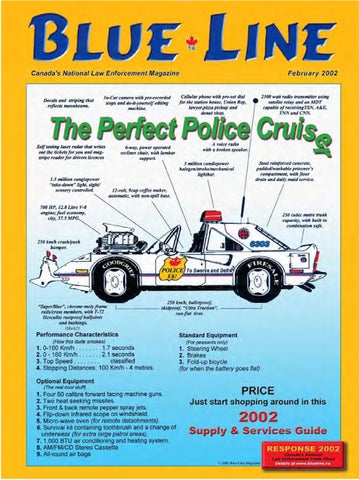
Blue Line’s annual Supply and Service Guide brings you the most comprehensive directory anywhere of businesses selling products and services to the Canadian law enforcement community. Product categories range from Access Control to Wireless Communications and the guide has complete corporate listings — names, addresses and phone/fax numbers. Those looking for what’s new in products and services will also want to mark April 23 and 24 on their calendars; that’s the dates of the sixth annual Blue Line Response Trade Show. News editor Les Linder reports on Canada’s national DNA databank, recognized as one of the best in the world, in an article beginning on page six. The databank linked over 100 cases to convicted criminals last year but could do much more with a little support, according to the officer in charge. There’s a common misconception that the 9mm bullet has more stopping power than the old .38 special round. Cst. Dean Steinberg sets things straight on page 13. Geographic information systems helped keep the pace during the Summit of the America’s conference in Quebec City. Read how four Canadian police services are using the technology to help street cops on page14. Videotaping domestic disputes is helping Canadian police services increase convictions — that story begins on page 17; a proposal for black boxes in police cars in Niagara Falls, Ontario has been scuttled, at least for now — see page 18; Tricia Rudy doesn’t hold back in telling us what’s wrong with police uniform tendering processes on page 30; Sergeant Lisa Thomas has a first-hand view of Ground Zero after the September 11 attack on page 34. This jam packed, 80 page issue also has the Michigan State Police special vehicles tests (page 36), a report on Asian crime from a Calgary officer currently in Vietnam, Saskatoon’s successful Street Legal Racing Program, which deters illegal street drag racing (page 74) and Blue Line’s regular columnists and features - Case Law, Firearms Editor Dave Brown, Dr. Dorothy Cotton, Tom Rataj, Vitality... the list goes on! Blue Blue Line Line Magazine Magazine
Taking command of a dangerous situation by Morley Lymburner I have been on this subject many times before and Blue Line Magazine has been harping about the exterior carriers that officers across Canada have been conned into believing is so wonderful. Recently an officer sent me a message requesting that I help him make a proposal to his chief to have the carriers banned within their department. My point in return to this is simple. “Give me a proposal to show the advantages of wearing them!” Over the past four years that I have gone public about my absolute hatred of exterior carriers I have not received one good argument in their favour. I have disliked these things so much that I now refuse to put any picture on the magazine’s cover that shows them. This month’s cover attests to our resolve on this issue. I would sooner go to a cartoon. I am working hard toward a policy that will exclude them from the inside of the magazine as well. I would suppose my disappointment is strongest with the command level of police services. I have spoken to many police managers across the country and have not found one that supports officers wearing exterior carriers. When pressed they simply shrug their shoulders. Some point their fingers at the unions or the associations or fall back on the axiom that “well at least they are wearing them and I am in favour of anything that encourages them to wear their vests.” This is, simply put, a “roll-over and give up” statement. I can only put it down to a lack of courage or a feeling that there are too many more important things to deal with. I certainly remember a time, not that long ago, when managerial enforcement was extremely high on such things as keeping your hat on, not turning your collar up or having a cup of coffee in the scout car. None of which were safety concerns. These infractions were aggressively enforced with a loss of a day’s pay for each infraction. There is no denying I lost a great deal of income my first year on the job. I think top managers should seriously look at an equally aggressive campaign to do away with something that can be a potential killer of cops. Those exterior vests are encouraging “killzone” target re-alignment. It is broadcasting to the world of criminals that you can be stopped by simply raising the barrel of the gun to target the head or you can be seriously slowed down by aiming lower. Cops are always at a disadvantage. The criminal element has a lot of time to prepare for your entry to the scene and to determine exactly what they can surprise you with if this occurs. Every call you roll on puts you at risk. Not every criminal you meet simply gives up when they see the badge. So exactly why is it that you want to increase your risk and decrease the threat to a determined criminal? February 2002
We certainly know that determined criminals exist. RCMP Constable Strongquill and Sudbury Police Constable MacDonald’s deaths are both attributable to very determined gun wielding criminals. These guys practice the art of firearms control and kill-zone targeting. They will not simply aim for the largest mass if you show them that this zone has armour. I would strongly suggest that if top level police managers and union bosses are really
concerned about officer safety they would discourage the use of exterior carriers and encourage the use of wick-away undergarments specifically designed for armour. Police departments should issue them and unions should lobby for them. Police departments should outlaw exterior carriers and unions should support them. Sometimes you have to work together for the common good and there is no greater good than officer safety.
For further details go to BlueLinks at www.blueline.ca
5
TOP LABS: DNA analysts in the National DNA Data Bank load samples into the DNA genetic sequencers. To date over 13,600 samples have been processed by the data bank laboratory. by Les Linder Canada’s national DNA databank, in operation for less than a year, has already helped link over 100 cases to convicted offenders and produced its first conviction last year. Dr. Ron Fourney, the officer in charge of the databank, which is operated by the RCMP in Ottawa, says significant progress has been made since it first opened its doors in July 2000. There have been 108 hits (matches) between convicted offender samples and DNA found at crime scenes and the bank had 3,482 crime scene samples in storage as of December. The Ontario Provincial Police in Guelph scored Canada’s first conviction based on DNA evidence thanks to the data bank. Robert Cybulski pled guilty to break and enter to commit a sexual offence last October after DNA taken from him in April matched a sample collected at the scene of a sexual assault of a 90year-old woman. Cybulski was sentenced to three-and-a-half years in prison. The investigating officers in the case initially had no suspect in the sexual assault, says OPP forensics division Det. Sgt. Mike Bussieres. “The DNA bank changed that.” The suspect was initially described by the victim as a male between 25 and 30 years old. When Cybulski was arrested, investigators found out he was 40 but appeared no older than 30. “This data bank help eliminate a particular challenge,” Bussieres points out. “Typically when we investigate a sexual assault and the February 2002
victim says the suspect is 25 to 30, then that’s the age group our officers will be looking for. “The search might stretch to people as old as 35, but the odds of that actually happening? I would suggest not likely.” Fourney says the data bank has become a significant tool for front line investigators. “What we’ve done here is enabled a cooperative interaction between police investigation and (the data bank) to work together to go back in time to solve cases,” Fourney said. The bank cost $10.6 million to set up and $5 million a year to operate and has a staff of 21 RCMP members. It receives crime scene DNA from forensic laboratory partners across Canada, including six run by the RCMP, and provincial partners in Toronto and Montreal. “From a cost effective point of view, we feel it is a terrific tool and an important part of forensic investigation teams,” Fourney says. “The data bank isn’t one bag of tricks - it’s the toolbox for investigators and part of the team.” Much of the system used to process, store and access DNA is automated through robotic workstations and has become the model which eight other countries are looking at to develop their own data banks, Fourney says. He’s proud of the bank’s current abilities. Fewer than one per cent of samples processed are rejected and lost, which is impressive when compared to the 10 to 20 percent rejection rate of banks around the world, he says. “That tells me our science is reliable and that the police on the front end collecting sam6
ples are doing a real great job.” Fourney and Bussieres both feel there is plenty of room for improvement, though, especially in the number of samples submitted to the bank. Ontario has shown the most enthusiasm with its Identification Act, passed last June, which allows courts to request or order a DNA sample from certain people convicted of designated offences such as sexual assault. The province has contributed 56 per cent of the convicted offender samples. “That’s not saying other provinces aren’t contributing,” Fourney says. “It just means Ontario has a very organized procedure.” Other provinces and courts will have to develop at their own speed, he says. “We would clearly like to see more samples come in because it’s just like a bank account the more money you have, the more you can do with it.” Fourney believes the data bank can expect as much as a two-thirds increase in samples annually once the rest of the country begins contributing more regularly. The more than 13,000 DNA convicted offenders samples in the bank are just a drop in the bucket, says Bussieres. “If we could get one DNA sample collected by every officer per year in Ontario alone, we should get an excess of 20,000 orders per year,” he notes. “With only 13,000 samples across . . . continued page 8
Canada, there’s plenty more we could be bringing in. “More samples means more hits and more hits means more convictions.” Bussieres, who is seconded to the bank to coordinate and collect samples, is concerned over the lack of funding to further expand sample collection. The OPP currently receives no federal funding to assist with the bank. Another critical issue is how forensic laboratories and the data bank will handle samples that may be used in court cases many years after they’re collected. “To support a hit 30 years from, we’re going to have to carefully watch how we handle our records retention and case management,” he says. Current policy within most police services is to keep a case file for two years before turfing it. However, if that policy is changed and records are maintained properly, DNA samples that would normally be disposed of will be available from the bank for future cases. Bussieres wants to see the bank begin collecting samples for offences other than sexual assault so that the DNA left behind at B&E scenes, for example, can be used to identify offenders. “Until the data bank in Florida began collecting DNA from B&E cases, they had a much lower success rate with hits. About 70 to 80 per cent of those who commit sex crimes also
IT’S ALL CODED: The bar like codes represent the final DNA profile results obtained from biological samples. Each colour represents a specific test that enables accurate discrimination that approaches one in 250 billion. have a history of property crimes.” Collecting samples from different types of crime scenes would mean more cases solved and suspects matched to other offences they’ve
committed. “If a person knows their DNA is already on file because of a previous property crime, then they may think twice before committing another crime such as rape,” Bussieres notes. However, under Canada’s current law, even a person who voluntarily offered their DNA as a way of deterring them from committing future sexual offences would not be able to do so; the database is for convicted offenders only. Bussieres would like to see Canada continue to invest in the bank and make improvements, following Florida’s example. “(Florida) knew they would have to increase funding to their bank because of the added samples from the break and enter cases. Nevertheless they did it and continue to keep looking at it to make other improvements. I think we should try doing the same.” The Ontario Centre of Forensic Sciences recently submitted DNA samples from B&Es to see how many hits result and how much they’d increase the workload. Bussieres says two of the eight samples have already generated hits. “That’s a 25 per cent return. If we could solve 25 per cent of the crimes we can’t solve today, I’d say we’d make an awful lot of people happy.”
Survey shows general approval of Canada’s cops But some public perceptions raise issues for concern About three-quarters of Canadians are satisfied with the way police are doing their jobs, a new poll suggests. However, about one-quarter of Canadians in the poll also feel their forces discriminated against visible minorities and 5.9 per cent of respondents in the Leger Marketing survey said they or a family member had suffered some form of police brutality. The poll, provided to The Canadian Press, also indicates that 52.6 per cent of respondents believed police have sufficient powers. The Dec. 4-13 poll was taken before the Dec. 18 approval of the federal government’s new anti-terrorism law and new clauses of the Criminal Code which include provisions allowing undercover investigators to break the law in certain cases. The survey of 1,583 people has a margin
of error of 2.6 percentage points or 19 times out of 20. Although police have made efforts to reduce abuse and improve relations with ethnic communities, 28.8 per cent of respondents believed police discriminated against visible minorities while 58.6 per cent said they did not. The provincial breakdown for those who thought police discriminated was: British Columbia (30.9 per cent), Quebec (30.5 per cent), Ontario (30 per cent), Alberta (24.4 per cent) and the Atlantic provinces and the Prairies (both 23.9 per cent). “It’s very high,” Yves Manseau, co-ordinator of Mouvement action justice, a Montreal-based police watchdog was quoted as saying “In a large city of two million, that’s a lot of people.”
For further details go to BlueLinks at www.blueline.ca
February 2002
8
But Dale Kinnear, a spokesman with the Canadian Police Association in Toronto, thought the opposite. “That’s very low,” Kinnear was quoted as saying. “There’s never a time or a place or an excuse for it but given the thousands and thousands of contacts on a daily basis across the country, I think it speaks to the fact that police officers are properly trained and properly informed and understand their authority. “I think those low numbers tell that tale.” Canadians overall seemed satisfied with their police forces, with 81.7 per cent of respondents saying they were happy with the RCMP. In Ontario, 87.6 per cent expressed satisfaction with the Ontario Provincial Police while 81.6 per cent of Quebecers were happy with the Quebec provincial police. Municipal police across the country had a 79.8 per cent satisfaction rating. Christian Bourque, a vice-president of Leger Marketing, said some of that satisfaction could be tied to Sept. 11. “If we had done this (poll) a couple of years back, I don’t think we would have gotten these numbers,” Bourque was quoted as saying. “If these people are perceived to be there to protect you and you’re being threatened, then of course your opinion about them will change.” Kinnear said there was no surprise in the level of satisfaction but he didn’t think the actions of police and firefighters after the Sept. 11 attacks were much of an influence on the results. “After those types of heroics, certainly it’s going to be on people’s minds but this is not out of line with examinations on this that have been done in the past.”
Police chief new chair of Canadian Centre on Substance Abuse Canada’s national addictions agency is bringing in the new year with a police chief as the chair of the board of directors. Health Minister Allan Rock announced in December the appointment of Barry King, police chief of the Brockville Police Service, with the Canadian Centre on Substance Abuse (CCSA). “As Canada’s national addictions agency, the CCSA has played a key role in the area of substance abuse for more than a decade,” said Rock. “Chief King understands issues of substance abuse and addictions from a front-line perspective and I look forward to working with him on the kinds of practical solutions that stem from his broad knowledge and experience.” King said he is looking forward to his new position to work more closely with CCSA Chief Executive Officer, Michel Perron. “I look forward to being involved with the continuing efforts by CCSA to lay the
groundwork for implementation of the federal government’s new national drug strategy,” King said. King has served as police chief in Brockville since retiring from the Sault Ste. Marie police service in 1995. He is Chief Barry King co-chair of the Brockville Safe Community Coalition, former chair of the Canadian Association of Chiefs of Police Drug Abuse Committee. He joined CCSA’s board of directors in 1998. King succeeds William Deeks, who stepped down in November after completing his three-year term as CCSA chair. The CCSA was created in 1988 to provide leadership and a national focus for Canada’s efforts to reduce or eliminate the harm caused by addictions. For further details go to BlueLinks at www.blueline.ca
First Director of the Ontario Police College dies at 85 Joseph Lloyd Mennill, former Director of the Ontario Police College, passed away on December 12, 2001 in Aylmer Ontario. Mr. Mennill was the first Director of the OPC and one of the pioneers of the provincial college that provides all Ontario police officers with basic training and other upgrading skills. Mr. Mennill joined the RCAF in 1940 and flew missions as a navigator overseas. He was shot down and imprisoned in the famous Nazi Stalag 3 (The Great Escape) and helped dig some of the escape tunnels. Upon returning home he took courses of study Joseph L. Mennill in Forestry at the University of Toronto and Yale. He finally took a position with Ontario Natural Resources as superintendent in charge of the Forest Ranger School. In 1962 Mr. Mennill was chosen to be the organizer and first Director in charge of the Ontario Police College. It was finally started on January 7, 1963 at a former RCAF base north of Aylmer, Ontario. Mr. Mennill finally retired in 1977 after helping plan and open the completely renovated facilities of the OPC. “He was a fine gentlemen,” Dr. Colin Hayes wrote to Blue Line Magazine. “He will be sorely missed, not only by his neighbours and friends, but also in the police community.”
For further details go to BlueLinks at www.blueline.ca
February 2002
9
New breathing apparatus designed for police A new version of the Viking Digital self contained breathing apparatus (SCBA) has been recently introduced to the Canadian law enforcement market. Manufactured by International Safety Instruments (ISI), the new Viking Stealth is designed specifically for police tactical, SWAT and bomb squads dealing with hazardous environments such as clandestine drug labs and CBW (chemical and biological warfare) agents. ISI, which has produced breathing apparatus for fire and industry for 30 years, introduced the Viking Digital, a radically different SCBA and the first which was all electronic, in 1998. The Digital was designed for firefighters and has dramatically changed the way the devices are used. The Stealth was developed after a major U.S. police department requested changes be made to the Digital to meet law enforcement’s unique requirements. SCBAs are traditionally designed for firefighters and industrial users and do not necessarily meet the specialized requirements of police. For example: • In tactical applications such as raids on clandestine drug labs or where another I.D.L.H. (Immediately Dangerous to Life or Health) atmosphere is possible, stealth and speed are of the utmost importance. Traditional SCBA low cylinder pressure alarms, typically a bell or whistle, are noisy. • Speaking through SCBA mechanical voice amplifiers makes communication difficult, if not impossible. Officers have to shout to be heard,
VIKING STEALTH: Now available in Canada
again compromising the silent approach. • Shouting through the mechanical voice amplifier into a radio microphone can be difficult, especially since the microphone also picks up background noise, making it even more
difficult to hear the transmission. • With typical SCBAs, you attach the demand valve to the mask and start using air immediately. Since they can only carry between 30 to 60 minutes of air, this can be a problem if the approach takes an extended period of time — and the larger the cylinder, the heavier the unit, which can result in restricted movement and reduced agility. • SCBA masks generally do not provide a wide and unrestricted field of view, especially if a large docking demand valve and an external voice amplifier or microphone are used. They can be too bulky to fit under a bomb disposal suit helmet and will add weight to the mask and stress to the wearers neck. The Stealth helps solve these problems. • LEDs were mounted inside the mask to indicate cylinder pressure, eliminating the noisy low cylinder pressure alarm. One of them flashes red on low cylinder pressure. • A waterproof microphone is mounted inside the nose cup within the mask, close to the wearer’s mouth, and is connected internally to a voice amplifier console mounted on the chest. The officer no longer needs to yell to be heard and the mic doesn’t pick up any outside or background noise. The amplifier is voice activated, eliminating ‘Darth Vader’ breathing sounds. A push button on the console puts the SCBA in stealth mode, silencing the console speaker. • An optional radio interface cord connects your radio directly to the SCBA, utilizing the integrated microphone to provide hands free voice activated radio communication. The console functions as the radio speaker but is silenced in stealth mode, when the user wears an earphone to maintain silence. • The Stealth has a unique airswitch; the user dons the complete SCBA, including the mask, but breathes fresh air through a port in the bottom of the mask and only activates the airswitch (with the tap of a finger) to go on cylinder air when required. This dramatically reduces air wastage and eliminates the difficulty of docking the demand valve, especially under a bomb suit helmet. It also prevents fogging of the mask when in fresh air mode. • The mask on the Stealth has the best peripheral vision of any SCBA. The demand valve and microphone are built into the mask so there is nothing in front to restrict vision or add additional weight. Its low profile demand valve allows the mask to fit under most bomb disposal suit helmets. A black balaclava and cylinder cover are available for the Stealth, as is a remote airline connection should the wearer need to be on air for an extended period of time. Viking says the Stealth is reliable, easy to use and tested in the extreme cold weather of the Arctic circle. The company’s products are distributed in Canada by Canadian Safety Equipment of Mississauga, Ontario. To find out more about this product phone: 800 265-0182 or check out Canadian Safety Equipment through;
February 2002
10
Database combats heavy equipment theft Remote work sites with inadequate vehicle and site security and a used equipment market with little or no checks allow thieves to steal an estimated $1 billion dollars (US) of equipment in the US alone. Non-standard numbering systems and incomplete or nonexistent owner records mean that police officers have little accurate data to investigate and prosecute equipment theft. To combat this, the National Equipment Register (NER) has launched a free investigative service for law enforcement in Canada and the US. Its solution is a specialized database of stolen heavy equipment and ownership records. With thousands of theft reports and millions of ownership records readily available, NER helps officers identify the status and ownership of a piece of heavy equipment — a labour intensive or impossible task at present. Calling NER toll-free at 1-866-6-NERUSA provides officers 24 hour access to operators who help locate identification numbers and search the database. On-site support from specialist investigators, geographically specific theft alerts and investigative training are also available free to police. NER is funded by member insurance companies and its database is linked to ISO ClaimSearch, the insurance industry’s all-claims database.
Its website, NERusa.com, provides an online theft reporting capability that allows equipment owners, fleet managers and third party administrators to submit their theft reports to be included in the database. Equipment owners whose losses may not have been reported to an NER member insurance company can now report a theft to NER securely, in detail and immediately on one simple form. Even if the loss occurred years ago, an item might still be recovered if registered. The combination of technologies provide the detail, speed and coverage never before seen in the fight against equipment theft. Equipment owners will also soon be able to register their fleet on a pre-theft basis. Using high quality 4" by 5" stickers, owners will be able to show would-be thieves that their unit is registered on a national database. In the first quarter of 2002, law enforcement will have internet based search access to the NER database. For more information on NER’s services, visit their website at www.nerusa.com. When you see a suspicious piece of stolen equipment, call them toll-free at 1-866-6NERUSA. For further details go to BlueLinks at www.blueline.ca
For further details go to BlueLinks at www.blueline.ca
February 2002
11
R-E-M-O-V-E Clutter from your Desktop Monday, January 14th was National ‘Clean Off Your Desk’ Day, listed in Chase’s Annual Events as the second Monday of each year. Chase’s daughter started this day to get her father to clean off his desk at least once a year. Because Blue Line Magazine is about the biggest challenge around in this respect we invited Eileen Roth, author of Organizing For Dummies, to give us a few tips. It’s easy to organize your desktop using her six R-E-M-O-V-E principles. R - Reduce distractions Pictures of your family distract you (hang them on a side wall or put them on a bookcase); candy invites guests and conversation (keep it in a drawer hidden away); papers distract you from concentrating on the project at hand (file them in a permanent system or the ‘take action file’). But the biggest distraction of all is the in/out mail box. It invites your own interruptions as you wonder what’s on that coloured flyer or think about other things to do (hang wall pockets on the outside of an office or cubicle wall). E - Everyday use Keep things you use everyday on your desk and remove the rest: if you don’t use the staple remover, tape or the post-it note holder, remove them from you desk. If you do use them daily, keep them out.
THE BIGGEST CHALLENGE: Looking around Blue Line’s offices for the most cluttered desk brought us to the publisher. M - Move to the preferred side If you’re right-handed, that’s your preferred side; if you’re left-handed, that’s your preferred side. So keep things on that side for easy reach. Move your pencil cup, coffee warmer and calculator to your preferred side. One big exception is
For further details go to BlueLinks at www.blueline.ca
February 2002
12
the telephone — move it to the non-preferred side so your hand is free to take notes. (And yes, you can hear just as well out of your other ear!) O - Organize together Form centres - make a telephone centre so your telephone, message pad or telephone log and rolodex are all in one place, creating a ‘centre.’ V - View your time As soon as you arrive in the office, take out your organizer so you can schedule a meeting with a caller or make an appointment for drop-in visitors to talk at a later time. Also keep a small clock on your desk so you are on time to meetings. (Note: A travel alarm clock doesn’t take up much space and can alert you to meetings too.) E - Empty the middle Keep everything on the desktop around the perimeter so the middle of the desk is free to do work and you can open one or two documents at the same time. Eileen Roth is a professional organizer and speaker who does workshops and consultations. As author of Organizing For Dummies, she helps people clean up their office, manage their time and organize their home. For more information, call 480 860-1616, email her at EileenRoth@aol.com or visit her website: www.everythinginitsplace.net.
Stopping power and shot placement by Cst. Dean Stienberg There has been considerable debate in the law enforcement community as to what sidearms and, more specifically, ammunitions are best suited for officers to carry. While researching the subject in preparing to order next year’s duty ammunition, I came across some STOPPING POWER: The common interesting facts that you assumption that a 45 cal. has more stopping might not be aware of with power is a fallacy. regards to ‘stopping power.’ A number of years ago when we made the transition to 9mm many people assumed it was more powerful and had more stopping power than the .38 cal. revolver we used to carry. This is not accurate. The 9mm and .38 special rounds are ballistically very similar in nature. The main reasons for switching was accuracy, safety, round capacity and ease of reloading. Studies done in the US suggest officers who had accuracy problems with the revolver shot significantly better with the pistol. In fact, stopping power has less to do with the caliber of the weapon than you might think. Research done by FBI Special Agent Urey Patrick concludes that it depends almost exclusively on shot placement and the psychological condition of the subject. The common assumption that larger rounds such as 45 cal. have more stopping power is a fallacy. Patrick conceded larger rounds will give the officer a slightly better chance of hitting vital organs, but this is a minimal factor compared to the importance of shot placement. Hollywood has conditioned us to believe that when a person is hit by a bullet they are going to be knocked backward or down. This is simply not true. The mass of a bullet is so small compared to the mass of a human that it could never knock someone off their feet. What stops a person is where the bullet strikes them and what psychological and physiological affects it has on them. The only shot that will insure the incapacitation of a person is a direct hit to the central nervous system. This is a very low percentage shot. The next shot most likely to stop a person is to the vital organs of the torso, hence our center mass training. This is a much higher percentage target. What is important to remember is that even a direct hit on a vital organ such as the heart will not guarantee an immediate incapacitation of a subject. The second most influential factor in suspect incapacitation is the psychological reaction to being shot. For the same reason we think a bullet will knock a person down, we also believe we should fall down when shot. This is not reality unless the central nervous system takes a direct hit. The body generally suppresses pain in high stress situations. This and a host of other factors, such as adrenaline, PCP, crack, pain killers, antidepressants or the famed ‘fight or flight’ syndrome can keep a person from succumbing
to their wounds. In his study, Patrick concluded that once a bullet, designed to expand on contact, has sufficient velocity and mass to penetrate 12 inches into a human target at less than optimal angles it has sufficient power to stop that target.
The 9mm 147 grain jacketed hollow point round we currently use will fit this bill. What we must understand from all of this is that even if you hit a subject with what you feel should have been an incapacitating shot you must be prepared for it not to stop him. Conversely, if you take a round but it wasn’t a direct hit to the central nervous system, there is no reason it should stop you either. Stay safe. Never give up! Cst. Dean Stienburg works in the training section of the Halifax Regional Police Service. This article was reprinted from the December issue of APB, the newsletter of the Halifax Regional Police..
For further details go to BlueLinks at www.blueline.ca
February 2002
13
Geographic Information Systems for street cops Geography has always played an important role in law enforcement since a large part of the work involves managing information, in particular about locations. Traditional police approaches — confidential informants, street investigations, undercover operations — all deal with collecting data, which becomes much more important when there are effective analysis tools and methodologies. This is where geographic informa“Almost every room in any police tion systems play a significant role — building in Ottawa has an ArcView genallowing investigators to integrate and erated map posted on the wall. That analyze data to identify, apprehend and fact alone speaks volumes as to the improsecute suspects. portance of geographical reference in Geographic information systems INFORMATION ON THE STREET: Modern crime police work.” (GIS) helps officers effectively allocate mapping sotware is designed for every officer to use when Ottawa’s 150 patrol car laptop comresources and improve policy. Though and as required. puters run customized GIS and compucomputer mapping has been around ter-aided dispatch software. Officers en since the 1970’s, its use has increased nology and training for advanced spatial analy- route to an incident can use keyboard controls to exponentially in the last few years with the sis techniques specific to this domain. It’s an- see an area map and determine how to react. In availability of more robust and user-friendly ticipated that a number of complementary tools addition, dispatch operators at headquarters can desktop applications. will be integrated into the ArcGIS platform, al- send backup based on information received from GIS has assisted many Canadian police serv- lowing users to combine the best data access patrol cars via a wireless communication link. ices in collecting and analyzing data, perform- and analysis tools currently available. Specialized units such as the Ottawa tactical ing route and crime mapping and disseminating “Since the adoption of mapping capabilities team and the forensic identification unit have come information. It’s much more efficient than in the crime analysis unit and in conjunction with to rely on maps and GIS technology. It’s cursearching databases or paper records. the deployment of dynamic mapping capability rently being used in a major criminal case in OtThe Ottawa Police Service’s (OPS) crime in patrol cars using mobile workstations, the in- tawa — crown attorneys, police investigators and analysis unit has used ArcView as one of its ternal demand for map products has increased GIS analysts are working together to compile the main tools to access and display crime data since dramatically,” said Resource/GIS Analysis Co- major elements, with maps being the ultimate out1996. It’s currently rolling out ArcGIS 8.1 tech- ordinator Fraser Moffatt. put that will be admitted as evidence in court.
February 2002
14
The Summit of the Americas allowed the Sûreté du Québec’s (SQ) geomatics division to demonstrate how useful geomatics tools are and increase their profile within the organization. Six people provided around the clock GIS support to police officers during the summit, focusing on cartography. A complete GIS was created in September, 2000 with help from local governments and provincial agencies. Police data, including the location of official sites, surveillance cameras, hazardous materials sites and guards stationed along the routes to be used by dignitaries, were also incorporated into the system. Several dozen maps were produced to support airport security planning activities. Live operational support involved the use of ArcView to follow various events, demonstrations and officers assigned to maintain order. Information, including addresses, were entered into the system using an ‘Access’ form. A series of drop down lists was included in the form to maintain a standardized address format and eliminate spelling and place name errors. The choice of a specific event city determined the list of streets available for selection. An automatic address geo-referencing procedure was implemented, in cooperation with Environmental Systems Research Institute (ESRI) Canada’s Montreal office, to update maps rapidly. The geo-referencing procedure is based on the standards of the Québec Toponymy Commission. The up-to-date maps generated were displayed within the command centre. The applications developed will be migrated and adapted to the ongoing needs of the SQ. Officers were quite pleased with the geomatic division’s services and intend to permanently integrate the technology into their activities. The Ontario Provincial Police (OPP) geomatics unit, part of the force’s information management and information technology section, has been using GIS for a number of years, including ESRI’s ArcInfo, ArcView, ArcSDE and ArcIMS technology, to create, maintain and deploy geographic information. It developed the Justice Road Network (JRN), a seamless, province-wide, addressed street centreline database compiled from many different sources which is used in mission critical applications such as CAD. Based primarily on the JRN, the OPP’s detachment mapping will be deployed internally via ArcIMS connected to ArcSDE and Oracle. It has several layers of geographic information to accurately depict officer deployment. The OPP is responsible for six regions, each with detachment areas and detachments which are further broken down into patrol zones and “atoms.” Officers can record crime occurrences by atom into a records management system, providing a common place to view and query all available crime information. The force uses an investigative technique called geographic profiling, an analytical methodology that determines the most probable area an offender lives in based on the locations of a connected series of crimes. Geographic profiling can be effective for investigating a wide range of crimes. 3D probability surfaces are generated, representing the
probably location of an offenders home or base. The resulting profile can be used with other GIS information, such as an addressed street centreline database. Target addresses under profile hotspots can be isolated and investigations can be more focused. The OPP has dedicated officers for geographic profiling and its geomatics unit also supports high profile provincial government driven initiatives such as the sex offender registry (SOR), which legislation requires it to maintain. This provincial database contains information about known sex offenders, including their address. A correct address is a critical component to SOR’s success, which relies on accurate geo-spatial information from the geomatics unit. The SOR uses the JRN and is built using MapObjects, ArcSDE and Oracle. “The utilization of GIS at the OPP has ushered in new opportunities to expand the way that our organization uses one of its most important assets, its own information,” said OPP senior GIS specialist Colin MacDonald. “We are able to deliver critical spatial information to decision makers in a timely fashion.” Peel Regional Police Service’s crime analysis unit has used GIS since 1990 to analyze crime data and send information to assist police operations and investigations. It’s used to: • Test spatial distribution of crime patterns. • Perform regression analysis on spatial data to identify significant variables that may prevent or be responsible for crimes. • Deduce offender’s spatial parameters to assist police investigations and direct police patrol saturation. • Conduct retrospective spatial analysis of known criminal cases. The results have helped investigators make arrests in unsolved cases. The unit utilizes GIS to analyze crime data in many diverse ways, including crime series and pattern detection, linkage analysis, target profiling, crime-suspect correlation (suspect identification), suspectcrime correlation (case matching), hot spot analysis, crime radius mapping, crime mapping density, crime probability mapping and forensic and “journey to” crime mapping. “GIS has added an important spatial dimension to the analysis of crime data,” said Dr. Raphael Djabatey, head of the crime analysis unit. “(Interpreting it) has provided valuable information to assist police commanders and decision makers in efficiently deploying police resources and developing tactical and strategic initiatives in combating crime and apprehending criminals.” The unit uses ArcView and ArcInfo to perform analytical mapping functions and is currently evaluating ArcIMS as a web application tool for disseminating crime-mapping products to patrol officers, investigators and police commanders. ESRI Canada has ten regional offices across the country. In addition to distributing the GIS software products, including ArcInfo, ArcView GIS, ArcIMS, ArcPad and MapObjects, ESRI Canada provides consulting, training and technical support services. To Find out more go to . . .
For further details go to BlueLinks at www.blueline.ca
February 2002
15
Videotaping domestics boosts convictions by Les Linder Several Canadian police agencies are catching on to an initiative to help curb problems associated with handling domestic violence cases. In an attempt to increase conviction rates, reduce witness recantations in court and display the severity of a domestic assault to the court, agencies are beginning to provide video cameras to their officers when attending domestic assault scenes. The Windsor Police Service in Ontario was one of the first services in the country to deploy them and has seen significant successes. “What we’ve found by doing videotaped statements and capturing the scene on film is that it has increased our conviction rates significantly and saved (the police service) and the courts time and money,” said Staff Sgt. Jerome Brannagan of the Windsor Police Service. Rather than taking a written statement, officers will instead videotape a statement to capture the emotion of the victim and the scene, including any property damage. The tape is used as evidence in court and full disclosure is given to the defence lawyer. “When we disclose these tapes to the defence the lawyer and client have to consider whether they want a judge to see the tape or just plead guilty to the charge in hopes of a lesser sentence,” he said. Brannagan said the cameras has improved the service’s conviction rates substantially for the three years they have been in use. “It’s working very well. We’re extremely happy with it.” Currently the service is using three cameras, which cost about $600 each. Supervisors typically bring the cameras to a scene when an officer calls in for one, Brannagan said. “Use of the camera is at the officer’s discretion and most often used only when a criminal charge is being laid.” Patrol officers are also pleased with the new equipment because it decreases the time needed to take statements, he said. A videotaped statement is about eight minutes long, whereas written statements can take much longer, he pointed out. “One of the biggest things going for it though is that witnesses can’t recant their statements, which makes the patrol officer’s work feel more appreciated.” Officers face frequent frustration when taking victim or witness statements because they know the person may likely recant it later. The Windsor service has also helped several other agencies begin their own program. The Durham Regional Police recently received help in training with their new program and the Edmonton Police Service is also having discussions with Brannagan. The Hamilton Police Service in Ontario initially looked into using the cameras in 1998 but was only able to get the funding to begin the program this year. The service received $30,000 in funding from the Hamilton Community Foundation and Edith Turner Foundation to purchase 10 video cameras and 16 Polaroid cameras. February 2002
Each of Hamilton’s four stations will receive two cameras while the extra cameras are kept in case any of the field equipment needs repairs or if an extra camera is needed. Det. Helena Russell, the service’s domestic violence coordinator, said the cameras were promised in 1998 as part of a domestic violence initiative but was shelved because of a lack of funding. “We knew about Windsor’s program and it was interesting to watch them develop it because we knew their success would also be our success when the program started,” Russell said, who’s expecting similar results to Windsor. “That in turn saves money overall because
17
there is less need to go to court to fight a defence, less stress placed on victims and it speeds up the whole court proceeding since everything isn’t left to the memory anymore of victims and witnesses.” Russel said she is hoping to add more video cameras in the future so officers don’t need to share between them during shifts. The 16 Polaroid cameras are enough to ensure each shift has access to one, she said. “Domestics don’t happen one at a time and we might need more than one if several calls come in to make sure we get the best convictions we can.”
Black box proposal scuttled - for now by Les Linder
strapped services. While Locke said many officers support Budget cutbacks have prevented the idea, the Niagara Regional Police AssociaNiagara Regional Police from tion has expressed concerns that the recordbecoming the first Canadian ers will be used to spy on officers. He said the police service to use data reservice will take any necessary action if a recorders in their vehicles. corder shows an officer had conducted himThe proposal by senior self inappropriately, but added “We’re not management was turned using it to spy on the officers. Our concern is down in December after eveto use the recorders to defend officers.” rything but non-discretionary funding was cut. Association president Mike Gamble said Michael Locke, superintendent of adusing data recorders is an insult towards ofministrative services, said the service was ficers because it gives the impression that the hoping to be able to use the device to help service doesn’t trust its members. The only defend police officers from complaints and use the recorders have, he said, is to help the false allegations. Special Investigations Unit (SIU), which is “More often than not, officers are accused responsible for investigating incidents involvof things that likely never happened the way ing police that result in serious injury or death. a complainant said it did,” Locke said. “We “Its a tool for (the SIU),” he said. “As far were hoping that by using the recorder we as our members go, it doesn’t provide any would have access to information that would BUDGET PRIORITIES: Determining what additional safety for them whatsoever.” Makmitigate our liability and officer’s conduct.” equipment is most needed... and most wanted. ing the SIU’s job easier shouldn’t be a priorThe recorders function much like the black ity for the service, he said, especially since it box devices used in airplanes. Information such can continue to rely on experts and forensic He said while the data can help clear offic- engineers to determine what happened at an as vehicle speed, point of braking, acceleration rate, deceleration, sudden lateral movement, use ers of false allegations, it can also serve as a accident scene. of lights and sirens and whether the ignition is ‘poison pill’ if defence counsels begin asking Gamble expressed surprise that management on or off is recorded and then downloaded to a for the data when their clients are accused of a would propose spending money on the recordserious traffic violation. personal computer for analysis. ers rather than hiring additional officers. “There are dozens of scenarios where deThe Canadian made recorders the service “We don’t have enough officers on the street was hoping to buy are capable of recording fence would want to subpoena those records,” and they’re going with more technological things continuously for 14 days and provide enough Locke said. “These are issues we want to look instead. At least if they insist on going with detailed data for five major or minor incidents, at carefully before we fully commit and that is technical things, why don’t they go with GPS said fleet supervisor Douglas Lawrence. The why it is being reviewed by the committee.” in our cars? That way if an officer is down and Locke said the ideal way to record data not responding, we know where they are - that’s recorder can also be used in driver training to help show people what went wrong in an would be to install a video camera in all cruis- a crucial safety issue right there.” ers, adding that Niagara officers, like in other accident. A GPS installed in every cruiser would also “A lot of times the only thing a person can areas, are subject to accusations on a daily ensure that vehicles are being used to patrol as remember about an accident is the collision,” basis. much territory as possible, as it can show how “A camera would go a long way to getting much distance there is between them in real Lawrence said. “They don’t remember things like whether or not sirens and lights were on. us that extra piece of information we need to time, Gamble said, adding that the equipment All the info in the recorder is critical to an of- get an officer off the hook.” wouldn’t cost much more than recorders. However, like many other Canadian police ficer being cleared.” “We can also see and pick the closest officThe recorder can also be used for vehicle agencies, Niagara lacks the funding needed to ers to a call and make sure we get there in the and driver performance monitoring, ensuring purchase video cameras. The devices, such as fastest time possible.” that both driver and vehicle are working at top those used by US police agencies, can cost about He suggested the money would be even efficiency. Locke, however, expressed some $2,000 (CDN). Lawrence says data recorders better spent on ergonomic seats for vehicles to concern over how the data could be used and cost less than half that and includes software help prevent back problems caused by 12 hour the proposal was subsequently sent to a equip- and training to use and install the equipment, shifts spent on the road. He also agreed with making it a more viable option for financially Locke’s sentiment that video cameras would ment committee for further review. provide much more security and information for officers. “With the video camera, we can see what actually happens during a pursuit, traffic stop or a scuffle with someone. The data recorders just provide numbers and information we can look at, but doesn’t actually let us see what happened exactly - the cameras are much more accurate.” The cameras could potentially make people behave more appropriately knowing they are on camera when talking to an officer after a traffic stop, he said. Lawrence will continue to push for data recorders and hopes to see them installed in 2003. In the meantime, he’s considering installing recorders in several cruisers on a trial basis. For further details go to BlueLinks at www.blueline.ca
February 2002
18
Overcoming Fear of PCs by Reid Goldsborough Are you afraid of computers? Do you know someone who is? If you’ve grown up with personal computers or been around them for any length of time, you probably take them for granted. After all, they’ve become nearly as commonplace as dishwashers. More than half of U.S. homes now have at least one and 90 percent of school-age children have regular access to PCs, two-thirds from their homes, according to the U.S. Census Bureau’s latest statistics. But there’s still a lot of fear and loathing about these machines. As many as 85 percent of us have at least some level of discomfort around technology, including PCs, says Larry Rosen, co-author of the book TechnoStress: Coping with Technology @Work @Home @Play, who has a Web site at http:// www.technostress.com In work settings, two-thirds of people are “hesitant” about technology, says Rosen, a psychology professor at California State University. Fully 80 percent of people, according to his studies, feel that workplace technology has brought additional stresses to their lives. Although the design of PC hardware and software has improved over the years, clearly there’s still room for more intelligent simplicity here. In the meantime, what do you do if you or somebody you know quakes around a PC at one level or another? Rosen, who prefers the broader term ‘technostress’ over the more common terms ‘technophobia’ or ‘computer phobia,’ says the first step is to is to understand that “essentially everybody” is feeling stressed out by technology. “You are not alone in your fears,” he says. Second, the fact is, “technology is frustrating,” he says. Whether you’re dealing with less complex technologies such as cellular phones, pagers or voice mail or more complex devices such as computers, e-mail or the Internet, it’s inevitable that they will not always work the way you want. Don’t make the complex more complex than it already is, says Rosen. “Just because technology can do many things at the same time, this doesn’t mean you have to.” Rosen has a name for this too: “multitasking madness.” By doing too many tasks at once, you don’t pay enough attention to any one task. Much here has to do with how time has become compressed in our increasingly frenzied lives. “Time is indelibly stamped on our routines,” says Rosen. “This gives us an impossible yardstick to measure ourselves against. We find ourselves getting impatient for a fax to go through, which might take 30 seconds, or for a computer to boot, which may take one minute.” The irony here is that personal computers, while enabling us to get things done faster, also February 2002
increase the expectation that things will get done faster, which can add pressure to an already pressure-filled situation and drive your anxiety level through the roof. To overcome anxiety, seek out help wherever you can, says Rosen, including your family. It may be a cliche in the information age that kids are computer mavens, but it’s often true. This shifts power away from parents and towards children. As a parent, turn this upended power structure in your family to your advantage. “Make it a positive a way for you to be proud of your children’s knowledge and for them to teach you what they know,” says Rosen. “If they know how to search the net, for instance, let them show you. Do it as a family.” In a work setting, help is crucial as well. You shouldn’t be on your own here, though too often people are. A sixth of the workers Rosen surveyed received no computer training at all, while only one-third said they received excellent or very good training. Not surprisingly, people who receive good computer training have less computer stress. Rosen’s work indicates that those business
19
people who had “excellent to good” training had more positive reactions to technology. Those who received “fair to terrible” training had more negative reactions. If you feel your training has been inadequate, find someone in your organization who knows the technology and who can speak about it in a down-to-earth fashion, recommends Rosen. Ask the person to show you one or two things the technology does, then spend some time doing that. Don’t worry about making mistakes. “If you get stuck, call your friend,” says Rosen. “When you want to learn more, call your friend.” As Ralph Waldo Emerson once wrote, “Fear always springs from ignorance.” Knowledge is a great antidote to fear. Once you know, you’re no longer afraid. Reid Goldsborough is a syndicated columnist and author of the book Straight Talk About the Information Superhighway. He can be reached at eMail: reidgold@netaxs.com or Webpage at: http://members.home.net/reidgold.
New security measures included in five-year budget to prevent terrorist staging in Canada The new national security measures outlined in this article are designed to prevent terrorist attacks in Canada and prevent terrorists from using Canada as a staging area. The Government’s plan is based on: • increased resources for intelligence and policing; • enhanced screening of arrivals to Canada; and • better emergency preparedness and support for Canada’s military. Security funding in this budget includes $1.2 billion for the Department of National Defence and its agencies. Over the next five years the cost of intelligence and policing actions will total more than $1.6 billion. This new funding builds on other recent initiatives such as those in the 2000 budget. The budget provided $1.1 billion over five years to the RCMP to strengthen policing and security activities. In addition, during the last two years the Government provided more than $900 million over five years in a number of enforcement and intelligence areas. Budget 2001 provides almost $1.2 billion over the next five years to the RCMP, CSIS and other security-related federal departments to train, equip and deploy more intelligence officers, front-line investigative personnel and other professional staff. CSIS will receive the biggest annual funding increase since its inception. This funding will also be used to upgrade technology and equipment for intelligence gathering and analysis. Part of this funding will be provided to the RCMP to increase the number of investigators and better train them to deal with terrorism. The RCMP will upgrade key information management systems to make the collection, analysis and dissemination of intelligence more efficient and effective. This budget provides $76 million over the next five years to strengthen inter-agency co-ordination on two fronts. First, funding will be provided to the RCMP to establish Integrated National Security Enforcement Teams (INSETs), which will include representatives from federal enforcement and intelligence agencies, as well as provincial, municipal and international law enforcement partners. The INSETs will gather information to prevent, detect and prosecute criminal offences against Canada’s national security. Using intelligence from CSIS or its own sources, the INSETs will investigate criminal activities, analyze intelligence and ensure that all information is shared among integrated partners. Second, additional resources will be provided to the Canadian Public Safety Information Network. This network is a modern Canada-wide information system that enhances the timely and accurate sharing of information among criminal justice, enforcement and national security agencies. Enhanced Marine Security Canada is stepping up measures to protect its ports and other critical infrastructure from terrorist attacks and is increasing intelligence gathering to screen for potential terrorists as well as weapons and explosives. Funding in this budget will allow Fisheries and Oceans Canada to increase the scope and frequency of its surveillance flights over critical approaches to North America. This will enhance Canada’s capacity to identify and address potential marine threats. The Government will also provide resources to expand the Coast Guard’s surveillance of Canada’s waterways. Over the coming months Transport Canada will work with other organizations to identify further measures to improve marine security. Cutting off the financing that supports terrorism and denying terrorists access to the nation’s financial system are a key element of the Government’s anti-terrorist strategy. The Government recognizes that these initiatives must be part of a co-ordinated international effort to ensure terrorism cannot simply shop jurisdictions until it finds an accommodating home. To deprive terrorists of the funds needed to finance their activities,
February 2002
20
Bill C-36 strengthens the Government’s ability to pursue those engaged in raising funds for terrorists and terrorist groups. The bill includes measures to make the financing of terrorism a criminal offence.
Helping to fill the gap in community problem solving The Community Policing Management Program (CPMP) is a continuing education program for police managers and community leaders. It was begun in the mid-1990s when a group of concerned officers and community leaders identified a ‘gap’ in the delivery of community policing in Ontario — a lack of the advanced skills needed to work together to address problems that call for a joint response. Community-based policing concepts that were merely talked about in the past are now being embraced by Canadian police agencies working to interpret and implement them in their jurisdictions. Community policing isn’t a simple concept and involves changing mindsets of police and the communities they serve, combining ‘traditional’ police methods with cooperative problem-solving skills. Among other things, it means cooperatively identifying and prioritizing problems, mobilizing people and resources to address them, finding causes and crafting solutions. Often this means working in areas that for decades weren’t considered to be within the scope of police work. Community policing is a specialized, complex and comprehensive science that requires focused and extensive training for everyone practising it. The first CPMP program was offered in the spring of 1997, focusing on teaching police leaders how to manage projects and mobilize the community. It’s since grown to include an equal number of police and community leaders and the only requirement now is that participants be in a position to participate in joint police-community projects. The sixth annual CPMP is being held at Queen’s University in Kingston from March 24 to 27, 2002. Partners include the Ontario Ministry of the Solicitor General, Ontario Police College, Ontario Association of Chiefs of Police, Police Leadership Forum, OPP and the Toronto and Ottawa Police Services. The theme is Partners in Community Problem Solving and the goal is to provide the practical skills and knowledge needed to develop joint police-community problem solving initiatives that will improve community safety, security and well being. CPMP works on three main assumptions: • Truly effective community problem solving must involve both police and community. • Everyone has something to contribute to the community problem solving process. • Problem antecedents are often disregarded in police problem solving (we don’t always analyze where problems come from before we try to solve them). Participants are led through a proven problem-solving formula (the OPP’s PARE model, developed in 1997) as they work to solve reallife issues facing an Ontario community. This year’s case study will be based on problems facing the southwestern Ontario community of Chatham-Kent.
Participants are encouraged to bring along a community or police partner. Guest speakers, led by Professor Collom, will speak on a variety of relevant topics and Dr. Fraser Mustard will help establish a clear link between early childhood development and later problems. Through the case study, groups of six or eight participants apply this material and the PARE model to real-life community issues. Planned and delivered in partnership with the School of Business at Queen’s University, CPMP is a proven program with exceptional feedback from both community members and
police officers. An independent impact analysis of the 1999 and 2000 programs found it “has been achieving its objective of improving the skills of police and community leaders for shared problem solving.” For more information, call Jim Lawson at 416 808-7760 or Peggy Austen at 613 591-3686. Call Constable Laura Houliston, OPP Sudbury, at 705 564-6900 to register. The cost is $895 for police officers and $100 for community members and includes accommodation and meals.
For further details go to BlueLinks at www.blueline.ca
February 2002
21
Thought disorders puzzling for everyone by Dr. Dorothy Cotton Ph.D., C. Psych. not your most common instrument but a faAccording to the manners, my hand-shoe vourite of Frank Zappa who named his chilisn’t ever out of latching with the laugh. Bless- dren odd things but then again Sept 11th was an odd date as is January 1 which makes you wonings are redand as indeed the megalore are. Ah, my grade seven English teacher would der if any holidays fall on even dates. Of course be proud. He was a major stickler for grammar I have been married for a long time and I don’t and as a result, I am pretty good at it. Nary date so maybe I’d better back up and explain does a participle dangle nor an infinitive dare to even though I find it much easier to back up in split in my presence. But one thing I’ve discov- my little Subaru than in the van... You still there? Perhaps I’d really better ered in my years of writing is that grammar isn’t everything. Consider the first two sen- explain thought disorder. The definition is easy. tences of this article. The grammar is fine and It means a disruption in the form and flow of dandy. The nouns and verbs line up nicely and thought and, as I mentioned, you often get a the punctuation is all where it ought to be. The clue about this from listening to someone’s problem is that the content is a little out to speech. I’ve given you a number of examples. People with thought disorder may tend to lunch. The sentences don’t make any sense. Who would actually generate sentences like go off on tangents — as I did in the paragraph that? Well, could be me after too much partying above. You can see where it was going; each and not enough sleep, which causes the wires in part was actually connected to the parts before the brain to short circuit a bit. Could be a per- — but not in the way that most of us would do son with permanent short-circuiting from a head it. You might call the speech ‘derailed,’ kind of injury, stroke or Alzheimer disease — but it like a train wreck. The associations between also could be a person suffering from a psy- one part and the next are there, but are pretty chotic disorder like schizophrenia. This jum- loose. That is probably why some wise person bled up speech could be an indication of what cleverly decided to call these symptoms things we call ‘thought disorder.’ Figuring out if some- like ‘derailment,’ ‘tangentiality’ and ‘loosening one has it is a bit of stab in the dark because of associations.’ Profound, eh? Sometimes the assembly of words just (duh) you can’t exactly see anyone’s thoughts, so you never really know what’s going on in doesn’t make any sense — like in the first paratheir heads. But you can make a guess at it graph. That would be ‘incoherence.’ Sometimes the words are used in a funny way. Ever hear of based on what they say and how they act. Speaking of acting, I went to a play the a hand-shoe? I bet you haven’t but I also bet other night at the local theatre which is quite you can figure out what it is — a glove of course. near the drug store where I got a card for my That would be a metonym, as opposed to the mother who lives in Florida where is it warm word ‘megalore’ which means... well, I haven’t which it was here in November which was al- a clue. It’s a made-up word or neologism. It ready more than two months after the Septem- would have some special meaning for the perber 11th event in New York where my daughter son who coined it but not for the rest of us. “Thought blocking” would be another type went last spring with her school class and bought a really neat black shirt which looks of thought disorder. It’s when a person has abgood on her even though black is not my best solutely no thoughts in their head. We all talk color which is too bad because I have to wear about going blank sometimes; it doesn’t really black for orchestra in which I play the bassoon, happen to most of us but it can to a person
with schizophrenia. Sometimes when they do have thoughts, they seem to be someone else’s — it’s like they, or the tv or radio, stuck their thoughts in your head. I could go on and on about thought disorder but I think you get the picture. What’s the point? If someone’s speech is this screwed up, you can be pretty sure their thoughts are equally messed up and that has a lot of implications for how you deal with such folks. What do you do with a person who is thought disordered? It depends — you’ll have to size up the situation and decide whether he’s just muttering away at the hydrant or about to cause serious harm to someone. That’s your call but there are a few things worth bearing in mind: • Assume that if someone’s speech doesn’t make much sense and thus their thoughts don’t either, they may be having a hard time figuring out what on earth you are saying to them. If they appear uncooperative, it may well be because they don’t understand. • Try talking in short, simple sentences. Forget the wherefores and why not’s, don’t give a lot of options, keep it brief and repeat yourself. • If a person is really thought disordered, you’re not likely going to get much out of them that makes sense. You might want to think about how hard you should try. Offer a little sympathy and try to give some direction but quizzing them over and over may not get you anywhere and might make them even more upset. • Be patient; If they don’t respond, it may be because they can’t. • Have only one person talk to the confused person. That’s more than enough. Keep in mind that if they’re thought-disordered, they may also be hallucinating, which means they’re already talking to at least one other set of voices. It can get pretty confusing to be carrying on all those conversations at once. • A thought disordered person may be like a person who doesn’t speak your language. Consider using non-verbal communication. Gesture, point, write things down. • Now this may seem REALLY dumb but try smiling. Psychotic people are very often afraid. If they don’t respond to your words they may respond to your demeanour. It can be hard for you police persons to look nonthreatening when you have body armour and a zillion gallons of guns and sticks and radios and stuff all over you. Frankly, you look a little like Martians in all that regalia. If you want to reassure and calm someone down, look friendly. • You might also want to pay close attention to their body language as well; it might tell you more than their speech. Puzzling, this thought disorder stuff — puzzling to you and puzzling to the person who is living with it. Dr. Dorothy Cotton has been practicing psychology for more than 20 years, “providing service for adults of all ages.” She holds degrees from McGill, Purdue and Queen’s Universities and can be reached by email at deepblue@blueline.ca.
February 2002
22
In your December 2001 issue, you wrote a commentary entitled, “Who did all this damage?” It was great! I think we have the same person in our department that does the same type of damage. You mentioned the steering wheel. We had the exact damage. What we found out, and we thought it was somebody cutting the steering wheel with a knife too, that it was not done with a knife. What happened was that heavyset officers or officers that sat close to the steering wheel was causing the knicks/cut-outs. When they exited the vehicle, their duty belt and equipment attached to the belt was catching on the soft padding of the steering wheel and ripping a section out - making it look like someone had taken a knife to cut a notch into it. Now, I am not saying that all notches made in the steering wheel were caused by accident. Some officer could have used a knife. But you are right! Some officers do not take care of the equipment because it isn’t theirs. We have all the same damage you described in your article. But here’s two you didn’t mention and you can probably relate. The dashboard panel “dimmer switch!” Now, you tell me how a dimmer switch would get broken and pushed in? Once it’s set, there is no reason in the world to touch it, yet in two or three of our patrol vehicles, they are completely broken! Here’s another one: The gooseneck map
Law permits taking suspects’ blood Health officers in Ontario can now order blood samples to be taken from anyone suspected of transmitting an infectious disease during a medical emergency or criminal act. The new law, which began as a private members bill and was passed before the Ontario Legislature’s Christmas break, also covers medical personnel who may have been exposed while on the job. “The officer who is bitten, the sexual assault victim and the Good Samaritan who helps an accident victim will now have the right to know whether their health has been put at risk,” Bob Baltin, president of the Police Association of Ontario, was quoted as saying. “We need to do everything we can to protect these valuable members who put their lives on the line for safety,” said Conservative MPP Garfield Dunlop, who introduced the bill. Information from the tests can’t be used for criminal prosecution and is subject to privacy laws.
light! Every gooseneck map light is broken off in almost all of our vehicles. The only way for them to be broken is the officers have to be playing with them! Your commentary hit it right on the head. I drive a vehicle full-time every night, and usually the same vehicle. This is my office for eight hours... my home away from home. Yet, every night I get into this vehicle, there is trash strewn around, a mess nobody cleaned up, or some new damaged part. And that doesn’t include just the inside. New dents, scuffed tires, dented wheel covers, pealing decals, just to name a few are the outside problems. Since it is not the officer’s personal car, they just do not care. Thanks for hearing my side and please keep up the great articles/commentary’s. It was well worth it! David J. Armitage New Jersey Editor’s Note: Thanks for that input on the steering wheel damage. The duty belt very well could be the reason. I often wondered how so many steering wheels got so cut up consistently in the fleet. Makes me wonder what piece of equipment on the belt does this and what damage does this do to that equipment. If any of our readers have any sage advice or a question on how things get in the condition they find them drop us a line. eMail: editor@blueline.ca
Dalhousie University Certificate in Police Leadership “The Police Leadership and Management Development course has opened my eyes. It has improved my understanding of just how police organizations fit into society. Furthermore, it has assisted me with leadership and management skills which are very necessary in today’s policing society.” Courses in this unique distance education program include: > Police Leadership and Management Development > Communication Skills for Police Personnel > Community-Based Policing > Problem-Oriented Policing WO Glen Rideout > Police Human Resource Management Detachment Commander > Budgeting and Financial Management Canadian Embassy Beijing, China > Legal Issues in Policing > Policing and the Law of Human Rights > Advanced Police Leadership > Managing Police Performance: Coaching Skills (includes a 3-day workshop) If you would like more information or wish to have a brochure mailed to you please contact Sherry Carmont-MacBean, Program Manager at (902) 494-6930. You may also write to Sherry via e-mail at CPL@Dal.Ca or to the address below. Detailed information and registration forms can also be found on our web site. Henson College, Dalhousie University 6100 University Avenue Halifax NS B3H 3J5 www.dal.ca/~henson/police/indexcpl.html
Learning Solutions for a Changing World
For further details go to BlueLinks at www.blueline.ca
February 2002
23
Now you can put CPIC in your pocket by Tom Rataj Mobile data terminals (MDTs), which began appearing in North American police cars over 20 years ago, brought an unprecedented level of efficiency, giving officers complete access to computer aided dispatch (CAD), CPIC and other data. In most places the MDT has now been replaced with the far more flexible mobile computer, which improves efficiency even more and provides a solid foundation for the complete mobile police office. While car-based solutions are excellent, they don’t help foot-patrol, bicycle, motorcycle and mounted officers, who are left with nothing more than a radio or cell-phone. The self-serve nature of the mobile computer is the true operational difference, since access to information sources can be obtained without having to rely on or interrupt someone else (who is probably busy with their own work). Self-serve checks eliminate errors that occur when the information an officer submits is misunderstood. Having someone else view and relay results also likely means they filter the information using a different criteria, potentially missing crucial information that the officer would recognize. Studies show that the number of checks done by an officer in a car equipped with a mobile computer far exceeds the number done in a car without one; and not only are there more checks, there are also far more arrests and tickets issued. A mobile computer based solution also relieves a substantial burden on a voice-radio system by moving all the CAD and CPIC based traffic off the air. With this relief come numerous tactical, operational and officer safety advantages.
Extending this type of capability to officers without cars also allows police agencies to further leverage the unique advantages of alternate patrol methods and allows them many of the same advantages enjoyed by their car-based colleagues. Recognizing these advantages led to the development of a wireless CAD and CPIC access system by one of Canada’s largest information technology (IT) companies. Xwave Inc. has paired its software design and integration strengths with the Research in Motion (RIM) BlackBerry pager, providing a complete wireless solution for all non car-based officers. The aptly named ‘OnPatrol’ software loaded on it connects field officers with CPIC and their local CAD system. Models 857 and 957 are two-way pagers, which measure a mere 1.17cm tall by 7.85cm wide and 1.8cm thick (4.6" x 3.1" x 0.70") and featuring a backlit grey-scale LCD display and a small ‘thumb’ keyboard. Weighing in at only 150g (5.3 ounces), including the rechargeable battery, they easily fit into a shirt or jacket pocket. The BlackBerry uses the data communications capabilities of public cellular phone systems to send and receive messages, including internet e-mail. The 857 model works on the Bell Mobility DataTAC network, while the 957 uses the Rogers AT&T Mobitex network. Both models, as well as the smaller
Alberta Transport Inspection Services receives accreditation Alberta’s Transportation Inspection Services Branch has become the eighth Canadian enforcement agency to be accredited by the Commission on Accreditation for Law Enforcement Agencies (CALEA). CALEA granted the three year accreditation after completing an on-site assessment last August as the final step in the process. The program is voluntary and requires an agency to achieve or exceed professional enforcement standards and to be re-evaluated every three years. The branch is responsible for ensuring public vehicles comply with provincial and federal laws and regulations, promoting safety for all highway users and developing and applying enforcement standards for motor carriers. “Inspection Services is the first province-wide agency to earn accredited status in February 2002
Canada,” noted Alberta Transportation Minister Ed Stelmach. “This enforcement accreditation is a highly prized professional distinction that will promote the department’s reputation as a leader amongst its peers and provincial enforcement agencies across Canada.” “We are not a police agency, nor are we trying to be. Law enforcement accreditation is a highly prized professional distinction which demonstrates that Inspection Services is committed to operating in line with modern best-practices in support of its goal of improving safety,” said Steve Callahan, Executive Director of Inspection Services. Alberta Transportation employs 164 transport inspection officers. The Edmonton, Lethbridge, Camrose, Winnipeg, Peel and Niagara police services and the Niagara Parks Police are the other Canadian agencies accredited. 24
950 model, are also available as regular twoway pagers at the retail level through their respective cell-phone vendors across Canada. In addition to two-way text messaging, the BlackBerry also features e-mail and personal organizer software providing an electronic date book with features similar to a Palm or Pocket PC. The New Westminster (BC) and South Simcoe (Ontario) police services and several RCMP detachments are all planning pilot projects using the pagers but are waiting for final approval from CPIC. A BlackBerry equipped officer inputs the information he/ she wants to query in the appropriate CPIC fields in the OnPatrol software and then sends it the request in a manner similar to e-mail. The results are returned the same way. Equipped with this product the officer can simply and with complete privacy run queries on individuals or any other CPIC file or connected database without assistance. The pagers and software are expected to cost less than $1,000 and access to the wireless data network will run under $100 per month per pager. Each unit uses 128-bit encryption and a log-on password, application lockout and remote erasure, securing the data as it’s sent and received and the device itself. While it may appear expensive, when compared against the hardware and operational costs of cell-phones ($500 or more annually), portable radios ($2,500 or more plus infrastructure) and mobile computers ($6,000 or more plus infrastructure), the cost is relatively modest. The software provides the capability to send and receive operational messages, including sending CPIC messages to any ORI on the system. Connected to a CAD system such as Xwave’s Computer Integrated and Information Dispatch System (CIIDS), the pager provides a complete solution for foot patrol officers. OnPatrol’s CAD capability gives officers access event fetch, reports, event history, unit history, unit status, active event report, monitor activity in zone, at scene, en route, out of service, cleared at scene and an emergency button. This wireless product will deliver numerous benefits at a relatively modest cost. Foot, bicycle, motorcycle and mounted patrol officers will now be able to help themselves to the same information as their car-based colleagues. Tom Rataj is Blue Line Magazine’s Technology Editor. He can be contact at technews@blueline.ca. To find out more about these products go to
Preparing to use the new CPIC by Brian Cameron What do I need to know before CPIC Renewal rolls out its changes? How are all these changes going to affect my work? Questions like these are being addressed now with a comprehensive strategy to meet the training needs of a large and varied user community. The CPIC renewal training strategy was developed in consultations with users by a steering committee which included representatives from CPIC Services, Infomatics and the CPIC Renewal Project. CPIC will be renewed with a series of technical and functional releases (changes) to the system over a period of two to four years. Some will have little or no effect on end users while others will significantly impact them. Agencies will be affected in different ways, depending on how they use the system. For these reasons, the committee is also preparing ‘release-specific’ training work plans that will take into account the different kinds of impact each change will have. The overall goal is to make sure that each change is integrated smoothly into the work environments of all user communities, with no interruptions in service. “Everyone understands there’s no room for mistakes on the job as these changes take place,”says Superintendent Roger St. Martin, officer in charge of CPIC Services. In general, three kinds of training will be needed: • Business functions training to show managers and operators how to benefit fully from the new system and the business changes that will be required. • Operations training to show CPIC operators the new work routines they will need to follow. • Operational support training for specialized tasks such as auditing CPIC use. The training strategy to be followed for each release will be determined by analyzing the technical elements of each release and the way they will impact our wide variety of user communities. The steering committee is also assessing the associated expenses with a view to determining appropriate cost sharing with user agencies. For the most part, this will be based on existing CPIC practices. The training strategy calls for a flexible approach based on what’s most cost effective and the needs of users, with a combination of electronic self-paced learning, instructor-lead training and job aids such as the familiar quick reference guide. Instructor-based training will use a ‘trainthe-trainer’ approach, following the existing CPIC agency delivery infrastructure as much as possible. The actual training will be done as close as possible to the release date so that it will still be fresh in users’ minds when the change takes place. Finally, once the initial implementation training is completed, CPIC Services will ensure that ongoing instruction is provided for
new end users. We’re almost finished developing training strategies for the first two releases, which are scheduled to be rolled out in parallel beginning around April and include: • Replacing PACT: A new interface will be introduced for external agencies, replacing the current PACT and CIIDS, but will not impact end-users. • CPIC Windows v2.0, which will introduce
changes to the interactive messaging and directory services functions for CPIC Windows and require training 15,000 users at about 3400 work stations. Nine workshops were held across Canada towards the end of last year to help prepare for the roll out of the new version. Each developed a detailed schedule for training and deploying infrastructure in a specific province or region. The process will occur between May 1, 2002 and April 30, 2003. Each schedule was established to allow a two-week training period, with installation to follow within two weeks. Each province or region has been broken down into zones and each zone has a training centre within a one-hour drive of agencies. The training process will be as follows: • first-level trainers will be trained in Ottawa. • first-level trainers will train second-level (expert users) in each zone. • second-level users will then assist in training end users, who will also work with a selfdirected learning CD-ROM. “The process we’ll follow for version 2.0 will be a good test of the principles of our overall training strategy,” says Supt. Roger St. Martin. “We’ve got to make sure that all end users have a good understanding of the benefits and underlying business practices of the new CPIC system; and on the day-to-day working level, it’s crucial that they learn the most effective and efficient way to use it.”
For further details go to BlueLinks at www.blueline.ca
February 2002
25
Police officers charged in anthrax threat hoax Two Philadelphia police officers were charged last November with sending an anthrax threat hoax from their patrol car computer to every police car and dispatch centre in the city. District Attorney Lynne Abraham said the text message read in part: “We don’t care... we can’t stand America. We have anthrax in our car...” Officers Gina McFadden and Dawn Norman turned themselves in after warrants were issued for their arrest, Abraham said. The two officers could face up to 46 years in jail if convicted on all nine charges, which include felony counts of criminal mischief and criminal conspiracy and misdemeanour counts of terrorist threats and making false reports, Abraham said. “I believe it was something that got out of hand,” deputy police commissioner and internal affairs head John Norris was quoted as saying. Norris said the officers denied sending the message but would not divulge how they explained the incident. “We don’t know whether they were joking or serious but obviously they were fooling around,
while on duty, in a police car and in full uniform,” Abraham was quoted as saying. Norman’s lawyer, Jeff Kolansky, said his client told investigators McFadden typed the message as a joke. Kolansky said Norman thought the message had been deleted but apparently it was sent. McFadden, an officer since January 2000 and Norman, an officer since October 1997, had no prior disciplinary problems, Norris said.
Officers nurse dog bites
Chief escapes Santa assault
Officers in a suburban Washington police department are nursing wounds — from their own police dogs. The Justice Department has spent two years investigating the canine unit of Prince George’s County police. That’s after police dogs bit at least 60 civilians in 1998. The county settled 17 excessiveforce lawsuits in four years. A major Washington newspaper reported in December that 36 officers have filed workers’ compensation claims following dog bite incidents since 1990. More than half a dozen other officers have been bitten but failed to file claims. Since 1999, police have been retraining the dogs to bark before they bite. But one expert says that’s confusing to the animal. One K9 officer says in his profession, “sooner or later you’re going to be bit.”
A man dressed as Santa Claus is accused of trying to run over a police chief with his car. Police in Pennsylvania said William Hatzell, 57, was wearing a full Santa suit when he was stopped in December and questioned by Bethel Township police Chief David Houser. Houser said Hatzell was wearing the suit at a farmer’s market and appeared to have been drinking. When he was asked for identification, Hatzell refused to hand it over, and instead backed his car into Houser, police said. The car drove off with Houser clinging to its side mirror. He fell off and was not seriously injured. Police arrested Hatzell a short time later, still wearing the costume. He was arraigned before a district justice on charges of aggravated assault and attempting to elude a police officer.
The Great Mac Attack!
Officer shot dead by son
by Tony MacKinnon “ ..AND DUE TO BUDGET RESTRAINTS, IT WILL JUST BE THE THREE OF US ..... BUT THE CHIEF DID WISH US ALL THE BEST! ”
February 2002
Unlucky gas station bandit gets nabbed Of all the gas stations in the city, he tried to rob this one. The Vancouver Police Service said just before midnight on New Year’s Eve a man told a gas station clerk he had a gun and wanted money. Moments later a police officer who had been using the washroom came out and easily arrested the man. A 29-year Burnaby, B.C., resident now faces robbery charges.
A rookie police officer in Nashville, Tennessee has been shot to death by his three-yearold son. Police say 22-year-old Joshua Haffner was shot in January when the toddler grabbed the man’s service weapon from a kitchen table. Haffner had just come home from his shift. Officials say the officer was taking off his duty equipment and laid his gun on the kitchen table. Apparently while Haffner had his back turned and was talking to his wife, their youngster picked the gun up and shot him. The officer was shot once in the upper back. 26
Tomato accident helps homeless Quick thinking cops in Montreal brought an early holiday gift to several homeless shelters after a tomato truck spilled its cargo. Provincial police put more than 300 crates of fresh tomatoes in their cruisers and took them to homeless shelters, which were expected to provide ample servings of tomato juice, salads and pasta sauce for two weeks. A truck carrying the tomatoes swerved out of control on a Montreal-area expressway in late November. The truck-driver escaped injury but many of the tomatoes were damaged in the accident. Cst. Bruno Duquette, who was monitoring a police barricade set up near the accident, went to see how the cleanup was proceeding. He then got the idea to donate the remaining undamaged tomatoes to charity. “The transport company said the tomatoes were a total loss because of the accident. There’s a lot of poverty in Montreal. So rather than just throwing them out, I thought, why not give them to charity since most of the tomatoes were still in good shape,” Duquette was quoted as saying. Duquette called for help from Transport Quebec workers, who helped police recover the tomatoes, which were then taken to to Montreal-area shelters. Rino Caron, a volunteer at the Acceuil Bonneau shelter, said the tomatoes were an early Christmas gift. “It’s a little bonus that will go a long way. These tomatoes can last up to 15 days in the refrigerator, so we plan to use every one,” Caron was quoted as saying.
Chief lands in hot water after burger dispute If you get into an argument about your lunch order, you can send it back, or you can take your business elsewhere - or if you’re the police chief, you can arrest the owner of the diner. Police Chief Joseph Elizarde in Inverness, Florida is on paid leave while officials investigate whether he did anything wrong. He had a diner owner arrested in January in a dispute over a hamburger order. Elizarde denies wrongdoing in the New Year’s Day altercation with the owner of the Happy Dayz Diner, Butch Ramsey. According to Ramsey’s wife, Chief Elizarde ordered two burgers over the phone and when he called back 20 minutes later, he became upset that the burgers weren’t done. The chief came to the restaurant, wearing sweat pants, and talked to the owner, who apparently didn’t know Elizarde was the police chief. There was an altercation. Elizarde says he was pushed. The city manager says he’s put the chief on leave so that the city attorney can investigate what happened.
Canada’s top court rules strip searches “presumptively unreasonable” by Mike Novakowski The Supreme Court of Canada recently released the reasons behind its decision finding a strip search of a Toronto drug suspect unreasonable R. v. Golden 2001 SCC 83. The majority (5-4) examined the long-standing common law rule respecting the power to search incidental to arrest. In reviewing the jurisprudence, the court continued to recognize that searches conducted in the absence of a warrant are prima facie unreasonable. At common law, the police have the right to search an arrested person for weapons or evidence related to the arrest. Although a search incidental to arrest does not generally require reasonable grounds beyond that necessary to support the arrest, the court carved out an exemption to this common rule in cases of strip searches. Toronto police were targeting an area known for drug trafficking when they observed, through a telescope, the accused dealing what appeared to be cocaine to two people. As officers moved in to arrest him and two other suspects, they noticed him crush a white substance between his fingers and found what appeared to be crack cocaine under a table where one of the suspects had been arrested. The accused was pat frisked and his pockets checked but no weapons or evidence was found. The arresting officer led him to a landing at the top of a stairwell, undid his pants, pulled them back and observed a clear plastic wrap with a white substance protruding from between his buttocks. A scuffle ensued when he attempted to remove the package and the accused was escorted
to a booth. The remaining patrons were asked to leave, the front door locked and the accused forced to bend over a table. His pants were lowered to his knees, exposing his buttocks and genitalia, and officers tried to seize the package but the accused tightly clenched his buttocks and then accidentally defecated. An officer retrieved a pair of dishwashing gloves from an employee and had another officer hold the accused’s legs while he was face down on the floor. He eventually managed to remove a package containing 10.1 grams of cocaine. The accused was subjected to a further strip search at the police station. At trial he was convicted of possession of a narcotic for the purpose of trafficking. His appeal to the Ontario Court of Appeal was dismissed. He appealed to the Supreme Court of Canada, arguing that his s.8 charter right to be secure against unreasonable search and seizure was violated and that the evidence should be excluded under s.24(2) of the charter. In identifying strip searches as often humiliating, degrading, traumatic and representing a significant invasion of privacy, the majority held that the officer must have reasonable grounds to justify a strip search in addition to those used to justify the arrest. Strip searches carried out as a matter of routine or policy, abusively or for the purpose of humiliating or punishing the arrestee will be unreasonable, the court stated. Furthermore, strip searches should be conducted at the police station unless there are exigencies requiring it to be conducted in the field. In this case, the court adopted the following definition of a strip search:
For further details go to BlueLinks at www.blueline.ca
February 2002
28
“The removal or rearrangement of some or all of the clothing of a person so as to permit a visual inspection of a person’s private areas, namely genitals, buttocks, breasts (in the case of female) or undergarments.” Using this definition, the court found the accused had actually been subjected to three strip searches: • In the stairwell, when the officer pulled back the pants and underwear of the accused and looked at the accused’s buttocks. • In the restaurant, when police pulled down the accused’s pants and underwear to his knees while attempting to seize the package. • At the police station, when the accused was again strip searched. For practical purposes, the following points are noteworthy: • The common law power to search incident to arrest does include the power to strip search. • Although permissible as an incident to arrest, strip searches are presumptively unreasonable and the onus lies with the police in justifying the search. For a strip search to be justified as an incident to arrest, the following three requirements must be met in balancing the privacy interests of the individual and the interests of the police and the public in securing evidence and ensuring safety: 1. The arrest must be lawful since the lawfulness of the search derives from it; if the arrest isn’t lawful, the resulting search won’t be either. In many cases, the belief that reasonable grounds for arrest exist is a condition precedent to a valid arrest. In the absence of reasonable grounds upon which to base the arrest, any search conducted will also be invalid. 2. The search must be incidental to the arrest. Its purpose or objective must in some way be “connected” or “related” to the arrest and its manner and scope must bear some reasonable relationship to the offence suspected and the evidence sought. Searching does not envelop purposes that have no connection to the reason for the arrest. For example, a search for drugs following a drug arrest would be incidental to arrest. A traffic violation arrest wouldn’t permit a search for drugs, even if the officer had prior knowledge of the arrestee’s involvement with drugs. Police must possess reasonable grounds to not only justify an arrest but also the strip search — for safety or evidentiary purposes in the particular circumstances of the arrest. These reasonable grounds are independent from those justifying the arrest. Mere possibility that a person has weapons or evidence upon their person is insufficient to justify a strip search. 3. The physical manner or method of the search must be carried out in a just and proper fashion, not by abusive means, and the scope of
the intrusion must be proportionate to the search objectives and other circumstances of the situation. In deciding whether the manner in which a strip search was conducted meets the constitutional requirements of s.8 of the Charter, the following questions provide guidance: • Was the search conducted at the police station; if not, why? • Was the health and safety of all involved ensured? • Was the search authorized by a supervisor? • Was the officer the same gender as the arrestee? • Were the number of officers involved in the search reasonable? • Was the minimum force necessary used? • Was the search conducted in private? • Was the search conducted as quickly as possible? • Was the search conducted in such a way that the suspect was not completely undressed at any one time? • Was the search only a visual inspection or was there physical contact? • Was the arrestee provided the option of selfremoval or medical assistance if a weapon or evidence is observed in a body cavity? • Was a proper record of the reasons and manner of search kept? Other points: • Strip searches are inherently humiliating and degrading regardless of the manner in which they are conducted and therefore cannot be carried out as a matter of routine or policy. Performing them routinely or under policy would be unreasonable unless there is a compelling reason justified in the circumstances. • There’s a distinction between strip searches on arrest and those done for security reasons in full custodial settings such as prisons. The appropriateness of routinely strip searching individuals integrated into a prison population cannot be used to justify searches of individuals briefly detained by police or held overnight in cells. Although police officers have legitimate concerns that short term detainees may conceal weapons, these concerns cannot justify routine strip searches of all arrestees, regardless of the particular circumstances surrounding the arrest, and must be addressed on a case-by-case basis. • Strip searches should generally be conducted at a police station, except in exigent circumstances where there’s reasonable grounds to believe the search is necessary in the field, such as an urgent need to search for weapons. • A suspect should be given a chance to remove items themselves or the assistance or advice of trained medical professionals should be sought to ensure material can be safely removed. When the reasonableness of a strip search is challenged, the police (crown) bear the onus of proving on a balance of probabilities that it was warranted. • In field strip searches, police must demonstrate reasonable grounds justification, exigent circumstances and evidence it was conducted in a reasonable manner. February 2002
• In station strip searches, police must demonstrate reasonable grounds justification and evidence it was conducted in a reasonable manner. Exigent circumstances need not be proven. In the Toronto case, the majority found the search unreasonable since the officer lacked grounds to believe the accused had drugs secreted on his body and there was an absence of exigency; the location of the arrest was two minutes from the police station. Even though the officer had discovered cocaine hidden in suspects’ private areas in at least 12 of 200 previous narcotic related arrests, this was ruled insufficient to justify the strip search at the restaurant. The officer had no information that the accused had reached into his pants to remove drugs, nor was there any bulging or protrusion to suggest concealment. As the court noted, “the decision to strip search was premised largely on a single officer’s hunch, arising from a handful of personal experiences.” Interestingly though, the court found that there would have been reasonable grounds to conduct the strip search at the police station on the basis that police observed two drug transactions, crack cocaine was found under the table at the restaurant, the accused was seen crushing the drug between his fingers and the officers limited experience in suspects concealing drugs. Finally, even though the accused resisted the officer’s attempts to remove the package by clenching his buttocks, the way the search was carried out demonstrated considerable disregard for the accused’s dignity and physical integrity. Since the accused had already served his 14-month sentence in full, the court found no merit in engaging in a s.24(2) analysis to determine if the evidence should none-the-less be admitted despite the Charter breach. As a result, an acquittal was entered.
The search of a person may be divided into essentially four distinct categories: • pat down or frisk search • strip or skin search • body cavity search • bodily substance search There’s no dispute that police can frisk search a person incidental to their arrest. A frisk search is a “relatively non-intrusive procedure: outside clothing is patted down to determine whether there is anything on the person of the arrested individual. Pockets may be examined but the clothing is not removed and no physical force is applied. The duration of the search is only a few seconds” Cloutier & Langlois v. Bedard (1990) 53 C.C.C. (3d) 257 (S.C.C.). However, the more physical or intrusive a search, the greater the justification (reasonable grounds) required. Body cavity searches are inherently more intrusive than a routine frisk search or strip search and will require a high level of justification R. v. Greffe [1990] 1 S.C.R. 755 (S.C.C.). As noted in Golden, police should give the arrestee the chance to remove the item or seek proper medical assistance. In Stillman v. the Queen [1997] 1 S.C.R. 607 (S.C.C.), the Supreme Court carved out an exception to the scope of search incident to arrest respecting the seizure of bodily samples (namely hair samples, buccal swabs and teeth impressions). Absent valid statutory authority, “the common law power of search incidental to arrest cannot be so broad as to encompass the seizure… of bodily samples in the face of a refusal to provide them.” In short, the greater the intrusion into one’s personal dignity and privacy the greater the justification and constraints as to the manner in which they may be reasonably conducted.
For further details go to BlueLinks at www.blueline.ca
29
First impressions count A critical review of the police uniform tendering process by Tricia Rudy Buying uniforms and equipment appears, from the outside, one of the simplest aspects of policing. Once you become part of the process though, it quickly becomes a different story. I was in the business of selling uniforms to Canadian Police for 10 years, from 1990 to 2000. It was sometimes as simple as sitting down in the chief’s office and walking out with an order — or it could involve months of designing, field trials, wear tests, evaluations, committee presentations, specification writing, tendering, measuring and fitting. Sometimes I got the order, sometimes I didn’t and sometimes it didn’t matter what I did, said or had to offer; the decision had already been made. Here are some of my lasting impressions of those years. • The way you, the end-user, treat your uniform and equipment is in direct proportion to how satisfied you are with its quality and performance. This includes fit, comfort, reliability and how you look in it. • Your uniform has a direct impact on how you carry yourself and the confidence and pride with which you do your job. • The public will make certain assumptions based solely on your appearance. • Clothing and equipment is the number one topic of ‘gripe festivals’ around coffee makers, lunch tables and in the line-ups at quartermaster stores and second only to health and safety issues at association meetings and contract negotiations. • Millions of dollars are spent annually on police clothing and equipment in Canada. Anyone who has volunteered to sit on a clothing and equipment committee learns all too quickly about the obstacles preventing any real, effective and lasting change to the status quo. The bigger the department, the more complex the process and the harder it is to change.
OBSTACLE ONE The tendering process Most departments with more than 100 members are obliged by law to purchase all clothing and equipment through a ‘fair and equitable tendering process.’ This, in its purest form, is designed to allow all suppliers a fair and equal opportunity to bid and create an equal playing field for the buyer to evaluate, test and compare all offers and obtain the best possible value. It’s intended to allow for intangible factors such as long term savings based on life expectancy, availability, delivery, consistency, etc. What this process can become, in its basest form is: ‘Your clothing & equipment was manufactured by the lowest bidder!’ The lowest bid means, again in its basest form, that the tender has devolved into a technical description of the lowest common denominators (usually called ‘minimum standards’) of the item being purchased, with restrictions on substituting or offering alternative solutions, making it virtually impossible to ‘raise the bar.’ The supplier who is able to meet this minimum standard with the lowest overall price, calculated simply by line item cost multiplied by the number of items to be purchased, wins. Certain provisions are usually made wherein the supplier must provide some guarantee of quality, workmanship, fit and performance assurance for delivery and follow up service. There is usually limited consideration for shipping, oversize and additional charges, but no real value is placed on these potentially costly factors or they are considered extraneous and not even included in the ‘bottom line.’ In my experience, suppliers are rarely held accountable for any of these considerations once an award has been made. Most manufacturers know this and have often agreed to conditions that they have had no intention of meeting, knowing full well that the accountability aspect of most of these tenders is sadly lacking. I’m aware of more than one occasion where the item deliv-
For further details go to BlueLinks at www.blueline.ca
February 2002
30
ered under certain tenders technically did not even meet the minimum standards as described in the specifications. This was because certain brands or components of the item specified had not been available in the industry for as long as 20 years! The general assumption being ‘give them what they want, not what they ask for.’ The purchasing agent or stores manager are usually responsible for the details and upkeep of the tender documents and are rarely familiar with the language and details needed to write clothing specifications. They often have only a limited understanding of the requirements detailed in the tender and few opportunities to learn more. How many of you know what ‘front facing,’ ‘interlining,’ ‘cross-stitched vs. lock stitch’ and ‘the bias’ mean? Look at any piece of clothing you are wearing and try to tell someone how to put it together.
OBSTACLE TWO Purchasing agent tenure I have met many concerned individuals who would genuinely like to see a better way of doing things. The overwhelming task of selfeducation and the commitment required to see it through is often more that an individual can handle during a one or two year tenure. The original reason behind short term buying positions — to prevent individuals from developing a loyalty to one supplier — has resulted in an inability to do long-term planning, a need to constantly re-educate each new person and an inherent fear of change. An attitude of ‘let’s just do what they did last time’ seems to permeate most of the procurement offices I visited. Asking too many questions created more work for them and they were already overburdened and deadline oriented. They had no incentive to take on new tasks when they were already doing more than their predecessor. OBSTACLE THREE Budgets and the low-bid spiral We are all too familiar with the pressure every department is under to do ‘more with less.’ Nowhere is this more evident than with clothing and equipment budgets. The focus on cutting the ‘bottom line’ has created an environment of short term thinking and shortsightedness and, quite frankly, has directly impacted the quality and quantity of clothing and equipment being purchased. No one has the resources to spend more today for a huge saving in three or four years; it just isn’t possible. Now let’s do a little math and use some common sense. Most Police shirts purchased today cost about $16 each. I haven’t seen any that look good past six months and aren’t in desperate need of replacement inside a year. The fabric is a blend of polyester and cotton and very light weight and the construction (seams, stitches etc.) is as minimal as it gets, with no extra linings, facings or stiffeners. They are not made to last, they are made to be the lowest bid. (I am generalizing a little here.) On the other hand, there is a shirt on the market that would cost about $45. It is a blend of polyester and wool, wash and wear that will not break down even after 200 washings. I have personally seen evidence of this. So if you have five shirts and you are doing laundry once a week, that’s 50 washings a year (two-week vacation). In four years, these shirts still look relatively new. So $45 divided by four years is $11.25 a year and the shirt has not even begun to wear yet. At five shirts a year, that’s a savings of $95.00 per member over four years. ($16 - 11.25 x five shirts x four years) plus however many additional years the shirt is still wearable - at $45 for each year you do not replace it! There have been numerous tests, field trials and research done on the value of long-term savings and the availability of premium quality uniforms. Manufacturers are quite eager and capable of working with agencies to provide a superior uniform. The system, however, breaks down at the bureaucratic level with an inherent resistance to change.
The current tendering method reveals to all bidders what the previous year’s tender was awarded at. The assumption is that one must bid at or below the previous year’s price in order to be considered, creating an atmosphere where prices must continually drop even though the cost of production increases. What other industry can you think of where prices go down or remain the same year after year? Where do you think the money is saved? When manufacturers cut margins, you can imagine how that affects customer service. I challenge any individual to take their opinion, concern, beef, complaint or criticism off the lunch table and submit it to their chief. Don’t burden your purchasing department with it; I bet they already know more than you think they do. Don’t complain to manufacturer’s sales reps when you see them at trade shows — they also know more than you think they do. And most importantly, don’t assume that someone else will do it for you. I tried for years. There are a lot of things that need to be changed to improve the quality, delivery and maintenance of your clothing and equipment. Until then, do the best you can with what you have, because there is a lot to be said for first impressions. Tricia Rudy is Blue Line Magazine’s Uniform Editor and consultant. She also works as a Puchasing and RFP Consultant and is the Exhibits Coordinator for the Response Trade Show. Tricia can be reached via eMail at response@blueline.ca For further details go to BlueLinks at www.blueline.ca
For further details go to BlueLinks at www.blueline.ca
February 2002
31
Cover is where you find it by Dave Brown
Effective use of cover requires thought and training
Telephone poles, fire hydrants and mailboxes can all provide some measure of protection when bullets start flying. Finding cover is usually instinctive but finding GOOD cover requires more thought. Making effective use of that cover also requires an understanding of how bullets behave if they happen to glance off whatever you are hiding behind. In this photo essay, Cst. Lucien Ethier of Manitoba’s Dakota Ojibway Police Service helps Blue Line Magazine illustrate some of the good and not so good, ways of using cover.
Better Cover Near or Far?
Dave Brown is a feature writer and Firearms Editor for Blue Line Magazine. He can be reached via eMail at firearms@blueline.ca.
Left or Right on Barricades? The WRONG way.
First, a theoretical perspective. The closer you are to the cover, the more your body is exposed. In this figure, note how much of the officer’s body can be seen from a simulated assailant’s position when the officer is tight up against the telephone pole.
Theoretically, one can take cover behind a matchstick if you are far enough away from it. In practical terms, there obviously must be a compromise between simple concealment and true protection. In real terms, the optimum distance from cover is usually about one arms-length.
The traditional left-hand barricade position. Right-handed officers were once taught to switch hands to keep the sidearm in the outside hand and then place the back of the strong hand against the edge of the barricade. This method is totally noninstinctive and expends too much time switching hands for it to be effective. Accuracy while returning fire is so poor that it is no wonder just about every major agency in North America has
dropped this outdated technique. The front view (shown above) of this traditional left-hand barricade technique shows how exposed the officer is to ricochets. Hugging the cover like this means that any rounds striking it are liable to throw debris and fragments directly into the officer’s face. Switching hands to shoot around the weak-side barricade does NOT result in better cover. This always was a myth and it is time to bury it once and for all.
The CORRECT way!
When taught properly, this position is called the weak-SIDE barricade and not the weakHAND barricade. The sidearm is held in a normal two-hand grip. The officer keeps about an armslength distance from the cover. Many people find it more comfortable to cant the gun slightly to shoot around the weak side. For further details go to BlueLinks at www.blueline.ca
February 2002
32
Viewed from the front, the gun is gripped in a proper twohand hold for better accuracy and the officer’s body is further from the barricade, out of ricochet range. Compare the above photo with the top right. You can see there is actually less of the body exposed than with the traditional left-hand barricade method.
Scout Car Cover Almost every officer has it... and should learn to use it
The WRONG way. Another traditional cover position that looks good in the movies but leaves the officer totally vulnerable in real life. Any shot striking the hood of this vehicle will cause the bullet to spray debris in every direction. When a bullet strikes a hard surface, it does not ricochet off at the same angle that it impacts. It tends to follow along the surface, travelling an inch or two above it until it hits some-
The CORRECT way!
thing (or someone) else. The assailant does not even have to be much of a shot to take this officer out of the action. Seen from the front and the side, it is obvious how much of the officer’s body is vulnerable to return fire. The extra support gained on the pistol is easily negated by the greater exposure. For this reason, I term this ‘Hollywood cover.’
Notice how low Cst. Ethier crouches, leaving only enough body exposed to get a good sight picture. The kneeling position shown here is used to get as low as possible as fast as possible. A more braced position is not necessary at the short range illustrated here. Any rounds striking the vehi-
The CORRECT way!
The WRONG way. Another outdated technique. Here the officer uses the A-pillar as a left-hand barricade. Using his weak hand to shoot, it would be remarkable if he could even hit anything. Difficult with a handgun, this technique would be almost impossible with a shotgun. While there may be a psychological need to remain inside a stationary vehicle, the officer is very exposed to return fire. Either get out and use cover properly, or get the vehicle moving and use it as a February 2002
cle have a better chance of passing harmlessly over his head. Viewed from the front, there is very little target exposed to possible return fire. The officer is well protected and flexible enough to move quickly if required. He would only be vulnerable if the assailant was elevated much higher than the officer.
weapon. (A typical 9mm bullet delivers about 300 foot-pounds of energy into its target. A 12-gauge slug punches out about 1800 footpounds. A two-ton vehicle moving at a slow jog can hit with over 16,000 foot-pounds of energy. Increase speed to only thirty kilometers per hour and the energy jumps to an incredible 64,000 footpounds, the equivalent to hitting the assailant simultaneously with a hundred 9mm rounds AND twenty 12-gauge slugs.)
Much better. The vital areas of the body are protected by some of the thickest metal in the vehicle. The A-pillar, door hinges, engine block and front wheels are all used to maximum advantage here. While it may be tempting to place the sidearm against the vehicle for support, comparing the proper technique, (above right) seen here from the front, with the previous (above left) shows how much less of the body can be seen from the assailant’s perspective. That arms-length distance from the
33
cover really pays off in much greater protection. There never was any logical reason to switch hands in the middle of a gunfight. While tradition and history are important, they should not prevent techniques that never did work from being discarded for the sake of those that do. After all, if the first two rules of a gunfight are “bring a gun” and “bring a loaded gun,” the third rule should simply say, “don’t get shot.” Find cover, find it fast and use it effectively.
Just ordinary people doing extraordinary things One officers view of Ground Zero by Sergeant Lisa Thomas — NYMTAP On September 19th, after 12 hours of work at my department, I, along with three of my colleagues, had the honour to help at trying to locate any survivors or those who perished at the World Trade Center. I now know what hell looks like. As we were driven by police car down the West Side Highway to the Hot Zone, we were met by thousands of people lining the street, applauding, cheering and wishing us well. This was in the middle of the night. Many came up to the car (since we were travelling slowly), handing us bottles of water and juice. Further down the road we were handed gloves, dust masks and other necessary equipment that was required for you to wear in the work zone. We waited in a long line of all sorts of emergency vehicles and construction equipment, many of which came from hundreds of miles away. At the first checkpoint our ID cards were checked by police and armed National Guardsmen. To me this was very chilling, as we do not have the military walking the streets of America. It does not happen here. This is America. It was very upsetting. We went through a second checkpoint a little farther on. This was done because several people had been caught at the site impersonating emergency workers. Worse yet they were caught video-taping, looting stores and taking pieces of debris as souvenirs. Thankfully, they have been arrested and charged appropriately. After the second checkpoint, the car could take us no further. We stepped out of the patrol car right onto the doorstep of hell. At checkpoint number three, we had to tell the armed Guardsmen where we intended to go work. We were directed to what used to be a securities firm building to get the rest of the equipment we would need. We walked over fire truck hoses, pieces of concrete, broken glass and hundreds of unidentifiable objects. We entered the building through what used to be the front lobby window. We walked up broken escalators covered with inches of dust. Boxes of supplies were piled all around us. Civilian volunteers helped us find and get fitted for respirator masks. They thanked us for being there to help and told us to be safe when we were working that night. We walked along the streets and passed by others on their way out. They just walked by us, staring out into the distance. They were covered in dust, except where the mask and goggles had covered their faces. They were exhausted, but still determined. We were pumped with energy, even though February 2002
we had already worked at our police jobs for 12 hours. We didn’t quite know exactly where we were heading in the darkness that was pierced by floodlights. Many accesses we walked down were blocked by huge chunks of concrete, so we had to walk back. We would then try for another access to the area. As we turned the corner of what used to be the World Financial Center, we saw the unimaginable; a pile of metal and concrete at least six stories tall. On top of it were hundreds of people handing buckets of debris to each other while huge cranes lifted steel beams, concrete and shells of cars. We started our ascent over piles of unidentifiable pieces of metal and concrete. Through mud and dust we moved toward the human chain of debris movers, joining the line wherever there was an opening. Looking at the uniforms around us, you could see emergency service workers from around the USA. A few minutes later a team of French officers joined us. I could not help but stare at the carnage that lay before me. I looked at what were once two majestic towers that helped distinguish the New York City skyline. Pieces of building facades hung precariously over our heads as we worked. Heroic ironworkers climbed to the tops of the twisted facades to cut the metal into smaller pieces for removal. By the hundreds, buckets were filled and emptied and bulldozers carried off the debris. The buildings, actually skeletons of them, cast ghostly shadows over us. 34
When we were told to stop working to let heavy equipment in, we would climb over slippery and unstable metal and concrete to other areas. Ironworkers and fire fighters were cutting through metal to get to a buried car. At that site we again filled and emptied buckets by the hundreds. As the firefighters emptied debris from the car, we all paused, hoping for a miracle; but as before during that night, it was not to be. That odour, that smell we were all too familiar with, came from that car. You could see the immeasurable look of sadness on the faces of those firefighters. We paused to say a prayer but we knew we had to go back to the task at hand. Again we filled buckets and passed them down the human chain to move at least another pound of debris from the 16 acres of what used to be the World Trade Center. By this time 70,000 tons of debris had been removed — the entire site contained 220 million tons. It is a daunting task. After four hours of work, my colleagues and I climbed over piles of debris to leave for this night. The climb back out was dangerous; at times we were five feet off the ground and the next moment we were 30 feet up. You could not tell how far from the ground you were standing. On the way out, we paused at an area (always marked with orange spray paint) where three other bodies had just been found. We bowed our heads and joined the prayer. Again, all respect paid to those who died so needlessly; and then the workers began their gruelling work again. You don’t realize the exhaustion you have. Medics and counsellors are sent to each site to take workers off the lines, because they work so long that they forget to eat and have something to drink. We made our way through pieces of desks, cars, twisted metal, papers, shoes and thick dust. I kept looking up to see the once beautiful arched facade of Tower One. It was charred and twisted and leaning at a bizarre angle. The one place everyone stops as they walk out from the site is the area called God’s House. It is a section of Tower One that has completely collapsed except for a steel beam approximately 80 feet tall with a cross beam still attached to it, forming a giant cross. Again, we paused for a moment of prayer. The elevated walkway that spanned between two of the smaller buildings stood unscathed on its south side, but at the halfway point it was blown away. The walkway leads to nowhere. Surrounding buildings have their
facades burned, windows blown out and huge pieces missing. The Millennium Hotel, which was built after the World Trade Center bombing, is damaged and leaning towards the site. It is leaning more and more each day. It will have to be taken down, along with about five other buildings. As you walk farther away from the debris, the darkness, shadows and silence grows. We walked to a gutted out restaurant, climbing over broken steps and walking through what was once a plate glass window. The area was illuminated by lamps run by generators. This is where wonderful civilian volunteers cooked real home-made food for all the weary workers. We sat at long tables with other workers — with heroes. The room was silent except for the sound of food being served. The silence was deafening. We all were too traumatized, too unbelieving and too exhausted to talk. After eating some food, which I am sure was good, we walked together to the West Side Highway to find a ride home. We walked down the street, covered with dirt and sweat and carrying our gear in our hands. We encountered the next shift of professional and volunteer emergency workers. They had that stare, that look on their faces that said that this was not the first time they had come to this devastation, this hell called the “Pile”. We walked along until we found a bus filled with emergency workers and asked if they were going towards Grand Central Terminal. Even though they were not, the driver said he would take us home. The bus was filled with doctors and psychiatrists from the state of Massachusetts. They had all given up their vacation time just to help us. When the driver brought us to Grand Central Terminal and we were leaving the bus, we thanked all of them for coming to help us. They applauded, thanking us and called us heroes. As we walked silently to the hotel, I looked at my colleagues and felt that we weren’t heroes. We are just ordinary people called upon to do extraordinary things. When we arrived at the hotel, the workers gazed at us covered in dirt and then thanked us for the work we had done. They wished us good sleep. We each went to our rooms without saying a word. We were left to our own thoughts and to reflect on the unthinkable devastation we had just seen, knowing that at least for a few hours we helped our city, our people and our world. With that thought I collapsed into bed, hoping that when I awoke, I would see that it was all a bad dream.
Photo courtesy of Joe Warmington, Toronto Sun.
Project Maple Leaf raised $100,000 for the Twin Towers Fund, established by former New York Mayor Rudolph Guliani. The fund is exclusively for the families of police, firefighters and emergency medical services personnel who made the supreme sacrifice while trying to save the lives of others during the World Trade Center attack. The cheque was presented by (L to R) Toronto Fire Chief Al Speed, Brockville Police Chief Barry King (Canadian Assoc. of Chiefs of Police) and Brockville lawyer John Simpson (president, National Fire and Life Safety Foundation). Project Maple Leaf provided an opportunity for Canadian police, fire and emergency medical service workers and their families, loved ones and supporters to contribute and no administration fees were deducted.
Sergeant Lisa Thomas is a member of the International Police Association who serves with the New York Metropolitan Transit Authority Police. This account of a day at Ground Zero — Thomas recently returned for the third time — is reprinted from the IPA Region Two Newsletter. For more information or to join, visit their website at http://www.ipa.ca or email president@ipa.ca. For further details go to BlueLinks at www.blueline.ca
February 2002
35
Michigan State Police 2002 Tests Special Service Vehicles
Chevrolet Camaro AM General Hummer Chevrolet Tahoe Dodge Durango
Special service police vehicles aren’t designed or manufactured for pursuits but may be used for specialized functions such as offroad, inclement weather, K9 or commercial vehicle enforcement. The special service vehicles included in this evaluation are the Chevrolet Tahoe (2WD & 4WD), DaimlerChrysler Dodge Durango SLT+ (2ED & 4WD), Ford Excursion (4WD), Ford Expedition (4WD) and Ford Explorer (4WD). Two vehicles with police packages — the AM General Hummer HMCS and the Chevrolet Camaro — are also included. • AM General: The AM General Hummer was once again submitted for testing as a policepackage vehicle. There are no significant changes from the 2001 model. • Chevrolet Camaro: 2002 marks the final year
of production for the Camaro B4C police package, as Chevrolet will discontinue production of the entire Camaro model line at the end of the 2002 model year. For the 2002 model year, the Camaro Ford Expedition police package will be available only with a four-speed automatic transmission. • Chevrolet Tahoe: The Tahoe is once again available in either a 2WD or 4WD specialservice package. In addition to the standard 4.8L (292 cid) engine, a new 5.3L (327 cid) engine, rated at 285 horsepower, is an available option on both models. • DaimlerChrysler Dodge Durango SLT+: The Jeep Cherokee, DaimlerChrysler’s longtime mainstay in the police-package category, was discontinued after the 2001 model year. The company is offering the Dodge Durango SLT+ as a special-service package, available in 2WD and 4WD models, to replace the Cherokee.
Both models are equipped with a 4.7L (287 cid) V6 engine, rated at 235 horsepower and 295 ft-lbs of torque. • Ford Explorer/Expedition/Excursion: The 2002 Explorer special-service package was a midyear replacement during the 2001 model year and was previously tested in the 2001 model year MSP tests. The Expedition and Excursion special-service packages are basically carryovers from the 2001 model year with no major changes or enhancements. Vehicle Dynamics Testing
Objective: To determine high-speed pursuit handling characteristics. The two-mile road racing course contains hills, curves and corners; except for the absence of traffic, it simulates actual pursuit conditions. The evaluation measures each vehicle’s blending of suspension components, acceleration capabilities and braking characteristics. Methodology: Each vehicle is driven 16 timed laps by four drivers. The final score is the average of the 12 fastest laps. February 2002
36
Acceleration Testing Objective: To determine the time required for each test vehicle to accelerate from a standing start to 60 mph, 80 mph and 100 mph. Methodology: Using a Datron Non-Contact Optical Sensor and a computer, each vehicle is driven through four acceleration sequences — two northbound and two southbound to allow for wind direction. The average of the four is the score on the competitive test. Top Speed Testing
stop is recorded with a Datron Non-Contact Optical Sensor. The data is used to calculate the average deceleration rate, which is the vehicle’s score for this test. Note: The final scores are the average of the 10 best deceleration rates attained out of a total of 12 stops (for each phase of the test, the five best deceleration rates achieved in six total stops). It was mutually agreed by MSP and the participating vehicle manufacturers that the lowest deceleration rate recorded in each phase would not be used in determining the final score.
Methodology: A minimum of four officers independently and individually score each vehicle on comfort and instrumentation. Communications division personnel responsible for new car prep evaluate the relative difficulty of the necessary installations. Each factor is graded on a one to ten scale, with one being totally unacceptable and ten representing superior. The scores are averaged to minimize personal prejudice. Fuel Economy
Ergonomics and Communications
Objective: To determine each vehicle’s speed at a distance of one mile and two miles and the actual top speed attainable within a distance of 14 miles from a standing start. Methodology: Following the fourth acceleration run, the vehicle continues to accelerate to the top speed attainable within 14 miles from the start of the run. The highest speed attained is the vehicle’s score on the competitive test. Braking Testing
Objectives: To rate the vehicle’s ability to provide a suitable environment for patrol officers to perform their job, to accommodate the required communications and emergency warning equipment and to assess the relative difficulty of installing the equipment.
Objective: To determine fuel economy potential. The scoring data are valid and reliable for comparison, but may not necessarily be an accurate prediction of the car’s actual fuel economy. Methodology: The vehicles’ scores are based on estimates of city fuel economy to the nearest one-tenth of a mile per gallon from data supplied by the vehicle manufacturers.
Objective: To determine the deceleration rate attained by each test vehicle on 12 60-to-0 mph impending skid (threshold) stops, with ABS in operation if the vehicle is so equipped. Each vehicle will be scored on the average deceleration rate it attains. Methodology: Each vehicle makes two decelerations at specific, predetermined points on the test road from 90-to-0 mph at 22 ft/sec2, with the driver using a decelerometer to maintain the deceleration rate. Immediately after these heat-up stops are completed, the vehicle is turned around and makes six measured 60-to-0 mph impending skid (threshold) stops with ABS in operation, if the vehicle is so equipped, at specific, predetermined points. Following a four-minute heat soak, the entire sequence is repeated. The exact initial velocity at the beginning of each of the 60-to-0 mph decelerations and the exact distance required to make each For further details go to BlueLinks at www.blueline.ca
February 2002
37
When the job overwhelms you Get a handle on workplace stress by Audrey Pihulyk On the job or at home, increased demands are being placed on us to perform, leaving many feeling distraught and exhausted. Stress and burnout are reaching epidemic proportions, resulting in the loss of millions of dollars in revenue due to absenteeism and the corresponding reduction in productivity. In general today, the workplace seems to have lost its sense of community. It used to be a place where like minded people gathered to produce work that was accepted and appreciated. A place, also, where workers were affirmed and at the end of the day felt a sense of joy and satisfaction for a job well done. Unfortunately this is not happening in many organizations today. There seems to be a lack of concern for quality of product and of people. The expectation seems to be that workers should extend themselves for the good of the organization but not that the organization should also be there for the good of the workers. These changes have come about partly because of globalization, where companies, for economic reasons, move out of a community or the country. Diversified technology has also squeezed the employee, with productivity being enhanced through the use of sophisticated technology and tight human resource management. There is now more to be done in less time. As a result, pressures have lead to serious stress or burnout. Burnout can best be described as a sickness of achievers who are committed to high ideals but realistically are unable to reach them and begins with cynicism and pessimism which, if not corrected, can lead to apathy, lethargy and exhaustion.
An employee who experiences burnout generally withdraws into isolation, becoming resigned to failure and eventually succumbing to depression. On the other hand, stress prone people develop worrisome, fearful and disgruntled thoughts which cause them to become easily agitated, anxious, angry and annoyed. They avoid others and become indecisive, explosive and belligerent. Not addressing the issues which bring on stress can lead to heart problems and other physical ailments. Workload to an organization means productivity, but to the individual worker it means giving out more in time and energy, little downtime and hardly having time to catch one’s breath before the next project begins. In addition, the work week often extends into the evening and weekend, further eroding time meant for leisure and recuperation. Down-sizing adds to this dilemma, requiring that middle management duties be distributed to all levels of the organization, further overwhelming employees. In many companies employees have no control over the decisions which impact them directly. Organizational control needs to be shared between management and workers for the success of the organization. Unexpected problems will arise but if employees are given the opportunity and time for input in decision making, they will feel a sense of control. We all need to feel the intrinsic reward of a job well done, of doing work that is appreciated with colleagues we like. Unfortunately this becomes difficult to achieve because many organizations are trimming budgets by reducing fringe benefits, hiring more part-time workers and asking employees to take pay cuts. Career advance-
Officers given code of conduct for G8 meeting Security forces for the G8 summit will be ordered for the first time to follow a code of conduct recognizing the public’s right to protest. The two-page framework, which explains how police officers should conduct themselves, will be given to every officer taking part in security during the June summit in Kananaskis Country, Calgary. “These are more than just words on paper,” Calgary police Insp. Al Redford, a member of the joint G8 security team was quoted as saying. “It lays out, in very specific terms, our values. “We’ve got to recognize it’s not a case of us against them. We have to respect the rights to lawful assembly. This is a democracy ... and people have a right to express their views.” Redford said he hopes the code will help reduce tensions. The G8 summit, a meeting of the eight most powerful nations, will take place June 26-28 in Kananaskis Village, about 100 kilometres southwest of Calgary. February 2002
Redford said the last thing security forces are looking for is confrontation at the summit. Sarah Kerr, a Calgary activist and protest organizer, said she is encouraged by the written code of values. “If (the code of values) influences and changes the way police treat legitimate protesters, then I think it’s an excellent thing,” Kerr was quoted as saying “It remains to be seen how it manifests on the ground.” G8 summit officials said they are determined to avoid the widespread violence that marred gatherings of world leaders in Seattle, Quebec City and Genoa, Italy. Previous meetings have been plagued by clashes between police and protesters, with images of tear gas, armoured security forces and brick-throwing activists eclipsing the aims of both politicians and legitimate protesters. Police tactics were criticized by activists as undemocratic for tackling and detaining protesters and using tear gas, water cannons and pepper spray to quell demonstrations. 38
ment and job security almost seem to be a thing of the past, but they are the very rewards that create a healthy and productive organization. Today, the sense of community is essential in the workplace but it is being undermined by the pressure of timelines and the practice of centralized control. As job security becomes an issue and the organization weakens its commitment to employees, individuals’ commitment to each other also weakens. Over time, the sense of community erodes as downsizing, mergers and acquisitions break up successful teams in the organization. This results in reduced group synergy as employees perform work more as individuals than as a team, opening the door to more mistrust and unresolved conflict. We are relationship minded and need to feel a sense of community, belonging and fairness. Unfortunately many times today the bottom line rules at the expense of trust, openness and respect. Do employees feel that they matter, or are they only pawns useful to the whims of the corporation? Are companies really concerned about the welfare of their workers? Mistrust is an issue, but it will be lessened when employees are treated fairly, feel their input is valued and allowed to become more involved. Organizations need to take specific actions to bring about engagement in the workplace. Making an effort to initiate positive dialogue is the first step. As trust increases, employees will be more comfortable discussing their concerns, feel a sense of engagement and even endure heavy workloads in an atmosphere where reward, fairness and respect is practiced. Audrey Pihulyk is a ‘humour-cilator’ who speaks at conventions and for organizations on ‘Winning Strategies for Life.’ You can reach her at 1-866-484-2197 or by email at audrey@possibilitiesnetwork.com or through her website, www.possibilitiesnetwork.com.
Mounties mourn loss of fallen comrade latest born Nov. 2 from a new relaRed was the colour of mourntionship. ing in December, as RCMP and He was raised in Barrows, but police officers from across Canada born in Fort Qu’Appelle, Sask. gave a solemn goodbye to Cst. Strongquill was the 202nd RCMP Dennis Strongquill, shot and killed officer killed in the line of duty. in the line of duty. RCMP Commissioner More than 350 police officers Giuliano Zaccardelli was one of the from Canada and the United States many high-ranking police officers visited Powerview, Manitoba in attendance. about 100 kilometres northeast of Cst. Dennis Strongquille “You never want to lose a life Winnipeg where Strongquill spent but it does happen, it is part of the many of his 20 years with the service. At the time of his death he was a member of job,” Zaccardelli was quoted as saying after the a new, all-aboriginal RCMP detachment on the Waywayseecapo First Nation. “We all join to serve. We don’t join to die,” chief Julian Fantino of the Toronto Police Service was quoted as saying. “But when it does happen we feel we’re part of the grieving, the sorrow and the tragedy.” Strongquill was shot to death in December after he and partner Brian Auger stopped a truck for a spot check around midnight on the road between the reserve and Russell, MB Robert Marlo Sand, 23, of Westlock, and Laurie Anne Bell, 20, of Edmonton, face first degree murder charges. Hundreds of police officers in uniform paraded through the community, including Mounties dressed in red serge bearing Strongquill’s coffin, his RCMP Stetson hat and a medal. In a voice filled with emotion, Teresa Strongquill expressed pride for her father. She said her father died doing what he loved to do - to serve and protect. Strongquill, 52, left behind six children, the
service. “I hope I never have to go to another funeral again.” Another suspect in Strongquill’s death, Danny Wayne Sand, 21, was killed in a shootout with police following a 14-hour manhunt that left a trail of gunshots and stolen vehicles across rural Saskatchewan and Manitoba. Sand and Bell were released from jail in fall and were wanted by police for parole violations. Corrections Canada and the National Parole Board are investigating the circumstances around their release.
Shawinigan officer killed in crash A young police officer died in December after he lost control of his car on an icy road while responding to an emergency call. Cst. Martin Lefebvre, 22, of the Shawinigan Police Service, lost control of his car and fell into a ditch two metres deep in the town about 150 kilometres Martin Lefebvre north of Montreal. “The ditch contained icy water that seeped in through the window,” Shawinigan-Sud Police spokesman Claude StYves was quoted as saying. Lefebvre was semiconscious with half his body immersed in water, St-Yves said. He remained like that for about 25 minutes - the time it took other officers to arrive on the scene. Cst. Stephanie Arnois was with Lefebvre when the accident occurred, but suffered only minor injuries. She managed to escape the vehicle before calling for help. Lefebvre died in hospital. He had only recently joined the police service before his death. February 2002
For further details go to BlueLinks at www.blueline.ca
39
The Sixth Annual Response Trade Show is on schedule Staff at Blue Line Magazine are well into preparations for the sixth annual Response 2002 Trade Show, which will be held April 23 and 24 at the Le Parc Conference Centre in Markham, Ontario. Response will again feature the latest gear and other items of interest to police officers, security personnel, bylaw enforcement officers and correctional officials nationwide. “The show has been very successful in the past and we’re expecting things to be even better this year,” says Response 2002 coordinator Tricia Rudy. “Interest in exhibit space has been
very strong and we began receiving calls to reserve space and register earlier than ever.” Thousands of people have attended the show since it began in 1997 and Rudy says the number of positive comments has increased each year. Exhibitors will again be displaying a vast array of products and services which will be available for members of the law enforcement community to view and test. Past shows have featured patrol cars, helicopters, motorcycles, infrared camera units, duty belts, holsters, flotation gear, pens, ammunition, computers, body armour, batons, blunt trauma vests, footwear
and sunglasses. Attendees are welcome to purchase samples on site. For the fourth year in a row the National Research Council’s Canadian Police Research Centre has been invited to a section of the show where attendees can give feedback to new initiatives, products and concepts in law enforcement currently under study. A wide range of exhibitors are expected this year too, says Rudy, who is confident that “officers will be able to find a product or piece of equipment of interest regardless of the agency they serve or rank they hold.”
Courses will be offered at the Blue Line Symposium. Each course will last one day and is available on both days of the Response Trade Show. Space is limited, and seats will be reserved on a first-come, first-served basis.
It’s all part of the job: Stress and policing Course 1 - April 23, 9-4 p.m. and Course 2 - April 24, 9-4 p.m. Course
Outline
Presenter
Stress — it’s always there and it’s usually not a problem. Some parts of it are unique to being a police officer and some are just part of living. It’s not necessarily a bad thing and no two of us experience it in the same way. The purpose of this seminar is to help participants understand the stress process and its effects, keep an eye on their own stress levels and develop a personal repertoire of coping strategies. Specifically, the course will cover: Physiology of stress • Signs and symptoms. • The relationship between stress and illness. • The adaptive function of stress.
• External work-related stressors (bad guys, fast cars, shift work, boredom, the boss). • The rest of life (family, money). • Me, myself and I — personal idiosyncrasies.
Warning signs • Physical symptoms. • Behavioural change. • Changes in thoughts and emotions. • Developing a personal profile and knowing when you are heading for trouble.
What to do — coping and problem solving • The boring stuff: lifestyle (fitness, nutrition). • The fun stuff: (diversion, recreation). • The challenging stuff: (skill acquisition and new knowledge). • The secret weapon: (talking sense to yourself). • The unmentionable stuff (getting help).
Causes • The essential decisions — things you can change and things you have to live with.
The goal of the day will be to leave with a personal plan and strategies to use when stress is a problem.
Dr. Dorothy Cotton is a regular columnist with Blue Line Magazine and has been practicing psychology for more than 20 years, “providing service for adults of all ages.” She holds degrees from McGill, Purdue and Queen’s Universities and can be reached by email at: deepblue@blueline.ca. Who Should Attend: Front-line officers, managers, employees assistance people, peer counsellors, and chaplains among others.
To register call 905 640-3048 or mail this form to Blue Line Magazine.
REGISTRATION Deadline for reservation is March 15th, 2002, or when classes are full. Name:
Course 1 q 3 Course 2 q 3
Agency:
Location Le Parc Conference Centre 8432 Leslie Street, Markham, ONT. (South west corner of Hwy #7 and Leslie St.)
Cost $125.00 (Plus Tax) per person. Prepayment by Visa, Mastercard or Cheque.
Badge #
Phone:
Fax:
Visa, MC:
Included is free access to the Response Trade Show floor and refreshments during breaks.
Exp:
Mail to: 12A-4981 Hwy 7 East, Ste. 254, Markham, ON L3R 1N1 or Fax: 905 640-7547 - Ph: 905 640-3048
CERTIFICATES OF ATTENDANCE WILL BE PRESENTED February 2002
Position/Rank:
40
CATEGORY INDEX
Each year Blue Line Magazine surveys the private sector to see which companies or individuals are interested in making their products or services available to the law enforcement community. This directory is a result of that survey and should be retained for reference througout the coming year. This directory is divided up into three parts. The first part is the “Category Index”. It provides you with details of how the products and services you may be looking for are listed. The second part is the“Product Listings” which places the companies under the categories of products or services they are prepared to supply. The third part is the “Corporate Listings” which include the names, address and phone/fax lines of the companies surveyed. Access Control Accident Reconstruction Computer - Software Accreditation Addiction Treatment Aircraft & Equipment Alarm Devices Security Alcohol Detection Devices Alcohol & Drug Simulators Ammunition - Lethal Ammunition - Non-Lethal Architecture & Engineering Consultant - Police Facilities Art Auctioneering Services Audio/Video Aids Training Aids & Books Automated Finger Print Technology Awards, Badges, Pins Pens Batteries & Rechargers Batons Weapons - Non-Lethal Bicycles & Supplies Binoculars & Telescopes Surveillance Body Armour Tactical Team Equipment Bomb Disposal Hazardous Material Handling Boots, Shoes & Footwear Footwear General Police Supply Cameras Surveillance Video - Mobile & Surveillance Security - Perimeter Control Photography Canine Body Armour CCTV, Film Cases, Duty Bags, Storage General Police Supply Ceremonial Uniforms & Regalia Chemical Trace Detection Clothing & Outerwear General Police Supply Uniform Communications - Base Stations Computer - Dispatching Telecommunications Communications - Consultant Communications - Hand Held Communications - Mobile Community Programs / Courses February 2002
Crime Prevention Computer - Accessories Computer - Consultant Computer - Dispatching Communications - Base Stations Computer - Hardware Computer - Records Computer - Security Computer - Software Computer - Training Counterfeit & Detections Court Room Presentation Equipment Crime Analysis Crime Prevention Community Programs Crime Scene Reconstruction Defensive Tactics Training Defibrilators Digital Video Dog Training & Supplies DNA Testing Services Emblems & Decals Awards, Badges & Pins Vehicle & Accessories Employer Support Equestrian Products Evidence/Exibit Storage Exercise Equipment & Clothing Eye, Ear & Skin Protection Gloves Range Supply Hazardous Material Handling Fabric Manufacturer Financial Services Firearms - Training Firearms - Simulation Training Video - Training Flags & Banners Fleet Graphics Food - Emergency Forensic Aids & Investigations Forensic Services & Equipment General Police Supply Global Positioning System Gloves General Police Supply Graphoanalysis Hats & Head Protection Clothing & Outerwear General Police Supply Hazardous Material Handling Bomb Disposal Eye, Ear & Skin Protection Hats & Head Protection
General Police Supply Health Products & Services Helicopter and Equipment Holsters & Accessories General Police Supply Weapons-Accessories Inert Explosive Training Aids Inflatables / Costumes Investigative Support Services Forensic Aids & Investigations Jewellery Legal Lights - Equipment Linen Supplies Loading & Unloading Stations Marine Electronics Marine Supplies Memo Books, Planners, Holders Motorcycles & Supplies Night Vision Equipment Nutritional Products Office Equipment & Supply Pagers Passport Verification Pens Photo Identification Photography Cameras, CCTV, Film Forensic Ident Equipment Security-Identification Video-Surveillance Police Equipment R&D Promotional Items Awards, Badges, Pins Pens Publishers, Books, Printing Reports & Forms Design Training Aids & Services Radar & Speed Equipment Range Supplies General Police Supply Recreational Products Reports & Forms Design Publishers, Books, Printing Restraining Devices Retirement Planning Robots Safety & Rescue Equipment Hazardous Material Handling Safety Wear Schools / Institutions Search Equipment Security Clothing Security - Identification Photography Security - Penal Institutions Security - Perimeter 41
Video - Mobile Security - Training Sirens & Emergency Lighting General Police Supply Vehicle - Accessories Specimen Packaging Surplus Used Inventory Surveillance Security Perimeter Control Video - Mobile Cameras, CCTV,Film Binoculars & Telescopes Surveillance Surveillance Countermeasures Surveillance - Under Vehicles Switches and Control Systems Systems Integration Tactical Team Equipment Body Armour General Police Supply Telescoping Masts Thief Detection Materials Tire Deflation Devices Training Aids & Services Audio/Video Aids Publishers, Books, Printing Trauma Scene Cleaning Trauma Treatment Uniforms & Accessories Clothing & Outerwear General Police Supply Holsters Emblems Vehicle Accessories General Police Supply Emblems Vehicles - Off Road Aircraft Vehicles - Refit Vehicles - Specialty Vehicle - Tracking Equipment Vessels & Accessories Aircraft Video - Mobile & Surveillance Security-Perimeter Control Photography Video - Training VIP Protection Voice Dictation Systems Voice Logging Systems Weapons & Accessories General Police Supply Weapons - Maintenance Weapons - Non-Lethal General Police Supply Weapons - Security Weapons - Training Training Programs & Course Wireless Communications
PRODUCT LISTINGS
A CCESS C ONTROL Cogent Systems Inc Controlled Access Systems Inc Deister Electronics Inc Innovative Security Solutions Inc Rebanks Architects Inc Sagem Morpho Inc Tufloc A CCIDENT R ECONSTRUCTION Digital Descriptor Systems Inc Engineering Dynamics Corp Highpoint Security Industrial Training & Design Ltd Laser Technology Inc Mega Tech The Walter Fedy Partnership True Traffic Safety Unifold Shelters Ltd Visual Planning Corporation VS Visual Statement Inc A CCREDITATION CALEA A DDICTION T REATMENT Bellwood Health Services Inc A CCESS C ONTROL Deister Electronics Inc A IRCRAFT & E QUIPMENT Bell Helicopter Canadian Helicopters Groen Brothers Aviation Inc MD Helicopters Inc National Helicopters Inc Northern Airborne Technology Ltd Oregon Aero Inc Robinson Helicopters Schweizer Aircraft Corp Visibility Systems Co A LARM D EVICES ADT Security Systems ATS Asset Tracking Services Blue Max Lighting Equipment Crown North America Flex-O-Lite Ltd Innovative Security Solutions Inc Interalia Inc ITS Canada Kaban Protective Services Law Enforcement Training & Supplies Levitt-Safety Ltd Micro Snitch Corp Racom Products Inc Thomas Electronics Security Ltd
A LCOHOL D ETECTION D EVICES Alcohol Countermeasure Systems DavTech Analytical Services Draeger Canada Ltd Industrial Training & Design Ltd MacMillans MD Charlton Co Ltd Mega Tech Pine Medic First Aid & Rescue Products POLIFORCE Canada Services Pro-Tech Equipment Sound Off Inc Tetragon Tasse Distribution Inc Thomas Electronics & Security AMMUNITION LETHAL Atlantic Police & Security Supply Cesaroni Technology Inc Kent Cartridge Canada MD Charlton Co Ltd North Sylva Olin-Winchester Ammunition R Nicholls Distributors Remington Arms Co Inc Valley Associates Inc
Federal Auction Service Inc
Identix Incorporated NEC Technologies Inc Printrak A Motorola Company Sagem Morpho Inc The Phoenix Group Inc AWARDS , B ADGES , P INS & MEMENTOS
Sokkia Corporation Surefire True Traffic Safety Visual Planning Corporation
B AT O N S Atlantic Police & Security Supply Canadian Police Supply Crime Scene Law Enforcement Supplies Dummies Unlimited Genesport Kee-Lok Security MD Charlton Co Ltd Monadnock Lifetime Products Inc Ontario Police Supplies O.P.S. Inc POLIFORCE Canada Services Pro-Tech Equipment PSTD Service Group R Nicholls Distributors & Stores Tactical & Survival Specialties Inc The Police Charter Tri-Tech Inc U.S. Cavalry / Cavpro Valley Associates Inc B ICYCLES & S UPPLIES
911 Supply Atlantic Police & Security Supply Auroralites Safety Systems Dalgas Enterprises Inc Genesport Industries Ltd Law Enforcement Training & Supplies Lees Motivation Muir Cap & Regalia Ltd
AMMUNITION N O N -L E T H A L Armor Holdings Products Division Cesaroni Technology Inc Defense Technology Highpoint Security Kent Cartridge Canada Lloyd Libke Police Sales MD Charlton Co Ltd Police Ordnance Co Pro-Tech Equipment Rec-T-Fire R Nicholls Distributors Spike Camp Wilderness Safety Supply Tetragon Tasse Distribution Inc Tri-Tech Inc Valley Associates Inc
Canadian Police Supply Cycle Works Hatch Inc Mega Tech Ontario Police Supplies O.P.S. Inc Smith & Wesson Corp Squad-Fitters Inc Tetragon Tasse Distributors U.S.Cavalry / Cavpro Visibility Systems Co B INOCULARS & T ELESCOPES
A RCHITECTURE & E NGINEERING Carruthers Shaw & Partners Ltd Dunlop Architects Inc Nelson Wong Architect Inc Rebanks Architects Inc The Walter Fedy Partnership
Pro-Tech Equipment R Nicholls Distributors & Stores Strath Craft Ltd Tetragon Tasse Distribution Inc Trilcor Industries U.S. Cavalry / Cavpro V H Blackinton & Co Inc Visual Planning Corporation Wizard Gift Corporation B ATTERIES & R ECHARGERS 911 Supply Alcom Enterprises Inc Alexander Battery Blue Max Lighting & Emergency Equipment Bock Optronics Inc Crime Scene Law Enforcement Supplies DavTech Analytical Services Hutton Communications Law Enforcement Training & Supplies Levitt-Safety Ltd MD Charlton Co Ltd Mega Tech Motorola Canada Limited Ontario Police Supplies O.P.S. Inc Pro-Tech Equipment R Nicholls Distributors & Stores
ART 911 Supply Best Choice Collectibles Constable Todd Gray Framed Police Concepts Law Enforcement Training & Supplies Ontario Police Video Training Alliance Tetragon Tasse Distributors Inc Tricia Rudy Enterprises Inc A U D I O /V I D E O A I D S
February 2002
A UCTIONEERING S ERVICES
A UTOMATED F I N G E R P R I N T TECHNOLOGY
A LCOHOL & D RUG S IMULATORS Innocorp ltd
Justice Institute of BC Kee-Lok Security LiveLink Training Network Magic Lantern Communications Ltd Panasonic Canada Racom Products Inc Special Electronics & Design Tetragon Tasse Distribution Inc The Current Corporation Visual Planning Corporation Westervelt College
Elmo Canada Industrial Training & Design Ltd
42
Atlantic Police & Security Supply Bock Optronics Inc Bushnell Performance Optics DavTech Analytical Services Henry’s Maritime Services Police & Fire Section Mega Tech Pro-Tech Equipment R Nicholls Distributors & Stores Tetragon Tasse Distribution Inc The Current Corporation Thomas Electronic Security Ltd Treck Hall Tri-Tech Inc U.S. Cavalry / Cavpro Valley Associates Inc Viking Metals & Military Supplies B ODY A RMOUR 911 Supply American Body Armor Armor Holdings Products Division Atlantic Police & Security Supply Tactical & Survival Specialties Inc Canadian Law Enforcement Products Canadian Police Supply Crime Scene Law Enforcement Supplies DuPont Canada Frontline Tactical Products
PRODUCT LISTINGS
Genesport Industries Ltd Honeywell Hot Cool Wear K9 Storm Inc Law Enforcement Training & Supplies Levitt-Safety Ltd MD Charlton Co Ltd Ontario Police Supplies O.P.S. Inc Pacific Safety Products POLIFORCE Canada Services Protech Armored Products Pro-Tech Equipment R Nicholls Distributors & Stores Safariland Ltd Inc Safesense Protection Gear Ltd Second Chance Body Armour Teijin Twaron USA Inc Tetragon Tasse Distribution Inc The Current Corporation Thomas Electronics Security Ltd Tri-Tech Inc U S Cavalry / Cavpro Valley Associates Inc Viking Metals & Military Supplies W E Canning Inc W L Gore & Associates B ODY A RMOUR C ONSULTANT
Levitt-Safety Ltd Metro Tactical Products Ontario Police Supplies O.P.S. Inc Pro-Tech Equipment R Nicholls Distributors & Stores Rocky Shoes & Boots Saucony Canada Inc Squad-Fitters Inc SWS Detention Group Inc Tactical & Survival Specialties Inc Tetragon Tasse Distribution Inc True Traffic Safety U.S. Cavalry / Cavpro W E Canning Inc Weinbrenner Shoe Co Inc Westervelt College W L Gore & Associates B REATHABLE V APOR B ARRIER Tetratex CAMERAS Bock Optronics Inc DavTech Analytical Services Drive Cam Elmo Canada Frisco Bay Industries Ltd
Tricia Rudy Enterprises Inc BOMB D ISPOSAL Armor Holdings Products Division Criminalistics Inc ITS Canada PK Van Bodies POLIFORCE Canada Services Protech Armoured Products Pro-Tech Equipment R Nicholls Distributors & Stores Securesearch Inc The Deltic Group Ltd The Police Charter Unifold Shelters Ltd Valley Associates Inc Viking Metals & Military Supplies B OOTS , S HOES , F OOTWEAR 911 Supply Atlantic Police & Security Supply Australian Shop Bates Shoe Company Canadian Law Enforcement Products Canadian Police Supply Class A Fire & Rescue Crime Scene Law Enforcement Supplies Dack’s Shoes Ltd Danner Shoe Flight Suits
Hartt Boot & Shoe Co Hi-Tec Sports Canada Ltd Law Enforcement Training & Supplies
H D Brown Enterprises Ltd Henry’s Hi-Tec Intervention Inc Innovative Security Solutions Inc Kirkpatricks Inc Kolpin Mfg Inc Law Enforcement Training & Supplies Levitt-Safety Ltd MD Charlton Co Ltd Mega Tech Metro Tactical Products Michaels of Oregon Co Nelson Wong Architect Inc North Sylva Co Pelican Products Pine Medic First Aid & Rescue Products Pro-Tech Equipment R Nicholls Distributors & Stores Spike Camp Wilderness Safety Supply Strong Holster Co Tactical Advantage Tetragon Tasse Distribution Inc The Current Corporation The Kop Shop Tri-Tech Inc True Traffic Safety Unifold Shelters Ltd U.S. Cavalry / Cavpro Viking Metals & Military Supplies Visual Planning Corporation
CCTV, F I L M ADT Security Services Canada Bock Optronics Inc Elmo Canada DavTech Analytical Services Frisco Bay Industries Ltd Hutton Communications Innovative Security Solutions Inc ITS Canada ITS Consultants K9 Storm Inc Kaban Protective Services Kodak Canada Inc Micro Video Products Panasonic Canada Inc Polaroid Canada POLIFORCE Canada Services Silent Witness Sony Canada Treck Hall Vidsecure Inc C EREMONIAL U NIFORMS & REGALIA Ascot Uniforms & Regalia Ltd Atlantic Police & Security Pro-Tech Equipment R Nicholls Distributors & Stores Strath Craft Ltd Stratton Hats Inc
Hutton Communications Identix Inc Imagis Technologies Inc Kee-Lok Security Levitt-Safety Ltd Micro Video Products Panasonic Canada Inc Polaroid Canada Inc Salient Manufacturing & Security Sony Canada The Current Corporation Treck Hall Valley Associates Inc Wescam Inc C ANINE B ODY A RMOUR Canadian Police Supply Crime Scene Law Enforcement Supplies Pacific Safety Products Second Change Body Armor Inc C ASES , D UTY B AGS , S TORAGE 911 Supply Bock Optronics Inc Canadian Law Enforcement Products Canadian Police Supply Canadian Safety Equipment Cases Unlimited Crown North America Crime Scene Law Enforcement Supplies DavTech Analytical Services DSM Law Enforcement Products Frontline Tactical Products For further details go to BlueLinks at www.blueline.ca
February 2002
43
PRODUCT LISTINGS
C HEMICAL T RACE D ETECTION Armor Holdings Products Division BCIT Forensic Science Technology Life Safety Systems R Nicholls Distributors & Stores Scintrex Trace Corp Unifold Shelters Ltd C LOTHING & O UTERWEAR 3M Canada Company 911 Supply Alpine Joe Sportswear Ltd Australian Shop Blauer Manufacturing Bristol Leather & Sportswear Mfg Co Ltd Canadian Police Supply Cascade Wear ltd Crime Scene Law Enforcement Supplies Empire Shirt Flex-O-Lite Ltd Gander Brands Inc Hatch Inc Hot Cool Wear Integral Designs Jock Young & Associates K9 Storm Inc Kee-Loc Security Law Enforcement Training & Supplies Levitt-Safety Ltd Martin & Levesque MD Charlton Co Ltd
Ontario Police Supplies O.P.S. Inc Pacific Safety Products Pro-Tech Equipment R Nicholls Distributors & Stores Spike Camp Wilderness Safety Supply Strath Craft Ltd Stratton Hats Inc Tactical & Survival Specialties Inc Tetragon Tasse Distribution Inc Thomas Electronics Security Ltd Tri-Tech Inc U.S. Cavalry / Cavpro VF Industries Viking Metals & Military Supplies W E Canning Inc Westervelt College W L Gore & Associates C O M M U N I C AT I O N S B ASE S TATIONS Alcom Enterprises Inc ATS Asset Tracking Services Bell Mobility Futurecom Hutton Communications Imagis Technologies Inc Levitt-Safety Ltd Motorola Canada Ltd Racom Products Inc Unifold Shelters Ltd X-Wave
February 2002
C O M M U N I C AT I O N S C O N S U LTA N T
COMPUTER C O N S U LTA N T
Alcom Enterprises Inc C-Cure Associates Motorola Canada Ltd
Bock Optronics Inc Can-Thai Software Solutions Imagis Technologies Inc Net Cyclops Inc Praeda Management System
C O M M U N I C AT I O N S H AND H ELD
COMPUTER D I S PATC H I N G
Alcom Enterprises Inc Canadian Police Supply Cogent Systems Inc Howard Leight Hearing Protection MacMillans Mitsubishi Electric Sales Canada Inc. Motorola Canada Ltd Tri-Tech Inc Twitco Distributing U.S. Cavalry / Cavpro
ATS Asset Tracking Services CriSys Limited Enterpol Inc Geac Public Safety PRC Public Sector Inc Motorola Canada Limited PPM 2000 Inc Printrak A Motorola Company Saf-T-Pak Inc Versaterm Inc.
C O M M U N I C AT I O N S MOBILE Alcom Enterprises Inc Bell Mobility Aether Systems Inc Cogent Systems Inc Data911 Dataradio Futurecom Hutton Communications Imagis Technologies Inc PRC Public Sector Inc Mitsubishi Electric Sales Canada Inc. Motorola Canada Ltd New Eagle Panasonic Canada Inc Racom Products Inc Software Corp of America Special Electronics & Designs Versaterm Inc. Wescam
COMPUTER H ARDWARE Bock Optronics Inc EMJ Data Systems Ltd Identix Inc Imagis Technologies Inc PRC Public Sector Inc NEC Technologies Inc Net Cyclops Inc
C O M M U N I C AT I O N S S AT E L L I T E
Pentax Technologies Praeda Management Systems Saf-T-Pak Inc Xico Inc
Alcom Enterprises Inc COMMUNITY P ROGRAMS /C OURSES Athabasca University Justice Institute of BC Magic Lantern Communications Ltd Trauma Management Training Ltd
COMPUTER RECORDS Bock Optronics Inc Cogent Systems Inc CriSys Limited Digital Descriptor Systems Inc Enterpol Inc Geac Public Safety
COMPUTER ACCESSORIES Bock Optronics Inc EMJ Data Systems Ltd Havis Shields Equipment Corp Henry’s Imagis Technologies Identix Inc Net Cyclops Inc Panasonic Canada Inc Pelican Products Polaroid Canada Praeda Management Systems Visual Planning Corporation Whelen Canada
COMPUTER SECURITY ADT Security Services Canada Absolute Software Cogent Systems Inc Innovative Security Solutions Inc Micro Snitch NEC Technologies Inc Net Cyclops Inc Nissetowa Inc Xico Inc COMPUTER SOFTWARE Absolute Software AdLib Publishing Systems Advantage Systems Technology Canada Inc ATS Asset Tracking Services Bock Optronics Inc Business Watch International Canada Law Book Can-Thai Software Solutions Captiva Software Corp CID Base Civerex Systems ComnetiX Computer Systems Inc CriSys Limited Dictaphone Canada Digital Descriptor Systems Inc EMJ Data Systems Ltd Engineering Dynamics Corp Enterpol Inc ESRI Canada Geac Public Safety Identix Inc Imagis Technologies Inc Intelligent Computer Solutions In-Time Solutions InvestigAide Software ITS Consultants Leads Softwear Inc PRC Public Sector Inc MicroSurvey Software Inc NEC Technologies Inc Net Cyclops Inc Our Software Ltd Polaroid Canada PPM 2000 Inc Saf-T-Pak inc Schedule Soft Corp Smith & Wesson Corp Software Corp of America The PERCS Index Inc Tri-Tech Inc Versaterm Inc. Visual Planning Corporation VS Visual Statement Inc COMPUTER TRAINING
PRC Public Sector Inc Printrak A Motorola Company Saf-T-Pak Inc Versaterm Inc XML Global
44
Advantage Systems Technology Canada Inc Athabasca University Can-Thai Software Solutions Enterpol Inc F.A.T.S. Inc IES – Range 2000 Imagis Technologies Inc Industrial Training & Design Ltd PRC Public Sector Inc
PRODUCT LISTINGS
Net Cyclops Inc PPM 2000 Inc Praeda Management Systems Inc Saf-T-Pak Inc COUNTERFEIT DETECTIONS A&A Robotics Development Corporate Security Supply Ltd Law Enforcement Training & Supplies Ontario Police Supplies O.P.S. Inc R Nicholls Distributors & Stores SecuriSource Inc Smartwater Canada Inc C OURT R OOM P RESENTATION EQUIPMENT Elmo Canada C R I M E A NALYS I S InvestigAide Software Inc C RIME P REVENTION Business Watch International Justice Institute of BC Magic Lantern Communications Ltd Smartwater Canada Inc Trauma Management Training Ltd Westervelt College
C RIME S CENE R ECONSTRUCTION Justice Institute of BC Laser Technology Inc MicroSurvey Software Inc Omniglow Corp R Nicholls Distributors & Stores VS Visual Statement Inc C RIME S CENE S HELTERS Canadian Safety Equipment D EFENSIVE T ACTICS T RAINING Advanced Interactive Systems Baden K-9 Blauer Tactical Systems Executive Security Services Int’l IES – Range 2000 Justice Institute of BC Metro Tactical Products Monadnock Lifetime Products Inc Pads Fitness Supplies PSTD Service Group Smith & Wesson Corp The Police Charter Westervelt College D E F I B R I L L ATO R S Laerdal Medical Canada Ltd
Levitt-Safety Ltd Pine Medic First Aid & Rescue Products Tactical & Survival Specialties Inc D I G I TAL V I D E O Elmo Canada EMJ Data Systems Ltd F.A.T.S. Inc IES – Range 2000 Medtronic Physio Control Mega Tech MPH Industries Inc Nikon Canada Inc Silent Witness D OG T RAINING & S UPPLIES Auroralites Safety Systems Baden K-9 Criminalistics Hi-Tec Intervention Inc K9 Storm Inc Kirkpatricks Inc Nine-One-One Outerwear Pacific Safety Products Securesearch Inc Tetragon Tasse Distributors Tricia Rudy Enterprises Inc Valley Associates Inc W E Canning Inc
For further details go to BlueLinks at www.blueline.ca
February 2002
45
DNA T ESTING S ERVICE Helix Biotech BCIT Forensic Science Technology Maxxam Analytics Smartwater Canada Inc E MBLEMS & D ECALS 911 Supply Artcal Graphics Atlantic Police & Security Canadian Police Supply Crown North America Ebik ID Solutions Inc Joe Drouin Enterprises Muir Cap & Regalia Ltd Pro-Tech Equipment R Nicholls Distributors & Stores Tetragon Tasse Distribution Inc Turbo Images Visual Planning Corporation E MPLOYER S UPPORT Applicant Testing Service Canadian Forces Liaison Council E QUESTRIAN P RODUCTS Alpine Joe Sports Wear Ltd
PRODUCT LISTINGS
E VIDENCE /E XHIBIT S TORAGE Armor Holdings Products Division Canadian Police Supply Cogent Systems Inc Corporate Security Supply Ltd DSM Law Enforcement Products Innovative Security Solutions Inc Life Safety Systems MD Charlton Co Ltd Mega Tech Ontario Police Supplies O.P.S. Inc Pro-Tech Equipment R Nicholls Distributors & Stores Space Saver Corp SWS Detention Group Inc Traversa Tri-Tech Inc Tufloc Unifold Shelters Ltd E XERCISE E QUIPMENT & CLOTHING Dotmar Athletics Genesport Industries Ltd Pro-Tech Equipment Sage Data Solution E YE , E AR & S KIN P ROTECTION 911 Supply Biosafe Skin Products Inc Bushnell Performance Optics Canadian Police Supply Genesport Industries Ltd Gentex International Ltd Howard Leight Hearing Protection Lasik MD Levitt-Safety Ltd MD Charlton Co Ltd Metro Tactical Products On Court Sports Ontario Police Supplies O.P.S. Inc Pro-Tech Equipment R Nicholls Distributors & Stores Remington Arms Co Inc Stratton Hats Inc Tetragon Tasse Distributors Inc True Traffic Safety Hutton Communications Viking Metals & Military Supplies F ABRIC M ANUFACTURER Honeywell Lincoln Fabrics Ltd Teijin Twaron USA Inc W L Gore & Associates F INANCIAL S ERVICES Beacon Financial Services FIREARMS TRAINING Advanced Interactive Systems Beretta USA Corp CAPS Caswell International Inc
February 2002
F.A.T.S. Inc Glock Inc Group Action Heckler & Koch Inc Mancom Manufacturing Inc MD Charlton Co Ltd Pads Fitness Supplies Police Ordnance Co Inc R Nicholls Distributors & Stores Securesearch Inc Sig Arms Inc Slugmaster Smith & Wesson Surefire Tetragon Tasse Distributors Inc The Police Charter U.S. Cavalry / Cavpro Westervelt College X-Spand Target Systems
Tetragon Tasse Distributors Inc Unifold Shelters Ltd VS Visual Statement Inc Westervelt College F ORENSIC S ERVICES & E QUIPMENT
Advanced Interactive Systems CAPS Inc F.A.T.S. Inc IES – Range 2000 Pro-Tech Equipment Rec-T-Fire R Nicholls Distributors & Stores Sig Arms Inc Smith & Wesson Corp Tetragon Tasse Distributors Inc Westervelt College
Bock Optronics Inc Civerex Systems Cogent Systems Inc Corporate Security Supply Ltd Criminalistics DBA Systems Inc A Titan Company Digital Descriptor Systems Inc DSM Law Enforcement Products Guidance Software Inc Helix Biotech Highpoint Security Identicator Intelligent Computer Solutions Ion-Trace Inc ITS Consultants Life Safety Systems Mega Lab Nikon Canada Inc Ontario Police Supplies O.P.S. Inc PK Van Bodies Polaroid Canada Inc R Nicholls Distributors & Stores Saf-T-Pak inc Smartwater Canada Inc Sokkia Corporation The Phoenix Group Inc Tri-Tech Inc Unifold Shelters Ltd
F LAGS & B ANNERS
G ENERAL P OLICE S UPPLY
FIREARMS S I M U L AT I O N T R A I N I N G
Flex-O-Lite Ltd Ontario Police Supplies O.P.S. Inc F LEET G RAPHICS Artcal Graphics Turbo Images FOOD EMERGENCY Corporate Security Supply Ltd Frontline Tactical Products Hot Pack Enterprises Pine Medic First Aid & Rescue Products F ORCIBLE E NTRY T OOLS Code 4 Fire & Rescue Inc F ORENSIC A IDS & I NVESTIGATIONS
B H Harris Consulting Canadian Police Supply Cogent Systems Inc Dummies Unlimited Forensic Technology Guidance Software Inc Identicator ITS Consultants Life Safety Systems Kings Markham Forensics Services R Nicholls Distributors & Stores Smartwater Canada Inc
2nd Star Associates 911 Supply Aerofast Industries Atlantic Police & Security Supply Bull Dog Police Supply Canadian Police Supply Corporate Security Supply Ltd Frontline Tactical Products Highpoint Security Howard Leight Hearing Protection K9 Storm Inc Kirkpatricks Inc Law Enforcement Training & Supplies MD Charlton Co Ltd Merit Apparel Co Inc Michaels of Oregon Co Ontario Police Supplies O.P.S. Inc Pentax Technologies Pine Medic First Aid & Rescue Products Pro-Tech Equipment R Nicholls Distributors & Stores Squad-Fitters Inc Swatgear.com Tactical Advantage Tetragon Tasse Distributors Inc Tri-Tech Inc True Traffic Safety U.S. Cavalry / Cavpro Viking Metals & Military Supplies Global Positioning Systems ATS Asset Tracking Services
46
Boomerang vehicle Tracking Canadian Police Supply ESRI Canada ITS Consultants Maritime Services Police & Fire Section Mega Tech Navitrak Police Ordnance Co Inc Prairie Geomatics Ltd Sokkia Corporation G LOV E S 911 Supply Atlantic Police & Security Supply Australian Shop Blauer Manufacturing Co Canadian Police Supply Crime Scene Law Enforcement Supplies Flight Suits Gander Brands Inc Genesport Industries Ltd Gimbel Glove Co Hatch Inc Law Enforcement Training & Supplies Levitt-Safety Ltd Martin & Levesque MD Charlton Ltd Merit Apparel Co Inc Michaels of Oregon Co Muir Cap & Regalia Ltd Ontario Police Supplies O.P.S. Inc POLIFORCE Canada Services Pro-Tech Equipment R Nicholls Distributors & Stores Spike Camp Wilderness Safety Supply Squad-Fitters Inc Tactical & Survival Specialties Inc Tetragon Tasse Distributors Inc The Current Corporation True Traffic Safety U.S. Cavalry / Cavpro VF Industries Viking Metals & Military Supplies Watson Gloves Weizel Security W L Gore & Associates G R A P H OAN ALYS I S The Police Charter H ATS & H EAD P ROTECTION 911 Supply Australian Shop Biltmore Hats Blauer Manufacturing Co Blue Max Lighting & Emergency Equipment Canadian Police Supply Flex-O-Lite Ltd Genesport Industries Ltd Gentex International Inc Helmet House Levitt-Safety Ltd MD Charlton Co Ltd Merit Apparel Co Inc Muir Cap & Regalia Ltd Ontario Police Supplies O.P.S. Inc Pro-Tech Equipment
PRODUCT LISTINGS
R Nicholls Distributors & Stores Spike Camp Wilderness Safety Supply Squad-Fitters Inc Stratton Hats Tetragon Tasse Distributors Inc Tri-Tech Inc U.S. Cavalry / Cavpro Valley Associates Inc VF Industries Viking Metals & Military Supplies HAZARDOUS M ATERIAL H ANDLING Canadian Safety Equipment Draeger Canada Ltd Levitt-Safety Ltd Life Safety Systems Ontario Police Supplies O.P.S. Inc R Nicholls Distributors & Stores Securesearch Inc Spectronics Corporation Unifold Shelters Ltd H EALTH P RODUCTS & S ERVICES Australian Shop Biosafe Skin Products Inc Canadian Safety Equipment Corporate Security Supply Ltd Frontline Tactical Products Ken Weinberg D.Ch. Lasik MD Levitt-Safety Ltd Med-Pro Industries Nutrition Club Canada Ontario Police Supplies O.P.S. Inc Pine Medic First Aid & Rescue Products Pumpuii Energy Products Inc The Police Charter
Kirkpatricks Inc Kolpin Mfg Inc Law Enforcement Training & Supplies Lloyd Libke Police Sales Mace Security Int’l Inc MD Charlton Co Ltd Michaels of Oregon Co Millennium Police Supply Mind Inc Ontario Police Supplies O.P.S. Inc Pelican Products Pine Medic First Aid & Rescue Products Police Ordnance Co Inc Pro-Tech Equipment R Nicholls Distributors & Stores Safariland Ltd Inc Scat Industries Spike Camp Wilderness Safety Supply Strong Holster Co Surefire Tactical Advantage Tactical & Survival Specialties Inc Ted Vourdon Leathers Inc Tetragon Tasse Distributors Inc Thomas Electronics Security Ltd Tri-Tech Inc True Traffic Safety Viking Metals & Military Supplies W E Canning Inc
I NERT E XPLOSIVE T RAINING AIDS
Auroralites Safety Systems Canadian Law Enforcement Products Canadian Police Supply Crime Scene Law Enforcement Supplies Diamond Prodcts Marketing Inc Flex-O-Lite Ltd Frontline Tactical Products Havis Shields Equipment Corp Kee-Lok Security Law Enforcement Training & Supplies Levitt-Safety Ltd MD Charlton Co Ltd Mega Tech North Sylva Co Omniglow Corp Ontario Police Supplies O.P.S. Inc
Surefire Tactical & Survival Specialties Inc Tetragon Tasse Distributors Inc The Current Corporation Tri-Tech Inc True Traffic Safety U.S. Cavalry / Cavpro Viking Metals & Military Supplies Visibility Systems Co V-Sec Systems Whelen Canada LINEN SUPPLIES Trilcor Industries L OADING & U NLOADING S TAT I O N S
Pine Medic First Aid & Rescue Products POLIFORCE Canada Services Police Ordnance Co Inc Pro-Tech Equipment R Nicholls Distributors & Stores Sig Arms Inc Smith & Wesson Corp Star Warning Systems Streamlight Inc
Atlantic Police & Security Supply Law Enforcement Training & Supplies MD Charlton Co Ltd Pacific Safety Products Pro-Tech Equipment R Nicholls Distributors & Stores Slugmaster
M ARINE E LECTRONICS Maritime Services Police & Fire Section Micro Video Products
H ELICOPTER & E QUIPMENT I N F L ATA B L E S /C O S T U M E S Bell Helicopter Canadian Helicopters Eurocopter Canada FLIR Systems Ltd Helicopter Transport Services Canada Merit Apparel Co Inc MD Helicopters Inc Micro Video Products National Helicopters Inc Northern Airborne Technology Robinson Helicopter Co Inc Schweizer Aircraft Corp Valley Associates Inc Wescam Inc Western Avionics Inc H OLSTERS & A CCESSORIES 911 Supply Atlantic Police & Security Supply Boa Handcuff Company Canadian Police Supply Crime Scene Law Enforcement Supplies Frontline Tactical Products Glock Inc Gould & Goodrich Hi-Tec Intervention Inc Hutton Communications Kee-Lok Security
Zodiac Hurricane Technologies Inc INSIGNIA V H Blackinton & Co Inc I NVESTIGATIVE S UPPORT S ERVICES B H Harris Consulting InvestigAide Software Mega Lab Racom Products Inc Smartwater Canada Inc The Walter Fedy Partnership Westervelt College J E W E L L E RY Federal Auction Service Inc Omnes ad Unum Pride in Service Strath Craft Ltd LIGHTS EQUIPMENT 911 Supply For further details go to BlueLinks at www.blueline.ca
February 2002
47
PRODUCT LISTINGS
M ARINE S UPPLIES Flex-O-Lite Ltd Fox 40 International Inc Maritime Services Police & Fire Section Ontario Police Supplies O.P.S. Inc POLIFORCE Canada Services Pro-Tech Equipment M E M O B O O K S /P L A N N E R S / HOLDERS 911 Supply Canadian Police Supply Crime Scene Law Enforcement Supplies Law Enforcement Training & Supplies MD Charlton Co Ltd Ontario Police Supplies O.P.S. Inc Pro-Tech Equipment R Nicholls Distributors & Stores
Viking Metals & Military Supplies Wescam Inc Wolverine Supplies
Ontario Police Supplies O.P.S. Inc Pads Fitness Supplies Pine Medic First Aid & Rescue Products Poliforce Polygraph Services PSTD Service Group Tactical Advantage Tri-Tech Inc Unifold Shelters Ltd
N UTRITIONAL P RODUCTS Nutrition Club Canada O FFICE E QUIPMENT & S UPPLY
PROMOTIONAL ITEMS Bramic Creative Business Products Dictaphone Canada Ltd EMJ Data Systems Ltd MD Charlton Co Ltd Pentax Technologies Space Saver Corp Traversa Visual Planning Corp
Beat Press Frontline Tactical Products Joe Drouin Enterprises Trilcor Industries Wizard Gift Corporation
P UBLISHERS , B OOKS , P RINTING
P AGERS Alcom Enterprises Inc PageNet Inc
Cogent Systems Inc
M OTORCYCLES & S UPPLIES
PENS
Blue Max Lighting & Emergency Equipment BMW Motorcycles (Canada) Limited Hatch Inc Helmet House Kirkpatricks Inc Mega Tech Pro-Tech Equipment Squad-Fitters Inc Yamaha Motor Canada Ltd
911 Supply Canadian Police Supply Crime Scene Law Enforcement Supplies Law Enforcement Training & Supplies Matte Industries Inc R Nicholls Distributors & Stores Strath Craft Ltd Triform Business Systems Ltd True Traffic Safety Visual Planning Corporation
NIGHT VISION EQUIPMENT
P HOTO I D E N T I F I C AT I O N
Auroralites Safety Systems Bock Optronics Inc Bushnell Performance Optics Canadian Police Supply FLIR Systems Ltd Industrial Training & Design Ltd Instrument Technology Inc ITS Canada ITT Industries Night Vision Laser Technology Inc Levitt-Safety Ltd Life Safety Systems Maritime Services Police & Fire Section MD Charlton Co Ltd Micro Video Products National Helicopters Inc Pelican Products POLIFORCE Canada Services Pro-Tech Equipment R Nicholls Distributors & Stores Tactical & Survival Specialties Inc Tetragon Tasse Distributors Inc The Current Corporation The Deltic Group Ltd Salient Manufacturing & Security U.S. Cavalry / Cavpro Valley Associates Inc
February 2002
R ECREATIONAL P RODUCTS Arctic Cat Inc Manta Sport Trilcor Industries
R EPORTS & F ORMS D ESIGN
P ASSPORT V ERIFICATION Westervelt College
Howard Leight Hearing Protection Law Enforcement Training & Supplies Mancom Manufacturing Inc MD Charlton Co Ltd Pro-Tech Equipment Realistic Target Co Rec-T-Fire Slugmaster Tetragon Tasse Distributors Inc Thomas Electronics Security Ltd Tri-Tech Inc Valley Associates Inc Viking Metals & Military Supplies X-Spand Target Systems
IDenticam Systems Canada Ltd Imagis Technologies Inc Nissetowa Inc Polaroid Canada Inc Printrak A Motorola Company
Butterworths Canada Law Book Inc. Carswell Thompson Publishing Charles C Thomas Publishers Ltd Jordan Publications Inc Law Enforcement Training & Supplies MD Charlton Co Ltd Nelson Thomson Learning Ontario Police Supplies O.P.S. Inc Quicklaw Inc R Nicholls Distributors & Stores Securesearch Inc The Police Charter Thompson Educational Publishing Triform Business Systems Ltd Westervelt College
Blue Line Magazine Imagis Technologies Inc Praeda Management Systems Triform Business Systems Ltd
R ESPIRATORY P ROTECTION Canadian Safety Equipment
R E S T R A I N I N G D EVICES 911 Supply Armor Holdings Products Division Canadian Police Supply Corporate Security Supply Ltd
R ADAR & S PEED E QUIPMENT
PHOTOGRAPHY Bock Optronics Inc Henry’s Imagis Technologies Inc Identix Inc Kodak Canada Inc National Helicopters Inc Polaroid Canada Inc The Current Sales Corporation Treck Hall P OLICE E QUIPMENT R&D Canadian Police Research Centre Canadian Police Supply Crime Scene Law Enforcement Supplies Cruisers Inc Frontline Tactical Products Hi-Tec Intervention Inc Innovative Security Solutions Inc
48
Blue Max Lighting Ltd Cruisers Inc Electromega Ltd F.A.T.S. Inc Flex-O-Lite Ltd Laser Technology Inc MD Charlton Co Ltd Mega Tech MPH Industries Inc Ontario Police Supplies O.P.S. Inc Poliforce Pro-Tech Equipment R Nicholls Distributors & Stores RU2 Systems Speed Measurement Labs Stalker Radar / Applied Concepts Thomas Electronics Security Ltd R ANGE S U P P L I E S Beacon Target Turner Caswell International Inc Concept Development Corporation
Genesport Industries Ltd Gould & Goodrich Kee-Lok Security Law Enforcement Training & Supplies MD Charlton Co Ltd Monadnock Lifetime Products Inc Ontario Police Supplies O.P.S. Inc Peerless Handcuff Company Pro-Tech Equipment PSTD Service Group R Nicholls Distributors & Stores Safe Restraints Inc Smith & Wesson Corp SWS Detention Group Inc Tactical Advantage U.S. Cavalry / Cavpro Viking Metals & Military Supplies Zak Tool Inc RE T I R E M E N T P L A N N I N G Beacon Financial Group
PRODUCT LISTINGS
ROBOTS Dummies Unlimited Inuktun Services Ltd Valley Associates Inc S AFETY & R ESCUE E QUIPMENT 3M Canada Company Auroralites Safety Systems Canadian Police Supply Canadian Safety Equipment Class A Fire & Rescue Draeger Canada Ltd Dummies Unlimited Equinox Adventures Flex-O-Lite Ltd Fox 40 International Inc Frontline Tactical Products Hatch Inc Highpoint Security Integral Designs K9 Storm Inc Law Enforcement Training & Supplies Levitt-Safety Ltd Life Safety Systems MD Charlton Co Ltd Micro Video Products Omniglow Corp Ontario Police Supplies O.P.S. Inc Pine Medic First Aid & Rescue Products Pro-Tech Equipment R Nicholls Distributors & Stores Slugmaster Software Corp of America Special Electronics & Design Spike Camp Wilderness Safety Supply Swatgear.com The Current Corporation The Police Charter TQ1 Thermal Quest Inc Tri-Tech Inc Unifold Shelters Ltd U.S. Cavalry / Cavpro Valley Associates Inc Viking Metals & Military Supplies Visual Planning Corporation Watercraft Rescue & Training Inc. W E Canning Inc Zodiac Hurricane Technologies Inc
Omniglow Corp Ontario Police Supplies O.P.S. Inc Pacific Safety Products Pine Medic First Aid & Rescue Products Pro-Tech Equipment R Nicholls Distributors & Stores Spike Camp Wilderness Safety Supply True Traffic Safety
Law Enforcement Training & Supplies Nine-One-One Outerwear Ontario Police Supplies O.P.S. Inc Pro-Tech Equipment R Nicholls Distributors & Stores SWS Detention Group Inc Trilcor Industries Tri-Tech Inc
S AFETY W EAR I L LU M I N AT E D
SECURITY I D E N T I F I C AT I O N
Alpine Joe Sportswear Ltd Les Entreprises P Cormier
S EARCH E QUIPMENT EOD Performance Inc Inuktun Services Ltd Search Systems Inc Torfino Enterprises Inc S CHOOLS / I N S T I T U T I O N S American Inst of Applied Science Athabasca University BCIT Forensic Science Technology Commercial Business College
ADT Security Services Canada Inc Auroralites Safety Systems Cogent Systems Inc Controlled Access Systems Inc Corporate Security Supply Ltd Digital Descriptor Systems Inc Frisco Bay Industries Ltd IDenticam Systems Canada Ltd Imagis Technologies Inc Iridian Technologies ITS Canada Kirkpatricks Inc Omniglow Corp Panasonic Canada Polaroid Canada R Nicholls Distributors & Stores Smartwater Canada Inc Tetragon Tasse Distributors Inc
SECURITY PENAL I NSTITUTIONS Corporate Security Supply Ltd Deister Electronics Inc Geac Public Safety Innovative Security Solutions Inc ITS Canada K9 Storm Inc SWS Detention Group Inc Trilcor Industries Tri-Tech Inc Security Perimeter ACE/Clear Defense Inc ADT Security Systems Bock Optronics Inc Controlled Access Systems Inc Courage Window Film Ener-Shield Security Films Frisco Bay Industries Ltd Innovative Security Solutions Inc ITS Canada K9 Storm Inc Salient Manufacturing & Security Sonitrol Security Systems Tetragon Tasse Distributors Inc The Current Corporation The Deltic Group Ltd Torfino Enterprises Inc
Equinox Adventures HSS International Inc Lethbridge Community College Niagara University Northern Ontario Police Academy Orion College Pearson Peacekeeping Rotman School of Mgmt Sig Arms Inc Southwest University Smith & Wesson Corp Valley Associates Inc
S AFETY W EAR 3M Canada Company Alpine Joe Sports Wear Ltd Auroralites Safety Systems Bristol Leather & Sportswear Mfg Co Ltd Canadian Police Supply Class A Fire & Rescue Flex-O-Lite Ltd Flight Suits Flex-O-Lite Ltd Frontline Tactical Products Hatch Inc Helmet House K9 Storm Inc Law Enforcement Training & Supplies MD Charlton Co Ltd Merit Apparel Co Inc Millennium Police Supply
SECURITY CLOTHING 911 Supply Alpine Joe Sports Wear Ltd Atlantic Police & Security Canadian Police Supply Crime Scene Law Enforcement Supplies Flight Suits Hatch Inc K9 Storm Inc For further details go to BlueLinks at www.blueline.ca
February 2002
49
PRODUCT LISTINGS
SECURITY TRAINING Advanced Interactive Systems Baden K-9 Dummies Unlimited Executive Security Services Int’l F.A.T.S. Inc Frontline Tactical Products Globe Risk Holdings Inc Heckler & Koch Inc IES – Range 2000 Industrial Training & Design Ltd ITS Consultants Justice Institute of BC Kaban Protective Services Lethbridge Community College Mondanock Lifetime Products Inc Pads Fitness Supplies Pro-Tech Equipment PSTD Service Group Securesearch Inc Slugmaster Smith & Wesson Corp The Police Charter Valley Associates Inc Shields U.S. Cavalry / Cavpro
SIRENS & E MERGENCY L IGHTING Atlantic Police & Security Supply Blue Max Lighting & Emergency Equipment Canadian Law Enforcement Products Canadian Police Supply Code 3 Public Safety Equipment Cruisers Inc Crown North America Dactar Systems Federal Signal Corp Flex-O-Lite Ltd Life Safety Systems Havis Shields Equipment Corp Hutton Communications Kee-Lok Security Levitt-Safety Ltd MD Charlton Co Ltd Mega Tech Pro-Tech Equipment R Nicholls Distributors & Stores Signaflex Inc Smith & Wesson Corp Sound Off Inc Squad-Fitters Inc Star Warning Systems POLIFORCE Canada Services Pro-Tech Equipment Tetragon Tasse Distributors Inc Thomas Electronic Security Ltd Visibility Systems Co Whelen Canada Whelen Engineering S PECIMAN P ACKAGING Corporate Security Supply Ltd Saf-T-Pak Inc
SURVEILLANCE Bock Optronics Inc Canadian Police Supply Dummies Unlimited Elmo Canada Executive Security Services Int’l Frisco Bay Industries Ltd Hutton Communications Instrument Technology Inc ITS Canada ITS Consultants ITT Industries Night Vision Life Safety Systems Maritime Services Police & Fire Section MD Charlton Co Ltd Micro Video Products Navitrak Nissetowa Inc Panasonic Canada Inc PK Van Bodies
Racom Products Inc R Nicholls Distributors & Stores Salient Manufacturing & Security Search Systems Inc Silent Witness Special Electronics & Designs Tetragon Tasse Distributors Inc The Current Corporation The Deltic Group Ltd The Police Charter Twitco Distributing U.S. Cavalry / Cavpro Valley Associates Inc Vidsecure Inc Wescam Inc SURVEILLANCE COUNTERMEASURES Highpoint Security SURVEILLANCE U NDER V EHICLE ATS Asset Tracking Services Canadian Safety Equipment Criminalistics Dummies Unlimited ITS Canada ITS Consultants MD Charlton Co Ltd Mega Tech Micro Video Products R Nicholls Distributors & Stores Salient Manufacturing & Security The Deltic Group Ltd The Police Charter Valley Associates Inc S WITCHES AND C ONTROL SYSTEMS
S URPLUS U SED I NVENTORY Mega Tech Pro-Tech Equipment R Nicholls Distributors & Stores
February 2002
Crown North America Kee-Lok Security MacMillans MD Charlton Co Ltd
50
Mega Tech Pro-Tech Equipment R Nicholls Distributors & Stores Signaflex Inc Sony Canada
Spike Camp Wilderness Safety Supply Surefire Swatgear.com Tactical Advantage Tactical & Survival Specialties Inc
S YSTEMS I NTEGRATION
T ACTICAL T EAM E QUIPMENT 911 Supply A&A Robotics Development Armor Holdings Products Division Atlantic Police & Security Supply Auroralites Safety Systems Big Sky Racks Inc Bushnell Performance Optics Bock Optronics Inc Canadian Law Enforcement Products Canadian Police Supply Canadian Safety Equipment Colt Manufacturing Co Inc Diamond Products Marketing Inc Dummies Unlimited DuPont Canada EOD Performance Inc Equinox Adventures Flight Suits Frontline Tactical Products Genesport Industries Ltd Gentex International Ltd Hatch Inc Hi-Tec Intervention Inc Howard Leight Hearing Protection K9 Storm Inc Instrument Technology Inc ITS Canada ITT Industries Night Vision Laser Technology Inc Law Enforcement Training & Supplies Life Safety Systems Mace Security Int’l Inc MD Charlton Co Ltd Metro Tactical Products Michaels of Oregon Co Micro Video Products Millennium Police Supply Monadnock Lifetime Products Inc New Eagle North Sylva Co Ontario Police Supplies O.P.S. Inc Pacific Safety Products Pads Fitness Supplies PK Van Bodies Police Ordnance Co Inc Protech Armored Products Pro-Tech Equipment Protective Optics Inc R Nicholls Distributors & Stores Rescue Phone Inc Safariland Ltd Inc Salient Manufacturing & Security Scat Industries Search Systems Inc Second Change Body Armor Inc Spa Tactical Special Electronics & Designs
The Current Corporation The Deltic Group Ltd The Kop Shop Thomas Electronic Security Ltd Tri-Tech Inc True Traffic Safety Twitco Distributing Unifold Shelters Ltd U S Cavalry / Cavpro Valley Associates Inc Viking Metals & Military Supplies W E Canning Inc Wolverine Supplies X-Spand Target Systems Zarc International Inc
T ELESCOPING M ASTS : L IGHTS & A NTENNA Canadian Police Supply ITS Canada Valley Associates Inc
T HIEF D ETECTION M ATERIALS Corporate Security Supply Ltd Crime Scene Law Enforcement Supplies R Nicholls Distributors & Stores SecuriSource Inc
T IRE D EFLATION D EVICES Canadian Police Supply MD Charlton Co Ltd Mega Tech Ontario Police Supplies O.P.S. Inc R Nicholls Distributors & Stores Stop Stick Ltd T RAINING A IDS & S ERVICES Advanced Interactive Systems Applicant Testing Services Armor Holdings Products Division Canadian Law Enforcement Products CAPS Inc Caswell International Inc Cesaroni Technology Inc CPI Crisis Prevention Institute Dalhousie University Defense Technology Detect Investigations Dummies Unlimited Equinox Adventures F.A.T.S. Inc Genesport Industries Ltd Georgian College Globe Risk Holdings Inc Howard Leight Hearing Protection
PRODUCT LISTINGS
IES – Range 2000 Industrial Training & Design Ltd Innocorp Ltd John E Reid & Associates Justice Institute of BC F.A.T.S. Inc Law Enforcement Training & Supplies Mace Security Int’l Inc Mancom Manufacturing Inc MD Charlton Co Ltd Monadnock Lifetime Products Inc Nelson Thomson Learning Old Village Press Pearson Peacekeeping Pine Medic First Aid & Rescue Products Pine Tree Law Enforcement Pro-Tech Equipment Saf-T-Pak Inc Securesearch Inc TAC Systems The Police Charter Trauma Management Training Ltd U.S. Cavalry / Cavpro Valley Associates Inc Visual Planning Corporation Watercraft Rescue & Training Inc. Westervelt College T RAUMA S CENE C LEANING Funeral Sanitation Service Kidd Cleaning Services T RAUMA T REATMENT Bellwood Health Services Inc Frontline Tactical Products Pine Medic First Aid & Rescue Products Trauma Management Training Ltd U NIFORMS & A CCESSORIES Alpine Joe Sportswear Ltd Atlantic Police & Security Supply Blauer Manufacturing Co Bushnell Performance Optics Canadian Police Supply Crime Scene Law Enforcement Supplies Elbeco Incorporated Flight Suits Flying Cross by Fechheimer Gander Brands Inc Genesport Industries Ltd Gould & Goodrich
Hatch Inc Integral Designs Kee-Lok Security Kirkpatricks Inc Law Enforcement Training & Supplies Les Entreprises P Cormier Martin & Levesque MD Charlton Co Ltd Merit Apparel Co Inc Muir Cap & Regalia Ltd Ontario Police Supplies O.P.S. Inc Outdoor Outfits Pacific Safety Products Pro-Tech Equipment R Nicholls Distributors & Stores Scat Industries Spike Camp Wilderness Safety Supply Squad-Fitters Inc Stratton Hats Inc Tetragon Tasse Distributors Inc The Kop Shop The Uniform Group Inc. Thomas Electronics Security Ltd Tri-Tech Inc Uniforms Uniforms US Cavalry / Cavpro VF Industries Viking Metals & Military Supplies W E Canning Inc Westervelt College W L Gore & Associates Zak Tool Inc
MD Charlton Co Ltd Pentax Technologies PK Van Bodies Pit Bull Tire Lock Corp Poliforce Pro-Tech Equipment R Nicholls Distributors & Stores Securitrim Inc Setina Manufacturing Co Inc SkidCar System Inc Signaflex Inc Software Corp of America Sound Off Inc Squad-Fitters Inc Turbo Images U.S. Cavalry / Cavpro VehiTech Whelen Engineering VEHICLES FUEL Whelen Canada VEHICLES O F F -R O A D
V EHICLES & A CCESSORIES Blue Max Lighting & Emergency Products Canadian Police Supply Cogent Systems Inc Concept Seating Incorporated Crown North America Cruisers Inc Dactar Systems DaimlerChrysler Canada Delmas Manufacturing Drive Cam Electromega Ltd Federal Signal Corp Ford Motor Co General Motors of Canada Go Rhino! Havis Shields Equipment Corp Kee-Lok Security
Arctic Cat Inc Ford Motor Co Honda Canada Ontario Drive & Gear Ltd Pro-Tech Equipment Redline Snowmobiles Yamaha Motor Canada Ltd VEHICLES REFIT Emergency Vehicle Restoration Marcor Automotive PK Van Bodies VehiTech Whelen Canada VEHICLES S P E C I A LTY Arctic Cat Inc
For further details go to BlueLinks at www.blueline.ca
February 2002
51
BMW Canada Inc Caswell International Inc Cruisers Inc Ford Motor Co General Motors Diesel Honda Canada LDV Inc PK Van Bodies Redline Snowmobiles The Deltic Group Ltd Turbo Images V EHICLE T RACKING E QUIPMENT ATS Asset Tracking Services Cruisers Inc Drive Cam ITS Canada ITS Consultants K9 Storm Inc The Current Sales Corporation V ESSELS & A CCESSORIES Mercury Marine Ltd Offshore Inflatable Boats Pro-Tech Equipment Whelen Canada Yamaha Motor Canada Ltd Zebec Canada Zodiac Hurricane Technologies Inc VIDEO M OBILE & S URVEILLANCE Bock Optronics Inc Cruisers Inc Drive Cam Elmo Canada Hutton Communications Instrument Technology Inc ITS Canada ITS Consultants F.A.T.S. Inc Mega Tech MPH Industries Inc Navitrak Search Systems Inc Silent Witness Sony Canada Special Electronics & Designs The Current Corporation Thomas Electronics & Security V-Sec Systems
PRODUCT LISTINGS
VIDEO TRAINING
V OICE L OGGING S YSTEMS
MD Charlton Co Ltd Mega Tech Michaels of Oregon Co Olympic Arms Inc Police Ordnance Co Inc Prairie Gun Works Pro-Tech Equipment R Nicholls Distributors & Stores Remington Arms Co Inc Schmidt & Bender Sig Arms Inc Smith & Wesson Sturm Ruger & Co Inc Tactical & Survival Specialties Inc Tetragon Tasse Distributors Inc The Current Corporation Thomas Electronics Security Ltd Wolverine Supplies
Dictaphone Canada Inc Corporate Security Supply Ltd
F.A.T.S. Inc IES – Range 2000 LiveLink Training Network MD Charlton Co Ltd Ontario Police Video Training Alliance Securesearch Inc Special Electronics & Designs Westervelt College
VIP P ROTECTION Executive Security Services Int’l HSS International Inc ITT Industries Night Vision K9 Storm Inc The Police Charter
W EAPONS & A CCESSORIES 911 Supply Alloy Welding Armor Holdings Products Division Atlantic Police & Security Supply Beretta USA Corp Big Sky Racks Inc Canadian Law Enforcement Products Canadian Police Supply Colt’s Mfg Co Inc Concept Development Corporation Dactar Systems Diamond Products Marketing Inc DSM Law Enforcement Products Glock Inc Heckler & Koch Inc North Sylva Co Laser Devices Inc LaserMax Inc
WEAPONS MAINTENANCE Break-Free Inc Canadian Police Supply Kleen-Bore Inc MD Charlton Co Ltd Police Ordnance Co Inc Prairie Gun Works R Nicholls Distributors & Stores Smith & Wesson Corp True Traffic Safety
V OICE D ICTATION S YSTEMS Dictaphone Canada Inc
Mace Security Int’l Inc WEAPONS N O N -L E T H A L Atlantic Police & Security Supply Blauer Tactical Systems Canadian Law Enforcement Products Dummies Unlimited Globe Risk Holdings Highpoint Security Technologies K9 Storm Inc Life Safety Systems MD Charlton Co Ltd Mace Security Intl Inc Mega Tech Monadnock Lifetime Products Inc Police Ordnance Co Inc Pro-Tech Equipment R Nicholls Distributors & Stores Spyderco Inc The Police Charter Tri-Tech Inc Valley Associates Inc Zarc International Inc
WEAPONS SECURITY Atlantic Police & Security Supply DSM Law Enforcement Products Globe Risk Holdings Heckler & Koch Inc Innovative Security Solutions Inc MD Charlton Co Ltd Pro-Tech Equipment PSTD Service Group R Nicholls Distributors & Stores For further details go to BlueLinks at www.blueline.ca
February 2002
52
Sig Arms Inc Smith & Wesson Corp Sturm Ruger & Co Inc The Police Charter Tufloc Mfg by Esmet
WEAPONS TRAINING Atlantic Police & Security Supply Blauer Tactical Systems Canadian Law Enforcement Products Beretta USA Corp CAPS Inc Dummies Unlimited F.A.T.S. Inc Globe Risk Holdings Glock Inc Heckler & Koch Inc HSS International Inc IES – Range 2000 Mace Security Int’l Inc MD Charlton Co Ltd Monadnock Lifetime Products Inc Pads Fitness Supplies Police Ordnance Co Inc PSTD Service Group R Nicholls Distributors & Stores Sig Arms Inc Slugmaster Smith & Wesson Corp Tetragon Tasse Distributors Inc The Police Charter Westervelt College X-Spand Target Systems Zarc International Inc
W I R E L E S S C O M M U N I C AT I O N S Aether Systems Inc Alcom Enterprises Inc Bell Mobility Cogent Systems Inc Dataradio Hutton Communications ITS Canada PRC Public Sector Inc
Mitsubishi Electric Sales Canada Inc. Panasonic Canada Inc Tri-Tech Inc Western Avionics Inc Windows to Technology Ltd
X RAY R EFERENCE M ATERIAL
CORPORATE
LISTINGS
2ND Star Associates 300 Carlsbad Village Dr Carlsbad CA 92008 760 434-0568 Fax 760 434-0570
Alcom Enterprises Inc 5050 Dufferin St Ste 104 Downsview ON M3H 5T5 416 665-9799 Fax 416 665-2899
ATS Asset Tracking Services 800 – 444 5th Ave SW Calgary AB T2P 2T8 403 213-5577 Fax 403 262-7169
Best Choice Collectibles 9 Bradwick Dr Concord ON L4K 2T4 800 306-7076 Fax 905 669-9756
3M Canada Company PO Box 5757 Station B London ON N6A 4T1 800 265-1840 Fax 519-452-6245
Alexander Battery 145 Spruce St Ottawa ON K1R 6P1 800 267-8895 Fax 613 230-7819
Auroralites Safety Systems 2231 Blue Beech Cres Mississauga ON L5L 1C2 905 820-2980
Bianchi International 100 Calle Cortez Temecula CA 92590 800 477-8545 Fax 909 676-5621
911 Supply 12 - 4412 Manilla Rd SE Calgary AB T2G 4B7 403 287-1911 Fax 403 287-9740
Alloy Welding 163 Curtis Drive Guelph ON N1K 1S9 519 822-0577 Fax 519 822-9791
Australian Shop 3284 Yonge St Ste 300 Toronto ON M4N 3M7 416 322-5826 Fax 416 322-5826
Big Rush Inc 183 Deer Ridge Dr St Albert AB T8N 6H1 780 459-9656
A
Alpine Joe Sportswear Ltd 1859 Franklin St Vancouver BC V5L 1P9 604 251-3843 Fax 604 251-2246
B
A&A Robotics Development 357 Edgeley Blvd Unit 12 Condord ON L4K 4Z5 905-761-2039 Fax 905 761-2040
American Institute of Applied Science 100 Hunter Place Youngsville NC 27596 919 554-2500 Fax 919 556-6784
Absolute Software 304 - 1212 W Broadway Vancouver BC V6H 3V1 604 730-9851 Fax 604 730-2621
Anchor Audio 3415 Lomita Blvd Torrence CA 90505 800 262-4671 Fax 310 784-0533
Ace Clear Defence Inc 200 Isabella Unit 500 Ottawa ON K1S 1V7 613 237-0000 Fax 613 237-1774
AntennaPlus 13199 North 101st Place Scottsdale AZ 85260 480 657-7354 Fax 480 657-0204
Accident Support Services Ltd 111 Toryork Drive Weston ON M9L 1X9 416 745-1600 Fax 416 745-5555
Applicant Testing Service 540 Clarke Road Unit 14 London ON N5V 2C7 800 429-7728 Fax 519 659-8757
AdLib Publishing Systems 5100 South Service Rd Unit 17 Burlington ON L7L 6A5 905 631-2875 Fax 905 639-3540
Arctic Cat Inc 601 Brooks Ave S Thief River Falls MN 56701 218 681-8558 Fax 218 681-3162
ADT Security Services Canada Inc 2815 Matheson Blvd E Mississauga ON L4W 5J8 800 567-5675
ArmaLite Inc PO Box 299 Geneseo IL 61254 309 944-6939 Fax 309 944-6949
Beacon Target Turner 3118 N River Park Johnsburg IL 60050 815 385-8383 Fax 815 385-8090
BMW Motorcycles (Canada) Ltd 920 Champlain Court Whitby ON L1N 6K9 905 683-1200 Fax 905 428-5446
Advanced Interactive Systems 565 Andover Pk W Ste 201 Seattle WA 98188 800 441-4487
Armor Holdings Products Division 13386 International Pkwy Jacksonville FL 32218 800 4218-0588 Fax 800 432-7019
Beaconway Technology Inc 6715 - 8th St NE Ste 212 Calgary AB T3G 3M1 403 274-6110 Fax 403 274-8447
BOA Handcuff Company 101 Commercial St Plainview NY 11803 516 576-0295 Fax 516 576-0100
Advantage Internet Software Solutions 138 Harmony Road North Oshawa On L1G 6L3 905 424-2389 Fax 905 721-9883
Artcal Graphics 779 Industrial Rd London ON N5V 3N5 519 453-6010 Fax 519 453-3617
Beat Press 1637 West Point Cres. Orleans ON K1C 6C5 613-824-1893 Fax 613-824-1893
Bock Optronics Inc 14 Steinway Blvd Unit 7 Etobicoke ON M9W 6M6 416 674-2804 Fax 416 674-1827
Aerofast Industries Box 3812 Jacksonville FL 32206 800 656-2376 Fax 904 354-3488
Ascot Uniforms & Regalia Ltd 11 Grand Marshall Dr Scarborough ON M1B 5N6 416 724-9166 Fax 416 724-9169
Bell Helicopter 12,800 rue de l’Avenir Mirabel PQ J7J 1R4 450 437-3400 Fax 450 437-2006
Boomerang Vehicle Tracking 9280 Boul. de l’acavie Montreal PQ H4N 3C5 514 234-8722 Fax 514 385-0763
Aether Systems 300 Nickerson Rd Malboro MA 01752 508 460-4000 Fax 508 460-4099
Asset Tracking Services Inc 800 – 444 Fifth Ave SW Calgary AB T2P 2T8 403 213-5577 Fax 403 262-7169
Bell Mobility 262 Britannia Road East Mississauga ON L4Z 1S6 905 890-0000 Fax 905 890-1949
Bramic Creative Business Products 5205 Sideline 14 Claremont ON L1Y 1A1 905 649-2732 Fax 905 649-2734
AIMS Multimedia 9710 DeSoto Ave Chatsworth CA 91311-4409 800 367-2467 Fax 818 341-6700
Athabasca University 1 University Drive Athabasca AB T9S 3A3 780 675-6145 Fax 780 675-6145
Bellwood Health Services 1020 McNicoll Ave Scarborough ON M1W 2J6 416-495-0926 Fax 416-495-7943
Bristol Leather & Sportswear 6600 St Urbain St Montreal PQ H2S 3G8 800 361-1936 Fax 514 279-5756
AirIQ Inc 1099 Kingston Road Ste 233 Pickering ON L1V 1B5 905 831-6444 Fax 905 831-0567
Atlantic Police & Security Supply Ltd 99 Rocky Lake Dr Unit 11 Bedford NS B4A 2T3 902 835-1819 Fax 902 835-2470
Beretta 17601 Beretta Drive Accokeek MD 20607 301 283-2191 Fax 301 283-0435
Bushnell Performance Optics 25A East Pearce St Unit 1 Richmond Hill ON L4B 2M9 905 771-2980 Fax 905 771-2984
February 2002
B H Harris Consulting & Research 140 King St West Gananoque ON K7G 2G4 613 382-3629 Baden K-9 PO Box 106 Wellandport ON L0R 2J0 905 562 3095 Fax 905 562-4242 Bates Shoe Company 9341 Courtland Dr Rockford MI 49351 616 866-5501 Fax 616 866-5659 BCIT Forensic Science Technology 3700 Willingdon Ave Burnaby BC V5G 3H2 604 412-7436 Fax 604 431-4516 Beacon Financial Group 20 Main St St Catharines ON L2N 4T4 905 646 8233 Fax 905 646-9359
53
Big Sky Racks Inc PO Box 729 Bozeman MT 59715 406 586 9393 Fax 406 585 7378 Biltmore Hats 139 Morris St Guelph ON N1H 6L7 800 265-8382 Fax 519 836-2774 Biosafe Skin Products Inc 824 – 86 Main St Hamilton ON L9H 2R1 877 786-2272 Fax 905 627-7510 Blauer Manufacturing Co Inc 20 Aberdeen St Boston MA 02215 800 225-6715 Fax 617 536-6948 Blue Line Magazine Inc 12A-4981 Hwy 7 East Ste 254 Markham ON L4A 6A2 905 640-3048 Fax 905 640-7547 Blue Max Lighting & Emergency 406 17665 - 66A Ave Surrey BC V3S 2A7 604 574-4062 Fax 640 574-4055
CORPORATE
LISTINGS
Business Watch International 6847 Rochdale Blvd. Regina SK S4X 2Z2 877 404-3368 Fax 306 543-5506
Carswell Thompson Publishing 2075 Kennedy Road Scarborough ON M1T 3V4 416 298-5180 Fax 416 298-5082
Commercial Business College 401 - 36 Eglinton Ave West Toronto ON M4R 1A1 416 480-1546 Fax 416 480-0772
Cruisers Inc 988 Rickett Road Brighton MI 48116 810 229-0122 Fax 810 229-0124
Butterworths 75 Clegg road Markham ON L6G 1A1 905 479-2665 Fax 905 479-2826
Cascade Wear Ltd 148 W 6th Ave Vancouver BC V5Y 1K6 604 873-2226 Fax 604 873-2487
Commercial Diving Group 1001 Churchill Cr N Vancouver BC V7P 1P9 604 904-5655 Fax 604 904-3483
CVDS 2109 St-Regis Blvd Dollard-Des-Ormeaux PQ H9B 2M9 514-421-7404 Fax 514-421-3752
C
Cases Unlimited 670 Progress Unit 8 Scarborough ON M1H 3A4 416 289-8340 Fax 416 289-8715
ComnetiX Computer Systems Inc 2872 Bristol Circle Ste 100 Oakville ON L6H 6G4 888 357-7448 Fax 905-829-1944
Cycle Works 1203 41st Ave. Capitola CA 95010 831 476-7092 Fax 831 976-7094
CALEA (Comm on Accreditation) 320 - 10306 Eaton Place Fairfax VA 22030-2201 800 368-3757 x26 Fax 703 591-2206
Caswell International Inc 2540 Second St Minneapolis MN 55418 612 379-2000 Fax 612 379-2367
Concept Development Corp 16610 Laser Dr Ste 5 Fountain Hills AZ 85268 800 472-4405 Fax 480 836-4435
D
Canada Law Book Inc 240 Edward Street Aurora ON L4G 3S9 905 841-6472 Fax 905 841-5078
C-Cure Associates 1137 Pinegrove Road Oakville ON L6L 2W3 905 844-6166 Fax 905 844-7533
Concept Seating Incorporated N76 W30500 Hwy VV PO Box 499 Hartland WI 53029 800 892-5563 Fax 800 897-2298
Canadian Firearms Centre 284 Wellington St Ottawa ON K1A 0H8 613 946-1566 Fax 613 941-1991
Centre for Curriculum Transfer Tech 1483 Douglas St 6th Floor Victoria BC V8W 3K1 250 413-4446 Fax 250 413-4403
Constable Todd Gray Box 10 Kugluktuk NU X0B 0E0 867 982-5231 Fax 867 982-3390
Canadian Forces Liaison Council 101 Colonel By Drive Ottawa ON K1A 0K2 613 992-3284 Fax 613 996-1618
Cesaroni Technology Inc PO Box 246 Gormley ON L0H 1G0 905 887-2370 Fax 905 887-2375
Controlle PC Inc 418 Rue Des Frenes L Acadie PQ J2Y 1J1 450-346-8710 Fax 450-346-8739
Canadian Helicopters Ltd Ste 210 Island Shell Aerocentre Toronto ON M5v 1A1 416 203-9213 Fax 416 203-9214
Charles C Thomas Publisher Ltd. 2600 S 1st St Springfield IL 62704 800 258-8980 Fax 217-789-9130
Controlled Access Systems Inc 35 W Pearce Richmond Hill ON L4B 3A9 905 764-1840 Fax 905 764-1770
Canadian Law Enforcement Products 44 Lorindale Ave Toronto ON M5M 3C2 416 487-8894 Fax 416 484-9345
CID Base 63 Raner Cres Wellesley ON N0B 2T0 519 656-9701
Corporate Security Supply Unit D 891 Century St Winnipeg MB R3H 0M3 204 989-1000 Fax 204 989-1010
Canadian Police Research Centre National Research Council Ottawa ON K1A 0R6 613 993-3737 Fax 613 954-1473
Civerex Systems 185 Dorval Ave Ste 201 Dorval PQ H9S 5J9 514 636-3223 Fax 514 636-8651
Courage Window Film Products 2170 Dunwind Dr Unit 4 Mississauga ON L5L 5M8 905 607-4950 Fax 905 607-4954
Canadian Police Supply 727 Kingston Mills Rd Kingston ON K7L 4V3 613 544-0032 Fax 613 544-8430
Class A Fire & Rescue PO Box 626 Madoc ON K0K 2K0 800 987-3698 Fax 613 473-5319
CPI Crisis Prevention Institute 3315 K North 124 th St Brookfield WI 53005 212 783-7850 Fax 262 783-5906
Canadian Safety Equipment 111 – 2465 Cawthra Road Mississauga ON L5A 3P2 800 265-0182 Fax 905 272-1866
Code 3 Public Safety Equipment Inc PO Box 120 DeWinton AB T0L 0X0 403 938-5348 Fax 403 938-5274
Criminalistics Inc 1391 Main Ave Morton WA 98356 360 496-6363 Fax 360 496-6210
Can-Thai Software Solutions 778 William St Midland ON L4R 4R8 705-527-1717
Code 4 Fire & Rescue Inc 2359 Royal Windsor Dr Mississauga ON L5T 4S9 800 387-2286
CriSys Limited 8901 Woodbine Ave Ste 110 Markham ON L3R 9Y4 905 474-9111 Fax 905 474-0536
DavTech Analytical Services 130 Industrial Ave Unit B Carleton Place ON K7C 3T2 613 253-7000 Fax 613 253-0023
CAPS Inc CP 312 Roxboro QC H8Y 3K4 514 696-8591 Fax 514 696-2348
Cogent Systems Inc 209 Fair Oaks Ave South Pasadena CA 91030 626 799-8090 Fax 626 799-8996
CritiCal Personnel Selection Software 1321 Howe Ave Ste 250 Sacremento CA 95825 3937 916 563-6219 Fax 916 563-7557
DBA Systems Inc A Titan Co 1200 S Woody Burke Rd Box 550 Melbourne FL 32902 0550 321 727-0660 Fax 321 952-1689
Captiva Software Corp 10145 Pacific Heights Blvd San Diego CA 92121 858 320-1000 Fax 858 320-1010
Colt’s Manufacturing Co Inc PO Box 1868 Hartford CT 06144 203 244-1410 Fax 203 244-1475
Cross Country Parts Distribution 2307 Centre Ave SE Calgary AB T2E 0A9 403 235-5454 Fax 403 235-6394
Defense Technology 13386 International Pkwy Jacksonville FL 32218 800 4218-0588 Fax 800 432-7019
Carruthers Shaw & Partners Ltd 200 - 2345 Yonge Street Toronto ON M4P 2E5 416 482-5002 Fax 416 482-5040
Command System Inc 155 Queen St Ste 200 Ottawa ON K1P 6L1 613 566-7011 Fax 613 566-7021
Crown North America 210 Rexdale Blvd Etobicoke ON M9W 1R2 416 741-4601 Fax 416 741-9931
Deister Electronics Inc 1099 Kingston Rd Ste 212 Pickering ON L1V 1B5 905 837-5666 Fax 905 837 0777
February 2002
54
Dack’s Shoes Ltd 595 Trethewey Drive Toronto ON M6M 4C1 416 241-5216 Fax 416 241-5210 Dactar Systems 190 Don Park Rd Unit 9 Markham ON L3R 2V8 905 479-9484 Fax 905 479-8604 DaimlerChrysler Canada Inc 6500 Mississauga Road Mississauga ON L5N 1A9 800 463-3600 Fax 905 821-6020 Dalgas Enterprises Inc 1885 Briarcrook Cres Mississauga ON L4X 1X3 905 625-8061 Fax 905 625-4911 Dalhousie University 6100 University Avenue Halifax NS B3H 3J5 902 494-6930 Fax 902 494-2598 Danner Shoe 18550 NE Riverside Parkway Portland OR 97230-4975 800 345-0430 Fax 503 251-1119 Data911 2021 Challenger Dr Alameda CA 94501 510 865-9100 Fax 510 865-9090 DataRadio 5500 Royalmount Ave Ste 200 Montreal PQ H4P 1H7 514 737-0020 Fax 514 737-7883
CORPORATE
Delmas Manufacturing Box 500 Hwy 16 & Main Delmas SK S0M 0P0 306 445-5562 Fax 306 445-9842
Electromega Ltd 760 Pacific Rd Unit 20 Oakville ON L6L 6M5 800 663-7071 Fax 905 847-6789
Detect Investigations 1211 Gorham St Unit 9 Newmarket ON L3Y 7V1 416 253-1796 Fax 416 253-1796
Elmo Canada 44 West Drive Brampton ON L6T 3T6 800 363-4059 Fax 905 453-2391
Diamond Products Marketing Inc 2300 Commerce Park Dr Ste 7 Palm Bay FL 32905-2619 321 726-0644 Fax 321 726-0645 Dictaphone Canada Ltd 2355 Skymark Ave Mississauga ON L4W 4Y6 905 625-0300 Fax 905 625-7885 Digital Descriptor Systems Inc 2010-F Cabot Blvd West Langhorne PA 19047 215 752-0963 Fax 215 752-5910 Dotmar Athletics 2555 Dixie Rd Ste 9 Mississauga ON L4Y 4C4 905 272-3663 Fax 905 949-5609 Draeger Canada Ltd 7555 Danbro Cr Mississauga ON L5N 6P9 905 821-8988 Fax 905 821-2565 Drive Cam 9550 A Ridgehaven Crt San Diego CA 92123 858 430-4000 Fax 858 430-4001 DSM Law Enforcement Products 14 Robb Blvd Orangeville ON L9W 3L2 1 866 276-0445 Fax 519 941-4184 DuPont Canada PO Box 2200 Stn Streetsville Mississauga ON L5M 2H3 905 821-5858 Fax 905 821-5177 Dummies Unlimited 4750 Chino Ave Chino CA 91710 909 590-8161 Fax 909 590-8163 Dunlop Architects Inc 477 Mount Pleasant Rd Ste 500 Toronto ON M4S 2L9 416 596-6666 Fax 416 596-7892
E Ebik ID Solutions Inc 14 Terry Fox Drive Vankleek Hill ON K0B 1R0 613 678-6310 Fax 613 678-3589 EDS Law Enforcement 99 Banks St Ste 600 Ottawa ON K1P 6L2 613-236-9734 Fax 613 232-5182 Elbeco Incorporated PO Box 13099 Reading PA 19612-3099 610 921-0651 Fax 610 921-8651
February 2002
LISTINGS
F F.A.T.S. 7340 McGiness Ferry Rd Suwanee GA 30024 770 813-0180 Fax 770 622-3501
Frontline Tactical Products 1320 Alberta Ave Saskatoon SK S7K 1R5 888 470-6620 Fax 306 664-3051 Futurecom 3277 Langstaff Rd Concord On L4K 5P8 800 701-9180 Fax 905 660-1380
Federal Auction Service Inc 80 Devon Road Unit 3 Brampton ON L6T 5B3 905 458 9509 Fax 905 458 1281
G
Federal Signal Corporation 2645 Federal Signal Dr University Park IL 60466 800 264 3578 Fax 800 682-8022
Gander Brands Inc 14556 – 121A Ave Edmonton AB T5L 4L2 800 661-6564 Fax 780 447-4454
Fire Facts Inc 45 Port Royal Trail Scarborough ON M1V 2G7 416 754-0459 Fax 416 754-8275
Geac Public Safety 5509 West Gray St Ste 100 Tampa FL 33609 813 872-9990 Fax 813 207-6941
First Choice Collectibles PO Box 402 Mississauga ON L5N 3E7 800 306 7076 Fax 905-813-8309
General Motors Defense PO Box 5160 London ON N6A 4N5 519 452 5054 Fax 519 452 5488
Flex-O-Lite Ltd 15 Flex-O-Lite Rd St Thomas ON N5P 3N5 800 265-7661 Fax 800 267-3265
General Motors of Canada Ltd 1908 Colonel Sam Drive Oshawa ON L1H 8P7 905 644-1051
Flight Suits 1675 Pioneer Way El Cajon CA 92020 800 748-6693 Fax 800 748 6694
Genesport Industries Ltd 150 King St Montreal PQ H3C 2P3 800 361-6173 Fax 514 874-0908
FLIR Systems Ltd 5230 South Service Rd Ste 125 Burlington ON L7L 5K2 905 637 5696 Fax 905 639 5488
Gentex International Inc 837 Rowantree Cres Kingston ON K7P 1P6 613 384-5303 Fax 613 384-5303
Flying Cross by Fechheimer 4545 Malsbary Road Cinncinati OH 45242 800 543-1939 Fax 888 793-5400
Georgian College 1 Georgian Dr Barrie ON L4M 3X9 705 728-1968 Fax 705 722-5123
Ford Motor Co of Canada Ltd The Canadian Road Oakville ON L6J 5E4 905 845-2511 Fax 905 845 9591
Gimbel Glove Co 10640 N 28th Drive A-200 Phoenix AZ 85029 888 667-8425 Fax 602 944-7933
Forensic Technology 5757 Cavendish Ste 200 Carte St Luc PQ H4W 2W8 514 489-4247 Fax 514 485-9336
Globalstar Canada 75 Watline Ave Ste 140 Mississauga ON L4Z 3E5 905 890-1377 Fax 905 890-2175
Fox 40 International Inc 20 Warrington St Hamilton ON L8E 3V1 905 561-4040 Fax 905 578-5646
Globe Risk Holdings Inc 20 Bay St Ste 1205 Toronto ON M5J 2N8 416 368-4118 Fax 416 214-2043
Eurocopter Canada Ltd PO Box 250 Fort Erie ON L2A 5M9 905 871-7772 Fax 905 871-3599
Framed Police Concepts 2429 Meldrum Rd Windsor ON N0 N8W 4E7 519-945-8229
Glock Inc 6000 Highlands Pkwy PO Box 369 Smyrna GA 30082 770 432-1202 Fax 770 433-8719
Everest VIT 199 Hwy 206 Flanders NJ 07836 4500 973 448-0077 Fax 973 448-0044
Fred Deeley Imports 830 Edgeley Blvd Concord ON L4K 4X1 905 660-3500 Fax 905 660-3372
Go Rhino 2097 Botavia Street Orange CA 92865 714 279-8300 Fax 714 273-8305
Executive Security Services Int’l PO Box 5585 Huntsville ON P1H 2L5 705 788-1957 Fax 705 788-1958
Frisco Bay Industries Ltd 160 Graveline Street St. Laurent PQ H4T 1R7 514-738-7300 Fax 514-738-4649
Gordon Contract Sales 552 Queen St West Toronto ON M5V 2B5 416 504-5503 Fax 416 504-6818
Elyps Dispatch Solutions 1010 de le Gauchetiere West #1100 Montreal PQ H3B 2N2 888 663-5977 Fax 514 879 1616 Emergency Vehicle Restorations 725 Richmond Street Chatham ON N7M 5J5 519 352-6200 Fax 519 352-6284 EMJ Data Systems Ltd 7067 Wellington Road 124 Guelph ON N1H 6J3 519 837-2444 Fax 519 836-1914 Empire Shirt 906 – 210 Markland Drive Toronto ON M9C 1R2 416 620-0611 Fax 416 620-0611 Ener-shield Security Films 761 Peter Robertson Blvd Brampton ON L6R 1V2 905 569-8468 Fax 905 799-3099 Engineering Dynamics Corp 8625 SW Cascade Blvd Ste 200 Beaverton OR 97008-7100 503 644-4500 Fax 503 526-0905 Enterpol Inc 64 Jardin Drive Ste 3G Vaughan ON L4K 3P3 905 761-2003 Fax 905 761-8013 EOD Performance Inc 2-5459 Canotek Rd Gloucester ON K1J 9M3 613 747-3590 Fax 613 747-0723 Equinox Adventures 5334 Yonge St unit 609 Toronto ON M2N 6M2 416 222-2223 Fax 905 887-1951 ESRI Canada 49 Gervais Drive Don Mills ON M3C 1Y9 800 447-9778 Fax 416 441-6838
55
CORPORATE
LISTINGS
Gould & Goodrich 709E McNeil St Lillington NC 27546 910 893-2071 Fax 910 893-4742
Hi-Tec Sports (Canada) Ltd 326 Watline Ave Mississauga ON L4Z 1X2 905 568-1212 Fax 905 568-8448
Impact Cases Inc 20 Steelcase Rd W Unit 6 Markham ON L3R 1B2 905 470-7888 Fax 905 780 7843
ITI Instrument Technology Inc PO Box 381 Westfield MA 01086-0381 413 562-3606 Fax 413 568-9809
Groen Brothers Aviation Inc 2640 W California Ave Ste A Salt Lake City UT 84104-4593 801 973 0177 Fax 801 973 4027
Honda Canada 715 Milner Ave Scarborough ON M1B 2K8 416 284-8110
Industrial Training & Design Ltd 1320 Alberta Ave Saskatoon SK S7K 1R5 888 470-6620 Fax 306 664-3051
ITS Canada 800 Industrial Ave Unit 6 Ottawa ON K1G 4B8 613 521-7899 Fax 613 521-7990
Group Action 75 Sherbrooke St W Montreal PQ H2X 1X2 514 982-9822 Fax 514 982-9717
Honeywell 15801 Woods Edge Road Colonial Heights VA 23834 804 520 3573
Innocorp Ltd PO Box 930064 Verona WI 53593-0064 800 272-5023 Fax 608 848-5558
ITS Consultants 2601 Matheson Blvd E Unit 28 Mississauga ON L4W 5A8 905 625-7610 Fax 905 625-8506
Guidance Software Inc 572 E Green St #300 Pasadena CA 91107 626 229-9191 Fax 626 229-9199
HotCool Wear 310 Dupont St Toronto ON M5R 1V9 416 968-7252 Fax 416 968-2377
Innovative Security Solutions Inc 20 Armstrong Ave Georgetown ON L7G 4R9 877-895-2790 Fax 905 877-9500
ITT Industries Night Vision 7671 Enon Dr Roanoke VA 24019 800 448-8678 Fax 540 362-4574
H
Hot Pack Enterprises 369 Holliday Point Rd Wolfe Island ON K0H 2Y0 613 385-1212 Fax 613 385-1212
Instrument Technology Inc PO Box 381 Westfield MA 01086 413 562-3606 Fax 413 568-9809
J
Howard Leight Hearing Protection 7828 Waterville Rd San Diego CA 92173 619 661-8383 Fax 619 661-8393
Integral Designs 5516 3rd St SE Calgary AB T2H 1J9 403 640-1445 Fax 403 640-1444
HSS International Inc PO Box 50 #337 Lake Arrowhead CA 92352 909 336-4450 Fax 714 242-1312
Integrys ltd 5835 Coopers Ave Mississauga ON L4Z 1Y2 905 890-2010
HTE Inc 1000 Business Centre Dr Lake Mary FL 32746 800 727-8088 Fax 407 304-1005
Intelligent Computer Solutions 9350 Eton Ave Chatsworth CA 91311 818 998-5805 Fax 818 998-3190
Hutton Communications 24 The East Mall Unit 12 Etobicoke ON M8W 4W5 800 263-2323 Fax 800 265-9414
Interalia Inc 4110 79th St NW Calgary AB T3B 5C2 800 661-9406 Fax 403 288-5935
I
In-Time Solutions 4165 Dawson St Ste 203 Burnaby BC V5C 4B3 877 603-2830 Fax 604 713-8588
i2 Inc 6551 Loisdale Court Suite 600 Springfield VA 22150 888 546-5242 Fax 703 921-0196
Inuktun Services Ltd 2569 Kenworth Rd Nainamo BC V9T 3M4 877 468-5886 Fax 250 729-8077
K
IDenticam Systems Canada 30 Royal Crest Court Unit 11 Markham ON L3R 9W8 800 387-7031 Fax 800 287-7788
InvestigAide Software 457 Catherine St Ottawa ON K1R 5T7 613 563-3413 Fax 613 563-3438
K9 Storm Inc 820 Kildonan Dr Winnipeg MB R2K 2E9 204 669-8199 Fax 204 668-2291
Identicator 358 Coral Circle El Segundo CA 90245 310 364-0042 Fax 310 364-0086
Ion-Trace Inc 5649 Concession 2 Stouffville ON L4A 7X4 905 640-0295 Fax 905 640-0297
Kaban Protective Services 1657 Nanaimo St Vancouver BC V5L 4T9 604 251-2121 Fax 604 251-2128
Identix Incorporated 100 Cooper Crt Los Vatos CA 95032 408 335-1400 Fax 408 395-8076
Ion Track Instruments 205 Lowell St. Wilmington MA 01887 978 658-3767 Fax 978 657-5954
Kee-Lok Security #3 6125 11th St SE Calgary AB T2H 2L6 403 252-1989 Fax 403 252-1988
IES-Range 2000 8250 E Park Meadow Dr Littleton CO 80124 303 662-1212 Fax 303 662-1211
Iridian Technologies Inc 121 Whitendale Drive Ste B Morristown NJ 08057 856 797-6890 Fax 856 222-9028
Kent Cartridge Canada 5 – 50 Bullock Dr Markham ON 800 844-1880 Fax 905 294-4921
Imagis Technologies Inc 1027 Pandora Ave Victoria BC V8V 3P6 250 383-4201 Fax 250 383-4705
I-Sim Corporation 2961 W California Ave Salt Lake City UT 84104 888 259-4746 Fax 801 983-9922
Ken Weinberg D.Ch. 310 Millway Ave Unit 9 Concord ON L4K 3W3 905 660-7760 Fax 905 660-7757
Hartt Boot & Shoe Co 595 Trethewey Dr Toronto ON M6M 4G1 416 241-5216 Fax 416 241-5210 Hatch Corporation 1600 Emerson Ave Oxnard CA 93033 800 767-1343 Fax 805 486-7133 Havis-Shields Equipment Corp PO Box 2099 Warminster PA 18974 215 957-0720 Fax 215 957-0729 H D Brown Enterprises Ltd 23 Beverly Street East St St George ON N0E 1N0 519 448-1381 Fax 519 448-3159 Heckler & Koch Inc 21480 Pacific Blvd Sterling VA 20166 703 450-1900 Fax 703 450-8160 Helicopter Transport Services Canada PO Box 250 Carp ON K0A 1L0 613 839-5868 Fax 613 839-2976 Helix Biotech Corp 215 - 7080 River Road Richmond BC V6X 1X5 800 563-4363 Fax 604 270-8208 Helmet House 26855 Malibu Hills Rd Calabasas Hills CA 91301 818 880-0000 Fax 818 880-4550 Henry’s 119 Church St Toronto ON M5C 2G5 800 461-7960 Fax 416 868-0243 Highpoint Security Technologies Inc RR1 5589 Flagg Rd Morrisburg ON K0C 1X0 613 652-4623 Fax 613 652-2739 Hi-Tec Intervention Inc 889 Marie-Victorin St-Nicolas PQ G7A 3T3 888 709-4400 Fax 800 309-4779
February 2002
56
Jack Young & Associates PO Box 522 Hazelton PA 18201 0522 570 455-7706 Joe Drouin Enterprises PO Box 53150 Ottawa ON K1N 1C5 819 568-6669 Fax 819 568-1074 John E Reid & Associates 250 S Walker Dr Ste 1200 Chicago IL 312 876-1743 Jordan Publications 14 Debbie Cr Port Colborne ON L3K 2V8 905 834-7556 Fax 905 834-7556 Justice Institute of BC 715 McBride Blvd New Westminster BC V3L 5T4 604 525-5422 Fax 604 528-5518
CORPORATE
LISTINGS
Kenwood Communications 6070 Kestrel Rd Mississauga ON L5T 1S8 905 670-7211 Fax 905 670-7248
LDV Inc 180 Industrial Drive Burlington WI 53105 800 558-5986 Fax 262 763-0270
Mancom Manufacturing Inc 64 Head St Dundas ON L9H 3H7 905 628-2240 Fax 905 628-8545
Merit Apparel Co Inc 1755 Commerce Ave Vero Beach FL 32960 561 563-0002 Fax 561 563-2575
Kidd Cleaning Services 2377 Hwy 2 Unit 120 Bowmanville ON L1C 5E2 905 242-7411 Fax 905 623-6317
LEADS Software Inc 200 1324 17th Ave SW Calgary AB T2T 5S8 403 204-8722 Fax 403 802-2086
Manta Sport 4425 Manitoba Rd SE Calgary AV T2G 4B9 403 777-1477 Fax 403 777-1470
Michaels of Oregon Inc 1710 Red Soils Court Oregon City OR 97045 503 655-7964 Fax 503 655-7546
Kings Markham Forensic Services 2543 Lakeshore Blvd Ste 304 Toronto ON M8V 1E9 416 563-6958
Lees Motivation Canada 838 Olive Ave Oshawa ON L1H 2S5 905-434-6020
Marcor Automotive 516 Parkdale Ave N Hamilton ON L8H 5Y5 800 263-8621 Fax 800 461-1458
Micro Snitch Corp 552 Leighland Drive Waterloo ON N2T 2H3 800 611-5200 Fax 519 725-4837
Kirkpatricks Inc 2600 John St Unit 123 Markham, ON L3R 3W3 905 475-2206 Fax 905 475-9890
Les Entreprises P Cormier CP Box 35 St-Luc PQ J2W 2A1 514 348-8501 Fax 514 348-0688
Maritime Services Police & Security 3440 Bridgeway St Vancouver BC V5K 1B6 604 294-4444 Fax 604 294-5879
Micro Survey Software Inc 110 – 2300 Carrington Rd Westbank BC V4T 2N6 250 707-0000 Fax 250 707-0150
Kleen-Bore Inc 16 Industrial Pkwy Easthampton MA 01027 413 527-0300 Fax 413 527-2522
Lethbridge Community College 3000 College Dr South Lethbridge AB T1K 1L6 403 382-6932 Fax 403 317-3521
Martin & Levesque 420 3eme Ave Park Industrial St Romuald PQ G6W 5M6 800 567-0068 Fax 418 839-5220
Micro Video Products One Mill Line Road Bobcaygeon ON K0M 1A0 705 738-1755 Fax 705 738-5484
Kodak Canada Inc 3500 Eglinton Ave West Toronto ON M6M 1V3 416 766-8233 Fax 416 766-5814
Levitt-Safety Ltd 2872 Bristol Circle Oakville ON L6H 5T5 905 829-3299 Fax 905 829-2919
Matte Industries Inc 4 Fortecon Drive Unit 1A Gormley ON L0H 1G0 888 772 2350 Fax 905-713-1690
Millennium Police Supply 4880 Baseline Road Gloucester ON K1G 3N4 613 795-2637 Fax 613 822-0482
Kolpin Outdoors 205 N Depot St Fox Lake WI 53933 920 928-3118 Fax 920 928-3687
Lincoln Fabrics Ltd 63 Lakeport Road St Catharines ON L2N 4P6 905 934-3391 Fax 905 934-9325
Maxxan Analytics 335 Laird Rd Unit 4 Guelph ON N1H 6J3 877 706-7678
Mind Inc 22 Guardwara Rd Ottawa ON K2E 8A2 888 566-4276 Fax 613 241-1593
Kustom Signals Inc 9325 Pflum Rd Lenexa KS 66215 913 452-1400 Fax 913 492-6330
LiveLink Training Network 40 College St 11th floor Toronto ON M5G 2J3 416 808-2222 Fax 416 808-8182
McDonnell Douglas Helicopter 4555 E McDowell Rd Mesa AZ 85215-9734 480 346-6424 Fax 480 346-6467
Mitsubishi Electric Sales Canada 4299 14th Ave Markham ON L3R 0J2 905 475-7728 Fax 905 475-7958
L
Lloyd Libke Police Sales PO Box 547 Cobourg ON K9A 4L3 905 372-8865 Fax 905 372-1936
MD Charlton Co Ltd PO Box 153 Brentwood Bay BC V8M 1R3 250 652-5266 Fax 250 652-4700
MK Ballistic Systems 2707 Santa Ana Valley Rd Hollister CA95023 800 345-1504 Fax 831 636-8657
Laerdal Medical Canada Ltd 15 Nashdene Rd Unit 45 Toronto ON M1V 4C3 888 523-7325 Fax 416 298-8016
LumaChem Inc 8050 South 1300 West West Jordan UT 84088 888 944-8391 Fax 801 256-3322
MD Charlton Co Ltd 4580 Eastgate Pkwy Unit 3 Mississauga ON L4W 4K4 905 625-9846 Fax 905 625-3538
M & L Supply 3 Ash, Box 29 Newington ON K0C 1Y0 613-346-2320 Fax 613-346-2320
Laser Devices Inc 2 Harris Crt Apt A4 Monterey CA 93940 831 373-0701 Fax 831 373-0903
Lynch Diversified Vehicles 180 Industrial Drive Burlington WI 53105 800 558-5986 Fax 262 763-0270
Medtronic Physio Control 6733 Kitimat Rd Mississauga ON L5N 1W3 888 879-0977 Fax 905 208-8373
Monadnock Lifetime Products Inc 126 NH RT 12 N Fitzwilliam NH 03447 603 585-6810 Fax 603 585-9575
Laser Labs 454 First Parish Rd Scituake MA 02066 800 452-2344 Fax 508 923-4750
M
Mega Lab 90B Centurian Drive Unit 1 Markham ON L3R 8C4 905 305-0215 Fax 905 305-0232
Motorola Canada Ltd 8133 Warden Ave Markham ON L6G 1B3 905 948-5200 Fax 800 752-1658
LaserMax Inc 3495 Winton Place Bldg B Rochester NY 14623 800 527-3703 Fax 716 272-5427
Mace Security Int’l Inc 160 Benmont Ave Ste 1 Bennington VT 05201 802 447-1503 Fax 802 442-1616
Mega Technical Holdings Ltd 6909 76th Ave Edmonton AB T6B 0A9 800 700-7937 Fax 780 435-7606
MPH Industries Inc 316 E Ninth St Owensboro KY 42303 888 689-9222 Fax 270 685-6288
Laser Technology Inc 7070 S Tucson Way Englewood CO 80112 800 280-6113 Fax 303 649-9710
Ma-Com Private Radio Systems 2425 Skymark Ave Unit 4 Mississauga ON L4W 4Y6 905 282 8300 Fax 905 282 8302
Mercury Marine Productds 2395 Meadowpine Blvd Mississauga ON L5N 7W6 905 567-6372 Fax 905 567-6371
Muir Cap & Regalia Ltd 1550 O’Connor Drive Toronto ON M4B 2V3 416 757-2815 Fax 416 752-4615
Lasik MD 1250 Rene Levesque W Level RT Montreal PQ H3B 4W8 514 845-1515 Fax 514 845-7231
MacMillans 3465 Semenyk Court Mississauga ON L5C 4P9 800 263-7283 Fax 905 896-4999
MetaMap Inc 771 Corporate Dr Suite 405 Lexington KY 40523-3198 606 223-7651 Fax 606 223-8112
N
Law Enforcement Training & Supplies 48 Talbot St Rear East Aylmer ON N5H 1H4 888 424-4496 Fax 519 773-8387
Magic Lantern Communications Ltd 10 Meteor Drive Toronto ON M9W 1A4 416 675-1155 Fax 416 675-1154
Mercury Marine Ltd 2395 Meadowpine Blvd Mississauga ON L5N 7W6 905 567-6372 Fax 905 567-7970
NABCO Inc 1501 Reedsdale St Ste 5000 Pittsburgh PA 15233 412 231-8558 Fax 412 321-9122
February 2002
57
CORPORATE
LISTINGS
National Helicopters Inc 11339 Albion Vaughan Road Kleinburg ON L0J 1C0 905 893-2727 Fax 905 893-2700
Northrupp Grumman 1840 Century Pk E Los Angeles CA 90067 310 201-3436 Fax 310 556-4561
Orion College 620 Lotus Drive North Mandeville LA 70471 800 374-9851 Fax 504 624-8241
Pine Tree Law Enforcement 1200 Michener Rd Sarnia ON N7S 4B1 519 344-4445 Fax 519 344-8700
Navitrak 1660 Hollis St Ste 904 Halifax NS B3J 1V7 902 429-1438
Nutrition Club Canada 1180 Cassells St Unit 102 North Bay ON P1B 4B6 705 474-4031 Fax 705 474-1593
Our Software Ltd 81 Auriga Dr Unit 15 Nepean ON K2E 7Y5 888 675-8255 Fax 613 228-9726
Pit Bull Tire Lock Corporation #1 240-222 Baseline Road Sherwood Park AB T8H 1S8 780 449-0928 Fax: 780 449-0928
O
Outdoor Outfits 372 Richmond St West Toronto ON M5V 1X6 416 598-4111 Fax 416 598-4626
PK Van Bodies 747 Bloor St W Oshawa ON L1J 5Y6 905 571-1701 Fax 905 571-3483
P
Polaroid Canada Inc 350 Carlingview Drive Etobicoke ON M9W 5G6 800 268-6970 Fax 416 675-3228
NEC Technologies Inc 2355 Gold Meadow Way Suite 200 Gold River CA 95670 800 777-AFIS Fax 916 463-7041 Nelson Thomson Learning 1120 Birchmount Rd Scarborough ON M1K 5G4 800 668-0671 Fax 416 750-3851 Nelson Wong Architect Inc 146 Vaughan Rd Toronto ON M6L 2M2 416 657 1048 Fax 416 657 8773
Ocean Systems 4016 Blackburn Ln Burtonsville MD 20866 800 253-7516 Fax 301 421-1785 Offshore Inflatable Boats 88 North Queen St Toronto ON M8Z 2C9 416 252-7775 Fax 416 252-0314
Pacific Safety Products 8056 Torbram Rd Brampton ON L6T 3T2 905 799-2999 Fax 905 799-2890
Poliforce Canada Services 356 Delta Ave Burnaby BC V5B 3C5 604 709-3634 Fax 604 876-8037
Pads Fitness Supplies 9624 - 74th Street Edmonton AB T6B 2B9 780 490-0144 Fax 780 490-0144
Police Ordnance Co Inc 22 Riviera Dr Markham ON L3R 5M1 905 479-2223 Fax 905 479-8558
Old Village Press PO Box 42221 128 Queen St S Mississauga ON L5M 4Z0 905 564-0078 Fax 905 507-9445
PageNet Inc 2001 Sheppard Ave E Ste 500 North York ON M2J 4Z8 416 490-3100 Fax 416 490-3149
Polygraph Professional Services PO Box 48004 St. Joseph Orleans ON K1C 7H5 613 830-8666 Fax 613 830 4578
Olin-Winchester Ammunition 427 N Shamrock St East Alton IL62024-1197 618 258-2000 Fax 618 258-3393
Palma Auto Boot 7620-H Richenbacker Dr Gaithersburg MD 20879-4773 301 330-7138 Fax 301 330-8797
Portable Alarms Ltd 1159 Kingdale Rd Newmarket ON L3Y 4W1 905 898-3343 Fax 905 895-9444
Olympic Arms Inc 620-624 Old Pacific Hwy SE Olympia WA 98513 360 459-7940 Fax 360 491-3447
Panasonic Canada 5770 Ambler Dr Mississauga ON L4W 2T3 800 265-0616 Fax 905 238-2417
Positron Public Safety Systems 5101 Buchan St Montreal PQ H4P 2R9 514 345-2200 Fax 514 345-2276
Omnes ad Unum (All Together as One) 1108 Birchcliff Cres Orillia ON L3V 6H4 705 329-1777 Fax 705 329-2777
Panda Voice Systems Inc 40 Hanna Crt Belleville ON K8P 5J2 613 967-8335 Fax 613 967-8176
PPM 2000 Inc 1400 - 10405 Jasper Ave Edmonton AB T5J 3N4 780 448-0616 Fax 780 448-0618
Omniglow Corp 96 Windsor St W Springfield MA 01089 800 762-7548 Fax 413 737-8636
Pearson Peacekeeping Centre Cornwallis Park PO Box 100 Clementsport NS B0S 1E0 902 638 8611 Fax 902 638 8888
Praeda Management Systems Inc 203 - 920 Commissioners Rd E London ON N5Z 3J1 519 685-3350 Fax 519 685-3009
On Court Sports 8 – 2601 Matheson Blvd E Mississauga ON L4W 5A8 905 629-8333 Fax 905 629-1989
Peerless Handcuff Company 95 State St Springfield MA 01103 800 732-3705 Fax 413 734 5467
Prairie Geomatics Ltd PO Box 141 Minnedosa MB R0J 1E0 888 444-0302 Fax 204 867-5722
Ontario Drive & Gear Ltd 220 Bergey Court Box 280 New Hamburg ON N0B 2G0 519 662-2840 Fax 519 662-2421
Pelican Products Inc Canada 10221 – 184 St Edmonton AB T5S 2J4 780 481-6076 Fax 780 481-9586
Prairie Gun Works 1 - 761 Marion St Winnipeg MB R2J 0K6 204 231-2976 Fax 204 231-8566
Ontario Police Supplies O.P.S. Inc 160 4th Ave Hanover ON N4N 2B3 800 236-0892 Fax 519 364-2510
Peltor Communications 546 Bryne Dr Unit C Barrie ON L4N 9P6 705 733-3404 Fax 705 733-3565
PRC Public Sector Inc 2425 Matheson Blvd E Ste 811 Mississauga ON L4W 5K4 877 772-6700 Fax 905 361-2738
Northern Airborne Technology Ltd 1925 Kirschner Road Kelowna BC V1Y 4N7 250 763-2232 Fax 250 762-3374
Ontario Police Video Training Alliance 68 Church St St Catharines ON L2R 3C6 905 688-3911 Fax 905 688-8353
Pentax Technologies 100 Technology Drive Broomfield CO 80021 800 543-6144 Fax 303 460-1628
PRC Public Sector Inc 1500 PRC Drive McLean VA 22102-5050 877 PRC-4911 Fax 703 556-2626
Northern Ontario Police Academy 239 Montee Principale Azilda ON P0M 1B0 705 983-5723 Fax 705 983-5696
Oregon Aero Inc 34020 Skyway Dr Scappoose OR 97056 2516 800 888-6910 Fax 503 543-7199
Pine Medic First Aid & Rescue Products 1320 Alberta Ave Saskatoon SK S7K 1R5 888 470-6620 Fax 306 664-3051
Pride in Service PO Box 705 Pickering, ON L1V 3T3 800 535-9735 Fax 905 509-6933
Net Cyclops Inc 27 – 2150 Winston Park Drive Oakville ON L6H 5V1 905 829-5579 Fax 905 829-0017 New Eagle 100 ½ Madome St Silver Lake KS 66539 800 850-8512 Fax 785 582-5820 New England Press Inc 1200 Wake Forest Drive Alexandria VA 22307 703 765-7228 Fax 703 765-3160 Niagara University Timon Hall Niagara NY 14109 716 286-8060 Fax 716 286-8061 Nikon Canada Inc 1366 Aerowood Dr Mississauga ON L4W 1C1 905 625-9910 Fax 905 625-6446 Nine-One-One Outerwear 1932 St. George Avenue Saskatoon SK S7M 0K5 800 667-6831 Fax 306 934-6022 Nissetowa Identification Systems 4470 - 97 Street Edmonton AB T6E 5R9 780 438-3085 Fax 780 438-3136 North Sylva 19 Ingram Dr Toronto ON M6M 2L7 416 242 4867 Fax 416 242 2829
February 2002
O’Gara-Hess & Eisenhardt 9113 Lesaint Drive Fairfield OH 45014 513 874-2112 Fax 513 874-2558
58
CORPORATE
LISTINGS
Printrak, A Motorola Company 1974 Rosebella Ave Ottawa ON K1T 1G7 613 733-5545 Fax 613 733-2826
Remington Arms Co Inc 870 Remington Dr PO Box 700 Madison NC 27025 0700 336 548-8899 Fax 336 548-8798
Salient Manufacturing & Security Prod 160 Main St S Brampton ON L6W 4R1 800 558-5958 Fax 905 456-9258
Scintrex Trace Corp 152 Cleopatra Drive Nepean ON K2G 5X2 613 224-1061 Fax 613 224-2603
Pro-tech Design 5220 W 104th St Los Angeles CA 90045 310 410-1311 Fax 310 410-1125
Rescue Phone Inc 2145 Priest Bridge Dr Ste 15 Crofton MD 21114 800 737-2832 Fax 410 451-1452
Saucony Canada Inc 550 Parkside Drive Unit B11 Waterloo ON N2L 5V4 888 203-8118 Fax 519 746-6835
Search Systems Inc. Box 80307 Bakersfield CA 93380-0307 661 399-7107 Fax 661 399-3284
Pro-Tech Equipment 33B Douglas St Aylmer PQ J9H 6P5 819 682-2861 Fax 819 682-1589
Response Trade Shows 12A - 4981 Hwy 7 East Ste 254 Markham, ON L3R 1N1 905 640-3048 Fax 905 640-7547
Savage Range Systems 100 Springdale Rd Westfield MA 01085 413 568-7001
Second Chance Body Armor Inc 2 Epsom Cres Winnipeg MB R3R 0X2 204 837-4080 Fax 204 837-4083
Progestic International Inc 222 Queen St Suite 400 Ottawa ON K1P 5V9 613 230-7522 Fax 613 230-5739
Road Shark Street Solutions 609 – 428 Portage Ave Winnipeg, MB R3C 0E2 204 294-0775 Fax 204 837-1673
Scat Industries 21 Magnolia Dr Parksville BC V9P 2P5 250 954-3663 Fax 250 954-3663
Securesearch Inc 3500 Pharmacy Ave Unit 4 Scarborough ON M1W 2T6 416 492-5349 Fax 416 492-3656
Protective Optics Inc 4777 Bennett Dr Ste D Livermore CA 94550 800 776-7842 Fax 925 455-8860
Robinson Helicopter Company Inc 2901 Airport Drive Torrance CA 90505 310 539-0508 Fax 310 539-5198
Schedule Soft Corporation 800 Excelsor Drive Ste 220 Madison WI 53717 800 416-9006 Fax 608 662-7610
SecuriSource Inc 800 Steeles Ave West Unit B10-143 Thornhill ON L4J 7L2 800 866-5166 Fax 416 226-5558
PSTD Service Group 2141 Kipling Ave PO Box 30094 Toronto ON M9W 3W0 416 744-1565 Fax 416 744-9939
Rocky Shoes & Boots 39 Canal St Nelsonville OH 45764 614 753-1951 Fax 614 753-4024
Schmidt & Bender PO Box 134 Meriden NH 03770 800 468-3450 Fax 603 469-3471
Securitrim Inc 1225 107 Rue East Ville de Saint-Georges PQ G5Y 8C3 888 927-6366 Fax 418 227-0799
Pumpuii Energy Products Unit 1 648 Squire St Thunder Bay ON P7B 4A8 800 665-0802 Fax 807 346-1244
Ronald Cormier 27 - 105 Hansen RD N Brampton ON L6V 3C9 905 450-2658 Fax 905 450-5012
Schweizer Aircraft Corp PO Box 147 Elmira NY 14902 607 739-3821 Fax 607 796-2488
Security Management 200 Queens Quay E Unit 1 Toronto ON M5A 4K9 416 360-1902 Fax 416 360-1263
Q Quicklaw Inc 901 – 275 Sparks St Ottawa ON K1R 7X9 800 387-0899 Fax 800 214-7085
Rotman School of Management 105 St George St Toronto ON M5S 3E6 416 978-1985 Royal Roads University 2005 Sooke Road Victoria BC V9B 5Y2 800-788-8028
R
RU2 Systems PO Box 6793 Apacher Jet AZ 85278-6793 480 982-2107 Fax 480 982-5237
R Nicholls Distributors Inc 2475 de la Province Longueuil PQ J4G 1G3 888 442-9215 Fax 450 442-9581
S
Racom Products Inc 5504 State Rd Cleveland OH 44134-2299 216 351-1755 Fax 216 351-0392
Safariland Ltd Inc 3120 East Mission Blvd Ontario CA 91761 800 347-1200 Fax 800 366-1669
Realistic Target Co 7850 Metro Parkway Ste 213 Minneapolis MN 55425 800 445-1381 Fax 612 851-8732
Safe Restraints Inc PO Box 6629 Mesa AZ 85216 800 717-1199 Fax 800 759-1199
Rebanks Architects Inc 402 - 1491 Yonge St Toronto ON M4T 1Z4 416 964-7163 Fax 416 964-5817 Rec-T-Fire
Saf-T-Pak Inc 10807 – 182 St Edmonton AB T5S 1J5 780 486-0211 Fax 780 486-0235
100A Boulevard Ford Chatequguay PQ J6J 4Z2 450 699-0591
Sage Data Solutions 1948 Merivale Rd Ste 201 Ottawa ON K2G 1E9 613 225-4905
Redline Snowmobiles 2510 Commerce Way Vista CA 92083 760 598-1970 Fax 760 598-0167
Sagem Morpho Inc 1145 Broadway Ste 200 Tacoma WA 98402 253 383-3617 Fax 253 591-8856 For further details go to BlueLinks at www.blueline.ca
February 2002
59
CORPORATE
LISTINGS
Setina Manufacturing Co Inc 2926 Yelm Highway SE Olympia WA 98501 800 426-2627 Fax 360 459-0729
Somum Inc 14A Tourigny Victoriaville PQ G6P 4C4 819 758-6275 Fax 819 751-5120
Star Warning Systems 8591 Earl Thomas Ave Niagara ON L2E 6X8 905 357-0222 Fax 905 357-9122
Ted Vourdon Leathers Inc 3080 Choquette Blvd St Hyacinthe PQ J2S 1H1 450 773-4065 Fax 450 773-4314
Shooting Ranges International 3240 Sirius Ave Unit D Las Vegas NV 89102 702 362-3623 Fax 702 362-7991
Sonitrol Security Systems 238 Britannia Road East Mississauga ON L4Z 1S6 905 890-7727 Fax 905 890-8391
Teijin Twaron USA Inc 801-F Blacklawn Rd Conyers GA 30012 770 388-5092 Fax 770 929-8138
Siemens Canada Ltd 2185 Derry Road West Mississauga ON L5N 7A6 905 819-5753 Fax 905 819-5790
Sony Canada 115 Gordon Baker Road Willowdale ON M2H 3R6 416 499-1414 Fax 416 497-1774
Stewart Products Inc 1552 East Cedar St Ontario CA 91761 909 923-7070 Fax 909 923-7070 Stop Tech Ltd 365 Industrial Drive Harrison OH 45030 800 537-0102 Fax 513 202-0240
Sig Arms Inc Exeter Corporate Park Exeter NH 03833 605 772-2302 Fax 605 772-2113
Sound Off Inc 5132 37th Ave Hudsonville MI 49426 800 338-7337 Fax 616 669-3475
Signaflex Inc 345 Boul Labbe N Victoriaville PQ G6P 1B1 819 758-1810 Fax 819 758-6727
Southwest University 2200 Veterans Blvd Kenner LA 70062-4005 800 433-5923 Fax 504 468-3213
Signal Vehicle Products 1611 Gunn Highway Odessa FL 33556 800 875-8003
Spacesaver Corporation 266 King St East Toronto ON M5A 4L5 888 249-5457 Fax 416 360-7290
Silent Witness 6554 – 176 St Surrey BC V3S 4G5 604 574-1523 Fax 604 574-7736
Spa Tactical 3409 NW 9th Ave Ste 1104 Ft Lauderdale FL 35309 954 568-7690 Fax 954 630-4159
Simunition Ltd 5 Montee des Arsenaux Le Gardeur PQ J5Z 2P4 450 581-5999 Fax 450 581-0231
Special Electronics & Designs 214 Bruce Ave Kincardine On N2Z 2P2 800 665-2740 Fax 519 396-4045
Sirchie Fingerprint Laboratories 100 Hunter Place Youngsville NC 27596 800 356-7311 Fax 919 554-2266
Spectronics Corporation 956 Brush Hollow Road PO Box 483 Westbury NY 11590 800 274-8888 Fax 800 491-6868
SkidCar System Inc 497 – 1963 Willamette Dr West Linn OR 97068 503 227-6707 Fax 503 557-9385
Speed Measurement Labs 2300 Harvest Glen Fort Worth TX 76108 817 560-9318 Fax 817 244-7630
Skyline Toolworks LLC 44 Pennsylvania Ave Malvern PA 19355 610 296-7501 Fax 610 296-7502
Spike Camp Wilderness Safety Supply 8003 Argyll Rd Edmonton AB T6C 4A9 780 461-5700 Fax 780 461-5771
Slugmaster 163 Curtis Drive Guelph ON N1K 1E1 519 822-0577 Fax 519 822-9791
Spyderco Inc PO Box 800 Golden CO 80402 800 525-7770 Fax 303 278-2229
Smartwater Canada Inc 6205 Airport Rd Bldg B Ste 100 Mississauga ON L4V 1E1 905 678-2002 Fax 905 677-4712
Spy Depot International 215 Carlingview Dr Unit 112 Etobicoke ON M9W 5X8 416 674-9336 Fax 416 674-4617
T
The Police Charter 3185 Unity Drive Mississauga ON L5L 4L5 905 820-9845 Fax 905 820-9845
Smith & Wesson 2100 Roosevelt Avenue Springfield MA 01104 800 321-0852 Fax 413 747-3288
Squad-Fitters Inc 1807 N Federal Drive Urbana IL 61801 217 367-0003 Fax 217 367-0005
TAC Systems 8521 Eastlake Dr Burnaby BC V5A 4T7 604 421-1234 Fax 604 421-1052
The Uniform Group Inc 2141 McCowan Road Scarborough ON M1S 3Y6 416 335-0143 Fax 416 335-0147
Software Corp of America 1200 High Ridge Road Stamford CT 06905 203 322-9422 Fax 203 322-8850
Stalker Radar 730 F Avenue Ste 200 Plano TX 75074 800 782-5537 Fax 972 398-3781
Tactical Advantage 464 Culzean Place Port Moody BC V3H 1E5 604 931-6351 Fax 604 931-6375
The Walter Fedy Partnership 546 Belmont Ave West Kitchener ON N2M 1N5 519 576-2150 Fax 519 576-5499
Sokkia Corporation 1050 Stacey Court Mississauga ON L4W 2X8 800 476-5542 Fax 905 238-9383
Starfield Safetywear Manufacturing Co 1020 Lawrence Ave W Toronto ON M6A 1C8 416 789-4354 Fax 416 789-5475
Tactical & Survival Specialties PO Box 1890 Harrisonburg VA 22801 540 434-8974 Fax 540 434 7796
Thomas Electronics Security Ltd 4169 Boul Decarie Montreal PQ H4A 3J8 800 361-7365 Fax 514 483-6295
February 2002
60
Strath Craft Ltd 620 Newbold St London ON N6E 2T6 519 686 1891 Fax 519 686 8016 Stratton Hats 3200 Randolph St Bellwood IL 60104 708 544-5220 Fax 708 544-5243 Streamlight Inc 1030 West Germantown Pike Norristown PA 19403 610 631-0600 Fax 610 631-0712 Strong Holster Co 39 Grove St Glousester MA 01930 978 281-3300 Fax 978 281-6321 Sturm Ruger & Co Inc Lacey Place Southport CT 06490 203 256-3860 Fax 203 255-5201 Super Trap 42380 Rio Nedo Temecula CA 92590 909 296-6272 Fax 909 296-6279 Surefire 18300 Mt Baldy Circle Fountain Valley CA 92708 714 545-9444 Fax 714 545-9537 Swatgear.com 1002 W 10 th St Azusa CA 91702 866 792-8432 SWS Detention Group Inc 751 Wall St Winnipeg MB R3G 2T6 204 779-1982 Fax 204 774-6888
Tetragon Tasse Distributors 2378 Dunwin Dr Mississauga ON L5L 1J9 905 828-9803 Fax 905 828-6390 Tetratex 8330 Roberts Rd Hillard OH 43026 614 851-7833 The CAD Zone Inc 7950 SW 139th Ave Beaverton OR 97008 503 641 0334 Fax 503 641-9077 The Current Corporation 2227 St Johns Street Port Moody BC V3H 2A6 604 461-5555 Fax 604 461-5525 The Deltic Group Ltd 403 - 627 Lyons Lane Oakville ON L6J 5Z7 905 339-0329 Fax 905 339-0769 The Galan Conflict Management Group 15232 84 th Ave Edmonton AB T4R 3X8 780 486-1870 Fax 780 443-3366 The Kop Shop Unlimited 738 Salter Ave Woodstock, ON N4S 2P5 519 539-1155 Fax 519 539-7375 The Mattman Co 1004 Rancheros San Marcos CA 92069 760 746-9516 Fax 760 746-9542 The PERCS Index Inc 535 San Remo Dr Port Moody BC V3H 3S6 604 469-7341 Fax 604 469-7342 The Phoenix Group Inc 205 N Walnut Pittsburg KS 66762 620 232-6420 Fax 620 232-2606
CORPORATE
Thomson Educational Publishing 6 Ripley Ave Ste 200 Toronto ON M6S 3N9 416 766-2763 Fax 416 766-0398 Torfino Enterprises Inc 3500 Fairlane Farms Rd Ste 3 West Palm Beach FL 33414 800 867-3466 Fax 561 790-0080 TQI Thermal Quest Inc 1673 Richmond St Ste 236 London ON N6G 2N3 519 474-9431
U Unifold Shelters 605 James Street North Hamilton ON L8L 1K1 905 528-4448 Fax 905 528-4439 Uniform Uniforms 351 Canarctic Drive North York ON M3J 2P9 416 663 6060 Fax 416 663 4484 US Armor Corp 11843 E Smith Ave Santa Fe Springs CA 90670 562 949-1733 Fax 562 949-1501
LISTINGS
V-Sec Systems 709 Grey St Winnipeg MB R2K 3Z1 800 694-8068 Fax 204 633-6486
W L Gore & Associates 297 Blue Ball Road Elkton MD 21921 410 392-3700 Fax 410 392-4452
VS Visual Statement Inc 1 – 1445 McGill Rd Kamloops BC V2C 6K7 877 661-1103 Fax 877 827-7702
Wolverine Supplies PO Box 729 Virden MB R0M 2C0 204 748-2454 Fax 204 748-1805
W
X
Watercraft Rescue & Training Inc 116-72 Tyrone Dr Hamilton ON L9C 2M7 905 388-4760 Fax 905 388-2402
Xico Inc 9737 Eton Ave Chatsworth CA 91311 818 709-4403 Fax 818 709-5235
WaterShed Inc 2895 Valpak Road NE Salem OR 97303 503 585-6741 Fax 503 581-7604
XML Global 1818 Cornwall Ave Ste 9 Vancouver BC V6J 1C7 604 717-1100 Fax 604 717-1107
Watson Gloves 127 E 2nd Ave Vancouver BC V5T 1B4 800 663-9509 Fax 604 875-9009
XS Technologies 9 – 2616 16th Street NE Calgary AB T1Y 4T7 403 571-8722 Fax 403 291-1326
W E Canning Inc 280 Sauve Ouest Montreal PQ H3L 1Z4 514 381-4487 Fax 514 381-6690
X-Spand Target Systems 30 - Ninth St SW Medicine Hat AB T1A 4N6 403 528-2362 Fax 403 528-2362
Weinbrenner Shoe Co Inc 108 S Polk Street Merrill WI 54452 800 826-0002 Fax 800 569-6817
X-Wave Technologies 65 Iber Road Stittsville ON K2S 1E7 613 831-0888 Fax 613 831-1836
Weizel Security 9 – 62 Fawcett Road Coquitlam BC V3K 6V5 800 308-3627 Fax 604 540-5263
Y
V H Blackinton & Co Inc 221 John Dietsch Blvd Attleboro Falls MA 02763 508 699-4436 Fax 508 695-5349
Wescam Inc 649 North Service Rd W Burlington ON L7P 5B9 905 633-4000 Fax 905 633-4100
Yamaha Motor Canada Ltd 480 Gordon Baker Road Toronto ON M2H 3B4 416 498-1911 Fax 416 491-3122
Vidsecure Inc 2651 John St Unit 6 Markham ON L3R 2W5 905 477-8329 Fax 905 479 1023
Western Avionics Inc 275 Palmer Rd NE Calgary AB T2E 7G4 800 668-9704 Fax 403 250-2622
Z
Viking Metal & Military Supplies 6 Orquel Court Dartmouth NS B2W 4Z3 902 456-1284 Fax 902 435-2274
Westervelt College 1060 Wellington Rd London ON N6E 3W5 519 668-2000 Fax 519 668-1616
Zak Tool Inc PO Box 382 Temple City CA 91007 800 446-5561 Fax 626 445-5604
Visibility Systems Co 428 Old Stratfield Rd Fairfield CT 06430 203 367-4000 Fax 203 333-5577
Whelen Canada 590 Moorelands Cres Milton ON L9T 4B5 905 878-8457 Fax 905 878-0877
Zarc International Inc PO Box 83940 Gaithersburg MD 20883 301 990-1617 Fax 301 990-9305
Visionics Corp 5600 Rowland Rd Ste 205 Minnetonka MN 55343 800 932-0890 Fax 800 932-0890
Whelen Engineering Co Inc Rt 145 Winthrop Rd Chester CT 06412 860 526-9504 Fax 860 526-4078
Zebec Canada 1040 78th Ave Edmonton AB T6P 1L7 780 468-4215 Fax 780 461-8218
Turbo Images 1225 – 107 e rue Saint-Georges Saint-Georges PQ G5Y 8C3 888 219-8872 Fax 418 227-0799
Vistek 496 Queen St E Toronto ON M5A 4G8 416 365-1777 Fax 416 365-7776
Windows to Technology Ltd 150 Sidney St Ste 200 Belleville ON K8P 5E2 800 964-8810 Fax 613 961-1779
Zetron Inc PO Box 97004 Redmond WA 98073-9704 425 820-6363 Fax 425 820-7031
Twitco Distributing PO Box 239 Rindge NH 03461 603 899-9800 Fax 603 899-9802
Visual Planning Corporation 6805 boul Decarie Montreal PQ H3W 3E4 514 739-3116 Fax 514 739-0085
Wizard Gift Corporation 6052 Vineyard Dr Orleans ON K1C 2M5 613 830-8863 Fax 613 830-5149
Zodiac Hurricane Technologies Inc 7830 Vantage Way Delta BC V4G 1S7 604 940-2999 Fax 604 940-2779
Trauma Management Training 503 - 281 Bristol Street Guelph ON N1H 8J3 519-836-6878 Fax 519 824-0901
US Cavalry / Cavpro 2855 Centennial Ave Radcliffe KY 40160-9000 270 351 1164 Fax 270 352-0327
Traversa 266 King St E Toronto ON M5A 4L5 888 249-5457 Fax 416 360-7290
V
Treck Hall 40 Viceroy Rd Concord ON L4K 2L8 905 738-4255 Fax 9045 738-5087 Tricia Rudy Enterprises Inc 16650 Jane St RR1 Kettleby ON L0B 1J0 905 726-4404 Fax 905 726-4405 Triform Business Systems Ltd 95 Doncaster Ave Thornhill ON L3T 1L6 416 226-6000 Fax 800 563-1666 Trilcor Industries 17 Wilson Dr Milton ON L9T 3J7 905 876-8807 Fax 905 876-8813 Tri-Tech Inc 4019 Executive Park Blvd SE Southport NC 28461 800 438-7884 Fax 910 457-0094 TriTech Software Systems 9860 Mesa Rim Rd San Diego CA 92121 858 799-7000 Fax 858 799-7010 True Traffic Safety PO Box 39524 Broadmoor PO Richmond BC V7A 5G9 604 277-5652 Fax 604 277-5654 Tufloc Mfg by Esmet 1406 Fifth St SW Canton OH 44702 330 452-9132 Fax 330 452-2557
February 2002
Valley Associates Inc 860 Taylor Creek Dr Unit 3 Ottawa ON K1C 1T1 613-830-1880 Fax 613-830-3008 VehiTech 1060 Lafayette Longueuil PQ J4K 3B1 888 648-3333 Fax 450 463-1649 Versaterm 2300 Carling Ave Ottawa ON K2B 7G1 613 820-0311 Fax 613 596-5884 VF Industries 545 Marriott Dr Ste 200 Nashville TN 37214-0995 615 391-1200 Fax 615 565 5284
61
1 PART O W T F O PARTS
Consent to enter private property Express permission to enter
Generally speaking, two types of authority exist that justify entry on to private property. One is consent of the occupier and the other is authority given by law. In this two part series, we will discuss both forms. The courts have long supported the right of all citizens to control and enjoy their own property, including deciding who can enter. Thus persons wishing to enter or remain on private property require the express or implied permission or consent (also known as a ‘license’) of the lawful occupier, or of the law. This applies to police officers as well as the general public. The lawful occupier may issue an express invitation consenting to entry by directly communicating, using words or otherwise, his or her intention. This may be for a limited purpose — to read a water meter, check on a person’s welfare or search a specific room — and can be given by any number of co-occupants; once given, it cannot be unilaterally revoked by another. Regardless, when consent is unequivocally revoked, a police officer, like any other individual, must leave the property or be liable to a trespass charge. While not specifically dealing with the right of entry, the issue of consent in general was established by the Ontario Court of Appeal in R. v. Willis (1992). Speaking for the court, Judge Doherty held that for consent to be valid the crown must establish, on the balance of probabilities, that: • There was consent, expressed or implied. • The person consenting has the authority to do so. • The consent was voluntary and didn’t result from police oppression, coercion or other external conduct that negated the freedom to choose. • The person consenting was aware of the nature of the police conduct he or she was being asked to allow. • The person consenting was aware of his or her right to refuse. • The person consenting was aware of the potential consequences of giving that consent. In R. v. Borden (1994), the Supreme Court of Canada considered the test adopted in Willis for the consensual seizure of blood and hair
samples during a rape investigation. While the Court favored the broad approach adopted by Doherty, Justice Iacobucci stated: In order for a waiver of the right to be secure against unreasonable search and seizure to be effective, the person purporting to consent must be possessed of the requisite informational foundation for a true relinquishment of the right. A right to choose requires not only the volition to prefer one option over another, but also sufficient available information to make the preference meaningful. The degree of awareness of the consequences of the waiver in a given case will depend on its particular facts. Obviously, it will not be necessary for the accused to have a detailed comprehension of every possible outcome of his or her consent. However, his or her understanding should include the fact that the police are also planning to use the product of the (search or) seizure in a different investigation from the one for which he or she is detained. Two months after the ruling, the British Columbia Court of Appeal released its decision in R. v. Head (1994). In light of Borden, the Court boiled Doherty’s six point test in Willis, down to two questions: • Was the accused’s consent voluntary? • Was he aware of the consequences? In finding that Head had consented to the search of his vehicle for evidence of a robbery, Judge Donald stated: The facts amply support the inference that the appellant knew he could have declined the officer’s request for a search. As to why he would let the officer search his car knowing that it contained a stolen item, I think the reasonable inference is that he was attempting to divert the officer by showing nonchalance and feigning innocence. The only reasonable inference on the issue of awareness of consequences is that having heard the charter warning and the police caution regarding the investigation of attempted breaking and entering, the appellant knew that the officer was looking for evidence that would connect the appellant with the matter under investigation. However, in R. v. Clement (1995) the Ontario Court of Appeal ruled that, even though he wasn’t fully apprised of his rights and the
consequences of allowing a search, the accused had still validly waived his rights since he knew the police had no legal right to search his vehicle, yet allowed them to proceed anyway. The Court confirmed the trial judge’s conclusion that: (The accused) made no protest at the time of the search. The police were polite and courteous throughout and would not have proceeded with the search had the appellant indicated he did not wish them to do so. While the appellant was not expressly told that he need not allow the police to search his car, he acknowledged that when he consented to the search he “knew they had no right to search my car.” In light of the factual findings and the appellant’s awareness of his rights, I am of the view that there is no basis for interfering with the trier of fact’s decision that the appellant validly consented to the search, which yielded the handgun. However, valid consent cannot be obtained from someone who does not have a reasonable expectation of privacy in the place to be searched. For instance, in R. v. Blinch (1993), the British Columbia Court of Appeal held that a neighbour with whom the house keys had been entrusted could not consent to the police entering the neighbour’s house. Speaking for the Court, Justice Bowles stated: (Crown) counsel did not argue that (the neighbour) could effectively waive the appellant’s right to be secure against unreasonable search and seizure under s. 8 of the charter. Waiver is the intentional or voluntary relinquishment of a known right. When the appellant was unaware that a search was about to be conducted by the police, I think it would be untenable to suggest that by the act of allowing entry, (the neighbour) could waive the appellant’s constitutional rights. This would also apply to a landlord-tenant relationship or the parents of older children. However, once valid consent has been obtained from someone who does have a valid interest in the property, another lawful occupant of the premise cannot simply revoke it unconditionally. In the case of R. v. Machado (1991), the summary conviction court of appeal ruled that a police officer had a right to remain on Mr. Machado’s property, even after being ordered to leave, as his common-law wife had expressed a willingness to talk with the officer (she gave her consent for him to remain). As a result of his refusal to leave, Mr. Machado attempted to strike the officer with a metal pipe and was convicted at trial. He appealed but was unsuccessful in arguing that he was merely defending his property against a trespasser. This was somewhat similar to the case in R. v. Godoy (1999) where the police forced entry into Godoy’s apartment as a result of a 911 hangup call. The Supreme Court ruled that entry was authorized in common law to preserve life and property (if not implied by the 911 distress call). Next Month Part Two: “Implied right to enter” Detective John Burchill is a major crime analyst with the Winnipeg Police Service.
For further details go to BlueLinks at www.blueline.ca
February 2002
62
Negligent investigations and malicious prosecution by Lynda Bordeleau The ruling of the Ontario Court of Appeal in Oneil and Toronto Police Force is significant in its less restrictive definition of the tort of malicious prosecution and the liability of police for negligent investigation. This is an unusual application of the court’s remedial powers in overriding a jury’s verdict of malicious prosecution and substituting its own finding of fact. The case commenced in 1985 when the appellant, Michael Oniel, was charged with robbing a man of a wrist watch and $40 in the Times Square Bookstore on Toronto’s Yonge Street. At his criminal trial in December of 1986, Oniel was acquitted after just 10 minutes of jury deliberations. Oniel commenced a malicious prosecution action in May of 1987, naming then Toronto police chief Jack Marks and the two arresting officers, Constable Mark Hegenauer and Sergeant James Hughes (since deceased), as respondents. The claim alleged the officers failed to conduct a proper investigation and that had they done so, Oniel’s innocence would have been demonstrated and the prosecution terminated.
The action was dismissed in April 1993 but the Appeal Court ordered a new trial in 1995 on the ground of jury misdirection. Prior to the second trial, the matter returned to the court of appeal, where the appellant was allowed to amend his statement of claim to include a claim for damages for breach of charter rights. Leave to appeal to the Supreme Court of Canada from that decision was denied. At the second trial in June 1998 before Justice Somers, the jury determined that the two officers had reasonable and probable grounds for commencing the prosecution against Oniel but not for continuing it. When asked if the officers were actuated by malice in relation to the continuation of the said charge tough, the jury said no. On appeal, Oniel argued that the trial judge had failed to instruct the jury that malice could be inferred from the respondents’ failure to make reasonable inquiries after receiving two letters from Oniel’s lawyer setting out several factors which cast serious doubt on the credibility of
For further details go to BlueLinks at www.blueline.ca
February 2002
the complainant. The court found that the trial judge was required to explain that the respondents as police officers had a duty to engage in a thorough investigation of the allegations made by the complainant and satisfy themselves that they had reasonable and probable cause to continue the prosecution. A police officer’s failure to exercise his/her duty of undertaking a thorough investigation may constitute malice. The Court referred to the decision in Watters v. Pacific Delivery Service Ltd. (1964) 42 D.L. R. (2d) 661 (B.C. Sup. Ct.) as being instructive. The Watters decision had also been cited with approval by the English Court of Appeal. It was found that the police have the training and experience to investigate a possible offence impartially and with skill and in that process to assess whether the evidence justifies invoking or continuing the criminal process. The police were found to have the professionalism to critically weigh and test the reliability of complainants and information provided by them which might be affected by the self-interest or ill-will of the complainant. The failure of a police officer to make adequate inquiries before charging a person or continuing a prosecution may constitute malice. The trial judge had stated that “a police
For further details go to BlueLinks at www.blueline.ca
63
officer can be sloppy in his or her work”. The Appeal Court found that this statement suggested to the jury that a careless investigation was not improper, which was incorrect. One rationale for the police continuing the prosecution was that the complainant wished the matter to continue. The court found that the very fact of continuing a prosecution in accordance with such wishes was capable of constituting malice. It was noted that it was not for the police officers to make the ultimate decision whether the prosecution was to continue. It is crown counsel, in consultation with the police and victims and perhaps defence counsel, who decide what charges are taken to court. The crown is entitled to rely on the police as the investigative source of most of the information relevant to the guilt or innocence of an accused person, to bring forward accurately and completely whatever has a bearing on the case. The final decision lay with the crown. It was accepted that in making the decision to continue the prosecution, the advice of the police would be sought. The court of appeal also noted that the common law action of negligent investigation would be available if it was properly pleaded. This was not the case in this instance. The court did highlight what was considered to be the factors leading to a finding of a cavalier approach to an investigation: • The officers failed to interview the two individuals noted by the defence counsel, namely the store manager where the robbery was alleged to have occurred and the appellant’s hairdresser, who might have had information with regard to the length of his hair.
• The complainant had provided inconsistent accounts of the alleged robbery. • One officer appeared obsessed by a belief that there had been some sort of sexual impropriety between the appellant and the complainant although there was evidence that this was not the version of the complaint given to the police by the complainant. • No notes were made of an interview with the store manager just prior to the preliminary hearing. The formal statement and all copies were lost. • Although it was stated that the hair dresser was contacted, no notes were made of the conversation. In all, the officers were found to have proceeded with reckless indifference to the guilt or innocence of the appellant and as such malice was inferred. The caution to police management is that this ruling provides individuals with a much less restrictive test of malice against the police and they should be aware of this heightened area of liability. Training and accountability for the investigative process is essential. The unsatisfactory work performance policy may address issues related to incomplete or careless investigations. Proactive training measures on recent judicial findings may be of greater value in risk management. Lynda A. Bordeleau acts as general counsel to the CACP and is a lawyer with PerleyRobertson, Hill & McDougall in Ottawa. She can be reached at (613) 566-2847. This article was reprinted from the CACP/ACCP Newsletter.
Government extends firearms amnesty The federal government has extended the amnesty for prohibited handguns and unregistered restricted firearms to December 31, 2002. The extension of the amnesty, which began December 1, 1998, gives people until the end of next year to dispose of certain prohibited handguns that they cannot legally keep. “These extensions will give those in possession of prohibited firearms or unregistered restricted firearms more time to take appropriate action. Our goal is to work with firearm users while ensuring public safety,” said Attorney General and Minister of Justice Anne McLellan. The government announced the prohibition of short-barrelled or .25 and .32 calibre handguns in February 1995 but all individuals who registered or applied to register a prohibited handgun at the time were grandfathered and can continue to use their firearm with the appropriate authorization. The federal government proposed grandfathering inventories of these weapons
held by businesses up to December 1, 1998 in Bill C-15B, which is currently being considered by Parliament. The bill also proposes changing the grandfathering date for these handguns to December 1, 1998 in order to grandfather individuals who acquired them prior to that date. The current amnesty has been extended to continue to protect both dealer inventories and individuals in possession of prohibited handguns while Parliament considers these amendments. The amnesty also provides an additional year for individuals in possession of unregistered restricted firearms to have them registered without fear of repercussion. The same applies to businesses newly regulated under the Firearms Act. During the amnesty period, individuals may register the firearm or turn in the firearm to police or a firearms officer for destruction or disposal. The act requires that every firearm owner in Canada now has a licence or a valid firearms acquisition certificate; all firearms must be registered by January 1, 2003. For further details go to BlueLinks at www.blueline.ca
February 2002
64
When do freedom fighters become terrorists? by Henry Hollinger When investigating Asian organized crime and terrorists, keep in mind that many Vietnamese (Viet Kieu) here associate with overseas Vietnamese associations. Most of them are legitimate but some are politically motivated and run by extreme elements working to overthrow the current communist government. Many of these groups have ties with the ‘Government of Free Vietnam (GOFV).’ Their web page — http://www.vntd.org — contains videos and information about their activity. Vietnam is demanding American officials extend their current crackdown on terrorism to this group, which they say is sponsoring bombing attempts. According to a recent article in the Los Angeles Times, the group consists largely of former South Vietnamese soldiers and bureaucrats who refuse to recognize the current Communist regime. ‘Mat Tran,’ established in 1975, had the same goals but, despite spending millions of dollars, wasn’t able to achieve them. GOFV members say they’ve spent six years organizing jungle training camps in Thailand and Laos and some have tried to bomb government facilities. Hanoi has called on the US to help Vietnam in “stopping and punishing the masterminds and those who plan terrorist acts against the Vietnamese government and its people,” according to the article. The group recently admitted that it kept the death of one of its leaders, who died 16years ago in the jungle, secret from the Viet Kieu community so it could continue to receive financial support. The Vietnamese government and police are very suspicious of the GOFV and monitor all conversations between them and the homeland. One of the members of the group, Van Duc Vo, 41, was arrested in October in Orange County, California by the FBI after Thai Police named him the main suspect in an attempted bombing of the Vietnamese Embassy in Bangkok. Vietnam has also asked the US to charge the group’s leader, former civil engineer Chanh Huu Nguyen, 52, with terrorism.
“Many times group members have organized bombings in Vietnam and against its agencies abroad,” Thuy Thanh Phan, spokeswoman for the Vietnamese Department of Foreign Affairs, was quoted as saying. “Vietnam has asked the US to stop harbouring, tolerating or supporting that group. It should punish those who commit terrorist acts on Vietnam... like Nguyen and his group.” Nguyen is defiant, saying Free Vietnam members acting on their own have been involved in bomb attacks against Vietnamese interests, according to the Times article, and vowing his group would continue to select targets within the country. Although it’s illegal to raise money for terror campaigns in the US, groups such as the IRA and Hamas have done it for years. There have been sporadic efforts to stop them but it’s difficult to pull off, experts say. The GOFV was formed from the remnants of earlier opposition groups in 1995, largely through the force of Nguyen’s personality, according to the article, and is based in Orange County. Although it’s difficult to find out much about it, the group reportedly has a budget of about $1 million (US) a year, obtained from wealthy Vietnamese business men around the world and the group’s cabinet, some of whom sold their homes and businesses to raise money. Nguyen claims about 200,000 members worldwide, about half in Cambodia and Vietnam, and about 10,000 members in the United States, though in the past, according to the article, it has reported only a few thousand members worldwide. Thai police have arrested numerous GOFV members in the jungles of Southeast Asia but they usually are eventually released and deported back to the US. Vo was described by the FBI in court pa-
For further details go to BlueLinks at www.blueline.ca
February 2002
66
pers as a member of an unspecified Orange Countybased anti-communist group that “wanted to overthrow the Vietnamese regime.” Thai police say he’s a member of GOFV’s military wing. It’s very obvious that police should more closely scrutinize some of these associations and examine private money transfer stores and agencies to find out where the money is going. Investigations of these activities should include the Vietnamese police, who have offered their assistance. Surprisingly, many of these ‘freedom fighters’ and associates of GOFV do business in Vietnam through family and/or government connections. Vietnamese communities around the world do not want this armed struggle with Vietnam and are very outspoken about that in private. In public, they would rather not say anything as they could be targeted and called communist; there is nothing worst in their community than being called a communist. Hopefully time will heal these wounds and people can go about their business free of intimidation and fear. This would also assist the Vietnamese Government and people to normalize relationships. Vietnam is a partner in Interpol, a signatory to most international treaties and has emerged as a civilized nation. Henry Hollinger is on the board of the International Association of Asian Crime Investigators. The views expressed in this article do not necessarily reflect those of his employer, the Calgary Police Service. Henry will be in Vietnam until March 2002 for language studies and to conduct research in various regions, including the Golden Triangle. If you have any questions or comments you my contact him at asiacop@hotmail.com.
VITALITY
WHY DIET? by Cst. Michael Cathcart If you walk into any bookstore you will find an entire section on dieting. An entire section! Take a trip to your local pharmacy or health food store and gaze at the multitude of weight-loss fads. There’s Sugar Busters — cut sugar to trim fat; The Grapefruit Diet, Fit America, Eat Right 4 Your Type and on and on. If a specific diet really worked, wouldn’t you think it would be the only product on the shelf? The multi-billion dollar weight-loss industry relies on two main principles to maintain its successfulness; your lack of dieting knowledge and their ability to consistently achieve the goal of making you thinner — in your wallet. So here’s a little basic diet education: What is body fat? Body fat is merely energy (calories) that is stored rather than used. One gram of fat contains nine calories and a gram of protein or carbohydrate contains four. If protein and carbohydrates are lower in calories, should I cut fats and make up the difference in protein and carbs? Not a good idea. If you ate 5,000 calories of nonfat protein, you would still store the excess as fat, simply because you would be eating more calories than your body can burn. Which will make you fatter, 500 extra calories of ice cream or 500 extra calories of a fatfree dietary product? Any overabundance of any food will cause you to gain weight. It is that simple. If I ingest more calories (from any source) than I burn, the excess will be stored as fat. Can I lose weight by making changes in my diet alone? Yes. According to nutrition and food science professor Mark Kantor, it takes 3,500 calories to make a pound of fat. If you cut back by 230 calories a day, you will lose nearly two pounds a month. As an example, cut out that handful of potato chips every evening or that can of pop — or instead of a tbsp. of mayon-
naise (57 calories) on your sandwich, use a tbsp. of mustard (11 calories) instead. What if I try a four-day fast? A person could lose about ten pounds in a four-day fast – but only two of those calories are from fat. The rest is water, which you will eventually regain. All diets, including fasting, make you feel deprived. As a result, your body thinks it’s starving and will then feed off your muscles. Your body’s metabolic rate downshifts and any food you eat after you go off the strict diet is actually more likely to be stored as fat than it was before. What if I just exercise and skip the diet? Exercise will burn calories. The theory is simple. Burn more calories than you consume and you will lose weight. If you work off 3,500 more calories than your body absorbs, you will lose one pound. The greatest weight-loss benefits come from training longer, harder or both, according to kinesiologist Dixie Stanforth. Naturally, it is easier to eat a thousand calories than it is to burn them. Approximately 50 per cent of people who start an exercise program abandon it within six months. I know cardiovascular (aerobic) training will burn calories so I should focus on that instead of weight training (anaerobic), right? Weight training burns some calories but the real benefits come later. Stanforth suggests that the muscle you build use more calories on a minute-to-minute basis that fat does. Here’s why. A pound of fat generally requires a calorie or two to sustain itself during an average day. On the other hand, a pound of lean muscle requires 35
For further details go to BlueLinks at www.blueline.ca
February 2002
to 50 calories to sustain itself. If you put on ten pounds of muscle over the course of a year, that muscle could burn 350 to 500 calories a day just by being on your body. That works out to more than a pound of fat every month. How does weight training burn calories? Exercise physiologist William Kraemer conducted a study to investigate this phenomenon and found that 10-repetition sets with short rest periods produced an increase in growth hormone. Growth hormone plays an essential role muscle development. He also found that when we gain weight as adults, we do not develop new fat cells; the ones we have always had just become bigger. During exercise, growth hormone takes fat out of those cells and makes your body use it as a source of energy. So which is best, diet, cardiovascular or weight training? It’s a combination of all three. In the largest continuing study of weight- losers, Mary Lou Klem found that nearly 90 percent of people who lost weight dieted and exercised (cardiovascular & weight training) to get the weight off and keep it off. To sum up: • The primary goal of any weight-maintenance program is to consume only as many calories as you burn. The average person expends approximately 2,800 calories a day. • Any excess calories (protein, carbohydrate or fat) will be stored as excess fat. • In order to sustain a caloric balance, you need to exercise. The benefits of combining cardiovascular & weight training are clear. • Replace high-fat foods with low-fat foods. Avoid foods which have more than 25 percent of calories from fat. A low-fat meal is low in neither fat nor calories if you eat multiple servings. • Dieting alone is only a temporary adjustment instead of a long-term lifestyle change. It’s only one third of the solution.
For further details go to BlueLinks at www.blueline.ca
67
2001 POLICE LEADER OF THE YEAR NOMINEE
An empowered visionar y Chief Constable D.J. (Jim) Cessford has 33 years of policing experience; 27 with Edmonton and six with the Delta Police Department. Located in BC’s lower mainland, Delta has 148 members and 29 civilian employees. Delta includes three distinct commercial/residential communities, separated by farmland and industrial areas. Cessford, president of the B.C. Association of Chiefs of Police and past president of the B.C. Association of Municipal Chiefs of Police, is an outstanding leader who exemplifies the very best of leadership qualities, including empowerment, vision and accountability. His exceptional ability to inspire others has successfully guided us through significant changes. Cessford strongly believes in a ‘team environment.’ Recognizing the benefits of greater devolution and empowerment, he established a committee comprised of front-line members to develop a new service delivery model, capable of meeting the needs of our ever-changing community. Through coaching and mentoring, he helped committee members develop their strengths and maximize their input. The result, service delivery based on community ownership and problem solving, was implemented in 1996. It’s enhanced service to the public and increased members’ feelings of doing meaningful work.
ments, strengthened links with The chief recognizes that orthe community and permitted ganizational change must conthe initiation of planned decentinue since one-third of our tralization. members may retire over the next The chief began a strategic four years. He established a planning process and review committee in April 2000 to dethat has told us how the develop strategies to implement a partment is serving its commuleadership and ethics model. He nity and how the public can asensured the ‘grass roots’ develsess its performance. opment of a leadership matrix to The planning process inincrease the sense of ownership cludes all levels of staff and the in members and staff, which is police board. Actions are measnow the basis for our leadership urable. It allows individual platraining, performance managetoons to develop annual action ment process, hiring and promoplans, while still being able to tions. Part of a leader’s challenge maintain cohesion of purpose, is to create more leaders; this provalues and outcomes. vides both strategy and action His ability to build relafor effective succession planning. Chief Constable D.J. (Jim) Cessford tionships, instill confidence, The chief has the unique ability to impart to others his faith that we can all encourage flexibility, recognize and appreciate make the leap from what is to what can be. He diversity and his inexhaustible sense of enthudisplays a strong sense of purpose, consistently siasm to do the right thing have melded our relating our day-to-day activities to future vi- individual elements into a connected whole. sions. For example, his vision converted a feasiFor more deails about the Police bility study for a sub-office in North Delta to a Leadership Forum membership call John full-service, $6.1 million public safety facility, combining police, fire and parks/recreation servMcNeil at 905 453-2121 ext.4730. For ices with public meeting rooms. The planning, information about nominations for 2002 construction and opening of this major project Police Leadership Award phone Scott tested his leadership abilities. Its successful comBleecker at 613-384-2400. pletion enhanced co-operation among depart-
For further details go to BlueLinks at www.blueline.ca
February 2002
68
Cameras don’t reduce crime says BC privacy chief British Columbia’s information and privacy commissioner doubts whether installing surveillance cameras on the streets of Vancouver will really deter crime. David Loukidelis says that, according to the studies he has read, the 2.5 million or so cameras currently installed all over the United Kingdom have not made a significant difference in preventing crime there and urges caution before going ahead with a costly project here. In a letter sent in response to a Vancouver Police Department discussion paper, Loukidelis expresses concern the paper doesn’t present enough evidence to justify a system. He also says it fails to address a number of fundamental issues, including how such a system would alleviate criminal activity attributed to poverty and inadequate treatment facilities for drug addicts. “Without such supporting evidence, the current proposal might, to some observers, appear to be an attempt at a technological fix for problems arising from complicated social issues such as poverty, drug abuse and mental illness.” Loukidelis criticizes Vancouver police for admitting the number of drug and related arrests made in the Downtown Eastside area has decreased but still pushing to install as many as 30 surveillance cameras. He also
February 2002
accuses the police for not addressing any other crime prevention measures before asking for the cameras. Loukidelis, who has veto power over the department’s use of cameras, says it hasn’t been determined whether the system complies with the freedom of information and protection of privacy act. He also is concerned about videotaping people on the street because he says the public has a high regard for the privacy of their daily activities. He’s asked to meet with police so they can give him more evidence on the need for, and the efficacy of, video surveillance in dealing with problems stemming from drug addiction and poverty. “Only then will I be in a position to assess and comment on the video surveillance system… that is not something I can usefully do at this time, as too many important issues have not been addressed.” Darrell Evans, executive director of the B.C. Freedom of Information and Privacy Association, says the police only assume the cameras are effective. His organization remains opposed, he says, because it feels the loss of general privacy is not worth it. Vancouver mayor and police board chairman Philip Owen says he believes the cameras will be effective in fighting crime but unless they’re proven cost-effective and the public backs the program, he would not support it.
69
by Blair McQuillan Arthur Lucas and Ronald Turpin first met on death row in Toronto’s Don Jail, their lives brought together by crime, prosecution and conviction. Lucas was born on December 18, 1907 in Cordle, Georgia. A fearsome man whose parents both died of natural causes before he reached the age of seven, he, along with his sister and two brothers, were raised in Byronville, Florida by an aunt and uncle. After dropping out of the sixth grade and working in a twine mill, he began making money on the street running errands for small time gangsters and eventually became involved in gambling, narcotics, forgery and prostitution. Lucas was in and out of prison throughout his life. Records describe him as a “feeble-minded, psycho-neurotic, anti-social agitator (with) a deficient, dependent personality whose early environment and lack of supervision and discipline are the principle factors in moulding his life, which is characterized by a long criminal record and an antagonistic, deficient attitude toward all properly constituted authority.” Lucas married prostitute Dolores Chipps from London, Ontario, in November, 1953 but moved her out of their home after she gave birth to a son so he could begin an affair with another prostitute, Lillian Boykin. By 1961, he was making money by procuring young females to work in brothels in and around Detroit, but was also not above taking cash for administering beatings to those who crossed gangsters. On the morning of Friday, November 17, 1961, an event occurred which placed Lucas back within the eyes of the law nearly 20 years after his last conviction. A Bell Canada operator answering a call at 6:33 a.m. heard a frantic female voice, followed by the sounds of a struggle, a thud and a low gurgling sound. The operator immediately tracked the call to a J. Rochelle at 116 Kendal Avenue in Toronto’s Bloor and Bathurst area and dispatched a patrol car but the officer misunderstood, headed in the opposite direction and didn’t arrive on the scene until forty minutes later. A postman first discovered the body of a man lying in his boxer shorts at 7:03 a.m. in the front hall of the Kendal Ave. address. Five minutes later the landlord of the boarding house discovered the nude body of a woman under a pile of bedclothes in a room upstairs. Police identified the male as Therland Crater, a 44-year-old black pimp from Little Rock, Arkansas who was based in Detroit. The woman, who was still holding the telephone receiver in her hand, was 20-year-old Carol Ann Newman, a known prostitute who used the alias Jean Rochelle. Police soon discovered that Newman’s throat had been cut from ear to ear. Crater’s throat had also been sliced after being shot three times in the back with a .38-calibre revolver. The first clue in the case was a man’s gold ring, February 2002
ONT ARIO ONTARIO set with eight imitation diamonds, said ‘you sit down and don’t say found in the covers of the bed. nothin.’ He said ‘I just, I just killed The word on the street was that two people.” “When he said to you, ‘I just killed two people,’ did Crater had been murdered because you question him who, or did he he crossed a Michigan mobster, Gus Saunders, in a drug deal. Informasay at the time?” tion also suggested that Newman “I asked him, I said, ‘well, who was a victim who was simply in the was it?’ and he told me, he said, wrong place at the wrong time. ‘you wouldn’t know them.’ Then he told me where it happened.” It didn’t take police long to “Where did he say it hapcompile a sequence of events which led to the murders. Crater had been pened?” “In Toronto.” “And did he a police informant since 1960 and say the people’s names?” worked with the Federal Bureau of “He said the man was Crater. Arthur Lucas Narcotics. He was also soon to be He didn’t call the girls name.” “Did he mention anything used as a witness against Gus about it?” Saunders in an upcoming narcotics trial. The investigation quickly moved to Detroit, “He said he didn’t intend to hurt her, bewhere police made nine arrests, including cause he didn’t know she was in the house Saunders, his wife Eloise and one of Saunder’s until she screamed. He said, ‘the only thing ‘employees,’ Morris ‘Red’ Thomas. The indi- that has got me worried is that I lost my ring viduals were to be questioned about the On- in the bed.’” Consistent with the talk on the street, tario murders. Thomas told police that he had recently Chipps revealed that Crater had crossed traveled to Chicago with an individual who pe- Saunders in a drug deal and Lucas believed he riodically performed jobs for gangsters and that deserved to be “whipped.” the man, Lucas, had heroin which he wanted to She also told police that Lucas had washed himself of the blood when he arrived home and sell in Toronto. Lucas borrowed Saunder’s car and drove to then cleaned a pair of blood-soaked shorts in a Canada on Nov. 16th. On the day of the mur- pail of water, which she still had. It was soon ders, he called Thomas to inform him that he discovered that the pail contained diluted huhad not met his contact and had decided to re- man blood. main in Toronto in search of a better deal. Police were directed to the home of Boykin Dolores Chipps was also willing to talk. in Detroit and Lucas was picked up there on Taken to Toronto under police protection, she the morning of November 18 at roughly 4 a.m. told officers she often tried to leave Lucas be- and transported to Toronto. cause of his ongoing affair with Boykin but was Later that day two tourists found a .38unable to resist him. calibre revolver on the Burlington Skyway, a “Why couldn’t you stay away?” police bridge Lucas would have had to cross while demanded. heading to Detroit from Toronto. Ballistics ex“Because he run on to me and I went back perts examined it and concluded it belonged to to him and he threw me out of the apartment. I him; powder-markings were discovered between never did go back to my home at the time his right thumb and forefinger, which led police [Boykin] was there,” she responded. to believe he could have recently fired it. “Then you didn’t voluntarily go back?” Charged with the murder of Crater, Lucas’s “He jumped on me before.” trial began on April 30, 1962 with Ontario’s Chipps told police Lucas had physically Chief Justice, James McRuer, also known as abused her and that some of the wounds were ‘Hanging Jim’ because he sentenced so many to made by a ring he wore while beating her. death, presiding. “Did he ever cut you?” police inquired. “No, The evidence brought forth by forensics he never did cut me, but I’ve been hit with experts in Detroit and Toronto was the most chains, baseball bats, anything he could get his convincing. Harold Alfulris of the Detroit Police Scienhands on. Most of these scars under my eyes are from rings. He hit me when he had his ring tific Bureau told the court that bloodstains on on.” “He’d strike you with the ring and cause the right door handle and armrest and on fingerthat injury?” “Well, I bought him a ring right nail parings found in the car Lucas was driving after he come home from jail,” explained Chipps, were type B blood, which is commonly found “a small diamond and I don’t know, he claimed in blacks. A biologist with Ontario’s attorneyhe lost it, I guess. I don’t know what happened general’s lab testified that blood samples found to that. But next time I seen him with a ring he at the crime scene were also type B. had a large one. I don’t know where he got it McRuer sentenced Arthur Lucas to hang on from, but it was large.” October 19, 1962 after a jury found him guilty Chipps told police that her husband ap- as charged with no recommendation for mercy. peared tense and edgy when he came to her Lucas would take to the scaffold in the company of Ronald Turpin. house on Nov. 17. Next month - Ronald Turpin “I asked him, I said, ‘what’s wrong?’ and he 70
S.W.A.T. ‘supersizes’ boots Original S.W.A.T. Footwear customers can now ‘super size’ their boots with the introduction of the company’s new Classic 10" or ‘Super Swat’ styles. S.W.A.T. introduced a service boot two years ago that provides the wearer with an orthotically correct shape, resulting in a truer fit and incorporated modern athletic cushioning technology, resulting in better fitting, more comfortable boots. The new Classic 10" is a leather fabric, 10-inch tall boot built with the same components as the original S.W.A.T. but with a few minor changes. The new Super Swat comes with a D-ring lacing
system, offset center D-ring and round laces. These cosmetic changes allow the wearer easier entry and exit and make it easier to get a more snug fit around the lower leg, resulting in more support. However, the principle difference is the height — it’s a full two inches taller than the original Classic 8". The company says the Classic 10" was created to make is easier for those who have to blouse their pants — correctional officers, SWAT teams and military personnel, for example. For more information on S.W.A.T. Boots, go to www.blueline.ca and click on BlueLinks.
High tech bylaw officers Parking police in the California towns of Monterey, Palo Alto, and Santa Cruz have been test-driving carts outfitted with state-of-the-art infrared digital cameras, global positioning systems (GPS) and personal computers equipped with flat-screen monitors operated by touch. The vehicular labs quicken the ability of officers to hand out parking citations while lowering their chance of acquiring repetitive motion problems — a job risk of marking tires to label cars that have been in a parking space too long. A Canadian firm has been marketing the labs for the last year; to date, just Salt Lake City and Seattle have bought the systems. Equipping a cart with the system costs a minimum of $60,000. As a law enforcement official drives past parked vehicles, cameras attached to the cart’s roof and bumper automatically take pictures of each car’s license plate and tires. The GPS system notes the exact locations of parked vehicles. Before the cart moves on to the next space, the computer rapidly checks its license plate database for violators. In addition, it matches plates against a local list of stolen
vehicles or those that have acquired five or more unpaid parking tickets; when a vehicle mandates a ticket, the system beeps.
Software monitors sex offenders An Illinois county plans to use software to not only protect children from sexual predators, but also to shield predators from their own impulses. Sangamon County already has four sex offenders using the Cyber Sentinal software on their computers. If they go to a prohibited site, use sexually explicit language, or employ phrases common to online predators, they will receive an email informing them they may have violated their probation. Similar technologies have been used elsewhere but some authorities insist that the new solutions do not replace human contact between law enforcement officials and individuals on probation.
For further details go to BlueLinks at www.blueline.ca
February 2002
New Ford seatbelt chime increases seatbelt use stats A new, more persistent reminder system installed on Fords has slightly increased the number of drivers using seat belts. First installed on some 2000 Fords and now standard equipment on 2002 models, the system first flashes a warning light and chimes for six seconds. If the driver still doesn’t buckle up, it repeats the alarm every 30 seconds for up to five minutes. Seatbelt use increased by five percent, from 71 to 76 per cent of drivers, in cars with the device, according to observations conducted by the Insurance Institute for Highway Safety (IIHS) at 12 Oklahoma car dealerships. “This may sound like a modest gain,” said IIHS chief scientist Alan Williams, “but it’s important when you consider the difficulty of changing the behaviour of the minority of motorists who don’t buckle up.”
Camera detects liers A high-resolution thermal-imaging camera trained on an individual’s face to detect signs of blushing associated with lying may eventually replace lie detectors and become standard equipment at airports and border checkpoints. A recent Mayo Clinic study took 20 US Army recruits and assigned eight of them to stab a mannequin and take $20 from it. The subjects were then asked about their ‘crimes,’ told to deny them and filmed with the camera. Six of the eight mock criminals were uncovered, while 11 of the 12 innocents were found to be telling the truth. Critics of the experiment say that not nearly enough people were used to validate the technology’s performance and that the camera only detected signs of anxiety, much like a polygraph test, and may not be a true indicator of when someone is lying.
For further details go to BlueLinks at www.blueline.ca
71
Suing shoplifters alternative to criminal charges CP news story from Blue Line Newsweek In the new reality of shoplifting, a stolen bottle of shampoo will often cost a thief hundreds of dollars. Retailers are suing shoplifters when they steal items, whether or not the case makes it to criminal court. The civil recovery programs, which began in the mid-1990s in Canada by the Bay and Zellers, are now used by half of all medium and large-sized retail stores, according to the Retail Council of Canada. “It’s trying to get people to understand that regardless of what you steal and the value of it, you will pay,’’ said council president Diane Brisebois, who adds it also helps recoup hefty
February 2002
store security costs. Civil recovery programs work like this: • A suspected shoplifter is taken to the security office and police are phoned. Security staff fill out a theft report for police. • The store sends a letter to the shoplifter stating it’s willing to settle a civil damage claim for a payment which usually ranges between $200 and $400. • The store takes the shoplifter to civil court if they don’t pay. Retailers also go after parents of young shoplifters, sending mom and dad a bill for their child’s misdeeds. Retailers say such lawsuits recover lost rev-
72
enue. In 1999, the value of stolen retail merchandise in Canada was $2.3 billion, according to the retail council. Gerry Davenport — a retired Ontario (Peel Regional) police officer who advises the council on security — says stores get frustrated because shoplifting is not a police priority. Police essentially say, “we are completely swamped; deal with it however you want,’’ he says. The number of people charged with shoplifting has declined in the past decade, from 109,690 in 1990 to 85,269 in 1999, according to Statistics Canada, The criminal justice system often only slaps shoplifters on the wrist, says Davenport, who points to a Kitchener, Ontario judge who fined two professional thieves $300 for stealing $700 worth of blue jeans. The Bay began its civil recovery program about six years ago, says Don Jobe, national loss prevention and operations manager, and it’s paying off. He says the department store chain arrests 12,500 alleged Canadian shoplifters each year — down from 17,000 in the early 1990s. He wouldn’t divulge the amount of money collected by the program but did say it covers only a fraction of security costs. Mark Freund of Calgary-based Loss Prevention said 100 of his retail store clients use loss recovery programs to keep prices competitive and survive. “If you have a combination of internal theft happening with external theft, it could shut a store down pretty damn quick,’’ said Freund, whose company provides security officers and implements loss recovery programs. Shoppers Drug Mart recently began a recovery program because its losses have doubled in the last decade and now total $40 million a year. A Calgary pilot project saw 40 per cent of accused shoplifters pay the amounts demanded in letters, said Shoppers’ spokesman David Melhado. Other retailers said it was too soon to gauge success. Those who fight in court sometimes win, sometimes lose. An Ontario judge agreed the Bay had no right to money from a Toronto man for stolen gloves but made the man pay $100 plus costs anyway since he was trespassing because he entered the store with no intention to buy. A Winnipeg judge ordered Zellers to return $225 paid by the mother of a teen caught stealing items worth about $60, ruling parents aren’t liable for their children’s crimes. Bob Thomas, former security head for Sears Canada, which doesn’t use loss recovery, says love it or hate it, the trend in shoplifting prevention is moving to the civil courts. “The more it is swung over, the more the (criminal) justice system starts to say, ‘well, that’s one less headache we don’t have to worry about.’”
by Mark Reesor The primary purpose behind Saskatoon’s Street Legal Racing Program has nothing to do with seeing who can run a few hundreds of a second faster on the drag strip. “If we can prevent one injury and one death every year from illegal drag racing, this program, even if it cost the public money, would be well worth it,” says Staff Sergeant Aime Decae, who quickly adds that not even a cent of tax dollars are spent on the program; “we are and wish to remain non-tax funded.” The program started after it was decided something had to be done about the “horrendous” amount of drag racing and stunting going on in the city, which puts the lives of the racers, and innocent motorists, at risk. RCMP Highway Patrol Corporal Ian Mitchell, who had just finished a car, and Decae began heading out, in uniform, every Friday night to the Saskatoon International Raceway in 1997 and talking to street racers. Mitchell is an accident reconstructionist and Decae was a traffic sergeant and both attended all the fatalities, he says. “After awhile of seeing this carnage on the street, a lot of it to do with speed and racing, you say ‘how can I stop those people?’ You know that old saying, ‘if you can’t beat them, join them?’ Well we joined them!” Saskatoon police unveiled their car in 2000 — a 1981 Chev Malibu with a 355 ci Chev four bolt main, 2.02 trick flow aluminum heads, 1.5 roller rockers, single plane wiemand team ‘G’ intake, 800 CFM Holley double pump, HEI distributor with Accell Super Coil, MSD/6AL ignition box, Hooker Super Comp Headers, Carter seven pound fuel pump, Auburn positraction, Strange Axles, Goodyear drag slicks... the list goes on. It competes in the advanced sportsmen class. Mitchell and the RCMP also race a marked police car, a Duster with a 440 ci alcohol burning engine which will run quarters in the mid 10s at 138 mph and competes in the street pro class. The first night Saskatoon’s car raced, Decae says, the number of cars entered more than douFebruary 2002
bled, setting a new season record; “everybody wanted to come out and challenge the police and their car!... “If they beat us, it’s a real honour — they get stickers and prizes at the end of the year — it really has changed the attitude of young drivers about why the police are enforcing the laws.” Drag racers know that if they get caught racing on the street, they can be expelled from the drag racing circuit. They don’t want that to happen, says Decae. “We find that when the younger driver — anywhere from 16 to about 25 — gets involved in drag racing and drives their cars and hearts out on Friday nights, they don’t come back in to Saskatoon and start stunting and drag racing because they have nothing to prove to anybody. “They have a timing slip, they have bragging rights... we’ve even heard that if they get challenged, they will say ‘no, come out to the drag strip where we can do it properly.” Although Decae admits “we will never stop the fool who goes out at 4 o’clock in the morning and has a single race with somebody and ends up hitting a pole or something, but the general attitude of drag racing in the streets has changed because of this program.” He recounts one incident where he and another officer observed two individuals racing, issued tickets but also encouraged both drivers to come to the track if they wanted to race. “One person did, the other was killed in a car accident four weeks later while driving at a high rate of speed.” “Not a penny of tax dollars” has gone into the project, Decae emphasizes. Members volunteer their time and a long list of local businesses donate supplies and equipment in return for advertising space on the car, which is a real opportunity, he notes, since “it’s very hard to get your advertising logo on a marked police car!” Police involvement also gives credibility and helps remove the stigma from drag racing, which he says is one of the largest spectator sports in the world. Police urge those who don’t like drag racing to get involved in stock car or go-cart racing or even demolition derbies, he says. “We 74
say race at any venue but, as our logo says, ‘if you race, the street is not the place.’” The Malibu presently runs 12.52 quarters at 108 mph, pleasing the crowd with its red and blue flashing lights and smoking tires. More importantly though, Decae estimates the program has reduced street drag racing on the city’s main cruise street by between 60 and 70 percent. “The guys do the little chirp off the line and they give it a little blast up to 50K but there’s no more flat out racing to 110K — we don’t see that very often and that’s where people die.” The program also helps the police develop a better relationship with young people. They’ve even started a ‘high school drags’ meet, where students bring out their — or their parents — cars. “We do their checking for them and we’re out there four or five hours with these kids and we have a blast... “Like many cities we lost the high school resource officers due to budget cuts; now we have some contact back with them. If they have their own car, you can be guaranteed they’re going to cross a police officer because they were driving foolishly. Now they understand some of the laws, the rules — why racing in the streets is dangerous... it’s changed the attitude of a lot of young drivers on the street.” The program also gives the public a chance to meet police in a “different and positive way,” he says. “It shows them that police officers can also enjoy themselves by having fun as others do.” Street Legal racing is long overdue in Canada, Decae says, noting there are approximately 160 programs in the US — the program was started by the LAPD — but only 10 in Canada. He highly recommends it for any community that has a problem with illegal drag racing — and is eager to help in any way he can. “Ian Mitchell and myself will travel anywhere and present this program to any police service, anywhere in Canada.” For more information, check out Saskatoon’s Street Legal Racing Program website at www.spsracing.ca or contact S/Sgt. Decae at (306) 975-8212.
Ask a Ques tion... Give a n Ans wer
... Topic Pick a nt... omme C a Make The cost of buying and cleaning duty clothing can really add up, especially if the amount you’re reimbursed doesn’t keep up with actual costs. That seemed unfair to Dean, who decided to argue his case on the Blue Line Forum: The RCMP has established an expected ‘life span’ of most issued items, including clothing. The system works reasonably well with the exception of uniform shirts. Aside from the initial issue of five long sleeve and five short sleeve, any replacements are at the cost of the member. This of course does not include reorders due to damage while working. A long sleeve shirt is in the neighbourhood of $16 plus tax. Not excessive unless one buys 3 or 4 at a time. It adds up! The people at our kit and clothing dept. maintain that the RCMP’s less than $16 a month clothing upkeep allowance (which is a taxable benefit) is sufficient. My uniform pants are dry clean only so there goes that money. There. I’ve vented. Am I snivelling over nothing, or is this a legit beef? Dean’s beef rang true with Big Blue: Sounds legit to me, anything that hits at your pocket book, without you being compensated for it, is a raw deal. Don’t forget that fabulous
February 2002
$16 a month after taxes, is more like $8-9. As far as dry cleaning goes here in Winnipeg, we get about 14 vouchers a year, each good for two pairs of pants or one suit... My experience with shirts has been they are good for a year or two at most and then they start to show wear and tear and as such need to replaced. Of course you need five and five of each, to allow for each day of a tour in both seasons. So your wallet’s going to be hurting a bit, if you want to keep your uniform in top shape. More than likely a lot of members will end up keeping/wearing their shirts for longer and as such end up looking more shabby. Lil_Mrs_MP5 also thought Dean’s complaint was justified: You are most assuredly NOT snivelling!! It is, in fact, a legitimate beef! It could be worse though. Ever since I was promoted to Det. Const., (ergo, no more uniform, but my own outfits) my dry cleaning costs have tripled! My cleaning allowance hasn’t tripled, I can assure you. That’s my beef... I think that EMS uniforms are the most practical I’ve seen, (my husband is a paramedic, so I do his laundry!) Their stuff is all wash and wear and very durable. A little more expensive
75
probably, but well worth it. Always buying the cheapest clothing available is a big part of the problem, argued Tricia: $16 shirts are $16 shirts. I haven’t seen any that look good past six months and are in desperate need of replacement inside a year. The fabric is poly/cotton, very light weight, the construction (seams, stitches etc) is as cheap as it gets, no extra linings, facings or stiffeners (in the collar). They are not made to last, they are made to be the lowest bid... On the other hand, the $45 shirts... are a poly/wool wash and wear fabric that will not break down even after 200 washings. I have seen evidence of that personally. So if you have five shirts and you are doing laundry once a week, that’s 50 washings a year (two weeks vacation), so in FOUR YEARS these shirts still look relatively new. I would bet that this is the type of shirt Lil Miss MP5’s paramedic is wearing. $45 divided by four years is $11.25 a year for the shirt and it has not even begun to wear out yet. At five shirts per year, that’s a savings of $95.00 per member over 4 years, ($16-11.25 x 5 shirts x 4 years) PLUS however many additional years the shirt is still wearable (at $45.00 for each year you do not have to replace it).
I have been trying to hammer this home to the purchasing departments for the last five years, with extremely limited success. The system is set up to award to the lowest bidder on a per unit basis, not over time and not in the long run. There are tender specifications that do not even ALLOW a manufacturer to submit this other shirt for consideration. Sounds pretty obvious to me, any one else out there get it? Big Blue did but wasn’t optimistic the bean counters would: (They) are caught by the same short sightedness that all of our wonderful politicians fall into. They don’t care about the savings four or five years down the road, they only want to look at what can be saved now. The idea that spending a little more money in the short term will save money in the future seems to be a foreign concept to them. Tricia had some bad news for RCMP officers — they can’t buy better shirts even if they are willing to spend their own money: RCMP grey shirts are unique to the RCMP. I know of NO manufacturer who would carry an ‘off the shelf’ shirt that would come close to resembling the style of the RCMP shirt. Because of the nature of their tendering process, you are pretty much limited to buying from RCMP or maybe directly from the manufacturer that has the current contract, but then you will get exactly what they have been issuing you. Sorry. There have been numerous tests, field trials and research done on the value of long term savings and the availability of premium quality uniforms and the manufacturers are quite eager to work with agencies to provide a superior uniform. The system however, breaks down at the bureaucratic level with an inherent resistance to change. Housing cop suggested we copy the Americans and let individual officers decide what to wear and what equipment to use: Many American police departments issue a uniform and equipment voucher to new officers in a specified amount (for arguments sake, let’s say the amount is $1,500). The new officer then goes to a supplier of his/her choice and purchases what is required to outfit himself/herself for duty. The department may specify special requirements as to the type of firearm, aerosol (OC, Mace, etc), baton and/or give a choice. Regardless, the officer is required to qualify with the weapon he/she chooses to carry. The officer decides how much money he/she wants to spend and where. Every year the of-
ficer is issued with a supplemental voucher to cover the cost of wear and tear (substantially less that the initial voucher; for arguments sake let’s say $200.00). If the officer does not need new pants one year he/she can use the allowance for the purchase of additional shirts let’s say. The OFFICER decides. This leave the onus on the individual officer to ensure that his/her kit is up to standard... I say give the officer the ability to decide what works best for himself/herself to do the job better and safer (and you might be able to save some money on those purchasing dept staffers that you don’t need anymore. That didn’t sit well with Court Officer: I think it looks totally unprofessional for two members of the same policing team to have different (even slightly) coloured pairs of pants or shirts. Same goes for some Officers wearing nylon carriers on their duty belts and others leather. I think the uniform should be... well... uniform! The American system wouldn’t work in Canada, argued Tricia, because of numbers: Where would these individuals go to purchase such things? In the US, there is a police supply shop on every corner. Most of them carry a full line of uniforms, duty gear, footwear, hats, guns, use of force options, etc., covering multiple brand names and styles. That is because of VOLUME, ladies and gentlemen. Remember, there are more cops in the City of New York (ONE police dept.) than we have in our whole country! Subtract the RCMP and you are down to 20,000 to 25,000 (approx.) officers in the entire country. (Last I heard NYPD had close to 40,000 sworn officers). There are three or four full service dealers in Canada that I am aware of and only two or three ‘storefront’ operations that could begin to handle this type of procurement. Most departments purchase directly from the manufacturer or deal with manufacturers’ agents who do not handle other products nor (in most cases) do they have a storefront. This has always been in an attempt to save money (cut out the middle men wherever possible). It would take tens of thousands of dollars in inventory to have the right make, model, color and size that an officer needs to come in and spend $200.00 a year. Does not make good business sense with the exception of the golden horseshoe in Ontario and perhaps Quebec. Three guesses where two of the existing stores are located... One final point......have you ever noticed how SOME officers dress OFF duty? Do you really want them to be in charge of their uniforms? One possible solution to this has been tried at a few larger dept.’s that I know of. They offered a “points system” to the officers, who could then control how they redeemed their points. The stores personnel within the dept. would carry an inventory of ‘approved’ items, offering good/better/best quality — usually based on cost, that the officer could choose from. They were then responsible for proper use and care and could decide how they wanted to use the points (better boots, cheaper flashlight, better shirt, cheaper pants, better rain gear, pass on the sweater). My guess is that this ended up costing MORE money with stores personnel busier, more overworked or more hired to handle the increased responsibility and coordination of such an undertaking.
For further details go to BlueLinks at www.blueline.ca
February 2002
76
Many officers don’t have a say in the matter, pointed out Pete: For those of us that have passed through the gates at the Swingin’ Arm Ranch and decided to stick it out, we really don’t have much choice in what we must wear at work. I am also one of the few members, it seems, that is generally happy with our clothing. Of course, I have been in long enough that I saw a guy wearing full Sam Browne over pea jacket while on night guard, but that was long before CAPRA! What I would like to see from the RCMP is, instead of merely issuing us our initial kit and clothing items, then giving each of us an annual kit upkeep allowance, that they figure out what it costs to replace our items of kit and clothing divided by the expected life span of the items, then pay us this pro-rated total as a non-taxable allowance. This can be adjusted for various duties (ie: musical ride changes their red serge more often; bike patrol needs different shirts; plain clothes, well...) Members could then order directly ourselves what we need, rather than needing approval from the commander and that RO is no longer included in her/his budget concerns. For example: my Red Serge still fits after 5 years, but I need more under-shirt SBA carriers; my long and short sleeve shirts can last another year, but I could use a zippered polar fleece liner; I’ll pay for re-soling of my winter and summer boots, since they fit well and look good, rather than buy new ones and spend the difference on cargo-pocket trousers. I know that the C/S/M is working on this, along with the DSRR, but I wish it would move along faster.
Support growing for national ID card Support for a national ID card connected to a database is increasing in the United States, reflecting a change in attitude toward privacy and security in the wake of the Sept. 11 attacks and the subsequent war on terrorism. A Pew Research Centre poll found 70 percent of respondents favoured a national ID card. The adoption of such a system faces enormous implementation costs and logistical difficulties, but other initiatives with similar objectives are currently underway: The Air Transport Association wants passengers to carry a voluntary travel card with biometric identifiers and a government database link; the US Justice Department and General Services Administration experts admit they are working on an ID system with vendors and motor vehicle officials; and the American Association of Motor Vehicle Administrators plans to issue computerized, biometric driver’s license cards. Security experts and high-tech executives believe that such a system can stop terrorists from operating in the country using fake IDs. If a national ID card system is implemented, the earliest users are likely to be immigrants and visitors from foreign countries.
Blue Line’s Classified advertisements are a free service to law enforcement agencies and related personnel support groups. Other persons or organizations may place their notices in this section at a price of $50 per insertion up to 25 words. Pre-payment by Visa, MasterCard or Cheque only please. Send information and pre-payment to: 12A-4981 Hwy. 7 East, Ste. 254, Markham, ON. L3R 1N1 or Fax (800) 563-1792 or E-mail to bluelinesales@home.com
Up-Coming Events February 19 - 23, 2002 American Society for Law Enforcement Training (ASLET) Terrorism Seminar Anchorage, Alaska ASLET has assembled a group of world renowned experts on terrorism to headline its 15th Annual International Training Seminar, including retired FBI agent Dr. Thomas Strentz and 21-year Secret Service veteran Carl Kovalchik. To register call ASLET’s national office at 301-668-9466, or go to their website at http://www.aslet.org. March 6 - 7, 2002 42nd Annual Police Hockey Tournament Vaughan - Ontario Hosted by York Regional Police. To register or for more information, go to http://www.policehockey.com or contact Ron Ralph at 905-881-1221 x7221 or John Miskiw at 905-8811221 x7850. March 18-22, 2002 16th Annual Forensic Identification Seminar Toronto, Ontario Hosted by the Toronto Police Service, the seminar includes lectures, workshops and a trade show. This year’s event will be held at the Colony Hotel in downtown Toronto. Call Det. Cst. Rodger Davie or Det. Cst. Martin Doyle at (416) 808-6869 for more information. March 24 to 27, 2002 6th Annual Community Policing Management Program Kingston, Ontario Each year’s program is based on a real-life community problem that deals with crime or disorder in an Ontario community. This
year’s case study will be based on real-life issues facing the community of Chatham-Kent. For more information, call Jim Lawson at (416) 808-7760. To register, call Constable Laura Houliston at (705) 564-6900.
law enforcement and emergency response trade show, promoting products and services for all law enforcement personnel. Call (905) 640-3048 to register as an exhibitor. Attendees register at www.blueline.ca.
April 10 - 12, 2002 3rd Annual Police Leadership Conference Vancouver, BC The conference theme is managing change through principled leadership, emphasizing that leadership is an activity, not a position. A twoday seminar on ethics training will follow on April 13 and May 11. Call S/Sgt. Murray Lunn at (604) 5285824 for more information or go to http://www.policeleadership.org to register.
April 26 - 28, 2002 41st Annual Toronto Police Service Interfaith Retreat Pickering, Ontario A time of personal growth and renewed hope for law enforcement personnel, civilian and auxiliary members, friends, family and associated professionals. Scriptures, audio visuals, healing, liturgy, personal counselling. Seventy places available. Contact Grant MacNeil at (416) 8088229 or (416) 808-8202 (fax) to register or for more information. June 4-7, 2002 Reid Interview and Interrogation Course Halton Regional Police This will be a combined basic and advanced course and will be held at Halton police headquarters. Contact Kate Pulford at (905) 8785511, x5105 or by email at katherine.pulford@hrps.on.ca for
April 16, 2002 Diversity Forum Justice Institute of BC Global issues - local concerns, a forum hosted by the BC Police & Diversity Network. Call Simmie Smith at (604) 599-7689 or by email at simmie.smith@rcmpgrc.gc.ca for more information. April 22 - May 3, 2002 Osteology for Police Officers York Regional Police An intensive, first year university course condensed and geared to police officers, with an emphasis placed on identifying human remains, ‘animal vs human’ and determining sex, race, stature and age. A background in forensic identification is helpful but not mandatory. Call Greg Olson at (905) 8300303, x7400 for more information. April 23 - 24, 2002 Response Trade Show Markham, Ontario Blue Line Magazine’s sixth annual
August 4 - 9, 2002 Annual Conference on Alcohol, Drugs and Traffic Safety Montreal, Quebec The 16th annual International Council on Alcohol, Drugs and Traffic Safety (ICADTS) Conference will be held in the Palais des Congrès de Montréal convention centre. It will build on acquired knowledge to push ahead with greater scientific understanding of impaired driving and seek to spur efforts to reduce it. Call (514) 3951808 or e-mail info@opus3.com for more information. August 26 - 30, 2002 Anthropological Short Course York Regional Police An intensive, five-day course geared to locating, identifying and recovering human remains, with both in-class lectures and ‘handson’ training. Instructors will feature excavating shallow graves, interpreting blood splatter, sharp edge/gunshot trauma to bone and collecting entomological evidence. Call Greg Olson at (905) 830-0303, x7400 for more information.
For further details go to BlueLinks at www.blueline.ca
For further details go to BlueLinks at www.blueline.ca
February 2002
registration information.
For further details go to BlueLinks at www.blueline.ca
77
Can we legislate around discretionary limitations? by Morley Lymburner There has been much talk recently about lowering the blood alcohol limit to 50mg from the current 80mg of alcohol in 100ml of blood. So why not? Discretionary limitations always interfere — that’s why not. In actual effect the charge of over 80mg is only laid when the motorist is over 100mg. So maybe it’s time to lower the threshold to get the people off the road who need to be off the road. I would like to give a little history lesson and share some ideas here. The public, mass media and even too many police officers are greatly confused about drinking driving violations. Most of this involves the differences between ‘driving while impaired’ and ‘driving over 80mg’ charges. There appears to be a blurring of the differences here that is getting worse. My simple explanation is that impairment is something you can see while over 80mgs is something you can measure. I also describe the difference as being similar to driving carelessly and speeding. Two very distinct violations requiring very different types of evidence. But back to my original point. Much research went into determining that the proper limit of blood alcohol was 80mgs. That same research clearly indicated the real level at which everyone begins to feel the effects of alcohol was actually 50mgs. Many stated that this research was very solid and that perhaps this should be the legal limit set by law. It was at this point a few legal beagles decided that perhaps there should be a discretionary level of another 30mgs of tolerance. This was just in case someone would be caught who could really handle that amount of alcohol and thus be unjustly convicted of a criminal offence when they were perfectly fine to drive. I think it was more out of fear of being caught themselves that motivated this. Law makers lived in an era of looking upon drinking violations as mere indiscretions rather than actual offences warranting criminal sanctions. Many years ago the instrument of choice was the Borkenstein Breathalyzer. It was an approved instrument specifically listed in the Criminal Code. When the new law of 80mgs was passed, the powers that be looked at the venerable Breathalyzer and decided that perhaps the credibility of the instrument may be brought into ill-repute if too many people were actually convicted at the 80mg level. The concern here was the appearance of accuracy of a metal needle that is hand manipulated across the painted numbers on the face of the instrument. As a result it was decided by a person long forgotten that the ‘discretionary’ level of the actual charge would not commence until the motorist actually reached 100mgs. After these regulations were passed into law and departments across the country were faced with enforcing it, the real test of the instrument began and the law became one of the most scrutinized in history. More case law exists on drinking driving legislation than almost all others combined. Hundreds, nay thousands, of lawyers pay their mortgages and put February 2002
the kids through universities which begat more lawyers on the money made solely from this offence. People just don’t like being convicted for doing something the TV commercials clearly show as being socially acceptable. Going out on the town with your buddies and drinking until you get happy and your face falls off is socially acceptable. The commercials never show how the person is transported to the location where the ‘fun’ is happening though — and they also don’t show the mangled bodies in the wreckage... where the face no longer smiles. So there you have it. The real reason over 50 became over 80 and is actually over 100 is because too many people lack the courage to enforce a piece of well researched law based on well researched toxicology. They have not had the ambition to change old habits or re-think old laws in light of newer technology. And this brings me to my suggestion. If all this discretionary stuff is flying around because everyone worries about the chances of someone who is not ‘impaired’ getting convicted (which, as I pointed out earlier, has nothing at all to do with over 80 anyway), then why not make a provincial offence for being over 50mgs?
Accident Support Services Advanced Interactive Systems Alpine Joe Asset Tracking Services Bianche International Blue Line Reading Library Blue Line Symposium BlueLinks BMW Motorcycles Brycan Distributors CALEA Canada Law Book Corporate Security Supply Dalhousie University Danner Shoes DavTECH Analytical Services Delmas Manufacturing Ltd Detect Investigations DuPont Canada EOD Performance ESRI Flir Systems Ford Glock Gordon Contract Footwear Helmet House Henry’s Hi-Tec Intervention Identicator K9 Storm Laser Labs
8 59 37 49 13 79 22, 40 72 14 27 9 35 31 23 64, 65 66 77 18 51 23 12 4 11 69 39 47 77 69 28 9 11
(Hello... are you still with me!) Unlike criminal offences a provincial offence requires no evidence of intent. You are found committing a breach of the law and a conviction is registered regardless of your intent to do so. Since history has shown us that people like discretionary limits, then the actual law will probably be imposed only after 70 and probably below 100mgs. Therefore it could probably work well. Writing laws that get around discretionary levels of enforcement can actually be very effective. It would also have the double effect of keeping more legal battles out of the higher courts of appeal. The law should also bolster the provincial coffers as well because a substantial fine could be imposed. As long as jail time is included only for nonpayment of the fine and not the violation itself, it would keep the Charter challenge clowns away and some agencies may even find themselves with a house or a neat car to auction off. The legal paperwork would be far simpler and an officer need not spend as much time processing. “Blow here... ticket there... off you go now.” The options are endless. I think this is something someone should be seriously looking at. What do you think?
LEADS Software LETS Lloyd Libke Police Sales Maritime Services Police & Security Matte Industries Mega Tech Micro Video Motorola Nelson Thompson Nelson Wong, Architect Nine-One-One Outerwear Pacific Body Armour Panasonic Canada Pelican Products PRC Pride in Service Printrak Reid and Associates Response Trade Show 2002 R. Nicholls Distributors Rotman School of Management Savage Range Systems Second Chance Body Armor Spike Camp Tetragon Tasse The Walter Fedy Partnership Triform Business Systems Ltd Viking Metals & Military Supplies Westervelt College Wolverine Supplies
80 29 71 63 62 Insert 67 16 15 67 45 21 7 2 10 30, 76 73 63 75 17 68 32 5 71 25 77 19 43 31 52
Find out more about these advertisers through BlueLinks at www.blueline.ca 78
IMPAIRED DRIVING Forming Reasonable Grounds
N TIO EDI RD I H T
GINO ARCARO
1
$46.00
Described as a “Paper Police College”, this unique and comprehensive Canadian text book is designed to instruct you in the workings of the Criminal Code of Canada in a logical, easy to read fashion.
3
$58.95
4
Advanced material ideal for academy and departmental training programs and for all law enforcement officers. This very real-life book will not only teach you about the “Tactical Edge” it will help keep you on it.
$48.95
Tactics for armed encounters. Positive tactics designed to master real-life situations. This book deals with tactics police officers can employ on the street to effectively use their own firearms to defeat those of assailants.
5
$14.70
$17.95
6
“The ability to deal with the public in all its forms, moods and temperament with a ‘System’ allows even experienced officers to feel a new confidence.” Give Terry Barker’s “System” a try, it will prove to be a valued tool.
Written by the author of The Five Minute Police Officer, this book is a must read for anyone looking toward a managerial level career. This book has been evaluated by college training staff and psychologists around the world.
$21.00
12
19
This book is a comprehensive study of Canada’s drinking driver laws. Excellent resource for police officers, prosecutors or anyone interested in the administration of laws toward drinking drivers.
$58.95
The main concepts of Tactics for Criminal Patrol states that “vehicle stops are golden opportunities for unique field investigations which ... can lead to major felony arrests.” For officers who want to stop smugglers in transit.
BASIC POLICE PROCEDURES SECOND EDITION
The North West Mounted Police Police Mounted Their First Decade
23
$29.95
Police officers are seekers of truth and facts. This book will help officers to interview people with the ultimate goal being to identify the guilty party in an effective manner, consistent with the requirements of any tribunal or court.
28
$24.95
24
Gino Arcaro
$24.95
33
This book covers the first decade in the history of the North West Mounted Police, 1873-1883, a decisive period in the history of Western Canada. The book examines the beginning of the force and the difficulties it faced.
$55.00
A hands-on case study approach combining the most recent materials with case studies and exercises making the connection between literature and practical applications of key ideas and concepts.
l From legendary Sam Steele to Nelson Eddy in Rose Marie. From the Great March West to the Musical Ride, the Mountie shines as an image of strength, courage and the Canadian way. A must read for RCMP members of those interested in the force. k This book effectively bridges both the theoretical and practical aspects of police work. It surveys current research and policy to examine the structure, operation and issues facing policing in the 1990s and the approaching millennium.
26
$16.95
$24.95
27
From the author of the Court Jesters series comes a hilarious collection of real-life tales from those who battle crime. Stupid crooks, cops with a sense of humour, incidents gone wrong - this book has it all.
$45.00
31
The sequel to A Double Duty, this book covers the 1885 North-West Rebellion. The role of the Mounties has been down-played by historians, but this doesn’t do justice to the officers who battled at Duke Lake, Loon Lake and more.
32
$55.00
This book is a comprehensive text that covers the most elementary knowledge that a police officer must process in order to apprehend, charge and gather evidence against the criminal element in our society.
This book, reviewed in the Jan. 2000 issue, responds to the need for a comprehensive leadership development model for the education and training of police, justice and public safety supervisors, managers and front line officers.
l A pocket-sized durable drug reference manual designed for street cops. This book is a quick reference book that explains symptoms officer would view in people under the influence of the most common street drugs.
29
$45.00
34
$20.00
k Blue Line Magazine has been the officer’s choice for law enforcement news, features and information for more than 10 years. The magazine’s 10 annual issues cover topics including firearms, private policing, communications, training, computer technology, and forensics.
$ 25.00
B
Tax Included
FILL OUT THIS ORDER FORM AND SEND BY MAIL OR FAX. ORDERS MAY ALSO BE SUBMITTED VIA BLUE LINE’S WEBSITE.
ORDER FORM
Catalogue Selection Number
Amount
( + $6.00 Shipping for first book)
Name:
City:
Province:
Postal Code:
Phone:
December 2001
( + $2.00 Shipping each additional book)
Address:
7% G.S.T. Sub Total
Signature:X
Subscription to Blue Line Magazine (Tax Incl.)
Total
CARDHOLDER WILL PAY TO THE ISSUER OF THE CHARGE CARD PRESENTED HEREWITH THE AMOUNT STATED HEREON IN ACCORDANCE WITH THE ISSUER’S AGREEMENT WITH THE CARDHOLDER
Fill out and Fax to 1-800-563-1792. You can also order by phone at (905) 640-3048, on the Internet at www.Blueline.ca, or mail your order to: 12A-4981 Hwy. 7 East, Suite 254, Markham ON L3R 1N1 39 December 2001
q
q
Credit Card Number
q Cheque
Enclosed
Make cheques payable to Blue Line Magazine
Expiry Date