Blue Line Magazine
1
DECEMBER 2004
Blue Line Magazine
2
DECEMBER 2004
December 2004 Volume 16 Number 10
Blue Line Magazine 12A-4981 Hwy 7 East Ste 254 Markham, ON L3R 1N1
Canada
Ph: 905 640-3048 Fax: 905 640-7547
Publisher’s Commentary A story of Christmas past
5
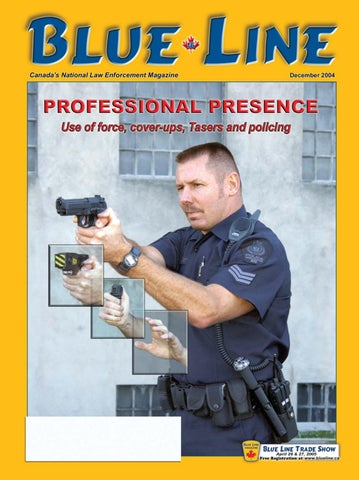
Professional presence 7 Use of force, cover-ups, Tasers and policing Tasers have always been controversial
9
Web: www.blueline.ca eMail: blueline@blueline.ca
Interim recommendations for Taser use 10
— Publisher — Morley S. Lymburner
The shotgun speedload 14 Reloading a tactical shotgun under stress
eMail: publisher@blueline.ca
— General Manager — Mary Lymburner, M.Ed. eMail: admin@blueline.ca
— Editor — Mark Reesor
DISPATCHES
16
Kits detect gunshot residue in the field 18 DEEP BLUE Internet sex crimes - not what you think
20
eMail: editor@blueline.ca
— News Editor — Les Linder eMail: news@blueline.ca
— Advertising — Mary Lymburner Dean Clarke Bob Murray Kathryn Lymburner eMail: sales@blueline.ca
— Pre-press Production — Del Wall — Contributing Editors — Public/Media Relations Mark Giles Police Management James Clark Tactical Firearms Dave Brown Technology Tom Rataj Psychology Dorothy Cotton Mike Novakowski Case Law Blue Line Magazine is published monthly, September to June, by Blue Line Magazine Incorporated with a mailing address of: 12A - 4981 Hwy. 7 East, Ste. 254, Markham, Ontario, L3R 1N1. Individual magazines are $5.00 each. Subscriptions are $25.00 per year or $40.00 for 2 years. (Foreign - $50.00 U.S.) Group and bulk rates available upon request. All material submitted for publication becomes the property of Blue Line Magazine unless other arrangements have been made with the publisher prior to publshing. The authors, advisors and Publisher accept no liability whatsoever for any injuries to persons or property resulting from the application or adoption of any of the procedures, tactics or considerations presented in this magazine. Readers are cautioned and advised that articles presented herein are edited and supplied for your personal awareness and should not be used for further action until appropriate advice and guidance is received from a supervisor, Crown Attorney or other person in authority. Established in 1988, Blue Line Magazine is an independent publication designed to inform, entertain, educate and upgrade the skills of those involved in the law enforcement profession. It has no direct control from a law enforcement agency and its opinions and articles do not necessarily reflect the opinions of any government, police, or law enforcement agency. ©2005 - All articles are protected by copyright. No part of this publication may be reproduced or transmitted in any form or by any means, electronic or mechanical, including photocopying and recording or by any information storage or retrieval system without permission.
Internet activity is monitored and use or reposting of material on the Internet is restricted.
This publication is a private venture and receives no subsidy or grant from any level of government.
— Affiliations — International Association of Law Enforcement Planners Canadian Advertising Rates & Data International Police Association The Police Leadership Forum Periodical Publishers Exchange The Canadian Press Newswire Harvey Research
Windsor multi-threat training complex 21 Good strategy needed in challenging times 22 Vancouver Police Department a market leader in police communications Officer dedicates life to helping youth
23
Holding deadbeat parents accountable 24 CASE LAW 26 Thermal imaging doesn’t intrude on privacy NEWS CLIPS
27
US psychology prof finds ‘truth wizards’ 28 They know a lie when they hear it DISPATCHES
28
Improved body armour on the way
29
Lone officer guards most borders 103 ‘work alone sites’
30
Toronto gang violence declines
31
BOOK REVIEW 32 Training at the Speed of Life, Volume One COMING EVENTS
33
Canada helps Interpol modernize
34
Correctional officers lobby for vests
35
PRODUCT NEWS
36
2005 BLUE LINE TRADE SHOW
37
Retractable firearms tether Bad idea, brilliantly executed
38
ODDITORIALS
39
TECHNOLOGY Portable storage technologies
40
Honours from the Prime Minister
41
Training police . . . on the rock 42 Hiring and training locally translates into improved officer retention CORRESPONDENCE
44
BACK OF THE BOOK Unified force needed to police BC lower mainland
46
Printed in Canada by Tri-Tech Printing
ISSN #0847 8538 Canada Post - Canadian Publications Mail Product Sales Agreement No. 176796 Blue Line Magazine
3
The subject theme for this December edition is firearms and less-lethal weapons. Vancouver Sergeant Joel Johnston graces our cover with a stylized and editorialized rendition of the use of force model. In this issue Joel explains the logic of incorporating a Taser capability within a police force’s use of force options. While researching some of the issues related to Taser use we discovered a large amount of documentation. As a result Kathryn Lymburner presents an overview of the Interim recommendations for Taser use as studied by the British Columbia Police Complaints Commission. In addition to this we also provide you with the origins of the Taser first described in a 1911 Tom Swift novel. In tune with this month’s theme, Blue Line’s tactical firearms editor Dave Brown, addresses the issue of speedloading a shotgun under stress. Adhering to the philosophy that under stress you react how you have been trained, Dave emphasises a fluid natural motion in his article on page 14. On page 18 Paul Weklinski introduces an innovative gunshot residue field test kit that can reveal a shooter’s identity and a witness’ proximity to the shooter. This article also provides a background on these types of tests and their importance to the investigative process. Elvin Klassen presents the second part of his three-part series on Assets Building with a profile on Brockville police officer Mark Heffernan. This officer has dedicated a considerable amount of time working with the youth of his city and the results are showing. This edition contains even more of what you ask for in the form of Case Law and innovation, insights and initiative. Dorothy Cotton writes about a second look at Internet Sex Crimes, Ryan Siegmund describes initiatives by the Toronto Police to reduce violence, and Mark Giles writes about Canada’s leader in corporate communications. Most of all, amongst the hubbub that surrounds the publishing of this magazine we wish you all a very Merry Christmas! DECEMBER 2004
Blue Line Magazine
4
DECEMBER 2004
A story of Christmas past Reprint from December 1999
by Morley Lymburner In my first year on the job I had few opportunities to even sit in a police car let alone drive one. I was introduced to my beat and the cold concrete below my feet and was advised it would be some time before it would be replaced by rubber mats and tires. In addition to being the new guy in the station I was also single. This meant I did have one time of the year when I was guaranteed to drive a police car... Christmas! I thought this would be terrific for a change and when “volunteered” by the Sergeant I did not see any need to grumble. I reported for duty on Christmas Eve with an eager expectation of doing something a little different. I looked around the guardroom and noticed my compatriots were mostly single, divorced or heavily mortgaged (we made extra on holidays.) One old copper advised us young guys, with a twinkle in his eye, not to worry about lunch this evening because it would be all taken care of. Our imaginations ran in high gear back to cozier times with turkey, cranberry sauce and cake. There were seven officers in that room and seven cars awaited us in the parking lot, all gassed and ready to go. I hopped behind the wheel of my warm cruiser and headed to my patrol area with renewed enthusiasm. For at least three days I would not be looking for a warm place to thaw my hands and feet. We were never
Blue Line Magazine
issued winter boots nor gloves and lost a day’s pay if we were caught wearing non-issued clothing. In other words it was a continual cat and mouse game to hide these items from the patrol sergeant. If any of my old sergeants are reading this, I can now confess I hid these items in the barber shop at the corner of Church and Weston. It was attitudes like this that kept me happy being a constable my entire career. But I digress! As usual! I cleared on the radio and immediately got my first call... a domestic dispute... “standby for a back-up unit at the address.” This was dispatcher code that really meant “you’re on your own, stupid!” Anyone knows you can’t sit in front of the house and listen to the beer bottles crashing for two hours on the hopes a back-up unit was coming. I acknowledged the call and thus commenced an entire evening of one domestic dispute after another. My last call took me into 45 minutes overtime and a lot of flak from the station sergeant, with a reminder it was not to happen again. There was no lunch and I asked another chewed-out officer how the Christmas lunch had gone. The grizzled look on his face turned to a smile. “You are new around here, aren’t you? There was not going to be lunch for anyone. It’s too darned busy on Christmas evening shift to get a lunch! That’s why they have to draft guys like us to work it.” In our materialistic world, the Christmas
5
season places such high expectations upon everyone that if you live in an atmosphere that can never achieve those expectations, it can be a big let down. In the low income project housing I worked, this reality caused considerable domestic trouble and depression. Domestics appeared to be more violent than usual and we were neither equipped nor trained to handle the root causes of the problem. Since that time, thankfully, a more enlightened era of policing has arrived and a better understanding of how to handle these calls exists. This time of year is when I get to pitch my beliefs, so here goes. Although marketing experts disagree, Christmas is not about materialism. Through all the glitz and clamour of this season, we should never forget that Christmas is a celebration. This day celebrates the birth of the Prince of Peace over two thousand years ago. Jesus’ birth was predicted by many in the Old Testament. When his birth was announced, many felt that he had come to conquer as a soldier. His real mission was to encourage peace -- like a police officer. He was to give us hope that no matter how bad we felt about ourselves, we will be forgiven with no more effort than sincerely saying “I believe!” God made His move -- now it’s your turn. All of us here at Blue Line Magazine wish you and your family all the joys, wonders and understanding of the Christmas season.
DECEMBER 2004
Blue Line Magazine
6
DECEMBER 2004
by Joel A. Johnston The Vancouver Police Department (VPD) would appear to be caught in a maelstrom of controversy over recent use of force (actually “police response to resistance and violence”) cases. Fuelled by grieving, passionate, partisan family members, a media frenzy, motivated litigation lawyers and a misinformed public, the reality of the cases has been lost in an emotional and deliberately crafted controversial aftermath. This is truly unfortunate because no one benefits under these circumstances and appropriate follow-up actions are rarely taken when the facts are clouded or completely obscured by a zealous media, emotionally pliable family members and a public deliberately misled through selective reporting. I am a strong proponent of accountability in all professions, including police, but it must occur in a neutral, objectively informed environment, as uninfected by deliberate controversy and emotional turmoil as possible. The reality is that police are tasked and sworn to deal with uncomfortable problems that no one else wants or chooses to deal with. It is the goal of each and every Canadian police officer to resolve all encounters with the citizenry through professional presence and communication. This goal is made very clear from police academies through to continuing training. It makes sense. Police officers do not don their Blue Line Magazine
uniforms prior to each shift and think ‘who can I fight with tonight.’ They are painfully aware that no one wins in a fight – injuries to officers and suspects are common, exposure to disease is an ever-present risk, officer conduct is scrutinized by supervisors, complaint bureaus, media and courts and criminal and civil liability may result. The stress and emotional toll of physical or armed encounters is not generally understood by those who don’t have to deal with confrontations. Few people know that the VPD is more than 95 per cent successful at generating voluntary compliance through officer’s professional presence and ability to communicate. Sadly, the reality is that some people will not cooperate, no matter what is said or who says it. At that point, police are faced with controlling one or sometimes more non-compliant, frequently violent, often drug-induced subjects. The alternative, frequently suggested by plaintiff’s lawyers, would be for police to pack up and drive away or do nothing, which I believe good people would not support, nor should they be expected to. Police have a duty to act when someone, including themselves, is in danger or commits a criminal offence – and it is also the right and honourable thing to do. Special interest groups, lawyers and other partisan parties often complain that “it’s not up to police to judge a criminal – to be judge, jury and executioner” (always alluded to in the aftermath of a suspect injury or death and used to indicate that police “sentenced” an individual to injury or death). Police do not judge or sentence criminals; they respond to problems called in by victims, 7
neighbours and other concerned citizens and part of their professional response includes assessing the criminal behaviour that was reported. For instance, a report of a violent homeinvasion robbery where the victims can be heard screaming for help will generally illicit a different assessment and response than a shoplifter being held by store security. Officers must assess a situation as they respond to it and as it unfolds before them. If professional presence and loud verbal commands are successful at controlling the home invaders – that is, they put their hands up and surrender – then they will simply be handcuffed and taken into custody. No one gets hurt. If they remain non-compliant and/or become confrontational, resistive or violent though, they can expect police to use the force necessary to control their behaviour. Add to the mix a lone officer faced with multiple, possibly armed subjects and a high-level violent crime, it can be reasonably expected (and lawful) that the officer’s response will be commensurately higher. If people fight with police, they will face physical force – and an officer must prevail in a use of force encounter. They cannot afford to lose because all too frequently it means death and a dangerous suspect on the loose with their gun, now endangering innocent people. If police cannot protect themselves from violent, confrontational subjects, how can they possibly protect the rest of our society? If police use physical force, someone is very likely to get hurt. This is an uncomfortable fact of real-world conflict. Sometimes people will die. This is never the intent but an DECEMBER 2004
infrequent, unfortunate by-product of the police mandate to control violent people and is caused by a variety of factors (physiology, toxicology, the nature of the force, etc.). Police officers endeavour to use force proportional to the threat they face, while first considering their safety and that of the public. People need to understand that the outcome of the force used does not relate to the justification for its use. In other words, injury or death does not necessarily equate to excessive force, nor does the absence of injury necessarily mean that the force was justified. The criminal gets to decide whether force is used. “What else are they hiding?” is another question often posed, indicating that police deliberately withhold facts from the press and public because they have done something wrong or unlawful, insinuating – sometimes actually stating – that there must be a cover-up. To maintain their perspective, officers need to realize that it is the business of the media to sell advertising. Controversy, salacious details and innuendo sells – the number one selling publication in the world is the National Enquirer. The reality is that police cannot always release all of the facts surrounding a particular case right away because it will compromise an ongoing investigation. Sometimes all of the facts are not readily available to media personnel or mistakes are made which prevent them from being presented in a timely manner – and yes, sometimes it’s not expedient or strategically wise to release certain facts at certain times, but cover-up? If honour and ethics aren’t reason enough, I believe that the socio-political structure of police organizations would not logistically allow for a cover-up to successfully occur. There are simply too many ways to get caught trying such a thing. However, it does make for far more titillating reading to suggest cover-up. Some call for the Taser to be banned, indicating they kill otherwise healthy individuals. That’s reminiscent of the call to ban pepper spray and the ‘police chokehold’ when some people died after they were used. There have been similar calls to ban other police tools and techniques such as batons, flashlights and ‘hogtying,’ and there will continue to be. It is important that tools, techniques and methodologies be reviewed in any profession, but fairly and objectively. Interestingly, as the tools, tactics and techniques used in policing have changed and evolved over the years, the one underlying commonality is that people continue to die during use of force arrest situations. Whether they are wrestled under control, pepper sprayed, rendered unconscious with restraint holds or Tasered, sometimes (albeit infinitesimally infrequently) people die. Almost exclusively they are under the influence of drugs or another pre-existing medical condition that has compromised their physiology. The less-lethal tools that police officers carry today are intended to provide intermediate means to control violent, resistive behaviour that are less likely to result in death. That does not mean death cannot ensue, which is why Blue Line Magazine
people; that’s why they put themselves in harm’s way each and every day to make society safer. Those who commit crimes and become violent, confrontational or resistive with other people or police can expect officers to use force and do so decisively and with the surety that they will prevail. To avoid this, all people have to do is voluntarily comply when caught engaging in criminal behaviour or, better yet, refrain from criminal behaviour altogether. This will spare them and their loved ones (and police) much grief and consternation. A little reality check now and again is good for everyone.
they’re called less-lethal, not “less-than-lethal” – death is far less likely to occur than with a firearm. These tools have been deployed thousands of times, successfully bringing violent subjects under control without killing them. Effective, but not perfect in an absolute sense. So, what if the Taser, pepper spray, the ‘police chokehold’ (there is no such thing) and the baton are banned? Then police will have only two remaining force response options – ‘empty hand control tactics’ and firearms. Violent, resistive people will still die as they are wrestled under control by multiple officers, while officer injuries will escalate dramatically, ultimately resulting in escalating human and financial costs. More people will get shot and die because police won’t be able to intervene earlier in encounters with less-lethal options. So really, how wise are those who continue calling for these remarkably successful and safe tools to be banned? They have clouded reality with emotion and failed to connect the facts in these cases, where the person would likely have died anyway and their death blamed on something else that police used or did wrong. I’m not so sure that the criminal element and their loved ones really want the civil libertarians and human rights activists “acting on their behalf” to have these less-lethal options banned. The reality is that police officers care about
Because of its power and extended reach, these Stun Master™ stun batons are a favorite with security guards. Not yet used in Canada, they’re an example of electrical charge weapons available. Simply touch an assailant with the baton and pull the trigger: three to five seconds will leave the assailant dazed and temporarily paralyzed. The baton will also deliver a shock when touched six inches from the tip, to prevent an assailant from grabbing it and taking it away. 8
Joel A. Johnston is an economics graduate of Simon Fraser University and 20 year veteran Vancouver Police Department sergeant who is currently an emergency response team leader and former control tactics coordinator. A presenter to numerous international law enforcement conferences, he holds a third degree black belt in traditional Japanese (Shotokan) karate and is a certified law enforcement trainer. He’s also a principal of Defensive Tactics Incorporated (DTI) and can be contacted at pdjjohnston@vpd.city.vancouver.bc.ca.
“Electrolux Death Ray "The Rolls-Royce of atomic weapons?" Maybe. Take a look at sculptor Greg Brotherton's Electrolux Death Ray, and decide for yourself. Powerful? Equipped with a genoseismic vibratofile nozzle, this "finger of God" weapon can wipe out Martian civilizations or cut the moon in half. Starting with little more than an Electrolux canister vacuum cleaner and six German siren whistles powered by vacuum pressure, Greg Brotherton, of California has taken us all back to "Tomorrowland" with this elegant sculpture. Brotherton is an artist, sculptor, designer and machinist. Greg's interest in the mechanical surfaced at age five, when he began disassembling anything with screws in it. By twelve he had taught himself to mine his back yard with home-made explosives (no injuries!). Then, after being successfully ejected from a series of public and private learning institutions, Greg, equivalency test in hand, enrolled in the Colorado Institute Of Art, beginning his undergraduate training at sixteen. Over the years, Greg has put his many talents to use, working as a builder for industrial prototype models, designing extreme sports racing gear, creating digital matt paintings and developing an impressive resume' as a graphic designer. His talents have found employ with a wide variety of clients, from directors Martin Scorcese and Ben Stiller, to MacFarlaine Entertainment, I.B.M., Vivid Entertainment and Disney. However, it is the art of the mechanical that keeps his shop lights glowing. Creating pieces that resemble high-quality merchandise from a futuristic catalogue, Greg sees to the design, casting, forming, manufacture and electrical needs of all of his "sculptures". Whether it's a planet-taming laser cannon made of vintage vacuum cleaners or a stunning, oddly sexy "she-droid", Greg excels at bringing yesterday's version of tomorrow to life. Today! You may find out more by going to: http://www.brotron.com DECEMBER 2004
Tasers have always been controversial
Adapted from a 1999 report by Victoria Police Department Sgt. Darren Laur
US President Lyndon Johnson formed a blue ribbon crime commission in the mid 1960s to look at ways of quelling civil unrest and violence. One of its many recommendations was that police should look for new, non-lethal methods to control violent behaviour. That caught the eye of John Cover who, a couple of days later, read another article about a hiker who grabbed a high voltage wire and became frozen to it for several hours, but lived to tell his story. Inspired, Cover went to work; by 1969, he had developed the idea of a high voltage, low amperage pulsed weapon that would knock a person down without injury. He developed his first prototype electric weapon by 1970 and called it ‘TASER,’ an acronym for “Thomas A. Swift’s Electrical Rifle,” named for the electric rifle in the Tom Swift adventure story series of Cover’s childhood. Cover began demonstrating the Taser to interested groups, who either really loved it or really hated it. Many police agencies saw the device as just another gimmick, in the
Blue Line Magazine
same class as water cannons and rubber bullets; less-lethal technology really did not interest them. The American airline industry, on the other hand, saw it as an option that they could use, rather than a conventional hand gun, when flying at 30,000 feet. Cover began concentrating his efforts toward the civilian markets, especially the airlines, who were beginning to place large orders. Just as his efforts began bearing fruit, the US Consumer Products Safety Commission (CPSC), prompted by political interference and pressure from outside influences, began investigating the Taser in 1975. The NRA and police organizations were up in arms that the device was being sold to civilians and the CPSC opted to halt all sales. It lifted the ban in the spring of 1976, just as the Bureau of Alcohol, Tobacco and Firearms (ATF) decided to classify the device as a Title II firearm, putting it in the same category as machine guns; this even though years earlier it had stated that it didn’t consider the Taser a firearm.
9
This was a major blow to Cover, since it made the device very difficult to sell to the civilian market, which he was depending on to finance his invention. Not to be defeated, he redesigned the original Taser and convinced the ATF to reclassify it as a Title I (conventional) firearm, easing restrictions on its sale to civilians. Cover’s problems with the government continued. The US State Department declared the Taser proprietary technology and, fearing it could be used for torture, put it on their Munitions Control Act list, preventing sales to other countries without prior approval. Sales dropped to less that 200 units a month and even these were put in jeopardy after the devices were used in robberies, prompting states to consider bans. A series of high-level meetings convinced all but New York and Michigan to decide against a ban and the device finally earned some positive press in 1976, when some progressive police departments and correctional facilities bought Tasers and used them on several occasions, with very positive results. Cover got his biggest break yet in November, 1980, when the Los Angeles Police Department purchased 700 of the old Tasertron TE-86 for general patrol duty use, after an extensive testing and evaluation period. Today thousands of police departments use Tasers and a model is once again being sold to the general public in the United States.
DECEMBER 2004
BC’s interim recommendations for police Taser use by Kathryn Lymburner Although police have more less-lethal force options than ever before, nothing “can completely eliminate the risk of physical harm to either the subject or the officer when police move to take a resistive subject into custody,” notes a report produced at the direction of the BC Police Complaint Commissioner. The commissioner ordered Victoria Police Department Chief Constable Paul Battershill to review use of force protocols and make interim recommendations on police use of Tasers in the province. The move was prompted by the death of Robert Bagnell after he was tasered by Vancouver Police Department officers, which Battershill was also ordered to investigate. As the report was being prepared, the Canadian Association of Chiefs of Police announced that the Canadian Police Research Centre is undertaking a national study of Taser use by officers. BC’s chief coroner is also conducting a thorough review of all restraint related in-custody deaths in the province. The interim report looks at data prepared by Victoria Police between 1999 and July 2004, the Edmonton Police Service (EPS) between 2001 and July 2004 and Taser International’s field use database. This “provides information on how the Taser is being used, the circumstances that cause police to choose that force option and the outcome.” The National Use of Force Model, which was modified in May 2000, lists five categories of subject behaviour, ranging from complete cooperation to potentially lethal acts: cooperative, passive resistance, active resistance, assaultive and grievous bodily harm/ death. Officers can respond using, depending on the threat level, officer presence, communication, physical control, intermediate weapons (where Tasers belong) and lethal force. Subject behaviour in the 4,599 cases the report looked at was characterized according to the use of force model, although only 4,372 were suitable field uses. Only 1.12 per cent (49 cases) ended with any form of medical complication and only 0.09 per cent were associated with an in-custody death, the report found. Tasers were used on pregnant women twice with no reported medical complications
Blue Line Magazine
to the fetus or mother. The report also indicated that when data from Taser International was compared with the Canadian use of force model, “the Taser was, in most instances, used in the appropriate force context.” The report also examined the two Canadian police services’ data on an individual basis for each year they were using Tasers. Edmonton officers filed 40 control tactics reports to the officer safety unit involving the use of Tasers in 2001; that increased to 236 deployments in 2003. See chart above. EPS currently experiences a 94 per cent success rate in cases where Tasers are used, the report notes.
10
The Victoria Police Department has used Tasers since 1999 and its initial analysis shows they are “an effective intermediate weapon with a very high (exceeding 90 per cent) success rate.” Its data shows the device has more success than pepper spray, which is prone to fail on subjects who are either emotionally disturbed or under the influence of stimulant drugs. The statistics also showed a generally low rate of injury for both officers and subjects but a significant possibility of secondary injuries. A more in-depth examination of Taser deployments will be published in the final report. “The electrical impulse delivered by Tasers... is well below the level established as ‘safe’ by the (US) federal government and international European standards in approving such devices as electrified cattle fence and the risk of cardiac complications is low,” according to an independent US study cited in the report. “Sudden death has been reported proximate to electrical impulse device use, however in all reported cases the cause of death was attributed to other factors, primarily drug intoxication and there has been no direct link to the use of the device.” The Victoria Police in Australia commissioned a medical study by Alfred Hospital in Melbourne of both the M26 and X26 models in 2003. The electrical safety analysis it conducted found that, although occasional DECEMBER 2004
deaths had been reported post-Taser, none occurred “instantaneously.” The study concludes that “the advanced Taser appears, from the manufacturer’s data file, to be a relatively safe device for immobilizing non-violent offenders. However, these subjects are exposed to a number of immediate risks or potentially fatal dangers operating either just before or just after being apprehended with the aid of the Taser.” The study suggests that, “it would be prudent to routinely observe all Tasered offenders for four to six hours in a suitably equipped hospital emergency department.” Another review, published in the well-respected medical journal The Lancet and cited by the report, states that “up to present there is no proven connection between the use of the Taser and the occurrence of in-custody deaths.” It also notes that “there is no evidence of longterm harm from electric current in survivors of the Taser” and that its use “reduces injuries compared to all alternative methods studied.” The Orange County Sheriff’s Office in Florida created a Taser task force in response to several highly publicized incidents of death associated to police use of the device. “The common factor in the deaths reported (seemed) to be the excited state (excited delirium) of the individual being shot by the Taser,” Florida medical examiner Dr. Jan Garavaglia found. “They all had hyperthermia, meaning elevated body temperature, and were talking (at an extremely high rate). They were all very hyperactive and had experienced extreme exertion while fleeing or being pursued by the police; and then they had sudden deaths, usually after being restrained by the police.” These results were noticed at the same time that crack cocaine started being actively marketed in Miami. Results from Garavaglia’s study suggest that “some frequently abused drugs have the potential to contribute to any cardiac related morbidity or mortality that may arise in the context of Taser use.” He further asserts that “it seems reasonable to assume that this conclusion could be generalized to other emotionally charged and possibly violent confrontations with law enforcement personnel.” Excited delirium and restraint-associated deaths have also been documented in BC. “Between 1990 and 2003, there were 22 of these that were investigated by the coroners service,” the report notes, none involving Tasers. Police were involved in 19 of these; the other three were unrelated to any emergency service. Thirteen of the 19 individuals police encountered were found to have cocaine present in their systems, one had been binged on alcohol for three days, one was in a state of acute psychosis and one tested positive for pseudo-ephedrine. In most of these cases, police were called because a subject was behaving in a bizarre manner and unresponsive to verbal direction. The suspect often became violent when police tried to take custody, forcing them to use some form of restraint to maintain control. Most were handcuffed, three were hog-tied and others were restrained on an ambulance gurney. Blue Line Magazine
The report notes that there have been four cases in BC where death has been associated with Tasers and cocaine use was a factor in all of them. “Deaths similar in nature to those occurring in law enforcement contexts are also experienced in psychiatric and geriatric care facilities where patients/residents are required to be restrained for their safety and security,” the report notes. Recommendations The interim recommendations, which were made after reviewing general police use of Tasers in BC and “DO NOT relate to the primary investigation involving Robert Bagnell’s death or the Vancouver Police Department,” are as follows:
11
Based on our research to date, this investigative team is of the opinion that the Taser should be retained as an intermediate weapon for use by police in British Columbia, subject to any recommendations that may emerge from our final report. Our analysis of the field usages and the medical literature suggests appropriate use of the Taser presents an acceptable level of risk to subjects being controlled. At the same time, we believe that more can be done to ensure uniformity of training across the province, to provide enhanced levels of accountability and to decrease the risk to those groups most at risk from sudden and unexpected death associated to restraint, whether or not the Taser is used. (Continued... )
DECEMBER 2004
Standardized training There appears to be significant inconsistencies throughout the province in the training of police officers in the use of the Taser. Therefore, we are recommending the creation of a standardized lesson plan/course training standard for Taser users in British Columbia. This course training standard would be developed by the Justice Institute of British Columbia, in consultation with use of force coordinators representing all municipal police agencies and the RCMP. This “core curriculum” would be delivered to all recruits and all in-service Taser users. Agencies would be free to provide training beyond the standard, once that initial training had been received. Mandatory reporting Not all agencies in the province currently require officers to properly report Taser deployment. Some agencies with mandatory reporting policy may not be capturing all usages due to insufficient levels of supervision. Therefore, we are recommending that after any deployment of a Taser (probes or pushstun application), the user must submit a use of force report that captures relevant information and that will allow for statistical analysis of Taser use across the province. Ideally, this
use of force report would be delivered via PRIME BC, in a format created by the Justice Institute of British Columbia, in consultation with use of force coordinators. Acquisition of new taser technology If agencies wish to acquire new Taser technology, we are recommending the X26 Taser due to its enhanced date collection capabilities and lower electrical output. Although there is no evidence to suggest that the output of the M26 Taser exceeds acceptable levels, the X26 provides a greater margin of safety as documented in the Alfred studies. Excited delirium training The phenomena of excited delirium still appears to be under recognized in the policing community. Although relatively rare, changes in patterns of drug abuse make it likely officers will encounter victims of excited delirium more frequently. Therefore, we are recommending the creation of a standardized lesson plan/course training standard for excited delirium by the Justice Institute of British Columbia. This training is to be delivered to all recruits as well as all in-service members, regardless of rank, in the province.
Officer killed in 1913 to be honoured Paul Smith has been lying forgotten and ignored in an unmarked grave. Now, thanks to dogged detective work, the police officer electrocuted in 1913 will finally receive the attention he deserves. “There have been officers who have done the ultimate sacrifice with this job and to me it’s extremely important not to forget anybody - it’s just as symbolic as Remembrance Day, said Cst. George Carscadden. It was Carscadden who learned of Smith’s existence while working on a centennial project for the Lethbridge Regional Police Service. “I discovered by chance that there was another officer killed in the line of duty. I knew there was one in 1964 but when we discovered the other officer I was interested in finding out more information about him,’’ he said. It’s known that Acting Sgt. Paul Smith was 28 when he died accidentally on June 10, 1913. He had been part of the 16-member Lethbridge Police Force for just seven months. The newspaper of the day said he was electrocuted while fixing a streetlight. Only two officers have died in the line of duty in Lethbridge and Smith was the first. The investigation into his background has gone nationwide and as far as South Africa. “We found out that from 1902 to 1909 he was with the South African constabulary and then from 1909 to 1911 he was listed with the North West Mounted Police,’’ said Carscadden. A further search found Smith’s father lived in St. Thomas, Ont., that Smith was engaged to a woman from Scotland and had a brother and sister living in western Canada. “With Manulife Insurance he had $2,000 left to
Blue Line Magazine
his sister but Manulife had no existing records dating back to 1913,’’ said Carscadden. There was no indication of Smith’s family coming forward to claim the body. Information about Smith’s death has now been sent to the Canadian Professional Police Association for inclusion on the 700-name honour roll. Some of the names go back to 1867, said spokeswoman Sophie Roux. Smith’s case is unusual but not unheard of, she said. “Even though we’re losing police officers from year to year in the line of duty, we’re also made aware of historical names that haven’t been recognized in the past,’’ Roux said from Ottawa. Recognizing those who have died is important, she said, noting that thousands of police officers travel to Ottawa on the final Sunday of every September for a national memorial day. Smith will be honoured at a short service on Nov. 12 and a gravestone has been purchased to mark the site and his contribution to the community. An honour guard of 16 officers, the number of police in Lethbridge in 1913, will attend the service. “He’ll get a full honours funeral,’’ said Staff-Sgt. Jeff Cove. “There’s a flag-folding ceremony and a flag to present,’’ he said. “It would be nice to present the flag to a family member - it’s closure, it’s respect to a police officer killed in the line of duty.’’
12
Restraint protocols Although medical evidence remains inconclusive, there does appear to be a linkage between restraint positions and enhanced risk to arrested subjects. Until definitive research has been conducted, we are recommending that the use of the maximal restraint position, where handcuffs and ankles are bound behind the back, should be eliminated by police agencies in the province. A hobble restraint, a wrap restraint or other similar devices should be provided to police, along with appropriate training. Hobble restraints are inexpensive and training costs should be minimal. Taser technology review and interim recommendations http://www.opcc.bc.ca/reports
MONTREAL — The Quebec government is preparing to enter into a private partnership to build a prison south of Montreal next year. The provincial jail, which could hold 500 inmates, would be built in Longueuil or Ste-Julie, Que. It would house those sentenced to two years or less in jail. The Liberal government plans to pass legislation by Christmas to create an agency to handle public-private partnerships, RDI, Radio-Canada’s all-news channel, reported in October. A British company and the engineering firm SNC-Lavalin have shown an interest in the project, the report added. Public Security Minister Jacques Chagnon confirmed that a private partnership to build a prison will be proposed in February. The former Parti Quebec government closed five prisons across Quebec in 1996. *** HALIFAX — Nova Scotia police officers will make an appointment with an arbitrator rather than hit picket lines now that amendments to the Trade Union Act passed a final reading. The private member’s bill, put forward by Colchester North member Bill Langille, replaces the police’s right to strike with a system of arbitration. “Police in Nova Scotia are the only ones in Canada that have the right to strike,” he was quoted as saying after the bill was passed in October. The amendments not only block the police’s ability to hit the picket line, but also stops municipalities from locking out police officers. Joe Ross, executive director of the Police Association of Nova Scotia, said if negotiations move to arbitration, the two parties will appoint a single arbitrator who will hear submissions from both sides. They will then make a decision on that basis. *** TORONTO — A high-performance all-wheeldrive sedan tops the list of the most stolen latemodel vehicles in Canada. According to the Insurance Bureau of Canada, the Subaru Impreza WRX four-door is the top choice of thieves. The second most-stolen vehicle in Canada is the Ford F-350 Super Duty fourwheel-drive pickup truck. It’s followed by the Cadillac Escalade SUV. The insurance industry says none of the three has electronic immobilizers as standard equipment. Immobilizers prevent a vehicle from being started unless a specific code is entered. DECEMBER 2004
Blue Line Magazine
13
DECEMBER 2004
by Dave Brown Nothing can match the versatility of the standard police issue shotgun. In the right hands, it can be fast, accurate and pack enough of a wallop to stop deadly threats instantly. It lacks a large ammunition supply but that doesn’t have to be a detriment, especially if officers can be taught to quickly and easily reload when empty. This technique, called ‘speedloading,’ should be an important part of basic shotgun training. With modern training and proper techniques, the same shotgun used by officers back in the 1920’s can be effectively deployed today in a variety of situations today. When Manitoba Corrections Emergency Response Units (CERU) adopted a 12 gauge, less lethal projectile option, teams needed high accuracy standards, the ability to rapidly change from one ammunition type to another and the capability to quickly speedload a shotgun under stress. “Unlike other emergency response teams, when a hostage situation happens in a correctional facility, we need to go in and get close right NOW,” says Denis Litster, retired head of training and now an instructor at the Northwest Law Enforcement Academy in Winnipeg. “Our tactics are unique and our shotgun shootBlue Line Magazine
ers can top up, speedload and switch ammunition types instinctively.” Less lethal projectiles were new to CERU and it was the first time firearms were deployed in provincial correctional facilities. I was approached to design an effective tactical shotgun safety and training program and help set standards for future training and qualifications. Teaching an effective way to speedload under stress was vital. “We expect our shooters to arrive at the end of each scenario with as much ammunition in the shotgun as what they started with,” notes Litster. “When Dave designed our shotgun training for us, he showed us this new way of speedloading the shotgun and we knew right away that this is the method that would work for us. It’s quick, it’s smooth and – most important – it’s dead reliable.” Speedloading the OLD way A speedload is different from a reload in that the shotgun has been fired until empty, but the threat hasn’t been stopped. There may not be enough time to completely reload the magazine and chamber a round, but if just one more round may solve the problem, a spare shell can be dropped directly into the chamber, bypassing the magazine entirely. Unfortunately many officers fail to ap14
preciate how fast this can be accomplished. One reason – despite all the advances in modern police training, the shotgun speedload is still sometimes taught the same old backwards way. The traditional way to speedload is to grasp the shotgun in your strong hand and fish out a spare shell from a weak side pocket, with your weak hand. The spare shell is aligned so that the little finger contacts the brass head and the front of the shell faces forward (photo 1). The shell is then rolled directly into the ejection port from underneath the frame and the shooter re-establishes a two-hand grip and brings the shotgun back into the shoulder.
Unfortunately, this oft taught method fails to acknowledge the actual performance of a human body under stress. It relies on the weak DECEMBER 2004
hand being able to perform fine motor skills just when they are rapidly disappearing in a real-life encounter. It may work fine on the range, but if officers are put into even a little bit of extra stress during shotgun training, their ability to perform this technique evaporates. Shooters tend to toss the live shell over top of the port or panic when they cannot align the shell properly from their pocket; in some situations, they’ve been known to feed a shell into the port backwards, with potentially disastrous results. Not Much Better An alternative method popularized by a large firearm manufacturer’s US training facility is to hold the shotgun in the strong hand and reach for the shell with the weak hand. The shotgun is tilted at a 45 degree angle and the spare shell is dropped straight into the ejection port from above (photo 2).
very wide port, the weak hand simply curls it back into the hole.
shell is simply dropped into the port and can land at any angle whatsoever (photo 5). Once the action begins to close, it instantly aligns the shell with the chamber and will always feed properly.
This method is both fast and instinctive. The only critical task is to ensure that the front of the shell faces the front of the firearm. The
This method also relies on fine motor skills that do not exist in an emergency. Also, at this angle, the port is a smaller target, which officers could easily miss. On the other hand, it has been my experience in shotgun training that this method can sometimes work for left handed shooters who are reasonably ambidextrous. In their case, the left hand controls the shotgun and the right hand drops the shell into the port from above. Speedloading the MODERN way I have trained hundreds of students on how to better handle shotguns in life threatening situations. I have yet to meet a single one who didn’t agree that transferring a shotgun to the weak hand and feeding a shell into the port with the strong hand is the best speedloading method. To accomplish this, the shotgun is held flat in the weak hand at its natural balance point, with the open hand cupping the ejection port (photo 3).
The spare shell is dropped into the port with the strong hand (photo 4); if it misses the Blue Line Magazine
15
DECEMBER 2004
The shotgun is then transferred to a proper two-grip and the bead sight is aligned with the potential threat (photo 6). To fire, simply raise the stock to your shoulder, with the bead remaining locked on the target.
Switching hands in the middle of a gunfight may seem counterintuitive, but it is the only way to get the weak hand performing the gross motor skills and leave the strong hand to do fine motor skills. After all, when police officers still carried revolvers, this is exactly the method that was taught; transfer the open revolver to the weak hand while manipulating the speedloader with the strong hand. Proponents of the older methods point out that the shotgun can still be fired if it stays in the strong hand. Unfortunately, they are unable to explain how pulling the trigger on an empty shotgun is going to solve anything! I recommend that officers who were taught the outdated method try it both ways the next time they’re on the range and decide for themselves which way works best. If still not convinced, try a simple little test. Watch how the vast majority of people tend to load a pump action shotgun when they are not under stress. You will notice that most hold it in their weak hand and feed the shells into the tube with the strong hand. This is the easiest and most natural way to do it for most people — and surely teaching an emergency manipulation skill that is totally different from a routine daily handling technique is a recipe for disaster. In fact, tests with electronic timers have shown all three methods may be accomplished in about the same amount of time, provided there is no stress. Add a time limit to the exercise and it becomes immediately obvious which way works best.
As an ultimate test of shotgun ability, I challenge shooters to perform my “five-in-five drill.” Using five reactive targets at seven to ten meters, the shooter begins with four shells in the shotgun and one in their pocket. They have five seconds to knock down four targets, speedload one more shell and knock down the fifth one. This is not an easy exercise but involves all the basics of good shotgun technique and certainly gets the heart rate up. When everything falls into place, successful shooters will even sometimes experience that “tachypsychia” effect, when time seems to slow down. This exercise does not require anything expensive or elaborate. I have had the most success with four-by-six posts cut to 18 inches and painted bright colours, laid out on a simple platform or even left standing on the ground. SWIFT training pays off In an ideal world, every officer would have a sidearm on their hip, a pump shotgun in an overhead rack and a patrol rifle in the trunk. Unfortunately, although a shotgun may be one of the most versatile and effective weapons, it continues to be unappreciated by many officers. In some situations however, properly trained shooters rely on the shotgun for exactly that versatility and psychological impact. CERU teams deployed shotguns operationally several times in what is now known as SWIFT (Special Weapons - Intermediate Force Tactics) while Litster headed training at Manitoba Corrections and he’s proud of the record they achieved. “In every situation, the subject complied without us having to fire a shot. We dramatically lowered the potential for injuries to both officers and inmates and substantially reduced the damage to our facilities. The cost saving alone to the institution was incredible.” This simply illustrates how good training and techniques and officers who perform to high standards under extreme stress are a most effective combination. Denis Litster can be reached at (204) 953-8300. Dave Brown is Blue Line’s Tactical Firearms Editor and has delivered tactical shotgun workshops to a variety of agencies and military units. He can be contacted at firearms@blueline.ca.
The murder of a parole officer has prompted the Correctional Service of Canada to improve security for staff who deal with criminals with a history involving death or sexual assault. The body of parole officer Louise Pargeter, 34, was found by RCMP Oct. 6 in a Yellowknife apartment. Pargeter was there to visit a parolee. Under the changes, two staff will now make visits to parolees with violent histories for the first three months of their supervision. After three months, the file will be reassessed before changes in supervision are made. Police will also be notified prior to home visits in remote areas. Training of parole officers will also be improved. Investigations into Pargeter’s death are continuing. Eli Ulayuk, 36, has been charged with first degree murder in the case. A BC Supreme Court judge sentenced a man to two years less a day in jail for the death of a Richmond Mountie. Stuart Chan was behind the wheel of a speeding car that slammed broadside into Constable Jimmy Ng’s cruiser in September 2002. The 21-year-old pleaded guilty to criminal negligence causing death and leaving the scene of an accident. The defence had sought a conditional sentence with no jail time. Chan was also given two-years’ probation and a three-year driving ban. The Mountie was ejected through the rear window of his cruiser by the force of the collision. Experts estimated that Chan’s Honda was travelling at 134 kilometres an hour when it rammed into the cruiser in neighbouring Richmond, B.C. Delegates at the 73rd Interpol General Assembly elected Jackie Selebi, National Commissioner of the South African Police Service as the organization’s new President. A former representative of South Africa at the United Nations, Commissioner Selebi replaced the outgoing President Jesús Espigares Mira, Director of the Criminal Investigation Department of the Spanish National Police. As President, Mr Selebi’s role during his four year term will include chairing meetings of the Executive Committee, the body which supervises the implementation of decisions taken at the General Assembly. In taking up his post as President of Interpol, Jackie Selebi said one of his priorities would be working to help strengthen weaker regions among Interpol’s 182 member countries. The BC government has introduced legislation to get tough on drunk drivers, including impounding vehicles and installing ignition interlocks for repeat offenders. Solicitor General Rich Coleman says alcohol-related traffic accidents claim more lives in BC each year than homicides, drowning and fires combined. Every year 40,000 BC drivers get 24-hour driving suspensions. BC has been the only province without rehabilitation programs for drunk drivers. That will change under the new law, which will see mandatory treatment for impaired drivers and the introduction of ignition interlock devices for repeat offenders. Police will get new powers to impound vehicles, and hand out bigger fines - from $300 dollars to $500. In addition, people will have to pay liquor infraction fines before they can renew their driver’s licence. Norm Gardner, former chair of the Toronto Police Services Board, announced his resignation in October. Gardner says there is no more reason for him to hang around. Gardner was suspended from the board during an investigation into whether he had illegally accepted gifts of ammunition and a handgun. The province’s Civilian Commission on Police Services later concluded that Gardner had broken the Police Services Act. However, he refused to step down and launched an appeal of the decision. Gardner’s three-year term is set to expire in December.
Blue Line Magazine
16
DECEMBER 2004
Blue Line Magazine
17
DECEMBER 2004
Kits detect gunshot residue in the field by Paul Weklinski An innovative new technology allows police to screen on scene to identify shooters at a crime scene. Officers investigating violent crimes need to reduce the number of potential suspects; especially when firearms are involved, there’s a distinct advantage to quickly, accurately and inexpensively determining whether potential suspects fired a gun or were close to one when it discharged. Statistics show that the first 24 hours is the most critical time for investigating a crime scene. Officers called to a shooting need to rapidly isolate suspects from witnesses. The lack of a stable field technique to accurately detect the recent firing of a weapon delays investigations of suspects until a forensic lab can analyze and interpret evidence, significantly delaying or even diminishing an officer’s ability to solve a shooting. Burning gases from gunpowder and primer, commonly referred to as a ‘plume,’ escape from all openings of a gun when it’s fired. Gunpowders used in bullets are either single-based powder, made of nitrocellulose, or doublebased powders, which contain nitroglycerine and nitrocellulose. Primers generally consist of an initiator (lead styphnate), an oxidizer (barium nitrate) and a fuel (antimony sulfide). The plume extends about three to five feet from the weapon, depending on the caliber and other variables, lodging on the target (if close enough), the shooter’s hand, wrist, sleeve and other surfaces. Residues can also settle on individuals nearby. When lead, antimony and barium combine or fuse together in a single particle (barring other elemental tags), it is classified as unique to gunshot residue (GSR). When unique particles are detected, all other particles with combinations of the above chemicals, with the proper morphology, are classified as characteristic of GSR. The particulate can remain on the hands, clothing and other surfaces for extended times, depending on the physical activity related to these items. Law enforcement agencies developed and field-tested forensic tests capable of identifying residual GSR chemicals on the hands and clothing of a shooter as early as 1933. Teodoro Gonzalez of the Mexico City Police Laboratory introduced the paraffin or dermal nitrate test. It was soon replaced with more advanced techniques such as neutron activation analysis (NAA), inductively coupled plasma-mass spectroscopy (ICP-MS) and capillary electrophoresis (CE), to name just a few. Scanning electron microscopy (SEM) has been accepted as the most practical and reliable analytical method of identification and analysis since a landmark GSR study was published in 1977. Computers have automated the Blue Line Magazine
process and the test is now also known as CCSEM (computer controlled SEM). The procedure starts with dabbing the suspect’s hands, clothes, belt or shoes with a swab or stub – some stubs are covered with an adhesive to ‘grab’ more particles – which are packaged and sent to a crime lab for analysis under a scanning electron microscope. The SEM provides high magnification to detect GSR particles, most commonly the lead, barium and antimony which, together are deemed unique to GSR. SEM is probably the most widely applied form of GSR testing but many criminal investigators simply don’t bother with it because of time and cost considerations – it often takes weeks or months to obtain results from a lab. Instant shooter ID Sandia National Laboratories developed a field-portable, Instant Shooter Identification Kit (ISID-1) in 2002 that shows an indication of recent gun use immediately in the field, allowing investigators to rapidly focus on prime suspects. The kit is binary in that it allows two different tests to be performed. A presumptive field test yields results in minutes and can subsequently be confirmed via SEM in a laboratory; those results are considered evidentiary. To apply ISID-1, an officer swabs a suspect in the field and saturates the swab with a reagent. If small blue (or brown if the suspect has very dirty hands) spots appear in five minutes or so, they have tested positive for nitrates. The field test detects the presence of nitrocellulose (which contains nitrates), reacting to as little as 700 nanograms, a truly trace amount. 18
The distinctive blue appearance of the spots or specks, rather than a clouding/smearing across the entire swab, strongly indicates that the reaction is from GSR and not a contaminant. The test’s advantages are many and obvious. If an officer confronts a suspect within minutes or hours of committing a crime, they will usually deny any involvement or that they’ve fired a gun. If, within minutes, the officer can present them with scientific evidence to the contrary, their alibi is discredited, justifying further investigation and sometimes leading to a confession. A fast and inexpensive field test allows investigators to quickly test multiple suspects. Triage in the field can, hopefully, lead to the identification and arrest of the perpetrator. While the field test produces valuable, albeit presumptive evidence, it is only the first half of Sandia’s new test. The second part is performed in a forensic laboratory applying standard SEM procedures. Investigators take the perpetrator’s test kit/swab (presumably containing a positive result), re-seal it and record relevant data on the outside of the box (officer’s name, suspect’s name, date, time, location and so forth). The kit is delivered to a crime lab, which runs the very same swab on its SEM, in a standard fashion, to confirm findings obtained in the field; the field chemistry does not interfere with the SEM chemistry. Once evidence is produced (confirmed) by the lab’s SEM, it becomes evidentiary in nature, suitable for presentation in court. Now investigators don’t mind waiting weeks, even months, for GSR results. They already have a strong indication of the results from the field test and only need SEM findings in time for the trial. Reliability Sandia performed a comprehensive controlled laboratory study of the accuracy of ISID-1 when used by officers in the field and reported 90 per cent accuracy. It’s not 100 per cent accurate – few tests are – and should not be considered foolproof, however the range is more than acceptable for presumptive evidence collection. Sandia is now studying the accuracy of lab interpretation of evidence; to date scientists report 100 per cent correlation between field and lab data. In other words, in every case tested so far, the lab (SEM) yielded exactly the same results as the field test. This is, of course, quite impressive. Because the field test looks for nitrocellulose, elements rich in nitrogen can cause blue (or brown) to appear on the swab. This is, of course, a concern for investigators, attorneys and judges. Fortunately, much has also been DECEMBER 2004
learned about corruption of data yielded by this test (false positives, false negatives.) Contaminants (the most common is fertilizer) display as a clouding or smearing of blue across the entire swab rather than as spots or specks. As with any tool, as investigators learn to use the technology and interpret it properly, accuracy can be increased. Benefits Officer reports confirm the kit can be used in a number of different ways, including to collect evidence from suspects, distinguish between suicides and homicides (by testing the victim and all suspects) and to reconstruct crime scenes (testing surfaces at the scene) or chain of events. The ISID-1 is being used successfully by local, county, state and federal law enforcement agencies across the US and by police on several continents. Many agencies choose to not concern themselves with lab processing – they find tremendous benefit from the field test alone. Even presumptive evidence has benefited prosecutions; in one typical case, for example, a positive field result led to a confession after two hours of noncooperation from a suspect. This allowed investigators to retrieve
Blue Line Magazine
the suspect’s clothing, which contained blood splatters with the victim’s DNA, from his home, resulting in a guilty verdict and 70 year sentence! American forces use a military version of the technology in Iraq, Afghanistan and elsewhere to identify hostile combatants in civilian clothing who fire at troops and then put down their weapons and roam towns and villages with impunity. GSR test procedures will undoubtedly continue to advance as science does. For now, ISID-1 is acknowledged as the next generation gunshot residue test because it provides dual benefits – the valuable advantage of instant results in the field and the assurance of reliability delivered by SEM. Paul Weklinski has been involved in public safety markets in the United States and worldwide since 1977, providing advanced technology to US and foreign governments, law enforcement, military, corrections and now Homeland Security. He’s written many articles on public safety and is presently the chief officer of Law Enforcement Technologies Inc. (www.lawenforcetech.com), which distributes the kits. Visit http://www.sandia.gov/media/NewsRel/NR2002/ gunres.htm for more information on the underlying technology employed by ISID-1.
19
DECEMBER 2004
Internet sex crimes - not what you think by Dr. Dorothy Cotton, Ph. D., Psych. Let’s play ‘free association’ – you know, that’s one of the things psychologists and psychiatrists in old movies always do; the shrink says a word and you have to say whatever comes to mind. What if I say: Internet… sex crimes… youth… You’re likely thinking of nasty old pedophiles who, posing as young people, deceive and lie on the net to lure innocent children into meeting them for nefarious purposes. You’d be right too... about five per cent of the time. The reality is that the vast majority of sex crimes resulting from Internet contacts are quite different. A recent study by members of the Crimes Against Children Research Center in New Hampshire tells a very different, and quite sobering, story. This group of researchers surveyed 2,754 law US enforcement agencies and looked into the details of reported Internet sex crimes against minors. Contrary to what they – and we – would expect, they found: • Most of the victims were young adolescents (13 to 15) and 75 per cent were female. None were under 12, meaning that the offenders were not, strictly speaking, pedophiles. • While most offenders were much older than their victims, only five per cent misrepresented themselves as being in the same age range as their targets. In some cases, the offenders did shave a few years off their age, like a 45 year old claiming to be 35 – but the vast majority were very clear that they were significantly older than their victim. • Deception about the purpose of the contact was also infrequent. These guys clearly said that they were much older and wanted sex. • When deception did occur, it tended to be re-
lated to promises of love and romance, not sex. Some offenders also lied about their physical appearance or their jobs and families. • When the situations progressed to face to face meetings, almost all resulted in sexual contact. • Violence was involved in only five per cent of cases and there was coercion in an additional 16 per cent. That means that, in the vast majority of cases, the victims “consented” (as much as a person that age can consent to sex). • Most victims who met offenders did so more than once – in fact, 73 per cent had recurrent meetings. • Almost half of the victims were given illegal drugs or alcohol and many were exposed to pornography or photographed in sexual poses. What does all this tell us? That the image most of us have about Internet based sex crime is probably a little off base. Most Internet initiated sex crime involved young teenagers who knew they were getting involved with someone much older and that the purpose of the encounter was for sex. They deluded themselves into thinking they were in love with the
person – or that they loved them, no overt force was used and they went back for more. Holy mackerel. Who are these kids? Some of them were troubled, lonely, depressed, had gender identity problems (like thinking they might be gay and not feeling they could talk to anyone about it), had bad relationships with their parents or were poorly monitored by them – but there were also many perfectly normal kids without these problems who fell into the same traps (although I am not quite sure what a “perfectly normal” teenager is!). The same authors, in a different study, report that about 19 per cent of teens who regularly use the Internet have been directly approached for sex by older individuals via chat rooms and other on line means. Only 10 per cent of these solicitations are reported to the police and only 25 per cent of those receiving the solicitations reported being very upset about it. While the authors of the study preface this statistic with “fortunately,” I actually wonder if this IS so fortunate. Shouldn’t they be horrified? Do kids see this sort of thing as normal? Geez, I sure hope not. These observations show our thinking about what we tell young people about Internet relationships, sex, etc needs to change. Telling them not to develop relationships with strangers over the net is a little like saying breathing is bad for you because you might get lung cancer. It might be true, but no one is going to stop doing it. Internet chatter is a pretty ingrained part of adolescent culture and, while it may have its risks, it also offers a lot of benefits. Warning kids to be beware of strangers posing as young people and misleading them with promises is also not going to do the trick. The kids who get involved in these relationships know the person is older, do not consider them a stranger and know exactly what they want. They often will not cooperate with police because they “love” the offender and don’t feel there is anything wrong with the relationship. What kids need to be told and to understand is that adults who care about young people do not have sex with them – that it is against the law and the person is committing a crime. That’s a little different message than what we usually tell these young folks. There’s also the usual take home message that seems to apply to almost any problematic adolescent behaviour. We need to keep these kids connected to family, friends and society, pay attention when they’re depressed, alienated or lonely and teach them what a normal, healthy relationship with an adult is – and that does NOT involve sex. The entire study was published in the November 2004 issue of the Journal of Adolescent Health, which is available at http:// journals.elsevierhealth.com/periodicals/jah. Dr. Dorothy Cotton is Blue Line Magazine’s Psychology columnist and she can be reached at deepblue@blueline.ca.
Blue Line Magazine
20
DECEMBER 2004
Windsor opens multi-threat training complex by Ryan Siegmund The Windsor Police Service (WPS) recently opened a new training facility complete with a ten position indoor and 20 position outdoor firing range, five storey repelling tower and canine training area. Located on an 18 acre site, it also houses classrooms and office space and features a 2,400 square foot, close quarter firearms training and shoot house. Uncommon in Canada, it has an overhead catwalk set up so instructors can view the training below in the six-room, interchangeable shoot house, which can withstand live fire from any direction. The rooms are set up to simulate a school classroom, living room and variety store. “We identified what we wanted the shoot house to be capable of and what kind of ammunition we wanted it to be able to contain – no splash back, no ricocheting,” says WPS planning director Barrie Horrobin. Provincial legislation and recent changes to the provincial police services act increasing mimimum training requirements were a wake-up call for the service, he says. “We felt for what we currently had in place it was going to be very challenging to try and meet these new standards.” The training function had suddenly been pushed to the front burner and it soon became clear that something had to change. Defensive tactics, firearms and classroom training were all being conducted at different locations. “It was just horribly inefficient in regards to our staff,” says Horrobin. “The standard for firearms requalifications has gone up significantly and that one range was just not enough – we were barely getting our people requalified.” The old training facility in Windsor wasn’t a training facility per se, he notes, pointing to
Blue Line Magazine
a training space that was shoehorned into various other facilities. “Here we have sort of a onestop shop... (which) greatly expands the type of training scenarios we can provide all of our officers,” says Horrobin. The shoot house is modular and was built by Porta Target. “Everything bolts together,” notes company president Paul Scholem, “so at some point in time they can change the floor plan, but it is labour intensive.” The layout can be designed to train officers
21
for the threats they’re most likely to face. A hostage rescue or active shooters within an office complex, for example, can be incorporated into a floor plan, notes Scholem. The shoot house can be used in many different ways that don’t involve shooting live ammuition, Horrobin points out, including containment and conflict scenarios. Windsor Police plan to install a digital television system to record training so it can be reviewed and critiqued later. “It just enhances better judgment in the real world,” says Horrobin. “When it comes time to answer a call that simulates that, you are looking at a much more prepared officer.” The new facility was unofficially opened in June and a grand opening was held in October. Horrobin says the opening festivities garnered the largest display of military and police personnel since the end of the Second World War. It was built in partnership with the Department of National Defense, which also uses it as an armory, and is available to other police services for a small user fee, says Horrobin. For more information, contact Barry Horrobin at bhorrobin@police.windsor.on.ca or call 519-2556700, x4471.
DECEMBER 2004
Good strategy needed in challenging times Vancouver Police Department a market leader in police communications by Mark Giles Effective public affairs and communications programs don’t just happen – they’re the result of good planning and implementing an effective strategy. Whether large or small, law enforcement agencies must ensure that their actions (tactics) form part of a cohesive strategy designed to achieve clear and measurable objectives. A successful communications program is not measured by the number of positive or negative events that occur, a fancy looking web site or a smooth talking spokesperson. Favourable events, resources and competent personnel can certainly help, but the true measure of success is an agency’s ability to communicate with the public and earn its trust in doing so. To communicate effectively, issue management and use of resources must be coordinated using a strategy consistent with an organization’s mission. The Vancouver Police Department (VPD) has developed a succinct, yet comprehensive mission statement. In one line, it communicates what it does for the public: In fulfillment of its public trust, the Vancouver Police maintains public order, upholds the rule of law and prevents crime. The mission is posted on the department’s web site (www.vpd.ca), which outlines a variety of public safety, statistical and general information. The web site is only one tool used as part of an overall strategy emphasizing openness and transparency. “The chief decided that our communications strategy should be consistent with our mission and strategic plan,” said Paul Patterson, VPD’s director of communications. “Our new strategy brings web site management and all aspects of media, public, government and community relations together and ensures that the public and all stakeholders are aware of the work we do.” Pub lic af s and mar keting unit Public afffair airs mark Part of the strategy includes a new name for the department’s former Media Relations Unit (MLU). Realizing that good communications involve more than just media relations, the MLU has been renamed the Public Affairs and Marketing Unit. The new name is consistent with the corporate strategy and designed to market the department to the public in a positive way. “Our objective is to have a full service unit responsible for all aspects of internal and external communications,” said Patterson. Some may ask if law enforcement agencies should be actively marketing themselves. Traditionalists might argue they should allow others to decide how successful their operations are, rather than engaging in self promotion. In today’s world, however, agencies that subscribe to this traditional thinking will likely find they’re waiting a long time for the media or special interest groups to take up their cause. Vancouver Police has designed its Public AfBlue Line Magazine
Chief Graham
fairs and Marketing Unit to support this strategy of marketing itself to the public and key stakeholders. With a user friendly web site, a proactive media-relations policy and a commitment to honesty and transparency, the department is making considerable efforts to earn the confidence of its internal and external audiences. Tr ust m ust be ear must earned ned “We cannot expect to earn your trust if we are not entirely open in explaining the decisions we make,” said Chief Jamie Graham in a public announcement shortly after becoming chief in August 2002. The Vancouver Police Department has had to work hard to maintain public trust in light of incidents in recent years. The infamous Stanley Park case in January 2003, where six officers assaulted three suspected drug dealers, generated considerable media attention and some public malaise. Using effective media relations to support its strategy of openness and transparency, the department was forthright in discussing the issue, taking responsibility but also highlighting the positive aspects of an otherwise negative situation. Fortunately, the bad news was mitigated by the fact that a rookie officer reported the incident and six officers later apologized and plead guilty to assault charges. “The reason we are here today is because one of our own members stepped forward to bring this matter to light,” said Deputy Chief Bob Rich. “Time and time again our members have been the ones who came forward when a member’s conduct may be in question.” Working closely with senior management, the public affairs and marketing team ensures the public and a variety of community stakeholders are aware of the efforts made to deal with such difficult issues. After the Stanley Park incident, the chief’s statement and his personal apology to the citizens of Vancouver were posted to the web site. These and other efforts were recognized in a letter written to the B.C. police complaints commissioner in February 2004. “Given the seriousness of the allegations and the public notice they received, the Vancouver Police Department had a special duty to report and explain its findings with as much openness and transparency as possible,” said John Russell, president of the British Colum22
bia Civil Liberties Association. “In our view, the VPD fully met this duty.” Dail y media brief ings Daily briefings Vancouver Police utilize other tools to proactively engage the public and ensure that the community is aware of the often unseen efforts of frontline officers. One example is the daily briefings held to update local accredited media. According to the web site, Vancouver Police is the only police agency in North America to hold such briefings, summaries of which are posted on the site, providing information on overnight occurrences and the status of ongoing investigations. The White House, Pentagon and some other high profile organizations hold daily or at least very frequent briefings. It’s a “big league” concept, but doesn’t necessarily require a steady feed of major issues to be successful. The briefings tie in nicely to the VPD’s communication strategy, allowing the media to seek information on routine and controversial incidents or investigations, and emphasizes a commitment to openness and transparency. The briefings also provide departmental spokespersons a daily opportunity to inform the public, deal with negative issues and market positive community events, programs and outcomes. The Vancouver Police Department’s communication strategy has the unwavering support of the chief and senior management. Whether dealing with unpleasant issues such as the Stanley Park assaults or with good news announcements, the chief’s message to his members and the community is clear: he is in charge and the VPD will be up front with the public whether the news is good or bad. In the past two years, Chief Graham has successfully led the police through difficult times. His commitment to a proactive mediarelations policy, openness and transparency and full support for the public affairs team in marketing the work of the department clearly establishes the Vancouver Police as one of the leaders in police communications. Captian Mark Giles is the communications director for the Canadian Forces Provost Marshal, Canadian Forces National Investigation Service, based at National Defence Headquarters in Ottawa. Email: giles@blueline.ca DECEMBER 2004
Officer dedicates life to helping youth by Elvin Klassen Brockville Police Service (BPS) Cst. Mark Heffernan is well know among the youth of the eastern Ontario city. For the last two years he’s organized a free Thanksgiving dinner, served by police officers and volunteers, to connect with inner city youth. Last summer he organized a hot dog stand to teach a high risk young person valuable employment skills. The 15 year old youth learned financial responsibility and how to be an entrepreneur. Another one of Heffernan’s initiatives is getting inner city youth involved in distributing roses and Easter eggs at a retirement home in their neighbourhood, building rapport and helping them connect with older members of the community. They also help residents with garden work and have lunch with the retirees. The Young Entrepreneurs, another program organized by the busy officer, are a group of students who sell candles in the community. They get to keep $5 for every $10 they sell, but must donate $1 to a worthy cause in the community and use another dollar to buy something that they value. Program members are also given the chance to get involved with odd jobs in the city. Heffernan also helps run Street Smarts, a program for grade four to 12 students held every Sunday night from fall to spring at the local YMCA. After a short talk on asset building and life skills, participants are trained in martial arts, with the assistance of community volunteers. The 20 or more youth who regularly show up are not charged for the program. Heffernan does most of the organization and participation in these programs on his own time. Living downtown with his wife and newborn baby makes it easier to connect, since he is only a few minutes away from the youth centre. “Every young person in this town is good at heart. Unfortunately, some have made bad decisions and it’s our job as adults to guide them towards better choices,” Heffernan says. He finds interacting with the youth in his community is making a difference. Both parents and kids see that police officers are real people interested in the everyday lives of community members. Heffernan’s many efforts were recognized recently with the 2004 Bud Knight Award. Created in 1990 to recognize the career of Herbert R. (Bud) Knight, an instructor at the Ontario Police College, it’s presented annually to an Ontario police officer demonstrating outstanding commitment, both on and off duty, to youth in the community. Knight created a youth officer course at the OPC and exhibited outstanding dedication and commitment to training youth officers throughout Ontario. He also helped create the Committee of Youth Officers for the Province of Ontario (COYO). The award is presented each year at COYO’s annual conference, which was held this year in Niagara Falls. “As a community we must demonstrate that we place a high value on the well being of children and youth,” BPS Chief Barry King told the 500 people gathered for the award presentation. “The impact will be felt by everyone, both now and in the future. Stopping Blue Line Magazine
crime before it happens often lies within the reach of all of us and can be reinforced by social actions that ensure a safe, healthy and strong community. “We are proud of Cst. Heffernan for his outstanding commitment as being representative of a range of community involvement demonstrated by a number of our police officers and civilian members, who are all working together with many other partners to make this community the safest and healthiest in which to live, learn, work and play.” Heffernan has been an outstanding volunteer since he was hired as a summer student with the police department in May 2000. He immediately volunteered with a local YMCA Saturday night youth program aimed at getting children off the streets and into the gym, pool and weight room. He also became involved with Youth Unlimited, a centre for high-risk youth from needy backgrounds, who often have very low self-esteem and struggle academically.
23
Heffernan has recruited friends and students from two local colleges for his team of dedicated volunteers. He also stops by the youth centre as much as he can while on duty, building a very strong rapport with at risk children, many of which have made huge advancements because of his dedicated and tireless efforts. In addition to his many other efforts, Heffernan helps out as an Adopt-a-Cop at the Thousand Island Secondary Alternative School, attended by students who have dropped out of other programs and require a different teaching style. He also volunteers with Big Brothers and has worked very hard to get the city to open a youth sports centre, where inner-city kids can skateboard, paint ball and hang out when they have free time. As King noted, “this well intentioned young officer is providing an extraordinary effort and is a positive role model in the Brockville community. His efforts are being noticed at many levels. This officer has made a difference.” Being a police officer “has given me the chance to help people, to make them feel safe and protected at times when they need it most,” says Heffernan. “In a more personal way, it has also given me the opportunity to make positive changes in the community, to make it a better and safer place in which my own children can grow up.” Elvin Klassen is Blue Line’s west coast correspondent. You can reach Elvin at elvin@blueline.ca.
DECEMBER 2004
Holding deadbeat parents accountable by Ryan Siegmund Maintenance enforcement programs (MEP) are becoming a more popular method for collecting child support payments, according to a recent Stats Canada survey. Created during the 1980s and ’90s, they were implemented in each province and territory to ensure support payments were being made, but some jurisdictions are now having difficulty keeping up with the increasing case load. The survey collected data from case management information systems in six provinces accounting for about 90 per cent of Canada’s population and will eventually be implemented nationally. Each jurisdiction has its own maintenance enforcement act which govern the way orders are enforced. The money collected is paid to the support recipient, even if they don’t reside in the province or territory. Stats Can estimates less than half of all support orders and agreements are under MEPs, though that number is increasing. Case loads increased 10 per cent in PEI from March 2002 to March 2003, six per cent in Alberta and five per cent in Quebec. They remained stable in Ontario and BC and decreased two per cent in Saskatchewan during that period. Some provinces are struggling to keep up with the demand and the low compliance of support orders. During 2002-03, PEI collected 66 per cent of the $8 million due, BC 71 per cent of $154 million, Saskatchewan 79 per cent of $30 million and Quebec 89 per cent of $406 million. PEI had the lowest yearly compliance rate of the surveyed provinces but has shown the largest improvement in new cases. Deborah J. Conway, director of maintenance enforcement, says that may be because creditors are becoming more aware that such a program exists. Ontario’s Family Responsibility Office (FRO) has the highest rate for non-support payments – currently 184,000 registered cases with only 32 per cent in full compliance and $1.3 billion in arrears. That’s prompted the government to commit $40 million over four years to develop and implement a better case
Blue Line Magazine
management system. Changes to be made include freeing up enforcement officers to implement more court orders, better tracking and more rigorous pursuit of deadbeat parents and a public awareness and outreach campaign aimed at employers, MPPs and clients. FRO says that money, committed in the 2004 provincial budget, is already paying dividends. Some organizations are pushing for stronger ways of holding parents accountable for non compliance. “All these changes will take years and the unfortunate part is that children don’t have years to wait for child support,” says Renate Diorio, president of Families Against Deadbeats (FAD). To acquire child support from a parent, you must first be able to locate them, she notes and wants FRO to initiate an investigative unit, composed of private investigators, that will do only that rather than also act as a collection agency. “My approach is giving them a percentage of (money collected by) locating a defaulter. FRO already does this with collection agencies but once the info is provided to FRO, they sit on it.” She says collection agencies are not allowed to follow through with enforcements and would like to see investigators, for example, alert the authorities to obtain a warrant after locating a non-compliant parent. “We have to get more people involved or what’s next – bounty hunters?” A court document is of no use when you can’t enforce it, notes Diorio, adding single parents do not have the resources nor the time to become private investigators themselves. The organization is also lobbying for more police involvement; Diorio has approached the OPP for its cooperation when a parent alerts her that a defaulter is known to be driving with a suspended licence.
24
“We don’t want them to turn a blind eye, we want them to check the information out and get them off the road,” she says. “The police feel that this is not an important issue but when you think of the outstanding monies owed to the children, this is an unacceptable attitude.” Information sharing is critical, especially with Revenue Canada, she adds. Diorio says Ontario should look to Western Canada for an example of how to better handle case loads. Saskatchewan, for example, has had an investigative unit to locate deadbeat parents for years. MEP’s have the legal authority to collect support payments and arrears and to take the following enforcement actions against those who do not meet their responsibilities: • collecting funds from federal sources (such as income tax refunds and employment insurance benefits) • reporting the payor to the credit bureau • seizing the payor’s bank account or assets • suspending the payor’s passport • seizing lottery winnings • suspending the payor’s driver’s licence • taking the payor to court Ryan Siegmund is a freelance writer and researcher working with Blue Line Magazine. You can contact Ryan at ryan@blueline.ca.
DECEMBER 2004
PRESS RELEASE
Alberta nabs elusive dead beat dad Owes $350,000 in child support EDMONTON (CP) - A former Alberta Crown prosecutor who the province says owes $350,000 in child maintenance payments was found in the Maritimes. Alberta’s special investigation unit tracked down Larry Keith Phillippe in October, said Michael Shields, spokesman for Alberta Justice. “I think it’s fair to say that this individual was particularly challenging because he had travelled around the world,’’ Shields said. Phillippe, a Red Deer crown prosecutor between 1982 and 1989, later a defence lawyer and once president of the Central Alberta Bar Association, surprised colleagues by disappearing in 1997, during or just after divorce proceedings. He’d told friends he was going to Vancouver, but was never heard from again. Investigators said his last known address was in Mexico and he was reportedly also known in Australia, Florida and possibly the Caribbean. He was added to an Alberta Justice list of the province’s most elusive child maintenance debtors in 2002. Phillippe was removed from the maintenance enforcement program’s ‘help us find’’ web site just after he was located. That web site, started in May 2000, has featured 71 of the most elusive debtor spouses on Alberta records. Of those, 48 have been located and 42 have subsequently paid at least some of their debt. “It has been very successful. We’re pleased with it,” said Alberta Justice Minister David Hancock. (Edmonton Sun)
Blue Line Magazine
Shr ek mak es the ar Shrek makes arrrest The Lethbridge Regional Police Service has one 20-year-old Lethbridge man believing in fairytales. He was arrested by an off duty police officer dressed as Shrek, on the evening of Saturday October 30, 2004. Shortly after 9:00 pm, off duty police officer Mark Smallbones was in the parking lot of a west side liquor store when he observed two subjects enter the liquor store and quickly emerge after stealing two bottles of liquor. In spite of the fact that the police officer was on his way to a Halloween party dressed as the character Shrek, he pursued the fleeing culprits on foot. The totally bald, six foot three, 260-pound police officer was painted completely green and wearing a duplicate of the costume from the movie, as he ran after the culprit who had the two bottles in his possession. The pursuit went on for a few blocks with the police officer gaining ground and shouting at the fleeing bandit, “Stop, Police”. The culprit saw who was chasing him, and after dropping the stolen liquor bottles, he doubled back and ran faster to return to the mall where the liquor store was located. It was there that Shrek and another off duty police officer arrested him. The 20-year-old Lethbridge man, who was charged with one count of theft under $5000, later said he felt he would be safer back at the mall in light of the fact he was being pursued by Shrek.
25
DECEMBER 2004
Thermal imaging doesn’t intrude on privacy by Mike Novakowski The Supreme Court of Canada has ruled that using thermal imaging technology does not infringe a person’s privacy interest in their home and therefore doesn’t constitute a ‘search’ under s.8 of the Charter. In R. v. Tessling, 2004 SCC 67, police used a thermal imaging camera attached to an airplane and flew over the accused’s home after receiving information that he was growing marijuana. The device takes ‘pictures’ of heat patterns instead of light, which can, depending on the circumstances, be used to infer the presence of a marihuana grow-op. The result from the flight, along with other information, was used to obtain a warrant to search Tessling’s home. Marijuana, scales, bags and firearms were found and he was convicted of weapons and drug offences. The Ontario Court of Appeal overturned his conviction, ruling that using thermal imaging amounted to a search and required a warrant in the absence of exigent circumstances. Justice Abella, authoring the unanimous Ontario judgement, concluded that it
unreasonably intruded upon Tessling’s privacy interest in his home. In her view, it revealed private information about what was happening inside the home that could not be detected by normal observation. “The measurement of heat emanations from inside a home is the measurement of inherently private activities which should not be available for state scrutiny without prior judicial authorization,” she wrote. The Crown successfully appealed to the Supreme Court of Canada, which restored Tessling’s conviction. Justice Binnie, writing
the unanimous high court decision, held that Tessling did not have a reasonable expectation of privacy in the external patterns of heat emanating from his home and, therefore, the search and seizure protections afforded by s.8 of the Charter were not engaged. Although the sanctity of a home must be afforded the utmost of protection from the prying eyes of the state, the information gleaned from thermal imaging does not reveal any insight into a person’s private life, nor offer a biographical core of personal information (such as intimate details of personal lifestyle and choices). A thermal image cannot, in its present state, tell police the precise activity which is giving rise to the heat signature. Binnie wrote: FLIR technology does not ‘see’ through the wall of the building. Indeed, it cannot even ‘see’ through a transparent window. It is not X-ray technology. Everything shown in the FLIR photograph exists on the external surfaces of the building and, in that sense, it records only information exposed to the public (albeit the public, unaided by technology, cannot in fact observe the heat pattern in the detail it affords). (para. 47) And further: The marijuana grow-op itself was certainly not in public view. Thus the debate is forced back to the same question posed at the outset: what exactly does the FLIR image tell the police about the existence of a marijuana growop inside the house? The answer… is that FLIR imaging cannot identify the source of the heat or the nature of the activity that created it. It merely tells the police that there are heat generating activities within the home (it would be strange if it were otherwise). The existence and distribution of heat on the external walls is consistent with a number of hypotheses, including as one possibility the existence of a marijuana grow-op. FLIR’s usefulness depends on what other information the police have (para. 53). Rather than viewing thermal imaging as an intrusion into the home (through the wall), it should be treated as gathering information about the home (off the wall). However, a result by itself does not provide sufficient basis for a search warrant, but it may help get one. Other information, which may or may not provide a foundation upon which inferences from the heat picture can be drawn about what is happening inside the home, is needed to determine if there are reasonable grounds to believe a marijuana grow-op is producing the heat. As a result, the Supreme Court concluded that s. 8 wasn’t “triggered by a FLIR image that discloses that heat sources of some unknown description are present inside the structure, or that the heat distribution is uneven.” It simply “shows that some activities in the house generate heat.” This, in the court’s view, wasn’t enough to overcome the constitutional threshold. Visit www.scc-csc.gc.ca for the complete case. Contact Mike Novakowski at caselaw@blueline.ca.
Blue Line Magazine
26
DECEMBER 2004
WINNIPEG — Manitoba’s police watchdog received the largest number of complaints ever last year. The Law Enforcement Review Agency, a body that investigates public complaints against the province’s 14 municipal police forces, released its annual report for 2003 in October. The report said 250 formal complaints were filed, the highest number since the organization was formed in 1985. George Wright, the agency’s commissioner, said there’s no reason to believe police misbehaviour is on the rise just because complaints are up. Between new complaints and ongoing investigations, the agency worked on a total of 447 complaints last year. Only five were referred to a provincial judge. Not one police officer was convicted of an offence last year as a result of a complaint, said Wright. Cst. Shelly Glover, a spokeswoman for the Winnipeg Police Service, said officers responded to 284,127 calls last year, which, when combined with walking the beat, traffic stops, special events, witness contacts and spot checks, means more than one million interactions with Winnipeggers last year. *** OTTAWA — The Supreme Court of Canada has ruled it’s legal for police to scan homes using heat-detecting equipment In a unanimous decision in October, the high court said infrared cameras can be used by authorities without violating the constitutional right to privacy. The ruling overturns an Ontario Court of Appeal decision that described RCMP infrared aerial surveillance as a technological invasion of privacy. Justice Ian Binnie wrote that individual privacy is not violated by police using heat-sensitive equipment to survey houses for signs of hidden marijuana grow-ops. “Patterns of heat distribution on the external surfaces of a house are not a type of information which give rise to a reasonable expectation of privacy,” he said. The decision restores the conviction and 18-month sentence for Walter Tessling of Windsor, Ont. Police detected his hydroponic marijuana operation in 1999 using airborne infrared equipment.
son charged has no way of deciphering what that means. Regulation mandates that the photograph must have shown or superimposed on it the date, location and time of day as a precondition to its admissibility. The photographs did not disclose that information in a fashion that is intelligible to the person charged with the offence, Blair said. A spokesperson for Transportation Minister Harinder Takhar said that in light of the ruling, the province plans to amend Highway Traffic Act regulations so the code can be understood. *** WINNIPEG — Some aboriginal groups concerned about police misconduct in Winnipeg are looking for volunteers to videotape officers on the beat. Organizers held a meeting in October to gauge interest in a new chapter of Copwatch, which was founded in the United States by the Black Panthers during the 1960s civil rights movement. Members will videotape police at work, but will also educate people about their rights during searches and arrests. Larry Wucherer of the Aboriginal Council of Winnipeg says too many aboriginals are being needlessly harassed. Constable Shelly Glover of the Winnipeg Police Service says there’s no need for Copwatch because most officers are profes-
sional and don’t discriminate. Those who do have concerns can complain to a police supervisor or Manitoba’s independent Law Enforcement Review Agency. There are Copwatch chapters in Vancouver, Montreal and Toronto. *** OTTAWA — Youth crime dropped in 200203 and Canada’s youth incarceration rate reached its lowest point in eight years, says Statistics Canada. “On any given day in 2002-03, an average of just under 29,400 young people aged 12 to 17 were either in custody or under supervised probation” the agency reported in October. Ninety per cent of them about 26,400 - were on probation. Of the remaining 2,980, 850 were in temporary detention awaiting a court appearance or sentencing; 1,070 were in secure custody and 1,060 were in open custody. “The resulting incarceration rate was 13 young people aged 12 to 17 in custody for every 10,000 in this population in 2002-03.” The figures exclude Ontario, because data for 12 to 15-year-olds is unavailable, the agency said. The rate was down five per cent from 200202 and by 33 per cent from 1993-94. “Overall, the number of young people incarcerated has been decreasing during this period in parallel with a decline in the youth crime rate.
*** TORONTO — The province’s red-light camera system was thrown into disarray by a ruling from the Ontario Court of Appeal. The court concluded in October that photographs of an alleged red-light runner are inadmissible as evidence. A three-judge panel of the court acquitted Jin-Di Yan, who was charged with failing to stop at a Kitchener, Ont., intersection equipped with a red-light camera on Oct. 5, 2001. Photographs used to support the charge - which appeared on the offence notice mailed to Yan failed to comply with Highway Traffic Act regulations, which require that the date, time and location of the alleged infraction be shown or superimposed on the picture, said Justice Robert Blair, writing for the court. Three lines of alphanumeric code appear near the top centre of the photos, but the perBlue Line Magazine
27
DECEMBER 2004
US psychology prof finds ‘truth wizards’ They know a lie when they hear it by Randolph E. Schmid WASHINGTON (AP) - The clues aren’t as obvious as Pinocchio’s nose, but there’s a small group of individuals who can detect the subtle signs that people reveal when they lie. The vast majority of people don’t notice those flickers of falsehood, but psychology professor Maureen O’Sullivan has found a few that can find the fibbers nearly every time. Of 13,000 people tested for the ability to detect deception, “we found 31, who we call wizards, who are usually able to tell whether the person is lying, whether the lie is about an opinion, how someone is feeling or about a theft,’’ she said. O’Sullivan conducts seminars for police officers and others on how to detect lying and said observing the wizards helps researchers direct further study. “We hope that by studying our wizards, we’ll learn more about the kinds of behaviours and ways of thinking and talking that can betray a liar to an experienced interviewer,’’ she said. Asked if the wizards could be used in reallife situations, she said that has been suggested but there are no formal programs to use them
Judge rules police broke law by asking bar patron for ID Winnipeg police broke the law by blanketing a Main Street bar - blocking off exits and asking patrons for identification - as part of an effort to clean up the seedy strip, a judge ruled. Judge Marvin Garfinkel threw out a case against Devon Skeet in October, ruling that police had no right under the Charter of Rights and Freedoms to bother him. Court had been told Skeet complied when officers asked for his identification, and they quickly determined he had been ordered by the court to abstain from alcohol after a prior criminal conviction. He was arrested and charged on the spot. Skeet’s lawyer Bruce Bonney argued in court his client was never given the right to a lawyer or told he didn’t have to comply with the police demands to see his identification. The presence of several officers, including the ones at the door, gave Skeet the impression there was no choice and that no one was leaving the bar until they complied, said Bonney. “This is abuse of police power,” Bonney was quoted as saying. “It’s understandable why he didn’t think he could refuse.” Garfinkel agreed, finding police breached three sections of the charter unreasonable search and seizure, unlawful detention and failure to provide a right to counsel. Police were angered at the judge’s decision. “If it’s malicious, I can understand that,” Loren Schinkel, president of the Winnipeg Police Association was quoted as saying. “But this is good policing. I guess pretty soon we’ll just be left to sit inside our cars and wait for (crimes) to happen.” He said frontline officers are demoralized by several recent cases where judges have dismissed criminal charges and chastised police conduct. Harry Lehotsky, inner-city activist and minister of New Life Ministries, said the judge’s decision is also demoralizing for residents of the city’s core, who rely on police to curtail crime. Blue Line Magazine
currently – and she cautioned that even the best of them is not 100 per cent accurate. There are two categories of clues to a lie, thinking clues and emotional ones, she explained. “Basic emotions are hard to conceal completely,’’ O’Sullivan said. People may be afraid of being caught or happy that they are putting something over on another person, so some inappropriate emotion may flicker across their face. O’Sullivan calls these microexpressions – changes that last less than a second – and the people best at catching liars are able to notice them. The thinking clues occur because it’s harder to lie than tell the truth, she said. To lie, people have to make something up. This can lead to hesitations in speech, slips of the tongue, lack of detail in what they are saying. A group known as “superliars’’ is aware of those problems, she added, but may overcompensate by talking too fast. “Anxiety by itself is not a sign of deception,’’ she added, “there are other things you have to look for... things that are inconsistent with what they’re saying.’’ Look for shrugs: “is someone telling you something very positive and shrugs in the middle,’’ she said. Watch body posture, hand gestures, eye flutters. So, who is good at detecting these various clues and sorting out the liars? Men and women are about equal among the 31 wizards, she said and they are scattered across the US. The thing they have in common is “they are motivated and want to get it right,’’ she said, and they practice it, like athletes. Some 20 per cent to 30 per cent reported some sort of childhood trauma, such as alcoholism in the family or a highly emotional mother, perhaps leading them to screen for emotional clues from childhood. A similar number didn’t notice their ability until midlife and then began working on it, she said. All of the wizards are intelligent, but their education ranges from high school diplomas to doctorates. The elite group contains a number of lawyers – people sensitive to how people use words –and hunters, who have to be aware of clues in their environment. O’Sullivan said FBI and CIA agents were only about average in lie-detecting ability, but a strong performing group was Secret Service agents who guard politicians and spend a lot of their time scanning crowds for nonverbal clues. She does her research by showing subjects videotapes of people being questioned in a variety of situations. Police officers tend to be above average in cases involving crimes but not in emotional situations, she said, while therapists were just the opposite.
28
Electricity distributors would be allowed to cut off power without notice to suspected marijuana grow houses under proposed legislation, Public Safety Minister Monte Kwinter said in October. If passed, the legislation would allow distributors to cut power with the backing of a court order or if they have “reasonable cause” to suspect criminal activity. The bill would also double the maximum fines under the Fire Protection and Prevention Act for tampering with electrical wiring. Any home that police confirm is being used to grow marijuana would have to be inspected before it could be used again for housing and the owner would have to pay for any repairs required to fix damage caused by criminal activity. The legislation would also protect home buyers from unwittingly taking over a former grow-op house that has been structurally damaged. Authorities would also be allowed to seize assets from grow ops, including real estate and vehicles, and spend the funds raised on law enforcement or in compensating victims. The Manitoba government has decided not to outfit dangerous offenders with tracking bracelets. Justice Minister Gord Mackintosh said in October that a department review found the technology is unreliable and creates a false sense of security in the community. In May, Mackintosh said the province would implement an ankle bracelet program on a trial basis some time this year. Mackintosh said a review found there were shortcomings with the technology, such as a tendency for signals from the bracelets to cut out behind buildings, in vehicles and in parking garages. The justice minister also said he’s concerned judges would let more dangerous offenders serve their sentences in the community if they had the option of ordering them to wear the bracelets. Mackintosh said he would be willing to look at bracelets again once the technology improves. A cocaine possession charge against a 30-year Toronto police veteran was withdrawn in October. The charge against John Pepper was dropped when Crown attorneys determined that there was “no reasonable prospect” of a conviction. Pepper, 50, was held in the Don Jail for five days following his February arrest after an undercover sting operation near his west-end Toronto home. University of Alberta criminologist, Keith Spencer, something must be done to deal with the large numbers of knives being carried in Edmonton, where paramedics attend an average of one stabbing call each day. By the end of August, emergency medical services had responded to 274 stabbings - compared to 18 shootings in the city - a figure that is expected to reach nearly 400 by the end of the year. “Everyone is focused on guns as if they are the only weapon, but knives are a very, very much more frequently used weapon and they can do some pretty severe damage,” he said. Emergency Response Department statistics show a marked difference in the number of people treated for gun shot and stab wounds - with 339 stabbing calls and 21 shootings in 2003. While the number of shootings remained stable over the last four years, stabbing calls rose steadily from 287 in 2000. At a national level, firearms accounted for 29 per cent of all homicides in 2003, while stabbings were responsible for 26 per cent of deaths. An Ottawa man has admitted his role in a crash that killed a provincial police officer. Thirty-eight-year-old John Barry pleaded guilty to several charges, including criminal negligence causing death. Barry was sentenced to eight years in prison. Barry led police on a high speed chase from Smiths Falls to Almonte in September, 2003. The car he was driving caused a crash which killed Kingston OPP Constable John Flagg, who was pursuing on his motorcycle.
DECEMBER 2004
Improved body armour on the way Tough, flexible comfort is the key by Sarah Hofius — USA Today Lightweight, flexible body armour that looks like dragon scales and is more comfortable to wear than today’s ballistic vests could be available within two years. The armour, designed to stiffen when hit with a high-velocity projectile, also will provide increased ease of movement and more body coverage. Today’s ballistic vests are made from strong fibers that absorb the impact of a projectile. For added protection, ceramic plates often are inserted into the vests. The problem with these vests, says Chuck Canterbury, president of the Fraternal Order of Police, is that they hinder movement by weighing officers down. Body armour is effective only if it always is worn while in the line of duty; if it’s not comfortable, officers will take it off. “If officers can’t wear a vest comfortably day in and day out, then it’s not any value to us,” Canterbury says. Jack Roberts, research professor in mechanical engineering at the Applied Physics
Blue Line Magazine
Lab at Johns Hopkins University in Baltimore, is working to create protection equal to the ceramic plate inserts. The new armour will be made of overlapping discs embedded in plastic-like layers. Each disc is about one-eighth of an inch thick and is about the size of a penny. The discs are made of hard materials such as alumina, tough
29
ceramics such as zirconia and metals that change their rigidity upon impact, such as iron aluminide. These materials complement each other in strength when put side by side, says Rick Reidy, associate professor of materials sciences and engineering at the University of North Texas. When a projectile hits the vest, the discs and the polymer layers act as a shock absorber. The armour also may be reinforced with traditional soft armour fabric, such as Kevlar. This latest armour technology is patented, and the discs have been impact tested. A prototype could come within two years. The group plans to submit a proposal to the U.S. Department of Defence. For the first year of production, about $200,000 is needed. The war on terrorism makes the development of the armour particularly timely, Reidy says. And land mines pose a major risk to the soldiers in Iraq, says Paul Biermann, material and process engineer at the Johns Hopkins Applied Physics Lab, who also is working on the armour. “Being able to extend armour over the whole body would be a real help.”
DECEMBER 2004
Lone officer guards most borders 103 ‘work-alone sites’
by Brian Hutchinson, National Post The majority of Canada’s 160 border crossings are patrolled by ill-equipped customs officers who are forced to work alone, without reliable communications devices and quick access to emergency support, warns an internal “risk evaluation” memo prepared by the Canada Border Services Agency. The 30-page internal memo reveals that 92 of the nation’s 147 land border crossings, and 11 of 13 border marinas, are classified as “workalone sites” by the CBSA, the federal agency in charge of protecting the nation’s borders. Custom agents say a severe staffing shortage has created a dangerous situation, one that contributed to the death of a customs officer working alone at a remote border crossing three weeks ago. On Oct. 17, border agent Adam Angel was discovered lying in a pool of his own blood and vomit at a “work-alone” crossing in Roosville, BC, an isolated community about 300 kilometres southwest of Calgary, on the Montana border. Angel had been nearing the end of a solo graveyard shift at the Roosville crossing. Just before 7 a.m., three co-workers arrived for work and found him lying face down in his booth. Angel died on his way to hospital. While there was no sign of foul play at the scene, the cause of his death is unknown;
a coroner’s report is still pending. It is believed that Angel suffered either a heart attack or brain aneurysm. The tragedy could have been prevented, his colleagues say, had Angel been working with another customs agent. “Adam was put in a dangerous position. It is completely unacceptable that he is dead because he was working alone,” said a veteran customs agent based in Roosville. “If there was someone working with him, he might still be alive today, and his pregnant wife might still have a husband. We’re all traumatized by it. We’ve been saying for years that someone is going to have a medical emergency or get into a violent confrontation at a border crossing. Now it has happened.” The tiny BC border crossing is among many that are vulnerable to foreign criminals and terrorists, said the Roosville agent. Fearing reprisal from his superiors, he refused to
From past to present by Erik Young
When it comes to community policing and public relation the Kingston police service brings a bit of history in to it. The 1952 restored Chevy seen left is part of the Kingston fleet. It is used for parades and special events and it gives every one a taste of what the police was back then. To the right you can see a 2002 PT Cruiser with the standard marking used on all patrol cars. the PT Cruiser is also used for parades and special event and also for school liaison and public relation.“ To see more photos go to policecanada.ca. Blue Line Magazine
30
be identified. Most of the work alone border crossings are in quiet, remote areas, far from police and medical services. Almost 70 per cent of the work alone sites experience “technical difficulties with their communications tools (e.g. radios not working properly, old equipment, poor cellular reception, dead zones due to geography),” the CBSA report notes. Personal protection is also an issue. Unlike their U.S. counterparts, Canadian customs inspectors are not issued firearms. Instead, they carry only pepper spray and batons and wear bulletproof vests. Canadian border agents working solo are instructed to “withdraw when they feel danger” from “unfavourable clients,” according to the CBSA report. “It’s a ridiculous situation,” said the Roosville border officer. “No one can believe it when I tell them that we work in the middle of the mountains, late at night, unarmed and alone. “We can’t stop someone if they want to drive across (the border). I’d say that 60 per cent of the time, people can drive straight through our ports. I’ve seen it happen. And even if we can get a call out to the RCMP, they are also understaffed. It takes them 45 minutes to respond and sometimes they can’t respond at all. It’s not safe, it’s not in the interests of national security, and it has to end.” BC Conservative MP Jim Abbott obtained a copy of the internal CBSA report yesterday and shared copies of it with reporters. The Roosville border crossing sits in his federal riding. “I’ve been hearing from a lot of people in my constituency since Mr. Angel’s death,” said Mr. Abbott. “Obviously, the Liberal government only pays lip service to the security of our country.” CBSA officials would not discuss specific details contained in the five-month-old report, such as the location of those border crossings with a risk rating identified as “high.” CBSA spokesman Chris Kealey said only that the agency “is very concerned that a document with this kind of information is floating around and could be made public. It is a work in progress, not a final document.” Among the report’s 21 recommendations is that a “formal memorandum of understanding be negotiated with the U.S. Customs and Border Protection Agency, to allow for reciprocal provision of incident management, including the provision of first aid.” “We’re already supposed to ask the Americans to help us, when we can’t help ourselves,” said one customs officer. “But that didn’t help Adam Angel, did it?” The Roosville border station is now staffed with at least two officers at all times. According to Customs and Excise Union executive Steve Pellerin-Fowlie, this is merely a “temporary” solution that won’t last past Christmas. “We need more resources and more protection,” said Mr. Pellerin-Fowlie, adding that his union’s 4,000 customs officers have been working without a contract for months and are now in a legal strike position. DECEMBER 2004
Toronto gang violence declines coming together and helping investigators with the success of these projects. “Let me be very clear, once again, as I was on May 12,” Fantino said. “(Projects) Impact and Pathfinder are not the end, they are the beginning.”
by Ryan Siegmund A Toronto Police Service (TPS) crackdown on gang violence in east end Toronto coincided with a declining homicide rate in the area. Project Impact, an investigation started in response to a rise in the number of shootings and violent activity in Scarborough, focused on the Malvern Crew and its turf war with The Galloway Boyz, a rival gang. By the time Impact concluded in mid May, 75 people had been arrested, more than 615 criminal charges laid, many for violent offences and 28 firearms seized. Another operation, Project Pathfinder, was immediately begun to investigate the murder of an innocent motorist and severe wounding of his passenger in March. The crime was linked to the Galloway Boyz. “The problem of street gangs was so serious, their malignant impact so damaging to the communities they seek to destroy, that we felt we had no choice but to adopt a new intelligence-led, targeted enforcement approach,” said TPS Chief Julian Fantino. New Criminal Code legislation targeting criminal organizations helped the TPS investigate, prosecute and ultimately dismantle street gangs. Project Pathfinder used it to nab 16 people alleged to be affiliated with the Get Mad Crew (a core group of the Galloway Boyz). Charges stemmed from a variety of offences, including being members of a criminal organization, weapon and drug offences,
Blue Line Magazine
obstruct justice and an immigration warrant. Four of those arrested were charged with offences relating to the motorist shooting. One of the suspects was already facing two counts of attempted murder. “Our targeting of these two criminal organizations has had a dramatic effect on the safety of the community in Scarborough and beyond,” Fantino noted. There’s been only one firearms related homicide in Scarborough since the multiple arrest — there were 11 from October 2003 to the May takedown. Fantino credits the ‘enormous power’ of the community in
31
DECEMBER 2004
Training at the Speed of Life, volume one” Written by: Ken Murray Publisher: Armiger Training Institute Reviewed by Dave Brown Nearly every police firearms instructor vows, at some point, that ‘I’m gonna write a book one of these days.’ Unfortunately, trying to put years of wisdom and hundreds of tips and techniques onto paper becomes overwhelming; the idea soon passes and we head back to the couch to watch The Simpsons. Training at the Speed of Life focuses on reality based training (RBT) and should be required reading for every police instructor. It’s the ultimate guide to RBT. I should warn readers up front though, there is a lot of information; this 340 page book and accompanying interactive CD-ROM, and it’s just the first volume in a three book series. If the name Ken Murray sounds familiar, it’s because he co-founded Simunition and is one of the world’s foremost experts on projectile based simulation training exercises. Originally from Winnipeg, he moved to the Ottawa area and began a scientific look at force-onforce training while it was still in its infancy. The near death of a friend who responded to an armoured car robbery in Nepean prompted Murray to call for police officers to be issued speedloaders. That was labelled “too aggressive” and he left Canada to found the Armiger Police Training Institute in Orlando Florida. His RBT principles have been adopted by thousands of agencies around the world. The concept of officer-on-officer training using projectile firing weapons was born out of a recognition that qualification scores on the target range bore little connection to actual hit ratios during real situations. Hit ratios in typical encounters were dismal and the only agencies increasing the number of shots connecting seemed to be the ones using some form of reality based training. The excuse that poor performance on the street was inevitable because of the high stress didn’t make sense, especially when police agencies were increasingly inducing stress into other aspects of training. Traditional firearms training without role playing scenarios that come with real consequences seemed to be like trying to train firefighters without ever putting them into a burning building. The principles of modern systematic firearms training must be based on sound physiological and psychological reactions of the human body to stress. RBT seeks to teach and test those skills in a safe and repeatable learning environment. Done properly, the student should move from what Murray terms ‘unconsciously incompetent,’ through ‘consciously incompetent’ to ‘consciously competent.’ In fact, there is one further level that instructors should strive towards and that is to make students ‘unconsciously competent.’ Blue Line Magazine
This recognizes that in real life situations, students need to perform on a subconscious level. Watch some of the great athletes at work and one can recognize how people that are really good at what they do make it look easy. Reality based training is like a three-legged stool, Murray points out, where none of the components stand alone. It must include equal amounts of skill, stress and what he calls “killing enabling factors” – the psychological factors governing confrontations that prepare officers to survive – because part of a police officer’s job description is training for the day when they must either kill or be killed. As a ‘kinder-and-gentler’ Canadian, of course, I am uneasy with Murray’s choice of the term ‘killing factors,’ because we are really training officers to STOP. Death may be a likely consequence of deadly force but it is not the intent. Proof of that is obvious in that, once the threat has been stopped, the officer is the first one down on their hands and knees desperately trying to keep the subject alive. Interestingly enough, Murray is also a pilot; many police instructors may not realize the common areas in both pilot and police training. Every instructor has seen examples of linear thinking in students in high stress situations, where the brain becomes fixated on one solution and refuses to acknowledge alternative methods, in spite of repeated failures. This type of thinking occurred during the charter plane crash that killed singer Ricky Nelson and his band. The captain repeatedly attempted to reset a tripped circuit breaker for a rear cabin heater, thinking it was defective. Subsequent investigation revealed that a cabin fire caused the crash, sparked by a short in the heater. Trying to bypass a circuit breaker that was doing exactly what it was designed to do merely exacerbated the problem. A more recent example is the airline pilots who mistakenly believed they were correcting a fuel imbalance and pumped fuel from a full tank into a leaking tank, despite obvious signs of a massive fuel loss. It resulted in a frightening mid-ocean flameout and a heroic dead-stick landing onto a tiny island in the middle of the Atlantic. Murray draws many parallels to aviation, even citing another good addition to the police instructor’s bookshelf, Ace Factor by Mike Spick, one of the best books ever written on air-to-air combat and the role of situational awareness. He uses a lot of real life examples to get his point across and is not above quoting dialog from Hollywood action movies. RBT is not just using marking cartridges in role-play scenarios. Murray discusses the 32
variety of realty training devices available for every budget, including Airsoft guns and blankfiring weapons. In fact, one of the downsides to the exclusive use of marking cartridges is that students start relying on a visible indication of a ‘hit.’ Hollywood conditions us to look for the bullet hole (which usually blows out the front, for some inexplicable reason), when in reality, there may be no visible indication of a hit. Officers must be conditioned to continually assess the threat and be prepared to keep employing deadly force until the threat is stopped. Murray suggests that role players always continue in the scenario until the trainer indicates they should stop. This conditions students to continue fighting even when hit and teaches them that assailants can still pose a threat even after receiving what would normally be considered non-survivable wounds. Murray maintains that training must be stressful and trainers need to teach lessons ranging from simple to complex. He suggests avoiding negative reinforcement and prefers simple scenarios with achievable goals, noting there’s no point to those designed just to keep ‘killing’ students. With proper RBT, there really is no reason why we can’t move towards a one-shot qualification test. Training at the Speed of Life continually emphasizes safety in training, a topic near and dear to my own heart. Murray discusses how to properly control the risks in reality training and points out the tragic consequences if not done so correctly. In fact, the last section of his book is a sober dedication to the 33 officers who died in training accidents across Canada and the US from 1971 to January 2004; sadly, there were another eight officers killed from the time the book was written to the date it was published. Blue Line Magazine has always been a strong advocate for safety in training and there are some very important lessons for trainers in this book. I once remember delivering an advanced pistol training session for the military and being asked why I insisted on proper eye protection on the range. The excuse I heard was, “we don’t have our people wearing safety glasses on the street. Why should they wear them in training?” The simple answer to that, of course, is that the whole idea of training is to keep them alive long enough to actually make it to the street. Training at the Speed of Life is appropriately subtitled “the definitive textbook for military and law enforcement reality based training;” I heartily agree. Training at the Speed of Life: Volume One is available from www.armiger.net or call 407-532-7381.
DECEMBER 2004
February 15 - 24, 2005 Threat Assessment and Risk Management Vancouver, BC Hosted by the Vancouver Police Domestic Violence and Criminal Harassment Unit and Simon Fraser University’s Mental Health and Law Policy Institute. Dr. Stephen Hart and Dr. Randall Kropp will provide training in the areas of conducting threat assessments, the role of mental disorders, threat management, and managing sexual violence, domestic violence, and school and workplace violence. The focus of the course is on the acquisition of job relevant skills. Contact: Catherine Meiklejohn at 604-7172653 or www.vpd.ca/dvach_conf .
March 12 - 15, 2005 Fraser Valley Law Enforcement Conference Abbotsford, BC Theme: Mass Murder in the Home, the School, and the Workplace: Spree Killers and Annihilators. Presented by the combined police agencies of Abbotsford, Delta, New Westminster, and Port Moody, British Columbia, in partnership with the University College of the Fraser Valley Department of Criminal Justice, and the Justice Institute of British Columbia Police Academy. Contact: Vivienne Chin at 604.859.6640, vchin@fvlec.org or visit www.fvlec.org .
April 26 & 27, 2005, 9:00 – 4:00 Investigative Interviewing Markham, ON A 2-day intensive training course is a must for professionals who want to take their investigative skills to the next level. Delivered by Gord MacKinnon author of the book Investigative Interviewing. Details and registration at: www.blueline.ca or email admin@blueline.ca or 905640-3048.
February 16 -18, 2005 9th Annual Conference on Child Abuse Issues Niagara Regional Police Child Abuse Unit Topics include: issues and practice surrounding child witness evidence; forensic dentistry; effective interviewing techniques and strategies; a case study based on John Jamelske, who abducted and sexually assaulted adolescent females; wellness, resiliency and stress management. Contact: Lianne Daley at 905-688-4111 ext 5190 or www.nrps.com .
April 27 – 28, 2004 9th Annual Blue Line Trade Show Markham ON Trade Show for law enforcement personnel from across Canada to view and purchase a wide spectrum of products and services of the latest technology in the law enforcement industry. Admission is free by pre-registration. Simultaneous 2 day conference with 4 training seminars requires separate pre-registration and fee. See topics below. Registration and information at: www.blueline.ca, email admin@blueline.ca or 905 640 3048.
April 26 & 27, 2005 Officer Safety & Situational Awareness Markham, ON This training course for security and municipal law enforcement officers includes basic handcuffing certification. Focusing on Bill 88 & new Ontario regulations on licensing requirements for security officers, this in depth training will give the officers the necessary foundation to effectively do there job. Topics include: positioning tactics, critical distances and personal space, distraction methods for slowing attackers and basic grounding and takedowns. Course details and registration at: www.blueline.ca or email admin@blueline.ca or 905-640-3048.
February 21 - 25, 2005 “The Forensic Factor: The Invisible Clues” Toronto, ON Hosted by Toronto Police Forensic Identification Services, the 19th annual training conference will be held at the Travelodge Hotel, 2737 Keele Street, Toronto, ON. Early registration rates will be available. For registration and contact: www.torontopolice.on.ca/forensics/ seminar.html or fis.admin@torontopolice.on.ca or call Det/Sgt, Dennis Buligan 416-808-6861.
April 26 or 27, 2005, 9:30 - 12:30 Unmasking Urban Graffiti II Markham, ON This new half-day training seminar is an award winning blueprint of how police services and community partners can win the war on graffiti vandalism. Delivered by Heinz Kuck, internationally recognized as Canada’s authority on graffiti eradication. Information and registration at: www.blueline.ca or email admin@blueline.ca, 905-640-3048.
September 7-10, 2005 Canadian Officer Safety Conference and Safe T-Ex Victoria, BC Victoria Police Department is the host for this national conference and trade show dedicated to supporting the officers who make our agencies safe for all. Contact: Conference Secretariat: De Armond Management Ltd at 250-472-7661, COSC@DeArmondManagement.com, or www.officersafetycanada.org.
Blue Line Magazine
33
DECEMBER 2004
Canada helps Interpol modernize by Ryan Siegmund Interpol used advanced Canadian technology to develop a new communication system which will assist law enforcement agencies around the world. Interpol’s I-24/7 Global Communication System is designed to keep a step ahead of international crime by providing information securely and rapidly. Member countries can connect to it anytime through the Internet to receive previously unavailable police information. A Natural Central Bureau (NCB) in each country acts as the contact point for police agencies requesting information or wishing to connect with the general secretariat or agencies in other countries. Information is provided by all 182 member countries; 120 are currently connected to the system. Members using I-24/7 can quickly search and cross check a DNA and fingerprint database, terrorism watch list, stolen motor vehicles, art and travel/ID documents and weapons, for example. Interpol approached Canada in 2002 to help develop I-24/7 to replace the old Interpol X-400, which is still used by countries not connected to the new system. The following year Canada became the first country to connect and has promoted the new system ever since. “The excellent work done in the background by the IT personnel in Ottawa made the transition from the X-400 and the I-24/7 seamless to the users,” says RCMP Cpl. Guy Parent of Canada’s NCB in Ottawa. Parent has worked with both systems and says they’re very different – the X-400 was a
secure messaging system with limited possibilities, he says, since it could only transfer messages up to 300kb, making it impossible to include fingerprints or most photographs. NCBs had to rely on fax machines, which provided very poor quality, or send material through the mail, creating delays for investigators. Using the old system was also “becoming cost prohibitive and the technology was so outdated that it was virtually impossible to find spare parts” Parent says. “The I-24/7 Global Communication System, on the other hand, offers a cheap and up to date solution that can grow at the same rate as technology.” I-24/7 GCS uses top of the line encryption to transfer information over the Internet, says Parent, has virtually no limit on file size and allows access to the Interpol Dashboard, including databases and information on current and future events. It’s now being installed in NCBs but countries are also moving to extend connections to national law enforcement authorities such as border control, customs and airports, which Interpol says will improve its effectiveness. The RCMP, Citizenship and Immigration and the Canada Border Services Agency will use the system at seven locations across the country under a three to six month pilot project which is scheduled to begin this month. “By giving it out to seven locations we are going to see what kind of impact it is going to have once people start using the database,” says Parent. “We will discover how much usage they are going to make out of it, what they like and don’t like about it and if it is a useful tool for them. Also we are going to see the impact on the infrastructure and if it creates a lot of traffic.” The next phase would be to provide direct
access to law enforcement agencies, which may require upgrading communication lines. Whether that happens depends on cost and how useful agencies find the system, Parent says. “The pilot project will give us an overview of how the expansion will take place and what’s going to be involved once we start expanding access to everybody… that’s why we chose those seven locations because we expect that they are going to be the main users and they will give us a good indication of what to expect.” The NYPD and London Metropolitan Police Service have been granted direct access to I-24/7 and negotiations are underway for it to be extended to Shanghai Police. Currently Canadian police services can only access it by contacting the NCB in Ottawa. Even if the system is rolled out to Canadian police agencies, querying the database will still involve a third party rule, notes Parent. Interpol Ottawa would have to first confirm with the country which posted the information that it’s still valid and accurate and get permission to release it to the agency requesting it. “It’s sad to say but a lot of people don’t know what Interpol can do for them and that’s a question we are addressing,” says Parent. “In making it known, we also have to be able to provide the service if we are going to be advertising what we can do.” Parent says Canada continues to play an important role on I-24/7 by sitting on a technology committee and the User Advisory Group, which looks at ways to improve and expand the system to meet the needs of users. Ryan Siegmund is a freelance writer and researcher working with Blue Line Magazine. You can contact Ryan at ryan@blueline.ca.
Interpol urges police to cooperate
Canada commits to defend against cyber attacks
Delegates to Interpol’s annual general assembly pledged to improve efficiency and cooperation among the world’s police as they combat international crime. “We share a heavy burden,” Secretary General Ronald K. Noble told delegates. “To a large extent, the well-being of society depends on our success. We have the obligation to live up to this responsibility by constantly trying to find new ways to combat international crime and terrorism.” Delegates endorsed Interpol’s three core functions – to provide police in member countries with a secure global communications system, operational data services and operational police support – and agreed: • more police need to be able to access Interpol’s databases so they can more effectively combat trans-border crime • terrorism is a threat to all member countries; members endorsed plans for developing a bioterrorism program • international wanted persons notices should be issued for individuals suspected of active membership in a terrorist organization
OTTAWA - A high level national task force is being assembled to help Canada steel its defences against potential cyber attacks by terrorists. The head of Canada’s electronic spy agency said the panel of private and public sector officials will help the country catch up to the United States in securing cyberspace. Communications Security Establishment chief Keith Coulter noted Washington has already begun moving to protect their own key grids and networks. Elements of Canada’s critical infrastructure - including power grids, hospitals, banks and other businesses - rely on digital networks to conduct their affairs, he said. Shoring up those systems cannot be accomplished by the federal government alone, he added. The national task force, now being planned by the Public Safety Department, will be established in the coming months. CSE, perhaps Canada’s most secretive agency, has the dual role of helping protect crucial information technology systems and eavesdropping on foreign communications. Coulter noted Canada’s recently released national security policy commits it to strengthening its approach to cyber protection.
Blue Line Magazine
• support for Interpol Incident Response teams, which react to major terrorist attacks or other criminal events, should be strengthened • to adopt new rules governing access of intergovernmental organizations to Interpol’s Orange Notices, introduced in 2004 to warn of potential threats posed by disguised weapons, parcel bombs and other dangerous objects or materials • to approve Tajikistan’s application for membership, making it the 182nd member • to sign an agreement with the International Criminal Court to improve co-operation, and to allow the court access to Interpol’s communications network and databases • the 2005 budget should be increased 12.36 per cent to nearly 35 million euros and the development of performance and management controls should continue The 73rd annual Interpol general assembly ran from October 5-8 in Cancun, Mexico and brought together almost 500 high-ranking police officers, law enforcement officials and security experts from 143 countries. 34
DECEMBER 2004
Correctional officers lobby for vests by Ryan Siegmund Now that correctional officers have won the right to carry handcuffs, their union is pushing for authorization allowing them to use other restraint equipment and stab-resistant vests. The biggest barrier against vests continues to be the philosophy of Correctional Service of Canada (CSC), insists Kevin Grabowsky, prairie rep for the Union of Canadian Correctional Officers (UCCO). “It doesn’t go with their dynamic security model – that’s the biggest hurdle,” he says. “Personally, I don’t really think this is about the message it sends,” counters CSC Acting Director General of Security Chris Price. “I think the important issue here for us is assessing the security equipment needs of our security staff – I don’t think it’s about messaging at all.” Correctional officers have been told that they will be sent home without pay if they show up wearing vests they purchased privately, says Grabowsky, since they create a barrier between them and the inmates. “It’s kind of funny,” he adds, “because really that is what you want to do – create that barrier.” As it stands now, the vests are available only to officers engaged in high profile or high risk escorts outside of the institution and those serving on institutional emergency response teams (IRT), he says – and even that’s at the discretion of the warden. A joint union/management committee is assessing the current policy on vests but the final decision on whether to allow them will be left up to institutional heads. “The warden has to permit this,” says Jason Cormier of CSC Security Operations. “It’s an assessment that has to be continuous and ongoing. The warden would do a daily risk assessment to determine the particular restraint equipment that he was going to authorize staff to carry or utilize. They do have the authority to conduct individualized threat risk assessments.” A recent Supreme Court decision is directly linked to the handcuff amendment and renewed talks about using vests, argues UCCO national president Sylvain Martel. The court decided Jason Kerr was acting in self defence when he fatally stabbed another inmate and upheld an acquittal in June on the charge of possessing a weapon for a dangerous purpose. “Well excuse me, but that inmate had other avenues to deal with the difficulty that he had inside,” says Martel, adding if Kerr had reported the other inmate, steps would have been taken to isolate the aggressor(s). Martel says inmates are going to use the decision to justify carrying weapons and that worries correctional officers. “It sends a message to the inmate population that it’s OK to arm yourself,” says Martel, “but by doing that, they are putting the lives Blue Line Magazine
of correctional officers in danger – because you never know when that weapon will be used against us.” “We understand the restrictions Corrections Canada is under,” he adds, noting vests cost $400 to $600 each. The union recognizes that not all institutions require them, he says, but maintains maximum security institutions need them immediately. There were seven murders last year in Canadian penitentiaries and six of them occurred in maximum security prisons, Grabowsky says. “So you’ve got six dead inmates in a population of about 2,400 inmates – it’s absolutely ridiculous. The trend is it’s not going to get any better.” Grabowsky, who works at the institution where the Kerr incident took place, says the court decision certainly has had an impact. “We, of course, made a big stink. The Crown went after him on the weapons charge again and that’s what they appealed and lost.” If and when an incident is heard by the courts, Grabowsky says the judges say ‘it is to be expected, they (prisons) are violent places.’ “You and I as Canadian citizens can’t carry a weapon as self defense – but inmates can.” Grabowsky says he expects more violence,
35
weapons and abuse, which will ultimately result in officers being injured. “At one time (if a weapon was found), you went to the hole and spent a fair bit of time there but now, its eroded as bad as getting a $20 fine. We’ve done a joint thing with the service on inmate discipline.” UCCO also claims the search procedures in institutions are not being conducted quarterly like they’re supposed to, nor effectively. CSC says it is important to follow the search procedures in every institution and expects each cell to be searched once a month and all areas of the institution to be regularly searched. Gang violence and weapons are an increasing problem at institutions nationwide, Grabowsky says, and made managing prison populations more complex. “It is very difficult to manage because one group cannot mix with the other and when it happens, big fights ensue and it jeopardizes staff and the security of the institutions.” Gang mentality is a survival mechanism, inside of jail and out, says Grabowsky. “As an intimidation thing – I mean that’s gang mentality period; like you either join the gang or you are going to be extorted.”
DECEMBER 2004
Pouch attachment ladder system
Versatile car-mounted radar
Hardigg’s ruggedized cases, provide excellent impact resistance, even at extreme temperatures, due to the new HPXTM resin. Press and pull latches are easy on knuckles, and won’t pop open when dropped. Vortex auto pressure release valve adjusts to changing environments automatically, while soft-grip carry handles with rigid core affords extra comfort and strength. Standard multi-layer cubed foam gives more customization options than the competition’s single layer option. Optional panel-mount system with aluminum rails and sealed rivets provides superior equipment attachment and custom fit. Waterproof design with tongue and groove locking lid. Seals tight for protection against water and the elements.
Pacific Safety Products is now licensed to offer the Pouch Attachment Ladder System (PALS) as an option on Protected by PSP tactical body armor and load bearing vests. The PALS interwoven webbing allows pouches to be securely placed where required for fast access to your critical equipment. The PALS system is field proven as reliable and durable even after years of hard tactical use. PSP has always been a leader in the design of body armor, and has added PALS as an option to complement the other pouch attachment systems used by the company, including fixed pocket, snap grid and the PSP exclusive Channel Lock™ system used on the Phoenix vest.
Mega-Tech introduced the Stalker II MDR Moving Directional Radar. The Stalker features direction sensing capability in a hand-held package, that can also be easily mounted on a dash for mobile speed enforcement. This radar gun easily tracks smaller, faster targets among stronger signals. The Stalker’s small, light and waterproof case ensures it will survive all conditions. A fully-functional remote control adds versatility to this mobile unit.
LED duty light
Durable handcuffs
Pepper spray
Tetragon Distributors introduces the INOVA T3, featuring a 3 watt, 85 lumen LED that is bright enough to serve as a primary light and is less than six inches long. With up to two hours of non-dimming output, the T3 has an effective range of 250 feet.
Winchester Ammunition offers the Winchester handcuffs which meet or exceed all NIJ requirements as tested by the U.S. Department of Justice. Each set features stainless steel construction with a hardened, riveted body that is polished and deburred. The push-pin locking system has 19 separate locking positions and comes with two hardened standard keys. Each set of cuffs are individually serial numbered and come with a lifetime warranty.
Defense Aerosols introduces to law enforcement a premium quality and low priced pepper spray Mk 3. Non flammable and non carcinogenic they range from .18 - 1.33% major capsaicinoids. They come also come in Mk 4 and Mk 9 sizes.
Tactical ballistic vest
24 hr electronic flare
Pre-orders are now being accepted for First Choice Armor and 5.11 Tactical’s new Tactical Ballistic Vest. This vest has been created due to demand for high-level protection in a lowprofile design featuring First Choice’s ballistic/ stab-shank resistant panels and 5.11’s tactical carrier. Models are available in NIJ-certified Level II or IIIA ballistics and can also accept Level IV 10" x 12" plates, providing continuous torso coverage while the vest conceals waistband weapons and ballistic panels, functioning as a “concealed tactical vest.”
TurboFlare has introduced the SOS Turboflare, the safest, strongest, smartest, brightest & only 24 hr electronic flare in the world. It operates on 4-C batteries 100-150 hrs. It is moisture, shock & vibration proof. Resists gasoline, diesel, jet fuel, road salt and chlorine to name a few. The life it saves could be your own.
Storm cases
Rechargeable aluminum duty light
The new Pelican M12 Rechargeable Aluminum is made of die-cast aluminum, is the lightest in its class (1.57 lbs with batteries) and sports a high-pressure Xenon bulb that blasts 151 lumens of brilliant white light for nearly two hours of burn time. It features an octagonal body-design, a vinyl sure-grip for all-weather usage and a fast charger for minimal downtime. The M12 is backed by Pelican’s Legendary Lifetime Guarantee of Excellence - “You Break It We Replace It …Forever.” Blue Line Magazine
36
DECEMBER 2004
Blue Line Magazine
37
DECEMBER 2004
Retractable firearms tether Bad idea, brilliantly executed by Dave Brown When S/Sgt. Ronald S. Brown retired from the RCMP in the late 1960s after a long and distinguished career, much of the firearms technology we take for granted hadn’t been invented. The modern triple retention holster wasn’t issued for another 20 years and early weapons retention consisted of a lanyard around the neck and praying your sidearm didn’t fall out during a foot pursuit. The Sam Browne belt and leather holster that Brown wore on the day he retired hadn’t changed much since it was first issued back in 1905. Originally designed for the Colt new service revolver of the day and subsequently, the Smith & Wesson revolver, the British Military Pattern holster was somewhat securely fastened by inserting a brass stud through a hole in the leather flap. Commissioned officers were issued a double strap Sam Browne, although they were allowed to wear them with only one strap; that wasn’t so much an early nod toward officer safety as a recognition that belt space was at a premium when officers still had to wear swords. Lanyards The handgun lanyard, first issued to RCMP members in 1886, consisted of a cod line looped over the left shoulder and then down to a holstered revolver on the left side. Before leather lanyards were adopted in 1890, cod lines were ordered to be stained brown with coffee. One surmises that early members would need to visit local coffee shops on a fairly regular basis in order to maintain their uniforms, at least until the current white nylon lanyard began to be issued. Mounted troops were allowed to switch their holsters to the right side because the cord was prone to catching on the saddle horn while dismounting, with embarrassing and dangerous consequences. Other variations were tried, with some mounted troops looping the cord over their right shoulder and down to a left side holster. The modern variation loops the lanyard around both sides of the neck, through the epaulets and down to a right side holster. Handgun retention and officer safety Sam Browne straps and handgun lanyards were eventually dropped from all but dress uniforms because they provided convenient handles for an assailant to grab during a fight, although the flap holster was still issued for many more years. The style eventually became Blue Line Magazine
known as the “widow-maker” due to its frightening propensity to release the sidearm during the briefest of struggles. While Brown would never admit to accidentally dropping his gun on the ground, he does recall having to return to the odd fence, climbed during a heated foot pursuit, in order to secure “evidence.” An armoured car company in Winnipeg also once suffered an embarrassing loss of similar “evidence” when a distracted guard left his handgun behind on the back of a toilet tank at the Winnipeg International Airport. On a more serious note, a comprehensive study of police officers murdered in Canada shows that six of 42 officers killed in the line of duty between 1980 and 1995 were disarmed and shot with their own sidearm. Retractable weapons tether Retention training has improved substantially in the decades since Brown retired but the quest for improvements continues. The latest candidate is Hammerhead Industries’ Gear Keeper retractable firearms tether. At first glance, a retractable tether seems to be a better idea than the traditional weapons lanyard. A powerful spring keeps the cord wound inside its housing until required and when the sidearm is drawn, the manufacturer says the tension helps stabilize the handgun. Unfortunately, tests by Blue Line Magazine have shown that the tether contributes nothing to the accuracy of a shot and may even slow down the draw. Worse, the extended cord can be used as leverage to pull you off balance after drawing your firearm, just when you desperately need all the balance you can get. In a worse case scenario, if a subject does gain control of your sidearm, you are now firmly attached to an armed assailant right about the time you hope your backup is taking a hurried sight picture on his chest. Think back on what your coworkers shot for qualification scores last year and how much they practiced in the mean time and decide for yourself if you now want to be lashed to an armed assailant when the bullets start flying. Understand that this assailant does not 38
want to gain control of your sidearm to wander down to the nearest pawn shop with it. If you lose it, they will start shooting. Personally, I want to trust my life to training and not some thin piece of nylon line attached to my belt – and if you do, make sure you’ve packed on a few pounds because belt space is at a premium on just about everyone short of a Sumo wrestler. The Gear Keeper needs space on your belt to clip to and room to swivel, so you’ll have to leave behind extra cuffs, latex gloves, mini flashlight and/or folding multi-tools. Horse Sense Over the past few years, I’ve written about firearms related products that I felt improved the safety and well-being of officers, and have been fortunate to test some great products – this is not one of them. I don’t endorse it and somehow I suspect that a certain retired RCMP officer who grew up with lanyards and flap holsters wouldn’t think much of it either. One of the many qualities he passed on to his two sons and a daughter was a great deal of common sense, although he’d probably refer to it as “horse sense” – and if there’s one thing my dad knows, it’s horse sense. He cleaned out a lot of stables in 1940’s Regina. Dave Brown is Blue Line’s tactical firearms editor and can be reached at firearms@blueline.ca.
DECEMBER 2004
A parole violator was transferred out of the Ottawa-Carleton Detention Centre after allegedly trying to tunnel his way to freedom. The bungled escape attempt at the jail was discovered by prison guards conducting a search for a missing razor. The guards found an incomplete hole in the wall of one of the cells, large enough for a slim man to crawl through. It’s not known how long inmates had worked on the tunnel, or what they were planning to do when they broke through the wall, which leads to a fenced-in yard. Its the first attempted jailbreak at the facility since 1999. *** A man who arranged to sell a stolen cellphone to the boyfriend of the woman who owned it agreed to a meeting place for the transaction - right beside Winnipeg police headquarters. Unfortunately for the crook, the so-called boyfriend turned out to be an undercover police officer. The tale began at the University of Winnipeg when the bag belonging to an 18-year-old student disappeared. When the woman dialled her telephone, a man answered and agreed to hand over her belongings, for a price. The woman’s next call was to police, who had an officer pose as the woman’s boyfriend. Michael Dunning, 25, of Selkirk, Man., was charged with two counts of failing to comply with a recognizance, three counts of breach of probation, possession of a weapon dangerous to the public, possession of a concealed weapon, unauthorized possession of a weapon and extortion. *** Nineteen Sacremento city firefighters were disciplined in October for misconduct that included using fire trucks to pick up women at
Blue Line Magazine
bars and drinking on the job. The department fired six firefighters, suspended seven without pay and reprimanded six others after a three-month investigation. One woman was among those disciplined. Investigators found that several other firefighters took two trucks and an ambulance to a local event known as the Porn Star Costume Ball at a hotel where a woman claimed she was sexually assaulted. Prosecutors concluded the act on one of the fire rigs was consensual and declined to press charges. During the event, a crew with one of the fire trucks failed to respond to an emergency call. Two of the firefighters fired had attended the costume ball and were involved in other incidents over the past two years. Three captains, two acting captains, two engineers and 12 firefighters were disciplined for drinking on duty, taking passengers on joy rides and misusing city equipment. The inquiry, sparked by a citizen’s complaint, found that on more than three occasions fire crews picked up women at bars and then circled the block with them aboard the engines. Investigators later uncovered two incidents in which on-duty firefighters drank booze at a restaurant and at the firehouse. *** A judge dismissed a $175,000 lawsuit in October brought against Belleville police by a woman convicted of robbing dozens of banks across Canada. Judge Roydon Kealey dismissed the case by Christine White, who alleged she was assaulted during her roadside arrest in November 1998 after robbing a Belleville bank and leading police on a highspeed chase. White said she was attacked by officers after her vehicle crashed, and alleged that she sustained several permanent injuries during her
39
arrest, did not receive medical treatment immediately and was inappropriately stripsearched. In his ruling, Kealey also awarded the Belleville Police Service $25,000 for reimbursement of legal fees - a figure lawyers representing police don’t expect to see anytime soon, as White used Legal Aid of Ontario to pay for the trial proceedings. White has also sued a number of other agencies for alleged mistreatment. Kealey said White’s statements during the three-day civil trial were “wholly self-serving,” and that the arrest “did not involve excessive force or brutalization of any kind.” White, who became known as the “Unisex Bandit” because of a sex-change operation in the early 1990s, was convicted of robbing more than 30 banks and financial institutions following her arrest in Belleville. She is still serving the 11-year sentence for those robberies in a federal institution in Quebec, and was flown in for her court appearances. *** Somewhere in the woods of New Brunswick, there may be a bear with a buzz on. RCMP say they discovered 200 cans of stolen Moosehead beer in the forest near Doaktown in October, but a few had been ripped open by a beer guzzling bear. The Mounties say there was no sign of the bear or the culprits who had possession of the beer - part of a shipment of 54-thousand cans stolen from a Moosehead truck in August. The beer, labelled in Spanish, was headed for the Mexican market. So far police have located about 14-thousand of the missing cans. The bear may have also sniffed more than beer in the air. The stolen brew was found at a hidden marijuana production site. Police say they discovered thousands of dollars worth of equipment used for marijuana production, including two camouflaged tents.
DECEMBER 2004
Portable storage technologies by Tom Rataj The massive amounts of data generated by our computer based work and leisure activities has resulted in huge demands for storage. Recordable CDs and DVD’s have filled the need, to varying degrees, but there are also a variety of portable storage devices that offer more versatility. Memory cards Virtually every digital camera and many video cameras and portable music players use increasingly large, non-volatile, solid-state memory cards to store their images and music. They don’t require power to retain data and have no mechanical components to wear out or fail, so they are very reliable and versatile. The most common formats are CompactFlash (CF) and SecureDigital (SD); SmartMedia (SM), MultiMediaCard (MMC), several models of Sony’s MemoryStick and the relatively new xD-PictureCard are less common. Several other formats have been proposed and are expected to come to market in the next year or so. Most formats offer capacities up to 2GB, while the larger CF format even offers a massive 8GB model. More expensive, “professional” memory cards offer faster recording speeds (12x through 80x). Each memory card format is unique in design and dimension and will only function in a device designed to accept it, with the exception of the SM and MMC cards, which some devices can use interchangeably. MMC has fallen from favour and is rapidly disappearing from the market. Sony’s MemoryStick brand now comes in 4 different versions, but because of technological ad-
vances, the newest, high-capacity versions do not work in many older MemoryStick devices. Many inkjet photo printers feature memory card slots for printing images without using a computer. Some televisions and monitors also come equipped with memory card readers, allowing for the viewing of photos without a computer. Memory keys These fabulous little devices are generally about half the size of a disposable lighter and feature a USB jack at one end. They’re sold under a wide variety of model names, including USB MemoryKey, Thumb-drive and USB Flash Drive but, despite the ‘drive’ label, have no moving parts. They are compatible with computers running Windows 98 through XP, Apple OS X or Mac OS 8.6 or higher and some versions of Linux. Using a memory key is as easy as plugging it into a USB port on a computer. Most operating systems automatically recognize it as a “removable drive” and access it the same way as a hard drive. Memory key capacities and prices have plummeted in the past six months, making a decently sized 256MB or 512MB memory key quite affordable at around $100, depending on make, capacity and current sales promotions and/or rebates. A number of manufacturers have added security features, including various types of encryption and basic biometric technologies such as fingerprint recognition. Others have included music player features and voice recording capabilities. Larger capacity memory keys – some have 2GB of storage – make excellent alternatives
to rewritable CD’s because of their decent read/ write speeds, package size and almost universal compatibility. Hard drives External hard drive sales have increased dramatically after the widespread adoption of HighSpeed USB (USB 2.0) technology in the past two years. The drives are available in a wide variety of capacities up to a staggering 400GB. Higher end models often offer a FireWire interface in addition to the usual USB. Some specialty models are also available with an Ethernet (network) plug so they can be directly connected to a computer network. Most external drives use a standard desktop computer hard drive, while several smaller models use laptop hard drives and the even smaller MicroDrives. Aftermarket external hard drive enclosures allow users to put older hard drives to good use. Some manufacturers have taken advantage of this market segment by offering external hard drive solutions that feature simplified and unattended back-ups of computer data. The Maxtor OneTouch is one of the most popular. Music players, like the wildly popular Apple iPOD, are also based on laptop computer sized hard drives in capacities up to 40GB. Legal issues As with all other computer technologies, criminals also take advantage of these portable storage devices. When writing search warrants involving computer hardware and any data able to be stored on or accessed by a computer or other compatible device, officers should consider the wide variety of storage technologies available. Any type of data, including music, photos, videos, audio recordings and various computer files can be readily stored on any of the devices discussed here, as well CD-RW and DVD/RW media. While on its face, an Apple iPOD is just a music-playing device, it can actually be used to store any kind of data, including videos, computer files and photographs. It could easily be overlooked during the execution of a search warrant involving child pornography because it only appears to be a music player. The small size of many of these portable storage devices also allows criminals or unscrupulous employees to easily steal data. Many newer computers can be started up from devices other than their internal hard drives, including USB drives. A computer can be readily configured to run only when a particular USB device is attached to it during startup – and that drive could be easily carried or hidden elsewhere to avoid detection and seizure. Officers participating in warrants should be aware of all these types of devices and technologies, so that valuable and often crucial evidence is not missed. You can reach Tom Rataj at technews@blueline.ca.
Blue Line Magazine
40
DECEMBER 2004
Honours from the Prime Minister On Tuesday October 19th, 2004, Staff Inspector Peter Sloly, and Staff Sgt. Heinz Kuck, of the Toronto Police Service, attended Canada’s Parliament in Ottawa for an audience with Prime Minister Paul Martin.“ The visit came about in recognition of the Toronto Police Service’s Graffiti Eradication Program in raising a national awareness of disorder crime. Locally the program has been responsible for eradicating over 400,000 square feet of vandalised surface and the arrest of over 300 persons since October 2000. Nationally, the program's successful blueprint has been presented to both police, and community agencies from Halifax to Vancouver.“ Political support for this service-wide program has been strong, having received Toronto mayoral proclamations from both Mel Lastman and David Miller.“ Since the commencement of the Graffiti Eradication Program, each Toronto Police Division has dedicated resources and personnel toward its own efforts, which collectively has made this a world class initiative.“ During the audience with Prime Minister Martin, Sloly and Kuck were presented with a letter of recognition which states in part; “Your unique initiative over the years, to vigorously
Supreme Court won’t revisit “fishing expedition” ruling WINNIPEG - The Supreme Court of Canada will not rehear a case involving how far police can go in searching and questioning suspects. Canada’s highest court ruled in July that police officers across the country can no longer play hunches and go on “fishing expeditions” for evidence when questioning potential suspects. Manitoba’s Crown had asked the court for a new hearing, claiming the ruling is unclear as to how far how far police can go. The Supreme Court disagreed, saying in October its decision speaks for itself and won’t be expanded on. This case was the first time the high court had examined an everyday police practice that many law officers and prosecutors take for granted. The Supreme Court’s decision overturned the Manitoba Court of Appeal and ruled Winnipeg police had no right to search the pocket of an aboriginal man found walking downtown in December 2000. Although police found 27.5 grams of marijuana on Phillip Mann, the evidence has been discarded on the grounds it was illegally obtained. As a result, Mann was cleared of drug trafficking charges. “Individuals have a reasonable expectation of privacy in their pockets,” Justice Frank Iacobucci wrote in a majority decision that divided the high court 5-2. “The search here went beyond what was required to mitigate concerns about officer safety and reflects a serious breach of (Mann’s) protection against unreasonable search and seizure.” Federal Crown prosecutor David Frankel claimed the court’s definitions were vague and should be clearly spelled out so that police forces can instruct their officers accordingly. The public should also know when they interact with the police what the limits of police powers are, he said. Police claim they stopped Mann because he matched the description of a suspect wanted for a nearby breakand-enter. Mann agreed to let police do a “security search,” which officers describe as a “pat-down of the extremities as well as the torso” in order to check for potential weapons. Police say Mann was wearing a pullover sweater that had a pouch in the front. An officer brushed against the pouch and said he felt something soft inside. He searched and found a plastic bag containing the pot. Blue Line Magazine
address issues of crime, fear and disorder as it relates to graffiti, is indeed worthy of recognition and great esteem. Thanks to your hard work and dedication to building stronger social foundations, our nation enjoys a quality of life that is the envy of the world. You can be proud to have contributed to this overall prosperity in Canada by providing communities with the tools and resources necessary to address the issues
41
of crime prevention and awareness.”“ Heinz Kuck will be presenting his second series of courses on the issues surrounding graffiti and its effects on the community at the Blue Line Trade Show on April 26th and 27th. Anyone interested in registering for this halfday course may do so by going to the Trade Show section at www.blueline.ca or phone 905 640-3048 for further details.
DECEMBER 2004
by Danette Dooley The Royal Newfoundland Constabulary (RNC) was flooded with almost 500 applications after putting out the call for recruits eager to train and police in the province. RNC recruits were formerly trained at the Atlantic Police Academy in Prince Edward Island. Now, through a partnership with Memorial University of Newfoundland, 75 new police officers will be recruited and trained over a three-year period. The program includes two semesters of academic training, supplemented by a practical work term with the RNC. The $30,000 cost of relocating out of the province for training put a career with the RNC out of reach for many, says RNC Cst. Joe Boland, fitness coordinator, president of the RNC Association and student advisor to the new recruits. The 30 young men and women who made the final cut for the first class are from communities in both Newfoundland and Labrador and all are entering the force for the right reasons, he says. “We got to pick people who we feel are best suited to this organization and are not just applying for financial gains; and because they are being trained here rather than in PEI, we get to see how they react in different situations.” Drawing officers from various regions of Newfoundland and offering them the chance to serve in their home province for the entire career was a drawing card, he says. Blue Line Magazine
Recruits with RNC Deputy Chief Joe Browne on left. Constable Joe Boland is in second row, last person on the right.
“They know the challenges in their communities, they understand Newfoundland people, they understand the culture here. They want the province to be a safe province and they have a vested interest in that because this is where their families live.” Sixteen of the recruits are female and they range in age from 22 to 38. Some have little or no work experience while others hold university degrees and have worked for many years in other professions. Several are following in their father’s footsteps, carrying on family traditions of policing with the country’s oldest police force. Boland says the age difference is benefi42
cial in many segments of the grueling training program. “We have recruits who are parents and have children. They have a lot of life and learning experience. We’re finding that the younger recruits are feeding off that and those older recruits are feeding off the youth and enthusiasm that the younger recruits bring to the program. So, it’s a great mix all around.” In addition to physical and academic training, the new recruits are being taught early in their careers that they will constantly be “under the microscope.” “As new recruits doing their training in St. John’s, the media capital of the province, DECEMBER 2004
Cadet Lisa Skinner in a pushup during 7 a.m. 5 km run
they’re living in a fish bowl, which is what happens when you become a police officer. So they’re leaning that now, first hand.” The role of police officers has changed over the years, Boland notes. “One time you could write a search war-
Blue Line Magazine
rant in 30 minutes; now, it might take three days – and change in laws over the years makes for a heavier workload today – but you still have to respond to the calls, even though the administrative role of the officer has increased tremendously over the years.” Boland sees all segments of the new program, including fitness facilities and in class university level courses, as meeting and exceeding national standards. The force has access to Memorial’s world-class facilities. “I don’t know of any training academy in the country that has these types of facilities at their disposal. We have the swimming, the running, the strength and conditioning and the cardiovascular right at our disposal,” Boland says. The rookies are about three months into the nine-month training program. They will work with coach officers after graduation to see first hand what police work is all about. Boland is confident they will add greatly to the force, continuously learning from vet-
43
eran officers and bringing an added excitement to the job. “They bring a whole new level of energy and enthusiasm and I think that’s going to lift this organization up,” he says. One of the biggest challenges the RNC will face is keeping the rookie cops in Newfoundland and Labrador when other forces come courting, Boland admits. “When you live in a province where wages are lower than other provinces, it’s par for the course that other organizations will come looking to recruit. So, as an organization, we know this is bound to happen, but we believe these new recruits will see the benefits of staying with the RNC and policing in their own home province. Offering police training here is one of the best moves we’ve seen in terms of growing the force and meeting the policing needs of Newfoundland and Labrador.” Danette Dooley can be contacted at dooley@blueline.ca
DECEMBER 2004
Blue Line publisher gets shredded Having read the Back of the Book feature entitled Take a load off your feet, back and hips in the November 2004 issue, I must take exception to a couple of your suggestions. I am well aware that you are a former police officer, from the days of the .38 (as I too started with the same equipment you describe), but your suggestion that the two extra ammunition magazines is excessive and unnecessary (“escalating paranoia and too many movie simulations”) has you sounding more like a politician than a police officer. When we converted to – or were initially trained on – semiautomatic pistols, reloading as per provincial training standards included three full magazines and preparation for a worst case scenario, which unfortunately does come along from time to time. In Ontario these magazines must always be worn on one’s duty belt, and the same place all of the time, so that you can rely upon your training under the extreme stress of re-loading during a gun fight. I would also argue that one carry as long an expandable baton as possible. It just makes sense, the ability to maintain as much distance between you and the assailant as possible during battle; and again, always carry it on your duty belt, the same place all of the time, for the same reasons mentioned above. Suspenders would be a safer solution to the unfortunate extra weight. John Sheridan Bracebridge, Ontario ***** I enjoyed your article about the duty belt. I started about the time we took the weight supporting cross belt away, but we still wore the tunic year round.
Blue Line Magazine
In Thunder Bay we have the heavy duty radios because, unfortunately, police officers don’t always treat their equipment kindly. We are going to digital radios in 2005. The radios are smaller but, get this, even heavier. A couple of comments, if you don’t mind. You seem to have forgotten the pepper spray on the belt. Small waisted persons who can’t fit all of the required equipment around themselves have the pouches in the small of their back. Use of force regulations, in Ontario at least, say if you’re trained in it, you carry it. This way you don’t shoot someone where you could have used pepper spray or an ASP. Now added to the semi-auto... Tasers – so now some of us have to carry two holsters. Any idea of the actual weight of the average belt today? With a small flashlight, mine weighs in at 25 pounds (that is just over 11 kilos for the new generation). In Thunder Bay, not that many years ago, the only way to switch from leather belts to nylon was to have a back problem and a note from your doctor. This has changed now since nylon is cheaper and lasts longer. Chris Higgins Thunder Bay, Ontario ***** Morley, I cannot agree with the points you made in your November Back of the Book article. I, along with my training comrades, have spent countless hours instilling “safety and being prepared” to our recruits and the rest of the service and to not be caught unawares or unprepared. I will address each point in your commentary separately. 1. Encourage smaller flashlights How many times have officers invested in a mini mag that can barely emit a light that you can read your notes with. Technology today has improved flashlights a hundred fold and that is something that you should mention if you are going to recommend a smaller flashlight, because the flashlight that we are still issued is small but I would not use for anything but a door stop. 2. Leave the flashlight in your case or the station on day shift To say that a flashlight is not required on day shift is just wrong and irresponsible. How many times have officers gone to insecure premises or B & E’s and have to search basements without the use of lights because the building doesn’t have electricity or because they have left their light source in the car. That is just NOT SAFE. “Being prepared is half the battle.” 3. Leave the extra mags at the station Why would you say this? I can only guess that this statement can be attributed to the old saying of “if I can’t get them with my first six, than I’m in a whole lot of trouble OR it doesn’t matter anymore.” I won’t even get into a response with this because a statement like that 44
is just plain stupid. 4. Move to a small expandable baton and try putting it in your cargo pants Our batons now are adequate use of force options. We train our officers on tactics and use of force through “muscle memory.” What good is it if a copper has to spend extra seconds that they don’t have looking for their force options if they are placed in a pocket that contains other items such as gloves, P.O.T.s, etc? These officers need to be able to count on the fact that their force options are exactly where they are supposed to be – secured on their duty belt and not in a snow bank or sewer grate because it fell during a chase because they left their cargo pocket unzipped. I won’t even mention what could happen if that copper spent valuable time unzipping their pocket to get at their baton. The days of putting your handcuffs in your winter coat or your revolver in your coat pocket is long gone and dead. Thank God because who knows how many copper lives have been saved because we were a little uncomfortable. I too welcome change and options that would make it easier for our officers but there are some things that cannot and should not change for officer safety reasons and I would be very angry if I had to go to a police funeral because they chose comfort over officer safety. No offence but advice like this is not good for all of us in this day and age. Jose Camacho, Toronto, Ontario ***** Another great publication was once again received this month. It truly is Canada’s National Law Enforcement Magazine. Times change my friend, and so does policing. In your article “Take a load off your feet, back and hips” you comment about the amount of weight that the average officer is now faced with carrying on their duty belts. Although I do concur with your concerns about the added/needed weight that officers are now faced with carrying as compared to perhaps a generation or two ago, I must strongly disagree with certain tips that were suggested in the article. The fact that officers carry a total of three magazines is a direct result of certain incidents that have occurred in the policing community through North America and the world. There have been and will continue to be events that test the limits of policing as was witnessed in the Columbine shooting, the Montreal massacre, Beverly Hill shootout, the Toronto shootout on Lakeshore etc. It is through these events that officers are tested to the limits on their ability to neutralize the threat. It is a sad fact that most officers will spray and pray as has been tested through field studies such as those conducted by Lt. Col Dave Grossman, but until the top guns arrive, this will only be the advantage the community will have. Is it a training issue, DECEMBER 2004
you bet! The tactical teams within southern Ontario are the best I have ever seen. Their training is the best in the world. Uniform patrol officers have also seen increased training, in such areas as first aid, CPR, driver training…the list goes on. Firearm training is only mandated once a year and over 80 % of the patrol officers only utilize this time to hone their skills. Calls for service and “other service needs” require them to utilize their time for community concerns. Should there be more time in firearm training? Yes. Will it happen within the service? No. Until that time as the criminal subculture of society disarms themselves from carrying long barreled weapons capable of deadly penetration (in excess of the ballistic protection armour most tactical teams wear), I will insist that officers on my platoon carry the issued equipment. You also raised a point about flashlights during dayshift. This is a major point in my lectures over the years. How many times have we entered a home, a factory, an underground area or any area with poor lighting to search for a subject or evidence? This is not only a life saving tool but essential equipment day or night. I will not dwell on this point. Ah, the expandable baton. With technology we now find ourselves with expandable batons as compared to the sap or PR24. The shorter versions have limited capability to striking force and safe distance reaction time. If we go below the 21 to 24 inches the officer may as well carry a Kubaton. The concept of the ASP or expandable baton is to allow reactionary distance and delivery an effective use of force option. Your other issues have merit, but until police services throughout North America become “private” with no budget concerns, we will be forced to work with what we have. You may have noticed the suspenders some police officers now wear to compensate for the weight that is now attached to duty belts. When “private” policing arrives…(I will save that for another day. Morley, keep the information forthcoming and Be Safe! Chris Collins SOLETA President END OF SHREAD
Blue Line Magazine
I just finished reading your article Maybe its time to re-connect with the people and I just have a few comments. I realize that you are supporting our officers and the jobs we do and the fact that we should be armed. The fact is, we as officers have the powers to arrest for any criminal code offence, as well as customs act offences, so really we have just as much authority, if not more, than the police do. For example, we do not need a warrant to do a personal search. We arrest people all the time for impaired driving and prohibited weapons. For you to say that we don’t have powers more extensive than a toll booth collector is a misleading statement. We as customs officers have been trying hard to get away from that stereotype. Please research a statement like this before making it. Thank you and I enjoy reading your articles. Todd Hoover CBSA ***** Your commentary describing the imbeciles in the ministry of defence was right on (November 2004, Maybe its time to reconnect with the people). The Brits must be just laughing their butts off after finding suckers to buy their junked subs in Canada. What a horrendously blatant waste of public money – and then topped off with the gun registry. Randy Carlson Markham, Ontario Great article! That’s all I can say about your comment Maybe it’s time to re-connect with the people. No other magazines bring up these subjects. A. Seregelyi CBSA/Customs GTA Div.
45
I just wanted to write a thank you for your latest commentary (Maybe it’s time to reconnect with the people.) I am a frontline customs officer, working on the border frontier in Niagara Falls, Ontario. I was working at the Rainbow Bridge the night that a deranged gun wielding madman sped through our primary lines with the US police on his tail. I heard first-hand the devastating news of the loss of one of our local citizens and mother of two. I felt an immediate and tremendous sense of grief and regret for not having any ability to prevent this terrible occurrence. I’ve seen parking garages in the city with strong security barriers and road spikes – at the border we have none of these. Customs officers exercise some of the greatest powers of arrest, search and seizure available in the law enforcement field. We apprehend more guns, drugs and proceeds of crime currency then any other agency in Canada. Why will they not arm us? Is it their irrational fear of the ‘image’ of guns? Cost implications? I don’t really know. All I know is that our leaders refuse to give us all of the tools needed to do the job completely, in order to better protect the public and ourselves. Thank you Mr. Lymburner for trying to bring common sense into the minds of our bureaucratic leaders. I hope that your words do not simply fall on deaf ears. Randy House Niagara Falls, ON ***** On behalf of all of the staff of York Regional Police, I would like to express my sincere appreciation for the (October 2004) magazine article on the Community Safety Village of York Region. The research done on the safety village in York Region and other villages across (Canada) was outstanding. Armand P. La Barge Chief of Police York Regional Police
DECEMBER 2004
Unified force needed to police BC lower mainland by Andrew F. Maksymchuk Clifford Olson’s murderous killing spree began in BC’s lower mainland and ended with the deaths of 11 children, some of them killed AFTER an Agassiz RCMP officer pointed him out as the probable killer. What happened? The answer lies in the basic frailties of human nature, which police officers do not escape. No one wants to be upstaged or embarrassed by indications of incompetence. Everyone wants the glory of solving a high profile case. The RCMP detachments involved apparently kept all the pertinent information close to their chests and wouldn’t share any data they received. There were several small investigations going on and it wasn’t until they began to cooperatively combine the pieces of the puzzle that the case was brought to a successful conclusion, at a great cost in children’s lives. As if the Olson case wasn’t enough for British Columbians, by 2002 at least 50 young women had gone missing from downtown Vancouver’s east side. Some were identified through body parts and DNA found at a Port Coquitlam pig farm. The scenario was similar to the Olson investigation but much more problematic, for in these cases two separate police agencies (RCMP and Vancouver City Police) were involved. I believe that jurisdictional issues, territorial jealousies, lack of communication and coordination between agencies, differences in reporting processes, separate chain of command procedures and funding were major stumbling blocks. Vancouver police were responsible for investigating reports of the missing women. Tips about the Port Coquitlam pig farm, which is in the RCMPs jurisdiction, were apparently re-
Adanac Security Blue Line Archives Blue Line Reading Library Blue Line Trade Show BMW Group Ceramic Protection Conrad Grebel University College Dalhousie University Danbar Enterprises davTech Analytical Services Diemaco Law Enforcement Fellowship of Christian Peace Officers First Choice Armor Henry’s Laser Labs Lloyd Libke Law Enforcement Sales Matte Industries MD Charlton
Blue Line Magazine
33 5 47 37 31 33 16 35 31 20 4 45 29 24 19 21 10 6
ceived as far back as 1998. From my understanding, it would be a unique situation if the Vancouver police could have just headed out to the farm and set up electronic or physical surveillance. On the other hand, the Port Coquitlam RCMP, working on behalf of that city, couldn’t have been expected to absorb the costs of surveillance for a missing person investigation in Vancouver. Time consuming authorizations for a joint forces operation would probably have been required; they were not implemented for reasons known only to the police agencies involved. There are at least 10 RCMP and six municipal police departments in the 60 kilometre stretch between Vancouver and Abbotsford – 16 separate policing pockets serving the province’s most heavily populated and built-up region. Some jurisdictions are divided by the centre line markings of a major city street! In today’s society, where high speed communications and travel is the norm, this system is obsolete and far too diverse to properly meet and serve the needs of its people. One (and probably two) of Canada’s most heinous serial murders is the result.
Medtronic Mega Tech Michaels of Oregon MicroSurvey Software Pacific Safety Products Panasonic Police Leadership Forum Porta Target R. Nicholls Distributors Royal Roads University Seneca College Tac Wear Tetragon Tasse Teijin Twaron USA Inc Toronto Police Gift Shop Triform Wolverine Supplies
46
48 19 15 24 17 2 25 11 9 41 27 40 39 13 45 23 26
Unfortunately, self-serving administrators and bureaucrats would undoubtedly fight any effort to amalgamate the police agencies into a regional service. Regionalization has been successful in other provinces, eliminating duplication of service, highpriced executive positions and saving money, resulting in a more effective and efficient system. A regional police service, for example, wouldn’t require 16 separate agreements to form a task force to cover motorcycle gangs, street racing, gang warfare, school bullying, missing persons and serial murders. It was announced in April 2003 that the RCMP had quietly set up a regional police force stretching from Boston Bar to Pemberton. This merging of 16 detachments into a single police department was to be known as the RCMP Lower Mainland Police Service. Mayors of cities which hosted two of the largest detachments were livid and they had every right to be; the lack of consultation flies in the face of modern community policing standards. The announcement went on to say that the RCMP hoped the plan would lead to “seamless policing;” perhaps so within their own detachments, but the seams are interrupted by the patchwork of the six or so municipal police departments not included in the regionalization pact. This exclusion can only add to policing inefficiencies, duplication, higher costs, investigative overlapping and lack of information sharing, among other problems. The BC government is doing a good job of reducing duplication, cutting costs and trimming top-heavy organizations within some of its agencies. No doubt sensing this, the RCMP set out to protect its lot in the province, which has the largest Mountie exposure in Canada; hence the need for confidentiality. Had the mayors known of this pending change, the resulting furor may have led to metropolitanizing or regionalizing the entire lower mainland and the formation of one large and entirely new police service, which is the proper way to go. Yes, the RCMP has taken a step in the right direction with its regionalization plan, but is Solicitor General (and former Mountie) Rich Coleman being manipulated to believe that this is as efficient as it needs to get to maintain its presence in BC? Or is he ready to step into the 21st century and announce the amalgamation of all police agencies in the lower mainland into one modern, cost-effective and efficient service? Come on, Mr. Coleman, take off the spurs. Andrew F. Maksymchuk retired as an inspector after serving more than 30 years with the OPP, including five years as a CIB Det/Insp and eight years as coordinator of the elite Tactics and Rescue Unit. He’s lectured to members of more than 100 police organizations around the world, was an expert witness on police procedures at officer death inquiries and wrote COPS: A Matter of Life and Death, published by Eden Press of Montreal. A recipient of the Queen’s Commission, Police Exemplary Medal and Canada 125 Commemorative Medal, he retired to Vernon, BC with his wife Myra and is currently working on his memoirs. DECEMBER 2004
Blue Line Magazine
47
DECEMBER 2004
Blue Line Magazine
48
DECEMBER 2004