December 2003
Volume 15 Number 10
Blue Line Magazine 12A-4981 Hwy 7 East Ste 254 Markham, ON L3R 1N1
Canada
Ph: 905 640-3048 Fax: 905 640-7547 eMail: blueline@blueline.ca — Publisher — Morley S. Lymburner
eMail: publisher@blueline.ca
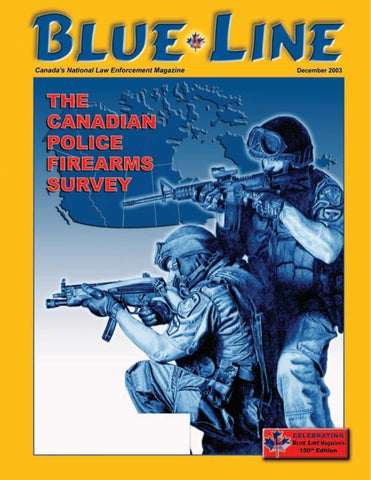
Publisher’s Commentary 5 A judicial common sense revolution is needed Cross Canada gun survey 2003 After seven years Blue Line Magazine checks out police firearm changes and trends across the country
6
Operation Thundercloud Winnipeg Police sharpen their skills at airport rescue excercise
10
South Simcoe Police brace for growth 12
— General Manager — Mary Lymburner, M.Ed.
Hells Angels a never ending story
14
— Editor — Mark Reesor
Combat proven electronic sights Can they survive Dave Brown?
15
YCJA designed to fix YOA problems
18
NEWS CLIPS
19
DEEP BLUE One reason why people do bad things
20
2003 Award Winners Canadian Crime Stoppers
21
By your words ye shall know them
22
— Contributing Editors — Communication Skills Terry Barker Police Management James Clark Tactical Firearms Dave Brown Technology Tom Rataj Psychology Dorothy Cotton Case Law Mike Novakowski
VITALITY Physically fit officers less prone to injury
23
CASE LAW Courts approve investigative detention and search
24
Blue Line Magazine is published monthly, September to June, by Blue Line Magazine Incorporated with a mailing address of: 12A - 4981 Hwy. 7 East, Ste. 254, Markham, Ontario, L3R 1N1. Individual magazines are $5.00 each. Subscriptions are $25.00 per year or $40.00 for 2 years. (Foreign - $50.00 U.S.)
Toronto police and fire services working together
26
Widening the pipe lets laptops shine Hamilton Police take desktop capabilities on the road
28
eMail: admin@blueline.ca
eMail: editor@blueline.ca
— News Editor — Les Linder eMail: news@blueline.ca
— Advertising — Mary Lymburner Dean Clarke Bob Murray eMail: sales@blueline.ca
— Pre-press Production — Del Wall
All material submitted for publication becomes the property of Blue Line Magazine unless other arrangements have been made with the publisher prior to publshing. The authors, advisors and Publisher accept no liability whatsoever for any injuries to persons or property resulting from the application or adoption of any of the procedures, tactics or considerations presented in this magazine. Readers are cautioned and advised that articles presented herein are edited and supplied for your personal awareness and should not be used for further action until appropriate advice and guidance is received from a supervisor, Crown Attorney or other person in authority. Established in 1988, Blue Line Magazine is an independent publication designed to inform, entertain, educate and upgrade the skills of those involved in the law enforcement profession. It has no direct control from a law enforcement agency and its opinions and articles do not necessarily reflect the opinions of any government, police, or law enforcement agency. ©2003 - All articles are protected by copyright. No part of this publication may be reproduced or transmitted in any form or by any means, electronic or mechanical, including photocopying and recording or by any information storage or retrieval system without permission.
Conference promotes investigative skills 29 DISPATCHES
30
Working with community results
31
TECHNOLOGY Computer buyer update
32
Feeding the media Necessary evil or essential strategy?
34
PRODUCT NEWS
36
Simpler and safer gun cleaning
37
COMING EVENTS
37
INCREDIBLE
38
CORRESPONDENCE
38
Community helps injured officer
40 42
Printed in Canada by Janson Printing Service
Fredericton sergeant IAWP officer of the year
ISSN #0847 8538
Ontario city hosts police force games
44
Internet activity is monitored and use or reposting of material on the Internet is restricted.
This publication is a private venture and receives no subsidy or grant from any level of government.
— Affiliations — International Association of Law Enforcement Planners Canadian Advertising Rates & Data International Police Association The Police Leadership Forum The Canadian Press Newswire
Canada Post - Canadian Publications Mail Product Sales Agreement No. 176796 December June 20032003
Police Leadership Award - 2002 nominee 46 3
It’s been seven years since Blue Line conducted its last Canadian firearms survey. At the time, many Canadian police forces were switching from revolvers to pistols and, as Firearms Editor Dave Brown discovered, most are largely satisfied with the choices they made. Brown also turns his attention to electronic sights, testing EOTech’s new Holographic Weapon Sight to see if it can stand up to the rigours of daily police use. In other stories this month, Winnipeg Police conduct a large scale airport rescue exercise; South Simcoe Police prepare for thousands of new residents as the Greater Toronto Area continues to expand north; Dr. Dorothy looks at why some people have a tough time resisting the impulse to do bad things; News Editor Les Linder has an overview of the Youth Criminal Justice Act; Mike Novakowski looks at two cases where appeal courts upheld investigative detentions and searches and Peter Shipley has figures to show that physically fit police officers are less prone to injuries. And finally all of us at Blue Line wish you a very Merry Christmas and Happy New Year.
Michael is a member of the Hamilton Police Service and fills in his spare time working on portrait line art. Blue Line Magazine invited him to contribute to this month’s cover and lead story on page 6. His line art drawing of the two tactical officers, which comprises a portion of this month’s cover, contributed to a very stunning collage when combined with the background artistic talents of Publisher Morley Lymburner. To obtain a copy of any art pieces created by Michael you can do so with the following information; Precise Illustrations 48 Green Trail Drive Mount Hope ON L0R 1W0 Phone: 905 679-3066 Email: msc@quickclic.net
December June 20032003
4
A judicial common sense revolution is needed by Morley Lymburner Quebec, Manitoba and British Columbia have recently undergone the torturous experience of “megatrials” in the past year. These trials have shown a major weakness in the judicial system that will need correcting if any form of justice is to prevail into the future. Exceptional times require exceptional laws and in this day of intimidation and terror it should not simply mean putting a blind up to hide juries. Under these circumstances there should be zero risk of contaminating the court room. One manner in which such matters could be dealt with would be by eliminating the right to a jury trial under certain circumstances. In the case of these “megatrials” there is no way a jury should be put under this amount of stress. They are trying ruthless criminals in charge of terrorist organizations who possess almost unlimited resources to seek revenge. The courts and police have gone to extreme measures to protect the jurors and the courts even to the extent of building entire high security court houses at a price tag into the millions. There is no doubt that when the three cities have completed these trials the price tag will be into the hundreds of millions of dollars. It is time new laws were introduced that strip away the right to a jury trial under certain circumstances. Cases in which jurors could be exposed to a high level of danger or even anxiety would include biker trials and those accused of terrorist acts. As a matter of note there are no greater terrorists in contemporary society than outlaw motorcycle gangs. Their entire existence relies heavily on intimidation of average citizens and authority figures alike. Two dead federal
December June 20032003
corrections officers clearly attest to this. At a preliminary hearing the Crown should be permitted to make application to have the trial by judge or judges alone. The Italian justice system found that it is far easier to protect one judge for the rest of his life than hundreds of average citizens from which a jury is drawn. For years the need for jury trials has been brought into question. In the year 1215, when the Magna Carta granted trial by jury, it was an age when almost everyone spent their entire life in one village. It made the jury trial process manageable. Almost every person knew everyone else and knew how their friends and families could be accommodated within that community. Today’s society has become much more complex than the era in which the jury trial process was first created. We are much more mobile, far more communicative and, of course, far deadlier than at any time in history. How can we expect to be assured that jury trials are free from intimidation in this day and age? Arguments in favour of the jury system point out that juries can find someone not guilty by virtue of bad law even if they agree the person violated the law. The bad law doctrine, however, is not the issue in trying members of organized crime groups and terrorists. Organized terror groups thrive on intimidation with headlines to help backup the threat of reprisals for those who would try to stop or
5
even interfere with their activities. A big part of the Hells Angels’ success is the ruthless business of “taking care of business.” This means an intention to never let anyone get away with impeding their activity. If even one is left ignored or unpunished then their business fails. In such matters, and if left unchecked, every citizen in this country is simply a pawn that lives or dies at their whim. Society can not tolerate this attitude nor permit an environment that supports it. When dealing with individual criminals, jury trials can still work. But not so for organized crime groups. The organizations that come part and parcel with the individual criminal is far more problematic than the pawns they sacrifice. It is the organization that the public must be protected from. It is the organization that is the square root of all fears. Long after an individual is squeezed between the pipes their organizations can busy itself “taking care of business” to ensure any one of the twelve jurors are gotten to as an example for the rest of society. If they don’t hesitate to kill correctional officers I am sure they won’t hesitate to intimidated a stock broker, store merchant or house wife. Society can no longer afford the luxury of juries in terrorist trial situations. It is time to re-think the entire megatrial process and get back to basics. It is time we really thought about how much we are willing to sacrifice to prop up a 788 year old tradition.
After seven years Blue Line Magazine checks out police firearm changes and trends across the country
An extensive Ontario government study of police firearms released in 1993 surprised many by determining that revolvers were unsafe for police use and designating semiautomatics as the only approved sidearm for the province’s police officers. Faced with the possibility of similar studies in other provinces, police agencies across Canada began a pre-emptive move from revolver to semiautomatic. Faced with the possibility of legislated transition, chiefs began to look closely at the advantages of semiautomatics and the merits of the various makes and models on the market. In our first Blue Line Cross Canada Gun Survey, published in January 1996, we noted that the wholesale transition to new sidearms caused a tremendous strain on budgets, manpower and research. We felt decisions had been hastily made, without the resources needed to properly study the range of firearms available, and predicted some agencies would eventually opt for different makes or models. We also expressed the hope Canada would move a little closer to the US model of sidearm acquisition, where officers can choose from the several different makes and models on an agency’s approved list — we were wrong on both counts.
2003 Results
Fast forward to this year — the vast majority of Canadian police agencies now seem to be making good selections, at least compared to the hasty rush to semiautos in the 1990s. It turns out most agencies were quite happy with their original choices; in fact, only three agencies reported switching brands this year and they all went with Glock. Abbotsford and Stratford Police switched from Beretta and Six Nations Police Service from Smith & Wesson. The most notable change for 2003 is Montreal Police, who have nearly completed a transition from revolvers to semiautomatics. This makes the revolver almost completely extinct December June 20032003
among Canadian police agencies, though they’re still issued by armoured car security services in Canada. The debate about whether they’re truly unsafe or just outdated as defensive weapons rages on. Few officers miss the revolver now that they’ve had a decade’s worth of experience with the modern, double-action-only semiautomatic and its ‘point-at-the-bad-guy-and-pull-the-trigger’ simplicity. Revolvers were neither very simple —even with ultra-modern technology, they still had to largely hand-fit each and every part — nor entirely as reliable as their reputation. A tiny flake of gunpowder falling onto the back of the ejector star could lock up the action tighter than a bomb disposal trailer. They also all suffered from one basic flaw; it took fine motor skills to reload them — skills that would not likely exist in an emergency. In our 1996 survey, 168 agencies reported a total of 49,000 sidearms. That number has dropped to 86 agencies and 42,000 handguns this year. While there are fewer agencies due to amalgamations, this number is more reflective of the fact that we had more responses in 1996, when semiautomatics were still ‘gollygee-whiz’ new to the market. 6
The Firearm of Choice
Smith & Wesson leads with 48 per cent of the market, due in no small part to the 18,000 guns bought by the RCMP. The S&W Model 5946 (and its smaller frame cousin, the 3953) have proven to be everything the RCMP hoped for. Most officers report they are happy with its accuracy and satisfied with the force’s choice. This even though Smith is still the only major manufacturer to equip their semiautos with magazine disconnect safeties, which elicit very mixed feelings, even among RCMP members. Glock dropped slightly in overall percentage from 1996 to 2003 but increased sales within its existing customer base. It should also be noted that every agency which switched brands since 1996 moved to Glock. Sigarms seem to be the big winner, climbing from 12 per cent of the market in 1996 to 19 per cent this year. Thankfully, the sales of the debateable and questionable Ruger semiautos seem to have finally died completely. I hope that the few Rugers still left in Quebec will soon find homes far away from policing and out of harms way. . . . continued page 9
December June 20032003
7
The only new make for 2003 is Walther, which sold 4,700 P99 pistols to Montreal Police, who still seem to delight in selecting different sidearms than any other agency in Canada. The ‘Rube Goldberg’ ergonomics of the Ruger aside, any Canadian police agency officer can feel confident that they are now carrying one of the most efficient, effective and safest firearms ever made, regardless of the brand name stamped on the side.
want a tough, plain-talking sidearm that will still function flawlessly, even if you (literally) drive over it with your pickup truck. British Columbia Glock and Beretta are almost evenly split. Vancouver Police have become the first major agency west of Sault St. Marie to not issue Glock.
Is there a winner?
Calibres
Introduced in the 1980’s, the .40 S&W cartridge didn’t take long to catch on with police agencies and Canada seems to have adopted it more than any other country. Although less than half of all firearms reported to Blue Line are chambered for it, that’s because Montreal Police and the RCMP’s 20,000 handguns use only the 9mm Luger cartridge. Sixty four per cent of the 86 police agencies who contributed to our survey use the .40 calibre. Created to fill a perceived need for a larger diameter, more powerful cartridge specifically designed for semiautos, the .40 calibre’s origins can be traced back to the famous Miami shoot out where two felons, Platt and Matix, murdered several FBI agents, despite absorbing numerous lethal hits. In an effort to equip agents with a more powerful handgun, the FBI chose the 10mm Auto cartridge. The fierce recoil, blinding muzzle flash and meaty frames of handguns chambered for this cartridge proved to overwhelm even the most Calahanlike agent and the FBI soon requested a reduced-load version called the 10mm Lite. Smith & Wesson saw an opportunity to design a cartridge with the same diameter bullet and similar ballistics as the 10mm Lite but contained in a much shorter and more efficient case. This meant that existing 9mm frame sizes could be easily adapted to the .40 S&W cartridge. Meanwhile, cartridge manufacturers didn’t ignore the 9mm Luger. Incremental designs in bullet efficiency now mean that both the .40 calibre and the 9mm perform as effectively as possible. In bullets, bigger is always better but that must be balanced by the reduced magazine capacity of the slightly larger cartridge. The overall winner remains the officer. Either chambering can be carried with confidence and the knowledge that it will get the job done.
sizeable sale to Montreal Police. Only time will tell if the over-engineered design and complicated manual of arms inherent in the Walther pistol will also miss the boat. Ontario There is an almost even split between Glock, Smith & Wesson, Sig and Beretta in the province where the transition to semiautos first began. Ontario police agencies all rushed to the latest technology when pushed to adopt a new sidearm — they just couldn’t agree on who had the best technology. Prairies With only a couple of exceptions, Manitoba, Saskatchewan and Alberta love their Glocks. Although officers will steadfastly deny that the cold prairie winters had a bearing on their selections, the polymer-frame Glocks are just plain easier to grab at minus 40 — or perhaps it’s just that the tough, plain-talking prairie folks also
Regional trends Maritimes New Brunswick and Nova Scotia are among the strongest supporters of the 9mm cartridge, perhaps because of the areas military heritage. Nova Scotia legislated the Sig Sauer pistol for all municipal agencies. Quebec Quebec has always gone its own way and their choice of police sidearms reflects this. Not only is the province home to some of the last Ruger holdouts, police in its largest city are the only Canadian force to select the Walther semiauto. Walther may have missed the original boat from Europe but succeeded in finally breaking into the Canadian market through the December June 20032003
9
Based on our latest results, it appears Canadian police agencies made very good choices of sidearms back in the 1990’s, even under the pressures of time, budgets and lack of research. There is an even greater choice of makes on the market now but most agencies cling fiercely to their original selection. Although a few have gone from 9mm to .40 calibre, this is more a reflection of how popular the .40 has become here. The clear winner is, just like we said in 1996, the officer who carries one of the most modern and efficient sidearm designs in history. Dave Brown is a regular Blue Line columnist. He can be reached at firearms@blueline.ca. Statistics gathered for this survey were obtained from 87 police agencies from across Canada. This includes all major cities and provincial and federal agencies. Blue Line Magazine would like to thank all the Chiefs and Commissioners of Police and their support staff for making this survey a success. Any police agency wishing to see the raw data can do so by sending an eMail request to: publisher@blueline.ca
Winnipeg Police sharpen their skills at airport rescue exercise by Darrall Kotchon The Winnipeg Police Service (WPS) staged a major aircraft hostage rescue training exercise at the city’s international airport in September. In addition to the WPS Airport Unit and staff from the Winnipeg Airport Authority (WAA), more than 50 WPS officers and staff participated in the successful exercise, including members of the emergency response, crisis negotiation, bomb, public safety, canine and protective services units. Technical Support Response Team and Communications Centre staff were also involved. S/Sgt. Mike Ryudyk of the WPS Special Operations and Support Unit headed planning and public information and organizational development division officers, video production
December June 20032003
unit, newsletter and other members coordinated actors and observers from the RCMP, Winnipeg Airport Authority, Canadian Forces and other police agencies. The exercise was an example of the iron fist, represented by ERU, and the velvet glove, repre- Field command central for Operation Thundercloud. Sitting sented by the Crisis Negotiation bottom left is P/Sgt. G. Burnet (CNU), RCMP Staff Sgt. Unit (CNU), who work hand in Dan Murchison, standing in background Cst. G. Anning hand to resolve incidents. One (driver of support unit) facing camera in center S/Sgt. John can’t work without the other. Ne- Ormondroyd (CNU Coordinator), RCMP Cpl. Joanne Ryll gotiators use communication tech- -( Negotiator observer) back of head D/Sgt Bob Legge niques to resolve most situations (CNU) and P/Sgt Dave Black (CNU). — the FBI says some 97 per cent of incidents are resolved through negotiations. When they take a dangerous turn comes in for a tactical resolution. though, the velvet glove comes off and ERU As always, the incident commander, Supt. Bill Evans, was the key to this exercise, ably assisted by Inspectors Keith McCaskill and Art Stannard. “ERU and CNU gave me their debriefing, it’s up to me to make a decision,” Evans said. “They both have definite ideas of how to do things. That’s the whole idea of having an incident commander to process the information and get the results we want. I thought it was an excellent exercise and all our people who took part were able to demonstrate the lessons learned. They were able to accomplish the mission.” P/Sgt Dave Black was the CNU Coordinator and updated Evans on negotiations. He was impressed with how Evans handled things, noting “he was making some hard decisions in there.” Cst. Leanne Ainley was on hand to assist observers by updating them on events. The scenario has many things happening at once and she was responsible for coordinating the vast amounts of information and making it understandable to the public and seasoned officers on hand to observe the events. The WPS ERU has been receiving addi10
tional hostage rescue training from Peel Regional Police in recent months and have also trained with the FBI, US Secret Service, RCMP, Canadian Forces, and National Tactical Officers Association. The Calgary Police Service (CPS) assisted them in setting up the exercise. PSU and ERU members were trained in specialized equipment over the weekend and the culmination of their training was a tactical response that was over in seconds. “I was in the plane when the rescue took place,” P/Sgt. Michelle Benoit said, “and if you blinked, you would have missed it.” “It was an excellent exercise,” ERU Coordinator Sgt. Norm Tchir said. “We had to have undisputed control and we did.” He was quick to credit the RCMP ERT for their assistance, adding “we couldn’t have done it without them; it was a joint exercise. We worked well with their help.” Winnipeg’s CNU has also been busy this year. Members have been continually upgrading their skills through training with the FBI, RCMP and CPS and have also been called upon to share their skills with other agencies. S/Sgt John Ormondroyd and Black of the CNU are sought after speakers and McCaskill has also been in demand for presentations on his role as an incident commander. They’ve trained officers at the Canadian Police College and conducted presentations in Nova Scotia, Arizona, and Las Vegas and are planning a presentation in St. Paul, Minnesota. The WAA is required to conduct this training every three years. In close consultation with the WPS Airport Unit, under the leadership of Sgt. Robert Sullivan, WAA staff members and WPS airport officers were integral to the year of planning that went into making this training exercise possible. In addition to fulfilling their duties as part of the exercise, they provided important leadership and insight during every step of the process, from planning the event, assisting with preexercise training, supplying equipment and ensuring the proper documents for airfield access were provided for everyone involved. The Public Information Unit was also involved in setting up this training. Cst. Bob Johnson, P/Sgt. Devon Clunis and James Ham assisted the actors and mock hostages with roleplaying and were responsible for developing the scenario and script. “It was a challenging task to develop a workDecember June 20032003
able and realistic scenario that not only challenged our resources but was an effective learning tool as well,” Johnson said. “It was the cooperation of other officers and their knowledge
11
of police work and creativity that allowed us to produce what was felt to be a successful training scenario.” Although an exercise of this nature is unique, the training by all members is applicable to many daily situations faced by police officers. WPS members called on to the scene of a potential suicide, armed and barricaded situations or a high risk warrant should be encouraged not only by the level of skill and dedication displayed by these specialty units but also their ability to work together cohesively to get the job done. Darrall Kotchon is a constable with the Winnipeg Police Service CNU.
Ready for today and planning for tomorrow
by Mark Reesor
Perhaps it’s a result of living and working in the shadow of Toronto but the first thing I noticed on a ride along with the South Simcoe Police Service were the friendly waves and smiles officers regularly receive. Although Bradford, where the south division is located, is just 40 kilometres north of the ‘megacity,’ it’s a world away when it comes to how most residents respond to police. The first wave, and a friendly smile, came from a pleasant looking man in his mid 60s who stopped to let us turn out of the downtown police station. Obviously a senior raised right and taught to respect police, I thought to myself. We then passed a group of teens, who also turned, smiled and waved. There were no raised middle fingers — I checked — and they seemed genuinely happy to see the officer I was riding with, Cst. John Kelly. The station is located in what was once an attractive residence which has been used by a number of town departments over the years — “a nice old house but it makes a poor police station,” observes Chief Bruce Davis, who hopes construction on a new building can begin soon. Kelly came to South Simcoe from the Jane/ Finch neighbourhood of Toronto a little over a year ago and noticed the difference immediately. “Kids will come running all the way out to the road just to say ‘hi’ and I’d wonder why. It threw me off for the first while — I wondered what they wanted. Last summer I was driving around and some guy has a barbecue in his garage; I pulled off and told him it was flaring up a bit and he said ‘well come on over and help me cook!’” As a Toronto police officer he wasn’t allowed to eat in restaurants “but here they say ‘oh yeah, mark yourself off and go on in — be part of the community.’” It wasn’t just the friendliness of the locals that took some getting used to. Kelly soon found out there was no more phoning in reports or arresting suspects, doing a minimal amount of paperwork and handing the case off to a detective as he did in Toronto. “Here you do the entire report yourself; you’re the officer in charge,” he says. “You can try forwarding it off to the detective but you get it handed back saying ‘this one is yours!’” Youth gangs, an increasing concern in Toronto, are also less of a problem here, he continues. “You have different groups of kids doing things here but it doesn’t seem as organized. Rumour has it there’re kids here running around with knives and things like that, but it’s all rumours. I’ve met with the kids, I’ve talked to and arrested different ones and didn’t find weapons on them.” He pauses and asks if I smell gas, which turns out to be leaking from an old pickup truck making a left turn in front of us. The driver claims the tank had just begun to leak and he’s arranged to have it fixed the next day as soon December June 20032003
South Simcoe Sgt. Robert Eeles shows off the Service's new Honda Element, leased from a local dealer at a substantial discount. as he gets paid; Kelly’s dubious but, after pointing out the obvious danger, gives him 48 hours to prove he’s made the repair. The tank is rusty and will likely have to be replaced, he tells me. “I doubt it’s worth doing given the condition of the truck but I’ll give him the chance to do it,” he tells me, adding that “in Toronto it would have been towed.” Another big difference is fewer calls for service; Kelly estimates he averages about five calls per shift, with one or two priority and the others the routine “be good, play nice” variety. There’s a lot to keep officers busy though, says Cst. Jeff Varey, the second officer I rode with. The force patrols a large area — north to the city of Barrie, west to Hwy. 27, east to Lake Simcoe and south to the Holland River — and officers respond to everything from a barking dog and cattle on the road to high priority calls. No call is the same and anything can happen at any time, Varey says — and unlike bigger services, when something big happens, you see it through from being the first officer on scene, arresting the person and taking it through the court process. “It’s pretty much you start it, you finish it,” he says, “and I like that.” Something he’s not so fond of is the time it can take to come to the aid of a fellow officer, one of the downsides to patrolling such a large area. That point was neatly illustrated as we were leaving the area where the Service’s marine unit is based, in the northern part of the patrol area. Varey hears over the radio that another officer has stopped to talk to a vagrant on an off-ramp at Hwys 89 and 400, near the south end of the patrol area. We immediately start heading toward him. Varey radios to see if he’s okay but there is no response. He checks several more times before the officer says everything’s 10-4. We slow down a little but continue — there’s no way of knowing who the vagrant is or what he’s up too and it’s better to be safe than sorry, Varey says. We reach the officer’s location to find the 12
vagrant, a quirky fellow who claims he’s hitchhiking to a friend’s house, seems harmless, though he is carrying gasoline and some other unusual items; the officers tell him to keep moving and we clear the call. The time it took to reach him would have seemed like a long wait if there had been trouble, Varey observes. One thing he does like is how well he’s been able to get to know the area and its people, which has its advantages. “If we get a warrant for a person, we find them that day,” he notes. “You know the area and it’s not difficult to find them — but it’s the same for them if they want to find you.”
Knowing that you’re going to see people you deal with on the street the next day helps keep officers on their best behaviour, he adds, especially since people who want to complain can just pop in and see Chief Davis. There’s no question the chief has high standards. Simply the best... better than all the rest and Quality of Service posters are displayed prominently in the station. Davis says his goal with South Simcoe, an amalgamation of the Innisfil and Bradford/West Gwillimbury police forces which began policing the area in 1997, was simple — get the best of the best. The ever expanding Greater Toronto area and proximity to Barrie, which claims to be the fastest growing city in Canada, has had a big impact on South Simcoe, which is getting the spill off. The service has grown to 66 officers and 23 civilians policing urban (Bradford and Innisfil), rural and cottage areas, Hwys 11 and 27 and the busy Hwy. 400 corridor. While the Ontario Provincial Police (OPP) handle traffic on the 400, criminal offences are South Simcoe’s responsibility — “if there’s a body in the ditch on 400, that’s ours, not theirs,” Davis explains. The service has a close working relationship with the York Regional Police and has occasionally called in its helicopter, which is based just east of Bradford in Holland Landing, for assistance with major occurrences or searches. It also works closely with the OPP. There’s talk of a lot of development in the area; one developer says that with the northerly extension of Hwys 404 and 427, in 15 years Bradford will be just like Vaughan, a sprawling urban area just north of Toronto, which also claims to be Canada’s fastest growing city “in terms of new construction.” Cottage and resort areas along the water are fast becoming year-round subdivisions, a trend that’s expected to accelerate. “We’ve coined the term policing a community of communities,” Davis says. “There are still little towns and villages throughout” and farms where officers still occasionally have to herd cattle or horses, for example, if a fence breaks. The service has enjoyed overwhelming support from the community, says Davis — “I couldn’t ask for it to be any stronger.” Friends of South Simcoe Police recently raised $50,000
December June 20032003
in three months for the canine unit and another $50,000 to install mobile workstations in the cars. It’s not a traditional system; developed through a partnership with Ericsson and Rogers AT&T, it uses GPRS (General Packet Radio Service) terminals and phones to send voice and data through the Rogers cell phone network. “We’ll be able to work anywhere that there’s a GPRS signal,” notes Davis. “It could even be Europe or the United States.” The system uses military grade encryption software, ensuring that no one can monitor transmissions, and switches to a wireless LAN (Local Area Network) when officers are close to stations. Officers will be able to get e-mail and enter data in the car and access dispatch and the records management system. There have been some problems getting the system up and running but Davis is confident it will work well and cover the service’s area better than the current radio system. A GPS locator system is also planned. The community has also helped raise money to pay for an Airstream Trailer, used at major crime scenes, snowmobiles and a marine unit. “We bought our original boat for $1,” Davis says. “When it came time to replace it, I said I’d pay twice as much!” The service didn’t get quite that good a deal but Doral Boats, which was based in Innisfil at the time, agreed to sell them a 25 foot launch worth $72,000 — “a really nice boat” — for $30,000 and a local yacht club provided a berth at no charge. With 45 miles of lakeshore to patrol, having a reliable boat was crucial, Davis says. When the number of fatal car accidents rose to 10 in 2001, the service stepped up enforcement with two stealth cars and leased a motorcycle, handing out some 1,700 tickets and reducing fatalities to five the next year. Community fundraising paid for the first year of the lease. The Option Four program — a TEAM (Traffic Enforcement Alternative Measures) school for people who get tickets which meet certain criteria — adds about $500,000 a year to the service’s budget. Individuals have five days to attend the school, which is held twice a week and costs $100, and write a test on the rules of the road. Pass the test and your ticket is cancelled.
13
The public has embraced the program, Davis says, and really appreciate the second chance. “Take someone who has been driving for 25 years and has never had a ticket (for example), and just happens to be in a hurry and go through radar. They’re pretty happy because they still have a clean record and they have a refresher course, which is great because they probably haven’t been to a driver’s exam or looked at a handbook since they got their license.” “Everybody uses ‘community policing’ as a buzzword,” Davis notes. “It’s not a buzzword. It is actually employed here.”
$
Hells Angels a never ending stor y by P.A. Sévigny The good news about the The Road to Hell is that William Marsden and Julian Sher have written a timely, sometimes interesting book about Canada’s outlaw motorcycle gangs. It has a catchy title, fancy cover and is on the shelves in time for the Christmas rush. Advance publicity stirred up a tidal wave of reaction, including serious questions about why the RCMP ‘looked the other way’ while they knew that their informant, Danny Kane, was personally involved in almost a dozen different murders. Others are concerned about the jealousy, rivalries and basic incompetence that nearly sabotaged ongoing criminal investigations. At least one senior police official is in trouble with his department over trivial matters revealed by the book and other heads are likely destined for the chopping block. The bad news is that the book’s research is uneven. Although its strong narrative line takes place during Montreal’s infamous biker war, descriptions of biker activity in the rest of the nation barely scratches the surface of what could be one of the biggest crime stories of our times. Both authors are well-respected journalists who live and work in Montreal. Their previous work has won well-deserved awards but The Road to Hell leaves the reader hungry for more. Readers are left to wonder, for example, how Maurice ‘Mom’ Boucher, a unilingual, French speaking high school drop-out, could crawl out of the depths of east end Montreal and build a multi million dollar criminal empire that controlled all the cocaine bought and sold in the city down to the last quarter gram. The book has many strong points. The authors believe the RCMP’s complacent attitude during the biker war’s early stages cost many lives and set the stage for them to stretch their strength across the nation. They make serious points about the growing sophistication of criminal cartels. However, the book’s research, as a whole, is uneven. The problems begin with the cover and its black and white picture of a muscle bound, tattooed goon — a stereotypical image that gives readers the wrong idea of what bikers are all about. The Canadian biker leadership are, for the most part, not greasy hoodlums but wellgroomed and dressed men who usually drive a
Cadillac SUV with tinted windows. They ‘take an appointment,’ have breakfast meetings with their accountants, discuss tax schemes and offshore real estate and consider better ways to hide their money, just like any other wealthy, whitecollar Canadian criminal. The Harley stays locked in their suburban garage. This book sometimes lacks a proper sense of scale. The authors have nothing to say about the day when ‘Mom’ sent a message to US Angels president ‘Sonny’ Barger, telling him not to poke his nose into Hells business in Quebec. A highly placed and well-respected Montreal police source said Barger heeded the advice, saying “Barger backed off because he knew that Boucher was dangerous. Barger knew that it didn’t pay to have ‘Mom’ annoyed with you.” Both Marsden and Sher should have understood that standing up to Sonny Barger is how you separate the men from the boys in North America’s biker underworld. That’s how biker legends are born. The reader is left hungering for the gritty details that were at the heart of this bloody conflict. Very little is said about the gruesome ‘turf war’ fought in Montreal’s southwest, for example. The Road to Hell pales besides Peter Paradis’ Nasty Business, a grim description of the back alley, kick in the crotch, eye-gouging brawl Boucher fought to win and keep his control. While Paradis is a survivor of the notorious biker war, he was also one of its victims; shot four times in the back by a Hells ‘hit-team’, he said “that’s when I knew that none of this (his street life) was worth it.” Also ignored is how the Hells have taken over Quebec’s prisons, reaping massive profits
from drug sales because they control the institutions. “The truth is that the Hells run the jails,” said Nikolas Gagnon, a prison guard union official. “We just count heads and lock the doors.” The book does do a good job of describing how police finally put together the case that put Mom behind bars for what will probably be the rest of his natural life. Police seethed when Boucher was acquitted and walked out of court after his first trial, followed by cheering bikers — but the book effectively ends with him being found guilty in a second trial and sent to jail for murdering two prison guards. The ‘Boucher’ story dominates, even though the authors make an effort to cover the biker story across the country. They don’t show the scale of crimes being committed or mention how much money the Hells make off their dope business. Recent court records show Boucher’s Nomads took in $110 million over 11 months and cleared nearly $15 million, more than a million per member in less than a year. That kind of money needs a good accountant and buys the best lawyer in town and power that reaches into the highest levels of government. In fact, informed readers will notice how the book neglects to mention how a Superior Court judge was recently tried and convicted of ‘cleaning’ money for the Hells’ in Laval. Sentenced to three years in jail, he was released after serving a year and a half. It also has nothing to say about the who’s who of Quebec’s show-biz and sports world who were happy to be photographed with Boucher. Despite its faults, The Road to Hell is a valuable addition to Canada’s growing body of biker books, joining Yves Lavigne’s Taking Care of Business and Peter Paradis’ Sale Job. There is real meat here, solid and valuable information. This could be the book that will force our nation’s police forces to be more aggressive, which they need to be if they want to win their war against the cutting edge of organized crime. There is no end to the Hells and their story. Even if ‘Mom’ and his Nomads are going away for a long time, Québec’s Angels are still busy building their highway to hell. While Montreal’s drug market is still worth at least $120 million per year, the traffic is heavy and becoming worse and the tolls are getting very expensive. Albert Sévigny is Blue Line Magazine’s Quebec correspondent. He can be reached via eMail at albert@blueline.ca.
December June 20032003
14
Combat proven electronic sights are tough But can they survive Dave Brown?
by Dave Brown “Push this button, it turns on,” said EOTech technical sales rep Mike Curlett. That was all the training I needed to fire up the company’s new Holographic Weapons Sight (HWS). The optical electronic sight may appear simple but its complex technology became apparent the moment I tried to photograph the image of the reticle (aiming point). “It’s a true head’s-up display,” explained Curlett as I struggled to focus my camera. “Your eye can see it clearly in focus but the reticle is an actual holographic image projected onto the display window and focused on the same plane as the target.” Wow. Just like a Head’s-Up Display (HUD) in an F-16 fighter jet. My eye could see the reticle sharply superimposed against the target, but my camera insisted that either the window or the reticle was in focus, not both. I finally gave up and shot them separately, relying on photo software to stitch them together. Tested in combat For years, HUDs have allowed fighter pilots to keep an eye on the threat while maintaining situational awareness of position, altitude, heading, airspeed and surrounding threats. Situational awareness is also important for po-
December June 20032003
The sighting reticle is focused about 20 feet in front of the sight, allowing you to keep both eyes open and watch your threat in sharp focus while superimposing the reticle on the target area. lice officers and that’s where electronic sights shine. Unlike traditional open sights, they allow you to keep potential threats in full view while aiming toward a spot on the target area. This is important whether your threat is a fighter jet, quadruped or biped. Electronic sights (and similar optical tube sights using tritium reticles) have been used with great success by specialty police and military
15
The EOTech mounted using a B-Square slide-on shotgun mount that provides a weaver-style base for shotguns simply by popping out the two trigger group pins and replacing them with the B-Square screws. teams for years. First seen by the public in images from Desert Storm, the unmistakable deserttan silhouette of the Aimpoint or EOTech sight is seen nearly every day in news reports from Iraq atop battle rifles carried by regular troops. Electronic sights are no longer the fragile toys they were once thought to be. Heads-up sights Powered by batteries, electronic weapon
sights don’t project beams like lasers but rather superimpose a reticle on an optical lens enclosed within a square or round tube. Unlike telescopic sights, they don’t magnify images, which isn’t desirable for fast, close and intermediate-range shooting police encounter. There’s no critical ‘eye relief distance,’ which requires the eye to be placed precisely behind a scope to get a full field of view through the lens. Electronic sights can be mounted at any convenient distance from the natural position of the head and don’t require shooters to carefully align eye, tube, reticle and target. The concept of eye relief is painfully familiar to high-power rifle shooters, who learn the consequences of an eye-relief distance shorter than the rearward travel of the rifle under recoil. The distinctive, half-moon shaped scar directly over the master eye is commonly referred to as ‘scope bite’. Electronic sight designs don’t have parallax error, which simply means that the telescopic sight reticle is only accurate if the crosshairs are exactly centred within the tube. It’s similar to the angular error from projecting a radar beam at an angle to your target vehicle. With electronic sights, the dot or reticle can appear anywhere on the optical lens; the shot will land where you see the aiming point. The EOTech’s large glass window is especially suited to this; even if it’s mostly obstructed by mud or snow, you simply alter the angle slightly and move the reticle to a clean portion. The tube almost seems to disappear from view with electronic sights and you see a full view of the target and area, with a dot or reticle superimposed on your aiming point. Electronic weapons sights The military didn’t invent electronic weapon sights. They were first popularized by practical pistol shooters who dominated unlimited class handgun competitions using their unbeatable combination of fast target acquisition and close range accuracy. They’re now mounted on every type of firearm used for sports where placing fast shots on multiple targets means the differ-
December June 20032003
Who says you can't use a shotgun near hostages? Both these 12-pellet OO buck shots were fired from 21 feet in under two seconds. ence between winning and losing. Manufacturers now combining the speed and accuracy of the electronic sight with the durability of military-spec optics. If they can be mounted on a handgun or assault rifle for fast, close-range shots, I figured they would also be ideally suited to shotguns and mentioned to Curlett at the last Blue Line Trade Show that perhaps it was time to consider electronic sights for ALL patrol weapons, not just specialty teams. They would have to be durable enough to withstand rolling around in freezing cold or blazing hot trunks, reliable enough to turn on quickly with one flick of the switch every time and require little or no maintenance. The battery life must also be sufficient to still function months after your partner forgot to turn it off. EOTech had the sight in my hands two weeks later and assured me I could perform any conceivable torture test and they wouldn’t complain, even if it was returned in pieces. They went out of their way; Aimpoint didn’t respond to phone or e-mail requests for a sample. Range tests EOTech sent me a Model 510 HWS with a 20 position brightness setting and the AA-battery option for long service life. I mounted it on a Remington police issue 870 shotgun, using a Weaver mounting base, and headed out
16
to the range for some live-fire tests. It took five minutes to dial in the aiming point off the bench and I was ready for some fast target shooting off the shoulder. Using the quick-release feature, I directly compared its speed and accuracy with an electronic dot sight taken off a competition pistol and the standard rifle sights that came on the shotgun. I used an electronic range timer set to a random start signal and recording the time it took me to react to the start beep, acquire the sights and knock over four reactive shotgun targets at seven meters. Although I recorded several trials with each sight design to ensure consistency, the first is the best test. In a real life situation, only the first shot counts, since you’re unlikely to be able to keep firing until you’ve reached an optimum combination of time and accuracy. Remington 870 Pump Action Shotgun 4 Shots on 4 targets at 7 meters EOTech HOLOgraphic Weapons Sight 2.45 seconds Tasco Pro-Point electronic dot sight 2.53 seconds Remington rifle sights 3.96 seconds
The results above show the electronic sights were not noticeably faster in target acquisition than the shotgun rifle sights. The next test was performed only with the EOTech. I fired four slug rounds into a silhouette target at 50 meters. Holding the empty shotgun upside down, I then dropped it from waist height so it landed directly on the protective hood of the HWS. I removed it from the mount and tossed it several times downrange. Just for fun, I cleaned off the dirt by leaving it in a bucket of water overnight and returned the next day to remount it and fire another four slugs. As you can see from the photo on page 17, there was no appreciable change in the point of aim. To test battery life, I left it at the default setting, causing the sight to turn off after eight hours, and then just kept pressing ON several times a day. After a month and more than 300 hours on one set of AA batteries, I became bored — there was no sign of the display dimming. The only adverse results from the tests were
a few scratches and gouges in the hood. HOLOgraphic Weapons Sight The HWS is a military grade, electronic optical sight that’s waterproof, fogproof and shockproof. It uses a laser diode controlled by an encapsulated microprocessor to project a hologram image of a sighting reticle onto a hardened, three-layer, laminated glass window with a special non-reflective coating. No visible light escapes from the side or front that would give away your position on even the darkest night and the HWS is undetectable by night-vision equipment. Unlike dot sights, there’s no protruding switches, adjustment dials or battery compartments to obstruct your vision. The display window is protected by a hardened metal ‘roll bar.’ It’s available in several variations and alternate reticle patterns, including graduated sighting ‘ladders’ designed for use with gas and intermediate-force projectile launchers. The Model 510 uses a 20-position switch to control brightness for a variety of lighting conditions. It’s waterproof to three meters and comes in two sizes; the shorter body has two ‘N’ size batteries, good for 100 hours of continuous use, and the longer body houses two AA cells for over 500 hours of continuous use. The Model 550 is waterproof to ten meters and uses a 30-position switch, ten of which are night-vision (NV) capable settings. It’s fully compatible with night vision helmets and goggles. Both models feature a quick-release mounting system which quickly attaches to any Picatinny or Weaver style mounting base.
December June 20032003
A Simunition round went through the lens of this sight, but since it only reflects the reticle back to the eye, it still works. There’s no parallax error so the shot lands where the reticle appears. This is great for ‘crossdominant’ shooters who have a dominant eye and dominant hand on different sides. Mounts are available for most popular rifles and shotguns; when mounted on a shotgun, the sight raises the head slightly so the mount should be as flush to the receiver as possible. In fact, if I were to select the EOTech for general patrol shotguns, I would drill and tap the top of the shotguns for a solid Weaver base. Not every vehicle rack can accommodate a mounted electronic sight but it may just be a matter of simply changing inserts. Getting used to shooting with electronic sight takes just seconds and most first-time users wonder why more agencies haven’t gone to them sooner. It’s obvious why they’re a hit with
17
Dear EOTech - We just KNOW you're going to laugh at this. First we fired a four-shot group under three inches at 50 meters with slugs, then dropped the shotgun so the protective hood landed on concrete, removed the sight and left it in a bucket of water overnight. We repeatedly tossed it the full length of the gun range, cleaned off most of the mud and fired a second slug group. This is the result. Sorry about the dents; we're sure those scratches will buff right out... the US Army Special Forces. Waterproof, shockproof and able to maintain their ‘zero’ in the most trying conditions, they have proven themselves in real combat situations. Perhaps they can even stand the toughest test of all — being mounted in a patrol car. Dave Brown is a regular Blue Line columnist. He can be reached at firearms@blueline.ca.
YCJA designed to fix YOA problems by Les Linder Nearly 17 years of frustration with the Young Offenders Act (YOA) demonstrated that it didn’t provide the clear direction needed to help solve problems in the Canadian youth justice system. The Youth Criminal Justice Act (YCJA), which came into effect April 1, was designed to address long-standing problems, including: • A system which lacks a coherent youth justice philosophy • The highest youth incarceration rate in the Western world • Courts being over-used for minor cases that can be better dealt with in alternative ways • Inconsistent and unfair sentencing • Ineffective reintegration of youth back into society • An overly complex transfer process to the adult system which resulted in unfairness and delay • A system which doesn’t clearly distinguish between serious and minor offences • A system which doesn’t sufficiently recognize the concerns and interests of victims The YCJA attempts to remedy these problems by adding new elements in its approach. For example, it contains a declaration of principle that makes the youth justice system’s purpose clear. The principles emphasize that protecting society is its primary objective. it also underscores the rights and responsibilities of youth and society in addressing youth crime. Its primary principles are: • Protection of society, to be achieved through prevention, consequences for youth crime and rehabilitation • Young offenders should be treated separately from adults under criminal law and in a separate system that emphasizes accountability, while keeping in mind the dependency and level of maturity of the accused • Hold the offender accountable; address the youth’s behaviour, reinforce respect for social values and encourage repair of the damage done to victims and the community • Respect gender, ethnic, cultural and linguistic differences, involve the family and community and be responsive to the circumstances of youth with special requirements • Parents and victims have a role to play in the youth justice system and should be kept informed and encouraged to participate Sentencing One of the major concerns with the YOA was that it didn’t provide clear guidance to judges on sentencing. The principles were too general and inconsistent with each other. The new act: • Gives youth justice courts the power to impose adult sentences when youth 14 or older are convicted of offences punishable by more than two years in jail • States that the purpose of sentencing is to hold youth accountable for their behaviour in a December June 20032003
way that fits the seriousness of what they’ve done and their level of maturity • Expands the offences for which convicted youth are expected to be given an adult sentence to include a pattern of convictions for serious, violent offences • Includes 14 and 15 year olds among offenders who are expected to be given adult sentences • Creates an intensive custody and supervision sentence for the most high-risk youth — repeat violent offenders or those who have committed murder, attempted murder, manslaughter or aggravated sexual assault. These sentences are intended for those with psychological, mental or emotional illness and would require a plan for treatment and supervision of the offenders. • Encourages community-based sentences where appropriate, such as compensation or restitution to the victim, community service or probation • Permits harsher penalties for adults who fail to comply with an undertaking made to the court to supervise youth who have been denied bail and placed in their care • Permits victim impact statements to be introduced in youth court Records and publication The YCJA permits publishing the names of all youth who receive an adult sentence; printing the names of 14-to 17-year-olds who are given a youth sentence for murder, attempted murder, manslaughter, aggravated sexual assault or repeat violent offences may be allowed. Publication would also be allowed if a youth is at large and is considered by a judge to be dangerous. The Crown can give notice at the beginning of a trial that it won’t seek an adult sentence in a particular case; this means the young offender receives a youth sentence on conviction and their name isn’t published. The records of youth who receive adult sentences are to be treated the same as those of adult offenders and can be accessed by authorized people such as victims, police officers or school authorities. Custody and reintegration A critical weakness of the YOA was that it failed to ensure effective reintegration of youth after release from custody. The YCJA includes provisions to assist them in reintegrating into the community; the focus of every custody sentence must be on reintegration and helping the young person not to re-offend. The YCJA emphasizes that custody and supervised reintegration contribute to the protection of society. It also places conditions on when and where a young person can be held in custody. In general, youth must be held separately from adults to reduce the risk that they will be exposed to adult criminals. Prov18
inces are also given more flexibility in deciding where a convicted young offender should be placed and grants flexibility in moving those who become adults while in custody into adult facilities. A maximum age of 20 was established as the limit for the youth justice system, but the YCJA permits provincial authorities to keep an offender in the youth system beyond that age if appropriate. Judges are required to impose a period of supervision in the community equal to half the period of custody. This allows authorities to monitor and control the young person and to ensure that he or she receives the necessary treatment and programs to return successfully to the community. Youth workers must work with a young person who is in custody to develop a reintegration plan. They must set out effective programs and treatment for the youth when he or she is in custody or serving the period of supervision in the community. Conditions must be imposed during supervision. Keeping the peace and reporting to authorities is mandatory, optional conditions are targeted to a youth’s particular circumstances and could include measures to build structure in their life, such as attending school and finding employment. Measures outside the court Many young offenders brought into the justice system for minor offences could be more effectively dealt with in less formal but meaningful ways in the community that focus on repairing the harm done. These options are often faster and more effective because they can involve a large array of community groups and services as well as the victim, offender, parents and others. They can also be specifically designed for the needs of an individual. Options could include: • Verbal warnings and cautions from police • Informal police diversion programs, such as referral to a program that involves them, their family, the victim and others in addressing their offence • Formal programs requiring community service or repairing the harm done to the victim through compensation or restitution The act also requires police to consider all options, including informal alternatives, before laying charges and the provinces can require Crown counsel to screen charges before a youth is charged. These measures are intended to help ensure that the more expensive and formal court process is used for youth crimes that warrant it. The federal government has committed $206 million over the first three years of the YCJA to implement it, in the hope of achieving a fairer and more effective youth justice system.
VANCOUVER — The Vancouver police department’s early retirement program is causing more officers to retire earlier than was expected. Forty-eight sergeants are retiring, and leaving 12 senior positions that can’t be filled. Inspector Bob Rolls has been at the head of a police human resources committee for over six months trying to find solutions to what he called a crisis. As of Dec. 1, there will be 178 open positions on the service — 30 more than was expected. Rolls said it will result in cuts to almost every unit in the department. Currently, there are officers qualified to fill 36 of the 48 sergeant jobs, but no more. The remaining 12 won’t be able to be filled until next year at the earliest, when more junior officers are expected to be eligible for promotions. An intensive police recruiting drive may provide up to 150 new officers by next year, Rolls says, but they will be younger, less experienced officers who will literally change the face of the Vancouver service. The average Vancouver patrol officer has three to five years of experience, Rolls says. Ten years ago it was twice that. He expects the age to drop even more as more senior officers retire. The consequence of that, says Rolls, could be a service of more enthusiastic, energetic officers, but with significantly less on-thejob and life experience. The losses are the result of unexpected
December June 20032003
changes in the officers’ pension plan. In March, the Municipal Pension Board concluded that improper indexing of officers’ supplemental pensions violated the Income Tax Act. As a result, the board announced changes that could result in some officers losing as much as $500 in monthly benefits if they stay on past Dec. 1.
the test can be charged with refusal and then face the same consequences. Quebec and British Columbia have similar laws, but police don’t have the power to take away a driver’s licence on the spot - even if the suspect shows obvious signs of drug impairment.
*** WINNIPEG — Manitoba will be the first province in Canada to introduce a law allowing police to take drug-impaired drivers off the road. Justice Minister Gord Mackintosh says the changes will allow police to administer roadside drug tests to drivers suspected of being high on marijuana, cocaine or prescription medication. The testing isn’t recognized under current law in Manitoba. Those who fail the tests under the planned changes will have their driver’s licence suspended for 24 hours or more, depending on the circumstances. Details of the amendments to the Highway Traffic Act are still being completed, but Mackintosh expected it to be law by spring 2004. In Manitoba, the administrative changes means drug-impaired driving will carry the same penalties as drunk-driving, enabling officers to demand that a drug-impaired driver perform a standardized field sobriety test. If the driver fails three short tests to display proper mental and physical co-ordination, the officer can revoke that person’s driving privileges for 24 hours or more. A driver who refuses to take
*** REGINA — The jury at a coroner’s inquest determined in October that a mentally ill man who fatally stabbed his young son in front of onlookers died in the back of a police cruiser of excited delirium. The six-member jury recommended improved sharing of medical history between health-care professionals through a secure data base to reference all patient medical records; increased awareness of excitation delirium syndrome among all law enforcement agencies and the medical community; and continued research of safer and more effective methods of restraint. Michael Stochmal, 35, suffered a heart attack when police put him into a cruiser after he stabbed his nine-year-old son on the front lawn of the family’s home on Sept. 1, 2001. Stochmal, who had previously been treated for a bipolar disorder, then removed most of his clothes and shouted that he had “killed Satan.” Six officers used pepper spray and handcuffs to subdue Stochmal and hog-tied him. When his heart stopped, police used CPR on Stochmal but could no resuscitate him.
19
One reason why people do bad things by Dr. Dorothy Cotton, Ph. D., Psych. As a psychologist, one of my responsibilities is to sit around having profound thoughts. This is not as easy as it seems; I mean, when was the last time you had a profound thought? Deciding to super size the fries doesn’t count. Recently, I was trying to have a profound thought on why people do bad things — like stuff you get called about. There are the usual, obvious reasons — they could make a lot of money, have no other options, don’t really care, were on drugs at the time, don’t know any better, got pressured into it by friends, are angry at society and figure we deserve it, thought they would get away with it, everyone they know does it so why not them… In my line of work, one of the motivators that interests me is ‘executive function,’ which has to do with brain parts that don’t work quite right. You’ve probably seen people who have ‘executive function’ problems — they’re a little different from other criminals. They might commit really poorly planned crimes, for example, even though they’re not stupid or unskilled. It doesn’t seem to make sense. They often seem really sorry and may ask themselves “what was I thinking?” It might have been a spur of the moment thing. They will promise not do it again — and really mean it — but then they do it again. What’s with these people? Well, some of them are probably just liars and others may simply be sorry they got caught — but others seem like they really ARE sorry and determined not to do it again, but aren’t able to stop themselves. It’s primarily the frontal lobes, the part of the brain above your eyes and aptly placed near the front, that controls this. They are usually
the last part of the brain to develop as we grow up and tend to separate us from other a n i m a l s . They’re kind of like management; no one has ever quite figured out what they do, but if you don’t have them, things don’t seem to run right. It’s like an orchestra without a conductor; even if all the violins, tubas and drums are playing the right notes, it will sound like dreck if someone doesn’t tell them when, how fast and how loud to play. So a person can know all the rules and what they ‘ought’ to do but that doesn’t mean they can actually control their behaviour. Think of the little kid who stands in front of the hot stove saying “hot, don’t touch,” then touches it anyhow. He knows the outcome but can’t stop himself. Lack of frontal lobes can also lead to exaggerated moods which can change at the speed of light. You sometimes see this in people with Alzheimer ’s disease, who may laugh one minute and sob the next because they lack the ability to moderate and modulate. This kind of really impulsive, poorly thought out behaviour is also seen in some people who break the law. They get caught up in the moment and are literally unable to look down the road and see the consequences of their
actions. They really ARE sorry when they stop and realize what happened and are sincere in their promise to do better next time — it is not an act. These people are often very frustrating to deal with because it’s hard to understand their actions. They puzzle us because there doesn’t appear to be any reason why they can’t behave and it seems like they are their own worst enemy — but what they need is not a good lecture but rather some lessons in how to control their impulses. Easier said than done, needless to say, especially since, alas, judges rarely sentence people to therapy or impulse control lessons. Why do people get this way, you ask. They could have attention deficit disorder, which is another executive function problem, or it may be due to a head injury or disease like Alzheimer’s or schizophrenia. Perhaps something went amuck at birth or even before, like mom drinking when she was pregnant. There are a lot of folks in prison with executive function problems, though it doesn’t usually mean they’re not responsible for what they did. There are a lot of reasons people do bad things. Dr. Dorothy Cotton is Blue Line’s Psychology columnist and she can be reached at deepblue@blueline.ca.
The Great Mac Attack! by Tony MacKinnon
“I THINK I MIGHT HAVE ONE!”
December June 20032003
20
2003 Canadian Award Winners Many Canadian Crime Stopper programs, participants and features were honoured at the 24th annual Crime Stoppers International Training Conference, held in Melbourne, Australia. Television Awards
3rd Place CS of Simcoe, Dufferin & Muskoka
Crime of the Week
1st Place (group 2) Crime Stoppers of Oxford
Presidents Award Student of The Year Jodi Fleming, Hagersville Secondary School, Haldimand, Norfolk & Tillsonburg, ON Web Site, 3rd Place Prince George Crime Stoppers (FloatingRock.com)
Radio Awards
Specials 1st Place (Population group 3) Chatham-Kent Crime Stoppers (CKSY/ CFCO/CKUE) 1st Place (group 4) Crime Stoppers of Simcoe, Dufferin & Muskoka (105.9 Lite FM) Public Service Announcements
Group 3 1st Place Central Okanagan Crime Stoppers (SUN.FM) 2nd Place Crime Stoppers of Haldimand, Norfolk & Tillsonburg (CHCD 106.7 FM) 3rd Place Chatham-Kent Crime Stoppers (CKSY/CFCO/CKUE) 2nd Place (group. 4) Crime Stoppers of Hamilton (CHML Y108) 1st Place (group. 5) Toronto Crime Stoppers (680 News) Crime of the Week Group 2 1st Place Prince George Crime Stoppers (CKPG/CKKN-FM) 2nd Place Greater Vancouver Crime Stoppers (CKNW Radio) 3rd Place Prince George Crime Stoppers (CKPG/CKKN-FM) Group 3 1st Place Chatham-Kent Crime Stoppers (CKSY/CFCO/CKUE) 2nd Place Saskatoon Crime Stoppers (CJWW/HOT 93/Magic 98) 2nd Place (group 4) Crime Stoppers of Hamilton (K-Lite/Oldies 1150) 1st Place (group 5) Toronto Crime Stoppers (CFRB 1010) December June 20032003
Public Service Announcements Group 2 1st Place Crime Stoppers of Oxford (Oxford Community Police Service) 2nd Place Prince George Crime Stoppers (The Prince George Free Press) 1st Place (group 3) Chatham-Kent Crime Stoppers (The Blenheim News-Tribune) Group 4 1st Place Crime Stoppers of Hamilton Inc. (Flamborough Review) 2nd Place Crime Stoppers of Simcoe, Dufferin & Muskoka (The Mirror)
2nd Place (group 3) Crime Stoppers of Saskatoon (CFQC/CTV) Group 4 1st Place Crime Stoppers of Simcoe, Dufferin & Muskoka (The New VR TV) 2nd Place Calgary Crime Stoppers Association (Shaw TV) 3rd Place New Brunswick Crime Stoppers (Global TV) 3rd Place (group 5) Greater Vancouver Crime Stoppers (Global TV) Specials 2nd Place (group 2) Crime Stoppers of St Thomas Inc. (Rogers TV) Group 3 2nd Place Crime Stoppers of Central Okanagan (CHBC-TV) 3rd Place Crime Stoppers of Haldimand, Norfolk & Tillsonburg (Rogers TV) Group 4 2nd Place Peel Crime Stoppers (Rogers Cable 10) 3rd Place Calgary Crime Stoppers Association (Shaw TV) Public Service Announcement 1st Place (group 2) Prince George Crime Stoppers (PGTV) 1st Place (group 3) Crime Stoppers of Central Okanagan (CHBC-TV) 2nd Place (group 4) Calgary Crime Stoppers Association (Shaw TV) 1st Place (group 5) Greater Vancouver Crime Stoppers (Global TV)
Special Report/Features Group 2 1st Place Prince George Crime Stoppers (The Prince George Free Press) 2nd Place Crime Stoppers of Oxford (The Sentinel Review) Group 3 1st Place Crime Stoppers of Haldimand, Norfolk & Tillsonburg (The Dunnville Chronicle) 2nd Place Chatham-Kent Crime Stoppers (Chatham This Week) Group 4 1st Place Calgary Crime Stoppers (Calgary Police Service Public Affairs) 2nd Place TIE - Crime Stoppers of Simcoe, Dufferin & Muskoka (Muskoka Advance) & Crime Stoppers of Hamilton Inc. (Hamilton Spectator) 3rd Place Crime Stoppers of York Region (The Era Banner) Program/Newsletter 1st Place (group 2) Crime Stoppers of Oxford (The Sentinel Review) Group 3 1st Place Central Okanagan Crime Stoppers (Power House Media Consulting) 3rd Place Crime Stoppers of Haldimand, Norfolk & Tillsonburg Group 4 1st Place Calgary Crime Stoppers (Bolder Graphics) 2nd Place Crime Stoppers of Hamilton Inc. (Hamilton Spectator)
Newspaper Awards
Crime of the Week 1st Place (group 1) Crime Stoppers of Oxford (The Sentinel Review) 2nd Place (group 2) Prince George Crime Stoppers (The Prince George Free Press) 2nd Place (group 3) Chatham-Kent Crime Stoppers (Ridgetown Independent News) Group 4 1st Place Crime Stoppers of Hamilton Inc. (Hamilton Spectator) 2nd Place Calgary Crime Stoppers (Calgary Sun)
3rd Place CS of Simcoe, Dufferin & Muskoka 21
Drugs Recovered Group 2 1st Place Prince George Crime Stoppers 2nd Place Crime Stoppers of St Thomas Inc. 2nd Place (group 3) Crime Stoppers of Haldimand, Norfolk & Tillsonburg Group 4 1st Place Crime Stoppers of York Region 2nd Place Calgary Crime Stoppers 3rd Place Crime Stoppers of Hamilton Inc. 2nd Place (group 5) Crime Stoppers Victoria Stolen Goods Recovered Group 2 1st Place Prince George Crime Stoppers 3rd Place Crime Stoppers of St Thomas Inc. 3rd Place (group 3) Crime Stoppers of Haldimand, Norfolk & Tillsonburg Group 4 1st Place Winnipeg Crime Stoppers 2nd Place Calgary Crime Stoppers 3rd Place Crime Stoppers of Hamilton Inc. 1st Place (group 5) Crime Stoppers Victoria Arrests Group 2 2nd Place Prince George Crime Stoppers 3rd Place Crime Stoppers of St Thomas Inc. Group 4 1st Place Crime Stoppers of Hamilton Inc. 2nd Place Calgary Crime Stoppers 3rd Place New Brunswick Crime Stoppers 3rd Place (group 5) Crime Stoppers Victoria Cases Cleared Group 2 1st Place Prince George Crime Stoppers 2nd Place Crime Stoppers of St Thomas Inc. Group 4 1st Place Crime Stoppers of Hamilton Inc. 3rd Place Winnipeg Crime Stoppers 2nd Place (group 5) Crime Stoppers Victoria
By their words ye shall know them by Gordon MacKinnon One of the key skills an investigative interviewer must develop quickly is the art of listening. I have seen many an interview go downhill rapidly because the interviewer talked too much. It was clearly evident in some cases that the suspect wanted to say something — but couldn’t get a word in edgewise! The more a person talks, particularly if they’re nervous, the more likely they are to provide you with vital information. This sometimes occurs through a ‘Freudian slip,’ which Webster’s defines as “an inadvertent mistake in speech… that supposedly reveals an unconscious motive…” Most of us can recall being in an awkward social setting where we were put on the spot by another party to make a commitment or attend a function. An acquaintance of mine has the particularly annoying habit of sandbagging people with sudden questions like “what are you doing this Friday evening?” If you are caught flatfooted and say “oh, nothing really” (which is the truth), she fires back “great, can I leave Ralphie, our great Dane, with you guys for the evening?” At a time like this, you would dearly like to have a convenient ‘white lie’ available. To be sure, lying your way out of babysitting a great Dane is a lot less stressful than being interrogated for a criminal offence, but the dynamics are the same.
basketball star Kobe Bryant disA person who has come uncussed his rape charges. A der the scope of a criminal invesnumber of comments attributed tigation is most definitely on the to Bryant were very interesting, spot and will often make hasty none more so than this one: and unconvincing slip-ups when And I sit here before you answering legitimate questions. guys, embarrassed and Your job as an investigative inashamed for committing terviewer is to make sure the presadultery. sure is on and your listening anAnd later: tennae are up and running. And I’ve been falsely Listen to the responses to accused of something and I’m each and every question and ask innocent. yourself ‘what did this person His use of the words “emreally say?’ Unless it’s a rare life barrassed” and “ashamed” inand death situation — and I’ve dicate acquiescence to an unnever had one in over 35 years Gordon MacKinnon worthy activity. A person who of law enforcement — an investigative interview is never a timed undertak- was “falsely accused” and “innocent” is uning. You’re not on the clock here and you should likely to be ashamed of anything. I would innot allow others, whether colleagues or superi- stead expect to hear an expression of righteous defiance and anger. ors, to rush your interview. His first statement would also prompt us Getting the truth out of people sometimes takes a lot of time. A person may be reluctant to ask “what do you mean by ‘committing and evasive for a legitimate reason and it may adultery?’” One should never assume that your own have nothing to do with what you suspect or are investigating. Draw them out with probing understanding of a particular word is the same questions and then let them talk. You can de- as the subject’s. What adultery means to you or termine whether they’re being evasive by lis- I may not be what it means to Bryant. Always tening carefully to what they say and latching ask the subject to explain themselves; this may on to their own words to make sure they ex- help them make things clearer — or invite a liar to dig a deeper hole. plain themselves. Also notice how Bryant says “…accused In a recent National Post column, Joe Bob Briggs scrutinized the press conference where of something and I’m innocent.” The use of a vague word like “something” when we all know (especially Bryant) that the charge is rape is a sign of ‘running away.’ Furthermore, saying he is “innocent” is not the same as saying he didn’t do it. Truthful people tend to give direct and simple answers and generally don’t feel a need to justify themselves. Watch for the subject who gives long rambling answers or uses words or phrases which seem somehow out of place. Ask yourself why they didn’t use a shorter, more direct route to arrive at their answer. Remember the classic line from then US President Bill Clinton when he said: “I have never had sexual relations with that woman, Monica Lewinsky.” The obvious question? “What do you mean when you say ‘sexual relations?’” As it turned out, Clinton had a very narrow definition of his own, one that did not include several sexual pastimes that most of us would be uncomfortable discussing in front of our mother. Once you get into the habit of listening closely to a person’s words and asking them to explain just what it is they mean, you will be well on your way to uncovering what really happened. And that, after all, is what investigative interviewing is all about. Gordon MacKinnon will present a two-day seminar at the Blue Line Trade Show. Preregister at http:// blueline.ca/tradeshow. His book, Investigative Interviewing, is available from the Blue Line BookShelf (http://blueline.ca/books).
December June 20032003
22
Physically fit officers less prone to injury by Peter Shipley Ontario Provincial Police recruits who failed their initial physical fitness test were more likely to be injured during training, an (Ontario) Provincial Police Academy (PPA) study has found. The PPA tests the fitness of all OPP recruits, augmenting PREP (Physical Readiness Evaluation for Police), which is mandatory for all Ontario police candidates. The academy uses the Ontario Police Fitness Award program standard, which can be found at www.pfpo.org. Injury rates from three randomly selected classes were reviewed; class 337 had 59 recruits and 336 and 371 both had 101. A previous study found that fitness training injuries accounted for 25 to 53 per cent of all recruit injuries. Class 337 had an injury rate of 32 per cent, within normal ranges. Procedures were reviewed and the program modified, which reduced the injury rate in two subsequent classes to 20 per cent. Physical preparedness key A cross-analysis of class 337 injuries showed 58 per cent of those hurt failed their initial PPA physical fitness test (see chart). This sent shock waves through staff members. The number of recruits who report unfit and don’t meet the fitness standard is a major concern. The OPP is not the only police agency experiencing this phenomenon.
December June 20032003
The problem appears to be due to a current lack of emphasis on physical fitness, the growing use of computer technology and acceptance/apathy about a high fat diet and a less active lifestyle. There are other factors, of course. A person with weaker knee/ligament/tendons, for example, is more likely to be injured if they step in a pothole. A former athlete who has previously been injured would also be more susceptible. Conclusion There is a direct correlation between individuals who fail their fitness test and those who are injured. It would be interesting to research whether this lack of fitness in training also applies to a member in the field. The PPA has previously found that physically fit officers average 4.24
23
fewer sick days per year than other officers, demonstrating that fitness offers tangible benefits both to the individual and the organization. What are you doing to promote and fund health and wellness programs in your organization? Peter Shipley can be reached peter.shipley@jus.gov.on.ca or 705-329-7546.
at
Courts approve investigative detention and search by Mike Novakowski The Manitoba and BC appeal courts have both unanimously upheld the validity of investigatory detentions and searches conducted incidental to them, providing police have articulable cause that a person was involved in a crime and search them because of safety concerns. In R. v. Willis, 2003 MBCA 54, two patrol officers saw a person running through a clearing in a residential area carrying items wrapped in a white sheet he had draped over his head. They broadcast a description and gave chase but slowed to a walk after losing sight of the suspect. One officer then spotted Willis, who he recognized from past dealings and knew lived nearby. Willis, who didn’t have a white sheet and differed somewhat from the original description, turned and walked towards the officer, engaging him in conversation but backing up every time the officer moved forward. His breathing was laboured and he fidgeted, didn’t make eye contact and held his hands over an obvious bulge in his jacket. He said his house had been broken
December June 20032003
into and that he was after the thief. Willis was arrested for break and enter, theft and possession of crime property. A pat search turned up items linking him to a recent robbery and blood on his jacket belonged to the victim. A white sheet and property belonging to the robbery victim was discovered between some houses. Willis was charged with robbery and break and enter but argued that police breached his rights under s. 8 (search and seizure) and s.9 (arbitrary detention) of the Charter. The trial judge convicted him after finding officers had reasonable grounds for arrest; Willis appealed, maintaining that his rights were infringed. In dismissing the appeal, Manitoba’s top
24
court noted that an accused bears the burden of proving they were arbitrarily detained. In this case, police didn’t know a crime had been committed; they only saw something suspicious, which didn’t amount to reasonable grounds. The break and enter wasn’t reported until nine minutes after the arrest and “there wasn’t anything objectively probable to link the accused with the commission of an offence,” thus the trial judge erred in finding officers had the requisite criteria necessary to justify the arrest. An unlawful arrest does not necessarily equate to an arbitrary detention, however. If the officer had an articulable cause, regardless of his intention to arrest, the effect of his conduct may nonetheless pass Charter scrutiny. Under the investigative detention doctrine, police are justified in detaining if they have an articulable cause, also known as reasonable suspicion or grounds to suspect a person was involved in a crime. Articulable cause is a legal standard, above suspicion but below reasonable grounds for belief. Here, the court concluded there was a constellation of facts giving rise to a reasonable suspicion, despite the disparity in description and police losing sight of the suspect during the foot chase. Willis’s submission that police can detain for investigations only when they have an actual known crime was rejected. Based on the circumstances of the case, detaining Willis for a few minutes to question him was lawful. The detention wasn’t arbitrary and therefore there was no s.9 violation. The appeal court cautioned that not all searches incidental to detention are justified though. Justice Steel stated: (A) minimal search incidental to a lawful detention can be reasonable provided that the purpose of the search is to ensure the safety of police and “any passing public.” The scope of such a “minimal search” would normally consist of a “pat-down” or “frisk.” There may be situations where this would be too intrusive and situations where more is reasonable. And further: There are two competing values at work in these scenarios that occur routinely on our streets. Police officers are at risk everyday. They never know when a routine, mundane situation will explode into violence. Therefore… it is undesirable to measure with extreme nicety whether their safety or that of the public in any particular search requires more or less than a quick pat-down. On the other hand, an individual has a right to be free from unreasonable search and seizure. There is a temptation for authorities to sometimes use such a search as an opportunity to obtain evidence of a crime. That temptation must be resisted strongly by the courts. The officer was concerned Willis might be concealing a weapon in his jacket and had prior
knowledge giving him reason to believe he could be violent. This subjective concern for safety was also supported objectively. The circumstances leading to the detention — the bulge in the jacket, the way it was being held and the knowledge of past violence — objectively substantiated the officer’s concern. In R. v. Hunt, 2003 BCCA 434, police arrested Hunt, who matched the general description of a bank robbery suspect, 1.5 kilometres away from the scene and 15 to 20 minutes after the offence had occurred. He was on foot and looking over his shoulder and from side to side. Officers searched him because they believed the robbery suspect had a weapon and found 30 $100 bills, the amount stolen from the bank. Hunt was arrested, tried and convicted of robbery by a jury, but appealed, arguing police lacked the articulable cause necessary to justify an investigative detention, making the resultant search unreasonable under s.8 of the Charter and the evidence inadmissible. In dismissing the appeal, Justice Oppal of the BC Court of Appeals concluded police reasonably suspected Hunt was involved in the robbery and had an articulable cause to search him for an investigative purpose. The trial judge did not err in holding the search reasonable and the conviction stood. Both of these cases demonstrate the view that police can force an encounter with a citizen even if they don’t have reasonable grounds to arrest them. However, a valid investigative detention involves a two-prong analysis to determine its validity. The officer must first have an articulable cause and the detention must be reasonably justified or necessary in the circumstances.
police reasonably warranted and justified in the circumstances? The nature of the detention must be circumscribed by the reasons warranting it; it may be found to be an unjustifiable use of police powers if it exceeds the boundaries imposed by common law. Aside from Madam Justice’s L’HeureuxDube’s dissenting analysis of the investigatory stop and right to counsel argument in {R. v. Elshaw (1991), 3 S.C.R. 24,} the Supreme Court of Canada has yet to deal head on with investigative detentions and searches. However, it recently granted leave to appeal in R. v. Mann, 2002 MBCA 121. Manitoba’s top court ordered a new trial in that case after a provincial court
Articulable cause Did the police officer initiating the detention have an articulable cause sufficient to support an investigative detention? (See R. v. Hall (1995), 22 O.R. (3d) 289 (Ont.C.A.), R. v. Simpson (1993), 79 C.C.C. (3d) 482 (Ont.C.A.), R. v. Ferris (1998), 126 C.C.C. (3d) 298 (B.C.C.A.) application for appeal to the S.C.C. dismissed (1998) S.C.C.A. No. 424 (S.C.C.), R. v. Johnson, 2000 BCCA 204) In justifying a detention, “police need not perform a legal analysis as to whether an offence could be made out; rather, they must determine whether there is an ‘articulable cause’ for such detention” R. v. Reid, (2000) O.J. No.2969 (Ont.P.C.). This requirement properly balances societal’s interest in police detecting and preventing crime (the need for police enquiry) and the liberty interests of the individual to be free from police detention R. v. Ferris (1998), 126 C.C.C. (3d) 298 (B.C.C.A.) application for appeal to the S.C.C. dismissed (1998) S.C.C.A. No. 424 (S.C.C.), R. v. Simpson (1993), 79 C.C.C. (3d) 482 (Ont.C.A.) Reasonably justified Was the detention and measures taken by December June 20032003
25
judge excluded evidence obtained after police searched a detainee’s pocket during an investigative detention and found marijuana. Justice Twaddle, writing for the unanimous court, concluded police acted within the scope of their common law duties of preventing crime and protecting life and property when they detained a suspect matching the description of a B&E suspect. Furthermore, a security search of the detainee’s pullover pouch for safety purposes was necessary to carry out these duties and involved a minimal interference with personal integrity. Contact Mike Novakowski at caselaw@blueline.ca.
Toronto police and fire services working together by Mike Dubé Recent events showed the need for Toronto’s police and fire departments to work together when handling civil unrest and disorder. No incident highlighted this more than the 78 day Serbian protest against the NATO bombings in Bosnia, which took place at the US Consulate in Toronto from March to June 1999. The consulate was firebombed with a flammable liquid which contained an additive to make it tenacious and police on the scene had only fire extinguishers to combat the flames. They eventually managed to extinguish the fire but not before an officer came into contact with the sticky, burning substance and received minor burns. A fire crew was called in to inspect the building and put out any remaining blazes but wasn’t advised about the nature of the incident. They weren’t trained or prepared to deal with the large, hostile crowd which threw rocks and bottles at them. Although police and fire crews worked well together, the agencies had a limited ability to communicate with each other and overall coordination of their response was lacking. Concept of operations Toronto Police already had a well established Public Order Unit (POU) to deal with large crowds and demonstrations. It was now apparent that the Toronto Fire Service (TFS) should consider assigning staff to the unit to deal with fire and hazardous materials (hazmat) issues that might be encountered during a mass crowd event. Fire crews would work within the established command structure for these events, improving safety. This paralleled Toronto EMS, who have assigned paramedics to the unit during these incidents for 14 years. They receive full POU training and are issued appropriate safety and personal protective equipment, allowing them to deal with any medical emergency or response within the designated area. This elimates the need to bring untrained and unfamiliar staff into a potentially dangerous situation. The National Fire Protection Association (NFPA) clearly recognizes the necessity for this approach, as reflected in its fire department occupational safety and health program standard. • The fire department shall develop and maintain written standard operating procedures that establish a standardized approach to the safety of members at incidents that involve violence, unrest or civil disturbance. Such situations shall include but not be limited to December June 20032003
riots, fights, violent crimes, drug-related situations, family disturbances, deranged individuals and people interfering with fire department operations. (NFPA 1500, 6-7.1) • The fire department shall be responsible for developing an inter-agency agreement with its law enforcement agency counterpart to provide protection for fire department members at situations that involve violence. (NFPA 1500, 6-7.2.) • Such violent situations shall be considered essentially a law enforcement event and the fire department shall coordinate with the law enforcement incident commander throughout the incident. (NFPA 1500, 6-7.3.) After extensive consultation and development of a fire-specific mandate, Division Commander John Allard developed and defined the role and structure of the incident commander and overall fire response, while Captain Bill Casey of Emergency Planning/Special Operations crafted the role of the liaison officer. Current TFS operating model and responsibilities The role of the TFS is to support the POU; at any public order incident it’s responsible only for duties it would normally preform. Core functions, outlined in a memorandum of understanding between the two services signed this year, are as follows: • provide a TFS PSU/POU liaison officer • provide rescue and fire protection and hazardous material intervention, including gross decontamination • provide Chemical/Biological/Radiological/ Nuclear (CBRN) response and support, including gross decontamination • conduct hazardous materials surveys or evaluations • perform physical search and rescue operations in damaged/collapsed structures • assist Toronto Emergency Medical Services with patient care when requested Firefighter safety is paramount in this op26
eration. The intent of the TFS role is NOT to enter an area where police and demonstrators are interacting but to work with police site command to provide services and support without endangering staff. Their on scene response is directed by police through the TFS liaison officer. Each of the four TFS commands has one rescue/pumper with a crew on each platoon trained in public order unit structure and techniques, crowd management theory and a basic understanding of crowd dynamics. Provided by the TPS, this gives firefighters a common and shared view of responsibilities at a POU incident. During deployment at these types of incidents, TFS personnel shall: • be under the exclusive command and control of TFS officers • not enter into or participate in TPS PSU/POU duties, including crowd control • not use their equipment against crowds or in a hostile and aggressive manner • not carry, use or be issued offensive or defensive weapons • wear TFS issued personal protective equipment TFS liaison officer responsibilities • Provides liaison between TPS and TFS joint operations apparatus and the TFS incident commander and resources. Responsible for providing information to the TFS command structure for planned, up coming events and to prepare and have approved a strategic operational plan for TFS response during each event. • Provide TFS communications and command with information and intelligence as it becomes available from the scene during events. Should a fire service response be required, they will, under the direction of TPS PSU/POU command, direct TFS joint operations apparatus in and out of the scene. They will also provide support to field site police command. Any is-
sue that involves TFS participation during an incident will go through them. In consultation with the TFS incident commander, they will terminate the incident by completing the following tasks: • assist in the incident debriefing, critique, preparing reports and documenting the incident • clearing all TFS apparatus and resources Joint operations apparatus deployment options Deployment will largely depend on the nature and venue of the event. Decisions are usually made just prior to the event to ensure the most recent intelligence has been considered. The four options are: • static on scene in a secure area • staged near the scene, but outside the area of responsibility • staged in the closest fire station • dynamic - mobile, shadowing a moving event Staging area At large pre-planned events, a predetermined staging area will be designated, typically to allow a police escort should one be needed. All apparatus responding to a call inside the police area of responsibility will go to that location, radio the liaison officer and wait for instructions. The area may also be used to stage joint operations apparatus in a stand-by mode. Training Training has been set up as an awareness program, with an emphasis on firefighter safety.
December June 20032003
Participants will learn what the PSU/POU is and how it functions when deployed, crowd dynamics, how to recognize the characteristics of a changing crowd, potential hazards of crowd violence and how to respond to a large event. Future of the program In response to overwhelming acceptance, the program is being expanded next year to include: • revision and expansion of the operations level course • an additional 100 firefighters trained to operations level • four more district chiefs trained to the technicians level • more mass training days, including full scale exercises • joint decontamination training with fire, police and partnering public order police agencies An annual review of the role of Toronto Fire Services in the POU will be formalized, along with operational procedures, communications, interoperability and safety. Interest in the program from outside agencies has been growing and requests for informal information exchanges have been and will continue to take place, placing the Toronto Fire Services in a unique position to share its experiences with other police and fire services. Mike Dubé is TFS Division Chief, Information and Communication Systems. He can be contacted at mdube@toronto.ca.
27
Widening the pipe lets laptops shine Hamilton Police take desktop capabilities on the road
by Mark Reesor The in-car laptop computers installed by many Canadian police agencies are severely limited by the slow data transfer speeds offered by traditional trunked radio systems. That was the problem the Hamilton Police Service (HPS) faced when it began replacing ‘dumb terminals’ (MDTs) with laptops about three years ago. “We wanted to carry it into a different vision,” says Hamilton Deputy Chief Tom Marlor, “where the officer would have everything they have on a desktop in the station in their car; all the applications they would normally use — records management and mug shot systems, email, policies and procedures.” The service quickly realized that its trunk radio system, which worked fine for voice, would not offer anywhere near the bandwidth required to wirelessly send and receive pictures, files and other data needed for its in-car desktop vision. “We asked what’s it going to cost to increase the size of the pipe to send all these things through the airwaves,” Marlor recalls. “It quickly passed a million dollars and kept climbing and we hadn’t even accomplished anything yet.” The service’s new Information Technology (IT) manager, Ross Memmolo, suggested they should look at partnering with a cellular phone carrier. The service put out a Request for Proposals and eventually settled on Bell Mobility — but still faced the thorny question of security. CPIC, for example, would have to approve before officers could access the service from their cars. Memmolo worked with companies to come up with a system that would meet the stringent requirements and “now we’ve got 115 laptops, one in each marked car, that have desktop capabilities,” says Marlor. HPS has replaced its 20 year old records management system and scanned the last four years of occurrences, which will be accessible from car laptops before the end of the year. A study showed 80 per cent of the occurrences officers refer to were from the past four years. One of the big benefits of the new system is that officers haven’t had to be trained much to use it “because it looks and feels just like the desktop — but don’t misunderstand me, there have been some challenges,” Marlor says. Coverage and laptop battery life — they only last about two years — have been the two biggest problems, he says, though the batteries do allow officers to take laptops into mini stations or homes to do reports or run checks and maintain wireless contact. “The difficulty is that if the batteries are getting old, you lose the signal — and if you go through tunnels or in between a bunch of December June 20032003
big buildings, you sometimes lose the signal, like you would with a cell phone — but we’re overcoming that. We’ve found ways to allow the system to stay connected and we’re continually working with it.” Bell has put up new cell towers where needed and corrected dead spots, he says, and the service can still use its trunked radio system for digital messaging and voice if required. “We have three tiers of available usage — if the public system (cells) go down, it just means the officers have to go back to the way we were doing it before,” says Marlor. The service polices 1,100 square kilometres and stations can be 20 minutes away in some areas — a long way, especially if there’s a priority one call. Now, he says, if there are four cars policing an area, two of them aren’t back at the station doing paperwork. Reaction among officers has been mixed, Marlor admits. “Some think it’s wonderful, some have been frustrated with it because the connectivity hasn’t always been maintained — and some people are still uncomfortable with technology.” Officers are coming around as they discover how useful the system can be though, he says. “Say you have a guy in the back seat of your car with no identification telling you he’s Tom Marlor; if he’s got a file, you can bring it up and look at the picture and know right away he’s lying.” Another benefit — instead of having to stay in the station for 15 minutes after parade to do your e-mail, “now you can drive out to your beat, park and do your e-mail — and instead of carrying a big book full of positions and procedures, you just go into the server and read it on the screen.” The bottom line, says Marlor — “with very little additional cost (just usage fees and the cost of security and software), we’ve been able to get the desktop into the car so the only time an officer has to come into the station, in theory, is when he or she makes an arrest... “All of these things are designed to keep an officer on the street, on his or her beat, cut down on the priority one and two response times because they’re already there and make paper28
work a lot more efficient.” Officers used to save information on floppy disks and take them into the station to update the servers, says Wing Lee, president of Sygma Wireless, which, along with Bell, XcelleNet and Citrix, developed the system. HPS was concerned with security when Sygma first suggested using the ‘1X’ public network, says Lee. “I said there’s a way to do it where the information doesn’t move. We use the laptop as a portal and encrypt the screen shots, which is really all we’re sending, so no one can see them. If the laptop is stolen, nothing is lost because nothing was ever transferred to it — it only acts as a dumb terminal, using the network to communicate with a central server.” Unlike client-server systems, officers can open multiple applications at the same time without increasing the load on the network, he says; “the bandwidth doesn’t change because you’re only sending screen shots.” The laptops use ‘virtual desktops’ which actually reside on the server at the station, he says, so if 60 officers are using the system, there are 60 virtual desktops open on the server. “If one of them gets cut off — or if all of them get cut off, none of their work is lost because those desktops still exist on that server at the police station — it’s like remote access.” Lee says the company asked Memmolo how, in a perfect world, he would envision the system working; “he gave us his wish list and we fulfilled every item on that list. He didn’t believe it was possible.” The company wrote software to optimise the bandwidth on the network and get the computers to act as if they were hardwired. If a connection is dropped, ‘system persistence software’ tells them to “hang on a second - let’s see if we reconnect.” They connect again seamlessly, he says, and the remote user doesn’t even know anything happened, thanks to a cache system that stores data. That’s important, he says, because “with cellular, it’s not a matter of if it’s going to drop, it’s a matter of when.” Sigma put about two months worth of engineering and programming into customizing remote connection software so it would work over a wireless connection instead of the wired connection it was designed for. Lee says the primary concern throughout was to keep things simple for the end user. “We knew a long time ago that if you make it any more difficult than what officers are accustomed to, they’re not going to use it... our objective was to ensure that it was seamless to the officer — the way they do it at the station is exactly the same as the way they do it on the road. Nothing changes - it looks exactly the same.” Other police services have expressed interest in the technology and are consulting with Sygma, Lee says. e-mail police@hamiltonpolice.on.ca for more information on the HPS system.
Conference promotes investigative skills by Danette Dooley A wrongful conviction suit a teenage boy brought against the Royal Newfoundland Constabulary (RNC) was among a handful of high profile murder cases presented at the Ontario Provincial Police (OPP) CIB Homicide Conference. Greg Parsons was charged and convicted of brutally stabbing his mother, Catherine Carroll, but later cleared by DNA tests. The Newfoundland government ended up paying him and his legal team more than $650,000. The only event of its kind east of Vancouver, the 2nd annual conference attracted more than 120 crown attorneys, major crime officers and justice officials from Canada and the US. It promotes an increased awareness and understanding of investigative and forensic issues among officers who conduct major investigations, with the aim of improving their investigative skills and increasing the number of successful prosecutions. In addition to educating participants, another conference goal is to “recognize the achievements of those individuals, police services, businesses large and small and government organizations that have truly had a positive and lasting impact on the field of investigative excellence.” While the first investigation into the Carroll murder resulted in Parsons’ wrongful conviction, the second was highlighted as one such case of investigative excellence. After DNA evidence cleared Parsons of murdering his mother, RNC Inspector Robert Johnston reopened the investigation in 1998. His efforts led to Mississauga resident Brian Doyle being charged with first-degree murder and subsequently convicted of second degree murder for Carroll’s death. Johnston’s presentation at the conference focused on investigative and technology skills used in the new investigation. Multi-jurisdictional cooperation was crucial in the Carroll investigation, which eventually led police to her killer. While Johnston headed the new investigation in 1998, it wasn’t until 2001 that Doyle was arrested in Ontario. The arrest came after a lengthy investigation and sophisticated undercover operation by members of the RNC, York and Peel regional police and the Toronto Police Service which ended with a confession. That operation was profiled in the Jan. 2003 issue of Blue Line. Other sessions included a presentation by Alan Brantley, an FBI Supervisory Special Agent, who spoke on staged crime scene analysis. For the last 15 years, Brantley has been assigned to the Bureau’s National Center for the Analysis of Violent Crime in Virginia, specializing in criminal investigative analysis and assessing how dangerous a suspect is. He’s also responsible for training law enforcement officers around the world in criminal December June 20032003
issues of concern, not only psychology and has studied in the classroom but at the the criminal aspects of bedinner table, he noted. haviour for more than a “In this way, everyquarter of a century and probody can find a venue to vided expertise to numerous relate work experiences murder investigations and difficulties they’ve across North America. He had and obstacles they’ve highlighted his involvement had to overcome.” with a rural homicide that The conference also occurred in the Caledon highlighted numerous case area of Southern Ontario studies involving case and other homicides conferencing, multi-juristhroughout the US. dictional cooperation and Also discussed was the other aspects of the invesAbbotsford killer case tigative process that major (Smith/Cockerel Homicide crime investigators are of 1995), which was prefaced with. sented by Insp. Rod Gehl VanZant was very of the Abbotsford Police OPP Det/Insp Mark VanZant pleased with the informaDepartment. BC police detion presented at the conpartments successfully worked together over a seven month period in ference and the excellent investigation highthis high profile investigation to find a man who lighted in the unique cases presented. “We took cases from across Canada and our had already killed once and was threatening to aim was to exchange information that would do so again. The conference proved to be a great ben- not only benefit us (the OPP) but other investiefit to US and Canadian homicide investiga- gators across Canada. We all have a little bit of tors, said OPP Detective Inspector Mark information. However, collectively it’s more VanZant, a member of the force’s Criminal In- powerful and can be utilized to combat these vestigation Branch and chair of the planning types of crimes across the country.” committee. The five day duration allowed each Danette Dooley can be contacted at dooley@blueline.ca. participant to exchange information and discuss
29
High tech nose connects to internet for alcohol monitoring US authorities are testing a device which uses a high tech ‘nose’ to sniff out alcohol 24hours a day. Strapped to a problem drinker’s ankle, it uses the Internet to wirelessly blow the whistle if they hit the bottle. Proponents say the device, dubbed the SCRAM, for Secure, Continuous, Remote, Alcohol Monitoring, could revolutionize how the legal system keeps tabs on alcoholics, free up jail space, cut corrections costs and get repeat drunk drivers off the streets. An 8-ounce ankle bracelet serves as the linchpin for the device, which measures alcohol vapours leaving the body through the skin as often as every 30 minutes. Each reading is date-and time-stamped, and stored in a memory chip in the bracelet for transmission. A probation officer, among others, can download the data from a secure Web site to learn who’s been tippling, against a judge’s order. SCRAM also rings alarms if a wearer tampers with the system — sticking plastic wrap or tape between the skin and the bracelet’s sensor mechanism, for example. About 400 of the devices are being used in California, Michigan, Minnesota, Texas and Indiana and Alcohol Monitoring Systems, which began marketing the product in April, says it’s shipping 50 SCRAMs a week. It hopes
to double that number by year’s end. It says wearers include doctors, stay-at-home moms, software salespeople, construction workers, car sellers and delivery-truck drivers. Officials in Hennepin County, which includes Minneapolis, have deployed 25 SCRAM units and a county supervisor says they’re living up to their billing, detecting several “alcohol events.” The county uses the ankle bracelets on people charged with driving while intoxicated; such cases typically involve those accused of multiple prior convictions. Officials get a court order to put the individuals back behind bars when the device detects a relapse and they have to appear before a judge to answer questions about their alleged infraction. While most admit to hitting the bottle, one individual insisted a hair-care product containing alcohol had somehow triggered a bogus reading. Another cut the bracelet off, triggering an alarm. There was one false alarm though, the county supervisor admits. A person jailed after a positive alcohol reading was triggered was released when officials couldn’t “absolutely” determine a drinking violation had occurred. The substance that triggered the reading is something that could be found on a construction site, though officials refused to elaborate.
Quebec provincial police must no longer go on “fishing expeditions” into local political activities, says Public Security Minister Jacques Chagnon. Chagnon met with Normand Proulx, the head of the provincial police service, to give him a new directive that no investigations may take place without a complaint, a threat, a crime or at least a suspicion that a crime may take place. He says a serious police service should be looking for something more worthwhile than that in its investigation. Detective Rick McIntosh has been elected as the new president of the Toronto Police Association. McIntosh received almost 90 per cent of the votes and says the huge win is a sign that members are happy with the current state of the association. McIntosh replaces outgoing president Craig Bromell, who stepped down for health reasons. Bromell has been the leader of the union since 1997. He’s one of four directors who retired from their posts. Edmonton’s police chief will not be running for mayor of the city next year. Bob Wasylyshen says one of the main reasons for not running is his reluctance to sell his horse farm and move within the city boundaries, which would make him eligible to run. He says he thought about his future over and decided it’s not the right time to jump into politics, despite strong support he’s received from the community. Wasylyshen plans to finish out the year he has remaining on his contract as chief but won’t speculate on what happens after that. The longest-serving Ontario Provincial Police constable retired from the farthest north detachment in the province. On his 65th birthday Oct. 9, Cst. Bev Hickey retired after more than 42 years as a police officer, almost 18 of those at the detachment in Pickle Lake, Ont. Hickey’s career is the longest for an OPP officer in the province and believed to be the longest for any peace officer in the country. In the mid-1980s, Hickey was transferred to remote Pickle Lake from southern Ontario for a normal two-year posting at the detachment. Hickey served under eight provincial police commissioners and was recognized in September for his long service. A new pin recognizing 40 years of police service had to be created for the ceremony. Michael Bryant has been appointed as the attorney general of Ontario. Bryant had served as opposition critic for the attorney general and as energy co-critic. He also served on Ontario’s Standing Committee on Justice and Social Policy and on the official opposition subcommittee on policy. Monte Kwinter was appointed as Ontario’s new minister of Community Safety and Correctional Services. He was first elected to the Ontario legislature in 1985 and was re-elected in 1987, 1990 and 1995. Kwinter has also served as Minister of Consumer and Commercial Relations, Minister of Financial Institutions and Minister of Industry, Trade and Technology. A Superior Court jury has acquitted four Toronto police officers of manslaughter in the death of Otto Vass three years ago. Constables Robert Lemaitre, 31, Phillip Duncan, 33, Filippo Bevilacqua, 30, and Nam-Nhat Le, 31 were found not guilty in November. A mandatory inquest into Vass’s death was scheduled to follow because he was in police custody when he died.
December June 20032003
30
Working with community survey results
by Judy Pal
Congratulations! Your department conducted its first community survey. You received some excellent feedback and identified a few key areas which need to be improved; now what? Before asking your PIO to write a news release, think carefully about how best to use this valuable information. Sure, it feels good to release positive information about your good relationship with the community but I strongly believe survey results are nothing to brag about. They are, quite simply, an invaluable tool for improving service, gauging positive or negative changes in community perceptions and providing solid evidence for key messaging. The only time you should consider releasing results is if they show positive responses to counter negative perceptions the media and/or citizens have about your department or police officers. Perhaps recent newspaper articles accused your department of racial profiling, for example, and you have survey results indicating 98 per cent of respondents reported being treated fairly by police. Publicizing this would seem to be beneficial, however it could be a double-edged sword. You’ll likely be asked to provide statistical data of the survey demographics – and if a good number of respondents were not visible minorities, your ‘positive story’ takes a nosedive. Instead, consider using results as a supporting foundation for strategic planning. They can be very useful in making and supporting decisions on resource allocation, budget increases and additional hires. Elected officials understand, and more importantly, respect survey numbers, which can also show staff why management has decided to implement, alter or remove certain programs. Police officers can better understand organizational change if you provide them with ‘hard evidence’ of why changes are being made. Perhaps the most important use for survey feedback is to provide rational, realitybased facts to support key messaging. For example, Halifax Regional Police (HRP) conducts town hall meetings each year in its three jurisdictional areas. Year after year, the issue of police visibility comes up and citizens always ask for a higher police presence in their neighbourhoods. In 2001, HRP conducted its biannual community survey two months before the meetings to define specific issues management would most likely be asked about. One of the questions was “how many police officers do you believe are on patrol in the HRP jurisdiction at any given time?” Answers ranged from 25 to 100 and 65 per cent of respondents thought there were more than 50. The service actually had only 28 uniform officers working at any given time. Management could now argue that the department must be providing a high-level of visible service, since so many residents felt there were more officers patrolling than actually were. It gave residents a reality-check and management an opportunity to dig deeper into the real and perceived needs of the community. The stats also provided an opportunity to praise often-beleaguered officers for being ‘out there’ and visible in the community and a strong December June 20032003
base from which to work when municipal councillors approached staff about increasing patrols in their regions. Finally, a baseline survey provides an excellent measure of improvements (or deterioration) in service and quality control. In today’s fiscal environment of activity-based costing analyses and ‘show me proof’ budget allocations, solid, independently-corroborated evidence of satisfaction goes a long way in winning buy-in for strategic business planning process and funding requirements. One final note; last month’s column prompted many readers to ask about web-based surveys. Any opportunity for a community to
31
interact with police is positive but it’s wise not to place a lot of confidence in online questionnaires. Demographic skew of respondents is very likely and the old adage about the ‘squeaky wheel’ also applies. You’ll get a lot more complaints than compliments; most people expect your department to do its job and don’t feel that meeting expectations is worthy of praise. Next month: Speaking with a single voice — the value of joint information centres at major incidents. Judy Pal can be contacted at palj@eastlink.ca or (902) 483-3055.
Computer buyer’s update speed (rotation at disc centre) of 5,400rpm and 2MB of buffer memory are the cheapest; more costly drives rotate at 7,200rpm and have 8MB of buffer memory. Price differences are quite small and faster speeds and more memory mean faster performance, so it’s worth spending the few extra dollars — typically $10 or less.
by Tom Rataj Keeping current with the blistering pace of computer technology is a full-time job. The fear of buying equipment, only to find something bigger, better, faster and cheaper days or weeks later, is real and distressing. Understanding some fundamental points is the key to avoiding or at least minimizing ‘post-purchase let down.’ For one thing, improvements range from small, incremental, ‘bells and whistles’ changes to major advances that really make a difference and are worth waiting for or spending a few extra dollars on. Knowing when to buy and when to wait often boils down to finding the ‘sweet spot’ on the price scale. Product prices gradually increase on the lower end of the market as you add bells and whistles; this continues until you reach a point where additional features cost substantially more. This sweet spot, where the balance between price and features meet, is generally the best buying point. Processors Market leader Intel is getting some stiff competition from rival Advanced Micro Devices (AMD) as selection improves; perennial underdog Apple also continues to broaden its offerings. Intel offers its Pentium 4 and budget Celeron lines, along with mobile (laptop) processors and some specialty products. The Pentium 4 – 2.8GHz model C (800Mhz) processor is currently the best buy for most mainstream applications. It offers some of the newest technologies which, when paired with the right motherboard and memory modules, provides great performance and value. A computer built around this processor will be able to tackle virtually every office or home computing task for the next three years or so. The Intel Celeron line offers slightly less power at about one-third the price of P4s. Quite adequate for surfing the Internet, e-mail and most other household and home office type applications, a decent name brand Celeron based computer, without a monitor, can be had for under $500. The price spread in the Celeron line is quite small, so the current top of the line 2.6GHz Celeron is the best buy. AMD offers a smaller range of comparable processors at lower prices then Intel. The Athlon XP is its mainstream line and the 2800+ model is the best buy. Laptop computers are a whole separate market that can’t adequately be addressed in December June 20032003
Memory Simply put, more is better; since Windows XP requires at least 128MB just for itself, any decently equipped, general-purpose PC should have at least 256MB. Boost that to at least 512 MB if you plan on playing leading edge games or editing video or digital photos. Fortunately, memory prices have dropped — a 512MB stick of memory retails for around $120. There’s a wide variety of memory on the market, although better quality new computers now ship with faster double data rate (DDR) memory. It’s available in different speeds, dependant on motherboard and processor types. The slowest is DDR 266MHz (also known as PC2100) and the fastest is DDR 400MHz (also know as PC3200). The faster memory is more expensive, although the price spread between modules of equal capacity is only about $5.
CD and DVD Most current mid-range computers come equipped with a CD writer as standard equipment which can read and write to single use CD-R’s and reusable CD-RW’s. Write speeds have rapidly increased — the current maximum is 52x. CDs hold 700MB of data or 80 minutes of music and are very affordable; name brands often cost less than .50 each in bulk while CDRW’s are about twice as much. Next up on the price-scale are DVD writers. Quite commonly found on high-end computers, they cost about four times as much as a comparable quality CD writer but store an astounding 4.7GB! While there are five different DVD recording standards, most manufacturers now ship multi-format drives that can burn CDs and the four most popular standards. Recordable name brand DVD’s are more expensive than CD’s but still quite affordable at around $1.50 each; rewritable DVD’s are around $3 each in quantity. The best buy in CD writers are those rated at 52x24x52 and I’d recommend a multi-format, name brand DVD writer. The price spread between budget and deluxe is about $100 for CD writers and $200 for DVD writers. The deciding factor among brands is often the writing software included — Roxio Easy CD & DVD Creator and Nero 6 Ultra Edition are consistently selected as the best.
Storage Here again, bigger and faster is better. Prices continue to plummet as hard drive capacities increase to 250GB and beyond. Most current machines ship with an 80GB or larger drive, which should be adequate for most general-purpose home and small office computers. Buy a 120 MB or larger drive if you plan to edit photos or video, which consume large amounts of space. As with other components, there are various types of hard drives. Those with a spindle-
Displays The days of huge cathode ray tube (CRT) monitors is rapidly coming to an end as prices for flat-panel liquid crystal display (LCD) monitors plummet. In addition to saving space and a considerable amount of energy, LCD monitors generate very little heat, virtually no radiation and are generally easier on the eyes during long hours of use. Stick with major name-brands such as NEC/Mitsubishi, Sony, Samsung, LG and ViewSonic with three year warranties. Newer
this space. Suffice it to say that it’s a good idea to stick to major brand names and the best buy is in the $2,000 neighbourhood, where processor speeds and screen sizes are very good. Look for the Centrino label for wireless connectivity and a standard CD writer. Laptops in this range make decent desktop replacements.
32
and better LCD’s now feature lower dot-pitches — .264mm instead of .297 — and faster refresh rates — 16ms instead of 25ms or slower. Other important considerations — contrast ratios, which begin at 300:1 on low end models and top out at 500:1 — and brightness, which starts at 250cd/m2 and goes up to around 500cd/m2. Decent name brand LCD monitors start in the $400 range for 15,” $600 for 17" and $800$1,000+ for 18" and 19,” though frequent sales and promotions offer significant savings. A 17" monitor is the best buy for either technology. CRT’s have also dropped in price — a good quality 17" monitor retails for around $200. The better models feature flat screens, dot-pitches of 0.25mm or less and maximum resolutions of 1600x1200. Peripherals One of the larger revolutions in the peripheral market, other than constantly dropping prices, is the arrival of wireless connections. Cordless keyboards and computer mice are all the rage, helping to eliminate the clutter of cables around a computer, although they’re considerably more expensive than their wired predecessors. An optical mouse, which uses light instead of a ball to track movement, is also a worthwhile upgrade, since it doesn’t need regular cleaning like its mechanical cousin. Wireless computer networking offers complete freedom of movement within about 100m of the base station or router. 801.11g is the most current and expensive standard, though it’s not much more than the older 802.11b (or WiFi). Look for a wireless router equipped with a printer port so all users can share one printer. The cost of colour printers continues to decrease while output quality increases. Unfortunately, ultra-cheap colour inkjet printers (under $75) generally need to be fed a steady diet of expensive ink. Better quality printers ($150+) such as Canon and Epson feature separate colour and black ink cartridges, which can substantially reduce long term printing costs. Multi-function, all-in-one printer/scanner/ copier and sometimes fax machines have also flooded the market in the last year, offering affordable alternatives to buying separate compo-
nents. The under $150 units generally offer mediocre performance and, since most output to inkjet printers, their operating costs are quite high. Colour laser printers have recently broken the $1,000 retail price point, which moves them into the realm of small office budgets. Internet The Internet drives much of the computer marketplace. High-speed access via cable or telephone line (DSL) is quite common in most urban areas, while dial-up service is still the norm in rural areas and for those on tighter budgets. Cable and DSL is relatively expensive — typical $44.99 a month plus taxes, though independent companies offer it for as much as $10 a month cheaper. A “lite” version, which offers slower upload and download speeds, can be had for a more reasonable $23.99 a month. Dial-up service can often be purchased for as little as $10 a month or less for 10 to 15 hours of monthly access. Cell phone companies provide wireless access to the Internet virtually anywhere cell service is available. Some new generation phones can directly access specially designed sites and almost all can provide a wireless connection for laptops and other portable computers. Data transfer rates are two to three times faster than the quickest dial up. Access fees for full wireless service are typically an additional $50 a month on top of a voice plan. You can reach Tom Rataj at technews@blueline.ca.
The Great Mac Attack! by Tony MacKinnon
“Get Ready! . . . another quick turn, comin your way! . . . .”
December June 20032003
33
Software piracy increases Software piracy increased in most Canadian provinces in 2002 and represented $408 million in lost sales across the country, according to a study commissioned by an industry group. Overall, 39.4 per cent of business application software in Canada was unlicensed, according to the study released in October by the Canadian Alliance Against Software Theft. This was up from 38 per cent in a similar study published a year ago. Prince Edward Island had the highest rate of software piracy at 65.3 per cent, an increase of 15 percentage points over 2001. Alberta, Ontario, Quebec and the Northwest Territories were the only areas below the national software theft average. Provincial piracy per cent rates from the study, conducted by International Planning and Research Corp.: • Prince Edward Island 65.3 • Newfoundland 61.5 • Nova Scotia 53.3 • Saskatchewan and Yukon 53.1 each • British Columbia • New Brunswick 40.5 • Manitoba 39.6 • Quebec 38.6 • Northwest Territories and Nunavut 36.6 • Ontario 35.5 • Alberta 33.6 Although Ontario’s piracy rate is at its lowest level in four years, the province accounts for 51 per cent of the dollar losses due to piracy, reflecting the size of its industry.
Feeding the media
by Jim Stanton
Is it a necessary evil or an essential strategy?
Which one of these two local newspaper stories will have the longer life — Heroic actions by two police officers save women from fiery car crash or Undercover cops charged in narcotics sting? Unquestionably the ‘sting’ article will have more ‘legs’ because it’s news — and news is, according to one definition, whatever media says it is. One thing’s sure — if a story doesn’t have tension, drama or conflict, it’s not news. The heroic cops story may get front-page coverage on a slow news days but will be gone the next day. The rogue cops story will stay around because it has those three essential elements. Police are held to a higher standard than civilians by the public and media and strategies are needed to manage those perceptions. Agencies need policies requiring a solid commitment to proactive, strategic communications if they want more balanced media coverage. Here’re some tips on how to achieve that balance: • Think and plan strategically. Communications
December June 20032003
must be seen as part of your strategic policy instead of an add-on, make right or quick fix when things go wrong, which is all too often the case and leaves you open to disaster when bad news breaks. Chief and police service board support is crucial for this to succeed. Communications needs to be part of your department’s corporate culture. • Train your chief and official spokesperson, as well as frontline commanders and senior
34
police officers, in effective communications. Police learn about the criminal justice system and the law and how to enforce it but — and this is an important but — are too often not taught how to speak to the media. This takes training and practice. Train your spokesperson, front line commanders, chief and most senior officers. • Know your local media and reporters. Be aware of their deadlines, likes and dislikes and commit to communicating with them rapidly when bad things happen. One major Canadian police department provides the media with pagers that it activates when a major event happens, notifying them all at the same time. • Offer open house activities, ride along programs, partnerships, etc. • You only get one chance to say it right so do it as soon as possible. If you don’t get your message out quickly, someone else will and you’ll be left looking like you don’t care or are hiding something. This is particularly important in the early stages of an incident when there may be restrictions on what information can be released. If you can’t tell the me-
dia the ‘whys’ of an incident, tell them what you’re doing. When there are security or privacy considerations, explain policies and procedures. Talk in ‘plain speak,’ not police jargon. Never say ‘no comment’ because it will be interpreted as dishonesty and as if you’re hiding something. • Designate an information officer – one person for the media to contact. He or she should be a uniformed member, must want the job and needs training to be comfortable with the ‘push and shove’ of breaking stories. Give them a cell phone and pager so reporters can reach them, fax and e-mail notification systems, administrative support, etc. This is a full-time job, not an add-on to existing responsibilities. • Think strategically - communications needs to be part of the planning process. Too often decisions are made to change policies, introduce new programs or cut back and communications planning is not considered. This is an invitation to disaster. Communications was involved with all aspects of planning from the ‘get-go’ for the 2002 Kananaskis G8 Summit, the largest security operation in Canadian history — that’s one of the reasons it was successful. International observers said they had never seen such open and clear communications at any similar world event. • Provide regular updates - one major Canadian police department conducts a daily media briefing each morning. This provides the media with the police perspective on overnight activities and allows the department to move its message ahead that day. It’s attended by all local media and they view it as a reliable source of information. • If you mess up, ‘fess up fast. This doesn’t mean accepting blame or responsibility but getting out quickly to acknowledge things may have gone wrong and telling the media what you’re doing about it. For example, then Montgomery County Police Chief Charles Moose held a daily media briefing during the Washington area sniper incident and was the first to say jurisdictional problems hampering the investigation. He became the focal point for media contact, engaging them and gaining public support by acknowledging investigators were not making progress as quickly as they’d like. • Speak to all of your audiences. You must ensure your officers know about communications decisions before they read or hear about it in the media. This requires commitment and discipline to accomplish. E-mail is an effective tool but cannot replace personal briefings to get the word across. If a story will have department wide implications, get out in front of the media by briefing your officers first. • Feed the beast - the media is an ever-hungry creature. Reporters are always on deadline and don’t want to be scooped on a big story. Keep them happy by providing bits of information on a regular basis. Give regular briefings at the scene of an incident, put news bulletins out via your page system, post inforDecember June 20032003
mation on your web site, hold briefings with senior officials, etc. Tell them what you do know and don’t speculate on what you don’t know. Consider giving reporters a password to a restricted section of your web site that contains information available only to accredited media. If you don’t feed them, the media will start to act like hungry dogs, rummaging through your garbage and making a mess on the front lawn.
Jim Stanton is president and founder of Jim Stanton & Associates, an Ottawa based communications and training company with offices in Canada and the US. A frequent guest lecturer on crisis communications and the media, Stanton will be conducting a seminar at the Blue Line Trade Show. You can go to www.blueline.ca for more information or to register. He can be reached at jimstanton@ca.inter.net.
Database lists SAR dog teams
The Ontario Provincial Police is creating a search and rescue database to list qualified dog handlers and trainers across the province. “Qualified dog handlers and trainers affiliated with the Ontario Search and Rescue Volunteer Association (OSARVA) will be asked to register with their canine teams so they can be quickly deployed when and where they are needed,” says S/Sgt Larry Bigley of the OPP Canine Unit. Search and rescue dogs and their dedicated handlers work across the province. Skills vary from air scenting and land tracking to water searches and heavy urban search and rescue, but until now there hasn’t been a central registry of qualifications and callout information for dogs and handlers. “The secure database will create accountability and eliminate convergence of
35
unqualified personnel at search and rescue sites,” notes Bigley. “It will provide accurate profiles on search and rescue specialties and certifications of individual canine teams across the province by both location and skill.” Emergency Management Ontario is administrating the unique online initiative. The money is coming from the National Search and Rescue Secretariat (NSS), a federal agency which works with government, police and emergency services to manage and improve search and rescue activities throughout Canada. It allocates over $8 million annually to some 100 projects. The database is slated to be operational by the spring. Go to http://www.gov.on.ca/opp/sardogs/english/ default.htm for more information.
New stealth speed measurement
Cost effective explosives detection
Laser Atlanta has announced the release of their new SpeedLaser S model speed measurement device. The SpeedLaser S is 20% lighter and 40% more compact than previous models. Features include alloy housing, head’s up display with aiming cross hairs, inclement weather mode and stealth mode capabilities.
Law Enforcement Associates Corporation has announced the general availability of its EDK123 explosives detection kit. EDK123 is a fast, reliable field test for the detection of trace nitrates that are found in over 85% of all explosives, the company says. EDK123 requires no training, and is the first of three detection and prevention products to be offered to law enforcement and the general public.
A special limited edition CD is now available containing all 150 back issues of Blue Line Magazine in a fully searchable PDF format. You can order your copy by going to the "Book Shelf" section online at www.blueline.ca.
Firearm lubrication
New handcuff design
Bomb Detection
KG Industries is now offering Gun-Kote, a multifunction coating that lubricates, protects and dissipates heat. Gun-Kote utilizes premium PTFE to bind to virtually any metal substrate, and even some plastics. The company claims their product is “tougher than bluing, phosphate or chemically blackened surface treatments”. Gun-Kote is available in nine colours.
Taper International Inc. has designed and patented a totally new operating and locking mechanism. The standard pawl and ratchet have been replaced with a unique and patented geared operating mechanism that is fully engaged with the swing arm at all times when the handcuff is either being opened or closed, the company says. The patented locking mechanism uses a patented cylindrical key which can be unique to an agency, country or region.
The CCX 1337 by CCS International is a hand-held explosive vapor detector capable of detecting trace amounts of explosives. Used in screening people, luggage,cargo, vehicles and buildings. When testing for the presence of explosive material, the CCX 1337 gives real time analysis, the company notes.
Investigation software
Xanalys announces Watson™ 5.1, the latest version of its popular visual information analysis software. Watson 5.1 is a powerful, intelligent visualization tool that has the unique ability to uncover patterns and relationships within large repositories of information, the company says, and graphically present the information in a meaningful format. With its simple interface, Watson was designed to ensure even nontechnical users can take full advantage of its capabilities. December June 20032003
Hand-held biological agent detector
Patlon introduces Smiths Detection’s Bio-Seeq, which it says is the first portable, hand-held thermocycler capable of detecting both bacterial and viral pathogens - quickly and accurately using Polymerase Chain Reaction technology. It is highly specific, capable of detecting 1 CFU in as little as 20 minutes, the company says. For ease of use by first responders, the unit contains a membrane keyboard with extra large keys allowing the unit to be used with heavy gloves. 36
Back issues of Blue Line
Online field reporting
NETdelivery has introduced FormStream, an electronic forms solution for form creation, movement and management. FormStream integrates with existing systems and databases, enabling new features such as attaching payments and routing information. FormStream is also available in a mobile version, extending the power of the product to remote PCs with slow or infrequent network connections.
Simpler and safer gun cleaning by Tom Marx Just as with everything else in modern-day policing, caring for and cleaning duty handguns has changed a great deal in the last decade. While certain techniques remain the same, new and specialized cleaning and lubricating compounds make field maintenance easier and more effective. New tools also make things easier, taking over from ‘pull through’ cleaning devices, which have been around for more than a century. Generally associated with long gun cleaning, most use wire or a beaded, rosary-type chain to pull separate brushes, patches and mops through the bore. A new device, the BoreSnake, offers a onepiece design that contains both swabbing and brushing surfaces and can clean out the barrel of the dirtiest handgun in one or two passes. It’s
eMail: admin@blueline.ca Jan. 18 - 24, 2004 Canadian Police Alpine Games Silverstar Mountain Vernon, BC Ski and snowboard races for all levels of abilities. Families welcome. Contact: tourdecops@shaw.ca, ian_wightman@city.vancouver.bc.ca or 604-717-3092. Jan 28 - 29, 2003 Emergency Services Hockey Tournament Vaughan, ON Hosted by York Regional Police at the Vaughan Sports Village to benefit the Jennifer Ashleigh Foundation. Open to police, fire, ambulance and corrections with competitive, recreational, womens and old-timer divisions. Go to www.policehockey.com to register or for more information.
reusable, washable, holds its shape through multiple cleanings and will go up through the magazine well of an empty, open and locked-back pistol. It can also be drawn over the feed ramp, led into the chamber and pulled out of the muzzle to clean all bullet contact points. Most police officers only fire their weapons during practice and qualification and ‘clean ammo’ dramatically reduces the amount of residue left in the firearm. This new cleaning tool can reach those areas that limited shooting does affect — the feed ramp, chamber mouth, bore and muzzle — making traditional field stripping, which many agencies are reluctant to encourage, unnecessary. More than a few police agencies refer even simple dismantling of a pistol to trained armorers to limit liability. Other benefits — the new device doesn’t have separate patches or brushes. It’s not unusual for police ranges to run out of basic cleaning components, which have to be constantly replaced, forcing officers to use patches instead of cloths on the outside of their firearms or bore brushes to brush things other than bores. Messy and sometimes harmful cleaning fluids are also eliminated, improving air quality in cleaning rooms and eliminating officer’s exposure to them.
Feb. 11 - 13, 2004 8th Annual Conference on Child Abuse Issues Niagara Falls, ON Topics include investigating and prosecuting serious child abuse offences such as Shaken Baby Syndrome, interviewing and working with male victims of abuse, legal issues and inter-agency joint investigations. Hosted by the Niagara Regional Police Service at the Brock Plaza Hotel. Go to www.nrps.on.ca or call Lianne Daley at 905-688-4111 x5190 for more. March 7 - 10, 2004 Sexual Assault Investigators' Conference, Edmonton, Alberta Hosted by the Edmonton Police Service, Sexual Assault Section and the Sexual Assault Centre of Edmonton. The agenda includes stalker threat assessment, profiling, same gender sexual assault and more. A strong component of the conference is actual case studies. Concentrating on the critical skills necessary to investigate complex and traumatic sexual assault this is an excellent opportunity to network. For more information and to register, go to scic@police.edmonton.ab.ca or call (780) 421-2041. April 5 - 7, 2004 Police Leadership 2004 Conference Vancouver, BC Hosted by the BCACP, Public Safety/Solicitor General ministries and Justice Institute of BC Police Academy. Theme: Excellence in policing through community health, organizational performance and personal wellness. Presenters include Giuliano Zaccardelli, Sir Ronnie Flanagan, Dr. Kevin Gilmartin and Gordon Graham. Go to www.policeleadership.org or contact Sgt. Mike Novakowski at mnovakowski@jibc.bc.ca or 1-877-2754333, x5733 to register or for more information. December June 20032003
37
Conventional field stripping still has its place though and modern chemicals not only make the procedure more effective but also better for the user and safer for the environment. Hoppes Elite, for example, has introduced a new line of cleaners and lubricants that perform better, ultimately require less work (and fewer patches) and are readily biodegradable. They’re designed to work down to the pores of the metal and were determined to be 98% effective in removing carbon in Canadian Military tests. Just as importantly, they’re free of harmful vapours, non-flammable and not harmful to the skin or fatal if swallowed. The company says the products can cut cleaning time by up to 80 per cent and patch consumption by as much as 75 per cent. Times are changing and so are the tools that we use. You owe it to yourself to learn not only about new guns, improved ammo and more secure holsters but safer, simpler and easier ways to maintain and clean your department’s guns. Former Chicago police officer Tom Marx instructed at the Smith & Wesson Academy. A mechanical engineer, he’s now marketing manager for Uncle Mike’s Law Enforcement, he’s also actively involved in product development. For more information go to Blue Links at www.blueline.ca.
Police in West Vancouver who were trying to make a positive identification on a con artist found a made in Canada solution. Officers checked for a tattoo on file for the man - a tattoo on his buttocks that reads “Made in Canada.” The 55-year-old Quebec man was wanted on a Canada-wide arrest warrant revoking his parole for fraud-related offences in Quebec, Ontario and Alberta. He was arrested in West Vancouver for using fake cheques to buy pizzas. Police said the man went by 22 different names and birthdates. In order to make a positive identification, and with the co-operation of the suspect, police took a look at his buttocks for the tattoo. *** A suspected drunk driver died after he kicked his way out of a moving police car and was run over, police in Arlington Texas said in October. Police say the man had been arrested for suspected drunk driving after a two-car accident. They say the man became combative and was placed in a police car, where he kicked out a rear window in an attempt to escape. He was placed in another car for the drive to the city jail, followed by two other police cars. The police spokesman says he kicked out another window and crawled from the moving car on Interstate 20, where he was run over by the two trailing police cars. The man was taken to hospital, where he died.
December June 20032003
*** A fluke meeting occurred between a convicted child molester and one of his past victims. Officials say the two ended up in a jail holding cell together in Tampa, Florida. When the former victim recognized Kevin Kinder as the man who abused him when he was 11, he beat him unconscious. The former victim’s mother, Judy Coronett, says it was a “therapeutic” way for her son to finally confront Kinder and fight back. Authorities say the two were inadvertently placed in the same cell. Both suffered minor injuries. *** A man was arrested in St. Catharines after he pulled up beside a police cruiser at a stop light and took a swig of beer. The man then drove off, veering all over the road as the officers followed, police said. Police tried to pull the car over, but the driver wouldn’t stop until he was eventually trapped by oncoming vehicles as he drove the wrong way along a oneway street. Justan Pearson, 32, of Vineland, Ont., is charged with four drinking and driving-related charges. *** Two RCMP officers were hospitalised in October with broken bones and other injuries after a man stole one of their cruisers and ran into them with it. Cst. Fleming Kaastrup, 38, of the Leduc detachment, and Cpl. Steve
38
Daley, 43, from the Beaumont detachment both south of Edmonton - had pulled over a camper-van after receiving a phone call about a suspicious vehicle. While the officers were dealing with two of the van’s three occupants, the remaining man jumped into one of the officer’s cars and after hitting them, sped north where the car was found abandoned a few kilometres away. About 20 police officers were called in on a manhunt for the suspect. Several hours later they converged on a residence near Fort Saskatchewan where a man had barged into the home while the occupants, a woman and a child, fled. After several hours of negotiation, a suspect surrendered peacefully. Police did not confirm whether the man apprehended was the same man sought in the wounding of the police officers, but they said a truck stolen from the Beaumont area was found near the Fort Saskatchewan home.
I wish to express my thanks for your continued fine service during my time as chief of police. My contract is not being renewed at the end of this year. My last day is November 6 and I want to express my gratitude for helping me equip and train this agency to its present high standard. David Grant Chief, East St. Paul Police Manitoba
OUT RARILY TEMPO
December June 20032003
39
CK OF STO
Community helps injured officer A Brantford police officer who was seriously injured during a chase should have a new, wheelchair accessible home to move into when he’s released from hospital. Cst. Cyrus Villa fell from an embankment on to a concrete ledge while chasing a suspect in July, injuring his spinal cord. The athletic-looking 26-year-old is now paralyzed from the chest down and is considered a quadriplegic because he can’t use his fingers, although he has limited movement in his arms. His condition isn’t expected to improve. A non-profit, eight member ‘dream team’ of local builders, an architect, police officer and real estate representative drew up plans for the one storey brick house and are helping to coordinate the construction. It will have wide hallways, low sinks, light switches and windows and a special garage for Villa to drive into during winter so he doesn’t get stuck in the snow. Brant County waived permit and development charges. Drywall, insulation and timber for the home was donated by Hamilton and Caledonia businesses. It’s hoped the home will be ready by the time Villa is released from Chedoke McMaster Hospital in Hamilton, where he’s currently undergoing rehabilitation. He’s expects to be released by January. Villa, his wife Candice and three year old daughter have received strong support from Brantford Police Service members, the citizens of Brantford and police officers across Ontario. Fund-raising efforts began shortly after his accident. The local ambulance service organized a fund-raising barbecue, raising $23,000. Brantford’s local newspaper, The Expositor, staged a benefit concert and local baseball teams and businesses have also pitched in. Waterloo and Hamilton Police also organized barbecues;
Cst. Cyrus Villa Villa attended the Hamilton event, which took place at police headquarters, and passed along his appreciation in a statement. “My progress has been quick with little complications. This is due in large part to the support my family has received from the Brantford Police Service, other emergency services, the media, as well as the loving support shown by this community and other communities for my family on my road to recovery. I would like to extend my most sincere appreciation to everyone who has helped in some way”. Two of Villa’s fellow officers have set up a trust fund to assist in his recovery and rehabilitation. Donations may be forwarded to the Cyrus Villa and Family Trust Fund, Account #13125139993, Royal Bank, 95 Lynden Road, Brantford, ON N3R 7J9. You can also show your support by e-mailing Cyrus Villa at cvilla@police.brantford.on.ca.
SARS standard advocate honoured Ontario Provincial Police S/Sgt Tim Charlebois has received an outstanding achievement award from the National Search and Rescue Secretariat (NSS) to recognize his work in advocating SAR standards. A member of the OPP’s first Emergency Response Team (ERT), Charlebois was among the first to recognize the increasing impact that Alzheimer Disease and other types of dementia would have on policing and search and rescue response. He participated in numerous ground searches, particularly in remote areas of Northwestern Ontario, between 1992 and
December June 20032003
1997. As an ERT team leader, he reached out to local communities and arranged for joint training between the OPP and local volunteer search teams. He transferred to OPP General Headquarters in Orillia in 1997 to coordinate ERT and SAR teams throughout the province and was named the Ontario policing representative to the Ontario Search and Rescue Advisory Council. Since February 2000, he has served as vice chairman of Canada’s national Ground Search and Rescue Council. Charlebois was given the honour at the ‘SARSCENE 2003’ Awards Banquet.
40
December June 20032003
41
Fredericton sergeant IAWP officer of the year Fredericton Police Force Sergeant Leanne Fitch is the International Association of Women Police (IAWP) officer of the year. Thirty Canadian members travelled to San Francisco to see Fitch honoured at the IAWP’s 41st annual training conference in San Francisco, which drew some 500 officers of all ranks from 26 countries. Other Canadian winners included Halton Police Service S/Sgt Brenda Glass, who received a mentoring award, OPP Acting Detective S/Sgt June Dobson, presented with an award of excellence. Toronto Police Service Cst. Leah Benham was presented with the first annual IAWP Presidential Award for organizing a police boot collection initiative and organizing a training conference to assist officers in Kosovo. Three members from IAWP region 11 made presentations at the conference. Colette DesRoches, a senior staff development officer with the Ministry of Correctional Services, gave an overview of crisis management; Dobson conducted a session on domestic violence and sexual assault; RCMP Chief Supt. Barb George made a presentation on the force’s strategy for turning the selection and promotional process ‘talent tap’ into a tidal wave and it’s executive officer succession planning challenges and successes. The Atlantic Women in Law Enforcement were accepted as IAWP affiliates at the conference. Next year’s conference is scheduled for Sept. 12 - 16 in Boston; the theme will be
December June 20032003
IAWP Officer of the Year Sgt. Leanne Fitch of the Fredericton Police Service.
IAWP award winners Brenda Glass (left) and June Dobson.
‘Learning Is the Trail to Freedom.’ Ontario Women in Law Enforcement have scheduled its annual conference, which will also include the awards banquet, for May 5 - 7 in Niagara Falls. A minimum of six 90 minute train-
ing sessions will be offered on diverse topics that will benefit front line officers in particular.
42
Go to www.owle.org for more information on the OWLE conference or iawp.org for more on the IAWP.
December June 20032003
43
Ontario city to hosts police/fire games London is gearing up to host the 2004 Can-Am Police Fire Games, the first to be held in the eastern section of Canada or the United States. Scheduled for July 11-18, the games will give police and fire personnel from across North America an opportunity to “share their camaraderie and test their skills amid the tremendous hospitality of our friendly city,” says London mayor Anne Marie DeCicco. Expected to attract many first-time participants because of London’s proximity to major eastern centres, the games will offer more than 60 diverse sporting and skills-based competitions. More than 2000 competitors are expected to register and any proceeds will go to the Children’s Safety Village of London Area. There will be many individual and team sports and such career specific events as fire attack, SWAT, auto extrication and various shooting competitions. The games are open to both sworn and civilian members representing police, fire, ambulance, customs and corrections. Spouses and partners are also welcome to compete and there will be several children’s events.
December June 20032003
The games were first held in Washington state in 1977 as a catalyst to develop camaraderie among community safety professionals and to strengthen the bonds between participants and the host communities. Thousands of competitors and spectators from North
44
America and the world have attended the biennial event. Go to http://canamgames.london.ca for more information or to register.
December June 20032003
45
2002 Nominee - Police Leadership Award Encourages self motivation and brings out leadership qualities in his subordinates
Ontario Provincial Police Sergeant Ron Gignac was one of seven nominees for the Police Leadership Award for 2002. Although not selected as the Award winner for the year, his nomination was supported by a wide range of fellow officers, superiors and community people in the Caledon, Ontario, area. Sergeant Gignac is described as a very motivating supervisor who cares about his officers and always takes notice in all their efforts. He leads by example. Through his leadership people are empowered to reach for their true potential. Sergeant Gignac joined the Ontario Provincial Police in 1995 after serving with the Canadian Armed Forces. He saw combat in the Gulf
Adanac Security Advanced Interactive Systems Atlantic Police & Security Blue Line 15th Anniversary Blue Line Reading Library Blue Line Trade Show BlueLinks BMW Group CALEA Ceramic Protection Dalhousie University Danner Shoes davTech Analytical Services Diemaco Law Enforcement Disco-Tech Industries DuPont Eotech Henry’s Hirsch Precision John E. Reid Laser Labs Lloyd Libke Law Enforcement Sales
December June 20032003
19 15 17 42 39 33, 35 34 27 5 4 30 40, 41 16 19 38 2 34 38 38 29 27 22
War and served as peacekeeper in the Middle East and Cyprus. At that time he was awarded top soldier of the Special Services Forces and received the Robert T. Frederick Award for Top Canadian Soldier and the Canadian Soldier of the Year. After his career in the military he served as constable in Dufferin and Nottawasaga Detachments. In January of 2001 he was appointed Sergeant of the Caledon OPP. In the Ontario Provincial Police, Sergeant Gignac is a member of the Detachment’s Strategic Directions Committee. This consists of a small number of exceptionally talented and committed leaders dedicated to ensuring that decisions are made in the best interests of the community and the Detachment. Through a variety of leadership efforts Sergeant Gignac has successfully created improvements and success in his department. • He has researched the reasons why some of the satellite offices have failed to reach the objective for which they were created and made recommendations. • He realized that officers spent a lot of time and effort on report writing. Through his efforts he started a dictaphone system that has gained acceptance of all of the officers. Four additional part time dictaphone operators were hired to assist officers in spending more time on the road. • His strong focused leadership has helped create a strong bond among platoon members. By recognizing their accomplishments, he has created in each a sense of worth. By accentuating the positive he has helped them overcome their difficulties. As members realize they are valued and can do a good job despite their short falls the production and
Matte Industries Mega Tech MSA Canada Nine-One-One Outerwear Novo Technologie Northrup Grumman Panasonic Canada Pointts Advisory Ltd ProSecurity Gear Royal Caymen Islands Police Savage Range Systems Sygma Wireless Tac Wear Inc. Teijin-Twaron USA Inc. Tetragon Tasse The Shooting Edge Toronto Police Gift Shop Triform Uncle Mike’s Law Enforcement Westervelt College Wolverine Supplies
46
14 44 43 31 20 47 48 23 8 11 15 25 10 45 13 23 38 24 7 37 9
work ethic of the platoon has increased dramatically. At present the members of his platoon are a tight knit, highly efficient unit who spread their work ethic to other detachment members simply by leading by example. • As part of the Detachment’s Strategic Directions Committee, he supported the implementation of the Citizens on Patrol Program. Community volunteers are assigned to patrol certain problem areas. They become another reporting mechanism for the police with their cellular phones and police scanners. • As a participant in focus groups as well as through civic and community meetings he is aware of the direction of local leaders and the needs of the community. • He is a participant and leader in life-long learning. He promotes training of the platoon members and puts physical fitness as a high priority. Members of the detachment participate in a “Leaders are Readers Club”. • He meets with members of his platoon and has them develop a plan for the future. He helps them set realistic goals and assists them to develop a plan to achieve the desired results. • To promote his personal growth he has initiated his own evaluation. In addition to his annual review conducted by his supervisor with input from his peers he has also requested input from each of the platoon officers as to his effectiveness as a leader. Sergeant Ron Gignac has demonstrated leadership qualities such as character, commitment, competence, focus, initiative, passion, responsibility, self-discipline and servant hood. He is a valued member of the Caledon Detachment of the Ontario Provincial Police. The Police Leadership Forum, in conjunction with Blue Line Magazine, will be sponsoring the 2003 Police Leader of the Year Award at the Forum’s Annual Banquet being held in Markham Ontario. Judges are currently analyzing the 2003 slate of candidates and a winner will be announced shortly. For further information on how to become a member of the Canadian Police Leadership Forum eMail: John.MacNeil@peelpolice.on.ca. Although nominations for 2003 have been entered further information regarding 2004 candidacy can be made to Staff Sergeant Peter Lennox at 416-808-7876 or eMail peter.lennox@torontopolice.on.ca.
December June 20032003
47
December June 20032003
48