Volume 14 Number 10 December 2002
Inside This Edition Publisher’s Commentary A tale of man and machine
5
Policing the Rock since 1729
6
The bullet stops here Better protection against the most common street threat
10
Frangibile bullets may threaten body armour
13
Extraordinary Rapid Deployment vital for all
14
eMail: editor@blueline.ca
— News Editor — Les Linder
Ironcops not just for the young
16
Governing policing in the future
18
DEEP BLUE Cops and shrinks not that different
20
WINNING STRATEGIES FOR LIFE Understanding the personality mix
22
Blue Line Magazine 12A-4981 Hwy 7 East Ste 254 Markham, ON Canada L3R 1N1
Ph: 905 640-3048 Fax: 905 640-7547 eMail: blueline@blueline.ca — Publisher / Editor — Morley S. Lymburner eMail: publisher@blueline.ca
— General Manager — Mary Lymburner, M.Ed. eMail: admin@blueline.ca
— Managing Editor — Mark Reesor
eMail: news@blueline.ca
— Advertising — Mary Lymburner Dean Clarke Kieran Huggins Bob Murray eMail: sales@blueline.ca
— Pre-press Production — Del Wall — Contributing Editors — Communication Skills Terry Barker Police Management James Clark Tactical Firearms Dave Brown Technology Tom Rataj Psychology Dorothy Cotton Case Law Mike Novakowski Blue Line Magazine is published monthly, September to June, by Blue Line Magazine Incorporated with a mailing address of: 12A - 4981 Hwy. 7 East, Ste. 254, Markham, Ontario, L3R 1N1. Individual magazines are $3.50 each. Subscriptions are $25.00 per year or $40.00 for 2 years. (Foreign - $50.00 U.S.) All material submitted for publication becomes the property of Blue Line Magazine unless other arrangements have been made with the publisher prior to publshing. The authors, advisors and Publisher accept no liability whatsoever for any injuries to persons or property resulting from the application or adoption of any of the procedures, tactics or considerations presented in this magazine. Readers are cautioned and advised that articles presented herein are edited and supplied for your personal awareness and should not be used for further action until appropriate advice and guidance is received from a supervisor, Crown Attorney or other person in authority. Established in 1988, Blue Line Magazine is an independent publication designed to inform, entertain, educate and upgrade the skills of those involved in the law enforcement profession. It has no direct control from a law enforcement agency and its opinions and articles do not necessarily reflect the opinions of any government, police, or law enforcement agency. ©2002 - All articles are protected by copyright. No part of this publication may be reproduced or transmitted in any form or by any means, electronic or mechanical, including photocopying and recording or by any information storage or retrieval system without permission.
Internet activity is monitored and use or reposting of material on the Internet is restricted. Blue Line Magazine is a private venture and as such is not funded through any level of government agency, union or association.
— Affiliations — International Association of Law Enforcement Planners Canadian Advertising Rates & Data International Police Association The Police Leadership Forum The Canadian Press Newswire Printed in Canada by Jansen Printing Service
ISSN #0847 8538 Canada Post - Canadian Publications Mail Product Sales Agreement No. 176796 December 2002
Rights Revolution makes Canada distinct 23 BROWN’S BEAT Drawing from the holster, sight your target faster.
24
CASE LAW 26 • Law office document seizure provisions unconstitutional • Exposing case to suspect amounts to elicitation • Make your case with line-up low-down • Charter breach doesn’t shorten sentence POLICE LEADERSHIP FORUM
30
CORRESPONDENCE
31
Halton Police win international award
32
TECHNOLOGY Detection systems pick up gunshot sound
34
PRODUCT NEWS
36
Canadian technology helps nab DC snipers
37
“True pioneer” Robert Borkenstein dead 38 COMING EVENTS
40
AWLE Conference a great success
42
THE BACK OF THE BOOK Mischief in the making
46
3
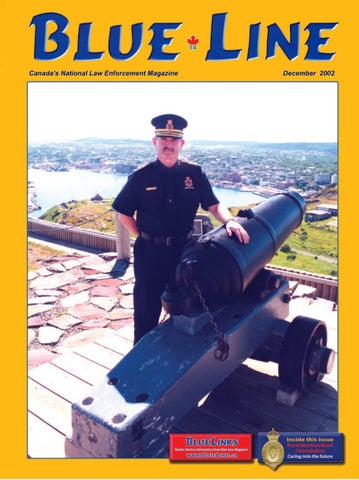
This month’s cover photo of Royal Newfoundland Constabulary (RNC) Chief Richard Deering on Signal Hill celebrates the historic site’s rich communications and military history. St. John’s harbour defences were on the hill from the 18th century to the Second World War and it was the reception point for Guglielmo Marconi’s first transatlantic wireless signal in 1901. Down East columnist Danette Dooley tells us about the RNC and its long history, dating all the way back to 1729, in our cover story. Robert Borkenstein, the man who invented the Breathalyzer and revolutionized DWI enforcement, died recently. In his commentary, Blue Line publisher Morley Lymburner recalls the first time he used Borkenstein’s ‘instrument’ on a “guest” — and we take a look at Borkenstein, a true pioneer. The world’s largest supplier of bonded ceramic armour, a Canadian company, has come up with a lightweight armour plate that could save your life. Blue Line firearms editor Dave Brown went to Ceramic Protection Corporation’s Calgary headquarters to find out more. Brown also has a photo essay on the TIP system, a fast, reliable draw method. Chris Collins explains why it’s vital every officer learns Extraordinary Rapid Deployment, a swift and immediate response to life threatening situations for those cases where waiting for the TAC Team could cost someone their life. Dr. Dorothy observes that cops and shrinks are not that different in her regular Deep Blue column, Audrey Pihulyk has more winning strategies and Technology Columnist Tom Rataj looks at gunshot detection systems. Mike Novakowski really hit the books this month, producing three case laws — and we’ve added a bonus item from Winnipeg Det/Sgt John Burchill. We also have part two of the Law Commission of Canada’s discussion paper on private and public policing and the Police Leadership Forum’s Leadership Award winner. Last but not least, all of us at Blue Line sincerely thank everyone for their interest and support and wish you a very Merry Christmas and a Happy New Year. Year Blue Blue Line Line Magazine Magazine
A tale of man and machine by Morley Lymburner I recall my number ONE Breathalyzer test. This was the biggy that every breath tech worries about because you can imagine what the defence lawyer would do when they found out that this is THE FIRST. I was working a quiet afternoon shift at “ol’ 3 Traffic” front desk when Harry gave me a wink and a nod as he began his shift. Harry, we will call him McClenehan to protect the innocent, called out to me, “Don’t worry Morley — we will get you your first drunk in no time.” I knew Harry’s reputation and he was a wonder to behold. He was known as the unit’s best drunk catcher and a record holder with a daisy chain of four prisoners, all cuffed together and stinkin drunk. As for how he managed such a record, don’t ask. Harry ain’t tellin. But I digress — again. Now Harry started his shift at 4 PM and by 4:20 he was parading an impaired (nay - drunk) driver before the sergeant at the desk. My surprise was more with the sergeant, who seemed not at all surprised. “Okay Morley, you better get that machine primed,” came the order. I dutifully corrected the sergeant that it was an “instrument and not a machine.” Off I went to the Breathalyzer office and everything I was taught kicked into high gear. I purged the instrument, timed everything and made careful notes. I qualified the ampoule containing the “clear yellow liquid” (consisting of 0.25% potassium dichromate, .025% silver nitrate and 50% by volume sulphuric acid) with the alcohol standard test, containing 3.38 milligrams of alcohol in each millilitre of solution. I purged the instrument to clear it of all residual alcohol and balanced the light meter. After making clear notes of all this I welcomed my “guest” - number ONE - into the office. The officer advised me of the circumstances of the arrest and his reasons for believing the subject to be impaired. I furiously wrote down my notes. Visions of a gruelling cross examination from a defence lawyer loomed large in my head. This one had to be letter perfect because it was — number ONE. I noted the condition of the subject carefully. Eyes - red and watery; pupils - dilated; smell - alcoholic beverage... ahhh... in there somewhere... I was sure there was alcohol... and grease... dirt... and... and... oh yes!... vomit... and... Oh No!... faecal matter. “Harry - where did you find this guy?” “Just driving down Yonge Street,” Harry said cheerily. “Okay Harry. Thanks... I guess,” I responded gloomily. The smell was overpowering. Thoughts of what a maggot might smell in the disposal bin of a slaughter house on a hot day came to mind. The man was slouched in the plain steel chair. The subject lobbed his head toward me in recognition of the voice he could hear in the fog. I asked him if he could understand me. He responded with something that could have been affirmative so I demanded he blow into the plastic tube I held to his lips. He placed the tube to
his mouth as I delicately withdrew my hand in time to avoid a drop of liquid bile coming from his mouth. He promptly pulled the instrument off the desk and threw it against the wall turning it instantly to rubble. The fight was on as I tackled him in the midriff and pinned him against the wall. The interview room door opened wide and the cavalry arrived just in time to see the primal hunk of sludge throw up all over my shoulder and back. As the troops carried away my chuckling subject, I could hear him saying “have a nice night copper.” I looked around the office in dismay. It was time to take notes as to what had happened here. “My first test is a refusal,” I said to myself. “What a way to start.” I looked at the wreckage
that was my shiny Borkenstein Breathalyzer model 900A. I looked at my notes, dutifully inscribed with the number ONE, and covered in puke. Do I clean my office, myself or the notes first. I decided on the notes and then went to change my shirt. After cleaning the office, the final indignity came from the sergeant in charge of the station. “Sign here Lymburner.” He was showing me a departmental documentation for permitting a drunk to handle my “machine.” I dutifully pointed out that it was an instrument and not a “machine.” His steely eyes narrowed at me as he dutifully added to the bottom of the documentation that I was also insolent with the sergeant. The epilogue to all this is both bitter and sweet. I was called into the inspector and he docked me eight hours pay for not securing the “machine.” I thought about dutifully correcting the errant descriptor of the instrument and then remembered that closed mouths are never a temptation to a confession. I took my lumps and ever after kept a firm hand on “the machine.” And what of my subject. Two weeks later I was notified by newspaper headlines that good old number ONE was found shot dead outside his apartment. Apparently, the victim of a drug deal gone bad. Is there justice so fair that mere mortals can not bear?
For further details go to BlueLinks at www.blueline.ca
December 2002
5
by Danette Dooley Touted as the oldest police force in North America, the Royal Newfoundland Constabulatory (RNC) represents one of the earliest examples of a multi-detachment policing agency in the country. Its roots date to 1729 when Governor Henry Osborne appointed the first constables for Newfoundland, Britain’s oldest colony. Members served and continue to serve with distinction over the force’s long and illustrious history, in both tumultuous and peaceful times. Memorable events include: • 1861 - Officer Jeremiah Dunn was killed in the line of duty at Harbour Grace during election-related violence. • 1871 - The constabulary was reorganized, re-
December 2002
placing the Imperial Garrison Troops stationed at Fort Townshend, where RNC headquarters remain today. Patterned after its mother-force, the Royal Irish Constabulary, four of the constabulary’s first five commanding officers came from that historic force. • 1883 - The author of a British book, Hatton and Harvey, writes “Inspector-General of Police Carty has carried out the organization so successful that, at the present time, the Newfoundland Constabulary is a splendid body of men and considered far superior to any other force in any of Her Majesty’s colonies.” • 1887 - Constable Ringwood, stationed in the rural community of Port de Grave, died while on duty in a blinding snowstorm. Today young officers are being challenged
6
with the concept of community-based policing. However, according to RNC’s deputy chief of support services, Gary Browne, the early members of the constabulary were the forefathers of community-based policing. Members acted as tidewaiters, revenue and relief officers and game wardens in Newfoundland out ports during the 1800s to mid-1900s. “The constabulary was not just police officers in the true sense of the word in the early part of our history,” Browne explains. “In the small communities right across Newfoundland and in Labrador (they) were the government contacts, as we had our own government then and we were our own country. So, most of the time, the only people who had contact with the government were the constabulary officers.” Constables sent letters to alert the government about disease outbreaks like tuberculosis in their communities. The force even had its own police boat, “for looking after customs and excise from St. Pierre because, again, the constabulary was the provincial arm of the law for the country. It was quite a challenging but I imagine a rewarding career.” In 1896 Inspector General McCowen – who commanded both the constabulary and the St. John’s Fire Department – organized a police brass band which played for community functions, at Government House and during Royal Visits. In keeping with tradition, the RNC police band Siochana recently released its second CD compilation of Newfoundland’s best known musicians. Money raised will be divided among four children’s charities. Thirteen members of the constabulary vol-
unteered for service in the First World War, including four who were part of the famous Royal Newfoundland Regiment (RNR) ‘Blue Putees.’ One, Walter Green, won the first regiment battle decoration in action on November 4th and 5th, 1915 at Caribou Hill in the Suvla. He rose to the rank of lieutenant before dying at the Battle of Marcoing in 1917, after bringing great honour to both the regiment and the constabulary. Sgt. Patrick O’Neil, who later became chief, was commissioned as a lieutenant with the RNR in WWI and put in command of the SS Fiona, which was tasked with gathering intelligence on enemy submarines and listening posts in the Labrador Sea area. Eight members of the constabulary were invited to England in 1937 to represent the force at the coronation of King George VI and Queen Elizabeth. The constabulary had its own security division in WWII, set up by MI5 (British Intelligence) and greatly contributing to the war efforts on the home front. In 1939 the Newfoundland Constabulary, under the terms of war, seized the German ship SS Christof Von Dornum at Botwood and arrested her crew. Two years later, 25 constabulary members seized the SS Odvara in Placentia Bay, again under the terms of war, and arrested her crew. Newfoundland was often called “the stepping stone to Europe.” German submarines fired on war ships and hit Bell Island, making the province the only place in North America to suffer a direct Nazi U-Boat hit during WWII. “There were ships sunk and our constabulary members were stationed at Bell Island at the time. There was lives lost on those ships and
December 2002
Newfoundland Constabulary Cycle Squad - Mid 1930s the constabulary played a role helping the survivors,” Browne notes. The constabulatory was the national police force of the Dominion of Newfoundland until it joined Canada in 1949 and the RCMP joined it in policing the province. Today the provincial force is responsible for providing police services to three areas of Newfoundland and Labrador: St. John’s, Mount Pearl and the surrounding communities which comprise the North East Avalon; Corner Brook and Labrador West. Tragedy struck again in 1959 when Cst. William Moss was brutally killed during a labour strike at Badger. Browne helped organize an annual youth memorial softball tournament in his memory. The week-long event, which has been taking place for decades, helps bridge the gap between youth and police. Thousands of youth have come to realize that the police are their friends and someone to turn to in a time of need.
7
Her Majesty, Queen Elizabeth II bestowed the prefix ‘Royal’ on the Newfoundland Constabulary in 1979 to recognize its proud history. It is one of only five police forces in the world to hold the distinction. In 2001, for the first time in its history, the RNC recruited a chief of police from not only outside the organization but outside the province. Browne, . . . with over 30 years experience and whose father and two uncles also served with the historic force, admits he initially wasn’t sure how an outside chief would be accepted. However, nearly two years later, he’s quick to note that Deering “hit the road running and hasn’t missed a beat... “I am very proud to serve as his senior deputy chief of police and to have him as a personal friend. There is no doubt that he will contribute much to this organization with his . . . continued page 9
First Newfoundland constabulary in-service training school - September 1944
Newfoundland is well known for its musical talent. RNC band Siochana recently released its second CD compilation of Newfoundland’s most well known musicians. Money raised will be divided among four children’s charities. modern leadership style and his great energy.” Browne believes the force has made significant progress since Deering’s arrival, noting that it also continues to benefit from its excellent relationship with the Ontario Provincial Police (OPP). He feels that was a major contributing factor to Deering’s acceptance. “His 31 years of exemplary service with the OPP was both recognized and respected by our members, staff and the community at large. There are many challenges still facing the RNC. I am confident in our ability to meet them head on under Chief Deering’s direction,” Browne says. In his role as an OPP chief superintendent, Deering guided the eastern division in a transition from a reactive enforcement service to a community oriented police service. He provided senior executive leadership and direction to approximately 1,000 uniform members and 200 full-time civilian employees December 2002
in one of the largest and most diverse regions of Ontario. He was also responsible for 160,000 kilometres of roadway and managed a fleet of 325 vehicles, 15 marine units and 30 snow and all-terrain vehicles. Taking over as Newfoundland’s top cop meant leaving behind a police force that had been a big part of his life for more than three decades. The decision came after much soul searching. “I knew I wasn’t part of the culture. I was a CFA (come from away), for lack of a better word, and I also knew that if the rank and file didn’t accept me, no matter how good of a job I could do, I wouldn’t be successful.” Deering had an interesting connection with the RNC before beginning as chief; he designed and delivered the training program for the RNC’s tactical response unit at the OPP Academy. Although he doesn’t have the financial or human resources at his disposal that were readily available to him at the OPP, he has decades of managerial policing experience to draw on running the day-to-day operations of the force. As an interim police chief — he’s signed on for a five-year term — Deering’s tougher decisions are in identifying and developing the RNC’s future leaders. He’s confident in those he has promoted, is implementing a viable performance management package and looks forward to his next three years. He’s also very much aware that the strength of the force depends on mutual cooperation and teamwork between management and rank and file members. “I’ve tried to develop an environment of mutual respect and trust with the (police) association, where the focus of both management and the association is on making the Royal Newfoundland Constabulary the best that it can be.” Deering has no regrets about moving to ‘The Rock’ and joining an innovative, tenacious and dedicated police force. Its members are professional and caring, proud of their history and looking forward to their future. “When I leave here I hope my legacy will be that perhaps I’ve made a difference. Our people come to work here every day and they do an excellent job; if we work together for the 9
betterment of the force and the people we serve, we will ensure that the Royal Newfoundland Constabulary continues to be the police force we are all so very proud of.” Danette Dooley, a Blue Line columnist and Newfoundland-based freelance writer, can be contacted at dooley@blueline.ca.
The bullet stops here Better protection against the most common street threat by Dave Brown It has often been said that the first rule of a gun fight is to bring a gun and preferably LOTS of guns. Even better is to bring lots of friends with guns. If the assailant is armed with a rifle however, you may also want to consider bringing a skyscraper with you, for you and your friends to hide behind. Far too many police officers end up bringing handguns to a rifle fight, according to Ceramic Protection Corporation (CPC), the world’s largest manufacturer of bonded ceramic plates. The number of officers injured or killed by rifle fire is particularly tragic, the company says, because it now has the technology to protect them. Rifles are a deadly problem even for police in the United States, where handguns are the most prevalent threat by far and even criminals carry back-up guns. According to the FBI’s Law Enforcement Officers Killed and Assaulted reports, 93 per cent (610) of the 658 US officers criminally killed in the line of duty from 1990 to 1999 were shot, 71 per cent (466) with handguns and 22 per cent (144) with rifles and shotguns. The statistics clearly illustrate the importance of wearing soft body armour — only 290 of the 658 officers killed were wearing it. Of those, 160 were shot in the head, 99 died when a round struck them either above, below or between their ballistic panels and 20 were killed when a rifle round penetrated their vest. To date, there have been no documented fatalities resulting from a vest being penetrated with a round it was rated to protect. US statistics may not necessarily translate to Canada, however. “When was the last time you were confronted by a barricaded suspect with a handgun in Canada?” asks CPC personnel armour specialist Rick Karst. Canadian figures support his view. A RCMP study of Canadian police officers killed on duty from 1980 to 1995 showed 88 per cent (38) were shot with a firearm — 23 per cent (10) with handguns and 44 per cent (19) with rifles or shotguns. No one will ever know if some of those officers would still be alive today if they had been wearing rifle-protection plates. So-called ‘trauma
CAP system front view plate’ inserts have been available for many years, but few officers outside of tactical teams ever consider wearing them. Traditional hard body armour is bulky, heavy, expensive and takes a long time to put on and take off. CPC is looking to address all of those problems with its new Ceramic Armour on Patrol (CAP) program. CAP program Since most officers routinely wear concealable soft body armour while on duty, CPC felt that a bulky, stand-alone ceramic plate that can withstand an armour-piercing bullet from a .3006 Springfield cartridge (level IV protection, as specified by the U.S. National Institute of Justice) was redundant. Reasoning that soft armour would supplement the protection, particularly from backface deformation trauma, they designed lighter-weight front and back ceramic plates that will withstand both NIJ level III and IV threats, when worn in conjunction with an existing level II or IIIA vest. The triple-curve plates are molded to follow the contours of the human body, and are contained in a one-size-fits-all harness that can easily be slipped over existing clothes, uniforms and jackets. Patrol officers can dive into their trunk and in less than ten seconds don a front and rear
For further details go to BlueLinks at www.blueline.ca
December 2002
10
Ceramic plate shot with 6 rounds of 7.62x51 NATO ball ceramic plate system that will effectively protect their vital areas from just about any shoulder-fired weapon you’re likely to find on the street. The complete CAP system, with two plates, weighs less than 12 pounds and adds about an inch of thickness. In light of tragic police shootings in Canada and the recent sniper killings in the US, practical protection against rifle threats may become even more desirable. “If I was a police officer in the Washington area (over that time)”, says Karst, “I would be wearing this stuff 24 hours a day.” A history of ceramic armour Ceramics were first considered for use as armour during the Vietnam War when the US Army needed to protect helicopter pilots who were routinely landing in the middle of hot zones. Helicopters are extremely weight sensitive so any additional armour in pilot seats had to come at the expense of hauling fewer soldiers. Ceramics were chosen when other ideas proved either too heavy or impractical. The first solution, of course, was to simply have two pilots at the controls when landing “hot.” Needless to say, this concept was about as popular with them as being chosen to go first in a game of Russian Roulette before revolvers were invented! The US Army initially installed ceramic armour in the backs of pilot seats, not the bottoms as one would imagine, to protect against the greatest threat — excited new recruits landing in the middle of their first firefight, with adrenalin-numbed fingers resting on the triggers of their automatic weapons. More than one pilot was accidentally shot from behind, at point-blank range, by an edgy recruit. Eventually, ceramics armour was used in the back, sides and bottom of the seats and today can be found in almost every imaginable modern military vehicle. While law enforcement agencies were concentrating on soft-body armour that would be comfortable enough to wear all day long, the military
continued to support the use of hard armour to protect personnel against rifle threats. Ceramic plates are now used by virtually every military force in the world for combat and tactical duties. Ceramic Protection Corporation The largest supplier of bonded ceramic armour plates to military and police agencies worldwide, CPC is based in Calgary, Alberta. Few people realize the extent to which its ceramics, developed and manufactured in Canada, are used around the world. CPC clients include the Canadian, US, German, British, Australian, Belgian, Israeli and Mexican militaries, as well as FBI, US Secret Service and Germany’s GSG-9 anti-terrorist units and emergency response teams. CPC also sells supplementary ceramic plates to most of the world’s leading soft-body armour manufacturers, including Second Chance, Point Blank, US Armor, Silent Partner and Pacific Safety Products. “This is a product developed and manufactured exclusively in Canada and is protecting military and police forces around the world and yet no one knows we are a Canadian company. We want to change that,” emphasizes CPC General Manager Jim Rice. The company manufactures every plate it makes, from aluminum oxide or silicon carbide powder to bonded finished product, to exacting ISO 9002 standards. Every step of the manufacturing process, from receiving raw materials at the back door to casting into precise moulds, cutting and polishing raw plates by hand, the day-long firing in massive kilns and vacuum-bag bonding of the Kevlar backing, is carefully monitored and recorded. Detailed records are kept on every single plate, including complete temperature graphs from the kiln on the day it was fired. CPC buys the highest grade aluminum oxide in the world from a French supplier and makes its ceramic armour using only 98% alumina, one of the industry’s highest percentages. That makes for a denser plate but also requires a much longer and hotter kiln firing process and a precisely controlled temperature ramp-up and ramp-down program. Every single plate is both hand and machine inspected numerous times and receives a serial number and record of its manufacturing date, weight and final dimensions. Sample plates from each batch are regularly stripped and tested or shot at in the factory ballistics lab.
Ceramic plate shot with 7.62x51 NATO ball round
Ceramic plate shot with 7.62x51 NATO ball round (close-up)
Ceramic armour is designed to sacrifice itself to protect the wearer, much like a modern automobile crumples more readily in a serious accident to slow the deceleration rate of the occupants. • Ceramic armour only has one-shot capability. NOT true; ceramic body armour is tested to the same NIJ standards as any other ‘hard’ rifle protection. This requires that six rounds of 7.62x51 NATO full metal jacket ammunition strike no less than three inches from the edge of the plate and at least two inches apart. As unrealistic as these standards may be — can you see any officer standing still and absorbing six straight hits in the same 10 by 12 inch square? — a NIJ-rated Level III protection plate must not allow ANY penetrations of a round or backface deflection of more than 44mm. • Ceramic armour is expensive. NOT true; CPC
anticipates they can put a CAP system into the trunk of every cruiser in Canada for much less than the cost of a good Level IIIA vest. • Soft body armour may not be designed to stop rifle fire but is at least better than nothing. NOT true; when it comes to rifles, nothing IS better. A rifle bullet which exceeds the rated threat level of a vest will not only penetrate but will be prone to tumbling, deflection and fragmentation, all of which will contribute to MUCH more serious injuries than if the round simply passed right through. • Ceramic armour is heavy and not practical to wear for extended periods of time. Partly true; traditional stand-alone ceramic plates are heavy and uncomfortable. The CAP system is much lighter and designed to bring rifle protection down to the patrol officer level. CPC doesn’t
Ceramic armour myths CPC offers a half-day, certified training course that covers the theory and practical application of ceramics as body armour material to any agency that requests it. One of its main purposes is to dispel misconceptions, including these common myths: • Ceramic armour is prone to ricochets. NOT true; before the rifle bullet actually strikes the ceramic side of the bonded plate, its leading-edge shockwave causes the ceramic to begin to shatter, a fraction of a second before it hits. This builds up an ever-increasing rubble field of ceramic particles in front of it, which serve to both slow the bullet down and break it apart. The back of the plate fractures into a conical crater and the Kevlar backing prevents any debris or fragments from penetrating. For further details go to BlueLinks at www.blueline.ca
December 2002
11
. . . continued page 12
want its ceramic armour to be considered ‘tactical’ wear but few situations will dictate that it be worn constantly. With the quick-donning system, officers can throw it over their heads when they anticipate a possible rifle threat or a situation with bats, knives or fists, which will very satisfyingly break up upon contacting the plate. • The highest level of armour protection available, NIJ level IV, is also the most difficult to achieve. NOT true; this may apply to hard armour made from heavy steel plate but not ceramics. “We can achieve level IV protection quite easily because it requires protecting against only one round of .30-06 armourpiercing. Level III protection takes a lot more work because we have to be able to fire six rounds of NATO 7.62 ball ammunition into a 10 by 12 inch square without any penetrations,” reports CPC ballistic technician Bob Radwell. Wearable protection With situations such as the FBI shoot-out with Platt and Matix in Miami, the famous North Hollywood bank robbery and the Washington and Maryland sniper slayings, many officers are thinking about enhancing their existing protection. CPC says its wearable, ceramic armour product is inexpensive, lightweight, quick to don and protects against any conceivable handgun and rifle threat on the market today, when worn in conjunction with an existing level II or IIIA soft body armour vest.
Jim Rice, Gen. Mgr. Ceramic Protection Corp
Rick Karst inspection station
Ceramic plates for CAP system
Level III and Level IV ceramic plates
The ceramic plate is designed to completely capture the bullet without penetrating the officer or bystanders who may be in the line of fire. Unlike soft armour, the officer will not be incapacitated and can respond effectively. “Wearing our armour, you can take a hit and keep on fighting,” says Karst as he points
to the six neat holes in the front of one of his test plates and then flips it over to reveal the unbroken backside. “We like to say that the bullet stops HERE.”
For further details go to BlueLinks at www.blueline.ca
December 2002
Dave Brown can be reached at firearms@blueline.ca.
For further details go to BlueLinks at www.blueline.ca
12
Frangible bullets may threaten body armour The US Office of Law Enforcement Standards (OLES) has conducted a limited series of tests evaluating the performance of frangible ammunition against body armour. Done at the request of the National Institute of Justice, the preliminary study was designed to establish the validity of claims that these types of rounds pose a potential safety threat to wearers of personal body armour. Limited calibres, manufacturers and types of frangible bullets were selected and tested against randomly available models and designs of body armour. Two types of frangible bullets were tested: a jacketed, hot pressed, powdered metal and a non-jacketed, sintered/hot pressed, powdered metal bullet. Both were 9 mm RNFP (round nose, flat point) designs weighing 100 grains. The NIJ compliant Type II and III armour was of hybrid construction, using both aramid and polyethylene ballistic fiber materials and layers, and were tested using both types of frangible bullets. The results of these preliminary, limited tests indicate that frangible bullets may represent an unconventional threat to personal body armour, when contrasted with traditional lead based bullets. The true scope and relevance of this threat are not yet known and additional research is being done to fully evaluate and quan-
tify this concern. In support of these efforts, NIJ requests that all agencies and parties who have conducted their own testing of frangible ammunition
against body armour e-mail its Compliance Testing Program Office (asknlectc@nlectc.org). All information provided by agencies will be considered proprietary and confidential. Additionally, staff would like to determine the extent that frangible ammunition is currently in use by law enforcement agencies, in order to properly assess the need for further/more extensive review of this issue. A brief survey has been prepared in support of this effort. Agencies interested in participating can obtain a copy by contacting the Compliance Testing Office at the e-mail address listed above.
OPP Sergeant not guilty A 39-year-old provincial police sergeant had tears of joy in his eyes in October after being cleared of criminal charges relating to an accident on Highway 401 last year. In March 2001, Cary Churchill heard about a runaway transport truck weaving as it drove at about 100 km/hour. The trial heard how other officers tried to stop the vehicle without success, although this wasn’t known to Churchill when he decided to slow down civilian traffic to create a rolling roadblock. Churchill’s plan left 90-year-old David Shuttleworth with serious injuries after the truck slammed into two cars. Churchill was charged with criminal negligence causing bodily harm by the province’s Special Investigations Unit, which investigates all deaths and injuries involving police. “Were the actions of Sgt. Churchill correct? No. They were a serious lapse of error and judgment. Where they criminal? No,” Justice Peter Wright was quoted as saying in court. In delivering his judgment, Wright noted several problems in provincial police communication, training and leadership on the day of the police chase. It seemed nobody was in charge or knew what was going on, he said. Moreover, Churchill’s plan to stop the truck was accepted by his colleagues and supervisors. The judge acknowledged that police work requires officers to think on their feet, sometimes leading to mistakes. Neither Churchill nor the other officers were aware that the truck driver had suffered a stroke and could not stop his vehicle. Churchill still faces charges under the Police Services Act relating to the incident. For further details go to BlueLinks at www.blueline.ca
December 2002
13
Extraordinary Rapid Deployment vital for all by Chris Collins A vital part of the Ontario Ministry of Public Safety and Security’s minimum policing standards, Extraordinary Rapid Deployment (ERD) training is vital to all police officers, particularly those on the front line. Like so many other developments in the policing community, ERD began with an event that caught law enforcement slightly off guard. Just as Texas Tower sniper Charles Whitman showed us the need for Special Weapons And Tactics (SWAT) teams by killing 16 people and wounding 31 in 1966, events such as the Columbine High School Shooting in 1999 demonstrated a need for ERD. Eric Harris and Dylan Klebold killed 13 people and wounded dozens of others. They had a mindset to kill and maim, which is central to situations requiring ERD responses, which are defined as: One or more subjects who participate in a random or systematic shooting spree, demonstrating their intent to continuously harm others. The overriding objective of an active shooter appears to be that of mass murder, rather than other criminal conduct such as robbery, hostage taking, etc. Also includes anyone who uses any other deadly weapon to systematically or randomly inflict death or serious bodily harm on others over a continuous or extended period of time. ERD, which goes by many names — Active Shooter, Immediate Deployment, Rapid Deployment — is: The swift and immediate deployment of law enforcement resources to an on-going, life threatening situation where delayed deployment could otherwise result in death or serious bodily harm to innocent persons. The standard approach to critical incidents in the policing community has usually focused around the four Cs – Contain, Control, Communicate and Call Tactical. This type of response and planning is the established norm in most incidents — barricaded subjects, hostage takings, emotionally disturbed people — where the event can be slowed down, allowing for a deliberate and immediate action plan. This mindset may result in catastrophic endings. “Shots fired” or “officer/citizen down” incidents like the North Hollywood bank shootout require immediate deployment and a new set of priorities: • Neutralize the suspect ASAP. • Safeguard the lives of citizens in close proximity to subject. • Protect citizens in area. • Safety of police. • Return to normalcy. Commanders and tactical personnel may cringe at the thought of uniform personnel taking control of a critical incident, but it must happen. Such situations could include: December 2002
• A citizen or law enforcement officer is gravely wounded and delayed recovery could result in their demise. • An assault is imminent — a suspect may or may not be actively involved — and immediate recovery of a wounded citizen/officer is crucial. • Due to the location of the victim or officer, an immediate recovery may be necessary to prevent death or serious bodily injury. Wide open? You bet! That’s why we hire the best and train to be the best. This is no exception. Officers must be trained to properly respond to an incident requiring immediate deployment. Without it, a rogue officer could enter a dwelling alone, for example, and elevate an incident. First responder actions Planning must occur when the initial call is received. If tactical is working, great; they have the expert training, equipment, and weapons to handle things — but what if they are not? Can you afford to wait the 45 minutes for mobilization of TAC? You must decide. The officers dispatched to the scene must immediately start to formulate a plan, while en route, by: • Gathering intelligence – layout, surroundings, number of subjects, etc. • Establishing last point of contact with the suspect. • Establishing a safe staging area. Once the first officer arrives, they must assess the situation. They will be the temporary commander of the situation (ad hoc commander) and must start positioning other personnel and relay information as it comes in. They will not be relived until a more qualified officer arrives. The ad hoc commander will be overwhelmed with continuous intelligence informa14
tion coming from the dispatcher, reports from fleeing citizens, sounds of gunfire/explosions and officer down observations, for example. They should relay information concerning: • Location and number of suspects. • Type of weapon. • Their determination whether immediate deployment tactics are appropriate. • Safe approach route to staging area. Containment of structure must occur as soon as possible, but prior to entry. This is where a competent officer’s experience, training and expertise comes into play. Is this an incident requiring extraordinary rapid deployment or can a perimeter be established and the four C’s enforced? It is crucial that containment take place. You do not want the subject(s) eluding police and moving to another venue to repeat their
destruction. Once containment is established, a cell consisting of four officers (ministry standards are two) are deployed to enter the structure. Equipment These officers should be equipped with the equipment essential to complete the job. Shoulder fired weapons are needed for those areas where shots over 20 feet need to be taken. There are weapons available that use the same magazines as our pistols, allowing an officer to quickly switch to a more accurate weapon when it’s required. One must always take into account the environment and backstop; you don’t want to kill or injure an innocent party. There are a wide variety of shoulder-fired weapons on the market for law enforcement personnel. Shotguns and MP5’s, for example, which are familiar to tactical teams but not most uniform personnel. Once equipped, the contact team enters the structure and works its way past injured parties and possible explosives to find and neutralize the threat, while continuing to advise the ad hoc commander of their progress and findings.
tals . Hospitals must be prepared for the injured and assistance from neighbouring police, fire and EMS services must be coordinated by the incident commander. Sound overwhelming? It doesn’t have to be. We learn through trial and error to handle such incidents, which are not just restricted to the United States. They have and will continue to happen here and we must prepare and be equipped to deal with them. Keep in mind what Confucius said about training: • I Hear – I Forget • I See - I Remember • I Do – I Understand So let’s attend regular training sessions with enthusiasm and vigour and equip ourselves to deal with the unpredictable.
A Halton Regional Police officer with over 15 years of experience, Chris Collins is the tactical rescue unit team leader and founder/president of the Southern Ontario Law Enforcement Training Association. He can be reached at soleta@cogeco.ca. SOLETA is offering ERD training at the Blue Line Trade Show on April 29-30, 2003. To register, go to www.blueline.ca?seminars.
Incident command The ad hoc commander continues to receive all information from available sources. Other personnel arrive and need direction. A rescue team, similar to the contact team, must be formed and deployed. Tactical personnel arriving on scene need to be briefed and a plan instituted for their entry or relief of the contact team. An incident commander or more qualified officer, complete with command post and other personnel, eventually relieves the ad hoc commander. The former ad hoc commander remains with the relieving commander until he or she is fully briefed. The contact team continues to move throughout the structure and neutralize the threat. Officers must be trained to work as a team and know their areas of responsibilities. Terms such as ‘cutting the pie’ and ‘suppressive fire’ should not be foreign to officers. This comes with training and is essential in resolving the incident. Officers must learn what they’ll encounter upon entry. Noise from alarms, people screaming, confusion, victims hiding, frightened and unresponsive people, carnage and multiple traumatic injuries, fire suppression systems engaged and explosives could all be encountered. Tunnel vision will occur but can be overcome with mindset and training. Every person on the contact team has a strict area of responsibility which must be adhered to. The team leader of the cell dictates speed and direction of travel. This is not a time to second-guess each other. Debriefing the incident afterwards is the forum for such input. Aftermath Police must be prepared to help return the area to normalcy and to encounter critical incident stress after a traumatic event. There will no doubt be an investigation by the (Ontario) Special Investigations Unit (SIU). All parties involved must receive counselling and hospiFor further details go to BlueLinks at www.blueline.ca
December 2002
15
Ironcops not just for the young
by Jean Roch “I’m sorry to inform you but you have cancer.” That’s something none of us ever want to hear but unfortunately, cancer is all too much a reality and affects us all. We all have a responsibility to do our part to help find a cure for this dreaded disease. What have
you done lately? Terry Fox once said “you don’t know who you are until you see what you can do.” It goes without saying that his accomplishments were great and his efforts affected the lives of many. Many medical advancements have been made since then but cancer is still among us, although some forms have been eliminated and treatment has improved tremendously. The term ‘cancer survivor’ is becoming more common. Cancer survivors are very special people
For further details go to BlueLinks at www.blueline.ca
December 2002
16
who have overcome an enormous challenge that has terminal consequences. The police community possesses similar qualities in that we face challenges daily and don’t like to be out-done. This was our motivation in taking on one of the hardest endurance events on the planet, the Ironman. Edmonton Police Service (EPS) is no stranger to initiating programs to raise money; after all, it was EPS member Gary Goulet who started the now well known ‘Cops for Cancer,’
head shaving event, which is now the Canadian Cancer Society’s largest third party fundraiser, having raised more than $11 million to date. EPS S/Sgt Kerry Nisbet formed Ironcops in 2000 and competed with nine other members in the Ironman to raise money for cancer research. He challenged the rest of Canada to get on board in a Jan. 2001 Blue Line article which didn’t go unheeded — the Iron Cops team was 56 members strong at the Ironman in Penticton in August. Members, which included 14 civilians, came from Delta, Calgary, Winnipeg, Ontario, Montreal, Halifax and the largest contingent from Edmonton. All had worked hard during the year, training together and spending countless hours at fundraising events; Edmonton even set up a mall display and had its members ride a stationary bike the equivalent distance of riding across Canada from coast to coast and back again. Our team of six Winnipeg Police Service members and one civilian were apprehensive about what to expect, since we were all novices; most of us had not even competed in a triathlon of any size prior to the event so the prospect was quite overwhelming. I had trouble completing one length of the pool without having to stop and gasp for breath at my first swim but amazingly, with a little coaching and some determination, I slowly progressed until I was able to swim for long periods comfortably. So don’t give me the oft heard “oh, I couldn’t do Ironman, I’m not a good enough swimmer” excuse. After some practice, most competitors find the swim the easiest part of the competition, less gruelling than the 180 km bike ride and 42.2 km marathon. I tried to keep this in mind when struggling into my wetsuit at 6:40 a.m. smiling in wonder as I faced a crowd of hundreds who had gathered, despite the tender hour. One of the spectators asked if this was my first Ironman. “Yeah, can’t you tell?” I answered nervously. “No, I think you look great,” he replied — this is just one example of the amazing support we received. The cannon was fired at 7:00 a.m. sharp and the Ironcops team, along with some 2000 other competitors, hit the water, which was congested with flailing arms and legs. Everyone was working hard to complete the course in less than 17 hours to qualify for the Hawaii Ironman. Penticton is the most popular Ironman competition in the world — hopefuls line up to register a year in advance to secure a spot. The competition is a lot of work but the rewards are tremendous. We all wore similar team jerseys bearing the Cops for Cancer logo, which proved to be a tremendous motivational tool; the large crowds lining the streets seemed to cheer a little louder and clap a little harder when we passed by. Countless strangers approached us to express their appreciation and one spectator, from Saudi Arabia, sent us a cheque for $500 after returning home. Ironman Canada recognized our achievements at the awards banquet by allowing Kerry
Nisbet, our team leader, and Goulet to present a cheque for $315,000 to the cancer society. The athletes and fans were thrilled with the amount of money that was raised. Training for an Ironman becomes a way of life and, contrary to what many think, is not just for those sleek 24 year olds that already can run for hours on end. It’s for everyone who can commit to something special and dedicate the time to work at it. There was one common theme among this year’s competitors — let’s do it again, bigger and better, for 2004. So on behalf of all the Ironcops finishers for 2002 — 55 of our 56 members finished — we challenge all of you to come forward and step up to the challenge of the Ironman and Cops for Cancer.
It is undoubtedly a lot of work but as one cancer survivor so eloquently stated to the Winnipeg Ironcops team — “you provide hope. Such a small word but to someone suffering from cancer, it means everything.” Like Kerry wrote last year, ‘Anyone can shave their head, but can you do the Ironman?’ Jean Roch is a constable with the Winnipeg Police Service. For more information on Ironcops, contact Kerry Nisbet (Kerry.Nisbet@police.edmonton.ab.ca) or Nick Paulet (nickpaulet@hotmail.com).
For further details go to BlueLinks at www.blueline.ca
December 2002
17
Governing policing in the future Part 2 of 2 Given that at least two-thirds of Canadian security is private, should it be scrutinized and held to the same standards as public policing? Or, because of its ‘private’ nature, is it exempt from discussions of public good? To what extent should the provision of security be regulated? Are current regulatory mechanisms sufficient? Does the private security sector have sufficient or too much power to fulfil its role? These concerns form the foundation of our need to examine both policing and security within the scope of democratic policing. Views about regulating public and private policing are diametrically opposed. A state expansionist position focuses on the reassertion of the public side of policing through increased spending and regulation of the private sector. The assumption here is that private security has grown primarily because of shortfalls in public spending on policing. On the other hand, a state-retrenchment position focuses on the continued diminishment of public policing through divesting of authority and jurisdiction to the private sector. From this perspective, private sector growth has taken place because consumers demand it and the state may have failed to offer a suitable sense of security to its citizens. The position here is that government should not stifle the free market by imposing regulations and monopolizing legal designations for the public sector alone. Proponents argue that it is perfectly reasonable to give for-profit companies the powers of regular or special constables. Neither of these two scenarios are likely and they’re not very helpful in reflecting on how to improve the governance of policing. Both visions — one foreseeing massive re-investment so that there are as many or more public officers than private and the other predicting a radical divestment of governmental authority and peace powers to the private sector — seem equally implausible. The current regulatory environment does not adequately reflect the reality of public and private policing networks in Canada. Should legislation attempt to shore up the distinction between public police and private security and regulate the activities of each? Professionalization of the private security industry Many have recommended the security industry become professional to better guarantee the delivery of policing in accordance with democratic values. It could take many forms — developing representative organizational structures, enacting and enforcing minimum standards and creating oversight mechanisms. At present, there is no national organization that can reasonably claim to represent the interests of a significant portion of the industry. There are cleavages between those segments of the industry that employ contract and those that have ‘in house’ security. There are few industry-wide standards for training and, indeed, very little data about the size of the industry itself – the number of people, companies and revenue it generates. There are many good reasons why the inDecember 2002
dustry lacks coordination. Its diverse, employing everyone from forensic accountants to security guards and armoured car drivers. Its corporate structure makes it hard to develop a unified voice, since it’s dominated by a handful of large, multinational corporations who employ tens of thousands worldwide and are engaged in all aspects of private security. At the other end, there are hundreds of smaller establishments operating in specialized areas with only a few employees, making the industry highly competitive. Small business owners may not wish to share proprietary information with their competitors for fear of losing their competitive advantage. Such fragmentation is not uncommon in other business sectors but can have serious consequences in the security industry. Lack of communication, a reluctance to co-operate on joint initiatives and often, bidding as low as possible in tender processes, creates risks for the delivery of effective and democratic policing. Government can play a role in professionalizing the industry by, for example, collecting statistical data; even rudimentary information is difficult to find. Minimum standards for training Most proponents of reform seem to agree that, whatever else is done to reform the governance of policing, minimum training standards can only improve the quality of private security services. The reason is obvious; in a highly competitive market, the quickest way to extract profit is to operate with little or no overhead. It is all too common to hire applicants one day and have them in uniform and patrolling the next with no training whatsoever except a cursory introduction to a site’s standing orders. Training costs money. Government may be able to diminish this race to the least qualified by imposing tender processes that do not routinely go to the lowest bidder. Some provinces have minimum training standards for security personnel but the large ‘in-house’ industry remains completely unregulated – 18
criminal record checks are not required and there are no training standards. Some security firms may be completing criminal record checks and maintaining and enforcing minimal standards, but it’s unclear whether this practice is widespread. The industry must not only encourage minimum standards for training but also life-long learning. This approach will help prevent frequent staff turnover and might change the orientation of workers from seeking ‘jobs’ to seeking ‘careers’. At the same time, basic managerial courses and accreditation (in some cases already provided by security associations) could be professionally recognized by statute. Given the new reality of public and private policing networks, we might envision a change from police colleges to policing colleges, jointly funded professional training facilities that provide basic and continuing education for all policing personnel. Their development would assist in professionalizing the industry and ensure that both public and private security executives have access to state-of-the-art training and education facilities. Oversight Closely associated with minimum standards and licensing is the contentious issue of oversight. Democratic policing must include a process by which those being policed can seek redress and have a voice in the organization of their local security needs. One of the major criticisms of private security has been that it doesn’t have a system of public oversight. Critics have argued that, as security companies expand their services into areas previously the exclusive domain of police, they operate in the interest of their clients and are uninterested in and unaccountable to the people they police. New regulatory models Professionalizing the private security industry is a good start but if we accept the assumption that policing includes all activities undertaken by both public and private agencies, then should we not look to broader forms of regulation that encompass the policing sector as a whole? Chief Ian Blair, formerly of the Surrey, UK Police, has proposed a form of regulation that would place the private security industry under the watch of police. He argues that, because public services can no longer provide the level of visible patrol that citizens demand, police should regulate and monitor the private security patrols that have stepped in to fill the void. Since UK police have all but surrendered routine patrol to the private sector, they would be better off using private security personnel already on patrol as additional eyes and ears, he reasons. Private companies and personnel who cooperate would have to meet minimum standards and then have their vehicles stamped as ‘Surrey Police Compliant.’ The area constable would have direct radio contact to these vehicles and act as a general community safety coordinator and peace officer. According to Blair, this solution would respond to the expectations of citizens without having to place highly trained and
well-paid professional police on routine patrol. Another option is to move to ‘policing boards’ rather than ‘police boards’ to organize and regulate public security. The 1998 Independent Commission on Policing for Northern Ireland put forward the idea that such a board would regulate both public and private security agencies, with the power to appoint, dismiss and provide oversight to chiefs and senior police officers. It would also act as a hub for fostering co-operation between police and a host of other agencies, including private security agencies, that could help in protecting public safety and preventing crime. The intent would be to create partnerships with other agencies that have important roles in maintaining public peace and security. At the core of the policing board framework is the notion that safety and security are public concerns that must be managed co-operatively through partnerships. The framework may include: • Civilian oversight power to review both police and private security misconduct. • A budget to be spent on the best mix of public/ private policing for a particular area. Any proposal to regulate investigation and security services in Canada must take into account commitments under the North American Free Trade Agreement and the General Agreement on Trade in Services. These prohibit measures that would discriminate against and among foreign services and service providers. Canada is committed to treating foreign investigation and security services the same as similar domestic services. However, this doesn’t prevent taking restrictive measures related to professional qualifications and requirements, as long as they’re implemented in a reasonable, objective and impartial manner that is no more restrictive to trade than necessary.
continue to make sense. 4. Governments may need to assess whether the current regulatory framework for the governance of policing adequately reflects the reality of how policing services are delivered. 5. What are the best governance mechanisms to ensure that policing is delivered in accordance with the democratic values of justice, equality, accountability and efficiency? 6. Should police service boards and governments look at creative ways of regulating the relationship between public and private security agencies? Canadians must continue to reflect on the exponential growth in the demand and need for security. What are our expectations of se-
curity? What factors shape these expectations? What are the best ways of providing security and safety? These are questions that concern all Canadians and are at the very heart of our democracy. This is the second part of an edited version of a Law Commission of Canada discussion paper designed to “raise questions and stimulate debate... the first step in the process of reflecting on what policing should be in a democratic society.” Your comments are welcome. E-mail policing@lcc.gc.ca, fax (613) 946-8988 or send to Law Commission of Canada, 1100 - 473 Albert Street, Ottawa, ON K1A 0H8.
Conclusion We began by making a distinction between police as an institution and policing as an activity. Police engage in policing activities but so do a range of other agencies. Our review of the history of policing showed that public and private security agencies have co-existed in the past. What is novel about contemporary policing however, is that we appear to have reached a turning point. The growth in private security and its expansion into all areas of policing suggests that we are entering a new era, one in which services are provided by a complex network of overlapping public and private policing bodies. Clearly, police are the primary service providers, but they no longer have a monopoly. Our review of networks of public and private policing in Canada suggests that the public/private distinction central to the current organization of governance may need to be rethought. This raises a number of key challenges for reforming the law. 1. Is it realistic to think of policing only in terms of public forces? 2. To what extent does the private security industry require professional standards of conduct? Are there sufficient channels of communication between public and private security agencies? 3. Courts may need to re-evaluate whether the public/private distinctions that have animated current applications of the charter For further details go to BlueLinks at www.blueline.ca
December 2002
19
Cops and shrinks not that different by Dr. Dorothy Cotton Ph. D., C. Psych. It’s funny that, on the surface, mental health professionals and police officers seem to do totally different jobs yet we actually have a lot in common. For example, one of the things we are both called upon to do with alarming regularity is assess human behaviour and find out why a person is acting the way they are. How is this individual likely to behave? Are they dangerous? How might they respond to directions or requests? Are they out of touch with reality? Is this something new or a long-standing pattern of behaviour? Should I arrest them or would another course of action be in their and the public’s best interests? The methods we use to find out this information are also pretty much the same in many cases — looking at appearances, for example. Does it make sense that this person is where they are? Do they seem aware of their surroundings? Can they give a reasonable account of their intentions? Is what they’re wearing appropriate? Could they be concealing a weapon? Do their answers and what they say make sense? Are there
signs of delusions or a thought disorder? Are they unduly upset or inappropriately cheerful? This is not to suggest that we do exactly the same things. My job is explaining and understanding while yours is controlling and containing. My primary concern is an individual’s rights and safety whereas yours is the rights and safety of the public. I generally have time on my side while you often do not. I thought it might be interesting to compare notes about how you and I might handle the same situation. I always like the ‘case study’ approach best, so I think that’s what I will do. Consider the following scenario: It is a cold night in a small Northern Ontario community and your department gets several calls within 15 minutes from people reporting an individual acting suspiciously. An adult male with a stocky build, he’s been seen loitering around several houses. The complainants were unclear about exactly what he was doing — he may have been attempting a B&E, vandalizing property or simply acting odd. You’re dispatched to check things out. You cruise around the neighbourhood several times and don’t see anything suspicious. Suddenly you spot some motion on a roof down
Joint police effort cracks smuggling ring A joint effort by police in Canada and the US busted a human smuggling ring that took life savings from scores of migrants in exchange for a chance to escape the poverty of Pakistan and India. Police arrested 15 people in October who were ferrying illegal aliens from south Asia through Canada and over the U.S. border. “Information gathered in our investigation revealed a core group of people smugglers based in the Toronto area was responsible for the vast majority of South Asia migrants being smuggled into Canada and then illegally transported across the border into the United States,” RCMP Insp. Steve Martin was quoted as saying. The illegal migrants allegedly entered Canada through Toronto, Vancouver and Montreal using forged Canadian, Indian and Pakistani passports and posing as large tour groups, Martin said. Each suspect was charged with belonging to a criminal organization and two counts each of conspiracy to violate US immigration laws. It’s the first time Canada’s organized crime law has been applied to people allegedly involved in human smuggling, Martin pointed out. Among those arrested were the ring’s overseers, the brokers who put the deal together and lower-echelon drivers who escorted migrants, including toddlers and seniors, across the border. December 2002
Officers from the RCMP, Ontario Provincial Police, the Toronto Police Service, Citizenship and Immigration Canada and the US Immigration and Naturalization Service were involved in the yearlong investigation, which resulted in arrests in Toronto, Hamilton and Windsor, Ont. Once in Canada, the migrants were taken to safe houses, motels or hotels in the Toronto area. Those wishing to continue into the U.S. - roughly 80 per cent, Martin said - were hidden in tractor-trailers or car trunks. They were taken to Ontario border points at Windsor, Niagara Falls, or Fort Erie, crossing into the U.S. in the vehicles or transferring to boats headed across the St. Clair and Niagara Rivers. Police said the illegal migrants paid up to $40,000 US each to be smuggled into North America. In many cases, the migrants were temporarily moved into Canadian hotel rooms arranged by the smugglers while their debts were paid in instalments, said Martin. There was no evidence to suggest any of the smugglers arrested had links to terrorist groups, although stricter border restrictions following the Sept. 11 attacks helped expose the activity, Martin said. Chief among the arrests was Ahmed Nawaz Tewana, 36, of Mississauga. Martin called the bust a significant blow to the operation, which had been working for more than 12 years and is considered one of Canada’s largest rings. 20
the street, pull over and look again, but see nothing. You then notice motion behind you, this time across the street. So you... Well, frankly, I have no idea what you would do. After all, you’re the police officer, not me — but I can tell you what I’d do if asked to assess the same situation. • Look for physical cues. For example, perhaps the man is grossly overweight, which would make me wonder about impulse control and what he’s doing in such a physically challenging situation. It can’t be easy for him, which would indicate his judgement is questionable. I’d also note his clothing. He’s dressed appropriately for the weather — bundled up and wearing hats and mitts — nothing there that suggests anything unusual. • Look at his immediate actions. I’m not sure if he’s figured out who I am but he obviously knows someone is watching him. He’s standing on the roof now, waving, which makes me wonder if it’s his own house and he’s cocky and thinks he can outsmart me. Perhaps he’s out of touch with reality and doesn’t recognize that he’s doing something wrong or that he might be in trouble. • Examine his surroundings. There appears to be a lot of stuff up there with him. It’s dark so it’s hard to make out what it is but it looks like many boxes and objects of a variety of sizes. There could easily be a weapon so I might have to call you. I also note motion around him but closer to the level of the roof — could be short people, children or perhaps animals. • Initiate conversation. Before I even have a chance to formulate an approach (being a little slow sometimes), I hear laughing. Not knowing the reason for the hilarity, I check to make sure my fly is zipped and my slip is not showing, then try to get him talking in hopes of finding out more about his mental status. “Hello up there!” I call. The laughing continues unabated and he doesn’t appear to be responding to me. “Are you all right,” I ask. More laughing. His speech is garbled and appears disjointed. I hear the word nightcap and wonder about intoxication. As I get closer I can hear more but he appears to be switching languages. Suddenly, he appears to begin whipping the other people or animals and seems to be trying to shove them off the roof. I’m getting worried. I’ve got inappropriate affect, unpredictable and possibly dangerous behaviour, thought disorder, impaired judgment, lack of contact with reality. My worst fear is realized. Something goes flying off the edge of the roof. I fall to the ground, listening to the screams… “...to all, and to all a good night.” Ok, what’s your take? Dr. Dorothy Cotton has been practicing psychology for more than 20 years, providing service for “adults of all ages.” She can be reached at deepblue@blueline.ca.
NEWMARKET, ON — Deputy Chief Armand La Barge has been selected to be the next Chief of York Regional Police. Chief designate La Barge began his career with the York Regional Police in 1973. He will replace Chief Robert Middaugh who is retiring after 34 years. Chief designate La Barge will be sworn in December 12, 2002. *** HALIFAX, NS — A record-setting defamation award a Halifax police officer won last year has been overturned. The Nova Scotia Court of Appeal overturned the $240,000 awarded to Cst. Carol Campbell-Waugh in October after her civil trial against prominent Halifax lawyers Anne Derrick and Rocky Jones. The constable launched the suit over comments the lawyers made at a 1995 news conference, in reference to a supposed strip search she conducted of three 12-year-old, black girls. The trial jury found that the lawyers defamed the officer and awarded her $240,000. That was the highest ever jury award for a defamation suit in Nova Scotia. The appeal court also ordered that she must pay the $105,000 in legal bills for the two lawyers. The officer can appeal. *** MONCTON, NB — Faced with a shortage of staff and funds to cover all responsibilities, the
RCMP is talking about cutting services in rural New Brunswick. In a report sent to the Conservative government in August, the police force warns it is on the brink of overhauling services. The 2002 Provincial Policing Update outlines a dozen areas where existing services will be modified or eliminated because of a lack of officers. The RCMP is recommending the elimination of all-terrain vehicle patrols and halting investigations on motor vehicle accidents where there are no injuries or alcohol was not a factor. The force is looking for more money and 99 new officers across the province. There are currently 506 RCMP officers working in rural New Brunswick. *** SPRINGHILL, NS — A tentative contract between Springhill, Nova Scotia’s unionized police officers has finally been accepted by council. The Nov. vote was close — four in favour and three against. Mayor Bill Mont says the frustrations of the past two and a half years are now behind them. Mont says the only changes made since the last negative vote on Oct. 30th involved the wage structure and pension plan. Sick leave and vacation will be reviewed in a year to see if there have been abuses. If so, Mont says, the contract will revert from 12 hours on duty to 10. *** CALGARY, AB — Calgary police used the national DNA data bank to lay charges in an eight-year-old rape case. Police charged a sus-
For further details go to BlueLinks at www.blueline.ca
December 2002
pect in a case in October where a Calgary woman, then 32, was sexually assaulted while walking in a city park. Despite an extensive investigation, the culprit was never found. This summer, a man found guilty of a serious offence was ordered to give a DNA sample. It was entered into the data bank, resulting in a match to samples gathered from the 1994 sexual assault. In June 2000, the DNA Identification Act came into force and the national DNA data bank was established. The Act allows the seizure of bodily substances from individuals found guilty of certain serious offences and contains a crime scenes index and a convicted offenders index. *** MISSISSAUGA, ON — Peel Region police chief Noel Catney made an urgent plea in October for an additional 96 officers at a cost of $10.5 million. Peel councillors seemed shocked by Catney’s revelation that only 4.4 per cent of priority one calls - such as robberies in progress or traffic accidents with fatalities - are dispatched immediately. The extra manpower, along with a previously approved 30-officer increase, will cost taxpayers an additional 3.8 per cent on the regional share of property taxes if approved in the 2003 budget. In three years the number of priority one calls has gone from 43,000 to 50,000 a year and there has been an increase in calls of all types from 210,000 to 234,000. Council will wait until budget talks early in 2003 to decide on Catney’s proposal.
For further details go to BlueLinks at www.blueline.ca
21
Understanding the personality mix Bringing out the best in you and your team by Audrey Pihulyk Whether in the office, at home or with friends, personality differences can lead to conflicts. We have all known people who easily irritate and challenge us, causing us to wonder why they act the way they do — or even why we act the way we do. Personality traits are inborn, not flaws or afflictions. However, if we cannot see past another’s weaknesses, it’s tempting to try to sculpt them into an image more acceptable to us. A person’s form is inherent and ingrained. To insist that they conform to our expectations may change but not necessarily transform them — and the changes could cause lasting personality scars, not exactly the effect we would wish upon anyone. Hypocrites, the Greek philosopher and father of modern medicine, made some interesting observations about his patients behaviour patterns. He categorized them into four groups: • Sanguine: Talkative, bubbly individuals who often take on new projects but may have difficulty completing them. • Choleric: Born leaders who have vision, are powerful and confident but tend to be controlling and overbearing. • Melancholy: Complex, deep thinking. • Phlegmatic: Negotiators; tranquil, good listeners but somewhat unmotivated and stubborn. It’s interesting to note that the weaknesses of each type are actually strengths taken to an
extreme. While there are four basic personality types, their make-up is a blend of two or more types, thus adding balance and uniqueness to everyone’s personality. Furthermore, the four types can also be placed into two broad categories — introversion and extraversion. The melancholics and phlegmatics (introverts) get their energy from being by themselves and can be broadly described as the strong, silent types. The sanguines and cholerics (extroverts) get their energy from being with people and are the movers and shakers. Since the two types hold many opposite views, they need to tolerate and understand each other’s strengths and weaknesses. Extroverts are people of action. They’re sociable and make friends easily but have to realize that introverts often prefer to be alone and need personal and mental space. They need time to process information and opportunities to speak without being interrupted. Introverts are people of focus, depth and independence and sometimes need to be alone so that they can recharge their batteries. Introverts, in turn, need to appreciate extroverts for their gift of leadership and try to work in harmony with them. In her enlightening book Discover the Power of Introversion, author Cheryl Card says introvert abilities may often be overlooked. She writes that these quiet, reticent and gifted people may at times be overpowered by the more outspoken extroverts.
Emergency plans now mandatory in Ontario The Ontario government has passed legislation requiring that all municipalities and key provincial ministries be prepared for emergency situations. The Emergency Readiness Act, 2002 (Bill 148) “ensures that first responders and emergency workers are as prepared as possible to handle serious emergencies, and that the public is informed during crises,” said Public Safety and Security Minister Bob Runciman. One proclaimed, the act will: • Authorize the Lieutenant-Governor in Council, on the recommendation of the Attorney General, to temporarily suspend certain provisions of provincial statutes, regulations, rules, bylaws or orders where this would assist victims of an emergency or help deal with an emergency and its aftermath. • Require Ontario municipalities to have programs that include an emergency plan, training and exercises and public education. • Authorize the minister to set consistent standards for emergency management programs. • Require a provincial hazard identification and risk assessment. • Establish a central repository for emergency plans. December 2002
• Rename Emergency Measures Ontario (EMO) as Emergency Management Ontario and give its new chief the authority to oversee emergency planning in the province. • Enact the Declarations of Death Act, which streamlines the process for obtaining a court order declaring a person to be dead when they’re presumed to be dead but physical evidence cannot be located. “This legislation will better enable the government to react quickly in an emergency to assist victims and to help the people of Ontario in the aftermath,” Attorney General David Young said. “It will ensure that people continue to have access to the justice system and removes unnecessary obstacles for victims’ families in their time of need.” New York used similar legislation after the Sept. 11 terrorist attacks, the government notes. Ontario’s former emergency act allowed municipalities to formulate emergency plans but the new act requires them to and establishes mandatory elements. Approximately 91 per cent of the province’s municipalities have plans, the government notes, but fewer than 50 per cent have training programs in place or hold regular exercises. 22
As these personality traits are inborn, you can see the distinctiveness between siblings. The extroverted child is outgoing, easily seen and heard while the quiet, introverted child is often left feeling somewhat inadequate and may withdraw. Understanding the distinctive personality differences will help parents guide children in their growth and future contribution to society. Insights into the negative and positive aspects of various personality types and understanding how they affect behaviour can improve harmony and reduce conflict in the workplace. For example, personable, extroverted sanguines who are energetic and outgoing are generally averse to working alone doing mundane tasks. They love to interact with people and are more suited to working in the front office where their creativeness and hard work can be recognized and appreciated. Sanguines value people who, like themselves, enjoy having fun and may become impatient with the laid back and quiet introverts. Extroverted cholerics are visionaries and goal-orientated people. Time is of the essence to these workaholics. They demand action and tend to be impatient with those who are laid back and less efficient. Cholerics are the driving force behind projects. They can mobilize people and equipment quickly and efficiently to get the job done and are suited for leadership positions because they are decisive and efficient. Therefore, they must be kept informed of decisions affecting their ability to direct the ship. Introverted melancholics are sensitive, quiet and enjoy working alone. They’re perfectionists who major in detailed work involving things like graphs, charts and balancing books and find loud and talkative people annoying. When presented with a problem, they take the time to process it carefully and usually do it right. Be sensitive to their needs, respect their privacy and give them realistic deadlines to meet. Introverted phlegmatics are peaceful and unhurried. They don’t create fun or excitement in the workplace but are dependable and consistent in doing and completing assignments. However, they will feel undervalued and overlooked when pushed to finish a project. Like melancholics, they prefer to work in quiet, orderly surroundings with few interruptions. Value phlegmatics for their consistent work and negotiating skills and be patient when they are processing time-limited tasks. Good interpersonal relationships are important. Understanding the strengths and weaknesses of a person’s personality and why they behave the way they do can go a long way towards making our personal and corporate lives a success. Audrey Pihulyk is a ‘humour-cilator’ who speaks at conventions and for organizations on ‘Winning Strategies for Life.’ You can reach her at 1-866-484-2197 or by e-mail at audrey@possibilitiesnetwork.com or through her website, www.possibilitiesnetwork.com.
Rights Revolution makes Canada distinct by Kathryn Lymburner Since the inception of the Canadian Charter of Rights and Freedoms in 1982, individual rights have become a mainstay in both the Canadian legal system and politics. Now, more than at any other time in our collective history, we’re concerned with the rights and privileges of minority groups. As a result, our judicial system has moved from discerning what is in the interest of Canadians as a collective to a system that must work to promote the various and unending demands of individual groups. Aboriginal, homosexual, immigrant and religious groups are all trying to gain equal legal rights and status. Laws are now used to ensure everyone’s place in the status quo. As a result, “Canada has been inventive in finding ways to enable a large multi-ethnic, multi-national state to survive and even prosper,” according to Michael Ignatieff. With such an increase in individual group rights in the last two decades, it’s no wonder that Michael Ignatieff Ignatieff called his book The Rights Revolution. Now, more than ever, we are beginning to see how this revolution is altering the Canadian mosaic. While explaining what exactly the rights revolution is, Ignatieff implores his reader to examine the trend towards liberalizing rights and consider what exactly the result of the rights making process will be. Is Canada a more accepting nation, or has it become increasingly complacent in an effort to appease everyone? How will these liberalizations affect our society in the future? At the heart of this book is the unspoken question of what we as a nation truly value. Do we want to live in a country that is truly accepting and hospitable to as many different views and lifestyles as possible? If so, how do we do this without self-destructing. Each of the five chapters of The Rights Revolution features an independent lecture given by Ignatieff in the University of Toronto’s Massey Lectures Series. He examines five topics: • Democracy and the rights revolution. • Human rights and human differences. • Individual and group rights. • Intimacy and the family life and family rights. • Recognition and nationalism. Ignatieff leaves no stone unturned and no topic untouched in his thorough examination. He covers it all, from Canada’s role as an international leader in human rights to governmental influence on each Canadian home. Ignatieff’s extensive use of sources increases the book’s validity. The more than forty sources he uses to support his work represent a historically accurate look at the rights phenomenon. His quotes range from the Canadian Charter of Rights and Freedoms to more contemporary and analytical works like Bernard Yack’s The Myth of the Civic Nation. Primary sources explain the Canadian legal December 2002
system and specific rights, while secondary sources validate and clarify Ignatieff’s points. The extensive use of both primary and secondary sources and the thoroughness with which the topic is treated make The Rights Revolution a scholarly piece of writing. Although Ignatieff, a professor at the Carr Centre for Human Rights at Harvard’s Kennedy School of Government, intends for this to be a serious work, it’s not so academic that the average pleasure reader would find it boring or monotonous. Although riddled with jargon, Ignatieff takes great care to ensure that the book is accessible to all readers. He successfully switches from academic style to writing for the masses by including many analogies, the most success-
23
ful being his pool table and patchwork quilt analogy, a new way to define the country. Instead of using the age-old mosaic versus the melting pot, he describes Canada’s cultural make up as being like that of a patchwork quilt, with many pieces of fabric are sewn together to make a blanket. As the rights revolution has progressed, we have moved away from the boring green felt of the pool table to this more interesting and colourful patchwork quilt. However he points out that this movement has the effect of returning us to the green felt pool table that we as a nation so desperately tried to escape. The rights and constitutional acknowledgement of other nations living within our own is what makes this nation distinct. Individual and group rights have always been a hotly debated issue, one that will not disappear any time soon. Other nations recognize and strive to emulate the way we’re learning to cope with the sometimes explosive controversy. Ignatieff, as an outsider Canadian, clearly expresses this sentiment — our nation is revered and Canadians living here need to realize this. What better way to hear this than through a book that forces us to look at the Canadian context through the lens of an outsider? The Rights Revolution is published by House of Anansi Press.
Drawing from the holster by Dave Brown
A TIP to help you nail the front sight onto your target faster! be one choice too many in the middle of a gunfight. The draw is one critical area of firearms training that should be kept as simple as possible. Emphasis should be on smoothness and consistency, not ending up in some unnatural shooting position that will be forgotten the instant the bullets start to fly. If it takes hours to learn and practice, it’s too complicated.
The TIP system illustrated
Drawing your sidearm from the holster is a little like learning to ride a bicycle; it may seem like a steep learning curve at first but with a little practice it becomes a reflex action. As with drawing, alternatives to bicycles have come and gone over the years but we still ride the same seat suspended on a post between two wheels. There may have been major technological improvements but the streets today are not filled with riders on recumbent cycles, as was once predicted. Similarly, new methods of teaching the draw have been suggested from time to time. Doing it properly and expecting it to work on the street means always taking into consideration the natural reactions of the human body under stress. One fad in firearms training that surfaces every now and then is teaching one technique for very close threats and a totally different one for targets further away. This ignores several important concepts in the physiology and psychology of stress reactions. Survival instinct The human body is a finely honed machine, capable of adapting to extreme circumstances through centuries of evolution. Sure, it may not always feel that way, particularly when first groaning out of bed in the morning or before that first cup of coffee — but your body has developed a variety December 2002
of natural reactions to danger, often referred to as the ‘fight-or-flight’ syndrome. One of the most common physiological responses to high stress is to sharpen the focus of the eye in the critical central area of vision. The body can actually distort the shape of the eyeball to a certain extent to optimize anything in its direct line of sight. The downside to this optimization is a loss of peripheral vision, often described as ‘tunnel vision, which can cause threats immediately adjacent to the central area to be overlooked. This is why conditioning officers to always scan the sides for potential threats is an important component of modern weapons training. Another drawback to tunnel vision is that the brain has difficulty perceiving that the focus is sharper than normal so it misinterprets anything in the central vision as being CLOSER or LARGER than normal; remember the witness to an armed robbery who describes the weapon as having a barrel “THIS big…” and indicates something the size of a sewer pipe? This means that the ability to judge distances is severely impaired under stress. Techniques that teach one method for close targets and a different technique for longer shots are more likely to fail under stress. Stress can also impair the brain’s ability to make decisions, which means trying to select between even two alternatives may 24
Threat-indexed presentations The most important function of the draw is to get the sights onto the threat without any wasted motions. I call this a Threat-Indexed Presentation, or TIP system. It’s designed to get the sidearm out of the holster in the smoothest and most natural way possible and to quickly nail the front sight onto the target with the least amount of motion. It also emphasizes consistency in the draw, regardless of target distance. The draw motion should look more like an inverted-L shape than a straight line from holster to full extension. The sidearm first travels up and then out. This way, the front sight is indexed onto the potential threat as soon as possible. The officer has the ability to fire the weapon even before the draw is fully extended if the threat is extremely close. If the threat is farther away, full extension is employed and the requisite fine alignment of the sights will result in an accurate, long distance shot. The advantage of the TIP system is that it conditions the arms to move the same way every time instead of artificially arresting them part way through the draw. It also emphasizes that the speed of the draw is the same, regardless of the distance to the threat. The six-stage TIP system The draw motion can be broken down into its component parts by stages. In training, each is practiced and mastered before moving on to the next. Once all six have been taught, they are strung together in one smooth, continuous motion. The smoothness of the draw should be emphasized over speed, which will come naturally with practice.
Figure 1
Figure 3
Figure 6 The six stages are: Grip: Starting from a ready position, the strong hand acquires a grip on the sidearm while in the holster and releases the snaps as required. At the same time, both arms will be moving in unison, so that the weak arm should bend at the elbow an amount equivalent to the bend in the strong arm (see figure 1). Break: Once the sidearm is released from its retention device, it should be drawn as close to vertical as possible (see figure 2a). The break from the holster is actually the most critical component to the whole draw and a clean, vertical jerk will contribute to a more natural rise and ex-
tension in all subsequent steps. The sidearm should be literally ‘popped’ out of its holster (see figure 2b). Punch: The sidearm is now travelling vertically upward; as it moves, the weak arm parallels it and then moves inward. The two
Figure 2a
hands meet near the center of the chest by punching the gun hand forward into the weak hand, which should wrap around the front of the strong hand. The weak hand forefinger should be pressed tightly underneath the trigger guard, right at the second finger joint. This will keep both thumbs alongside the weak side and clear of the slide (see figure 3). Figure 4
Index: The sidearm has now risen almost completely vertically and the arms can begin to extend. The sights are rising to eye level and, if the situation warrants, the handgun can be fired right here if the target is literally on top of you and you have no other choice. The focus point should now be moving to the front sight, which should be indexed onto the center of the target from this point onward (see figure 4). Acquire: The sights are still close to the eye so the notch of the rear sight appears quite large. A rough sight picture can be formed, which will enhance the accuracy of a close range shot if needed. As long as the front sight is indexed onto the target, having the notch of the rear sight in close proximity will result in an acceptably accurate shot. This is why this is referred to as a ‘flash’ sight picture (see figure 5). Extend: At full extension, the sight picture can now be utilized for the fine adjustments needed for a longer-range shot. This directly relates the distance to the threat with the care taken in precisely lining up the sights (see figure 6).
Conditioned response TIP emphasizes consistency in the draw motion, enhancing mental conditioning. The draw then becomes a reflex action through the thousands of duplicated repetitions throughout an officer’s career. That way, on the day they need it most, it will be an automatic response, totally driven by the subconscious mind. The only situation where an alternate draw should be attempted is if the threat is completely on top of you and you have neither the ability to shove the target back nor to back away. In this case, the sidearm is pivoted forward as soon as it clears the holster and can be fired while still tucked in close to the Figure 2b body. To accomplish this safely requires expert instruction and close supervision. We will deal with extreme close-in shooting in a future article. When it comes to the basic draw from the holster, street officers do not need techniques that might work for tactical teams, who are able to practice their craft for hours and hours every month. They need something simple Figure 5 that their body will inherently perform as a reflex action, yet will still work even when the only practice they get is five minutes before it is time to qualify. They need something as simple as falling off a bicycle.
Beware of bowlers and fishermen Beware of two basic errors that may creep into your draw motion: 1. Some officers draw their sidearm normally but allow it to descend slightly without realizing. The handgun is then swept upward in an arc toward the target. This is called a ‘bowler’s draw’ and the problem with it is that, besides the wasted motion, the sights cannot be acquired until the very last fraction of travel. This completely negates the advantage of a threat-index presentation, which relies on getting the sights onto the threat as soon as possible. 2. Other officers draw properly but then allow the muzzle to tilt slightly upward as the arms extend so the sights are not aligned with the threat until the very last instant of the arm extension. This is called the ‘fisherman’s draw’ because it looks suspiciously like a fly-casting motion. The best way to tell if you have any hint of these is to have a partner observe your draw from the side. It is very difficult to identify these two basic errors by yourself. For further details go to BlueLinks at www.blueline.ca
December 2002
25
Law office document seizure provisions unconstitutional by Mike Novakowski Canada’s top court has declared unconstitutional a Criminal Code provision governing searches of law offices. In Lavallee et al. v. Canada; White et al. v. Canada; R. v Fink, 2002 SCC 61, three separate appeals — from Alberta, Newfoundland, and Ontario — were taken to the Supreme Court of Canada. The provinces argued that the Criminal Code provisions (s.488.1) for searching law offices and seizing and protecting materials possibly protected by solicitor-client privilege violated ss.7 and 8 of the charter. Section 488.1 creates a procedure by which police, after executing a search warrant on a law office, are obligated to take special steps in securing seized materials. When a lawyer claims that documents are protected by solicitor client privilege, police must place them in a sealed package and turn them over to a court. The attorney general, the client, or the lawyer on behalf of the client, then has 14 days to ap-
ply to a judge for a court order. The judge can then inspect the documents, with the assistance of the attorney general if necessary, to decide whether they should be disclosed. If the judge determines they are protected by solicitor client privilege, they remain “privileged and inadmissible as evidence unless the client consents to its admission in evidence or the privilege is otherwise lost.” The majority of the court (6:3) concluded that s.488.1 “unconstitutionally jeopardizes solicitorclient privilege,” which is “a rule of evidence, an important civil and legal right and a principle of fundamental justice in Canadian law... “Confidential communications to a lawyer represent an important exercise of the right to privacy, and they are central to the administration of justice in an adversarial system,” it ruled. The section “was enacted in an effort to… ensure that privileged communications made to a lawyer were properly exempted from the reach of (searches of lawyers’ business premises).” Although the lawyer acts as “gatekeeper” to the privilege, it is the client who owns it and all information protected by the privilege cannot be accessed by the state unless the client waives it. Since a client has an extremely high expectation of privacy in the documents in possession of their
For further details go to BlueLinks at www.blueline.ca
December 2002
26
lawyer, the privilege must be as close to absolute as possible. The provisions of s.488.1 could only avoid charter attack if they resulted in “minimal impairment” of the privilege. Madame Justice Arbor, writing for the majority, found the provisions were constitutionally deficient because the privilege could be breached without the client’s knowledge. Since solicitor-client privilege is engaged at the time of communication, it doesn’t require an affirmative assertion before it exists. Section 488.1 creates a situation where the privilege would be lost because a lawyer could fail to act by advancing the constitutionally protected right, thus allowing “solicitor-client confidentiality to be destroyed without the client’s express and informed authorization, and even without the client having an opportunity to be heard.” Furthermore, the lawyer is required to make the privilege claim at the time of the search, triggering the other procedural safeguards. Nevertheless, the privilege belongs to the client and the provisions do not adequately address the entitlement the privilege holder has to protect their rights. In fact, the client may not even know the privilege is threatened. Justice Arbor went on to add that, even in cases where it wouldn’t be feasible to notify the client, independent legal intervention, such as the law society, should be sought to ensure the privilege is protected. The top court identified other fatal flaws to the current regime, including: • Lack of judicial discretion in the provisions requiring the mandatory disclosure of the documents to the Crown if privilege hasn’t been applied for within 14 days. • The ability of the judge to request the assistance of the attorney general (the prosecution) to help decide whether the material is privileged. In summary, Justice Arbor wrote: In short… s.488.1 fails to ensure that clients are given a reasonable opportunity to exercise their constitutional prerogative to assert or waive their privilege. Far from upholding solicitor-client confidentiality, s.488.1 permits the privilege to fall the interstices of its inadequate procedure. The possible automatic loss of protection against unreasonable search and seizure through the normal operation of the law cannot be reasonable. Nor can the provision be infused with reasonableness in a constitutional sense on the basis of an assumption that the prosecution will behave honourably… if neither the client nor the lawyer has [initiated a review of the documents], or refrained from exercising the right to inspect the sealed documents, even though authorized to do so by the reviewing judge… In concluding that the section violated s.8 of the charter and could not be saved by s.1, the majority of the court refused to read in or sever the existing law and suggested Parliament carefully redraft the legislation. They did however, provide general common law principles
that would govern law office searches and seizures until Parliament completes its task: • No search warrant can be issued with regards to documents that are known to be protected by solicitor-client privilege. • Before searching a law office, the investigative authorities must satisfy the issuing justice that there exists no other reasonable alternative to the search. • When allowing a law office to be searched, the issuing justice must be rigorously demanding so to afford maximum protection of solicitor-client confidentiality. • Except when the warrant specifically authorizes the immediate examination, copying and seizure of an identified document, all documents in possession of a lawyer must be sealed before being examined or removed from the lawyer’s possession. • Every effort must be made to contact the lawyer and the client at the time of the execution of the search warrant. Where the lawyer or the client cannot be contacted, a representative of the bar should be allowed to oversee the sealing and seizure of documents. • The investigative officer executing the warrant should report to the justice of the peace the efforts made to contact all potential privilege holders, who should then be given a reasonable opportunity to assert a claim of privilege and, if that claim is contested, to have the issue judicially decided. • If notification of potential privilege holders is not possible, the lawyer who had custody of the documents seized, or another lawyer appointed either by the law society or by the court, should examine the documents to determine whether a claim of privilege should be asserted, and should be given a reasonable opportunity to do so. • The attorney general may make submissions on the issue of privilege, but should not be permitted to inspect the documents beforehand. The prosecuting authority can only inspect the documents if and when it is determined by a judge that the documents are not privileged. • Where sealed documents are found not to be privileged, they may be used in the normal course of the investigation. • Where documents are found to be privileged, they are to be returned immediately to the holder of the privilege, or to a person designated by the court. A different view The minority agreed the provision allowing the prosecution — the attorney general — to read the documents violated the charter. However, the three dissenting justices found that s.488.1 could nonetheless “be interpreted in a manner that comports with constitutional guarantees by assuming… that lawyers will discharge their obligations to their clients in a manner which reflects their status as… officers of the court, and… as independent professionals playing a key function in the life of the Canadian legal system.” In their opinion, the section provided “reasonable and adequate safeguards against illegal December 2002
searches or seizure and actually protects solicitor-client privilege. Justice Louis LeBel stated: The picture of lawyers and staff passively standing by while the police rummage through the firm’s files, seizing them and carting them away, appears highly hypothetical, to say the least. Even the most incompetent lawyer or the most absent-minded legal assistant or law clerk would not confuse a squad of RCMP or Sûreté du Québec officers armed with a search warrant, barging into the reception room, with the pizza man. In any firm, large or small, this kind of event should ring a few bells and trigger some kind of a response. A reasonably competent law-
yer should be expected to realize that a question of privilege could arise, that he or she would need to review some or all of the files sought by the police and should make a claim of privilege where necessary. The minority concluded that, with the exception of the prosecution assisting the judge in viewing the documents, s.488.1 satisfied the requirements of s.8 of the charter protecting persons from unreasonable search and seizure. Mike Novakowski is Blue Line’s Case Law Editor. You can reach him at caselaw@blueline.ca.
Exposing case to suspect amounts to elicitation by Mike Novakowski Showing a suspect evidence in hopes of prompting them to make a statement, even when no questions are asked, is elicitation. If the accused has asked for but is not provided an opportunity to consult counsel, it also violates s.10 of the Charter, Ontario’s highest court has ruled. In R. v. McKenzie, (2002) Docket: C33215 (OntCA), the accused told the investigating police detectives he wanted to contact a local criminal lawyer following his arrest for murder. He was taken to the station and, 20 minutes later, to an interview room equipped with video recording equipment, where he stated, “I want my lawyer.” He was asked to sit down and identify himself and told that the interview was being taped. After again being informed of his right to counsel, he asked for his lawyer, was taken to a phone and left a message, then back to the interview room. He was cautioned regarding statements and told police he had nothing to say. When asked if he wanted to make a statement, he again said that he wanted to speak to his lawyer. An undercover officer to whom the accused had earlier confessed was brought into the room. He identified himself as a police officer, told the suspect to take care of himself, and left. A detective then played part of a taped conversation between the accused and the undercover officer where he admitted killing the victim. After listening for six minutes, the accused got up and asked to be taken back to cells. He was told to sit down and while the detectives were completing their notes, he stated he had “sunk himself” and “might as well start doing (his) 25 now.” The accused was taken from the interview room and while in the elevator en route to cells stated, “I’ll be 59,” which was taken to mean he would be 59 years old before being released from jail. Later, in the cell area, he said, “he got me drunk, he got me totalled” and “at least I can enjoy a good sleep now.” At trial, the accused unsuccessfully attempted to have the remarks at the end of the ‘interview’ in the elevator and cell area excluded as a breach of his s.10(b) Charter rights. He ar-
27
gued that he had not been provided a reasonable opportunity to contact counsel when the police elicited these statements from him. The trial judge concluded that although an accused must have access to counsel “before he is questioned or otherwise required to provide evidence,” in this case the accused was not being questioned. Police simply exposed their case to him and he chose to freely make the statements. The accused appealed to Ontario’s top court. Was the statement elicited? The right to counsel protected in s.10 of the Charter places a duty on police to cease questioning or attempting to elicit evidence from a detainee who has asked to speak to a lawyer until they have been given a reasonable opportunity to do so. The right is more than simply being afforded an opportunity to place a telephone call, but requires speaking with a lawyer or, at a minimum, being given a reasonable opportunity to do so. Although the accused was allowed to use a phone, he didn’t speak to a lawyer and wasn’t given a reasonable opportunity to do so before being confronted with the taped confession, the court ruled. Even though no direct questions were posed to him, the conduct of the police amounted to the “functional equivalent of an interrogation.” Furthermore, since he didn’t speak to a lawyer and obtain advice about his rights and the type of police conduct he should be cautious of, police were able to manipulate him into a mental state in which he was more likely to talk, the court noted. In summary, there was a causal link between police conduct and making the statements such that they were “elicited” — and since the accused wasn’t provided a reasonable opportunity to consult counsel, his s.10(b) Charter right had been violated. Since the statements were conscriptive and their admission would render the trial unfair, they were excluded under s.24(2) of the Charter. Not satisfied that a jury would necessarily convict had the impugned statements been excluded, despite there being a very strong case against the accused, the Ontario Court of Appeal quashed the conviction and ordered a new trial.
Make your case with line-up low-down by Det/Sgt John Burchill Live or in-person physical line-ups have rarely, if ever, been done by the Winnipeg Police Service (WPS) over the past decade, even though the current policy states that they’re the preferred method of identifying a suspect. The procedure does help identify a person who either has no police ID picture or has changed or aged since it was taken. However, the policy was written over 20 years ago and has never been updated to reflect the modern reality of a technologically advanced, postCharter Canada. It was probably derived from old cases and reports up to and including a 1983 Law Reform Commission of Canada report on identification procedure, which states that lineups are preferable to photographic displays for a number of reasons, including: • Flexibility - suspects can be asked to perform various gestures and movements or don special clothing or eyeglasses similar to those worn by the offender. • Accuracy - suspects are more likely to appear as they did at the time of the offence and may have distinguishing features not captured during the photographic process ( complexion, skin tone, blemishes, habits, mannerisms, etc). • Caution - witnesses viewing a live line-up may be more careful, knowing that some of the participants are law-abiding citizens (as opposed to a gallery pack where all the pictures are presumably of convicted criminals). Nevertheless, the commission noted photographic displays also have their benefits, including the ability to control when, where and how the line-up is presented to a witness. They also allow police to control what takes place at the viewing location, including the number and type of fillers and the actions of the suspect. For example, a suspect in a live line-up may deliberately or unwittingly engage in some form of behaviour that tends to attract the witness’s attention, thus compromising the value of any subsequent identification. Notwithstanding the apparent value of lineups, in R. v. Ross (and LeClair) (1989) the Supreme Court of Canada stated that a suspect has no legal obligation or duty to participate in a line-up. The court held that while it’s true a person’s physical appearance is pre-existing “real evidence” that exists irrespective of any steps taken by police, the suspect’s participation in a line-up does assist in the construction of credible inculpating evidence. Therefore an accused who’s told to participate is conscripted against themselves since they’re used as a means for creating evidence for the purposes of a trial. Thus you may be hard pressed to convince the accused or his or her counsel that they should appear in a lineDecember 2002
up to help you solve your case. Nevertheless, a good police officer will always find ways around this type of problem. The following are three scenarios where officers could work around a suspect’s refusal to participate in a line-up or to provide a picture for use in a gallery pack. Surveillance photographs Just a few short months after the Ross decision was released, the Ontario Court of Appeal ruled in RR v. Shortreed (1990) that photographs of an accused person’s face, taken in a public place, were admissible in evidence for identification purposes. The case involved the investigation of five sexual assaults in Pickering, Ontario. A suspect had come to the attention of the police early on in the investigation due to the type of vehicle he was driving. He was asked to participate in a line-up but refused, wouldn’t allow his picture to be taken and thwarted any attempts to do so by wearing sunglasses and a hat. Ultimately police arranged to have one victim enter a store frequented by the suspect. She successfully identified him as her assailant, he was arrested and his mug shot used in a photo line-up, where he was positively identified by the rest of the victims. The accused was convicted and sentenced as a dangerous offender. On appeal, he argued that his right to privacy was violated by police attempting to take his picture in public. The court held that police could take photos of anyone in a public place so long as there was no physical compulsion involved. This means, for example, that a person can’t be forced to stand somewhere to have their picture taken unless they’ve been charged with an offence. The Court further ruled that: Conduct which may be interpreted as an attempt to conceal one’s identity by adopting disguises or by changing one’s appearance by artificial means, is admissible as evidence as consciousness of guilt.” With respect to the officer’s attempts to take his picture, the court held that: For the same reasons that the assertion of one’s right to silence does not impose an obligation on the police to cease asking non-coercive questions as part of the continuing investigation... the refusal of a suspect to allow himself to be photographed should not preclude appropriate efforts by the investigating officer to obtain one. (Furthermore) if this is done in a non intrusive way and without trespass or other improper means, I do not regard the efforts as a breach of privilege, an invasion of privacy or a violation of Charter rights. Surreptitious video-tape In R. v. Parsons (1993), Ottawa police were confronted with a suspect who refused to participate in a line-up regarding several robberies. Relying on the ruling in R. v. Shortreed, police 28
resorted to having him surreptitiously videotaped as he was escorted down a long hallway in the station. They videotaped nine other persons who had been recruited for that purpose and resembled the suspect, transferred the videos to one tape and played it to the witnesses. The suspect was identified and convicted at trial but appealed on the grounds that he had refused to participate in a traditional line-up, yet police conscripted him without his knowledge to participate in a substitute for the same thing. The Ontario Court of Appeal agreed that a suspect has no obligation to participate in a lineup, yet his refusal to do so did not mean that police were prevented from taking further initiatives to identify him, as noted in Shortreed. It held that “the use of a video camera is an example of the police using modern technology as an aid to criminal investigation and is neither illegal per se, nor an unwarranted intrusion upon the person of the suspect.” In fact, the Court held that video-tape had advantages over still photography or even lineups because the witnesses had the opportunity to see the body movements of the accused as well as his appearance. It ruled that the procedure constituted an appropriate balance between the rights of the suspect and the need to provide effective law enforcement. Although the WPS operations manual makes no reference to these alternative techniques in its line-up policy, it’s interesting to note that the administration manual states that “members may be photographed surreptitiously during the course of an investigation.” A word of caution When surreptitiously video-taping or photographing a suspect for the purposes of constructing a line-up, members should ensure that it’s done in a public place. Video-taping a suspect in a private place would require a video warrant. Public gatherings and general warrants Should these methods fail, members may consider doing a ‘walk-about,’ taking your victim/witness on a walk though an area frequented by your suspect, as in R. v. Shortreed. However, when attempting this, officers must be able to describe all other people in the area to prove to the court that there were enough distracters or non-suspects present to make the identification meaningful. To avoid any apprehension of bias, thoroughly video-taping the gathering would assist in showing that this was the case. Consideration could also be given to obtaining a general warrant, pursuant to section 487.01, requiring the suspect to yield for a photo suitable for a photo line-up. This article was reprinted from the Winnipeg Police Service Spotlight. Det/Sgt John Burchill can be reached at JBurchil@city.winnipeg.mb.ca.
Charter breach doesn’t shorten sentence by Mike Novakowski The BC Court of Appeal recently rejected an application by an accused to have his sentence reduced because customs officers searched him, violating the Charter of Rights and Freedoms in the process. In R. v. Carpenter, 2002 BCCA 301, the accused was charged and convicted of importing a controlled substance after swallowing 1.3 pounds of heroin pellets in Thailand before flying back to Vancouver. Although he was convicted, the court found his rights under ss. 8 and 10(b) of the Charter had been violated. The inculpatory statement he provided was excluded at trial but the heroin was nonetheless admitted under s. 24(2) and he received a six-year sentence. The accused appealed, in part, by arguing that an appropriate remedy under s. 24(1) for the s.8 breaches would be a reduction to his sentence. In a two-to-one decision, the majority of the court rejected this argument. Justice Newbury (Justice Smith concurring) held that such an approach would improperly shift the focus of sentencing from the accused and the offence he committed to the non-serious Charter breaches committed by the customs officers. Sentences blunted by a breach may well not be proportionate to the gravity of the offence or the degree of offender responsibility and would have even more serious implications if the offender is a danger to society. Justice Newbury opined: I also have concerns that on a practical level, it would be stretching judicial resources to their limit if the door were to be opened
widely to arguments of this kind in sentencing hearings. In the real world, such hearings would be prolonged and complicated by the raising of minor and even trivial allegations of Charter breaches in hopes that the result would be a reduction in sentences. Justice Donald, on the other hand, concluded that the violations should be recognized in the calculation of an appropriate sentence and result in a reduction if the breach mitigated the offence or imposed a hardship. He disagreed that the s. 24(2) analysis exhausted the alternatives for a breach and precluded a reduction in sentence as a remedy. The strip search, x-rays, and laxatives provided to the accused, which resulted in the Charter breaches, were “a hardship or penalty suffered by the (accused)” for which he was not credited on sentencing. Even though the breaches did not warrant the exclusion of evidence, they must be factored into the overall punishment of the accused. Justice Donald held that a reduction in sentence for the violations did not indicate a reduced culpability for the offence, but appropriately balanced the penalty so the accused would not be over-punished. He would have reduced the accused’s sentence to five years. For further details go to BlueLinks at www.blueline.ca
For further details go to BlueLinks at www.blueline.ca
December 2002
29
Vancouver Inspector selected as “Leader of the Year” Inspector Robert Taylor of the Vancouver Police Department is the recipient of the 2002 Police Leadership Forum Leadership Award. His abilities as a leader and innovator are demonstrated in his many achievements. His vision, drive and leadership have assisted his unit leaders to achieve outstanding success in their respective areas of expertise. He leads ninety police officers in Vancouver that have the responsibility for criminal analysis, criminal surveillance as well as property crime, anti-fencing, criminal triage, stolen autos, and general investigation. Inspector Robert Taylor has demonstrated outstanding meritorious service throughout his career, especially in intelligence-led policing, addressing domestic violence, enhancing community policing in the Downtown Eastside of Vancouver, researching policing and using the research in policy and training, and lecturing on police topics in Canada, the United States and England. Inspector Taylor was responsible for developing the “Skytrain” policing strategy. He authored the 1999 BC Association of Chiefs of Police paper and recommendations and the current Vancouver Police Department proposal regarding a municipal approach to the public policing of the transit system. Inspector Taylor conducted a four-month traffic enforcement study in partnership with the Insurance Corporation of British Columbia to determine the most effective application of police resources to improve safety. This included the researching of traffic technology in the United States and the United Kingdom. Of special interest is his leadership in allowing his detectives, in partnership with a number of corporations and organizations, to develop the concept of a Bait Car Program, to combat auto theft and theft from autos. The use of global positioning satellite equipment is highly innovative. Another significant achievement is the development of a program in the anti-fencing unit that can process the estimated 400,000 annual second-hand property transactions within the city. The program led to the recovery of an estimated one million dollars worth of property in 2001. He facilitated the plan for the Vancouver Police to assume the policing responsibility for the Vancouver Port and was successful in obtaining City Council approval for an increase in staffing to meet the policing needs of the port. He also successfully negotiated with the Ministry of Attorney General to include police access and “port legislation” powers delegated to Vancouver Police officers. These proposals were incorporated in the memorandum of understanding, which structured the policing model. He was responsible for the Downtown Eastside, an area subject to addiction and street disorder problems, from 1990 to 1995. He introduced neighbourhood foot patrol officers, community partnership police offices, and developed partnerships with various agencies and communities to address specific issues. He worked effectively with commuDecember 2002
nity groups and agencies in establishing joint local initiatives. Inspector Taylor initiated, facilitated and co-ordinated a joint Vancouver Police Department and Simon Fraser University research project concerning the problems and issues with licensed premises in the Downtown Eastside of Vancouver. The research identified a number of key factors, which assisted in implementing strategies to address public safety and quality of life issues. Based on this study the targeted enforcement led to the suspension of twenty-three local liquor licences in 1992. In 1990 he assumed responsibility within the Vancouver Police for policy issues concerning domestic violence. He initiated and facilitated a continuing series of research studies conducted by the School of Criminology at Simon Fraser University. The fifteen studies to date provide empirical data for policy and training initiatives. They include topics such as domestic violence, the Downtown Eastside environment, the clustering effect of licensed premises in the Downtown Eastside and police traffic enforcement effectiveness. The studies show a significant increase in the number of cases that are reported and the percentage of cases resulting in prosecution. The research papers have been published as public documents and are being used to develop and guide policy and training strategies. Inspector Taylor recognized that the Vancouver Police were unable to accurately identify the characteristics and issues of the cases where police intervened. From 1990 to the present all Violence against Women in Relationships (VAWIR) reported in the months of January and July have been included in a continuing study by Simon Fraser University. The profiles include the type of crime, age and sex of the persons involved, area of the city, children’s involvement, drug and or liquor abuse, employment, whether an arrest was made and charges laid as well as the court process and disposition. 30
The annual studies showed that during the first six years the percentage of arrests and recommended prosecutions in VAWIR cases increased from 45% to 75% and the total number of cases reported increased by approximately 30%. This provided empirical evidence enabling the effective development of policies and training. He established partnerships to introduce a specialized alarm system and cell-phone program for high-risk victims. The General Investigation Unit was initially only able to provide minimum service due to lack of personnel. Inspector Taylor, by encouraging his unit leaders and supporting them in being innovative, was able to provide internship training for junior patrol personnel, and have senior detectives who were planning to retire, continue to work and take leading roles in investigations. This innovation has reaped impressive successes. Inspector Taylor was seconded to the BC Police Commission to lead a project team in the development of the BC Provincial Standards for Municipal Police Departments. The Standards were the first in Canada to provide a comprehensive guide to ensure the quality of policing services. He was seconded to the Justice Institute of BC Police Academy as the Director of Advanced Programs for three years, and was responsible for providing in-service and continuing training for the twelve municipal police forces in BC. He established a number of new, innovative programs, including evening courses. Inspector Taylor has been invited to lecture on policing issues at Oxford University, Cambridge University, and Leeds University, England, and has presented seminars on policing issues in New Brunswick and at the FBI Academy. A number of awards support his career as a leader. · In 1992 he was recognized for Outstanding Police Service by the Attorney General for writing provincial standards for municipal police departments in BC. · In 1993 he was awarded the Canadian Commemorative Medal for “contributions to the community deserving special recognition and honour”. · In 1999 the Attorney General “for significant contributions to victim services” recognized him. · In 2000 he was the recipient of, Building a Safer Future Awards for the partnership category, in recognition of exemplary work being done in British Columbia to prevent violence against women. · In May of 2002 he was appointed a Member of the Order of Merit of the Police Forces by the Governor General of Canada. Any one wishing further information about the Police Leadership Forum or the Annual Award may send an eMail to: John.MacNeil@peelpolice.on.ca
We would like to point out what we believe to be a serious inaccuracy of language in your August/September issue. A headline on page 41 reads Police say non-lethal weapons too dangerous when, in fact, the article is about LESS-lethal weapons, specifically beanbag projectiles. That headline is misleading for two reasons: It seems to be a generalization that all police believe all non-lethal weapons to be too dangerous; and the article isn’t about non-lethal weapons at all. The terms “non-lethal” and “less-lethal” are NOT the same and are NOT
interchangeable. We believe the distinction to be important. Non-lethal weapons, such as OC pepper spray, do not kill, whereas less-lethal weapons can. Thanks for helping us clarify this issue. Cameron Logman, President & CEO Zarc International, Inc. I am a Federal Fraud Investigations Manager with the Department of Public Works and Government Services Canada, a Certified Fraud Examiner through the Association of
CFE in Austin, Texas and have been working in the investigative field for approximately 20 years. I have been reading your magazine for years and have just recently check out your website. I just wanted to let you know that it has been an invaluable resource for me, especially your links; extremely easy to use and very interesting. Thanks for GREAT work - I really appreciate it. Sincerely, Janet LaBelle B.A.; C.F.E. Ottawa, ON
Sam D’Angelo, a Staff Sergeant with the University of Toronto Police Service, was elected president of the Canadian Police Leadership Forum at its annual meeting last month. D’Angelo, a 15 year member of the U of T Police, is currently the second in charge of the 45 member police service responsible for protecting one of Canada’s largest universities. “Encouraging officers to take more leadership responsibilities is the primary focus of the Forum,” D’Angelo stated. “I am very happy to be elected president and look forward to furthering the goals and objectives of the Police Leadership Forum.” The Police Leadership Forum also elected John MacNeil of Peel Regional Police as Administrative Secretary. The outgoing President, Retired OPP Superintendent Bob Pilon, will remain with the Forum as immediate Past President. Sgt. Barry Gordon of the Cape Breton Regional Police was voted Eastern Canada district representative.
37.01/hr
OPP Staff Sergeant Scott Bleecker was recognized for his many years of service to the Police Leadership Forum. PLF President Bob Pilon acknowldeged Bleecker’s tireless work in coordinating the selection process for the Police Leader of the Year award. A plaque of recognition was presented to Bleecker at the PLF annual banquet held on the evening of November 9th at the University of Toronto. Saskatoon Police Constable Susan Grant announced that the city has been selected to host the 2006 International Association of Women Police Officers conference. She stated that Saskatoon was selected after an aggressive bidding contest among serveral other cities around the world. The Sakatoon Police winning bid was announced at the IAWP conference held in Australia in October.
P
Retired Judge Patrick Galighan has been selected to head the enquiry into allegations of internal meddling into police investigation by Winnipeg Chief Jack Ewatski. Deputy Attorney General Bruce MacFarlane announced the appointment of the retired Ontario Judge last month. The investigation is expected to take up to six weeks. Galighan is best known for his work investigating the manner in which Ontario prosecutors plea bargained with Karla Homolka’s attorneys in the mid 90’s. Niagara Regional police officer Richard Owens, who is serving time for two bank robberies, was officially kicked off the force last month. Owens was sentenced to 12 years in prison after being convicted in 2000 of two counts of robbery and four counts of attempted robbery. The heists took place at Bank of Montreal and Scotiabank branches in Richmond Hill in 1994 and 1996. For further details go to BlueLinks at www.blueline.ca
December 2002
31
Halton Police win international award Halton Regional Police Service (HRPS) has won the 2002 Community Policing Award for communities with 250,000 or more residents. Presented by the International Association of Chiefs of Police (IACP) and ITT Industries Night Vision, the award recognizes outstanding community policing initiatives by law enforcement agencies worldwide. Halton and police agencies from four smaller communities were selected from more than 84 nominations. HRPS was recognized for its Total Integrated Policing (TIP) service delivery, a model of community policing “based on extensive research and input from all members of the service and the community.” Its focus was to “empower frontline members and hold them accountable for their efforts and team problem solving initiatives in their neighbourhoods.” This edited award submission describes the program and its origins. The problem In the mid-to-late 90s, it had become increasingly clear to HRPS that a five-block area within the Burlington district was draining valuable police and other emergency resources, leaving the rest of the region vulnerable. At the center of the five-block area was a nightclub — NRG (Energy). Upon investigation, it became clear that NRG was the region’s worst problem. This specific neighbourhood was besieged with violence, gang activity, drug trafficking, underage drinking, social disorder and property damage. Analysis of crimes in the neighbourhood revealed an exceptionally high number of violent crimes, as well as damage to property, parking complaints, vehicle and other thefts. The potential offender group, the clientele of NRG, was being drawn from throughout the Golden Horseshoe, which has a population of 8.8 million people. Youth attending the nightclub were not local residents. Other large cities were dealing with what appeared to be weekly incidents at their nightclubs — drug overdoses, gang activity, drive-by shootings and sexual assaults. The fact that the same clientele were commuting regularly to NRG was an issue of concern. The enforcement levels relating to drugs, liquor, trespassing and parking enforcement were low, considering pay duty officers had been assigned to police the club. The Core Team policing the area was unable to maintain enforcement due to inadequate staffing levels and a high number of calls for service. This wasn’t just a Core Team problem because the other three teams were being called to help maintain control, leaving other areas of the community vulnerable. The OPP and Hamilton Wentworth Police had to be called in to help quell a major riot at the nightclub in January, 1998. Patrons and police officers were injured and neighbourhood property damaged. Another incident occurred December 2002
that October when 300 unruly people went on another criminal rampage. All of the HRPS resources had to be summoned to gain control of the situation. The solution The traditional response to the problem — analyzing crime statistics and providing more resources to deal with the problem — was having no effect. The time had arrived to implement SARA (Scanning, Analysis, Response, Assessment) to address and ultimately solve the escalating crisis. Using Crime Prevention Through Environmental Design (CPTED) proved to be a useful strategy. Each side of the crime prevention triangle had to be analyzed to eliminate or reduce the dynamics that were providing the opportunity for crime and disorder to flourish unchecked. A number of problems were identified, including easy access to private property, residential street parking, secluded vacant properties, poor lighting, close proximity to railway tracks and the opportunity for loitering in nearby strip plazas. Neighbourhood meetings conducted by police, City of Burlington and the Maple Brant Community Consultation Committee provided an opportunity for local residents and business owners to voice their concerns. This helped identify problems that required an immediate, coordinated strategy to deal with. The goal was clear — improve safety for everyone and the quality of life in the neighbourhood. Closing the nightclub was not an option, although it was tried. The initial police reaction was to target only the club by initiating random fire code searches, encourage alcohol and gaming spot checks and generally use high enforcement tactics, none of which worked. Other ways had to be found to solve the problems. The objectives and challenges became finding ways to: • Encourage community ownership of the 32
problem • Reduce harm, the number of incidents and their severity • Improve the handling of the problem • Deal with the problem through appropriate channels The overall analysis indicated that the problems were so extensive that multiple partnerships would have to be developed to solve them. Deputy Chief Gary Crowell created the NRG team and challenged it to target the problems. An initial operational plan, implemented in October 1999, included a targeted, multidimensional response: • A parade to share the latest intelligence on gangs and criminal activity and to note areas of concern. • Using three sub teams — uniform, old clothes and security staff — and bikes, volunteers, unmarked cars, foot patrol and the tactical unit. • Evaluating and modifying the plan based on what worked the previous week. The flexible enforcement strategy ensures that safety of citizens, patrons and police is the number one priority. The range of strategies focuses on the total environment surrounding the nightclub, not just the patrons. Highlights include: • Installing extra lighting and gates on private property. • Restricting parking in residential areas on NRG nights. • Closely monitoring a parking lot checkpoint and questioning vehicle occupants about drugs, weapons and alcohol. • Stationing two officers in an escort van 15 feet from NRG’s entrance. It not only serves as a command post but is highly visible to patrons. • Communities on Phone Patrol (COPP) members, who are volunteers, monitor the parking lot, recording license plates to be checked the next day for intelligence information and identifying suspicious behaviour for the old clothes officers to investigate. • Club security physically checks all patrons twice, bans all gang garments and ensures proper identification is presented before a person is served alcohol. • At closing each uniformed officer is located strategically to assist with the exit of patrons. There are distinct cultures in each dance room so they exit at different times to reduce confrontation. • Patrons exiting the club (an average of 1200 to 1800 per night) pass seven uniformed officers on the way to their vehicles. • A nearby plaza is monitored for activity and the only ‘eat-in’ food outlet closes between 2 a.m. and 4 a.m. on NRG nights to discourage groups from collecting. • HRPS is an agent for several of the plazas, thereby ensuring patrons don’t loiter. Partners have supported the plan by: • Attending strategy meetings. • Paying to make changes to their property. • Training staff on drugs, serving alcohol, handling violent patrons and identifying those who are underage.
• Cleaning up debris. • Offering translation for multi-cultural patrons. • Encouraging bylaw changes. • Tracking gang activity and stolen vehicles. Evaluation Both formal and informal evaluation confirms that the targeted approach has been successful. The statistical measuring tool was the 75 percent decrease in crime relating to assaults, stolen autos, thefts, mischief, parking complaints, damages, littering and calls for service. This measurement was based upon analysis of the baseline (established in 1997) as compared with statistics up to and including 2001. The reduction has given citizens and business owners a substantially better quality of life; confidence and satisfaction increased from 88 per cent in 1995 to 94 percent in 2001. A second assessment tool involved analyzing enforcement statistics. Charges for criminal activity relating to drugs, liquor offences, false identification, underage drinking, impaired driving, trespassing and recovered stolen vehicles increased 1,500 from 1997 figures. Although not a goal of the project, NRG patrons also say they feel safe. Approximately 750,000 people have attended the nightclub and there have been only five public complaints over a five-year period. The NRG Team Project is an example of a community’s collaborative response to an all ages nightclub by implementing a problemoriented strategy together. HRPS is confident that the problem was addressed and continues to be dealt with because of the broad support
and buy-in from all sectors of the community. The dedication of each and every citizen, partner and member has contributed to the success of the project.
For more information on Halton’s NRG Team Project, contact Cst. Earl Fletcher, team support officer, at earl.fletcher@hrps.on.ca, Sgt. Paul Garner at paul.garner@hrps.on.ca or phone (905) 825-4747, x2320.
For further details go to BlueLinks at www.blueline.ca
December 2002
33
Supreme Court child porn ruling criticized The head of Canada’s largest police force used a $2-million provincial funding announcement to blast a Supreme Court child porn ruling. Announced by Attorney General David Young, the money will be used to help Toronto police fight child porn on the Internet. The country’s high court ruled last year that privately created drawings or journals involving children and sex were legal to possess. “How can we say that those kinds of pictures, examples of the brutal victimization of the most vulnerable components in our society - children, some months old - can be something that I’m entitled to have? I mean, I just don’t get it,” Toronto police Chief Julian Fantino was quoted as saying. Fantino said the Charter doesn’t entitle anyone to possess material that glorifies or depicts brutal, sadistic or cunning victimization of the most vulnerable people in our society. The money from the provincial victims’ justice fund will be used to help Toronto police expand probes into Internet child pornography. It will also be used to purchase specialized computers and other equipment. A two-year pilot project will enable the service to hire and train officers in the world of high-tech porn. Young said he hoped Toronto’s police will be able to gain experience over the next two years that will be useful to other forces, including those abroad.
Detection systems pick up gunshot sound by Tom Rataj
Allow quicker and safer police response
Police response to citizen reports of hearing the “sound of gunshots” are complex and potentially dangerous endeavours. Many reports can never be substantiated as actual shots, probably because most people aren’t qualified to accurately distinguish the sound of a gunshot from that of a car or truck backfiring or a firecracker. The point of origin provided is also usually very inaccurate, simply because of the nature of the sound and how it reflects and echoes in an urban environment. In response to this problem, which is most severe in large US cities, a number of companies developed systems that recognize gunshots and fairly accurately determine their point of origin within several seconds of the actual event. Using an array of acoustic sensors deployed within a geographic area, the systems recognize probable gunshots and send the information to a computer, which uses a triangulation algorithm to accurately establish the point of origin. Police officers dispatched can then be given precise coordinates, making their response more appropriate and safer. Citizen reports can also be coordinated with the system information to provide a more complete picture for any resultant investigation. Also, because the system can distinguish a gunshot from other loud bangs, citizen reports can be corroborated or dismissed. System information can also be used for analysis or with Geographic Information System (GIS) applications to develop statistical models of trouble areas, making pro-active police initiatives timelier and more accurate. The systems SECURES (System for the Effective Control of Urban Environment Security) consists of a series of discrete, weatherproof sensor units
that wirelessly transmit gunshot sounds to a base station using a one watt transmitter. The rugged aluminum sensor units measure 15.2x15.2x10.2 cm (6x6x4") and are powered by a long-life battery with a rated life span of one year. At the police dispatch end, both audio and visual alerts advise the dispatcher that a gunshot has been detected. The system displays the point of origin on an aerial photograph of the area, along with the location of the sensors that detected the gunshot and the nearest address. A history of previously detected gunshots is also displayed. The dispatcher can use other tools to further refine information about the precise location of the point of origin, including street and structural overlays. The manufacturer, Planning Systems Inc. (PSI), will customize the system as required and claims it can pinpoint 99 percent of gunshots within a 65-foot radius of the firing spot. The ShotSpotter 9-1-1 Gunfire Alert System consists of weatherproof sensors connected to a monitoring facility wirelessly or through a phone line. One square-mile of a typical urban area can be effectively serviced by eight sensors, although more are required in heavily built-up areas. When a suspected gunshot is recognized, triangulation information is used to plot the precise location of the origin on an electronic map
of the area. The point of origin is determined in less than 10 seconds with an advertised accuracy within 40 feet. Multiple shot incidents, such as those from a moving vehicle, can also be analyzed and plotted, providing an approximate speed for the vehicle from which the shots emanated. An individual monitoring the system can listen to the recorded sound to determine whether it was actually a shot. According to tests conducted by the National Institute of Justice (NIJ), ShotSpotter, which runs on Windows and Unix computers, was able to successfully locate 80% of all gunshots. A number of systems designed for military use are also capable of locating the physical location of a sniper or other shooter by monitoring for the distinct signature of a gunshot. A BNN Technologies device uses a system of inexpensive microphones, portable computers and compasses connected to a central processing unit to determine the location of a shooter. The system can determine the trajectory, speed, elevation and distance of the bullet itself, ultimately pinpointing the location of the shooter using sounds picked up by the mics. The Viper Counter Sniper System uses an aircraft mounted infrared sensor to detect the infrared light and heat signals generated by the muzzle flash of a firearm. The data and integrated GPS information is used by the unit, produced by Maryland Advanced Development Laboratory, to very quickly find the precise location of the shooter. Conclusions Investigating “sound of gunshots” calls is often a wild goose-chase, based on sketchy and often unreliable information provided by wellintentioned but ultimately unqualified civilians. However, making an assumption that this is true in every case is a dangerous and potentially deadly mistake. While there aren’t many Canadian cities that have shootings on a regular basis, this type of technology could certainly provide a welcome increase in officer and community safety, as well as a huge increase in the identification and plotting of actual gunshot incidents. The sniper-finding devices appear to be far more suited for military operations, where a sniper or enemy soldier is believed to be in a specific area, although they could be very effective for situations encountered by specialized units. You can reach Tom Rataj at technews@blueline.ca.
For further details go to BlueLinks at www.blueline.ca
December 2002
34
Joints in Motion marathon A war of words erupted between Winnipeg Police Chief Jack Ewatski and a lawyer for the Hells Angels at two biker trials. Alan Gold accused officers of planting and creating evidence, threatening witnesses and concocting bogus stories. Ewatski ordered transcripts of the comments and says a complaint may be filed with the Law Society. David Kingsbury, a Nova Scotia police officer, is suing Chief Ambrose Heighton, the town and its police commission for wrongful dismissal and malicious prosecution. Kingsbury alleges they falsely arrested, imprisoned, prosecuted, defamed, demoted, suspended and fired him. Police boards fire officers on the recommendation of the chief. The defendants deny all of the allegations and claim Kingsbury was fired with just cause. Toronto Police Chief Julian Fantino says that Police should be allowed to obtain DNA samples from suspects as easily as they now collect fingerprints. Fantino announced in October that DNA evidence had led to an arrest in an 11-year-old rape case. He said it is proof a national data bank is not only necessary, but is an essential aspect of everything police do in fighting crime. A Quebec provincial police officer was one of two victims in a crash north of Montreal. Corporal Antonio Arsenault and provincial transport ministry employee Jean-Yves Therrien died in the crash in October. They were on their way to help a broken-down bus when another car crashed into their vehicle in Laval. Apparently the driver of the other vehicle was blinded by the sun. Arsenault and Therrien were both 54. A sister of a slain city police officer has received a $15,000 grant to research the role of auto theft in fatalities and injuries from police pursuits of suspects. Bob Wood, cochair of the Ontario Crime Control Commission said they want to make communities safer for Ontarians, including peace officers who are on the front lines in the fight against crime. The money will go to Project 6116, chaired by Marlene Viau, the sister of Sgt. Rick McDonald, who died in July 1999 while trying to lay out a spike belt when he was struck by a stolen vehicle that was being pursued by other officers.
Seventeen years ago, at the age of 23, Kentville Police Service Cpl. Bruce Weir was diagnosed with Ankylosing Spondylitis, a very painful type of arthritis. He was pushed to his limits and thought his career as a street cop was over. Thanks to research and new medications, he’s still a police officer, has been pain free for the past year and says “life is great and I am still working the streets.” Weir, along with hundreds of other Canadians, will be participating in the Arthritis Society’s Joints in Motion Disney Marathon Jan. 12 in Orlando Florida. He’s never run a marathon before so opted to walk the 42.2 kms in under seven hours and is currently training with “some great trainers” provided by Joints in Motion. He’s set a goal of raising $10,000 for ar-
thritis research and communitybased programs, which he says “is possible with your support. What ever you can give will be gratefully appreciated.” Wier adds that the Arthritis Society and Joints in Motion team ask that participants run for a hero. “My hero is my sister Sonya, who suffers from the same type of arthritis (as I do) and who will be walking the marathon with me.” Arthritis affects more than four million Canadians and can present many different challenges, such as disability and chronic pain. The Arthritis Society searches for the underlying causes and subsequent cures for arthritis, promoting the best possible care and treatment. For more on Weir, go to his website (www.arthritis.ca/joints/novascotia/ Bruce_Weir).
For more on Weir, go to his website (www.arthritis.ca/joints/novascotia/Bruce_Weir).
Winnipeg’s police chief says Manitoba’s zero tolerance policy on domestic violence is bogging down the force’s ability to do other work. Chief Jack Ewatski says it is time to measure the policy’s effectiveness, which has been in place ten years. The policy means police attending a domestic violence call should charge the accused even if the victim doesn’t want to press charges or there’s no evidence of an assault. Christine Diotte, who studied mapmaking but found her calling in the RCMP, was paid tribute in November when her name was added to a wall of honour for officers killed in the line of duty. Diotte, 35, died on March 12, while investigating a traffic accident eight kilometres west of Banff. She had just arrived on the scene when another vehicle lost control on the icy highway, pinning Diotte against her police cruiser. Diotte was married to Const. Mario Diotte, also of the Banff detachment. The top spokesman for the Vancouver Police department is apologizing for some jokes he made at the expense of women. Scott Driemel has written about 100 letters of apology for the remarks he made at a conference for senior police officers in June. The jokes have been described as sexist and insensitive. Driemel says he didn’t mean to offend anyone and now realizes that in public speaking, he has to err on the side of correctness. For further details go to BlueLinks at www.blueline.ca
December 2002
35
Roadblock planning software
ROADBlock Software was developed as a response to the sniper spree in the Washington, DC area. Its purpose is to assist the police to quickly develop and implement road closure plans. The user enters an address or a road intersection and the software quickly maps the area and important facilities.
Plug-in radio encryption
Midan offers plug-in encryption for some of Motorola’s entry level radios. The units use frequency hopping for enhanced security on both the high level rolling code scrambler and the voice inversion scrambler. Both scramblers also use Midian’s Kryptic signalling format for features such as Deadbeat Disable, Selective Calling, ANI and Over the Air Reprogramming.
Durable duty belt
SAFARILAND has developed a new line of their “NYLOK” survival gear called “NYLOK PRO.” All NYLOK PRO products are made of super light, incredibly durable ballistic nylon that can withstand the toughest abuse. NYLOK products are designed especially for officers involved in community policing, marine police, SWAT and officers who ride ATV’s, bicycles and horses.
Lightweight tactical camera
Ultrasonic weapon cleaner
Instrument Technology releases their new IR telescopic camera kit for tactical covert surveillance. The camera kit comes complete with the waterproof infrared camera, a shoulder strap equipped field monitor and either a 6' or 27' telescopic pole. Weighing in at just under 3 lbs, the ultra light carbon fiber pole helps reduce operator fatigue.
L&R Ultrasonics’ Q650 Tack Pack was designed for simultaneous ultrasonic cleaning and lubricating of tactical weapons. The Tack Pack consists of an ultrasonic tank, timer and heater, a streamline lubricating pan, two streamline baskets and two covers.
Audio forensic toolkit
Enhanced Audio has announced a new version of their popular DC LIVE/Forensics tools. The software allows Law Enforcement professional to take advantage of the most complete noise reduction analysis and audio enhancement toolkits available. DC LIVE/Forensics Version 5 includes an audio spectrograph for accurate voice printing and acoustical analysis, as well as de-clipping, de-crackle and spectral subtraction filters.
Concealed weapon briefcases Concealed Carry Systems introduced their new line of “Just in Case” briefcase concealment systems. These briefcases feature new design elements which allow the user immediate access to their firearm. The firearm is kept safe in a customized foam cutout, cased in a keyed, button lock assembly, all locked in a reinforced shell by two combination locks.
Networked surveillance software
GE Interlogix announced he release of their new WaveReader 2.8 software for its digital video security products. With this software, users can remotely access GE Interlogix digital recorders via Ethernet or dial-up connections. In addition, users can also monitor their alarm system via TCP/IP, search for and listen to audio of copied files and greatly expand their search flexibilities of copied video files.
Lighted paddle signs Alerte Systems introduces the “Halt” lighted reflective paddle sign. The paddles incorporate a highly reflective coating with built-in, “super bright” LEDs for high visibility in all conditions. The Halt series weighs only two pounds and runs for about two hours on a standard 9 volt battery.
Canadian technology helps nab DC snipers A Canadian company’s technology is being credited with helping to crack the Washington sniper case by matching casings to the gun seized from the two suspects. The Integrated Ballistic Identification System (IBIS), developed by Forensic Technology of Montreal, harnesses the power of computers to match bullet and cartridge case evidence with crime guns. It digitally captures and stores the images of bullets and cartridges found at crime scenes, performs comparisons with stored images and ranks the matches. The system’s ability to find the ‘needle in a haystack’ makes police more effective at solving firearms related crimes. Used in 28 countries around the world, including Canada (the RCMP bought a system in the spring), IBIS has become the world standard in ballistic technology, the company says. IBIS is the only fully automated integrated system able to capture, store, retrieve and perform searches on bullets, bullet fragments and cartridge cases, the company says, providing police with immediate access to valuable information to further investigations. FTI says it developed sophisticated mathematical algorithms to accurately analyze and compare a theoretically unlimited number of stored cases with a reference image, which was previously impossible. Prior to the development of IBIS, searching for ballistic matches was a manual process and comparisons that previously would have taken months or even years to perform are now completed in a matter of hours, the company says. This has greatly enhanced the efficiency and effectiveness of criminal investigation and “has created a new paradigm in the field of ballistics examination.” IBIS began when a former RCMP firearms examiner approached Robert Walsh with a development proposal to automate the tedious process of manually matching spent bullets and cartridge cases to the weapon from which it was fired. Walsh decided to develop an image analysis system designed expressly for ballistic identification, a field whose last major development was the introduction of the comparison microscope in the 1920’s. This project was officially launched in January 1991 and FTI was officially incorporated in 1992. In 1995, FTI’s ‘Bulletproof’ was recognized by R&D Magazine as one of the 100 most technologically significant new products of the year. The product was followed quickly by ‘Brasscatcher,’ parallel technology for analysis of shell casings. Both products were integrated into one package (IBIS) later that year. In just a few years, “IBIS has changed the way in which ballistics examinations are conducted around the world,” the company says, and has helped police solve thousands of crimes that otherwise would have gone unsolved. The US Bureau of Alcohol, Tobacco and Firearms (ATF) has deployed IBIS equipment
to state and local law enforcement agencies through its National Integrated Ballistic Information Network (NIBIN) program. The NIBIN program is currently engaged in the second year of a multi-year expansion — 160 sites have received IBIS equipment so far and when the deployment is complete, the technology will be available at approxi-
mately 233 sites, covering every state and major population centres. The agency says one of the chief benefits of the system is its ability to share intelligence across jurisdictional boundaries, allowing police agencies to work together to stop violent criminals. The FBI and ATF collaborated in deploying the technology, which has logged more than 4,400 ‘hits’ to date, many of them yielding investigative information not obtainable by other means. The ATF ordered another $25 million of IBIS equipment in March to expand NIBIN.
.
“True pioneer” Robert Borkenstein dead His breathalyzer revolutionized DWI enforcement The man who invented the first commercially successful breath tester has died; Robert F. Borkenstein died Aug. 10 at his home in Bloomington, Indiana, following a long illness. Borkenstein’s “instrument” — it was never to be referred to as a machine — measures the proportion of alcohol vapours in exhaled air, a proportion that reflects the content of alcohol in the blood. Although he didn’t discover this process, Borkenstein provided a small, reliable and portable device to take the measurements, which any police officer could handle. Before widespread use of the device, police officers investigating an accident or noticing a weaving car looked for symptoms like a flushed face, slurred speech and bloodshot eyes. If the suspect then went to sleep in the police station, they might have sufficient basis for charges. Getting a conviction was harder still. Defense lawyers might say the suspect had been staggering because of the long hours he worked and
bring in friends to say he had no more than two beers. The defendant might maintain that his eyes had been red as a result of allergies. But the Breathalyzer provided scientific evidence of the level of intoxication. “This technological innovation enabled traffic enforcement authorities to determine and quantify blood alcohol concentrations with sufficient accuracy to meet the demands of legal evidence,” the National Safety Council said in naming Mr. Borkenstein to its Safety and Health Hall of Fame International in 1988. The ratio of breath alcohol to blood alcohol is 2,100 to 1, meaning that 2,100 milliliters of exhaled air will contain the same amount of alcohol as one millilitre of blood. Borkenstein displayed early technical skills when, in 1936, he began working as a photographer for the state police in his native
Fort Wayne, Indiana, after leaving high school. He invented a colour printing process that was sold to businesses, and rose rapidly to become a captain and director of the Indiana police laboratory. He collaborated with toxicology professor Dr. Rolla Harger, the inventor of the ‘Drunkometer,’ one of the first instruments that accurately measured blood alcohol. That device, introduced in 1938, replaced laboratory analysis of drawn blood but required the driver to blow into a balloon, which was then taken to the laboratory. This was a time-consuming and awkward process that depended on the visual talents of the technician
doing the analysis — a procedure in which defence lawyers were often successful in finding faults. Borkenstein came up with the Breathalyzer on his own in 1954 — the name was derived from ‘breath, alcohol and analyse.’ It was smaller than the Drunkometer, substituted a rubber hose for the balloon, and added an automatic device to judge the colour comparisons previously made by the naked eye. It was marketed in 1958 and Borkenstein held the patent for most of his life, finally selling it to the Colorado firm that markets it today, although it is no longer the dominant instrument used by police forces. Its name, however, entered the vernacular. As well as the Breathalyzer, he worked extensively on developing the polygraph, or lie detector, and administered more than 15,000 tests before his retirement in the late 1980s. Another gadget Borkenstein invented was a coin-operated Breathalyzer that could be installed in bars. When a customer dropped in a coin and blew through a straw that popped up, a reading of .04 or less would produce a message: “Be a safe driver.” Between .05 and .09, the machine blinked and advised: “Be a good walker.” At .10 or higher, it sounded a small alarm and warned: “You’re a passenger.”
Police ID card found in trash Quebec Public Security Minister Normand Jutras said in October he was surprised to learn that a template for identification cards used by provincial police was obtained by a prisoner. Jutras confirmed that a convict apparently found a discarded version of the card while in a prison workshop where the cards are produced. The card had been thrown into the trash. The cards were being produced by a private firm which did work in the provincial jail. The firm was hired by the provincial For further details go to BlueLinks at www.blueline.ca
December 2002
38
police but is no longer being used. Jutras acknowledged that there had been a breach in security, particularly in management of trash on the work site. It is not believed that there are any false cards in circulation, he added. The incident is being investigated but Jutras said the provincial police had stopped using the supplier for the cards since the spring. The convict was serving time at the Orsainville detention centre. Provincial police have been investigating for about three months.
DECEMBER 2002
December 2002
39
Blue Line’s Coming Events are a free service to law enforcement agencies and related personnel support groups. Other persons or organizations may place their notices in this section at a price of $50 per insertion up to 25 words. Pre-payment by Visa, MasterCard or Cheque only please. Send information and pre-payment to: 12A-4981 Hwy. 7 East, Ste. 254, Markham, ON. L3R 1N1 or Fax (800) 563-1792 or E-mail to sales@blueline.ca. Jan. 19 - 25, 2003 Canadian Police Alpine Games Silverstar Mountain, Vernon, BC 17th annual games. Designed for all levels of skiers and snow boarders, finishing off with downhill. Contact: Sgt. Ian Wightman at (604) 717-3066 or ian_wightman@city.vancouver.bc.ca. Feb. 12 -14, 2003 7th Annual Conference on Child Abuse Issues Niagara Falls, ON Hosted by the Niagara Police Service’s child abuse unit and featuring experts in interviewing victims and suspects in abuse cases. Featured speakers include Dr. John Yuille, who developed standardized procedures for investigative interviews, Dr. Lillian Glass, who specializes in body language and speech and Crown Attorney Rita Zaied, who will discuss the Randall Dooley case. Contact: Lianne Daley at (905) 688-4111 x5100.
Feb. 27 - 28, 2003 Youth & Crime 2003 Niagara Falls, ON Hosted by the Ontario Committee of Youth Officers, the two-day conference includes guest speakers, workshops and a panel of experts from various disciplines. Speakers include Barbara Coloroso, Lt. Col. Dave Grossman and Det. Wes Daily Jr. Contact: Cst. Jennifer Caddell at jcaddell@police.barrie.on.ca or (705) 725-7025 x2551. April 2 - 4, 2003 Sexual Assault/Offender Management Issues Conference Hosted by the Niagara Police Service’s sexual assault and offender management units and geared toward police and crown attorneys dealing with sexual assaults and offender management. Speakers include Doctors Alberto Choy and John Yuille and Crown Attorney Rita Zaied. Contact: Maureen Phelan at (905) 6884111, x5100.
For further details go to BlueLinks at www.blueline.ca
December 2002
April 29 - 30, 2003 Blue Line Trade Show Le Parc Conference Centre 8432 Leslie St. Markham, Ontario Blue Line Magazine’s seventh annual law enforcement and emergency response trade show, promoting products and services for all law enforcement personnel. Call (905) 640-3048 to register as an exhibitor. Attendees can register at www.blueline.ca.
April 29 - 30, 2003 Extraordinary Rapid Deployment (ERD) Training Le Parc Conference Centre 8432 Leslie St. Markham, Ontario The Southern Ontario Law Enforcement Training Association (SOLETA) is offering ERD training at the Blue Line Trade Show April 29-30, 2003. Register at www.blueline.ca?seminars.
Toronto Police win IACP Civil Rights Award The International Association of Chiefs of Police has presented the Toronto Police Service with a civil rights award, recognizing its participation and leadership in a June, 2000 Alternatives to Lethal Force by Police conference. In response to public reaction to police use-of-force incidents, the service met with the Urban Alliance on Race Relations and Queen Street Patients Council to discuss solutions to the real and perceived problems. The meeting was pivotal, the award citation says, since some leaders of the groups didn’t trust police and were very outspoken critics. It was proposed that police and community groups hold a conference on the issue. The planning process “established
the police as sensitive and caring to the community’s needs... (allowing them) to provide a supportive, secondary role in the conference. “The rapport, respect, goodwill and communication that were started at the conference have continued. Dialogue between leaders in the minority communities and the police no longer takes place on the front page of the newspaper. Relations have so greatly improved that one community civil rights activist was prompted to say publicly, ‘this chief (Toronto police chief Julian Fantino) is my chief’... This conference was a major step in police race and mental health relations in the city of Toronto.”
For further details go to BlueLinks at www.blueline.ca
40
AWLE Conference a great success by Bobbi Simmons They were invited and they came — 128 to be exact — to the 10th annual Atlantic Women in Law Enforcement (AWLE) Conference, hosted by the Fredericton Police Force. By all accounts it was a fantastic success. Opening ceremonies featured dignitaries entering the conference site to native drumming and chanting by the St. Mary’s First Nation musicians, one of whom, Cst Frank Paul, is a member of the Fredericton Police Force. Conference delegates were officially welcomed by Her Honour Marilyn Trenholme-Counsell, Lieutenant Governor of New Brunswick. Key note speaker Ottawa Police Deputy Chief Susan O’Sullivan was inspiring, dynamic and very well received. She encouraged delegates to reach for the pinnacle of their careers and offered excellent and timely advice to those would-be police managers. Vali Stone, author of Cops Don’t Cry, was also a huge hit. Her experience as a police spouse of 20 years provided practical solutions for surviving and coping within police families. Stone commented that she had not encountered a more interested and attentive audience in her travels throughout North America. Delegates were also offered seminars in officer safety, Myers-Briggs personality test-
ing, women working in criminal justice and youth at risk. Agencies were well represented in the first ever AWLE uniform parade, a proud moment for members who marched for 25 minutes through downtown Fredericton, passing the New Brunswick Police Officer’s Memorial on their way to Old Government House to be welcomed by the Lieutenant Governor.
For further details go to BlueLinks at www.blueline.ca
December 2002
42
Later that evening the second annual awards banquet honoured eight special women for their contributions to women in law enforcement. The winners were: • Officer of the Year: Fredericton Police Force Cpl. Leanne Fitch, for “leading with insight and integrity,” demonstrating “creativity in work related problems and strengths in all . . . continued page 44
aspects of organization and planning.” She was recognized as a mentor and “knowledgeable, well spoken individual.” • Mentoring: Halifax Regional Police Cst. Lisa Jackson, for her consistent commitment to improving the lot of women in law enforcement through her active involvement with AWLE (currently as president), research, writing and participation in conferences and forums. • Community Service Award: Fredericton Police Force Cst. Paula Murray, for her dedication to improving the safety of school children. She developed a school lecture series on bullying and continues to educate students, teachers, parents and politicians on school violence and is the first female member to receive her department’s 25-year service medal. • Excellence in Performance: RCMP St. John’s Cst. Chris MacNaughton, for her outstanding work in the major crime unit and for sharing information with other officers through training sessions. • Leadership Award: Fredericton Police Force Cst Sara McElman, for inspiring others to become involved and working on many committees within and outside the police community. She was also a driving force behind the negotiation process between the Fredericton Police Association and the City of Fredericton. • Medal of Valour: Codiac RCMP Cpl Pat Fox, for rescuing, without hesitation, a woman from the Peticodiac River in Moncton, New Brunswick; Codiac RCMP Cst. Patcy Williams, who was the primary responder
sons; Halifax Regional Police Cst. Susan Foster, who survived being shot through the leg and hand by an irate male upset by his sister’s arrest. Once fully recovered, she plans to resume a full and active career. Throughout the conference, delegates were able to network and discuss issues, on a more personal level, that affect them as women in law enforcement. The conference welcomed members from military police, customs, immigration and NB Department of Natural Resources, who helped police officers better understand their respective roles within the law enforcement community via this face to face interaction among the delegates. Other highlights included unveiling the AWLE logo, designed by Fredericton Police Force Cst Janet Smith and COOP student Adam Stacey. Fellow Fredericton Cst. Dale Carruthers, a well known artist, presented the host committee with an original sketch to commemorate the conference. Contact Cst. Sara McElman at (506) 460-2300 if you’d like a copy. Next year’s conference is to be held in Truro, Nova Scotia. The conference committee thanks all who helped make this year’s forum such a success and was honoured to host a group of exceptional, dedicated and loyal women who bring a great deal of integrity and respect to the job. and played an integral role in preserving the scene and following up in a horrendous homicide/suicide of a father and his two young
For further details go to BlueLinks at www.blueline.ca
December 2002
44
Fredericton Police Force Cst. Bobbi Simmons was a 2002 AWLE conference committee member.
Mischief in the making by Robert Stevens The Toronto Star, Canada’s largest newspaper and every police officer’s ‘best friend,’ recently joined the federal and provincial governments as a major racial profiler. The Star ‘broke’ the news on Oct. 19 that it had garnered a mountain of police statistics through the Freedom of Information Act and used them to reach certain sweeping conclusions. Although it possessed the figures for quite some time, it waited until that fateful Saturday to present them to a breathless public, along with its ‘objective’ commentary. Arranging and manipulating numbers takes time, after all. The timing was right for another reason — the Toronto Police Service (TPS) had just been internationally recognized for reaching out and working with ethnic communities. In spite of this, TPS was forced to be handmaiden at its own arbitrary trial and execution by supplying the newspaper with their supposedly damning enforcement statistics. The numbers accompanied charts, graphs and self serving anecdotal comments that, according to The Star, “suggests” police racial profiling, bias and harassment. The word suggests is interesting, since it implies moderation & restraint. “There are lies, damned lies and statistics” — Mark Twain. Drop statistics amongst opposing sides of any argument and each will come up with a well developed thesis of how they unfailingly support their side. When the numbers are shaded, reworked, compared and weighted to support this side or that, the results can be dramatic. Toronto Police cannot respond to The Star’s accusations because of a police commission policy gag order — as it noted, the newspaper is under no such constraint. The first victim in this loathsome nonsense is the truth. Of particular concern is the Star’s accuracy in reference to traffic stops and enforcement. Officers rarely know much about the driver when pulling a car over for a traffic violation; one is observing the car’s movements, not the driver’s. So many cars have dangerously deep tinted windows all round that it’s tough to know how many people are in the car, much less the tint of the driver’s skin. You deal with what you’ve got. Police are empowered to demand license, ownership and insurance and the information on these must be correct or else there’s the basis for a citation. Seat belt infractions, driving infractions — there’s no mystery. The offences are there or they are not. Period. Skin colour makes no difference. A person’s race doesn’t appear on provincial statutes or HTA documents given to offenders or sent to the court. It’s impossible to determine from them what a defendant’s skin colour is. Where exactly did the newspaper get its data? Surely not from the lowly ‘suspect cards’, randomly collected on vehicles and occupants and sometimes submitted by police when working in high crime areas. They account for a low percentage of the millions-plus police pullovers since 1996. That would explain the very small number of infracDecember 2002
tions on which the paper drew for its conclusions — and why their stats and conclusions are so unrepresentative of the real picture. Arrests do generate a record on which the driver’s colour is noted, though that happens in comparatively few vehicle stops. The Star makes much of the census number that blacks comprise about eight per cent of Toronto’s population. Does it necessarily follow that they comprise eight per cent of drivers on the road at any given hour or attending after hours or dance clubs? Are eight per cent of all drug traffickers going to be black? Of course I’m talking nonsense, but so is The Star when it expects any useful conclusions to be drawn based on eight per cent of the population which, in a city of two and a half million, is still a lot of people. What percentage of the 1.5 million people in the suburbs, just outside Toronto, are black? Do they travel to the city? How do the figures hold up if you take into account where blacks who are arrested and detained come from? These and many more questions go unanswered, with no venue for public cross examination. The statistic nobody wants to talk about is that an astonishing 58 per cent of Toronto murder victims are black, and overwhelmingly they are victims of other blacks. In the Star’s ridiculous extrapolation, are we now to blame the police because this figure is over eight per cent? Most of these murders have been shootings. Police should be directing their every effort into checking neighbourhoods where this violence occurs but instead have to answer to charges of racism. A concerned community should be screaming for more attention, not less. Toronto’s finest are accused of harassing certain minorities and, by inference, giving white bandits a free ride. Does The Star really want the police to just walk away? What of the Washington Beltway snipers? How well did racial profiling work there? Very well indeed — for the killers. For weeks, police targeted white guys driving a white van. Nobody apparently even remotely considered that it could be anyone else. The ‘ex-
Advanced Interactive Systems Blue Line Reading Library Blue Line Trade Show BMW Motorcycles Brandon Police Service CALEA Canada Law Book Canadian Medic Alert Carswell Ceramic Protection Corp Constable Cigar Dalhousie University DaimlerChrysler Intoximeters, Inc. Diemaco Law Enforcement DuPont Canada Fellowship of Christian Peace Officers Glock Inc Henry’s
46
12 39 47 33 38 5 35 16 17 43 40 29 8 12 25 4 40 6 40
pert’ profilers had done their job. The real suspects slipped through the police dragnet again and again, tragically to go on killing. The Star’s conclusions are dead wrong; I say wrong because the two best words, “trash” and “crap,” have already been used by Toronto Police Chief Julian Fantino and TPA President Craig Bromell respectively. When you really think of it, those words will do. Racially biased policing occurs when law enforcement inappropriately considers race or ethnicity in deciding with whom and how to intervene in an enforcement capacity. After surveying 31 police agencies across North America the Police Executive Research Forum (PERF) released a publication on the subject of Racial Profiling and suggested policies for agencies to adopt. Blue Line Magazine will be excerpting from this publication next month but thought our readers could benefit from some salient points at this time. This PERF publication suggests a few points for officers to consider adopting when stopping a citizen to avoid inapproriate accusations of racial profiling. • Be courteous and professional. • Introduce him/her self to the citizen (providing name and agency affiliation), and state the reason for the stop as soon as practical, unless providing this information will compromise officer or public safety. In vehicle stops, the officer shall provide this information before asking the driver for his or her license and registration. • Ensure that the detention is no longer than necessary to take appropriate action for the known or suspected offense, and that the citizen understands the purpose of reasonable delays. • Answer any questions the citizen may have, including explaining options for traffic citation disposition, if relevant. • Provide his or her name and badge number when requested, in writing or on a business card. • Apologize and/or explain if he/she determines that the reasonable suspicion was unfounded (e.g., after an investigatory stop). For more information go to: www.policeforum.org/racial.html
Laser Labs LEADS Software Matte Industries Medtronic of Canada Ltd Mega Tech Nine-One-One Outerwear Northrop Grumman Pacific Safety Products Panasonic Canada Pelican Products Canada Planning Systems Inc Special Investigations Unit Tetragon Tasse The Shooting Edge Treck Hall Triform Business Systems Ltd Viking Metals & Military Supply Westervelt College Wolverine Supplies
29 48 34 45 42 13 19 15 41 2 10 31 7 21 44 23 21 26 11